EP4431489A1 - Cationic lipid - Google Patents
Cationic lipid Download PDFInfo
- Publication number
- EP4431489A1 EP4431489A1 EP22892797.6A EP22892797A EP4431489A1 EP 4431489 A1 EP4431489 A1 EP 4431489A1 EP 22892797 A EP22892797 A EP 22892797A EP 4431489 A1 EP4431489 A1 EP 4431489A1
- Authority
- EP
- European Patent Office
- Prior art keywords
- oxy
- methyl
- optionally substituted
- group
- sup
- Prior art date
- Legal status (The legal status is an assumption and is not a legal conclusion. Google has not performed a legal analysis and makes no representation as to the accuracy of the status listed.)
- Pending
Links
Classifications
-
- C—CHEMISTRY; METALLURGY
- C07—ORGANIC CHEMISTRY
- C07C—ACYCLIC OR CARBOCYCLIC COMPOUNDS
- C07C229/00—Compounds containing amino and carboxyl groups bound to the same carbon skeleton
- C07C229/02—Compounds containing amino and carboxyl groups bound to the same carbon skeleton having amino and carboxyl groups bound to acyclic carbon atoms of the same carbon skeleton
- C07C229/04—Compounds containing amino and carboxyl groups bound to the same carbon skeleton having amino and carboxyl groups bound to acyclic carbon atoms of the same carbon skeleton the carbon skeleton being acyclic and saturated
- C07C229/06—Compounds containing amino and carboxyl groups bound to the same carbon skeleton having amino and carboxyl groups bound to acyclic carbon atoms of the same carbon skeleton the carbon skeleton being acyclic and saturated having only one amino and one carboxyl group bound to the carbon skeleton
- C07C229/10—Compounds containing amino and carboxyl groups bound to the same carbon skeleton having amino and carboxyl groups bound to acyclic carbon atoms of the same carbon skeleton the carbon skeleton being acyclic and saturated having only one amino and one carboxyl group bound to the carbon skeleton the nitrogen atom of the amino group being further bound to acyclic carbon atoms or to carbon atoms of rings other than six-membered aromatic rings
- C07C229/12—Compounds containing amino and carboxyl groups bound to the same carbon skeleton having amino and carboxyl groups bound to acyclic carbon atoms of the same carbon skeleton the carbon skeleton being acyclic and saturated having only one amino and one carboxyl group bound to the carbon skeleton the nitrogen atom of the amino group being further bound to acyclic carbon atoms or to carbon atoms of rings other than six-membered aromatic rings to carbon atoms of acyclic carbon skeletons
-
- A—HUMAN NECESSITIES
- A61—MEDICAL OR VETERINARY SCIENCE; HYGIENE
- A61K—PREPARATIONS FOR MEDICAL, DENTAL OR TOILETRY PURPOSES
- A61K31/00—Medicinal preparations containing organic active ingredients
- A61K31/21—Esters, e.g. nitroglycerine, selenocyanates
- A61K31/215—Esters, e.g. nitroglycerine, selenocyanates of carboxylic acids
- A61K31/22—Esters, e.g. nitroglycerine, selenocyanates of carboxylic acids of acyclic acids, e.g. pravastatin
- A61K31/221—Esters, e.g. nitroglycerine, selenocyanates of carboxylic acids of acyclic acids, e.g. pravastatin with compounds having an amino group, e.g. acetylcholine, acetylcarnitine
-
- A—HUMAN NECESSITIES
- A61—MEDICAL OR VETERINARY SCIENCE; HYGIENE
- A61K—PREPARATIONS FOR MEDICAL, DENTAL OR TOILETRY PURPOSES
- A61K31/00—Medicinal preparations containing organic active ingredients
- A61K31/70—Carbohydrates; Sugars; Derivatives thereof
- A61K31/7088—Compounds having three or more nucleosides or nucleotides
-
- A—HUMAN NECESSITIES
- A61—MEDICAL OR VETERINARY SCIENCE; HYGIENE
- A61K—PREPARATIONS FOR MEDICAL, DENTAL OR TOILETRY PURPOSES
- A61K31/00—Medicinal preparations containing organic active ingredients
- A61K31/70—Carbohydrates; Sugars; Derivatives thereof
- A61K31/7088—Compounds having three or more nucleosides or nucleotides
- A61K31/7105—Natural ribonucleic acids, i.e. containing only riboses attached to adenine, guanine, cytosine or uracil and having 3'-5' phosphodiester links
-
- A—HUMAN NECESSITIES
- A61—MEDICAL OR VETERINARY SCIENCE; HYGIENE
- A61K—PREPARATIONS FOR MEDICAL, DENTAL OR TOILETRY PURPOSES
- A61K31/00—Medicinal preparations containing organic active ingredients
- A61K31/70—Carbohydrates; Sugars; Derivatives thereof
- A61K31/7088—Compounds having three or more nucleosides or nucleotides
- A61K31/711—Natural deoxyribonucleic acids, i.e. containing only 2'-deoxyriboses attached to adenine, guanine, cytosine or thymine and having 3'-5' phosphodiester links
-
- A—HUMAN NECESSITIES
- A61—MEDICAL OR VETERINARY SCIENCE; HYGIENE
- A61K—PREPARATIONS FOR MEDICAL, DENTAL OR TOILETRY PURPOSES
- A61K31/00—Medicinal preparations containing organic active ingredients
- A61K31/70—Carbohydrates; Sugars; Derivatives thereof
- A61K31/7088—Compounds having three or more nucleosides or nucleotides
- A61K31/713—Double-stranded nucleic acids or oligonucleotides
-
- A—HUMAN NECESSITIES
- A61—MEDICAL OR VETERINARY SCIENCE; HYGIENE
- A61K—PREPARATIONS FOR MEDICAL, DENTAL OR TOILETRY PURPOSES
- A61K47/00—Medicinal preparations characterised by the non-active ingredients used, e.g. carriers or inert additives; Targeting or modifying agents chemically bound to the active ingredient
- A61K47/06—Organic compounds, e.g. natural or synthetic hydrocarbons, polyolefins, mineral oil, petrolatum or ozokerite
- A61K47/16—Organic compounds, e.g. natural or synthetic hydrocarbons, polyolefins, mineral oil, petrolatum or ozokerite containing nitrogen, e.g. nitro-, nitroso-, azo-compounds, nitriles, cyanates
- A61K47/18—Amines; Amides; Ureas; Quaternary ammonium compounds; Amino acids; Oligopeptides having up to five amino acids
-
- A—HUMAN NECESSITIES
- A61—MEDICAL OR VETERINARY SCIENCE; HYGIENE
- A61K—PREPARATIONS FOR MEDICAL, DENTAL OR TOILETRY PURPOSES
- A61K47/00—Medicinal preparations characterised by the non-active ingredients used, e.g. carriers or inert additives; Targeting or modifying agents chemically bound to the active ingredient
- A61K47/06—Organic compounds, e.g. natural or synthetic hydrocarbons, polyolefins, mineral oil, petrolatum or ozokerite
- A61K47/16—Organic compounds, e.g. natural or synthetic hydrocarbons, polyolefins, mineral oil, petrolatum or ozokerite containing nitrogen, e.g. nitro-, nitroso-, azo-compounds, nitriles, cyanates
- A61K47/18—Amines; Amides; Ureas; Quaternary ammonium compounds; Amino acids; Oligopeptides having up to five amino acids
- A61K47/183—Amino acids, e.g. glycine, EDTA or aspartame
-
- A—HUMAN NECESSITIES
- A61—MEDICAL OR VETERINARY SCIENCE; HYGIENE
- A61K—PREPARATIONS FOR MEDICAL, DENTAL OR TOILETRY PURPOSES
- A61K48/00—Medicinal preparations containing genetic material which is inserted into cells of the living body to treat genetic diseases; Gene therapy
-
- A—HUMAN NECESSITIES
- A61—MEDICAL OR VETERINARY SCIENCE; HYGIENE
- A61K—PREPARATIONS FOR MEDICAL, DENTAL OR TOILETRY PURPOSES
- A61K9/00—Medicinal preparations characterised by special physical form
- A61K9/14—Particulate form, e.g. powders, Processes for size reducing of pure drugs or the resulting products, Pure drug nanoparticles
- A61K9/16—Agglomerates; Granulates; Microbeadlets ; Microspheres; Pellets; Solid products obtained by spray drying, spray freeze drying, spray congealing,(multiple) emulsion solvent evaporation or extraction
-
- C—CHEMISTRY; METALLURGY
- C12—BIOCHEMISTRY; BEER; SPIRITS; WINE; VINEGAR; MICROBIOLOGY; ENZYMOLOGY; MUTATION OR GENETIC ENGINEERING
- C12N—MICROORGANISMS OR ENZYMES; COMPOSITIONS THEREOF; PROPAGATING, PRESERVING, OR MAINTAINING MICROORGANISMS; MUTATION OR GENETIC ENGINEERING; CULTURE MEDIA
- C12N15/00—Mutation or genetic engineering; DNA or RNA concerning genetic engineering, vectors, e.g. plasmids, or their isolation, preparation or purification; Use of hosts therefor
- C12N15/09—Recombinant DNA-technology
- C12N15/11—DNA or RNA fragments; Modified forms thereof; Non-coding nucleic acids having a biological activity
-
- C—CHEMISTRY; METALLURGY
- C12—BIOCHEMISTRY; BEER; SPIRITS; WINE; VINEGAR; MICROBIOLOGY; ENZYMOLOGY; MUTATION OR GENETIC ENGINEERING
- C12N—MICROORGANISMS OR ENZYMES; COMPOSITIONS THEREOF; PROPAGATING, PRESERVING, OR MAINTAINING MICROORGANISMS; MUTATION OR GENETIC ENGINEERING; CULTURE MEDIA
- C12N15/00—Mutation or genetic engineering; DNA or RNA concerning genetic engineering, vectors, e.g. plasmids, or their isolation, preparation or purification; Use of hosts therefor
- C12N15/09—Recombinant DNA-technology
- C12N15/87—Introduction of foreign genetic material using processes not otherwise provided for, e.g. co-transformation
- C12N15/88—Introduction of foreign genetic material using processes not otherwise provided for, e.g. co-transformation using microencapsulation, e.g. using amphiphile liposome vesicle
-
- A—HUMAN NECESSITIES
- A61—MEDICAL OR VETERINARY SCIENCE; HYGIENE
- A61K—PREPARATIONS FOR MEDICAL, DENTAL OR TOILETRY PURPOSES
- A61K9/00—Medicinal preparations characterised by special physical form
- A61K9/48—Preparations in capsules, e.g. of gelatin, of chocolate
- A61K9/50—Microcapsules having a gas, liquid or semi-solid filling; Solid microparticles or pellets surrounded by a distinct coating layer, e.g. coated microspheres, coated drug crystals
- A61K9/51—Nanocapsules; Nanoparticles
- A61K9/5107—Excipients; Inactive ingredients
- A61K9/5123—Organic compounds, e.g. fats, sugars
Definitions
- nucleic acid medicaments containing a nucleic acid As an active ingredient. For example, many studies have been conducted on nucleic acid medicaments containing a nucleic acid such as siRNA, miRNA, miRNA mimic or antisense nucleic acid and having an effect of degrading or functionally suppressing target mRNA. Also, studies have been conducted on nucleic acid medicaments for the intracellular expression of a protein of interest, containing mRNA encoding the protein of interest and the like. In relation to such research and development, techniques for transferring a nucleic acid to cells, tissues or organs with high efficiency have been developed as drug delivery system (DDS) techniques.
- DDS drug delivery system
- Patent Literature 1 describes a compound represented by the following formula or a salt thereof, etc.
- R 1 is each independently selected from the group consisting of optionally substituted C 8 to C 24 alkyl and optionally substituted C 8 to C 24 alkenyl
- R 2 and R 3 are each independently selected from the group consisting of hydrogen, optionally substituted C 1 to C 8 alkyl, optionally substituted arylalkyl, and the like
- Y 1 and Y 2 are each independently selected from the group consisting of hydrogen, optionally substituted C 1 to C 6 alkyl, optionally substituted arylalkyl, and the like
- Y 3 if present, is each independently selected from the group consisting of hydrogen, optionally substituted C 1 to C 8 alkyl, optionally substituted arylalkyl, and the like
- m is any integer of 1 to 4
- n is any integer of 0 to 3
- p is 0 or 1
- k is any integer of 1 to 5
- q is 0 or 1.
- Patent Literature 2 describes a compound represented by the following formula or a salt thereof, etc.
- W represents the formula -NR 1 R 2 or the formula -N + R 3 R 4 R 5 (Z - ), R 1 and R 2 each independently represent a C 1-4 alkyl group or a hydrogen atom, R 3 , R 4 and R 5 each independently represent a C 1-4 alkyl group, Z - represents an anion, X represents an optionally substituted C 1-6 alkylene group, Y A , Y B and Y C each independently represent an optionally substituted methine group, L A , L B and L C each independently represent an optionally substituted methylene group or a bond, and R A1 , R A2 , R B1 , R B2 , R C1 and R C2 each independently represent an optionally substituted C 4-10 alkyl group.
- Patent Literature 3 describes a compound represented by the following formula or a salt thereof, etc.
- n represents an integer of 2 to 5
- R represents a linear C 1-5 alkyl group, a linear C 7-11 alkenyl group or a linear C 11 alkadienyl group, and the wavy lines each independently represent a cis or trans bond.
- Patent Literature 4 describes a compound represented by the following formula or a salt thereof, etc.
- n1 represents an integer of 2 to 6
- n2 represents an integer of 0 to 2
- n3 represents an integer of 0 to 2
- L represents -C(O)O- or -NHC(O)O-
- Ra represents a linear C 5-13 alkyl group, a linear C 13-17 alkenyl group or a linear C 17 alkadienyl group
- Rb represents a linear C 2-9 alkyl group
- Rc represents a hydrogen atom or a linear C 2-9 alkyl group
- Rd represents a hydrogen atom or a linear C 2-9 alkyl group
- Re represents a linear C 2-9 alkyl group
- Rf represents a linear C 2-9 alkyl group.
- Cationic lipids capable of transferring a nucleic acid to a cell with high efficiency are expected to contribute to the development of nucleic acid medicaments that are excellent in exertion of drug efficacy, safety (low toxicity), etc. and have a therapeutically excellent effect.
- cationic lipids capable of transferring a nucleic acid to various cells are expected to permit development of nucleic acid medicaments for various types of diseases caused in various tissues.
- Patent Literatures 3 and 4 can exert given effects on the transfer of a nucleic acid to a cell with excellent efficiency or the transfer of a nucleic acid to various cells and however, are still susceptible to further improvement, for example, improvement in in vivo degradability (i.e., improvement in safety as medicaments), toward applications as nucleic acid medicaments.
- An object of the present invention is to provide a technique for improving in vivo degradability (safety as medicaments) while being capable of transferring a nucleic acid to a cell with excellent efficiency, and a cationic lipid for use in this technique, etc.
- an object of the present invention is to provide a technique for improving in vivo degradability (safety as medicaments) while being capable of transferring a nucleic acid to various cells, and a compound for use in this technique, etc.
- the present inventors have conducted diligent studies to attain the objects and consequently completed the present invention by finding that use of a compound represented by the formula (I) given below, i.e., a cationic lipid having two ester bonds in at least one side chain among three side chains, or a salt thereof can attain the objects.
- a compound represented by the formula (I) given below i.e., a cationic lipid having two ester bonds in at least one side chain among three side chains, or a salt thereof can attain the objects.
- the present invention relates to at least the following aspects.
- the compound represented by the formulas (I)-(IV) is also referred to as the "compound (I)"-"compound (IV)".
- the “compound represented by formula (I) or a salt thereof” is also referred to as the “compound of the present invention”.
- the "lipid particle comprising (or containing) the compound represented by the formula (I) or the salt thereof (the compound of the present invention)” is also referred to as the “lipid particle of the present invention”.
- the “composition for nucleic acid transfer comprising (or containing) a nucleic acid and the lipid particle of the present invention” is also referred to as the "composition of the present invention”.
- the present invention enables in vivo degradability (safety as medicaments) to be improved while transferring a nucleic acid to a cell, a tissue or an organ with excellent efficiency.
- the present invention also enables in vivo degradability (safety as medicaments) to be improved while transferring a nucleic acid to many types of cells, tissues or organs (e.g., cancer cells).
- the present invention enables a medicament or a reagent for research to be obtained which transfers a nucleic acid to many types of cells, tissues or organs.
- the efficiency of exertion of the activity (e.g., drug efficacy) of the nucleic acid is high.
- the compound of the present invention is a compound represented by the following formula (I) (compound (I)) or a salt thereof.
- C 1-5 alkyl group refers to an alkyl group having 1 to 5 carbon atoms, which may be linear or branched.
- the number of bonds (how many carbon atoms are bonded) and a binding position (what number of carbon atom is bonded) in the branched chain are arbitrary.
- Specific examples of the C 1-5 alkyl group include the following:
- the "optionally substituted C 1-5 alkyl group" of R 1 and R 2 is preferably an "optionally substituted C 1-4 alkyl group", more preferably an "optionally substituted C 1-3 alkyl group”.
- the "optionally substituted C 1-5 alkyl group" of R 11 , R 12 and R 13 is preferably an "optionally substituted C 1-3 alkyl group”.
- C 2-6 alkylene group refers to a divalent group derived from an alkyl group having 2 to 6 carbon atoms, which may be linear or branched. For the branched form, the number of bonds and a binding position in the branched chain are arbitrary. Specific examples of the C 2-6 alkylene group include the following:
- the "optionally substituted C 2-6 alkylene group" of X is preferably an "optionally substituted C 2-5 alkylene group", more preferably an "optionally substituted C 2-4 alkylene group".
- C 1-17 alkyl group refers to an alkyl group having 1 to 17 carbon atoms, which may be linear or branched. For the branched form, the number of bonds and a binding position in the branched chain are arbitrary. Specific examples of the C 1-17 alkyl group include the specific examples of the C 1-5 alkyl group as well as the following, though the C 1-17 alkyl group that can be used in the present invention is not limited to these examples:
- C 3-17 alkenyl group refers to an alkenyl group having 3 to 17 carbon atoms, which may be linear or branched.
- the number of bonds and a binding position in the branched chain are arbitrary, and the position of a carbon-carbon double bond is also arbitrary.
- Specific examples of the C 3-17 alkenyl group include the following, though the C 3-17 alkenyl group that can be used in the present invention is not limited to these examples:
- C 15-17 alkadienyl group refers to an alkadienyl group having 15 to 17 carbon atoms, which may be linear or branched.
- the number of bonds and a binding position in the branched chain are arbitrary, and the positions of two carbon-carbon double bonds are also arbitrary.
- Specific examples of the C 15-17 alkadienyl group include the following, though the C 15-17 alkadienyl group that can be used in the present invention is not limited to these examples:
- C 1-16 alkylene group refers to a divalent group derived from an alkyl group having 1 to 16 carbon atoms, which may be linear or branched. For the branched form, a binding position in the branched chain is arbitrary.
- Specific examples of the C 1-16 alkylene group include the specific examples of the C 2-6 alkylene group as well as the following, though the C 1-16 alkylene group that can be used in the present invention is not limited to these examples:
- the "optionally substituted C 1-16 alkylene group" of R 3 is preferably an "optionally substituted C 1-10 alkylene group”.
- C 4-16 alkenylene group refers to a divalent group derived from an alkenyl group having 4 to 16 carbon atoms, which may be linear or branched.
- the number of bonds and a binding position in the branched chain are arbitrary, and the position of a carbon-carbon double bond is also arbitrary.
- Specific examples of the C 4-16 alkenylene group include the following, though the C 4-16 alkenylene group that can be used in the present invention is not limited to these examples:
- C 7-16 alkadienylene group refers to a divalent group derived from an alkadienyl group having 7 to 16 carbon atoms, which may be linear or branched.
- the number of bonds and a binding position in the branched chain are arbitrary, and the position of a carbon-carbon double bond is also arbitrary.
- Specific examples of the C 7-16 alkadienylene group include the following, though the C 7-16 alkadienylene group that can be used in the present invention is not limited to these examples:
- C 1-18 alkyl group refers to an alkyl group having 1 to 18 carbon atoms, which may be linear or branched.
- the number of bonds and a binding position in the branched chain are arbitrary.
- C 1-18 alkyl group examples include the specific examples of the "C 1-17 alkyl group" (R A and R B ) as well as the following, though the C 1-18 alkyl group that can be used in the present invention is not limited to these examples: [C 18 ] octadecyl, 1-methylheptadecyl, 2-methylheptadecyl, 3-methylheptadecyl, 4-methylheptadecyl, 5-methylheptadecyl, 6-methylheptadecyl, 7-methylheptadecyl, 8-methylheptadecyl, 9-methylheptadecyl, 10-methylheptadecyl, 11-methylheptadecyl, 12-methylheptadecyl, 13-methylheptadecyl, 14-methylheptadecyl, 15-methylheptadecyl, 16-methylheptadecyl, 1-ethylhexa
- the "optionally substituted C 1-18 alkyl group" of R 4 is preferably an "optionally substituted C 1-16 alkyl group", more preferably an "optionally substituted C 1-14 alkyl group”.
- C 3-18 alkenyl group refers to an alkenyl group having 3 to 18 carbon atoms, which may be linear or branched.
- the number of bonds and a binding position in the branched chain are arbitrary, and the position of a carbon-carbon double bond is also arbitrary.
- C 3-18 alkenyl group examples include the specific examples of the "C 3-17 alkenyl group" (R A and R B ) as well as the following, though the C 3-18 alkenyl group that can be used in the present invention is not limited to these examples: [C 18 ] 1-octadecenyl, 2-octadecenyl, 3-octadecenyl, 4-octadecenyl, 5-octadecenyl, 6-octadecenyl, 7-octadecenyl, 8-octadecenyl, 9-octadecenyl, 10-octadecenyl, 11-octadecenyl, 12-octadecenyl, 13-octadecenyl, 14-octadecenyl, 15-octadecenyl, 16-octadecenyl
- the "optionally substituted C 3-18 alkenyl group" of R 4 is preferably an "optionally substituted C 5-18 alkenyl group", more preferably an "optionally substituted C 7-18 alkenyl group”.
- C 15-18 alkadienyl group refers to an alkadienyl group having 15 to 18 carbon atoms, which may be linear or branched.
- the number of bonds and a binding position in the branched chain are arbitrary, and the position of a carbon-carbon double bond is also arbitrary.
- C 15-18 alkadienyl group examples include the specific examples of the "C 15-17 alkadienyl group" (R A and R B ) as well as the following, though the C 15-18 alkadienyl group that can be used in the present invention is not limited to these examples: [C 18 ] 1,3-octadecadienyl, 1,4-octadecadienyl, 1,5-octadecadienyl, 1,6-octadecadienyl, 1,7-octadecadienyl, 1,8-octadecadienyl, 1,9-octadecadienyl, 1,10-octadecadienyl, 1,11-octadecadienyl, 1,12-octadecadienyl, 1,13-octadecadienyl, 1,14-octadecadienyl, 1,15-octadecadieny
- each of the C 1-5 alkyl group (R 1 , R 2 , R 11 , R 12 or R 13 ); the C 1-17 alkyl group, the C 3-17 alkenyl group or the C 15-17 alkadienyl group (R A or R B /R A1 or R B1 ); the C 1-16 alkylene group, the C 4-16 alkenylene group or the C 7-16 alkadienylene group (R 3 ); and the C 1-18 alkyl group, the C 3-18 alkenyl group or the C 15-18 alkadienyl group (R 4 ) include halogen atoms, a cyano group, a nitro group, acyl groups (e.g., a formyl group, an acetyl group, and a propionyl group), an optionally further substituted amino group, an optionally further substituted carbamoyl group, an optionally further substituted thiocarbamoyl
- Examples of the "further substituent” that may be carried by these “substituents” include halogen atoms, a cyano group, a nitro group, an amino group, a hydroxy group, and a sulfanyl group.
- Z - is not particularly limited as long as the anion can be electrically bonded to W which is -N + R 11 R 12 R 13 .
- a pharmacologically acceptable anion is preferred.
- Preferred examples of Z - include: halide ions (fluoride ions, chloride ions, bromide ions and iodide ions); anions of inorganic acids such as nitric acid ions, sulfuric acid ions, and phosphoric acid ions; anions of organic acids such as formic acid ions, acetic acid ions, trifluoroacetic acid ions, phthalic acid ions, fumaric acid ions, oxalic acid ions, tartaric acid ions, maleic acid ions, citric acid ions, succinic acid ions, malic acid ions, methanesulfonic acid ions, benzenesulfonic acid ions, and p-toluenesulfonic acid ions; and aspartic acid ions
- the compound (I) can be classified into the following three types depending on the embodiments of R A and R B , more specifically, whether each of R A and R B is an optionally substituted C 1-17 alkyl group, an optionally substituted C 3-17 alkenyl group, or an optionally substituted C 15-17 alkadienyl group containing no ester bond (hereinafter, referred to as "R A/B group 1") or is -R 3 -C(O)O-R 4 or -R 3 -OC(O)-R 4 containing an ester bond (hereinafter, referred to as "R A/B group 2").
- the first type is a compound represented by the following formula (II) (compound (II)).
- the formula (II) corresponds to the formula (I) wherein each of R A and R B is R A/B group 1 (which contains no ester bond).
- R A and R B are represented by R A1 and R B1 , respectively.
- the symbols other than R A1 and R B1 are as defined in the formula (I).
- the compound (II) is a cationic lipid in which only one side chain, i.e., the side chain containing R C , among three side chains has two ester bonds.
- the second type is a compound represented by the following formula (III) (compound (III)).
- the formula (III) corresponds to the formula (I) wherein R A is R A/B group 1 (which contains no ester bond) and R B is R A/B group 2 (which contains an ester bond) .
- R A and R B are represented by R A1 and R B2 , respectively.
- the symbols other than R A1 and R B2 are as defined in the formula (I).
- the compound (III) is a cationic lipid in which two side chains, i.e., the side chain containing R C and the side chain containing R B2 , among three side chains each have two ester bonds.
- the compound (IV) is a cationic lipid in which all of three side chains, i.e., all of the side chain containing R C , the side chain containing R B2 , and the side chain containing R A2 each have two ester bonds.
- the salt of the compound (I) is preferably a pharmacologically acceptable salt.
- examples thereof include salts with inorganic bases, salts with organic bases, salts with inorganic acids, salts with organic acids, and salts with basic or acidic amino acids.
- salts with inorganic bases include: alkali metal salts such as sodium salt and potassium salt; alkaline earth metal salts such as calcium salt and magnesium salt; aluminum salt; and ammonium salt.
- alkali metal salts such as sodium salt and potassium salt
- alkaline earth metal salts such as calcium salt and magnesium salt
- aluminum salt such as aluminum salt
- ammonium salt such as sodium salt, potassium salt, calcium salt, and magnesium salt are preferred, and sodium salt and potassium salt are more preferred.
- salts with organic bases include salts with trimethylamine, triethylamine, pyridine, picoline, ethanolamine, diethanolamine, triethanolamine, tromethamine [tris(hydroxymethyl)methylamine], tert-butylamine, cyclohexylamine, benzylamine, dicyclohexylamine, and N,N-dibenzylethylenediamine.
- salts with inorganic acids include salts with hydrofluoric acid, hydrochloric acid, hydrobromic acid, hydroiodic acid, nitric acid, sulfuric acid, and phosphoric acid. Salts with hydrochloric acid and salts with phosphoric acid are preferred.
- salts with organic acids include salts with formic acid, acetic acid, trifluoroacetic acid, phthalic acid, fumaric acid, oxalic acid, tartaric acid, maleic acid, citric acid, succinic acid, malic acid, methanesulfonic acid, benzenesulfonic acid, and p-toluenesulfonic acid.
- salts with acidic amino acids include salts with aspartic acid and glutamic acid.
- lipid components examples include structured lipids that can constitute lipid particles.
- structured lipids that can constitute lipid particles.
- the contents are 1 to 1.5 mol of the compound of the present invention, 0 to 1.25 mol of the sterol, 0 to 0.5 mol of the phospholipid and 0 to 0.125 mol of the polyethylene glycol lipid.
- the compound of the present invention can be used for producing the lipid particle of the present invention.
- the lipid particle of the present invention means the complex described above except that the complex does not contain a nucleic acid.
- the shape of the lipid particle of the present invention is not particularly limited and includes, for example, a complex assembled by the compound of the present invention, etc. so as to constitute a spherical shape, a complex assembled thereby without constituting a specific shape, a complex dissolved in a solvent, and a complex dispersed uniformly or nonuniformly in a dispersion medium.
- the lipid particle of the present invention (e.g., a lipid particle constituted by the compound of the present invention and an additional structured lipid) can be used for producing, for example, the composition of the present invention containing the lipid particle and a nucleic acid (particularly, a nucleic acid which is a substance useful for a pharmaceutical application or an application for a research purpose).
- the composition of the present invention can be used as a medicament or a reagent.
- nucleic acid can be any molecule of polymerized nucleotides and molecules having functions equivalent to those of the nucleotides. Examples thereof can include RNA which is a polymer of ribonucleotides, DNA which is a polymer of deoxyribonucleotides, a polymer of a mixture of ribonucleotides and deoxyribonucleotides, and a nucleotide polymer containing a nucleotide analog. Alternatively, a nucleotide polymer containing a nucleic acid derivative may be used.
- the nucleic acid may be a single-stranded nucleic acid or a double-stranded nucleic acid.
- the double-stranded nucleic acid also includes a double-stranded nucleic acid in which one of the strands hybridizes under stringent conditions to the other strand.
- the nucleotide analog can be any molecule as long as the molecule is a ribonucleotide, a deoxyribonucleotide, RNA or DNA modified in order to improve nuclease resistance, in order to stabilize, in order to enhance affinity for a complementary strand nucleic acid, in order to enhance cell permeability, or in order to visualize the molecule, as compared with RNA or DNA.
- the nucleotide analog may be a naturally occurring molecule or a non-natural molecule. Examples thereof include a nucleotide analog with a modified sugar moiety and a nucleotide analog with a modified phosphodiester bond.
- the nucleotide analog with a modified sugar moiety can be any molecule as long as an arbitrary chemical structural substance is added to or replaced for a portion or the whole of the chemical structure of a sugar in a nucleotide. Specific examples thereof include a nucleotide analog substituted by 2'-O-methyl ribose, a nucleotide analog substituted by 2'-O-propyl ribose, a nucleotide analog substituted by 2'-methoxyethoxy ribose, a nucleotide analog substituted by 2'-O-methoxyethyl ribose, a nucleotide analog substituted by 2'-O-[2-(guanidium)ethyl]ribose, a nucleotide analog substituted by 2'-fluoro ribose, a nucleic acid analog with a sugar moiety substituted by a morpholino ring (morpholino nucleic acid), bridge
- the nucleotide analog with a modified phosphodiester bond can be any molecule as long as an arbitrary chemical structural substance is added to or replaced for a portion or the whole of the chemical structure of a phosphodiester bond in a nucleotide. Specific examples thereof can include a nucleotide analog substituted by a phosphorothioate bond, and a nucleotide analog substituted by a N3'-P5' phosphoramidate bond [ Cell Engineering, 16, 1463-1473 (1997 )] [RNAi Method and Antisense Method, Kodansha Ltd. (2005)].
- the nucleic acid derivative can be any molecule as long as the molecule is a nucleic acid with another chemical substance added thereto in order to improve nuclease resistance, in order to stabilize, in order to enhance affinity for a complementary strand nucleic acid, in order to enhance cell permeability, or in order to visualize the molecule, as compared with a nucleic acid.
- Specific examples thereof can include a 5'-polyamine-added derivative, a cholesterol-added derivative, a steroid-added derivative, a bile acid-added derivative, a vitamin-added derivative, a Cy5-added derivative, a Cy3-added derivative, a 6-FAM-added derivative, and a biotin-added derivative.
- the nucleic acid according to the present invention is not particularly limited and may be a nucleic acid aimed at, for example, amelioration of a disease, a symptom, a disorder, or morbidity, and reduction of a disease, a symptom, a disorder or a pathological condition or prevention of onset thereof (in the present specification, also referred to as the "treatment, etc. of a disease"), or may be a nucleic acid for regulating the expression of the desired protein useful for research, albeit not contributing to the treatment, etc. of a disease.
- disease-related gene Information on a gene or a polynucleotide related to a disease (in the present specification, also referred to as the "disease-related gene") is available from, for example, McKusick-Nathans Institute of Genetic Medicine, Johns Hopkins University (Baltimore, Md.) and National Center for Biotechnology Information, National Library of Medicine (Bethesda, Md.).
- nucleic acid examples include single-stranded DNA, double-stranded DNA, siRNA, miRNA, miRNA mimic, antisense nucleic acid, ribozyme, mRNA, gRNA, decoy nucleic acid, and aptamer, each of which may be an analog or derivative obtained by artificial modification.
- the nucleic acid is preferably DNA or RNA such as single-stranded DNA, double-stranded DNA, siRNA, mRNA, or gRNA, or an analog or derivative thereof obtained by artificial modification.
- the "siRNA” means double-stranded RNA of 10 to 30 bases, preferably 15 to 25 bases, or an analog thereof, containing complementary sequences.
- the siRNA has preferably 1 to 3, more preferably 2 overhang bases at the 3' end.
- the complementary sequence moiety may be completely complementary or may contain a noncomplementary base, and is preferably completely complementary.
- the siRNA according to the present invention is not particularly limited, and, for example, siRNA for knocking down the gene expression of a disease-related gene can be used.
- the disease-related gene refers to an arbitrary gene or polynucleotide that yields a transcription or translation product at an abnormal level or in an abnormal form in a cell derived from an affected tissue as compared with a non-diseased control tissue or cell.
- siRNA for regulating the expression of the desired protein useful for research may be used as the siRNA according to the present invention.
- the "mRNA” means RNA containing a nucleotide sequence translatable into a protein.
- the mRNA according to the present invention is not particularly limited as long as the mRNA can cause intracellular expression of the desired protein.
- the mRNA is preferably mRNA useful for a pharmaceutical application (e.g., an application to disease treatment) and/or an application for a research purpose. Examples of such mRNA include mRNA for the intracellular expression of a marker protein such as luciferase.
- the "gRNA” means guide RNA adapted to a CRISPR system.
- the gRNA according to the present invention may be in the form of a single RNA strand composed of crRNA and tracrRNA linked to each other, i.e., chimeric RNA (also called single guide RNA, sgRNA, etc.), or may be in the form of individual single RNA strands that are not linked (a combination of two RNA strands or a combination of three or more RNA strands).
- the "DNA” means DNA containing a nucleotide sequence transcribable into mRNA.
- the DNA according to the present invention is not particularly limited as long as the DNA is transcribed into the desired mRNA in a cell.
- the DNA is preferably DNA useful for a pharmaceutical application (e.g., an application to disease treatment) and/or an application for a research purpose.
- Examples of such DNA include plasmid DNA (pDNA), single-stranded DNA (ssDNA), Nanoplasmid, minicircle DNA (Minicircle), closed-ended DNA (ceDNA), Doggybone DNA (dbDNA), ministring DNA (msDNA), and linear DNA (linDNA).
- pDNA plasmid DNA
- ssDNA single-stranded DNA
- Nanoplasmid minicircle DNA
- ceDNA minicircle DNA
- dbDNA ministring DNA
- msDNA ministring DNA
- linear DNA linear DNA
- the DNA according to the present invention may contain an enhancer or a promoter.
- the enhancer or the promoter according to the present invention is not particularly limited as long as the enhancer or the promoter can control transcription into the desired mRNA in a cell.
- Examples of the promoter or the enhancer include ApoE/hAAT enhancer or promoter, CAG promoter, CMV (cytomegalovirus) promoter, RSV (Rous sarcoma virus) promoter or enhancer, SV40 promoter, DHFR (dihydrofolate reductase) promoter, EF1 ⁇ promoter, EF and CBA (chicken ⁇ -actin) promoter, PGK (phosphoglycerate kinase) promoter, hSYN (human synapsin) promoter, MND promoter, RSV (Rous sarcoma virus LTR) promoter, chicken beta actin + intron promoter, TRE (tetracycline-responsive element) promoter, UBC (ubi
- Examples of the disease described above include, but are not particularly limited to, diseases described in the (1)-(7) below.
- Examples of the disease-related gene are shown within the parentheses "()" except for the case where specific examples of the disease are described.
- Examples of the nucleic acid according to the present invention also include nucleic acids regulating the expression levels of these disease-related genes (or proteins encoded thereby).
- composition of the present invention as a medicament can be produced by a method known in the field of pharmaceutical formulation techniques using a pharmaceutically acceptable carrier.
- dosage form of the medicament can include preparations for parenteral administration (e.g., solutions such as injections) supplemented with auxiliary agents commonly used such as a buffer and/or a stabilizer, and local preparations such as ointments, creams, solutions or plasters supplemented with pharmaceutical carriers commonly used.
- the composition of the present invention can be used for transferring an active ingredient to many types of cells, tissues or organs.
- the cell to which the composition of the present invention can be applied include spleen cell, nerve cell, glia cell, pancreatic B cell, bone marrow cell, mesangial cell, Langerhans cell, epidermal cell, epithelial cell, endothelial cell, fibroblast, fiber cell, muscle cell (e.g., skeletal muscle cell, cardiac muscle cell, myoblast, and satellite cell), fat cell, immune cell (e.g., macrophage, T cell, B cell, natural killer cell, mast cell, neutrophil, basophil, eosinophil, monocyte, and megakaryocyte), synovial cell, cartilage cell, bone cell, osteoblast, osteoclast, mammary gland cell, liver cell or stromal cell, egg cell, sperm cell, or progenitor cell inducible to differentiate into these cells, stem cell (including e.g., induced pluripotent stem
- tissue or the organ to which the composition of the present invention can be applied include every tissue or organ where the cell described above are present, for example, brain, each site of brain (e.g., olfactory bulb, amygdaloid nucleus, cerebral basal ganglia, hippocampus, thalamus, hypothalamus, hypothalamic nucleus, cerebral cortex, oblong medulla, cerebellum, occipital lobe, frontal lobe, temporal lobe, putamen, caudate nucleus, corpus callosum, and substantia nigra), spinal cord, pituitary gland, stomach, pancreas, kidney, liver, genital gland, thyroid gland, gallbladder, bone marrow, adrenal gland, skin, muscle, lung, gastrointestinal tract (e.g., large intestine and small intestine), vascular vessel, heart, thymus gland, spleen, submandibular gland, peripheral blood, peripheral blood cell
- the compound, the lipid particle and the composition of the present invention can be used with stability, low toxicity and safety.
- the composition can be administered to a recipient (e.g., a human or a nonhuman mammal (e.g., a mouse, a rat, a hamster, a rabbit, a cat, a dog, cattle, sheep, or a monkey) (preferably a human)) such that an effective amount of the nucleic acid is delivered to a targeted cell.
- a recipient e.g., a human or a nonhuman mammal (e.g., a mouse, a rat, a hamster, a rabbit, a cat, a dog, cattle, sheep, or a monkey) (preferably a human)
- a recipient e.g., a human or a nonhuman mammal (e.g., a mouse, a rat, a hamster, a rabbit, a cat, a dog, cattle, sheep, or a
- the composition in vivo or as a medicament, can be safely administered as a pharmaceutical preparation, for example, tablets (including sugar-coated tablets, film-coated tablets, sublingual tablets, and orally disintegrating tablets), powders, granules, capsules (including soft capsules and microcapsules), solutions, troches, syrups, emulsions, suspensions, injections (e.g., subcutaneous injections, intravenous injections, intramuscular injections, and intraperitoneal injections), external preparations (e.g., transnasal administration preparations, transdermal preparations, ointments), suppositories (e.g., rectal suppositories and vaginal suppositories), pellets, transnasal agents, transpulmonary agents (inhalants), or drops, through an oral or parenteral (e.g., local, rectal, or intravenous administration) route.
- These preparations may be release-controlled preparations such as quick
- a starting material or a reagent used in each step in the production method given below and the obtained compound may each form a salt.
- Examples of such a salt include the same as the aforementioned salt of the compound of the present invention.
- this compound can be converted to a salt of interest by a known method.
- this salt can be converted to a free form or another type of salt of interest by a known method.
- the compound obtained in each step may be used in the next reaction in the form of its reaction solution or after being obtained as a crude product.
- the compound obtained in each step can be isolated and/or purified from the reaction mixture by a separation approach such as concentration, crystallization, recrystallization, distillation, solvent extraction, fractionation, or chromatography according to a routine method.
- a starting material or a reagent compound for each step is commercially available, the commercially available product can be used directly.
- the reaction time may differ depending on the reagent or the solvent used and is usually 1 minute to 72 hours, preferably 10 minutes to 48 hours, unless otherwise specified.
- the reaction temperature may differ depending on the reagent or the solvent used and is usually -78°C to 300°C, preferably -78°C to 150°C, unless otherwise specified.
- the pressure may differ depending on the reagent or the solvent used and is usually 1 atm to 20 atm, preferably 1 atm to 3 atm, unless otherwise specified.
- a microwave synthesis apparatus for example, Initiator manufactured by Biotage Japan Ltd.
- the reaction temperature may differ depending on the reagent or the solvent used and is usually room temperature to 300°C, preferably room temperature to 250°C, more preferably 50°C to 250°C, unless otherwise specified.
- the reaction time may differ depending on the reagent or the solvent used and is usually 1 minute to 48 hours, preferably 1 minute to 8 hours, unless otherwise specified.
- the reagent is used at 0.5 equivalents to 20 equivalents, preferably 0.8 equivalents to 5 equivalents, based on the substrate, unless otherwise specified.
- the reagent is used at 0.001 equivalents to 1 equivalent, preferably 0.01 equivalents to 0.2 equivalents, based on the substrate.
- the reagent is used in the amount as the solvent.
- this reaction is carried out without a solvent or by dissolution or suspension in an appropriate solvent, unless otherwise specified.
- Specific examples of the solvent include solvents described in Examples and the following:
- Two or more of these solvents may be used as a mixture at an appropriate ratio.
- reaction of each step is carried out according to a known method, for example, a method described in The Fifth Series of Experimental Chemistry, Vol. 13 to Vol. 19 (edited by The Chemical Society of Japan ); Shin Jikken Kagaku Koza (in Japanese, translated title: New Experimental Chemistry), Vol. 14 to Vol. 15 (edited by The Chemical Society of Japan ); Seimitsu Yuki Kagaku (in Japanese, translated title: Precise Organic Chemistry, original title: Concepten und Synthesen im organisch-chemischen Praktikum und Anlagenslaboratorium) Revised, 2nd Ed. (L. F. Tietze, Th.
- the protection or deprotection reaction of a functional group is carried out according to a known method, for example, a method described in " Protective Groups in Organic Synthesis, 4th Ed.” (Theodora W. Greene, Peter G. M. Wuts), Wiley-Interscience (2007 ); “ Protecting Groups, 3rd Ed.” (P.J. Kocienski), Thieme Medical Publishers (2004 ), etc., or a method described in Examples.
- Examples of a protective group for a hydroxy group or a phenolic hydroxy group in an alcohol or the like include: ether-type protective groups such as methoxy methyl ether, benzyl ether, p-methoxy benzyl ether, t-butyl dimethyl silyl ether, t-butyl diphenyl silyl ether, and tetrahydropyranyl ether; carboxylic acid ester-type protective groups such as acetic acid ester; sulfonic acid ester-type protective groups such as methanesulfonic acid ester; and carbonic acid ester-type protective groups such as t-butyl carbonate.
- ether-type protective groups such as methoxy methyl ether, benzyl ether, p-methoxy benzyl ether, t-butyl dimethyl silyl ether, t-butyl diphenyl silyl ether, and tetrahydropyranyl ether
- Examples of a protective group for a carbonyl group in an aldehyde include: acetal-type protective groups such as dimethylacetal; and cyclic acetal-type protective groups such as cyclic 1,3-dioxane.
- Examples of a protective group for a carbonyl group in a ketone include: ketal-type protective groups such as dimethylketal; cyclic ketal-type protective groups such as cyclic 1,3-dioxane; oxime-type protective groups such as O-methyloxime; and hydrazone-type protective groups such as N,N-dimethylhydrazone.
- Examples of a protective group for a carboxyl group include: ester-type protective groups such as methyl ester and benzyl ester; and amide-type protective groups such as N,N-dimethylamide.
- Examples of a protective group for an amino group or an aromatic heterocyclic ring such as imidazole, pyrrole, or indole include: carbamate-type protective groups such as benzyl carbamate; amide-type protective groups such as acetamide; alkylamine-type protective groups such as N-triphenylmethylamine; and sulfonamide-type protective groups such as methanesulfonamide.
- These protective groups can be removed (deprotection) by use of a known method, for example, a method using an acid, a base, ultraviolet light, hydrazine, phenylhydrazine, sodium N-methyldithiocarbamate, tetrabutylammonium fluoride, palladium acetate, or trialkylsilyl halide (e.g., trimethylsilyl iodide and trimethylsilyl bromide), or a reduction method.
- a known method for example, a method using an acid, a base, ultraviolet light, hydrazine, phenylhydrazine, sodium N-methyldithiocarbamate, tetrabutylammonium fluoride, palladium acetate, or trialkylsilyl halide (e.g., trimethylsilyl iodide and trimethylsilyl bromide), or a reduction method.
- examples of the reducing agent used include: metal hydrides such as lithium aluminum hydride, sodium triacetoxyborohydride, sodium cyanoborohydride, diisobutyl aluminum hydride (DIBAL-H), sodium borohydride, and tetramethylammonium triacetoxyborohydride; boranes such as a borane-tetrahydrofuran complex; Raney nickel; Raney cobalt; hydrogen; and formic acid.
- a catalyst such as palladium-carbon, Raney nickel or Raney cobalt can be used in the presence of hydrogen or formic acid.
- examples of the oxidizing agent used include: peracids such as m-chloroperbenzoic acid (MCPBA), hydrogen peroxide, and t-butyl hydroperoxide; perchlorates such as tetrabutylammonium perchlorate; chlorates such as sodium chlorate; chlorites such as sodium chlorite; periodates such as sodium periodate; high-valent iodine reagents such as iodosylbenzene; reagents having manganese, such as manganese dioxide and potassium permanganate; leads such as lead tetraacetate; reagents having chromium, such as pyridinium chlorochromate (PCC), pyridinium dichromate (PDC), and Jones reagents; halogen compounds such as N-bromosuccinimide (NBS); oxygen; ozone; a sulfur trioxide-pyridine complex; osmium tetrode (MCPBA), hydrogen peroxide, and
- examples of the radical initiator used include: azo compounds such as azobisisobutyronitrile (AIBN); water-soluble radical initiators such as 4-4'-azobis-4-cyanopentanoic acid (ACPA); triethylboron in the presence of air or oxygen; and benzoyl peroxide.
- examples of the radical reaction agent used include tributylstannane, tristrimethylsilylsilane, 1,1,2,2-tetraphenyldisilane, diphenylsilane, and samarium iodide.
- examples of the Wittig reagent used include alkylidenephosphoranes.
- the alkylidenephosphoranes can be prepared by a known method, for example, the reaction between a phosphonium salt and a strong base.
- examples of the reagent used include: phosphonoacetic acid esters such as methyl dimethylphosphonoacetate and ethyl diethylphosphonoacetate; and bases such as alkali metal hydrides and organic lithiums.
- examples of the reagent used include a Lewis acid and an acid chloride or an alkylating agent (e.g., alkyl halides, alcohols, and olefins).
- an organic acid or an inorganic acid may be used instead of the Lewis acid, and an acid anhydride such as acetic anhydride may be used instead of the acid chloride.
- a nucleophile e.g., amines and imidazole
- a base e.g., basic salts and organic bases
- examples of the base used for generating the carbanion include organic lithiums, metal alkoxides, inorganic bases, and organic bases.
- examples of the Grignard reagent include: aryl magnesium halides such as phenyl magnesium bromide; and alkyl magnesium halides such as methyl magnesium bromide and isopropyl magnesium bromide.
- the Grignard reagent can be prepared by a known method, for example, the reaction between alkyl halide or aryl halide and metal magnesium with ether or tetrahydrofuran as a solvent.
- an active methylene compound flanked by two electron-attracting groups e.g., malonic acid, diethyl malonate, and malononitrile
- a base e.g., organic bases, metal alkoxides, and inorganic bases
- phosphoryl chloride and an amide derivative e.g., N,N-dimethylformamide are used as reagents.
- examples of the azidating agent used include diphenylphosphorylazide (DPPA), trimethylsilylazide, and sodium azide.
- DPPA diphenylphosphorylazide
- examples of azidating for example, alcohols, a method using diphenylphosphorylazide and 1,8-diazabicyclo[5.4.0]undec-7-ene (DBU), a method using trimethylsilylazide and a Lewis acid, or the like can be used.
- examples of the reducing agent used include sodium triacetoxyborohydride, sodium cyanoborohydride, hydrogen, and formic acid.
- examples of the carbonyl compound used include p-formaldehyde as well as aldehydes such as acetaldehyde, and ketones such as cyclohexanone.
- examples of the amines used include: primary amine such as ammonia and methylamine; and secondary amine such as dimethylamine.
- azodicarboxylic acid esters e.g., diethyl azodicarboxylate (DEAD) and diisopropyl azodicarboxylate (DIAD)
- triphenylphosphine e.g., triphenylphosphine
- examples of the reagent used include: an acyl halide form of ester form, acid chloride, acid bromide, and the like; and activated carboxylic acids such as an acid anhydride, an active ester form, a sulfuric acid ester form, and the like.
- Examples of the activator for carboxylic acid include: carbodiimide condensing agents such as 1-ethyl-3-(3-dimethylaminopropyl)carbodiimide hydrochloride (EDCI), N,N'-dicyclohexylcarbodiimide (DCC); triazine condensing agents such as 4-(4,6-dimethoxy-1,3,5-triazin-2-yl)-4-methylmorpholinium chloride-n-hydrate (DMT-MM); carbonic acid ester condensing agents such as 1,1-carbonyldiimidazole (CDI); diphenylphosphorylazide (DPPA); benzotriazol-1-yloxy-trisdimethylaminophosphonium salt (BOP reagent); 2-chloro-1-methyl-pyridinium iodide (Mukaiyama reagent); thionyl chloride; lower alkyl haloformate such as ethyl chloroformat
- examples of the metal catalyst used include: palladium compounds such as palladium(II) acetate, tetrakis(triphenylphosphine)palladium(0), dichlorobis(triphenylphosphine)palladium(II), dichlorobis(triethylphosphine)palladium(II), tris(dibenzylideneacetone)dipalladium(0), 1,1'-bis(diphenylphosphino)ferrocene palladium(II) chloride, and palladium(II) acetate; nickel compounds such as tetrakis(triphenylphosphine)nickel(0); rhodium compounds such as tris(triphenylphosphine)rhodium(III) chloride; cobalt compounds; copper compounds such as copper oxide and copper(I) iodide; and platinum compounds.
- a base may be further added for the reaction. Examples of such
- diphosphorus pentasulfide is typically used as a thiocarbonylating agent.
- a reagent having a 1,3,2,4-dithiadiphosphetane-2,4-disulfide structure such as 2,4-bis(4-methoxyphenyl-1,3,2,4-dithiadiphosphetane-2,4-disulfide (Lawesson's reagent) may be used instead of diphosphorus pentasulfide.
- examples of the halogenating agent used include N-iodosuccinimide, N-bromosuccinimide (NBS), N-chlorosuccinimide (NCS), bromine, and sulfuryl chloride.
- NBS N-bromosuccinimide
- NCS N-chlorosuccinimide
- the reaction can be accelerated by the further addition of heat, light, a radical initiator such as benzoyl peroxide or azobisisobutyronitrile for the reaction.
- examples of the halogenating agent used include a hydrohalic acid and an acid halide of an inorganic acid, specifically, hydrochloric acid, thionyl chloride, and phosphorus oxychloride for chlorination, and 48% hydrobromic acid for bromination. Also, a method for obtaining an alkyl halide form from an alcohol by the action of triphenylphosphine and carbon tetrachloride or carbon tetrabromide or the like may be used.
- examples of the reagent used include: alkyl halides such as ethyl bromoacetate; and phosphites such as triethyl phosphite and tri(isopropyl) phosphite.
- examples of the sulfonylating agent used include methanesulfonyl chloride, p-toluenesulfonyl chloride, methanesulfonic anhydride, p-toluenesulfonic anhydride, and trifluoromethanesulfonic anhydride.
- an acid or a base is used as a reagent.
- formic acid, triethylsilane, or the like may be added in order to reductively trap a by-product t-butyl cation.
- examples of the dehydrating agent used include sulfuric acid, diphosphorus pentoxide, phosphorus oxychloride, N,N'-dicyclohexylcarbodiimide, alumina, and polyphosphoric acid.
- an acid may be used.
- the acid include inorganic acids and organic acids.
- a base may be used.
- the base include metal alkoxides, inorganic bases and organic bases.
- the compound (I) can be produced by, for example, a production method given below.
- the compound (I) having the desired structure can be synthesized by using a starting material appropriate for the structure of the compound (I) of interest, particularly, for esterification.
- the salt of the compound (I) can be obtained by appropriate mixing with an inorganic base, an organic base, an organic acid, or a basic or acidic amino acid.
- Scheme 1 shows an exemplary production method.
- P 1 represents a protective group
- the other symbols are the same as in the formula (I) (the same holds true for other schemes related to the scheme 1).
- L represents a leaving group
- R A , R B and R C may be appropriately interchanged with each other.
- Scheme 2 shows a method for synthesizing a compound (R A1 or R B1 -COOH) for use in esterification when R A and/or R B of the compound (I) in the scheme 1 is R A/B group 1 (an optionally substituted C 1-17 alkyl group, an optionally substituted C 3-17 alkenyl group, or an optionally substituted C 15-17 alkadienyl group), i.e., R A and/or R B is R A1 and/or R B1 described in the formula (II) or the formula (III).
- P 2 , P 3 , P 4 and P 5 each represent a protective group
- R a , R b , R c , R d and R g each represent H, an optionally substituted alkyl group, an optionally substituted alkenyl group, or an optionally substituted alkadienyl group and partially constitute R A and/or R B .
- the numbers of carbon atoms, substituents and structures of R a , R b , R c , R d and R g are appropriately adjusted according to the structure of R A and/or R B of interest.
- Scheme 3 shows a method for synthesizing a compound (R A2 or R B2 -COOH) for use in esterification when R A and/or R B of the compound (I) in the scheme 1 is R A/B group 2 (-R 3 -C(O)O-R 4 or -R 3 -OC(O)-R 4 ), i.e., R A and/or R B is R A2 and/or R B2 described in the formula (II) or the formula (III), and a compound (R C -COOH) for use in the esterification of R C in the compound (I).
- P 6 and P 7 each represent a protective group.
- Scheme 4 shows a method for synthesizing a compound (R 4 -OH) for use in esterification in the scheme 3.
- P 4 represents a protective group
- R a , R b , R c and R d each represent H, an optionally substituted alkyl group, an optionally substituted alkenyl group, or an optionally substituted alkadienyl group and partially constitute R 4 .
- the numbers of carbon atoms, substituents and structures of R a , R b , R c and R d are appropriately adjusted according to the structure of R 4 of interest.
- Scheme 5 shows a method for synthesizing a compound (R 4 -COOH) for use in esterification in the scheme 3.
- P 4 and P 5 each represent a protective group
- R a , R b , R c and R d each represent H, an optionally substituted alkyl group, an optionally substituted alkenyl group, or an optionally substituted alkadienyl group and partially constitute R 4 .
- the numbers of carbon atoms, substituents and structures of R a , R b , R c and R d are appropriately adjusted according to the structure of R 4 of interest.
- Scheme 6 shows a method for synthesizing a compound (W-X-COOH) for use in esterification in the scheme 1.
- R e represents an optionally substituted alkylene group
- L represents a leaving group
- P 8 represents a protective group.
- the number of carbon atoms, substituent and structure of R e are appropriately adjusted according to the structure of X of interest.
- Scheme 7 shows a method for synthesizing the compound (I).
- R f represents an optionally substituted alkylene group
- P 9 represents a protective group.
- the number of carbon atoms, substituent and structure of R f are appropriately adjusted according to the structure of W of interest.
- the lipid particle of the present invention can be produced by a known method for preparing lipid particles from lipid components after mixing of the compound (compound (I) or a salt thereof) of the present invention as a cationic lipid, if necessary, with an additional lipid component.
- the (mixed) lipid component described above is dissolved in an organic solvent, and the resulting solution in the organic solvent can be mixed (e.g., by an emulsification method) with water or a buffer solution to produce a lipid particle dispersion.
- the mixing can be performed using a microfluidic mixing system (e.g., NanoAssemblr apparatus (Precision NanoSystems Inc.)).
- the obtained lipid particle may be subjected to desalting or dialysis and sterile filtration. If necessary, pH adjustment or osmotic pressure adjustment may be carried out.
- the compound of the present invention may assume a plurality of structures by combinations of definitions of respective symbols (substituents, etc.) in the formula (I).
- one type of compound (I) or salt thereof having a specific structure may be used as the compound of the present invention, or plural types of compounds (I) or salts thereof differing in structure may be used as a mixture.
- additional lipid component examples include the structured lipids mentioned above, for example, sterols, phospholipids, and polyethylene glycol lipids.
- the “additional lipid component” is used at, for example, 0.008 to 4 mol, based on 1 mol of the compound of the present invention.
- the compound of the present invention is preferably mixed, for use, with the additional lipid component (particularly, cholesterol, phosphatidylcholine and polyethylene glycol lipid).
- a preferred embodiment is a mixture of 1 to 4 mol of the compound of the present invention, 0 to 3 mol of the sterol, 0 to 2 mol of the phospholipid and 0 to 1 mol of the polyethylene glycol lipid.
- a more preferred embodiment is a mixture of 1 to 1.5 mol of the compound of the present invention, 0 to 1.25 mol of the sterol, 0 to 0.5 mol of the phospholipid and 0 to 0.125 mol of the polyethylene glycol lipid.
- the concentration of the compound of the present invention or the mixture of the compound of the present invention with the additional lipid component in the solution in the organic solvent described above is preferably 0.5 to 100 mg/mL.
- organic solvent examples include methanol, ethanol, 1-propanol, 2-propanol, 1-butanol, tert-butanol, acetone, acetonitrile, N,N-dimethylformamide, dimethyl sulfoxide, and mixtures thereof.
- the organic solvent may contain 0 to 20% of water or a buffer solution.
- buffer solution examples include acidic buffer solutions (e.g., an acetate buffer solution, a citrate buffer solution, a 2-morpholinoethanesulfonic acid (MES) buffer solution, and a phosphate buffer solution), and neutral buffer solutions (e.g., a 4-(2-hydroxyethyl)-1-piperazineethanesulfonic acid (HEPES) buffer solution, a tris(hydroxymethyl)aminomethane (Tris) buffer solution, a phosphate buffer solution, and phosphate-buffered saline (PBS)).
- acidic buffer solutions e.g., an acetate buffer solution, a citrate buffer solution, a 2-morpholinoethanesulfonic acid (MES) buffer solution, and a phosphate buffer solution
- neutral buffer solutions e.g., a 4-(2-hydroxyethyl)-1-piperazineethanesulfonic acid (HEPES) buffer solution, a tris(hydroxymethyl)aminomethane
- 1 to 5 parts by volume of water or a buffer solution are preferably mixed with 1 part by volume of the solution in the organic solvent.
- the flow rate of the mixed solution is, for example, 0.01 to 20 mL/min, preferably 0.1 to 10 mL/min, and the temperature is, for example, 5 to 60°C, preferably 15 to 45°C.
- the composition of the present invention can be produced as a lipid particle dispersion containing a nucleic acid by adding the nucleic acid to water or a buffer solution for the production of the lipid particle or a lipid particle dispersion.
- the nucleic acid is preferably added such that the concentration of the nucleic acid in water or the buffer solution is, for example, 0.01 to 20 mg/mL, preferably 0.05 to 2.0 mg/mL.
- the composition of the present invention may be produced as a lipid particle dispersion containing an active ingredient by mixing the lipid particle or a lipid particle dispersion with the nucleic acid or an aqueous solution thereof by a known method.
- the lipid particle dispersion can be prepared by dispersing the lipid particle in an appropriate dispersion medium.
- the aqueous solution of the active ingredient can be prepared by dissolving the active ingredient in an appropriate solvent.
- the content of the compound of the present invention in the composition of the present invention excluding the dispersion medium and the solvent is usually 10 to 70% by weight, preferably 40 to 70% by weight.
- the content of the nucleic acid in the composition of the present invention excluding the dispersion medium and the solvent is usually 0.1 to 25% by weight, preferably 1 to 20% by weight.
- the dispersion medium in the lipid particle dispersion or the dispersion containing the composition can be replaced with water or a buffer solution by dialysis.
- the dialysis is carried out at 4°C to room temperature using an ultrafiltration membrane having a molecular weight cutoff of 10 to 20 K.
- the dialysis may be performed repetitively.
- the replacement of the dispersion medium may employ tangential flow filtration (TFF).
- pH adjustment or osmotic pressure adjustment may be carried out.
- the pH adjuster include sodium hydroxide, citric acid, acetic acid, triethanolamine, sodium hydrogen phosphate, sodium dihydrogen phosphate, and potassium dihydrogen phosphate.
- the osmotic pressure adjuster examples include: inorganic salts such as sodium chloride, potassium chloride, sodium hydrogen phosphate, potassium hydrogen phosphate, sodium dihydrogen phosphate, and potassium dihydrogen phosphate; polyols such as glycerol, mannitol, and sorbitol; and sugars such as glucose, fructose, lactose, and sucrose.
- the pH is usually adjusted to 6.5 to 8.0, preferably 7.0 to 7.8.
- the osmotic pressure is preferably adjusted to 250 to 350 Osm/kg.
- composition of the present invention may contain, if necessary, a component other than the lipid particle and the nucleic acid.
- a component other than the lipid particle and the nucleic acid examples include appropriate amounts of a stabilizer and an antioxidant.
- stabilizer examples include, but are not particularly limited to, sugars such as glycerol, mannitol, sorbitol, lactose, and sucrose.
- the particle size of the lipid particle (in the composition) can be measured by a known approach.
- the particle size can be calculated as a Z-average particle size by the cumulant analysis of an autocorrelation function using a particle size measurement apparatus Zetasizer Nano ZS (Malvern Instruments) based on a dynamic light scattering measurement technique.
- the particle size (average particle size) of the lipid particle (in the composition) is, for example, 10 to 200 nm, preferably 60 to 170 nm.
- the concentration and rate of encapsulation of the nucleic acid (e.g., siRNA or mRNA) in the composition of the present invention can be measured by a known approach.
- the nucleic acid is fluorescently labeled using Quant-iT(TM) RiboGreen(R) (Invitrogen Corp.), and the fluorescence intensity can be measured to determine the concentration and the rate of encapsulation.
- the concentration of the nucleic acid in the composition can be calculated using a calibration curve prepared from aqueous nucleic acid solutions having known concentrations.
- the rate of encapsulation can be calculated on the basis of the difference in fluorescence intensity between the presence and absence of addition of Triton-X 100 (surfactant for disrupting the lipid particle).
- the concentration of the nucleic acid in the composition refers to the total concentration of a nucleic acid encapsulated in the lipid particle and an unencapsulated nucleic acid.
- the rate of encapsulation refers to the ratio of the nucleic acid encapsulated in the lipid particle to all nucleic acids in the composition.
- room temperature usually refers to a temperature of approximately 10°C to approximately 35°C.
- the ratio shown in a mixed solvent refers to a volume ratio, unless otherwise specified.
- the term “%” refers to % by weight, unless otherwise specified.
- elution for column chromatography was performed under observation by TLC (thin layer chromatography), unless otherwise specified.
- TLC thin layer chromatography
- a solvent used as an eluting solvent in column chromatography was used as a developing solvent.
- Detection adopted a UV detector, and a TLC chromogenic reagent was used, if necessary, for observation.
- silica gel column chromatography the term "NH" means that an aminopropylsilane-bound silica gel was used, and the term "Diol” means that a 3-(2,3-dihydroxypropoxy)propylsilane-bound silica gel was used.
- C18 means that an octadecyl-bound silica gel was used.
- the ratio shown in an eluting solvent refers to a volume ratio, unless otherwise specified.
- 1 H NMR was measured by Fourier transform NMR. 1 H NMR was analyzed using ACD/SpecManager (trade name) software or the like. Very gentle peaks of protons of, for example, a hydroxyl group and an amino group may not be described.
- MS was measured by LC/MS or MALDI/TOFMS.
- ESI, APCI, or MALDI was used as an ionization method.
- CHCA was used as a matrix. Measured values (Found) are shown in data.
- a molecular ion peak is usually observed, however, the peak observed may be of a polyvalent ion or a fragment ion.
- the peak observed is usually of a free molecular ion, a cationic species, an anionic species or a fragment ion.
- the extracts were washed with a 20% aqueous citric acid solution, a 5% aqueous sodium bicarbonate solution, saturated brine and water and then concentrated under reduced pressure (C).
- B was subjected to extraction with a mixed solvent of water and DMA.
- the obtained aqueous layer was subjected to extraction with a mixed solvent of ethyl acetate and heptane.
- the extracts were washed with a 20% aqueous citric acid solution, a 5% aqueous sodium bicarbonate solution, saturated brine and water and concentrated under reduced pressure (D).
- C and D were mixed to obtain the title compound (78 g).
- the residue was diluted with ethyl acetate, washed with an aqueous sodium bisulfate solution, a 5% aqueous sodium bicarbonate solution and saturated brine, then dried over sodium sulfate, and concentrated under reduced pressure.
- the residue was purified by silica gel column chromatography (ethyl acetate/petroleum ether) to obtain the title compound (33 g).
- Luciferase (luc) DNA (manufactured by Nature Technology Corp.) was dissolved in a 10 mM MES buffer solution (pH 5.5) to obtain a 0.3 mg/ml nucleic acid solution.
- the obtained lipid solution and nucleic acid solution were mixed at a flow rate ratio of 3 ml/min : 6 ml/min at room temperature using NanoAssemblr (manufactured by Precision NanoSystems Inc.) to obtain a dispersion containing Luc DNA-encapsulated lipid nanoparticles.
- the obtained dispersion was dialyzed against water at room temperature for 1 hour and against PBS at 4°C for 23 hours using Slyde-A-Lyzer (molecular weight cutoff: 20 K, Thermo Fischer Scientific Inc.). Subsequently, the dialysate was filtered through a 0.2 ⁇ m syringe filter (Iwaki).
- the Luc DNA-encapsulated lipid nanopatricles obtained in the aforesaid Production Example were intravenously administered to the tails of ICrl:CD1 (ICR) mice (10 mL/kg i.v.). After administration of the lipid particles, luciferin (15 mg/mL) was administered to the mice (10 mL/kg i.p.), which were loaded in an IVIS ( in vivo imaging system) apparatus (manufactured by PerkinElmer, Inc.) under isoflurane inhalation anesthesia. Luminescence images of the mice were taken ventrally (in a supine position) 15 minutes after luciferin administration.
- IVIS in vivo imaging system
- the luminescence was digitized with the software of IVIS, followed by evaluation using the value of total flux. Higher luminescence means strong expression of the protein encoded by the DNA encapsulate in the lipid particle. Measurement results are also shown in Table 2. In Table 2, higher luminescence is indicated on a scale of A, B and C in order. A represents luminescence of 3.0E+07 or more, B represents luminescence of 1.0E+0.7 or more and less than 3.0E+07, and C represents luminescence of less than 1.0E+07. High luminescence was observed for all the cationic lipids of Examples used.
- Huh-7 cells were seeded in a 96-well plate, and PBS, the Luc DNA-encapsulated lipid nanoparticles obtained in the aforesaid Production Example by using the cationic lipids of the Examples shown in Table 3, or Luc DNA-encapsulated lipid nanoparticles for control which were obtained in the same manner as in the aforesaid Production Example except that a known lipid, MC3 (DLin-MC3-DMA) or ALC-0315, was used instead of the cationic lipids of the Examples were added thereto (final concentration: 0.1 ⁇ g/mL and 0.3 ⁇ g/mL), followed by evaluation of viability (CellTiter-Fluor Cell Viability Assay, Promega Corporation).
- the compound, the lipid particle or the composition of the present invention is capable of efficiently transferring a nucleic acid to various cells, tissues or organs.
- the compound, the lipid particle or the composition of the present invention can be utilized as a DDS technique for nucleic acid medicaments.
- the compound, the lipid particle or the composition of the present invention can also be utilized as a nucleic acid transfer reagent for research.
Landscapes
- Health & Medical Sciences (AREA)
- Life Sciences & Earth Sciences (AREA)
- Chemical & Material Sciences (AREA)
- General Health & Medical Sciences (AREA)
- Engineering & Computer Science (AREA)
- Organic Chemistry (AREA)
- Veterinary Medicine (AREA)
- Public Health (AREA)
- Animal Behavior & Ethology (AREA)
- Epidemiology (AREA)
- Pharmacology & Pharmacy (AREA)
- Medicinal Chemistry (AREA)
- Molecular Biology (AREA)
- Genetics & Genomics (AREA)
- Biochemistry (AREA)
- Bioinformatics & Cheminformatics (AREA)
- Biomedical Technology (AREA)
- Biotechnology (AREA)
- Zoology (AREA)
- Wood Science & Technology (AREA)
- General Engineering & Computer Science (AREA)
- Physics & Mathematics (AREA)
- Plant Pathology (AREA)
- Microbiology (AREA)
- Biophysics (AREA)
- Oil, Petroleum & Natural Gas (AREA)
- Proteomics, Peptides & Aminoacids (AREA)
- Chemical Kinetics & Catalysis (AREA)
- General Chemical & Material Sciences (AREA)
- Nanotechnology (AREA)
- Optics & Photonics (AREA)
- Emergency Medicine (AREA)
- Organic Low-Molecular-Weight Compounds And Preparation Thereof (AREA)
- Pharmaceuticals Containing Other Organic And Inorganic Compounds (AREA)
- Medicines That Contain Protein Lipid Enzymes And Other Medicines (AREA)
- Medicinal Preparation (AREA)
Abstract
Description
- The present invention relates to a cationic lipid capable of transferring a nucleic acid as an active ingredient to many types of cells, tissues or organs. The present invention further relates to a lipid particle containing the cationic lipid, and a composition containing the lipid particle and a nucleic acid.
- In recent years, research and development have been actively made on nucleic acid medicaments containing a nucleic acid as an active ingredient. For example, many studies have been conducted on nucleic acid medicaments containing a nucleic acid such as siRNA, miRNA, miRNA mimic or antisense nucleic acid and having an effect of degrading or functionally suppressing target mRNA. Also, studies have been conducted on nucleic acid medicaments for the intracellular expression of a protein of interest, containing mRNA encoding the protein of interest and the like. In relation to such research and development, techniques for transferring a nucleic acid to cells, tissues or organs with high efficiency have been developed as drug delivery system (DDS) techniques.
- Techniques of mixing a nucleic acid with a lipid to form a complex, followed by the cellular uptake of the nucleic acid via the complex have heretofore been known as the DDS techniques. Cationic lipids, hydrophilic polymer lipids, helper lipids, and the like have heretofore been known as lipids for use in the complex formation. For example, the following compounds described in the prior art documents are known as the cationic lipids.
- Patent Literature 1 describes a compound represented by the following formula or a salt thereof, etc.

- The formula is defined as follows: R1 is each independently selected from the group consisting of optionally substituted C8 to C24 alkyl and optionally substituted C8 to C24 alkenyl; R2 and R3 are each independently selected from the group consisting of hydrogen, optionally substituted C1 to C8 alkyl, optionally substituted arylalkyl, and the like; Y1 and Y2 are each independently selected from the group consisting of hydrogen, optionally substituted C1 to C6 alkyl, optionally substituted arylalkyl, and the like; Y3, if present, is each independently selected from the group consisting of hydrogen, optionally substituted C1 to C8 alkyl, optionally substituted arylalkyl, and the like; m is any integer of 1 to 4, n is any integer of 0 to 3, p is 0 or 1, and the total of m, n and p is 4; k is any integer of 1 to 5; q is 0 or 1.
- Patent Literature 2 describes a compound represented by the following formula or a salt thereof, etc.

- In the formula, W represents the formula -NR1R2 or the formula -N+R3R4R5(Z-), R1 and R2 each independently represent a C1-4 alkyl group or a hydrogen atom, R3, R4 and R5 each independently represent a C1-4 alkyl group, Z- represents an anion, X represents an optionally substituted C1-6 alkylene group, YA, YB and YC each independently represent an optionally substituted methine group, LA, LB and LC each independently represent an optionally substituted methylene group or a bond, and RA1, RA2, RB1, RB2, RC1 and RC2 each independently represent an optionally substituted C4-10 alkyl group.
- Patent Literature 3 describes a compound represented by the following formula or a salt thereof, etc.


- In the formula, n represents an integer of 2 to 5, R represents a linear C1-5 alkyl group, a linear C7-11 alkenyl group or a linear C11 alkadienyl group, and the wavy lines each independently represent a cis or trans bond.
- Patent Literature 4 describes a compound represented by the following formula or a salt thereof, etc.

- In the formula, n1 represents an integer of 2 to 6, n2 represents an integer of 0 to 2, n3 represents an integer of 0 to 2, L represents -C(O)O- or -NHC(O)O-, Ra represents a linear C5-13 alkyl group, a linear C13-17 alkenyl group or a linear C17 alkadienyl group, Rb represents a linear C2-9 alkyl group, Rc represents a hydrogen atom or a linear C2-9 alkyl group, Rd represents a hydrogen atom or a linear C2-9 alkyl group, Re represents a linear C2-9 alkyl group, and Rf represents a linear C2-9 alkyl group.
-
- Patent Literature 1:
WO2003/102150 - Patent Literature 2:
WO2016/021683 - Patent Literature 3:
WO2019/131839 - Patent Literature 4:
WO2020/032184 - Cationic lipids capable of transferring a nucleic acid to a cell with high efficiency are expected to contribute to the development of nucleic acid medicaments that are excellent in exertion of drug efficacy, safety (low toxicity), etc. and have a therapeutically excellent effect. Also, cationic lipids capable of transferring a nucleic acid to various cells are expected to permit development of nucleic acid medicaments for various types of diseases caused in various tissues. The inventions of cationic lipids described in Patent Literatures 3 and 4 can exert given effects on the transfer of a nucleic acid to a cell with excellent efficiency or the transfer of a nucleic acid to various cells and however, are still susceptible to further improvement, for example, improvement in in vivo degradability (i.e., improvement in safety as medicaments), toward applications as nucleic acid medicaments.
- An object of the present invention is to provide a technique for improving in vivo degradability (safety as medicaments) while being capable of transferring a nucleic acid to a cell with excellent efficiency, and a cationic lipid for use in this technique, etc. In another aspect, an object of the present invention is to provide a technique for improving in vivo degradability (safety as medicaments) while being capable of transferring a nucleic acid to various cells, and a compound for use in this technique, etc.
- The present inventors have conducted diligent studies to attain the objects and consequently completed the present invention by finding that use of a compound represented by the formula (I) given below, i.e., a cationic lipid having two ester bonds in at least one side chain among three side chains, or a salt thereof can attain the objects.
- Specifically, the present invention relates to at least the following aspects.
- [1] A compound or a salt thereof, wherein the compound is represented by the following formula (I):


- W represents -NR1R2 or -N+R11R12R13(Z-),
- R1 and R2 each independently represent H or an optionally substituted C1-5 alkyl group,
- R11, R12 and R13 each independently represent an optionally substituted C1-5 alkyl group,
- Z- represents an anion,
- X represents an optionally substituted C2-6 alkylene group,
- RA and RB each independently represent an optionally substituted C1-17 alkyl group, an optionally substituted C3-17 alkenyl group, an optionally substituted C15-17 alkadienyl group, -R3-C(O)O-R4 or -R3-OC(O)-R4,
- RC represents -R3-C(O)O-R4 or -R3-OC(O)-R4,
- R3 represents an optionally substituted C1-16 alkylene group, an optionally substituted C4-16 alkenylene group or an optionally substituted C7-16 alkadienylene group, and
- R4 represents H, an optionally substituted C1-18 alkyl group, an optionally substituted C3-18 alkenyl group or an optionally substituted C15-18 alkadienyl group,
- [2] The compound according to [1] or a salt thereof, wherein the compound is represented by the following formula (II):


- W represents -NR1R2 or -N+R11R12R13(Z-),
- R1 and R2 each independently represent H or an optionally substituted C1-5 alkyl group,
- R11, R12 and R13 each independently represent an optionally substituted C1-5 alkyl group,
- Z- represents an anion,
- X represents an optionally substituted C2-6 alkylene group,
- RA1 and RB1 each independently represent an optionally substituted C1-17 alkyl group, an optionally substituted C3-17 alkenyl group, or an optionally substituted C15-17 alkadienyl group,
- RC represents -R3-C(O)O-R4 or -R3-OC(O)-R4,
- R3 represents an optionally substituted C1-16 alkylene group, an optionally substituted C4-16 alkenylene group or an optionally substituted C7-16 alkadienylene group, and
- R4 represents H, an optionally substituted C1-18 alkyl group, an optionally substituted C3-18 alkenyl group or an optionally substituted C15-18 alkadienyl group.
- [3] The compound according to [1] or a salt thereof, wherein the compound is represented by the following formula (III):


- W represents -NR1R2 or -N+R11R12R13(Z-),
- R1 and R2 each independently represent H or an optionally substituted C1-5 alkyl group,
- R11, R12 and R13 each independently represent an optionally substituted C1-5 alkyl group,
- Z- represents an anion,
- X represents an optionally substituted C2-6 alkylene group,
- RA1 represents an optionally substituted C1-17 alkyl group, an optionally substituted C3-17 alkenyl group, or an optionally substituted C15-17 alkadienyl group,
- RB2 and RC each independently represent -R3-C(O)O-R4 or -R3-OC(O)-R4,
- R3 represents an optionally substituted C1-16 alkylene group, an optionally substituted C4-16 alkenylene group or an optionally substituted C7-16 alkadienylene group, and
- R4 represents H, an optionally substituted C1-18 alkyl group, an optionally substituted C3-18 alkenyl group or an optionally substituted C15-18 alkadienyl group.
- [4] The compound according to [1] or a salt thereof, wherein the compound is represented by the following formula (IV):


- W represents -NR1R2 or -N+R11R12R13(Z-),
- R1 and R2 each independently represent H or an optionally substituted C1-5 alkyl group,
- R11, R12 and R13 each independently represent an optionally substituted C1-5 alkyl group,
- Z- represents an anion,
- X represents an optionally substituted C2-6 alkylene group,
- RA2, RB2 and RC each independently represent -R3-C(O)O-R4 or -R3-OC(O)-R4,
- R3 represents an optionally substituted C1-16 alkylene group, an optionally substituted C4-16 alkenylene group or an optionally substituted C7-16 alkadienylene group, and
- R4 represents H, an optionally substituted C1-18 alkyl group, an optionally substituted C3-18 alkenyl group or an optionally substituted C15-18 alkadienyl group.
- [5] 1,1'-[2-({[4-(Dimethylamino)butanoyl]oxy]methyl)-2-{[(3-pentyloctanoyl)oxy]methyl}propane-1,3-diyl] 6,6'-diheptyl dihexanedioate.
- [6] 1,1'-{2-({[4-(Dimethylamino)butanoyl]oxy}methyl)-2-[({4-oxo-4-[(undecan-6-yl)oxy]butanoyl}oxy)methyl]propane-1,3-diyl} 4,4'-diundecan-6-yl dibutanedioate.
- [7] Decyl 2-({[4-(Dimethylamino)butanoyl]oxy}methyl)-3-[(3-pentyloctanoyl)oxy]-2-{[(3-pentyloctanoyl)oxy]methyl}propyl hexanedioate.
- [8] 1,1'-[2-({[4-(Dimethylamino)butanoyl]oxy}methyl)-2-{[(3-pentyloctanoyl)oxy]methyl}propane-1,3-diyl] 6,6'-bis(2-propylpentyl) dihexanedioate.
- [9] 1,1'-{2-({[4-(Dimethylamino)butanoyl]oxy}methyl)-2-[({3-oxo-3-[(2-pentylheptyl)oxy]propanoyl}oxy)methyl]propane-1,3-diyl} 3,3'-bis(2-pentylheptyl) dipropanedioate.
- [10] 1,1'-[2-({[4-(Dimethylamino)butanoyl]oxy}methyl)-2-{[(3-pentyloctanoyl)oxy]methyl}propane-1,3-diyl] 3,3'-dihexyl bis(hexylpropanedioate).
- [11] A lipid particle comprising a compound according to [1] or a salt thereof.
- [12] A composition for nucleic acid transfer comprising a nucleic acid and a lipid particle according to [11].
- [13] The composition according to [12], wherein the nucleic acid is DNA or RNA.
- [14] The composition according to [13], wherein the DNA is Nanoplasmid.
- [15] The composition according to [13], wherein the DNA is controlled by CAG promoter or CMV promoter.
- In the present specification, the compound represented by the formulas (I)-(IV) is also referred to as the "compound (I)"-"compound (IV)". The "compound represented by formula (I) or a salt thereof" is also referred to as the "compound of the present invention". The "lipid particle comprising (or containing) the compound represented by the formula (I) or the salt thereof (the compound of the present invention)" is also referred to as the "lipid particle of the present invention". The "composition for nucleic acid transfer comprising (or containing) a nucleic acid and the lipid particle of the present invention" is also referred to as the "composition of the present invention".
- The present invention enables in vivo degradability (safety as medicaments) to be improved while transferring a nucleic acid to a cell, a tissue or an organ with excellent efficiency. The present invention also enables in vivo degradability (safety as medicaments) to be improved while transferring a nucleic acid to many types of cells, tissues or organs (e.g., cancer cells). The present invention enables a medicament or a reagent for research to be obtained which transfers a nucleic acid to many types of cells, tissues or organs. In the case of transferring a nucleic acid to a cell, a tissue or an organ according to the present invention, the efficiency of exertion of the activity (e.g., drug efficacy) of the nucleic acid is high.
- The compound of the present invention is a compound represented by the following formula (I) (compound (I)) or a salt thereof.

- In the formula (I),
- W represents -NR1R2 or -N+R11R12R13(Z-),
- R1 and R2 each independently represent H or an optionally substituted C1-5 alkyl group,
- R11, R12 and R13 each independently represent an optionally substituted C1-5 alkyl group,
- Z- represents an anion,
- X represents an optionally substituted C2-6 alkylene group,
- RA and RB each independently represent an optionally substituted C1-17 alkyl group, an optionally substituted C3-17 alkenyl group, an optionally substituted C15-17 alkadienyl group, -R3-C(O)O-R4 or -R3-OC(O)-R4,
- RC represents -R3-C(O)O-R4 or -R3-OC(O)-R4,
- R3 represents an optionally substituted C1-16 alkylene group, an optionally substituted C4-16 alkenylene group or an optionally substituted C7-16 alkadienylene group, and
- R4 represents H, an optionally substituted C1-18 alkyl group, an optionally substituted C3-18 alkenyl group or an optionally substituted C15-18 alkadienyl group.
- The "C1-5 alkyl group" (R1, R2, R11, R12 and R13) refers to an alkyl group having 1 to 5 carbon atoms, which may be linear or branched. For the branched form, the number of bonds (how many carbon atoms are bonded) and a binding position (what number of carbon atom is bonded) in the branched chain are arbitrary. Specific examples of the C1-5 alkyl group include the following:
- [C1] methyl;
- [C2] ethyl;
- [C3] propyl and 1-methylethyl (also called isopropyl);
- [C4] butyl, 1-methylpropyl (also called sec-butyl), 2-methylpropyl (also called isobutyl), and 1,1-dimethylethyl (also called tert-butyl); and
- [C5] pentyl, 1-methylbutyl, 2-methylbutyl, 3-methylbutyl (also called isopentyl), 1-ethylpropyl, 1,1-dimethylpropyl, 1,2-dimethylpropyl, and 2,2-dimethylpropyl (also called neopentyl).
- The "optionally substituted C1-5 alkyl group" of R1 and R2 is preferably an "optionally substituted C1-4 alkyl group", more preferably an "optionally substituted C1-3 alkyl group". The "optionally substituted C1-5 alkyl group" of R11, R12 and R13 is preferably an "optionally substituted C1-3 alkyl group".
- The "C2-6 alkylene group" (X) refers to a divalent group derived from an alkyl group having 2 to 6 carbon atoms, which may be linear or branched. For the branched form, the number of bonds and a binding position in the branched chain are arbitrary. Specific examples of the C2-6 alkylene group include the following:
- [C2] ethylene and methylmethylene;
- [C3] propylene, 1-methylethylene, 2-methylethylene, and ethylmethylene;
- [C4] butylene, 1-methylpropylene, 2-methylpropylene, 3-methylpropylene, 1-ethylethylene, 2-ethylethylene, 1,2-dimethylethylene, and propylmethylene;
- [C5] pentylene, 1-methylbutylene, 2-methylbutylene, 3-methylbutylene, 4-methylbutylene, 1-ethylpropylene, 2-ethylpropylene, 3-ethylpropylene, 1,1-dimethylpropylene, 1,2-dimethylpropylene, 1,3-dimethylpropylene, 2,2-dimethylpropylene, 2,3-dimethylpropylene, 1-propylethylene, 2-propylethylene, and butylmethylene; and
- [C6] hexylene, 1-methylpentylene, 2-methylpentylene, 3-methylpentylene, 4-methylpentylene, 5-methylpentylene, 1-ethylbutylene, 2-ethylbutylene, 3-ethylbutylene, 4-ethylbutylene, 1,1-dimethylbutylene, 1,2-dimethylbutylene, 1,3-dimethylbutylene, 1,4-dimethylbutylene, 2,2-dimethylbutylene, 2,3-dimethylbutylene, 2,4-dimethylbutylene, 3,3-dimethylbutylene, 3,4-dimethylbutylene, 1-propylpropylene, 2-propylpropylene, 3-propylpropylene, 1-methyl-1-ethylpropylene, 1-methyl-2-ethylpropylene, 1-ethyl-2-methylpropylene, 1-methyl-3-ethylpropylene, 1-ethyl-3-methylpropylene, 2-methyl-2-ethylpropylene, 2-methyl-3-ethylpropylene, 2-ethyl-3-methylpropylene, 3-methyl-3-ethylpropylene, 1-butylethylene, 2-butylethylene, and pentylmethylene.
- The "optionally substituted C2-6 alkylene group" of X is preferably an "optionally substituted C2-5 alkylene group", more preferably an "optionally substituted C2-4 alkylene group".
- The "C1-17 alkyl group" (RA and RB) refers to an alkyl group having 1 to 17 carbon atoms, which may be linear or branched. For the branched form, the number of bonds and a binding position in the branched chain are arbitrary. Specific examples of the C1-17 alkyl group include the specific examples of the C1-5 alkyl group as well as the following, though the C1-17 alkyl group that can be used in the present invention is not limited to these examples:
- [C6] hexyl, 1-methylpentyl, 2-methylpentyl, 3-methylpentyl, 4-methylpentyl (also called isohexyl), 1-ethylbutyl, 2-ethylbutyl, 1,1-dimethylbutyl, 1,2-dimethylbutyl, 1,3-dimethylbutyl, 2,2-dimethylbutyl, 2,3-dimethylbutyl, and 3,3-dimethylbutyl;
- [C7] heptyl, 1-methylhexyl, 2-methylhexyl, 3-methylhexyl, 4-methylhexyl, 5-methylhexyl, 1-ethylpentyl, 2-ethylpentyl, 3-ethylpentyl, and 1-propylbutyl;
- [C8] octyl, 1-methylpentyl, 2-methylpentyl, 3-methylpentyl, 4-methylpentyl, 5-methylpentyl, 6-methylpentyl, 1-ethylhexyl, 2-ethylhexyl, 3-ethylhexyl, 4-ethylhexyl, 1-propylpentyl, and 2-propylpentyl;
- [C9] nonyl, 1-methyloctyl, 2-methyloctyl, 3-methyloctyl, 4-methyloctyl, 5-methyloctyl, 6-methyloctyl, 7-methyloctyl, 1-ethylheptyl, 2-ethylheptyl, 3-ethylheptyl, 4-ethylheptyl, 5-ethylheptyl, 1-butylhexyl, 2-butylhexyl, 3-butylhexyl, and 1-butylpentyl;
- [C10] decyl, 1-methylnonyl, 2-methylnonyl, 3-methylnonyl, 4-methylnonyl, 5-methylnonyl, 6-methylnonyl, 7-methylnonyl, 8-methylnonyl, 1-ethyloctyl, 2-ethyloctyl, 3-ethyloctyl, 4-ethyloctyl, 5-ethyloctyl, 6-ethyloctyl, 1-propylheptyl, 2-propylheptyl, 3-propylheptyl, 1-butylhexyl, and 2-butylhexyl;
- [C11] undecyl, 1-methyldecyl, 2-methyldecyl, 3-methyldecyl, 4-methyldecyl, 5-methyldecyl, 6-methyldecyl, 7-methyldecyl, 8-methyldecyl, 9-methyldecyl, 1-ethylnonyl, 2-ethylnonyl, 3-ethylnonyl, 4-ethylnonyl, 5-ethylnonyl, 6-ethylnonyl, 7-ethylnonyl, 1-propyloctyl, 2-propyloctyl, 3-propyloctyl, 4-propyloctyl, 5-propyloctyl, 1-butylheptyl, 2-butylheptyl, 3-butylheptyl, and 1-pentylhexyl;
- [C12] dodecyl, 1-methylundecyl, 2-methylundecyl, 3-methylundecyl, 4-methylundecyl, 5-methylundecyl, 6-methylundecyl, 7-methylundecyl, 8-methylundecyl, 9-methylundecyl, 10-methylundecyl, 1-ethyldecyl, 2-ethyldecyl, 3-ethyldecyl, 4-ethyldecyl, 5-ethyldecyl, 6-ethyldecyl, 7-ethyldecyl, 8-ethyldecyl, 1-propylnonyl, 2-propylnonyl, 3-propylnonyl, 4-propylnonyl, 5-propylnonyl, 6-propylnonyl, 1-butyloctyl, 2-butyloctyl, 3-butyloctyl, 4-butyloctyl, 1-pentylheptyl, and 2-pentylheptyl;
- [C13] tridecyl, 1-methyldodecyl, 2-methyldodecyl, 3-methyldodecyl, 4-methyldodecyl, 5-methyldodecyl, 6-methyldodecyl, 7-methyldodecyl, 8-methyldodecyl, 9-methyldodecyl, 10-methyldodecyl, 11-methyldodecyl, 1-ethylundecyl, 2-ethylundecyl, 3-ethylundecyl, 4-ethylundecyl, 5-ethylundecyl, 6-ethylundecyl, 7-ethylundecyl, 8-ethylundecyl, 9-ethylundecyl, 1-propyldecyl, 2-propyldecyl, 3-propyldecyl, 4-propyldecyl, 5-propyldecyl, 6-propyldecyl, 7-propyldecyl, 1-butylnonyl, 2-butylnonyl, 3-butylnonyl, 4-butylnonyl, 5-butylnonyl, 1-pentyloctyl, 2-pentyloctyl, 3-pentyloctyl, 1-hexylpentyl, and 3,4-dipropylheptyl;
- [C14] tetradecyl, 1-methyltridecyl, 2-methyltridecyl, 3-methyltridecyl, 4-methyltridecyl, 5-methyltridecyl, 6-methyltridecyl, 7-methyltridecyl, 8-methyltridecyl, 9-methyltridecyl, 10-methyltridecyl, 11-methyltridecyl, 12-methyltridecyl, 1-ethyldodecyl, 2-ethyldodecyl, 3-ethyldodecyl, 4-ethyldodecyl, 5-ethyldodecyl, 6-ethyldodecyl, 7-ethyldodecyl, 8-ethyldodecyl, 9-ethyldodecyl, 10-ethyldodecyl, 1-propylundecyl, 2-propylundecyl, 3-propylundecyl, 4-propylundecyl, 5-propylundecyl, 6-propylundecyl, 7-propylundecyl, 8-propylundecyl, 1-butyldecyl, 2-butyldecyl, 3-butyldecyl, 4-butyldecyl, 5-butyldecyl, 6-butyldecyl, 1-pentylnonyl, 2-pentylnonyl, 3-pentylnonyl, 4-pentylnonyl, 1-hexyloctyl, and 2-hexyloctyl;
- [C15] pentadecyl, 1-methyltetradecyl, 2-methyltetradecyl, 3-methyltetradecyl, 4-methyltetradecyl, 5-methyltetradecyl, 6-methyltetradecyl, 7-methyltetradecyl, 8-methyltetradecyl, 9-methyltetradecyl, 10-methyltetradecyl, 11-methyltetradecyl, 12-methyltetradecyl, 13-methyltetradecyl, 1-ethyltridecyl, 2-ethyltridecyl, 3-ethyltridecyl, 4-ethyltridecyl, 5-ethyltridecyl, 6-ethyltridecyl, 7-ethyltridecyl, 8-ethyltridecyl, 9-ethyltridecyl, 10-ethyltridecyl, 11-ethyltridecyl, 1-propyldodecyl, 2-propyldodecyl, 3-propyldodecyl, 4-propyldodecyl, 5-propyldodecyl, 6-propyldodecyl, 7-propyldodecyl, 8-propyldodecyl, 9-propyldodecyl, 1-butylundecyl, 2-butylundecyl, 3-butylundecyl, 4-butylundecyl, 5-butylundecyl, 6-butylundecyl, 7-butylundecyl, 1-pentyldecyl, 2-pentyldecyl, 3-pentyldecyl, 4-pentyldecyl, 5-pentyldecyl, 1-hexylnonyl, 2-hexylnonyl, 3-hexylnonyl, and 1-heptyloctyl;
- [C16] hexadecyl, 1-methylpentadecyl, 2-methylpentadecyl, 3-methylpentadecyl, 4-methylpentadecyl, 5-methylpentadecyl, 6-methylpentadecyl, 7-methylpentadecyl, 8-methylpentadecyl, 9-methylpentadecyl, 10-methylpentadecyl, 11-methylpentadecyl, 12-methylpentadecyl, 13-methylpentadecyl, 14-methylpentadecyl, 1-ethyltetradecyl, 2-ethyltetradecyl, 3-ethyltetradecyl, 4-ethyltetradecyl, 5-ethyltetradecyl, 6-ethyltetradecyl, 7-ethyltetradecyl, 8-ethyltetradecyl, 9-ethyltetradecyl, 10-ethyltetradecyl, 11-ethyltetradecyl, 12-ethyltetradecyl, 1-propyltridecyl, 2-propyltridecyl, 3-propyltridecyl, 4-propyltridecyl, 5-propyltridecyl, 6-propyltridecyl, 7-propyltridecyl, 8-propyltridecyl, 9-propyltridecyl, 10-propyltridecyl, 1-butyldodecyl, 2-butyldodecyl, 3-butyldodecyl, 4-butyldodecyl, 5-butyldodecyl, 6-butyldodecyl, 7-butyldodecyl, 8-butyldodecyl, 1-pentylundecyl, 2-pentylundecyl, 3-pentylundecyl, 4-pentylundecyl, 5-pentylundecyl, 6-pentylundecyl, 1-hexyldecyl, 2-hexyldecyl, 3-hexyldecyl, 4-hexyldecyl, 1-heptylnonyl, 2-heptylnonyl, and 3,4-dibutyloctyl; and
- [C17] heptadecyl, 1-methylhexadecyl, 2-methylhexadecyl, 3-methylhexadecyl, 4-methylhexadecyl, 5-methylhexadecyl, 6-methylhexadecyl, 7-methylhexadecyl, 8-methylhexadecyl, 9-methylhexadecyl, 10-methylhexadecyl, 11-methylhexadecyl, 12-methylhexadecyl, 13-methylhexadecyl, 14-methylhexadecyl, 15-methylhexadecyl, 1-ethylpentadecyl, 2-ethylpentadecyl, 3-ethylpentadecyl, 4-ethylpentadecyl, 5-ethylpentadecyl, 6-ethylpentadecyl, 7-ethylpentadecyl, 8-ethylpentadecyl, 9-ethylpentadecyl, 10-ethylpentadecyl, 11-ethylpentadecyl, 12-ethylpentadecyl, 13-ethylpentadecyl, 1-propyltetradecyl, 2-propyltetradecyl, 3-propyltetradecyl, 4-propyltetradecyl, 5-propyltetradecyl, 6-propyltetradecyl, 7-propyltetradecyl, 8-propyltetradecyl, 9-propyltetradecyl, 10-propyltetradecyl, 11-propyltetradecyl, 1-butyltridecyl, 2-butyltridecyl, 3-butyltridecyl, 4-butyltridecyl, 5-butyltridecyl, 6-butyltridecyl, 7-butyltridecyl, 8-butyltridecyl, 9-butyltridecyl, 1-pentyldodecyl, 2-pentyldodecyl, 3-pentyldodecyl, 4-pentyldodecyl, 5-pentyldodecyl, 6-pentyldodecyl, 7-pentyldodecyl, 1-hexylundecyl, 2-hexylundecyl, 3-hexylundecyl, 4-hexylundecyl, 5-hexylundecyl, 1-heptyldecyl, 2-heptyldecyl, 3-heptyldecyl, and 1-octylnonyl.
- The "C3-17 alkenyl group" (RA and RB) refers to an alkenyl group having 3 to 17 carbon atoms, which may be linear or branched. For the branched form, the number of bonds and a binding position in the branched chain are arbitrary, and the position of a carbon-carbon double bond is also arbitrary. Specific examples of the C3-17 alkenyl group include the following, though the C3-17 alkenyl group that can be used in the present invention is not limited to these examples:
- [C3] 1-propenyl and 2-propenyl;
- [C4] 1-butenyl, 2-butenyl, 3-butenyl, 1-methyl-1-propenyl, 2-methyl-1-propenyl, 1-methyl-2-propenyl, and 2-methyl-2-propenyl;
- [C5] 1-pentenyl, 2-pentenyl, 3-pentenyl, 4-pentenyl, 1-methyl-1-butenyl, 2-methyl-1-butenyl, 3-methyl-1-butenyl, 1-methyl-2-butenyl, 2-methyl-2-butenyl, 3-methyl-2-butenyl, 1-methyl-3-butenyl, 2-methyl-3-butenyl, 3-methyl-3-butenyl, 1-ethyl-1-propenyl, 2-ethyl-1-propenyl, 1-ethyl-2-propenyl, and 2-ethyl-3-propenyl;
- [C6] 1-hexenyl, 2-hexenyl, 3-hexenyl, 4-hexenyl, 5-hexenyl, 1-methyl-1-pentenyl, 1-methyl-2-pentenyl, 1-methyl-3-pentenyl, 1-methyl-4-pentenyl, 2-methyl-1-pentenyl, 2-methyl-2-pentenyl, 2-methyl-3-pentenyl, 2-methyl-4-pentenyl, 3-methyl-1-pentenyl, 3-methyl-2-pentenyl, 3-methyl-3-pentenyl, 3-methyl-4-pentenyl, 4-methyl-1-pentenyl, 4-methyl-2-pentenyl, 4-methyl-3-pentenyl, 4-methyl-4-pentenyl, 1-ethyl-1-butenyl, 1-ethyl-2-butenyl, 1-ethyl-3-butenyl, 2-ethyl-1-butenyl, 2-ethyl-2-butenyl, 2-ethyl-3-butenyl, 3-ethyl-1-butenyl, 3-ethyl-2-butenyl, 3-ethyl-3-butenyl, 1-propyl-1-propenyl, 2-propyl-1-propenyl, 1-propyl-2-propenyl, and 2-propyl-2-propenyl;
- [C7] 1-heptenyl, 2-heptenyl, 3-heptenyl, 4-heptenyl, 5-heptenyl, and 6-heptenyl;
- [C8] 1-octenyl, 2-octenyl, 3-octenyl, 4-octenyl, 5-octenyl, 6-octenyl, and 7-octenyl;
- [C9] 1-nonenyl, 2-nonenyl, 3-nonenyl, 4-nonenyl, 5-nonenyl, 6-nonenyl, 7-nonenyl, and 8-nonenyl;
- [C10] 1-decenyl, 2-decenyl, 3-decenyl, 4-decenyl, 5-decenyl, 6-decenyl, 7-decenyl, 8-decenyl, and 9-decenyl (C10);
- [C11] 1-undecenyl, 2-undecenyl, 3-undecenyl, 4-undecenyl, 5-undecenyl, 6-undecenyl, 7-undecenyl, 8-undecenyl, 9-undecenyl, and 10-undecenyl;
- [C12] 1-dodecenyl, 2-dodecenyl, 3-dodecenyl, 4-dodecenyl, 5-dodecenyl, 6-dodecenyl, 7-dodecenyl, 8-dodecenyl, 9-dodecenyl, 10-dodecenyl, and 11-dodecenyl;
- [C13] 1-tridecenyl, 2-tridecenyl, 3-tridecenyl, 4-tridecenyl, 5-tridecenyl, 6-tridecenyl, 7-tridecenyl, 8-tridecenyl, 9-tridecenyl, 10-tridecenyl, 11-tridecenyl, and 12-tridecenyl;
- [C14] 1-tetradecenyl, 2-tetradecenyl, 3-tetradecenyl, 4-tetradecenyl, 5-tetradecenyl, 6-tetradecenyl, 7-tetradecenyl, 8-tetradecenyl, 9-tetradecenyl, 10-tetradecenyl, 11-tetradecenyl, 12-tetradecenyl, and 13-tetradecenyl;
- [C15] 1-pentadecenyl, 2-pentadecenyl, 3-pentadecenyl, 4-pentadecenyl, 5-pentadecenyl, 6-pentadecenyl, 7-pentadecenyl, 8-pentadecenyl, 9-pentadecenyl, 10-pentadecenyl, 11-pentadecenyl, 12-pentadecenyl, 13-pentadecenyl, and 14-pentadecenyl;
- [C16] ;1-hexadecenyl, 2-hexadecenyl, 3-hexadecenyl, 4-hexadecenyl, 5-hexadecenyl, 6-hexadecenyl, 7-hexadecenyl, 8-hexadecenyl, 9-hexadecenyl, 10-hexadecenyl, 11-hexadecenyl, 12-hexadecenyl, 13-hexadecenyl, 14-hexadecenyl, and 15-hexadecenyl; and
- [C17] 1-heptadecenyl, 2-heptadecenyl, 3-heptadecenyl, 4-heptadecenyl, 5-heptadecenyl, 6-heptadecenyl, 7-heptadecenyl, 8-heptadecenyl, 9-heptadecenyl, 10-heptadecenyl, 11-heptadecenyl, 12-heptadecenyl, 13-heptadecenyl, 14-heptadecenyl, 15-heptadecenyl, and 16-heptadecenyl. C3-17 alkenyl groups contain one carbon-carbon double bond and may therefore assume cis and trans structures, any of which may be allowed.
- The "C15-17 alkadienyl group" (RA and RB) refers to an alkadienyl group having 15 to 17 carbon atoms, which may be linear or branched. For the branched form, the number of bonds and a binding position in the branched chain are arbitrary, and the positions of two carbon-carbon double bonds are also arbitrary. Specific examples of the C15-17 alkadienyl group include the following, though the C15-17 alkadienyl group that can be used in the present invention is not limited to these examples:
- [C15] 1,3-pentadecadienyl, 1,4-pentadecadienyl, 1,5-pentadecadienyl, 1,6-pentadecadienyl, 1,7-pentadecadienyl, 1,8-pentadecadienyl, 1,9-pentadecadienyl, 1,10-pentadecadienyl, 1,11-pentadecadienyl, 1,12-pentadecadienyl, 1,13-pentadecadienyl, 1,14-pentadecadienyl, 2,4-pentadecadienyl, 2,5-pentadecadienyl, 2,6-pentadecadienyl, 2,7-pentadecadienyl, 2,8-pentadecadienyl, 2,9-pentadecadienyl, 2,10-pentadecadienyl, 2,11-pentadecadienyl, 2,12-pentadecadienyl, 2,13-pentadecadienyl, 2,14-pentadecadienyl, 3,5-pentadecadienyl, 3,6-pentadecadienyl, 3,7-pentadecadienyl, 3,8-pentadecadienyl, 3,9-pentadecadienyl, 3,10-pentadecadienyl, 3,11-pentadecadienyl, 3,12-pentadecadienyl, 3,13-pentadecadienyl, 3,14-pentadecadienyl, 4,6-pentadecadienyl, 4,7-pentadecadienyl, 4,8-pentadecadienyl, 4,9-pentadecadienyl, 4,10-pentadecadienyl, 4,11-pentadecadienyl, 4,12-pentadecadienyl, 4,13-pentadecadienyl, 4,14-pentadecadienyl, 5,7-pentadecadienyl, 5,8-pentadecadienyl, 5,9-pentadecadienyl, 5,10-pentadecadienyl, 5,11-pentadecadienyl, 5,12-pentadecadienyl, 5,13-pentadecadienyl, 5,14-pentadecadienyl, 6,8-pentadecadienyl, 6,9-pentadecadienyl, 6,10-pentadecadienyl, 6,11-pentadecadienyl, 6,12-pentadecadienyl, 6,13-pentadecadienyl, 6,14-pentadecadienyl, 7,9-pentadecadienyl, 7,10-pentadecadienyl, 7,11-pentadecadienyl, 7,12-pentadecadienyl, 7,13-pentadecadienyl, 7,14-pentadecadienyl, 8,10-pentadecadienyl, 8,11-pentadecadienyl, 8,12-pentadecadienyl, 8,13-pentadecadienyl, 8,14-pentadecadienyl, 9,11-pentadecadienyl, 9,12-pentadecadienyl, 9,13-pentadecadienyl, 9,14-pentadecadienyl, 10,12-pentadecadienyl, 10,13-pentadecadienyl, 10,14-pentadecadienyl, 11,13-pentadecadienyl, 11,14-pentadecadienyl, and 12,14-pentadecadienyl;
- [C16] 1,3-hexadecadienyl, 1,4-hexadecadienyl, 1,5-hexadecadienyl, 1,6-hexadecadienyl, 1,7-hexadecadienyl, 1,8-hexadecadienyl, 1,9-hexadecadienyl, 1,10-hexadecadienyl, 1,11-hexadecadienyl, 1,12-hexadecadienyl, 1,13-hexadecadienyl, 1,14-hexadecadienyl, 1,15-hexadecadienyl, 2,4-hexadecadienyl, 2,5-hexadecadienyl, 2,6-hexadecadienyl, 2,7-hexadecadienyl, 2,8-hexadecadienyl, 2,9-hexadecadienyl, 2,10-hexadecadienyl, 2,11-hexadecadienyl, 2,12-hexadecadienyl, 2,13-hexadecadienyl, 2,14-hexadecadienyl, 2,15-hexadecadienyl, 3,5-hexadecadienyl, 3,6-hexadecadienyl, 3,7-hexadecadienyl, 3,8-hexadecadienyl, 3,9-hexadecadienyl, 3,10-hexadecadienyl, 3,11-hexadecadienyl, 3,12-hexadecadienyl, 3,13-hexadecadienyl, 3,14-hexadecadienyl, 3,15-hexadecadienyl, 4,6-hexadecadienyl, 4,7-hexadecadienyl, 4,8-hexadecadienyl, 4,9-hexadecadienyl, 4,10-hexadecadienyl, 4,11-hexadecadienyl, 4,12-hexadecadienyl, 4,13-hexadecadienyl, 4,14-hexadecadienyl, 4,15-hexadecadienyl, 5,7-hexadecadienyl, 5,8-hexadecadienyl, 5,9-hexadecadienyl, 5,10-hexadecadienyl, 5,11-hexadecadienyl, 5,12-hexadecadienyl, 5,13-hexadecadienyl, 5,14-hexadecadienyl, 5,15-hexadecadienyl, 6,8-hexadecadienyl, 6,9-hexadecadienyl, 6,10-hexadecadienyl, 6,11-hexadecadienyl, 6,12-hexadecadienyl, 6,13-hexadecadienyl, 6,14-hexadecadienyl, 6,15-hexadecadienyl, 7,9-hexadecadienyl, 7,10-hexadecadienyl, 7,11-hexadecadienyl, 7,12-hexadecadienyl, 7,13-hexadecadienyl, 7,14-hexadecadienyl, 7,15-hexadecadienyl, 8,10-hexadecadienyl, 8,11-hexadecadienyl, 8,12-hexadecadienyl, 8,13-hexadecadienyl, 8,14-hexadecadienyl, 8,15-hexadecadienyl, 9,11-hexadecadienyl, 9,12-hexadecadienyl, 9,13-hexadecadienyl, 9,14-hexadecadienyl, 9,15-hexadecadienyl, 10,12-hexadecadienyl, 10,13-hexadecadienyl, 10,14-hexadecadienyl, 10,15-hexadecadienyl, 11,13-hexadecadienyl, 11,14-hexadecadienyl, 11,15-hexadecadienyl, 12,14-hexadecadienyl, 12,15-hexadecadienyl, 13,15-hexadecadienyl, and 13,16-hexadecadienyl; and
- [C17] 1,3-heptadecadienyl, 1,4-heptadecadienyl, 1,5-heptadecadienyl, 1,6-heptadecadienyl, 1,7-heptadecadienyl, 1,8-heptadecadienyl, 1,9-heptadecadienyl, 1,10-heptadecadienyl, 1,11-heptadecadienyl, 1,12-heptadecadienyl, 1,13-heptadecadienyl, 1,14-heptadecadienyl, 1,15-heptadecadienyl, 1,16-heptadecadienyl, 2,4-heptadecadienyl, 2,5-heptadecadienyl, 2,6-heptadecadienyl, 2,7-heptadecadienyl, 2,8-heptadecadienyl, 2,9-heptadecadienyl, 2,10-heptadecadienyl, 2,11-heptadecadienyl, 2,12-heptadecadienyl, 2,13-heptadecadienyl, 2,14-heptadecadienyl, 2,15-heptadecadienyl, 2,16-heptadecadienyl, 3,5-heptadecadienyl, 3,6-heptadecadienyl, 3,7-heptadecadienyl, 3,8-heptadecadienyl, 3,9-heptadecadienyl, 3,10-heptadecadienyl, 3,11-heptadecadienyl, 3,12-heptadecadienyl, 3,13-heptadecadienyl, 3,14-heptadecadienyl, 3,15-heptadecadienyl, 3,16-heptadecadienyl, 4,6-heptadecadienyl, 4,7-heptadecadienyl, 4,8-heptadecadienyl, 4,9-heptadecadienyl, 4,10-heptadecadienyl, 4,11-heptadecadienyl, 4,12-heptadecadienyl, 4,13-heptadecadienyl, 4,14-heptadecadienyl, 4,15-heptadecadienyl, 4,16-heptadecadienyl, 5,7-heptadecadienyl, 5,8-heptadecadienyl, 5,9-heptadecadienyl, 5,10-heptadecadienyl, 5,11-heptadecadienyl, 5,12-heptadecadienyl, 5,13-heptadecadienyl, 5,14-heptadecadienyl, 5,15-heptadecadienyl, 5,16-heptadecadienyl, 6,8-heptadecadienyl, 6,9-heptadecadienyl, 6,10-heptadecadienyl, 6,11-heptadecadienyl, 6,12-heptadecadienyl, 6,13-heptadecadienyl, 6,14-heptadecadienyl, 6,15-heptadecadienyl, 6,16-heptadecadienyl, 7,9-heptadecadienyl, 7,10-heptadecadienyl, 7,11-heptadecadienyl, 7,12-heptadecadienyl, 7,13-heptadecadienyl, 7,14-heptadecadienyl, 7,15-heptadecadienyl, 7,16-heptadecadienyl, 8,10-heptadecadienyl, 8,11-heptadecadienyl, 8,12-heptadecadienyl, 8,13-heptadecadienyl, 8,14-heptadecadienyl, 8,15-heptadecadienyl, 8,16-heptadecadienyl, 9,11-heptadecadienyl, 9,12-heptadecadienyl, 9,13-heptadecadienyl, 9,14-heptadecadienyl, 9,15-heptadecadienyl, 9,16-heptadecadienyl, 10,12-heptadecadienyl, 10,13-heptadecadienyl, 10,14-heptadecadienyl, 10,15-heptadecadienyl, 10,16-heptadecadienyl, 11,13-heptadecadienyl, 11,14-heptadecadienyl, 11,15-heptadecadienyl, 11,16-heptadecadienyl, 12,14-heptadecadienyl, 12,15-heptadecadienyl, 12,16-heptadecadienyl, 13,15-heptadecadienyl, 13,16-heptadecadienyl, and 14,16-heptadecadienyl (C17). C15-17 alkadienyl groups contain two carbon-carbon double bonds and may therefore assume cis and trans structures at each of the bonds independently, any of which may be allowed.
- The "C1-16 alkylene group" (R3) refers to a divalent group derived from an alkyl group having 1 to 16 carbon atoms, which may be linear or branched. For the branched form, a binding position in the branched chain is arbitrary. Specific examples of the C1-16 alkylene group include the specific examples of the C2-6 alkylene group as well as the following, though the C1-16 alkylene group that can be used in the present invention is not limited to these examples:
- [C1] methylene;
- [C7] heptylene, 1-methylhexylene, 2-methylhexylene, 3-methylhexylene, 4-methylhexylene, 5-methylhexylene, 6-methylhexylene, 1-ethylpentylene, 2-ethylpentylene, 3-ethylpentylene, 4-ethylpentylene, 5-ethylpentylene, 1-propylbutylene, 2-propylbutylene, 3-propylbutylene, 4-propylbutylene), 1-butylpropylene, 2-butylpropylene, 3-butylpropylene, 1-pentylethylene, 2-pentylethylene, and hexylmethylene;
- [C8] octylene, 1-methylheptylene, 2-methylheptylene, 3-methylheptylene, 4-methylheptylene, 5-methylheptylene, 6-methylheptylene, 1-ethylhexylene, 2-ethylhexylene, 3-ethylhexylene, 4-ethylhexylene, 5-ethylhexylene, 6-ethylhexylene, 1-propylpentylene, 2-propylpentylene, 3-propylpentylene, 4-propylpentylene, 5-propylpentylene, 1-butylbutylene, 2-butylbutylene, 3-butylbutylene, 4-butylbutylene, 1-pentylpropylene, 2-pentylpropylene, 3-pentylpropylene, 1-hexylethylene, 2-hexylethylene, and heptylmethylene;
- [C9] nonylene, 1-methyloctylene, 2-methyloctylene, 3-methyloctylene, 4-methyloctylene, 5-methyloctylene, 6-methyloctylene, 7-methyloctylene, 8-methyloctylene, 1-ethylheptylene, 2-ethylheptylene, 3-ethylheptylene, 4-ethylheptylene, 5-ethylheptylene, 6-ethylheptylene, 7-ethylheptylene, 1-propylhexylene, 2-propylhexylene, 3-propylhexylene, 4-propylhexylene, 5-propylhexylene, 6-propylhexylene, 1-butylpentylene, 2-butylpentylene, 3-butylpentylene, 4-butylpentylene, 5-butylpentylene, 1-pentylbutylene, 2-pentylbutylene, 3-pentylbutylene, 4-pentylbutylene, 1-hexylpropylene, 2-hexylpropylene, 3-hexylpropylene, 1-heptylethylene, 2-heptylethylene, and octylmethylene;
- [C10] decylene, 1-methylnonylene, 2-methylnonylene, 3-methylnonylene, 4-methylnonylene, 5-methylnonylene, 6-methylnonylene, 7-methylnonylene, 8-methylnonylene, 9-methylnonylene, 1-ethyloctylene, 2-ethyloctylene, 3-ethyloctylene, 4-ethyloctylene, 5-ethyloctylene, 6-ethyloctylene, 7-ethyloctylene, 8-ethyloctylene, 1-propylheptylene, 2-propylheptylene, 3-propylheptylene, 4-propylheptylene, 5-propylheptylene, 6-propylheptylene, 7-propylheptylene, 1-butylhexylene, 2-butylhexylene, 3-butylhexylene, 4-butylhexylene, 5-butylhexylene, 6-butylhexylene, 1-pentylpentylene, 2-pentylpentylene, 3-pentylpentylene, 4-pentylpentylene, 5-pentylpentylene, 1-hexylbutylene, 2-hexylbutylene, 3-hexylbutylene, 4-hexylbutylene, 1-heptylpropylene, 2-heptylpropylene, 3-heptylpropylene, 1-octylethylene, 2-octylethylene, and nonylmethylene;
- [C11] undecylene, 1-methyldecylene, 2-methyldecylene, 3-methyldecylene, 4-methyldecylene, 5-methyldecylene, 6-methyldecylene, 7-methyldecylene, 8-methyldecylene, 9-methyldecylene, 10-methyldecylene, 1-ethylnonylene, 2-ethylnonylene, 3-ethylnonylene, 4-ethylnonylene, 5-ethylnonylene, 6-ethylnonylene, 7-ethylnonylene, 8-ethylnonylene, 9-ethylnonylene, 1-propyloctylene, 2-propyloctylene, 3-propyloctylene, 4-propyloctylene, 5-propyloctylene, 6-propyloctylene, 7-propyloctylene, 8-propyloctylene, 1-butylheptylene, 2-butylheptylene, 3-butylheptylene, 4-butylheptylene, 5-butylheptylene, 6-butylheptylene, 7-butylheptylene, 1-pentylhexylene, 2-pentylhexylene, 3-pentylhexylene, 4-pentylhexylene, 5-pentylhexylene, 6-pentylhexylene, 1-hexylpentylene, 2-hexylpentylene, 3-hexylpentylene, 4-hexylpentylene, 5-hexylpentylene, 1-heptylbutylene, 2-heptylbutylene, 3-heptylbutylene, 4-heptylbutylene, 1-octylpropylene, 2-octylpropylene, 3-octylpropylene, 1-nonylethylene, 2-nonylethylene, and decylmethylene;
- [C12] dodecylene, 1-methylundecylene, 2-methylundecylene, 3-methylundecylene, 4-methylundecylene, 5-methylundecylene, 6-methylundecylene, 7-methylundecylene, 8-methylundecylene, 9-methylundecylene, 10-methylundecylene, 11-methylundecylene, 1-ethyldecylene, 2-ethyldecylene, 3-ethyldecylene, 4-ethyldecylene, 5-ethyldecylene, 6-ethyldecylene, 7-ethyldecylene, 8-ethyldecylene, 9-ethyldecylene, 10-ethyldecylene, 1-propylnonylene, 2-propylnonylene, 3-propylnonylene, 4-propylnonylene, 5-propylnonylene, 6-propylnonylene, 7-propylnonylene, 8-propylnonylene, 9-propylnonylene, 1-butyloctylene, 2-butyloctylene, 3-butyloctylene, 4-butyloctylene, 5-butyloctylene, 6-butyloctylene, 7-butyloctylene, 8-butyloctylene, 1-pentylheptylene, 2-pentylheptylene, 3-pentylheptylene, 4-pentylheptylene, 5-pentylheptylene, 6-pentylheptylene, 7-pentylheptylene, 1-hexylhexylene, 2-hexylhexylene, 3-hexylhexylene, 4-hexylhexylene, 5-hexylhexylene, 6-hexylhexylene, 1-heptylpentylene, 2-heptylpentylene, 3-heptylpentylene, 4-heptylpentylene, 5-heptylpentylene, 1-octylbutylene, 2-octylbutylene, 3-octylbutylene, 4-octylbutylene, 1-nonylpropylene, 2-nonylpropylene, 3-nonylpropylene, 1-decylethylene, 2-decylethylene, and undecylmethylene;
- [C13] tridecylene, 1-methyldodecylene, 2-methyldodecylene, 3-methyldodecylene, 4-methyldodecylene, 5-methyldodecylene, 6-methyldodecylene, 7-methyldodecylene, 8-methyldodecylene, 9-methyldodecylene, 10-methyldodecylene, 11-methyldodecylene, 12-methyldodecylene, 1-ethylundecylene, 2-ethylundecylene, 3-ethylundecylene, 4-ethylundecylene, 5-ethylundecylene, 6-ethylundecylene, 7-ethylundecylene, 8-ethylundecylene, 9-ethylundecylene, 10-ethylundecylene, 11-ethylundecylene, 1-propyldecylene, 2-propyldecylene, 3-propyldecylene, 4-propyldecylene, 5-propyldecylene, 6-propyldecylene, 7-propyldecylene, 8-propyldecylene, 9-propyldecylene, 10-propyldecylene, 1-butylnonylene, 2-butylnonylene, 3-butylnonylene, 4-butylnonylene, 5-butylnonylene, 6-butylnonylene, 7-butylnonylene, 8-butylnonylene, 9-butylnonylene, 1-pentyloctylene, 2-pentyloctylene, 3-pentyloctylene, 4-pentyloctylene, 5-pentyloctylene, 6-pentyloctylene, 7-pentyloctylene, 8-pentyloctylene, 1-hexylheptylene, 2-hexylheptylene, 3-hexylheptylene, 4-hexylheptylene, 5-hexylheptylene, 6-hexylheptylene, 7-hexylheptylene, 1-heptylhexylene, 2-heptylhexylene, 3-heptylhexylene, 4-heptylhexylene, 5-heptylhexylene, 6-heptylhexylene, 1-octylpentylene, 2-octylpentylene, 3-octylpentylene, 4-octylpentylene, 5-octylpentylene, 1-nonylbutylene, 2-nonylbutylene, 3-nonylbutylene, 4-nonylbutylene, 1-decylpropylene, 2-decylpropylene, 3-decylpropylene, 1-undecylethylene, 2-undecylethylene, and dodecylmethylene;
- [C14] tetradecylene, 1-methyltridecylene, 2-methyltridecylene, 3-methyltridecylene, 4-methyltridecylene, 5-methyltridecylene, 6-methyltridecylene, 7-methyltridecylene, 8-methyltridecylene, 9-methyltridecylene, 10-methyltridecylene, 11-methyltridecylene, 12-methyltridecylene, 13-methyltridecylene, 1-ethyldodecylene, 2-ethyldodecylene, 3-ethyldodecylene, 4-ethyldodecylene, 5-ethyldodecylene, 6-ethyldodecylene, 7-ethyldodecylene, 8-ethyldodecylene, 9-ethyldodecylene, 10-ethyldodecylene, 11-ethyldodecylene, 12-ethyldodecylene, 1-propylundecylene, 2-propylundecylene, 3-propylundecylene, 4-propylundecylene, 5-propylundecylene, 6-propylundecylene, 7-propylundecylene, 8-propylundecylene, 9-propylundecylene, 10-propylundecylene, 11-propylundecylene, 1-butyldecylene, 2-butyldecylene, 3-butyldecylene, 4-butyldecylene, 5-butyldecylene, 6-butyldecylene, 7-butyldecylene, 8-butyldecylene, 9-butyldecylene, 10-butyldecylene, 1-pentylnonylene, 2-pentylnonylene, 3-pentylnonylene, 4-pentylnonylene, 5-pentylnonylene, 6-pentylnonylene, 7-pentylnonylene, 8-pentylnonylene, 9-pentylnonylene, 1-hexyloctylene, 2-hexyloctylene, 3-hexyloctylene, 4-hexyloctylene, 5-hexyloctylene, 6-hexyloctylene, 7-hexyloctylene, 8-hexyloctylene, 1-heptylheptylene, 2-heptylheptylene, 3-heptylheptylene, 4-heptylheptylene, 5-heptylheptylene, 6-heptylheptylene, 7-heptylheptylene, 1-octylhexylene, 2-octylhexylene, 3-octylhexylene, 4-octylhexylene, 5-octylhexylene, 6-octylhexylene, 1-nonylpentylene, 2-nonylpentylene, 3-nonylpentylene, 4-nonylpentylene, 5-nonylpentylene, 1-decylbutylene, 2-decylbutylene, 3-decylbutylene, 4-decylbutylene, 1-undecylpropylene, 2-undecylpropylene, 3-undecylpropylene, 1-dodecylethylene, 2-dodecylethylene, and tridecylmethylene;
- [C15] pentadecylene, 1-methyltetradecylene, 2-methyltetradecylene, 3-methyltetradecylene, 4-methyltetradecylene, 5-methyltetradecylene, 6-methyltetradecylene, 7-methyltetradecylene, 8-methyltetradecylene, 9-methyltetradecylene, 10-methyltetradecylene, 11-methyltetradecylene, 12-methyltetradecylene, 13-methyltetradecylene, 14-methyltetradecylene, 1-ethyltridecylene, 2-ethyltridecylene, 3-ethyltridecylene, 4-ethyltridecylene, 5-ethyltridecylene, 6-ethyltridecylene, 7-ethyltridecylene, 8-ethyltridecylene, 9-ethyltridecylene, 10-ethyltridecylene, 11-ethyltridecylene, 12-ethyltridecylene, 13-ethyltridecylene, 1-propyldodecylene, 2-propyldodecylene, 3-propyldodecylene, 4-propyldodecylene, 5-propyldodecylene, 6-propyldodecylene, 7-propyldodecylene, 8-propyldodecylene, 9-propyldodecylene, 10-propyldodecylene, 11-propyldodecylene, 12-propyldodecylene, 1-butylundecylene, 2-butylundecylene, 3-butylundecylene, 4-butylundecylene, 5-butylundecylene, 6-butylundecylene, 7-butylundecylene, 8-butylundecylene, 9-butylundecylene, 10-butylundecylene, 11-butylundecylene, 1-pentyldecylene, 2-pentyldecylene, 3-pentyldecylene, 4-pentyldecylene, 5-pentyldecylene, 6-pentyldecylene, 7-pentyldecylene, 8-pentyldecylene, 9-pentyldecylene, 10-pentyldecylene, 1-hexylnonylene, 2-hexylnonylene, 3-hexylnonylene, 4-hexylnonylene, 5-hexylnonylene, 6-hexylnonylene, 7-hexylnonylene, 8-hexylnonylene, 9-hexylnonylene, 1-heptyloctylene, 2-heptyloctylene, 3-heptyloctylene, 4-heptyloctylene, 5-heptyloctylene, 6-heptyloctylene, 7-heptyloctylene, 8-heptyloctylene, 1-octylheptylene, 2-octylheptylene, 3-octylheptylene, 4-octylheptylene, 5-octylheptylene, 6-octylheptylene, 7-octylheptylene, 1-nonylhexylene, 2-nonylhexylene, 3-nonylhexylene, 4-nonylhexylene, 5-nonylhexylene, 6-nonylhexylene, 1-decylpentylene, 2-decylpentylene, 3-decylpentylene, 4-decylpentylene, 5-decylpentylene, 1-undecylbutylene, 2-undecylbutylene, 3-undecylbutylene, 4-undecylbutylene, 1-dodecylpropylene, 2-dodecylpropylene, 3-dodecylpropylene, 1-tridecylethylene, 2-tridecylethylene, and tetradecylmethylene; and
- [C16] hexadecylene, 1-methylpentadecylene, 2-methylpentadecylene, 3-methylpentadecylene, 4-methylpentadecylene, 5-methylpentadecylene, 6-methylpentadecylene, 7-methylpentadecylene, 8-methylpentadecylene, 9-methylpentadecylene, 10-methylpentadecylene, 11-methylpentadecylene, 12-methylpentadecylene, 13-methylpentadecylene, 14-methylpentadecylene, 15-methylpentadecylene, 1-ethyltetradecylene, 2-ethyltetradecylene, 3-ethyltetradecylene, 4-ethyltetradecylene, 5-ethyltetradecylene, 6-ethyltetradecylene, 7-ethyltetradecylene, 8-ethyltetradecylene, 9-ethyltetradecylene, 10-ethyltetradecylene, 11-ethyltetradecylene, 12-ethyltetradecylene, 13-ethyltetradecylene, 1-propyltridecylene, 2-propyltridecylene, 3-propyltridecylene, 4-propyltridecylene, 5-propyltridecylene, 6-propyltridecylene, 7-propyltridecylene, 8-propyltridecylene, 9-propyltridecylene, 10-propyltridecylene, 11-propyltridecylene, 12-propyltridecylene, 13-propyltridecylene, 1-butyldodecylene, 2-butyldodecylene, 3-butyldodecylene, 4-butyldodecylene, 5-butyldodecylene, 6-butyldodecylene, 7-butyldodecylene, 8-butyldodecylene, 9-butyldodecylene, 10-butyldodecylene, 11-butyldodecylene, 12-butyldodecylene, 1-pentylundecylene, 2-pentylundecylene, 3-pentylundecylene, 4-pentylundecylene, 5-pentylundecylene, 6-pentylundecylene, 7-pentylundecylene, 8-pentylundecylene, 9-pentylundecylene, 10-pentylundecylene, 11-pentylundecylene, 1-hexyldecylene, 2-hexyldecylene, 3-hexyldecylene, 4-hexyldecylene, 5-hexyldecylene, 6-hexyldecylene, 7-hexyldecylene, 8-hexyldecylene, 9-hexyldecylene, 10-hexyldecylene, 1-heptylnonylene, 2-heptylnonylene, 3-heptylnonylene, 4-heptylnonylene, 5-heptylnonylene, 6-heptylnonylene, 7-heptylnonylene, 8-heptylnonylene, 9-heptylnonylene, 1-octyloctylene, 2-octyloctylene, 3-octyloctylene, 4-octyloctylene, 5-octyloctylene, 6-octyloctylene, 7-octyloctylene, 8-octyloctylene, 1-nonylheptylene, 2-nonylheptylene, 3-nonylheptylene, 4-nonylheptylene, 5-nonylheptylene, 6-nonylheptylene, 7-nonylheptylene, 1-decylhexylene, 2-decylhexylene, 3-decylhexylene, 4-decylhexylene, 5-decylhexylene, 6-decylhexylene, 1-undecylpentylene, 2-undecylpentylene, 3-undecylpentylene, 4-undecylpentylene, 5-undecylpentylene, 1-dodecylbutylene, 2-dodecylbutylene, 3-dodecylbutylene, 4-dodecylbutylene, 1-tridecylpropylene, 2-tridecylpropylene, 3-tridecylpropylene, 1-tetradecylethylene, 2-tetradecylethylene, and pentadecylmethylene.
- The "optionally substituted C1-16 alkylene group" of R3 is preferably an "optionally substituted C1-10 alkylene group".
- The "C4-16 alkenylene group" (R3) refers to a divalent group derived from an alkenyl group having 4 to 16 carbon atoms, which may be linear or branched. For the branched form, the number of bonds and a binding position in the branched chain are arbitrary, and the position of a carbon-carbon double bond is also arbitrary. Specific examples of the C4-16 alkenylene group include the following, though the C4-16 alkenylene group that can be used in the present invention is not limited to these examples:
- [C4] 1-butenylene, 2-butenylene, 3-butenylene, 1-methyl-1-propenylene, 2-methyl-1-propenylene, 1-methyl-2-propenylene, and 2-methyl-2-propenylene;
- [C5] 1-pentenylene, 2-pentenylene, 3-pentenylene, 4-pentenylene, 1-methyl-1-butenylene, 2-methyl-1-butenylene, 3-methyl-1-butenylene, 1-methyl-2-butenylene, 2-methyl-2-butenylene, 3-methyl-2-butenylene, 1-methyl-3-butenylene, 2-methyl-3-butenylene, 3-methyl-3-butenylene, 1-ethyl-1-propenylene, 2-ethyl-1-propenylene, 1-ethyl-2-propenylene, and 2-ethyl-3-propenylene;
- [C6] 1-hexenylene, 2-hexenylene, 3-hexenylene, 4-hexenylene, 5-hexenylene, 1-methyl-1-pentenylene, 1-methyl-2-pentenylene, 1-methyl-3-pentenylene, 1-methyl-4-pentenylene, 2-methyl-1-pentenylene, 2-methyl-2-pentenylene, 2-methyl-3-pentenylene, 2-methyl-4-pentenylene, 3-methyl-1-pentenylene, 3-methyl-2-pentenylene, 3-methyl-3-pentenylene, 3-methyl-4-pentenylene, 4-methyl-1-pentenylene, 4-methyl-2-pentenylene, 4-methyl-3-pentenylene, 4-methyl-4-pentenylene, 1-ethyl-1-butenylene, 1-ethyl-2-butenylene, 1-ethyl-3-butenylene, 2-ethyl-1-butenylene, 2-ethyl-2-butenylene, 2-ethyl-3-butenylene, 3-ethyl-1-butenylene, 3-ethyl-2-butenylene, 3-ethyl-3-butenylene, 1-propyl-1-propenylene, 2-propyl-1-propenylene, 1-propyl-2-propenylene, and 2-propyl-2-propenylene;
- [C7] 1-heptenylene, 2-heptenylene, 3-heptenylene, 4-heptenylene, 5-heptenylene, and 6-heptenylene;
- [C8] 1-octenylene, 2-octenylene, 3-octenylene, 4-octenylene, 5-octenylene, 6-octenylene, and 7-octenylene;
- [C9] 1-nonenylene, 2-nonenylene, 3-nonenylene, 4-nonenylene, 5-nonenylene, 6-nonenylene, 7-nonenylene, and 8-nonenylene;
- [C10] 1-decenylene, 2-decenylene, 3-decenylene, 4-decenylene, 5-decenylene, 6-decenylene, 7-decenylene, 8-decenylene, and 9-decenylene (C10);
- [C11] 1-undecenylene, 2-undecenylene, 3-undecenylene, 4-undecenylene, 5-undecenylene, 6-undecenylene, 7-undecenylene, 8-undecenylene, 9-undecenylene, and 10-undecenylene;
- [C12] 1-dodecenylene, 2-dodecenylene, 3-dodecenylene, 4-dodecenylene, 5-dodecenylene, 6-dodecenylene, 7-dodecenylene, 8-dodecenylene, 9-dodecenylene, 10-dodecenylene, and 11-dodecenylene;
- [C13] 1-tridecenylene, 2-tridecenylene, 3-tridecenylene, 4-tridecenylene, 5-tridecenylene, 6-tridecenylene, 7-tridecenylene, 8tridecenylene, 9-tridecenylene, 10-tridecenylene, 11-tridecenylene, and 12-tridecenylene;
- [C14] 1-tetradecenylene, 2-tetradecenylene, 3-tetradecenylene, 4-tetradecenylene, 5-tetradecenylene, 6-tetradecenylene, 7-tetradecenylene, 8-tetradecenylene, 9-tetradecenylene, 10-tetradecenylene, 11-tetradecenylene, 12-tetradecenylene, and 13-tetradecenylene;
- [C15] 1-pentadecenylene, 2-pentadecenylene, 3-pentadecenylene, 4-pentadecenylene, 5-pentadecenylene, 6-pentadecenylene, 7-pentadecenylene, 8-pentadecenylene, 9-pentadecenylene, 10-pentadecenylene, 11-pentadecenylene, 12-pentadecenylene, 13-pentadecenylene, and 14-pentadecenylene; and
- [C16] 1-hexadecenylene, 2-hexadecenylene, 3-hexadecenylene, 4-hexadecenylene, 5-hexadecenylene, 6-hexadecenylene, 7-hexadecenylene, 8-hexadecenylene, 9-hexadecenylene, 10-hexadecenylene, 11-hexadecenylene, 12-hexadecenylene, 13-hexadecenylene, 14-hexadecenylene, and 15-hexadecenylene. The C4-16 alkenylene group contains one carbon-carbon double bond and may therefore assume cis and trans structures, any of which may be allowed.
- The "C7-16 alkadienylene group" (R3) refers to a divalent group derived from an alkadienyl group having 7 to 16 carbon atoms, which may be linear or branched. For the branched form, the number of bonds and a binding position in the branched chain are arbitrary, and the position of a carbon-carbon double bond is also arbitrary. Specific examples of the C7-16 alkadienylene group include the following, though the C7-16 alkadienylene group that can be used in the present invention is not limited to these examples:
- [C7] 1,3-heptadienylene, 1,4-heptadienylene, 1,5-heptadienylene, 1,6-heptadienylene, 2,4-heptadienylene, 2,5-heptadienylene, 2,6-heptadienylene, 3,5-heptadienylene, and 3,6-heptadienylene;
- [C8] 1,3-octadienylene, 1,4-octadienylene, 1,5-octadienylene, 1,6-octadienylene, 1,7-octadienylene, 2,4-octadienylene, 2,5-octadienylene, 2,6-octadienylene, 2,7-octadienylene, 3,5-octadienylene, 3,6-octadienylene, 3,7-octadienylene, 4,6-octadienylene, 4,7-octadienylene, and 5,7-octadienylene;
- [C9] 1,3-nonadienylene, 1,4-nonadienylene, 1,5-nonadienylene, 1,6-nonadienylene, 1,7-nonadienylene, 1,8-nonadienylene, 2,4-nonadienylene, 2,5-nonadienylene, 2,6-nonadienylene, 2,7-nonadienylene, 2,8-nonadienylene, 3,5-nonadienylene, 3,6-nonadienylene, 3,7-nonadienylene, 3,8-nonadienylene, 4,6-nonadienylene, 4,7-nonadienylene, 4,8-nonadienylene, 5,7-nonadienylene, 5,8-nonadienylene, and 6,8-nonadienylene;
- [C10] 1,3-decadienylene, 1,4-decadienylene, 1,5-decadienylene, 1,6-decadienylene, 1,7-decadienylene, 1,8-decadienylene, 1,9-decadienylene, 2,4-decadienylene, 2,5-decadienylene, 2,6-decadienylene, 2,7-decadienylene, 2,8-decadienylene, 2,9-decadienylene, 3,5-decadienylene, 3,6-decadienylene, 3,7-decadienylene, 3,8-decadienylene, 3,9-decadienylene, 4,6-decadienylene, 4,7-decadienylene, 4,8-decadienylene, 4,9-decadienylene, 5,7-decadienylene, 5,8-decadienylene, 5,9-decadienylene, 6,8-decadienylene, 6,9-decadienylene, and 7,9-decadienylene;
- [C11] 1,3-undecadienylene, 1,4-undecadienylene, 1,5-undecadienylene, 1,6-undecadienylene, 1,7-undecadienylene, 1,8-undecadienylene, 1,9-undecadienylene, 1,10-undecadienylene, 2,4-undecadienylene, 2,5-undecadienylene, 2,6-undecadienylene, 2,7-undecadienylene, 2,8-undecadienylene, 2,9-undecadienylene, 2,10-undecadienylene, 3,5-undecadienylene, 3,6-undecadienylene, 3,7-undecadienylene, 3,8-undecadienylene, 3,9-undecadienylene, 3,10-undecadienylene, 4,6-undecadienylene, 4,7-undecadienylene, 4,8-undecadienylene, 4,9-undecadienylene, 4,10-undecadienylene, 5,7-undecadienylene, 5,8-undecadienylene, 5,9-undecadienylene, 5,10-undecadienylene, 6,8-undecadienylene, 6,9-undecadienylene, 6,10-undecadienylene, 7,9-undecadienylene, 7,10-undecadienylene, and 8,10-undecadienylene;
- [C12] 1,3-dodecadienylene, 1,4-dodecadienylene, 1,5-dodecadienylene, 1,6-dodecadienylene, 1,7-dodecadienylene, 1,8-dodecadienylene, 1,9-dodecadienylene, 1,10-dodecadienylene, 1,11-dodecadienylene, 2,4-dodecadienylene, 2,5-dodecadienylene, 2,6-dodecadienylene, 2,7-dodecadienylene, 2,8-dodecadienylene, 2,9-dodecadienylene, 2,10-dodecadienylene, 2,11-dodecadienylene, 3,5-dodecadienylene, 3,6-dodecadienylene, 3,7-dodecadienylene, 3,8-dodecadienylene, 3,9-dodecadienylene, 3,10-dodecadienylene, 3,11-dodecadienylene, 4,6-dodecadienylene, 4,7-dodecadienylene, 4,8-dodecadienylene, 4,9-dodecadienylene, 4,10-dodecadienylene, 4,11-dodecadienylene, 5,7-dodecadienylene, 5,8-dodecadienylene, 5,9-dodecadienylene, 5,10-dodecadienylene, 5,11-dodecadienylene, 6,8-dodecadienylene, 6,9-dodecadienylene, 6,10-dodecadienylene, 6,11-dodecadienylene, 7,9-dodecadienylene, 7,10-dodecadienylene, 7,11-dodecadienylene, 8,10-dodecadienylene, 8,11-dodecadienylene, and 9,11-dodecadienylene;
- [C13] 1,3-tridecadienylene, 1,4-tridecadienylene, 1,5-tridecadienylene, 1,6-tridecadienylene, 1,7-tridecadienylene, 1,8-tridecadienylene, 1,9-tridecadienylene, 1,10-tridecadienylene, 1,11-tridecadienylene, 1,12-tridecadienylene, 2,4-tridecadienylene, 2,5-tridecadienylene, 2,6-tridecadienylene, 2,7-tridecadienylene, 2,8-tridecadienylene, 2,9-tridecadienylene, 2,10-tridecadienylene, 2,11-tridecadienylene, 2,12-tridecadienylene, 3,5-tridecadienylene, 3,6-tridecadienylene, 3,7-tridecadienylene, 3,8-tridecadienylene, 3,9-tridecadienylene, 3,10-tridecadienylene, 3,11-tridecadienylene, 3,12-tridecadienylene, 4,6-tridecadienylene, 4,7-tridecadienylene, 4,8-tridecadienylene, 4,9-tridecadienylene, 4,10-tridecadienylene, 4,11-tridecadienylene, 4,12-tridecadienylene, 5,7-tridecadienylene, 5,8-tridecadienylene, 5,9-tridecadienylene, 5,10-tridecadienylene, 5,11-tridecadienylene, 5,12-tridecadienylene, 6,8-tridecadienylene, 6,9-tridecadienylene, 6,10-tridecadienylene, 6,11-tridecadienylene, 6,12-tridecadienylene, 7,9-tridecadienylene, 7,10-tridecadienylene, 7,11-tridecadienylene, 7,12-tridecadienylene, 8,10-tridecadienylene, 8,11-tridecadienylene, 8,12-tridecadienylene, 9,11-tridecadienylene, 9,12-tridecadienylene, and 10,12-tridecadienylene;
- [C14] 1,3-tetradecadienylene, 1,4-tetradecadienylene, 1,5-tetradecadienylene, 1,6-tetradecadienylene, 1,7-tetradecadienylene, 1,8-tetradecadienylene, 1,9-tetradecadienylene, 1,10-tetradecadienylene, 1,11-tetradecadienylene, 1,12-tetradecadienylene, 1,13-tetradecadienylene, 2,4-tetradecadienylene, 2,5-tetradecadienylene, 2,6-tetradecadienylene, 2,7-tetradecadienylene, 2,8-tetradecadienylene, 2,9-tetradecadienylene, 2,10-tetradecadienylene, 2,11-tetradecadienylene, 2,12-tetradecadienylene, 2,13-tetradecadienylene, 3,5-tetradecadienylene, 3,6-tetradecadienylene, 3,7-tetradecadienylene, 3,8-tetradecadienylene, 3,9-tetradecadienylene, 3,10-tetradecadienylene, 3,11-tetradecadienylene, 3,12-tetradecadienylene, 3,13-tetradecadienylene, 4,6-tetradecadienylene, 4,7-tetradecadienylene, 4,8-tetradecadienylene, 4,9-tetradecadienylene, 4,10-tetradecadienylene, 4,11-tetradecadienylene, 4,12-tetradecadienylene, 4,13-tetradecadienylene, 5,7-tetradecadienylene, 5,8-tetradecadienylene, 5,9-tetradecadienylene, 5,10-tetradecadienylene, 5,11-tetradecadienylene, 5,12-tetradecadienylene, 5,13-tetradecadienylene, 6,8-tetradecadienylene, 6,9-tetradecadienylene, 6,10-tetradecadienylene, 6,11-tetradecadienylene, 6,12-tetradecadienylene, 6,13-tetradecadienylene, 7,9-tetradecadienylene, 7,10-tetradecadienylene, 7,11-tetradecadienylene, 7,12-tetradecadienylene, 7,13-tetradecadienylene, 8,10-tetradecadienylene, 8,11-tetradecadienylene, 8,12-tetradecadienylene, 8,13-tetradecadienylene, 9,11-tetradecadienylene, 9,12-tetradecadienylene, 9,13-tetradecadienylene, 9,14-tetradecadienylene, 10,12-tetradecadienylene, 10,13-tetradecadienylene, and 11,13-tetradecadienylene;
- [C15] 1,3-pentadecadienylene, 1,4-pentadecadienylene, 1,5-pentadecadienylene, 1,6-pentadecadienylene, 1,7-pentadecadienylene, 1,8-pentadecadienylene, 1,9-pentadecadienylene, 1,10-pentadecadienylene, 1,11-pentadecadienylene, 1,12-pentadecadienylene, 1,13-pentadecadienylene, 1,14-pentadecadienylene, 2,4-pentadecadienylene, 2,5-pentadecadienylene, 2,6-pentadecadienylene, 2,7-pentadecadienylene, 2,8-pentadecadienylene, 2,9-pentadecadienylene, 2,10-pentadecadienylene, 2,11-pentadecadienylene, 2,12-pentadecadienylene, 2,13-pentadecadienylene, 2,14-pentadecadienylene, 3,5-pentadecadienylene, 3,6-pentadecadienylene, 3,7-pentadecadienylene, 3,8-pentadecadienylene, 3,9-pentadecadienylene, 3,10-pentadecadienylene, 3,11-pentadecadienylene, 3,12-pentadecadienylene, 3,13-pentadecadienylene, 3,14-pentadecadienylene, 4,6-pentadecadienylene, 4,7-pentadecadienylene, 4,8-pentadecadienylene, 4,9-pentadecadienylene, 4,10-pentadecadienylene, 4,11-pentadecadienylene, 4,12-pentadecadienylene, 4,13-pentadecadienylene, 4,14-pentadecadienylene, 5,7-pentadecadienylene, 5,8-pentadecadienylene, 5,9-pentadecadienylene, 5,10-pentadecadienylene, 5,11-pentadecadienylene, 5,12-pentadecadienylene, 5,13-pentadecadienylene, 5,14-pentadecadienylene, 6,8-pentadecadienylene, 6,9-pentadecadienylene, 6,10-pentadecadienylene, 6,11-pentadecadienylene, 6,12-pentadecadienylene, 6,13-pentadecadienylene, 6,14-pentadecadienylene, 7,9-pentadecadienylene, 7,10-pentadecadienylene, 7,11-pentadecadienylene, 7,12-pentadecadienylene, 7,13-pentadecadienylene, 7,14-pentadecadienylene, 8,10-pentadecadienylene, 8,11-pentadecadienylene, 8,12-pentadecadienylene, 8,13-pentadecadienylene, 8,14-pentadecadienylene, 9,11-pentadecadienylene, 9,12-pentadecadienylene, 9,13-pentadecadienylene, 9,14-pentadecadienylene, 10,12-pentadecadienylene, 10,13-pentadecadienylene, 10,14-pentadecadienylene, 11,13-pentadecadienylene, 11,14-pentadecadienylene, and 12,14-pentadecadienylene; and
- [C16] 1,3-hexadecadienylene, 1,4-hexadecadienylene, 1,5-hexadecadienylene, 1,6-hexadecadienylene, 1,7-hexadecadienylene, 1,8-hexadecadienylene, 1,9-hexadecadienylene, 1,10-hexadecadienylene, 1,11-hexadecadienylene, 1,12-hexadecadienylene, 1,13-hexadecadienylene, 1,14-hexadecadienylene, 1,15-hexadecadienylene, 2,4-hexadecadienylene, 2,5-hexadecadienylene, 2,6-hexadecadienylene, 2,7-hexadecadienylene, 2,8-hexadecadienylene, 2,9-hexadecadienylene, 2,10-hexadecadienylene, 2,11-hexadecadienylene, 2,12-hexadecadienylene, 2,13-hexadecadienylene, 2,14-hexadecadienylene, 2,15-hexadecadienylene, 3,5-hexadecadienylene, 3,6-hexadecadienylene, 3,7-hexadecadienylene, 3,8-hexadecadienylene, 3,9-hexadecadienylene, 3,10-hexadecadienylene, 3,11-hexadecadienylene, 3,12-hexadecadienylene, 3,13-hexadecadienylene, 3,14-hexadecadienylene, 3,15-hexadecadienylene, 4,6-hexadecadienylene, 4,7-hexadecadienylene, 4,8-hexadecadienylene, 4,9-hexadecadienylene, 4,10-hexadecadienylene, 4,11-hexadecadienylene, 4,12-hexadecadienylene, 4,13-hexadecadienylene, 4,14-hexadecadienylene, 4,15-hexadecadienylene, 5,7-hexadecadienylene, 5,8-hexadecadienylene, 5,9-hexadecadienylene, 5,10-hexadecadienylene, 5,11-hexadecadienylene, 5,12-hexadecadienylene, 5,13-hexadecadienylene, 5,14-hexadecadienylene, 5,15-hexadecadienylene, 6,8-hexadecadienylene, 6,9-hexadecadienylene, 6,10-hexadecadienylene, 6,11-hexadecadienylene, 6,12-hexadecadienylene, 6,13-hexadecadienylene, 6,14-hexadecadienylene, 6,15-hexadecadienylene, 7,9-hexadecadienylene, 7,10-hexadecadienylene, 7,11-hexadecadienylene, 7,12-hexadecadienylene, 7,13-hexadecadienylene, 7,14-hexadecadienylene, 7,15-hexadecadienylene, 8,10-hexadecadienylene, 8,11-hexadecadienylene, 8,12-hexadecadienylene, 8,13-hexadecadienylene, 8,14-hexadecadienylene, 8,15-hexadecadienylene, 9,11-hexadecadienylene, 9,12-hexadecadienylene, 9,13-hexadecadienylene, 9,14-hexadecadienylene, 9,15-hexadecadienylene, 10,12-hexadecadienylene, 10,13-hexadecadienylene, 10,14-hexadecadienylene, 10,15-hexadecadienylene, 11,13-hexadecadienylene, 11,14-hexadecadienylene, 11,15-hexadecadienylene, 12,14-hexadecadienylene, 12,15-hexadecadienylene, 13,15-hexadecadienylene, and 13,16-hexadecadienylene. The C7-16 alkadienylene group contains two carbon-carbon double bonds and may therefore assume cis and trans structures at each of the bonds independently, any of which may be allowed.
- The "C1-18 alkyl group" (R4) refers to an alkyl group having 1 to 18 carbon atoms, which may be linear or branched. For the branched form, the number of bonds and a binding position in the branched chain are arbitrary. Specific examples of the C1-18 alkyl group include the specific examples of the "C1-17 alkyl group" (RA and RB) as well as the following, though the C1-18 alkyl group that can be used in the present invention is not limited to these examples:
[C18] octadecyl, 1-methylheptadecyl, 2-methylheptadecyl, 3-methylheptadecyl, 4-methylheptadecyl, 5-methylheptadecyl, 6-methylheptadecyl, 7-methylheptadecyl, 8-methylheptadecyl, 9-methylheptadecyl, 10-methylheptadecyl, 11-methylheptadecyl, 12-methylheptadecyl, 13-methylheptadecyl, 14-methylheptadecyl, 15-methylheptadecyl, 16-methylheptadecyl, 1-ethylhexadecyl, 2-ethylhexadecyl, 3-ethylhexadecyl, 4-ethylhexadecyl, 5-ethylhexadecyl, 6-ethylhexadecyl, 7-ethylhexadecyl, 8-ethylhexadecyl, 9-ethylhexadecyl, 10-ethylhexadecyl, 11-ethylhexadecyl, 12-ethylhexadecyl, 13-ethylhexadecyl, 14-ethylhexadecyl, 1-propylpentadecyl, 2-propylpentadecyl, 3-propylpentadecyl, 4-propylpentadecyl, 5-propylpentadecyl, 6-propylpentadecyl, 7-propylpentadecyl, 8-propylpentadecyl, 9-propylpentadecyl, 10-propylpentadecyl, 11-propylpentadecyl, 12-propylpentadecyl, 1-butyltetradecyl, 2-butyltetradecyl, 3-butyltetradecyl, 4-butyltetradecyl, 5-butyltetradecyl, 6-butyltetradecyl, 7-butyltetradecyl, 8-butyltetradecyl, 9-butyltetradecyl, 10-butyltetradecyl, 1-pentyltridecyl, 2-pentyltridecyl, 3-pentyltridecyl, 4-pentyltridecyl, 5-pentyltridecyl, 6-pentyltridecyl, 7-pentyltridecyl, 8-pentyltridecyl, 1-hexyldodecyl, 2-hexyldodecyl, 3-hexyldodecyl, 4-hexyldodecyl, 5-hexyldodecyl, 6-hexyldodecyl, 1-heptylundecyl, 2-heptylundecyl, 3-heptylundecyl, 4-heptylundecyl, 1-octyldecyl, and 2-octyldecyl. - The "optionally substituted C1-18 alkyl group" of R4 is preferably an "optionally substituted C1-16 alkyl group", more preferably an "optionally substituted C1-14 alkyl group".
- The "C3-18 alkenyl group" (R4) refers to an alkenyl group having 3 to 18 carbon atoms, which may be linear or branched. For the branched form, the number of bonds and a binding position in the branched chain are arbitrary, and the position of a carbon-carbon double bond is also arbitrary. Specific examples of the C3-18 alkenyl group include the specific examples of the "C3-17 alkenyl group" (RA and RB) as well as the following, though the C3-18 alkenyl group that can be used in the present invention is not limited to these examples:
[C18] 1-octadecenyl, 2-octadecenyl, 3-octadecenyl, 4-octadecenyl, 5-octadecenyl, 6-octadecenyl, 7-octadecenyl, 8-octadecenyl, 9-octadecenyl, 10-octadecenyl, 11-octadecenyl, 12-octadecenyl, 13-octadecenyl, 14-octadecenyl, 15-octadecenyl, 16-octadecenyl, and 17-octadecenyl. The C3-18 alkenyl group contains one carbon-carbon double bond and may therefore assume cis and trans structures, any of which may be allowed. - The "optionally substituted C3-18 alkenyl group" of R4 is preferably an "optionally substituted C5-18 alkenyl group", more preferably an "optionally substituted C7-18 alkenyl group".
- The "C15-18 alkadienyl group" (R4) refers to an alkadienyl group having 15 to 18 carbon atoms, which may be linear or branched. For the branched form, the number of bonds and a binding position in the branched chain are arbitrary, and the position of a carbon-carbon double bond is also arbitrary. Specific examples of the C15-18 alkadienyl group include the specific examples of the "C15-17 alkadienyl group" (RA and RB) as well as the following, though the C15-18 alkadienyl group that can be used in the present invention is not limited to these examples:
[C18] 1,3-octadecadienyl, 1,4-octadecadienyl, 1,5-octadecadienyl, 1,6-octadecadienyl, 1,7-octadecadienyl, 1,8-octadecadienyl, 1,9-octadecadienyl, 1,10-octadecadienyl, 1,11-octadecadienyl, 1,12-octadecadienyl, 1,13-octadecadienyl, 1,14-octadecadienyl, 1,15-octadecadienyl, 1,16-octadecadienyl, 1,17-octadecadienyl, 2,4-octadecadienyl, 2,5-octadecadienyl, 2,6-octadecadienyl, 2,7-octadecadienyl, 2,8-octadecadienyl, 2,9-octadecadienyl, 2,10-octadecadienyl, 2,11-octadecadienyl, 2,12-octadecadienyl, 2,13-octadecadienyl, 2,14-octadecadienyl, 2,15-octadecadienyl, 2,16-octadecadienyl, 2,17-octadecadienyl, 3,5-octadecadienyl, 3,6-octadecadienyl, 3,7-octadecadienyl, 3,8-octadecadienyl, 3,9-octadecadienyl, 3,10-octadecadienyl, 3,11-octadecadienyl, 3,12-octadecadienyl, 3,13-octadecadienyl, 3,14-octadecadienyl, 3,15-octadecadienyl, 3,16-octadecadienyl, 3,17-octadecadienyl, 4,6-octadecadienyl, 4,7-octadecadienyl, 4,8-octadecadienyl, 4,9-octadecadienyl, 4,10-octadecadienyl, 4,11-octadecadienyl, 4,12-octadecadienyl, 4,13-octadecadienyl, 4,14-octadecadienyl, 4,15-octadecadienyl, 4,16-octadecadienyl, 4,17-octadecadienyl, 5,7-octadecadienyl, 5,8-octadecadienyl, 5,9-octadecadienyl, 5,10-octadecadienyl, 5,11-octadecadienyl, 5,12-octadecadienyl, 5,13-octadecadienyl, 5,14-octadecadienyl, 5,15-octadecadienyl, 5,16-octadecadienyl, 5,17-octadecadienyl, 6,8-octadecadienyl, 6,9-octadecadienyl, 6,10-octadecadienyl, 6,11-octadecadienyl, 6,12-octadecadienyl, 6,13-octadecadienyl, 6,14-octadecadienyl, 6,15-octadecadienyl, 6,16-octadecadienyl, 6,17-octadecadienyl, 7,9-octadecadienyl, 7,10-octadecadienyl, 7,11-octadecadienyl, 7,12-octadecadienyl, 7,13-octadecadienyl, 7,14-octadecadienyl, 7,15-octadecadienyl, 7,16-octadecadienyl, 7,17-octadecadienyl, 8,10-octadecadienyl, 8,11-octadecadienyl, 8,12-octadecadienyl, 8,13-octadecadienyl, 8,14-octadecadienyl, 8,15-octadecadienyl, 8,16-octadecadienyl, 8,17-octadecadienyl, 9,11-octadecadienyl, 9,12-octadecadienyl, 9,13-octadecadienyl, 9,14-octadecadienyl, 9,15-octadecadienyl, 9,16-octadecadienyl, 9,17-octadecadienyl, 10,12-octadecadienyl, 10,13-octadecadienyl, 10,14-octadecadienyl, 10,15-octadecadienyl, 10,16-octadecadienyl, 10,17-octadecadienyl, 11,13-octadecadienyl, 11,14-octadecadienyl, 11,15-octadecadienyl, 11,16-octadecadienyl, 11,17-octadecadienyl, 12,14-octadecadienyl, 12,15-octadecadienyl, 12,16-octadecadienyl, 12,17-octadecadienyl, 13,15-octadecadienyl, 13,16-octadecadienyl, 13,17-octadecadienyl, 14,16-octadecadienyl, 14,17-octadecadienyl, and 15,17-octadecadienyl. The C15-18 alkadienyl group contains two carbon-carbon double bonds and may therefore assume cis and trans structures at each of the bonds independently, any of which may be allowed. - Examples of the "substituent" that may be carried by each of the C1-5 alkyl group (R1, R2, R11, R12 or R13); the C1-17 alkyl group, the C3-17 alkenyl group or the C15-17 alkadienyl group (RA or RB/RA1 or RB1); the C1-16 alkylene group, the C4-16 alkenylene group or the C7-16 alkadienylene group (R3); and the C1-18 alkyl group, the C3-18 alkenyl group or the C15-18 alkadienyl group (R4) include halogen atoms, a cyano group, a nitro group, acyl groups (e.g., a formyl group, an acetyl group, and a propionyl group), an optionally further substituted amino group, an optionally further substituted carbamoyl group, an optionally further substituted thiocarbamoyl group, an optionally further substituted sulfamoyl group, an optionally further substituted hydroxy group, an optionally further substituted sulfanyl (SH) group, and an optionally further substituted silyl group. Examples of the "further substituent" that may be carried by these "substituents" include halogen atoms, a cyano group, a nitro group, an amino group, a hydroxy group, and a sulfanyl group.
- Z- is not particularly limited as long as the anion can be electrically bonded to W which is -N+R11R12R13. A pharmacologically acceptable anion is preferred. Preferred examples of Z- include: halide ions (fluoride ions, chloride ions, bromide ions and iodide ions); anions of inorganic acids such as nitric acid ions, sulfuric acid ions, and phosphoric acid ions; anions of organic acids such as formic acid ions, acetic acid ions, trifluoroacetic acid ions, phthalic acid ions, fumaric acid ions, oxalic acid ions, tartaric acid ions, maleic acid ions, citric acid ions, succinic acid ions, malic acid ions, methanesulfonic acid ions, benzenesulfonic acid ions, and p-toluenesulfonic acid ions; and aspartic acid ions.
- The compound (I) can be classified into the following three types depending on the embodiments of RA and RB, more specifically, whether each of RA and RB is an optionally substituted C1-17 alkyl group, an optionally substituted C3-17 alkenyl group, or an optionally substituted C15-17 alkadienyl group containing no ester bond (hereinafter, referred to as "RA/B group 1") or is -R3-C(O)O-R4 or -R3-OC(O)-R4 containing an ester bond (hereinafter, referred to as "RA/B group 2").
- The first type is a compound represented by the following formula (II) (compound (II)). The formula (II) corresponds to the formula (I) wherein each of RA and RB is RA/B group 1 (which contains no ester bond). In this case, RA and RB are represented by RA1 and RB1, respectively. In the formula (II), the symbols other than RA1 and RB1 are as defined in the formula (I). The compound (II) is a cationic lipid in which only one side chain, i.e., the side chain containing RC, among three side chains has two ester bonds.

- The second type is a compound represented by the following formula (III) (compound (III)). The formula (III) corresponds to the formula (I) wherein RA is RA/B group 1 (which contains no ester bond) and RB is RA/B group 2 (which contains an ester bond) . In this case, RA and RB are represented by RA1 and RB2, respectively. In the formula (III), the symbols other than RA1 and RB2 are as defined in the formula (I). The compound (III) is a cationic lipid in which two side chains, i.e., the side chain containing RC and the side chain containing RB2, among three side chains each have two ester bonds.

- The third type is a compound represented by the following formula (IV) (compound (IV)). The formula (IV) corresponds to the formula (I) wherein each of RA and RB is -R3-C(O)O-R4 or -R3-OC(O)-R4 (RA/B group 2) . In this case, RA and RB are represented by RA2 and RB2, respectively. Specifically, in the formula (IV), all of RA2, RB2 and RC are defined as -R3-C(O)O-R4 or -R3-OC(O)-R4. In the formula (IV), the symbols other than RA2 and RB2 are as defined in the formula (I). The compound (IV) is a cationic lipid in which all of three side chains, i.e., all of the side chain containing RC, the side chain containing RB2, and the side chain containing RA2 each have two ester bonds.
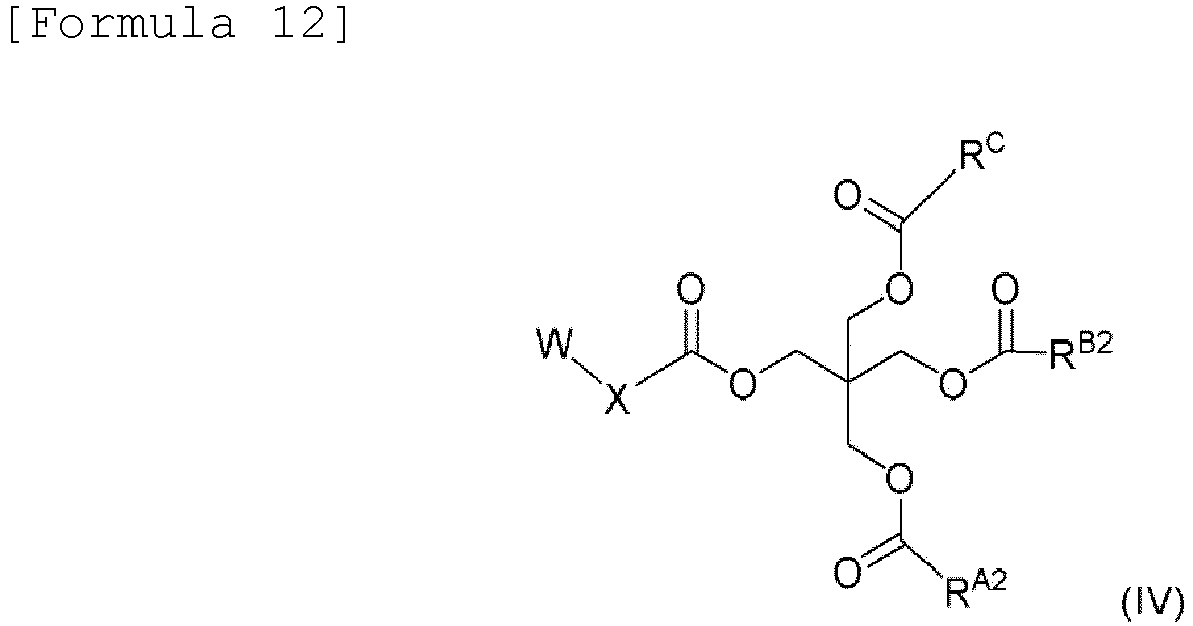
- The salt of the compound (I) is preferably a pharmacologically acceptable salt. Examples thereof include salts with inorganic bases, salts with organic bases, salts with inorganic acids, salts with organic acids, and salts with basic or acidic amino acids.
- Preferred examples of the salts with inorganic bases include: alkali metal salts such as sodium salt and potassium salt; alkaline earth metal salts such as calcium salt and magnesium salt; aluminum salt; and ammonium salt. Sodium salt, potassium salt, calcium salt, and magnesium salt are preferred, and sodium salt and potassium salt are more preferred.
- Preferred examples of the salts with organic bases include salts with trimethylamine, triethylamine, pyridine, picoline, ethanolamine, diethanolamine, triethanolamine, tromethamine [tris(hydroxymethyl)methylamine], tert-butylamine, cyclohexylamine, benzylamine, dicyclohexylamine, and N,N-dibenzylethylenediamine.
- Preferred examples of the salts with inorganic acids include salts with hydrofluoric acid, hydrochloric acid, hydrobromic acid, hydroiodic acid, nitric acid, sulfuric acid, and phosphoric acid. Salts with hydrochloric acid and salts with phosphoric acid are preferred.
- Preferred examples of the salts with organic acids include salts with formic acid, acetic acid, trifluoroacetic acid, phthalic acid, fumaric acid, oxalic acid, tartaric acid, maleic acid, citric acid, succinic acid, malic acid, methanesulfonic acid, benzenesulfonic acid, and p-toluenesulfonic acid.
- Preferred examples of the salts with basic amino acids include salts with arginine, lysine, and ornithine.
- Preferred examples of the salts with acidic amino acids include salts with aspartic acid and glutamic acid.
- In the present invention, the compound of the present invention can be used as a cationic lipid. The cationic lipid may form a complex with a plurality of molecules in a solvent or a dispersion medium. The complex may contain an additional component, in addition to the compound of the present invention. Examples of the additional component include other lipid components and nucleic acids.
- Examples of the other lipid components include structured lipids that can constitute lipid particles. For example, at least one member selected from the group consisting of:
- sterols (e.g., cholesterol, cholesterol ester, and cholesteryl hemisuccinate);
- phospholipids (e.g., phosphatidylcholines (e.g., dipalmitoylphosphatidylcholine, distearoylphosphatidylcholine, lysophosphatidylcholine, dioleoylphosphatidylcholine, palmitoyloleoylphosphatidylcholine, dilinolenoylphosphatidylcholine, MC-1010 (NOF Corporation), MC-2020 (NOF Corporation), MC-4040 (NOF Corporation), MC-6060 (NOF Corporation), and MC-8080(NOF Corporation)), phosphatidylserines (e.g., dipalmitoylphosphatidylserine, distearoylphosphatidylserine, dioleoylphosphatidylserine, and palmitoyloleoylphosphatidylserine), phosphatidylethanolamines (e.g., dipalmitoylphosphatidylethanolamine, distearoylphosphatidylethanolamine, dioleoylphosphatidylethanolamine, palmitoyloleoylphosphatidylethanolamine, and lysophosphatidylethanolamine), phosphatidylinositol, and phosphatidic acid); and
- polyethylene glycol lipids (PEG lipids) (e.g., PEG-DAA, PEG-DAG, PEG-phospholipid conjugate, PEG-Cer, PEG-cholesterol, PEG-C-DOMG, 2KPEG-CMG, GM-020 (NOF Corporation), GS-020 (NOF Corporation), and GS-050 (NOF Corporation))
- The ratio between the compound of the present invention and the structured lipid in a mixed lipid component forming the lipid particle of the present invention can be appropriately adjusted according to a purpose or an application. For example, the ratio of the structured lipid is usually 0.008 to 4 mol, preferably 0.4 to 1.5 mol, based on 1 mol of the compound of the present invention. According to another definition, the contents in the mixed lipid component are usually 1 to 4 mol of the compound of the present invention, usually 0 to 3 mol of the sterol, usually 0 to 2 mol of the phospholipid and usually 0 to 1 mol of the polyethylene glycol lipid. In a more preferred aspect, in the case of using the compound of the present invention and an additional lipid component in a mixture, the contents are 1 to 1.5 mol of the compound of the present invention, 0 to 1.25 mol of the sterol, 0 to 0.5 mol of the phospholipid and 0 to 0.125 mol of the polyethylene glycol lipid.
- The compound of the present invention can be used for producing the lipid particle of the present invention. The lipid particle of the present invention means the complex described above except that the complex does not contain a nucleic acid. The shape of the lipid particle of the present invention is not particularly limited and includes, for example, a complex assembled by the compound of the present invention, etc. so as to constitute a spherical shape, a complex assembled thereby without constituting a specific shape, a complex dissolved in a solvent, and a complex dispersed uniformly or nonuniformly in a dispersion medium.
- The lipid particle of the present invention (e.g., a lipid particle constituted by the compound of the present invention and an additional structured lipid) can be used for producing, for example, the composition of the present invention containing the lipid particle and a nucleic acid (particularly, a nucleic acid which is a substance useful for a pharmaceutical application or an application for a research purpose). The composition of the present invention can be used as a medicament or a reagent. In the composition of the present invention, it is preferred that the maximum possible proportion of the nucleic acid should be encapsulated in the lipid particle (i.e., the rate of encapsulation should be high).
- The "nucleic acid" can be any molecule of polymerized nucleotides and molecules having functions equivalent to those of the nucleotides. Examples thereof can include RNA which is a polymer of ribonucleotides, DNA which is a polymer of deoxyribonucleotides, a polymer of a mixture of ribonucleotides and deoxyribonucleotides, and a nucleotide polymer containing a nucleotide analog. Alternatively, a nucleotide polymer containing a nucleic acid derivative may be used. The nucleic acid may be a single-stranded nucleic acid or a double-stranded nucleic acid. The double-stranded nucleic acid also includes a double-stranded nucleic acid in which one of the strands hybridizes under stringent conditions to the other strand.
- The nucleotide analog can be any molecule as long as the molecule is a ribonucleotide, a deoxyribonucleotide, RNA or DNA modified in order to improve nuclease resistance, in order to stabilize, in order to enhance affinity for a complementary strand nucleic acid, in order to enhance cell permeability, or in order to visualize the molecule, as compared with RNA or DNA. The nucleotide analog may be a naturally occurring molecule or a non-natural molecule. Examples thereof include a nucleotide analog with a modified sugar moiety and a nucleotide analog with a modified phosphodiester bond.
- The nucleotide analog with a modified sugar moiety can be any molecule as long as an arbitrary chemical structural substance is added to or replaced for a portion or the whole of the chemical structure of a sugar in a nucleotide. Specific examples thereof include a nucleotide analog substituted by 2'-O-methyl ribose, a nucleotide analog substituted by 2'-O-propyl ribose, a nucleotide analog substituted by 2'-methoxyethoxy ribose, a nucleotide analog substituted by 2'-O-methoxyethyl ribose, a nucleotide analog substituted by 2'-O-[2-(guanidium)ethyl]ribose, a nucleotide analog substituted by 2'-fluoro ribose, a nucleic acid analog with a sugar moiety substituted by a morpholino ring (morpholino nucleic acid), bridged nucleic acid (BNA) having two cyclic structures by the introduction of a bridged structure to the sugar moiety, more specifically, locked nucleic acid (LNA) with an oxygen atom at position 2' and a carbon atom at position 4' bridged via methylene, and ethylene bridged nucleic acid (ENA) [Nucleic Acid Research, 32, e175 (2004)], and amide-bridged nucleic acid (AmNA) with a carbon atom at position 2' and a carbon atom at position 4' bridged via an amide bond, and can further include peptide nucleic acid (PNA)[Acc. Chem. Res., 32, 624 (1999)], oxypeptide nucleic acid (OPNA) [J. Am. Chem. Soc., 123, 4653 (2001)], and peptide ribonucleic acid (PRNA) [J. Am. Chem. Soc., 122, 6900 (2000)].
- The nucleotide analog with a modified phosphodiester bond can be any molecule as long as an arbitrary chemical structural substance is added to or replaced for a portion or the whole of the chemical structure of a phosphodiester bond in a nucleotide. Specific examples thereof can include a nucleotide analog substituted by a phosphorothioate bond, and a nucleotide analog substituted by a N3'-P5' phosphoramidate bond [Cell Engineering, 16, 1463-1473 (1997)] [RNAi Method and Antisense Method, Kodansha Ltd. (2005)].
- The nucleic acid derivative can be any molecule as long as the molecule is a nucleic acid with another chemical substance added thereto in order to improve nuclease resistance, in order to stabilize, in order to enhance affinity for a complementary strand nucleic acid, in order to enhance cell permeability, or in order to visualize the molecule, as compared with a nucleic acid. Specific examples thereof can include a 5'-polyamine-added derivative, a cholesterol-added derivative, a steroid-added derivative, a bile acid-added derivative, a vitamin-added derivative, a Cy5-added derivative, a Cy3-added derivative, a 6-FAM-added derivative, and a biotin-added derivative.
- The nucleic acid according to the present invention is not particularly limited and may be a nucleic acid aimed at, for example, amelioration of a disease, a symptom, a disorder, or morbidity, and reduction of a disease, a symptom, a disorder or a pathological condition or prevention of onset thereof (in the present specification, also referred to as the "treatment, etc. of a disease"), or may be a nucleic acid for regulating the expression of the desired protein useful for research, albeit not contributing to the treatment, etc. of a disease.
- Information on a gene or a polynucleotide related to a disease (in the present specification, also referred to as the "disease-related gene") is available from, for example, McKusick-Nathans Institute of Genetic Medicine, Johns Hopkins University (Baltimore, Md.) and National Center for Biotechnology Information, National Library of Medicine (Bethesda, Md.).
- Specific examples of the nucleic acid according to the present invention include single-stranded DNA, double-stranded DNA, siRNA, miRNA, miRNA mimic, antisense nucleic acid, ribozyme, mRNA, gRNA, decoy nucleic acid, and aptamer, each of which may be an analog or derivative obtained by artificial modification. The nucleic acid is preferably DNA or RNA such as single-stranded DNA, double-stranded DNA, siRNA, mRNA, or gRNA, or an analog or derivative thereof obtained by artificial modification.
- In the present invention, the "siRNA" means double-stranded RNA of 10 to 30 bases, preferably 15 to 25 bases, or an analog thereof, containing complementary sequences. The siRNA has preferably 1 to 3, more preferably 2 overhang bases at the 3' end. The complementary sequence moiety may be completely complementary or may contain a noncomplementary base, and is preferably completely complementary.
- The siRNA according to the present invention is not particularly limited, and, for example, siRNA for knocking down the gene expression of a disease-related gene can be used. The disease-related gene refers to an arbitrary gene or polynucleotide that yields a transcription or translation product at an abnormal level or in an abnormal form in a cell derived from an affected tissue as compared with a non-diseased control tissue or cell. Alternatively, siRNA for regulating the expression of the desired protein useful for research may be used as the siRNA according to the present invention.
- In the present invention, the "mRNA" means RNA containing a nucleotide sequence translatable into a protein. The mRNA according to the present invention is not particularly limited as long as the mRNA can cause intracellular expression of the desired protein. The mRNA is preferably mRNA useful for a pharmaceutical application (e.g., an application to disease treatment) and/or an application for a research purpose. Examples of such mRNA include mRNA for the intracellular expression of a marker protein such as luciferase.
- In the present invention, the "gRNA" means guide RNA adapted to a CRISPR system. The gRNA according to the present invention may be in the form of a single RNA strand composed of crRNA and tracrRNA linked to each other, i.e., chimeric RNA (also called single guide RNA, sgRNA, etc.), or may be in the form of individual single RNA strands that are not linked (a combination of two RNA strands or a combination of three or more RNA strands).
- In the present invention, the "DNA" means DNA containing a nucleotide sequence transcribable into mRNA. The DNA according to the present invention is not particularly limited as long as the DNA is transcribed into the desired mRNA in a cell. The DNA is preferably DNA useful for a pharmaceutical application (e.g., an application to disease treatment) and/or an application for a research purpose. Examples of such DNA include plasmid DNA (pDNA), single-stranded DNA (ssDNA), Nanoplasmid, minicircle DNA (Minicircle), closed-ended DNA (ceDNA), Doggybone DNA (dbDNA), ministring DNA (msDNA), and linear DNA (linDNA). Examples of such DNA include DNA for the intracellular expression of a marker protein such as luciferase.
- The DNA according to the present invention may contain an enhancer or a promoter. The enhancer or the promoter according to the present invention is not particularly limited as long as the enhancer or the promoter can control transcription into the desired mRNA in a cell. Examples of the promoter or the enhancer include ApoE/hAAT enhancer or promoter, CAG promoter, CMV (cytomegalovirus) promoter, RSV (Rous sarcoma virus) promoter or enhancer, SV40 promoter, DHFR (dihydrofolate reductase) promoter, EF1α promoter, EF and CBA (chicken β-actin) promoter, PGK (phosphoglycerate kinase) promoter, hSYN (human synapsin) promoter, MND promoter, RSV (Rous sarcoma virus LTR) promoter, chicken beta actin + intron promoter, TRE (tetracycline-responsive element) promoter, UBC (ubiquitin C) promoter, MSCV U3 (murine stem cell virus LTR) promoter, GALV U3 (gibbon ape leukemia virus LTR) promoter, GUSB (beta glucuronidase) promoter, MeCP2 promoter, GFAP (glial fibrillary acidic protein) promoter, human beta actin promoter, EBV (Epstein-Barr virus) promoter, and SFFV (spleen focus forming virus LTR) promoter. The enhancer or the promoter is preferably CMV promoter or CAG promoter.
- Examples of the disease described above include, but are not particularly limited to, diseases described in the (1)-(7) below. Examples of the disease-related gene are shown within the parentheses "()" except for the case where specific examples of the disease are described. Examples of the nucleic acid according to the present invention also include nucleic acids regulating the expression levels of these disease-related genes (or proteins encoded thereby).
-
- (1) Hematological diseases: anemia (CDAN1, CDA1, RPS19, DBA, PKLR, PK1, NT5C3, UMPH1, PSN1, RHAG, RH50A, NRAMP2, SPTB, ALAS2, ANH1, ASB, ABCB7, ABC7, and ASAT), bare lymphocyte syndrome (TAPBP, TPSN, TAP2, ABCB3, PSF2, RING11, MHC2TA, C2TA, and RFX5), bleeding diseases (TBXA2R, P2RX1, and P2X1), factor H and factor H-like factor 1 deficiency(HF1, CFH, and HUS), factor V and factor VIII deficiency (MCFD2), factor VII deficiency (F7), factor X deficiency (F10), factor XI deficiency (F11), factor XII deficiency (F12 and HAF), factor XIIIA deficiency (F13A1 and F13A), factor XIIIB deficiency (F13B), fanconi anemia (FANCA, FACA, FA1, FA, FAA, FAAP95, FAAP90, FLJ34064, FANCB, FANCC, FACC, BRCA2, FANCD1, FANCD2, FANCD, FACD, FAD, FACE, FACE, FANCF, XRCC9, FANCG, BRIP1, BACH1, FANCJ, PHF9, FANCL, FANCM, and KIAA1596), hemophagocytic lymphohistiocytosis (PRF1, HPLH2, UNC13D, MUNC13-4, HPLH3, HLH3, and FHL3), hemophilia A (F8, F8C, and HEMA), hemophilia B (F9 and HEMB), bleeding disorders (PI, ATT, and F5), leukocyte defect (ITGB2, CD18, LCAMB, LAD, EIF2B1, EIF2BA, EIF2B2, EIF2B3, EIF2B5, LVWM, CACH, CLE, and EIF2B4), sickle-cell anemia (HBB), thalassemia (HBA2, HBB, HBD, LCRB, and HBA1), von Willebrand disease (VWF), hypoalbuminemia, hypovolemia, severe congenital protein C deficiency, prothrombin deficiency, etc.
- (2) Inflammatory or immunological diseases: AIDS (KIR3DL1, NKAT3, NKB1, AMB11, KIR3DS1, IFNG, CXCL12, and SDF1), autoimmune lymphoproliferative syndrome (TNFRSF6, APT1, FAS, CD95, and ALPS1A), combined immunodeficiency disease (IL2RG, SCIDX1, SCIDX, and IMD4), HIV infection (CCL5, SCYA5, D17S135E, TCP228, IL10, CSIF, CMKBR2, CCR2, DMKBR5, CCCKR5, and CCR5), immunodeficiency disease (CD3E, CD3G, AICDA, AID, HIGM2, TNFRSF5, CD40, UNG, DGU, HIGM4, TNFSF5, CD40LG, HIGM1, IGM, FOXP3, IPEX, AIID, XPID, PIDX, TNFRSF14B, and TACI), inflammation (IL10, IL-1, IL-13, IL-17, IL-23, and CTLA4), severe combined immunodeficiency disease (JAK3, JAKL, DCLRE1C, ATREMIS, SCIDA, RAG1, RAG2, ADA, PTPRC, CD45, LCA, IL7R, CD3D, T3D, IL2RG, SCIDX1, SCIDX, and IMD4), primary immunodeficiency, secondary immunodeficiency, multifocal motor neuropathy, Guillain-Barre syndrome, chronic inflammatory demyelinating neuropathy, rheumatoid arthritis, psoriasis, inflammatory bowel disease (e.g., Crohn disease and colitis ulcerosa), Sjogren's syndrome, Behcet's disease, multiple sclerosis, systemic lupus erythematosus, lupus nephritis, discoid lupus erythematosus, Castleman's disease, ankylosing spondylitis, polymyositis, dermatomyositis, polyarteritis nodosa, mixed connective tissue disease, scleroderma, lupus erythematosus profundus, chronic thyroiditis, Graves' disease, autoimmune gastritis, type I and type II diabetes mellitus, autoimmune hemolytic anemia, autoimmune neutropenia, thrombocytopenia, atopic dermatitis, chronic active hepatitis, myasthenia gravis, graft versus host disease, Addison's disease, abnormal immune response, arthritis, dermatitis, radiodermatitis, primary biliary cirrhosis, etc.
- (3) Metabolic, liver, or kidney diseases: amyloid neuropathy (TTR and PALB), amyloidosis (APOA1, APP, AAA, CVAP, AD1, GSN, FGA, LYZ, TTR, and PALB), non-alcoholic steatohepatitis and hepatic fibrosis (COL1A1), hepatic cirrhosis (KRT18, KRT8, CIRH1A, NAIC, TEX292, and KIAA1988), cystic fibrosis (CFTR, ABCC7, CF, and MRP7), glycogen storage disease (SLC2A2, GLUT2, G6PC, G6PT, G6PT1, GAA, LAMP2, LAMPB, AGL, GDE, GBE1, GYS2, PYGL, and PERM), hepatocellular adenoma (TCF1, HFN1A, and MODY3), hepatic failure (SCOD1 and SCO1), hepatic lipase deficiency (LIPC), hepatoblastoma (CTNNB1, PDFGRL, PDGRL, PRLTS, AXIN1, AXIN, TP53, P53, LFS1, IGF2R, MPRI, MET, CASP8, and MCH5), medullary cystic kidney disease (UMOD, HNFJ, FJHN, MCKD2, and ADMCKD2), phenyl ketonuria (PAH, PKU1, QDPR, DHPR, and PTS), polycystic kidney and liver diseases (FCYT, PKHD1, APRKD, PDK1, PDK2, PDK4, PDKTS, PRKCSH, G19P1, PCLD, and SEC63), Hunter syndrome, lysosome disease, Fabry's disease, Pompe's disease, Gaucher's disease, mucopolysaccharidosis, hypoparathyroidism, Wilson's disease, etc.
- (4) Neurological diseases: ALS (SOD1, ALS2, STEX, FUS, TARDBP, and VEGF), Alzheimer's disease (APP, AAA, CVAP, AD1, APOE, AD2, PSEN2, AD4, STM2, APBB2, FE65L1, NOS3, PLAU, URK, ACE, DCP1, ACE1, MPO, PACIP1, PAXIP1L, PTIP, A2M, BLMH, BMH, PSEN1, and AD3), autism (BZRAP1, MDGA2, GLO1, MECP2, RTT, PPMX, MRX16, MRX79, NLGN3, NLGN4, KIAA1260, and AUTSX2), fragile X syndrome (FMR2, FXR1, FXR2, and mGLUR5), Huntington's disease (HD, IT15, PRNP, PRIP, JPH3, JP3, HDL2, TBP, and SCA17), Parkinson's disease (NR4A2, NURR1, NOT, TINUR, SNCAIP, TBP, SCA17, SNCA, NACP, PARK1, PARK4, DJ1, DBH, and NDUFV2), Rett syndrome (MECP2, RTT, PPMX, MRX16, MRX79, CDKL5, and STK9), schizophrenia (GSK3, 5-HTT, COMT, DRD, SLC6A3, DAOA, and DTNBP1), secretase-related disorder (APH-1), etc.
- (5) Eye diseases: age-related macular degeneration (Abcr, Ccl2, cp, Timp3, cathepsin D, Vldlr, and Ccr2), cataract (CRYAA, CRYA1, CRYBB2, CRYB2, PITX3, BFSP2, CP49, CP47, PAX6, AN2, MGDA, CRYBA1, CRYB1, CRYGC, CRYG3, CCL, LIM2, MP19, CRYGD, CRYG4, BSFP2, CP49, CP47, HSF4, CTM, MIP, AQP0, CRYAB, CRYA2, CTPP2, CRYBB1, CRYGD, CRYG4, CRYA1, GJA8, CX50, CAE1, GJA3, CX46, CZP3, CAE3, CCM1, CAM, and KRIT1), corneal opacity (APOA1, TGFB1, CSD2, CDGG1, CSD, BIGH3, CDG2, TASTD2, TROP2, M1S1, VSX1, RINX, PPCD, PPD, KTCN, COL8A2, FECD, PPCD2, PIP5K3, and CFD), cornea plana congenita familiares (KERA and CNA2), glaucoma (MYOC, TIGR, GLC1A, JOAG, GPOA, OPTN, GLC1E, FIP2, HYPL, NRP, CYP1B1, GLC3A, OPA1, NTG, NPG, CYP1B1, and GLC3A), Leber's congenital amaurosis (CRB1, RP12, CRX, CORD2, CRD, RPGRIP1, LCA6, CORD9, RPE65, RP20, AIPL1, LCA4, GUCY2D, GUC2D, LCA1, CORD6, RDH12, and LCA3), macular dystrophy (ELOVL4, ADMD, STGD2, STGD3, RDS, RP7, PRPH2, PRPH, AVMD, AOFMD, and VMD2), etc.
- (6) Noplastic diseases: malignant tumor, neovascular glaucoma, infantile hemangioma, hereditary angioedema, multiple myeloma, chronic sarcoma, metastatic melanoma, Kaposi's sarcoma, vascular proliferation, cachexia, metastasis of breast cancer, etc., cancers (e.g., colorectal cancer (e.g., familial colorectal cancer, hereditary non-polyposis colorectal cancer, and gastrointestinal stromal tumor), lung cancer (e.g., non-small cell lung cancer, small-cell lung cancer, and malignant mesothelioma), mesothelioma, pancreatic cancer (e.g., ductal pancreatic cancer), stomach cancer (e.g., papillary adenocarcinoma, mucous adenocarcinoma, and adenosquamous carcinoma), breast cancer (e.g., invasive ductal breast cancer, noninvasive ductal breast cancer, and inflammatory breast cancer), ovarian cancer (e.g., epithelial ovarian cancer, extragonadal germ cell tumor, ovarian germ cell tumor, and ovarian tumor of low malignant potential), prostate cancer (e.g., hormone-dependent prostate cancer and hormone-independent prostate cancer), liver cancer (e.g., primary liver cancer and extrahepatic bile duct cancer), thyroid cancer (e.g., medullary thyroid cancer), kidney cancer (e.g., renal cell cancer and transitional cell cancer of the renal pelvis and ureter), uterine cancer, brain tumor (e.g., pineal astrocytoma, pilocytic astrocytoma, diffuse astrocytoma, and anaplastic astrocytoma), melanoma, sarcoma, bladder cancer, blood cancer, etc. including multiple myeloma, pituitary adenoma, glioma, acoustic schwannoma, retinal sarcoma, throat cancer, voice box cancer, tongue cancer, thymoma, esophageal cancer, duodenal cancer, colon cancer, rectal cancer, hepatocellular carcinoma, pancreatic endocrine tumor, bile duct cancer, gallbladder cancer, penis cancer, ureter cancer, testicular tumor, vulval cancer, uterine cervical cancer, uterine body cancer, uterine sarcoma, trophoblastic disease, vaginal cancer, skin cancer, mycosis fungoides, basal cell tumor, soft tissue sarcoma, malignant lymphoma, Hodgkin's disease, myelodysplastic syndrome, adult T cell leukemia, chronic myeloproliferative disease, pancreatic endocrine tumor, fibrous histiocytoma, leiomyosarcoma, rhabdomyosarcoma, and cancer of unknown primary origin), leukemia (e.g., acute leukemia (e.g., acute lymphatic leukemia and acute myeloid leukemia), chronic leukemia (e.g., chronic lymphatic leukemia and chronic myeloid leukemia), and myelodysplastic syndrome), uterine sarcoma (e.g., mixed mesodermal tumor, uterine leiomyosarcoma, and endometrial stromal tumor), myelofibrosis, etc.
- (7) Other diseases: IgA nephropathy, aplastic anemia, sarcoidosis, Williams syndrome, Marfan syndrome, muscular dystrophy, spinocerebellar degeneration, hypoparathyroidism, pemphigus, pemphigoid, amyotrophic lateral sclerosis, schistorrhachis, hypertrophic cardiomyopathy, idiopathic thrombocytopenic purpura, ankylosing spondylitis, osteomalacia, dermatomyositis, IgG4-related disease, Usher syndrome, Apert syndrome, Alport's syndrome, Angelman syndrome, West syndrome, spinal muscular atrophy, Werner's syndrome, Osler-Weber-Rendu disease, Crouzon syndrome, Creutzfeldt-Jakob disease, POEMS syndrome, prion disease, Shy-Drager syndrome, Charcot-Marie-Tooth disease, Sturge-Weber syndrome, Stevens-Johnson syndrome, SMON, Sotos syndrome, Dravet syndrome, Noonan syndrome, Buerger's disease, Hirschsprung disease, Pfeiffer syndrome, tetralogy of Fallot, phenyl ketonuria, Prader-Willi syndrome, porphyria, mitochondrial disease, maple syrup urine disease, familial hypercholesterolemia, familial Mediterranean fever, Kabuki syndrome, fulminant hepatitis, tuberous sclerosis complex, polyarteritis nodosa, thrombotic thrombocytopenic purpura, microscopic polyangiitis, primary sclerosing cholangitis, primary biliary cholangitis, eosinophilic sinusitis, Takayasu arteritis, osteogenesis imperfecta, mixed connective-tissue disease, optic neuromyelitis, autoimmune hepatitis, autoimmune hemolytic anemia, xeroderma pigmentosum, progressive supranuclear palsy, adult Still's disease, syringomyelia, congenital myopathy, generalized scleroderma, multiple system atrophy, aortitis syndrome, corticobasal degeneration, biliary atresia, fatal familial insomnia, toxic epidermal necrolysis, idiopathic interstitial pneumonia, chondrodystrophia foetalis, pustular psoriasis, pulmonary arterial hypertension, inclusion body myositis, chronic inflammatory demyelinating polyneuropathy, chronic active Epstein-Barr virus infection, retinitis pigmentosa, Cushing disease, familial chronic pyoderma, autosomal dominant polycystic kidney, 1p36 deletion syndrome, 22q11.2 deletion syndrome, HTLV-1-associated myelopathy, Aicardi syndrome, Weaver syndrome, granulomatosis with polyangiitis, Ehlers-Danlos syndrome, Emanuel syndrome, Klippel-Trenanay-Weber syndrome, Cockayne syndrome, Costello syndrome, Coffin-Siris syndrome, Coffin-Lowry syndrome, Smith-Magenis syndrome, thanatophoric dysplasia, Tangier disease, CHARGE syndrome, Budd-Chiari syndrome, peroxisomal disease, epilepsy with myoclonic absence, Moebius syndrome, Menkes disease, lymphangioleiomyomatosis, Rubinstein-Taybi syndrome, Leber hereditary optic neuropathy, subacute sclerosing panencephalitis, ossification of ligamentum flavum, familial benign chronic pemphigus, oculocutaneous albinism, giant cell arteritis, ossification of posterior longitudinal ligament, coexisting cervical and lumbar spinal stenosis, hyper IgD syndrome, relapsing polychondritis, tricuspid valve atresia, congenital ichthyosis, polysplenia syndrome, pseudoxanthoma elasticum, delayed endolymphatic hydrops, Nakajo-Nishimura syndrome, hypophosphatasia, idiopathic portal hypertension, Nasu-Hakola disease, acute encephalitis with refractory, repetitive partial seizures, urea cycle defect, pulmonary alveolar proteinosis, paroxysmal nocturnal hemoglobinuria, pachydermoperiostosis, bronchiolitis obliterans, Arima syndrome, acute encephalopathy with biphasic seizures and late reduced diffusion, Epstein syndrome, fanconi anemia, 4p deletion syndrome, 5p deletion syndrome, Ullrich disease, Occipital horn syndrome, Carney complex, galactose-1-phosphate uridyltransferase deficiency, Galloway-Mowat syndrome, Mowat-Wilson syndrome, Young-Simpson syndrome, Landau-Kleffner syndrome, Rothmund-Thomson syndrome, pyogenic sterile arthritis, pyoderma gangrenosum and acne syndrome, interstitial cystitis, giant lymphatic malformation, eosinophilic granulomatosis with polyangiitis, autoimmune hemorrhaphilia XIII, congenital dyserythropoietic anemia, septo-optic dysplasia, branchio-oto-renal syndrome, etc.
- The composition of the present invention as a medicament can be produced by a method known in the field of pharmaceutical formulation techniques using a pharmaceutically acceptable carrier. Examples of the dosage form of the medicament can include preparations for parenteral administration (e.g., solutions such as injections) supplemented with auxiliary agents commonly used such as a buffer and/or a stabilizer, and local preparations such as ointments, creams, solutions or plasters supplemented with pharmaceutical carriers commonly used.
- The composition of the present invention can be used for transferring an active ingredient to many types of cells, tissues or organs. Examples of the cell to which the composition of the present invention can be applied include spleen cell, nerve cell, glia cell, pancreatic B cell, bone marrow cell, mesangial cell, Langerhans cell, epidermal cell, epithelial cell, endothelial cell, fibroblast, fiber cell, muscle cell (e.g., skeletal muscle cell, cardiac muscle cell, myoblast, and satellite cell), fat cell, immune cell (e.g., macrophage, T cell, B cell, natural killer cell, mast cell, neutrophil, basophil, eosinophil, monocyte, and megakaryocyte), synovial cell, cartilage cell, bone cell, osteoblast, osteoclast, mammary gland cell, liver cell or stromal cell, egg cell, sperm cell, or progenitor cell inducible to differentiate into these cells, stem cell (including e.g., induced pluripotent stem cell (iPS cell) and embryonic stem cell (ES cell)), blood cell, oocyte, and fertilized egg. Examples of the tissue or the organ to which the composition of the present invention can be applied include every tissue or organ where the cell described above are present, for example, brain, each site of brain (e.g., olfactory bulb, amygdaloid nucleus, cerebral basal ganglia, hippocampus, thalamus, hypothalamus, hypothalamic nucleus, cerebral cortex, oblong medulla, cerebellum, occipital lobe, frontal lobe, temporal lobe, putamen, caudate nucleus, corpus callosum, and substantia nigra), spinal cord, pituitary gland, stomach, pancreas, kidney, liver, genital gland, thyroid gland, gallbladder, bone marrow, adrenal gland, skin, muscle, lung, gastrointestinal tract (e.g., large intestine and small intestine), vascular vessel, heart, thymus gland, spleen, submandibular gland, peripheral blood, peripheral blood cell, prostate, testis, orchis, ovary, placenta, uterus, bone, joint and skeletal muscle. These cells, tissues or organs may be cancer cells, cancer tissues or the like resulting from malignant transformation.
- The compound, the lipid particle and the composition of the present invention can be used with stability, low toxicity and safety. In the case of using the composition of the present invention in vivo or as a medicament, the composition can be administered to a recipient (e.g., a human or a nonhuman mammal (e.g., a mouse, a rat, a hamster, a rabbit, a cat, a dog, cattle, sheep, or a monkey) (preferably a human)) such that an effective amount of the nucleic acid is delivered to a targeted cell.
- In the case of using the composition of the present invention in vivo or as a medicament, the composition can be safely administered as a pharmaceutical preparation, for example, tablets (including sugar-coated tablets, film-coated tablets, sublingual tablets, and orally disintegrating tablets), powders, granules, capsules (including soft capsules and microcapsules), solutions, troches, syrups, emulsions, suspensions, injections (e.g., subcutaneous injections, intravenous injections, intramuscular injections, and intraperitoneal injections), external preparations (e.g., transnasal administration preparations, transdermal preparations, ointments), suppositories (e.g., rectal suppositories and vaginal suppositories), pellets, transnasal agents, transpulmonary agents (inhalants), or drops, through an oral or parenteral (e.g., local, rectal, or intravenous administration) route. These preparations may be release-controlled preparations such as quick-release preparations or sustained-release preparations (e.g., sustained-release microcapsules).
- Hereinafter, a method for producing the compound of the present invention will be described.
- A starting material or a reagent used in each step in the production method given below and the obtained compound may each form a salt. Examples of such a salt include the same as the aforementioned salt of the compound of the present invention.
- When the compound obtained in each step is a free compound, this compound can be converted to a salt of interest by a known method. On the contrary, when the compound obtained in each step is a salt, this salt can be converted to a free form or another type of salt of interest by a known method.
- The compound obtained in each step may be used in the next reaction in the form of its reaction solution or after being obtained as a crude product. Alternatively, the compound obtained in each step can be isolated and/or purified from the reaction mixture by a separation approach such as concentration, crystallization, recrystallization, distillation, solvent extraction, fractionation, or chromatography according to a routine method.
- If a starting material or a reagent compound for each step is commercially available, the commercially available product can be used directly.
- In the reaction of each step, the reaction time may differ depending on the reagent or the solvent used and is usually 1 minute to 72 hours, preferably 10 minutes to 48 hours, unless otherwise specified.
- In the reaction of each step, the reaction temperature may differ depending on the reagent or the solvent used and is usually -78°C to 300°C, preferably -78°C to 150°C, unless otherwise specified.
- In the reaction of each step, the pressure may differ depending on the reagent or the solvent used and is usually 1 atm to 20 atm, preferably 1 atm to 3 atm, unless otherwise specified.
- In the reaction of each step, a microwave synthesis apparatus, for example, Initiator manufactured by Biotage Japan Ltd., may be used. The reaction temperature may differ depending on the reagent or the solvent used and is usually room temperature to 300°C, preferably room temperature to 250°C, more preferably 50°C to 250°C, unless otherwise specified. The reaction time may differ depending on the reagent or the solvent used and is usually 1 minute to 48 hours, preferably 1 minute to 8 hours, unless otherwise specified.
- In the reaction of each step, the reagent is used at 0.5 equivalents to 20 equivalents, preferably 0.8 equivalents to 5 equivalents, based on the substrate, unless otherwise specified. In the case of using the reagent as a catalyst, the reagent is used at 0.001 equivalents to 1 equivalent, preferably 0.01 equivalents to 0.2 equivalents, based on the substrate. When the reagent also serves as a reaction solvent, the reagent is used in the amount as the solvent.
- In the reaction of each step, this reaction is carried out without a solvent or by dissolution or suspension in an appropriate solvent, unless otherwise specified. Specific examples of the solvent include solvents described in Examples and the following:
- alcohols: methanol, ethanol, isopropanol, isobutanol, tert-butyl alcohol, 2-methoxyethanol, and the like;
- ethers: diethyl ether, diisopropyl ether, diphenyl ether, tetrahydrofuran, 1,2-dimethoxyethane, cyclopentyl methyl ether, and the like;
- aromatic hydrocarbons: chlorobenzene, toluene, xylene, and the like;
- saturated hydrocarbons: cyclohexane, hexane, heptane, and the like;
- amides: N,N-dimethylformamide, N-methylpyrrolidone, and the like;
- halogenated hydrocarbons: dichloromethane, carbon tetrachloride, and the like;
- nitriles: acetonitrile and the like;
- sulfoxides: dimethyl sulfoxide and the like;
- aromatic organic bases: pyridine and the like;
- acid anhydrides: acetic anhydride and the like;
- organic acids: formic acid, acetic acid, trifluoroacetic acid, and the like;
- inorganic acids: hydrochloric acid, sulfuric acid, and the like;
- esters: ethyl acetate, acetic acid isopropyl ester, and the like;
- ketones: acetone, methyl ethyl ketone, and the like; and
- water.
- Two or more of these solvents may be used as a mixture at an appropriate ratio.
- In the case of using a base in the reaction of each step, for example, the following base or a base described in Examples is used:
- inorganic bases: sodium hydroxide, potassium hydroxide, magnesium hydroxide, and the like;
- basic salts: sodium carbonate, calcium carbonate, sodium bicarbonate, and the like;
- organic bases: triethylamine, diethylamine, N,N-diisopropylethylamine, pyridine, 4-dimethylaminopyridine, N,N-dimethylaniline, 1,4-diazabicyclo[2.2.2]octane, 1,8-diazabicyclo[5.4.0]-7-undecene, imidazole, piperidine, and the like;
- metal alkoxides: sodium ethoxide, potassium tert-butoxide, sodium tert-butoxide, and the like;
- alkali metal hydrides: sodium hydride, and the like;
- metal amides: sodium amide, lithium diisopropylamide, lithium hexamethyldisilazide, and the like; and
- organic lithiums: n-butyllithium, sec-butyllithium, and the like.
- In the case of using an acid or an acidic catalyst in the reaction of each step, for example, the following acid or acidic catalyst or an acid or an acidic catalyst described in Examples is used:
- inorganic acids: hydrochloric acid, sulfuric acid, nitric acid, hydrobromic acid, phosphoric acid, and the like;
- organic acids: acetic acid, trifluoroacetic acid, citric acid, p-toluenesulfonic acid, 10-camphorsulfonic acid, and the like; and
- Lewis acids: boron trifluoride-diethyl ether complex, zinc iodide, anhydrous aluminum chloride, anhydrous zinc chloride, anhydrous iron chloride, and the like.
- The reaction of each step is carried out according to a known method, for example, a method described in The Fifth Series of Experimental Chemistry, Vol. 13 to Vol. 19 (edited by The Chemical Society of Japan); Shin Jikken Kagaku Koza (in Japanese, translated title: New Experimental Chemistry), Vol. 14 to Vol. 15 (edited by The Chemical Society of Japan); Seimitsu Yuki Kagaku (in Japanese, translated title: Precise Organic Chemistry, original title: Reaktionen und Synthesen im organisch-chemischen Praktikum und Forschungslaboratorium) Revised, 2nd Ed. (L. F. Tietze, Th. Eicher, Nankodo Co., Ltd.); Organic Named Reactions; The Reaction Mechanism and Essence, Revised (Hideo Tougo, Kodansha Ltd.); Organic Syntheses Collective Volume I to VII (John Wiley & Sons, Inc.); Modern Organic Synthesis in the Laboratory: A Collection of Standard Experimental Procedures (Jie Jack Li, Oxford University Press); Comprehensive Heterocyclic Chemistry III, Vol. 1 to Vol. 14 (Elsevier Japan KK); Strategic Applications of Named Reactions in Organic Synthesis (translated by Kiyoshi Tomioka, published by Kagaku-Dojin Publishing Company, Inc.); Comprehensive Organic Transformations (VCH Publishers, Inc.) (1989), etc., or a method described in Examples, unless otherwise specified.
- In each step, the protection or deprotection reaction of a functional group is carried out according to a known method, for example, a method described in "Protective Groups in Organic Synthesis, 4th Ed." (Theodora W. Greene, Peter G. M. Wuts), Wiley-Interscience (2007); "Protecting Groups, 3rd Ed." (P.J. Kocienski), Thieme Medical Publishers (2004), etc., or a method described in Examples.
- Examples of a protective group for a hydroxy group or a phenolic hydroxy group in an alcohol or the like include: ether-type protective groups such as methoxy methyl ether, benzyl ether, p-methoxy benzyl ether, t-butyl dimethyl silyl ether, t-butyl diphenyl silyl ether, and tetrahydropyranyl ether; carboxylic acid ester-type protective groups such as acetic acid ester; sulfonic acid ester-type protective groups such as methanesulfonic acid ester; and carbonic acid ester-type protective groups such as t-butyl carbonate.
- Examples of a protective group for a carbonyl group in an aldehyde include: acetal-type protective groups such as dimethylacetal; and cyclic acetal-type protective groups such as cyclic 1,3-dioxane.
- Examples of a protective group for a carbonyl group in a ketone include: ketal-type protective groups such as dimethylketal; cyclic ketal-type protective groups such as cyclic 1,3-dioxane; oxime-type protective groups such as O-methyloxime; and hydrazone-type protective groups such as N,N-dimethylhydrazone.
- Examples of a protective group for a carboxyl group include: ester-type protective groups such as methyl ester and benzyl ester; and amide-type protective groups such as N,N-dimethylamide.
- Examples of a protective group for a thiol include: ether-type protective groups such as benzyl thioether; and ester-type protective groups such as thioacetic acid ester, thiocarbonate, and thiocarbamate.
- Examples of a protective group for an amino group or an aromatic heterocyclic ring such as imidazole, pyrrole, or indole include: carbamate-type protective groups such as benzyl carbamate; amide-type protective groups such as acetamide; alkylamine-type protective groups such as N-triphenylmethylamine; and sulfonamide-type protective groups such as methanesulfonamide.
- These protective groups can be removed (deprotection) by use of a known method, for example, a method using an acid, a base, ultraviolet light, hydrazine, phenylhydrazine, sodium N-methyldithiocarbamate, tetrabutylammonium fluoride, palladium acetate, or trialkylsilyl halide (e.g., trimethylsilyl iodide and trimethylsilyl bromide), or a reduction method.
- In the case of carrying out reduction reaction in each step, examples of the reducing agent used include: metal hydrides such as lithium aluminum hydride, sodium triacetoxyborohydride, sodium cyanoborohydride, diisobutyl aluminum hydride (DIBAL-H), sodium borohydride, and tetramethylammonium triacetoxyborohydride; boranes such as a borane-tetrahydrofuran complex; Raney nickel; Raney cobalt; hydrogen; and formic acid. A catalyst such as palladium-carbon, Raney nickel or Raney cobalt can be used in the presence of hydrogen or formic acid.
- In the case of carrying out oxidation reaction in each step, examples of the oxidizing agent used include: peracids such as m-chloroperbenzoic acid (MCPBA), hydrogen peroxide, and t-butyl hydroperoxide; perchlorates such as tetrabutylammonium perchlorate; chlorates such as sodium chlorate; chlorites such as sodium chlorite; periodates such as sodium periodate; high-valent iodine reagents such as iodosylbenzene; reagents having manganese, such as manganese dioxide and potassium permanganate; leads such as lead tetraacetate; reagents having chromium, such as pyridinium chlorochromate (PCC), pyridinium dichromate (PDC), and Jones reagents; halogen compounds such as N-bromosuccinimide (NBS); oxygen; ozone; a sulfur trioxide-pyridine complex; osmium tetroxide; selenium dioxide; and 2,3-dichloro-5,6-dicyano-1,4-benzoquinone (DDQ).
- In the case of carrying out radical cyclization reaction in each step, examples of the radical initiator used include: azo compounds such as azobisisobutyronitrile (AIBN); water-soluble radical initiators such as 4-4'-azobis-4-cyanopentanoic acid (ACPA); triethylboron in the presence of air or oxygen; and benzoyl peroxide. Examples of the radical reaction agent used include tributylstannane, tristrimethylsilylsilane, 1,1,2,2-tetraphenyldisilane, diphenylsilane, and samarium iodide.
- In the case of carrying out Wittig reaction in each step, examples of the Wittig reagent used include alkylidenephosphoranes. The alkylidenephosphoranes can be prepared by a known method, for example, the reaction between a phosphonium salt and a strong base.
- In the case of carrying out Horner-Emmons reaction in each step, examples of the reagent used include: phosphonoacetic acid esters such as methyl dimethylphosphonoacetate and ethyl diethylphosphonoacetate; and bases such as alkali metal hydrides and organic lithiums.
- In the case of carrying out Friedel-Crafts reaction in each step, examples of the reagent used include a Lewis acid and an acid chloride or an alkylating agent (e.g., alkyl halides, alcohols, and olefins). Alternatively, an organic acid or an inorganic acid may be used instead of the Lewis acid, and an acid anhydride such as acetic anhydride may be used instead of the acid chloride.
- In the case of carrying out aromatic nucleophilic substitution reaction in each step, a nucleophile (e.g., amines and imidazole) and a base (e.g., basic salts and organic bases) are used as reagents.
- In the case of carrying out nucleophilic addition reaction using a carbanion, nucleophilic 1,4-addition reaction (Michael addition reaction) using a carbanion, or nucleophilic substitution reaction using a carbanion in each step, examples of the base used for generating the carbanion include organic lithiums, metal alkoxides, inorganic bases, and organic bases.
- In the case of carrying out Grignard reaction in each step, examples of the Grignard reagent include: aryl magnesium halides such as phenyl magnesium bromide; and alkyl magnesium halides such as methyl magnesium bromide and isopropyl magnesium bromide. The Grignard reagent can be prepared by a known method, for example, the reaction between alkyl halide or aryl halide and metal magnesium with ether or tetrahydrofuran as a solvent.
- In the case of carrying out Knoevenagel condensation reaction in each step, an active methylene compound flanked by two electron-attracting groups (e.g., malonic acid, diethyl malonate, and malononitrile) and a base (e.g., organic bases, metal alkoxides, and inorganic bases) are used as reagents.
- In the case of carrying out Vilsmeier-Haack reaction in each step, phosphoryl chloride and an amide derivative (e.g., N,N-dimethylformamide) are used as reagents.
- In the case of carrying out azidation reaction of alcohols, alkyl halides, or sulfonic acid esters in each step, examples of the azidating agent used include diphenylphosphorylazide (DPPA), trimethylsilylazide, and sodium azide. In the case of azidating, for example, alcohols, a method using diphenylphosphorylazide and 1,8-diazabicyclo[5.4.0]undec-7-ene (DBU), a method using trimethylsilylazide and a Lewis acid, or the like can be used.
- In the case of carrying out reductive amination reaction in each step, examples of the reducing agent used include sodium triacetoxyborohydride, sodium cyanoborohydride, hydrogen, and formic acid. When the substrate is an amine compound, examples of the carbonyl compound used include p-formaldehyde as well as aldehydes such as acetaldehyde, and ketones such as cyclohexanone. When the substrate is a carbonyl compound, examples of the amines used include: primary amine such as ammonia and methylamine; and secondary amine such as dimethylamine.
- In the case of carrying out Mitsunobu reaction in each step, azodicarboxylic acid esters (e.g., diethyl azodicarboxylate (DEAD) and diisopropyl azodicarboxylate (DIAD)) and triphenylphosphine are used as reagents.
- In the case of carrying out esterification reaction, amidation reaction, or ureation reaction in each step, examples of the reagent used include: an acyl halide form of ester form, acid chloride, acid bromide, and the like; and activated carboxylic acids such as an acid anhydride, an active ester form, a sulfuric acid ester form, and the like. Examples of the activator for carboxylic acid include: carbodiimide condensing agents such as 1-ethyl-3-(3-dimethylaminopropyl)carbodiimide hydrochloride (EDCI), N,N'-dicyclohexylcarbodiimide (DCC); triazine condensing agents such as 4-(4,6-dimethoxy-1,3,5-triazin-2-yl)-4-methylmorpholinium chloride-n-hydrate (DMT-MM); carbonic acid ester condensing agents such as 1,1-carbonyldiimidazole (CDI); diphenylphosphorylazide (DPPA); benzotriazol-1-yloxy-trisdimethylaminophosphonium salt (BOP reagent); 2-chloro-1-methyl-pyridinium iodide (Mukaiyama reagent); thionyl chloride; lower alkyl haloformate such as ethyl chloroformate; O-(7-azabenzotriazol-1-yl)-N,N,N',N'-tetramethyluronium hexafluorophosphate (HATU); sulfuric acid; or combinations thereof. An additive such as 1-hydroxybenzotriazole (HOBt), N-hydroxysuccinimide (HOSu), or dimethylaminopyridine (DMAP) may be further added for the reaction.
- In the case of carrying out coupling reaction in each step, examples of the metal catalyst used include: palladium compounds such as palladium(II) acetate, tetrakis(triphenylphosphine)palladium(0), dichlorobis(triphenylphosphine)palladium(II), dichlorobis(triethylphosphine)palladium(II), tris(dibenzylideneacetone)dipalladium(0), 1,1'-bis(diphenylphosphino)ferrocene palladium(II) chloride, and palladium(II) acetate; nickel compounds such as tetrakis(triphenylphosphine)nickel(0); rhodium compounds such as tris(triphenylphosphine)rhodium(III) chloride; cobalt compounds; copper compounds such as copper oxide and copper(I) iodide; and platinum compounds. A base may be further added for the reaction. Examples of such a base include inorganic bases and basic salts.
- In the case of carrying out thiocarbonylation reaction in each step, diphosphorus pentasulfide is typically used as a thiocarbonylating agent. A reagent having a 1,3,2,4-dithiadiphosphetane-2,4-disulfide structure such as 2,4-bis(4-methoxyphenyl-1,3,2,4-dithiadiphosphetane-2,4-disulfide (Lawesson's reagent) may be used instead of diphosphorus pentasulfide.
- In the case of carrying out Wohl-Ziegler reaction in each step, examples of the halogenating agent used include N-iodosuccinimide, N-bromosuccinimide (NBS), N-chlorosuccinimide (NCS), bromine, and sulfuryl chloride. The reaction can be accelerated by the further addition of heat, light, a radical initiator such as benzoyl peroxide or azobisisobutyronitrile for the reaction.
- In the case of carrying out halogenation reaction of a hydroxy group in each step, examples of the halogenating agent used include a hydrohalic acid and an acid halide of an inorganic acid, specifically, hydrochloric acid, thionyl chloride, and phosphorus oxychloride for chlorination, and 48% hydrobromic acid for bromination. Also, a method for obtaining an alkyl halide form from an alcohol by the action of triphenylphosphine and carbon tetrachloride or carbon tetrabromide or the like may be used. Alternatively, a method for synthesizing an alkyl halide form through 2-stage reactions involving the conversion of an alcohol to sulfonic acid ester and the subsequent reaction with lithium bromide, lithium chloride, or sodium iodide may be used.
- In the case of carrying out Arbuzov reaction in each step, examples of the reagent used include: alkyl halides such as ethyl bromoacetate; and phosphites such as triethyl phosphite and tri(isopropyl) phosphite.
- In the case of carrying out sulfone-esterification reaction in each step, examples of the sulfonylating agent used include methanesulfonyl chloride, p-toluenesulfonyl chloride, methanesulfonic anhydride, p-toluenesulfonic anhydride, and trifluoromethanesulfonic anhydride.
- In the case of carrying out hydrolysis reaction in each step, an acid or a base is used as a reagent. In the case of carrying out acid hydrolysis reaction of t-butyl ester, formic acid, triethylsilane, or the like may be added in order to reductively trap a by-product t-butyl cation.
- In the case of carrying out dehydration reaction in each step, examples of the dehydrating agent used include sulfuric acid, diphosphorus pentoxide, phosphorus oxychloride, N,N'-dicyclohexylcarbodiimide, alumina, and polyphosphoric acid.
- In the case of performing decarboxylation reaction in each step, an acid may be used. Examples of the acid include inorganic acids and organic acids.
- In the case of performing nucleophilic substitution reaction in each step, a base may be used. Examples of the base include metal alkoxides, inorganic bases and organic bases.
- The compound (I) can be produced by, for example, a production method given below. In the present invention, the compound (I) having the desired structure can be synthesized by using a starting material appropriate for the structure of the compound (I) of interest, particularly, for esterification. The salt of the compound (I) can be obtained by appropriate mixing with an inorganic base, an organic base, an organic acid, or a basic or acidic amino acid.
- Scheme 1 given below shows an exemplary production method. In the scheme 1, P1 represents a protective group, and the other symbols are the same as in the formula (I) (the same holds true for other schemes related to the scheme 1). In the scheme 1, L represents a leaving group, and RA, RB and RC may be appropriately interchanged with each other.

- Scheme 2 given below shows a method for synthesizing a compound (RA1 or RB1-COOH) for use in esterification when RA and/or RB of the compound (I) in the scheme 1 is RA/B group 1 (an optionally substituted C1-17 alkyl group, an optionally substituted C3-17 alkenyl group, or an optionally substituted C15-17 alkadienyl group), i.e., RA and/or RB is RA1 and/or RB1 described in the formula (II) or the formula (III). In the scheme 2, P2, P3, P4 and P5 each represent a protective group, Ra, Rb, Rc, Rd and Rg each represent H, an optionally substituted alkyl group, an optionally substituted alkenyl group, or an optionally substituted alkadienyl group and partially constitute RA and/or RB. The numbers of carbon atoms, substituents and structures of Ra, Rb, Rc, Rd and Rg are appropriately adjusted according to the structure of RA and/or RB of interest.

- Scheme 3 given below shows a method for synthesizing a compound (RA2 or RB2-COOH) for use in esterification when RA and/or RB of the compound (I) in the scheme 1 is RA/B group 2 (-R3-C(O)O-R4 or -R3-OC(O)-R4), i.e., RA and/or RB is RA2 and/or RB2 described in the formula (II) or the formula (III), and a compound (RC-COOH) for use in the esterification of RC in the compound (I). In the scheme 3, P6 and P7 each represent a protective group.

- Scheme 4 given below shows a method for synthesizing a compound (R4-OH) for use in esterification in the scheme 3. In the scheme 4, P4 represents a protective group, and Ra, Rb, Rc and Rd each represent H, an optionally substituted alkyl group, an optionally substituted alkenyl group, or an optionally substituted alkadienyl group and partially constitute R4. The numbers of carbon atoms, substituents and structures of Ra, Rb, Rc and Rd are appropriately adjusted according to the structure of R4 of interest.

- Scheme 5 given below shows a method for synthesizing a compound (R4-COOH) for use in esterification in the scheme 3. In the scheme 5, P4 and P5 each represent a protective group, and Ra, Rb, Rc and Rd each represent H, an optionally substituted alkyl group, an optionally substituted alkenyl group, or an optionally substituted alkadienyl group and partially constitute R4. The numbers of carbon atoms, substituents and structures of Ra, Rb, Rc and Rd are appropriately adjusted according to the structure of R4 of interest.

- Scheme 6 given below shows a method for synthesizing a compound (W-X-COOH) for use in esterification in the scheme 1. In the scheme 6, Re represents an optionally substituted alkylene group, L represents a leaving group, and P8 represents a protective group. The number of carbon atoms, substituent and structure of Re are appropriately adjusted according to the structure of X of interest.

- Scheme 7 given below shows a method for synthesizing the compound (I). In the scheme 7, Rf represents an optionally substituted alkylene group, and P9 represents a protective group. The number of carbon atoms, substituent and structure of Rf are appropriately adjusted according to the structure of W of interest.


- Hereinafter, methods for producing a lipid particle containing the compound of the present invention, and a composition for nucleic acid transfer (transfection) containing the lipid particle and a nucleic acid as an active ingredient will be described.
- The lipid particle of the present invention can be produced by a known method for preparing lipid particles from lipid components after mixing of the compound (compound (I) or a salt thereof) of the present invention as a cationic lipid, if necessary, with an additional lipid component. For example, the (mixed) lipid component described above is dissolved in an organic solvent, and the resulting solution in the organic solvent can be mixed (e.g., by an emulsification method) with water or a buffer solution to produce a lipid particle dispersion. The mixing can be performed using a microfluidic mixing system (e.g., NanoAssemblr apparatus (Precision NanoSystems Inc.)). The obtained lipid particle may be subjected to desalting or dialysis and sterile filtration. If necessary, pH adjustment or osmotic pressure adjustment may be carried out.
- The compound of the present invention may assume a plurality of structures by combinations of definitions of respective symbols (substituents, etc.) in the formula (I). In the production of the lipid particle, one type of compound (I) or salt thereof having a specific structure may be used as the compound of the present invention, or plural types of compounds (I) or salts thereof differing in structure may be used as a mixture.
- Examples of the "additional lipid component" include the structured lipids mentioned above, for example, sterols, phospholipids, and polyethylene glycol lipids. The "additional lipid component" is used at, for example, 0.008 to 4 mol, based on 1 mol of the compound of the present invention. The compound of the present invention is preferably mixed, for use, with the additional lipid component (particularly, cholesterol, phosphatidylcholine and polyethylene glycol lipid). In the case of using the compound of the present invention and an additional lipid component in a mixture, a preferred embodiment is a mixture of 1 to 4 mol of the compound of the present invention, 0 to 3 mol of the sterol, 0 to 2 mol of the phospholipid and 0 to 1 mol of the polyethylene glycol lipid. In the case of using the compound of the present invention and an additional lipid component in a mixture, a more preferred embodiment is a mixture of 1 to 1.5 mol of the compound of the present invention, 0 to 1.25 mol of the sterol, 0 to 0.5 mol of the phospholipid and 0 to 0.125 mol of the polyethylene glycol lipid.
- The concentration of the compound of the present invention or the mixture of the compound of the present invention with the additional lipid component in the solution in the organic solvent described above is preferably 0.5 to 100 mg/mL.
- Examples of the organic solvent include methanol, ethanol, 1-propanol, 2-propanol, 1-butanol, tert-butanol, acetone, acetonitrile, N,N-dimethylformamide, dimethyl sulfoxide, and mixtures thereof. The organic solvent may contain 0 to 20% of water or a buffer solution.
- Examples of the buffer solution include acidic buffer solutions (e.g., an acetate buffer solution, a citrate buffer solution, a 2-morpholinoethanesulfonic acid (MES) buffer solution, and a phosphate buffer solution), and neutral buffer solutions (e.g., a 4-(2-hydroxyethyl)-1-piperazineethanesulfonic acid (HEPES) buffer solution, a tris(hydroxymethyl)aminomethane (Tris) buffer solution, a phosphate buffer solution, and phosphate-buffered saline (PBS)).
- In the case of carrying out the mixing using a microfluidic mixing system, 1 to 5 parts by volume of water or a buffer solution are preferably mixed with 1 part by volume of the solution in the organic solvent. In the system, the flow rate of the mixed solution (the mixed solution of the solution in the organic solvent with water or the buffer solution) is, for example, 0.01 to 20 mL/min, preferably 0.1 to 10 mL/min, and the temperature is, for example, 5 to 60°C, preferably 15 to 45°C.
- The composition of the present invention can be produced as a lipid particle dispersion containing a nucleic acid by adding the nucleic acid to water or a buffer solution for the production of the lipid particle or a lipid particle dispersion. The nucleic acid is preferably added such that the concentration of the nucleic acid in water or the buffer solution is, for example, 0.01 to 20 mg/mL, preferably 0.05 to 2.0 mg/mL.
- Alternatively, the composition of the present invention may be produced as a lipid particle dispersion containing an active ingredient by mixing the lipid particle or a lipid particle dispersion with the nucleic acid or an aqueous solution thereof by a known method. The lipid particle dispersion can be prepared by dispersing the lipid particle in an appropriate dispersion medium. The aqueous solution of the active ingredient can be prepared by dissolving the active ingredient in an appropriate solvent.
- The content of the compound of the present invention in the composition of the present invention excluding the dispersion medium and the solvent is usually 10 to 70% by weight, preferably 40 to 70% by weight.
- The content of the nucleic acid in the composition of the present invention excluding the dispersion medium and the solvent is usually 0.1 to 25% by weight, preferably 1 to 20% by weight.
- The dispersion medium in the lipid particle dispersion or the dispersion containing the composition can be replaced with water or a buffer solution by dialysis. The dialysis is carried out at 4°C to room temperature using an ultrafiltration membrane having a molecular weight cutoff of 10 to 20 K. The dialysis may be performed repetitively. The replacement of the dispersion medium may employ tangential flow filtration (TFF). After the replacement of the dispersion medium, if necessary, pH adjustment or osmotic pressure adjustment may be carried out. Examples of the pH adjuster include sodium hydroxide, citric acid, acetic acid, triethanolamine, sodium hydrogen phosphate, sodium dihydrogen phosphate, and potassium dihydrogen phosphate. Examples of the osmotic pressure adjuster include: inorganic salts such as sodium chloride, potassium chloride, sodium hydrogen phosphate, potassium hydrogen phosphate, sodium dihydrogen phosphate, and potassium dihydrogen phosphate; polyols such as glycerol, mannitol, and sorbitol; and sugars such as glucose, fructose, lactose, and sucrose. The pH is usually adjusted to 6.5 to 8.0, preferably 7.0 to 7.8. The osmotic pressure is preferably adjusted to 250 to 350 Osm/kg.
- The composition of the present invention may contain, if necessary, a component other than the lipid particle and the nucleic acid. Examples of such a component include appropriate amounts of a stabilizer and an antioxidant.
- Examples of the stabilizer include, but are not particularly limited to, sugars such as glycerol, mannitol, sorbitol, lactose, and sucrose.
- Examples of the antioxidant include ascorbic acid, uric acid, cysteine, tocopherol homologs (vitamin E, four isomers tocopherol α, β, γ, and δ, etc.), EDTA, and cysteine.
- Hereinafter, methods for analyzing a lipid particle containing the compound of the present invention, and a composition containing the lipid particle and a nucleic acid as an active ingredient will be described.
- The particle size of the lipid particle (in the composition) can be measured by a known approach. For example, the particle size can be calculated as a Z-average particle size by the cumulant analysis of an autocorrelation function using a particle size measurement apparatus Zetasizer Nano ZS (Malvern Instruments) based on a dynamic light scattering measurement technique. The particle size (average particle size) of the lipid particle (in the composition) is, for example, 10 to 200 nm, preferably 60 to 170 nm.
- The concentration and rate of encapsulation of the nucleic acid (e.g., siRNA or mRNA) in the composition of the present invention can be measured by a known approach. For example, the nucleic acid is fluorescently labeled using Quant-iT(TM) RiboGreen(R) (Invitrogen Corp.), and the fluorescence intensity can be measured to determine the concentration and the rate of encapsulation. The concentration of the nucleic acid in the composition can be calculated using a calibration curve prepared from aqueous nucleic acid solutions having known concentrations. The rate of encapsulation can be calculated on the basis of the difference in fluorescence intensity between the presence and absence of addition of Triton-X 100 (surfactant for disrupting the lipid particle). The concentration of the nucleic acid in the composition refers to the total concentration of a nucleic acid encapsulated in the lipid particle and an unencapsulated nucleic acid. The rate of encapsulation refers to the ratio of the nucleic acid encapsulated in the lipid particle to all nucleic acids in the composition.
- The present invention will be described in more detail with reference to Examples, Production Examples and Test Examples given below. However, the present invention is not limited by these examples. Changes or modifications may be made therein without departing from the scope of the present invention.
- In the examples given below, the term "room temperature" usually refers to a temperature of approximately 10°C to approximately 35°C. The ratio shown in a mixed solvent refers to a volume ratio, unless otherwise specified. The term "%" refers to % by weight, unless otherwise specified.
- In the examples, elution for column chromatography was performed under observation by TLC (thin layer chromatography), unless otherwise specified. In the TLC observation, a solvent used as an eluting solvent in column chromatography was used as a developing solvent. Detection adopted a UV detector, and a TLC chromogenic reagent was used, if necessary, for observation. In silica gel column chromatography, the term "NH" means that an aminopropylsilane-bound silica gel was used, and the term "Diol" means that a 3-(2,3-dihydroxypropoxy)propylsilane-bound silica gel was used. In preparative HPLC (high-performance liquid chromatography), the term "C18" means that an octadecyl-bound silica gel was used. The ratio shown in an eluting solvent refers to a volume ratio, unless otherwise specified.
- 1H NMR was measured by Fourier transform NMR. 1H NMR was analyzed using ACD/SpecManager (trade name) software or the like. Very gentle peaks of protons of, for example, a hydroxyl group and an amino group may not be described.
- MS was measured by LC/MS or MALDI/TOFMS. ESI, APCI, or MALDI was used as an ionization method. CHCA was used as a matrix. Measured values (Found) are shown in data. A molecular ion peak is usually observed, however, the peak observed may be of a polyvalent ion or a fragment ion. For a salt, the peak observed is usually of a free molecular ion, a cationic species, an anionic species or a fragment ion.
- The following abbreviations are used in the examples given below.
- MS: mass spectrum
- M: molar concentration
- N: normality
- CDCl3: deuterated chloroform
- DMSO-d6: deuterated dimethyl sulfoxide
- 1H NMR: proton nuclear magnetic resonance
- LC/MS: liquid chromatograph-mass spectrometer
- ESI: electrospray ionization
- APCI: atmospheric pressure chemical ionization
- MALDI: matrix-assisted laser desorption/ionization
- TOFMS: time-of-flight mass spectrometry
- CHCA: α-cyano-4-hydroxycinnamic acid
- DCM: dichloromethane
- DMA: N,N-dimethylacetamide
- DMF: N,N-dimethylformamide
- THF: tetrahydrofuran
- MeOH: methanol
- EtOH: ethanol
- DMAP: 4-dimethylaminopyridine
- TBAF: tetrabutylammonium fluoride
- TBAB: tetrabutylammonium bromide
- DIBAL-H: diisobutyl aluminum hydride
- DBU:1,8-diazabicyclo[5,4,0]undec-7-ene
- TEA: triethylamine
- EDCI: 1-ethyl-3-(3-dimethylaminopropyl)carbodiimide hydrochloride
- DCC: N,N'-dicyclohexylcarbodiimide
- HOBt: 1-hydroxybenzotriazole
- Compounds of Examples 1 to 173 (compounds 1 to 173) shown in Table 1 below were produced in accordance with the production methods described in the present specification. More specific production methods will be given below as to Examples 3, 13, 22, 33, 39, 51, 70, 73, 93, 115, 119, 121, 132 and 173 among these Examples.
[Table 1-1] Example No. IUPAC name Structural formula MS:m/z ([M+H]+ or [M+2H]2+ or [M]+) 1 1,1'-[2-{[(9-Butoxy-9-oxononanoyl)oxy]methyl}-2-({[4-(dimethylamino)butanoyl]oxy}m ethyl)propane-1,3-diyl] 9,9'-dibutyl dinonanedioate 
928.6 2 1,1'-[2-{[(9-Butoxy-9-oxononanoyl)oxy]methyl}-2-({[5-(dimethylamino)pentanoyl]oxy} methyl)propane-1,3-diyl] 9,9'-dibutyl dinonanedioate 
942.7 3 1,1'-2-{[(N,N-Dimethyl-beta-alanyl)oxy]methyl}-2-({[6-(heptyloxy)-6-oxohexanoyl]oxy}methyl)propan e-1,3-diyl] 6,6'-diheptyl dihexanedioate 
914.6 4 1,1'-12-({[4-(Dimethylamino)butanoyl]oxy}m ethyl)-2-({[6-(heptyloxy)-6-oxohexanoyl]oxy}methyl)propan e-1,3-diyl] 6,6'-diheptyl dihexanedioate 
928.6 5 1,1'-[2-(1[4-(Diethylamino)butanoyl]oxy}met hyl)-2-({[6-(heptyloxy)-6-oxohexanoyl]oxy}methyl)propan e-1,3-diyl] 6,6'-diheptyl dihexanedioate 
479.0 6 1,1'-2-{[(N,N-Dimethyl-beta-alanyl)oxy]methyl}-2-({[6-(octyloxy)-6-oxohexanoyl]oxy}methyl)propan e-1,3-diyl] 6,6'-dioctyl dihexanedioate 
478.9 [Table 1-2] 7 1,1'-[2-({[4-(Dimethylamino)butanoyl]oxy}m ethyl)-2-({[6-(octyloxy)-6-oxohexanoyl]oxy}methyl)propan e-1,3-diyl] 6,6'-dioctyl dihexanedioate 
486.0 8 1,1'-[2-(1[4-(Diethylamino)butanoyl]oxy}met hyl)-2-({[6-(octyloxy)-6-oxohexanoyl]oxy}methyl)propan e-1,3-diyl] 6,6'-dioctyl dihexanedioate 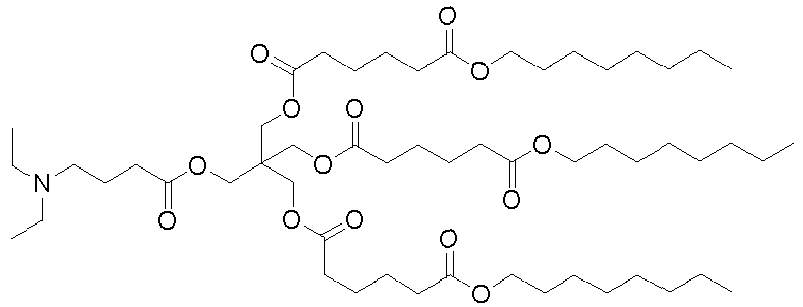
5000 9 1,1'-(2-1[(N,N-Dimethyl-beta-alanyl)oxy]methyl}-2-{[(12-methoxy-12-oxododecanoyl)oxy]methyl}prop ane-1,3-diyl) 12,12'-dimethyl didodecanedioate 
914.6 10 1,1'-[2-({[4-(Dimethylamino)butanoyl]oxy}m ethyl)-2-{[(12-methoxy-12-oxododecanoyl)oxy]methyl}prop ane-1,3-diyl] 12,12'-dimethyl didodecanedioate 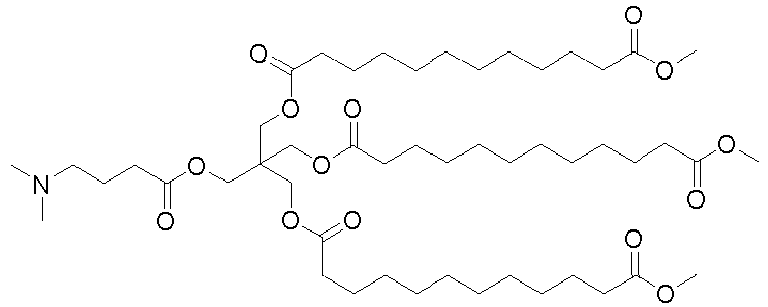
928.6 11 1,1'-[2-(1[4-(Diethylamino)butanoyl]oxy}met hyl)-2-{[(12-methoxy-12-oxododecanoyl)oxy]methyl}prop ane-1,3-diyl] 12,12'-dimethyl didodecanedioate 
956.6 12 1,1'-(2-{[(N,N-Dimethyl-beta-alanyl)oxy]methyl}-2-{[(3-pentyloctanoyl)oxy]methyl}prop ane-1,3-diyl) 6,6'-diheptyl dihexanedioate 
442.9 13 1,1'-[2-({[4-(Dimethylamino)butanoyl]oxy}m ethyl)-2-{[(3-pentyloctanoyl)oxy]methyl}prop ane-1,3-diyl] 6,6'-diheptyl dihexanedioate 
449.9 [Table 1-3] 14 1,1'-[2-({[4-(Diethylamino)butanoyl]oxy}met hyl)-2-{[(3-pentyloctanoyl)oxy]methyl}prop ane-1,3-diyl] 6,6'-diheptyl dihexanedioate 
464.0 15 2-{[(N,N-Dimethyl-beta-alanyl)oxy]methyl}-3-[(3-pentyloctanoyl)oxy]-2-{[(3-pentyloctanoyl)oxy]methyl}propy l heptyl hexanedioate 
854.7 16 2-({[4-(Dimethylamino)butanoyl]oxy}m ethyl)-3-[(3-pentyloctanoyl)oxy]-2-{[(3-pentyloctanoyl)oxy]methyl}propy l heptyl hexanedioate 
868.7 17 2-({[4-(Diethylamino)butanoyl]oxy}met hyl)-3-[(3-pentyloctanoyl)oxy]-2-{[(3-pentyloctanoyl)oxy]methyl}propy l heptyl hexanedioate 
896.7 18 2-({[5-(Dimethylamino)pentanoyl]oxy} methyl)-3-[(3-pentyloctanoyl)oxy]-2-{[(3-pentyloctanoyl)oxy]methyl}propy l heptyl hexanedioate 
882.7 19 Butyl 2-{[(N,N-dimethyl-beta-alanyl)oxy]methyl}-3-[(3-pentyloctanoyl)oxy]-2-{[(3-pentyloctanoyl)oxy]methyl}propy l hexanedioate 
812.6 20 Butyl 2-({[4-(dimethylamino)butanoyl]oxy}m ethyl)-3-[(3-pentyloctanoyl)oxy]-pentyloctanoyl)oxy]methyl}propy l hexanedioate 
826.7 [Table 1-4] 21 Butyl 2-({[4-(diethylamino)butanoyl]oxy}met hyl)-3-[(3-pentyloctanoyl)oxy]-2-{[(3-pentyloctanoyl)oxy]methyl}propy l hexanedioate 
854.7 22 {[2-{[(N,N-Dimethyl-beta-alanyl)oxy]methyl}-2-({[5-(octanoyloxy)pentanoyl]oxy}met hyl)propane-1,3-diyl]bis(oxy)-5-oxopentane-5,1-diyl} dioctanoate 
914.6 23 {[2-({[4-(Dimethylamino)butanoyl]oxy}m ethyl)-2-({[5-(octanoyloxy)pentanoyl]oxy}met hyl)propane-1,3-diyl]bis(oxy)-5-oxopentane-5,1-diyl} dioctanoate 
928.6 24 {[2-({[4-(Diethylamino)butanoyl]oxy}met hyl)-2-({[5-(octanoyloxy)pentanoyl]oxy}met hyl)propane-1,3-diyl]bis(oxy)-5-oxopentane-5,1-diyl} dioctanoate 
956.6 25 {[2-({[4-(Dimethylamino)butanoyl]oxy}m ethyl)-2-{[(3-pentyloctanoyl)oxy]methyl}prop ane-1,3-diyl]bis(oxy)-5-oxopentane-5,1-diyl} dioctanoate 
898.7 26 2-({[4-(Dimethylamino)butanoyl]oxy}m ethyl)-2-({[5-(octanoyloxy)pentanoyl]oxy}met hyl)propane-1,3-diyl bis(3-pentyloctanoate) 
868.7 27 1,1'-(2-{[(N,N-Dimethyl-beta-alanyl)oxy]methyl}-2-{[(3-propyldecanoyl)oxy]methyl}prop ane-1,3-diyl) 6,6'-diheptyl dihexanedioate 
884.7 [Table 1-5] 28 1,1'-[2-({[4-(Dimethylamino)butanoyl]oxy}m ethyl)-2-{[(3-propyldecanoyl)oxy]methyl}prop ane-1,3-diyl] 6,6'-diheptyl dihexanedioate 
898.7 29 1,1'-[2-({[4-(Diethylamino)butanoyl]oxy}met hyl)-2-{[(3-propyldecanoyl)oxy]methyl}prop ane-1,3-diyl] 6,6'-diheptyl dihexanedioate 
926.7 30 2-{[(N,N-Dimethyl-beta-alanyl)oxy]methyl}-3-[(3-propyldecanoyl)oxy]-2-{[(3-propyldecanoyl)oxy]methyl}prop yl heptyl hexanedioate 
854.7 31 2-({[4-(Dimethylamino)butanoyl]oxy}m ethyl)-3-[(3-propyldecanoyl)oxy]-2-{[(3-propyldecanoyl)oxy]methyl}prop yl heptyl hexanedioate 
868.7 32 2-({[4-(Diethylamino)butanoyl]oxy}met hyl)-3-[(3-propyldecanoyl)oxy]-propyldecanoyl)oxy]methyl}prop yl heptyl hexanedioate 
896.7 33 1,1'-Dibutyl 9,9'-[2-({[4-(dimethylamino)butanoyl]oxy}m ethyl)-2-{[(3-pentyloctanoyl)oxy]methyl}prop ane-1,3-diyl] dinonanedioate 
898.7 34 Butyl 2-({[4-(dimethylamino)butanoyl]oxy}m ethyl)-3-[(3-pentyloctanoyl)oxy]-2-{[(3-pentyloctanoyl)oxy]methyl}propy I nonanedioate 
868.7 35 1,1'-[2-({[4-(Dimethylamino)butanoyl]oxy}m ethyl)-2-{[(3-pentyloctanoyl)oxy]methyl}prop ane-1,3-diyl] 9,9'-dimethyl dinonanedioate 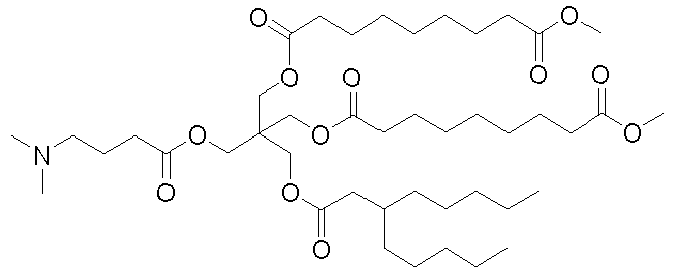
814.6 [Table 1-6] 36 2-({[4-(Dimethylamino)butanoyl]oxy}m ethyl)-3-[(3-pentyloctanoyl)oxy]-pentyloctanoyl)oxy]methyl}propy l methyl nonanedioate 
826.7 37 1,1'-{2-({[4-(Dimethylamino)butanoyl]oxy}m ethyl)-2-[({4-oxo-4-[(2-pentylheptyl)oxy]butanoyl}oxy)m ethyl]propane-1,3-diyl} 4,4'-bis(2-pentylheptyl) dibutanedioate 
1054.8 38 1,1'-{2-({[5-(Dimethylamino)pentanoyl]oxy} methyl)-2-[({4-oxo-4-[(2-pentylheptyl)oxy]butanoyl}oxy)m ethyl]propane-1,3-diyl} 4,4'-bis(2-pentylheptyl) dibutanedioate 
1068.8 39 1,1'-{2-({[4-(Dimethylamino)butanoyl]oxy}m ethyl)-2-[({4-oxo-4-[(undecan-6-yl)oxy]butanoyl}oxy)methyl]prop ane-1,3-diyl} 4,4'-diundecan-6-yl dibutanedioate 
1012.7 40 1,1'-{2-({[5-(Dimethylamino)pentanoyl]oxy} methyl)-2-[({4-oxo-4-[(undecan-6-yl)oxy]butanoyl}oxy)methyl]prop ane-1,3-diyl} 4,4'-diundecan-6-yl dibutanedioate 
1026.7 41 1,1'-[2-({[4-(Dimethylamino)butanoyl]oxy}m ethyl)-2-({[6-(nonyloxy)-6-oxohexanoyl]oxy}methyl)propan e-1,3-diyl] 6,6'-dinonyl dihexanedioate 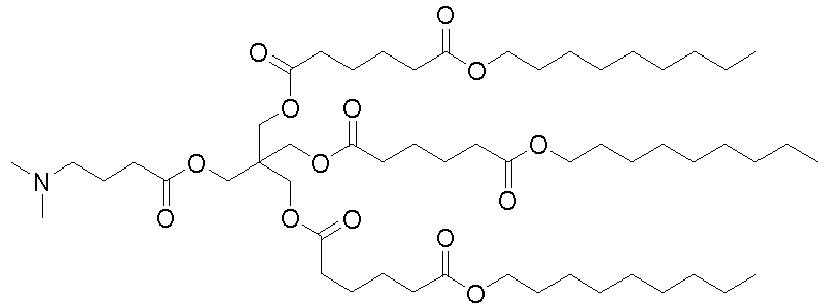
1012.7 42 1,1'-Didecyl 6,6'-[2-({[6-(dexyloxy)-6-oxohexanoyl]oxy}methyl)-2-({[4-(dimethylamino)butanoyl]oxy}m ethyl)propane-1,3-diyl] dihexanedioate 
528.0 [Table 1-7] 43 1,1'-[2-({[4-(Dimethylamino)butanoyl]oxy}m ethyl)-2-{[(3-pentyloctanoyl)oxy]methyl}prop ane-1,3-diyl] 6,6'-dioctyl dihexanedioate 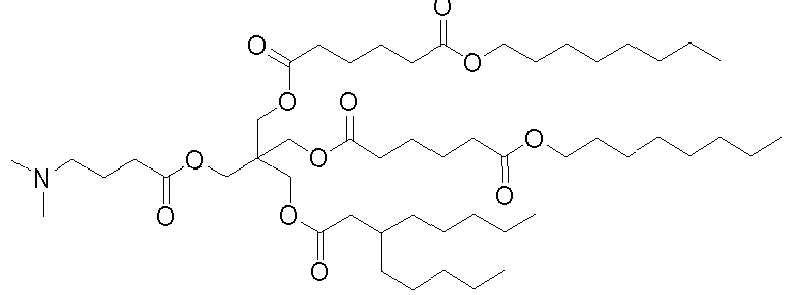
926.7 44 1,1'-[2-(1[4-(Dimethylamino)butanoyl]oxy}m ethyl)-2-{[(3-pentyloctanoyl)oxy]methyl}prop ane-1,3-diyl]6,6'-dinonyl dihexanedioate 
954.7 45 1,1'-Didecyl 6,6'-[2-({[4-(dimethylamino)butanoyl]oxy}m ethyl)-2-{[(3-pentyloctanoyl)oxy]methyl}prop ane-1,3-diyl] dihexanedioate 
982.7 46 1,1'-[2-({[4-(Dimethylamino)butanoyl]oxy}m ethyl)-2-{[(3-pentyloctanoyl)oxy]methyl}prop ane-1,3-diyl] 6,6'-dihexyl dihexanedioate 
870.6 47 1,1'-[2-({[4-(Dimethylamino)butanoyl]oxy}m ethyl)-2-{[(3-pentyloctanoyl)oxy]methyl}prop ane-1,3-diyl] 6,6'-di-(4Z)-hept-4-en-1-yl dihexanedioate 
894.6 48 1,1'-[2-({[4-(Dimethylamino)butanoyl]oxy}m ethyl)-2-{[(3-pentyloctanoyl)oxy]methyl}prop ane-1,3-diyl] 6,6'-di-(3Z)-hept-3-en-1-yl dihexanedioate 
894.6 49 2-({[4-(Dimethylamino)butanoyl]oxy}m ethyl)-3-[(3-pentyloctanoyl)oxy]-pentyloctanoyl)oxy]methyl}propy l octyl hexanedioate 
882.7 [Table 1-8] 50 2-({[4-(Dimethylamino)butanoyl]oxy}m ethyl)-3-[(3-pentyloctanoyl)oxy]-2-{[(3-pentyloctanoyl)oxy]methyl}propy l nonyl hexanedioate 
896.7 51 Decyl 2-({[4-(dimethylamino)butanoyl]oxy}m ethyl)-3-[(3-pentyloctanoyl)oxy]-2-{[(3-pentyloctanoyl)oxy]methyl}propy l hexanedioate 
9107 52 2-({[4-(Dimethylamino)butanoyl]oxy}m ethyl)-3-[(3-pentyloctanoyl)oxy]-2-{[(3-pentyloctanoyl)oxy]methyl}propy l hexyl hexanedioate 
854.7 53 2-({[4-(Dimethylamino)butanoyl]oxy}m ethyl)-3-[(3-pentyloctanoyl)oxy]-2-{[(3-pentyloctanoyl)oxy]methyl}propy l (4Z)-hept-4-en-1-yl hexanedioate 
866.7 54 2-({[4-(Dimethylamino)butanoyl]oxy}m ethyl)-3-[(3-pentyloctanoyl)oxy]-2-{[(3-pentyloctanoyl)oxy]methyl}propy l (3Z)-hept-3-en-1-yl hexanedioate 
8667 55 1,1'-[2-({[4-(Dimethylamino)butanoyl]oxy}m ethyl)-2-({[9-oxo-9-(pentyloxy)nonanoyl]oxy}methyl )propane-1,3-diyl] 9,9'-dipentyl dinonanedioate 
970.7 56 1,1'-[2-({[4-(Dimethylamino)butanoyl]oxy}m ethyl)-2-({[9-(hexyloxy)-9-oxononanoyl]oxy}methyl)propan e-1,3-diyl] 9,9'-dihexyl dinonanedioate 
507.0 [Table 1-9] 57 1,1'-[2-({[4-(Dimethylamino)butanoyl]oxy }methyl)-2-({[9-(heptyloxy)-9-oxononanoyl]oxy}methyl)pro pane-1,3-diyl] 9,9'-diheptyl dinonanedioate 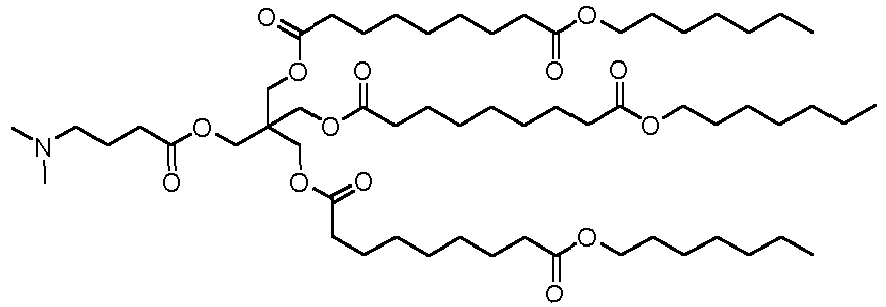
1054.7 58 1,1'-[2-({[4-(Dimethylamino)butanoyl]oxy }methyl)-2-{[(3-pentyloctanoyl)oxy]methyl }pr opane-1,3-diyl] 9,9'-dipentyl dinonanedioate 
926.7 59 1,1'-[2-({[4-(Dimethylamino)butanoyl]oxy }methyl)-2-{[(3-pentyloctanoyl)oxy]methyl }pr opane-1,3-diyl] 9,9'-dihexyl dinonanedioate 
954.7 60 1,1'-[2-({[4-(Dimethylamino)butanoyl]oxy }methyl)-2-{[(3-pentyloctanoyl)oxy]methyl}pr opane-1,3-diyl] 9,9'-diheptyl dinonanedioate 
982.7 61 1,1'-[2-({[4-(Dimethylamino)butanoyl]oxy }methyl)-2-{[(3-pentyloctanoyl)oxy]methyl }pr opane-1,3-diyl] 9,9'-dipropyl dinonanedioate 
870.6 62 2-({[4-(Dimethylamino)butanoyl]oxy }methyl)-3-[(3-pentyloctanoyl)oxy]-2-{[(3-pentyloctanoyl)oxy]methyl }pr opyl pentyl nonanedioate 
882.7 63 2-({[4-(Dimethylamino)butanoyl]oxy }methyl)-3-[(3-pentyloctanoyl)oxy]-2-{[(3-pentyloctanoyl)oxy]methyl}pr opyl hexyl nonanedioate 
896.7 64 2-({[4-(Dimethylamino)butanoyl]oxy }methyl)-3-[(3-pentyloctanoyl)oxy]-2-{[(3-pentyloctanoyl)oxy]methyl }pr opyl heptyl nonanedioate 
910.7 [Table 1-10] 65 2-({[4-(Dimethylamino)butanoyl]oxy }methyl)-3-[(3-pentyloctanoyl)oxy]-2-{[(3-pentyloctanoyl)oxy]methyl }pr opyl propyl nonanedioate 
854.7 66 1,1'-[2-({[4-(Dimethylamino)butanoyl]oxy }methyl)-2-({[3-(octyloxy)propanoyl]oxy}met hyl)propane-1,3-diyl] 3,3'-dioctyl dipropanedioate 
844.6 67 1,1'-[2-({[4-(Dimethylamino)butanoyl]oxy }methyl)-2-({[3-(nonyloxy)-3-oxopropanoyl]oxy}methyl)pro pane-1,3-diyl] 3,3'-dinonyl dipropanedioate 
886.6 68 1, 1'-Didecyl 3,3'-[2-({[3-(decyloxy)-3-oxopropanoyl]oxy}methyl)-2-({[4-(dimethylamino)butanoyl]oxy }methyl)propane-1,3-diyl] dipropanedioate 
928.6 69 1,1'-[2-({[4-(Dimethylamino)butanoyl]oxy }methyl)-2-{[(3-pentyloctanoyl)oxy]methyl}pr opane-1,3-diyl] 3,3'-dioctyl dipropanedioate 
842.6 70 1,1'-[2-({[4-(Dimethylamino)butanoyl]oxy }methyl)-2-{[(3-pentyloctanoyl)oxy]methyl }pr opane-1,3-diyl] 3,3'-dinonyl dipropanedioate 
870.7 71 1, 1'-Didecyl 3,3'-[2-({[4-(dimethylamino)butanoyl]oxy }methyl)-2-{[(3-pentyloctanoyl)oxy]methyl }pr opane-1,3-diyl] dipropanedioate 
8987 [Table 1-11] 72 2-({[4-(Dimethylamino)butanoyl]oxy }methyl)-3-[(3-pentyloctanoyl)oxy]-2-{[(3-pentyloctanoyl)oxy]methyl}pr opyl octyl propanedioate 
840.7 73 2-({[4-(Dimethylamino)butanoyl]oxy }methyl)-3-[(3-pentyloctanoyl)oxy]-2-{[(3-pentyloctanoyl)oxy]methyl }pr opyl nonyl propanedioate 
854.7 74 Decyl 2-({[4-(dimethylamino)butanoyl]oxy }methyl)-3-[(3-pentyloctanoyl)oxy]-2-{[(3-pentyloctanoyl)oxy]methyl }pr opyl propanedioate 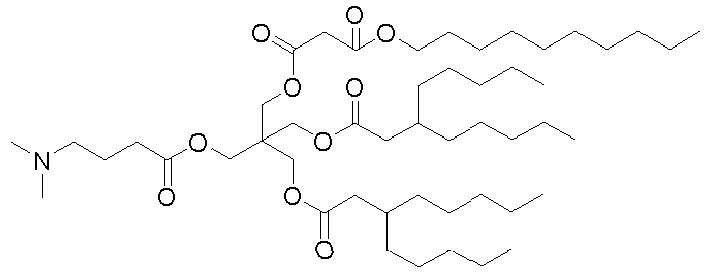
868.7 75 1,1'-[2-({[4-(Dimethylamino)butanoyl]oxy }methyl)-2-{[(12-ethoxy-12-oxododecanoyl)oxy]methyl}p ropane-1,3-diyl] 12,12'-diethyl didodecanedioate 
970.7 76 1,1'-[2-({[4-(Dimethylamino)butanoyl]oxy }methyl)-2-{[(12-oxo-12-propoxydodecanoyl)oxy] met hyl}propane-1,3-diyl] 12,12'-dipropyl didodecanedioate 
1012.7 77 1,1'-[2-({[4-(Dimethylamino)butanoyl]oxy }methyl)-2-{[(3-pentyloctanoyl)oxy]methyl }pr opane-1,3-diyl] 12,12'-dimethyl didodecanedioate 
898.7 78 1,1'-[2-({[4-(Dimethylamino)butanoyl]oxy }methyl)-2-{[(3-pentyloctanoyl)oxy]methyl}pr opane-1,3-diyl] 12,12'-diethyl didodecanedioate 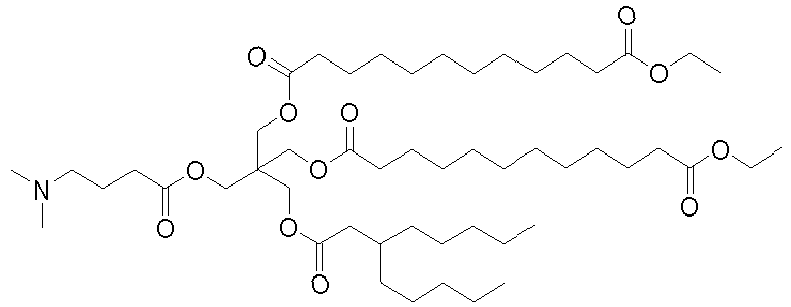
926. 7 [Table 1-12] 79 1,1'-[2-({[4-(Dimethylamino)butanoyl]oxy }methyl)-2-{[(3-pentyloctanoyl)oxy]methyl}pr opane-1,3-diyl] 12,12'-dipropyl didodecanedioate 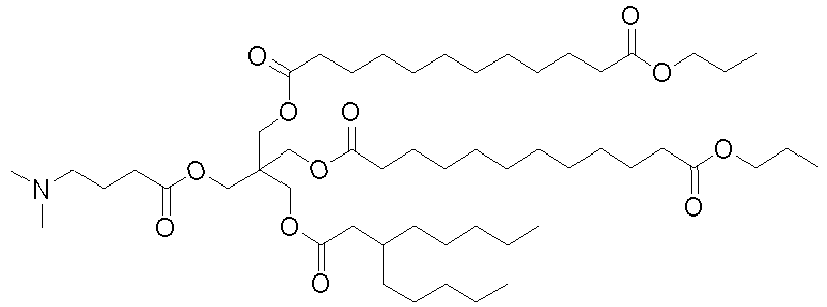
954.7 80 2-({[4-(Dimethylamino)butanoyl]oxy }methyl)-3-[(3-pentyloctanoyl)oxy]-2-{[(3-pentyloctanoyl)oxy]methyl }pr opyl methyl dodecanedioate 
868.7 81 2-({[4-(Dimethylamino)butanoyl]oxy }methyl)-3-[(3-pentyloctanoyl)oxy]-2-{[(3-pentyloctanoyl)oxy]methyl }pr opyl ethyl dodecanedioate 
882.7 82 2-({[4-(Dimethylamino)butanoyl]oxy }methyl)-3-[(3-pentyloctanoyl)oxy]-2-{[(3-pentyloctanoyl)oxy]methyl }pr opyl propyl dodecanedioate 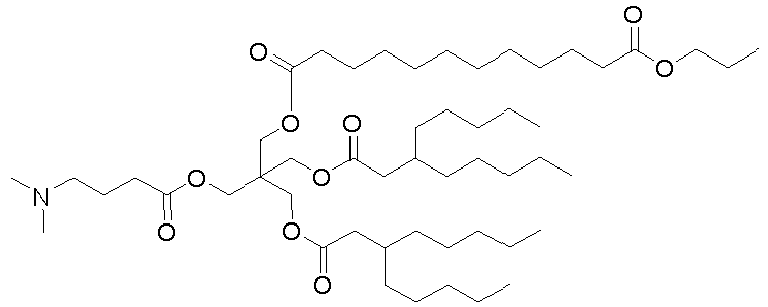
896.7 83 1,1'-[2-({[4-(Dimethylamino)butanoyl]oxy }methyl)-2-{[(2-pentylheptanoyl)oxy]methyl}p ropane-1,3-diyl] 6,6'-diheptyl dihexanedioate 
884.7 84 1,1'-[2-{[(3-Butyl heptanoyl)oxy]methyl}-2-({[4-(dimethylamino)butanoyl]oxy }methyl)propane-1,3-diyl] 6,6'-diheptyl dihexanedioate 
870.6 85 1,1'-[2-({[4-(Dimethylamino)butanoyl]oxy }methyl)-2-{[(3-hexylnonanoyl)oxy]methyl}pr opane-1,3-diyl] 6,6'-diheptyl dihexanedioate 
926. 7 [Table 1-13] 86 2-({[4-(Dimethylamino)butanoyl]oxy }methyl)-3-[(2-pentylheptanoyl)oxy]-2-{[(2-pentylheptanoyl)oxy]methyl}p ropyl heptyl hexanedioate 
840.7 87 2,2-Bis{[(3-butylheptanoyl)oxy]methyl}-3-({[4-(dimethylamino)butanoyl]oxy }propyl heptyl hexanedioate 
812.6 88 2-({[4-(Dimethylamino)butanoyl]oxy }methyl)-3-[(3-hexylnonanoyl)oxy]-2-{[(3-hexylnonanoyl)oxy]methyl}pr opyl heptyl hexanedioate 
924.8 89 1,1'-(2-[({4-[Ethyl(methyl)amino]butanoyl }oxy)methyl]-2-{[(3-pentyloctanoyl)oxy]methyl}pr opane-1,3-diyl] 6,6'-diheptyl dihexanedioate 
912.7 90 1,1'-Diheptyl 6,6'-(2-[({4-[methyl(propan-2-yl)amino]butanoyl}oxy)methyl ]-2-{[(3-pentyloctanoyl)oxy]methyl}pr opane-1,3-diyl) dihexanedioate 
926.7 91 1,1'-(2-[({4-[Ethyl(propan-2-yl)amino]butanoyl}oxy)methyl ]-2-{[(3-pentyloctanoyl)oxy]methyl }pr opane-1,3-diyl] 6,6'-diheptyl dihexanedioate 
940.7 92 1,1'-(2-[({4-[di(Propan-2-yl)amino]butanoyl}oxy)methyl ]-2-{[(3-pentyloctanoyl)oxy]methyl}pr opane-1,3-diyl] 6,6'-diheptyl dihexanedioate 
954.7 [Table 1-14] 93 1,1'-Diheptyl 6,6'-(2-[({4-[(2-hydroxyethyl)(methyl)amino] butanoyl}oxy)methyl]-2-{[(3-pentyloctanoyl)oxy]methyl}pr opane-1,3-diyl) dihexanedioate 
928.7 94 1,1'-Diheptyl 6,6'-(2-[({4-[(3-hydroxypropyl)(methyl)amino ]butanoyl}oxy)methyl]-2-{[(3-pentyloctanoyl)oxy]methyl }pr opane-1,3-diyl) dihexanedioate 
942.70 95 1,1'-[2-({[4-(Dimethylamino)butanoyl]oxy }methyl)-2-{[(3-pentyloctanoyl)oxy]methyl }pr opane-1,3-diyl] 4,4'-bis(2-pentylheptyl) dibutanedioate 
982.8 96 2-({[4-(Dimethylamino)butanoyl]oxy }methyl)-3-[(3-pentyloctanoyl)oxy]-2-{[(3-pentyloctanoyl)oxy]methyl }pr opyl 2-pentylheptyl butanedioate 
910.7 97 1,1'-[2-({[4-(Dimethylamino)butanoyl]oxy }methyl)-2-{[(3-pentyloctanoyl)oxy]methyl}pr opane-1,3-diyl] 4,4'-dinonyl dibutanedioate 
898.7 98 1,1'-[2-({[4-(Dimethylamino)butanoyl]oxy }methyl)-2-{[(3-pentyloctanoyl)oxy]methyl}pr opane-1,3-diyl] 5,5'-dioctyl dipentanedioate 
898.7 99 1,1'-[2-({[4-(Dimethylamino)butanoyl]oxy }methyl)-2-{[(3-pentyloctanoyl)oxy]methyl}pr opane-1,3-diyl] 7,7'-dihexyl diheptanedioate 
898.7 [Table 1-15] 100 1,1'-(2-[({4-[Ethyl(propan-2-yl)amino]butanoyl}oxy)methyl ]-2-{[(3-pentyloctanoyl)oxy]methyl}pr opane-1,3-diyl) 4,4'-dinonyl dibutanedioate 
940.7 101 1,1'-(2-[({4-[Ethyl(propan-2-yl)amino]butanoyl}oxy)methyl ]-2-{[(3-pentyloctanoyl)oxy]methyl}pr opane-1,3-diyl) 5,5'-dioctyl dipentanedioate 
940.7 102 1,1'-(2-[({4-[Ethyl(propan-2-yl)amino]butanoyl}oxy)methyl ]-2-{[(3-pentyloctanoyl)oxy]methyl }pr opane-1,3-diyl) 7,7'-dihexyl diheptanedioate 
940.7 103 2-({[4-(Dimethylamino)butanoyl]oxy }methyl)-3-[(3-pentyloctanoyl)oxy]-2-{[(3-pentyloctanoyl)oxy]methyl }pr opyl nonyl butanedioate 
868.7 104 2-({[4-(Dimethylamino)butanoyl]oxy }methyl)-3-[(3-pentyloctanoyl)oxy]-2-{[(3-pentyloctanoyl)oxy]methyl }pr opyl octyl pentanedioate 
868.7 105 2-({[4-(Dimethylamino)butanoyl]oxy }methyl)-3-[(3-pentyloctanoyl)oxy]-2-{[(3-pentyloctanoyl)oxy]methyl }pr opyl hexyl heptanedioate 
868.7 106 1,1'-(2-[({4-[Ethyl(propan-2-yl)amino]butanoyl}oxy)methyl ]-2-1[(3-pentyloctanoyl)oxy]methyl}pr opane-1,3-diyl) 6,6'-dioctyl dihexanedioate 
968.7 [Table 1-16] 107 1,1'-(2-[({4-[Ethyl(propan-2-yl)amino]butanoyl}oxy)methyl ]-2-{[(3-pentyloctanoyl)oxy]methyl}pr opane-1,3-diyl) 6,6'-dinonyl dihexanedioate 
996.7 108 1, 1'-Didecyl 6,6'-(2-[({4-[ethyl(propan-2-yl)amino]butanoyl}oxy)methyl ]-2-{[(3-pentyloctanoyl)oxy]methyl }pr opane-1,3-diyl) dihexanedioate 
1024.8 109 1,1'-(2-[({4-[Ethyl(propan-2-yl)amino]butanoyl}oxy)methyl ]-2-{[(3-pentyloctanoyl)oxy]methyl }pr opane-1,3-diyl) 6,6'-dihexyl dihexanedioate 
912.7 110 1,1'-(2-[({4-[Ethyl(propan-2-yl)amino]butanoyl}oxy)methyl ]-2-{[(3-pentyloctanoyl)oxy]methyl}pr opane-1,3-diyl) 6,6'-di-(4Z)-hept-4-en-1-yl dihexanedioate 
936.7 111 1,1'-(2-[({4-[Ethyl(propan-2-yl)amino]butanoyl}oxy)methyl ]-2-{[(3-pentyloctanoyl)oxy]methyl}pr opane-1,3-diyl) 6,6'-di-(3Z)-hept-3-en-1-yl dihexanedioate 
936.7 112 1,1'-(2-[({4-[Ethyl(propan-2-yl)amino]butanoyl}oxy)methyl ]-2-{[(2-pentylheptanoyl)oxy]methyl}p ropane-1,3-diyl) 6,6'-diheptyl dihexanedioate 
926.7 113 1,1'-(2-{[(3-Butylheptanoyl)oxy]methyl}-2-[({4-[ethyl(propan-2-yl)amino]butanoyl}oxy)methyl ]propane-1,3-diyl) 6,6'-diheptyl dihexanedioate 
912.7 [Table 1-17] 114 1,1'-(2-[({4-[Ethyl(propan-2-yl)amino]butanoyl}oxy)methyl ]-2-{[(3-hexylnonanoyl)oxy]methyl}pr opane-1,3-diyl) 6,6'-diheptyl dihexanedioate 
968.7 115 1,1'-[2-({[4-(Dimethylamino)butanoyl]oxy }methyl)-2-{[(3-pentyloctanoyl)oxy]methyl}pr opane-1,3-diyl] 6,6'-bis(2-propylpentyl) dihexanedioate 
926.7 116 1,1'-(2-[({4-[Ethyl(propan-2-yl)amino]butanoyl}oxy)methyl ]-2-{[(3-pentyloctanoyl)oxy]methyl}pr opane-1,3-diyl) 6,6'-bis(2-propylpentyl) dihexanedioate 
968.7 117 1,1'-Bis(2-butylhexyl) 6,6'-[2-({[4-(dimethylamino)butanoyl]oxy }methyl)-2-{[(3-pentyloctanoyl)oxy]methyl }pr opane-1,3-diyl] dihexanedioate 
982.8 118 1,1'-Bis(2-butylhexyl) 6,6'-(2-[({4-[ethyl(propan-2-yl)amino]butanoyl}oxy)methyl ]-2-{[(3-pentyloctanoyl)oxy]methyl}pr opane-1,3-diyl) dihexanedioate 
1024.8 119 1,1'-{2-({[4-(Dimethylamino)butanoyl]oxy }methyl)-2-[({3-oxo-3-[(2-pentylheptyl)oxy]propanoyl}o xy)methyl]propane-1,3-diyl} 3,3'-bis(2-pentylheptyl) dipropanedioate 
1012.7 [Table 1-18] 120 1,1'-{2-[({4-[Ethyl(propan-2-yl)amino]butanoyl}oxy)methyl ]-2-[({3-oxo-3-[(2-pentylheptyl)oxy]propanoyl}o xy)methyl]propane-1,3-diyl} 3,3'-bis(2-pentylheptyl) dipropanedioate 
1054.7 121 1,1'-[2-({[4-(Dimethylamino)butanoyl]oxy }methyl)-2-{[(3-pentyloctanoyl)oxy]methyl}pr opane-1,3-diyl] 3,3'-dihexyl bis(hexylpropanedioate) 
954.7 122 1,1'-[2-({[5-(Dimethylamino)pentanoyl]ox y}methyl)-2-{[(3-pentyloctanoyl)oxy]methyl}pr opane-1,3-diyl] 3,3'-dihexyl bis(hexylpropanedioate) 
968.7 123 2-({[4-(Dimethylamino)butanoyl]oxy }methyl)-3-[(3-pentyloctanoyl)oxy]-2-{[(3-pentyloctanoyl)oxy]methyl }pr opyl hexyl hexylpropanedioate 
896.7 124 2-({[5-(Dimethylamino)pentanoyl]ox y}methyl)-3-[(3-pentyloctanoyl)oxy]-2-{[(3-pentyloctanoyl)oxy]methyl }pr opyl hexyl hexylpropanedioate 
910.7 [Table 1-19] 125 1,1'-{2-({[4-(Dimethylamino)butanoyl]oxy }methyl)-2-[(heptanoyloxy)methyl]propa ne-1,3-diyl}3,3'-dihexyl bis(hexylpropanedioate) 
870.6 126 1,1'-(2-[({4-[Ethyl(propan-2-yl)amino]butanoyl}oxy)methyl ]-2-{[(3-pentyloctanoyl)oxy]methyl}pr opane-1,3-diyl) 3,3'-dioctyl dipropanedioate 
884.6 127 1,1'-(2-[({4-[Ethyl(propan-2-yl)amino]butanoyl}oxy)methyl ]-2-{[(3-pentyloctanoyl)oxy]methyl}pr opane-1,3-diyl) 3,3'-dinonyl dipropanedioate 
912.6 128 1,1'-Didecyl 3,3'-(2-[({4-[ethyl(propan-2-yl)amino]butanoyl}oxy)methyl ]-2-{[(3-pentyloctanoyl)oxy]methyl}pr opane-1,3-diyl) dipropanedioate 
940.7 129 1,1'-[2-({[4-(Dimethylamino)butanoyl]oxy }methyl)-2-{[(3-pentyloctanoyl)oxy]methyl}pr opane-1,3-diyl] 8,8'-dipentyl dioctanedioate 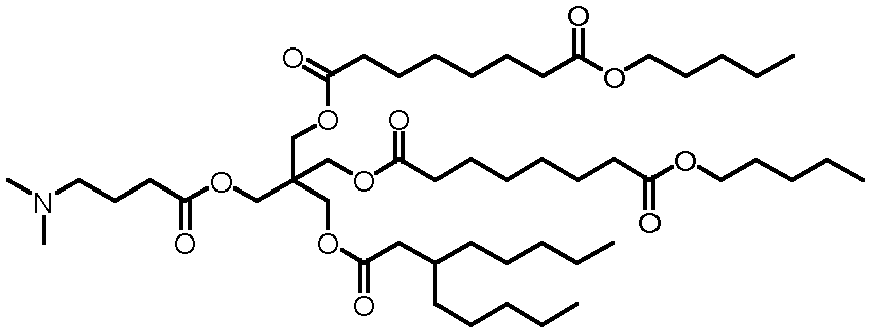
898.5 130 1,1'-[2-({[4-(Diethylamino)butanoyl]oxy} methyl)-2-{[(3-pentyloctanoyl)oxy]methyl}pr opane-1,3-diyl] 8,8'-dipentyl dioctanedioate 
926. 7 [Table 1-20] 131 1,1'-(2-[({4-[Ethyl(propan-2-yl)amino]butanoyl}oxy)methyl ]-2-{[(3-pentyloctanoyl)oxy]methyl}pr opane-1,3-diyl) 8,8'-dipentyl dioctanedioate 
940.5 132 1,1'-[2-({[4-(Dimethylamino)butanoyl]oxy }methyl)-2-{[(3-pentyloctanoyl)oxy]methyl}pr opane-1,3-diyl] 3,3'-dimethyl bis(octylpropanedioate) 
870.6 133 1,1'-(2-[({4-[Ethyl(propan-2-yl)amino]butanoyl}oxy)methyl ]-2-{[(3-pentyloctanoyl)oxy]methyl}pr opane-1,3-diyl) 3,3'-dimethyl bis(octylpropanedioate) 
912.7 134 1,1'-[2-({[4-(Dimethylamino)butanoyl]oxy }methyl)-2-{[(3-pentyloctanoyl)oxy]methyl}pr opane-1,3-diyl] 3,3'-dimethyl bis(decylpropanedioate) 
926.7 135 1,1'-(2-[({4-[Ethyl(propan-2-yl)amino]butanoyl}oxy)methyl ]-2-{[(3-pentyloctanoyl)oxy]methyl}pr opane-1,3-diyl) 3,3'-dimethyl bis(decylpropanedioate) 
968.7 [Table 1-21] 136 2-({[4-(Dimethylamino)butanoyl]oxy }methyl)-3-[(3-pentyloctanoyl)oxy]-2-{[(3-pentyloctanoyl)oxy]methyl}pr opyl methyl octylpropanedioate 
854.7 137 2-({[4-(Dimethylamino)butanoyl]oxy }methyl)-3-[(3-pentyloctanoyl)oxy]-2-{[(3-pentyloctanoyl)oxy]methyl }pr opyl methyl decylpropanedioate 
882.7 138 1,1'-[2-({[4-(Dimethylamino)butanoyl]oxy }methyl)-2-{[(3-pentyloctanoyl)oxy]methyl }pr opane-1,3-diyl] 5,5'-dinonyl dipentanedioate 
926.7 139 1,1'-(2-[({4-[Ethyl(propan-2-yl)amino]butanoyl}oxy)methyl ]-2-{[(3-pentyloctanoyl)oxy]methyl}pr opane-1,3-diyl) 5,5'-dinonyl dipentanedioate 
968.7 140 1, 1'-Didecyl 5,5'-[2-({[4-(dimethylamino)butanoyl]oxy }methyl)-2-{[(3-pentyloctanoyl)oxy]methyl}pr opane-1,3-diyl] dipentanedioate 
954.7 141 1, 1'-Didecyl 5,5'-(2-[({4-[ethyl(propan-2-yl)amino]butanoyl}oxy)methyl ]-2-{[(3-pentyloctanoyl)oxy]methyl}pr opane-1,3-diyl) dipentanedioate 
996.8 142 1,1'-[2-({[4-(Dimethylamino)butanoyl]oxy }methyl)-2-{[(3-pentyloctanoyl)oxy]methyl}pr opane-1,3-diyl] 5,5'-diundecyl dipentanedioate 
982.7 [Table 1-22] 143 1,1'-(2-[({4-[Ethyl(propan-2-yl)amino]butanoyl}oxy)methyl ]-2-{[(3-pentyloctanoyl)oxy]methyl}pr opane-1,3-diyl) 5,5'-diundecyl dipentanedioate 
1024.8 144 1,1'-[2-({[4-(Dimethylamino)butanoyl]oxy }methyl)-2-{[(3-pentyloctanoyl)oxy]methyl}pr opane-1,3-diyl]5,5'-bis(2-propylpentyl) dipentanedioate 
8987 145 1,1'-(2-[({4-[Ethyl(propan-2-yl)amino]butanoyl}oxy)methyl ]-2-{[(3-pentyloctanoyl)oxy]methyl}pr opane-1,3-diyl) 5,5'-bis(2-propylpentyl) dipentanedioate 
940.7 146 1,1'-Bis(2-butylhexyl) 5,5'-[2-({[4-(dimethylamino)butanoyl]oxy }methyl)-2-{[(3-pentyloctanoyl)oxy]methyl}pr opane-1,3-diyl] dipentanedioate 
954.7 147 1,1'-Bis(2-butylhexyl) 5,5'-(2-[({4-[ethyl(propan-2-yl)amino]butanoyl}oxy)methyl ]-2-{[(3-pentyloctanoyl)oxy]methyl}pr opane-1,3-diyl) dipentanedioate 
996.8 148 1,1'-[2-({[4-(Dimethylamino)butanoyl]oxy }methyl)-2-{[(3-propyldecanoyl)oxy]methyl}p ropane-1 ,3-diyl] 5,5'-dioctyl dipentanedioate 
8986 149 1,1'-(2-[({4-[Ethyl(propan-2-yl)amino]butanoyl}oxy)methyl ]-2-{[(3-propyldecanoyl)oxy]methyl}p ropane-1 ,3-diyl) 5,5'-dioctyl dipentanedioate 
940.7 [Table 1-23] 150 1,1'-[2-{[(3-Butylheptanoyl)oxy]methyl}-2-({[4-(dimethylamino)butanoyl]oxy }methyl)propane-1,3-diyl] 5,5'-dioctyl dipentanedioate 
870.6 151 1,1'-(2-{[(3-Butylheptanoyl)oxy]methyl}-2-[({4-[ethyl(propan-2-yl)amino]butanoyl}oxy)methyl ]propane-1,3-diyl) 5,5'-dioctyl dipentanedioate 
912.7 152 1,1'-[2-({[4-(Dimethylamino)butanoyl]oxy }methyl)-2-{[(3-hexylnonanoyl)oxy]methyl}pr opane-1,3-diyl] 5,5'-dioctyl dipentanedioate 
926.7 153 1,1'-(2-[({4-[Ethyl(propan-2-yl)amino]butanoyl}oxy)methyl ]-2-{[(3-hexylnonanoyl)oxy]methyl}pr opane-1,3-diyl) 5,5'-dioctyl dipentanedioate 
968.7 154 1,1'-[2-({[4-(Dimethylamino)butanoyl]oxy }methyl)-2-{[(2-pentylheptanoyl)oxy]methyl}p ropane-1 ,3-diyl] 5,5'-dioctyl dipentanedioate 
884.6 155 1,1'-(2-[({4-[Ethyl(propan-2-yl)amino]butanoyl}oxy)methyl ]-2-{[(2-pentylheptanoyl)oxy]methyl}p ropane-1 ,3-diyl) 5,5'-dioctyl dipentanedioate 
926.7 156 1,1'-{2-({[4-(Dimethylamino)butanoyl]oxy }methyl)-2-[({2-[(hexyloxy)carbonyl]octanoyl} oxy)methyl]propane-1,3-diyl} 3,3'-dihexyl bis(hexylpropanedioate) 
1012.8 [Table 1-24] 157 1,1'-{2-({[5-(Dimethylamino)pentanoyl]ox y}methyl)-2-[({2-[(hexyloxy)carbonyl]octanoyl} oxy)methyl]propane-1,3-diyl} 3,3'-dihexyl bis(hexylpropanedioate) 
1026.8 158 1,1'-{2-({[5-(Dimethylamino)pentanoyl]ox y}methyl)-2-[({3-oxo-3-[(2-pentylheptyl)oxy]propanoyl}o xy)methyl]propane-1,3-diyl} 3,3'-bis(2-pentylheptyl) dipropanedioate 
1026.7 159 1,1'-[2-({[4-(Dimethylamino)butanoyl]oxy }methyl)-2-{[(3-pentyloctanoyl)oxy]methyl}pr opane-1,3-diyl] 3,3'-bis(2-pentylheptyl) dipropanedioate 
954.8 160 1,1'-[2-({[5-(Dimethylamino)pentanoyl]ox y}methyl)-2-{[(3-pentyloctanoyl)oxy]methyl}pr opane-1,3-diyl] 3,3'-bis(2-pentylheptyl) dipropanedioate 
968.8 161 2-({[4-(Dimethylamino)butanoyl]oxy }methyl)-3-[(3-pentyloctanoyl)oxy]-2-{[(3-pentyloctanoyl)oxy]methyl}pr opyl 2-pentylheptyl propanedioate 
896.8 [Table 1-25] 162 2-({[5-(Dimethylamino)pentanoyl]ox y}methyl)-3-[(3-pentyloctanoyl)oxy]-2-{[(3-pentyloctanoyl)oxy]methyl }pr opyl 2-pentylheptyl propanedioate 
9108 163 1,1'-{2-({[4-(Dimethylamino)butanoyl]oxy }methyl)-2-[({3-oxo-3-[(undecane-6-yl)oxy]propanoyl}oxy)methyl] propane-1,3-diyl} 3,3'-diundecane-6-yl dipropanedioate 
970.9 164 1,1'-{2-({[5-(Dimethylamino)pentanoyl]ox y}methyl)-2-[({3-oxo-3-[(undecane-6-yl)oxy]propanoyl}oxy)methyl] propane-1,3-diyl} 3,3'-diundecane-6-yl dipropanedioate 
984.8 165 1,1'-{2-({[4-(Dimethylamino)butanoyl]oxy }methyl)-2-[({3-oxo-3-[(tridecan-7-yl)oxy]propanoyl}oxy)methyl] propane-1,3-diyl} 3,3'-ditridecane-7-yl dipropanedioate 
1054.5 166 1,1'-{2-({[5-(Dimethylamino)pentanoyl]ox y}methyl)-2-[({3-oxo-3-[(tridecan-7-yl)oxy]propanoyl}oxy)methyl] propane-1,3-diyl} 3,3'-ditridecane-7-yl dipropanedioate 
1068.6 [Table 1-26] 167 1,1'-Bis(2-butylhexyl) 3,3'-{2-[({3-[(2-butylhexyl)oxy]-3-oxopropanoyl}oxy)methyl]-2-({[4-(dimethylamino)butanoyl]oxy }methyl)propane-1,3-diyl} dipropanedioate 
928.8 168 1,1'-Bis(2-butylhexyl) 3,3'-{2-[({3-[(2-butylhexyl)oxy]-3-oxopropanoyl}oxy)methyl]-2-({[5-(dimethylamino)pentanoyl]ox y}methyl)propane-1,3-diyl} dipropanedioate 
942.5 169 1,1'-{2-({[4-(Dimethylamino)butanoyl]oxy }methyl)-2-[({3-[(2-hexyloctyl)oxy]-3-oxopropanoyl}oxy)methyl]pro pane-1,3-diyl} 3,3'-bis(2-hexyloctyl) dipropanedioate 
1097.0 170 1,1'-{2-({[5-(Dimethylamino)pentanoyl]ox y}methyl)-2-[({3-[(2-hexyloctyl)oxy]-3-oxopropanoyl}oxy)methyl]pro pane-1,3-diyl} 3,3'-bis(2-hexyloctyl) dipropanedioate 
11111 171 1,1'-Bis(2-butyloctyl) 3,3'-{2-[({3-[(2-butyloctyl)oxy]-3-oxopropanoyl}oxy)methyl]-2-({[4-(dimethylamino)butanoyl]oxy }methyl)propane-1,3-diyl} dipropanedioate 
1012.5 [Table 1-27] 172 1,1'-Bis(2-butyloctyl) 3,3'-{2-[({3-[(2-butyloctyl)oxy]-3-oxopropanoyl}oxy)methyl]-2-({[5-(dimethylamino)pentanoyl]ox y}methyl)propane-1,3-diyl} dipropanedioate 
1026.5 173 N,N,N-trimethyl-4-oxo-4-{3-({3-oxo-3-[(2-pentylheptyl)oxy]propanoyl}o xy)-2,2-bis[({3-oxo-3-[(2-pentylheptyl)oxy]propanoyl}o xy)methyl]propoxy}butane-1-aminium 
1026.9 - A mixture of 2,2-bis(hydroxymethyl)propane-1,3-diol (49.5 g), triethylamine (36.8 g) and DMA (300 mL) was stirred at room temperature, and a mixture of tert-butyldiphenylchlorosilane (50 g) and DMA (200 mL) was added dropwise thereto over 1 hour. 6 hours later, ethyl acetate, water, and heptane were added to the mixture, and the mixture was stirred for 10 minutes. The reaction mixture was separated into an aqueous layer (A) and an organic layer (B). A was subjected to extraction with a mixed solvent of ethyl acetate and heptane. The extracts were washed with a 20% aqueous citric acid solution, a 5% aqueous sodium bicarbonate solution, saturated brine and water and then concentrated under reduced pressure (C). B was subjected to extraction with a mixed solvent of water and DMA. The obtained aqueous layer was subjected to extraction with a mixed solvent of ethyl acetate and heptane. Then, the extracts were washed with a 20% aqueous citric acid solution, a 5% aqueous sodium bicarbonate solution, saturated brine and water and concentrated under reduced pressure (D). C and D were mixed to obtain the title compound (78 g).
1H NMR (400 MHz, CDCl3) δ 7.66 (dd, J=1.3, 7.8 Hz, 4H), 7.50 - 7.38 (m, 6H), 3.75 (s, 6H), 3.67 (s, 2H), 2.46 - 2.24 (br s, 3H), 1.08 (s, 9H). - To a mixture of oxepane-2,7-dione (10.0 g), heptan-1-ol (10.0 g) and DCM (120 mL), DMAP (953 mg) and TEA (15.8 g) were added, and the mixture was stirred at room temperature for 3 hours. 1 M hydrochloric acid was added to the mixture, followed by extraction with DCM. The organic layer was washed with saturated brine, then dried over sodium sulfate, and concentrated under reduced pressure. The residue was purified by silica gel column chromatography (ethyl acetate/petroleum ether) to obtain the title compound (11.1 g).
1H NMR (400 MHz, DMSO-d6) δ 12.04 (br s, 1H) 4.00 (t, J=6.53 Hz, 2H) 2.29 (t,J=6.90 Hz, 2H) 2.21 (t, J=6.90 Hz, 2H) 1.60 - 1.43 (m, 6H) 1.34 - 1.20 (m, 8H) 0.90 - 0.82 (m, 3H). - To a mixture of 2-({[tert-butyl(diphenyl)silyl]oxy}methyl)-2-(hydroxymethyl)propane-1,3-diol (2.0 g), 6-(heptyloxy)-6-oxohexanoic acid (4.0 g) and DMF (30 mL), EDCI (6.1 g) and DMAP (652 mg) were added, and the mixture was stirred at room temperature for 15 hours. Water was added to the mixture, followed by extraction with ethyl acetate. The organic layer was washed with saturated brine, then dried over sodium sulfate, and concentrated under reduced pressure. The residue was purified by silica gel column chromatography (ethyl acetate/petroleum ether) to obtain 1,1'-[2-({[tert-butyl(diphenyl)silyl]oxy}methyl)-2-({[6-(heptyloxy)-6-oxohexanoyl]oxy}methyl)propane-1,3-diyl] 6,6'-diheptyl dihexanedioate (4.7 g). To a mixture of 1,1'-[2-({[tert-butyl(diphenyl)silyl]oxy}methyl)-2-({[6-(heptyloxy)-6-oxohexanoyl]oxy}methyl)propane-1,3-diyl] 6,6'-diheptyl dihexanedioate (4.7 g) and THF (45 mL), a solution of TBAF in THF (1 M, 5.8 mL) was added, and the mixture was stirred at room temperature for 12 hours. Water was added to the mixture, followed by extraction with ethyl acetate. The organic layer was washed with saturated brine, then dried over sodium sulfate, and concentrated under reduced pressure. The residue was purified by silica gel column chromatography (ethyl acetate/petroleum ether) to obtain the title compound (2.4 g). 1H NMR (400 MHz, CDCl3) δ 4.13 (s, 6H) 4.08 (t, J=6.79 Hz, 6H) 3.53 (s, 2H) 2.44 - 2.30 (m, 12H) 1.71 - 1.60 (m, 18H) 1.37 - 1.26 (m, 24H) 0.97 - 0.86 (m, 9H).
- To a mixture of 1,1'-diheptyl 6,6'-[2-({[6-(heptyloxy)-6-oxohexanoyl]oxy}methyl)-2-(hydroxymethyl)propane-1,3-diyl] dihexanedioate (0.4 g), 3-(dimethylamino)propionic acid hydrochloride (152 mg) and DMF (5 mL), EDCI (235 mg) and DMAP (30 mg) were added, and the mixture was stirred at room temperature for 15 hours. Water was added to the mixture, followed by extraction with ethyl acetate. The organic layer was washed with saturated brine, then dried over sodium sulfate, and concentrated under reduced pressure. The residue was purified by silica gel column chromatography (MeOH/DCM) to obtain the title compound (210 mg).
- 1H NMR (400 MHz, CDCl3) δ 4.19 - 4.10 (m, 8H), 4.07 (t, J=6.79 Hz, 6H), 2.63 - 2.56 (m, 2H), 2.53 - 2.46 (m, 2H), 2.39 - 2.29 (m, 12H), 2.24 (s, 6H), 1.74 - 1.55 (m, 18H), 1.39 - 1.23 (m, 24H), 0.94 - 0.84 (m, 9H).
- MS: [M+H]+ 914.6.
- To a mixture of 60% sodium hydride (1.12 g) and THF (100 mL), ethyl 2-diethoxyphosphoryl acetate (6.73 g) was added at 0°C, and the mixture was stirred for 10 minutes. Undecan-6-one (3.41 g) was added thereto at room temperature, and the mixture was stirred at 50°C for 12 hours. Water was added to the mixture, followed by extraction with ethyl acetate. The organic layer was washed with saturated brine, then dried over sodium sulfate, and concentrated under reduced pressure. The residue was purified by silica gel column chromatography (ethyl acetate/petroleum ether) to obtain ethyl 3-pentyloct-2-enoate (4.1 g). To a mixture of ethyl 3-pentyloct-2-enoate (0.8 g) and EtOH (10 mL), 10% Pd/C (50 mg) was added, and the mixture was stirred at room temperature for 18 hours in a hydrogen atmosphere (15 psi). The mixture was filtered, and the filtrate was dried under reduced pressure to obtain ethyl 3-pentyloctanoate (0.8 g). To a mixture of ethyl 3-pentyloctanoate (0.8 g) and EtOH (10 mL), a solution of sodium hydroxide (0.66 g) in water (3 mL) was added, and the mixture was stirred at 50°C for 1 hour. The mixture was concentrated under reduced pressure. The residue was diluted with water and washed with petroleum ether. The aqueous layer was rendered acidic (pH = 3 to 4) with 1 M hydrochloric acid, followed by extraction with ethyl acetate. The organic layer was washed with saturated brine, then dried over sodium sulfate, and concentrated under reduced pressure to obtain the title compound (0.5 g) .
1H NMR (400 MHz, CDCl3) δ 2.30 (d, J=6.9 Hz, 2H), 1.88 (m, 1H), 1.37 - 1.25 (m,16H), 0.91 (t, J=6.9 Hz, 6H). - To a mixture of 3-pentyloctanoic acid (3.43 g) and DMF (100 mL), EDCI (4.61 g), 2-({[tert-butyl(diphenyl)silyl]oxy}methyl)-2-(hydroxymethyl)propane-1,3-diol (10.0 g) and DMAP (815 mg) were added, and the mixture was stirred at room temperature for 16 hours. The mixture was poured to water, followed by extraction with ethyl acetate/petroleum ether. The organic layer was washed with saturated brine, then dried over sodium sulfate, and concentrated under reduced pressure. The residue was purified by silica gel column chromatography (ethyl acetate/petroleum ether) to obtain the title compound (3.9 g). 1H NMR (400 MHz, CDCl3) δ 7.70 - 7.60 (m, 4H), 7.49 - 7.37 (m, 6H), 4.26 (s, 2H), 3.73 - 3.52 (m, 6H), 2.23 (d, J=6.8 Hz, 2H), 1.85 - 1.75 (m, 1H), 1.35 - 1.17(m, 16H), 1.07 (s, 9H), 0.87 (t, J=7.0 Hz, 6H).
- To a mixture of 2-({[tert-butyl(diphenyl)silyl]oxy}methyl)-3-hydroxy-2-(hydroxymethyl)propyl 3-pentyloctanoate (3.9 g) and DMF (60 mL), 6-(heptyloxy)-6-oxohexanoic acid (4.0 g), DMAP (419 mg) and EDCI (3.9 g) were added, and the mixture was stirred at room temperature for 16 hours. The mixture was poured to water, followed by extraction with ethyl acetate/petroleum ether. The organic layer was washed with saturated brine, then dried over sodium sulfate, and concentrated under reduced pressure. The residue was purified by silica gel column chromatography (ethyl acetate/petroleum ether) to obtain the title compound (6.8 g). 1H NMR (400 MHz, CDCl3) δ 7.54 (d, J=7.0 Hz, 4H), 7.41 - 7.26 (m, 6H), 4.15 (s,6H), 4.07 (t, J=6.8 Hz, 4H), 3.62 (s, 2H), 2.25 - 2.14 (m, 8H), 2.12 (d, J=6.8 Hz, 2H), 1.80 - 1.72 (m, 1H), 1.61 - 1.48 (m, 12H), 1.32 - 1.08 (m, 32H), 0.97 (s, 9H), 0.86 - 0.72 (m, 12H).
- To a mixture of 1,1'-[2-({[tert-butyl(diphenyl)silyl]oxy}methyl)-2-{[(3-pentyloctanoyl)oxy}methyl]propane-1,3-diyl] 6,6'-diheptyl dihexanedioate (6.8 g) and THF (120 mL), a solution of TBAF in THF (1 M, 8.6 mL) was added, and the mixture was stirred at room temperature for 24 hours. The solution was rendered neutral by the addition of acetic acid to the mixture and stirred for 10 minutes. This solution was poured to water, followed by extraction with ethyl acetate/petroleum ether. The organic layer was washed with saturated brine, then dried over sodium sulfate, and concentrated under reduced pressure. The residue was purified by silica gel column chromatography (ethyl acetate/petroleum ether) to obtain the title compound (3.8 g). 1H NMR (400 MHz, CDCl3) δ 4.12 - 4.00 (m, 10H), 3.50 (s, 2H), 2.41 - 2.22 (m, 10H), 1.85-1.80 (m, 1H), 1.72 - 1.55 (m, 12H), 1.36 - 1.18 (m, 32H), 0.92 - 0.81 (m, 12H).
- To a mixture of 1,1'-diheptyl 6,6'-[2-(hydroxymethyl)-2-{[(3-pentyloctanoyl)oxy]methyl}propane-1,3-diyl] dihexanedioate (0.4 g) and DMF (20 mL), 4-(dimethylamino)butyric acid hydrochloride (120 mg), EDCI (176 mg) and DMAP (31 mg) were added, and the mixture was stirred at room temperature for 16 hours. The mixture was poured to water, followed by extraction with ethyl acetate. The organic layer was washed with a 5% aqueous sodium bicarbonate solution, then dried over sodium sulfate, and concentrated under reduced pressure. The residue was purified by silica gel column chromatography (MeOH/DCM) to obtain the title compound (0.3 g).
- 1H NMR (400 MHz, CDCl3) δ 4.11 (s, 8H), 4.05 (t, J=6.8 Hz, 4H), 2.56 - 2.45 (m,2H), 2.42 - 2.36 (m, 8H), 2.36 - 2.28 (m, 8H), 2.28 - 2.20 (m, 2H), 1.91 - 1.85(m, 2H), 1.85 - 1.80 (m, 1H), 1.68 - 1.57 (m, 12H), 1.36 - 1.20 (m, 32H), 0.92 - 0.85 (m, 12H) .
- MS: [M+2H]2+ 449.9.
- To a mixture of delta-valerolactone (20 g) and EtOH (200 mL), a solution of sodium hydroxide (8.8 g) in water (50 mL) was added, and the mixture was stirred at 80°C for 0.5 hours and further stirred at room temperature for 12 hours. The mixture was concentrated under reduced pressure. To a mixture of the residue and acetone (200 mL), benzyl bromide (40.7 g) and TBAB (3.2 g) were added, and the mixture was stirred at 60°C for 12 hours. The mixture was dried under reduced pressure. The residue was diluted with ethyl acetate, washed with an aqueous sodium bisulfate solution, a 5% aqueous sodium bicarbonate solution and saturated brine, then dried over sodium sulfate, and concentrated under reduced pressure. The residue was purified by silica gel column chromatography (ethyl acetate/petroleum ether) to obtain the title compound (33 g).
1H NMR (400 MHz, CDCl3) δ 7.39-7.32 (m, 5H), 5.12 (s, 2H), 3.64 (t, J=6.4 Hz, 2H), 2.41 (t, J=7.4 Hz, 2H), 1.77-1.73 (m, 2H), 1.62-1.58 (m, 2H). - To a mixture of benzyl 5-hydroxypentanoate (33 g) and DCM (300 mL), octanoic acid (45.7 g), DMAP (38.7 g) and EDCI (91.1 g) were added, and the mixture was stirred at room temperature for 12 hours. DCM was added to the mixture, and the mixture was washed with water and saturated brine, then dried over sodium sulfate, and concentrated under reduced pressure. The residue was purified by silica gel column chromatography (ethyl acetate/petroleum ether) to obtain the title compound (43 g). 1H NMR (400 MHz, CDCl3) δ 7.35 - 7.27 (m, 5H), 5.05 (s, 2H), 3.99 (t, J=6.4 Hz,2H), 2.33 (t, J=6.8 Hz, 2H), 2.21 (t, J=6.8 Hz, 2H), 1.64 - 1.54 (m, 6H), 1.24-1.21 (m, 8H), 0.81 (t, J=6.8 Hz, 3H) .
- A mixture of 5-(benzyloxy)-5-oxopentyl octanoate (1 g), 10% Pd/C (100 mg) and EtOH (10 mL) was stirred at room temperature for 1 hour in a hydrogen atmosphere (15 psi). The mixture was filtered, and the filtrate was concentrated under reduced pressure to obtain the title compound (0.7 g).
1H NMR (400 MHz, DMSO-d6) δ = 4.00 (t, J=6.1 Hz, 2H), 2.32 - 2.18 (m, 4H), 1.63- 1.46 (m, 6H), 1.32 - 1.17 (m, 8H), 0.91 - 0.81 (m, 3H). - A mixture of 2-({[tert-butyl(diphenyl)silyl]oxy}methyl)-2-(hydroxymethyl)propane-1,3-diol (570 mg), 5-(octanoyloxy)pentanoic acid (1.49 g), EDCI (1.02 g), DMAP (186 mg) and DMF (10 mL) was stirred at room temperature for 12 hours. Water was added to the mixture, followed by extraction with ethyl acetate. The organic layer was washed with saturated brine, then dried over sodium sulfate, and concentrated under reduced pressure. The residue was purified by silica gel column chromatography (ethyl acetate/petroleum ether) to obtain the title compound (1.3 g).
1H NMR (400 MHz, CDCl3) δ 7.63 (m, 4H), 7.50 - 7.37 (m, 6H), 4.15 (s, 6H), 4.11- 4.02 (m, 6H), 3.63 (s, 2H), 2.35 - 2.24 (m, 12H), 1.69 - 1.60 (m, 18H), 1.38 - 1.25 (m, 24H), 1.06 (s, 9H), 0.95 - 0.85 (m, 9H). - A mixture of {[2-({[tert-butyl(diphenyl)silyl]oxy}methyl)-2-({[5-(octanoyloxy)pentanoyl]oxy}methyl)propane-1,3-diyl]bis(oxy)-5-oxopentane-5,1-diyl} dioctanoate (3.6 g) and THF (80 mL) was stirred, and a solution of TBAF in THF (1 M, 4.1 mL) was added dropwise thereto. 18 hours later, water was added to the mixture, followed by extraction with ethyl acetate. The organic layer was washed with saturated brine, then dried over sodium sulfate, and concentrated under reduced pressure. The residue was purified by silica gel column chromatography (ethyl acetate/petroleum ether) to obtain the title compound (1.8 g). 1H NMR (400 MHz, DMSO-d6) δ 4.90 (t, J=5.4 Hz, 1H), 4.07 - 3.93 (m, 12H), 3.42 (d, J=5.4 Hz, 2H), 2.38 - 2.20 (m, 12H), 1.63 - 1.44 (m, 18H), 1.34 - 1.14 (m, 24H), 0.93 - 0.79 (m, 9H).
- To a mixture of {[2-(hydroxymethyl)-2-({[5-(octanoyloxy)pentanoyl]oxy}methyl)propane-1,3-diyl]bis(oxy)-5-oxopentane-5,1-diyl} dioctanoate (300 mg) and DMF (10 mL), 3-(dimethylamino)propionic acid hydrochloride (113 mg), DMAP (22 mg) and EDCI (176 mg) were added, and the mixture was stirred at room temperature for 18 hours. Water was added to the mixture, followed by extraction with ethyl acetate. The organic layer was washed with a 5% aqueous sodium bicarbonate solution and saturated brine, then dried over sodium sulfate, and concentrated under reduced pressure. The residue was purified by silica gel column chromatography (MeOH/DCM) to obtain the title compound (230 mg).
- 1H NMR (400 MHz, CDCl3) δ 4.12 - 4.03 (m, 8H), 4.00 - 3.90 (m, 6H), 2.85 - 2.67(m, 2H), 2.60 - 2.50 (m, 2H), 2.44 - 2.25 (m, 12H), 2.24 - 2.18 (m, 6H), 1.69 -1.47 (m, 18H), 1.28 - 1.14 (m, 24H), 0.81 (t, J=6.8 Hz, 9H).
- MS: [M+H]+ 914.6.
- To a mixture of nonanedioic acid (20 g) and DCM (600 mL), DMAP (2.6 g), EDCI (20.4 g) and butan-1-ol (7.9 g) were added, and the mixture was stirred at room temperature for 12 hours. The mixture was washed with water, then dried over sodium sulfate, and concentrated under reduced pressure. The residue was purified by silica gel column chromatography (ethyl acetate/petroleum ether) to obtain the title compound (11 g). 1H NMR (400 MHz, CDCl3) δ 4.08 (t, J=6.4 Hz, 2H), 2.36 (t, J=7.6 Hz, 2H), 2.31 (t, J=7.6 Hz, 2H), 1.65-1.60 (m, 6H), 1.39-1.34 (m, 8H), 0.95 (t, J=7.2 Hz, 2H).
- To a mixture of 2-({[tert-butyl(diphenyl)silyl]oxy}methyl)-3-hydroxy-2-(hydroxymethyl)propyl 3-pentyloctanoate (1 g), 9-butoxy-9-oxononanoic acid (1.01 g) and DMF (10 mL), EDCI (1.01 g) and DMAP (107 mg) were added, and the mixture was stirred at room temperature for 12 hours. Ethyl acetate was added to the mixture, and the mixture was washed with water and saturated brine, then dried over sodium sulfate, and concentrated under reduced pressure. The residue was purified by silica gel column chromatography (ethyl acetate/petroleum ether) to obtain the title compound (1.5 g).
1H NMR (400 MHz, CDCl3) δ 7.55 - 7.53 (m, 4H), 7.39-7.28 (m, 6H), 4.05 (s, 6H),4.00 (t, J=6.8 Hz, 4H), 3.55 (s, 2H), 2.23-2.14 (m, 10H), 1.79 - 1.66 (m, 1H), 1.55-1.54 (m, 12H), 1.30-1.22 (m, 4H), 1.22-1.16 (m, 28H), 0.97 (s, 9H), 0.86 (t, J=7.2 Hz, 6H), 0.80 (t, J=6.8 Hz, 6H). - To a mixture of 1,1'-dibutyl 9,9'-[2-({[tert-butyl(diphenyl)silyl]oxy}methyl)-2-{[(3-pentyloctanoyl)oxy]methyl}propane-1,3-diyl] dinonanedioate (1 g) and THF (30 mL), a solution of TBAF in THF (1 M, 1.17 mL) was added, and the mixture was stirred at room temperature for 12 hours. Ethyl acetate was added to the mixture, and the mixture was washed with saturated brine, then dried over sodium sulfate, and concentrated under reduced pressure. The residue was purified by silica gel column chromatography (ethyl acetate/petroleum ether) to obtain the title compound (0.6 g). 1H NMR (400 MHz, CDCl3) δ 4.13 - 4.09 (m, 10H), 3.51 (s, 2H), 2.60 (br s, 1H), 2.36-2.29 (m, 10H), 1.87 - 1.65 (m, 1H), 1.61-1.50 (m, 12H), 1.34-1.28 (m, 4H), 1.28-1.26 (m, 28H), 0.97 - 0.90 (m, 12H).
- To a mixture of 1,1'-dibutyl 9,9'-[2-(hydroxymethyl)-2-{[(3-pentyloctanoyl)oxy]methyl}propane-1,3-diyl] dinonanedioate (0.4 g), 4-(dimethylamino)butyric acid hydrochloride (102 mg) and DMF (10 mL), EDCI (146 mg) and DMAP (31 mg) were added, and the mixture was stirred at room temperature for 12 hours. Water was added to the mixture, followed by extraction with ethyl acetate. The organic layer was washed with a saturated aqueous solution of sodium bicarbonate and saturated brine, then dried over sodium sulfate, and concentrated under reduced pressure. The residue was purified by silica gel column chromatography (MeOH/DCM) to obtain the title compound (131 mg).
- 1H NMR (400 MHz, CDCl3) δ 4.03 - 3.97 (m, 12H), 2.55-2.20 (m, 20H), 1.90-1.45 (m, 15H), 1.24-1.18 (m, 32H), 0.88 - 0.79 (m, 12H) .
- MS: [M+H]+ 898.7.
- To a mixture of undecan-6-one (5 g) and THF (70 mL), sodium borohydride (1.3 g) was added at room temperature. After stirring for 2 hours, water was added to the mixture, followed by extraction with ethyl acetate. The organic layer was washed with saturated brine, then dried over sodium sulfate, and concentrated under reduced pressure. The residue was purified by silica gel column chromatography (ethyl acetate/petroleum ether) to obtain the title compound (4.91 g).
1H NMR (400 MHz, CDCl3) δ 3.56 - 3.47 (m, 1H), 1.45 - 1.17 (m, 16H), 0.82 (t, J=6.88 Hz, 6H). - To a mixture of succinic anhydride (30 g), benzyl alcohol (32.4 g) and DCM (800 mL), DMAP (3.7 g) and TEA (60.7 g) were added at 0°C, and the mixture was stirred for 3 hours. 1M Hydrochloric acid was added to the mixture, followed by extraction with DCM. The organic layer was dried over sodium sulfate and concentrated under reduced pressure. The residue was purified by silica gel column chromatography (ethyl acetate/petroleum ether) to obtain the title compound (54.1 g). 1H NMR (400 MHz, CDCl3) δ 7.47 - 7.31 (m, 5H) 5.17 (s, 2H) 2.80 - 2.63 (m, 4H).
- To a mixture of 4-(benzyloxy)-4-oxobutanoic acid (8.9 g), undecan-6-ol (4.9 g) and DMF (20 mL), EDCI (8.2 g) and DMAP (1.04 g) were added at room temperature, and the mixture was stirred for 1 hour. Water was added to the mixture, followed by extraction with ethyl acetate. The organic layer was washed with saturated brine, then dried over sodium sulfate, and concentrated under reduced pressure. The residue was purified by silica gel column chromatography (ethyl acetate/petroleum ether) to obtain the title compound (9.41 g).
1H NMR (400 MHz, CDCl3) δ 7.40 - 7.21 (m, 5H), 5.06 (s, 2H), 4.83 - 4.77 (m, 1H), 2.65 - 2.52 (m, 4H), 1.46 - 1.38 (m, 4H), 1.28 - 1.15 (m, 12H), 0.85 - 0.76 (m, 6H). - To a mixture of undecane-6-ylbenzyl butanedioate (9.4 g) and MeOH (120 mL), 10% Pd/C (2 g) was added, and the mixture was stirred under a hydrogen atmosphere (15 psi) at room temperature for 18 hours. The mixture was filtered and concentrated under reduced pressure. The residue was purified by silica gel column chromatography (MeOH/DCM) to obtain 4-oxo-4-[(undecane-6-yl)oxy]butanoic acid (6.47 g). To a mixture of 2-({[tert-butyl(diphenyl)silyl]oxy}methyl)-2-(hydroxymethyl)propane-1,3-diol (0.5 g), 4-oxo-4-[(undecane-6-yl)oxy]butanoic acid (1.16 g) and DMF (30 mL), EDCI (1.02 g) and DMAP (163 mg) were added and at room temperature, and the mixture was stirred for 2 hours. Water was added to the mixture, followed by extraction with ethyl acetate. The organic layer was washed with saturated brine, then dried over sodium sulfate, and concentrated under reduced pressure. The residue was purified by silica gel column chromatography (ethyl acetate/petroleum ether) to obtain the title compound (1.4 g).
1H NMR (400 MHz, CDCl3) δ 7.70 - 7.58 (m, 4H) 7.53 - 7.35 (m, 6H) 4.92 - 4.85 (m, 3H) 4.14 (s, 6H) 3.65 (s, 2H) 2.58 (s, 12H) 1.57 - 1.48 (m, 12H) 1.34 - 1.25 (m, 36H) 1.06 (s, 9H) 0.91- 0.88 (m, 18H) . - To a mixture of 4,4'-diundecane-6-yl dibutanedioate 1,1'-{2-({[tert-butyl(diphenyl)silyl]oxy}methyl)-2-[({4-oxo-4-[(undecane-6-yl)oxy]butanoyl}oxy)methyl]propane-1,3-diyl} (1.4 g) and THF (15 mL), a THF solution of TBAF (1 M, 1.35 mL) was added, and the mixture was stirred for 16 hours. Water was added to the mixture, followed by extraction with ethyl acetate. The organic layer was washed with saturated brine, then dried over sodium sulfate, and concentrated under reduced pressure. The residue was purified by silica gel column chromatography (ethyl acetate/petroleum ether) to obtain the title compound (614 mg).
1H NMR (400 MHz, CDCl3) δ 4.98 - 4.79 (m, 3H), 4.17 (s, 6H), 3.55 (s, 2H), 2.68 (s, 12H), 1.61 - 1.49 (m, 12H), 1.36 - 1.23 (m, 36H), 0.90 (t, J=6.75 Hz, 18H). - To a mixture of 4-(dimethylamino)butyric acid hydrochloride (80 mg), 4,4'-diundecane-6-yl dibutanedioate 1,1'-{2-(hydroxymethyl)-2-[({4-oxo-4-[(undecane-6-yl)oxy]butanoyl}oxy)methyl]propane-1,3-diyl} (214 mg) and DMF (5 mL), EDCI (114 mg) and DMAP (14.5 mg) was added, and the mixture was stirred at room temperature for 15 hours. Water was added to the mixture, followed by extraction with ethyl acetate. The organic layer was washed with saturated aqueous sodium hydrogencarbonate solution and saturated brine, then dried over sodium sulfate, and concentrated under reduced pressure. The residue was purified by silica gel column chromatography (MeOH/DCM) to obtain the title compound (231 mg).
- 1H NMR (400 MHz, CDCl3) δ = 4.82 - 4.76 (m, 3H), 4.12 - 4.00 (m, 8H), 2.75 - 2.64 (m, 2H), 2.59 - 2.48 (m, 18H), 2.37 (t, J=6.94 Hz, 2H), 1.99 - 1.89 (m, 2H), 1.50 - 1.39 (m, 12H), 1.29 - 1.20 (m, 36H), 0.81 (t, J=6.75 Hz, 18H).
- MS: [M+H]+ 1012.7.
- To a mixture of oxepane-2,7-dione (5 g), decan-1-ol (6.8 g) and DCM (50 mL), DMAP (477 mg) and TEA (7.9 g) were added at 0°C, and the mixture was stirred for 3 hours. 1M Hydrochloric acid was added to the mixture, followed by extraction with DCM. The organic layer was dried over sodium sulfate and concentrated under reduced pressure. The residue was purified by silica gel column chromatography (MeOH/DCM) to obtain the title compound (3.8 g).
1H NMR (400 MHz, CDCl3) δ 12.02 (br s, 1H), 3.99 (t, J=6.5 Hz, 2H), 2.28 (t, J=6.9 Hz, 2H), 2.20 (t, J=6.9 Hz, 2H), 1.58 - 1.46 (m, 6H), 1.42 - 1.13 (m, 14H), 0.85 (t, J=6.7 Hz, 3H). - To a mixture of bis(3-pentyloctanoic acid) 2-({[tert-butyl(diphenyl)silyl]oxy}methyl)-2-(hydroxymethyl)propane-1,3-diyl (700 mg), 6-(decyloxy)-6 - oxohexanoic acid (340 mg) and DMF (15 mL), DMAP (56 mg) and EDCI (350 mg) were added at room temperature, and the mixture was stirred for 12 hours. Water was added to the mixture, followed by extraction with ethyl acetate. The organic layer was washed with saturated brine, then dried over sodium sulfate, and concentrated under reduced pressure. The residue was purified by silica gel column chromatography (ethyl acetate/petroleum ether) to obtaion the title compound (880 mg).
1H NMR (400 MHz, CDCl3) δ 7.61 (dd, J=1.4, 7.9 Hz, 4H), 7.46 - 7.35 (m, 6H), 4.12 (s, 6H), 4.08 - 4.02 (m, 2H), 3.62 (s, 2H), 2.32 - 2.15 (m, 8H), 1.85 - 1.70 (m, 2H), 1.64 - 1.57 (m, 6H), 1.32 - 1.17 (m, 46H), 1.04 (s, 9H), 0.90 - 0.84 (m, 15H). - To a mixture of decyl hexanedioate 2-({[tert-butyl(diphenyl)silyl]oxy}methyl)-3-[(3-pentyloctanoyl)oxy]-2-{[(3-pentyloctanoyl)oxy]methyl} propyl (300 mg) and THF (12 mL), acetic acid (35 mg) was added, and the mixture was stirred at room temperature for 5 minutes. A solution of TBAF in THF (1 M, 0.72 mL) was added to the mixture, and the mixture was stirred at room temperature for 12 hours. A saturated aqueous sodium hydrogencarbonate solution was added to the mixture, followed by extraction with ethyl acetate. The organic layer was dried over sodium sulfate and concentrated under reduced pressure. The residue was purified by silica gel column chromatography (ethyl acetate/petroleum ether) to obtain the title compound (185 mg). 1H NMR (400 MHz, CDCl3) δ 4.10 (d, J=2.3 Hz, 6H), 4.05 (t, J=6.8 Hz, 2H), 3.48 (s, 2H), 2.60 (br s, 1H), 2.37 - 2.24 (m, 8H), 1.85 - 1.70 (m, 2H), 1.67 - 1.59 (m, 6H), 1.32 - 1.21 (m, 46H), 0.88 (t, J=7.0 Hz, 15H).
- To a mixture of hexanedioate 2-(hydroxymethyl)-3-[(3-pentyloctanoyl)oxy]-2-{[(3-pentyloctanoyl)oxy]methyl}propyldecyl (249 mg) and DMF (6 mL), 4-(dimethylamino)butyric acid hydrochloride (105 mg), DMAP (19 mg) and EDCI (150 mg) were added, and the mixture was stirred at room temperature for 18 hours. Water and saturated brine were added to the mixture, followed by extraction with ethyl acetate. The organic layer was washed with saturated aqueous sodium hydrogencarbonate solution and saturated brine, then dried over sodium sulfate, and concentrated under reduced pressure. The residue was purified by silica gel column chromatography (MeOH/DCM) to obtain the title compound (229 mg).
- 1H NMR (400 MHz, CDCl3) δ = 4.10 (s, 8H), 4.05 (t, J=6.8 Hz, 2H), 2.42 - 2.28 (m, 14H), 2.24 (d, J=6.8 Hz, 4H), 1.87 - 1.81 (m, 4H), 1.68 - 1.55 (m, 6H), 1.32 - 1.21 (m, 46H), 0.87 (t, J=6.9 Hz, 15H).
- MS: [M+H]+ 910.7.
- To a mixture of 2,2-dimethyl-1,3-dioxane-4,6-dione (1 g) and toluene (10 mL), 1-nonanol (1 g) was added, and the mixture was stirred at 120°C for 3 hours. The mixture was cooled to room temperature, and water was added thereto, followed by extraction with ethyl acetate. The organic layer was washed with saturated brine, then dried over sodium sulfate, and concentrated under reduced pressure. The residue was purified by silica gel column chromatography (MeOH/DCM) to obtain the title compound (0.98 g).
1H NMR (400 MHz, CDCl3) δ 4.19 (t, J=6.8 Hz, 2H), 3.44 (s, 2H), 1.72 - 1.62 (m,2H), 1.38 -1.22 (m, 12H), 0.92 - 0.84 (m, 3H). - To a mixture of 2-({[tert-butyl(diphenyl)silyl]oxy}methyl)-3-hydroxy-2-(hydroxymethyl)propyl 3-pentyloctanoate (600 mg) and DCM (10 mL), 3-(nonyloxy)-3-oxopropanoic acid (605 mg) and DCC (650 mg) were added, and the mixture was stirred at room temperature for 18 hours. Water was added to the mixture, followed by extraction with ethyl acetate. The organic layer was washed with saturated brine, then dried over sodium sulfate, and concentrated under reduced pressure. The residue was purified by silica gel column chromatography (ethyl acetate/petroleum ether) to obtain the title compound (810 mg). 1H NMR (400 MHz, CDCl3) δ 7.64-7.62 (m, 4H), 7.49 - 7.37 (m, 6H), 4.23 (s, 4H),4.16 - 4.07 (m, 6H), 3.65 (s, 2H), 3.32 (s, 4H), 2.21 (dd, J=1.7, 6.8 Hz, 2H), 1.81 (m, 1H), 1.67 - 1.60 (m, 4H), 1.36 - 1.23 (m, 40H), 1.06 (s, 9H), 0.94 - 0.85 (m, 12H).
- To a mixture of 1,1'-[2-({[tert-butyl(diphenyl)silyl]oxy}methyl)-2-{[(3-pentyloctanoyl)oxy]methyl}propane-1,3-diyl] 3,3'-dinonyl dipropanedioate (810 mg) and THF (20 mL), a solution of acetic acid (98 mg) and TBAF in THF (1 M, 2.03 mL) was added, and the mixture was stirred at room temperature for 12 hours. An aqueous sodium bicarbonate solution was added to the mixture, followed by extraction with ethyl acetate. The organic layer was washed with saturated brine, then dried over sodium sulfate, and concentrated under reduced pressure. The residue was purified by silica gel column chromatography (ethyl acetate/petroleum ether) to obtain the title compound (425 mg). 1H NMR (400 MHz, CDCl3) δ 4.26 - 4.20 (m, 4H), 4.18 - 4.11 (m, 6H), 3.58 (s, 2H), 3.47 - 3.37 (m, 4H), 2.28 (d, J=6.5 Hz, 2H), 1.86 (m, 1H), 1.70-1.62 (m, 4H), 1.38 - 1.25 (m, 40H), 0.94 - 0.86 (m, 12H).
- To a mixture of 1,1'-[2-(hydroxymethyl)-2-{[(3-pentyloctanoyl)oxy]methyl}propane-1,3-diyl] 3,3'-dinonyl dipropanedioate (425 mg) and DMF (10 mL), 4-(dimethylamino)butyric acid hydrochloride (141 mg), DMAP (34 mg) and EDCI (215 mg) were added, and the mixture was stirred at room temperature for 12 hours. Water was added to the mixture, followed by extraction with ethyl acetate. The organic layer was washed with a saturated aqueous solution of sodium bicarbonate and saturated brine, then dried over sodium sulfate, and concentrated under reduced pressure. The residue was purified by silica gel column chromatography (MeOH/DCM) to obtain the title compound (240 mg).
- 1H NMR (400 MHz, CDCl3) δ 4.21 (s, 4H), 4.18 - 4.08 (m, 8H), 3.40 (s, 4H), 2.66(m, 2H), 2.57 - 2.39 (m, 8H), 2.30 - 2.21 (m, 2H), 2.04 - 1.91 (m, 2H), 1.83 (m, 1H), 1.70-1.62 (m, 4H), 1.37 - 1.22 (m, 40H), 0.95 - 0.82 (m, 12H).
- MS: [M+H]+ 870.7.
- To a mixture of 2-({[tert-butyl(diphenyl)silyl]oxy]methyl)-2-(hydroxymethyl)propane-1,3-diol (10.0 g), 3-pentyloctanoic acid (9.16 g) and DMF (150 mL), EDCI (10.24 g) and DMAP (979 mg) were added, and the mixture was stirred at room temperature for 15 hours. Water was added to the mixture, followed by extraction with ethyl acetate. The organic layer was washed with saturated brine, then dried over sodium sulfate, and concentrated under reduced pressure. The residue was purified by silica gel column chromatography (ethyl acetate/petroleum ether) to obtain the title compound (6.57 g).
1H NMR (400 MHz, CDCl3) δ 7.65 (d, J=6.63 Hz, 4H), 7.49 - 7.34 (m, 6H),4.16 (s, 4H), 3.65 (s, 2H), 3.54 (s, 2H), 2.49 (br s, 1H), 2.21 (d, J=6.88 Hz, 4H), 1.81-1.65 (m, 2H), 1.37 - 1.17 (m, 32H), 1.06 (s, 9H), 0.88 (t, J=6.88 Hz, 12H). - To a mixture of 2-({[tert-butyl(diphenyl)silyl]oxy}methyl)-2-(hydroxymethyl)propane-1,3-diyl bis(3-pentyloctanoate) (600 mg) and DCM (10 mL), DCC (484 mg) and 3-(nonyloxy)-3-oxopropanoic acid (360 mg) were added, and the mixture was stirred at room temperature for 12 hours. An aqueous sodium bicarbonate solution was added to the mixture, followed by extraction with ethyl acetate. The organic layer was washed with saturated brine, then dried over sodium sulfate, and concentrated under reduced pressure. The residue was purified by silica gel column chromatography (ethyl acetate/petroleum ether) to obtain the title compound (542 mg).
1H NMR (400 MHz, CDCl3) δ 7.60 - 7.50 (m, 4H), 7.43 - 7.27 (m, 6H), 4.17 - 3.96 (m, 8H), 3.56 (s, 2H), 3.22 (s, 2H), 2.15-2.09 (m, 4H), 1.71 (br s, 2H),1.23 - 1.12 (m, 46H), 0.97 (s, 9H), 0.78 - 0.82 (m, 15H). - To a mixture of nonyl 2-({[tert-butyl(diphenyl)silyl]oxy}methyl)-3-[(3-pentyloctanoyl)oxy]-2-[{(3-pentyloctanoyl)oxy]methyl}propyl propanedioate (540 mg) and THF (10 mL), a solution of acetic acid (66 mg) and TBAF in THF (1 M, 1.38 mL) was added, and the mixture was stirred at room temperature for 12 hours. An aqueous sodium bicarbonate solution was added to the mixture, followed by extraction with ethyl acetate. The organic layer was washed with saturated brine, then dried over sodium sulfate, and concentrated under reduced pressure. The residue was purified by silica gel column chromatography (ethyl acetate/petroleum ether) to obtain the title compound (200 mg).
1H NMR (400 MHz, CDCl3) δ 4.23 (s, 2H), 4.19 - 4.12 (m, 6H), 3.54 (s, 2H), 3.42 (s, 2H), 2.29 (d, J=6.78 Hz, 4H), 1.85 (br s, 2H), 1.37 - 1.26 (m, 46H), 0.90 (t, J=6.90 Hz, 15H). - To a mixture of nonyl 2-(hydroxymethyl)-3-[(3-pentyloctanoyl)oxy]-2-{(3-pentyloctanoyl)oxy]methyl}propyl propanedioate (200 mg) and DMF (6 mL), EDCI (129 mg), DMAP (16.5 mg) and 4-(dimethylamino)butyric acid hydrochloride (91 mg) were added, and the mixture was stirred at room temperature for 12 hours. Water was added to the mixture, followed by extraction with ethyl acetate. The organic layer was washed with saturated brine, then dried over sodium sulfate, and concentrated under reduced pressure. The residue was purified by silica gel column chromatography (MeOH/DCM) to obtain the title compound (160 mg). 1H NMR (400 MHz, CDCl3) δ 4.22 (s, 2H), 4.18 - 4.09 (m, 8H), 3.40 (s, 2H), 2.42-2.40 (m, 4H), 2.33 (s, 6H), 2.27 (d, J=6.88 Hz, 4H), 1.89 - 1.76 (m, 6H), 1.38 - 1.25 (m, 44H), 0.90 (t, J=6.88 Hz, 15H).
MS: [M+H]+ 854.7. - To a mixture of succinic anhydride (30 g), benzyl alcohol (32.4 g) and DCM (800 mL), DMAP (3.7 g) and TEA (60.7 g) were added at 0°C, and the mixture was stirred for 3 hours. 1 M hydrochloric acid was added to the mixture, followed by extraction with DCM. The organic layer was dried over sodium sulfate and concentrated under reduced pressure. The residue was purified by silica gel column chromatography (ethyl acetate/petroleum ether) to obtain the title compound (54.1 g). 1H NMR (400 MHz, CDCl3) δ 7.47 - 7.31 (m, 5 H) 5.17 (s, 2 H) 2.80 - 2.63 (m, 4 H).
- A mixture of 4-(benzyloxy)-4-oxobutanoic acid (45 g) and THF (500 mL) was stirred, and a borane-dimethyl sulfide complex (28.1 mL) was added dropwise thereto. 15 hours later, methanol was gradually added to the mixture. 1 hour later, the mixture was concentrated under reduced pressure. The residue was purified by silica gel column chromatography (ethyl acetate/petroleum ether) to obtain the title compound (40.1 g). 1H NMR (400 MHz, CDCl3) δ 7.48 - 7.31 (m, 5 H), 5.15 (s, 2 H), 4.52 (t, J=6.13 Hz, 1 H), 3.71 (t, J=6.13 Hz, 2 H), 2.52 (t, J=7.13 Hz, 2 H), 1.96-1.89 (m, 2 H).
- To a mixture of benzyl 4-hydroxybutanoate (30 g) and THF (350 mL), TEA (20.3 g) was added, then methanesulfonyl chloride (20.7 g) was added dropwise at 0°C, and the mixture was then stirred for 30 minutes. After further stirring at room temperature for 1 hour, the mixture was filtered. The filtrate was concentrated under reduced pressure to obtain the title compound (31.1 g).
1H NMR (400 MHz, CDCl3) δ 7.44 - 7.30 (m, 5 H) 5.15 (s, 2 H) 4.30 (t, J=6.19 Hz, 2 H) 2.97 (s, 3 H) 2.55 (t, J=7.19 Hz, 2 H) 2.15 - 2.08 (m, 2 H). - To a mixture of 2-(methylamino)ethanol (10 g) and DCM (200 mL), tert-butyldimethylchlorosilane (24.1 g) and imidazole (9.1 g) were added, and the mixture was stirred at room temperature for 12 hours. Water was added to the mixture, followed by extraction with DCM. The organic layer was washed with saturated brine, then dried over sodium sulfate, and concentrated under reduced pressure. The residue was purified by silica gel column chromatography (MeOH/DCM) to obtain the title compound (13 g).
1H NMR (400 MHz, CDCl3) δ 3.73 (t, J=5.27 Hz, 2 H), 2.69 (t, J=5.27 Hz, 2 H), 2.46 (s, 3 H), 1.78 (s, 1 H), 0.90 (s, 9 H), 0.07 (s, 6 H). - To a mixture of benzyl 4-[(methanesulfonyl)oxy]butanoate (5 g) and EtOH (20 mL), N,N-diisopropylethylamine (4.8 g) and 2-{[tert-butyl(dimethyl)silyl]oxy}-N-methylethan-1-amine (10.4 g) were added, and the mixture was stirred at 50°C for 12 hours. Water was added to the mixture, followed by extraction with ethyl acetate. The organic layer was washed with saturated brine, then dried over sodium sulfate, and concentrated under reduced pressure. The residue was purified by silica gel column chromatography (ethyl acetate/petroleum ether) to obtain benzyl 4-[(2-{[tert-butyl(dimethyl)silyl]oxy}ethyl) (methyl)amino]butanoate (340 mg). This compound was diluted with EtOH (20 mL). To the dilution, 10% Pd/C (200 mg) was added, and the mixture was stirred at room temperature for 12 hours in a hydrogen atmosphere (15 psi). The mixture was filtered and concentrated under reduced pressure. The residue was purified by silica gel column chromatography (ethyl acetate/petroleum ether) to obtain the title compound (220 mg) .
1H NMR (400 MHz, CDCl3) δ 3.91 - 3.89 (m, 2 H), 2.91 - 2.85 (m, 4 H), 2.65 - 2.61 (m, 2 H), 2.57 (s, 3 H), 1.82 - 1.89 (m, 2 H), 0.91 (s, 9 H), 0.10 (s, 6 H). - To a mixture of 4-[(2-{[tert-butyl(dimethyl)silyl]oxy}ethyl) (methyl)amino]butanoic acid (326 mg) and DMF (20 mL), EDCI (303 mg), DMAP (48 mg) and 1,1'-diheptyl 6,6'-[2-(hydroxymethyl)-2-{[(3-pentyloctanoyl)oxy]methyl}propane-1,3-diyl] dihexanedioate (620 mg) were added, and the mixture was stirred at room temperature for 12 hours. Water was added to the mixture, followed by extraction with ethyl acetate. The organic layer was washed with saturated brine, then dried over sodium sulfate, and concentrated under reduced pressure. The residue was purified by silica gel column chromatography (MeOH/DCM) to obtain the title compound (270 mg).
1H NMR (400 MHz, CDCl3) δ 4.17 - 4.02 (m, 12 H), 3.85 - 3.73 (m, 2 H), 2.62 - 2.21 (m, 19 H), 1.87 -1.76 (m, 3 H), 1.71 - 1.52 (m, 12 H), 1.38 - 1.16 (m, 32 H), 0.95 - 0.82 (m, 21 H), 0.07 (s, 6 H) . - To a mixture of 1,1'-diheptyl 6,6'-(2-[({4-[(2-{[tert-butyl(dimethyl)silyl]oxy}ethyl)(methyl)amino]butanoyl}oxy)methyl ]-2-{[(3-pentyloctanoyl)oxy]methyl}propane-1,3-diyl) dihexanedioate (270 mg) and THF (35 mL), a solution of TBAF in THF (1 M, 0.65 mL) and acetic acid (31 mg) were added, and the mixture was stirred at room temperature for 12 hours. Water was added to the mixture, followed by extraction with ethyl acetate. The organic layer was washed with an aqueous sodium bicarbonate solution and saturated brine, then dried over sodium sulfate, and concentrated under reduced pressure. The residue was purified by silica gel column chromatography (MeOH/DCM) to obtain the title compound (106 mg).
- 1H NMR (400 MHz, CDCl3) δ 4.13 (s, 8 H), 4.08 (t, J=6.79 Hz, 4 H), 3.78 -3.77 (m, 2 H), 2.90 - 2.75 (m, 4 H), 2.52 (s, 3 H), 2.47 - 2.41 (m, 2 H), 2.40 - 2.31(m, 8 H), 2.27 (d, J=6.85 Hz, 2 H), 2.02 - 1.91 (m, 3 H), 1.70 - 1.57 (m, 12 H), 1.44 - 1.22 (m, 32 H), 0.95 - 0.87 (m, 12 H).
- MS: [M+H]+ 928.7.
- To a mixture of 2-propylpentanoic acid (20 g) and THF (200 mL), borane dimethylsulfide complex (16.6 mL) was added dropwise at 0°C, and the mixture was stirred at room temperature for 2 hours. Water was added to the mixture at 0°C, followed by extraction with ethyl acetate. The organic layer was washed with saturated aqueous sodium hydrogencarbonate solution and saturated brine, then dried over sodium sulfate, and concentrated under reduced pressure. The residue was purified by silica gel column chromatography (ethyl acetate/petroleum ether) to obtain the title compound (16 g).
1H NMR (400 MHz, CDCl3) δ = 3.47 (d, J=5.6 Hz, 2H), 1.42 (td, J=5.6, 11.2 Hz, 1H), 1.29 - 1.17 (m, 8H), 0.88 - 0.80 (m, 6H). - To a mixture of hexanedioic acid (3 g), 2-propylpentan-1-ol (2.1 g) and DCM (50 mL), EDCI (4.7 g) and DMAP (1.3 g) were added at room temperature, and the mixture was stirred for 12 hours. 0.5M Hydrochloric acid was added to the mixture, followed by extraction with ethyl acetate. The organic layer was dried over sodium sulfate and concentrated under reduced pressure. The residue was purified by silica gel column chromatography (ethyl acetate/petroleum ether) to obtain the title compound (2.3 g).
1H NMR (400 MHz, CDCl3) δ 4.00 (d, J=6.0 Hz, 2H), 2.51 - 2.27 (m, 4H), 1.81 - 1.64 (m, 5H), 1.42 - 1.27 (m, 8H), 0.92 (t, J=6.8 Hz, 6H). - 2-({[tert-butyl(diphenyl)silyl]oxy}methyl)-3-hydroxy-2-(hydroxymethyl)propyl 3-pentyl octanoate (1 g), 6-oxo-6-[(2-propyl pentyl)oxy]hexanoic acid (1.1 g) and DMF (20 mL), DMAP (107 mg) and EDCI (1.0 g) were added at room temperature, and the mixture was stirred for 12 hours. Ethyl acetate was added to the mixture, and the mixture was washed with saturated brine, then dried over sodium sulfate, and concentrated under reduced pressure. The residue was purified by silica gel column chromatography (ethyl acetate/petroleum ether) to obtain the title compound (1.7 g).
1H NMR (400 MHz, CDCl3) δ 7.66 - 7.59 (m, 4H), 7.49 - 7.34 (m, 6H), 4.14 (s, 6H), 3.99 (d, J=6.0 Hz, 4H), 3.64 (s, 2H), 2.30 (td, J=7.2,18.0 Hz, 8H), 2.21 (d, J=6.8 Hz, 2H), 1.88 - 1.75 (m, 1H), 1.72 - 1.62 (m, 10H), 1.42 - 1.22 (m, 32H), 1.06 (s, 9H), 0.98 - 0.84 (m, 18H). - To a mixture of dihexanedioate 6,6'-Bis(2-propylpentyl) 1,1'-[2-({[tert-butyl(diphenyl)silyl]oxy]methyl)-2-{[(3-pentyloctanoyl)oxy]methyl}propane-1,3-diyl] (1.7 g) and THF (40 mL), acetic acid (194 mg) and a THF solution of TBAF (1 M, 4.0 mL) were added, and the mixture was stirred at room temperature for 12 hours. Ethyl acetate was added to the mixture, and the mixture was washed with saturated brine, then dried over sodium sulfate, and concentrated under reduced pressure. The residue was purified by silica gel column chromatography (ethyl acetate/petroleum ether) to obtain the title compound (1.15 g). 1H NMR (400 MHz, CDCl3) δ 4.04 (s, 6H), 3.90 (d, J=6.0 Hz, 4H), 3.43 (s, 2H), 2.54 (br s, 1H), 2.34 - 2.22 (m, 8H), 2.19 (d, J=6.8 Hz, 2H), 1.82 - 1.70 (m, 1H), 1.65 - 1.54 (m, 10H), 1.30 - 1.13 (m, 32H), 0.90 - 0.72 (m, 18H).
- To a mixture of dihexanedioate 6,6'-bis(2-propylpentyl) 1,1'-[2-(hydroxymethyl)-2-{[(3-pentyloctanoyl)oxy]methyl}propane-1,3-diyl] (400 mg), 4-(dimethylamino)butyric acid hydrochloride (107 mg) and DMF (10 mL), EDCI (151 mg) and DMAP (30 mg) were added, and the mixture was stirred at room temperature for 12 hours. Water was added to the mixture, followed by extraction with ethyl acetate. The organic layer was washed with saturated aqueous sodium hydrogencarbonate solution and saturated brine, then dried over sodium sulfate, and concentrated under reduced pressure. The residue was purified by silica gel column chromatography (MeOH/DCM) to obtain the title compound (280 mg).
- 1H NMR (400 MHz, CDCl3) δ = 4.04 (s, 8H), 3.90 (d, J=6.0 Hz, 4H), 2.33 - 2.13 (m, 20H), 1.76 - 1.66 (m, 3H), 1.60 - 1.56 (m, 10H), 1.29 -1.14 (m, 32H), 0.89 - 0.74 (m, 18H).
- MS: [M+H]+ 926.7
- To a mixture of methyltriphenylphosphonium bromide (42.0 g) and THF (300 mL), potassium tert-butoxide (13.2 g) was gradually added at 0°C, and the mixture was stirred for 15 minutes. Undecan-6-one (10.0 g) was added thereto, and the mixture was stirred at room temperature for 12 hours. Water was added to the mixture, followed by extraction with ethyl acetate. The organic layer was washed with saturated brine, dried over sodium sulfate, and concentrated under reduced pressure. The residue was purified by silica gel column chromatography (petroleum ether) to obtain the title compound (3 g).
1H NMR (400 MHz, CDCl3) δ 4.72 (s, 2 H), 2.07-1.95 (m, 4H), 1.45 - 1.23 (m, 12H), 0.85 - 0.78 (m, 6H). - To a mixture of 6-methylideneundecane (7.1 g) and THF (75 mL), a THF solution of borane THF complex (1 M, 169 mL) was added at 0°C, and the mixture was stirred for 1 hour and then at room temperature for 2 hours. An aqueous sodium hydroxide solution (4 M, 52.7 mL) was added to the mixture, and the mixture was stirred for 10 minutes. A 30% hydrogen peroxide solution (20.3 mL) was added at 0°C, and the mixture was stirred at room temperature for 12 hours. A saturated aqueous sodium sulfite solution (150 mL) was added to the mixture, followed by extraction with ethyl acetate. The organic layer was washed with saturated brine, dried over sodium sulfate, and concentrated under reduced pressure. The residue was purified by silica gel column chromatography (ethyl acetate/petroleum ether) to obtain the title compound (4.5 g).
1H NMR (400 MHz, CDCl3) δ 3.55 (d, J=5.5 Hz, 2H), 1.46 - 1.45 (m, 1H), 1.38 - 1.22 (m, 16H), 0.90 (t, J=6.8 Hz, 6H). - To a mixture of 2-pentylheptan-1-ol (3.8 g) and toluene (60 mL), 2,2-Dimethyl-1,3-dioxane-4,6-dione (3.3 g) was added, and the mixture was stirred at 120°C for 16 hours. The mixture was concentrated under reduced pressure, and the residue was poured into water, followed by extraction with petroleum ether. The organic layer was dried over sodium sulfate and concentrated under reduced pressure. The residue was purified by silica gel column chromatography (MeOH/DCM) to obtain the title compound (3.0 g).
1H NMR (400 MHz, CDCl3) δ 4.10 (d, J=5.8 Hz, 2H), 3.45 (s, 2H), 1.73-1.62 (m, 1H), 1.38 - 1.19 (m, 16H), 0.89 (t, J=6.9 Hz, 6H). - To a mixture of 2-({[tert-butyl(diphenyl)silyl]oxy}methyl)-2-(hydroxymethyl)propane-1,3-diol (700 mg) and DCM (15 mL), 3-oxo-3 -[(2-Pentylheptyl)oxy]propanoic acid (2.0 g) and DCC (1.9 g) were added, and the mixture was stirred at room temperature for 16 hours. The mixture was filtered and the filtrate was concentrated under reduced pressure. The residue was purified by silica gel column chromatography (ethyl acetate/petroleum ether) to obtain the title compound (2.0 g).
1H NMR (400 MHz, CDCl3) δ 7.63 - 7.61 (m, 4H), 7.48 - 7.37 (m, 6H), 4.22 (s, 6H), 4.03 (d, J=5.8 Hz, 6H), 3.64 (s, 2H), 3.32 (s, 6H), 1.10 - 1.60 (m, 3H), 1.36 - 1.23 (m, 48H), 1.05 (s, 9H), 0.93 - 0.79 (m, 18H). - To a mixture of dipropanedioate 3,3'-bis(2-pentylheptyl) 1,1'-{2-({[tert-butyl(diphenyl)silyl]oxy}methyl)-2-[({3-oxo-3-[(2-pentylheptyl)oxy]propanoyl}oxy)methyl]propane-1,3-diyl} (950 mg) and THF (40 mL), acetic acid (100 mg) and THF solution of TBAF (1 M, 2.1 mL) were added, and the mixture was stirred at room temperature for 16 hours. Water was added to the mixture, followed by extraction with ethyl acetate. The organic layer was dried over sodium sulfate and concentrated under reduced pressure. The residue was purified by silica gel column chromatography (ethyl acetate/petroleum ether) to obtain the title compound (690 mg).
1H NMR (400 MHz, CDCl3) δ 4.23 (s, 6H), 4.06 (d, J=5.9 Hz, 6H), 3.60 (s, 2H), 3.42 (s, 6H), 1.70 -1.60 (m, 3H), 1.36 - 1.23 (m, 48H), 0.89 (t, J=6.9 Hz, 18H). - To a mixture of dipropanedioate 3,3'-bis(2-pentylheptyl) 1,1'-{2-(hydroxymethyl)-2-[({3-oxo-3-[(2-pentylheptyl)oxy]propanoyl}oxy)methyl]propane-1,3-diyl (300 mg) and DMF (3 mL), 4-(dimethylamino)butyric acid hydrochloride (100 mg), EDCI (192 mg) and DMAP (25 mg) were added, and the mixture was stirred at room temperature for 16 hours. The mixture was poured into water, followed by extraction with ethyl acetate. The organic layer was washed with a saturated aqueous sodium hydrogencarbonate solution and saturated brine, dried over sodium sulfate, and concentrated under reduced pressure. The residue was purified by silica gel column chromatography (MeOH/DCM) to obtain the title compound (279 mg).
- 1H NMR (400 MHz, CDCl3) δ 4.22 (s, 6H), 4.13 (s, 2H), 4.05 (d, J=5.8 Hz, 6H), 3.41 (s, 6H), 2.38 (m, 4H), 2.28 (s, 6H), 1.82 (quin, J=7.3 Hz, 2H), 1.65 (br s, 3H), 1.36 - 1.21 (m, 48H), 0.89 (t, J=6.8 Hz, 18H).
- MS: [M+H]+ 1012.7.
- To a mixture of 2,2-dimethyl-1,3-dioxane-4,6-dione (1 g) and THF (15 mL), a 60% sodium hydride (305 mg) was added at 0°C over 30 minutes. After stirring for 30 minutes, 1-iodohexane (1.47 g) was added dropwise, and the mixture was stirred at room temperature for 14 hours. An aqueous ammonium chloride solution was added to the mixture, followed by extraction with ethyl acetate. The organic layer was washed with saturated brine, dried over sodium sulfate, and concentrated under reduced pressure. The residue was purified by silica gel column chromatography (ethyl acetate/petroleum ether) to obtain the title compound (610 mg).
1H NMR (400 MHz, CDCl3) δ 3.51 (t, J=5.0 Hz, 1H), 2.17 - 2.09 (m, 2H), 1.79 (d, J=9.4 Hz, 6H), 1.51 - 1.29 (m, 8H), 0.90 (t, J=6.7 Hz, 3H). - To a mixture of 5-hexyl-2,2-dimethyl-1,3-dioxane-4,6-dione (500 mg) and toluene (15 mL), 1-hexanol (246 mg) was added, and the mixture was stirred at 120°C for 15 hours. The mixture was concentrated under reduced pressure, and the residue was poured into water, followed by extraction with petroleum ether. The organic layer was dried over sodium sulfate and concentrated under reduced pressure. The residue was purified by silica gel column chromatography (ethyl acetate/petroleum ether) to obtain the title compound (310 mg).
1H NMR (400 MHz, CDCl3) δ 4.18 (t, J=6.8 Hz, 2H), 3.40 (t, J=7.4 Hz, 1H), 2.00 - 1.87 (m, 2H), 1.73 - 1.62 (m, 2H), 1.41 - 1.27 (m, 14H), 0.99 - 0.85 (m, 6H). - To a mixture of 2-({[tert-butyl(diphenyl)silyl]oxy}methyl)-3-hydroxy-2-(hydroxymethyl)propyl 3-pentyloctanoate (1 g), 2-[(hexyloxy)carbonyl]octanoic acid (1.1 g) and DCM (20 mL), DCC (1.1 g) was added, and the mixture was stirred at room temperature for 15 hours. Water was added to the mixture, followed by extraction with ethyl acetate. The organic layer was washed with saturated brine, dried over sodium sulfate, and concentrated under reduced pressure. The residue was purified by silica gel column chromatography (ethyl acetate/petroleum ether) to obtain the title compound (1.1 g).
1H NMR (400 MHz, CDCl3) δ 7.64 - 7.62 (m, 4H), 7.50 - 7.37 (m, 6H), 4.24 - 4.04 (m, 10H), 3.65 (s, 2H), 3.31 -3.27 (m, 2H), 2.20 - 2.18 (m, 2H), 1.95 - 1.77 (m, 5H), 1.65 - 1.58 (m, 4H), 1.33 - 1.22 (m, 44H), 1.06 (s, 9H), 0.96 - 0.84 (m, 18H). - To a mixture of bis(hexylpropanedioic acid) 3,3'-dihexyl 1,1'-[2-({[tert-butyl(diphenyl)silyl]oxy]methyl)-2-{[(3-pentyloctanoyl)oxy]methyl}propane-1,3-diyl] (550 mg) and THF (15 mL), acetic acid (61 mg) and a THF solution of TBAF (1 M, 1.2 mL) were added at room temperature, and the mixture was stirred for 12 hours. Water was added to the mixture, followed by extraction with ethyl acetate. The organic layer was washed with saturated brine, dried over sodium sulfate, and concentrated under reduced pressure. The residue was purified by silica gel column chromatography (ethyl acetate/petroleum ether) to obtain the title compound (401 mg).
1H NMR (400 MHz, CDCl3) δ 4.29 - 4.21 (m, 2H), 4.18 - 4.09 (m, 8H), 3.54 (d, J=6.0 Hz, 2H), 3.38 (t, J=7.4 Hz, 2H), 2.62 - 2.51 (m, 1H), 2.28 (d, J=6.8 Hz, 2H), 1.94 - 1.83 (m, 5H), 1.69 - 1.61 (m, 4H), 1.39 - 1.24 (m, 44H), 0.99 - 0.83 (m, 18H). - To a mixture of 4-(4-(dimethylamino))butyric acid hydrochloride (64 mg), bis(hexylpropanedioic acid) 3,3'-[2-(hydroxymethyl)-2-{[(3-pentyloctanoyl)oxy]methyl}propane-1,3-diyl] 1,1'-dihexyl (160 mg) and DMF (5 mL), EDCI (91 mg) and DMAP (12 mg) were added at room temperature, and the mixture was stirred for 15 hours. Water was added to the mixture, followed by extraction with ethyl acetate. The organic layer was washed with a saturated aqueous sodium hydrogencarbonate solution and saturated brine, dried over sodium sulfate, and concentrated under reduced pressure. The residue was purified by silica gel column chromatography (MeOH/DCM) to obtain the title compound (161 mg).
- 1H NMR (400 MHz, CDCl3) δ 4.26 - 4.07 (m, 12H), 3.36 (t, J=7.5 Hz, 2H), 2.41- 2.39 (m, 4H), 2.33 (s, 6H), 2.26 (d, J=6.8 Hz, 2H), 1.94 - 1.81 (m, 7H), 1.70 - 1.58 (m, 4H), 1.37 - 1.23 (m, 44H), 0.96 - 0.85 (m, 18H).
- MS: [M+H]+ 954.7.
- To a mixture of 60% sodium hydride (2.8 g) and DMF (300 mL), 60% methyl propanedioate tert-butyl (8 g) was added at 0°C. After stirring for 1 hour, 1-iodooctane (7.7 g) was added, and the mixture was stirred at room temperature for 12 hours. Water was added to the mixture, followed by extraction with ethyl acetate. The organic layer was washed with saturated brine, dried over sodium sulfate, and concentrated under reduced pressure. The residue was purified by silica gel column chromatography (ethyl acetate/petroleum ether) to obtain the title compound (2.1 g).
1H NMR (400 MHz, CDCl3) δ 3.70 (s, 3H), 3.26 (t, J=7.6 Hz, 1H), 1.86 (d, J=7.0 Hz, 2H), 1.52 - 1.44 (m, 9H), 1.36 - 1.25 (m, 12H), 0.93 - 0.87 (m, 3H). - To a mixture of methyl octylpropanedioate tert-butyl (2.1 g) and DCM (20 mL), trifluoroacetic acid (4 mL) was added at room temperature. After stirring for 12 hours, the mixture was concentrated under reduced pressure. Water was added to the residue, followed by extraction with ethyl acetate. The organic layer was washed with saturated brine, dried over sodium sulfate, and concentrated under reduced pressure to obtain the title compound (6.5 g).
1H NMR (400 MHz, CDCl3) δ 3.70 (s, 3H), 3.33 (t, J=7.4 Hz, 1H), 1.95 - 1.77 (m, 2H), 1.31 - 1.14 (m, 12H), 0.81 (t, J=6.8 Hz, 3H) . - To a mixture of 2-({[tert-butyl(diphenyl)silyl]oxy}methyl)-3-hydroxy-2-(hydroxymethyl)propyl 3-pentyloctanoate (500 mg) and DCM (10 mL), DCC (452 mg), 2-(methoxycarbonyl)decanoic acid (464 mg) and DMAP (21 mg) were added, and the mixture was stirred at room temperature for 12 hours. Water was added to the mixture. Followed by extractioon with ethyl acetate. The organic layer was washed with saturated brine, dried over sodium sulfate, and concentrated under reduced pressure. The residue was purified by silica gel column chromatography (ethyl acetate/petroleum ether) to obtain the title compound (680 mg).
1H NMR (400 MHz, CDCl3) δ 7.63 (dd, J=1.4, 7.8 Hz, 4H), 7.53 - 7.35 (m, 6H), 4.28 - 4.06 (m, 6H), 3.71 - 3.57 (m, 8H), 3.31 (dt, J=1.9, 7.5 Hz, 2H), 2.20 (td, J=2.3, 6.8 Hz, 2H), 1.95 - 1.75 (m, 5H), 1.34 - 1.22 (m, 40H), 1.07 (s, 9H), 0.92 - 0.87 (m, 12H). - To a mixture of bis(octylpropanedioic acid) 3,3'-dimethyl 1,1'-[2-({[tert-butyl(diphenyl)silyl]oxy]methyl)-2-{[(3-pentyloctanoyl)oxy]methyl}propane-1,3-diyl] (680 mg) and THF (30 mL), acetic acid (82 mg) and a THF solution of TBAF (1 M, 1.71 mL) were added at room temperature, and the mixture was stirred for 12 hours. Water was added to the mixture, followed by extraction with ethyl acetate. The organic layer was washed with saturated brine, dried over sodium sulfate, and concentrated under reduced pressure. The residue was purified by silica gel column chromatography (ethyl acetate/petroleum ether) to obtain the title compound (430 mg).
1H NMR (400 MHz, CDCl3) δ 4.36 - 4.07 (m, 6H), 3.76 (s, 6H), 3.54 (s, 2H), 3.39 (t, J=7.5 Hz, 2H), 2.51 (br s, 1H), 2.28 (d, J=6.9 Hz, 2H), 2.00 - 1.80 (m, 5H), 1.36 - 1.23 (m, 40H), 0.90 (dt, J=2.3, 6.8 Hz, 12H). - To a mixture of bis(octylpropanedioic acid) 3,3'-dimethyl 1,1'-[2-(hydroxymethyl)-2-{[(3-pentyloctanoyl)oxy]methyl}propane-1,3-diyl] (210 mg) and DMF (10 mL), EDCI (160 mg), 4-(dimethylamino)butyric acid hydrochloride (94 mg) and DMAP (17 mg) were added at room temperature, and the mixture was stirred for 12 hours. Water was added to the mixture, followed by extraction with ethyl acetate. The organic layer was washed with a saturated aqueous sodium hydrogencarbonate solution and saturated brine, dried over sodium sulfate, and concentrated under reduced pressure. The residue was purified by silica gel column chromatography (MeOH/DCM) to obtain the title compound (200 mg).
- 1H NMR (400 MHz, CDCl3) δ 4.30 - 4.03 (m, 8H), 3.75 (s, 6H), 3.37 (t, J=7.5 Hz, 2H), 2.45 - 2.25 (m, 12H), 1.95 - 1.78 (m, 7H), 1.35 - 1.23 (m, 40H), 0.90 (dt, J=2.3, 6.9 Hz, 12H).
- MS: [M+H]+ 870.6.
- To a mixture of 1,1'-{2-({[4-(dimethylamino)butanoyl]oxy}methyl)-2-[({3-oxo-3-[(2-pentylheptyl)oxy]propanoyl}oxy)methyl]propane-1,3-diyl} 3,3'-bis(2-pentylheptyl) dipropanedioate (1 g) and DCM (10 mL), iodomethane (1.4 g) was added, and the mixture was stirred at room temperature for 5 hours. The mixture was concentrated under reduced pressure to obtain the title compound (1.16 g). 1H NMR (400 MHz, CDCl3) δ 4.21 (s, 6H), 4.13 (s, 2H), 4.03 (d, J=5.8 Hz, 6H), 3.69 - 3.60 (m, 2H), 3.44 (s, 9H), 3.40 (s, 6H), 2.55 (t, J=6.4 Hz, 2H), 2.20 - 2.06 (m, 2H), 1.70 - 1.63 (m, 3H), 1.34 - 1.22 (m, 48H), 0.88 (t, J=6.9 Hz, 18H).
MS: [M+H]+ 1026.9. - A lipid mixture containing a cationic lipid of the Examples shown in Table 2 (cationic lipid:DPPC:cholesterol:GM-020 = 60:10.6:28:1.4, molar ratio) was dissolved in 90% of EtOH and 10% of water to obtain a 15.0 mg/ml lipid solution. Luciferase (luc) DNA (manufactured by Nature Technology Corp.) was dissolved in a 10 mM MES buffer solution (pH 5.5) to obtain a 0.3 mg/ml nucleic acid solution. The obtained lipid solution and nucleic acid solution were mixed at a flow rate ratio of 3 ml/min : 6 ml/min at room temperature using NanoAssemblr (manufactured by Precision NanoSystems Inc.) to obtain a dispersion containing Luc DNA-encapsulated lipid nanoparticles. The obtained dispersion was dialyzed against water at room temperature for 1 hour and against PBS at 4°C for 23 hours using Slyde-A-Lyzer (molecular weight cutoff: 20 K, Thermo Fischer Scientific Inc.). Subsequently, the dialysate was filtered through a 0.2 µm syringe filter (Iwaki). A 60% solution of sucrose in PBS was added thereto, and the mixture was preserved as a 20% solution of sucrose in PBS at -80°C. Analysis results of particle size and rate of encapsulation of the Luc DNA-encapsulated lipid nanoparticles are also shown in Table 2.
- The Luc DNA-encapsulated lipid nanopatricles obtained in the aforesaid Production Example were intravenously administered to the tails of ICrl:CD1 (ICR) mice (10 mL/kg i.v.). After administration of the lipid particles, luciferin (15 mg/mL) was administered to the mice (10 mL/kg i.p.), which were loaded in an IVIS (in vivo imaging system) apparatus (manufactured by PerkinElmer, Inc.) under isoflurane inhalation anesthesia. Luminescence images of the mice were taken ventrally (in a supine position) 15 minutes after luciferin administration. The luminescence was digitized with the software of IVIS, followed by evaluation using the value of total flux. Higher luminescence means strong expression of the protein encoded by the DNA encapsulate in the lipid particle. Measurement results are also shown in Table 2. In Table 2, higher luminescence is indicated on a scale of A, B and C in order. A represents luminescence of 3.0E+07 or more, B represents luminescence of 1.0E+0.7 or more and less than 3.0E+07, and C represents luminescence of less than 1.0E+07. High luminescence was observed for all the cationic lipids of Examples used.
[Table 2-1] Cationic lipid Particle size (nm) Rate of encapsulation Luminescence Example 12 89.5 95.7 C Example 13 136.5 96.3 A Example 14 145.0 94.7 A Example 15 89.5 95.9 C Example 16 98.4 97.0 B Example 17 120.7 96.2 B Example 18 138.9 96.6 A Example 19 89.8 95.4 B Example 20 104.2 97.2 B Example 21 131.4 96.2 B Example 28 137.3 94.9 A Example 31 97.9 97.1 A Example 33 145.7 89.9 B Example 34 184.3 52.7 C Example 35 95.1 96.1 B Example 36 127.9 95.1 B Example 37 124.1 97.0 A Example 38 131.3 95.2 A Example 39 135.2 98.5 B Example 41 138.0 80.3 B Example 42 114.5 86.2 C Example 43 126.7 96.0 A Example 44 132.3 96.3 A [Table 2-2] Example 45 119.0 95.6 A Example 49 112.8 96.0 B Example 50 86.5 98.2 B Example 51 83.9 98.2 B Example 55 186.2 79.7 C Example 60 143.9 77.6 A Example 63 90.9 98.2 C Example 71 97.2 92.6 A Example 77 128.7 73.5 B Example 83 148.7 92.9 B Example 84 172.6 93.5 B Example 85 148.3 95.4 B Example 91 111.9 96.5 B Example 92 125.7 94.1 B Example 93 145.6 94.8 B Example 94 129.4 93.0 C Example 95 82.6 99.1 B Example 96 74.2 98.8 B Example 97 118.7 97.8 A Example 98 140.5 96.3 A Example 99 153.8 92.4 A Example 100 141.8 94.9 B Example 101 137.2 93.2 A Example 102 139.8 91.8 B [Table 2-3] Example 115 109.6 95.7 A Example 116 122.0 97.0 B Example 117 161.0 82.0 B Example 119 116.5 96.4 A Example 120 77.4 97.8 B Example 121 78.7 97.7 A Example 122 152.1 96.0 B Example 125 88.4 98.1 A Example 129 144.9 92.6 A Example 132 129.2 96.5 A Example 133 133.4 95.3 C Example 134 103.0 94.5 A Example 135 80.1 97.1 A - Huh-7 cells were seeded in a 96-well plate, and PBS, the Luc DNA-encapsulated lipid nanoparticles obtained in the aforesaid Production Example by using the cationic lipids of the Examples shown in Table 3, or Luc DNA-encapsulated lipid nanoparticles for control which were obtained in the same manner as in the aforesaid Production Example except that a known lipid, MC3 (DLin-MC3-DMA) or ALC-0315, was used instead of the cationic lipids of the Examples were added thereto (final concentration: 0.1 µg/mL and 0.3 µg/mL), followed by evaluation of viability (CellTiter-Fluor Cell Viability Assay, Promega Corporation). Taking the viability of dead cell group as 0% and the viability of the PBS group as 100%, the viability of each of the lipid particle groups was calculated. Higher viability indicates higher safety of the lipid particles. The measurement results are also shown in Table 3. When the cationic lipids of the Examples were used, an improvement in safety compared to the control groups of MC3 and ALC-0315 was observed.
[Table 3] Cationic lipid Viability 0.1 µg/ml (%) Viability 0.3 µg/ml (%) MC3 97 49 ALC-0315 89 68 Example 13 112 105 Example 18 110 106 Example 28 113 110 Example 37 111 98 Example 39 113 94 Example 41 111 101 Example 45 108 103 Example 51 104 78 Example 93 105 101 Example 115 110 100 Example 119 95 95 Example 121 99 98 Example 132 95 94 - The compound, the lipid particle or the composition of the present invention is capable of efficiently transferring a nucleic acid to various cells, tissues or organs. Thus, the compound, the lipid particle or the composition of the present invention can be utilized as a DDS technique for nucleic acid medicaments. Furthermore, the compound, the lipid particle or the composition of the present invention can also be utilized as a nucleic acid transfer reagent for research.
Claims (13)
- A compound represented by the following formula (I):
 W represents -NR1R2 or -N+R11R12R13 (Z-),R1 and R2 each independently represent H or an optionally substituted C1-5 alkyl group,R11, R12 and R13 each independently represent an optionally substituted C1-5 alkyl group,Z- represents an anion,X represents an optionally substituted C2-6 alkylene group,RA and RB each independently represent an optionally substituted C1-17 alkyl group, an optionally substituted C3-17 alkenyl group, an optionally substituted C15-17 alkadienyl group, -R3-C (O) O-R4 or -R3-OC(O)-R4,RC represents -R3-C (O) O-R4 or -R3-OC(O)-R4,R3 represents an optionally substituted C1-16 alkylene group, an optionally substituted C4-16 alkenylene group or an optionally substituted C7-16 alkadienylene group, andR4 represents H, an optionally substituted C1-18 alkyl group, an optionally substituted C3-18 alkenyl group or an optionally substituted C15-18 alkadienyl group,or a salt thereof.
 - The compound according to claim 1 or a salt thereof, wherein the compound is represented by the following formula (II) :
 W represents -NR1R2 or -N+R11R12R13 (Z-),R1 and R2 each independently represent H or an optionally substituted C1-5 alkyl group,R11, R12 and R13 each independently represent an optionally substituted C1-5 alkyl group,Z- represents an anion,X represents an optionally substituted C2-6 alkylene group,RA1 and RB1 each independently represent an optionally substituted C1-17 alkyl group, an optionally substituted C3-17 alkenyl group, or an optionally substituted C15-17 alkadienyl group,RC represents -R3-C (O) O-R4 or -R3-OC(O)-R4,R3 represents an optionally substituted C1-16 alkylene group, an optionally substituted C4-16 alkenylene group or an optionally substituted C7-16 alkadienylene group, andR4 represents H, an optionally substituted C1-18 alkyl group, an optionally substituted C3-18 alkenyl group or an optionally substituted C15-18 alkadienyl group.
 - The compound according to claim 1 or a salt thereof, wherein the compound is represented by the following formula (III):
 W represents -NR1R2 or -N+R11R12R13 (Z-),R1 and R2 each independently represent H or an optionally substituted C1-5 alkyl group,R11, R12 and R13 each independently represent an optionally substituted C1-5 alkyl group,Z- represents an anion,X represents an optionally substituted C2-6 alkylene group,RA1 represents an optionally substituted C1-17 alkyl group, an optionally substituted C3-17 alkenyl group, or an optionally substituted C15-17 alkadienyl group,RB2 and RC each independently represent -R3-C (O) O-R4 or -R3-OC(O)-R4,R3 represents an optionally substituted C1-16 alkylene group, an optionally substituted C4-16 alkenylene group or an optionally substituted C7-16 alkadienylene group, andR4 represents H, an optionally substituted C1-18 alkyl group, an optionally substituted C3-18 alkenyl group or an optionally substituted C15-18 alkadienyl group.
 - The compound according to claim 1 or a salt thereof, wherein the compound is represented by the following formula (IV) :
 W represents -NR1R2 or -N+R11R12R13 (Z-),R1 and R2 each independently represent H or an optionally substituted C1-5 alkyl group,R11, R12 and R13 each independently represent an optionally substituted C1-5 alkyl group,Z- represents an anion,X represents an optionally substituted C2-6 alkylene group,RA2, RB2 and RC each independently represent -R3-C (O) O-R4 or -R3-OC(O)-R4,R3 represents an optionally substituted C1-16 alkylene group, an optionally substituted C4-16 alkenylene group or an optionally substituted C7-16 alkadienylene group, andR4 represents H, an optionally substituted C1-18 alkyl group, an optionally substituted C3-18 alkenyl group or an optionally substituted C15-18 alkadienyl group.
 - 1,1'-[2-({[4-(Dimethylamino)butanoyl]oxy}methyl)-2-{[(3-pentyloctanoyl)oxy]methyl}propane-1,3-diyl] 6,6'-diheptyl dihexanedioate.
- 1,1'-{2-({[4-(Dimethylamino)butanoyl]oxy}methyl)-2-[({4-oxo-4-[(undecan-6-yl)oxy]butanoyl}oxy)methyl]propane-1,3-diyl} 4,4'-diundecan-6-yl dibutanedioate.
- Decyl 2-({[4-(dimethylamino)butanoyl]oxy}methyl)-3-[(3-pentyloctanoyl)oxy]-2-{[(3-pentyloctanoyl)oxy]methyl}propyl hexanedioate.
- 1,1'-[2-({[4-(Dimethylamino)butanoyl]oxy}methyl)-2-{[(3-pentyloctanoyl)oxy]methyl}propane-1,3-diyl] 6,6'-bis(2-propylpentyl) dihexanedioate.
- 1,1'-{2-({[4-(Dimethylamino)butanoyl]oxy}methyl)-2-[({3-oxo-3-[(2-pentylheptyl)oxy]propanoyl}oxy)methyl]propane-1,3-diyl} 3,3'-bis(2-pentylheptyl) dipropanedioate.
- 1,1'-[2-({[4-(Dimethylamino)butanoyl]oxy}methyl)-2-{[(3-pentyloctanoyl)oxy]methyl}propane-1,3-diyl] 3,3'-dihexyl bis(hexylpropanedioate).
- A lipid particle comprising a compound according to claim 1 or a salt thereof.
- A composition for nucleic acid transfer comprising a nucleic acid and a lipid particle according to claim 11.
- The composition according to claim 12, wherein the nucleic acid is DNA or RNA.
Applications Claiming Priority (2)
| Application Number | Priority Date | Filing Date | Title |
|---|---|---|---|
| JP2021183413 | 2021-11-10 | ||
| PCT/JP2022/041651 WO2023085299A1 (en) | 2021-11-10 | 2022-11-09 | Cationic lipid |
Publications (2)
| Publication Number | Publication Date |
|---|---|
| EP4431489A1 true EP4431489A1 (en) | 2024-09-18 |
| EP4431489A4 EP4431489A4 (en) | 2025-11-12 |
Family
ID=86335736
Family Applications (1)
| Application Number | Title | Priority Date | Filing Date |
|---|---|---|---|
| EP22892797.6A Pending EP4431489A4 (en) | 2021-11-10 | 2022-11-09 | CATIONIC LIPIDE |
Country Status (13)
| Country | Link |
|---|---|
| US (1) | US20250197343A1 (en) |
| EP (1) | EP4431489A4 (en) |
| JP (1) | JPWO2023085299A1 (en) |
| KR (1) | KR20240109991A (en) |
| CN (1) | CN118201905A (en) |
| AR (1) | AR127615A1 (en) |
| AU (1) | AU2022388185A1 (en) |
| CA (1) | CA3237659A1 (en) |
| CO (1) | CO2024005797A2 (en) |
| IL (1) | IL312605A (en) |
| MX (1) | MX2024005608A (en) |
| TW (1) | TW202340137A (en) |
| WO (1) | WO2023085299A1 (en) |
Family Cites Families (7)
| Publication number | Priority date | Publication date | Assignee | Title |
|---|---|---|---|---|
| US6043390A (en) * | 1998-04-03 | 2000-03-28 | The Regents Of The University Of California | Pentaerythritol lipid derivatives and nucleic-acid complexes |
| AU2003240978A1 (en) | 2002-05-31 | 2003-12-19 | Genteric, Inc. | Multi-functional polyamines for delivery of biologically-active polynucleotides |
| WO2011006453A1 (en) * | 2009-07-17 | 2011-01-20 | 哈尔滨工业大学 | Compound lipid based on pentaerythritol, intermediates, preparation method and use thereof |
| JP6333604B2 (en) * | 2013-07-09 | 2018-05-30 | 富士フイルム株式会社 | Coloring composition, cured film, color filter, method for producing color filter, solid-state imaging device, and image display device |
| KR101882634B1 (en) | 2014-08-07 | 2018-07-26 | 다케다 야쿠힝 고교 가부시키가이샤 | Cationic lipid |
| US20200331841A1 (en) | 2017-12-28 | 2020-10-22 | Takeda Pharmaceutical Company Limited | Cationic lipids |
| US12479791B2 (en) | 2018-08-10 | 2025-11-25 | Takeda Pharmaceutical Company Limited | Cationic lipid |
-
2022
- 2022-11-09 JP JP2023559658A patent/JPWO2023085299A1/ja active Pending
- 2022-11-09 CN CN202280074121.3A patent/CN118201905A/en active Pending
- 2022-11-09 WO PCT/JP2022/041651 patent/WO2023085299A1/en not_active Ceased
- 2022-11-09 TW TW111142815A patent/TW202340137A/en unknown
- 2022-11-09 US US18/709,440 patent/US20250197343A1/en active Pending
- 2022-11-09 EP EP22892797.6A patent/EP4431489A4/en active Pending
- 2022-11-09 CA CA3237659A patent/CA3237659A1/en active Pending
- 2022-11-09 IL IL312605A patent/IL312605A/en unknown
- 2022-11-09 AR ARP220103070A patent/AR127615A1/en unknown
- 2022-11-09 AU AU2022388185A patent/AU2022388185A1/en active Pending
- 2022-11-09 MX MX2024005608A patent/MX2024005608A/en unknown
- 2022-11-09 KR KR1020247015085A patent/KR20240109991A/en active Pending
-
2024
- 2024-05-03 CO CONC2024/0005797A patent/CO2024005797A2/en unknown
Also Published As
| Publication number | Publication date |
|---|---|
| MX2024005608A (en) | 2024-05-22 |
| CA3237659A1 (en) | 2023-05-19 |
| US20250197343A1 (en) | 2025-06-19 |
| WO2023085299A1 (en) | 2023-05-19 |
| AU2022388185A1 (en) | 2024-05-23 |
| KR20240109991A (en) | 2024-07-12 |
| TW202340137A (en) | 2023-10-16 |
| IL312605A (en) | 2024-07-01 |
| JPWO2023085299A1 (en) | 2023-05-19 |
| CN118201905A (en) | 2024-06-14 |
| CO2024005797A2 (en) | 2024-05-10 |
| EP4431489A4 (en) | 2025-11-12 |
| AR127615A1 (en) | 2024-02-14 |
Similar Documents
| Publication | Publication Date | Title |
|---|---|---|
| US11993570B2 (en) | Cationic lipids | |
| EP3835287B1 (en) | Cationic lipid | |
| EP4431489A1 (en) | Cationic lipid | |
| HK40110444A (en) | Cationic lipid | |
| RU2782218C2 (en) | Cationic lipids | |
| RU2784335C2 (en) | Cationic lipid | |
| BR112020012424B1 (en) | COMPOUND, LIPID PARTICLE, AND COMPOSITION FOR INTRODUCTION OF NUCLEIC ACID |
Legal Events
| Date | Code | Title | Description |
|---|---|---|---|
| STAA | Information on the status of an ep patent application or granted ep patent |
Free format text: STATUS: THE INTERNATIONAL PUBLICATION HAS BEEN MADE |
|
| PUAI | Public reference made under article 153(3) epc to a published international application that has entered the european phase |
Free format text: ORIGINAL CODE: 0009012 |
|
| STAA | Information on the status of an ep patent application or granted ep patent |
Free format text: STATUS: REQUEST FOR EXAMINATION WAS MADE |
|
| 17P | Request for examination filed |
Effective date: 20240524 |
|
| AK | Designated contracting states |
Kind code of ref document: A1 Designated state(s): AL AT BE BG CH CY CZ DE DK EE ES FI FR GB GR HR HU IE IS IT LI LT LU LV MC ME MK MT NL NO PL PT RO RS SE SI SK SM TR |
|
| REG | Reference to a national code |
Ref country code: HK Ref legal event code: DE Ref document number: 40110444 Country of ref document: HK |
|
| DAV | Request for validation of the european patent (deleted) | ||
| DAX | Request for extension of the european patent (deleted) | ||
| A4 | Supplementary search report drawn up and despatched |
Effective date: 20251010 |
|
| RIC1 | Information provided on ipc code assigned before grant |
Ipc: C07C 229/12 20060101AFI20251006BHEP Ipc: A61K 31/221 20060101ALI20251006BHEP Ipc: A61K 9/16 20060101ALI20251006BHEP Ipc: A61K 31/7088 20060101ALI20251006BHEP Ipc: A61K 31/7105 20060101ALI20251006BHEP Ipc: A61K 31/711 20060101ALI20251006BHEP Ipc: A61K 31/713 20060101ALI20251006BHEP Ipc: A61K 47/18 20170101ALI20251006BHEP Ipc: A61K 48/00 20060101ALI20251006BHEP Ipc: A61K 9/51 20060101ALI20251006BHEP Ipc: C12N 15/88 20060101ALI20251006BHEP |