EP4431197A1 - Cu-sn containing steel manufacturing method - Google Patents
Cu-sn containing steel manufacturing method Download PDFInfo
- Publication number
- EP4431197A1 EP4431197A1 EP22915644.3A EP22915644A EP4431197A1 EP 4431197 A1 EP4431197 A1 EP 4431197A1 EP 22915644 A EP22915644 A EP 22915644A EP 4431197 A1 EP4431197 A1 EP 4431197A1
- Authority
- EP
- European Patent Office
- Prior art keywords
- flux
- cast steel
- steel
- hot
- heating
- Prior art date
- Legal status (The legal status is an assumption and is not a legal conclusion. Google has not performed a legal analysis and makes no representation as to the accuracy of the status listed.)
- Pending
Links
Images
Classifications
-
- B—PERFORMING OPERATIONS; TRANSPORTING
- B21—MECHANICAL METAL-WORKING WITHOUT ESSENTIALLY REMOVING MATERIAL; PUNCHING METAL
- B21B—ROLLING OF METAL
- B21B45/00—Devices for surface or other treatment of work, specially combined with or arranged in, or specially adapted for use in connection with, metal-rolling mills
- B21B45/008—Heat shields
-
- C—CHEMISTRY; METALLURGY
- C21—METALLURGY OF IRON
- C21D—MODIFYING THE PHYSICAL STRUCTURE OF FERROUS METALS; GENERAL DEVICES FOR HEAT TREATMENT OF FERROUS OR NON-FERROUS METALS OR ALLOYS; MAKING METAL MALLEABLE, e.g. BY DECARBURISATION OR TEMPERING
- C21D1/00—General methods or devices for heat treatment, e.g. annealing, hardening, quenching or tempering
- C21D1/68—Temporary coatings or embedding materials applied before or during heat treatment
- C21D1/70—Temporary coatings or embedding materials applied before or during heat treatment while heating or quenching
-
- C—CHEMISTRY; METALLURGY
- C21—METALLURGY OF IRON
- C21D—MODIFYING THE PHYSICAL STRUCTURE OF FERROUS METALS; GENERAL DEVICES FOR HEAT TREATMENT OF FERROUS OR NON-FERROUS METALS OR ALLOYS; MAKING METAL MALLEABLE, e.g. BY DECARBURISATION OR TEMPERING
- C21D9/00—Heat treatment, e.g. annealing, hardening, quenching or tempering, adapted for particular articles; Furnaces therefor
- C21D9/46—Heat treatment, e.g. annealing, hardening, quenching or tempering, adapted for particular articles; Furnaces therefor for sheet metals
-
- B—PERFORMING OPERATIONS; TRANSPORTING
- B21—MECHANICAL METAL-WORKING WITHOUT ESSENTIALLY REMOVING MATERIAL; PUNCHING METAL
- B21B—ROLLING OF METAL
- B21B45/00—Devices for surface or other treatment of work, specially combined with or arranged in, or specially adapted for use in connection with, metal-rolling mills
- B21B45/004—Heating the product
-
- C—CHEMISTRY; METALLURGY
- C21—METALLURGY OF IRON
- C21D—MODIFYING THE PHYSICAL STRUCTURE OF FERROUS METALS; GENERAL DEVICES FOR HEAT TREATMENT OF FERROUS OR NON-FERROUS METALS OR ALLOYS; MAKING METAL MALLEABLE, e.g. BY DECARBURISATION OR TEMPERING
- C21D8/00—Modifying the physical properties of ferrous metals or ferrous alloys by deformation combined with, or followed by, heat treatment
- C21D8/02—Modifying the physical properties of ferrous metals or ferrous alloys by deformation combined with, or followed by, heat treatment during manufacturing of plates or strips
-
- C—CHEMISTRY; METALLURGY
- C21—METALLURGY OF IRON
- C21D—MODIFYING THE PHYSICAL STRUCTURE OF FERROUS METALS; GENERAL DEVICES FOR HEAT TREATMENT OF FERROUS OR NON-FERROUS METALS OR ALLOYS; MAKING METAL MALLEABLE, e.g. BY DECARBURISATION OR TEMPERING
- C21D8/00—Modifying the physical properties of ferrous metals or ferrous alloys by deformation combined with, or followed by, heat treatment
- C21D8/02—Modifying the physical properties of ferrous metals or ferrous alloys by deformation combined with, or followed by, heat treatment during manufacturing of plates or strips
- C21D8/0221—Modifying the physical properties of ferrous metals or ferrous alloys by deformation combined with, or followed by, heat treatment during manufacturing of plates or strips characterised by the working steps
- C21D8/0226—Hot rolling
-
- C—CHEMISTRY; METALLURGY
- C21—METALLURGY OF IRON
- C21D—MODIFYING THE PHYSICAL STRUCTURE OF FERROUS METALS; GENERAL DEVICES FOR HEAT TREATMENT OF FERROUS OR NON-FERROUS METALS OR ALLOYS; MAKING METAL MALLEABLE, e.g. BY DECARBURISATION OR TEMPERING
- C21D8/00—Modifying the physical properties of ferrous metals or ferrous alloys by deformation combined with, or followed by, heat treatment
- C21D8/02—Modifying the physical properties of ferrous metals or ferrous alloys by deformation combined with, or followed by, heat treatment during manufacturing of plates or strips
- C21D8/0278—Modifying the physical properties of ferrous metals or ferrous alloys by deformation combined with, or followed by, heat treatment during manufacturing of plates or strips involving a particular surface treatment
-
- C—CHEMISTRY; METALLURGY
- C21—METALLURGY OF IRON
- C21D—MODIFYING THE PHYSICAL STRUCTURE OF FERROUS METALS; GENERAL DEVICES FOR HEAT TREATMENT OF FERROUS OR NON-FERROUS METALS OR ALLOYS; MAKING METAL MALLEABLE, e.g. BY DECARBURISATION OR TEMPERING
- C21D9/00—Heat treatment, e.g. annealing, hardening, quenching or tempering, adapted for particular articles; Furnaces therefor
-
- C—CHEMISTRY; METALLURGY
- C22—METALLURGY; FERROUS OR NON-FERROUS ALLOYS; TREATMENT OF ALLOYS OR NON-FERROUS METALS
- C22C—ALLOYS
- C22C37/00—Cast-iron alloys
-
- C—CHEMISTRY; METALLURGY
- C22—METALLURGY; FERROUS OR NON-FERROUS ALLOYS; TREATMENT OF ALLOYS OR NON-FERROUS METALS
- C22C—ALLOYS
- C22C38/00—Ferrous alloys, e.g. steel alloys
- C22C38/008—Ferrous alloys, e.g. steel alloys containing tin
-
- C—CHEMISTRY; METALLURGY
- C22—METALLURGY; FERROUS OR NON-FERROUS ALLOYS; TREATMENT OF ALLOYS OR NON-FERROUS METALS
- C22C—ALLOYS
- C22C38/00—Ferrous alloys, e.g. steel alloys
- C22C38/16—Ferrous alloys, e.g. steel alloys containing copper
Definitions
- the present invention relates to a method for producing Cu-Sn-containing steel that can eliminate or reduce the occurrence of cracking on the steel surface during hot working.
- Patent Literature 1 discloses a method in which the surface of a cast steel is melted by plasma heating using a DC arc plasma vibrated with an AC magnetic field, and Ni is added only to a superficial portion.
- Patent Literature 2 discloses a method in which a flux including SiO 2 is attached to the surface of a Cu-Sn-containing cast steel from continuous casting while the cast steel temperature is in the range of 1150°C and above, thereby forming a scale of a FeO-SiO 2 -based low-melting oxide fluid, and a Cu-Sn melt is incorporated into the fluid, thus suppressing the occurrence of red shortness on the surface.
- Patent Literature 1 can reduce the cost associated with the addition of Ni, the installation of the AC magnetic field and arc plasma facilities entails enormous costs of the initial investment. Moreover, the method disclosed in Patent Literature 2 is problematic in that the method cannot be applied to hot working at temperatures below 1150°C.
- Patent Literature 2 refers to the prevention of cracking during hot working in the temperature range of 1150°C and above, no reference is made as to problems that will be encountered when a heating furnace with a low heating capacity is used. Specifically, low-temperature heating does not allow a flux spread on the surface of a Cu-Sn-containing cast steel to form a liquid phase sufficiently and makes it difficult to remove the flux completely together with the scale in the downstream descaling step. The flux remaining on the surface of the Cu-Sn-containing cast steel causes a poor appearance of the cast steel.
- the present invention has been made in view of the circumstances discussed above. It is therefore an object of the present invention to provide a method for producing Cu-Sn-containing steel that can be hot-worked at low cost without surface cracking even when a heating furnace with a low heating capacity is used for the hot working.
- Cu-Sn-containing steel can be hot-worked at low cost without surface cracking even when a heating furnace with a low heating capacity is used for the hot working.
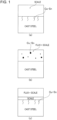
- Fig. 1 will be discussed to describe the behavior of a Cu-Sn melt that occurs in a superficial layer of a Cu-Sn-containing cast steel that has been heated to a high temperature and has been surface-oxidized (hereinafter, this state of the Cu-Sn-containing cast steel will be written as "hot oxidized state"), and also a flux attached to the surface of the Cu-Sn-containing cast steel.
- Fig. 1(a) illustrates a state of the surface of a Cu-Sn-containing cast steel without any flux attached.
- Fig. 1(b) illustrates a state of the surface of a Cu-Sn-containing cast steel to which a flux having a liquid phase ratio of 80% in a high-temperature atmosphere has been attached.
- Fig. 1(c) illustrates a state of the surface of a Cu-Sn-containing cast steel to which a flux having a liquid phase ratio of 5% in a high-temperature atmosphere has been attached.
- Fig. 1(a) schematically illustrates a state of the interface between the Cu-Sn-containing cast steel in a hot oxidized state and a scale.
- Fe which is oxidized more easily than Cu and Sn, forms a scale layer on the surface of the cast steel, and Cu and Sn are concentrated in a superficial layer of the cast steel.
- the melting point of Cu is 1085°C and is further lowered by the enrichment of Sn.
- the Cu-Sn-enriched phase forms a liquid phase in a high-temperature atmosphere of 1000°C or above, and the melt (hereinafter, written as "Cu-Sn melt”) penetrates into grain boundaries in the Cu-Sn-containing cast steel.
- the Cu-Sn melt serves as origins of embrittlement at the time of hot working, such as rolling, and cracks extend to a greater depth with increasing amount of the Cu-Sn melt.
- Fig. 1(b) schematically illustrates a state of the interface between the Cu-Sn-containing cast steel and a scale when a flux has been attached that has a liquid phase ratio of 80% in a high-temperature atmosphere.
- the scale formed by oxidation reacts and mixes with the liquid phase of the flux and, as illustrated in Fig. 1(b) , the flux and the scale are mixed (forming a mixed phase) on the surface of the cast steel.
- the Cu-Sn melt present in a superficial layer of the cast steel is incorporated into the liquid phase of the mixed phase and can be removed without penetration of the Cu-Sn melt into grain boundaries in the Cu-Sn-containing cast steel.
- Fig. 1(c) schematically illustrates a state of the interface between the Cu-Sn-containing cast steel and a scale when a flux has been attached that has a liquid phase ratio of 5% in a high-temperature atmosphere.
- the flux does not sufficiently form a liquid phase, and oxidation proceeds while the scale formed on the surface of the cast steel does not sufficiently react and mix with the flux.
- the cast steel surface and the flux are separated by the scale, and the Cu-Sn melt penetrates into grain boundaries in the Cu-Sn-containing cast steel similarly to the hot oxidized state illustrated in Fig. 1(a) .
- the cast steel surface and the flux should not be separated by a scale in order to ensure that the Cu-Sn melt present in a superficial layer of the cast steel in the hot oxidized state will be removed. That is, the flux needs to be sufficiently liquefied in a high-temperature atmosphere, such as in a heating furnace.
- the scale on the surface of the Cu-Sn-containing cast steel is removed (hereinafter, written as "descaled or descaling") before the Cu-Sn-containing cast steel that has the hot oxidized surface is subjected to hot working.
- the flux does not form a liquid phase sufficiently as illustrated in Fig. 1(c) , it is impossible to remove (clean away) the flux completely together with the scale by the subsequent descaling.
- the flux that remains on the surface of the Cu-Sn-containing cast steel causes a poor appearance of the cast steel that is produced.
- the flux needs to be highly liquefied on the surface of the Cu-Sn-containing cast steel even when the heating furnace that is used has a low heating capacity.
- the present invention focuses on a flux that includes at least any of B 2 O 3 , P 2 O 5 , K 2 O, PbO, Na 2 O-FeO, Na 2 O-SiO 2 , Na 2 O-TiO 2 , and Li 2 O-SiO 2 components.
- a flux that includes at least any of B 2 O 3 , P 2 O 5 , K 2 O, PbO, Na 2 O-FeO, Na 2 O-SiO 2 , Na 2 O-TiO 2 , and Li 2 O-SiO 2 components.
- Na 2 O-FeO includes both Na 2 O and FeO components
- Na 2 O-SiO 2 includes both Na 2 O and SiO 2 components
- Na 2 O-TiO 2 includes both Na 2 O and TiO 2 components
- Li 2 O-SiO 2 includes both Li 2 O and SiO 2 components.
- the liquid phase ratio of the flux may be determined using an equilibrium diagram obtained by experiments or thermodynamic calculations.
- a sample may be held at a predetermined temperature to reach thermodynamic equilibrium and then frozen by, for example, water cooling, and a cross section of the sample may be analyzed to estimate the liquid phase ratio.
- the flux may further include incidental oxide, fluoride, carbonate, and metal components as long as the composition of the flux allows the liquid phase ratio at 1000°C to be 10 mass% or more.
- a flux based on, for example, SiO 2 , CaO, Li 2 O, Na 2 O, F, MgO, or Al 2 O 3 is known as a continuous casting mold flux. Even such a flux can be applied to the present invention as long as the liquid phase ratio at 1000°C is 10 mass% or more.
- the base material of the flux including at least any of B 2 O 3 , P 2 O 5 , K 2 O, PbO, Na 2 O-FeO, Na 2 O-SiO 2 , Na 2 O-TiO 2 , and Li 2 O-SiO 2 components may be an oxide or may be, for example, a carbonate or a fluoride. These base materials may be mixed.
- the flux may be attached as a pre-melt to the surface of the Cu-Sn-containing cast steel.
- the flux may be attached (supplied) to the surface of the Cu-Sn-containing cast steel in an appropriate manner, such as by application or spraying, without limitation to any particular technique.
- the flux may be in the form of powder or slurry.
- the flux may be applied as a solution or a suspension in water or other liquid.
- the flux may be mixed together with an inorganic or organic miscible polymer or a solvent similarly to a general paint agent.
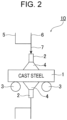
- Fig. 2 is a schematic view illustrating an outline of the flux supply device 10.
- a cast steel 1 is placed on placement or conveying rollers 3 for the supply of a flux 4.
- the flux supply device 10 has spray guns 2 arranged above and below the cast steel 1 placed on the rollers 3 in order to supply the flux 4 uniformly to the surface of the cast steel 1 located therebetween.
- a flux powder 5 and jet air 6 are mixed together through a supply pipe 7 and are supplied to the spray guns 2.
- the amount of the flux 4 attached to the surface of the cast steel 1 may be controlled by controlling the amount of the flux 4 supplied through the supply pipe 7 and the line speed.
- the amount of the flux attached to the surface of the cast steel is preferably such that the mass per unit area of the surface of the Cu-Sn-containing cast steel is 50 g/m 2 or more and 5000 g/m 2 or less. If the amount of the flux attached is less than 50 g/m 2 , the flux cannot sufficiently incorporate the Cu-Sn melt and cracks disadvantageously occur on the steel surface after hot working. If the amount of the flux attached is more than 5000 g/m 2 , the excess of the flux adheres to, for example, the rollers 3 and causes early deterioration of the flux supply device 10. The excess supply of the flux also disadvantageously leads to economic problems, such as cost increase.
- the amount of the flux attached to the surface of the cast steel is more preferably 100 g/m 2 or more and 2500 g/m 2 or less, and still more preferably 500 g/m 2 or more and 1000 g/m 2 or less.
- the cast steel (the Cu-Sn-containing cast steel) to which the flux will be or has been supplied is subjected to heat treatment at a temperature of 1000°C or above and 1400°C or below and is subsequently subjected to hot rolling (hot working). If the heating temperature is below 1000°C, high deformation resistance is encountered during hot working to cause a decrease in rolling efficiency. If the heating temperature exceeds 1400°C, predetermined steel material properties may not be obtained.
- the heating temperature for the cast steel (the Cu-Sn-containing cast steel) is more preferably 1000°C or above and 1300°C or below, and still more preferably 1000°C or above and below 1150°C. This heating temperature is applicable to a heating furnace with a low heating capacity.
- the residence time in the heating furnace (the heating time) is preferably 2 hours or more for uniform heating of the cast steel. Because long heating time raises the manufacturing cost, the residence time in the heating furnace is preferably 5 hours or less.
- Table 1 describes the components contained in the flux and the contents (mass%).
- the fluxes with flux Nos. "A1 to A20” are fluxes having a liquid phase ratio of 10 mass% or more at an atmosphere temperature of 1000°C.
- the flux with flux number "B” is a SiO 2 flux disclosed in Patent Literature 2.
- the fluxes with flux numbers "C1 and C2" are fluxes having a liquid phase ratio of less than 10 mass% at an atmosphere temperature of 1000°C.
- the liquid phase ratios of the fluxes with flux Nos. "A1 to A20" and “C1 and C2" were determined in the following manner. First, 10 g of a sample obtained by mixing the flux components described in Table 1 was added to a platinum crucible, melted by being held in an electric resistance furnace at 1600°C for 1 hour, and then held at 1000°C for 48 hours. Subsequently, the lateral side of the platinum crucible containing the sample was water-cooled to freeze the sample. A cross section of the frozen sample was observed with an optical microscope to measure the cross-sectional liquid phase ratio.
- Table 2 describes the results of evaluation (INVENTIVE EXAMPLES 1 to 20 and COMPARATIVE EXAMPLES 1 to 5) of the Cu-Sn-containing steels (the hot-rolled steel sheets) produced by performing the heating step in a heating furnace (the hot heating step) and the rolling step (the hot working step) using the fluxes described in Table 1.
- EX. 1 A1 1541 Good INV.
- EX. 2 A2 1402 Good INV.
- EX. 3 A3 582 Good INV.
- EX. 1 A1 1541 Good INV.
- EX. 2 A2 1402 Good INV.
- EX. 3 A3 582 Good INV.
- the "cracking occurrence” was “good” when use was made of the fluxes having a liquid phase ratio of 10 mass% or more at an atmosphere temperature of 1000°C (the fluxes with flux Nos. "A1 to A20"). As shown by the results of INVENTIVE EXAMPLES 1 to 20, it was confirmed that the "cracking occurrence” was “good” when the amount of the flux attached to the surface of the Cu-Sn-containing cast steel was such that the mass per unit area was 544 g/m 2 or more and 3281 g/m 2 or less.
- a Cu-Sn-containing cast steel (a carbon steel) containing 1.0 mass% Cu and 0.1 mass% Sn was charged into a heating furnace and was heated for 3 hours at a furnace atmosphere temperature of 1010°C. Subsequently, various fluxes (see Table 1) were applied to the surface of the Cu-Sn-containing cast steel that had been heated. Such Cu-Sn-containing cast steels were subjected to rough rolling and finish rolling. Cu-Sn-containing steels (hot-rolled steel sheets) having a thickness of 2.3 mm were thus produced. While EXAMPLE 1 has illustrated that the steel was heated and rolled after the flux had been applied, EXAMPLE 2 will illustrate that heating precedes flux application and rolling.
- Table 3 describes the results of evaluation (INVENTIVE EXAMPLES 21 to 40 and COMPARATIVE EXAMPLES 6 to 10) of the Cu-Sn-containing steels (the hot-rolled steel sheets) produced by performing the heating step in a heating furnace (the hot heating step) and the rolling step (the hot working step) using the fluxes described in Table 1.
- EX. 25 A5 1896 Good INV.
- the "cracking occurrence” was “good” when use was made of the fluxes having a liquid phase ratio of 10 mass% or more at an atmosphere temperature of 1000°C (the fluxes with flux Nos. "A1 to A20"). As shown by the results of INVENTIVE EXAMPLES 21 to 40, it was confirmed that the "cracking occurrence” was “good” when the amount of the flux attached to the surface of the Cu-Sn-containing cast steel was such that the weight per unit area was 544 g/m 2 or more and 3281 g/m 2 or less.
- the Cu-Sn-containing steels thus produced were studied (evaluated) for surface cracks in the same manner as the previous EXAMPLES. Specifically, ten sheets of the Cu-Sn-containing steel, each 1 m in width and 1 m in length, were randomly sampled in the rolling direction, and the 1 m ⁇ 1 m area (face) of each sheet was crosscut at 100 mm intervals and was divided into 100 equal squares. Next, the number of cracked squares was counted to determine the count per m 2 . The results of the ten sheets were averaged. Surface cracking was rated as "good” when the cracking frequency was 0.3 squares/m 2 or less and was rated as "bad” when the cracking frequency was more than 0.3 squares/m 2 .
- this EXAMPLE studied (evaluated) the surface appearance in order to investigate the presence of residual flux on the surface of the descaled Cu-Sn-containing cast steels.
- Table 4 describes the results of evaluation (INVENTIVE EXAMPLES 41 to 47 and COMPARATIVE EXAMPLE 11) of the Cu-Sn-containing steels (the hot-rolled steel sheets) produced by performing the heating step in a heating furnace (the hot heating step) and the rolling step (the hot working step) using some of the fluxes described in Table 1.
- EX. 41 A18 1270 3 Good Good INV.
- EX. 42 A19 1270 3 Good Good INV.
- EX. 43 A20 1270 3 Good Good INV.
- EX. 44 A18 1140 3 Good Good INV.
- EX. 45 A19 1140 3 Good Good INV.
- EX. 46 A20 1140 3 Good Good INV.
- EX. 47 A20 1270 5 Good Good COMP. EX. 11 B 1270 3 Good Bad
- the flux having a liquid phase ratio of 10 mass% or more at an atmosphere temperature of 1000°C was attached to the surface of the Cu-Sn-containing cast steel.
- the flux successfully suppressed the occurrence of cracks stemming from the penetration of a Cu-Sn melt into grain boundaries in the rolling step even when the atmosphere temperature in the heating furnace was 1150°C or below.
- little flux remained on the surface of the Cu-Sn-containing cast steel after descaling, and the cast steel was free from a poor appearance.
Landscapes
- Chemical & Material Sciences (AREA)
- Engineering & Computer Science (AREA)
- Mechanical Engineering (AREA)
- Materials Engineering (AREA)
- Metallurgy (AREA)
- Organic Chemistry (AREA)
- Crystallography & Structural Chemistry (AREA)
- Thermal Sciences (AREA)
- Physics & Mathematics (AREA)
- Heat Treatment Of Sheet Steel (AREA)
- Metal Rolling (AREA)
- Coating With Molten Metal (AREA)
- Solid-Phase Diffusion Into Metallic Material Surfaces (AREA)
Abstract
Description
- The present invention relates to a method for producing Cu-Sn-containing steel that can eliminate or reduce the occurrence of cracking on the steel surface during hot working.
- The recent increase in the demand for reducing the CO2 emissions has led to the growing use of electric arc furnaces in the steelmaking process. Due to the need of saving the production cost, the raw materials used in the steelmaking process are scraps containing large amounts of tramp elements, in particular, scraps containing large amounts of Cu and Sn.
- However, tramp elements are difficult to remove in the refining step and inevitably remain in the steel. When cast steel contains residual tramp elements (for example, Cu and Sn) after the refining step (hereinafter, such cast steel will be written as "Cu-Sn-containing cast steel" or simply as "cast steel"), a Cu-Sn melt occurs in a superficial layer during the hot heating step. The Cu-Sn melt gives rise to red shortness in the hot working step, such as rolling. Thus, cracks (cracking) occur on the surface of the steel resulting from the hot working step (hereinafter written as "Cu-Sn-containing steel" or simply as "steel"), making it difficult to produce final hot-rolled steel sheets with excellent surface properties.
- At the time of high-temperature oxidation of Cu-Sn-containing cast steel, a Cu-Sn enriched melt is precipitated in a superficial layer of the cast steel and causes surface defects on the Cu-Sn-containing steel. It is conventionally known that this precipitation is suppressed by the addition of a predetermined amount of Ni to the Cu-Sn-containing cast steel, and thereby the occurrence of cracking on the cast steel surface can be prevented. However, the addition of Ni is costly and destroys the merits offered by the use of scraps containing much tramp elements.
- Because the Cu-Sn melt that causes surface defects on Cu-Sn-containing steel occurs only in a superficial layer of the Cu-Sn-containing cast steel, the prevention technique of surface cracking has been proposed based on surface modification of the Cu-Sn-containing cast steel.
-
Patent Literature 1 discloses a method in which the surface of a cast steel is melted by plasma heating using a DC arc plasma vibrated with an AC magnetic field, and Ni is added only to a superficial portion. Furthermore,Patent Literature 2 discloses a method in which a flux including SiO2 is attached to the surface of a Cu-Sn-containing cast steel from continuous casting while the cast steel temperature is in the range of 1150°C and above, thereby forming a scale of a FeO-SiO2-based low-melting oxide fluid, and a Cu-Sn melt is incorporated into the fluid, thus suppressing the occurrence of red shortness on the surface. -
- PTL 1:
Japanese Patent No. 5454132 - PTL 2:
Japanese Unexamined Patent Application Publication No. 6-297025 - While the method disclosed in
Patent Literature 1 can reduce the cost associated with the addition of Ni, the installation of the AC magnetic field and arc plasma facilities entails enormous costs of the initial investment. Moreover, the method disclosed inPatent Literature 2 is problematic in that the method cannot be applied to hot working at temperatures below 1150°C. - Furthermore, while
Patent Literature 2 refers to the prevention of cracking during hot working in the temperature range of 1150°C and above, no reference is made as to problems that will be encountered when a heating furnace with a low heating capacity is used. Specifically, low-temperature heating does not allow a flux spread on the surface of a Cu-Sn-containing cast steel to form a liquid phase sufficiently and makes it difficult to remove the flux completely together with the scale in the downstream descaling step. The flux remaining on the surface of the Cu-Sn-containing cast steel causes a poor appearance of the cast steel. - The present invention has been made in view of the circumstances discussed above. It is therefore an object of the present invention to provide a method for producing Cu-Sn-containing steel that can be hot-worked at low cost without surface cracking even when a heating furnace with a low heating capacity is used for the hot working.
- Main configurations of the present invention for solving the above problems are as follows.
- [1] A method for producing Cu-Sn-containing steel, including a hot heating step of attaching a flux to a surface of a Cu-Sn-containing cast steel in such an amount that the mass per unit area is 50 g/m2 or more and 5000 g/m2 or less, and heating the Cu-Sn-containing cast steel at a temperature of 1000°C or above and 1400°C or below, the flux including at least any of B2O3, P2O5, K2O, PbO, Na2O-FeO, Na2O-SiO2, Na2O-TiO2, and Li2O-SiO2 components and being such that the liquid phase ratio at 1000°C is 10 mass% or more; and a hot working step of hot working the Cu-Sn-containing cast steel.
- [2] A method for producing Cu-Sn-containing steel, including a hot heating step of heating a Cu-Sn-containing cast steel at a temperature of 1000°C or above and 1400°C or below; and a hot working step of attaching a flux to a surface of the Cu-Sn-containing cast steel in such an amount that the mass per unit area is 50 g/m2 or more and 5000 g/m2 or less, and hot working the Cu-Sn-containing cast steel, the flux including at least any of B2O3, P2O5, K2O, PbO, Na2O-FeO, Na2O-SiO2, Na2O-TiO2, and Li2O-SiO2 components and being such that the liquid phase ratio at 1000°C is 10 mass% or more.
- [3] The method for producing Cu-Sn-containing steel according to [1] or [2], wherein the flux further includes an incidental oxide, fluoride, carbonate, or metal component.
- [4] The method for producing Cu-Sn-containing steel according to any one of [1] to [3], wherein the flux is attached as a pre-melt to the surface of the Cu-Sn-containing cast steel.
- According to the present invention, Cu-Sn-containing steel can be hot-worked at low cost without surface cracking even when a heating furnace with a low heating capacity is used for the hot working.
-
- [
Fig. 1] Fig. 1 is a set of views illustrating actions of a flux on a Cu-Sn melt. - [
Fig. 2] Fig. 2 is a schematic view illustrating an outline of a flux spray device. - A method for implementing the present invention will be described below. First,
Fig. 1 will be discussed to describe the behavior of a Cu-Sn melt that occurs in a superficial layer of a Cu-Sn-containing cast steel that has been heated to a high temperature and has been surface-oxidized (hereinafter, this state of the Cu-Sn-containing cast steel will be written as "hot oxidized state"), and also a flux attached to the surface of the Cu-Sn-containing cast steel. -
Fig. 1(a) illustrates a state of the surface of a Cu-Sn-containing cast steel without any flux attached.Fig. 1(b) illustrates a state of the surface of a Cu-Sn-containing cast steel to which a flux having a liquid phase ratio of 80% in a high-temperature atmosphere has been attached.Fig. 1(c) illustrates a state of the surface of a Cu-Sn-containing cast steel to which a flux having a liquid phase ratio of 5% in a high-temperature atmosphere has been attached. - Here,
Fig. 1(a) schematically illustrates a state of the interface between the Cu-Sn-containing cast steel in a hot oxidized state and a scale. As illustrated inFig. 1(a) , Fe, which is oxidized more easily than Cu and Sn, forms a scale layer on the surface of the cast steel, and Cu and Sn are concentrated in a superficial layer of the cast steel. The melting point of Cu is 1085°C and is further lowered by the enrichment of Sn. As a result, the Cu-Sn-enriched phase forms a liquid phase in a high-temperature atmosphere of 1000°C or above, and the melt (hereinafter, written as "Cu-Sn melt") penetrates into grain boundaries in the Cu-Sn-containing cast steel. The Cu-Sn melt serves as origins of embrittlement at the time of hot working, such as rolling, and cracks extend to a greater depth with increasing amount of the Cu-Sn melt. -
Fig. 1(b) schematically illustrates a state of the interface between the Cu-Sn-containing cast steel and a scale when a flux has been attached that has a liquid phase ratio of 80% in a high-temperature atmosphere. The scale formed by oxidation reacts and mixes with the liquid phase of the flux and, as illustrated inFig. 1(b) , the flux and the scale are mixed (forming a mixed phase) on the surface of the cast steel. The Cu-Sn melt present in a superficial layer of the cast steel is incorporated into the liquid phase of the mixed phase and can be removed without penetration of the Cu-Sn melt into grain boundaries in the Cu-Sn-containing cast steel. -
Fig. 1(c) schematically illustrates a state of the interface between the Cu-Sn-containing cast steel and a scale when a flux has been attached that has a liquid phase ratio of 5% in a high-temperature atmosphere. In the state illustrated inFig. 1(c) , the flux does not sufficiently form a liquid phase, and oxidation proceeds while the scale formed on the surface of the cast steel does not sufficiently react and mix with the flux. As a result, the cast steel surface and the flux are separated by the scale, and the Cu-Sn melt penetrates into grain boundaries in the Cu-Sn-containing cast steel similarly to the hot oxidized state illustrated inFig. 1(a) . - As described with reference to
Figs. 1(a) to 1(c) , the cast steel surface and the flux should not be separated by a scale in order to ensure that the Cu-Sn melt present in a superficial layer of the cast steel in the hot oxidized state will be removed. That is, the flux needs to be sufficiently liquefied in a high-temperature atmosphere, such as in a heating furnace. - The scale on the surface of the Cu-Sn-containing cast steel is removed (hereinafter, written as "descaled or descaling") before the Cu-Sn-containing cast steel that has the hot oxidized surface is subjected to hot working.
- If, however, the flux does not form a liquid phase sufficiently as illustrated in
Fig. 1(c) , it is impossible to remove (clean away) the flux completely together with the scale by the subsequent descaling. The flux that remains on the surface of the Cu-Sn-containing cast steel causes a poor appearance of the cast steel that is produced. Thus, in order to ensure that the flux will be removed completely together with the scale by descaling, the flux needs to be highly liquefied on the surface of the Cu-Sn-containing cast steel even when the heating furnace that is used has a low heating capacity. - To ensure that the liquid phase ratio in a high-temperature atmosphere at 1000°C will be 10 mass% or more, the present invention focuses on a flux that includes at least any of B2O3, P2O5, K2O, PbO, Na2O-FeO, Na2O-SiO2, Na2O-TiO2, and Li2O-SiO2 components. Here, "Na2O-FeO" includes both Na2O and FeO components, "Na2O-SiO2" includes both Na2O and SiO2 components, "Na2O-TiO2" includes both Na2O and TiO2 components, and "Li2O-SiO2" includes both Li2O and SiO2 components.
- The liquid phase ratio of the flux may be determined using an equilibrium diagram obtained by experiments or thermodynamic calculations. Alternatively, a sample may be held at a predetermined temperature to reach thermodynamic equilibrium and then frozen by, for example, water cooling, and a cross section of the sample may be analyzed to estimate the liquid phase ratio.
- In addition to at least any of B2O3, P2O5, K2O, PbO, Na2O-FeO, Na2O-SiO2, Na2O-TiO2, and Li2O-SiO2 components, the flux may further include incidental oxide, fluoride, carbonate, and metal components as long as the composition of the flux allows the liquid phase ratio at 1000°C to be 10 mass% or more.
- A flux based on, for example, SiO2, CaO, Li2O, Na2O, F, MgO, or Al2O3 is known as a continuous casting mold flux. Even such a flux can be applied to the present invention as long as the liquid phase ratio at 1000°C is 10 mass% or more.
- The base material of the flux including at least any of B2O3, P2O5, K2O, PbO, Na2O-FeO, Na2O-SiO2, Na2O-TiO2, and Li2O-SiO2 components may be an oxide or may be, for example, a carbonate or a fluoride. These base materials may be mixed. The flux may be attached as a pre-melt to the surface of the Cu-Sn-containing cast steel.
- The flux may be attached (supplied) to the surface of the Cu-Sn-containing cast steel in an appropriate manner, such as by application or spraying, without limitation to any particular technique. The flux may be in the form of powder or slurry. The flux may be applied as a solution or a suspension in water or other liquid. Alternatively, the flux may be mixed together with an inorganic or organic miscible polymer or a solvent similarly to a general paint agent.
- Here, a
flux supply device 10 will be described with reference toFig. 2. Fig. 2 is a schematic view illustrating an outline of theflux supply device 10. As illustrated inFig. 2 , acast steel 1 is placed on placement or conveyingrollers 3 for the supply of aflux 4. Theflux supply device 10 hasspray guns 2 arranged above and below thecast steel 1 placed on therollers 3 in order to supply theflux 4 uniformly to the surface of thecast steel 1 located therebetween. Aflux powder 5 and jet air 6 are mixed together through asupply pipe 7 and are supplied to thespray guns 2. The amount of theflux 4 attached to the surface of thecast steel 1 may be controlled by controlling the amount of theflux 4 supplied through thesupply pipe 7 and the line speed. - The amount of the flux attached to the surface of the cast steel is preferably such that the mass per unit area of the surface of the Cu-Sn-containing cast steel is 50 g/m2 or more and 5000 g/m2 or less. If the amount of the flux attached is less than 50 g/m2, the flux cannot sufficiently incorporate the Cu-Sn melt and cracks disadvantageously occur on the steel surface after hot working. If the amount of the flux attached is more than 5000 g/m2, the excess of the flux adheres to, for example, the
rollers 3 and causes early deterioration of theflux supply device 10. The excess supply of the flux also disadvantageously leads to economic problems, such as cost increase. The amount of the flux attached to the surface of the cast steel is more preferably 100 g/m2 or more and 2500 g/m2 or less, and still more preferably 500 g/m2 or more and 1000 g/m2 or less. - The cast steel (the Cu-Sn-containing cast steel) to which the flux will be or has been supplied is subjected to heat treatment at a temperature of 1000°C or above and 1400°C or below and is subsequently subjected to hot rolling (hot working). If the heating temperature is below 1000°C, high deformation resistance is encountered during hot working to cause a decrease in rolling efficiency. If the heating temperature exceeds 1400°C, predetermined steel material properties may not be obtained. The heating temperature for the cast steel (the Cu-Sn-containing cast steel) is more preferably 1000°C or above and 1300°C or below, and still more preferably 1000°C or above and below 1150°C. This heating temperature is applicable to a heating furnace with a low heating capacity. The residence time in the heating furnace (the heating time) is preferably 2 hours or more for uniform heating of the cast steel. Because long heating time raises the manufacturing cost, the residence time in the heating furnace is preferably 5 hours or less.
- EXAMPLES of hot heating and hot working performed based on the method for producing Cu-Sn-containing steel according to the present embodiment will be described below.
- First, various fluxes were applied to the surface of a Cu-Sn-containing cast steel (a carbon steel) containing 1.0 mass% Cu and 0.1 mass% Sn, and the cast steels were charged into a heating furnace and were heated (hot heated) for 3 hours at a furnace atmosphere temperature of 1010°C. Next, the Cu-Sn-containing cast steels that had been heated were hot-worked by rough rolling and finish rolling. Cu-Sn-containing steels (hot-rolled steel sheets) having a thickness of 2.3 mm were thus produced. Table 1 describes the fluxes applied to the surface of the Cu-Sn-containing cast steel.
[Table 1] Flux No. Flux components [mass%] Liquid phase ratio at 1000°C [mass%] SiO2 CaO Na2O F Li2O FeO Fe2O3 TiO2 K2O P2O5 PbO B2O3 BaO MnO A1 56.3 43.4 0.3 100.0 A2 68.6 31.4 100.0 A3 76.0 24.0 100.0 A4 32.2 67.8 100.0 A5 45.5 54.5 100.0 A6 66.3 33.7 100.0 A7 48.0 52.0 100.0 A8 64.0 36.0 100.0 A9 65.0 35.0 100.0 A10 16.0 84.0 100.0 A11 29.9 70.1 100.0 A12 59.5 40.5 100.0 A13 55.0 0.2 44.8 100.0 A14 37.5 62.5 100.0 A15 58.8 41.2 100.0 A16 67.2 32.8 100.0 A17 41.3 58.7 100.0 A18 36.6 35.3 19.1 9.0 100.0 A19 16.4 83.6 50.2 A20 50.0 50.0 10.0 B 100.0 0.0 C1 13.2 86.4 0.4 5.1 C2 73.3 26.7 2.1 - Table 1 describes the components contained in the flux and the contents (mass%). The fluxes with flux Nos. "A1 to A20" are fluxes having a liquid phase ratio of 10 mass% or more at an atmosphere temperature of 1000°C. The flux with flux number "B" is a SiO2 flux disclosed in
Patent Literature 2. The fluxes with flux numbers "C1 and C2" are fluxes having a liquid phase ratio of less than 10 mass% at an atmosphere temperature of 1000°C. - The liquid phase ratios of the fluxes with flux Nos. "A1 to A20" and "C1 and C2" were determined in the following manner. First, 10 g of a sample obtained by mixing the flux components described in Table 1 was added to a platinum crucible, melted by being held in an electric resistance furnace at 1600°C for 1 hour, and then held at 1000°C for 48 hours. Subsequently, the lateral side of the platinum crucible containing the sample was water-cooled to freeze the sample. A cross section of the frozen sample was observed with an optical microscope to measure the cross-sectional liquid phase ratio.
- Surface cracking in the Cu-Sn-containing steels (the hot-rolled steel sheets) produced in this EXAMPLE was studied (evaluated) in the following manner. First, ten sheets of the Cu-Sn-containing steel, each 1 m in width and 1 m in length, were randomly sampled in the rolling direction, and the 1 m × 1 m area (face) of each sheet was crosscut at 100 mm intervals and was divided into 100 equal squares. Next, the number of cracked squares was counted to determine the count per m2. The results of the ten sheets were averaged. Surface cracking was rated as "good" when the cracking frequency was 0.3 squares/m2 or less and was rated as "bad" when the cracking frequency was more than 0.3 squares/m2.
- Table 2 describes the results of evaluation (INVENTIVE EXAMPLES 1 to 20 and COMPARATIVE EXAMPLES 1 to 5) of the Cu-Sn-containing steels (the hot-rolled steel sheets) produced by performing the heating step in a heating furnace (the hot heating step) and the rolling step (the hot working step) using the fluxes described in Table 1.
[Table 2] EXAMPLES Flux No. Amount attached [g/m2] Cracking occurrence INV. EX. 1 A1 1541 Good INV. EX. 2 A2 1402 Good INV. EX. 3 A3 582 Good INV. EX. 4 A4 544 Good INV. EX. 5 A5 1896 Good INV. EX. 6 A6 3281 Good INV. EX. 7 A7 1764 Good INV. EX. 8 A8 1389 Good INV. EX. 9 A9 1576 Good INV. EX. 10 A10 1519 Good INV. EX. 11 A11 2080 Good INV. EX. 12 A12 2175 Good INV. EX. 13 A13 2675 Good INV. EX. 14 A14 1788 Good INV. EX. 15 A15 2692 Good INV. EX. 16 A16 2698 Good INV. EX. 17 A17 1207 Good INV. EX. 18 A18 551 Good INV. EX. 19 A19 2905 Good INV. EX. 20 A20 1450 Good COMP. EX. 1 C1 1686 Bad COMP. EX. 2 C2 1375 Bad COMP. EX. 3 A1 48 Bad COMP. EX. 4 A2 11 Bad COMP. EX. 5 B 2834 Bad - As described in Table 1 and Table 2, the "cracking occurrence" was "good" when use was made of the fluxes having a liquid phase ratio of 10 mass% or more at an atmosphere temperature of 1000°C (the fluxes with flux Nos. "A1 to A20"). As shown by the results of INVENTIVE EXAMPLES 1 to 20, it was confirmed that the "cracking occurrence" was "good" when the amount of the flux attached to the surface of the Cu-Sn-containing cast steel was such that the mass per unit area was 544 g/m2 or more and 3281 g/m2 or less.
- The "cracking occurrence" was "bad" every time when the flux that was used had a liquid phase ratio of less than 10 mass% at an atmosphere temperature of 1000°C (COMPARATIVE EXAMPLES 1 and 2).
- Furthermore, it was confirmed that even when the flux had a liquid phase ratio of 10 mass% or more at an atmosphere temperature of 1000°C, the "cracking occurrence" was "bad" when the amount (mass) of the flux applied to the surface of the Cu-Sn-containing cast steel was 48 g/m2 or less per unit area (COMPARATIVE EXAMPLES 3 and 4). Furthermore, it was confirmed that when the flux consisted solely of SiO2, the "cracking occurrence" was "bad" even though the amount (mass) applied to the surface of the Cu-Sn-containing cast steel was 2834 g/m2 per unit area (COMPARATIVE EXAMPLE 5).
- In the next EXAMPLE, a Cu-Sn-containing cast steel (a carbon steel) containing 1.0 mass% Cu and 0.1 mass% Sn was charged into a heating furnace and was heated for 3 hours at a furnace atmosphere temperature of 1010°C. Subsequently, various fluxes (see Table 1) were applied to the surface of the Cu-Sn-containing cast steel that had been heated. Such Cu-Sn-containing cast steels were subjected to rough rolling and finish rolling. Cu-Sn-containing steels (hot-rolled steel sheets) having a thickness of 2.3 mm were thus produced. While EXAMPLE 1 has illustrated that the steel was heated and rolled after the flux had been applied, EXAMPLE 2 will illustrate that heating precedes flux application and rolling.
- Table 3 describes the results of evaluation (INVENTIVE EXAMPLES 21 to 40 and COMPARATIVE EXAMPLES 6 to 10) of the Cu-Sn-containing steels (the hot-rolled steel sheets) produced by performing the heating step in a heating furnace (the hot heating step) and the rolling step (the hot working step) using the fluxes described in Table 1.
[Table 3] EXAMPLES Flux No. Amount attached [g/m2] Cracking occurrence INV. EX. 21 A1 1541 Good INV. EX. 22 A2 1402 Good INV. EX. 23 A3 582 Good INV. EX. 24 A4 544 Good INV. EX. 25 A5 1896 Good INV. EX. 26 A6 3281 Good INV. EX. 27 A7 1764 Good INV. EX. 28 A8 1389 Good INV. EX. 29 A9 1576 Good INV. EX. 30 A10 1519 Good INV. EX. 31 A11 2080 Good INV. EX. 32 A12 2175 Good INV. EX. 33 A13 2675 Good INV. EX. 34 A14 1788 Good INV. EX. 35 A15 2692 Good INV. EX. 36 A16 2698 Good INV. EX. 37 A17 1207 Good INV. EX. 38 A18 551 Good INV. EX. 39 A19 2905 Good INV. EX. 40 A20 1450 Good COMP. EX. 6 C1 1686 Bad COMP. EX. 7 C2 1375 Bad COMP. EX. 8 A1 48 Bad COMP. EX. 9 A2 11 Bad COMP. EX. 10 B 2834 Bad - As described in Table 1 and Table 3, the "cracking occurrence" was "good" when use was made of the fluxes having a liquid phase ratio of 10 mass% or more at an atmosphere temperature of 1000°C (the fluxes with flux Nos. "A1 to A20"). As shown by the results of INVENTIVE EXAMPLES 21 to 40, it was confirmed that the "cracking occurrence" was "good" when the amount of the flux attached to the surface of the Cu-Sn-containing cast steel was such that the weight per unit area was 544 g/m2 or more and 3281 g/m2 or less.
- The "cracking occurrence" was "bad" every time when the flux that was used had a liquid phase ratio of less than 10 mass% at an atmosphere temperature of 1000°C (COMPARATIVE EXAMPLES 6 and 7).
- Furthermore, it was confirmed that even when the flux had a liquid phase ratio of 10 mass% or more at an atmosphere temperature of 1000°C, the "cracking occurrence" was "bad" when the amount (mass) of the flux applied to the surface of the Cu-Sn-containing cast steel was 48 g/m2 or less per unit area (COMPARATIVE EXAMPLES 8 and 9). Furthermore, it was confirmed that when the flux consisted solely of SiO2, the "cracking occurrence" was "bad" even though the amount (mass) applied to the surface of the Cu-Sn-containing cast steel was 2834 g/m2 per unit area (COMPARATIVE EXAMPLE 10).
- In the next EXAMPLE, some types of the fluxes were applied to the surface of a Cu-Sn-containing cast steel (a carbon steel) containing 1.0 mass% Cu and 0.1 mass% Sn. The amount applied per unit area was 2500 g/m2. The Cu-Sn-containing cast steels coated with the flux were charged into a heating furnace and were heated at varied furnace atmosphere temperatures (heating temperatures) for varied amounts of heating time. The Cu-Sn-containing cast steels extracted from the heating furnace were descaled. The descaled Cu-Sn-containing cast steels were hot-worked by rough rolling and finish rolling. Cu-Sn-containing steels (hot-rolled steel sheets) having a thickness of 2.3 mm were thus produced.
- The Cu-Sn-containing steels thus produced were studied (evaluated) for surface cracks in the same manner as the previous EXAMPLES. Specifically, ten sheets of the Cu-Sn-containing steel, each 1 m in width and 1 m in length, were randomly sampled in the rolling direction, and the 1 m × 1 m area (face) of each sheet was crosscut at 100 mm intervals and was divided into 100 equal squares. Next, the number of cracked squares was counted to determine the count per m2. The results of the ten sheets were averaged. Surface cracking was rated as "good" when the cracking frequency was 0.3 squares/m2 or less and was rated as "bad" when the cracking frequency was more than 0.3 squares/m2.
- Furthermore, this EXAMPLE studied (evaluated) the surface appearance in order to investigate the presence of residual flux on the surface of the descaled Cu-Sn-containing cast steels. In the study of surface appearance, ten sheets of the Cu-Sn-containing steel, each 1 m in width and 1 m in length, were randomly sampled in the rolling direction, and the 1 m × 1 m area (face) of each sheet was crosscut at 100 mm intervals and was divided into 100 equal squares. Next, the 100 mm × 100 m squares were visually inspected to measure the flux. The results were averaged to determine the residual flux area ratio per sheet. The surface appearance was rated as "good" when the average of the residual flux area ratios of the ten sheets was 0.1% or less and was rated as "bad" when the average was more than 0.1%.
- Table 4 describes the results of evaluation (INVENTIVE EXAMPLES 41 to 47 and COMPARATIVE EXAMPLE 11) of the Cu-Sn-containing steels (the hot-rolled steel sheets) produced by performing the heating step in a heating furnace (the hot heating step) and the rolling step (the hot working step) using some of the fluxes described in Table 1.
[Table 4] EXAMPLES Flux No. Heating temp. [°C] Heating time [H] Cracking occurrence Surface appearance INV. EX. 41 A18 1270 3 Good Good INV. EX. 42 A19 1270 3 Good Good INV. EX. 43 A20 1270 3 Good Good INV. EX. 44 A18 1140 3 Good Good INV. EX. 45 A19 1140 3 Good Good INV. EX. 46 A20 1140 3 Good Good INV. EX. 47 A20 1270 5 Good Good COMP. EX. 11 B 1270 3 Good Bad - As demonstrated in INVENTIVE EXAMPLES 41 to 46, it was confirmed that when use was made of the fluxes having a liquid phase ratio of 10 mass% or more at an atmosphere temperature (a heating temperature) of 1000°C (the fluxes with flux Nos. "A18 to A20"), the "cracking occurrence" and the "surface appearance" were "good" even when the atmosphere temperature was 1270°C or 1140°C. Furthermore, as demonstrated in INVENTIVE EXAMPLE 47, it was confirmed that the "cracking occurrence" and the "surface appearance" were "good" even when the heating time (the residence time) at an atmosphere temperature of 1270°C was 5 hours.
- When the flux that was used had a liquid phase ratio of less than 10 mass% at an atmosphere temperature of 1000°C (COMPARATIVE EXAMPLE 11), the "cracking occurrence" was "good" but the "surface appearance" was "bad".
- When the Cu-Sn-containing cast steel was heated (the hot heating step) and rolled (the hot working step), the flux having a liquid phase ratio of 10 mass% or more at an atmosphere temperature of 1000°C was attached to the surface of the Cu-Sn-containing cast steel. As demonstrated above, the flux successfully suppressed the occurrence of cracks stemming from the penetration of a Cu-Sn melt into grain boundaries in the rolling step even when the atmosphere temperature in the heating furnace was 1150°C or below. Furthermore, little flux remained on the surface of the Cu-Sn-containing cast steel after descaling, and the cast steel was free from a poor appearance.
- While EXAMPLES described above evaluated the production of hot-rolled steel sheets, similar effects were confirmed on steel bars, wire rods, and steel pipes produced from round billets or square billets as the cast steel with the attachment of the flux of the present invention. The flux offered similar effects even when attached by brush application.
- While the results of the studies in EXAMPLES described above were obtained at 1010°C, it is needless to mention that similar effects can be obtained by adding the flux of the present invention also in the hot rolling test at a higher temperature, such as 1100°C, 1150°C, or 1250°C.
-
- 1
- cast steel
- 2
- spray gun
- 3
- roller
- 4
- flux
- 5
- flux powder
- 6
- jet air
- 7
- supply pipe
- 10
- flux supply device
Claims (4)
- A method for producing Cu-Sn-containing steel, comprising:a hot heating step of attaching a flux to a surface of a Cu-Sn-containing cast steel in such an amount that the mass per unit area is 50 g/m2 or more and 5000 g/m2 or less, and heating the Cu-Sn-containing cast steel at a temperature of 1000°C or above and 1400°C or below, the flux comprising at least any of B2O3, P2O5, K2O, PbO, Na2O-FeO, Na2O-SiO2, Na2O-TiO2, and Li2O-SiO2 components and being such that the liquid phase ratio at 1000°C is 10 mass% or more; anda hot working step of hot working the Cu-Sn-containing cast steel.
- A method for producing Cu-Sn-containing steel, comprising:a hot heating step of heating a Cu-Sn-containing cast steel at a temperature of 1000°C or above and 1400°C or below; anda hot working step of attaching a flux to a surface of the Cu-Sn-containing cast steel in such an amount that the mass per unit area is 50 g/m2 or more and 5000 g/m2 or less, and hot working the Cu-Sn-containing cast steel, the flux comprising at least any of B2O3, P2O5, K2O, PbO, Na2O-FeO, Na2O-SiO2, Na2O-TiO2, and Li2O-SiO2 components and being such that the liquid phase ratio at 1000°C is 10 mass% or more.
- The method for producing Cu-Sn-containing steel according to claim 1 or 2, wherein the flux further comprises an incidental oxide, fluoride, carbonate, or metal component.
- The method for producing Cu-Sn-containing steel according to any one of claims 1 to 3, wherein the flux is attached as a pre-melt to the surface of the Cu-Sn-containing cast steel.
Applications Claiming Priority (2)
| Application Number | Priority Date | Filing Date | Title |
|---|---|---|---|
| JP2021211805 | 2021-12-27 | ||
| PCT/JP2022/044717 WO2023127413A1 (en) | 2021-12-27 | 2022-12-05 | Cu-sn containing steel manufacturing method |
Publications (2)
| Publication Number | Publication Date |
|---|---|
| EP4431197A1 true EP4431197A1 (en) | 2024-09-18 |
| EP4431197A4 EP4431197A4 (en) | 2025-08-06 |
Family
ID=86998578
Family Applications (1)
| Application Number | Title | Priority Date | Filing Date |
|---|---|---|---|
| EP22915644.3A Pending EP4431197A4 (en) | 2021-12-27 | 2022-12-05 | PROCESS FOR THE PRODUCTION OF CU-SN-CONTAINING STEEL |
Country Status (6)
| Country | Link |
|---|---|
| US (1) | US20250051873A1 (en) |
| EP (1) | EP4431197A4 (en) |
| JP (1) | JP7508010B2 (en) |
| KR (1) | KR20240113526A (en) |
| CN (1) | CN118382504A (en) |
| WO (1) | WO2023127413A1 (en) |
Families Citing this family (2)
| Publication number | Priority date | Publication date | Assignee | Title |
|---|---|---|---|---|
| JP7758226B2 (en) * | 2023-09-21 | 2025-10-22 | Jfeスチール株式会社 | Method for producing Cu-Sn containing steel |
| JP7772286B1 (en) * | 2024-05-24 | 2025-11-18 | Jfeスチール株式会社 | Manufacturing method of steel bar or wire rod |
Family Cites Families (10)
| Publication number | Priority date | Publication date | Assignee | Title |
|---|---|---|---|---|
| JPS5744031Y2 (en) | 1977-09-24 | 1982-09-29 | ||
| JPS55126313A (en) * | 1979-03-19 | 1980-09-30 | Nippon Steel Corp | Scarfing method for surface of steel material |
| JPH05111701A (en) * | 1991-10-21 | 1993-05-07 | Nippon Steel Corp | Method for preventing surface flaw of hot rolled steel and its coating agent |
| JPH06297025A (en) | 1993-04-14 | 1994-10-25 | Nippon Steel Corp | Method for preventing hot crack of cu-and sn-containing steel |
| JPH06346084A (en) * | 1993-06-10 | 1994-12-20 | Sumitomo Metal Ind Ltd | Lubricating composition for hot rolled steel and method of using the same |
| JP2000024707A (en) | 1998-07-10 | 2000-01-25 | Kawasaki Steel Corp | Hot rolling of stainless steel slab |
| JP4479092B2 (en) * | 2000-12-13 | 2010-06-09 | 住友金属工業株式会社 | Hot rolled steel and method for producing the same |
| JP5454132B2 (en) | 2008-12-26 | 2014-03-26 | 新日鐵住金株式会社 | Surface melting method, surface modified steel slab, processed product |
| WO2015022932A1 (en) | 2013-08-12 | 2015-02-19 | 新日鐵住金ステンレス株式会社 | Martensitic stainless steel having excellent wear resistance and corrosion resistance, and method for producing same |
| US20170066022A1 (en) * | 2015-09-09 | 2017-03-09 | Siemens Energy, Inc. | Methods for removing tramp elements from alloy substrates |
-
2022
- 2022-12-05 WO PCT/JP2022/044717 patent/WO2023127413A1/en not_active Ceased
- 2022-12-05 JP JP2023514937A patent/JP7508010B2/en active Active
- 2022-12-05 US US18/720,754 patent/US20250051873A1/en active Pending
- 2022-12-05 KR KR1020247020512A patent/KR20240113526A/en active Pending
- 2022-12-05 CN CN202280082285.0A patent/CN118382504A/en active Pending
- 2022-12-05 EP EP22915644.3A patent/EP4431197A4/en active Pending
Also Published As
| Publication number | Publication date |
|---|---|
| US20250051873A1 (en) | 2025-02-13 |
| JPWO2023127413A1 (en) | 2023-07-06 |
| JP7508010B2 (en) | 2024-07-01 |
| WO2023127413A1 (en) | 2023-07-06 |
| EP4431197A4 (en) | 2025-08-06 |
| CN118382504A (en) | 2024-07-23 |
| KR20240113526A (en) | 2024-07-22 |
Similar Documents
| Publication | Publication Date | Title |
|---|---|---|
| KR102292306B1 (en) | Hot-rolled sheet annealing facility for Si-containing hot-rolled steel sheet, hot-rolled sheet annealing method and descaling method | |
| US20250051873A1 (en) | METHOD FOR PRODUCING Cu-Sn-CONTAINING STEEL | |
| KR20080027948A (en) | Hot rolled steel sheet, cold rolled steel sheet and their manufacturing method | |
| EP1811054B1 (en) | Pipe for petroleum and gas product pipelines and method for the production thereof | |
| CN108291282A (en) | Hot-rolled steel plates, steel products and containers | |
| CN111893388B (en) | Corrosion-resistant steel bar and production process thereof | |
| JP2005281793A (en) | Method for manufacturing wire rod for steel wire and wire rod for steel wire | |
| EP4524279A1 (en) | Ultralow-carbon cold-rolled high-strength steel applicable to electrostatic dry powder enamel, and manufacturing method therefor | |
| CN103114243A (en) | Iron-chromium-aluminum foil for honeycomb carrier of automobile exhaust purification catalyst and preparation method thereof | |
| RU2840442C2 (en) | METHOD OF PRODUCING Cu-Sn-CONTAINING STEEL | |
| CN100506745C (en) | High temperature-resistant coating material for hot continuous rolling steel billet or continuous rolling blank | |
| JP6919493B2 (en) | Manufacturing method of seamless steel pipe | |
| CN113564360A (en) | A large-scale silicon-manganese submerged arc furnace hot charging equipment and its manufacturing process | |
| KR100286667B1 (en) | Manufacturing method of galvanized steel sheet | |
| CN116497290B (en) | Stainless steel material with good machinability and cutting destructiveness | |
| KR102109232B1 (en) | Antioxidant, processing method of the steel using thereof, and rolled steel product using the same | |
| JP7758226B2 (en) | Method for producing Cu-Sn containing steel | |
| KR102176332B1 (en) | Steel having excellent high temperature corrosion resistance and creep resistance | |
| JP3932567B2 (en) | Granular lubricant for elongator rolling and seamless elongator rolling process for seamless steel pipe production | |
| JPH08144036A (en) | Method for producing hot-dip galvanized steel sheet using hot-rolled steel sheet | |
| JP2026006962A (en) | Hot Rolling Method | |
| JPS58138501A (en) | Surface finishing method of steel ingot or slab | |
| KR101839840B1 (en) | Antioxidant, process method of steel and rolled steel product using the same | |
| JPH11156407A (en) | Manufacturing method of hot rolled steel sheet with excellent surface quality | |
| JP2026006953A (en) | Hot-rolled steel sheet manufacturing method |
Legal Events
| Date | Code | Title | Description |
|---|---|---|---|
| STAA | Information on the status of an ep patent application or granted ep patent |
Free format text: STATUS: THE INTERNATIONAL PUBLICATION HAS BEEN MADE |
|
| PUAI | Public reference made under article 153(3) epc to a published international application that has entered the european phase |
Free format text: ORIGINAL CODE: 0009012 |
|
| STAA | Information on the status of an ep patent application or granted ep patent |
Free format text: STATUS: REQUEST FOR EXAMINATION WAS MADE |
|
| 17P | Request for examination filed |
Effective date: 20240613 |
|
| AK | Designated contracting states |
Kind code of ref document: A1 Designated state(s): AL AT BE BG CH CY CZ DE DK EE ES FI FR GB GR HR HU IE IS IT LI LT LU LV MC ME MK MT NL NO PL PT RO RS SE SI SK SM TR |
|
| DAV | Request for validation of the european patent (deleted) | ||
| DAX | Request for extension of the european patent (deleted) | ||
| A4 | Supplementary search report drawn up and despatched |
Effective date: 20250709 |
|
| RIC1 | Information provided on ipc code assigned before grant |
Ipc: B21B 45/00 20060101AFI20250703BHEP Ipc: C21D 1/70 20060101ALI20250703BHEP Ipc: C21D 9/00 20060101ALI20250703BHEP Ipc: C21D 9/46 20060101ALI20250703BHEP Ipc: C22C 38/00 20060101ALI20250703BHEP Ipc: C22C 38/16 20060101ALI20250703BHEP |