EP4431151A1 - Anti-sars-cov-2 drug - Google Patents
Anti-sars-cov-2 drug Download PDFInfo
- Publication number
- EP4431151A1 EP4431151A1 EP22892890.9A EP22892890A EP4431151A1 EP 4431151 A1 EP4431151 A1 EP 4431151A1 EP 22892890 A EP22892890 A EP 22892890A EP 4431151 A1 EP4431151 A1 EP 4431151A1
- Authority
- EP
- European Patent Office
- Prior art keywords
- mmol
- group
- added
- ymsa
- compound
- Prior art date
- Legal status (The legal status is an assumption and is not a legal conclusion. Google has not performed a legal analysis and makes no representation as to the accuracy of the status listed.)
- Pending
Links
Images
Classifications
-
- A—HUMAN NECESSITIES
- A61—MEDICAL OR VETERINARY SCIENCE; HYGIENE
- A61K—PREPARATIONS FOR MEDICAL, DENTAL OR TOILETRY PURPOSES
- A61K31/00—Medicinal preparations containing organic active ingredients
- A61K31/33—Heterocyclic compounds
- A61K31/395—Heterocyclic compounds having nitrogen as a ring hetero atom, e.g. guanethidine or rifamycins
- A61K31/495—Heterocyclic compounds having nitrogen as a ring hetero atom, e.g. guanethidine or rifamycins having six-membered rings with two or more nitrogen atoms as the only ring heteroatoms, e.g. piperazine or tetrazines
- A61K31/505—Pyrimidines; Hydrogenated pyrimidines, e.g. trimethoprim
- A61K31/517—Pyrimidines; Hydrogenated pyrimidines, e.g. trimethoprim ortho- or peri-condensed with carbocyclic ring systems, e.g. quinazoline, perimidine
-
- A—HUMAN NECESSITIES
- A61—MEDICAL OR VETERINARY SCIENCE; HYGIENE
- A61P—SPECIFIC THERAPEUTIC ACTIVITY OF CHEMICAL COMPOUNDS OR MEDICINAL PREPARATIONS
- A61P31/00—Antiinfectives, i.e. antibiotics, antiseptics, chemotherapeutics
- A61P31/12—Antivirals
- A61P31/14—Antivirals for RNA viruses
-
- C—CHEMISTRY; METALLURGY
- C07—ORGANIC CHEMISTRY
- C07D—HETEROCYCLIC COMPOUNDS
- C07D239/00—Heterocyclic compounds containing 1,3-diazine or hydrogenated 1,3-diazine rings
- C07D239/70—Heterocyclic compounds containing 1,3-diazine or hydrogenated 1,3-diazine rings condensed with carbocyclic rings or ring systems
- C07D239/72—Quinazolines; Hydrogenated quinazolines
- C07D239/86—Quinazolines; Hydrogenated quinazolines with hetero atoms directly attached in position 4
- C07D239/94—Nitrogen atoms
-
- C—CHEMISTRY; METALLURGY
- C07—ORGANIC CHEMISTRY
- C07D—HETEROCYCLIC COMPOUNDS
- C07D401/00—Heterocyclic compounds containing two or more hetero rings, having nitrogen atoms as the only ring hetero atoms, at least one ring being a six-membered ring with only one nitrogen atom
- C07D401/02—Heterocyclic compounds containing two or more hetero rings, having nitrogen atoms as the only ring hetero atoms, at least one ring being a six-membered ring with only one nitrogen atom containing two hetero rings
- C07D401/12—Heterocyclic compounds containing two or more hetero rings, having nitrogen atoms as the only ring hetero atoms, at least one ring being a six-membered ring with only one nitrogen atom containing two hetero rings linked by a chain containing hetero atoms as chain links
-
- C—CHEMISTRY; METALLURGY
- C07—ORGANIC CHEMISTRY
- C07D—HETEROCYCLIC COMPOUNDS
- C07D403/00—Heterocyclic compounds containing two or more hetero rings, having nitrogen atoms as the only ring hetero atoms, not provided for by group C07D401/00
- C07D403/02—Heterocyclic compounds containing two or more hetero rings, having nitrogen atoms as the only ring hetero atoms, not provided for by group C07D401/00 containing two hetero rings
- C07D403/12—Heterocyclic compounds containing two or more hetero rings, having nitrogen atoms as the only ring hetero atoms, not provided for by group C07D401/00 containing two hetero rings linked by a chain containing hetero atoms as chain links
-
- C—CHEMISTRY; METALLURGY
- C07—ORGANIC CHEMISTRY
- C07D—HETEROCYCLIC COMPOUNDS
- C07D405/00—Heterocyclic compounds containing both one or more hetero rings having oxygen atoms as the only ring hetero atoms, and one or more rings having nitrogen as the only ring hetero atom
- C07D405/02—Heterocyclic compounds containing both one or more hetero rings having oxygen atoms as the only ring hetero atoms, and one or more rings having nitrogen as the only ring hetero atom containing two hetero rings
- C07D405/12—Heterocyclic compounds containing both one or more hetero rings having oxygen atoms as the only ring hetero atoms, and one or more rings having nitrogen as the only ring hetero atom containing two hetero rings linked by a chain containing hetero atoms as chain links
-
- Y—GENERAL TAGGING OF NEW TECHNOLOGICAL DEVELOPMENTS; GENERAL TAGGING OF CROSS-SECTIONAL TECHNOLOGIES SPANNING OVER SEVERAL SECTIONS OF THE IPC; TECHNICAL SUBJECTS COVERED BY FORMER USPC CROSS-REFERENCE ART COLLECTIONS [XRACs] AND DIGESTS
- Y02—TECHNOLOGIES OR APPLICATIONS FOR MITIGATION OR ADAPTATION AGAINST CLIMATE CHANGE
- Y02P—CLIMATE CHANGE MITIGATION TECHNOLOGIES IN THE PRODUCTION OR PROCESSING OF GOODS
- Y02P20/00—Technologies relating to chemical industry
- Y02P20/50—Improvements relating to the production of bulk chemicals
- Y02P20/55—Design of synthesis routes, e.g. reducing the use of auxiliary or protecting groups
Definitions
- the present invention relates to an anti-SARS-CoV-2 drug.
- Coronaviruses are viruses that essentially cause cold symptoms in humans. Four types of coronaviruses are known, and these viruses cause 10 to 15% of cases of cold. In addition, coronaviruses causing severe acute respiratory syndrome (SARS) and Middle East respiratory syndrome (MERS) which are highly fatal are known so far.
- SARS severe acute respiratory syndrome
- MERS Middle East respiratory syndrome
- the number of SARS patients is about 8,000 with a fatality rate of about 10%.
- MERS patients is about 2,500 with a fatality rate of about 35%.
- the coronaviruses are positive-stranded RNA viruses having an envelope of about 100 nm in diameter.
- SARS-CoV is classified as a Class II pathogen
- MERS-CoV is classified as a Class III pathogen.
- Paxlovid is a combination drug of Nirmatrelvir and Ritonavir where Nirmatrelvir is a low-molecular-weight compound which inhibits the function of the main protease needed for virus replication and Ritonavir functions as a booster for maintaining the blood concentration of Nirmatrelvir.
- these drugs have some deficits, for example, side effects such as teratogenicity and problems on combination use with other drugs. Accordingly, it is very important to identify and develop a novel drug having a selective and strong anti-virus effects against SARS-CoV-2.
- Patent Literature 1 to Patent Literature 3 have no description suggesting the relation between Amodiaquine or a derivative thereof and anti-SARS-CoV-2 activity thereof.
- An object of the present invention is to provide an antiviral drug which is effective against SARS-CoV-2.
- the present inventors have established an anti-SARS-CoV-2 assay system for drugs and performed screening of various drugs, found selective anti-SARS-CoV-2 effects of Amodiaquine and specific derivatives thereof, and filed a patent application ( PCT/JP2021/18602 ).
- the present inventors have further conducted research and found that by replacing the quinoline skeleton of the compound disclosed in PCT/JP2021/18602 with a quinazoline skeleton, toxicity is reduced while anti-virus activity is maintained, thus achieving the present invention.
- the present invention can provide an antiviral drug effective against SARS-CoV-2.
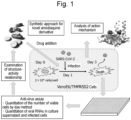
- Figure 1 schematically shows the anti-SARS-CoV-2 assay performed in Examples.
- Examples of the C 1-10 -alkyl group in the formula (I) include a methyl group, an ethyl group, a propyl group, an isopropyl group, a butyl group, an isobutyl group, a sec-butyl group, a tert-butyl group, a pentyl group, an isopentyl group, a hexyl group, a heptyl group, an octyl group, a nonyl group, a decyl group, a cyclopropyl group, a cyclobutyl group, a cyclopentyl group, a cyclohexyl group, and a 2-cyclopropylethyl group.
- Examples of the C 1-6 -alkyl group include a methyl group, an ethyl group, a propyl group, an isopropyl group, a butyl group, an isobutyl group, a sec-butyl group, a tert-butyl group, a pentyl group, an isopentyl group, a hexyl group, a cyclobutyl group, a cyclopentyl group, a cyclohexyl group, and a 2-cyclopropylethyl group.
- Examples of the C 1-6 -alkoxy group include a methoxy group, an ethoxy group, a propoxy group, an isopropoxy group, a butoxy group, an isobutoxy group, a sec-butoxy group, a tert-butoxy group, a pentyloxy group, an isopentyloxy group, a hexyloxy group, a cyclopropyloxy group, a cyclobutyloxy group, a cyclopentyloxy group, and a cyclohexyloxy group.
- the C 1-10 -alkyl group, the C 1-6 -alkyl group, and the C 1-6 -alkoxy group may be substituted with one or more substituents selected from the group consisting of C 1-6 -alkoxy groups such as a methoxy group, an ethoxy group, a propoxy group, an isopropoxy group, a butoxy group, an isobutoxy group, a sec-butoxy group, a tert-butoxy group, a pentyloxy group, an isopentyloxy group, a hexyloxy group, a cyclopropyloxy group, a cyclobutyloxy group, a cyclopentyloxy group, and a cyclohexyloxy group; C 1-6 -alkoxy-carbonyl groups such as a methoxycarbonyl group, an ethoxycarbonyl group, a propoxycarbonyl group, an isopropoxycarbonyl group, a butoxycarbony
- aryl group examples include aromatic hydrocarbon groups such as a phenyl group and a naphthyl group.
- these may be substituted with one or more substituents selected from the group consisting of C 1-6 -alkyl groups; C 1-6 -alkoxy groups such as a methoxy group, an ethoxy group, a propoxy group, an isopropoxy group, a butoxy group, an isobutoxy group, a sec-butoxy group, a tert-butoxy group, a pentyloxy group, an isopentyloxy group, a hexyloxy group, a cyclopropyloxy group, a cyclobutyloxy group, a cyclopentyloxy group, and a cyclohexyloxy group; C 1-6 -alkoxy-carbonyl groups such as a methoxycarbonyl group, an ethoxycarbonyl group, a propoxycarbonyl group, an isopropoxy
- Examples of 5 to 7-membered ring groups formed by R a and R b together with an adjacent nitrogen atom include a 1-pyrrolidinyl group, a 1-imidazolidinyl group, a 1-pyrazolidinyl group, a morpholino group (4-morpholinyl group), a piperidino group (1-piperidinyl group), a 1-piperazinyl group, a 4-thiamorpholinyl group, a perhydro-1,4-diazepin-1-yl group, a hexahydro-1H-azepin-1-yl group, and a perhydro-1,4-thiazepin-4-yl groups.
- the 5 to 7-membered ring groups may be substituted with one or more substituents selected from the group consisting of C 1-6 -alkyl groups, C 2-6 -alkenyl groups, C 2-6 -alkynyl groups, aromatic groups, an acyl group, a hydroxyl group, a carboxyl group, a cyano group, halogen atoms (such as a fluorine atom), C 1-6 -alkoxy groups, an aralkyl group, a nitro group, an amino group, C 1-6 -alkylamino groups, and di-C 1-6 -alkylamino groups.
- substituents selected from the group consisting of C 1-6 -alkyl groups, C 2-6 -alkenyl groups, C 2-6 -alkynyl groups, aromatic groups, an acyl group, a hydroxyl group, a carboxyl group, a cyano group, halogen atoms (such as a fluorine
- the 5 to 7-membered ring groups are preferably 5-membered ring groups or 6-membered ring groups, more preferably substituted or unsubstituted 1-pyrrolidinyl groups (such as a 3-fluoro-1-pyrrolidinyl group), substituted or unsubstituted 1-piperazinyl groups (such as a 4-methyl-1-piperazinyl group), substituted or unsubstituted morpholino groups (4-morpholinyl group), substituted or unsubstituted piperidino groups (1-piperidinyl groups) (such as a 3-fluoropiperidino group and a 3,5-dimethylpiperidino group).
- 1-pyrrolidinyl groups such as a 3-fluoro-1-pyrrolidinyl group
- 1-piperazinyl groups such as a 4-methyl-1-piperazinyl group
- substituted or unsubstituted morpholino groups (4-morpholinyl group)
- halogen atom examples include a fluorine atom, a chlorine atom, a bromine atom, and an iodine atom.
- the hydroxyl group in the formula (I) may be substituted with a protecting group such as a 2-tetrahydropyranyl group (THP), a 3,4,5-trihydroxy-6-methyltetrahydropyran-2-yl group, or a methoxy methyl group.
- a protecting group such as a 2-tetrahydropyranyl group (THP), a 3,4,5-trihydroxy-6-methyltetrahydropyran-2-yl group, or a methoxy methyl group.
- R 4 is an ethyl (isopropyl)amino group, a diisopropylamino group, a cyclohexyl(ethyl)amino group, an ethyl(pentane-3-yl)amino group, a tert-butyl(ethyl)amino group, or a 3,5-dimethylpiperidino group
- R 1 , R 2 , and R 3 are the same or different, and each of them is a hydrogen atom, a halogen atom (preferably a fluorine atom), a C 1-6 -alkoxy group (preferably a methoxy group), or a dimethylamino group
- X is a hydrogen atom or a chlorine atom; and their combinations are more preferable.
- the compound according to the present invention can have an asymmetric carbon, the compound may have optical isomers.
- the compound according to the present invention may also have tautomers.
- the compound according to the present invention may be any isolated isomer (such as an R form or an S form), or may be a mixture of two or more isomers including racemates and diastereoisomers in any proportion.
- Salts of the compound represented by the formula (I) are preferably pharmaceutically acceptable salts.
- examples thereof include salts thereof with inorganic acids such as hydrochloric acid, sulfuric acid, phosphoric acid, hydrobromic acid, hydroiodic acid, nitric acid, pyrosulfuric acid, and metaphosphoric acid; or salts thereof with organic acids such as citric acid, benzoic acid, acetic acid, propionic acid, fumaric acid, maleic acid, and sulfonic acids (such as methanesulfonic acid, p-toluenesulfonic acid, and naphthalenesulfonic acid).
- inorganic acids such as hydrochloric acid, sulfuric acid, phosphoric acid, hydrobromic acid, hydroiodic acid, nitric acid, pyrosulfuric acid, and metaphosphoric acid
- organic acids such as citric acid, benzoic acid, acetic acid, propionic acid, fumaric acid, maleic acid,
- solvates of the compound represented by the formula (I) or a salt thereof include hydrates.
- the compound represented by the formula (I), a salt thereof, a solvate thereof, or a prodrug thereof may be a deuterium converter obtained by converting 1 H to 2 H (D). Such a compound is also included in the present invention.
- prodrug refers to any compound which is administrated to a living organism and then generates the compound represented by the formula (I) as a result of a spontaneous chemical reaction or by a catalytic enzyme or a metabolic reaction.
- the prodrug is a compound which can be administrated into a body as a medical drug.
- examples of the prodrug include pharmaceutically acceptable esters or amides.
- examples of the group which constitutes the prodrug and is used for the hydroxyl group or the amino group include C 2-7 -acyl groups, C 1-6 -alkoxy (C 2-7 -acyl) groups, C 1-6 -alkoxycarbonyl (C 2-7 -acyl) groups, C 1-6 -alkoxycarbonyl groups, C 1-6 -alkoxy (C 2-7 -alkoxycarbonyl) groups, (C 2-7 -acyloxy)methyl groups, 1-(C 2-7 -acyloxy)ethyl groups, (C 2-7 -alkoxycarbonyl)oxymethyl groups, and 1-[(C 2-7 -alkoxycarbonyl)oxy]ethyl groups.
- C 2-7 -acyl groups and C 1-6 -alkoxycarbonyl groups are preferred.
- Examples of the group which constitutes the prodrug and is used for the carboxyl group include C 1-6 -alkyl groups, C 1-6 -alkoxy-C 1-6 -alkyl groups, (C 2-7 -acyloxy)methyl groups, 1-(C 2-7 -acyloxy)ethyl groups, (C 2-7 -alkoxycarbonyl)oxymethyl groups, and 1-[(C 2-7 -alkoxycarbonyl)oxy]ethyl groups.
- C 1-6 -alkyl groups and C 1-6 -alkoxy-C 1-6 -alkyl groups are preferred.
- the compound represented by the formula (I) can be produced as shown below, for example. (where the symbols are as defined as in the formula (I).)
- a 4-aminophenol derivative (A) is added to an ethanol solution of a 4-chloroquinazoline compound (B), and these are reacted under heating. Thereby, the target compound (I) can be produced.
- R 1 , R 2 , or R 3 is a halogen atom, e.g., a chlorine atom
- R 1 , R 2 , or R 3 is a halogen atom, e.g., a chlorine atom
- R a and R b are as defined as in the formula (I)
- R 1 , R 2 , or R 3 in the formula (I) is -N(R a )(R b ).
- the product thus obtained may be purified by a method usually used, such as column chromatography using silica gel or the like as a carrier, or recrystallization using methanol, ethanol, chloroform, dimethyl sulfoxide, n-hexane-ethyl acetate, or water.
- a method usually used such as column chromatography using silica gel or the like as a carrier, or recrystallization using methanol, ethanol, chloroform, dimethyl sulfoxide, n-hexane-ethyl acetate, or water.
- the elution solvent for column chromatography include methanol, ethanol, chloroform, acetone, hexane, dichloromethane, ethyl acetate, and mixed solvents thereof.
- the compound can be formulated in combination with a traditional pharmaceutical carrier, as an anti-SARS-CoV-2 drug.
- the dosage form thereof is not particularly limited, and can be appropriately selected as needed.
- examples of the dosage form include oral agents such as a tablet, a capsule, a granule, a fine granule, a powder, a sustained release formulation, a liquid preparation, a suspension, an emulsion, a syrup, and an elixir, and parenteral agents such as an injection and a suppository.
- the oral agents are produced by a normal method, for example, using starch, lactose, sucrose, mannite, carboxymethyl cellulose, or inorganic salts.
- a binder, a disintegrant, a surfactant, a lubricant, a glidant, a flavoring agent, a colorant, and/or a fragrance can be appropriately added.
- binder examples include starch, dextrin, gum arabic, gelatin, hydroxypropyl starch, methylcellulose, sodium carboxymethylcellulose, hydroxypropylcellulose, crystalline cellulose, ethylcellulose, polyvinylpyrrolidone, and macrogol.
- disintegrant examples include starch, hydroxypropyl starch, carboxymethylcellulose sodium, carboxymethylcellulose calcium, carboxymethylcellulose, and a low-substituted hydroxypropylcellulose.
- surfactant examples include sodium lauryl sulfate, soy lecithin, sucrose fatty acid ester, and polysorbate 80.
- lubricant examples include talc, waxes, hydrogenated vegetable oil, sucrose fatty acid esters, magnesium stearate, calcium stearate, aluminum stearate, and polyethylene glycol.
- Examples of the glidant include light anhydrous silicic acid, dry aluminum hydroxide gel, synthetic aluminum silicate, and magnesium silicate.
- the injection is produced by a normal method, and as a diluent, distilled water for injection, saline, a glucose aqueous solution, olive oil, sesame oil, peanut oil, soybean oil, corn oil, propylene glycol, or polyethylene glycol can be generally used. Further, a bactericide, a preservative agent, a stabilizer, an isotonizing agent, and/or a soothing agent may be added as needed. From the viewpoint of stability, the injection can be filled into a vial or the like, frozen, and then subjected to ordinary lyophilization to remove the water content. Immediately before use, a liquid preparation can be reconstituted from the lyophilized injection. The proportion of the compound represented by the formula (I) in the injection can be varied between 5% by weight and 50% by weight, but not limited thereto.
- parenteral agents examples include suppositories for intrarectal administration, which are produced by a normal method.
- the formulated anti-SARS-CoV-2 drug can be administrated, for example, 1 to 4 times a day for one week to three months, depending on the form of the drug and the administration route.
- the anti-SARS-CoV-2 drug according to the present invention is used for the treatment of COVID-19.
- the treatment encompasses prevention of severe illness.
- the dose varies depending on the age and the body weight of the patient and the severity of the disease thereof, usually, for an adult, it is suitable that the dose is, for example, 0.1 to 1000 mg, preferably 1 to 500 mg of the compound represented by the formula (I) per day, which is divided into portions and administrated.
- the dose varies depending on the age and the body weight of the patient and the severity of the disease thereof, usually, for an adult, it is suitable that the dose is, for example, 0.1 to 1000 mg, preferably 1 to 500 mg of the compound represented by the formula (I), which is administrated by intravenous injection, intravenous drip, subcutaneous injection, or intramuscular injection.
- the compound represented by the formula (I), a salt thereof, a solvate thereof, or a prodrug thereof can be contained in a pharmaceutical composition as the only active ingredient, or can be contained together with other active ingredients.
- the compound represented by the formula (I), a salt thereof, a solvate thereof, or a prodrug thereof may be used in combination with a different drug effective against SARS-CoV-2 infection.
- these agents are separately administrated in the course of the treatment, or are combined with the compound represented by the formula (I) into a single dosage form such as a tablet, an intravenous solution, or a capsule. Examples of such a different drug include Remdesivir.
- coronaviruses infect a variety of animals, and SARS-CoV also infects a variety of animals beyond species.
- the subject to be treated with the anti-coronavirus drug according to the present invention is not limited to humans, and includes various animals such as pet animals (such as dogs and cats), pigs, camels, bats, palm civets, tigers, ferrets, golden hamsters, minks, and sparrows.
- a viable cell counting kit using a water-soluble tetrazolium salt WST-8 (2-(2-methoxy-4-nitrophenyl)-3-(4-nitrophenyl)-5-(2,4-disulfophenyl)-2H-tetrazolium monosodium salt) as a coloring reagent) was added. After 2 hours of culture, 100 ⁇ L of 2-propanol hydrochloride was added, and was sufficiently mixed; thereafter, the absorbance of each well was measured at 450/620 nm. The anti-SARS-CoV-2 effect and the cell toxicity of the drug were determined by comparing the numbers of viable cells in infected cells and non-infected cells with those in the absence of the drugs.
- Table 4 shows the anti-SARS-CoV-2 effect of compounds in which hydroxyl group in the phenylamino group substituting the 4-position of the quinazoline ring is present at the 3-position in place of the 4-position of the phenylamino group as in the formula (I).
- Tables 1 to 3 reveal that the compounds represented by the formula (I) according to the present invention have the anti-SARS-CoV-2 effects.
- Table 4 reveals that sufficient anti-SARS-CoV-2 effects were not observed in the compounds which have basic skeletons similar to that of the compound represented by the formula (I) according to the present invention but have the substituting hydroxyl group at a different position.
- YMSA-0785 had 50% effective concentration (EC 50 ) of 0.12 ⁇ M, 50% toxicity concentration (CC 50 ) of >100 ⁇ M, and selectivity coefficient (CC 50 /EC 50 ) of >833 (Table 5).
- the assay in HEK293T/ACE2 cells was performed as follows. (Assay in HEK293T/ACE2 cells)
- the culture supernatant on the plate for infection was transferred to a new plate, which was stored at -80°C. 110 ⁇ L of the culture solution was discarded from the plate for cells, and 10 ⁇ L of Cell Counting Kit-8 was added. After 2 hours of culture in a CO 2 incubator, absorbance at 450 nm (620 nm) was measured.
- RNAs were extracted according to the instructions (15 ⁇ L). The extracted RNAs were diluted 10-fold with nuclease-free water, which was used as an RNA sample. Using High-Capacity RNA-to-cDNA TM Kit (Thermo Fisher Scientific), cDNAs were synthesized from the RNA sample, and the RNA amount in the sample was measured by real-time PCR.
- N-iodosuccinimide (1.6 g, 7.3 mmol) was added to an MeCN solution (35 mL) of 2 (1.6 g, 7.3 mmol), and these were stirred under room temperature for 30 minutes.
- IR (ATR): v 2971, 1618, 1572, 1533, 1497, 1444, 1387, 1353, 1319, 1284, 1246, 1169, 1115, 1067, 1049, 997, 956, 908, 876, 816, 765, 680, 671, 637, 591, 581, 564, 512, 502, 473, 463, 434, 414 cm -1 .
- IR (ATR): v 3303, 2969, 2930, 1668, 1611, 1582, 1543, 1459, 1412, 1386, 1349, 1287, 1228, 1191, 1163, 1112, 1044, 1019, 991, 953, 928, 907, 864, 807, 756, 715, 660, 636, 597, 547, 504, 414 cm -1 .
- YMSA-0516 was obtained as a yellow solid by the same method as that in YMSA-0514 (0.11 g, 88%). mp 181-185°C.
- IR(ATR): v 2975, 1619, 1573, 1534, 1497, 1465, 1403, 1354, 1319, 1287, 1247, 1224, 1184, 1119, 1069, 1051, 998, 957, 917, 875, 854, 817, 765, 723, 676, 639, 592, 584, 566, 514, 464, 437, 423, 408 cm -1 .
- YMSA-0517 was obtained as a yellow powder substance by the same method as that in the synthesis of YMSA-0514 (53 mg, 69%). mp 125°C (dec.).
- IR (ATR): v 2971, 1622, 1579, 1504, 1456, 1430, 1335, 1240, 1218, 1145, 1112, 1072, 1030, 1004, 914, 846, 804, 748, 687, 661, 568, 557, 508, 465, 420 cm -1 .
- Compound 14 was obtained as a yellow oily substance by the same method as that in the synthesis of Compound 2 (0.50 g, 67%).
- YMSA-0576 was obtained as a yellow solid by the same method as that in YMSA-0514 (24 mg, 34%). mp 190°C (dec.).
- IR (ATR): v 2938, 2795, 1619, 1589, 1567, 1529, 1499, 1442, 1433, 1410, 1390, 1356, 1342, 1321, 1302, 1281, 1240, 1157, 1134, 1117, 1087, 1075, 1050, 1005, 987, 924, 913, 885, 867, 815, 801, 775, 724, 681, 653, 631, 596, 580, 567, 528, 508, 488, 469, 432, 428 cm -1 .
- YMSA-0613 was obtained as a yellow powder substance by the same method as that in the synthesis of YMSA-0514 (18 mg, 28%). mp 115°C (dec.).
- IR (ATR): v 2970, 1618, 1576, 1516, 1463, 1392, 1357, 1318, 1125, 1073, 918, 868, 765, 681, 570, 470, 418, 407 cm -1 .
- YMSA-0614 was obtained as a yellow solid by the same method as that in the synthesis of YMSA-0464 (55 mg, 85%). mp 163°C (dec.).
- IR(ATR): v 2967, 1618, 1572, 1531, 1497, 1452, 1389, 1355, 1318, 1223, 1166, 1074, 1029, 913, 867, 818, 762, 725, 677, 573, 560, 466, 440, 419 cm -1 .
- IR (ATR): v 3263, 2969, 2848, 2930, 1616, 1567, 1528, 1494, 1446, 1388, 1365, 1354, 1340, 1278, 1249, 1195, 1167, 1116, 1982, 1067, 1048, 997, 948, 906, 875, 854, 815, 787, 761, 723, 686, 676, 639, 598, 571, 517, 503, 473, 407 cm -1 .
- Compound 29 was obtained as a yellow powder solid (1.1 g, 69%) as in the synthesis of YMSA-0532 by reacting Compound 2 and N-chlorosuccinimide. mp 142-150°C.
- YMSA-0656 was obtained as a yellow solid by the same method as that for YMSA-0464 (90 mg, 42%). mp 170-174°C.
- IR(ATR): v 2969, 1617, 1572, 1532, 1469, 1405, 1354, 1318, 1246, 1227, 1190, 1165, 1125, 1072, 959, 919, 867, 818, 761, 725, 677, 587, 570, 545, 517, 465, 438, 424 cm -1 .
- Compound 32 was obtained as a yellow oily substance by the same method as that in the synthesis of Compound 3 (0.33 g, 59%).
- Compound 33 was obtained as a light yellow powder solid by the same method as that in the synthesis of YMSA-0635 (0.11 g, 55%). mp 90-99°C.
- YMSA-0707 was obtained as a light yellow solid by the same method as that in the synthesis of YMSA-0636 (38 mg, 46%). mp 176-180°C.
- IR (ATR): v 3304, 3133, 3054, 2972, 2937, 1622, 1581, 1558, 1528, 1464, 1383, 1350, 1303, 1264, 1250, 1228, 1191, 1165, 1125, 1106, 1089, 1063, 1045, 1019, 996, 926, 875, 853, 807, 793, 780, 771, 742, 719, 663, 635, 584, 566, 549, 538, 508, 483, 426, 407 cm -1 .
- Compound 41 was obtained as a yellow solid by the same method as that in the synthesis of YMSA-0532 (0.24 g, 75%). mp 151-153°C.
- YMSA-0781 was obtained as a light yellow solid by the same method as that in the synthesis of YMSA-0464 (15 mg, 47%). mp 111-120°C.
- IR (ATR): v 2968, 1619, 1571, 1530, 1498, 1465, 1390, 1369, 1315, 1239, 1192, 1169, 1118, 1073, 948, 914, 869, 819, 764, 735, 707. 680, 569, 551, 498, 467, 432, 419 cm -1 .
- 1 H NMR (399 MHz, CDCl 3 /TMS): ⁇ 8.73
- Compound 43 was obtained as a yellow oily substance by the same method as the method of synthesizing Compound 40 (0.52 g, 100%).
- Compound 44 was obtained as a yellow oily substance by the same method as that in the synthesis of Compound 29 (92 mg, 37%).
- YMSA-0797 was obtained as a yellow solid by the same method as that in the synthesis of YMSA-0464 (35 mg, 35%). mp 80-85°C.
- IR (ATR): v 2928, 2854, 1669, 1618, 1573, 1532, 1470, 1391, 1356, 1319, 1234, 1171, 1123, 1073, 967, 915, 868, 765, 680, 581, 533, 465, 429, 416 cm -1 .
- N-chlorosuccinimide (203 mg, 1.52 mmol) was added to a solution of Compound 40 (319 mg, 1.26 mmol) dissolved in 10 mL of acetonitrile, followed by stirring at room temperature for 23 hours. After confirming the completion of the reaction, the solvent was distilled off under reduced pressure, and a 10% sodium thiosulfate aqueous solution was added, followed by extraction with ethyl acetate. The organic phase was washed with saturated sodium hydrogen carbonate aqueous solution and saturated saline water, and dried over sodium sulfate. Solids were removed by filtration, and the solvent was distilled off under reduced pressure. The resulting mixture was purified by silica gel column chromatography (ethyl acetate), thus isolating Compound 48 (241 mg, 67%) as a yellow solid. mp 154-157°C.
- IR (ATR): v 2971, 1619, 1590, 1569, 1528, 1472, 1446, 1421, 1390, 1355, 1315, 1292, 1250, 1195, 1147, 1119, 1074, 1016, 970, 918, 899, 872, 799, 787, 776, 678, 647, 579, 554, 526, 507, 465, 450, 428, 405 cm -1 .
- N-tert-butylisopropylamine (0.19 mL, 1.2 mmol) and triethylamine (0.31 mL, 2.2 mmol) were added to a solution of 2-hydroxy-5-nitrobenzyl bromide 39 (0.23 g, 1.0 mmol) dissolved in 4 mL of tetrahydrofuran, and were stirred under reflux conditions for 3 hours. After confirming the completion of the reaction, the solvent was distilled off under reduced pressure, and saturated sodium hydrogen carbonate aqueous solution was added, followed by extraction with ethyl acetate. The organic phase was washed with saturated saline water, and dried over sodium sulfate.
- N-chlorosuccinimide (101 mg, 0.76 mmol) was added to a solution of Compound 49 (183 mg, 0.69 mmol) dissolved in 5 mL of acetonitrile, followed by stirring at room temperature for 23 hours.
- the solvent was distilled off under reduced pressure, and 10% sodium thiosulfate aqueous solution was added, followed by extraction with ethyl acetate.
- the organic phase was washed with saturated sodium hydrogen carbonate aqueous solution and saturated saline water, and dried over sodium sulfate. Solids were removed by filtration, and the solvent was distilled off under reduced pressure. The resulting mixture was purified by silica gel column chromatography (ethyl acetate), thus isolating Compound 50 (130 mg, 63%) as a yellow solid. mp 167-172°C.
- IR (ATR): v 2970, 1732, 1620, 1601, 1572, 1537, 1500, 1476, 1431, 1414, 1392, 1372, 1356, 1323, 1309, 1288, 1239, 1195, 1172, 1146, 1125, 1077, 1027, 969, 916, 886, 869, 813, 797, 786, 734, 699, 679, 668, 584, 573, 520, 497, 468, 426, 417 cm -1 .
- N-isopropylpropylamine (0.12 mL, 1.2 mmol) and triethylamine (0.31 mL, 2.2 mmol) were added to a solution of 2-hydroxy-5-nitrobenzyl bromide 39 (0.23 g, 1.0 mmol) dissolved in 4 mL of tetrahydrofuran, followed by stirring under reflux conditions for 1 hour.
- the solvent was distilled off under reduced pressure, and saturated sodium hydrogen carbonate aqueous solution was added, followed by extraction with ethyl acetate.
- the organic phase was washed with saturated saline water, and dried over sodium sulfate. Solids were removed by filtration, and the solvent was distilled off under reduced pressure.
- the resulting mixture was purified by silica gel column chromatography (ethyl acetate), thus isolating Compound 51 (0.22 g, 88%) as a yellow oil.
- N-chlorosuccinimide (175 mg, 1.3 mmol) was added to a solution of Compound 51 (221 mg, 0.88 mmol) dissolved in 5 mL of acetonitrile, followed by stirring at room temperature for 23 hours.
- the solvent was distilled off under reduced pressure, and 10% sodium thiosulfate aqueous solution was added, followed by extraction with ethyl acetate.
- the organic phase was washed with saturated sodium hydrogen carbonate aqueous solution and saturated saline water, and dried over sodium sulfate. Solids were removed by filtration, and the solvent was distilled off under reduced pressure. The resulting mixture was purified by silica gel column chromatography (ethyl acetate), thus isolating Compound 52 (132 mg, 52%) as a yellow solid. mp 67-68°C.
- N-tert-butylethylamine (0.17 mL, 1.2 mmol) and triethylamine (0.31 mL, 2.2 mmol) were added to a solution of 2-hydroxy-5-nitrobenzyl bromide 39 (0.23 g, 1.0 mmol) dissolved in 4 mL of tetrahydrofuran, followed by stirring under reflux conditions for 3 hours. After confirming the completion of the reaction, the solvent was distilled off under reduced pressure, and saturated sodium hydrogen carbonate aqueous solution was added, followed by extraction with ethyl acetate. The organic phase was washed with saturated saline water, and dried over sodium sulfate.
- N-chlorosuccinimide (145 mg, 1.1 mmol) was added to a solution of Compound 53 (229 mg, 0.91 mmol) dissolved in 5 mL of acetonitrile, followed by stirring at room temperature for 13 hours.
- the solvent was distilled off under reduced pressure, and 10% sodium thiosulfate aqueous solution was added, followed by extraction with ethyl acetate.
- the organic phase was washed with saturated sodium hydrogen carbonate aqueous solution and saturated saline water, and dried over sodium sulfate. Solids were removed by filtration, and the solvent was distilled off under reduced pressure. The resulting mixture was purified by silica gel column chromatography (ethyl acetate), thus isolating Compound 54 (124 mg, 48%) as a yellow solid. mp 145-155°C.
- N-ethyl(-3-pentyl)amine (0.17 mL, 1.2 mmol) and triethylamine (0.31 mL, 2.2 mmol) were added to a solution of 2-hydroxy-5-nitrobenzyl bromide 39 (0.23 g, 1.0 mmol) dissolved in 4 mL of tetrahydrofuran, followed by stirring under reflux conditions for 13 hours. After confirming the completion of the reaction, the solvent was distilled off under reduced pressure, and saturated sodium hydrogen carbonate aqueous solution was added, followed by extraction with ethyl acetate. The organic phase was washed with saturated saline water, and dried over sodium sulfate.
- N-chlorosuccinimide 160 mg, 1.2 mmol was added to a solution of Compound 55 (266 mg, 1.0 mmol) dissolved in 4 mL of acetonitrile, followed by stirring at room temperature for 15 hours.
- the solvent was distilled off under reduced pressure, and 10% sodium thiosulfate aqueous solution was added, followed by extraction with ethyl acetate.
- the organic phase was washed with saturated sodium hydrogen carbonate aqueous solution and saturated saline water, and dried over sodium sulfate. Solids were removed by filtration, and the solvent was distilled off under reduced pressure. The resulting mixture was purified by silica gel column chromatography (ethyl acetate), thus isolating Compound 56 (180 mg, 59%) as a yellow solid. mp 58-68°C.
- N-isopropylpropylamine (0.17 mL, 1.2 mmol) and triethylamine (0.31 mL, 2.2 mmol) were added to a solution of 2-hydroxy-5-nitrobenzyl bromide 39 (0.23 g, 1.0 mmol) dissolved in 4 mL of tetrahydrofuran, followed by stirring under reflux conditions for 1 hour.
- the solvent was distilled off under reduced pressure, and saturated sodium hydrogen carbonate aqueous solution was added, followed by extraction with ethyl acetate.
- the organic phase was washed with saturated saline water, and dried over sodium sulfate. Solids were removed by filtration, and the solvent was distilled off under reduced pressure.
- the resulting mixture was purified by silica gel column chromatography (ethyl acetate), thus isolating Compound 57 (0.22 g, 88%) as a yellow oil.
- N-chlorosuccinimide (175 mg, 1.3 mmol) was added to a solution of Compound 57 (266 mg, 1.0 mmol) dissolved in 5 mL of acetonitrile, followed by stirring at room temperature for 23 hours.
- the solvent was distilled off under reduced pressure, and 10% sodium thiosulfate aqueous solution was added, followed by extraction with ethyl acetate.
- the organic phase was washed with saturated sodium hydrogen carbonate aqueous solution and saturated saline water, and dried over sodium sulfate. Solids were removed by filtration, and the solvent was distilled off under reduced pressure.
- the resulting mixture was purified by silica gel column chromatography (ethyl acetate), thus isolating Compound 58 (132 mg, 52%) as a yellow amorphous substance.
- IR (ATR): v 3061, 2975, 2480, 1620, 1573, 1535, 1499, 1482, 1464, 1447, 1357, 1320, 1297, 1262, 1249, 1224, 1185, 1125, 1075, 1031, 934, 919, 870, 852, 817, 796, 784, 769, 722, 677, 641, 596, 574, 516, 465, 432, 420, 411 cm -1 .
- N-chlorosuccinimide 160 mg, 1.2 mmol was added to a solution of Compound 59 (274 mg, 1.0 mmol) dissolved in 5 mL of acetonitrile, followed by stirring at room temperature for 15 hours. After confirming the completion of the reaction, the solvent was distilled off under reduced pressure, and 10% sodium thiosulfate aqueous solution was added, followed by extraction with ethyl acetate. The organic phase was washed with saturated sodium hydrogen carbonate aqueous solution and saturated saline water, and dried over sodium sulfate. Solids were removed by filtration, and the solvent was distilled off under reduced pressure. The resulting mixture was purified by silica gel column chromatography (ethyl acetate), thus isolating Compound 60 (68 mg, 23%) as a yellow oil.
- N-chlorosuccinimide (0.46 g, 2.5 mmol) was added to a solution of Compound 62 (0.41 g, 1.74 mmol) dissolved in 5 mL of acetonitrile, followed by stirring at room temperature for 16 hours.
- the solvent was distilled off under reduced pressure, and 10% sodium thiosulfate aqueous solution was added, followed by extraction with ethyl acetate.
- the organic phase was washed with saturated sodium hydrogen carbonate aqueous solution and saturated saline water, and dried over sodium sulfate. Solids were removed by filtration, and the solvent was distilled off under reduced pressure.
- IR (ATR): v 2972, 1620, 1574, 1536, 1499, 1457, 1409, 1384, 1354, 1321, 1287, 1249, 1227, 1171, 1114, 1064, 995, 960, 918, 880, 858, 809, 786, 767, 750, 719, 640, 592, 583, 570, 556, 513, 503, 464, 436, 421 cm -1 .
- IR (ATR): v 2963, 2923, 2838, 2580, 1613, 1579, 1558, 1538, 1500, 1415, 1375, 1359, 1330, 1314, 1282, 1241, 1210, 1165, 1151, 1125, 1080, 1059, 1038, 977, 932, 886, 846, 820, 799, 779, 707, 685, 674, 646, 596, 567, 539, 514, 502, 468, 453, 426 cm -1 .
- YMSA-0850 mp 165-170°C.
- IR (ATR): v 2969, 1605, 1577, 1530, 1499, 1459, 1413, 1386, 1366, 1307, 1212, 1191, 1164, 1129, 1085, 1020, 1036, 963, 920, 867, 813, 761, 722, 653, 617, 569, 526, 506, 458, 424, 413 cm -1 .
- IR (ATR): v 3263, 3056, 2975, 2826, 1616, 1604, 1567, 1535, 1457, 1441, 1409, 1386, 1349, 1322, 1300, 1255, 1223, 1195, 1169, 1155, 1120, 1112, 1087, 1066, 1054, 1026, 998, 978, 945, 911, 894, 875, 832, 818, 798, 786, 765, 677, 632, 579, 561, 524, 499, 474, 466, 445, 433, 423 cm -1 .
- IR(ATR): v 3371, 2974, 2921, 1621, 1604, 1579, 1533, 1497, 1469, 1452, 1416, 1386, 1372, 1340, 1305, 1243, 1227, 1193, 1172, 1126, 1068, 1024, 994, 952, 929, 909, 893, 875, 846, 831, 796, 779, 753, 722, 712, 678, 660, 590, 542, 517, 422, 413 cm -1 .
- N-methylbenzylamine (1300 ⁇ E, 10.0 mmol) and 37% formaldehyde aqueous solution (1020 ⁇ L, 12.5 mmol) were added to a solution of 1 (346.9 mg, 2.49 mmol) dissolved in 25 mL of ethanol, followed by stirring under reflux conditions for 46 hours. After confirming the completion of the reaction, the solvent was distilled off under reduced pressure. Thereafter, saturated ammonium chloride aqueous solution was added, followed by extraction with ethyl acetate. The organic phase was washed with saturated saline water, and dried over sodium sulfate. Solids were removed by filtration, and the solvent was distilled off under reduced pressure.
- N-iodosuccinimide (98.3 mg, 0.43 mmol) was added to a solution of Compound 72 (105.9 mg, 0.38 mmol) dissolved in 1.9 mL of acetonitrile, followed by stirring at 0 °C for 1.5 hours. After the reaction solution was diluted with methylene chloride, the organic phase was washed with saturated sodium hydrogen carbonate aqueous solution and saturated saline water, and dried over sodium sulfate. Solids were removed by filtration, and the solvent was distilled off under reduced pressure.
- YMSA-0628 was obtained as a light yellow powder solid by the same method as that in the synthesis of YMSA-0828 (84.6 mg, 76%). mp 76-77°C.
- IR (ATR): v 2847, 1618, 1571, 1527, 1497, 1453, 1417, 1391, 1356, 1315, 1239, 1118, 1073, 1016, 984, 914, 850, 818, 743, 698, 679, 613, 566, 494, 451, 465, 433, 411 m -1 .
- YMSA-0908 was obtained as a yellow solid by the same method as that in the synthesis of YMSA-0464 (120.4 mg, 89 %). mp 144-145°C.
- IR (ATR): v 2963, 1706, 1667, 1618, 1574, 1536, 1499, 1468, 1406, 1357, 1321, 1229, 1126, 1075, 1026, 968, 922, 868, 842, 820, 796, 764, 684, 592, 572, 547, 468, 423, 411 cm -1 .
- N-ethylaniline (151.5 ⁇ L, 1.2 mmol) and triethylamine (306.1 ⁇ L, 2.2 mmol) were added to a solution of 2-hydroxy-5-nitrobenzyl bromide 39 (0.23 g, 1.0 mmol) dissolved in 4 mL of tetrahydrofuran, followed by stirring under reflux conditions for 20.5 hours.
- the solvent was distilled off under reduced pressure, and saturated sodium hydrogen carbonate aqueous solution was added, followed by extraction with ethyl acetate.
- the organic phase was washed with saturated saline water, and dried over sodium sulfate. Solids were removed by filtration, and the solvent was distilled off under reduced pressure.
- N-chlorosuccinimide (155.9 mg, 1.17 mmol) was added to a solution of Compound 81 (265 mg, 0.97 mmol) dissolved in 5 mL of acetonitrile, followed by stirring at room temperature for 72 hours.
- the solvent was distilled off under reduced pressure, and 10% sodium thiosulfate aqueous solution was added, followed by extraction with ethyl acetate.
- the organic phase was washed with saturated sodium hydrogen carbonate aqueous solution and saturated saline water, and dried over sodium sulfate. Solids were removed by filtration, and the solvent was distilled off under reduced pressure.
- IR (ATR): v 2967, 1616, 1596, 1578, 1499, 1443, 1402, 1384 1351, 1304, 1290, 1272, 1242, 1208, 1187, 1147, 1131, 1099,1071, 985, 959, 911, 863, 817, 786, 761, 745, 709, 683, 652, 592, 562, 545, 511, 462, 423, 416 cm -1 .
- N-isopropylaniline (172.6 ⁇ L, 1.2 mmol) and triethylamine (306.1 ⁇ L, 2.2 mmol) were added to a solution of 2-hydroxy-5-nitrobenzyl bromide 39 (0.23 g, 1.0 mmol) dissolved in 4 mL of tetrahydrofuran, followed by stirring under reflux conditions for 20.5 hours. After confirming the completion of the reaction, the solvent was distilled off under reduced pressure, and saturated sodium hydrogen carbonate aqueous solution was added, followed by extraction with ethyl acetate. The organic phase was washed with saturated saline water, and dried over sodium sulfate. Solids were removed by filtration, and the solvent was distilled off under reduced pressure.
- N-chlorosuccinimide 130.4 mg, 0.98 mmol was added to a solution of Compound 83 (233.2 mg, 0.81 mmol) dissolved in 5 mL of acetonitrile, followed by stirring at room temperature for 72 hours.
- the solvent was distilled off under reduced pressure, and 10% sodium thiosulfate aqueous solution was added, followed by extraction with ethyl acetate.
- the organic phase was washed with saturated sodium hydrogen carbonate aqueous solution and saturated saline water, and dried over sodium sulfate. Solids were removed by filtration, and the solvent was distilled off under reduced pressure.
- Phosphorus tribromide 100 ⁇ L, 1.05 mmol was added to a solution of Compound 65 (205.0 mg, 1.00 mmol) dissolved in 4 mL of chloroform, followed by stirring under room temperature for 23 hours. Water was added to the reaction solution to quench the reaction, followed by extraction with chloroform three times. The organic phase was washed with saturated saline water, and dried over sodium sulfate. Solids were removed by filtration, and the solvent was distilled off under reduced pressure.
- IR (ATR): v 2969, 1741, 1621, 1595, 1574, 1534, 1500, 1474, 1428, 1406, 1364, 1307, 1289, 1266, 1221, 1168, 1129, 1074, 982, 922, 865, 823, 812, 786, 761, 718, 701, 679, 647, 623, 599, 577, 557, 531, 506, 467, 438, 427, 414 cm -1 .
- IR (ATR): v 3264, 3058, 2974, 2829, 1619, 1568, 1538, 1492, 1475, 1446, 1406, 1394, 1354, 1331, 1318, 1288, 1271, 1242, 1212, 1194, 1167, 1150, 1120, 1088, 1055, 1028, 1003, 965, 916, 867, 819, 798, 766, 725, 678, 614, 591, 557, 530, 506, 466, 434, 424, 410 cm -1 .
- N-chlorosuccinimide (80 mg, 0.6 mmol) was added to a solution of Compound 3 (143 mg, 0.5 mmol) dissolved in 4.5 mL of acetonitrile and 0.2 mL of acetic acid, followed by stirring at room temperature for 44 hours.
- the solvent was distilled off under reduced pressure, and 10% sodium thiosulfate aqueous solution was added, followed by extraction with ethyl acetate.
- the organic phase was washed with saturated sodium hydrogen carbonate aqueous solution and saturated saline water, and dried over sodium sulfate. Solids were removed by filtration, and the solvent was distilled off under reduced pressure.
- Tin chloride dihydrate (133 mg, 0.59 mmol) was added to a solution of Compound 4 (49.5 mg, 0.15 mmol) dissolved in 4 mL of ethanol, followed by stirring under reflux conditions for 1 hour. After the reaction solution was cooled to room temperature, 4-chloroquinazoline (48.5 mg, 0.29 mmol) was added to the reaction solution, which was again stirred under reflux conditions for 1.5 hours. After confirming the completion of the reaction, the solvent was distilled off under reduced pressure, 3N sodium hydroxide aqueous solution was added, followed by extraction with ethyl acetate. The organic phase was washed with saturated saline water, and dried over sodium sulfate.
- IR (ATR): v 2963, 2808, 2748, 2690, 2528, 2446, 2393, 2323, 1601, 1512, 1480, 1468, 1446, 1348, 1327, 1251, 1181, 1157, 1100, 1039, 1019, 973, 960, 943, 923, 865, 825, 802, 498, 442, 419cm -1 .
- N-chlorosuccinimide (25 mg, 0.19 mmol) was added to a solution of Compound 7 (40 mg, 0.16 mmol) dissolved in 0.9 mL of acetonitrile and 0.1 mL of acetic acid, followed by stirring at room temperature for 21.5 hours.
- the solvent was distilled off under reduced pressure, and saturated sodium hydrogen carbonate aqueous solution was added, followed by extraction with ethyl acetate.
- the organic phase was washed with saturated saline water, and dried over sodium sulfate. Solids were removed by filtration, and the solvent was distilled off under reduced pressure.
- Tin chloride dihydrate (45 mg, 0.21 mmol) was added to a solution of Compound 8 (19 mg, 0.06 mmol) dissolved in 1 mL of ethanol, followed by stirring under reflux conditions for 1.5 hours. After the reaction solution was cooled to room temperature, 4-chloroquinazoline (12 mg, 0.07 mmol) was added to the reaction solution, which was again stirred under reflux conditions for 2 hours. After confirming the completion of the reaction, the solvent was distilled off under reduced pressure, and saturated sodium hydrogen carbonate aqueous solution was added, followed by extraction with ethyl acetate. The organic phase was washed with saturated saline water, and dried over sodium sulfate. Solids were removed by filtration, and the solvent was distilled off under reduced pressure.
- Tin chloride dihydrate (81 mg, 0.36 mmol) was added to a solution of Compound 10 (28 mg, 0.09 mmol) dissolved in 1.5 mL of ethanol, followed by stirring under reflux conditions for 1 hour. After the reaction solution was cooled to room temperature, 4-chloroquinazoline (30 mg, 0.18 mmol) was added to the reaction solution, which was again stirred under reflux conditions for 3 hours. After confirming the completion of the reaction, the solvent was distilled off under reduced pressure, 3N sodium hydroxide aqueous solution was added, followed by extraction with ethyl acetate. The organic phase was washed with saturated saline water, and dried over sodium sulfate.
- reaction solution was slowly added to a mixture of ethyl acetate and 2M hydrochloric acid, and the organic phase was extracted with 2N hydrochloric acid. Thereafter, the resulting aqueous phase was neutralized with 5N sodium hydroxide aqueous solution until the pH reached 11. The neutralized aqueous phase was extracted with chloroform three times, and then dried over sodium sulfate. Solids were removed by filtration, and the solvent was distilled off under reduced pressure. The resulting mixture was purified by silica gel column chromatography (hexane), thus isolating Compound 12 (336.7 mg, 56%) as a colorless oil.
- IR (ATR): v 3420, 2972, 2876, 1612, 1503, 1452, 1396, 1323, 1260, 1219, 1148, 1099, 1063, 1046, 946, 923, 840, 799, 781, 742, 702, 689, 584, 518, 443, 418 cm -1 .
- PBr 3 (85.5 ⁇ L, 0.90 mmol) was added to a solution of Compound 13 (61.1 mg, 0.3 mmol) dissolved in 1 mL of chloroform, followed by stirring at room temperature for 16 hours. After confirming the completion of the reaction, the reaction solution was diluted with chloroform. The organic phase was washed with water and saturated saline water, then dried over sodium sulfate. Solids were removed by filtration, and the solvent was distilled off under reduced pressure.
- the resulting mixture (264.6 mg) was dissolved in 1 mL of dichloroethane, and dichloromethane solution (2 mL) of triethylamine (125 ⁇ L, 0.90 mmol) and 12 (78.1 mg, 0.45 mmol) was added, followed by stirring at room temperature for 2 hours. After confirming the completion of the reaction, the reaction solution was diluted with chloroform. The organic phase was washed with 1N hydrochloric acid, saturated sodium hydrogen carbonate aqueous solution, and saturated saline water, and then dried over sodium sulfate. Solids were removed by filtration, and the solvent was distilled off under reduced pressure.
- Tin chloride dihydrate 147.0 mg, 0.65 mmol was added to a solution of Compound 14 (78.0 mg, 0.22 mmol) dissolved in 2 mL of ethanol, followed by stirring under reflux conditions for 30 minutes. After the reaction solution was cooled to room temperature, 4-chloroquinazoline (46.4 mg, 0.28 mmol) was added to the reaction solution, which was again stirred under reflux conditions for 4 hours. After confirming the completion of the reaction, the solvent was distilled off under reduced pressure, and saturated sodium hydrogen carbonate aqueous solution was added, followed by extraction with ethyl acetate. The organic phase was washed with saturated saline water, and dried over sodium sulfate.
- N-chlorosuccinimide (93 mg, 0.70 mmol) was added to a solution of Compound 16 (154 mg, 0.58 mmol) dissolved in 3 mL of acetonitrile, followed by stirring at room temperature for 13 hours.
- the solvent was distilled off under reduced pressure, and 10% sodium thiosulfate aqueous solution was added, followed by extraction with ethyl acetate.
- the organic phase was washed with saturated sodium hydrogen carbonate aqueous solution and saturated saline water, and dried over sodium sulfate. Solids were removed by filtration, and the solvent was distilled off under reduced pressure.
- Tin chloride dihydrate (90.4 mg, 0.40 mmol) was added to a solution of Compound 17 (29.8 mg, 0.10 mmol) dissolved in 2 mL of ethanol, followed by stirring under reflux conditions for 1.5 hours. After the reaction solution was cooled to room temperature, 4-chloroquinazoline (33 mg, 0.20 mmol) was added to the reaction solution, which was again stirred under reflux conditions for 2.5 hours. After confirming the completion of the reaction, the solvent was distilled off under reduced pressure, 3N sodium hydroxide aqueous solution was added, followed by extraction with ethyl acetate. The organic phase was washed with saturated saline water, and dried over sodium sulfate.
- IR(ATR): v 2955, 2911, 1619, 1574, 1537, 1498, 1466, 1405, 1357, 1319, 1228, 1125, 1967, 999, 962, 921, 899, 868, 819, 796, 777, 761, 732, 684, 654, 594, 547, 519, 503, 467, 446, 417 ppm.
- N-chlorosuccinimide (340 mg, 2.54 mmol) was added to a solution of Compound 18 (538 mg, 2.54 mmol) dissolved in 9 mL of acetonitrile and 1 mL of acetic acid, followed by stirring at room temperature for 8 hours. N-chlorosuccinimide (340 mg, 2.54 mmol) was further added to the reaction solution, followed by stirring at room temperature for 13 hours. The solvent was distilled off under reduced pressure, and 10% sodium thiosulfate aqueous solution was added, followed by extraction with ethyl acetate. The organic phase was washed with saturated sodium hydrogen carbonate aqueous solution and saturated saline water, and dried over sodium sulfate.
- IR (ATR): v 3470, 3339, 3103, 2988, 1851, 1804, 1695, 1603, 1585, 1557, 1505, 1467, 1429, 1374, 1314, 1251, 1220, 1141, 1115, 1081, 1025, 938, 929, 906, 874, 823, 793, 742, 710, 662, 600, 507, 461 cm -1 .
- Triethylamine (416 ⁇ L, 3 mmol) and methane sulfonyl chloride (155 ⁇ L, 2 mmol) were added to a solution of Compound 20 (101 mg, 0.5 mmol) dissolved in 5 mL of dichloromethane, followed by stirring at room temperature for 1.5 hours. After confirming the completion of the reaction, 1N hydrochloric acid and dichloromethane were added. The organic phase was washed with saturated saline water, and then dried over sodium sulfate. Then, solids were removed by filtration. The solvent was distilled off under reduced pressure, giving a mesylated product (118 mg, 85%).
- Tin chloride dihydrate (33.6 mg, 0.15 mmol) was added to a solution of Compound 22 (13.5 mg, 0.037 mmol) dissolved in 1 mL of ethanol, followed by stirring under reflux conditions for 1 hour. After the reaction solution was cooled to room temperature, 4-chloroquinazoline (14.4 mg, 0.087 mmol) was added to the reaction solution, which was again stirred under reflux conditions for 1 hour. After confirming the completion of the reaction, the solvent was distilled off under reduced pressure, 3N sodium hydroxide aqueous solution was added, followed by extraction with ethyl acetate. The organic phase was washed with saturated saline water, and dried over sodium sulfate.
- N-chlorosuccinimide (20.8 mg, 0.16 mmol) was added to a solution of Compound 25 (34.2 mg, 0.13 mmol) dissolved in 1.8 mL of acetonitrile and 0.2 mL of acetic acid, followed by stirring at room temperature for 5.5 hours.
- the solvent was distilled off under reduced pressure, and 10% sodium thiosulfate aqueous solution was added, followed by extraction with ethyl acetate.
- the organic phase was washed with saturated sodium hydrogen carbonate aqueous solution and saturated saline water, and dried over sodium sulfate. Solids were removed by filtration, and the solvent was distilled off under reduced pressure.
- Tin chloride dihydrate 64 mg, 0.29 mmol was added to a solution of Compound 26 (21.3 mg, 0.07 mmol) dissolved in 2 mL of ethanol, followed by stirring under reflux conditions for 1.5 hours.
- 4-chloroquinazoline 23 mg, 0.14 mmol was added to the reaction solution, which was again stirred under reflux conditions for 1.5 hours.
- the solvent was distilled off under reduced pressure. Thereafter, 2N sodium hydroxide aqueous solution was added, followed by extraction with ethyl acetate. The organic phase was washed with saturated saline water, and dried over sodium sulfate.
- N-chlorosuccinimide (151 mg, 1.1 mmol) was added to a solution of Compound 28 (260 mg, 0.94 mmol) dissolved in 9 mL of acetonitrile and 1 mL of acetic acid, followed by stirring at room temperature for 22 hours.
- the solvent was distilled off under reduced pressure, and a 10% sodium thiosulfate aqueous solution was added, followed by extraction with ethyl acetate.
- the organic phase was washed with saturated sodium hydrogen carbonate aqueous solution and saturated saline water, and dried over sodium sulfate. Solids were removed by filtration, and the solvent was distilled off under reduced pressure.
- Tin chloride dihydrate (0.18 g, 0.8 mmol) was added to a solution of Compound 29 (63 mg, 0.2 mmol) dissolved in 4 mL of ethanol, followed by stirring under reflux conditions for 1.5 hours. After the reaction solution was cooled to room temperature, 4-chloroquinazoline (66 mg, 0.4 mmol) was added to the reaction solution, which was again stirred under reflux conditions for 6 hours. After confirming the completion of the reaction, the solvent was distilled off under reduced pressure, 3N sodium hydroxide aqueous solution was added, followed by extraction with ethyl acetate. The organic phase was washed with saturated saline water, and dried over sodium sulfate.
- Tin chloride dihydrate (0.12 g, 0.53 mmol) was added to a solution of Compound 30 (39.7 mg, 0.13 mmol) dissolved in 2 mL of ethanol, followed by stirring under reflux conditions for 1 hour. After the reaction solution was cooled to room temperature, 4-chloroquinazoline (47 mg, 0.26 mmol) was added to the reaction solution, which was again stirred under reflux conditions for 3 hours. After confirming the completion of the reaction, the solvent was distilled off under reduced pressure, 3N sodium hydroxide aqueous solution was added, followed by extraction with ethyl acetate. The organic phase was washed with saturated saline water, and dried over sodium sulfate.
- IR(ATR): v 2948, 2718, 2662, 2545, 2491, 1590, 1623, 1590, 1564, 1477, 1443, 1432, 1375, 1255, 1168, 1149, 1123, 1089, 994, 938, 919, 898, 841, 821, 775, 761, 733, 645, 611, 558, 540, 497, 477, 456, 422 cm -1 .
- N-chlorosuccinimide (0.59 g, 4.46 mmol) was added to a solution of Compound 32 (0.85 g, 4.04 mmol) dissolved in 22.8 mL of acetonitrile and 2.53 mL of acetic acid, followed by stirring at room temperature for 2 days. After the solvent was distilled off under reduced pressure, methanol was added to the resulting mixture. The generated precipitates were separated by filtration, and washed with methanol. Thereafter, Compound 33 (0.26 mg, 26%) was isolated as a yellow solid. M.p. 222.0-224.0°C.
- IR (ATR): v 3148, 2975, 2295, 1586, 1563, 1480, 1456, 1435, 1391, 1348, 1298, 1280, 1209, 1167, 1131, 1089, 11077, 1018, 1004, 963, 923, 906, 883, 858, 849, 826, 782, 760, 746, 719, 657, 581, 535, 472, 446 cm -1 .
- Tin chloride dihydrate (46 mg, 0.20 mmol) was added to a solution of Compound 33 (10 mg, 0.04 mmol) dissolved in 3 mL of ethanol, followed by stirring under reflux conditions for 4 hours. After the reaction solution was cooled to room temperature, 4-chloroquinazoline (14 mg, 0.08 mmol) was added to the reaction solution, which was again stirred under reflux conditions for 2 hours. After confirming the completion of the reaction, saturated sodium hydrogen carbonate aqueous solution was added, followed by extraction with ethyl acetate. The organic phase was washed with saturated saline water, and dried over sodium sulfate. Solids were removed by filtration, and the solvent was distilled off under reduced pressure.
- YMSA-1130 (16 mg, quant.) as a yellow solid. M.p. 107.1-110.2°C.
- IR (ATR): v 3184, 2975, 1621, 1601, 1576, 1530, 1498, 1465, 1393, 1367, 1321, 1287, 1252, 1230, 1154, 1136, 1125, 1078, 1014, 977, 948, 926, 906, 866, 850, 820, 808, 756, 746, 675, 592, 551, 516, 485, 471, 427 cm -1 .
- IR (ATR): v 3388, 3119, 2968, 1698, 1625, 1609, 1569, 1533, 1489, 1470, 1438, 1416, 1394, 1372, 1353, 1328, 1310, 1280, 1251, 1227, 1210, 1192, 1141, 1132, 1073, 1047, 990, 968, 917, 896, 874, 864, 820, 792, 765, 737, 705, 677, 662, 615, 596, 583, 539, 511, 502, 482, 468, 438, 403 cm -1 .
- Tin chloride dihydrate (0.49 g, 2.15 mmol) was added to a solution of Compound 35(120 mg, 0.54 mmol) dissolved in 5 mL of ethanol, followed by stirring under reflux conditions for 2 hours. After the reaction solution was cooled to room temperature, 4-chloroquinazoline (178 mg, 1.1 mmol) was added to the reaction solution, which was again stirred under reflux conditions for 2 hours. After confirming the completion of the reaction, the solvent was distilled off under reduced pressure, 3N sodium hydroxide aqueous solution was added, followed by extraction with ethyl acetate. The organic phase was washed with saturated saline water, and dried over sodium sulfate.
- N-chlorosuccinimide (62 mg, 0.46 mmol) was added to a solution of Compound 40 (59 mg, 0.21 mmol) dissolved in 2.07 mL of acetonitrile and 0.23 mL of acetic acid, followed by stirring at room temperature for 6 days.
- the solvent was distilled off under reduced pressure, and 10% sodium thiosulfate aqueous solution was added, followed by extraction with ethyl acetate.
- the organic phase was washed with saturated sodium hydrogen carbonate aqueous solution and saturated saline water, and dried over sodium sulfate. Solids were removed by filtration, and the solvent was distilled off under reduced pressure.
- Tin chloride dihydrate (27 mg, 0.12 mmol) was added to a solution of Compound 41 (12 mg, 0.04 mmol) dissolved in 2 mL of ethanol, followed by stirring under reflux conditions for 1.5 hours. After the reaction solution was cooled to room temperature, 4-chloroquinazoline (7.4 mg, 0.05 mmol) was added to the reaction solution, which was again stirred under reflux conditions for 3 hours. After confirming the completion of the reaction, the solvent was distilled off under reduced pressure, and 1N sodium hydroxide aqueous solution was added, followed by extraction with ethyl acetate. The organic phase was washed with saturated saline water, and dried over sodium sulfate.
- Tin chloride dihydrate (31 mg, 0.14 mmol) was added to a solution of Compound 42 (11.5 mg, 0.035 mmol) dissolved in 1 mL of ethanol, followed by stirring under reflux conditions for 1 hour. After the reaction solution was cooled to room temperature, 4-chloroquinazoline (12 mg, 0.07 mmol) was added to the reaction solution, which was again stirred under reflux conditions for 1.5 hours. After confirming the completion of the reaction, the solvent was distilled off under reduced pressure, 3N sodium hydroxide aqueous solution was added, followed by extraction with ethyl acetate. The organic phase was washed with saturated saline water, and dried over sodium sulfate.
- Tin chloride dihydrate (181 mg, 0.8 mmol) was added to a solution of Compound 44 (58 mg, 0.2 mmol) dissolved in 3 mL of ethanol, followed by stirring under reflux conditions for 1 hour. After the reaction solution was cooled to room temperature, 4-chloroquinazoline (66 mg, 0.4 mmol) was added to the reaction solution, which was again stirred under reflux conditions for 2.5 hours. After confirming the completion of the reaction, the solvent was distilled off under reduced pressure, 3N sodium hydroxide aqueous solution was added, followed by extraction with ethyl acetate. The organic phase was washed with saturated saline water, and dried over sodium sulfate.
- Tin chloride dihydrate (362 mg, 1.6 mmol) was added to a solution of Compound 46 (129 mg, 0.40 mmol) dissolved in 6 mL of ethanol, followed by stirring under reflux conditions for 1.5 hours. After the reaction solution was cooled to room temperature, 4-chloroquinazoline (132 mg, 0.8 mmol) was added to the reaction solution, which was again stirred under reflux conditions for 1.5 hours. After confirming the completion of the reaction, the solvent was distilled off under reduced pressure, 3N sodium hydroxide aqueous solution was added, followed by extraction with ethyl acetate. The organic phase was washed with saturated saline water, and dried over sodium sulfate.
- IR(ATR): v 3112, 2970, 1626, 1609, 1574, 1535, 1503, 1462, 1418, 1381, 1354, 1322, 1207, 1179, 1102, 1050, 927, 915, 880, 865, 841, 819, 794, 761, 720, 676, 635, 609, 573, 531, 509, 486, 458, 433, 406 ppm.
- YMSA-1033 was obtained by the same method as that in Example 21.
Landscapes
- Chemical & Material Sciences (AREA)
- Organic Chemistry (AREA)
- Health & Medical Sciences (AREA)
- Life Sciences & Earth Sciences (AREA)
- Pharmacology & Pharmacy (AREA)
- Virology (AREA)
- Veterinary Medicine (AREA)
- Public Health (AREA)
- General Health & Medical Sciences (AREA)
- Animal Behavior & Ethology (AREA)
- Medicinal Chemistry (AREA)
- Molecular Biology (AREA)
- Nuclear Medicine, Radiotherapy & Molecular Imaging (AREA)
- General Chemical & Material Sciences (AREA)
- Chemical Kinetics & Catalysis (AREA)
- Oncology (AREA)
- Communicable Diseases (AREA)
- Epidemiology (AREA)
- Pharmaceuticals Containing Other Organic And Inorganic Compounds (AREA)
Abstract
Description
- The present invention relates to an anti-SARS-CoV-2 drug.
- Coronaviruses are viruses that essentially cause cold symptoms in humans. Four types of coronaviruses are known, and these viruses cause 10 to 15% of cases of cold. In addition, coronaviruses causing severe acute respiratory syndrome (SARS) and Middle East respiratory syndrome (MERS) which are highly fatal are known so far. The number of SARS patients is about 8,000 with a fatality rate of about 10%. The number of MERS patients is about 2,500 with a fatality rate of about 35%.
- The coronaviruses are positive-stranded RNA viruses having an envelope of about 100 nm in diameter. SARS-CoV is classified as a Class II pathogen, and MERS-CoV is classified as a Class III pathogen.
- A variety of antibody drugs targeting spike proteins on the surface of SARS-CoV-2 and Remdesivir diverted from an anti-Ebola drug are currently used as curative medicines. Besides, Molnupiravir developed as an anti-Influenza drug and newly developed Paxlovid (Paxlovid) have been approved as anti-SARS-CoV-2 drugs which can be orally administrated. Molnupiravir has an action mechanism of inhibiting the RNA-dependent RNA polymerase enzyme of the virus and causing errors during virus RNA replication. Paxlovid is a combination drug of Nirmatrelvir and Ritonavir where Nirmatrelvir is a low-molecular-weight compound which inhibits the function of the main protease needed for virus replication and Ritonavir functions as a booster for maintaining the blood concentration of Nirmatrelvir. However, these drugs have some deficits, for example, side effects such as teratogenicity and problems on combination use with other drugs. Accordingly, it is very important to identify and develop a novel drug having a selective and strong anti-virus effects against SARS-CoV-2.
- On the other hand, Amodiaquine has already been approved for clinical use as an anti-Malaria drug. In addition, it is known that 7-chloro-4-aminoquinoline compounds such as Amodiaquine are effective against Parkinson's disease (Patent Literature 1). Furthermore, the present inventors have found that Amodiaquine or derivatives thereof are effective against severe fever with thrombocytopenia syndrome virus (SFTSV) and Ebola virus, and filed patent applications (
Patent Literatures 2 and 3). - However,
Patent Literature 1 toPatent Literature 3 have no description suggesting the relation between Amodiaquine or a derivative thereof and anti-SARS-CoV-2 activity thereof. -
- Patent Literature 1:
JP Patent Publication (Kohyo) No. 2009-527478 A - Patent Literature 2:
WO 2018/135449 - Patent Literature 3:
WO 2018/191642 - An object of the present invention is to provide an antiviral drug which is effective against SARS-CoV-2.
- To solve the problems above, the present inventors have established an anti-SARS-CoV-2 assay system for drugs and performed screening of various drugs, found selective anti-SARS-CoV-2 effects of Amodiaquine and specific derivatives thereof, and filed a patent application (
PCT/JP2021/18602 - The present inventors have further conducted research and found that by replacing the quinoline skeleton of the compound disclosed in
PCT/JP2021/18602 - Specifically, the present invention is summarized as follows.
- (1) A compound represented by the following formula (I), a salt thereof, a solvate thereof, or a prodrug thereof

- R4 is -N(Ra)(Rb) (wherein Ra and Rb are the same or different, and each of them is a substituted or unsubstituted C1-10-alkyl group or a substituted or unsubstituted aryl group; or Ra and Rb, together with an adjacent nitrogen atom, may form a substituted or unsubstituted 5 to 7-membered ring),
- X is a hydrogen atom, a fluorine atom, a chlorine atom, a bromine atom, or an iodine atom, and the hydroxyl group in the formula may be substituted with a protecting group.
- (2) The compound, a salt thereof, a solvate thereof, or a prodrug thereof according to (1) above, wherein in the formula (I), R4 is an ethyl(isopropyl)amino group, a diisopropylamino group, a cyclohexyl(ethyl)amino group, an ethyl(pentane-3-yl)amino group, a tert-butyl(ethyl)amino group, or a 3,5-dimethylpiperidino group.
- (3) The compound, a salt thereof, a solvate thereof, or a prodrug thereof according to (1) or (2) above, wherein in the formula (I), R1, R2, and R3 are the same or different, and each of them is a hydrogen atom, a halogen atom, a C1-6-alkoxy group, or a dimethylamino group.
- (4) The compound, a salt thereof, a solvate thereof, or a prodrug thereof according to any one of (1) to (3) above, wherein in the formula (I), X is a hydrogen atom or a chlorine atom.
- (5) An anti-SARS-CoV-2 drug comprising the compound, a salt thereof, a solvate thereof, or a prodrug thereof according to any one of (1) to (4) above.
- (6) Use of the compound, a salt thereof, a solvate thereof, or a prodrug thereof according to any one of (1) to (4) above in production of an anti-SARS-CoV-2 drug.
- The present invention can provide an antiviral drug effective against SARS-CoV-2.
- [
Figure 1] Figure 1 schematically shows the anti-SARS-CoV-2 assay performed in Examples. - Hereinafter, the present invention will be described in detail.
- Examples of the C1-10-alkyl group in the formula (I) include a methyl group, an ethyl group, a propyl group, an isopropyl group, a butyl group, an isobutyl group, a sec-butyl group, a tert-butyl group, a pentyl group, an isopentyl group, a hexyl group, a heptyl group, an octyl group, a nonyl group, a decyl group, a cyclopropyl group, a cyclobutyl group, a cyclopentyl group, a cyclohexyl group, and a 2-cyclopropylethyl group. Examples of the C1-6-alkyl group include a methyl group, an ethyl group, a propyl group, an isopropyl group, a butyl group, an isobutyl group, a sec-butyl group, a tert-butyl group, a pentyl group, an isopentyl group, a hexyl group, a cyclobutyl group, a cyclopentyl group, a cyclohexyl group, and a 2-cyclopropylethyl group.
- Examples of the C1-6-alkoxy group include a methoxy group, an ethoxy group, a propoxy group, an isopropoxy group, a butoxy group, an isobutoxy group, a sec-butoxy group, a tert-butoxy group, a pentyloxy group, an isopentyloxy group, a hexyloxy group, a cyclopropyloxy group, a cyclobutyloxy group, a cyclopentyloxy group, and a cyclohexyloxy group.
- The C1-10-alkyl group, the C1-6-alkyl group, and the C1-6-alkoxy group may be substituted with one or more substituents selected from the group consisting of C1-6-alkoxy groups such as a methoxy group, an ethoxy group, a propoxy group, an isopropoxy group, a butoxy group, an isobutoxy group, a sec-butoxy group, a tert-butoxy group, a pentyloxy group, an isopentyloxy group, a hexyloxy group, a cyclopropyloxy group, a cyclobutyloxy group, a cyclopentyloxy group, and a cyclohexyloxy group; C1-6-alkoxy-carbonyl groups such as a methoxycarbonyl group, an ethoxycarbonyl group, a propoxycarbonyl group, an isopropoxycarbonyl group, a butoxycarbonyl group, an isobutoxycarbonyl group, a sec-butoxycarbonyl group, a tert-butoxycarbonyl group, a pentyloxycarbonyl group, an isopentyloxycarbonyl group, a cyclopropyloxycarbonyl group, a cyclobutyloxycarbonyl group, and a cyclopentyloxycarbonyl group; aromatic hydrocarbon groups such as a phenyl group, a tolyl group, and a naphthyl group; heterocyclic groups such as a pyridyl group; halogen atoms such as a fluorine atom, a chlorine atom, a bromine atom, and an iodine atom; C1-6-aliphatic acyl groups such as a formyl group, an acetyl group, a propionyl group (propanoyl group), a butyryl group (butanoyl group), a valeryl group (pentanoyl group), and a hexanoyl group; aromatic acyl groups (aroyl groups) such as a benzoyl group and a toluoyl group; an aralkyloxy group, a carboxyl group, a hydroxyl group, an amino group, C1-6-alkylamino groups, and di-C1-6-alkylamino groups.
- Examples of the aryl group include aromatic hydrocarbon groups such as a phenyl group and a naphthyl group. For example, these may be substituted with one or more substituents selected from the group consisting of C1-6-alkyl groups; C1-6-alkoxy groups such as a methoxy group, an ethoxy group, a propoxy group, an isopropoxy group, a butoxy group, an isobutoxy group, a sec-butoxy group, a tert-butoxy group, a pentyloxy group, an isopentyloxy group, a hexyloxy group, a cyclopropyloxy group, a cyclobutyloxy group, a cyclopentyloxy group, and a cyclohexyloxy group; C1-6-alkoxy-carbonyl groups such as a methoxycarbonyl group, an ethoxycarbonyl group, a propoxycarbonyl group, an isopropoxycarbonyl group, a butoxycarbonyl group, an isobutoxycarbonyl group, a sec-butoxycarbonyl group, a tert-butoxycarbonyl group, a pentyloxycarbonyl group, an isopentyloxycarbonyl group, a cyclopropyloxycarbonyl group, a cyclobutyloxycarbonyl group, and a cyclopentyloxycarbonyl group; aromatic hydrocarbon groups such as a phenyl group, a tolyl group, and a naphthyl group; halogen atoms such as a fluorine atom, a chlorine atom, a bromine atom, and an iodine atom; C1-6-aliphatic acyl groups such as a formyl group, an acetyl group, a propionyl group (propanoyl group), a butyryl group (butanoyl group), a valeryl group (pentanoyl group), and a hexanoyl group; aromatic acyl groups (aroyl groups) such as a benzoyl group and a toluoyl group; an aralkyloxy group, a carboxyl group, an amino group, C1-6-alkylamino groups, and di-C1-6-alkylamino groups.
- Examples of 5 to 7-membered ring groups formed by Ra and Rb together with an adjacent nitrogen atom include a 1-pyrrolidinyl group, a 1-imidazolidinyl group, a 1-pyrazolidinyl group, a morpholino group (4-morpholinyl group), a piperidino group (1-piperidinyl group), a 1-piperazinyl group, a 4-thiamorpholinyl group, a perhydro-1,4-diazepin-1-yl group, a hexahydro-1H-azepin-1-yl group, and a perhydro-1,4-thiazepin-4-yl groups. The 5 to 7-membered ring groups may be substituted with one or more substituents selected from the group consisting of C1-6-alkyl groups, C2-6-alkenyl groups, C2-6-alkynyl groups, aromatic groups, an acyl group, a hydroxyl group, a carboxyl group, a cyano group, halogen atoms (such as a fluorine atom), C1-6-alkoxy groups, an aralkyl group, a nitro group, an amino group, C1-6-alkylamino groups, and di-C1-6-alkylamino groups. The 5 to 7-membered ring groups are preferably 5-membered ring groups or 6-membered ring groups, more preferably substituted or unsubstituted 1-pyrrolidinyl groups (such as a 3-fluoro-1-pyrrolidinyl group), substituted or unsubstituted 1-piperazinyl groups (such as a 4-methyl-1-piperazinyl group), substituted or unsubstituted morpholino groups (4-morpholinyl group), substituted or unsubstituted piperidino groups (1-piperidinyl groups) (such as a 3-fluoropiperidino group and a 3,5-dimethylpiperidino group).
- Examples of the halogen atom include a fluorine atom, a chlorine atom, a bromine atom, and an iodine atom.
- The hydroxyl group in the formula (I) may be substituted with a protecting group such as a 2-tetrahydropyranyl group (THP), a 3,4,5-trihydroxy-6-methyltetrahydropyran-2-yl group, or a methoxy methyl group.
- From the viewpoint of selectivity coefficient (50% toxicity concentration (CC50)/50% effective concentration (EC50)), in the formula (I), preferably, R4 is an ethyl (isopropyl)amino group, a diisopropylamino group, a cyclohexyl(ethyl)amino group, an ethyl(pentane-3-yl)amino group, a tert-butyl(ethyl)amino group, or a 3,5-dimethylpiperidino group, R1, R2, and R3 are the same or different, and each of them is a hydrogen atom, a halogen atom (preferably a fluorine atom), a C1-6-alkoxy group (preferably a methoxy group), or a dimethylamino group, and X is a hydrogen atom or a chlorine atom; and their combinations are more preferable.
- Since the compound according to the present invention can have an asymmetric carbon, the compound may have optical isomers. The compound according to the present invention may also have tautomers. The compound according to the present invention may be any isolated isomer (such as an R form or an S form), or may be a mixture of two or more isomers including racemates and diastereoisomers in any proportion.
- Salts of the compound represented by the formula (I) are preferably pharmaceutically acceptable salts. Examples thereof include salts thereof with inorganic acids such as hydrochloric acid, sulfuric acid, phosphoric acid, hydrobromic acid, hydroiodic acid, nitric acid, pyrosulfuric acid, and metaphosphoric acid; or salts thereof with organic acids such as citric acid, benzoic acid, acetic acid, propionic acid, fumaric acid, maleic acid, and sulfonic acids (such as methanesulfonic acid, p-toluenesulfonic acid, and naphthalenesulfonic acid).
- Examples of solvates of the compound represented by the formula (I) or a salt thereof include hydrates.
- The compound represented by the formula (I), a salt thereof, a solvate thereof, or a prodrug thereof may be a deuterium converter obtained by converting 1H to 2H (D). Such a compound is also included in the present invention.
- In this specification, the term "prodrug" refers to any compound which is administrated to a living organism and then generates the compound represented by the formula (I) as a result of a spontaneous chemical reaction or by a catalytic enzyme or a metabolic reaction. Preferably, the prodrug is a compound which can be administrated into a body as a medical drug. Examples of the prodrug include pharmaceutically acceptable esters or amides. Specifically, examples of the group which constitutes the prodrug and is used for the hydroxyl group or the amino group include C2-7-acyl groups, C1-6-alkoxy (C2-7-acyl) groups, C1-6-alkoxycarbonyl (C2-7-acyl) groups, C1-6-alkoxycarbonyl groups, C1-6-alkoxy (C2-7-alkoxycarbonyl) groups, (C2-7-acyloxy)methyl groups, 1-(C2-7-acyloxy)ethyl groups, (C2-7-alkoxycarbonyl)oxymethyl groups, and 1-[(C2-7-alkoxycarbonyl)oxy]ethyl groups. C2-7-acyl groups and C1-6-alkoxycarbonyl groups are preferred. Examples of the group which constitutes the prodrug and is used for the carboxyl group include C1-6-alkyl groups, C1-6-alkoxy-C1-6-alkyl groups, (C2-7-acyloxy)methyl groups, 1-(C2-7-acyloxy)ethyl groups, (C2-7-alkoxycarbonyl)oxymethyl groups, and 1-[(C2-7-alkoxycarbonyl)oxy]ethyl groups. C1-6-alkyl groups and C1-6-alkoxy-C1-6-alkyl groups are preferred.
- The compound represented by the formula (I) can be produced as shown below, for example.
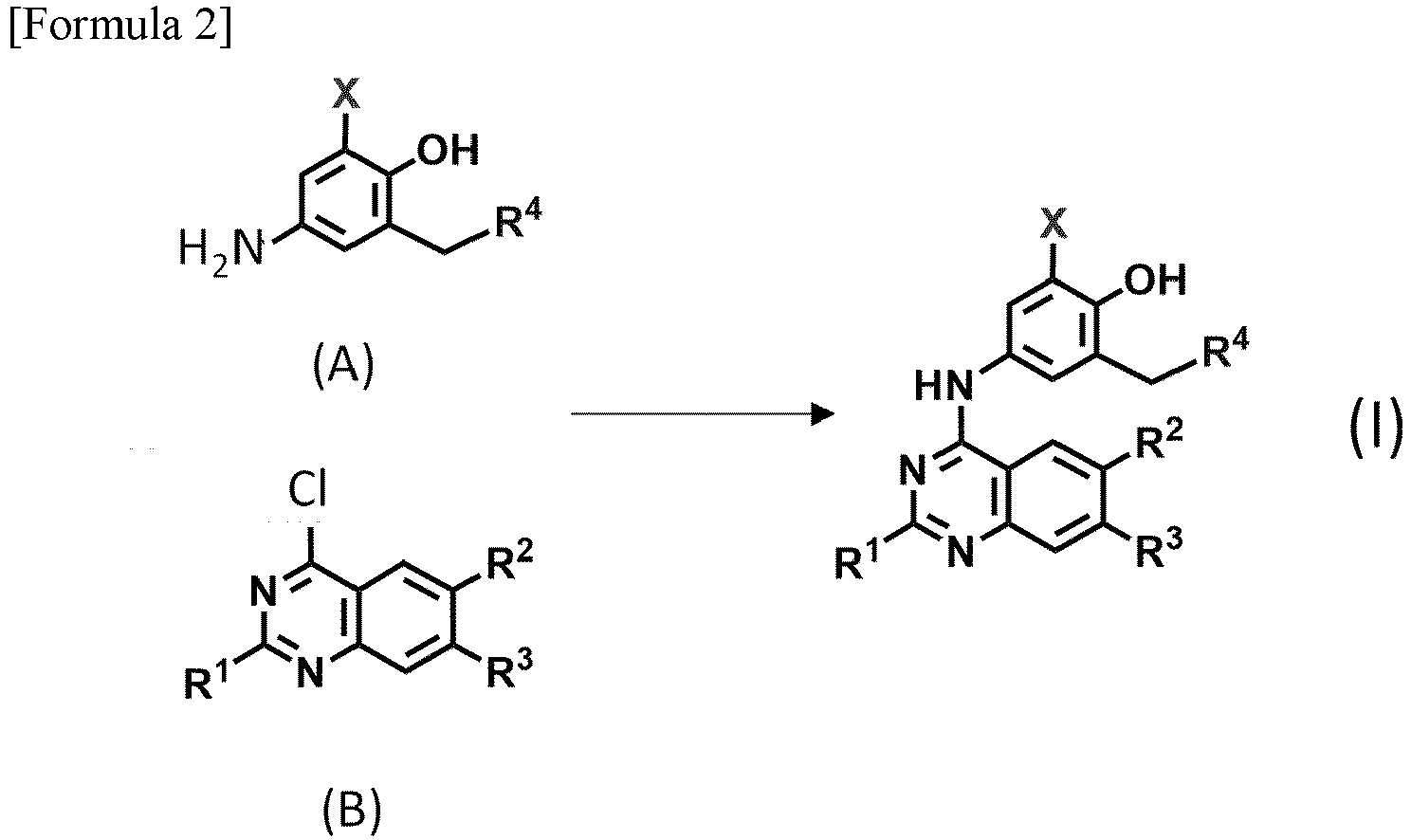
- Specifically, a 4-aminophenol derivative (A) is added to an ethanol solution of a 4-chloroquinazoline compound (B), and these are reacted under heating. Thereby, the target compound (I) can be produced.
- Among the compound (I), compounds where R1, R2, or R3 is a halogen atom, e.g., a chlorine atom, can be reacted with NH(Ra)(Rb)·HCl (where Ra and Rb are as defined as in the formula (I)), e.g., a dimethylamine hydrochloride, and converted to compounds where R1, R2, or R3 in the formula (I) is -N(Ra)(Rb).
- The product thus obtained may be purified by a method usually used, such as column chromatography using silica gel or the like as a carrier, or recrystallization using methanol, ethanol, chloroform, dimethyl sulfoxide, n-hexane-ethyl acetate, or water. Examples of the elution solvent for column chromatography include methanol, ethanol, chloroform, acetone, hexane, dichloromethane, ethyl acetate, and mixed solvents thereof.
- The compound can be formulated in combination with a traditional pharmaceutical carrier, as an anti-SARS-CoV-2 drug. The dosage form thereof is not particularly limited, and can be appropriately selected as needed. Examples of the dosage form include oral agents such as a tablet, a capsule, a granule, a fine granule, a powder, a sustained release formulation, a liquid preparation, a suspension, an emulsion, a syrup, and an elixir, and parenteral agents such as an injection and a suppository.
- The oral agents are produced by a normal method, for example, using starch, lactose, sucrose, mannite, carboxymethyl cellulose, or inorganic salts. In addition to these, a binder, a disintegrant, a surfactant, a lubricant, a glidant, a flavoring agent, a colorant, and/or a fragrance can be appropriately added.
- Examples of the binder include starch, dextrin, gum arabic, gelatin, hydroxypropyl starch, methylcellulose, sodium carboxymethylcellulose, hydroxypropylcellulose, crystalline cellulose, ethylcellulose, polyvinylpyrrolidone, and macrogol.
- Examples of the disintegrant include starch, hydroxypropyl starch, carboxymethylcellulose sodium, carboxymethylcellulose calcium, carboxymethylcellulose, and a low-substituted hydroxypropylcellulose.
- Examples of the surfactant include sodium lauryl sulfate, soy lecithin, sucrose fatty acid ester, and polysorbate 80.
- Examples of the lubricant include talc, waxes, hydrogenated vegetable oil, sucrose fatty acid esters, magnesium stearate, calcium stearate, aluminum stearate, and polyethylene glycol.
- Examples of the glidant include light anhydrous silicic acid, dry aluminum hydroxide gel, synthetic aluminum silicate, and magnesium silicate.
- The injection is produced by a normal method, and as a diluent, distilled water for injection, saline, a glucose aqueous solution, olive oil, sesame oil, peanut oil, soybean oil, corn oil, propylene glycol, or polyethylene glycol can be generally used. Further, a bactericide, a preservative agent, a stabilizer, an isotonizing agent, and/or a soothing agent may be added as needed. From the viewpoint of stability, the injection can be filled into a vial or the like, frozen, and then subjected to ordinary lyophilization to remove the water content. Immediately before use, a liquid preparation can be reconstituted from the lyophilized injection. The proportion of the compound represented by the formula (I) in the injection can be varied between 5% by weight and 50% by weight, but not limited thereto.
- Examples of other parenteral agents include suppositories for intrarectal administration, which are produced by a normal method.
- The formulated anti-SARS-CoV-2 drug can be administrated, for example, 1 to 4 times a day for one week to three months, depending on the form of the drug and the administration route.
- The anti-SARS-CoV-2 drug according to the present invention is used for the treatment of COVID-19. In the present invention, the treatment encompasses prevention of severe illness.
- To demonstrate a desired effect as an oral agent, although the dose varies depending on the age and the body weight of the patient and the severity of the disease thereof, usually, for an adult, it is suitable that the dose is, for example, 0.1 to 1000 mg, preferably 1 to 500 mg of the compound represented by the formula (I) per day, which is divided into portions and administrated.
- To demonstrate a desired effect as a parenteral agent, although the dose varies depending on the age and the body weight of the patient and the severity of the disease thereof, usually, for an adult, it is suitable that the dose is, for example, 0.1 to 1000 mg, preferably 1 to 500 mg of the compound represented by the formula (I), which is administrated by intravenous injection, intravenous drip, subcutaneous injection, or intramuscular injection.
- The compound represented by the formula (I), a salt thereof, a solvate thereof, or a prodrug thereof can be contained in a pharmaceutical composition as the only active ingredient, or can be contained together with other active ingredients.
- Further, the compound represented by the formula (I), a salt thereof, a solvate thereof, or a prodrug thereof may be used in combination with a different drug effective against SARS-CoV-2 infection. These agents are separately administrated in the course of the treatment, or are combined with the compound represented by the formula (I) into a single dosage form such as a tablet, an intravenous solution, or a capsule. Examples of such a different drug include Remdesivir.
- It is known that coronaviruses infect a variety of animals, and SARS-CoV also infects a variety of animals beyond species. Thus, the subject to be treated with the anti-coronavirus drug according to the present invention is not limited to humans, and includes various animals such as pet animals (such as dogs and cats), pigs, camels, bats, palm civets, tigers, ferrets, golden hamsters, minks, and sparrows.
- This specification encompasses the contents disclosed in the description and/or the drawing of
Japanese Patent Application No. 2021-184512 - Hereinafter, the present invention will be more specifically described by way of Examples, but the scope of the present invention is not limited thereto.
- An anti-SARS-CoV-2 assay is schematically shown in
Figure 1 . - VeroE6/TMPRSS2 cells highly sensitive to SARS-CoV-2 were seeded on microplates (2 × 10⁴ cells/well). After 24 hours of culture, drugs in various concentrations and SARS-CoV-2 (WK-521) (obtained from the National Institute of Infectious Diseases, Japan) were added with a multiplicity of infection (MOI) = 0.01, followed by culture at 37°C for 3 days. After the culture, 110 µL of culture supernatant was discarded, and 10 µL of Cell Counting Kit-8 (DOJINDO LABORATORIES, Co. Ltd., a viable cell counting kit using a water-soluble tetrazolium salt WST-8 (2-(2-methoxy-4-nitrophenyl)-3-(4-nitrophenyl)-5-(2,4-disulfophenyl)-2H-tetrazolium monosodium salt) as a coloring reagent) was added. After 2 hours of culture, 100 µL of 2-propanol hydrochloride was added, and was sufficiently mixed; thereafter, the absorbance of each well was measured at 450/620 nm. The anti-SARS-CoV-2 effect and the cell toxicity of the drug were determined by comparing the numbers of viable cells in infected cells and non-infected cells with those in the absence of the drugs.
- The anti-SARS-CoV-2 effects of various quinazoline derivatives are shown in Tables 1 to 3.
[Table 1] 
Compound R1 R2 R3 X EC50 (µM) CC50 (µM) 1 (YMSA-0650) H H H H 30.4 >100 2 (YMSA-0656) H H H Cl 30.1 >100 3 (YMSA-0516) H H H Br 23.9 >100 4 (YMSA-0464) H H H I 16.9 >100 5 (YMSA-0517) H OMe OMe I 31.6 >100 6 (YMSA-0636) NMe2 H H I 12.9 49.9 7 (YMSA-0707) NMe2 H H Cl 7.2 49.2 [Table 2] 
Compound R1 R2 R3 R4 X EC50 (µM) CC50 (µM) 8 (YMSA-0614) H H H NMeEt I 57.6 >100 9 (YMSA-0628) H H H NMe(CH2C6H5) I 8.0 38.1 10 (YMSA-0576) H H H 
I 15.5 >100 11 (YMSA-0808) H H H 
Cl 7.6 >100 12 (YMSA-0828) H H OMe 
Cl 9.5 >100 13 (YMSA-0613) H H H NHEt I 44.7 >100 14 (YMSA-0644) H H H 
I 17.8 >100 15 (YMSA-0785) H H H 
Cl 3.3 >100 16 (YMSA-0781) H H H 
I 44.6 >100 17 (YMSA-0842) H H H 
Cl 5.0 >100 18 (YMSA-0832) H H H 
Cl 53.1 >100 [Table 3] Compound Formula EC50 (µM) CC50 (µM) 19 (YMSA-0797) 
3.2 >100 20 (YMSA-0823) 
3.9 >100 21 (YMSA-0864) 
11.7 >100 22 (YMSA-0897) 
10.8 >100 23 (YMSA-0908) 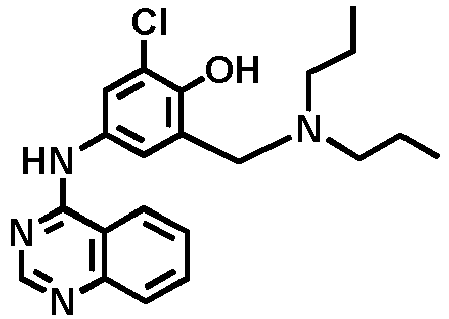
15.3 >100 24 (YMSA-0863) 
2.1 >100 25 (YMSA-0907) 
2.5 >100 26 (YMSA-0868) 
11.7 >100 27 (YMSA-0884) 
13.9 >100 28 (YMSA-0909) 
10.0 >100 29 (YMSA-0833) 
10.6 >100 30 (YMSA-0944) 
10.8 >100 31 (YMSA-1012) 
19.4 37.5 32 (YMSA-1033) 
20.0 60.2 33 (YMSA-1066) 
54.7 >100 34 (YMSA-0974) 
60.2 >100 Nirmatrelvir 8.3 >100 EC50: 50% effective concentration (concentration of the drug which inhibits cell death induced by SARS-CoV-2 infection by 50%)
CC50: 50% toxicity concentration (concentration of the drug which reduces the number of viable cells in non-infected cells by 50%) - Table 4 shows the anti-SARS-CoV-2 effect of compounds in which hydroxyl group in the phenylamino group substituting the 4-position of the quinazoline ring is present at the 3-position in place of the 4-position of the phenylamino group as in the formula (I).
[Table 4] 
Compound R1 R2 R3 R4 R5 EC50 (µM) CC50 (µM) YMSA-0843 H H H 
H >100 >100 YMSA-0850 H H H H 
>100 >100 EC50: 50% effective concentration (concentration of the drug which inhibits cell death induced by SARS-CoV-2 infection by 50%)
CC50: 50% toxicity concentration (concentration of the drug which reduces the number of viable cells in non-infected cells by 50%) - Tables 1 to 3 reveal that the compounds represented by the formula (I) according to the present invention have the anti-SARS-CoV-2 effects. In contrast, Table 4 reveals that sufficient anti-SARS-CoV-2 effects were not observed in the compounds which have basic skeletons similar to that of the compound represented by the formula (I) according to the present invention but have the substituting hydroxyl group at a different position.
- Among the compounds according to the present invention, four derivatives demonstrating strong anti-SARS-CoV-2 effects against VeroE6/TMPRSS2 cells were selected, and examined for their anti-SARS-CoV-2 effects using cells other than VeroE6/TMPRSS2. As a result, these four derivatives also demonstrated strong effects against HEK293T/ACE2 cells derived from humans. In particular, YMSA-0785 had 50% effective concentration (EC50) of 0.12 µM, 50% toxicity concentration (CC50) of >100 µM, and selectivity coefficient (CC50/EC50) of >833 (Table 5).
- These drugs also had similar anti-SARS-CoV-2 effects against mutant strains as those against the standard strains (Table 5).
[Table 5] Cells (Assay) Drug YMSA-0785 YMSA-0797 YMSA-0808 YMSA -0842 VeroE6/TMPRSS2 (CPE) 3.3 3.2 7.6 5.0 > 100 > 100 > 100 > 100 VeroE6/TMPRSS2 (RNA) 1.9 2.9 1.9 2.0 Vero (RNA) 1.7 2.9 5.5 1.2 HEK293T/ACE2 (RNA) 0.12 0.14 0.12 0.31 > 100 36.1 85.4 13.8 Effects against mutant virus strain (CPE assay in Vero/TMPRSS2) Alpha strain (QK002) 2.7 5.8 3.8 2.6 Beta strain (TY8-612) 6.8 8.6 9.3 8.1 Gamma strain (TY7-501) 3.5 4.2 5.4 3.4 - The assay in HEK293T/ACE2 cells was performed as follows.
(Assay in HEK293T/ACE2 cells) - HEK293T/ACE2 cells (2 × 10⁴ cells/well) were seeded on microplates with 100 µL of cell culture solution. After 24 hours of culture, 50 µL each of various drugs prepared by diluting drug stock solution to 4 times the final concentration was added to each well. Further, 50 µL of virus solution of SARS-CoV-2 (WK-521 strain) (obtained from the National Institute of Infectious Diseases, Japan) was added with MOI = 0.1 (plate for infection). To a plate for cells, 50 µL each of the various drugs prepared by diluting the drug stock solution to 4 times the final concentration was added to each well, and 50 µL of the cell culture solution was added thereto. After 3 days of culture, the culture supernatant on the plate for infection was transferred to a new plate, which was stored at -80°C. 110 µL of the culture solution was discarded from the plate for cells, and 10 µL of Cell Counting Kit-8 was added. After 2 hours of culture in a CO2 incubator, absorbance at 450 nm (620 nm) was measured.
- To 50 µL of a culture supernatant, 50 µL of DNA/RNA Shield (Zymo Research) was added, and using Quick-RNA Viral 96 kit (Zymo Research), RNAs were extracted according to the instructions (15 µL). The extracted RNAs were diluted 10-fold with nuclease-free water, which was used as an RNA sample. Using High-Capacity RNA-to-cDNA™ Kit (Thermo Fisher Scientific), cDNAs were synthesized from the RNA sample, and the RNA amount in the sample was measured by real-time PCR.
-

- Using a microwave synthesizing apparatus (Discover, CEM, 50 W), an EtOH solution (5 mL) of 4-chloroquinazoline (144 mg, 0.88 mmol) and 4-aminophenol (99 mg, 1.2 mmol) was reacted at 80°C for 50 minutes. After the temperature of the reaction solution was returned to room temperature, Et2O (5 mL) was added, and deposited solids were separated with a filter, and washed with diethyl ether. The obtained solids were recrystallized from Et2O/MeOH, giving YMSA-0398 hydrochloride as a light yellow green powder (120 mg, 43%). mp 284-290°C.
-

- Using a microwave reactor (Discover, CEM, 50 W), an EtOH solution (5 mL) of 4-chloroquinazoline (119 mg, 0.73 mmol) and 4-amino-2-fluorophenol (93 mg, 0.73 mmol) was reacted at 80°C for 60 minutes. After the temperature of the reaction solution was returned to room temperature, Et2O (5 mL) was added, and deposited solids were separated with a filter, and washed with diethyl ether. The obtained solids were recrystallized from Et2O/MeOH, giving YMSA-0329 hydrochloride as a yellow green powder (117 mg, 63%). mp 249-265°C.
-

- Using a microwave reactor (Discover, CEM, 50 W), an EtOH solution (5 mL) of 4-chloroquinazoline (189 mg, 1.2 mmol) and 4-amino-2-chlorophenol (164 mg, 1.1 mmol) was reacted at 80°C for 60 minutes. After the temperature of the reaction solution was returned to room temperature, Et2O (5 mL) was added, and deposited solids were separated with a filter, and washed with diethyl ether. The obtained solids were recrystallized from MeOH, giving YMSA-0721 hydrochloride as a yellow powder (176 mg, 65%). mp 284-290°C.
-

- Using a microwave reactor (Discover, CEM, 50 W), a mixture of 4-chloroquinazoline (134 mg, 0.81 mmol) and 4-amino-2-bromophenol (153 mg, 0.82 mmol) was reacted in EtOH (5 mL) at 80°C for 60 minutes. After the temperature of the reaction solution was returned to room temperature, Et2O (5 mL) was added, and deposited solids were separated with a filter, and washed with diethyl ether. The obtained solids were recrystallized from EtOH, giving YMSA-0840 1.25 hydrochloride as a yellow powder (96 mg, 37%). mp 277-288°C.
-

- Using a microwave reactor (Discover, CEM, 50 W), a mixture of 4-chloroquinazoline (91 mg, 0.56 mmol) and 4-amino-2-iodophenol (133 mg, 0.56 mmol) was reacted in EtOH (5 mL) at 80°C for 60 minutes. After the temperature of the reaction solution was returned to room temperature, Et2O (5 mL) was added, and deposited solids were separated with a filter, and washed with diethyl ether. The obtained solids were recrystallized from MeOH, giving YMSA-0414 hydrochloride as a yellow powder (104 mg, 51%). mp 250-255°C.
-

- Using a microwave reactor (Discover, CEM, 50 W), a mixture of 4-chloroquinazoline (119 mg, 0.73 mmol) and 5-amino-2-chlorophenol (103 mg, 0.72 mmol) was reacted in EtOH (5 mL) at 80°C for 60 minutes. After the temperature of the reaction solution was returned to room temperature, Et2O (5 mL) was added, and deposited solids were separated with a filter, and washed with diethyl ether. The obtained solids were recrystallized from MeOH, giving YMSA-0891 hydrochloride as a yellow powder (118 mg, 60%). mp 287-289°C.
-


- Diethylamine (8.6 mL, 83.5 mmol) and a 37% HCHO aqueous solution (8.5 mL, 0.10 mol) were added to an EtOH (100 mL) solution of 4-nitrophenol 1 (2.9 g, 20.8 mmol), followed by heating under reflux for 44 hours. After the reaction, the reaction solution was concentrated under reduced pressure. H2O (50 mL) was added, followed by extraction with AcOEt (50 mL × 3). The combined organic phases were washed with saturated saline water, dried over Na2SO4, filtered, and concentrated under reduced pressure. The resulting residue was purified by silica gel column chromatography (hexane/AcOEt = 1/1 to 1/3), giving
Compound 2 as a yellow oily substance (3.5 g, 76%). - N-iodosuccinimide (1.6 g, 7.3 mmol) was added to an MeCN solution (35 mL) of 2 (1.6 g, 7.3 mmol), and these were stirred under room temperature for 30 minutes. The reaction solution was concentrated under reduced pressure, and purified by silica gel column chromatography (hexane/AcOEt = 1/1 to 1/2). Hexane/CHCl3 was added to the resulting compound, insolubles were filtered out, and the filtrate was concentrated under reduced pressure, giving
Compound 3 as a yellow solid (1.2 g, 47%). mp 118°C (dec.). - SnCl2·2H2O (0.31 g, 1.4 mmol) was added to an EtOH (8 mL) solution of YMSA-0532 (96 mg, 0.27 mmol), and the reaction solution was heated under reflux for 1.5 hours. The reaction solution was concentrated under reduced pressure, and a saturated aqueous NaHCO3 solution (30 mL) was added, followed by extraction with AcOEt (30 mL × 3). The combined organic phases were washed with saturated saline water, dried over Na2SO4, filtered, and concentrated under reduced pressure, giving
Compound 3 as a yellow solid (82.6 mg, 90%). mp 69°C (dec.). - Compound 3 (36 mg, 0.11 mmol) was added to an EtOH solution (1 mL) of 4-chloroquinazoline (4) (18 mg, 0.11 mmol), and the reaction solution was heated under reflux for 3 hours. The reaction solution was concentrated under reduced pressure, and the resulting residue was purified by silica gel column chromatography (hexane/AcOEt = 1/1). The resulting oily substance was formed into solids with Et2O/MeOH, giving YMSA-0464 as a beige powdery substance (5.5 mg, 11%). mp 185-189°C. IR (ATR): v = 2971, 1618, 1572, 1533, 1497, 1444, 1387, 1353, 1319, 1284, 1246, 1169, 1115, 1067, 1049, 997, 956, 908, 876, 816, 765, 680, 671, 637, 591, 581, 564, 512, 502, 473, 463, 434, 414 cm-1. 1H NMR (300 MHz, CDCl3/TMS): δ = 8.73 (s, 1H), 7.90-7.81 (m, 4H), 7.56 (t, J = 6.9 Hz, 1H), 7.43 (d, J = 2.7 Hz, 1H), 3.81 (s, 2H), 2.68 (q, J = 7.2 Hz, 4H), 1.15 (t, J = 7.2 Hz, 6H) ppm. 13C NMR (100 MHz, CDCl3/TMS): δ = 157.8, 155.6, 155.2, 150.0, 133.0, 132.1, 130.1, 129.1, 126.7, 123.7, 122.1, 120.3, 115.0, 84.6, 57.0, 46.3, 11.1 ppm. HRMS (FAB+): calcd for [M+H]+, C19H22IN4O: 449.0838; found 449.0839. Anal. Calcd (%) for C19H21IN4O: C, 50.90; H, 4.72; N, 12.50. found: C, 50.51; H, 4.63; N, 12.33.
-

- SnCl2·2H2O (0.25 g, 1.1 mmol) was added to an EtOH (4 mL) solution of YMSA-0532 (80 mg, 0.22 mmol), and the reaction solution was heated under reflux for 30 minutes. 2-Bromoquinoxaline (5) (36 mg, 0.22 mmol) was added thereto, followed by further heating under reflux for 4 hours. The reaction solution was concentrated under reduced pressure, and the resulting residue was purified by silica gel column chromatography (CHCl3/MeOH = 50/1 to 10/1). The resulting oily substance was formed into solids with Et2O/MeOH, giving YMSA-0514 as a yellow powder substance (98 mg, 97%). mp 37-40°C. IR (ATR): v = 3303, 2969, 2930, 1668, 1611, 1582, 1543, 1459, 1412, 1386, 1349, 1287, 1228, 1191, 1163, 1112, 1044, 1019, 991, 953, 928, 907, 864, 807, 756, 715, 660, 636, 597, 547, 504, 414 cm-1. 1H NMR (399 MHz, CDCl3/TMS): δ = 8.34 (s, 1H), 7.92-7.89 (m, 2H), 7.75 (dd, J = 8.6, 1.2 Hz, 1H), 7.62 (td, J = 6.8, 1.2 Hz, 1H), 7.45 (td, J = 7.8, 1.2 Hz, 1H), 7.33 (d, J= 1.8 Hz, 1H), 6.66 (brs, 1H), 3.78 (s, 2H), 2.67 (q, J = 7.2 Hz, 4H), 1.14 (t, J = 7.2 Hz, 6H) ppm. 13C NMR (100 MHz, CDCl3/TMS): δ = 155.0, 149.8, 137.9, 131.2, 130.7, 130.4, 128.9, 126.8, 125.5, 122.4, 122.2, 116.5, 84.9, 57.0, 46.4, 46.3, 11.1 ppm. HRMS (FAB+): calcd for [M+H]+, C19H22IN4O: 449.0833; found 449.0834. Anal. Calcd (%) for C20H13IN4O·0.3H2O, 0.1AcOEt: C, 51.42; H, 5.16; N, 11.76. found: C, 51.45; H, 5.04; N, 11.47.
-

- Compound 6 was obtained as a yellow solid from
Compound 2 and N-bromosuccinimide (NBS) by the same method as that in the synthesis of YMSA-0532 (0.16 g, 50%). mp 148°C (dec.). - YMSA-0516 was obtained as a yellow solid by the same method as that in YMSA-0514 (0.11 g, 88%). mp 181-185°C. IR(ATR): v = 2975, 1619, 1573, 1534, 1497, 1465, 1403, 1354, 1319, 1287, 1247, 1224, 1184, 1119, 1069, 1051, 998, 957, 917, 875, 854, 817, 765, 723, 676, 639, 592, 584, 566, 514, 464, 437, 423, 408 cm-1. 1H NMR (399 MHz, DMSO-d6/TMS): δ = 8.73 (s, 1H), 7.91 (d, J = 8.0 Hz, 1H), 7.85-7.78 (m, 2H), 7.71 (d, J= 2.0 Hz, 1H), 7.55 (t, J = 7.2 Hz, 1H), 7.35 (d, J = 2.0 Hz, 1H), 7.30 (s, 1H), 3.82 (s, 2H), 2.67 (q, J = 6.8 Hz, 4H), 1.14 (t, J= 6.8 Hz, 6H) ppm. 13C NMR (100 MHz, CDCl3/TMS): δ = 157.9, 155.1, 153.1, 150.0, 133.0, 129.6, 129.0, 126.7, 126.4, 123.1, 122.5, 120.4, 115.0, 110.0, 57.0, 46.4, 11.1 ppm. HRMS (FAB+): calcd for [M+H]+, C19H22BrN4O: 401.0977; found 401.0976. Anal. Calcd (%) for C19H21BrN4O·0.2H2O: C, 56.36; H, 5.33; N, 13.84. found: C, 56.34; H, 5.09; N 13.50.
-

- YMSA-0517 was obtained as a yellow powder substance by the same method as that in the synthesis of YMSA-0514 (53 mg, 69%). mp 125°C (dec.). IR (ATR): v = 2971, 1622, 1579, 1504, 1456, 1430, 1335, 1240, 1218, 1145, 1112, 1072, 1030, 1004, 914, 846, 804, 748, 687, 661, 568, 557, 508, 465, 420 cm-1. 1H NMR (300 MHz, DMSO-d6/TMS): δ = 8.77 (s, 1H), 8.23 (s, 1H), 8.13 (d, J = 2.4 Hz, 1H), 7.85 (d, J = 2.4 Hz, 1H), 7.30 (s, 1H), 4.34 (s, 2H), 4.01 (s, 3H), 3.99 (s, 3H), 3.13 (q, J = 6.9 Hz, 4H), 1.28 (t, J = 6.9 Hz, 6H) ppm. 13C NMR (100 MHz, DMSO-d6/TMS): δ = 157.5, 155.2, 155.1, 154.1, 149.9, 147.9, 132.8, 132.3, 124.6, 123.1, 109.8, 108.3, 102.9, 85.0, 57.3, 57.2, 56.9, 46.7, 12.0 ppm. HRMS (FAB+): calcd for [M+H]+, C21H26IN4O3:509.1050; found 509.1050. Anal. Calcd (%) for C21H25IN4O3·0.5H2O: C, 48.05; H, 5.07; N, 10.83. found: C, 48.37; H, 4.74; N, 10.62.
-

- Compound 14 was obtained as a yellow oily substance by the same method as that in the synthesis of Compound 2 (0.50 g, 67%).
- Compound 15 was obtained as a yellow solid by the same method as that in the synthesis of YMSA-0532 (0.17 g, 38%). mp 148°C(dec.).
- YMSA-0576 was obtained as a yellow solid by the same method as that in YMSA-0514 (24 mg, 34%). mp 190°C (dec.). IR (ATR): v = 2938, 2795, 1619, 1589, 1567, 1529, 1499, 1442, 1433, 1410, 1390, 1356, 1342, 1321, 1302, 1281, 1240, 1157, 1134, 1117, 1087, 1075, 1050, 1005, 987, 924, 913, 885, 867, 815, 801, 775, 724, 681, 653, 631, 596, 580, 567, 528, 508, 488, 469, 432, 428 cm-1. 1H NMR (399 MHz, CDCl3/TMS): δ = 8.73 (s, 1H), 7.93-7.90 (m, 2H), 7.85-7.79 (m, 2H), 7.76 (t, J = 6.8 Hz, 1H), 7.44 (d, J= 2.4 Hz), 7.28 (brs, 1H), 3.74 (s, 2H), 2.60 (brs, 8H), 2.32 (s, 3H) ppm. 13C NMR (100 MHz, CDCl3/TMS): δ = 157.7, 155.0, 154.7, 149.9, 133.0, 132.2, 130.4, 129.0, 126.6, 123.8, 121.2, 120.1, 114.8, 84.4, 61.4, 54.6, 52.4, 45.8 ppm. HRMS (FAB+): calcd for [M+H]+, C20H23IN5O: 476.0947; found 479.0946. Anal. Calcd (%) for C20H22IN5O·0.5H2O: C, 49.60; H, 4.79; N, 14.46. found: C, 49.54; H, 4.76; N, 14.45.
-

- A 70% ethylamine aqueous solution (85 µL, 1.0 mmol) was added to an MeOH (5 mL) solution of 5-nitrosalicylaldehyde (0.17 g, 1.0 mmol). After the reaction solution was stirred at room temperature for 1 hour, an MeOH (3 mL) solution of NaBH4 (44 mg, 1.2 mmol) was added, and the reaction solution was further stirred at room temperature for 1 hour. The formed solid was separated with a filter, and washed with MeOH, giving Compound 20 as a yellow powdery substance (0.16 g, 79%). mp 209-210°C.
- A 1N HCl aqueous solution (10 drops) was added to an MeCN solution of Compound 20 (0.10 g, 0.50 mmol) until the reaction solution became colorless. Further, NIS (0.13 g, 0.57 mmol) was added, and the reaction solution was stirred at room temperature for 30 minutes. The reaction was stopped with saturated NaHCO3 aqueous solution, and the pH was adjusted to 7. The formed solids were filtered out, and the filtrate was concentrated under reduced pressure. The resulting residue was purified by silica gel column chromatography (CHCl3/MeOH = 10/1), giving Compound 21 as a yellow solid (0.17 g, 100%). mp 145°C (dec.).
- YMSA-0613 was obtained as a yellow powder substance by the same method as that in the synthesis of YMSA-0514 (18 mg, 28%). mp 115°C (dec.). IR (ATR): v = 2970, 1618, 1576, 1516, 1463, 1392, 1357, 1318, 1125, 1073, 918, 868, 765, 681, 570, 470, 418, 407 cm-1. 1H NMR (399 MHz, CDCl3/TMS): δ = 8.72 (s, 1H), 7.91 (d, J = 8.4 Hz, 1H), 7.85-7.78 (m, 3H), 7.55 (t, J= 8.4 Hz, 1H), 7.43 (s, 1H), 4.01 (s, 2H), 2.77 (q, J = 8.4 Hz, 2H), 1.20 (t, J= 7.6 Hz, 3H) ppm. 13C NMR (100 MHz, CDCl3/TMS): δ = 155.5, 155.0, 149.9, 132.8, 132.2, 130.0, 129.0, 126.6, 123.8, 122.5, 120.2, 114.9, 84.8, 52.5, 43.1, 14.7 ppm. HRMS (FAB+): calcd for [M+H]+, C17H18IN4O: 421.0525; found 421.0526. Anal. Calcd (%) for C17H17IN4O·0.1AcOEt: C, 48.71; H, 4.18; N, 13.06. found: C, 48.58; H, .4.31; N, 12.81.
-

- Compound 22 was obtained as a yellow solid by the same method as that in the synthesis of Compound 2 (0.75 g, 71%). mp 48-51°C.
- Compound 23 was obtained as a yellow solid by the same method as that in the synthesis of YMSA-0532 (0.41 g, 81%). mp 121-131°C.
- YMSA-0614 was obtained as a yellow solid by the same method as that in the synthesis of YMSA-0464 (55 mg, 85%). mp 163°C (dec.). IR(ATR): v = 2967, 1618, 1572, 1531, 1497, 1452, 1389, 1355, 1318, 1223, 1166, 1074, 1029, 913, 867, 818, 762, 725, 677, 573, 560, 466, 440, 419 cm-1. 1H NMR (399 MHz, CDCl3/TMS): δ = 8.72 (s, 1H), 7.91 (d, J = 8.4 Hz, 1H), 7.87-7.85 (m, 2H), 7.80 (t, J= 8.0 Hz, 1H), 7.55 (t, J = 6.3 Hz, 1H), 7.41 (d, J = 2.4 Hz, 1H), 7.38 (brs, 1H), 2.61 (q, J= 7.2 Hz, 2H), 2.32 (s, 2H), 1.17 (t, J= 7.2 Hz, 3H) ppm. 13C NMR (100 MHz, CDCl3/TMS): δ = 156.7, 154.3, 154.0, 148.9, 131.9, 131.1, 129.1, 127.9, 125.6, 122.6, 120.8, 119.3, 113.6, 83.5, 59.7, 49.7, 39.5, 10.9 ppm. HRMS (FAB+): calcd for [M+H]+, C18H20IN4O: 435.0682; found 435.0682. Anal. Calcd (%) for C18H19IN4O·0.3AcOEt: C, 50.06; H, 4.68; N, 12.16. found: C, 49.90; H, 4.42; N, 11.91.
-
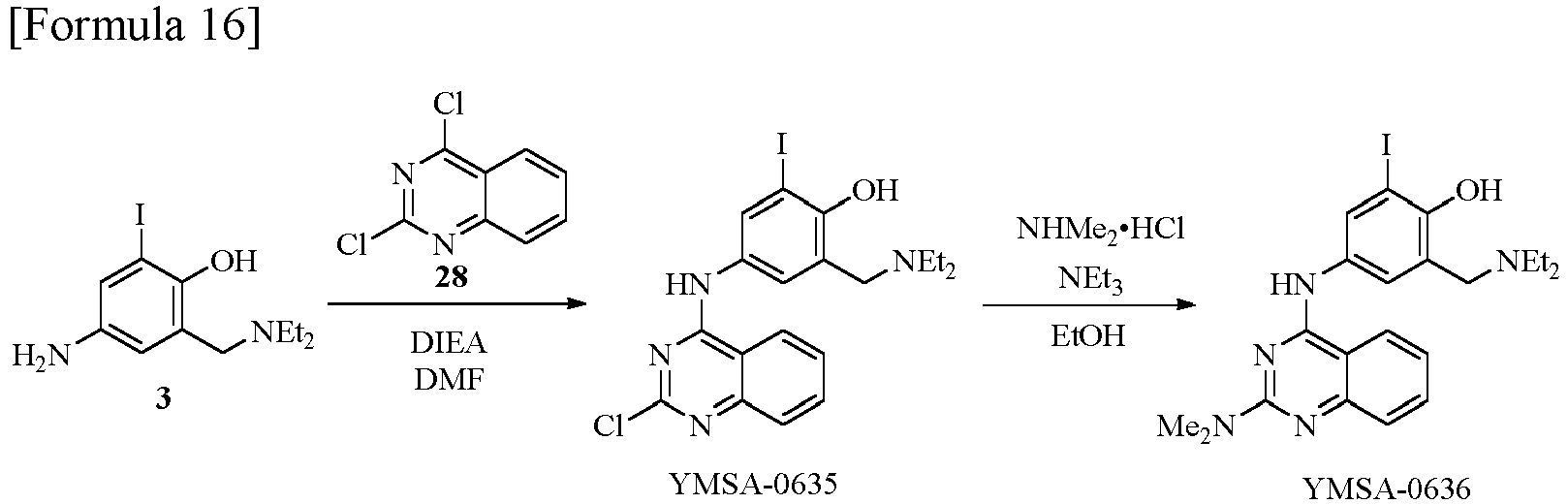
- Compound 3 (76 mg, 0.24 mmol) and N,N-diisopropylethylamine (DIEA) (45 µL, 0.25 mmol) were added to a DMF (2 mL) solution of 2,4-dichloroquinazoline 28 (34 mg, 0.17 mmol). After the reaction solution was stirred for 2.5 hours, H2O (20 mL) was added, followed by extraction with EtOAc (20 mL × 3). The combined organic phases were washed with saturated saline water, dried over Na2SO4, filtered, and concentrated under reduced pressure. The resulting residue was purified by silica gel column chromatography (CHCl3/MeOH = 100/1), and formed into a solid with hexane, giving YMSA-0635 as a beige solid (45 mg, 54%). mp 183-185°C. IR (ATR): v = 3263, 2969, 2848, 2930, 1616, 1567, 1528, 1494, 1446, 1388, 1365, 1354, 1340, 1278, 1249, 1195, 1167, 1116, 1982, 1067, 1048, 997, 948, 906, 875, 854, 815, 787, 761, 723, 686, 676, 639, 598, 571, 517, 503, 473, 407 cm-1. 1H NMR (399 MHz, CDCl3/TMS): δ = 7.82-7.79 (m, 4H), 7.55-7.48 (m, 3H), 3.78 (s, 2H), 2.67 (q, J = 7.2 Hz, 4H), 1.14 (t, J= 7.2 Hz, 6H) ppm. 13C NMR (100 MHz, CDCl3/TMS): δ = 158.7, 157.4, 155.9, 151.4, 133.9, 131.5, 129.5, 128.3, 126.8, 123.3, 122.1, 120.6, 113.3, 84.4, 56.9, 46.3, 11.0 ppm. HRMS (FAB+): calcd for [M+H]+, C19H21IClN4O: 483.0449; found 483.0449. Anal. Calcd (%) for C19H20ClIN4O: C, 47.27; H, 4.18; N, 11.61. found: C, 47.40; H, 4.12; N, 11.46.
- Dimethylamine hydrochloride (80 mg, 0.98 mmol) and NEt3 (0.17 mL, 1.2 mmol) were added to an EtOH (5 mL) solution of YMSA-0635 (0.12 g, 0.25 mmol). After the reaction solution was heated under reflux for 4 hours, water (20 mL) was added, followed by extraction with EtOAc (20 mL × 3). The combined organic phases were washed with saturated saline water, dried over Na2SO4, filtered, and concentrated under reduced pressure. The resulting residue was purified by silica gel column chromatography (AcOEt), and formed into a solid with hexane/CHCl3, giving YMSA-0636 as a light yellow solid (91 mg, 75%). mp 168-176°C. IR (ATR): v = 2969, 1620, 1580, 1559, 1523, 1459, 1379, 1305, 1259, 1191, 1160, 1122, 1087, 1042, 1019, 877, 861, 805, 790, 759, 719, 674, 651, 635, 562, 509, 433, 408 cm-1. 1H NMR (399 MHz, CDCl3/TMS): δ = 8.14 (d, J = 2.4 Hz, 1H), 7.60 (d, J = 8.0 Hz, 1H), 7.52-7.51 (m, 2H), 7.28 (d, J = 2.0 Hz, 1H), 7.18 (brs, 1H), 7.07 (td, J= 7.2, 1.6 Hz, 1H), 3.71 (s, 2H), 3.23 (s, 6H), 2.63 (q, J = 7.2 Hz, 4H), 1.10 (t, J = 7.2 Hz, 6H) ppm. HRMS (FAB+): calcd for [M+H]+, C21H27IN5O: 492.1260; found 492.1258. Anal. Calcd (%) for C21H26IN5O·0.1CHCl3: C, 50.35; H, 5.23; N, 13.91. found: C, 50.59; H, 4.98; N, 13.66.
-


- Compound 29 was obtained as a yellow powder solid (1.1 g, 69%) as in the synthesis of YMSA-0532 by reacting
Compound 2 and N-chlorosuccinimide. mp 142-150°C. - YMSA-0656 was obtained as a yellow solid by the same method as that for YMSA-0464 (90 mg, 42%). mp 170-174°C. IR(ATR): v = 2969, 1617, 1572, 1532, 1469, 1405, 1354, 1318, 1246, 1227, 1190, 1165, 1125, 1072, 959, 919, 867, 818, 761, 725, 677, 587, 570, 545, 517, 465, 438, 424 cm-1. 1H NMR (399 MHz, CDCl3/TMS): δ = 8.71 (s, 1H), 7.97 (d, J = 8.4 Hz, 1H), 7.90-7.86 (m, 2H), 7.77 (t, J= 7.2 Hz, 1H), 7.53 (d, J = 2.4 Hz, 1H), 7.50 (t, J = 7.2 Hz, 1H), 7.22 (d, J = 2.0 Hz, 1H), 3.75 (s, 2H), 2.62 (q, J = 7.6 Hz, 4H), 1.09 (t, J = 7.6 Hz, 6H) ppm. 13C NMR(100 MHz, CDCl3/TMS): δ = 158.4, 155.4, 150.2, 133.4, 129.6, 129.0, 127.0, 124.1, 123.5, 122.2, 121.2, 121.0, 115.4, 57.2, 46.7, 11.4 ppm. HRMS (ESI+): calcd for [M+H]+, C19H22ClN4O: 357.1477; found 357.1472. Anal. Calcd (%) for C19H21ClN4O·0.03CHCl3: C, 63.41; H, 5.88; N, 15.54. found: C, 63.78; H, 5.53; N, 15.19.
-


- Compound 32 was obtained as a yellow oily substance by the same method as that in the synthesis of Compound 3 (0.33 g, 59%).
- Compound 33 was obtained as a light yellow powder solid by the same method as that in the synthesis of YMSA-0635 (0.11 g, 55%). mp 90-99°C.
- YMSA-0707 was obtained as a light yellow solid by the same method as that in the synthesis of YMSA-0636 (38 mg, 46%). mp 176-180°C. IR (ATR): v = 3304, 3133, 3054, 2972, 2937, 1622, 1581, 1558, 1528, 1464, 1383, 1350, 1303, 1264, 1250, 1228, 1191, 1165, 1125, 1106, 1089, 1063, 1045, 1019, 996, 926, 875, 853, 807, 793, 780, 771, 742, 719, 663, 635, 584, 566, 549, 538, 508, 483, 426, 407 cm-1. 1H NMR (399 MHz, CDCl3/TMS): δ = 7.76 (d, J = 2.8 Hz, 1H), 7.59 (d, J = 8.0 Hz, 1H), 7.52 (td, J = 7.4, 2.0 Hz, 2H), 7.23 (d, J = 2.4 Hz, 1H), 7.11-7.07 (m, 2H), 3.78 (s, 2H), 3.24 (s, 6H), 2.65 (q, J = 7.2 Hz, 4H), 1.13 (t, J= 7.2 Hz, 6H) ppm. 13C NMR (100 MHz, CDCl3/TMS): δ = 159.4, 157.3, 153.1, 150.7, 132.8, 130.4, 126.2, 123.0, 122.4, 121.0, 120.4, 110.0, 56.9, 46.4, 37.2, 11.1 ppm. HRMS (FAB+): calcd for [M]+, C21H26ClN5O:399.1826; found 399.1826. Anal. Calcd (%) for C21H26ClN5O·0.2AcOEt: C, 62.71; H, 6.66; N, 16.77. found: C, 62.83; H, 6.41; N, 16.56.
-

- Diisopropylamine (0.26 mL, 1.8 mmol) and Et3N (0.42 mL, 3.0 mmol) were added to a THF (7 mL) solution of 2-hydroxy-5-nitrobenzyl bromide 39 (0.35 g, 1.5 mmol), and the reaction solution was heated under reflux for 30 minutes. The reaction solution was concentrated under reduced pressure, and the resulting residue was dissolved in AcOEt (20 mL), and washed with H2O (20 mL × 3) and saturated saline water (20 mL). The organic phase was dried over Na2SO4, filtered, and concentrated under reduced pressure, giving Compound 40 as a yellow solid (0.33 g, 88%). mp 112-115°C.
- Compound 41 was obtained as a yellow solid by the same method as that in the synthesis of YMSA-0532 (0.24 g, 75%). mp 151-153°C.
- YMSA-0781 was obtained as a light yellow solid by the same method as that in the synthesis of YMSA-0464 (15 mg, 47%). mp 111-120°C. IR (ATR): v = 2968, 1619, 1571, 1530, 1498, 1465, 1390, 1369, 1315, 1239, 1192, 1169, 1118, 1073, 948, 914, 869, 819, 764, 735, 707. 680, 569, 551, 498, 467, 432, 419 cm-1. 1H NMR (399 MHz, CDCl3/TMS): δ = 8.73
- (s, 1H), 7.91 (d, J = 8.4 Hz, 1H), 7.86-7.78 (m, 3H), 7.55 (td, J = 7.4, 1.2 Hz, 1H), 7.41 (d, J = 2.8 Hz, 1H), 7.35 (brs, 1H), 3.85 (s, 2H), 3.21-3.15 (m, 2H), 1.15 (d, J= 6.8 Hz, 12H) ppm. 13C NMR (100 MHz, CDCl3/TMS): δ = 157.9, 156.0, 155.2, 150.0, 133.0, 131.8, 129.9, 129.1, 126.7, 123.5, 122.7, 120.4, 115.0, 84.7, 49.1, 48.4, 19.8 ppm. HRMS (FAB+): calcd for [M+H]+, C21H26IN4O:477.1151; found 477.1153. Anal. Calcd (%) for C21H25IN4O·0.1H2O: C, 52.75; H, 5.31; N, 11.72. found: C, 52.68; H, 5.47; N, 11.33.
-

- Compound 43 was obtained as a yellow oily substance by the same method as the method of synthesizing Compound 40 (0.52 g, 100%).
- Compound 44 was obtained as a yellow oily substance by the same method as that in the synthesis of Compound 29 (92 mg, 37%).
- YMSA-0797 was obtained as a yellow solid by the same method as that in the synthesis of YMSA-0464 (35 mg, 35%). mp 80-85°C. IR (ATR): v = 2928, 2854, 1669, 1618, 1573, 1532, 1470, 1391, 1356, 1319, 1234, 1171, 1123, 1073, 967, 915, 868, 765, 680, 581, 533, 465, 429, 416 cm-1. 1H NMR (399 MHz, CDCl3/TMS): δ = 8.72 (s, 1H), 7.91-7.88 (m, 2H), 7.81-7.79 (m, 2H), 7.55-7.53 (m, 3H), 3.87 (s, 2H), 2.66-2.64 (m, 3H), 1.89 (d, J= 12 Hz, 2H), 1.82 (d, J = 12 Hz, 2H), 1.65 (d, J = 13 Hz, 1H), 1.34-1.22 (m, 4H), 1.14 (t, J = 6.8 Hz, 3H), 0.89 (t, J = 6.8 Hz, 1H) ppm. 13C NMR(100 MHz, CDCl3/TMS): δ = 157.9, 155.1, 152.5, 149.9, 143.6, 134.9, 133.0, 128.9, 126.7, 123.5, 121.7, 120.8, 120.5, 115.0, 58.9, 53.6, 43.9, 28.1, 26.1, 25.9, 13.0 ppm. HRMS (FAB+): calcd for [M+H]+, C23H28ClN4O:411.1952; found 411.1950. Anal. Calcd (%) for C23H27ClN4O·0.4H2O: C, 66.07; H, 6.70; N, 13.40. found: C, 66.04; H, 6.64; N, 13.10.
-

- N-chlorosuccinimide (203 mg, 1.52 mmol) was added to a solution of Compound 40 (319 mg, 1.26 mmol) dissolved in 10 mL of acetonitrile, followed by stirring at room temperature for 23 hours. After confirming the completion of the reaction, the solvent was distilled off under reduced pressure, and a 10% sodium thiosulfate aqueous solution was added, followed by extraction with ethyl acetate. The organic phase was washed with saturated sodium hydrogen carbonate aqueous solution and saturated saline water, and dried over sodium sulfate. Solids were removed by filtration, and the solvent was distilled off under reduced pressure. The resulting mixture was purified by silica gel column chromatography (ethyl acetate), thus isolating Compound 48 (241 mg, 67%) as a yellow solid. mp 154-157°C.
- Lead chloride dihydrate (0.18 g, 0.80 mmol) was added to a solution of Compound 48 (57 mg, 0.20 mmol) dissolved in 5 mL of ethanol, followed by stirring under reflux conditions for 1 hour. After the reaction solution was cooled to room temperature, 4-chloroquinazoline 4 (66 mg, 0.40 mmol) was added to the reaction solution, which was again stirred under reflux conditions for 3 hours. After confirming the completion of the reaction, the solvent was distilled off under reduced pressure. Then, 3N sodium hydroxide aqueous solution was added, followed by extraction with ethyl acetate. The organic phase was washed with saturated saline water, and dried over sodium sulfate. Solids were removed by filtration, and the solvent was distilled off under reduced pressure. The resulting mixture was purified by silica gel column chromatography (ethyl acetate), thus isolating YMSA-0785 (76 mg, quant.) as a yellow solid. mp 258°C (dec.). IR (ATR): v = 2971, 1619, 1590, 1569, 1528, 1472, 1446, 1421, 1390, 1355, 1315, 1292, 1250, 1195, 1147, 1119, 1074, 1016, 970, 918, 899, 872, 799, 787, 776, 678, 647, 579, 554, 526, 507, 465, 450, 428, 405 cm-1. 1H NMR (300 MHz, CDCl3/TMS): δ = 8.74 (s, 1H), 7.93-7.90 (m, 1H), 7.84-7.78 (m, 2H), 7.59-7.52 (m, 2H), 7.31 (d, J = 2.1 Hz, 1H), 3.92 (s, 2H), 3.25-3.19 (m, 2H), 1.16 (d, J = 6.7 Hz, 12H) ppm. 13C NMR(100 MHz, CDCl3/TMS): δ = 158.9, 155.7, 152.1, 150.7, 134.1, 131.2, 128.9, 127.3, 125.2, 124.0, 123.8, 123.0, 119.5, 116.2, 49.2(2C), 49.0, 20.5(4C) ppm. HRMS (ESI+): calcd for [M+H]+, C21H26ClN4O:385.1790; found 385.1791. Anal. Calcd (%) for C21H26ClN4O+ 0.25 H2O: C 64.77, H 6.60, N 14.39; found: C 64.93, H 6.55, N 14.07.
- N-tert-butylisopropylamine (0.19 mL, 1.2 mmol) and triethylamine (0.31 mL, 2.2 mmol) were added to a solution of 2-hydroxy-5-nitrobenzyl bromide 39 (0.23 g, 1.0 mmol) dissolved in 4 mL of tetrahydrofuran, and were stirred under reflux conditions for 3 hours. After confirming the completion of the reaction, the solvent was distilled off under reduced pressure, and saturated sodium hydrogen carbonate aqueous solution was added, followed by extraction with ethyl acetate. The organic phase was washed with saturated saline water, and dried over sodium sulfate. Solids were removed by filtration, and the solvent was distilled off under reduced pressure. The resulting mixture was purified by silica gel column chromatography (ethyl acetate), thus isolating Compound 49 (0.18 g, 69%) as a yellow solid. mp 142-147°C.
- N-chlorosuccinimide (101 mg, 0.76 mmol) was added to a solution of Compound 49 (183 mg, 0.69 mmol) dissolved in 5 mL of acetonitrile, followed by stirring at room temperature for 23 hours. The solvent was distilled off under reduced pressure, and 10% sodium thiosulfate aqueous solution was added, followed by extraction with ethyl acetate. The organic phase was washed with saturated sodium hydrogen carbonate aqueous solution and saturated saline water, and dried over sodium sulfate. Solids were removed by filtration, and the solvent was distilled off under reduced pressure. The resulting mixture was purified by silica gel column chromatography (ethyl acetate), thus isolating Compound 50 (130 mg, 63%) as a yellow solid. mp 167-172°C.
- Lead chloride dihydrate (0.18 g, 0.80 mmol) was added to a solution of Compound 50 (60 mg, 0.20 mmol) dissolved in 2 mL of ethanol, followed by stirring under reflux conditions for 1 hour. After the reaction solution was cooled to room temperature, 4-chloroquinazoline 4 (66 mg, 0.40 mmol) was added to the reaction solution, which was again stirred under reflux conditions for 2 hours. After confirming the completion of the reaction, the solvent was distilled off under reduced pressure, 3N sodium hydroxide aqueous solution was added, followed by extraction with ethyl acetate. The organic phase was washed with saturated saline water, and dried over sodium sulfate. Solids were removed by filtration, and the solvent was distilled off under reduced pressure. The resulting mixture was purified by silica gel column chromatography (ethyl acetate), thus isolating YMSA-0897 (71 mg, 89%) as a yellow solid. mp 170°C (Dec.). IR (ATR): v = 2970, 1732, 1620, 1601, 1572, 1537, 1500, 1476, 1431, 1414, 1392, 1372, 1356, 1323, 1309, 1288, 1239, 1195, 1172, 1146, 1125, 1077, 1027, 969, 916, 886, 869, 813, 797, 786, 734, 699, 679, 668, 584, 573, 520, 497, 468, 426, 417 cm-1. 1H NMR (300 MHz, CDCl3/TMS): δ = 8.74 (s, 1H), 7.93-7.90 (m, 1H), 7.83-7.78 (m, 2H), 7.58-7.52 (m, 2H), 7.46 (d, J = 2.7 Hz, 1H), 4.02 (s, 2H), 3.53 (sep, J = 6.6 Hz, 1H), 1.22 (s, 9H), 1.17 (d, J = 6.6 Hz, 6H) ppm. 13C NMR (100 MHz, CDCl3/TMS): δ = 158.9, 155.8, 152.1, 150.7, 134.1, 131.1, 128.9, 127.9, 127.3, 124.0, 123.1, 121.4, 119.7, 116.2, 58.3, 48.7, 46.8, 28.3(3C), 22.2(2C) ppm. HRMS (ESI+): calcd for [M+H]+, C22H28ClN4O: 399.1946; found 399.1945. Anal. Calcd (%) for C22H27ClN4O + 0.25 CHCl3: C 62.33, H 6.41, N 13.07; found: C 62.59, H 6.51, N 12.68.
- N-isopropylpropylamine (0.12 mL, 1.2 mmol) and triethylamine (0.31 mL, 2.2 mmol) were added to a solution of 2-hydroxy-5-nitrobenzyl bromide 39 (0.23 g, 1.0 mmol) dissolved in 4 mL of tetrahydrofuran, followed by stirring under reflux conditions for 1 hour. After confirming the completion of the reaction, the solvent was distilled off under reduced pressure, and saturated sodium hydrogen carbonate aqueous solution was added, followed by extraction with ethyl acetate. The organic phase was washed with saturated saline water, and dried over sodium sulfate. Solids were removed by filtration, and the solvent was distilled off under reduced pressure. The resulting mixture was purified by silica gel column chromatography (ethyl acetate), thus isolating Compound 51 (0.22 g, 88%) as a yellow oil.
- N-chlorosuccinimide (175 mg, 1.3 mmol) was added to a solution of Compound 51 (221 mg, 0.88 mmol) dissolved in 5 mL of acetonitrile, followed by stirring at room temperature for 23 hours. The solvent was distilled off under reduced pressure, and 10% sodium thiosulfate aqueous solution was added, followed by extraction with ethyl acetate. The organic phase was washed with saturated sodium hydrogen carbonate aqueous solution and saturated saline water, and dried over sodium sulfate. Solids were removed by filtration, and the solvent was distilled off under reduced pressure. The resulting mixture was purified by silica gel column chromatography (ethyl acetate), thus isolating Compound 52 (132 mg, 52%) as a yellow solid. mp 67-68°C.
- Lead chloride dihydrate (0.24 g, 1.04 mmol) was added to a solution of Compound 52 (75 mg, 0.26 mmol) dissolved in 3 mL of ethanol, followed by stirring under reflux conditions for 1 hour. After the reaction solution was cooled to room temperature, 4-chloroquinazoline 4 (86 mg, 0.52 mmol) was added to the reaction solution, which was again stirred under reflux conditions for 2 hours. After confirming the completion of the reaction, the solvent was distilled off under reduced pressure, 3N sodium hydroxide aqueous solution was added, followed by extraction with ethyl acetate. The organic phase was washed with saturated saline water, and dried over sodium sulfate. Solids were removed by filtration, and the solvent was distilled off under reduced pressure. The resulting mixture was purified by silica gel column chromatography (ethyl acetate), thus isolating YMSA-0864 (80 mg, 79%) as a yellow solid. mp 72-78°C. IR(ATR): v = 2967, 1620, 1574, 1534, 1499, 1393, 1358, 1319, 1237, 1168, 1125, 1074, 1027, 959, 918, 871, 767, 681, 583, 504, 466, 430, 417, 407 cm-1. 1H NMR (300 MHz, CDCl3/TMS): δ = 8.74 (s, 1H), 7.93-7.90 (m, 1H), 7.83-7.78 (m, 2H), 7.58-7.53 (m, 2H), 7.30 (d, J = 2.7 Hz, 1H), 7.21 (br, 1H), 3.85 (s, 2H), 3.13 (sep, J= 6.6 Hz, 1H), 2.48 (t, J = 7.5 Hz, 2H), 1.61 (sext, J = 7.5 Hz, 2H),1.12 (d, 6H), 0.91 (t, J = 7.5 Hz, 3H) ppm. 13C NMR (100 MHz, CDCl3/TMS): δ = 158.9, 155.7, 151.8, 150.7, 134.1, 131.4, 128.9, 127.3, 124.8, 124.0, 123.9, 123.1, 119.6, 116.2, 54.1, 51.6, 50.6, 21.6 (2C), 18.1, 12.8 ppm. HRMS (ESI+): calcd for [M+2H]+, C21H27ClN4O: 193.0931; found 193.0931. Anal. Calcd (%) for C21H26ClN4O + 0.25H2O: C 64.77, H 6.60, N 14.39; found: C 64.42, H 6.53, N 14.14.
- N-tert-butylethylamine (0.17 mL, 1.2 mmol) and triethylamine (0.31 mL, 2.2 mmol) were added to a solution of 2-hydroxy-5-nitrobenzyl bromide 39 (0.23 g, 1.0 mmol) dissolved in 4 mL of tetrahydrofuran, followed by stirring under reflux conditions for 3 hours. After confirming the completion of the reaction, the solvent was distilled off under reduced pressure, and saturated sodium hydrogen carbonate aqueous solution was added, followed by extraction with ethyl acetate. The organic phase was washed with saturated saline water, and dried over sodium sulfate. Solids were removed by filtration, and the solvent was distilled off under reduced pressure. The resulting mixture was purified by silica gel column chromatography (ethyl acetate), thus isolating Compound 53 (0.23 g, 91%) as a yellow solid. mp 104-109°C.
- N-chlorosuccinimide (145 mg, 1.1 mmol) was added to a solution of Compound 53 (229 mg, 0.91 mmol) dissolved in 5 mL of acetonitrile, followed by stirring at room temperature for 13 hours. The solvent was distilled off under reduced pressure, and 10% sodium thiosulfate aqueous solution was added, followed by extraction with ethyl acetate. The organic phase was washed with saturated sodium hydrogen carbonate aqueous solution and saturated saline water, and dried over sodium sulfate. Solids were removed by filtration, and the solvent was distilled off under reduced pressure. The resulting mixture was purified by silica gel column chromatography (ethyl acetate), thus isolating Compound 54 (124 mg, 48%) as a yellow solid. mp 145-155°C.
- Lead chloride dihydrate (0.17 g, 0.76 mmol) was added to a solution of Compound 54 (54 mg, 0.19 mmol) dissolved in 3 mL of ethanol, followed by stirring under reflux conditions for 1 hour. After the reaction solution was cooled to room temperature, 4-chloroquinazoline 4 (62 mg, 0.38 mmol) was added to the reaction solution, which was again stirred under reflux conditions for 1.5 hours. After confirming the completion of the reaction, the solvent was distilled off under reduced pressure, 3N sodium hydroxide aqueous solution was added, followed by extraction with ethyl acetate. The organic phase was washed with saturated saline water, and dried over sodium sulfate. Solids were removed by filtration, and the solvent was distilled off under reduced pressure. The resulting mixture was purified by silica gel column chromatography (hexane:ethyl acetate = 1:1), thus isolating YMSA-0823 (66 mg, 91%) as a yellow solid. mp 155°C (dec.). IR (ATR): v = 2963, 1619, 1598, 1573, 1533, 1500, 1472, 1411, 1391, 1356, 1321, 1288, 1239, 1197, 1123, 1076, 1028, 996, 952, 916, 884, 869, 820, 788, 736, 704, 679, 666, 583, 546, 524, 510. 496, 460, 427, 418 cm-1. 1H NMR (300 MHz, CDCl3/TMS): δ = 8.74 (s, 1H), 7.93-7.90 (m, 1H), 7.84-7.78 (m, 2H), 7.58-7.50 (m, 2H), 7.30 (d, J = 1.5 Hz, 1H), 3.99 (s, 2H), 2.75 (br, 2H), 1.24 (s, 9H), 1.14 (t, J = 7.5 Hz, 3H) ppm. 13C NMR(100MHz, CDCl3/TMS): δ =158.9, 155.7, 152.2, 150.7, 134.0, 131.1, 128.9, 127.3, 126.1, 123.9, 123.6, 121.9, 119.8, 116.2, 57.3, 53.4, 45.1, 27.2 (3C), 15.4 ppm. HRMS (ESI+): calcd for [M+H]+, C21H26ClN4O: 385.1790; found 385.1789. Anal. Calcd (%) for C21H26ClN4O + 0.02CHCl3: C 65.19, H 6.51, N 14.47; found: C 65.18, H 6.53, N 14.51.
- N-ethyl(-3-pentyl)amine (0.17 mL, 1.2 mmol) and triethylamine (0.31 mL, 2.2 mmol) were added to a solution of 2-hydroxy-5-nitrobenzyl bromide 39 (0.23 g, 1.0 mmol) dissolved in 4 mL of tetrahydrofuran, followed by stirring under reflux conditions for 13 hours. After confirming the completion of the reaction, the solvent was distilled off under reduced pressure, and saturated sodium hydrogen carbonate aqueous solution was added, followed by extraction with ethyl acetate. The organic phase was washed with saturated saline water, and dried over sodium sulfate. Solids were removed by filtration, and the solvent was distilled off under reduced pressure. The resulting mixture was purified by silica gel column chromatography (ethyl acetate), thus isolating Compound 55 (0.28 g, quant.) as a yellow solid. mp 44-45°C.
- N-chlorosuccinimide (160 mg, 1.2 mmol) was added to a solution of Compound 55 (266 mg, 1.0 mmol) dissolved in 4 mL of acetonitrile, followed by stirring at room temperature for 15 hours. The solvent was distilled off under reduced pressure, and 10% sodium thiosulfate aqueous solution was added, followed by extraction with ethyl acetate. The organic phase was washed with saturated sodium hydrogen carbonate aqueous solution and saturated saline water, and dried over sodium sulfate. Solids were removed by filtration, and the solvent was distilled off under reduced pressure. The resulting mixture was purified by silica gel column chromatography (ethyl acetate), thus isolating Compound 56 (180 mg, 59%) as a yellow solid. mp 58-68°C.
- Lead chloride dihydrate (0.53 g, 2.4 mmol) was added to a solution of Compound 56 (180 mg, 0.59 mmol) dissolved in 6 mL of ethanol, followed by stirring under reflux conditions for 1 hour. After confirming the completion of the reaction, the solvent was distilled off under reduced pressure, 3N sodium hydroxide aqueous solution was added, followed by extraction with ethyl acetate. The organic phase was washed with saturated saline water, and dried over sodium sulfate. Solids were removed by filtration, and the solvent was distilled off under reduced pressure. The resulting mixture was dissolved in 2 mL of ethanol, 4-chloroquinazoline 4 (62 mg, 0.38 mmol) was added, and these were stirred under reflux conditions for 6.5 hours. After confirming the completion of the reaction, the solvent was distilled off under reduced pressure, 3N sodium hydroxide aqueous solution was added, followed by extraction with ethyl acetate. The organic phase was washed with saturated saline water, and dried over sodium sulfate. Solids were removed by filtration, and the solvent was distilled off under reduced pressure. The resulting mixture was purified by silica gel column chromatography (hexane:ethyl acetate = 1:1), thus isolating YMSA-0842 (82 mg, 82%) as a yellow solid. mp 75-80°C. IR (ATR): v = 2964, 2933, 2876, 1621, 1601, 1573, 1532, 1500, 1404, 1357, 1320, 1287, 1239, 1184, 1161, 1122, 1074, 1029, 972, 944, 919, 868, 818, 766, 737, 720, 679, 661, 581, 567, 524, 497, 466, 425 cm-1. 1H NMR (300 MHz, CDCl3/TMS): δ = 8.74 (s, 1H), 7.93-7.90 (m, 1H), 7.84-7.78 (m, 2H), 7.58-7.53 (m, 2H), 7.30 (d, J= 1.5 Hz, 1H), 3.87 (s, 2H), 2.64-2.51 (m, 3H), 1.68-1.56 (m, 2H), 1.49-1.39 (m, 2H), 1.17 (t, J = 6.9 Hz, 3H), 1.00 (t, J = 7.5 Hz, 6H) ppm. 13C NMR (100 MHz, CDCl3/TMS): δ = 158.9, 155.7, 151.5, 150.7, 134.1, 131.6, 128.9, 127.3, 125.2, 124.0, 123.2, 119.6, 116.2, 64.0, 54.0, 44.0, 22.6(2C), 14.1, 13.0(2C) ppm. HRMS (ESI+): calcd for [M+H]+, C22H28ClN4O: 399.1946; found 399.1945. Anal. Calcd (%) for C22H27ClN4O + 0.5H2O: C 64.77, H 6,92, N 13.73; found: C 64.90, H 6.96, N 13.70.
- N-isopropylpropylamine (0.17 mL, 1.2 mmol) and triethylamine (0.31 mL, 2.2 mmol) were added to a solution of 2-hydroxy-5-nitrobenzyl bromide 39 (0.23 g, 1.0 mmol) dissolved in 4 mL of tetrahydrofuran, followed by stirring under reflux conditions for 1 hour. After confirming the completion of the reaction, the solvent was distilled off under reduced pressure, and saturated sodium hydrogen carbonate aqueous solution was added, followed by extraction with ethyl acetate. The organic phase was washed with saturated saline water, and dried over sodium sulfate. Solids were removed by filtration, and the solvent was distilled off under reduced pressure. The resulting mixture was purified by silica gel column chromatography (ethyl acetate), thus isolating Compound 57 (0.22 g, 88%) as a yellow oil.
- N-chlorosuccinimide (175 mg, 1.3 mmol) was added to a solution of Compound 57 (266 mg, 1.0 mmol) dissolved in 5 mL of acetonitrile, followed by stirring at room temperature for 23 hours. The solvent was distilled off under reduced pressure, and 10% sodium thiosulfate aqueous solution was added, followed by extraction with ethyl acetate. The organic phase was washed with saturated sodium hydrogen carbonate aqueous solution and saturated saline water, and dried over sodium sulfate. Solids were removed by filtration, and the solvent was distilled off under reduced pressure. The resulting mixture was purified by silica gel column chromatography (ethyl acetate), thus isolating Compound 58 (132 mg, 52%) as a yellow amorphous substance.
- Lead chloride dihydrate (0.24 g, 1.04 mmol) was added to a solution of Compound 58 (75 mg, 0.26 mmol) dissolved in 3 mL of ethanol, followed by stirring under reflux conditions for 1 hour. After the reaction solution was cooled to room temperature, 4-chloroquinazoline 4 (86 mg, 0.52 mmol) was added to the reaction solution, which was again stirred under reflux conditions for 2 hours. After confirming the completion of the reaction, the solvent was distilled off under reduced pressure, 3N sodium hydroxide aqueous solution was added, followed by extraction with ethyl acetate. The organic phase was washed with saturated saline water, and dried over sodium sulfate. Solids were removed by filtration, and the solvent was distilled off under reduced pressure. The resulting mixture was purified by silica gel column chromatography (ethyl acetate), thus isolating YMSA-0832 (80 mg, 79%) as a yellow solid. mp 140-145°C. IR (ATR): v = 3061, 2975, 2480, 1620, 1573, 1535, 1499, 1482, 1464, 1447, 1357, 1320, 1297, 1262, 1249, 1224, 1185, 1125, 1075, 1031, 934, 919, 870, 852, 817, 796, 784, 769, 722, 677, 641, 596, 574, 516, 465, 432, 420, 411 cm-1. 1H NMR (300 MHz, CDCl3/TMS): δ = 8.75 (s, 1H), 7.93-7.91 (d, J= 7.8 Hz, 1H), 7.84-7.78 (m, 2H), 7.60-7.54 (m, 2H), 7.30 (d, J = 2.7 Hz, 1H), 7.25 (br, 1H), 4.02 (s, 2H), 2.76 (q, J = 6.9 Hz, 2H), 1.99-1.92 (m, 1H), 1.19 (t, J = 6.9 Hz, 2H), 0.66-0.63 (m, 4H) ppm. 13C NMR (75 MHz, CDCl3/TMS): δ = 157.7, 155.0, 151.4, 150.0, 132.9, 129.5, 129.0, 126.6, 123.4(2C), 121.3, 120.6, 120.2, 114.9, 58.7, 48.6, 36.3, 10.7, 6.5(2C) ppm. HRMS (ESI+): calcd for [M+2H]+, C20H22ClN4O: 369.1477; found 369.1478. Anal. Calcd (%) for C20H21ClN4O + 0.2 MeOH: C 64.65, H 5.86, N 14.93; found: C 64.96, H 5.83, N 14.56.
- 3,5-Dimethylpiperidine (0.16 mL, 1.2 mmol) and triethylamine (0.31 mL, 2.2 mmol) were added to a solution of 2-hydroxy-5-nitrobenzyl bromide 39 (0.23 g, 1.0 mmol) dissolved in 4 mL of tetrahydrofuran, followed by stirring under reflux conditions for 2.5 hours. After confirming the completion of the reaction, the solvent was distilled off under reduced pressure, and saturated sodium hydrogen carbonate aqueous solution was added, followed by extraction with ethyl acetate. The organic phase was washed with saturated saline water, and dried over sodium sulfate. Solids were removed by filtration, and the solvent was distilled off under reduced pressure. The resulting mixture was purified by silica gel column chromatography (hexane:ethyl acetate = 1:1), thus isolating Compound 59 (0.28 g, quant.) as a yellow oil.
- N-chlorosuccinimide (160 mg, 1.2 mmol) was added to a solution of Compound 59 (274 mg, 1.0 mmol) dissolved in 5 mL of acetonitrile, followed by stirring at room temperature for 15 hours. After confirming the completion of the reaction, the solvent was distilled off under reduced pressure, and 10% sodium thiosulfate aqueous solution was added, followed by extraction with ethyl acetate. The organic phase was washed with saturated sodium hydrogen carbonate aqueous solution and saturated saline water, and dried over sodium sulfate. Solids were removed by filtration, and the solvent was distilled off under reduced pressure. The resulting mixture was purified by silica gel column chromatography (ethyl acetate), thus isolating Compound 60 (68 mg, 23%) as a yellow oil.
- Lead chloride dihydrate (0.21 g, 0.91 mmol) was added to a solution of Compound 60 (68 mg, 0.23 mmol) dissolved in 3 mL of ethanol, followed by stirring under reflux conditions for 1.5 hours. After the reaction solution was cooled to room temperature, 4-chloroquinazoline 4 (75 mg, 0.38 mmol) was added to the reaction solution, which was again stirred under reflux conditions for 2 hours. After confirming the completion of the reaction, the solvent was distilled off under reduced pressure, 3N sodium hydroxide aqueous solution was added, followed by extraction with ethyl acetate. The organic phase was washed with saturated saline water, and dried over sodium sulfate. Solids were removed by filtration, and the solvent was distilled off under reduced pressure. The resulting mixture was purified by silica gel column chromatography (hexane:ethyl acetate = 1:1), thus isolating YMSA-0863 (78 mg, 86%) as a yellow solid. mp 80-85°C. IR (ATR): v = 2953, 1620, 1573, 1534, 1499, 1405, 1357, 1317, 1286, 1236, 1124, 1067, 1027, 996, 961, 918, 869, 820, 765, 728, 680, 591, 536, 499, 467, 431, 418 cm-1. 1H NMR (300 MHz, CDCl3/TMS): δ = 8.74 (s, 1H), 7.93-7.90 (m, 1H), 7.84-7.81 (m, 2H), 7.61-7.53 (m, 2H), 7.29 (d, J = 2.4 Hz, 1H), 3.74 (s, 2H), 2.97-2.94 (m, 2H), 1.80-1.76 (m, 2H), 1.70-1.62 (m, 2H), 1.27-1.26 (m, 2H), 0.87 (d, J= 6.3 Hz, 6H) ppm. 13C NMR (100 MHz, CDCl3/TMS): δ = 157.9, 155.1, 151.8, 150.0, 133.0, 129.3, 129.0, 126.7, 123.7, 122.9, 121.8, 120.8, 120.5, 115.0, 62.2, 61.7, 60.6, 41.6, 38.3, 31.2, 22.7, 19.4, 14.2 ppm. HRMS (ESI+): calcd for [M+H]+, C22H26ClN4O: 397.1795; found 397.1784. Anal. Calcd (%) for C22H25ClN4O + 0.5 H2O: C 65.10, H 6.46, N 13.80; found: C 65.02, H 6.48, N 13.50.
- Lead chloride dihydrate (0.18 g, 0.80 mmol) was added to a solution of Compound 48 (57 mg, 0.2 mmol) dissolved in 3 mL of ethanol, followed by stirring under reflux conditions for 1 hour. After the reaction solution was cooled to room temperature, 4-chloro-7-fluoroquinazoline 61 (73 mg, 0.38 mmol) was added to the reaction solution, which was again stirred under reflux conditions for 5 hours. After confirming the completion of the reaction, the solvent was distilled off under reduced pressure, 3N sodium hydroxide aqueous solution was added, followed by extraction with ethyl acetate. The organic phase was washed with saturated saline water, and dried over sodium sulfate. Solids were removed by filtration, and the solvent was distilled off under reduced pressure. The resulting mixture was purified by silica gel column chromatography (hexane:ethyl acetate = 1:1), thus isolating YMSA-0907 (74 mg, 91%) as a yellow solid. mp 170-175°C. IR (ATR): v = 2974, 1625, 1600, 1576, 1529, 1457, 1444, 1425, 1394, 1344, 1322, 1287, 1202, 1149, 1113, 1072, 1010, 962, 910, 839, 808, 788, 722, 672, 651, 602, 581, 556, 533, 493, 478, 439, 422 cm-1. 1H NMR (300 MHz, CDCl3/TMS): δ = 8.70 (s, 1H), 7.87-7.82 (m, 1H), 7.56-7.49 (m, 2H), 7.34-7.28 (m, 2H), 7.20 (s, 1H), 3.92 (s, 2H), 3.21 (sep, J = 6.6 Hz, 2H), 1.16 (d, J = 6.6 Hz, 12H) ppm. 13C NMR (75 MHz, CDCl3/TMS): δ = 157.7, 156.1, 152.7, 128.6, 123.7, 123.5, 123.1, 123.0, 121.6, 120.6, 116.4, 116.1, 113.2, 112.9, 48.8, 48.3 (2C), 19.6 (4C) ppm. HRMS (ESI+): calcd for [M+H]+, C21H25ClFN4O: 403.1695; found 403.1695. Anal. Calcd (%) for C21H24ClN4OF: C 62.66, H 6.01, N 13.93; found: C 62.35, H 5.86, N 13.65.
-


- Ethylisopropylamine (1.80 mL, 15.0 mmol) and 37% formaldehyde aqueous solution (1.1 mL, 15.0 mmol) were added to a solution of 4-nitrophenol 1 (1.39 g, 10.00 mmol) dissolved in 8 mL of ethanol, followed by stirring under reflux conditions for 16 hours. After confirming the completion of the reaction, the solvent was distilled off under reduced pressure, and saturated sodium hydrogen carbonate aqueous solution was added, followed by extraction with ethyl acetate. The organic phase was washed with saturated saline water, and dried over sodium sulfate. Solids were removed by filtration, and the solvent was distilled off under reduced pressure. The resulting mixture was purified by silica gel column chromatography (ethyl acetate), thus isolating Compound 62 (414 mg, 15%) as a yellow solid. mp 65-67°C.
- N-chlorosuccinimide (0.46 g, 2.5 mmol) was added to a solution of Compound 62 (0.41 g, 1.74 mmol) dissolved in 5 mL of acetonitrile, followed by stirring at room temperature for 16 hours. The solvent was distilled off under reduced pressure, and 10% sodium thiosulfate aqueous solution was added, followed by extraction with ethyl acetate. The organic phase was washed with saturated sodium hydrogen carbonate aqueous solution and saturated saline water, and dried over sodium sulfate. Solids were removed by filtration, and the solvent was distilled off under reduced pressure. The resulting mixture was purified by silica gel column chromatography (ethyl acetate:methanol = 9:1), thus isolating Compound 63 (172 mg, 36%) as a yellow solid. mp 158-164°C.
- N-iodosuccinimide (0.21 g, 0.94 mmol) was added to a solution of Compound 62 (0.18 g, 0.63 mmol) dissolved in 5 mL of acetonitrile, followed by stirring at room temperature for 22 hours. After confirming the completion of the reaction, the solvent was distilled off under reduced pressure, and 10% sodium thiosulfate aqueous solution was added, followed by extraction with ethyl acetate. The organic phase was washed with saturated sodium hydrogen carbonate aqueous solution and saturated saline water, and dried over sodium sulfate. Solids were removed by filtration, and the solvent was distilled off under reduced pressure. The resulting mixture was purified by silica gel column chromatography (ethyl acetate:methanol = 9:1), thus isolating Compound 64 (213 mg, 83%) as a yellow solid. mp 145-155°C.
- Lead chloride dihydrate (0.57 g, 2.52 mmol) was added to a solution of Compound 63 (172 mg, 0.63 mmol) dissolved in 6 mL of ethanol, followed by stirring under reflux conditions for 1 hour. After confirming the completion of the reaction, the solvent was distilled off under reduced pressure, 3N sodium hydroxide aqueous solution was added, followed by extraction with ethyl acetate. The organic phase was washed with saturated saline water, and dried over sodium sulfate. Solids were removed by filtration, and the solvent was distilled off under reduced pressure. The resulting mixture was dissolved in 1 mL of ethanol, 4-chloroquinazoline 4 (16.5 mg, 0.10 mmol) was added, and these were stirred under reflux conditions for 3 hours. After confirming the completion of the reaction, the solvent was distilled off under reduced pressure, 3N sodium hydroxide aqueous solution was added, followed by extraction with ethyl acetate. The organic phase was washed with saturated saline water, and dried over sodium sulfate. Solids were removed by filtration, and the solvent was distilled off under reduced pressure. The resulting mixture was purified by silica gel column chromatography (ethyl acetate:methanol = 9:1), thus isolating YMSA-0808 (21.5 mg, 58%) as a yellow solid. mp 70-75°C. IR (ATR): v = 2969, 1620, 1573, 1532, 1499, 1393, 1356, 1319, 1236, 1192, 1170, 1123, 1073, 1023, 966, 918, 869, 766, 720, 681, 581, 565, 535, 492, 465, 427, 409 cm-1. 1H NMR (300 MHz, CDCl3/TMS): δ = 8.73 (s, 1H), 7.92-7.77 (m, 3H), 7.56-7.51 (m, 2H), 7.43 (br, 1H), 3.82 (s, 2H), 3.15 (sep, J = 6.6 Hz, 1H), 2.59 (q, J = 7.2 Hz, 2H), 1.18-1.11 (m, 9H) ppm. 13C NMR (100 MHz, CDCl3/TMS): δ = 158.9, 155.7, 152.0, 150.7, 134.1, 131.4, 128.9, 127.3, 124.7, 124.0, 123.1, 119.6, 116.2, 53.4, 50.4, 43.9, 18.2, 14.1 ppm. HRMS (ESI+): calcd for [M+2H]+, C20H25ClN4O: 186.0853; found 186.0853. Anal. Calcd (%) for C20H23ClN4O + 0.75 CH3OH: C 63.11, H 6.64, N 14.19; found: C 63.19, H 6.28, N 14.02.
- Lead chloride dihydrate (0.46 g, 2.05 mmol) was added to a solution of Compound 64 (210 mg, 0.51 mmol) dissolved in 10 mL of ethanol, followed by stirring under reflux conditions for 2 hours. After the reaction solution was cooled to room temperature, 4-chloroquinazoline 4 (170 mg, 1.03 mmol) was added to the reaction solution, which was again stirred under reflux conditions for 5 hours. After confirming the completion of the reaction, the solvent was distilled off under reduced pressure, 3N sodium hydroxide aqueous solution was added, followed by extraction with ethyl acetate. The organic phase was washed with saturated saline water, and dried over sodium sulfate. Solids were removed by filtration, and the solvent was distilled off under reduced pressure. The resulting mixture was purified by silica gel column chromatography (ethyl acetate), thus isolating YMSA-0644 (173.2 mg, 73%) as a yellow solid. mp 155°C (dec.). IR (ATR): v = 2972, 1620, 1574, 1536, 1499, 1457, 1409, 1384, 1354, 1321, 1287, 1249, 1227, 1171, 1114, 1064, 995, 960, 918, 880, 858, 809, 786, 767, 750, 719, 640, 592, 583, 570, 556, 513, 503, 464, 436, 421 cm-1. 1H NMR (300 MHz, CDCl3/TMS): δ = 8.73 (s, 1H), 7.93-7.77 (m, 4H), 7.58-7.52 (m, 1H), 7.41 (d, J = 2.7 Hz, 1H), 3.81 (s, 2H), 3.15 (sep, J= 6.6 Hz, 1H), 2.60 (q, J = 7.2 Hz, 2H), 1.18-1.11 (m, 9H) ppm. 13C NMR (75 MHz, CDCl3/TMS): δ = 157.9, 155.7, 155.0, 149.8, 132.9, 132.0, 129.9, 128.7, 126.5, 123.7, 122.1, 120.5, 114.9, 84.6, 52.9, 49.4, 43.1, 17.3(2C), 12.8 ppm. HRMS (ESI+): calcd for [M+2H]+, C20H25IN4O: 232.0531; found 232.0531. Anal. Calcd (%) for C20H23IN4O + 0.25 H2O: C 51.46, H 5.07, N 12.00; found: C 51.56, H 4.96, N 11.72.
-

- Diethylamine (82 µL, 0.8 mmol) and 37% formaldehyde aqueous solution (60 µL, 0.8 mmol) were added to a solution of YMSA-0891 (54 mg, 0.2 mmol) dissolved in 8 mL of ethanol, followed by stirring under reflux conditions for 5 hours. After confirming the completion of the reaction, the solvent was distilled off under reduced pressure. The resulting mixture was purified by silica gel column chromatography (ethyl acetate), thus isolating YMSA-0843 (18.6 mg, 26%) and YMSA-0850 (35.6 mg, 50%) as a yellow solid. mp 195°C (dec.). IR (ATR): v = 2963, 2923, 2838, 2580, 1613, 1579, 1558, 1538, 1500, 1415, 1375, 1359, 1330, 1314, 1282, 1241, 1210, 1165, 1151, 1125, 1080, 1059, 1038, 977, 932, 886, 846, 820, 799, 779, 707, 685, 674, 646, 596, 567, 539, 514, 502, 468, 453, 426 cm-1. 1H NMR (300 MHz, CDCl3/TMS): δ = 8.69 (s, 1H), 7.94-7.91 (m, 2H), 7.84-7.79 (m, 1H), 7.59-7.54 (m, 1H), 7.29 (d, J = 8.4 Hz, 1H), 3.84 (s, 2H), 2.62 (q, J = 7.2 Hz, 4H), 1.12 (t, J = 7.2 Hz, 6H) ppm. 13C NMR (75 MHz, CDCl3/TMS): δ = 158.6, 155.1, 153.7, 150.0, 136.6, 133.0, 128.9, 128.4, 126.6, 121.2, 118.3, 118.1, 116.1, 115.4, 51.4, 46.5(2C), 11.0(2C) ppm. HRMS (ESI+): calcd for [M+H]+, C19H22N4O: 357.1477; found 357.1477. Anal. Calcd (%) for C19H21N4O + 0.25 EtOAc: C 63.40, H 6.12, N 14.79; found: C 63.72, H 6.22, N 14.58. YMSA-0850:mp 165-170°C. IR (ATR): v = 2969, 1605, 1577, 1530, 1499, 1459, 1413, 1386, 1366, 1307, 1212, 1191, 1164, 1129, 1085, 1020, 1036, 963, 920, 867, 813, 761, 722, 653, 617, 569, 526, 506, 458, 424, 413 cm-1. 1H NMR (300 MHz, CDCl3/TMS): δ = 9.18 (s, 1H), 8.32 (s,1H), 7.97 (d, J = 8.4 Hz, 1H), 7.89 (d, J = 7.5 Hz, 1H), 7.81-7.76 (m, 1H), 7.55-7.50 (m, 1H), 7.15 (s, 1H), 3.70 (s, 2H), 2.68 (q, J = 7.2 Hz, 4H), 1.13 (t, J= 7.2 Hz, 6H) ppm. 13C NMR (75 MHz, CDCl3/TMS): δ = 157.6, 155.8, 152.6, 149.1, 138.3, 133.1, 130.5, 127.9, 126.6, 121.4, 119.5, 116.1, 114.6, 109.6, 57.0, 46.1, 11.0ppm. HRMS (ESI+): calcd for [M+H]+, C19H22N4O: 357.1477; found 357.1477. Anal. Calcd (%) for C19H21N4O + 0.25 H2O: C 63.15, H 6.00, N 15.50; found: C 63.05, H 5.83, N 15.64.
-

- Lead chloride dihydrate (0.46 g, 2.05 mmol) was added to a solution of Compound 2 (57 mg, 0.20 mmol) dissolved in 3 mL of ethanol, followed by stirring under reflux conditions for 1 hour. After the reaction solution was cooled to room temperature, 4-chloroquinazoline 4 (72.8 mg, 0.4 mmol) was added to the reaction solution, which was again stirred under reflux conditions for 4.5 hours. After confirming the completion of the reaction, the solvent was distilled off under reduced pressure, 3N sodium hydroxide aqueous solution was added, followed by extraction with ethyl acetate. The organic phase was washed with saturated saline water, and dried over sodium sulfate. Solids were removed by filtration, and the solvent was distilled off under reduced pressure. The resulting mixture was purified by silica gel column chromatography (hexane:ethyl acetate = 1:1), thus isolating YMSA-0650 (74 mg, 91%) as a yellow solid. mp 70-75°C. IR (ATR): v = 3263, 3056, 2975, 2826, 1616, 1604, 1567, 1535, 1457, 1441, 1409, 1386, 1349, 1322, 1300, 1255, 1223, 1195, 1169, 1155, 1120, 1112, 1087, 1066, 1054, 1026, 998, 978, 945, 911, 894, 875, 832, 818, 798, 786, 765, 677, 632, 579, 561, 524, 499, 474, 466, 445, 433, 423 cm-1. 1H NMR (300 MHz, CDCl3/TMS): δ = 8.71 (s, 1H), 7.91-7.76 (m, 3H), 7.57-7.51 (m, 1H), 7.38-7.30 (m, 3H), 6.85 (d, J= 8.4 Hz, 1H), 3.82 (s, 2H), 2.63 (q, J = 6.9 Hz, 4H), 1.13 (t, J = 7.2 Hz, 6H) ppm. 13C NMR (75 MHz, CDCl3/TMS): δ = 158.0, 156.0, 155.2, 149.9, 132.7, 129.1, 128.8, 126.4, 123.5(2C), 122.5, 120.5, 116.5, 115.0, 56.9, 46.3(2C), 11.2(2C) ppm. HRMS (ESI+): calcd for [M+2H]+, C19H24N4O: 162.0970; found 162.0970. Anal. Calcd (%) for C19H22N4O + 0.1 H2O: C 70.39, H 6.90, N 17.28; found: C 70.35, H 6.78, N 17.25.
-

- Lead chloride dihydrate (0.25 g, 1.1 mmol) was added to a solution of Compound 63 (0.10 g, 0.37 mmol) dissolved in 4 mL of ethanol, followed by stirring under reflux conditions for 3 hours. After the reaction solution was cooled to room temperature, 4-chloro-7-methoxyquinazoline 71 (72 mg, 0.37 mmol) was added to the reaction solution, which was again stirred under reflux conditions for 12 hours. After confirming the completion of the reaction, the solvent was distilled off under reduced pressure, and saturated sodium hydrogen carbonate aqueous solution was added, followed by extraction with ethyl acetate. The organic phase was washed with saturated saline water, and dried over sodium sulfate. Solids were removed by filtration, and the solvent was distilled off under reduced pressure. The resulting mixture was purified by silica gel column chromatography (ethyl acetate:methanol =30:1), thus isolating YMSA-0828 (32 mg, 21%) as a yellow solid. mp 163-165°C. IR(ATR): v = 3371, 2974, 2921, 1621, 1604, 1579, 1533, 1497, 1469, 1452, 1416, 1386, 1372, 1340, 1305, 1243, 1227, 1193, 1172, 1126, 1068, 1024, 994, 952, 929, 909, 893, 875, 846, 831, 796, 779, 753, 722, 712, 678, 660, 590, 542, 517, 422, 413 cm-1. 1H NMR (300 MHz, CDCl3/TMS): δ = 8.66 (s, 1H), 7.72 (d, J = 9.3 Hz, 1H), 7.52 (d J = 2.4, 1H), 7.26-7.23 (m, 2H), 7.16-7.12 (m, 2H), 3.95 (s, 3H), 3.84 (s, 2H), 3.20-3.11 (m, 1H), 2.60 (q, J = 6.9, 2H), 1.19-1.11 (m, 9H) ppm. 13C NMR (100 MHz, CDCl3/TMS): δ = 163.3, 157.7, 155.7, 152.3, 152.2, 129.3, 123.7, 123.3, 122.2, 121.9, 120.7, 118.7, 109.3, 107.4, 55.8, 53.0, 49.6, 43.3, 29.8, 17.4, 13.1 ppm. HRMS (FAB+): calcd for [M+H]+, C21H26ClN4O2: 401.1744; found 401.1741. Anal. Calcd (%) for C21H25ClN4O2·0.55H2O: C, 61.40; H, 6.40; N, 13.64. found: C, 61.50; H, 6.31; N, 13.35.
-

- N-methylbenzylamine (1300 µE, 10.0 mmol) and 37% formaldehyde aqueous solution (1020 µL, 12.5 mmol) were added to a solution of 1 (346.9 mg, 2.49 mmol) dissolved in 25 mL of ethanol, followed by stirring under reflux conditions for 46 hours. After confirming the completion of the reaction, the solvent was distilled off under reduced pressure. Thereafter, saturated ammonium chloride aqueous solution was added, followed by extraction with ethyl acetate. The organic phase was washed with saturated saline water, and dried over sodium sulfate. Solids were removed by filtration, and the solvent was distilled off under reduced pressure. Chloroform was added to the resulting residue, followed by back-extraction with 1N hydrochloric acid aqueous solution. Saturated sodium hydrogen carbonate aqueous solution was added to the aqueous phase, and the pH was adjusted to 8 by neutralization, followed by extraction with chloroform. The organic phase was washed with saturated saline water, and dried over sodium sulfate. Solids were removed by filtration, and the solvent was distilled off under reduced pressure. The resulting mixture was purified by silica gel column chromatography (hexane:ethyl acetate (+1% AcOH) = 4:1 to 1:3), thus isolating Compound 72 (205.6 mg, 30%) as a light yellow solid. mp 80-81°C.
- N-iodosuccinimide (98.3 mg, 0.43 mmol) was added to a solution of Compound 72 (105.9 mg, 0.38 mmol) dissolved in 1.9 mL of acetonitrile, followed by stirring at 0 °C for 1.5 hours. After the reaction solution was diluted with methylene chloride, the organic phase was washed with saturated sodium hydrogen carbonate aqueous solution and saturated saline water, and dried over sodium sulfate. Solids were removed by filtration, and the solvent was distilled off under reduced pressure. The resulting mixture was purified by silica gel column chromatography (hexane:ethyl acetate =2:1), thus isolating Compound 73 (117.4 mg, 76%) as a yellow solid. mp 39-40°C.
- YMSA-0628 was obtained as a light yellow powder solid by the same method as that in the synthesis of YMSA-0828 (84.6 mg, 76%). mp 76-77°C. IR (ATR): v = 2847, 1618, 1571, 1527, 1497, 1453, 1417, 1391, 1356, 1315, 1239, 1118, 1073, 1016, 984, 914, 850, 818, 743, 698, 679, 613, 566, 494, 451, 465, 433, 411 m-1. 1H NMR (300 MHz, CDCl3/TMS): δ= 8.73 (s, 1H), 7.93-7.88 (m, 2H), 7.80 (t, J =7.5 Hz, 2H), 7.56 (t, J = 6.9 Hz, 1H), 7.48 (s, 1H), 7.37-7.22 (m, 5H), 3.78 (s, 2H), 3.67 (s, 2H), 2.28 (s, 3H) ppm. 13C NMR (100 MHz, DMSO-d6/TMS): δ= 158.8, 155.7, 154.5, 150.6, 137.8, 134.0, 132.8, 132.7, 130.4, 129.7, 128.9, 128.8, 127.3, 124.9, 123. 9, 123.0, 116.1, 85.0, 61.3, 60.6, 41.5 ppm. HRMS (FAB+): calcd for [M+H]+, C23H22N4OI:497.0838; found 497.0838. Anal. Calcd (%) for C23H21IN4O·0.1CHCl3:C, 54.59; H, 4.18; N,11.02. found: C, 54. 47; H, 4.33; N 11.05.
-

- Dipropylamine (168 µL, 1.2 mmol) and Et3N (167 µL, 1.2 mmol) were added to THF (4 mL) solution of 2-hydroxy-5-nitrobenzyl bromide (39) (232 mg, 1.0 mmol), and the reaction solution was heated under reflux for 1 hour. The reaction solution was concentrated under reduced pressure, and saturated NaHCO3 aqueous solution was added, followed by extraction with AcOEt. The combined organic phases were washed with saturated saline water, dried over Na2SO4, filtered, and concentrated under reduced pressure. The resulting residue was purified by silica gel column chromatography (hexane/AcOEt = 1/1), thus giving Compound 75 as a yellow oily substance (249.9 mg, 99 %).
- N-chlorosuccinimide (152.2 mg, 1.14 mmol) was added to MeCN (5 mL) solution of Compound 75 (238.5 mg, 0.95 mmol), and the reaction solution was stirred at room temperature for 27.5 hours. The reaction solution was concentrated under reduced pressure, and 10% Na2S2O3 aqueous solution was added, followed by extraction with AcOEt (30 mL × 4). The combined organic phases were washed with saturated saline water, dried over Na2SO4, filtered, and concentrated under reduced pressure. The resulting residue was purified by silica gel column chromatography (hexane/AcOEt/ = 1/3), giving Compound 76 as a yellow solid (101.1 mg, 37 %). mp 124°C.
- YMSA-0908 was obtained as a yellow solid by the same method as that in the synthesis of YMSA-0464 (120.4 mg, 89 %). mp 144-145°C. IR (ATR): v= 2963, 1706, 1667, 1618, 1574, 1536, 1499, 1468, 1406, 1357, 1321, 1229, 1126, 1075, 1026, 968, 922, 868, 842, 820, 796, 764, 684, 592, 572, 547, 468, 423, 411 cm-1. 1H NMR (300MHz, CDCl3/TMS): δ= 8.73 (s, 1H), 7.90 (d, J = 8.1 Hz, 2H), 7.79 (t, J =7.5 Hz, 1H), 7.58-7.51 (m, 3H), 3.77 (s, 2H), 2.54-2.48 (m, 4H), 1.64-1.52 (m, 4H), 0.90 (t, J = 7.4 Hz, 6H) ppm. 13C NMR (100 MHz, CDCl3/TMS): δ = 162.3, 158.0, 154.7, 151.5, 149.4, 134.4, 132.8, 129.2, 128.0, 127.3, 127.0, 126.3, 123.6, 123.0, 122.6, 121.7, 120.3, 115.0, 57.8, 55.0, 19.0 ppm. HRMS (ESI+): calcd for [M+H]+, C21H26ClN4O: 385.1790; found 385.1780. Anal. Calcd (%) for C21H26ClN4O: C 65.53, H 6.55, N 14.56; found C 65.49, H 6.14, N 14.63.
-

- N-ethylaniline (151.5 µL, 1.2 mmol) and triethylamine (306.1 µL, 2.2 mmol) were added to a solution of 2-hydroxy-5-nitrobenzyl bromide 39 (0.23 g, 1.0 mmol) dissolved in 4 mL of tetrahydrofuran, followed by stirring under reflux conditions for 20.5 hours. After confirming the completion of the reaction, the solvent was distilled off under reduced pressure, and saturated sodium hydrogen carbonate aqueous solution was added, followed by extraction with ethyl acetate. The organic phase was washed with saturated saline water, and dried over sodium sulfate. Solids were removed by filtration, and the solvent was distilled off under reduced pressure. The resulting mixture was purified by silica gel column chromatography (hexane: ethyl acetate = 4:1), thus isolating Compound 81 (257 mg, 97%) as a yellow solid. mp 113-117°C.
- N-chlorosuccinimide (155.9 mg, 1.17 mmol) was added to a solution of Compound 81 (265 mg, 0.97 mmol) dissolved in 5 mL of acetonitrile, followed by stirring at room temperature for 72 hours. The solvent was distilled off under reduced pressure, and 10% sodium thiosulfate aqueous solution was added, followed by extraction with ethyl acetate. The organic phase was washed with saturated sodium hydrogen carbonate aqueous solution and saturated saline water, and dried over sodium sulfate. Solids were removed by filtration, and the solvent was distilled off under reduced pressure. The resulting mixture was purified by silica gel column chromatography (hexane:ethyl acetate = 1:1), thus isolating Compound 82 (127.7 mg, 43%) as a yellow solid. mp 105-114°C.
- Lead chloride dihydrate (179.9 mg, 0.8 mmol) was added to a solution of Compound 82 (61.1 mg, 0.2 mmol) dissolved in 2 mL of ethanol, followed by stirring under reflux conditions for 2.5 hours. After the reaction solution was cooled to room temperature, 4-chloroquinazoline 4 (65.7 mg, 0.4 mmol) was added to the reaction solution, which was again stirred under reflux conditions for 2 hours. After confirming the completion of the reaction, the solvent was distilled off under reduced pressure, 2N sodium hydroxide aqueous solution was added, followed by extraction with ethyl acetate. The organic phase was washed with saturated saline water, and dried over sodium sulfate. Solids were removed by filtration, and the solvent was distilled off under reduced pressure. The resulting mixture was purified by silica gel column chromatography (ethyl acetate), thus isolating YMSA-0868 (27.7 mg, 34%) as a white solid. mp 215°C (dec.). IR (ATR): v = 2967, 1616, 1596, 1578, 1499, 1443, 1402, 1384 1351, 1304, 1290, 1272, 1242, 1208, 1187, 1147, 1131, 1099,1071, 985, 959, 911, 863, 817, 786, 761, 745, 709, 683, 652, 592, 562, 545, 511, 462, 423, 416 cm-1. 1HNMR (300 MHz, CDCl3/TMS): δ= 8.72 (s, 1H), 7.91 (d, J= 8.1 Hz, 1H), 7.85-7.78 (m, 2H), 7.55 (t, J = 7.65 Hz, 1H), 7.47 (s, 1H), 7.40 (d, J = 8.4 Hz, 1H), 7.27-7.24 (m, 2H), 7.03 (d, J = 9.0 Hz, 2H), 6.89 (d, J =8.4 Hz, 1H), 4.38 (s, 2H), 3.34-3.27 (m, 2H), 1.07 (t, J = 6.9 Hz, 3H) ppm. HRMS (FAB+): calcd for [M+H]+, C23H21ClN4O: 404.1405; found 404.1404.
-

- N-isopropylaniline (172.6 µL, 1.2 mmol) and triethylamine (306.1 µL, 2.2 mmol) were added to a solution of 2-hydroxy-5-nitrobenzyl bromide 39 (0.23 g, 1.0 mmol) dissolved in 4 mL of tetrahydrofuran, followed by stirring under reflux conditions for 20.5 hours. After confirming the completion of the reaction, the solvent was distilled off under reduced pressure, and saturated sodium hydrogen carbonate aqueous solution was added, followed by extraction with ethyl acetate. The organic phase was washed with saturated saline water, and dried over sodium sulfate. Solids were removed by filtration, and the solvent was distilled off under reduced pressure. The resulting mixture was purified by silica gel column chromatography (hexane:ethyl acetate = 4:1), thus isolating Compound 83 (233.2 mg, 81%) as a yellow solid. mp 129-133°C.
- N-chlorosuccinimide (130.4 mg, 0.98 mmol) was added to a solution of Compound 83 (233.2 mg, 0.81 mmol) dissolved in 5 mL of acetonitrile, followed by stirring at room temperature for 72 hours. The solvent was distilled off under reduced pressure, and 10% sodium thiosulfate aqueous solution was added, followed by extraction with ethyl acetate. The organic phase was washed with saturated sodium hydrogen carbonate aqueous solution and saturated saline water, and dried over sodium sulfate. Solids were removed by filtration, and the solvent was distilled off under reduced pressure. The resulting mixture was purified by silica gel column chromatography (hexane:ethyl acetate = 1:1), thus isolating Compound 84 (224.3 mg, 85%) as a yellow solid. mp 83-85°C.
- Lead chloride dihydrate (287.5 mg, 1.27 mmol) was added to a solution of Compound 84 (102 mg, 0.32 mmol) dissolved in 2 mL of ethanol, followed by stirring under reflux conditions for 2.5 hours. After the reaction solution was cooled to room temperature, 4-chloroquinazoline 4 (104.9 mg, 0.64 mmol) was added to the reaction solution, which was again stirred under reflux conditions for 2 hours. After confirming the completion of the reaction, the solvent was distilled off under reduced pressure. 2N sodium hydroxide aqueous solution was added, followed by extraction with ethyl acetate. The organic phase was washed with saturated saline water, and dried over sodium sulfate. Solids were removed by filtration, and the solvent was distilled off under reduced pressure. The resulting mixture was purified by silica gel column chromatography (ethyl acetate), thus isolating YMSA-0884 (72.6 mg, 55%) as a yellow solid. mp 94-105°C. IR(ATR): v = 2970, 1619, 1576, 1532, 1493, 1443, 1391, 1358, 1319, 1295, 1252, 1187, 1126, 1071, 1040, 987, 959, 919, 808, 746, 695, 681, 666, 595, 546, 513, 466 cm-1. 1HNMR (300 MHz, CDCl3/TMS): δ = 8.72 (s, 1H), 7.90 (d, J = 7.8 Hz, 1H), 7.83-7.77 (m, 2H), 7.54 (t, J = 7.5 Hz, 1H), 7.47 (d, J = 3.0 Hz, 1H), 7.31-7.25 (m, 2H), 7.15 (d, J = 7.8 Hz, 2H), 7.09-7.05 (m,1H), 6.80 (d, J =9.0 Hz, 1H), 4.42 (s, 2H), 3.70 (hep, J =6.6, 1H), 1.19 (d, J= 6.6 Hz, 6H) ppm. 13CNMR (100MHz, CDCl3/TMS): δ= 158.0, 155.1, 149.7, 147.1, 133.0, 129.5, 129.0, 128.8, 126.6, 124.1, 123.7, 123.5, 123.4, 123.0, 120.5, 116.7, 115.0, 54.4, 51.0, 19.1 ppm. HRMS (FAB+): calcd for [M+H]+, C24H23ClN4O: 419.1636; found 419.1639. Anal. Calcd (%) for C24H23ClN4O: C, 68.81; H, 5.53; N, 13.37. found: C, 67.07; H, 5.66; N, 13.14.
-

- Phosphorus tribromide (100 µL, 1.05 mmol) was added to a solution of Compound 65 (205.0 mg, 1.00 mmol) dissolved in 4 mL of chloroform, followed by stirring under room temperature for 23 hours. Water was added to the reaction solution to quench the reaction, followed by extraction with chloroform three times. The organic phase was washed with saturated saline water, and dried over sodium sulfate. Solids were removed by filtration, and the solvent was distilled off under reduced pressure. The resulting mixture (214.9 mg) was dissolved in tetrahydrofuran (3.2 mL), N-ethyl-4-chloroaniline (136 µL, 0.978 mmol) and triethylamine (248 µL, 1.78 mmol) were added, and the mixture was stirred under reflux conditions for 2.5 hours. After confirming the completion of the reaction, the solvent was distilled off under reduced pressure, and saturated sodium hydrogen carbonate aqueous solution was added, followed by extraction with ethyl acetate. The organic phase was washed with saturated saline water, and dried over sodium sulfate. Solids were removed by filtration, and the solvent was distilled off under reduced pressure. The resulting mixture was purified by silica gel column chromatography (hexane: ethyl acetate = 10:1 to 1:1), thus isolating Compound 85 (153.8 mg, 45%) as a yellow solid. mp 118-119°C.
- Lead chloride dihydrate (0.18 g, 0.80 mmol) was added to a solution of Compound 85 (68 mg, 0.20 mmol) dissolved in 2 mL of ethanol, followed by stirring under reflux conditions for 2.5 hours. After the reaction solution was cooled to room temperature, 4-chloroquinazoline 4 (72.8 mg, 0.4 mmol) was added to the reaction solution, which was again stirred under reflux conditions for 2.5 hours. After confirming the completion of the reaction, the solvent was distilled off under reduced pressure, 3N sodium hydroxide aqueous solution was added, followed by extraction with ethyl acetate. The organic phase was washed with saturated saline water, and dried over sodium sulfate. Solids were removed by filtration, and the solvent was distilled off under reduced pressure. The resulting mixture was purified by silica gel column chromatography (hexane:ethyl acetate =5:1), thus isolating YMSA-0909 (12 mg, 14%) as a light brown solid. mp 185-192°C. IR (ATR): v= 2969, 1741, 1621, 1595, 1574, 1534, 1500, 1474, 1428, 1406, 1364, 1307, 1289, 1266, 1221, 1168, 1129, 1074, 982, 922, 865, 823, 812, 786, 761, 718, 701, 679, 647, 623, 599, 577, 557, 531, 506, 467, 438, 427, 414 cm-1. 1H NMR (300 MHz, CDCl3/TMS): δ = 8.72 (s, 1H), 7.93-7.90 (m, 1H), 7.84-7.78 (m, 3H), 7.61-7.53 (m, 1H), 7.24-7.20 (m, 3H), 6.83 (d, J = 8.7 Hz, 2H), 4.45 (s, 2H), 3.34 (q, J = 6.9 Hz, 2H), 1.14 (t, J = 6.9 Hz, 3H) ppm. HRMS (FAB): Calcd for [M+H]+, C23H21Cl2N4O: 439.1092; found 439.1091.
-


- Diethylamine (82.7 µL, 0.80 mmol) and para-formaldehyde (30 mg, 5.2 mmol) were added to a solution of YMSA-0329 (51 mg, 0.20 mmol) dissolved in 2 mL of methanol, followed by stirring under reflux conditions for 17 hours. After confirming the completion of the reaction, the solvent was distilled off under reduced pressure. Then, the resulting mixture was purified by silica gel column chromatography (ethyl acetate:methanol = 1:0 to 9:1), thus isolating YMSA-0651 (18.5 mg, 27%) as a yellow solid. mp 163-167°C. IR (ATR): v = 3264, 3058, 2974, 2829, 1619, 1568, 1538, 1492, 1475, 1446, 1406, 1394, 1354, 1331, 1318, 1288, 1271, 1242, 1212, 1194, 1167, 1150, 1120, 1088, 1055, 1028, 1003, 965, 916, 867, 819, 798, 766, 725, 678, 614, 591, 557, 530, 506, 466, 434, 424, 410 cm-1. 1H NMR (300 MHz, CDCl3/TMS): δ = 8.74 (s, 1H), 7.93 (d, J = 8.1 Hz, 1H), 7.84-7.78 (m, 2H), 7.56 (t, J = 7.2 Hz, 1H), 7.46-7.41 (m, 1H), 7.11 (s, 1H), 3.86 (s, 2H), 2.67 (q, J = 7.2 Hz, 2H), 1.15 (t, J = 7.2 Hz, 9H) ppm. 13C NMR (75 MHz, CDCl3/TMS): δ = 157.8, 154.9, 152.3, 150.0, 149.1, 144.0, 143.8, 132.9, 128.8, 128.6, 126.5, 124.1, 124.0, 120.6, 117.8, 117.7, 115.0, 110.7, 110.5, 56.8, 46.4, 11.1 ppm. HRMS (ESI+): calcd for [M+H]+, C19H22FN4O: 341.1772; found 341.1771. Anal. Calcd (%) for C19H21FN4O + 0.5MeOH: C 65.71, H 6.50, N 15.72; found: C65.69, H 6.12, N 15.79.
-


- Compound 1 (469 µL, 5.0 mmol) was dissolved in 5 mL of methanol, isopropylamine (428 µL, 5.0 mmol) was added thereto, and the mixture was stirred at room temperature for 2.5 hours. Sodium borohydride (208 mg, 5.5 mmol) was added to the reaction solution, which was further stirred for 13 hours. After confirming the completion of the reaction, H2O and 3N sodium hydroxide aqueous solution were added, followed by extraction with chloroform. The organic phase was washed with saturated saline water, and dried over sodium sulfate. Solids were removed by filtration, and the solvent was distilled off under reduced pressure. The resulting mixture was purified by silica gel column chromatography (chloroform:methanol:triethylamine = 10:1:0.1), thus isolating Compound 2 (329 mg, 44%) as a colorless liquid. IR (ATR): v = 3284, 2965, 2115, 1603, 1561, 1468, 1415, 1381, 1337, 1309, 1220, 1174, 1127, 1092, 1065, 994, 800, 748, 663, 594, 528, 477, 443, 415, 407 cm-1. 1H NMR (300 MHz, CDCl3/TMS): δ= 8.54-8.52 (m, 2H), 7.27-7.26 (m, 2H), 3.81 (s, 2H), 2.84 (sept, J = 6.3 Hz, 1H), 1.10 (d, J = 6.3 Hz, 9H) ppm. 13CNMR (100MHz, CDCl3/TMS): δ= 150.0, 149.7, 149.6, 123.1, 121.2, 50.2, 48.4, 22.9(2C) ppm. HRMS (ESI+): calcd for [M+H]+, C9H15N2: 151.1230; found 151.1225.
- Compound 2 (329 mg, 2.2 mmol) was dissolved in 10 mL of tetrahydrofuran, triethylamine (306 µL, 2.2 mmol) and 2-hydroxy-5-nitrobenzyl bromide (425 g, 1.83 mmol) were added thereto, and the mixture was stirred under reflux conditions for 1.5 hours. After confirming the completion of the reaction, the solvent was distilled off, and the residue was diluted with ethyl acetate. The organic phase was washed with saturated sodium hydrogen carbonate aqueous solution and saturated saline water, and dried over sodium sulfate. Solids were removed by filtration, and the solvent was distilled off under reduced pressure. The resulting mixture was purified by silica gel column chromatography (hexane:ethyl acetate = 1:1→0:1), thus isolating Compound 3 (227 mg, 43%) as a yellow solid. IR (ATR): v = 1621, 1589, 1524, 1477, 1416, 1397, 1374, 1343, 1287, 1273, 1224, 1180, 1158, 1132, 1090, 1073, 1045, 977, 923, 911, 883, 856, 835, 813, 776, 762, 752, 736, 713, 670, 635, 614, 547, 494, 447, 422 cm-1. 1H NMR (300 MHz, CDCl3/TMS): δ= 8.52-8.50 (m, 2H), 8.23 (brs,1H), 8.09-8.06 (m, 1H), 7.69 (d, J = 8.1 Hz, 1H), 7.46 (t, J = 8.1 Hz, 1H), 7.29 (d, J = 6.0 Hz, 1H), 3.66 (s, 2H), 3.59 (s, 2H), 2.90 (sept, J = 6.6 Hz, 1H), 1.11 (d, J = 6.6 Hz, 9H) ppm. 13CNMR (100MHz, CDCl3/TMS): δ= 162.9, 149.5, 148.7, 139.4, 126.0, 124.8, 124.2, 123.5, 115.3, 52.2, 49.8, 48.3, 17.4 ppm. HRMS (ESI+): calcd for [M+H]+, C16H20N3O3: 302.1505; found 302.1495.
- N-chlorosuccinimide (80 mg, 0.6 mmol) was added to a solution of Compound 3 (143 mg, 0.5 mmol) dissolved in 4.5 mL of acetonitrile and 0.2 mL of acetic acid, followed by stirring at room temperature for 44 hours. The solvent was distilled off under reduced pressure, and 10% sodium thiosulfate aqueous solution was added, followed by extraction with ethyl acetate. The organic phase was washed with saturated sodium hydrogen carbonate aqueous solution and saturated saline water, and dried over sodium sulfate. Solids were removed by filtration, and the solvent was distilled off under reduced pressure. The resulting mixture was purified by silica gel column chromatography (ethyl acetate), thus isolating Compound 4 (63.1 mg, 38%) as a yellow solid. IR (ATR): v = 3089, 2980, 1599, 1563, 1468, 1420, 1374, 1329, 1230, 1215, 1173, 1091, 1022, 991, 910, 894, 876, 852, 822, 811, 747, 715, 666, 655, 594, 546, 529, 480, 412 cm-1. 1H NMR (300 MHz, CDCl3/TMS): δ= 8.62 (d, J = 5.7 Hz, 2H), 8.20 (d, J = 3.0 Hz, 1H), 7.87 (d, J = 2.7 Hz, 1H), 7.26-7.25 (m, 1H), 3.91 (s, 2H), 3.67 (s, 2H), 3.08 (sept, J = 6.6 Hz, 1H), 1.21 (d, J = 6.6 Hz, 9H) ppm. 13CNMR (100MHz, CDCl3/TMS): δ= 171.8, 166.5, 149.9, 143.0, 124.8, 124.5, 120.9, 120.7, 52.1, 51.9, 51.8, 16.4 ppm. HRMS (ESI+): calcd for [M+H]+, C16H19ClN3O3: 336.1115; found 336.1109.
- Tin chloride dihydrate (133 mg, 0.59 mmol) was added to a solution of Compound 4 (49.5 mg, 0.15 mmol) dissolved in 4 mL of ethanol, followed by stirring under reflux conditions for 1 hour. After the reaction solution was cooled to room temperature, 4-chloroquinazoline (48.5 mg, 0.29 mmol) was added to the reaction solution, which was again stirred under reflux conditions for 1.5 hours. After confirming the completion of the reaction, the solvent was distilled off under reduced pressure, 3N sodium hydroxide aqueous solution was added, followed by extraction with ethyl acetate. The organic phase was washed with saturated saline water, and dried over sodium sulfate. Solids were removed by filtration, and the solvent was distilled off under reduced pressure. The resulting residue was purified by silica gel column chromatography (ethyl acetate), thus isolating the compound YMSA-0833 (30 mg, 47%) as a light yellow solid. M.p. 98-101°C.IR(ATR): v = 2967, 1620, 1601, 1574, 1533, 1477, 1393, 1358, 1318, 1236, 1157, 1127, 1073, 987, 919, 869, 765, 721, 680, 623, 580, 556, 534, 506, 467, 421, 413 ppm. 1H NMR (300 MHz, CDCl3/TMS): δ= 8.73 (s, 1H), 8.59 (d, J = 6.0 Hz, 2H), 7.93 (d, J = 8.4 Hz, 1H), 7.85-7.82 (m, 2H), 7.61-7.53 (m, 2H), 7.53 (d, J = 2.7 Hz, 1H), 7.41 (d, J = 2.4 Hz, 1H), 3.86 (s, 2H), 3.66(s, 2H), 3.09 (sept, J = 6.6 Hz, 1H), 1.18 (d, J = 6.6 Hz, 9H) ppm. 13CNMR (100MHz, CDCl3/TMS): δ= 157.7, 154.5, 149.8, 149.5, 149.2, 147.4, 132.9, 131.0, 127.8, 126.2, 124.3, 124.0, 122.8, 122.7, 122.3, 118.8, 115.0, 51.8, 51.4, 49.3, 17.0 ppm. HRMS (ESI+): calcd for [M+H]+, C24H25ClN5O: 434.1748; found 434.1742.
-


- Compound 5 (0.20 g, 0.99 mmol) was dissolved in 1 mL of dioxane, 4N dioxane hydrochloride solution (3.0 mL, 12 mmol) was added, and the mixture was stirred at room temperature for 1 hour. After confirming the completion of the reaction, the solvent was distilled off under reduced pressure. The resulting solid was washed with diethyl ether, thus isolating Compound 6 (84 mg, 62%) as a colorless solid.
- M.p. 192-194°C. IR (ATR): v = 2963, 2808, 2748, 2690, 2528, 2446, 2393, 2323, 1601, 1512, 1480, 1468, 1446, 1348, 1327, 1251, 1181, 1157, 1100, 1039, 1019, 973, 960, 943, 923, 865, 825, 802, 498, 442, 419cm-1. 1H NMR (300 MHz, CDCl3/TMS): δ = 9.40 (s, 1H), 3.13-3.02 (m, 2H), 2.79-2.73 (m, 2H), 2.33-2.19 (m, 1H), 1.50 (t, J = 7.2 Hz, 3H), 1.12 (d, J = 6.6, 6H) ppm. 13C NMR (100 MHz, CDCl3/TMS): δ = 54.4, 43.4, 25.9, 20.8, 11.0 ppm. HRMS (ESI (Positive mode)): calcd for [M+H]+, C6H16N: 102.1277; found 102.1278.
- Compound 6 (41 mg, 0.30 mmol) and triethylamine (80 µL, 0.60 mmol) were added to a solution of 2-hydroxy-5-nitrobenzyl bromide (71 mg, 0.31 mmol) dissolved in 1 mL of tetrahydrofuran, followed by stirring under reflux conditions for 2 hours. After confirming the completion of the reaction, the solvent was distilled off under reduced pressure, and saturated sodium hydrogen carbonate aqueous solution was added, followed by extraction with ethyl acetate. The organic phase was washed with saturated saline water, and dried over sodium sulfate. Solids were removed by filtration, and the solvent was distilled off under reduced pressure. The resulting mixture was purified by silica gel column chromatography (hexane:ethyl acetate = 4:1), thus isolating Compound 7 (68.6 mg, 91%) as a yellow solid. M.p. 78.5-79.8°C. IR (ATR): v = 2956, 2873, 1591, 1553, 1509, 1478, 1435, 1402, 1380, 1340, 1305, 1264, 1204, 1142, 1114, 1088, 1053, 982, 966, 897, 881, 870, 822, 795, 761, 746, 714, 535, 523, 481, 465 cm-1. 1H NMR (300 MHz, CDCl3/TMS): δ = 8.09 (dd, J = 3.0, 2.4 Hz, 1H), 7.93 (d, J = 3.0, 1H), 6.82 (d, J = 9.0, 1H), 3.82 (s, 2H), 2.62 (q, J = 7.2, 2H), 2.34 (d, J = 7.5, 2H), 1.99-1.86 (m, J = 6.6, 1H), 1.11 (t, J = 6.9, 3H), 0.96 (d, J = 6.6, 6H) ppm. 13C NMR (100 MHz, CDCl3/TMS): δ = 165.2, 139.7, 125.3, 124.5, 121.9, 116.3, 61.7, 57.6, 46.7, 25.7, 20.8, 10.0 ppm. HRMS (ESI (Positive mode)): calcd for [M+H]+, C13H21N2O3: 253.1547; found 253.1547.
- N-chlorosuccinimide (25 mg, 0.19 mmol) was added to a solution of Compound 7 (40 mg, 0.16 mmol) dissolved in 0.9 mL of acetonitrile and 0.1 mL of acetic acid, followed by stirring at room temperature for 21.5 hours. The solvent was distilled off under reduced pressure, and saturated sodium hydrogen carbonate aqueous solution was added, followed by extraction with ethyl acetate. The organic phase was washed with saturated saline water, and dried over sodium sulfate. Solids were removed by filtration, and the solvent was distilled off under reduced pressure. The resulting mixture was purified by silica gel column chromatography (hexane:ethyl acetate = 2:1 to 1:5), thus isolating Compound 8 (32.8 mg, 71%) as a yellow solid. M.p. 99.8-102.1°C. IR (ATR): v = 3508, 3395, 3093, 2924, 1603, 1583, 1519, 1462, 1422, 1338, 1255, 1208, 1169, 1085, 1051, 979, 940, 899, 865, 799, 752, 742, 710, 639, 557, 542, 521, 472, 417 cm-1. 1H NMR (300 MHz, CDCl3/TMS): δ = 8.23 (d, J = 2.4 Hz 1H), 7.84 (d, J = 2.4, 1H), 3.92 (s, 2H), 2.73 (q, J = 7.2, 2H), 2.47 (d, J = 7.5, 2H), 2.04-1.94 (m, 1H), 1.18 (t, J = 7.2, 3H), 1.02 (d, J = 6.6, 6H) ppm. 13C NMR (100 MHz, CDCl3/TMS): δ = 163.6, 137.7, 125.7, 122.9, 121.8, 120.5, 61.4, 57.7, 46.7, 25.5, 20.8, 9.5 ppm. HRMS (ESI (Positive mode)): calcd for [M+H]+, C13H20 35ClN2O3: 287.1157; found 287.1157.
- Tin chloride dihydrate (45 mg, 0.21 mmol) was added to a solution of Compound 8 (19 mg, 0.06 mmol) dissolved in 1 mL of ethanol, followed by stirring under reflux conditions for 1.5 hours. After the reaction solution was cooled to room temperature, 4-chloroquinazoline (12 mg, 0.07 mmol) was added to the reaction solution, which was again stirred under reflux conditions for 2 hours. After confirming the completion of the reaction, the solvent was distilled off under reduced pressure, and saturated sodium hydrogen carbonate aqueous solution was added, followed by extraction with ethyl acetate. The organic phase was washed with saturated saline water, and dried over sodium sulfate. Solids were removed by filtration, and the solvent was distilled off under reduced pressure. The resulting mixture was purified by silica gel column chromatography (hexane:ethyl acetate = 1:1), thus isolating the compound YMSA-0866 (21 mg, 84%) as a yellow solid. M.p. 137.3-140.2°C. IR (ATR): v = 2959, 1620, 1572, 1532, 1499, 1467, 1389, 1356, 1317, 1287, 1237, 1191, 1163, 1125, 1074, 1043, 990, 958, 917, 868, 820, 763, 726, 679, 581, 544, 466, 433, 408 cm-1. 1H NMR (300 MHz, CDCl3/TMS): δ = 8.74 (s, 1H), 7.93-7.90 (m, 1H), 7.83-7.78 (m, 2H), 7.60-7.53 (m, 2H), 7.30 (d, J = 2.7 Hz, 1H), 7.22 (s, 1H), 3.81 (s, 2H), 2.62 (q, J = 7.2, 2H), 2.34 (d, J = 7.5, 2H), 1.93 (m, 1H), 1.11 (t, J = 7.2, 3H), 0.98 (d, J = 6.6, 6H) ppm. 13C NMR (100 MHz, CDCl3/TMS): δ = 157.7, 155.0, 151.6, 150.0, 132.9, 129.3, 129.0, 126.6, 123.4, 121.6, 120.7, 120.1, 114.9, 62.0, 58.1, 46.8, 25.8, 21.0, 10.2 ppm. HRMS (ESI (Positive mode)): calcd for [M+H]+, C21H26 35ClN4O: 385.1790; found 385.1788.
-


- Potassium carbonate (138 mg, 1 mmol) and methyl iodide (62 µL, 1 mmol) were added to a solution of Compound 9 (57.3 mg, 0.2 mmol) dissolved in 4 mL of acetonitrile, followed by stirring under reflux conditions for 3 hours. After the solvent was distilled off under reduced pressure, H2O was added, followed by extraction with ethyl acetate. The organic phase was washed with saturated saline water, and dried over sodium sulfate. Solids were removed by filtration, and the solvent was distilled off under reduced pressure. The resulting mixture was purified by silica gel column chromatography (hexane:ethyl acetate = 9:1), thus isolating Compound 10 (49.2 mg, 82%) as a colorless oily substance. 1H NMR (300 MHz, CDCl3/TMS): δ = 8.47 (d, J = 2.4 Hz, 1H), 8.12 (d, J = 2.1 Hz, 1H), 3.93 (s, 3H), 3.72 (s, 2H), 3.05 (sept, J = 6.6 Hz, 1H), 1.04 (d, J = 6.6 Hz, 12H) ppm. HRMS (ESI+): calcd for [M+H]+, C14H22ClN2O3: 301.1319; found:301.1313.
- Tin chloride dihydrate (81 mg, 0.36 mmol) was added to a solution of Compound 10 (28 mg, 0.09 mmol) dissolved in 1.5 mL of ethanol, followed by stirring under reflux conditions for 1 hour. After the reaction solution was cooled to room temperature, 4-chloroquinazoline (30 mg, 0.18 mmol) was added to the reaction solution, which was again stirred under reflux conditions for 3 hours. After confirming the completion of the reaction, the solvent was distilled off under reduced pressure, 3N sodium hydroxide aqueous solution was added, followed by extraction with ethyl acetate. The organic phase was washed with saturated saline water, and dried over sodium sulfate. Solids were removed by filtration, and the solvent was distilled off under reduced pressure. The resulting mixture was purified by silica gel column chromatography (ethyl acetate), thus isolating the compound YMSA-0911 (95 mg, quant.) as a yellow solid. 1H NMR (300 MHz, CDCl3/TMS): δ = 8.80 (s, 1H), 7.95-7.89 (m, 3H), 7.85-7.79 (m, 1H), 7.67 (d, J = 3.0 Hz, 1H), 7.61-7.56 (m, 1H), 7.41 (s, 1H), 3.86 (s, 3H), 3.76-3.73 (m, 2H), 3.12-3.01 (m, 1H), 1.06 (d, J = 6.6 Hz, 12H) ppm. HRMS (ESI+): calcd for [M+H]+, C22H28ClN4O: 399.1952; found 399.1947.
-

- Sodium hydrogen carbonate (1154.1 mg, 13.7 mmol) and acetaldehyde (776 uL, 13.7 mmol) were added to a solution of Compound 11 (500.0 mg, 3.4 mmol) dissolved in 6 mL of methanol, followed by stirring under reflux conditions for 3 hours. After the reaction solution was cooled to room temperature, the solvent and acetaldehyde were distilled off under reduced pressure. 15 mL of methanol and sodium borohydride (390.4 mg, 10.3 mmol) were added to the resulting residue, and the mixture was stirred at room temperature for 1 hour. After confirming the completion of the reaction, the reaction solution was slowly added to a mixture of ethyl acetate and 2M hydrochloric acid, and the organic phase was extracted with 2N hydrochloric acid. Thereafter, the resulting aqueous phase was neutralized with 5N sodium hydroxide aqueous solution until the pH reached 11. The neutralized aqueous phase was extracted with chloroform three times, and then dried over sodium sulfate. Solids were removed by filtration, and the solvent was distilled off under reduced pressure. The resulting mixture was purified by silica gel column chromatography (hexane), thus isolating Compound 12 (336.7 mg, 56%) as a colorless oil. IR (ATR): v = 3420, 2972, 2876, 1612, 1503, 1452, 1396, 1323, 1260, 1219, 1148, 1099, 1063, 1046, 946, 923, 840, 799, 781, 742, 702, 689, 584, 518, 443, 418 cm-1. 1H NMR (300 MHz, CDCl3/TMS): δ = 6.93 (t, J = 9.0Hz, 1H), 6.58 (dd, J = 6.2, 2.9 Hz, 1H), 6.41 (td, J = 9.0, 3.3 Hz, 1H), 3.48 (brs, 1H), 3.09 (q, J = 6.9 Hz, 2H), 1.25 (t, J = 6.9 Hz, 3H) ppm; 13C NMR (100 MHz, CDCl3/TMS): δ = 150.8 (d, JC,F = 235.7 Hz), 145.5, 121.0 (d, JC,F = 18.2 Hz), 116.8 (d, JC,F = 22.0 Hz), 113.5, 112.1 (d, JC,F = 5.8 Hz), 38.9, 14.7 ppm; HRMS (ESI positive): calcd for [M+H]+, C8H10 35ClFN: 174.0480; found 178.0480.
- PBr3 (85.5 µL, 0.90 mmol) was added to a solution of Compound 13 (61.1 mg, 0.3 mmol) dissolved in 1 mL of chloroform, followed by stirring at room temperature for 16 hours. After confirming the completion of the reaction, the reaction solution was diluted with chloroform. The organic phase was washed with water and saturated saline water, then dried over sodium sulfate. Solids were removed by filtration, and the solvent was distilled off under reduced pressure. The resulting mixture (264.6 mg) was dissolved in 1 mL of dichloroethane, and dichloromethane solution (2 mL) of triethylamine (125 µL, 0.90 mmol) and 12 (78.1 mg, 0.45 mmol) was added, followed by stirring at room temperature for 2 hours. After confirming the completion of the reaction, the reaction solution was diluted with chloroform. The organic phase was washed with 1N hydrochloric acid, saturated sodium hydrogen carbonate aqueous solution, and saturated saline water, and then dried over sodium sulfate. Solids were removed by filtration, and the solvent was distilled off under reduced pressure. The resulting mixture was purified by silica gel column chromatography (hexane:ethyl acetate =5:1), thus isolating Compound 14 (94.3 mg, 0.26 mmol, 88% for steps) as a yellow solid. M.p. 101-102°C. IR (ATR): v = 3403, 3102, 2979, 2936, 1610, 1584, 1504, 1466, 1440, 1398, 1376, 1325, 1284, 1271, 1223, 1193, 1178, 1130, 1068, 1049, 981, 941, 922, 896, 868, 842, 794, 742, 722, 681, 560, 524, 490, 443, 413 cm-1. 1H NMR (300 MHz, CDCl3/TMS): δ = 8.23 (d, J = 3.0 Hz, 1H), 7.91(d, J= 2.7 Hz, 1H), 7.07-7.15 (m, 2H), 6.92-6.97 (m, 1H), 4.40 (s, 2H), 3.23 (q, J = 4.2 Hz, 2H), 1.11 (t, J = 4.2 Hz, 2H) ppm; 13C NMR (100 MHz, CDCl3/TMS): δ = 158.6, 154.8 (d, JC,F = 244.9 Hz), 153.6, 144.1 (d, JC,F = 2.9 Hz), 140.4, 125.2, 123.3, 122.6 (d, J = 9.6 Hz), 122.0, 121.8, 121.5, 120.4 (d, JC,F = 6.7 Hz), 117.3 (d, JC,F = 21.1 Hz), 55.8, 49.1, 11.3 ppm; HRMS (ESI positive): calcd for [M+H]+, C15H14 35Cl2FN2O3: 359.0360; found 359.0359.
- Tin chloride dihydrate (147.0 mg, 0.65 mmol) was added to a solution of Compound 14 (78.0 mg, 0.22 mmol) dissolved in 2 mL of ethanol, followed by stirring under reflux conditions for 30 minutes. After the reaction solution was cooled to room temperature, 4-chloroquinazoline (46.4 mg, 0.28 mmol) was added to the reaction solution, which was again stirred under reflux conditions for 4 hours. After confirming the completion of the reaction, the solvent was distilled off under reduced pressure, and saturated sodium hydrogen carbonate aqueous solution was added, followed by extraction with ethyl acetate. The organic phase was washed with saturated saline water, and dried over sodium sulfate. Solids were removed by filtration, and the solvent was distilled off under reduced pressure. The resulting mixture was purified by silica gel column chromatography (hexane:ethyl acetate = 10:1 to 2:1, 1% triethylamine) and preparative TLC (hexane:ethyl acetate = 3:1, 1% triethylamine), thus isolating the compound YMSA-0911 (7.1 mg, 7%) as a light yellow solid. 1H NMR (300 MHz, CDCl3/TMS): δ = 8.72 (s, 1H), 7.78-7.93 (m, 4H), 7.55 (t, J = 6.9 Hz, 1H), 7.23 (t, J = 2.4 Hz, 1H), 7.02 (t, J = 9.0 Hz, 1H), 6.95 (dd, J = 6.2, 2.9 Hz, 1H), 4.41 (s, 2H), 3.33 (q, J = 7.2 Hz, 2H), 1.15 (t, J = 7.2 Hz,) ppm; HRMS (ESI positive): calcd for [M+H]+, C23H20 35Cl2FN4O: 457.0993; found 457.0992.
-


- Compound 15 (89.5 mg, 0.79 mmol) and triethylamine (202 µL, 1.5 mmol) were added to a solution of 2-hydroxy-5-nitrobenzyl bromide (153 mg, 0.66 mmol) dissolved in 2 mL of tetrahydrofuran, followed by stirring under reflux conditions for 2 hours. After confirming the completion of the reaction, the solvent was distilled off under reduced pressure, and saturated sodium hydrogen carbonate aqueous solution was added, followed by extraction with ethyl acetate. The organic phase was washed with saturated saline water, and dried over sodium sulfate. Solids were removed by filtration, and the solvent was distilled off under reduced pressure. The resulting mixture was purified by silica gel column chromatography (hexane:ethyl acetate = 1:1), thus isolating Compound 16 (173 mg, 99%) as a yellow oily substance. 1H NMR (300 MHz, CDCl3/TMS): δ = 8.09 (dd, J = 2.7, 9.0 Hz, 1H), 7.92 (d, J = 2.7 Hz, 1H), 6,83 (d, J = 8.7 Hz, 1H), 3.77 (s, 2H), 2.90 (d, J = 9.0 Hz, 2H), 1.81-1.66 (m, 5H), 0.89 (d, J = 6.0 Hz, 6H), 0.69-0.58 (m, 1H) ppm. HRMS (ESI+): calcd for [M+H]+, C14H21N2O3: 265.1552; found 265.1544.
- N-chlorosuccinimide (93 mg, 0.70 mmol) was added to a solution of Compound 16 (154 mg, 0.58 mmol) dissolved in 3 mL of acetonitrile, followed by stirring at room temperature for 13 hours. The solvent was distilled off under reduced pressure, and 10% sodium thiosulfate aqueous solution was added, followed by extraction with ethyl acetate. The organic phase was washed with saturated sodium hydrogen carbonate aqueous solution and saturated saline water, and dried over sodium sulfate. Solids were removed by filtration, and the solvent was distilled off under reduced pressure. The resulting mixture was purified by silica gel column chromatography (hexane:ethyl acetate = 1:1), thus isolating Compound 17 (34 mg, 19%) as a yellow solid. 1H NMR (300 MHz, CDCl3/TMS): δ = 8.23 (d, J = 3.0 Hz, 1H), 7.83 (d, J = 3.0 Hz, 1H), 3.85 (s, 2H), 2.98 (d, J = 6.6 Hz, 2H), 1.85-1.82 (m, 5H), 0.91 (d, J = 5.7 Hz, 6H), 0.67-0.66 (m, 1H) ppm.
- Tin chloride dihydrate (90.4 mg, 0.40 mmol) was added to a solution of Compound 17 (29.8 mg, 0.10 mmol) dissolved in 2 mL of ethanol, followed by stirring under reflux conditions for 1.5 hours. After the reaction solution was cooled to room temperature, 4-chloroquinazoline (33 mg, 0.20 mmol) was added to the reaction solution, which was again stirred under reflux conditions for 2.5 hours. After confirming the completion of the reaction, the solvent was distilled off under reduced pressure, 3N sodium hydroxide aqueous solution was added, followed by extraction with ethyl acetate. The organic phase was washed with saturated saline water, and dried over sodium sulfate. Solids were removed by filtration, and the solvent was distilled off under reduced pressure. The resulting residue was purified by silica gel column chromatography (hexane:ethyl acetate = 1:1), thus isolating the compound YMSA-0958 (34.6 mg, 87%) as a light yellow solid. M.p. 48-49°C. IR(ATR): v = 2955, 2911, 1619, 1574, 1537, 1498, 1466, 1405, 1357, 1319, 1228, 1125, 1967, 999, 962, 921, 899, 868, 819, 796, 777, 761, 732, 684, 654, 594, 547, 519, 503, 467, 446, 417 ppm. 1H NMR (300 MHz, CDCl3/TMS): δ = 8.74 (s, 1H), 7.92 (d, J= 8.1 Hz, 1H), 7.84-7.78 (m, 2H), 7.59-7.53 (m, 2H), 7.28-7.23 (m, 1H), 3.74 (s, 2H), 2.95 (d, J = 9.3 Hz, 2H), 1.79-1.62 (m, 5H), 0.88 (d, J= 6.3 Hz, 6H), 0.67-0.59 (m, 1H) ppm. 13CNMR (100MHz, CDCl3/TMS): δ= 165.2, 125.2, 124.6, 121.3, 116.4, 61.0, 60.3, 41.4, 31.1, 19.2 ppm. HRMS (ESI+): calcd for [M+H]+, C22H26ClN4O: 397.1795; found 397.1789.
-

- N-chlorosuccinimide (340 mg, 2.54 mmol) was added to a solution of Compound 18 (538 mg, 2.54 mmol) dissolved in 9 mL of acetonitrile and 1 mL of acetic acid, followed by stirring at room temperature for 8 hours. N-chlorosuccinimide (340 mg, 2.54 mmol) was further added to the reaction solution, followed by stirring at room temperature for 13 hours. The solvent was distilled off under reduced pressure, and 10% sodium thiosulfate aqueous solution was added, followed by extraction with ethyl acetate. The organic phase was washed with saturated sodium hydrogen carbonate aqueous solution and saturated saline water, and dried over sodium sulfate. Solids were removed by filtration, and the solvent was distilled off under reduced pressure. The resulting mixture was purified by silica gel column chromatography (hexane:ethyl acetate = 5:1), thus isolating Compound 19 (604 mg, 97%) as a yellow solid. M.p. 145-146°C. IR (ATR): v = 3470, 3339, 3103, 2988, 1851, 1804, 1695, 1603, 1585, 1557, 1505, 1467, 1429, 1374, 1314, 1251, 1220, 1141, 1115, 1081, 1025, 938, 929, 906, 874, 823, 793, 742, 710, 662, 600, 507, 461 cm-1. 1H NMR (300 MHz, CDCl3/TMS): δ= 8.79 (d, J = 2.4 Hz, 1H), 8.33 (d, J = 2.7 Hz, 1H), 4.41 (q, J = 7.2 Hz, 2H), 1.44 (t, J = 7.2 Hz, 3H) ppm. 13C NMR (100MHz, CDCl3/TMS): δ= 166.4, 151.0, 136.2, 128.5, 126.9, 120.0, 110.2, 61.8, 14.2 ppm. HRMS (ESI+): calcd for [M+H]+, C9H10ClN2O4: 245.0329; found 245.0328.
- LiBH4 in THF (2 M solution, 1.5 mL, 3 mmol) and methanol (125 µL, 3 mmol) were added to a solution of Compound 19 (490 mg, 2 mmol) dissolved in 2 mL of tetrahydrofuran, followed by stirring at room temperature for 1 hour. After confirming the completion of the reaction, methanol was added until bubbling no longer occurred. After the solvent was distilled off, ethyl acetate was added to the resulting residue. The organic phase was washed with saturated sodium hydrogen carbonate aqueous solution and saturated saline water, and dried over sodium sulfate. Solids were removed by filtration, and the solvent was distilled off under reduced pressure. The resulting mixture was purified by silica gel column chromatography (hexane:ethyl acetate = 1:1), thus isolating Compound 20 (305 mg, 76%) as a colorless solid. M.p. 158-159°C. IR (ATR): v = 3521, 3417, 3336, 3233, 3099, 2867, 1651, 1597, 1577, 1484, 1457, 1439, 1395, 1297, 1220, 1188, 1105, 1054, 979, 947, 896, 855, 821, 743, 734, 628, 543, 480 cm-1. 1H NMR (300 MHz, CDCl3/TMS): δ= 8.06 (s, 1H), 6.56 (s, 1H), 5.51 (s, 1H), 4.46 (d, J= 4.5 Hz, 2H) ppm. 13C NMR (100MHz, CDCl3/TMS): δ= 147.9, 135.7, 126.3, 123.8, 121.5, 115.9, 59.7 ppm. HRMS (ESI+): calcd for [M+H]+, C7H8ClN2O3: 203.0223; found 203.0224.
- Triethylamine (416 µL, 3 mmol) and methane sulfonyl chloride (155 µL, 2 mmol) were added to a solution of Compound 20 (101 mg, 0.5 mmol) dissolved in 5 mL of dichloromethane, followed by stirring at room temperature for 1.5 hours. After confirming the completion of the reaction, 1N hydrochloric acid and dichloromethane were added. The organic phase was washed with saturated saline water, and then dried over sodium sulfate. Then, solids were removed by filtration. The solvent was distilled off under reduced pressure, giving a mesylated product (118 mg, 85%). The resulting mesylated product was dissolved in acetonitrile (4 mL), and diisopropylamine (295 µL, 2.1 mmol) was added, followed by stirring at room temperature for 1 hour. After the solvent was distilled off, purification was performed by silica gel column chromatography (hexane:ethyl acetate = 4:1), thus isolating Compound 21 (68 mg, 56%) as a colorless solid.
- 1H NMR (300 MHz, CDCl3/TMS): δ= 8.15 (d, J = 2.7 Hz, 1H), 7.90 (d, J = 2.1 Hz, 1H), 6.47 (br, 1H), 3.81 (s, 2H), 3.08-2.99 (m, 2H), 1.07 (m, 12H) ppm. 13C NMR (100MHz, CDCl3/TMS): δ= 150.1, 137.3, 124.5, 123.0, 49.2, 47.3, 29.7, 20.0 ppm. HRMS (ESI+): calcd for [M+H]+, C13H21ClN3O2: 286.1322; found 286.1319.
- Sodium hydride (4.4 mg, 0.1 mmol) was added to a solution of Compound 21 (28.6 mg, 0.1 mmol) dissolved in 0.5 mL of dimethylformamide, followed by stirring for 30 minutes. Methanesulfonyl chloride (7.7 µL, 0.1 mmol) was added to the reaction solution, which was further stirred at room temperature for 34 hours. After confirming the completion of the reaction, saturated sodium hydrogen carbonate aqueous solution and ethyl acetate were added. The organic phase was washed with saturated saline water, and then dried over sodium sulfate. Then, solids were removed by filtration. After the solvent was distilled off, purification was performed by silica gel column chromatography (hexane:ethyl acetate = 10:1), thus isolating Compound 22 (14 mg, 39%) as a colorless solid. 1H NMR (300 MHz, CDCl3/TMS): δ = 8.27 (d, J = 2.4 Hz, 1H), 8.02 (d, J = 2.4 Hz, 1H), 4.06 (s, 2H), 3.36 (s, 3H), 3.27-3.14 (m, 3H), 1.15 (d, J = 6.6 Hz, 12H).
- Tin chloride dihydrate (33.6 mg, 0.15 mmol) was added to a solution of Compound 22 (13.5 mg, 0.037 mmol) dissolved in 1 mL of ethanol, followed by stirring under reflux conditions for 1 hour. After the reaction solution was cooled to room temperature, 4-chloroquinazoline (14.4 mg, 0.087 mmol) was added to the reaction solution, which was again stirred under reflux conditions for 1 hour. After confirming the completion of the reaction, the solvent was distilled off under reduced pressure, 3N sodium hydroxide aqueous solution was added, followed by extraction with ethyl acetate. The organic phase was washed with saturated saline water, and dried over sodium sulfate. Solids were removed by filtration, and the solvent was distilled off under reduced pressure. The resulting residue was purified by silica gel column chromatography (ethyl acetate), thus isolating the compound YMSA-0968 (6.1 mg, 36%) as a light yellow solid. 1H NMR (300 MHz, CDCl3/TMS): δ = 8.80 (s, 1H), 8.01-7.93 (m, 3H), 7.86-7.81 (m, 1H), 7.63-7.58 (m, 3H), 3.84 (s, 2H), 3.36 (m, 3H), 3.12-3.03 (m, 2H), 1.05 (d, J= 6.6 Hz, 12H) ppm. 13CNMR (100MHz, CDCl3/TMS): δ= 157.8, 155.0, 151.7, 149.9, 132.9, 129.3, 128.9, 126.6, 123.6, 122.7, 121.6, 120.7, 120.3, 61.6, 60.5, 41.5, 31.1, 19.3 ppm.
-

- Sodium hydride (55% in paraffin oil, 4.4 mg, 0.10 mmol) was added to a solution of the compound YMSA-0785 (35.0 mg, 0.091 mmol) dissolved in 0.5 mL of dimethylformamide, followed by stirring at room temperature for 15 minutes. Subsequently, DMF solution (0.5 mL) of 2 was added, followed by stirring at room temperature for 6 hours. Subsequently, the reaction solution was stirred at 80°C for 12 hours. After the reaction solution was cooled to room temperature, the solvent was distilled off under reduced pressure. The resulting residue was diluted with chloroform, and the organic phase was washed with water and saturated saline water, then dried over sodium sulfate. Solids were removed by filtration, and the solvent was distilled off under reduced pressure. The resulting residue was purified by silica gel column chromatography (hexane/ethyl acetate = 2: 1 to 1:1, 1% Et3N), giving a mixture (18 mg) containing a deprotected product. The resulting mixture (18 mg) was dissolved in mL of methanol, and sodium methoxide was added, followed by a reaction at room temperature for 1 hour. After the solvent was distilled off, the resulting residue was purified by silica gel column chromatography (chloroform/methanol = 50:1 to 10:1, 1% Et3N), giving the compound YMSA-0974 (8.4 mg, 17% for 2 steps) as a colorless solid. 1H NMR (400 MHz, CD3OD/TMS): δ = 8.40 (d, J = 8.8 Hz, 1H), 8.01 (d, J = 2.4 Hz, 1H), 7.85-7.87 (m, 1H), 7.80 (d, J = 8.4 Hz, 1H), 7.74 (d, J = 2.4 Hz, 1H), 7.64-7.66 (m, 1H), 4.92 (d, J = 8.0 Hz, 1H), 4.05 (d, J = 17.2 Hz, 1H), 3.85 (dd, J = 9.8, 7.4 Hz, 1H), 3.56-3.65 (m, 3H), 1.23 (d, J = 6.4 Hz, 3H), 1.09 (d, J = 6.0 Hz, 12H) ppm; HRMS (ESI positive): calcd for [M+H]+, C27H36ClN4O5: 531.2369; found 531.2369.
- Acetic anhydride (150 µL, 1.59 mmol) and dimethylaminopyridine (1.3 mg, 1.1 µmol) were added to YMSA-0974 (5.8 mg, 0.011 mmol) dissolved in 0.15 mL of pyridine, followed by stirring at room temperature for 24 hours. After confirming the completion of the reaction, the solvent was distilled off under reduced pressure. The resulting residue was purified by silica gel column chromatography (hexane:ethyl acetate = 2:1, 1% Et3N), giving the compound YMSA-0973 (7.0 mg, 0.011 mmol, 98%) as a colorless solid. 1H NMR (300 MHz, CDCl3/TMS): δ = 8.78 (s, 1H), 8.02 (d, J = 2.7 Hz, 1H), 7.92-7.95 (m, 2H), 7.80-7.85 (m, 1H), 7.73 (m, 1H), 7.56-7.62 (m, 1H), 7.48 (brs, 1H), 5.51 (dd, J= 10.5, 7.8 Hz, 1H), 5.25 (d, J = 2.7 Hz, 1H), 5.11-5.16 (m, 2H), 4.02 (d, J = 18.3 Hz, 1H), 3.68-3.76 (m, 2H), 2.22 (s, 3H), 2.16 (s, 3H), 2.03 (s, 3H), 1.16 (d, J = 6.3 Hz, 3H), 1.05 (d, J = 6.3 Hz, 6H), 1.03 (d, J = 6.0 Hz, 6H) ppm; HRMS (ESI positive): calcd for [M+H]+, C33H42 35ClN4O8: 657.2686; found 657.2685.
-


- Superhydride™ in THF (1M solution, 60 mL, 60 mmol) was added to a solution of 3,5-dimethylpyridine 23 (2.3 mL, 20 mmol) dissolved in 20 mL of tetrahydrofuran, followed by stirring at room temperature for 14 hours. After confirming the completion of the reaction, methanol was added until bubbling no longer occurred. The resulting mixture was diluted with diethyl ether, and 1N hydrochloric acid was added, followed by extraction. An aqueous layer was neutralized with 3N sodium hydroxide aqueous solution, followed by extraction with ethyl acetate. The organic phase was washed with saturated sodium hydrogen carbonate aqueous solution and saturated saline water, and dried over sodium sulfate. Solids were removed by filtration, and the solvent was distilled off under reduced pressure, giving 2.72 g of a mixture of 24. 1.35 g of the resulting mixture was dissolved in 10 mL of tetrahydrofuran, and triethylamine (2.8 mL, 20 mmol) and 2-hydroxy-5-nitrobenzyl bromide (1.15 g, 5 mmol) were added, followed by stirring under reflux conditions for 11 hours. After confirming the completion of the reaction, the solvent was distilled off, and the residue was diluted with ethyl acetate. The organic phase was washed with saturated sodium hydrogen carbonate aqueous solution and saturated saline water, and dried over sodium sulfate. Solids were removed by filtration, and the solvent was distilled off under reduced pressure. The resulting mixture was diluted with diethyl ether, dioxane hydrochloride solution was added until precipitates were generated, and then the solution was cooled with ice. The resulting precipitates were washed with diethyl ether, and the solvent was distilled off under reduced pressure. The resulting white solid was dissolved in water, and purified by HPLC (mobile phase: 0.1% TFA aqueous solution/0.1% TFA acetonitrile solution = 85/15). After lyophilization, 25 (34.2 mg, 1%) and its cis form (29.5 mg, 1%) were obtained as white solids. 1H NMR (300 MHz, CDCl3/TMS): 8.09 (dd, J = 3.0, 9.0Hz, 1H), 7.92 (d, J = 3.0 Hz, 1H), 6.83 (d, J = 9.0 Hz, 1H), 3.77 (s, 2H), 2.90 (d, J = 8.4 Hz, 2H), 1.81-1.66 (m, 5H), 0.99 (brs, 1H), 0.89 (d, J = 5.7 Hz, 6H) ppm.
- N-chlorosuccinimide (20.8 mg, 0.16 mmol) was added to a solution of Compound 25 (34.2 mg, 0.13 mmol) dissolved in 1.8 mL of acetonitrile and 0.2 mL of acetic acid, followed by stirring at room temperature for 5.5 hours. The solvent was distilled off under reduced pressure, and 10% sodium thiosulfate aqueous solution was added, followed by extraction with ethyl acetate. The organic phase was washed with saturated sodium hydrogen carbonate aqueous solution and saturated saline water, and dried over sodium sulfate. Solids were removed by filtration, and the solvent was distilled off under reduced pressure. The resulting mixture was purified by silica gel column chromatography (hexane:ethyl acetate = 1:1), thus isolating Compound 26 (21.3 mg, 55%) as a yellow solid. 1H NMR (300 MHz, CDCl3/TMS): δ= 8.23 (d, J = 2.7 Hz, 1H), 7.83 (d, J = 2.7 Hz, 1H), 3.88 (d, J = 14.4 Hz, 1H), 3.69 (d, J = 14.4 Hz, 1H), 2.10-2.04 (m, 5H), 1.03 (br, 9H) ppm.
- Tin chloride dihydrate (64 mg, 0.29 mmol) was added to a solution of Compound 26 (21.3 mg, 0.07 mmol) dissolved in 2 mL of ethanol, followed by stirring under reflux conditions for 1.5 hours. After the reaction solution was cooled to room temperature, 4-chloroquinazoline (23 mg, 0.14 mmol) was added to the reaction solution, which was again stirred under reflux conditions for 1.5 hours. After confirming the completion of the reaction, the solvent was distilled off under reduced pressure. Thereafter, 2N sodium hydroxide aqueous solution was added, followed by extraction with ethyl acetate. The organic phase was washed with saturated saline water, and dried over sodium sulfate. Solids were removed by filtration, and the solvent was distilled off under reduced pressure. The resulting mixture was purified by silica gel column chromatography (hexane:ethyl acetate = 1:1), thus isolating the compound YMSA-1012 (26.1 mg, 93%) as a light yellow solid. M.p. 89-90°C. IR(ATR): v = 2924, 2162, 1620, 1572, 1533, 1499, 1468, 1394, 1357, 1235, 1122, 1067, 1027, 995, 960, 917, 868, 820, 765, 727, 679, 590, 557, 537, 498, 466, 433, 416 cm-1. 1H NMR (300 MHz, CDCl3/TMS): δ= 8.74 (s, 1H), 7.93-7.90 (m, 1H), 7.84-7.81 (m, 2H), 7.60-7.56 (m, 2H), 7.30-7.23 (m, 2H), 3.80 (d, J = 13.8 Hz, 1H), 3.57 (d, J = 3.57, 1H), 2.05 (br, 4H), 1.37-1.26 (m, 4H), 1.00 (brs, 6H) ppm.13CNMR (100MHz, CDCl3/TMS): δ= 166.8, 157.7, 154.6, 150.1, 149.5, 133.0, 130.5, 127.8, 126.2, 123.0, 122.9, 122.8, 122.0, 118.5, 60.8, 59.3, 48.6, 37.8, 27.2, 18.7 ppm. HRMS (ESI+): calcd for [M+H]+, C22H26ClN4O: 397.1795; found 397.1790.
-

- 27 (152 mg, 1.2 mmol) and triethylamine (0.31 mL, 2.2 mmol) were added to a solution of 2-hydroxy-5-nitrobenzyl bromide (0.23 g, 1.0 mmol) dissolved in 4 mL of tetrahydrofuran, followed by stirring under reflux conditions for 3 hours. After confirming the completion of the reaction, the solvent was distilled off under reduced pressure, and saturated sodium hydrogen carbonate aqueous solution was added, followed by extraction with ethyl acetate. The organic phase was washed with saturated saline water, and dried over sodium sulfate. Solids were removed by filtration, and the solvent was distilled off under reduced pressure. The resulting mixture was purified by silica gel column chromatography (ethyl acetate:methanol = 4:1), thus isolating Compound 28 (0.26 g, 94%) as a yellow solid. 1H NMR (300 MHz, CDCl3/TMS): δ = 8.10 (dd, J = 8.7, 2.7, 1H), 7.90 (s, 1H), 6.82 (d, J = 9.3 Hz, 1H), 4.16-4.09 (m, 1H), 3.77 (s, 2H), 3.31 (s, 2H), 2.30-2.26 (m, 2H), 2.18-2.06 (m, 4H), 1.88-1.83 (m, 2H).
- N-chlorosuccinimide (151 mg, 1.1 mmol) was added to a solution of Compound 28 (260 mg, 0.94 mmol) dissolved in 9 mL of acetonitrile and 1 mL of acetic acid, followed by stirring at room temperature for 22 hours. The solvent was distilled off under reduced pressure, and a 10% sodium thiosulfate aqueous solution was added, followed by extraction with ethyl acetate. The organic phase was washed with saturated sodium hydrogen carbonate aqueous solution and saturated saline water, and dried over sodium sulfate. Solids were removed by filtration, and the solvent was distilled off under reduced pressure. The resulting mixture was purified by silica gel column chromatography (ethyl acetate:methanol = 4:1), thus isolating Compound 29 (102 mg, 35%) as a yellow solid. 1H NMR (300 MHz, DMSO-d6/TMS): δ = 8.05-8.02 (m, 2H), 4.87 (s, 1H), 4.07 (s, 2H), 3.88 (s, 1H), 3.75 (s, 2H), 2.34-2.07 (m, 6H), 1.88-1.84 (m, 2H).
- Tin chloride dihydrate (0.18 g, 0.8 mmol) was added to a solution of Compound 29 (63 mg, 0.2 mmol) dissolved in 4 mL of ethanol, followed by stirring under reflux conditions for 1.5 hours. After the reaction solution was cooled to room temperature, 4-chloroquinazoline (66 mg, 0.4 mmol) was added to the reaction solution, which was again stirred under reflux conditions for 6 hours. After confirming the completion of the reaction, the solvent was distilled off under reduced pressure, 3N sodium hydroxide aqueous solution was added, followed by extraction with ethyl acetate. The organic phase was washed with saturated saline water, and dried over sodium sulfate. Solids were removed by filtration, and the solvent was distilled off under reduced pressure. The resulting mixture was purified by silica gel column chromatography (ethyl acetate:methanol = 4:1), thus isolating the compound YMSA-1015 (95 mg, quant.) as a yellow solid. M.p. 60-62°C. IR(ATR): v = 2926, 1620, 1575, 1531, 1473, 1395, 1357, 1317, 1224, 1125, 1072, 1044, 967, 919, 867, 832, 749, 681, 584, 466, 431, 413 cm-1. 1H NMR (300 MHz, CDCl3/TMS): δ = 8.74 (s, 1H), 7.93 (d, J = 7.8 Hz, 1H), 7.84-7.78 (m, 3H), 7.58-7.53 (m, 3H), 4.10 (s, 1H), 3.77 (s, 2H), 3.33 (s, 2H), 2.26-2.16 (m, 6H), 1.83-1.78 (m, 2H). 13CNMR (100MHz, CDCl3/TMS): δ= 157.7, 154.6, 151.2, 149.5, 132.9,129.9, 127.7, 126.2, 123.2, 123.1, 122.8, 122.3, 118.7, 115.0, 79.2, 62.1(2C), 57.8(2C), 55.3(2C), 25.3(2C) ppm. HRMS (ESI+): calcd for [M+H]+, C22H24ClN4O2: 411.1588; found 411.1584.
-

- Tin chloride dihydrate (0.12 g, 0.53 mmol) was added to a solution of Compound 30 (39.7 mg, 0.13 mmol) dissolved in 2 mL of ethanol, followed by stirring under reflux conditions for 1 hour. After the reaction solution was cooled to room temperature, 4-chloroquinazoline (47 mg, 0.26 mmol) was added to the reaction solution, which was again stirred under reflux conditions for 3 hours. After confirming the completion of the reaction, the solvent was distilled off under reduced pressure, 3N sodium hydroxide aqueous solution was added, followed by extraction with ethyl acetate. The organic phase was washed with saturated saline water, and dried over sodium sulfate. Solids were removed by filtration, and the solvent was distilled off under reduced pressure. The resulting mixture was purified by silica gel column chromatography (hexane:ethyl acetate = 1:1), thus isolating the compound YMSA-1026 (46.1 mg, 89%) as a yellow solid. 1H NMR (300 MHz, CDCl3/TMS): δ = 8.70 (s, 1H), 7.84 (dd, J = 5.7, 9.0 Hz, 1H), 7.56-7.52 (m, 2H), 7.34-7.21 (m, 2H), 3.87 (s, 2H), 2.62-2.51 (m, 3H), 1.68-1.59 (m, 3H), 1.49-1.39 (m, 3H), 1.15 (t, J = 6.9 Hz, 3H), 1.00 (t, J = 7.5 Hz, 6H) ppm.
-

- Compound 31 (0.84 g, 5.00 mmol) was dissolved in 25 mL of methanol, and isopropylamine (0.51 mL, 5.95 mmol) was added, followed by stirring at room temperature for 1 hour. Under cooling with ice, sodium borohydride (0.23 g, 6.04 mmol) was added to the reaction solution, which was further stirred for 1 hour. After confirming the completion of the reaction, the solvent was distilled off under reduced pressure. The resulting mixture was purified by silica gel column chromatography (ethyl acetate:methanol = 5:1), thus isolating Compound 32 (1.00 g, 95%) as a yellow solid. M.p. 182.5-184.4°C. IR(ATR): v = 2948, 2718, 2662, 2545, 2491, 1590, 1623, 1590, 1564, 1477, 1443, 1432, 1375, 1255, 1168, 1149, 1123, 1089, 994, 938, 919, 898, 841, 821, 775, 761, 733, 645, 611, 558, 540, 497, 477, 456, 422 cm-1. 1H NMR (300 MHz, CDCl3/TMS): δ = 8.07 (dd, J = 8.9, 3.0 Hz, 1H), 7.94 (d, J = 3.0, 1H), 6.84 (d, J = 9.0, 1H), 4.10 (s, 2H), 2.96-2.86 (m, 1H), 1.18 (d, J = 6.0, 6H) ppm. 13C NMR (100 MHz, CDCl3/TMS): δ = 165.4, 140.0, 125.3, 124.3, 122.6, 116.9, 49.7, 48.5, 22.3 ppm. [M+H]+, C10H15N2O3: 211.1077; found 211.1083.
- N-chlorosuccinimide (0.59 g, 4.46 mmol) was added to a solution of Compound 32 (0.85 g, 4.04 mmol) dissolved in 22.8 mL of acetonitrile and 2.53 mL of acetic acid, followed by stirring at room temperature for 2 days. After the solvent was distilled off under reduced pressure, methanol was added to the resulting mixture. The generated precipitates were separated by filtration, and washed with methanol. Thereafter, Compound 33 (0.26 mg, 26%) was isolated as a yellow solid. M.p. 222.0-224.0°C. IR (ATR): v = 3148, 2975, 2295, 1586, 1563, 1480, 1456, 1435, 1391, 1348, 1298, 1280, 1209, 1167, 1131, 1089, 11077, 1018, 1004, 963, 923, 906, 883, 858, 849, 826, 782, 760, 746, 719, 657, 581, 535, 472, 446 cm-1. 1H NMR (300 MHz, CD3OD/TMS): δ = 8.18 (d, J = 3.0 Hz 1H), 8.06 (d, J = 3.0, 1H), 4.13 (s, 2H), 3.42-3.294 (m, 1H), 1.37 (d, J = 6.6, 6H) ppm. 13C NMR (100 MHz, DMSO/TMS): δ = 172.3, 128.5, 127.2, 126.4, 123.2, 120.4, 49.7, 45.9, 19.2 ppm. HRMS (ESI (Positive mode)): calcd for [M+H]+, C10H14 35ClN2O3: 245.0687; found 245.0686.
- Tin chloride dihydrate (46 mg, 0.20 mmol) was added to a solution of Compound 33 (10 mg, 0.04 mmol) dissolved in 3 mL of ethanol, followed by stirring under reflux conditions for 4 hours. After the reaction solution was cooled to room temperature, 4-chloroquinazoline (14 mg, 0.08 mmol) was added to the reaction solution, which was again stirred under reflux conditions for 2 hours. After confirming the completion of the reaction, saturated sodium hydrogen carbonate aqueous solution was added, followed by extraction with ethyl acetate. The organic phase was washed with saturated saline water, and dried over sodium sulfate. Solids were removed by filtration, and the solvent was distilled off under reduced pressure. The resulting mixture was purified by silica gel column chromatography (chloroform:methanol = 5:1), thus isolating the compound YMSA-1130 (16 mg, quant.) as a yellow solid. M.p. 107.1-110.2°C. IR (ATR): v = 3184, 2975, 1621, 1601, 1576, 1530, 1498, 1465, 1393, 1367, 1321, 1287, 1252, 1230, 1154, 1136, 1125, 1078, 1014, 977, 948, 926, 906, 866, 850, 820, 808, 756, 746, 675, 592, 551, 516, 485, 471, 427 cm-1. 1H NMR (300 MHz, CDCl3/TMS): δ = 8.73 (s, 1H), 7.93-7.78 (m, 3H), 7.58-7.53 (m, 2H), 7.62-7.54 (m, 2H), 7.35 (d, J= 2.4 Hz 1H), 4.06 (s, 2H), 2.99-2.93 (m, 1H), 2.01(s br, 1H), 1.21 (d, 6H) ppm. 13C NMR (100 MHz, CHCl3/TMS): δ = 158.0, 155.0, 152.1, 149.9, 133.1, 129.2, 128.8, 126.7, 124.1, 123.9, 121.9, 121.2, 115.0, 50.0, 48.6, 22.3 ppm. HRMS (ESI (Positive mode)): calcd for [M+H]+, C18H20 35ClN4O: 343.1320; found 343.1420.
- Carbonyldiimidazole (0.25 g, 0.15 mmol) and triethylamine (25.3 µL, 0.18 mmol) were added to YMSA-1130 (0.510 g, 0.15 mmol) dissolved in 1 mL of dimethylformamide, followed by stirring at 80°C for 20 hours. After confirming the completion of the reaction, water was added, followed by extraction with diethyl ether. The organic phase was washed with saturated saline water, and dried over sodium sulfate. Solids were removed by filtration, and the solvent was distilled off under reduced pressure. The resulting mixture was purified by silica gel column chromatography (chloroform:methanol = 10:1), thus isolating the compound YMSA-1062 (12.4 mg, 23%) as a yellow solid. M.p. 261.2-269.1°C. IR (ATR): v = 3388, 3119, 2968, 1698, 1625, 1609, 1569, 1533, 1489, 1470, 1438, 1416, 1394, 1372, 1353, 1328, 1310, 1280, 1251, 1227, 1210, 1192, 1141, 1132, 1073, 1047, 990, 968, 917, 896, 874, 864, 820, 792, 765, 737, 705, 677, 662, 615, 596, 583, 539, 511, 502, 482, 468, 438, 403 cm-1. 1H NMR (300 MHz, CDCl3/TMS): δ = 8.80 (s, 1H), 7.98-7.95 (m, 1H), 7.88-7.80 (m, 2H), 7.64-7.56 (m, 2H), 7.36 (s, 1H), 4.73-4.68 (m, 1H), 4.42 (s, 2H), 1.30 (d, J = 6.7 Hz 6H) ppm. 13C NMR (100 MHz, CHCl3/TMS): δ = 157.7, 154.9, 150.3, 150.0, 142.6, 135.0, 133.5, 129.4, 127.3, 123.0, 121.6, 120.6, 119.9, 117.9, 115.3, 48.4, 41.4, 19.3 ppm. HRMS (ESI (Positive mode)): calcd for [M+H]+, C19H18 3sClN4O2: 369.1113; found 369.1109.
-


- Compound 34 (145 µL, 1.2 mmol) and triethylamine (306 µL, 2.2 mmol) were added to a solution of 3-nitrobenzyl bromide (216 mg, 1.0 mmol) dissolved in 2 mL of tetrahydrofuran, followed by stirring under reflux conditions for 1 hour. After confirming the completion of the reaction, the solvent was distilled off under reduced pressure, 3N sodium hydroxide aqueous solution was added, followed by extraction with ethyl acetate. The organic phase was washed with saturated saline water, and dried over sodium sulfate. Solids were removed by filtration, and the solvent was distilled off under reduced pressure. The resulting mixture was purified by silica gel column chromatography (hexane:ethyl acetate = 1:1), thus isolating Compound 35 (120 mg, 54%) as a light yellow oil.
- Tin chloride dihydrate (0.49 g, 2.15 mmol) was added to a solution of Compound 35(120 mg, 0.54 mmol) dissolved in 5 mL of ethanol, followed by stirring under reflux conditions for 2 hours. After the reaction solution was cooled to room temperature, 4-chloroquinazoline (178 mg, 1.1 mmol) was added to the reaction solution, which was again stirred under reflux conditions for 2 hours. After confirming the completion of the reaction, the solvent was distilled off under reduced pressure, 3N sodium hydroxide aqueous solution was added, followed by extraction with ethyl acetate. The organic phase was washed with saturated saline water, and dried over sodium sulfate. Solids were removed by filtration, and the solvent was distilled off under reduced pressure. The resulting mixture was purified by silica gel column chromatography (hexane:ethyl acetate = 1:1), thus isolating the compound YMSA-1055 (135 mg, 78%) as a yellow solid. 1H NMR (300 MHz, CDCl3/TMS): δ = 8.78 (s, 1H), 7.91 (t, J = 9.6 Hz, 2H), 7.84-7.76 (m, 2H), 7.61-7.55 (m, 2H), 7.44 (s, 1H), 7.36 (t, J = 7.5 Hz, 1H), 7.16 (d, J = 8.1 Hz, 1H), 3.60 (s, 1H), 3.03 (sept, J = 6.6 Hz, 1H), 2.51 (q, J = 6.6 Hz, 2H), 1.06-1.00 (m, 9H).13CNMR (100MHz, CDCl3/TMS): δ= 158.0, 154.7, 149.9, 142.1, 139.1, 133.1, 128.2, 128.0, 126.4, 123.8, 123.2, 122.3, 121.0, 115.4, 53.1, 49.2, 43.3, 18.1, 14.2 ppm.
-

- (Boc)2O (0.53 g, 2.4 mmol) solution in chloroform (200 mL) was added dropwise to Compound 36 (0.50 g, 4.5 mmol) solution in chloroform (250 mL) under cooling with ice, followed by stirring for 23 hours. After confirming the completion of the reaction, water was added, followed by extraction with ethyl acetate. The organic phase was washed with saturated saline water, and dried over sodium sulfate. Solids were removed by filtration, and the solvent was distilled off under reduced pressure. The resulting mixture was purified by silica gel column chromatography (chloroform:methanol =25:1 to 3:1), thus isolating Compound 37 (0.32 g, 62%) as a yellow solid. IR (ATR): v = 3333, 2972, 2932, 1679, 1456, 1414, 1364, 1339, 1317, 1247, 1149, 1119, 1099, 1059, 1037, 936, 866, 815, 752, 665, 592, 522, 455, 408 cm-1. 1H NMR (300 MHz, CDCl3/TMS): δ = 4.16-4.06 (m, 1H), 3.55 (dd, J = 15, 2.4 Hz, 1H), 3.24-3.08 (m, 3H), 2.48 (dd, J = 13, 3, 1H), 1.46 (s, 9H), 1.21 (d, J = 6.6, 3H), 1.17 (d, J = 6.9, 3H) ppm. 13C NMR(100 MHz, CDCl3/TMS): δ = 155.4, 79.3, 47.2, 46.8, 44.0, 43.5, 28.4, 17.1, 15.3 ppm. HRMS (ESI (Positive mode)): calcd for [M+H]+, C11H23N2O2: 215.1753; found 215.1754.
- Compound 37 (0.20 g, 0.93 mmol) was dissolved in 15. 5 mL of acetone, and methyl iodide (0.11 mL, 1.8 mmol) and potassium carbonate (0.14 mg, 1.0 mmol) were added, followed by stirring at room temperature for 1 hour. After confirming the completion of the reaction, saturated sodium hydrogen carbonate aqueous solution was added, followed by extraction with ethyl acetate. The organic phase was washed with saturated saline water, and dried over sodium sulfate. Solids were removed by filtration, and the solvent was distilled off under reduced pressure. The resulting mixture was purified by silica gel column chromatography (hexane:ethyl acetate = 4:1), thus isolating Compound 38 (0.15 g, 73%) as a yellow oil. 1H NMR (300 MHz, CDCl3/TMS): δ = 4.22-4.18 (m, 1H), 8.10-8.04 (m, 1H), 3.63 (dd, J = 13, 1.2, 1H), 3.23 (dd, J = 13, 3.6, 1H), 2.83-2.79 (m, 1H), 2.71-2.63 (m, 1H), 2.27 (s, 3H), 2.22-2.18 (m, 1H), 1.46 (s, 9H), 1.25 (d, J = 6.9, 3H), 0.93 (d, J = 6.6, 3H) ppm. 13C NMR (100 MHz, CDCl3/TMS): δ = 155.4, 79.2, 53.4, 52.1, 46.8, 44.4, 42.8, 28.4, 16.4, 7.38 ppm. HRMS (ESI (Positive mode)): calcd for [M+H]+, C12H25N2O2: 229.1911; found 229.1911.
- Compound 38 (0.12 g, 0.52 mmol) was dissolved in 6 mL of dichloromethane, trifluoroacetic acid (6 mL) was added, followed by stirring at room temperature for 1 hour. After confirming the completion of the reaction, the solvent was distilled off, thus isolating Compound 39 (0.28 g, quant.) as a colorless solid. 1H NMR (300 MHz, CD3OD/TMS): δ = 3.79-3.66 (m, 3H), 3.54-3.44 (m, 1H), 3.28-3.11 (m, 1H), 2.97 (s, 3H), 1.45 (d, 6.3, 1H), 1.40 (d, 6.3, 3H) ppm. HRMS (ESI (Positive mode)): calcd for [M+H]+, C7H17N2: 129.1386; found 129.1386.
- 39 (0.20 g, 0.84 mmol) and triethylamine (240 µL, 1.68 mmol) were added to a solution of 2-hydroxy-5-nitrobenzyl bromide (0.13 g, 0.56 mmol) dissolved in 1 mL of tetrahydrofuran, followed by stirring under reflux conditions for 1 hour. After confirming the completion of the reaction, the solvent was distilled off under reduced pressure, and saturated sodium hydrogen carbonate aqueous solution was added, followed by extraction with ethyl acetate. The organic phase was washed with saturated saline water, and dried over sodium sulfate. Solids were removed by filtration, and the solvent was distilled off under reduced pressure. The resulting mixture was purified by silica gel column chromatography (ethyl acetate), thus isolating Compound 40 (81.6 mg, 52%) as a yellow solid. 1H NMR (300 MHz, CDCl3/TMS): δ = 8.09 (dd, J = 9.0, 2.7 Hz, 1H), 7.93 (d, J = 2.7, 1H), 6.83 (d, J = 8.7, 1H), 4.43 (d, J = 15, 1H), 3.33 (d, J = 14, 1H), 2.83 (dd, J= 12, 2.7, 1H), 2.74 (dd, J = 11, 1.8, 1H) 2.65-2.61 (m, 1H), 2.28 (s, 3H), 2.15-2.03 (m, 3H), 1.21 (d, J = 6.3, 3H), 1.01 (d, J = 6.0, 3H) ppm. HRMS (ESI (Positive mode)): calcd for [M+H]+, C14H22N3O3: 280.1656; found 280.1659.
- N-chlorosuccinimide (62 mg, 0.46 mmol) was added to a solution of Compound 40 (59 mg, 0.21 mmol) dissolved in 2.07 mL of acetonitrile and 0.23 mL of acetic acid, followed by stirring at room temperature for 6 days. The solvent was distilled off under reduced pressure, and 10% sodium thiosulfate aqueous solution was added, followed by extraction with ethyl acetate. The organic phase was washed with saturated sodium hydrogen carbonate aqueous solution and saturated saline water, and dried over sodium sulfate. Solids were removed by filtration, and the solvent was distilled off under reduced pressure. The resulting mixture was purified by silica gel column chromatography (hexane:ethyl acetate = 10:1 to 4:1), thus isolating Compound 41 (14.8 mg, 22%) as a yellow solid. 1H NMR (300 MHz, CDCl3/TMS): δ = 8.22 (d, J = 2.7 Hz 1H), 7.85 (d, J = 2.4, 1H), 4.46 (d, J= 15, 1H), 3.42 (d, J = 14, 1H), 2.86 (dd, J = 12, 3.3, 1H), 2.80-2.73 (m, 2H), 2.29 (s, 3H), 2.24-2.07 (m, 3H), 1.24 (d, J = 6.3, 3H), 1.04 (d, J = 6.0, 3H) ppm. HRMS (ESI (Positive mode)): calcd for [M+H]+, C14H21 35ClN3O3: 314.1266; found 314.1267.
- Tin chloride dihydrate (27 mg, 0.12 mmol) was added to a solution of Compound 41 (12 mg, 0.04 mmol) dissolved in 2 mL of ethanol, followed by stirring under reflux conditions for 1.5 hours. After the reaction solution was cooled to room temperature, 4-chloroquinazoline (7.4 mg, 0.05 mmol) was added to the reaction solution, which was again stirred under reflux conditions for 3 hours. After confirming the completion of the reaction, the solvent was distilled off under reduced pressure, and 1N sodium hydroxide aqueous solution was added, followed by extraction with ethyl acetate. The organic phase was washed with saturated saline water, and dried over sodium sulfate. Solids were removed by filtration, and the solvent was distilled off under reduced pressure. The resulting mixture was purified by silica gel column chromatography (ethyl acetate:methanol = 10:1 to 5:1), thus isolating the compound YMSA-1066 (4.7 mg, 29%) as a yellow solid. 1H NMR (300 MHz, CDCl3/TMS): δ = 8.75 (s, 1H), 7.93 (d, J = 2.1 Hz, 1H), 7.84-7.79 (m, 2H), 7.62-7.54 (m, 2H), 7.31 (d, J = 2.7, 1H), 4.47 (d, J = 14, 1H), 3.26 (d, J = 14, 1H), 2.87-2.83 (m, 2H), 2.64 (s br, 1H), 2.28-2.04 (m, 6H), 1.23 (d, J = 6.0, 3H), 1.03 (d, J = 6.3, 3H) ppm. HRMS (ESI (Positive mode)): calcd for [M+H]+, C22H27 35ClN5O: 412.1899; found 412.1900.
-

- Tin chloride dihydrate (31 mg, 0.14 mmol) was added to a solution of Compound 42 (11.5 mg, 0.035 mmol) dissolved in 1 mL of ethanol, followed by stirring under reflux conditions for 1 hour. After the reaction solution was cooled to room temperature, 4-chloroquinazoline (12 mg, 0.07 mmol) was added to the reaction solution, which was again stirred under reflux conditions for 1.5 hours. After confirming the completion of the reaction, the solvent was distilled off under reduced pressure, 3N sodium hydroxide aqueous solution was added, followed by extraction with ethyl acetate. The organic phase was washed with saturated saline water, and dried over sodium sulfate. Solids were removed by filtration, and the solvent was distilled off under reduced pressure. The resulting residue was purified by silica gel column chromatography (ethyl acetate), thus isolating the compound YMSA-1111 (15.4 mg, quant) as a light yellow solid. 1H NMR (300 MHz, DMSO-d6/TMS): δ = 9.60 (s, 1H), 8.50 (s, 1H), 8.46 (d, J= 7.8 Hz, 1H), 7.84-7.79 (m, 1H), 7.74-7.72 (m, 2H), 7.61-7.56 (m, 1H), 7.40 (d, J = 2.4 Hz, 1H), 5.52 (s, 2H), 3.67 (s, 2H), 3.01 (sept, J = 6.6 Hz, 2H), 1.03 (d, J = 6.6 Hz, 12H), 13CNMR (100MHz, CDCl3/TMS): δ= 157.9, 155.2, 149.9, 141.5, 132.8, 128.9, 127.6, 126.4, 125.2, 124.0, 122.9, 120.3, 119.2, 115.0, 49.2, 47.1, 20.1 ppm. HRMS (FAB+): calcd for [M+H]+, C21H27ClN5: 384.1955; found 384.1949.
-


- Under -78°C, potassium hydroxide (2.1 g, 3.79 mmol) and BrCF2PO(OEt)2 were added to a solution of Compound 43 (451 mg, 1.89 mmol) dissolved in 10 mL of 50% acetonitrile aqueous solution (11H NMR (300 MHz, CDCl3/TMS): δ= 8.57 (d, J = 3.0 Hz, 1H), 8.10 (dd, J = 3.0, 9.0 Hz, 1H), 6.66 (t, J = 72.6 Hz, 1H), 3.64 (s, 2H), 2.99 (sept, J = 6.6 Hz, 1H), 2.53 (q, J = 6.9 Hz, 2H), 1.06-0.98 (m, 9H) ppm.
- Tin chloride dihydrate (181 mg, 0.8 mmol) was added to a solution of Compound 44 (58 mg, 0.2 mmol) dissolved in 3 mL of ethanol, followed by stirring under reflux conditions for 1 hour. After the reaction solution was cooled to room temperature, 4-chloroquinazoline (66 mg, 0.4 mmol) was added to the reaction solution, which was again stirred under reflux conditions for 2.5 hours. After confirming the completion of the reaction, the solvent was distilled off under reduced pressure, 3N sodium hydroxide aqueous solution was added, followed by extraction with ethyl acetate. The organic phase was washed with saturated saline water, and dried over sodium sulfate. Solids were removed by filtration, and the solvent was distilled off under reduced pressure. The resulting residue was purified by silica gel column chromatography (ethyl acetate), thus isolating the compound YMSA-1117 (31 mg, 41%) as a colorless solid. 1H NMR (300 MHz, CDCl3/TMS): δ= 8.76 (s, 1H), 7.92 (t, J = 8.4 Hz, 1H), 7.89-7.76 (m, 3H), 7.62-7.57 (m, 1H), 7.15 (d, J = 8.7 Hz, 1H), 6.58 (t, J = 74.7 Hz, 1H), 3.64 (s, 2H), 3.02 (sept, J = 6.6 Hz, 1H), 2.54 (q, J = 7.5 Hz, 2H), 1.07-1.01 (m, 9H) ppm. 13CNMR (100MHz, CDCl3/TMS): δ= 154.9, 132.9, 129.1, 126.7, 123.9, 121.3, 120.5, 120.3, 50.0, 47.5, 44.0, 18.1, 13.9 ppm. HRMS (ESI+): calcd for [M+H]+, C21H25F2N4O: 387.1996; found 387.1984.
- Under -78°C, potassium hydroxide (1.1 g, 20 mmol) and BrCF2 PO(OEt)2 (356 µL, 2 mmol) were added to a solution of Compound 45 (273 mg, 1 mmol) dissolved in 10 mL of 50% acetonitrile aqueous solution, followed by stirring at room temperature for 1 hour. After confirming the completion of the reaction, H2O was added to the reaction mixture, which was extracted with ethyl acetate. The organic phase was washed with saturated saline water, and dried over sodium sulfate. Solids were removed by filtration, and the solvent was distilled off under reduced pressure. The resulting mixture was purified by silica gel column chromatography (hexane:ethyl acetate = 10:1), thus isolating Compound 46 (129 mg, 40%) as a colorless oil. 1H NMR (300 MHz, CDCl3/TMS): δ= 8.54 (d, J = 2.7 Hz, 1H), 8.19 (d, J = 2.7 Hz, 1H), 6.70 (t, J = 74.1 Hz, 1H), 3.71 (s, 2H), 2.97 (sept, J = 6.6 Hz, 1H), 2.52 (q, J = 6.9 Hz, 2H), 1.05-0.98 (m, 9H) ppm.
- Tin chloride dihydrate (362 mg, 1.6 mmol) was added to a solution of Compound 46 (129 mg, 0.40 mmol) dissolved in 6 mL of ethanol, followed by stirring under reflux conditions for 1.5 hours. After the reaction solution was cooled to room temperature, 4-chloroquinazoline (132 mg, 0.8 mmol) was added to the reaction solution, which was again stirred under reflux conditions for 1.5 hours. After confirming the completion of the reaction, the solvent was distilled off under reduced pressure, 3N sodium hydroxide aqueous solution was added, followed by extraction with ethyl acetate. The organic phase was washed with saturated saline water, and dried over sodium sulfate. Solids were removed by filtration, and the solvent was distilled off under reduced pressure. The resulting residue was purified by silica gel column chromatography (ethyl acetate), thus isolating the compound YMSA-1112 (150 mg, 89%) as a light yellow solid. IR(ATR): v =3112, 2970, 1626, 1609, 1574, 1535, 1503, 1462, 1418, 1381, 1354, 1322, 1207, 1179, 1102, 1050, 927, 915, 880, 865, 841, 819, 794, 761, 720, 676, 635, 609, 573, 531, 509, 486, 458, 433, 406 ppm. 1H NMR (300 MHz, CDCl3/TMS): δ= 8.81 (s, 1H), 8.19 (d, J = 2.7 Hz, 1H), 7.98-7.82 (m, 3H), 7.70 (d, J = 2.4 Hz, 1H), 7.64-7.58 (m, 1H), 7.47 (s, 1H), 6.64 (t, J = 75.3 Hz, 1H), 3.70 (s, 2H), 3.00 (sept, J = 6.6 Hz, 1H), 2.54 (q, J = 6.9 Hz, 2H), 1.07-1.01 (m, 9H) ppm. 13CNMR (100MHz, CDCl3/TMS): δ= 157.6, 154.2, 149.7, 140.2, 138.0, 137.3, 133.2, 127.9, 126.4, 126.0, 123.1, 122.1, 121.4, 117.9, 115.1, 49.8, 47.3, 43.8, 17.9(2C), 13.9(2C) ppm. HRMS (ESI+): calcd for [M+H]+, C21H24ClF2N4O: 421.1607; found 421.1600.
-

- YMSA-1033 was obtained by the same method as that in Example 21.
- All the publications, patents, and patent applications cited in this specification are incorporated herein in their entirety by reference.
Claims (5)
- A compound represented by the following formula (I), a salt thereof, a solvate thereof, or a prodrug thereof
 R4 is -N(Ra)(Rb) (wherein Ra and Rb are the same or different, and each of them is a substituted or unsubstituted C1-10-alkyl group or a substituted or unsubstituted aryl group; or Ra and Rb, together with an adjacent nitrogen atom, may form a substituted or unsubstituted 5 to 7-membered ring),X is a hydrogen atom, a fluorine atom, a chlorine atom, a bromine atom, or an iodine atom, andthe hydroxyl group in the formula may be substituted with a protecting group.
 - The compound, a salt thereof, a solvate thereof, or a prodrug thereof according to claim 1, wherein in the formula (I), R4 is an ethyl (isopropyl)amino group, a diisopropylamino group, a cyclohexyl(ethyl)amino group, an ethyl(pentane-3-yl)amino group, a tert-butyl(ethyl)amino group, or a 3,5-dimethylpiperidino group.
- The compound, a salt thereof, a solvate thereof, or a prodrug thereof according to claim 1 or 2, wherein in the formula (I), R1, R2, and R3 are the same or different, and each of them is a hydrogen atom, a halogen atom, a C1-6-alkoxy group, or a dimethylamino group.
- The compound, a salt thereof, a solvate thereof, or a prodrug thereof according to any one of claims 1 to 3, wherein in the formula (I), X is a hydrogen atom or a chlorine atom.
- An anti-SARS-CoV-2 drug comprising the compound, a salt thereof, a solvate thereof, or a prodrug thereof according to any one of claims 1 to 4.
Applications Claiming Priority (2)
| Application Number | Priority Date | Filing Date | Title |
|---|---|---|---|
| JP2021184512 | 2021-11-12 | ||
| PCT/JP2022/042029 WO2023085392A1 (en) | 2021-11-12 | 2022-11-11 | Anti-sars-cov-2 drug |
Publications (2)
| Publication Number | Publication Date |
|---|---|
| EP4431151A1 true EP4431151A1 (en) | 2024-09-18 |
| EP4431151A4 EP4431151A4 (en) | 2025-02-26 |
Family
ID=86335828
Family Applications (1)
| Application Number | Title | Priority Date | Filing Date |
|---|---|---|---|
| EP22892890.9A Pending EP4431151A4 (en) | 2021-11-12 | 2022-11-11 | MEDICATION AGAINST SARS-COV-2 |
Country Status (5)
| Country | Link |
|---|---|
| US (1) | US20250325547A1 (en) |
| EP (1) | EP4431151A4 (en) |
| JP (1) | JPWO2023085392A1 (en) |
| CN (1) | CN118302413A (en) |
| WO (1) | WO2023085392A1 (en) |
Families Citing this family (1)
| Publication number | Priority date | Publication date | Assignee | Title |
|---|---|---|---|---|
| CN117362234A (en) * | 2023-09-25 | 2024-01-09 | 苏州凯瑞医药科技有限公司 | A kind of preparation method of 5-bromo-7 chloro-1H indazole |
Family Cites Families (8)
| Publication number | Priority date | Publication date | Assignee | Title |
|---|---|---|---|---|
| CN101466380A (en) | 2006-02-16 | 2009-06-24 | 麦克莱恩医院 | Methods and compositions for the treatment of parkinson's disease |
| EP3572081B1 (en) | 2017-01-19 | 2021-10-20 | Kagoshima University | Antiviral drug for severe fever with thrombocytopenia syndrome |
| US11571416B2 (en) | 2017-04-13 | 2023-02-07 | Kagoshima University | Amodiaquine analogs and methods of uses thereof |
| CN111303055B (en) * | 2020-03-05 | 2021-12-24 | 中国农业科学院兰州畜牧与兽药研究所 | Quinazoline derivative and preparation method and application thereof |
| WO2021183463A1 (en) * | 2020-03-09 | 2021-09-16 | President And Fellows Of Harvard College | Compositions and methods for treating coronavirus |
| CA3182306A1 (en) * | 2020-05-05 | 2021-11-11 | The Scripps Research Institute | Methods and compositions for the treatment of sars-cov-2 |
| WO2021235390A1 (en) * | 2020-05-18 | 2021-11-25 | 国立大学法人鹿児島大学 | Anti-sars-cov-2 drug |
| JP2021184512A (en) | 2020-05-21 | 2021-12-02 | 株式会社リコー | Image forming apparatus |
-
2022
- 2022-11-11 CN CN202280074839.2A patent/CN118302413A/en active Pending
- 2022-11-11 JP JP2023559919A patent/JPWO2023085392A1/ja active Pending
- 2022-11-11 WO PCT/JP2022/042029 patent/WO2023085392A1/en not_active Ceased
- 2022-11-11 US US18/708,827 patent/US20250325547A1/en active Pending
- 2022-11-11 EP EP22892890.9A patent/EP4431151A4/en active Pending
Also Published As
| Publication number | Publication date |
|---|---|
| WO2023085392A1 (en) | 2023-05-19 |
| US20250325547A1 (en) | 2025-10-23 |
| CN118302413A (en) | 2024-07-05 |
| EP4431151A4 (en) | 2025-02-26 |
| JPWO2023085392A1 (en) | 2023-05-19 |
Similar Documents
| Publication | Publication Date | Title |
|---|---|---|
| EP2984088B1 (en) | Quinazolines and azaquinazolines as dual inhibitors of ras/raf/mek/erk and pi3k/akt/pten/mtor pathways | |
| JP5240899B2 (en) | Triazolophthalazine | |
| CN113677347A (en) | TYK2 pseudokinase ligands | |
| CZ293482B6 (en) | DihydropyrimidinesŹ The method of their production - Drugs These substances contain and their use | |
| CA2927560A1 (en) | Hepatitis b viral assembly effectors | |
| CN105142642A (en) | cancer treatment | |
| WO2012008564A1 (en) | Nitrogenated aromatic heterocyclic ring derivative | |
| EP3968991B1 (en) | Protein kinase inhibitors and uses thereof for the treatment of diseases and conditions | |
| EP3572081B1 (en) | Antiviral drug for severe fever with thrombocytopenia syndrome | |
| EP3932910A1 (en) | Aniline wdr5 protein-protein interaction inhibitor, preparation method therefor and use thereof | |
| CN114269734A (en) | JAK inhibitors | |
| KR20190028544A (en) | Triazolepolazinone derivatives useful as human PDE1 inhibitors | |
| US20250325547A1 (en) | Anti-sars-cov-2 drug | |
| EP3189060B1 (en) | Derivatives of macrocyclic n-aryl-2-amino-4-aryl-pyrimidine polyethers as inhibitors of ftl3 and jak | |
| CN1990470B (en) | Phthiobuzonum derivative, its manufacturing process, pharmaceutical combination and uses thereof | |
| CN115003300A (en) | JAK inhibitors | |
| CN114230630B (en) | Triptolide derivative and application thereof | |
| EP3345894A1 (en) | Compound having protein tyrosine phosphatase shp-1 agonist activity | |
| CN117800953A (en) | A kind of 2-aromatic aminopyrimidine compound and its preparation method and application | |
| CN112969703A (en) | 2, 6-dimethyl-N- ((pyridin-4-yl) methyl) imidazo [1,2-b ] pyridazin-8-amine and 2, 5-dimethyl-N- [ (pyridin-4-yl) methyl ] pyrazolo [1,5-a ] pyrimidin-7-amine derivatives for the treatment of viral infections | |
| You et al. | Synthesis and anticoccidial activity of 4-(2-methoxyphenyl)-2-oxobutylquinazolinone derivatives | |
| JP2015522604A (en) | Dihydropyrimidin-2 (1H) -ones and dihydropyrimidine-2 (1H) -thiones as inhibitors of sodium iodide symporter | |
| KR20220051351A (en) | JAK inhibitors | |
| US10449186B2 (en) | Phenylethynyl-substituted benzenes and heterocycles for the treatment of cancer | |
| EP2216335A1 (en) | Tetriacyclodipyranyl coumarins and the anti-hiv and anti-tuberculosis uses thereof |
Legal Events
| Date | Code | Title | Description |
|---|---|---|---|
| STAA | Information on the status of an ep patent application or granted ep patent |
Free format text: STATUS: THE INTERNATIONAL PUBLICATION HAS BEEN MADE |
|
| PUAI | Public reference made under article 153(3) epc to a published international application that has entered the european phase |
Free format text: ORIGINAL CODE: 0009012 |
|
| STAA | Information on the status of an ep patent application or granted ep patent |
Free format text: STATUS: REQUEST FOR EXAMINATION WAS MADE |
|
| 17P | Request for examination filed |
Effective date: 20240611 |
|
| AK | Designated contracting states |
Kind code of ref document: A1 Designated state(s): AL AT BE BG CH CY CZ DE DK EE ES FI FR GB GR HR HU IE IS IT LI LT LU LV MC ME MK MT NL NO PL PT RO RS SE SI SK SM TR |
|
| REG | Reference to a national code |
Ref country code: DE Ref legal event code: R079 Free format text: PREVIOUS MAIN CLASS: A61P0031140000 Ipc: C07D0403120000 |
|
| DAV | Request for validation of the european patent (deleted) | ||
| DAX | Request for extension of the european patent (deleted) | ||
| A4 | Supplementary search report drawn up and despatched |
Effective date: 20250124 |
|
| RIC1 | Information provided on ipc code assigned before grant |
Ipc: A61P 31/14 20060101ALI20250120BHEP Ipc: A61K 31/517 20060101ALI20250120BHEP Ipc: C07D 239/94 20060101ALI20250120BHEP Ipc: C07D 401/12 20060101ALI20250120BHEP Ipc: C07D 403/12 20060101AFI20250120BHEP |
|
| STAA | Information on the status of an ep patent application or granted ep patent |
Free format text: STATUS: EXAMINATION IS IN PROGRESS |
|
| 17Q | First examination report despatched |
Effective date: 20251103 |