EP4430772B1 - Optimierung der gemeinsamen spektrumsnutzung in optischen leitungssystemen - Google Patents
Optimierung der gemeinsamen spektrumsnutzung in optischen leitungssystemen Download PDFInfo
- Publication number
- EP4430772B1 EP4430772B1 EP24708096.3A EP24708096A EP4430772B1 EP 4430772 B1 EP4430772 B1 EP 4430772B1 EP 24708096 A EP24708096 A EP 24708096A EP 4430772 B1 EP4430772 B1 EP 4430772B1
- Authority
- EP
- European Patent Office
- Prior art keywords
- spectrum
- optical
- users
- line system
- optical spectrum
- Prior art date
- Legal status (The legal status is an assumption and is not a legal conclusion. Google has not performed a legal analysis and makes no representation as to the accuracy of the status listed.)
- Active
Links
Images










Classifications
-
- H—ELECTRICITY
- H04—ELECTRIC COMMUNICATION TECHNIQUE
- H04J—MULTIPLEX COMMUNICATION
- H04J14/00—Optical multiplex systems
- H04J14/02—Wavelength-division multiplex systems
- H04J14/0227—Operation, administration, maintenance or provisioning [OAMP] of WDM networks, e.g. media access, routing or wavelength allocation
- H04J14/0254—Optical medium access
- H04J14/02762—Spectrum slot allocation
-
- H—ELECTRICITY
- H04—ELECTRIC COMMUNICATION TECHNIQUE
- H04J—MULTIPLEX COMMUNICATION
- H04J14/00—Optical multiplex systems
- H04J14/02—Wavelength-division multiplex systems
- H04J14/0227—Operation, administration, maintenance or provisioning [OAMP] of WDM networks, e.g. media access, routing or wavelength allocation
- H04J14/0254—Optical medium access
- H04J14/0261—Optical medium access at the optical multiplex section layer
- H04J14/0265—Multiplex arrangements in bidirectional systems, e.g. interleaved allocation of wavelengths or allocation of wavelength groups
Definitions
- the present disclosure relates generally to fiber optics. More particularly, the present disclosure relates to systems and methods for optimization of spectrum sharing in optical line systems.
- Spectrum sharing is an evolving business model. Sharing the capacity of an optical cable among two or more users can occur either via a sale of the spectrum or a co-purchase of a fiber pair. At face value, it appears very straightforward - divide the usable optical bandwidth into spectral slices and operate each slice as a virtual fiber pair. However, not all spectrum is equal and the operational realities of buying and selling spectrum (in GHz) versus capacity (in Gb/s) are not widely understood. Spectrum sharing is common in submarine cable systems which are very expensive to build and operate.
- EP3032762A1 discloses a method for controlling shared optical spectrum in submarine optical networks so that the cable owner defines slices of spectrum available to each user, each slice of spectrum being assigned depending on the available total output power.
- Rivera Elizabeth et al “Subsea Open Cables: A Practical Perspective on the Guidelines and Gotchas” discloses to take into account performance versus frequency for spectrum allocation and the possibility to adjust the bandwidth allocations over time in a submarine optical line.
- the present disclosure relates to systems and methods for optimization of spectrum sharing in optical line systems.
- the present disclosure includes techniques for assigning value to spectrum in a spectrum sharing environment and explore how variations in SNR over frequency and time impact such valuations.
- SNR signal to noise ratio
- SLTE Submarine Line Terminating Equipment
- the present disclosure describes optical control policies for spectrum sharing or spectrum leasing and the management system for monitoring, alarming, and enforcing each policy.
- the present disclosure includes a method having steps, a processing device, such as a management system, configured to implement the steps, and a non-transitory computer-readable medium storing instructions that, when executed, cause one or more processors to perform the steps.
- the steps include, for at least one fiber having optical spectrum being shared by at least two users in an optical line system, assigning value to the optical spectrum using spectral efficiency of the optical spectrum, wherein the assigned value varies over time as performance of the optical spectrum changes over time; determining using a policy and the assigned value of the optical spectrum how to partition the optical spectrum between the at least two users; and causing implementation of the partition of the optical spectrum.
- the assigned value of the optical spectrum can be based on information carrying capacity in bandwidth per second.
- the assigned value of the optical spectrum accounts for performance versus frequency, such that two or more of the at least two users have different amounts of the optical spectrum from one another.
- the partition of the optical spectrum can be contiguous such that each of the at least two users has a contiguous amount of the optical spectrum.
- the partition of the optical spectrum can be fragmented between each of the at least two users.
- the determining and the implementation can be performed at system turnup of the optical line system.
- the determining and the implementation can be performed subsequent to system turnup and after a period of operation of the optical line system, where there has been any of performance degradation of the optical line system and system enhancement of the optical line system.
- the steps can further include monitoring the optical line system; and checking the partition of the optical spectrum with the policy to determine whether there is violation of the policy due to any of performance degradation of the optical line system and system enhancement of the optical line system.
- the policy can include one of allocation of spectral bands for the at least two users such that each band equally fits a highest baud channel at an arbitrary line rate, allocation of the spectral bands for the at least two users such that each band equally fits a same channel count of line rates, and allocation of the spectral bands for the at least two users that equally contain a same maximum theoretical capacity based on integration of frequency-dependent optical performance.
- the present disclosure relates to systems and methods for optimization of spectrum sharing in optical line systems.
- the present disclosure includes techniques for assigning value to spectrum in a spectrum sharing environment and explore how variations in SNR over frequency and time impact such valuations.
- SNR signal to noise ratio
- SLTE Submarine Line Terminating Equipment
- the present disclosure includes:
- FIG. 1 is a graph of optical spectrum illustrating contiguous spectrum sharing allocation between three users C 1 , C 2 , C 3 .
- FIG. 2 is a graph of optical spectrum illustrating fragmented spectrum sharing allocation between the three users C 1 , C 2 , C 3 .
- the present disclosure relates to systems and methods for optimization of spectrum sharing channel configurations and management of the individually leased spectral partitions in an optical line system.
- Spectrum sharing and/or leasing have become popular business models for terrestrial and submarine line system operators.
- submarine line systems typically have significant costs, including high installation costs.
- various service providers typically form consortiums to build and manage a submarine line system, where each service provider is allocated some portion of the submarine line system.
- an operator or manager is responsible for the management of the line system and ensuring allocated spectra follow one or more control policies.
- Allocated spectra may exist in contiguous or fragmented bandwidths within the traffic carrying passband.
- a contiguous implementation is shown in FIG. 1 where C 1 , C 2 , C 3 represent the three (as an example) independent customers/partners (service providers).
- a fragmented implementation is shown in FIG. 2 where each partner is allocated spectrum per availability and/or preferred spectral regions.
- spectrum sharing is focused on the division of spectral resources (measured in GHz) on an optical fiber.
- This construct can be very useful because it separates the performance, and thus value, of a wet plant (optical line system with amplifiers, repeaters, branching units, etc.) from any specific terminal technology (i.e., terminal equipment such as modems). While this aligns with the industry direction of embracing an open cable paradigm, it is a departure from the traditional approach of directly dealing in terms of capacity.
- SNR is a key factor in determining the fundamental limit in information carrying capacity for a given communications channel.
- GSNR Generalized Signal to Noise Ratio
- Equation (2) gives us the relationship between what we can characterize on a given cable (GSNR over bandwidth B) and an upper limit on capacity if we were to have an ideal modem with margin M. This is a useful metric for the valuation of spectrum because it is wholly independent of SLTE technology. However, it must be recognized that commercial SLTE technologies cannot achieve this ultimate capacity defined by Equation (1) in practice, and the difference between this upper bound and a deployable solution can be quite large.
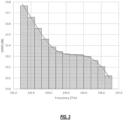
- FIG. 3 is a graph of a Riemann approximation of Generalized Signal to Noise Ratio (GSNR) across optical spectrum, and it is well known that this approximation improves with larger values of n, and equals the integral as B i approaches zero.
- GSNR Generalized Signal to Noise Ratio
- GSNR(f) may vary over time. For example, at the design stage of a cable build, you may only have access to nominal and/or worst case GSNR values, without any detail on the spectral dependence. However, at cable acceptance, this could change with a spectrum sweep which measures the beginning of life (BOL) GSNR(f). Finally, as the cable ages, the end of life (EOL) GSNR(f) can change due to repairs and other factors. This is illustrated in FIG. 4 which is a graph of example GSNR variations over time.
- FIG. 5 shows a representative BOL GSNR versus frequency for a modern, trans-Atlantic, uncompensated fiber pair.
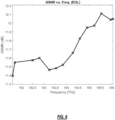
- FIG. 6 shows a predicted EOL GSNR(f) for this same fiber pair. In this case it has been assumed that cable aging and repairs have impacted both the average GSNR and the tilt.
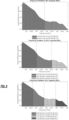
- FIG. 7 and FIG. 8 This is shown in FIG. 7 and FIG. 8 for BOL and EOL conditions respectively.
- FIGS. 9 and 10 show how the division of the passband evolves from the beginning of life (BOL) to the end of life (EOL). Performance was originally (at BOL) highest in the red band and after aging, performance has degraded across the entire band but the blue band now holds higher spectral efficiency than the red.
- the present disclosure contemplates any commercial or contractual arrangement between the users, and is focused on the value of this arrangement over time given the dynamic nature of optical fiber.
- spectrum values Once the spectrum values are determined, they can be provisioned (manually or automatically) in spectrum partitioning devices, e.g., WSSs, etc., as well as in modems, transceivers, SLTE terminals, etc.
- the process 10 includes, on at least one fiber having optical spectrum being shared by at least two users, assigning value to the optical spectrum (step 12); determining how the assigned value of the optical spectrum changes over time based on one or more of measurements and calculations (step 14); and causing implementation of a partition of the optical spectrum between the at least two users based on the changes over time (step 16).
- the process can be implemented with respect to any optical line system, including submarine, terrestrial, etc.
- each user is assigned some spectrum from each different spectral region (e.g., blue, mid, and red), resulting in multiple frequency regions per user.
- This approach can minimize the differences in spectral behavior between users but comes at a cost of lower overall spectral efficiency due to the additional filter dead-bands.
- SLTE photonics the ability to operate on a truly flexible grid is a key attribute. While a commercial agreement may choose to set frequency boundaries on a well-defined grid (e.g., 50GHz ITU grid), the boundaries calculated for a given optimization criteria are unlikely to land on such frequencies. Thus, having a flexible grid terminal is required to access all available spectrum and maximize the value of each user's share.
- a second key photonic attribute is minimizing spectral waste. This applies to both the filter dead-bands required by the WSS technology and to the Mux/Demux structures chosen.
- SLTE modem technology also plays a key role in spectrum sharing applications. For example, current commercial, deployable solutions will not achieve the upper bound defined by the Shannon Capacity. The achievable capacity will be impacted not only by modem performance (modem noise and implementation), but also by quantization of performance due to discrete client rate and/or baud options.
- FIG. 13 is a network diagram of an optical line system 100 including a management system 102, terminal equipment 104, and a line system 106.
- FIG. 14 is a network diagram of the optical line system 100 illustrating connectivity between the management system 102 and the terminal equipment 104 for monitoring policy.
- FIG. 15 is a network diagram of the optical line system 100 illustrating connectivity between the management system 102 and the line system 106 for enforcement, i.e., partitioning.
- the optical line system 100 is illustrated as a submarine system where the terminal equipment 104 is located at a cable landing or the like, and the line system 106 includes wet plant 110 with a cable and various repeaters (i.e., optical amplifiers) and the like (omitted for illustration purposes).
- the submarine system is just one example where spectrum sharing is possible.
- the line system 106 is disaggregated from the terminal equipment, as well as other optical line systems.
- the terminal equipment 104 in a submarine system is referred to as SLTE equipment, and those skilled in the art will recognize the terrestrial equivalent is referred to as an Optical Add/Drop Multiplexer (OADM), Reconfigurable OADM (ROADM), Wavelength Division Multiplexing (WDM) terminal, and the like.
- OADM Optical Add/Drop Multiplexer
- ROADM Reconfigurable OADM
- WDM Wavelength Division Multiplexing
- the line system 106 in a terrestrial system may simply be referred to as the line side having amplifiers and the like, instead of "wet plant" in a submarine system.
- the management system 102 is a computing system, implemented via one or more servers, clusters, etc. as well as in a cloud.
- the management system 102 is focused on monitoring operation, performing configuration of various components, as well as general Operations, Administration, Maintenance, and Provisioning (OAM&P) functions.
- the management system 102 may operate as a high-level controller, interacting with Network Management Systems (NMS) 112 associated with the terminal equipment 104 and the line system 106.
- NMS Network Management Systems
- the terminal equipment 104 and the line system 106 may include equipment from different vendors, thus having different management systems.
- the management system 102 implementing the spectrum sharing partitioning, deployment, monitoring, and enforcement can communicate with various different NMSs and the like, via northbound interfaces, open Application Programming Interfaces (APIs) and the like.
- APIs Application Programming Interfaces
- the terminal equipment 104 is configured to perform optical-electrical-optical (OEO) conversion, multiplexing/demultiplexing, and amplification.
- the terminal equipment 104 includes transceivers (TR) 120 which are also referred to as transmitters/receivers, modems, coherent modems, pluggable optical modules, transponders, and the like.
- TR transceivers
- Each transceiver 120 can be multiplexed/demultiplexed via a mux/demux 122 and a Wavelength Selective Switch (WSS) 124, and finally amplified via an optical amplifier 126 before connecting to the line equipment 106.
- WSS Wavelength Selective Switch
- the mux/demux 122 can combined multiple channels from multiple TRs 120 to a subset of spectrum, e.g., creating a media channel (MC).
- the WSS 124 can combine multiple subsets of spectrum, and the like.
- N SLTE components namely SLTE 1, SLTE 2, ..., SLTE N, (N is a positive integer).
- N users i.e., service providers
- the objective of the terminal equipment 104 is to provide channels in the assigned, allotted, or partitioned spectrum on the line system 106.
- the line system 106 includes a Spectrum Sharing Terminal 130 and an Open Cable Interface (OCI) 132 to the wet plant 110.
- the Spectrum Sharing Terminal 130 can be implemented as a WSS as well as other optical components and its function is to enforce the assigned, allotted, or partitioned spectrum on the line system 106, for each user, i.e., SLTE 1 - SLTE N.
- SLTE 1 - SLTE N an Open Cable Interface
- the process 10 described herein utilizes the approaches of assigning value to optical spectrum to partition the optical spectrum based on a policy.
- This process 10 contemplates implementation at a point in time, such as initial deployment, after operation for a time with changed conditions, and the like.
- the objective is to ensure the assigned spectrum (partitioned spectrum) is equitable based on the policy.
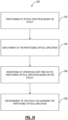
- FIG. 16 is a flowchart of a process 200 for utilizing spectrum value assignment to partition, deploy, monitor, and enforce policy in shared optical spectrum.
- the process 200 contemplates implementation as a method having steps, via a processing device configured to implement the steps, and via instructions stored in a non-transitory computer-readable medium where the instructions, when executed, cause one or more processors to implement the steps.
- the process 200 is described from the perspective of the management system 102 communicating with the optical line system 100, although other implementations are contemplated.
- the objective of the process 200 is to partition optical spectrum amongst N users, whether contiguous and/or fragmented, according to a predefined policy (step 202).
- Partitioning means the spectrum is broken up so that each of the N users has some assigned value. The values can be equal as well as non-equal. The key is they are agreed upon up front.
- the partitioning can be contiguous (e.g., FIG. 1 ) and/or fragmented (e.g., FIG. 2 ).
- the objective of the partitioning step 202 is to assign the spectrum as a function of optical or transceiver performance monitored through the management system 102. The unique frequency divisions and/or frequency groups are specified based on the optical performance profile across the band against the policy.
- the partitioning conventionally is a static step, performed once at the planning and engineering of the optical line system 100.
- the present disclosure contemplates this partitioning step 202 to become dynamic, reevaluated over time for dynamic partitioning based on lifetime monitoring, by the management system 102. Based on this monitoring, the partitioning step 202 contemplates reevaluation where equitable partner requirements are achieved through actively expanding and/or compressing frequency partitions and/or frequency allocations over time. As described herein, frequency partitions and/or frequency allocations are the same as the partitioning of the optical spectrum.
- the process 200 includes deployment of the partitioned optical spectrum (step 204).
- the deployment step 204 includes configuration of the terminal equipment 104 and/or the line system 106.
- the deployment step 204 can include configuration of the Spectrum Sharing Terminal 130.
- the deployment step 204 can include allocation of spectral bands in the line system 206 for the N users such that each band equally fits the highest baud (R) channel at arbitrary line rates (G) defined or undefined by the occupying partner.
- the allocation of spectral bands in the line system 206 for the N users such that each band equally fits the same channel count of line rates (G).
- the allocation of spectral bands in the line system 206 for the N users is performed to equally contain the same maximum theoretical capacity based on continuous or discretized integration of the frequency-dependent optical performance.
- any combination or superposition of the above approaches can be used in the deployment step 204.
- FIG. 17 is a graph of optical spectrum for illustrating deployment of a policy where the various rules are used to allocate the spectrum.
- the process 200 includes monitoring of operation over time on the partitioned optical spectrum based on the policy (step 206).
- the management system 102 can build and store any optical knowledge with the end-to-end performance monitors (PMs) of current traffic or non-traffic carrying channels. This data can be obtained during the calibration phase of turnup, during field trials, or pre-deployment activities, all associated with the optical line system 100.
- PMs Performance Monitoring
- open interfaces are used to capture Performance Monitoring (PM) data post-deployment and/or commissioning. Open interfaces are standardized.
- the management system 102 can provide the database of PMs to a spectrum sharing policy controller, which can be part of the management system 102 or implemented separately.
- the process 200 includes enforcement of the policy via changing the partitioned optical spectrum (step 208).
- This can include reimplementing the partitioning step 202.
- the objective is to perform some adjustment of the allocated spectrum when there are changes that make the policy no longer equitable.
- the enforcement step 208 can include pushing system level changes over Open APIs to partner network management systems (NMS) based on the partitioning, deployment, and monitoring policy steps.
- NMS partner network management systems
- the objective is to trigger spectral boundary or partition expansion and/or compression based on performance degradation or system enhancements.
- the process 200 contemplates operation of the monitoring step 206 and the enforcement step 208 dynamically over system lifetime or instantaneous changes, to allow the active redistribution of spectral allocations on new partner adds and/or partner deletes.
- the partitioning step 202 and the deployment step 204 contemplate operation at system planning, engineering, installation, and turnup.
- the monitoring step 206 and the enforcement step 208 can be performed periodically, based on system changes, and the like. Also, the enforcement step 208 can be configured to only change configuration once threshold changes are met.
- FIG. 18 is a flowchart of a process 300 for partitioning optical spectrum based on value.
- the process 300 contemplates implementation as a method having steps, via a processing device configured to implement the steps, and via instructions stored in a non-transitory computer-readable medium where the instructions, when executed, cause one or more processors to implement the steps.
- the process 300 is described from the perspective of the management system 102 communicating with the optical line system 100, although other implementations are contemplated.
- the process 300 is described from the perspective of a single point in time, namely to show how to use the assigned value at any given point in time to equitably partition the optical spectrum based on the policy. Equitably means to partition the optical spectrum based on the agreed upon policy.
- the value of spectrum can change over time due to a variety of factors.
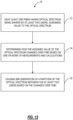
- the process 300 includes, for at least one fiber having optical spectrum being shared by at least two users in an optical line system, assigning value to the optical spectrum (step 302); determining using a policy and the assigned value of the optical spectrum how to partition the optical spectrum between the at least two users (step 304); and causing implementation of the partition of the optical spectrum (step 306).
- the policy is something agreed on by the at least two users.
- the at least two users can be equal partners, each getting the same amount of bandwidth. Other approaches are contemplated.
- the assigned value of the optical spectrum is based on information carrying capacity in bandwidth per second.
- the assigned value of the optical spectrum accounts for performance versus frequency, such that two or more of the at least two users have different amounts of the optical spectrum from one another. As such, the assigned value is a more accurate representation than an equal split of the optical spectrum.
- the partition of the optical spectrum is contiguous such that each of the at least two users has a contiguous amount of the optical spectrum.
- the partition of the optical spectrum is fragmented between each of the at least two users.
- the partition can be a combination of contiguous and fragmented.
- the determining and the implementation is performed at system turnup of the optical line system. In another embodiment, the determining and the implementation is performed subsequent to system turnup and after a period of operation of the optical line system, where there has been any of performance degradation of the optical line system and system enhancement of the optical line system.
- the process 300 can further include monitoring the optical line system; and checking the partition of the optical spectrum with the policy to determine whether there is violation of the policy due to any of performance degradation of the optical line system and system enhancement of the optical line system.
- the policy can include one of allocation of spectral bands for the at least two users such that each band equally fits a highest baud channel at an arbitrary line rate, allocation of the spectral bands for the at least two users such that each band equally fits a same channel count of line rates, and allocation of the spectral bands for the at least two users that equally contain a same maximum theoretical capacity based on integration of frequency-dependent optical performance.
- a management system 102 includes a network interface connected to terminal equipment from at least two users and a line system, the terminal equipment from the at least two users and the line system forming an optical line system; one or more processors communicatively coupled to the network interface; and memory storing instructions that, when executed, cause the one or more processors to implement the process 300.
- the implementation is caused by configuring any of the terminal equipment from the at least two users and the line system.
- circuitry configured or adapted to
- logic configured or adapted to
- software can include instructions executable by a processor or device (e.g., any type of programmable circuitry or logic) that, in response to such execution, cause a processor or the device to perform a set of operations, steps, methods, processes, algorithms, functions, techniques, etc. as described herein for the various embodiments.
- a processor or device e.g., any type of programmable circuitry or logic
Landscapes
- Engineering & Computer Science (AREA)
- Computer Networks & Wireless Communication (AREA)
- Signal Processing (AREA)
- Optical Communication System (AREA)
Claims (15)
- Verfahren (300), das folgende Schritte umfasst:Zuweisen (302), für mindestens eine Faser, die ein optisches Spektrum aufweist, das von mindestens zwei Benutzern in einem optischen Leitungssystem (100) gemeinsam genutzt wird, eines Werts zu dem optischen Spektrum, wobei der Wert auf der spektralen Effizienz des optischen Spektrums basiert, wobei der zugewiesene Wert über die Zeit variiert, wenn sich die Leistung des optischen Spektrums über die Zeit verändert;Bestimmen (304), unter Verwendung einer Richtlinie und des zugewiesenen Werts des optischen Spektrums, wie das optische Spektrum zwischen den mindestens zwei Benutzern aufgeteilt werden soll, wobei der zugewiesene Wert eine Metrik ist, die verwendet wird, um die Aufteilung auf Basis der Richtlinie zu bestimmen; undBewirken (306) einer Implementierung der Aufteilung des optischen Spektrums.
- Verfahren (300) nach Anspruch 1, wobei der zugewiesene Wert des optischen Spektrums auf der Informationsübertragungskapazität in Bandbreite pro Sekunde basiert.
- Verfahren (300) nach Anspruch 1, wobei der zugewiesene Wert des optischen Spektrums die Leistung gegenüber der Frequenz derart berücksichtigt, dass zwei oder mehr der mindestens zwei Benutzer über voneinander unterschiedliche Mengen des optischen Spektrums verfügen.
- Verfahren (300) nach einem der Ansprüche 1 bis 3, wobei die Aufteilung des optischen Spektrums derart zusammenhängend erfolgt, dass jeder der mindestens zwei Benutzer über eine zusammenhängende Menge des optischen Spektrums verfügt.
- Verfahren (300) nach einem der Ansprüche 1 bis 3, wobei die Aufteilung des optischen Spektrums zwischen jedem der mindestens zwei Benutzer fragmentiert wird.
- Verfahren (300) nach einem der Ansprüche 1 bis 5, wobei das Bestimmen und die Implementierung beim Systemstart des optischen Leitungssystems durchgeführt wird.
- Verfahren (300) nach einem der Ansprüche 1 bis 5, wobei das Bestimmen und die Implementierung im Anschluss an den Systemstart und nach einer Betriebsperiode des optischen Leitungssystems, in der es zu einem von Leistungsverschlechterung des optischen Leitungssystems und Systemverbesserung des optischen Leitungssystems gekommen ist, durchgeführt werden.
- Verfahren (300) nach einem der Ansprüche 1 bis 7, wobei die Schritte weiter beinhaltenÜberwachen des optischen Leitungssystems; undÜberprüfen der Aufteilung des optischen Spektrums anhand der Richtlinie, um zu bestimmen, ob es aufgrund von Leistungsverschlechterung des optischen Leitungssystems zu einem Verstoß gegen die Richtlinie gekommen ist.
- Verfahren (300) nach einem der Ansprüche 1 bis 7, wobei die Schritte weiter beinhalten
Überwachen des optischen Leitungssystems über die Zeit, was das Zuweisen des Werts über die Zeit und das Überprüfen der Aufteilung des optischen Spektrums anhand der Richtlinie, um zu bestimmen, ob es zu einem Verstoß gegen die Richtlinie gekommen ist, beinhaltet. - Verfahren (300) nach einem der Ansprüche 1 bis 9, wobei die Richtlinie die Zuteilung von Spektralbändern für die mindestens zwei Benutzer derart beinhaltet, dass jedes Band gleichermaßen zu einem Kanal mit der höchsten Baudrate bei einer beliebigen Leitungsrate passt.
- Verfahren (300) nach einem der Ansprüche 1 bis 10, wobei die Richtlinie die Zuteilung der Spektralbänder für die mindestens zwei Benutzer derart beinhaltet, dass jedes Band gleichermaßen zu derselben Kanalanzahl von Leitungsraten passt.
- Verfahren (300) nach einem der Ansprüche 1 bis 11, wobei die Richtlinie die Zuteilung der Spektralbänder für die mindestens zwei Benutzer, die auf Basis von Integration der frequenzabhängigen optischen Leistung gleichermaßen dieselbe maximale theoretische Kapazität enthalten, beinhaltet.
- Verwaltungssystem (102), umfassend:eine Netzwerkschnittstelle, die mit Endgeräteausrüstung von mindestens zwei Benutzern und einem Leitungssystem verbunden ist, wobei die Endgeräteausrüstung der mindestens zwei Benutzer und das Leitungssystem das optische Leitungssystem (100) bilden; undeinen oder mehrere Prozessoren, die dazu konfiguriert sind, das Verfahren (300) nach einem der Ansprüche 1 bis 12 zu implementieren.
- Optisches Leitungssystem (100), das ein Verwaltungssystem nach Anspruch 13 beinhaltet.
- Computerlesbarer Code zum Programmieren eines oder mehrerer Prozessoren dazu, das Verfahren (300) nach einem der Ansprüche 1 bis 12 zu implementieren.
Applications Claiming Priority (3)
| Application Number | Priority Date | Filing Date | Title |
|---|---|---|---|
| US202363481783P | 2023-01-26 | 2023-01-26 | |
| US18/326,818 US12348265B2 (en) | 2023-01-26 | 2023-05-31 | Optimization of spectrum sharing in optical line systems |
| PCT/US2024/012855 WO2024158960A1 (en) | 2023-01-26 | 2024-01-25 | Optimization of spectrum sharing in optical line systems |
Publications (2)
| Publication Number | Publication Date |
|---|---|
| EP4430772A1 EP4430772A1 (de) | 2024-09-18 |
| EP4430772B1 true EP4430772B1 (de) | 2025-05-07 |
Family
ID=90059295
Family Applications (1)
| Application Number | Title | Priority Date | Filing Date |
|---|---|---|---|
| EP24708096.3A Active EP4430772B1 (de) | 2023-01-26 | 2024-01-25 | Optimierung der gemeinsamen spektrumsnutzung in optischen leitungssystemen |
Country Status (3)
| Country | Link |
|---|---|
| EP (1) | EP4430772B1 (de) |
| CN (1) | CN119213712A (de) |
| WO (1) | WO2024158960A1 (de) |
Family Cites Families (3)
| Publication number | Priority date | Publication date | Assignee | Title |
|---|---|---|---|---|
| US9853762B2 (en) * | 2014-12-04 | 2017-12-26 | Ciena Corporation | Automated provisioning and control of shared optical spectrum in submarine optical networks |
| CN113067661B (zh) * | 2021-03-26 | 2021-12-28 | 苏州大学 | 光通道性能保证下的osnr感知频谱分配方法及系统 |
| US11581952B2 (en) * | 2021-06-21 | 2023-02-14 | Cisco Technology, Inc. | Optical channel plan process |
-
2024
- 2024-01-25 WO PCT/US2024/012855 patent/WO2024158960A1/en not_active Ceased
- 2024-01-25 CN CN202480002858.3A patent/CN119213712A/zh active Pending
- 2024-01-25 EP EP24708096.3A patent/EP4430772B1/de active Active
Also Published As
| Publication number | Publication date |
|---|---|
| EP4430772A1 (de) | 2024-09-18 |
| CN119213712A (zh) | 2024-12-27 |
| WO2024158960A1 (en) | 2024-08-02 |
Similar Documents
| Publication | Publication Date | Title |
|---|---|---|
| US10727973B1 (en) | Apparatus and method for self-learning and predictive DWDM network | |
| US11496817B2 (en) | Proactively detecting failures on restoration paths in an optical network and visualizations thereof | |
| US10707958B2 (en) | Method and apparatus for determining a maximum transmission capacity within an optical network | |
| US9768902B2 (en) | Control systems and methods for spectrally overlapped flexible grid spectrum using a control bandwidth | |
| EP2571184B1 (de) | Zuweisung spektraler Kapazität in einem optischen Wellenlängenmultiplexnetzwerk | |
| EP2989735B1 (de) | Optische datenübertragung | |
| US9654248B2 (en) | Optical data transmission method and apparatus | |
| US10523355B2 (en) | System and method for applying system policies in an optical communication system having user-allocated bandwidth | |
| EP3343815B1 (de) | Verfahren und system zur zuweisung von ressourcen in optischen transportnetzwerken | |
| US9680596B2 (en) | Span-wise spectrum management system and method | |
| Moura et al. | Cognitive methodology for optical amplifier gain adjustment in dynamic DWDM networks | |
| US12348265B2 (en) | Optimization of spectrum sharing in optical line systems | |
| US10911321B2 (en) | Reconstruction of an optical network link in a link viewer based on a text file | |
| EP4430772A1 (de) | Optimierung der gemeinsamen spektrumsnutzung in optischen leitungssystemen | |
| CN110249556A (zh) | 用于在无格栅网络中以改进的频谱效率进行服务供应的方法和工具 | |
| JP7124832B2 (ja) | リソース分配装置及びリソース分配方法 | |
| Hajipour et al. | Artificial neural network-aided multiclass service provisioning and prioritization in eons | |
| Kaeval | Optical spectrum services in open disaggregated transport networks | |
| US11139893B2 (en) | Method and system for media channel format set management in optical transport networks | |
| Moniz et al. | Multi-layer network optimization efficiently exploiting real-time performance monitoring | |
| US12634607B2 (en) | Calibration data from modules for an incremental noise metric for rapid modeling of optical networks | |
| Pedreno-Manresa et al. | On the benefits of elastic spectrum management in multi-hour filterless metro networks | |
| EP4611278A1 (de) | Automatische bereitstellung optischer kanäle auf basis von spektrumsüberwachung | |
| US11646811B2 (en) | Alien wavelength management | |
| US20240333383A1 (en) | Alien wavelength management |
Legal Events
| Date | Code | Title | Description |
|---|---|---|---|
| STAA | Information on the status of an ep patent application or granted ep patent |
Free format text: STATUS: UNKNOWN |
|
| STAA | Information on the status of an ep patent application or granted ep patent |
Free format text: STATUS: THE INTERNATIONAL PUBLICATION HAS BEEN MADE |
|
| PUAI | Public reference made under article 153(3) epc to a published international application that has entered the european phase |
Free format text: ORIGINAL CODE: 0009012 |
|
| STAA | Information on the status of an ep patent application or granted ep patent |
Free format text: STATUS: REQUEST FOR EXAMINATION WAS MADE |
|
| STAA | Information on the status of an ep patent application or granted ep patent |
Free format text: STATUS: EXAMINATION IS IN PROGRESS |
|
| 17P | Request for examination filed |
Effective date: 20240613 |
|
| AK | Designated contracting states |
Kind code of ref document: A1 Designated state(s): AL AT BE BG CH CY CZ DE DK EE ES FI FR GB GR HR HU IE IS IT LI LT LU LV MC ME MK MT NL NO PL PT RO RS SE SI SK SM TR |
|
| 17Q | First examination report despatched |
Effective date: 20240913 |
|
| P01 | Opt-out of the competence of the unified patent court (upc) registered |
Free format text: CASE NUMBER: APP_61417/2024 Effective date: 20241115 |
|
| REG | Reference to a national code |
Ref country code: DE Ref legal event code: R079 Free format text: PREVIOUS MAIN CLASS: H99Z9999999999 Ipc: H04J0014020000 Ref country code: DE Ref legal event code: R079 Ref document number: 602024000113 Country of ref document: DE Free format text: PREVIOUS MAIN CLASS: H99Z9999999999 Ipc: H04J0014020000 |
|
| RIC1 | Information provided on ipc code assigned before grant |
Ipc: H04J 14/02 20060101AFI20250110BHEP |
|
| GRAP | Despatch of communication of intention to grant a patent |
Free format text: ORIGINAL CODE: EPIDOSNIGR1 |
|
| STAA | Information on the status of an ep patent application or granted ep patent |
Free format text: STATUS: GRANT OF PATENT IS INTENDED |
|
| GRAS | Grant fee paid |
Free format text: ORIGINAL CODE: EPIDOSNIGR3 |
|
| INTG | Intention to grant announced |
Effective date: 20250304 |
|
| GRAA | (expected) grant |
Free format text: ORIGINAL CODE: 0009210 |
|
| STAA | Information on the status of an ep patent application or granted ep patent |
Free format text: STATUS: THE PATENT HAS BEEN GRANTED |
|
| DAV | Request for validation of the european patent (deleted) | ||
| DAX | Request for extension of the european patent (deleted) | ||
| AK | Designated contracting states |
Kind code of ref document: B1 Designated state(s): AL AT BE BG CH CY CZ DE DK EE ES FI FR GB GR HR HU IE IS IT LI LT LU LV MC ME MK MT NL NO PL PT RO RS SE SI SK SM TR |
|
| REG | Reference to a national code |
Ref country code: GB Ref legal event code: FG4D |
|
| REG | Reference to a national code |
Ref country code: CH Ref legal event code: EP |
|
| REG | Reference to a national code |
Ref country code: DE Ref legal event code: R096 Ref document number: 602024000113 Country of ref document: DE |
|
| REG | Reference to a national code |
Ref country code: IE Ref legal event code: FG4D |
|
| REG | Reference to a national code |
Ref country code: NL Ref legal event code: FP |
|
| PG25 | Lapsed in a contracting state [announced via postgrant information from national office to epo] |
Ref country code: FI Free format text: LAPSE BECAUSE OF FAILURE TO SUBMIT A TRANSLATION OF THE DESCRIPTION OR TO PAY THE FEE WITHIN THE PRESCRIBED TIME-LIMIT Effective date: 20250507 Ref country code: PT Free format text: LAPSE BECAUSE OF FAILURE TO SUBMIT A TRANSLATION OF THE DESCRIPTION OR TO PAY THE FEE WITHIN THE PRESCRIBED TIME-LIMIT Effective date: 20250908 Ref country code: ES Free format text: LAPSE BECAUSE OF FAILURE TO SUBMIT A TRANSLATION OF THE DESCRIPTION OR TO PAY THE FEE WITHIN THE PRESCRIBED TIME-LIMIT Effective date: 20250507 |
|
| REG | Reference to a national code |
Ref country code: LT Ref legal event code: MG9D |
|
| PG25 | Lapsed in a contracting state [announced via postgrant information from national office to epo] |
Ref country code: NO Free format text: LAPSE BECAUSE OF FAILURE TO SUBMIT A TRANSLATION OF THE DESCRIPTION OR TO PAY THE FEE WITHIN THE PRESCRIBED TIME-LIMIT Effective date: 20250807 Ref country code: GR Free format text: LAPSE BECAUSE OF FAILURE TO SUBMIT A TRANSLATION OF THE DESCRIPTION OR TO PAY THE FEE WITHIN THE PRESCRIBED TIME-LIMIT Effective date: 20250808 |
|
| PG25 | Lapsed in a contracting state [announced via postgrant information from national office to epo] |
Ref country code: PL Free format text: LAPSE BECAUSE OF FAILURE TO SUBMIT A TRANSLATION OF THE DESCRIPTION OR TO PAY THE FEE WITHIN THE PRESCRIBED TIME-LIMIT Effective date: 20250507 |
|
| REG | Reference to a national code |
Ref country code: AT Ref legal event code: MK05 Ref document number: 1793665 Country of ref document: AT Kind code of ref document: T Effective date: 20250507 |
|
| PG25 | Lapsed in a contracting state [announced via postgrant information from national office to epo] |
Ref country code: BG Free format text: LAPSE BECAUSE OF FAILURE TO SUBMIT A TRANSLATION OF THE DESCRIPTION OR TO PAY THE FEE WITHIN THE PRESCRIBED TIME-LIMIT Effective date: 20250507 |
|
| PG25 | Lapsed in a contracting state [announced via postgrant information from national office to epo] |
Ref country code: HR Free format text: LAPSE BECAUSE OF FAILURE TO SUBMIT A TRANSLATION OF THE DESCRIPTION OR TO PAY THE FEE WITHIN THE PRESCRIBED TIME-LIMIT Effective date: 20250507 |
|
| PG25 | Lapsed in a contracting state [announced via postgrant information from national office to epo] |
Ref country code: AT Free format text: LAPSE BECAUSE OF FAILURE TO SUBMIT A TRANSLATION OF THE DESCRIPTION OR TO PAY THE FEE WITHIN THE PRESCRIBED TIME-LIMIT Effective date: 20250507 |
|
| PG25 | Lapsed in a contracting state [announced via postgrant information from national office to epo] |
Ref country code: RS Free format text: LAPSE BECAUSE OF FAILURE TO SUBMIT A TRANSLATION OF THE DESCRIPTION OR TO PAY THE FEE WITHIN THE PRESCRIBED TIME-LIMIT Effective date: 20250807 |
|
| PG25 | Lapsed in a contracting state [announced via postgrant information from national office to epo] |
Ref country code: IS Free format text: LAPSE BECAUSE OF FAILURE TO SUBMIT A TRANSLATION OF THE DESCRIPTION OR TO PAY THE FEE WITHIN THE PRESCRIBED TIME-LIMIT Effective date: 20250907 |
|
| PG25 | Lapsed in a contracting state [announced via postgrant information from national office to epo] |
Ref country code: LV Free format text: LAPSE BECAUSE OF FAILURE TO SUBMIT A TRANSLATION OF THE DESCRIPTION OR TO PAY THE FEE WITHIN THE PRESCRIBED TIME-LIMIT Effective date: 20250507 |
|
| PG25 | Lapsed in a contracting state [announced via postgrant information from national office to epo] |
Ref country code: DK Free format text: LAPSE BECAUSE OF FAILURE TO SUBMIT A TRANSLATION OF THE DESCRIPTION OR TO PAY THE FEE WITHIN THE PRESCRIBED TIME-LIMIT Effective date: 20250507 Ref country code: SM Free format text: LAPSE BECAUSE OF FAILURE TO SUBMIT A TRANSLATION OF THE DESCRIPTION OR TO PAY THE FEE WITHIN THE PRESCRIBED TIME-LIMIT Effective date: 20250507 |
|
| PG25 | Lapsed in a contracting state [announced via postgrant information from national office to epo] |
Ref country code: CZ Free format text: LAPSE BECAUSE OF FAILURE TO SUBMIT A TRANSLATION OF THE DESCRIPTION OR TO PAY THE FEE WITHIN THE PRESCRIBED TIME-LIMIT Effective date: 20250507 |
|
| PG25 | Lapsed in a contracting state [announced via postgrant information from national office to epo] |
Ref country code: EE Free format text: LAPSE BECAUSE OF FAILURE TO SUBMIT A TRANSLATION OF THE DESCRIPTION OR TO PAY THE FEE WITHIN THE PRESCRIBED TIME-LIMIT Effective date: 20250507 |
|
| PG25 | Lapsed in a contracting state [announced via postgrant information from national office to epo] |
Ref country code: SK Free format text: LAPSE BECAUSE OF FAILURE TO SUBMIT A TRANSLATION OF THE DESCRIPTION OR TO PAY THE FEE WITHIN THE PRESCRIBED TIME-LIMIT Effective date: 20250507 |
|
| PG25 | Lapsed in a contracting state [announced via postgrant information from national office to epo] |
Ref country code: IT Free format text: LAPSE BECAUSE OF FAILURE TO SUBMIT A TRANSLATION OF THE DESCRIPTION OR TO PAY THE FEE WITHIN THE PRESCRIBED TIME-LIMIT Effective date: 20250507 |
|
| REG | Reference to a national code |
Ref country code: DE Ref legal event code: R097 Ref document number: 602024000113 Country of ref document: DE |
|
| PLBE | No opposition filed within time limit |
Free format text: ORIGINAL CODE: 0009261 |
|
| STAA | Information on the status of an ep patent application or granted ep patent |
Free format text: STATUS: NO OPPOSITION FILED WITHIN TIME LIMIT |
|
| REG | Reference to a national code |
Ref country code: CH Ref legal event code: L10 Free format text: ST27 STATUS EVENT CODE: U-0-0-L10-L00 (AS PROVIDED BY THE NATIONAL OFFICE) Effective date: 20260318 |
|
| PGFP | Annual fee paid to national office [announced via postgrant information from national office to epo] |
Ref country code: DE Payment date: 20260121 Year of fee payment: 3 |
|
| 26N | No opposition filed |
Effective date: 20260210 |
|
| PGFP | Annual fee paid to national office [announced via postgrant information from national office to epo] |
Ref country code: FR Payment date: 20260123 Year of fee payment: 3 |