EP4429338A1 - Verfahren und vorrichtung für uplink-übertragung und -empfang in einem drahtloskommunikationssystem - Google Patents
Verfahren und vorrichtung für uplink-übertragung und -empfang in einem drahtloskommunikationssystem Download PDFInfo
- Publication number
- EP4429338A1 EP4429338A1 EP22890437.1A EP22890437A EP4429338A1 EP 4429338 A1 EP4429338 A1 EP 4429338A1 EP 22890437 A EP22890437 A EP 22890437A EP 4429338 A1 EP4429338 A1 EP 4429338A1
- Authority
- EP
- European Patent Office
- Prior art keywords
- tag
- tags
- uplink transmission
- serving cell
- base station
- Prior art date
- Legal status (The legal status is an assumption and is not a legal conclusion. Google has not performed a legal analysis and makes no representation as to the accuracy of the status listed.)
- Pending
Links
Images





Classifications
-
- H—ELECTRICITY
- H04—ELECTRIC COMMUNICATION TECHNIQUE
- H04W—WIRELESS COMMUNICATION NETWORKS
- H04W56/00—Synchronisation arrangements
- H04W56/0005—Synchronisation arrangements synchronizing of arrival of multiple uplinks
-
- H—ELECTRICITY
- H04—ELECTRIC COMMUNICATION TECHNIQUE
- H04W—WIRELESS COMMUNICATION NETWORKS
- H04W56/00—Synchronisation arrangements
- H04W56/004—Synchronisation arrangements compensating for timing error of reception due to propagation delay
- H04W56/0045—Synchronisation arrangements compensating for timing error of reception due to propagation delay compensating for timing error by altering transmission time
-
- H—ELECTRICITY
- H04—ELECTRIC COMMUNICATION TECHNIQUE
- H04W—WIRELESS COMMUNICATION NETWORKS
- H04W56/00—Synchronisation arrangements
- H04W56/001—Synchronization between nodes
-
- H—ELECTRICITY
- H04—ELECTRIC COMMUNICATION TECHNIQUE
- H04W—WIRELESS COMMUNICATION NETWORKS
- H04W72/00—Local resource management
- H04W72/04—Wireless resource allocation
- H04W72/044—Wireless resource allocation based on the type of the allocated resource
- H04W72/0457—Variable allocation of band or rate
-
- H—ELECTRICITY
- H04—ELECTRIC COMMUNICATION TECHNIQUE
- H04W—WIRELESS COMMUNICATION NETWORKS
- H04W72/00—Local resource management
- H04W72/20—Control channels or signalling for resource management
- H04W72/23—Control channels or signalling for resource management in the downlink direction of a wireless link, i.e. towards a terminal
Definitions
- the present disclosure relates to a wireless communication system, and in more detail, relates to a method and an apparatus of transmitting and receiving uplink in a wireless communication system.
- a mobile communication system has been developed to provide a voice service while guaranteeing mobility of users.
- a mobile communication system has extended even to a data service as well as a voice service, and currently, an explosive traffic increase has caused shortage of resources and users have demanded a faster service, so a more advanced mobile communication system has been required.
- a technical object of the present disclosure is to provide a method and an apparatus of transmitting and receiving an uplink signal/channel.
- an additional technical object of the present disclosure is to provide a method and apparatus for configuring a plurality of timing advance groups for one or more cells or cell groups for multiple transmission reception point (TRP) transmission.
- TRP transmission reception point
- a method of performing uplink transmission in a wireless communication system may include: receiving, from the base station, configuration information related to a serving cell, wherein the configuration information includes information on a plurality of timing advance groups (TAGs) related to the serving cell; receiving, from the base station, control information including a timing advance (TA) command for each TAG in the plurality of TAGs; and performing, to the base station, the uplink transmission in the serving cell.
- TAGs timing advance groups
- TA timing advance
- transmission timing of the uplink transmission may be determined based on a TA command for the specific TAG.
- a method of receiving uplink transmission may include: transmitting, to a user equipment (UE), configuration information related to a serving cell, wherein the configuration information includes information on a plurality of timing advance groups (TAGs) related to the serving cell; transmitting, to the UE, control information including a timing advance (TA) command for each TAG in the plurality of TAGs; and receiving, from the UE, the uplink transmission in the serving cell.
- TAGs timing advance groups
- TA timing advance
- transmission timing of the uplink transmission may be determined based on a TA command for the specific TAG.
- timing advance groups are configured for one or more cells or cell groups for transmission
- uplink transmission and reception can be performed by applying a TRP-specific timing advance value.
- uplink transmission and reception for multiple TRPs can be performed smoothly even when distances between a TRP and a UE are significantly different for each TRP.
- known structures and devices may be omitted or may be shown in a form of a block diagram based on a core function of each structure and device in order to prevent a concept of the present disclosure from being ambiguous.
- an element when referred to as being “connected”, “combined” or “linked” to another element, it may include an indirect connection relation that yet another element presents therebetween as well as a direct connection relation.
- a term, “include” or “have”, specifies the presence of a mentioned feature, step, operation, component and/or element, but it does not exclude the presence or addition of one or more other features, stages, operations, components, elements and/or their groups.
- a term such as “first”, “second”, etc. is used only to distinguish one element from other element and is not used to limit elements, and unless otherwise specified, it does not limit an order or importance, etc. between elements. Accordingly, within a scope of the present disclosure, a first element in an embodiment may be referred to as a second element in another embodiment and likewise, a second element in an embodiment may be referred to as a first element in another embodiment.
- a term used in the present disclosure is to describe a specific embodiment, and is not to limit a claim. As used in a described and attached claim of an embodiment, a singular form is intended to include a plural form, unless the context clearly indicates otherwise.
- a term used in the present disclosure, "and/or”, may refer to one of related enumerated items or it means that it refers to and includes any and all possible combinations of two or more of them. In addition,”/" between words in the present disclosure has the same meaning as “and/or”, unless otherwise described.
- the present disclosure describes a wireless communication network or a wireless communication system, and an operation performed in a wireless communication network may be performed in a process in which a device (e.g., a base station) controlling a corresponding wireless communication network controls a network and transmits or receives a signal, or may be performed in a process in which a terminal associated to a corresponding wireless network transmits or receives a signal with a network or between terminals.
- a device e.g., a base station
- transmitting or receiving a channel includes a meaning of transmitting or receiving information or a signal through a corresponding channel.
- transmitting a control channel means that control information or a control signal is transmitted through a control channel.
- transmitting a data channel means that data information or a data signal is transmitted through a data channel.
- a downlink means a communication from a base station to a terminal and an uplink (UL) means a communication from a terminal to a base station.
- a transmitter may be part of a base station and a receiver may be part of a terminal.
- a transmitter may be part of a terminal and a receiver may be part of a base station.
- a base station may be expressed as a first communication device and a terminal may be expressed as a second communication device.
- a base station may be substituted with a term such as a fixed station, a Node B, an eNB(evolved-NodeB), a gNB(Next Generation NodeB), a BTS(base transceiver system), an Access Point(AP), a Network(5G network), an AI(Artificial Intelligence) system/module, an RSU(road side unit), a robot, a drone(UAV: Unmanned Aerial Vehicle), an AR(Augmented Reality) device, a VR(Virtual Reality) device, etc.
- a term such as a fixed station, a Node B, an eNB(evolved-NodeB), a gNB(Next Generation NodeB), a BTS(base transceiver system), an Access Point(AP), a Network(5G network), an AI(Artificial Intelligence) system/module, an RSU(road side unit), a robot, a drone(UAV: Unmanned Aerial Vehicle), an AR
- a terminal may be fixed or mobile, and may be substituted with a term such as a UE(User Equipment), an MS(Mobile Station), a UT(user terminal), an MSS(Mobile Subscriber Station), an SS(Subscriber Station), an AMS(Advanced Mobile Station), a WT(Wireless terminal), an MTC(Machine-Type Communication) device, an M2M(Machine-to-Machine) device, a D2D(Device-to-Device) device, a vehicle, an RSU(road side unit), a robot, an AI(Artificial Intelligence) module, a drone(UAV: Unmanned Aerial Vehicle), an AR(Augmented Reality) device, a VR(Virtual Reality) device, etc.
- a term such as a UE(User Equipment), an MS(Mobile Station), a UT(user terminal), an MSS(Mobile Subscriber Station), an SS(Subscriber Station), an AMS(Advanced Mobile Station
- CDMA may be implemented by a wireless technology such as UTRA(Universal Terrestrial Radio Access) or CDMA2000.
- TDMA may be implemented by a radio technology such as GSM(Global System for Mobile communications)/GPRS(General Packet Radio Service)/EDGE(Enhanced Data Rates for GSM Evolution).
- OFDMA may be implemented by a radio technology such as IEEE 802.11(Wi-Fi), IEEE 802.16(WiMAX), IEEE 802-20, E-UTRA(Evolved UTRA), etc.
- UTRA is a part of a UMTS(Universal Mobile Telecommunications System).
- 3GPP(3rd Generation Partnership Project) LTE(Long Term Evolution) is a part of an E-UMTS(Evolved UMTS) using E-UTRA and LTE-A(Advanced)/LTE-A pro is an advanced version of 3GPP LTE.
- 3GPP NR(New Radio or New Radio Access Technology) is an advanced version of 3GPP LTE/LTE-A/LTE-A pro.
- LTE means a technology after 3GPP TS(Technical Specification) 36.xxx Release 8.
- LTE-A an LTE technology in or after 3GPP TS 36.
- xxx Release 10 is referred to as LTE-A
- LTE-A pro an LTE technology in or after 3GPP TS 36.
- xxx Release 13 is referred to as LTE-A pro.
- 3GPP NR means a technology in or after TS 38.xxx Release 15.
- LTE/NR may be referred to as a 3GPP system, "xxx" means a detailed number for a standard document.
- LTE/NR may be commonly referred to as a 3GPP system.
- a term, an abbreviation, etc. used to describe the present disclosure matters described in a standard document disclosed before the present disclosure may be referred to.
- the following document may be referred to.
- TS 36.211 physical channels and modulation
- TS 36.212 multiplexing and channel coding
- TS 36.213 physical layer procedures
- TS 36.300 overall description
- TS 36.331 radio resource control
- TS 38.211 physical channels and modulation
- TS 38.212 multiplexing and channel coding
- TS 38.213 physical layer procedures for control
- TS 38.214 physical layer procedures for data
- TS 38.300 NR and NG-RAN(New Generation-Radio Access Network) overall description
- TS 38.331 radio resource control protocol specification
- NR is an expression which represents an example of a 5G RAT.
- a new RAT system including NR uses an OFDM transmission method or a transmission method similar to it.
- a new RAT system may follow OFDM parameters different from OFDM parameters of LTE.
- a new RAT system follows a numerology of the existing LTE/LTE-A as it is, but may support a wider system bandwidth (e.g., 100MHz).
- one cell may support a plurality of numerologies. In other words, terminals which operate in accordance with different numerologies may coexist in one cell.
- a numerology corresponds to one subcarrier spacing in a frequency domain.
- a reference subcarrier spacing is scaled by an integer N, a different numerology may be defined.
- FIG. 1 illustrates a structure of a wireless communication system to which the present disclosure may be applied.
- NG-RAN is configured with gNBs which provide a control plane (RRC) protocol end for a NG-RA(NG-Radio Access) user plane (i.e., a new AS(access stratum) sublayer/PDCP(Packet Data Convergence Protocol)/RLC(Radio Link Control)/MAC/PHY) and UE.
- RRC control plane
- the gNBs are interconnected through a Xn interface.
- the gNB in addition, is connected to an NGC(New Generation Core) through an NG interface.
- the gNB is connected to an AMF(Access and Mobility Management Function) through an N2 interface, and is connected to a UPF(User Plane Function) through an N3 interface.
- FIG. 2 illustrates a frame structure in a wireless communication system to which the present disclosure may be applied.
- a NR system may support a plurality of numerologies.
- a numerology may be defined by a subcarrier spacing and a cyclic prefix (CP) overhead.
- CP cyclic prefix
- a plurality of subcarrier spacings may be derived by scaling a basic (reference) subcarrier spacing by an integer N (or, ⁇ ).
- N or, ⁇
- a used numerology may be selected independently from a frequency band.
- a variety of frame structures according to a plurality of numerologies may be supported in a NR system.
- a plurality of OFDM numerologies supported in a NR system may be defined as in the following Table 1.
- CP 0 15 Normal 1 30 Normal 2 60 Normal, Extended 3 120 Normal 4 240 Normal
- NR supports a plurality of numerologies (or subcarrier spacings (SCS)) for supporting a variety of 5G services. For example, when a SCS is 15kHz, a wide area in traditional cellular bands is supported, and when a SCS is 30kHz/60kHz, dense-urban, lower latency and a wider carrier bandwidth are supported, and when a SCS is 60kHz or higher, a bandwidth wider than 24.25GHz is supported to overcome a phase noise.
- numerologies or subcarrier spacings (SCS)
- NR frequency band is defined as a frequency range in two types (FR1, FR2).
- FR1, FR2 may be configured as in the following Table 2.
- FR2 may mean a millimeter wave (mmW).
- mmW millimeter wave
- ⁇ f max is 480-103 Hz and N f is 4096.
- slots are numbered in an increasing order of n s ⁇ ⁇ 0,..., N slot subframe, ⁇ -1 ⁇ in a subframe and are numbered in an increasing order of n s,f ⁇ ⁇ 0,..., N slot frame, ⁇ -1 ⁇ in a radio frame.
- One slot is configured with N symb slot consecutive OFDM symbols and N symb slot is determined according to CP.
- a start of a slot n s ⁇ in a subframe is temporally arranged with a start of an OFDM symbol n s ⁇ N symb slot in the same subframe. All terminals may not perform transmission and reception at the same time, which means that all OFDM symbols of a downlink slot or an uplink slot may not be used.
- Table 3 represents the number of OFDM symbols per slot (N symb slot ), the number of slots per radio frame (N slot frame, ⁇ ) and the number of slots per subframe (N slot subframe, ⁇ ) in a normal CP and Table 4 represents the number of OFDM symbols per slot, the number of slots per radio frame and the number of slots per subframe in an extended CP.
- Table 4 ⁇ N symb slot N slot frame, ⁇ N slot subframe, ⁇ 2 12 40 4
- a mini-slot may include 2, 4 or 7 symbols or more or less symbols.
- an antenna port a resource grid, a resource element, a resource block, a carrier part, etc. may be considered.
- the physical resources which may be considered in an NR system will be described in detail.
- an antenna port in relation to an antenna port, is defined so that a channel where a symbol in an antenna port is carried can be inferred from a channel where other symbol in the same antenna port is carried.
- a large-scale property of a channel where a symbol in one antenna port is carried may be inferred from a channel where a symbol in other antenna port is carried, it may be said that 2 antenna ports are in a QC/QCL(quasi co-located or quasi co-location) relationship.
- the large-scale property includes at least one of delay spread, doppler spread, frequency shift, average received power, received timing.
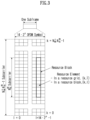
- FIG. 3 illustrates a resource grid in a wireless communication system to which the present disclosure may be applied.
- a resource grid is configured with N RB ⁇ N sc RB subcarriers in a frequency domain and one subframe is configured with 14 ⁇ 2 ⁇ OFDM symbols, but it is not limited thereto.
- a transmitted signal is described by OFDM symbols of 2 ⁇ N symb ( ⁇ ) and one or more resource grids configured with N RB N N sc RB subcarriers.
- N RB N ⁇ N RB max, ⁇ The N RB max, ⁇ represents a maximum transmission bandwidth, which may be different between an uplink and a downlink as well as between numerologies.
- one resource grid may be configured per ⁇ and antenna port p.
- Each element of a resource grid for ⁇ and an antenna port p is referred to as a resource element and is uniquely identified by an index pair (k,l').
- an index pair (k,l) is used.
- I 0,..., N symb ⁇ -1.
- a resource element (k,l') for ⁇ and an antenna port p corresponds to a complex value, a k,l' (p, ⁇ ) .
- indexes p and ⁇ may be dropped, whereupon a complex value may be a k,l' (p) or a k,l' .
- Point A plays a role as a common reference point of a resource block grid and is obtained as follows.
- Common resource blocks are numbered from 0 to the top in a frequency domain for a subcarrier spacing configuration ⁇ .
- the center of subcarrier 0 of common resource block 0 for a subcarrier spacing configuration ⁇ is identical to 'point A'.
- a relationship between a common resource block number n CRB ⁇ and a resource element (k,l) for a subcarrier spacing configuration ⁇ in a frequency domain is given as in the following Equation 1.
- n CRB ⁇ ⁇ k N sc RB ⁇
- Physical resource blocks are numbered from 0 to N BWP,i size, ⁇ -1 in a bandwidth part (BWP) and i is a number of a BWP.
- a relationship between a physical resource block n PRB and a common resource block n CRB in BWP i is given by the following Equation 2.
- N BWp,i start, ⁇ is a common resource block that a BWP starts relatively to common resource block 0.
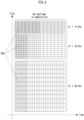
- FIG. 4 illustrates a physical resource block in a wireless communication system to which the present disclosure may be applied.
- FIG. 5 illustrates a slot structure in a wireless communication system to which the present disclosure may be applied.
- a slot includes a plurality of symbols in a time domain. For example, for a normal CP, one slot includes 7 symbols, but for an extended CP, one slot includes 6 symbols.
- a carrier includes a plurality of subcarriers in a frequency domain.
- An RB Resource Block
- a BWP(Bandwidth Part) is defined as a plurality of consecutive (physical) resource blocks in a frequency domain and may correspond to one numerology (e.g., an SCS, a CP length, etc.).
- a carrier may include a maximum N (e.g., 5) BWPs.
- a data communication may be performed through an activated BWP and only one BWP may be activated for one terminal.
- each element is referred to as a resource element (RE) and one complex symbol may be mapped.
- RE resource element
- a terminal operating in such a wideband CC may always operate turning on a radio frequency (FR) chip for the whole CC, terminal battery consumption may increase.
- FR radio frequency
- a different numerology e.g., a subcarrier spacing, etc.
- each terminal may have a different capability for the maximum bandwidth.
- a base station may indicate a terminal to operate only in a partial bandwidth, not in a full bandwidth of a wideband CC, and a corresponding partial bandwidth is defined as a bandwidth part (BWP) for convenience.
- a BWP may be configured with consecutive RBs on a frequency axis and may correspond to one numerology (e.g., a subcarrier spacing, a CP length, a slot/a mini-slot duration).
- a base station may configure a plurality of BWPs even in one CC configured to a terminal. For example, a BWP occupying a relatively small frequency domain may be configured in a PDCCH monitoring slot, and a PDSCH indicated by a PDCCH may be scheduled in a greater BWP.
- some terminals may be configured with other BWP for load balancing.
- some middle spectrums of a full bandwidth may be excluded and BWPs on both edges may be configured in the same slot.
- a base station may configure at least one DL/UL BWP to a terminal associated with a wideband CC.
- a base station may activate at least one DL/UL BWP of configured DL/UL BWP(s) at a specific time (by L1 signaling or MAC CE(Control Element) or RRC signaling, etc.).
- a base station may indicate switching to other configured DL/UL BWP (by L1 signaling or MAC CE or RRC signaling, etc.).
- a timer when a timer value is expired, it may be switched to a determined DL/UL BWP.
- an activated DL/UL BWP is defined as an active DL/UL BWP.
- a configuration on a DL/UL BWP may not be received when a terminal performs an initial access procedure or before a RRC connection is set up, so a DL/UL BWP which is assumed by a terminal under these situations is defined as an initial active DL/UL BWP.
- FIG. 6 illustrates physical channels used in a wireless communication system to which the present disclosure may be applied and a general signal transmission and reception method using them.
- a terminal receives information through a downlink from a base station and transmits information through an uplink to a base station.
- Information transmitted and received by a base station and a terminal includes data and a variety of control information and a variety of physical channels exist according to a type/a usage of information transmitted and received by them.
- a terminal When a terminal is turned on or newly enters a cell, it performs an initial cell search including synchronization with a base station or the like (S601).
- a terminal may synchronize with a base station by receiving a primary synchronization signal (PSS) and a secondary synchronization signal (SSS) from a base station and obtain information such as a cell identifier (ID), etc.
- PSS primary synchronization signal
- SSS secondary synchronization signal
- ID cell identifier
- a terminal may obtain broadcasting information in a cell by receiving a physical broadcast channel (PBCH) from a base station.
- PBCH physical broadcast channel
- a terminal may check out a downlink channel state by receiving a downlink reference signal (DL RS) at an initial cell search stage.
- DL RS downlink reference signal
- a terminal which completed an initial cell search may obtain more detailed system information by receiving a physical downlink control channel (PDCCH) and a physical downlink shared channel (PDSCH) according to information carried in the PDCCH (S602).
- PDCCH physical downlink control channel
- PDSCH physical downlink shared channel
- a terminal when a terminal accesses to a base station for the first time or does not have a radio resource for signal transmission, it may perform a random access (RACH) procedure to a base station (S603 to S606).
- RACH random access
- a terminal may transmit a specific sequence as a preamble through a physical random access channel (PRACH) (S603 and S605) and may receive a response message for a preamble through a PDCCH and a corresponding PDSCH (S604 and S606).
- PRACH physical random access channel
- a contention based RACH may additionally perform a contention resolution procedure.
- a terminal which performed the above-described procedure subsequently may perform PDCCH/PDSCH reception (S607) and PUSCH(Physical Uplink Shared Channel)/PUCCH(physical uplink control channel) transmission (S608) as a general uplink/downlink signal transmission procedure.
- a terminal receives downlink control information (DCI) through a PDCCH.
- DCI includes control information such as resource allocation information for a terminal and a format varies depending on its purpose of use.
- control information which is transmitted by a terminal to a base station through an uplink or is received by a terminal from a base station includes a downlink/uplink ACK/NACK(Acknowledgement/Non-Acknowledgement) signal, a CQI(Channel Quality Indicator), a PMI(Precoding Matrix Indicator), a RI(Rank Indicator), etc.
- a terminal may transmit control information of the above-described CQI/PMI/RI, etc. through a PUSCH and/or a PUCCH.
- Table 5 represents an example of a DCI format in an NR system.
- DCI Format Use 0_0 Scheduling of a PUSCH in one cell 0_1 Scheduling of one or multiple PUSCHs in one cell, or indication of cell group downlink feedback information to a UE 0_2 Scheduling of a PUSCH in one cell 1_0 Scheduling of a PDSCH in one DL cell 1_1 Scheduling of a PDSCH in one cell 1_2 Scheduling of a PDSCH in one cell
- DCI formats 0_0, 0_1 and 0_2 may include resource information (e.g., UL/SUL(Supplementary UL), frequency resource allocation, time resource allocation, frequency hopping, etc.), information related to a transport block(TB) (e.g., MCS(Modulation Coding and Scheme), a NDI(New Data Indicator), a RV(Redundancy Version), etc.), information related to a HARQ(Hybrid - Automatic Repeat and request) (e.g., a process number, a DAI(Downlink Assignment Index), PDSCH-HARQ feedback timing, etc.), information related to multiple antennas (e.g., DMRS sequence initialization information, an antenna port, a CSI request, etc.), power control information (e.g., PUSCH power control, etc.) related to scheduling of a PUSCH and control information included in each DCI format may be pre-defined.
- resource information e.g., UL/SUL(Sup
- DCI format 0_0 is used for scheduling of a PUSCH in one cell.
- Information included in DCI format 0_0 is CRC (cyclic redundancy check) scrambled by a C-RNTI(Cell Radio Network Temporary Identifier) or a CS-RNTI(Configured Scheduling RNTI) or a MCS-C-RNTI(Modulation Coding Scheme Cell RNTI) and transmitted.
- CRC cyclic redundancy check
- DCI format 0_1 is used to indicate scheduling of one or more PUSCHs or configure grant (CG) downlink feedback information to a terminal in one cell.
- Information included in DCI format 0_1 is CRC scrambled by a C-RNTI or a CS-RNTI or a SP-CSI-RNTI(Semi-Persistent CSI RNTI) or a MCS-C-RNTI and transmitted.
- DCI format 0_2 is used for scheduling of a PUSCH in one cell.
- Information included in DCI format 0_2 is CRC scrambled by a C-RNTI or a CS-RNTI or a SP-CSI-RNTI or a MCS-C-RNTI and transmitted.
- DCI formats 1_0, 1_1 and 1_2 may include resource information (e.g., frequency resource allocation, time resource allocation, VRB(virtual resource block)-PRB(physical resource block) mapping, etc.), information related to a transport block(TB)(e.g., MCS, NDI, RV, etc.), information related to a HARQ (e.g., a process number, DAI, PDSCH-HARQ feedback timing, etc.), information related to multiple antennas (e.g., an antenna port, a TCI(transmission configuration indicator), a SRS(sounding reference signal) request, etc.), information related to a PUCCH (e.g., PUCCH power control, a PUCCH resource indicator, etc.) related to scheduling of a PDSCH and control information included in each DCI format may be pre-defined.
- resource information e.g., frequency resource allocation, time resource allocation, VRB(virtual resource block)-PRB(physical resource block) mapping, etc.
- DCI format 1_0 is used for scheduling of a PDSCH in one DL cell.
- Information included in DCI format 1_0 is CRC scrambled by a C-RNTI or a CS-RNTI or a MCS-C-RNTI and transmitted.
- DCI format 1_1 is used for scheduling of a PDSCH in one cell.
- Information included in DCI format 1_1 is CRC scrambled by a C-RNTI or a CS-RNTI or a MCS-C-RNTI and transmitted.
- DCI format 1_2 is used for scheduling of a PDSCH in one cell.
- Information included in DCI format 1_2 is CRC scrambled by a C-RNTI or a CS-RNTI or a MCS-C-RNTI and transmitted.
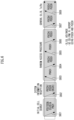
- FIG. 7 is a diagram illustrating an uplink-downlink timing relationship in a wireless communication system to which the present disclosure can be applied.
- N TA may be configured through i) a random access response (RAR), or ii) a timing advance command MAC control element (CE).
- RAR random access response
- CE timing advance command MAC control element
- N TA is relative to SCS of the first uplink transmission from a UE after receipt of a random access response or an absolute timing advance command MAC CE.
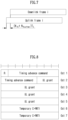
- FIG. 8 illustrates a MAC CE for random access response in a wireless communication system to which the present disclosure can be applied.
- a MAC CE (hereinafter MAC RAR) for a random access response has a fixed size as shown in FIG. 8 and includes the following fields.
- N TA_new N TA_old +(T A -31) ⁇ 16 ⁇ 64/2 ⁇ .
- FIG. 9 illustrates a timing advance command MAC CE in a wireless communication system to which the present disclosure can be applied.
- a timing advance command MAC CE is identified by a MAC subheader having a logical channel identifier (LCID).
- a timing advance command MAC CE has a fixed size and composed of 1 octet as follows.
- the present disclosure primarily illustrates and describes a 4-step random access procedure (i.e., the RACH procedure), however a 2-step random access procedure is not excluded, therefore the present disclosure can be equally applied to the 2-step random access procedure.
- Case 1 Method for configuring a specific value for each serving cell
- An information element (IE) for serving cell common configuration (e.g., ServingCellConfigCommon) is used to configure cell-specific parameters of a serving cell of a UE.
- the corresponding IE includes parameters that can generally be obtained from an SSB, a master information block (MIB), or SIBs.
- MIB master information block
- SIBs SIBs.
- a network provides a UE with information in dedicated signaling when configuring secondary cells (SCells) or additional secondary cell groups (SCGs).
- SpCell master cell group (MCG) and SCG) when re-establishing synchronization.
- Table 6 illustrates ServingCellConfigCommon IE.
- the n-TimingAdvanceOffset field indicates N TA,offset to be applied to all uplink transmissions on a corresponding serving cell. If this field does not exist, a UE applies a value defined for a duplex mode and frequency range (FR) of a corresponding serving cell.
- Case 2 Method of applying a predefined value to a serving cell according to a duplex mode and a frequency range (FR)
- Table 7 illustrates a value of N TA,offset .
- N TAoffset Frequency range and band of cell used for uplink transmission N TAoffset (Unit: Tc) FR1 FDD or TDD band with neither E-UTRA-NR nor NB-IoT-NR coexistence case 25600 (Note 1) FR1 FDD band with E-UTRA-NR and/or NB-IoT-NR coexistence case 0 (Note 1) FR1 TDD band with E-UTRA-NR and/or NB-IoT-NR coexistence case 39936 (Note 1) FR2 13792 Note 1: The UE identifies N TA offset based on the information n-TimingAdvanceOffset as specified in TS 38.331 [2].
- N TA offset is set as 25600 for FR1 band.
- UE expects that the same value of n-TimingAdvanceOffset is provided for all the UL carriers according to clause 4.2 in TS 38.213 [3] and the value 39936 of N TA offset can also be provided for a FDD serving cell. Note 2: Void
- a value of N TA,offset is determined according to a frequency range (FR) and a band of a cell used for uplink transmission.
- FR frequency range
- N TA,offset is 25600.
- a value of N TA,offset is 0.
- a value of N TA,offset is 39936. If FR2, a value of N TA,offset is 13792.
- a UE identifies a value of N TA,offset based on the n-TimingAdvanceOffset field (or parameter) information. However, if a UE does not receive n-TimingAdvanceOffset field (or parameter) information, a default value of N TA,offset is configured to 25600 for an FR1 band. In the case of multiple UL carriers within the same timing advance group (TAG), a UE expects the same n-TimingAdvanceOffset value for all UL carriers, and the 39936 value of N TA,offset may also be provided for an FDD serving cell.
- TAG timing advance group
- timing advance group (TAG) will be described.
- a TAG refers to a serving cell group using the same timing reference cell and the same timing advance value.
- a TAG including an SpCell of a MAC entity is referred to as a primary timing advance group (PTAG), while a secondary timing advance group (STAG) refers to other TAGs.
- PTAG primary timing advance group
- STAG secondary timing advance group
- An IE e.g., TAG-Config
- TAG-Config for TAG configuration is used to configure parameters for a time-alignment group.
- Table 8 illustrates the TAG-Config IE.
- the tag-Id field (parameter) indicates a TAG of an SpCell or an SCell. This field uniquely identifies a TAG within a scope of a cell group.
- timeAlignmentTimer field indicates a time alignment timer value ([ms]) for a TAG with tag-Id.
- a maximum number of TAGs may be determined by the standard or by a base station, and may be, for example, 4.
- An IE e.g., MAC-CellGroupConfig
- MAC-CellGroupConfig e.g., MAC-CellGroupConfig
- Table 9 illustrates part of MAC-CellGroupConfig IE.
- the TAG-Config IE can be configured through the tag-Config field in the MAC-CellGroupConfig IE.
- An IE for configuring a cell group is used to configure a master cell group (MCG) or a secondary cell group (SCG).
- MCG master cell group
- SCG secondary cell group
- a cell group is associated with one MAC entity, Radio Link Control (RLC) entities and includes a set of logical channels of a primary cell (SpCell) and one or more secondary cells (SCells).
- RLC Radio Link Control
- Table 10 illustrates part of CellGroupConfig IE.
- the MAC-CellGroupConfig IE can be confiugred through the mac-CellGroupConfig field in CellGroupConfig IE.
- a maximum number of secondary cell groups may be determined by the standard or by a base station, and may be, for example, 3.
- a TAG may correspond to one or more cell groups, so the same TA command can be applied to all serving cells (s) in the cell group(s) corresponding to a specific TAG.
- an appropriate TA may have different values for each TRP (panel) - UE (panel) pair.
- TA1 may be required for TRP1-UE
- TA2 may be required for TRP2-UE
- TA1 and TA2 may have different values.
- the difference in TA as described above may occur, for example, when a distance between TRP-UE is relatively large. For example, when a distance (Dist1) between TRP1 and a UE is significantly larger than a distance (Dist2) between TRP2 and a UE (Dist1 > > Dist2), TA1 may also be significantly larger than TA2 (TA1 >> TA2).
- multi-TRP transmission can be supported as follows. Different TRPs can be distinguished based on a CORESET pool index (CORESETPoolindex), a TCI state, a SRS resource indicator (SRI), spatial relation information (SpatialRelationInfo), a pathloss reference RS (Path loss Reference RS) (or PL RS: pathloss reference signal), etc.
- CORESETPoolindex CORESET pool index
- TCI state a SRS resource indicator
- SRI SRS resource indicator
- spatial relation information SpatialRelationInfo
- Path loss Reference RS pathloss reference RS
- PL RS pathloss reference signal
- the different TRPs may be included in the same cell group and, therefore, may be included in the same TAG. Therefore, even when different TA values are required for each TRP, according to the current standard, only the same TA value can be applied within a TAG, so TA values for each TRP cannot be supported.
- the present disclosure proposes a method for supporting different TA values for each TRP even within the same TAG.
- TRP TRP-reliable and low-power computing
- the description as a TRP is for convenience of explanation, and may also be interpreted as terms such as a panel/beam. That is, the methods proposed in this disclosure can be applied/interpreted by replacing a TRP with a panel/beam.
- L1 layer 1
- L2 Layer 2 signaling may refer to higher layer signaling based on an RRC/MAC control element (CE) between a base station and a UE.
- CE RRC/MAC control element
- the method proposed in this disclosure can be applied/supported independently and/or in a form of a combination of one or more multiple proposed methods.
- Embodiment 1 Method for configuring/indicating/defining a TAG that can perform an independent TA procedure while referring to a specific TAG
- The'referring to a specific TAG' may mean that a TA value corresponding to a specific TAG can be used as a base/reference value.
- the 'performing an independent TA procedure' means that a TA value different from a TA corresponding to a specific TAG may be configured/indicated/defined, and a base station/UE may transmit a DL/UL signal based on a differential TA value.
- sub-TAG in which an independent TA procedure can be performed while referring to a specific TAG' can be named as sub-TAG.
- a sub-TAG may be referred to by another term as it is not intended to limit the proposal of the present disclosure. And/or, it may be interpreted that a plurality of TAGs are defined based on the method proposed in this disclosure. And/or, a method of supporting sub-TAG by expanding the number of TAG-ID (identity) may be applied.
- a plurality of TAGs may mean a plurality of TAGs related to a specific cell or a specific cell group.
- the plurality of TAGs configured for a specific cell or a specific cell group may or may not include the same cell(s) or the same cell group(s).
- cell 1 (or cell group 1), cell 2 (or cell group 2), cell 3 (or cell group 3), cell 4 (or cell group 4), cell 5 (or cell group 5), TAG 1, TAG 2, and TAG 3 are configured.
- cell 1 (or cell group 1), cell 2 (or cell group 2), and cell 3 (or cell group 3) may correspond to TAG 1
- cell 4 (or cell group 4) may correspond to TAG 2
- cell 1 (or cell group 1) may correspond only to TAG 1
- cell 2 (or cell group 2) and cell 3 (or cell group 3) may correspond to TAG 1 and TAG 2
- cell 4 (or cell group 4) may correspond to TAG 2 and TAG 3
- cell 5 (or cell group 5) may only correspond to TAG 3.
- sub-TAGs within one TAG are configured.
- sub-TAGs that can be configured/indicated/defined different TA values within a TAG can be configured/ indicated/defined.
- different TA values may be configured/indicated/defined for each of the plurality of TAGs configured per cell or per cell group.
- a UE/base station when configuring/indicating/defining a sub-TAG, can perform an independent TA operation based on different TA values for each sub-TAG. And/or an operation related to a timer (e.g., TimeAlignmentTimer) for time alignment within the TAG may be configured/indicated/defined to equally perform/assume an operation corresponding to the TAG for all sub-TAGs within the TAG.
- a timer e.g., TimeAlignmentTimer
- Table 11 illustrates the operations defined in the current standard TS 38.321 Section 5.2.
- RRC configures the following parameters for the maintenance of UL time alignment: - timeAlignmentTimer (per TAG) which controls how long the MAC entity considers the Serving Cells belonging to the associated TAG to be uplink time aligned.
- the MAC entity shall: 1> when a Timing Advance Command MAC CE is received, and if an N TA has been maintained with the indicated TAG: 2> apply the Timing Advance Command for the indicated TAG; 2> start or restart the timeAlignmentTimer associated with the indicated TAG.
- timeAlignmentTimer associated with this TAG is not running: 3> apply the Timing Advance Command for this TAG; 3> start the timeAlignmentTimer associated with this TAG; 3> when the Contention Resolution is considered not successful; or 3> when the Contention Resolution is considered successful for SI request, after transmitting HARQ feedback for MAC PDU including UE Contention Resolution Identity MAC CE: 4> stop timeAlignmentTimer associated with this TAG. 2> else: 3> ignore the received Timing Advance Command.
- timeAlignmentTimer is associated with an STAG, then for all Serving Cells belonging to this TAG: 3> flush all HARQ buffers; 3> notify RRC to release PUCCH, if configured; 3> notify RRC to release SRS, if configured; 3> clear any configured downlink assignments and configured uplink grants; 3> clear any PUSCH resource for semi-persistent CSI reporting; 3> maintain N TA of this TAG.
- the MAC entity When the MAC entity stops uplink transmissions for an SCell due to the fact that the maximum uplink transmission timing difference between TAGs of the MAC entity or the maximum uplink transmission timing difference between TAGs of any MAC entity of the UE is exceeded, the MAC entity considers the timeAlignmentTimer associated with the SCell as expired. The MAC entity shall not perform any uplink transmission on a Serving Cell except the Random Access Preamble and MSGA transmission when the timeAlignmentTimer associated with the TAG to which this Serving Cell belongs is not running. Furthermore, when the timeAlignmentTimer associated with the PTAG is not running, the MAC entity shall not perform any uplink transmission on any Serving Cell except the Random Access Preamble and MSGA transmission on the SpCell.
- Embodiment 1-1 Method for configuring/indicating/defining sub-TAG
- the sub-TAG can be configured/indicated/defined based on a predetermined index (or group/set of indices).
- a predetermined index or group/set of indices.
- the given index or group/set of indices
- the following can be applied.
- a sub TAG (or multiple TAGs) can be configured/indicated/defined based on a CORESET pool index (CORESETPoolIndex), a CORESET (or group/set of CORESETs), a search space (SS) set (or group/set of SS sets), a TCI state (group/set of TCI states), an SRI (or group/set of SRIs), SpatialRelationInfo (or group/set of SpatialRelationInfos), a PL RS (or group/set of PL RSs), a BWP (or group/set of BWPs), and/or a newly defined index (e.g., sub-TAG-iD) to distinguish sub-TAGs.
- CORESETPoolIndex CORESET pool index
- CORESET or group/set of CORESETs
- SS search space
- TCI state group/set of TCI states
- SRI or group/set of SRIs
- SpatialRelationInfo or group
- this information may be referred to as information for distinguishing sub TAGs (or multiple TAGs).
- different TAGs can be related to different CORESET pool indexes, CORESETs (or group/set of CORESETs), SS sets (or group/set of SS sets), TCI states (or group/set of TCI states), SRIs (or group/set of SRIs), SpatialRelationInfo (or group/set of SpatialRelationInfos), PL RSs (or group/set of PL RSs), BWPs (or group/set of BWPs), and/or newly defined indexes to distinguish sub-TAGs (e.g., sub-TAG-ID)), etc.
- CORESETs or group/set of CORESETs
- SS sets or group/set of SS sets
- TCI states or group/set of TCI states
- SRIs or group/set of SRIs
- SpatialRelationInfo or group/set of SpatialRelationInfos
- FIG. 10 is a diagram illustrating a plurality of TAGs according to an embodiment of the present disclosure.
- FIG. 10(a) shows an example in which one or more serving cells (serving cell #0, serving cell #1, serving cell #2) (e.g., cell group) correspond to a single TAG (e.g., TAG #0) based on the current standard.
- serving cell #0 serving cell #1, serving cell #2
- TAG #0 a single TAG
- FIG. 10(b) shows an example in which two TAGs (e.g., TAG #0, TAG #1) are defined for one or more serving cells (serving cell #0, serving cell #1, serving cell #2) (e.g., cell group), based on the method proposed in this disclosure.
- a TA value for TAG #0 may be applied for a scheduled/transmitted UL channel/RS (e.g. PUCCH, PUSCH, SRS, etc.) corresponding to/related to CORESET pool index 0 in serving cell #0, serving cell #1, and serving cell #2.
- a TA value for TAG #1 may be applied for a scheduled/transmitted UL channel/RS (e.g. PUCCH, PUSCH, SRS, etc.) corresponding to/related to CORESET pool index 1 in serving cell #0, serving cell #1, and serving cell #2.
- TAGs can be distinguished based on the above-described CORESET full index, a CORESET (or group/set of CORESETs), an SS set (or group/set of SS sets), a TCI state (or group/set of TCI states), an SRI (or group/set of SRIs), SpatialRelationInfo (or group/set of SpatialRelationInfos), a PL RS (or group/set of PL RSs), a BWP (or group/set of BWPs), and/or a newly defined index (e.g., TAG-ID) for TAG identification, etc.
- CORESET or group/set of CORESETs
- an SS set or group/set of SS sets
- TCI state or group/set of TCI states
- SRI or group/set of SRIs
- SpatialRelationInfo or group/set of SpatialRelationInfos
- PL RS or group/set of PL RSs
- BWP or group/set of B
- FIG. 11 is a diagram illustrating a sub-TAG according to an embodiment of the present disclosure.
- FIG. 11(a) shows an example in which one or more serving cells (serving cell #0, serving cell #1, serving cell #2) (e.g., cell group) correspond to a single TAG (e.g., TAG #0) based on the current standard.
- serving cell #0 serving cell #1, serving cell #2
- TAG #0 a single TAG
- FIG. 11(b) shows an example in which two sub-TAGs (e.g., sub-TAG #0, sub-TAG #1) referencing a specific TAG (e.g., TAG #0) are defined for one or more serving cells (serving cell #0, serving cell #1, serving cell #2) (e.g., cell group), based on the method proposed in this disclosure.
- a TA value for sub-TAG #0 may be applied for a scheduled/transmitted UL channel/RS (e.g. PUCCH, PUSCH, SRS, etc.) corresponding to/related to CORESET pool index 0 in serving cell #0, serving cell #1, and serving cell #2.
- a scheduled/transmitted UL channel/RS e.g. PUCCH, PUSCH, SRS, etc.
- a TA value for sub-TAG #1 may be applied for a scheduled/transmitted UL channel/RS (e.g. PUCCH, PUSCH, SRS, etc.) corresponding to/related to CORESET pool index 1 in serving cell #0, serving cell #1, and serving cell #2.
- a scheduled/transmitted UL channel/RS e.g. PUCCH, PUSCH, SRS, etc.
- FIG. 11(b) shows an example of distinguishing sub-TAGs in a TAG based on a CORESET pool index (CORESETPoolIndex) of each serving cell, but this is only one example of the proposed method.
- sub-TAGs in a TAG can be distinguished based on the above-described CORESET full index, a CORESET (or group/set of CORESETs), an SS set (or group/set of SS sets), a TCI state (or group/set of TCI states), an SRI (or group/set of SRIs), SpatialRelationInfo (or group/set of SpatialRelationInfos), a PL RS (or group/set of PL RSs), a BWP (or group/set of BWPs), and/or a newly defined index (e.g., TAG-ID) for TAG identification, etc.
- CORESETPoolIndex CORESET Pool Index
- a TA corresponding to sub-TAG #0 may be applied to a UL channel/RS (e.g., PUCCH/PUSCH/SRS, etc.) scheduled with CORESETPoolindex 0 (or 1).
- a UL channel/RS e.g., PUCCH/PUSCH/SRS, etc.
- CORESETPoolindex 0 or 1
- the correspondence relationship i.e., in addition to the above-described information to distinguish sub-TAGs
- a specific CORESETPoolIndex may be configured/indicated/defined to a UE (in advance) based on L1/L2 signaling between a base station/UE.
- a TA corresponding to (sub-)TAG #0 may be applied to a UL channel/RS (e.g., PUCCH/PUSCH/SRS, etc.) corresponding to a specific CORESET pool index, a specific CORESET (or group/set of CORESETs), a specific SS set (or group/set of SS sets), a specific TCI state (group/set of TCI states), a specific SRI (or group/set of SRIs), specific SpatialRelationInfo (or group/set of SpatialRelationInfos), a specific PL RS (or group/set of PL RSs), a specific BWP (or group/set of BWPs), and/or a newly defined index (e.g., (sub-)TAG-ID) to distinguish a specific (sub-)TAG, etc., based on a CORESET pool index, a CORESET (or group/set of CORESETs), an SS set (
- a TA corresponding to (sub-)TAG #0 may be applied to a UL channel/RS (e.g., PUCCH/PUSCH/SRS, etc.) corresponding to SRI/SpatialRelationInfo/PL RS 1 (or 2), TCI state 1/2/3 (or 4/5/6).
- a UL channel/RS e.g., PUCCH/PUSCH/SRS, etc.
- SRI/SpatialRelationInfo/PL RS 1 or 2
- TCI state 1/2/3 or 4/5/6
- a specific CORESET or group/set of CORESETs
- a specific SS set or group/set of SS sets
- a specific TCI state group/set of TCI
- an index for distinguishing a (sub-)TAG is newly defined, and the index information may be configured/indicated (e.g., by L1/L2 signaling) together when configuring/scheduling a UL channel/RS (e.g., PUCCH/PUSCH/SRS, etc.).
- a TA corresponding to (sub-)TAG #0 (or #1) may be applied to a UL channel/RS (e.g., PUCCH/PUSCH/SRS, etc.) corresponding to index 0 (or 1).
- an independent parameter pool may be configured/indicated for each serving cell (e.g., CORESETPoolindex, TCI state, Path loss Reference RS, etc.).
- a predetermined grouping method to distinguish the above parameters within a single TAG may be additionally applied to all serving cells corresponding to a specific TAG. For example, assume that serving cells 0 and 1 correspond to a single TAG, CORESETPoolindex0 and 1 are configured for serving cell 0, and CORESETPoolindex0 and 1 are configured for serving cell 1.
- group 0 may include CORESETPoolindex0 (serving cell 0) and CORESETPoolindex0 (serving cell 1)
- group 1 may include CORESETPoolindex1 (serving cell 0) and CORESETPoolindex1 (serving cell 1)
- group 0 may include CORESETPoolindex0 (serving cell 0) and CORESETPoolindex1 (serving cell 1)
- group 1 may include CORESETPoolindex1 (serving cell 0) and CORESETPoolindex0 (serving cell 1)
- two groups can be defined/configured/indicated.
- grouping for serving cell(s) is configured for specific parameter(s) within one TAG, and the specific parameter(s) may be configured individually for each group of serving cell(s).
- the proposed method may be applied based on the unified TCI framework introduced in Rel-17.
- the unified TCI framework i.e., joint unified TCI framework
- the unified TCI framework i.e., separate unified TCI framework
- a pool of a TCI state corresponding to the joint unified TCI framework may be referred to as the joint TCI state pool
- a pool of a TCI state corresponding to the separate unified TCI framework may be referred to as the separate (DL/UL) TCI state pool.
- an index for sub-TAG definition/configuration/indication is defined/configured/indicated based on a TCI state (or group of TCI states) defined/configured/indicated in the joint TCI state pool and/or the separate (DL/UL) TCI state pool.
- grouping for each TCI state may be configured/defined for each joint TCI state pool and/or separate (DL/UL) TCI state pool.
- sub-TAG 0/1 may be distinguished for a TCI state in the separate DL TCI state pool
- sub-TAG 0/1 may be distinguished for a TCI state in the separate UL TCI state pool.
- a base station can configure/indicate/define a TA command for each sub-TAG (or group of sub-TAGs) to a UE.
- a TA command may be transmitted through RRC/MAC CE/DCI, etc.
- a sub-TAG (or group of sub-TAGs) and a TA command for the corresponding sub-TAG (or group of sub-TAGs) can be distinguished from each other based on information (e.g., index) for distinguishing sub-TAGs (or multiple TAGs) of the method proposed in Embodiment 1-1.
- a TA command value configured/indicated for each sub-TAG (or group of sub-TAGs) may be configured/indicated/defined in the form of an offset based on a TA of a TAG including the sub-TAG (or group of sub-TAGs).
- Equation 3 N TA + N TA , offset T c
- N TA and N TA,offset can be configured for a UE according to the method described above.
- Equation 3 may be changed and defined as Equation 4 or Equation 5 below.
- T TA N TA + N TA , offset + N Sub ⁇ TAG , i T c
- N Sub-TAG,i may mean an offset TA value configured/indicated/defined for each sub-TAG (or group of sub-TAGs).
- i may mean an index for distinguishing sub-TAGs proposed in Embodiment 1-1, and therefore N Sub-TAG,i may mean a offset TA value corresponding to the i-th sub-TAG.
- N TA and N TA,offset values can be configured for each TAG.
- N Sub-TAG,i configured for a sub-TAG may be applied to N TA and N TA,offset values configured for a TAG to which the sub-TAG belongs.
- T TA N Sub ⁇ TAG , i + N TA , offset T c
- NSub-TAG,i may mean a TA value configured/indicated/defined for each sub-TAG (or group of sub-TAGs).
- i may mean an index for distinguishing sub-TAGs proposed in Embodiment 1-1, and therefore N Sub-TAG,i may mean a TA value corresponding to the i-th sub-TAG.
- a N TA value may not be configured for each TAG, and N Sub-TAG,i configured for each sub-TAG may be applied to the corresponding sub-TAG.
- a concept of a TAG pool may be defined/introduced.
- a reference TAG and/or reference sub-TAG e.g., TAG0 and/or sub-TAG0
- TAG pool or sub-TAG pool
- N TA /N TA,offset /N Sub-TAG,i may be indicated/configured based on a differential (e.g., not 6 bits, number of bits less than 6 bits) value compared to the reference TAG and/or reference sub-TAG.
- the reference timing shall be (N TA +N TA,offset +N Sub-TAG,i )xT c before the downlink timing of the reference cell.
- T q and the aggregate adjustment rate T p are specified in Table 12.
- Table 12 Frequency Range SCS of uplink siqnals (kHz) T q T p 1 15 5.5*64*T c 5.5*64*T c 30 5.5*64*T c 5.5*64*T c 60 5.5*64*T c 5.5*64*T c 2 60 2.5*64*T c 2.5*64*T c 120 2.5*64*T c 2.5*64*T c Note: T c is the basic timing unit defined in TS 38.211.
- Embodiment 1-2 In addition to Embodiment 1-2 (or by substituting with Embodiment 1-2), a method of indicating a TA value for a sub-TAG by expanding a range of N TA,offset may be used.
- a TA command can be configured/indicated/defined for each configured cell (or configured component carrier (CC) or serving cell) and/or configured cell (or configured CC or serving cell) group.
- CC component carrier
- a TA command by the configured cell/configured CC/serving cell or configured cell group/configured CC group/serving cell group
- it can have the advantage that different TA commands are possible for different the configured cells/configured CCs/serving cells (or configured cell groups/configured CC groups/serving cell groups).
- Embodiment 1/Embodiment 1-1/Embodiment 1-2 if there is no separate configuration/indication related to a sub-TAG (or related to multiple TAGs) within a single TAG, a UE/base station can perform a TA operation based on the TAG. On the other hand, if there are a separate configuration/indication related to a sub-TAG (or related to multiple TAGs), based on a (offset) TA value that can be configured/indicated/defined separately only for a corresponding sub-TAG (or a specific TAG among multiple TAGs), a UE/base station can perform a TA operation independent of the TAG.
- CORESETPoolindex0 performs a TA operation by referring to a TA value corresponding to a TAG
- CORESETPoolindex1 corresponds to a sub-TAG (or sub-TAG 0 or sub-TAG 1, where the sub-TAG index corresponds to one example).
- a UE/base station can perform an independent TA operation by separately configuring/indicating/defining a (offset) TA value for the sub-TAG.
- FIG. 12 illustrates a signaling method for an uplink transmission and reception method according to an embodiment of the present disclosure.
- Fig. 12 illustrates signaling between a network (e.g., TRP 1, TRP 2) and a UE in a multiple TRP (i.e. M-TRP, or multi-cell, hereinafter all TRPs can be replaced by cells) situation to which the methods (e.g., any one or a combination of more than one in Embodiment 1, Embodiment 1-1, Embodiment 1-2, and detailed embodiments) proposed in the present disclosure can be applied.
- a UE/Network may be an example and may be applied by being substituted with a variety of devices.
- FIG. 12 is only for convenience of description, but it is not intended to limit a scope of the present disclosure.
- some step(s) shown in FIG. 7 may be omitted according to a situation and/or a configuration, etc.
- a network may be one base station including a plurality of TRPs or may be one cell including a plurality of TRPs.
- ideal/non-ideal backhaul may be configured between TRP 1 and TRP 2 included in a network.
- the following description is described based on a plurality of TRPs, but it may be also equivalently extended and applied to transmission through a plurality of panels.
- an operation in which a terminal receives a signal from TRP1/TRP2 may be interpreted/explained (or may be an operation) as an operation in which a terminal receives a signal from a network (via/using TRP1/2), and an operation in which a terminal transmits a signal to TRP1/TRP2 may be interpreted/explained (or may be an operation) as an operation in which a terminal transmits a signal to a network (via/using TRP1/TRP2), and vice versa.
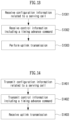
- a UE receives configuration information related to a serving cell from a base station (S1201).
- the configuration information may include information related to a multiple TRP configuration, a multiple TAG configuration for serving cells, and uplink transmission and reception described in the above-mentioned proposed method.
- the configuration information may be information (e.g., CellGroupConfig, see Table 10) used to configure a cell group including one or more serving cells, or may be information used to configure MAC parameters for a cell group including one or more serving cells (e.g., MAC-CellGroupConfig, see Table 9).
- the configuration information may include information on correspondence relationships between each TAG in the plurality of TAGs and at least one of a CORESET, an SS set, a TCI state, an SRI, spatial relation information, a PL RS, a BWP, a TAG index.
- the configuration information may include information on a plurality of timing advance groups (TAG) associated with the serving cell (or a group of cells containing one or more serving cells) (e.g., TAG-Config).
- TAG timing advance groups
- the information on the plurality of TAGs may correspond to a plurality of TAG-Configs.
- the information on the plurality of TAGs may correspond to information on a plurality of sub-TAGs within one TAG-Config.
- a UE receives control information including a TA command for each TAG in a plurality of TAGs from a base station (S1202).
- control information may correspond to, for example, a random access response or a TA command MAC CE, but is not limited thereto. Additionally, as described above, a TA command may indicate the N TA value.
- control information may include a TA command for each TAG belonging to a plurality of TAGs, and a TA command for each TAG may individually indicate a TA value (e.g., N TA value) used to control uplink timing adjustment.
- a TA command may indicate a differential value compared to a TA value used to control uplink timing adjustment for a reference TAG.
- a TA command may indicate an offset for each sub-TAG based on a TA value used to control uplink timing adjustment for the single TAG.
- a TA command may individually indicate a TA value (e.g., N TA value) used to control uplink timing adjustment for each sub-TAG.
- a UE performs uplink transmission to a base station in a serving cell (S1203).
- uplink transmission may be transmitted at a transmission timing determined in consideration of a timing relation with a downlink frame previously described in FIG. 7 .
- a transmission timing of the uplink transmission may be determined based on a TA command for the specific TAG.
- the specific TAG related to the uplink transmission may be determined.
- a UE may receive DCI scheduling the uplink transmission from a base station before the uplink transmission.
- the specific TAG related to the uplink transmission may be indicated by DCI.
- FIG. 13 is a diagram illustrating an operation of a UE for an uplink transmission and reception method according to an embodiment of the present disclosure.
- FIG. 13 exemplifies an operation of a UE based on the above-described proposed methods (e.g., any one or a combination of more than one in Embodiment 1, Embodiment 1-1, Embodiment 1-2, and detailed embodiments).
- FIG. 13 is only for convenience of description, but it is not intended to limit a scope of the present disclosure. Some step(s) shown in FIG. 13 may be omitted according to a situation and/or a configuration, etc.
- a UE in FIG. 13 is only one example, and may be implemented as a device illustrated in FIG. 15 .
- a processor (102/202) of FIG. 15 may control to transmit and receive channel/signal/data/information, etc. by using a transceiver (106/206), and control to store transmitted or received channel/signal/data/information in a memory (104/204).
- FIG. 13 may be processed by one or more processors 102, 202 of FIG. 15 , the operation of FIG. 13 may be stored in memory (e.g., one or more memories 104, 204 of FIG. 15 ) in the form of instructions/programs (e.g. instruction, executable code) for driving at least one processor (e.g., 102, 202) of FIG. 15 .
- memory e.g., one or more memories 104, 204 of FIG. 15
- instructions/programs e.g. instruction, executable code
- a UE receives configuration information related to a serving cell from a base station (S1301).
- the configuration information may include information related to a multiple TRP configuration, a multiple TAG configuration for serving cells, and uplink transmission and reception described in the above-mentioned proposed method.
- the configuration information may be information (e.g., CellGroupConfig, see Table 10) used to configure a cell group including one or more serving cells, or may be information used to configure MAC parameters for a cell group including one or more serving cells (e.g., MAC-CellGroupConfig, see Table 9).
- the configuration information may include information on correspondence relationships between each TAG in the plurality of TAGs and at least one of a CORESET, an SS set, a TCI state, an SRI, spatial relation information, a PL RS, a BWP, a TAG index.
- the configuration information may include information on a plurality of timing advance groups (TAG) associated with the serving cell (or a group of cells containing one or more serving cells) (e.g., TAG-Config).
- TAG timing advance groups
- the information on the plurality of TAGs may correspond to a plurality of TAG-Configs.
- the information on the plurality of TAGs may correspond to information on a plurality of sub-TAGs within one TAG-Config.
- a UE receives control information including a TA command for each TAG in a plurality of TAGs from a base station (S1302).
- control information may correspond to, for example, a random access response or a TA command MAC CE, but is not limited thereto. Additionally, as described above, a TA command may indicate the N TA value.
- control information may include a TA command for each TAG belonging to a plurality of TAGs, and a TA command for each TAG may individually indicate a TA value (e.g., N TA value) used to control uplink timing adjustment.
- a TA command may indicate a differential value compared to a TA value used to control uplink timing adjustment for a reference TAG.
- a TA command may indicate an offset for each sub-TAG based on a TA value used to control uplink timing adjustment for the single TAG.
- a TA command may individually indicate a TA value (e.g., N TA value) used to control uplink timing adjustment for each sub-TAG.
- a UE performs uplink transmission to a base station in a serving cell (S1303).
- uplink transmission may be transmitted at a transmission timing determined in consideration of a timing relation with a downlink frame previously described in FIG. 7 .
- transmission timing of the uplink transmission may be determined based on a TA command for the specific TAG.
- the specific TAG related to the uplink transmission may be determined.
- a UE may receive DCI scheduling the uplink transmission from a base station before the uplink transmission.
- the specific TAG related to the uplink transmission may be indicated by DCI.
- FIG. 14 is a diagram illustrating an operation of a base station for an uplink transmission and reception method according to an embodiment of the present disclosure.
- FIG. 14 exemplifies an operation of a UE based on the above-described proposed methods (e.g., any one or a combination of more than one in Embodiment 1, Embodiment 1-1, Embodiment 1-2, and detailed embodiments).
- FIG. 14 is only for convenience of description, but it is not intended to limit a scope of the present disclosure. Some step(s) shown in FIG. 14 may be omitted according to a situation and/or a configuration, etc.
- a UE in FIG. 14 is only one example, and may be implemented as a device illustrated in FIG. 15 .
- a processor (102/202) of FIG. 15 may control to transmit and receive channel/signal/data/information, etc. by using a transceiver (106/206), and control to store transmitted or received channel/signal/data/information in a memory (104/204).
- FIG. 14 may be processed by one or more processors 102, 202 of FIG. 15 , the operation of FIG. 14 may be stored in memory (e.g., one or more memories 104, 204 of FIG. 15 ) in the form of instructions/programs (e.g. instruction, executable code) for driving at least one processor (e.g., 102, 202) of FIG. 15 .
- memory e.g., one or more memories 104, 204 of FIG. 15
- instructions/programs e.g. instruction, executable code
- a base station transmits configuration information related to a serving cell to a UE (S1401).
- the configuration information may include information related to a multiple TRP configuration, a multiple TAG configuration for serving cells, and uplink transmission and reception described in the above-mentioned proposed method.
- the configuration information may be information (e.g., CellGroupConfig, see Table 10) used to configure a cell group including one or more serving cells, or may be information used to configure MAC parameters for a cell group including one or more serving cells (e.g., MAC-CellGroupConfig, see Table 9).
- the configuration information may include information on correspondence relationships between each TAG in the plurality of TAGs and at least one of a CORESET, an SS set, a TCI state, an SRI, spatial relation information, a PL RS, a BWP, a TAG index.
- the configuration information may include information on a plurality of timing advance groups (TAG) associated with the serving cell (or a group of cells containing one or more serving cells) (e.g., TAG-Config).
- TAG timing advance groups
- the information on the plurality of TAGs may correspond to a plurality of TAG-Configs.
- the information on the plurality of TAGs may correspond to information on a plurality of sub-TAGs within one TAG-Config.
- a base station transmits control information including a TA command for each TAG in a plurality of TAGs to a UE (S1402).
- control information may correspond to, for example, a random access response or a TA command MAC CE, but is not limited thereto. Additionally, as described above, a TA command may indicate the NTA value.
- control information may include a TA command for each TAG belonging to a plurality of TAGs, and a TA command for each TAG may individually indicate a TA value (e.g., N TA value) used to control uplink timing adjustment.
- a TA command may indicate a differential value compared to a TA value used to control uplink timing adjustment for a reference TAG.
- a TA command may indicate an offset for each sub-TAG based on a TA value used to control uplink timing adjustment for the single TAG.
- a TA command may individually indicate a TA value (e.g., N TA value) used to control uplink timing adjustment for each sub-TAG.
- a base station receives uplink transmission from a UE in a serving cell (S1403).
- uplink transmission may be transmitted at a transmission timing determined in consideration of a timing relation with a downlink frame previously described in FIG. 7 .
- transmission timing of the uplink transmission may be determined based on a TA command for the specific TAG.
- the specific TAG related to the uplink transmission may be determined.
- a UE may receive DCI scheduling the uplink transmission from a base station before the uplink transmission.
- the specific TAG related to the uplink transmission may be indicated by DCI.
- FIG. 14 is a diagram which illustrates a block diagram of a wireless communication device according to an embodiment of the present disclosure.
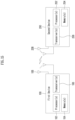
- a first wireless device 100 and a second wireless device 200 may transmit and receive a wireless signal through a variety of radio access technologies (e.g., LTE, NR).
- radio access technologies e.g., LTE, NR.
- a first wireless device 100 may include one or more processors 102 and one or more memories 104 and may additionally include one or more transceivers 106 and/or one or more antennas 108.
- a processor 102 may control a memory 104 and/or a transceiver 106 and may be configured to implement description, functions, procedures, proposals, methods and/or operation flow charts disclosed in the present disclosure.
- a processor 102 may transmit a wireless signal including first information/signal through a transceiver 106 after generating first information/signal by processing information in a memory 104.
- a processor 102 may receive a wireless signal including second information/signal through a transceiver 106 and then store information obtained by signal processing of second information/signal in a memory 104.
- a memory 104 may be connected to a processor 102 and may store a variety of information related to an operation of a processor 102.
- a memory 104 may store a software code including commands for performing all or part of processes controlled by a processor 102 or for performing description, functions, procedures, proposals, methods and/or operation flow charts disclosed in the present disclosure.
- a processor 102 and a memory 104 may be part of a communication modem/circuit/chip designed to implement a wireless communication technology (e.g., LTE, NR).
- a transceiver 106 may be connected to a processor 102 and may transmit and/or receive a wireless signal through one or more antennas 108.
- a transceiver 106 may include a transmitter and/or a receiver.
- a transceiver 106 may be used together with a RF (Radio Frequency) unit.
- a wireless device may mean a communication modem/circuit/chip.
- a second wireless device 200 may include one or more processors 202 and one or more memories 204 and may additionally include one or more transceivers 206 and/or one or more antennas 208.
- a processor 202 may control a memory 204 and/or a transceiver 206 and may be configured to implement description, functions, procedures, proposals, methods and/or operation flows charts disclosed in the present disclosure.
- a processor 202 may generate third information/signal by processing information in a memory 204, and then transmit a wireless signal including third information/signal through a transceiver 206.
- a processor 202 may receive a wireless signal including fourth information/signal through a transceiver 206, and then store information obtained by signal processing of fourth information/signal in a memory 204.
- a memory 204 may be connected to a processor 202 and may store a variety of information related to an operation of a processor 202.
- a memory 204 may store a software code including commands for performing all or part of processes controlled by a processor 202 or for performing description, functions, procedures, proposals, methods and/or operation flow charts disclosed in the present disclosure.
- a processor 202 and a memory 204 may be part of a communication modem/circuit/chip designed to implement a wireless communication technology (e.g., LTE, NR).
- a transceiver 206 may be connected to a processor 202 and may transmit and/or receive a wireless signal through one or more antennas 208.
- a transceiver 206 may include a transmitter and/or a receiver.
- a transceiver 206 may be used together with a RF unit.
- a wireless device may mean a communication modem/circuit/chip.
- one or more protocol layers may be implemented by one or more processors 102, 202.
- one or more processors 102, 202 may implement one or more layers (e.g., a functional layer such as PHY, MAC, RLC, PDCP, RRC, SDAP).
- One or more processors 102, 202 may generate one or more PDUs (Protocol Data Unit) and/or one or more SDUs (Service Data Unit) according to description, functions, procedures, proposals, methods and/or operation flow charts included in the present disclosure.
- PDUs Protocol Data Unit
- SDUs Service Data Unit
- One or more processors 102, 202 may generate a message, control information, data or information according to description, functions, procedures, proposals, methods and/or operation flow charts disclosed in the present disclosure.
- One or more processors 102, 202 may generate a signal (e.g., a baseband signal) including a PDU, a SDU, a message, control information, data or information according to functions, procedures, proposals and/or methods disclosed in the present disclosure to provide it to one or more transceivers 106, 206.
- a signal e.g., a baseband signal
- One or more processors 102, 202 may receive a signal (e.g., a baseband signal) from one or more transceivers 106, 206 and obtain a PDU, a SDU, a message, control information, data or information according to description, functions, procedures, proposals, methods and/or operation flow charts disclosed in the present disclosure.
- a signal e.g., a baseband signal
- One or more processors 102, 202 may be referred to as a controller, a micro controller, a micro processor or a micro computer.
- One or more processors 102, 202 may be implemented by a hardware, a firmware, a software, or their combination.
- one or more ASICs Application Specific Integrated Circuit
- one or more DSPs Digital Signal Processor
- one or more DSPDs Digital Signal Processing Device
- one or more PLDs PROgrammable Logic Device
- FPGAs Field Programmable Gate Arrays
- Description, functions, procedures, proposals, methods and/or operation flow charts disclosed in the present disclosure may be implemented by using a firmware or a software and a firmware or a software may be implemented to include a module, a procedure, a function, etc.
- a firmware or a software configured to perform description, functions, procedures, proposals, methods and/or operation flow charts disclosed in the present disclosure may be included in one or more processors 102, 202 or may be stored in one or more memories 104, 204 and driven by one or more processors 102, 202.
- Description, functions, procedures, proposals, methods and/or operation flow charts disclosed in the present disclosure may be implemented by using a firmware or a software in a form of a code, a command and/or a set of commands.
- One or more memories 104, 204 may be connected to one or more processors 102, 202 and may store data, a signal, a message, information, a program, a code, an instruction and/or a command in various forms.
- One or more memories 104, 204 may be configured with ROM, RAM, EPROM, a flash memory, a hard drive, a register, a cash memory, a computer readable storage medium and/or their combination.
- One or more memories 104, 204 may be positioned inside and/or outside one or more processors 102, 202.
- one or more memories 104, 204 may be connected to one or more processors 102, 202 through a variety of technologies such as a wire or wireless connection.
- One or more transceivers 106, 206 may transmit user data, control information, a wireless signal/channel, etc. mentioned in methods and/or operation flow charts, etc. of the present disclosure to one or more other devices.
- One or more transceivers 106, 206 may receiver user data, control information, a wireless signal/channel, etc. mentioned in description, functions, procedures, proposals, methods and/or operation flow charts, etc. disclosed in the present disclosure from one or more other devices.
- one or more transceivers 106, 206 may be connected to one or more processors 102, 202 and may transmit and receive a wireless signal.
- one or more processors 102, 202 may control one or more transceivers 106, 206 to transmit user data, control information or a wireless signal to one or more other devices.
- one or more processors 102, 202 may control one or more transceivers 106, 206 to receive user data, control information or a wireless signal from one or more other devices.
- one or more transceivers 106, 206 may be connected to one or more antennas 108, 208 and one or more transceivers 106, 206 may be configured to transmit and receive user data, control information, a wireless signal/channel, etc. mentioned in description, functions, procedures, proposals, methods and/or operation flow charts, etc.
- one or more antennas may be a plurality of physical antennas or a plurality of logical antennas (e.g., an antenna port).
- One or more transceivers 106, 206 may convert a received wireless signal/channel, etc. into a baseband signal from a RF band signal to process received user data, control information, wireless signal/channel, etc. by using one or more processors 102, 202.
- One or more transceivers 106, 206 may convert user data, control information, a wireless signal/channel, etc. which are processed by using one or more processors 102, 202 from a baseband signal to a RF band signal.
- one or more transceivers 106, 206 may include an (analogue) oscillator and/or a filter.
- Embodiments described above are that elements and features of the present disclosure are combined in a predetermined form. Each element or feature should be considered to be optional unless otherwise explicitly mentioned. Each element or feature may be implemented in a form that it is not combined with other element or feature.
- an embodiment of the present disclosure may include combining a part of elements and/or features. An order of operations described in embodiments of the present disclosure may be changed. Some elements or features of one embodiment may be included in other embodiment or may be substituted with a corresponding element or a feature of other embodiment. It is clear that an embodiment may include combining claims without an explicit dependency relationship in claims or may be included as a new claim by amendment after application.
- a scope of the present disclosure includes software or machineexecutable commands (e.g., an operating system, an application, a firmware, a program, etc.) which execute an operation according to a method of various embodiments in a device or a computer and a non-transitory computer-readable medium that such a software or a command, etc. are stored and are executable in a device or a computer.
- a command which may be used to program a processing system performing a feature described in the present disclosure may be stored in a storage medium or a computer-readable storage medium and a feature described in the present disclosure may be implemented by using a computer program product including such a storage medium.
- a storage medium may include a high-speed random-access memory such as DRAM, SRAM, DDR RAM or other random-access solid state memory device, but it is not limited thereto, and it may include a nonvolatile memory such as one or more magnetic disk storage devices, optical disk storage devices, flash memory devices or other nonvolatile solid state storage devices.
- a memory optionally includes one or more storage devices positioned remotely from processor(s).
- a memory or alternatively, nonvolatile memory device(s) in a memory include a non-transitory computer-readable storage medium.
- a feature described in the present disclosure may be stored in any one of machine-readable mediums to control a hardware of a processing system and may be integrated into a software and/or a firmware which allows a processing system to interact with other mechanism utilizing a result from an embodiment of the present disclosure.
- a software or a firmware may include an application code, a device driver, an operating system and an execution environment/container, but it is not limited thereto.
- a wireless communication technology implemented in a wireless device 100, 200 of the present disclosure may include Narrowband Internet of Things for a low-power communication as well as LTE, NR and 6G.
- an NB-IoT technology may be an example of a LPWAN(Low Power Wide Area Network) technology, may be implemented in a standard of LTE Cat NB1 and/or LTE Cat NB2, etc. and is not limited to the above-described name.
- a wireless communication technology implemented in a wireless device 100, 200 of the present disclosure may perform a communication based on a LTE-M technology.
- a LTE-M technology may be an example of a LPWAN technology and may be referred to a variety of names such as an eMTC (enhanced Machine Type Communication), etc.
- an LTE-M technology may be implemented in at least any one of various standards including 1) LTE CAT 0, 2) LTE Cat M1, 3) LTE Cat M2, 4) LTE non-BL(non-Bandwidth Limited), 5) LTE-MTC, 6) LTE Machine Type Communication, and/or 7) LTE M and so on and it is not limited to the above-described name.
- a wireless communication technology implemented in a wireless device 100, 200 of the present disclosure may include at least any one of a ZigBee, a Bluetooth and a low power wide area network (LPWAN) considering a low-power communication and it is not limited to the above-described name.
- a ZigBee technology may generate PAN(personal area networks) related to a small/low-power digital communication based on a variety of standards such as IEEE 802.15.4, etc. and may be referred to as a variety of names.
- a method proposed by the present disclosure is mainly described based on an example applied to 3GPP LTE/LTE-A, 5G system, but may be applied to various wireless communication systems other than the 3GPP LTE/LTE-A, 5G system.
Landscapes
- Engineering & Computer Science (AREA)
- Computer Networks & Wireless Communication (AREA)
- Signal Processing (AREA)
- Mobile Radio Communication Systems (AREA)
Applications Claiming Priority (2)
| Application Number | Priority Date | Filing Date | Title |
|---|---|---|---|
| KR20210150318 | 2021-11-04 | ||
| PCT/KR2022/017217 WO2023080706A1 (ko) | 2021-11-04 | 2022-11-04 | 무선 통신 시스템에서 상향링크 송수신 방법 및 장치 |
Publications (2)
| Publication Number | Publication Date |
|---|---|
| EP4429338A1 true EP4429338A1 (de) | 2024-09-11 |
| EP4429338A4 EP4429338A4 (de) | 2025-10-15 |
Family
ID=86241882
Family Applications (1)
| Application Number | Title | Priority Date | Filing Date |
|---|---|---|---|
| EP22890437.1A Pending EP4429338A4 (de) | 2021-11-04 | 2022-11-04 | Verfahren und vorrichtung für uplink-übertragung und -empfang in einem drahtloskommunikationssystem |
Country Status (4)
| Country | Link |
|---|---|
| EP (1) | EP4429338A4 (de) |
| KR (1) | KR20240100345A (de) |
| CN (1) | CN118202726A (de) |
| WO (1) | WO2023080706A1 (de) |
Families Citing this family (2)
| Publication number | Priority date | Publication date | Assignee | Title |
|---|---|---|---|---|
| EP4712598A1 (de) * | 2023-05-12 | 2026-03-18 | LG Electronics Inc. | Verfahren für uplink-übertragung und -empfang sowie vorrichtung dafür |
| KR20260033026A (ko) * | 2023-08-02 | 2026-03-10 | 엘지전자 주식회사 | 상향링크 송수신을 위한 방법 및 그 장치 |
Family Cites Families (8)
| Publication number | Priority date | Publication date | Assignee | Title |
|---|---|---|---|---|
| EP2774426B1 (de) * | 2011-11-04 | 2019-01-02 | Interdigital Patent Holdings, Inc. | Verfahren und vorrichtung zur leistungsregelung für drahtlose übertragungen auf mehreren mit mehreren timing-vorläufen assoziierten komponententrägern |
| US10015757B2 (en) * | 2015-09-14 | 2018-07-03 | Ofinno Technologies, Llc | Uplink timing advance configuration of a wireless device and base station |
| KR102187395B1 (ko) * | 2016-04-11 | 2020-12-04 | 텔레폰악티에볼라겟엘엠에릭슨(펍) | 라이센스되지 않은 스펙트럼을 통해서 2차 셀 활성화 및 비활성화 상에서 무선 디바이스 피드백을 제어하기 위한 시스템 및 방법 |
| US11540256B2 (en) * | 2017-11-03 | 2022-12-27 | Qualcomm Incorporated | Timing advance granularity for uplink with different numerologies |
| US10779251B2 (en) * | 2018-09-25 | 2020-09-15 | Huawei Technologies Co., Ltd. | Timing advance in new radio |
| CN111585732B (zh) * | 2019-02-15 | 2022-02-25 | 华为技术有限公司 | 通信方法和通信设备 |
| US12004142B2 (en) * | 2020-03-30 | 2024-06-04 | Qualcomm Incorporated | Uplink timing associated with uplink transmission configuration indication (TCI) state |
| CN116235568A (zh) * | 2020-08-06 | 2023-06-06 | 华为技术有限公司 | 用于多点通信中的上行定时的系统和方法 |
-
2022
- 2022-11-04 CN CN202280072732.4A patent/CN118202726A/zh active Pending
- 2022-11-04 KR KR1020247011471A patent/KR20240100345A/ko active Pending
- 2022-11-04 EP EP22890437.1A patent/EP4429338A4/de active Pending
- 2022-11-04 WO PCT/KR2022/017217 patent/WO2023080706A1/ko not_active Ceased
Also Published As
| Publication number | Publication date |
|---|---|
| EP4429338A4 (de) | 2025-10-15 |
| WO2023080706A1 (ko) | 2023-05-11 |
| CN118202726A (zh) | 2024-06-14 |
| KR20240100345A (ko) | 2024-07-01 |
Similar Documents
| Publication | Publication Date | Title |
|---|---|---|
| EP4373186A2 (de) | Verfahren und vorrichtung für drahtlose signalübertragung oder -empfang auf basis einer frequenzressourcenkonfiguration in einem drahtloskommunikationssystem | |
| EP4412134B1 (de) | Verfahren und vorrichtung zum senden oder empfangen eines uplink-kanals auf basis von demodulationsreferenzsignalbündelung in einem drahtloskommunikationssystem | |
| EP4412350A1 (de) | Verfahren und vorrichtung zur durchführung eines direktzugriffsverfahrens in einem drahtloskommunikationssystem | |
| EP4482228A1 (de) | Verfahren und vorrichtung zum senden oder empfangen von leistungsreserveinformationen in einem drahtloskommunikationssystem | |
| EP4373192A1 (de) | Verfahren und vorrichtung zur dynamischen änderung der uplink-übertragungskonfiguration in einem drahtlosen kommunikationssystem | |
| EP4472301A1 (de) | Verfahren und vorrichtung zur durchführung von uplink-übertragung und -empfang in einem drahtloskommunikationssystem | |
| EP4383631A1 (de) | Verfahren und vorrichtung zur übertragung eines uplink-kanals in einem drahtloskommunikationssystem | |
| EP4210266A1 (de) | Verfahren und vorrichtung zum senden oder empfangen eines referenzsignals in einem drahtloskommunikationssystem | |
| US20230328753A1 (en) | Method and device for uplink transmission or downlink reception in wireless communication system | |
| EP4429338A1 (de) | Verfahren und vorrichtung für uplink-übertragung und -empfang in einem drahtloskommunikationssystem | |
| EP4472297A1 (de) | Verfahren und vorrichtung zur durchführung von uplink-übertragung und -empfang in einem drahtloskommunikationssystem | |
| EP4478643A1 (de) | Verfahren und vorrichtung zur durchführung von uplink-übertragung und -empfang in einem drahtloskommunikationssystem | |
| EP4383896A1 (de) | Verfahren und vorrichtung zur durchführung von uplink-übertragung und -empfang in einem drahtloskommunikationssystem | |
| EP4304278B1 (de) | Verfahren und vorrichtung zur durchführung von kommunikation in einem drahtloskommunikationssystem | |
| EP4465564A1 (de) | Verfahren und vorrichtung zum senden und empfangen von uplink in einem drahtloskommunikationssystem | |
| EP4478820A1 (de) | Verfahren und vorrichtung zum senden und empfangen eines gemeinsamen gruppensignals und eines gemeinsamen gruppenkanals in einem drahtloskommunikationssystem | |
| EP4412358A1 (de) | Verfahren und vorrichtung zum senden und empfangen eines referenzsignals in einem drahtloskommunikationssystem | |
| EP4472298A1 (de) | Verfahren und vorrichtung zur durchführung von uplink-übertragung und -empfang in einem drahtloskommunikationssystem | |
| EP4694519A1 (de) | Erstzugangsverfahren und -vorrichtung für ein endgerät mit reduzierter fähigkeit in einem drahtloskommunikationssystem | |
| EP4383921A1 (de) | Verfahren und vorrichtung zur durchführung eines direktzugriffsverfahrens in einem drahtloskommunikationssystem | |
| EP4693977A1 (de) | Verfahren und vorrichtung zum senden und empfangen von uplink-steuerinformationen in einem drahtloskommunikationssystem | |
| EP4383632A1 (de) | Verfahren und vorrichtung zur durchführung von uplink-übertragung oder -empfang in einem drahtloskommunikationssystem | |
| EP4557626A1 (de) | Verfahren und vorrichtung für uplink-übertragung und -empfang in einem drahtloskommunikationssystem | |
| EP4340281A1 (de) | Verfahren und vorrichtung zum senden oder empfangen von uplink oder downlink in einem drahtloskommunikationssystem | |
| EP4270844A1 (de) | Verfahren und vorrichtung zur uplink-übertragung in einem drahtloskommunikationssystem |
Legal Events
| Date | Code | Title | Description |
|---|---|---|---|
| STAA | Information on the status of an ep patent application or granted ep patent |
Free format text: STATUS: THE INTERNATIONAL PUBLICATION HAS BEEN MADE |
|
| PUAI | Public reference made under article 153(3) epc to a published international application that has entered the european phase |
Free format text: ORIGINAL CODE: 0009012 |
|
| STAA | Information on the status of an ep patent application or granted ep patent |
Free format text: STATUS: REQUEST FOR EXAMINATION WAS MADE |
|
| 17P | Request for examination filed |
Effective date: 20240524 |
|
| AK | Designated contracting states |
Kind code of ref document: A1 Designated state(s): AL AT BE BG CH CY CZ DE DK EE ES FI FR GB GR HR HU IE IS IT LI LT LU LV MC ME MK MT NL NO PL PT RO RS SE SI SK SM TR |
|
| DAV | Request for validation of the european patent (deleted) | ||
| DAX | Request for extension of the european patent (deleted) | ||
| A4 | Supplementary search report drawn up and despatched |
Effective date: 20250917 |
|
| RIC1 | Information provided on ipc code assigned before grant |
Ipc: H04W 56/00 20090101AFI20250911BHEP Ipc: H04W 72/04 20230101ALI20250911BHEP |