EP4429143A1 - Hybrid automatic repeat request acknowledgement feedback method and apparatus, and terminal device - Google Patents
Hybrid automatic repeat request acknowledgement feedback method and apparatus, and terminal device Download PDFInfo
- Publication number
- EP4429143A1 EP4429143A1 EP22889127.1A EP22889127A EP4429143A1 EP 4429143 A1 EP4429143 A1 EP 4429143A1 EP 22889127 A EP22889127 A EP 22889127A EP 4429143 A1 EP4429143 A1 EP 4429143A1
- Authority
- EP
- European Patent Office
- Prior art keywords
- transport blocks
- pdschs
- pdsch
- type
- dci
- Prior art date
- Legal status (The legal status is an assumption and is not a legal conclusion. Google has not performed a legal analysis and makes no representation as to the accuracy of the status listed.)
- Pending
Links
- 238000000034 method Methods 0.000 title claims abstract description 70
- 230000005540 biological transmission Effects 0.000 claims description 116
- 230000001174 ascending effect Effects 0.000 claims description 66
- 238000004590 computer program Methods 0.000 claims description 54
- 238000012163 sequencing technique Methods 0.000 claims description 40
- 238000004364 calculation method Methods 0.000 claims description 27
- 238000004891 communication Methods 0.000 abstract description 10
- 238000005516 engineering process Methods 0.000 abstract description 4
- 238000012545 processing Methods 0.000 description 19
- 238000010586 diagram Methods 0.000 description 17
- 230000008569 process Effects 0.000 description 9
- 230000006870 function Effects 0.000 description 8
- 230000007246 mechanism Effects 0.000 description 7
- 230000009286 beneficial effect Effects 0.000 description 4
- 238000010295 mobile communication Methods 0.000 description 4
- 230000007774 longterm Effects 0.000 description 3
- 238000012986 modification Methods 0.000 description 3
- 230000004048 modification Effects 0.000 description 3
- 230000003287 optical effect Effects 0.000 description 3
- 239000004176 azorubin Substances 0.000 description 2
- 239000001679 citrus red 2 Substances 0.000 description 2
- 238000013461 design Methods 0.000 description 2
- 230000000694 effects Effects 0.000 description 2
- 238000007726 management method Methods 0.000 description 2
- 230000011664 signaling Effects 0.000 description 2
- 239000007787 solid Substances 0.000 description 2
- 238000003491 array Methods 0.000 description 1
- 230000001413 cellular effect Effects 0.000 description 1
- 239000003795 chemical substances by application Substances 0.000 description 1
- 125000004122 cyclic group Chemical group 0.000 description 1
- 238000013500 data storage Methods 0.000 description 1
- 230000003993 interaction Effects 0.000 description 1
- 238000004519 manufacturing process Methods 0.000 description 1
- 238000005259 measurement Methods 0.000 description 1
- 238000012544 monitoring process Methods 0.000 description 1
- 239000013307 optical fiber Substances 0.000 description 1
- 230000002093 peripheral effect Effects 0.000 description 1
- 239000004065 semiconductor Substances 0.000 description 1
- 238000001228 spectrum Methods 0.000 description 1
Images

Classifications
-
- H—ELECTRICITY
- H04—ELECTRIC COMMUNICATION TECHNIQUE
- H04L—TRANSMISSION OF DIGITAL INFORMATION, e.g. TELEGRAPHIC COMMUNICATION
- H04L5/00—Arrangements affording multiple use of the transmission path
-
- H—ELECTRICITY
- H04—ELECTRIC COMMUNICATION TECHNIQUE
- H04W—WIRELESS COMMUNICATION NETWORKS
- H04W72/00—Local resource management
- H04W72/20—Control channels or signalling for resource management
- H04W72/23—Control channels or signalling for resource management in the downlink direction of a wireless link, i.e. towards a terminal
-
- H—ELECTRICITY
- H04—ELECTRIC COMMUNICATION TECHNIQUE
- H04L—TRANSMISSION OF DIGITAL INFORMATION, e.g. TELEGRAPHIC COMMUNICATION
- H04L1/00—Arrangements for detecting or preventing errors in the information received
- H04L1/12—Arrangements for detecting or preventing errors in the information received by using return channel
- H04L1/16—Arrangements for detecting or preventing errors in the information received by using return channel in which the return channel carries supervisory signals, e.g. repetition request signals
- H04L1/1607—Details of the supervisory signal
- H04L1/1628—List acknowledgements, i.e. the acknowledgement message consisting of a list of identifiers, e.g. of sequence numbers
-
- H—ELECTRICITY
- H04—ELECTRIC COMMUNICATION TECHNIQUE
- H04L—TRANSMISSION OF DIGITAL INFORMATION, e.g. TELEGRAPHIC COMMUNICATION
- H04L1/00—Arrangements for detecting or preventing errors in the information received
- H04L1/12—Arrangements for detecting or preventing errors in the information received by using return channel
- H04L1/16—Arrangements for detecting or preventing errors in the information received by using return channel in which the return channel carries supervisory signals, e.g. repetition request signals
- H04L1/18—Automatic repetition systems, e.g. Van Duuren systems
- H04L1/1812—Hybrid protocols; Hybrid automatic repeat request [HARQ]
-
- H—ELECTRICITY
- H04—ELECTRIC COMMUNICATION TECHNIQUE
- H04L—TRANSMISSION OF DIGITAL INFORMATION, e.g. TELEGRAPHIC COMMUNICATION
- H04L1/00—Arrangements for detecting or preventing errors in the information received
- H04L1/12—Arrangements for detecting or preventing errors in the information received by using return channel
- H04L1/16—Arrangements for detecting or preventing errors in the information received by using return channel in which the return channel carries supervisory signals, e.g. repetition request signals
- H04L1/18—Automatic repetition systems, e.g. Van Duuren systems
- H04L1/1829—Arrangements specially adapted for the receiver end
- H04L1/1854—Scheduling and prioritising arrangements
-
- H—ELECTRICITY
- H04—ELECTRIC COMMUNICATION TECHNIQUE
- H04L—TRANSMISSION OF DIGITAL INFORMATION, e.g. TELEGRAPHIC COMMUNICATION
- H04L1/00—Arrangements for detecting or preventing errors in the information received
- H04L1/12—Arrangements for detecting or preventing errors in the information received by using return channel
- H04L1/16—Arrangements for detecting or preventing errors in the information received by using return channel in which the return channel carries supervisory signals, e.g. repetition request signals
- H04L1/18—Automatic repetition systems, e.g. Van Duuren systems
- H04L1/1829—Arrangements specially adapted for the receiver end
- H04L1/1861—Physical mapping arrangements
-
- H—ELECTRICITY
- H04—ELECTRIC COMMUNICATION TECHNIQUE
- H04L—TRANSMISSION OF DIGITAL INFORMATION, e.g. TELEGRAPHIC COMMUNICATION
- H04L1/00—Arrangements for detecting or preventing errors in the information received
- H04L1/12—Arrangements for detecting or preventing errors in the information received by using return channel
- H04L1/16—Arrangements for detecting or preventing errors in the information received by using return channel in which the return channel carries supervisory signals, e.g. repetition request signals
- H04L1/18—Automatic repetition systems, e.g. Van Duuren systems
- H04L1/1829—Arrangements specially adapted for the receiver end
- H04L1/1864—ARQ related signaling
-
- H—ELECTRICITY
- H04—ELECTRIC COMMUNICATION TECHNIQUE
- H04L—TRANSMISSION OF DIGITAL INFORMATION, e.g. TELEGRAPHIC COMMUNICATION
- H04L1/00—Arrangements for detecting or preventing errors in the information received
- H04L1/12—Arrangements for detecting or preventing errors in the information received by using return channel
- H04L1/16—Arrangements for detecting or preventing errors in the information received by using return channel in which the return channel carries supervisory signals, e.g. repetition request signals
- H04L1/18—Automatic repetition systems, e.g. Van Duuren systems
- H04L1/1867—Arrangements specially adapted for the transmitter end
- H04L1/1896—ARQ related signaling
-
- H—ELECTRICITY
- H04—ELECTRIC COMMUNICATION TECHNIQUE
- H04L—TRANSMISSION OF DIGITAL INFORMATION, e.g. TELEGRAPHIC COMMUNICATION
- H04L5/00—Arrangements affording multiple use of the transmission path
- H04L5/003—Arrangements for allocating sub-channels of the transmission path
- H04L5/0053—Allocation of signalling, i.e. of overhead other than pilot signals
-
- H—ELECTRICITY
- H04—ELECTRIC COMMUNICATION TECHNIQUE
- H04L—TRANSMISSION OF DIGITAL INFORMATION, e.g. TELEGRAPHIC COMMUNICATION
- H04L5/00—Arrangements affording multiple use of the transmission path
- H04L5/003—Arrangements for allocating sub-channels of the transmission path
- H04L5/0053—Allocation of signalling, i.e. of overhead other than pilot signals
- H04L5/0055—Physical resource allocation for ACK/NACK
-
- H—ELECTRICITY
- H04—ELECTRIC COMMUNICATION TECHNIQUE
- H04W—WIRELESS COMMUNICATION NETWORKS
- H04W72/00—Local resource management
- H04W72/20—Control channels or signalling for resource management
- H04W72/23—Control channels or signalling for resource management in the downlink direction of a wireless link, i.e. towards a terminal
- H04W72/232—Control channels or signalling for resource management in the downlink direction of a wireless link, i.e. towards a terminal the control data signalling from the physical layer, e.g. DCI signalling
-
- Y—GENERAL TAGGING OF NEW TECHNOLOGICAL DEVELOPMENTS; GENERAL TAGGING OF CROSS-SECTIONAL TECHNOLOGIES SPANNING OVER SEVERAL SECTIONS OF THE IPC; TECHNICAL SUBJECTS COVERED BY FORMER USPC CROSS-REFERENCE ART COLLECTIONS [XRACs] AND DIGESTS
- Y02—TECHNOLOGIES OR APPLICATIONS FOR MITIGATION OR ADAPTATION AGAINST CLIMATE CHANGE
- Y02D—CLIMATE CHANGE MITIGATION TECHNOLOGIES IN INFORMATION AND COMMUNICATION TECHNOLOGIES [ICT], I.E. INFORMATION AND COMMUNICATION TECHNOLOGIES AIMING AT THE REDUCTION OF THEIR OWN ENERGY USE
- Y02D30/00—Reducing energy consumption in communication networks
- Y02D30/70—Reducing energy consumption in communication networks in wireless communication networks
Definitions
- the present disclosure relates to the field of communications technology, in particular, relates to a hybrid automatic repeat request acknowledgement feedback method, a hybrid automatic repeat request acknowledgement feedback device and a terminal device.
- a high frequency technology in Release 17 supports one Downlink Control Information (DCI) schedules multiple Physical downlink shared channels (PDSCH), and also supports transmission of a two-codeword transport block (TB). Meanwhile, in order to reduce a feedback overhead for Hybrid Automatic Repeat Request Acknowledgement (HARQ-ACK), it is also expected that the R17 will support that a bundling method is used for HARQ-ACK feedback for the PDSCHs.
- DCI Downlink Control Information
- PDSCH Physical downlink shared channels
- TB two-codeword transport block
- HARQ-ACK Hybrid Automatic Repeat Request Acknowledgement
- the embodiment of the present disclosure provide a Hybrid Automatic Repeat request (HARQ) acknowledgement (ACK) feedback method, a HARQ-ACK feedback device and a terminal device, to solve the problem that reliability of network communication cannot be guaranteed because there is no clear technical solution under the condition of scheduling multi-PDSCH transmission.
- HARQ Hybrid Automatic Repeat request
- ACK acknowledgement
- the embodiments of the present disclosure provide a HARQ-ACK feedback method performed by a terminal device.
- the method includes
- determining the at least one scheduling state of the at least one type of transport blocks corresponding to the multiple PDSCHs scheduled by the first DCI includes:
- obtaining the scheduling state judgment manner includes at least one of following:
- the method further includes:
- determining the at least one scheduling state of at least one type of transport blocks corresponding to the multiple PDSCHs scheduled by the first DCI includes:
- determining the scheduling state of the first type of target transport blocks corresponding to the multiple PDSCHs scheduled by the first DCI, according to field information, corresponding to the first type of target transport blocks, in the information field of the first DCI includes:
- determining the at least one scheduling state of at least one type of transport blocks corresponding to the multiple PDSCHs scheduled by the first DCI includes:
- determining the scheduling state of the second type of target transport blocks corresponding to the first PDSCH according to the field information of the corresponding second type of target transport blocks in the information field of the first DCI includes:
- the method further includes any one of following:
- bundling configuration information is that there is no bundling of feedback information of different types of transport blocks corresponding to the same PDSCH, and there is no bundling of feedback information of different PDSCHs
- generating HARQ-ACK information for the multiple PDSCHs according to the at least one scheduling state of the at least one type of transport blocks corresponding to the multiple PDSCHs scheduled by the first DCI and bundling configuration information for PDSCH feedback includes at least one of the following:
- generating the HARQ-ACK information according to the third feedback bit, the fourth feedback bit and the fifth feedback bit includes:
- generating the HARQ-ACK information for the multiple PDSCHs according to the at least one scheduling state of the at least one type of transport blocks corresponding to the multiple PDSCHs scheduled by the first DCI and bundling configuration information for PDSCH feedback includes:
- determining the value of the sixth feedback bit corresponding to at least one type of transport blocks corresponding to each PDSCH includes at least one of following:
- generating the HARQ-ACK information for the multiple PDSCHs according to the seventh feedback bit corresponding to each PDSCH includes: generating the HARQ-ACK information for the multiple PDSCHs according to the seventh feedback bit corresponding to the scheduled PDSCH or the valid PDSCH.
- generating the HARQ-ACK information for the multiple PDSCHs according to the at least one scheduling state of the at least one type of transport blocks corresponding to the multiple PDSCHs scheduled by the first DCI and bundling configuration information for PDSCH feedback includes:
- grouping the PDSCHs scheduled by the first DCI or the valid PDSCHs includes at least one of the following:
- determining the quantity of PDSCHs scheduled by the first DCI or the valid PDSCHs includes: determining the quantity of PDSCHs scheduled by the first DCI or the valid PDSCHs according to a quantity of PDSCHs actually scheduled, the quantity of PDSCHs actually scheduled being obtained in a time-domain scheduling information table indicated by the first DCI.
- generating the HARQ-ACK information for the multiple PDSCHs according to the at least one scheduling state of the at least one type of transport blocks corresponding to the multiple PDSCHs scheduled by the first DCI and bundling configuration information for PDSCH feedback includes:
- determining the quantity of transport blocks included in each type of transport blocks, involved in bundling calculation, in the PDSCHs scheduled by the first DCI when multi-codeword transmission is configured includes at least one of following:
- generating the HARQ-ACK information for the multiple PDSCHs according to the quantity of transport blocks included in each type of transport blocks, involved in bundling calculation, in the PDSCHs scheduled by the first DCI and the corresponding decoding result includes at least one of the following:
- generating the HARQ-ACK information for the multiple PDSCHs includes any one of following:
- the embodiments of the present disclosure further provide a terminal device.
- the terminal device includes a memory, a transceiver, and a processor, the memory is configured to store a computer program, the transceiver is configured to send and/or receive data under control of the processor, and the processor is configured to read the computer program in the memory to implement following:
- the processor is configured to read the computer program in the memory to implement following:
- the processor is configured to read the computer program in the memory to implement at least one of following:
- the processor is configured to read the computer program in the memory to further implement following:
- the processor is configured to read the computer program in the memory to implement following:
- the processor is configured to read the computer program in the memory to implement following:
- the processor is configured to read the computer program in the memory to implement following:
- the processor is configured to read the computer program in the memory to implement following:
- the processor is configured to read the computer program in the memory to further implement any one of following:
- the processor is configured to read the computer program in the memory to further implement at least one of following::
- the processor is configured to read the computer program in the memory to implement following:
- the processor is configured to read the computer program in the memory to implement following:
- the processor is configured to read the computer program in the memory to implement at least one of following:
- the processor is configured to read the computer program in the memory to implement following: generating the HARQ-ACK information for the multiple PDSCHs according to the seventh feedback bit corresponding to the scheduled PDSCH or the valid PDSCH.
- the processor is configured to read the computer program in the memory to implement following:
- the processor is configured to read the computer program in the memory to implement at least one of following:
- the processor is configured to read the computer program in the memory to implement following: determining the quantity of PDSCHs scheduled by the first DCI or valid PDSCHs according to a quantity of PDSCHs actually scheduled, the quantity of PDSCHs actually scheduled being obtained in a time-domain scheduling information table indicated by the first DCI.
- the processor is configured to read the computer program in the memory to implement following:
- the processor is configured to read the computer program in the memory to implement at least one of following:
- the processor is configured to read the computer program in the memory to implement at least one of following:
- the processor is configured to read the computer program in the memory to implement any one of following:
- the embodiments of the present disclosure further provide a HARQ-ACK feedback apparatus which is applied to a terminal device.
- the apparatus includes:
- the embodiments of the present disclosure further provide a processor-readable storage medium.
- the processor-readable storage medium stores a computer program, wherein when the computer program is executed by a processor, the processor implements the method described above.
- the HARQ-ACK information is obtained by first determining the scheduling states of the transport blocks of PDSCHs scheduled by the DCI, and then according to the scheduling states of the transport blocks and the bundling configuration information for the PDSCH feedback. Therefore, the technical solution of obtaining the HARQ-ACK information in the case of scheduling multi-PDSCH transmission is improved, and the reliability of network communication is ensured.
- a term "and/or" describes an association relationship of connected objects, meaning that there can be three relationship, for example, A and/or B can mean three cases in which A exists alone, A and B exist simultaneously, and B exists alone. Such character '/' generally indicates that objects connected by this character is an "OR" relationship.
- terms “multiple” or "a plurality of” refer to two or more, and other quantifiers are similar.
- the hybrid automatic repeat request acknowledgement feedback method, the hybrid automatic repeat request acknowledgement feedback method device and a terminal device provided in the embodiments of the present disclosure can be applied to a wireless communication system.
- the wireless communication system may be a system adopting the fifth generation (5th Generation, 5G) mobile communication technology (hereinafter referred to simply as a 5G system), and those skilled in the art can understand that the 5G NR system is merely an example and not a limitation.
- 5G fifth generation
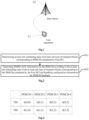
- Fig. 1 is a structural diagram of a network system applicable to some embodiments of the present disclosure.
- the network system includes a user terminal 11 and a base station 12, wherein the user terminal 11 may be a User Equipment (UE), for example a terminal-side device, such as a mobile phone, a Tablet Personal Computer, a Laptop Computer, a personal digital assistant (PDA), a Mobile Internet Device (MID), or a Wearable Device.
- UE User Equipment
- PDA personal digital assistant
- MID Mobile Internet Device
- Wearable Device a Wearable Device.
- the user terminal 11 in the embodiments of the present disclosure is not limited to a specific type.
- the above-mentioned base station 12 may be a base station of Fifth Generation (5G) mobile communications and later versions (for example, gNB, 5G NR NB), or a base station in other communication systems, or is called Node B. It should be noted that, in the embodiments of the present disclosure, only a 5G base station is taken as an example, but the base station 12 is not limited to a specific type.
- 5G Fifth Generation
- Hybrid Automatic Repeat Request acknowledgement (HARQ-ACK) dynamic codebook (type-2) mechanism based on a Physical downlink shared channel (PDSCH) scheduling.
- HARQ-ACK Hybrid Automatic Repeat Request acknowledgement
- type-2 dynamic codebook
- An 5G system in the related art supports a mechanism of generating a dynamic HARQ-ACK codebook, a principle of which is that a DownLink Assignment Index (DAI) indication is added when a scheduling signaling (Downlink control information, DCI) is sent.
- DAI DownLink Assignment Index
- a terminal side calculates, according to counts in the DAI, the number of DCIs and PDSCHs actually transmitted by the base station, thereby determining the number, included in the HARQ-ACK codebook, of PDSCHs needing to be fed back.
- DAI DCI scheduling PDSCHs
- DCI-1 DCI-1 to DCI-9
- j is the number of cycles used by the terminal side to calculate a DAI value (j is added by 1 when a case that the DAI in the current DCI is less than or equal to the DAI in the previous DCI occurs).
- the terminal further calculates, according to the number of scheduled DCIs, the number of transport blocks feeding back the HARQ-ACK, and corresponding number O ACK of bits of a HARQ codebook.
- the number O ACK of bits of the HARQ-ACK codebook fed back on a Physical uplink control channel (PUCCH) by the terminal is equal to the sum of the number of bits of a unicast HARQ sub-codebook and the number of bits of a multicast HARQ sub-codebook.
- O ACK ( unicast ) is the length of a unicast HARQ-ACK sub-codebook
- O ACK(G-RNIT(I)) is the length of a sub-codebook corresponding to G-RNTI (i)
- N is the length of the HARQ-ACK codebook configured by the base station to be fed back on the PUCCH.
- one PDSCH can correspond to one codeword (single codeword) or two codewords (double codewords), which is briefly described below:
- Single codeword for one PDSCH, if one codeword (also called single codeword) is transmitted, then one PDSCH transmits a transport block (TB) (a Cyclic Redundancy Check (CRC) check is performed separately, and a HARQ-ACK needs to be fed back), that is, when feeding back the HARQ-ACK, one HARQ-ACK information is generated, this TB can be described as a first TB (TB 1).
- TB a Cyclic Redundancy Check
- Double codeword for one PDSCH, if two codewords (also called double codewords) are transmitted, then one PDSCH transmits two transport blocks TBs (a CRC check to each of the TBs is performed independently and the HARQ-ACK to the TB is needed), that is, when feeding back the HARQ-ACK, two pieces of HARQ-ACK information are generated; a TB transmitted through a first codeword is called a first TB (TB1) and a TB transmitted through a second codeword is called a second TB (TB2).
- a parameter maxNrofCodeWordsScheduledByDCI indicates the maximum codeword that can be supported when scheduling the PDSCH
- a bundling mechanism of HARQ-ACK feedback by two TBs :
- HARQ-ACK Acknowledgement, ACK
- the standard introduces the bundling mechanism, that is, bits of the two pieces of feedback HARQ-ACK information and operations form a feedback message, such as:
- the terminal feeds back the HARQ-ACK information of two TBs by using the bundling mechanism depends on a configuration indication from the base station. If the base station configures harq-ACK-SpatialBundlingPUCCH, then it indicates that the base station needs to perform a bundling operation on the HARQ-ACK information of two TBs when the HARQ-ACK is fed back, otherwise, feedback is performed separately without performing a bundling operation.
- the embodiments of the present disclosure provide a hybrid automatic repeat request acknowledgement feedback method, a hybrid automatic repeat request acknowledgement feedback device and a terminal device, to solve the problem that reliability of network communication cannot be guaranteed because there is no clear technical solution under the condition of multi-PDSCH transmission scheduling.
- the method and the device are based on the concept of the same application. Since the principles of solving problems by the method and the device are similar, implementation of the device and the method can be referred to each other, and the repeated description thereof will not be described again here.
- the embodiments of the present disclosure provide a hybrid automatic repeat request acknowledgement feedback method, which is executed by a terminal device, and includes steps S201-S202.
- Step S201 determining a scheduling state of at least one type of transport blocks corresponding to multiple physical downlink shared channels (PDSCHs) scheduled by first downlink control information (DCI), wherein the scheduling state includes an enabled state or a disabled state.
- PDSCHs physical downlink shared channels
- DCI downlink control information
- the first DCI refers to any DCI transmitted by a network device, and any one type of transport blocks in the at least one type of transport blocks (or may also be referred to as a series of transport blocks, a group of transport blocks) include transport blocks having the same identifier corresponding to multiple PDSCHs scheduled by the first DCI.
- each PDSCH corresponds to a TB identified as first-TB (also known as TB1) and a TB identified as second-TB (also known as TB2). All TBs identified as the first-TB corresponding to different PDSCHs are regarded as a type of TBs, the number of transport blocks contained in this type of transport blocks is 2 (that is, this type of transport blocks contains the same number of transport blocks as that of the PDSCHs scheduled by the DCI).
- All TBs identified as the second-TB corresponding to different PDSCHs are regarded as a type of TBs, and the number of transport blocks contained in this type of transport blocks is 2 (that is, this type of transport blocks contains the same number of transport blocks as that of the PDSCHs scheduled by the DCI).
- Step S202 generating Hybrid Automatic Repeat Request Acknowledgement (HARQ-ACK) information of the multiple PDSCHs scheduled by the first DCI, according to the scheduling state of the at least one type of transport blocks corresponding to the multiple PDSCHs scheduled by the first DCI and bundling configuration information for PDSCH feedback.
- HARQ-ACK Hybrid Automatic Repeat Request Acknowledgement
- step S201 includes steps S2011-S2012.
- Step S2011 obtaining a scheduling state judgment manner.
- the scheduling state judgment manner includes any one of the following:
- this step S2011 includes at least one of the following:
- the terminal device determines the scheduling state judgement manner by itself. Therefore, in order to enable the network device to also know the scheduling state judgment manner used by the terminal device, the terminal device should send the terminal capability information to the network device, and the terminal capability information includes the scheduling state judgment manner supported by the terminal device.
- Step S2012 determining at least one scheduling state of at least one type of transport blocks corresponding to multiple PDSCHs scheduled by the first DCI according to the scheduling state judgment manner.
- the specific implementation of this step may be: when the network device indicates that multi-codeword transmission is supported, determining a scheduling state of a first type of target transport blocks corresponding to each of the multiple PDSCHs scheduled by the first DCI, according to field information, corresponding to the first type of target transport blocks, in an information field of the first DCI; wherein the first type of target transport blocks is any type of transport blocks of the transport blocks indicated by the information field of the first DCI.
- the scheduling state of a type of transport blocks corresponding to each of the PDSCHs is directly determined according to the field information of the type of transport blocks, and optionally, according to the field information corresponding to the first type of target transport blocks in the information field of the first DCI, determining the scheduling state of the first type of target transport blocks corresponding to the multiple PDSCHs scheduled by the first DCI includes: in a case that the field information corresponding to the first type of target transport blocks in the information field of the first DCI meets a first condition, determining that the scheduling state of the first type of target transport blocks corresponding to each of the multiple PDSCHs scheduled by the first DCI is a disabled state; or in a case that the field information corresponding to the first type of target transport blocks in the information field of the first DCI does not meet a first condition, determining that the scheduling state of the first type of target transport blocks corresponding to each of the multiple PDSCHs scheduled by the first DCI is an enabled state.
- the first condition includes at least one of the following:
- N the maximum number of PDSCHs scheduled by one DCI is N (N is 8, 4, or other values).
- N the maximum number of PDSCHs scheduled by one DCI is N (N is 8, 4, or other values).
- N the maximum number of PDSCHs scheduled by one DCI is N (N is 8, 4, or other values).
- N the maximum number of PDSCHs scheduled by one DCI is N (N is 8, 4, or other values).
- N the maximum number of PDSCHs scheduled by one DCI is N (N is 8, 4, or other values).
- MCS Modulation and Coding Scheme
- a usual practice is to configure indication of the RV for the corresponding PDSCH not being scheduled as 0 or as a randomly configured value.
- the RV for the PDSCH not being scheduled may also be indicated as a specific value (for example, 1), so that flexibility of scheduling parameters of the base station may be improved. It is assumed that the base station uses one DCI to schedule four PDSCHs (the configured maximum number is 8), as follows:
- this step S2011 may be implemented specifically as follows: when the network device indicates that the multi-codeword transmission is supported, determining the scheduling state of a second type of target transport blocks corresponding to the first PDSCH according to field information of the corresponding second type of target transport blocks in the information field of the first DCI; wherein the first PDSCH is any one of multiple PDSCHs scheduled by the first DCI, and the second type of target transport blocks is any type of transport blocks of transport blocks indicated in the information field of the first DCI.
- determination of the scheduling state is performed for a transport block of each PDSCH, and optionally, determining the scheduling state of the second type of target transport blocks corresponding to the first PDSCH according to the field information of the corresponding second type of target transport blocks in the information field of the first DCI includes: in a case that the field information corresponding to the second type of target transport blocks in the information field of the first DCI meets a second condition, determining that the scheduling state of the second type of target transport blocks corresponding to the first PDSCH is a disabled state; or in a case that the field information corresponding to the second type of target transport blocks in the information field of the first DCI does not meet the second condition, determining that the scheduling state of the second type of target transport blocks corresponding to the first PDSCH is an enabled state; wherein the second condition includes at least one of following: C21, a value of bits, corresponding to the first PDSCH, in the indication of MCS is a fourth preset value, optionally, the fourth preset value may
- the first condition includes C21 and C22.
- each of NDI and RV use 1 bit for indication.
- MCS Modulation and Coding Scheme
- Table 3 a correspondence table between RVs corresponding to each PDSCH and TB scheduling states based on the DCI information field.
- Descrip tion TB2 is disabled TB1 is disabled TB1/2 is disabled TB1/2 is disabled TB2 is disabled TB2 is disabled TB2 is disabled TB1 is disabled
- the terminal device determines that the network device does not send transport blocks, for example, when both determination conditions for TB1 and TB2 satisfy the disabled state, the terminal may think that the base station does not transmit any TB.
- the terminal device determines that the scheduling states of the third type of target transport blocks(which is at least one of the transport blocks indicated in the information field of the first DCI) corresponding to the second PDSCH are the disabled state; for example, the protocol may also specify that, for a particular PDSCH, when both judgment conditions of TB1 and TB2 satisfy disabling conditions, only one TB may be in the disabled state by default (e.g., TB2 in the disabled state, TB1 is transmitted).
- the number of TBs to be transmitted can be determined, thereby ensuring that the HARQ-ACK information is generated smoothly.
- step S202 Specific implementation of step S202 is described below.
- bundling configuration information for PDSCH feedback may include the following cases:
- the base station configures one DCI to schedule the maximum number max_PDSCH of PDSCHs.
- the multi-codeword transmission configured by the base station is dual-codeword transmission
- the average bundling of the number of scheduled PDSCHs is adopted in the following cases:
- step S202 is described in detail from the perspective of different configurations.
- step S202 includes at least one of the following:
- generating the HARQ-ACK information according to the third feedback bit, the fourth feedback bit and the fifth feedback bit includes: sequencing the third feedback bit, the fourth feedback bit and the fifth feedback bit in a preset manner to generate the HARQ-ACK information.
- the preset manner includes any one of the following:
- a feedback bit sequence in the HARQ-ACK information obtained according to E121 is arranged as: b (0, 0), b (1, 0), b (0, 1), b (1, 1), b (0, 2), b (1, 2), b (1, 2), b (0, 3), b (1, 3);
- a feedback bit sequence in the HARQ-ACK information obtained according to E122 is arranged as: b (0, 0), b (0, 1), b (0, 2), b (0, 3), b (1, 0), b (1, 1), b (1, 2), b (1, 3).
- step S202 includes steps S2021 to S2023.
- Step S2021 determining a value of a sixth feedback bit corresponding to at least one type of transport blocks corresponding to each PDSCH in the case of configuring multi-codeword transmission.
- the specific implementation in this case includes at least one of the following:
- Step S2022 determining the value of the seventh feedback bit corresponding to each PDSCH according to the value of the sixth feedback bit corresponding to at least one type of transport blocks corresponding to the PDSCH; it should be noted that in this case, the seventh feedback bit corresponding to each PDSCH is obtained by performing an "and" operation on the sixth feedback bits of all types of transport blocks corresponding to the PDSCH, and the seventh feedback bit includes one bit.
- Step S2023 generating the HARQ-ACK information for the multiple PDSCHs according to the seventh feedback bit corresponding to each PDSCH; optionally, in this case, the HARQ-ACK information for the multiple PDSCHs is generated according to the seventh feedback bit corresponding to the scheduled PDSCH or the valid PDSCH. That is, in this case, all valid PDSCHs are fed back.
- the feedback bit sequence in the HARQ-ACK information obtained from Fig. 3 is arranged as (& indicates "bit and"): b (0,0) & b (1,0), b (0,1) & b (1,1), b (0,2) & b (1,2), and b (0,3) & b (1,3).
- Case 1 a case that single-codeword transmission is configured or no codeword transmission is configured.
- step S202 includes steps S2024 to S2027.
- Step S2024 determining the number of PDSCHs scheduled by the first DCI or valid PDSCHs.
- determining the number of PDSCHs scheduled by the first DCI or valid PDSCHs includes: determining the number of PDSCHs scheduled by the first DCI or valid PDSCHs according to the number of PDSCHs actually scheduled obtained in a time-domain scheduling information table indicated by the first DCI.
- Step S2025 grouping the PDSCHs scheduled by the first DCI or the valid PDSCHs.
- the implementation of the grouping in the embodiments of the present disclosure includes at least one of the following:
- Step S2026 bundling the decoding results of PDSCHs in each group after grouping, to obtain an eighth feedback bit.
- Step S2027 generating HARQ-ACK information according to the eighth feedback bit corresponding to each group of PDSCHs.
- step S202 includes steps of S2028 and S2029.
- Step S2028 determining the number of transport blocks included in each type of transport blocks involved in bundling calculation in the PDSCHs scheduled by the first DCI; it should be noted that the specific implementation in this case includes at least one of the following:
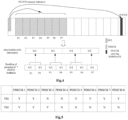
- Fig. 5 For example, in an example that two TBs and eight PDSCHs are scheduled by one DCI, and the scheduling states of the TBs corresponding to each PDSCH are shown in Fig. 5 , where N is the disabled state and Y is the enabled state. Then, according to the calculation method in H31, the obtained number of enabled TBs in TB1 is 6, and the obtained number of enabled TBs in TB2 is 3; according to the calculation method in H32, the obtained number of enabled TBs in TB1 is 7 and the obtained number of enabled TBs of TB2 is 7.
- Step S2029 generating HARQ-ACK information for the multiple PDSCHs according to the number of transport blocks included in each type of transport blocks involved in bundling calculation in the PDSCHs scheduled by the first DCI and a corresponding decoding result.
- generating the HARQ-ACK information for the multiple PDSCHs includes any one of following:
- TB grouping is performed using the manner of H221.
- step S202 includes steps S20210 to S20212.
- Step S20210 determining, for a case of configuring multi-codeword transmission, a value of a sixth feedback bit corresponding to at least one type of transport blocks corresponding to each PDSCH.
- the specific implementation in this case includes at least one of the following:
- Step S20211 determining a value of a seventh feedback bit corresponding to each PDSCH according to the value of the sixth feedback bit corresponding to the at least one type of transport blocks corresponding to each PDSCH.
- an "and" operation is performed on the sixth feedback bits of all types of transport blocks corresponding to each PDSCH, to obtain the seventh feedback bit corresponding to each PDSCH, and the seventh feedback bit includes 1 bit.
- Step S20212 generating HARQ-ACK information for the multiple PDSCHs according to the seventh feedback bit corresponding to each PDSCH.
- the HARQ-ACK information for the multiple PDSCHs is generated according to the seventh feedback bit corresponding to the scheduled PDSCH or the valid PDSCH. That is, in this case, all valid PDSCHs are fed back. Specifically, when the HARQ-ACK information for the multiple PDSCHs is generated. First, the valid PDSCHs or the scheduled PDSCHs need to be ranked and needs to be grouped according to an order of the ranking, to realize bundling of feedback bits belonging to a group of PDSCHs, and then the HARQ-ACK information is generated. Implementation of grouping PDSCHs can be obtained by referring to the grouping method in the above description, and is not describe in detail herein.
- the number N of bits of HARQ-ACK being fed back is determined in advance.
- the terminal needs to fill in predetermined information (such as NACK or ACK).
- predetermined information such as NACK or ACK.
- the base station and the terminal can also use the useless bit information to transmit other information, such as, under the unlicensed spectrum, the terminal feeds back results of channel measurement or channel monitoring on corresponding information bits of the HARQ-ACK.
- the scheduling state of the TB of each PDSCH is determined in a case of multi-PDSCH scheduling, thereby improving the scheduling flexibility of the base station, providing a different bundling technical solution of HARQ-ACKs, making better use of limited feedback information and improving feedback efficiency.
- a manner in which the terminal device sends the HARQ-ACK information should be the same as the manner in which the network device receives and analyzes HARQ-ACK information, to ensure the same understanding between the terminal device and the network device.
- Applicable systems may, for example, be a global system of mobile communication (GSM), a code division multiple access (CDMA) system, a Wideband Code Division Multiple Access (WCDMA) general packet radio service (GPRS) systems, a long term evolution (LTE) system, a LTE frequency division duplex (FDD) system, a LTE time division duplex (TDD) system, a long term evolution advanced (LTE-A) system, a universal mobile telecommunication system (UMTS), a worldwide interoperability for microwave access (WiMAX) system, a 5G New Radio (NR) system, etc.
- GSM global system of mobile communication
- CDMA code division multiple access
- WCDMA Wideband Code Division Multiple Access
- GPRS general packet radio service
- LTE long term evolution
- FDD frequency division duplex
- TDD LTE time division duplex
- LTE-A long term evolution advanced
- UMTS universal mobile telecommunication system
- WiMAX worldwide interoperability for microwave access
- NR 5G
- the terminal device may be a device providing voice and/or data connectivity to a user, a handheld device having a wireless connection function, or other processing device connected to a wireless modem, etc.
- names of terminal devices may be different.
- terminal devices can be called User Equipment (UE).
- UE User Equipment
- a wireless terminal device can communicate with one or more Core Networks (CN) via a Radio Access Network (RAN),
- CN Core Networks
- RAN Radio Access Network
- the wireless terminal device may be a mobile terminal device, such as a mobile telephone (or a "cellular" telephone) and a computer having a mobile terminal device, such as a portable, pocket-sized, hand-held, computer-built or vehicle-mounted mobile device, which exchanges language and/or data with a wireless access network.
- the wireless terminal device may also be referred to as a system, a subscriber unit, a subscriber station, a mobile station, a mobile, a remote station, an access point, a remote terminal, an access terminal, a user terminal, a user agent, and a user device, which are not limited in the embodiments of the present disclosure.
- the network device may be a base station, and the base station may include multiple cells providing services for terminals.
- the base station may also be referred to as an access point, or may be a device, in the access network, that communicates with a wireless terminal device through one or more sectors on the air interface, or another name.
- the network device may be used to exchange received over-the-air frames with Internet Protocol (IP) packets as a router between the wireless terminal device and the rest of the access network, wherein the rest of the access network may include an Internet Protocol (IP) communication network.
- IP Internet Protocol
- the network device can also coordinate attribute management of the air interface.
- the network device may be a network device (Base Transceiver Station, BTS) in the Global System for Mobile Communications (GSM) or Code Division Multiple Access (CDMA), or can be a network device (Node B) in a Wide-band Code Division Multiple Access (WCDMA), an evolutionary Node B, eNB or e-NodeB in a long term evolution (LTE) system, a 5G base station (gNB) in a next generation system, a Home evolved Node B (HeNB), a relay node, a home base station (femto), a pico base station, etc., which are not limited in the embodiments of the present disclosure.
- network devices may include centralized unit (CU) nodes and distributed unit (DU) nodes, which may also be geographically separated.
- MIMO transmission can be carried out between the network device and the terminal device by using one or more antennas respectively, and the MIMO transmission can be a Single User MIMO (SU-MIMO) or a Multiple User MIMO (MU-MIMO).
- the MIMO transmission can be two-dimension MIMO (2D-MIMO), three dimension MIMO (3D-MIMO), Full Dimension MIMO
- FD-MIMO FD-MIMO
- massive-MIMO diversity transmission or pre-coding transmission or beamforming transmission according to a pattern and the number of root antenna combinations.
- the embodiments of the present disclosure provide a Hybrid Automatic Repeat reQuest (HARQ) acknowledgement feedback device 700, which is applied to a terminal device.
- the device includes:
- the first determining unit 701 is configured for: obtaining a scheduling state judgment manner; determining at least one scheduling state of at least one type of transport blocks corresponding to the multiple PDSCHs scheduled by the first DCI according to the scheduling state judgment manner.
- the scheduling state judgment manner includes any one of the following:
- the implementation of obtaining the scheduling state judgment manner includes at least one of the following:
- the device further includes: a sending unit, configured for sending terminal capability information to the network device; wherein, the terminal capability information includes a scheduling state judgment manner supported by the terminal device.
- implementation of determining the scheduling state of at least one type of transport blocks corresponding to the multiple PDSCHs scheduled by the first DCI includes: when the network device indicates that multi-codeword transmission is supported, determining a scheduling state of a first type of target transport blocks corresponding to each of the multiple PDSCHs scheduled by the first DCI, according to field information, corresponding to the first type of target transport blocks, in an information field of the first DCI; wherein the first type of target transport blocks is any type of transport blocks of the transport blocks indicated by the information field of the first DCI.
- implementation of determining the scheduling state of the first type of target transport blocks corresponding to each of the multiple PDSCHs scheduled by the first DCI, according to field information, corresponding to the first type of target transport blocks, in the information field of the first DCI includes: in a case that the field information corresponding to the first type of target transport blocks in the information field of the first DCI meets a first condition, determining that the scheduling state of the first type of target transport blocks corresponding to each of the multiple PDSCHs scheduled by the first DCI is a disabled state; or in a case that the field information corresponding to the first type of target transport blocks in the information field of the first DCI does not meet a first condition, determining that the scheduling state of the first type of target transport blocks corresponding to each of the multiple PDSCHs scheduled by the first DCI is an enabled state.
- the first condition includes at least one of the following:
- implementation of determining the scheduling state of at least one type of transport blocks corresponding to the multiple PDSCHs scheduled by the first DCI includes: when the network device indicates that the multi-codeword transmission is supported, determining the scheduling state of a second type of target transport blocks corresponding to the first PDSCH according to field information of the corresponding second type of target transport blocks in the information field of the first DCI; wherein the first PDSCH is any one of multiple PDSCHs scheduled by the first DCI, and the second type of target transport blocks is any type of transport blocks of transport blocks indicated in the information field of the first DCI.
- implementation of determining the scheduling state of the second type of target transport blocks corresponding to the first PDSCH according to the field information of the corresponding second type of target transport blocks in the information field of the first DCI includes: in a case that the field information corresponding to the second type of target transport blocks in the information field of the first DCI meets a second condition, determining that the scheduling state of the second type of target transport blocks corresponding to the first PDSCH is a disabled state; or in a case that the field information corresponding to the second type of target transport blocks in the information field of the first DCI does not meet the second condition, determining that the scheduling state of the second type of target transport blocks corresponding to the first PDSCH is an enabled state; wherein the second condition includes at least one of following: a value of bits, corresponding to the first PDSCH, in the indication of MCS is a fourth preset value; a value of a bit, corresponding to the first PDSCH, in the indication of RV is a fifth preset value; a value of a bit,
- the device further includes the following:
- the generating unit 702 is configured for implementing at least one of the following:
- implementation of generating the HARQ-ACK information according to the third feedback bit, the fourth feedback bit and the fifth feedback bit includes: sequencing the third feedback bit, the fourth feedback bit and the fifth feedback bit in a preset manner to generate the HARQ-ACK information; wherein the preset manner includes any one of the following:
- the generating unit 702 is configured for implementing the following:
- determining the value of the sixth feedback bit corresponding to at least one type of transport blocks corresponding to each PDSCH includes at least one of following:
- implementation of generating the HARQ-ACK information for the multiple PDSCHs according to the seventh feedback bit corresponding to each PDSCH includes: generating the HARQ-ACK information for the multiple PDSCHs according to the seventh feedback bit corresponding to the scheduled PDSCH or the valid PDSCH.
- the generating unit 702 is configured for implementing the following:
- implementation manner of grouping the PDSCHs scheduled by the first DCI or the valid PDSCHs includes at least one of the following:
- the first manner includes one of the following:
- implementation of determining the number of PDSCHs scheduled by the first DCI or valid PDSCHs includes: determining the number of PDSCHs scheduled by the first DCI or valid PDSCHs according to the number of PDSCHs actually scheduled obtained in a time-domain scheduling information table indicated by the first DCI.
- the generating unit 702 is configured for implementing the following:
- determining the number of transport blocks included in each type of transport blocks involved in bundling calculation in the PDSCHs scheduled by the first DCI, in a case that multi-codeword transmission is configured includes at least one of the following:
- implementation of generating HARQ-ACK information for the multiple PDSCHs according to the number of transport blocks included in each type of transport blocks involved in bundling calculation in the PDSCHs scheduled by the first DCI and the corresponding decoding result includes at least one of the following:
- implementation of generating the HARQ-ACK information for the multiple PDSCHs includes any one of following:
- the device of the embodiments of the present disclosure further includes a transceiver unit, w configured to receive and transmit data.
- the device in the embodiments is a device corresponding to the method in the above embodiments, and all the implementations in the above embodiments for describing the method are applicable to the embodiments describing the device and can achieve the same technical effect.
- each functional unit in each embodiment of the present disclosure may be integrated in one processing unit, or each unit may physically exist separately, or two or more units may be integrated in one unit.
- the integrated unit can be realized in the form of hardware or software functional units.
- the integrated unit if implemented as a software functional unit and sold or used as a separate product, may be stored in a processor-readable storage medium.
- an essential part or a part contributing to the related art of the technical solutions of the present disclosure or all of a part of the technical solutions of the present disclosure may be embodied in the form of a computer software product stored in storage media which includes multiple instructions for causing a computer device (which may be a personal computer, a server, or a network device, etc.) or a processor to perform all or a portion of the steps of the methods described in the various embodiments of the present disclosure.
- the aforementioned storage media include various media capable of storing program codes, such as a U disk, a mobile hard disk, a Read-Only Memory (ROM), a Random Access Memory (RAM), a magnetic disk or an optical disk.
- the embodiments of the present disclosure further provide a terminal device.
- the terminal device includes a processor 800, a transceiver 810, a memory 820, and a program stored on the memory 820 and executable by the processor 800.
- the transceiver 810 is connected to the processor 800 and the memory 820 through a bus interface, wherein the processor 800 is configured to read the program in the memory and execute the following processes:
- the transceiver 810 is configured for receiving and transmitting data under the control of the processor 800.
- the bus architecture may include any number of interconnected buses and bridges, specifically various circuits such as one or more processors represented by the processor 800 and a memory represented by the memory 820 are linked together.
- the bus architecture may also link together various other circuits, such as peripheral devices, voltage regulators, power management circuits, and the like, all of which are well known in the art and thus will not be described further herein.
- a bus interface provides an interface.
- the transceiver 810 may be multiple elements, i.e., including a transmitter and a receiver, providing a unit for communicating with various other devices over a transmission medium.
- the transmission medium includes wireless channels, wired channels, optical fiber cables, and the like.
- a user interface 830 may also be an interface capable of externally connecting to desired devices, the connected devices include, but are not limited to, a keypad, a display, a speaker, a microphone, a joystick, and the like.
- the processor 800 is responsible for managing the bus architecture and general processing.
- the memory 820 may store data used by the processor 800 when performing operations.
- the processor 800 may be a CPU (Central Processing Unit), an ASIC (Application Specific Integrated Circuit), an FPGA (Field-Programmable Gate Array) or a CPLD (Complex Programmable Logic Device).
- the processor can also adopt a multi-core architecture.
- the processor executes any of the methods provided in the embodiments of the present disclosure in accordance with executable instructions obtained by calling a computer program stored in the memory.
- the processor and the memory may also be physically arranged separately.
- processor is configured to call the program in the memory to execute following:
- the scheduling state judgment manner includes any one of the following:
- processor is configured to call the program in the memory to execute at least one of the following:
- the processor is configured to call the program in the memory to execute: sending terminal capability information to the network device through the transceiver; wherein, the terminal capability information includes a scheduling state judgment manner supported by the terminal device.
- the processor is configured to call the program in the memory to execute following: when the network device indicates that multi-codeword transmission is supported, determining a scheduling state of a first type of target transport blocks corresponding to each of the multiple PDSCHs scheduled by the first DCI, according to field information, corresponding to the first type of target transport blocks, in an information field of the first DCI; wherein the first type of target transport blocks is any type of transport blocks of the transport blocks indicated by the information field of the first DCI.
- the processor is configured to call the program in the memory to execute following: in a case that the field information corresponding to the first type of target transport blocks in the information field of the first DCI meets a first condition, determining that the scheduling state of the first type of target transport blocks corresponding to each of the multiple PDSCHs scheduled by the first DCI is a disabled state; or in a case that the field information corresponding to the first type of target transport blocks in the information field of the first DCI does not meet a first condition, determining that the scheduling state of the first type of target transport blocks corresponding to each of the multiple PDSCHs scheduled by the first DCI is an enabled state.
- the first condition includes at least one of the following:
- the processor is configured to call the program in the memory to execute the following: when the network device indicates that the multi-codeword transmission is supported, determining the scheduling state of a second type of target transport blocks corresponding to the first PDSCH according to field information of the corresponding second type of target transport blocks in the information field of the first DCI; wherein the first PDSCH is any one of multiple PDSCHs scheduled by the first DCI, and the second type of target transport blocks is any type of transport blocks of transport blocks indicated in the information field of the first DCI.
- processor is configured to call the program in the memory to execute the following:
- processor is configured to call the program in the memory to execute any one of the following:
- the processor is configured to call the program in the memory to execute further at least one of the following:
- the processor is configured to call the program in the memory to execute the following: sequencing the third feedback bit, the fourth feedback bit and the fifth feedback bit in a preset manner to generate the HARQ-ACK information; wherein the preset manner includes any one of the following:
- the processor is configured to call the program in the memory to execute the following:
- processor is configured to call the program in the memory to execute at least one of following:
- the processor is configured to call the program in the memory to execute the following: generating the HARQ-ACK information for the multiple PDSCHs according to the seventh feedback bit corresponding to the scheduled PDSCH or the valid PDSCH.
- the processor is configured to call the program in the memory to execute the following:
- processor is configured to call the program in the memory to execute at least one of the following:
- the first manner includes one of the following:
- the processor is configured to call the program in the memory to execute the following: determining the number of PDSCHs scheduled by the first DCI or valid PDSCHs according to the number of PDSCHs actually scheduled obtained in a time-domain scheduling information table indicated by the first DCI.
- the processor is configured to call the program in the memory to execute the following:
- processor is configured to call the program in the memory to execute at least one of the following:
- processor is configured to call the program in the memory to execute at least one of the following:
- processor is configured to call the program in the memory to execute any one of following:
- the terminal device in the embodiments may implement all steps in the method in the above embodiments, and can achieve the same technical effect.
- the same part between this embodiment and the above method embodiment and the beneficial effect will not be described in details again.
- Embodiments of the present disclosure also provide a computer readable storage medium having a computer program stored thereon, wherein steps of the hybrid automatic repeat request acknowledgement feedback method applied to a terminal device is implemented when the computer program is executed by a processor.
- the processor-readable storage medium may be any available medium or data storage device that a processor can access, includes, but is not limited to, a magnetic memory (such as a floppy disk, a hard disk, a magnetic tape, a magneto-optical (MO) disk, etc.), an optical memory (such as a Compack Disck (CD), a Digital Versatile Disc (DVD), a Blu-ray Disc (BD), a High-Definition Versatile Disc (HVD), etc.), and a semiconductor memory (such as a Readable Only Memory (ROM), an Erasable Programmable ROM (EPROM), an Electrically EPROM (EEPROM), etc.), a non-volatile memory (NAND FLASH), a solid-state hard disk (Solid State Dis
- the embodiments of the present disclosure may be provided as methods, systems, or computer program products. Accordingly, the present disclosure may take the form of an entirely hardware embodiment, an entirely software embodiment, or some embodiments combining software and hardware aspects.
- the present disclosure may take the form of a computer program product implemented on one or more computer usable storage media (including, but not limited to, a magnetic disk storage, an optical storage, and the like) having computer usable program codes embodied therein.
- the processor-executable instructions may also be stored in a processor-readable memory capable of directing a computer or other programmable data processing device to operate in a particular manner, so that the instructions stored in the processor-readable memory to produce an article of manufacture including an instruction means, the instruction means implements the functions specified in one or more flows of a flow chart or one or more blocks in the block diagram.
- processor-executable instructions may also be loaded onto a computer or other programmable data processing device, such that a series of operational steps are performed on the computer or other programmable device to produce a computer-implemented process, and instructions executed on the computer or other programmable device thereby provide steps for implementing the functions specified in one or more flows of the flowchart and one or more blocks of the block diagram.
- each module above is only a division of logical functions. In actual implementation, the functions can be fully or partially integrated into a physical entity, or can also be physically separated.
- These modules can all be implemented in the form of software invoked by processing components, or can also all be implemented in the form of hardware; some modules can also be implemented in the form of software invoked by processing components, and some modules can be implemented in the form of hardware.
- the determination module can be a separate processing element, or can be integrated into a chip of the above device.
- the software can also be stored in the memory of the above device in the form of program codes, and can be processed by a certain processing element of the above device. Functions of the above determination module can implemented by a certain processing element invoking the program codes.
- each step of the above method or each of the above modules can be completed by integrated logic circuits of hardware in the processor element or software in the form of program codes.
- each module, unit, sub-unit or sub-module may be one or more integrated circuits configured to implement the above method, such as one or more Application Specific Integrated Circuits (ASICs), or one or microprocessors (digital signal processor, DSP), or one or more Field Programmable Gate Arrays (FPGA), etc.
- ASICs Application Specific Integrated Circuits
- DSP digital signal processor
- FPGA Field Programmable Gate Arrays
- the processing element can be a general-purpose processor, such as a central processing unit (Central Processing Unit, CPU) or other processors that can invoke the program codes.
- these modules can be integrated together and implemented in the form of a system-on-a-chip (SOC).
- SOC system-on-a-chip
Landscapes
- Engineering & Computer Science (AREA)
- Signal Processing (AREA)
- Computer Networks & Wireless Communication (AREA)
- Mobile Radio Communication Systems (AREA)
- Detection And Prevention Of Errors In Transmission (AREA)
Abstract
Description
- This application claims a priority to
Chinese Patent Application No. 202111308683.3 filed on November 5, 2021 - The present disclosure relates to the field of communications technology, in particular, relates to a hybrid automatic repeat request acknowledgement feedback method, a hybrid automatic repeat request acknowledgement feedback device and a terminal device.
- A high frequency technology in Release 17 (R17) supports one Downlink Control Information (DCI) schedules multiple Physical downlink shared channels (PDSCH), and also supports transmission of a two-codeword transport block (TB). Meanwhile, in order to reduce a feedback overhead for Hybrid Automatic Repeat Request Acknowledgement (HARQ-ACK), it is also expected that the R17 will support that a bundling method is used for HARQ-ACK feedback for the PDSCHs.
- However, in case of scheduling multi-PDSCH transmission, there is no feasible technical solution for how to obtain HARQ-ACK information.
- The embodiment of the present disclosure provide a Hybrid Automatic Repeat request (HARQ) acknowledgement (ACK) feedback method, a HARQ-ACK feedback device and a terminal device, to solve the problem that reliability of network communication cannot be guaranteed because there is no clear technical solution under the condition of scheduling multi-PDSCH transmission.
- In order to address the above technical problem, the embodiments of the present disclosure provide a HARQ-ACK feedback method performed by a terminal device. The method includes
- determining at least one scheduling state of at least one type of transport blocks corresponding to multiple physical downlink shared channels (PDSCHs) scheduled by first downlink control information (DCI), wherein the at least one scheduling state includes an enabled state or a disabled state;
- generating HARQ-ACK information for the multiple PDSCHs according to the at least one scheduling state of the at least one type of transport blocks corresponding to the multiple PDSCHs scheduled by the first DCI and bundling configuration information for PDSCH feedback;
- wherein any type of transport blocks of the at least one type of transport blocks are transport blocks, having the same identifier, in the multiple PDSCHs scheduled by the first DCI.
- Optionally, determining the at least one scheduling state of the at least one type of transport blocks corresponding to the multiple PDSCHs scheduled by the first DCI includes:
- obtaining a scheduling state judgment manner;
- determining the at least one scheduling state of the at least one type of transport blocks corresponding to the multiple PDSCHs scheduled by the first DCI according to the scheduling state judgment manner;
- wherein scheduling state judgment manner includes any one of the following:
- determining a scheduling state of each type of transport blocks corresponding to each PDSCH the multiple PDSCHs scheduled by the first DCI, in one-time judgment;
- judging a scheduling state of each type of transport blocks corresponding to each PDSCH the multiple PDSCHs scheduled by the first DCI, independently.
- Optionally, obtaining the scheduling state judgment manner includes at least one of following:
- obtaining the scheduling state judgment manner indicated by a network device;
- obtaining the scheduling state judgment manner agreed by a protocol;
- determining the scheduling state judgment manner, according to a scheduling state judgment capability supported by the terminal device.
- Optionally, in case of obtaining the scheduling state judgment manner indicated by the network device or determining the scheduling state judgment manner according to the scheduling state judgment capability supported by the terminal device, the method further includes:
- sending terminal capability information to the network device;
- wherein, the terminal capability information includes a scheduling state judgment manner supported by the terminal device.
- Optionally, when the scheduling state judgment manner is to determine the scheduling state of each type of transport blocks corresponding to the multiple PDSCHs scheduled by the first DCI in one-time judgment, determining the at least one scheduling state of at least one type of transport blocks corresponding to the multiple PDSCHs scheduled by the first DCI includes:
- when the network device indicates that multi-codeword transmission is supported, determining a scheduling state of a first type of target transport blocks corresponding to the multiple PDSCHs scheduled by the first DCI, according to field information, corresponding to the first type of target transport blocks, in an information field of the first DCI;
- wherein the first type of target transport blocks is any type of transport blocks in transport blocks indicated by the information field of the first DCI.
- Optionally, determining the scheduling state of the first type of target transport blocks corresponding to the multiple PDSCHs scheduled by the first DCI, according to field information, corresponding to the first type of target transport blocks, in the information field of the first DCI includes:
- determining that the scheduling state of the first type of target transport blocks corresponding to the multiple PDSCHs scheduled by the first DCI is a disabled state when the field information corresponding to the first type of target transport blocks in the information field of the first DCI meets a first condition; or
- determining that the scheduling state of the first type of target transport blocks corresponding to the multiple PDSCHs scheduled by the first DCI is an enabled state, when the field information corresponding to the first type of target transport blocks in the information field of the first DCI does not meet a first condition;
- wherein the first condition includes at least one of following:
- a value of indication of a Modulation and Coding Scheme (MCS) is a first preset value;
- values of part or all of bits in Redundancy Version (RV) indication are second preset values;
- a value of a New Data Indicator (NDI) is a third preset value.
- Optionally, when the scheduling state judgment manner is to judge the scheduling state of each type of transport blocks corresponding to the multiple PDSCHs scheduled by the first DCI, independently, determining the at least one scheduling state of at least one type of transport blocks corresponding to the multiple PDSCHs scheduled by the first DCI includes:
- determining a scheduling state of a second type of target transport blocks corresponding to a first PDSCH according to field information of the corresponding second type of target transport blocks in an information field of the first DCI, when the network device indicates that multi-codeword transmission is supported;
- wherein the first PDSCH is any PDSCH of the multiple PDSCHs scheduled by the first DCI, and the second type of target transport blocks is any type of transport blocks of transport blocks indicated in the information field of the first DCI.
- Optionally, determining the scheduling state of the second type of target transport blocks corresponding to the first PDSCH according to the field information of the corresponding second type of target transport blocks in the information field of the first DCI includes:
- determining that the scheduling state of the second type of target transport blocks corresponding to the first PDSCH is a disabled state, when the field information corresponding to the second type of target transport blocks in the information field of the first DCI meets a second condition; or
- determining that the scheduling state of the second type of target transport blocks corresponding to the first PDSCH is an enabled state, when the field information corresponding to the second type of target transport blocks in the information field of the first DCI does not meet the second condition;
- wherein the second condition includes at least one of following:
- a value of bits, corresponding to the first PDSCH, in indication of Modulation and Coding Scheme (MCS) is a fourth preset value;
- a value of a bit, corresponding to the first PDSCH, in indication of a Redundancy Version (RV) is a fifth preset value;
- a value of a bit, corresponding to the first PDSCH, in a New Data Indicator (NDI) is a sixth preset value.
- Optionally, after determining the at least one scheduling state of the at least one type of transport blocks corresponding to the multiple PDSCHs scheduled by the first DCI, the method further includes any one of following:
- determining that the network device does not send transport blocks when scheduling states of all corresponding transport blocks in an information field of the first DCI are determined to be a disabled state;
- determining that the scheduling states of a third type of target transport blocks corresponding to a second PDSCH are a disabled state when scheduling states of all transport blocks corresponding to the second PDSCH in an information field of the first DCI are determined to be a disabled state,
- wherein the second PDSCH is any PDSCH scheduled by the first DCI, the third type of target transport blocks is at least one transport block of transport blocks indicated in the information field of the first DCI.
- Optionally, when bundling configuration information is that there is no bundling of feedback information of different types of transport blocks corresponding to the same PDSCH, and there is no bundling of feedback information of different PDSCHs, generating HARQ-ACK information for the multiple PDSCHs according to the at least one scheduling state of the at least one type of transport blocks corresponding to the multiple PDSCHs scheduled by the first DCI and bundling configuration information for PDSCH feedback includes at least one of the following:
- if codeword transmission is not configured or single-codeword transmission is configured, then configuring, to a seventh preset value, a value of a first feedback bit corresponding to a PDSCH not being scheduled, configuring, according to a decoding result, a bit value of a second feedback bit corresponding to a PDSCH being scheduled, and generating the HARQ-ACK information according to the first feedback bit and the second feedback bit;
- if multi-codeword transmission is configured, configuring, to an eighth preset value, a value of a third feedback bit of a Transport Block (TB) corresponding to a PDSCH not being scheduled, configuring, to the eighth preset value, a value of a fourth feedback bit corresponding to a transport block in a disabled state corresponding to a PDSCH being scheduled; configuring, according to a decoding result, a bit value of a fifth feedback bit corresponding to a transport block in an enabled state corresponding to the PDSCH being scheduled, and generating the HARQ-ACK information according to the third feedback bit, the fourth feedback bit and the fifth feedback bit.
- Optionally, generating the HARQ-ACK information according to the third feedback bit, the fourth feedback bit and the fifth feedback bit includes:
- sequencing the third feedback bit, the fourth feedback bit and the fifth feedback bit in a preset manner to generate the HARQ-ACK information;
- wherein the preset manner includes any one of the following:
- sequencing the third feedback bit, the fourth feedback bit and the fifth feedback bit according to a rule of codewords being in an ascending order first and then PDSCHs being in an ascending order;
- sequencing the third feedback bit, the fourth feedback bit and the fifth feedback bit according to a rule of PDSCHs being in an ascending order first and then codewords being in an ascending order.
- Optionally, when the bundling configuration information is that there is bundling of feedback information of different types of transport blocks corresponding to the same PDSCH and there is no bundling of feedback information of different PDSCHs, or there is bundling of feedback information of different types of transport blocks corresponding to the same PDSCH and there is bundling of feedback information of different PDSCHs, generating the HARQ-ACK information for the multiple PDSCHs according to the at least one scheduling state of the at least one type of transport blocks corresponding to the multiple PDSCHs scheduled by the first DCI and bundling configuration information for PDSCH feedback includes:
- determining a value of a sixth feedback bit corresponding to at least one type of transport blocks corresponding to each PDSCH when configuring multi-codeword transmission;
- determining a value of a seventh feedback bit corresponding to each PDSCH according to the value of the sixth feedback bit corresponding to at least one type of transport blocks corresponding to each PDSCH;
- generating the HARQ-ACK information for the multiple PDSCHs according to the seventh feedback bit corresponding to each PDSCH.
- Optionally, determining the value of the sixth feedback bit corresponding to at least one type of transport blocks corresponding to each PDSCH includes at least one of following:
- when a third PDSCH needs to transmit at least one type of transport blocks, setting, to a ninth preset value, the value of the sixth feedback bit of the transport block not transmitted;
- when a fourth PDSCH needs to transmit at least one type of transport blocks and all the transport blocks corresponding to the fourth PDSCH are not transmitted, setting, to a tenth preset value, the values of the sixth feedback bits of all the transport blocks corresponding to the fourth PDSCH;
- setting, according to a decoding result, a bit value of the sixth feedback bit of a transport block scheduled for transmission corresponding to a fifth PDSCH;
- setting the sixth feedback bit corresponding to the transport block in the disable state to an eleventh preset value;
- for a sixth PDSCH which is not scheduled or which is invalidly scheduled, setting a sixth feedback bit of a transport block corresponding to the sixth PDSCH to a twelfth preset value.
- Optionally, generating the HARQ-ACK information for the multiple PDSCHs according to the seventh feedback bit corresponding to each PDSCH includes:
generating the HARQ-ACK information for the multiple PDSCHs according to the seventh feedback bit corresponding to the scheduled PDSCH or the valid PDSCH. - Optionally, when the bundling configuration information is that there is no bundling of feedback information of different types of transport blocks corresponding to the same PDSCH and there is bundling of feedback information of different PDSCHs, generating the HARQ-ACK information for the multiple PDSCHs according to the at least one scheduling state of the at least one type of transport blocks corresponding to the multiple PDSCHs scheduled by the first DCI and bundling configuration information for PDSCH feedback includes:
- determining a quantity of PDSCHs scheduled by the first DCI or valid PDSCHs, when single-codeword transmission is configured or no codeword transmission is configured;
- grouping PDSCHs scheduled by the first DCI or valid PDSCHs;
- bundling decoding results of PDSCHs in each group after grouping, to obtain an eighth feedback bit;
- generating the HARQ-ACK information according to the eighth feedback bit corresponding to each group of PDSCHs.
- Optionally, grouping the PDSCHs scheduled by the first DCI or the valid PDSCHs includes at least one of the following:
- if X is less than or equal to N, determining that Y is equal to X, and each group corresponds to one PDSCH;
- if X is greater than N, determining that Y is equal to N, and determining the number of PDSCHs corresponding to each group in a first manner;
- wherein, X is a quantity of valid PDSCHs or scheduled PDSCHs, Y is a quantity of groups, N is a quantity of bits of the HARQ-ACK information to be fed back, and both X and Y are integers greater than or equal to 1;
- wherein the first manner includes one of the following:
- each bit of first (X mod N) bits in the HARQ-ACK information corresponds to a bundling result of decoding results of


- each bit of last (X mod N) bits in the HARQ-ACK information corresponds to a bundling result of decoding results of


- wherein 'Mod' represents finding a remainder, and

- each bit of first (X mod N) bits in the HARQ-ACK information corresponds to a bundling result of decoding results of
- Optionally, determining the quantity of PDSCHs scheduled by the first DCI or the valid PDSCHs includes:
determining the quantity of PDSCHs scheduled by the first DCI or the valid PDSCHs according to a quantity of PDSCHs actually scheduled, the quantity of PDSCHs actually scheduled being obtained in a time-domain scheduling information table indicated by the first DCI. - Optionally, when the bundling configuration information is that there is no bundling of feedback information of different types of transport blocks corresponding to the same PDSCH and there is bundling of feedback information of different PDSCH, generating the HARQ-ACK information for the multiple PDSCHs according to the at least one scheduling state of the at least one type of transport blocks corresponding to the multiple PDSCHs scheduled by the first DCI and bundling configuration information for PDSCH feedback includes:
- determining a quantity of transport blocks included in each type of transport blocks, involved in bundling calculation, in the PDSCHs scheduled by the first DCI, when multi-codeword transmission is configured;
- generating the HARQ-ACK information for the multiple PDSCHs according to the quantity of transport blocks included in each type of transport blocks, involved in bundling calculation, in the PDSCHs scheduled by the first DCI and a corresponding decoding result.
- Optionally, determining the quantity of transport blocks included in each type of transport blocks, involved in bundling calculation, in the PDSCHs scheduled by the first DCI when multi-codeword transmission is configured includes at least one of following:
- determining the quantity of transport blocks included in each type of transport blocks according to a quantity of actually scheduled PDSCHs or valid PDSCHs and scheduling states of the transport blocks;
- uniformly calculating a quantity of transport blocks included in each type of transport blocks according to a quantity of actually scheduled PDSCHs or valid PDSCHs and the scheduling states of the transport blocks, wherein the quantities of transport blocks included in different types of transport blocks are the same.
- Optionally, generating the HARQ-ACK information for the multiple PDSCHs according to the quantity of transport blocks included in each type of transport blocks, involved in bundling calculation, in the PDSCHs scheduled by the first DCI and the corresponding decoding result includes at least one of the following:
- according to the quantity of transport blocks included in each type of transport blocks and the corresponding decoding result, bundling decoding results of each type of transport blocks to generate a bit sequence corresponding to each type of transport block;
- adding up the quantities of transport blocks included in different types of transport blocks, and according to the quantity of all transport blocks after the adding, bundling the decoding results of all transport blocks to generate multiple feedback bits.
- Optionally, generating the HARQ-ACK information for the multiple PDSCHs includes any one of following:
- generating the HARQ-ACK information for the multiple PDSCHs by sequencing the feedback bits according to a rule of codewords being in an ascending order first and then PDSCHs being in an ascending order;
- generating the HARQ-ACK information for the multiple PDSCHs by sequencing the feedback bits according to a rule of PDSCHs being in an ascending order first and then codewords being in an ascending order.
- The embodiments of the present disclosure further provide a terminal device. The terminal device includes a memory, a transceiver, and a processor, the memory is configured to store a computer program, the transceiver is configured to send and/or receive data under control of the processor, and the processor is configured to read the computer program in the memory to implement following:
- determining at least one scheduling state of at least one type of transport blocks corresponding to multiple physical downlink shared channels (PDSCHs) scheduled by first downlink control information (DCI), wherein the at least one scheduling state includes an enabled state or a disabled state;
- generating Hybrid Automatic Repeat reQuest acknowledgement (HARQ-ACK) information of the multiple PDSCHs according to the at least one scheduling state of the at least one type of transport blocks corresponding to the multiple PDSCHs scheduled by the first DCI and bundling configuration information for PDSCH feedback;
- wherein any type of transport blocks of the at least one type of transport blocks are transport blocks, having the same identifier, in the multiple PDSCHs scheduled by the first DCI.
- Optionally, the processor is configured to read the computer program in the memory to implement following:
- obtaining a scheduling state judgment manner;
- determining the at least one scheduling state of the at least one type of transport blocks corresponding to the multiple PDSCHs scheduled by the first DCI according to the scheduling state judgment manner;
- wherein scheduling state judgment manner includes any one of the following:
- determining a scheduling state of each type of transport blocks corresponding to each PDSCH of the multiple PDSCHs scheduled by the first DCI, in one-time judgment;
- judging a scheduling state of each type of transport blocks corresponding to each PDSCH the multiple PDSCHs scheduled by the first DCI, independently.
- Optionally, the processor is configured to read the computer program in the memory to implement at least one of following:
- obtaining the scheduling state judgment manner indicated by a network device;
- obtaining the scheduling state judgment manner agreed by a protocol;
- determining the scheduling state judgment manner, according to a scheduling state judgment capability supported by the terminal device.
- Optionally, in case of obtaining the scheduling state judgment manner indicated by the network device or determining the scheduling state judgment manner according to the scheduling state judgment capability supported by the terminal device, the processor is configured to read the computer program in the memory to further implement following:
- sending terminal capability information to the network device through the transceiver;
- wherein, the terminal capability information includes a scheduling state judgment manner supported by the terminal device.
- Optionally, when the scheduling state judgment manner is to determine the scheduling state of each type of transport blocks corresponding to the multiple PDSCHs scheduled by the first DCI in one-time judgment, the processor is configured to read the computer program in the memory to implement following:
- when the network device indicates that multi-codeword transmission is supported, determining a scheduling state of a first type of target transport blocks corresponding to the multiple PDSCHs scheduled by the first DCI, according to field information, corresponding to the first type of target transport blocks, in an information field of the first DCI;
- wherein the first type of target transport blocks is any type of transport blocks in transport blocks indicated by the information field of the first DCI.
- Optionally, the processor is configured to read the computer program in the memory to implement following:
- determining that the scheduling state of the first type of target transport blocks corresponding to the multiple PDSCHs scheduled by the first DCI is a disabled state when the field information corresponding to the first type of target transport blocks in the information field of the first DCI meets a first condition; or
- determining that the scheduling state of the first type of target transport blocks corresponding to the multiple PDSCHs scheduled by the first DCI is an enabled state, when the field information corresponding to the first type of target transport blocks in the information field of the first DCI does not meet a first condition;
- wherein the first condition includes at least one of following:
- a value of indication of a Modulation and Coding Scheme (MCS) is a first preset value;
- values of part or all of bits in Redundancy Version (RV) indication are second preset values;
- a value of a New Data Indicator (NDI) is a third preset value.
- Optionally, when the scheduling state judgment manner is to judge the scheduling state of each type of transport blocks corresponding to the multiple PDSCHs scheduled by the first DCI, independently, the processor is configured to read the computer program in the memory to implement following:
- determining a scheduling state of a second type of target transport blocks corresponding to a first PDSCH according to field information of the corresponding second type of target transport blocks in an information field of the first DCI, when the network device indicates that multi-codeword transmission is supported;
- wherein the first PDSCH is any PDSCH of the multiple PDSCHs scheduled by the first DCI, and the second type of target transport blocks is any type of transport blocks of transport blocks indicated in the information field of the first DCI.
- Optionally, the processor is configured to read the computer program in the memory to implement following:
- determining that the scheduling state of the second type of target transport blocks corresponding to the first PDSCH is a disabled state, when the field information corresponding to the second type of target transport blocks in the information field of the first DCI meets a second condition; or
- determining that the scheduling state of the second type of target transport blocks corresponding to the first PDSCH is an enabled state, when the field information corresponding to the second type of target transport blocks in the information field of the first DCI does not meet the second condition;
- wherein the second condition includes at least one of following:
- a value of bits, corresponding to the first PDSCH, in indication of Modulation and Coding Scheme (MCS) is a fourth preset value;
- a value of a bit, corresponding to the first PDSCH, in indication of a Redundancy Version (RV) is a fifth preset value;
- a value of a bit, corresponding to the first PDSCH, in a New Data Indicator (NDI) is a sixth preset value.
- Optionally, the processor is configured to read the computer program in the memory to further implement any one of following:
- determining that the network device does not send transport blocks when scheduling states of all corresponding transport blocks in an information field of the first DCI are determined to be a disabled state;
- determining that the scheduling states of a third type of target transport blocks corresponding to a second PDSCH are a disabled state when scheduling states of all transport blocks corresponding to the second PDSCH in an information field of the first DCI are determined to be a disabled state,
- wherein the second PDSCH is any PDSCH scheduled by the first DCI, the third type of target transport blocks is at least one transport block of transport blocks indicated in the information field of the first DCI.
- Optionally, when the bundling configuration information is that there is no bundling of feedback information of different types of transport blocks corresponding to the same PDSCH, and there is no bundling of feedback information of different PDSCHs, the processor is configured to read the computer program in the memory to further implement at least one of following::
- if codeword transmission is not configured or single-codeword transmission is configured, then configuring, to a seventh preset value, a value of a first feedback bit corresponding to a PDSCH not being scheduled, configuring, according to a decoding result, a bit value of a second feedback bit corresponding to a PDSCH being scheduled, and generating the HARQ-ACK information according to the first feedback bit and the second feedback bit;
- if multi-codeword transmission is configured, configuring, to an eighth preset value, a value of a third feedback bit of a Transport Block (TB) corresponding to a PDSCH not being scheduled, configuring, to the eighth preset value, a value of a fourth feedback bit corresponding to a transport block in a disabled state corresponding to a PDSCH being scheduled; configuring, according to a decoding result, a bit value of a fifth feedback bit corresponding to a transport block in an enabled state corresponding to the PDSCH being scheduled, and generating the HARQ-ACK information according to the third feedback bit, the fourth feedback bit and the fifth feedback bit.
- Optionally, the processor is configured to read the computer program in the memory to implement following:
- sequencing the third feedback bit, the fourth feedback bit and the fifth feedback bit in a preset manner to generate the HARQ-ACK information;
- wherein the preset manner includes any one of the following:
- sequencing the third feedback bit, the fourth feedback bit and the fifth feedback bit according to a rule of codewords being in an ascending order first and then PDSCHs being in an ascending order;
- sequencing the third feedback bit, the fourth feedback bit and the fifth feedback bit according to a rule of PDSCHs being in an ascending order first and then codewords being in an ascending order.
- Optionally, when the bundling configuration information is that there is bundling of feedback information of different types of transport blocks corresponding to the same PDSCH and there is no bundling of feedback information of different PDSCHs, or there is bundling of feedback information of different types of transport blocks corresponding to the same PDSCH and there is bundling of feedback information of different PDSCHs, the processor is configured to read the computer program in the memory to implement following:
- determining a value of a sixth feedback bit corresponding to at least one type of transport blocks corresponding to each PDSCH when configuring multi-codeword transmission;
- determining a value of a seventh feedback bit corresponding to each PDSCH according to the value of the sixth feedback bit corresponding to at least one type of transport blocks corresponding to each PDSCH;
- generating the HARQ-ACK information for the multiple PDSCHs according to the seventh feedback bit corresponding to each PDSCH.
- Optionally, the processor is configured to read the computer program in the memory to implement at least one of following:
- when a third PDSCH needs to transmit at least one type of transport blocks, setting, to a ninth preset value, the value of the sixth feedback bit of the transport block not transmitted;
- when a fourth PDSCH needs to transmit at least one type of transport blocks and all the transport blocks corresponding to the fourth PDSCH are not transmitted, setting, to a tenth preset value, the values of the sixth feedback bits of all the transport blocks corresponding to the fourth PDSCH;
- setting, according to a decoding result, a bit value of the sixth feedback bit of a transport block scheduled for transmission corresponding to a fifth PDSCH;
- setting the sixth feedback bit corresponding to the transport block in the disable state to an eleventh preset value;
- for a sixth PDSCH which is not scheduled or which is invalidly scheduled, setting a sixth feedback bit of a transport block corresponding to the sixth PDSCH to a twelfth preset value.
- Optionally, the processor is configured to read the computer program in the memory to implement following:
generating the HARQ-ACK information for the multiple PDSCHs according to the seventh feedback bit corresponding to the scheduled PDSCH or the valid PDSCH. - Optionally, when the bundling configuration information is that there is no bundling of feedback information of different types of transport blocks corresponding to the same PDSCH and there is bundling of feedback information of different PDSCHs, the processor is configured to read the computer program in the memory to implement following:
- determining a quantity of PDSCHs scheduled by the first DCI or valid PDSCHs, when single-codeword transmission is configured or no codeword transmission is configured;
- grouping PDSCHs scheduled by the first DCI or valid PDSCHs;
- bundling decoding results of PDSCHs in each group after grouping, to obtain an eighth feedback bit;
- generating the HARQ-ACK information according to the eighth feedback bit corresponding to each group of PDSCHs.
- Optionally, the processor is configured to read the computer program in the memory to implement at least one of following:
- if X is less than or equal to N, determining that Y is equal to X, and each group corresponds to one PDSCH;
- if X is greater than N, determining that Y is equal to N, and determining the number of PDSCHs corresponding to each group in a first manner;
- wherein, X is a quantity of valid PDSCHs or scheduled PDSCHs, Y is a quantity of groups, N is a quantity of bits of the HARQ-ACK information to be fed back, and both X and Y are integers greater than or equal to 1;
- wherein the first manner includes one of the following:
- each bit of the first (X mod N) bits in the HARQ-ACK information corresponds to a bundling result of decoding results of


- each of the last (X mod N) bits in the HARQ-ACK information corresponds to a bundling result of decoding results of


- wherein 'Mod' represents finding a remainder, and

- each bit of the first (X mod N) bits in the HARQ-ACK information corresponds to a bundling result of decoding results of
- Optionally, the processor is configured to read the computer program in the memory to implement following:
determining the quantity of PDSCHs scheduled by the first DCI or valid PDSCHs according to a quantity of PDSCHs actually scheduled, the quantity of PDSCHs actually scheduled being obtained in a time-domain scheduling information table indicated by the first DCI. - Optionally, when the bundling configuration information is that there is no bundling of feedback information of different types of transport blocks corresponding to the same PDSCH and there is bundling of feedback information of different PDSCH, the processor is configured to read the computer program in the memory to implement following:
- determining a quantity of transport blocks included in each type of transport blocks, involved in bundling calculation, in the PDSCHs scheduled by the first DCI, when multi-codeword transmission is configured;
- generating the HARQ-ACK information for the multiple PDSCHs according to the quantity of transport blocks included in each type of transport blocks, involved in bundling calculation, in the PDSCHs scheduled by the first DCI and a corresponding decoding result.
- Optionally, the processor is configured to read the computer program in the memory to implement at least one of following:
- determining the quantity of transport blocks included in each type of transport blocks according to a quantity of actually scheduled PDSCHs or valid PDSCHs and scheduling states of the transport blocks;
- uniformly calculating a quantity of transport blocks included in each type of transport blocks according to a quantity of actually scheduled PDSCHs or valid PDSCHs and the scheduling states of the transport blocks, wherein the quantities of transport blocks included in different types of transport blocks are the same.
- Optionally, the processor is configured to read the computer program in the memory to implement at least one of following:
- according to the quantity of transport blocks included in each type of transport blocks and the corresponding decoding result, bundling decoding results of each type of transport blocks to generate a bit sequence corresponding to each type of transport block;
- adding up the quantities of transport blocks included in different types of transport blocks, and according to the quantity of all transport blocks after the adding, bundling the decoding results of all transport blocks to generate multiple feedback bits.
- Optionally, the processor is configured to read the computer program in the memory to implement any one of following:
- generating the HARQ-ACK information for the multiple PDSCHs by sequencing the feedback bits according to a rule of codewords being in an ascending order first and then PDSCHs being in an ascending order;
- generating the HARQ-ACK information for the multiple PDSCHs by sequencing the feedback bits according to a rule of PDSCHs being in an ascending order first and then codewords being in an ascending order.
- The embodiments of the present disclosure further provide a HARQ-ACK feedback apparatus which is applied to a terminal device. The apparatus includes:
- a first determining unit, configured for determining at least one scheduling state of at least one type of transport blocks corresponding to multiple physical downlink shared channels (PDSCHs) scheduled by first downlink control information (DCI), wherein the at least one scheduling state includes an enabled state or a disabled state;
- a generating unit, configured for generating HARQ-ACK information for the multiple PDSCHs according to the at least one scheduling state of the at least one type of transport blocks corresponding to the multiple PDSCHs scheduled by the first DCI and bundling configuration information for PDSCH feedback;
- wherein any type of transport blocks of the at least one type of transport blocks are transport blocks, having the same identifier, in the multiple PDSCHs scheduled by the first DCI.
- The embodiments of the present disclosure further provide a processor-readable storage medium. The processor-readable storage medium stores a computer program, wherein when the computer program is executed by a processor, the processor implements the method described above.
- Beneficial effects of the present disclosure are:
by using the above technical solutions, the HARQ-ACK information is obtained by first determining the scheduling states of the transport blocks of PDSCHs scheduled by the DCI, and then according to the scheduling states of the transport blocks and the bundling configuration information for the PDSCH feedback. Therefore, the technical solution of obtaining the HARQ-ACK information in the case of scheduling multi-PDSCH transmission is improved, and the reliability of network communication is ensured. - In order to more clearly explain technical solutions in embodiments of the present disclosure or the related art, drawings that need to be used in description of the embodiments or the related art will be briefly introduced below. Obviously, the drawings in the following description are only some of the embodiments described in the present disclosure, and other drawings may be obtained from these drawings without paying any creative labor by those skilled in the art.
-
Fig. 1 shows a structural diagram of a network system suitable for some embodiments of the present disclosure; -
Fig. 2 is a flowchart of a hybrid automatic repeat request acknowledgement feedback method according to some embodiments of the present disclosure; -
Fig. 3 shows a schematic diagram of feedback bits of each TB corresponding to each PDSCH; -
Fig. 4 shows a schematic diagram of PDSCH group bundling; -
Fig. 5 is a schematic diagram of a scheduling state of a TB corresponding to each PDSCH; -
Fig. 6 shows a schematic diagram of a scheduling state of each TB and TB group bundling; -
Fig. 7 shows a block diagram of a hybrid automatic repeat request acknowledgement feedback device according to some embodiments of the present disclosure; -
Fig. 8 shows a structural diagram of a terminal device according to some embodiments of the present disclosure. - The technical solutions in the embodiments of the present disclosure will be clearly and completely described below with reference to the drawings in the embodiments of the present disclosure. Obviously, the described embodiments are part of the embodiments of the present disclosure, not all of the embodiments. Based on the embodiments in the present disclosure, all other embodiments obtained by those skilled in the art without paying creative work belong to the protection scope of the present disclosure.
- Such terms as "first," "second," etc. in the specification and claims of the present disclosure are used to distinguish similar objects, but are not necessarily used to describe a particular order or order of precedence. It should be understood that the terms used in this way may be interchanged where appropriate so that the embodiments of the present disclosure described herein may be implemented in an order other than those illustrated or described herein. Furthermore, such terms as "including" and "having," and any variations thereof, are intended to cover non-exclusive inclusion, for example, a process, method, system, product or device including a series of steps or units need not be limited to those steps or units that are clearly listed, but may include other steps or elements that are not explicitly listed or inherent to the process, method, product or device.
- In some embodiments of the present disclosure, a term "and/or" describes an association relationship of connected objects, meaning that there can be three relationship, for example, A and/or B can mean three cases in which A exists alone, A and B exist simultaneously, and B exists alone. Such character '/' generally indicates that objects connected by this character is an "OR" relationship. In the embodiments of the present disclosure, terms "multiple" or "a plurality of" refer to two or more, and other quantifiers are similar.
- In the embodiments of the present disclosure, such words as "exemplary" or "such as" are used to denote examples, illustrations, or descriptions. Any embodiment or design that is described as "exemplary" or "such as" in the embodiments of the present disclosure should not be construed as being more preferred or advantageous than other embodiments or designs. Rather, use of the words "exemplary" or "such as" is intended to present related concepts in a specific manner.
- Embodiments of the present disclosure are described below with reference to the drawings. The hybrid automatic repeat request acknowledgement feedback method, the hybrid automatic repeat request acknowledgement feedback method device and a terminal device provided in the embodiments of the present disclosure can be applied to a wireless communication system. The wireless communication system may be a system adopting the fifth generation (5th Generation, 5G) mobile communication technology (hereinafter referred to simply as a 5G system), and those skilled in the art can understand that the 5G NR system is merely an example and not a limitation.
- Referring to
Fig. 1, Fig. 1 is a structural diagram of a network system applicable to some embodiments of the present disclosure. As shown inFig. 1 , the network system includes auser terminal 11 and abase station 12, wherein theuser terminal 11 may be a User Equipment (UE), for example a terminal-side device, such as a mobile phone, a Tablet Personal Computer, a Laptop Computer, a personal digital assistant (PDA), a Mobile Internet Device (MID), or a Wearable Device. It should be noted that theuser terminal 11 in the embodiments of the present disclosure is not limited to a specific type. The above-mentionedbase station 12 may be a base station of Fifth Generation (5G) mobile communications and later versions (for example, gNB, 5G NR NB), or a base station in other communication systems, or is called Node B. It should be noted that, in the embodiments of the present disclosure, only a 5G base station is taken as an example, but thebase station 12 is not limited to a specific type. - Some concepts related to the embodiments of the present disclosure are first described below.
- First, a Hybrid Automatic Repeat Request acknowledgement (HARQ-ACK) dynamic codebook (type-2) mechanism based on a Physical downlink shared channel (PDSCH) scheduling.
- An 5G system in the related artsupports a mechanism of generating a dynamic HARQ-ACK codebook, a principle of which is that a DownLink Assignment Index (DAI) indication is added when a scheduling signaling (Downlink control information, DCI) is sent. A terminal side calculates, according to counts in the DAI, the number of DCIs and PDSCHs actually transmitted by the base station, thereby determining the number, included in the HARQ-ACK codebook, of PDSCHs needing to be fed back.
- A process is described below in a single carrier scenario (with Counter Downlink Assignment Index (C-DAI) only).
- It is assumed that the base station transmits 9 DCIs scheduling PDSCHs, i.e., DCI-1 to DCI-9, respectively. A bit width of counting in DAI is 2 bits, i.e., a maximum counting range is TD = 4. j is the number of cycles used by the terminal side to calculate a DAI value (j is added by 1 when a case that the DAI in the current DCI is less than or equal to the DAI in the previous DCI occurs).
- According to the current DAI counting mechanism, the terminal may calculate the number of DCIs sent by the base station, and a calculation method is as follows:

where
- When the base station schedules codebook feedback which supports a multicast, the number O ACK of bits of the HARQ-ACK codebook fed back on a Physical uplink control channel (PUCCH) by the terminal is equal to the sum of the number of bits of a unicast HARQ sub-codebook and the number of bits of a multicast HARQ sub-codebook. For example, O ACK = O ACK(unicast) +

- Second, multi-codeword transmission based on single PDSCH scheduling
- When scheduling data in a physical layer, one PDSCH can correspond to one codeword (single codeword) or two codewords (double codewords), which is briefly described below:
- Single codeword: for one PDSCH, if one codeword (also called single codeword) is transmitted, then one PDSCH transmits a transport block (TB) (a Cyclic Redundancy Check (CRC) check is performed separately, and a HARQ-ACK needs to be fed back), that is, when feeding back the HARQ-ACK, one HARQ-ACK information is generated, this TB can be described as a first TB (TB 1).
- Double codeword: for one PDSCH, if two codewords (also called double codewords) are transmitted, then one PDSCH transmits two transport blocks TBs (a CRC check to each of the TBs is performed independently and the HARQ-ACK to the TB is needed), that is, when feeding back the HARQ-ACK, two pieces of HARQ-ACK information are generated; a TB transmitted through a first codeword is called a first TB (TB1) and a TB transmitted through a second codeword is called a second TB (TB2).
- In a technical standard, when configuring a PDSCH, a parameter maxNrofCodeWordsScheduledByDCI indicates the maximum codeword that can be supported when scheduling the PDSCH;
- when maxNrofCodeWordsScheduledByDCI=2, it means that two-codeword scheduling is supported;
- when maxNrofCodeWordsScheduledByDCI=1 or is not configured, only one-codeword scheduling is supported.
- It should be noted that, if maxNrofCodeWordsScheduledByDCI=2 is configured by the base station, then in an actual scheduling process, one PDSCH may transmit one transport block or two transport blocks, which is indicated in the scheduling signaling DCI (such as a modulation format MCS = 26 and a redundant version supporting RV=1 indicate that a corresponding TB is not transmitted, this is also called 'disable'). In this case, the standard thinks that the base station can only use MCS=26/RV=1 for indication of one TB, to support that one TB is not transmitted.
- When one PDSCH supports two-codeword transmission, two pieces of HARQ-ACK (Acknowledgement, ACK) information need to be fed back. In order to reduce the amount of HARQ-ACK information, the standard introduces the bundling mechanism, that is, bits of the two pieces of feedback HARQ-ACK information and operations form a feedback message, such as:
- HARQ-ACK (TB1) = NACK (= 0), HARQ-ACK (TB2) = ACK (= 1), then the message after the bundling is "0" bit and " 1"=0;
- HARQ-ACK (TB1) = ACK (= 1), HARQ-ACK (TB2) = ACK (= 1), then the message after the bundling is: "1" bit and "1" = 1;
- although the bundling mechanism can reduce the overhead of feedback bits, its shortcomings lead to invalid retransmission by the base station. The reason is that as long as there is an error in decoding one TB (Negative Acknowledgement (NACK) is fed back), the terminal will feed back the NACK, resulting in that the base station may retransmit both TBs.
- It should be noted that whether the terminal feeds back the HARQ-ACK information of two TBs by using the bundling mechanism depends on a configuration indication from the base station. If the base station configures harq-ACK-SpatialBundlingPUCCH, then it indicates that the base station needs to perform a bundling operation on the HARQ-ACK information of two TBs when the HARQ-ACK is fed back, otherwise, feedback is performed separately without performing a bundling operation.
- In the existing standards, there is only a HARQ-ACK feedback mode for determination of enabling/disnabling transmission codewords and for bundling between codewords in a single-PDSCH scheduling scenario, and the technical solution corresponding to this scenario cannot be directly applied to multi-PDSCH transmission.
- The embodiments of the present disclosure provide a hybrid automatic repeat request acknowledgement feedback method, a hybrid automatic repeat request acknowledgement feedback device and a terminal device, to solve the problem that reliability of network communication cannot be guaranteed because there is no clear technical solution under the condition of multi-PDSCH transmission scheduling.
- The method and the device are based on the concept of the same application. Since the principles of solving problems by the method and the device are similar, implementation of the device and the method can be referred to each other, and the repeated description thereof will not be described again here.
- As shown in
Fig. 2 , the embodiments of the present disclosure provide a hybrid automatic repeat request acknowledgement feedback method, which is executed by a terminal device, and includes steps S201-S202. - Step S201: determining a scheduling state of at least one type of transport blocks corresponding to multiple physical downlink shared channels (PDSCHs) scheduled by first downlink control information (DCI), wherein the scheduling state includes an enabled state or a disabled state.
- It should be noted that "multiple" or "multiple" referred to in the embodiments of the present disclosure refers to two or more; the first DCI refers to any DCI transmitted by a network device, and any one type of transport blocks in the at least one type of transport blocks (or may also be referred to as a series of transport blocks, a group of transport blocks) include transport blocks having the same identifier corresponding to multiple PDSCHs scheduled by the first DCI. Because the TB corresponding to each PDSCH will have a TB identifier, for example, in a case where the first DCI schedules two types of transport blocks, each PDSCH corresponds to a TB identified as first-TB (also known as TB1) and a TB identified as second-TB (also known as TB2). All TBs identified as the first-TB corresponding to different PDSCHs are regarded as a type of TBs, the number of transport blocks contained in this type of transport blocks is 2 (that is, this type of transport blocks contains the same number of transport blocks as that of the PDSCHs scheduled by the DCI). All TBs identified as the second-TB corresponding to different PDSCHs are regarded as a type of TBs, and the number of transport blocks contained in this type of transport blocks is 2 (that is, this type of transport blocks contains the same number of transport blocks as that of the PDSCHs scheduled by the DCI).
- Step S202: generating Hybrid Automatic Repeat Request Acknowledgement (HARQ-ACK) information of the multiple PDSCHs scheduled by the first DCI, according to the scheduling state of the at least one type of transport blocks corresponding to the multiple PDSCHs scheduled by the first DCI and bundling configuration information for PDSCH feedback.
- Specific implementation of the above two steps is described in detail as follows.
- Optionally, the specific implementation of the step S201 includes steps S2011-S2012.
- Step S2011: obtaining a scheduling state judgment manner.
- Specifically, the scheduling state judgment manner includes any one of the following:
- A11, determining the scheduling state of each type of transport blocks corresponding to the multiple PDSCHs scheduled by the first DCI, in one-time judgment;
- A12, judging the scheduling state of each type of transport blocks corresponding to the multiple PDSCHs scheduled by the first DCI, independently.
- Optionally, the specific implementation of this step S2011 includes at least one of the following:
- B11, obtaining the scheduling state judgment manner indicated by a network device; that is, in this case, the scheduling state judgment manner is indicated by the network device to the terminal device; optionally, in this case, the terminal device can also send terminal capability information to the network device, wherein the terminal capability information includes a scheduling state judgment manner supported by the terminal device; it should be explained here that this method is usually suitable for a case that the terminal device supports multiple scheduling state judgment manners, and the network device can select one of the multiple scheduling state judgment manners to be indicated to the terminal device, according to the terminal capability information reported by the terminal device;
- B12, obtaining the scheduling state judgment manner agreed by a protocol; that is, in this case, the scheduling state judgment manner is agreed by the protocol, which is known by both the terminal device and the network device, and there is no need for interaction between the terminal device and the network device;
- B13, determining a used scheduling state judgment manner, according to a scheduling state judgment capability supported by the terminal device; it should be noted that, in this case, the terminal device decides which scheduling state judgment manner to use by itself, for example, if the scheduling state judgment capability supported by the terminal device is that both A11 and A12 are supported, then the terminal device decides whether to use A11 or A12 by itself, or if the scheduling state judgment capability supported by the terminal device is that A11 or A12 is supported, then the terminal device directly determines that the manner A11 or A12 supported by the scheduling state judgment capability is used.
- It should further be noted here that, this case is that the terminal device determines the scheduling state judgement manner by itself. Therefore, in order to enable the network device to also know the scheduling state judgment manner used by the terminal device, the terminal device should send the terminal capability information to the network device, and the terminal capability information includes the scheduling state judgment manner supported by the terminal device.
- Step S2012: determining at least one scheduling state of at least one type of transport blocks corresponding to multiple PDSCHs scheduled by the first DCI according to the scheduling state judgment manner.
- Specifically, in a case that the scheduling state judgment manner is A11, the specific implementation of this step may be: when the network device indicates that multi-codeword transmission is supported, determining a scheduling state of a first type of target transport blocks corresponding to each of the multiple PDSCHs scheduled by the first DCI, according to field information, corresponding to the first type of target transport blocks, in an information field of the first DCI; wherein the first type of target transport blocks is any type of transport blocks of the transport blocks indicated by the information field of the first DCI.
- It should be noted that, in this case, the scheduling state of a type of transport blocks corresponding to each of the PDSCHs is directly determined according to the field information of the type of transport blocks, and optionally, according to the field information corresponding to the first type of target transport blocks in the information field of the first DCI, determining the scheduling state of the first type of target transport blocks corresponding to the multiple PDSCHs scheduled by the first DCI includes: in a case that the field information corresponding to the first type of target transport blocks in the information field of the first DCI meets a first condition, determining that the scheduling state of the first type of target transport blocks corresponding to each of the multiple PDSCHs scheduled by the first DCI is a disabled state; or in a case that the field information corresponding to the first type of target transport blocks in the information field of the first DCI does not meet a first condition, determining that the scheduling state of the first type of target transport blocks corresponding to each of the multiple PDSCHs scheduled by the first DCI is an enabled state.
- The first condition includes at least one of the following:
- C11, a value indicated by a modulation and coding scheme (MCS) is a first preset value; optionally, the first preset value may be 26;
- C12, values of part or all of bits in a redundancy version (RV) indicator are second preset values; it should be noted that, when values of all bits are used, the terminal device determines the bits corresponding to the scheduled PDSCH and the bits corresponding to the unscheduled PDSCH in the RV indicator together; and when the values of part of the bits are used, the terminal device determines only the bits of the scheduled PDSCH in the RV indicator; optionally, the second preset value may be 1, that is, the values of part or all of the bits in the RV indicator are all 1;
- C13, a value of a new data indicator (NDI) is a third preset value; it should be noted that the first preset value, the second preset value, and the third preset value may be configured by agreement in a protocol, by an indication from the network device, or by pre-configuration, or the like.
- A case that the first condition includes both C11 and C12 is taken as an example, and the specific implementation is described as follows. When the network device (for example, the base station) indicates that 2-codeword transmisison is supported (for example, maxNrofCodeWordsScheduledByDCI = 2), the scheduling states of TB1 and/or TB2 are determined according to information of the DCI. It is assumed that the terminal device supports determining the scheduling states of TB1 and/or TB2 based on A11, and the specific implementation is that the MCS corresponding to a corresponding TB is a first preset value (for example, MCS = 26), and all RV fields corresponding to the corresponding TB are second preset values (for example, RV=1).
- It is assumed that in multi-PDSCH configuration, the maximum number of PDSCHs scheduled by one DCI is N (N is 8, 4, or other values). For each PDSCH, Each of NDI and RV is indicated by 1 bit. In the information field of the scheduling DCI, if it is configured that multi-codeword transmission is supported (maxNrofCodeWordsScheduledByDCI = 2), the information corresponding to TB1 and TB2 is shown in Table 1:
Table 1 DCI information fields supporting two-codeword transmission Transport block Field information Bit width Description Transport block 1 Indication of Modulation and Coding Scheme (MCS) 5 Indicating a format index of the MCS MCS=26, all RV=1, which indicates that TB1 is a disable state Indication of New Data Indicator (NDI) N Each PDSCH corresponds to 1 bit Indication of Redundancy Version (RV) N Each PDSCH corresponds to 1 bit Transport block 2 Indication of Modulation and Coding Scheme (MCS) 5 Indicating a format index of the MCS MCS=26, all RV=1, which indicates that TB2 is a disable state Indication of New Data Indicator (NDI) N Each PDSCH corresponds to 1 bit Indication of Redundancy Version (RV) N Each PDSCH corresponds to 1 bit - In Table 1, it is assumed that the predetermined MCS = 26 and all RVs = 1 indicate that the corresponding TB is in a disabled state, that is, the base station does not transmit the corresponding TB. During DCI scheduling, when the number of PDSCHs actually scheduled is less than N, a usual practice is to configure indication of the RV for the corresponding PDSCH not being scheduled as 0 or as a randomly configured value. When a combination of the RV and the MCS is used to indicate that the TB is in the disabled state, the RV for the PDSCH not being scheduled may also be indicated as a specific value (for example, 1), so that flexibility of scheduling parameters of the base station may be improved. It is assumed that the base station uses one DCI to schedule four PDSCHs (the configured maximum number is 8), as follows:
- in
TB 1, MCS = 26, RV [8] = {1,1,1,1,0,0,0,0}; - in TB2, MCS = 26, RV [8] = {1,1,1,1,1,1,1,1};
- It should be noted that the above C11-C13 can be combined in any way, and the preset value is only an example, which does not limit the protection scope of the present disclosure.
- Specifically, when the scheduling state judgment manner is A12, this step S2011 may be implemented specifically as follows:
when the network device indicates that the multi-codeword transmission is supported, determining the scheduling state of a second type of target transport blocks corresponding to the first PDSCH according to field information of the corresponding second type of target transport blocks in the information field of the first DCI; wherein the first PDSCH is any one of multiple PDSCHs scheduled by the first DCI, and the second type of target transport blocks is any type of transport blocks of transport blocks indicated in the information field of the first DCI. - It should be noted that, in this case, determination of the scheduling state is performed for a transport block of each PDSCH, and optionally, determining the scheduling state of the second type of target transport blocks corresponding to the first PDSCH according to the field information of the corresponding second type of target transport blocks in the information field of the first DCI includes:
in a case that the field information corresponding to the second type of target transport blocks in the information field of the first DCI meets a second condition, determining that the scheduling state of the second type of target transport blocks corresponding to the first PDSCH is a disabled state; or in a case that the field information corresponding to the second type of target transport blocks in the information field of the first DCI does not meet the second condition, determining that the scheduling state of the second type of target transport blocks corresponding to the first PDSCH is an enabled state; wherein the second condition includes at least one of following: C21, a value of bits, corresponding to the first PDSCH, in the indication of MCS is a fourth preset value, optionally, the fourth preset value may be 26; C22, a value of a bit, corresponding to the first PDSCH, in the indication of RV is a fifth preset value, optionally, the fifth preset value may be 1; C23, a value of a bit, corresponding to the first PDSCH, in the NDI is a sixth preset value. It should be noted that the fourth preset value, the fifth preset value, and the sixth preset value may be configured in manners of protocol agreement, indication by a network device, pre-configuration, or the like. - Specification implementation is described below by taking as an example that the first condition includes C21 and C22.
- When the network device (for example, the base station) indicates that two-codeword transmission is supported (for example, maxNrofCodeWordsScheduledByDCI = 2), the scheduling states of TB1 and/or TB2 are determined according to information of the DCI. It is assumed that the terminal device supports determining the scheduling states of TB1 and/or TB2 based on A12, and the specific implementation is that the MCS corresponding to the corresponding TB is the fourth preset value (for example, MCS = 26), and all RV fields corresponding to the corresponding TB are the fifth preset value (for example, RV = 1).
- It is assumed that in configuration of multiple PDSCHs, the maximum number of PDSCHs scheduled by one DCI is max_PDSCH (which is 8, 4, or other value). For each PDSCH, each of NDI and
RV use 1 bit for indication. In the information field of a scheduling DCI, if it is configured to support multi-codeword transmission (maxNrofCodeWordsScheduledByDCI = 2), the information corresponding to TB1 and TB2 is shown in Table 2:Table 2: DCI information fields supporting two-codeword transmission Transport block Field information Bit width Description Transport block 1 Indication of Modulation and Coding Scheme (MCS) 5 Indicating a format index of the MCS MCS=26, all RV=1, which indicates that TB1 is a disabled state Indication of New Data Indicator (NDI) max_PDSCH Each PDSCH corresponds to 1 bit Indication of Redundancy Version (RV) max_PDSCH Each PDSCH corresponds to 1 bit Transport block 2 Indication of Modulation and Coding Scheme (MCS) 5 Indicating a format index of the MCS MCS=26, all RV=1, which indicates that TB2 is a disabled state Indication of New Data Indicator (NDI) max_PDSCH Each PDSCH corresponds to 1 bit Indication of Redundancy Version (RV) max_PDSCH Each PDSCH corresponds to 1 bit - In Table 2, it is assumed that the predetermined MCS = 26 and RV = 1 of a corresponding PDSCH indicates that the TB corresponding to the PDSCH is in a disabled state, that is, the base station does not transmit the corresponding TB.
- It is assumed that the base station uses one DCI to schedule 8 PDSCHs (the configured maximum number is 8), and DCI scheduling information is shown in Table 3:
Table 3: a correspondence table between RVs corresponding to each PDSCH and TB scheduling states based on the DCI information field. RV-1 RV-2 RV-3 RV-4 RV-5 RV-6 RV-7 RV-8 TB1 0 1 1 1 0 0 0 1 TB2 1 0 1 1 1 1 1 0 Descrip tion TB2 is disabled TB1 is disabled TB1/2 is disabled TB1/2 is disabled TB2 is disabled TB2 is disabled TB2 is disabled TB1 is disabled - In Table 3, the MCSs of both scheduled TBs is 26.
- RV-1 represents the RV of
PDSCH 1, where RV= 0 ofTB 1 and RV= 1 of TB2 indicate that TB1 is in the enabled state and TB2 is in the disabled state; - RV-2 represents the RV of
PDSCH 2, where RV= 1 of TB1 and RV1 = 0 of TB2 indicate that TB1 is in the disabled state and TB2 is in the enabled state; - RV-3 represents the RV of
PDSCH 3, where RV= 1 of TB1 and RV= 1 of TB2 indicate that TB1 is in the disabled state and TB2 is in the disabled state. - Other PDSCHs have similar conditions and will not be described here.
- It should be noted that any combination of C21-C23 may be adopted, and the value of the preset value is only taken as an example, and does not limit the protection scope of the present disclosure.
- It should also be noted that, optionally, when the scheduling states of all the transport blocks are determined to be the disabled state through the above A11 or A12, the terminal device determines that the network device does not send transport blocks, for example, when both determination conditions for TB1 and TB2 satisfy the disabled state, the terminal may think that the base station does not transmit any TB.
- Optionally, when the scheduling states of all the transport blocks for the second PDSCH (that is, any PDSCH scheduled by the first DCI) are determined to be the disabled state through the above A11 or A12, the terminal device determines that the scheduling states of the third type of target transport blocks(which is at least one of the transport blocks indicated in the information field of the first DCI) corresponding to the second PDSCH are the disabled state; for example, the protocol may also specify that, for a particular PDSCH, when both judgment conditions of TB1 and TB2 satisfy disabling conditions, only one TB may be in the disabled state by default (e.g., TB2 in the disabled state, TB1 is transmitted).
- It should be noted that by determining the scheduling state of the TB, the number of TBs to be transmitted can be determined, thereby ensuring that the HARQ-ACK information is generated smoothly.
- Specific implementation of step S202 is described below.
- Firstly, it should be noted that bundling configuration information for PDSCH feedback provided in the embodiments of the present disclosure may include the following cases:
- D11. feedback information of different types of transport blocks corresponding to the same PDSCH are not bundled, and feedback information of different PDSCHs are not bundled;
- D12. feedback information of different types of transport blocks corresponding to the same PDSCH are bundled, and feedback information of different PDSCHs are not bundled; it should be noted that this case is only applicable to the case of configuring the multi-codeword transmission;
- D13. feedback information of different types of transport blocks corresponding to the same PDSCH are not bundled, and feedback information of different PDSCHs are bundled;
- D14. feedback information of different types of transport blocks corresponding to the same PDSCH are bundled, and feedback information of different PDSCHs is bundled; it should be noted that this case is only applicable to the case of configuring the multi-codeword transmission.
- It should also be noted that it is assumed that the base station configures one DCI to schedule the maximum number max_PDSCH of PDSCHs. Taking as an example that the multi-codeword transmission configured by the base station is dual-codeword transmission, the average bundling of the number of scheduled PDSCHs is adopted in the following cases:
- case 1: when the base station configures single-codeword transmission, the number of HARQ-ACK bits after bundling among multiple PDSCHs is N;
- case 2: when the base station configures dual-codeword transmission, and there is no bundling between two TBs, the number of HARQ-ACK bits after bundling among multiple PDSCHs is 2N;
- case 3: when the base station configures dual-codeword transmission, and there is bundling between two TBs, the number of HARQ-ACK bits after bundling among multiple PDSCHs is N;
- it should be noted that, in this case, an operation "bit and" is performed on the HARQ-ACKs of two TBs of the same PDSCH, and then the number N of HARQ-ACK bits after the bundling among multiple PDSCHs is generated in a manner of single-codeword transmission.
- The implementation of step S202 is described in detail from the perspective of different configurations.
- 1. In a case that the bundling configuration information for PDSCH feedback is D11.
- In this case, the implementation of step S202 includes at least one of the following:
- E11: if codeword transmission is not configured or single-codeword transmission (maxNrofCodeWordsScheduledByDCI=1) is configured, then configuring, as a seventh preset value, a value of a first feedback bit corresponding to a PDSCH not being scheduled, configuring, according to a decoding result, a bit value of a second feedback bit corresponding to a PDSCH being scheduled, and generating HARQ-ACK information according to the first feedback bit and the second feedback bit. It should be noted that the seventh preset value can be negative-acknowledgement (NACK) or acknowledgement (ACK). The first feedback bit corresponding to each PDSCH contains 1 bit. For example, a PDSCH not being scheduled is correspondingly filled with NACK, and ACK/NACK for a scheduled PDSCH is fed back according to the actual decoding result. Optionally, for the PDSCH not being scheduled, bits in the corresponding HARQ-ACK information can also be filled with ACK, so that the base station can distinguish a situation that a DCI is not detected or a situation that decoding of this PDSCH scheduled by the DCI is wrong, which is beneficial for the base station to perform scheduling retransmission.
- E12: if multi-codeword transmission is configured, a value of a third feedback bit of a TB corresponding to the PDSCH not being scheduled is configured to an eighth preset value, a value of a fourth feedback bit corresponding to a transport block in a disabled state corresponding to a scheduled PDSCH is configured as the eighth preset value. A bit value of a fifth feedback bit corresponding to a transport block in an enabled state corresponding to the scheduled PDSCH is configured according to a decoding result, and HARQ-ACK information is generated according to the third feedback bit, the fourth feedback bit and the fifth feedback bit. It should be noted that the feedback bit corresponding to each transport block contains 1 bit. Specifically, the eighth preset value can be NACK or ACK (so that the base station can distinguish a situation that a DCI is not detected or a situation that decoding of this PDSCH scheduled by the DCI is wrong, which is beneficial for the base station to perform scheduling retransmission).
- Further, it should be noted that generating the HARQ-ACK information according to the third feedback bit, the fourth feedback bit and the fifth feedback bit, includes: sequencing the third feedback bit, the fourth feedback bit and the fifth feedback bit in a preset manner to generate the HARQ-ACK information.
- The preset manner includes any one of the following:
- E121: sequencing the third feedback bit, the fourth feedback bit and the fifth feedback bit according to a rule of codewords being in an ascending order first and then PDSCHs being in an ascending order;
- E122: sequencing the third feedback bit, the fourth feedback bit and the fifth feedback bit according to a rule of PDSCHs being in an ascending order first and then codewords being in an ascending order.
- For example, in the case that a
DCI schedules 4 PDSCHs and 2 TBs, the feedback bit of the TB corresponding to each PDSCH is shown inFig. 3 , where b (0, 0) represents the decoding result of TB1 of PDSCH-1, and a feedback bit sequence in the HARQ-ACK information obtained according to E121 is arranged as: b (0, 0), b (1, 0), b (0, 1), b (1, 1), b (0, 2), b (1, 2), b (1, 2), b (0, 3), b (1, 3); a feedback bit sequence in the HARQ-ACK information obtained according to E122 is arranged as: b (0, 0), b (0, 1), b (0, 2), b (0, 3), b (1, 0), b (1, 1), b (1, 2), b (1, 3). - 2. In a case that the bundling configuration information for PDSCH feedback is D12.
- In this case, the implementation of step S202 includes steps S2021 to S2023.
- Step S2021: determining a value of a sixth feedback bit corresponding to at least one type of transport blocks corresponding to each PDSCH in the case of configuring multi-codeword transmission.
- Optionally, the specific implementation in this case includes at least one of the following:
- F11: when a third PDSCH needs to transmit at least one type of transport blocks, setting, as a ninth preset value, the value of the sixth feedback bit of the transport block not transmitted; it should be noted that the ninth preset value can be ACK;
- F12: when a fourth PDSCH needs to transmit at least one type of transport blocks and all the transport blocks corresponding to the fourth PDSCH are not transmitted, setting, as a tenth preset value, the values of the sixth feedback bits of all the transport blocks corresponding to the fourth PDSCH; it should be noted that the tenth preset value can be ACK or NACK; that is, , when at least one TB for a specific PDSCH needs to be transmitted, a HARQ-ACK corresponding to a TB that is not transmitted is filled with ACK (such as 1); when two TBs are not transmitted, the HARQ-ACKs corresponding to the TBs can be filled with ACK or NACK;
- F13: setting, according to the decoding result, a bit value of the sixth feedback bit of the transport block scheduled for transmission corresponding to a fifth PDSCH; it should be noted that in this case, ACK or NACK for the TB scheduled for transmission is fed back according to the actual decoding result:
- F14: for a sixth PDSCH which is not scheduled or which is invalidly scheduled, setting a sixth feedback bit of a transport block corresponding to the sixth PDSCH to a twelfth preset value; it should be noted that the twelfth preset value may be ACK or NACK, that is, for a PDSCH which is not scheduled or which is invalidly scheduled, the protocol determines to set the sixth feedback bit to NACK (for example, 0) or ACK.
- Step S2022: determining the value of the seventh feedback bit corresponding to each PDSCH according to the value of the sixth feedback bit corresponding to at least one type of transport blocks corresponding to the PDSCH; it should be noted that in this case, the seventh feedback bit corresponding to each PDSCH is obtained by performing an "and" operation on the sixth feedback bits of all types of transport blocks corresponding to the PDSCH, and the seventh feedback bit includes one bit.
- Step S2023: generating the HARQ-ACK information for the multiple PDSCHs according to the seventh feedback bit corresponding to each PDSCH; optionally, in this case, the HARQ-ACK information for the multiple PDSCHs is generated according to the seventh feedback bit corresponding to the scheduled PDSCH or the valid PDSCH. That is, in this case, all valid PDSCHs are fed back. For example, in this case, the feedback bit sequence in the HARQ-ACK information obtained from
Fig. 3 is arranged as (& indicates "bit and"): b (0,0) & b (1,0), b (0,1) & b (1,1), b (0,2) & b (1,2), and b (0,3) & b (1,3). - 3. In a case that the bundling configuration information for PDSCH feedback is D13.
- It should be noted that since the specific implementation of the single-codeword is different from that of the multi-codeword, the specific implementations of step S202 in different codeword cases are described in detail as follow.
-
Case 1. a case that single-codeword transmission is configured or no codeword transmission is configured. - It should be noted that, in this case, the implementation of step S202 includes steps S2024 to S2027.
- Step S2024: determining the number of PDSCHs scheduled by the first DCI or valid PDSCHs.
- Optionally, determining the number of PDSCHs scheduled by the first DCI or valid PDSCHs includes: determining the number of PDSCHs scheduled by the first DCI or valid PDSCHs according to the number of PDSCHs actually scheduled obtained in a time-domain scheduling information table indicated by the first DCI.
- Step S2025: grouping the PDSCHs scheduled by the first DCI or the valid PDSCHs.
- Optionally, the implementation of the grouping in the embodiments of the present disclosure includes at least one of the following:
- H21, if X is less than or equal to N, determining that Y is equal to X, and each group corresponds to one PDSCH; it should be noted that, X is the number of the valid PDSCHs or the scheduled PDSCHs, Y is the number of groups, N is the bit number of the HARQ-ACK information to be fed back, and both X and Y are integers greater than or equal to 1; That is to say, each group includes one PDSCH (that is, in each HARQ-ACK information, there is a decoding result corresponding to one PDSCH, which is equivalent to not performing bundling), and the remaining N-Y bits in the HARQ-ACK information are filled with ACK or NACK (corresponding to the feedback bits for PDSCHs not being scheduled, the ACK is filled; which facilitates the base station to identify whether the terminal fails to detect the DCI or all the PDSCHs are incorrectly decoded, so that the retransmission efficiency can be improved;
- H22. if X is greater than N, determining that Y is equal to N, and determining the number of PDSCHs corresponding to each group in a first manner; it should be noted that the first manner includes one of the following:
- H221. each bit of first (X mod N) bits in the HARQ-ACK information corresponds to a bundling result of decoding results of


- H222. each bit of the last (X mod N) bits in the HARQ-ACK information corresponds to a bundling result of decoding results of


- H221. each bit of first (X mod N) bits in the HARQ-ACK information corresponds to a bundling result of decoding results of
- Step S2026: bundling the decoding results of PDSCHs in each group after grouping, to obtain an eighth feedback bit.
- Step S2027: generating HARQ-ACK information according to the eighth feedback bit corresponding to each group of PDSCHs.
- Specifically, taking, as an example, that the first manner is H221, as shown in
Fig. 4 , it is assumed that N = 4, X = 7, then each bit of the first (7 mod 4)=3 bits in the HARQ-ACK information is bundling of feedback information of

-
Case 2. a case that multi-codeword transmission is configured - It should be noted that, in this case, the implementation of step S202 includes steps of S2028 and S2029.
- Step S2028: determining the number of transport blocks included in each type of transport blocks involved in bundling calculation in the PDSCHs scheduled by the first DCI; it should be noted that the specific implementation in this case includes at least one of the following:
- H31: determining the number of transport blocks included in each type of transport blocks according to the number of actually scheduled PDSCHs or valid PDSCHs and the scheduling states of the transport blocks; it should be noted that, in this case, the number of transport blocks included in each type of transport blocks is calculated separately, and the calculated numbers of transport blocks included in different types of transport blocks are usually different;
- H32: uniformly calculating the number of transport blocks included in each type of transport blocks according to the number of actually scheduled PDSCHs or valid PDSCHs and the scheduling states of the transport blocks, wherein the numbers of transport blocks included in different types of transport blocks are the same; it should be noted that in this case, the numbers of transport blocks included in types of transport blocks are calculated uniformly (as long as 1 TB is in the enabled state or transmitted, the TB is counted in the number of transport blocks included in each type of transport blocks). The calculated numbers of transport blocks included in the types of transport blocks are the same.
- For example, in an example that two TBs and eight PDSCHs are scheduled by one DCI, and the scheduling states of the TBs corresponding to each PDSCH are shown in
Fig. 5 , where N is the disabled state and Y is the enabled state. Then, according to the calculation method in H31, the obtained number of enabled TBs in TB1 is 6, and the obtained number of enabled TBs in TB2 is 3; according to the calculation method in H32, the obtained number of enabled TBs in TB1 is 7 and the obtained number of enabled TBs of TB2 is 7. - Step S2029: generating HARQ-ACK information for the multiple PDSCHs according to the number of transport blocks included in each type of transport blocks involved in bundling calculation in the PDSCHs scheduled by the first DCI and a corresponding decoding result.
- It should be noted that the specific implementation in this case includes at least one of the following:
- H41. according to the number of transport blocks included in each type of transport blocks and the corresponding decoding result, bundling the decoding results of each type of transport blocks to generate a bit sequence corresponding to each type of transport block; it should be noted that the HARQ-ACK information for the multiple PDSCHs is formed by concatenating bit sequences corresponding to the types of transport blocks; it should be noted that in this case, the decoding results of the transport blocks included in each type of transport blocks are bundled separately, and N-bit HARQ-ACK information is generated for each type of transport blocks.
- H42: adding up the numbers of transport blocks included in different types of transport blocks, and according to the number of all transport blocks after the adding, bundling the decoding results of all transport blocks to generate multiple feedback bits; it should be noted that the multiple feedback bits is the HARQ-ACK information for the multiple PDSCHs; it should be noted that, in this case, the transport blocks included in each type of transport blocks are bundled together, and the TBs are grouped in the manner of H221 or H222, thereby generating a total of 2*N bits of HARQ-ACK information.
- It should also be noted that generating the HARQ-ACK information for the multiple PDSCHs includes any one of following:
- H51: generating the HARQ-ACK information for the multiple PDSCHs by sequencing the feedback bits according to a rule of codewords being in an ascending order first and then PDSCHs being in an ascending order;
- H52: generating the HARQ-ACK information for the multiple PDSCHs by sequencing the feedback bits according to a rule of PDSCHs being in an ascending order first and then codewords being in an ascending order.
- For example, in an example that two TBs and eight PDSCHs are scheduled by one DCI, and feedback bits are sequenced according to a rule of PDSCHs being in an ascending order first and then codewords being in an ascending order, the scheduling state of each TB and TB grouping and bundling are illustrated in
Fig. 6 . It should be noted that inFig. 6 , TB grouping is performed using the manner of H221. - 4. In a case that the bundling configuration information for PDSCH feedback is D11.
- In this case, the implementation of step S202 includes steps S20210 to S20212.
- Step S20210: determining, for a case of configuring multi-codeword transmission, a value of a sixth feedback bit corresponding to at least one type of transport blocks corresponding to each PDSCH.
- Optionally, the specific implementation in this case includes at least one of the following:
- K11: setting the sixth feedback bit corresponding to the transport block in the disable state to an eleventh preset value; it should be noted that the eleventh preset value may be ACK (such as 1);
- K12: for a sixth PDSCH which is not scheduled or which is invalidly scheduled, setting a sixth feedback bit of a transport block corresponding to the sixth PDSCH to a twelfth preset value; it should be noted that, the twelfth preset value may be ACK or NACK, that is, for the PDSCH which is not scheduled or which is invalidly scheduled, the protocol determines setting the PDSCH as NACK (such as 0) or ACK.
- Step S20211: determining a value of a seventh feedback bit corresponding to each PDSCH according to the value of the sixth feedback bit corresponding to the at least one type of transport blocks corresponding to each PDSCH.
- It should be noted that in this case, an "and" operation is performed on the sixth feedback bits of all types of transport blocks corresponding to each PDSCH, to obtain the seventh feedback bit corresponding to each PDSCH, and the seventh feedback bit includes 1 bit.
- Step S20212: generating HARQ-ACK information for the multiple PDSCHs according to the seventh feedback bit corresponding to each PDSCH.
- Optionally, in this case, the HARQ-ACK information for the multiple PDSCHs is generated according to the seventh feedback bit corresponding to the scheduled PDSCH or the valid PDSCH. That is, in this case, all valid PDSCHs are fed back. Specifically, when the HARQ-ACK information for the multiple PDSCHs is generated. First, the valid PDSCHs or the scheduled PDSCHs need to be ranked and needs to be grouped according to an order of the ranking, to realize bundling of feedback bits belonging to a group of PDSCHs, and then the HARQ-ACK information is generated. Implementation of grouping PDSCHs can be obtained by referring to the grouping method in the above description, and is not describe in detail herein.
- It should be noted here that, for multi-PDSCH scheduling scenarios, the number N of bits of HARQ-ACK being fed back is determined in advance. When the actual scheduled PDSCH or TB is less than N in length, the terminal needs to fill in predetermined information (such as NACK or ACK). In this case, the base station and the terminal can also use the useless bit information to transmit other information, such as, under the unlicensed spectrum, the terminal feeds back results of channel measurement or channel monitoring on corresponding information bits of the HARQ-ACK.
- It needs to be explained that, in the embodiments of the present disclosure, the scheduling state of the TB of each PDSCH is determined in a case of multi-PDSCH scheduling, thereby improving the scheduling flexibility of the base station, providing a different bundling technical solution of HARQ-ACKs, making better use of limited feedback information and improving feedback efficiency.
- It should be explained here that a manner in which the terminal device sends the HARQ-ACK information should be the same as the manner in which the network device receives and analyzes HARQ-ACK information, to ensure the same understanding between the terminal device and the network device.
- The technical solutions provided by the embodiments of the present disclosure can be applied to various systems, in particular, applied to the 5G systems. Applicable systems may, for example, be a global system of mobile communication (GSM), a code division multiple access (CDMA) system, a Wideband Code Division Multiple Access (WCDMA) general packet radio service (GPRS) systems, a long term evolution (LTE) system, a LTE frequency division duplex (FDD) system, a LTE time division duplex (TDD) system, a long term evolution advanced (LTE-A) system, a universal mobile telecommunication system (UMTS), a worldwide interoperability for microwave access (WiMAX) system, a 5G New Radio (NR) system, etc. These systems each include a terminal device and a network device. The systems may also include core network parts, such as an Evolved Packet System (EPS), a 5G System (5GS), etc.
- The terminal device according to the embodiments of the present disclosure may be a device providing voice and/or data connectivity to a user, a handheld device having a wireless connection function, or other processing device connected to a wireless modem, etc. In different systems, names of terminal devices may be different. For example, in the 5G systems, terminal devices can be called User Equipment (UE). A wireless terminal device can communicate with one or more Core Networks (CN) via a Radio Access Network (RAN), The wireless terminal device may be a mobile terminal device, such as a mobile telephone (or a "cellular" telephone) and a computer having a mobile terminal device, such as a portable, pocket-sized, hand-held, computer-built or vehicle-mounted mobile device, which exchanges language and/or data with a wireless access network. For example, a Personal Communication Service (PCS) telephone, a cordless telephone, a Session Initiated Protocol (SIP) telephone, a Wireless Local Loop (WLL) station, a Personal Digital Assistant (PDA), and the like. The wireless terminal device may also be referred to as a system, a subscriber unit, a subscriber station, a mobile station, a mobile, a remote station, an access point, a remote terminal, an access terminal, a user terminal, a user agent, and a user device, which are not limited in the embodiments of the present disclosure.
- The network device according to the embodiments of the present disclosure may be a base station, and the base station may include multiple cells providing services for terminals. Depending on the specific application, the base station may also be referred to as an access point, or may be a device, in the access network, that communicates with a wireless terminal device through one or more sectors on the air interface, or another name. The network device may be used to exchange received over-the-air frames with Internet Protocol (IP) packets as a router between the wireless terminal device and the rest of the access network, wherein the rest of the access network may include an Internet Protocol (IP) communication network. The network device can also coordinate attribute management of the air interface. For example, the network device according to the embodiments of the present disclosure may be a network device (Base Transceiver Station, BTS) in the Global System for Mobile Communications (GSM) or Code Division Multiple Access (CDMA), or can be a network device (Node B) in a Wide-band Code Division Multiple Access (WCDMA), an evolutionary Node B, eNB or e-NodeB in a long term evolution (LTE) system, a 5G base station (gNB) in a next generation system, a Home evolved Node B (HeNB), a relay node, a home base station (femto), a pico base station, etc., which are not limited in the embodiments of the present disclosure. In some network architectures, network devices may include centralized unit (CU) nodes and distributed unit (DU) nodes, which may also be geographically separated.
- Multiple Input Multiple Output (MIMO) transmission can be carried out between the network device and the terminal device by using one or more antennas respectively, and the MIMO transmission can be a Single User MIMO (SU-MIMO) or a Multiple User MIMO (MU-MIMO). The MIMO transmission can be two-dimension MIMO (2D-MIMO), three dimension MIMO (3D-MIMO), Full Dimension MIMO
- (FD-MIMO) or massive-MIMO, diversity transmission or pre-coding transmission or beamforming transmission according to a pattern and the number of root antenna combinations.
- As shown in
Fig. 7 , the embodiments of the present disclosure provide a Hybrid Automatic Repeat reQuest (HARQ)acknowledgement feedback device 700, which is applied to a terminal device. The device includes: - a first determining
unit 701, configured for determining a scheduling state of at least one type of transport blocks corresponding to multiple physical downlink shared channels (PDSCHs) scheduled by first downlink control information (DCI), wherein the scheduling state includes an enabled state or a disabled state; - a
generating unit 702, configured for generating Hybrid Automatic Repeat reQuest Acknowledgement (HARQ-ACK) information of the multiple PDSCHs scheduled by the first DCI, according to the scheduling state of the at least one type of transport blocks corresponding to the multiple PDSCHs scheduled by the first DCI and bundling configuration information for PDSCH feedback; - wherein any type of transport blocks of the at least one type of transport blocks are transport blocks having the same identifier in the multiple PDSCHs scheduled by the first DCI.
- Optionally, the first determining
unit 701 is configured for: obtaining a scheduling state judgment manner; determining at least one scheduling state of at least one type of transport blocks corresponding to the multiple PDSCHs scheduled by the first DCI according to the scheduling state judgment manner. - The scheduling state judgment manner includes any one of the following:
- determining the scheduling state of each type of transport blocks corresponding to the multiple PDSCHs scheduled by the first DCI, in one-time judgment;
- judging the scheduling state of each type of transport blocks corresponding to the multiple PDSCHs scheduled by the first DCI, independently.
- Optionally, the implementation of obtaining the scheduling state judgment manner includes at least one of the following:
- obtaining the scheduling state judgment manner indicated by a network device;
- obtaining the scheduling state judgment manner agreed by a protocol;
- determining a used scheduling state judgment manner, according to a scheduling state judgment capability supported by the terminal device.
- Optionally, in case of obtaining the scheduling state judgment manner indicated by a network device or determining a used scheduling state judgment manner, according to a scheduling state judgment capability supported by the terminal device, the device further includes: a sending unit, configured for sending terminal capability information to the network device; wherein, the terminal capability information includes a scheduling state judgment manner supported by the terminal device.
- Optionally, in case of the scheduling state judgment manner of determining the scheduling state of each type of transport blocks corresponding to the multiple PDSCHs scheduled by the first DCI in one-time judgment, implementation of determining the scheduling state of at least one type of transport blocks corresponding to the multiple PDSCHs scheduled by the first DCI includes:
when the network device indicates that multi-codeword transmission is supported, determining a scheduling state of a first type of target transport blocks corresponding to each of the multiple PDSCHs scheduled by the first DCI, according to field information, corresponding to the first type of target transport blocks, in an information field of the first DCI; wherein the first type of target transport blocks is any type of transport blocks of the transport blocks indicated by the information field of the first DCI. - Optionally, implementation of determining the scheduling state of the first type of target transport blocks corresponding to each of the multiple PDSCHs scheduled by the first DCI, according to field information, corresponding to the first type of target transport blocks, in the information field of the first DCI includes:
in a case that the field information corresponding to the first type of target transport blocks in the information field of the first DCI meets a first condition, determining that the scheduling state of the first type of target transport blocks corresponding to each of the multiple PDSCHs scheduled by the first DCI is a disabled state; or in a case that the field information corresponding to the first type of target transport blocks in the information field of the first DCI does not meet a first condition, determining that the scheduling state of the first type of target transport blocks corresponding to each of the multiple PDSCHs scheduled by the first DCI is an enabled state. - The first condition includes at least one of the following:
- a value indicated by a modulation and coding scheme (MCS) is a first preset value;
- values of part or all of bits in a redundancy version (RV) indicator are second preset values;
- a value of a new data indicator (NDI) is a third preset value.
- Optionally, in case of the scheduling state judgment manner of judging the scheduling state of each type of transport blocks corresponding to the multiple PDSCHs scheduled by the first DCI, independently, implementation of determining the scheduling state of at least one type of transport blocks corresponding to the multiple PDSCHs scheduled by the first DCI includes:
when the network device indicates that the multi-codeword transmission is supported, determining the scheduling state of a second type of target transport blocks corresponding to the first PDSCH according to field information of the corresponding second type of target transport blocks in the information field of the first DCI; wherein the first PDSCH is any one of multiple PDSCHs scheduled by the first DCI, and the second type of target transport blocks is any type of transport blocks of transport blocks indicated in the information field of the first DCI. - Optionally, implementation of determining the scheduling state of the second type of target transport blocks corresponding to the first PDSCH according to the field information of the corresponding second type of target transport blocks in the information field of the first DCI includes:
in a case that the field information corresponding to the second type of target transport blocks in the information field of the first DCI meets a second condition, determining that the scheduling state of the second type of target transport blocks corresponding to the first PDSCH is a disabled state; or in a case that the field information corresponding to the second type of target transport blocks in the information field of the first DCI does not meet the second condition, determining that the scheduling state of the second type of target transport blocks corresponding to the first PDSCH is an enabled state; wherein the second condition includes at least one of following: a value of bits, corresponding to the first PDSCH, in the indication of MCS is a fourth preset value; a value of a bit, corresponding to the first PDSCH, in the indication of RV is a fifth preset value; a value of a bit, corresponding to the first PDSCH, in the NDI is a sixth preset value. - Optionally, the device further includes the following:
- a second determining unit, configured for, after the first determining
unit 701 determines the scheduling state of at least one type of transport blocks corresponding to the multiple PDSCHs scheduled by the first DCI, determining that the network device does not send transport blocks when it is determined that the scheduling states of all corresponding transport blocks in the information field of the first DCI are the disabled state; - a third determining unit, configured for, after the first determining
unit 701 determines the scheduling state of at least one type of transport blocks corresponding to the multiple PDSCHs scheduled by the first DCI, determining that the scheduling states of the third type of target transport blocks corresponding to the second PDSCH are the disabled state when it is determined that the scheduling states of all transport blocks corresponding to the second PDSCH in the information field of the first DCI are the disabled state, wherein the second PDSCH is any PDSCH scheduled by the first DCI, the third type of target transport blocks is at least one transport block of the transport blocks indicated in the information field of the first DCI. - Optionally, in a case that bundling configuration information is that there is no bundling of feedback information of different types of transport blocks corresponding to the same PDSCH, and there is no bundling of feedback information of different PDSCHs, the generating
unit 702 is configured for implementing at least one of the following: - if codeword transmission is not configured or single-codeword transmission is configured, then configuring, as a seventh preset value, a value of a first feedback bit corresponding to a PDSCH not being scheduled, configuring, according to a decoding result, a bit value of a second feedback bit corresponding to a PDSCH being scheduled, and generating HARQ-ACK information according to the first feedback bit and the second feedback bit;
- if multi-codeword transmission is configured, configuring, to an eighth preset value, a value of a third feedback bit of a TB corresponding to the PDSCH not being scheduled, configuring, to the eighth preset value, a value of a fourth feedback bit corresponding to a transport block in a disabled state corresponding to a scheduled PDSCH; configuring, according to a decoding result, a bit value of a fifth feedback bit corresponding to a transport block in an enabled state corresponding to the PDSCH being scheduled, and generating HARQ-ACK information according to the third feedback bit, the fourth feedback bit and the fifth feedback bit.
- Optionally, implementation of generating the HARQ-ACK information according to the third feedback bit, the fourth feedback bit and the fifth feedback bit includes: sequencing the third feedback bit, the fourth feedback bit and the fifth feedback bit in a preset manner to generate the HARQ-ACK information; wherein the preset manner includes any one of the following:
- sequencing the third feedback bit, the fourth feedback bit and the fifth feedback bit according to a rule of codewords being in an ascending order first and then PDSCHs being in an ascending order;
- sequencing the third feedback bit, the fourth feedback bit and the fifth feedback bit according to a rule of PDSCHs being in an ascending order first and then codewords being in an ascending order.
- Optionally, in a case that bundling configuration information is that there is bundling of feedback information of different types of transport blocks corresponding to the same PDSCH and there is no bundling of feedback information of different PDSCHs, or there is bundling of feedback information of different types of transport blocks corresponding to the same PDSCH and there is bundling of feedback information of different PDSCHs, the generating
unit 702 is configured for implementing the following: - determining a value of a sixth feedback bit corresponding to at least one type of transport blocks corresponding to each PDSCH in the case of configuring multi-codeword transmission;
- determining a value of a seventh feedback bit corresponding to each PDSCH according to the value of the sixth feedback bit corresponding to at least one type of transport blocks corresponding to the PDSCH;
- generating the HARQ-ACK information for the multiple PDSCHs according to the seventh feedback bit corresponding to each PDSCH.
- Optionally, determining the value of the sixth feedback bit corresponding to at least one type of transport blocks corresponding to each PDSCH includes at least one of following:
- when a third PDSCH needs to transmit at least one type of transport blocks, setting, to a ninth preset value, the value of the sixth feedback bit of the transport block not transmitted;
- when a fourth PDSCH needs to transmit at least one type of transport blocks and all the transport blocks corresponding to the fourth PDSCH are not transmitted, setting, to a tenth preset value, the values of the sixth feedback bits of all the transport blocks corresponding to the fourth PDSCH;
- setting, according to the decoding result, a bit value of the sixth feedback bit of the transport block scheduled for transmission corresponding to a fifth PDSCH;
- setting the sixth feedback bit corresponding to the transport block in the disable state to an eleventh preset value;
- for a sixth PDSCH which is not scheduled or which is invalidly scheduled, setting a sixth feedback bit of a transport block corresponding to the sixth PDSCH to a twelfth preset value.
- Optionally, implementation of generating the HARQ-ACK information for the multiple PDSCHs according to the seventh feedback bit corresponding to each PDSCH includes: generating the HARQ-ACK information for the multiple PDSCHs according to the seventh feedback bit corresponding to the scheduled PDSCH or the valid PDSCH.
- Optionally, in a case that bundling configuration information is that there is no bundling of feedback information of different types of transport blocks corresponding to the same PDSCH and there is bundling of feedback information of different PDSCHs, the generating
unit 702 is configured for implementing the following: - determining the number of PDSCHs scheduled by the first DCI or valid PDSCHs, when single-codeword transmission is configured or no codeword transmission is configured;
- grouping the PDSCHs scheduled by the first DCI or the valid PDSCHs;
- bundling the decoding results of PDSCHs in each group after grouping, to obtain an eighth feedback bit;
- generating HARQ-ACK information according to the eighth feedback bit corresponding to each group of PDSCHs.
- Optionally, implementation manner of grouping the PDSCHs scheduled by the first DCI or the valid PDSCHs includes at least one of the following:
- if X is less than or equal to N, determining that Y is equal to X, and each group corresponds to one PDSCH;
- if X is greater than N, determining that Y is equal to N, and determining the number of PDSCHs corresponding to each group in a first manner;
- wherein, X is the number of valid PDSCHs or scheduled PDSCHs, Y is the number of groups, N is the bit number of the HARQ-ACK information to be fed back, and both X and Y are integers greater than or equal to 1.
- The first manner includes one of the following:
- each bit of first (X mod N) bits in the HARQ-ACK information corresponds to a bundling result of decoding results of

- each bit of the last (X mod N) bits in the HARQ-ACK information corresponds to a bundling result of decoding results of


- Optionally, implementation of determining the number of PDSCHs scheduled by the first DCI or valid PDSCHs includes: determining the number of PDSCHs scheduled by the first DCI or valid PDSCHs according to the number of PDSCHs actually scheduled obtained in a time-domain scheduling information table indicated by the first DCI.
- Optionally, in a case that the bundling configuration information is that there is no bundling of feedback information of different types of transport blocks corresponding to the same PDSCH and there is bundling of feedback information of different PDSCHs, the generating
unit 702 is configured for implementing the following: - determining the number of transport blocks included in each type of transport blocks involved in bundling calculation in the PDSCHs scheduled by the first DCI, in a case that multi-codeword transmission is configured;
- generating HARQ-ACK information for the multiple PDSCHs according to the number of transport blocks included in each type of transport blocks involved in bundling calculation in the PDSCHs scheduled by the first DCI and a corresponding decoding result.
- Optionally, determining the number of transport blocks included in each type of transport blocks involved in bundling calculation in the PDSCHs scheduled by the first DCI, in a case that multi-codeword transmission is configured, includes at least one of the following:
- determining the number of transport blocks included in each type of transport blocks according to the number of actually scheduled PDSCHs or valid PDSCHs and the scheduling states of the transport blocks;
- uniformly calculating the number of transport blocks included in each type of transport blocks according to the number of actually scheduled PDSCHs or valid PDSCHs and the scheduling states of the transport blocks, wherein the numbers of transport blocks included in different types of transport blocks are the same.
- Optionally, implementation of generating HARQ-ACK information for the multiple PDSCHs according to the number of transport blocks included in each type of transport blocks involved in bundling calculation in the PDSCHs scheduled by the first DCI and the corresponding decoding result includes at least one of the following:
- according to the number of transport blocks included in each type of transport blocks and the corresponding decoding result, bundling the decoding results of each type of transport blocks to generate a bit sequence corresponding to each type of transport block;
- adding up the numbers of transport blocks included in different types of transport blocks, and according to the number of all transport blocks after the adding, bundling the decoding results of all transport blocks to generate multiple feedback bits.
- Optionally, implementation of generating the HARQ-ACK information for the multiple PDSCHs includes any one of following:
- generating the HARQ-ACK information for the multiple PDSCHs by sequencing the feedback bits according to a rule of codewords being in an ascending order first and then PDSCHs being in an ascending order;
- generating the HARQ-ACK information for the multiple PDSCHs by sequencing the feedback bits according to a rule of PDSCHs being in an ascending order first and then codewords being in an ascending order.
- It should be noted that the device of the embodiments of the present disclosure further includes a transceiver unit, w configured to receive and transmit data.
- It should be noted that, the device in the embodiments is a device corresponding to the method in the above embodiments, and all the implementations in the above embodiments for describing the method are applicable to the embodiments describing the device and can achieve the same technical effect.
- It should be noted that division of units in the embodiments of the present disclosure is schematic, which is only division of logical functions, and there may be other division in actual implementation. In addition, each functional unit in each embodiment of the present disclosure may be integrated in one processing unit, or each unit may physically exist separately, or two or more units may be integrated in one unit. The integrated unit can be realized in the form of hardware or software functional units. The integrated unit, if implemented as a software functional unit and sold or used as a separate product, may be stored in a processor-readable storage medium. Based on such understanding, an essential part or a part contributing to the related art of the technical solutions of the present disclosure or all of a part of the technical solutions of the present disclosure may be embodied in the form of a computer software product stored in storage media which includes multiple instructions for causing a computer device (which may be a personal computer, a server, or a network device, etc.) or a processor to perform all or a portion of the steps of the methods described in the various embodiments of the present disclosure. The aforementioned storage media include various media capable of storing program codes, such as a U disk, a mobile hard disk, a Read-Only Memory (ROM), a Random Access Memory (RAM), a magnetic disk or an optical disk.
- As shown in
Fig. 8 , the embodiments of the present disclosure further provide a terminal device. The terminal device includes aprocessor 800, atransceiver 810, amemory 820, and a program stored on thememory 820 and executable by theprocessor 800. Thetransceiver 810 is connected to theprocessor 800 and thememory 820 through a bus interface, wherein theprocessor 800 is configured to read the program in the memory and execute the following processes: - determining a scheduling state of at least one type of transport blocks corresponding to multiple physical downlink shared channels (PDSCHs) scheduled by first downlink control information (DCI), wherein the scheduling state includes an enabled state or a disabled state;
- generating Hybrid Automatic Repeat reQuest Acknowledgement (HARQ-ACK) information of the multiple PDSCHs scheduled by the first DCI, according to the scheduling state of the at least one type of transport blocks corresponding to the multiple PDSCHs scheduled by the first DCI and bundling configuration information for PDSCH feedback;
- wherein any type of transport blocks of the at least one type of transport blocks are transport blocks having the same identifier in the multiple PDSCHs scheduled by the first DCI.
- The
transceiver 810 is configured for receiving and transmitting data under the control of theprocessor 800. - In
Fig. 8 , the bus architecture may include any number of interconnected buses and bridges, specifically various circuits such as one or more processors represented by theprocessor 800 and a memory represented by thememory 820 are linked together. The bus architecture may also link together various other circuits, such as peripheral devices, voltage regulators, power management circuits, and the like, all of which are well known in the art and thus will not be described further herein. A bus interface provides an interface. Thetransceiver 810 may be multiple elements, i.e., including a transmitter and a receiver, providing a unit for communicating with various other devices over a transmission medium. The transmission medium includes wireless channels, wired channels, optical fiber cables, and the like. For different user devices, auser interface 830 may also be an interface capable of externally connecting to desired devices, the connected devices include, but are not limited to, a keypad, a display, a speaker, a microphone, a joystick, and the like. - The
processor 800 is responsible for managing the bus architecture and general processing. Thememory 820 may store data used by theprocessor 800 when performing operations. - Optionally, the
processor 800 may be a CPU (Central Processing Unit), an ASIC (Application Specific Integrated Circuit), an FPGA (Field-Programmable Gate Array) or a CPLD (Complex Programmable Logic Device). The processor can also adopt a multi-core architecture. - The processor executes any of the methods provided in the embodiments of the present disclosure in accordance with executable instructions obtained by calling a computer program stored in the memory. The processor and the memory may also be physically arranged separately.
- Further, the processor is configured to call the program in the memory to execute following:
- obtaining a scheduling state judgment manner;
- determining at least one scheduling state of at least one type of transport blocks corresponding to the multiple PDSCHs scheduled by the first DCI according to the scheduling state judgment manner.
- The scheduling state judgment manner includes any one of the following:
- determining the scheduling state of each type of transport blocks corresponding to the multiple PDSCHs scheduled by the first DCI, in one-time judgment;
- judging the scheduling state of each type of transport blocks corresponding to the multiple PDSCHs scheduled by the first DCI, independently.
- Further, the processor is configured to call the program in the memory to execute at least one of the following:
- obtaining the scheduling state judgment manner indicated by a network device;
- obtaining the scheduling state judgment manner agreed by a protocol;
- determining a used scheduling state judgment manner, according to a scheduling state judgment capability supported by the terminal device.
- Optionally, in case of obtaining the scheduling state judgment manner indicated by a network device or determining a used scheduling state judgment manner, according to a scheduling state judgment capability supported by the terminal device, the processor is configured to call the program in the memory to execute:
sending terminal capability information to the network device through the transceiver; wherein, the terminal capability information includes a scheduling state judgment manner supported by the terminal device. - Optionally, in case of the scheduling state judgment manner of determining the scheduling state of each type of transport blocks corresponding to the multiple PDSCHs scheduled by the first DCI in one-time judgment, the processor is configured to call the program in the memory to execute following:
when the network device indicates that multi-codeword transmission is supported, determining a scheduling state of a first type of target transport blocks corresponding to each of the multiple PDSCHs scheduled by the first DCI, according to field information, corresponding to the first type of target transport blocks, in an information field of the first DCI; wherein the first type of target transport blocks is any type of transport blocks of the transport blocks indicated by the information field of the first DCI. - Further, the processor is configured to call the program in the memory to execute following:
in a case that the field information corresponding to the first type of target transport blocks in the information field of the first DCI meets a first condition, determining that the scheduling state of the first type of target transport blocks corresponding to each of the multiple PDSCHs scheduled by the first DCI is a disabled state; or in a case that the field information corresponding to the first type of target transport blocks in the information field of the first DCI does not meet a first condition, determining that the scheduling state of the first type of target transport blocks corresponding to each of the multiple PDSCHs scheduled by the first DCI is an enabled state. - The first condition includes at least one of the following:
- a value indicated by a modulation and coding scheme (MCS) is a first preset value;
- values of part or all of bits in a redundancy version (RV) indicator are second preset values;
- a value of a new data indicator (NDI) is a third preset value.
- Further, in case of the scheduling state judgment manner of judging the scheduling state of each type of transport blocks corresponding to the multiple PDSCHs scheduled by the first DCI, independently, the processor is configured to call the program in the memory to execute the following:
when the network device indicates that the multi-codeword transmission is supported, determining the scheduling state of a second type of target transport blocks corresponding to the first PDSCH according to field information of the corresponding second type of target transport blocks in the information field of the first DCI; wherein the first PDSCH is any one of multiple PDSCHs scheduled by the first DCI, and the second type of target transport blocks is any type of transport blocks of transport blocks indicated in the information field of the first DCI. - Further, the processor is configured to call the program in the memory to execute the following:
- in a case that the field information corresponding to the second type of target transport blocks in the information field of the first DCI meets a second condition, determining that the scheduling state of the second type of target transport blocks corresponding to the first PDSCH is a disabled state; or in a case that the field information corresponding to the second type of target transport blocks in the information field of the first DCI does not meet the second condition, determining that the scheduling state of the second type of target transport blocks corresponding to the first PDSCH is an enabled state;
- wherein the second condition includes at least one of following: a value of bits, corresponding to the first PDSCH, in the indication of MCS is a fourth preset value; a value of a bit, corresponding to the first PDSCH, in the indication of RV is a fifth preset value; a value of a bit, corresponding to the first PDSCH, in the NDI is a sixth preset value.
- Further, the processor is configured to call the program in the memory to execute any one of the following:
- determining that the network device does not send transport blocks when it is determined that the scheduling states of all corresponding transport blocks in the information field of the first DCI are the disabled state;
- determining that the scheduling states of the third type of target transport blocks corresponding to the second PDSCH are the disabled state when it is determined that the scheduling states of all transport blocks corresponding to the second PDSCH in the information field of the first DCI are the disabled state, wherein the second PDSCH is any PDSCH scheduled by the first DCI, the third type of target transport blocks is at least one transport block of the transport blocks indicated in the information field of the first DCI.
- Further, in a case that bundling configuration information is that there is no bundling of feedback information of different types of transport blocks corresponding to the same PDSCH, and there is no bundling of feedback information of different PDSCHs, the processor is configured to call the program in the memory to execute further at least one of the following:
- if codeword transmission is not configured or single-codeword transmission is configured, then configuring, as a seventh preset value, a value of a first feedback bit corresponding to a PDSCH not being scheduled, configuring, according to a decoding result, a bit value of a second feedback bit corresponding to a PDSCH being scheduled, and generating HARQ-ACK information according to the first feedback bit and the second feedback bit;
- if multi-codeword transmission is configured, configuring, to an eighth preset value, a value of a third feedback bit of a TB corresponding to the PDSCH not being scheduled, configuring, to the eighth preset value, a value of a fourth feedback bit corresponding to a transport block in a disabled state corresponding to a scheduled PDSCH; configuring, according to a decoding result, a bit value of a fifth feedback bit corresponding to a transport block in an enabled state corresponding to the PDSCH being scheduled, and generating HARQ-ACK information according to the third feedback bit, the fourth feedback bit and the fifth feedback bit.
- Further, the processor is configured to call the program in the memory to execute the following: sequencing the third feedback bit, the fourth feedback bit and the fifth feedback bit in a preset manner to generate the HARQ-ACK information; wherein the preset manner includes any one of the following:
- sequencing the third feedback bit, the fourth feedback bit and the fifth feedback bit according to a rule of codewords being in an ascending order first and then PDSCHs being in an ascending order;
- sequencing the third feedback bit, the fourth feedback bit and the fifth feedback bit according to a rule of PDSCHs being in an ascending order first and then codewords being in an ascending order.
- Further, in a case that bundling configuration information is that there is bundling of feedback information of different types of transport blocks corresponding to the same PDSCH and there is no bundling of feedback information of different PDSCHs, or there is bundling of feedback information of different types of transport blocks corresponding to the same PDSCH and there is bundling of feedback information of different PDSCHs, the processor is configured to call the program in the memory to execute the following:
- determining a value of a sixth feedback bit corresponding to at least one type of transport blocks corresponding to each PDSCH in the case of configuring multi-codeword transmission;
- determining a value of a seventh feedback bit corresponding to each PDSCH according to the value of the sixth feedback bit corresponding to at least one type of transport blocks corresponding to the PDSCH;
- generating the HARQ-ACK information for the multiple PDSCHs according to the seventh feedback bit corresponding to each PDSCH.
- Further, the processor is configured to call the program in the memory to execute at least one of following:
- when a third PDSCH needs to transmit at least one type of transport blocks, setting, to a ninth preset value, the value of the sixth feedback bit of the transport block not transmitted;
- when a fourth PDSCH needs to transmit at least one type of transport blocks and all the transport blocks corresponding to the fourth PDSCH are not transmitted, setting, to a tenth preset value, the values of the sixth feedback bits of all the transport blocks corresponding to the fourth PDSCH;
- setting, according to the decoding result, a bit value of the sixth feedback bit of the transport block scheduled for transmission corresponding to a fifth PDSCH;
- setting the sixth feedback bit corresponding to the transport block in the disable state to an eleventh preset value;
- for a sixth PDSCH which is not scheduled or which is invalidly scheduled, setting a sixth feedback bit of a transport block corresponding to the sixth PDSCH to a twelfth preset value.
- Further, the processor is configured to call the program in the memory to execute the following:
generating the HARQ-ACK information for the multiple PDSCHs according to the seventh feedback bit corresponding to the scheduled PDSCH or the valid PDSCH. - Further, in a case that bundling configuration information is that there is no bundling of feedback information of different types of transport blocks corresponding to the same PDSCH and there is bundling of feedback information of different PDSCHs, the processor is configured to call the program in the memory to execute the following:
- determining the number of PDSCHs scheduled by the first DCI or valid PDSCHs, when single-codeword transmission is configured or no codeword transmission is configured;
- grouping the PDSCHs scheduled by the first DCI or the valid PDSCHs;
- bundling the decoding results of PDSCHs in each group after grouping, to obtain an eighth feedback bit;
- generating HARQ-ACK information according to the eighth feedback bit corresponding to each group of PDSCHs.
- Further, the processor is configured to call the program in the memory to execute at least one of the following:
- if X is less than or equal to N, determining that Y is equal to X, and each group corresponds to one PDSCH;
- if X is greater than N, determining that Y is equal to N, and determining the number of PDSCHs corresponding to each group in a first manner;
- wherein, X is the number of valid PDSCHs or scheduled PDSCHs, Y is the number of groups, N is the bit number of the HARQ-ACK information to be fed back, and both X and Y are integers greater than or equal to 1.
- The first manner includes one of the following:
- each bit first (X mod N) bits in the HARQ-ACK information corresponds to a bundling result of decoding results of

- each bit of the last (X mod N) bits in the HARQ-ACK information corresponds to a bundling result of decoding results of


- Further, the processor is configured to call the program in the memory to execute the following:
determining the number of PDSCHs scheduled by the first DCI or valid PDSCHs according to the number of PDSCHs actually scheduled obtained in a time-domain scheduling information table indicated by the first DCI. - Further, in a case that the bundling configuration information is that there is no bundling of feedback information of different types of transport blocks corresponding to the same PDSCH and there is bundling of feedback information of different PDSCHs, the processor is configured to call the program in the memory to execute the following:
- determining the number of transport blocks included in each type of transport blocks involved in bundling calculation in the PDSCHs scheduled by the first DCI, in a case that multi-codeword transmission is configured;
- generating HARQ-ACK information for the multiple PDSCHs according to the number of transport blocks included in each type of transport blocks involved in bundling calculation in the PDSCHs scheduled by the first DCI and a corresponding decoding result.
- Further, the processor is configured to call the program in the memory to execute at least one of the following:
- determining the number of transport blocks included in each type of transport blocks according to the number of actually scheduled PDSCHs or valid PDSCHs and the scheduling states of the transport blocks;
- uniformly calculating the number of transport blocks included in each type of transport blocks according to the number of actually scheduled PDSCHs or valid PDSCHs and the scheduling states of the transport blocks, wherein the numbers of transport blocks included in different types of transport blocks are the same.
- Further, the processor is configured to call the program in the memory to execute at least one of the following:
- according to the number of transport blocks included in each type of transport blocks and the corresponding decoding result, bundling the decoding results of each type of transport blocks to generate a bit sequence corresponding to each type of transport block;
- adding up the numbers of transport blocks included in different types of transport blocks, and according to the number of all transport blocks after the adding, bundling the decoding results of all transport blocks to generate multiple feedback bits.
- Further, the processor is configured to call the program in the memory to execute any one of following:
- generating the HARQ-ACK information for the multiple PDSCHs by sequencing the feedback bits according to a rule of codewords being in an ascending order first and then PDSCHs being in an ascending order;
- generating the HARQ-ACK information for the multiple PDSCHs by sequencing the feedback bits according to a rule of PDSCHs being in an ascending order first and then codewords being in an ascending order.
- It should be noted that, the terminal device in the embodiments may implement all steps in the method in the above embodiments, and can achieve the same technical effect. The same part between this embodiment and the above method embodiment and the beneficial effect will not be described in details again.
- Embodiments of the present disclosure also provide a computer readable storage medium having a computer program stored thereon, wherein steps of the hybrid automatic repeat request acknowledgement feedback method applied to a terminal device is implemented when the computer program is executed by a processor. The processor-readable storage medium may be any available medium or data storage device that a processor can access, includes, but is not limited to, a magnetic memory (such as a floppy disk, a hard disk, a magnetic tape, a magneto-optical (MO) disk, etc.), an optical memory (such as a Compack Disck (CD), a Digital Versatile Disc (DVD), a Blu-ray Disc (BD), a High-Definition Versatile Disc (HVD), etc.), and a semiconductor memory (such as a Readable Only Memory (ROM), an Erasable Programmable ROM (EPROM), an Electrically EPROM (EEPROM), etc.), a non-volatile memory (NAND FLASH), a solid-state hard disk (Solid State Disk or Solid State Drive (SSD)), and the like.
- Those skilled in the art will appreciate that the embodiments of the present disclosure may be provided as methods, systems, or computer program products. Accordingly, the present disclosure may take the form of an entirely hardware embodiment, an entirely software embodiment, or some embodiments combining software and hardware aspects. The present disclosure may take the form of a computer program product implemented on one or more computer usable storage media (including, but not limited to, a magnetic disk storage, an optical storage, and the like) having computer usable program codes embodied therein.
- This application is described with reference to flow diagrams and/or block diagrams of methods, devices (systems), and computer program products according to embodiments of the present disclosure. It should be understood that each of the flows and blocks in the flow diagrams and/or block diagrams, and combinations of the flows and/or blocks in the flow diagrams and/or block diagrams, may be implemented by computer executable instructions. These computer-executable instructions may be provided to a processor of a general purpose computer, a special purpose computer, an embedded processor, or other programmable data processing device to produce a machine, so that instructions to be executed by a processor of a computer or other programmable data processing device produce a means for implementing functions specified in one or more flows of the flowchart and one or more blocks of the block diagrams.
- The processor-executable instructions may also be stored in a processor-readable memory capable of directing a computer or other programmable data processing device to operate in a particular manner, so that the instructions stored in the processor-readable memory to produce an article of manufacture including an instruction means, the instruction means implements the functions specified in one or more flows of a flow chart or one or more blocks in the block diagram.
- These processor-executable instructions may also be loaded onto a computer or other programmable data processing device, such that a series of operational steps are performed on the computer or other programmable device to produce a computer-implemented process, and instructions executed on the computer or other programmable device thereby provide steps for implementing the functions specified in one or more flows of the flowchart and one or more blocks of the block diagram.
- It should be noted that division of each module above is only a division of logical functions. In actual implementation, the functions can be fully or partially integrated into a physical entity, or can also be physically separated. These modules can all be implemented in the form of software invoked by processing components, or can also all be implemented in the form of hardware; some modules can also be implemented in the form of software invoked by processing components, and some modules can be implemented in the form of hardware. For example, the determination module can be a separate processing element, or can be integrated into a chip of the above device. In addition, the software can also be stored in the memory of the above device in the form of program codes, and can be processed by a certain processing element of the above device. Functions of the above determination module can implemented by a certain processing element invoking the program codes. The implementation of other modules is similar to the implementation of the determination module. In addition, all or part of these modules can be integrated together or implemented independently. The processing element described here may be an integrated circuit with signal processing capabilities. During the implementation process, each step of the above method or each of the above modules can be completed by integrated logic circuits of hardware in the processor element or software in the form of program codes.
- For example, each module, unit, sub-unit or sub-module may be one or more integrated circuits configured to implement the above method, such as one or more Application Specific Integrated Circuits (ASICs), or one or microprocessors (digital signal processor, DSP), or one or more Field Programmable Gate Arrays (FPGA), etc. For another example, when one of the above modules is implemented in the form of a processing element invoking program codes, the processing element can be a general-purpose processor, such as a central processing unit (Central Processing Unit, CPU) or other processors that can invoke the program codes. For another example, these modules can be integrated together and implemented in the form of a system-on-a-chip (SOC).
- The terms "first", "second", etc. in the description and claims of the present disclosure are used to distinguish similar objects and are not necessarily used to describe a specific order or sequence. It is to be understood that the terms so used are interchangeable under appropriate circumstances so that the embodiments of the present disclosure described herein may be implemented, for example, in sequences other than those illustrated or described herein. In addition, the terms "including" and "having" and any variations thereof are intended to cover non-exclusive inclusions, e.g., a process, method, system, product, or apparatus that encompasses a series of steps or units and need not be limited to those explicitly listed, and may include other steps or elements not expressly listed or inherent to the process, method, product or apparatus. In addition, the use of "and/or" in the description and claims indicates at least one of the connected objects, such as A and/or B and/or C, indicating the inclusion of 7 situations which are A alone, B alone, C alone, both A and B, both A and C, both B and C, and all of A, B and C. in which both B and C exist, both A and C exist, and A, B, and C all exist. Similarly, the use of "at least one of A and B" in this specification and in the claims should be understood to mean "A alone exists, B alone exists, or both A and B exi st. "
- It will be apparent that those skilled in the art may make various changes and modifications to the present disclosure without departing from the spirit and scope of the present disclosure. As such, the present disclosure is also intended to include such modifications and changes if such modifications and changes fall within the scope of the claims of the present disclosure and their equivalents.
Claims (64)
- A Hybrid Automatic Repeat reQuest (HARQ) acknowledgement (ACK) feedback method, the method comprising:determining at least one scheduling state of at least one type of transport blocks corresponding to multiple physical downlink shared channels (PDSCHs) scheduled by first downlink control information (DCI), wherein the at least one scheduling state comprises an enabled state or a disabled state;generating HARQ-ACK information for the multiple PDSCHs according to the at least one scheduling state of the at least one type of transport blocks corresponding to the multiple PDSCHs scheduled by the first DCI and bundling configuration information for PDSCH feedback;wherein any type of transport blocks of the at least one type of transport blocks are transport blocks, having the same identifier, in the multiple PDSCHs scheduled by the first DCI.
- The method according to claim 1, wherein, determining the at least one scheduling state of the at least one type of transport blocks corresponding to the multiple PDSCHs scheduled by the first DCI comprises:obtaining a scheduling state judgment manner;determining the at least one scheduling state of the at least one type of transport blocks corresponding to the multiple PDSCHs scheduled by the first DCI according to the scheduling state judgment manner;wherein scheduling state judgment manner comprises any one of the following:determining a scheduling state of each type of transport blocks corresponding to each PDSCH of the multiple PDSCHs scheduled by the first DCI, in one-time judgment;judging a scheduling state of each type of transport blocks corresponding to each PDSCH of the multiple PDSCHs scheduled by the first DCI, independently.
- The method according to claim 2, wherein, obtaining the scheduling state judgment manner comprises at least one of following:obtaining the scheduling state judgment manner indicated by a network device;obtaining the scheduling state judgment manner agreed by a protocol;determining the scheduling state judgment manner, according to a scheduling state judgment capability supported by the terminal device.
- The method according to claim 3, wherein, in case of obtaining the scheduling state judgment manner indicated by the network device or determining the scheduling state judgment manner according to the scheduling state judgment capability supported by the terminal device, the method further comprises:sending terminal capability information to the network device;wherein, the terminal capability information comprises a scheduling state judgment manner supported by the terminal device.
- The method according to claim 2, wherein, when the scheduling state judgment manner is to determine the scheduling state of each type of transport blocks corresponding to the multiple PDSCHs scheduled by the first DCI in one-time judgment, determining the at least one scheduling state of at least one type of transport blocks corresponding to the multiple PDSCHs scheduled by the first DCI comprises:when the network device indicates that multi-codeword transmission is supported, determining a scheduling state of a first type of target transport blocks corresponding to the multiple PDSCHs scheduled by the first DCI, according to field information, corresponding to the first type of target transport blocks, in an information field of the first DCI;wherein the first type of target transport blocks is any type of transport blocks in transport blocks indicated by the information field of the first DCI.
- The method according to claim 5, wherein, determining the scheduling state of the first type of target transport blocks corresponding to the multiple PDSCHs scheduled by the first DCI, according to field information, corresponding to the first type of target transport blocks, in the information field of the first DCI comprises:determining that the scheduling state of the first type of target transport blocks corresponding to the multiple PDSCHs scheduled by the first DCI is a disabled state when the field information corresponding to the first type of target transport blocks in the information field of the first DCI meets a first condition; ordetermining that the scheduling state of the first type of target transport blocks corresponding to the multiple PDSCHs scheduled by the first DCI is an enabled state, when the field information corresponding to the first type of target transport blocks in the information field of the first DCI does not meet a first condition;wherein the first condition comprises at least one of following:a value of indication of a Modulation and Coding Scheme (MCS) is a first preset value;values of part or all of bits in Redundancy Version (RV) indication are second preset values;a value of a New Data Indicator (NDI) is a third preset value.
- The method according to claim 2, wherein, when the scheduling state judgment manner is to judge the scheduling state of each type of transport blocks corresponding to the multiple PDSCHs scheduled by the first DCI, independently, determining the at least one scheduling state of at least one type of transport blocks corresponding to the multiple PDSCHs scheduled by the first DCI comprises:determining a scheduling state of a second type of target transport blocks corresponding to a first PDSCH according to field information of the corresponding second type of target transport blocks in an information field of the first DCI, when the network device indicates that multi-codeword transmission is supported;wherein the first PDSCH is any PDSCH of the multiple PDSCHs scheduled by the first DCI, and the second type of target transport blocks is any type of transport blocks of transport blocks indicated in the information field of the first DCI.
- The method according to claim 7, wherein, determining the scheduling state of the second type of target transport blocks corresponding to the first PDSCH according to the field information of the corresponding second type of target transport blocks in the information field of the first DCI comprises:determining that the scheduling state of the second type of target transport blocks corresponding to the first PDSCH is a disabled state, when the field information corresponding to the second type of target transport blocks in the information field of the first DCI meets a second condition; ordetermining that the scheduling state of the second type of target transport blocks corresponding to the first PDSCH is an enabled state, when the field information corresponding to the second type of target transport blocks in the information field of the first DCI does not meet the second condition;wherein the second condition comprises at least one of following:a value of bits, corresponding to the first PDSCH, in indication of Modulation and Coding Scheme (MCS) is a fourth preset value;a value of a bit, corresponding to the first PDSCH, in indication of a Redundancy Version (RV) is a fifth preset value;a value of a bit, corresponding to the first PDSCH, in a New Data Indicator (NDI) is a sixth preset value.
- The method according to any one of claims 2 to 8, wherein, after determining the at least one scheduling state of the at least one type of transport blocks corresponding to the multiple PDSCHs scheduled by the first DCI, the method further comprises any one of following:determining that the network device does not send transport blocks when scheduling states of all corresponding transport blocks in an information field of the first DCI are determined to be a disabled state;determining that the scheduling states of a third type of target transport blocks corresponding to a second PDSCH are a disabled state when scheduling states of all transport blocks corresponding to the second PDSCH in an information field of the first DCI are determined to be a disabled state,wherein the second PDSCH is any PDSCH scheduled by the first DCI, the third type of target transport blocks is at least one transport block of transport blocks indicated in the information field of the first DCI.
- The method according to claim 1, wherein, when bundling configuration information is that there is no bundling of feedback information of different types of transport blocks corresponding to the same PDSCH, and there is no bundling of feedback information of different PDSCHs, generating HARQ-ACK information for the multiple PDSCHs according to the at least one scheduling state of the at least one type of transport blocks corresponding to the multiple PDSCHs scheduled by the first DCI and bundling configuration information for PDSCH feedback comprises at least one of the following:if codeword transmission is not configured or single-codeword transmission is configured, then configuring, to a seventh preset value, a value of a first feedback bit corresponding to a PDSCH not being scheduled, configuring, according to a decoding result, a bit value of a second feedback bit corresponding to a PDSCH being scheduled, and generating the HARQ-ACK information according to the first feedback bit and the second feedback bit;if multi-codeword transmission is configured, configuring, to an eighth preset value, a value of a third feedback bit of a Transport Block (TB) corresponding to a PDSCH not being scheduled, configuring, to the eighth preset value, a value of a fourth feedback bit corresponding to a transport block in a disabled state corresponding to a PDSCH being scheduled; configuring, according to a decoding result, a bit value of a fifth feedback bit corresponding to a transport block in an enabled state corresponding to the PDSCH being scheduled, and generating the HARQ-ACK information according to the third feedback bit, the fourth feedback bit and the fifth feedback bit.
- The method according to claim 10, wherein, generating the HARQ-ACK information according to the third feedback bit, the fourth feedback bit and the fifth feedback bit comprises:sequencing the third feedback bit, the fourth feedback bit and the fifth feedback bit in a preset manner to generate the HARQ-ACK information;wherein the preset manner comprises any one of the following:sequencing the third feedback bit, the fourth feedback bit and the fifth feedback bit according to a rule of codewords being in an ascending order first and then PDSCHs being in an ascending order;sequencing the third feedback bit, the fourth feedback bit and the fifth feedback bit according to a rule of PDSCHs being in an ascending order first and then codewords being in an ascending order.
- The method according to claim 1, wherein, when the bundling configuration information is that there is bundling of feedback information of different types of transport blocks corresponding to the same PDSCH and there is no bundling of feedback information of different PDSCHs, or there is bundling of feedback information of different types of transport blocks corresponding to the same PDSCH and there is bundling of feedback information of different PDSCHs, generating the HARQ-ACK information for the multiple PDSCHs according to the at least one scheduling state of the at least one type of transport blocks corresponding to the multiple PDSCHs scheduled by the first DCI and bundling configuration information for PDSCH feedback comprises:determining a value of a sixth feedback bit corresponding to at least one type of transport blocks corresponding to each PDSCH when configuring multi-codeword transmission;determining a value of a seventh feedback bit corresponding to each PDSCH according to the value of the sixth feedback bit corresponding to at least one type of transport blocks corresponding to each PDSCH;generating the HARQ-ACK information for the multiple PDSCHs according to the seventh feedback bit corresponding to each PDSCH.
- The method according to claim 12, wherein, determining the value of the sixth feedback bit corresponding to at least one type of transport blocks corresponding to each PDSCH comprises at least one of following:when a third PDSCH needs to transmit at least one type of transport blocks, setting, to a ninth preset value, the value of the sixth feedback bit of the transport block not transmitted;when a fourth PDSCH needs to transmit at least one type of transport blocks and all the transport blocks corresponding to the fourth PDSCH are not transmitted, setting, to a tenth preset value, the values of the sixth feedback bits of all the transport blocks corresponding to the fourth PDSCH;setting, according to a decoding result, a bit value of the sixth feedback bit of a transport block scheduled for transmission corresponding to a fifth PDSCH;setting the sixth feedback bit corresponding to the transport block in the disable state to an eleventh preset value;for a sixth PDSCH which is not scheduled or which is invalidly scheduled, setting a sixth feedback bit of a transport block corresponding to the sixth PDSCH to a twelfth preset value.
- The method according to claim 12, wherein, generating the HARQ-ACK information for the multiple PDSCHs according to the seventh feedback bit corresponding to each PDSCH comprises:
generating the HARQ-ACK information for the multiple PDSCHs according to the seventh feedback bit corresponding to the scheduled PDSCH or the valid PDSCH. - The method according to claim 1, wherein, when the bundling configuration information is that there is no bundling of feedback information of different types of transport blocks corresponding to the same PDSCH and there is bundling of feedback information of different PDSCHs, generating the HARQ-ACK information for the multiple PDSCHs according to the at least one scheduling state of the at least one type of transport blocks corresponding to the multiple PDSCHs scheduled by the first DCI and bundling configuration information for PDSCH feedback comprises:determining a quantity of PDSCHs scheduled by the first DCI or a quantity of valid PDSCHs, when single-codeword transmission is configured or no codeword transmission is configured;grouping PDSCHs scheduled by the first DCI or valid PDSCHs;bundling decoding results of PDSCHs in each group after grouping, to obtain an eighth feedback bit;generating the HARQ-ACK information according to the eighth feedback bit corresponding to each group of PDSCHs.
- The method according to claim 15, wherein, grouping the PDSCHs scheduled by the first DCI or the valid PDSCHs comprises at least one of the following:if X is less than or equal to N, determining that Y is equal to X, and each group corresponds to one PDSCH;if X is greater than N, determining that Y is equal to N, and determining the number of PDSCHs corresponding to each group in a first manner;wherein, X is a quantity of valid PDSCHs or scheduled PDSCHs, Y is a quantity of groups, N is a quantity of bits of the HARQ-ACK information to be fed back, and both X and Y are integers greater than or equal to 1;wherein the first manner comprises one of the following:each bit of first (X mod N) bits in the HARQ-ACK information corresponds to a bundling result of decoding results of
 each bit of last (X mod N) bits in the HARQ-ACK information corresponds to a bundling result of decoding results of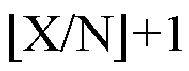
 wherein 'Mod' represents finding a remainder, and [X/N] represents rounding down X/N.
 - The method according to claim 15, wherein, determining the quantity of PDSCHs scheduled by the first DCI or valid PDSCHs comprises:
determining the quantity of PDSCHs scheduled by the first DCI or valid PDSCHs according to a quantity of PDSCHs actually scheduled, the quantity of PDSCHs actually scheduled being obtained in a time-domain scheduling information table indicated by the first DCI. - The method according to claim 1, wherein, when the bundling configuration information is that there is no bundling of feedback information of different types of transport blocks corresponding to the same PDSCH and there is bundling of feedback information of different PDSCH, generating the HARQ-ACK information for the multiple PDSCHs according to the at least one scheduling state of the at least one type of transport blocks corresponding to the multiple PDSCHs scheduled by the first DCI and bundling configuration information for PDSCH feedback comprises:determining a quantity of transport blocks comprised in each type of transport blocks, involved in bundling calculation, in the PDSCHs scheduled by the first DCI, when multi-codeword transmission is configured;generating the HARQ-ACK information for the multiple PDSCHs according to the quantity of transport blocks comprised in each type of transport blocks, involved in bundling calculation, in the PDSCHs scheduled by the first DCI and a corresponding decoding result.
- The method according to claim 18, wherein, determining the quantity of transport blocks comprised in each type of transport blocks, involved in bundling calculation, in the PDSCHs scheduled by the first DCI when multi-codeword transmission is configured comprises at least one of following:determining the quantity of transport blocks comprised in each type of transport blocks according to a quantity of actually scheduled PDSCHs or valid PDSCHs and scheduling states of the transport blocks;uniformly calculating a quantity of transport blocks comprised in each type of transport blocks according to a quantity of actually scheduled PDSCHs or valid PDSCHs and the scheduling states of the transport blocks, wherein the quantities of transport blocks comprised in different types of transport blocks are the same.
- The method according to claim 18, wherein, generating the HARQ-ACK information for the multiple PDSCHs according to the quantity of transport blocks comprised in each type of transport blocks, involved in bundling calculation, in the PDSCHs scheduled by the first DCI and the corresponding decoding result comprises at least one of the following:according to the quantity of transport blocks comprised in each type of transport blocks and the corresponding decoding result, bundling decoding results of each type of transport blocks to generate a bit sequence corresponding to each type of transport block;adding up the quantities of transport blocks comprised in different types of transport blocks, and according to the quantity of all transport blocks after the adding, bundling the decoding results of all transport blocks to generate multiple feedback bits.
- The method according to claim 18, wherein, generating the HARQ-ACK information for the multiple PDSCHs comprises any one of following:generating the HARQ-ACK information for the multiple PDSCHs by sequencing the feedback bits according to a rule of codewords being in an ascending order first and then PDSCHs being in an ascending order;generating the HARQ-ACK information for the multiple PDSCHs by sequencing the feedback bits according to a rule of PDSCHs being in an ascending order first and then codewords being in an ascending order.
- A terminal device, wherein, the terminal device comprises a memory, a transceiver, and a processor,
the memory is configured to store a computer program, the transceiver is configured to send and/or receive data under control of the processor, and the processor is configured to read the computer program in the memory to implement following:determining at least one scheduling state of at least one type of transport blocks corresponding to multiple physical downlink shared channels (PDSCHs) scheduled by first downlink control information (DCI), wherein the at least one scheduling state comprises an enabled state or a disabled state;generating Hybrid Automatic Repeat reQuest acknowledgement (HARQ-ACK) information of the multiple PDSCHs according to the at least one scheduling state of the at least one type of transport blocks corresponding to the multiple PDSCHs scheduled by the first DCI and bundling configuration information for PDSCH feedback;wherein any type of transport blocks of the at least one type of transport blocks are transport blocks, having the same identifier, in the multiple PDSCHs scheduled by the first DCI. - The terminal device according to claim 22, wherein, the processor is configured to read the computer program in the memory to implement following:obtaining a scheduling state judgment manner;determining the at least one scheduling state of the at least one type of transport blocks corresponding to the multiple PDSCHs scheduled by the first DCI according to the scheduling state judgment manner;wherein scheduling state judgment manner comprises any one of the following:determining a scheduling state of each type of transport blocks corresponding to each PDSCH of the multiple PDSCHs scheduled by the first DCI, in one-time judgment;judging a scheduling state of each type of transport blocks corresponding to each PDSCH of the multiple PDSCHs scheduled by the first DCI, independently.
- The terminal device according to claim 23, wherein, the processor is configured to read the computer program in the memory to implement at least one of following:obtaining the scheduling state judgment manner indicated by a network device;obtaining the scheduling state judgment manner agreed by a protocol;determining the scheduling state judgment manner, according to a scheduling state judgment capability supported by the terminal device.
- The terminal device according to claim 24, wherein, in case of obtaining the scheduling state judgment manner indicated by the network device or determining the scheduling state judgment manner according to the scheduling state judgment capability supported by the terminal device, the processor is configured to read the computer program in the memory to further implement following:sending terminal capability information to the network device through the transceiver;wherein, the terminal capability information comprises a scheduling state judgment manner supported by the terminal device.
- The terminal device according to claim 23, wherein, when the scheduling state judgment manner is to determine the scheduling state of each type of transport blocks corresponding to the multiple PDSCHs scheduled by the first DCI in one-time judgment, the processor is configured to read the computer program in the memory to implement following:when the network device indicates that multi-codeword transmission is supported, determining a scheduling state of a first type of target transport blocks corresponding to the multiple PDSCHs scheduled by the first DCI, according to field information, corresponding to the first type of target transport blocks, in an information field of the first DCI;wherein the first type of target transport blocks is any type of transport blocks in transport blocks indicated by the information field of the first DCI.
- The terminal device according to claim 26, wherein, the processor is configured to read the computer program in the memory to implement following:determining that the scheduling state of the first type of target transport blocks corresponding to the multiple PDSCHs scheduled by the first DCI is a disabled state when the field information corresponding to the first type of target transport blocks in the information field of the first DCI meets a first condition; ordetermining that the scheduling state of the first type of target transport blocks corresponding to the multiple PDSCHs scheduled by the first DCI is an enabled state, when the field information corresponding to the first type of target transport blocks in the information field of the first DCI does not meet a first condition;wherein the first condition comprises at least one of following:a value of indication of a Modulation and Coding Scheme (MCS) is a first preset value;values of part or all of bits in Redundancy Version (RV) indication are second preset values;a value of a New Data Indicator (NDI) is a third preset value.
- The terminal device according to claim 23, wherein, when the scheduling state judgment manner is to judge the scheduling state of each type of transport blocks corresponding to the multiple PDSCHs scheduled by the first DCI, independently, the processor is configured to read the computer program in the memory to implement following:determining a scheduling state of a second type of target transport blocks corresponding to a first PDSCH according to field information of the corresponding second type of target transport blocks in an information field of the first DCI, when the network device indicates that multi-codeword transmission is supported;wherein the first PDSCH is any PDSCH of the multiple PDSCHs scheduled by the first DCI, and the second type of target transport blocks is any type of transport blocks of transport blocks indicated in the information field of the first DCI.
- The terminal device according to claim 28, wherein, the processor is configured to read the computer program in the memory to implement following:determining that the scheduling state of the second type of target transport blocks corresponding to the first PDSCH is a disabled state, when the field information corresponding to the second type of target transport blocks in the information field of the first DCI meets a second condition; ordetermining that the scheduling state of the second type of target transport blocks corresponding to the first PDSCH is an enabled state, when the field information corresponding to the second type of target transport blocks in the information field of the first DCI does not meet the second condition;wherein the second condition comprises at least one of following:a value of bits, corresponding to the first PDSCH, in indication of Modulation and Coding Scheme (MCS) is a fourth preset value;a value of a bit, corresponding to the first PDSCH, in indication of a Redundancy Version (RV) is a fifth preset value;a value of a bit, corresponding to the first PDSCH, in a New Data Indicator (NDI) is a sixth preset value.
- The terminal device according to any one of claims 23-29, wherein, the processor is configured to read the computer program in the memory to further implement any one of following:determining that the network device does not send transport blocks when scheduling states of all corresponding transport blocks in an information field of the first DCI are determined to be a disabled state;determining that the scheduling states of a third type of target transport blocks corresponding to a second PDSCH are a disabled state when scheduling states of all transport blocks corresponding to the second PDSCH in an information field of the first DCI are determined to be a disabled state,wherein the second PDSCH is any PDSCH scheduled by the first DCI, the third type of target transport blocks is at least one transport block of transport blocks indicated in the information field of the first DCI.
- The terminal device according to claim 22, wherein, when the bundling configuration information is that there is no bundling of feedback information of different types of transport blocks corresponding to the same PDSCH, and there is no bundling of feedback information of different PDSCHs, the processor is configured to read the computer program in the memory to further implement at least one of following::if codeword transmission is not configured or single-codeword transmission is configured, then configuring, to a seventh preset value, a value of a first feedback bit corresponding to a PDSCH not being scheduled, configuring, according to a decoding result, a bit value of a second feedback bit corresponding to a PDSCH being scheduled, and generating the HARQ-ACK information according to the first feedback bit and the second feedback bit;if multi-codeword transmission is configured, configuring, to an eighth preset value, a value of a third feedback bit of a Transport Block (TB) corresponding to a PDSCH not being scheduled, configuring, to the eighth preset value, a value of a fourth feedback bit corresponding to a transport block in a disabled state corresponding to a PDSCH being scheduled; configuring, according to a decoding result, a bit value of a fifth feedback bit corresponding to a transport block in an enabled state corresponding to the PDSCH being scheduled, and generating the HARQ-ACK information according to the third feedback bit, the fourth feedback bit and the fifth feedback bit.
- The terminal device according to claim 31, wherein the processor is configured to read the computer program in the memory to implement following:sequencing the third feedback bit, the fourth feedback bit and the fifth feedback bit in a preset manner to generate the HARQ-ACK information;wherein the preset manner comprises any one of the following:sequencing the third feedback bit, the fourth feedback bit and the fifth feedback bit according to a rule of codewords being in an ascending order first and then PDSCHs being in an ascending order;sequencing the third feedback bit, the fourth feedback bit and the fifth feedback bit according to a rule of PDSCHs being in an ascending order first and then codewords being in an ascending order.
- The terminal device according to claim 22, wherein, when the bundling configuration information is that there is bundling of feedback information of different types of transport blocks corresponding to the same PDSCH and there is no bundling of feedback information of different PDSCHs, or there is bundling of feedback information of different types of transport blocks corresponding to the same PDSCH and there is bundling of feedback information of different PDSCHs, the processor is configured to read the computer program in the memory to implement following:determining a value of a sixth feedback bit corresponding to at least one type of transport blocks corresponding to each PDSCH when configuring multi-codeword transmission;determining a value of a seventh feedback bit corresponding to each PDSCH according to the value of the sixth feedback bit corresponding to at least one type of transport blocks corresponding to each PDSCH;generating the HARQ-ACK information for the multiple PDSCHs according to the seventh feedback bit corresponding to each PDSCH.
- The terminal device according to claim 33, wherein, the processor is configured to read the computer program in the memory to implement at least one of following:when a third PDSCH needs to transmit at least one type of transport blocks, setting, to a ninth preset value, the value of the sixth feedback bit of the transport block not transmitted;when a fourth PDSCH needs to transmit at least one type of transport blocks and all the transport blocks corresponding to the fourth PDSCH are not transmitted, setting, to a tenth preset value, the values of the sixth feedback bits of all the transport blocks corresponding to the fourth PDSCH;setting, according to a decoding result, a bit value of the sixth feedback bit of a transport block scheduled for transmission corresponding to a fifth PDSCH;setting the sixth feedback bit corresponding to the transport block in the disable state to an eleventh preset value;for a sixth PDSCH which is not scheduled or which is invalidly scheduled, setting a sixth feedback bit of a transport block corresponding to the sixth PDSCH to a twelfth preset value.
- The terminal device according to claim 33, wherein, the processor is configured to read the computer program in the memory to implement following:
generating the HARQ-ACK information for the multiple PDSCHs according to the seventh feedback bit corresponding to the scheduled PDSCH or the valid PDSCH. - The terminal device according to claim 22, wherein, when the bundling configuration information is that there is no bundling of feedback information of different types of transport blocks corresponding to the same PDSCH and there is bundling of feedback information of different PDSCHs, the processor is configured to read the computer program in the memory to implement following:determining a quantity of PDSCHs scheduled by the first DCI or a quantity of valid PDSCHs, when single-codeword transmission is configured or no codeword transmission is configured;grouping PDSCHs scheduled by the first DCI or valid PDSCHs;bundling decoding results of PDSCHs in each group after grouping, to obtain an eighth feedback bit;generating the HARQ-ACK information according to the eighth feedback bit corresponding to each group of PDSCHs.
- The terminal device according to claim 36, wherein, the processor is configured to read the computer program in the memory to implement at least one of following:if X is less than or equal to N, determining that Y is equal to X, and each group corresponds to one PDSCH;if X is greater than N, determining that Y is equal to N, and determining the number of PDSCHs corresponding to each group in a first manner;wherein, X is a quantity of valid PDSCHs or scheduled PDSCHs, Y is a quantity of groups, N is a quantity of bits of the HARQ-ACK information to be fed back, and both X and Y are integers greater than or equal to 1;wherein the first manner comprises one of the following:each bit of first (X mod N) bits in the HARQ-ACK information corresponds to a bundling result of decoding results of

 each bit of last (X mod N) bits in the HARQ-ACK information corresponds to a bundling result of decoding results of
 wherein 'Mod' represents finding a remainder, and
- The terminal device according to claim 36, wherein, the processor is configured to read the computer program in the memory to implement following:
determining the quantity of PDSCHs scheduled by the first DCI or valid PDSCHs according to a quantity of PDSCHs actually scheduled, the quantity of PDSCHs actually scheduled being obtained in a time-domain scheduling information table indicated by the first DCI. - The terminal device according to claim 22, wherein, when the bundling configuration information is that there is no bundling of feedback information of different types of transport blocks corresponding to the same PDSCH and there is bundling of feedback information of different PDSCH, the processor is configured to read the computer program in the memory to implement following:determining a quantity of transport blocks comprised in each type of transport blocks, involved in bundling calculation, in the PDSCHs scheduled by the first DCI, when multi-codeword transmission is configured;generating the HARQ-ACK information for the multiple PDSCHs according to the quantity of transport blocks comprised in each type of transport blocks, involved in bundling calculation, in the PDSCHs scheduled by the first DCI and a corresponding decoding result.
- The terminal device according to claim 39, wherein, the processor is configured to read the computer program in the memory to implement at least one of following:determining the quantity of transport blocks comprised in each type of transport blocks according to a quantity of actually scheduled PDSCHs or valid PDSCHs and scheduling states of the transport blocks;uniformly calculating a quantity of transport blocks comprised in each type of transport blocks according to a quantity of actually scheduled PDSCHs or valid PDSCHs and the scheduling states of the transport blocks, wherein the quantities of transport blocks comprised in different types of transport blocks are the same.
- The terminal device according to claim 39, wherein, the processor is configured to read the computer program in the memory to implement at least one of following:according to the quantity of transport blocks comprised in each type of transport blocks and the corresponding decoding result, bundling decoding results of each type of transport blocks to generate a bit sequence corresponding to each type of transport block;adding up the quantities of transport blocks comprised in different types of transport blocks, and according to the quantity of all transport blocks after the adding, bundling the decoding results of all transport blocks to generate multiple feedback bits.
- The terminal device according to claim 39, wherein, the processor is configured to read the computer program in the memory to implement any one of following:generating the HARQ-ACK information for the multiple PDSCHs by sequencing the feedback bits according to a rule of codewords being in an ascending order first and then PDSCHs being in an ascending order;generating the HARQ-ACK information for the multiple PDSCHs by sequencing the feedback bits according to a rule of PDSCHs being in an ascending order first and then codewords being in an ascending order.
- A Hybrid Automatic Repeat reQuest (HARQ) acknowledgement (ACK) feedback apparatus, which is applied to a terminal device, wherein, the apparatus comprises:a first determining unit, configured for determining at least one scheduling state of at least one type of transport blocks corresponding to multiple physical downlink shared channels (PDSCHs) scheduled by first downlink control information (DCI), wherein the at least one scheduling state comprises an enabled state or a disabled state;a generating unit, configured for generating HARQ-ACK information for the multiple PDSCHs according to the at least one scheduling state of the at least one type of transport blocks corresponding to the multiple PDSCHs scheduled by the first DCI and bundling configuration information for PDSCH feedback;wherein any type of transport blocks of the at least one type of transport blocks are transport blocks, having the same identifier, in the multiple PDSCHs scheduled by the first DCI.
- The apparatus according to claim 43, wherein, the first determining unit is configured for:obtaining a scheduling state judgment manner;determining at least one scheduling state of at least one type of transport blocks corresponding to the multiple PDSCHs scheduled by the first DCI according to the scheduling state judgment manner,wherein the scheduling state judgment manner comprises any one of following:determining a scheduling state of each type of transport blocks corresponding to each PDSCH of the multiple PDSCHs scheduled by the first DCI, in one-time judgment;judging a scheduling state of each type of transport blocks corresponding to each PDSCH of the multiple PDSCHs scheduled by the first DCI, independently.
- The apparatus according to claim 44, wherein obtaining the scheduling state judgment manner comprises at least one of the following:obtaining the scheduling state judgment manner indicated by a network device;obtaining the scheduling state judgment manner agreed by a protocol;determining the scheduling state judgment manner, according to a scheduling state judgment capability supported by the terminal device.
- The apparatus according to claim 45, wherein, in case of obtaining the scheduling state judgment manner indicated by the network device or determining the scheduling state judgment manner according to the scheduling state judgment capability supported by the terminal device, the apparatus further comprises:
a sending unit, configured for sending terminal capability information to the network device; wherein, the terminal capability information comprises the scheduling state judgment manner supported by the terminal device. - The apparatus according to claim 45, wherein in case of the scheduling state judgment manner of determining the scheduling state of each type of transport blocks corresponding to each PDSCH of the multiple PDSCHs scheduled by the first DCI in one-time judgment, implementation of determining the scheduling state of at least one type of transport blocks corresponding to the multiple PDSCHs scheduled by the first DCI includes:
when the network device indicates that multi-codeword transmission is supported, determining a scheduling state of a first type of target transport blocks corresponding to each of the multiple PDSCHs scheduled by the first DCI, according to field information, corresponding to the first type of target transport blocks, in an information field of the first DCI; wherein the first type of target transport blocks is any type of transport blocks of the transport blocks indicated by the information field of the first DCI. - The apparatus according to claim 47, wherein determining the scheduling state of the first type of target transport blocks corresponding to each PDSCH of the multiple PDSCHs scheduled by the first DCI, according to field information, corresponding to the first type of target transport blocks, in the information field of the first DCI comprises:determining that the scheduling state of the first type of target transport blocks corresponding to each PDSCH of the multiple PDSCHs scheduled by the first DCI is a disabled state when the field information corresponding to the first type of target transport blocks in the information field of the first DCI meets a first condition; ordetermining that the scheduling state of the first type of target transport blocks corresponding to each PDSCH of the multiple PDSCHs scheduled by the first DCI is an enabled state, when the field information corresponding to the first type of target transport blocks in the information field of the first DCI does not meet a first condition;wherein the first condition comprises at least one of following:a value of indication of a Modulation and Coding Scheme (MCS) is a first preset value;values of part or all of bits in Redundancy Version (RV) indication are second preset values;a value of a New Data Indicator (NDI) is a third preset value.
- The apparatus according to claim 44, wherein in case of the scheduling state judgment manner of judging the scheduling state of each type of transport blocks corresponding to each PDSCH of the multiple PDSCHs scheduled by the first DCI, independently, implementation of determining the scheduling state of at least one type of transport blocks corresponding to the multiple PDSCHs scheduled by the first DCI comprises:determining a scheduling state of a second type of target transport blocks corresponding to a first PDSCH according to field information of the corresponding second type of target transport blocks in an information field of the first DCI, when the network device indicates that multi-codeword transmission is supported;wherein the first PDSCH is any PDSCH of the multiple PDSCHs scheduled by the first DCI, and the second type of target transport blocks is any type of transport blocks of transport blocks indicated in the information field of the first DCI.
- The apparatus according to claim 49, wherein determining the scheduling state of the second type of target transport blocks corresponding to the first PDSCH according to the field information of the corresponding second type of target transport blocks in the information field of the first DCI comprises:determining that the scheduling state of the second type of target transport blocks corresponding to the first PDSCH is a disabled state, when the field information corresponding to the second type of target transport blocks in the information field of the first DCI meets a second condition; ordetermining that the scheduling state of the second type of target transport blocks corresponding to the first PDSCH is an enabled state, when the field information corresponding to the second type of target transport blocks in the information field of the first DCI does not meet the second condition;wherein the second condition comprises at least one of following:a value of bits, corresponding to the first PDSCH, in indication of Modulation and Coding Scheme (MCS) is a fourth preset value;a value of a bit, corresponding to the first PDSCH, in indication of a Redundancy Version (RV) is a fifth preset value;a value of a bit, corresponding to the first PDSCH, in a New Data Indicator (NDI) is a sixth preset value.
- The apparatus according to any one of claims 44-50, further comprising:a second determining unit, configured for, after the first determining unit determines the scheduling state of at least one type of transport blocks corresponding to the multiple PDSCHs scheduled by the first DCI, determining that the network device does not send transport blocks when it is determined that the scheduling states of all corresponding transport blocks in the information field of the first DCI are the disabled state;a third determining unit, configured for, after the first determining unit determines the scheduling state of at least one type of transport blocks corresponding to the multiple PDSCHs scheduled by the first DCI, determining that the scheduling states of the third type of target transport blocks corresponding to the second PDSCH are the disabled state when it is determined that the scheduling states of all transport blocks corresponding to the second PDSCH in the information field of the first DCI are the disabled state, wherein the second PDSCH is any PDSCH scheduled by the first DCI, the third type of target transport blocks is at least one transport block of the transport blocks indicated in the information field of the first DCI.
- The apparatus according to claim 43, wherein when bundling configuration information is that there is no bundling of feedback information of different types of transport blocks corresponding to the same PDSCH, and there is no bundling of feedback information of different PDSCHs, the generating unit is configured for implementing at least one of the following:if codeword transmission is not configured or single-codeword transmission is configured, then configuring, to a seventh preset value, a value of a first feedback bit corresponding to a PDSCH not being scheduled, configuring, according to a decoding result, a bit value of a second feedback bit corresponding to a PDSCH being scheduled, and generating the HARQ-ACK information according to the first feedback bit and the second feedback bit;if multi-codeword transmission is configured, configuring, to an eighth preset value, a value of a third feedback bit of a Transport Block (TB) corresponding to a PDSCH not being scheduled, configuring, to the eighth preset value, a value of a fourth feedback bit corresponding to a transport block in a disabled state corresponding to a PDSCH being scheduled; configuring, according to a decoding result, a bit value of a fifth feedback bit corresponding to a transport block in an enabled state corresponding to the PDSCH being scheduled, and generating the HARQ-ACK information according to the third feedback bit, the fourth feedback bit and the fifth feedback bit.
- The apparatus according to claim 52, wherein generating the HARQ-ACK information according to the third feedback bit, the fourth feedback bit and the fifth feedback bit comprises:sequencing the third feedback bit, the fourth feedback bit and the fifth feedback bit in a preset manner to generate the HARQ-ACK information;wherein the preset manner comprises any one of the following:sequencing the third feedback bit, the fourth feedback bit and the fifth feedback bit according to a rule of codewords being in an ascending order first and then PDSCHs being in an ascending order;sequencing the third feedback bit, the fourth feedback bit and the fifth feedback bit according to a rule of PDSCHs being in an ascending order first and then codewords being in an ascending order.
- The apparatus according to claim 43, wherein when the bundling configuration information is that there is bundling of feedback information of different types of transport blocks corresponding to the same PDSCH and there is no bundling of feedback information of different PDSCHs, or there is bundling of feedback information of different types of transport blocks corresponding to the same PDSCH and there is bundling of feedback information of different PDSCHs, the generating unit further implements following:determining a value of a sixth feedback bit corresponding to at least one type of transport blocks corresponding to each PDSCH when configuring multi-codeword transmission;determining a value of a seventh feedback bit corresponding to each PDSCH according to the value of the sixth feedback bit corresponding to at least one type of transport blocks corresponding to each PDSCH;generating the HARQ-ACK information for the multiple PDSCHs according to the seventh feedback bit corresponding to each PDSCH.
- The apparatus according to claim 54, wherein determining the value of the sixth feedback bit corresponding to at least one type of transport blocks corresponding to each PDSCH comprises at least one of following:when a third PDSCH needs to transmit at least one type of transport blocks, setting, to a ninth preset value, the value of the sixth feedback bit of the transport block not transmitted;when a fourth PDSCH needs to transmit at least one type of transport blocks and all the transport blocks corresponding to the fourth PDSCH are not transmitted, setting, to a tenth preset value, the values of the sixth feedback bits of all the transport blocks corresponding to the fourth PDSCH;setting, according to the decoding result, a bit value of the sixth feedback bit of the transport block scheduled for transmission corresponding to a fifth PDSCH;setting the sixth feedback bit corresponding to the transport block in the disable state to an eleventh preset value;for a sixth PDSCH which is not scheduled or which is invalidly scheduled, setting a sixth feedback bit of a transport block corresponding to the sixth PDSCH to a twelfth preset value.
- The apparatus according to claim 54, wherein, generating the HARQ-ACK information for the multiple PDSCHs according to the seventh feedback bit corresponding to each PDSCH comprises:
generating the HARQ-ACK information for the multiple PDSCHs according to the seventh feedback bit corresponding to the scheduled PDSCH or the valid PDSCH. - The apparatus according to claim 43, wherein when the bundling configuration information is that there is no bundling of feedback information of different types of transport blocks corresponding to the same PDSCH and there is bundling of feedback information of different PDSCHs, the generating unit is specifically configured for:determining a quantity of PDSCHs scheduled by the first DCI or a quantity of valid PDSCHs, when single-codeword transmission is configured or no codeword transmission is configured;grouping PDSCHs scheduled by the first DCI or valid PDSCHs;bundling decoding results of PDSCHs in each group after grouping, to obtain an eighth feedback bit;generating the HARQ-ACK information according to the eighth feedback bit corresponding to each group of PDSCHs.
- The apparatus according to claim 57, wherein grouping the PDSCHs scheduled by the first DCI or the valid PDSCHs comprises at least one of the following:if X is less than or equal to N, determining that Y is equal to X, and each group corresponds to one PDSCH;if X is greater than N, determining that Y is equal to N, and determining the number of PDSCHs corresponding to each group in a first manner;wherein, X is a quantity of valid PDSCHs or scheduled PDSCHs, Y is a quantity of groups, N is a quantity of bits of the HARQ-ACK information to be fed back, and both X and Y are integers greater than or equal to 1;wherein the first manner comprises one of the following:each bit of first (X mod N) bits in the HARQ-ACK information corresponds to a bundling result of decoding results of

 each bit of last (X mod N) bits in the HARQ-ACK information corresponds to a bundling result of decoding results of
 wherein `Mod' represents finding a remainder, and
- The apparatus according to claim 57, wherein determining the quantity of PDSCHs scheduled by the first DCI or valid PDSCHs comprises:
determining the quantity of PDSCHs scheduled by the first DCI or valid PDSCHs according to a quantity of PDSCHs actually scheduled, the quantity of PDSCHs actually scheduled being obtained in a time-domain scheduling information table indicated by the first DCI. - The apparatus according to claim 43, wherein, when the bundling configuration information is that there is no bundling of feedback information of different types of transport blocks corresponding to the same PDSCH and there is bundling of feedback information of different PDSCHs, the generating unit is specifically configured for:determining a quantity of transport blocks comprised in each type of transport blocks, involved in bundling calculation, in the PDSCHs scheduled by the first DCI, when multi-codeword transmission is configured;generating the HARQ-ACK information for the multiple PDSCHs according to the quantity of transport blocks comprised in each type of transport blocks, involved in bundling calculation, in the PDSCHs scheduled by the first DCI and a corresponding decoding result.
- The apparatus according to claim 60, wherein determining the quantity of transport blocks comprised in each type of transport blocks, involved in bundling calculation, in the PDSCHs scheduled by the first DCI when multi-codeword transmission is configured comprises at least one of following:determining the quantity of transport blocks comprised in each type of transport blocks according to a quantity of actually scheduled PDSCHs or valid PDSCHs and scheduling states of the transport blocks;uniformly calculating a quantity of transport blocks comprised in each type of transport blocks according to a quantity of actually scheduled PDSCHs or valid PDSCHs and the scheduling states of the transport blocks, wherein the quantities of transport blocks comprised in different types of transport blocks are the same.
- The apparatus according to claim 60, wherein generating the HARQ-ACK information for the multiple PDSCHs according to the quantity of transport blocks comprised in each type of transport blocks, involved in bundling calculation, in the PDSCHs scheduled by the first DCI and the corresponding decoding result comprises at least one of the following:according to the quantity of transport blocks comprised in each type of transport blocks and the corresponding decoding result, bundling decoding results of each type of transport blocks to generate a bit sequence corresponding to each type of transport block;adding up the quantities of transport blocks comprised in different types of transport blocks, and according to the quantity of all transport blocks after the adding, bundling the decoding results of all transport blocks to generate multiple feedback bits.
- The apparatus according to claim 60, wherein generating the HARQ-ACK information for the multiple PDSCHs comprises any one of following:generating the HARQ-ACK information for the multiple PDSCHs by sequencing the feedback bits according to a rule of codewords being in an ascending order first and then PDSCHs being in an ascending order;generating the HARQ-ACK information for the multiple PDSCHs by sequencing the feedback bits according to a rule of PDSCHs being in an ascending order first and then codewords being in an ascending order.
- A processor-readable storage medium wherein, the processor-readable storage medium stores a computer program, wherein when the computer program is executed by a processor, the processor implements the method according to any one of claims 1 to 21.
Applications Claiming Priority (2)
| Application Number | Priority Date | Filing Date | Title |
|---|---|---|---|
| CN202111308683.3A CN116094657B (en) | 2021-11-05 | 2021-11-05 | Hybrid automatic repeat request response feedback method and device and terminal equipment |
| PCT/CN2022/126653 WO2023078102A1 (en) | 2021-11-05 | 2022-10-21 | Hybrid automatic repeat request acknowledgement feedback method and apparatus, and terminal device |
Publications (2)
| Publication Number | Publication Date |
|---|---|
| EP4429143A1 true EP4429143A1 (en) | 2024-09-11 |
| EP4429143A4 EP4429143A4 (en) | 2025-03-12 |
Family
ID=86210711
Family Applications (1)
| Application Number | Title | Priority Date | Filing Date |
|---|---|---|---|
| EP22889127.1A Pending EP4429143A4 (en) | 2021-11-05 | 2022-10-21 | HYBRID AUTOMATIC REPEAT REQUEST ACKNOWLEDGMENT FEEDBACK METHOD AND APPARATUS, AND TERMINAL DEVICE |
Country Status (8)
| Country | Link |
|---|---|
| US (1) | US20250016782A1 (en) |
| EP (1) | EP4429143A4 (en) |
| JP (1) | JP7717276B2 (en) |
| KR (1) | KR20240090631A (en) |
| CN (2) | CN116094657B (en) |
| AR (1) | AR127573A1 (en) |
| TW (1) | TWI833411B (en) |
| WO (1) | WO2023078102A1 (en) |
Family Cites Families (19)
| Publication number | Priority date | Publication date | Assignee | Title |
|---|---|---|---|---|
| US20140328260A1 (en) * | 2013-02-26 | 2014-11-06 | Samsung Electronics Co., Ltd. | Scheduling over multiple transmission time intervals |
| CN109478958B (en) * | 2016-06-30 | 2020-09-18 | 华为技术有限公司 | A data transmission method, device and system |
| GB2557991A (en) * | 2016-12-21 | 2018-07-04 | Tcl Communication Ltd | ACK/NACK bundling in wireless communication systems |
| US10548096B2 (en) * | 2017-04-21 | 2020-01-28 | Samsung Electronics Co., Ltd. | Information type multiplexing and power control |
| CN111316756B (en) * | 2017-11-14 | 2023-09-05 | 瑞典爱立信有限公司 | Method and apparatus for hybrid automatic repeat request acknowledgment/negative acknowledgment bundling |
| CN110086583B (en) * | 2018-01-26 | 2021-05-07 | 电信科学技术研究院有限公司 | DAI indicating method, user terminal and network side equipment |
| CN116094659B (en) * | 2018-08-09 | 2025-02-11 | 北京三星通信技术研究有限公司 | Block transmission method, downlink transmission method, NRS receiving method, UE, base station and medium |
| CN110875814B (en) * | 2018-09-03 | 2023-05-02 | 华为技术有限公司 | Method for transmitting and receiving hybrid automatic repeat request acknowledgement information and communication device |
| CN111954307A (en) * | 2019-05-17 | 2020-11-17 | 北京三星通信技术研究有限公司 | Communication method and device in wireless communication network |
| PL3979729T3 (en) * | 2019-05-31 | 2025-05-12 | Ntt Docomo, Inc. | User terminal and wireless communication method |
| WO2021023531A1 (en) * | 2019-08-06 | 2021-02-11 | Sony Corporation | Communications devices, infrastructure equipment, and methods |
| WO2021032266A1 (en) * | 2019-08-16 | 2021-02-25 | Nokia Technologies Oy | Method for determining a hybrid automatic repeat request acknowledgement feedback codebook |
| CN112583558B (en) * | 2019-09-30 | 2023-06-09 | 维沃移动通信有限公司 | Resource allocation method, terminal equipment and network equipment |
| US11751209B2 (en) * | 2020-02-14 | 2023-09-05 | Qualcomm Incorporated | Acknowledgement feedback for multi-component carrier scheduling with separate feedback-related control fields |
| US11818723B2 (en) * | 2020-02-14 | 2023-11-14 | Qualcomm Incorporated | Downlink assignment index for multi-component carrier scheduling |
| CN113518454A (en) * | 2020-04-10 | 2021-10-19 | 北京三星通信技术研究有限公司 | Method for configuring downlink control information and method for receiving downlink data |
| CN113543348B (en) * | 2020-04-15 | 2024-08-16 | 大唐移动通信设备有限公司 | HARQ-ACK transmission method, terminal and network side equipment |
| WO2022041183A1 (en) * | 2020-08-31 | 2022-03-03 | Qualcomm Incorporated | Indication scheme for rateless codes transmissions without feedback information |
| CN118057969A (en) * | 2021-09-30 | 2024-05-21 | 富士通株式会社 | Information feedback method and device |
-
2021
- 2021-11-05 CN CN202111308683.3A patent/CN116094657B/en active Active
- 2021-11-05 CN CN202411891412.9A patent/CN119696736A/en active Pending
-
2022
- 2022-10-21 KR KR1020247016741A patent/KR20240090631A/en active Pending
- 2022-10-21 JP JP2024525708A patent/JP7717276B2/en active Active
- 2022-10-21 WO PCT/CN2022/126653 patent/WO2023078102A1/en not_active Ceased
- 2022-10-21 US US18/706,633 patent/US20250016782A1/en active Pending
- 2022-10-21 EP EP22889127.1A patent/EP4429143A4/en active Pending
- 2022-11-01 TW TW111141536A patent/TWI833411B/en active
- 2022-11-04 AR ARP220103024A patent/AR127573A1/en unknown
Also Published As
| Publication number | Publication date |
|---|---|
| CN116094657A (en) | 2023-05-09 |
| KR20240090631A (en) | 2024-06-21 |
| TW202320504A (en) | 2023-05-16 |
| TWI833411B (en) | 2024-02-21 |
| US20250016782A1 (en) | 2025-01-09 |
| JP7717276B2 (en) | 2025-08-01 |
| EP4429143A4 (en) | 2025-03-12 |
| JP2024539349A (en) | 2024-10-28 |
| CN116094657B (en) | 2025-01-07 |
| WO2023078102A1 (en) | 2023-05-11 |
| AR127573A1 (en) | 2024-02-07 |
| CN119696736A (en) | 2025-03-25 |
Similar Documents
| Publication | Publication Date | Title |
|---|---|---|
| EP3324565B1 (en) | Uplink control information transmission method and apparatus | |
| EP4164157B1 (en) | Hybrid automatic repeat request feedback method, terminal device and network device | |
| CN114070488B (en) | UCI transmission method, reception method, terminal and network equipment | |
| US20240195534A1 (en) | Method for sending and method for receiving harq codebook, apparatus, and storage medium | |
| CN114501624B (en) | Information transmission processing method, device and terminal | |
| CN114760006B (en) | Data transmission method, device, communication equipment and storage medium | |
| CN114726478B (en) | Method, device and storage medium for transmitting uplink control information | |
| EP4429143A1 (en) | Hybrid automatic repeat request acknowledgement feedback method and apparatus, and terminal device | |
| CN118611832B (en) | Methods, devices and storage media for uplink DAI indication | |
| EP4319354A1 (en) | Information reporting method, network side configuration method, apparatus, device and storage medium | |
| EP4429335A1 (en) | Power control parameter determination method and apparatus, and terminal device | |
| WO2022237539A1 (en) | Feedback processing method, sending method, feedback method, device, and storage medium | |
| EP4654711A1 (en) | Multi-carrier data processing method, apparatus, terminal, and network side device | |
| CN115915447B (en) | Method and device for determining PUCCH power control parameters | |
| CN115333681B (en) | Information transmission method, device and storage medium | |
| EP4518212A1 (en) | Hybrid automatic repeat request feedback method and apparatus | |
| EP4661327A1 (en) | Information processing method and apparatus, network device, and terminal | |
| EP4664804A1 (en) | Method and apparatus for determining dynamic harq-ack codebook, and communication device | |
| CN115174016B (en) | Information transmission method, device, equipment and storage medium | |
| WO2024067158A1 (en) | Information determination method, apparatus, terminal and network device | |
| CN116996181A (en) | Methods, equipment, devices and storage media for determining resource overlap | |
| WO2024067347A1 (en) | Method for determining control information, and terminal device, network device and storage medium | |
| CN118785497A (en) | Physical uplink shared channel PUSCH transmission method and device | |
| CN121487000A (en) | UCI transmission methods, terminals, network equipment, devices, and storage media | |
| CN117459195A (en) | HARQ codebook generation method, scheduling method, terminal and network side equipment |
Legal Events
| Date | Code | Title | Description |
|---|---|---|---|
| STAA | Information on the status of an ep patent application or granted ep patent |
Free format text: STATUS: THE INTERNATIONAL PUBLICATION HAS BEEN MADE |
|
| PUAI | Public reference made under article 153(3) epc to a published international application that has entered the european phase |
Free format text: ORIGINAL CODE: 0009012 |
|
| STAA | Information on the status of an ep patent application or granted ep patent |
Free format text: STATUS: REQUEST FOR EXAMINATION WAS MADE |
|
| 17P | Request for examination filed |
Effective date: 20240510 |
|
| AK | Designated contracting states |
Kind code of ref document: A1 Designated state(s): AL AT BE BG CH CY CZ DE DK EE ES FI FR GB GR HR HU IE IS IT LI LT LU LV MC ME MK MT NL NO PL PT RO RS SE SI SK SM TR |
|
| REG | Reference to a national code |
Ref country code: DE Ref legal event code: R079 Free format text: PREVIOUS MAIN CLASS: H04L0001180000 Ipc: H04L0001182900 |
|
| DAV | Request for validation of the european patent (deleted) | ||
| DAX | Request for extension of the european patent (deleted) | ||
| A4 | Supplementary search report drawn up and despatched |
Effective date: 20250210 |
|
| RIC1 | Information provided on ipc code assigned before grant |
Ipc: H04L 1/1867 20230101ALI20250204BHEP Ipc: H04L 5/00 20060101ALI20250204BHEP Ipc: H04L 1/1829 20230101AFI20250204BHEP |