EP4429089A1 - In-wheel motor - Google Patents
In-wheel motor Download PDFInfo
- Publication number
- EP4429089A1 EP4429089A1 EP22890347.2A EP22890347A EP4429089A1 EP 4429089 A1 EP4429089 A1 EP 4429089A1 EP 22890347 A EP22890347 A EP 22890347A EP 4429089 A1 EP4429089 A1 EP 4429089A1
- Authority
- EP
- European Patent Office
- Prior art keywords
- encoder
- ring
- shaped magnet
- rim
- wheel motor
- Prior art date
- Legal status (The legal status is an assumption and is not a legal conclusion. Google has not performed a legal analysis and makes no representation as to the accuracy of the status listed.)
- Pending
Links
- 230000004907 flux Effects 0.000 claims abstract description 32
- 230000008859 change Effects 0.000 claims description 17
- 230000008878 coupling Effects 0.000 claims description 17
- 238000010168 coupling process Methods 0.000 claims description 17
- 238000005859 coupling reaction Methods 0.000 claims description 17
- 238000007789 sealing Methods 0.000 claims description 5
- 239000000696 magnetic material Substances 0.000 claims description 4
- 230000008901 benefit Effects 0.000 description 6
- 230000000694 effects Effects 0.000 description 6
- 238000005259 measurement Methods 0.000 description 6
- 230000005540 biological transmission Effects 0.000 description 4
- 230000005347 demagnetization Effects 0.000 description 4
- 230000000903 blocking effect Effects 0.000 description 3
- 239000012212 insulator Substances 0.000 description 3
- 229910000831 Steel Inorganic materials 0.000 description 2
- 238000001514 detection method Methods 0.000 description 2
- 230000007613 environmental effect Effects 0.000 description 2
- 230000014509 gene expression Effects 0.000 description 2
- 238000000034 method Methods 0.000 description 2
- 230000003287 optical effect Effects 0.000 description 2
- 230000008569 process Effects 0.000 description 2
- 239000010959 steel Substances 0.000 description 2
- 239000000853 adhesive Substances 0.000 description 1
- 230000001070 adhesive effect Effects 0.000 description 1
- 230000006866 deterioration Effects 0.000 description 1
- 239000013013 elastic material Substances 0.000 description 1
- 230000005611 electricity Effects 0.000 description 1
- 238000005516 engineering process Methods 0.000 description 1
- 238000003780 insertion Methods 0.000 description 1
- 230000037431 insertion Effects 0.000 description 1
- 230000007774 longterm Effects 0.000 description 1
- 230000005426 magnetic field effect Effects 0.000 description 1
- 238000012986 modification Methods 0.000 description 1
- 230000004048 modification Effects 0.000 description 1
- 230000001144 postural effect Effects 0.000 description 1
- 238000000926 separation method Methods 0.000 description 1
- 238000004904 shortening Methods 0.000 description 1
Images







Classifications
-
- H—ELECTRICITY
- H02—GENERATION; CONVERSION OR DISTRIBUTION OF ELECTRIC POWER
- H02K—DYNAMO-ELECTRIC MACHINES
- H02K11/00—Structural association of dynamo-electric machines with electric components or with devices for shielding, monitoring or protection
- H02K11/01—Structural association of dynamo-electric machines with electric components or with devices for shielding, monitoring or protection for shielding from electromagnetic fields, i.e. structural association with shields
- H02K11/014—Shields associated with stationary parts, e.g. stator cores
- H02K11/0141—Shields associated with casings, enclosures or brackets
-
- B—PERFORMING OPERATIONS; TRANSPORTING
- B60—VEHICLES IN GENERAL
- B60K—ARRANGEMENT OR MOUNTING OF PROPULSION UNITS OR OF TRANSMISSIONS IN VEHICLES; ARRANGEMENT OR MOUNTING OF PLURAL DIVERSE PRIME-MOVERS IN VEHICLES; AUXILIARY DRIVES FOR VEHICLES; INSTRUMENTATION OR DASHBOARDS FOR VEHICLES; ARRANGEMENTS IN CONNECTION WITH COOLING, AIR INTAKE, GAS EXHAUST OR FUEL SUPPLY OF PROPULSION UNITS IN VEHICLES
- B60K7/00—Disposition of motor in, or adjacent to, traction wheel
-
- G—PHYSICS
- G01—MEASURING; TESTING
- G01D—MEASURING NOT SPECIALLY ADAPTED FOR A SPECIFIC VARIABLE; ARRANGEMENTS FOR MEASURING TWO OR MORE VARIABLES NOT COVERED IN A SINGLE OTHER SUBCLASS; TARIFF METERING APPARATUS; MEASURING OR TESTING NOT OTHERWISE PROVIDED FOR
- G01D5/00—Mechanical means for transferring the output of a sensing member; Means for converting the output of a sensing member to another variable where the form or nature of the sensing member does not constrain the means for converting; Transducers not specially adapted for a specific variable
- G01D5/12—Mechanical means for transferring the output of a sensing member; Means for converting the output of a sensing member to another variable where the form or nature of the sensing member does not constrain the means for converting; Transducers not specially adapted for a specific variable using electric or magnetic means
- G01D5/14—Mechanical means for transferring the output of a sensing member; Means for converting the output of a sensing member to another variable where the form or nature of the sensing member does not constrain the means for converting; Transducers not specially adapted for a specific variable using electric or magnetic means influencing the magnitude of a current or voltage
- G01D5/142—Mechanical means for transferring the output of a sensing member; Means for converting the output of a sensing member to another variable where the form or nature of the sensing member does not constrain the means for converting; Transducers not specially adapted for a specific variable using electric or magnetic means influencing the magnitude of a current or voltage using Hall-effect devices
- G01D5/145—Mechanical means for transferring the output of a sensing member; Means for converting the output of a sensing member to another variable where the form or nature of the sensing member does not constrain the means for converting; Transducers not specially adapted for a specific variable using electric or magnetic means influencing the magnitude of a current or voltage using Hall-effect devices influenced by the relative movement between the Hall device and magnetic fields
-
- H—ELECTRICITY
- H02—GENERATION; CONVERSION OR DISTRIBUTION OF ELECTRIC POWER
- H02K—DYNAMO-ELECTRIC MACHINES
- H02K1/00—Details of the magnetic circuit
- H02K1/06—Details of the magnetic circuit characterised by the shape, form or construction
- H02K1/22—Rotating parts of the magnetic circuit
- H02K1/27—Rotor cores with permanent magnets
- H02K1/2786—Outer rotors
-
- H—ELECTRICITY
- H02—GENERATION; CONVERSION OR DISTRIBUTION OF ELECTRIC POWER
- H02K—DYNAMO-ELECTRIC MACHINES
- H02K11/00—Structural association of dynamo-electric machines with electric components or with devices for shielding, monitoring or protection
- H02K11/01—Structural association of dynamo-electric machines with electric components or with devices for shielding, monitoring or protection for shielding from electromagnetic fields, i.e. structural association with shields
- H02K11/012—Shields associated with rotating parts, e.g. rotor cores or rotary shafts
-
- H—ELECTRICITY
- H02—GENERATION; CONVERSION OR DISTRIBUTION OF ELECTRIC POWER
- H02K—DYNAMO-ELECTRIC MACHINES
- H02K11/00—Structural association of dynamo-electric machines with electric components or with devices for shielding, monitoring or protection
- H02K11/20—Structural association of dynamo-electric machines with electric components or with devices for shielding, monitoring or protection for measuring, monitoring, testing, protecting or switching
- H02K11/21—Devices for sensing speed or position, or actuated thereby
- H02K11/215—Magnetic effect devices, e.g. Hall-effect or magneto-resistive elements
-
- H—ELECTRICITY
- H02—GENERATION; CONVERSION OR DISTRIBUTION OF ELECTRIC POWER
- H02K—DYNAMO-ELECTRIC MACHINES
- H02K21/00—Synchronous motors having permanent magnets; Synchronous generators having permanent magnets
- H02K21/12—Synchronous motors having permanent magnets; Synchronous generators having permanent magnets with stationary armatures and rotating magnets
- H02K21/22—Synchronous motors having permanent magnets; Synchronous generators having permanent magnets with stationary armatures and rotating magnets with magnets rotating around the armatures, e.g. flywheel magnetos
-
- H—ELECTRICITY
- H02—GENERATION; CONVERSION OR DISTRIBUTION OF ELECTRIC POWER
- H02K—DYNAMO-ELECTRIC MACHINES
- H02K5/00—Casings; Enclosures; Supports
- H02K5/04—Casings or enclosures characterised by the shape, form or construction thereof
- H02K5/10—Casings or enclosures characterised by the shape, form or construction thereof with arrangements for protection from ingress, e.g. water or fingers
-
- H—ELECTRICITY
- H02—GENERATION; CONVERSION OR DISTRIBUTION OF ELECTRIC POWER
- H02K—DYNAMO-ELECTRIC MACHINES
- H02K7/00—Arrangements for handling mechanical energy structurally associated with dynamo-electric machines, e.g. structural association with mechanical driving motors or auxiliary dynamo-electric machines
- H02K7/003—Couplings; Details of shafts
-
- B—PERFORMING OPERATIONS; TRANSPORTING
- B60—VEHICLES IN GENERAL
- B60K—ARRANGEMENT OR MOUNTING OF PROPULSION UNITS OR OF TRANSMISSIONS IN VEHICLES; ARRANGEMENT OR MOUNTING OF PLURAL DIVERSE PRIME-MOVERS IN VEHICLES; AUXILIARY DRIVES FOR VEHICLES; INSTRUMENTATION OR DASHBOARDS FOR VEHICLES; ARRANGEMENTS IN CONNECTION WITH COOLING, AIR INTAKE, GAS EXHAUST OR FUEL SUPPLY OF PROPULSION UNITS IN VEHICLES
- B60K7/00—Disposition of motor in, or adjacent to, traction wheel
- B60K7/0007—Disposition of motor in, or adjacent to, traction wheel the motor being electric
-
- H—ELECTRICITY
- H02—GENERATION; CONVERSION OR DISTRIBUTION OF ELECTRIC POWER
- H02K—DYNAMO-ELECTRIC MACHINES
- H02K2211/00—Specific aspects not provided for in the other groups of this subclass relating to measuring or protective devices or electric components
- H02K2211/03—Machines characterised by circuit boards, e.g. pcb
Definitions
- Embodiments of the present disclosure relate to an in-wheel motor, and more specifically, relate to an in-wheel motor that may improve a performance of a magnetic encoder used to control the in-wheel motor by sensing the number of rotations and a speed of the in-wheel motor.
- An in-wheel motor is used not only in various means of travel that use electricity as a power source, but also in means of travel of an autonomous robot or the like.
- the in-wheel motor outputs power from a motor assembly located inside a rim.
- the motor assembly includes a stator and a rotor, and the power output from such motor assembly is transmitted to the rim and wheels without going through a separate power transmitting apparatus to provide a rotational force necessary for travel.
- the in-wheel motor does not require a complicated driving apparatus or the power transmitting apparatus, and thus, has a simple structure and enables lightening of the means of travel. Furthermore, the in-wheel motor reduces energy loss that occurs during power transmission compared to the existing general means of travel.
- a general in-wheel motor includes a tire, the circular rim that is coupled with the tire and rotates the tire, the motor assembly that provides the rotational force to the rim, and a shaft that is fixed to a center of the motor assembly.
- the tire is removably coupled to the circular rim.
- the motor assembly includes the stator and the rotor, and is disposed inside the rim and receives the power to generate the rotational force.
- the shaft extends through a center of the stator and is coupled to the stator.
- the stator receives the power from the outside of the in-wheel motor via a power supply line, and when the power is supplied to the stator, the rotor rotates around the stator.
- the power supply line may have a structure that is inserted via a hollow of the shaft and connected to one side of the stator.
- the rotor is connected to the rim. For this reason, when the rotor rotates around the stator, the rim rotates with the rotor. Further, the tire rotates with the rim. This may enable an operation of the in-wheel motor.
- an encoder is used as an apparatus to sense the number of rotations and a speed of the in-wheel motor.
- the encoder is a type of sensor.
- the encoder is installed on the in-wheel motor and is used to control the in-wheel motor by sensing the number of rotations and the speed of the in-wheel motor.
- Types of encoders include an optical encoder, a magnetic encoder, and the like.
- the in-wheel motor mainly used outdoors uses the magnetic encoder with excellent environmental reliability.
- the magnetic encoder includes a magnet and an encoder sensor that senses a change in a magnetic flux when the magnet rotates and outputs an A/B/Z signal.
- a magnetic shielding structure is required so as not to be affected by an external stray field, other than the magnetic flux caused by the magnet.
- Prior Document 1 discloses a magnetic sensor outer rotor motor.
- the outer rotor motor disclosed in Prior Document 1 includes a magnetic sensor and a magnet.
- the magnet is disposed facing the magnetic sensor and has a disk shape.
- the disk-shaped magnet is fixed to the inside of a cover.
- An anti-interference steel plate is disposed on the outside of the cover and shields an external magnetic field to prevent external magnetic field disturbance.
- Prior Document 2 Korean Utility Model Application Publication No. 20-2013-0002174
- a sensor structure disclosed in Prior Document 2 proposes a spacing adjusting means that adjusts a spacing between a magnet and an encoder IC (i.e., a sensor).
- a magnet receiving groove is defined in a rotatable body, and the magnet and a spring are inserted into the magnet receiving groove.
- the spring presses the magnet inserted into the magnet receiving groove outward, so that the magnet protrudes toward the encoder sensor.
- the spacing adjusting means adjusts a protruding degree of the magnet and adjusts the spacing between the magnet and the encoder sensor.
- Such spacing adjusting means includes a spacing adjusting plate and an adjusting screw.
- the spacing adjusting means is disposed inside the rotatable body, more specifically, in an internal area of the rotatable body facing the sensor, so that there is an inconvenience during work that an entirety of the rotatable body must be disassembled to adjust the spacing (i.e., a distance) between the magnet and the encoder sensor.
- replacing the magnet with a new one also requires a complicated work process that requires disassembling an entirety of the rotatable body, then unfastening an adjusting screw, and then separating the spacing adjusting plate.
- the sensor structure of Prior Document 2 is weak in shielding the external magnetic fields in both the axial direction of the magnet as well as the radial direction, which has a fatal disadvantage in that encoder measurement accuracy may be reduced.
- Korean Patent No. 10-1928877 discloses a speed measuring device for a vehicle equipped with an in-wheel motor.
- Prior Document 3 includes a transmission gear that rotates by receiving power of the in-wheel motor, a measurement subject having a magnetic force and mounted on the transmission gear, and a speed sensor that measures rotation of the measurement subject.
- the measurement subject includes a bracket coupled to the transmission gear and a magnet fixed to the bracket.
- Prior Document 3 uses the magnet and the sensor to measure a speed of the in-wheel motor, more specifically, the vehicle equipped with the in-wheel motor.
- Prior Document 3 has a disadvantage of not suggesting any structure that may shield the external magnetic field, other than the magnetic flux caused by the magnet.
- the present disclosure is to provide an in-wheel motor that may improve a performance of a magnetic encoder used to control the in-wheel motor by sensing the number of rotations and a speed of the in-wheel motor.
- the present disclosure is to provide an in-wheel motor that makes it easy to replace a magnet with a new one when a performance of the magnet deteriorates because of demagnetization as the replacement of the magnet becomes simpler by improving a shape of a shielding plate.
- the present disclosure is to provide an in-wheel motor that may improve an axial external magnetic field shielding performance of a magnet as well as a radial external magnetic field shielding performance thereof by compensating for radial external magnetic field vulnerability of an existing disk-shaped magnet using a ring-shaped magnet.
- the present disclosure is to provide an in-wheel motor that may prevent accuracy of an encoder from being reduced because of inability to adjust a distance between an existing disk-shaped magnet and an encoder sensor because adjustment of a distance between the magnet and the encoder sensor is not required as long as a ring-shaped magnet is used and the encoder sensor is located in a hollow of the ring-shaped magnet.
- an in-wheel motor that may improve a performance of a magnetic encoder used to control the in-wheel motor by sensing the number of rotations and a speed of the in-wheel motor may be provided.
- an in-wheel motor that makes it easy to replace a magnet with a new one when a performance of the magnet deteriorates because of demagnetization as the replacement of the magnet becomes simpler by improving a shape of a shielding plate may be provided.
- an in-wheel motor that may improve an axial external magnetic field shielding performance of a magnet as well as a radial external magnetic field shielding performance thereof by compensating for radial external magnetic field vulnerability of an existing disk-shaped magnet using a ring-shaped magnet may be provided.
- an in-wheel motor that may prevent accuracy of an encoder from being reduced because of inability to adjust a distance between an existing disk-shaped magnet and an encoder sensor because adjustment of a distance between the magnet and the encoder sensor is not required as long as a ring-shaped magnet is used and the encoder sensor is located in a hollow of the ring-shaped magnet may be provided.
- An in-wheel motor includes a rim, a cover, a shaft, a motor assembly, a magnetic encoder, and a shielding portion.
- the rim refers to a circular rigid member that is open at both sides.
- a tire and the like may be coupled in an outer circumferential direction of the rim.
- the cover may be coupled to the rim to cover open areas at the both sides of the rim.
- the cover may seal the interior of the rim.
- the cover serves to protect various electronic components, including the motor assembly disposed inside the rim.
- the shaft may be disposed arranged in an axial direction at a center of the rim.
- the motor assembly includes a stator surrounding and fixed to the shaft, and a rotor disposed to surround the stator and rotatable about the shaft.
- the motor assembly may be disposed inside the rim to provide a rotational force to the rim.
- the magnetic encoder is an apparatus that senses the number of rotations and a speed of the in-wheel motor.
- the magnetic encoder includes a ring-shaped magnet and an encoder sensor.
- the ring-shaped magnet refers to a ring-shaped magnet with a circular hollow defined therein.
- the ring-shaped magnet may rotate together with the cover.
- the encoder sensor refers to a sensor that is located between the shaft and the cover and connected and fixed to the shaft in the axial direction, and senses a change in a magnetic flux of the ring-shaped magnet.
- the encoder sensor may output an A/B/Z phase signal by sensing the change in the magnetic flux of the ring-shaped magnet that rotates with the rim and the cover.
- the shielding portion may be detachably coupled to the cover.
- a screw hole may be defined in the cover, and the shielding portion may be fastened to or released from the screw hole.
- the shielding portion may serve to shield an external magnetic field other than the ring-shaped magnet.
- the shielding portion may improve accuracy of the encoder sensor by preventing the encoder sensor from being affected by an external stray field other than the ring-shaped magnet, that is, the magnetic flux caused by the magnet.
- the encoder sensor may be located inside the hollow of the ring-shaped magnet.
- the ring-shaped magnet does not require the caution in adjusting the distance from the encoder sensor, but preferably, the encoder sensor is located inside the hollow of the ring-shaped magnet.
- the magnetic encoder may further include an encoder board where the encoder sensor is mounted.
- the encoder board may be located together with the encoder sensor inside a hollow of the ring-shaped magnet.
- the magnetic encoder may further include an encoder board where the encoder sensor is mounted, and an encoder housing coupled to the encoder board and connecting the encoder board to the shaft in the axial direction.
- the encoder housing may have one end inserted into a hollow of the shaft by a predetermined length in the axial direction and the other end coupled to the encoder board.
- the magnetic encoder may further include an encoder board where the encoder sensor is mounted, and an encoder housing coupled to the encoder board and connecting the encoder board to the shaft in the axial direction.
- the encoder housing may include a circular tubular portion-to-be-inserted inserted into a hollow of the shaft in the axial direction, a connecting portion connected to the portion-to-be-inserted and having an outer diameter greater than an outer diameter of the portion-to-be-inserted, and a protrusion protruding from the connecting portion toward the outside of the shaft.
- the encoder board may have a coupling hole defined therein.
- the protrusion may be inserted into and extend through the coupling hole to support the encoder board.
- the protrusion may include a first protrusion protruding from the connecting portion, and a second protrusion protruding from the first protrusion and having a smaller diameter than the first protrusion.
- the coupling hole may have a size allowing only the second protrusion to be inserted.
- a length of a hollow of the ring-shaped magnet may be greater than a thickness of the encoder sensor.
- a length of a hollow of the ring-shaped magnet may be greater than a sum of a thickness of the encoder board and a thickness of the encoder sensor.
- the shielding portion may be made of a magnetic material.
- the outer cover may have a screw hole extending therethrough in the axial direction of the shaft. Further, the shielding portion may be inserted into and fastened to or separated and released from the screw hole. Accordingly, the shielding portion may have a structure that is easily detachable from the outer cover.
- the shielding portion may include a plate-shaped head that protrudes outwardly of an outer surface of the outer cover and rotates the shielding portion when the shielding portion is fastened or released, and a screw connected to the head and inserted into and fastened to the screw hole.
- the screw may have a groove with a circular cross-section recessed in the axial direction of the shaft, and the ring-shaped magnet may be confined to the groove and be mounted in the shielding portion in a replaceable manner.
- the screw may have a groove with a circular cross-section recessed in the axial direction of the shaft, and the groove may include a first groove located at a front end in a protruding direction of the screw, wherein the ring-shaped magnet is mounted in the first groove in a replaceable manner, and a second groove located at a rear end in the protruding direction of the screw and securing a space of a smaller size than the first groove to define a clearance space between the ring-shaped magnet and the shielding portion.
- the second groove may secure the clearance space of a predetermined size between the ring-shaped magnet and the shielding portion, allowing a magnetic flux to proceed straight and preventing leakage of the magnetic flux.
- the in-wheel motor according to an embodiment of the present disclosure may further include an O-ring disposed in a contact area between an outer surface of the outer cover and the shielding portion.
- the O-ring may be inserted into and fixed to an O-ring receiving groove defined in the outer surface of the outer cover in contact with the shielding portion. Accordingly, sealing between the shielding portion and the outer cover may be improved.
- An in-wheel motor includes a circular rim with both sides open, a cover coupled to the rim to cover open areas at the both sides of the rim and sealing the interior of the rim, a shaft disposed in an axial direction at a center of the rim, a stator surrounding and fixed to the shaft, a motor assembly including a rotor disposed to surround the stator and rotatable about the shaft, wherein the motor assembly is disposed inside the rim to provide a rotational force to the rim, a ring-shaped magnet rotatable together with the cover, and a magnetic encoder located between the shaft and the cover and connected and fixed to the shaft in the axial direction, wherein the magnetic encoder includes an encoder sensor configured to sense a change in a magnetic flux of the ring-shaped magnet. The encoder sensor is located inside a hollow of the ring-shaped magnet.
- the in-wheel motor may further include a shielding portion detachably coupled to the cover and shielding an external magnetic field other than the ring-shaped magnet.
- the cover may include an outer cover detachably coupled to the rim by covering an outer open area of the rim, and an inner cover detachably coupled to the rim by covering an inner open area of the rim.
- the outer cover may have a screw hole extending therethrough in the axial direction of the shaft, and the shielding portion may be detachable from the outer cover by being inserted into and fastened to or released from the screw hole.
- the shielding portion may include a plate-shaped head that protrudes outwardly of an outer surface of the outer cover and rotates the shielding portion when the shielding portion is fastened or released, and a screw connected to the head and inserted into and fastened to the screw hole.
- the screw may have a groove with a circular cross-section recessed in the axial direction of the shaft,
- the groove may include a first groove located at a front end in a protruding direction of the screw, wherein the ring-shaped magnet is mounted in the first groove in a replaceable manner, and a second groove located at a rear end in the protruding direction of the screw and securing a space of a smaller size than the first groove to define a clearance space between the ring-shaped magnet and the shielding portion.
- the performance of the magnetic encoder used to control the in-wheel motor may be improved by sensing the number of rotations and the speed of the in-wheel motor.
- replacing the magnet may be made easier. Accordingly, when the magnet performance deteriorates because of the magnet demagnetization during the long-term use, the magnet may be easily replaced with the new magnet by disassembling only the shielding portion screwed to the center of the cover.
- the vulnerability of the shielding structure, which was only able to shield the axial external magnetic field by the shielding plate when using the existing disk-shaped magnet may be compensated for. Accordingly, according to the embodiment of the present disclosure, the external magnetic field in the axial direction of the magnet may be shielded with the shielding plate, and at the same time, the external magnetic field in the radial direction of the magnet may be shielded with the ring shape of the magnet, thereby significantly reducing the vulnerability of the existing shielding structure. As a result, the measurement accuracy of the encoder may be increased and the reliability of the motor control may be improved.
- the measurement accuracy of the encoder may be secured as long as the encoder sensor is located inside the hollow of the ring-shaped magnet. Accordingly, the precise adjustment of the distance between the magnet and the encoder sensor is not required unlike in the case of using the existing disk-shaped magnet, thereby preventing the problem of the deterioration in the accuracy of the encoder caused by the assembly tolerance occurring when assembling the in-wheel motor.
- first, second, and the like are used to describe various components, the components are not limited by such terms. These terms are only used to distinguish one component from another component, and unless specifically stated to the contrary, a first component may also be a second component.
- first component when a first component is described to be disposed "on (or under)" a second component, the first component may not only be disposed in contact with a top surface (or a bottom surface) of the second component, but also be disposed on the second component with a third component interposed therebetween.
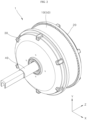
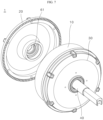
- FIGS. 1 and 2 are a front perspective view and a rear perspective view of an in-wheel motor according to an embodiment of the present disclosure
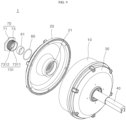
- FIGS. 3 and 4 are a front exploded perspective view and a rear exploded perspective view of an in-wheel motor according to an embodiment of the present disclosure
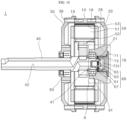
- FIG. 5 is a half-cross-sectional perspective view showing an in-wheel motor according to an embodiment of the present disclosure.
- an in-wheel motor 1 includes a rim 10, a cover 20 and 30, a shaft 40, a motor assembly 50, a magnetic encoder 60, and a shielding portion 70.
- the rim 10 is a circular rigid member that forms a wheel. Although not shown separately, a tire and the like may be coupled to surround an outer ring of the rim 10.
- a hollow may be defined inside the rim 10.
- the motor assembly 50 may be built into the hollow of the rim 10.
- various electrical and electronic components for example, a Hall sensor 56 (see FIG. 3 ), may be further disposed.
- the motor assembly 50 is coupled to the inside of the rim 10 and is a driving apparatus that rotates the rim 10.
- the motor assembly 50 may be disposed between the rim 10 and the shaft 40.
- the motor assembly 50 includes a stator 51 and a rotor 53.
- the stator 51 is coupled by surrounding the shaft 40, and receives power from a power supply line connected to the outside via a power supply line passage 42 defined along a center of the shaft 40.
- the stator 51 is disposed to surround and fix the shaft 40 by a core 52.
- the rotor 53 is disposed to surround the stator 51 with an air gap interposed therebetween.
- the rotor 53 includes a plurality of permanent magnets.
- stator 51 When the stator 51 receives the power, an electromagnetic force may be generated between the stator 51 and the rotor 53. Because of such electromagnetic force, the rotor 53 rotates around the stator 51 in a circumferential direction on the outside of the stator 51.
- a plurality of insulators 54 and 55 may be disposed on both side surfaces of the stator 51, respectively.
- the first insulator 54 may be disposed on an outer surface of the stator 51.
- the second insulator 55 may be disposed on the other side surface of the stator 51.
- the Hall sensor 56 may be assembled on a board and disposed at one side of the motor assembly 50.
- the Hall sensor 56 refers to a sensor that senses a magnetic force within the motor assembly 50.
- the Hall sensor 56 may be located close to the motor assembly 50, and at least two Hall sensors 56 may be disposed on the board.
- the motor assembly 50 that is, the stator 51 and the rotor 53, is located in the inner hollow of the rim 10.
- the stator 51 is directly connected to the shaft 40 and is fixed without rotating with the shaft 50, and only the rotor 53 rotates on the outside of the stator 51.
- the covers 20 and 30 are coupled to the rim 10 to cover open areas at both sides of the rim 10.
- the covers 20 and 30 are coupled to cover the open areas at both sides of the rim 10, thereby blocking an internal space of the rim 10 from the outside.
- Various components of the in-wheel motor 1, including the motor assembly 50, are built into the internal space of the rim 10, and are able to be protected from the outside as exposure thereof to the outside is blocked.
- the covers 20 and 30 include the outer cover 20 and the inner cover 30.
- the outer cover 20 may cover the outer open area of the rim 10 and may be detachably coupled to the rim 10.
- the outer cover 20 has a bolt fastening hole 28 defined therein.
- the bolt fastening hole 28 of the outer cover 20 is located at an edge of the disk-shaped outer cover 20.
- a bolt fastening hole 18 corresponding to the bolt fastening hole 28 of the outer cover 20 is defined at an outer edge of the rim 10. Accordingly, the bolt fastening hole 28 of the outer cover 20 and the outer bolt fastening hole 18 of the rim 10 may be assembled with and disassembled from each other using a fastening bolt.
- the inner cover 30 may cover an inner open area of the rim 10 and may be detachably coupled to the rim 10.
- the inner cover 30 has a bolt fastening hole 38 defined therein.
- the bolt fastening hole 38 of the inner cover 30 is located at an edge of the disk-shaped inner cover 30.
- a bolt fastening hole 19 corresponding to the bolt fastening hole 38 of the inner cover 30 is defined at an inner edge of the rim 10. Accordingly, the bolt fastening hole 38 of the inner cover 30 and the outer bolt fastening hole 19 of the rim 10 may be assembled with and disassembled from each other using a fastening bolt.
- a screw hole 21 may be defined in an outer surface 23 of the outer cover 20.
- the screw hole 21 may be defined through the outer surface 23 of the outer cover 20 in an axial direction of the shaft 40 toward a location facing the shaft 40.
- the screw hole 21 is defined for the shielding portion 70, which will be described later, to be coupled to or released from the outer cover 20 via screw fastening as needed.
- the screw hole 21 may be used as a fastening hole through which the shielding portion 70 may be attached to and detached from the outer cover 20.
- the shaft 40 may be disposed in the axial direction at a center of the rim 10.
- the shaft 40 may be coupled through a center of the inner cover 30, and an encoder sensor 63 may be connected to one end, that is, an inner end, of the shaft 40.
- the magnetic encoder 60 is a sensor that enables control of the in-wheel motor 1 by sensing the number of rotations and a speed of the in-wheel motor 1.
- the magnetic encoder 60 includes a ring-shaped magnet 61 and the encoder sensor 63.
- the ring-shaped magnet 61 is coupled to the cover, specifically the outer cover 20, and rotates together with the outer cover 20.
- the encoder sensor 63 senses a change in a magnetic flux of the ring-shaped magnet 61 when the ring-shaped magnet 61 coupled to the outer cover 20 rotates.
- an encoder that senses the number of rotations and a speed of a motor includes an optical encoder and a magnetic encoder.
- the reason why the magnetic encoder 60 is used in the in-wheel motor 1 according to an embodiment of the present disclosure is because the magnetic encoder 60 has excellent environmental reliability. In other words, it is more desirable to use the magnetic encoder 60 to detect the number of rotations and the speed of the in-wheel motor 1 used outdoors.
- the encoder sensor 63 is preferably located inside a hollow 611 (see FIG. 13 ) of the ring-shaped magnet 61.
- the encoder sensor is disposed in a direction facing the disk-shaped magnet, and a shielding plate is disposed outwardly of the cover, external magnetic field shielding occurs only in an axial direction of the disk-shaped magnet.
- the magnetic field shielding is achieved only in the axial direction of the disk-type magnet, but not in a radial direction thereof.
- the ring-shaped magnet 61 is mounted inside the shielding portion 70 that is fastened to the screw hole 21 of the outer cover 20, and the encoder sensor 63 is located inside the hollow 611 (see FIG. 13 ) of the ring-shaped magnet 61.
- the magnetic field shielding in the axial direction of the ring-shaped magnet 61 may become available by the shielding portion 70, and the magnetic field shielding in the radial direction of the ring-shaped magnet 61 (i.e., X and Y-axis directions) may also become available by the ring shape of the magnet. Because of this, accuracy of the magnetic encoder 60 may be improved.
- the magnetic encoder 60 further includes an encoder board 65 and an encoder housing 67.
- the encoder board 65 refers to a circuit board on which the encoder sensor 63 is mounted.
- the encoder board 65 may be located together with the encoder sensor 63 inside the hollow 611 (see FIG. 13 ) of the ring-shaped magnet 61.
- the encoder housing 67 is a body of the magnetic encoder 60 to which the encoder board 65 is coupled, and serves to connect the encoder board 65 to the inner end of the shaft 40 in the axial direction.
- one end of the encoder housing 67 may be inserted by a predetermined length in the axial direction into a hollow 41 (see FIG. 10 ) of a predetermined length defined in the inner end of the shaft 40.
- the encoder board 65 is coupled to the other end of the encoder housing 67 to fix a location of the encoder sensor 63.
- the encoder sensor 63 senses the change in the magnetic flux while being located in the hollow 611 (see FIG. 13 ) of the ring-shaped magnet 61.
- the encoder sensor 63 outputs an A/B/Z signal based on the results of sensing the change in the magnetic flux.
- the magnetic encoder 60 may accurately detect the number of rotations and the speed of the in-wheel motor 1 by sensing the change in the magnetic flux of the ring-shaped magnet 61 connected to the outer cover 20 that is connected to the rotor 53 and the rim 10.
- the shielding portion 70 shields a magnetic field effect other than the ring-shaped magnet 61 to increase the detection accuracy of the magnetic encoder 60.
- the shielding portion 70 prevents the encoder sensor 63 from being affected by an external stray field other than the ring-shaped magnet 61 so as to accurately detect the number of rotations and the speed of the in-wheel motor 1 by detecting only the change in the magnetic flux of the rotating ring-shaped magnet 61.
- the shielding portion 70 may be made of a magnetic material to shield the external magnetic field.
- the shielding portion 70 may be detachably coupled to the cover, particularly, the outer cover 20.
- the shielding portion 70 may be formed in a shape of a bolt, and specifically include a head 71 corresponding to a bolt head and a screw 73 corresponding to a screw body of the bolt.
- the head 71 may have a polygonal plate shape such that an operator may easily rotate the shielding portion 70 outside the outer cover 20.
- the head 71 has a hexagonal plate shape, but the present disclosure is not limited thereto. Accordingly, the head 71 may be formed in various polygonal plate shapes (e.g., square, octagon, and the like) other than the hexagonal plate shape.
- the shielding portion 70 may be screwed into the screw hole 21 of the outer cover 20 and assembled to the outer cover 20 or may be easily separated from the outer cover 20 as the screw fastening is released, depending on a rotation direction of the head 71.
- the head 71 may have a shape of protruding outwardly of the outer surface 23 of the outer cover 20. As such, when the head 71 has the shape of protruding outwardly of the outer surface 23 of the outer cover 20, rotation manipulation of the head 71 may be easily performed.
- the screw 73 is fastened to the screw hole 21 and assembled to the outer cover 20, or is released and separated from the outer cover 20.
- the shielding portion 70 has the structure that is easily detachable from the outer cover 20 so as to be assembled thereto and dissembled therefrom, making it easier to separate and replace the ring-shaped magnet 61 mounted on the shielding portion 70 and shortening a work time.
- the in-wheel motor 1 has the structure in which the shielding portion 70 is detachable from the outer cover 20 by the screw fastening scheme, making it easy to replace the ring-shaped magnet 61.
- the in-wheel motor 1 according to an embodiment of the present disclosure has an O-ring 80 on the outer surface 23 of the outer cover 20.
- the O-ring 80 may be inserted into and fixed to an O-ring receiving groove 231 (see FIG. 11 ) defined in the outer surface 23 of the outer cover 20.
- the O-ring 80 may be made of an elastic material (e.g., rubber and the like).
- the O-ring 80 may be located at a contact area between the outer surface 23 of the outer cover 20 and the shielding portion 70, more specifically, the head 71.
- the O-ring 80 may seal a space between the outer cover 20 and the head 71 to increase sealing between the outer cover 20 and the shielding portion 70.
- the in-wheel motor 1 includes a plurality of bearings 91 and 92.
- the plurality of bearings 91 and 92 includes the first bearing 91 and the second bearing 93.
- the first bearing 91 is located between the shaft 40 and the outer cover 20.
- the second bearing 93 is located between the shaft 40 and the inner cover 30 at a distance from the first bearing 91.
- the first bearing 91 may reduce friction between the shaft 40 and the outer cover 20.
- the shaft 40 is coupled to the stator 51 and does not rotate, and the outer cover 20 is coupled to one side of the rim 10, which rotates in association with the rotor 53, and rotates.
- the outer cover 20 is supported by the shaft 40 by the first bearing 91, allowing quiet and stable rotation.
- the second bearing 93 may reduce friction between the shaft 40 and the inner cover 30.
- the shaft 40 is coupled to the stator 51 and does not rotate, and the inner cover 30 is coupled to the other side of the rim 10, which rotates in association with the rotor 53, and rotates.
- the inner cover 30 is supported by the shaft 40 by the second bearing 93, allowing quiet and stable rotation.
- the in-wheel motor 1 has the structure in which the single shaft 40 extends through the outer cover 20 and the inner cover 30 with the motor assembly 50 interposed therebetween and respective both ends of the outer cover 20 and the inner cover 30 are supported by the shaft 40 by the first and second bearings 91 and 93.
- the rim 10 may rotate stably while being supported on the shaft 40.
- postural shaking of the rim 10 is suppressed, thereby improving travel stability of the in-wheel motor 1.
- FIGS. 6 and 7 are front and rear exploded perspective views showing a structure in which an outer cover is separated from an in-wheel motor
- FIGS. 8 and 9 are front and rear exploded perspective views showing a structure in which a shielding portion is separated from an outer cover of an in-wheel motor
- FIG. 10 is an overall cross-sectional view showing an in-wheel motor according to an embodiment of the present disclosure.
- the in-wheel motor 1 uses the magnetic encoder 60 including the ring-shaped magnet 61 to sense the number of rotations and the speed of the in-wheel motor 1.
- the in-wheel motor 1 uses the ring-shaped magnet 61 instead of the general disk-shaped magnet, thereby effectively blocking the disadvantage of the disk-shaped magnet, that is, the external magnetic field in the radial direction of the magnet (i.e., the X-axis and the Y-axis).
- blocking the external magnetic field in the axial direction of the magnet i.e., the Z-axis
- the shielding portion 70 that is coupled to the outer cover 20
- the external magnetic field in the radial direction of the magnet i.e., the X-axis and the Y-axis
- the ring-shaped magnet 61 may be blocked using the ring-shaped magnet 61.
- the in-wheel motor 1 may satisfy the accuracy of the encoder sensor simply by placing the encoder sensor 63 inside the hollow 611 (see FIG. 13 ) of the ring-shaped magnet 61.
- the distance between the disk-shaped magnet and the encoder sensor 63 may not be accurately adjusted because of an assembly tolerance generated when assembling the in-wheel motor 1. In this case, the accuracy of the magnetic encoder 60 is reduced.
- the encoder sensor 63 is located inside the hollow of the ring-shaped magnet 61, and precise distance adjustment between the encoder sensor 63 and the ring-shaped magnet 61 is not required (see FIG. 10 ). For this reason, there is an advantage in securing the accuracy of the magnetic encoder 60.
- the magnetic encoder 60 includes the ring-shaped magnet 61, the encoder sensor 63, the encoder board 65, and the encoder housing 67.
- the ring-shaped magnet 61 refers to a magnet member that has a circular ring shape and has a hollow defined therein, unlike the disk-shaped magnet used in the general magnetic encoder 60.
- the ring-shaped magnet 61 may be mounted in a groove 731 of the shielding portion 70 that is screwed to the outer cover 20. As the shielding portion 70 is coupled to the outer cover 20, the ring-shaped magnet 61 rotates together with the outer cover 20 when the outer cover 20 rotates.
- the encoder sensor 63 is located inside the hollow 611 (see FIG. 13 ) of the ring-shaped magnet 61.
- the encoder sensor 63 senses the change in the magnetic flux of the ring-shaped magnet 61 when the ring-shaped magnet 61 rotates, thereby sensing the number of rotations and the speed of the in-wheel motor 1.
- the external magnetic field shielding in the radial direction of the ring-shaped magnet 61 becomes available.
- the external magnetic field shielding in the axial direction of the ring-shaped magnet 61 may become available by the shielding portion 70.
- the magnetic field shielding in the axial direction (i.e., the Z-axis direction) of the ring-shaped magnet 61 becomes available by the shielding portion 70, and the magnetic field shielding in the radial direction of the ring-shaped magnet 61 (i.e., the X-axis direction and the Y-axis direction) also becomes available by the shape of the ring-shaped magnet 61.
- the encoder board 65 may have a plurality of coupling holes 651 (see FIG. 11 ). Such coupling hole 651 becomes a hole into which a protrusion 675 (see FIG. 11 ) of the encoder housing 67, which will be described later, is inserted.
- the encoder board 65 may be located inside the hollow 611 (see FIG. 13 ) of the ring-shaped magnet 61 together with the encoder sensor 63.
- the encoder housing 67 is a body of the magnetic encoder 60 to which the encoder board 65 is coupled, and serves to connect the encoder board 65 to the inner end of the shaft 40 in the axial direction.
- one end of the encoder housing 67 may be inserted into the hollow 41 defined at the inner end of the shaft 40.
- the encoder board 65 is coupled to the other end of the encoder housing 67.
- the protrusion 675 (see FIG. 11 ) of the encoder housing 67 may be inserted into and coupled to the coupling hole 651 (see FIG. 11 ) of the encoder board 65.
- FIG. 11 is an enlarged cross-sectional view of an area "A" in FIG. 10
- FIG. 12 is a cross-sectional view showing a magnetic flux caused by a ring-shaped magnet in an area "A" in FIG. 10
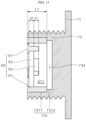
- FIG. 13 is an enlarged cross-sectional view of a shielding portion included in an in-wheel motor.
- the ring-shaped magnet 61 may be mounted in the groove 731 of the shielding portion 70 that is screwed to the outer cover 20. Because the shielding portion 70 is coupled to the outer cover 20, when the outer cover 20 rotates, the ring-shaped magnet 61 mounted in the groove 731 of the shielding portion 70 rotates together with the outer cover 20.
- the encoder sensor 63 is located inside the hollow 611 (see FIG. 13 ) of the ring-shaped magnet 61.
- the encoder sensor 63 senses the change in the magnetic flux of the ring-shaped magnet 61 when the ring-shaped magnet 61 rotates, thereby sensing the number of rotations and the speed of the in-wheel motor 1.
- the external magnetic field shielding in the radial direction of the ring-shaped magnet 61 is available.
- the external magnetic field shielding in the axial direction of the ring-shaped magnet 61 may become available by the shielding portion 70.
- the encoder board 65 is the circuit board on which the encoder sensor 63 is mounted.
- the encoder board 65 has the plurality of coupling holes 651.
- the coupling hole 651 becomes a hole into which a portion of the encoder housing 67, which will be described later, that is, the protrusion 675 is inserted.
- the encoder board 65 may be located inside the hollow 611 of the ring-shaped magnet 61 together with the encoder sensor 63.
- the encoder housing 67 connects the encoder board 65 to the inner end of the shaft 40 in the axial direction.
- the encoder housing 67 includes a portion-to-be-inserted 671, a connecting portion 673, and the protrusion 675.
- the portion-to-be-inserted 671 refers to a circular tube-shaped portion that is inserted in the axial direction into a hollow 411 defined at the inner end of the shaft 40.
- the portion-to-be-inserted 671 may be inserted into and attached to the hollow 411 of the shaft 40 to firmly fix the locations of the encoder sensor 63 and the encoder board 65.
- the portion-to-be-inserted 671 when inserting the portion-to-be-inserted 671 into the hollow 411 of the shaft 40, the portion-to-be-inserted 671 may be inserted after an adhesive is applied and then be cured at a high temperature for a set time, thereby being firmly fixed to the shaft 40.
- the connecting portion 673 as a portion connected to the portion-to-be-inserted 671, has a shape whose outer diameter is expanded than that of the portion-to-be-inserted 671.
- the protrusion 675 protrudes from the connecting portion 673 toward the outside of the shaft 40, that is, in a direction opposite to a direction in which the portion-to-be-inserted 671 is inserted.
- the protrusion 675 is inserted into each of the plurality of coupling holes 651 defined in the encoder board 65 and supports the encoder board 65.
- the number and locations of protrusions 675 may correspond to the number and locations of coupling holes 651.
- the protrusion 675 includes a first protrusion 6751 and a second protrusion 6752.
- the first protrusion 6751 refers to a protrusion protruding from a surface of the connecting portion 673.
- the second protrusion 6752 refers to a protrusion protruding further from a protruding tip of the first protrusion 6751.
- the second protrusion 6752 may have a smaller diameter than the first protrusion 6751.
- the first protrusion 6751 refers to a circular cross-sectional protrusion with a first diameter
- the second protrusion 6752 refers to a circular cross-sectional protrusion with a second diameter that protrudes by a predetermined length from the protruding tip of the first protrusion 6751.
- the first diameter may be greater than the second diameter.
- the coupling hole 651 defined in the encoder board 65 has a size and a shape corresponding to those the second protrusion 6752.
- the coupling hole 651 defined in the encoder board 65 may have a shape that only the second protrusion 6752 is inserted, then extends through the coupling hole 651, and then protrudes, and the encoder board 65 may be restricted in the insertion by being caught on the tip of the first protrusion 6751.
- L1 is greater than t1, which is a thickness of the encoder sensor 63 (see FIG. 13 ).
- the encoder sensor 63 may be located inside the hollow of the ring-shaped magnet 61, and the external magnetic field shielding performance in the radial direction of the ring-shaped magnet 61 may be satisfied.
- the length of the hollow 611 of the ring-shaped magnet 61 is L1 (see FIG. 13 ) (see FIG. 13 ), it is preferable that L1 greater than a sum of t1, which is the thickness of the encoder sensor 63, and t2, which is a thickness of the encoder board 65 (see FIG. 13 ). That is, when the relationship L1>t1+t2 is satisfied, the encoder sensor 63 may be more stably located inside the hollow of the ring-shaped magnet 61, as shown in FIG. 13 . Accordingly, the external magnetic field shielding performance in the radial direction of the ring-shaped magnet 61 may be satisfied.
- the encoder sensor 63 senses the change in the magnetic flux while being located inside the hollow 611 of the ring-shaped magnet 61.
- the accuracy of the magnetic encoder 60 may be trusted as long as the encoder sensor 63 is located inside the hollow 611 of the ring-shaped magnet 61.
- the problem in which the accuracy of the magnetic encoder 60 is reduced because of a failure in adjusting the distance between the magnet and the encoder sensor when using the existing disk-shaped magnet resulted from the assembly tolerance of the in-wheel motor 1 may be prevented in advance.
- the encoder sensor 63 may sense the change in the magnetic flux f of the ring-shaped magnet 61 and output the A/B/Z signal, and may accurately sense the number of rotations and the speed of the in-wheel motor 1.
- the shielding portion 70 serves to shield the encoder sensor 63 from the magnetic field other than the ring-shaped magnet 61 to increase the detection accuracy of the magnetic encoder 60.
- the shielding portion 70 allows the encoder sensor 63 to be not affected by the external stray field other than the ring-shaped magnet 61 so as to detect only the change in the magnetic flux of the ring-shaped magnet 61.
- the shielding portion 70 provides the function of shielding the external magnetic field in the axial direction of the ring-shaped magnet 61 (i.e., the Z-axis).
- the shielding portion 70 may be made of the magnetic material to shield the external magnetic field.
- the shielding portion 70 may be formed in the shape of the bolt screwed to the outer cover 20.
- the shielding portion 70 includes the head 71 corresponding to the head of the bolt and the screw 73 corresponding to the screw body of the bolt.
- the head 71 may have the polygonal plate shape so as to be easily rotated from outside the outer cover 20.
- the head 71 may have the hexagonal plate shape.
- the head 71 may have the polygonal shape that is easy to rotate, for example, the plate shape such as the square or the octagon.
- the shielding portion 70 may be screwed into the screw hole 21 of the outer cover 20 and assembled to the outer cover 20 or may be separated from the outer cover 20 as the screw fastening is released, depending on the rotation manipulation of the head 71.
- the head 71 may protrude outwardly of the outer surface 23 of the outer cover 20. When the head 71 protrudes outwardly of the outer surface 23 of the outer cover 20, rotating the head 71 may become easier.
- the screw 73 refers to a male screw body that is fastened into or released from the screw hole 21 based on the rotation of the head 71.
- the shielding portion 70 may have a structure that may be easily coupled to and separated from the outer cover 20. Accordingly, the separation and the replacement of the ring-shaped magnet 61 mounted in the groove 731 defined inside the screw 73 of the shielding portion 70 may become easier.
- the shielding portion 70 is fixed to the outside of the outer cover 20 and the ring-shaped magnet 61 is fixed to the inside of the outer cover 20, the complex work of separating the entirety of the outer cover 20 from the rim 10 to remove and replace the ring-shaped magnet 61 is required.
- the shielding portion 70 is not structured to be partially separated from the outer cover 20 and the ring-shaped magnet 61 is coupled to the inside of the outer cover 20, the complex work of disassembling the outer cover 20 from the rim 10 is required to replace the ring-shaped magnet 61.
- the work of completely separating the outer cover 20 attached to the rim 10 from the rim 10 is very complicated and requires a lot of work time.
- the in-wheel motor 1 has the structure in which the shielding portion 70 is partially coupled to and separated from the outer cover 20 via the screw fastening, the groove 731 is defined in the shielding portion 70, and the ring-shaped magnet 61 is mounted in such groove 731. Accordingly, the ring-shaped magnet 61 may be replaced after partially separating only the shielding portion 70, without completely removing the outer cover 20 to replace the ring-shaped magnet 61.
- the screw 73 has the groove 731 with the circular cross-section.
- the groove 731 defined in the screw 73, as the groove with the circular cross-section recessed in the axial direction of the shaft 40, may be a groove with a circular cross-section having a center the same as a center of a cross-section of the shaft 40.
- the ring-shaped magnet 61 may be inserted into and fixed to the groove 731 defined in the screw 73.
- the ring-shaped magnet 61 is confined in a location to the inside of the groove 731, but is able to be separated to the outside of the groove 731 when necessary, so that the replacement thereof with the new ring-shaped magnet 61 may become available.
- the screw 73 has the groove 731 with the circular cross-section recessed in the axial direction of the shaft 40, and the groove 731 includes a first groove 7311 and a second groove 7312.
- the first groove 7311 is located at a front end in a protruding direction of the screw 73.
- the first groove 7311 provides a space for the ring-shaped magnet 61 to be inserted and installed.
- the ring-shaped magnet 61 may be inserted into and fixed to the first groove 7311 of the screw 73, and may be separated from the first groove 7311 to the outside when necessary.
- the second groove 7312 is located at a rear end in the protruding direction of the screw 73.
- the second groove 7312 secures a smaller space than that of the first groove 7311.
- the second groove 7312 is an empty space in which the ring-shaped magnet 61 is not inserted, and defines a predetermined clearance space 734 (see FIG. 13 ) between the ring-shaped magnet 61 inserted into the first groove 7311 and the shielding portion 70.
- the ring-shaped magnet 61 is not inserted into the clearance space 734 defined by the second groove 7312 and the clearance space 734 always remains empty.
- the second groove 7312 allows the clearance space 734 of a predetermined size to be secured between the ring-shaped magnet 61 and the shielding portion 70, so that the magnetic flux f (see FIG. 12 ) travels straight and leakage of the magnetic flux f is prevented.
- FIG. 14 is an exploded perspective view showing a state in which a shielding portion and a ring-shaped magnet are separated from an outer cover of an in-wheel motor according to an embodiment of the present disclosure.
- the ring-shaped magnet 61 demagnetizes and it becomes necessary to replace the same with the new ring-shaped magnet 61.
- the magnetic flux f may travel straight and the amount of change in the magnetic flux depending on the location of the encoder sensor 63 may be reduced.
- the empty clearance space is secured between the shielding portion 70 and the ring-shaped magnet 61, thereby preventing the magnetic flux leakage.
- the external magnetic field shielding effect may be strengthened in the axial direction (i.e., the Z-axis direction) as well as the radial direction (i.e., the Y-axis direction and the Z-axis direction) for the ring-shaped magnet 61, and the structure in which the shielding portion 70 surrounds the ring-shaped magnet 61 may be achieved. Accordingly, the reliability to the external environment may be improved.
- the ring-shaped magnet 61 when the ring-shaped magnet 61 is damaged or demagnetizes and does not function properly, the ring-shaped magnet 61 may be easily replaced by disassembling only the shielding portion 70 without disassembling the entire outer cover 20.
Landscapes
- Engineering & Computer Science (AREA)
- Power Engineering (AREA)
- Physics & Mathematics (AREA)
- Microelectronics & Electronic Packaging (AREA)
- Electromagnetism (AREA)
- Chemical & Material Sciences (AREA)
- Combustion & Propulsion (AREA)
- Transportation (AREA)
- Mechanical Engineering (AREA)
- General Physics & Mathematics (AREA)
Abstract
Description
- Embodiments of the present disclosure relate to an in-wheel motor, and more specifically, relate to an in-wheel motor that may improve a performance of a magnetic encoder used to control the in-wheel motor by sensing the number of rotations and a speed of the in-wheel motor.
- Content to be described below is merely for a purpose of providing background information related to an embodiment of the present disclosure, and the content described does not necessarily constitute prior art.
- An in-wheel motor is used not only in various means of travel that use electricity as a power source, but also in means of travel of an autonomous robot or the like.
- The in-wheel motor outputs power from a motor assembly located inside a rim.
- The motor assembly includes a stator and a rotor, and the power output from such motor assembly is transmitted to the rim and wheels without going through a separate power transmitting apparatus to provide a rotational force necessary for travel.
- As such, unlike existing general means of travel, the in-wheel motor does not require a complicated driving apparatus or the power transmitting apparatus, and thus, has a simple structure and enables lightening of the means of travel. Furthermore, the in-wheel motor reduces energy loss that occurs during power transmission compared to the existing general means of travel.
- A general in-wheel motor includes a tire, the circular rim that is coupled with the tire and rotates the tire, the motor assembly that provides the rotational force to the rim, and a shaft that is fixed to a center of the motor assembly.
- The tire is removably coupled to the circular rim.
- The motor assembly includes the stator and the rotor, and is disposed inside the rim and receives the power to generate the rotational force.
- Generally, the shaft extends through a center of the stator and is coupled to the stator. The stator receives the power from the outside of the in-wheel motor via a power supply line, and when the power is supplied to the stator, the rotor rotates around the stator.
- The power supply line may have a structure that is inserted via a hollow of the shaft and connected to one side of the stator.
- In one example, the rotor is connected to the rim. For this reason, when the rotor rotates around the stator, the rim rotates with the rotor. Further, the tire rotates with the rim. This may enable an operation of the in-wheel motor.
- In one example, an encoder is used as an apparatus to sense the number of rotations and a speed of the in-wheel motor.
- The encoder is a type of sensor. The encoder is installed on the in-wheel motor and is used to control the in-wheel motor by sensing the number of rotations and the speed of the in-wheel motor.
- Types of encoders include an optical encoder, a magnetic encoder, and the like.
- The in-wheel motor mainly used outdoors uses the magnetic encoder with excellent environmental reliability.
- Generally, the magnetic encoder includes a magnet and an encoder sensor that senses a change in a magnetic flux when the magnet rotates and outputs an A/B/Z signal.
- However, to ensure accuracy of such magnetic encoder, a magnetic shielding structure is required so as not to be affected by an external stray field, other than the magnetic flux caused by the magnet.
- Additionally, there is a range of magnetic flux density that the encoder sensor may recognize depending on a temperature. For this reason, care is needed in designing a distance between the encoder sensor and the magnet.
- As a prior document related to the present disclosure,
CN210608838U (hereinafter, referred to as Prior Document 1) discloses a magnetic sensor outer rotor motor. - The outer rotor motor disclosed in Prior
Document 1 includes a magnetic sensor and a magnet. The magnet is disposed facing the magnetic sensor and has a disk shape. The disk-shaped magnet is fixed to the inside of a cover. An anti-interference steel plate is disposed on the outside of the cover and shields an external magnetic field to prevent external magnetic field disturbance. - However, the outer rotor motor disclosed in
Prior Document 1 has following problems. - First, as the anti-interference steel plate is disposed in an axial direction of the disk-shaped magnet, external magnetic field shielding occurs only in the axial direction of the disk-shaped magnet. In other words, there is a disadvantage that the magnetic field shielding is only achieved in the axial direction of the disk-shaped magnet, but not in a radial direction thereof.
- Second, a distance between the disk-shaped magnet and the encoder sensor is fixed. This structure has a disadvantage in that when a performance of the disk-shaped magnet deteriorates resulted from demagnetization, the encoder sensor may not accurately sense rotation of the magnet.
- Third, as the disk-shaped magnet is fixed to the inside of the cover, there is a disadvantage that complex work processes such as tire removal and cover removal are required to replace the magnet when the performance thereof deteriorates.
- As another prior document related to the present disclosure, a rotary sensor assembly is disclosed in
Korean Utility Model Application Publication No. 20-2013-0002174 - A sensor structure disclosed in Prior Document 2 proposes a spacing adjusting means that adjusts a spacing between a magnet and an encoder IC (i.e., a sensor).
- The sensor structure in Prior Document 2 will be described. A magnet receiving groove is defined in a rotatable body, and the magnet and a spring are inserted into the magnet receiving groove. The spring presses the magnet inserted into the magnet receiving groove outward, so that the magnet protrudes toward the encoder sensor. In one example, the spacing adjusting means adjusts a protruding degree of the magnet and adjusts the spacing between the magnet and the encoder sensor. Such spacing adjusting means includes a spacing adjusting plate and an adjusting screw.
- However, in the sensor structure disclosed in Prior Document 2, the spacing adjusting means is disposed inside the rotatable body, more specifically, in an internal area of the rotatable body facing the sensor, so that there is an inconvenience during work that an entirety of the rotatable body must be disassembled to adjust the spacing (i.e., a distance) between the magnet and the encoder sensor. In addition, replacing the magnet with a new one also requires a complicated work process that requires disassembling an entirety of the rotatable body, then unfastening an adjusting screw, and then separating the spacing adjusting plate.
- In addition, the sensor structure of Prior Document 2 is weak in shielding the external magnetic fields in both the axial direction of the magnet as well as the radial direction, which has a fatal disadvantage in that encoder measurement accuracy may be reduced.
- As another prior document related to the present disclosure,
Korean Patent No. 10-1928877 - Prior Document 3 includes a transmission gear that rotates by receiving power of the in-wheel motor, a measurement subject having a magnetic force and mounted on the transmission gear, and a speed sensor that measures rotation of the measurement subject. The measurement subject includes a bracket coupled to the transmission gear and a magnet fixed to the bracket.
- As such, Prior Document 3 uses the magnet and the sensor to measure a speed of the in-wheel motor, more specifically, the vehicle equipped with the in-wheel motor.
- However, Prior Document 3 has a disadvantage of not suggesting any structure that may shield the external magnetic field, other than the magnetic flux caused by the magnet.
- The present disclosure is to provide an in-wheel motor that may improve a performance of a magnetic encoder used to control the in-wheel motor by sensing the number of rotations and a speed of the in-wheel motor.
- The present disclosure is to provide an in-wheel motor that makes it easy to replace a magnet with a new one when a performance of the magnet deteriorates because of demagnetization as the replacement of the magnet becomes simpler by improving a shape of a shielding plate.
- The present disclosure is to provide an in-wheel motor that may improve an axial external magnetic field shielding performance of a magnet as well as a radial external magnetic field shielding performance thereof by compensating for radial external magnetic field vulnerability of an existing disk-shaped magnet using a ring-shaped magnet.
- The present disclosure is to provide an in-wheel motor that may prevent accuracy of an encoder from being reduced because of inability to adjust a distance between an existing disk-shaped magnet and an encoder sensor because adjustment of a distance between the magnet and the encoder sensor is not required as long as a ring-shaped magnet is used and the encoder sensor is located in a hollow of the ring-shaped magnet.
- Purposes of the present disclosure are not limited to the purposes mentioned above, and other purposes and advantages of the present disclosure not mentioned may be understood by the description below and may be understood more clearly by embodiments of the present disclosure. In addition, it will be easy to recognize that the purposes and the advantages of the present disclosure may be realized by the means indicated in the patent claims and combinations thereof.
- According to one aspect of the present disclosure, an in-wheel motor that may improve a performance of a magnetic encoder used to control the in-wheel motor by sensing the number of rotations and a speed of the in-wheel motor may be provided.
- According to another aspect of the present disclosure, an in-wheel motor that makes it easy to replace a magnet with a new one when a performance of the magnet deteriorates because of demagnetization as the replacement of the magnet becomes simpler by improving a shape of a shielding plate may be provided.
- According to still another aspect of the present disclosure, an in-wheel motor that may improve an axial external magnetic field shielding performance of a magnet as well as a radial external magnetic field shielding performance thereof by compensating for radial external magnetic field vulnerability of an existing disk-shaped magnet using a ring-shaped magnet may be provided.
- According to yet another aspect of the present disclosure, an in-wheel motor that may prevent accuracy of an encoder from being reduced because of inability to adjust a distance between an existing disk-shaped magnet and an encoder sensor because adjustment of a distance between the magnet and the encoder sensor is not required as long as a ring-shaped magnet is used and the encoder sensor is located in a hollow of the ring-shaped magnet may be provided.
- An in-wheel motor according to an embodiment of the present disclosure includes a rim, a cover, a shaft, a motor assembly, a magnetic encoder, and a shielding portion.
- The rim refers to a circular rigid member that is open at both sides. A tire and the like may be coupled in an outer circumferential direction of the rim.
- The cover may be coupled to the rim to cover open areas at the both sides of the rim.
- The cover may seal the interior of the rim. The cover serves to protect various electronic components, including the motor assembly disposed inside the rim.
- The shaft may be disposed arranged in an axial direction at a center of the rim.
- The motor assembly includes a stator surrounding and fixed to the shaft, and a rotor disposed to surround the stator and rotatable about the shaft.
- The motor assembly may be disposed inside the rim to provide a rotational force to the rim.
- The magnetic encoder is an apparatus that senses the number of rotations and a speed of the in-wheel motor.
- The magnetic encoder includes a ring-shaped magnet and an encoder sensor.
- The ring-shaped magnet refers to a ring-shaped magnet with a circular hollow defined therein.
- The ring-shaped magnet may rotate together with the cover.
- The encoder sensor refers to a sensor that is located between the shaft and the cover and connected and fixed to the shaft in the axial direction, and senses a change in a magnetic flux of the ring-shaped magnet.
- The encoder sensor may output an A/B/Z phase signal by sensing the change in the magnetic flux of the ring-shaped magnet that rotates with the rim and the cover.
- The shielding portion may be detachably coupled to the cover. For example, a screw hole may be defined in the cover, and the shielding portion may be fastened to or released from the screw hole.
- The shielding portion may serve to shield an external magnetic field other than the ring-shaped magnet.
- The shielding portion may improve accuracy of the encoder sensor by preventing the encoder sensor from being affected by an external stray field other than the ring-shaped magnet, that is, the magnetic flux caused by the magnet.
- In the in-wheel motor according to an embodiment of the present disclosure, the encoder sensor may be located inside the hollow of the ring-shaped magnet.
- Because there is a range of magnetic flux density that the sensor may recognize depending on a temperature, caution is required in designing a distance between the encoder sensor and the magnet.
- Unlike the disk-shaped magnet, the ring-shaped magnet does not require the caution in adjusting the distance from the encoder sensor, but preferably, the encoder sensor is located inside the hollow of the ring-shaped magnet.
- In the in-wheel motor according to an embodiment of the present disclosure, the magnetic encoder may further include an encoder board where the encoder sensor is mounted.
- The encoder board may be located together with the encoder sensor inside a hollow of the ring-shaped magnet.
- In the in-wheel motor according to an embodiment of the present disclosure, the magnetic encoder may further include an encoder board where the encoder sensor is mounted, and an encoder housing coupled to the encoder board and connecting the encoder board to the shaft in the axial direction.
- In this regard, the encoder housing may have one end inserted into a hollow of the shaft by a predetermined length in the axial direction and the other end coupled to the encoder board.
- In the in-wheel motor according to an embodiment of the present disclosure, the magnetic encoder may further include an encoder board where the encoder sensor is mounted, and an encoder housing coupled to the encoder board and connecting the encoder board to the shaft in the axial direction.
- In this regard, the encoder housing may include a circular tubular portion-to-be-inserted inserted into a hollow of the shaft in the axial direction, a connecting portion connected to the portion-to-be-inserted and having an outer diameter greater than an outer diameter of the portion-to-be-inserted, and a protrusion protruding from the connecting portion toward the outside of the shaft.
- The encoder board may have a coupling hole defined therein.
- The protrusion may be inserted into and extend through the coupling hole to support the encoder board.
- The protrusion may include a first protrusion protruding from the connecting portion, and a second protrusion protruding from the first protrusion and having a smaller diameter than the first protrusion.
- The coupling hole may have a size allowing only the second protrusion to be inserted.
- A length of a hollow of the ring-shaped magnet may be greater than a thickness of the encoder sensor.
- Further, a length of a hollow of the ring-shaped magnet may be greater than a sum of a thickness of the encoder board and a thickness of the encoder sensor.
- In the in-wheel motor according to an embodiment of the present disclosure, the shielding portion may be made of a magnetic material.
- In the in-wheel motor according to an embodiment of the present disclosure, the cover may include an outer cover detachably coupled to the rim by covering an outer open area of the rim, and an inner cover detachably coupled to the rim by covering an inner open area of the rim.
- The outer cover may have a screw hole extending therethrough in the axial direction of the shaft. Further, the shielding portion may be inserted into and fastened to or separated and released from the screw hole. Accordingly, the shielding portion may have a structure that is easily detachable from the outer cover.
- In the in-wheel motor according to an embodiment of the present disclosure, the shielding portion may include a plate-shaped head that protrudes outwardly of an outer surface of the outer cover and rotates the shielding portion when the shielding portion is fastened or released, and a screw connected to the head and inserted into and fastened to the screw hole.
- The screw may have a groove with a circular cross-section recessed in the axial direction of the shaft, and the ring-shaped magnet may be confined to the groove and be mounted in the shielding portion in a replaceable manner.
- The screw may have a groove with a circular cross-section recessed in the axial direction of the shaft, and the groove may include a first groove located at a front end in a protruding direction of the screw, wherein the ring-shaped magnet is mounted in the first groove in a replaceable manner, and a second groove located at a rear end in the protruding direction of the screw and securing a space of a smaller size than the first groove to define a clearance space between the ring-shaped magnet and the shielding portion. The second groove may secure the clearance space of a predetermined size between the ring-shaped magnet and the shielding portion, allowing a magnetic flux to proceed straight and preventing leakage of the magnetic flux.
- The in-wheel motor according to an embodiment of the present disclosure may further include an O-ring disposed in a contact area between an outer surface of the outer cover and the shielding portion.
- The O-ring may be inserted into and fixed to an O-ring receiving groove defined in the outer surface of the outer cover in contact with the shielding portion. Accordingly, sealing between the shielding portion and the outer cover may be improved.
- An in-wheel motor according to another aspect of the present disclosure includes a circular rim with both sides open, a cover coupled to the rim to cover open areas at the both sides of the rim and sealing the interior of the rim, a shaft disposed in an axial direction at a center of the rim, a stator surrounding and fixed to the shaft, a motor assembly including a rotor disposed to surround the stator and rotatable about the shaft, wherein the motor assembly is disposed inside the rim to provide a rotational force to the rim, a ring-shaped magnet rotatable together with the cover, and a magnetic encoder located between the shaft and the cover and connected and fixed to the shaft in the axial direction, wherein the magnetic encoder includes an encoder sensor configured to sense a change in a magnetic flux of the ring-shaped magnet. The encoder sensor is located inside a hollow of the ring-shaped magnet.
- The in-wheel motor may further include a shielding portion detachably coupled to the cover and shielding an external magnetic field other than the ring-shaped magnet.
- The cover may include an outer cover detachably coupled to the rim by covering an outer open area of the rim, and an inner cover detachably coupled to the rim by covering an inner open area of the rim.
- The outer cover may have a screw hole extending therethrough in the axial direction of the shaft, and the shielding portion may be detachable from the outer cover by being inserted into and fastened to or released from the screw hole.
- The shielding portion may include a plate-shaped head that protrudes outwardly of an outer surface of the outer cover and rotates the shielding portion when the shielding portion is fastened or released, and a screw connected to the head and inserted into and fastened to the screw hole.
- The screw may have a groove with a circular cross-section recessed in the axial direction of the shaft,
- The groove may include a first groove located at a front end in a protruding direction of the screw, wherein the ring-shaped magnet is mounted in the first groove in a replaceable manner, and a second groove located at a rear end in the protruding direction of the screw and securing a space of a smaller size than the first groove to define a clearance space between the ring-shaped magnet and the shielding portion.
- According to the embodiment of the present disclosure, the performance of the magnetic encoder used to control the in-wheel motor may be improved by sensing the number of rotations and the speed of the in-wheel motor.
- In particular, according to the embodiment of the present disclosure, there are following advantages.
- First, because only the shielding portion may be dismantled from the cover without disassembling the entire cover to replace the magnet, replacing the magnet may be made easier. Accordingly, when the magnet performance deteriorates because of the magnet demagnetization during the long-term use, the magnet may be easily replaced with the new magnet by disassembling only the shielding portion screwed to the center of the cover.
- Second, by using the ring-shaped magnet instead of the existing disk-shaped magnet, the vulnerability of the shielding structure, which was only able to shield the axial external magnetic field by the shielding plate when using the existing disk-shaped magnet may be compensated for. Accordingly, according to the embodiment of the present disclosure, the external magnetic field in the axial direction of the magnet may be shielded with the shielding plate, and at the same time, the external magnetic field in the radial direction of the magnet may be shielded with the ring shape of the magnet, thereby significantly reducing the vulnerability of the existing shielding structure. As a result, the measurement accuracy of the encoder may be increased and the reliability of the motor control may be improved.
- Third, when replacing the existing disk-shaped magnet with the ring-shaped magnet, the measurement accuracy of the encoder may be secured as long as the encoder sensor is located inside the hollow of the ring-shaped magnet. Accordingly, the precise adjustment of the distance between the magnet and the encoder sensor is not required unlike in the case of using the existing disk-shaped magnet, thereby preventing the problem of the deterioration in the accuracy of the encoder caused by the assembly tolerance occurring when assembling the in-wheel motor.
- In addition to the above-mentioned effects, specific effects of the present disclosure will be described below while describing the specific details for carrying out the invention.
-
-
FIG. 1 is a front perspective view showing an in-wheel motor viewed from one direction according to an embodiment of the present disclosure. -
FIG. 2 is a rear perspective view showing an in-wheel motor viewed from another direction according to an embodiment of the present disclosure. -
FIG. 3 is a front exploded perspective view showing an in-wheel motor viewed from one direction according to an embodiment of the present disclosure. -
FIG. 4 is an exploded rear perspective view showing an in-wheel motor viewed from another direction according to an embodiment of the present disclosure. -
FIG. 5 is a half-cross-sectional perspective view showing an in-wheel motor according to an embodiment of the present disclosure. -
FIG. 6 is a front exploded perspective view showing a state in which an outer cover is separated from an in-wheel motor according to an embodiment of the present disclosure. -
FIG. 7 is an exploded rear perspective view showing a state in which an outer cover is separated from an in-wheel motor according to an embodiment of the present disclosure. -
FIG. 8 is a front exploded perspective view showing a state in which only a shielding portion is separated from an in-wheel motor according to an embodiment of the present disclosure. -
FIG. 9 is an exploded rear perspective view showing a state in which only a shielding portion is separated from an in-wheel motor according to an embodiment of the present disclosure. -
FIG. 10 is an overall cross-sectional view showing an in-wheel motor according to an embodiment of the present disclosure. -
FIG. 11 is an enlarged cross-sectional view of an area "A" inFIG. 10 . -
FIG. 12 is a cross-sectional view showing a magnetic flux caused by a ring-shaped magnet in an area "A" inFIG. 10 . -
FIG. 13 is an enlarged cross-sectional view of a shielding portion included in an in-wheel motor according to an embodiment of the present disclosure. -
FIG. 14 is an exploded perspective view showing a state in which a shielding portion and a ring-shaped magnet are separated from an outer cover of an in-wheel motor according to an embodiment of the present disclosure. - The above objects, features, and advantages will be described in detail later with reference to the accompanying drawings. Accordingly, a person having ordinary knowledge in the technical field to which the present disclosure belongs will be able to easily implement the technical idea of the present disclosure. In describing the present disclosure, when it is determined that a detailed description of a known technology related to the present disclosure may unnecessarily obscure the gist of the present disclosure, the detailed description will be omitted. Hereinafter, preferred embodiments according to the present disclosure will be described in detail with reference to the accompanying drawings. In the drawings, the same reference numerals are used to indicate the same or similar components.
- Although the terms "first", "second", and the like are used to describe various components, the components are not limited by such terms. These terms are only used to distinguish one component from another component, and unless specifically stated to the contrary, a first component may also be a second component.
- Throughout the present document, unless otherwise stated, each element may be singular or plural.
- Hereinafter, it may mean that when a first component is described to be disposed "on (or under)" a second component, the first component may not only be disposed in contact with a top surface (or a bottom surface) of the second component, but also be disposed on the second component with a third component interposed therebetween.
- Additionally, it should be understood that when a component is described as being "connected to", "combined to", or "coupled to" another component, the components may be directly connected or coupled to each other, but other components may be "interposed" therebetween and the components may be "connected to", "combined to", or "connected to" each other via said other components.
- As used herein, the singular constitutes "a" and "an" are intended to include the plural constitutes as well, unless the context clearly indicates otherwise. In this application, terms such as "composed of" or "include" should not be construed as necessarily including all of various components or steps described herein, but should be construed that some components or steps among those may not be included or additional components or steps may be further included.
- Additionally, as used herein, singular expressions include plural expressions, unless the context clearly dictates otherwise. In the present application, terms such as "composed of' or "include" should not be construed as necessarily including all of various components or steps described herein, and should be interpreted as being able to not including some of the components or the steps and further including additional components or steps.
- Throughout the present document, when referred to as "A and/or B", this means A, B, or A and B, unless specifically stated to the contrary, and when referred to as "C to D", this means equal to or higher than C and equal to or lower than D unless specifically stated to the contrary.
- Hereinafter, the present disclosure will be described with reference to drawings showing a configuration of an in-wheel motor according to an embodiment of the present disclosure.
- Hereinafter, the overall structure of the in-wheel motor according to an embodiment of the present disclosure will be described in detail with reference to the attached drawings.
-
FIGS. 1 and2 are a front perspective view and a rear perspective view of an in-wheel motor according to an embodiment of the present disclosure, andFIGS. 3 and4 are a front exploded perspective view and a rear exploded perspective view of an in-wheel motor according to an embodiment of the present disclosure. Further,FIG. 5 is a half-cross-sectional perspective view showing an in-wheel motor according to an embodiment of the present disclosure. - As shown, an in-
wheel motor 1 according to an embodiment of the present disclosure includes arim 10, acover shaft 40, amotor assembly 50, amagnetic encoder 60, and a shieldingportion 70. - The
rim 10 is a circular rigid member that forms a wheel. Although not shown separately, a tire and the like may be coupled to surround an outer ring of therim 10. - A hollow may be defined inside the
rim 10. Themotor assembly 50 may be built into the hollow of therim 10. In addition, various electrical and electronic components, for example, a Hall sensor 56 (seeFIG. 3 ), may be further disposed. - The
motor assembly 50 is coupled to the inside of therim 10 and is a driving apparatus that rotates therim 10. - The
motor assembly 50 may be disposed between therim 10 and theshaft 40. - The
motor assembly 50 includes astator 51 and arotor 53. - The
stator 51 is coupled by surrounding theshaft 40, and receives power from a power supply line connected to the outside via a powersupply line passage 42 defined along a center of theshaft 40. - The
stator 51 is disposed to surround and fix theshaft 40 by acore 52. - The
rotor 53 is disposed to surround thestator 51 with an air gap interposed therebetween. Therotor 53 includes a plurality of permanent magnets. - When the
stator 51 receives the power, an electromagnetic force may be generated between thestator 51 and therotor 53. Because of such electromagnetic force, therotor 53 rotates around thestator 51 in a circumferential direction on the outside of thestator 51. - A plurality of
insulators stator 51, respectively. - For example, the
first insulator 54 may be disposed on an outer surface of thestator 51. Further, thesecond insulator 55 may be disposed on the other side surface of thestator 51. - Additionally, the
Hall sensor 56 may be assembled on a board and disposed at one side of themotor assembly 50. - The
Hall sensor 56 refers to a sensor that senses a magnetic force within themotor assembly 50. TheHall sensor 56 may be located close to themotor assembly 50, and at least twoHall sensors 56 may be disposed on the board. - The
motor assembly 50, that is, thestator 51 and therotor 53, is located in the inner hollow of therim 10. Thestator 51 is directly connected to theshaft 40 and is fixed without rotating with theshaft 50, and only therotor 53 rotates on the outside of thestator 51. - When the
rotor 53 rotates, thecircular rim 10 coupled to therotor 53 rotates, thereby enabling rotation of the in-wheel motor 1. - The
covers rim 10 to cover open areas at both sides of therim 10. - The
covers rim 10, thereby blocking an internal space of therim 10 from the outside. Various components of the in-wheel motor 1, including themotor assembly 50, are built into the internal space of therim 10, and are able to be protected from the outside as exposure thereof to the outside is blocked. - For example, the
covers outer cover 20 and theinner cover 30. - The
outer cover 20 may cover the outer open area of therim 10 and may be detachably coupled to therim 10. - As a specific example, the
outer cover 20 has abolt fastening hole 28 defined therein. - The
bolt fastening hole 28 of theouter cover 20 is located at an edge of the disk-shapedouter cover 20. Abolt fastening hole 18 corresponding to thebolt fastening hole 28 of theouter cover 20 is defined at an outer edge of therim 10. Accordingly, thebolt fastening hole 28 of theouter cover 20 and the outerbolt fastening hole 18 of therim 10 may be assembled with and disassembled from each other using a fastening bolt. - The
inner cover 30 may cover an inner open area of therim 10 and may be detachably coupled to therim 10. - As a specific example, the
inner cover 30 has abolt fastening hole 38 defined therein. - The
bolt fastening hole 38 of theinner cover 30 is located at an edge of the disk-shapedinner cover 30. Abolt fastening hole 19 corresponding to thebolt fastening hole 38 of theinner cover 30 is defined at an inner edge of therim 10. Accordingly, thebolt fastening hole 38 of theinner cover 30 and the outerbolt fastening hole 19 of therim 10 may be assembled with and disassembled from each other using a fastening bolt. - Additionally, a
screw hole 21 may be defined in anouter surface 23 of theouter cover 20. - The
screw hole 21 may be defined through theouter surface 23 of theouter cover 20 in an axial direction of theshaft 40 toward a location facing theshaft 40. - The
screw hole 21 is defined for the shieldingportion 70, which will be described later, to be coupled to or released from theouter cover 20 via screw fastening as needed. In other words, thescrew hole 21 may be used as a fastening hole through which the shieldingportion 70 may be attached to and detached from theouter cover 20. - The
shaft 40 may be disposed in the axial direction at a center of therim 10. - The
shaft 40 may be coupled through a center of theinner cover 30, and anencoder sensor 63 may be connected to one end, that is, an inner end, of theshaft 40. - The
magnetic encoder 60 is a sensor that enables control of the in-wheel motor 1 by sensing the number of rotations and a speed of the in-wheel motor 1. - For example, the
magnetic encoder 60 includes a ring-shapedmagnet 61 and theencoder sensor 63. - The ring-shaped
magnet 61 is coupled to the cover, specifically theouter cover 20, and rotates together with theouter cover 20. - The
encoder sensor 63 senses a change in a magnetic flux of the ring-shapedmagnet 61 when the ring-shapedmagnet 61 coupled to theouter cover 20 rotates. - Generally, an encoder that senses the number of rotations and a speed of a motor includes an optical encoder and a magnetic encoder.
- However, the reason why the
magnetic encoder 60 is used in the in-wheel motor 1 according to an embodiment of the present disclosure is because themagnetic encoder 60 has excellent environmental reliability. In other words, it is more desirable to use themagnetic encoder 60 to detect the number of rotations and the speed of the in-wheel motor 1 used outdoors. - In one example, the
encoder sensor 63 is preferably located inside a hollow 611 (seeFIG. 13 ) of the ring-shapedmagnet 61. - When a disk-shaped magnet, rather than the ring-shaped
magnet 61, is disposed inside the cover, the encoder sensor is disposed in a direction facing the disk-shaped magnet, and a shielding plate is disposed outwardly of the cover, external magnetic field shielding occurs only in an axial direction of the disk-shaped magnet. In other words, there is a disadvantage that the magnetic field shielding is achieved only in the axial direction of the disk-type magnet, but not in a radial direction thereof. - According to an embodiment of the present disclosure, the ring-shaped
magnet 61 is mounted inside the shieldingportion 70 that is fastened to thescrew hole 21 of theouter cover 20, and theencoder sensor 63 is located inside the hollow 611 (seeFIG. 13 ) of the ring-shapedmagnet 61. - As a result, the magnetic field shielding in the axial direction of the ring-shaped magnet 61 (i.e., a Z-axis direction) may become available by the shielding
portion 70, and the magnetic field shielding in the radial direction of the ring-shaped magnet 61 (i.e., X and Y-axis directions) may also become available by the ring shape of the magnet. Because of this, accuracy of themagnetic encoder 60 may be improved. - In addition, the
magnetic encoder 60 further includes anencoder board 65 and anencoder housing 67. - The
encoder board 65 refers to a circuit board on which theencoder sensor 63 is mounted. Theencoder board 65 may be located together with theencoder sensor 63 inside the hollow 611 (seeFIG. 13 ) of the ring-shapedmagnet 61. - The
encoder housing 67 is a body of themagnetic encoder 60 to which theencoder board 65 is coupled, and serves to connect theencoder board 65 to the inner end of theshaft 40 in the axial direction. - For example, one end of the
encoder housing 67 may be inserted by a predetermined length in the axial direction into a hollow 41 (seeFIG. 10 ) of a predetermined length defined in the inner end of theshaft 40. In addition, theencoder board 65 is coupled to the other end of theencoder housing 67 to fix a location of theencoder sensor 63. - In one example, in the
magnetic encoder 60, when the ring-shapedmagnet 61 rotates in association with the rotation of therotor 53, therim 10, and theouter cover 20, theencoder sensor 63 senses the change in the magnetic flux while being located in the hollow 611 (seeFIG. 13 ) of the ring-shapedmagnet 61. - The
encoder sensor 63 outputs an A/B/Z signal based on the results of sensing the change in the magnetic flux. - As such, the
magnetic encoder 60 may accurately detect the number of rotations and the speed of the in-wheel motor 1 by sensing the change in the magnetic flux of the ring-shapedmagnet 61 connected to theouter cover 20 that is connected to therotor 53 and therim 10. - The shielding
portion 70 shields a magnetic field effect other than the ring-shapedmagnet 61 to increase the detection accuracy of themagnetic encoder 60. - In other words, the shielding
portion 70 prevents theencoder sensor 63 from being affected by an external stray field other than the ring-shapedmagnet 61 so as to accurately detect the number of rotations and the speed of the in-wheel motor 1 by detecting only the change in the magnetic flux of the rotating ring-shapedmagnet 61. - The shielding
portion 70 may be made of a magnetic material to shield the external magnetic field. - In an embodiment of the present disclosure, the shielding
portion 70 may be detachably coupled to the cover, particularly, theouter cover 20. - For example, the shielding
portion 70 may be formed in a shape of a bolt, and specifically include ahead 71 corresponding to a bolt head and ascrew 73 corresponding to a screw body of the bolt. - The
head 71 may have a polygonal plate shape such that an operator may easily rotate the shieldingportion 70 outside theouter cover 20. - As shown, the
head 71 has a hexagonal plate shape, but the present disclosure is not limited thereto. Accordingly, thehead 71 may be formed in various polygonal plate shapes (e.g., square, octagon, and the like) other than the hexagonal plate shape. - The shielding
portion 70 may be screwed into thescrew hole 21 of theouter cover 20 and assembled to theouter cover 20 or may be easily separated from theouter cover 20 as the screw fastening is released, depending on a rotation direction of thehead 71. - Additionally, the
head 71 may have a shape of protruding outwardly of theouter surface 23 of theouter cover 20. As such, when thehead 71 has the shape of protruding outwardly of theouter surface 23 of theouter cover 20, rotation manipulation of thehead 71 may be easily performed. - Depending on the rotation direction of the
head 71, thescrew 73 is fastened to thescrew hole 21 and assembled to theouter cover 20, or is released and separated from theouter cover 20. - The shielding
portion 70 has the structure that is easily detachable from theouter cover 20 so as to be assembled thereto and dissembled therefrom, making it easier to separate and replace the ring-shapedmagnet 61 mounted on the shieldingportion 70 and shortening a work time. - When the shielding
portion 70 is fixed to the outside of theouter cover 20 and the ring-shapedmagnet 61 is fixed to the inside of theouter cover 20, a complex removal work of removing an entirety of theouter cover 20 from therim 10 is required to remove and replace the ring-shapedmagnet 61. In other words, after completely dismantling and separating theouter cover 20 from therim 10, the ring-shapedmagnet 61 located inside theouter cover 20 may be replaced. In this case, the magnet replacement work is complicated and requires a lot of work time. Further, the work of dismantling theouter cover 20 from therim 10 is complicated and difficult, causing inconvenience during the work. - The in-
wheel motor 1 according to an embodiment of the present disclosure has the structure in which the shieldingportion 70 is detachable from theouter cover 20 by the screw fastening scheme, making it easy to replace the ring-shapedmagnet 61. - Further, the in-
wheel motor 1 according to an embodiment of the present disclosure has an O-ring 80 on theouter surface 23 of theouter cover 20. - The O-
ring 80 may be inserted into and fixed to an O-ring receiving groove 231 (seeFIG. 11 ) defined in theouter surface 23 of theouter cover 20. - The O-
ring 80 may be made of an elastic material (e.g., rubber and the like). - The O-
ring 80 may be located at a contact area between theouter surface 23 of theouter cover 20 and the shieldingportion 70, more specifically, thehead 71. - The O-
ring 80 may seal a space between theouter cover 20 and thehead 71 to increase sealing between theouter cover 20 and the shieldingportion 70. - In one example, the in-
wheel motor 1 according to an embodiment of the present disclosure includes a plurality ofbearings 91 and 92. - The plurality of
bearings 91 and 92 includes thefirst bearing 91 and thesecond bearing 93. - The
first bearing 91 is located between theshaft 40 and theouter cover 20. - The
second bearing 93 is located between theshaft 40 and theinner cover 30 at a distance from thefirst bearing 91. - The
first bearing 91 may reduce friction between theshaft 40 and theouter cover 20. Theshaft 40 is coupled to thestator 51 and does not rotate, and theouter cover 20 is coupled to one side of therim 10, which rotates in association with therotor 53, and rotates. Theouter cover 20 is supported by theshaft 40 by thefirst bearing 91, allowing quiet and stable rotation. - The
second bearing 93 may reduce friction between theshaft 40 and theinner cover 30. Theshaft 40 is coupled to thestator 51 and does not rotate, and theinner cover 30 is coupled to the other side of therim 10, which rotates in association with therotor 53, and rotates. Theinner cover 30 is supported by theshaft 40 by thesecond bearing 93, allowing quiet and stable rotation. - As such, the in-
wheel motor 1 according to an embodiment of the present disclosure has the structure in which thesingle shaft 40 extends through theouter cover 20 and theinner cover 30 with themotor assembly 50 interposed therebetween and respective both ends of theouter cover 20 and theinner cover 30 are supported by theshaft 40 by the first andsecond bearings - For this reason, when the in-
wheel motor 1 operates, therim 10 may rotate stably while being supported on theshaft 40. In particular, when therim 10 rotates, postural shaking of therim 10 is suppressed, thereby improving travel stability of the in-wheel motor 1. - Hereinafter, with reference to
FIGS. 6 to 10 , detailed components of themagnetic encoder 60 including the ring-shapedmagnet 61 in the in-wheel motor according to an embodiment of the present disclosure and an operational relationship between such detailed components will be described. -
FIGS. 6 and7 are front and rear exploded perspective views showing a structure in which an outer cover is separated from an in-wheel motor, andFIGS. 8 and9 are front and rear exploded perspective views showing a structure in which a shielding portion is separated from an outer cover of an in-wheel motor. Further,FIG. 10 is an overall cross-sectional view showing an in-wheel motor according to an embodiment of the present disclosure. - The in-
wheel motor 1 according to an embodiment of the present disclosure uses themagnetic encoder 60 including the ring-shapedmagnet 61 to sense the number of rotations and the speed of the in-wheel motor 1. - The in-
wheel motor 1 according to an embodiment of the present disclosure uses the ring-shapedmagnet 61 instead of the general disk-shaped magnet, thereby effectively blocking the disadvantage of the disk-shaped magnet, that is, the external magnetic field in the radial direction of the magnet (i.e., the X-axis and the Y-axis). - In other words, blocking the external magnetic field in the axial direction of the magnet (i.e., the Z-axis) may become available by the shielding
portion 70 that is coupled to theouter cover 20, and at the same time, the external magnetic field in the radial direction of the magnet (i.e., the X-axis and the Y-axis) may be blocked using the ring-shapedmagnet 61. - In addition, the in-
wheel motor 1 according to an embodiment of the present disclosure may satisfy the accuracy of the encoder sensor simply by placing theencoder sensor 63 inside the hollow 611 (seeFIG. 13 ) of the ring-shapedmagnet 61. - For this reason, when using the disk-shaped magnet, there is an advantage that distance adjustment between the disk-shaped magnet and the
encoder sensor 63 is not strictly required. - When the disk-shaped magnet is used, the distance between the disk-shaped magnet and the
encoder sensor 63 may not be accurately adjusted because of an assembly tolerance generated when assembling the in-wheel motor 1. In this case, the accuracy of themagnetic encoder 60 is reduced. - In contrast, in the case of the
magnetic encoder 60 using the ring-shapedmagnet 61, it is sufficient that theencoder sensor 63 is located inside the hollow of the ring-shapedmagnet 61, and precise distance adjustment between theencoder sensor 63 and the ring-shapedmagnet 61 is not required (seeFIG. 10 ). For this reason, there is an advantage in securing the accuracy of themagnetic encoder 60. - Specifically, the
magnetic encoder 60 includes the ring-shapedmagnet 61, theencoder sensor 63, theencoder board 65, and theencoder housing 67. - The ring-shaped
magnet 61 refers to a magnet member that has a circular ring shape and has a hollow defined therein, unlike the disk-shaped magnet used in the generalmagnetic encoder 60. - The ring-shaped
magnet 61 may be mounted in agroove 731 of the shieldingportion 70 that is screwed to theouter cover 20. As the shieldingportion 70 is coupled to theouter cover 20, the ring-shapedmagnet 61 rotates together with theouter cover 20 when theouter cover 20 rotates. - The
encoder sensor 63 is located inside the hollow 611 (seeFIG. 13 ) of the ring-shapedmagnet 61. - The
encoder sensor 63 senses the change in the magnetic flux of the ring-shapedmagnet 61 when the ring-shapedmagnet 61 rotates, thereby sensing the number of rotations and the speed of the in-wheel motor 1. - As the
encoder sensor 63 is located inside the hollow 611 (seeFIG. 13 ) of the ring-shapedmagnet 61, the external magnetic field shielding in the radial direction of the ring-shapedmagnet 61 becomes available. The external magnetic field shielding in the axial direction of the ring-shapedmagnet 61 may become available by the shieldingportion 70. - As such, according to an embodiment of the present disclosure, the magnetic field shielding in the axial direction (i.e., the Z-axis direction) of the ring-shaped
magnet 61 becomes available by the shieldingportion 70, and the magnetic field shielding in the radial direction of the ring-shaped magnet 61 (i.e., the X-axis direction and the Y-axis direction) also becomes available by the shape of the ring-shapedmagnet 61. - The
encoder board 65, as the circuit board on which theencoder sensor 63 is mounted, may have a plurality of coupling holes 651 (seeFIG. 11 ).Such coupling hole 651 becomes a hole into which a protrusion 675 (seeFIG. 11 ) of theencoder housing 67, which will be described later, is inserted. - The
encoder board 65 may be located inside the hollow 611 (seeFIG. 13 ) of the ring-shapedmagnet 61 together with theencoder sensor 63. - The
encoder housing 67 is a body of themagnetic encoder 60 to which theencoder board 65 is coupled, and serves to connect theencoder board 65 to the inner end of theshaft 40 in the axial direction. - As a specific example, one end of the
encoder housing 67 may be inserted into the hollow 41 defined at the inner end of theshaft 40. Theencoder board 65 is coupled to the other end of theencoder housing 67. The protrusion 675 (seeFIG. 11 ) of theencoder housing 67 may be inserted into and coupled to the coupling hole 651 (seeFIG. 11 ) of theencoder board 65. - Hereinafter, a detailed configuration and a coupling relationship of the
magnetic encoder 60 will be described in more detail with reference to the attachedFIGS. 11 to 13 . -
FIG. 11 is an enlarged cross-sectional view of an area "A" inFIG. 10 ,FIG. 12 is a cross-sectional view showing a magnetic flux caused by a ring-shaped magnet in an area "A" inFIG. 10 , andFIG. 13 is an enlarged cross-sectional view of a shielding portion included in an in-wheel motor. - As shown, the ring-shaped
magnet 61 may be mounted in thegroove 731 of the shieldingportion 70 that is screwed to theouter cover 20. Because the shieldingportion 70 is coupled to theouter cover 20, when theouter cover 20 rotates, the ring-shapedmagnet 61 mounted in thegroove 731 of the shieldingportion 70 rotates together with theouter cover 20. - The
encoder sensor 63 is located inside the hollow 611 (seeFIG. 13 ) of the ring-shapedmagnet 61. Theencoder sensor 63 senses the change in the magnetic flux of the ring-shapedmagnet 61 when the ring-shapedmagnet 61 rotates, thereby sensing the number of rotations and the speed of the in-wheel motor 1. - As the
encoder sensor 63 is located inside the hollow 611 (seeFIG. 13 ) of the ring-shapedmagnet 61, the external magnetic field shielding in the radial direction of the ring-shapedmagnet 61 is available. In this regard, the external magnetic field shielding in the axial direction of the ring-shapedmagnet 61 may become available by the shieldingportion 70. - The
encoder board 65 is the circuit board on which theencoder sensor 63 is mounted. Theencoder board 65 has the plurality of coupling holes 651. Thecoupling hole 651 becomes a hole into which a portion of theencoder housing 67, which will be described later, that is, theprotrusion 675 is inserted. - The
encoder board 65 may be located inside the hollow 611 of the ring-shapedmagnet 61 together with theencoder sensor 63. - The
encoder housing 67 connects theencoder board 65 to the inner end of theshaft 40 in the axial direction. - For example, the
encoder housing 67 includes a portion-to-be-inserted 671, a connectingportion 673, and theprotrusion 675. - The portion-to-be-inserted 671 refers to a circular tube-shaped portion that is inserted in the axial direction into a hollow 411 defined at the inner end of the
shaft 40. - The portion-to-be-inserted 671 may be inserted into and attached to the hollow 411 of the
shaft 40 to firmly fix the locations of theencoder sensor 63 and theencoder board 65. - For example, when inserting the portion-to-be-inserted 671 into the hollow 411 of the
shaft 40, the portion-to-be-inserted 671 may be inserted after an adhesive is applied and then be cured at a high temperature for a set time, thereby being firmly fixed to theshaft 40. - The connecting
portion 673, as a portion connected to the portion-to-be-inserted 671, has a shape whose outer diameter is expanded than that of the portion-to-be-inserted 671. - The
protrusion 675 protrudes from the connectingportion 673 toward the outside of theshaft 40, that is, in a direction opposite to a direction in which the portion-to-be-inserted 671 is inserted. - The
protrusion 675 is inserted into each of the plurality ofcoupling holes 651 defined in theencoder board 65 and supports theencoder board 65. The number and locations ofprotrusions 675 may correspond to the number and locations of coupling holes 651. - As a specific example, the
protrusion 675 includes afirst protrusion 6751 and asecond protrusion 6752. - The
first protrusion 6751 refers to a protrusion protruding from a surface of the connectingportion 673. - The
second protrusion 6752 refers to a protrusion protruding further from a protruding tip of thefirst protrusion 6751. Thesecond protrusion 6752 may have a smaller diameter than thefirst protrusion 6751. - For example, the
first protrusion 6751 refers to a circular cross-sectional protrusion with a first diameter, and thesecond protrusion 6752 refers to a circular cross-sectional protrusion with a second diameter that protrudes by a predetermined length from the protruding tip of thefirst protrusion 6751. In this regard, the first diameter may be greater than the second diameter. - The
coupling hole 651 defined in theencoder board 65 has a size and a shape corresponding to those thesecond protrusion 6752. As a result, thecoupling hole 651 defined in theencoder board 65 may have a shape that only thesecond protrusion 6752 is inserted, then extends through thecoupling hole 651, and then protrudes, and theencoder board 65 may be restricted in the insertion by being caught on the tip of thefirst protrusion 6751. - When a length of the hollow 611 of the ring-shaped
magnet 61 is L1 (seeFIG. 13 ), it is desirable that L1 is greater than t1, which is a thickness of the encoder sensor 63 (seeFIG. 13 ). In other words, only when the relationship L1>t1 is satisfied, theencoder sensor 63 may be located inside the hollow of the ring-shapedmagnet 61, and the external magnetic field shielding performance in the radial direction of the ring-shapedmagnet 61 may be satisfied. - Furthermore, when the length of the hollow 611 of the ring-shaped
magnet 61 is L1 (seeFIG. 13 ), it is preferable that L1 greater than a sum of t1, which is the thickness of theencoder sensor 63, and t2, which is a thickness of the encoder board 65 (seeFIG. 13 ). That is, when the relationship L1>t1+t2 is satisfied, theencoder sensor 63 may be more stably located inside the hollow of the ring-shapedmagnet 61, as shown inFIG. 13 . Accordingly, the external magnetic field shielding performance in the radial direction of the ring-shapedmagnet 61 may be satisfied. - As such, in the
magnetic encoder 60 according to an embodiment of the present disclosure, when the ring-shapedmagnet 61 rotates in association with the rotation of therotor 53, therim 10, and theouter cover 20, theencoder sensor 63 senses the change in the magnetic flux while being located inside the hollow 611 of the ring-shapedmagnet 61. - In this regard, because a magnetic flux f of the ring-shaped
magnet 61 moves straight in a direction of an arrow shown inFIG. 12 , the accuracy of themagnetic encoder 60 may be trusted as long as theencoder sensor 63 is located inside the hollow 611 of the ring-shapedmagnet 61. - Therefore, the problem in which the accuracy of the
magnetic encoder 60 is reduced because of a failure in adjusting the distance between the magnet and the encoder sensor when using the existing disk-shaped magnet resulted from the assembly tolerance of the in-wheel motor 1 may be prevented in advance. - The
encoder sensor 63 may sense the change in the magnetic flux f of the ring-shapedmagnet 61 and output the A/B/Z signal, and may accurately sense the number of rotations and the speed of the in-wheel motor 1. - Hereinafter, with reference to
FIGS. 6 to 14 , the detailed components of the shieldingportion 70 in which the ring-shapedmagnet 61 is mounted in the in-wheel motor according to an embodiment of the present disclosure and an operational relationship between such detailed components will be described. - The shielding
portion 70 serves to shield theencoder sensor 63 from the magnetic field other than the ring-shapedmagnet 61 to increase the detection accuracy of themagnetic encoder 60. - In other words, the shielding
portion 70 allows theencoder sensor 63 to be not affected by the external stray field other than the ring-shapedmagnet 61 so as to detect only the change in the magnetic flux of the ring-shapedmagnet 61. In particular, the shieldingportion 70 provides the function of shielding the external magnetic field in the axial direction of the ring-shaped magnet 61 (i.e., the Z-axis). - The shielding
portion 70 may be made of the magnetic material to shield the external magnetic field. - The shielding
portion 70 may be formed in the shape of the bolt screwed to theouter cover 20. For example, the shieldingportion 70 includes thehead 71 corresponding to the head of the bolt and thescrew 73 corresponding to the screw body of the bolt. - The
head 71 may have the polygonal plate shape so as to be easily rotated from outside theouter cover 20. Thehead 71 may have the hexagonal plate shape. As another example, thehead 71 may have the polygonal shape that is easy to rotate, for example, the plate shape such as the square or the octagon. - The shielding
portion 70 may be screwed into thescrew hole 21 of theouter cover 20 and assembled to theouter cover 20 or may be separated from theouter cover 20 as the screw fastening is released, depending on the rotation manipulation of thehead 71. - The
head 71 may protrude outwardly of theouter surface 23 of theouter cover 20. When thehead 71 protrudes outwardly of theouter surface 23 of theouter cover 20, rotating thehead 71 may become easier. - The
screw 73 refers to a male screw body that is fastened into or released from thescrew hole 21 based on the rotation of thehead 71. - As such, the shielding
portion 70 may have a structure that may be easily coupled to and separated from theouter cover 20. Accordingly, the separation and the replacement of the ring-shapedmagnet 61 mounted in thegroove 731 defined inside thescrew 73 of the shieldingportion 70 may become easier. - When the shielding
portion 70 is fixed to the outside of theouter cover 20 and the ring-shapedmagnet 61 is fixed to the inside of theouter cover 20, the complex work of separating the entirety of theouter cover 20 from therim 10 to remove and replace the ring-shapedmagnet 61 is required. - In other words, when the magnetic force of the ring-shaped
magnet 61 is weakened as the ring-shapedmagnet 61 is used for a long time, the previously used ring-shapedmagnet 61 must be removed and a new ring-shapedmagnet 61 must be installed. - When the shielding
portion 70 is not structured to be partially separated from theouter cover 20 and the ring-shapedmagnet 61 is coupled to the inside of theouter cover 20, the complex work of disassembling theouter cover 20 from therim 10 is required to replace the ring-shapedmagnet 61. The work of completely separating theouter cover 20 attached to therim 10 from therim 10 is very complicated and requires a lot of work time. - The in-
wheel motor 1 according to an embodiment of the present disclosure has the structure in which the shieldingportion 70 is partially coupled to and separated from theouter cover 20 via the screw fastening, thegroove 731 is defined in the shieldingportion 70, and the ring-shapedmagnet 61 is mounted insuch groove 731. Accordingly, the ring-shapedmagnet 61 may be replaced after partially separating only the shieldingportion 70, without completely removing theouter cover 20 to replace the ring-shapedmagnet 61. - Referring to the enlarged cross-sectional views shown in
FIGS. 11 to 13 , thescrew 73 has thegroove 731 with the circular cross-section. Thegroove 731 defined in thescrew 73, as the groove with the circular cross-section recessed in the axial direction of theshaft 40, may be a groove with a circular cross-section having a center the same as a center of a cross-section of theshaft 40. - The ring-shaped
magnet 61 may be inserted into and fixed to thegroove 731 defined in thescrew 73. - The ring-shaped
magnet 61 is confined in a location to the inside of thegroove 731, but is able to be separated to the outside of thegroove 731 when necessary, so that the replacement thereof with the new ring-shapedmagnet 61 may become available. - More specifically, the
screw 73 has thegroove 731 with the circular cross-section recessed in the axial direction of theshaft 40, and thegroove 731 includes afirst groove 7311 and asecond groove 7312. - The
first groove 7311 is located at a front end in a protruding direction of thescrew 73. - The
first groove 7311 provides a space for the ring-shapedmagnet 61 to be inserted and installed. In other words, the ring-shapedmagnet 61 may be inserted into and fixed to thefirst groove 7311 of thescrew 73, and may be separated from thefirst groove 7311 to the outside when necessary. - The
second groove 7312 is located at a rear end in the protruding direction of thescrew 73. - The
second groove 7312 secures a smaller space than that of thefirst groove 7311. - Unlike the
first groove 7311, thesecond groove 7312 is an empty space in which the ring-shapedmagnet 61 is not inserted, and defines a predetermined clearance space 734 (seeFIG. 13 ) between the ring-shapedmagnet 61 inserted into thefirst groove 7311 and the shieldingportion 70. - The ring-shaped
magnet 61 is not inserted into theclearance space 734 defined by thesecond groove 7312 and theclearance space 734 always remains empty. As such, thesecond groove 7312 allows theclearance space 734 of a predetermined size to be secured between the ring-shapedmagnet 61 and the shieldingportion 70, so that the magnetic flux f (seeFIG. 12 ) travels straight and leakage of the magnetic flux f is prevented. -
FIG. 14 is an exploded perspective view showing a state in which a shielding portion and a ring-shaped magnet are separated from an outer cover of an in-wheel motor according to an embodiment of the present disclosure. - Referring to
FIG. 14 , when the ring-shapedmagnet 61 is used for a long time, the ring-shapedmagnet 61 demagnetizes and it becomes necessary to replace the same with the new ring-shapedmagnet 61. - In this case, without removing the entire
outer cover 20 from the in-wheel motor, only the shieldingportion 70 screwed to theouter cover 20 may be easily separated and the ring-shapedmagnet 61 inserted into thescrew 73 of the shieldingportion 70 may be easily separated to the outside. - As a result, the replacement work of the ring-shaped
magnet 61 becomes simpler and the work time may be significantly shortened. - As such, by using the ring-shaped
magnet 61 in themagnetic encoder 60 and placing theencoder sensor 63 inside the hollow of the ring-shapedmagnet 61, the magnetic flux f may travel straight and the amount of change in the magnetic flux depending on the location of theencoder sensor 63 may be reduced. - Furthermore, by further defining the
second groove 7312 inside thescrew 73 of the shieldingportion 70, the empty clearance space is secured between the shieldingportion 70 and the ring-shapedmagnet 61, thereby preventing the magnetic flux leakage. - Furthermore, the external magnetic field shielding effect may be strengthened in the axial direction (i.e., the Z-axis direction) as well as the radial direction (i.e., the Y-axis direction and the Z-axis direction) for the ring-shaped
magnet 61, and the structure in which the shieldingportion 70 surrounds the ring-shapedmagnet 61 may be achieved. Accordingly, the reliability to the external environment may be improved. - In addition, when the ring-shaped
magnet 61 is damaged or demagnetizes and does not function properly, the ring-shapedmagnet 61 may be easily replaced by disassembling only the shieldingportion 70 without disassembling the entireouter cover 20. - As described above, the present disclosure has been described with reference to illustrated drawings, but the present disclosure is not limited by the embodiments disclosed herein and the drawings, and it is obvious that various modifications may be made by those skilled in the art within the scope of the technical idea of the present disclosure. In addition, although effects based on the components of the present disclosure were not explicitly described and illustrated when describing the embodiment of the present disclosure earlier, it is natural that the predictable effects of the corresponding components should also be recognized.
Claims (20)
- An in-wheel motor comprising:a circular rim with both sides open;a cover coupled to the rim to cover open areas at the both sides of the rim and sealing the interior of the rim;a shaft disposed in an axial direction at a center of the rim;a motor assembly including a stator surrounding and fixed to the shaft, and a rotor disposed to surround the stator and rotatable about the shaft, wherein the motor assembly is disposed inside the rim to provide a rotational force to the rim;a ring-shaped magnet rotatable together with the cover;a magnetic encoder located between the shaft and the cover and connected and fixed to the shaft in the axial direction, wherein the magnetic encoder includes an encoder sensor configured to sense a change in a magnetic flux of the ring-shaped magnet; anda shielding portion detachably coupled to the cover, wherein the ring-shaped magnet is mounted in the shielding portion in a replaceable manner.
- The in-wheel motor of claim 1, wherein the encoder sensor is located inside a hollow of the ring-shaped magnet.
- The in-wheel motor of claim 1, wherein the magnetic encoder further includes an encoder board where the encoder sensor is mounted,
wherein the encoder board is located together with the encoder sensor inside a hollow of the ring-shaped magnet. - The in-wheel motor of claim 1, wherein the magnetic encoder further includes:an encoder board where the encoder sensor is mounted; andan encoder housing coupled to the encoder board and connecting the encoder board to the shaft in the axial direction,wherein the encoder housing has one end inserted into a hollow of the shaft by a predetermined length in the axial direction and the other end coupled to the encoder board.
- The in-wheel motor of claim 1, wherein the magnetic encoder further includes:an encoder board where the encoder sensor is mounted; andan encoder housing coupled to the encoder board and connecting the encoder board to the shaft in the axial direction,wherein the encoder housing includes:a circular tubular portion-to-be-inserted inserted into a hollow of the shaft in the axial direction;a connecting portion connected to the portion-to-be-inserted and having an outer diameter greater than an outer diameter of the portion-to-be-inserted; anda protrusion protruding from the connecting portion toward the outside of the shaft.
- The in-wheel motor of claim 5, wherein the encoder board has a coupling hole defined therein,
wherein the protrusion is inserted into and extends through the coupling hole to support the encoder board. - The in-wheel motor of claim 5, wherein the protrusion includes:a first protrusion protruding from the connecting portion; anda second protrusion protruding from the first protrusion and having a smaller diameter than the first protrusion,wherein the coupling hole has a size allowing only the second protrusion to be inserted.
- The in-wheel motor of claim 1, wherein a length of a hollow of the ring-shaped magnet is greater than a thickness of the encoder sensor.
- The in-wheel motor of claim 1, wherein the magnetic encoder further includes an encoder board where the encoder sensor is mounted,
wherein a length of a hollow of the ring-shaped magnet is greater than a sum of a thickness of the encoder board and a thickness of the encoder sensor. - The in-wheel motor of claim 1, wherein the shielding portion is made of a magnetic material.
- The in-wheel motor of claim 1, wherein the cover includes:an outer cover detachably coupled to the rim by covering an outer open area of the rim; andan inner cover detachably coupled to the rim by covering an inner open area of the rim,wherein the outer cover has a screw hole extending therethrough in the axial direction of the shaft,wherein the shielding portion is detachable from the outer cover by being fastened to or released from the screw hole.
- The in-wheel motor of claim 11, wherein the shielding portion includes:a plate-shaped head protruding outwardly of an outer surface of the outer cover and configured to rotate the shielding portion when the shielding portion is fastened or released; anda screw connected to the head and fastened into the screw hole.
- The in-wheel motor of claim 12, wherein the screw has a groove with a circular cross-section recessed in the axial direction of the shaft,
wherein the ring-shaped magnet is inserted into and fixed to the groove. - The in-wheel motor of claim 12, wherein the screw has a groove with a circular cross-section recessed in the axial direction of the shaft,
wherein the groove includes:a first groove located at a front end in a protruding direction of the screw, wherein the ring-shaped magnet is inserted into and fixed to the first groove; anda second groove located at a rear end in the protruding direction of the screw and securing a space of a smaller size than the first groove to define a clearance space between the ring-shaped magnet and the shielding portion. - The in-wheel motor of claim 11, further comprising an O-ring disposed in a contact area between an outer surface of the outer cover and the shielding portion,
wherein the O-ring is inserted into and fixed to an O-ring receiving groove defined in the outer surface of the outer cover in contact with the shielding portion. - An in-wheel motor comprising:a circular rim with both sides open;a cover coupled to the rim to cover open areas at the both sides of the rim and sealing the interior of the rim;a shaft disposed in an axial direction at a center of the rim;a motor assembly including a stator surrounding and fixed to the shaft, and a rotor disposed to surround the stator and rotatable about the shaft, wherein the motor assembly is disposed inside the rim to provide a rotational force to the rim;a ring-shaped magnet rotatable together with the cover; anda magnetic encoder located between the shaft and the cover and connected and fixed to the shaft in the axial direction, wherein the magnetic encoder includes an encoder sensor configured to sense a change in a magnetic flux of the ring-shaped magnet,wherein the encoder sensor is located inside a hollow of the ring-shaped magnet.
- The in-wheel motor of claim 16, further comprising a shielding portion detachably coupled to the cover, wherein the ring-shaped magnet is mounted in the shielding portion in a replaceable manner.
- The in-wheel motor of claim 17, wherein the cover includes:an outer cover detachably coupled to the rim by covering an outer open area of the rim; andan inner cover detachably coupled to the rim by covering an inner open area of the rim,wherein the outer cover has a screw hole extending therethrough in the axial direction of the shaft,wherein the shielding portion is detachable from the outer cover by being inserted into and fastened to or released from the screw hole.
- The in-wheel motor of claim 18, wherein the shielding portion includes:a plate-shaped head protruding outwardly of an outer surface of the outer cover and configured to rotate the shielding portion when the shielding portion is fastened or released; anda screw connected to the head and inserted into and fastened to the screw hole.
- The in-wheel motor of claim 18, wherein the screw has a groove with a circular cross-section recessed in the axial direction of the shaft, wherein the groove includes:a first groove located at a front end in a protruding direction of the screw, wherein the ring-shaped magnet is mounted in the first groove in a replaceable manner; anda second groove located at a rear end in the protruding direction of the screw and securing a space of a smaller size than the first groove to define a clearance space between the ring-shaped magnet and the shielding portion.
Applications Claiming Priority (2)
| Application Number | Priority Date | Filing Date | Title |
|---|---|---|---|
| KR1020210150346A KR20230064824A (en) | 2021-11-04 | 2021-11-04 | Inwheel motor |
| PCT/KR2022/016979 WO2023080616A1 (en) | 2021-11-04 | 2022-11-02 | In-wheel motor |
Publications (2)
| Publication Number | Publication Date |
|---|---|
| EP4429089A1 true EP4429089A1 (en) | 2024-09-11 |
| EP4429089A4 EP4429089A4 (en) | 2025-03-12 |
Family
ID=86241788
Family Applications (1)
| Application Number | Title | Priority Date | Filing Date |
|---|---|---|---|
| EP22890347.2A Pending EP4429089A4 (en) | 2021-11-04 | 2022-11-02 | WHEEL MOTOR |
Country Status (5)
| Country | Link |
|---|---|
| US (1) | US20250119026A1 (en) |
| EP (1) | EP4429089A4 (en) |
| KR (1) | KR20230064824A (en) |
| CN (1) | CN118202562A (en) |
| WO (1) | WO2023080616A1 (en) |
Families Citing this family (5)
| Publication number | Priority date | Publication date | Assignee | Title |
|---|---|---|---|---|
| KR102879389B1 (en) * | 2023-07-25 | 2025-10-31 | 세인아이엠디 주식회사 | In-wheel motor device |
| TWI895032B (en) * | 2024-07-04 | 2025-08-21 | 摩特動力工業股份有限公司 | Crankshaft origin position detection assembly and starter generator |
| CN118713372B (en) * | 2024-08-28 | 2024-12-06 | 浙江仕优驱动科技有限公司 | Power-assisted hub motor assembly and wheelchair wheel assembly |
| KR102784543B1 (en) * | 2024-11-05 | 2025-03-19 | 시효석 | In-wheel motor with hubless structure |
| CN119743053A (en) * | 2024-11-28 | 2025-04-01 | 北京工业大学 | A driving control circuit for an electromechanical actuator with electromagnetic interference resistance |
Family Cites Families (12)
| Publication number | Priority date | Publication date | Assignee | Title |
|---|---|---|---|---|
| KR101281648B1 (en) | 2011-08-17 | 2013-07-03 | 경북대학교 산학협력단 | Automatic hand drip coffee machine |
| KR20130002174U (en) | 2011-09-29 | 2013-04-08 | 대성전기공업 주식회사 | Rotary sensor assembly |
| KR101324817B1 (en) | 2013-04-24 | 2013-11-01 | 정윤진 | Hand drip device of coffee |
| CN204304712U (en) * | 2014-11-28 | 2015-04-29 | 浙江雅迪机车有限公司 | A kind of hub-type encoder motor |
| KR101775685B1 (en) | 2016-11-03 | 2017-09-06 | 주식회사 테쿰 | Water and bean auto feeding device |
| KR101943568B1 (en) * | 2017-06-08 | 2019-01-30 | 주식회사 사이보그-랩 | Hollow type intergrated driving module structure |
| KR101929424B1 (en) * | 2017-06-13 | 2018-12-14 | 주식회사 사이보그-랩 | Method for propriety installation of encoder and intergrated driving module structure using the same |
| CN207082974U (en) * | 2017-08-25 | 2018-03-09 | 北京进化者机器人科技有限公司 | Wheel hub motor and wheel hub motor system |
| KR101928877B1 (en) | 2017-09-29 | 2018-12-13 | 현대모비스 주식회사 | Apparatus for measuring speed of vehicle having in-wheel motor |
| CN110936403B (en) * | 2019-11-30 | 2021-07-06 | 北京思灵机器人科技有限责任公司 | A modular robot joint, an encoder read head position adjustment mechanism and a read head position adjustment method |
| CN210608838U (en) * | 2019-12-04 | 2020-05-22 | 深圳中菱科技有限公司 | Magnetic sensor external rotor motor |
| CN214451626U (en) * | 2021-03-01 | 2021-10-22 | 雅迪科技集团有限公司 | In-wheel motor |
-
2021
- 2021-11-04 KR KR1020210150346A patent/KR20230064824A/en active Pending
-
2022
- 2022-11-02 CN CN202280072277.8A patent/CN118202562A/en active Pending
- 2022-11-02 US US18/707,309 patent/US20250119026A1/en active Pending
- 2022-11-02 EP EP22890347.2A patent/EP4429089A4/en active Pending
- 2022-11-02 WO PCT/KR2022/016979 patent/WO2023080616A1/en not_active Ceased
Also Published As
| Publication number | Publication date |
|---|---|
| US20250119026A1 (en) | 2025-04-10 |
| CN118202562A (en) | 2024-06-14 |
| WO2023080616A1 (en) | 2023-05-11 |
| EP4429089A4 (en) | 2025-03-12 |
| KR20230064824A (en) | 2023-05-11 |
Similar Documents
| Publication | Publication Date | Title |
|---|---|---|
| EP4429089A1 (en) | In-wheel motor | |
| JP6795356B2 (en) | motor | |
| US7509883B2 (en) | Torque detecting apparatus and manufacturing method thereof | |
| US8975793B2 (en) | Actuator assembly with rotational position sensor | |
| JP5102083B2 (en) | Rotation sensor unit | |
| US11491861B2 (en) | In-wheel electric motor provided with a control system | |
| KR20210037798A (en) | Geared inwheel motor | |
| JP5927891B2 (en) | Rotation angle detector | |
| JP2013093985A (en) | Stator fixing structure | |
| US20230054067A1 (en) | Motor | |
| JP5728704B2 (en) | Resolver mounting structure | |
| KR20230066731A (en) | Inwheel motor | |
| CN104115013B (en) | Bearing assemblies and rotating electric machines including such bearings | |
| KR101929424B1 (en) | Method for propriety installation of encoder and intergrated driving module structure using the same | |
| CN214591081U (en) | Brushless motor | |
| JP2016005337A (en) | Sensor mounting structure | |
| JP2013251982A (en) | Motor | |
| CN118251326A (en) | Wheel hub motor | |
| CN118302318A (en) | Hub motor | |
| CN203813638U (en) | rotating electrical machine | |
| CN107302288B (en) | hub drive | |
| CN110332949B (en) | Resolver and mechanical equipment with same | |
| KR20180051150A (en) | Assembly for sensing and apparatus for steering | |
| JP2013092400A (en) | Mounting structure of resolver | |
| KR20240079398A (en) | Robot wheel driving apparatus |
Legal Events
| Date | Code | Title | Description |
|---|---|---|---|
| STAA | Information on the status of an ep patent application or granted ep patent |
Free format text: STATUS: THE INTERNATIONAL PUBLICATION HAS BEEN MADE |
|
| PUAI | Public reference made under article 153(3) epc to a published international application that has entered the european phase |
Free format text: ORIGINAL CODE: 0009012 |
|
| STAA | Information on the status of an ep patent application or granted ep patent |
Free format text: STATUS: REQUEST FOR EXAMINATION WAS MADE |
|
| 17P | Request for examination filed |
Effective date: 20240604 |
|
| AK | Designated contracting states |
Kind code of ref document: A1 Designated state(s): AL AT BE BG CH CY CZ DE DK EE ES FI FR GB GR HR HU IE IS IT LI LT LU LV MC ME MK MT NL NO PL PT RO RS SE SI SK SM TR |
|
| DAV | Request for validation of the european patent (deleted) | ||
| DAX | Request for extension of the european patent (deleted) | ||
| A4 | Supplementary search report drawn up and despatched |
Effective date: 20250210 |
|
| RIC1 | Information provided on ipc code assigned before grant |
Ipc: H02K 5/10 20060101ALI20250204BHEP Ipc: B60K 7/00 20060101ALI20250204BHEP Ipc: G01D 5/14 20060101ALI20250204BHEP Ipc: H02K 11/01 20160101ALI20250204BHEP Ipc: H02K 11/215 20160101ALI20250204BHEP Ipc: H02K 7/00 20060101ALI20250204BHEP Ipc: H02K 1/2786 20220101ALI20250204BHEP Ipc: H02K 21/22 20060101AFI20250204BHEP |