EP4428855A1 - Verfahren und vorrichtung zur gerätesteuerung - Google Patents
Verfahren und vorrichtung zur gerätesteuerung Download PDFInfo
- Publication number
- EP4428855A1 EP4428855A1 EP21965961.2A EP21965961A EP4428855A1 EP 4428855 A1 EP4428855 A1 EP 4428855A1 EP 21965961 A EP21965961 A EP 21965961A EP 4428855 A1 EP4428855 A1 EP 4428855A1
- Authority
- EP
- European Patent Office
- Prior art keywords
- information
- vehicle
- user
- mounted device
- wake
- Prior art date
- Legal status (The legal status is an assumption and is not a legal conclusion. Google has not performed a legal analysis and makes no representation as to the accuracy of the status listed.)
- Pending
Links
Images



Classifications
-
- G—PHYSICS
- G10—MUSICAL INSTRUMENTS; ACOUSTICS
- G10L—SPEECH ANALYSIS TECHNIQUES OR SPEECH SYNTHESIS; SPEECH RECOGNITION; SPEECH OR VOICE PROCESSING TECHNIQUES; SPEECH OR AUDIO CODING OR DECODING
- G10L15/00—Speech recognition
- G10L15/22—Procedures used during a speech recognition process, e.g. man-machine dialogue
-
- B—PERFORMING OPERATIONS; TRANSPORTING
- B60—VEHICLES IN GENERAL
- B60R—VEHICLES, VEHICLE FITTINGS, OR VEHICLE PARTS, NOT OTHERWISE PROVIDED FOR
- B60R16/00—Electric or fluid circuits specially adapted for vehicles and not otherwise provided for; Arrangement of elements of electric or fluid circuits specially adapted for vehicles and not otherwise provided for
- B60R16/02—Electric or fluid circuits specially adapted for vehicles and not otherwise provided for; Arrangement of elements of electric or fluid circuits specially adapted for vehicles and not otherwise provided for electric constitutive elements
- B60R16/037—Electric or fluid circuits specially adapted for vehicles and not otherwise provided for; Arrangement of elements of electric or fluid circuits specially adapted for vehicles and not otherwise provided for electric constitutive elements for occupant comfort, e.g. for automatic adjustment of appliances according to personal settings, e.g. seats, mirrors, steering wheel
- B60R16/0373—Voice control
-
- G—PHYSICS
- G06—COMPUTING OR CALCULATING; COUNTING
- G06F—ELECTRIC DIGITAL DATA PROCESSING
- G06F3/00—Input arrangements for transferring data to be processed into a form capable of being handled by the computer; Output arrangements for transferring data from processing unit to output unit, e.g. interface arrangements
- G06F3/16—Sound input; Sound output
- G06F3/167—Audio in a user interface, e.g. using voice commands for navigating, audio feedback
-
- G—PHYSICS
- G06—COMPUTING OR CALCULATING; COUNTING
- G06V—IMAGE OR VIDEO RECOGNITION OR UNDERSTANDING
- G06V40/00—Recognition of biometric, human-related or animal-related patterns in image or video data
- G06V40/10—Human or animal bodies, e.g. vehicle occupants or pedestrians; Body parts, e.g. hands
- G06V40/16—Human faces, e.g. facial parts, sketches or expressions
- G06V40/172—Classification, e.g. identification
-
- G—PHYSICS
- G10—MUSICAL INSTRUMENTS; ACOUSTICS
- G10L—SPEECH ANALYSIS TECHNIQUES OR SPEECH SYNTHESIS; SPEECH RECOGNITION; SPEECH OR VOICE PROCESSING TECHNIQUES; SPEECH OR AUDIO CODING OR DECODING
- G10L15/00—Speech recognition
- G10L15/08—Speech classification or search
-
- G—PHYSICS
- G10—MUSICAL INSTRUMENTS; ACOUSTICS
- G10L—SPEECH ANALYSIS TECHNIQUES OR SPEECH SYNTHESIS; SPEECH RECOGNITION; SPEECH OR VOICE PROCESSING TECHNIQUES; SPEECH OR AUDIO CODING OR DECODING
- G10L17/00—Speaker identification or verification techniques
-
- G—PHYSICS
- G06—COMPUTING OR CALCULATING; COUNTING
- G06F—ELECTRIC DIGITAL DATA PROCESSING
- G06F21/00—Security arrangements for protecting computers, components thereof, programs or data against unauthorised activity
- G06F21/30—Authentication, i.e. establishing the identity or authorisation of security principals
- G06F21/31—User authentication
- G06F21/32—User authentication using biometric data, e.g. fingerprints, iris scans or voiceprints
-
- G—PHYSICS
- G10—MUSICAL INSTRUMENTS; ACOUSTICS
- G10L—SPEECH ANALYSIS TECHNIQUES OR SPEECH SYNTHESIS; SPEECH RECOGNITION; SPEECH OR VOICE PROCESSING TECHNIQUES; SPEECH OR AUDIO CODING OR DECODING
- G10L15/00—Speech recognition
- G10L15/08—Speech classification or search
- G10L2015/088—Word spotting
-
- G—PHYSICS
- G10—MUSICAL INSTRUMENTS; ACOUSTICS
- G10L—SPEECH ANALYSIS TECHNIQUES OR SPEECH SYNTHESIS; SPEECH RECOGNITION; SPEECH OR VOICE PROCESSING TECHNIQUES; SPEECH OR AUDIO CODING OR DECODING
- G10L15/00—Speech recognition
- G10L15/22—Procedures used during a speech recognition process, e.g. man-machine dialogue
- G10L2015/223—Execution procedure of a spoken command
-
- H—ELECTRICITY
- H04—ELECTRIC COMMUNICATION TECHNIQUE
- H04W—WIRELESS COMMUNICATION NETWORKS
- H04W76/00—Connection management
- H04W76/10—Connection setup
- H04W76/14—Direct-mode setup
Definitions
- This application relates to the field of intelligent control, and in particular, to a device control method and an apparatus.
- a mobile phone, a smart watch, a smart headset, and a tablet computer that are of a same user, or intelligent devices used by different users all exist in a vehicle-mounted scenario or a smart home scenario.
- a plurality of intelligent devices may use a same wake-up word. When the user performs wake-up, the plurality of devices may simultaneously respond. This causes poor user experience.
- a general solution is to determine a response solution based on a distance between a device and a user or based on a preset device priority. For example, in the vehicle-mounted scenario, the user wakes up a device by using a voice. In this case, a wake-up engine of each device is in an enabled state, and each device may be woken up after receiving the voice. The woken-up device may send wake-up information by using broadcast information, where the wake-up information includes a type of the device and a sound pressure intensity. All the devices may use same wake-up decision logic.
- each device may determine, based on priority information of the device and the received broadcast information, whether to respond to the voice of the user. Finally, a device that decides to respond to the voice makes a response, and performs subsequent identification and responding.
- the foregoing solution has many disadvantages. For example, selecting a device only based on a sound intensity cannot meet an intelligent selection requirement of multi-device collaboration. In a noisy environment, a proportional relationship between a sound intensity and a distance is weakened, leading to an inaccurate determining result. In addition, simultaneous working of the wake-up engines of all the devices causes a waste of computing power, and power consumption and resource occupation of a single device are high. Therefore, an optimized intelligent control solution for a multi-device wake-up scenario is urgently needed in the industry.
- This application provides a device control method and an apparatus, to reduce power consumption and resource occupation in a multi-device wake-up scenario, and enhance seamless user experience.
- a device control method includes: A vehicle-mounted device obtains voice information of a first user, where the voice information indicates to perform a first operation; the vehicle-mounted device determines a target device from a plurality of candidate devices based on the voice information, where the plurality of candidate devices include the vehicle-mounted device and at least one terminal device; and when the target device belongs to the at least one terminal device, the vehicle-mounted device sends indication information to the target device, where the indication information indicates the target device to perform the first operation, or when the target device is the vehicle-mounted device, the vehicle-mounted device performs the first operation.
- the candidate device hosts a wake-up engine to the vehicle-mounted device to perform wake-up determining and wake-up responding.
- the vehicle-mounted device is responsible for wake-up determining and wake-up responding of the candidate device, and after making a decision, the vehicle-mounted device performs the decision or sends a decision result to the terminal device.
- the terminal device may be wired or wirelessly connected to the vehicle-mounted device or a vehicle to which the vehicle-mounted device belongs, but the terminal device does not belong to the vehicle.
- the at least one terminal device has registered registration information with the vehicle-mounted device.
- the terminal device may register information with the vehicle-mounted device in advance, so that the vehicle-mounted device performs wake-up determining and wake-up responding in the multi-device scenario based on the registration information, and after making a decision, the vehicle-mounted device performs the decision or sends a decision result to the terminal device.
- the vehicle-mounted device performs the decision or sends a decision result to the terminal device.
- the registration information includes account information
- the account information includes at least one of the following: an account identifier of a user, voiceprint feature information of the user, and facial image feature information of the user.
- the registration information sent by the terminal device to the vehicle-mounted device includes the account identifier of the user, the voiceprint feature information of the user, the facial image feature information of the user, and the like, so that the vehicle-mounted device makes a decision based on the account information when performing wake-up determining and wake-up responding, thereby improving accuracy of a collaboration policy in the multi-device scenario.
- the registration information further includes device information, and the device information includes at least one of the following: a device type and media access control (Media Access Control, MAC) address information.
- a device type Media Access Control
- MAC media access control
- the method further includes: The vehicle-mounted device sends search information to the terminal device, where the search information indicates the terminal device to register with the vehicle-mounted device; and the vehicle-mounted device receives the registration information from the terminal device.
- the voice information indicates reference information corresponding to the target device.
- the reference information includes at least one of the following: intent information, indicating an intent of the voice information; a wake-up word, used to wake up the vehicle-mounted device, where the wake-up word belongs to a plurality of wake-up words, and there is a preset correspondence between the plurality of wake-up words and the plurality of candidate devices; and user identity information, indicating an identity of the first user. That the vehicle-mounted device determines a target device from a plurality of candidate devices based on the voice information includes: The vehicle-mounted device determines the target device from the plurality of candidate devices based on the reference information.
- the vehicle-mounted device serves as the only responding device, and may make a decision based on the wake-up word, the intent information corresponding to the voice information, and the user identity information, to determine the target device that performs the first operation indicated by the voice information.
- seamless user experience can be enhanced, and accuracy of a collaboration policy in the multi-device scenario is improved.
- the vehicle-mounted device determines the target device from the plurality of candidate devices based on the reference information includes: The vehicle-mounted device determines a first candidate device subset from the plurality of candidate devices based on the intent information, where a type of a candidate device in the first candidate device subset corresponds to the intent information; and the vehicle-mounted device determines the target device from the first candidate device subset based on the user identity information.
- the vehicle-mounted device may narrow down, based on the intent information, a list range of candidate devices corresponding to the voice information, and then further determine the target device based on the user identity information, to improve intelligence of identifying the target device, enhance seamless user experience, and improve user experience.
- the vehicle-mounted device determines the target device from the plurality of candidate devices based on the reference information includes: The vehicle-mounted device determines a second candidate device subset corresponding to the wake-up word, where there is a preset correspondence between the wake-up word and a candidate device in the second candidate device subset; and the vehicle-mounted device determines the target device from the second candidate device subset based on at least one of the intent information and the user identity information.
- the vehicle-mounted device obtains the reference information based on the voice information includes: The vehicle-mounted device obtains, based on the voice information, at least one piece of the following user feature information: sound source positioning information of the first user, voiceprint feature information of the first user, and facial image feature information of the first user; and the vehicle-mounted device determines the user identity information based on the at least one piece of user feature information.
- a wake-up engine in the vehicle-mounted device is enabled, and a wake-up engine in the at least one terminal device is disabled.
- the wake-up engine of the terminal device may be disabled, and only the wake-up engine of the vehicle-mounted device is retained, thereby reducing resource occupation and power consumption of the terminal device.
- a device control method includes: A terminal device sends registration information to a vehicle-mounted device, where the registration information is used by the terminal device to register with the vehicle-mounted device; and the terminal device receives indication information from the vehicle-mounted device, where the indication information indicates the terminal device to perform a first operation, and the first operation includes an operation that is indicated to be performed in voice information of a first user.
- the terminal device may register information with the vehicle-mounted device in advance, so that the vehicle-mounted device performs wake-up determining and wake-up responding in the multi-device scenario based on the registration information, and after making a decision, the vehicle-mounted device sends a decision result to the terminal device.
- the terminal device may be wired or wirelessly connected to the vehicle-mounted device or a vehicle, but the terminal device does not belong to the vehicle.
- the registration information includes account information
- the account information includes at least one of the following: an account identifier of a user, voiceprint feature information of the user, and facial image feature information of the user.
- the registration information further includes device information, and the device information includes at least one of the following: a device type and MAC address information.
- the method further includes: The terminal device disables a wake-up engine of the terminal device after sending the registration information, where the wake-up engine is configured to respond to voice information of the user.
- the method further includes: The terminal device receives search information sent by the vehicle-mounted device, where the search information indicates the terminal device to register with the vehicle-mounted device.
- a vehicle-mounted device includes a module configured to perform the method according to the first aspect or any possible implementation of the first aspect.
- a terminal device includes a module configured to perform the method according to the second aspect or any possible implementation of the second aspect.
- a vehicle-mounted device includes a communication interface and a processor.
- the processor is configured to invoke a computer program from a memory.
- the processor is configured to perform the method according to the first aspect or any possible implementation of the first aspect.
- a terminal device includes a communication interface and a processor.
- the processor is configured to invoke a computer program from a memory.
- the processor is configured to perform the method according to the second aspect or any possible implementation of the second aspect.
- a computer-readable storage medium configured to store a computer program.
- the computer program includes code used to perform the method according to the first aspect or any possible implementation of the first aspect.
- a computer-readable storage medium configured to store a computer program.
- the computer program includes code used to perform the method according to the second aspect or any possible implementation of the second aspect.
- a vehicle includes the vehicle-mounted device according to the third aspect or any possible implementation of the third aspect, and the vehicle-mounted device according to the fifth aspect or any possible implementation of the fifth aspect.
- a computer program product including a computer program.
- the computer program includes code used to perform the method according to the first aspect or any possible implementation of the first aspect and the method according to the second aspect or any possible implementation of the second aspect.
- a terminal device in embodiments of this application may be user equipment, an access terminal, a subscriber unit, a subscriber station, a mobile station, a mobile console, a remote station, a remote terminal, a mobile device, a user terminal, a terminal, a wireless communication device, a user agent, or a user apparatus.
- the terminal device may alternatively be a cellular phone, a cordless phone, a session initiation protocol (Session Initiation Protocol, SIP) phone, a wireless local loop (Wireless Local Loop, WLL) station, a personal digital assistant (Personal Digital Assistant, PDA), a handheld device having a wireless communication function, a computing device, another processing device connected to a wireless modem, a wearable device, a vehicle, a terminal device in a future 5G network, a terminal device in a future evolved public land mobile network (Public Land Mobile Network, PLMN), or the like. This is not limited in embodiments of this application.
- SIP Session Initiation Protocol
- WLL Wireless Local Loop
- PDA Personal Digital Assistant
- the solutions in embodiments of this application are applicable to a multi-device wake-up scenario, for example, a vehicle-mounted scenario or a smart home scenario.
- FIG. 1 is a schematic diagram of an application scenario according to an embodiment of this application.
- the application scenario includes a central device and at least one terminal device.
- the central device and the terminal device may communicate with each other.
- the central device may be a vehicle-mounted device or a device in a smart home scenario, for example, includes a head unit in a vehicle-mounted scenario or a set-top box in the smart home scenario, or may be any terminal device having a communication function.
- the head unit may be a vehicle-mounted domain controller and a control system of the vehicle-mounted domain controller that are installed in the vehicle, and may implement communication between a person and the vehicle and between the vehicle and the outside.
- the terminal device includes but is not limited to the following items: a mobile phone, a tablet computer, a wearable device, a smart watch, a smart headset, a home appliance, or another device having a communication function.
- a wake-up engine may be disposed in each of the central device and the terminal device. For example, when the wake-up engine works, a user may wake up, by using a voice, the central device or the terminal device to respond to a request of the user.
- the wake-up engine may be a program that is disposed in the device and that is used to respond to voice information of the user.
- the wake-up engine may be configured to: detect a user voice keyword and respond accordingly based on the user voice keyword.
- the wake-up engine needs to continuously monitor the voice information of the user, and consequently, both resource occupation and power consumption are high, especially in a multi-microphone scenario.
- a difference between the central device and the terminal device lies in the following:
- the central device needs to be responsible for responding to the voice information of the user, and after analyzing the voice information, the central device performs an operation indicated by the voice information, or indicates a corresponding terminal device to perform an operation.
- the terminal device does not need to respond to the voice information of the user, and only needs to perform an operation based on an indication of the central device. Therefore, the central device may enable the wake-up engine of the central device, and the terminal device may disable the wake-up engine of the terminal device, to reduce power consumption and computing power.
- the central device and the terminal device have no essential difference in terms of hardware.
- one terminal device may be selected from several terminal devices as the central device, and other terminal devices send registration information to the central device.
- the central device and the terminal devices may belong to a same user, or may belong to different users.
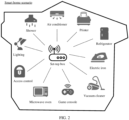
- FIG. 2 is a schematic diagram of a smart home scenario according to an embodiment of this application.
- a set-top box may be set as a central device.
- another device for example, a smart screen
- a terminal device may include but is not limited to the following items: electronic devices with a wireless communication function, such as an air conditioner, a printer, a refrigerator, an electric iron, a vacuum cleaner, a game console, a microwave oven, an access control system, a lighting system, and a shower system.
- Each device may send registration information to the set-top box.
- the set-top box is responsible for responding to and analyzing voice information of a user, and indicating a corresponding device to perform an operation indicated by the voice information.
- FIG. 3 is a schematic diagram of a vehicle scenario according to an embodiment of this application.
- a central device may include a vehicle-mounted device, and the vehicle-mounted device may be a head unit or another device disposed in the vehicle.
- a terminal device may include but is not limited to the following items: a mobile phone, a personal computer, a tablet computer, a game console, a smart watch, and a smart headset. After detecting that the terminal device enters the vehicle, the terminal device may send registration information to the vehicle-mounted device, and disable a wake-up engine of the terminal device.
- the vehicle-mounted device is responsible for responding to voice information of a user and performing unified allocation, to enhance seamless user experience.
- the central device is a vehicle-mounted device. It should be understood that the vehicle-mounted device in the following may alternatively be replaced with another type of central device, for example, a set-top box or a smart screen in the smart home scenario.
- FIG. 4 is a schematic flowchart of a device control method according to an embodiment of this application.
- a vehicle-mounted device in FIG. 4 may be a head unit or another device disposed in a vehicle, provided that the vehicle-mounted device has a communication function and a processing function. As shown in FIG. 4 , the method includes the following content.
- the vehicle-mounted device obtains voice information of a first user, where the voice information indicates to perform a first operation.
- the voice information may include a wake-up word, and the wake-up word may be used to wake up the vehicle-mounted device. After capturing the wake-up word, the vehicle-mounted device may respond to the wake-up word.
- the vehicle-mounted device may further perform semantic analysis on the voice information to obtain intent information.
- the intent information indicates an intent of the first user, that is, performing the first operation.
- the first operation may be any indication sent by the first user.
- the first operation may be playing music, making a call, adjusting a temperature of an air conditioner, or the like.
- the vehicle-mounted device determines a target device from a plurality of candidate devices based on the voice information, where the plurality of candidate devices include the vehicle-mounted device and at least one terminal device.
- the at least one terminal device has registered registration information with the vehicle-mounted device.
- the registration information is used by each terminal device to register with the vehicle-mounted device.
- the registration information may include device information and/or account information of the terminal device.
- Table 1 shows content registered by the terminal device with the vehicle-mounted device.
- the device information may include a device type, MAC address information, and the like.
- the account information may include an account identifier (identifier, ID) of the user, voiceprint feature information of the user, facial image feature information of the user, or the like. It should be understood that proper addition or deletion of the information required for registration falls within the protection scope of embodiments of this application. The following continues to describe a specific registration process of the terminal device with reference to the accompanying drawings.
- Table 1 Number Device information Account information Device 1 Device type and MAC address information Account identifier of a user, voiceprint feature information of the user, and facial image feature information of the user Device 2 Device type and MAC address information Identifier of a user, voiceprint feature information of the user, and facial image feature information of the user ... ... ...
- the vehicle-mounted device may send search information to the terminal device, where the search information indicates the terminal device to register with the vehicle-mounted device.
- the terminal device may send registration information to the vehicle-mounted device.
- the registration information may include the foregoing device information and/or account information, so that the vehicle-mounted device registers related information of the terminal device.
- the vehicle-mounted device sends indication information to the target device, where the indication information indicates the target device to perform the first operation.
- the vehicle-mounted device enables a wake-up engine, and the at least one terminal device disables a wake-up engine.
- the vehicle-mounted device is responsible for responding to voice information of the user, and all other devices disable the wake-up engines, to reduce power consumption.
- the terminal device may disable the wake-up engine of the terminal device.
- the terminal device when the terminal device detects that the distance between the terminal device and the vehicle-mounted device is greater than or equal to the preset threshold, that is, when the terminal device has left a multi-device environment covered by the vehicle-mounted device, the terminal device may enable the wake-up engine of the terminal device again, to independently respond to a wake-up word.
- the foregoing preset threshold may be set based on practice. This is not specifically limited in this application.
- the wake-up engine of the terminal device may be disabled, and only the wake-up engine of the vehicle-mounted device is retained, thereby reducing resource occupation and power consumption of the terminal device.
- the terminal device hosts the wake-up engine to the vehicle-mounted device to perform wake-up determining and wake-up responding.
- the terminal device may register information with the vehicle-mounted device in advance.
- the vehicle-mounted device is responsible for wake-up determining and wake-up responding of the terminal device, and after making a decision, the vehicle-mounted device sends a decision result to the target device.
- only the vehicle-mounted device needs to enable a wake-up engine, thereby reducing power consumption and resource occupation of the terminal device.
- the vehicle-mounted device and the at least one terminal device are located in a same local area network.
- the local area network may be a wired local area network or a wireless local area network, or may be a combination of a wired local area network and a wireless local area network.
- the vehicle-mounted device may determine the target device from the plurality of candidate devices in a plurality of implementations.
- the voice information may indicate reference information corresponding to the target device, and the reference information includes at least one of the following:
- the vehicle-mounted device may determine the target device from the plurality of candidate devices based on the reference information.
- the vehicle-mounted device serves as the only responding device, and may make a decision based on the wake-up word, the intent information corresponding to the voice information, and the user identity information, to determine the target device that performs the first operation indicated by the voice information.
- seamless user experience can be enhanced, and accuracy of a collaboration policy in the multi-device wake-up scenario is improved.
- the vehicle-mounted device may perform semantic analysis on the voice information to obtain the corresponding intent information, and then determine the target device from the plurality of candidate devices based on the intent information.
- the intent information may be understood as information indicating an intent of the user.
- the voice information of the user may be playing music.
- the vehicle-mounted device needs to perform semantic analysis on the voice information to understand the intent of the user.
- that the vehicle-mounted device determines a target device from a plurality of candidate devices based on the voice information includes: The vehicle-mounted device performs semantic analysis on the voice information, to obtain the intent information corresponding to the voice information; and the vehicle-mounted device determines the target device from the plurality of candidate devices based on the intent information.
- a device may determine an operation intent of the user based on the intent information.
- the intent information may indicate, in an explicit or implicit manner, a type of a device with which the user wants to interact. For example, when the intent information indicates "Control the atmospheric light”, the indicated device type is a vehicle-mounted device. When the intent information indicates "View health information”, the indicated device type is a mobile phone. When the intent information indicates "Make a call”, the indicated device may be a mobile phone or a vehicle-mounted device. The vehicle-mounted device may further determine, based on historical calls made by the user, whether the indicated device is the mobile phone or the vehicle-mounted device. In addition, when there is a clear keyword indicating the device type in the intent information, the target device or the type of the target device may be directly determined. For example, the intent information indicates "Make a call by using a mobile phone", “Check weather by using a tablet computer", or the like.
- the vehicle-mounted device may further determine the target device from the plurality of candidate devices based on the intent information and the user identity information, to improve efficiency of determining the target device.
- the vehicle-mounted device determines a first candidate device subset from the plurality of candidate devices based on the intent information, where a type of a candidate device in the first candidate device subset corresponds to the intent information; and the vehicle-mounted device determines the target device from the first candidate device subset based on the user identity information.
- the vehicle-mounted device may determine the type of the target device based on the intent information, and then is associated, based on the user identity information, with a device corresponding to the user identity information, to further determine the target device.
- the vehicle-mounted device may narrow down, based on the intent information, a list range of candidate devices corresponding to the voice information, and then further determine the target device based on the user identity information, to improve intelligence of identifying the target device, enhance seamless user experience, and improve user experience.
- the vehicle-mounted device may obtain the user identity information in the following manner.
- the vehicle-mounted device obtains, based on the voice information, at least one piece of the following user feature information: sound source positioning information of the first user, voiceprint feature information of the first user, and facial image feature information of the first user.
- the vehicle-mounted device determines the user identity information based on the at least one piece of user feature information.
- the sound source positioning information of the user may indicate a position of the user in a scenario, and the scenario may be an in-vehicle scenario or an indoor scenario.
- the facial image feature information of the user may be obtained based on the corresponding position.
- an identity of the user sitting at the position may be determined by comparing a facial feature with the facial image feature information of the user in the registration information stored in the vehicle-mounted device.
- whether the user at the corresponding position is in a speaking state may be further verified based on an open/closed state of a lip of the user, to determine whether the user feature information is correct.
- the identity of the user may also be determined by comparing a voiceprint feature of a speaking voice with a voiceprint feature in the registration information stored in the vehicle-mounted device.
- the foregoing manner of obtaining the user identity information may be independently completed by the vehicle-mounted device, or may be completed by the vehicle-mounted device in cooperation with another device.
- the vehicle-mounted device may obtain the facial image feature information of the user by using a camera, and obtain the sound source positioning information and the voiceprint feature information of the user by using a microphone.
- the vehicle-mounted device may fully use a sound source feature and a voiceprint feature of the voice information to obtain the user feature information, to determine the user identity information based on the user feature information, and determine the target device based on the user identity information. This improves intelligence in a multi-device wake-up scenario, and improves user experience.
- the voice information may further include a wake-up word.
- the wake-up word may be a specific word or sound clip in the voice information, and the word or sound clip may be used to wake up a specific device.
- the wake-up word is used to wake up the vehicle-mounted device.
- the wake-up word apart from playing a function of waking up the vehicle-mounted device, the wake-up word may also be used to distinguish between different devices. For example, a plurality of wake-up words may be set, and there may be a preset correspondence between each wake-up word and one or more candidate devices.
- the vehicle-mounted device may consider that the wake-up word is used to wake up the corresponding device.
- the wake-up keyword may be "Hey Celia", and the wake-up keyword may be used to wake up a mobile phone.
- the correspondence between the wake-up word and the candidate device may be preset before the vehicle-mounted device is delivered from a factory, and the correspondence is stored in a storage unit in the vehicle-mounted device.
- the correspondence between the wake-up word and the candidate device may be preset by the user, and stored in a storage unit of the vehicle-mounted device.
- the plurality of candidate devices may be divided into a plurality of candidate device subsets based on the wake-up words.
- Table 2 is an example of correspondences between the wake-up words and the candidate devices.
- a wake-up word A may be set to correspond to a mobile phone, a tablet computer, and a head unit
- a wake-up word B may be set to correspond to a smart headset and a smart watch.
- intersection set between candidate device subsets corresponding to different wake-up words there may be an intersection set between candidate device subsets corresponding to different wake-up words, or there may be no intersection set between candidate device subsets corresponding to different wake-up words.
- the vehicle-mounted device may determine the candidate device as the target device based on the wake-up word in the voice information.
- the vehicle-mounted device may determine, based on the wake-up word, the candidate device subset corresponding to the wake-up word, and then determines the target device in the candidate device subset.
- the vehicle-mounted device determines the wake-up word in the voice information; and the vehicle-mounted device determines, based on the wake-up word, a second candidate device subset corresponding to the wake-up word.
- the plurality of candidate devices belong to the plurality of candidate device subsets, and there is a preset correspondence between the plurality of wake-up words and the plurality of candidate device subsets.
- the vehicle-mounted device determines the target device from the second candidate device subset based on at least one of the intent information and the user identity information.
- the candidate devices corresponding to the wake-up word A include the mobile phone, the tablet computer, and the head unit.
- content indicated by the intent information is "Turn on the air conditioner", and only the head unit can perform the operation. Therefore, it is determined that the head unit is the target device, and the operation of turning on the air conditioner may be performed by using the head unit.
- a vehicle-mounted scenario includes a user 1 and a user 2, the user 1 carries a mobile phone 1, and the user 2 carries a mobile phone 2.
- the voice information includes the wake-up word A, according to Table 2, the wake-up word A corresponds to the mobile phone 1, the mobile phone 2, and the head unit.
- content indicated by the intent information is "View a quantity of steps today”
- the user feature information may be obtained by using the voice information, and it is determined that a source of the voice information is the user 2. Therefore, it is determined that the target device is the mobile phone 2 of the user 2. Therefore, the head unit may indicate the mobile phone 2 to respond to an instruction of the voice information and open a health information interface on the mobile phone.
- FIG. 5 is a schematic flowchart in which a terminal device registers with a vehicle-mounted device according to an embodiment of this application. As shown in FIG. 5 , the solution includes but is not limited to the following content.
- a vehicle-mounted device sends search information, and correspondingly, a terminal device receives the search information, where the search information indicates the terminal device to register with the vehicle-mounted device.
- the vehicle-mounted device is triggered to send the search information.
- the vehicle-mounted device detects that a distance between the vehicle-mounted device and the terminal device is less than a preset threshold, or a near field communication (near field communication, NFC) touch occurs between the vehicle-mounted device and the terminal device.
- NFC is a short-distance high-frequency wireless communication technology, and allows non-contact point-to-point data transmission and data exchange between electronic devices.
- the NFC touch indicates a case in which electronic devices detect existence of each other by using the NFC and communicate with each other.
- the specific condition may further include the following scenarios: a scenario in which an operation such as unlocking and power-on or hibernation recovery is performed on the vehicle; a scenario in which an operation of opening a vehicle door is performed; and a scenario in which a vehicle owner account is switched.
- the search information may alternatively be sent in a broadcast manner.
- the search information may include searching for a Bluetooth low energy (Bluetooth low energy, BLE) broadcast.
- the searching for a BLE broadcast may refer to broadcast information sent by using a BLE technology.
- the terminal device sends registration information to the vehicle-mounted device, and correspondingly, the vehicle-mounted device receives the registration information, where the registration information is used by the terminal device to register with the vehicle-mounted device.
- the vehicle-mounted device may ignore the registration information, or the vehicle-mounted device may update the registration information.
- the registration information may include device information and account information of the terminal device.
- the device information may include a device type and a MAC address.
- the account information may include an account identifier of a user, voiceprint feature information of the user, or facial image feature information of the user.
- the registration information may be sent in a broadcast manner.
- the vehicle-mounted device registers the terminal device based on the registration information.
- the vehicle-mounted device may locally establish and store a registry, and add the registration information of the terminal device to an entry.
- a process in which the terminal device registers with the vehicle-mounted device may be completed in a networking process of the terminal device and the vehicle-mounted device. For example, after receiving the registration information, the vehicle-mounted device may send a Wi-Fi name of the vehicle-mounted device to the terminal device. In this case, the terminal device may establish a network connection to the vehicle-mounted device based on the received Wi-Fi name, and communicate with the vehicle-mounted device through Wi-Fi in a subsequent process.
- FIG. 6 is a specific flowchart of a device control method according to an embodiment of this application. As shown in FIG. 6 , the method includes the following content.
- S601 A vehicle-mounted device registers registration information of a terminal device.
- a user carries terminal devices on a vehicle, and the terminal devices may include a mobile phone, a tablet computer, and the like.
- the vehicle-mounted device is triggered to send search information through Bluetooth.
- each terminal device responds to the search information, and send the registration information to the vehicle-mounted device.
- the vehicle-mounted device sends Wi-Fi information to each terminal device, so that a communication connection is established between each terminal device and the vehicle-mounted device.
- each terminal device may disable a wake-up engine of the terminal device, to reduce resource occupation. Subsequently, the vehicle-mounted device is responsible for a wake-up response.
- each terminal device may alternatively display, to the user on an interface, an interface indicating whether to disable a wake-up engine. The user determines whether to disable the wake-up engine.
- the vehicle-mounted device may send indication information to the terminal device, to indicate the terminal device to disable the engine of the terminal device.
- the vehicle-mounted device receives voice information, and is woken up by the voice information.
- the voice information may include a specific wake-up word, and the vehicle-mounted device is woken up after detecting the wake-up word.
- the vehicle-mounted device may respond to the voice information by using a voice.
- the vehicle-mounted device determines, based on the voice information, a target device configured to perform an operation indicated by the voice information.
- the vehicle-mounted device obtains, based on the voice information, at least one piece of the following information: intent information, a wake-up word, and user identity information; and the vehicle-mounted device determines the target device based on the foregoing information.
- the vehicle-mounted device indicates the target device to perform the operation indicated by the voice information, or the vehicle-mounted device performs the operation.
- the vehicle-mounted device may send indication information to the target device, to indicate the target device to perform the operation.
- the vehicle-mounted device performs the operation.
- FIG. 7 is a schematic block diagram of an apparatus 700 according to an embodiment of this application.
- the apparatus 700 includes an obtaining module 710, a determining module 720, and an execution module 730.
- the apparatus 700 may be the vehicle-mounted device in the foregoing embodiments, or may be a component (like a chip) of the vehicle-mounted device.
- the apparatus 700 may implement steps or processes corresponding to the vehicle-mounted device in the foregoing method embodiments.
- the obtaining module 710 is configured to obtain voice information of a first user, where the voice information indicates to perform a first operation.
- the determining module 720 is configured to determine a target device from a plurality of candidate devices based on the voice information, where the plurality of candidate devices include the apparatus 700 and at least one terminal device.
- the execution module 730 is configured to: when the target device belongs to the at least one terminal device, send indication information to the target device, where the indication information indicates the target device to perform the first operation; or when the target device is the apparatus 700, perform the first operation.
- the at least one terminal device has registered registration information with the apparatus 700.
- the registration information includes account information
- the account information includes at least one of the following: an account identifier of a user, voiceprint feature information of the user, and facial image feature information of the user.
- the registration information further includes device information, and the device information includes at least one of the following: a device type and MAC address information.
- the obtaining module 710 is further configured to: send search information to the terminal device, where the search information indicates the terminal device to register with the apparatus 700; and receive the registration information from the terminal device.
- the voice information indicates reference information corresponding to the target device.
- the reference information includes at least one of the following: intent information, indicating an intent of the voice information; a wake-up word, used to wake up the vehicle-mounted device, where the wake-up word belongs to a plurality of wake-up words, and there is a preset correspondence between the plurality of wake-up words and the plurality of candidate devices; and user identity information, indicating an identity of the first user.
- the determining module 720 is specifically configured to determine the target device from the plurality of candidate devices based on the reference information.
- the determining module 720 is specifically configured to: determine a first candidate device subset from the plurality of candidate devices based on the intent information, where a type of a candidate device in the first candidate device subset corresponds to the intent information; and determine the target device from the first candidate device subset based on the user identity information.
- the determining module 720 is specifically configured to: determine a second candidate device subset corresponding to the wake-up word, where there is a preset correspondence between the wake-up word and a candidate device in the second candidate device subset; and determine the target device from the second candidate device subset based on at least one of the intent information and the user identity information.
- the determining module 720 is specifically configured to: obtain, based on the voice information, at least one piece of the following user feature information: sound source positioning information of the first user, voiceprint feature information of the first user, and facial image feature information of the first user; and determine the user identity information based on the at least one piece of user feature information.
- a wake-up engine in the apparatus 700 is enabled, and a wake-up engine in the at least one terminal device is disabled.
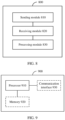
- FIG. 8 is a schematic block diagram of an apparatus 800 according to an embodiment of this application.
- the apparatus 800 includes a sending module 810 and a receiving module 820.
- the apparatus 800 further includes a processing module 830.
- the apparatus 800 may be the terminal device in the foregoing embodiments, or may be a component (like a chip) of the terminal device.
- the sending module 810 is configured to send registration information to a vehicle-mounted device, where the registration information is used by the apparatus 800 to register with the vehicle-mounted device.
- the receiving module 820 is configured to receive indication information from the vehicle-mounted device, where the indication information indicates the apparatus 800 to perform a first operation, and the first operation includes an operation that is indicated to be performed in voice information of a first user.
- the registration information includes account information
- the account information includes at least one of the following: an account identifier of a user, voiceprint feature information of the user, and facial image feature information of the user.
- the registration information further includes device information, and the device information includes at least one of the following: a device type and MAC address information.
- the apparatus 800 further includes a processing module 830, and the processing module 830 is configured to disable a wake-up engine of the processing module 830 after the registration information is sent, where the wake-up engine is configured to respond to voice information of the user.
- the receiving module 820 is further configured to receive search information sent by the vehicle-mounted device, where the search information indicates the apparatus 800 to register with the vehicle-mounted device.
- FIG. 9 is a schematic block diagram of an apparatus 900 according to another embodiment of this application.
- the apparatus 900 includes a processor 910.
- the processor 910 is configured to execute a computer program or instructions stored in a memory 920, or read data stored in the memory 920, to perform the methods in the foregoing method embodiments.
- the apparatus 900 further includes the memory 920.
- the memory 920 is configured to store a computer program or instructions and/or data.
- the memory 920 may be integrated with the processor 910, or may be disposed separately.
- the apparatus 900 further includes a communication interface 930.
- the communication interface 930 is configured to receive and/or send a signal.
- the processor 910 is configured to control the communication interface 930 to send and/or receive a signal.
- the apparatus 900 is configured to implement the operations performed by the vehicle-mounted device in the foregoing method embodiments.
- the processor 910 is configured to execute the computer program or the instructions stored in the memory 920, to implement the related operations of the vehicle-mounted device in the foregoing method embodiments. For example, the method performed by the vehicle-mounted device in the embodiments shown in FIG. 4 to FIG. 6 is implemented.
- the apparatus 900 is configured to implement the operations performed by the terminal device in the foregoing method embodiments.
- the processor 910 is configured to execute the computer program or the instructions stored in the memory 920, to implement the related operations of the terminal device in the foregoing method embodiments. For example, the method performed by the terminal device in the embodiments shown in FIG. 4 to FIG. 6 is implemented.
- the apparatus 900 in FIG. 9 may be the vehicle-mounted device or the terminal device in the foregoing embodiments, or may be a chip or a chip system, for example, a system-on-a-chip (system-on-a-chip, SoC). This is not limited herein.
- the disclosed system, apparatus and method may be implemented in another manner.
- the described apparatus embodiment is merely an example.
- division into the units is merely logical function division and may be other division in actual implementation.
- a plurality of units or components may be combined or integrated into another system, or some features may be ignored or not performed.
- the displayed or discussed mutual couplings or direct couplings or communication connections may be implemented through some interfaces.
- the indirect couplings or communication connections between the apparatuses or units may be implemented in electronic, mechanical, or other forms.
- the units described as separate parts may or may not be physically separate, and parts displayed as units may or may not be physical units, that is, may be located in one position, or may be distributed on a plurality of network units. Some or all of the units may be selected based on actual requirements to achieve the objectives of the solutions of embodiments.
- function units in embodiments of this application may be integrated into one processing unit, or each of the units may exist alone physically, or two or more units may be integrated into one unit.
- the functions When the functions are implemented in the form of a software functional unit and sold or used as an independent product, the functions may be stored in a computer-readable storage medium. Based on such an understanding, the technical solutions of this application essentially, or some of the technical solutions may be implemented in a form of a software product.
- the computer software product is stored in a storage medium, and includes several instructions for instructing a computer device (which may be a personal computer, a server, or a network device) to perform all or some of the steps of the methods described in embodiments of this application.
- the foregoing storage medium includes any medium that can store program code, such as a USB flash drive, a removable hard disk, a read-only memory (Read-Only Memory, ROM), a random access memory (Random Access Memory, RAM), a magnetic disk, or an optical disc.
- program code such as a USB flash drive, a removable hard disk, a read-only memory (Read-Only Memory, ROM), a random access memory (Random Access Memory, RAM), a magnetic disk, or an optical disc.
Landscapes
- Engineering & Computer Science (AREA)
- Human Computer Interaction (AREA)
- Physics & Mathematics (AREA)
- Multimedia (AREA)
- Health & Medical Sciences (AREA)
- Audiology, Speech & Language Pathology (AREA)
- Acoustics & Sound (AREA)
- Computational Linguistics (AREA)
- Theoretical Computer Science (AREA)
- General Health & Medical Sciences (AREA)
- General Physics & Mathematics (AREA)
- Oral & Maxillofacial Surgery (AREA)
- Mechanical Engineering (AREA)
- General Engineering & Computer Science (AREA)
- Telephone Function (AREA)
- Selective Calling Equipment (AREA)
Applications Claiming Priority (1)
| Application Number | Priority Date | Filing Date | Title |
|---|---|---|---|
| PCT/CN2021/134663 WO2023097524A1 (zh) | 2021-11-30 | 2021-11-30 | 设备的控制方法及装置 |
Publications (2)
| Publication Number | Publication Date |
|---|---|
| EP4428855A1 true EP4428855A1 (de) | 2024-09-11 |
| EP4428855A4 EP4428855A4 (de) | 2025-06-18 |
Family
ID=86611413
Family Applications (1)
| Application Number | Title | Priority Date | Filing Date |
|---|---|---|---|
| EP21965961.2A Pending EP4428855A4 (de) | 2021-11-30 | 2021-11-30 | Verfahren und vorrichtung zur gerätesteuerung |
Country Status (5)
| Country | Link |
|---|---|
| US (1) | US20240312463A1 (de) |
| EP (1) | EP4428855A4 (de) |
| JP (1) | JP7820516B2 (de) |
| CN (1) | CN118251719A (de) |
| WO (1) | WO2023097524A1 (de) |
Families Citing this family (2)
| Publication number | Priority date | Publication date | Assignee | Title |
|---|---|---|---|---|
| EP4734104A1 (de) * | 2023-08-24 | 2026-04-29 | Honor Device Co., Ltd. | Sprachsteuerungsverfahren, vorrichtungsauswahlverfahren und elektronische vorrichtung |
| CN120412585B (zh) * | 2025-06-30 | 2025-10-03 | 重庆长安汽车股份有限公司 | 车辆联动控制方法、装置、用户终端及车机端 |
Family Cites Families (24)
| Publication number | Priority date | Publication date | Assignee | Title |
|---|---|---|---|---|
| JP4363076B2 (ja) * | 2002-06-28 | 2009-11-11 | 株式会社デンソー | 音声制御装置 |
| KR101567603B1 (ko) * | 2009-05-07 | 2015-11-20 | 엘지전자 주식회사 | 멀티 음성 시스템의 동작 제어 장치 및 방법 |
| US9493130B2 (en) * | 2011-04-22 | 2016-11-15 | Angel A. Penilla | Methods and systems for communicating content to connected vehicle users based detected tone/mood in voice input |
| EP2798634A4 (de) * | 2011-12-29 | 2015-08-19 | Intel Corp | Spracherkennung unter verwendung eines dynamischen satzes von grammatikelementen |
| US8805281B2 (en) * | 2012-02-29 | 2014-08-12 | Cellco Partnership | Controlling device functions of a mobile terminal in a restricted area |
| JP6261311B2 (ja) | 2013-12-05 | 2018-01-17 | アルパイン株式会社 | 通信システム、電子装置、通信方法及び通信プログラム |
| JP6258077B2 (ja) | 2014-03-04 | 2018-01-10 | アルパイン株式会社 | 通信システムおよび電子装置、ペアリング方法、ペアリングプログラム |
| US9916839B1 (en) * | 2014-03-27 | 2018-03-13 | Amazon Technologies, Inc. | Shared audio functionality based on device grouping |
| US20150317973A1 (en) * | 2014-04-30 | 2015-11-05 | GM Global Technology Operations LLC | Systems and methods for coordinating speech recognition |
| JP6827918B2 (ja) * | 2014-06-11 | 2021-02-10 | ヴェリディウム アイピー リミテッド | 生体情報に基づいて、ユーザの車両へのアクセスを容易にするためのシステムと方法 |
| CN106375995A (zh) * | 2015-07-22 | 2017-02-01 | 深圳市中兴微电子技术有限公司 | 一种信息处理方法、系统及车载通信装置 |
| JP2017146437A (ja) * | 2016-02-17 | 2017-08-24 | 本田技研工業株式会社 | 音声入力処理装置 |
| US10783883B2 (en) * | 2016-11-03 | 2020-09-22 | Google Llc | Focus session at a voice interface device |
| KR102552486B1 (ko) * | 2017-11-02 | 2023-07-06 | 현대자동차주식회사 | 차량의 음성인식 장치 및 방법 |
| US10847153B2 (en) * | 2018-06-06 | 2020-11-24 | Amazon Technologies, Inc. | Temporary account association with voice-enabled devices |
| WO2020040775A1 (en) | 2018-08-23 | 2020-02-27 | Google Llc | Regulating assistant responsiveness according to characteristics of a multi-assistant environment |
| CN109391528A (zh) * | 2018-08-31 | 2019-02-26 | 百度在线网络技术(北京)有限公司 | 语音智能设备的唤醒方法、装置、设备及存储介质 |
| KR102767654B1 (ko) * | 2019-04-18 | 2025-02-17 | 엘지전자 주식회사 | 전자장치, 그 동작방법, 및 복수의 인공지능장치를 포함한 시스템 |
| KR102228549B1 (ko) * | 2019-06-11 | 2021-03-16 | 엘지전자 주식회사 | 음성 인에이블 디바이스 선택 방법, 음성 인에이블 디바이스 선택 장치 및 이를 제어하는 지능형 컴퓨팅 디바이스 |
| CN119296533A (zh) | 2019-08-15 | 2025-01-10 | 深圳引望智能技术有限公司 | 语音交互方法、装置、终端及存储介质 |
| CN111192591B (zh) * | 2020-02-10 | 2022-12-13 | 百度在线网络技术(北京)有限公司 | 智能设备的唤醒方法、装置、智能音箱及存储介质 |
| CN111640434A (zh) * | 2020-06-05 | 2020-09-08 | 三星电子(中国)研发中心 | 用于控制语音设备的方法和装置 |
| JP7509069B2 (ja) * | 2021-03-29 | 2024-07-02 | トヨタ自動車株式会社 | 車両制御システム及び車両制御方法 |
| CN113421559B (zh) * | 2021-06-01 | 2023-04-07 | 荣耀终端有限公司 | 基于语音唤醒的控制方法、电子设备及控制器 |
-
2021
- 2021-11-30 WO PCT/CN2021/134663 patent/WO2023097524A1/zh not_active Ceased
- 2021-11-30 JP JP2024532543A patent/JP7820516B2/ja active Active
- 2021-11-30 EP EP21965961.2A patent/EP4428855A4/de active Pending
- 2021-11-30 CN CN202180104414.7A patent/CN118251719A/zh active Pending
-
2024
- 2024-05-29 US US18/677,174 patent/US20240312463A1/en active Pending
Also Published As
| Publication number | Publication date |
|---|---|
| JP2024540681A (ja) | 2024-10-31 |
| EP4428855A4 (de) | 2025-06-18 |
| CN118251719A (zh) | 2024-06-25 |
| WO2023097524A1 (zh) | 2023-06-08 |
| JP7820516B2 (ja) | 2026-02-25 |
| US20240312463A1 (en) | 2024-09-19 |
Similar Documents
| Publication | Publication Date | Title |
|---|---|---|
| US20240312463A1 (en) | Device Control Method and Apparatus | |
| CN110505652B (zh) | 网络连接的控制方法、终端及存储介质 | |
| US20150065053A1 (en) | Method of controlling short-range wireless communication and apparatus supporting the same | |
| CN106912048B (zh) | 接入点信息分享方法和装置 | |
| CN105094968B (zh) | 唤醒mcu的方法及装置 | |
| WO2018000134A1 (zh) | 一种蓝牙连接的方法及终端 | |
| EP2993928A1 (de) | Geräteauswahl zur Herstellung einer drahtlosen Kommunikation | |
| US11076263B2 (en) | Electronic device for providing location information and control method therefor | |
| CN107194228A (zh) | 解锁控制方法及相关产品 | |
| US11412555B2 (en) | Mobile terminal | |
| CN107657689A (zh) | 一种门禁开锁方法、移动终端及计算机可读介质 | |
| AU2014315883A1 (en) | Method of controlling short-range wireless communication and apparatus supporting the same | |
| KR20160015668A (ko) | 영역을 인식하는 방법 및 전자 장치 | |
| CN115278932A (zh) | 网络重连方法、装置、终端设备及存储介质 | |
| US9088982B2 (en) | Beacon frame data transmission rate adjustment | |
| US10764738B2 (en) | Wireless communication connection method and terminal | |
| EP2770784A1 (de) | WPAN-Endgerät mit Energieeinsparung mittels Übergang zwischen aktivem Modus und Ruhemodus | |
| CN108133180A (zh) | 指纹识别方法、装置及终端 | |
| CN113254092B (zh) | 处理方法、设备及存储介质 | |
| KR20110121435A (ko) | WiFi와 이동통신 기능을 가진 단말기의 전력소모를 절감시킬 수 있는 방법 및 이를 위한 단말기 | |
| WO2018076613A1 (zh) | 无线网络连接的流量控制方法、装置及可读取存储介质 | |
| CN107194226A (zh) | 解锁控制方法及相关产品 | |
| EP4398525A1 (de) | Verfahren zur identifizierung eines startszenarios oder heimrückkehrszenarios und vorrichtung | |
| CN106255146A (zh) | 一种终端的省电控制方法、装置和终端 | |
| US20170103009A1 (en) | Monitoring a device status for an application |
Legal Events
| Date | Code | Title | Description |
|---|---|---|---|
| STAA | Information on the status of an ep patent application or granted ep patent |
Free format text: STATUS: THE INTERNATIONAL PUBLICATION HAS BEEN MADE |
|
| PUAI | Public reference made under article 153(3) epc to a published international application that has entered the european phase |
Free format text: ORIGINAL CODE: 0009012 |
|
| STAA | Information on the status of an ep patent application or granted ep patent |
Free format text: STATUS: REQUEST FOR EXAMINATION WAS MADE |
|
| 17P | Request for examination filed |
Effective date: 20240606 |
|
| AK | Designated contracting states |
Kind code of ref document: A1 Designated state(s): AL AT BE BG CH CY CZ DE DK EE ES FI FR GB GR HR HU IE IS IT LI LT LU LV MC MK MT NL NO PL PT RO RS SE SI SK SM TR |
|
| RAP1 | Party data changed (applicant data changed or rights of an application transferred) |
Owner name: SHENZHEN YINWANG INTELLIGENTTECHNOLOGIES CO., LTD. |
|
| DAV | Request for validation of the european patent (deleted) | ||
| DAX | Request for extension of the european patent (deleted) | ||
| RIC1 | Information provided on ipc code assigned before grant |
Ipc: G10L 17/00 20130101ALN20250131BHEP Ipc: G06F 21/32 20130101ALI20250131BHEP Ipc: G06F 3/16 20060101ALI20250131BHEP Ipc: B60R 16/037 20060101ALI20250131BHEP Ipc: G10L 17/14 20130101ALI20250131BHEP Ipc: G10L 17/22 20130101ALI20250131BHEP Ipc: G10L 15/22 20060101AFI20250131BHEP |
|
| A4 | Supplementary search report drawn up and despatched |
Effective date: 20250521 |
|
| RIC1 | Information provided on ipc code assigned before grant |
Ipc: G10L 17/00 20130101ALN20250515BHEP Ipc: G06F 21/32 20130101ALI20250515BHEP Ipc: G06F 3/16 20060101ALI20250515BHEP Ipc: B60R 16/037 20060101ALI20250515BHEP Ipc: G10L 17/14 20130101ALI20250515BHEP Ipc: G10L 17/22 20130101ALI20250515BHEP Ipc: G10L 15/22 20060101AFI20250515BHEP |