EP4428819A1 - Vorrichtung und verfahren zur verbesserung der verfolgung von objekten in einer szene, die in einer videosequenz aufgenommen wurde - Google Patents
Vorrichtung und verfahren zur verbesserung der verfolgung von objekten in einer szene, die in einer videosequenz aufgenommen wurde Download PDFInfo
- Publication number
- EP4428819A1 EP4428819A1 EP23160912.4A EP23160912A EP4428819A1 EP 4428819 A1 EP4428819 A1 EP 4428819A1 EP 23160912 A EP23160912 A EP 23160912A EP 4428819 A1 EP4428819 A1 EP 4428819A1
- Authority
- EP
- European Patent Office
- Prior art keywords
- crop
- tracklets
- tracklet
- crops
- crop score
- Prior art date
- Legal status (The legal status is an assumption and is not a legal conclusion. Google has not performed a legal analysis and makes no representation as to the accuracy of the status listed.)
- Granted
Links
Images


Classifications
-
- G—PHYSICS
- G06—COMPUTING OR CALCULATING; COUNTING
- G06T—IMAGE DATA PROCESSING OR GENERATION, IN GENERAL
- G06T7/00—Image analysis
- G06T7/20—Analysis of motion
- G06T7/246—Analysis of motion using feature-based methods, e.g. the tracking of corners or segments
- G06T7/248—Analysis of motion using feature-based methods, e.g. the tracking of corners or segments involving reference images or patches
-
- G—PHYSICS
- G06—COMPUTING OR CALCULATING; COUNTING
- G06T—IMAGE DATA PROCESSING OR GENERATION, IN GENERAL
- G06T7/00—Image analysis
- G06T7/20—Analysis of motion
- G06T7/246—Analysis of motion using feature-based methods, e.g. the tracking of corners or segments
-
- G—PHYSICS
- G06—COMPUTING OR CALCULATING; COUNTING
- G06V—IMAGE OR VIDEO RECOGNITION OR UNDERSTANDING
- G06V20/00—Scenes; Scene-specific elements
- G06V20/20—Scenes; Scene-specific elements in augmented reality scenes
-
- G—PHYSICS
- G06—COMPUTING OR CALCULATING; COUNTING
- G06V—IMAGE OR VIDEO RECOGNITION OR UNDERSTANDING
- G06V10/00—Arrangements for image or video recognition or understanding
- G06V10/20—Image preprocessing
- G06V10/26—Segmentation of patterns in the image field; Cutting or merging of image elements to establish the pattern region, e.g. clustering-based techniques; Detection of occlusion
-
- G—PHYSICS
- G06—COMPUTING OR CALCULATING; COUNTING
- G06V—IMAGE OR VIDEO RECOGNITION OR UNDERSTANDING
- G06V10/00—Arrangements for image or video recognition or understanding
- G06V10/70—Arrangements for image or video recognition or understanding using pattern recognition or machine learning
- G06V10/82—Arrangements for image or video recognition or understanding using pattern recognition or machine learning using neural networks
-
- G—PHYSICS
- G06—COMPUTING OR CALCULATING; COUNTING
- G06V—IMAGE OR VIDEO RECOGNITION OR UNDERSTANDING
- G06V20/00—Scenes; Scene-specific elements
- G06V20/40—Scenes; Scene-specific elements in video content
-
- G—PHYSICS
- G06—COMPUTING OR CALCULATING; COUNTING
- G06T—IMAGE DATA PROCESSING OR GENERATION, IN GENERAL
- G06T2207/00—Indexing scheme for image analysis or image enhancement
- G06T2207/10—Image acquisition modality
- G06T2207/10016—Video; Image sequence
-
- G—PHYSICS
- G06—COMPUTING OR CALCULATING; COUNTING
- G06T—IMAGE DATA PROCESSING OR GENERATION, IN GENERAL
- G06T2207/00—Indexing scheme for image analysis or image enhancement
- G06T2207/20—Special algorithmic details
- G06T2207/20021—Dividing image into blocks, subimages or windows
-
- G—PHYSICS
- G06—COMPUTING OR CALCULATING; COUNTING
- G06T—IMAGE DATA PROCESSING OR GENERATION, IN GENERAL
- G06T2207/00—Indexing scheme for image analysis or image enhancement
- G06T2207/20—Special algorithmic details
- G06T2207/20084—Artificial neural networks [ANN]
Definitions
- the present invention relates to tracking of objects, and specifically to selecting a crop score threshold for enhancing tracking of objects in a scene captured in a video sequence.
- tracklets are identified including crops from a sub-set of subsequent image frames of the video sequence.
- Each crop of a tracklet is a portion of an image frame of the video sequence and is associated with a detection in the image frame.
- each crop may be the portion of a corresponding image frame that is within a bounding box around a detected object in the image frame.
- All crops of a tracklet have been determined to relate to the same object according to a given criterion. Tracklets belonging to the same object should then be connected to produce a single track relating to that same object.
- feature vectors of the crops of the respective tracklet may be used.
- Such feature vectors may for example be feature vectors determined by means of a convolutional neural network. Specifically, a feature vector may be determined for each of the two tracklets, e.g. as average of the feature vectors of the crops of the respective tracklet, and the tracklets may then be determined as belonging to the same tracked object if the distance between their feature vectors is less than a threshold.
- a problem that may arise in such prior art schemes for connecting tracklets is that the determined feature vector for the tracklets may not be representative for the object and hence errors may occur such as two tracklets being determined not to relate to the same object even if they actually do.
- An object of the present invention is to provide a method and a device for selecting a crop score threshold for enhancing tracking of objects in a scene captured in a video sequence which overcome or mitigate issues in prior art.
- the present disclosure makes use of a recognition that a crop score of each crop can be used to determine which crops of a tracklet should be used to determine a difference between the tracklet and other tracklets.
- a method for selecting a crop score threshold for enhancing tracking of objects in a scene captured in a video sequence is provided.
- a respective track is obtained for each one of two different objects, wherein each track comprises crops of object instances of the respective object in the scene captured in a calibration video sequence, and wherein each crop has a crop score and a feature vector.
- Each track is then split into respective two or more tracklets thereby forming four or more tracklets.
- a respective difference between each tracklet of the four or more tracklets and each other tracklet of the four or more tracklets is determined based on differences between feature vectors of crops having a crop score above the candidate crop score threshold of each tracklet of the four or more tracklets and feature vectors of crops having a crop score above the candidate crop score threshold of each other tracklet of the four or more tracklets.
- a crop score threshold is then selected from the set of candidate crop score thresholds resulting in a maximum difference between a measure of the determined differences between tracklets of different tracks and a measure of the determined differences between tracklets of the same track.
- a crop score threshold such that difference between a measure of the determined differences between tracklets of different tracks and a measure of the determined differences between tracklets of the same track is maximized, a more accurate differentiation between tracklets of different tracks and tracklets from the same track is enabled.
- a difference threshold on a determined difference between tracklets can be set for which it is likely that a determined difference between tracklets of different tracks is greater than the difference threshold and that a determined difference between tracklets of the same track is less than the difference threshold.
- a “crop” is meant a region of an image frame of a video sequence.
- the crop is done in such a way that the crop mainly contains pixels depicting an object.
- the crop may for example correspond to the region enclosed by a bounding box.
- the crop may correspond to a rectangular image area wherein a segmentation mask masks a detected object and wherein pixels within the rectangular image area and not belonging to the detected object are equal to zero.
- a “tracklet” is meant a portion of a track relating to an object in relation to a sub-set of sequential image frames of the video sequence. The combination of all tracklets relating to the same object in relation to the video sequence make up a track relating to the object in relation to the video sequence.
- a “feature vector” is generally a n-dimensional vector of numerical features that represent an object. This is a common representation of an object for e.g. machine learning algorithms which typically require a numerical representation of objects for facilitating for example data processing and statistical analysis.
- the feature vectors may for example be received from a machine learning module trained to extract similar feature vectors for the same object in different image frames and to extract less similar feature vectors for different objects .
- the act of determining a respective difference may comprise determining a respective feature vector for each of the four or more tracklets based on feature vectors of crops of the tracklet having a crop score above the candidate crop score threshold, and determining the respective difference between each tracklet of the four or more tracklets and each other tracklet of the four or more tracklets as a respective difference between each determined respective feature vector and each other determined respective feature vector.
- the crop score threshold is then selected that results in a maximum difference between a measure of the determined differences between feature vectors from tracklets of different tracks and a measure of the determined differences between feature vectors from tracklets of the same track.
- the respective feature vector for each of the four or more tracklets may be determined as a mean or median of the feature vectors of crops of the tracklet having a crop score above the candidate crop score threshold.
- the measure may be a mean or median.
- the method according to the first aspect may further comprise identifying a subset of candidate crop score thresholds consisting of each candidate crop score threshold of the candidate crop score thresholds for which a number of crops having a crop score above the candidate crop score threshold is larger than or equal to a first required number for each tracklet of the four or more tracklets.
- the crop score threshold is then selected from the subset of candidate crop score thresholds.
- a crop score will be selected resulting in a larger likelihood that each tracklet identified in relation to an object in the scene will include at least one crop having a crop score above the selected crop score.
- the method according to the first aspect may further comprise obtaining two further tracklets relating to one or more objects, wherein each tracklet comprises crops of object instances of one of the one or more objects in the scene captured in the video sequence, and wherein each crop has a crop score and a feature vector.
- a respective feature vector is then determined for each tracklet of the two further tracklets based on feature vectors of crops of the respective tracklet having a crop score above the selected crop score threshold, a difference between the determined respective feature vector of the further two tracklets is then determined. Whether the two further tracklets relate to a same object or to different objects is then determined based on the determined difference.
- the two further tracklets may be determined to relate to a same object on condition that the determined difference is below a difference threshold, and determined to relate to different objects on condition that the determined difference is above the difference threshold.
- the respective feature vector may be determined based further on additional crops of the tracklet having largest crop scores of crops having crop scores equal to or below the selected crop score threshold such that the number of crops on which the feature vector is based is equal to the second required number.
- a non-transitory computer-readable storage medium having stored thereon instructions for implementing the method according to the first aspect or the method according to the first aspect, when executed by a device having processing capabilities.
- a device for enhancing tracking of objects in a scene captured in a video sequence comprises circuitry configured to execute a first obtaining function, a splitting function, a first determining function, and a selecting function.
- the first obtaining function is configured to obtain a respective track for each one of two different objects, wherein each track comprises crops of object instances of the respective object in the scene captured in a calibration video sequence, and wherein each crop has a crop score determined by a classifier and a feature vector.
- the splitting function is configured to split each track into respective two or more tracklets thereby forming four or more tracklets.
- the first determining function is configured to, for each of a set of candidate crop score thresholds: determine a respective difference between each tracklet of the four or more tracklets and each other tracklet of the four or more tracklets based on differences between feature vectors of crops having a crop score above the candidate crop score threshold of each tracklet of the four or more tracklets and feature vectors of crops having a crop score above the candidate crop score threshold of each other tracklet of the four or more tracklets.
- the selecting function is configured to select a crop score threshold from the set of candidate crop score thresholds resulting in a maximum difference between a measure of the determined differences between tracklets of different tracks and a measure of the determined differences between tracklets of the same track.
- a method for enhancing tracking of objects in a scene captured in a video sequence is provided.
- a track relating to an object of one or more objects in the scene captured in the video sequence are obtained, wherein the track comprises crops of object instances of the object of the one or more objects, and wherein each crop has a crop score and a feature re-identification vector.
- a feature vector for the track is determined based on feature vectors of crops of the track having a crop score above a crop score threshold selected for the scene.
- a further crop of an object instance of one of the one or more objects in the scene captured in the video sequence is obtained, wherein the crop has a crop score selected for the scene and a feature vector.
- a difference is then determined between the determined feature vector of the track and the feature vector of the further crop. Whether the further crop and the track relate to a same object or to different objects is determined based on the determined difference.
- the selected crop score threshold may for example be selected according to the method according to the first aspect.
- a device for enhancing tracking of objects in a scene captured in a video sequence comprises circuitry configured to execute a first obtaining function, a first determining function, a second obtaining function, and a second determining function.
- the first obtaining function is configured to obtain a track relating to an object of one or more objects in the scene captured in the video sequence, wherein the track comprises crops of object instances of the object of the one or more objects, and wherein each crop has a crop score and a feature re-identification vector.
- the first determining function is configured to determine a feature vector for the track based on feature vectors of crops of the tracklet having a crop score above a selected crop score threshold.
- the second obtaining function is configured to obtain a further crop of an object instance of one of the one or more objects in the scene captured in the video sequence, wherein the crop has a crop score selected for the scene and a feature vector.
- the second determining function is configured to, on condition that the crop score of the further crop is greater than the crop score threshold selected for the scene, determine difference is between the determined respective feature vector of the two tracklets, and determine whether the further crop and the track relate to a same object or to different objects based on the determined difference.
- the crop score threshold selected for the scene may for example be selected according to the method according to the first aspect.
- the invention is applicable in scenarios in which objects are tracked in a scene captured over time in a video sequence.
- a scenario may for example arise when a scene is captured in a sequence of image frames by means of a surveillance camera.
- the objects have been detected using an object detection module using any kind of object detection.
- a feature vector may be extracted for a crop relating to a tracked object in each image frame in the object detection or it may be extracted in a separate process using the object detection as an input.
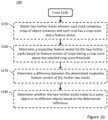
- a respective track is obtained S110 for each one of two different objects.
- Each track comprises crops of object instances of the respective object in the scene captured in a calibration video sequence.
- Each crop has a crop score and a feature vector.
- each track may further comprise estimations in relation to some frames for which no crop is available, e.g. because no object was detected in those frames. Such a crop score could be determined by annotating crops based on whether they contribute positively or negatively to solving a problem and then training a classifier on this data
- the objects may relate to vehicles, people, faces, bags, pets, or any other objects that might be of interest in different situations.
- a crop score of a crop may for example be a value that indicates how well the crop works for re-identification or in other words how good a crop is for use as input for extracting a feature vector from it to be used for object re-identification.
- a crop score of a crop may be a value that indicates how well the crop works for object classification or in other words how good a crop is for use as input for extracting a feature vector from it to be used for object classification.
- Such a crop score may be determined by means of a classifier trained to calculate a value, i.e. crop score, for a crop which specifies how similar the crop is to what is considered a 'good' crop.
- a crop score may be a value between 0 and 1.
- a feature vector of a crop is a vector describing features of the object.
- the feature vectors may for example be received from a machine learning module, such as a neural network trained to extract similar feature vectors for the same object in different image frames and to extract less similar feature vectors for different objects.
- the feature vectors may be received from other types of modules, such as modules based on support vector machine or colour histograms. The way the crop score is determined will depend on the type of module the feature vectors are received from.
- Each track is then split S120 into respective two or more tracklets thereby forming four or more tracklets.
- the two tracks received in relation to the calibration video sequence are known to relate to a respective one of the two different objects.
- each candidate crop score threshold of a set of candidate crop score thresholds a respective difference between each tracklet of the four or more tracklets and each other tracklet of the four or more tracklets is determined S130.
- Each respective difference is based on a difference between feature vectors of crops having a crop score above the candidate crop score threshold of a tracklet of the four or more tracklets and feature vectors of crops having a crop score above the candidate crop score threshold of another tracklet of the four or more tracklets.
- a first difference is determined based on a difference between feature vectors of crops having a crop score above the candidate crop score threshold of a first tracklet and feature vectors of crops having a crop score above the candidate crop score threshold of a second tracklet
- a second difference is determined based on a difference between feature vectors of crops having a crop score above the candidate crop score threshold of the first tracklet and feature vectors of crops having a crop score above the candidate crop score threshold of a third tracklet, and so on until there is a difference determined for each combination of tracklets of the four or more tracklets.
- n*(n-1)/2 differences determined for each candidate crop score there will be n*(n-1)/2 differences determined for each candidate crop score.
- a difference between two feature vectors may for example be determined by determining a distance between the two feature vectors. The larger the distance between the two feature vectors, the larger the difference. Distance may for example be determined in L 2 norm (also called Euclidian norm).
- the difference between two tracklets should preferably be determined such that it is larger with larger difference between feature vectors of crops having a crop score above the candidate crop score threshold of one of the two tracklets and feature vectors of crops having a crop score above the candidate crop score threshold of the other of the two tracklets.
- the act of determining S130 a respective difference may comprise determining a respective feature vector for each of the four or more tracklets based on feature vectors of crops of the tracklet having a crop score above the candidate crop score threshold.
- the feature vector for a tracklet is preferably determined such that it reflects the feature vectors of crops having a crop score above the candidate crop score threshold for the tracklet, such as being a mean or a median of the feature vectors of crops of the tracklet having a crop score above the candidate crop score threshold.
- the respective difference between each tracklet of the four or more tracklets and each other tracklet of the four or more tracklets may then be determined as a respective difference between each determined respective feature vector and each other determined respective feature vector.
- a variance of the feature vectors may also be determined.
- the respective difference between each tracklet of the four or more tracklets and each other tracklet of the four or more tracklets may then be determined as a respective difference between each determined respective feature vector and corresponding variance with or without weighting and each other determined respective feature vector and corresponding variance with or without weighting.
- more than one feature vector may be determined for each tracklet when the tracked object of the tracklet has more than one appearance in the tracklet. For example, if the tracked object is a person, two feature vectors may be determined, a first feature vector relating to crops where the person is visible from the front and a second feature vector relating to crops where the person is visible from behind. The first and second feature vectors may then be determined using a mean or a median feature vector of the feature vectors of crops where the person is visible from the front and a second feature vectors of crops where the person is visible from behind, respectively.
- the difference may be determined as a measure of the respective difference between corresponding feature vectors of the first tracklet and the second tracklet.
- the measure may for example be a median or a mean.
- the candidate crop scores of the set of candidate crop score thresholds will differ depending on the type of crop score used. If for example a crop score is used which may have values in the range 0 to 1, the candidate crop scores may be 0.1, 0.2, ..., 0.9. Other ranges and other values within those ranges are of course possible.
- a crop score threshold is then selected S140 from the set of candidate crop score thresholds resulting in a maximum difference between a measure of the determined differences between tracklets of different tracks and a measure of the determined differences between tracklets of the same track.
- the measure is preferably such that it reflects the determined differences between tracklets of different tracks and the determined differences between tracklets of the same track, respectively, such as being a mean or a median.
- the crop score threshold is preferably selected such that the measure of the determined differences between tracklets of the same track is less than the measure of the determined differences between tracklets of different tracks.
- the crop score threshold is selected that results in a maximum difference between a measure of the determined differences between feature vectors for tracklets of different tracks and a measure of the determined differences between feature vectors for tracklets of the same track.
- the measure is preferably such that it reflects the determined differences between the feature vectors for tracklets of different tracks and the determined differences between the feature vectors for tracklets of the same track, respectively, such as being a mean or a median.
- the crop score threshold is then further preferably selected such that the measure of the determined differences between feature vectors for tracklets of the same track is less than the measure of the determined differences between feature vectors for tracklets of different tracks.
- the selected crop score threshold is typically used for the scene in relation to which it has been selected by means of the method 100.
- a new crop score threshold is typically determined by performing the method 100 in relation to the different scene.
- the method 100 may thus further comprise obtaining S150 two further tracks relating to one or more object.
- Each track of the two further tracks comprises crops of object instances of one of the one or more objects in the scene captured in the video sequence, and each crop has a crop score and a feature vector.
- a respective feature vector is then determined S160 for each track of the two further tracks based on feature vectors of crops of the respective track having a crop score above the selected crop score threshold from the act of selecting S140.
- a difference between the determined respective feature vector of the further two tracks is then determined S170.
- the difference between two feature vectors may for example be determined by determining a distance between the two feature vectors. The larger the distance between the two feature vectors, the larger the difference. Distance may for example be determined in L 2 norm (also called Euclidian norm).
- the two further tracks relate to a same object or to different objects is then determined S180 based on the determined difference.
- the two further tracks may be determined to relate to a same object on condition that the determined difference is below a difference threshold, and determined to relate to different objects on condition that the determined difference is above the difference threshold.
- the difference threshold may be set based on the measure of the determined differences between tracks of different tracks and the measure of the determined differences between tracks of the same track for the selected crop score threshold of the act of selecting S140.
- the difference threshold may be set as a mean of the measure of the determined differences between tracks of different tracks and the measure of the determined differences between tracks of the same track for the selected crop score threshold of the act of selecting S140.
- the measure may be a mean or a median. If for example the measure of the determined differences between tracks of different tracks is 1.2 and the measure of the determined differences between tracks of the same track is 0.2, the difference threshold may be set to 0.7.
- the respective feature vector may be determined based further on additional crops of the track having largest crop scores of crops having crop scores equal to or below the selected crop score threshold such that the number of crops on which the feature vector is based is equal to the second required number.
- additional crops are used to determine the feature vector for the track.
- a further crop score threshold may be set which is a lower crop score, wherein crops are not used for determining the feature vector even if this results in fewer than the second required number of crops for determining the feature vector.
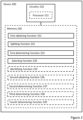
- the device 200 may further comprise a memory 230.
- the memory 230 may be one or more of a buffer, a flash memory, a hard drive, a removable media, a volatile memory, a non-volatile memory, a random access memory (RAM), or another suitable device.
- the memory 230 may include a non-volatile memory for long term data storage and a volatile memory that functions as device memory for the circuitry 210.
- the memory 230 may exchange data with the circuitry 210 over a data bus. Accompanying control lines and an address bus between the memory 230 and the circuitry 210 also may be present.
- Functions of the device 200 may be embodied in the form of executable logic routines (e.g., lines of code, software programs, etc.) that are stored on a non-transitory computer readable medium (e.g., the memory 230) of the device 200 and are executed by the circuitry 210 (e.g., using the processor 212).
- the functions of the device 200 may be a stand-alone software application or form a part of a software application that carries out additional tasks related to the device 200.
- the described functions may be considered a method that a processing unit, e.g. the processor 212 of the circuitry 210 is configured to carry out.
- the described functions may be implemented in software, such functionality may as well be carried out via dedicated hardware or firmware, or some combination of hardware, firmware and/or software.
- the circuitry 210 is configured to execute a first obtaining function 231, a splitting function 232, a first determining function 233, and a selecting function 234.
- the first obtaining function 231 is configured to obtain a respective track for each one of two different objects, wherein each track comprises crops of object instances of the respective object in the scene captured in a calibration video sequence, and wherein each crop has a crop score determined by a classifier and a feature vector.
- the splitting function 232 is configured to split each track into respective two or more tracklets thereby forming four or more tracklets.
- the first determining function 233 is configured to, for each of a set of candidate crop score thresholds: determine a respective difference between each tracklet of the four or more tracklets and each other tracklet of the four or more tracklets based on differences between feature vectors of crops having a crop score above the candidate crop score threshold of each tracklet of the four or more tracklets and feature vectors of crops having a crop score above the candidate crop score threshold of each other tracklet of the four or more tracklets.
- the selecting function 234 is configured to select a crop score threshold from the set of candidate crop score thresholds resulting in a maximum difference between a measure of the determined differences between tracklets of different tracks and a measure of the determined differences between tracklets of the same track.
- the circuitry 210 may be further configured to execute an identifying function 235, a second obtaining function 236, a second determining function 237, a third determining function 238, and a fourth determining function 239.
- the identifying function 235 is configured to identify a subset of candidate crop score thresholds for which a number of crops having a crop score above the candidate crop score threshold is larger than or equal to a first required number for each tracklet of the four or more tracklets. In the selecting function 234, the crop score threshold is then selected from the subset of candidate crop score thresholds.
- the respective feature vector for each of the four or more tracklets may be determined as a mean or median of the feature vectors of crops of the tracklet having a crop score above the candidate crop score threshold.
- the measure may be a mean or median.
- the second obtaining function 236 is configured to obtain two further tracks relating to one or more objects, wherein each track comprises crops of object instances of one of the one or more objects in the scene captured in the video sequence, and wherein each crop has a crop score determined by a classifier and a feature vector.
- the second determining function 237 is configured to determine a respective feature vector for each of the two further tracks based on feature vectors of crops of the track having a crop score above the selected crop score threshold.
- the third determining function 238 is configured to determine a difference between the determined respective feature vector of the two further tracks.
- the fourth determining function 239 is configured to determine whether the two further tracks relate to a same object or to different objects based on the determined difference.
- the respective re-identification vector is determined based further on additional crops of the track having largest crop scores of crops having crop scores equal to or below the selected crop score threshold such that the number of crops on which the re-identification vector is based is equal to the second required number.
- circuitry 210 is configured to execute are provided in relation to the corresponding acts of the method 100 for selecting a crop score threshold for enhancing tracking of objects in a scene captured in a video sequence.
- a track relating to an object of one or more objects in the scene captured in the video sequence is obtained S350.
- the track comprises crops of object instances of the object of the one or more objects.
- Each crop has a crop score and a feature vector.
- the crop scores may be determined as described in relation to Figure 1a .
- a feature vector is determined S360 for the track based on feature vectors of crops of the respective track having a crop score above a crop score threshold selected for the scene.
- the feature vector may be determined as described in relation to Figure 1a .
- a further crop of an object instance of one of the one or more objects in the scene captured in the video sequence is obtained S365.
- the further crop has a crop score selected for the scene and a feature vector.
- the crop score may be determined as described in relation to Figure 1a .
- condition C368 that the crop score of the further crop is not greater than the crop score threshold, the further crop is not considered for comparison to the track since this indicates that the crop is not sufficiently representative for the object such that feature vector comparison will not likely lead to a relevant result.
- comparison is made between two tracks.
- the comparison is made between a single crop and a track.
- the single crop may be special case of a track consisting only of one crop, namely the further crop.
- the crop score threshold selected for the scene may be selected according to the method 100 described in relation to Figure 1a .
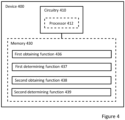
- the device 400 comprises circuitry 410.
- the circuitry 410 is configured to carry out functions of the device 400.
- the circuitry 410 may include a processor 412, such as a central processing unit (CPU), microcontroller, or microprocessor.
- the processor 412 is configured to execute program code.
- the program code may for example be configured to carry out the functions of the device 400.
- the device 400 may further comprise a memory 430.
- the memory 430 may be one or more of a buffer, a flash memory, a hard drive, a removable media, a volatile memory, a non-volatile memory, a random access memory (RAM), or another suitable device.
- the memory 430 may include a non-volatile memory for long term data storage and a volatile memory that functions as device memory for the circuitry 410.
- the memory 430 may exchange data with the circuitry 410 over a data bus. Accompanying control lines and an address bus between the memory 430 and the circuitry 410 also may be present.
- Functions of the device 400 may be embodied in the form of executable logic routines (e.g., lines of code, software programs, etc.) that are stored on a non-transitory computer readable medium (e.g., the memory 430) of the device 400 and are executed by the circuitry 410 (e.g., using the processor 412).
- the functions of the device 400 may be a stand-alone software application or form a part of a software application that carries out additional tasks related to the device 400.
- the described functions may be considered a method that a processing unit, e.g. the processor 412 of the circuitry 410 is configured to carry out.
- the described functions may be implemented in software, such functionality may as well be carried out via dedicated hardware or firmware, or some combination of hardware, firmware and/or software.
- the circuitry 410 is configured to execute a first obtaining function 436, a first determining function 437, a second obtaining function 438, and a second determining function 439.
- the first obtaining function 436 is configured to obtain a track relating to an object of one or more objects in the scene captured in the video sequence, wherein the track comprises crops of object instances of the object of the one or more objects, and wherein each crop has a crop score and a feature re-identification vector.
- the first determining function 437 is configured to determine a feature vector for the track based on feature vectors of crops of the track having a crop score above a selected crop score threshold.
- the second obtaining function 438 is configured to obtain a further crop of an object instance of one of the one or more objects in the scene captured in the video sequence, wherein the crop has a crop score selected for the scene and a feature vector.
- the second determining function 439 is configured to, on condition that the crop score of the further crop is greater than the crop score threshold selected for the scene, determine difference is between the determined respective feature vector of the two tracks, and determine whether the further crop and the track relate to a same object or to different objects based on the determined difference.
- the crop score threshold selected for the scene may for example be selected according to the method according to the first aspect.
- circuitry 410 is configured to execute are provided in relation to the corresponding acts of the method 300 for enhancing tracking of objects in a scene captured in a video sequence.
Landscapes
- Engineering & Computer Science (AREA)
- Theoretical Computer Science (AREA)
- Multimedia (AREA)
- General Physics & Mathematics (AREA)
- Physics & Mathematics (AREA)
- Computer Vision & Pattern Recognition (AREA)
- Evolutionary Computation (AREA)
- Databases & Information Systems (AREA)
- Medical Informatics (AREA)
- Software Systems (AREA)
- General Health & Medical Sciences (AREA)
- Computing Systems (AREA)
- Artificial Intelligence (AREA)
- Health & Medical Sciences (AREA)
- Image Analysis (AREA)
Priority Applications (3)
| Application Number | Priority Date | Filing Date | Title |
|---|---|---|---|
| EP23160912.4A EP4428819B1 (de) | 2023-03-09 | 2023-03-09 | Vorrichtung und verfahren zur verbesserung der verfolgung von objekten in einer szene, die in einer videosequenz aufgenommen wurde |
| US18/439,200 US12283057B2 (en) | 2023-03-09 | 2024-02-12 | Device and method for enhancing tracking of objects in a scene captured in a video sequence |
| CN202410196858.3A CN118628945B (zh) | 2023-03-09 | 2024-02-22 | 用于增强场景中的对象的跟踪的设备和方法 |
Applications Claiming Priority (1)
| Application Number | Priority Date | Filing Date | Title |
|---|---|---|---|
| EP23160912.4A EP4428819B1 (de) | 2023-03-09 | 2023-03-09 | Vorrichtung und verfahren zur verbesserung der verfolgung von objekten in einer szene, die in einer videosequenz aufgenommen wurde |
Publications (3)
| Publication Number | Publication Date |
|---|---|
| EP4428819A1 true EP4428819A1 (de) | 2024-09-11 |
| EP4428819B1 EP4428819B1 (de) | 2025-02-19 |
| EP4428819C0 EP4428819C0 (de) | 2025-02-19 |
Family
ID=85556475
Family Applications (1)
| Application Number | Title | Priority Date | Filing Date |
|---|---|---|---|
| EP23160912.4A Active EP4428819B1 (de) | 2023-03-09 | 2023-03-09 | Vorrichtung und verfahren zur verbesserung der verfolgung von objekten in einer szene, die in einer videosequenz aufgenommen wurde |
Country Status (3)
| Country | Link |
|---|---|
| US (1) | US12283057B2 (de) |
| EP (1) | EP4428819B1 (de) |
| CN (1) | CN118628945B (de) |
Family Cites Families (11)
| Publication number | Priority date | Publication date | Assignee | Title |
|---|---|---|---|---|
| US10395385B2 (en) * | 2017-06-27 | 2019-08-27 | Qualcomm Incorporated | Using object re-identification in video surveillance |
| US11676182B2 (en) * | 2018-06-29 | 2023-06-13 | Insurance Services Office, Inc. | Computer vision systems and methods for automatically detecting, classifying, and pricing objects captured in images or videos |
| EP3667557B1 (de) * | 2018-12-13 | 2021-06-16 | Axis AB | Verfahren und vorrichtung zur verfolgung eines objekts |
| CN110134126B (zh) * | 2019-05-15 | 2022-08-23 | 百度在线网络技术(北京)有限公司 | 轨迹匹配方法、装置、设备和介质 |
| US11003918B1 (en) * | 2019-10-25 | 2021-05-11 | 7-Eleven, Inc. | Event trigger based on region-of-interest near hand-shelf interaction |
| US20210264496A1 (en) * | 2020-02-21 | 2021-08-26 | Goldenspear Llc | Machine learning for rapid analysis of image data via curated customer personas |
| CN112037245B (zh) * | 2020-07-22 | 2023-09-01 | 杭州海康威视数字技术股份有限公司 | 一种确定追踪目标相似度的方法和系统 |
| CN112614154B (zh) * | 2020-12-08 | 2024-01-19 | 深圳市优必选科技股份有限公司 | 目标跟踪轨迹的获取方法、装置及计算机设备 |
| CN114913386B (zh) * | 2021-01-29 | 2025-08-19 | 北京原创世代科技有限公司 | 一种多目标跟踪模型的训练方法以及多目标跟踪方法 |
| US12211269B2 (en) * | 2021-05-07 | 2025-01-28 | Waymo Llc | Time-line based object tracking annotation |
| CN114494358B (zh) * | 2022-04-07 | 2022-06-21 | 中航信移动科技有限公司 | 一种数据处理方法、电子设备及存储介质 |
-
2023
- 2023-03-09 EP EP23160912.4A patent/EP4428819B1/de active Active
-
2024
- 2024-02-12 US US18/439,200 patent/US12283057B2/en active Active
- 2024-02-22 CN CN202410196858.3A patent/CN118628945B/zh active Active
Non-Patent Citations (2)
| Title |
|---|
| GAO XINWEN ET AL: "Multi-object tracking with Siamese-RPN and adaptive matching strategy", SIGNAL, IMAGE AND VIDEO PROCESSING, SPRINGER LONDON, LONDON, vol. 16, no. 4, 26 January 2022 (2022-01-26), pages 965 - 973, XP037799733, ISSN: 1863-1703, [retrieved on 20220126], DOI: 10.1007/S11760-021-02041-X * |
| MK BASHAR ET AL: "Multiple Object Tracking in Recent Times: A Literature Review", ARXIV.ORG, CORNELL UNIVERSITY LIBRARY, 201 OLIN LIBRARY CORNELL UNIVERSITY ITHACA, NY 14853, 11 September 2022 (2022-09-11), XP091315172 * |
Also Published As
| Publication number | Publication date |
|---|---|
| EP4428819B1 (de) | 2025-02-19 |
| CN118628945B (zh) | 2025-11-14 |
| US20240303828A1 (en) | 2024-09-12 |
| US12283057B2 (en) | 2025-04-22 |
| EP4428819C0 (de) | 2025-02-19 |
| CN118628945A (zh) | 2024-09-10 |
Similar Documents
| Publication | Publication Date | Title |
|---|---|---|
| CN105404884B (zh) | 图像分析方法 | |
| JP6032921B2 (ja) | 物体検出装置及びその方法、プログラム | |
| CN104408707B (zh) | 一种快速数字成像模糊鉴别与复原图像质量评估方法 | |
| CN107564034A (zh) | 一种监控视频中多目标的行人检测与跟踪方法 | |
| US7783106B2 (en) | Video segmentation combining similarity analysis and classification | |
| CN104615986B (zh) | 利用多检测器对场景变化的视频图像进行行人检测的方法 | |
| US20140307917A1 (en) | Robust feature fusion for multi-view object tracking | |
| US10110846B2 (en) | Computationally efficient frame rate conversion system | |
| JP7392488B2 (ja) | 遺留物誤検出の認識方法、装置及び画像処理装置 | |
| CN111814852B (zh) | 图像检测方法、装置、电子设备和计算机可读存储介质 | |
| US9508018B2 (en) | Systems and methods for object detection | |
| CN115019052B (zh) | 图像识别方法、装置、电子设备及存储介质 | |
| CN111814690B (zh) | 一种目标重识别方法、装置和计算机可读存储介质 | |
| CN114463808B (zh) | 人脸识别方法、装置、终端及计算机可读存储介质 | |
| Bouachir et al. | Structure-aware keypoint tracking for partial occlusion handling | |
| CN114495025B (zh) | 一种车辆识别方法、装置、电子设备及存储介质 | |
| CN115272284A (zh) | 基于图像质量评估的输电线路缺陷识别方法 | |
| CN116912880A (zh) | 一种基于鸟类关键点检测的鸟类识别质量评估方法及系统 | |
| CN113052019B (zh) | 目标跟踪方法及装置、智能设备和计算机存储介质 | |
| EP4428819A1 (de) | Vorrichtung und verfahren zur verbesserung der verfolgung von objekten in einer szene, die in einer videosequenz aufgenommen wurde | |
| CN108985216B (zh) | 一种基于多元logistic回归特征融合的行人头部检测方法 | |
| Nguyen et al. | Improving zero-shot object-level change detection by incorporating visual correspondence | |
| CN108665479B (zh) | 基于压缩域多尺度特征tld的红外目标跟踪方法 | |
| Islam et al. | A new method for road surface detection | |
| CN115063590A (zh) | 基于sar图像超像素融合的cfar目标检测方法、装置和设备 |
Legal Events
| Date | Code | Title | Description |
|---|---|---|---|
| STAA | Information on the status of an ep patent application or granted ep patent |
Free format text: STATUS: EXAMINATION IS IN PROGRESS |
|
| PUAI | Public reference made under article 153(3) epc to a published international application that has entered the european phase |
Free format text: ORIGINAL CODE: 0009012 |
|
| 17P | Request for examination filed |
Effective date: 20231017 |
|
| AK | Designated contracting states |
Kind code of ref document: A1 Designated state(s): AL AT BE BG CH CY CZ DE DK EE ES FI FR GB GR HR HU IE IS IT LI LT LU LV MC ME MK MT NL NO PL PT RO RS SE SI SK SM TR |
|
| GRAP | Despatch of communication of intention to grant a patent |
Free format text: ORIGINAL CODE: EPIDOSNIGR1 |
|
| STAA | Information on the status of an ep patent application or granted ep patent |
Free format text: STATUS: GRANT OF PATENT IS INTENDED |
|
| INTG | Intention to grant announced |
Effective date: 20241129 |
|
| GRAS | Grant fee paid |
Free format text: ORIGINAL CODE: EPIDOSNIGR3 |
|
| GRAA | (expected) grant |
Free format text: ORIGINAL CODE: 0009210 |
|
| STAA | Information on the status of an ep patent application or granted ep patent |
Free format text: STATUS: THE PATENT HAS BEEN GRANTED |
|
| AK | Designated contracting states |
Kind code of ref document: B1 Designated state(s): AL AT BE BG CH CY CZ DE DK EE ES FI FR GB GR HR HU IE IS IT LI LT LU LV MC ME MK MT NL NO PL PT RO RS SE SI SK SM TR |
|
| REG | Reference to a national code |
Ref country code: GB Ref legal event code: FG4D |
|
| REG | Reference to a national code |
Ref country code: CH Ref legal event code: EP |
|
| REG | Reference to a national code |
Ref country code: DE Ref legal event code: R096 Ref document number: 602023002052 Country of ref document: DE |
|
| REG | Reference to a national code |
Ref country code: IE Ref legal event code: FG4D |
|
| U01 | Request for unitary effect filed |
Effective date: 20250219 |
|
| U07 | Unitary effect registered |
Designated state(s): AT BE BG DE DK EE FI FR IT LT LU LV MT NL PT RO SE SI Effective date: 20250225 |
|
| U20 | Renewal fee for the european patent with unitary effect paid |
Year of fee payment: 3 Effective date: 20250228 |
|
| PG25 | Lapsed in a contracting state [announced via postgrant information from national office to epo] |
Ref country code: RS Free format text: LAPSE BECAUSE OF FAILURE TO SUBMIT A TRANSLATION OF THE DESCRIPTION OR TO PAY THE FEE WITHIN THE PRESCRIBED TIME-LIMIT Effective date: 20250519 |
|
| PG25 | Lapsed in a contracting state [announced via postgrant information from national office to epo] |
Ref country code: PL Free format text: LAPSE BECAUSE OF FAILURE TO SUBMIT A TRANSLATION OF THE DESCRIPTION OR TO PAY THE FEE WITHIN THE PRESCRIBED TIME-LIMIT Effective date: 20250219 |
|
| PG25 | Lapsed in a contracting state [announced via postgrant information from national office to epo] |
Ref country code: ES Free format text: LAPSE BECAUSE OF FAILURE TO SUBMIT A TRANSLATION OF THE DESCRIPTION OR TO PAY THE FEE WITHIN THE PRESCRIBED TIME-LIMIT Effective date: 20250219 |
|
| PG25 | Lapsed in a contracting state [announced via postgrant information from national office to epo] |
Ref country code: NO Free format text: LAPSE BECAUSE OF FAILURE TO SUBMIT A TRANSLATION OF THE DESCRIPTION OR TO PAY THE FEE WITHIN THE PRESCRIBED TIME-LIMIT Effective date: 20250519 Ref country code: IS Free format text: LAPSE BECAUSE OF FAILURE TO SUBMIT A TRANSLATION OF THE DESCRIPTION OR TO PAY THE FEE WITHIN THE PRESCRIBED TIME-LIMIT Effective date: 20250619 |
|
| PG25 | Lapsed in a contracting state [announced via postgrant information from national office to epo] |
Ref country code: HR Free format text: LAPSE BECAUSE OF FAILURE TO SUBMIT A TRANSLATION OF THE DESCRIPTION OR TO PAY THE FEE WITHIN THE PRESCRIBED TIME-LIMIT Effective date: 20250219 |
|
| PG25 | Lapsed in a contracting state [announced via postgrant information from national office to epo] |
Ref country code: GR Free format text: LAPSE BECAUSE OF FAILURE TO SUBMIT A TRANSLATION OF THE DESCRIPTION OR TO PAY THE FEE WITHIN THE PRESCRIBED TIME-LIMIT Effective date: 20250520 |
|
| PG25 | Lapsed in a contracting state [announced via postgrant information from national office to epo] |
Ref country code: SM Free format text: LAPSE BECAUSE OF FAILURE TO SUBMIT A TRANSLATION OF THE DESCRIPTION OR TO PAY THE FEE WITHIN THE PRESCRIBED TIME-LIMIT Effective date: 20250219 |
|
| PG25 | Lapsed in a contracting state [announced via postgrant information from national office to epo] |
Ref country code: CZ Free format text: LAPSE BECAUSE OF FAILURE TO SUBMIT A TRANSLATION OF THE DESCRIPTION OR TO PAY THE FEE WITHIN THE PRESCRIBED TIME-LIMIT Effective date: 20250219 |
|
| PG25 | Lapsed in a contracting state [announced via postgrant information from national office to epo] |
Ref country code: SK Free format text: LAPSE BECAUSE OF FAILURE TO SUBMIT A TRANSLATION OF THE DESCRIPTION OR TO PAY THE FEE WITHIN THE PRESCRIBED TIME-LIMIT Effective date: 20250219 |
|
| PG25 | Lapsed in a contracting state [announced via postgrant information from national office to epo] |
Ref country code: MC Free format text: LAPSE BECAUSE OF FAILURE TO SUBMIT A TRANSLATION OF THE DESCRIPTION OR TO PAY THE FEE WITHIN THE PRESCRIBED TIME-LIMIT Effective date: 20250219 |
|
| PLBE | No opposition filed within time limit |
Free format text: ORIGINAL CODE: 0009261 |
|
| STAA | Information on the status of an ep patent application or granted ep patent |
Free format text: STATUS: NO OPPOSITION FILED WITHIN TIME LIMIT |
|
| PG25 | Lapsed in a contracting state [announced via postgrant information from national office to epo] |
Ref country code: IE Free format text: LAPSE BECAUSE OF NON-PAYMENT OF DUE FEES Effective date: 20250309 |
|
| 26N | No opposition filed |
Effective date: 20251120 |
|
| U20 | Renewal fee for the european patent with unitary effect paid |
Year of fee payment: 4 Effective date: 20260219 |