EP4428790A1 - Mandate processing device, mandate processing method, and mandate processing system - Google Patents
Mandate processing device, mandate processing method, and mandate processing system Download PDFInfo
- Publication number
- EP4428790A1 EP4428790A1 EP23210948.8A EP23210948A EP4428790A1 EP 4428790 A1 EP4428790 A1 EP 4428790A1 EP 23210948 A EP23210948 A EP 23210948A EP 4428790 A1 EP4428790 A1 EP 4428790A1
- Authority
- EP
- European Patent Office
- Prior art keywords
- mandate
- information
- candidates
- mandator
- mandatary
- Prior art date
- Legal status (The legal status is an assumption and is not a legal conclusion. Google has not performed a legal analysis and makes no representation as to the accuracy of the status listed.)
- Pending
Links
Images













Classifications
-
- G—PHYSICS
- G06—COMPUTING OR CALCULATING; COUNTING
- G06Q—INFORMATION AND COMMUNICATION TECHNOLOGY [ICT] SPECIALLY ADAPTED FOR ADMINISTRATIVE, COMMERCIAL, FINANCIAL, MANAGERIAL OR SUPERVISORY PURPOSES; SYSTEMS OR METHODS SPECIALLY ADAPTED FOR ADMINISTRATIVE, COMMERCIAL, FINANCIAL, MANAGERIAL OR SUPERVISORY PURPOSES, NOT OTHERWISE PROVIDED FOR
- G06Q10/00—Administration; Management
- G06Q10/10—Office automation; Time management
-
- G—PHYSICS
- G06—COMPUTING OR CALCULATING; COUNTING
- G06F—ELECTRIC DIGITAL DATA PROCESSING
- G06F21/00—Security arrangements for protecting computers, components thereof, programs or data against unauthorised activity
- G06F21/30—Authentication, i.e. establishing the identity or authorisation of security principals
- G06F21/31—User authentication
-
- H—ELECTRICITY
- H04—ELECTRIC COMMUNICATION TECHNIQUE
- H04L—TRANSMISSION OF DIGITAL INFORMATION, e.g. TELEGRAPHIC COMMUNICATION
- H04L63/00—Network architectures or network communication protocols for network security
- H04L63/08—Network architectures or network communication protocols for network security for authentication of entities
- H04L63/0807—Network architectures or network communication protocols for network security for authentication of entities using tickets, e.g. Kerberos
-
- H—ELECTRICITY
- H04—ELECTRIC COMMUNICATION TECHNIQUE
- H04L—TRANSMISSION OF DIGITAL INFORMATION, e.g. TELEGRAPHIC COMMUNICATION
- H04L63/00—Network architectures or network communication protocols for network security
- H04L63/10—Network architectures or network communication protocols for network security for controlling access to devices or network resources
-
- H—ELECTRICITY
- H04—ELECTRIC COMMUNICATION TECHNIQUE
- H04L—TRANSMISSION OF DIGITAL INFORMATION, e.g. TELEGRAPHIC COMMUNICATION
- H04L63/00—Network architectures or network communication protocols for network security
- H04L63/12—Applying verification of the received information
Definitions
- the present invention relates to a mandate processing device, a mandate processing method, and a mandate processing system.
- the present invention particularly relates to a mandate processing device, a mandate processing method, and a mandate processing system that can be suitably used when an action to be performed by a mandator is delegated to a mandatary.
- mandate processing in which an action to be performed by a mandator is delegated to a mandatary is performed.
- mandate processing for example, it is necessary for the mandator to issue a mandate to the mandatary in advance, and when the mandatary is to perform the delegated action, authorization for the action of the mandatary is required on the side of the system performing mandate management.
- mandate information including mandate content is registered on the system side before performing the authorization processing, and the system side performing the mandate management performs the authorization based on the mandate information.
- JP 2003-99401 A indicates that a server is configured to provide a trusted third-party organization with a ticket that authenticates the server, information regarding a target service that the server intends to access on behalf of the client, and a service ticket associated with the client.
- the service ticket can be provided by a client, or can be an issued service ticket issued to the server for the server itself in the name of the client. If the mandate is authorized according to a mandate constraint condition pertaining to the client, the trusted third-party organization issues a new service ticket for accessing the target service to the server in the name of the client.
- JP 2016-51451 A indicates that an entrustment source assigns an access right to a document in a document management system to a primary contractor, and sets conditions of a client certificate and a user attribute to be satisfied by a secondary contractor, in a certificate condition table and a user attribute condition table.
- the primary contractor acquires a primary token by receiving authentication from an authentication-authorization server, and passes the primary token to the secondary contractor.
- the secondary contractor presents the primary token to the authentication-authorization server via an intermediate server and requests a secondary token.
- the authentication-authorization server provides the secondary token in a case where the secondary contractor satisfies the conditions of the certificate condition table and the user attribute condition table.
- the secondary contractor presents the secondary token when requesting the document.
- mandate information registrant in the system performing mandate management, mandate information including mandate content, for example, the mandate information registrant needs to check the attribute information of the mandatary and the authority pertaining to the mandate content. Therefore, the mandate information registrant needs to collect the attribute information of the mandatary and the mandate content information, and thus the burden on the mandate information registrant is large.
- a registration item constituting the mandate information is manually inputted by the mandate information registrant.
- condition settings associated with the mandate content and the mandator, and it is difficult to establish rules, and hence setting errors are likely to occur.
- An object of the present invention is to provide a mandate processing device, a mandate processing method, and a mandate processing system that enable a mandate information registrant to register accurate mandate information more easily.
- the present invention provides a mandate processing device including: a first presentation unit that, when a mandate is to be issued from a mandator to a mandatary, presents, as first input candidates, mandate information candidates, which is capable of being determined based on user information of the mandator and the mandatary and which is information for performing the mandate; a second presentation unit that presents, as second input candidates, mandate condition candidates, which are the mandate information candidates other than the first input candidates and which are candidates for a mandate condition defined by the mandator as a condition for the mandatary; and/or a mandate information registration unit that registers mandate information selected from the first input candidates and the second input candidates.
- a mandate processing device that enables the mandate information registrant to more easily register accurate mandate information.
- the first input candidates may include mandator candidates determined based on user information.
- the mandate information registrant is able to more easily set a mandator by selecting the mandator from among the mandator candidates. It is also possible to suppress mandator setting errors.
- a user satisfying a condition for becoming a mandator candidate can be selected as one of the mandator candidates based on the user information.
- a user suitable as a mandator can be selected.
- the first input candidates may further include mandate content candidates, which are candidates for mandate content required based on the authority of the mandator selected from among the mandator candidates.
- mandate content candidates are candidates for mandate content required based on the authority of the mandator selected from among the mandator candidates.
- the mandate information registrant can more easily set mandate content by selecting the mandate content from the mandate content candidates.
- the mandate content candidates can be obtained based on a resource owned by a mandator selected from among the mandator candidates. In this case, it is possible to extract suitable content as the mandate content.
- the first input candidates may include mandator resource candidates obtained from the mandate content candidates.
- the mandate information registrant may select a resource owned by the mandator from the resource candidates, and may more easily set the resource owned by the mandator.
- the first input candidates may include mandatary candidates, which are candidates for the mandatary that are obtained based on an authority required by the mandatary and determined from the mandate content selected from among the mandate content candidates.
- the mandate information registrant can more easily set the mandatary by selecting the mandatary from the mandatary candidates. It is also possible to suppress mandatary setting errors.
- the mandate information may include information on the mandator, the mandate content, the resources owned by the mandatary and the mandator, and the mandate conditions.
- the mandate information may be mandate information reflecting the intentions of the mandate information registrant.
- the second presentation unit may verify whether the mandatary satisfies the mandate condition selected from among the mandate condition candidates. In this case, it is possible to select a mandatary suitable for the mandate condition.
- the mandate processing device may further include a submandate setting unit that sets a mandatary (submandatary) of a submandate when the mandatary issues a mandate (submandate) with respect to self-mandated mandate content, and the submandate setting unit may present submandatary candidates who are candidates for the submandatary.
- the mandate information registrant can more easily set the submandatary by selecting the submandatary from among the submandatary candidates. It is also possible to suppress submandatary setting errors.
- the submandate setting unit may also make a range of conditions, which are set in the mandate information, the same or smaller each time a submandate is performed. In this case, the possibility of the mandate being performed by an unintended party when a submandate is to be performed is reduced.
- the conditions set in the mandate information may be at least one of a restriction on the number of submandates and a submandatable range.
- a submandate may be issued according to the intentions of the mandator.
- the submandate setting unit may make it possible to add conditions to be set in the mandate information.
- a mandate condition can be added for each submandatary.
- the present invention provides a mandate processing method implemented by a processor executing a program recorded in memory, the method including: when a mandate is issued by a mandator to a mandatary, presenting, as first input candidates, mandate information candidates, which is capable of being determined based on user information of the mandator and the mandatary and which is information for performing the mandate; presenting, as second input candidates, mandate condition candidates, which are the mandate information candidates other than the first input candidates and which are candidates for a mandate condition defined by the mandator as a condition for the mandatary; and/or registering mandate information selected from the first input candidates and the second input candidates.
- a mandate processing method in which a mandate information registrant is able to register accurate mandate information more easily.
- the present invention provides a mandate processing system, including: a mandate processing device that, when a mandate is to be issued from a mandator to a mandatary, performs setting of mandate information; and a mandate management device that, based on the mandate information, grants the mandatary permission to process the mandate content, wherein the mandate processing device includes: a first presentation unit that, when a mandate is to be issued from the mandator to the mandatary, presents, as first input candidates, mandate information candidates, which is capable of being determined based on user information of the mandator and the mandatary and which is information for performing the mandate; a second presentation unit that presents, as second input candidates, mandate condition candidates, which are the mandate information candidates other than the first input candidates and which are candidates for a mandate condition defined by the mandator as a condition for the mandatary; and a mandate information registration unit that registers mandate information selected from the first input candidates and the second input candidates.
- a mandate processing system that enables a mandate information registrant to register accurate mandate information more easily.
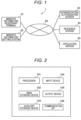
- Fig. 1 is a diagram illustrating an overall configuration example of a mandate processing system 1 to which the present embodiment is applied.
- the mandate processing system 1 includes a mandate information registrant terminal 10, a mandate information setting system 20, an authentication-authorization server 30, a resource server 40, and an application server 50. These parts are connected via a network 60.
- the mandate information registrant terminal 10 is a terminal device operated by the mandate information registrant to register a mandate.
- "mandate” means that the mandate information registrant entrusts a mandatary to perform a certain act.
- the "mandate” will sometimes be referred to as the representative or agent.
- a "mandate information registrant” is a party who performs the setting of a mandate by using the mandate information registrant terminal 10.
- the mandate information registrant may be the mandator himself/herself or may be a party who operates the mandate information registrant terminal 10 instead of the mandator to register the mandate.
- mandate content is processing content delegated by the mandator to the mandatary.
- the mandate content is not particularly limited, but is, for example, an action necessary when the mandator performs a task. This action corresponds to, for example, the creation and editing of an electronic document, the signing of an electronic document, settlement processing, and the like.
- the mandate information setting system 20 is an example of a mandate processing device, and sets the mandate information when a mandate is issued by a mandator to a mandatary.
- the authentication-authorization server 30 is an example of a mandate management device, and the mandatary grants permission to process the mandate content based on the mandate information.
- the authentication-authorization server 30 receives a request for mandatary authentication. After the authentication, the authentication-authorization server 30 grants the mandatary authorization to process the mandate content.
- the resource server 40 has resources for processing the mandate content.
- the resource server 40 grants authority to process the resource.
- the resource server 40 receives, from the mandatary, a request to process a resource according to mandate content, and returns a processing result to the mandatary.
- the application server 50 executes application software with which the mandatary processes the mandate content.
- the mandatary executes the application software to process the mandate content to be performed on the resource server 40.
- the network 60 is a communication means used for information communication between the mandate information registrant terminal 10, the mandate information setting system 20, the authentication-authorization server 30, the resource server 40, and the application server 50, and is, for example, the Internet, a local area network (LAN), or a wide area network (WAN).
- the network 60 may be used in combination regardless of whether same is wired or wireless.
- the network 60 may use a relay device such as a gateway device or a router and be connected via a plurality of communication lines.
- Fig. 2 is a diagram illustrating a hardware configuration of the mandate information registrant terminal 10, the mandate information setting system 20, the authentication-authorization server 30, the resource server 40, and the application server 50.
- the foregoing components are computer devices such as a personal computer (PC) and a server computer. Further, as illustrated, the foregoing components include a processor 101 such as a central processing unit (CPU), and, as storage means, a main storage device 102 and an auxiliary storage device 103 such as a hard disk drive (HDD) or a solid state drive (SSD).
- the processor 101 executes various kinds of software such as an OS (basic software) and an application program (application software).
- the main storage device 102 is a storage area that stores various software, data used for execution thereof, and the like
- the auxiliary storage device 103 is a storage area that stores input data for various software, output data from various software, and the like.
- these devices include an input device 104 such as a keyboard, a mouse, and a touch panel, a display device 105 including a video memory, a display, and the like, and a communication interface (communication I/F) 106 for performing communication with the outside.
- an input device 104 such as a keyboard, a mouse, and a touch panel
- a display device 105 including a video memory, a display, and the like
- a communication interface (communication I/F) 106 for performing communication with the outside.
- Figs. 3(a) and 3(b) are diagrams illustrating operations of the mandate processing system 1.
- Fig. 3(a) is a diagram illustrating, as Step 1, mandate information registration in which the mandate information registrant (mandator) registers mandate information.
- mandate information registrant (mandator) registers mandate information including mandate content in the authentication-authorization server 30 in advance together with user information and a policy. As a result, preparation for a mandatary to process the mandate content is complete.
- Fig. 3(b) is a diagram illustrating, as Step 2, mandatary processing in which the mandatary uses the mandate processing system 1 to process the mandate content.
- the mandatary accesses the application server 50 (1. Access), and transmits a token requesting mandate authentication and authorization to the authentication-authorization server 30 (2. Token request).
- the authentication-authorization server 30 determines whether or not to grant the mandate to the mandatary based on the mandate information (3. Mandate permission). Further, in a case where permission is granted, the authentication-authorization server 30 returns a token indicating permission to the application server 50 (4. Token).
- the mandatary makes a request to process resources in the resource server 40 via the application server 50, and sends a token for actually performing processing (5. Processing request + token). The resource server 40 then returns the processing result to the application server 50 (6. Processing result).
- authorization is performed by aggregating the authorization processing and the authentication processing in the authentication-authorization server 30 and returning an authorization determination result to the resource server 40.
- the authentication-authorization server 30 it is necessary to store user information (including attribute information of the user and the like) used for the authorization determination by the authentication-authorization server 30 and an authorization determination policy in the authentication-authorization server 30 in advance.
- the advantages of such a method include, in addition to the convenience for the user of being able to manage their own information in one place (in this case, the authentication-authorization server 30), the convenience for the administrator of the loss/reduction in the amount of personal information to be managed, and so forth.
- points in the registration of the mandate information illustrated in Fig. 3(a) include the following (1) to (3).
- the mandatary has authority satisfying conditions according to the processing content and the mandator.
- the processing of the mandate processing system 1 is performed as follows, thereby solving the above problems. It is thus possible to improve the convenience and accuracy of mandate information registration.
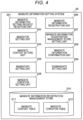
- Fig. 4 is a block diagram illustrating a functional configuration example of the mandate information setting system 20.
- the mandate information setting system 20 includes a mandate information setting request reception unit 201, a mandator setting unit 202, a mandate content setting unit 203, a mandatary setting unit 204, a mandate condition setting unit 205, a mandate information registration unit 206, a mandate information registration management store setting unit 207, a mandate information confirmation unit 208, a submandate setting unit 209, and a mandate information registration management store 210.
- the mandate information setting request reception unit 201 receives a mandate information setting request which is a request for setting the mandate information from the mandate information registrant.
- the mandator setting unit 202 calculates a mandator candidate condition and acquires user information from the account management table 311 (see Fig. 5 ) of the authentication-authorization server 30.
- the mandator candidate condition is a condition for becoming a mandator candidate. Further, the mandator setting unit 202 obtains mandator candidates who are candidates for the mandator in the light of the mandator candidate condition and the user information, and presents the mandator candidate to the mandate information registrant. Further, when the mandate information registrant makes an input to select a mandator from among the mandator candidates, the mandator setting unit 202 acquires the input as a response.
- the mandate content setting unit 203 calculates a mandate content candidate condition and acquires mandate content candidate information from the mandate content table 211 of the mandate information registration management store 210.
- the mandate content candidate condition is a condition for extracting a mandate content candidate.
- the mandate content setting unit 203 obtains mandate content candidates in the light of the authority of the selected mandator, and presents the mandate content candidates to the mandate information registrant.
- the authority of the mandator can be acquired from attribute information of the selected mandator. Further, when the mandate information registrant makes an input to select mandate content from among the mandate content candidates, the mandate content setting unit 203 acquires the input as a response.
- the mandatary setting unit 204 calculates a mandatary candidate condition, and acquires user information from the account management table 311 of the authentication-authorization server 30.
- the mandatary candidate condition is a condition for becoming a mandatary candidate.
- Mandatary candidates who are candidates for the mandatary are then obtained in the light of the mandatary candidate condition and the user information, and the mandatary candidates are presented to the mandate information registrant.
- the mandatary setting unit 204 acquires the input as a response.
- the mandate condition setting unit 205 acquires, from the mandate condition table 212, mandate condition candidates which are candidates for the mandate condition determined by the mandator as the mandatary condition. The mandate condition candidates are then presented to the mandate information registrant. Further, when the mandate information registrant makes an input to select a mandate condition from among the mandate condition candidates, the mandate condition setting unit 205 acquires the input as a response.
- the mandate information registration unit 206 transmits a request to register the mandate information along with the mandate information to the authentication-authorization server 30.
- the mandate information includes information on a mandator, mandate content, resources owned by the mandator and the mandatary, and a mandate condition.
- the mandate information is information enabling the "mandator” to grant the "mandatary” the "processing content” with respect to the "resources owned by the mandator” under the "mandate condition". Note that, depending on the mandate content, the resources owned by the mandator may be unnecessary.
- the mandate information registration management store setting unit 207 provides the mandate information registrant with a function for editing data in the mandate content table 211 and the mandate condition table 212 in the mandate information registration management store 210.
- the mandate information confirmation unit 208 transmits a request to acquire mandate information to the mandate information setting unit 302 (see Fig. 5 ) of the authentication-authorization server 30, and presents the acquired mandate information to the mandate information registrant.
- the mandate information confirmation unit 208 receives a mandate information setting request and a submandate setting request.
- the submandate setting unit 209 sets the submandatary.
- the mandate information registration management store 210 includes a mandate content table 211 and a mandate condition table 212.
- the mandate content table 211 stores mandator conditions and mandatary conditions for mandate content, which is processing content to be mandated.
- the mandate condition table 212 stores the condition content of mandate conditions.
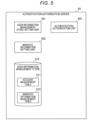
- Fig. 5 is a block diagram illustrating a functional configuration example of the authentication-authorization server 30.
- the authentication-authorization server 30 includes a user information management store setting unit 301, a mandate information setting unit 302, an authentication-authorization unit 303, and a user information management store 310.
- the user information management store setting unit 301 sets data stored in the account management table 311 and a mandate information management table 312 of the user information management store 310.
- the mandate information setting unit 302 sets the mandate information in the mandate information management table 312 of the user information management store 310.
- the authentication-authorization unit 303 receives a request for authentication and authorization from the application server 50, performs authentication and authorization of the user from the data stored in the account management table 311 and the mandate information management table 312, and returns the result as a token.
- the user information management store 310 includes the account management table 311 and the mandate information management table 312.
- the account management table 311 stores user information which is information on users using the mandate processing system 1.
- the user information includes a username, attributes of the user associated with the username, and the like.
- the mandator or the mandatary is selected from among users for whom user information is stored in the account management table 311.
- the mandate information management table 312 stores the mandate information sent from the mandate information setting system 20.
- Fig. 6 is a block diagram illustrating a functional configuration example of the resource server 40.
- the resource server 40 includes a mandate information confirmation unit 401, a resource management unit 402, a processing execution unit 403, and a resource information management store 410.
- the mandate information confirmation unit 401 confirms the mandate information when the mandatary issues a request to process resources in the resource server 40.
- the resource management unit 402 manages the resources stored in the resource information management store 410.
- the processing execution unit 403 executes processing using the resources stored in the resource information management store 410 based on the mandate information.
- the resource information management store 410 includes a resource management table 411.
- the resource management table 411 manages the resources stored in the resource information management store 410.
- Fig. 7 is a diagram illustrating a data structure of the mandate content table 211.
- the mandate content table 211 includes items, namely, mandate content, mandator condition, mandator resource, and mandatary condition.
- the mandate content is the content for performing the mandate described above.
- the mandator condition is a mandator condition required for the mandate content.
- the mandator resource is the resource owned by the mandator required to perform the mandate content.
- a resource can also be an element required for the mandator to perform a task.
- the mandatary condition is a mandatary condition required for the mandate content.
- the mandate content is "signing key usage”
- the mandator condition is "has signing key”
- the mandator resource is "signing key”.
- the condition of the mandatary is " ⁇ -qualified”.
- Fig. 8 is a diagram illustrating a data structure of a mandate condition table 212.
- the mandate condition table 212 includes predetermined condition content.
- the condition content "in the same department” and the “employment position: ⁇ or higher” is prepared in advance as the condition content.
- Fig. 9 is a diagram illustrating a data structure of the account management table 311.
- the account management table 311 stores user information.
- the account management table 311 includes items which are: username, PW, attribute 1: department, attribute 2: position, attribute 3: resource, and attribute 4: qualifications held.
- the username is the name or ID of the user.
- PW is a password for performing authentication.
- Attribute 1 department
- Attribute 2 position
- Attribute 3 resources
- Attribute 4 qualifications held are attribute information for the user, and denote the department to which the user belongs, the position of the user, the resources owned by the user, and the qualifications held by the user, respectively.
- Fig. 10 is a diagram illustrating a data structure of the mandate information management table 312.
- the mandate information management table 312 includes items, namely, mandator, mandate content, resource, mandate authority, mandatary, mandate condition, and mandate information registrant.
- the mandator, the mandate content, the mandatary, and the mandate information registrant are as described above.
- the resource is a resource of the mandator, and the mandate authority is an authority for performing a mandate.
- the mandate information setting system 20 sequentially performs the following processing 1 to 3.
- the mandate information setting request reception unit 201, the mandator setting unit 202, the mandate content setting unit 203, and the mandatary setting unit 204 set mandate information in the light of the mandate information candidates that can be mechanically calculated based on user information prepared in advance, and the like.
- the mandator, the mandate content, the mandatary, and the resources owned by the mandator are set in the mandate information.
- these pieces of mandate information are set using an interactive mode between the mandate information setting system 20 and the mandate information registrant. That is, these pieces of mandate information are set in the following format: narrowing of input candidates based on user information and the like ⁇ presentation of input candidates ⁇ input (response) by mandate information registrant.
- the mandate condition setting unit 205 sets mandate information that cannot be mechanically calculated based on user information or the like.
- a mandate condition is set in the mandate information.
- the mandate information is set using an interactive mode between the mandate information setting system 20 and the mandate information registrant. That is, a mandate condition is set in the following format: narrowing down of mandate conditions ⁇ presentation of input candidates ⁇ input (response) by mandate information registrant.
- the mandate information registration unit 206 registers the set mandate information in the mandate information management table 312 of the authentication-authorization server 30.
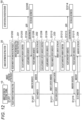
- Fig. 11 is a diagram illustrating the overall operation of Processing 1 to 3.
- Fig. 12 is a sequence diagram illustrating Processing 1.
- the mandate information registrant issues a mandate information setting request, which is a request to set mandate information, from the mandate information registrant terminal 10 (S1201).
- the mandate information setting request reception unit 201 receives the mandate information setting request (S1202).
- the mandator setting unit 202 performs mandator candidate condition calculation processing as processing to calculate a mandator candidate condition that can be set by the mandate information registrant (S1203).
- the mandate information registrant can be specified from logged-in user information or the like supplied by the mandate information registrant in S1201, for example.
- the mandator candidate condition is, for example, a condition that a party of the same affiliation can be set as a mandator in the light of the user information of the mandate information registrant.
- the mandator candidate condition is, for example, a condition that only the mandator himself/herself (the mandate information registrant himself/herself) can be set as a mandator.
- the setting of the mandator candidate condition may be determined in advance by the mandator setting unit 202, or a table for the setting candidates may be held in the mandate processing system 1 and the mandate information registrant may select the mandator candidate condition from the table at the time of the mandator candidate condition calculation processing.
- the mandator setting unit 202 acquires user information (including user attribute information) having the mandator candidate condition obtained in S1203, from the authentication-authorization server 30 (S1204). This action is performed by sending a query requesting the user information having the condition obtained in S1203 to the authentication-authorization server 30, and the authentication-authorization server 30 returning the corresponding user information (S1205).
- the mandator setting unit 202 Upon receiving the user information, the mandator setting unit 202 presents the corresponding users on the screen as mandator candidates (S1206). At the same time, the mandator setting unit 202 presents a screen for selecting a mandator candidate, and the mandate information registrant selects a mandator from among the mandator candidates and inputs the mandator (S1207). At this time, the mandator setting unit 202 may present only the names of the mandator candidates on the screen, or may also present a portion of the attribute information (for example, affiliation) on the screen.
- the attribute information for example, affiliation
- the mandator setting unit 202 is capable of setting a mandator.
- the mandate content setting unit 203 performs mandate content candidate condition calculation processing as processing to calculate a mandate content candidate condition in the light of the attribute information of the mandator selected by the mandator setting unit 202 (S1208).
- the mandate content candidate condition is the authority of the mandator.
- the authority of the mandator is, for example, an attribute value of attribute information (information acquired from the account management table 311) of the mandator selected by the mandator setting unit 202.
- the authority of the mandator for example, a correspondence table of attribute values and authorities may be stored in the mandate processing system 1, and the authority of the mandator may be acquired from this table and the attribute value of the attribute information (information acquired from the account management table) of the mandator selected by the mandator setting unit 202.
- the mandate content setting unit 203 acquires settable mandate content candidates from the mandate content table 211 in the light of the authority of the mandator obtained in S1208. This action is performed by sending a query requesting mandate content candidates to the mandate content table 211 and acquiring the corresponding user information from the mandate content table 211. At the same time, resource candidates that are possible candidates for resources owned by the mandator are acquired from the user information (account management table 311) of the mandator (S1209).
- the mandate content setting unit 203 presents the mandate content candidates and the resource candidates on the screen (S1210).
- the mandate content setting unit 203 presents a screen for selecting a mandate content candidate and a resource candidate, and the mandate information registrant selects mandate content and a resource from among such candidates and inputs the mandate content and resource (S1211).
- the mandate content setting unit 203 is capable of setting the mandate content and the resource owned by the mandator.
- the mandatary setting unit 204 performs mandatary candidate condition calculation processing as processing to calculate a mandatary candidate condition from the mandate content selected by the mandate content setting unit 203 (S1212).
- the mandatary candidate condition is an authority required by the mandatary.
- the mandatary setting unit 204 acquires the user information of users having the authority from the authentication-authorization server 30 (S1213). This action is performed by sending a query requesting user information having the authority obtained in S1212 to the authentication-authorization server 30, and the authentication-authorization server 30 returning the corresponding user information (S1214).
- the mandatary setting unit 204 Upon receiving the user information, the mandatary setting unit 204 presents the corresponding users on the screen as mandatary candidates (S1215). At the same time, the mandatary setting unit 204 presents a screen for selecting a mandatary candidate, and the mandate information registrant selects a mandatary from among the mandatary candidates and inputs the mandatary (S1216). At this time, the mandatary setting unit 204 may present only the names of the mandatary candidates on the screen, or may also present a portion of the attribute information (for example, affiliation) on the screen.
- the attribute information for example, affiliation
- the mandatary setting unit 204 is capable of setting the mandatary.
- the mandator setting unit 202, the mandate content setting unit 203, and the mandatary setting unit 204 function as a first presentation unit that presents, as first input candidates, mandate information candidates, which can be determined based on user information of the mandator and the mandatary and which is information for performing the mandate.
- the first input candidates include mandator candidates determined based on user information.
- users satisfying a condition for becoming a mandator candidate are selected as the mandator candidates based on the user information.
- the first input candidates may further include mandate content candidates, which are candidates for mandate content required based on the authority of the mandator selected from among the mandator candidates.
- the first input candidates include mandatary candidates, which are candidates for the mandatary that are obtained based on an authority required by the mandatary and determined from the mandate content selected from among the mandate content candidates.
- Fig. 13A is a diagram illustrating a case where the authority owned by the mandator is set to an attribute value of attribute information (information acquired from the account management table 311) of the mandator in S1208 of Fig. 12 .
- Fig. 13B illustrates the account management table 311 illustrated in Fig. 9 .
- a case where a user having the username A-1 is set as the mandator is illustrated.
- attribute 3 is the owned resource, which, in the case of user A-1, is "signing key (A-1)".
- Fig. 13B is a diagram illustrating processing to acquire mandate content candidates and resource candidates in the light of the authority of the mandator in S1209 of Fig. 12 .
- Fig. 13B is a table created based on the mandate content table 211 illustrated in Fig. 7 .
- the mandate content is "signing key usage”
- the mandator condition is "has signing key”
- the mandator-owned resource is “signing key”.
- the mandate content setting unit 203 sets the authority of the user A-1 as "signing key (A-1)" in the light of the account management table 311, and sets a settable mandate content candidate as "signing key usage” in the mandate content table 211.
- the mandate content setting unit 203 sets the resource candidate to "signing key (A-1)" in the account management table 311 because, according to the mandate content table 211, the condition of the mandator is "has signing key” and the owned resource of the mandator is "signing key”.
- Fig. 13C illustrates a result of acquiring mandate content candidates and resource candidates.
- the mandate content candidates are obtained based on a resource owned by a mandator selected from among the mandator candidates.
- the first input candidates may include mandator resource candidates obtained from mandate content candidates.
- Fig. 14 is a diagram illustrating mandatary candidate condition calculation processing in S1212 of Fig. 12 .
- Fig. 14 is a diagram similar to Fig. 13B and is a table created based on the mandate content table 211.
- the mandatary setting unit 204 sets a mandatary condition in the mandate content table 211 as the authority required by the mandatary. Here, it is indicated that "being ⁇ -qualified" is set as the authority required by the mandatary.
- Fig. 15 is a sequence diagram illustrating Processing 2 and 3.
- the mandate condition setting unit 205 acquires, from the mandate condition table 212, mandate condition candidates which can be set by the mandate information registrant (mandate condition information acquisition) (S1501). That is, candidates that can be set by the mandator are selected as mandate condition candidates. This action is performed by sending a query requesting mandate condition candidates to the mandate condition table 212 and acquiring the corresponding user information from the mandate condition table 212.
- the mandate condition setting unit 205 presents the acquired mandate condition candidates on a screen (presentation of mandate condition information) (S1502).
- the mandate condition setting unit 205 presents a screen for selecting a mandate condition candidate, and the mandate information registrant selects a mandate condition from among the mandate condition candidates and inputs the mandate condition (S1503).
- the mandate condition setting unit 205 may present options in a form for selection by the mandate information registrant, or the mandate information registrant may input information (numerical values or the like) related to the options.
- the former corresponds to, for example, a case where a designated number or more of service years are to be selected, and the latter corresponds to a case where the service years are to be inputted.
- the mandate condition setting unit 205 verifies that the mandate condition is satisfied by the mandatary from the mandatary attribute information (S1504).
- the mandate condition setting unit 205 is capable of performing Processing 2 to set a mandate condition.
- the mandate information registration unit 206 presents the mandate information acquired in Processing 1 and 2 on the screen (S1505).
- the mandate information registrant confirms and approves the mandate information (S1506). Note that, in the case of disapproval, the processing starts again from processing 1.
- the mandate information registration unit 206 presents the registered mandate information, and transmits the mandate information to the authentication-authorization server 30 if the mandate information registrant approves the mandate information (S1507).
- the authentication-authorization server 30 registers the mandate information in the mandate information management table 312 (S1508).
- the mandate information registration unit 206 is capable of performing Processing 3 and of registering the mandate information in the authentication-authorization server 30.
- the mandate condition setting unit 205 functions as a second presentation unit that presents, as second input candidates, mandate condition candidates, which are the mandate information candidates other than that of the first input candidates and which are candidates for the mandate condition defined by the mandator as a mandatary condition.
- the mandate condition setting unit 205 verifies whether the mandatary satisfies the mandate condition selected from among the mandate condition candidates.
- the mandate information registration unit 206 registers the mandate information selected from the first input candidates and the second input candidates.
- Fig. 16 is a screen which is displayed when the mandate information registrant issues a mandate information setting request in S1201 of Fig. 12 .
- the illustrated screen is a so-called home screen.
- a button Bt1 for newly registering the mandate information and a button Bt2 for confirming, changing, and deleting the mandate information are displayed.
- the button Bt1 When the mandate information registrant presses the button Bt1, the processing of S1202 and subsequent processing is started.
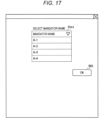
- Fig. 17 illustrates a screen on which mandator candidates are presented on the screen in S1206 to S1207 in Fig. 12 , and the mandate information registrant selects a mandator from among the mandator candidates and inputs the mandator.
- a pull-down menu Pm1 is displayed on the illustrated screen, and that users whose usernames are A-1 to A-4 are displayed as mandator candidates.
- users whose usernames are A-1 to A-4 are displayed as mandator candidates.
- the mandate information registrant selects user A-1 and presses the OK button Bt3, user A-1 is selected and inputted.
- Fig. 18 illustrates a screen on which mandate content candidates are presented on the screen in S1210 to S1211 in Fig. 12 , and the mandate information registrant selects mandate content from among the mandate content candidates and inputs the mandate content.
- a pull-down menu Pm2 is displayed on the illustrated screen, and "use signing key” and “reference signing key” are displayed as the mandate content candidates.
- "use signing key” and “reference signing key” are displayed as the mandate content candidates.
- Fig. 19 illustrates a screen on which resource candidates are presented on the screen in S1210 to S1211 in Fig. 12 , and the mandate information registrant selects a resource from among the resource candidates and inputs the resource.
- a pull-down menu Pm3 is displayed on the illustrated screen, and that "signing key (A-1)" is displayed as the resource candidate.
- "signing key (A-1)" is displayed as the resource candidate.
- Fig. 20 illustrates a screen on which mandatary candidates are presented on a screen in S1215 to S1216 of Fig. 12 , and the mandate information registrant selects a mandatary from among the mandatary candidates and inputs the mandatary.
- a pull-down menu Pm4 is displayed on the illustrated screen, and that users whose usernames are B-1 to B-4 are displayed as mandatary candidates.
- users whose usernames are B-1 to B-4 are displayed as mandatary candidates.
- the mandate information registrant selects user B-1 and presses the OK button Bt6, user B-1 is selected and inputted.
- the setting content may be temporarily stored when processing 1 ends, another mandate information registrant may be asked to register the mandate information, and the request may be executed starting from processing 2. This is, for example, a case where the processing 1 is performed by the system administrator, and the processing 2 and subsequent processing are performed by the mandator himself/herself, or the like.
- Fig. 21 is a diagram illustrating such a case and illustrates a screen for temporarily saving the content set up until Fig. 20 as basic information.
- a dialog box Db1 is displayed on the illustrated screen, and when an OK button Bt7 is pressed in response to the message "Would you like to use the above content to register basic information?", the basic information is registered.
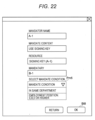
- Fig. 22 illustrates a screen on which the mandate condition candidates are presented on a screen in S1502 to S1503 of Fig. 15 , and the mandate information registrant selects a mandate condition from among the mandate condition candidates and inputs the mandate condition.
- a pull-down menu Pm5 is displayed on the illustrated screen, and "in the same department” and “position: ⁇ or higher” are displayed as mandate condition candidates. Further, for example, when the mandate information registrant selects “in the same department” and presses the OK button Bt8, "in the same department” is selected and inputted.
- Fig. 23 illustrates a screen on which the mandate information registrant confirms and approves the mandate information in S1506 of Fig. 15 .
- a dialog box Db2 is displayed on the illustrated screen, and when an OK button Bt9 is pressed in response to the message "Would you like to use the above content to register the mandate information?", the mandate information is registered.
- Fig. 24 illustrates a screen for presenting registered mandate information in S1507 of Fig. 15 .
- a dialog box Db3 is displayed, and the mandate information to be registered is displayed.
- Fig. 25 is a diagram illustrating registered mandate information.
- mandate information has been registered with user A-1 as the mandator, user B-1 as the mandatary, user C-1 as the registrant (mandate information registrant), "use signing key” as the mandate content, “signing key (A-1)” as the resource (resource owned by the mandator)", and "in the same department” as the mandate condition.
- the mandatary is also able to issue a submandate to a submandatary.
- Fig. 26 is a diagram to illustrate a submandate.
- the mandatary is able to issue a submandate (mandate [secondary]) to a submandatary.
- a submandatary to issue a submandate (mandate [tertiary]) to another submandatary. That is, it is conceivable for a submandate to be issued any number of times.
- Fig. 26 a case where mandates are issued n times is illustrated in the form of submandates (mandate [nth order]).
- the range of conditions set in the mandate information is made the same or smaller each time a submandate is performed. That is, the range of the conditions set in the mandate information at the time of the submandate cannot be increased.
- a condition that has been set in the mandate information can be added to the latter.
- the range of the conditions set in the mandate information is, for example, a range in which the number of submandates is limited and a submandatable range for employment positions or the like.
- Figs. 27(a) and 27(b) are diagrams illustrating a range of conditions set in the mandate information at the time a submandate is issued.
- Fig. 27(a) is a diagram illustrating the conditions set in the mandate information.
- the condition set in the mandate information of the mandator is a condition (primary).
- the condition set in the mandate information of the mandatary indicates a case where a condition (secondary) is added in addition to the condition (primary).
- the conditions set in the mandate information of the submandatary submandated by the mandatary are the condition (primary) and the condition (secondary), similarly to the mandatary.
- a condition (secondary) in the event of a condition relating to an upstream mandate condition, the condition cannot be broader than the upstream mandate condition.
- Methods of verifying the mandate condition include methods such as determining a relationship from an employment position tree structure, and determining a relationship from a qualification information tree structure.
- the left diagram in Fig. 27(b) illustrates this case, and illustrates a case where the range of the condition (secondary) is smaller than the range of the condition (primary).
- a case is illustrated where, when the condition (tertiary) is added, the range of the condition (tertiary) is smaller than the range of the condition (secondary). Note that, in a case where the condition is not related to the upstream mandate condition, the condition can be added without being bound by such a constraint, as illustrated in the right diagram of Fig. 27 (b) .
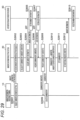
- Fig. 28 is a diagram illustrating an operation of the mandate information setting system 20 when a submandate is to be performed. Further, Fig. 29 is a sequence diagram illustrating processing at the time a submandate is to be performed.
- the mandate information registrant issues a mandate information setting request, which is a request to set mandate information, from the mandate information registrant terminal 10 (S2901).
- the mandate information setting request reception unit 201 receives the mandate information setting request (S2902).
- the submandate setting unit 209 performs submandatary candidate condition calculation processing as processing to calculate a submandatary candidate condition that can be set by the mandate information registrant (S2903) .
- the mandate information confirmation unit 208 acquires, from the authentication-authorization server 30, mandate information in the mandate information setting unit 302 of the authentication-authorization server 30 (S2904). This action is performed by sending a query requesting the mandate information to the authentication-authorization server 30, and the authentication-authorization server 30 returning the corresponding mandate information (S2905).
- the mandate information registrant is, for example, a mandatary.
- the submandate setting unit 209 acquires user information having the submandatary candidate condition from the authentication-authorization server 30 (S2906). This action is performed by sending a query requesting the user information having a submandatary candidate condition to the authentication-authorization server 30, and the authentication-authorization server 30 returning the corresponding user information (S2907).
- the submandate setting unit 209 Upon receiving the user information, the submandate setting unit 209 presents the corresponding users on the screen as submandatary candidates (S2908). At the same time, the submandate setting unit 209 presents a screen for selecting a submandatary candidate, and the mandate information registrant selects a submandatary from among the submandatary candidates and inputs the submandatary (S2909) .
- the submandatary can be set by means of the above processing.
- the submandate setting unit 209 sets the mandatary of the mandate information as the mandator, and sets the mandate content and the mandate condition as the mandate information without further processing (S2910).
- submandate setting unit 209 takes the mandate content as an input, calls the mandatary setting unit 204, and sets the mandatary (in this case, the submandatary) as the mandate information (S2911).
- submandate setting unit 209 takes the mandate content as an input, calls the mandate condition setting unit 205, and sets an additional mandate condition (S2912).
- the mandate information set thus far is then taken as an input of the submandate information, the mandate information registration unit 206 is called, and the submandate information is registered (S2913).
- the submandate setting unit 209 is capable of registering the submandatary in the authentication-authorization server 30.
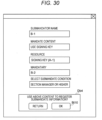
- Fig. 30 illustrates a screen on which the mandate information registrant confirms and approves submandate information.
- a dialog box Db4 which is illustrated in Fig. 23 , is displayed.
- the dialog box Db4 is the same diagram except that the mandate condition in the dialog box Db2 of Fig. 23 becomes the submandate condition.
- the OK button Bt10 is pressed in response to the message "Would you like to use the above content to register submandate information?", the mandate information is registered.
- Fig. 31 illustrates a screen for presenting the registered submandate information.
- a dialog box Db3 which is illustrated in Fig. 24 , is displayed, and the mandate information is displayed.
- a dialog box Db5 is also displayed, and registered submandate information is displayed.
- mandate information has been registered with user B-1 as the mandator, user D-1 as the mandatary, user C-1 as the registrant (mandate information registrant), "use signing key” as the mandate content, "signing key (A-1)" as the resource (resource owned by the mandator)", and "in the same department” as the mandate condition.
- the respective pieces of information of the mandator, the mandate content, and the mandatary are not independent information but are related to each other. It is thus possible to narrow down the input candidates of other information by using each of these pieces of information.
- the mandate information setting system 20 is used to perform registration in the following order: mandator ⁇ mandate content ⁇ mandatary, and thus candidates that can be registered in the following setting items are narrowed down on the mandate information setting system 20 side, presented to the mandate information registrant, and the mandator, the mandate content, and the mandatary are set.
- the burden on the mandate information registrant is reduced, and the mandate information can be registered more easily.
- the mandate information can be registered more accurately. It is also possible to register mandate information reflecting the intentions of the mandate information registrant. In the present embodiment, the registration is performed in the following order: mandator ⁇ mandate content ⁇ mandatary, but the order of registration of the mandator, the mandate content, and the mandatary is not limited thereto, rather, the registration may be performed in any order. At such time, similarly to the procedure described in the present embodiment, it is possible to register the mandate information more easily by narrowing down candidates for the information (mandator, mandate content, mandatary) to be set next by using the previously registered information (mandator, mandate content, mandatary). In addition, it is possible to suppress errors in the setting of mandate information by the mandate information registrant. That is, the mandate information can be registered more accurately.
- Mandate conditions can also be added for each submandatary.
- the mandate information setting system 20, the authentication-authorization server 30, and the resource server 40 described in detail above are described as separate devices, any two or more of them may be integrated with each other.
- the mandate information setting system 20 may be incorporated as a function in the authentication-authorization server 30 or the resource server 40.
- some functions of the mandate information setting system 20, the authentication-authorization server 30, and the resource server 40 may be provided as separate devices.
- mandators and mandataries there may be one or more mandators and mandataries that can be registered at one time.
- a group of users may be designated and registered as the mandator and mandatary.
- any number of pieces of mandate content may be registered at one time.
- mandate conditions there may be any number of mandate conditions.
- mandate conditions need not be set.
- the processing performed by the mandate information setting system 20 described hereinabove is realized through cooperation between software and hardware resources. That is, the processor 101 in the computer provided in the mandate information setting system 20 loads software for realizing each of the above-described functions into the main storage device 102 and executes the software to realize the functions.
- the processing performed by the mandate information setting system 20 can be regarded as a mandate processing method implemented by a processor executing a program recorded in memory, the method including: when a mandate is issued by a mandator to a mandatary, presenting, as first input candidates, mandate information candidates, which can be determined based on user information of the mandator and the mandatary and which is information for performing the mandate; presenting, as second input candidates, mandate condition candidates, which are the mandate information candidates other than the first input candidates and which are candidates for a mandate condition defined by the mandator as a condition for the mandatary; and registering mandate information selected from the first input candidates and the second input candidates.
Landscapes
- Engineering & Computer Science (AREA)
- Computer Security & Cryptography (AREA)
- Computer Hardware Design (AREA)
- General Engineering & Computer Science (AREA)
- Theoretical Computer Science (AREA)
- Computer Networks & Wireless Communication (AREA)
- Signal Processing (AREA)
- Computing Systems (AREA)
- Business, Economics & Management (AREA)
- Physics & Mathematics (AREA)
- General Physics & Mathematics (AREA)
- Human Resources & Organizations (AREA)
- Entrepreneurship & Innovation (AREA)
- Strategic Management (AREA)
- Software Systems (AREA)
- Data Mining & Analysis (AREA)
- Economics (AREA)
- Marketing (AREA)
- Operations Research (AREA)
- Quality & Reliability (AREA)
- Tourism & Hospitality (AREA)
- General Business, Economics & Management (AREA)
- Management, Administration, Business Operations System, And Electronic Commerce (AREA)
Abstract
A mandate processing device includes: a mandator setting unit, a mandate content setting unit, and a mandatary setting unit, which serve as a first presentation unit that, when a mandate is to be issued from a mandator to a mandatary, presents, as first input candidates, mandate information candidates, which can be determined based on user information of the mandator and the mandatary; a mandate condition setting unit serving as a second presentation unit that presents, as second input candidates, mandate condition candidates, which are the mandate information candidates other than the first input candidates and which are candidates for a mandate condition defined by the mandator as a condition for the mandatary; and a mandate information registration unit that registers mandate information which is information selected from the first input candidates and the second input candidates and for performing the mandate.
Description
- The present invention relates to a mandate processing device, a mandate processing method, and a mandate processing system. The present invention particularly relates to a mandate processing device, a mandate processing method, and a mandate processing system that can be suitably used when an action to be performed by a mandator is delegated to a mandatary.
- In practice, mandate processing in which an action to be performed by a mandator is delegated to a mandatary is performed. In mandate processing, for example, it is necessary for the mandator to issue a mandate to the mandatary in advance, and when the mandatary is to perform the delegated action, authorization for the action of the mandatary is required on the side of the system performing mandate management. In a case where the action of the mandatary on the system side performing the mandate management is to be authorized, mandate information including mandate content is registered on the system side before performing the authorization processing, and the system side performing the mandate management performs the authorization based on the mandate information.
-
JP 2003-99401 A - In addition,
JP 2016-51451 A - However, in a case where a mandate information registrant registers, in the system performing mandate management, mandate information including mandate content, for example, the mandate information registrant needs to check the attribute information of the mandatary and the authority pertaining to the mandate content. Therefore, the mandate information registrant needs to collect the attribute information of the mandatary and the mandate content information, and thus the burden on the mandate information registrant is large. In addition, in registering the mandate information, in many cases, a registration item constituting the mandate information is manually inputted by the mandate information registrant. However, there are many condition settings associated with the mandate content and the mandator, and it is difficult to establish rules, and hence setting errors are likely to occur.
- An object of the present invention is to provide a mandate processing device, a mandate processing method, and a mandate processing system that enable a mandate information registrant to register accurate mandate information more easily.
- In order to solve the above problems, the present invention provides a mandate processing device including: a first presentation unit that, when a mandate is to be issued from a mandator to a mandatary, presents, as first input candidates, mandate information candidates, which is capable of being determined based on user information of the mandator and the mandatary and which is information for performing the mandate; a second presentation unit that presents, as second input candidates, mandate condition candidates, which are the mandate information candidates other than the first input candidates and which are candidates for a mandate condition defined by the mandator as a condition for the mandatary; and/or a mandate information registration unit that registers mandate information selected from the first input candidates and the second input candidates. In this case, it is possible to provide a mandate processing device that enables the mandate information registrant to more easily register accurate mandate information.
- Here, the first input candidates may include mandator candidates determined based on user information. In this case, the mandate information registrant is able to more easily set a mandator by selecting the mandator from among the mandator candidates. It is also possible to suppress mandator setting errors.
- Furthermore, a user satisfying a condition for becoming a mandator candidate can be selected as one of the mandator candidates based on the user information. In this case, a user suitable as a mandator can be selected.
- Further, the first input candidates may further include mandate content candidates, which are candidates for mandate content required based on the authority of the mandator selected from among the mandator candidates. In this case, the mandate information registrant can more easily set mandate content by selecting the mandate content from the mandate content candidates. In addition, it is possible to suppress mandate content setting errors.
- Moreover, the mandate content candidates can be obtained based on a resource owned by a mandator selected from among the mandator candidates. In this case, it is possible to extract suitable content as the mandate content.
- Further, the first input candidates may include mandator resource candidates obtained from the mandate content candidates. In this case, the mandate information registrant may select a resource owned by the mandator from the resource candidates, and may more easily set the resource owned by the mandator.
- Furthermore, the first input candidates may include mandatary candidates, which are candidates for the mandatary that are obtained based on an authority required by the mandatary and determined from the mandate content selected from among the mandate content candidates. In this case, the mandate information registrant can more easily set the mandatary by selecting the mandatary from the mandatary candidates. It is also possible to suppress mandatary setting errors.
- Moreover, the mandate information may include information on the mandator, the mandate content, the resources owned by the mandatary and the mandator, and the mandate conditions. In this case, the mandate information may be mandate information reflecting the intentions of the mandate information registrant.
- Further, the second presentation unit may verify whether the mandatary satisfies the mandate condition selected from among the mandate condition candidates. In this case, it is possible to select a mandatary suitable for the mandate condition.
- Further, the mandate processing device may further include a submandate setting unit that sets a mandatary (submandatary) of a submandate when the mandatary issues a mandate (submandate) with respect to self-mandated mandate content, and the submandate setting unit may present submandatary candidates who are candidates for the submandatary. In this case, the mandate information registrant can more easily set the submandatary by selecting the submandatary from among the submandatary candidates. It is also possible to suppress submandatary setting errors.
- The submandate setting unit may also make a range of conditions, which are set in the mandate information, the same or smaller each time a submandate is performed. In this case, the possibility of the mandate being performed by an unintended party when a submandate is to be performed is reduced.
- Moreover, the conditions set in the mandate information may be at least one of a restriction on the number of submandates and a submandatable range. In this case, a submandate may be issued according to the intentions of the mandator.
- Further, the submandate setting unit may make it possible to add conditions to be set in the mandate information. In this case, a mandate condition can be added for each submandatary.
- Furthermore, the present invention provides a mandate processing method implemented by a processor executing a program recorded in memory, the method including: when a mandate is issued by a mandator to a mandatary, presenting, as first input candidates, mandate information candidates, which is capable of being determined based on user information of the mandator and the mandatary and which is information for performing the mandate; presenting, as second input candidates, mandate condition candidates, which are the mandate information candidates other than the first input candidates and which are candidates for a mandate condition defined by the mandator as a condition for the mandatary; and/or registering mandate information selected from the first input candidates and the second input candidates. In this case, it is possible to provide a mandate processing method in which a mandate information registrant is able to register accurate mandate information more easily.
- In addition, the present invention provides a mandate processing system, including: a mandate processing device that, when a mandate is to be issued from a mandator to a mandatary, performs setting of mandate information; and a mandate management device that, based on the mandate information, grants the mandatary permission to process the mandate content, wherein the mandate processing device includes: a first presentation unit that, when a mandate is to be issued from the mandator to the mandatary, presents, as first input candidates, mandate information candidates, which is capable of being determined based on user information of the mandator and the mandatary and which is information for performing the mandate; a second presentation unit that presents, as second input candidates, mandate condition candidates, which are the mandate information candidates other than the first input candidates and which are candidates for a mandate condition defined by the mandator as a condition for the mandatary; and a mandate information registration unit that registers mandate information selected from the first input candidates and the second input candidates. In this case, it is possible to provide a mandate processing system that enables a mandate information registrant to register accurate mandate information more easily.
- According to the present invention, it is possible to provide a mandate processing device, a mandate processing method, and a mandate processing system that enable a mandate information registrant to register accurate mandate information more easily.
-
-
Fig. 1 is a diagram illustrating an overall configuration example of a mandate processing system to which the present embodiment is applied; -
Fig. 2 is a diagram illustrating a hardware configuration of a mandate information registrant terminal, a mandate information setting system, an authentication-authorization server, a resource server, and an application server; -
Figs. 3(a) and 3(b) are diagrams illustrating operations of the mandate processing system; -
Fig. 4 is a block diagram illustrating a functional configuration example of a mandate information setting system; -
Fig. 5 is a block diagram illustrating a functional configuration example of an authentication-authorization server; -
Fig. 6 is a block diagram illustrating a functional configuration example of a resource server; -
Fig. 7 is a diagram illustrating a data structure of a mandate content table; -
Fig. 8 is a diagram illustrating a data structure of a mandate condition table; -
Fig. 9 is a diagram illustrating a data structure of an account management table; -
Fig. 10 is a diagram illustrating a data structure of a mandate information management table; -
Fig. 11 is a diagram illustrating the overall operation ofprocessing 1 to 3; -
Fig. 12 is a sequencediagram illustrating processing 1; -
Fig. 13A is a diagram illustrating a case where the authority owned by the mandator is set to an attribute value of attribute information (information acquired from an account management table 311) of the mandator in S1208 ofFig. 12 ;Fig. 13B is a diagram illustrating processing to acquire mandate content candidates and resource candidates in the light of the authority of the mandator in S1209 ofFig. 12 ; -
Fig. 14 is a diagram illustrating mandatary candidate condition calculation processing in S1212 ofFig. 12 ; -
Fig. 15 is a sequencediagram illustrating Processing -
Fig. 16 is a screen displayed when the mandate information registrant makes a mandate information setting request in S1201 ofFig. 12 ; -
Fig. 17 illustrates a screen on which mandator candidates are presented on the screen in S1206 to S1207 inFig. 12 , and the mandate information registrant selects a mandator from among the mandator candidates and inputs the mandator; -
Fig. 18 illustrates a screen on which mandate content candidates are presented on the screen in S1210 to S1211 inFig. 12 , and the mandate information registrant selects mandate content from among the mandate content candidates and inputs the mandate content; -
Figs. 19 illustrates a screen on which resource candidates are presented on the screen in S1210 to S1211 inFig. 12 , and the mandate information registrant selects a resource from among the resource candidates and inputs the resource; -
Fig. 20 illustrates a screen on which mandatary candidates are presented on a screen in S1215 to S1216 ofFig. 12 , and the mandate information registrant selects a mandatary from among the mandatary candidates and inputs the mandatary; -
Fig. 21 illustrates a screen for temporarily saving the content set up untilFig. 20 as basic information; -
Fig. 22 illustrates a screen on which the mandate condition candidates are presented on the screen in S1502 to S1503 ofFig. 15 , and the mandate information registrant selects a mandate condition from among the mandate condition candidates and inputs the mandate condition; -
Fig. 23 illustrates a screen on which the mandate information registrant confirms and approves the mandate information in S1506 ofFig. 15 ; -
Fig. 24 illustrates a screen for presenting registered mandate information in S1507 ofFig. 15 ; -
Fig. 25 is a diagram illustrating registered mandate information; -
Fig. 26 is a diagram to illustrate a submandate; - Figs. 27(a) and 27(b) are diagrams illustrating a range of conditions set in the mandate information at the time of issuing a submandate;
-
Fig. 28 is a diagram illustrating an operation of the mandate information setting system when performing a submandate; -
Fig. 29 is a sequence diagram illustrating processing at the time of performing a submandate; -
Fig. 30 illustrates a screen on which the mandate information registrant confirms and approves submandate information; and -
Fig. 31 illustrates a screen for presenting the registered submandate information. - Hereinafter, embodiments of the present invention will be described in detail with reference to the accompanying drawings.
-
Fig. 1 is a diagram illustrating an overall configuration example of amandate processing system 1 to which the present embodiment is applied. - As illustrated, the
mandate processing system 1 includes a mandateinformation registrant terminal 10, a mandateinformation setting system 20, an authentication-authorization server 30, aresource server 40, and anapplication server 50. These parts are connected via anetwork 60. - The mandate
information registrant terminal 10 is a terminal device operated by the mandate information registrant to register a mandate. Here, "mandate" means that the mandate information registrant entrusts a mandatary to perform a certain act. The "mandate" will sometimes be referred to as the representative or agent. Further, a "mandate information registrant" is a party who performs the setting of a mandate by using the mandateinformation registrant terminal 10. The mandate information registrant may be the mandator himself/herself or may be a party who operates the mandateinformation registrant terminal 10 instead of the mandator to register the mandate. - In addition, "mandate content" is processing content delegated by the mandator to the mandatary. The mandate content is not particularly limited, but is, for example, an action necessary when the mandator performs a task. This action corresponds to, for example, the creation and editing of an electronic document, the signing of an electronic document, settlement processing, and the like.
- The mandate
information setting system 20 is an example of a mandate processing device, and sets the mandate information when a mandate is issued by a mandator to a mandatary. - The authentication-
authorization server 30 is an example of a mandate management device, and the mandatary grants permission to process the mandate content based on the mandate information. In the present embodiment, the authentication-authorization server 30 receives a request for mandatary authentication. After the authentication, the authentication-authorization server 30 grants the mandatary authorization to process the mandate content. - The
resource server 40 has resources for processing the mandate content. When the mandatary receives authentication and permission from the authentication-authorization server 30, theresource server 40 grants authority to process the resource. Theresource server 40 receives, from the mandatary, a request to process a resource according to mandate content, and returns a processing result to the mandatary. - The
application server 50 executes application software with which the mandatary processes the mandate content. The mandatary executes the application software to process the mandate content to be performed on theresource server 40. - The
network 60 is a communication means used for information communication between the mandateinformation registrant terminal 10, the mandateinformation setting system 20, the authentication-authorization server 30, theresource server 40, and theapplication server 50, and is, for example, the Internet, a local area network (LAN), or a wide area network (WAN). Thenetwork 60 may be used in combination regardless of whether same is wired or wireless. Furthermore, thenetwork 60 may use a relay device such as a gateway device or a router and be connected via a plurality of communication lines. -
Fig. 2 is a diagram illustrating a hardware configuration of the mandateinformation registrant terminal 10, the mandateinformation setting system 20, the authentication-authorization server 30, theresource server 40, and theapplication server 50. - The foregoing components are computer devices such as a personal computer (PC) and a server computer. Further, as illustrated, the foregoing components include a
processor 101 such as a central processing unit (CPU), and, as storage means, amain storage device 102 and anauxiliary storage device 103 such as a hard disk drive (HDD) or a solid state drive (SSD). Here, theprocessor 101 executes various kinds of software such as an OS (basic software) and an application program (application software). Furthermore, themain storage device 102 is a storage area that stores various software, data used for execution thereof, and the like, and theauxiliary storage device 103 is a storage area that stores input data for various software, output data from various software, and the like. - In addition, these devices include an
input device 104 such as a keyboard, a mouse, and a touch panel, adisplay device 105 including a video memory, a display, and the like, and a communication interface (communication I/F) 106 for performing communication with the outside. -
Figs. 3(a) and 3(b) are diagrams illustrating operations of themandate processing system 1. - Among these drawings,
Fig. 3(a) is a diagram illustrating, asStep 1, mandate information registration in which the mandate information registrant (mandator) registers mandate information. - Here, it is indicated that the mandate information registrant (mandator) registers mandate information including mandate content in the authentication-
authorization server 30 in advance together with user information and a policy. As a result, preparation for a mandatary to process the mandate content is complete. -
Fig. 3(b) is a diagram illustrating, asStep 2, mandatary processing in which the mandatary uses themandate processing system 1 to process the mandate content. - First, the mandatary accesses the application server 50 (1. Access), and transmits a token requesting mandate authentication and authorization to the authentication-authorization server 30 (2. Token request). The authentication-
authorization server 30 determines whether or not to grant the mandate to the mandatary based on the mandate information (3. Mandate permission). Further, in a case where permission is granted, the authentication-authorization server 30 returns a token indicating permission to the application server 50 (4. Token). Next, the mandatary makes a request to process resources in theresource server 40 via theapplication server 50, and sends a token for actually performing processing (5. Processing request + token). Theresource server 40 then returns the processing result to the application server 50 (6. Processing result). - Here, when authorization to process the mandate content is performed for a general-purpose system using the
resource server 40, authorization is performed by aggregating the authorization processing and the authentication processing in the authentication-authorization server 30 and returning an authorization determination result to theresource server 40. - In this case, it is necessary to store user information (including attribute information of the user and the like) used for the authorization determination by the authentication-
authorization server 30 and an authorization determination policy in the authentication-authorization server 30 in advance. The advantages of such a method include, in addition to the convenience for the user of being able to manage their own information in one place (in this case, the authentication-authorization server 30), the convenience for the administrator of the loss/reduction in the amount of personal information to be managed, and so forth. - Therefore, in the systemization of mandate processing, there is a demand for handling authorization processing including that of mandates by using the general-purpose authentication-
authorization server 30, similarly to the general-purpose system such as theresource server 40. - In addition, points in the registration of the mandate information illustrated in
Fig. 3(a) include the following (1) to (3). - (1) The mandate information is registered using the content intended by the mandator.
- This is because processing according to the mandate is performed by the mandatary under the liability of the mandator.
- (2) The mandator shall delegate, to the mandatary, only mandate content based on the authority possessed by the mandator himself/herself.
- This is because processing of the mandate is to be performed by the mandatary in place of the mandator.
- (3) The mandatary has authority satisfying conditions according to the processing content and the mandator.
- This is because legal problems may occur in addition to point (1).
- On the other hand, as illustrated in
Fig. 3(a) , there are the following problems (4) to (5) in a case where the mandate information registrant (mandator) is to register the mandate information. - (4) In a case where the mandator is to perform the registration, the burden of registration of the mandate information is large.
- This is mainly because it takes time to confirm (3) above. That is, the mandator needs to check the attribute information of the mandatary and the authority pertaining to the mandate content, and for this purpose, the mandator needs to collect the attribute information of the mandatary and the mandate content information, for example.
- (5) In a case where the mandate information registrant is to perform registration in place of the mandator, information different from the mandate content assumed by the mandator comes to be registered as the mandate information.
- This is due to the fact that it is difficult to make rules in the light of the mandate content because the mandate conditions vary depending on the intentions of the mandator, that setting errors due to the mandate information being manually inputted are likely to occur, and that there may be a difference in recognition between the mandator and the mandate information registrant.
- Therefore, in the present embodiment, when the mandate information illustrated in
Fig. 3(a) is to be registered, the processing of themandate processing system 1 is performed as follows, thereby solving the above problems. It is thus possible to improve the convenience and accuracy of mandate information registration. -
Fig. 4 is a block diagram illustrating a functional configuration example of the mandateinformation setting system 20. - As illustrated, the mandate
information setting system 20 includes a mandate information settingrequest reception unit 201, amandator setting unit 202, a mandatecontent setting unit 203, amandatary setting unit 204, a mandatecondition setting unit 205, a mandateinformation registration unit 206, a mandate information registration managementstore setting unit 207, a mandateinformation confirmation unit 208, asubmandate setting unit 209, and a mandate informationregistration management store 210. - The mandate information setting
request reception unit 201 receives a mandate information setting request which is a request for setting the mandate information from the mandate information registrant. - The
mandator setting unit 202 calculates a mandator candidate condition and acquires user information from the account management table 311 (seeFig. 5 ) of the authentication-authorization server 30. The mandator candidate condition is a condition for becoming a mandator candidate. Further, themandator setting unit 202 obtains mandator candidates who are candidates for the mandator in the light of the mandator candidate condition and the user information, and presents the mandator candidate to the mandate information registrant. Further, when the mandate information registrant makes an input to select a mandator from among the mandator candidates, themandator setting unit 202 acquires the input as a response. - The mandate
content setting unit 203 calculates a mandate content candidate condition and acquires mandate content candidate information from the mandate content table 211 of the mandate informationregistration management store 210. The mandate content candidate condition is a condition for extracting a mandate content candidate. Further, the mandatecontent setting unit 203 obtains mandate content candidates in the light of the authority of the selected mandator, and presents the mandate content candidates to the mandate information registrant. The authority of the mandator can be acquired from attribute information of the selected mandator. Further, when the mandate information registrant makes an input to select mandate content from among the mandate content candidates, the mandatecontent setting unit 203 acquires the input as a response. - The
mandatary setting unit 204 calculates a mandatary candidate condition, and acquires user information from the account management table 311 of the authentication-authorization server 30. The mandatary candidate condition is a condition for becoming a mandatary candidate. Mandatary candidates who are candidates for the mandatary are then obtained in the light of the mandatary candidate condition and the user information, and the mandatary candidates are presented to the mandate information registrant. Furthermore, when the mandate information registrant makes an input to select the mandatary from among the mandatary candidates, themandatary setting unit 204 acquires the input as a response. - The mandate
condition setting unit 205 acquires, from the mandate condition table 212, mandate condition candidates which are candidates for the mandate condition determined by the mandator as the mandatary condition. The mandate condition candidates are then presented to the mandate information registrant. Further, when the mandate information registrant makes an input to select a mandate condition from among the mandate condition candidates, the mandatecondition setting unit 205 acquires the input as a response. - The mandate
information registration unit 206 transmits a request to register the mandate information along with the mandate information to the authentication-authorization server 30. In the present embodiment, the mandate information includes information on a mandator, mandate content, resources owned by the mandator and the mandatary, and a mandate condition. In other words, the mandate information is information enabling the "mandator" to grant the "mandatary" the "processing content" with respect to the "resources owned by the mandator" under the "mandate condition". Note that, depending on the mandate content, the resources owned by the mandator may be unnecessary. - The mandate information registration management
store setting unit 207 provides the mandate information registrant with a function for editing data in the mandate content table 211 and the mandate condition table 212 in the mandate informationregistration management store 210. - The mandate
information confirmation unit 208 transmits a request to acquire mandate information to the mandate information setting unit 302 (seeFig. 5 ) of the authentication-authorization server 30, and presents the acquired mandate information to the mandate information registrant. In addition, the mandateinformation confirmation unit 208 receives a mandate information setting request and a submandate setting request. - When a submandate is issued from a mandatary to a submandatary, the
submandate setting unit 209 sets the submandatary. - The mandate information
registration management store 210 includes a mandate content table 211 and a mandate condition table 212. - The mandate content table 211 stores mandator conditions and mandatary conditions for mandate content, which is processing content to be mandated.
- The mandate condition table 212 stores the condition content of mandate conditions.
-
Fig. 5 is a block diagram illustrating a functional configuration example of the authentication-authorization server 30. - As illustrated, the authentication-
authorization server 30 includes a user information managementstore setting unit 301, a mandateinformation setting unit 302, an authentication-authorization unit 303, and a userinformation management store 310. - The user information management
store setting unit 301 sets data stored in the account management table 311 and a mandate information management table 312 of the userinformation management store 310. - When there is a request for registration of the mandate information from the mandate
information setting system 20, the mandateinformation setting unit 302 sets the mandate information in the mandate information management table 312 of the userinformation management store 310. - The authentication-
authorization unit 303 receives a request for authentication and authorization from theapplication server 50, performs authentication and authorization of the user from the data stored in the account management table 311 and the mandate information management table 312, and returns the result as a token. - The user
information management store 310 includes the account management table 311 and the mandate information management table 312. - The account management table 311 stores user information which is information on users using the
mandate processing system 1. The user information includes a username, attributes of the user associated with the username, and the like. The mandator or the mandatary is selected from among users for whom user information is stored in the account management table 311. - The mandate information management table 312 stores the mandate information sent from the mandate
information setting system 20. -
Fig. 6 is a block diagram illustrating a functional configuration example of theresource server 40. - As illustrated, the
resource server 40 includes a mandateinformation confirmation unit 401, aresource management unit 402, aprocessing execution unit 403, and a resourceinformation management store 410. - The mandate
information confirmation unit 401 confirms the mandate information when the mandatary issues a request to process resources in theresource server 40. - The
resource management unit 402 manages the resources stored in the resourceinformation management store 410. - The
processing execution unit 403 executes processing using the resources stored in the resourceinformation management store 410 based on the mandate information. - The resource
information management store 410 includes a resource management table 411. The resource management table 411 manages the resources stored in the resourceinformation management store 410. -
Fig. 7 is a diagram illustrating a data structure of the mandate content table 211. - The mandate content table 211 includes items, namely, mandate content, mandator condition, mandator resource, and mandatary condition.
- The mandate content is the content for performing the mandate described above. The mandator condition is a mandator condition required for the mandate content. The mandator resource is the resource owned by the mandator required to perform the mandate content. A resource can also be an element required for the mandator to perform a task. The mandatary condition is a mandatary condition required for the mandate content. Here, in a case where the mandate content is "signing key usage", it is indicated that the mandator condition is "has signing key" and the mandator resource is "signing key". Furthermore, in a case where the mandate content is "signing key usage", it is indicated that the condition of the mandatary is "○○-qualified".
-
Fig. 8 is a diagram illustrating a data structure of a mandate condition table 212. - The mandate condition table 212 includes predetermined condition content. Here, the condition content "in the same department" and the "employment position: □□ or higher" is prepared in advance as the condition content.
-
Fig. 9 is a diagram illustrating a data structure of the account management table 311. - The account management table 311 stores user information. The account management table 311 includes items which are: username, PW, attribute 1: department, attribute 2: position, attribute 3: resource, and attribute 4: qualifications held.
- The username is the name or ID of the user. PW is a password for performing authentication. Attribute 1: department, Attribute 2: position, Attribute 3: resources, and Attribute 4: qualifications held are attribute information for the user, and denote the department to which the user belongs, the position of the user, the resources owned by the user, and the qualifications held by the user, respectively.
-
Fig. 10 is a diagram illustrating a data structure of the mandate information management table 312. - The mandate information management table 312 includes items, namely, mandator, mandate content, resource, mandate authority, mandatary, mandate condition, and mandate information registrant.
- Among the foregoing items, the mandator, the mandate content, the mandatary, and the mandate information registrant are as described above. In addition, the resource is a resource of the mandator, and the mandate authority is an authority for performing a mandate.
- Next, the operation of the mandate
information setting system 20 will be described in detail. The mandateinformation setting system 20 sequentially performs the followingprocessing 1 to 3. - The mandate information setting
request reception unit 201, themandator setting unit 202, the mandatecontent setting unit 203, and themandatary setting unit 204 set mandate information in the light of the mandate information candidates that can be mechanically calculated based on user information prepared in advance, and the like. Inprocessing 1, the mandator, the mandate content, the mandatary, and the resources owned by the mandator are set in the mandate information. As actual processing, these pieces of mandate information are set using an interactive mode between the mandateinformation setting system 20 and the mandate information registrant. That is, these pieces of mandate information are set in the following format: narrowing of input candidates based on user information and the like → presentation of input candidates → input (response) by mandate information registrant. - The mandate
condition setting unit 205 sets mandate information that cannot be mechanically calculated based on user information or the like. Inprocessing 2, a mandate condition is set in the mandate information. Here too, as actual processing, the mandate information is set using an interactive mode between the mandateinformation setting system 20 and the mandate information registrant. That is, a mandate condition is set in the following format: narrowing down of mandate conditions → presentation of input candidates → input (response) by mandate information registrant. - The mandate
information registration unit 206 registers the set mandate information in the mandate information management table 312 of the authentication-authorization server 30. -
Fig. 11 is a diagram illustrating the overall operation ofProcessing 1 to 3.Fig. 12 is a sequencediagram illustrating Processing 1. - Here, information exchange between the mandate information registrant terminal 10 (mandate information registrant), the mandate
information setting system 20, and the authentication-authorization server 30 is illustrated. -
Processing 1 will be described below with reference toFigs. 11 and12 . - First, the mandate information registrant issues a mandate information setting request, which is a request to set mandate information, from the mandate information registrant terminal 10 (S1201). Next, the mandate information setting
request reception unit 201 receives the mandate information setting request (S1202). - Next, the
mandator setting unit 202 performs mandator candidate condition calculation processing as processing to calculate a mandator candidate condition that can be set by the mandate information registrant (S1203). - The mandate information registrant can be specified from logged-in user information or the like supplied by the mandate information registrant in S1201, for example. The mandator candidate condition is, for example, a condition that a party of the same affiliation can be set as a mandator in the light of the user information of the mandate information registrant. In addition, the mandator candidate condition is, for example, a condition that only the mandator himself/herself (the mandate information registrant himself/herself) can be set as a mandator. The setting of the mandator candidate condition may be determined in advance by the
mandator setting unit 202, or a table for the setting candidates may be held in themandate processing system 1 and the mandate information registrant may select the mandator candidate condition from the table at the time of the mandator candidate condition calculation processing. - Next, the
mandator setting unit 202 acquires user information (including user attribute information) having the mandator candidate condition obtained in S1203, from the authentication-authorization server 30 (S1204). This action is performed by sending a query requesting the user information having the condition obtained in S1203 to the authentication-authorization server 30, and the authentication-authorization server 30 returning the corresponding user information (S1205). - Upon receiving the user information, the
mandator setting unit 202 presents the corresponding users on the screen as mandator candidates (S1206). At the same time, themandator setting unit 202 presents a screen for selecting a mandator candidate, and the mandate information registrant selects a mandator from among the mandator candidates and inputs the mandator (S1207). At this time, themandator setting unit 202 may present only the names of the mandator candidates on the screen, or may also present a portion of the attribute information (for example, affiliation) on the screen. - By means of S1203 to S1207, the
mandator setting unit 202 is capable of setting a mandator. - Next, the mandate
content setting unit 203 performs mandate content candidate condition calculation processing as processing to calculate a mandate content candidate condition in the light of the attribute information of the mandator selected by the mandator setting unit 202 (S1208). Here, the mandate content candidate condition is the authority of the mandator. - The authority of the mandator is, for example, an attribute value of attribute information (information acquired from the account management table 311) of the mandator selected by the
mandator setting unit 202. In addition, as the authority of the mandator, for example, a correspondence table of attribute values and authorities may be stored in themandate processing system 1, and the authority of the mandator may be acquired from this table and the attribute value of the attribute information (information acquired from the account management table) of the mandator selected by themandator setting unit 202. - Next, the mandate
content setting unit 203 acquires settable mandate content candidates from the mandate content table 211 in the light of the authority of the mandator obtained in S1208. This action is performed by sending a query requesting mandate content candidates to the mandate content table 211 and acquiring the corresponding user information from the mandate content table 211. At the same time, resource candidates that are possible candidates for resources owned by the mandator are acquired from the user information (account management table 311) of the mandator (S1209). - Further, the mandate
content setting unit 203 presents the mandate content candidates and the resource candidates on the screen (S1210). In addition, the mandatecontent setting unit 203 presents a screen for selecting a mandate content candidate and a resource candidate, and the mandate information registrant selects mandate content and a resource from among such candidates and inputs the mandate content and resource (S1211). - By means of S1208 to S1211, the mandate
content setting unit 203 is capable of setting the mandate content and the resource owned by the mandator. - Next, the
mandatary setting unit 204 performs mandatary candidate condition calculation processing as processing to calculate a mandatary candidate condition from the mandate content selected by the mandate content setting unit 203 (S1212). Here, the mandatary candidate condition is an authority required by the mandatary. - Next, the
mandatary setting unit 204 acquires the user information of users having the authority from the authentication-authorization server 30 (S1213). This action is performed by sending a query requesting user information having the authority obtained in S1212 to the authentication-authorization server 30, and the authentication-authorization server 30 returning the corresponding user information (S1214). - Upon receiving the user information, the
mandatary setting unit 204 presents the corresponding users on the screen as mandatary candidates (S1215). At the same time, themandatary setting unit 204 presents a screen for selecting a mandatary candidate, and the mandate information registrant selects a mandatary from among the mandatary candidates and inputs the mandatary (S1216). At this time, themandatary setting unit 204 may present only the names of the mandatary candidates on the screen, or may also present a portion of the attribute information (for example, affiliation) on the screen. - By means of S1212 to S1216, the
mandatary setting unit 204 is capable of setting the mandatary. - When a mandate is to be issued from a mandator to a mandatary, the
mandator setting unit 202, the mandatecontent setting unit 203, and themandatary setting unit 204 function as a first presentation unit that presents, as first input candidates, mandate information candidates, which can be determined based on user information of the mandator and the mandatary and which is information for performing the mandate. - Here, as illustrated in S1206 of
Fig. 11 , the first input candidates include mandator candidates determined based on user information. Next, as illustrated in S1204 to S1205 ofFig. 11 , users satisfying a condition for becoming a mandator candidate are selected as the mandator candidates based on the user information. - Further, as illustrated in S1210 in
Fig. 11 , the first input candidates may further include mandate content candidates, which are candidates for mandate content required based on the authority of the mandator selected from among the mandator candidates. - Further, as illustrated in S1215 of
Fig. 11 , the first input candidates include mandatary candidates, which are candidates for the mandatary that are obtained based on an authority required by the mandatary and determined from the mandate content selected from among the mandate content candidates. -
Fig. 13A is a diagram illustrating a case where the authority owned by the mandator is set to an attribute value of attribute information (information acquired from the account management table 311) of the mandator in S1208 ofFig. 12 . -
Fig. 13B illustrates the account management table 311 illustrated inFig. 9 . Here, a case where a user having the username A-1 is set as the mandator is illustrated. Next, a case is illustrated where the authority of a user A-1 who is the mandator is set to attribute 3, which is the attribute value of the account management table 311. In this case,attribute 3 is the owned resource, which, in the case of user A-1, is "signing key (A-1)". -
Fig. 13B is a diagram illustrating processing to acquire mandate content candidates and resource candidates in the light of the authority of the mandator in S1209 ofFig. 12 . -
Fig. 13B is a table created based on the mandate content table 211 illustrated inFig. 7 . Here, it can be seen that when the mandate content is "signing key usage", the mandator condition is "has signing key" and the mandator-owned resource is "signing key". - The mandate
content setting unit 203 sets the authority of the user A-1 as "signing key (A-1)" in the light of the account management table 311, and sets a settable mandate content candidate as "signing key usage" in the mandate content table 211. In addition, the mandatecontent setting unit 203 sets the resource candidate to "signing key (A-1)" in the account management table 311 because, according to the mandate content table 211, the condition of the mandator is "has signing key" and the owned resource of the mandator is "signing key".Fig. 13C illustrates a result of acquiring mandate content candidates and resource candidates. - Thus, the mandate content candidates are obtained based on a resource owned by a mandator selected from among the mandator candidates.
- Further, the first input candidates may include mandator resource candidates obtained from mandate content candidates.
-
Fig. 14 is a diagram illustrating mandatary candidate condition calculation processing in S1212 ofFig. 12 . -
Fig. 14 is a diagram similar toFig. 13B and is a table created based on the mandate content table 211. Themandatary setting unit 204 sets a mandatary condition in the mandate content table 211 as the authority required by the mandatary. Here, it is indicated that "being ○○-qualified" is set as the authority required by the mandatary. -
Fig. 15 is a sequencediagram illustrating Processing - Here, as per
Fig. 12 , the exchange of information between the mandate information registrant terminal 10 (mandate information registrant), the mandateinformation setting system 20, and the authentication-authorization server 30 is illustrated. -
Processing Figs. 11 and15 . - First, the mandate
condition setting unit 205 acquires, from the mandate condition table 212, mandate condition candidates which can be set by the mandate information registrant (mandate condition information acquisition) (S1501). That is, candidates that can be set by the mandator are selected as mandate condition candidates. This action is performed by sending a query requesting mandate condition candidates to the mandate condition table 212 and acquiring the corresponding user information from the mandate condition table 212. - Next, the mandate
condition setting unit 205 presents the acquired mandate condition candidates on a screen (presentation of mandate condition information) (S1502). In addition, the mandatecondition setting unit 205 presents a screen for selecting a mandate condition candidate, and the mandate information registrant selects a mandate condition from among the mandate condition candidates and inputs the mandate condition (S1503). At this time, the mandatecondition setting unit 205 may present options in a form for selection by the mandate information registrant, or the mandate information registrant may input information (numerical values or the like) related to the options. The former corresponds to, for example, a case where a designated number or more of service years are to be selected, and the latter corresponds to a case where the service years are to be inputted. - Next, the mandate
condition setting unit 205 verifies that the mandate condition is satisfied by the mandatary from the mandatary attribute information (S1504). - By means of S1501 to S1504, the mandate
condition setting unit 205 is capable of performingProcessing 2 to set a mandate condition. - Next, the mandate
information registration unit 206 presents the mandate information acquired inProcessing - The mandate information registrant confirms and approves the mandate information (S1506). Note that, in the case of disapproval, the processing starts again from
processing 1. - The mandate
information registration unit 206 presents the registered mandate information, and transmits the mandate information to the authentication-authorization server 30 if the mandate information registrant approves the mandate information (S1507). - Next, the authentication-
authorization server 30 registers the mandate information in the mandate information management table 312 (S1508). - By means of S1505 to S1508, the mandate
information registration unit 206 is capable of performingProcessing 3 and of registering the mandate information in the authentication-authorization server 30. - The mandate
condition setting unit 205 functions as a second presentation unit that presents, as second input candidates, mandate condition candidates, which are the mandate information candidates other than that of the first input candidates and which are candidates for the mandate condition defined by the mandator as a mandatary condition. - In addition, as illustrated in S1504 of
Fig. 15 , the mandatecondition setting unit 205 verifies whether the mandatary satisfies the mandate condition selected from among the mandate condition candidates. - Next, the mandate
information registration unit 206 registers the mandate information selected from the first input candidates and the second input candidates. - Next, a UI for when the mandate information registrant is to set the mandate information by using the mandate
information registrant terminal 10 inProcessing 1 to 3 will be described. -
Fig. 16 is a screen which is displayed when the mandate information registrant issues a mandate information setting request in S1201 ofFig. 12 . - The illustrated screen is a so-called home screen. On this screen, a button Bt1 for newly registering the mandate information and a button Bt2 for confirming, changing, and deleting the mandate information are displayed. When the mandate information registrant presses the button Bt1, the processing of S1202 and subsequent processing is started.
-
Fig. 17 illustrates a screen on which mandator candidates are presented on the screen in S1206 to S1207 inFig. 12 , and the mandate information registrant selects a mandator from among the mandator candidates and inputs the mandator. - It can be seen that a pull-down menu Pm1 is displayed on the illustrated screen, and that users whose usernames are A-1 to A-4 are displayed as mandator candidates. Next, for example, when the mandate information registrant selects user A-1 and presses the OK button Bt3, user A-1 is selected and inputted.
-
Fig. 18 illustrates a screen on which mandate content candidates are presented on the screen in S1210 to S1211 inFig. 12 , and the mandate information registrant selects mandate content from among the mandate content candidates and inputs the mandate content. - It can be seen that a pull-down menu Pm2 is displayed on the illustrated screen, and "use signing key" and "reference signing key" are displayed as the mandate content candidates. Next, for example, when the mandate information registrant selects "use signing key" and presses the OK button Bt4, "use signing key" is then selected and inputted.
-
Fig. 19 illustrates a screen on which resource candidates are presented on the screen in S1210 to S1211 inFig. 12 , and the mandate information registrant selects a resource from among the resource candidates and inputs the resource. - It can be seen that a pull-down menu Pm3 is displayed on the illustrated screen, and that "signing key (A-1)" is displayed as the resource candidate. Next, for example, when the mandate information registrant selects "signing key (A-1)" and presses the OK button Bt5, "signing key (A-1)" is selected and inputted.
-
Fig. 20 illustrates a screen on which mandatary candidates are presented on a screen in S1215 to S1216 ofFig. 12 , and the mandate information registrant selects a mandatary from among the mandatary candidates and inputs the mandatary. - It can be seen that a pull-down menu Pm4 is displayed on the illustrated screen, and that users whose usernames are B-1 to B-4 are displayed as mandatary candidates. Next, for example, when the mandate information registrant selects user B-1 and presses the OK button Bt6, user B-1 is selected and inputted.
- Note that the setting content may be temporarily stored when processing 1 ends, another mandate information registrant may be asked to register the mandate information, and the request may be executed starting from
processing 2. This is, for example, a case where theprocessing 1 is performed by the system administrator, and theprocessing 2 and subsequent processing are performed by the mandator himself/herself, or the like. -
Fig. 21 is a diagram illustrating such a case and illustrates a screen for temporarily saving the content set up untilFig. 20 as basic information. - A dialog box Db1 is displayed on the illustrated screen, and when an OK button Bt7 is pressed in response to the message "Would you like to use the above content to register basic information?", the basic information is registered.
-
Fig. 22 illustrates a screen on which the mandate condition candidates are presented on a screen in S1502 to S1503 ofFig. 15 , and the mandate information registrant selects a mandate condition from among the mandate condition candidates and inputs the mandate condition. - It can be seen that a pull-down menu Pm5 is displayed on the illustrated screen, and "in the same department" and "position: □□ or higher" are displayed as mandate condition candidates. Further, for example, when the mandate information registrant selects "in the same department" and presses the OK button Bt8, "in the same department" is selected and inputted.
-
Fig. 23 illustrates a screen on which the mandate information registrant confirms and approves the mandate information in S1506 ofFig. 15 . - A dialog box Db2 is displayed on the illustrated screen, and when an OK button Bt9 is pressed in response to the message "Would you like to use the above content to register the mandate information?", the mandate information is registered.
-
Fig. 24 illustrates a screen for presenting registered mandate information in S1507 ofFig. 15 . - On the illustrated screen, a dialog box Db3 is displayed, and the mandate information to be registered is displayed.
-
Fig. 25 is a diagram illustrating registered mandate information. - Here, it can be seen that mandate information has been registered with user A-1 as the mandator, user B-1 as the mandatary, user C-1 as the registrant (mandate information registrant), "use signing key" as the mandate content, "signing key (A-1)" as the resource (resource owned by the mandator)", and "in the same department" as the mandate condition.
- Next, a modification of the above-described mandate
information setting system 20 will be described. - In the modification, not only is the mandator able to issue a mandate to the mandatary, the mandatary is also able to issue a submandate to a submandatary.
-
Fig. 26 is a diagram to illustrate a submandate. - First, the mandator issues a mandate (mandate [primary]) to the mandatary. This mandate (mandate [primary]) can be performed using the method described above.
- Meanwhile, in the present embodiment, the mandatary is able to issue a submandate (mandate [secondary]) to a submandatary. Note that it is also conceivable for a submandatary to issue a submandate (mandate [tertiary]) to another submandatary. That is, it is conceivable for a submandate to be issued any number of times. In
Fig. 26 , a case where mandates are issued n times is illustrated in the form of submandates (mandate [nth order]). - However, in a case where a submandate is to be performed, there is a possibility of a mandate being performed by an unintended party. Furthermore, it may be desirable to add a mandate condition for each submandatary. Therefore, in the present embodiment, for the former, the range of conditions set in the mandate information is made the same or smaller each time a submandate is performed. That is, the range of the conditions set in the mandate information at the time of the submandate cannot be increased. In addition, a condition that has been set in the mandate information can be added to the latter. The range of the conditions set in the mandate information is, for example, a range in which the number of submandates is limited and a submandatable range for employment positions or the like.
- Figs. 27(a) and 27(b) are diagrams illustrating a range of conditions set in the mandate information at the time a submandate is issued.
- Among these diagrams, Fig. 27(a) is a diagram illustrating the conditions set in the mandate information. Here, the condition set in the mandate information of the mandator is a condition (primary). In addition, the condition set in the mandate information of the mandatary indicates a case where a condition (secondary) is added in addition to the condition (primary). Further, the conditions set in the mandate information of the submandatary submandated by the mandatary are the condition (primary) and the condition (secondary), similarly to the mandatary.
- At such time, in a case where a condition (secondary) is to be added, in the event of a condition relating to an upstream mandate condition, the condition cannot be broader than the upstream mandate condition. Methods of verifying the mandate condition include methods such as determining a relationship from an employment position tree structure, and determining a relationship from a qualification information tree structure. The left diagram in Fig. 27(b) illustrates this case, and illustrates a case where the range of the condition (secondary) is smaller than the range of the condition (primary). In addition, a case is illustrated where, when the condition (tertiary) is added, the range of the condition (tertiary) is smaller than the range of the condition (secondary). Note that, in a case where the condition is not related to the upstream mandate condition, the condition can be added without being bound by such a constraint, as illustrated in the right diagram of Fig. 27 (b) .
-
Fig. 28 is a diagram illustrating an operation of the mandateinformation setting system 20 when a submandate is to be performed. Further,Fig. 29 is a sequence diagram illustrating processing at the time a submandate is to be performed. - First, the mandate information registrant issues a mandate information setting request, which is a request to set mandate information, from the mandate information registrant terminal 10 (S2901). Next, the mandate information setting
request reception unit 201 receives the mandate information setting request (S2902). - Next, the
submandate setting unit 209 performs submandatary candidate condition calculation processing as processing to calculate a submandatary candidate condition that can be set by the mandate information registrant (S2903) . - Next, the mandate
information confirmation unit 208 acquires, from the authentication-authorization server 30, mandate information in the mandateinformation setting unit 302 of the authentication-authorization server 30 (S2904). This action is performed by sending a query requesting the mandate information to the authentication-authorization server 30, and the authentication-authorization server 30 returning the corresponding mandate information (S2905). Note that the mandate information registrant is, for example, a mandatary. - Next, the
submandate setting unit 209 acquires user information having the submandatary candidate condition from the authentication-authorization server 30 (S2906). This action is performed by sending a query requesting the user information having a submandatary candidate condition to the authentication-authorization server 30, and the authentication-authorization server 30 returning the corresponding user information (S2907). - Upon receiving the user information, the
submandate setting unit 209 presents the corresponding users on the screen as submandatary candidates (S2908). At the same time, thesubmandate setting unit 209 presents a screen for selecting a submandatary candidate, and the mandate information registrant selects a submandatary from among the submandatary candidates and inputs the submandatary (S2909) . - The submandatary can be set by means of the above processing.
- Next, the
submandate setting unit 209 sets the mandatary of the mandate information as the mandator, and sets the mandate content and the mandate condition as the mandate information without further processing (S2910). - In addition, the
submandate setting unit 209 takes the mandate content as an input, calls themandatary setting unit 204, and sets the mandatary (in this case, the submandatary) as the mandate information (S2911). - Furthermore, the
submandate setting unit 209 takes the mandate content as an input, calls the mandatecondition setting unit 205, and sets an additional mandate condition (S2912). - The mandate information set thus far is then taken as an input of the submandate information, the mandate
information registration unit 206 is called, and the submandate information is registered (S2913). - By means of S2903 to S2913, the
submandate setting unit 209 is capable of registering the submandatary in the authentication-authorization server 30. - Next, in a modification, a UI for when the mandate information registrant is to set the submandate information by using the mandate
information registrant terminal 10 will be described. -
Fig. 30 illustrates a screen on which the mandate information registrant confirms and approves submandate information. - In this case, a dialog box Db4, which is illustrated in
Fig. 23 , is displayed. The dialog box Db4 is the same diagram except that the mandate condition in the dialog box Db2 ofFig. 23 becomes the submandate condition. Next, when the OK button Bt10 is pressed in response to the message "Would you like to use the above content to register submandate information?", the mandate information is registered. -
Fig. 31 illustrates a screen for presenting the registered submandate information. - In this case, a dialog box Db3, which is illustrated in
Fig. 24 , is displayed, and the mandate information is displayed. Here, a dialog box Db5 is also displayed, and registered submandate information is displayed. Here, it can be seen that mandate information has been registered with user B-1 as the mandator, user D-1 as the mandatary, user C-1 as the registrant (mandate information registrant), "use signing key" as the mandate content, "signing key (A-1)" as the resource (resource owned by the mandator)", and "in the same department" as the mandate condition. - The respective pieces of information of the mandator, the mandate content, and the mandatary are not independent information but are related to each other. It is thus possible to narrow down the input candidates of other information by using each of these pieces of information. In the present embodiment, the mandate
information setting system 20 is used to perform registration in the following order: mandator → mandate content → mandatary, and thus candidates that can be registered in the following setting items are narrowed down on the mandateinformation setting system 20 side, presented to the mandate information registrant, and the mandator, the mandate content, and the mandatary are set. As a result, the burden on the mandate information registrant is reduced, and the mandate information can be registered more easily. In addition, it is possible to suppress errors in the setting of mandate information by the mandate information registrant. That is, the mandate information can be registered more accurately. It is also possible to register mandate information reflecting the intentions of the mandate information registrant. In the present embodiment, the registration is performed in the following order: mandator → mandate content → mandatary, but the order of registration of the mandator, the mandate content, and the mandatary is not limited thereto, rather, the registration may be performed in any order. At such time, similarly to the procedure described in the present embodiment, it is possible to register the mandate information more easily by narrowing down candidates for the information (mandator, mandate content, mandatary) to be set next by using the previously registered information (mandator, mandate content, mandatary). In addition, it is possible to suppress errors in the setting of mandate information by the mandate information registrant. That is, the mandate information can be registered more accurately. - Further, in the present embodiment, the mandate
information setting system 20 uses the above-described method to set, inprocessing 1, the mandator, the mandate content, and the mandatary as mandate information that can be mechanically calculated based on the user information and the like, but, inprocessing 2, sets a mandate condition as mandate information that cannot be mechanically calculated based on the user information and the like. In this manner, by separatingprocessing 1 andprocessing 2 and setting the mandate information, it is possible to set mandate information that reflects the intentions of the mandate information registrant. - Note that, conventionally, there is no method at present that uses the above method to set a mandator, mandate content, a mandatary, and a mandatary condition.
- According to the modification, in a case where a submandate is to be performed, the possibility of the mandate being performed by an unintended party is reduced. Mandate conditions can also be added for each submandatary.
- Although the mandate
information setting system 20, the authentication-authorization server 30, and theresource server 40 described in detail above are described as separate devices, any two or more of them may be integrated with each other. For example, the mandateinformation setting system 20 may be incorporated as a function in the authentication-authorization server 30 or theresource server 40. In addition, some functions of the mandateinformation setting system 20, the authentication-authorization server 30, and theresource server 40 may be provided as separate devices. - Furthermore, there may be one or more mandators and mandataries that can be registered at one time. A group of users may be designated and registered as the mandator and mandatary. Similarly, any number of pieces of mandate content may be registered at one time. Likewise, there may be any number of mandate conditions. Moreover, mandate conditions need not be set.
- The processing performed by the mandate
information setting system 20 described hereinabove is realized through cooperation between software and hardware resources. That is, theprocessor 101 in the computer provided in the mandateinformation setting system 20 loads software for realizing each of the above-described functions into themain storage device 102 and executes the software to realize the functions. - Accordingly, the processing performed by the mandate
information setting system 20 can be regarded as a mandate processing method implemented by a processor executing a program recorded in memory, the method including: when a mandate is issued by a mandator to a mandatary, presenting, as first input candidates, mandate information candidates, which can be determined based on user information of the mandator and the mandatary and which is information for performing the mandate; presenting, as second input candidates, mandate condition candidates, which are the mandate information candidates other than the first input candidates and which are candidates for a mandate condition defined by the mandator as a condition for the mandatary; and registering mandate information selected from the first input candidates and the second input candidates. - Although the present embodiment has been described above, the technical scope of the present invention is not limited to or by the scope disclosed in the foregoing embodiment. It is evident from the disclosures of the patent claims that the addition of various changes or improvements to the foregoing embodiment falls within the technical scope of the present invention.
Claims (15)
- A mandate processing device comprising:a first presentation unit that, when a mandate is to be issued from a mandator to a mandatary, presents, as first input candidates, mandate information candidates, which is capable of being determined based on user information of the mandator and the mandatary and which is information for performing the mandate;a second presentation unit that presents, as second input candidates, mandate condition candidates, which are the mandate information candidates other than the first input candidates and which are candidates for a mandate condition defined by the mandator as a condition for the mandatary; anda mandate information registration unit that registers mandate information selected from the first input candidates and the second input candidates.
- The mandate processing device according to claim 1, wherein the first input candidates include mandator candidates determined based on the user information.
- The mandate processing device according to claim 2, wherein a user satisfying a condition for becoming a mandator candidate is selected as one of the mandator candidates based on the user information.
- The mandate processing device according to claim 3, wherein the first input candidates further include mandate content candidates, which are candidates for mandate content required based on an authority of the mandator selected from among the mandator candidates.
- The mandate processing device according to claim 4, wherein the mandate content candidates are obtained based on a resource owned by the mandator selected from among the mandator candidates.
- The mandate processing device according to claim 5, wherein the first input candidates include mandator resource candidates obtained from the mandate content candidates.
- The mandate processing device according to claim 4, wherein the first input candidates include mandatary candidates, which are candidates for the mandatary that are obtained based on an authority required by the mandatary and determined from the mandate content selected from among the mandate content candidates.
- The mandate processing device according to claim 1, wherein the mandate information includes information of the mandator, mandate content, resources owned by the mandatary and the mandator, and the mandate condition.
- The mandate processing device according to claim 1, wherein the second presentation unit verifies whether the mandatary satisfies the mandate condition selected from among the mandate condition candidates.
- The mandate processing device according to claim 1, further comprising a submandate setting unit that, when a submandate is to be issued, sets a submandatary,
wherein the submandate setting unit presents submandatary candidates who are candidates for the submandatary. - The mandate processing device according to claim 10, wherein the submandate setting unit makes a range of conditions, which are set in the mandate information, the same or smaller each time a submandate is performed.
- The mandate processing device according to claim 11, wherein the conditions set in the mandate information are at least one of a restriction on the number submandates and a submandatable range.
- The mandate processing device according to claim 10, wherein the submandate setting unit is capable of adding a condition to be set in the mandate information.
- A mandate processing method implemented by a processor executing a program recorded in memory, the method comprising:when a mandate is to be issued from a mandator to a mandatary, presenting, as first input candidates, mandate information candidates, which is capable of being determined based on user information of the mandator and the mandatary and which is information for performing the mandate;presenting, as second input candidates, mandate condition candidates, which are the mandate information candidates other than the first input candidates and which are candidates for a mandate condition defined by the mandator as a condition for the mandatary; andregistering mandate information selected from the first input candidates and the second input candidates.
- A mandate processing system comprising:a mandate processing device that, when a mandate is to be issued from a mandator to a mandatary, performs setting of mandate information; anda mandate management device that, based on the mandate information, grants the mandatary permission to process the mandate content,wherein the mandate processing device includes:a first presentation unit that, when a mandate is to be issued from the mandator to the mandatary, presents, as first input candidates, mandate information candidates, which is capable of being determined based on user information of the mandator and the mandatary and which is information for performing the mandate;a second presentation unit that presents, as second input candidates, mandate condition candidates, which are the mandate information candidates other than the first input candidates and which are candidates for a mandate condition defined by the mandator as a condition for the mandatary; anda mandate information registration unit that registers the mandate information selected from the first input candidates and the second input candidates.
Applications Claiming Priority (1)
| Application Number | Priority Date | Filing Date | Title |
|---|---|---|---|
| JP2023036888A JP2024127618A (en) | 2023-03-09 | 2023-03-09 | Delegation processing device, delegation processing method, and delegation processing system |
Publications (1)
| Publication Number | Publication Date |
|---|---|
| EP4428790A1 true EP4428790A1 (en) | 2024-09-11 |
Family
ID=88874504
Family Applications (1)
| Application Number | Title | Priority Date | Filing Date |
|---|---|---|---|
| EP23210948.8A Pending EP4428790A1 (en) | 2023-03-09 | 2023-11-20 | Mandate processing device, mandate processing method, and mandate processing system |
Country Status (3)
| Country | Link |
|---|---|
| US (1) | US20240303304A1 (en) |
| EP (1) | EP4428790A1 (en) |
| JP (1) | JP2024127618A (en) |
Citations (2)
| Publication number | Priority date | Publication date | Assignee | Title |
|---|---|---|---|---|
| JP2003099401A (en) | 2001-06-20 | 2003-04-04 | Microsoft Corp | Method and system for controlling scope of delegation of authentication credential |
| JP2016051451A (en) | 2014-09-02 | 2016-04-11 | 富士ゼロックス株式会社 | Access control system and program |
Family Cites Families (145)
| Publication number | Priority date | Publication date | Assignee | Title |
|---|---|---|---|---|
| US5918222A (en) * | 1995-03-17 | 1999-06-29 | Kabushiki Kaisha Toshiba | Information disclosing apparatus and multi-modal information input/output system |
| AUPQ654400A0 (en) * | 2000-03-28 | 2000-04-20 | Optimiser Pty Ltd | Authorising use of a computer program |
| US7103912B2 (en) * | 2001-06-29 | 2006-09-05 | International Business Machines Corporation | User authorization management system using a meta-password and method for same |
| US20040025048A1 (en) * | 2002-05-20 | 2004-02-05 | Porcari Damian O. | Method and system for role-based access control to a collaborative online legal workflow tool |
| JP4068921B2 (en) * | 2002-08-15 | 2008-03-26 | インターナショナル・ビジネス・マシーンズ・コーポレーション | Server, method, computer program, storage medium, network system for providing web service to user terminal |
| US7257834B1 (en) * | 2002-10-31 | 2007-08-14 | Sprint Communications Company L.P. | Security framework data scheme |
| US7177916B2 (en) * | 2003-06-26 | 2007-02-13 | Fmr Corp. | Methods and systems for selecting and managing network-accessible accounts |
| US20050114523A1 (en) * | 2003-11-26 | 2005-05-26 | International Business Machines Corporation | Computer-implemented method, system and program product for providing real-time access to information on a computer system over a network |
| US7415498B2 (en) * | 2003-12-10 | 2008-08-19 | International Business Machines Corporation | Time limited collaborative community role delegation policy |
| US7890394B2 (en) * | 2004-02-13 | 2011-02-15 | Oracle International Corporation | Secure access to transaction based information |
| US20050198046A1 (en) * | 2004-03-03 | 2005-09-08 | Bottomline Technologies (De) Inc. | System and method for dynamically linking data within a portable document file to a related data processing system |
| JP2005267199A (en) * | 2004-03-18 | 2005-09-29 | Chugoku Electric Power Co Inc:The | Representative certification method and certification apparatus |
| JP2005332265A (en) * | 2004-05-20 | 2005-12-02 | Sony Corp | Information processing system and method, information processing apparatus and method, and program |
| JP4706262B2 (en) * | 2004-05-21 | 2011-06-22 | 日本電気株式会社 | Access control system, access control method, and access control program |
| US8272032B2 (en) * | 2004-11-10 | 2012-09-18 | Mlb Advanced Media, L.P. | Multiple user login detection and response system |
| JP4896397B2 (en) * | 2004-12-28 | 2012-03-14 | 富士通株式会社 | Program, limiting method and computer |
| US20060277594A1 (en) * | 2005-06-02 | 2006-12-07 | International Business Machines Corporation | Policy implementation delegation |
| JP4895263B2 (en) * | 2005-12-27 | 2012-03-14 | キヤノンマーケティングジャパン株式会社 | Electronic document management server, electronic document management system, and control program thereof |
| JP2007199834A (en) * | 2006-01-24 | 2007-08-09 | Fuji Xerox Co Ltd | Work information creating system |
| US8027861B2 (en) * | 2006-06-05 | 2011-09-27 | Lee Page Brintle | Systems and methods for shared task management |
| US20080059500A1 (en) * | 2006-09-05 | 2008-03-06 | Chad Symens | System and method for collaborative data sharing and analysis |
| US20080127331A1 (en) * | 2006-09-26 | 2008-05-29 | Glenn Robert Seidman | Method, system, and apparatus for linked personas authenticator |
| JP4956176B2 (en) * | 2006-12-21 | 2012-06-20 | キヤノン株式会社 | Monitoring host device, image forming apparatus, control method therefor, and program |
| US20080243999A1 (en) * | 2007-03-27 | 2008-10-02 | Motorola, Inc. | Method and system for management of an application ensemble |
| JP2008299453A (en) * | 2007-05-30 | 2008-12-11 | Fuji Xerox Co Ltd | Information processing program and information processing system |
| JP5392086B2 (en) * | 2007-10-04 | 2014-01-22 | コニカミノルタ株式会社 | Database system and program |
| US8364625B2 (en) * | 2007-10-12 | 2013-01-29 | The Pnc Financial Services Group, Inc. | Mainframe-based business rules engine construction tool |
| JP5190252B2 (en) * | 2007-11-27 | 2013-04-24 | インターナショナル・ビジネス・マシーンズ・コーポレーション | Preference matching system, method and program |
| US8495487B2 (en) * | 2009-01-04 | 2013-07-23 | Sandra Lee Jerome | Web-based dealership management system |
| US8806605B1 (en) * | 2008-01-11 | 2014-08-12 | Juniper Networks, Inc. | Provisioning network access through a firewall |
| US20090241064A1 (en) * | 2008-03-20 | 2009-09-24 | John James Harris | User interface for information publishing and user administration |
| US20100036676A1 (en) * | 2008-08-07 | 2010-02-11 | E-Merge Health Solutions, Ltd. | Computer implemented medical treatment management system |
| JP5153591B2 (en) * | 2008-11-26 | 2013-02-27 | 株式会社日立製作所 | Authentication mediation server, program, authentication system, and selection method |
| JP5471632B2 (en) * | 2010-03-11 | 2014-04-16 | 富士ゼロックス株式会社 | Information input support device and program |
| US20210117574A1 (en) * | 2010-03-16 | 2021-04-22 | e2Post, Inc. | Data privacy in online and physical world environments |
| US9875463B2 (en) * | 2010-03-17 | 2018-01-23 | Infostreet, Inc. | Cloud-based desktop and subscription application platform apparatuses, methods and systems |
| JP5499914B2 (en) * | 2010-06-03 | 2014-05-21 | 富士ゼロックス株式会社 | Information processing program and information processing apparatus |
| CA2719790A1 (en) * | 2010-11-05 | 2011-01-19 | Ibm Canada Limited - Ibm Canada Limitee | Expertise identification using interaction metrics |
| WO2012071574A2 (en) * | 2010-11-24 | 2012-05-31 | Visa International Service Association | Unified online content manager apparatuses, methods, and systems |
| JP5787640B2 (en) * | 2011-06-24 | 2015-09-30 | キヤノン株式会社 | Authentication system, authentication method and program |
| JP2013077227A (en) * | 2011-09-30 | 2013-04-25 | Fujitsu Ltd | Control program, information processing device, and method |
| US9015798B1 (en) * | 2012-02-16 | 2015-04-21 | Google Inc. | User authentication using pointing device |
| US9178995B2 (en) * | 2012-03-19 | 2015-11-03 | Marc Alexander Costa | Systems and methods for event and incident reporting and management |
| US8973106B2 (en) * | 2012-05-03 | 2015-03-03 | Salesforce.Com, Inc. | Computer implemented methods and apparatus for providing permissions to users in an on-demand service environment |
| US8839376B2 (en) * | 2012-06-29 | 2014-09-16 | Cable Television Laboratories, Inc. | Application authorization for video services |
| US20140019880A1 (en) * | 2012-07-11 | 2014-01-16 | Salesforce.Com, Inc. | Community switching |
| JP6057666B2 (en) * | 2012-10-25 | 2017-01-11 | キヤノン株式会社 | Image forming apparatus, information processing method, and program |
| US9280566B2 (en) * | 2012-11-02 | 2016-03-08 | Ca, Inc. | System and method for visual role engineering |
| US20140137273A1 (en) * | 2012-11-13 | 2014-05-15 | Appsense Limited | System and method for securing the upload of files from a system server |
| US9355231B2 (en) * | 2012-12-05 | 2016-05-31 | Telesign Corporation | Frictionless multi-factor authentication system and method |
| US9154502B2 (en) * | 2013-01-31 | 2015-10-06 | Google Inc. | Accessing objects in hosted storage |
| US9412097B2 (en) * | 2013-02-05 | 2016-08-09 | Thomas A. Jaffee | System and method for facilitating structured meetings |
| US9519756B2 (en) * | 2013-03-15 | 2016-12-13 | Microsoft Technology Licensing, Llc | Managing policy and permissions profiles |
| JP2014203141A (en) * | 2013-04-02 | 2014-10-27 | キヤノン株式会社 | Management device, management system, control method and computer program |
| JP2014215652A (en) * | 2013-04-23 | 2014-11-17 | 富士通株式会社 | Information processing device, information processing system, and authentication processing method |
| JP6187140B2 (en) * | 2013-10-21 | 2017-08-30 | 富士ゼロックス株式会社 | Document registration apparatus and program |
| US20150212659A1 (en) * | 2014-01-24 | 2015-07-30 | Tresys Technology, Llc | Multi-Persona Launcher |
| US9798832B1 (en) * | 2014-03-31 | 2017-10-24 | Facebook, Inc. | Dynamic ranking of user cards |
| CN105101196B (en) * | 2014-05-06 | 2018-11-02 | 阿里巴巴集团控股有限公司 | A kind of user account management method and device |
| US11895137B2 (en) * | 2014-07-03 | 2024-02-06 | Palantir Technologies Inc. | Phishing data item clustering and analysis |
| JP6376869B2 (en) * | 2014-07-10 | 2018-08-22 | キヤノン株式会社 | Data synchronization system, control method thereof, authorization server, and program thereof |
| US10425418B2 (en) * | 2014-10-07 | 2019-09-24 | Ricoh Company, Ltd. | Information processing apparatus, communications method, and system |
| JP2016126445A (en) * | 2014-12-26 | 2016-07-11 | Line株式会社 | Server, control method thereof, and program |
| US9591008B2 (en) * | 2015-03-06 | 2017-03-07 | Imperva, Inc. | Data access verification for enterprise resources |
| US10079833B2 (en) * | 2015-03-30 | 2018-09-18 | Konica Minolta Laboratory U.S.A., Inc. | Digital rights management system with confirmation notification to document publisher during document protection and distribution |
| US9569626B1 (en) * | 2015-04-10 | 2017-02-14 | Dell Software Inc. | Systems and methods of reporting content-exposure events |
| US10735356B1 (en) * | 2015-05-12 | 2020-08-04 | Federal Reserve Bank Of Chicago | Intelligent messaging system based multiple account selection for electronic message communications |
| JP6461738B2 (en) * | 2015-07-24 | 2019-01-30 | シャープ株式会社 | Cooperation system and device control server |
| CN106487770B (en) * | 2015-09-01 | 2019-07-30 | 阿里巴巴集团控股有限公司 | Authentication method and authentication device |
| JP6561761B2 (en) * | 2015-10-21 | 2019-08-21 | コニカミノルタ株式会社 | Medical information management system and management server |
| US9985972B2 (en) * | 2015-11-06 | 2018-05-29 | Nasdaq, Inc. | Systems and methods for controlling sign-on to web applications |
| US9813452B2 (en) * | 2015-11-24 | 2017-11-07 | Konica Minolta Laboratory U.S.A., Inc. | Digital rights management system providing event notifications for user actions based on access control rules |
| US20170193001A1 (en) * | 2015-12-30 | 2017-07-06 | Dropbox, Inc. | Control transfer of shared content |
| US9571500B1 (en) * | 2016-01-21 | 2017-02-14 | International Business Machines Corporation | Context sensitive security help |
| JP6610365B2 (en) * | 2016-03-17 | 2019-11-27 | 富士ゼロックス株式会社 | Image processing apparatus and image processing program |
| JP6891405B2 (en) * | 2016-05-11 | 2021-06-18 | 富士フイルムビジネスイノベーション株式会社 | Image forming device and program |
| US10554644B2 (en) * | 2016-07-20 | 2020-02-04 | Fisher-Rosemount Systems, Inc. | Two-factor authentication for user interface devices in a process plant |
| US20180032960A1 (en) * | 2016-08-01 | 2018-02-01 | IS&T Consulting Group LLC | Methods, Systems, and Computer-Readable Medium Having Computer Program Products Stored Thereon For a Proactive, Bi-Directional Professional Networking Application |
| US10165005B2 (en) * | 2016-09-07 | 2018-12-25 | Oracle International Corporation | System and method providing data-driven user authentication misuse detection |
| JP6852324B2 (en) * | 2016-09-16 | 2021-03-31 | 富士ゼロックス株式会社 | Information processing equipment, information processing systems and programs |
| US11900455B1 (en) * | 2016-09-18 | 2024-02-13 | Mark Lawrence | Method and apparatus for decentralized VC funds |
| JP6818544B2 (en) * | 2016-12-27 | 2021-01-20 | キヤノン株式会社 | Image forming device, its control method, and program |
| US10789572B2 (en) * | 2017-02-09 | 2020-09-29 | Ipaladin, Llc | Data processing system and method for managing enterprise information |
| JP6897155B2 (en) * | 2017-02-27 | 2021-06-30 | 富士フイルムビジネスイノベーション株式会社 | Information processing equipment and information processing programs |
| JP6891570B2 (en) * | 2017-03-17 | 2021-06-18 | 株式会社リコー | Electronic device system, communication method, terminal device, program |
| JP6907631B2 (en) * | 2017-03-22 | 2021-07-21 | 富士フイルムビジネスイノベーション株式会社 | Information processing equipment and information processing programs |
| JP6841112B2 (en) * | 2017-03-22 | 2021-03-10 | 富士ゼロックス株式会社 | Information processing equipment, programs and information processing systems |
| JP6857065B2 (en) * | 2017-03-27 | 2021-04-14 | キヤノン株式会社 | Authentication authorization server, resource server, authentication authorization system, authentication method and program |
| JP2018190311A (en) * | 2017-05-11 | 2018-11-29 | コニカミノルタ株式会社 | Authorizing device and control program therefor |
| US20180352430A1 (en) * | 2017-05-30 | 2018-12-06 | Atlassian Pty Ltd | Systems and methods for creating electronic access accounts |
| US10270759B1 (en) * | 2017-06-21 | 2019-04-23 | Mesosphere, Inc. | Fine grained container security |
| JP6819484B2 (en) * | 2017-06-26 | 2021-01-27 | カシオ計算機株式会社 | Information processing equipment and programs |
| JP2019041304A (en) * | 2017-08-28 | 2019-03-14 | シャープ株式会社 | Information transmission apparatus, multifunction device, information transmission method, and information transmission program |
| US10592595B2 (en) * | 2017-09-29 | 2020-03-17 | Dropbox, Inc. | Maintaining multiple versions of a collection of content items |
| JP7035443B2 (en) * | 2017-10-18 | 2022-03-15 | 富士フイルムビジネスイノベーション株式会社 | Information processing equipment, information processing systems and programs |
| US20240106846A1 (en) * | 2017-11-27 | 2024-03-28 | Lacework, Inc. | Approval Workflows For Anomalous User Behavior |
| US10754972B2 (en) * | 2018-01-30 | 2020-08-25 | Salesforce.Com, Inc. | Multi-factor administrator action verification system |
| US10831904B2 (en) * | 2018-04-09 | 2020-11-10 | International Business Machines Corporation | Automatically discovering attribute permissions |
| CN110427218A (en) * | 2018-05-01 | 2019-11-08 | 富士施乐株式会社 | Information processing unit and non-transitory computer-readable medium |
| US11163834B2 (en) * | 2018-08-28 | 2021-11-02 | Box, Inc. | Filtering collaboration activity |
| US11137998B2 (en) * | 2018-10-08 | 2021-10-05 | Ebay Inc. | Dependency lock in CICD pipelines |
| US10868855B2 (en) * | 2019-04-01 | 2020-12-15 | Citrix Systems, Inc. | File containerization and management |
| US11194897B2 (en) * | 2019-04-10 | 2021-12-07 | Mastercard International Incorporated | System and methods for generating and authenticating dynamic usernames replication |
| WO2021025721A1 (en) * | 2019-08-07 | 2021-02-11 | Acxiom Llc | Cloud architecture to secure privacy of personal data |
| US12039066B1 (en) * | 2019-09-13 | 2024-07-16 | Egnyte, Inc. | Storage agnostic large scale permissions and access analytics |
| JP7451911B2 (en) * | 2019-09-18 | 2024-03-19 | 富士フイルムビジネスイノベーション株式会社 | Information processing device and information processing program |
| US11003645B1 (en) * | 2019-10-04 | 2021-05-11 | Palantir Technologies Inc. | Column lineage for resource dependency system and graphical user interface |
| US11586746B2 (en) * | 2019-11-08 | 2023-02-21 | Microsoft Technology Licensing, Llc | Integration management of applications |
| JP7347136B2 (en) * | 2019-11-08 | 2023-09-20 | 株式会社リコー | One or more information processing devices, information processing systems, and authorization methods |
| US20210160335A1 (en) * | 2019-11-22 | 2021-05-27 | Microsoft Technology Licensing, Llc | Contextually-based presence status |
| US11233772B1 (en) * | 2019-11-27 | 2022-01-25 | Worldpay, Llc | Methods and systems for secure cross-platform token exchange |
| US11675920B2 (en) * | 2019-12-03 | 2023-06-13 | Sonicwall Inc. | Call location based access control of query to database |
| EP3851984B1 (en) * | 2020-01-15 | 2023-12-20 | IDENTOS Inc. | Computer-implemented systems for distributed authorization and federated privacy exchange |
| US20210233094A1 (en) * | 2020-01-28 | 2021-07-29 | Salesforce.Com, Inc. | Dynamic asset management system and methods for generating actions in response to interaction with assets |
| US12111894B2 (en) * | 2020-03-12 | 2024-10-08 | Haworth, Inc. | User experience container level identity federation and content security |
| US11995047B2 (en) * | 2020-04-10 | 2024-05-28 | International Business Machines Corporation | Dynamic schema based multitenancy |
| US11144365B1 (en) * | 2020-05-29 | 2021-10-12 | Microsoft Technology Licensing, Llc | Automatic clustering of users for enabling viral adoption of applications hosted by multi-tenant systems |
| US12210532B2 (en) * | 2020-07-09 | 2025-01-28 | Fidelity Information Services, Llc | Multi-tenancy data analytics platform |
| KR20220039417A (en) * | 2020-09-22 | 2022-03-29 | 삼성전자주식회사 | Method and apparatus for moving profiles with different versions during device change |
| US20220114265A1 (en) * | 2020-10-08 | 2022-04-14 | Google Llc | Unified viewing of roles and permissions in a computer data processing system |
| JP7581083B2 (en) * | 2021-03-01 | 2024-11-12 | キヤノン株式会社 | Information processing device to which user authentication can be applied and method for controlling said device |
| US11783325B1 (en) * | 2021-03-26 | 2023-10-10 | Amazon Technologies, Inc. | Removal probability-based weighting for resource access |
| US11627154B2 (en) * | 2021-04-26 | 2023-04-11 | Orca Security LTD. | Forward and rearward facing attack vector visualization |
| US11552816B2 (en) * | 2021-06-02 | 2023-01-10 | Microsoft Technology Licensing, Llc | Targeted positioning of message content for interfaces identifying multiple users |
| US12027073B2 (en) * | 2021-06-30 | 2024-07-02 | Skyflow, Inc. | Polymorphic encryption for security of a data vault |
| US11562191B1 (en) * | 2021-07-27 | 2023-01-24 | Paypal, Inc. | Tracking, monitoring, and consolidating transactions using quick response codes |
| US20230045558A1 (en) * | 2021-08-06 | 2023-02-09 | Eagle Telemedicine, LLC | Systems and Methods for Automating Processes for Remote Work |
| EP4135372B1 (en) * | 2021-08-12 | 2025-10-15 | Giesecke+Devrient Mobile Security Germany GmbH | Delegated euicc profile management |
| US11575676B1 (en) * | 2021-08-28 | 2023-02-07 | Todd M Banks | Computer implemented networking system and method for creating, sharing and archiving content including the use of a user interface (UI) virtual environment and associated rooms, content prompting tool, content vault, and intelligent template-driven content posting (AKA archive and networking platform) |
| US12301639B2 (en) * | 2021-09-19 | 2025-05-13 | Jian Sun | Method for sharing electronic content or comments to specific users |
| US20230099324A1 (en) * | 2021-09-24 | 2023-03-30 | Slack Technologies, Llc | Establishing new connections in a communication platform |
| WO2023059942A1 (en) * | 2021-10-05 | 2023-04-13 | Argo AI, LLC | Systems and methods for managing, accessing and using services |
| US12088579B2 (en) * | 2021-11-29 | 2024-09-10 | Microsoft Technology Licensing, Llc | Secure account login and authentication |
| WO2023107399A1 (en) * | 2021-12-06 | 2023-06-15 | Acentium Inc | Systems and methods for a session-based collaboration platform |
| US12069056B2 (en) * | 2021-12-29 | 2024-08-20 | Brex Inc. | Authorization and access control system for access rights using relationship graphs |
| US12380236B2 (en) * | 2021-12-30 | 2025-08-05 | PRIVACY4CARS, Inc. | Data privacy and security management system |
| US12273309B2 (en) * | 2021-12-30 | 2025-04-08 | Snap Inc. | Providing permissions for accessing shared content collections |
| US12244583B1 (en) * | 2021-12-30 | 2025-03-04 | Wells Fargo Bank, N.A. | Systems and methods for providing access rights of an enterprise account to an enterprise resource |
| JP7737942B2 (en) * | 2022-03-23 | 2025-09-11 | 東芝テック株式会社 | Image forming apparatus and control method |
| US12155641B1 (en) * | 2022-04-15 | 2024-11-26 | Wells Fargo Bank, N.A. | Network access tokens and meta-application programming interfaces for enhanced inter-enterprise system data promulgation and profiling |
| US11985100B2 (en) * | 2022-06-21 | 2024-05-14 | Microsoft Licensing Technology, LLC | Management of delegates for participants that are mentioned in a communication session |
| US12353681B2 (en) * | 2022-07-05 | 2025-07-08 | Rakuten Mobile, Inc. | Method, system and computer program product for user interface customization |
| US20240061954A1 (en) * | 2022-08-22 | 2024-02-22 | Stripe, Inc. | Systems and methods for data access and deletion in distributed service systems |
| US20240111601A1 (en) * | 2022-09-29 | 2024-04-04 | Microstrategy Incorporated | Enhanced migration of objects among computing environments |
| US20240265393A1 (en) * | 2023-02-06 | 2024-08-08 | Truist Bank | Systems and methods for unified user experience with single screen user interface |
-
2023
- 2023-03-09 JP JP2023036888A patent/JP2024127618A/en active Pending
- 2023-11-20 EP EP23210948.8A patent/EP4428790A1/en active Pending
- 2023-11-24 US US18/518,853 patent/US20240303304A1/en active Pending
Patent Citations (2)
| Publication number | Priority date | Publication date | Assignee | Title |
|---|---|---|---|---|
| JP2003099401A (en) | 2001-06-20 | 2003-04-04 | Microsoft Corp | Method and system for controlling scope of delegation of authentication credential |
| JP2016051451A (en) | 2014-09-02 | 2016-04-11 | 富士ゼロックス株式会社 | Access control system and program |
Non-Patent Citations (2)
| Title |
|---|
| LONGHUA ZHANG: "A rule-based framework for role-based delegation and revocation", ACM TRANSACTIONS ON INFORMATION AND SYSTEM SECURITY, vol. 6, no. 3, 1 August 2003 (2003-08-01), US, pages 404 - 441, XP093160295, ISSN: 1094-9224 * |
| SANG YEOB NA ET AL: "ROLE DELEGATION IN ROLE-BASED ACCESS CONTROL", PROCEEDINGS OF THE 5TH. ACM WORKSHOP ON ROLE-BASED ACCESS CONTROL. BERLIN, GERMANY, JULY 26 - 27, 2000; [ACM ROLE-BASED ACCESS CONTROL WORKSHOP], NEW YORK, NY : ACM, US, 26 July 2000 (2000-07-26), pages 39 - 44, XP000958092, ISBN: 978-1-58113-259-5 * |
Also Published As
| Publication number | Publication date |
|---|---|
| JP2024127618A (en) | 2024-09-20 |
| US20240303304A1 (en) | 2024-09-12 |
Similar Documents
| Publication | Publication Date | Title |
|---|---|---|
| US20220101316A1 (en) | Methods for User Authentication using Non-Fungible Digital Assets | |
| US9059982B2 (en) | Authentication federation system and ID provider device | |
| US8104075B2 (en) | Trust management systems and methods | |
| US8955041B2 (en) | Authentication collaboration system, ID provider device, and program | |
| US11329968B2 (en) | Authentication across decentralized and centralized identities | |
| CN110417863B (en) | Method and device for generating identification code, and method and device for identity authentication | |
| CN101257386A (en) | A Dynamic Access Control Method Based on Trust Model | |
| CN113761552B (en) | Access control method, device, system, server and storage medium | |
| JP2000112891A (en) | Access control setting system and storage medium | |
| US11483158B2 (en) | Distributed ledger device, distributed ledger system, and distributed ledger management method | |
| CN108462687A (en) | Method, apparatus, terminal device and the storage medium that anti-brush logs in | |
| US20200394162A1 (en) | Operation management method for distributed ledger system, operation management system for distributed ledger system, and operation management program for distributed ledger system | |
| US9203828B2 (en) | Service usage management method, recording medium, and information processing device | |
| EP4428790A1 (en) | Mandate processing device, mandate processing method, and mandate processing system | |
| US11567856B2 (en) | Secured code assignment and review engine | |
| JP2012137995A (en) | Resource providing system, access control program and access control method | |
| JP6957223B2 (en) | Information processing system, control method and its program | |
| US12619984B2 (en) | Transaction management system and transaction management method | |
| US20230334485A1 (en) | Transaction management system and transaction management method | |
| JP5708131B2 (en) | ACCESS CONTROL SYSTEM, ACCESS CONTROL METHOD, AUTHENTICATION DEVICE AND ITS PROGRAM, AND SERVICE PROVIDING DEVICE | |
| JP4570933B2 (en) | Macro delivery system | |
| Ferrer-Gomila et al. | A Hard-Timeliness Blockchain-Based Contract Signing Protocol. Computers 2023, 12, 246 | |
| CN111464823B (en) | Virtual gift exchange method and device, electronic equipment and storage medium | |
| JP6677373B2 (en) | Registrant management server, system, method and program | |
| CN117726337A (en) | Transaction information processing methods, devices, electronic equipment and storage media |
Legal Events
| Date | Code | Title | Description |
|---|---|---|---|
| PUAI | Public reference made under article 153(3) epc to a published international application that has entered the european phase |
Free format text: ORIGINAL CODE: 0009012 |
|
| STAA | Information on the status of an ep patent application or granted ep patent |
Free format text: STATUS: REQUEST FOR EXAMINATION WAS MADE |
|
| 17P | Request for examination filed |
Effective date: 20240119 |
|
| AK | Designated contracting states |
Kind code of ref document: A1 Designated state(s): AL AT BE BG CH CY CZ DE DK EE ES FI FR GB GR HR HU IE IS IT LI LT LU LV MC ME MK MT NL NO PL PT RO RS SE SI SK SM TR |