EP4428740A1 - Sph-based hyperelastic simulation method and apparatus - Google Patents
Sph-based hyperelastic simulation method and apparatus Download PDFInfo
- Publication number
- EP4428740A1 EP4428740A1 EP23211788.7A EP23211788A EP4428740A1 EP 4428740 A1 EP4428740 A1 EP 4428740A1 EP 23211788 A EP23211788 A EP 23211788A EP 4428740 A1 EP4428740 A1 EP 4428740A1
- Authority
- EP
- European Patent Office
- Prior art keywords
- sph
- hyperelastic
- denotes
- particles
- energy
- Prior art date
- Legal status (The legal status is an assumption and is not a legal conclusion. Google has not performed a legal analysis and makes no representation as to the accuracy of the status listed.)
- Pending
Links
Images


Classifications
-
- G—PHYSICS
- G06—COMPUTING OR CALCULATING; COUNTING
- G06F—ELECTRIC DIGITAL DATA PROCESSING
- G06F30/00—Computer-aided design [CAD]
- G06F30/20—Design optimisation, verification or simulation
- G06F30/25—Design optimisation, verification or simulation using particle-based methods
-
- G—PHYSICS
- G06—COMPUTING OR CALCULATING; COUNTING
- G06F—ELECTRIC DIGITAL DATA PROCESSING
- G06F30/00—Computer-aided design [CAD]
- G06F30/20—Design optimisation, verification or simulation
- G06F30/28—Design optimisation, verification or simulation using fluid dynamics, e.g. using Navier-Stokes equations or computational fluid dynamics [CFD]
-
- G—PHYSICS
- G06—COMPUTING OR CALCULATING; COUNTING
- G06F—ELECTRIC DIGITAL DATA PROCESSING
- G06F2111/00—Details relating to CAD techniques
- G06F2111/10—Numerical modelling
-
- G—PHYSICS
- G06—COMPUTING OR CALCULATING; COUNTING
- G06F—ELECTRIC DIGITAL DATA PROCESSING
- G06F2119/00—Details relating to the type or aim of the analysis or the optimisation
- G06F2119/06—Power analysis or power optimisation
Definitions
- the present invention relates to a physics-based animation technique, and more particularly, to a method an apparatus for simulating a smoothed particle hydrodynamics (SPH)-based hyperelastic deformable body.
- SPH smoothed particle hydrodynamics
- This technology applies a backward Euler technique to approximate the next position and velocity of a deformable body made of particles, which is approximated as a problem of solving two linear systems in order.
- the existing technique is a technique optimized for expressing the simplest Corotated model of hyperelastic models, and therefore, cannot simulate the movement of the SPH-based deformable body using more sophisticated models such as neo-Hookean or St. Venant-Kirchoff.
- the present invention provides an SPH-based hyperelastic simulation method and apparatus capable of increasing accuracy while reducing complexity.
- a smoothed particle hydrodynamics (SPH)-based hyperelastic simulation apparatus includes: a processor; and a memory connected to the processor, in which the memory stores program instructions executed by the processor to define states of each of m particles in a discrete time as a set of positions and velocities, for an SPH-based deformable body composed of m particles, approximate hyperelastic energy of each of the m particles using a rest-pose volume, a material parameter, a vectorized deformation gradient, and a projection of the vectorized deformation gradient in order to optimize an objective function for solving new states of each of the m particles, search for an initial approximation of a Hessian matrix using the approximated hyperelastic energy, and simulate the SPH-based deformable body based on the searched initial approximation.
- SPH smoothed particle hydrodynamics
- the deformation gradient may be defined by the following Equation.
- F i ⁇ j ⁇ N i 0 V j x ji ⁇ L i ⁇ W ji
- N i 0 an initial neighbor set of particle i
- V j may denote the rest-pose volume
- x ji x j - x i
- ⁇ may denote a Kronecker product operator (i.e.
- the deformation gradient may be approximated through a zero energy mode.
- the new state may be expressed by the following Equation.
- h denotes a time step size
- M may denote a mass matrix
- f ext denotes external force
- f int (x) denotes internal force including elastic force and zero energy mode suppression force of an SPH framework
- x ⁇ R 3 m denotes the position of the particle
- V denotes the velocity of the particle.
- the internal force may be evaluated as a negative slope and the new state may be expressed by the following Equation.
- M h 2 x n + 1 ⁇ y n + ⁇ E he x n + 1 + ⁇ E ze x n + 1 0
- y n x n + h v n + h 2 M -1 f ext .
- Equation 1 1 2 h 2 ⁇ x n + 1 ⁇ y n ⁇ M 2 + E he x n + 1 + E ze x n + 1
- ⁇ ⁇ ⁇ M 2 denotes a weighted Frobenius norm
- the program instructions may optimize the objective function through an iterative approach using a limited-memory Broyden-Fletcher-Goldfarb-Shanno (L-BFGS) algorithm.
- L-BFGS limited-memory Broyden-Fletcher-Goldfarb-Shanno
- a smoothed particle hydrodynamics (SPH)-based hyperelastic simulation method in an apparatus including a processor and a memory includes: generating an SPH-based deformable body composed of m particles; defining states of each of m particles in a discrete time as a set of positions and velocities, for the SPH-based deformable body composed of the m particles; approximating hyperelastic energy of each of the m particles using a rest-pose volume, a material parameter, a vectorized deformation gradient, and a projection of the vectorized deformation gradient in order to optimize an objective function for solving new states of each of the m particles; searching for an initial approximation of a Hessian matrix using the approximated hyperelastic energy; and simulating the SPH-based deformable body based on the searched initial approximation.
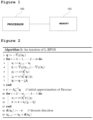
- FIG. 1 is a diagram illustrating a configuration of an SPH-based hyperelastic simulation apparatus according to a preferred embodiment of the present invention.
- the SPH-based hyperelastic simulation apparatus may include a processor 100 and a memory 102.
- the processor 100 may include a central processing unit (CPU) capable of executing a computer program, a graphics processing unit (GPU), other virtual machines, or the like.
- CPU central processing unit
- GPU graphics processing unit
- the memory 102 may include a non-volatile storage device such as a non-removable hard drive or a removable storage device.
- the removable storage device may include a compact flash unit, a USB memory stick, and the like.
- the memory 102 may also include a volatile memory, such as various random access memories.
- the memory 102 stores program instructions for SPH-based deformable body simulation composed of m particles.
- the program instructions according to the present embodiment defines states of each of m particles in a discrete time as a set of positions and velocities, for an SPH-based deformable body composed of m particles, approximates hyperelastic energy of each of the m particles using a rest-pose volume, a material parameter, a vectorized deformation gradient, and a projection of the vectorized deformation gradient in order to optimize an objective function for solving new states of each of the m particles, searches for an initial approximation of a Hessian matrix using the approximated hyperelastic energy, and simulates the SPH-based deformable body based on the searched initial approximation.
- the objective function is optimized through an iterative approach using a limited-memory Broyden-Fletcher-Goldfarb-Shanno (L-BFGS) algorithm.
- L-BFGS limited-memory Broyden-Fletcher-Goldfarb-Shanno
- the SPH-based hyperelastic simulation according to the present embodiment is based on deformation gradient and zero-energy mode suppression.
- Elastic energy models (corotated, Neo-Hookean, and St. Venant-Kirchoff, etc.) are widely used for deformable bodies having elasticity.
- the deformation gradient for the existing SPH-based deformable body is expressed as follows.
- F i ⁇ j ⁇ N i 0 V j x ji ⁇ L i ⁇ W ji
- N i 0 denotes an initial neighbor set of particle i
- V j denotes the rest-pose volume
- x ji x j - x i
- L i denotes a kernel correction matrix
- the kernel correction matrix L i is defined as follows.
- L i ⁇ j ⁇ N i 0 V
- Equation 1 The hyperelastic energy expressed as E he ( x ) is defined using the deformation gradient given in Equation 1.
- E he x ⁇ i V i ⁇ F i
- ⁇ denotes an elastic energy density function and may vary depending on a type of elastic material of the deformable body.
- Equation 1 A well-known problem in approximating the deformation gradient given in Equation 1 is a zero energy mode.
- E ze x ⁇ 2 ⁇ i w i V i ⁇ j ⁇ N i 0 W ji V j ⁇ e ji ⁇ 2 ⁇ X ji ⁇ 2
- ⁇ denotes a user-defined parameter
- W i denotes a material parameter that makes penalty force proportional to elastic force
- e ji defined by F i X ji - x ji denotes an error due to the zero energy mode.
- Equation 5 may be expressed in a matrix-vector product form.
- E ze x 1 2 x T Hx
- the state may be described as a set of positions x ⁇ R 3 m and velocities v ⁇ R 3 m of the particles.
- the physical system is evolved in discrete time samples ⁇ t 1 , t 2 , ⁇ , t N ⁇ .
- h denotes a time step size
- M denotes a mass matrix
- f ext denotes external force (e.g., gravity)
- f int (x) denotes internal force including the elastic force and zero energy mode suppression force in an SPH framework.
- Equation 8 To solve a new state x n+1 in Equation 8, it is reformulated as an optimization problem to find x n+1 that minimizes the following objective function g(x).
- g x n + 1 1 2 h 2 ⁇ x n + 1 ⁇ y n ⁇ M 2 + E he x n + 1 + E ze x n + 1 wherein, ⁇ ⁇ ⁇ M 2 denotes a weighted Frobenius norm.
- x is used instead of x n+1 .
- Equation 9 The problem of optimizing the objective function given in Equation 9 may be solved using an iterative approach such as a Newton's method.
- the Newton's method should calculate a Hessian matrix ⁇ 2 g ( x k )per iteration of a solver and perform factorization, and therefore, has reduced efficiency.
- the limited-memory Broyden-Fletcher-Goldfarb-Shanno (L-BFGS) algorithm is used.
- the Hessian matrix ⁇ 2 g (x k ) is approximated using the curvature information of the m most recent iterations, i.e., x k-m , ⁇ , x k -1 .
- the following shows the effective approximation of the matrix for the present embodiment and shows the efficiency for an optimization-based elastic SPH solid solver in experiments.
- the initial approximation of the Hessian matrix denoted by A 0 , has a significant impact on a convergence rate of the L-BFGS.
- ⁇ 2 g ( x k ) M / h 2 + H + ⁇ 2 E he ( x ) and ⁇ 2 E he ( x ) is the only non-constant term. Therefore, the goal may be achieved by replacing the non-constant term ⁇ 2 E he ( x ) with "constant approximation".
- the hyperelastic energy E he,i ( x ) per particle is first approximated as follows.
- vec F i D i x
- B ⁇ i V i w i D i T D i
- FIG. 2 is a diagram illustrating an L-BFGS algorithm based on A 0 according to the present embodiment.
- FIG. 3 is a diagram illustrating results of a solver tested with various elastic models.
- the model according to the present embodiment expresses a twist of an elastic beam better than the corotated model on the left.
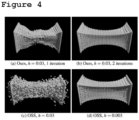
- FIGS. 4A to 4D are diagrams illustrating simulation results according to the present embodiment and simulation results of the existing technique.
- FIG. 5 is a diagram illustrating the results of applying the L-BFGS algorithm according to the present embodiment and the simulation results of the existing Newton's method. As a result, it can be seen that even if the L-BFGS algorithm according to the present embodiment is applied, there is no significant difference from the existing Newton's method.
Landscapes
- Engineering & Computer Science (AREA)
- Physics & Mathematics (AREA)
- Theoretical Computer Science (AREA)
- General Physics & Mathematics (AREA)
- Computer Hardware Design (AREA)
- General Engineering & Computer Science (AREA)
- Geometry (AREA)
- Evolutionary Computation (AREA)
- Fluid Mechanics (AREA)
- Pure & Applied Mathematics (AREA)
- Mathematical Physics (AREA)
- Mathematical Optimization (AREA)
- Mathematical Analysis (AREA)
- Computing Systems (AREA)
- Algebra (AREA)
- Management, Administration, Business Operations System, And Electronic Commerce (AREA)
- Processing Or Creating Images (AREA)
Abstract
The present invention discloses a smoothed particle hydrodynamics (SPH)-based hyperelastic simulation method and apparatus. According to the invention, an SPH-based hyperelastic simulation apparatus includes a processor; and a memory connected to the processor, wherein the memory stores program instructions executed by the processor to define states of each of m particles in a discrete time as a set of positions and velocities, for an SPH-based deformable body composed of m particles, approximate hyperelastic energy of each of the m particles using a rest-pose volume, a material parameter, a vectorized deformation gradient, and a projection of the vectorized deformation gradient in order to optimize an objective function for solving new states of each of the m particles, search for an initial approximation of a Hessian matrix using the approximated hyperelastic energy, and simulate the SPH-based deformable body based on the searched initial approximation.
Description
- The present invention relates to a physics-based animation technique, and more particularly, to a method an apparatus for simulating a smoothed particle hydrodynamics (SPH)-based hyperelastic deformable body.
- A representative example of the related art for simulating a SPH (Smoothed Particle Hydrodynamics)-based deformable body is the technology in the paper "Fast Corotated Elastic SPH Solids with Implicit Zero-Energy Mode Control" (hereinafter referred to as existing technique) published in the international journal, Proceedings of the ACM on Computer Graphics and Interactive Techniques (PACMCGIT).
- This technology applies a backward Euler technique to approximate the next position and velocity of a deformable body made of particles, which is approximated as a problem of solving two linear systems in order.
- Here, the solutions of the two linear systems are obtained by Cholesky Factorization and Preconditioned Conjugate Gradient, respectively.
- The existing technique is a technique optimized for expressing the simplest Corotated model of hyperelastic models, and therefore, cannot simulate the movement of the SPH-based deformable body using more sophisticated models such as neo-Hookean or St. Venant-Kirchoff.
- In addition, when a high elastic modulus or a large time step is used, the problem of unstable simulation results occurs.
- In order to solve the problems of the prior art described above, the present invention provides an SPH-based hyperelastic simulation method and apparatus capable of increasing accuracy while reducing complexity.
- In order to achieve the above object, according to one aspect of the present invention, a smoothed particle hydrodynamics (SPH)-based hyperelastic simulation apparatus includes: a processor; and a memory connected to the processor, in which the memory stores program instructions executed by the processor to define states of each of m particles in a discrete time as a set of positions and velocities, for an SPH-based deformable body composed of m particles, approximate hyperelastic energy of each of the m particles using a rest-pose volume, a material parameter, a vectorized deformation gradient, and a projection of the vectorized deformation gradient in order to optimize an objective function for solving new states of each of the m particles, search for an initial approximation of a Hessian matrix using the approximated hyperelastic energy, and simulate the SPH-based deformable body based on the searched initial approximation.
- The deformation gradient may be defined by the following Equation.


- The hyperelastic energy may be defined by the following Equation.

- The deformation gradient may be approximated through a zero energy mode.
- The new state may be expressed by the following Equation.


- The internal force may be evaluated as a negative slope and the new state may be expressed by the following Equation.

- The optimization problem of the objective function may be reformulated into the following Equation.


- The program instructions may optimize the objective function through an iterative approach using a limited-memory Broyden-Fletcher-Goldfarb-Shanno (L-BFGS) algorithm.
- According to another aspect of the invention, a smoothed particle hydrodynamics (SPH)-based hyperelastic simulation method in an apparatus including a processor and a memory includes: generating an SPH-based deformable body composed of m particles; defining states of each of m particles in a discrete time as a set of positions and velocities, for the SPH-based deformable body composed of the m particles; approximating hyperelastic energy of each of the m particles using a rest-pose volume, a material parameter, a vectorized deformation gradient, and a projection of the vectorized deformation gradient in order to optimize an objective function for solving new states of each of the m particles; searching for an initial approximation of a Hessian matrix using the approximated hyperelastic energy; and simulating the SPH-based deformable body based on the searched initial approximation.
- According to still another aspect of the present invention, there is provided a computer program stored in a computer-readable recording medium performing the above-described method.
- According to the present invention, it is possible to simulate movement of an SPH-based deformable body using more sophisticated models such as neo-Hookean or St. Venant-Kirchoff.
- In addition, according to the present invention, by expanding the existing technique to an optimization problem and solving it with limited-memory BFGS (L-BFGS), it is possible to generate stable simulation results even when using a high elastic modulus or a large time step compared to the existing technique.
-
-
FIG. 1 is a diagram illustrating a configuration of an SPH-based hyperelastic simulation apparatus according to a preferred embodiment of the present invention. -
FIG. 2 is a diagram illustrating an L-BFGS algorithm based on A0 according to the present embodiment. -
FIG. 3 is a diagram illustrating results of a solver tested with various elastic models. -
FIGS. 4A to 4D are diagrams illustrating simulation results according to the present embodiment and simulation results of the existing technique. -
FIG. 5 is a diagram illustrating results of applying an L-BFGS algorithm according to the present embodiment and simulation results of the existing Newton's method. - Since the present invention may be variously modified and have several exemplary embodiments, specific exemplary embodiments will be illustrated in the accompanying drawings, and will be described in detail in a detailed description. However, it is to be understood that the present invention is not limited to a specific exemplary embodiment, but includes all modifications, equivalents, and substitutions without departing from the scope and spirit of the present invention.
- The terms used in the present specification are used only in order to describe specific exemplary embodiments rather than limiting the present invention. Singular forms are intended to include plural forms unless the context clearly indicates otherwise. It should be further understood that terms "include" or "have" used herein specify the presence of features, numerals, steps, operations, components, parts described in the present specification, or combinations thereof, but do not preclude the presence or addition of one or more other features, numerals, steps, operations, components, parts, or combinations thereof.
- In addition, components of the embodiments described with reference to each drawing are not limitedly applied only to the corresponding embodiment, and may be implemented to be included in other embodiments within the scope of maintaining the technical spirit of the present invention. In addition, it goes without saying that these components may also be re-implemented as one embodiment in which a plurality of embodiments are integrated, even if a separate description is omitted.
- In addition, in the description with reference to the accompanying drawings, regardless of reference numerals, the same components will be given the same or related reference numerals and duplicate description thereof will be omitted. When it is decided that the detailed description of the known art related to the present invention may unnecessary obscure the gist of the present invention, a detailed description therefor will be omitted.
-
FIG. 1 is a diagram illustrating a configuration of an SPH-based hyperelastic simulation apparatus according to a preferred embodiment of the present invention. - As illustrated in
FIG. 1 , the SPH-based hyperelastic simulation apparatus may include aprocessor 100 and amemory 102. - The
processor 100 may include a central processing unit (CPU) capable of executing a computer program, a graphics processing unit (GPU), other virtual machines, or the like. - The
memory 102 may include a non-volatile storage device such as a non-removable hard drive or a removable storage device. The removable storage device may include a compact flash unit, a USB memory stick, and the like. Thememory 102 may also include a volatile memory, such as various random access memories. - The
memory 102 according to the present embodiment stores program instructions for SPH-based deformable body simulation composed of m particles. - Such program instructions may be stored in a computer-readable recording medium.
- The program instructions according to the present embodiment defines states of each of m particles in a discrete time as a set of positions and velocities, for an SPH-based deformable body composed of m particles, approximates hyperelastic energy of each of the m particles using a rest-pose volume, a material parameter, a vectorized deformation gradient, and a projection of the vectorized deformation gradient in order to optimize an objective function for solving new states of each of the m particles, searches for an initial approximation of a Hessian matrix using the approximated hyperelastic energy, and simulates the SPH-based deformable body based on the searched initial approximation.
- According to the present embodiment, the objective function is optimized through an iterative approach using a limited-memory Broyden-Fletcher-Goldfarb-Shanno (L-BFGS) algorithm.
- Hereinafter, the SPH-based hyperelasticity simulation process according to the present embodiment will be described in detail.
- The SPH-based hyperelastic simulation according to the present embodiment is based on deformation gradient and zero-energy mode suppression.
- Hereinafter, these will be explained in detail.
- Elastic energy models (corotated, Neo-Hookean, and St. Venant-Kirchoff, etc.) are widely used for deformable bodies having elasticity.
- In general, the deformation gradient is expressed as


- The deformation gradient for the existing SPH-based deformable body is expressed as follows.


- Due to the above correction, a deformation gradient F i satisfies a first-order consistency condition.

- The hyperelastic energy expressed as E he(x) is defined using the deformation gradient given in
Equation 1.
- A well-known problem in approximating the deformation gradient given in
Equation 1 is a zero energy mode. - The following denotes implicit penalty forces suppressing the previously proposed zero energy mode.

-
Equation 5 may be expressed in a matrix-vector product form.
- Hereinafter, the optimization process will be described in detail.
- Given a physical system composed of m particles, the state may be described as a set of positions


- The physical system is evolved in discrete time samples {t 1, t 2, ··· ,tN }.
- Given the state of tn, the implicit Euler scheme approximates the next state of tn+1 as follows.

- The internal force can be evaluated as a negative slope of the internal energy, i.e., f int(x) = -(∇E he(x) + ∇E ze(x)), so
Equation 7 can be rewritten as follows.
- To solve a new state xn+1 in
Equation 8, it is reformulated as an optimization problem to find xn+1 that minimizes the following objective function g(x).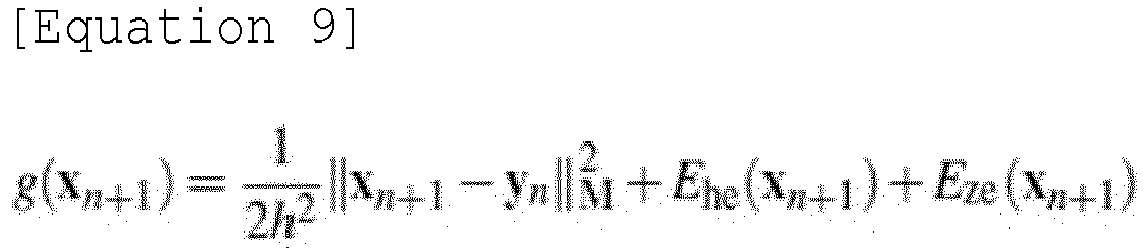

- The problem of optimizing the objective function given in Equation 9 may be solved using an iterative approach such as a Newton's method.

- Despite the quick convergence characteristics of the Newton's method, the Newton's method should calculate a Hessian matrix ∇2 g(x k)per iteration of a solver and perform factorization, and therefore, has reduced efficiency.
- In the present embodiment, the limited-memory Broyden-Fletcher-Goldfarb-Shanno (L-BFGS) algorithm is used.
- For efficiency, the Hessian matrix ∇2 g(x k ) is approximated using the curvature information of the m most recent iterations, i.e., x k-m , ··· , x k-1.
- The following shows the effective approximation of the matrix for the present embodiment and shows the efficiency for an optimization-based elastic SPH solid solver in experiments.
- Hereinafter, the initial approximation of the Hessian matrix will be described.
- The initial approximation of the Hessian matrix, denoted by A0, has a significant impact on a convergence rate of the L-BFGS.
- Therefore, to be close to the Hessian matrix ∇2 g(x k ) and to avoid expensive Cholesky factorization during simulation, A0 remaining constant is searched.
- ∇2 g(x k ) = M/h 2 + H + ∇2 E he(x) and ∇2 E he(x) is the only non-constant term. Therefore, the goal may be achieved by replacing the non-constant term ∇2 E he(x) with "constant approximation".
- To this end, in the present embodiment, the hyperelastic energy E he,i(x) per particle is first approximated as follows.


- In the present embodiment, the desired "constant approximation" denoted by B is defined as follows.

- Finally, the initial approximation of the Hessian matrix A0 is completed with B.

-
FIG. 2 is a diagram illustrating an L-BFGS algorithm based on A0 according to the present embodiment. -
FIG. 3 is a diagram illustrating results of a solver tested with various elastic models. - Referring to
FIG. 3 , it can be seen that the model according to the present embodiment expresses a twist of an elastic beam better than the corotated model on the left. - FIGS. 4A to 4D are diagrams illustrating simulation results according to the present embodiment and simulation results of the existing technique.
- As illustrated in
FIG. 4A , when the L-BFGS is performed once, the simulation is somewhat unstable, but as illustrated inFIG. 4B , when the number of times of L-BFGS progress is increased to twice, the simulation becomes stable immediately. - As illustrated in
FIG. 4C , when the simulation is performed using the existing technique, it is unstable, and as illustrated inFIG. 4D , in order to stabilize the simulation using the existing technique, the size of h should be reduced, which has the problem of increasing complexity. -
FIG. 5 is a diagram illustrating the results of applying the L-BFGS algorithm according to the present embodiment and the simulation results of the existing Newton's method. As a result, it can be seen that even if the L-BFGS algorithm according to the present embodiment is applied, there is no significant difference from the existing Newton's method. - The embodiments of the present invention described above have been disclosed for illustrative purposes, and those skilled in the art with ordinary knowledge of the present invention will be able to make various modifications, changes, and additions within the spirit and scope of the present invention, and these modifications, changes, and additions should be regarded as falling within the scope of the following claims.
Claims (10)
- A smoothed particle hydrodynamics (SPH)-based hyperelastic simulation apparatus, comprising:a processor; anda memory connected to the processor,wherein the memory stores program instructions executed by the processor to define states of each of m particles in a discrete time as a set of positions and velocities, for an SPH-based deformable body composed of m particles,approximate hyperelastic energy of each of the m particles using a rest-pose volume, a material parameter, a vectorized deformation gradient, and a projection of the vectorized deformation gradient in order to optimize an objective function for solving new states of each of the m particles,search for an initial approximation of a Hessian matrix using the approximated hyperelastic energy, andsimulate the SPH-based deformable body based on the searched initial approximation.
- The smoothed particle hydrodynamics (SPH)-based hyperelastic simulation apparatus of claim 1, wherein the deformation gradient is defined by the following Equation.


- The smoothed particle hydrodynamics (SPH)-based hyperelastic simulation apparatus of claim 2, wherein the hyperelastic energy is defined by the following Equation.

- The smoothed particle hydrodynamics (SPH)-based hyperelastic simulation apparatus of claim 3, wherein the deformation gradient is approximated through a zero energy mode.
- The smoothed particle hydrodynamics (SPH)-based hyperelastic simulation apparatus of claim 4, wherein the new state is expressed by the following Equation.


- The smoothed particle hydrodynamics (SPH)-based hyperelastic simulation apparatus of claim 5, wherein the internal force is evaluated as a negative slope and the new state is expressed by the following Equation.

- The smoothed particle hydrodynamics (SPH)-based hyperelastic simulation apparatus of claim 6, wherein the optimization problem of the objective function is reformulated into the following Equation.


- The smoothed particle hydrodynamics (SPH)-based hyperelastic simulation apparatus of claim 1, wherein the program instructions optimize the objective function through an iterative approach using a limited-memory Broyden-Fletcher-Goldfarb-Shanno (L-BFGS) algorithm.
- A smoothed particle hydrodynamics (SPH)-based hyperelastic simulation method in an apparatus including a processor and a memory, the smoothed particle hydrodynamics (SPH)-based hyperelastic simulation method comprising:generating an SPH-based deformable body composed of m particles;defining states of each of m particles in a discrete time as a set of positions and velocities, for then SPH-based deformable body composed of the m particles;approximating hyperelastic energy of each of the m particles using a rest-pose volume, a material parameter, a vectorized deformation gradient, and a projection of the vectorized deformation gradient in order to optimize an objective function for solving new states of each of the m particles;searching for an initial approximation of a Hessian matrix using the approximated hyperelastic energy; andsimulating the SPH-based deformable body based on the searched initial approximation.
- A computer program stored in a computer-readable recording medium that performs the method of claim 9.
Applications Claiming Priority (1)
| Application Number | Priority Date | Filing Date | Title |
|---|---|---|---|
| KR1020230030018A KR102602805B1 (en) | 2023-03-07 | 2023-03-07 | SPH-based hyperelastic simulation method and apparatus |
Publications (1)
| Publication Number | Publication Date |
|---|---|
| EP4428740A1 true EP4428740A1 (en) | 2024-09-11 |
Family
ID=88742631
Family Applications (1)
| Application Number | Title | Priority Date | Filing Date |
|---|---|---|---|
| EP23211788.7A Pending EP4428740A1 (en) | 2023-03-07 | 2023-11-23 | Sph-based hyperelastic simulation method and apparatus |
Country Status (4)
| Country | Link |
|---|---|
| US (1) | US20240303397A1 (en) |
| EP (1) | EP4428740A1 (en) |
| JP (1) | JP7749242B2 (en) |
| KR (1) | KR102602805B1 (en) |
Families Citing this family (1)
| Publication number | Priority date | Publication date | Assignee | Title |
|---|---|---|---|---|
| CN119150643B (en) * | 2024-11-08 | 2025-01-28 | 中国科学技术大学 | Warhead shell expansion fracture simulation method based on smooth particle dynamics |
Family Cites Families (8)
| Publication number | Priority date | Publication date | Assignee | Title |
|---|---|---|---|---|
| JP5802041B2 (en) | 2011-04-12 | 2015-10-28 | インターナショナル・ビジネス・マシーンズ・コーポレーションInternational Business Machines Corporation | Information processing apparatus, calculation method, program, and recording medium |
| KR101350732B1 (en) | 2012-06-04 | 2014-01-14 | 한국과학기술원 | Multi-Resolution Meshless Method for Real-Time Simulation of Deformable Objects |
| JP7580253B2 (en) * | 2019-11-15 | 2024-11-11 | 株式会社明治 | Swallowing simulation device and swallowing simulation method |
| CA3182690A1 (en) * | 2020-05-07 | 2021-11-11 | Mimyk Medical Simulations Private Limited | Method and system for real-time simulation of elastic body |
| US12216969B2 (en) * | 2020-09-04 | 2025-02-04 | Nvidia Corporation | Methods of contact for simulation |
| US20220375163A1 (en) * | 2021-05-14 | 2022-11-24 | Unity Technologies Sf | Computationally-Efficient Generation of Simulations of Cloth-Like Materials Using Bilinear Element Models |
| CN113837958B (en) | 2021-09-09 | 2023-08-04 | 南方医科大学 | Diffusion weighted image denoising algorithm, medium and equipment |
| CN114925507B (en) | 2022-05-03 | 2024-03-29 | 珠海复旦创新研究院 | An optimized calculation method for equivalent gas absorption coefficient in AMCKD mode |
-
2023
- 2023-03-07 KR KR1020230030018A patent/KR102602805B1/en active Active
- 2023-11-16 US US18/510,879 patent/US20240303397A1/en active Pending
- 2023-11-23 EP EP23211788.7A patent/EP4428740A1/en active Pending
- 2023-12-12 JP JP2023209270A patent/JP7749242B2/en active Active
Non-Patent Citations (6)
| Title |
|---|
| "Fast Corotated Elastic SPH Solids with Implicit Zero-Energy Mode Control", PROCEEDINGS OF THE ACM ON COMPUTER GRAPHICS AND INTERACTIVE TECHNIQUES (PACMCGIT |
| CHENFANFU JIANG ET AL: "The material point method for simulating continuum materials", 20160724; 1077952576 - 1077952576, 24 July 2016 (2016-07-24), pages 1 - 52, XP058275917, ISBN: 978-1-4503-4289-6, DOI: 10.1145/2897826.2927348 * |
| HÉBERT ALAIN ED - VAN DAM HUGO ET AL: "A general presentation of the SPH equivalence technique in non-fundamental mode cases", ANNALS OF NUCLEAR ENERGY, PERGAMON PRESS, OXFORD, GB, vol. 141, 28 January 2020 (2020-01-28), XP086094940, ISSN: 0306-4549, [retrieved on 20200128], DOI: 10.1016/J.ANUCENE.2020.107323 * |
| LI XUAN ET AL: "BFEMP: Interpenetration-free MPM-FEM coupling with barrier contact", COMPUTER METHODS IN APPLIED MECHANICS AND ENGINEERING, NORTH-HOLLAND, AMSTERDAM, NL, vol. 390, 26 November 2021 (2021-11-26), XP086934027, ISSN: 0045-7825, [retrieved on 20211126], DOI: 10.1016/J.CMA.2021.114350 * |
| REN HUILONG ET AL: "Dual-support smoothed particle hydrodynamics in solid: variational principle and implicit formulation", ENGINEERING ANALYSIS WITH BOUNDARY ELEMENTS, ELSEVIER, AMSTERDAM, NL, vol. 108, 30 August 2019 (2019-08-30), pages 15 - 29, XP085845558, ISSN: 0955-7997, [retrieved on 20190830], DOI: 10.1016/J.ENGANABOUND.2019.05.024 * |
| XINLEI WANG ET AL: "Hierarchical Optimization Time Integration for CFL-rate MPM Stepping", ARXIV.ORG, CORNELL UNIVERSITY LIBRARY, 201 OLIN LIBRARY CORNELL UNIVERSITY ITHACA, NY 14853, 18 November 2019 (2019-11-18), XP081535035 * |
Also Published As
| Publication number | Publication date |
|---|---|
| JP2024127734A (en) | 2024-09-20 |
| KR102602805B1 (en) | 2023-11-15 |
| US20240303397A1 (en) | 2024-09-12 |
| JP7749242B2 (en) | 2025-10-06 |
Similar Documents
| Publication | Publication Date | Title |
|---|---|---|
| Sifakis et al. | FEM simulation of 3D deformable solids: a practitioner's guide to theory, discretization and model reduction | |
| US8803887B2 (en) | Computer graphic system and method for simulating hair | |
| Narain et al. | ADMM⊇ projective dynamics: fast simulation of general constitutive models. | |
| CN110569979B (en) | Logical-physical bit remapping method for noisy medium-sized quantum equipment | |
| Fischer et al. | Fast smallest-enclosing-ball computation in high dimensions | |
| US8566260B2 (en) | Structured prediction model learning apparatus, method, program, and recording medium | |
| Iben et al. | Artistic simulation of curly hair | |
| US7079145B2 (en) | Method and program solving LCPs for rigid body dynamics | |
| Fang et al. | Guaranteed globally injective 3D deformation processing | |
| CN115859597B (en) | Molecular dynamics simulation method and system based on hybrid functional and first principles | |
| EP3291099B1 (en) | Efficient and stable approach to elasticity and collisions for hair animation | |
| JP6772213B2 (en) | Question answering device, question answering method and program | |
| Jiang et al. | Real-time hair simulation with heptadiagonal decomposition on mass spring system | |
| Sifakis et al. | Finite element method simulation of 3d deformable solids | |
| US20240303397A1 (en) | Sph-based hyperelastic simulation method and apparatus | |
| CN113204911A (en) | Fluid-solid coupling simulation method and system for trailing edge deflection process of ram parafoil | |
| Shi et al. | Lifted Curls: A Model for Tightly Coiled Hair Simulation. | |
| Kaddoura | A primer on generative adversarial networks | |
| Cafieri et al. | Interior-point solver for large-scale quadratic programming problems with bound constraints | |
| US20190370422A1 (en) | Method and system for simulating deformation of a thin-shell material | |
| CN107491417A (en) | A kind of document structure tree method under topic model based on particular division | |
| Liu et al. | Krylov solvers for interior point methods with applications in radiation therapy and support vector machines | |
| US20030216900A1 (en) | Method and system for calculating the electrostatic force due to a system of charged bodies in molecular modeling | |
| Holt et al. | EvoControl: Multi-Frequency Bi-Level Control for High-Frequency Continuous Control | |
| Wang et al. | Neural Modes: Self-supervised Learning of Nonlinear Modal Subspaces |
Legal Events
| Date | Code | Title | Description |
|---|---|---|---|
| PUAI | Public reference made under article 153(3) epc to a published international application that has entered the european phase |
Free format text: ORIGINAL CODE: 0009012 |
|
| STAA | Information on the status of an ep patent application or granted ep patent |
Free format text: STATUS: REQUEST FOR EXAMINATION WAS MADE |
|
| 17P | Request for examination filed |
Effective date: 20231123 |
|
| AK | Designated contracting states |
Kind code of ref document: A1 Designated state(s): AL AT BE BG CH CY CZ DE DK EE ES FI FR GB GR HR HU IE IS IT LI LT LU LV MC ME MK MT NL NO PL PT RO RS SE SI SK SM TR |