EP4428552B1 - Method of evaluating power storage device, arrangement, and method of producing power storage device - Google Patents
Method of evaluating power storage device, arrangement, and method of producing power storage device Download PDFInfo
- Publication number
- EP4428552B1 EP4428552B1 EP24158822.7A EP24158822A EP4428552B1 EP 4428552 B1 EP4428552 B1 EP 4428552B1 EP 24158822 A EP24158822 A EP 24158822A EP 4428552 B1 EP4428552 B1 EP 4428552B1
- Authority
- EP
- European Patent Office
- Prior art keywords
- metal piece
- power storage
- storage device
- jig
- push jig
- Prior art date
- Legal status (The legal status is an assumption and is not a legal conclusion. Google has not performed a legal analysis and makes no representation as to the accuracy of the status listed.)
- Active
Links
Images







Classifications
-
- G—PHYSICS
- G01—MEASURING; TESTING
- G01R—MEASURING ELECTRIC VARIABLES; MEASURING MAGNETIC VARIABLES
- G01R31/00—Arrangements for testing electric properties; Arrangements for locating electric faults; Arrangements for electrical testing characterised by what is being tested not provided for elsewhere
- G01R31/36—Arrangements for testing, measuring or monitoring the electrical condition of accumulators or electric batteries, e.g. capacity or state of charge [SoC]
-
- G—PHYSICS
- G01—MEASURING; TESTING
- G01R—MEASURING ELECTRIC VARIABLES; MEASURING MAGNETIC VARIABLES
- G01R31/00—Arrangements for testing electric properties; Arrangements for locating electric faults; Arrangements for electrical testing characterised by what is being tested not provided for elsewhere
- G01R31/50—Testing of electric apparatus, lines, cables or components for short-circuits, continuity, leakage current or incorrect line connections
- G01R31/64—Testing of capacitors
-
- G—PHYSICS
- G01—MEASURING; TESTING
- G01R—MEASURING ELECTRIC VARIABLES; MEASURING MAGNETIC VARIABLES
- G01R1/00—Details of instruments or arrangements of the types included in groups G01R5/00 - G01R13/00 and G01R31/00
- G01R1/02—General constructional details
- G01R1/04—Housings; Supporting members; Arrangements of terminals
- G01R1/0408—Test fixtures or contact fields; Connectors or connecting adaptors; Test clips; Test sockets
- G01R1/0425—Test clips, e.g. for IC's
-
- G—PHYSICS
- G01—MEASURING; TESTING
- G01R—MEASURING ELECTRIC VARIABLES; MEASURING MAGNETIC VARIABLES
- G01R19/00—Arrangements for measuring currents or voltages or for indicating presence or sign thereof
- G01R19/10—Measuring sum, difference or ratio
-
- G—PHYSICS
- G01—MEASURING; TESTING
- G01R—MEASURING ELECTRIC VARIABLES; MEASURING MAGNETIC VARIABLES
- G01R31/00—Arrangements for testing electric properties; Arrangements for locating electric faults; Arrangements for electrical testing characterised by what is being tested not provided for elsewhere
- G01R31/50—Testing of electric apparatus, lines, cables or components for short-circuits, continuity, leakage current or incorrect line connections
- G01R31/52—Testing for short-circuits, leakage current or ground faults
-
- G—PHYSICS
- G01—MEASURING; TESTING
- G01R—MEASURING ELECTRIC VARIABLES; MEASURING MAGNETIC VARIABLES
- G01R31/00—Arrangements for testing electric properties; Arrangements for locating electric faults; Arrangements for electrical testing characterised by what is being tested not provided for elsewhere
- G01R31/36—Arrangements for testing, measuring or monitoring the electrical condition of accumulators or electric batteries, e.g. capacity or state of charge [SoC]
- G01R31/385—Arrangements for measuring battery or accumulator variables
- G01R31/3865—Arrangements for measuring battery or accumulator variables related to manufacture, e.g. testing after manufacture
-
- Y—GENERAL TAGGING OF NEW TECHNOLOGICAL DEVELOPMENTS; GENERAL TAGGING OF CROSS-SECTIONAL TECHNOLOGIES SPANNING OVER SEVERAL SECTIONS OF THE IPC; TECHNICAL SUBJECTS COVERED BY FORMER USPC CROSS-REFERENCE ART COLLECTIONS [XRACs] AND DIGESTS
- Y02—TECHNOLOGIES OR APPLICATIONS FOR MITIGATION OR ADAPTATION AGAINST CLIMATE CHANGE
- Y02E—REDUCTION OF GREENHOUSE GAS [GHG] EMISSIONS, RELATED TO ENERGY GENERATION, TRANSMISSION OR DISTRIBUTION
- Y02E60/00—Enabling technologies; Technologies with a potential or indirect contribution to GHG emissions mitigation
- Y02E60/10—Energy storage using batteries
-
- Y—GENERAL TAGGING OF NEW TECHNOLOGICAL DEVELOPMENTS; GENERAL TAGGING OF CROSS-SECTIONAL TECHNOLOGIES SPANNING OVER SEVERAL SECTIONS OF THE IPC; TECHNICAL SUBJECTS COVERED BY FORMER USPC CROSS-REFERENCE ART COLLECTIONS [XRACs] AND DIGESTS
- Y02—TECHNOLOGIES OR APPLICATIONS FOR MITIGATION OR ADAPTATION AGAINST CLIMATE CHANGE
- Y02P—CLIMATE CHANGE MITIGATION TECHNOLOGIES IN THE PRODUCTION OR PROCESSING OF GOODS
- Y02P70/00—Climate change mitigation technologies in the production process for final industrial or consumer products
- Y02P70/50—Manufacturing or production processes characterised by the final manufactured product
Definitions
- the present disclosure relates to a method of evaluating a power storage device, an arrangement, and a method of producing a power storage device.
- Japanese Patent Laying-Open No. 2020-191181 discloses a method of evaluating a power storage device.
- a power storage device comprises an electrode assembly.
- the electrode assembly in a charged state is partly disassembled, and a metal piece (a simulated foreign object) is placed inside the electrode assembly.
- the metal piece has an L-shaped outer profile. This procedure is very difficult to implement and needs to be taken care of by a skilled, experienced person. A test method that does not require skills or experience is demanded.
- Japanese Patent Laying-Open No. 2020-191181 proposes simulating a micro short circuit by pushing a metal piece into an electrode assembly from the outside of the electrode assembly.
- This method has the following advantages. It does not require disassembling the electrode assembly. It uses a ring-shaped metal piece, and therefore the posture of the metal piece is stably maintained, allowing for a high success rate of pushing-into. It uses a push jig and a guide jig, lowering the difficulty of the procedure. However, it also has the following two issues which have room for improvement.
- a first issue is that the detection of a short circuit relies on a voltage drop in the power storage device. As the capacity of the power storage device is increased, a voltage decrement caused by a short circuit becomes smaller. Because of this, as the capacity of the power storage device is increased, detection of a short circuit becomes difficult. At the time when a voltage drop is detected, there is a possibility that the metal piece can have already penetrated through two or more separator layers. Usually, a micro short circuit caused by foreign object contamination is "a single-layer short circuit". A single-layer short circuit occurs when a foreign object penetrates through a single separator layer. Simulation of a single-layer short circuit is demanded. Penetration by a metal piece through two or more separator layers is different from single-layer short-circuiting.
- a second issue is that the push jig is made of resin.
- the push jig can be softer than the metal piece.
- the pushing load tends not to be transferred to the metal piece, and rather tends to escape to the push jig.
- the metal piece can be pushed into the electrode assembly not very smoothly, and at the moment when the metal piece penetrates through the outermost layer of the electrode assembly, the metal piece can be pushed into very quickly with a strong force.
- An object of the present disclosure is to improve reproducibility of single-layer short-circuiting.
- a method of evaluating a power storage device is defined in claim 1.
- detection of a short circuit is based on a change in potential difference between the electrode (either a positive electrode or a negative electrode) and the metal piece (a simulated foreign object).
- the amount of change in potential difference between the electrode and the metal piece tends not to be affected by the capacity of the power storage device. Hence, even when the capacity of the power storage device is increased, a single-layer short circuit may be detected accurately.
- the push jig is electrically conductive. By measuring the electric potential of the push jig which is in contact with the metal piece, it is possible to measure the electric potential of the metal piece.
- the push jig is as hard as or harder than the metal piece.
- the pushing load tends not to escape to the push jig, and as a result, the metal piece may be pushed into the electrode assembly smoothly.
- the method of evaluating a power storage device may include the following configuration.
- the push jig has a hollow rod shape.
- a melt diameter the diameter of a hole that is formed by the melting of the separator.
- the heat capacity of a hollow material is lower than that of a solid material.
- the method of evaluating a power storage device may include the following configuration.
- the metal piece has a first end face and a second end face.
- the second end face is a face opposite to the first end face.
- the push jig comes into contact with the second end face.
- An area of contact between the push jig and the second end face is smaller than an area of the second end face.
- the method of evaluating a power storage may include the following configuration.
- the push jig is made of metal.
- the material of the push jig is not particularly limited to a metal material.
- a method of producing a power storage device is defined in claim 6.
- Expressions such as “comprise”, “include”, and “have”, and other similar expressions are open-ended expressions.
- an additional component may or may not be further included.
- the expression “consist of” is a closed-end expression. However, even when a closed-end expression is used, impurities present under ordinary circumstances as well as an additional element irrelevant to the technique according to the present disclosure are not excluded.
- the expression “consist essentially of” is a semiclosed-end expression. A semiclosed-end expression tolerates addition of an element that does not substantially affect the fundamental, novel features of the technique according to the present disclosure.
- any geometric term should not be interpreted solely in its exact meaning.
- "parallel” may mean a geometric state that is deviated, to some extent, from exact “parallel”.
- Any geometric term herein may include tolerances and/or errors in terms of design, operation, production, and/or the like.
- the dimensional relationship in each figure may not necessarily coincide with the actual dimensional relationship.
- the dimensional relationship (in length, width, thickness, and the like) in each figure may have been changed for the purpose of assisting understanding for the readers. Further, a part of a given configuration may have been omitted.
- a numerical range such as “from m to n%” includes both the upper limit and the lower limit, unless otherwise specified. That is, “from m to n%” means a numerical range of "not less than m% and not more than n%". Moreover, “not less than m% and not more than n%” includes “more than m% and less than n%”. Further, any numerical value selected from a certain numerical range may be used as a new upper limit or a new lower limit. For example, any numerical value from a certain numerical range may be combined with any numerical value described in another location of the present specification or in a table or a drawing to set a new numerical range.
- each numerical value may be an approximate value that can vary depending on the implementation configuration of the technique according to the present disclosure.
- Each numerical value may be expressed in significant figures.
- each measured value may be the average value obtained from multiple measurements performed. The number of measurements may be 3 or more, or may be 5 or more, or may be 10 or more. Generally, the greater the number of measurements is, the more reliable the average value is expected to be.
- Each measured value may be rounded off based on the number of the significant figures.
- Each measured value may include an error occurring due to an identification limit of the measurement apparatus, for example.
- Electrode collectively refers to a positive electrode and a negative electrode.
- An electrode may be either a positive electrode or a negative electrode.
- Hardness is expressed by a value that is measurable for both a metal piece and a push jig.
- the hardness of the metal piece and the push jig may be expressed by a Vickers hardness, for example.
- Vickers hardness may be measured by the procedure described below. A pyramid-shaped indenter made of diamond is pressed against the surface of a sample with a test force (F) to form an indentation. With the use of a microscope, the length of a diagonal line of the indentation is measured. From the length of the diagonal line, the surface area (S) of the indentation is determined. The test force (F) is divided by the surface area (S), and thereby the Vickers hardness is determined.
- the hardness of the metal piece and the push jig may be expressed by tensile yield stress.
- "Tensile yield stress” may be measured by the procedure described below. A sample is formed into a dumbbell-like shape to prepare a test piece. Tensile stress is applied in the axial direction (the longitudinal direction) of the test piece until the test piece becomes broken. Upper yield stress on a stress-strain diagram is divided by the cross-sectional area of the test piece, and thereby the tensile yield stress is determined.
- the push jig that is electrically conductive includes a push jig that is electrically conductive as a whole as well as a push jig that is partially electrically conductive. For example, only the surface of the push jig may be electrically conductive. When a material that constitutes at least part of the surface of the push jig has a resistivity of 10 8 ⁇ cm or less, the push jig is regarded as being electrically conductive.
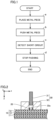
- Fig. 1 is a schematic flowchart illustrating a method of evaluating a power storage device according to the present embodiment.
- the method of evaluating a power storage device according to the present embodiment may also be simply called “the present evaluation method”.
- the present evaluation method includes "(a) placing a metal piece”, “(b) pushing the metal piece”, “(c) detecting a short circuit”, and “(d) stopping pushing”.
- Each procedure in the present evaluation method may be carried out in an environment at a low dew point, for example.
- Each procedure may be carried out in an environment at a constant temperature, for example.
- the present evaluation method includes placing a metal piece on an outer surface of the electrode assembly.
- a power storage device to be evaluated is prepared. The details of the power storage device will be described below.
- SOC of the power storage device may be adjusted.
- SOC State Of Charge
- SOC refers to a percentage of remaining capacity of a power storage device with respect to its rated capacity. SOC may be adjusted to 50% or more, or 60% or more, or 70% or more, or 80% or more, or 90% or more, or 100% or more, for example. SOC may be adjusted to 120% or less, or 110% or less, or 100% or less, for example.
- the power storage device includes an exterior member.
- the exterior member accommodates the electrode assembly. After SOC is adjusted, the exterior member may be opened and thereby the entirety of the electrode assembly may be taken out from the exterior member. For example, a portion of the exterior member may be removed to expose a portion of the outer surface of the electrode assembly (see Fig. 18 ).
- Fig. 2 is a conceptual view illustrating placement of a metal piece.
- An electrode assembly 10 includes a positive electrode 11, a separator 13, and a negative electrode 12. Separator 13 is interposed between positive electrode 11 and negative electrode 12. Separator 13 separates positive electrode 11 from negative electrode 12. Separator 13 may be exposed at the outer surface of electrode assembly 10.
- an insulating film (not illustrated) may be affixed.
- the outer surface of electrode assembly 10 is formed of separator 13.
- a metal piece 20 is placed on the outer surface of electrode assembly 10. The posture (orientation) of metal piece 20 is adjusted in such a way that the area of contact between metal piece 20 and electrode assembly 10 becomes maximum.
- metal piece 20 may include any metal material.
- metal piece 20 may include at least one selected from the group consisting of Al, Cu, Fe, Ni, and stainless steel (SUS).
- metal piece 20 may be made of SUS.
- the SUS may be any of SUS2XX (namely, those ranging from SUS200 to SUS299) (such as SUS201, for example), SUS3XX (such as SUS304, SUS316, for example), SUS4XX (such as SUS403, SUS430, for example), and SUS6XX (such as SUS630, SUS631).
- SUS304 is "Syurui no Kigou" (a symbol specifying the type) according to "JIS G 4303".
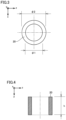
- Fig. 3 is a schematic plan view illustrating the metal piece.
- Metal piece 20 has a ring shape.
- the planar shape of metal piece 20 is not limited to circular.
- the planar shape of metal piece 20 may be circular, elliptical, or polygonal (such as triangular, square, or hexagonal).
- each of the inner diameter ( ⁇ 1) and the outer diameter ( ⁇ 2) of metal piece 20 refers to the maximum diameter in a plan view.
- the planar shape of metal piece 20 may be continuous for the entire contour.
- the planar shape of metal piece 20 may be partially discontinuous.
- the planar shape of metal piece 20 may be C-shaped.
- the inner diameter ( ⁇ 1) of metal piece 20 may be 0.1 mm or more, or 0.3 mm or more, or 0.5 mm or more, or 0.7 mm or more, for example.
- the inner diameter ( ⁇ 1) of metal piece 20 may be 1.5 mm or less, or 1.3 mm or less, or 1.1 mm or less, or 1.3 mm or less, for example.
- the outer diameter ( ⁇ 2) of metal piece 20 may be 0.3 mm or more, or 0.5 mm or more, or 0.7 mm or more, or 0.9 mm or more, for example.
- the outer diameter ( ⁇ 2) of metal piece 20 may be 2 mm or less, or 1.8 mm or less, or 1.6 mm or less, or 1.4 mm or less, for example.
- the difference between the outer diameter and the inner diameter ( ⁇ 2- ⁇ 1) may be 0.05 mm or more, or 0.1 mm, or 0.2 mm or more, or 0.3 mm or more, or 0.5 mm or more, for example.
- the difference between the outer diameter and the inner diameter ( ⁇ 2- ⁇ 1) may be 0.9 mm or less, or 0.8 mm or less, or 0.7 mm or less, for example.
- Fig. 4 is a schematic cross-sectional view illustrating the metal piece.
- the height (h) of metal piece 20 may be 0.2 mm or more, or 0.3 mm or more, or 0.4 mm or more, for example.
- the height (h) of metal piece 20 may be 0.5 mm or less, or 0.4 mm or less, for example.
- the present evaluation method includes pushing metal piece 20 into electrode assembly 10.
- a jig set 30 is used.
- Jig set 30 includes push jig 31 and a guide jig 32.
- Guide jig 32 has a through hole 32a.
- Guide jig 32 is placed on the outer surface of electrode assembly 10 in such a manner that metal piece 20 is accommodated inside through hole 32a.
- Push jig 31 is inserted into through hole 32a.
- a servo press machine and/or the like is used to drive push jig 31 in the Y-axis direction so that push jig 31 presses metal piece 20.
- Guide jig 32 guides the movement of the push jig in the Y-axis direction.
- push jig 31 pushes metal piece 20 out of through hole 32a, metal piece 20 is pushed into electrode assembly 10. Because push jig 31 presses metal piece 20 inside through hole 32a, unsuccessful pushing-into due to, for example, positional misalignment between push jig 31 and metal piece 20, and the like, may be reduced.
- Push jig 31 has a rod shape.
- Push jig 31 may have a round-rod shape, or a square-rod shape, or a flat-rod shape, for example.
- the shape of a cross section of push jig 31 orthogonal to the axial direction may be similar to the planar shape (the shape of an end face) of metal piece 20.
- Push jig 31 is electrically conductive.
- push jig 31 may include at least one selected from the group consisting of a metal material, a carbon material, an electrically-conductive resin material, an electrically-conductive ceramic material, and the like.
- the electrically-conductive resin material may be a resin material that has electrical conductivity.
- the electrically-conductive resin material may be a conductive material (such as a carbon material) dispersed in a matrix resin.
- the electrically-conductive ceramic material may be a ceramic material that has electrical conductivity.
- the electrically-conductive ceramic material may be a mixture of a ceramic material and a conductive material (such as a carbon material).
- Push jig 31 may be produced by any method.
- push jig 31 may be produced by an extrusion process, a drawing process, a bending process, a welding process, and/or the like.
- Push jig 31 may be a composite component.
- push jig 31 may be produced by covering a rod-shaped insulation material with a conductive material.
- the material (a constituent material) included by push jig 31 may have a resistivity of 1 ⁇ cm or less, or 10 -2 ⁇ cm or less, or 10 -4 ⁇ cm or less, or 10 -6 ⁇ cm or less, for example.
- Push jig 31 is as hard as or harder than metal piece 20. More specifically, the relationship of the following expression (1) is satisfied. H 0 ⁇ H 1
- Each of H 0 and H 1 may be a Vickers hardness.
- Each of H 0 and H 1 may be 150 HV or more.
- the relationship of the following expression (2) may be satisfied. 50 HV ⁇ H 1 ⁇ H 0
- H 1 may be 200 HV or more, or 300 HV or more, or 400 HV or more.
- H 1 may be 600 HV or less, or 400 HV or less, or 300 HV or less.
- H 0 may be from 50 to 200 HV, or from 100 to 200 HV, or from 150 to 200 HV.
- push jig 31 may include any material.
- push jig 31 may include at least one selected from the group consisting of Al, Cu, Fe, Ni, and SUS.
- push jig 31 may be formed of a material that is different from that of metal piece 20.
- push jig 31 may be formed of the same material as metal piece 20.
- the hardness of push jig 31 may be the same as that of metal piece 20.
- both the push jig 31 and the metal piece 20 may be made of SUS304.
- push jig 31 may be made of SUS630 and metal piece 20 may be made of SUS304.
- push jig 31 may be made of SUS440C and metal piece 20 may be made of SUS304.
- the push jig may be made of SUS304 and metal piece 20 may be made of a 2XXX Al.
- 2XXX Al refers to Al materials of Alloy Nos. 2XXX (ranging from 2000 to 2999) specified by "JIS H 4000".
- a constituent material of push jig 31 may have a low specific heat.
- the specific heat of the constituent material may be 1 kJ/(kg ⁇ K) or less, or 0.9 kJ/(kg ⁇ K) or less, or 0.8 kJ/(kg ⁇ K) or less, or 0.7 kJ/(kg ⁇ K) or less, or 0.6 kJ/(kg ⁇ K) or less, or 0.5 kJ/(kg ⁇ K) or less, or 0.4 kJ/(kg ⁇ K) or less, or 0.3 kJ/(kg ⁇ K) or less, or 0.2 kJ/(kg ⁇ K) or less, or 0.1 kJ/(kg ⁇ K) or less.
- the specific heat of the constituent material may be 0.1 kJ/(kg ⁇ K) or more, or 0.2 kJ/(kg ⁇ K) or more, or 0.3 kJ/(kg ⁇ K) or more, or 0.4 kJ/(kg ⁇ K) or more.
- the thermal conductivity of push jig 31 may be lower than that of metal piece 20.
- the thermal conductivity of the constituent material of push jig 31 may be 100 W/(m ⁇ k) or less, or 75 W/(m ⁇ k) or less, or 50 W/(m ⁇ k) or less, or 25 W/(m ⁇ k) or less, or 10 W/(m ⁇ k) or less.
- the thermal conductivity of the constituent material of push jig 31 may be 1 W/(m ⁇ k) or more, or 5 W/(m ⁇ k) or more, or 10 W/(m ⁇ k) or more.
- Push jig 31 may be either a solid material or a hollow material.
- push jig 31 when push jig 31 is a hollow material, heat capacity of push jig 31 may be reduced.
- push jig 31 may have a hollow rod shape.
- push jig 31 may have a hollow tubular shape.
- the hollow portion may extend through push jig 31 in the axial direction (the longitudinal direction). In the axial direction of push jig 31, the hollow portion may be open at both end faces, or may be open at one of the end faces.
- Push jig 31 may press metal piece 20 at an end face where the hollow portion is open. As long as it is capable of pushing metal piece 20, push jig 31 is not particularly limited in terms of the hollow rate.
- “Hollow rate” refers to the percentage of the volume of the hollow portion relative to the apparent volume of push jig 31.
- the apparent volume refers to the volume determined from the outer diameter dimensions.
- the apparent volume includes the volume of a hollow portion 31a.
- the hollow rate may be 1% or more, or 5% or more, or 10% or more, or 25% or more, or 50% or more, or 75% or more.
- the hollow rate may be 75% or less, or 50% or less, or 25% or less, or 10% or less, or 5% or less, or 1% or less.
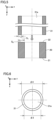
- Fig. 5 is a descriptive view illustrating the area of contact between the push jig and the metal piece.
- Metal piece 20 includes a first end face 21 and a second end face 22.
- Second end face 22 is a face opposite to first end face 21.
- Each of first end face 21 and second end face 22 may be independently either a flat face or a curved face.
- Metal piece 20 is pushed into electrode assembly 10 from the first end face 21 side.
- Push jig 31 has hollow portion 31a. Push jig 31 comes into contact with second end face 22. Second end face 22 is pressed by push jig 31.
- the area of contact between push jig 31 and second end face 22 may be smaller than the area of second end face 22. More specifically, the relationship of the following expression (3) may be satisfied.
- the difference in area is expressed as the difference in length.
- the area ratio (S 1 /S 0 ) is determined by dividing the area of contact between push jig 31 and second end face 22 by the area of second end face 22. When the relationship of the above expression (3) is satisfied, the area ratio (S 1 /S 0 ) is less than 1. The smaller the area ratio is, the less likely the heat escape to push jig 31 is expected to occur.
- the area ratio (S 1 /S 0 ) may be 0.9 or less, or 0.8 or less, or 0.7 or less, or 0.6 or less, or 0.5 or less, or 0.4 or less, or 0.3 or less, or 0.2 or less, or 0.1 or less.
- the area ratio (S 1 /S 0 ) may be 0.1 or more, or 0.2 or more, or 0.3 or more, or 0.4 or more, or 0.5 or more, or 0.6 or more, or 0.7 or more, or 0.8 or more, or 0.9 or more.
- Fig. 6 is a first example of the shape of an end face of the push jig.
- push jig 31 may have a single hollow portion 31a.
- the outer diameter ( ⁇ 4) of push jig 31 may be equal to the outer diameter ( ⁇ 2) of metal piece 20.
- the outer diameter ( ⁇ 4) of push jig 31 may be different from the outer diameter ( ⁇ 2) of metal piece 20.
- the inner diameter ( ⁇ 3) of push jig 31 may be larger than the inner diameter ( ⁇ 2) of metal piece 20.
- Fig. 7 is a second example of the shape of an end face of the push jig.
- push jig 31 may have a plurality of hollow portions 31a. Each hollow portion 31a may extend in the axial direction of push jig 31 (in the Y-axis direction). Hollow portions 31a may be parallel to one another.
- Fig. 8 is a schematic plan view illustrating a guide jig.
- guide jig 32 may also be called “a push jig guide”, "a sleeve”, and the like.
- Guide jig 32 has through hole 32a.
- the planar shape of guide jig 32 is not particularly limited.
- Guide jig 32 may have a shape and a size that are suitable for stable placement on the outer surface of electrode assembly 10.
- the planar shape of guide jig 32 may be rectangular, circular, and/or the like.
- Guide jig 32 has through hole 32a.
- the planar shape of through hole 32a may be similar to the planar shape (the shape of an end face) of metal piece 20.
- the planar shape of through hole 32a may be similar to the shape of an end face of push jig 31.
- the clearance is designed so that push jig 31 is capable of sliding inside the through hole 32a.
- the clearance refers to the difference between the outer diameter of push jig 31 and the inner diameter of through hole 32a.
- Guide jig 32 may include any material.
- guide jig 32 may include at least one selected from the group consisting of a metal material, a ceramic material, and a resin material.
- guide jig 32 may include at least one selected from the group consisting of phenolic resin (bakelite), polyvinyl chloride, acrylic resin, polyethylene terephthalate, fluororesin, nylon, polypropylene, and polyethylene.
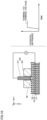
- Fig. 9 is a first conceptual view illustrating detection of a short circuit.
- the present evaluation method includes detecting a short circuit based on a change in potential difference between an electrode inside electrode assembly 10 and metal piece 20.
- the potential difference between positive electrode 11 and metal piece 20 may be measured, or the potential difference between negative electrode 12 and metal piece 20 may be measured.
- the potential difference between the second outermost electrode layer and metal piece 20 may be measured.
- the second outermost electrode layer is positive electrode 11.
- the potential difference is measured with a voltmeter. At the time when metal piece 20 is placed on the outer surface of electrode assembly 10, the potential difference is 0 V.
- Fig. 10 is a second conceptual view illustrating detection of a short circuit.
- Metal piece 20 is pushed into electrode assembly 10.
- negative electrode 12 When metal piece 20 comes into contact with negative electrode 12, a change in potential difference occurs. It is conceivable that the potential difference at the time when metal piece 20 has come into contact with negative electrode 12 is equal to the terminal-to-terminal voltage between positive electrode 11 and negative electrode 12.
- Fig. 11 is a third conceptual view illustrating detection of a short circuit.
- Metal piece 20 is further pushed into, and thereby metal piece 20 penetrates through negative electrode 12. Subsequently, metal piece 20 penetrates through separator 13. As a result of metal piece 20 penetrating through separator 13, metal piece 20 comes into contact with positive electrode 11. At this point, as a result of metal piece 20 penetrating through a single separator layer 13, negative electrode 12 and positive electrode 11 are short-circuited. That is, a single-layer short circuit has occurred.
- the potential difference decreases. That is, it is possible to detect a single-layer short circuit based on a change in potential difference. It is conceivable that a decrease in potential difference occurs as a result of the potential of metal piece 20 becoming equal to that of positive electrode 11. It is conceivable that the decrement of potential difference tends not to depend on the capacity of the power storage device. For example, at the time when a decrease in potential difference of at least 2 mV is observed, it may be judged that a short circuit has occurred.
- the pushing rate is not particularly limited. However, the lower the pushing rate is, the smaller the time lag between short circuit detection and stopping pushing.
- the pushing rate may be 1 mm/s or less, or 0.1 mm/s or less, or 0.05 mm/s or less, or 0.01 mm/s or less.
- the pushing rate may be 0.001 mm/s or more, or 0.005 mm/s or more, or 0.01 mm/s or more.
- the present evaluation method includes stopping the action of pushing the metal piece. Pushing the metal piece may be stopped immediately after detection of a short circuit.
- the state of electrode assembly 10 is checked. Based on the state of electrode assembly 10, the power storage device may be evaluated. The checking of the state may be continued for a predetermined period of time.
- the checking duration may be 1 minute or more, or 1 hour or more, or 3 hours or more, or 6 hours or more.
- the checking duration may be 24 hours or less, or 12 hours or less.
- the state of the electrode assembly may include at least one selected from the group consisting of appearance, surface temperature, and terminal-to-terminal voltage.
- the appearance may be checked by visual examination.
- the appearance may be recorded on a recording apparatus.
- a change in appearance may be in the form of discoloration and/or smoking.
- the presence or absence of an appearance change, the extent of the appearance change, and/or the like may be used to evaluate whether the power storage device is failed or not.
- the surface temperature may be measured with a temperature sensor and/or the like.
- the temperature sensor may include a thermocouple, a thermography, and/or the like.
- the surface temperature may be used to evaluate whether the power storage device is failed or not.
- the terminal-to-terminal voltage may be measured with a voltmeter.
- Fig. 12 is a schematic flowchart illustrating a method of producing a power storage device according to the present embodiment.
- the method of producing a power storage device according to the present embodiment may also be simply called “the present production method”.
- the present production method includes "(A) producing a power storage device” and "(B) evaluating the power storage device”.
- the present production method includes producing a power storage device.
- a single power storage device may be produced, or a plurality of power storage devices may be produced.
- a plurality of power storage devices having the same specifications may be produced.
- power storage devices having different specifications may be produced.
- the present production method includes evaluating the power storage device.
- Each power storage device is evaluated by the present evaluation method as described above.
- the present evaluation method may be utilized in sampling inspection and/or the like during production of the power storage device.
- one or more power storage devices may be taken out from a production lot.
- evaluation results of the one or more power storage devices may be used to evaluate whether the production lot is failed or not.
- the present evaluation method may be utilized in specifications determination and/or the like during development of the power storage device.
- a plurality of power storage devices of the same specifications may be produced.
- evaluation results of one or more power storage devices may be used to evaluate whether the specifications are a failure or not.
- Power storage device refers to a device that is capable of storing electrical energy.
- the specific configuration and the structure of the power storage device are not particularly limited.
- the power storage device may be "a battery".
- the battery may be either a primary battery or a secondary battery.
- the battery may be any of a lead battery, a nickel-cadmium battery, a nickel-metal hydride battery, a nickel-zinc battery, a lithium-ion battery, a sodium-ion battery, a lithium primary battery, or the like.
- the battery may be any of a liquid-type battery, a polymer battery, or an all-solid-state battery.
- the battery may include at least one selected from the group consisting of a liquid electrolyte (an electrolyte solution), a gelled electrolyte, and a solid electrolyte.
- the power storage device may be either of a monopolar (unipolar) type or of a bipolar type.
- the power storage device includes an electrode assembly.
- the power storage device may further include an exterior member.
- "Exterior member” is a member that is capable of accommodating the electrode assembly.
- the exterior member may also be called a housing, a case, a can, and the like.
- the exterior member may include a container made of metal.
- the exterior member may include a pouch made of a metal foil laminated film, and the like.
- Electrode assembly is a group of electrodes.
- the electrode assembly may also be called an electrode group, an electrode body, an assembly of electrodes, an electrode winding assembly, an electrode stack, and the like.
- the electrode assembly includes a positive electrode, a separator, and a negative electrode.
- the separator is interposed between the positive electrode and the negative electrode. The separator separates the positive electrode from the negative electrode.
- Fig. 13 is a schematic view illustrating a prismatic battery.
- a prismatic battery 100 is an example of the power storage device.
- Prismatic battery 100 includes an electrode assembly 110 and an exterior member 120.
- Exterior member 120 is a container having a prismatic shape.
- the "prismatic" shape refers to a rectangular parallelepiped.
- exterior member 120 may be made of a metal material.
- exterior member 120 may be made of Al, or made of an Al alloy or the like, or may be made of SUS, or may be made of Fe, or may be made of a resin material.
- exterior member 120 may be equipped with a liquid inlet hole, a gas-discharge valve, a CID (Current Interrupt Device), and/or the like.
- Exterior member 120 is hermetically sealed. Exterior member 120 accommodates electrode assembly 110.
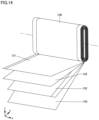
- Electrode assembly 110 may be an electrode winding assembly 130.
- Electrode winding assembly 130 includes a positive electrode 131, a negative electrode 132, and a separator 133. Each of positive electrode 131, negative electrode 132, and separator 133 is a belt-shaped sheet.
- Electrode winding assembly 130 may include two separators 133.
- positive electrode 131, separator 133 (first one), negative electrode 132, and separator 133 (second one) may be stacked in this order to form a stack.
- the resulting stack may be wound spirally to form electrode winding assembly 130.
- electrode winding assembly 130 may be shaped into a flat form by pressing.
- electrode winding assembly 130 is impregnated with an electrolyte solution.
- positive electrode 131 includes a positive electrode current collector and a positive electrode active material layer.
- the positive electrode current collector may include a metal foil and/or the like.
- the positive electrode current collector may include an Al foil and/or the like.
- the positive electrode active material layer may be placed on the surface of the positive electrode current collector.
- the positive electrode active material layer includes a positive electrode active material.
- the positive electrode active material layer may further include a conductive material, a binder, and the like.
- the positive electrode active material may include a lithium-containing transition metal composite oxide (such as LiNi 1/3 Co 1/3 Mn 1/3 O 2 , LiNi 0.8 Co 0.15 Al 0.05 O 2 , for example).
- negative electrode 132 includes a negative electrode current collector and a negative electrode active material layer.
- the negative electrode current collector may include a metal foil and/or the like.
- the negative electrode active material layer may be placed on the surface of the negative electrode current collector.
- the negative electrode active material layer includes a negative electrode active material.
- the negative electrode active material layer may further include a conductive material, a binder, and the like.
- the negative electrode active material may include graphite and/or the like.
- separator 133 may include a porous film.
- the porous film may be made of polyethylene (PE), or may be made of polypropylene (PP), or may be made of polyamide (PA).
- the porous film may have a multilayer structure.
- the porous film may be formed by stacking a PP layer, a PE layer, and a PP layer in this order.
- separator 133 may further include a ceramic layer and/or the like.
- the ceramic layer may be placed on the surface of the porous film.
- the ceramic layer includes a ceramic material and a binder.
- the ceramic material may include alumina, boehmite, and/or the like.
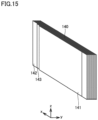
- Electrode assembly 110 may be an electrode stack 140.
- Electrode stack 140 includes a positive electrode 141, a negative electrode 142, and a separator 143.
- Each of positive electrode 141, negative electrode 142, and separator 143 is a rectangular sheet.
- Positive electrode 141 and negative electrode 142 may be alternately stacked to form electrode stack 140.
- Separator 143 is interposed between every pair of positive electrode 141 and negative electrode 142.
- electrode stack 140 is impregnated with an electrolyte solution.
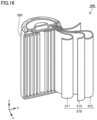
- FIG. 16 is a schematic view illustrating a cylindrical battery.
- a cylindrical battery is an example of the power storage device.
- a cylindrical battery 200 includes an electrode assembly 210 and an exterior member 220.
- Exterior member 220 is a cylindrical container.
- exterior member 220 may be made of SUS, or may be made of Fe, or may be made of a resin material.
- Exterior member 220 is hermetically sealed.
- Exterior member 220 accommodates electrode assembly 210.
- Electrode assembly 210 includes a positive electrode 211, a negative electrode 212, and a separator 213.
- electrode assembly 210 may be an electrode winding assembly.
- electrode assembly 210 may be wound in a tubular shape.
- Fig. 17 is a schematic view illustrating a pouch-type battery.
- a pouch-type battery is an example of the power storage device.
- a pouch-type battery may also be called "a laminate-type battery" and the like.
- a pouch-type battery 300 includes an exterior member 320 and an electrode assembly.
- Exterior member 320 is a pouch made of an aluminum-laminated film.
- the pouch is hermetically sealed by heat sealing.
- Exterior member 320 accommodates the electrode assembly.
- the electrode assembly may be an electrode winding assembly.
- the electrode assembly may be an electrode stack.
- Fig. 18 is a schematic view illustrating an example of opening an exterior member.
- a portion of exterior member 320 may be removed to expose a portion of an electrode assembly 310.
- metal piece 20 may be placed.
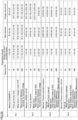
- Fig. 19 is a table showing the configuration of test products. Power storage devices having the configuration specified in Fig. 19 were prepared.
- Fig. 20 is a table showing experiment results.
- short-circuit testing was carried out.
- the short-circuit testing was carried out for 10 power storage device cells of respective configurations ranging from 5 Ah to 200 Ah. After testing, the power storage device was disassembled, and the number of short-circuited layers and the melt diameter were evaluated.
- the number of short-circuited layers refers to the number of separator layers through which the metal piece penetrated.
- “ 1 (10/10)” means that the number of short-circuited layers was one in 10 out of 10 tests.
- 1 (7/10), 0 (3/10) means that the number of short-circuited layers was one in 7 out of 10 tests and the number of short-circuited layers was zero (no short circuit) in 3 tests.
- ⁇ (7/10), 0 (3/10) means that a hole having a diameter of ⁇ (unit, mm) was formed in the separator in 7 out of 10 tests and no hole was formed in the separator in 3 tests.
- ⁇ (10/10) means that a hole having a diameter of 2 ⁇ (twice the diameter ⁇ ) was formed in the separator in 10 out of 10 tests.
- ⁇ means a voltage decrement of 2 mV or more.
- N means that the voltage decrement was less than 2 mV.
- ⁇ (7/10), N (3/10) means that a voltage decrement of ⁇ (unit, mV) was observed in 7 out of 10 tests and a voltage decrement of less than 2 mV was observed in 3 tests.
- 0.5 ⁇ means 0.5 times the amount ⁇ .
- No. 1 was carried out in accordance with "Forced internal short circuit test" specified by IEC62660-3.
- the metal piece was L-shaped (made of Ni).
- the height of the metal piece was 0.2 mm, the length of each side of the L shape was 1 mm (the total length was 2 mm), and the width of the metal piece was 0.1 mm.
- the push jig was a block made of acrylic resin (5 mm ⁇ 5 mm). The pushing rate was 0.01 mm/s.
- a terminal-to-terminal voltage decrement of 2 mV or more was regarded as indicating an occurrence of a short circuit.
- No. 1 a terminal-to-terminal voltage decrement of 2 mV or more was regarded as indicating an occurrence of a short circuit.
- No. 1 a terminal-to-terminal voltage decrement of 2 mV or more was regarded as indicating an occurrence of a short circuit.
- No. 1 a terminal-to-terminal voltage de
- No. 2 was carried out in accordance with the method of evaluating a power storage device described by Japanese Patent Laying-Open No. 2020-191181 .
- the metal piece had a ring shape (made of SUS).
- the push jig was a rod made of bakelite.
- the pushing rate was 0.01 mm/s.
- a terminal-to-terminal voltage decrement of 2 mV or more was regarded as indicating an occurrence of a short circuit.
- the pushing load reached 400 N, pushing was stopped.
- "Number of short-circuited layers" of Fig. 20 indicates that, in No. 2, there is a tendency that as the capacity of the power storage device increased, the number of short-circuited layers increased.
- No. 3 was carried out in accordance with the present evaluation method.
- the metal piece had a ring shape (made of SUS).
- the push jig was a solid rod made of metal.
- the pushing rate was 0.01 mm/s.
- a decrease in potential difference between the positive electrode and the metal piece was regarded as indicating an occurrence of a short circuit.
- "Number of short-circuited layers" of Fig. 20 indicates that, in No. 3, single-layer short-circuiting was maintained even when the capacity of the power storage device increased. That is, reproducibility of single-layer short-circuiting was improved.
- Fig. 21 is a graph showing the relationship between the average number of short-circuited layers and the capacity of the power storage device. At a capacity of 50 Ah or more, No. 1 and No. 2 are markedly different from single-layer short-circuiting. In contrast, in No. 3, a single-layer short circuit is reproduced stably.
- No. 4 was carried out in accordance with the present evaluation method.
- the metal piece had a ring shape (made of SUS).
- the push jig was a hollow rod made of metal.
- the pushing rate was 0.01 mm/s.
- a decrease in potential difference between the positive electrode and the metal piece was regarded as indicating an occurrence of a short circuit.
- "Number of short-circuited layers" of Fig. 20 indicates that, in No. 4, single-layer short-circuiting was maintained even when the capacity of the power storage device increased.
- the push jig was a solid material.
- the push jig was a hollow material.
- the melt diameter in No. 4 was greater than that in No. 3. It may be because heat escape to a hollow material tends not to occur as compared to heat escape to a solid material.
- melt diameter there is a correlation between the melt diameter and the voltage decrement. More specifically, the greater the melt diameter is, the greater the voltage decrement (absolute value) tends to be. The greater the voltage decrement is, the more enhanced the accuracy of short circuit detection is expected to be.
Landscapes
- Physics & Mathematics (AREA)
- General Physics & Mathematics (AREA)
- Engineering & Computer Science (AREA)
- Power Engineering (AREA)
- Electric Double-Layer Capacitors Or The Like (AREA)
- Secondary Cells (AREA)
- Fixed Capacitors And Capacitor Manufacturing Machines (AREA)
Description
- The present disclosure relates to a method of evaluating a power storage device, an arrangement, and a method of producing a power storage device.
-
Japanese Patent Laying-Open No. 2020-191181 - There is a demand for simulation of micro short-circuiting which can be caused by foreign object contamination. Conventionally, simulation of a micro short circuit is carried out by "Forced internal short circuit test" specified in IEC62660-3. A power storage device comprises an electrode assembly. In the forced internal short circuit test, the electrode assembly in a charged state is partly disassembled, and a metal piece (a simulated foreign object) is placed inside the electrode assembly. The metal piece has an L-shaped outer profile. This procedure is very difficult to implement and needs to be taken care of by a skilled, experienced person. A test method that does not require skills or experience is demanded.
-
Japanese Patent Laying-Open No. 2020-191181 - A first issue is that the detection of a short circuit relies on a voltage drop in the power storage device. As the capacity of the power storage device is increased, a voltage decrement caused by a short circuit becomes smaller. Because of this, as the capacity of the power storage device is increased, detection of a short circuit becomes difficult. At the time when a voltage drop is detected, there is a possibility that the metal piece can have already penetrated through two or more separator layers. Usually, a micro short circuit caused by foreign object contamination is "a single-layer short circuit". A single-layer short circuit occurs when a foreign object penetrates through a single separator layer. Simulation of a single-layer short circuit is demanded. Penetration by a metal piece through two or more separator layers is different from single-layer short-circuiting.
- A second issue is that the push jig is made of resin. There is a possibility that the push jig can be softer than the metal piece. In that case, the pushing load tends not to be transferred to the metal piece, and rather tends to escape to the push jig. As a result, the metal piece can be pushed into the electrode assembly not very smoothly, and at the moment when the metal piece penetrates through the outermost layer of the electrode assembly, the metal piece can be pushed into very quickly with a strong force. As a consequence, there is a possibility that the metal piece can penetrate through two or more separator layers.
- An object of the present disclosure is to improve reproducibility of single-layer short-circuiting.
- Hereinafter, the technical configuration and effects of the present disclosure will be described. It should be noted that the action mechanism according to the present specification includes presumption. The action mechanism does not limit the technical scope of the present disclosure.
- A method of evaluating a power storage device is defined in
claim 1. - In the method of evaluating a power storage device according to the present disclosure, detection of a short circuit is based on a change in potential difference between the electrode (either a positive electrode or a negative electrode) and the metal piece (a simulated foreign object). The amount of change in potential difference between the electrode and the metal piece tends not to be affected by the capacity of the power storage device. Hence, even when the capacity of the power storage device is increased, a single-layer short circuit may be detected accurately.
- In the method of evaluating a power storage device according to the present disclosure, the push jig is electrically conductive. By measuring the electric potential of the push jig which is in contact with the metal piece, it is possible to measure the electric potential of the metal piece.
- Furthermore, the push jig is as hard as or harder than the metal piece. The pushing load tends not to escape to the push jig, and as a result, the metal piece may be pushed into the electrode assembly smoothly.
- Due to the synergistic effect of the above-described actions, reproducibility of single-layer short-circuiting is expected to be improved.
- The method of evaluating a power storage device may include the following configuration.
- The push jig has a hollow rod shape.
- When a short-circuit current flows through the metal piece, Joule heat is generated. The Joule heat melts the separator, at and around the position of the metal piece. Hereinafter, the diameter of a hole that is formed by the melting of the separator is referred to as "a melt diameter". The larger the melt diameter is, the greater the amount of change in potential difference between the electrode and the metal piece may be. This means that the accuracy of short circuit detection is expected to be enhanced. However, if the heat escapes from the metal piece toward the push jig, there is a possibility that the melt diameter can become smaller. The heat capacity of a hollow material is lower than that of a solid material. When the push jig is a hollow material, heat escape to the push jig is expected to be reduced. That is, accuracy of short circuit detection is expected to be enhanced.
- The method of evaluating a power storage device may include the following configuration. The metal piece has a first end face and a second end face. The second end face is a face opposite to the first end face. In the (b), the push jig comes into contact with the second end face. An area of contact between the push jig and the second end face is smaller than an area of the second end face.
- With the area of contact between the push jig and the metal piece being small, heat escape from the metal piece toward the push jig is expected to be reduced. That is, accuracy of short circuit detection is expected to be enhanced.
- The method of evaluating a power storage may include the following configuration. The push jig is made of metal.
- There may be a wide variety of metal materials that are harder than the metal piece and electrically conductive. As a matter of course, as long as it is harder than the metal piece and electrically conductive, the material of the push jig is not particularly limited to a metal material.
- An arrangement used in the method of evaluating a power storage device is defined in
claim 5. - A method of producing a power storage device is defined in
claim 6. - Next, an embodiment of the present disclosure (which may also be simply called "the present embodiment" hereinafter) and an example of the present disclosure (which may also be simply called "the present example" hereinafter) will be described. It should be noted that neither the present embodiment nor the present example limits the technical scope of the present disclosure. The present embodiment and the present example are illustrative in any respect. The present embodiment and the present example are non-restrictive. The technical scope of the present disclosure encompasses any modifications within the meaning and the scope of the claims.
- The foregoing and other objects, features, aspects and advantages of the present disclosure will become more apparent from the following detailed description of the present disclosure when taken in conjunction with the accompanying drawings.
-
-
Fig. 1 is a schematic flowchart illustrating a method of evaluating a power storage device according to the present embodiment. -
Fig. 2 is a conceptual view illustrating placement of a metal piece. -
Fig. 3 is a schematic plan view illustrating the metal piece. -
Fig. 4 is a schematic cross-sectional view illustrating the metal piece. -
Fig. 5 is a descriptive view illustrating the area of contact between a push jig and a metal piece. -
Fig. 6 is a first example of the shape of an end face of the push jig. -
Fig. 7 is a second example of the shape of an end face of the push jig. -
Fig. 8 is a schematic plan view illustrating a guide jig. -
Fig. 9 is a first conceptual view illustrating detection of a short circuit. -
Fig. 10 is a second conceptual view illustrating detection of a short circuit. -
Fig. 11 is a third conceptual view illustrating detection of a short circuit. -
Fig. 12 is a schematic flowchart illustrating a method of producing a power storage device according to the present embodiment. -
Fig. 13 is a schematic view illustrating a prismatic battery. -
Fig. 14 is a schematic view illustrating an electrode winding assembly. -
Fig. 15 is a schematic view illustrating an electrode stack. -
Fig. 16 is a schematic view illustrating a cylindrical battery. -
Fig. 17 is a schematic view illustrating a pouch-type battery. -
Fig. 18 is a schematic view illustrating an example of opening an exterior member. -
Fig. 19 is a table showing the configuration of test products. -
Fig. 20 is a table showing experiment results. -
Fig. 21 is a graph showing the relationship between the average number of short-circuited layers and the capacity of the power storage device. - A description will be provided for terms that are used in the present specification. Terms that are not described here may be described in the specification when the term is used.
- Expressions such as "comprise", "include", and "have", and other similar expressions (such as "be composed of", for example) are open-ended expressions. In an open-ended expression, in addition to an essential component, an additional component may or may not be further included. The expression "consist of" is a closed-end expression. However, even when a closed-end expression is used, impurities present under ordinary circumstances as well as an additional element irrelevant to the technique according to the present disclosure are not excluded. The expression "consist essentially of" is a semiclosed-end expression. A semiclosed-end expression tolerates addition of an element that does not substantially affect the fundamental, novel features of the technique according to the present disclosure.
- Expressions such as "may" and "can" are not intended to mean "must" (obligation) but rather mean "there is a possibility" (tolerance).
- Regarding a plurality of steps, operations, processes, and the like that are included in various methods, the order for implementing those things is not limited to the described order, unless otherwise specified. For example, a plurality of steps may proceed simultaneously. For example, a plurality of steps may be implemented in reverse order.
- Any geometric term (such as "parallel", "vertical", and "orthogonal", for example) should not be interpreted solely in its exact meaning. For example, "parallel" may mean a geometric state that is deviated, to some extent, from exact "parallel". Any geometric term herein may include tolerances and/or errors in terms of design, operation, production, and/or the like. The dimensional relationship in each figure may not necessarily coincide with the actual dimensional relationship. The dimensional relationship (in length, width, thickness, and the like) in each figure may have been changed for the purpose of assisting understanding for the readers. Further, a part of a given configuration may have been omitted.
- A numerical range such as "from m to n%" includes both the upper limit and the lower limit, unless otherwise specified. That is, "from m to n%" means a numerical range of "not less than m% and not more than n%". Moreover, "not less than m% and not more than n%" includes "more than m% and less than n%". Further, any numerical value selected from a certain numerical range may be used as a new upper limit or a new lower limit. For example, any numerical value from a certain numerical range may be combined with any numerical value described in another location of the present specification or in a table or a drawing to set a new numerical range.
- All the numerical values are regarded as being modified by the term "about". The term "about" may mean ±5%, ±3%, ±1%, and/or the like, for example. Each numerical value may be an approximate value that can vary depending on the implementation configuration of the technique according to the present disclosure. Each numerical value may be expressed in significant figures. Unless otherwise specified, each measured value may be the average value obtained from multiple measurements performed. The number of measurements may be 3 or more, or may be 5 or more, or may be 10 or more. Generally, the greater the number of measurements is, the more reliable the average value is expected to be. Each measured value may be rounded off based on the number of the significant figures. Each measured value may include an error occurring due to an identification limit of the measurement apparatus, for example.
- "Electrode" collectively refers to a positive electrode and a negative electrode. An electrode may be either a positive electrode or a negative electrode.
- "Hardness" is expressed by a value that is measurable for both a metal piece and a push jig. For example, in the case where the push jig is made of metal, the hardness of the metal piece and the push jig may be expressed by a Vickers hardness, for example. "Vickers hardness" may be measured by the procedure described below. A pyramid-shaped indenter made of diamond is pressed against the surface of a sample with a test force (F) to form an indentation. With the use of a microscope, the length of a diagonal line of the indentation is measured. From the length of the diagonal line, the surface area (S) of the indentation is determined. The test force (F) is divided by the surface area (S), and thereby the Vickers hardness is determined.
- For example, the hardness of the metal piece and the push jig may be expressed by tensile yield stress. "Tensile yield stress" may be measured by the procedure described below. A sample is formed into a dumbbell-like shape to prepare a test piece. Tensile stress is applied in the axial direction (the longitudinal direction) of the test piece until the test piece becomes broken. Upper yield stress on a stress-strain diagram is divided by the cross-sectional area of the test piece, and thereby the tensile yield stress is determined.
- "The push jig that is electrically conductive" includes a push jig that is electrically conductive as a whole as well as a push jig that is partially electrically conductive. For example, only the surface of the push jig may be electrically conductive. When a material that constitutes at least part of the surface of the push jig has a resistivity of 108 Ωcm or less, the push jig is regarded as being electrically conductive.
-
Fig. 1 is a schematic flowchart illustrating a method of evaluating a power storage device according to the present embodiment. Hereinafter, "the method of evaluating a power storage device according to the present embodiment" may also be simply called "the present evaluation method". The present evaluation method includes "(a) placing a metal piece", "(b) pushing the metal piece", "(c) detecting a short circuit", and "(d) stopping pushing". Each procedure in the present evaluation method may be carried out in an environment at a low dew point, for example. Each procedure may be carried out in an environment at a constant temperature, for example. - The present evaluation method includes placing a metal piece on an outer surface of the electrode assembly. A power storage device to be evaluated is prepared. The details of the power storage device will be described below. For example, SOC of the power storage device may be adjusted. "SOC (State Of Charge)" refers to a percentage of remaining capacity of a power storage device with respect to its rated capacity. SOC may be adjusted to 50% or more, or 60% or more, or 70% or more, or 80% or more, or 90% or more, or 100% or more, for example. SOC may be adjusted to 120% or less, or 110% or less, or 100% or less, for example.
- The power storage device includes an exterior member. The exterior member accommodates the electrode assembly. After SOC is adjusted, the exterior member may be opened and thereby the entirety of the electrode assembly may be taken out from the exterior member. For example, a portion of the exterior member may be removed to expose a portion of the outer surface of the electrode assembly (see
Fig. 18 ). -
Fig. 2 is a conceptual view illustrating placement of a metal piece. Anelectrode assembly 10 includes apositive electrode 11, aseparator 13, and anegative electrode 12.Separator 13 is interposed betweenpositive electrode 11 andnegative electrode 12.Separator 13 separatespositive electrode 11 fromnegative electrode 12.Separator 13 may be exposed at the outer surface ofelectrode assembly 10. To the outer surface ofelectrode assembly 10, an insulating film (not illustrated) may be affixed. InFig. 2 , the outer surface ofelectrode assembly 10 is formed ofseparator 13. On the outer surface ofelectrode assembly 10, ametal piece 20 is placed. The posture (orientation) ofmetal piece 20 is adjusted in such a way that the area of contact betweenmetal piece 20 andelectrode assembly 10 becomes maximum. - As long as it has a hardness equal to or less than that of a push jig 31 (described below),
metal piece 20 may include any metal material. For example,metal piece 20 may include at least one selected from the group consisting of Al, Cu, Fe, Ni, and stainless steel (SUS). For example,metal piece 20 may be made of SUS. For example, the SUS may be any of SUS2XX (namely, those ranging from SUS200 to SUS299) (such as SUS201, for example), SUS3XX (such as SUS304, SUS316, for example), SUS4XX (such as SUS403, SUS430, for example), and SUS6XX (such as SUS630, SUS631). The notation such as "SUS304" is "Syurui no Kigou" (a symbol specifying the type) according to "JIS G 4303". -
Fig. 3 is a schematic plan view illustrating the metal piece.Metal piece 20 has a ring shape. As long as it has a ring shape, the planar shape ofmetal piece 20 is not limited to circular. For example, the planar shape ofmetal piece 20 may be circular, elliptical, or polygonal (such as triangular, square, or hexagonal). When the planar shape is not circular, each of the inner diameter (φ1) and the outer diameter (φ2) ofmetal piece 20 refers to the maximum diameter in a plan view. - The planar shape of
metal piece 20 may be continuous for the entire contour. The planar shape ofmetal piece 20 may be partially discontinuous. For example, the planar shape ofmetal piece 20 may be C-shaped. - The inner diameter (φ1) of
metal piece 20 may be 0.1 mm or more, or 0.3 mm or more, or 0.5 mm or more, or 0.7 mm or more, for example. The inner diameter (φ1) ofmetal piece 20 may be 1.5 mm or less, or 1.3 mm or less, or 1.1 mm or less, or 1.3 mm or less, for example. - The outer diameter (φ2) of
metal piece 20 may be 0.3 mm or more, or 0.5 mm or more, or 0.7 mm or more, or 0.9 mm or more, for example. The outer diameter (φ2) ofmetal piece 20 may be 2 mm or less, or 1.8 mm or less, or 1.6 mm or less, or 1.4 mm or less, for example. - The difference between the outer diameter and the inner diameter (φ2-φ1) may be 0.05 mm or more, or 0.1 mm, or 0.2 mm or more, or 0.3 mm or more, or 0.5 mm or more, for example. The difference between the outer diameter and the inner diameter (φ2-φ1) may be 0.9 mm or less, or 0.8 mm or less, or 0.7 mm or less, for example.
-
Fig. 4 is a schematic cross-sectional view illustrating the metal piece. The height (h) ofmetal piece 20 may be 0.2 mm or more, or 0.3 mm or more, or 0.4 mm or more, for example. The height (h) ofmetal piece 20 may be 0.5 mm or less, or 0.4 mm or less, for example. - The present evaluation method includes pushing
metal piece 20 intoelectrode assembly 10. In the present evaluation method, a jig set 30 is used. Jig set 30 includespush jig 31 and aguide jig 32.Guide jig 32 has a throughhole 32a.Guide jig 32 is placed on the outer surface ofelectrode assembly 10 in such a manner thatmetal piece 20 is accommodated inside throughhole 32a. Pushjig 31 is inserted into throughhole 32a. For example, a servo press machine and/or the like is used to drivepush jig 31 in the Y-axis direction so thatpush jig 31 pressesmetal piece 20.Guide jig 32 guides the movement of the push jig in the Y-axis direction. Aspush jig 31 pushesmetal piece 20 out of throughhole 32a,metal piece 20 is pushed intoelectrode assembly 10. Becausepush jig 31 pressesmetal piece 20 inside throughhole 32a, unsuccessful pushing-into due to, for example, positional misalignment betweenpush jig 31 andmetal piece 20, and the like, may be reduced. - Push
jig 31 has a rod shape. Pushjig 31 may have a round-rod shape, or a square-rod shape, or a flat-rod shape, for example. The shape of a cross section ofpush jig 31 orthogonal to the axial direction may be similar to the planar shape (the shape of an end face) ofmetal piece 20. - Push
jig 31 is electrically conductive. For example, pushjig 31 may include at least one selected from the group consisting of a metal material, a carbon material, an electrically-conductive resin material, an electrically-conductive ceramic material, and the like. The electrically-conductive resin material may be a resin material that has electrical conductivity. The electrically-conductive resin material may be a conductive material (such as a carbon material) dispersed in a matrix resin. The electrically-conductive ceramic material may be a ceramic material that has electrical conductivity. The electrically-conductive ceramic material may be a mixture of a ceramic material and a conductive material (such as a carbon material). Pushjig 31 may be produced by any method. For example, pushjig 31 may be produced by an extrusion process, a drawing process, a bending process, a welding process, and/or the like. Pushjig 31 may be a composite component. For example, pushjig 31 may be produced by covering a rod-shaped insulation material with a conductive material. - The material (a constituent material) included by
push jig 31 may have a resistivity of 1 Ωcm or less, or 10-2 Ωcm or less, or 10-4 Ωcm or less, or 10-6 Ωcm or less, for example. - Push
jig 31 is as hard as or harder thanmetal piece 20. More specifically, the relationship of the following expression (1) is satisfied.
- H0: Hardness of
metal piece 20 - Hi: Hardness of
push jig 31 - The hardness ratio (H1/H0) is determined by dividing the hardness of
push jig 31 by the hardness ofmetal piece 20. The hardness ratio (H1/H0) derived from the above expression (1) is 1 or more. For example, the hardness ratio (H1/H0) may be 1.1 or more, or 1.2 or more, or 1.5 or more, or 2 or more, or 3 or more. For example, the hardness ratio (H1/H0) may be 3 or less, or 2 or less, or 1.5 or less, or 1.2 or less, or 1.1 or less. - Each of H0 and H1 may be a Vickers hardness. Each of H0 and H1 may be 150 HV or more. For example, the relationship of the following expression (2) may be satisfied.

- For example, H1 may be 200 HV or more, or 300 HV or more, or 400 HV or more. For example, H1 may be 600 HV or less, or 400 HV or less, or 300 HV or less. For example, H0 may be from 50 to 200 HV, or from 100 to 200 HV, or from 150 to 200 HV.
- As long as it is as hard as or harder than
metal piece 20,push jig 31 may include any material. For example, pushjig 31 may include at least one selected from the group consisting of Al, Cu, Fe, Ni, and SUS. For example, pushjig 31 may be formed of a material that is different from that ofmetal piece 20. For example, pushjig 31 may be formed of the same material asmetal piece 20. Whenpush jig 31 is formed of the same material asmetal piece 20, the hardness ofpush jig 31 may be the same as that ofmetal piece 20. For example, both thepush jig 31 and themetal piece 20 may be made of SUS304. For example, pushjig 31 may be made of SUS630 andmetal piece 20 may be made of SUS304. For example, pushjig 31 may be made of SUS440C andmetal piece 20 may be made of SUS304. For example, the push jig may be made of SUS304 andmetal piece 20 may be made of a 2XXX Al. "2XXX Al" refers to Al materials of Alloy Nos. 2XXX (ranging from 2000 to 2999) specified by "JIS H 4000". - A constituent material of
push jig 31 may have a low specific heat. The lower the specific heat of the constituent material is, the more reduced the heat capacity ofpush jig 31 may be. The lower the heat capacity is, the more reduced the heat escape to pushjig 31 tends to be. For example, the specific heat of the constituent material may be 1 kJ/(kg·K) or less, or 0.9 kJ/(kg·K) or less, or 0.8 kJ/(kg·K) or less, or 0.7 kJ/(kg·K) or less, or 0.6 kJ/(kg·K) or less, or 0.5 kJ/(kg·K) or less, or 0.4 kJ/(kg·K) or less, or 0.3 kJ/(kg·K) or less, or 0.2 kJ/(kg·K) or less, or 0.1 kJ/(kg·K) or less. For example, the specific heat of the constituent material may be 0.1 kJ/(kg·K) or more, or 0.2 kJ/(kg·K) or more, or 0.3 kJ/(kg·K) or more, or 0.4 kJ/(kg·K) or more. - For example, the thermal conductivity of
push jig 31 may be lower than that ofmetal piece 20. The lower the thermal conductivity ofpush jig 31 is, the more reduced the heat escape to pushjig 31 tends to be. For example, the thermal conductivity of the constituent material ofpush jig 31 may be 100 W/(m·k) or less, or 75 W/(m·k) or less, or 50 W/(m·k) or less, or 25 W/(m·k) or less, or 10 W/(m·k) or less. For example, the thermal conductivity of the constituent material ofpush jig 31 may be 1 W/(m·k) or more, or 5 W/(m·k) or more, or 10 W/(m·k) or more. - Push
jig 31 may be either a solid material or a hollow material. For example, whenpush jig 31 is a hollow material, heat capacity ofpush jig 31 may be reduced. For example, pushjig 31 may have a hollow rod shape. For example, pushjig 31 may have a hollow tubular shape. For example, the hollow portion may extend throughpush jig 31 in the axial direction (the longitudinal direction). In the axial direction ofpush jig 31, the hollow portion may be open at both end faces, or may be open at one of the end faces. Pushjig 31 may pressmetal piece 20 at an end face where the hollow portion is open. As long as it is capable of pushingmetal piece 20,push jig 31 is not particularly limited in terms of the hollow rate. "Hollow rate" refers to the percentage of the volume of the hollow portion relative to the apparent volume ofpush jig 31. The apparent volume refers to the volume determined from the outer diameter dimensions. The apparent volume includes the volume of ahollow portion 31a. For example, the hollow rate may be 1% or more, or 5% or more, or 10% or more, or 25% or more, or 50% or more, or 75% or more. For example, the hollow rate may be 75% or less, or 50% or less, or 25% or less, or 10% or less, or 5% or less, or 1% or less. -
Fig. 5 is a descriptive view illustrating the area of contact between the push jig and the metal piece.Metal piece 20 includes afirst end face 21 and asecond end face 22.Second end face 22 is a face opposite tofirst end face 21. Each offirst end face 21 andsecond end face 22 may be independently either a flat face or a curved face.Metal piece 20 is pushed intoelectrode assembly 10 from thefirst end face 21 side. Pushjig 31 hashollow portion 31a. Pushjig 31 comes into contact withsecond end face 22.Second end face 22 is pressed bypush jig 31. The area of contact betweenpush jig 31 andsecond end face 22 may be smaller than the area ofsecond end face 22. More specifically, the relationship of the following expression (3) may be satisfied.
- S0: Area of
second end face 22 - S1: Area of contact between
push jig 31 andsecond end face 22 - In the cross-sectional view of
Fig. 5 , for the sake of convenience, the difference in area is expressed as the difference in length. - The area ratio (S1/S0) is determined by dividing the area of contact between
push jig 31 andsecond end face 22 by the area ofsecond end face 22. When the relationship of the above expression (3) is satisfied, the area ratio (S1/S0) is less than 1. The smaller the area ratio is, the less likely the heat escape to pushjig 31 is expected to occur. For example, the area ratio (S1/S0) may be 0.9 or less, or 0.8 or less, or 0.7 or less, or 0.6 or less, or 0.5 or less, or 0.4 or less, or 0.3 or less, or 0.2 or less, or 0.1 or less. For example, the area ratio (S1/S0) may be 0.1 or more, or 0.2 or more, or 0.3 or more, or 0.4 or more, or 0.5 or more, or 0.6 or more, or 0.7 or more, or 0.8 or more, or 0.9 or more. -
Fig. 6 is a first example of the shape of an end face of the push jig. For example, pushjig 31 may have a singlehollow portion 31a. For example, the outer diameter (φ4) ofpush jig 31 may be equal to the outer diameter (φ2) ofmetal piece 20. For example, the outer diameter (φ4) ofpush jig 31 may be different from the outer diameter (φ2) ofmetal piece 20. For example, the inner diameter (φ3) ofpush jig 31 may be larger than the inner diameter (φ2) ofmetal piece 20. -
Fig. 7 is a second example of the shape of an end face of the push jig. For example, pushjig 31 may have a plurality ofhollow portions 31a. Eachhollow portion 31a may extend in the axial direction of push jig 31 (in the Y-axis direction).Hollow portions 31a may be parallel to one another. -
Fig. 8 is a schematic plan view illustrating a guide jig. For example, guidejig 32 may also be called "a push jig guide", "a sleeve", and the like.Guide jig 32 has throughhole 32a. The planar shape ofguide jig 32 is not particularly limited.Guide jig 32 may have a shape and a size that are suitable for stable placement on the outer surface ofelectrode assembly 10. For example, the planar shape ofguide jig 32 may be rectangular, circular, and/or the like. -
Guide jig 32 has throughhole 32a. The planar shape of throughhole 32a may be similar to the planar shape (the shape of an end face) ofmetal piece 20. The planar shape of throughhole 32a may be similar to the shape of an end face ofpush jig 31. The clearance is designed so thatpush jig 31 is capable of sliding inside the throughhole 32a. The clearance refers to the difference between the outer diameter ofpush jig 31 and the inner diameter of throughhole 32a. -
Guide jig 32 may include any material. For example, guidejig 32 may include at least one selected from the group consisting of a metal material, a ceramic material, and a resin material. For example, guidejig 32 may include at least one selected from the group consisting of phenolic resin (bakelite), polyvinyl chloride, acrylic resin, polyethylene terephthalate, fluororesin, nylon, polypropylene, and polyethylene. -
Fig. 9 is a first conceptual view illustrating detection of a short circuit. The present evaluation method includes detecting a short circuit based on a change in potential difference between an electrode insideelectrode assembly 10 andmetal piece 20. The potential difference betweenpositive electrode 11 andmetal piece 20 may be measured, or the potential difference betweennegative electrode 12 andmetal piece 20 may be measured. For example, inelectrode assembly 10, the potential difference between the second outermost electrode layer andmetal piece 20 may be measured. InFig. 9 , the second outermost electrode layer ispositive electrode 11. The potential difference is measured with a voltmeter. At the time whenmetal piece 20 is placed on the outer surface ofelectrode assembly 10, the potential difference is 0 V. -
Fig. 10 is a second conceptual view illustrating detection of a short circuit.Metal piece 20 is pushed intoelectrode assembly 10. Whenmetal piece 20 comes into contact withnegative electrode 12, a change in potential difference occurs. It is conceivable that the potential difference at the time whenmetal piece 20 has come into contact withnegative electrode 12 is equal to the terminal-to-terminal voltage betweenpositive electrode 11 andnegative electrode 12. -
Fig. 11 is a third conceptual view illustrating detection of a short circuit.Metal piece 20 is further pushed into, and therebymetal piece 20 penetrates throughnegative electrode 12. Subsequently,metal piece 20 penetrates throughseparator 13. As a result ofmetal piece 20 penetrating throughseparator 13,metal piece 20 comes into contact withpositive electrode 11. At this point, as a result ofmetal piece 20 penetrating through asingle separator layer 13,negative electrode 12 andpositive electrode 11 are short-circuited. That is, a single-layer short circuit has occurred. - As a result of
metal piece 20 coming into contact withpositive electrode 11, the potential difference decreases. That is, it is possible to detect a single-layer short circuit based on a change in potential difference. It is conceivable that a decrease in potential difference occurs as a result of the potential ofmetal piece 20 becoming equal to that ofpositive electrode 11. It is conceivable that the decrement of potential difference tends not to depend on the capacity of the power storage device. For example, at the time when a decrease in potential difference of at least 2 mV is observed, it may be judged that a short circuit has occurred. - The pushing rate is not particularly limited. However, the lower the pushing rate is, the smaller the time lag between short circuit detection and stopping pushing. For example, the pushing rate may be 1 mm/s or less, or 0.1 mm/s or less, or 0.05 mm/s or less, or 0.01 mm/s or less. For example, the pushing rate may be 0.001 mm/s or more, or 0.005 mm/s or more, or 0.01 mm/s or more.
- The present evaluation method includes stopping the action of pushing the metal piece. Pushing the metal piece may be stopped immediately after detection of a short circuit.
- After the pushing is stopped, the state of
electrode assembly 10 is checked. Based on the state ofelectrode assembly 10, the power storage device may be evaluated. The checking of the state may be continued for a predetermined period of time. For example, the checking duration may be 1 minute or more, or 1 hour or more, or 3 hours or more, or 6 hours or more. For example, the checking duration may be 24 hours or less, or 12 hours or less. - For example, "the state of the electrode assembly" may include at least one selected from the group consisting of appearance, surface temperature, and terminal-to-terminal voltage. For example, the appearance may be checked by visual examination. The appearance may be recorded on a recording apparatus. For example, a change in appearance may be in the form of discoloration and/or smoking. For example, the presence or absence of an appearance change, the extent of the appearance change, and/or the like may be used to evaluate whether the power storage device is failed or not.
- For example, the surface temperature may be measured with a temperature sensor and/or the like. For example, the temperature sensor may include a thermocouple, a thermography, and/or the like. For example, the surface temperature may be used to evaluate whether the power storage device is failed or not. The terminal-to-terminal voltage may be measured with a voltmeter.
-
Fig. 12 is a schematic flowchart illustrating a method of producing a power storage device according to the present embodiment. Hereinafter, "the method of producing a power storage device according to the present embodiment" may also be simply called "the present production method". The present production method includes "(A) producing a power storage device" and "(B) evaluating the power storage device". - The present production method includes producing a power storage device. A single power storage device may be produced, or a plurality of power storage devices may be produced. For example, a plurality of power storage devices having the same specifications may be produced. For example, power storage devices having different specifications may be produced.
- The present production method includes evaluating the power storage device. Each power storage device is evaluated by the present evaluation method as described above. For example, the present evaluation method may be utilized in sampling inspection and/or the like during production of the power storage device. For example, one or more power storage devices may be taken out from a production lot. For example, evaluation results of the one or more power storage devices may be used to evaluate whether the production lot is failed or not.
- For example, the present evaluation method may be utilized in specifications determination and/or the like during development of the power storage device. For example, a plurality of power storage devices of the same specifications may be produced. For example, evaluation results of one or more power storage devices may be used to evaluate whether the specifications are a failure or not.
- In the following, the power storage device will be described in detail. "Power storage device" refers to a device that is capable of storing electrical energy. The specific configuration and the structure of the power storage device are not particularly limited. For example, the power storage device may be "a battery". For example, the battery may be either a primary battery or a secondary battery. For example, the battery may be any of a lead battery, a nickel-cadmium battery, a nickel-metal hydride battery, a nickel-zinc battery, a lithium-ion battery, a sodium-ion battery, a lithium primary battery, or the like.
- For example, the battery may be any of a liquid-type battery, a polymer battery, or an all-solid-state battery. The battery may include at least one selected from the group consisting of a liquid electrolyte (an electrolyte solution), a gelled electrolyte, and a solid electrolyte.
- For example, the power storage device may be "a capacitor". For example, the capacitor may be either a lithium-ion capacitor or an electric double-layer capacitor.
- For example, the power storage device may be either of a monopolar (unipolar) type or of a bipolar type.
- The power storage device includes an electrode assembly. The power storage device may further include an exterior member. "Exterior member" is a member that is capable of accommodating the electrode assembly. For example, the exterior member may also be called a housing, a case, a can, and the like. For example, the exterior member may include a container made of metal. For example, the exterior member may include a pouch made of a metal foil laminated film, and the like.
- "Electrode assembly" is a group of electrodes. For example, the electrode assembly may also be called an electrode group, an electrode body, an assembly of electrodes, an electrode winding assembly, an electrode stack, and the like. The electrode assembly includes a positive electrode, a separator, and a negative electrode. The separator is interposed between the positive electrode and the negative electrode. The separator separates the positive electrode from the negative electrode.
-
Fig. 13 is a schematic view illustrating a prismatic battery. Aprismatic battery 100 is an example of the power storage device.Prismatic battery 100 includes anelectrode assembly 110 and anexterior member 120.Exterior member 120 is a container having a prismatic shape. The "prismatic" shape refers to a rectangular parallelepiped. For example,exterior member 120 may be made of a metal material. For example,exterior member 120 may be made of Al, or made of an Al alloy or the like, or may be made of SUS, or may be made of Fe, or may be made of a resin material. For example,exterior member 120 may be equipped with a liquid inlet hole, a gas-discharge valve, a CID (Current Interrupt Device), and/or the like.Exterior member 120 is hermetically sealed.Exterior member 120 accommodateselectrode assembly 110. -
Fig. 14 is a schematic view illustrating an electrode winding assembly.Electrode assembly 110 may be anelectrode winding assembly 130.Electrode winding assembly 130 includes apositive electrode 131, anegative electrode 132, and aseparator 133. Each ofpositive electrode 131,negative electrode 132, andseparator 133 is a belt-shaped sheet.Electrode winding assembly 130 may include twoseparators 133. For example,positive electrode 131, separator 133 (first one),negative electrode 132, and separator 133 (second one) may be stacked in this order to form a stack. The resulting stack may be wound spirally to formelectrode winding assembly 130. For example,electrode winding assembly 130 may be shaped into a flat form by pressing. For example,electrode winding assembly 130 is impregnated with an electrolyte solution. - For example,
positive electrode 131 includes a positive electrode current collector and a positive electrode active material layer. For example, the positive electrode current collector may include a metal foil and/or the like. For example, the positive electrode current collector may include an Al foil and/or the like. The positive electrode active material layer may be placed on the surface of the positive electrode current collector. The positive electrode active material layer includes a positive electrode active material. For example, in addition to a positive electrode active material, the positive electrode active material layer may further include a conductive material, a binder, and the like. For example, in a lithium-ion battery, the positive electrode active material may include a lithium-containing transition metal composite oxide (such as LiNi1/3Co1/3Mn1/3O2, LiNi0.8Co0.15Al0.05O2, for example). - For example,
negative electrode 132 includes a negative electrode current collector and a negative electrode active material layer. For example, the negative electrode current collector may include a metal foil and/or the like. The negative electrode active material layer may be placed on the surface of the negative electrode current collector. The negative electrode active material layer includes a negative electrode active material. For example, in addition to a negative electrode active material, the negative electrode active material layer may further include a conductive material, a binder, and the like. For example, in a lithium-ion battery, the negative electrode active material may include graphite and/or the like. - For example,
separator 133 may include a porous film. For example, the porous film may be made of polyethylene (PE), or may be made of polypropylene (PP), or may be made of polyamide (PA). The porous film may have a multilayer structure. For example, the porous film may be formed by stacking a PP layer, a PE layer, and a PP layer in this order. - For example, in addition to the porous film,
separator 133 may further include a ceramic layer and/or the like. For example, the ceramic layer may be placed on the surface of the porous film. For example, the ceramic layer includes a ceramic material and a binder. For example, the ceramic material may include alumina, boehmite, and/or the like. -
Fig. 15 is a schematic view illustrating an electrode stack.Electrode assembly 110 may be anelectrode stack 140.Electrode stack 140 includes apositive electrode 141, anegative electrode 142, and aseparator 143. Each ofpositive electrode 141,negative electrode 142, andseparator 143 is a rectangular sheet.Positive electrode 141 andnegative electrode 142 may be alternately stacked to formelectrode stack 140.Separator 143 is interposed between every pair ofpositive electrode 141 andnegative electrode 142. For example,electrode stack 140 is impregnated with an electrolyte solution. -
Fig. 16 is a schematic view illustrating a cylindrical battery. A cylindrical battery is an example of the power storage device. Acylindrical battery 200 includes anelectrode assembly 210 and anexterior member 220.Exterior member 220 is a cylindrical container. For example,exterior member 220 may be made of SUS, or may be made of Fe, or may be made of a resin material.Exterior member 220 is hermetically sealed.Exterior member 220 accommodateselectrode assembly 210.Electrode assembly 210 includes apositive electrode 211, anegative electrode 212, and aseparator 213. For example,electrode assembly 210 may be an electrode winding assembly. For example,electrode assembly 210 may be wound in a tubular shape. -
Fig. 17 is a schematic view illustrating a pouch-type battery. A pouch-type battery is an example of the power storage device. For example, a pouch-type battery may also be called "a laminate-type battery" and the like. A pouch-type battery 300 includes anexterior member 320 and an electrode assembly.Exterior member 320 is a pouch made of an aluminum-laminated film. For example, the pouch is hermetically sealed by heat sealing.Exterior member 320 accommodates the electrode assembly. For example, the electrode assembly may be an electrode winding assembly. For example, the electrode assembly may be an electrode stack. -
Fig. 18 is a schematic view illustrating an example of opening an exterior member. For example, as described above, a portion ofexterior member 320 may be removed to expose a portion of anelectrode assembly 310. To the exposed portion ofelectrode assembly 310,metal piece 20 may be placed. -
Fig. 19 is a table showing the configuration of test products. Power storage devices having the configuration specified inFig. 19 were prepared. -
Fig. 20 is a table showing experiment results. In the manner specified in No. 1 to No. 4, short-circuit testing was carried out. The short-circuit testing was carried out for 10 power storage device cells of respective configurations ranging from 5 Ah to 200 Ah. After testing, the power storage device was disassembled, and the number of short-circuited layers and the melt diameter were evaluated. - "The number of short-circuited layers" refers to the number of separator layers through which the metal piece penetrated. For example, in the column "Number of short-circuited layers" of
Fig. 20 , "1 (10/10)" means that the number of short-circuited layers was one in 10 out of 10 tests. For example, "1 (7/10), 0 (3/10)" means that the number of short-circuited layers was one in 7 out of 10 tests and the number of short-circuited layers was zero (no short circuit) in 3 tests. - For example, in the column "Melt diameter" of
Fig. 20 , "Φ (7/10), 0 (3/10)" means that a hole having a diameter of Φ (unit, mm) was formed in the separator in 7 out of 10 tests and no hole was formed in the separator in 3 tests. For example, "2Φ (10/10)" means that a hole having a diameter of 2Φ (twice the diameter Φ) was formed in the separator in 10 out of 10 tests. - In the column "Voltage decrement" of
Fig. 20 , "δ" means a voltage decrement of 2 mV or more. "N" means that the voltage decrement was less than 2 mV. For example, "δ (7/10), N (3/10)" means that a voltage decrement of δ (unit, mV) was observed in 7 out of 10 tests and a voltage decrement of less than 2 mV was observed in 3 tests. For example, "0.5δ" means 0.5 times the amount δ. - No. 1 was carried out in accordance with "Forced internal short circuit test" specified by IEC62660-3. The metal piece was L-shaped (made of Ni). The height of the metal piece was 0.2 mm, the length of each side of the L shape was 1 mm (the total length was 2 mm), and the width of the metal piece was 0.1 mm. The push jig was a block made of acrylic resin (5 mm×5 mm). The pushing rate was 0.01 mm/s. In No. 1, a terminal-to-terminal voltage decrement of 2 mV or more was regarded as indicating an occurrence of a short circuit. However, in No. 1, even with a terminal-to-terminal voltage decrement of less than 2 mV, when the pushing load reached 400 N, pushing was stopped. For example, "Number of short-circuited layers" of
Fig. 20 indicates that, in No. 1, there is a tendency that as the capacity of the power storage device increased, short-circuiting became less likely to occur. - No. 2 was carried out in accordance with the method of evaluating a power storage device described by
Japanese Patent Laying-Open No. 2020-191181 Fig. 20 indicates that, in No. 2, there is a tendency that as the capacity of the power storage device increased, the number of short-circuited layers increased. - No. 3 was carried out in accordance with the present evaluation method. The metal piece had a ring shape (made of SUS). The push jig was a solid rod made of metal. The pushing rate was 0.01 mm/s. In No. 3, a decrease in potential difference between the positive electrode and the metal piece was regarded as indicating an occurrence of a short circuit. "Number of short-circuited layers" of
Fig. 20 indicates that, in No. 3, single-layer short-circuiting was maintained even when the capacity of the power storage device increased. That is, reproducibility of single-layer short-circuiting was improved. -
Fig. 21 is a graph showing the relationship between the average number of short-circuited layers and the capacity of the power storage device. At a capacity of 50 Ah or more, No. 1 and No. 2 are markedly different from single-layer short-circuiting. In contrast, in No. 3, a single-layer short circuit is reproduced stably. - No. 4 was carried out in accordance with the present evaluation method. The metal piece had a ring shape (made of SUS). The push jig was a hollow rod made of metal. The pushing rate was 0.01 mm/s. In No. 4, a decrease in potential difference between the positive electrode and the metal piece was regarded as indicating an occurrence of a short circuit. "Number of short-circuited layers" of
Fig. 20 indicates that, in No. 4, single-layer short-circuiting was maintained even when the capacity of the power storage device increased. - In No. 3, the push jig was a solid material. In contrast, in No. 4, the push jig was a hollow material. There is a tendency that the melt diameter in No. 4 was greater than that in No. 3. It may be because heat escape to a hollow material tends not to occur as compared to heat escape to a solid material.
- There is a correlation between the melt diameter and the voltage decrement. More specifically, the greater the melt diameter is, the greater the voltage decrement (absolute value) tends to be. The greater the voltage decrement is, the more enhanced the accuracy of short circuit detection is expected to be.
Claims (6)
- A method of evaluating a power storage device including an electrode assembly (10), the method comprising, in the following order:(a) placing a metal piece (20) on an outer surface of the electrode assembly (10);(b) pushing the metal piece (20) into the electrode assembly (10);(c) detecting a short circuit based on a change in potential difference between an electrode inside the electrode assembly (10) and the metal piece (20); and(d) stopping the pushing the metal piece (20),
whereinthe step (b) includes using a push jig (31) and a guide jig (32), whereinthe guide jig (32) is provided with a through hole (32a),the push jig is inserted into the through hole,the metal piece (20) has a ring shape,the metal piece (20) is placed inside the through hole (32a), whereinthe push jig (31) pushes the metal piece (20) out of the through hole (32a) and thereby the metal piece (20) is pushed into the electrode assembly (10), whereinthe push jig (31) is electrically conductive, and wherein the method is characterised in thatthe hardness of the push jig (31) is equal to or more than the hardness of the metal piece (20). - The method of evaluating a power storage device according to claim 1, wherein the push jig (31) has a hollow rod shape.
- The method of evaluating a power storage device according to claim 1 or 2, whereinthe metal piece (20) has a first end face (21) and a second end face (22),the second end face (22) is a face opposite to the first end face (21),wherein in the step (b), the push jig (31) comes into contact with the second end face (22), and whereinan area of contact between the push jig (31) and the second end face (22) is smaller than an area of the second end face (22).
- The method of evaluating a power storage device according to claim 1 or 2, wherein the push jig (31) is made of metal.
- An arrangement used in the method of evaluating a power storage device according to any one of claims 1 to 4, comprising the push jig (31, the guide jig (32) and the metal piece (20).
- A method of producing a power storage device, the method comprising, in the following order:(A) producing a power storage device; and(B) evaluating the power storage device,
wherein
the step (B) includes the method of evaluating a power storage device according to any one of claims 1 to 4.
Applications Claiming Priority (1)
| Application Number | Priority Date | Filing Date | Title |
|---|---|---|---|
| JP2023037362A JP7736023B2 (en) | 2023-03-10 | 2023-03-10 | Method for evaluating an electricity storage device, jig set, and method for manufacturing an electricity storage device |
Publications (2)
| Publication Number | Publication Date |
|---|---|
| EP4428552A1 EP4428552A1 (en) | 2024-09-11 |
| EP4428552B1 true EP4428552B1 (en) | 2025-05-21 |
Family
ID=90038282
Family Applications (1)
| Application Number | Title | Priority Date | Filing Date |
|---|---|---|---|
| EP24158822.7A Active EP4428552B1 (en) | 2023-03-10 | 2024-02-21 | Method of evaluating power storage device, arrangement, and method of producing power storage device |
Country Status (4)
| Country | Link |
|---|---|
| US (1) | US12517187B2 (en) |
| EP (1) | EP4428552B1 (en) |
| JP (1) | JP7736023B2 (en) |
| CN (1) | CN118625133A (en) |
Family Cites Families (8)
| Publication number | Priority date | Publication date | Assignee | Title |
|---|---|---|---|---|
| JP5223329B2 (en) * | 2007-12-26 | 2013-06-26 | Tdk株式会社 | Electrochemical element evaluation method and electrochemical element evaluation apparatus |
| US9935344B2 (en) * | 2012-03-30 | 2018-04-03 | Eliiy Power Co., Ltd. | Test battery case and test battery |
| KR101927257B1 (en) * | 2015-09-09 | 2018-12-10 | 주식회사 엘지화학 | Apparatus of Testing Secondary Battery by Nail Penetration and Method thereof |
| JP6791104B2 (en) | 2017-11-29 | 2020-11-25 | トヨタ自動車株式会社 | Evaluation method of power storage device, manufacturing method of power storage device, and test system |
| JP6933129B2 (en) * | 2017-12-26 | 2021-09-08 | トヨタ自動車株式会社 | Evaluation method of power storage device, evaluation jig and manufacturing method of power storage device |
| KR102204699B1 (en) * | 2018-01-31 | 2021-01-18 | 주식회사 엘지화학 | Method and apparatus for evaluating safety of secondary battery |
| JP7085149B2 (en) * | 2019-04-09 | 2022-06-16 | トヨタ自動車株式会社 | Non-aqueous electrolyte secondary battery |
| JP7147684B2 (en) | 2019-05-20 | 2022-10-05 | トヨタ自動車株式会社 | Method for evaluating power storage device, metal piece, and method for manufacturing power storage device |
-
2023
- 2023-03-10 JP JP2023037362A patent/JP7736023B2/en active Active
-
2024
- 2024-02-21 EP EP24158822.7A patent/EP4428552B1/en active Active
- 2024-02-22 US US18/584,577 patent/US12517187B2/en active Active
- 2024-03-06 CN CN202410251400.3A patent/CN118625133A/en active Pending
Also Published As
| Publication number | Publication date |
|---|---|
| JP2024128404A (en) | 2024-09-24 |
| US12517187B2 (en) | 2026-01-06 |
| CN118625133A (en) | 2024-09-10 |
| EP4428552A1 (en) | 2024-09-11 |
| US20240302454A1 (en) | 2024-09-12 |
| JP7736023B2 (en) | 2025-09-09 |
Similar Documents
| Publication | Publication Date | Title |
|---|---|---|
| JP7111235B2 (en) | Lithium-ion battery evaluation method, lithium-ion battery manufacturing method, and test system | |
| EP3428670B1 (en) | Method of inspecting electric power storage device for short circuit and method of manufacturing electric power storage device | |
| JP5060623B2 (en) | Battery internal short circuit evaluation device | |
| CN109959875B (en) | Evaluation method of electric storage device, evaluation tool, and manufacturing method of electric storage device | |
| US7239147B2 (en) | Method and device for inspecting secondary battery precursor and method for manufacturing secondary battery using the inspection method | |
| KR20220118250A (en) | Device and method for detecting damage to monocell type separator | |
| KR20210111076A (en) | A detecting device of welding defect | |
| US12517187B2 (en) | Method of evaluating power storage device, jig set, and method of producing power storage device | |
| JP4313625B2 (en) | Secondary battery manufacturing method and secondary battery precursor inspection apparatus | |
| JP7479465B2 (en) | How to inspect for welding defects | |
| US20230098222A1 (en) | Evaluation method and evaluation system for separator for battery, production method for separator for battery, production method for electrode unit, and production method for battery | |
| US12140642B2 (en) | Method for evaluating electric power storage device and method for manufacturing electric power storage device | |
| JP7147684B2 (en) | Method for evaluating power storage device, metal piece, and method for manufacturing power storage device | |
| KR20250138620A (en) | Measuring unit, measuring device, measuring method and safety evaluation method |
Legal Events
| Date | Code | Title | Description |
|---|---|---|---|
| PUAI | Public reference made under article 153(3) epc to a published international application that has entered the european phase |
Free format text: ORIGINAL CODE: 0009012 |
|
| STAA | Information on the status of an ep patent application or granted ep patent |
Free format text: STATUS: REQUEST FOR EXAMINATION WAS MADE |
|
| 17P | Request for examination filed |
Effective date: 20240221 |
|
| AK | Designated contracting states |
Kind code of ref document: A1 Designated state(s): AL AT BE BG CH CY CZ DE DK EE ES FI FR GB GR HR HU IE IS IT LI LT LU LV MC ME MK MT NL NO PL PT RO RS SE SI SK SM TR |
|
| GRAP | Despatch of communication of intention to grant a patent |
Free format text: ORIGINAL CODE: EPIDOSNIGR1 |
|
| STAA | Information on the status of an ep patent application or granted ep patent |
Free format text: STATUS: GRANT OF PATENT IS INTENDED |
|
| RIC1 | Information provided on ipc code assigned before grant |
Ipc: G01R 31/52 20200101ALI20250117BHEP Ipc: G01R 31/36 20200101AFI20250117BHEP |
|
| INTG | Intention to grant announced |
Effective date: 20250131 |
|
| GRAS | Grant fee paid |
Free format text: ORIGINAL CODE: EPIDOSNIGR3 |
|
| GRAA | (expected) grant |
Free format text: ORIGINAL CODE: 0009210 |
|
| STAA | Information on the status of an ep patent application or granted ep patent |
Free format text: STATUS: THE PATENT HAS BEEN GRANTED |
|
| AK | Designated contracting states |
Kind code of ref document: B1 Designated state(s): AL AT BE BG CH CY CZ DE DK EE ES FI FR GB GR HR HU IE IS IT LI LT LU LV MC ME MK MT NL NO PL PT RO RS SE SI SK SM TR |
|
| REG | Reference to a national code |
Ref country code: GB Ref legal event code: FG4D |
|
| REG | Reference to a national code |
Ref country code: CH Ref legal event code: EP |
|
| P01 | Opt-out of the competence of the unified patent court (upc) registered |
Free format text: CASE NUMBER: APP_20540/2025 Effective date: 20250430 |
|
| REG | Reference to a national code |
Ref country code: DE Ref legal event code: R096 Ref document number: 602024000135 Country of ref document: DE |
|
| REG | Reference to a national code |
Ref country code: IE Ref legal event code: FG4D |
|
| REG | Reference to a national code |
Ref country code: NL Ref legal event code: MP Effective date: 20250521 |
|
| PG25 | Lapsed in a contracting state [announced via postgrant information from national office to epo] |
Ref country code: FI Free format text: LAPSE BECAUSE OF FAILURE TO SUBMIT A TRANSLATION OF THE DESCRIPTION OR TO PAY THE FEE WITHIN THE PRESCRIBED TIME-LIMIT Effective date: 20250521 Ref country code: PT Free format text: LAPSE BECAUSE OF FAILURE TO SUBMIT A TRANSLATION OF THE DESCRIPTION OR TO PAY THE FEE WITHIN THE PRESCRIBED TIME-LIMIT Effective date: 20250922 Ref country code: ES Free format text: LAPSE BECAUSE OF FAILURE TO SUBMIT A TRANSLATION OF THE DESCRIPTION OR TO PAY THE FEE WITHIN THE PRESCRIBED TIME-LIMIT Effective date: 20250521 |
|
| REG | Reference to a national code |
Ref country code: LT Ref legal event code: MG9D |
|
| PG25 | Lapsed in a contracting state [announced via postgrant information from national office to epo] |
Ref country code: NO Free format text: LAPSE BECAUSE OF FAILURE TO SUBMIT A TRANSLATION OF THE DESCRIPTION OR TO PAY THE FEE WITHIN THE PRESCRIBED TIME-LIMIT Effective date: 20250821 Ref country code: GR Free format text: LAPSE BECAUSE OF FAILURE TO SUBMIT A TRANSLATION OF THE DESCRIPTION OR TO PAY THE FEE WITHIN THE PRESCRIBED TIME-LIMIT Effective date: 20250822 |
|
| PG25 | Lapsed in a contracting state [announced via postgrant information from national office to epo] |
Ref country code: NL Free format text: LAPSE BECAUSE OF FAILURE TO SUBMIT A TRANSLATION OF THE DESCRIPTION OR TO PAY THE FEE WITHIN THE PRESCRIBED TIME-LIMIT Effective date: 20250521 Ref country code: PL Free format text: LAPSE BECAUSE OF FAILURE TO SUBMIT A TRANSLATION OF THE DESCRIPTION OR TO PAY THE FEE WITHIN THE PRESCRIBED TIME-LIMIT Effective date: 20250521 |
|
| PG25 | Lapsed in a contracting state [announced via postgrant information from national office to epo] |
Ref country code: BG Free format text: LAPSE BECAUSE OF FAILURE TO SUBMIT A TRANSLATION OF THE DESCRIPTION OR TO PAY THE FEE WITHIN THE PRESCRIBED TIME-LIMIT Effective date: 20250521 |
|
| PG25 | Lapsed in a contracting state [announced via postgrant information from national office to epo] |
Ref country code: HR Free format text: LAPSE BECAUSE OF FAILURE TO SUBMIT A TRANSLATION OF THE DESCRIPTION OR TO PAY THE FEE WITHIN THE PRESCRIBED TIME-LIMIT Effective date: 20250521 |
|
| PG25 | Lapsed in a contracting state [announced via postgrant information from national office to epo] |
Ref country code: RS Free format text: LAPSE BECAUSE OF FAILURE TO SUBMIT A TRANSLATION OF THE DESCRIPTION OR TO PAY THE FEE WITHIN THE PRESCRIBED TIME-LIMIT Effective date: 20250821 |
|
| PG25 | Lapsed in a contracting state [announced via postgrant information from national office to epo] |
Ref country code: IS Free format text: LAPSE BECAUSE OF FAILURE TO SUBMIT A TRANSLATION OF THE DESCRIPTION OR TO PAY THE FEE WITHIN THE PRESCRIBED TIME-LIMIT Effective date: 20250921 |
|
| PG25 | Lapsed in a contracting state [announced via postgrant information from national office to epo] |
Ref country code: LV Free format text: LAPSE BECAUSE OF FAILURE TO SUBMIT A TRANSLATION OF THE DESCRIPTION OR TO PAY THE FEE WITHIN THE PRESCRIBED TIME-LIMIT Effective date: 20250521 |
|
| REG | Reference to a national code |
Ref country code: AT Ref legal event code: MK05 Ref document number: 1797170 Country of ref document: AT Kind code of ref document: T Effective date: 20250521 |
|
| PG25 | Lapsed in a contracting state [announced via postgrant information from national office to epo] |
Ref country code: SM Free format text: LAPSE BECAUSE OF FAILURE TO SUBMIT A TRANSLATION OF THE DESCRIPTION OR TO PAY THE FEE WITHIN THE PRESCRIBED TIME-LIMIT Effective date: 20250521 Ref country code: DK Free format text: LAPSE BECAUSE OF FAILURE TO SUBMIT A TRANSLATION OF THE DESCRIPTION OR TO PAY THE FEE WITHIN THE PRESCRIBED TIME-LIMIT Effective date: 20250521 Ref country code: AT Free format text: LAPSE BECAUSE OF FAILURE TO SUBMIT A TRANSLATION OF THE DESCRIPTION OR TO PAY THE FEE WITHIN THE PRESCRIBED TIME-LIMIT Effective date: 20250521 |
|
| PGFP | Annual fee paid to national office [announced via postgrant information from national office to epo] |
Ref country code: FR Payment date: 20251231 Year of fee payment: 3 |
|
| PG25 | Lapsed in a contracting state [announced via postgrant information from national office to epo] |
Ref country code: CZ Free format text: LAPSE BECAUSE OF FAILURE TO SUBMIT A TRANSLATION OF THE DESCRIPTION OR TO PAY THE FEE WITHIN THE PRESCRIBED TIME-LIMIT Effective date: 20250521 |
|
| PG25 | Lapsed in a contracting state [announced via postgrant information from national office to epo] |
Ref country code: EE Free format text: LAPSE BECAUSE OF FAILURE TO SUBMIT A TRANSLATION OF THE DESCRIPTION OR TO PAY THE FEE WITHIN THE PRESCRIBED TIME-LIMIT Effective date: 20250521 |
|
| PG25 | Lapsed in a contracting state [announced via postgrant information from national office to epo] |
Ref country code: SK Free format text: LAPSE BECAUSE OF FAILURE TO SUBMIT A TRANSLATION OF THE DESCRIPTION OR TO PAY THE FEE WITHIN THE PRESCRIBED TIME-LIMIT Effective date: 20250521 |
|
| PG25 | Lapsed in a contracting state [announced via postgrant information from national office to epo] |
Ref country code: IT Free format text: LAPSE BECAUSE OF FAILURE TO SUBMIT A TRANSLATION OF THE DESCRIPTION OR TO PAY THE FEE WITHIN THE PRESCRIBED TIME-LIMIT Effective date: 20250521 |
|
| REG | Reference to a national code |
Ref country code: DE Ref legal event code: R097 Ref document number: 602024000135 Country of ref document: DE |
|
| PLBE | No opposition filed within time limit |
Free format text: ORIGINAL CODE: 0009261 |
|
| STAA | Information on the status of an ep patent application or granted ep patent |
Free format text: STATUS: NO OPPOSITION FILED WITHIN TIME LIMIT |
|
| REG | Reference to a national code |
Ref country code: CH Ref legal event code: L10 Free format text: ST27 STATUS EVENT CODE: U-0-0-L10-L00 (AS PROVIDED BY THE NATIONAL OFFICE) Effective date: 20260402 |
|
| PGFP | Annual fee paid to national office [announced via postgrant information from national office to epo] |
Ref country code: DE Payment date: 20251230 Year of fee payment: 3 |
|
| 26N | No opposition filed |
Effective date: 20260224 |