EP4428297A1 - Process to obtain fully oxidized white liquor for use in the fiberline of a kraft pulp process - Google Patents
Process to obtain fully oxidized white liquor for use in the fiberline of a kraft pulp process Download PDFInfo
- Publication number
- EP4428297A1 EP4428297A1 EP23160197.2A EP23160197A EP4428297A1 EP 4428297 A1 EP4428297 A1 EP 4428297A1 EP 23160197 A EP23160197 A EP 23160197A EP 4428297 A1 EP4428297 A1 EP 4428297A1
- Authority
- EP
- European Patent Office
- Prior art keywords
- stages
- white liquor
- kraft pulp
- oxygen
- fully oxidized
- Prior art date
- Legal status (The legal status is an assumption and is not a legal conclusion. Google has not performed a legal analysis and makes no representation as to the accuracy of the status listed.)
- Pending
Links
Images
Classifications
-
- D—TEXTILES; PAPER
- D21—PAPER-MAKING; PRODUCTION OF CELLULOSE
- D21C—PRODUCTION OF CELLULOSE BY REMOVING NON-CELLULOSE SUBSTANCES FROM CELLULOSE-CONTAINING MATERIALS; REGENERATION OF PULPING LIQUORS; APPARATUS THEREFOR
- D21C11/00—Regeneration of pulp liquors or effluent waste waters
- D21C11/0064—Aspects concerning the production and the treatment of green and white liquors, e.g. causticizing green liquor
- D21C11/0071—Treatment of green or white liquors with gases, e.g. with carbon dioxide for carbonation; Expulsion of gaseous compounds, e.g. hydrogen sulfide, from these liquors by this treatment (stripping); Optional separation of solid compounds formed in the liquors by this treatment
-
- D—TEXTILES; PAPER
- D21—PAPER-MAKING; PRODUCTION OF CELLULOSE
- D21C—PRODUCTION OF CELLULOSE BY REMOVING NON-CELLULOSE SUBSTANCES FROM CELLULOSE-CONTAINING MATERIALS; REGENERATION OF PULPING LIQUORS; APPARATUS THEREFOR
- D21C11/00—Regeneration of pulp liquors or effluent waste waters
- D21C11/12—Combustion of pulp liquors
-
- D—TEXTILES; PAPER
- D21—PAPER-MAKING; PRODUCTION OF CELLULOSE
- D21C—PRODUCTION OF CELLULOSE BY REMOVING NON-CELLULOSE SUBSTANCES FROM CELLULOSE-CONTAINING MATERIALS; REGENERATION OF PULPING LIQUORS; APPARATUS THEREFOR
- D21C3/00—Pulping cellulose-containing materials
- D21C3/02—Pulping cellulose-containing materials with inorganic bases or alkaline reacting compounds, e.g. sulfate processes
- D21C3/022—Pulping cellulose-containing materials with inorganic bases or alkaline reacting compounds, e.g. sulfate processes in presence of S-containing compounds
-
- D—TEXTILES; PAPER
- D21—PAPER-MAKING; PRODUCTION OF CELLULOSE
- D21C—PRODUCTION OF CELLULOSE BY REMOVING NON-CELLULOSE SUBSTANCES FROM CELLULOSE-CONTAINING MATERIALS; REGENERATION OF PULPING LIQUORS; APPARATUS THEREFOR
- D21C9/00—After-treatment of cellulose pulp, e.g. of wood pulp, or cotton linters ; Treatment of dilute or dewatered pulp or process improvement taking place after obtaining the raw cellulosic material and not provided for elsewhere
- D21C9/10—Bleaching ; Apparatus therefor
Definitions
- This application relates to a process to obtain fully oxidized white liquor comprising NaOH, Na 2 SO 4 , NaCO 3 , and traces of Na 2 S 2 O 3 for use in the fiberline of a Kraft pulp process.
- the Kraft process is a process for the conversion of wood into wood pulp consisting of almost pure cellulose fibers. It entails treatment of wood chips with a mixture of sodium hydroxide (NaOH) and sodium sulfide (Na 2 S), known as white liquor, which breaks the bonds that link lignin to the cellulose.
- NaOH sodium hydroxide
- Na 2 S sodium sulfide
- EP1345684B1 discloses a method for oxidizing a liquid contained in a reactor (1) that comprises means for introducing gas into the reactor and means for introducing liquid into the reactor, at least liquid evacuating means, at least gas evacuating means.
- the liquid contains compounds to be oxidized and the oxidizing gas contains oxygen, where gas roof bleeding provides a predetermined partial pressure of the oxygen in the gaseous roof, the value of said partial pressure corresponding to a desired oxidizing rate for said compounds.
- EP1345680B1 discloses an oxidizing method by wet process oxidation or ozonization of a liquid contained in a reactor.
- the method is more particularly suitable for all oxidizing processes using large amounts of oxygen or ozone. It is in particular used for oxidizing paper-mill liquors.
- the present application relates to a process to obtain fully oxidized white liquor for use in the fiberline of a Kraft pulp process comprising the following steps:
- the white liquor is oxidized with 20 to 60 kg of O 2 /m 3 of white liquor.
- the oxygen is used as pure oxygen or as a gas mixture comprising oxygen.
- oxygen is used with a purity degree above 70% v/v.
- the fully oxidized white liquor substitutes up to 100% of the amount of purchased NaOH used in the bleaching stages and/or alkaline extraction stages and/or delignification stages of the Kraft pulp process.
- the oxidation step occurs at a temperature above 100°C, pressure above 1 barg, and the total Hydraulic Residence Time is at least 30 minutes.
- up to 100% of the filtrates from washing steps after the bleaching stages and/or alkaline extraction stages are sent to the Wastewater Treatment Plant.
- Companies in this technical field can benefit from a reduction of the high cost related to purchased NaOH by reusing process streams currently present in the Kraft pulp process to produce a solution comprising NaOH which can be used as a substitute for the pure product.
- the present application relates to a process to obtain said solution, known as fully oxidized white liquor (FOWL), which comprises NaOH, Na 2 SO 4 , NaCO 3 and traces of Na 2 S 2 O 3 .
- FOWL fully oxidized white liquor
- the FOWL is obtained from the white liquor used in a Kraft pulp process.
- the aim of this process is to produce a solution suitable to substitute purchased NaOH used in the alkaline steps of certain stages in the fiberline, such as the delignification stages and/or alkaline extraction stages and/or bleaching stages that use NaOH in certain steps, as well as purge non-process elements from the recovery circuit of the kraft pulp process by purging alkaline wash filtrates to a Wastewater Treatment Plant (WWTP).
- WWTP Wastewater Treatment Plant
- the FOWL produced by the presently disclosed process is also suitable to be used in bleaching stages that use hydrogen peroxide.
- the oxygen used in the present process can be not only pure oxygen but also impure oxygen with purity > 70% O 2 v/v.
- This impure oxygen can be produced in a PSA or VSA unit, but also can be the off-gas of an Ozone bleaching stage, which normally is above 700 O 2 v/v.
- reaction (I) as well as reaction (II) proceed to their full extent and the presence of sulfide ions is undetectable by Ionic Chromatography. In this case the extent of conversion of total sulfur to sulfate ions expressed as sulphur should be above 900.
- the product of this process can be called "Fully Oxidised White Liquor" and the quality is so good that it can be used as a substitute for the purchased NaOH used in the fiberline, including the stages using hydrogen peroxide, without any detectable difference from using the pure NaOH product.
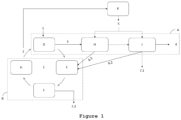
- FIG. 1 shows a general schematic representation of a Kraft pulp process including one embodiment of the process disclosed in the present application.
- the present application relates to a process to obtain fully oxidized white liquor from the white liquor used in a Kraft pulp process.
- the FOWL is suitable to be used in the alkaline stages of the fiberline of said Kraft pulp process, such as the bleaching stages, and/or alkaline extraction stages and/or the delignification stages that comprise alkaline steps.
- FIG. 1 shows a general schematic representation of a Kraft pulp process comprising the process of the present application.
- (A) represents the fiberline and
- (B) represents the recovery line.
- a fraction of the white liquor (2) is fed to at least one oxidation reactor (K) to produce FOWL (5) which is used in the delignification stages (H) and/or the bleaching stages (I) and/or alkaline extraction stages to partly or totally substitute purchased NaOH used in alkaline steps of these stages.
- the resulting alkaline wash filtrate (6.1, 6.2) of the delignification stages (H) and/or bleaching stages (I) are fed back to an evaporation plant (E) in the recovery line (B) to return to the Kraft chemical recovery process (C).
- the non-process elements (7.1) will be totally or partly purged to the WWTP through the wash step after the alkaline bleaching stages (I).
- purchased NaOH is also known as fresh NaOH.
- the process to obtain fully oxidized white liquor for use in the fiberline of a Kraft pulp process comprises the following steps:
- white liquor is oxidized with 20 to 60 kg of O 2 /m 3 of white liquor.
- the amount of alkaline filtrate (6.2) obtained in the bleaching stages (I) and/or alkaline extraction stages that is fed to the evaporation plant (E) varies according to the concentration of non-process elements.
- the amount of alkaline filtrate (6.1) obtained in the delignification stages (H) that is fed to the evaporation plant (E) is 100% due to the high concentration of chemical oxygen demand (COD).
- up to 100% of the fully oxidized white liquor (5) is fed to the bleaching stages (I) and/or alkaline extraction stages and/or the delignification stages (H).
- oxygen is used in the process as pure oxygen or as a gas mixture comprising oxygen.
- pure oxygen is considered an oxygen stream with a purity degree above 700 O 2 v/v.
- the FOWL totally or partially substitutes up to 100% of the amount of purchased NaOH used in the delignification stages of the Kraft pulp process.
- the FOWL substitutes up to 100% of the amount of purchased NaOH used in the bleaching stages and/or alkaline extraction stages of the Kraft pulp process.
- the oxidation step of the process makes use of at least one oxidation reactor (K) .
- a plurality of reactors can be used for the purpose of the present invention.
- the FOWL produced is an aqueous solution comprising NaOH, Na 2 SO 4 , NaCO 3 and less than 5 g of Na 2 S 2 O 3 per liter of FOWL, in which the presence of sulfide ions is undetectable by Ionic Chromatography and the extent of conversion of total sulfur to sulfate ions is above 900.
- the temperature is above 100°C
- the pressure is above 1 barg
- the total Hydraulic Residence Time (HRT) is at least 30 minutes.
- the sodium makeup of the recovery line of the Kraft pulp process is done - solely or in part, i.e., up to 1000, - in the delignification stages (H) by using purchased NaOH.
- the sodium makeup of the recovery line of the Kraft pulp process is done - solely or in part - in the recovery boiler (F) as Na 2 CO 3 and/or Na 2 SO 4 .
- the non-process elements such as K + or Cl - but not exclusively, are purged from the recovery line through the use of the FOWL.
- the totality or a fraction, i.e., up to 100% of the filtrates from washing steps after the bleaching stages and/or alkaline extraction stages are sent to the WWTP - thus discharging the recovery line from non-process elements.
Landscapes
- Chemical & Material Sciences (AREA)
- Inorganic Chemistry (AREA)
- Life Sciences & Earth Sciences (AREA)
- Engineering & Computer Science (AREA)
- Wood Science & Technology (AREA)
- Paper (AREA)
Abstract
The present application relates to a process to obtain fully oxidized white liquor from white liquor used in a Kraft pulp process. Said fully oxidized white liquor is suitable to be used in alkaline steps of certain stages of the Kraft pulp process fiberline in order to partly or totally substitute the purchased sodium hydroxide used in those stages. The presently disclosed process also allows to purge non-process elements (NPE's) by purging alkaline wash filtrates to a wastewater treatment plant.
Description
- This application relates to a process to obtain fully oxidized white liquor comprising NaOH, Na2SO4, NaCO3, and traces of Na2S2O3 for use in the fiberline of a Kraft pulp process.
- The Kraft process is a process for the conversion of wood into wood pulp consisting of almost pure cellulose fibers. It entails treatment of wood chips with a mixture of sodium hydroxide (NaOH) and sodium sulfide (Na2S), known as white liquor, which breaks the bonds that link lignin to the cellulose.
- The price of pure NaOH in the Market has been increasing over time. The price of pure NaOH rose - in Europe - fourfold in the last five years. The main goal for pulp mill companies is thus to reuse process streams present in their site to produce a solution containing NaOH which can be used as a substitute for the NaOH that is currently purchased. In order to substitute the purchased NaOH used in the alkaline steps of certain stages in the fiberline, processes to produce NaOH by the oxidation of white liquor are a solution to the increasing prices of NaOH.
- These companies aim to reduce the high cost related to the purchased NaOH and this can be done by reusing process streams currently present in the Kraft pulp process, which is by far the most common pulping process, to produce NaOH. In parallel, these companies are installing processes to control the purge of non-process elements, for example but not exclusively: K+; Cl-, and thus avoid the "classical" way to control the non-process elements by purging ash from the recovery boiler electro filters and thus reducing the loss of Na and S. These processes include diverse approaches such as ash leaching, crystallization strategies, special ion exchange or membrane-based systems that act as "kidneys" to the process, but they are very costly both in capital expenditures (CAPEX), energy and/or chemicals. Since all of these approaches use currents rich in non-process elements that are removed from the recovery circuit, and these are not extracted in pure form, a significant loss of Na and S still occurs (typically 0.5 to 3 Kg Na/Ton ad and 0.1 to 1.5 Kg S/ton ad). So, Na and S makeups are still needed and are normally done by adding purchased Na2CO3 or Na2SO4 to the recovery circuit of the Kraft pulp process.
-
EP1345684B1 discloses a method for oxidizing a liquid contained in a reactor (1) that comprises means for introducing gas into the reactor and means for introducing liquid into the reactor, at least liquid evacuating means, at least gas evacuating means. The liquid contains compounds to be oxidized and the oxidizing gas contains oxygen, where gas roof bleeding provides a predetermined partial pressure of the oxygen in the gaseous roof, the value of said partial pressure corresponding to a desired oxidizing rate for said compounds. -
EP1345680B1 discloses an oxidizing method by wet process oxidation or ozonization of a liquid contained in a reactor. The method is more particularly suitable for all oxidizing processes using large amounts of oxygen or ozone. It is in particular used for oxidizing paper-mill liquors. - The present application relates to a process to obtain fully oxidized white liquor for use in the fiberline of a Kraft pulp process comprising the following steps:
- Oxidizing between 1 and 100 m3/h of white liquor from the Kraft pulp process with oxygen, obtaining fully oxidized white liquor comprising NaOH, Na2SO4, Na2CO3 and Na2S2O3;
- Feeding the fully oxidized white liquor to the bleaching stages and/or the delignification stages and/or the alkaline extraction stages of the Kraft pulp process;
- Purging non-process elements by purging the filtrates from washing steps after the bleaching stages and/or alkaline extraction stages to a Wastewater Treatment Plant;
- Feeding up to 100% of the alkaline filtrate obtained in the washing steps after the bleaching stages to an evaporation plant;
- Feeding the alkaline filtrate obtained in the washing steps after the delignification stages to the evaporation plant;
- Purging non-process elements from a recovery boiler in the Kraft chemical recovery process of the Kraft pulp process.
- In one embodiment, the white liquor is oxidized with 20 to 60 kg of O2/m3 of white liquor.
- In one embodiment, the oxygen is used as pure oxygen or as a gas mixture comprising oxygen.
- In one embodiment, oxygen is used with a purity degree above 70% v/v.
- In one embodiment, the fully oxidized white liquor substitutes up to 100% of the amount of purchased NaOH used in the bleaching stages and/or alkaline extraction stages and/or delignification stages of the Kraft pulp process.
- In one embodiment, the oxidation step occurs at a temperature above 100°C, pressure above 1 barg, and the total Hydraulic Residence Time is at least 30 minutes.
- In one embodiment, up to 100% of the filtrates from washing steps after the bleaching stages and/or alkaline extraction stages are sent to the Wastewater Treatment Plant.
- Companies in this technical field can benefit from a reduction of the high cost related to purchased NaOH by reusing process streams currently present in the Kraft pulp process to produce a solution comprising NaOH which can be used as a substitute for the pure product.
- Thus, the present application relates to a process to obtain said solution, known as fully oxidized white liquor (FOWL), which comprises NaOH, Na2SO4, NaCO3 and traces of Na2S2O3. The FOWL is obtained from the white liquor used in a Kraft pulp process.
- The aim of this process is to produce a solution suitable to substitute purchased NaOH used in the alkaline steps of certain stages in the fiberline, such as the delignification stages and/or alkaline extraction stages and/or bleaching stages that use NaOH in certain steps, as well as purge non-process elements from the recovery circuit of the kraft pulp process by purging alkaline wash filtrates to a Wastewater Treatment Plant (WWTP).
- The FOWL produced by the presently disclosed process is also suitable to be used in bleaching stages that use hydrogen peroxide.
- Since a fraction or the totality of the FOWL can be used in the bleaching stages and/or alkaline extraction stages, and the alkaline wash filtrate resultant of the wash step after the mentioned bleaching stages will be partly or totally sent to sewer (to the WWTP), a compensation of the Na and S loss must be done using a makeup of sodium carbonate and/or sodium sulfate in the recovery cycle, or in the case of sodium compensation by adding a fraction of the alkali in the oxygen delignification stages as purchased NaOH. In this way the balance of Na and S will be maintained in the recovery cycle, as well as the purge of non-process elements, for example but not exclusively, K+ or Cl-, will be done partly or totally through the purge of the alkaline wash filtrate after the above-mentioned alkaline bleaching stage.
- The main reactions occurring during the oxidation process of white liquor are:
(I) 2Na2S + 2O2 + H2O → Na2S2O3 + 2NaOH
(II) Na2S2O3 + 2O2 + 2NaOH → 2Na2SO4 + H2O
- One of the advantages is that the oxygen used in the present process can be not only pure oxygen but also impure oxygen with purity > 70% O2 v/v. This impure oxygen can be produced in a PSA or VSA unit, but also can be the off-gas of an Ozone bleaching stage, which normally is above 700 O2 v/v. With this process, reaction (I) as well as reaction (II) proceed to their full extent and the presence of sulfide ions is undetectable by Ionic Chromatography. In this case the extent of conversion of total sulfur to sulfate ions expressed as sulphur should be above 900.
- With this high level of oxidation, the product of this process can be called "Fully Oxidised White Liquor" and the quality is so good that it can be used as a substitute for the purchased NaOH used in the fiberline, including the stages using hydrogen peroxide, without any detectable difference from using the pure NaOH product.
- For easier understanding of this application, figures are attached in the annex that represent the preferred forms of implementation which nevertheless are not intended to limit the technique disclosed herein.
-
Figure 1 shows a general schematic representation of a Kraft pulp process including one embodiment of the process disclosed in the present application. - Now, preferred embodiments of the present application will be described in detail with reference to the annexed drawings. However, they are not intended to limit the scope of this application.
- The present application relates to a process to obtain fully oxidized white liquor from the white liquor used in a Kraft pulp process. The FOWL is suitable to be used in the alkaline stages of the fiberline of said Kraft pulp process, such as the bleaching stages, and/or alkaline extraction stages and/or the delignification stages that comprise alkaline steps.
-
Figure 1 shows a general schematic representation of a Kraft pulp process comprising the process of the present application. (A) represents the fiberline and (B) represents the recovery line. - In general terms, in the Kraft chemical recovery process (C) of a Kraft pulp process, wood chips (1) are mixed with white liquor (2) provided by a white liquor filter (G). The mixture is fed to a digester and after digestion, sent to a washer (D). It results in a pulp (3) that is fed to the delignification stages (H) followed by the bleaching stages (I) producing bleached pulp (4).
- According to the present invention, a fraction of the white liquor (2) is fed to at least one oxidation reactor (K) to produce FOWL (5) which is used in the delignification stages (H) and/or the bleaching stages (I) and/or alkaline extraction stages to partly or totally substitute purchased NaOH used in alkaline steps of these stages. The resulting alkaline wash filtrate (6.1, 6.2) of the delignification stages (H) and/or bleaching stages (I) are fed back to an evaporation plant (E) in the recovery line (B) to return to the Kraft chemical recovery process (C).
- The non-process elements (7.1) will be totally or partly purged to the WWTP through the wash step after the alkaline bleaching stages (I).
- In the recovery boiler (F) of the Kraft chemical recovery process (C) methods that allow removing the non-process elements (7.2) are applied, these non-process elements (7.2) are also discarded to the WWTP.
- In the context of the present invention, purchased NaOH is also known as fresh NaOH.
- The process to obtain fully oxidized white liquor for use in the fiberline of a Kraft pulp process comprises the following steps:
- Oxidizing between 1 and 100 m3/h of white liquor (2) from the Kraft pulp process with oxygen, obtaining fully oxidized white liquor (5) comprising NaOH, Na2SO4, NaCO3 and Na2S2O3;
- Feeding the fully oxidized white liquor (5) to the bleaching stages (I) and/or alkaline extraction stages and/or the delignification stages (H) of the Kraft pulp process;
- Purging non-process elements (7.1) by purging the filtrates from washing steps after the bleaching stages (I) and/or alkaline extraction stages to a Wastewater Treatment Plant;
- Feeding up to 100% of the alkaline filtrate (6.2) obtained in the washing steps after the bleaching stages (I) to an evaporation plant (E);
- Feeding the alkaline filtrate (6.1) obtained in the delignification stages (H) to the evaporation plant (E) ;
- Purging non-process elements (7.2) from a recovery boiler (F) in the Kraft chemical recovery process (C) of the Kraft pulp process.
- In one embodiment, less than 5 g of Na2S2O3 per liter of fully oxidized white liquor (5) are produced.
- In one embodiment, white liquor is oxidized with 20 to 60 kg of O2/m3 of white liquor.
- The amount of alkaline filtrate (6.2) obtained in the bleaching stages (I) and/or alkaline extraction stages that is fed to the evaporation plant (E) varies according to the concentration of non-process elements.
- The amount of alkaline filtrate (6.1) obtained in the delignification stages (H) that is fed to the evaporation plant (E) is 100% due to the high concentration of chemical oxygen demand (COD).
- In one embodiment, up to 100% of the fully oxidized white liquor (5) is fed to the bleaching stages (I) and/or alkaline extraction stages and/or the delignification stages (H).
- In one embodiment, oxygen is used in the process as pure oxygen or as a gas mixture comprising oxygen.
- For the purposes of the present application, pure oxygen is considered an oxygen stream with a purity degree above 700 O2 v/v.
- The FOWL totally or partially substitutes up to 100% of the amount of purchased NaOH used in the delignification stages of the Kraft pulp process.
- The FOWL substitutes up to 100% of the amount of purchased NaOH used in the bleaching stages and/or alkaline extraction stages of the Kraft pulp process.
- The oxidation step of the process makes use of at least one oxidation reactor (K) . A plurality of reactors can be used for the purpose of the present invention.
- The FOWL produced is an aqueous solution comprising NaOH, Na2SO4, NaCO3 and less than 5 g of Na2S2O3 per liter of FOWL, in which the presence of sulfide ions is undetectable by Ionic Chromatography and the extent of conversion of total sulfur to sulfate ions is above 900.
- In one embodiment, during the oxidation step the temperature is above 100°C, the pressure is above 1 barg, and the total Hydraulic Residence Time (HRT) is at least 30 minutes.
- The sodium makeup of the recovery line of the Kraft pulp process is done - solely or in part, i.e., up to 1000, - in the delignification stages (H) by using purchased NaOH.
- The sodium makeup of the recovery line of the Kraft pulp process is done - solely or in part - in the recovery boiler (F) as Na2CO3 and/or Na2SO4.
- The non-process elements, such as K+ or Cl- but not exclusively, are purged from the recovery line through the use of the FOWL.
- The totality or a fraction, i.e., up to 100% of the filtrates from washing steps after the bleaching stages and/or alkaline extraction stages are sent to the WWTP - thus discharging the recovery line from non-process elements.
- This description is of course not in any way restricted to the forms of implementation presented herein and any person with an average knowledge of the area can provide many possibilities for modification thereof without departing from the general idea as defined by the claims. The preferred forms of implementation described above can obviously be combined with each other. The following claims further define the preferred forms of implementation.
Claims (7)
- Process to obtain fully oxidized white liquor for use in the fiberline of a Kraft pulp process characterized by comprising the following steps:- Oxidizing between 1 and 100 m3/h of white liquor from the Kraft pulp process with oxygen, obtaining fully oxidized white liquor comprising NaOH, Na2SO4, Na2CO3 and Na2S2O3;- Feeding the fully oxidized white liquor to the bleaching stages and/or the delignification stages and/or the alkaline extraction stages of the Kraft pulp process;- Purging non-process elements by purging the filtrates from washing steps after the bleaching stages and/or alkaline extraction stages to a Wastewater Treatment Plant;- Feeding up to 100% of the alkaline filtrate obtained in the washing steps after the bleaching stages to an evaporation plant;- Feeding the alkaline filtrate obtained in the washing steps after the delignification stages to the evaporation plant;- Purging non-process elements from a recovery boiler in the Kraft chemical recovery process of the Kraft pulp process.
- Process according to the previous claim, wherein the white liquor is oxidized with 20 to 60 kg of O2/m3 of white liquor.
- Process according to any of the previous claims, wherein the oxygen is used as pure oxygen or as a gas mixture comprising oxygen.
- Process according to any of the previous claims, wherein oxygen is used with a purity degree above 70% v/v.
- Process according to any of the previous claims, wherein the fully oxidized white liquor substitutes up to 100% of the amount of purchased NaOH used in the bleaching stages and/or alkaline extraction stages and/or delignification stages of the Kraft pulp process.
- Process according to any of the previous claims, wherein the oxidation step occurs at a temperature above 100°C, pressure above 1 barg, and the total Hydraulic Residence Time is at least 30 minutes.
- Process according to any of the previous claims, wherein up to 100% of the filtrates from washing steps after the bleaching stages and/or alkaline extraction stages are sent to the Wastewater Treatment Plant.
Priority Applications (3)
| Application Number | Priority Date | Filing Date | Title |
|---|---|---|---|
| EP23160197.2A EP4428297A1 (en) | 2023-03-06 | 2023-03-06 | Process to obtain fully oxidized white liquor for use in the fiberline of a kraft pulp process |
| CA3230672A CA3230672A1 (en) | 2023-03-06 | 2024-02-29 | Process to obtain fully oxidized white liquor for use in the fiberline of a kraft pulp process |
| US18/597,787 US20240301622A1 (en) | 2023-03-06 | 2024-03-06 | Process to obtain fully oxidized white liquor for use in the fiberline of a kraft pulp process |
Applications Claiming Priority (1)
| Application Number | Priority Date | Filing Date | Title |
|---|---|---|---|
| EP23160197.2A EP4428297A1 (en) | 2023-03-06 | 2023-03-06 | Process to obtain fully oxidized white liquor for use in the fiberline of a kraft pulp process |
Publications (1)
| Publication Number | Publication Date |
|---|---|
| EP4428297A1 true EP4428297A1 (en) | 2024-09-11 |
Family
ID=85505523
Family Applications (1)
| Application Number | Title | Priority Date | Filing Date |
|---|---|---|---|
| EP23160197.2A Pending EP4428297A1 (en) | 2023-03-06 | 2023-03-06 | Process to obtain fully oxidized white liquor for use in the fiberline of a kraft pulp process |
Country Status (3)
| Country | Link |
|---|---|
| US (1) | US20240301622A1 (en) |
| EP (1) | EP4428297A1 (en) |
| CA (1) | CA3230672A1 (en) |
Citations (9)
| Publication number | Priority date | Publication date | Assignee | Title |
|---|---|---|---|---|
| CA1043516A (en) * | 1973-07-25 | 1978-12-05 | Mo Och Domsjo Aktiebolag | Method for producing oxidized white liquor |
| EP0543135A1 (en) * | 1991-10-18 | 1993-05-26 | Air Products And Chemicals, Inc. | Selective white liquor oxidation |
| US5352332A (en) * | 1991-01-28 | 1994-10-04 | Maples Gerald E | Process for recycling bleach plant filtrate |
| EP0643163A2 (en) * | 1993-08-16 | 1995-03-15 | The Boc Group, Inc. | Oxidised white liquor production method |
| WO2000047812A1 (en) * | 1999-02-15 | 2000-08-17 | Kiram Ab | Process for oxygen pulping of lignocellulosic material and recovery of pulping chemicals |
| EP1345680B1 (en) | 2000-12-20 | 2004-10-27 | L'AIR LIQUIDE, Société Anonyme à Directoire et Conseil de Surveillance pour l'Etude et l'Exploitation des | Wet oxidation or ozonization process |
| EP1345684B1 (en) | 2000-12-20 | 2012-05-09 | L'AIR LIQUIDE, Société Anonyme pour l'Etude et l'Exploitation des Procédés Georges Claude | Improvements to oxidising processes by oxygen transfer within a liquid medium in a reactor under pressure |
| WO2020165504A1 (en) * | 2019-02-13 | 2020-08-20 | Metsä Fibre Oy | A method of replacing sodium losses in a pulp mill, a method of producing bleached cellulosic pulp, and a system |
| WO2021006798A1 (en) * | 2019-07-05 | 2021-01-14 | Kiram Ab | Method for dissolving pulp from recycled textile material |
Family Cites Families (3)
| Publication number | Priority date | Publication date | Assignee | Title |
|---|---|---|---|---|
| US5374333A (en) * | 1992-07-30 | 1994-12-20 | Kamyr, Inc. | Method for minimizing pulp mill effluents |
| SE514825C2 (en) * | 1999-09-16 | 2001-04-30 | Aga Ab | Oxygen delignification of cellulose pulp with oxidized white liquor as an alkaline source |
| DE102020002446A1 (en) * | 2020-04-23 | 2021-10-28 | Messer Austria Gmbh | Process and device for white liquor oxidation |
-
2023
- 2023-03-06 EP EP23160197.2A patent/EP4428297A1/en active Pending
-
2024
- 2024-02-29 CA CA3230672A patent/CA3230672A1/en active Pending
- 2024-03-06 US US18/597,787 patent/US20240301622A1/en active Pending
Patent Citations (9)
| Publication number | Priority date | Publication date | Assignee | Title |
|---|---|---|---|---|
| CA1043516A (en) * | 1973-07-25 | 1978-12-05 | Mo Och Domsjo Aktiebolag | Method for producing oxidized white liquor |
| US5352332A (en) * | 1991-01-28 | 1994-10-04 | Maples Gerald E | Process for recycling bleach plant filtrate |
| EP0543135A1 (en) * | 1991-10-18 | 1993-05-26 | Air Products And Chemicals, Inc. | Selective white liquor oxidation |
| EP0643163A2 (en) * | 1993-08-16 | 1995-03-15 | The Boc Group, Inc. | Oxidised white liquor production method |
| WO2000047812A1 (en) * | 1999-02-15 | 2000-08-17 | Kiram Ab | Process for oxygen pulping of lignocellulosic material and recovery of pulping chemicals |
| EP1345680B1 (en) | 2000-12-20 | 2004-10-27 | L'AIR LIQUIDE, Société Anonyme à Directoire et Conseil de Surveillance pour l'Etude et l'Exploitation des | Wet oxidation or ozonization process |
| EP1345684B1 (en) | 2000-12-20 | 2012-05-09 | L'AIR LIQUIDE, Société Anonyme pour l'Etude et l'Exploitation des Procédés Georges Claude | Improvements to oxidising processes by oxygen transfer within a liquid medium in a reactor under pressure |
| WO2020165504A1 (en) * | 2019-02-13 | 2020-08-20 | Metsä Fibre Oy | A method of replacing sodium losses in a pulp mill, a method of producing bleached cellulosic pulp, and a system |
| WO2021006798A1 (en) * | 2019-07-05 | 2021-01-14 | Kiram Ab | Method for dissolving pulp from recycled textile material |
Also Published As
| Publication number | Publication date |
|---|---|
| CA3230672A1 (en) | 2025-06-27 |
| US20240301622A1 (en) | 2024-09-12 |
Similar Documents
| Publication | Publication Date | Title |
|---|---|---|
| FI67242B (en) | SAETT ATT AVLAEGSNA LIGNIN FRAON OBLEKT KEMISK PAPPERSMASSA | |
| JP2796477B2 (en) | White liquor selective oxidation method, oxidized white liquor production method and control method of oxidation reaction system operation in pulp mill | |
| CA2150254C (en) | Method of bleaching pulp without using chlorine-containing chemicals | |
| US3366534A (en) | Complete chemical system for a kraft mill | |
| EP4428297A1 (en) | Process to obtain fully oxidized white liquor for use in the fiberline of a kraft pulp process | |
| CA2384471C (en) | Oxidised white liquor in an oxygen delignification process | |
| US20050087315A1 (en) | Low consistency oxygen delignification process | |
| US4288286A (en) | Kraft mill recycle process | |
| US8524038B2 (en) | Bleaching process of chemical pulp | |
| CA2103066C (en) | White liquor preparation and pulping process | |
| US5976321A (en) | Process for making sulfur enhanced undigested cellulosic fiber material and pulp | |
| US20120031575A1 (en) | Pulp Bleaching and Alkaline Extraction Method | |
| BR102024004452A2 (en) | PROCESS FOR OBTAINING FULLY OXIDATED WHITE LIQUOR FOR USE IN THE FIBER LINE OF A KRAFT PULP PROCESS | |
| AU657003B2 (en) | Ozone bleaching of pulp | |
| US6210527B1 (en) | Pulp bleaching method wherein an ozone bleaching waste stream is scrubbed to form an oxygen containing stream | |
| US5126009A (en) | Process for decreasing the charge of chemical required in a chlorine bleaching extraction stage | |
| Miyanishi | Theory and Practice of Ozone Bleaching | |
| AU605913B2 (en) | A method in the activation of lignocellulosic material with a gas containing nitrogen dioxide | |
| SE502135C2 (en) | Chemical pulp bleaching sequence comprising a sulfonating bleaching step | |
| CA1103412A (en) | Kraft mill recycle process | |
| US6039837A (en) | Method of bleaching pulp with ozone wherein the acidity is maintained with an acid solution prepared by electrolysis or electrodialysis | |
| WO1995018884A1 (en) | Process for the recovery of chemicals and energy from pulp bleaching effluent | |
| CA2098062A1 (en) | Production of cellulose pulp bleaching chemicals | |
| CA2163852A1 (en) | Utilization of oxidized white liquor | |
| JP2001214390A (en) | Bleaching chemical pulp for papermaking. |
Legal Events
| Date | Code | Title | Description |
|---|---|---|---|
| PUAI | Public reference made under article 153(3) epc to a published international application that has entered the european phase |
Free format text: ORIGINAL CODE: 0009012 |
|
| STAA | Information on the status of an ep patent application or granted ep patent |
Free format text: STATUS: THE APPLICATION HAS BEEN PUBLISHED |
|
| AK | Designated contracting states |
Kind code of ref document: A1 Designated state(s): AL AT BE BG CH CY CZ DE DK EE ES FI FR GB GR HR HU IE IS IT LI LT LU LV MC ME MK MT NL NO PL PT RO RS SE SI SK SM TR |
|
| STAA | Information on the status of an ep patent application or granted ep patent |
Free format text: STATUS: REQUEST FOR EXAMINATION WAS MADE |
|
| 17P | Request for examination filed |
Effective date: 20250311 |