EP4428187A1 - Conductive rubber composition for sensing - Google Patents
Conductive rubber composition for sensing Download PDFInfo
- Publication number
- EP4428187A1 EP4428187A1 EP22889682.5A EP22889682A EP4428187A1 EP 4428187 A1 EP4428187 A1 EP 4428187A1 EP 22889682 A EP22889682 A EP 22889682A EP 4428187 A1 EP4428187 A1 EP 4428187A1
- Authority
- EP
- European Patent Office
- Prior art keywords
- antioxidant
- rubber composition
- rubber
- molwt
- sensing
- Prior art date
- Legal status (The legal status is an assumption and is not a legal conclusion. Google has not performed a legal analysis and makes no representation as to the accuracy of the status listed.)
- Pending
Links
- 229920001971 elastomer Polymers 0.000 title claims abstract description 219
- 239000005060 rubber Substances 0.000 title claims abstract description 219
- 239000000203 mixture Substances 0.000 title claims abstract description 113
- 239000003963 antioxidant agent Substances 0.000 claims abstract description 107
- 230000003078 antioxidant effect Effects 0.000 claims abstract description 103
- 239000006229 carbon black Substances 0.000 claims abstract description 47
- 229920003244 diene elastomer Polymers 0.000 claims abstract description 24
- 125000004429 atom Chemical group 0.000 claims abstract description 9
- 125000004435 hydrogen atom Chemical group [H]* 0.000 claims abstract description 8
- LZZYPRNAOMGNLH-UHFFFAOYSA-M Cetrimonium bromide Chemical compound [Br-].CCCCCCCCCCCCCCCC[N+](C)(C)C LZZYPRNAOMGNLH-UHFFFAOYSA-M 0.000 claims description 15
- ZZMVLMVFYMGSMY-UHFFFAOYSA-N 4-n-(4-methylpentan-2-yl)-1-n-phenylbenzene-1,4-diamine Chemical group C1=CC(NC(C)CC(C)C)=CC=C1NC1=CC=CC=C1 ZZMVLMVFYMGSMY-UHFFFAOYSA-N 0.000 claims description 9
- 238000001179 sorption measurement Methods 0.000 claims description 8
- 238000001514 detection method Methods 0.000 abstract description 10
- 235000019241 carbon black Nutrition 0.000 description 43
- 239000000047 product Substances 0.000 description 32
- OKTJSMMVPCPJKN-UHFFFAOYSA-N Carbon Chemical compound [C] OKTJSMMVPCPJKN-UHFFFAOYSA-N 0.000 description 30
- 239000002041 carbon nanotube Substances 0.000 description 28
- 229910021393 carbon nanotube Inorganic materials 0.000 description 27
- 230000000052 comparative effect Effects 0.000 description 26
- -1 p-phenylenediamine compound Chemical class 0.000 description 24
- 238000007789 sealing Methods 0.000 description 24
- 239000012530 fluid Substances 0.000 description 16
- DOIRQSBPFJWKBE-UHFFFAOYSA-N dibutyl phthalate Chemical compound CCCCOC(=O)C1=CC=CC=C1C(=O)OCCCC DOIRQSBPFJWKBE-UHFFFAOYSA-N 0.000 description 14
- 230000007246 mechanism Effects 0.000 description 14
- ZJNLYGOUHDJHMG-UHFFFAOYSA-N 1-n,4-n-bis(5-methylhexan-2-yl)benzene-1,4-diamine Chemical compound CC(C)CCC(C)NC1=CC=C(NC(C)CCC(C)C)C=C1 ZJNLYGOUHDJHMG-UHFFFAOYSA-N 0.000 description 13
- 238000010521 absorption reaction Methods 0.000 description 13
- 230000008859 change Effects 0.000 description 13
- 238000012360 testing method Methods 0.000 description 11
- 230000002787 reinforcement Effects 0.000 description 10
- 239000011324 bead Substances 0.000 description 9
- 238000000034 method Methods 0.000 description 8
- 230000008602 contraction Effects 0.000 description 7
- 150000002430 hydrocarbons Chemical group 0.000 description 7
- 239000000463 material Substances 0.000 description 7
- 229930195734 saturated hydrocarbon Natural products 0.000 description 7
- 244000043261 Hevea brasiliensis Species 0.000 description 5
- 239000005062 Polybutadiene Substances 0.000 description 5
- BGYHLZZASRKEJE-UHFFFAOYSA-N [3-[3-(3,5-ditert-butyl-4-hydroxyphenyl)propanoyloxy]-2,2-bis[3-(3,5-ditert-butyl-4-hydroxyphenyl)propanoyloxymethyl]propyl] 3-(3,5-ditert-butyl-4-hydroxyphenyl)propanoate Chemical compound CC(C)(C)C1=C(O)C(C(C)(C)C)=CC(CCC(=O)OCC(COC(=O)CCC=2C=C(C(O)=C(C=2)C(C)(C)C)C(C)(C)C)(COC(=O)CCC=2C=C(C(O)=C(C=2)C(C)(C)C)C(C)(C)C)COC(=O)CCC=2C=C(C(O)=C(C=2)C(C)(C)C)C(C)(C)C)=C1 BGYHLZZASRKEJE-UHFFFAOYSA-N 0.000 description 5
- 229910052799 carbon Inorganic materials 0.000 description 5
- 238000013329 compounding Methods 0.000 description 5
- 230000000694 effects Effects 0.000 description 5
- 230000005611 electricity Effects 0.000 description 5
- 229920003052 natural elastomer Polymers 0.000 description 5
- 229920001194 natural rubber Polymers 0.000 description 5
- 229920002857 polybutadiene Polymers 0.000 description 5
- 239000000126 substance Substances 0.000 description 5
- VZSRBBMJRBPUNF-UHFFFAOYSA-N 2-(2,3-dihydro-1H-inden-2-ylamino)-N-[3-oxo-3-(2,4,6,7-tetrahydrotriazolo[4,5-c]pyridin-5-yl)propyl]pyrimidine-5-carboxamide Chemical compound C1C(CC2=CC=CC=C12)NC1=NC=C(C=N1)C(=O)NCCC(N1CC2=C(CC1)NN=N2)=O VZSRBBMJRBPUNF-UHFFFAOYSA-N 0.000 description 4
- 125000000217 alkyl group Chemical group 0.000 description 4
- 230000007423 decrease Effects 0.000 description 4
- 238000009472 formulation Methods 0.000 description 4
- 230000001788 irregular Effects 0.000 description 4
- 238000005259 measurement Methods 0.000 description 4
- 229910052751 metal Inorganic materials 0.000 description 4
- 239000002184 metal Substances 0.000 description 4
- 230000002093 peripheral effect Effects 0.000 description 4
- CBCKQZAAMUWICA-UHFFFAOYSA-N 1,4-phenylenediamine Chemical group NC1=CC=C(N)C=C1 CBCKQZAAMUWICA-UHFFFAOYSA-N 0.000 description 3
- AIMXDOGPMWDCDF-UHFFFAOYSA-N 1-n,4-n-dicyclohexylbenzene-1,4-diamine Chemical compound C1CCCCC1NC(C=C1)=CC=C1NC1CCCCC1 AIMXDOGPMWDCDF-UHFFFAOYSA-N 0.000 description 3
- XLOMVQKBTHCTTD-UHFFFAOYSA-N Zinc monoxide Chemical compound [Zn]=O XLOMVQKBTHCTTD-UHFFFAOYSA-N 0.000 description 3
- 239000002134 carbon nanofiber Substances 0.000 description 3
- 239000003795 chemical substances by application Substances 0.000 description 3
- 150000001875 compounds Chemical class 0.000 description 3
- 125000000753 cycloalkyl group Chemical group 0.000 description 3
- 239000007789 gas Substances 0.000 description 3
- 238000007373 indentation Methods 0.000 description 3
- 238000004898 kneading Methods 0.000 description 3
- 238000004519 manufacturing process Methods 0.000 description 3
- 238000000926 separation method Methods 0.000 description 3
- 239000004636 vulcanized rubber Substances 0.000 description 3
- VTYYLEPIZMXCLO-UHFFFAOYSA-L Calcium carbonate Chemical compound [Ca+2].[O-]C([O-])=O VTYYLEPIZMXCLO-UHFFFAOYSA-L 0.000 description 2
- XEEYBQQBJWHFJM-UHFFFAOYSA-N Iron Chemical compound [Fe] XEEYBQQBJWHFJM-UHFFFAOYSA-N 0.000 description 2
- AFCARXCZXQIEQB-UHFFFAOYSA-N N-[3-oxo-3-(2,4,6,7-tetrahydrotriazolo[4,5-c]pyridin-5-yl)propyl]-2-[[3-(trifluoromethoxy)phenyl]methylamino]pyrimidine-5-carboxamide Chemical compound O=C(CCNC(=O)C=1C=NC(=NC=1)NCC1=CC(=CC=C1)OC(F)(F)F)N1CC2=C(CC1)NN=N2 AFCARXCZXQIEQB-UHFFFAOYSA-N 0.000 description 2
- 229920000459 Nitrile rubber Polymers 0.000 description 2
- CBENFWSGALASAD-UHFFFAOYSA-N Ozone Chemical compound [O-][O+]=O CBENFWSGALASAD-UHFFFAOYSA-N 0.000 description 2
- VYPSYNLAJGMNEJ-UHFFFAOYSA-N Silicium dioxide Chemical compound O=[Si]=O VYPSYNLAJGMNEJ-UHFFFAOYSA-N 0.000 description 2
- 235000021355 Stearic acid Nutrition 0.000 description 2
- 229910000831 Steel Inorganic materials 0.000 description 2
- 239000013065 commercial product Substances 0.000 description 2
- 239000000470 constituent Substances 0.000 description 2
- 238000004132 cross linking Methods 0.000 description 2
- 125000000113 cyclohexyl group Chemical group [H]C1([H])C([H])([H])C([H])([H])C([H])(*)C([H])([H])C1([H])[H] 0.000 description 2
- 230000001066 destructive effect Effects 0.000 description 2
- 238000005516 engineering process Methods 0.000 description 2
- 210000003414 extremity Anatomy 0.000 description 2
- 239000000945 filler Substances 0.000 description 2
- 229920003049 isoprene rubber Polymers 0.000 description 2
- 239000007788 liquid Substances 0.000 description 2
- 238000012544 monitoring process Methods 0.000 description 2
- QIQXTHQIDYTFRH-UHFFFAOYSA-N octadecanoic acid Chemical compound CCCCCCCCCCCCCCCCCC(O)=O QIQXTHQIDYTFRH-UHFFFAOYSA-N 0.000 description 2
- OQCDKBAXFALNLD-UHFFFAOYSA-N octadecanoic acid Natural products CCCCCCCC(C)CCCCCCCCC(O)=O OQCDKBAXFALNLD-UHFFFAOYSA-N 0.000 description 2
- 150000007524 organic acids Chemical class 0.000 description 2
- 239000004033 plastic Substances 0.000 description 2
- 229920003023 plastic Polymers 0.000 description 2
- BASFCYQUMIYNBI-UHFFFAOYSA-N platinum Chemical compound [Pt] BASFCYQUMIYNBI-UHFFFAOYSA-N 0.000 description 2
- 229920001084 poly(chloroprene) Polymers 0.000 description 2
- 229920000139 polyethylene terephthalate Polymers 0.000 description 2
- 239000005020 polyethylene terephthalate Substances 0.000 description 2
- 230000001105 regulatory effect Effects 0.000 description 2
- 230000003014 reinforcing effect Effects 0.000 description 2
- 230000004044 response Effects 0.000 description 2
- 150000003839 salts Chemical class 0.000 description 2
- 239000008117 stearic acid Substances 0.000 description 2
- 239000010959 steel Substances 0.000 description 2
- 238000009864 tensile test Methods 0.000 description 2
- 238000004073 vulcanization Methods 0.000 description 2
- 238000009941 weaving Methods 0.000 description 2
- 239000011787 zinc oxide Substances 0.000 description 2
- 235000014692 zinc oxide Nutrition 0.000 description 2
- QNRATNLHPGXHMA-XZHTYLCXSA-N (r)-(6-ethoxyquinolin-4-yl)-[(2s,4s,5r)-5-ethyl-1-azabicyclo[2.2.2]octan-2-yl]methanol;hydrochloride Chemical compound Cl.C([C@H]([C@H](C1)CC)C2)CN1[C@@H]2[C@H](O)C1=CC=NC2=CC=C(OCC)C=C21 QNRATNLHPGXHMA-XZHTYLCXSA-N 0.000 description 1
- 125000005918 1,2-dimethylbutyl group Chemical group 0.000 description 1
- GEYOCULIXLDCMW-UHFFFAOYSA-N 1,2-phenylenediamine Chemical group NC1=CC=CC=C1N GEYOCULIXLDCMW-UHFFFAOYSA-N 0.000 description 1
- JUHXTONDLXIGGK-UHFFFAOYSA-N 1-n,4-n-bis(5-methylheptan-3-yl)benzene-1,4-diamine Chemical compound CCC(C)CC(CC)NC1=CC=C(NC(CC)CC(C)CC)C=C1 JUHXTONDLXIGGK-UHFFFAOYSA-N 0.000 description 1
- 125000003660 2,3-dimethylpentyl group Chemical group [H]C([H])([H])C([H])([H])C([H])(C([H])([H])[H])C([H])(C([H])([H])[H])C([H])([H])* 0.000 description 1
- BYLSIPUARIZAHZ-UHFFFAOYSA-N 2,4,6-tris(1-phenylethyl)phenol Chemical compound C=1C(C(C)C=2C=CC=CC=2)=C(O)C(C(C)C=2C=CC=CC=2)=CC=1C(C)C1=CC=CC=C1 BYLSIPUARIZAHZ-UHFFFAOYSA-N 0.000 description 1
- 125000003764 2,4-dimethylpentyl group Chemical group [H]C([H])([H])C([H])(C([H])([H])[H])C([H])([H])C([H])(C([H])([H])[H])C([H])([H])* 0.000 description 1
- 125000003229 2-methylhexyl group Chemical group [H]C([H])([H])C([H])([H])C([H])([H])C([H])([H])C([H])(C([H])([H])[H])C([H])([H])* 0.000 description 1
- 125000005916 2-methylpentyl group Chemical group 0.000 description 1
- YLZOPXRUQYQQID-UHFFFAOYSA-N 3-(2,4,6,7-tetrahydrotriazolo[4,5-c]pyridin-5-yl)-1-[4-[2-[[3-(trifluoromethoxy)phenyl]methylamino]pyrimidin-5-yl]piperazin-1-yl]propan-1-one Chemical compound N1N=NC=2CN(CCC=21)CCC(=O)N1CCN(CC1)C=1C=NC(=NC=1)NCC1=CC(=CC=C1)OC(F)(F)F YLZOPXRUQYQQID-UHFFFAOYSA-N 0.000 description 1
- 125000005917 3-methylpentyl group Chemical group 0.000 description 1
- 229910000838 Al alloy Inorganic materials 0.000 description 1
- 229910001369 Brass Inorganic materials 0.000 description 1
- 239000004594 Masterbatch (MB) Substances 0.000 description 1
- MKYBYDHXWVHEJW-UHFFFAOYSA-N N-[1-oxo-1-(2,4,6,7-tetrahydrotriazolo[4,5-c]pyridin-5-yl)propan-2-yl]-2-[[3-(trifluoromethoxy)phenyl]methylamino]pyrimidine-5-carboxamide Chemical compound O=C(C(C)NC(=O)C=1C=NC(=NC=1)NCC1=CC(=CC=C1)OC(F)(F)F)N1CC2=C(CC1)NN=N2 MKYBYDHXWVHEJW-UHFFFAOYSA-N 0.000 description 1
- NIPNSKYNPDTRPC-UHFFFAOYSA-N N-[2-oxo-2-(2,4,6,7-tetrahydrotriazolo[4,5-c]pyridin-5-yl)ethyl]-2-[[3-(trifluoromethoxy)phenyl]methylamino]pyrimidine-5-carboxamide Chemical compound O=C(CNC(=O)C=1C=NC(=NC=1)NCC1=CC(=CC=C1)OC(F)(F)F)N1CC2=C(CC1)NN=N2 NIPNSKYNPDTRPC-UHFFFAOYSA-N 0.000 description 1
- 239000004677 Nylon Substances 0.000 description 1
- 229920000297 Rayon Polymers 0.000 description 1
- 238000005411 Van der Waals force Methods 0.000 description 1
- 230000015572 biosynthetic process Effects 0.000 description 1
- 239000010951 brass Substances 0.000 description 1
- 229910000019 calcium carbonate Inorganic materials 0.000 description 1
- 238000004364 calculation method Methods 0.000 description 1
- 125000004432 carbon atom Chemical group C* 0.000 description 1
- 238000005229 chemical vapour deposition Methods 0.000 description 1
- 239000011248 coating agent Substances 0.000 description 1
- 238000000576 coating method Methods 0.000 description 1
- 238000007796 conventional method Methods 0.000 description 1
- 125000004122 cyclic group Chemical group 0.000 description 1
- 125000000582 cycloheptyl group Chemical group [H]C1([H])C([H])([H])C([H])([H])C([H])([H])C([H])(*)C([H])([H])C1([H])[H] 0.000 description 1
- 125000000640 cyclooctyl group Chemical group [H]C1([H])C([H])([H])C([H])([H])C([H])([H])C([H])(*)C([H])([H])C([H])([H])C1([H])[H] 0.000 description 1
- 125000001511 cyclopentyl group Chemical group [H]C1([H])C([H])([H])C([H])([H])C([H])(*)C1([H])[H] 0.000 description 1
- 238000000354 decomposition reaction Methods 0.000 description 1
- 125000002704 decyl group Chemical group [H]C([H])([H])C([H])([H])C([H])([H])C([H])([H])C([H])([H])C([H])([H])C([H])([H])C([H])([H])C([H])([H])C([H])([H])* 0.000 description 1
- 238000002845 discoloration Methods 0.000 description 1
- 125000003438 dodecyl group Chemical group [H]C([H])([H])C([H])([H])C([H])([H])C([H])([H])C([H])([H])C([H])([H])C([H])([H])C([H])([H])C([H])([H])C([H])([H])C([H])([H])C([H])([H])* 0.000 description 1
- 238000010891 electric arc Methods 0.000 description 1
- 125000001495 ethyl group Chemical group [H]C([H])([H])C([H])([H])* 0.000 description 1
- 238000011156 evaluation Methods 0.000 description 1
- 238000001125 extrusion Methods 0.000 description 1
- 239000000835 fiber Substances 0.000 description 1
- 230000006870 function Effects 0.000 description 1
- 230000006872 improvement Effects 0.000 description 1
- 239000004615 ingredient Substances 0.000 description 1
- 238000002347 injection Methods 0.000 description 1
- 239000007924 injection Substances 0.000 description 1
- 239000011256 inorganic filler Substances 0.000 description 1
- 229910003475 inorganic filler Inorganic materials 0.000 description 1
- 229910052742 iron Inorganic materials 0.000 description 1
- 125000000959 isobutyl group Chemical group [H]C([H])([H])C([H])(C([H])([H])[H])C([H])([H])* 0.000 description 1
- 125000004491 isohexyl group Chemical group C(CCC(C)C)* 0.000 description 1
- 238000002955 isolation Methods 0.000 description 1
- 125000001972 isopentyl group Chemical group [H]C([H])([H])C([H])(C([H])([H])[H])C([H])([H])C([H])([H])* 0.000 description 1
- 125000001449 isopropyl group Chemical group [H]C([H])([H])C([H])(*)C([H])([H])[H] 0.000 description 1
- 210000003141 lower extremity Anatomy 0.000 description 1
- 238000010801 machine learning Methods 0.000 description 1
- 150000002739 metals Chemical class 0.000 description 1
- 125000002496 methyl group Chemical group [H]C([H])([H])* 0.000 description 1
- 239000002048 multi walled nanotube Substances 0.000 description 1
- 210000003205 muscle Anatomy 0.000 description 1
- 125000004108 n-butyl group Chemical group [H]C([H])([H])C([H])([H])C([H])([H])C([H])([H])* 0.000 description 1
- 125000001280 n-hexyl group Chemical group C(CCCCC)* 0.000 description 1
- 125000000740 n-pentyl group Chemical group [H]C([H])([H])C([H])([H])C([H])([H])C([H])([H])C([H])([H])* 0.000 description 1
- 125000004123 n-propyl group Chemical group [H]C([H])([H])C([H])([H])C([H])([H])* 0.000 description 1
- 125000001971 neopentyl group Chemical group [H]C([*])([H])C(C([H])([H])[H])(C([H])([H])[H])C([H])([H])[H] 0.000 description 1
- 229920001778 nylon Polymers 0.000 description 1
- 125000002347 octyl group Chemical group [H]C([*])([H])C([H])([H])C([H])([H])C([H])([H])C([H])([H])C([H])([H])C([H])([H])C([H])([H])[H] 0.000 description 1
- 150000004989 p-phenylenediamines Chemical class 0.000 description 1
- 239000002245 particle Substances 0.000 description 1
- 150000002989 phenols Chemical class 0.000 description 1
- 230000000704 physical effect Effects 0.000 description 1
- 238000005268 plasma chemical vapour deposition Methods 0.000 description 1
- 229910052697 platinum Inorganic materials 0.000 description 1
- 239000002964 rayon Substances 0.000 description 1
- 238000011160 research Methods 0.000 description 1
- 125000002914 sec-butyl group Chemical group [H]C([H])([H])C([H])([H])C([H])(*)C([H])([H])[H] 0.000 description 1
- 239000000377 silicon dioxide Substances 0.000 description 1
- 239000002109 single walled nanotube Substances 0.000 description 1
- 239000000243 solution Substances 0.000 description 1
- 239000010935 stainless steel Substances 0.000 description 1
- 229910001220 stainless steel Inorganic materials 0.000 description 1
- 229920003048 styrene butadiene rubber Polymers 0.000 description 1
- 125000001424 substituent group Chemical group 0.000 description 1
- 238000003786 synthesis reaction Methods 0.000 description 1
- 125000000999 tert-butyl group Chemical group [H]C([H])([H])C(*)(C([H])([H])[H])C([H])([H])[H] 0.000 description 1
- 238000002230 thermal chemical vapour deposition Methods 0.000 description 1
- 210000001364 upper extremity Anatomy 0.000 description 1
- 238000007740 vapor deposition Methods 0.000 description 1
- 238000013022 venting Methods 0.000 description 1
- 238000010792 warming Methods 0.000 description 1
- XLYOFNOQVPJJNP-UHFFFAOYSA-N water Substances O XLYOFNOQVPJJNP-UHFFFAOYSA-N 0.000 description 1
Images

Classifications
-
- B—PERFORMING OPERATIONS; TRANSPORTING
- B60—VEHICLES IN GENERAL
- B60C—VEHICLE TYRES; TYRE INFLATION; TYRE CHANGING; CONNECTING VALVES TO INFLATABLE ELASTIC BODIES IN GENERAL; DEVICES OR ARRANGEMENTS RELATED TO TYRES
- B60C1/00—Tyres characterised by the chemical composition or the physical arrangement or mixture of the composition
-
- C—CHEMISTRY; METALLURGY
- C08—ORGANIC MACROMOLECULAR COMPOUNDS; THEIR PREPARATION OR CHEMICAL WORKING-UP; COMPOSITIONS BASED THEREON
- C08K—Use of inorganic or non-macromolecular organic substances as compounding ingredients
- C08K3/00—Use of inorganic substances as compounding ingredients
- C08K3/02—Elements
- C08K3/04—Carbon
-
- C—CHEMISTRY; METALLURGY
- C08—ORGANIC MACROMOLECULAR COMPOUNDS; THEIR PREPARATION OR CHEMICAL WORKING-UP; COMPOSITIONS BASED THEREON
- C08K—Use of inorganic or non-macromolecular organic substances as compounding ingredients
- C08K5/00—Use of organic ingredients
- C08K5/04—Oxygen-containing compounds
- C08K5/13—Phenols; Phenolates
- C08K5/134—Phenols containing ester groups
- C08K5/1345—Carboxylic esters of phenolcarboxylic acids
-
- C—CHEMISTRY; METALLURGY
- C08—ORGANIC MACROMOLECULAR COMPOUNDS; THEIR PREPARATION OR CHEMICAL WORKING-UP; COMPOSITIONS BASED THEREON
- C08K—Use of inorganic or non-macromolecular organic substances as compounding ingredients
- C08K5/00—Use of organic ingredients
- C08K5/16—Nitrogen-containing compounds
- C08K5/17—Amines; Quaternary ammonium compounds
- C08K5/18—Amines; Quaternary ammonium compounds with aromatically bound amino groups
-
- C—CHEMISTRY; METALLURGY
- C08—ORGANIC MACROMOLECULAR COMPOUNDS; THEIR PREPARATION OR CHEMICAL WORKING-UP; COMPOSITIONS BASED THEREON
- C08L—COMPOSITIONS OF MACROMOLECULAR COMPOUNDS
- C08L9/00—Compositions of homopolymers or copolymers of conjugated diene hydrocarbons
-
- G—PHYSICS
- G01—MEASURING; TESTING
- G01B—MEASURING LENGTH, THICKNESS OR SIMILAR LINEAR DIMENSIONS; MEASURING ANGLES; MEASURING AREAS; MEASURING IRREGULARITIES OF SURFACES OR CONTOURS
- G01B1/00—Measuring instruments characterised by the selection of material therefor
-
- G—PHYSICS
- G01—MEASURING; TESTING
- G01B—MEASURING LENGTH, THICKNESS OR SIMILAR LINEAR DIMENSIONS; MEASURING ANGLES; MEASURING AREAS; MEASURING IRREGULARITIES OF SURFACES OR CONTOURS
- G01B7/00—Measuring arrangements characterised by the use of electric or magnetic techniques
- G01B7/16—Measuring arrangements characterised by the use of electric or magnetic techniques for measuring the deformation in a solid, e.g. by resistance strain gauge
-
- G—PHYSICS
- G01—MEASURING; TESTING
- G01L—MEASURING FORCE, STRESS, TORQUE, WORK, MECHANICAL POWER, MECHANICAL EFFICIENCY, OR FLUID PRESSURE
- G01L1/00—Measuring force or stress, in general
- G01L1/20—Measuring force or stress, in general by measuring variations in ohmic resistance of solid materials or of electrically-conductive fluids; by making use of electrokinetic cells, i.e. liquid-containing cells wherein an electrical potential is produced or varied upon the application of stress
- G01L1/22—Measuring force or stress, in general by measuring variations in ohmic resistance of solid materials or of electrically-conductive fluids; by making use of electrokinetic cells, i.e. liquid-containing cells wherein an electrical potential is produced or varied upon the application of stress using resistance strain gauges
- G01L1/2287—Measuring force or stress, in general by measuring variations in ohmic resistance of solid materials or of electrically-conductive fluids; by making use of electrokinetic cells, i.e. liquid-containing cells wherein an electrical potential is produced or varied upon the application of stress using resistance strain gauges constructional details of the strain gauges
-
- C—CHEMISTRY; METALLURGY
- C08—ORGANIC MACROMOLECULAR COMPOUNDS; THEIR PREPARATION OR CHEMICAL WORKING-UP; COMPOSITIONS BASED THEREON
- C08K—Use of inorganic or non-macromolecular organic substances as compounding ingredients
- C08K2201/00—Specific properties of additives
- C08K2201/001—Conductive additives
-
- C—CHEMISTRY; METALLURGY
- C08—ORGANIC MACROMOLECULAR COMPOUNDS; THEIR PREPARATION OR CHEMICAL WORKING-UP; COMPOSITIONS BASED THEREON
- C08K—Use of inorganic or non-macromolecular organic substances as compounding ingredients
- C08K2201/00—Specific properties of additives
- C08K2201/002—Physical properties
- C08K2201/006—Additives being defined by their surface area
-
- C—CHEMISTRY; METALLURGY
- C08—ORGANIC MACROMOLECULAR COMPOUNDS; THEIR PREPARATION OR CHEMICAL WORKING-UP; COMPOSITIONS BASED THEREON
- C08L—COMPOSITIONS OF MACROMOLECULAR COMPOUNDS
- C08L2201/00—Properties
- C08L2201/08—Stabilised against heat, light or radiation or oxydation
-
- C—CHEMISTRY; METALLURGY
- C08—ORGANIC MACROMOLECULAR COMPOUNDS; THEIR PREPARATION OR CHEMICAL WORKING-UP; COMPOSITIONS BASED THEREON
- C08L—COMPOSITIONS OF MACROMOLECULAR COMPOUNDS
- C08L2203/00—Applications
- C08L2203/20—Applications use in electrical or conductive gadgets
-
- C—CHEMISTRY; METALLURGY
- C08—ORGANIC MACROMOLECULAR COMPOUNDS; THEIR PREPARATION OR CHEMICAL WORKING-UP; COMPOSITIONS BASED THEREON
- C08L—COMPOSITIONS OF MACROMOLECULAR COMPOUNDS
- C08L2205/00—Polymer mixtures characterised by other features
- C08L2205/03—Polymer mixtures characterised by other features containing three or more polymers in a blend
Definitions
- the present disclosure relates to a conductive rubber composition for sensing.
- Patent Literature 1 discloses a technique of compounding carbon black and/or carbon nanotubes having high electrical conductivity with a rubber ingredient in production of a rubber material so as to impart electrical conductivity to the rubber material and determining correlation between electrical resistance value change due to strain and strain so as to infer the magnitude of strain of the rubber material.
- the present disclosure is directed at solving the problem in the conventional technique described above and providing a conductive rubber composition for sensing that when adopted in a rubber product, enables high-accuracy detection of the magnitude of strain of the rubber product without the use of a sensor.
- a conductive rubber composition for sensing that when adopted in a rubber product, enables high-accuracy detection of the magnitude of strain of the rubber product without the use of a sensor.
- the conductive rubber composition for sensing according to the present disclosure contains a diene rubber, carbon black, and an antioxidant.
- a feature of the conductive rubber composition for sensing according to the present disclosure is that the antioxidant satisfies a relationship in the following formula (i). HeavyAtomCount/MolWt ⁇ 5 .46 ⁇ MaxPartialCharge/MolWt + 0.071 [In formula (i), HeavyAtomCount indicates the number of non-hydrogen atoms in the antioxidant, MolWt indicates the molecular weight of the antioxidant, and MaxPartialCharge indicates the partial charge (value of + ⁇ ) of an atom that is most positively charged in the antioxidant.]
- this conductive rubber composition only makes it possible to roughly infer the magnitude of strain through measurement of an electrical resistance value, and the accuracy of this inference is inadequate.
- antioxidants that are typically compounded in rubber compositions and found that such antioxidants also contribute to an electrical resistance value of a rubber composition.
- the inventor found that when an antioxidant satisfying the relationship in the preceding formula (i) is compounded instead of N-phenyl-N'-(1,3-dimethylbutyl)-p-phenylenediamine (antioxidant 6PPD), which is typically used as an antioxidant, this yields a rubber composition that makes it possible to infer the magnitude of strain with higher accuracy.
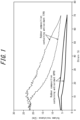
- FIG. 1 illustrates an example of the manner in which volume resistance ( ⁇ m) varies when strain is applied to a rubber test specimen formed from a rubber composition containing N,N'-bis(1,4-dimethylpentyl)-p-phenylenediamine (antioxidant 77PD) as one example of an antioxidant satisfying the relationship in formula (i) and a rubber test specimen formed from a rubber composition containing N-phenyl-N'-(1,3-dimethylbutyl)-p-phenylenediamine (antioxidant 6PPD).
- the left edge is a point corresponding to no deformation and the right edge is a point corresponding to 70% deformation.
- FIG. 1 expresses an electrical resistance value measured in one cycle of: No deformation -> Deformation (max. 70%) -> No deformation.
- the conductive rubber composition for sensing according to the present disclosure when adopted in a rubber product, the conductive rubber composition for sensing according to the present disclosure enables high-accuracy detection of the magnitude of strain of the rubber product without the use of a sensor.
- the conductive rubber composition for sensing according to the present disclosure contains a diene rubber.
- the diene rubber brings about rubber elasticity in the composition and enables extension and contraction of the rubber composition.
- the rubber composition is provided with sufficient ozone resistance.
- the diene rubber may be natural rubber (NR), synthetic isoprene rubber (IR), butadiene rubber (BR), styrene-butadiene rubber (SBR), acrylonitrile-butadiene rubber (NBR), chloroprene rubber (CR), or the like.
- the diene rubber may be one type of diene rubber used individually, or may be a blend of two or more types of diene rubbers.
- the conductive rubber composition for sensing according to the present disclosure contains carbon black.
- the carbon black brings about electrical conductivity in the composition and enables sensing of the rubber composition.
- the content of the carbon black is preferably 45 parts by mass or more, and more preferably 50 parts by mass or more relative to 100 parts by mass of the diene rubber.
- the rubber composition has a sufficiently low electrical resistance value (i.e., electricity sufficiently flows).
- the content of the carbon black is preferably 70 parts by mass or less, more preferably 60 parts by mass or less, and even more preferably 55 parts by mass or less relative to 100 parts by mass of the diene rubber.
- the rubber composition has a sufficiently high electrical resistance value (i.e., electricity does not excessively flow), electrical resistance value change is even easier to detect, and hardness of the rubber composition is reduced, resulting in suitable hardness for adoption in tube rubber of a rubber actuator, for example.
- the carbon black preferably has a cetyltrimethylammonium bromide (CTAB) adsorption specific surface area of 110 m 2 /g or more.
- CTAB cetyltrimethylammonium bromide
- the cetyltrimethylammonium bromide (CTAB) adsorption specific surface area of the carbon black is preferably 140 m 2 /g or less from a viewpoint of operability.
- cetyltrimethylammonium bromide (CTAB) adsorption specific surface area of the carbon black in the present specification is a value measured based on JIS K6217-3 and indicates the external surface area of the carbon black, exclusive of micropores, as the specific surface area when CTAB (cetyltrimethylammonium bromide) adsorbs to the carbon black.
- the carbon black preferably has a compressed-sample dibutyl phthalate (24M4DBP) absorption number of 90 mL/100 g or more.
- the 24M4DBP absorption number of the carbon black is a physical property related to structure of the carbon black.
- the electrical resistance value of the rubber composition decreases with increasing 24M4DBP absorption number.
- the 24M4DBP absorption number of the carbon black is an indicator of high strain loss and is related to the amount of rubbing together of the carbon black at high strain. Electrical resistance value change increases with increasing rubbing together of the carbon black at high strain.
- the rubber composition has a sufficiently low electrical resistance value and larger electrical resistance value change relative to strain.
- the compressed-sample dibutyl phthalate (24M4DBP) absorption number of the carbon black is preferably 130 mL/100 g or less from a viewpoint of suppressing variation due to kneading.
- the compressed-sample dibutyl phthalate (24M4DBP) absorption number of the carbon black in the present specification is a value determined by measuring the DBP (dibutyl phthalate) absorption number after four repetitions of pressure application with a pressure of 24,000 psi in accordance with ISO 6894.
- the 24M4DBP absorption number is an indicator for evaluating the skeletal structure of carbon black based mainly on the primary structure thereof and is used when determining the DBP absorption number based on non-destructive true structural form (primary structure) by excluding the DBP absorption number based on deformable and destructive structural form (secondary structure) formed through so-called Van der Waals forces.
- the carbon black may be HAF-, ISAF-, or SAF-grade carbon black, for example, without any specific limitations.
- One of these carbon blacks may be used individually, or two or more of these carbon blacks may be used together.
- the conductive rubber composition for sensing according to the present disclosure contains an antioxidant.
- the antioxidant satisfies a relationship in the following formula (i). HeavyAtomCount/MolWt ⁇ 5.46 ⁇ MaxPartialCharge/MolWt + 0.071
- HeavyAtomCount indicates the number of non-hydrogen atoms in the antioxidant
- MolWt indicates the molecular weight of the antioxidant.
- MaxPartialCharge in formula (i) is an indicator that influences permittivity and indicates the partial charge (value of + ⁇ ) of a most positively charged atom when the partial charge is calculated as the Gasteiger charge for each atom in a molecule of the antioxidant.
- An antioxidant satisfying formula (i) tends to have low partial charge, and thus tends to result in lower permittivity. Moreover, by reducing the permittivity of the rubber composition, such an antioxidant tends to result in the rubber composition having a larger resistance range (electrical resistance value change width) when strain is applied. Therefore, when a rubber composition that contains an antioxidant satisfying the relationship in formula (i) is adopted in a rubber product, this enables high-accuracy detection of the magnitude of strain of the rubber product without the use of a sensor.
- the antioxidant preferably satisfies a relationship in the following formula (2).
- HeavyAtomCount indicates the number of non-hydrogen atoms in the antioxidant
- MolWt indicates the molecular weight of the antioxidant
- MaxPartialCharge indicates the partial charge (value of + ⁇ ) of an atom that is most positively charged in the antioxidant.
- the antioxidant preferably has a value of 0.072 or more for HeavyAtomCount/MolWt in formula (1). In this case, it is possible to detect the magnitude of strain of a rubber product in which the conductive rubber composition for sensing is adopted with even higher accuracy.
- the antioxidant preferably has a value of 0.001 or less for MaxPartialCharge/MolWt in formula (1). In this case, it is possible to detect the magnitude of strain of a rubber product in which the conductive rubber composition for sensing is adopted with even higher accuracy.
- the antioxidant is preferably a p-phenylenediamine antioxidant.
- the p-phenylenediamine antioxidant is preferably a p-phenylenediamine antioxidant that does not include a double bond other than in a phenylenediamine moiety, and is more preferably a p-phenylenediamine compound represented by the following general formula (1).
- R 1 and R 2 are each independently a monovalent saturated hydrocarbon group.
- R 1 and R 2 are each independently a monovalent saturated hydrocarbon group. Although R 1 and R 2 may be the same or may be different from each other, it is preferable that R 1 and R 2 are the same from a synthetic viewpoint.
- the carbon number of the monovalent saturated hydrocarbon group is preferably 1 to 20, more preferably 3 to 10, and particularly preferably 6 or 7.
- the antioxidant has a larger age resistance effect due to the number of moles thereof per unit mass increasing, and thus ozone resistance of vulcanized rubber and/or the rubber composition improves.
- R 1 and R 2 in general formula (1) are preferably each independently a chain or cyclic monovalent saturated hydrocarbon group having a carbon number of 1 to 20.
- the monovalent saturated hydrocarbon group may be an alkyl group or a cycloalkyl group, where the alkyl group may be linear or branched, and the cycloalkyl group may further have an alkyl group or the like bonded thereto as a substituent.
- alkyl group examples include a methyl group, an ethyl group, an n-propyl group, an isopropyl group, an n-butyl group, an isobutyl group, a sec-butyl group, a tert-butyl group, a 1,2-dimethylbutyl group, a 1,3-dimethylbutyl group, a 2,3-dimethylbutyl group, an n-pentyl group, an isopentyl group, a neopentyl group, a 1-methylpentyl group, a 2-methylpentyl group, a 3-methylpentyl group, a 4-methylpentyl group, a 1,2-dimethylpentyl group, a 1,3-dimethylpentyl group, a 1,4-dimethylpentyl group, a 2,3-dimethylpentyl group, a 2,4-dimethylpentyl group, a 3,
- cycloalkyl group examples include a cyclopentyl group, a methylcyclopentyl group, a cyclohexyl group, a methylcyclohexyl group, a cycloheptyl group, and a cyclooctyl group, of which, a cyclohexyl group is preferable.
- the p-phenylenediamine compound represented by general formula (1) may, more specifically, be N,N'-bis(1,4-dimethylpentyl)-p-phenylenediamine (antioxidant 77PD), N,N'-bis(1-ethyl-3-methylpentyl)-p-phenylenediamine, N,N'-dicyclohexyl-p-phenylenediamine (antioxidant CCPD), or the like, of which, N,N'-bis(1,4-dimethylpentyl)-p-phenylenediamine (antioxidant 77PD) and N,N'-dicyclohexyl-p-phenylenediamine (antioxidant CCPD) are preferable, and N,N'-bis(1,4-dimethylpentyl)-p-phenylenediamine (antioxidant 77PD) is particularly preferable.
- the p-phenylenediamine compound may be one type of p
- the p-phenylenediamine compound represented by general formula (1) may be mounted on any support.
- the p-phenylenediamine compound represented by general formula (1) may be mounted on an inorganic filler such as silica or calcium carbonate.
- the p-phenylenediamine compound represented by general formula (1) may form a masterbatch together with a rubber component used in vulcanized rubber.
- the p-phenylenediamine compound represented by general formula (1) may be in the form of a salt with an organic acid.
- the organic acid used to obtain the salt is not specifically limited and may be stearic acid or the like.
- a phenolic compound such as styrenated phenol (antioxidant SPH) or pentaerythritol tetrakis[3-(3,5-di-tert-butyl-4-hydroxyphenyl)propionate] (antioxidant 1010) may be used as the antioxidant.
- the content of the antioxidant is preferably 1 part by mass or more, and more preferably 2 parts by mass or more relative to 100 parts by mass of the diene rubber, and is preferably 10 parts by mass or less, and more preferably 6 parts by mass or less relative to 100 parts by mass of the diene rubber.
- the content of the antioxidant is 2 parts by mass or more relative to 100 parts by mass of the diene rubber, this increases an effect of reducing permittivity of the rubber composition and an effect of widening the resistance range.
- the content of the antioxidant is 6 parts by mass or less relative to 100 parts by mass of the diene rubber, the degree of discoloration due to blooming is good.
- the conductive rubber composition for sensing according to the present disclosure may further contain carbon nanotubes.
- the carbon nanotubes have an effect of improving electrical conductivity of the composition.
- the content of the carbon nanotubes is preferably not less than 1 part by mass and not more than 5 parts by mass, and more preferably not less than 2 parts by mass and not more than 5 parts by mass relative to 100 parts by mass of the rubber component.
- the rubber composition has a sufficiently low electrical resistance value (i.e., electricity sufficiently flows), and electrical resistance value change becomes even easier to detect.
- the content of the carbon nanotubes is 5 parts by mass or less relative to 100 parts by mass of the rubber component, the rubber composition has a sufficiently high electrical resistance value (i.e., electricity does not excessively flow), and electrical resistance value change becomes even easier to detect.
- the carbon nanotubes are structures formed of carbon atoms that have a diameter on the scale of nanometers to tens of nanometers and have an ultrafine tube-shaped structure.
- the carbon nanotubes may be single-walled nanotubes or may be multi-walled nanotubes.
- the carbon nanotubes are preferably carbon nanotubes having a length of 0.1 ⁇ m to 30 ⁇ m, and more preferably carbon nanotubes having a length of 0.1 ⁇ m to 10 ⁇ m.
- the carbon nanotubes are preferably carbon nanotubes having a diameter of 10 nm to 300 nm, and more preferably carbon nanotubes having a diameter of 100 nm to 250 nm.
- the carbon nanotubes can be synthesized by plasma CVD (chemical vapor deposition), thermal CVD, surface decomposition, fluidized gas phase synthesis, arc discharge, or the like, and a commercial product can be used as the carbon nanotubes.
- the commercial product of carbon nanotubes can be carbon nanotubes produced by Kumho Tire Co., Inc., vapor grown carbon fiber VGCF ® (VGCF is a registered trademark in Japan, other countries, or both) produced by Showa Denko K.K., or carbon nanotubes produced by Materials Technologies Research (MTR), for example.
- the conductive rubber composition for sensing preferably has reduced permittivity during extension compared to a rubber composition in which the antioxidant in the conductive rubber composition for sensing is replaced with N-phenyl-N'-(1,3-dimethylbutyl)-p-phenylenediamine (antioxidant 6PPD). Reducing the permittivity of the rubber composition during extension makes it easier to increase the resistance range (electrical resistance value change width) of the rubber composition when strain is applied and enables even higher accuracy detection of the magnitude of strain of a rubber product in which the conductive rubber composition for sensing is adopted.
- the method by which the permittivity of the rubber composition during extension is reduced may be by compounding an antioxidant satisfying formula (i), by adjusting the compounded amount thereof, etc.
- extension No specific limitations are placed on the length of extension. So long as the length in an arbitrary direction is increased relative to a state in which external force is not applied, this may be considered to be extension.
- the conductive rubber composition for sensing preferably has a large resistance range compared to a rubber composition in which the antioxidant in the conductive rubber composition for sensing is replaced with N-phenyl-N'-(1,3-dimethylbutyl)-p-phenylenediamine (antioxidant 6PPD).
- Increasing the resistance range (electrical resistance value change width) of the rubber composition when strain is applied makes it possible to detect the magnitude of strain of a rubber product in which the conductive rubber composition for sensing is adopted with even higher accuracy.
- the method by which the resistance range of the rubber composition is increased may be by compounding an antioxidant satisfying formula (i), by adjusting the compounded amount thereof, etc.
- the rubber composition according to the present disclosure can be produced by, for example, using a Banbury mixer, rolls, or the like to compound the carbon black and the antioxidant with the diene rubber, further compound carbon nanotubes as desired, and perform kneading thereof, and subsequently performing warming, extrusion, etc.
- a softener stearic acid, zinc oxide (flowers of zinc), a vulcanization accelerator, a vulcanizing agent, and so forth may be selected as appropriate and compounded in the conductive rubber composition for sensing to the extent that the object of the present disclosure is not impeded.
- Commercial products can suitably be used as these compounding agents.
- the conductive rubber composition for sensing according to the present disclosure set forth above has a large resistance range (electrical resistance value change width) when strain is applied and thus can be used for sensing (detecting, perceiving, etc.) the magnitude of strain.
- the conductive rubber composition for sensing can be used in various rubber products and, in particular, can suitably be used in a tire or tube rubber of a rubber actuator.
- the conductive rubber composition for sensing can appropriately be repurposed for any rubber member in which strain arises during use, such as anti-vibration rubber, seismic isolation rubber, hoses, conveyor belts, rubber crawlers, and gloves.
- the conductive rubber composition for sensing can be used widely without limitation to the examples of applications given above.
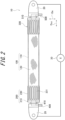
- FIG. 2 A rubber actuator according to a preferred aspect in which the conductive rubber composition for sensing according to the present disclosure is used is illustrated in FIG. 2 .
- the rubber actuator 10 illustrated in FIG. 2 includes an actuator main body 100 constituted of tube-shaped tube rubber 110 that expands/contracts through fluid pressure and a sleeve 120 that is a woven tube-shaped structure formed by weaving cords such as to be disposed in certain directions and that covers an outer peripheral surface of the tube rubber 110.
- the conductive rubber composition for sensing according to the present disclosure set forth above is used for the tube rubber 110.
- FIG. 2 is a side view of the rubber actuator 10 according to the present embodiment.
- the rubber actuator 10 includes the actuator main body 100, a sealing mechanism 200, and a sealing mechanism 300.
- Connection portions 20 are provided at respective ends of the rubber actuator 10.
- a resistance value measuring device 30 is connected to each of the connection portions 20.
- the actuator main body 100 is constituted of the tube rubber 110 and the sleeve 120.
- a working fluid flows into the actuator main body 100 via a fitting 400 and a passage hole 410.
- the rubber actuator 10 operates through fluid pressure and may be of a pneumatic type or a hydraulic type. Moreover, in a case in which a liquid is used as the working fluid, the liquid may be oil, water, or the like. In a case in which the rubber actuator is of an oil pressure type, any suitable working oil that is conventionally used in a driving system employing oil pressure can be used as the working fluid.
- the actuator main body 100 contracts in an axial direction D AX and expands in a radial direction D R of the actuator main body 100 when the working fluid flows into the tube rubber 110. Moreover, the actuator main body 100 expands in the axial direction D AX and contracts in the radial direction D R of the actuator main body 100 when the working fluid flows out from the tube rubber 110.
- the rubber actuator 10 functions as an actuator through changes in shape of the actuator main body 100 such as described above.
- the rubber actuator 10 as described above is what is referred to as a McKibben type actuator, is applicable for artificial muscle of course, and can also suitably be used for a limb (upper limb, lower limb, etc.) of a robot where higher capability (contraction force) is required.
- the connection portions 20 are connected to constituent members of a limb or the like. Note that although the resistance value measuring device 30 is connected to the connection portions 20 in the present embodiment, the connection sites of the resistance value measuring device 30 are not limited thereto. For example, the resistance value measuring device 30 may be connected directly to respective end portions of the tube rubber 110.
- the sealing mechanism 200 and the sealing mechanism 300 seal the respective end portions of the actuator main body 100 in the axial direction D AX .
- the sealing mechanism 200 includes a sealing member 210 and a caulking member 230.
- the sealing member 210 seals an end portion in the axial direction D AX of the actuator main body 100.
- the caulking member 230 caulks the actuator main body 100 in collaboration with the sealing member 210.
- Indentations 231 as caulking marks made by a jig are formed at an outer peripheral surface of the caulking member 230.
- the fitting 400 provided in the sealing mechanism 200 protrudes such that a driving pressure source of the rubber actuator 10, or more specifically a hose (piping path) connected to a compressor of the working fluid, can be attached to the fitting 400.
- the working fluid that has flowed into the actuator via the fitting 400 then flows into the inside of the actuator main body 100, or more specifically the inside of the tube rubber 110, via the passage hole 410.
- the fitting 500 provided in the sealing mechanism 300 protrudes such that it can be used for gas venting when the working fluid is injected into the rubber actuator 10.
- gas originally present inside of the rubber actuator 10 is expelled from the fitting 500 via the passage hole 510 in response to injection of the working fluid into the rubber actuator 10.
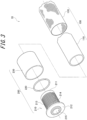
- FIG. 3 is a partially exploded perspective view of the rubber actuator 10. As illustrated in FIG. 3 , the rubber actuator 10 includes the actuator main body 100 and the sealing mechanism 200.
- the actuator main body 100 is constituted of the tube rubber 110 and the sleeve 120 as previously described.
- the tube rubber 110 is a circular tube-shaped member capable of expanding/contracting by fluid pressure.
- the tube rubber 110 repeatedly contracts and expands through the working fluid and is formed using the conductive rubber composition for sensing according to the present disclosure set forth above.
- the sleeve 120 has a circular tube shape and covers an outer peripheral surface of the tube rubber 110.
- the sleeve 120 is a woven structure formed by weaving cords such as to be disposed in certain directions, wherein the cords thus disposed intersect each other to provide repeated rhombic configurations.
- the sleeve 120 having such a configuration as described above can deform like a pantograph and follow contraction/expansion of the tube rubber 110, while also regulating the contraction/expansion.
- the sealing mechanism 200 seals an end portion in the axial direction D AX of the actuator main body 100.
- the sealing mechanism 200 is constituted of the sealing member 210, a locking ring 220, and the caulking member 230.
- the sealing member 210 has a trunk portion 211 and a flange portion 212.
- Metal such as stainless steel can suitably be used for the sealing member 210.
- the material for the sealing member 210 is not limited to metal, and a hard plastic material or the like may alternatively be used.
- the trunk portion 211 has a circular tube shape and has a passage hole 215 through which the working fluid flows formed therein.
- the passage hole 215 communicates with the passage hole 410 (refer to FIG. 2 ).
- the trunk portion 211 is inserted into the tube rubber 110.
- the flange portion 212 which is integral with the trunk portion 211, is positioned further toward an end portion side in the axial direction D AX of the actuator 10 than the trunk portion 211.
- the flange portion 212 has a larger outer diameter in the radial direction D R than the outer diameter of the trunk portion 211.
- the flange portion 212 locks the tube rubber 110 having the trunk portion 211 inserted therein and the locking ring 220.
- Irregular portions 213 are formed at an outer peripheral surface of the trunk portion 211.
- the irregular portions 213 contribute to suppressing slippage of the tube rubber 110 having the trunk portion 211 inserted therein.
- the irregular portions 213 preferably include at least three projecting portions.
- a small diameter portion 214 having a smaller outer diameter than the trunk portion 211 is formed in the trunk portion 211 at a position adjacent to the flange portion 212.
- the locking ring 220 locks the sleeve 120. Specifically, the sleeve 120 is folded backward at an outer side in the radial direction D R via the locking ring 220.
- the outer diameter of the locking ring 220 is larger than that of the trunk portion 211.
- the locking ring 220 locks the sleeve 120 at a position of the small diameter portion 214 of the trunk portion 211. In other words, the locking ring 220 locks the sleeve 120 at a position that is at a radial direction D R outer side of the trunk portion 211 and that is adjacent to the flange portion 212.
- the locking ring 220 has a configuration split into two portions in the present embodiment so that the locking ring 220 can be locked at the small diameter portion 214 that is smaller than the trunk portion 211.
- the configuration of the locking ring 220 is not limited to one in which the locking ring 220 is split into two portions.
- the locking ring 220 may alternatively be split into three or more portions, and some of the split portions may be pivotably linked with each other.
- sealing member 210 Any of the same metals, hard plastic materials, etc. as for the sealing member 210 can be used for the locking ring 220.
- the caulking member 230 caulks the actuator main body 100 in collaboration with the sealing member 210.
- Metal such as aluminum alloy, brass, iron, or the like can be used for the caulking member 230.
- Indentations 231 such as illustrated in FIG. 2 are formed on the caulking member 230 as a result of the caulking member 230 being caulked by a caulking jig.
- the tube rubber 110 repeatedly contracts and expands through the working fluid and is formed using the conductive rubber composition for sensing according to the present disclosure.
- An electrical resistance value of the actuator main body 100 decreases as a contraction ratio of the actuator main body 100 increases. This is because when the fluid flows into the actuator main body 100 and the actuator main body 100 contracts in the axial direction D AX , the tube rubber 110 expands in the radial direction D R within a certain range that is regulated by the sleeve 120, and the thickness of the tube rubber 110 decreases during this expansion, thereby narrowing the separation of carbon black (and carbon nanotubes) contained in the tube rubber 110.
- the film thickness of the tube rubber 110 decreases due to extension of the tube rubber 110. This results in a dimension (separation) of carbon black (and carbon nanotubes) in the film thickness direction narrowing, and the carbon black (and carbon nanotubes) being brought closer together.
- the separation of carbon black (and carbon nanotubes) narrows, thus resulting in an increase of electrical conductivity of the tube rubber 110 (i.e., lowering of an electrical resistance value of the tube rubber 110).
- the resistance value measuring device 40 that is connected to each of the connection portions 30, it is possible to measure the magnitude of strain of the tube rubber 110 with high accuracy.
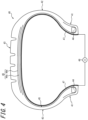
- a tire 40 according to a preferred aspect includes a pair of bead portions 41, a pair of sidewall portions 42, a tread portion 43, and a carcass 45 that reinforces each of these portions, and further includes a sensing rubber member 47 at a tire inner surface side of the carcass 45.
- the tire 40 that is illustrated in FIG. 4 includes a pair of bead portions 41, a pair of sidewall portions 42, a tread portion 43, and a carcass 45 extending in a toroidal shape between bead cores 44 that are embedded in the respective bead portions 41.
- the tire 40 further includes a belt 46 formed of two reinforcement layers 46a and 46b that are disposed at an inner side of a tread surface in a tire radial direction and at an outer side of a crown portion of the carcass 45 in the tire radial direction and a sensing rubber member 47 that is disposed at a tire inner surface side of the carcass 45.
- a resistance value measuring device 48 is connected to both end portions of the sensing rubber member 47.
- the carcass 45 is constituted of a single carcass ply and includes a main body portion that extends in a toroidal shape between the pair of bead cores 44 that are embedded in the respective bead portions 41 and turn-up portions that are folded up in an outward radial direction around the respective bead cores 44 from inside to outside in a tire width direction.
- the number of plies and the structure of the carcass 45 are not limited to this configuration.
- a radial carcass is preferable as the carcass from a viewpoint of durability of the tire.
- the carcass ply constituting the carcass 45 has a configuration in which a plurality of reinforcing cords are coated by coating rubber.
- the reinforcing cords may be organic fiber cords such as polyethylene terephthalate cords, nylon cords, or rayon cords, or may alternatively be steel cords.
- the belt 46 of the tire 40 illustrated in FIG. 4 is constituted of two belt layers 46a and 46b.
- Each of the belt layers is normally a rubber coated layer of cords that extend in an inclined manner relative to a tire equatorial plane, and is preferably a steel cord layer coated with rubber.
- the two belt layers are stacked to form the belt 46 such that constituent cords of these belt layers intersect with the tire equatorial plane interposed therebetween.
- the belt 46 in FIG. 4 includes two belt layers, the number of belt layers constituting the belt 46 is not limited thereto and may be any number that is 1 or more.
- a belt reinforcement layer a and a belt reinforcement layer b may be disposed further outward than the belt 46 in the tire radial direction of the tire 40.
- the belt reinforcement layer a may be disposed such as to cover the entirety of the belt 46, and a pair of belt reinforcement layers b may be disposed such as to only cover the respective tire width direction end portions of the belt reinforcement layer a at an outer side of the belt reinforcement layer a in the tire radial direction.
- the belt reinforcement layer a and the belt reinforcement layer b may be formed of a polyethylene terephthalate cord layer coated with rubber that is arranged substantially parallel to a tire circumferential direction.
- the tire 40 illustrated in FIG. 4 includes the sensing rubber member 47 at an innermost surface of the tire, which is a tire inner surface side of the carcass 45.
- the sensing rubber member 47 may be provided in place of an inner liner that is normally provided in order to ensure airtightness of the tire (i.e., the sensing rubber member 47 may have air impermeability in addition to sensing functionality), or may be separately attached at a tire inner surface side of the inner liner.
- the sensing rubber member 47 is formed from the conductive rubber composition for sensing according to the present disclosure set forth above.
- the resistance value measuring device 48 is connected to both end portions of the sensing rubber member 47, thereby enabling high-accuracy measurement of the magnitude of strain of the tire 10 through measurement (monitoring) of a resistance value of the sensing rubber member 47 by the resistance value measuring device 48. Moreover, by measuring (monitoring) the magnitude of strain of the tire 10, it is possible to continuously acquire information such as road surface conditions, tire grounding conditions, tire wear conditions, and so forth.
- Rubber compositions having formulations indicated in Table 1 were produced through kneading by a typical method.
- Each of the obtained rubber compositions was used to produce a test specimen that was subjected to platinum vapor deposition at both ends on one side leaving a length of 20 mm with a strip shape of 1 mm in thickness and 4.7 mm in width.
- the resistance range electrical resistance value change width
- MSE mean squared error
- test specimen was connected to a tensile test machine (model K18003) produced by System One Co., Ltd., and the magnitude of strain and electrical resistance value ( ⁇ m) during extension of the test specimen by 70% (minimum-maximum strain: 0-70%) with a tensing rate of 6 mm/s were measured. Differences in terms of resistance range (electrical resistance value change width) for cases with the same filler formulation were evaluated by:
- MSE mean squared error
- test specimen was connected to a tensile test machine (model K18003) produced by System One Co., Ltd., and the permittivity at 20 Hz during extension of the test specimen by 70% was measured using an E4990A produced by Keysight Technologies. Differences in permittivity for cases with the same filler formulation were evaluated by:
- antioxidant 6PPD Structural formulae for the used antioxidant 6PPD, antioxidant SDPA, antioxidant SPH, antioxidant 1010, and antioxidant 77PD are shown below.
- the rubber compositions of the Examples which are in accordance with the present disclosure, have a low permittivity, a large resistance range, and a small mean squared error (MSE) for the actual magnitude of strain and the magnitude of strain inferred from an electrical resistance value, and enable high-accuracy detection of the magnitude of strain.
- MSE mean squared error
- the conductive rubber composition for sensing according to the present disclosure enables high-accuracy detection of the magnitude of strain of a rubber product without the use of a sensor when adopted in the rubber product and can be used in various rubber products such as tires and tube rubber of rubber actuators.
Landscapes
- Chemical & Material Sciences (AREA)
- Health & Medical Sciences (AREA)
- Chemical Kinetics & Catalysis (AREA)
- Medicinal Chemistry (AREA)
- Polymers & Plastics (AREA)
- Organic Chemistry (AREA)
- Physics & Mathematics (AREA)
- General Physics & Mathematics (AREA)
- Engineering & Computer Science (AREA)
- Mechanical Engineering (AREA)
- Compositions Of Macromolecular Compounds (AREA)
- Measurement Of Length, Angles, Or The Like Using Electric Or Magnetic Means (AREA)
- Tires In General (AREA)
Abstract
Description
- The present disclosure relates to a conductive rubber composition for sensing.
- In rubber products such as rubber actuators and tires, there is demand for measuring the magnitude of strain of such rubber products. Detection of the magnitude of strain of typical rubber products requires the provision of a separate sensor (strain sensor, accelerometer, position detection sensor, angle sensor, etc.) externally to the rubber product.
- On the other hand, a technique of inferring the magnitude of strain of a rubber product through measurement of an electrical resistance value of the rubber product without the use of a sensor is a known technique. For example, Patent Literature (PTL) 1, indicated below, discloses a technique of compounding carbon black and/or carbon nanotubes having high electrical conductivity with a rubber ingredient in production of a rubber material so as to impart electrical conductivity to the rubber material and determining correlation between electrical resistance value change due to strain and strain so as to infer the magnitude of strain of the rubber material.
- PTL 1:
JP 2008-037906 A - However, although the technique described in PTL 1 makes it possible to roughly infer the magnitude of strain, the accuracy of this inference is inadequate, and there is room for further improvement of the accuracy of inference.
- Accordingly, the present disclosure is directed at solving the problem in the conventional technique described above and providing a conductive rubber composition for sensing that when adopted in a rubber product, enables high-accuracy detection of the magnitude of strain of the rubber product without the use of a sensor.
- Primary features of a conductive rubber composition for sensing according to the present disclosure that solves the problem set forth above are as follows.
- [1] A conductive rubber composition for sensing comprising a diene rubber, carbon black, and an antioxidant, wherein
the antioxidant satisfies a relationship in formula (i), shown below,
- [2] The conductive rubber composition for sensing according to the foregoing [1], wherein content of the carbon black is 45 parts by mass or more relative to 100 parts by mass of the diene rubber.
- [3] The conductive rubber composition for sensing according to the foregoing [1] or [2], wherein the carbon black has a cetyltrimethylammonium bromide (CTAB) adsorption specific surface area of 110 m2/g or more.
- [4] The conductive rubber composition for sensing according to any one of the foregoing [1] to [3], having reduced permittivity during extension compared to a rubber composition in which the antioxidant in the conductive rubber composition for sensing is replaced with N-phenyl-N'-(1,3-dimethylbutyl)-p-phenylenediamine, otherwise known as antioxidant 6PPD.
- [5] The conductive rubber composition for sensing according to any one of the foregoing [1] to [4], having a large resistance range compared to a rubber composition in which the antioxidant in the conductive rubber composition for sensing is replaced with N-phenyl-N'-(1,3-dimethylbutyl)-p-phenylenediamine, otherwise known as antioxidant 6PPD.
- [6] The conductive rubber composition for sensing according to any one of the foregoing [1] to [5], wherein the antioxidant satisfies a relationship in formula (ii), shown below,

- [7] The conductive rubber composition for sensing according to any one of the foregoing [1] to [6], wherein the antioxidant has a value of 0.072 or more for HeavyAtomCount/MolWt in formula (i).
- [8] The conductive rubber composition for sensing according to any one of the foregoing [1] to [7], wherein the antioxidant has a value of 0.001 or less for MaxPartialCharge/MolWt in formula (i).
- According to the present disclosure, it is possible to provide a conductive rubber composition for sensing that when adopted in a rubber product, enables high-accuracy detection of the magnitude of strain of the rubber product without the use of a sensor.
- In the accompanying drawings:
-
FIG. 1 is a graph illustrating an example of the manner in which volume resistance (Ωm) varies when strain is applied to a rubber test specimen formed from a rubber composition containing antioxidant 77PD and a rubber test specimen formed from a rubber composition containing antioxidant 6PPD; -
FIG. 2 is a side view of an example of a rubber actuator; -
FIG. 3 is a partially exploded perspective view of an example of a rubber actuator; -
FIG. 4 is a cross-sectional view of an example of a tire; and -
FIG. 5 is a graph illustrating a relationship between "HeavyAtomCount/MolWt" (vertical axis) and "MaxPartialCharge/MolWt" (horizontal axis) for various antioxidants. - The following provides a detailed illustrative description of the conductive rubber composition for sensing according to the present disclosure based on embodiments thereof.
- The conductive rubber composition for sensing according to the present disclosure contains a diene rubber, carbon black, and an antioxidant. A feature of the conductive rubber composition for sensing according to the present disclosure is that the antioxidant satisfies a relationship in the following formula (i).

- As previously described, although it is possible to obtain a rubber composition having electrical conductivity by compounding carbon black and/or carbon nanotubes having high electrical conductivity with a rubber component such as a diene rubber, this conductive rubber composition only makes it possible to roughly infer the magnitude of strain through measurement of an electrical resistance value, and the accuracy of this inference is inadequate.
- In response to this issue, the inventor focused on antioxidants that are typically compounded in rubber compositions and found that such antioxidants also contribute to an electrical resistance value of a rubber composition. Moreover, as a result of further studies, the inventor found that when an antioxidant satisfying the relationship in the preceding formula (i) is compounded instead of N-phenyl-N'-(1,3-dimethylbutyl)-p-phenylenediamine (antioxidant 6PPD), which is typically used as an antioxidant, this yields a rubber composition that makes it possible to infer the magnitude of strain with higher accuracy.
-
FIG. 1 illustrates an example of the manner in which volume resistance (Ωm) varies when strain is applied to a rubber test specimen formed from a rubber composition containing N,N'-bis(1,4-dimethylpentyl)-p-phenylenediamine (antioxidant 77PD) as one example of an antioxidant satisfying the relationship in formula (i) and a rubber test specimen formed from a rubber composition containing N-phenyl-N'-(1,3-dimethylbutyl)-p-phenylenediamine (antioxidant 6PPD). InFIG. 1 , the left edge is a point corresponding to no deformation and the right edge is a point corresponding to 70% deformation.FIG. 1 expresses an electrical resistance value measured in one cycle of: No deformation -> Deformation (max. 70%) -> No deformation. - In a case in which a rubber composition containing an antioxidant satisfying the relationship in formula (i) is used, there is a larger difference between electrical resistance values before and after deformation of a rubber product than in a case in which a rubber composition containing antioxidant 6PPD is used, and thus the magnitude of strain can be inferred with higher accuracy.
- Therefore, when the conductive rubber composition for sensing according to the present disclosure is adopted in a rubber product, the conductive rubber composition for sensing according to the present disclosure enables high-accuracy detection of the magnitude of strain of the rubber product without the use of a sensor.
- The conductive rubber composition for sensing according to the present disclosure contains a diene rubber. The diene rubber brings about rubber elasticity in the composition and enables extension and contraction of the rubber composition. Moreover, as a result of the diene rubber being compounded in combination with the subsequently described antioxidant in the rubber composition, the rubber composition is provided with sufficient ozone resistance.
- The diene rubber may be natural rubber (NR), synthetic isoprene rubber (IR), butadiene rubber (BR), styrene-butadiene rubber (SBR), acrylonitrile-butadiene rubber (NBR), chloroprene rubber (CR), or the like. The diene rubber may be one type of diene rubber used individually, or may be a blend of two or more types of diene rubbers.
- The conductive rubber composition for sensing according to the present disclosure contains carbon black. The carbon black brings about electrical conductivity in the composition and enables sensing of the rubber composition.
- The content of the carbon black is preferably 45 parts by mass or more, and more preferably 50 parts by mass or more relative to 100 parts by mass of the diene rubber. When the content of the carbon black is 45 parts by mass or more relative to 100 parts by mass of the diene rubber, the rubber composition has a sufficiently low electrical resistance value (i.e., electricity sufficiently flows).
- Moreover, the content of the carbon black is preferably 70 parts by mass or less, more preferably 60 parts by mass or less, and even more preferably 55 parts by mass or less relative to 100 parts by mass of the diene rubber. When the content of the carbon black is 55 parts by mass or less relative to 100 parts by mass of the diene rubber, the rubber composition has a sufficiently high electrical resistance value (i.e., electricity does not excessively flow), electrical resistance value change is even easier to detect, and hardness of the rubber composition is reduced, resulting in suitable hardness for adoption in tube rubber of a rubber actuator, for example.
- The carbon black preferably has a cetyltrimethylammonium bromide (CTAB) adsorption specific surface area of 110 m2/g or more. When the CTAB adsorption specific surface area of the carbon black is 110 m2/g or more, the carbon black has a sufficiently small particle size, and the rubber composition has a sufficiently low electrical resistance value (i.e., electricity sufficiently flows).
- The cetyltrimethylammonium bromide (CTAB) adsorption specific surface area of the carbon black is preferably 140 m2/g or less from a viewpoint of operability.
- Note that the cetyltrimethylammonium bromide (CTAB) adsorption specific surface area of the carbon black in the present specification is a value measured based on JIS K6217-3 and indicates the external surface area of the carbon black, exclusive of micropores, as the specific surface area when CTAB (cetyltrimethylammonium bromide) adsorbs to the carbon black.
- The carbon black preferably has a compressed-sample dibutyl phthalate (24M4DBP) absorption number of 90 mL/100 g or more. The 24M4DBP absorption number of the carbon black is a physical property related to structure of the carbon black. The electrical resistance value of the rubber composition decreases with increasing 24M4DBP absorption number. Moreover, the 24M4DBP absorption number of the carbon black is an indicator of high strain loss and is related to the amount of rubbing together of the carbon black at high strain. Electrical resistance value change increases with increasing rubbing together of the carbon black at high strain. Furthermore, when the 24M4DBP absorption number of the carbon black is 90 mL/100 g or more, the rubber composition has a sufficiently low electrical resistance value and larger electrical resistance value change relative to strain.
- The compressed-sample dibutyl phthalate (24M4DBP) absorption number of the carbon black is preferably 130 mL/100 g or less from a viewpoint of suppressing variation due to kneading.
- Note that the compressed-sample dibutyl phthalate (24M4DBP) absorption number of the carbon black in the present specification is a value determined by measuring the DBP (dibutyl phthalate) absorption number after four repetitions of pressure application with a pressure of 24,000 psi in accordance with ISO 6894. The 24M4DBP absorption number is an indicator for evaluating the skeletal structure of carbon black based mainly on the primary structure thereof and is used when determining the DBP absorption number based on non-destructive true structural form (primary structure) by excluding the DBP absorption number based on deformable and destructive structural form (secondary structure) formed through so-called Van der Waals forces.
- The carbon black may be HAF-, ISAF-, or SAF-grade carbon black, for example, without any specific limitations. One of these carbon blacks may be used individually, or two or more of these carbon blacks may be used together.
- The conductive rubber composition for sensing according to the present disclosure contains an antioxidant. The antioxidant satisfies a relationship in the following formula (i).

- In formula (i), HeavyAtomCount indicates the number of non-hydrogen atoms in the antioxidant, and MolWt indicates the molecular weight of the antioxidant. Moreover, MaxPartialCharge in formula (i) is an indicator that influences permittivity and indicates the partial charge (value of +δ) of a most positively charged atom when the partial charge is calculated as the Gasteiger charge for each atom in a molecule of the antioxidant.
- Note that "HeavyAtomCount", "MolWt", and "MaxPartialCharge" in formula (i) and the subsequently described formula (ii) are values obtained through logic calculation using RDkit (Open-source cheminformatics; http://www.rdkit.org), which is free software (OSS: Open-Source Software), by inputting the structural formula of a compound.
- An antioxidant satisfying formula (i) tends to have low partial charge, and thus tends to result in lower permittivity. Moreover, by reducing the permittivity of the rubber composition, such an antioxidant tends to result in the rubber composition having a larger resistance range (electrical resistance value change width) when strain is applied. Therefore, when a rubber composition that contains an antioxidant satisfying the relationship in formula (i) is adopted in a rubber product, this enables high-accuracy detection of the magnitude of strain of the rubber product without the use of a sensor.
- The antioxidant preferably satisfies a relationship in the following formula (2).

- The antioxidant preferably has a value of 0.072 or more for HeavyAtomCount/MolWt in formula (1). In this case, it is possible to detect the magnitude of strain of a rubber product in which the conductive rubber composition for sensing is adopted with even higher accuracy.
- The antioxidant preferably has a value of 0.001 or less for MaxPartialCharge/MolWt in formula (1). In this case, it is possible to detect the magnitude of strain of a rubber product in which the conductive rubber composition for sensing is adopted with even higher accuracy.
- The antioxidant is preferably a p-phenylenediamine antioxidant.
- The p-phenylenediamine antioxidant is preferably a p-phenylenediamine antioxidant that does not include a double bond other than in a phenylenediamine moiety, and is more preferably a p-phenylenediamine compound represented by the following general formula (1).


- In general formula (1), R1 and R2 are each independently a monovalent saturated hydrocarbon group. Although R1 and R2 may be the same or may be different from each other, it is preferable that R1 and R2 are the same from a synthetic viewpoint.
- The carbon number of the monovalent saturated hydrocarbon group is preferably 1 to 20, more preferably 3 to 10, and particularly preferably 6 or 7. When the carbon number of the saturated hydrocarbon group is 20 or less, the antioxidant has a larger age resistance effect due to the number of moles thereof per unit mass increasing, and thus ozone resistance of vulcanized rubber and/or the rubber composition improves.
- R1 and R2 in general formula (1) are preferably each independently a chain or cyclic monovalent saturated hydrocarbon group having a carbon number of 1 to 20.
- The monovalent saturated hydrocarbon group may be an alkyl group or a cycloalkyl group, where the alkyl group may be linear or branched, and the cycloalkyl group may further have an alkyl group or the like bonded thereto as a substituent.
- Examples of the alkyl group include a methyl group, an ethyl group, an n-propyl group, an isopropyl group, an n-butyl group, an isobutyl group, a sec-butyl group, a tert-butyl group, a 1,2-dimethylbutyl group, a 1,3-dimethylbutyl group, a 2,3-dimethylbutyl group, an n-pentyl group, an isopentyl group, a neopentyl group, a 1-methylpentyl group, a 2-methylpentyl group, a 3-methylpentyl group, a 4-methylpentyl group, a 1,2-dimethylpentyl group, a 1,3-dimethylpentyl group, a 1,4-dimethylpentyl group, a 2,3-dimethylpentyl group, a 2,4-dimethylpentyl group, a 3,4-dimethylpentyl group, an n-hexyl group, a 1-methylhexyl group, a 2-methylhexyl group, various octyl groups, various decyl groups, and various dodecyl groups, of which, a 1,4-dimethylpentyl group is preferable.
- Examples of the cycloalkyl group include a cyclopentyl group, a methylcyclopentyl group, a cyclohexyl group, a methylcyclohexyl group, a cycloheptyl group, and a cyclooctyl group, of which, a cyclohexyl group is preferable.
- The p-phenylenediamine compound represented by general formula (1) may, more specifically, be N,N'-bis(1,4-dimethylpentyl)-p-phenylenediamine (antioxidant 77PD), N,N'-bis(1-ethyl-3-methylpentyl)-p-phenylenediamine, N,N'-dicyclohexyl-p-phenylenediamine (antioxidant CCPD), or the like, of which, N,N'-bis(1,4-dimethylpentyl)-p-phenylenediamine (antioxidant 77PD) and N,N'-dicyclohexyl-p-phenylenediamine (antioxidant CCPD) are preferable, and N,N'-bis(1,4-dimethylpentyl)-p-phenylenediamine (antioxidant 77PD) is particularly preferable. The p-phenylenediamine compound may be one type of p-phenylenediamine compound used individually or may be two or more types of p-phenylenediamine compounds used in combination.
- Note that the p-phenylenediamine compound represented by general formula (1) may be mounted on any support. For example, the p-phenylenediamine compound represented by general formula (1) may be mounted on an inorganic filler such as silica or calcium carbonate.
- Moreover, the p-phenylenediamine compound represented by general formula (1) may form a masterbatch together with a rubber component used in vulcanized rubber.
- Furthermore, the p-phenylenediamine compound represented by general formula (1) may be in the form of a salt with an organic acid. The organic acid used to obtain the salt is not specifically limited and may be stearic acid or the like.
- Besides the p-phenylenediamine compound described above, a phenolic compound such as styrenated phenol (antioxidant SPH) or pentaerythritol tetrakis[3-(3,5-di-tert-butyl-4-hydroxyphenyl)propionate] (antioxidant 1010) may be used as the antioxidant.
- The content of the antioxidant is preferably 1 part by mass or more, and more preferably 2 parts by mass or more relative to 100 parts by mass of the diene rubber, and is preferably 10 parts by mass or less, and more preferably 6 parts by mass or less relative to 100 parts by mass of the diene rubber. When the content of the antioxidant is 2 parts by mass or more relative to 100 parts by mass of the diene rubber, this increases an effect of reducing permittivity of the rubber composition and an effect of widening the resistance range. Moreover, when the content of the antioxidant is 6 parts by mass or less relative to 100 parts by mass of the diene rubber, the degree of discoloration due to blooming is good.
- The conductive rubber composition for sensing according to the present disclosure may further contain carbon nanotubes. The carbon nanotubes have an effect of improving electrical conductivity of the composition.
- The content of the carbon nanotubes is preferably not less than 1 part by mass and not more than 5 parts by mass, and more preferably not less than 2 parts by mass and not more than 5 parts by mass relative to 100 parts by mass of the rubber component. When the content of the carbon nanotubes is 1 part by mass or more relative to 100 parts by mass of the rubber component, the rubber composition has a sufficiently low electrical resistance value (i.e., electricity sufficiently flows), and electrical resistance value change becomes even easier to detect. Moreover, when the content of the carbon nanotubes is 5 parts by mass or less relative to 100 parts by mass of the rubber component, the rubber composition has a sufficiently high electrical resistance value (i.e., electricity does not excessively flow), and electrical resistance value change becomes even easier to detect.
- The carbon nanotubes (CNTs) are structures formed of carbon atoms that have a diameter on the scale of nanometers to tens of nanometers and have an ultrafine tube-shaped structure.
- The carbon nanotubes may be single-walled nanotubes or may be multi-walled nanotubes.
- The carbon nanotubes are preferably carbon nanotubes having a length of 0.1 µm to 30 µm, and more preferably carbon nanotubes having a length of 0.1 µm to 10 µm.
- Moreover, the carbon nanotubes are preferably carbon nanotubes having a diameter of 10 nm to 300 nm, and more preferably carbon nanotubes having a diameter of 100 nm to 250 nm.
- The carbon nanotubes can be synthesized by plasma CVD (chemical vapor deposition), thermal CVD, surface decomposition, fluidized gas phase synthesis, arc discharge, or the like, and a commercial product can be used as the carbon nanotubes. The commercial product of carbon nanotubes can be carbon nanotubes produced by Kumho Tire Co., Inc., vapor grown carbon fiber VGCF® (VGCF is a registered trademark in Japan, other countries, or both) produced by Showa Denko K.K., or carbon nanotubes produced by Materials Technologies Research (MTR), for example.
- The conductive rubber composition for sensing according to the present disclosure preferably has reduced permittivity during extension compared to a rubber composition in which the antioxidant in the conductive rubber composition for sensing is replaced with N-phenyl-N'-(1,3-dimethylbutyl)-p-phenylenediamine (antioxidant 6PPD). Reducing the permittivity of the rubber composition during extension makes it easier to increase the resistance range (electrical resistance value change width) of the rubber composition when strain is applied and enables even higher accuracy detection of the magnitude of strain of a rubber product in which the conductive rubber composition for sensing is adopted.
- Note that the method by which the permittivity of the rubber composition during extension is reduced may be by compounding an antioxidant satisfying formula (i), by adjusting the compounded amount thereof, etc.
- No specific limitations are placed on the length of extension. So long as the length in an arbitrary direction is increased relative to a state in which external force is not applied, this may be considered to be extension.
- The conductive rubber composition for sensing according to the present disclosure preferably has a large resistance range compared to a rubber composition in which the antioxidant in the conductive rubber composition for sensing is replaced with N-phenyl-N'-(1,3-dimethylbutyl)-p-phenylenediamine (antioxidant 6PPD). Increasing the resistance range (electrical resistance value change width) of the rubber composition when strain is applied makes it possible to detect the magnitude of strain of a rubber product in which the conductive rubber composition for sensing is adopted with even higher accuracy.
- Note that the method by which the resistance range of the rubber composition is increased may be by compounding an antioxidant satisfying formula (i), by adjusting the compounded amount thereof, etc.
- The rubber composition according to the present disclosure can be produced by, for example, using a Banbury mixer, rolls, or the like to compound the carbon black and the antioxidant with the diene rubber, further compound carbon nanotubes as desired, and perform kneading thereof, and subsequently performing warming, extrusion, etc.
- Besides the components described above, a softener, stearic acid, zinc oxide (flowers of zinc), a vulcanization accelerator, a vulcanizing agent, and so forth may be selected as appropriate and compounded in the conductive rubber composition for sensing to the extent that the object of the present disclosure is not impeded. Commercial products can suitably be used as these compounding agents.
- The conductive rubber composition for sensing according to the present disclosure set forth above has a large resistance range (electrical resistance value change width) when strain is applied and thus can be used for sensing (detecting, perceiving, etc.) the magnitude of strain. The conductive rubber composition for sensing can be used in various rubber products and, in particular, can suitably be used in a tire or tube rubber of a rubber actuator. Besides the above applications, the conductive rubber composition for sensing can appropriately be repurposed for any rubber member in which strain arises during use, such as anti-vibration rubber, seismic isolation rubber, hoses, conveyor belts, rubber crawlers, and gloves. Moreover, it goes without saying that the conductive rubber composition for sensing can be used widely without limitation to the examples of applications given above.
- A rubber actuator according to a preferred aspect in which the conductive rubber composition for sensing according to the present disclosure is used is illustrated in
FIG. 2 . Therubber actuator 10 illustrated inFIG. 2 includes an actuatormain body 100 constituted of tube-shapedtube rubber 110 that expands/contracts through fluid pressure and asleeve 120 that is a woven tube-shaped structure formed by weaving cords such as to be disposed in certain directions and that covers an outer peripheral surface of thetube rubber 110. The conductive rubber composition for sensing according to the present disclosure set forth above is used for thetube rubber 110. -
FIG. 2 is a side view of therubber actuator 10 according to the present embodiment. As illustrated inFIG. 2 , therubber actuator 10 includes the actuatormain body 100, asealing mechanism 200, and asealing mechanism 300.Connection portions 20 are provided at respective ends of therubber actuator 10. Moreover, a resistancevalue measuring device 30 is connected to each of theconnection portions 20. - The actuator
main body 100 is constituted of thetube rubber 110 and thesleeve 120. A working fluid flows into the actuatormain body 100 via a fitting 400 and apassage hole 410. Therubber actuator 10 operates through fluid pressure and may be of a pneumatic type or a hydraulic type. Moreover, in a case in which a liquid is used as the working fluid, the liquid may be oil, water, or the like. In a case in which the rubber actuator is of an oil pressure type, any suitable working oil that is conventionally used in a driving system employing oil pressure can be used as the working fluid. - The actuator
main body 100 contracts in an axial direction DAX and expands in a radial direction DR of the actuatormain body 100 when the working fluid flows into thetube rubber 110. Moreover, the actuatormain body 100 expands in the axial direction DAX and contracts in the radial direction DR of the actuatormain body 100 when the working fluid flows out from thetube rubber 110. Therubber actuator 10 functions as an actuator through changes in shape of the actuatormain body 100 such as described above. - The
rubber actuator 10 as described above is what is referred to as a McKibben type actuator, is applicable for artificial muscle of course, and can also suitably be used for a limb (upper limb, lower limb, etc.) of a robot where higher capability (contraction force) is required. Theconnection portions 20 are connected to constituent members of a limb or the like. Note that although the resistancevalue measuring device 30 is connected to theconnection portions 20 in the present embodiment, the connection sites of the resistancevalue measuring device 30 are not limited thereto. For example, the resistancevalue measuring device 30 may be connected directly to respective end portions of thetube rubber 110. - The
sealing mechanism 200 and thesealing mechanism 300 seal the respective end portions of the actuatormain body 100 in the axial direction DAX. Specifically, thesealing mechanism 200 includes a sealingmember 210 and acaulking member 230. The sealingmember 210 seals an end portion in the axial direction DAX of the actuatormain body 100. Thecaulking member 230 caulks the actuatormain body 100 in collaboration with the sealingmember 210.Indentations 231 as caulking marks made by a jig are formed at an outer peripheral surface of thecaulking member 230. - Differences between the
sealing mechanism 200 and thesealing mechanism 300 reside in the different roles offittings 400 and 500 (and passage holes 410 and 510). - The fitting 400 provided in the
sealing mechanism 200 protrudes such that a driving pressure source of therubber actuator 10, or more specifically a hose (piping path) connected to a compressor of the working fluid, can be attached to the fitting 400. The working fluid that has flowed into the actuator via the fitting 400 then flows into the inside of the actuatormain body 100, or more specifically the inside of thetube rubber 110, via thepassage hole 410. - On the other hand, the fitting 500 provided in the
sealing mechanism 300 protrudes such that it can be used for gas venting when the working fluid is injected into therubber actuator 10. In an initial stage of operation of therubber actuator 10, gas originally present inside of therubber actuator 10 is expelled from the fitting 500 via thepassage hole 510 in response to injection of the working fluid into therubber actuator 10. -
FIG. 3 is a partially exploded perspective view of therubber actuator 10. As illustrated inFIG. 3 , therubber actuator 10 includes the actuatormain body 100 and thesealing mechanism 200. - The actuator
main body 100 is constituted of thetube rubber 110 and thesleeve 120 as previously described. - The
tube rubber 110 is a circular tube-shaped member capable of expanding/contracting by fluid pressure. Thetube rubber 110 repeatedly contracts and expands through the working fluid and is formed using the conductive rubber composition for sensing according to the present disclosure set forth above. - The
sleeve 120 has a circular tube shape and covers an outer peripheral surface of thetube rubber 110. Thesleeve 120 is a woven structure formed by weaving cords such as to be disposed in certain directions, wherein the cords thus disposed intersect each other to provide repeated rhombic configurations. Thesleeve 120 having such a configuration as described above can deform like a pantograph and follow contraction/expansion of thetube rubber 110, while also regulating the contraction/expansion. - In
FIG. 3 , thesealing mechanism 200 seals an end portion in the axial direction DAX of the actuatormain body 100. Thesealing mechanism 200 is constituted of the sealingmember 210, alocking ring 220, and thecaulking member 230. - The sealing
member 210 has atrunk portion 211 and aflange portion 212. Metal such as stainless steel can suitably be used for the sealingmember 210. However, the material for the sealingmember 210 is not limited to metal, and a hard plastic material or the like may alternatively be used. - The
trunk portion 211 has a circular tube shape and has apassage hole 215 through which the working fluid flows formed therein. Thepassage hole 215 communicates with the passage hole 410 (refer toFIG. 2 ). Thetrunk portion 211 is inserted into thetube rubber 110. - The
flange portion 212, which is integral with thetrunk portion 211, is positioned further toward an end portion side in the axial direction DAX of theactuator 10 than thetrunk portion 211. Theflange portion 212 has a larger outer diameter in the radial direction DR than the outer diameter of thetrunk portion 211. Theflange portion 212 locks thetube rubber 110 having thetrunk portion 211 inserted therein and thelocking ring 220. -
Irregular portions 213 are formed at an outer peripheral surface of thetrunk portion 211. Theirregular portions 213 contribute to suppressing slippage of thetube rubber 110 having thetrunk portion 211 inserted therein. Theirregular portions 213 preferably include at least three projecting portions. - Furthermore, a
small diameter portion 214 having a smaller outer diameter than thetrunk portion 211 is formed in thetrunk portion 211 at a position adjacent to theflange portion 212. - The
locking ring 220 locks thesleeve 120. Specifically, thesleeve 120 is folded backward at an outer side in the radial direction DR via thelocking ring 220. - The outer diameter of the
locking ring 220 is larger than that of thetrunk portion 211. Thelocking ring 220 locks thesleeve 120 at a position of thesmall diameter portion 214 of thetrunk portion 211. In other words, thelocking ring 220 locks thesleeve 120 at a position that is at a radial direction DR outer side of thetrunk portion 211 and that is adjacent to theflange portion 212. - The
locking ring 220 has a configuration split into two portions in the present embodiment so that thelocking ring 220 can be locked at thesmall diameter portion 214 that is smaller than thetrunk portion 211. Note that the configuration of thelocking ring 220 is not limited to one in which thelocking ring 220 is split into two portions. Thelocking ring 220 may alternatively be split into three or more portions, and some of the split portions may be pivotably linked with each other. - Any of the same metals, hard plastic materials, etc. as for the sealing
member 210 can be used for thelocking ring 220. - The
caulking member 230 caulks the actuatormain body 100 in collaboration with the sealingmember 210. Metal such as aluminum alloy, brass, iron, or the like can be used for thecaulking member 230.Indentations 231 such as illustrated inFIG. 2 are formed on thecaulking member 230 as a result of thecaulking member 230 being caulked by a caulking jig. - As previously described, the
tube rubber 110 repeatedly contracts and expands through the working fluid and is formed using the conductive rubber composition for sensing according to the present disclosure. - An electrical resistance value of the actuator main body 100 (tube rubber 110) decreases as a contraction ratio of the actuator
main body 100 increases. This is because when the fluid flows into the actuatormain body 100 and the actuatormain body 100 contracts in the axial direction DAX, thetube rubber 110 expands in the radial direction DR within a certain range that is regulated by thesleeve 120, and the thickness of thetube rubber 110 decreases during this expansion, thereby narrowing the separation of carbon black (and carbon nanotubes) contained in thetube rubber 110. - Specifically, during contraction of the actuator
main body 100, the film thickness of thetube rubber 110 decreases due to extension of thetube rubber 110. This results in a dimension (separation) of carbon black (and carbon nanotubes) in the film thickness direction narrowing, and the carbon black (and carbon nanotubes) being brought closer together. - In other words, as the contraction ratio of the actuator
main body 100 increases and the length of the actuatormain body 100 shortens, the separation of carbon black (and carbon nanotubes) narrows, thus resulting in an increase of electrical conductivity of the tube rubber 110 (i.e., lowering of an electrical resistance value of the tube rubber 110). Moreover, by measuring this resistance value through the resistancevalue measuring device 40 that is connected to each of theconnection portions 30, it is possible to measure the magnitude of strain of thetube rubber 110 with high accuracy. - Next, a tire according to a preferred aspect in which the conductive rubber composition for sensing according to the present disclosure is used is illustrated in
FIG. 4 . Atire 40 according to a preferred aspect includes a pair ofbead portions 41, a pair ofsidewall portions 42, atread portion 43, and acarcass 45 that reinforces each of these portions, and further includes asensing rubber member 47 at a tire inner surface side of thecarcass 45. - The
tire 40 that is illustrated inFIG. 4 includes a pair ofbead portions 41, a pair ofsidewall portions 42, atread portion 43, and acarcass 45 extending in a toroidal shape betweenbead cores 44 that are embedded in therespective bead portions 41. In thetread portion 43, thetire 40 further includes abelt 46 formed of tworeinforcement layers carcass 45 in the tire radial direction and asensing rubber member 47 that is disposed at a tire inner surface side of thecarcass 45. Moreover, a resistancevalue measuring device 48 is connected to both end portions of thesensing rubber member 47. - In the
tire 40 illustrated inFIG. 4 , thecarcass 45 is constituted of a single carcass ply and includes a main body portion that extends in a toroidal shape between the pair ofbead cores 44 that are embedded in therespective bead portions 41 and turn-up portions that are folded up in an outward radial direction around therespective bead cores 44 from inside to outside in a tire width direction. However, the number of plies and the structure of thecarcass 45 are not limited to this configuration. Note that a radial carcass is preferable as the carcass from a viewpoint of durability of the tire. The carcass ply constituting thecarcass 45 has a configuration in which a plurality of reinforcing cords are coated by coating rubber. The reinforcing cords may be organic fiber cords such as polyethylene terephthalate cords, nylon cords, or rayon cords, or may alternatively be steel cords. - The
belt 46 of thetire 40 illustrated inFIG. 4 is constituted of twobelt layers belt 46 such that constituent cords of these belt layers intersect with the tire equatorial plane interposed therebetween. Note that although thebelt 46 inFIG. 4 includes two belt layers, the number of belt layers constituting thebelt 46 is not limited thereto and may be any number that is 1 or more. - Moreover, although not illustrated in
FIG. 4 , a belt reinforcement layer a and a belt reinforcement layer b may be disposed further outward than thebelt 46 in the tire radial direction of thetire 40. The belt reinforcement layer a may be disposed such as to cover the entirety of thebelt 46, and a pair of belt reinforcement layers b may be disposed such as to only cover the respective tire width direction end portions of the belt reinforcement layer a at an outer side of the belt reinforcement layer a in the tire radial direction. The belt reinforcement layer a and the belt reinforcement layer b may be formed of a polyethylene terephthalate cord layer coated with rubber that is arranged substantially parallel to a tire circumferential direction. - The
tire 40 illustrated inFIG. 4 includes thesensing rubber member 47 at an innermost surface of the tire, which is a tire inner surface side of thecarcass 45. Thesensing rubber member 47 may be provided in place of an inner liner that is normally provided in order to ensure airtightness of the tire (i.e., thesensing rubber member 47 may have air impermeability in addition to sensing functionality), or may be separately attached at a tire inner surface side of the inner liner. - The
sensing rubber member 47 is formed from the conductive rubber composition for sensing according to the present disclosure set forth above. The resistancevalue measuring device 48 is connected to both end portions of thesensing rubber member 47, thereby enabling high-accuracy measurement of the magnitude of strain of thetire 10 through measurement (monitoring) of a resistance value of thesensing rubber member 47 by the resistancevalue measuring device 48. Moreover, by measuring (monitoring) the magnitude of strain of thetire 10, it is possible to continuously acquire information such as road surface conditions, tire grounding conditions, tire wear conditions, and so forth. - The following describes the present disclosure in more detail through Examples. However, the present disclosure is not in any way limited by the following Examples.
- Rubber compositions having formulations indicated in Table 1 were produced through kneading by a typical method.
- A relationship between "HeavyAtomCount/MolWt" and "MaxPartialCharge/MolWt" for used antioxidants is illustrated in
FIG. 5 . Moreover, a point based on calculated values (HeavyAtomCount/MolWt = 0.073412, MaxPartialCharge/MolWt = 0.00058854) for N,N'-dicyclohexyl-p-phenylenediamine (antioxidant CCPD), which is an example of an antioxidant satisfying the relationship in formula (i), is also recorded inFIG. 5 . - Each of the obtained rubber compositions was used to produce a test specimen that was subjected to platinum vapor deposition at both ends on one side leaving a length of 20 mm with a strip shape of 1 mm in thickness and 4.7 mm in width. The resistance range (electrical resistance value change width), mean squared error (MSE) of magnitude of strain, and permittivity were measured by the following methods with respect to this test specimen.
- The test specimen was connected to a tensile test machine (model K18003) produced by System One Co., Ltd., and the magnitude of strain and electrical resistance value (Ωm) during extension of the test specimen by 70% (minimum-maximum strain: 0-70%) with a tensing rate of 6 mm/s were measured. Differences in terms of resistance range (electrical resistance value change width) for cases with the same filler formulation were evaluated by:
- expressing the resistance range in each of Comparative Examples 1-1 and 1-2 and Examples 1-1 to 1-4 as an index value with the resistance range in Comparative Example 1-1 set as 100;
- expressing the resistance range in each of Comparative Example 2 and Examples 2-1 and 2-2 as an index value with the resistance range in Comparative Example 2 set as 100;
- expressing the resistance range in each of Comparative Example 3 and Example 3 as an index value with the resistance range in Comparative Example 3 set as 100;
- expressing the resistance range in each of Comparative Example 4 and Example 4 as an index value with the resistance range in Comparative Example 4 set as 100; and
- expressing the resistance range in each of Comparative Example 5 and Example 5 as an index value with the resistance range in Comparative Example 5 set as 100.
- Moreover, machine learning was performed with magnitude of strain as a target variable and resistance value as an explanatory variable so as to determine correlation between the magnitude of strain and electrical resistance value.
- Next, the mean squared error (MSE) was calculated for the actual magnitude of strain and the magnitude of strain inferred from the electrical resistance value (i.e., the magnitude of strain inferred from the electrical resistance value using the correlation between the magnitude of strain and electrical resistance value described above).
- The test specimen was connected to a tensile test machine (model K18003) produced by System One Co., Ltd., and the permittivity at 20 Hz during extension of the test specimen by 70% was measured using an E4990A produced by Keysight Technologies. Differences in permittivity for cases with the same filler formulation were evaluated by:
- expressing the permittivity in each of Comparative Examples 1-1 and 1-2 and Examples 1-1 to 1-4 as an index value with the permittivity in Comparative Example 1-1 set as 100;
- expressing the permittivity in each of Comparative Example 2 and Examples 2-1 and 2-2 as an index value with the permittivity in Comparative Example 2 set as 100;
- expressing the permittivity in each of Comparative Example 3 and Example 3 as an index value with the permittivity in Comparative Example 3 set as 100;
- expressing the permittivity in each of Comparative Example 4 and Example 4 as an index value with the permittivity in Comparative Example 4 set as 100; and
- expressing the permittivity in each of Comparative Example 5 and Example 5 as an index value with the permittivity in Comparative Example 5 set as 100.
- Structural formulae for the used antioxidant 6PPD, antioxidant SDPA, antioxidant SPH,
antioxidant 1010, and antioxidant 77PD are shown below.


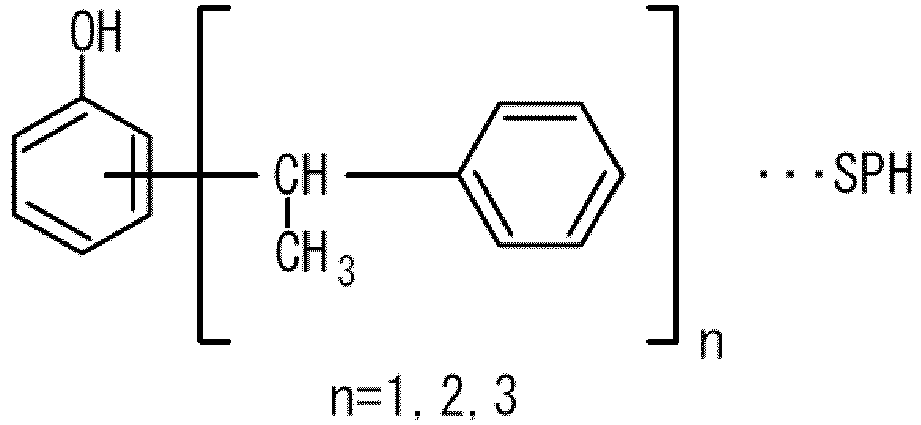


- It can be seen from Table 1 that compared to a rubber composition containing antioxidant 6PPD, the rubber compositions of the Examples, which are in accordance with the present disclosure, have a low permittivity, a large resistance range, and a small mean squared error (MSE) for the actual magnitude of strain and the magnitude of strain inferred from an electrical resistance value, and enable high-accuracy detection of the magnitude of strain.
- The conductive rubber composition for sensing according to the present disclosure enables high-accuracy detection of the magnitude of strain of a rubber product without the use of a sensor when adopted in the rubber product and can be used in various rubber products such as tires and tube rubber of rubber actuators.
-
- 10:
- rubber actuator
- 20:
- connection portion
- 30:
- resistance value measuring device
- 100:
- actuator main body
- 110:
- tube rubber
- 111:
- inner layer rubber
- 112:
- outer layer rubber
- 120:
- sleeve
- 200:
- sealing mechanism
- 210:
- sealing member
- 211:
- trunk portion
- 212:
- flange portion
- 213:
- irregular portion
- 214:
- small diameter portion
- 215:
- passage hole
- 220:
- locking ring
- 230:
- caulking member
- 231:
- indentation
- 300:
- sealing mechanism
- 400, 500:
- fitting
- 410, 510:
- passage hole
- DAX:
- axial direction
- DR:
- radial direction
- 40:
- tire
- 41:
- bead portion
- 42:
- side wall portion
- 43:
- tread portion
- 44:
- bead core
- 45:
- carcass
- 46:
- belt
- 46a, 46b:
- reinforcement layer
- 47:
- sensing rubber member
- 48:
- resistance value measuring device
| Comparative Example 1-1 | Comparative Example 1-2 | Example 1-1 | Example 1-2 | Example 1-3 | Example 1-4 | Comparative Example 2 | Example 2-1 | Example 2-2 | Comparative Example 3 | Example 3 | Comparative Example 4 | Example 4 | Comparative Example 5 | Example 5 | |||
| NR *1 | 30 | 30 | 30 | 30 | 30 | 30 | 30 | 30 | 30 | 30 | 30 | 30 | 30 | 30 | 30 | ||
| BR *2 | 70 | 70 | 70 | 70 | 70 | 70 | 70 | 70 | 70 | 70 | 70 | 70 | 70 | 70 | 70 | ||
| Wax *3 | 1.5 | 1.5 | 1.5 | 1.5 | 1.5 | 1.5 | 1.5 | 1.5 | 1.5 | 1.5 | 1.5 | 1.5 | 1.5 | 1.5 | 1.5 | ||
| Carbon black 1 *4 | 50 | 50 | 50 | 50 | 50 | 50 | - | - | - | 50 | 50 | 55 | 55 | - | - | ||
| Carbon black 2 *5 | - | - | - | - | - | - | 50 | 50 | 50 | - | - | - | - | 55 | 55 | ||
| Carbon nanotubes *6 | - | - | - | - | - | - | - | - | - | 4 | 4 | 4 | 4 | - | - | ||
| Formulation | Antioxidant 6PPD *7 | Parts by mass | 5 | - | - | - | - | - | 5 | - | - | 5 | - | 5 | - | 5 | - |
| Antioxidant SDPA *8 | - | 5 | - | - | - | - | - | - | - | - | - | - | - | - | - | ||
| Antioxidant SPH *9 | - | - | 5 | - | - | - | - | - | - | - | - | - | - | - | - | ||
| Antioxidant 1010 *10 | - | - | - | 5 | - | - | - | - | 5 | - | - | - | - | - | - | ||
| Antioxidant 77PD *11 | - | - | - | - | 3 | 6 | - | 5 | - | - | 5 | - | 5 | - | 5 | ||
| Other crosslinking system chemicals *12 | 6 | 6 | 6 | 6 | 6 | 6 | 6 | 6 | 6 | 6 | 6 | 6 | 6 | 6 | 6 | ||
| Mean squared error (MSE) of magnitude of strain | - | 69 | 71 | 36 | 40 | 43 | 35 | 64 | 35 | 38 | 75 | 37 | 85 | 38 | 36 | 35 | |
| Evaluation results | Resistance range | Index value | 100 | 80 | 131 | 134 | 135 | 230 | 100 | 142 | 113 | 100 | 282 | 100 | 366 | 100 | 164 |
| Permittivity during 70% tensing | Index value | 100 | 113 | 81 | 82 | 71 | 67 | 100 | 18 | 65 | 100 | 94 | 100 | 92 | 100 | 48 | |
| *1 NR: Natural rubber, RSS#2 *2 BR: High-cis butadiene rubber, produced by Ube Industries, Ltd., UBEPOL-BR150L (product name) *3 Wax: Produced by Seiko Chemical Co., Ltd., SUNTIGHT S *4 Carbon black 1: Produced by Tokai Carbon Co., Ltd., SEAST 6 (product name), CTAB adsorption specific surface area = 112 m2/g, 24M4DBP absorption number = 100 mL/100 g *5 Carbon black 2: Produced by Asahi Carbon Co., Ltd.; ASAHI #78 (product name), CTAB adsorption specific surface area = 123 m2/g, 24M4DBP absorption number = 100 mL/100 g *6 Carbon nanotubes: Produced by Kumho Tire Co., Inc.; CNT K-Nanos-100P (product name) *7 Antioxidant 6PPD: N-Phenyl-N'-(1,3-dimethylbutyl)-p-phenylenediamine, HeavyAtomCount/MolWt = 0.000620, MaxPartialCharge/MolWt = 0.074515 *8 Antioxidant SDPA: Produced by Kawaguchi Chemical Industry Co., Ltd., DDA (product name), HeavyAtomCount/MolWt = 0.000441, MaxPartialCharge/MolWt = 0.076815 *9 Antioxidant SPH: Produced by Kawaguchi Chemical Industry Co., Ltd., SP (product name), HeavyAtomCount/MolWt = 0.000969, MaxPartialCharge/MolWt = 0.076054 *10 Antioxidant 1010: Produced by ADEKA Corporation, ADK STAB AO-60 (product name), HeavyAtomCount/MolWt = 0.000260, MaxPartialCharge/MolWt = 0.072177 *11 Antioxidant 77PD: p-Phenylenediamine compound for which R1 and R2 in general formula (1) are saturated hydrocarbon groups (1,4-dimethylpentyl groups), N,N'-bis(1,4-dimethylpentyl)-p-phenylenediamine, produced by Eastman Chemical Company, HeavyAtomCount/MolWt = 0.000526, MaxPartialCharge/MolWt = 0.072244 *12 Other crosslinking system chemicals: Total amount of vulcanizing agent, vulcanization accelerator, etc. |
Claims (8)
- A conductive rubber composition for sensing comprising a diene rubber, carbon black, and an antioxidant, wherein
the antioxidant satisfies a relationship in formula (i), shown below,
- The conductive rubber composition for sensing according to claim 1, wherein content of the carbon black is 45 parts by mass or more relative to 100 parts by mass of the diene rubber.
- The conductive rubber composition for sensing according to claim 1 or 2, wherein the carbon black has a cetyltrimethylammonium bromide (CTAB) adsorption specific surface area of 110 m2/g or more.
- The conductive rubber composition for sensing according to any one of claims 1 to 3, having reduced permittivity during extension compared to a rubber composition in which the antioxidant in the conductive rubber composition for sensing is replaced with N-phenyl-N'-(1,3-dimethylbutyl)-p-phenylenediamine, otherwise known as antioxidant 6PPD.
- The conductive rubber composition for sensing according to any one of claims 1 to 4, having a large resistance range compared to a rubber composition in which the antioxidant in the conductive rubber composition for sensing is replaced with N-phenyl-N'-(1,3-dimethylbutyl)-p-phenylenediamine, otherwise known as antioxidant 6PPD.
- The conductive rubber composition for sensing according to any one of claims 1 to 5, wherein the antioxidant satisfies a relationship in formula (ii), shown below,

- The conductive rubber composition for sensing according to any one of claims 1 to 6, wherein the antioxidant has a value of 0.072 or more for HeavyAtomCount/MolWt in formula (i).
- The conductive rubber composition for sensing according to any one of claims 1 to 7, wherein the antioxidant has a value of 0.001 or less for MaxPartialCharge/MolWt in formula (i).
Applications Claiming Priority (2)
| Application Number | Priority Date | Filing Date | Title |
|---|---|---|---|
| JP2021181514A JP7804432B2 (en) | 2021-11-05 | 2021-11-05 | Conductive rubber composition for sensing |
| PCT/JP2022/035528 WO2023079858A1 (en) | 2021-11-05 | 2022-09-22 | Conductive rubber composition for sensing |
Publications (2)
| Publication Number | Publication Date |
|---|---|
| EP4428187A1 true EP4428187A1 (en) | 2024-09-11 |
| EP4428187A4 EP4428187A4 (en) | 2025-03-05 |
Family
ID=86241363
Family Applications (1)
| Application Number | Title | Priority Date | Filing Date |
|---|---|---|---|
| EP22889682.5A Pending EP4428187A4 (en) | 2021-11-05 | 2022-09-22 | Conductive rubber composition for sensing |
Country Status (5)
| Country | Link |
|---|---|
| US (1) | US20240409725A1 (en) |
| EP (1) | EP4428187A4 (en) |
| JP (1) | JP7804432B2 (en) |
| CN (1) | CN118176253A (en) |
| WO (1) | WO2023079858A1 (en) |
Families Citing this family (1)
| Publication number | Priority date | Publication date | Assignee | Title |
|---|---|---|---|---|
| JP2026099646A (en) * | 2024-12-06 | 2026-06-18 | 株式会社ブリヂストン | Rubber compositions, vulcanized rubber for tire treads, tires, and rubber tracks |
Family Cites Families (10)
| Publication number | Priority date | Publication date | Assignee | Title |
|---|---|---|---|---|
| JP2006208051A (en) | 2005-01-25 | 2006-08-10 | Bridgestone Corp | Distortion sensor for rubber article |
| JP2006208052A (en) | 2005-01-25 | 2006-08-10 | Bridgestone Corp | Distortion sensor for rubber article |
| JP2008037906A (en) * | 2006-08-02 | 2008-02-21 | Shinshu Univ | Rubber material and strain sensor using the same |
| JP5056119B2 (en) | 2007-03-30 | 2012-10-24 | 横浜ゴム株式会社 | Method for measuring deformation behavior of tire reinforcement layer |
| JP2009024134A (en) * | 2007-07-23 | 2009-02-05 | Toyo Tire & Rubber Co Ltd | Rubber composition for tire and pneumatic tire |
| JP5367860B2 (en) | 2011-09-29 | 2013-12-11 | 住友ゴム工業株式会社 | Rubber composition for sidewall and tire using the same |
| JP5845058B2 (en) * | 2011-10-31 | 2016-01-20 | 住友ゴム工業株式会社 | Rubber composition for a sidewall or tread and a pneumatic tire |
| CN104774348A (en) * | 2015-03-18 | 2015-07-15 | 南京东亚橡塑制品有限公司 | Rubber material added with heat stabilizer (HS-80) and preparation method thereof |
| JP7488150B2 (en) | 2020-08-05 | 2024-05-21 | 株式会社ブリヂストン | Conductive rubber composition for sensing |
| CN114075352A (en) | 2020-08-12 | 2022-02-22 | 苏州怒鲨智能科技有限公司 | Conductive rubber for flexible sensor and preparation method thereof |
-
2021
- 2021-11-05 JP JP2021181514A patent/JP7804432B2/en active Active
-
2022
- 2022-09-22 CN CN202280073334.4A patent/CN118176253A/en active Pending
- 2022-09-22 EP EP22889682.5A patent/EP4428187A4/en active Pending
- 2022-09-22 US US18/697,763 patent/US20240409725A1/en not_active Abandoned
- 2022-09-22 WO PCT/JP2022/035528 patent/WO2023079858A1/en not_active Ceased
Also Published As
| Publication number | Publication date |
|---|---|
| CN118176253A (en) | 2024-06-11 |
| JP7804432B2 (en) | 2026-01-22 |
| JP2023069565A (en) | 2023-05-18 |
| US20240409725A1 (en) | 2024-12-12 |
| EP4428187A4 (en) | 2025-03-05 |
| WO2023079858A1 (en) | 2023-05-11 |
Similar Documents
| Publication | Publication Date | Title |
|---|---|---|
| JP7488150B2 (en) | Conductive rubber composition for sensing | |
| EP4393994A1 (en) | Conductive rubber composition for sensing | |
| US20240409725A1 (en) | Conductive rubber composition for sensing | |
| US20190316608A1 (en) | Hydraulic actuator | |
| EP3348425A1 (en) | Pneumatic tire and crosslinked rubber composition | |
| CN108349311B (en) | Pneumatic tire and cross-linked rubber composition | |
| JP5542416B2 (en) | Soft-type furnace carbon black for anti-vibration rubber compounding and anti-vibration rubber composition containing the same | |
| EP4393993A1 (en) | Conductive rubber composition for sensing | |
| JP5900526B2 (en) | Rubber composition and pneumatic tire using the same | |
| JP2023031814A (en) | Conductive rubber composition for sensing | |
| JP2020063369A (en) | Rubber composition and tire | |
| WO2024189956A1 (en) | Conductive rubber composition for sensing | |
| JP6027299B2 (en) | Soft furnace carbon black and rubber composition containing the same | |
| WO2015079659A1 (en) | Pneumatic tire | |
| JP7650752B2 (en) | Conductive rubber composition for sensing | |
| WO2023026619A1 (en) | Conductive rubber composition for sensing | |
| JP2023031815A (en) | Conductive rubber composition for sensing | |
| JP2023031813A (en) | Conductive rubber composition for sensing | |
| JP2023031816A (en) | Conductive rubber composition for sensing | |
| US7666937B2 (en) | Rubber composition for side reinforcement and run flat tire using the same | |
| BR112020019114B1 (en) | RUBBER COMPOSITION COMPRISING A REINFORCEMENT LOAD WITH A SPECIFIC LOW SURFACE | |
| JP2009035655A (en) | Rubber composition and pneumatic tire | |
| JP2020066640A (en) | Rubber composition for actuator, vulcanized rubber for actuator and actuator | |
| CN103492176A (en) | Parylene Coatings for Tire Components | |
| JP2021017062A (en) | Pneumatic tire |
Legal Events
| Date | Code | Title | Description |
|---|---|---|---|
| STAA | Information on the status of an ep patent application or granted ep patent |
Free format text: STATUS: THE INTERNATIONAL PUBLICATION HAS BEEN MADE |
|
| PUAI | Public reference made under article 153(3) epc to a published international application that has entered the european phase |
Free format text: ORIGINAL CODE: 0009012 |
|
| STAA | Information on the status of an ep patent application or granted ep patent |
Free format text: STATUS: REQUEST FOR EXAMINATION WAS MADE |
|
| 17P | Request for examination filed |
Effective date: 20240404 |
|
| AK | Designated contracting states |
Kind code of ref document: A1 Designated state(s): AL AT BE BG CH CY CZ DE DK EE ES FI FR GB GR HR HU IE IS IT LI LT LU LV MC MK MT NL NO PL PT RO RS SE SI SK SM TR |
|
| DAV | Request for validation of the european patent (deleted) | ||
| DAX | Request for extension of the european patent (deleted) | ||
| A4 | Supplementary search report drawn up and despatched |
Effective date: 20250203 |
|
| RIC1 | Information provided on ipc code assigned before grant |
Ipc: C08K 5/134 20060101ALI20250128BHEP Ipc: C08K 5/13 20060101ALI20250128BHEP Ipc: G01B 7/16 20060101ALI20250128BHEP Ipc: C08L 7/00 20060101ALI20250128BHEP Ipc: C08K 5/18 20060101ALI20250128BHEP Ipc: C08K 3/04 20060101ALI20250128BHEP Ipc: B60C 1/00 20060101ALI20250128BHEP Ipc: C08L 9/00 20060101AFI20250128BHEP |