EP4428135A1 - Deuterated nucleoside compounds and use thereof - Google Patents
Deuterated nucleoside compounds and use thereof Download PDFInfo
- Publication number
- EP4428135A1 EP4428135A1 EP24169552.7A EP24169552A EP4428135A1 EP 4428135 A1 EP4428135 A1 EP 4428135A1 EP 24169552 A EP24169552 A EP 24169552A EP 4428135 A1 EP4428135 A1 EP 4428135A1
- Authority
- EP
- European Patent Office
- Prior art keywords
- compound
- present disclosure
- pharmaceutically acceptable
- acceptable salt
- stereoisomer
- Prior art date
- Legal status (The legal status is an assumption and is not a legal conclusion. Google has not performed a legal analysis and makes no representation as to the accuracy of the status listed.)
- Withdrawn
Links
Classifications
-
- A—HUMAN NECESSITIES
- A61—MEDICAL OR VETERINARY SCIENCE; HYGIENE
- A61K—PREPARATIONS FOR MEDICAL, DENTAL OR TOILETRY PURPOSES
- A61K31/00—Medicinal preparations containing organic active ingredients
- A61K31/33—Heterocyclic compounds
- A61K31/395—Heterocyclic compounds having nitrogen as a ring hetero atom, e.g. guanethidine or rifamycins
- A61K31/53—Heterocyclic compounds having nitrogen as a ring hetero atom, e.g. guanethidine or rifamycins having six-membered rings with three nitrogens as the only ring hetero atoms, e.g. chlorazanil, melamine
-
- A—HUMAN NECESSITIES
- A61—MEDICAL OR VETERINARY SCIENCE; HYGIENE
- A61K—PREPARATIONS FOR MEDICAL, DENTAL OR TOILETRY PURPOSES
- A61K31/00—Medicinal preparations containing organic active ingredients
- A61K31/70—Carbohydrates; Sugars; Derivatives thereof
- A61K31/7042—Compounds having saccharide radicals and heterocyclic rings
- A61K31/7052—Compounds having saccharide radicals and heterocyclic rings having nitrogen as a ring hetero atom, e.g. nucleosides, nucleotides
- A61K31/706—Compounds having saccharide radicals and heterocyclic rings having nitrogen as a ring hetero atom, e.g. nucleosides, nucleotides containing six-membered rings with nitrogen as a ring hetero atom
-
- A—HUMAN NECESSITIES
- A61—MEDICAL OR VETERINARY SCIENCE; HYGIENE
- A61P—SPECIFIC THERAPEUTIC ACTIVITY OF CHEMICAL COMPOUNDS OR MEDICINAL PREPARATIONS
- A61P11/00—Drugs for disorders of the respiratory system
-
- A—HUMAN NECESSITIES
- A61—MEDICAL OR VETERINARY SCIENCE; HYGIENE
- A61P—SPECIFIC THERAPEUTIC ACTIVITY OF CHEMICAL COMPOUNDS OR MEDICINAL PREPARATIONS
- A61P31/00—Antiinfectives, i.e. antibiotics, antiseptics, chemotherapeutics
- A61P31/12—Antivirals
-
- A—HUMAN NECESSITIES
- A61—MEDICAL OR VETERINARY SCIENCE; HYGIENE
- A61P—SPECIFIC THERAPEUTIC ACTIVITY OF CHEMICAL COMPOUNDS OR MEDICINAL PREPARATIONS
- A61P31/00—Antiinfectives, i.e. antibiotics, antiseptics, chemotherapeutics
- A61P31/12—Antivirals
- A61P31/14—Antivirals for RNA viruses
-
- A—HUMAN NECESSITIES
- A61—MEDICAL OR VETERINARY SCIENCE; HYGIENE
- A61P—SPECIFIC THERAPEUTIC ACTIVITY OF CHEMICAL COMPOUNDS OR MEDICINAL PREPARATIONS
- A61P31/00—Antiinfectives, i.e. antibiotics, antiseptics, chemotherapeutics
- A61P31/12—Antivirals
- A61P31/14—Antivirals for RNA viruses
- A61P31/16—Antivirals for RNA viruses for influenza or rhinoviruses
-
- C—CHEMISTRY; METALLURGY
- C07—ORGANIC CHEMISTRY
- C07B—GENERAL METHODS OF ORGANIC CHEMISTRY; APPARATUS THEREFOR
- C07B59/00—Introduction of isotopes of elements into organic compounds ; Labelled organic compounds per se
- C07B59/005—Sugars; Derivatives thereof; Nucleosides; Nucleotides; Nucleic acids
-
- C—CHEMISTRY; METALLURGY
- C07—ORGANIC CHEMISTRY
- C07D—HETEROCYCLIC COMPOUNDS
- C07D487/00—Heterocyclic compounds containing nitrogen atoms as the only ring hetero atoms in the condensed system, not provided for by groups C07D451/00 - C07D477/00
- C07D487/02—Heterocyclic compounds containing nitrogen atoms as the only ring hetero atoms in the condensed system, not provided for by groups C07D451/00 - C07D477/00 in which the condensed system contains two hetero rings
- C07D487/04—Ortho-condensed systems
-
- C—CHEMISTRY; METALLURGY
- C07—ORGANIC CHEMISTRY
- C07H—SUGARS; DERIVATIVES THEREOF; NUCLEOSIDES; NUCLEOTIDES; NUCLEIC ACIDS
- C07H13/00—Compounds containing saccharide radicals esterified by carbonic acid or derivatives thereof, or by organic acids, e.g. phosphonic acids
- C07H13/02—Compounds containing saccharide radicals esterified by carbonic acid or derivatives thereof, or by organic acids, e.g. phosphonic acids by carboxylic acids
- C07H13/04—Compounds containing saccharide radicals esterified by carbonic acid or derivatives thereof, or by organic acids, e.g. phosphonic acids by carboxylic acids having the esterifying carboxyl radicals attached to acyclic carbon atoms
-
- C—CHEMISTRY; METALLURGY
- C07—ORGANIC CHEMISTRY
- C07H—SUGARS; DERIVATIVES THEREOF; NUCLEOSIDES; NUCLEOTIDES; NUCLEIC ACIDS
- C07H13/00—Compounds containing saccharide radicals esterified by carbonic acid or derivatives thereof, or by organic acids, e.g. phosphonic acids
- C07H13/02—Compounds containing saccharide radicals esterified by carbonic acid or derivatives thereof, or by organic acids, e.g. phosphonic acids by carboxylic acids
- C07H13/08—Compounds containing saccharide radicals esterified by carbonic acid or derivatives thereof, or by organic acids, e.g. phosphonic acids by carboxylic acids having the esterifying carboxyl radicals directly attached to carbocyclic rings
-
- C—CHEMISTRY; METALLURGY
- C07—ORGANIC CHEMISTRY
- C07H—SUGARS; DERIVATIVES THEREOF; NUCLEOSIDES; NUCLEOTIDES; NUCLEIC ACIDS
- C07H13/00—Compounds containing saccharide radicals esterified by carbonic acid or derivatives thereof, or by organic acids, e.g. phosphonic acids
- C07H13/12—Compounds containing saccharide radicals esterified by carbonic acid or derivatives thereof, or by organic acids, e.g. phosphonic acids by acids having the group -X-C(=X)-X-, or halides thereof, in which each X means nitrogen, oxygen, sulfur, selenium or tellurium, e.g. carbonic acid, carbamic acid
-
- C—CHEMISTRY; METALLURGY
- C07—ORGANIC CHEMISTRY
- C07H—SUGARS; DERIVATIVES THEREOF; NUCLEOSIDES; NUCLEOTIDES; NUCLEIC ACIDS
- C07H7/00—Compounds containing non-saccharide radicals linked to saccharide radicals by a carbon-to-carbon bond
- C07H7/06—Heterocyclic radicals
-
- C—CHEMISTRY; METALLURGY
- C07—ORGANIC CHEMISTRY
- C07B—GENERAL METHODS OF ORGANIC CHEMISTRY; APPARATUS THEREFOR
- C07B2200/00—Indexing scheme relating to specific properties of organic compounds
- C07B2200/05—Isotopically modified compounds, e.g. labelled
-
- C—CHEMISTRY; METALLURGY
- C07—ORGANIC CHEMISTRY
- C07B—GENERAL METHODS OF ORGANIC CHEMISTRY; APPARATUS THEREFOR
- C07B2200/00—Indexing scheme relating to specific properties of organic compounds
- C07B2200/07—Optical isomers
Definitions
- the present disclosure relates to the technical field of medicinal chemistry, especially relates to a series of deuterated nucleoside compounds and a use thereof.
- the present disclosure specifically relates to a compound of formula (VI-1), a stereoisomer thereof, or a pharmaceutically acceptable salt thereof.
- coronaviruses that can infect humans, namely HCoV-229E, HCoV-OC43, HCoV-NL63, HCoV-HKU1, SARS-CoV (SARS), MERS-CoV (MERS), and SARS-CoV-2 (COVID-2019) which emerged at the end of 2019.
- SARS SARS-CoV
- MERS-CoV MERS-CoV
- COVID-2019 SARS-CoV-2
- the present disclosure provides a compound of formula (VI-1), a stereoisomer thereof, or a pharmaceutically acceptable salt thereof, wherein
- each R is independently selected from hydroxyl, and other variables are as defined in the present disclosure.
- R 5 is selected from and other variables are as defined in the present disclosure.
- the R 2 and R 3 are each independently selected from hydrogen and and other variables are as defined in the present disclosure.
- the present disclosure also provides a compound of the following formula or a pharmaceutically acceptable salt thereof, selected from:
- a use of the compound or the pharmaceutically acceptable salt thereof in the manufacture of a medicament for treating diseases related to RNA-dependent RNA polymerase inhibitor is provided.
- the use is characterized in that the disease related to RNA-dependent RNA polymerase inhibitor is a viral infectious disease, such as viral influenza, viral pneumonia.
- the use is characterized in that the disease related to RNA-dependent RNA polymerase inhibitor is viral pneumonia.
- the compound of the present disclosure exhibits potent anti-coronavirus activity in vitro ; upon administration to mice, the compound of the present disclosure is rapidly metabolized in vivo into its corresponding active metabolites, exerting a pharmacological effect; the pharmaceutical concentration of the compound of the present disclosure is sustained for a longer duration and maintained at a higher concentration, which is conducive to the continuous inhibition of the virus and the exertion of pharmacological efficacy.
- pharmaceutically acceptable is used herein in terms of those compounds, materials, compositions, and/or dosage forms, which are suitable for use in contact with human and animal tissues within the scope of reliable medical judgment, with no excessive toxicity, irritation, an allergic reaction, or other problems or complications, commensurate with a reasonable benefit/risk ratio.
- treatment is intended to refer to all processes that may slow down, interrupt, contain, or prevent the progression of a disease, but does not necessarily imply the complete elimination of all symptoms.
- pharmaceutically acceptable salt refers to a salt of the compound of the present disclosure that is prepared by reacting the compound having a specific substituent of the present disclosure with a relatively non-toxic acid or base.
- a base addition salt can be obtained by bringing the neutral form of the compound into contact with a sufficient amount of base in a pure solution or a suitable inert solvent.
- the pharmaceutically acceptable base addition salt includes a salt of sodium, potassium, calcium, ammonium, organic amine, magnesium, or similar salts.
- an acid addition salt can be obtained by bringing the neutral form of the compound into contact with a sufficient amount of acid in a pure solution or a suitable inert solvent.
- Certain specific compounds of the present disclosure contain both basic and acidic functional groups, thus can be converted to any base or acid addition salt.
- the pharmaceutically acceptable salt of the present disclosure can be prepared from the parent compound that contains an acidic or basic moiety by conventional chemical method.
- such salt can be prepared by reacting the free acid or base form of the compound with a stoichiometric amount of an appropriate base or acid in water or an organic solvent or a mixture thereof.
- the term "isomer” is intended to include a geometric isomer, a cis-trans isomer, a stereoisomer, an enantiomer, an optical isomer, a diastereoisomer, and a tautomericisomer.
- the compounds of the present disclosure may exist in specific geometric or stereoisomeric forms.
- the present disclosure contemplates all such compounds, including cis and trans isomers, (-)- and (+)-enantiomers, ( R )- and ( S )-enantiomers, diastereoisomers, (D)-isomers, (Z)-isomers, racemic, and other mixtures thereof, such as enantiomers or diastereomer enriched mixtures, all of which are within the scope of the present disclosure.
- Additional asymmetric carbon atoms may be present in substituents such as alkyl. All these isomers and their mixtures are included within the scope of the present disclosure.
- enantiomer or “optical isomer” refers to stereoisomers that are mirror images of each other.
- cis-trans isomer or “geometric isomer” is caused by the inability to rotate freely of double bonds or single bonds of ring-forming carbon atoms.
- diastereomer refers to a stereoisomer in which a molecule has two or more chiral centers and the relationship between the molecules is not mirror images.
- the absolute configuration of a stereogenic center is represented by a wedged solid bond ( ) and a wedged dashed bond ( )
- the relative configuration of a stereogenic center is represented by a straight solid bond ( ) and a straight dashed bond ( )
- a wave line ( ) is used to represent a wedged solid bond ( ) or a wedged dashed bond ( )
- the wave line ( ) is used to represent a straight solid bond ( ) or a straight dashed bond ( ).
- any one or more sites of the group can be linked to other groups through chemical bonds.
- the linking site of the chemical bond is not positioned, and there is an H atom at the linkable site, then the number of H atoms at the site will decrease correspondingly with the number of the chemical bonds linking thereto so as to meet the corresponding valence.
- the chemical bond between the site and other groups can be represented by a straight solid bond ( ), a straight dashed bond or a wavy line
- the straight solid bond in -OCH 3 means that it is linked to other groups through the oxygen atom in the group
- the straight dashed bond in means that it is linked to other groups through the two ends of nitrogen atom in the group
- the dashed bond in means that the phenyl group can be linked to other groups through one chemical bond at any connectable site in the phenyl group.
- tautomer or “tautomeric form” means that at room temperature, the isomers of different functional groups are in dynamic equilibrium and can be transformed into each other quickly. If tautomers possibly exist (such as in solution), the chemical equilibrium of tautomers can be reached.
- proton tautomer also called prototropic tautomer
- proton migration such as keto-enol isomerization and imine-enamine isomerization.
- Valence tautomer includes some recombination of bonding electrons for mutual transformation.
- keto-enol tautomerization is the tautomerism between two tautomers of pentane-2,4-dione and 4-hydroxypent-3-en-2-one.
- the terms “enriched in one isomer”, “enriched in isomers”, “enriched in one enantiomer” or “enriched in enantiomers” refer to the content of one of the isomers or enantiomers is less than 100%, and the content of the isomer or enantiomer is greater than or equal to 60%, or greater than or equal to 70%, or greater than or equal to 80%, or greater than or equal to 90%, or greater than or equal to 95%, or greater than or equal to 96%, or greater than or equal to 97%, or greater than or equal to 98%, or greater than or equal to 99%, or greater than or equal to 99.5%, or greater than or equal to 99.6%, or greater than or equal to 99.7%, or greater than or equal to 99.8%, or greater than or equal to 99.9%.
- the term “isomer excess” or “enantiomeric excess” refers to the difference between the relative percentages of two isomers or two enantiomers. For example, if the content of one isomer or enantiomer is 90%, and the content of the other isomer or enantiomer is 10%, the isomer or enantiomer excess (ee value) is 80%.
- Optically active ( R )- and ( S )-isomers, or D and L isomers can be prepared using chiral synthesis, chiral reagents, or other conventional techniques. If one kind of enantiomer of certain compound of the present disclosure is to be obtained, it can be obtained by asymmetric synthesis or derivative action of chiral auxiliary, wherein the resulting diastereomeric mixture is separated and the auxiliary group is cleaved to provide the pure desired enantiomer.
- a salt of a diastereoisomer is formed with an appropriate optically active acid or base, and then diastereomeric resolution is performed by conventional methods known in the art, and then the pure enantiomer is recovered.
- the enantiomer and the diastereoisomer are generally separated through chromatography which uses a chiral stationary phase and optionally combines with a chemical derivative method (such as carbamate generated from amine).
- the compound of the present disclosure may contain an unnatural proportion of atomic isotope at one or more atoms that constitute the compound.
- the compound can be radiolabeled with a radioactive isotope, such as tritium ( 3 H), iodine-125 ( 125 I), or C-14 ( 14 C).
- deuterated drugs can be formed by replacing hydrogen with deuterium, the bond formed by deuterium and carbon is stronger than that of ordinary hydrogen and carbon, compared with non-deuterated drugs, deuterated drugs have the advantages of reduced toxic and side effects, increased drug stability, enhanced efficacy, extended biological half-life of drugs, etc. All isotopic variations of the compound of the present disclosure, whether radioactive or not, are encompassed within the scope of the present disclosure.
- substituted means one or more than one hydrogen atom on a specific atom is substituted by the substituent, including deuterium and hydrogen variables, as long as the valence of the specific atom is normal and the substituted compound is stable.
- it means two hydrogen atoms are substituted.
- Positions on an aromatic ring cannot be substituted with a ketone.
- optionally substituted means an atom can be substituted with a substituent or not, unless otherwise specified, the type and number of the substituent may be arbitrary as long as being chemically achievable.
- variable such as R
- the definition of the variable at each occurrence is independent.
- the group can be optionally substituted with up to two R, wherein the definition of R at each occurrence is independent.
- a combination of the substituent and/or the variant thereof is allowed only when the combination results in a stable compound.
- C 1-6 alkyl refers to a linear or branched saturated hydrocarbon group consisting of 1 to 6 carbon atoms.
- the C 1-6 alkyl includes C 1-5 , C 1--4 , C 1--3 , C 1-2 , C 2-6 , C 2--4 , C 6 , C 5 alkyl, etc.; it can be monovalent (such as methyl), divalent (such as methylene), or multivalent (such as methine).
- C 1-6 alkyl examples include, but are not limited to, methyl (Me), ethyl (Et), propyl (including n -propyl and isopropyl), butyl (including n -butyl, isobutyl, s -butyl, and t -butyl), pentyl (including n -pentyl, isopentyl, and neopentyl), hexyl, etc.
- Me methyl
- Et ethyl
- propyl including n -propyl and isopropyl
- butyl including n -butyl, isobutyl, s -butyl, and t -butyl
- pentyl including n -pentyl, isopentyl, and neopentyl
- hexyl etc.
- C 1-6 alkoxy examples include, but are not limited to, methoxy, ethoxy, propoxy (including n -propoxy and isopropoxy), butoxy (including n -butoxy, isobutoxy, s -butoxy, and t -butoxy), pentyloxy (including n -pentyloxy, isopentyloxy, and neopentyloxy), hexyloxy, etc.
- halogen element or halogen by itself or as part of another substituent refers to fluorine, chlorine, bromine, or iodine atom.
- the compounds of the present disclosure can be prepared by a variety of synthetic methods known to those skilled in the art, including the specific embodiments listed below, the embodiments formed by their combination with other chemical synthesis methods, and equivalent alternatives known to those skilled in the art, preferred embodiments include but are not limited to the examples of the present disclosure.
- the structure of the compounds of the present disclosure can be confirmed by conventional methods known to those skilled in the art, and if the present disclosure involves an absolute configuration of a compound, then the absolute configuration can be confirmed by means of conventional techniques in the art.
- SXRD single crystal X-ray diffraction
- diffraction intensity data are collected from the cultured single crystal using a Bruker D8 venture diffractometer with CuK ⁇ radiation as the light source and scanning mode: ⁇ / ⁇ scan, and after collecting the relevant data, the crystal structure is further analyzed by direct method (Shelxs97), so that the absolute configuration can be confirmed.
- the compounds of the present disclosure are named according to the conventional naming principles in the art or by ChemDraw ® software, and the commercially available compounds use the supplier catalog names.
- Test example 1 Pharmacokinetic evaluation of compounds
- CD-1 mice Male, from Beijing Vital River Laboratory Animal Technology Co., Ltd.
- Plasma drug concentration was quantitatively analyzed by LC-MS/MS analysis method, and the plasma drug concentration data of the metabolite of the compound of the present disclosure were processed by using the pharmacokinetic software of WinNonlin Version 6.3 or above (Pharsight) in a non-compartmental model.
- Relevant pharmacokinetic parameters such as peak concentration (C max ), half-life (T 1/2 ), and area under the curve (AUC 0-inf ) were calculated using the linear-log trapezoidal method.
- Experimental results are shwn in Tables 1 and 2.
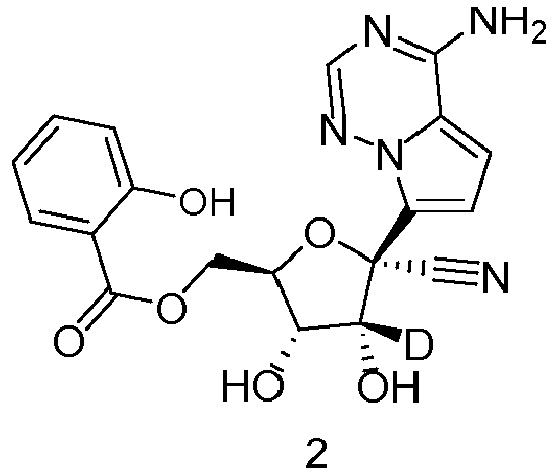
- Table 1 Pharmacokinetic experimental data Pharmacokinetic Parameter Compound 2 C max (nmol/L) 38150 T 1/2 (h) 2.67 AUC 0-inf (h * nmol/L) 150291 Note: The compounds of the present disclosure would be rapidly metabolized in vivo, and the above data are all for the detected metabolites.
- Table 2 Concentration of nucleoside Nuc in plasma and tissues at different times Nucleoside PK Assay Concentration of Nucleoside Nuc in Plasma and Tissues (nM) Time (h) Compound 2 1 38150 2 32700 4 21500 8 1489 24 95.8
Landscapes
- Chemical & Material Sciences (AREA)
- Health & Medical Sciences (AREA)
- Organic Chemistry (AREA)
- Life Sciences & Earth Sciences (AREA)
- General Health & Medical Sciences (AREA)
- Molecular Biology (AREA)
- Virology (AREA)
- Public Health (AREA)
- Medicinal Chemistry (AREA)
- Pharmacology & Pharmacy (AREA)
- Veterinary Medicine (AREA)
- Animal Behavior & Ethology (AREA)
- Biochemistry (AREA)
- Engineering & Computer Science (AREA)
- General Chemical & Material Sciences (AREA)
- Chemical Kinetics & Catalysis (AREA)
- Nuclear Medicine, Radiotherapy & Molecular Imaging (AREA)
- Genetics & Genomics (AREA)
- Biotechnology (AREA)
- Communicable Diseases (AREA)
- Oncology (AREA)
- Epidemiology (AREA)
- Pulmonology (AREA)
- Bioinformatics & Cheminformatics (AREA)
- Pharmaceuticals Containing Other Organic And Inorganic Compounds (AREA)
- Saccharide Compounds (AREA)
- Organic Low-Molecular-Weight Compounds And Preparation Thereof (AREA)
- Medicinal Preparation (AREA)
Abstract
Description
- The present application is a Divisional Application of
EP Application No. 23807006.4, filed on February 5, 2024 CN202210548373.7, filed on May 17, 2022 CN202210695557.6, filed on June 15, 2022 CN202211002496.7, filed on August 19, 2022 CN202310213459.9, filed on March 7, 2023 - The present disclosure relates to the technical field of medicinal chemistry, especially relates to a series of deuterated nucleoside compounds and a use thereof. The present disclosure specifically relates to a compound of formula (VI-1), a stereoisomer thereof, or a pharmaceutically acceptable salt thereof.
- Currently, there are seven known coronaviruses that can infect humans, namely HCoV-229E, HCoV-OC43, HCoV-NL63, HCoV-HKU1, SARS-CoV (SARS), MERS-CoV (MERS), and SARS-CoV-2 (COVID-2019) which emerged at the end of 2019. The latter three may cause more severe symptoms and even lead to death in infected individuals. Coronavirus infections, particularly COVID-2019 and its variants, spread rapidly, and some patients may require an extended recovery period, significantly impacting their work and daily lives. There is an urgent need for more practical and effective drugs and methods to treat such infectious diseases.
- In one aspect, the present disclosure provides a compound of formula (VI-1), a stereoisomer thereof, or a pharmaceutically acceptable salt thereof,

- R2 and R3 are each independently selected from hydrogen, C1-6 alkyl-C(=O)-, C1-4 alkoxy-C(=O)-, and phenyl-C(=O)-, and the C1-6 alkyl, C1-4 alkoxy, and phenyl are each independently and optionally substituted by 1, 2, or 3 R;
- R5 is selected from phenyl, and the phenyl is optionally substituted by 1, 2, or 3 R;
- each R is independently selected from hydroxyl, halogen, amino, and cyano.
- In some embodiments of the present disclosure, each R is independently selected from hydroxyl, and other variables are as defined in the present disclosure.
- In some embodiments of the present disclosure, in the compound of formula (VI-1), the stereoisomer thereof, or the pharmaceutically acceptable salt thereof, R5 is selected from

- In some embodiments of the present disclosure, the R2 and R3 are each independently selected from hydrogen, isopropyl-C(=O)-, and phenyl-C(=O)-, and the isopropyl and phenyl are each independently and optionally substituted by 1, 2, or 3 R, and other variables are as defined in the present disclosure.
- In some embodiments of the present disclosure, the R2 and R3 are each independently selected from hydrogen, isopropyl-C(=O)-, and

- In some embodiments of the present disclosure, the R2 and R3 are each independently selected from hydrogen and isopropyl-C(=O)-, and other variables are as defined in the present disclosure.
- In some embodiments of the present disclosure, the R2 and R3 are each independently selected from hydrogen and

- There are still some embodiments of the present disclosure which are obtained by any combination of the above variables.
- The present disclosure also provides a compound of the following formula or a pharmaceutically acceptable salt thereof, selected from:

- In some embodiments of the present disclosure, a use of the compound or the pharmaceutically acceptable salt thereof in the manufacture of a medicament for treating diseases related to RNA-dependent RNA polymerase inhibitor is provided.
- In some embodiments of the present disclosure, the use is characterized in that the disease related to RNA-dependent RNA polymerase inhibitor is a viral infectious disease, such as viral influenza, viral pneumonia.
- In some embodiments of the present disclosure, the use is characterized in that the disease related to RNA-dependent RNA polymerase inhibitor is viral pneumonia.
- The compound of the present disclosure exhibits potent anti-coronavirus activity in vitro; upon administration to mice, the compound of the present disclosure is rapidly metabolized in vivo into its corresponding active metabolites, exerting a pharmacological effect; the pharmaceutical concentration of the compound of the present disclosure is sustained for a longer duration and maintained at a higher concentration, which is conducive to the continuous inhibition of the virus and the exertion of pharmacological efficacy.
- Unless otherwise specified, the following terms and phrases when used herein have the following meanings. A specific term or phrase should not be considered indefinite or unclear in the absence of a particular definition, but should be understood in the ordinary sense. When a trading name appears herein, it is intended to refer to its corresponding commodity or active ingredient thereof.
- The term "pharmaceutically acceptable" is used herein in terms of those compounds, materials, compositions, and/or dosage forms, which are suitable for use in contact with human and animal tissues within the scope of reliable medical judgment, with no excessive toxicity, irritation, an allergic reaction, or other problems or complications, commensurate with a reasonable benefit/risk ratio.
- Unless otherwise specified, the term "treatment" is intended to refer to all processes that may slow down, interrupt, contain, or prevent the progression of a disease, but does not necessarily imply the complete elimination of all symptoms.
- The term "pharmaceutically acceptable salt" refers to a salt of the compound of the present disclosure that is prepared by reacting the compound having a specific substituent of the present disclosure with a relatively non-toxic acid or base. When the compound of the present disclosure contains a relatively acidic functional group, a base addition salt can be obtained by bringing the neutral form of the compound into contact with a sufficient amount of base in a pure solution or a suitable inert solvent. The pharmaceutically acceptable base addition salt includes a salt of sodium, potassium, calcium, ammonium, organic amine, magnesium, or similar salts. When the compound of the present disclosure contains a relatively basic functional group, an acid addition salt can be obtained by bringing the neutral form of the compound into contact with a sufficient amount of acid in a pure solution or a suitable inert solvent. Certain specific compounds of the present disclosure contain both basic and acidic functional groups, thus can be converted to any base or acid addition salt.
- The pharmaceutically acceptable salt of the present disclosure can be prepared from the parent compound that contains an acidic or basic moiety by conventional chemical method. Generally, such salt can be prepared by reacting the free acid or base form of the compound with a stoichiometric amount of an appropriate base or acid in water or an organic solvent or a mixture thereof.
- Unless otherwise specified, the term "isomer" is intended to include a geometric isomer, a cis-trans isomer, a stereoisomer, an enantiomer, an optical isomer, a diastereoisomer, and a tautomericisomer.
- The compounds of the present disclosure may exist in specific geometric or stereoisomeric forms. The present disclosure contemplates all such compounds, including cis and trans isomers, (-)- and (+)-enantiomers, (R)- and (S)-enantiomers, diastereoisomers, (D)-isomers, (Z)-isomers, racemic, and other mixtures thereof, such as enantiomers or diastereomer enriched mixtures, all of which are within the scope of the present disclosure. Additional asymmetric carbon atoms may be present in substituents such as alkyl. All these isomers and their mixtures are included within the scope of the present disclosure.
- Unless otherwise specified, the term "enantiomer" or "optical isomer" refers to stereoisomers that are mirror images of each other.
- Unless otherwise specified, the term "cis-trans isomer" or "geometric isomer" is caused by the inability to rotate freely of double bonds or single bonds of ring-forming carbon atoms.
- Unless otherwise specified, the term "diastereomer" refers to a stereoisomer in which a molecule has two or more chiral centers and the relationship between the molecules is not mirror images.
- Unless otherwise specified, "(+)" refers to dextrorotation, "(-)" refers to levorotation, and or "(±)" refers to racemic.
- Unless otherwise specified, the absolute configuration of a stereogenic center is represented by a wedged solid bond () and a wedged dashed bond (
 ), and the relative configuration of a stereogenic center is represented by a straight solid bond (
 ) and a straight dashed bond (
 ), a wave line (
 ) is used to represent a wedged solid bond (
 ) or a wedged dashed bond (
 ), or the wave line (
 ) is used to represent a straight solid bond (
 ) or a straight dashed bond (
 ).
).
- Unless otherwise specified, when a group has one or more linkable sites, any one or more sites of the group can be linked to other groups through chemical bonds. When the linking site of the chemical bond is not positioned, and there is an H atom at the linkable site, then the number of H atoms at the site will decrease correspondingly with the number of the chemical bonds linking thereto so as to meet the corresponding valence. The chemical bond between the site and other groups can be represented by a straight solid bond (), a straight dashed bond


- The compounds of the present disclosure may exist in specific forms. Unless otherwise specified, the term "tautomer" or "tautomeric form" means that at room temperature, the isomers of different functional groups are in dynamic equilibrium and can be transformed into each other quickly. If tautomers possibly exist (such as in solution), the chemical equilibrium of tautomers can be reached. For example, proton tautomer (also called prototropic tautomer) includes interconversion through proton migration, such as keto-enol isomerization and imine-enamine isomerization. Valence tautomer includes some recombination of bonding electrons for mutual transformation. A specific example of keto-enol tautomerization is the tautomerism between two tautomers of pentane-2,4-dione and 4-hydroxypent-3-en-2-one.
- Unless otherwise specified, the terms "enriched in one isomer", "enriched in isomers", "enriched in one enantiomer" or "enriched in enantiomers" refer to the content of one of the isomers or enantiomers is less than 100%, and the content of the isomer or enantiomer is greater than or equal to 60%, or greater than or equal to 70%, or greater than or equal to 80%, or greater than or equal to 90%, or greater than or equal to 95%, or greater than or equal to 96%, or greater than or equal to 97%, or greater than or equal to 98%, or greater than or equal to 99%, or greater than or equal to 99.5%, or greater than or equal to 99.6%, or greater than or equal to 99.7%, or greater than or equal to 99.8%, or greater than or equal to 99.9%.
- Unless otherwise specified, the term "isomer excess" or "enantiomeric excess" refers to the difference between the relative percentages of two isomers or two enantiomers. For example, if the content of one isomer or enantiomer is 90%, and the content of the other isomer or enantiomer is 10%, the isomer or enantiomer excess (ee value) is 80%.
- Optically active (R)- and (S)-isomers, or D and L isomers can be prepared using chiral synthesis, chiral reagents, or other conventional techniques. If one kind of enantiomer of certain compound of the present disclosure is to be obtained, it can be obtained by asymmetric synthesis or derivative action of chiral auxiliary, wherein the resulting diastereomeric mixture is separated and the auxiliary group is cleaved to provide the pure desired enantiomer. Alternatively, when the molecule contains a basic functional group (such as amino) or an acidic functional group (such as carboxyl), a salt of a diastereoisomer is formed with an appropriate optically active acid or base, and then diastereomeric resolution is performed by conventional methods known in the art, and then the pure enantiomer is recovered. In addition, the enantiomer and the diastereoisomer are generally separated through chromatography which uses a chiral stationary phase and optionally combines with a chemical derivative method (such as carbamate generated from amine).
- The compound of the present disclosure may contain an unnatural proportion of atomic isotope at one or more atoms that constitute the compound. For example, the compound can be radiolabeled with a radioactive isotope, such as tritium (3H), iodine-125 (125I), or C-14 (14C). For another example, deuterated drugs can be formed by replacing hydrogen with deuterium, the bond formed by deuterium and carbon is stronger than that of ordinary hydrogen and carbon, compared with non-deuterated drugs, deuterated drugs have the advantages of reduced toxic and side effects, increased drug stability, enhanced efficacy, extended biological half-life of drugs, etc. All isotopic variations of the compound of the present disclosure, whether radioactive or not, are encompassed within the scope of the present disclosure.
- "Optional" or "optionally" means that the subsequent event or condition may occur but not requisite, that the term includes the instance in which the event or condition occurs and the instance in which the event or condition does not occur.
- The term "substituted" means one or more than one hydrogen atom on a specific atom is substituted by the substituent, including deuterium and hydrogen variables, as long as the valence of the specific atom is normal and the substituted compound is stable. When the substituent is an oxygen (i.e., =O), it means two hydrogen atoms are substituted. Positions on an aromatic ring cannot be substituted with a ketone. The term "optionally substituted" means an atom can be substituted with a substituent or not, unless otherwise specified, the type and number of the substituent may be arbitrary as long as being chemically achievable.
- When any variable (such as R) occurs in the constitution or structure of the compound more than once, the definition of the variable at each occurrence is independent. Thus, for example, if a group is substituted by 0 to -2 R, the group can be optionally substituted with up to two R, wherein the definition of R at each occurrence is independent. Moreover, a combination of the substituent and/or the variant thereof is allowed only when the combination results in a stable compound.
- Unless otherwise specified, the term "C1-6 alkyl" refers to a linear or branched saturated hydrocarbon group consisting of 1 to 6 carbon atoms. The C1-6 alkyl includes C1-5, C1--4, C1--3, C1-2, C2-6, C2--4, C6, C5 alkyl, etc.; it can be monovalent (such as methyl), divalent (such as methylene), or multivalent (such as methine). Examples of C1-6 alkyl include, but are not limited to, methyl (Me), ethyl (Et), propyl (including n-propyl and isopropyl), butyl (including n-butyl, isobutyl, s-butyl, and t-butyl), pentyl (including n-pentyl, isopentyl, and neopentyl), hexyl, etc.
- Unless otherwise specified, the term "C1-4 alkoxy" refers to an alkyl group containing 1 to 4 carbon atoms that are connected to the rest of the molecule through an oxygen atom. The C1-4 alkoxy includes C1-3, C1-2, C2-4, C4, C3 alkoxy, etc. Examples of C1-6 alkoxy include, but are not limited to, methoxy, ethoxy, propoxy (including n-propoxy and isopropoxy), butoxy (including n-butoxy, isobutoxy, s-butoxy, and t-butoxy), pentyloxy (including n-pentyloxy, isopentyloxy, and neopentyloxy), hexyloxy, etc.
- Unless otherwise specified, the term "halogen element" or "halogen" by itself or as part of another substituent refers to fluorine, chlorine, bromine, or iodine atom.
- The compounds of the present disclosure can be prepared by a variety of synthetic methods known to those skilled in the art, including the specific embodiments listed below, the embodiments formed by their combination with other chemical synthesis methods, and equivalent alternatives known to those skilled in the art, preferred embodiments include but are not limited to the examples of the present disclosure.
- The structure of the compounds of the present disclosure can be confirmed by conventional methods known to those skilled in the art, and if the present disclosure involves an absolute configuration of a compound, then the absolute configuration can be confirmed by means of conventional techniques in the art. For example, in the case of single crystal X-ray diffraction (SXRD), diffraction intensity data are collected from the cultured single crystal using a Bruker D8 venture diffractometer with CuKα radiation as the light source and scanning mode: ϕ/ω scan, and after collecting the relevant data, the crystal structure is further analyzed by direct method (Shelxs97), so that the absolute configuration can be confirmed.
- The solvent used in the present disclosure is commercially available. The present disclosure uses the following abbreviations: aq stands for water; eq stands for equivalent; M stands for mol/L; DCM stands for dichloromethane; PE stands for petroleum ether; DMF stands for N,N-dimethylformamide; DMSO stands for dimethyl sulfoxide; EtOAc stands for ethyl acetate; EtOH stands for ethanol; MeOH stands for methanol; THF stands for tetrahydrofuran; HCOOH stands for formic acid; TFA stands for trifluoroacetic acid; Py stands for pyridine; DIPEA stands for diisopropylethylamine; DMP stands for Dess-Martin periodinane; NaBD4 stands for sodium borodeuteride; MeOD stands for deuterated methanol; TBAF stands for tetrabutylammonium fluoride; ACN stands for acetonitrile; mp stands for melting point; RdRp stands for RNA-dependent RNA polymerase; room temperature stands for 25°C.
- The compounds of the present disclosure are named according to the conventional naming principles in the art or by ChemDraw® software, and the commercially available compounds use the supplier catalog names.
- The present disclosure is described in detail by the examples below, but it does not mean that there are any adverse restrictions on the present disclosure. The present disclosure has been described in detail herein, and its specific examples have also been disclosed; for one skilled in the art, it is obvious to make various modifications and improvements to the examples of the present disclosure without departing from the spirit and scope of the present disclosure.
-

- To a reaction flask were added compound 1-1 (3.0 g) and dichloromethane (20 mL), then sequentially added pyridine (29.40 g) and compound 1,3-dichloro-1,1,3,3-tetraisopropyldisiloxane (3.90 g). The reaction system was stirred at room temperature for 14 hours. The reaction mixture was directly concentrated under reduced pressure to obtain a crude product. The crude product was separated by flash column chromatography (ISCO®; 40 g SepaFlash® Silica Flash Column, mobile phase: 0 to 50% EtOAc/PE, flow rate: 50 mL/min). Thus compound 1-2 (purity: 84.0%) was obtained.
- MS m/z(ESI): [M+H]+ =534.6.
- To a reaction flask were added compound 1-2 (1.0 g, purity: 84%) and dichloromethane (50 mL), then added Dess-Martin periodinane (1.19 g). The reaction system was stirred at room temperature for 4 hours. The reaction mixture was filtered and directly concentrated under reduced pressure to obtain a crude product. The crude product was separated by flash column chromatography (ISCO®; 12 g SepaFlash® Silica Flash Column, mobile phase: 0 to 33% EtOAc/PE, flow rate: 35 mL/min). Thus compound 1-3 was obtained.
- MS m/z(ESI): [M+H]+ =532.2.
- To a reaction flask were added compound 1-3 (200 mg) and deuterated methanol (10 mL), then added sodium borodeuteride (28.46 mg). The reaction system was stirred at room temperature for 1 hour. The reaction mixture was directly concentrated under reduced pressure to obtain a crude product. The crude product was separated by flash column chromatography (ISCO®; 12 g SepaFlash® Silica Flash Column, mobile phase: 0 to 30% EtOAc/PE, flow rate: 30 mL/min). Thus compound 1-4 was obtained.
- MS m/z(ESI): [M+H]+ =535.2.
- To a reaction flask were added compound 1-4 (110 mg) and tetrahydrofuran (4 mL), then added a solution of tetrabutylammonium fluoride in tetrahydrofuran (1 M, 411.39 µL). The reaction system was stirred at room temperature for 0.5 hours. The reaction mixture was directly concentrated under reduced pressure to obtain a crude product. Thus compound 1-5 was obtained.
- MS m/z(ESI): [M+H]+ =293.2.
- 1H NMR (400MHz, DMSO-d6) δ =7.88 (s, 1H), 6.91-6.94 (m, 2H) ,3.95 (d, J=5.3 Hz, 1H), 3.65 (br d, J=3.5 Hz, 1H), 3.62 (br d, J=3.3 Hz, 2H), 3.52 (br d, J=4.5 Hz, 2H).
- To a reaction flask were added compound 1-5 (100 mg) and acetone (40 mL), then sequentially added sulfuric acid (50.34 mg) and compound 2,2-dimethoxypropane (178.17 mg). The reaction system was stirred at 45°C for 0.5 hours. Water (50 mL) was added to the reaction system, and the reaction mixture was adjusted to neutral using a 15% sodium bicarbonate solution. The mixture was then extracted with EtOAc (50 mL * 3). The organic phases were combined and subsequently washed sequentially with saturated brine (50 mL) and water (50 mL). After the phases were separated, the organic phase was dried over anhydrous Na2SO4, and finally, the organic phase was directly concentrated under reduced pressure. Thus compound 1-6 was obtained.
- MS m/z(ESI): [M+H]+ =333.2.
-
-

- To a reaction flask were added compound 1-6 (300 mg), salicylic acid (311.71 mg), and dichloromethane (3 mL), then sequentially added 4-dimethylaminopyridine (275.71 mg) and N,N-dicyclohexylcarbodiimide (465.63 mg). The reaction system was stirred at 35°C for 12 hours. The reaction system was quenched by water (30 mL), and extracted with EtOAc (10 mL * 2). The origanic phases were combined, washed with saturated brine (10 mL), and dried over anhydrous Na2SO4. The organic phase was filtered, and concentrated under reduced pressure. The crude product was separated by flash column chromatography (ISCO®; 4 g SepaFlash® Silica Flash Column, mobile phase: 0 to 80% ethyl acetate/petroleum ether, flow rate: 18 mL/min) to obtain compound 2-2.
- MS m/z(ESI): [M+H] + =453.0.
- To a reaction flask were added compound 2-2 (275 mg) and water (3 mL), then added formic acid (15 mL). The reaction system was stirred at room temperature for 4 hours. The reaction mixture was directly concentrated under reduced pressure to obtain a crude product. The crude product was purified by prep-HPLC (column: O-Welch C18 150 * 30 mm * 5 µm; mobile phase: [H2O(FA)-ACN]; ACN%: 18% to 58%, 10 min) to obtain compound 2.
- MS m/z(ESI): [M+H]+ =413.3.
- 1H NMR: (400MHz, DMSO-d6) δ = 10.43 (s, 1H), 7.98 - 7.81 (m, 2H), 7.64 (d, J=6.8 Hz, 1H), 7.53 (t, J=7.7 Hz, 1H), 6.98 (d, J=8.3 Hz, 1H), 6.91 (t, J=7.7 Hz, 1H), 6.87 (d, J=4.5 Hz, 1H), 6.80 (d, J=4.5 Hz, 1H), 6.34 (s, 1H), 5.46 (br s, 1H), 4.63 (dd, J=2.6, 12.2 Hz, 1H), 4.48 - 4.43 (m, 1H), 4.41 - 4.36 (m, 1H), 4.13 (br d, J=6.3 Hz, 1H).
- Experimental objective: To test the pharmacokinetics of the compounds in CD-1 mice
- Experimental materials: CD-1 mice (male, from Beijing Vital River Laboratory Animal Technology Co., Ltd.)
- Experimental procedure: The pharmacokinetic characteristics in rodents after intragastric administration of the compound were tested using a standard protocol. In the experiment, candidate compounds are prepared into clear solutions (the solvent for intragastric administration preparations was 1% methylcellulose 4000 aqueous solution). Four male CD-1 mice were used in this project, with a drug concentration of 10 mg/mL and a dose of 100 mg/kg. Plasma samples were collected at 0 h (before administration) and post-administration at 0.083, 0.25, 0.5, 1, 2, 4, 8, 24 h. Samples were centrifuged at 3200 g for 10 minutes at 4°C, and the supernatant was separated to obtain plasma samples. The plasma was transferred to a pre-cooled centrifuge tube, snap-frozen in dry ice, and then stored in an ultra-low temperature freezer at -70 ± 10°C/-60°C or lower. Plasma drug concentration was quantitatively analyzed by LC-MS/MS analysis method, and the plasma drug concentration data of the metabolite of the compound of the present disclosure were processed by using the pharmacokinetic software of WinNonlin Version 6.3 or above (Pharsight) in a non-compartmental model. Relevant pharmacokinetic parameters such as peak concentration (Cmax), half-life (T1/2), and area under the curve (AUC0-inf) were calculated using the linear-log trapezoidal method. Experimental results are shwn in Tables 1 and 2.
Table 1: Pharmacokinetic experimental data Pharmacokinetic Parameter Compound 2 Cmax (nmol/L) 38150 T1/2 (h) 2.67 AUC0-inf (h * nmol/L) 150291 Note: The compounds of the present disclosure would be rapidly metabolized in vivo, and the above data are all for the detected metabolites. Table 2: Concentration of nucleoside Nuc in plasma and tissues at different times Nucleoside PK Assay Concentration of Nucleoside Nuc in Plasma and Tissues (nM) Time (h) Compound 2 1 38150 2 32700 4 21500 8 1489 24 95.8 - Conclusion: After administration of the compound of the present disclosure to mice, it is rapidly metabolized in vivo into its corresponding active metabolites, exerting a pharmacological effect; the drug concentration of the compound of the present disclosure is sustained for a long duration and maintained at a high concentration, which is conducive to the continuous inhibition of the virus and the exertion of pharmacological efficacy.
Claims (8)
- A compound of formula (VI-1), a stereoisomer thereof, or a pharmaceutically acceptable salt thereof,
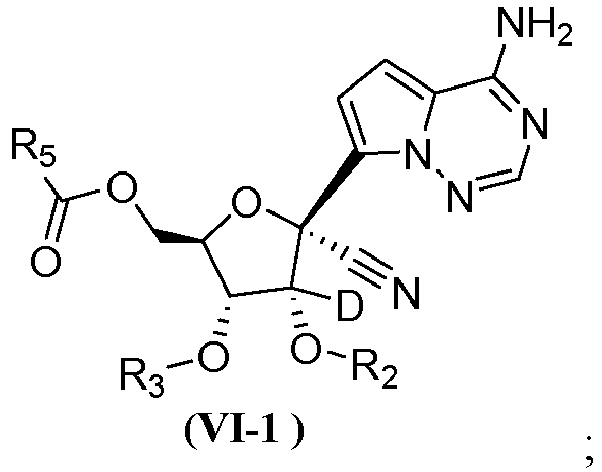 R2 and R3 are each independently selected from hydrogen, C1-6 alkyl-C(=O)-, C1-4 alkoxy-C(=O)-, and phenyl-C(=O)-, and the C1-6 alkyl, C1-4 alkoxy, and phenyl are each independently and optionally substituted by 1, 2, or 3 R;R5 is selected from phenyl, and the phenyl is optionally substituted by 1, 2, or 3 R;each R is independently selected from hydroxyl, halogen, amino, and cyano.
 - The compound, the stereoisomer thereof, or the pharmaceutically acceptable salt thereof according to claim 1, wherein each R is independently selected from hydroxyl.
- The compound, the stereoisomer thereof, or the pharmaceutically acceptable salt thereof according to claim 1, wherein R5 is selected from

- The compound, the stereoisomer thereof, or the pharmaceutically acceptable salt thereof according to claim 1, wherein R2 and R3 are each independently selected from hydrogen, isopropyl-C(=O)-, and phenyl-C(=O)-, and the isopropyl and phenyl are each independently and optionally substituted by 1, 2, or 3 R.
- The compound, the stereoisomer thereof, or the pharmaceutically acceptable salt thereof according to claim 4, wherein R2 and R3 are each independently selected from hydrogen, isopropyl-C(=O)-, and

- The compound, the stereoisomer thereof, or the pharmaceutically acceptable salt thereof according to claim 1, wherein the compound is

- The compound, the stereoisomer thereof or the pharmaceutically acceptable salt thereof according to any one of claims 1-6 for use in treating a viral infectious disease.
- The compound, the stereoisomer thereof or the pharmaceutically acceptable salt thereof for use according to claim 7, wherein the viral infectious disease is viral influenza or viral pneumonia.
Applications Claiming Priority (6)
| Application Number | Priority Date | Filing Date | Title |
|---|---|---|---|
| CN202210548373 | 2022-05-17 | ||
| CN202210695557 | 2022-06-15 | ||
| CN202211002496 | 2022-08-19 | ||
| CN202310213459 | 2023-03-07 | ||
| PCT/CN2023/094871 WO2023222055A1 (en) | 2022-05-17 | 2023-05-17 | Deuterated nucleoside compounds and use thereof |
| EP23807006.4A EP4368623A1 (en) | 2022-05-17 | 2023-05-17 | Deuterated nucleoside compounds and use thereof |
Related Parent Applications (2)
| Application Number | Title | Priority Date | Filing Date |
|---|---|---|---|
| EP23807006.4A Division EP4368623A1 (en) | 2022-05-17 | 2023-05-17 | Deuterated nucleoside compounds and use thereof |
| EP23807006.4A Division-Into EP4368623A1 (en) | 2022-05-17 | 2023-05-17 | Deuterated nucleoside compounds and use thereof |
Publications (1)
| Publication Number | Publication Date |
|---|---|
| EP4428135A1 true EP4428135A1 (en) | 2024-09-11 |
Family
ID=88834698
Family Applications (3)
| Application Number | Title | Priority Date | Filing Date |
|---|---|---|---|
| EP24170888.2A Pending EP4389220A3 (en) | 2022-05-17 | 2023-05-17 | Deuterated nucleoside compounds and use thereof |
| EP24169552.7A Withdrawn EP4428135A1 (en) | 2022-05-17 | 2023-05-17 | Deuterated nucleoside compounds and use thereof |
| EP23807006.4A Withdrawn EP4368623A1 (en) | 2022-05-17 | 2023-05-17 | Deuterated nucleoside compounds and use thereof |
Family Applications Before (1)
| Application Number | Title | Priority Date | Filing Date |
|---|---|---|---|
| EP24170888.2A Pending EP4389220A3 (en) | 2022-05-17 | 2023-05-17 | Deuterated nucleoside compounds and use thereof |
Family Applications After (1)
| Application Number | Title | Priority Date | Filing Date |
|---|---|---|---|
| EP23807006.4A Withdrawn EP4368623A1 (en) | 2022-05-17 | 2023-05-17 | Deuterated nucleoside compounds and use thereof |
Country Status (7)
| Country | Link |
|---|---|
| US (3) | US20240327446A1 (en) |
| EP (3) | EP4389220A3 (en) |
| JP (3) | JP2025517042A (en) |
| CN (3) | CN117924294A (en) |
| AU (5) | AU2023272140A1 (en) |
| CA (3) | CA3227999A1 (en) |
| WO (1) | WO2023222055A1 (en) |
Citations (3)
| Publication number | Priority date | Publication date | Assignee | Title |
|---|---|---|---|---|
| WO2021213288A1 (en) * | 2020-04-20 | 2021-10-28 | 中国科学院上海药物研究所 | Antiviral application of nucleoside analog or combination formulation containing nucleoside analog |
| CN113735862A (en) * | 2020-12-30 | 2021-12-03 | 南方科技大学 | Nucleoside compound for treating virus infection and application thereof |
| WO2022047065A2 (en) * | 2020-08-27 | 2022-03-03 | Gilead Sciences, Inc. | Compounds and methods for treatment of viral infections |
Family Cites Families (6)
| Publication number | Priority date | Publication date | Assignee | Title |
|---|---|---|---|---|
| CN113292567A (en) * | 2020-04-08 | 2021-08-24 | 迪斯凯威(深圳)新药发展有限公司 | Nucleotide derivative and pharmaceutical composition and application thereof |
| CN111961057A (en) * | 2020-05-26 | 2020-11-20 | 李小冬 | Alpha-configuration nucleoside and application thereof in treating feline coronavirus infection |
| WO2022098371A1 (en) * | 2020-11-09 | 2022-05-12 | Yan Matthew | Prodrugs of 1'-substituted carba-nucleoside analogues for antiviral treatment |
| CN113698405B (en) * | 2021-06-03 | 2022-09-27 | 南方科技大学坪山生物医药研究院 | Crystal form of nucleoside compound and preparation method thereof |
| TW202317144A (en) * | 2021-06-14 | 2023-05-01 | 美商維納拓爾斯製藥公司 | Orally-bioavailable nucleoside analogs |
| CN113999237B (en) * | 2021-10-29 | 2023-08-08 | 润佳(苏州)医药科技有限公司 | A kind of nucleoside prodrug and its application |
-
2023
- 2023-05-17 EP EP24170888.2A patent/EP4389220A3/en active Pending
- 2023-05-17 EP EP24169552.7A patent/EP4428135A1/en not_active Withdrawn
- 2023-05-17 EP EP23807006.4A patent/EP4368623A1/en not_active Withdrawn
- 2023-05-17 CA CA3227999A patent/CA3227999A1/en active Pending
- 2023-05-17 CN CN202311755807.1A patent/CN117924294A/en active Pending
- 2023-05-17 AU AU2023272140A patent/AU2023272140A1/en not_active Abandoned
- 2023-05-17 CA CA3235287A patent/CA3235287A1/en active Pending
- 2023-05-17 CN CN202380009968.8A patent/CN117440952A/en active Pending
- 2023-05-17 JP JP2024508580A patent/JP2025517042A/en active Pending
- 2023-05-17 US US18/682,091 patent/US20240327446A1/en active Pending
- 2023-05-17 WO PCT/CN2023/094871 patent/WO2023222055A1/en not_active Ceased
- 2023-05-17 CN CN202311760339.7A patent/CN117865964A/en active Pending
- 2023-05-17 CA CA3237040A patent/CA3237040A1/en active Pending
-
2024
- 2024-04-10 US US18/632,254 patent/US20240262837A1/en active Pending
- 2024-04-16 US US18/637,382 patent/US20240287117A1/en active Pending
- 2024-04-23 AU AU2024202645A patent/AU2024202645A1/en not_active Abandoned
- 2024-04-23 AU AU2024202646A patent/AU2024202646A1/en not_active Abandoned
- 2024-06-03 AU AU2024203703A patent/AU2024203703A1/en not_active Abandoned
- 2024-06-03 AU AU2024203702A patent/AU2024203702A1/en not_active Abandoned
-
2025
- 2025-06-12 JP JP2025098483A patent/JP2025134790A/en active Pending
- 2025-06-12 JP JP2025098487A patent/JP2025134791A/en active Pending
Patent Citations (3)
| Publication number | Priority date | Publication date | Assignee | Title |
|---|---|---|---|---|
| WO2021213288A1 (en) * | 2020-04-20 | 2021-10-28 | 中国科学院上海药物研究所 | Antiviral application of nucleoside analog or combination formulation containing nucleoside analog |
| WO2022047065A2 (en) * | 2020-08-27 | 2022-03-03 | Gilead Sciences, Inc. | Compounds and methods for treatment of viral infections |
| CN113735862A (en) * | 2020-12-30 | 2021-12-03 | 南方科技大学 | Nucleoside compound for treating virus infection and application thereof |
Also Published As
| Publication number | Publication date |
|---|---|
| US20240262837A1 (en) | 2024-08-08 |
| CA3237040A1 (en) | 2023-11-23 |
| CN117440952A (en) | 2024-01-23 |
| JP2025134790A (en) | 2025-09-17 |
| JP2025134791A (en) | 2025-09-17 |
| CN117924294A (en) | 2024-04-26 |
| EP4368623A1 (en) | 2024-05-15 |
| US20240287117A1 (en) | 2024-08-29 |
| US20240327446A1 (en) | 2024-10-03 |
| AU2024202645A1 (en) | 2024-05-16 |
| WO2023222055A1 (en) | 2023-11-23 |
| AU2023272140A1 (en) | 2024-02-22 |
| AU2024202646A1 (en) | 2024-05-16 |
| EP4389220A2 (en) | 2024-06-26 |
| CA3227999A1 (en) | 2023-11-23 |
| CN117865964A (en) | 2024-04-12 |
| AU2024203702A1 (en) | 2024-06-20 |
| JP2025517042A (en) | 2025-06-03 |
| CA3235287A1 (en) | 2023-11-23 |
| AU2024203703A1 (en) | 2024-06-20 |
| EP4389220A3 (en) | 2024-09-11 |
Similar Documents
| Publication | Publication Date | Title |
|---|---|---|
| RU2435756C2 (en) | Selective androgen receptor modulators | |
| JP7665774B2 (en) | Bicyclic phenolic compounds and their uses | |
| CA2690349C (en) | Derivatives of 7-alkynyl-1,8-naphthyridones, preparation method thereof and use of same in therapeutics | |
| JP6980779B2 (en) | Nucleoside cyclic phosphate compounds and their use, which are antiviral prodrugs based on liver delivery | |
| BE897516A (en) | NOVEL DEOXYURIDINE DERIVATIVES, THEIR PREPARATION AND THEIR USE AS MEDICAMENTS | |
| US20110124704A1 (en) | Deuterium-enriched atorvastatin | |
| CA1228359A (en) | Process for preparing new quinoline derivatives | |
| EP2880023A1 (en) | Griseofulvin derivatives | |
| CA2987067A1 (en) | Compounds and methods for treating cancer | |
| US20240262837A1 (en) | Deuterated nucleoside compounds and use thereof | |
| US5703084A (en) | Adenosine deaminase inhibitors | |
| JPWO2001027115A1 (en) | Pentacyclic taxane compounds | |
| JPH0560478B2 (en) | ||
| US7915309B2 (en) | Deuterium-enriched oseltamivir | |
| WO2008157271A1 (en) | Deuterium-enriched escitalopram | |
| JP2025520300A (en) | Cyclopentyladenosine derivatives and their medical uses | |
| JPH0699458B2 (en) | Dihydropyridine-5-phosphonic acid cyclic ester | |
| JPH072776A (en) | Angiotensin ii-antagonistic pyridine derivative | |
| CN120981470A (en) | A class of nucleoside analogs and their applications | |
| JPH06345739A (en) | 2-nitroimidazol-1-yl-n-propargylacetamide | |
| JPH05503716A (en) | Substituted imidazol-2-yl derivatives of bicyclic compounds and methods for their preparation | |
| FR2544311A2 (en) | Medicinal form of theophylline having prolonged action |
Legal Events
| Date | Code | Title | Description |
|---|---|---|---|
| PUAI | Public reference made under article 153(3) epc to a published international application that has entered the european phase |
Free format text: ORIGINAL CODE: 0009012 |
|
| STAA | Information on the status of an ep patent application or granted ep patent |
Free format text: STATUS: THE APPLICATION HAS BEEN PUBLISHED |
|
| AC | Divisional application: reference to earlier application |
Ref document number: 4368623 Country of ref document: EP Kind code of ref document: P |
|
| AK | Designated contracting states |
Kind code of ref document: A1 Designated state(s): AL AT BE BG CH CY CZ DE DK EE ES FI FR GB GR HR HU IE IS IT LI LT LU LV MC ME MK MT NL NO PL PT RO RS SE SI SK SM TR |
|
| STAA | Information on the status of an ep patent application or granted ep patent |
Free format text: STATUS: THE APPLICATION IS DEEMED TO BE WITHDRAWN |
|
| 18D | Application deemed to be withdrawn |
Effective date: 20250312 |