EP4428090A1 - Load fall preventing system for forklift - Google Patents
Load fall preventing system for forklift Download PDFInfo
- Publication number
- EP4428090A1 EP4428090A1 EP23216511.8A EP23216511A EP4428090A1 EP 4428090 A1 EP4428090 A1 EP 4428090A1 EP 23216511 A EP23216511 A EP 23216511A EP 4428090 A1 EP4428090 A1 EP 4428090A1
- Authority
- EP
- European Patent Office
- Prior art keywords
- load
- fork
- risk
- loaded
- forklift
- Prior art date
- Legal status (The legal status is an assumption and is not a legal conclusion. Google has not performed a legal analysis and makes no representation as to the accuracy of the status listed.)
- Pending
Links
Images



Classifications
-
- B—PERFORMING OPERATIONS; TRANSPORTING
- B66—HOISTING; LIFTING; HAULING
- B66F—HOISTING, LIFTING, HAULING OR PUSHING, NOT OTHERWISE PROVIDED FOR, e.g. DEVICES WHICH APPLY A LIFTING OR PUSHING FORCE DIRECTLY TO THE SURFACE OF A LOAD
- B66F9/00—Devices for lifting or lowering bulky or heavy goods for loading or unloading purposes
- B66F9/06—Devices for lifting or lowering bulky or heavy goods for loading or unloading purposes movable, with their loads, on wheels or the like, e.g. fork-lift trucks
- B66F9/075—Constructional features or details
-
- B—PERFORMING OPERATIONS; TRANSPORTING
- B66—HOISTING; LIFTING; HAULING
- B66F—HOISTING, LIFTING, HAULING OR PUSHING, NOT OTHERWISE PROVIDED FOR, e.g. DEVICES WHICH APPLY A LIFTING OR PUSHING FORCE DIRECTLY TO THE SURFACE OF A LOAD
- B66F17/00—Safety devices, e.g. for limiting or indicating lifting force
- B66F17/003—Safety devices, e.g. for limiting or indicating lifting force for fork-lift trucks
-
- B—PERFORMING OPERATIONS; TRANSPORTING
- B66—HOISTING; LIFTING; HAULING
- B66F—HOISTING, LIFTING, HAULING OR PUSHING, NOT OTHERWISE PROVIDED FOR, e.g. DEVICES WHICH APPLY A LIFTING OR PUSHING FORCE DIRECTLY TO THE SURFACE OF A LOAD
- B66F9/00—Devices for lifting or lowering bulky or heavy goods for loading or unloading purposes
- B66F9/06—Devices for lifting or lowering bulky or heavy goods for loading or unloading purposes movable, with their loads, on wheels or the like, e.g. fork-lift trucks
-
- B—PERFORMING OPERATIONS; TRANSPORTING
- B66—HOISTING; LIFTING; HAULING
- B66F—HOISTING, LIFTING, HAULING OR PUSHING, NOT OTHERWISE PROVIDED FOR, e.g. DEVICES WHICH APPLY A LIFTING OR PUSHING FORCE DIRECTLY TO THE SURFACE OF A LOAD
- B66F9/00—Devices for lifting or lowering bulky or heavy goods for loading or unloading purposes
- B66F9/06—Devices for lifting or lowering bulky or heavy goods for loading or unloading purposes movable, with their loads, on wheels or the like, e.g. fork-lift trucks
- B66F9/075—Constructional features or details
- B66F9/0755—Position control; Position detectors
-
- B—PERFORMING OPERATIONS; TRANSPORTING
- B66—HOISTING; LIFTING; HAULING
- B66F—HOISTING, LIFTING, HAULING OR PUSHING, NOT OTHERWISE PROVIDED FOR, e.g. DEVICES WHICH APPLY A LIFTING OR PUSHING FORCE DIRECTLY TO THE SURFACE OF A LOAD
- B66F9/00—Devices for lifting or lowering bulky or heavy goods for loading or unloading purposes
- B66F9/06—Devices for lifting or lowering bulky or heavy goods for loading or unloading purposes movable, with their loads, on wheels or the like, e.g. fork-lift trucks
- B66F9/075—Constructional features or details
- B66F9/12—Platforms; Forks; Other load supporting or gripping members
-
- B—PERFORMING OPERATIONS; TRANSPORTING
- B60—VEHICLES IN GENERAL
- B60Y—INDEXING SCHEME RELATING TO ASPECTS CROSS-CUTTING VEHICLE TECHNOLOGY
- B60Y2200/00—Type of vehicle
- B60Y2200/10—Road Vehicles
- B60Y2200/15—Fork lift trucks, Industrial trucks
Definitions
- the present disclosure relates to a system for preventing a load fall of a forklift, and more particularly, to a system for preventing a load fall accident that may occur when a load of a forklift is tilted to one side or swayed when the forklift operates.
- Forklifts are required to carry a wide variety of loads, and forklifts do not operate with only flat-shaped loads. Accordingly, it is common for a driver to drive a forklift with a load based on the driver's experience or visual perception when loading the load, and in this case, there is a high probability that the load will fall because the load is tilted to one side or swayed when the forklift operates.
- a forklift load fall preventing device includes a main body; an elevating part having a fixed frame part fixed to the main body, an elevating frame part installed to the fixed frame part to be elevatable; a towing part mounted to the elevating frame part, elevated upon elevation of the elevating frame part, and securing a load; and a fall preventing part mounted to the fixed frame part and preventing the load secured to the towing part from falling.
- the present disclosure has been made in an effort to provide a system for preventing a load fall accident by detecting a loading situation in real time when a forklift loads or transports the load and notifying a driver of the loading situation or decreasing a forklift speed or stopping the forklift.
- An exemplary embodiment of the present disclosure provides a system for preventing a load from falling for a forklift, the system including: a load weight measuring unit including a plurality of pressure sensors for measuring weight of a load loaded on a fork of a forklift; a risk determination unit for determining a degree of risk of a loading situation of the load based on pressure information measured by the plurality of pressure sensors; and an operation unit for performing an operation to prevent a fall of the load according to the degree of risk of the loading situation determined by the risk determination unit.
- the forklift forks may be formed as a left and right pair, and the plurality of pressure sensors of the load weight measuring unit may be mounted in a plurality of compartmentalized regions compartmentalized in a longitudinal direction of each of the left and right pair of forks, respectively.
- the risk determination unit may determine a loading position of the load based on the pressure information measured in real time from the plurality of pressure sensors, respectively.
- the risk determination unit may determine a left-right balance state of the loaded load from the pressure information measured by the plurality of pressure sensors, respectively.
- the risk determination unit may determine the degree of risk of the loading situation of the load based on the loading position of the load, the left-right balance state of the load, and the weight of the load measured by the load weight measuring unit.
- the degree of risk of the loading situation may be categorized into a safe state, a cautionary state, and a warning state.
- the safe state may correspond to the case where the load is unloaded because the load is weightless, or when the load is balanced on the left and right.
- the cautionary state may correspond to the case where the load is not left and right balanced and is loaded with a bias toward one fork, but the load applied to the one fork is equal to or less than the maximum loaded load of the one fork, or when the load is left and right balanced, but the load equal to or greater than the maximum loaded load of all two forks is applied.
- the warning state may correspond to the case where the load is not left and right balanced and is loaded with a bias toward one fork, but the load applied to the one fork is equal to or greater than the maximum loaded load of the one fork, where the left and right balanced state of the loaded load is in the cautionary state and the load equal to or greater than the maximum loaded load of all two forks is applied, or where a movement of the load in one direction by a certain threshold or more is detected during driving.
- the degree of risk of the loading situation may be determined by assigning weight proportional to the closeness of the loading position of the load toward the end of the fork to the loaded load.
- the degree of risk of the loading situation may be determined by assigning weight when the load is loaded while hanging from one fork.
- the operation unit in real time during the loading of the load and during an operation of a vehicle, may notify a forklift operator of the degree of risk of the loading situation, or slows down and stops the forklift, or restricts an operation of a forklift operating device.
- the load fall preventing system for the forklift has the effect of enabling uniform loading of the load during loading and preventing the load from falling during operation by in real time during the loading of the load and during the operation of the vehicle, informing a forklift operator of the degree of risk of the loading situation, or slowing down and stopping the forklift, or restricting the operation of the forklift operating device.
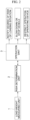
- FIG. 2 is a diagram illustrating a configuration of a load fall preventing system for a forklift according to an exemplary embodiment of the present disclosure.
- a load fall preventing system for a forklift includes a load weight measuring unit 1 including a plurality of pressure sensors for measuring weight of a load loaded on a fork of a forklift, a risk determination unit 2 for determining a degree of risk of a loading situation of the load based on pressure information measured by the plurality of pressure sensors; and an operation unit 3 that performs an operation to prevent a fall of the load in accordance with the degree of risk of the loading situation determined by the risk determination unit 2.
- the forks of the forklift are generally formed as a left and right pair, and the plurality of pressure sensors of the load weight measuring unit are each mounted in a plurality of compartmentalized regions compartmentalized in a longitudinal direction of each of the left and right pair of forks.
- the risk determination unit may determine the tilting or left-right balance state of the load, and the loading position of the load on the fork, from the respective pressure information measured in real time from the plurality of pressure sensors installed in the fork compartments.
- the risk determination unit determines a degree of the risk of the loading situation of the load based on the tilting or left and right balance state of the load, the loading position of the load on the fork, and the weight of the load measured by the load weight measuring unit.
- the driver may load the load on the fork relatively evenly when loading the load from an initial time.
- the system may notify the driver of the degree of risk of the loading situation to prevent a load falling accident, or may actively slow down or stop the vehicle to prevent the load from falling.
- FIG. 3 is a diagram illustrating a load loaded at a fork end in the load fall preventing system of the forklift according to the exemplary embodiment of the present disclosure
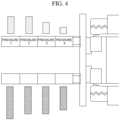
- FIG. 4 is a diagram illustrating a load loaded while being biased toward one fork in the load fall preventing system for the forklift according to the exemplary embodiment of the present disclosure.
- the pressure distribution measured in each compartment of the fork may indicate the position where the load is loaded, whether the load is tilting, or whether the load is balanced.
- the total load of the load may be known, and the load applied to a single fork may be known.
- the loading situation degree of risk may be categorized into a safe state, a cautionary state, and a warning state.
- the safe state corresponds to the case where the load is unloaded because the load is weightless, or when the load is balanced left and right.
- the cautionary state corresponds to the case where the load is not left and right balanced and is loaded with a bias toward one fork, but the load applied to the one fork is equal to or less than the maximum loaded load of the one fork, or when the load is left and right balanced, but the load equal to or greater than the maximum loaded load of all two forks is applied.
- the warning state corresponds to the case where the load is not left and right balanced and is loaded with a bias toward one fork, but the load applied to the one fork is equal to or greater than the maximum loaded load of the one fork, where the left and right balanced state of the loaded load is in the cautionary state and the load equal to or greater than the maximum loaded load of all two forks is applied, or where a movement of the load in one direction by a certain threshold or more is detected during driving.
- the degree of risk of the loading situation may be determined by assigning weight proportional to the close of the loading position of the load toward the end of the fork to the loaded load.
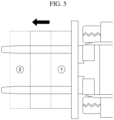
- FIG. 5 is a diagram illustrating a loading state of a load in the load fall preventing system for the forklift according to the exemplary embodiment of the present disclosure.
- the load in both loading states 1 and 2, the load is safely loaded with the load balanced left and right, but even if the load is of the same weight, the load in the load state 2 is loaded in a more precarious position than the load state 1, so it is desirable to assign weight to the load state (2) to determine the degree of risk of the loading situation.
- FIG. 6 is a diagram illustrating a load loaded while hanging from a fork on one side of a forklift in the load fall preventing system of the forklift according to the exemplary embodiment of the present disclosure.
- This state indicates the case where a large pressure is concentratedly measured on a portion of the left fork when viewed by the driver, and this case is determined as the case where the load hangs from the left fork. It is desirable to determine the degree of risk of the loading situation by assigning weight of the load, since the load is more likely to fall when the load is loaded while hanging from one fork.
- the operation unit in real time during the loading of the load and during the operation of the vehicle, informs a forklift operator of the degree of risk of the loading situation, or slows down and stops the forklift, or restricts the operation of the forklift operating device. This allows for uniform loading of the load during loading, and prevents the load from falling when the forklift operates.
- the exemplary embodiments are intended to illustrate, not limit, the technical ideas of the present disclosure, and the scope of the technical ideas of the present disclosure is not limited by the exemplary embodiment.
- the scope of protection of the present disclosure shall be construed in accordance with the following claims, and all technical ideas within their scope shall be construed to be included in the scope of the present disclosure.
Landscapes
- Engineering & Computer Science (AREA)
- Structural Engineering (AREA)
- Transportation (AREA)
- Life Sciences & Earth Sciences (AREA)
- Geology (AREA)
- Mechanical Engineering (AREA)
- Civil Engineering (AREA)
- Forklifts And Lifting Vehicles (AREA)
Abstract
Provided is a load fall preventing system for a forklift according to an exemplary embodiment of the present disclosure includes a load weight measuring unit 1 including a plurality of pressure sensors for measuring weight of a load loaded on a fork of a forklift, a risk determination unit 2 for determining a degree of risk of a loading situation of the load based on pressure information measured by the plurality of pressure sensors; and an operation unit 3 that performs an operation to prevent a fall of the load in accordance with the degree of risk of the loading situation determined by the risk determination unit.
Description
- This application claims benefit and priority to
Korean Patent Application No. 10-2023-0030419, filed on March 8, 2023 - The present disclosure relates to a system for preventing a load fall of a forklift, and more particularly, to a system for preventing a load fall accident that may occur when a load of a forklift is tilted to one side or swayed when the forklift operates.
- Forklifts are required to carry a wide variety of loads, and forklifts do not operate with only flat-shaped loads. Accordingly, it is common for a driver to drive a forklift with a load based on the driver's experience or visual perception when loading the load, and in this case, there is a high probability that the load will fall because the load is tilted to one side or swayed when the forklift operates.
- To prevent such a fall of a load, Korean Patent Application Laid-Open No. 10-2022-0022554 (published on February 28, 2022) discloses installation of a structure that prevents a load from falling as a prior art. Referring to
FIG. 1 , a forklift load fall preventing device according to the prior art includes a main body; an elevating part having a fixed frame part fixed to the main body, an elevating frame part installed to the fixed frame part to be elevatable; a towing part mounted to the elevating frame part, elevated upon elevation of the elevating frame part, and securing a load; and a fall preventing part mounted to the fixed frame part and preventing the load secured to the towing part from falling. - However, this prior art has a problem in that it is impossible to predict in advance the possibility of a load falling.
- Accordingly, there is a need to develop a system for detecting a load condition in advance when a forklift loads or transports a load, and taking measures to prevent a fall of the load.
-
Korean Patent Application Laid-Open No. 10-2022-0022554 (published on February 28, 2022 - The present disclosure has been made in an effort to provide a system for preventing a load fall accident by detecting a loading situation in real time when a forklift loads or transports the load and notifying a driver of the loading situation or decreasing a forklift speed or stopping the forklift.
- An exemplary embodiment of the present disclosure provides a system for preventing a load from falling for a forklift, the system including: a load weight measuring unit including a plurality of pressure sensors for measuring weight of a load loaded on a fork of a forklift; a risk determination unit for determining a degree of risk of a loading situation of the load based on pressure information measured by the plurality of pressure sensors; and an operation unit for performing an operation to prevent a fall of the load according to the degree of risk of the loading situation determined by the risk determination unit.
- The forklift forks may be formed as a left and right pair, and the plurality of pressure sensors of the load weight measuring unit may be mounted in a plurality of compartmentalized regions compartmentalized in a longitudinal direction of each of the left and right pair of forks, respectively.
- The risk determination unit may determine a loading position of the load based on the pressure information measured in real time from the plurality of pressure sensors, respectively.
- The risk determination unit may determine a left-right balance state of the loaded load from the pressure information measured by the plurality of pressure sensors, respectively.
- The risk determination unit may determine the degree of risk of the loading situation of the load based on the loading position of the load, the left-right balance state of the load, and the weight of the load measured by the load weight measuring unit.
- The degree of risk of the loading situation may be categorized into a safe state, a cautionary state, and a warning state.
- The safe state may correspond to the case where the load is unloaded because the load is weightless, or when the load is balanced on the left and right.
- The cautionary state may correspond to the case where the load is not left and right balanced and is loaded with a bias toward one fork, but the load applied to the one fork is equal to or less than the maximum loaded load of the one fork, or when the load is left and right balanced, but the load equal to or greater than the maximum loaded load of all two forks is applied.
- The warning state may correspond to the case where the load is not left and right balanced and is loaded with a bias toward one fork, but the load applied to the one fork is equal to or greater than the maximum loaded load of the one fork, where the left and right balanced state of the loaded load is in the cautionary state and the load equal to or greater than the maximum loaded load of all two forks is applied, or where a movement of the load in one direction by a certain threshold or more is detected during driving.
- The degree of risk of the loading situation may be determined by assigning weight proportional to the closeness of the loading position of the load toward the end of the fork to the loaded load.
- The degree of risk of the loading situation may be determined by assigning weight when the load is loaded while hanging from one fork.
- The operation unit, in real time during the loading of the load and during an operation of a vehicle, may notify a forklift operator of the degree of risk of the loading situation, or slows down and stops the forklift, or restricts an operation of a forklift operating device.
- The load fall preventing system for the forklift according to exemplary embodiment of the present disclosure has the effect of enabling uniform loading of the load during loading and preventing the load from falling during operation by in real time during the loading of the load and during the operation of the vehicle, informing a forklift operator of the degree of risk of the loading situation, or slowing down and stopping the forklift, or restricting the operation of the forklift operating device.
- The foregoing summary is illustrative only and is not intended to be in any way limiting. In addition to the illustrative aspects, exemplary embodiments, and features described above, further aspects, exemplary embodiments, and features will become apparent by reference to the drawings and the following detailed description.
-
-
FIG. 1 is a diagram illustrating forklift load fall prevention according to the prior art. -
FIG. 2 is a diagram illustrating a configuration of a load fall preventing system for a forklift according to an exemplary embodiment of the present disclosure. -
FIG. 3 is a diagram illustrating a load loaded at a fork end in the load fall preventing system of the forklift according to the exemplary embodiment of the present disclosure. -
FIG. 4 is a diagram illustrating a load loaded biased toward one fork in the load fall preventing system for the forklift according to the exemplary embodiment of the present disclosure. -
FIG. 5 is a diagram illustrating a loading state of a load in the load fall preventing system for the forklift according to the exemplary embodiment of the present disclosure. -
FIG. 6 is a diagram illustrating a load loaded while hanging from a fork on one side of a forklift in the load fall preventing system of the forklift according to the exemplary embodiment of the present disclosure. - In the following detailed description, reference is made to the accompanying drawing, which forms a part hereof. The illustrative exemplary embodiments described in the detailed description, drawing, and claims are not meant to be limiting. Other exemplary embodiments may be utilized, and other changes may be made, without departing from the spirit or scope of the subject matter presented here.
- Hereinafter, with reference to the drawings, an exemplary embodiment of a load fall preventing system for a forklift according to the present disclosure will be described in detail.
-
FIG. 2 is a diagram illustrating a configuration of a load fall preventing system for a forklift according to an exemplary embodiment of the present disclosure. - A load fall preventing system for a forklift according to an exemplary embodiment of the present disclosure includes a load
weight measuring unit 1 including a plurality of pressure sensors for measuring weight of a load loaded on a fork of a forklift, arisk determination unit 2 for determining a degree of risk of a loading situation of the load based on pressure information measured by the plurality of pressure sensors; and anoperation unit 3 that performs an operation to prevent a fall of the load in accordance with the degree of risk of the loading situation determined by therisk determination unit 2. - The forks of the forklift are generally formed as a left and right pair, and the plurality of pressure sensors of the load weight measuring unit are each mounted in a plurality of compartmentalized regions compartmentalized in a longitudinal direction of each of the left and right pair of forks.
- The risk determination unit may determine the tilting or left-right balance state of the load, and the loading position of the load on the fork, from the respective pressure information measured in real time from the plurality of pressure sensors installed in the fork compartments.
- The risk determination unit determines a degree of the risk of the loading situation of the load based on the tilting or left and right balance state of the load, the loading position of the load on the fork, and the weight of the load measured by the load weight measuring unit.
- By informing a driver in advance of the determined degree of risk of the loading situation, the driver may load the load on the fork relatively evenly when loading the load from an initial time.
- When the load is at risk of falling, such as due to swaying caused by a forklift operation, driving on an unpaved road, and driving on an inclined road, the system may notify the driver of the degree of risk of the loading situation to prevent a load falling accident, or may actively slow down or stop the vehicle to prevent the load from falling.
-
FIG. 3 is a diagram illustrating a load loaded at a fork end in the load fall preventing system of the forklift according to the exemplary embodiment of the present disclosure, andFIG. 4 is a diagram illustrating a load loaded while being biased toward one fork in the load fall preventing system for the forklift according to the exemplary embodiment of the present disclosure. - In the case of
FIG. 3 , where the load is loaded at the front where the fork end is located, the pressure distribution measured for each compartment where the plurality of pressure sensors is located shows that the greatest pressure is detected at the fork end. - In the case of
FIG. 4 , where the load is loaded while being biased toward one fork (the left one when viewed from the driver's seat), and the pressure distribution measured for each compartment shows that the left fork has a concentrated large pressure. - As described above, the pressure distribution measured in each compartment of the fork may indicate the position where the load is loaded, whether the load is tilting, or whether the load is balanced. Of course, from the measured pressures of the plurality of pressure sensors, the total load of the load may be known, and the load applied to a single fork may be known.
- The loading situation degree of risk may be categorized into a safe state, a cautionary state, and a warning state.
- The safe state corresponds to the case where the load is unloaded because the load is weightless, or when the load is balanced left and right.
- The cautionary state corresponds to the case where the load is not left and right balanced and is loaded with a bias toward one fork, but the load applied to the one fork is equal to or less than the maximum loaded load of the one fork, or when the load is left and right balanced, but the load equal to or greater than the maximum loaded load of all two forks is applied.
- The warning state corresponds to the case where the load is not left and right balanced and is loaded with a bias toward one fork, but the load applied to the one fork is equal to or greater than the maximum loaded load of the one fork, where the left and right balanced state of the loaded load is in the cautionary state and the load equal to or greater than the maximum loaded load of all two forks is applied, or where a movement of the load in one direction by a certain threshold or more is detected during driving.
- Meanwhile, the degree of risk of the loading situation may be determined by assigning weight proportional to the close of the loading position of the load toward the end of the fork to the loaded load.
-
FIG. 5 is a diagram illustrating a loading state of a load in the load fall preventing system for the forklift according to the exemplary embodiment of the present disclosure. InFIG. 5 , in bothloading states load state ② is loaded in a more precarious position than theload state ①, so it is desirable to assign weight to the load state (2) to determine the degree of risk of the loading situation. -
FIG. 6 is a diagram illustrating a load loaded while hanging from a fork on one side of a forklift in the load fall preventing system of the forklift according to the exemplary embodiment of the present disclosure. This state indicates the case where a large pressure is concentratedly measured on a portion of the left fork when viewed by the driver, and this case is determined as the case where the load hangs from the left fork. It is desirable to determine the degree of risk of the loading situation by assigning weight of the load, since the load is more likely to fall when the load is loaded while hanging from one fork. - The operation unit, in real time during the loading of the load and during the operation of the vehicle, informs a forklift operator of the degree of risk of the loading situation, or slows down and stops the forklift, or restricts the operation of the forklift operating device. This allows for uniform loading of the load during loading, and prevents the load from falling when the forklift operates.
- The above description is merely an exemplary description of the technical ideas of the present disclosure, and various modifications, changes, and substitutions will be apparent to one of ordinary skill in the art to which the present disclosure belongs without departing from the essential features of the invention.
- Accordingly, the exemplary embodiments are intended to illustrate, not limit, the technical ideas of the present disclosure, and the scope of the technical ideas of the present disclosure is not limited by the exemplary embodiment. The scope of protection of the present disclosure shall be construed in accordance with the following claims, and all technical ideas within their scope shall be construed to be included in the scope of the present disclosure.
- From the foregoing, it will be appreciated that various embodiments of the present disclosure have been described herein for purposes of illustration, and that various modifications may be made without departing from the scope and spirit of the present disclosure. Accordingly, the various embodiments disclosed herein are not intended to be limiting, with the true scope and spirit being indicated by the following claims.
Claims (12)
- A system for preventing a load from falling for a forklift, the system comprising:a load weight measuring unit including a plurality of pressure sensors for measuring weight of a load loaded on a fork of a forklift;a risk determination unit for determining a degree of risk of a loading situation of the load based on pressure information measured by the plurality of pressure sensors; andan operation unit for performing an operation to prevent a fall of the load according to the degree of risk of the loading situation determined by the risk determination unit.
- The system of claim 1, wherein the forklift forks are formed as a left and right pair, and
the plurality of pressure sensors of the load weight measuring unit is mounted in a plurality of compartmentalized regions compartmentalized in a longitudinal direction of each of the left and right pair of forks, respectively. - The system of claim 2, wherein the risk determination unit determines a loading position of the load based on the pressure information measured in real time from the plurality of pressure sensors, respectively.
- The system of claim 3, wherein the risk determination unit determines a left-right balance state of the loaded load from the pressure information measured by the plurality of pressure sensors, respectively.
- The system of claim 4, wherein the risk determination unit determines the degree of risk of the loading situation of the load based on the loading position of the load, the left-right balance state of the load, and the weight of the load measured by the load weight measuring unit.
- The system of claim 5, wherein the degree of risk of the loading situation is categorized into a safe state, a cautionary state, and a warning state.
- The system of claim 6, wherein the safe state corresponds to the case where the load is unloaded because the load is weightless, or when the load is balanced left and right.
- The system of claim 7, wherein the cautionary state corresponds to the case where the load is not left and right balanced and is loaded with a bias toward one fork, but the load applied to the one fork is equal to or less than the maximum loaded load of the one fork, or when the load is left and right balanced, but the load equal to or greater than the maximum loaded load of all two forks is applied.
- The system of claim 8, wherein he warning state corresponds to the case where the load is not left and right balanced and is loaded with a bias toward one fork, but the load applied to the one fork is equal to or greater than the maximum loaded load of the one fork, where the left and right balanced state of the loaded load is in the cautionary state and the load equal to or greater than the maximum loaded load of all two forks is applied, or where a movement of the load in one direction by a certain threshold or more is detected during driving.
- The system of claim 8 or 9, wherein the degree of risk of the loading situation is determined by assigning weight proportional to the closeness of the loading position of the load toward the end of the fork to the loaded load.
- The system of claim 8 or 9, wherein the degree of risk of the loading situation is determined by assigning weight when the load is loaded while hanging from one fork.
- The system of claim 9, wherein the operation unit, in real time during the loading of the load and during an operation of a vehicle, informs a forklift operator of the degree of risk of the loading situation, or slows down and stops the forklift, or restricts an operation of a forklift operating device.
Applications Claiming Priority (1)
| Application Number | Priority Date | Filing Date | Title |
|---|---|---|---|
| KR1020230030419A KR102934305B1 (en) | 2023-03-08 | 2023-03-08 | Forklift load fall prevention system |
Publications (1)
| Publication Number | Publication Date |
|---|---|
| EP4428090A1 true EP4428090A1 (en) | 2024-09-11 |
Family
ID=89222578
Family Applications (1)
| Application Number | Title | Priority Date | Filing Date |
|---|---|---|---|
| EP23216511.8A Pending EP4428090A1 (en) | 2023-03-08 | 2023-12-14 | Load fall preventing system for forklift |
Country Status (5)
| Country | Link |
|---|---|
| US (1) | US20240300793A1 (en) |
| EP (1) | EP4428090A1 (en) |
| KR (1) | KR102934305B1 (en) |
| CN (1) | CN118651796A (en) |
| GB (1) | GB2628026A (en) |
Citations (6)
| Publication number | Priority date | Publication date | Assignee | Title |
|---|---|---|---|---|
| JPH06156996A (en) * | 1992-11-20 | 1994-06-03 | Showa:Kk | Load detecting device for fork-lift |
| US20120101684A1 (en) * | 2010-10-21 | 2012-04-26 | Jtekt Corporation | Motor vehicle steering system |
| KR101863309B1 (en) * | 2017-04-17 | 2018-05-30 | 김철 | Safety Apparatus of a forklift |
| JP2022015592A (en) * | 2020-07-09 | 2022-01-21 | 三菱ロジスネクスト株式会社 | Cargo handling system |
| KR20220022554A (en) | 2020-08-19 | 2022-02-28 | 현대제철 주식회사 | Apparatus for preventing material from falling in forklift truck |
| CN115231476A (en) * | 2022-06-28 | 2022-10-25 | 浙江金华文瑞机电有限公司 | Unbalance loading protection structure and method of weighing fork |
Family Cites Families (11)
| Publication number | Priority date | Publication date | Assignee | Title |
|---|---|---|---|---|
| US4511974A (en) * | 1981-02-04 | 1985-04-16 | Kabushiki Kaisha Toyoda Jidoshokki Seisakusho | Load condition indicating method and apparatus for forklift truck |
| US5986560A (en) * | 1998-11-02 | 1999-11-16 | Rayburn; Brutus | Forklift weight sensing device |
| JP5656490B2 (en) * | 2010-07-13 | 2015-01-21 | 大和製衡株式会社 | Forklift and center of gravity measurement device |
| NL2007060C2 (en) * | 2011-07-06 | 2013-01-08 | Ravas Europ B V | DEVICE, CARRYING BODY AND LIFTING VEHICLE. |
| NL2019033B1 (en) * | 2017-06-08 | 2018-12-17 | Ravas Europe B V | Device for moving a load and a lifting device therefor |
| CN209306896U (en) * | 2018-12-18 | 2019-08-27 | 北京金开宇国际货运代理有限公司 | A kind of pallet fork and its overload warning system with overload alarm ability |
| KR102063579B1 (en) * | 2019-06-28 | 2020-01-09 | 주식회사 알씨엔 | Sensor Anchor Bolt For Measuring Load Of Freight Loaded On Forklift Using Strain Gage |
| CN111707342B (en) * | 2020-05-29 | 2022-03-11 | 浙江华叉搬运设备有限公司 | Forklift load detection method and device |
| JP6969858B1 (en) | 2020-06-24 | 2021-11-24 | 三菱ロジスネクスト株式会社 | Cargo handling system and control method |
| CN112707338A (en) * | 2020-12-23 | 2021-04-27 | 南京爱动信息技术有限公司 | Cargo carrying load bearing capacity detection system and method based on industrial forklift intellectualization |
| CN218174567U (en) * | 2022-08-26 | 2022-12-30 | 江苏乾运达智能设备有限公司 | Forklift with pressure sensing system |
-
2023
- 2023-03-08 KR KR1020230030419A patent/KR102934305B1/en active Active
- 2023-12-05 GB GB2318577.0A patent/GB2628026A/en active Pending
- 2023-12-07 US US18/532,301 patent/US20240300793A1/en active Pending
- 2023-12-14 EP EP23216511.8A patent/EP4428090A1/en active Pending
-
2024
- 2024-01-03 CN CN202410004429.1A patent/CN118651796A/en active Pending
Patent Citations (6)
| Publication number | Priority date | Publication date | Assignee | Title |
|---|---|---|---|---|
| JPH06156996A (en) * | 1992-11-20 | 1994-06-03 | Showa:Kk | Load detecting device for fork-lift |
| US20120101684A1 (en) * | 2010-10-21 | 2012-04-26 | Jtekt Corporation | Motor vehicle steering system |
| KR101863309B1 (en) * | 2017-04-17 | 2018-05-30 | 김철 | Safety Apparatus of a forklift |
| JP2022015592A (en) * | 2020-07-09 | 2022-01-21 | 三菱ロジスネクスト株式会社 | Cargo handling system |
| KR20220022554A (en) | 2020-08-19 | 2022-02-28 | 현대제철 주식회사 | Apparatus for preventing material from falling in forklift truck |
| CN115231476A (en) * | 2022-06-28 | 2022-10-25 | 浙江金华文瑞机电有限公司 | Unbalance loading protection structure and method of weighing fork |
Also Published As
| Publication number | Publication date |
|---|---|
| CN118651796A (en) | 2024-09-17 |
| GB202318577D0 (en) | 2024-01-17 |
| KR20240137252A (en) | 2024-09-20 |
| GB2628026A (en) | 2024-09-11 |
| US20240300793A1 (en) | 2024-09-12 |
| KR102934305B1 (en) | 2026-03-04 |
Similar Documents
| Publication | Publication Date | Title |
|---|---|---|
| AU2009299639B2 (en) | Load monitoring system | |
| EP2406163B1 (en) | Brake torque control | |
| US10865080B2 (en) | Overload preventing device | |
| KR20150077910A (en) | Controller and control method of Forklift | |
| US10112485B2 (en) | Chassis monitoring system having overload detection | |
| US9546073B2 (en) | Rope sway mitigation through control of access to elevators | |
| KR20120084868A (en) | Forklift having sensor | |
| US6819980B2 (en) | Method for the avoidance of rollover phenomena in semitrailers | |
| KR20190080183A (en) | Axial load sensor module with axle load | |
| EP4428090A1 (en) | Load fall preventing system for forklift | |
| US9102208B2 (en) | Air suspension system with load detection | |
| US10450171B1 (en) | Automatic de-rate operating system and method for a truck mounted crane | |
| KR101489018B1 (en) | Sensing device for the rear wheels of the forklift being lifted | |
| CN118458644A (en) | Weight adjustment method, apparatus, electronic device, and computer-readable storage medium | |
| KR102485399B1 (en) | Vehicle, and control method for the same | |
| KR20150010338A (en) | Device For Detecting Tilt Of Forklift | |
| KR101502245B1 (en) | The overload protection device for truck | |
| CN220012029U (en) | Rope breakage detection mechanism and rope breakage alarm device | |
| KR20240151397A (en) | Overturn preventing apparatus and method thereof for forklift | |
| TR2024000478A2 (en) | Storage Cabinet Weight System | |
| KR0140210Y1 (en) | Cargo overload protection device | |
| KR0147524B1 (en) | Single load alarm device of automobile | |
| JP2025000142A (en) | Forklift, pedal weight changing system, and pedal weight changing program | |
| TR2021009057A2 (en) | OPTIMIZATION OF ROLL CONTROL THROUGH THE USE OF AXLE LOADS | |
| TR2023014085A2 (en) | LOAD BALANCE MECHANISM |
Legal Events
| Date | Code | Title | Description |
|---|---|---|---|
| PUAI | Public reference made under article 153(3) epc to a published international application that has entered the european phase |
Free format text: ORIGINAL CODE: 0009012 |
|
| STAA | Information on the status of an ep patent application or granted ep patent |
Free format text: STATUS: REQUEST FOR EXAMINATION WAS MADE |
|
| 17P | Request for examination filed |
Effective date: 20231214 |
|
| AK | Designated contracting states |
Kind code of ref document: A1 Designated state(s): AL AT BE BG CH CY CZ DE DK EE ES FI FR GB GR HR HU IE IS IT LI LT LU LV MC ME MK MT NL NO PL PT RO RS SE SI SK SM TR |
|
| STAA | Information on the status of an ep patent application or granted ep patent |
Free format text: STATUS: EXAMINATION IS IN PROGRESS |
|
| 17Q | First examination report despatched |
Effective date: 20260313 |