EP4427946A2 - Tire - Google Patents
Tire Download PDFInfo
- Publication number
- EP4427946A2 EP4427946A2 EP24156586.0A EP24156586A EP4427946A2 EP 4427946 A2 EP4427946 A2 EP 4427946A2 EP 24156586 A EP24156586 A EP 24156586A EP 4427946 A2 EP4427946 A2 EP 4427946A2
- Authority
- EP
- European Patent Office
- Prior art keywords
- shoulder
- tire
- crown
- grooves
- land region
- Prior art date
- Legal status (The legal status is an assumption and is not a legal conclusion. Google has not performed a legal analysis and makes no representation as to the accuracy of the status listed.)
- Pending
Links
Images




Classifications
-
- B—PERFORMING OPERATIONS; TRANSPORTING
- B60—VEHICLES IN GENERAL
- B60C—VEHICLE TYRES; TYRE INFLATION; TYRE CHANGING; CONNECTING VALVES TO INFLATABLE ELASTIC BODIES IN GENERAL; DEVICES OR ARRANGEMENTS RELATED TO TYRES
- B60C11/00—Tyre tread bands; Tread patterns; Anti-skid inserts
- B60C11/03—Tread patterns
- B60C11/0304—Asymmetric patterns
-
- B—PERFORMING OPERATIONS; TRANSPORTING
- B60—VEHICLES IN GENERAL
- B60C—VEHICLE TYRES; TYRE INFLATION; TYRE CHANGING; CONNECTING VALVES TO INFLATABLE ELASTIC BODIES IN GENERAL; DEVICES OR ARRANGEMENTS RELATED TO TYRES
- B60C11/00—Tyre tread bands; Tread patterns; Anti-skid inserts
- B60C11/0083—Tyre tread bands; Tread patterns; Anti-skid inserts characterised by the curvature of the tyre tread
-
- B—PERFORMING OPERATIONS; TRANSPORTING
- B60—VEHICLES IN GENERAL
- B60C—VEHICLE TYRES; TYRE INFLATION; TYRE CHANGING; CONNECTING VALVES TO INFLATABLE ELASTIC BODIES IN GENERAL; DEVICES OR ARRANGEMENTS RELATED TO TYRES
- B60C11/00—Tyre tread bands; Tread patterns; Anti-skid inserts
- B60C11/03—Tread patterns
-
- B—PERFORMING OPERATIONS; TRANSPORTING
- B60—VEHICLES IN GENERAL
- B60C—VEHICLE TYRES; TYRE INFLATION; TYRE CHANGING; CONNECTING VALVES TO INFLATABLE ELASTIC BODIES IN GENERAL; DEVICES OR ARRANGEMENTS RELATED TO TYRES
- B60C11/00—Tyre tread bands; Tread patterns; Anti-skid inserts
- B60C11/03—Tread patterns
- B60C11/0306—Patterns comprising block rows or discontinuous ribs
-
- B—PERFORMING OPERATIONS; TRANSPORTING
- B60—VEHICLES IN GENERAL
- B60C—VEHICLE TYRES; TYRE INFLATION; TYRE CHANGING; CONNECTING VALVES TO INFLATABLE ELASTIC BODIES IN GENERAL; DEVICES OR ARRANGEMENTS RELATED TO TYRES
- B60C11/00—Tyre tread bands; Tread patterns; Anti-skid inserts
- B60C11/03—Tread patterns
- B60C11/0327—Tread patterns characterised by special properties of the tread pattern
-
- B—PERFORMING OPERATIONS; TRANSPORTING
- B60—VEHICLES IN GENERAL
- B60C—VEHICLE TYRES; TYRE INFLATION; TYRE CHANGING; CONNECTING VALVES TO INFLATABLE ELASTIC BODIES IN GENERAL; DEVICES OR ARRANGEMENTS RELATED TO TYRES
- B60C11/00—Tyre tread bands; Tread patterns; Anti-skid inserts
- B60C11/03—Tread patterns
- B60C11/0327—Tread patterns characterised by special properties of the tread pattern
- B60C11/033—Tread patterns characterised by special properties of the tread pattern by the void or net-to-gross ratios of the patterns
-
- B—PERFORMING OPERATIONS; TRANSPORTING
- B60—VEHICLES IN GENERAL
- B60C—VEHICLE TYRES; TYRE INFLATION; TYRE CHANGING; CONNECTING VALVES TO INFLATABLE ELASTIC BODIES IN GENERAL; DEVICES OR ARRANGEMENTS RELATED TO TYRES
- B60C11/00—Tyre tread bands; Tread patterns; Anti-skid inserts
- B60C11/03—Tread patterns
- B60C11/0327—Tread patterns characterised by special properties of the tread pattern
- B60C11/0332—Tread patterns characterised by special properties of the tread pattern by the footprint-ground contacting area of the tyre tread
-
- B—PERFORMING OPERATIONS; TRANSPORTING
- B60—VEHICLES IN GENERAL
- B60C—VEHICLE TYRES; TYRE INFLATION; TYRE CHANGING; CONNECTING VALVES TO INFLATABLE ELASTIC BODIES IN GENERAL; DEVICES OR ARRANGEMENTS RELATED TO TYRES
- B60C11/00—Tyre tread bands; Tread patterns; Anti-skid inserts
- B60C11/03—Tread patterns
- B60C2011/0337—Tread patterns characterised by particular design features of the pattern
- B60C2011/0339—Grooves
- B60C2011/0341—Circumferential grooves
-
- B—PERFORMING OPERATIONS; TRANSPORTING
- B60—VEHICLES IN GENERAL
- B60C—VEHICLE TYRES; TYRE INFLATION; TYRE CHANGING; CONNECTING VALVES TO INFLATABLE ELASTIC BODIES IN GENERAL; DEVICES OR ARRANGEMENTS RELATED TO TYRES
- B60C11/00—Tyre tread bands; Tread patterns; Anti-skid inserts
- B60C11/03—Tread patterns
- B60C2011/0337—Tread patterns characterised by particular design features of the pattern
- B60C2011/0339—Grooves
- B60C2011/0341—Circumferential grooves
- B60C2011/0346—Circumferential grooves with zigzag shape
-
- B—PERFORMING OPERATIONS; TRANSPORTING
- B60—VEHICLES IN GENERAL
- B60C—VEHICLE TYRES; TYRE INFLATION; TYRE CHANGING; CONNECTING VALVES TO INFLATABLE ELASTIC BODIES IN GENERAL; DEVICES OR ARRANGEMENTS RELATED TO TYRES
- B60C11/00—Tyre tread bands; Tread patterns; Anti-skid inserts
- B60C11/03—Tread patterns
- B60C2011/0337—Tread patterns characterised by particular design features of the pattern
- B60C2011/0339—Grooves
- B60C2011/0341—Circumferential grooves
- B60C2011/0353—Circumferential grooves characterised by width
-
- B—PERFORMING OPERATIONS; TRANSPORTING
- B60—VEHICLES IN GENERAL
- B60C—VEHICLE TYRES; TYRE INFLATION; TYRE CHANGING; CONNECTING VALVES TO INFLATABLE ELASTIC BODIES IN GENERAL; DEVICES OR ARRANGEMENTS RELATED TO TYRES
- B60C11/00—Tyre tread bands; Tread patterns; Anti-skid inserts
- B60C11/03—Tread patterns
- B60C2011/0337—Tread patterns characterised by particular design features of the pattern
- B60C2011/0339—Grooves
- B60C2011/0341—Circumferential grooves
- B60C2011/0355—Circumferential grooves characterised by depth
-
- B—PERFORMING OPERATIONS; TRANSPORTING
- B60—VEHICLES IN GENERAL
- B60C—VEHICLE TYRES; TYRE INFLATION; TYRE CHANGING; CONNECTING VALVES TO INFLATABLE ELASTIC BODIES IN GENERAL; DEVICES OR ARRANGEMENTS RELATED TO TYRES
- B60C11/00—Tyre tread bands; Tread patterns; Anti-skid inserts
- B60C11/03—Tread patterns
- B60C2011/0337—Tread patterns characterised by particular design features of the pattern
- B60C2011/0339—Grooves
- B60C2011/0358—Lateral grooves, i.e. having an angle of 45 to 90 degees to the equatorial plane
-
- B—PERFORMING OPERATIONS; TRANSPORTING
- B60—VEHICLES IN GENERAL
- B60C—VEHICLE TYRES; TYRE INFLATION; TYRE CHANGING; CONNECTING VALVES TO INFLATABLE ELASTIC BODIES IN GENERAL; DEVICES OR ARRANGEMENTS RELATED TO TYRES
- B60C11/00—Tyre tread bands; Tread patterns; Anti-skid inserts
- B60C11/03—Tread patterns
- B60C2011/0337—Tread patterns characterised by particular design features of the pattern
- B60C2011/0339—Grooves
- B60C2011/0358—Lateral grooves, i.e. having an angle of 45 to 90 degees to the equatorial plane
- B60C2011/0362—Shallow grooves, i.e. having a depth of less than 50% of other grooves
-
- B—PERFORMING OPERATIONS; TRANSPORTING
- B60—VEHICLES IN GENERAL
- B60C—VEHICLE TYRES; TYRE INFLATION; TYRE CHANGING; CONNECTING VALVES TO INFLATABLE ELASTIC BODIES IN GENERAL; DEVICES OR ARRANGEMENTS RELATED TO TYRES
- B60C11/00—Tyre tread bands; Tread patterns; Anti-skid inserts
- B60C11/03—Tread patterns
- B60C2011/0337—Tread patterns characterised by particular design features of the pattern
- B60C2011/0339—Grooves
- B60C2011/0358—Lateral grooves, i.e. having an angle of 45 to 90 degees to the equatorial plane
- B60C2011/0365—Lateral grooves, i.e. having an angle of 45 to 90 degees to the equatorial plane characterised by width
-
- B—PERFORMING OPERATIONS; TRANSPORTING
- B60—VEHICLES IN GENERAL
- B60C—VEHICLE TYRES; TYRE INFLATION; TYRE CHANGING; CONNECTING VALVES TO INFLATABLE ELASTIC BODIES IN GENERAL; DEVICES OR ARRANGEMENTS RELATED TO TYRES
- B60C11/00—Tyre tread bands; Tread patterns; Anti-skid inserts
- B60C11/03—Tread patterns
- B60C2011/0337—Tread patterns characterised by particular design features of the pattern
- B60C2011/0339—Grooves
- B60C2011/0358—Lateral grooves, i.e. having an angle of 45 to 90 degees to the equatorial plane
- B60C2011/0367—Lateral grooves, i.e. having an angle of 45 to 90 degees to the equatorial plane characterised by depth
-
- B—PERFORMING OPERATIONS; TRANSPORTING
- B60—VEHICLES IN GENERAL
- B60C—VEHICLE TYRES; TYRE INFLATION; TYRE CHANGING; CONNECTING VALVES TO INFLATABLE ELASTIC BODIES IN GENERAL; DEVICES OR ARRANGEMENTS RELATED TO TYRES
- B60C11/00—Tyre tread bands; Tread patterns; Anti-skid inserts
- B60C11/03—Tread patterns
- B60C2011/0337—Tread patterns characterised by particular design features of the pattern
- B60C2011/0339—Grooves
- B60C2011/0381—Blind or isolated grooves
-
- B—PERFORMING OPERATIONS; TRANSPORTING
- B60—VEHICLES IN GENERAL
- B60C—VEHICLE TYRES; TYRE INFLATION; TYRE CHANGING; CONNECTING VALVES TO INFLATABLE ELASTIC BODIES IN GENERAL; DEVICES OR ARRANGEMENTS RELATED TO TYRES
- B60C11/00—Tyre tread bands; Tread patterns; Anti-skid inserts
- B60C11/03—Tread patterns
- B60C2011/0337—Tread patterns characterised by particular design features of the pattern
- B60C2011/0386—Continuous ribs
- B60C2011/0388—Continuous ribs provided at the equatorial plane
-
- B—PERFORMING OPERATIONS; TRANSPORTING
- B60—VEHICLES IN GENERAL
- B60C—VEHICLE TYRES; TYRE INFLATION; TYRE CHANGING; CONNECTING VALVES TO INFLATABLE ELASTIC BODIES IN GENERAL; DEVICES OR ARRANGEMENTS RELATED TO TYRES
- B60C11/00—Tyre tread bands; Tread patterns; Anti-skid inserts
- B60C11/03—Tread patterns
- B60C2011/0337—Tread patterns characterised by particular design features of the pattern
- B60C2011/0386—Continuous ribs
- B60C2011/039—Continuous ribs provided at the shoulder portion
-
- Y—GENERAL TAGGING OF NEW TECHNOLOGICAL DEVELOPMENTS; GENERAL TAGGING OF CROSS-SECTIONAL TECHNOLOGIES SPANNING OVER SEVERAL SECTIONS OF THE IPC; TECHNICAL SUBJECTS COVERED BY FORMER USPC CROSS-REFERENCE ART COLLECTIONS [XRACs] AND DIGESTS
- Y02—TECHNOLOGIES OR APPLICATIONS FOR MITIGATION OR ADAPTATION AGAINST CLIMATE CHANGE
- Y02T—CLIMATE CHANGE MITIGATION TECHNOLOGIES RELATED TO TRANSPORTATION
- Y02T10/00—Road transport of goods or passengers
- Y02T10/80—Technologies aiming to reduce greenhouse gasses emissions common to all road transportation technologies
- Y02T10/86—Optimisation of rolling resistance, e.g. weight reduction
Definitions
- the present invention relates to a tire.
- Japanese Unexamined Patent Application Publication No. 2012-1120 describes a pneumatic tire with a tread portion provided with a pair of shoulder circumferential grooves, and a plurality of shoulder axial grooves extending between one of the shoulder circumferential grooves and one of tread ground contact edges.
- the average ground contact pressure in a shoulder region demarcated between the shoulder circumferential groove and the tread ground contact edge is from 1.2 to 1.4 times the average ground contact pressure in a crown region demarcated between the shoulder circumferential grooves.
- the present invention was made in view of the above, and a primary object thereof is to provide a tire capable of improving the mud performance while suppressing deterioration of the rolling resistance performance.
- the present invention is a tire having a tread portion including:
- the tire of the present invention can improve the mud performance while suppressing the deterioration of the rolling resistance performance.
- the dimensions and the like of various parts of a tire 1 are the values measured under a standard state.
- the "standard state” refers to a state in which the tire 1 is assembled on a standard rim, inflated to a standard inner pressure, and loaded with no tire load.
- the standard sate means a state of standard usage according to the purpose of use of the tire and a state in which the tire is not mounted on a vehicle and is loaded with no tire load.
- the "standard rim” is a wheel rim specified for the concerned tire by a standard included in a standardization system on which the tire is based, for example, the "normal wheel rim” in JATMA, "Design Rim” in TRA, and “Measuring Rim” in ETRTO.
- the "standard inner pressure” is air pressure specified for the concerned tire by a standard included in a standardization system on which the tire is based, for example, the maximum air pressure in JATMA, maximum value listed in the "TIRE LOAD LIMITS AT VARIOUS COLD INFLATION PRESSURES" table in TRA, and "INFLATION PRESSURE” in ETRTO.
- FIG. 1 is a partial plan view of a tread portion 2 of the tire 1 showing an embodiment of the present invention.
- the tire 1 of the present embodiment is suitably used, for example, as a pneumatic tire for a passenger car, specifically, for an SUV that can be driven on muddy terrain.
- the present invention may be used, for example, for a heavy duty pneumatic tire, as well as a non-pneumatic tire that are not filled with compressed air inside.
- the tread portion 2 includes a first tread edge T1, a shoulder circumferential groove 3 adjacent to the first tread edge T1, and a shoulder land region 5 located and demarcated between the shoulder circumferential groove 3 and the first tread edge T1.
- the shoulder land region 5 includes an inner area 5A located and demarcated axially inside from a center position (5c) in the tire axial direction of the shoulder land region 5 and an outer area 5B located and demarcated axially outside from the center position (5c) of the shoulder land region 5.
- the center position (5c) is the axial midpoint of the shoulder land region 5 at its maximum width (Ws) in the tire axial direction.
- the shoulder land region 5 includes a plurality of shoulder axial grooves 8 connected to the first tread edge T1 and extend in the tire axial direction at least in the outer area 5B.
- the shoulder axial grooves 8 communicating with the first tread edge T1 allow mud in the grooves to be smoothly discharged to the outside of the first tread edge T1.
- the shoulder axial grooves 8 can grab and compact a lot of mud when newly grounded, therefore, a large sharing force can be exerted.
- the average ground contact pressure (Pb) in the outer area 5B is greater than the average ground contact pressure (Pa) in the inner area 5A under a standard tire load loaded state.
- the shoulder axial grooves 8 arranged in the outer area 5B can exert greater shearing force against mud and can discharge mud more smoothly to the outside of the first tread edge T1, therefore, the mud performance is improved.
- the tire 1 of the present invention can improve the mud performance while maintaining the rolling resistance performance.
- the “standard tire load loaded state” is the state in which the tire 1 in the standard state is in contact with a flat surface with zero camber angle.
- the “standard tire load” refers to a tire load specified for the concerned tire by a standard included in a standardization system on which the tire is based, for example, the “maximum load capacity” in JATMA, maximum value listed in “TIRE LOAD LIMITS AT VARIOUS COLD INFLATION PRESSURES" table in TRA, and "LOAD CAPACITY" in ETRTO.
- the “standard tire load” refers to the load acting on a single tire when the tire is in a standard mounting state.
- the “standard mounting state” refers to a state in which the tire is mounted on a standard vehicle according to the intended use of the tire, and the vehicle is at rest on a flat road surface in a roadworthy condition.
- the "average ground contact pressure” is defined as the average of the pressure (kPa) acting on a ground contacting surface (2a) (shown in FIG. 2 ) of the tread portion 2, which can be measured, for example, by observing the ground contacting surface (2a). More specifically, the average ground contact pressure can be measured by using a pressure distribution measuring device available from Tekscan, Inc., for example. This device can measure the ground contact pressure applied to the ground contacting surface (2a) of the tire 1 in the standard tire load loaded state at 1.0 mm intervals in the tire circumferential direction and the tire axial direction, for example. The average ground contact pressure is a value obtained by dividing the sum of the measurement values for each area or each land region measured by the above measuring device at 1.0 mm intervals by the number of measurements.
- the tire 1, which has such an average ground contact pressure, can be formed, for example, by manipulating or adjusting the rubber volume of the tread rubber (not shown) of the tread portion 2, or by manipulating or adjusting the strength of the carcass (not shown) or other tire components distributed inside the tread portion 2.
- the aforementioned "tread rubber” and “ tire components” are made of well-known materials, so their description is omitted.
- the average ground contact pressure (Pb) of the outer area 5B is preferably at least 1.1 times, more preferably at least 1.2 times the average ground contact pressure (Pb) of the inner area 5A, and preferably 1.4 or less times, more preferably 1.3 or less times the average ground contact pressure (Pb) of the inner area 5A. Since the average ground contact pressure (Pb) of the outer area 5B is 1.1 or more times the average ground contact pressure (Pa) of the inner area 5A, the shearing force is increased in the outer area 5B, which enables stable running in muddy terrain.
- the average ground contact pressure (Pb) in the outer area 5B is 1.4 or less times the average ground contact pressure (Pa) of the inner area 5A, it is possible that the deterioration of the rolling resistance performance due to the frictional force in the outer area 5B becoming excessively large is suppressed.
- FIG. 2 is a plan view of the tread portion 2.
- the tread portion 2 of the present embodiment further includes a second tread edge T2, a pair of crown circumferential grooves 4 adjacent to the tire equator (C) so as to sandwich the tire equator (C), and a crown land region 6 located and demarcated between the pair of the crown circumferential grooves 4.
- the tread portion 2 includes a middle land region 7 located and demarcated between the shoulder circumferential groove 3 and one of the crown circumferential grooves 4 adjacent to the shoulder circumferential groove 3.
- the tread portion 2 in the present embodiment is formed by a line symmetrical pattern at the tire equator (C) or a point symmetrical pattern at an arbitrary point on the tire equator (C). Therefore, the tread portion 2 of the present embodiment is provided with another shoulder land region 5 and another middle land region 7 on the second tread edge T2 side of the tire equator (C). And descriptions of another shoulder land region 5 and another middle land region 7 located on the second tread edge T2 side are omitted.
- the tread portion 2 of the present embodiment has the point-symmetrical pattern. It should be noted that the tire 1 of the present invention is not limited to such an embodiment.
- the first tread edge T1 and the second tread edge T2 are the axially outermost ground contact positions of the tire 1 in the standard tire load loaded state. Further, the axial distance between the first tread edge T1 and the second tread edge T2 is a tread width TW.
- the tire 1 is formed so that the average ground contact pressure P1 of the shoulder land region 5 is larger than the average ground contact pressure P2 of the crown land region 6.
- the relatively large average ground contact pressure P1 as described above further improves the stability of running in muddy terrain.
- the average ground contact pressure (Pa) of the inner area 5A is set larger than the average ground contact pressure P2 of the crown land region 6 in the present embodiment.
- the average ground contact pressure P1 of the shoulder land region 5 is preferably at least 1.15 times, more preferably at least 1.2 times the average ground contact pressure P2 of the crown land region 6.
- the average ground contact pressure P1 of the shoulder land region 5 is preferably 1.35 or less times, more preferably 1.3 or less times the average ground contact pressure P2 of the crown land region 6.
- the tire 1 is formed so that the average ground contact pressure P3 of the middle land region 7 is smaller than the average ground contact pressure P1 of the shoulder land region 5, and larger than the average ground contact pressure P2 of the crown land region 6. Further, the average ground contact pressure (Pd) of a middle outer area 7B located and demarcated on the axially outer side from a center position (7c) (shown in FIG. 4 ) of the middle land region 7 is smaller than the average ground contact pressure (Pc) of a middle inner area 7A located and demarcated on the axially inner side from the center position (7c) of the middle land region 7.
- the shoulder circumferential groove 3 and the crown circumferential grooves 4 extend continuously in a zigzag shape in the tire circumferential direction, for example.
- the shoulder circumferential groove 3 and the crown circumferential groove 4 in the present embodiment have tire axial components, therefore, they can exert a shearing force against mud.
- the shoulder circumferential groove 3 and the crown circumferential grooves 4 are not limited to such an embodiment, and may extend linearly or in a wavy shape, for example.
- the shoulder circumferential groove 3 in the present embodiment includes a plurality of first parts 21, a plurality of second parts 22, a plurality of third parts 23, and a plurality of fourth parts 24.
- the first parts 21 extend parallel to the tire circumferential direction.
- the second parts 22 extend parallel to the tire circumferential direction on the axially inner side of the first parts 21.
- Each of the third parts 23 connects a respective one of the first parts 21 with one of the second parts 22 adjacent thereto and is inclined with respect to the tire circumferential direction.
- Each of the fourth parts 24 connects a respective one of the first parts 21 with one of the second parts 22 adjacent thereto and is inclined to a side opposite the third parts 23 with respect to the tire circumferential direction.
- the shoulder circumferential groove 3 in the present embodiment is formed by units each in which the first part 21, the fourth part 24, the second part 22, and the third part 23 are connected in series in this order.
- Each of the crown circumferential grooves 4 includes a plurality of crown first parts 25, a plurality of crown second parts 26, a plurality of crown third parts 27, a plurality of crown fourth parts 28.
- the crown first parts 25 extend parallel to the tire circumferential direction.
- the crown second parts 26 extend parallel to the tire circumferential direction on the axially inner side of the crown first parts 25.
- Each of the crown third parts 27 connects a respective one of the crown first parts 25 and one of the crown second parts 26 adjacent thereto and is inclined with respect to the tire circumferential direction.
- Each of the crown fourth parts 28 connects a respective one of the crown first parts 25 and one of the crown second parts 26 adjacent thereto and is inclined to a side opposite to the crown third parts 27 with respect to the tire circumferential direction.
- the crown third parts 27 and the crown fourth parts 28 are arranged alternately one by one in the tire circumferential direction. Therefore, the shoulder circumferential groove 3 in the present embodiment is formed by units each in which the crown first part 25, the crown third part 27, the crown second part 26, and the crown fourth part 28 are connected in series in this order.
- the groove width W1 of the shoulder circumferential groove 3 and the groove width W2 of each of the crown circumferential grooves 4 are preferably 5 mm or more, more preferably 6 mm or more, and 9 mm or less, more preferably 8 mm or less, for example.
- the groove depth D1 (shown in FIG. 3 ) of the shoulder circumferential groove 3 and the groove depth D2 (shown in FIG. 3 ) of each of the crown circumferential grooves 4 are preferably 6 mm or more, more preferably 7 mm or more, and preferably 10 mm or less, more preferably 9 mm or less, for example.
- the groove depth D1 of the shoulder circumferential groove 3 is smaller than the groove depth D2 of each of the crown circumferential grooves 4.
- the "groove width" is the average value of the opening area of the groove on the ground contacting surface (2a) divided by the length of the groove centerline.
- the shoulder axial grooves 8 connect the first tread edge T1 and the shoulder circumferential groove 3 in the present embodiment. That is, each of the shoulder axial grooves 8 extends from the first tread edge T1 to the shoulder circumferential groove 3 in the present embodiment. Since the shoulder axial grooves 8 configured as such ensure a large axial length, the shearing force against mud can be increased.
- Each of the shoulder axial grooves 8 is connected to a respective one of the third parts 23 in the present embodiment.
- the shoulder axial grooves 8 are connected to the third parts 23 having tire axial components. Thereby, the shoulder axial grooves 8 and the third parts 23 are brought into contact with the ground at substantially the same time, therefore, a high shearing force can be obtained.
- each of the shoulder axial grooves 8 together with q respective one of the third parts 23 form one groove-shaped body extending in the tire axial direction, for example. This further improves the mud performance.
- the term "one groove-shaped body" is defined as one in which one of groove edges (8e) of the shoulder axial groove 8 and one of groove edges (23e) of the third part 23 are smoothly connected with each other in a straight line or in an arc, excluding a mode in which the groove edge (8e) and the groove edge (23e) are connected in a bent shaped.
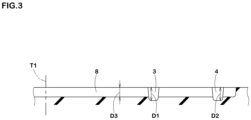
- FIG. 3 is a cross-sectional view taken along A-A line in FIG. 2 .
- the groove depth D3 of each of the shoulder axial grooves 8 is smaller than the groove depth D1 of the shoulder circumferential groove 3 and the groove depth D2 of each of the crown circumferential grooves 4.
- the rigidity of the shoulder land region 5 is maintained high.
- the difference between the groove depth D2 of each of the shoulder axial grooves 8 and the groove depth D1 of the shoulder circumferential groove 3 and the difference between the groove depth D2 and the groove depth D1 of each of the crown circumferential grooves 4 are 1.7 mm or less.
- the shoulder land region 5 includes a plurality of shoulder axial sub grooves 9 each having a groove width W4 smaller than that of each of the shoulder axial grooves 8.
- the shoulder axial sub grooves 9 configured as such help increase the shearing force against mud and improve the mud performance.
- the groove width W4 of the shoulder axial sub grooves 9 is set from 1 to 2.5 mm, the above-mentioned effect is effectively exerted.
- the shoulder axial sub grooves 9 connect the first tread edge T1 and the shoulder circumferential groove 3, i.e., each of the shoulder axial sub grooves 9 extends from the first tread edge T1 to the shoulder circumferential groove 3. That is to say, each of the shoulder axial sub grooves 9 extends from the first tread edge T1 to the shoulder circumferential groove 3 in the present embodiment.
- Each of the shoulder axial sub grooves 9 of the present embodiment is connected to an intersection position K1 where a respective one of the third parts 23 intersects a respective one of the second parts 22.
- the intersection positions K1 are positions where the rigidity of the shoulder land region 5 is relatively small.
- the shoulder axial sub grooves 9 connected to the intersection positions K1 as such deform more when contacting the ground, therefore, mud in the grooves can be smoothly discharged.
- the maximum width (Ws) of the shoulder land region 5 is excessively small, the area of the ground contacting surface (5a) of the shoulder land region 5, which has a relatively large average ground contact pressure, becomes small, and therefore the mud performance may deteriorate. If the maximum width (Ws) of shoulder land region 5 is excessively large, the area of the ground contacting surface (7a) (shown in FIG. 2 ) of the middle land region 7 and the area of the ground contacting surface (6a) (shown in FIG. 2 ) of the crown land region 6, which have a relatively small average ground contact pressure, become small, and therefore the rolling resistance performance may deteriorate. For these reasons, the maximum width (Ws) of the shoulder land region 5 is preferably 20% or more, more preferably 22% or more, and preferably 32% or less, more preferably 30% or less of the tread width TW.
- FIG. 4 is a plan view of the middle land region 7.
- the middle land region 7 includes a plurality of middle axial grooves 11 each extending from a respective one of the third parts 23 to the crown circumferential grooves 4. Since the middle axial grooves 11 configured as such also contact the ground at substantially the same time as the third parts 23, large shearing forces against mud can be exerted.
- the middle axial grooves 11 are arranged so as to each form one groove-shaped body extending in the tire axial direction together with a respective one of the third parts 23, for example.
- one of groove edges (11e) of the middle axial groove 11 and one of groove edges (23e) of the third part 23 are smoothly connected by an arc.
- each of the middle axial grooves 11 is connected to an intersection position K2 (crown intersection position) between a respective one of the crown second parts 26 and a respective one of the crown third parts 27.
- the middle land region 7 includes first sipes 13 and second sipes 14. Each of the first sipes 13 crosses the middle land region 7. Each of the second sipes 14 has an end portion (14e) terminating within the middle land region 7. The end portion (14e) in the present embodiment is a closed terminating end and not connected with other sipes and grooves.
- the second sipes 14 consist of outer second sipes 15 connected to the shoulder circumferential groove 3 and inner second sipes 16 connected to the crown circumferential groove 4.
- Each of the first sipes 13 in the present embodiment extends from an intersection position (intersection) between a respective one of the first parts 21 and a respective one of the third parts 23 to an intersection position (intersection) between a respective one of the crown first parts 25 and a respective one of the crown third parts 27.
- Each of the outer second sipes 15 in the present embodiment extends from the intersection position of a respective one of the second parts 22 and a respective one of the fourth parts 24 to have an end portion (15e) terminating axially outside the center position (7c) of the middle land region 7.
- the end portion (15e) in the present embodiment is a closed terminating end and not connected with other sipes and grooves.
- Each of the inner second sipes 16 in the present embodiment extends from the intersection position of a respective one of the crown first parts 25 and a respective one of the crown fourth parts 28 to have an end portion (16e) terminating axially inside the center position (7c) of the middle land region 7.
- the end portion (16e) in the present embodiment is a closed terminating end and not connected with other sipes and grooves.
- the term "sipe” refers to a cut-like body or an incision having a width of less than 1.0 mm on the ground contacting surface (2a), and is clearly distinguished from a groove having a groove width of 1 mm or more.
- FIG. 5 is a plan view of the crown land region 6.
- the crown land region 6 includes a plurality of crown axial grooves 18 each extending from one of the crown circumferential grooves 4 toward the tire equator (C) to have an end portion (18e) terminating to have a closed end within the crown land region 6.
- Each of the crown axial grooves 18 extends from an intersection position of a respective one of the crown second parts 26 and a respective one of the crown third parts 27, for example.
- FIG. 6 is an enlarged view of the crown land region 6 and the middle land region 7.
- each of the crown axial grooves 18 is connected with a respective one of the middle axial grooves 11 via the crown circumferential groove 4. Therefore, each of the crown axial grooves 18, a respective one of the crown circumferential grooves 4, and the middle axial grooves 11 form one groove-shaped body extending in the tire axial direction, thereby, a large shearing force is exerted.
- the term "connected" used in the above description means that a virtual line (v1) is located within the crown axial groove 18, and a virtual line (v2) is located within the middle axial groove 11.
- the virtual line (v1) is a line segment obtained by extending a linear line (n1) connecting an axially inner end (11a) and an axially outer end (11b) of a groove centerline (1 1c) of the middle axial groove 11 while maintaining the inclination angle of the linear line (n1).
- the virtual line (v2) is a line segment obtained by extending a linear line (n2) connecting an axially inner end (18a) and an axially outer end (18b) of a groove centerline (18c) of the crown axial groove 18 while maintaining the inclination angle of the linear line (n2).
- the crown axial grooves 18 include first crown axial grooves 18A extending from the crown circumferential groove 4 located on the first tread edge T1 side and second crown axial grooves 18B extending from the crown circumferential groove 4 located on the second tread edge T2 side.
- a length (La) in the tire circumferential direction between each of the first crown axial grooves 18A and one of the second crown axial grooves 18B immediately adjacent thereto is preferably 15% or more, more preferably 20% or more, and preferably 35% or less, more preferably 30% or less of the maximum width (Wc) of the crown land region 6.
- the length (La) is the distance in the tire circumferential direction between the inner end (18a) of the groove centerline (18c) of the first crown axial groove 18A and the inner end (18a) of the groove centerline (18c) of the second crown axial groove 18B.
- the maximum width (Wc) of the crown land region 6 is the width in the tire axial direction between a position (6e) of the crown land region 6 closest to the first tread edge T1 and a position (6i) of the crown land region 6 closest to the second tread edge T2.
- Tires having the basic pattern shown in FIG. 2 were made by way of test according to the specifications listed in Table 1. Then, each of the test tires was tested for the mud performance and the rolling resistance performance.
- the common specifications and test methods for each test tire are as follows.
- test tires were mounted on all wheels of a vehicle described below. Then a test driver drove the vehicle on a muddy test course. The test driver evaluated the driving characteristics in terms of steering response, traction, grip, and the like during the drive by sensory evaluation. The results are indicated by an evaluation point based on Reference 1 being 100. The larger the numerical value, the better.
- Vehicle 4-wheel drive passenger car (SUV) with a displacement of 2500 cc
- the rolling resistance of each of the test tires was measured in accordance with ISO 28580 by using a rolling resistance tester.
- the results are indicated as an index based on the reciprocal of the value of Reference 1 being 100, wherein the larger the numerical value, the smaller the rolling resistance, which is better.
- a score of 95 or higher is acceptable.
- Table 1 Ref. 1 Ex. 1 Ex. 2 Ex. 3 Ex. 4 Ex. 5 Ex. 6 Ex. 7 Ex.
- the present invention includes the following aspects.
- a tire having a tread portion including:
- each of the shoulder axial grooves has a groove depth smaller than a groove depth of the shoulder circumferential groove and a groove depth of each of the crown circumferential grooves.
- each of the shoulder axial sub grooves is from 1 to 2.5 mm.
Landscapes
- Engineering & Computer Science (AREA)
- Mechanical Engineering (AREA)
- Tires In General (AREA)
Abstract
Description
- This application claims the benefit of foreign priority to Japanese Patent Application No.
JP2023-033888, filed March 6, 2023 - The present invention relates to a tire.
-
Japanese Unexamined Patent Application Publication No. 2012-1120 - In recent years, there has been a demand for improved mud performance by increasing the mud scraping force (shearing force) by using shoulder axial grooves. One possible method for increasing the shearing force is, for example, increasing the groove volume of the shoulder axial grooves. However, in order to increase the groove volume, it is necessary to increase the tread rubber volume of the tread portion. Such tires have poorer rolling resistance performance.
- The present invention was made in view of the above, and a primary object thereof is to provide a tire capable of improving the mud performance while suppressing deterioration of the rolling resistance performance.
- The present invention is a tire having a tread portion including:
- a first tread edge;
- a shoulder circumferential groove adjacent to the first tread edge; and
- a shoulder land region demarcated between the shoulder circumferential groove and the first tread edge,
- wherein the shoulder land region includes an inner area, an outer area, and a plurality of shoulder axial grooves,
- the inner area is demarcated axially inside from a center position in the tire axial direction of the shoulder land region,
- the outer area is demarcated axially outside from the center position of the shoulder land region,
- each of the shoulder axial grooves is connected with the first tread edge and extends therefrom in the tire axial direction at least in the outer area,
- an average ground contact pressure in the outer area is greater than an average ground contact pressure (Pa) in the inner area under a standard tire load loaded state, and
- the standard tire load loaded state is the state in which the tire is assembled on a standard rim, inflated to a standard inner pressure, loaded with a standard tire load, and in contact with a flat surface with zero camber angle.
- By adopting the above configuration, the tire of the present invention can improve the mud performance while suppressing the deterioration of the rolling resistance performance.
-
-
FIG. 1 is a partial plan view showing the tread portion of the tire according to an embodiment of the present invention. -
FIG. 2 is a plan view of the tread portion. -
FIG. 3 is a cross section taken along A-A line ofFIG. 2 . -
FIG. 4 is a plan view of the middle land region. -
FIG. 5 is a plan view of the crown land region. -
FIG. 6 is an enlarged plan view of the crown land region and the middle land region. - An embodiment of the present invention will now be described in conjunction with accompanying drawings. The drawings contain exaggerated representations and representations that differ from the actual dimensional ratios of the structure in order to aid in the understanding of the present invention. Further, in cases where there are multiple embodiments, the identical or common elements are denoted by the same reference numerals throughout the specification, and redundant explanations will be omitted.
- In the present specification, unless otherwise noted, the dimensions and the like of various parts of a
tire 1 are the values measured under a standard state. In the case of a pneumatic tire for which various standards have been established, the "standard state" refers to a state in which thetire 1 is assembled on a standard rim, inflated to a standard inner pressure, and loaded with no tire load. In the case of a tire for which various standards are not established, the standard sate means a state of standard usage according to the purpose of use of the tire and a state in which the tire is not mounted on a vehicle and is loaded with no tire load. - The "standard rim" is a wheel rim specified for the concerned tire by a standard included in a standardization system on which the tire is based, for example, the "normal wheel rim" in JATMA, "Design Rim" in TRA, and "Measuring Rim" in ETRTO.
- The "standard inner pressure" is air pressure specified for the concerned tire by a standard included in a standardization system on which the tire is based, for example, the maximum air pressure in JATMA, maximum value listed in the "TIRE LOAD LIMITS AT VARIOUS COLD INFLATION PRESSURES" table in TRA, and "INFLATION PRESSURE" in ETRTO.
-
FIG. 1 is a partial plan view of atread portion 2 of thetire 1 showing an embodiment of the present invention. Thetire 1 of the present embodiment is suitably used, for example, as a pneumatic tire for a passenger car, specifically, for an SUV that can be driven on muddy terrain. However, the present invention may be used, for example, for a heavy duty pneumatic tire, as well as a non-pneumatic tire that are not filled with compressed air inside. - As shown in
FIG. 1 , thetread portion 2 includes a first tread edge T1, a shouldercircumferential groove 3 adjacent to the first tread edge T1, and ashoulder land region 5 located and demarcated between the shouldercircumferential groove 3 and the first tread edge T1. - The
shoulder land region 5 includes aninner area 5A located and demarcated axially inside from a center position (5c) in the tire axial direction of theshoulder land region 5 and anouter area 5B located and demarcated axially outside from the center position (5c) of theshoulder land region 5. The center position (5c) is the axial midpoint of theshoulder land region 5 at its maximum width (Ws) in the tire axial direction. - Further, the
shoulder land region 5 includes a plurality of shoulderaxial grooves 8 connected to the first tread edge T1 and extend in the tire axial direction at least in theouter area 5B. The shoulderaxial grooves 8 communicating with the first tread edge T1 allow mud in the grooves to be smoothly discharged to the outside of the first tread edge T1. As a result, the shoulderaxial grooves 8 can grab and compact a lot of mud when newly grounded, therefore, a large sharing force can be exerted. - It is inferred that increasing the shearing force in the axially outer part of the
tread portion 2 can stabilize driving in muddy terrain. Therefore, in the present invention, the average ground contact pressure (Pb) in theouter area 5B is greater than the average ground contact pressure (Pa) in theinner area 5A under a standard tire load loaded state. As a result, the shoulderaxial grooves 8 arranged in theouter area 5B can exert greater shearing force against mud and can discharge mud more smoothly to the outside of the first tread edge T1, therefore, the mud performance is improved. Further, in theinner area 5A, where the average ground contact pressure is relatively small, the amount of heat generated in the rubber forming theinner area 5A and the friction force with the road surface can be reduced, and thus the increase in rolling resistance can be suppressed. Furthermore, in thistire 1, the shearing force can be increased without relying on the groove volume of the shoulderaxial grooves 8, and as a result, deterioration of the rolling resistance performance can be suppressed. Therefore, thetire 1 of the present invention can improve the mud performance while maintaining the rolling resistance performance. - The "standard tire load loaded state" is the state in which the
tire 1 in the standard state is in contact with a flat surface with zero camber angle. In the case of a pneumatic tire for which various standards have been established, the "standard tire load" refers to a tire load specified for the concerned tire by a standard included in a standardization system on which the tire is based, for example, the "maximum load capacity" in JATMA, maximum value listed in "TIRE LOAD LIMITS AT VARIOUS COLD INFLATION PRESSURES" table in TRA, and "LOAD CAPACITY" in ETRTO. Further, in the case of a tire for which various standards are not established and a non-pneumatic tire, the "standard tire load" refers to the load acting on a single tire when the tire is in a standard mounting state. The "standard mounting state" refers to a state in which the tire is mounted on a standard vehicle according to the intended use of the tire, and the vehicle is at rest on a flat road surface in a roadworthy condition. - In the present specification, the "average ground contact pressure" is defined as the average of the pressure (kPa) acting on a ground contacting surface (2a) (shown in
FIG. 2 ) of thetread portion 2, which can be measured, for example, by observing the ground contacting surface (2a). More specifically, the average ground contact pressure can be measured by using a pressure distribution measuring device available from Tekscan, Inc., for example. This device can measure the ground contact pressure applied to the ground contacting surface (2a) of thetire 1 in the standard tire load loaded state at 1.0 mm intervals in the tire circumferential direction and the tire axial direction, for example. The average ground contact pressure is a value obtained by dividing the sum of the measurement values for each area or each land region measured by the above measuring device at 1.0 mm intervals by the number of measurements. - The
tire 1, which has such an average ground contact pressure, can be formed, for example, by manipulating or adjusting the rubber volume of the tread rubber (not shown) of thetread portion 2, or by manipulating or adjusting the strength of the carcass (not shown) or other tire components distributed inside thetread portion 2. The aforementioned "tread rubber" and " tire components" are made of well-known materials, so their description is omitted. - In order to effectively exert such an effect, the average ground contact pressure (Pb) of the
outer area 5B is preferably at least 1.1 times, more preferably at least 1.2 times the average ground contact pressure (Pb) of theinner area 5A, and preferably 1.4 or less times, more preferably 1.3 or less times the average ground contact pressure (Pb) of theinner area 5A. Since the average ground contact pressure (Pb) of theouter area 5B is 1.1 or more times the average ground contact pressure (Pa) of theinner area 5A, the shearing force is increased in theouter area 5B, which enables stable running in muddy terrain. Since the average ground contact pressure (Pb) in theouter area 5B is 1.4 or less times the average ground contact pressure (Pa) of theinner area 5A, it is possible that the deterioration of the rolling resistance performance due to the frictional force in theouter area 5B becoming excessively large is suppressed. -
FIG. 2 is a plan view of thetread portion 2. As shown inFIG. 2 , thetread portion 2 of the present embodiment further includes a second tread edge T2, a pair of crowncircumferential grooves 4 adjacent to the tire equator (C) so as to sandwich the tire equator (C), and acrown land region 6 located and demarcated between the pair of thecrown circumferential grooves 4. Further, thetread portion 2 includes amiddle land region 7 located and demarcated between the shouldercircumferential groove 3 and one of thecrown circumferential grooves 4 adjacent to the shouldercircumferential groove 3. It should be noted that thetread portion 2 in the present embodiment is formed by a line symmetrical pattern at the tire equator (C) or a point symmetrical pattern at an arbitrary point on the tire equator (C). Therefore, thetread portion 2 of the present embodiment is provided with anothershoulder land region 5 and anothermiddle land region 7 on the second tread edge T2 side of the tire equator (C). And descriptions of anothershoulder land region 5 and anothermiddle land region 7 located on the second tread edge T2 side are omitted. Thetread portion 2 of the present embodiment has the point-symmetrical pattern. It should be noted that thetire 1 of the present invention is not limited to such an embodiment. - The first tread edge T1 and the second tread edge T2 are the axially outermost ground contact positions of the
tire 1 in the standard tire load loaded state. Further, the axial distance between the first tread edge T1 and the second tread edge T2 is a tread width TW. - The
tire 1 is formed so that the average ground contact pressure P1 of theshoulder land region 5 is larger than the average ground contact pressure P2 of thecrown land region 6. The relatively large average ground contact pressure P1 as described above further improves the stability of running in muddy terrain. In order to exert such an effect more effectively, the average ground contact pressure (Pa) of theinner area 5A is set larger than the average ground contact pressure P2 of thecrown land region 6 in the present embodiment. - In order to improve the running stability in muddy terrain, the average ground contact pressure P1 of the
shoulder land region 5 is preferably at least 1.15 times, more preferably at least 1.2 times the average ground contact pressure P2 of thecrown land region 6. In order to suppress the increase in the frictional force and the like of theshoulder land region 5 and suppress the deterioration of the rolling resistance performance, the average ground contact pressure P1 of theshoulder land region 5 is preferably 1.35 or less times, more preferably 1.3 or less times the average ground contact pressure P2 of thecrown land region 6. - It is required to suppress the deterioration of the rolling resistance performance caused by excessively high friction forces and the like as well as to improve the running stability in muddy terrain by increasing the shearing force in the land region and/or the area located relatively outside in the tire axial direction. For this reason, the
tire 1 is formed so that the average ground contact pressure P3 of themiddle land region 7 is smaller than the average ground contact pressure P1 of theshoulder land region 5, and larger than the average ground contact pressure P2 of thecrown land region 6. Further, the average ground contact pressure (Pd) of a middleouter area 7B located and demarcated on the axially outer side from a center position (7c) (shown inFIG. 4 ) of themiddle land region 7 is smaller than the average ground contact pressure (Pc) of a middleinner area 7A located and demarcated on the axially inner side from the center position (7c) of themiddle land region 7. - The shoulder
circumferential groove 3 and thecrown circumferential grooves 4 extend continuously in a zigzag shape in the tire circumferential direction, for example. As described above, the shouldercircumferential groove 3 and the crowncircumferential groove 4 in the present embodiment have tire axial components, therefore, they can exert a shearing force against mud. The shouldercircumferential groove 3 and thecrown circumferential grooves 4 are not limited to such an embodiment, and may extend linearly or in a wavy shape, for example. - The shoulder
circumferential groove 3 in the present embodiment includes a plurality offirst parts 21, a plurality ofsecond parts 22, a plurality ofthird parts 23, and a plurality offourth parts 24. Thefirst parts 21 extend parallel to the tire circumferential direction. Thesecond parts 22 extend parallel to the tire circumferential direction on the axially inner side of thefirst parts 21. Each of thethird parts 23 connects a respective one of thefirst parts 21 with one of thesecond parts 22 adjacent thereto and is inclined with respect to the tire circumferential direction. Each of thefourth parts 24 connects a respective one of thefirst parts 21 with one of thesecond parts 22 adjacent thereto and is inclined to a side opposite thethird parts 23 with respect to the tire circumferential direction. Thethird parts 23 and thefourth parts 24 are arranged alternately one by one in the tire circumferential direction. Therefore, the shouldercircumferential groove 3 in the present embodiment is formed by units each in which thefirst part 21, thefourth part 24, thesecond part 22, and thethird part 23 are connected in series in this order. - Each of the
crown circumferential grooves 4 includes a plurality of crownfirst parts 25, a plurality of crownsecond parts 26, a plurality of crownthird parts 27, a plurality of crownfourth parts 28. The crownfirst parts 25 extend parallel to the tire circumferential direction. The crownsecond parts 26 extend parallel to the tire circumferential direction on the axially inner side of the crownfirst parts 25. Each of the crownthird parts 27 connects a respective one of the crownfirst parts 25 and one of the crownsecond parts 26 adjacent thereto and is inclined with respect to the tire circumferential direction. Each of the crownfourth parts 28 connects a respective one of the crownfirst parts 25 and one of the crownsecond parts 26 adjacent thereto and is inclined to a side opposite to the crownthird parts 27 with respect to the tire circumferential direction. The crownthird parts 27 and the crownfourth parts 28 are arranged alternately one by one in the tire circumferential direction. Therefore, the shouldercircumferential groove 3 in the present embodiment is formed by units each in which the crownfirst part 25, the crownthird part 27, the crownsecond part 26, and the crownfourth part 28 are connected in series in this order. - Although not particularly limited, the groove width W1 of the shoulder
circumferential groove 3 and the groove width W2 of each of thecrown circumferential grooves 4 are preferably 5 mm or more, more preferably 6 mm or more, and 9 mm or less, more preferably 8 mm or less, for example. Further, the groove depth D1 (shown inFIG. 3 ) of the shouldercircumferential groove 3 and the groove depth D2 (shown inFIG. 3 ) of each of thecrown circumferential grooves 4 are preferably 6 mm or more, more preferably 7 mm or more, and preferably 10 mm or less, more preferably 9 mm or less, for example. In the present embodiment, the groove depth D1 of the shouldercircumferential groove 3 is smaller than the groove depth D2 of each of thecrown circumferential grooves 4. In the present specification, the "groove width" is the average value of the opening area of the groove on the ground contacting surface (2a) divided by the length of the groove centerline. - As shown in
FIG. 1 , the shoulderaxial grooves 8 connect the first tread edge T1 and the shouldercircumferential groove 3 in the present embodiment. That is, each of the shoulderaxial grooves 8 extends from the first tread edge T1 to the shouldercircumferential groove 3 in the present embodiment. Since the shoulderaxial grooves 8 configured as such ensure a large axial length, the shearing force against mud can be increased. - Each of the shoulder
axial grooves 8 is connected to a respective one of thethird parts 23 in the present embodiment. To explain in detail, the shoulderaxial grooves 8 are connected to thethird parts 23 having tire axial components. Thereby, the shoulderaxial grooves 8 and thethird parts 23 are brought into contact with the ground at substantially the same time, therefore, a high shearing force can be obtained. - Each of the shoulder
axial grooves 8 together with q respective one of thethird parts 23 form one groove-shaped body extending in the tire axial direction, for example. This further improves the mud performance. In the present specification, the term "one groove-shaped body" is defined as one in which one of groove edges (8e) of the shoulderaxial groove 8 and one of groove edges (23e) of thethird part 23 are smoothly connected with each other in a straight line or in an arc, excluding a mode in which the groove edge (8e) and the groove edge (23e) are connected in a bent shaped. -
FIG. 3 is a cross-sectional view taken along A-A line inFIG. 2 . As shown inFIG. 3 , the groove depth D3 of each of the shoulderaxial grooves 8 is smaller than the groove depth D1 of the shouldercircumferential groove 3 and the groove depth D2 of each of thecrown circumferential grooves 4. Thereby, the rigidity of theshoulder land region 5 is maintained high. In order to maintain the effect of increasing the shearing force of the shoulderaxial grooves 8, it is preferred that the difference between the groove depth D2 of each of the shoulderaxial grooves 8 and the groove depth D1 of the shouldercircumferential groove 3 and the difference between the groove depth D2 and the groove depth D1 of each of thecrown circumferential grooves 4 are 1.7 mm or less. - As shown in
FIG. 1 , theshoulder land region 5 includes a plurality of shoulderaxial sub grooves 9 each having a groove width W4 smaller than that of each of the shoulderaxial grooves 8. The shoulderaxial sub grooves 9 configured as such help increase the shearing force against mud and improve the mud performance. In particular, since the groove width W4 of the shoulderaxial sub grooves 9 is set from 1 to 2.5 mm, the above-mentioned effect is effectively exerted. - The shoulder
axial sub grooves 9 connect the first tread edge T1 and the shouldercircumferential groove 3, i.e., each of the shoulderaxial sub grooves 9 extends from the first tread edge T1 to the shouldercircumferential groove 3. That is to say, each of the shoulderaxial sub grooves 9 extends from the first tread edge T1 to the shouldercircumferential groove 3 in the present embodiment. Each of the shoulderaxial sub grooves 9 of the present embodiment is connected to an intersection position K1 where a respective one of thethird parts 23 intersects a respective one of thesecond parts 22. The intersection positions K1 are positions where the rigidity of theshoulder land region 5 is relatively small. The shoulderaxial sub grooves 9 connected to the intersection positions K1 as such deform more when contacting the ground, therefore, mud in the grooves can be smoothly discharged. - If the maximum width (Ws) of the
shoulder land region 5 is excessively small, the area of the ground contacting surface (5a) of theshoulder land region 5, which has a relatively large average ground contact pressure, becomes small, and therefore the mud performance may deteriorate. If the maximum width (Ws) ofshoulder land region 5 is excessively large, the area of the ground contacting surface (7a) (shown inFIG. 2 ) of themiddle land region 7 and the area of the ground contacting surface (6a) (shown inFIG. 2 ) of thecrown land region 6, which have a relatively small average ground contact pressure, become small, and therefore the rolling resistance performance may deteriorate. For these reasons, the maximum width (Ws) of theshoulder land region 5 is preferably 20% or more, more preferably 22% or more, and preferably 32% or less, more preferably 30% or less of the tread width TW. -
FIG. 4 is a plan view of themiddle land region 7. As shown inFIG. 4 , themiddle land region 7 includes a plurality of middleaxial grooves 11 each extending from a respective one of thethird parts 23 to thecrown circumferential grooves 4. Since the middleaxial grooves 11 configured as such also contact the ground at substantially the same time as thethird parts 23, large shearing forces against mud can be exerted. The middleaxial grooves 11 are arranged so as to each form one groove-shaped body extending in the tire axial direction together with a respective one of thethird parts 23, for example. In the present embodiment, one of groove edges (11e) of the middleaxial groove 11 and one of groove edges (23e) of thethird part 23 are smoothly connected by an arc. Further, in the present embodiment, each of the middleaxial grooves 11 is connected to an intersection position K2 (crown intersection position) between a respective one of the crownsecond parts 26 and a respective one of the crownthird parts 27. - The
middle land region 7 includesfirst sipes 13 andsecond sipes 14. Each of thefirst sipes 13 crosses themiddle land region 7. Each of thesecond sipes 14 has an end portion (14e) terminating within themiddle land region 7. The end portion (14e) in the present embodiment is a closed terminating end and not connected with other sipes and grooves. Thesecond sipes 14 consist of outersecond sipes 15 connected to the shouldercircumferential groove 3 and innersecond sipes 16 connected to the crowncircumferential groove 4. - Each of the
first sipes 13 in the present embodiment extends from an intersection position (intersection) between a respective one of thefirst parts 21 and a respective one of thethird parts 23 to an intersection position (intersection) between a respective one of the crownfirst parts 25 and a respective one of the crownthird parts 27. Each of the outersecond sipes 15 in the present embodiment extends from the intersection position of a respective one of thesecond parts 22 and a respective one of thefourth parts 24 to have an end portion (15e) terminating axially outside the center position (7c) of themiddle land region 7. The end portion (15e) in the present embodiment is a closed terminating end and not connected with other sipes and grooves. Each of the innersecond sipes 16 in the present embodiment extends from the intersection position of a respective one of the crownfirst parts 25 and a respective one of the crownfourth parts 28 to have an end portion (16e) terminating axially inside the center position (7c) of themiddle land region 7. The end portion (16e) in the present embodiment is a closed terminating end and not connected with other sipes and grooves. In the present specification, the term "sipe" refers to a cut-like body or an incision having a width of less than 1.0 mm on the ground contacting surface (2a), and is clearly distinguished from a groove having a groove width of 1 mm or more. -
FIG. 5 is a plan view of thecrown land region 6. As shown inFIG. 5 , thecrown land region 6 includes a plurality of crownaxial grooves 18 each extending from one of thecrown circumferential grooves 4 toward the tire equator (C) to have an end portion (18e) terminating to have a closed end within thecrown land region 6. Each of the crownaxial grooves 18 extends from an intersection position of a respective one of the crownsecond parts 26 and a respective one of the crownthird parts 27, for example. -
FIG. 6 is an enlarged view of thecrown land region 6 and themiddle land region 7. As shown inFIG. 6 , each of the crownaxial grooves 18 is connected with a respective one of the middleaxial grooves 11 via the crowncircumferential groove 4. Therefore, each of the crownaxial grooves 18, a respective one of thecrown circumferential grooves 4, and the middleaxial grooves 11 form one groove-shaped body extending in the tire axial direction, thereby, a large shearing force is exerted. The term "connected" used in the above description means that a virtual line (v1) is located within the crownaxial groove 18, and a virtual line (v2) is located within the middleaxial groove 11. The virtual line (v1) is a line segment obtained by extending a linear line (n1) connecting an axially inner end (11a) and an axially outer end (11b) of a groove centerline (1 1c) of the middleaxial groove 11 while maintaining the inclination angle of the linear line (n1). The virtual line (v2) is a line segment obtained by extending a linear line (n2) connecting an axially inner end (18a) and an axially outer end (18b) of a groove centerline (18c) of the crownaxial groove 18 while maintaining the inclination angle of the linear line (n2). - As shown in
FIG. 5 , the crownaxial grooves 18 include first crownaxial grooves 18A extending from the crowncircumferential groove 4 located on the first tread edge T1 side and second crownaxial grooves 18B extending from the crowncircumferential groove 4 located on the second tread edge T2 side. A length (La) in the tire circumferential direction between each of the first crownaxial grooves 18A and one of the second crownaxial grooves 18B immediately adjacent thereto is preferably 15% or more, more preferably 20% or more, and preferably 35% or less, more preferably 30% or less of the maximum width (Wc) of thecrown land region 6. The length (La) is the distance in the tire circumferential direction between the inner end (18a) of the groove centerline (18c) of the first crownaxial groove 18A and the inner end (18a) of the groove centerline (18c) of the second crownaxial groove 18B. The maximum width (Wc) of thecrown land region 6 is the width in the tire axial direction between a position (6e) of thecrown land region 6 closest to the first tread edge T1 and a position (6i) of thecrown land region 6 closest to the second tread edge T2. - While detailed description has been made according to an embodiment of the present invention, the present invention can be embodied in various forms without being limited to the illustrated embodiment.
- Tires having the basic pattern shown in
FIG. 2 were made by way of test according to the specifications listed in Table 1.
Then, each of the test tires was tested for the mud performance and the rolling resistance performance.
The common specifications and test methods for each test tire are as follows. - Tire size: 265/65R18
- Tire inner pressure (kPa): 230 (all wheels)
- Tire rim: 18x9.0J
- For each test tire, the test tires were mounted on all wheels of a vehicle described below. Then a test driver drove the vehicle on a muddy test course. The test driver evaluated the driving characteristics in terms of steering response, traction, grip, and the like during the drive by sensory evaluation. The results are indicated by an evaluation point based on
Reference 1 being 100. The larger the numerical value, the better.
Vehicle: 4-wheel drive passenger car (SUV) with a displacement of 2500 cc - The rolling resistance of each of the test tires was measured in accordance with ISO 28580 by using a rolling resistance tester. The results are indicated as an index based on the reciprocal of the value of
Reference 1 being 100, wherein the larger the numerical value, the smaller the rolling resistance, which is better. A score of 95 or higher is acceptable. - Tire load: 9.26 kN
- Speed: 80 km/h
- Test results are shown in Table 1. In each of Examples and Reference of Table 1, the groove depth D1 and the groove depth D2 are the same. Moreover, the average ground contact pressure (Pa) of the inner area is the same in each of Examples and Reference.
Table 1 Ref. 1 Ex. 1 Ex. 2 Ex. 3 Ex. 4 Ex. 5 Ex. 6 Ex. 7 Ex. 8 Average Ground Contact Pressure (Pb) / Average Ground Contact Pressure (Pa) 1.0 1.3 1.1 1.4 1.5 1.3 1.3 1.3 1.3 Groove Depth D1 - Groove Depth D3 [mm] 1.5 1.5 1.5 1.5 1.5 1 2 2.5 1.5 Average Ground Contact Pressure P1 / Average Ground Contact Pressure P2 1.0 1.2 1.2 1.2 1.2 1.2 1.2 1.2 1.5 Mud Performance 100 130 120 130 130 135 115 110 135 [evaluation point: larger numerical value is better] Rolling Resistance Performance 100 100 100 100 95 95 100 105 95 [index: larger numerical value is better] - From the test results, it was confirmed that the tires in the Examples improved the mud performance while suppressing deterioration in the rolling resistance performance.
- The present invention includes the following aspects.
- A tire having a tread portion including:
- a first tread edge;
- a shoulder circumferential groove adjacent to the first tread edge; and
- a shoulder land region demarcated between the shoulder circumferential groove and the first tread edge,
- wherein the shoulder land region includes an inner area, an outer area, and a plurality of shoulder axial grooves,
- the inner area is demarcated axially inside from a center position in the tire axial direction of the shoulder land region,
- the outer area is demarcated axially outside from the center position of the shoulder land region,
- each of the shoulder axial grooves is connected with the first tread edge and extends therefrom in the tire axial direction at least in the outer area,
- an average ground contact pressure in the outer area is greater than an average ground contact pressure (Pa) in the inner area under a standard tire load loaded state, and
- the standard tire load loaded state is the state in which the tire is assembled on a standard rim, inflated to a standard inner pressure, loaded with a standard tire load, and in contact with a flat surface with zero camber angle.
- The tire according to
Present Invention 1, wherein the average ground contact pressure of the outer area is from 1.1 times to 1.4 times the average ground contact pressure of the inner area. - The tire according to
Present Invention 2, wherein the shoulder axial grooves connect the first tread edge and the shoulder circumferential groove. - The tire according to any one of
Present Inventions 1 to 3, wherein - the tread portion includes a pair of crown circumferential grooves each adjacent to the tire equator on a respective side thereof, and a crown land region demarcated between the crown circumferential grooves, and
- the shoulder land region has an average ground contact pressure larger than an average ground contact pressure of the crown land region.
- The tire according to
Present Invention 4, wherein the average ground contact pressure of the shoulder land region is from 1.15 times to 1.35 times the average ground contact pressure of the crown land region. - The tire according to
Present Invention 4, wherein each of the shoulder axial grooves has a groove depth smaller than a groove depth of the shoulder circumferential groove and a groove depth of each of the crown circumferential grooves. - The tire according to
Present Invention 6, wherein a difference between the groove depth of each of the shoulder axial grooves and the groove depth of the shoulder circumferential groove and a difference between the groove depth of each of the shoulder axial grooves and the groove depth of each of the crown circumferential grooves are 1.7 mm or less. - The tire according to any one of
Present Inventions 1 to 3, wherein - the shoulder land region includes a plurality of shoulder axial sub grooves each having a groove width smaller than a groove width of each of the shoulder axial grooves, and
- the shoulder axial sub grooves connect the first tread edge and the shoulder circumferential groove.
- The tire according to
Present Invention 8, wherein the groove width of each of the shoulder axial sub grooves is from 1 to 2.5 mm. - The tire according to any one of
Present Inventions 1 to 3, wherein - the shoulder circumferential groove includes a plurality of first parts, a plurality of second parts, and a plurality of third parts,
- the first parts extend parallel to the tire circumferential direction,
- the second parts extend parallel to the tire circumferential direction on the axially inner side of the first parts,
- each of the third parts connects a respective one of the first parts with one of the second parts adjacent thereto and is inclined with respect to the tire circumferential direction, and
- each of the shoulder axial grooves is connected with a respective one of the third parts.
- The tire according to Present Invention 10, wherein
- the tread portion includes a pair of crown circumferential grooves and a middle land region,
- the crown circumferential grooves are adjacent to the shoulder circumferential groove on a side opposite to the first tread edge so as to sandwich the tire equator between the crown circumferential grooves,
- the middle land region is demarcated between the shoulder circumferential groove and one of the crown circumferential grooves on the first tread edge side, and
- the middle land region includes a plurality of middle axial grooves each extending from a respective one of the third parts of the shoulder circumferential groove to one of the crown circumferential grooves on the first tread edge side.
- The tire according to
Present Invention 11, wherein - the tread portion includes a crown land region demarcated between the crown circumferential grooves,
- the crown land region includes a plurality of crown axial grooves extending from one of the crown circumferential grooves on the first tread edge side toward the tire equator to have end portions terminating to have closed ends within the crown land region, and
- each of the crown axial grooves is connected with a respective one of the middle axial grooves via the crown circumferential groove.
-
- 1
- tire
- 2
- tread portion
- 3
- shoulder circumferential groove
- 5
- shoulder land region
- 5A
- inner area
- 5B
- outer area
- 5c
- center position
- 8
- shoulder axial groove
- T1
- first tread edge
- Pa, Pb
- average ground contact pressure
Claims (12)
- A tire having a tread portion comprising:a first tread edge;a shoulder circumferential groove adjacent to the first tread edge; anda shoulder land region demarcated between the shoulder circumferential groove and the first tread edge,wherein the shoulder land region includes an inner area, an outer area, and a plurality of shoulder axial grooves,the inner area is demarcated axially inside from a center position in the tire axial direction of the shoulder land region,the outer area is demarcated axially outside from the center position of the shoulder land region,each of the shoulder axial grooves is connected with the first tread edge and extends therefrom in the tire axial direction at least in the outer area,an average ground contact pressure in the outer area is greater than an average ground contact pressure (Pa) in the inner area under a standard tire load loaded state, andthe standard tire load loaded state is the state in which the tire is assembled on a standard rim, inflated to a standard inner pressure, loaded with a standard tire load, and in contact with a flat surface with zero camber angle.
- The tire according to claim 1, wherein the average ground contact pressure of the outer area is from 1.1 times to 1.4 times the average ground contact pressure of the inner area.
- The tire according to claim 2, wherein the shoulder axial grooves connect the first tread edge and the shoulder circumferential groove.
- The tire according to any one of claims 1 to 3, whereinthe tread portion includes a pair of crown circumferential grooves each adjacent to the tire equator on a respective side thereof, and a crown land region demarcated between the crown circumferential grooves, andthe shoulder land region has an average ground contact pressure larger than an average ground contact pressure of the crown land region.
- The tire according to claim 4, wherein the average ground contact pressure of the shoulder land region is from 1.15 times to 1.35 times the average ground contact pressure of the crown land region.
- The tire according to claim 4, wherein each of the shoulder axial grooves has a groove depth smaller than a groove depth of the shoulder circumferential groove and a groove depth of each of the crown circumferential grooves.
- The tire according to claim 6, wherein a difference between the groove depth of each of the shoulder axial grooves and the groove depth of the shoulder circumferential groove and a difference between the groove depth of each of the shoulder axial grooves and the groove depth of each of the crown circumferential grooves are 1.7 mm or less.
- The tire according to any one of claims 1 to 7, whereinthe shoulder land region includes a plurality of shoulder axial sub grooves each having a groove width smaller than a groove width of each of the shoulder axial grooves, andthe shoulder axial sub grooves connect the first tread edge and the shoulder circumferential groove.
- The tire according to claim 8, wherein the groove width of each of the shoulder axial sub grooves is from 1 to 2.5 mm.
- The tire according to any one of claims 1 to 9, whereinthe shoulder circumferential groove includes a plurality of first parts, a plurality of second parts, and a plurality of third parts,the first parts extend parallel to the tire circumferential direction,the second parts extend parallel to the tire circumferential direction on the axially inner side of the first parts,each of the third parts connects a respective one of the first parts with one of the second parts adjacent thereto and is inclined with respect to the tire circumferential direction, andeach of the shoulder axial grooves is connected with a respective one of the third parts.
- The tire according to claim 10, whereinthe tread portion includes a pair of crown circumferential grooves and a middle land region,the crown circumferential grooves are adjacent to the shoulder circumferential groove on a side opposite to the first tread edge so as to sandwich the tire equator between the crown circumferential grooves,the middle land region is demarcated between the shoulder circumferential groove and one of the crown circumferential grooves on the first tread edge side, andthe middle land region includes a plurality of middle axial grooves each extending from a respective one of the third parts of the shoulder circumferential groove to one of the crown circumferential grooves on the first tread edge side.
- The tire according to claim 11, whereinthe tread portion includes a crown land region demarcated between the crown circumferential grooves,the crown land region includes a plurality of crown axial grooves extending from one of the crown circumferential grooves on the first tread edge side toward the tire equator to have end portions terminating to have closed ends within the crown land region, andeach of the crown axial grooves is connected with a respective one of the middle axial grooves via the crown circumferential groove.
Applications Claiming Priority (1)
| Application Number | Priority Date | Filing Date | Title |
|---|---|---|---|
| JP2023033888A JP2024125809A (en) | 2023-03-06 | 2023-03-06 | tire |
Publications (2)
| Publication Number | Publication Date |
|---|---|
| EP4427946A2 true EP4427946A2 (en) | 2024-09-11 |
| EP4427946A3 EP4427946A3 (en) | 2025-01-08 |
Family
ID=89897217
Family Applications (1)
| Application Number | Title | Priority Date | Filing Date |
|---|---|---|---|
| EP24156586.0A Pending EP4427946A3 (en) | 2023-03-06 | 2024-02-08 | Tire |
Country Status (3)
| Country | Link |
|---|---|
| US (1) | US12441139B2 (en) |
| EP (1) | EP4427946A3 (en) |
| JP (1) | JP2024125809A (en) |
Citations (2)
| Publication number | Priority date | Publication date | Assignee | Title |
|---|---|---|---|---|
| JP2012001120A (en) | 2010-06-17 | 2012-01-05 | Sumitomo Rubber Ind Ltd | Pneumatic tire |
| JP2023033888A (en) | 2021-08-30 | 2023-03-13 | セイコーエプソン株式会社 | Three-dimensional molding device |
Family Cites Families (10)
| Publication number | Priority date | Publication date | Assignee | Title |
|---|---|---|---|---|
| JP4486592B2 (en) * | 2005-12-29 | 2010-06-23 | 住友ゴム工業株式会社 | Heavy duty tire |
| DE102011051387A1 (en) * | 2011-06-28 | 2013-01-03 | Continental Reifen Deutschland Gmbh | Vehicle tires |
| US9757991B2 (en) | 2013-02-19 | 2017-09-12 | Sumitomo Rubber Industries, Ltd. | Pneumatic tire |
| JP5732089B2 (en) | 2013-02-26 | 2015-06-10 | 住友ゴム工業株式会社 | Pneumatic tire |
| JP5732091B2 (en) | 2013-02-27 | 2015-06-10 | 住友ゴム工業株式会社 | Pneumatic tire |
| JP6724397B2 (en) | 2016-02-04 | 2020-07-15 | 住友ゴム工業株式会社 | tire |
| JP6879086B2 (en) | 2017-07-04 | 2021-06-02 | 住友ゴム工業株式会社 | Pneumatic tires |
| JP7106982B2 (en) * | 2018-05-22 | 2022-07-27 | 住友ゴム工業株式会社 | tire |
| JP7187255B2 (en) | 2018-10-22 | 2022-12-12 | Toyo Tire株式会社 | pneumatic tire |
| JP7424159B2 (en) | 2020-03-26 | 2024-01-30 | 住友ゴム工業株式会社 | tire |
-
2023
- 2023-03-06 JP JP2023033888A patent/JP2024125809A/en active Pending
-
2024
- 2024-02-01 US US18/429,612 patent/US12441139B2/en active Active
- 2024-02-08 EP EP24156586.0A patent/EP4427946A3/en active Pending
Patent Citations (2)
| Publication number | Priority date | Publication date | Assignee | Title |
|---|---|---|---|---|
| JP2012001120A (en) | 2010-06-17 | 2012-01-05 | Sumitomo Rubber Ind Ltd | Pneumatic tire |
| JP2023033888A (en) | 2021-08-30 | 2023-03-13 | セイコーエプソン株式会社 | Three-dimensional molding device |
Also Published As
| Publication number | Publication date |
|---|---|
| US20240300266A1 (en) | 2024-09-12 |
| JP2024125809A (en) | 2024-09-19 |
| EP4427946A3 (en) | 2025-01-08 |
| US12441139B2 (en) | 2025-10-14 |
Similar Documents
| Publication | Publication Date | Title |
|---|---|---|
| EP3153334B1 (en) | Tire | |
| EP3351407B1 (en) | Tire | |
| US9004125B2 (en) | Pneumatic tire | |
| EP3015288B1 (en) | Pneumatic tire | |
| EP3098090B1 (en) | Winter tire | |
| EP3248810B1 (en) | Tire | |
| EP3098089A1 (en) | Winter tire | |
| EP2289714A1 (en) | Pneumatic tire | |
| EP2151333A1 (en) | Pneumatic tire | |
| EP3012119A1 (en) | Pneumatic tire | |
| EP3575110B1 (en) | Tyre | |
| EP3960503B1 (en) | Tire | |
| CN108621709B (en) | Tyre for vehicle wheels | |
| EP3536521B1 (en) | Tyre | |
| EP3552845B1 (en) | Tyre | |
| EP4046827A1 (en) | Tire | |
| EP4180244A1 (en) | Tire | |
| EP3988336B1 (en) | Tire | |
| EP4039506A1 (en) | Tire | |
| EP3747672B1 (en) | Tire tread | |
| EP4484179A1 (en) | Tire | |
| EP3603991B1 (en) | Pneumatic tyre | |
| EP4427946A2 (en) | Tire | |
| EP3075571A2 (en) | Tire | |
| EP3970996B1 (en) | Tire |
Legal Events
| Date | Code | Title | Description |
|---|---|---|---|
| PUAI | Public reference made under article 153(3) epc to a published international application that has entered the european phase |
Free format text: ORIGINAL CODE: 0009012 |
|
| STAA | Information on the status of an ep patent application or granted ep patent |
Free format text: STATUS: THE APPLICATION HAS BEEN PUBLISHED |
|
| AK | Designated contracting states |
Kind code of ref document: A2 Designated state(s): AL AT BE BG CH CY CZ DE DK EE ES FI FR GB GR HR HU IE IS IT LI LT LU LV MC ME MK MT NL NO PL PT RO RS SE SI SK SM TR |
|
| PUAL | Search report despatched |
Free format text: ORIGINAL CODE: 0009013 |
|
| AK | Designated contracting states |
Kind code of ref document: A3 Designated state(s): AL AT BE BG CH CY CZ DE DK EE ES FI FR GB GR HR HU IE IS IT LI LT LU LV MC ME MK MT NL NO PL PT RO RS SE SI SK SM TR |
|
| RIC1 | Information provided on ipc code assigned before grant |
Ipc: B60C 11/00 20060101ALI20241129BHEP Ipc: B60C 11/03 20060101AFI20241129BHEP |
|
| P01 | Opt-out of the competence of the unified patent court (upc) registered |
Free format text: CASE NUMBER: APP_12411/2025 Effective date: 20250313 |
|
| STAA | Information on the status of an ep patent application or granted ep patent |
Free format text: STATUS: REQUEST FOR EXAMINATION WAS MADE |
|
| 17P | Request for examination filed |
Effective date: 20250613 |
|
| STAA | Information on the status of an ep patent application or granted ep patent |
Free format text: STATUS: EXAMINATION IS IN PROGRESS |
|
| 17Q | First examination report despatched |
Effective date: 20251030 |