EP4425918A2 - Verfahren und vorrichtung zum filtern mit modusbewusstem tiefenlernen - Google Patents
Verfahren und vorrichtung zum filtern mit modusbewusstem tiefenlernen Download PDFInfo
- Publication number
- EP4425918A2 EP4425918A2 EP24190524.9A EP24190524A EP4425918A2 EP 4425918 A2 EP4425918 A2 EP 4425918A2 EP 24190524 A EP24190524 A EP 24190524A EP 4425918 A2 EP4425918 A2 EP 4425918A2
- Authority
- EP
- European Patent Office
- Prior art keywords
- image region
- image
- neural network
- block
- reconstructed version
- Prior art date
- Legal status (The legal status is an assumption and is not a legal conclusion. Google has not performed a legal analysis and makes no representation as to the accuracy of the status listed.)
- Granted
Links
Images



Classifications
-
- H—ELECTRICITY
- H04—ELECTRIC COMMUNICATION TECHNIQUE
- H04N—PICTORIAL COMMUNICATION, e.g. TELEVISION
- H04N19/00—Methods or arrangements for coding, decoding, compressing or decompressing digital video signals
- H04N19/80—Details of filtering operations specially adapted for video compression, e.g. for pixel interpolation
- H04N19/82—Details of filtering operations specially adapted for video compression, e.g. for pixel interpolation involving filtering within a prediction loop
-
- G—PHYSICS
- G06—COMPUTING OR CALCULATING; COUNTING
- G06N—COMPUTING ARRANGEMENTS BASED ON SPECIFIC COMPUTATIONAL MODELS
- G06N3/00—Computing arrangements based on biological models
- G06N3/02—Neural networks
- G06N3/04—Architecture, e.g. interconnection topology
- G06N3/045—Combinations of networks
-
- G—PHYSICS
- G06—COMPUTING OR CALCULATING; COUNTING
- G06N—COMPUTING ARRANGEMENTS BASED ON SPECIFIC COMPUTATIONAL MODELS
- G06N3/00—Computing arrangements based on biological models
- G06N3/02—Neural networks
- G06N3/04—Architecture, e.g. interconnection topology
- G06N3/0464—Convolutional networks [CNN, ConvNet]
-
- G—PHYSICS
- G06—COMPUTING OR CALCULATING; COUNTING
- G06N—COMPUTING ARRANGEMENTS BASED ON SPECIFIC COMPUTATIONAL MODELS
- G06N3/00—Computing arrangements based on biological models
- G06N3/02—Neural networks
- G06N3/04—Architecture, e.g. interconnection topology
- G06N3/048—Activation functions
-
- G—PHYSICS
- G06—COMPUTING OR CALCULATING; COUNTING
- G06N—COMPUTING ARRANGEMENTS BASED ON SPECIFIC COMPUTATIONAL MODELS
- G06N3/00—Computing arrangements based on biological models
- G06N3/02—Neural networks
- G06N3/08—Learning methods
-
- G—PHYSICS
- G06—COMPUTING OR CALCULATING; COUNTING
- G06N—COMPUTING ARRANGEMENTS BASED ON SPECIFIC COMPUTATIONAL MODELS
- G06N3/00—Computing arrangements based on biological models
- G06N3/02—Neural networks
- G06N3/08—Learning methods
- G06N3/09—Supervised learning
-
- H—ELECTRICITY
- H04—ELECTRIC COMMUNICATION TECHNIQUE
- H04N—PICTORIAL COMMUNICATION, e.g. TELEVISION
- H04N19/00—Methods or arrangements for coding, decoding, compressing or decompressing digital video signals
- H04N19/10—Methods or arrangements for coding, decoding, compressing or decompressing digital video signals using adaptive coding
- H04N19/102—Methods or arrangements for coding, decoding, compressing or decompressing digital video signals using adaptive coding characterised by the element, parameter or selection affected or controlled by the adaptive coding
- H04N19/117—Filters, e.g. for pre-processing or post-processing
-
- H—ELECTRICITY
- H04—ELECTRIC COMMUNICATION TECHNIQUE
- H04N—PICTORIAL COMMUNICATION, e.g. TELEVISION
- H04N19/00—Methods or arrangements for coding, decoding, compressing or decompressing digital video signals
- H04N19/10—Methods or arrangements for coding, decoding, compressing or decompressing digital video signals using adaptive coding
- H04N19/102—Methods or arrangements for coding, decoding, compressing or decompressing digital video signals using adaptive coding characterised by the element, parameter or selection affected or controlled by the adaptive coding
- H04N19/124—Quantisation
-
- H—ELECTRICITY
- H04—ELECTRIC COMMUNICATION TECHNIQUE
- H04N—PICTORIAL COMMUNICATION, e.g. TELEVISION
- H04N19/00—Methods or arrangements for coding, decoding, compressing or decompressing digital video signals
- H04N19/10—Methods or arrangements for coding, decoding, compressing or decompressing digital video signals using adaptive coding
- H04N19/134—Methods or arrangements for coding, decoding, compressing or decompressing digital video signals using adaptive coding characterised by the element, parameter or criterion affecting or controlling the adaptive coding
- H04N19/136—Incoming video signal characteristics or properties
-
- H—ELECTRICITY
- H04—ELECTRIC COMMUNICATION TECHNIQUE
- H04N—PICTORIAL COMMUNICATION, e.g. TELEVISION
- H04N19/00—Methods or arrangements for coding, decoding, compressing or decompressing digital video signals
- H04N19/10—Methods or arrangements for coding, decoding, compressing or decompressing digital video signals using adaptive coding
- H04N19/169—Methods or arrangements for coding, decoding, compressing or decompressing digital video signals using adaptive coding characterised by the coding unit, i.e. the structural portion or semantic portion of the video signal being the object or the subject of the adaptive coding
- H04N19/17—Methods or arrangements for coding, decoding, compressing or decompressing digital video signals using adaptive coding characterised by the coding unit, i.e. the structural portion or semantic portion of the video signal being the object or the subject of the adaptive coding the unit being an image region, e.g. an object
- H04N19/176—Methods or arrangements for coding, decoding, compressing or decompressing digital video signals using adaptive coding characterised by the coding unit, i.e. the structural portion or semantic portion of the video signal being the object or the subject of the adaptive coding the unit being an image region, e.g. an object the region being a block, e.g. a macroblock
-
- H—ELECTRICITY
- H04—ELECTRIC COMMUNICATION TECHNIQUE
- H04N—PICTORIAL COMMUNICATION, e.g. TELEVISION
- H04N19/00—Methods or arrangements for coding, decoding, compressing or decompressing digital video signals
- H04N19/85—Methods or arrangements for coding, decoding, compressing or decompressing digital video signals using pre-processing or post-processing specially adapted for video compression
- H04N19/86—Methods or arrangements for coding, decoding, compressing or decompressing digital video signals using pre-processing or post-processing specially adapted for video compression involving reduction of coding artifacts, e.g. of blockiness
Definitions
- the present embodiments generally relate to a method and an apparatus for video encoding and decoding, and more particularly, to a method and an apparatus for filtering with a mode-aware neural network in video encoding and decoding.
- image and video coding schemes usually employ prediction and transform to leverage spatial and temporal redundancy in the video content.
- intra or inter prediction is used to exploit the intra or inter frame correlation, then the differences between the original image block and the predicted image block, often denoted as prediction errors or prediction residuals, are transformed, quantized and entropy coded.
- the compressed data is decoded by inverse processes corresponding to the prediction, transform, quantization and entropy coding.
- in-loop filtering can be used.
- a method for video encoding comprising: accessing a first reconstructed version of an image block of a picture of a video; and filtering said first reconstructed version of said image block by a neural network to form a second reconstructed version of said image block, wherein said neural network is responsive to at least one of (1) information based on at least a quantization parameter for said image block, (2) block boundary information for samples in said image block, and (3) prediction samples for said image block.
- a method for video decoding comprising: accessing a first reconstructed version of an image block of a picture of an encoded video; and filtering said first reconstructed version of said image block by a neural network to form a second reconstructed version of said image block, wherein said neural network is responsive to at least one of (1) information based on at least a quantization parameter for said image block, (2) block boundary information for samples in said image block, and (3) prediction samples for said image block.
- an apparatus for video encoding comprising at least a memory and one or more processors, said one or more processors configured to: access a first reconstructed version of an image block of a picture of a video; and filter said first reconstructed version of said image block by a neural network to form a second reconstructed version of said image block, wherein said neural network is responsive to at least one of (1) information based on at least a quantization parameter for said image block, (2) block boundary information for samples in said image block, and (3) prediction samples for said image block.
- an apparatus for video decoding comprising at least a memory and one or more processors, said one or more processors configured to: access a first reconstructed version of an image block of a picture of an encoded video; and filter said first reconstructed version of said image block by a neural network to form a second reconstructed version of said image block, wherein said neural network is responsive to at least one of (1) information based on at least a quantization parameter for said image block, (2) block boundary information for samples in said image block, and (3) prediction samples for said image block.
- said neural network is a convolutional neural network.
- Said neural network may be based on residue learning.
- said image block may correspond to a Coding Unit (CU), Coding Block (CB), or a Coding Tree Unit (CTU).
- CU Coding Unit
- CB Coding Block
- CTU Coding Tree Unit
- a video signal is formatted to include: prediction residuals between an image block and prediction samples of said image block; and wherein a first reconstructed version of an image block is based on said prediction samples and said prediction residuals, wherein said first reconstructed version of said image block is filtered by a neural network to form a second reconstructed version of said image block, and wherein said neural network is responsive to at least one of (1) at least a quantization parameter for said image block, (2) block boundary information for samples in said image block, and (3) said prediction samples for said image block.
- a picture is partitioned into coding tree blocks (CTB) of square shape with a configurable size, and a consecutive set of coding tree blocks is grouped into a slice.
- a Coding Tree Unit (CTU) contains the CTBs of the encoded color components.
- a CTB is the root of a quadtree partitioning into Coding Blocks (CB), and a Coding Block may be partitioned into one or more Prediction Blocks (PB) and forms the root of a quadtree partitioning into Transform Blocks (TBs).
- CB Coding Tree Unit
- PB Prediction Blocks
- TBs Transform Blocks
- a Coding Unit includes the Prediction Units (PUs) and the tree-structured set of Transform Units (TUs), a PU includes the prediction information for all color components, and a TU includes residual coding syntax structure for each color component.
- the size of a CB, PB and TB of the luma component applies to the corresponding CU, PU and TU.
- the term "block” can be used to refer to any of CTU, CU, PU, TU, CB, PB and TB.
- the "block” can also be used to refer to a macroblock and a partition as specified in H.264/AVC or other video coding standards, and more generally to refer to an array of data of various sizes.
- a picture is encoded by the encoder elements as described below.
- the picture to be encoded is processed in units of CUs.
- Each CU is encoded using either an intra or inter mode.
- intra prediction 160
- inter mode motion estimation (175) and compensation (170) are performed.
- the encoder decides (105) which one of the intra mode or inter mode to use for encoding the CU, and indicates the intra/inter decision by a prediction mode flag. Prediction residuals are calculated by subtracting (110) the predicted block from the original image block.
- CUs in intra mode are predicted from reconstructed neighboring samples within the same slice.
- the causal neighboring CUs have already been encoded/decoded when the encoding/decoding of the current CU is considered.
- the encoder and the decoder have the same prediction. Therefore, both the encoder and the decoder use the information from the reconstructed/decoded neighboring causal CUs to form prediction for the current CU.
- a set of 35 intra prediction modes is available in HEVC, including a planar (indexed 0), a DC (indexed 1) and 33 angular prediction modes (indexed 2-34).
- the intra prediction reference is reconstructed from the row and column adjacent to the current block.
- the reference may extend over two times the block size in horizontal and vertical direction using available samples from previously reconstructed blocks.
- reference samples can be copied along the direction indicated by the angular prediction mode.
- the corresponding coding block is further partitioned into one or more prediction blocks. Inter prediction is performed on the PB level, and the corresponding PU contains the information about how inter prediction is performed.
- the motion information i.e., motion vector and reference picture index
- AMVP advanced motion vector prediction
- the prediction residuals are then transformed (125) and quantized (130).
- the quantized transform coefficients, as well as motion vectors and other syntax elements, are entropy coded (145) to output a bitstream.
- the encoder may also skip the transform and apply quantization directly to the non-transformed residual signal on a 4x4 TU basis.
- the encoder may also bypass both transform and quantization, i.e., the residual is coded directly without the application of the transform or quantization process. In direct PCM coding, no prediction is applied and the coding unit samples are directly coded into the bitstream.
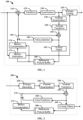
- FIG. 2 illustrates a block diagram of an exemplary HEVC video decoder 200.
- a bitstream is decoded by the decoder elements as described below.
- Video decoder 200 generally performs a decoding pass reciprocal to the encoding pass as described in FIG. 1 , which performs video decoding as part of encoding video data.
- the input of the decoder includes a video bitstream, which may be generated by video encoder 100.
- the bitstream is first entropy decoded (230) to obtain transform coefficients, motion vectors, and other coded information.
- the transform coefficients are de-quantized (240) and inverse transformed (250) to decode the prediction residuals.
- Combining (255) the decoded prediction residuals and the predicted block an image block is reconstructed.
- the predicted block may be obtained (270) from intra prediction (260) or motion-compensated prediction (i.e., inter prediction) (275).
- AMVP and merge mode techniques may be used to derive motion vectors for motion compensation, which may use interpolation filters to calculate interpolated values for sub-integer samples of a reference block.
- In-loop filters (265) are applied to the reconstructed image.
- the filtered image is stored at a reference picture buffer (280).
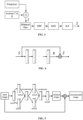
- deblocking and SAO filters are used as in-loop filters to reduce encoding artifacts. More generally for video compression, other filters can be used for in-loop filtering. For example, as shown in FIG. 3 for the current JEM 6.0 (Joint Exploration Model 6.0) developed by JVET (Joint Video Exploration Team), four filters, namely, bilateral filter (BLF), the deblocking filter (DBF), SAO and ALF (Adaptive Loop Filter) are successively applied. These different filters are in general based on: (1) samples analysis and pixels classification and (2) class-dependent filtering.
- the input image to the encoder is S
- input to in-loop filtering is ⁇
- output of in-loop filtering is S ⁇ .
- ⁇ may also be referred to as an initial reconstruction or an initial reconstructed version of the image.
- the input to in-loop filtering is the sum of predicted samples and the decoded prediction residuals.
- prediction residuals are zero or do not exist (e.g., in SKIP mode)
- the input to in-loop filtering is the predicted samples directly.
- a bilateral filter is applied before the deblocking filter, to the reconstructed samples ⁇ .
- BLF works by basing the filter weights not only on the distance to neighboring samples but also on their values. Each sample in the initial reconstructed picture is replaced by a weighted average of itself and its neighbors. The weights are calculated based on the distance from the center sample as well as the difference in sample values. Because the filter is in the shape of a small plus sign (i.e., the filter uses four neighbor samples), all of the distances are 0 or 1.
- the properties (or strength) of the bilateral filter is controlled by parameters ⁇ d and ⁇ r .
- ⁇ d is set dependent on the transform unit size and prediction mode
- ⁇ r is set based on the QP used for the current block.
- the proposed bilateral filter is applied to each CU, or blocks of maximum size 16x 16 if the CU is larger than 16x16, in both the encoder and the decoder.
- the bilateral filter is performed inside the RDO (Rate-Distortion Optimization) loop at the encoder side.
- the filtered blocks may also be used for predicting the subsequent blocks (intra prediction).
- ALF is basically designed based on Wiener filter, which aims at designing linear filters (1D or 2D) to minimize the L2-distortion, that is, minimizing the square error between the filtered samples and the reference ones (in general the original samples).
- Wiener filter which aims at designing linear filters (1D or 2D) to minimize the L2-distortion, that is, minimizing the square error between the filtered samples and the reference ones (in general the original samples).
- ALF with block based filter adaption is applied.
- For the luma component one among 25 filters is selected for each 2x2 block based on the direction and activity of signal.
- Up to three circular symmetric filter shapes are supported for the luma component.
- An index is signalled at the picture level to indicate the filter shape used for the luma component of a picture.
- the 5x5 diamond shape filter is always used.
- the block classification is applied to each 2x2 block, which is categorized into one out of 25 classes based on the local signal analysis (gradients, directionality). For both chroma components in a picture, no classification method is applied, i.e., a single set of ALF coefficients is applied to each chroma component.
- the filtering process of luma component can be controlled at the CU level.
- a flag is signalled to indicate whether ALF is applied to the luma component of a CU.
- For chroma component whether ALF is applied or not is indicated at the picture level only.
- ALF filter parameters are signalled in the first CTU, before the SAO parameters of the first CTU. Up to 25 sets of luma filter coefficients could be signalled. To reduce bits overhead, filter coefficients of different classification can be merged. Also, the ALF coefficients of reference pictures can be reused as ALF coefficients of a current picture.
- a neural network contains neurons that are organized by groups called layers. There are the input layer, output layer and hidden layer(s) in a neural network.
- a deep neural network has two or more hidden layers.
- Video compression may be considered as linked to pattern recognition, as compression often looks for repetitive patterns in order to remove redundancies. Because artifact removal or artifact reduction in video compression can be considered as recognizing and restoring the original images, it is possible to use neural networks as filters to reduce artifacts. In this application, artifact reduction is also referred to as image restoration, and the neural networks for reducing artifacts may also be referred to as the restoration filters.
- FIG. 4 shows an exemplary M-layer convolutional neural network, where the initial reconstruction from the video codec without filtering ( ⁇ ) is restored as S ⁇ by adding a residue R computed by the CNN.
- W i and B i are the weights and bias parameters for layer i , respectively
- g () is the activation function (e.g., a sigmoid or a Rectified Linear Unit (ReLU) function), and * denotes the convolution operation.
- the output S ⁇ from the CNN might be stored in the Reference Picture Buffer (RPB) to
- VRCNN Variable-filter-size Residue-learning CNN
- the VRCNN is structured as a four-layer fully convolutional neural network, where the four layers may be considered to correspond to feature extraction, feature enhancement, mapping, and reconstruction, respectively.
- the second layer uses a combination of 5x5 and 3x3 filters (conv2, conv3)
- the third layer uses a combination of 3x3 and 1x1 filters (conv4, conv5).
- VRCNN uses residue learning techniques, where the CNN is designed to learn the residue between the output and input rather than directly learning the output.
- FIG. 6A shows that a CNN is trained on a large database of images, where the network tries to restore a reconstructed image by an encoder, by minimizing the error with the original image.
- FIG. 6B shows that the resulting CNN is used in the encoder to restore images after reconstruction. The restored images can then be displayed or used as reference to predict other frames in the sequence.
- the decoder as shown in FIG. 6C receives the bitstream, reconstructs the images and restores the images using the same CNN.
- VRCNN only uses reconstructed images to train and apply the CNN at different QPs, without using other information that is available from the encoder or decoder.
- the input to the CNN does not explicitly take into account the particular artifacts of blocks effects which appear on the block boundaries, nor the artifacts depending on the block coding type.
- the present embodiments are directed to a mode-aware CNN for filtering.
- different information also referred to as "mode” in general
- mode is also used as input to the CNN during the training, encoding or decoding process.
- QPs Quantization Parameters
- block partitioning of the image and the block coding type can be used as additional inputs. Since the CNN takes as an input the reconstructed image as a set of samples, we may also input the partitioning, the coding mode information and the QP aligned with the reconstructed samples of the image, using additional channels as input of the CNN.
- the input to the first layer of the CNN is usually the Y component of the reconstructed image, i.e., an image of size WxHx1, where W and H are the width and height of the image.
- WxHx1 the Y component of the reconstructed image
- the boundary information of the partitions is organized into one sample array at the same size as the reconstructed image to form a boundary image.
- a sample in the boundary image indicates whether a corresponding sample is at the partition boundary or not (i.e., a partition frontier or not).
- the partition may be a CU, PU, TU, CTU or other regions.
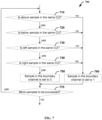
- FIG. 7 illustrates an exemplary method 700 for generating the boundary image, according to an embodiment.
- CU boundary is considered for partition boundary.
- steps 710, 720, 730 and 740 whether the above sample, the below sample, the left sample, or the right sample is in the same CU as the current sample is checked. If any of the condition is not satisfied, the current sample is a boundary sample and the corresponding sample in the boundary image is set (760) to 1. Otherwise, the sample in the boundary image is set (750) to 0.
- the control returns to step 710. Otherwise, the boundary image is obtained.
- image borders we may consider them as boundary or non-boundary. In practice, we may use a zero-padding policy.
- FIG. 8A illustrates that an exemplary image is divided into three coding units, where the partition frontiers are shown in bold lines, and FIG. 8B shows the corresponding boundary image. Specifically, pixels adjacent to the partition frontiers are considered as boundary pixels, and other pixels are considered as non-boundary pixels. In the boundary image, the boundary pixels are represented by "1" and the non-boundary pixels are represented by "0.”
- the boundary information may help the CNN to understand where the blocking artifacts are, and thus, may improve the CNN since the network does not need to spending parameters looking for blocking artifacts.
- each sample in the QP image represents the quantization step size.
- the conversion may further consider the quantization matrix and/or the quantization rounding offset.
- QP is usually indicated for a block, for example, a macroblock in H.264/AVC or a CU in HEVC, to obtain QP for individual samples, QP for a particular sample is set to the QP for the block that includes the particular sample.
- the quantization step size may be normalized between 0 and 1 before input. Other parameters based on QP can also be used as input. Using the QP image as an additional channel can accommodate different quantization step sizes associated with different blocks.
- a channel corresponding to the pixel values of the prediction image is used. Because the prediction blocks for different coding modes, such as intra or inter, the type of filtering, have different characteristics, the prediction blocks or the prediction residuals would reflect the coding modes.
- the intra prediction mode many other modes exist for a block, for example, but not limited to, the EMT (explicit multiple core transforms) index in JEM, the NSST (Non-separable secondary transform) index, and the boundary filtering type, and could be used as input for the CNN.
- EMT express multiple core transforms
- NSST Non-separable secondary transform
- the input information may be organized into an array of WxHxD.
- the input can be organized as [Y component ⁇ , Boundary image BI , Prediction image P , Quantization image Q ].
- same configuration is repeated for all the color components (for example, Y, Cb, Cr).
- the input information can also be organized in different manners, for example, some input channel may be input later in the network.
- the four layers in the VRCNN may be considered as corresponding to feature extraction, feature enhancement, mapping, and reconstruction, respectively.
- the QP may only be used as input to the feature enhancement stage where the QP information may be more relevant.
- the CNN can use fewer parameters in the earlier stage.
- one or more input channels may be used in an intermediate layer of the CNN to reduce the complexity.
- different networks can be trained for different values of a particular parameter if this parameter has a large influence on the final reconstructed image.
- a set of CNN can be trained at different QPs and the one with the closest QP to the current CU is used.
- a weighted average of the input of several CNNs is used to filter the image.
- FIG. 9A illustrates an exemplary training process 900A using four channels as input, according to an embodiment.
- a large database of images (905) is used as the training input.
- a training image is encoded (910) by the encoder.
- the information available from the encoder, including, QP, partition boundaries, the initial reconstruction ⁇ , and the prediction image is used as input to the CNN.
- the QP information is used to form (930) a quantization image
- the boundary information is used to form (920) a boundary image.
- residue learning technique is used. Namely, the initial reconstruction ⁇ is added (940) to the output of the final layer of the CNN to restore the image.
- the loss function (950) is based on the difference between the restored image S ⁇ and the original image S .
- W i and B i are the weights and bias parameters for layer i , respectively
- g () is the activation function (e.g., a sigmoid or a Rectified Linear Unit (ReLU) function), and * denotes the convolution operation.
- the first weight ( W 1 ) is different from what is described in Eq. (1) as the first weight has a dimension of WxHxD instead of WxHx1.
- the activation function g() can be different by layers and can also contain other processing, for example, batch normalization.
- FIG. 9B illustrates an exemplary encoding process 900B using multiple channels as input to a CNN, which corresponds to the trained CNN of FIG. 9A , according to an embodiment.
- an original image is encoded (915) by the encoder without in-loop filtering.
- the information available from the encoder including, QP, partition boundaries, the initial reconstruction ⁇ , and the prediction image, is used as input to the CNN (950).
- the QP information is used to form (935) a quantization image
- the boundary information is used to form (925) a boundary image.
- FIG. 9C illustrates an exemplary decoding process 900C using multiple channels as input to a CNN, which corresponds to the trained CNN of FIG. 9A , according to an embodiment. Similar to the encoding process 900B, four channels are used as input to the CNN.
- a bitstream is decoded (970) by the decoder without in-loop filtering.
- the information available from the decoder including, QP, partition boundaries, the initial reconstruction ⁇ , and the prediction image, is used as input to the CNN (980).
- the QP information is used to form (995) a quantization image
- the boundary information is used to form (990) a boundary image.
- the input reconstructed image may be divided into regions, for example, at a size of W'xH' with W' ⁇ W and H' ⁇ H.
- the QP image region, the boundary image region or the prediction image region would accordingly be generated at the size of W'xH'.
- a region may be a CU, PU or CTU.
- the filtering region may include several blocks and therefore several QPs or intra prediction direction modes.
- the corresponding QP image region is generated such that a sample therein is associated with the QP for the block covering the sample.
- the QP image for a CTU may contain several values of quantization step sizes, where each CU has a corresponding quantization step size.
- FIG. 8C illustrates that an exemplary CTU is divided into seven coding units, where the CU boundaries are shown in bold lines, and FIG. 8D shows the corresponding QP image.
- quantization step size qs corresponding to QP i is used in the QP image.
- the mode-aware CNN for in-loop filtering.
- the present embodiments can also be applied to post-processing outside the coding loop to enhance image quality before rendering, or in other modules where filtering can be applied.
- the MSE is used for calculating the loss function in the exemplary embodiments.
- other error functions such as a perceptual, differentiable metric, for example, the MS-SSIM can be used for the loss function.
- in-loop filters such as in-loop filters (165, 265) in an HEVC video encoder or decoder
- the mode-aware CNN can be used together with other in-loop filters, in parallel or successively.
- the mode-aware approach uses the information from the block itself when it is applied at a block level, the mode-aware network can be used in the RDO decision, similar to how the bilateral filter is tested in the RDO decision.
- each of the methods comprises one or more steps or actions for achieving the described method. Unless a specific order of steps or actions is required for proper operation of the method, the order and/or use of specific steps and/or actions may be modified or combined.
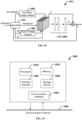
- FIG. 10 illustrates a block diagram of an exemplary system in which various aspects of the exemplary embodiments may be implemented.
- System 1000 may be embodied as a device including the various components described below and is configured to perform the processes described above. Examples of such devices, include, but are not limited to, personal computers, laptop computers, smartphones, tablet computers, digital multimedia set top boxes, digital television receivers, personal video recording systems, connected home appliances, and servers.
- System 1000 may be communicatively coupled to other similar systems, and to a display via a communication channel as shown in FIG. 10 and as known by those skilled in the art to implement the exemplary video system described above.
- the system 1000 may include at least one processor 1010 configured to execute instructions loaded therein for implementing the various processes as discussed above.
- Processor 1010 may include embedded memory, input output interface and various other circuitries as known in the art.
- the system 1000 may also include at least one memory 1020 (e.g., a volatile memory device, a non-volatile memory device).
- System 1000 may additionally include a storage device 1020, which may include non-volatile memory, including, but not limited to, EEPROM, ROM, PROM, RAM, DRAM, SRAM, flash, magnetic disk drive, and/or optical disk drive.
- the storage device 1040 may comprise an internal storage device, an attached storage device and/or a network accessible storage device, as non-limiting examples.
- System 1000 may also include an encoder/decoder module 1030 configured to process data to provide an encoded video or decoded video.
- Encoder/decoder module 1030 represents the module(s) that may be included in a device to perform the encoding and/or decoding functions. As is known, a device may include one or both of the encoding and decoding modules. Additionally, encoder/decoder module 1030 may be implemented as a separate element of system 1000 or may be incorporated within processors 1010 as a combination of hardware and software as known to those skilled in the art.
- processors 1010 Program code to be loaded onto processors 1010 to perform the various processes described hereinabove may be stored in storage device 1040 and subsequently loaded onto memory 1020 for execution by processors 1010.
- one or more of the processor(s) 1010, memory 1020, storage device 1040 and encoder/decoder module 1030 may store one or more of the various items during the performance of the processes discussed herein above, including, but not limited to the input video, the decoded video, the bitstream, equations, formula, matrices, variables, operations, and operational logic.
- the system 1000 may also include communication interface 1050 that enables communication with other devices via communication channel 1060.
- the communication interface 1050 may include, but is not limited to a transceiver configured to transmit and receive data from communication channel 1060.
- the communication interface may include, but is not limited to, a modem or network card and the communication channel may be implemented within a wired and/or wireless medium.
- the various components of system 1000 may be connected or communicatively coupled together using various suitable connections, including, but not limited to internal buses, wires, and printed circuit boards.
- the exemplary embodiments may be carried out by computer software implemented by the processor 1010 or by hardware, or by a combination of hardware and software. As a non-limiting example, the exemplary embodiments may be implemented by one or more integrated circuits.
- the memory 1020 may be of any type appropriate to the technical environment and may be implemented using any appropriate data storage technology, such as optical memory devices, magnetic memory devices, semiconductor-based memory devices, fixed memory and removable memory, as non-limiting examples.
- the processor 1010 may be of any type appropriate to the technical environment, and may encompass one or more of microprocessors, general purpose computers, special purpose computers and processors based on a multi-core architecture, as non-limiting examples.
- the implementations described herein may be implemented in, for example, a method or a process, an apparatus, a software program, a data stream, or a signal. Even if only discussed in the context of a single form of implementation (for example, discussed only as a method), the implementation of features discussed may also be implemented in other forms (for example, an apparatus or program).
- An apparatus may be implemented in, for example, appropriate hardware, software, and firmware.
- the methods may be implemented in, for example, an apparatus such as, for example, a processor, which refers to processing devices in general, including, for example, a computer, a microprocessor, an integrated circuit, or a programmable logic device. Processors also include communication devices, such as, for example, computers, cell phones, portable/personal digital assistants ("PDAs”), and other devices that facilitate communication of information between end-users.
- PDAs portable/personal digital assistants
- Determining the information may include one or more of, for example, estimating the information, calculating the information, predicting the information, or retrieving the information from memory.
- Accessing the information may include one or more of, for example, receiving the information, retrieving the information (for example, from memory), copying the information, calculating the information, determining the information, predicting the information, or estimating the information.
- Receiving is, as with “accessing”, intended to be a broad term.
- Receiving the information may include one or more of, for example, accessing the information, or retrieving the information (for example, from memory).
- “receiving” is typically involved, in one way or another, during operations such as, for example, storing the information, processing the information, transmitting the information, moving the information, copying the information, erasing the information, calculating the information, determining the information, predicting the information, or estimating the information.
- implementations may produce a variety of signals formatted to carry information that may be, for example, stored or transmitted.
- the information may include, for example, instructions for performing a method, or data produced by one of the described implementations.
- a signal may be formatted to carry the bitstream of a described embodiment.
- Such a signal may be formatted, for example, as an electromagnetic wave (for example, using a radio frequency portion of spectrum) or as a baseband signal.
- the formatting may include, for example, encoding a data stream and modulating a carrier with the encoded data stream.
- the information that the signal carries may be, for example, analog or digital information.
- the signal may be transmitted over a variety of different wired or wireless links, as is known.
- the signal may be stored on a processor-readable medium.
Landscapes
- Engineering & Computer Science (AREA)
- Physics & Mathematics (AREA)
- Theoretical Computer Science (AREA)
- Signal Processing (AREA)
- Multimedia (AREA)
- General Health & Medical Sciences (AREA)
- General Physics & Mathematics (AREA)
- Computational Linguistics (AREA)
- Data Mining & Analysis (AREA)
- Evolutionary Computation (AREA)
- Biomedical Technology (AREA)
- Molecular Biology (AREA)
- Computing Systems (AREA)
- General Engineering & Computer Science (AREA)
- Biophysics (AREA)
- Mathematical Physics (AREA)
- Software Systems (AREA)
- Artificial Intelligence (AREA)
- Life Sciences & Earth Sciences (AREA)
- Health & Medical Sciences (AREA)
- Compression Or Coding Systems Of Tv Signals (AREA)
- Image Analysis (AREA)
Applications Claiming Priority (3)
| Application Number | Priority Date | Filing Date | Title |
|---|---|---|---|
| EP17306101.1A EP3451670A1 (de) | 2017-08-28 | 2017-08-28 | Verfahren und vorrichtung zum filtern mit modusbewusstem tiefenlernen |
| EP18762755.9A EP3677034B1 (de) | 2017-08-28 | 2018-08-28 | Verfahren und vorrichtung zum filtern mit modusbewusstem tiefenlernen |
| PCT/US2018/048333 WO2019046295A1 (en) | 2017-08-28 | 2018-08-28 | APPARATUS AND METHOD FOR FILTERING WITH DEPTH LEARNING IN FUNCTION MODE |
Related Parent Applications (2)
| Application Number | Title | Priority Date | Filing Date |
|---|---|---|---|
| EP18762755.9A Division EP3677034B1 (de) | 2017-08-28 | 2018-08-28 | Verfahren und vorrichtung zum filtern mit modusbewusstem tiefenlernen |
| EP18762755.9A Division-Into EP3677034B1 (de) | 2017-08-28 | 2018-08-28 | Verfahren und vorrichtung zum filtern mit modusbewusstem tiefenlernen |
Publications (3)
| Publication Number | Publication Date |
|---|---|
| EP4425918A2 true EP4425918A2 (de) | 2024-09-04 |
| EP4425918A3 EP4425918A3 (de) | 2024-12-04 |
| EP4425918B1 EP4425918B1 (de) | 2025-12-03 |
Family
ID=59761904
Family Applications (3)
| Application Number | Title | Priority Date | Filing Date |
|---|---|---|---|
| EP17306101.1A Withdrawn EP3451670A1 (de) | 2017-08-28 | 2017-08-28 | Verfahren und vorrichtung zum filtern mit modusbewusstem tiefenlernen |
| EP18762755.9A Active EP3677034B1 (de) | 2017-08-28 | 2018-08-28 | Verfahren und vorrichtung zum filtern mit modusbewusstem tiefenlernen |
| EP24190524.9A Active EP4425918B1 (de) | 2017-08-28 | 2018-08-28 | Verfahren und vorrichtung zum filtern mit modusbewusstem tiefenlernen |
Family Applications Before (2)
| Application Number | Title | Priority Date | Filing Date |
|---|---|---|---|
| EP17306101.1A Withdrawn EP3451670A1 (de) | 2017-08-28 | 2017-08-28 | Verfahren und vorrichtung zum filtern mit modusbewusstem tiefenlernen |
| EP18762755.9A Active EP3677034B1 (de) | 2017-08-28 | 2018-08-28 | Verfahren und vorrichtung zum filtern mit modusbewusstem tiefenlernen |
Country Status (5)
| Country | Link |
|---|---|
| US (1) | US20200213587A1 (de) |
| EP (3) | EP3451670A1 (de) |
| KR (2) | KR102833083B1 (de) |
| CN (1) | CN111194555B (de) |
| WO (1) | WO2019046295A1 (de) |
Families Citing this family (75)
| Publication number | Priority date | Publication date | Assignee | Title |
|---|---|---|---|---|
| US10999602B2 (en) | 2016-12-23 | 2021-05-04 | Apple Inc. | Sphere projected motion estimation/compensation and mode decision |
| US11259046B2 (en) | 2017-02-15 | 2022-02-22 | Apple Inc. | Processing of equirectangular object data to compensate for distortion by spherical projections |
| US10924747B2 (en) | 2017-02-27 | 2021-02-16 | Apple Inc. | Video coding techniques for multi-view video |
| US11093752B2 (en) | 2017-06-02 | 2021-08-17 | Apple Inc. | Object tracking in multi-view video |
| US11019355B2 (en) * | 2018-04-03 | 2021-05-25 | Electronics And Telecommunications Research Institute | Inter-prediction method and apparatus using reference frame generated based on deep learning |
| US11166044B2 (en) * | 2018-07-31 | 2021-11-02 | Tencent America LLC | Method and apparatus for improved compound orthonormal transform |
| US11025907B2 (en) * | 2019-02-28 | 2021-06-01 | Google Llc | Receptive-field-conforming convolution models for video coding |
| US10869036B2 (en) | 2018-09-18 | 2020-12-15 | Google Llc | Receptive-field-conforming convolutional models for video coding |
| US10931950B2 (en) * | 2018-11-19 | 2021-02-23 | Intel Corporation | Content adaptive quantization for video coding |
| KR20210129151A (ko) * | 2019-03-07 | 2021-10-27 | 광동 오포 모바일 텔레커뮤니케이션즈 코포레이션 리미티드 | 루프 필터링 구현 방법 및 장치 |
| KR20210132708A (ko) | 2019-03-07 | 2021-11-04 | 광동 오포 모바일 텔레커뮤니케이션즈 코포레이션 리미티드 | 루프 필터링 구현 방법, 장치 및 컴퓨터 저장 매체 |
| JP7026065B2 (ja) * | 2019-03-12 | 2022-02-25 | Kddi株式会社 | 画像復号装置、画像復号方法及びプログラム |
| WO2020192020A1 (zh) * | 2019-03-24 | 2020-10-01 | Oppo广东移动通信有限公司 | 滤波方法、装置、编码器以及计算机存储介质 |
| US11166022B2 (en) * | 2019-06-04 | 2021-11-02 | Google Llc | Quantization constrained neural image coding |
| WO2020253947A1 (en) * | 2019-06-18 | 2020-12-24 | Xzimg Limited | Recurrent multi-task convolutional neural network architecture |
| CN115278227B (zh) * | 2019-06-24 | 2023-08-22 | 华为技术有限公司 | 一种由解码设备或编码设备实现的译码方法,编码器和解码器 |
| TWI908728B (zh) * | 2019-06-28 | 2025-12-21 | 法商內數位Ce專利控股公司 | 編解碼深度神經網路權重張量之裝置及方法 |
| US10972749B2 (en) | 2019-08-29 | 2021-04-06 | Disney Enterprises, Inc. | Systems and methods for reconstructing frames |
| US11012718B2 (en) | 2019-08-30 | 2021-05-18 | Disney Enterprises, Inc. | Systems and methods for generating a latent space residual |
| CN110677649B (zh) * | 2019-10-16 | 2021-09-28 | 腾讯科技(深圳)有限公司 | 基于机器学习的去伪影方法、去伪影模型训练方法及装置 |
| CN110942140B (zh) * | 2019-11-29 | 2022-11-08 | 任科扬 | 一种人工神经网络差和迭代数据处理方法及装置 |
| EP4094442A1 (de) * | 2020-05-15 | 2022-11-30 | Huawei Technologies Co., Ltd. | Cnn-filter mit erlernter abwärtsabtastung für bild- und videocodierung unter verwendung von erlernten abwärtsabtastungsmerkmalen |
| CN113784146A (zh) * | 2020-06-10 | 2021-12-10 | 华为技术有限公司 | 环路滤波方法和装置 |
| CN114125446B (zh) * | 2020-06-22 | 2025-07-22 | 华为技术有限公司 | 图像编码方法、解码方法和装置 |
| CN111711824B (zh) * | 2020-06-29 | 2021-07-02 | 腾讯科技(深圳)有限公司 | 视频编解码中的环路滤波方法、装置、设备及存储介质 |
| CN116113985A (zh) * | 2020-08-24 | 2023-05-12 | 现代自动车株式会社 | 利用基于深度学习的环内滤波器进行视频编码和解码 |
| CN116235493A (zh) * | 2020-09-30 | 2023-06-06 | Oppo广东移动通信有限公司 | 一种视频编解码方法、编码器、解码器及存储介质 |
| EP4222968A4 (de) * | 2020-10-01 | 2024-10-30 | Beijing Dajia Internet Information Technology Co., Ltd. | Videocodierung mit neuronalem netzwerk basierend auf in-loop-filterung |
| US11825101B2 (en) * | 2020-10-05 | 2023-11-21 | Qualcomm Incorporated | Joint-component neural network based filtering during video coding |
| CN112468826B (zh) * | 2020-10-15 | 2021-09-24 | 山东大学 | 一种基于多层gan的vvc环路滤波方法及系统 |
| CN114449296B (zh) * | 2020-11-06 | 2023-07-18 | 北京大学 | 基于卷积神经网络的环路滤波方法和装置 |
| CN112669400B (zh) * | 2020-12-11 | 2022-11-29 | 中国科学院深圳先进技术研究院 | 基于深度学习预测和残差架构的动态mr重建方法 |
| US12058321B2 (en) * | 2020-12-16 | 2024-08-06 | Tencent America LLC | Method and apparatus for video coding |
| US20220201295A1 (en) * | 2020-12-21 | 2022-06-23 | Electronics And Telecommunications Research Institute | Method, apparatus and storage medium for image encoding/decoding using prediction |
| US12327384B2 (en) | 2021-01-04 | 2025-06-10 | Qualcomm Incorporated | Multiple neural network models for filtering during video coding |
| US11490085B2 (en) * | 2021-01-14 | 2022-11-01 | Tencent America LLC | Model sharing by masked neural network for loop filter with quality inputs |
| US12022098B2 (en) * | 2021-03-04 | 2024-06-25 | Lemon Inc. | Neural network-based in-loop filter with residual scaling for video coding |
| CN113068031B (zh) * | 2021-03-12 | 2021-12-07 | 天津大学 | 一种基于深度学习的环路滤波方法 |
| US11979591B2 (en) | 2021-04-06 | 2024-05-07 | Lemon Inc. | Unified neural network in-loop filter |
| WO2022218385A1 (en) | 2021-04-14 | 2022-10-20 | Beijing Bytedance Network Technology Co., Ltd. | Unified neural network filter model |
| US11949918B2 (en) | 2021-04-15 | 2024-04-02 | Lemon Inc. | Unified neural network in-loop filter signaling |
| US11750847B2 (en) * | 2021-04-19 | 2023-09-05 | Tencent America LLC | Quality-adaptive neural network-based loop filter with smooth quality control by meta-learning |
| US12058314B2 (en) * | 2021-04-30 | 2024-08-06 | Tencent America LLC | Block-wise content-adaptive online training in neural image compression with post filtering |
| EP4331231A4 (de) | 2021-05-01 | 2025-06-18 | Beijing Dajia Internet Information Technology Co., Ltd. | Netzwerkbasierte bildfilterung zur videocodierung |
| US20220383554A1 (en) * | 2021-05-18 | 2022-12-01 | Tencent America LLC | Substitutional quality factor learning for quality-adaptive neural network-based loop filter |
| CN113422966B (zh) * | 2021-05-27 | 2024-05-24 | 绍兴市北大信息技术科创中心 | 一种多模型cnn环路滤波方法 |
| US12542931B2 (en) | 2021-07-06 | 2026-02-03 | Nokia Technologies Oy | Performance improvements of machine vision tasks via learned neural network based filter |
| WO2023287018A1 (ko) * | 2021-07-13 | 2023-01-19 | 현대자동차주식회사 | 딥러닝 기반 인트라 예측 신호를 개선하는 비디오 코딩방법 및 장치 |
| KR20230012218A (ko) | 2021-07-15 | 2023-01-26 | 주식회사 칩스앤미디어 | 신경망 기반의 인-루프 필터를 이용한 영상 부호화/복호화 방법, 장치 및 비트스트림을 저장한 기록 매체 |
| CN117678221A (zh) * | 2021-07-20 | 2024-03-08 | Oppo广东移动通信有限公司 | 图像编解码及处理方法、装置及设备 |
| MX2024001286A (es) | 2021-08-06 | 2024-02-13 | Samsung Electronics Co Ltd | Dispositivo y metodo para filtrado de imagenes basado en inteligencia artificial (ia). |
| WO2023022376A1 (ko) * | 2021-08-17 | 2023-02-23 | 현대자동차주식회사 | 개선된 인루프 필터를 이용하는 비디오 코딩방법 및 장치 |
| CN114240808B (zh) * | 2021-09-18 | 2025-05-16 | 海南大学 | 基于联合双边滤波和非下采样剪切波的图像融合算法 |
| CN115883851A (zh) * | 2021-09-28 | 2023-03-31 | 腾讯科技(深圳)有限公司 | 滤波及编解码方法、装置、计算机可读介质及电子设备 |
| CN115883842B (zh) * | 2021-09-28 | 2024-12-10 | 腾讯科技(深圳)有限公司 | 滤波及编解码方法、装置、计算机可读介质及电子设备 |
| CN114025164B (zh) * | 2021-09-30 | 2025-06-20 | 浙江大华技术股份有限公司 | 图像编码方法、图像解码方法、编码器以及解码器 |
| CN114187230B (zh) * | 2021-10-25 | 2026-07-03 | 中国科学院大学 | 一种基于两级优化网络的伪装物体检测方法 |
| CN114125449B (zh) * | 2021-10-26 | 2024-06-11 | 阿里巴巴创新公司 | 基于神经网络的视频处理方法、系统和计算机可读介质 |
| CN116074540B (zh) * | 2021-10-27 | 2025-05-30 | 四川大学 | 一种基于深度学习的vvc压缩伪影去除半盲方法 |
| CN114501034B (zh) * | 2021-12-11 | 2023-08-04 | 同济大学 | 基于离散高斯混合超先验和Mask的图像压缩方法及介质 |
| TWI786992B (zh) * | 2021-12-14 | 2022-12-11 | 國立清華大學 | 整合卷積神經網路運算電路的影像感測器 |
| CN116266889A (zh) * | 2021-12-14 | 2023-06-20 | 谢志成 | 整合卷积神经网络运算电路的图像传感器 |
| WO2023128421A1 (ko) * | 2021-12-29 | 2023-07-06 | 삼성전자 주식회사 | 컨볼루션 신경망을 이용한 이미지 처리 방법 및 장치 |
| US12167047B2 (en) * | 2022-01-13 | 2024-12-10 | Tencent America LLC | Neural network-based deblocking filters |
| CN116630171A (zh) * | 2022-02-10 | 2023-08-22 | 腾讯科技(深圳)有限公司 | 图像滤波方法、装置、设备及存储介质 |
| CN119487855A (zh) * | 2022-07-05 | 2025-02-18 | 高通股份有限公司 | 视频数据的复杂性降低的多模式神经网络滤波 |
| CN119788885B (zh) * | 2022-07-14 | 2025-12-26 | 杭州海康威视数字技术股份有限公司 | 一种基于神经网络的图像解码、编码方法、装置及其设备 |
| CN117793355A (zh) * | 2022-09-19 | 2024-03-29 | 腾讯科技(深圳)有限公司 | 多媒体数据处理方法、装置、设备及存储介质 |
| CN115914654B (zh) * | 2022-10-25 | 2026-06-30 | 西安电子科技大学 | 一种用于视频编码的神经网络环路滤波方法及装置 |
| WO2024140369A1 (en) * | 2022-12-29 | 2024-07-04 | Douyin Vision Co., Ltd. | Multiple side information for adaptive loop filter in video coding |
| CN119011826A (zh) * | 2023-05-19 | 2024-11-22 | 腾讯科技(深圳)有限公司 | 滤波及编解码方法、装置、计算机可读介质及电子设备 |
| US20240422361A1 (en) * | 2023-06-14 | 2024-12-19 | Qualcomm Incorporated | Neural network based in loop filter architecture with unified supplementary data processing for video coding |
| WO2025097423A1 (zh) * | 2023-11-10 | 2025-05-15 | Oppo广东移动通信有限公司 | 编解码方法、码流、编码器、解码器以及存储介质 |
| CN119363999B (zh) * | 2024-08-07 | 2025-11-18 | 中国科学院大学 | 自适应地基于隐表示网络的视频压缩方法 |
| CN119835415B (zh) * | 2024-12-26 | 2025-10-10 | 西安电子科技大学 | 一种基于动态卷积神经网络的视频编码环路滤波方法 |
Family Cites Families (10)
| Publication number | Priority date | Publication date | Assignee | Title |
|---|---|---|---|---|
| CA2638465A1 (en) * | 2007-08-01 | 2009-02-01 | Jean-Yves Chouinard | Learning filters for enhancing the quality of block coded still and video images |
| JP2009111691A (ja) * | 2007-10-30 | 2009-05-21 | Hitachi Ltd | 画像符号化装置及び符号化方法、画像復号化装置及び復号化方法 |
| CN101621683A (zh) * | 2008-07-01 | 2010-01-06 | 邹采荣 | 一种基于avs的快速立体视频编码方法 |
| US20100027909A1 (en) * | 2008-08-04 | 2010-02-04 | The Hong Kong University Of Science And Technology | Convex optimization approach to image deblocking |
| JP5506272B2 (ja) * | 2009-07-31 | 2014-05-28 | 富士フイルム株式会社 | 画像処理装置及び方法、データ処理装置及び方法、並びにプログラム |
| US11196992B2 (en) * | 2015-09-03 | 2021-12-07 | Mediatek Inc. | Method and apparatus of neural network based processing in video coding |
| CN105430415B (zh) * | 2015-12-02 | 2018-02-27 | 宁波大学 | 一种3d‑hevc深度视频帧内快速编码方法 |
| US9799102B2 (en) * | 2015-12-02 | 2017-10-24 | Adobe Systems Incorporated | Smoothing images using machine learning |
| US9659355B1 (en) * | 2015-12-03 | 2017-05-23 | Motorola Mobility Llc | Applying corrections to regions of interest in image data |
| CN106952228B (zh) * | 2017-03-10 | 2020-05-22 | 北京工业大学 | 基于图像非局部自相似性的单幅图像的超分辨率重建方法 |
-
2017
- 2017-08-28 EP EP17306101.1A patent/EP3451670A1/de not_active Withdrawn
-
2018
- 2018-08-28 WO PCT/US2018/048333 patent/WO2019046295A1/en not_active Ceased
- 2018-08-28 KR KR1020247014682A patent/KR102833083B1/ko active Active
- 2018-08-28 CN CN201880065216.2A patent/CN111194555B/zh active Active
- 2018-08-28 KR KR1020207005398A patent/KR102735534B1/ko active Active
- 2018-08-28 EP EP18762755.9A patent/EP3677034B1/de active Active
- 2018-08-28 EP EP24190524.9A patent/EP4425918B1/de active Active
- 2018-08-28 US US16/639,098 patent/US20200213587A1/en not_active Abandoned
Non-Patent Citations (1)
| Title |
|---|
| YUANYING DAI ET AL.: "International Conference on Multimedia Modeling", 2017, SPRINGER, article "A convolutional neural network approach for post-processing in HEVC intra coding", pages: 28 - 39 |
Also Published As
| Publication number | Publication date |
|---|---|
| KR102735534B1 (ko) | 2024-11-29 |
| WO2019046295A1 (en) | 2019-03-07 |
| KR102833083B1 (ko) | 2025-07-14 |
| US20200213587A1 (en) | 2020-07-02 |
| EP4425918A3 (de) | 2024-12-04 |
| EP3677034A1 (de) | 2020-07-08 |
| KR20200040773A (ko) | 2020-04-20 |
| EP3677034B1 (de) | 2024-08-28 |
| CN111194555B (zh) | 2022-04-26 |
| EP3451670A1 (de) | 2019-03-06 |
| CN111194555A (zh) | 2020-05-22 |
| KR20240068078A (ko) | 2024-05-17 |
| EP4425918B1 (de) | 2025-12-03 |
Similar Documents
| Publication | Publication Date | Title |
|---|---|---|
| EP4425918B1 (de) | Verfahren und vorrichtung zum filtern mit modusbewusstem tiefenlernen | |
| US20200244997A1 (en) | Method and apparatus for filtering with multi-branch deep learning | |
| KR102435595B1 (ko) | 분산 처리 환경에서의 학습 파라미터의 압축 및 전송을 제공하는 방법 및 장치 | |
| EP3468196A1 (de) | Verfahren und vorrichtungen zur videocodierung und videodecodierung | |
| US12262041B2 (en) | Picture prediction method, encoder, decoder and computer storage medium | |
| EP3706046A1 (de) | Verfahren und vorrichtung zur bildcodierung und -decodierung | |
| EP3695608B1 (de) | Verfahren und vorrichtung zur adaptiven transformation in der videocodierung und -decodierung | |
| EP3487177A1 (de) | Verfahren und vorrichtung zur bidirektionalen intraprädiktion mit geringer komplexität in der videocodierung und -decodierung | |
| US20150163498A1 (en) | Video encoding apparatus and video encoding method | |
| US20230297833A1 (en) | Method and device for providing compression and transmission of training parameters in distributed processing environment | |
| EP3567860A1 (de) | Verfahren und vorrichtung für gemischte intravorhersage | |
| US20200359025A1 (en) | Method and apparatus for video compression using efficient multiple transforms | |
| CN118077201A (zh) | 用于视频处理的方法、设备和介质 | |
| WO2018206396A1 (en) | Method and apparatus for intra prediction in video encoding and decoding | |
| EP3410724A1 (de) | Verfahren und vorrichtung zur signalisierung von bidirektionaler intraprädiktion in der videocodierung und -decodierung | |
| WO2024081872A1 (en) | Method, apparatus, and medium for video processing | |
| US20250030882A1 (en) | Local Illumination Compensation for Inter Prediction | |
| EP3707899B1 (de) | Automatischer abtastreihenfolge für unterteilte blöcke | |
| EP3503549A1 (de) | Verfahren und vorrichtung zur videokompression mithilfe effizienter mehrfachumwandlungen | |
| CN120051988A (zh) | 用于视频处理的方法、装置和介质 | |
| EP3471413A1 (de) | Codierungs- und decodierungsverfahren und zugehörige vorrichtungen | |
| US20260019572A1 (en) | Video in-loop filter adaptive to various types of noise and characteristics | |
| WO2025067503A1 (en) | Method and apparatus for filtered inter prediction | |
| US20260012588A1 (en) | Adaptive loop filter with adaptive filter strength | |
| EP3518537A1 (de) | Verfahren und vorrichtung zur videocodierung und -decodierung basierend auf einem linearen modell als reaktion auf benachbarte proben |
Legal Events
| Date | Code | Title | Description |
|---|---|---|---|
| PUAI | Public reference made under article 153(3) epc to a published international application that has entered the european phase |
Free format text: ORIGINAL CODE: 0009012 |
|
| STAA | Information on the status of an ep patent application or granted ep patent |
Free format text: STATUS: THE APPLICATION HAS BEEN PUBLISHED |
|
| AC | Divisional application: reference to earlier application |
Ref document number: 3677034 Country of ref document: EP Kind code of ref document: P |
|
| AK | Designated contracting states |
Kind code of ref document: A2 Designated state(s): AL AT BE BG CH CY CZ DE DK EE ES FI FR GB GR HR HU IE IS IT LI LT LU LV MC MK MT NL NO PL PT RO RS SE SI SK SM TR |
|
| REG | Reference to a national code |
Ref country code: DE Ref legal event code: R079 Free format text: PREVIOUS MAIN CLASS: H04N0019136000 Ipc: H04N0019820000 Ref country code: DE Ref legal event code: R079 Ref document number: 602018087750 Country of ref document: DE Free format text: PREVIOUS MAIN CLASS: H04N0019136000 Ipc: H04N0019820000 |
|
| PUAL | Search report despatched |
Free format text: ORIGINAL CODE: 0009013 |
|
| AK | Designated contracting states |
Kind code of ref document: A3 Designated state(s): AL AT BE BG CH CY CZ DE DK EE ES FI FR GB GR HR HU IE IS IT LI LT LU LV MC MK MT NL NO PL PT RO RS SE SI SK SM TR |
|
| RIC1 | Information provided on ipc code assigned before grant |
Ipc: H04N 19/136 20140101ALI20241029BHEP Ipc: H04N 19/124 20140101ALI20241029BHEP Ipc: H04N 19/117 20140101ALI20241029BHEP Ipc: H04N 19/176 20140101ALI20241029BHEP Ipc: H04N 19/82 20140101AFI20241029BHEP |
|
| STAA | Information on the status of an ep patent application or granted ep patent |
Free format text: STATUS: REQUEST FOR EXAMINATION WAS MADE |
|
| 17P | Request for examination filed |
Effective date: 20250526 |
|
| GRAP | Despatch of communication of intention to grant a patent |
Free format text: ORIGINAL CODE: EPIDOSNIGR1 |
|
| STAA | Information on the status of an ep patent application or granted ep patent |
Free format text: STATUS: GRANT OF PATENT IS INTENDED |
|
| INTG | Intention to grant announced |
Effective date: 20250711 |
|
| GRAJ | Information related to disapproval of communication of intention to grant by the applicant or resumption of examination proceedings by the epo deleted |
Free format text: ORIGINAL CODE: EPIDOSDIGR1 |
|
| STAA | Information on the status of an ep patent application or granted ep patent |
Free format text: STATUS: REQUEST FOR EXAMINATION WAS MADE |
|
| GRAS | Grant fee paid |
Free format text: ORIGINAL CODE: EPIDOSNIGR3 |
|
| STAA | Information on the status of an ep patent application or granted ep patent |
Free format text: STATUS: GRANT OF PATENT IS INTENDED |
|
| GRAP | Despatch of communication of intention to grant a patent |
Free format text: ORIGINAL CODE: EPIDOSNIGR1 |
|
| GRAA | (expected) grant |
Free format text: ORIGINAL CODE: 0009210 |
|
| STAA | Information on the status of an ep patent application or granted ep patent |
Free format text: STATUS: THE PATENT HAS BEEN GRANTED |
|
| INTG | Intention to grant announced |
Effective date: 20251028 |
|
| AC | Divisional application: reference to earlier application |
Ref document number: 3677034 Country of ref document: EP Kind code of ref document: P |
|
| AK | Designated contracting states |
Kind code of ref document: B1 Designated state(s): AL AT BE BG CH CY CZ DE DK EE ES FI FR GB GR HR HU IE IS IT LI LT LU LV MC MK MT NL NO PL PT RO RS SE SI SK SM TR |
|
| REG | Reference to a national code |
Ref country code: CH Ref legal event code: F10 Free format text: ST27 STATUS EVENT CODE: U-0-0-F10-F00 (AS PROVIDED BY THE NATIONAL OFFICE) Effective date: 20251203 Ref country code: GB Ref legal event code: FG4D |
|
| REG | Reference to a national code |
Ref country code: DE Ref legal event code: R096 Ref document number: 602018087750 Country of ref document: DE |
|
| P01 | Opt-out of the competence of the unified patent court (upc) registered |
Free format text: CASE NUMBER: UPC_APP_0014377_4425918/2025 Effective date: 20251121 |
|
| REG | Reference to a national code |
Ref country code: IE Ref legal event code: FG4D |
|
| REG | Reference to a national code |
Ref country code: NL Ref legal event code: FP |
|
| PG25 | Lapsed in a contracting state [announced via postgrant information from national office to epo] |
Ref country code: ES Free format text: LAPSE BECAUSE OF FAILURE TO SUBMIT A TRANSLATION OF THE DESCRIPTION OR TO PAY THE FEE WITHIN THE PRESCRIBED TIME-LIMIT Effective date: 20251203 |
|
| REG | Reference to a national code |
Ref country code: LT Ref legal event code: MG9D |
|
| PG25 | Lapsed in a contracting state [announced via postgrant information from national office to epo] |
Ref country code: NO Free format text: LAPSE BECAUSE OF FAILURE TO SUBMIT A TRANSLATION OF THE DESCRIPTION OR TO PAY THE FEE WITHIN THE PRESCRIBED TIME-LIMIT Effective date: 20260303 |
|
| PG25 | Lapsed in a contracting state [announced via postgrant information from national office to epo] |
Ref country code: FI Free format text: LAPSE BECAUSE OF FAILURE TO SUBMIT A TRANSLATION OF THE DESCRIPTION OR TO PAY THE FEE WITHIN THE PRESCRIBED TIME-LIMIT Effective date: 20251203 Ref country code: HR Free format text: LAPSE BECAUSE OF FAILURE TO SUBMIT A TRANSLATION OF THE DESCRIPTION OR TO PAY THE FEE WITHIN THE PRESCRIBED TIME-LIMIT Effective date: 20251203 |
|
| PG25 | Lapsed in a contracting state [announced via postgrant information from national office to epo] |
Ref country code: RS Free format text: LAPSE BECAUSE OF FAILURE TO SUBMIT A TRANSLATION OF THE DESCRIPTION OR TO PAY THE FEE WITHIN THE PRESCRIBED TIME-LIMIT Effective date: 20260303 |
|
| PG25 | Lapsed in a contracting state [announced via postgrant information from national office to epo] |
Ref country code: PL Free format text: LAPSE BECAUSE OF FAILURE TO SUBMIT A TRANSLATION OF THE DESCRIPTION OR TO PAY THE FEE WITHIN THE PRESCRIBED TIME-LIMIT Effective date: 20251203 |
|
| PG25 | Lapsed in a contracting state [announced via postgrant information from national office to epo] |
Ref country code: LV Free format text: LAPSE BECAUSE OF FAILURE TO SUBMIT A TRANSLATION OF THE DESCRIPTION OR TO PAY THE FEE WITHIN THE PRESCRIBED TIME-LIMIT Effective date: 20251203 |
|
| PG25 | Lapsed in a contracting state [announced via postgrant information from national office to epo] |
Ref country code: BG Free format text: LAPSE BECAUSE OF FAILURE TO SUBMIT A TRANSLATION OF THE DESCRIPTION OR TO PAY THE FEE WITHIN THE PRESCRIBED TIME-LIMIT Effective date: 20251203 |
|
| REG | Reference to a national code |
Ref country code: AT Ref legal event code: MK05 Ref document number: 1864992 Country of ref document: AT Kind code of ref document: T Effective date: 20251203 |
|
| PG25 | Lapsed in a contracting state [announced via postgrant information from national office to epo] |
Ref country code: LT Free format text: LAPSE BECAUSE OF FAILURE TO SUBMIT A TRANSLATION OF THE DESCRIPTION OR TO PAY THE FEE WITHIN THE PRESCRIBED TIME-LIMIT Effective date: 20251203 |
|
| PG25 | Lapsed in a contracting state [announced via postgrant information from national office to epo] |
Ref country code: SM Free format text: LAPSE BECAUSE OF FAILURE TO SUBMIT A TRANSLATION OF THE DESCRIPTION OR TO PAY THE FEE WITHIN THE PRESCRIBED TIME-LIMIT Effective date: 20251203 |
|
| PG25 | Lapsed in a contracting state [announced via postgrant information from national office to epo] |
Ref country code: IT Free format text: LAPSE BECAUSE OF FAILURE TO SUBMIT A TRANSLATION OF THE DESCRIPTION OR TO PAY THE FEE WITHIN THE PRESCRIBED TIME-LIMIT Effective date: 20251203 |
|
| PG25 | Lapsed in a contracting state [announced via postgrant information from national office to epo] |
Ref country code: AT Free format text: LAPSE BECAUSE OF FAILURE TO SUBMIT A TRANSLATION OF THE DESCRIPTION OR TO PAY THE FEE WITHIN THE PRESCRIBED TIME-LIMIT Effective date: 20251203 |
|
| PG25 | Lapsed in a contracting state [announced via postgrant information from national office to epo] |
Ref country code: EE Free format text: LAPSE BECAUSE OF FAILURE TO SUBMIT A TRANSLATION OF THE DESCRIPTION OR TO PAY THE FEE WITHIN THE PRESCRIBED TIME-LIMIT Effective date: 20251203 |
|
| PG25 | Lapsed in a contracting state [announced via postgrant information from national office to epo] |
Ref country code: PT Free format text: LAPSE BECAUSE OF FAILURE TO SUBMIT A TRANSLATION OF THE DESCRIPTION OR TO PAY THE FEE WITHIN THE PRESCRIBED TIME-LIMIT Effective date: 20260406 Ref country code: IS Free format text: LAPSE BECAUSE OF FAILURE TO SUBMIT A TRANSLATION OF THE DESCRIPTION OR TO PAY THE FEE WITHIN THE PRESCRIBED TIME-LIMIT Effective date: 20260403 |
|
| PG25 | Lapsed in a contracting state [announced via postgrant information from national office to epo] |
Ref country code: CZ Free format text: LAPSE BECAUSE OF FAILURE TO SUBMIT A TRANSLATION OF THE DESCRIPTION OR TO PAY THE FEE WITHIN THE PRESCRIBED TIME-LIMIT Effective date: 20251203 |
|
| PG25 | Lapsed in a contracting state [announced via postgrant information from national office to epo] |
Ref country code: SK Free format text: LAPSE BECAUSE OF FAILURE TO SUBMIT A TRANSLATION OF THE DESCRIPTION OR TO PAY THE FEE WITHIN THE PRESCRIBED TIME-LIMIT Effective date: 20251203 |
|
| PG25 | Lapsed in a contracting state [announced via postgrant information from national office to epo] |
Ref country code: SE Free format text: LAPSE BECAUSE OF FAILURE TO SUBMIT A TRANSLATION OF THE DESCRIPTION OR TO PAY THE FEE WITHIN THE PRESCRIBED TIME-LIMIT Effective date: 20251203 |