EP4425612A1 - Negative electrode active material, electrochemical device, and electronic device - Google Patents
Negative electrode active material, electrochemical device, and electronic device Download PDFInfo
- Publication number
- EP4425612A1 EP4425612A1 EP21962018.4A EP21962018A EP4425612A1 EP 4425612 A1 EP4425612 A1 EP 4425612A1 EP 21962018 A EP21962018 A EP 21962018A EP 4425612 A1 EP4425612 A1 EP 4425612A1
- Authority
- EP
- European Patent Office
- Prior art keywords
- negative electrode
- active material
- electrode active
- silicon
- carbon
- Prior art date
- Legal status (The legal status is an assumption and is not a legal conclusion. Google has not performed a legal analysis and makes no representation as to the accuracy of the status listed.)
- Pending
Links
- 239000007773 negative electrode material Substances 0.000 title claims abstract description 95
- 229910004012 SiCx Inorganic materials 0.000 claims abstract description 48
- TWNQGVIAIRXVLR-UHFFFAOYSA-N oxo(oxoalumanyloxy)alumane Chemical compound O=[Al]O[Al]=O TWNQGVIAIRXVLR-UHFFFAOYSA-N 0.000 claims abstract description 48
- 239000002245 particle Substances 0.000 claims abstract description 43
- ADKPKEZZYOUGBZ-UHFFFAOYSA-N [C].[O].[Si] Chemical compound [C].[O].[Si] ADKPKEZZYOUGBZ-UHFFFAOYSA-N 0.000 claims abstract description 40
- 239000000463 material Substances 0.000 claims description 59
- OKTJSMMVPCPJKN-UHFFFAOYSA-N Carbon Chemical compound [C] OKTJSMMVPCPJKN-UHFFFAOYSA-N 0.000 claims description 33
- 229910052782 aluminium Inorganic materials 0.000 claims description 21
- XAGFODPZIPBFFR-UHFFFAOYSA-N aluminium Chemical compound [Al] XAGFODPZIPBFFR-UHFFFAOYSA-N 0.000 claims description 21
- 229910052799 carbon Inorganic materials 0.000 claims description 21
- 229910052710 silicon Inorganic materials 0.000 claims description 21
- 239000010703 silicon Substances 0.000 claims description 21
- 239000000843 powder Substances 0.000 claims description 17
- 238000006243 chemical reaction Methods 0.000 claims description 14
- 238000000034 method Methods 0.000 claims description 14
- 238000009826 distribution Methods 0.000 claims description 7
- 239000007795 chemical reaction product Substances 0.000 claims description 6
- 230000008021 deposition Effects 0.000 claims description 5
- 238000002441 X-ray diffraction Methods 0.000 claims description 4
- 230000001351 cycling effect Effects 0.000 abstract description 27
- 239000010410 layer Substances 0.000 description 44
- 230000008961 swelling Effects 0.000 description 42
- HBBGRARXTFLTSG-UHFFFAOYSA-N Lithium ion Chemical compound [Li+] HBBGRARXTFLTSG-UHFFFAOYSA-N 0.000 description 31
- 229910001416 lithium ion Inorganic materials 0.000 description 31
- 230000014759 maintenance of location Effects 0.000 description 31
- 230000007423 decrease Effects 0.000 description 25
- 230000003247 decreasing effect Effects 0.000 description 25
- -1 polyropylene Polymers 0.000 description 20
- XUIMIQQOPSSXEZ-UHFFFAOYSA-N Silicon Chemical compound [Si] XUIMIQQOPSSXEZ-UHFFFAOYSA-N 0.000 description 19
- XLYOFNOQVPJJNP-UHFFFAOYSA-N water Chemical compound O XLYOFNOQVPJJNP-UHFFFAOYSA-N 0.000 description 17
- 239000003792 electrolyte Substances 0.000 description 13
- 239000011230 binding agent Substances 0.000 description 12
- 238000002360 preparation method Methods 0.000 description 12
- 238000012360 testing method Methods 0.000 description 12
- 229920000642 polymer Polymers 0.000 description 11
- 239000000126 substance Substances 0.000 description 10
- 239000011244 liquid electrolyte Substances 0.000 description 9
- KMTRUDSVKNLOMY-UHFFFAOYSA-N Ethylene carbonate Chemical compound O=C1OCCO1 KMTRUDSVKNLOMY-UHFFFAOYSA-N 0.000 description 8
- 239000008367 deionised water Substances 0.000 description 8
- 229910021641 deionized water Inorganic materials 0.000 description 8
- 229910002804 graphite Inorganic materials 0.000 description 8
- 239000010439 graphite Substances 0.000 description 8
- 230000001681 protective effect Effects 0.000 description 8
- 238000001179 sorption measurement Methods 0.000 description 8
- 229910001868 water Inorganic materials 0.000 description 8
- PXHVJJICTQNCMI-UHFFFAOYSA-N Nickel Chemical compound [Ni] PXHVJJICTQNCMI-UHFFFAOYSA-N 0.000 description 7
- 239000002033 PVDF binder Substances 0.000 description 7
- 229920002125 Sokalan® Polymers 0.000 description 7
- 230000000052 comparative effect Effects 0.000 description 7
- 238000013461 design Methods 0.000 description 7
- RUOJZAUFBMNUDX-UHFFFAOYSA-N propylene carbonate Chemical compound CC1COC(=O)O1 RUOJZAUFBMNUDX-UHFFFAOYSA-N 0.000 description 7
- 239000002904 solvent Substances 0.000 description 7
- OIFBSDVPJOWBCH-UHFFFAOYSA-N Diethyl carbonate Chemical compound CCOC(=O)OCC OIFBSDVPJOWBCH-UHFFFAOYSA-N 0.000 description 6
- OBNDGIHQAIXEAO-UHFFFAOYSA-N [O].[Si] Chemical compound [O].[Si] OBNDGIHQAIXEAO-UHFFFAOYSA-N 0.000 description 6
- 239000000470 constituent Substances 0.000 description 6
- 239000010408 film Substances 0.000 description 6
- 239000007789 gas Substances 0.000 description 6
- 239000011261 inert gas Substances 0.000 description 6
- 229910052744 lithium Inorganic materials 0.000 description 6
- 229920002981 polyvinylidene fluoride Polymers 0.000 description 6
- JLTRXTDYQLMHGR-UHFFFAOYSA-N trimethylaluminium Chemical compound C[Al](C)C JLTRXTDYQLMHGR-UHFFFAOYSA-N 0.000 description 6
- XKRFYHLGVUSROY-UHFFFAOYSA-N Argon Chemical compound [Ar] XKRFYHLGVUSROY-UHFFFAOYSA-N 0.000 description 5
- RYGMFSIKBFXOCR-UHFFFAOYSA-N Copper Chemical compound [Cu] RYGMFSIKBFXOCR-UHFFFAOYSA-N 0.000 description 5
- 229910001290 LiPF6 Inorganic materials 0.000 description 5
- 239000004698 Polyethylene Substances 0.000 description 5
- 239000004743 Polypropylene Substances 0.000 description 5
- 239000000654 additive Substances 0.000 description 5
- 230000000996 additive effect Effects 0.000 description 5
- 239000012298 atmosphere Substances 0.000 description 5
- 230000015572 biosynthetic process Effects 0.000 description 5
- 239000002131 composite material Substances 0.000 description 5
- 239000006258 conductive agent Substances 0.000 description 5
- 238000005755 formation reaction Methods 0.000 description 5
- 229910000625 lithium cobalt oxide Inorganic materials 0.000 description 5
- 229910003002 lithium salt Inorganic materials 0.000 description 5
- 159000000002 lithium salts Chemical class 0.000 description 5
- BFZPBUKRYWOWDV-UHFFFAOYSA-N lithium;oxido(oxo)cobalt Chemical compound [Li+].[O-][Co]=O BFZPBUKRYWOWDV-UHFFFAOYSA-N 0.000 description 5
- 239000003960 organic solvent Substances 0.000 description 5
- 229920000058 polyacrylate Polymers 0.000 description 5
- 229920001155 polypropylene Polymers 0.000 description 5
- 239000007774 positive electrode material Substances 0.000 description 5
- CURLTUGMZLYLDI-UHFFFAOYSA-N Carbon dioxide Chemical compound O=C=O CURLTUGMZLYLDI-UHFFFAOYSA-N 0.000 description 4
- RAHZWNYVWXNFOC-UHFFFAOYSA-N Sulphur dioxide Chemical compound O=S=O RAHZWNYVWXNFOC-UHFFFAOYSA-N 0.000 description 4
- 238000000231 atomic layer deposition Methods 0.000 description 4
- 239000004020 conductor Substances 0.000 description 4
- 239000013256 coordination polymer Substances 0.000 description 4
- 230000007797 corrosion Effects 0.000 description 4
- 238000005260 corrosion Methods 0.000 description 4
- 238000000151 deposition Methods 0.000 description 4
- 239000011888 foil Substances 0.000 description 4
- 230000002401 inhibitory effect Effects 0.000 description 4
- 229910052751 metal Inorganic materials 0.000 description 4
- 239000002184 metal Substances 0.000 description 4
- VNWKTOKETHGBQD-UHFFFAOYSA-N methane Chemical compound C VNWKTOKETHGBQD-UHFFFAOYSA-N 0.000 description 4
- 239000000203 mixture Substances 0.000 description 4
- 239000004584 polyacrylic acid Substances 0.000 description 4
- 229920000573 polyethylene Polymers 0.000 description 4
- 239000001267 polyvinylpyrrolidone Substances 0.000 description 4
- 229920000036 polyvinylpyrrolidone Polymers 0.000 description 4
- 235000013855 polyvinylpyrrolidone Nutrition 0.000 description 4
- 239000007787 solid Substances 0.000 description 4
- 229920003048 styrene butadiene rubber Polymers 0.000 description 4
- 239000000758 substrate Substances 0.000 description 4
- WHXSMMKQMYFTQS-UHFFFAOYSA-N Lithium Chemical compound [Li] WHXSMMKQMYFTQS-UHFFFAOYSA-N 0.000 description 3
- BPQQTUXANYXVAA-UHFFFAOYSA-N Orthosilicate Chemical compound [O-][Si]([O-])([O-])[O-] BPQQTUXANYXVAA-UHFFFAOYSA-N 0.000 description 3
- 239000004952 Polyamide Substances 0.000 description 3
- 239000006230 acetylene black Substances 0.000 description 3
- HSFWRNGVRCDJHI-UHFFFAOYSA-N alpha-acetylene Natural products C#C HSFWRNGVRCDJHI-UHFFFAOYSA-N 0.000 description 3
- 229910052786 argon Inorganic materials 0.000 description 3
- 229910021383 artificial graphite Inorganic materials 0.000 description 3
- 239000003575 carbonaceous material Substances 0.000 description 3
- 229910052802 copper Inorganic materials 0.000 description 3
- 239000010949 copper Substances 0.000 description 3
- 238000002425 crystallisation Methods 0.000 description 3
- 230000008025 crystallization Effects 0.000 description 3
- 238000001035 drying Methods 0.000 description 3
- 230000000694 effects Effects 0.000 description 3
- 239000011267 electrode slurry Substances 0.000 description 3
- 125000002534 ethynyl group Chemical group [H]C#C* 0.000 description 3
- QSZMZKBZAYQGRS-UHFFFAOYSA-N lithium;bis(trifluoromethylsulfonyl)azanide Chemical compound [Li+].FC(F)(F)S(=O)(=O)[N-]S(=O)(=O)C(F)(F)F QSZMZKBZAYQGRS-UHFFFAOYSA-N 0.000 description 3
- 238000004519 manufacturing process Methods 0.000 description 3
- 239000007769 metal material Substances 0.000 description 3
- 229910021382 natural graphite Inorganic materials 0.000 description 3
- 229910052759 nickel Inorganic materials 0.000 description 3
- 239000004745 nonwoven fabric Substances 0.000 description 3
- 239000012071 phase Substances 0.000 description 3
- 229920002239 polyacrylonitrile Polymers 0.000 description 3
- 229920002647 polyamide Polymers 0.000 description 3
- 229920001343 polytetrafluoroethylene Polymers 0.000 description 3
- 239000004810 polytetrafluoroethylene Substances 0.000 description 3
- 229920001289 polyvinyl ether Polymers 0.000 description 3
- 238000003825 pressing Methods 0.000 description 3
- 230000008569 process Effects 0.000 description 3
- 239000002994 raw material Substances 0.000 description 3
- 239000000376 reactant Substances 0.000 description 3
- LIVNPJMFVYWSIS-UHFFFAOYSA-N silicon monoxide Chemical compound [Si-]#[O+] LIVNPJMFVYWSIS-UHFFFAOYSA-N 0.000 description 3
- 239000002002 slurry Substances 0.000 description 3
- 239000002335 surface treatment layer Substances 0.000 description 3
- WNXJIVFYUVYPPR-UHFFFAOYSA-N 1,3-dioxolane Chemical compound C1COCO1 WNXJIVFYUVYPPR-UHFFFAOYSA-N 0.000 description 2
- RTZKZFJDLAIYFH-UHFFFAOYSA-N Diethyl ether Chemical compound CCOCC RTZKZFJDLAIYFH-UHFFFAOYSA-N 0.000 description 2
- XTHFKEDIFFGKHM-UHFFFAOYSA-N Dimethoxyethane Chemical compound COCCOC XTHFKEDIFFGKHM-UHFFFAOYSA-N 0.000 description 2
- 229910003405 Li10GeP2S12 Inorganic materials 0.000 description 2
- SECXISVLQFMRJM-UHFFFAOYSA-N N-Methylpyrrolidone Chemical compound CN1CCCC1=O SECXISVLQFMRJM-UHFFFAOYSA-N 0.000 description 2
- BQCADISMDOOEFD-UHFFFAOYSA-N Silver Chemical compound [Ag] BQCADISMDOOEFD-UHFFFAOYSA-N 0.000 description 2
- NINIDFKCEFEMDL-UHFFFAOYSA-N Sulfur Chemical compound [S] NINIDFKCEFEMDL-UHFFFAOYSA-N 0.000 description 2
- RTAQQCXQSZGOHL-UHFFFAOYSA-N Titanium Chemical compound [Ti] RTAQQCXQSZGOHL-UHFFFAOYSA-N 0.000 description 2
- XLOMVQKBTHCTTD-UHFFFAOYSA-N Zinc monoxide Chemical compound [Zn]=O XLOMVQKBTHCTTD-UHFFFAOYSA-N 0.000 description 2
- SOXUFMZTHZXOGC-UHFFFAOYSA-N [Li].[Mn].[Co].[Ni] Chemical compound [Li].[Mn].[Co].[Ni] SOXUFMZTHZXOGC-UHFFFAOYSA-N 0.000 description 2
- 238000005054 agglomeration Methods 0.000 description 2
- 230000002776 aggregation Effects 0.000 description 2
- 238000004458 analytical method Methods 0.000 description 2
- TZCXTZWJZNENPQ-UHFFFAOYSA-L barium sulfate Chemical compound [Ba+2].[O-]S([O-])(=O)=O TZCXTZWJZNENPQ-UHFFFAOYSA-L 0.000 description 2
- 239000003990 capacitor Substances 0.000 description 2
- 239000006229 carbon black Substances 0.000 description 2
- 239000001569 carbon dioxide Substances 0.000 description 2
- 229910002092 carbon dioxide Inorganic materials 0.000 description 2
- 239000011248 coating agent Substances 0.000 description 2
- 238000000576 coating method Methods 0.000 description 2
- 229920001940 conductive polymer Polymers 0.000 description 2
- 229920001577 copolymer Polymers 0.000 description 2
- 238000012937 correction Methods 0.000 description 2
- 230000001186 cumulative effect Effects 0.000 description 2
- 238000000354 decomposition reaction Methods 0.000 description 2
- 238000010586 diagram Methods 0.000 description 2
- JBTWLSYIZRCDFO-UHFFFAOYSA-N ethyl methyl carbonate Chemical compound CCOC(=O)OC JBTWLSYIZRCDFO-UHFFFAOYSA-N 0.000 description 2
- FKRCODPIKNYEAC-UHFFFAOYSA-N ethyl propionate Chemical compound CCOC(=O)CC FKRCODPIKNYEAC-UHFFFAOYSA-N 0.000 description 2
- 239000006260 foam Substances 0.000 description 2
- 239000001257 hydrogen Substances 0.000 description 2
- 229910052739 hydrogen Inorganic materials 0.000 description 2
- 239000010954 inorganic particle Substances 0.000 description 2
- 239000003273 ketjen black Substances 0.000 description 2
- 229910001496 lithium tetrafluoroborate Inorganic materials 0.000 description 2
- VDVLPSWVDYJFRW-UHFFFAOYSA-N lithium;bis(fluorosulfonyl)azanide Chemical compound [Li+].FS(=O)(=O)[N-]S(F)(=O)=O VDVLPSWVDYJFRW-UHFFFAOYSA-N 0.000 description 2
- 239000012528 membrane Substances 0.000 description 2
- 239000002931 mesocarbon microbead Substances 0.000 description 2
- 239000011812 mixed powder Substances 0.000 description 2
- 238000002156 mixing Methods 0.000 description 2
- 239000002103 nanocoating Substances 0.000 description 2
- 238000005498 polishing Methods 0.000 description 2
- 229920003229 poly(methyl methacrylate) Polymers 0.000 description 2
- 229920005569 poly(vinylidene fluoride-co-hexafluoropropylene) Polymers 0.000 description 2
- 239000004926 polymethyl methacrylate Substances 0.000 description 2
- 150000003839 salts Chemical class 0.000 description 2
- 229910052709 silver Inorganic materials 0.000 description 2
- 239000004332 silver Substances 0.000 description 2
- 239000007784 solid electrolyte Substances 0.000 description 2
- 229910052717 sulfur Inorganic materials 0.000 description 2
- 239000011593 sulfur Substances 0.000 description 2
- LQIIEHBULBHJKX-UHFFFAOYSA-N 2-methylpropylalumane Chemical compound CC(C)C[AlH2] LQIIEHBULBHJKX-UHFFFAOYSA-N 0.000 description 1
- 229910001316 Ag alloy Inorganic materials 0.000 description 1
- BTBUEUYNUDRHOZ-UHFFFAOYSA-N Borate Chemical compound [O-]B([O-])[O-] BTBUEUYNUDRHOZ-UHFFFAOYSA-N 0.000 description 1
- 229920000049 Carbon (fiber) Polymers 0.000 description 1
- 239000006245 Carbon black Super-P Substances 0.000 description 1
- 229910000881 Cu alloy Inorganic materials 0.000 description 1
- IAYPIBMASNFSPL-UHFFFAOYSA-N Ethylene oxide Chemical compound C1CO1 IAYPIBMASNFSPL-UHFFFAOYSA-N 0.000 description 1
- 229920002153 Hydroxypropyl cellulose Polymers 0.000 description 1
- 229910020735 Li0.3La0.5TiO3 Inorganic materials 0.000 description 1
- 229910006210 Li1+xAlxTi2-x(PO4)3 Inorganic materials 0.000 description 1
- 229910006212 Li1+xAlxTi2−x(PO4)3 Inorganic materials 0.000 description 1
- 229910004942 Li11AlP2S12 Inorganic materials 0.000 description 1
- 229910007860 Li3.25Ge0.25P0.75S4 Inorganic materials 0.000 description 1
- 229910002984 Li7La3Zr2O12 Inorganic materials 0.000 description 1
- 229910011201 Li7P3S11 Inorganic materials 0.000 description 1
- 229910013098 LiBF2 Inorganic materials 0.000 description 1
- 229910013188 LiBOB Inorganic materials 0.000 description 1
- 229910010941 LiFSI Inorganic materials 0.000 description 1
- 229910052493 LiFePO4 Inorganic materials 0.000 description 1
- 229910012305 LiPON Inorganic materials 0.000 description 1
- 229910014351 N(SO2F)2 Inorganic materials 0.000 description 1
- 229910000990 Ni alloy Inorganic materials 0.000 description 1
- GRYLNZFGIOXLOG-UHFFFAOYSA-N Nitric acid Chemical compound O[N+]([O-])=O GRYLNZFGIOXLOG-UHFFFAOYSA-N 0.000 description 1
- 239000004677 Nylon Substances 0.000 description 1
- 239000004642 Polyimide Substances 0.000 description 1
- 229920000265 Polyparaphenylene Polymers 0.000 description 1
- 239000004372 Polyvinyl alcohol Substances 0.000 description 1
- VYPSYNLAJGMNEJ-UHFFFAOYSA-N Silicium dioxide Chemical compound O=[Si]=O VYPSYNLAJGMNEJ-UHFFFAOYSA-N 0.000 description 1
- 239000002174 Styrene-butadiene Substances 0.000 description 1
- 229910001069 Ti alloy Inorganic materials 0.000 description 1
- GWEVSGVZZGPLCZ-UHFFFAOYSA-N Titan oxide Chemical compound O=[Ti]=O GWEVSGVZZGPLCZ-UHFFFAOYSA-N 0.000 description 1
- 238000010521 absorption reaction Methods 0.000 description 1
- 230000001133 acceleration Effects 0.000 description 1
- DPXJVFZANSGRMM-UHFFFAOYSA-N acetic acid;2,3,4,5,6-pentahydroxyhexanal;sodium Chemical compound [Na].CC(O)=O.OCC(O)C(O)C(O)C(O)C=O DPXJVFZANSGRMM-UHFFFAOYSA-N 0.000 description 1
- NIXOWILDQLNWCW-UHFFFAOYSA-N acrylic acid group Chemical group C(C=C)(=O)O NIXOWILDQLNWCW-UHFFFAOYSA-N 0.000 description 1
- 230000009471 action Effects 0.000 description 1
- 239000011149 active material Substances 0.000 description 1
- WNROFYMDJYEPJX-UHFFFAOYSA-K aluminium hydroxide Chemical compound [OH-].[OH-].[OH-].[Al+3] WNROFYMDJYEPJX-UHFFFAOYSA-K 0.000 description 1
- QVGXLLKOCUKJST-UHFFFAOYSA-N atomic oxygen Chemical compound [O] QVGXLLKOCUKJST-UHFFFAOYSA-N 0.000 description 1
- 229910001593 boehmite Inorganic materials 0.000 description 1
- AXCZMVOFGPJBDE-UHFFFAOYSA-L calcium dihydroxide Chemical compound [OH-].[OH-].[Ca+2] AXCZMVOFGPJBDE-UHFFFAOYSA-L 0.000 description 1
- 239000000920 calcium hydroxide Substances 0.000 description 1
- 229910001861 calcium hydroxide Inorganic materials 0.000 description 1
- BRPQOXSCLDDYGP-UHFFFAOYSA-N calcium oxide Chemical compound [O-2].[Ca+2] BRPQOXSCLDDYGP-UHFFFAOYSA-N 0.000 description 1
- 239000000292 calcium oxide Substances 0.000 description 1
- ODINCKMPIJJUCX-UHFFFAOYSA-N calcium oxide Inorganic materials [Ca]=O ODINCKMPIJJUCX-UHFFFAOYSA-N 0.000 description 1
- 239000004917 carbon fiber Substances 0.000 description 1
- 239000002041 carbon nanotube Substances 0.000 description 1
- 229910021393 carbon nanotube Inorganic materials 0.000 description 1
- 239000001768 carboxy methyl cellulose Substances 0.000 description 1
- 239000005466 carboxylated polyvinylchloride Substances 0.000 description 1
- 230000015556 catabolic process Effects 0.000 description 1
- CETPSERCERDGAM-UHFFFAOYSA-N ceric oxide Chemical compound O=[Ce]=O CETPSERCERDGAM-UHFFFAOYSA-N 0.000 description 1
- 229910000422 cerium(IV) oxide Inorganic materials 0.000 description 1
- 230000008859 change Effects 0.000 description 1
- 238000005234 chemical deposition Methods 0.000 description 1
- 239000011889 copper foil Substances 0.000 description 1
- 230000006378 damage Effects 0.000 description 1
- 238000007872 degassing Methods 0.000 description 1
- 238000006731 degradation reaction Methods 0.000 description 1
- 230000002542 deteriorative effect Effects 0.000 description 1
- 229920005994 diacetyl cellulose Polymers 0.000 description 1
- QHGJSLXSVXVKHZ-UHFFFAOYSA-N dilithium;dioxido(dioxo)manganese Chemical compound [Li+].[Li+].[O-][Mn]([O-])(=O)=O QHGJSLXSVXVKHZ-UHFFFAOYSA-N 0.000 description 1
- IEJIGPNLZYLLBP-UHFFFAOYSA-N dimethyl carbonate Chemical compound COC(=O)OC IEJIGPNLZYLLBP-UHFFFAOYSA-N 0.000 description 1
- 238000004146 energy storage Methods 0.000 description 1
- 238000005516 engineering process Methods 0.000 description 1
- 239000003822 epoxy resin Substances 0.000 description 1
- 239000000835 fiber Substances 0.000 description 1
- 239000000446 fuel Substances 0.000 description 1
- 229910021389 graphene Inorganic materials 0.000 description 1
- 229910000449 hafnium oxide Inorganic materials 0.000 description 1
- WIHZLLGSGQNAGK-UHFFFAOYSA-N hafnium(4+);oxygen(2-) Chemical compound [O-2].[O-2].[Hf+4] WIHZLLGSGQNAGK-UHFFFAOYSA-N 0.000 description 1
- 238000010438 heat treatment Methods 0.000 description 1
- FAHBNUUHRFUEAI-UHFFFAOYSA-M hydroxidooxidoaluminium Chemical compound O[Al]=O FAHBNUUHRFUEAI-UHFFFAOYSA-M 0.000 description 1
- 239000001863 hydroxypropyl cellulose Substances 0.000 description 1
- 235000010977 hydroxypropyl cellulose Nutrition 0.000 description 1
- 238000002354 inductively-coupled plasma atomic emission spectroscopy Methods 0.000 description 1
- 150000002500 ions Chemical class 0.000 description 1
- 238000002955 isolation Methods 0.000 description 1
- 239000004973 liquid crystal related substance Substances 0.000 description 1
- 239000007791 liquid phase Substances 0.000 description 1
- 238000006138 lithiation reaction Methods 0.000 description 1
- 229910003473 lithium bis(trifluoromethanesulfonyl)imide Inorganic materials 0.000 description 1
- DEUISMFZZMAAOJ-UHFFFAOYSA-N lithium dihydrogen borate oxalic acid Chemical compound B([O-])(O)O.C(C(=O)O)(=O)O.C(C(=O)O)(=O)O.[Li+] DEUISMFZZMAAOJ-UHFFFAOYSA-N 0.000 description 1
- GELKBWJHTRAYNV-UHFFFAOYSA-K lithium iron phosphate Chemical compound [Li+].[Fe+2].[O-]P([O-])([O-])=O GELKBWJHTRAYNV-UHFFFAOYSA-K 0.000 description 1
- IGILRSKEFZLPKG-UHFFFAOYSA-M lithium;difluorophosphinate Chemical compound [Li+].[O-]P(F)(F)=O IGILRSKEFZLPKG-UHFFFAOYSA-M 0.000 description 1
- VTHJTEIRLNZDEV-UHFFFAOYSA-L magnesium dihydroxide Chemical compound [OH-].[OH-].[Mg+2] VTHJTEIRLNZDEV-UHFFFAOYSA-L 0.000 description 1
- 239000000347 magnesium hydroxide Substances 0.000 description 1
- 229910001862 magnesium hydroxide Inorganic materials 0.000 description 1
- 239000000395 magnesium oxide Substances 0.000 description 1
- CPLXHLVBOLITMK-UHFFFAOYSA-N magnesium oxide Inorganic materials [Mg]=O CPLXHLVBOLITMK-UHFFFAOYSA-N 0.000 description 1
- AXZKOIWUVFPNLO-UHFFFAOYSA-N magnesium;oxygen(2-) Chemical compound [O-2].[Mg+2] AXZKOIWUVFPNLO-UHFFFAOYSA-N 0.000 description 1
- 239000011159 matrix material Substances 0.000 description 1
- 238000000691 measurement method Methods 0.000 description 1
- 239000002923 metal particle Substances 0.000 description 1
- YQCIWBXEVYWRCW-UHFFFAOYSA-N methane;sulfane Chemical compound C.S YQCIWBXEVYWRCW-UHFFFAOYSA-N 0.000 description 1
- 238000000120 microwave digestion Methods 0.000 description 1
- 238000012986 modification Methods 0.000 description 1
- 230000004048 modification Effects 0.000 description 1
- 229910000480 nickel oxide Inorganic materials 0.000 description 1
- 229910017604 nitric acid Inorganic materials 0.000 description 1
- 229920001778 nylon Polymers 0.000 description 1
- 238000005457 optimization Methods 0.000 description 1
- SIWVEOZUMHYXCS-UHFFFAOYSA-N oxo(oxoyttriooxy)yttrium Chemical compound O=[Y]O[Y]=O SIWVEOZUMHYXCS-UHFFFAOYSA-N 0.000 description 1
- GNRSAWUEBMWBQH-UHFFFAOYSA-N oxonickel Chemical compound [Ni]=O GNRSAWUEBMWBQH-UHFFFAOYSA-N 0.000 description 1
- 239000001301 oxygen Substances 0.000 description 1
- 229910052760 oxygen Inorganic materials 0.000 description 1
- RVTZCBVAJQQJTK-UHFFFAOYSA-N oxygen(2-);zirconium(4+) Chemical compound [O-2].[O-2].[Zr+4] RVTZCBVAJQQJTK-UHFFFAOYSA-N 0.000 description 1
- 229920000647 polyepoxide Polymers 0.000 description 1
- 229920000139 polyethylene terephthalate Polymers 0.000 description 1
- 239000005020 polyethylene terephthalate Substances 0.000 description 1
- 229920001721 polyimide Polymers 0.000 description 1
- 229920006254 polymer film Polymers 0.000 description 1
- 229920000307 polymer substrate Polymers 0.000 description 1
- 229920002635 polyurethane Polymers 0.000 description 1
- 239000004814 polyurethane Substances 0.000 description 1
- 229920002451 polyvinyl alcohol Polymers 0.000 description 1
- 229920000915 polyvinyl chloride Polymers 0.000 description 1
- 239000004800 polyvinyl chloride Substances 0.000 description 1
- 229920002620 polyvinyl fluoride Polymers 0.000 description 1
- 229920000973 polyvinylchloride carboxylated Polymers 0.000 description 1
- 238000005086 pumping Methods 0.000 description 1
- 238000004080 punching Methods 0.000 description 1
- 230000005855 radiation Effects 0.000 description 1
- 230000002441 reversible effect Effects 0.000 description 1
- 238000001878 scanning electron micrograph Methods 0.000 description 1
- 238000007789 sealing Methods 0.000 description 1
- HBMJWWWQQXIZIP-UHFFFAOYSA-N silicon carbide Chemical compound [Si+]#[C-] HBMJWWWQQXIZIP-UHFFFAOYSA-N 0.000 description 1
- 229910010271 silicon carbide Inorganic materials 0.000 description 1
- 229910052814 silicon oxide Inorganic materials 0.000 description 1
- 239000002210 silicon-based material Substances 0.000 description 1
- 239000002356 single layer Substances 0.000 description 1
- 235000019812 sodium carboxymethyl cellulose Nutrition 0.000 description 1
- 229920001027 sodium carboxymethylcellulose Polymers 0.000 description 1
- 239000010935 stainless steel Substances 0.000 description 1
- 229910001220 stainless steel Inorganic materials 0.000 description 1
- 238000003860 storage Methods 0.000 description 1
- 239000004094 surface-active agent Substances 0.000 description 1
- 238000010408 sweeping Methods 0.000 description 1
- 238000010998 test method Methods 0.000 description 1
- XOLBLPGZBRYERU-UHFFFAOYSA-N tin dioxide Chemical compound O=[Sn]=O XOLBLPGZBRYERU-UHFFFAOYSA-N 0.000 description 1
- 229910001887 tin oxide Inorganic materials 0.000 description 1
- 239000010936 titanium Substances 0.000 description 1
- 229910052719 titanium Inorganic materials 0.000 description 1
- OGIDPMRJRNCKJF-UHFFFAOYSA-N titanium oxide Inorganic materials [Ti]=O OGIDPMRJRNCKJF-UHFFFAOYSA-N 0.000 description 1
- VOITXYVAKOUIBA-UHFFFAOYSA-N triethylaluminium Chemical compound CC[Al](CC)CC VOITXYVAKOUIBA-UHFFFAOYSA-N 0.000 description 1
- 238000009966 trimming Methods 0.000 description 1
- 238000004506 ultrasonic cleaning Methods 0.000 description 1
- 238000002604 ultrasonography Methods 0.000 description 1
- 238000001291 vacuum drying Methods 0.000 description 1
- 238000004804 winding Methods 0.000 description 1
- 239000011787 zinc oxide Substances 0.000 description 1
- 229910001928 zirconium oxide Inorganic materials 0.000 description 1
Images


Classifications
-
- C—CHEMISTRY; METALLURGY
- C01—INORGANIC CHEMISTRY
- C01B—NON-METALLIC ELEMENTS; COMPOUNDS THEREOF; METALLOIDS OR COMPOUNDS THEREOF NOT COVERED BY SUBCLASS C01C
- C01B33/00—Silicon; Compounds thereof
- C01B33/113—Silicon oxides; Hydrates thereof
-
- H—ELECTRICITY
- H01—ELECTRIC ELEMENTS
- H01M—PROCESSES OR MEANS, e.g. BATTERIES, FOR THE DIRECT CONVERSION OF CHEMICAL ENERGY INTO ELECTRICAL ENERGY
- H01M10/00—Secondary cells; Manufacture thereof
- H01M10/05—Accumulators with non-aqueous electrolyte
- H01M10/052—Li-accumulators
- H01M10/0525—Rocking-chair batteries, i.e. batteries with lithium insertion or intercalation in both electrodes; Lithium-ion batteries
-
- H—ELECTRICITY
- H01—ELECTRIC ELEMENTS
- H01M—PROCESSES OR MEANS, e.g. BATTERIES, FOR THE DIRECT CONVERSION OF CHEMICAL ENERGY INTO ELECTRICAL ENERGY
- H01M4/00—Electrodes
- H01M4/02—Electrodes composed of, or comprising, active material
- H01M4/36—Selection of substances as active materials, active masses, active liquids
- H01M4/362—Composites
- H01M4/364—Composites as mixtures
-
- H—ELECTRICITY
- H01—ELECTRIC ELEMENTS
- H01M—PROCESSES OR MEANS, e.g. BATTERIES, FOR THE DIRECT CONVERSION OF CHEMICAL ENERGY INTO ELECTRICAL ENERGY
- H01M4/00—Electrodes
- H01M4/02—Electrodes composed of, or comprising, active material
- H01M4/36—Selection of substances as active materials, active masses, active liquids
- H01M4/362—Composites
- H01M4/366—Composites as layered products
-
- H—ELECTRICITY
- H01—ELECTRIC ELEMENTS
- H01M—PROCESSES OR MEANS, e.g. BATTERIES, FOR THE DIRECT CONVERSION OF CHEMICAL ENERGY INTO ELECTRICAL ENERGY
- H01M4/00—Electrodes
- H01M4/02—Electrodes composed of, or comprising, active material
- H01M4/36—Selection of substances as active materials, active masses, active liquids
- H01M4/48—Selection of substances as active materials, active masses, active liquids of inorganic oxides or hydroxides
- H01M4/485—Selection of substances as active materials, active masses, active liquids of inorganic oxides or hydroxides of mixed oxides or hydroxides for inserting or intercalating light metals, e.g. LiTi2O4 or LiTi2OxFy
-
- H—ELECTRICITY
- H01—ELECTRIC ELEMENTS
- H01M—PROCESSES OR MEANS, e.g. BATTERIES, FOR THE DIRECT CONVERSION OF CHEMICAL ENERGY INTO ELECTRICAL ENERGY
- H01M4/00—Electrodes
- H01M4/02—Electrodes composed of, or comprising, active material
- H01M4/62—Selection of inactive substances as ingredients for active masses, e.g. binders, fillers
- H01M4/628—Inhibitors, e.g. gassing inhibitors, corrosion inhibitors
-
- H—ELECTRICITY
- H01—ELECTRIC ELEMENTS
- H01M—PROCESSES OR MEANS, e.g. BATTERIES, FOR THE DIRECT CONVERSION OF CHEMICAL ENERGY INTO ELECTRICAL ENERGY
- H01M4/00—Electrodes
- H01M4/02—Electrodes composed of, or comprising, active material
- H01M2004/021—Physical characteristics, e.g. porosity, surface area
-
- H—ELECTRICITY
- H01—ELECTRIC ELEMENTS
- H01M—PROCESSES OR MEANS, e.g. BATTERIES, FOR THE DIRECT CONVERSION OF CHEMICAL ENERGY INTO ELECTRICAL ENERGY
- H01M4/00—Electrodes
- H01M4/02—Electrodes composed of, or comprising, active material
- H01M2004/026—Electrodes composed of, or comprising, active material characterised by the polarity
- H01M2004/027—Negative electrodes
-
- Y—GENERAL TAGGING OF NEW TECHNOLOGICAL DEVELOPMENTS; GENERAL TAGGING OF CROSS-SECTIONAL TECHNOLOGIES SPANNING OVER SEVERAL SECTIONS OF THE IPC; TECHNICAL SUBJECTS COVERED BY FORMER USPC CROSS-REFERENCE ART COLLECTIONS [XRACs] AND DIGESTS
- Y02—TECHNOLOGIES OR APPLICATIONS FOR MITIGATION OR ADAPTATION AGAINST CLIMATE CHANGE
- Y02E—REDUCTION OF GREENHOUSE GAS [GHG] EMISSIONS, RELATED TO ENERGY GENERATION, TRANSMISSION OR DISTRIBUTION
- Y02E60/00—Enabling technologies; Technologies with a potential or indirect contribution to GHG emissions mitigation
- Y02E60/10—Energy storage using batteries
Definitions
- This application relates to the field of energy storage and specifically to a negative electrode active material, an electrochemical apparatus, and an electronic apparatus.
- silicon has been viewed as a negative electrode material most likely to be applied to lithium-ion batteries on a large scale because its reversible capacity of silicon is up to 4200 mAh/g.
- silicon undergoes about 400% volume swelling during charge and discharge.
- the ultra-high volume swelling destroys a solid electrolyte interface (SEI), and a new material surface exposed due to interface destruction will continuously consume an electrolyte, leading to repeated SEI formation.
- SEI solid electrolyte interface
- silicon-oxygen materials have a slightly lower capacity than pure silicon, silicon-oxygen materials can significantly reduce volume swelling to some extent.
- this application provides a negative electrode active material and an electrochemical apparatus containing the negative electrode active material.
- the negative electrode active material is used for the electrochemical apparatus, the cycling performance of the electrochemical apparatus can be significantly improved.
- a negative electrode active material includes carbon-silicon-oxygen particles and an aluminum oxide layer located on a surface of the carbon-silicon-oxygen particles, where the carbon-silicon-oxygen particles are represented by SiC x O y , 0 ⁇ x ⁇ 0.04, and 0.8 ⁇ y ⁇ 1.2.
- Aluminum oxide (Al 2 O 3 ) on the surface of the carbon-silicon-oxygen particles can react with HF generated in decomposition of an electrolyte, inhibiting generation of silicon-hydrogen bonds (Si-H) on the surface of the carbon-silicon-oxygen particles, thereby inhibiting agglomeration of the carbon-silicon-oxygen particles. This improves the stability at the interface of the carbon-silicon-oxygen material, thereby allowing for a better capacity retention rate and swelling rate of an electrochemical apparatus using the negative electrode active material.
- SiC x O y 0.01 ⁇ x ⁇ 0.035, and 0.85 ⁇ y ⁇ 1.0.
- a percentage of carbon increases, and a percentage of active silicon decreases.
- the gram capacity of the negative electrode active material decreases, and the electrochemical apparatus with the same capacity design has a decreased cycling capacity retention rate but an increased swelling rate.
- a percentage of carbon decreases, and a percentage of active silicon increases.
- the gram capacity of the negative electrode active material increases, the structural stability thereof deteriorates, and the electrochemical apparatus with the same capacity design has a decreased cycling capacity retention rate but an increased swelling rate.
- thickness of the aluminum oxide layer is 0.5 nm to 10 nm.
- a percentage of Al decreases, ionic conductivity at the interface is improved, and the gram capacity of the material slightly increases.
- a thinner aluminum oxide layer has weakened effect in resisting corrosion by HF, leading to decreased cycling capacity retention rate and increased swelling rate of the electrochemical apparatus.
- the thickness of the aluminum oxide layer is large, a percentage of Al increases, ionic conductivity at the interface deteriorates, and the gram capacity of the material decreases.
- an excessively thick aluminum oxide layer leads to an increase in the amount of H 2 O produced in the reaction of Al 2 O 3 and HF, causing the electrolyte to decompose faster to produce more HF. As a result, the interface cannot be effectively protected, thereby leading to decreased cycling capacity retention rate and increased swelling rate of the electrochemical apparatus.
- a percentage of element silicon is a%, where 45 ⁇ a ⁇ 70.
- the percentage of silicon is too high, the swelling of the negative electrode active material is too severe, and the cycling performance of the material deteriorates.
- the percentage of silicon is too low, the gram capacity of the negative electrode active material is low, and correspondingly, the energy density of the electrochemical apparatus is low.
- a percentage of element carbon is b%, where 0.9 ⁇ b ⁇ 11.
- a percentage a% of element silicon and a percentage c% of element aluminum satisfy 0.001 ⁇ c/a ⁇ 0.015.
- a percentage b% of element carbon and a percentage c% of element aluminum satisfy 0.008 ⁇ c/b ⁇ 0.30.
- the negative electrode active material satisfies at least one of the following conditions (d) to (g): (d) D v 50 of the carbon-silicon-oxygen particles ranges from 2.5 ⁇ m to 10 ⁇ m; (e) particle size distribution of the carbon-silicon-oxygen particles satisfies 0.3 ⁇ D n 10/D v 50 ⁇ 0.6; (f) in an X-ray diffraction pattern of the carbon-silicon-oxygen particles, a highest intensity value at 2 ⁇ of 28.0° to 29.0° is 12, and a highest intensity value at 2 ⁇ of 20.5° to 21.5° is I1, where 0 ⁇ I2/I1 ⁇ 1; or (g) specific surface area of the carbon-silicon-oxygen particles is 1 m 2 /g to 50 m 2 /g.
- powder conductivity of the negative electrode active material is 2.0 S/cm to 30 S/cm.
- the negative electrode active material further includes graphite.
- the addition of the graphite can increase the gram capacity of the negative electrode active material.
- the graphite includes at least one of natural graphite, artificial graphite, or meso-carbon microbeads.
- a method for preparing the negative electrode active material includes: making a carbon-silicon-oxygen material and an aluminum source undergo a deposition reaction to obtain a reaction product; and roasting the reaction product.
- a roasting temperature is 300°C to 800°C. If the roasting temperature decreases, bond energy between aluminum-oxygen bonds (Al-O) weakens, and the stability of the aluminum oxide on the surface of the negative electrode active material deteriorates, causing the protective effect of the aluminum oxide on the interface to deteriorate, thereby leading to decreased cycling capacity retention rate and increased swelling rate of the electrochemical apparatus. If the roasting temperature increases, bond energy between silicon-oxygen bonds (Si-O) strengthens, and a crystallization phenomenon occurs, causing uneven stress distribution during cycling. This leads to formation of more new interfaces, thereby leading to decreased cycling capacity retention rate and increased swelling rate of the electrochemical apparatus.
- Al-O aluminum-oxygen bonds
- Si-O silicon-oxygen bonds
- a roasting time is 1 h to 5 h. If the roasting time is too short, Al-O bond strength is low, Al-O bonding is insufficient, the stability of the aluminum oxide on the surface deteriorates, causing the protective effect of the aluminum oxide on the interface to deteriorate, thereby leading to decreased capacity retention rate and increased swelling rate of the electrochemical apparatus. If the roasting time is too long, silicate phases become more, bond strength of silicon-silicon bonds (Si-Si) decreases, and bond strength of Si-O bonds increases, causing the structural stability of the material to deteriorate, thereby leading to decreased capacity retention rate and increased swelling rate of the electrochemical apparatus.
- Si-Si silicon-silicon bonds
- this application provides an electrochemical apparatus including a negative electrode, where the negative electrode includes the negative electrode active material according to the first aspect.
- sheet resistance of the negative electrode is 0.2 S2 to 1 ⁇ .
- this application provides an electronic apparatus including the electrochemical apparatus according to the second aspect of this application.
- This application provides the negative electrode active material, and the aluminum oxide layer is present on the surface of the silicon-oxygen material doped with carbon in the negative electrode active material.
- the presence of the aluminum oxide layer protects the silicon material interface from corrosion by HF and the like, effectively improving the interface stability of the material, thereby improving the cycling performance of the electrochemical apparatus containing the active material.
- any lower limit may be combined with any upper limit to form a range not expressly recorded; any lower limit may be combined with any other lower limit to form a range not expressly recorded; and any upper limit may be combined with any other upper limit to form a range not expressly recorded.
- each individually disclosed point or individual single numerical value may itself be a lower limit or an upper limit which can be combined with any other point or individual numerical value or combined with another lower limit or upper limit to form a range not expressly recorded.
- a list of items connected by the terms “at least one of”, “at least one piece of”, “at least one kind of”, or the like may mean any combination of the listed items.
- the phrase “at least one of A or B” means only A; only B; or A and B.
- the phrase “at least one of A, B, or C” means only A, only B, only C, A and B (excluding C), A and C (excluding B), B and C (excluding A), or all of A, B, and C.
- the item A may contain a single constituent or a plurality of constituents.
- the item B may contain a single constituent or a plurality of constituents.
- the item C may contain a single constituent or a plurality of constituents.
- a negative electrode active material includes carbon-silicon-oxygen particles and an aluminum oxide layer located on a surface of the carbon-silicon-oxygen particles, where the carbon-silicon-oxygen particles are represented by SiC x O y , 0 ⁇ x ⁇ 0.04, and 0.8 ⁇ y ⁇ 1.2.
- Aluminum oxide on the surface of the carbon-silicon-oxygen particles can react with HF generated in decomposition of an electrolyte, inhibiting generation of silicon-hydrogen bonds (Si-H) on the surface of the carbon-silicon-oxygen particles, thereby inhibiting agglomeration of the carbon-silicon-oxygen particles. This improves the stability at the interface of the carbon-silicon-oxygen material, thereby allowing for a better capacity retention rate and swelling rate of an electrochemical apparatus using the negative electrode active material.
- x in SiC x O y , x may be 0.005, 0.015, 0.017, 0.02, 0.023, 0.025, 0.027, 0.03, 0.033, or 0.037, or in a range defined by any two of these values. In some embodiments, 0.01 ⁇ x ⁇ 0.035. According to some embodiments of this application, in SiC x O y , y may be 0.87, 0.90, 0.93, 0.95, 0.97, 1.05, 1.1, or 1.15, or in a range defined by any two of these values. In some embodiments, 0.85 ⁇ y ⁇ 1.0. As the value of x increases, in the negative electrode active material, a percentage of carbon increases, and a percentage of active silicon decreases.
- the gram capacity of the negative electrode active material decreases, and the electrochemical apparatus with the same capacity design has a decreased cycling capacity retention rate but an increased swelling rate.
- the value of x decreases, in the negative electrode active material, a percentage of carbon decreases, and a percentage of active silicon increases.
- the gram capacity of the negative electrode active material increases, the structural stability thereof deteriorates, and the electrochemical apparatus with the same capacity design has a decreased cycling capacity retention rate but an increased swelling rate.
- thickness of the aluminum oxide layer is 0.5 nm to 10 nm. In some embodiments, the thickness of the aluminum oxide layer is 1.5 nm, 2.5 nm, 3 nm, 4 nm, 5.5 nm, 6 nm, 7 nm, 8 nm, or 9 nm, or in a range defined by any two of these values.
- a percentage of Al decreases, ionic conductivity at the interface is improved, and the gram capacity of the material slightly increases.
- a thinner aluminum oxide layer has weakened effect in resisting corrosion by HF, leading to decreased capacity retention rate and increased swelling rate of the electrochemical apparatus.
- the thickness of the aluminum oxide layer is large, a percentage of Al increases, ionic conductivity at the interface deteriorates, and the gram capacity of the material decreases.
- an excessively thick aluminum oxide layer leads to an increase in the amount of H 2 O produced in the reaction of Al 2 O 3 and HF, causing the electrolyte to decompose faster to produce more HF. As a result, the interface cannot be effectively protected, thereby leading to decreased capacity retention rate and increased swelling rate of the electrochemical apparatus.
- a percentage of element silicon is a%, where 45 ⁇ a ⁇ 70.
- a is 48, 52, 55, 57, 59, 62, 64, or 66, or in a range defined by any two of these values.
- 50 ⁇ a ⁇ 65 When the percentage of silicon is too high, the swelling of the negative electrode active material is too severe, and the cycling performance of the material deteriorates. When the percentage of silicon is too low, the gram capacity of the negative electrode active material is low, and correspondingly, the energy density of the electrochemical apparatus is low.
- a percentage of element carbon is b%, where 0.9 ⁇ b ⁇ 11.
- b is 0.98, 1.5, 2, 3, 4, 5, 6, 7, 8, 9, or 10.5, or in a range defined by any two of these values.
- Si-C silicon-carbon bonds
- a percentage of element aluminum is c%, where 0.04 ⁇ c ⁇ 1.0.
- c is 0.07, 0.1, 0.2, 0.3, 0.4, 0.5, 0.6, 0.7, 0.8, or 0.9, or in a range defined by any two of these values.
- 0.05 ⁇ c ⁇ 0.8 When the percentage of aluminum is too high, the ionic conductivity of the interface deteriorates, leading to deteriorated cycling performance and swelling performance of the electrochemical apparatus. When the aluminum percentage is too low, the protective effect on the interface of the carbon-silicon-oxygen material weakens, also leading to deteriorated cycling performance and swelling performance of the electrochemical apparatus.
- a percentage a% of element silicon and a percentage c% of element aluminum satisfy 0.001 ⁇ c/a ⁇ 0.015.
- c/a is 0.002, 0.003, 0.004, 0.005, 0.006, 0.007, 0.008, 0.009, 0.01, 0.12, 0.13, or 0.145, or in a range defined by any two of these values.
- a percentage b% of element carbon and a percentage c% of element aluminum satisfy 0.008 ⁇ c/b ⁇ 0.30.
- c/b is 0.01, 0.03, 0.05, 0.07, 0.09, 0.1, 0.13, 0.15, 0.17, 0.19, 0.2, 0.23, 0.25, 0.27, or 0.29, or in a range defined by any two of these values. In some embodiments, 0.01 ⁇ c/b ⁇ 0.29.
- D v 50 of the carbon-silicon-oxygen particles ranges from 2.5 ⁇ m to 10 ⁇ m. In some embodiments, D v 50 of the carbon-silicon-oxygen particles is 2.5 ⁇ m, 3.0 ⁇ m, 4.0 ⁇ m, 4.5 ⁇ m, 5.5 ⁇ m, 6.0 ⁇ m, 7.0 ⁇ m, or 8.0 ⁇ m, or in a range defined by any two of these values. In this application, D v 50 is a corresponding particle size when a cumulative volume percentage of the particles reaches 50%.
- the particle size distribution of the carbon-silicon-oxygen particles satisfies 0.3 ⁇ D n 10/D v 50 ⁇ 0.6.
- D n 10/D v 50 is 0.35, 0.4, 0.45, 0.5, 0.55, or the like.
- D.10 is a corresponding particle size when a cumulative number percentage of the particles reaches 10%.
- a highest intensity value at 2 ⁇ of 28.0° to 29.0° is I2
- a highest intensity value at 2 ⁇ of 20.5° to 21.5° is I1, where 0 ⁇ I2/I1 ⁇ 1.
- specific surface area of the carbon-silicon-oxygen particles is 1 m 2 /g to 50 m 2 /g.
- the specific surface area of the carbon-silicon-oxygen particles is 1 m 2 /g, 10 m 2 /g, 20 m 2 /g, 30 m 2 /g, 40 m 2 /g, or 45 m 2 /g, or in a range defined by any two of these values.
- powder conductivity of the negative electrode active material is 2.0 S/cm to 30 S/cm. In some embodiments, the powder conductivity of the negative electrode active material is 3.0 S/cm, 5.0 S/cm, 7.0 S/cm, 10 S/cm, 15 S/cm, 20 S/cm, or 25 S/cm, or in a range defined by any two of these values.
- the negative electrode active material further includes graphite.
- the addition of the graphite can increase the gram capacity of the negative electrode active material.
- the graphite includes at least one of natural graphite, artificial graphite, or meso-carbon microbeads.
- a method for preparing the negative electrode active material in this application includes: making a carbon-silicon-oxygen material and an aluminum source undergo a deposition reaction to obtain a reaction product; and roasting the reaction product.
- a roasting temperature is 300°C to 800°C.
- the roasting temperature is 350°C, 430°C, 450°C, 470°C, 490°C, 510°C, 530°C, 550°C, 570°C, 590°C, 610°C, 630°C, 650°C, 670°C, 690°C, 710°C, 730°C, 750°C, or 770°C, or in a range defined by any two of these values.
- a roasting temperature is 400°C to 700°C.
- roasting temperature decreases, bond energy between Al-O weakens, and the stability of Al 2 O 3 on the surface of the negative electrode active material deteriorates, causing the protective effect of Al 2 O 3 on the interface to deteriorate, thereby leading to decreased capacity retention rate and increased swelling rate of the electrochemical apparatus.
- the roasting temperature increases, bond energy between Si-O strengthens, and a crystallization phenomenon occurs, causing uneven stress distribution during cycling. This leads to formation of more new interfaces, thereby leading to decreased capacity retention rate and increased swelling rate of the electrochemical apparatus.
- a roasting time is 1 h to 5 h.
- the roasting time is 1.3 h, 1.5 h, 1.7 h, 1.9 h, 2.0 h, 2.3 h, 2.5 h, 2.7 h, 2.9 h, 3.1 h, 3.3 h, 3.5 h, 3.7 h, 4.0 h, 4.2 h, 4.5 h, or 4.7 h, or in a range defined by any two of these values.
- a roasting time is 1.5 h to 4.5 h.
- roasting time is too short, Al-O bond strength is low, Al-O bonding is insufficient, the stability of Al 2 O 3 on the surface deteriorates, causing the protective effect of the Al 2 O 3 on the interface to deteriorate, thereby leading to decreased capacity retention rate and increased swelling rate of the electrochemical apparatus.
- the roasting time is too long, silicate phases become more, bond strength of Si-Si bonds decreases, and bond strength of Si-O bonds increases, causing the structural stability of the material to deteriorate, thereby leading to decreased capacity retention rate and increased swelling rate of the electrochemical apparatus.
- the deposition reaction is a well-known chemical deposition method in the art, for example, atomic layer deposition (ALD) or chemical liquid phase deposition.
- ALD atomic layer deposition
- chemical reactants such as trimethylaluminum and water vapor
- the reactants flow under the action of a sweeping gas or are dispersed from each other through pumping.
- Each reactant pulse reacts chemically with the surface of the particles, so that a single layer is precisely grown in ALD through this self-limiting process, with uniform coating.
- an aluminum source includes at least one of trimethylaluminum, triethylaluminum, or isobutylaluminum.
- the method for preparing the carbon-silicon-oxygen material includes: heating a raw material generating SiO gas; and feeding in a carbon source, for example, acetylene, at 600°C to 1100°C.
- a carbon source for example, acetylene
- An electrochemical apparatus provided in this application includes a negative electrode, where the negative electrode includes the negative electrode active material according to the first aspect.
- sheet resistance of the negative electrode is 0.2 S2 to 1 ⁇ .
- the negative electrode includes a negative electrode current collector and a negative electrode active material layer provided on a surface of the negative electrode current collector, where the negative electrode active material layer includes the negative electrode active material according to the first aspect.
- the negative electrode active material layer further includes a binder, and the binder may include various binder polymers.
- the binder includes at least one of polyvinylidene fluoride, a vinylidene fluoride-hexafluoropropylene copolymer, polyamide, polyacrylonitrile, polyropylene, polyacrylic acid, polyacrylate, sodium carboxymethylcellulose, polyvinylpyrrolidone, polyvinyl ether, polymethyl methacrylate, polytetrafluoroethylene, polyhexafluoropropylene, or styrene-butadiene rubber.
- the negative electrode active material layer further includes a conductive material to improve electrode conductivity. Any conductive material causing no chemical change can be used as the conductive material.
- the conductive material includes at least one of conductive carbon black, acetylene black, carbon nanotubes, Ketjen black, conductive graphite, or graphene.
- the negative electrode current collector may be copper foil, nickel foil, stainless steel foil, titanium foil, nickel foam, copper foam, a polymer substrate coated with conductive metal, or a combination thereof.
- the electrochemical apparatus further includes a positive electrode, and the positive electrode includes a current collector and a positive electrode active material layer located on the current collector.
- the positive electrode active material includes but is not limited to lithium cobalt oxide (LiCoO 2 ), lithium-nickel-cobalt-manganese (NCM) ternary material, lithium iron phosphate (LiFePO 4 ), or lithium manganate (LiMn 2 O 4 ).
- LiCoO 2 lithium cobalt oxide
- NCM lithium-nickel-cobalt-manganese
- LiFePO 4 lithium iron phosphate
- LiMn 2 O 4 lithium manganate
- the positive electrode active material layer further includes a conductive agent and a binder.
- the binder includes but is not limited to polyvinyl alcohol, hydroxypropyl cellulose, diacetyl cellulose, polyvinyl chloride, carboxylated polyvinyl chloride, polyvinyl fluoride, a polymer containing ethylene oxide, polyvinylpyrrolidone, polyurethane, polytetrafluoroethylene, poly(1,1-difluoroethylene), polyethylene, polypropylene, styrene-butadiene rubber, acrylic styrene-butadiene rubber, epoxy resin, or nylon.
- the conductive agent includes but is not limited to a carbon-based material, a metal-based material, a conductive polymer, or a mixture thereof.
- the carbon-based material is selected from natural graphite, artificial graphite, carbon black, acetylene black, Ketjen black, carbon fiber, or any combination thereof.
- the metal-based material is selected from metal powder, metal fiber, copper, nickel, aluminum, or silver.
- the conductive polymer is a polyphenylene derivative.
- the positive electrode current collector may be a metal foil or a composite current collector.
- an aluminum foil may be used.
- the composite current collector may be formed by forming a metal material (copper, copper alloy, nickel, nickel alloy, titanium, titanium alloy, silver, silver alloy, or the like) on a polymer matrix.
- the positive electrode provided in this application may be prepared by using a common method in the art. Usually, a positive electrode material, an optional conductive agent (for example, a carbon material such as carbon black, and metal particles), a binder (for example, SBR), an optional additive (for example, a PTC thermistor material), and other materials are mixed and dispersed in a solvent (for example, deionized water), the resulting mixture is stirred to uniformity to form a slurry, and then the slurry is uniformly applied on a positive electrode current collector, followed by drying, to obtain a positive electrode including a positive electrode membrane.
- a solvent for example, deionized water
- the electrochemical apparatus further includes a liquid electrolyte or a solid-state electrolyte.
- the liquid electrolyte that can be used in some embodiments of this application may be a liquid electrolyte known in the prior art.
- the liquid electrolyte includes an organic solvent, a lithium salt, and an additive.
- the organic solvent of the liquid electrolyte according to this application may be any organic solvent known in the prior art which can be used as a solvent of the liquid electrolyte.
- An electrolytic salt used in the liquid electrolyte according to this application is not limited, and may be any electrolytic salt known in the prior art.
- the additive of the liquid electrolyte according to this application may be any additive known in the prior art which can be used as an additive of the liquid electrolyte.
- the organic solvent includes but is not limited to ethylene carbonate (EC), propylene carbonate (PC), diethyl carbonate (DEC), ethyl methyl carbonate (EMC), dimethyl carbonate (DMC), propylene carbonate, or ethyl propionate.
- the organic solvent includes an ether solvent, for example, at least one of 1,3-dioxolane (DOL) or dimethoxyethane (DME).
- the lithium salt includes at least one of an organic lithium salt or an inorganic lithium salt.
- the lithium salt includes but is not limited to lithium hexafluorophosphate (LiPF 6 ), lithium tetrafluoroborate (LiBF 4 ), lithium difluorophosphate (LiPO 2 F 2 ), lithium bistrifluoromethanesulfonimide LiN(CF 3 SO 2 ) 2 (LiTFSI), lithium bis(fluorosulfonyl)imide Li(N(SO 2 F) 2 )(LiFSI), lithium bis(oxalate) borate LiB(C 2 O 4 ) 2 (LiBOB), or lithium difluoro(oxalato)borate LiBF 2 (C 2 O 4 )(LiDFOB).
- LiPF 6 lithium hexafluorophosphate
- LiBF 4 lithium tetrafluoroborate
- LiPO 2 F 2 lithium difluorophosphate
- LiN(CF 3 SO 2 ) 2 LiTFSI
- LiFSI lithium bis(fluorosulfonyl)imi
- the solid-state electrolyte includes at least one of Li 2+x Al 2+x Si 1-x S 6 (0 ⁇ x ⁇ 1), Li 3 YCl 6 , Lb 3 YBr 6 , Li 3 OCl, LiPON, Li 0.3 La 0.5 TiO 3 , Li 1+x Al x Ti 2-x (PO 4 ) 3 , Li 7 La 3 Zr 2 O 12 , Li 10 GeP 2 S 12 (LGPS), Li 9.54 Si 1.74 P 1.44 S 11.7 Cl 0.3 , Li 3.25 Ge 0.25 P 0.75 S 4 , Li 11 AlP 2 S 12 , or Li 7 P 3 S 11 .
- a separator is provided between the positive electrode and the negative electrode to prevent short circuits.
- a material and shape of the separator used in some embodiments of this application is not specifically limited, and any technology disclosed in the prior art may be used for the separator.
- the separator includes a polymer or an inorganic substance formed by a material stable to the electrolyte of this application.
- the separator may include a substrate layer and a surface treatment layer.
- the substrate layer is non-woven fabric, film, or composite film of a porous structure.
- the substrate layer is made of at least one of polyethylene, polypropylene, polyethylene terephthalate, or polyimide.
- a polypropylene porous film, a polyethylene porous film, polypropylene non-woven fabric, polyethylene non-woven fabric, or a polypropylene-polyethylene-polypropylene porous composite film may be selected.
- the surface treatment layer is provided on at least one surface of the substrate layer, and the surface treatment layer may be a polymer layer or an inorganic layer, or may be a layer formed by a mixed polymer and an inorganic substance.
- the inorganic substance layer includes an inorganic particle and a binder.
- the inorganic particle includes at least one of aluminum oxide, silicon oxide, magnesium oxide, titanium oxide, hafnium oxide, tin oxide, ceria oxide, nickel oxide, zinc oxide, calcium oxide, zirconium oxide, yttrium oxide, silicon carbide, boehmite, aluminum hydroxide, magnesium hydroxide, calcium hydroxide, or barium sulfate.
- the binder includes at least one of polyvinylidene fluoride, a vinylidene fluoride-hexafluoropropylene copolymer, polyamide, polyacrylonitrile, polyacrylate, polyacrylic acid, polyacrylate, polyvinylpyrrolidone, polyvinyl ether, polymethyl methacrylate, polytetrafluoroethylene, or polyhexafluoropropylene.
- the polymer layer contains a polymer, and a material of the polymer includes at least one of polyamide, polyacrylonitrile, acrylate polymer, polyacrylic acid, polyacrylate, polyvinylpyrrolidone, polyvinyl ether, polyvinylidene fluoride, or poly (vinylidene fluoride-hexafluoropropylene).
- the electrochemical apparatus of this application includes but is not limited to all types of primary batteries, secondary batteries, fuel batteries, solar batteries, or capacitors.
- the electrochemical apparatus is a lithium secondary battery.
- the lithium secondary battery includes but is not limited to a lithium metal secondary battery, a lithium-ion secondary battery, a lithium polymer secondary battery or a lithium-ion polymer secondary battery.
- the electronic apparatus in this application may be any apparatus using the electrochemical apparatus according to the third aspect of this application.
- the electronic apparatus includes but is not limited to a notebook computer, a pen-input computer, a mobile computer, an e-book player, a portable phone, a portable fax machine, a portable copier, a portable printer, a head-mounted stereo headset, a video recorder, a liquid crystal display television, a portable cleaner, a portable CD player, a mini disc, a transceiver, an electronic notebook, a calculator, a memory card, a portable recorder, a radio, a backup power supply, a motor, an automobile, a motorcycle, a motor bicycle, a bicycle, a lighting apparatus, a toy, a game machine, a clock, an electric tool, a flashlight, a camera, a large household storage battery, or a lithium-ion capacitor.
- the preparation of the SiC x O y material included the following steps:
- a raw material generating SiO gas was heated, and acetylene was fed in at 600°C to 1100°C to obtain a SiC x O y material.
- the values of x and y were adjusted by adjusting the amount of the raw material generating SiO gas and the acetylene.
- the SiC x O y @Al 2 O 3 material and graphite were mixed at a specified ratio to obtain mixed powder with a gram capacity of 850 mAh/g.
- the mixed powder, a conductive agent acetylene black, and PAA at a mass ratio of 95:1.2:3.8 were fully stirred and mixed to uniformity in solvent system of deionized water, and the resulting mixture was applied on a Cu foil, followed by drying and cold pressing to obtain a negative electrode plate.
- a positive electrode active material lithium cobalt oxide LiCoO 2 , a conductive agent carbon black Supper-P, and a binder polyvinylidene fluoride (PVDF for short, where a mass percentage of polyvinylidene fluoride in the binder was 10%) were uniformly dispersed in a solvent N-methylpyrrolidone (NMP for short) to obtain a positive electrode slurry.
- NMP solvent N-methylpyrrolidone
- a solid content in the positive electrode slurry was 75%, and the solid components included 96% lithium cobalt oxide, 2% PVDF, and 2% conductive carbon black Super-P.
- the positive electrode slurry was uniformly applied on a positive electrode current collector aluminum foil, followed by drying and cold pressing, to obtain a positive electrode plate.
- LiPF 6 was added to a solvent obtained by mixing propylene carbonate (PC), ethylene carbonate (EC), and diethyl carbonate (DEC) (at a weight ratio of about 1:1:1), and the former substances were mixed to uniformity, with the concentration of LiPF 6 being about 1.15 mol/L.
- PC propylene carbonate
- EC ethylene carbonate
- DEC diethyl carbonate
- FEC fluorinated ethylene carbonate
- a PE porous polymer film was used as a separator.
- the positive electrode plate, the separator, and the negative electrode plate were stacked in order, so that the separator was placed between positive and negative electrodes for isolation, and winding was performed to obtain an electrode assembly.
- the electrode assembly was placed in an outer package, the prepared electrolyte was injected, and sealing was performed, followed by processes such as formation, degassing, and trimming, to obtain a lithium-ion battery.
- SiC x O y @Al 2 O 3 x was 0.015, y was 0.95, and the Al 2 O 3 layer on the surface was 1 nm thick.
- the negative electrode active material SiC x O y @ Al 2 O 3 a percentage of element Si was 60%, a percentage of carbon was 3.3%, a percentage of element Al was 0.086%, a ratio of element Al to element Si was 0.0014, and a ratio of element Al to element C was 0.026.
- D v 50 of SiC x O y all was 5.7 ⁇ m, the ratio D n 10/D v 50 was 0.49, I2/I1 was 0.78, and BET was 1.78 m 2 /g.
- the gram capacity of the powder of the SiC x O y @Al 2 O 3 material was 1505 mAh/g, the capacity retention rate of the lithium-ion battery after 400 cycles was 92.5%, and the swelling rate thereof was 9%.
- Example 1 For the preparation of SiC x O y @Al 2 O 3 material and the manufacturing process of lithium-ion battery, refer to Example 1, with the difference lying in that in Examples 2 to 5, the thicknesses of the Al 2 O 3 layers formed in step 5 were different. Refer to Table 1 for details.
- Example 10 For the preparation of SiC x O y @Al 2 O 3 material and the manufacturing process of lithium-ion battery, refer to Example 1, with the difference lying in that in Examples 6 to 9, the roasting temperatures in the Ar atmosphere in step 6 were different. Refer to Table 2 for details. In Example 10, the roasting time in the Ar atmosphere in step 6 was different. Refer to Table 2 for details.
- Carbon percentage test The sample was heated and combusted at a high temperature in a high-frequency furnace under oxygen-rich conditions to oxidize carbon and sulfur into carbon dioxide and sulfur dioxide, respectively.
- the gas entered a corresponding absorption tank after treatment to absorb corresponding infrared radiation, and then a corresponding signal was generated by a detector.
- the signal was sampled by using a computer and converted into values in direct proportional to concentrations of carbon dioxide and sulfur dioxide after linear correction; values in an entire analysis procedure were added; after the analysis, the sum was divided by mass and then multiplied by a correction coefficient on the computer; and a blank was deducted to obtain the percentages of carbon and sulfur contained in the sample.
- the sample was tested using a high-frequency infrared carbon-sulfur analyzer (HCS-140 from Shanghai Dekai).
- Test for percentage of silicon and percentage of aluminum A specified amount of the sample was weighed and added to a specified amount of concentrated nitric acid for microwave digestion to obtain a solution, and the obtained solution and filter residue washed several times were diluted to a specified volume. Plasma intensity of the elements was tested through ICP-OES. The percentages of the elements in the solution were calculated based on standard curves of the measured elements, so as to calculate the amounts of the elements contained in the material.
- Specific surface area test At a constant low temperature, after amounts of gas adsorbed by the surface of a solid under different relative pressures were tested, an adsorption amount of a monomolecular layer of the sample was found based on the Brunauer-Emmett-Teller adsorption theory and its equation (BET equation), to calculate a specific surface area of the solid.
- BET equation Brunauer-Emmett-Teller adsorption theory
- Particle size test About 0.02 g of a powder sample was added into a 50 mL clean beaker, about 20 mL of deionized water was added into the breaker, with a few drops of surfactant (1%) added to make the powder fully dispersed in the water, the powder was subjected to ultrasound for 5 min in a 120 W ultrasonic cleaning machine, and a particle size distribution was tested with a MasterSizer 2000.
- the negative electrode active material, conductive carbon black, and a binder PAA modified polyacrylic acid, PAA
- PAA modified polyacrylic acid
- a 100 ⁇ m thick coating was made with a scraper, dried in a vacuum drying oven for 12 hours at 85°C, and then cut into circular plates with a diameter of 1 cm in a dry environment by using a punching machine.
- a button cell was assembled with a lithium metal plate as a counter electrode, a Ceglard composite membrane as a separator, and electrolyte added.
- LAND (LAND) series battery test system was used to conduct a charge and discharge test on the battery.
- the assembled button cell was taken and it was ensured that an open circuit voltage (OCV) was normal.
- OCV open circuit voltage
- Each group contained at least four parallel samples.
- the voltage window of the button cell was set at 0 V to 2.5 V.
- the button cell was left standing for 1 h, then discharged at a small current in three stages: 0.050/50 ⁇ A/20 ⁇ A, to form an SEI (solid electrolyte interface) film, and a lithiation capacity was recorded.
- the cell was charged to 2.5 V at a current of 0.1C, and a delithiation capacity was recorded. This delithiation capacity was the gram capacity of the negative electrode active material.
- Test for swelling rate of fully charged lithium-ion battery At 25°C, the battery was charged at a constant current of 0.5C to 4.45 V, then charged at a constant voltage to 0.025C, left standing for 5 min, and then discharged at 0.5C to 3.0 V. A spiral micrometer was used to measure the thickness of the lithium-ion battery half charged, where the thickness was denoted as h 0 . After 400 cycles, the lithium-ion battery was in a fully charged state, and then the thickness of the lithium-ion battery at that time was measured with the spiral micrometer, where the thickness was denoted as h. The swelling rate of the lithium-ion battery was equal to h ⁇ h 0 h 0 ⁇ 100 % .
- Table 1 shows the influence of the thickness of the aluminum oxide layer on the performance of the negative electrode active material and the lithium-ion battery containing the negative electrode active material.
- the roasting temperature during preparation of the SiC x O y material in Comparative Example 1 and the SiC x O y @Al 2 O 3 material in Examples 1 to 5 was 600°C, and the roasting time was 3 h.
- the BETs of SiC x O y in Comparative Example 1 and Examples 1 to 5 were 1.78 m 2 /g, 1.78 m 2 /g, 1.46 m 2 /g, 1.98 m 2 /g, 2.02 m 2 /g, and 2.58 m 2 /g, respectively.
- an excessively thick Al 2 O 3 layer leads to an increase in the amount of H 2 O produced in the reaction of Al 2 O 3 and HF, causing the electrolyte to decompose faster to produce more HF. As a result, the interface cannot be effectively protected, thereby leading to decreased capacity retention rate and increased swelling rate of the lithium-ion battery.
- Table 2 shows the influence of the roasting temperature and time in step 6 of the method for preparing negative electrode active material on the performance of the negative electrode active material obtained and the lithium-ion battery containing the negative electrode active material.
- the thickness of the aluminum oxide layer of the SiC x O y @Al 2 O 3 material in Examples 6 to 10 was 1 nm, x was 0.015, and y was 0.95.
- D v 50 of SiC x O y all was 5.7 ⁇ m, the ratio D n 10/D v 50 was 0.49, I2/I1 was 0.78, and BET was 1.78 m 2 /g.
- Table 3 shows the influence of the values of x and y in the negative electrode active material on the performance of the negative electrode active material and the lithium-ion battery containing the negative electrode active material.
- the roasting temperature during preparation of the SiC x O y @Al 2 O 3 material in Examples 11 and 12 was 600°C, and the roasting time was 3 h.
- the thickness of the aluminum oxide layer of the SiC x O y @Al 2 O 3 material in Examples 11 and 12 was 1 nm.
- D v 50 of SiC x O y all was 5.7 ⁇ m, the ratio D n 10/D v 50 was 0.49, I2/I1 was 0.78, and BET was 1.78 m 2 /g.
Landscapes
- Chemical & Material Sciences (AREA)
- Chemical Kinetics & Catalysis (AREA)
- Electrochemistry (AREA)
- General Chemical & Material Sciences (AREA)
- Composite Materials (AREA)
- Inorganic Chemistry (AREA)
- Organic Chemistry (AREA)
- Engineering & Computer Science (AREA)
- Materials Engineering (AREA)
- Manufacturing & Machinery (AREA)
- Battery Electrode And Active Subsutance (AREA)
- Secondary Cells (AREA)
Abstract
Description
- This application relates to the field of energy storage and specifically to a negative electrode active material, an electrochemical apparatus, and an electronic apparatus.
- In recent years, silicon has been viewed as a negative electrode material most likely to be applied to lithium-ion batteries on a large scale because its reversible capacity of silicon is up to 4200 mAh/g. However, silicon undergoes about 400% volume swelling during charge and discharge. The ultra-high volume swelling destroys a solid electrolyte interface (SEI), and a new material surface exposed due to interface destruction will continuously consume an electrolyte, leading to repeated SEI formation. Although silicon-oxygen materials have a slightly lower capacity than pure silicon, silicon-oxygen materials can significantly reduce volume swelling to some extent. Reasonable design of a silicon-oxygen ratio and particle size of a silicon-oxygen material, optimization of battery preparation processes, and the like can make the volume of silicon-oxygen material swell only 120%, but this still cannot meet the current requirements for long cycle life of lithium-ion batteries.
- In order to solve the problems in the prior art, this application provides a negative electrode active material and an electrochemical apparatus containing the negative electrode active material. When the negative electrode active material is used for the electrochemical apparatus, the cycling performance of the electrochemical apparatus can be significantly improved.
- According to a first aspect, a negative electrode active material provided in this application includes carbon-silicon-oxygen particles and an aluminum oxide layer located on a surface of the carbon-silicon-oxygen particles, where the carbon-silicon-oxygen particles are represented by SiCxOy, 0<x<0.04, and 0.8<y<1.2. Aluminum oxide (Al2O3) on the surface of the carbon-silicon-oxygen particles can react with HF generated in decomposition of an electrolyte, inhibiting generation of silicon-hydrogen bonds (Si-H) on the surface of the carbon-silicon-oxygen particles, thereby inhibiting agglomeration of the carbon-silicon-oxygen particles. This improves the stability at the interface of the carbon-silicon-oxygen material, thereby allowing for a better capacity retention rate and swelling rate of an electrochemical apparatus using the negative electrode active material.
- According to some embodiments of this application, in SiCxOy, 0.01≤x≤0.035, and 0.85≤y≤1.0. As the value of x increases, in the negative electrode active material, a percentage of carbon increases, and a percentage of active silicon decreases. As a result, the gram capacity of the negative electrode active material decreases, and the electrochemical apparatus with the same capacity design has a decreased cycling capacity retention rate but an increased swelling rate. As the value of x decreases, in the negative electrode active material, a percentage of carbon decreases, and a percentage of active silicon increases. Although the gram capacity of the negative electrode active material increases, the structural stability thereof deteriorates, and the electrochemical apparatus with the same capacity design has a decreased cycling capacity retention rate but an increased swelling rate.
- According to some embodiments of this application, thickness of the aluminum oxide layer is 0.5 nm to 10 nm. When the thickness of the aluminum oxide layer is small, a percentage of Al decreases, ionic conductivity at the interface is improved, and the gram capacity of the material slightly increases. However, a thinner aluminum oxide layer has weakened effect in resisting corrosion by HF, leading to decreased cycling capacity retention rate and increased swelling rate of the electrochemical apparatus. When the thickness of the aluminum oxide layer is large, a percentage of Al increases, ionic conductivity at the interface deteriorates, and the gram capacity of the material decreases. In addition, an excessively thick aluminum oxide layer leads to an increase in the amount of H2O produced in the reaction of Al2O3 and HF, causing the electrolyte to decompose faster to produce more HF. As a result, the interface cannot be effectively protected, thereby leading to decreased cycling capacity retention rate and increased swelling rate of the electrochemical apparatus.
- According to some embodiments of this application, based on mass of the negative electrode active material, a percentage of element silicon is a%, where 45≤a≤70. When the percentage of silicon is too high, the swelling of the negative electrode active material is too severe, and the cycling performance of the material deteriorates. When the percentage of silicon is too low, the gram capacity of the negative electrode active material is low, and correspondingly, the energy density of the electrochemical apparatus is low. According to some embodiments of this application, based on mass of the negative electrode active material, a percentage of element carbon is b%, where 0.9≤b≤11. When the percentage of carbon is too low, silicon-carbon bonds (Si-C) become fewer, making the stability of the negative electrode active material worse, thereby leading to decreased cycling capacity retention rate and increased swelling rate of the electrochemical apparatus. Based on mass of the negative electrode active material, a percentage of element aluminum is c%, where 0.04≤c≤1.0. When the percentage of aluminum is too high, the ionic conductivity of the interface deteriorates, leading to deteriorated cycling performance and swelling performance of the electrochemical apparatus. When the aluminum percentage is too low, the protective effect on the interface of the carbon-silicon-oxygen material weakens, also leading to deteriorated cycling performance and swelling performance of the electrochemical apparatus.
- According to some embodiments of this application, based on mass of the negative electrode active material, a percentage a% of element silicon and a percentage c% of element aluminum satisfy 0.001≤c/a≤0.015. According to some embodiments of this application, based on mass of the negative electrode active material, a percentage b% of element carbon and a percentage c% of element aluminum satisfy 0.008≤c/b≤0.30.
- According to some embodiments of this application, the negative electrode active material satisfies at least one of the following conditions (d) to (g): (d) Dv50 of the carbon-silicon-oxygen particles ranges from 2.5 µm to 10 µm; (e) particle size distribution of the carbon-silicon-oxygen particles satisfies 0.3≤Dn10/Dv50≤0.6; (f) in an X-ray diffraction pattern of the carbon-silicon-oxygen particles, a highest intensity value at 2θ of 28.0° to 29.0° is 12, and a highest intensity value at 2θ of 20.5° to 21.5° is I1, where 0<I2/I1<1; or (g) specific surface area of the carbon-silicon-oxygen particles is 1 m2/g to 50 m2/g.
- According to some embodiments of this application, powder conductivity of the negative electrode active material is 2.0 S/cm to 30 S/cm.
- According to some embodiments of this application, the negative electrode active material further includes graphite. The addition of the graphite can increase the gram capacity of the negative electrode active material. In some embodiments, the graphite includes at least one of natural graphite, artificial graphite, or meso-carbon microbeads.
- According to some embodiments of this application, a method for preparing the negative electrode active material includes: making a carbon-silicon-oxygen material and an aluminum source undergo a deposition reaction to obtain a reaction product; and roasting the reaction product.
- According to some embodiments of this application, a roasting temperature is 300°C to 800°C. If the roasting temperature decreases, bond energy between aluminum-oxygen bonds (Al-O) weakens, and the stability of the aluminum oxide on the surface of the negative electrode active material deteriorates, causing the protective effect of the aluminum oxide on the interface to deteriorate, thereby leading to decreased cycling capacity retention rate and increased swelling rate of the electrochemical apparatus. If the roasting temperature increases, bond energy between silicon-oxygen bonds (Si-O) strengthens, and a crystallization phenomenon occurs, causing uneven stress distribution during cycling. This leads to formation of more new interfaces, thereby leading to decreased cycling capacity retention rate and increased swelling rate of the electrochemical apparatus.
- According to some embodiments of this application, a roasting time is 1 h to 5 h. If the roasting time is too short, Al-O bond strength is low, Al-O bonding is insufficient, the stability of the aluminum oxide on the surface deteriorates, causing the protective effect of the aluminum oxide on the interface to deteriorate, thereby leading to decreased capacity retention rate and increased swelling rate of the electrochemical apparatus. If the roasting time is too long, silicate phases become more, bond strength of silicon-silicon bonds (Si-Si) decreases, and bond strength of Si-O bonds increases, causing the structural stability of the material to deteriorate, thereby leading to decreased capacity retention rate and increased swelling rate of the electrochemical apparatus.
- According to a second aspect, this application provides an electrochemical apparatus including a negative electrode, where the negative electrode includes the negative electrode active material according to the first aspect. According to some embodiments of this application, sheet resistance of the negative electrode is 0.2 S2 to 1 Ω.
- According to a third aspect, this application provides an electronic apparatus including the electrochemical apparatus according to the second aspect of this application.
- This application provides the negative electrode active material, and the aluminum oxide layer is present on the surface of the silicon-oxygen material doped with carbon in the negative electrode active material. The presence of the aluminum oxide layer protects the silicon material interface from corrosion by HF and the like, effectively improving the interface stability of the material, thereby improving the cycling performance of the electrochemical apparatus containing the active material.
-
-
FIG. 1 is a schematic structural diagram of a negative electrode active material according to an embodiment of this application, where 1 represents SiCxOy, and 2 represents an aluminum oxide layer. -
FIG. 2 is an EDS layered image of a negative electrode active material in Example 1 according to this application. -
FIG. 3 is an XRD pattern of the negative electrode active material in Example 1 according to this application. -
FIG. 4 is a comparison diagram of capacity retention rates and cycling swelling of lithium-ion batteries of Example 1 and Comparative Example 1, where 3 represents Example 1, and 4 represents Comparative Example 1. - To make the objectives, technical solutions, and advantages of this application clearer, the following clearly and completely describes the technical solutions in this application with reference to some embodiments. Apparently, the described embodiments are some but not all embodiments of this application. These embodiments described herein are illustrative in nature and used to provide a basic understanding of this application. Some embodiments of this application should not be construed as a limitation on this application.
- For brevity, this specification specifically discloses only some numerical ranges. However, any lower limit may be combined with any upper limit to form a range not expressly recorded; any lower limit may be combined with any other lower limit to form a range not expressly recorded; and any upper limit may be combined with any other upper limit to form a range not expressly recorded. In addition, each individually disclosed point or individual single numerical value may itself be a lower limit or an upper limit which can be combined with any other point or individual numerical value or combined with another lower limit or upper limit to form a range not expressly recorded.
- In the descriptions of this specification, "more than" or "less than" is inclusive of the present number unless otherwise specified.
- Unless otherwise specified, the terms used in this application have well known meanings as commonly understood by persons skilled in the art. Unless otherwise specified, numerical values of parameters mentioned in this application may be measured by using various measurement methods commonly used in the art (for example, they may be tested by using the methods provided in the embodiments of this application).
- A list of items connected by the terms "at least one of", "at least one piece of", "at least one kind of", or the like may mean any combination of the listed items. For example, if items A and B are listed, the phrase "at least one of A or B" means only A; only B; or A and B. In another example, if items A, B, and C are listed, the phrase "at least one of A, B, or C" means only A, only B, only C, A and B (excluding C), A and C (excluding B), B and C (excluding A), or all of A, B, and C. The item A may contain a single constituent or a plurality of constituents. The item B may contain a single constituent or a plurality of constituents. The item C may contain a single constituent or a plurality of constituents.
- According to a first aspect, a negative electrode active material provided in this application includes carbon-silicon-oxygen particles and an aluminum oxide layer located on a surface of the carbon-silicon-oxygen particles, where the carbon-silicon-oxygen particles are represented by SiCxOy, 0<x<0.04, and 0.8<y<1.2. Aluminum oxide on the surface of the carbon-silicon-oxygen particles can react with HF generated in decomposition of an electrolyte, inhibiting generation of silicon-hydrogen bonds (Si-H) on the surface of the carbon-silicon-oxygen particles, thereby inhibiting agglomeration of the carbon-silicon-oxygen particles. This improves the stability at the interface of the carbon-silicon-oxygen material, thereby allowing for a better capacity retention rate and swelling rate of an electrochemical apparatus using the negative electrode active material.
- According to some embodiments of this application, in SiCxOy, x may be 0.005, 0.015, 0.017, 0.02, 0.023, 0.025, 0.027, 0.03, 0.033, or 0.037, or in a range defined by any two of these values. In some embodiments, 0.01≤x≤0.035. According to some embodiments of this application, in SiCxOy, y may be 0.87, 0.90, 0.93, 0.95, 0.97, 1.05, 1.1, or 1.15, or in a range defined by any two of these values. In some embodiments, 0.85≤y≤1.0. As the value of x increases, in the negative electrode active material, a percentage of carbon increases, and a percentage of active silicon decreases. As a result, the gram capacity of the negative electrode active material decreases, and the electrochemical apparatus with the same capacity design has a decreased cycling capacity retention rate but an increased swelling rate. As the value of x decreases, in the negative electrode active material, a percentage of carbon decreases, and a percentage of active silicon increases. Although the gram capacity of the negative electrode active material increases, the structural stability thereof deteriorates, and the electrochemical apparatus with the same capacity design has a decreased cycling capacity retention rate but an increased swelling rate.
- According to some embodiments of this application, thickness of the aluminum oxide layer is 0.5 nm to 10 nm. In some embodiments, the thickness of the aluminum oxide layer is 1.5 nm, 2.5 nm, 3 nm, 4 nm, 5.5 nm, 6 nm, 7 nm, 8 nm, or 9 nm, or in a range defined by any two of these values. When the thickness of the aluminum oxide layer is small, a percentage of Al decreases, ionic conductivity at the interface is improved, and the gram capacity of the material slightly increases. However, a thinner aluminum oxide layer has weakened effect in resisting corrosion by HF, leading to decreased capacity retention rate and increased swelling rate of the electrochemical apparatus. When the thickness of the aluminum oxide layer is large, a percentage of Al increases, ionic conductivity at the interface deteriorates, and the gram capacity of the material decreases. In addition, an excessively thick aluminum oxide layer leads to an increase in the amount of H2O produced in the reaction of Al2O3 and HF, causing the electrolyte to decompose faster to produce more HF. As a result, the interface cannot be effectively protected, thereby leading to decreased capacity retention rate and increased swelling rate of the electrochemical apparatus.
- According to some embodiments of this application, based on mass of the negative electrode active material, a percentage of element silicon is a%, where 45≤a≤70. In some embodiments, a is 48, 52, 55, 57, 59, 62, 64, or 66, or in a range defined by any two of these values. In some embodiments, 50≤a≤65. When the percentage of silicon is too high, the swelling of the negative electrode active material is too severe, and the cycling performance of the material deteriorates. When the percentage of silicon is too low, the gram capacity of the negative electrode active material is low, and correspondingly, the energy density of the electrochemical apparatus is low.
- According to some embodiments of this application, based on mass of the negative electrode active material, a percentage of element carbon is b%, where 0.9≤b≤11. In some embodiments, b is 0.98, 1.5, 2, 3, 4, 5, 6, 7, 8, 9, or 10.5, or in a range defined by any two of these values. In some embodiments, 1≤b≤10. When the percentage of carbon is too low, silicon-carbon bonds (Si-C) become fewer, making the stability of the negative electrode active material worse, thereby deteriorating the cycling performance and swelling performance of the electrochemical apparatus.
- According to some embodiments of this application, based on mass of the negative electrode active material, a percentage of element aluminum is c%, where 0.04≤c≤1.0. In some embodiments, c is 0.07, 0.1, 0.2, 0.3, 0.4, 0.5, 0.6, 0.7, 0.8, or 0.9, or in a range defined by any two of these values. In some embodiments, 0.05≤c≤0.8. When the percentage of aluminum is too high, the ionic conductivity of the interface deteriorates, leading to deteriorated cycling performance and swelling performance of the electrochemical apparatus. When the aluminum percentage is too low, the protective effect on the interface of the carbon-silicon-oxygen material weakens, also leading to deteriorated cycling performance and swelling performance of the electrochemical apparatus.
- According to some embodiments of this application, based on mass of the negative electrode active material, a percentage a% of element silicon and a percentage c% of element aluminum satisfy 0.001≤c/a≤0.015. In some embodiments, c/a is 0.002, 0.003, 0.004, 0.005, 0.006, 0.007, 0.008, 0.009, 0.01, 0.12, 0.13, or 0.145, or in a range defined by any two of these values. In some embodiments, 0.001≤c/a≤0.014.
- According to some embodiments of this application, based on mass of the negative electrode active material, a percentage b% of element carbon and a percentage c% of element aluminum satisfy 0.008≤c/b≤0.30. In some embodiments, c/b is 0.01, 0.03, 0.05, 0.07, 0.09, 0.1, 0.13, 0.15, 0.17, 0.19, 0.2, 0.23, 0.25, 0.27, or 0.29, or in a range defined by any two of these values. In some embodiments, 0.01≤c/b≤0.29.
- According to some embodiments of this application, Dv50 of the carbon-silicon-oxygen particles ranges from 2.5 µm to 10 µm. In some embodiments, Dv50 of the carbon-silicon-oxygen particles is 2.5 µm, 3.0 µm, 4.0 µm, 4.5 µm, 5.5 µm, 6.0 µm, 7.0 µm, or 8.0 µm, or in a range defined by any two of these values. In this application, Dv50 is a corresponding particle size when a cumulative volume percentage of the particles reaches 50%.
- According to some embodiments of this application, the particle size distribution of the carbon-silicon-oxygen particles satisfies 0.3≤Dn10/Dv50≤0.6. For example, Dn10/Dv50 is 0.35, 0.4, 0.45, 0.5, 0.55, or the like. In this application, D.10 is a corresponding particle size when a cumulative number percentage of the particles reaches 10%.
- According to some embodiments of this application, in an X-ray diffraction pattern of the carbon-silicon-oxygen particles, a highest intensity value at 2θ of 28.0° to 29.0° is I2, and a highest intensity value at 2θ of 20.5° to 21.5° is I1, where 0<I2/I1≤1. According to some embodiments of this application, specific surface area of the carbon-silicon-oxygen particles is 1 m2/g to 50 m2/g. In some embodiments, the specific surface area of the carbon-silicon-oxygen particles is 1 m2/g, 10 m2/g, 20 m2/g, 30 m2/g, 40 m2/g, or 45 m2/g, or in a range defined by any two of these values.
- According to some embodiments of this application, powder conductivity of the negative electrode active material is 2.0 S/cm to 30 S/cm. In some embodiments, the powder conductivity of the negative electrode active material is 3.0 S/cm, 5.0 S/cm, 7.0 S/cm, 10 S/cm, 15 S/cm, 20 S/cm, or 25 S/cm, or in a range defined by any two of these values.
- According to some embodiments of this application, the negative electrode active material further includes graphite. The addition of the graphite can increase the gram capacity of the negative electrode active material. In some embodiments, the graphite includes at least one of natural graphite, artificial graphite, or meso-carbon microbeads.
- A method for preparing the negative electrode active material in this application includes: making a carbon-silicon-oxygen material and an aluminum source undergo a deposition reaction to obtain a reaction product; and roasting the reaction product.
- According to some embodiments of this application, a roasting temperature is 300°C to 800°C. In some embodiments, the roasting temperature is 350°C, 430°C, 450°C, 470°C, 490°C, 510°C, 530°C, 550°C, 570°C, 590°C, 610°C, 630°C, 650°C, 670°C, 690°C, 710°C, 730°C, 750°C, or 770°C, or in a range defined by any two of these values. In some embodiments, a roasting temperature is 400°C to 700°C. If the roasting temperature decreases, bond energy between Al-O weakens, and the stability of Al2O3 on the surface of the negative electrode active material deteriorates, causing the protective effect of Al2O3 on the interface to deteriorate, thereby leading to decreased capacity retention rate and increased swelling rate of the electrochemical apparatus. If the roasting temperature increases, bond energy between Si-O strengthens, and a crystallization phenomenon occurs, causing uneven stress distribution during cycling. This leads to formation of more new interfaces, thereby leading to decreased capacity retention rate and increased swelling rate of the electrochemical apparatus.
- According to some embodiments of this application, a roasting time is 1 h to 5 h. In some embodiments, the roasting time is 1.3 h, 1.5 h, 1.7 h, 1.9 h, 2.0 h, 2.3 h, 2.5 h, 2.7 h, 2.9 h, 3.1 h, 3.3 h, 3.5 h, 3.7 h, 4.0 h, 4.2 h, 4.5 h, or 4.7 h, or in a range defined by any two of these values. In some embodiments, a roasting time is 1.5 h to 4.5 h. If the roasting time is too short, Al-O bond strength is low, Al-O bonding is insufficient, the stability of Al2O3 on the surface deteriorates, causing the protective effect of the Al2O3 on the interface to deteriorate, thereby leading to decreased capacity retention rate and increased swelling rate of the electrochemical apparatus. If the roasting time is too long, silicate phases become more, bond strength of Si-Si bonds decreases, and bond strength of Si-O bonds increases, causing the structural stability of the material to deteriorate, thereby leading to decreased capacity retention rate and increased swelling rate of the electrochemical apparatus.
- According to some embodiments of this application, the deposition reaction is a well-known chemical deposition method in the art, for example, atomic layer deposition (ALD) or chemical liquid phase deposition. In an ALD process, chemical reactants (such as trimethylaluminum and water vapor) are introduced into a reaction chamber in a gaseous state and enter a reactor in a pulse mode; and the reactants flow under the action of a sweeping gas or are dispersed from each other through pumping. Each reactant pulse reacts chemically with the surface of the particles, so that a single layer is precisely grown in ALD through this self-limiting process, with uniform coating.
- According to some embodiments of this application, an aluminum source includes at least one of trimethylaluminum, triethylaluminum, or isobutylaluminum.
- According to some embodiments of this application, the method for preparing the carbon-silicon-oxygen material includes: heating a raw material generating SiO gas; and feeding in a carbon source, for example, acetylene, at 600°C to 1100°C.
- An electrochemical apparatus provided in this application includes a negative electrode, where the negative electrode includes the negative electrode active material according to the first aspect. According to some embodiments of this application, sheet resistance of the negative electrode is 0.2 S2 to 1 Ω.
- According to some embodiments of this application, the negative electrode includes a negative electrode current collector and a negative electrode active material layer provided on a surface of the negative electrode current collector, where the negative electrode active material layer includes the negative electrode active material according to the first aspect. In some embodiments, the negative electrode active material layer further includes a binder, and the binder may include various binder polymers. In some embodiments, the binder includes at least one of polyvinylidene fluoride, a vinylidene fluoride-hexafluoropropylene copolymer, polyamide, polyacrylonitrile, polyropylene, polyacrylic acid, polyacrylate, sodium carboxymethylcellulose, polyvinylpyrrolidone, polyvinyl ether, polymethyl methacrylate, polytetrafluoroethylene, polyhexafluoropropylene, or styrene-butadiene rubber. In some embodiments, the negative electrode active material layer further includes a conductive material to improve electrode conductivity. Any conductive material causing no chemical change can be used as the conductive material. In some embodiments, the conductive material includes at least one of conductive carbon black, acetylene black, carbon nanotubes, Ketjen black, conductive graphite, or graphene.
- According to some embodiments of this application, the negative electrode current collector may be copper foil, nickel foil, stainless steel foil, titanium foil, nickel foam, copper foam, a polymer substrate coated with conductive metal, or a combination thereof.
- According to some embodiments of this application, the electrochemical apparatus further includes a positive electrode, and the positive electrode includes a current collector and a positive electrode active material layer located on the current collector.
- According to some embodiments of this application, the positive electrode active material includes but is not limited to lithium cobalt oxide (LiCoO2), lithium-nickel-cobalt-manganese (NCM) ternary material, lithium iron phosphate (LiFePO4), or lithium manganate (LiMn2O4).
- According to some embodiments of this application, the positive electrode active material layer further includes a conductive agent and a binder. In some embodiments, the binder includes but is not limited to polyvinyl alcohol, hydroxypropyl cellulose, diacetyl cellulose, polyvinyl chloride, carboxylated polyvinyl chloride, polyvinyl fluoride, a polymer containing ethylene oxide, polyvinylpyrrolidone, polyurethane, polytetrafluoroethylene, poly(1,1-difluoroethylene), polyethylene, polypropylene, styrene-butadiene rubber, acrylic styrene-butadiene rubber, epoxy resin, or nylon. In some embodiments, the conductive agent includes but is not limited to a carbon-based material, a metal-based material, a conductive polymer, or a mixture thereof. In some embodiments, the carbon-based material is selected from natural graphite, artificial graphite, carbon black, acetylene black, Ketjen black, carbon fiber, or any combination thereof. In some embodiments, the metal-based material is selected from metal powder, metal fiber, copper, nickel, aluminum, or silver. In some embodiments, the conductive polymer is a polyphenylene derivative.
- According to some embodiments of this application, the positive electrode current collector may be a metal foil or a composite current collector. For example, an aluminum foil may be used. The composite current collector may be formed by forming a metal material (copper, copper alloy, nickel, nickel alloy, titanium, titanium alloy, silver, silver alloy, or the like) on a polymer matrix.
- The positive electrode provided in this application may be prepared by using a common method in the art. Usually, a positive electrode material, an optional conductive agent (for example, a carbon material such as carbon black, and metal particles), a binder (for example, SBR), an optional additive (for example, a PTC thermistor material), and other materials are mixed and dispersed in a solvent (for example, deionized water), the resulting mixture is stirred to uniformity to form a slurry, and then the slurry is uniformly applied on a positive electrode current collector, followed by drying, to obtain a positive electrode including a positive electrode membrane.
- According to some embodiments of this application, the electrochemical apparatus further includes a liquid electrolyte or a solid-state electrolyte.
- According to some embodiments of this application, the liquid electrolyte that can be used in some embodiments of this application may be a liquid electrolyte known in the prior art.
- In some embodiments, the liquid electrolyte includes an organic solvent, a lithium salt, and an additive. The organic solvent of the liquid electrolyte according to this application may be any organic solvent known in the prior art which can be used as a solvent of the liquid electrolyte. An electrolytic salt used in the liquid electrolyte according to this application is not limited, and may be any electrolytic salt known in the prior art. The additive of the liquid electrolyte according to this application may be any additive known in the prior art which can be used as an additive of the liquid electrolyte. In some embodiments, the organic solvent includes but is not limited to ethylene carbonate (EC), propylene carbonate (PC), diethyl carbonate (DEC), ethyl methyl carbonate (EMC), dimethyl carbonate (DMC), propylene carbonate, or ethyl propionate. In some embodiments, the organic solvent includes an ether solvent, for example, at least one of 1,3-dioxolane (DOL) or dimethoxyethane (DME). In some embodiments, the lithium salt includes at least one of an organic lithium salt or an inorganic lithium salt. In some embodiments, the lithium salt includes but is not limited to lithium hexafluorophosphate (LiPF6), lithium tetrafluoroborate (LiBF4), lithium difluorophosphate (LiPO2F2), lithium bistrifluoromethanesulfonimide LiN(CF3SO2)2(LiTFSI), lithium bis(fluorosulfonyl)imide Li(N(SO2F)2)(LiFSI), lithium bis(oxalate) borate LiB(C2O4)2(LiBOB), or lithium difluoro(oxalato)borate LiBF2(C2O4)(LiDFOB).
- According to some embodiments of this application, the solid-state electrolyte includes at least one of Li2+xAl2+xSi1-xS6 (0≤x<1), Li3YCl6, Lb3YBr6, Li3OCl, LiPON, Li0.3La0.5TiO3, Li1+xAlxTi2-x(PO4)3, Li7La3Zr2O12, Li10GeP2S12 (LGPS), Li9.54Si1.74P1.44S11.7Cl0.3, Li3.25Ge0.25P0.75S4, Li11AlP2S12, or Li7P3S11.
- According to some embodiments of this application, in the electrochemical apparatus, a separator is provided between the positive electrode and the negative electrode to prevent short circuits. A material and shape of the separator used in some embodiments of this application is not specifically limited, and any technology disclosed in the prior art may be used for the separator. In some embodiments, the separator includes a polymer or an inorganic substance formed by a material stable to the electrolyte of this application. For example, the separator may include a substrate layer and a surface treatment layer. The substrate layer is non-woven fabric, film, or composite film of a porous structure. The substrate layer is made of at least one of polyethylene, polypropylene, polyethylene terephthalate, or polyimide. Specifically, a polypropylene porous film, a polyethylene porous film, polypropylene non-woven fabric, polyethylene non-woven fabric, or a polypropylene-polyethylene-polypropylene porous composite film may be selected. The surface treatment layer is provided on at least one surface of the substrate layer, and the surface treatment layer may be a polymer layer or an inorganic layer, or may be a layer formed by a mixed polymer and an inorganic substance. The inorganic substance layer includes an inorganic particle and a binder. The inorganic particle includes at least one of aluminum oxide, silicon oxide, magnesium oxide, titanium oxide, hafnium oxide, tin oxide, ceria oxide, nickel oxide, zinc oxide, calcium oxide, zirconium oxide, yttrium oxide, silicon carbide, boehmite, aluminum hydroxide, magnesium hydroxide, calcium hydroxide, or barium sulfate. The binder includes at least one of polyvinylidene fluoride, a vinylidene fluoride-hexafluoropropylene copolymer, polyamide, polyacrylonitrile, polyacrylate, polyacrylic acid, polyacrylate, polyvinylpyrrolidone, polyvinyl ether, polymethyl methacrylate, polytetrafluoroethylene, or polyhexafluoropropylene. The polymer layer contains a polymer, and a material of the polymer includes at least one of polyamide, polyacrylonitrile, acrylate polymer, polyacrylic acid, polyacrylate, polyvinylpyrrolidone, polyvinyl ether, polyvinylidene fluoride, or poly (vinylidene fluoride-hexafluoropropylene).
- According to some embodiments of this application, the electrochemical apparatus of this application includes but is not limited to all types of primary batteries, secondary batteries, fuel batteries, solar batteries, or capacitors. In some embodiments, the electrochemical apparatus is a lithium secondary battery. In some embodiments, the lithium secondary battery includes but is not limited to a lithium metal secondary battery, a lithium-ion secondary battery, a lithium polymer secondary battery or a lithium-ion polymer secondary battery.
- The electronic apparatus in this application may be any apparatus using the electrochemical apparatus according to the third aspect of this application.
- In some embodiments, the electronic apparatus includes but is not limited to a notebook computer, a pen-input computer, a mobile computer, an e-book player, a portable phone, a portable fax machine, a portable copier, a portable printer, a head-mounted stereo headset, a video recorder, a liquid crystal display television, a portable cleaner, a portable CD player, a mini disc, a transceiver, an electronic notebook, a calculator, a memory card, a portable recorder, a radio, a backup power supply, a motor, an automobile, a motorcycle, a motor bicycle, a bicycle, a lighting apparatus, a toy, a game machine, a clock, an electric tool, a flashlight, a camera, a large household storage battery, or a lithium-ion capacitor.
-
-
Step 1. A SiCxOy material was placed in a treatment chamber of a fluidized bed system, and the treatment chamber was suctioned to make the pressure fall within a range of 0.3 mbar to 0.5 mbar. -
Step 2. Deionized water was pulsed for 0.1s to 0.5s, for example, 0.3s, with adsorption reaction allowed for 30s to 90s, for example, 60s, and then an inert gas was used to blow away excess water. -
Step 3. Trimethylaluminum was pulsed for 3s to 10s, for example, 5s, with adsorption reaction allowed for 30s to 90s, for example, 60s, and an inert gas was used to blow away excess trimethylaluminum. -
Step 4. Deionized water was pulsed for 0.1s to 0.5s, for example, 0.3s, with adsorption reaction allowed for 30s to 90s, for example, 60s, and then an inert gas was used to blow away excess water. - Step 5.
Steps 2 to 4 were repeated until a nano-coating layer with a certain thickness was formed on the surface of the SiCxOy material. -
Step 6. Powder obtained in step 5 was roasted at a specified temperature in an Ar atmosphere for a specified time to obtain a SiCxOy@Al2O3 material. - The preparation of the SiCxOy material included the following steps:
- A raw material generating SiO gas was heated, and acetylene was fed in at 600°C to 1100°C to obtain a SiCxOy material. The values of x and y were adjusted by adjusting the amount of the raw material generating SiO gas and the acetylene.
- The SiCxOy@Al2O3 material and graphite were mixed at a specified ratio to obtain mixed powder with a gram capacity of 850 mAh/g. The mixed powder, a conductive agent acetylene black, and PAA at a mass ratio of 95:1.2:3.8 were fully stirred and mixed to uniformity in solvent system of deionized water, and the resulting mixture was applied on a Cu foil, followed by drying and cold pressing to obtain a negative electrode plate.
- A positive electrode active material lithium cobalt oxide LiCoO2, a conductive agent carbon black Supper-P, and a binder polyvinylidene fluoride (PVDF for short, where a mass percentage of polyvinylidene fluoride in the binder was 10%) were uniformly dispersed in a solvent N-methylpyrrolidone (NMP for short) to obtain a positive electrode slurry. A solid content in the positive electrode slurry was 75%, and the solid components included 96% lithium cobalt oxide, 2% PVDF, and 2% conductive carbon black Super-P. The positive electrode slurry was uniformly applied on a positive electrode current collector aluminum foil, followed by drying and cold pressing, to obtain a positive electrode plate.
- In a dry argon environment, LiPF6 was added to a solvent obtained by mixing propylene carbonate (PC), ethylene carbonate (EC), and diethyl carbonate (DEC) (at a weight ratio of about 1:1:1), and the former substances were mixed to uniformity, with the concentration of LiPF6 being about 1.15 mol/L. About 7.5% fluorinated ethylene carbonate (FEC) was added then, and these substances were mixed uniform to obtain an electrolyte.
- A PE porous polymer film was used as a separator. The positive electrode plate, the separator, and the negative electrode plate were stacked in order, so that the separator was placed between positive and negative electrodes for isolation, and winding was performed to obtain an electrode assembly. The electrode assembly was placed in an outer package, the prepared electrolyte was injected, and sealing was performed, followed by processes such as formation, degassing, and trimming, to obtain a lithium-ion battery.
-
-
Step 1. A SiCxOy material was placed in a treatment chamber of a fluidized bed system, and the treatment chamber was suctioned to make the pressure fall within a range of 0.3 mbar to 0.5 mbar. -
Step 2. Deionized water was pulsed for 0.3s, with adsorption reaction allowed for 60s, and then an inert gas was used to blow away excess water. -
Step 3. Trimethylaluminum was pulsed for 5s, with adsorption reaction allowed for 60s, and an inert gas was used to blow away excess trimethylaluminum. -
Step 4. Deionized water was pulsed for 0.3s, with adsorption reaction allowed for 60s, and then an inert gas was used to blow away excess water. - Step 5.
Steps 2 to 4 were repeated until a 1 nm nano-coating layer was formed on the surface of the SiCxOy material. -
Step 6. Powder obtained in step 5 was roasted at 600°C in an Ar atmosphere for 3 h to obtain a SiCxOy@Al2O3 material. - Step 7. A lithium-ion battery was prepared in a same method as the description in the preparation process II.
- In SiCxOy@Al2O3, x was 0.015, y was 0.95, and the Al2O3 layer on the surface was 1 nm thick. In the negative electrode active material SiCxOy @ Al2O3, a percentage of element Si was 60%, a percentage of carbon was 3.3%, a percentage of element Al was 0.086%, a ratio of element Al to element Si was 0.0014, and a ratio of element Al to element C was 0.026.
- Dv50 of SiCxOy all was 5.7 µm, the ratio Dn10/Dv50 was 0.49, I2/I1 was 0.78, and BET was 1.78 m2/g.
- The gram capacity of the powder of the SiCxOy@Al2O3 material was 1505 mAh/g, the capacity retention rate of the lithium-ion battery after 400 cycles was 92.5%, and the swelling rate thereof was 9%.
- For the preparation of SiCxOy@Al2O3 material and the manufacturing process of lithium-ion battery, refer to Example 1, with the difference lying in that in Examples 2 to 5, the thicknesses of the Al2O3 layers formed in step 5 were different. Refer to Table 1 for details.
- For the preparation of SiCxOy@Al2O3 material and the manufacturing process of lithium-ion battery, refer to Example 1, with the difference lying in that in Examples 6 to 9, the roasting temperatures in the Ar atmosphere in
step 6 were different. Refer to Table 2 for details. In Example 10, the roasting time in the Ar atmosphere instep 6 was different. Refer to Table 2 for details. - For the preparation of SiCxOy@Al2O3 material and the manufacturing process of lithium-ion battery, refer to Example 1, with the difference lying in that in Examples 11 and 12, SiCxOy used was different. Refer to Table 3 for details.
-
-
Step 1. The SiCxOy material was roasted at 600°C for 3 h in an Ar atmosphere to obtain a SiCxOy material treated with high temperature, where in SiCxOy, x was 0.002, and y was 0.98. -
Step 2. A lithium-ion battery was prepared in a same method as the description in the preparation process II. -
Step 3. The SiCxOy material obtained did not contain element Al, and the gram capacity of the powder was 1510 mAh/g. The capacity retention rate of the lithium-ion battery after 400 cycles was 87%, and the swelling rate thereof was 11%. -
- (1) Preparation of negative electrode ion polishing (using CP, Cross Section Polisher) sample: Negative electrode active material powder was fixed on a sample stage, and then treated with argon ion polishing (parameters: 8 KV acceleration voltage, and 4 h for each sample) to obtain a negative electrode active material CP sample.
- (2) After the negative electrode active material CP sample was prepared, a scanning electron microscope (XL-30 field emission scanning electron microscope from Philips) was used to take SEM images of the negative electrode active material CP sample under conditions of 10 kV and 10 mA, and the thickness of the Al2O3 layer was measured by drawing a line.
- Carbon percentage test: The sample was heated and combusted at a high temperature in a high-frequency furnace under oxygen-rich conditions to oxidize carbon and sulfur into carbon dioxide and sulfur dioxide, respectively. The gas entered a corresponding absorption tank after treatment to absorb corresponding infrared radiation, and then a corresponding signal was generated by a detector. The signal was sampled by using a computer and converted into values in direct proportional to concentrations of carbon dioxide and sulfur dioxide after linear correction; values in an entire analysis procedure were added; after the analysis, the sum was divided by mass and then multiplied by a correction coefficient on the computer; and a blank was deducted to obtain the percentages of carbon and sulfur contained in the sample. The sample was tested using a high-frequency infrared carbon-sulfur analyzer (HCS-140 from Shanghai Dekai).
- Test for percentage of silicon and percentage of aluminum: A specified amount of the sample was weighed and added to a specified amount of concentrated nitric acid for microwave digestion to obtain a solution, and the obtained solution and filter residue washed several times were diluted to a specified volume. Plasma intensity of the elements was tested through ICP-OES. The percentages of the elements in the solution were calculated based on standard curves of the measured elements, so as to calculate the amounts of the elements contained in the material.
- Powder conductivity: A resistivity tester (ST-2255A from Suzhou Jingge Electronics) was used. 5 g of the powder sample was taken and pressed at a constant pressure of 5000 kg±2 kg for 15s to 25s with an electronic press machine. The sample was placed between electrodes of the tester, with the sample height being h (cm), the voltage across two ends being U, the current being I, and the resistance being R (KS2). The area of the powder after pressing was 3.14 cm2. The electronic conductivity of the powder was calculated according to the formula δ=h/(3.14×R)/1000, measured in S/cm.
- Specific surface area test: At a constant low temperature, after amounts of gas adsorbed by the surface of a solid under different relative pressures were tested, an adsorption amount of a monomolecular layer of the sample was found based on the Brunauer-Emmett-Teller adsorption theory and its equation (BET equation), to calculate a specific surface area of the solid.
- Particle size test: About 0.02 g of a powder sample was added into a 50 mL clean beaker, about 20 mL of deionized water was added into the breaker, with a few drops of surfactant (1%) added to make the powder fully dispersed in the water, the powder was subjected to ultrasound for 5 min in a 120 W ultrasonic cleaning machine, and a particle size distribution was tested with a MasterSizer 2000.
- Test for gram capacity of negative electrode active material: In a dry argon environment, LiPF6 was added to a solvent obtained by mixing propylene carbonate (PC), ethylene carbonate (EC), and diethyl carbonate (DEC) (at a weight ratio of about 1:1:1), and the former substances were mixed to uniformity, with the percentage of LiPF6 being about 12%. About 7.5% fluorinated ethylene carbonate (FEC) was added then, and these substances were mixed uniform to obtain an electrolyte.
- The negative electrode active material, conductive carbon black, and a binder PAA (modified polyacrylic acid, PAA) were added into deionized water at a weight ratio of about 80:10:10, and the resulting mixture was stirred to obtain a slurry. A 100 µm thick coating was made with a scraper, dried in a vacuum drying oven for 12 hours at 85°C, and then cut into circular plates with a diameter of 1 cm in a dry environment by using a punching machine. In a glove box, a button cell was assembled with a lithium metal plate as a counter electrode, a Ceglard composite membrane as a separator, and electrolyte added. LAND (LAND) series battery test system was used to conduct a charge and discharge test on the battery.
- Specifically, the assembled button cell was taken and it was ensured that an open circuit voltage (OCV) was normal. Each group contained at least four parallel samples. The voltage window of the button cell was set at 0 V to 2.5 V. At 25°C, the button cell was left standing for 1 h, then discharged at a small current in three stages: 0.050/50µA/20µA, to form an SEI (solid electrolyte interface) film, and a lithiation capacity was recorded. Then, the cell was charged to 2.5 V at a current of 0.1C, and a delithiation capacity was recorded. This delithiation capacity was the gram capacity of the negative electrode active material.
- Cycling test: At 25°C, the battery was charged at a constant current of 0.5C to 4.45 V, then charged at a constant voltage to 0.025C, left standing for 5 min, and then discharged at 0.5C to 3.0 V. A capacity obtained in this cycle was the initial capacity. Then, a 0.5C charge and 0.5C discharge cycling test was performed. A ratio of the capacity of each cycle to the initial capacity was calculated to obtain a capacity degradation curve. Capacity retention rate of after n cycles=discharge capacity after n cycles/initial capacity×100%.
- Test for swelling rate of fully charged lithium-ion battery: At 25°C, the battery was charged at a constant current of 0.5C to 4.45 V, then charged at a constant voltage to 0.025C, left standing for 5 min, and then discharged at 0.5C to 3.0 V. A spiral micrometer was used to measure the thickness of the lithium-ion battery half charged, where the thickness was denoted as h0. After 400 cycles, the lithium-ion battery was in a fully charged state, and then the thickness of the lithium-ion battery at that time was measured with the spiral micrometer, where the thickness was denoted as h. The swelling rate of the lithium-ion battery was equal to

- Test result
- Table 1 shows the influence of the thickness of the aluminum oxide layer on the performance of the negative electrode active material and the lithium-ion battery containing the negative electrode active material.
- The roasting temperature during preparation of the SiCxOy material in Comparative Example 1 and the SiCxOy@Al2O3 material in Examples 1 to 5 was 600°C, and the roasting time was 3 h.
- In SiCxOy in Comparative Example 1 and SiCxOy@Al2O3 in Examples 1 to 5, x was 0.015 and y was 0.95. Dv50 of SiCxOy all was 5.7 µm, the ratio Dn10/Dv50 was 0.49, and I2/I1 was 0.78.
- The BETs of SiCxOy in Comparative Example 1 and Examples 1 to 5 were 1.78 m2/g, 1.78 m2/g, 1.46 m2/g, 1.98 m2/g, 2.02 m2/g, and 2.58 m2/g, respectively.
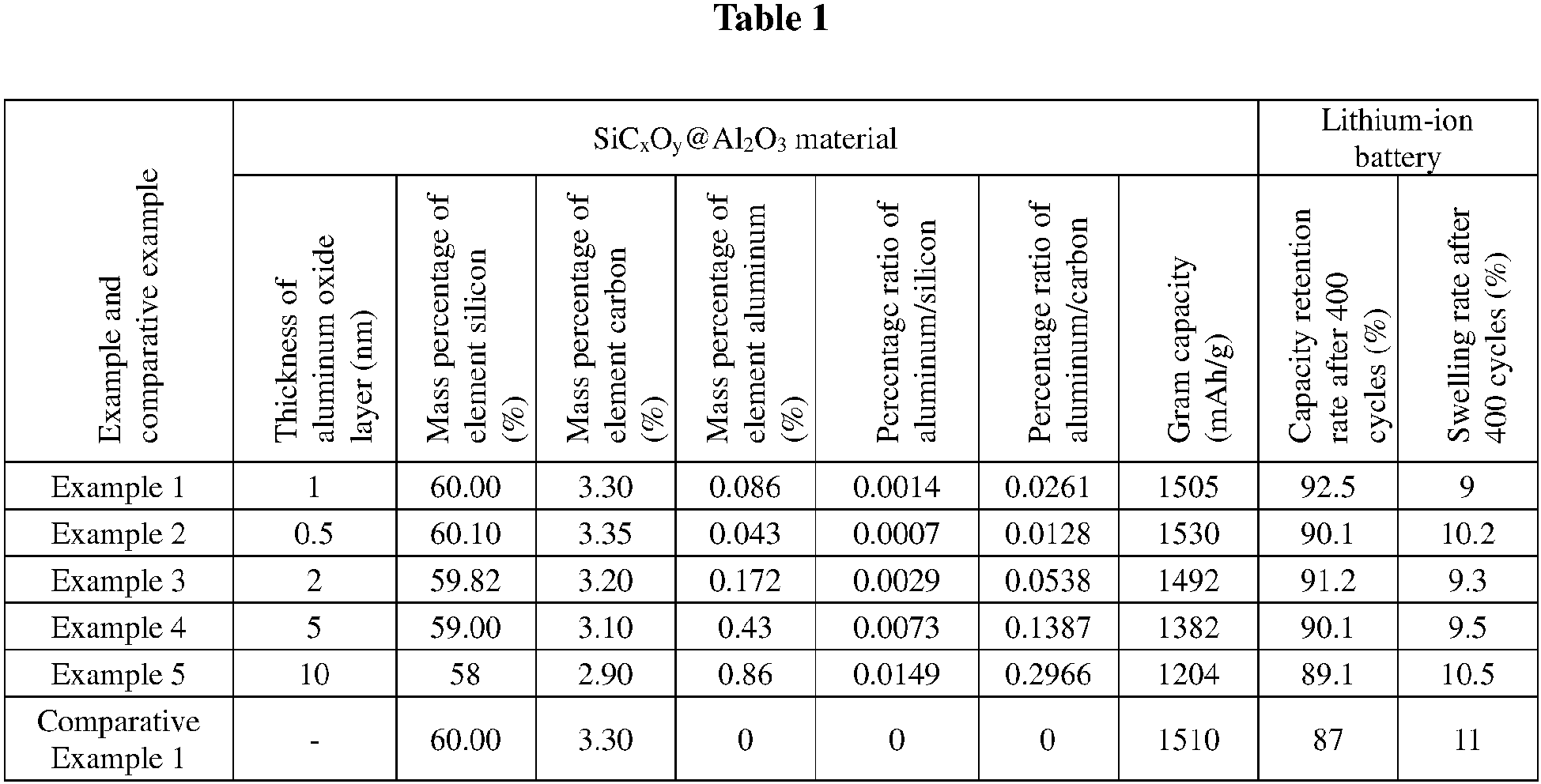
- It can be learned from the data in table 1 that as the thickness of the Al2O3 layer decreases, the percentage of Al decreases, the ionic conductivity of the interface is improved, and the gram capacity of the SiCxOy@Al2O3 material slightly increases. However, a thinner Al2O3 layer has weakened effect in resisting corrosion by HF, leading to decreased capacity retention rate and increased swelling rate of the lithium-ion battery. As the thickness of the Al2O3 layer increases, the percentage of Al increases, the ionic conductivity of the interface deteriorates, and the gram capacity of the SiCxOy@Al2O3 material decreases. In addition, an excessively thick Al2O3 layer leads to an increase in the amount of H2O produced in the reaction of Al2O3 and HF, causing the electrolyte to decompose faster to produce more HF. As a result, the interface cannot be effectively protected, thereby leading to decreased capacity retention rate and increased swelling rate of the lithium-ion battery.
- Table 2 shows the influence of the roasting temperature and time in
step 6 of the method for preparing negative electrode active material on the performance of the negative electrode active material obtained and the lithium-ion battery containing the negative electrode active material. - The thickness of the aluminum oxide layer of the SiCxOy@Al2O3 material in Examples 6 to 10 was 1 nm, x was 0.015, and y was 0.95. Dv50 of SiCxOy all was 5.7 µm, the ratio Dn10/Dv50 was 0.49, I2/I1 was 0.78, and BET was 1.78 m2/g.


- It can be learned from the data in table 2 that if the roasting temperature decreases, bond energy between Al-O weakens, and the stability of Al2O3 on the surface deteriorates, causing the protective effect of Al2O3 on the interface to deteriorate, thereby leading to decreased capacity retention rate and increased swelling rate of the lithium-ion battery. If the roasting temperature increases, bond energy between Si-O strengthens, and a crystallization phenomenon occurs, causing uneven stress distribution during cycling. This leads to formation of more new interfaces, thereby leading to decreased capacity retention rate and increased swelling rate of the lithium-ion battery.
- If the roasting time is too short, Al-O bond strength is low, bonding is insufficient, the stability of Al2O3 on the surface deteriorates, causing the protective effect of the Al2O3 on the interface to deteriorate, thereby leading to decreased capacity retention rate and increased swelling rate of the lithium-ion battery. If the roasting time is too long, silicate phases become more, bond strength of Si-Si bonds decreases, and bond strength of Si-O bonds increases, causing the structural stability of the SiCxOy@Al2O3 material to deteriorate, thereby leading to decreased capacity retention rate and increased swelling rate of the lithium-ion battery.
- Table 3 shows the influence of the values of x and y in the negative electrode active material on the performance of the negative electrode active material and the lithium-ion battery containing the negative electrode active material.
- The roasting temperature during preparation of the SiCxOy@Al2O3 material in Examples 11 and 12 was 600°C, and the roasting time was 3 h.
- The thickness of the aluminum oxide layer of the SiCxOy@Al2O3 material in Examples 11 and 12 was 1 nm. Dv50 of SiCxOy all was 5.7 µm, the ratio Dn10/Dv50 was 0.49, I2/I1 was 0.78, and BET was 1.78 m2/g.

- It can be learned from the data in table 3 that as the value of x increases, the percentage of carbon in the SiCxOy@Al2O3 material increases, and the percentage of active silicon thereof decreases, causing the gram capacity of the SiCxOy@Al2O3 material to decrease, and the lithium-ion battery with the same capacity design to have decreased cycling capacity retention rate and increased swelling rate. As the value of x decreases, the percentage of carbon in the SiCxOy@Al2O3 material decreases, and the percentage of active silicon thereof increases. Although the gram capacity of the SiCxOy@Al2O3 material increases, the structural stability thereof deteriorates, and the lithium-ion battery with the same capacity design has decreased cycling capacity retention rate and increased swelling rate.
- Although some example embodiments of this application have been illustrated and described, this application is not limited to the disclosed embodiments. On the contrary, persons of ordinary skill in the art will recognize that some modifications and changes can be made to some embodiments without departing from the spirit and scope of this application described in the appended claims.
Claims (10)
- A negative electrode active material, comprising carbon-silicon-oxygen particles and an aluminum oxide layer located on a surface of the carbon-silicon-oxygen particles, wherein the carbon-silicon-oxygen particles are represented by SiCxOy, 0<x<0.04, and 0.8<y<1.2.
- The negative electrode active material according to claim 1, wherein 0.01≤x≤0.035, and 0.85≤y≤1.0.
- The negative electrode active material according to claim 1, wherein thickness of the aluminum oxide layer is 0.5 nm to 10 nm.
- The negative electrode active material according to claim 1, wherein the negative electrode active material satisfies at least one of the following conditions (a) to (c):(a) based on mass of the negative electrode active material, a percentage of element silicon is a%, wherein 45≤a≤70;(b) based on mass of the negative electrode active material, a percentage of element carbon is b%, wherein 0.9≤b≤11; or(c) based on mass of the negative electrode active material, a percentage of element aluminum is c%, wherein 0.04≤c≤1.0.
- The negative electrode active material according to claim 1, wherein based on mass of the negative electrode active material, a percentage of element silicon is a%, and a percentage of element aluminum is c%, wherein 0.001≤c/a≤0.015; and/or a percentage of element carbon is b%, and a percentage of element aluminum is c%, wherein 0.008≤c/b≤0.30.
- The negative electrode active material according to claim 1, wherein the negative electrode active material satisfies at least one of the following conditions (d) to (h):(d) Dv50 of the carbon-silicon-oxygen particles ranges from 2.5 µm to 10 µm;(e) particle size distribution of the carbon-silicon-oxygen particles satisfies 0.3≤Dn10/Dv50≤0.6;(f) in an X-ray diffraction pattern of the carbon-silicon-oxygen particles, a highest intensity value at 2θ of 28.0° to 29.0° is I2, and a highest intensity value at 2θ of 20.5° to 21.5° is I1, wherein 0<I2/I1≤1;(g) specific surface area of the carbon-silicon-oxygen particles is 1 m2/g to 50 m2/g; or(h) powder conductivity of the negative electrode active material is 2.0 S/cm to 30 S/cm.
- The negative electrode active material according to claim 1, wherein a method for preparing the negative electrode active material comprises: making a carbon-silicon-oxygen material and an aluminum source undergo a deposition reaction to obtain a reaction product; and roasting the reaction product, wherein a roasting temperature is 300°C to 800°C and/or a roasting time is 1 h to 5 h.
- An electrochemical apparatus, comprising a negative electrode, wherein the negative electrode comprises the negative electrode active material according to any one of claims 1 to 7.
- The electrochemical apparatus according to claim 8, wherein sheet resistance of the negative electrode is 0.2 S2 to 1 S2.
- An electronic apparatus, comprising the electrochemical apparatus according to claim 8 or 9.
Applications Claiming Priority (1)
| Application Number | Priority Date | Filing Date | Title |
|---|---|---|---|
| PCT/CN2021/127966 WO2023070668A1 (en) | 2021-11-01 | 2021-11-01 | Negative electrode active material, electrochemical device, and electronic device |
Publications (2)
| Publication Number | Publication Date |
|---|---|
| EP4425612A1 true EP4425612A1 (en) | 2024-09-04 |
| EP4425612A4 EP4425612A4 (en) | 2025-03-12 |
Family
ID=83405428
Family Applications (1)
| Application Number | Title | Priority Date | Filing Date |
|---|---|---|---|
| EP21962018.4A Pending EP4425612A4 (en) | 2021-11-01 | 2021-11-01 | Negative electrode active material, electrochemical device and electronic device |
Country Status (7)
| Country | Link |
|---|---|
| US (1) | US20240282974A1 (en) |
| EP (1) | EP4425612A4 (en) |
| JP (1) | JP2024539355A (en) |
| KR (1) | KR20240074871A (en) |
| CN (1) | CN115152055A (en) |
| AU (1) | AU2021471323B2 (en) |
| WO (1) | WO2023070668A1 (en) |
Family Cites Families (12)
| Publication number | Priority date | Publication date | Assignee | Title |
|---|---|---|---|---|
| CN102122708A (en) * | 2010-01-08 | 2011-07-13 | 中国科学院物理研究所 | Negative pole material for lithium-ion secondary battery, negative pole containing negative pole material, preparation method of negative pole and battery containing negative pole |
| JP6079651B2 (en) * | 2014-01-15 | 2017-02-15 | 信越化学工業株式会社 | Method for producing negative electrode material for non-aqueous electrolyte secondary battery |
| KR20150098453A (en) * | 2014-02-20 | 2015-08-28 | 주식회사 엘지화학 | Surface coated porous silicon based anode active material, preparation method thereof, and lithium secondary battery comprising the same |
| KR102192087B1 (en) * | 2014-02-26 | 2020-12-16 | 삼성전자주식회사 | Anode active material, lithium battery comprising the same, and preparation method thereof |
| JP2016048673A (en) * | 2014-08-26 | 2016-04-07 | 三菱化学株式会社 | Nonaqueous electrolyte secondary battery |
| CN108807855A (en) * | 2018-06-19 | 2018-11-13 | 武汉艾特米克超能新材料科技有限公司 | A kind of method for coating and battery of negative material |
| CN109950515A (en) * | 2019-04-23 | 2019-06-28 | 清华大学 | A kind of Silicon Based Anode Materials for Lithium-Ion Batteries and preparation method thereof |
| CN110911636B (en) * | 2019-11-14 | 2021-08-31 | 宁德新能源科技有限公司 | Anode material and electrochemical device and electronic device including the same |
| CN111029543B (en) * | 2019-11-28 | 2022-02-15 | 宁德新能源科技有限公司 | Negative electrode material, and electrochemical device and electronic device comprising same |
| WO2022205100A1 (en) * | 2021-03-31 | 2022-10-06 | 宁德新能源科技有限公司 | Negative electrode active material, and electrochemical device and electronic device having same |
| CN113258051B (en) * | 2021-05-13 | 2022-07-29 | 溧阳天目先导电池材料科技有限公司 | A uniformly modified silicon oxide negative electrode material, preparation method and application thereof |
| CN113506861B (en) * | 2021-09-06 | 2022-05-17 | 北京壹金新能源科技有限公司 | A lithium-ion battery silicon-based composite negative electrode material and preparation method thereof |
-
2021
- 2021-11-01 CN CN202180016311.5A patent/CN115152055A/en active Pending
- 2021-11-01 AU AU2021471323A patent/AU2021471323B2/en active Active
- 2021-11-01 JP JP2024525747A patent/JP2024539355A/en active Pending
- 2021-11-01 WO PCT/CN2021/127966 patent/WO2023070668A1/en not_active Ceased
- 2021-11-01 KR KR1020247015469A patent/KR20240074871A/en active Pending
- 2021-11-01 EP EP21962018.4A patent/EP4425612A4/en active Pending
-
2024
- 2024-04-30 US US18/650,640 patent/US20240282974A1/en active Pending
Also Published As
| Publication number | Publication date |
|---|---|
| WO2023070668A1 (en) | 2023-05-04 |
| EP4425612A4 (en) | 2025-03-12 |
| AU2021471323A1 (en) | 2024-06-13 |
| US20240282974A1 (en) | 2024-08-22 |
| CN115152055A (en) | 2022-10-04 |
| AU2021471323B2 (en) | 2026-03-19 |
| KR20240074871A (en) | 2024-05-28 |
| JP2024539355A (en) | 2024-10-28 |
Similar Documents
| Publication | Publication Date | Title |
|---|---|---|
| CN111029543B (en) | Negative electrode material, and electrochemical device and electronic device comprising same | |
| EP4123760A1 (en) | Negative electrode active material, electrochemical device using same, and electronic apparatus | |
| KR102132878B1 (en) | Positive electrode active material for lithium secondary battery, preparing method of the same, positive electrode and lithium secondary battery including the same | |
| KR102909157B1 (en) | Electrochemical devices and electronic devices | |
| EP3968415B1 (en) | Negative electrode active material and electrochemical device and electronic device using same | |
| EP4084133B1 (en) | Negative electrode material and electrochemical device and electronic device containing same | |
| JP7432608B2 (en) | Positive electrode piece, electrochemical device and electronic device including the positive electrode piece | |
| CN111146428B (en) | Negative electrode and electrochemical device and electronic device including the same | |
| EP2677570B1 (en) | Non-aqueous electrolyte secondary battery | |
| EP4318647A1 (en) | Negative electrode, electrochemical device comprising negative electrode, and electronic device | |
| EP4318659A1 (en) | Positive electrode active material, electrochemical device using positive electrode active material, and electronic device | |
| JP5783029B2 (en) | Negative electrode for non-aqueous electrolyte secondary battery, method for producing the same, and non-aqueous electrolyte secondary battery | |
| CN116802841A (en) | Cathode materials, electrochemical devices and electronic devices | |
| EP4607603A1 (en) | Silicon-carbon particle and preparation method thereof, electrochemical apparatus, and electronic apparatus | |
| WO2025209064A1 (en) | Positive electrode material, electrochemical device, and electronic device | |
| JP7206379B2 (en) | Negative electrode material and electrochemical device and electronic equipment containing the same | |
| EP4394969A1 (en) | Electrochemical apparatus and electronic apparatus including same | |
| KR20260047528A (en) | Silicon-carbon composite materials, its manufacturing methods, and applications | |
| KR102867402B1 (en) | Positive electrode active material powder, positive electrode comprising the same and lithium secondary battery | |
| JP7715845B2 (en) | Electrochemical device and electronic device including said electrochemical device | |
| EP4489103A1 (en) | Electrochemical device and electronic device comprising same | |
| CN118867229B (en) | A positive electrode active material, a secondary battery, and an electrical device. | |
| EP4471904A1 (en) | Secondary battery and electronic apparatus | |
| US10944098B2 (en) | Negative electrode active material particle, negative electrode, lithium-ion secondary battery, and production method of negative electrode active material particle | |
| US20240282974A1 (en) | Negative electrode active material, electrochemical apparatus, and electronic apparatus |
Legal Events
| Date | Code | Title | Description |
|---|---|---|---|
| STAA | Information on the status of an ep patent application or granted ep patent |
Free format text: STATUS: THE INTERNATIONAL PUBLICATION HAS BEEN MADE |
|
| PUAI | Public reference made under article 153(3) epc to a published international application that has entered the european phase |
Free format text: ORIGINAL CODE: 0009012 |
|
| STAA | Information on the status of an ep patent application or granted ep patent |
Free format text: STATUS: REQUEST FOR EXAMINATION WAS MADE |
|
| 17P | Request for examination filed |
Effective date: 20240530 |
|
| AK | Designated contracting states |
Kind code of ref document: A1 Designated state(s): AL AT BE BG CH CY CZ DE DK EE ES FI FR GB GR HR HU IE IS IT LI LT LU LV MC MK MT NL NO PL PT RO RS SE SI SK SM TR |
|
| DAV | Request for validation of the european patent (deleted) | ||
| DAX | Request for extension of the european patent (deleted) | ||
| A4 | Supplementary search report drawn up and despatched |
Effective date: 20250210 |
|
| RIC1 | Information provided on ipc code assigned before grant |
Ipc: H01M 4/62 20060101ALI20250204BHEP Ipc: H01M 4/48 20100101AFI20250204BHEP |