EP4425596A1 - Positive plate and lithium-ion secondary battery including same - Google Patents
Positive plate and lithium-ion secondary battery including same Download PDFInfo
- Publication number
- EP4425596A1 EP4425596A1 EP21962114.1A EP21962114A EP4425596A1 EP 4425596 A1 EP4425596 A1 EP 4425596A1 EP 21962114 A EP21962114 A EP 21962114A EP 4425596 A1 EP4425596 A1 EP 4425596A1
- Authority
- EP
- European Patent Office
- Prior art keywords
- positive electrode
- electrode plate
- sub
- lithium
- active material
- Prior art date
- Legal status (The legal status is an assumption and is not a legal conclusion. Google has not performed a legal analysis and makes no representation as to the accuracy of the status listed.)
- Pending
Links
- HBBGRARXTFLTSG-UHFFFAOYSA-N Lithium ion Chemical compound [Li+] HBBGRARXTFLTSG-UHFFFAOYSA-N 0.000 title claims abstract description 54
- 229910001416 lithium ion Inorganic materials 0.000 title claims abstract description 54
- 239000007774 positive electrode material Substances 0.000 claims abstract description 71
- 239000000463 material Substances 0.000 claims abstract description 53
- 238000006138 lithiation reaction Methods 0.000 claims abstract description 49
- 239000003792 electrolyte Substances 0.000 claims description 28
- VAYTZRYEBVHVLE-UHFFFAOYSA-N 1,3-dioxol-2-one Chemical compound O=C1OC=CO1 VAYTZRYEBVHVLE-UHFFFAOYSA-N 0.000 claims description 15
- FSSPGSAQUIYDCN-UHFFFAOYSA-N 1,3-Propane sultone Chemical compound O=S1(=O)CCCO1 FSSPGSAQUIYDCN-UHFFFAOYSA-N 0.000 claims description 13
- 229910052782 aluminium Inorganic materials 0.000 claims description 9
- 229910052759 nickel Inorganic materials 0.000 claims description 8
- 229910052719 titanium Inorganic materials 0.000 claims description 8
- 229910052742 iron Inorganic materials 0.000 claims description 7
- 229910052749 magnesium Inorganic materials 0.000 claims description 6
- 229910052717 sulfur Inorganic materials 0.000 claims description 6
- 229910052725 zinc Inorganic materials 0.000 claims description 6
- 239000000470 constituent Substances 0.000 claims description 4
- 229910052796 boron Inorganic materials 0.000 claims description 3
- 229910052804 chromium Inorganic materials 0.000 claims description 3
- 229910052720 vanadium Inorganic materials 0.000 claims description 3
- 229910052726 zirconium Inorganic materials 0.000 claims description 3
- 229910052744 lithium Inorganic materials 0.000 abstract description 25
- WHXSMMKQMYFTQS-UHFFFAOYSA-N Lithium Chemical compound [Li] WHXSMMKQMYFTQS-UHFFFAOYSA-N 0.000 abstract description 19
- 229910002097 Lithium manganese(III,IV) oxide Inorganic materials 0.000 description 34
- 229910002993 LiMnO2 Inorganic materials 0.000 description 33
- 230000000052 comparative effect Effects 0.000 description 30
- 239000010410 layer Substances 0.000 description 21
- 230000001351 cycling effect Effects 0.000 description 18
- 239000000654 additive Substances 0.000 description 12
- 239000011230 binding agent Substances 0.000 description 12
- OKTJSMMVPCPJKN-UHFFFAOYSA-N Carbon Chemical compound [C] OKTJSMMVPCPJKN-UHFFFAOYSA-N 0.000 description 11
- 238000000034 method Methods 0.000 description 11
- PXHVJJICTQNCMI-UHFFFAOYSA-N nickel Substances [Ni] PXHVJJICTQNCMI-UHFFFAOYSA-N 0.000 description 11
- 239000002033 PVDF binder Substances 0.000 description 10
- -1 alkyl lithium Chemical compound 0.000 description 10
- 229920002981 polyvinylidene fluoride Polymers 0.000 description 10
- VNWKTOKETHGBQD-UHFFFAOYSA-N methane Chemical compound C VNWKTOKETHGBQD-UHFFFAOYSA-N 0.000 description 9
- 239000007773 negative electrode material Substances 0.000 description 9
- 239000003960 organic solvent Substances 0.000 description 9
- 230000000996 additive effect Effects 0.000 description 8
- 239000006258 conductive agent Substances 0.000 description 8
- XEEYBQQBJWHFJM-UHFFFAOYSA-N iron Substances [Fe] XEEYBQQBJWHFJM-UHFFFAOYSA-N 0.000 description 8
- 238000002360 preparation method Methods 0.000 description 8
- 239000010936 titanium Substances 0.000 description 8
- 229910052751 metal Inorganic materials 0.000 description 7
- 239000002184 metal Substances 0.000 description 7
- XEKOWRVHYACXOJ-UHFFFAOYSA-N Ethyl acetate Chemical compound CCOC(C)=O XEKOWRVHYACXOJ-UHFFFAOYSA-N 0.000 description 6
- 230000015572 biosynthetic process Effects 0.000 description 6
- 239000011267 electrode slurry Substances 0.000 description 6
- 239000011888 foil Substances 0.000 description 6
- 229910003002 lithium salt Inorganic materials 0.000 description 6
- 159000000002 lithium salts Chemical class 0.000 description 6
- 239000002002 slurry Substances 0.000 description 6
- XLYOFNOQVPJJNP-UHFFFAOYSA-N water Substances O XLYOFNOQVPJJNP-UHFFFAOYSA-N 0.000 description 6
- 239000004743 Polypropylene Substances 0.000 description 5
- 229920001155 polypropylene Polymers 0.000 description 5
- 239000000843 powder Substances 0.000 description 5
- 239000002904 solvent Substances 0.000 description 5
- 239000002562 thickening agent Substances 0.000 description 5
- 239000004925 Acrylic resin Substances 0.000 description 4
- 229920000178 Acrylic resin Polymers 0.000 description 4
- 229920002134 Carboxymethyl cellulose Polymers 0.000 description 4
- RYGMFSIKBFXOCR-UHFFFAOYSA-N Copper Chemical compound [Cu] RYGMFSIKBFXOCR-UHFFFAOYSA-N 0.000 description 4
- OIFBSDVPJOWBCH-UHFFFAOYSA-N Diethyl carbonate Chemical compound CCOC(=O)OCC OIFBSDVPJOWBCH-UHFFFAOYSA-N 0.000 description 4
- KMTRUDSVKNLOMY-UHFFFAOYSA-N Ethylene carbonate Chemical compound O=C1OCCO1 KMTRUDSVKNLOMY-UHFFFAOYSA-N 0.000 description 4
- 229910045601 alloy Inorganic materials 0.000 description 4
- 239000000956 alloy Substances 0.000 description 4
- JBTWLSYIZRCDFO-UHFFFAOYSA-N ethyl methyl carbonate Chemical compound CCOC(=O)OC JBTWLSYIZRCDFO-UHFFFAOYSA-N 0.000 description 4
- FKRCODPIKNYEAC-UHFFFAOYSA-N ethyl propionate Chemical compound CCOC(=O)CC FKRCODPIKNYEAC-UHFFFAOYSA-N 0.000 description 4
- 239000011777 magnesium Substances 0.000 description 4
- TZIHFWKZFHZASV-UHFFFAOYSA-N methyl formate Chemical compound COC=O TZIHFWKZFHZASV-UHFFFAOYSA-N 0.000 description 4
- 229920002037 poly(vinyl butyral) polymer Polymers 0.000 description 4
- 229920001343 polytetrafluoroethylene Polymers 0.000 description 4
- 239000004810 polytetrafluoroethylene Substances 0.000 description 4
- 238000003825 pressing Methods 0.000 description 4
- 239000000243 solution Substances 0.000 description 4
- 230000002195 synergetic effect Effects 0.000 description 4
- 239000011701 zinc Substances 0.000 description 4
- 229910001290 LiPF6 Inorganic materials 0.000 description 3
- SECXISVLQFMRJM-UHFFFAOYSA-N N-Methylpyrrolidone Chemical compound CN1CCCC1=O SECXISVLQFMRJM-UHFFFAOYSA-N 0.000 description 3
- RTAQQCXQSZGOHL-UHFFFAOYSA-N Titanium Chemical compound [Ti] RTAQQCXQSZGOHL-UHFFFAOYSA-N 0.000 description 3
- XAGFODPZIPBFFR-UHFFFAOYSA-N aluminium Chemical compound [Al] XAGFODPZIPBFFR-UHFFFAOYSA-N 0.000 description 3
- 238000007796 conventional method Methods 0.000 description 3
- 238000013461 design Methods 0.000 description 3
- 238000007599 discharging Methods 0.000 description 3
- 238000001035 drying Methods 0.000 description 3
- 229910002804 graphite Inorganic materials 0.000 description 3
- 239000010439 graphite Substances 0.000 description 3
- 239000007788 liquid Substances 0.000 description 3
- 239000000203 mixture Substances 0.000 description 3
- 230000008569 process Effects 0.000 description 3
- 229920003048 styrene butadiene rubber Polymers 0.000 description 3
- XOLBLPGZBRYERU-UHFFFAOYSA-N tin dioxide Chemical compound O=[Sn]=O XOLBLPGZBRYERU-UHFFFAOYSA-N 0.000 description 3
- ZZXUZKXVROWEIF-UHFFFAOYSA-N 1,2-butylene carbonate Chemical compound CCC1COC(=O)O1 ZZXUZKXVROWEIF-UHFFFAOYSA-N 0.000 description 2
- HNAGHMKIPMKKBB-UHFFFAOYSA-N 1-benzylpyrrolidine-3-carboxamide Chemical compound C1C(C(=O)N)CCN1CC1=CC=CC=C1 HNAGHMKIPMKKBB-UHFFFAOYSA-N 0.000 description 2
- BJWMSGRKJIOCNR-UHFFFAOYSA-N 4-ethenyl-1,3-dioxolan-2-one Chemical compound C=CC1COC(=O)O1 BJWMSGRKJIOCNR-UHFFFAOYSA-N 0.000 description 2
- SBLRHMKNNHXPHG-UHFFFAOYSA-N 4-fluoro-1,3-dioxolan-2-one Chemical compound FC1COC(=O)O1 SBLRHMKNNHXPHG-UHFFFAOYSA-N 0.000 description 2
- BTBUEUYNUDRHOZ-UHFFFAOYSA-N Borate Chemical compound [O-]B([O-])[O-] BTBUEUYNUDRHOZ-UHFFFAOYSA-N 0.000 description 2
- 239000002000 Electrolyte additive Substances 0.000 description 2
- PLUBXMRUUVWRLT-UHFFFAOYSA-N Ethyl methanesulfonate Chemical compound CCOS(C)(=O)=O PLUBXMRUUVWRLT-UHFFFAOYSA-N 0.000 description 2
- JGFBQFKZKSSODQ-UHFFFAOYSA-N Isothiocyanatocyclopropane Chemical compound S=C=NC1CC1 JGFBQFKZKSSODQ-UHFFFAOYSA-N 0.000 description 2
- RJUFJBKOKNCXHH-UHFFFAOYSA-N Methyl propionate Chemical compound CCC(=O)OC RJUFJBKOKNCXHH-UHFFFAOYSA-N 0.000 description 2
- 229910019142 PO4 Inorganic materials 0.000 description 2
- 239000004698 Polyethylene Substances 0.000 description 2
- 239000004372 Polyvinyl alcohol Substances 0.000 description 2
- XBDQKXXYIPTUBI-UHFFFAOYSA-M Propionate Chemical compound CCC([O-])=O XBDQKXXYIPTUBI-UHFFFAOYSA-M 0.000 description 2
- KXKVLQRXCPHEJC-UHFFFAOYSA-N acetic acid trimethyl ester Natural products COC(C)=O KXKVLQRXCPHEJC-UHFFFAOYSA-N 0.000 description 2
- 239000006230 acetylene black Substances 0.000 description 2
- 239000013543 active substance Substances 0.000 description 2
- 229910021383 artificial graphite Inorganic materials 0.000 description 2
- OBNCKNCVKJNDBV-UHFFFAOYSA-N butanoic acid ethyl ester Natural products CCCC(=O)OCC OBNCKNCVKJNDBV-UHFFFAOYSA-N 0.000 description 2
- PWLNAUNEAKQYLH-UHFFFAOYSA-N butyric acid octyl ester Natural products CCCCCCCCOC(=O)CCC PWLNAUNEAKQYLH-UHFFFAOYSA-N 0.000 description 2
- 238000004364 calculation method Methods 0.000 description 2
- 229910052799 carbon Inorganic materials 0.000 description 2
- 239000006229 carbon black Substances 0.000 description 2
- 239000002134 carbon nanofiber Substances 0.000 description 2
- 229910021393 carbon nanotube Inorganic materials 0.000 description 2
- 239000002041 carbon nanotube Substances 0.000 description 2
- 239000001768 carboxy methyl cellulose Substances 0.000 description 2
- 229910052802 copper Inorganic materials 0.000 description 2
- 239000010949 copper Substances 0.000 description 2
- 239000011889 copper foil Substances 0.000 description 2
- 238000005520 cutting process Methods 0.000 description 2
- 238000000354 decomposition reaction Methods 0.000 description 2
- 230000003247 decreasing effect Effects 0.000 description 2
- 239000008367 deionised water Substances 0.000 description 2
- 229910021641 deionized water Inorganic materials 0.000 description 2
- VUPKGFBOKBGHFZ-UHFFFAOYSA-N dipropyl carbonate Chemical compound CCCOC(=O)OCCC VUPKGFBOKBGHFZ-UHFFFAOYSA-N 0.000 description 2
- CYEDOLFRAIXARV-UHFFFAOYSA-N ethyl propyl carbonate Chemical compound CCCOC(=O)OCC CYEDOLFRAIXARV-UHFFFAOYSA-N 0.000 description 2
- 239000005038 ethylene vinyl acetate Substances 0.000 description 2
- 229910021389 graphene Inorganic materials 0.000 description 2
- 239000003273 ketjen black Substances 0.000 description 2
- 229910003473 lithium bis(trifluoromethanesulfonyl)imide Inorganic materials 0.000 description 2
- MHCFAGZWMAWTNR-UHFFFAOYSA-M lithium perchlorate Chemical compound [Li+].[O-]Cl(=O)(=O)=O MHCFAGZWMAWTNR-UHFFFAOYSA-M 0.000 description 2
- 229910001486 lithium perchlorate Inorganic materials 0.000 description 2
- 229910001496 lithium tetrafluoroborate Inorganic materials 0.000 description 2
- VDVLPSWVDYJFRW-UHFFFAOYSA-N lithium;bis(fluorosulfonyl)azanide Chemical compound [Li+].FS(=O)(=O)[N-]S(F)(=O)=O VDVLPSWVDYJFRW-UHFFFAOYSA-N 0.000 description 2
- QSZMZKBZAYQGRS-UHFFFAOYSA-N lithium;bis(trifluoromethylsulfonyl)azanide Chemical compound [Li+].FC(F)(F)S(=O)(=O)[N-]S(=O)(=O)C(F)(F)F QSZMZKBZAYQGRS-UHFFFAOYSA-N 0.000 description 2
- MCVFFRWZNYZUIJ-UHFFFAOYSA-M lithium;trifluoromethanesulfonate Chemical compound [Li+].[O-]S(=O)(=O)C(F)(F)F MCVFFRWZNYZUIJ-UHFFFAOYSA-M 0.000 description 2
- 239000002931 mesocarbon microbead Substances 0.000 description 2
- 229940017219 methyl propionate Drugs 0.000 description 2
- KKQAVHGECIBFRQ-UHFFFAOYSA-N methyl propyl carbonate Chemical compound CCCOC(=O)OC KKQAVHGECIBFRQ-UHFFFAOYSA-N 0.000 description 2
- 229940016409 methylsulfonylmethane Drugs 0.000 description 2
- YKYONYBAUNKHLG-UHFFFAOYSA-N n-Propyl acetate Natural products CCCOC(C)=O YKYONYBAUNKHLG-UHFFFAOYSA-N 0.000 description 2
- UUIQMZJEGPQKFD-UHFFFAOYSA-N n-butyric acid methyl ester Natural products CCCC(=O)OC UUIQMZJEGPQKFD-UHFFFAOYSA-N 0.000 description 2
- 238000011056 performance test Methods 0.000 description 2
- NBIIXXVUZAFLBC-UHFFFAOYSA-K phosphate Chemical compound [O-]P([O-])([O-])=O NBIIXXVUZAFLBC-UHFFFAOYSA-K 0.000 description 2
- 239000010452 phosphate Substances 0.000 description 2
- 229920001200 poly(ethylene-vinyl acetate) Polymers 0.000 description 2
- 229920000573 polyethylene Polymers 0.000 description 2
- 229920002451 polyvinyl alcohol Polymers 0.000 description 2
- 229940090181 propyl acetate Drugs 0.000 description 2
- RUOJZAUFBMNUDX-UHFFFAOYSA-N propylene carbonate Chemical compound CC1COC(=O)O1 RUOJZAUFBMNUDX-UHFFFAOYSA-N 0.000 description 2
- 239000011241 protective layer Substances 0.000 description 2
- 238000011160 research Methods 0.000 description 2
- 239000000523 sample Substances 0.000 description 2
- 238000000926 separation method Methods 0.000 description 2
- 229910052710 silicon Inorganic materials 0.000 description 2
- 239000010703 silicon Substances 0.000 description 2
- IAHFWCOBPZCAEA-UHFFFAOYSA-N succinonitrile Chemical compound N#CCCC#N IAHFWCOBPZCAEA-UHFFFAOYSA-N 0.000 description 2
- HXJUTPCZVOIRIF-UHFFFAOYSA-N sulfolane Chemical compound O=S1(=O)CCCC1 HXJUTPCZVOIRIF-UHFFFAOYSA-N 0.000 description 2
- HHVIBTZHLRERCL-UHFFFAOYSA-N sulfonyldimethane Chemical compound CS(C)(=O)=O HHVIBTZHLRERCL-UHFFFAOYSA-N 0.000 description 2
- NQPDZGIKBAWPEJ-UHFFFAOYSA-N valeric acid Chemical compound CCCCC(O)=O NQPDZGIKBAWPEJ-UHFFFAOYSA-N 0.000 description 2
- MBDUIEKYVPVZJH-UHFFFAOYSA-N 1-ethylsulfonylethane Chemical compound CCS(=O)(=O)CC MBDUIEKYVPVZJH-UHFFFAOYSA-N 0.000 description 1
- UHOPWFKONJYLCF-UHFFFAOYSA-N 2-(2-sulfanylethyl)isoindole-1,3-dione Chemical compound C1=CC=C2C(=O)N(CCS)C(=O)C2=C1 UHOPWFKONJYLCF-UHFFFAOYSA-N 0.000 description 1
- IFDLFCDWOFLKEB-UHFFFAOYSA-N 2-methylbutylbenzene Chemical compound CCC(C)CC1=CC=CC=C1 IFDLFCDWOFLKEB-UHFFFAOYSA-N 0.000 description 1
- YEJRWHAVMIAJKC-UHFFFAOYSA-N 4-Butyrolactone Chemical compound O=C1CCCO1 YEJRWHAVMIAJKC-UHFFFAOYSA-N 0.000 description 1
- 229910001148 Al-Li alloy Inorganic materials 0.000 description 1
- 229910000967 As alloy Inorganic materials 0.000 description 1
- 229910008365 Li-Sn Inorganic materials 0.000 description 1
- 229910008410 Li-Sn-O Inorganic materials 0.000 description 1
- 229910008722 Li2NiO2 Inorganic materials 0.000 description 1
- 229910002986 Li4Ti5O12 Inorganic materials 0.000 description 1
- 229910013188 LiBOB Inorganic materials 0.000 description 1
- 229910010941 LiFSI Inorganic materials 0.000 description 1
- 229910014356 LiMn1.8Ni0.2O4 Inorganic materials 0.000 description 1
- 229910014143 LiMn2 Inorganic materials 0.000 description 1
- 229910012265 LiPO2F2 Inorganic materials 0.000 description 1
- 229910006759 Li—Sn Inorganic materials 0.000 description 1
- 229910006763 Li—Sn—O Inorganic materials 0.000 description 1
- VYPSYNLAJGMNEJ-UHFFFAOYSA-N Silicium dioxide Chemical compound O=[Si]=O VYPSYNLAJGMNEJ-UHFFFAOYSA-N 0.000 description 1
- XUIMIQQOPSSXEZ-UHFFFAOYSA-N Silicon Chemical compound [Si] XUIMIQQOPSSXEZ-UHFFFAOYSA-N 0.000 description 1
- BQCADISMDOOEFD-UHFFFAOYSA-N Silver Chemical compound [Ag] BQCADISMDOOEFD-UHFFFAOYSA-N 0.000 description 1
- 239000002174 Styrene-butadiene Substances 0.000 description 1
- ATJFFYVFTNAWJD-UHFFFAOYSA-N Tin Chemical compound [Sn] ATJFFYVFTNAWJD-UHFFFAOYSA-N 0.000 description 1
- 238000002441 X-ray diffraction Methods 0.000 description 1
- QTJOIXXDCCFVFV-UHFFFAOYSA-N [Li].[O] Chemical class [Li].[O] QTJOIXXDCCFVFV-UHFFFAOYSA-N 0.000 description 1
- DPXJVFZANSGRMM-UHFFFAOYSA-N acetic acid;2,3,4,5,6-pentahydroxyhexanal;sodium Chemical compound [Na].CC(O)=O.OCC(O)C(O)C(O)C(O)C=O DPXJVFZANSGRMM-UHFFFAOYSA-N 0.000 description 1
- 230000009471 action Effects 0.000 description 1
- 239000011149 active material Substances 0.000 description 1
- BTGRAWJCKBQKAO-UHFFFAOYSA-N adiponitrile Chemical compound N#CCCCCC#N BTGRAWJCKBQKAO-UHFFFAOYSA-N 0.000 description 1
- 229910003481 amorphous carbon Inorganic materials 0.000 description 1
- 239000003125 aqueous solvent Substances 0.000 description 1
- QVGXLLKOCUKJST-UHFFFAOYSA-N atomic oxygen Chemical compound [O] QVGXLLKOCUKJST-UHFFFAOYSA-N 0.000 description 1
- 230000009286 beneficial effect Effects 0.000 description 1
- 239000006227 byproduct Substances 0.000 description 1
- 235000010948 carboxy methyl cellulose Nutrition 0.000 description 1
- 239000008112 carboxymethyl-cellulose Substances 0.000 description 1
- 239000003153 chemical reaction reagent Substances 0.000 description 1
- 150000001875 compounds Chemical class 0.000 description 1
- IEJIGPNLZYLLBP-UHFFFAOYSA-N dimethyl carbonate Chemical compound COC(=O)OC IEJIGPNLZYLLBP-UHFFFAOYSA-N 0.000 description 1
- 238000004146 energy storage Methods 0.000 description 1
- 238000005516 engineering process Methods 0.000 description 1
- 238000001879 gelation Methods 0.000 description 1
- 239000003365 glass fiber Substances 0.000 description 1
- 229910021385 hard carbon Inorganic materials 0.000 description 1
- 150000002500 ions Chemical class 0.000 description 1
- 230000002427 irreversible effect Effects 0.000 description 1
- 229910001540 lithium hexafluoroarsenate(V) Inorganic materials 0.000 description 1
- IGILRSKEFZLPKG-UHFFFAOYSA-M lithium;difluorophosphinate Chemical compound [Li+].[O-]P(F)(F)=O IGILRSKEFZLPKG-UHFFFAOYSA-M 0.000 description 1
- 230000014759 maintenance of location Effects 0.000 description 1
- 238000004519 manufacturing process Methods 0.000 description 1
- 238000013508 migration Methods 0.000 description 1
- 230000005012 migration Effects 0.000 description 1
- 238000012986 modification Methods 0.000 description 1
- 230000004048 modification Effects 0.000 description 1
- 229910021382 natural graphite Inorganic materials 0.000 description 1
- 239000004745 nonwoven fabric Substances 0.000 description 1
- 229910052760 oxygen Inorganic materials 0.000 description 1
- 239000001301 oxygen Substances 0.000 description 1
- 238000004806 packaging method and process Methods 0.000 description 1
- 238000003672 processing method Methods 0.000 description 1
- 239000000047 product Substances 0.000 description 1
- 230000009467 reduction Effects 0.000 description 1
- 238000007493 shaping process Methods 0.000 description 1
- LIVNPJMFVYWSIS-UHFFFAOYSA-N silicon monoxide Chemical compound [Si-]#[O+] LIVNPJMFVYWSIS-UHFFFAOYSA-N 0.000 description 1
- 229910052814 silicon oxide Inorganic materials 0.000 description 1
- 239000002153 silicon-carbon composite material Substances 0.000 description 1
- 229910052709 silver Inorganic materials 0.000 description 1
- 239000004332 silver Substances 0.000 description 1
- 239000002356 single layer Substances 0.000 description 1
- 235000019812 sodium carboxymethyl cellulose Nutrition 0.000 description 1
- 229920001027 sodium carboxymethylcellulose Polymers 0.000 description 1
- 229910021384 soft carbon Inorganic materials 0.000 description 1
- 239000007784 solid electrolyte Substances 0.000 description 1
- 230000000087 stabilizing effect Effects 0.000 description 1
- 238000003756 stirring Methods 0.000 description 1
- 239000000126 substance Substances 0.000 description 1
- 238000010998 test method Methods 0.000 description 1
- 238000012360 testing method Methods 0.000 description 1
- 229910001887 tin oxide Inorganic materials 0.000 description 1
- YZYKZHPNRDIPFA-UHFFFAOYSA-N tris(trimethylsilyl) borate Chemical compound C[Si](C)(C)OB(O[Si](C)(C)C)O[Si](C)(C)C YZYKZHPNRDIPFA-UHFFFAOYSA-N 0.000 description 1
- QJMMCGKXBZVAEI-UHFFFAOYSA-N tris(trimethylsilyl) phosphate Chemical compound C[Si](C)(C)OP(=O)(O[Si](C)(C)C)O[Si](C)(C)C QJMMCGKXBZVAEI-UHFFFAOYSA-N 0.000 description 1
Images

Classifications
-
- H—ELECTRICITY
- H01—ELECTRIC ELEMENTS
- H01M—PROCESSES OR MEANS, e.g. BATTERIES, FOR THE DIRECT CONVERSION OF CHEMICAL ENERGY INTO ELECTRICAL ENERGY
- H01M4/00—Electrodes
- H01M4/02—Electrodes composed of, or comprising, active material
- H01M4/36—Selection of substances as active materials, active masses, active liquids
- H01M4/48—Selection of substances as active materials, active masses, active liquids of inorganic oxides or hydroxides
- H01M4/50—Selection of substances as active materials, active masses, active liquids of inorganic oxides or hydroxides of manganese
- H01M4/505—Selection of substances as active materials, active masses, active liquids of inorganic oxides or hydroxides of manganese of mixed oxides or hydroxides containing manganese for inserting or intercalating light metals, e.g. LiMn2O4 or LiMn2OxFy
-
- H—ELECTRICITY
- H01—ELECTRIC ELEMENTS
- H01M—PROCESSES OR MEANS, e.g. BATTERIES, FOR THE DIRECT CONVERSION OF CHEMICAL ENERGY INTO ELECTRICAL ENERGY
- H01M10/00—Secondary cells; Manufacture thereof
- H01M10/05—Accumulators with non-aqueous electrolyte
- H01M10/052—Li-accumulators
- H01M10/0525—Rocking-chair batteries, i.e. batteries with lithium insertion or intercalation in both electrodes; Lithium-ion batteries
-
- H—ELECTRICITY
- H01—ELECTRIC ELEMENTS
- H01M—PROCESSES OR MEANS, e.g. BATTERIES, FOR THE DIRECT CONVERSION OF CHEMICAL ENERGY INTO ELECTRICAL ENERGY
- H01M10/00—Secondary cells; Manufacture thereof
- H01M10/05—Accumulators with non-aqueous electrolyte
- H01M10/056—Accumulators with non-aqueous electrolyte characterised by the materials used as electrolytes, e.g. mixed inorganic/organic electrolytes
- H01M10/0564—Accumulators with non-aqueous electrolyte characterised by the materials used as electrolytes, e.g. mixed inorganic/organic electrolytes the electrolyte being constituted of organic materials only
- H01M10/0566—Liquid materials
- H01M10/0567—Liquid materials characterised by the additives
-
- H—ELECTRICITY
- H01—ELECTRIC ELEMENTS
- H01M—PROCESSES OR MEANS, e.g. BATTERIES, FOR THE DIRECT CONVERSION OF CHEMICAL ENERGY INTO ELECTRICAL ENERGY
- H01M10/00—Secondary cells; Manufacture thereof
- H01M10/42—Methods or arrangements for servicing or maintenance of secondary cells or secondary half-cells
- H01M10/4235—Safety or regulating additives or arrangements in electrodes, separators or electrolyte
-
- H—ELECTRICITY
- H01—ELECTRIC ELEMENTS
- H01M—PROCESSES OR MEANS, e.g. BATTERIES, FOR THE DIRECT CONVERSION OF CHEMICAL ENERGY INTO ELECTRICAL ENERGY
- H01M4/00—Electrodes
- H01M4/02—Electrodes composed of, or comprising, active material
- H01M4/13—Electrodes for accumulators with non-aqueous electrolyte, e.g. for lithium-accumulators; Processes of manufacture thereof
- H01M4/131—Electrodes based on mixed oxides or hydroxides, or on mixtures of oxides or hydroxides, e.g. LiCoOx
-
- H—ELECTRICITY
- H01—ELECTRIC ELEMENTS
- H01M—PROCESSES OR MEANS, e.g. BATTERIES, FOR THE DIRECT CONVERSION OF CHEMICAL ENERGY INTO ELECTRICAL ENERGY
- H01M4/00—Electrodes
- H01M4/02—Electrodes composed of, or comprising, active material
- H01M4/36—Selection of substances as active materials, active masses, active liquids
- H01M4/48—Selection of substances as active materials, active masses, active liquids of inorganic oxides or hydroxides
- H01M4/52—Selection of substances as active materials, active masses, active liquids of inorganic oxides or hydroxides of nickel, cobalt or iron
- H01M4/525—Selection of substances as active materials, active masses, active liquids of inorganic oxides or hydroxides of nickel, cobalt or iron of mixed oxides or hydroxides containing iron, cobalt or nickel for inserting or intercalating light metals, e.g. LiNiO2, LiCoO2 or LiCoOxFy
-
- H—ELECTRICITY
- H01—ELECTRIC ELEMENTS
- H01M—PROCESSES OR MEANS, e.g. BATTERIES, FOR THE DIRECT CONVERSION OF CHEMICAL ENERGY INTO ELECTRICAL ENERGY
- H01M4/00—Electrodes
- H01M4/02—Electrodes composed of, or comprising, active material
- H01M2004/021—Physical characteristics, e.g. porosity, surface area
-
- H—ELECTRICITY
- H01—ELECTRIC ELEMENTS
- H01M—PROCESSES OR MEANS, e.g. BATTERIES, FOR THE DIRECT CONVERSION OF CHEMICAL ENERGY INTO ELECTRICAL ENERGY
- H01M4/00—Electrodes
- H01M4/02—Electrodes composed of, or comprising, active material
- H01M2004/026—Electrodes composed of, or comprising, active material characterised by the polarity
- H01M2004/028—Positive electrodes
-
- Y—GENERAL TAGGING OF NEW TECHNOLOGICAL DEVELOPMENTS; GENERAL TAGGING OF CROSS-SECTIONAL TECHNOLOGIES SPANNING OVER SEVERAL SECTIONS OF THE IPC; TECHNICAL SUBJECTS COVERED BY FORMER USPC CROSS-REFERENCE ART COLLECTIONS [XRACs] AND DIGESTS
- Y02—TECHNOLOGIES OR APPLICATIONS FOR MITIGATION OR ADAPTATION AGAINST CLIMATE CHANGE
- Y02E—REDUCTION OF GREENHOUSE GAS [GHG] EMISSIONS, RELATED TO ENERGY GENERATION, TRANSMISSION OR DISTRIBUTION
- Y02E60/00—Enabling technologies; Technologies with a potential or indirect contribution to GHG emissions mitigation
- Y02E60/10—Energy storage using batteries
Definitions
- This application pertains to the field of battery technologies and relates to a positive electrode plate and a lithium-ion secondary battery containing the same.
- a solid electrolyte interface (SEI) is formed on the surface of a negative electrode, which causes irreversible capacity loss, decreasing the energy density of a lithium-ion energy storage device.
- SEI solid electrolyte interface
- the negative electrode is made of a negative electrode material with high specific capacity such as alloy (silicon, tin, or the like), oxide (silicon oxide or tin oxide), and amorphous carbon, more of the active lithium source is consumed. Therefore, an appropriate lithiation method is of great significance for further increasing the energy density of the lithium-ion secondary battery.
- the patent CN1427490A proposes a negative electrode lithiation method. Specifically, lithium metal powder, a negative electrode material, and a non-aqueous liquid are mixed to form a slurry, and the slurry is applied onto a current collector.
- This method can increase the energy density of a battery but requires extremely strict control of moisture during production, increasing the process difficulty.
- FMC in the United States has made certain improvements to lithium powder and produces stabled lithium metal powder SLMP (stabled lithium metal powder) with better stability. However, such powder can remain stable for only a few hours in dry air, posing great safety hazards. If a wet operation is used, there are also issues in selecting a non-aqueous solvent and controlling moisture.
- the patent CN104037418A discloses a positive electrode lithiation material based on lithium-oxygen compounds, lithium sources, and alkyl lithium.
- the lithium-containing compound therein has a high decomposition potential and produces oxygen and other by-products during decomposition, affecting the service life of the battery.
- the patent CN101877417A discloses a Li 2 NiO 2 lithiation material. Such material has an extremely high content of free lithium on the surface, so the slurry is prone to gelation during slurry preparation, severely affecting the processability, causing continuous increase in impedance, and affecting the cycling performance.
- This application is intended to overcome the shortcomings in the prior art by providing a positive electrode plate and a lithium-ion secondary battery containing the same, so as to allow the lithium-ion secondary battery to have high energy density, good rate performance, and long cycle life while stabilizing a positive electrode plate and simplifying a processing method.
- this application provides a positive electrode plate.
- the positive electrode plate includes a positive electrode current collector and a positive electrode active material layer disposed on at least one surface of the positive electrode current collector, where the positive electrode active material layer includes a first positive electrode active material and a second positive electrode lithiation material; and the positive electrode plate satisfies 1.5 ⁇ R•P/Q ⁇ 30, where R represents resistance of the positive electrode plate in S2; P represents compacted density of the positive electrode plate in g/cm 3 ; and Q represents single-sided surface density of the positive electrode plate in g/1540.25 mm 2 .
- the first positive electrode active material is Li 1+x Mn y M 2-y O 4-t A t , where -0.1 ⁇ x ⁇ 0.2, 1 ⁇ y ⁇ 2, 0 ⁇ t ⁇ 0.5, M is at least one of Ni, Fe, Zn, Mg, Al, Ti, or Zr, and A is at least one of S, N, F, Cl, or Br.
- the second positive electrode lithiation material is Li 1+r Mn 1-p N p O 2-s B s , where -0.1 ⁇ r ⁇ 0.2, 0 ⁇ p ⁇ 0.2, 0 ⁇ s ⁇ 0.2, N is at least one of Fe, Co, Ni, Ti, Zn, Mg, Al, V, Cr, or Zr, and B is at least one of S, N, F, Cl, or Br.
- the positive electrode plate satisfies at least one of the following characteristics:
- a weight percentage of the first positive electrode active material in the positive electrode active material is 80%-98%. More preferably, the weight percentage of the first positive electrode active material in the positive electrode active material is 85%-98%.
- this application provides a lithium-ion secondary battery.
- the lithium-ion secondary battery includes the positive electrode plate, a negative electrode plate, a separator, and an electrolyte.
- the electrolyte includes the following constituents in weight percentage: 0.001% to 5% of vinylene carbonate and/or 0.001% to 5% of 1,3-propane sultone.
- the second positive electrode lithiation material in the positive electrode plate of this application has a very low content of free lithium on the surface, resulting in a slurry with good stability and good processability.
- the obtained lithium-ion secondary battery has high energy density, good rate performance, and long cycle life.
- test methods used are conventional methods unless otherwise specified, and all materials, reagents, and the like used are commercially available unless otherwise specified.
- the positive electrode plate of this application includes a positive electrode current collector and a positive electrode active material layer disposed on at least one surface of the positive electrode current collector.
- the positive electrode current collector includes two back-to-back surfaces in a thickness direction of the positive electrode current collector, and the positive electrode active material layer is disposed on either or both of the two surfaces.
- the positive electrode active material layer includes a first positive electrode active material and a second positive electrode lithiation material; and the positive electrode plate satisfies 1.5 ⁇ R•P/Q ⁇ 30, where R represents resistance of the positive electrode plate in S2; P represents compacted density of the positive electrode plate in g/cm 3 ; and Q represents single-sided surface density of the positive electrode plate in g/1540.25 mm 2 .
- the first positive electrode active material is Li 1+x Mn y M 2-y O 4-t A t , where - 0.1 ⁇ x ⁇ 0.2, 1 ⁇ y ⁇ 2, 0 ⁇ t ⁇ 0.5, M is at least one of Ni, Fe, Zn, Mg, Al, Ti, or Zr, and A is at least one of S, N, F, Cl, or Br.
- the second positive electrode lithiation material is Li 1+r Mn 1-p N p C 2-s B s , where -0.1 ⁇ r ⁇ 0.2, 0 ⁇ p ⁇ 0.2, 0 ⁇ s ⁇ 0.2, N is at least one of Fe, Co, Ni, Ti, Zn, Mg, Al, V, Cr, or Zr, and B is at least one of S, N, F, Cl, or Br.
- the positive electrode plate of this application uses the first positive electrode active material and second positive electrode lithiation material with specific constituents, where the first positive electrode active material has a stable structure, good cycling stability, and high initial coulombic efficiency; and the second positive electrode lithiation material has a low content of free lithium on the surface and thus has good processability.
- the second positive electrode lithiation material has higher initial charge specific capacity and lower initial discharge specific capacity, which means lower initial coulombic efficiency.
- the second positive electrode lithiation material can release a large number of lithium ions to compensate for the loss of active lithium caused by formation of a SEI.
- the lithium-ion secondary battery has effectively improved energy density, rate performance, and cycle life.
- the combination of the first positive electrode active material and the second positive electrode lithiation material used in this application can more significantly improve the energy density, rate performance, and cycle life of the lithium-ion secondary battery.
- the resistance R, compacted density P, and single-sided surface density Q of the positive electrode plate are specifically designed in this application, which can further improve the energy density, rate performance, and cycle life of the lithium-ion secondary battery, achieving organic unity of high energy density, good rate performance, and long cycle life.
- the second positive electrode lithiation material in this application needs to satisfy 1 - p > 0.8 (that is, 0 ⁇ p ⁇ 0.2).
- the second positive electrode lithiation material in this application has two phase structures belonging to Pmmn and C2/m space groups respectively.
- the Pmmn space group corresponds to a characteristic diffraction peak A at 15° to 16° in a ray diffraction pattern of the second positive electrode lithiation material
- the C2/m space group corresponds to a characteristic diffraction peak B at 18° to 19° in the ray diffraction pattern of the second positive electrode lithiation material, where a ratio I A /I B of an intensity I A of the characteristic diffraction peak A to an intensity I B of the characteristic diffraction peak B satisfies 0 ⁇ I A /I B ⁇ 0.2.
- the positive electrode plate needs to satisfy 1.5 ⁇ R•P/Q ⁇ 30, so as to ensure that the lithium-ion secondary battery has high energy density, good rate performance, and long cycle life.
- R•P/Q is a value among 1.5, 3, 6, 9, 12, 15, 18, 21, 24, 27, 30, and the like.
- R•P/Q satisfies 3.0 ⁇ R•P/Q ⁇ 15, so as to allow the obtained lithium-ion secondary battery to have longer cycle life and better rate performance.
- R•P/Q is a value among 3, 4, 5, 6, 7, 8, 9, 10, 11, 12, 13, 14, 15, and the like.
- R•P/Q the resistance of the positive electrode plate is 1.0 S2
- the compacted density P is 3.0 g/cm 3
- the single-sided surface density Q of the positive electrode plate is 0.35 g/1540.25 mm 2
- R•P/Q 8.57.
- the resistance R of the positive electrode plate is a resistance value measured using a direct current two-probe method, where a contact area between probes and the positive electrode plate is 49 ⁇ mm 2 .
- the resistance R of the positive electrode plate is measured using a HIOKI BT23562 internal resistance tester during research in this application. The specific operation is as follows: upper and lower sides of the positive electrode plate are clamped between two conductive terminals of the tester and are fixed by applying pressure, where a diameter of the conductive terminal is 14 mm and the applied pressure is 15 MPa-27 MPa, and then the resistance R of the positive electrode plate is measured.
- the volume v of the positive electrode active material layer can be a product of an area A r of the positive electrode active material layer and a thickness of the positive electrode active material layer.
- the sheet resistance R, compacted density P, and single-sided surface density Q of the positive electrode plate are the key parameters in the design and preparation of the lithium-ion secondary battery.
- An excessively large sheet resistance R of the positive electrode plate deteriorates the cycling performance and rate performance of the lithium-ion secondary battery.
- An excessively large or small compacted density P deteriorates the cycling performance and rate performance of the lithium-ion secondary battery.
- An excessively large single-sided surface density Q of the positive electrode plate reduces the cycle life of the lithium-ion secondary battery and affects permeation of the electrolyte, affecting the rate performance of the battery, and especially decreasing the discharge capacity of the battery at a high rate.
- an excessively small single-sided surface density Q of the positive electrode plate means that the length of the current collector and separator increases under the same battery capacity, resulting in an increased ohmic resistance of the battery. This requires the comprehensive design of these parameters during preparation of the battery to ensure that the positive electrode plate achieves the expected design values, so as to allow the lithium-ion secondary battery to achieve desired electrochemical performance.
- the sheet resistance R of the positive electrode plate preferably satisfies R ⁇ 5 S2, so as to improve the cycling performance and rate performance of the lithium-ion secondary battery.
- the sheet resistance R of the positive electrode plate more preferably satisfies R ⁇ 2 S2, so as to further improve the cycling performance and rate performance of the lithium-ion secondary battery.
- the compacted density P of the positive electrode plate preferably satisfies 2.5 g/cm 3 ⁇ P ⁇ 3.2 g/cm 3 . This facilitates migration of electrons and ions in the positive electrode plate, thereby improving the cycling performance of the lithium-ion secondary battery.
- the single-sided surface density Q of the positive electrode plate preferably satisfies 0.3 g/1540.25 mm 2 ⁇ Q ⁇ 0.55 g/1540.25 mm 2 . This can improve the cycling performance and rate performance of the lithium-ion secondary battery while guaranteeing the charge and discharge capacity.
- a weight ratio of the first positive electrode active material to the second positive electrode lithiation material is preferably 5:1-99:1.
- the majority of such positive electrode plate is the first positive electrode active material, which has higher structural stability, reducing capacity loss and impedance increase caused by structural damage of the positive electrode active material, thereby maintaining cycling stability and kinetic performance.
- the weight ratio of the first positive electrode active material to the second positive electrode lithiation material is more preferably 9: 1-99: 1, so as to further improve the cycling stability and kinetic performance.
- a weight percentage of the first positive electrode active material in the positive electrode active material is 80%-98%, and more preferably 85%-98%.
- the positive electrode active material layer may further include a conductive agent and a binder.
- the conductive agent and the binder are not limited to any specific type in this application, and may be selected depending on actual needs.
- the conductive agent may be at least one of graphite, superconducting carbon, acetylene black, carbon black, Ketjen black, carbon dots, carbon nanotubes, graphene, or carbon nanofiber; and the binder may be at least one of styrene-butadiene rubber (SBR), water-based acrylic resin (water based acrylic resin), carboxymethyl cellulose (CMC), polyvinylidene fluoride (PVDF), polytetrafluoroethylene (PTFE), polyvinyl butyral (PVB), ethylene-vinyl acetate copolymer (EVA), or polyvinyl alcohol (PVA).
- SBR styrene-butadiene rubber
- water-based acrylic resin water based acrylic resin
- CMC carboxymethyl cellulose
- PVDF polyvinylidene fluoride
- PTFE polytetrafluoroethylene
- PVB polyvinyl butyral
- EVA ethylene-vinyl acetate copoly
- a weight percentage of the conductive agent in the positive electrode active material layer is ⁇ 0.5%, so as to obtain a low sheet resistance of the positive electrode.
- a weight percentage of the binder in the positive electrode active material layer is ⁇ 2.0%, so as to obtain a low sheet resistance of the positive electrode.
- the positive electrode current collector may be made of a metal foil material or a porous metal plate, for example, a foil material or porous plate made of metal such as aluminum, copper, nickel, titanium, or silver or alloys thereof, such as aluminum foil.
- Thickness of the positive electrode current collector is preferably 5 ⁇ m-20 ⁇ m, further preferably 6 ⁇ m-18 ⁇ m, and more preferably 8 ⁇ m-16 ⁇ m.
- Lithium-ion secondary battery Lithium-ion secondary battery
- the positive electrode plate of this application can be used as a positive electrode of a lithium-ion secondary battery.
- the lithium-ion secondary battery includes a positive electrode plate, a negative electrode plate, a separator, and an electrolyte, where the positive electrode plate is the positive electrode plate of this application.
- the positive electrode plate of this application is used, so the lithium-ion secondary battery of this application has high energy density, good cycling performance, and good rate performance.
- the negative electrode plate may be a lithium metal plate or may include a negative electrode current collector and a negative electrode active material layer disposed on at least one surface of the negative electrode current collector.
- the negative electrode active material layer generally includes a negative electrode active material, a conductive agent, a binder, and a thickener.
- the negative electrode active material may be at least one of natural graphite, artificial graphite, mesocarbon microbeads (MCMB), hard carbon, soft carbon, silicon, silicon-carbon composite, SiO, Li-Sn alloy, Li-Sn-O alloy, Sn, SnO, SnO 2 , spinel-structured lithium titanate Li 4 Ti 5 O 12 , Li-Al alloy, or metal lithium;
- the conductive agent may be at least one of graphite, superconducting carbon, acetylene black, carbon black, Ketjen black, carbon dots, carbon nanotubes, graphene, or carbon nanofiber;
- the binder may be at least one of styrene-butadiene rubber (SBR), polyvinylidene fluoride (PVDF), polytetrafluoroethylene (PTFE), polyvinyl butyral (
- the negative electrode current collector may be made of a material such as a metal foil material or a porous metal plate, for example, a foil material or porous plate made of metal such as copper, nickel, titanium, or iron or alloys thereof, such as copper foil.
- the negative electrode plate may be prepared using a conventional method in the art. Generally, the negative electrode active material and the optional conductive agent, binder, and thickener are dispersed in a solvent to form a uniform negative electrode slurry, where the solvent may be N-methylpyrrolidone (NMP) or deionized water, and then the negative electrode slurry is applied onto the negative electrode current collector, followed by processes such as drying and cold pressing, to obtain a negative electrode plate.
- NMP N-methylpyrrolidone
- the separator is not limited, and may be any well-known porous separator with electrochemical stability and chemical stability, for example, a single-layer or multi-layer film made of at least one of glass fiber, non-woven fabric, polyethylene (PE), polypropylene (PP), or polyvinylidene fluoride (PVDF).
- a single-layer or multi-layer film made of at least one of glass fiber, non-woven fabric, polyethylene (PE), polypropylene (PP), or polyvinylidene fluoride (PVDF).
- the electrolyte includes an organic solvent, an electrolytic lithium salt, and an additive.
- the organic solvent and electrolytic lithium salt are not limited to any specific type in this application, and may be selected depending on actual needs.
- the organic solvent may be at least one and preferably more than two of ethylene carbonate (EC), propylene carbonate (PC), ethyl methyl carbonate (EMC), diethyl carbonate (DEC), dimethyl carbonate (DMC), dipropyl carbonate (DPC), methyl propyl carbonate (MPC), ethyl propyl carbonate (EPC), butylene carbonate (BC), fluoroethylene carbonate (FEC), methyl formate (MF), methyl acetate (MA), ethyl acetate (EA), propyl acetate (PA), methyl propionate (MP), ethyl propionate (EP), propyl propionate (PP), methyl butyrate (MB), ethyl butyrate (EB), gamma-butyrolactone (GBL), sulfolane (SF), methyl sulfonyl methane (MSM), ethyl methanesulfonate (EMS), methyl
- the electrolytic lithium salt may be at least one of LiPF 6 (lithium hexafluorophosphate), LiBF 4 (lithium tetrafluoroborate), LiClO 4 (lithium perchlorate), LiAsF 6 (lithium hexafluoroarsenate), LiFSI (lithium bis(fluorosulfonyl)imide), LiTFSI (lithium bis(trifluoromethanesulfonyl)imide), LiTFS (lithium trifluoromethanesulfonate), LiDFOB (lithium difluoro(oxalato)borate), LiBOB (lithium bis(oxalato)borate), LiPO 2 F 2 (lithium difluorophosphate), LiDFOP (lithium difluorobis(oxalato)phosphate), or LiTFOP (lithium tetrafluoro(oxalato)phosphate).
- LiPF 6 lithium hexafluorophosphate
- LiBF 4
- the electrolyte additive includes vinylene carbonate (VC). Based on a total weight of the electrolyte, a weight percentage of the vinylene carbonate is 0%-5% and is not 0%.
- VC vinylene carbonate
- the vinylene carbonate additive being added to the electrolyte promotes formation of a more uniform and denser SEI film on the negative electrode, suppressing the continuous loss of active lithium.
- the electrolyte additive includes 1,3-propane sultone (PS). Based on the total weight of the electrolyte, a weight percentage of the 1,3-propane sultone is 0%-5% and is not 0%.
- PS 1,3-propane sultone
- the electrolyte further optionally includes other additives.
- the additive may be any additive that can be used as an additive of a lithium-ion secondary battery, which is not specifically limited in this application, and may be selected depending on actual needs.
- the additive may further include at least one of vinylethylene carbonate (VEC), succinonitrile (SN), adiponitrile (AND), 1,3-propene sultone (PST), sulfonate cyclic quaternary ammonium salt, tris(trimethylsilyl) phosphate (TMSP), or tris(trimethylsilyl) borate (TMSB).
- the electrolyte may be prepared using a conventional method in the art.
- the organic solvent, the electrolytic lithium salt, the vinylene carbonate, the 1,3-propane sultone, and the other optional additives may be evenly mixed to obtain the electrolyte, where the materials are not limited to a particular addition order.
- the electrolytic lithium salt, the vinylene carbonate, the 1,3-propane sultone, and the other optional additives are added to the organic solvent and evenly mixed to obtain the electrolyte.
- the electrolytic lithium salt may be added to the organic solvent first, and then the vinylene carbonate, the 1,3-propane sultone, and the other optional additives are added to the organic solvent separately or simultaneously.
- the positive electrode plate, the separator, and the negative electrode plate are stacked in sequence such that the separator is located between the positive electrode plate and the negative electrode plate for separation to obtain a battery cell, or the resulting stack is wound to obtain a battery cell; and the battery cell is placed in a packaging housing, the electrolyte is injected, and the housing is sealed, to obtain the lithium-ion secondary battery.
- Charge and discharge curve test At 45°C, the lithium-ion secondary battery is charged to 4.3 V at a constant current of 0.1C, then charged to a current less than or equal to 0.025C at a constant voltage, and discharged to 3.0 V at a constant current of 0.1C, and charge and discharge curves of the lithium-ion secondary battery are recorded.
- High-temperature cycling performance test At 45°C, the lithium-ion secondary battery is charged to 4.3 V at a constant current of 1.5C, then charged to a current less than or equal to 0.05C at a constant voltage, and discharged to 3.0 V at a constant current of 1C. This is one charge and discharge cycle, and a discharge capacity of the lithium-ion secondary battery after the first cycle is recorded.
- the lithium-ion secondary battery is subjected to charge and discharge cycles using the foregoing method, a discharge capacity after each cycle is recorded until the discharge capacity of the lithium-ion secondary battery decays to 80% of the discharge capacity after the first cycle, and the number of charge and discharge cycles is recorded.
- Rate performance test At 25°C, the lithium-ion secondary battery is charged to 4.3 V at a constant current of 0.2C, then charged to a current less than or equal to 0.05C at a constant voltage, and discharged to 3.0 V at a constant current of 0.2C, and a discharge capacity at 0.2C is recorded; and at 25°C, the lithium-ion secondary battery is charged to 4.3 V at a constant current of 0.2C, then charged to a current less than or equal to 0.05C at a constant voltage, and discharged to 3.0 V at a constant current of 2C, and a discharge capacity at 2C is recorded.
- Discharge capacity retention rate of lithium-ion secondary battery at 2C (%) discharge capacity at 2C/discharge capacity at 0.2C ⁇ 100%.
- a first positive electrode active material LiMn 2 O 4 , a second positive electrode lithiation material LiMnO 2 , a binder PVDF, and conductive carbon black were mixed, where a weight ratio of LiMn 2 O 4 , LiMnO 2 , PVDF, and conductive carbon black was 92.5:4.0:1.5:2.0, a solvent NMP was added at a material-to-liquid ratio of 7:3, and the mixture was stirred to a uniform transparent system under the action of vacuum stirring to obtain a positive electrode slurry; and the positive electrode slurry was uniformly applied onto a positive electrode current collector aluminum foil, and then transferred to an oven for drying at 120°C, followed by cold pressing and cutting, to obtain a positive electrode plate.
- a weight percentage of the first positive electrode active material LiMn 2 O 4 in the positive electrode active material layer was 92.5%
- a weight percentage of the second positive electrode lithiation material LiMnO 2 in the positive electrode active material layer was 4.0%.
- a negative electrode active material artificial graphite, a thickener sodium carboxymethyl cellulose (CMC), a binder (SBR), and conductive carbon black were mixed at a mass ratio of 95.7:1.0:1.8:1.5, a solvent deionized water was added at a material-to-liquid ratio of 4:6, and the mixture was stirred by a vacuum stirrer to obtain a negative electrode slurry; and the negative electrode slurry was uniformly applied onto a negative electrode current collector copper foil, and then transferred to an oven for drying at 120°C, followed by cold pressing and cutting, to obtain a negative electrode plate.
- Ethylene carbonate (EC), ethyl methyl carbonate (EMC), and diethyl carbonate (DEC) were evenly mixed at a volume ratio of 1:1:1 to obtain an organic solvent; LiPF 6 was dissolved in the organic solvent such that a concentration of the LiPF 6 was 1 mol/L; and based on a total mass of the electrolyte, 3wt% vinylene carbonate and 3wt% 1,3-propane sultone were added, and the mixture was evenly mixed to obtain an electrolyte.
- Preparation of lithium-ion secondary battery The positive electrode plate, the separator, and the negative electrode plate were stacked sequentially, where the separator was a 14 ⁇ m thick polypropylene (PP) film (provided by Celgard), and the separator was located between the positive electrode plate and the negative electrode plate for separation. Then, the resulting stack was wound to form an electrode assembly. After tabs were welded, the electrode assembly was placed in a housing, the electrolyte was injected, and the housing was sealed, followed by processes such as standing, formation, and shaping, to obtain a lithium-ion secondary battery.
- PP polypropylene
- the material constituents in the positive electrode and the related parameters in the preparation steps were adjusted. See Table 1 for details.
- the weight percentage of the first positive electrode active material is the weight percentage of the first positive electrode active material in the positive electrode active material
- the weight percentage of the second positive electrode lithiation material is the weight percentage of the second positive electrode lithiation material in the positive electrode active material
- the positive electrode included only LiMn 2 O 4 .
- the positive electrode included only LiMnO 2 .
- the weight ratio of the first positive electrode active material to the second positive electrode lithiation material in the positive electrode was different from that in Example 1.
- the sheet resistance, compacted density, and single-sided surface density of the positive electrode plate were different from those in Example 1.
- Example 26 Different from Example 26, the electrolyte included only vinylene carbonate or 1,3-propane sultone.
- the combination of the first positive electrode active material and the second positive electrode lithiation material produces a synergistic effect.
- the second positive electrode lithiation material used in this application has a small content of free lithium on the surface, and when it is added to the positive electrode, the obtained slurry has good stability and good processability.
- the second positive electrode lithiation material used in this application has high initial charge specific capacity and low initial coulombic efficiency, and thus can better compensate for the loss of active lithium caused by formation of a SEI. During discharging, more lithium ions are intercalated into the lattice of the first positive electrode active material, effectively increasing the energy density of the lithium-ion secondary battery.
- the first positive electrode active material has a stable structure and good cycling stability. Controlling the sheet resistance R, compacted density P, and single-sided surface density Q of the positive electrode plate within the ranges of this application can allow the lithium-ion secondary battery to have good cycling performance and rate performance.
- the vinylene carbonate added to the electrolyte and the lithiation strategy of the first positive electrode active material and the second lithiation active material can generate a synergistic effect. During initial charging, a large amount of active lithium released from the second positive electrode lithiation material is intercalated into the negative electrode. This further reduces the true potential of the negative electrode, resulting in the continuous reduction of the solvent in the electrolyte, thereby affecting the cycling performance.
- the vinylene carbonate additive falling within the range of this application being used can facilitate formation of a denser and thinner SEI layer, which prevents the continuous consumption of the electrolyte.
- the 1,3-propane sultone additive is also added to the electrolyte, which can form an interface protective layer on the surface of the positive electrode active material, further improving the cycling performance.
Landscapes
- Chemical & Material Sciences (AREA)
- Chemical Kinetics & Catalysis (AREA)
- Electrochemistry (AREA)
- General Chemical & Material Sciences (AREA)
- Engineering & Computer Science (AREA)
- Manufacturing & Machinery (AREA)
- Inorganic Chemistry (AREA)
- Materials Engineering (AREA)
- Condensed Matter Physics & Semiconductors (AREA)
- General Physics & Mathematics (AREA)
- Physics & Mathematics (AREA)
- Battery Electrode And Active Subsutance (AREA)
- Secondary Cells (AREA)
Abstract
Description
- This application pertains to the field of battery technologies and relates to a positive electrode plate and a lithium-ion secondary battery containing the same.
- During first-cycle charging and discharging of a lithium-ion secondary battery, a solid electrolyte interface (SEI) is formed on the surface of a negative electrode, which causes irreversible capacity loss, decreasing the energy density of a lithium-ion energy storage device. In a device using a graphite negative electrode, about 10% of an active lithium source is consumed in the first cycle. When the negative electrode is made of a negative electrode material with high specific capacity such as alloy (silicon, tin, or the like), oxide (silicon oxide or tin oxide), and amorphous carbon, more of the active lithium source is consumed. Therefore, an appropriate lithiation method is of great significance for further increasing the energy density of the lithium-ion secondary battery.
- The patent
CN1427490A proposes a negative electrode lithiation method. Specifically, lithium metal powder, a negative electrode material, and a non-aqueous liquid are mixed to form a slurry, and the slurry is applied onto a current collector. This method can increase the energy density of a battery but requires extremely strict control of moisture during production, increasing the process difficulty. FMC in the United States has made certain improvements to lithium powder and produces stabled lithium metal powder SLMP (stabled lithium metal powder) with better stability. However, such powder can remain stable for only a few hours in dry air, posing great safety hazards. If a wet operation is used, there are also issues in selecting a non-aqueous solvent and controlling moisture. - In view of the significant challenges faced by the negative electrode lithiation strategy, the positive electrode lithiation method that is safer and easier to operate has gained increasing attention in the industry. The patent
CN104037418A discloses a positive electrode lithiation material based on lithium-oxygen compounds, lithium sources, and alkyl lithium. However, the lithium-containing compound therein has a high decomposition potential and produces oxygen and other by-products during decomposition, affecting the service life of the battery. The patentCN101877417A discloses a Li2NiO2 lithiation material. Such material has an extremely high content of free lithium on the surface, so the slurry is prone to gelation during slurry preparation, severely affecting the processability, causing continuous increase in impedance, and affecting the cycling performance. - This application is intended to overcome the shortcomings in the prior art by providing a positive electrode plate and a lithium-ion secondary battery containing the same, so as to allow the lithium-ion secondary battery to have high energy density, good rate performance, and long cycle life while stabilizing a positive electrode plate and simplifying a processing method.
- To achieve the foregoing objective, according to a first aspect, this application provides a positive electrode plate. The positive electrode plate includes a positive electrode current collector and a positive electrode active material layer disposed on at least one surface of the positive electrode current collector, where the positive electrode active material layer includes a first positive electrode active material and a second positive electrode lithiation material; and the positive electrode plate satisfies 1.5 ≤ R•P/Q ≤ 30, where R represents resistance of the positive electrode plate in S2; P represents compacted density of the positive electrode plate in g/cm3; and Q represents single-sided surface density of the positive electrode plate in g/1540.25 mm2.
- Preferably, the first positive electrode active material is Li1+xMnyM2-yO4-tAt, where -0.1 < x < 0.2, 1 < y ≤ 2, 0 ≤ t < 0.5, M is at least one of Ni, Fe, Zn, Mg, Al, Ti, or Zr, and A is at least one of S, N, F, Cl, or Br.
- Preferably, the second positive electrode lithiation material is Li1+rMn1-pNpO2-sBs, where -0.1 < r < 0.2, 0 ≤ p < 0.2, 0 ≤ s < 0.2, N is at least one of Fe, Co, Ni, Ti, Zn, Mg, Al, V, Cr, or Zr, and B is at least one of S, N, F, Cl, or Br.
- Preferably, the positive electrode plate satisfies at least one of the following characteristics:
- (a) the positive electrode plate satisfies 3.0 ≤ R•P/Q ≤ 15;
- (b) R ≤ 5 Q, and preferably R ≤ 2 S2;
- (c) P satisfies 2.5 g/cm3 < P < 3.2 g/cm3; or
- (d) Q satisfies 0.3 g/1540.25 mm2 < Q < 0.55 g/1540.25 mm2.
- Preferably, a weight ratio of the first positive electrode active material to the second positive electrode lithiation material is first positive electrode active material: second positive electrode lithiation material = 5:1-99:1. More preferably, the weight ratio of the first positive electrode active material to the second positive electrode lithiation material is first positive electrode active material:second positive electrode lithiation material = 9:1-99:1.
- Preferably, a weight percentage of the first positive electrode active material in the positive electrode active material is 80%-98%. More preferably, the weight percentage of the first positive electrode active material in the positive electrode active material is 85%-98%.
- According to a second aspect, this application provides a lithium-ion secondary battery. The lithium-ion secondary battery includes the positive electrode plate, a negative electrode plate, a separator, and an electrolyte.
- Preferably, the electrolyte includes the following constituents in weight percentage: 0.001% to 5% of vinylene carbonate and/or 0.001% to 5% of 1,3-propane sultone.
- Compared with the prior art, this application has the following beneficial effects: the second positive electrode lithiation material in the positive electrode plate of this application has a very low content of free lithium on the surface, resulting in a slurry with good stability and good processability. In addition, under the synergistic effect between the first positive electrode active material and the second positive electrode lithiation material, and with the positive electrode plate limited to satisfying 1.5 ≤ R•P/Q ≤ 30, the obtained lithium-ion secondary battery has high energy density, good rate performance, and long cycle life.
-
-
FIG. 1 shows XRD patterns of a second positive electrode lithiation material in Example 1 before and after initial charging, where FIG. (b) is a partially enlarged view of FIG. (a). -
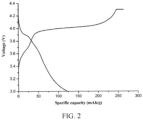
FIG. 2 shows first-cycle charge and discharge curves of the second positive electrode lithiation material in Example 1. - To better describe the objectives, technical solutions, and advantages of this application, the following further describes this application with reference to specific embodiments. Persons skilled in the art should understand that the specific embodiments described herein are merely used to explain this application but are not intended to limit this application.
- In some embodiments, all test methods used are conventional methods unless otherwise specified, and all materials, reagents, and the like used are commercially available unless otherwise specified.
- The positive electrode plate of this application includes a positive electrode current collector and a positive electrode active material layer disposed on at least one surface of the positive electrode current collector. In an example, the positive electrode current collector includes two back-to-back surfaces in a thickness direction of the positive electrode current collector, and the positive electrode active material layer is disposed on either or both of the two surfaces.
- In the positive electrode plate of this application, the positive electrode active material layer includes a first positive electrode active material and a second positive electrode lithiation material; and the positive electrode plate satisfies 1.5 ≤ R•P/Q ≤ 30, where R represents resistance of the positive electrode plate in S2; P represents compacted density of the positive electrode plate in g/cm3; and Q represents single-sided surface density of the positive electrode plate in g/1540.25 mm2.
- The first positive electrode active material is Li1+xMnyM2-yO4-tAt, where - 0.1 < x < 0.2, 1 < y ≤ 2, 0 ≤ t < 0.5, M is at least one of Ni, Fe, Zn, Mg, Al, Ti, or Zr, and A is at least one of S, N, F, Cl, or Br.
- The second positive electrode lithiation material is Li1+rMn1-pNpC2-sBs, where -0.1 < r < 0.2, 0 ≤ p < 0.2, 0 ≤ s < 0.2, N is at least one of Fe, Co, Ni, Ti, Zn, Mg, Al, V, Cr, or Zr, and B is at least one of S, N, F, Cl, or Br.
- The positive electrode plate of this application uses the first positive electrode active material and second positive electrode lithiation material with specific constituents, where the first positive electrode active material has a stable structure, good cycling stability, and high initial coulombic efficiency; and the second positive electrode lithiation material has a low content of free lithium on the surface and thus has good processability. Compared with the first positive electrode active material, the second positive electrode lithiation material has higher initial charge specific capacity and lower initial discharge specific capacity, which means lower initial coulombic efficiency. During initial charging, the second positive electrode lithiation material can release a large number of lithium ions to compensate for the loss of active lithium caused by formation of a SEI. During initial discharging, sufficient lithium ions are intercalated into the first positive electrode active material, so as to increase energy density of the battery. Under the synergistic effect between the first positive electrode active material and the second positive electrode lithiation material, the lithium-ion secondary battery has effectively improved energy density, rate performance, and cycle life. Compared with a combination of a first positive electrode active substance and a second positive electrode active substance in the previously filed patent
CN110265627A , the combination of the first positive electrode active material and the second positive electrode lithiation material used in this application can more significantly improve the energy density, rate performance, and cycle life of the lithium-ion secondary battery. In addition, the resistance R, compacted density P, and single-sided surface density Q of the positive electrode plate are specifically designed in this application, which can further improve the energy density, rate performance, and cycle life of the lithium-ion secondary battery, achieving organic unity of high energy density, good rate performance, and long cycle life. - To achieve the lithiation function, the second positive electrode lithiation material in this application needs to satisfy 1 - p > 0.8 (that is, 0 ≤ p < 0.2). Specifically, the second positive electrode lithiation material in this application has two phase structures belonging to Pmmn and C2/m space groups respectively. The Pmmn space group corresponds to a characteristic diffraction peak A at 15° to 16° in a ray diffraction pattern of the second positive electrode lithiation material, and the C2/m space group corresponds to a characteristic diffraction peak B at 18° to 19° in the ray diffraction pattern of the second positive electrode lithiation material, where a ratio IA/IB of an intensity IA of the characteristic diffraction peak A to an intensity IB of the characteristic diffraction peak B satisfies 0 < IA/IB ≤ 0.2. After initial charging, both the characteristic diffraction peak A and the characteristic diffraction peak B shift toward lower angles, with a shift amplitude < 0.5°.
- In this application, the positive electrode plate needs to satisfy 1.5 ≤ R•P/Q ≤ 30, so as to ensure that the lithium-ion secondary battery has high energy density, good rate performance, and long cycle life. In some embodiments of this application, R•P/Q is a value among 1.5, 3, 6, 9, 12, 15, 18, 21, 24, 27, 30, and the like. In some preferred embodiments of this application, R•P/Q satisfies 3.0 ≤ R•P/Q ≤ 15, so as to allow the obtained lithium-ion secondary battery to have longer cycle life and better rate performance. For example, R•P/Q is a value among 3, 4, 5, 6, 7, 8, 9, 10, 11, 12, 13, 14, 15, and the like.
- In this specification, the calculation of R•P/Q involves only numerical calculations. For example, if the resistance R of the positive electrode plate is 1.0 S2, the compacted density P is 3.0 g/cm3, and the single-sided surface density Q of the positive electrode plate is 0.35 g/1540.25 mm2, then R•P/Q = 8.57.
- The resistance R of the positive electrode plate is a resistance value measured using a direct current two-probe method, where a contact area between probes and the positive electrode plate is 49π mm2. The resistance R of the positive electrode plate is measured using a HIOKI BT23562 internal resistance tester during research in this application. The specific operation is as follows: upper and lower sides of the positive electrode plate are clamped between two conductive terminals of the tester and are fixed by applying pressure, where a diameter of the conductive terminal is 14 mm and the applied pressure is 15 MPa-27 MPa, and then the resistance R of the positive electrode plate is measured.
- The compacted density P of the positive electrode plate can be calculated according to the formula P = m/v, where in the formula, m is a weight of the positive electrode active material layer in g; and v is a volume of the positive electrode active material layer in cm3. The volume v of the positive electrode active material layer can be a product of an area Ar of the positive electrode active material layer and a thickness of the positive electrode active material layer.
- The single-sided surface density Q of the positive electrode plate can be calculated according to the formula Q = 1540.25 m/Ar, where in the formula, m is a weight of the positive electrode active material layer in g; and Ar is an area of the positive electrode active material layer in mm2.
- It should be noted that the sheet resistance R, compacted density P, and single-sided surface density Q of the positive electrode plate are the key parameters in the design and preparation of the lithium-ion secondary battery. An excessively large sheet resistance R of the positive electrode plate deteriorates the cycling performance and rate performance of the lithium-ion secondary battery. An excessively large or small compacted density P deteriorates the cycling performance and rate performance of the lithium-ion secondary battery. An excessively large single-sided surface density Q of the positive electrode plate reduces the cycle life of the lithium-ion secondary battery and affects permeation of the electrolyte, affecting the rate performance of the battery, and especially decreasing the discharge capacity of the battery at a high rate. However, an excessively small single-sided surface density Q of the positive electrode plate means that the length of the current collector and separator increases under the same battery capacity, resulting in an increased ohmic resistance of the battery. This requires the comprehensive design of these parameters during preparation of the battery to ensure that the positive electrode plate achieves the expected design values, so as to allow the lithium-ion secondary battery to achieve desired electrochemical performance.
- The sheet resistance R of the positive electrode plate preferably satisfies R ≤ 5 S2, so as to improve the cycling performance and rate performance of the lithium-ion secondary battery. The sheet resistance R of the positive electrode plate more preferably satisfies R ≤ 2 S2, so as to further improve the cycling performance and rate performance of the lithium-ion secondary battery.
- The compacted density P of the positive electrode plate preferably satisfies 2.5 g/cm3 < P < 3.2 g/cm3. This facilitates migration of electrons and ions in the positive electrode plate, thereby improving the cycling performance of the lithium-ion secondary battery.
- The single-sided surface density Q of the positive electrode plate preferably satisfies 0.3 g/1540.25 mm2 < Q < 0.55 g/1540.25 mm2. This can improve the cycling performance and rate performance of the lithium-ion secondary battery while guaranteeing the charge and discharge capacity.
- A weight ratio of the first positive electrode active material to the second positive electrode lithiation material is preferably 5:1-99:1. The majority of such positive electrode plate is the first positive electrode active material, which has higher structural stability, reducing capacity loss and impedance increase caused by structural damage of the positive electrode active material, thereby maintaining cycling stability and kinetic performance. The weight ratio of the first positive electrode active material to the second positive electrode lithiation material is more preferably 9: 1-99: 1, so as to further improve the cycling stability and kinetic performance.
- A weight percentage of the first positive electrode active material in the positive electrode active material is 80%-98%, and more preferably 85%-98%.
- In the positive electrode plate in some embodiments of this application, the positive electrode active material layer may further include a conductive agent and a binder. The conductive agent and the binder are not limited to any specific type in this application, and may be selected depending on actual needs.
- In an example, the conductive agent may be at least one of graphite, superconducting carbon, acetylene black, carbon black, Ketjen black, carbon dots, carbon nanotubes, graphene, or carbon nanofiber; and the binder may be at least one of styrene-butadiene rubber (SBR), water-based acrylic resin (water based acrylic resin), carboxymethyl cellulose (CMC), polyvinylidene fluoride (PVDF), polytetrafluoroethylene (PTFE), polyvinyl butyral (PVB), ethylene-vinyl acetate copolymer (EVA), or polyvinyl alcohol (PVA).
- In some optional embodiments, a weight percentage of the conductive agent in the positive electrode active material layer is ≥ 0.5%, so as to obtain a low sheet resistance of the positive electrode.
- In some optional embodiments, a weight percentage of the binder in the positive electrode active material layer is ≤ 2.0%, so as to obtain a low sheet resistance of the positive electrode.
- The positive electrode current collector may be made of a metal foil material or a porous metal plate, for example, a foil material or porous plate made of metal such as aluminum, copper, nickel, titanium, or silver or alloys thereof, such as aluminum foil.
- Thickness of the positive electrode current collector is preferably 5 µm-20 µm, further preferably 6 µm-18 µm, and more preferably 8 µm-16 µm.
- The positive electrode plate of this application can be used as a positive electrode of a lithium-ion secondary battery. The lithium-ion secondary battery includes a positive electrode plate, a negative electrode plate, a separator, and an electrolyte, where the positive electrode plate is the positive electrode plate of this application. The positive electrode plate of this application is used, so the lithium-ion secondary battery of this application has high energy density, good cycling performance, and good rate performance.
- The negative electrode plate may be a lithium metal plate or may include a negative electrode current collector and a negative electrode active material layer disposed on at least one surface of the negative electrode current collector.
- The negative electrode active material layer generally includes a negative electrode active material, a conductive agent, a binder, and a thickener. In an example, the negative electrode active material may be at least one of natural graphite, artificial graphite, mesocarbon microbeads (MCMB), hard carbon, soft carbon, silicon, silicon-carbon composite, SiO, Li-Sn alloy, Li-Sn-O alloy, Sn, SnO, SnO2, spinel-structured lithium titanate Li4Ti5O12, Li-Al alloy, or metal lithium; the conductive agent may be at least one of graphite, superconducting carbon, acetylene black, carbon black, Ketjen black, carbon dots, carbon nanotubes, graphene, or carbon nanofiber; the binder may be at least one of styrene-butadiene rubber (SBR), polyvinylidene fluoride (PVDF), polytetrafluoroethylene (PTFE), polyvinyl butyral (PVB), water-based acrylic resin (water-based acrylic resin), or carboxymethyl cellulose (CMC); and the thickener may be carboxymethyl cellulose (CMC). However, this application is not limited to these materials, and this application may alternatively use other materials that can be used as a negative electrode active material, conductive agent, binder, and thickener of a lithium-ion secondary battery.
- The negative electrode current collector may be made of a material such as a metal foil material or a porous metal plate, for example, a foil material or porous plate made of metal such as copper, nickel, titanium, or iron or alloys thereof, such as copper foil.
- The negative electrode plate may be prepared using a conventional method in the art. Generally, the negative electrode active material and the optional conductive agent, binder, and thickener are dispersed in a solvent to form a uniform negative electrode slurry, where the solvent may be N-methylpyrrolidone (NMP) or deionized water, and then the negative electrode slurry is applied onto the negative electrode current collector, followed by processes such as drying and cold pressing, to obtain a negative electrode plate.
- The separator is not limited, and may be any well-known porous separator with electrochemical stability and chemical stability, for example, a single-layer or multi-layer film made of at least one of glass fiber, non-woven fabric, polyethylene (PE), polypropylene (PP), or polyvinylidene fluoride (PVDF).
- The electrolyte includes an organic solvent, an electrolytic lithium salt, and an additive. The organic solvent and electrolytic lithium salt are not limited to any specific type in this application, and may be selected depending on actual needs.
- In an example, the organic solvent may be at least one and preferably more than two of ethylene carbonate (EC), propylene carbonate (PC), ethyl methyl carbonate (EMC), diethyl carbonate (DEC), dimethyl carbonate (DMC), dipropyl carbonate (DPC), methyl propyl carbonate (MPC), ethyl propyl carbonate (EPC), butylene carbonate (BC), fluoroethylene carbonate (FEC), methyl formate (MF), methyl acetate (MA), ethyl acetate (EA), propyl acetate (PA), methyl propionate (MP), ethyl propionate (EP), propyl propionate (PP), methyl butyrate (MB), ethyl butyrate (EB), gamma-butyrolactone (GBL), sulfolane (SF), methyl sulfonyl methane (MSM), ethyl methanesulfonate (EMS), or diethyl sulfone (ESE).
- The electrolytic lithium salt may be at least one of LiPF6 (lithium hexafluorophosphate), LiBF4 (lithium tetrafluoroborate), LiClO4 (lithium perchlorate), LiAsF6 (lithium hexafluoroarsenate), LiFSI (lithium bis(fluorosulfonyl)imide), LiTFSI (lithium bis(trifluoromethanesulfonyl)imide), LiTFS (lithium trifluoromethanesulfonate), LiDFOB (lithium difluoro(oxalato)borate), LiBOB (lithium bis(oxalato)borate), LiPO2F2 (lithium difluorophosphate), LiDFOP (lithium difluorobis(oxalato)phosphate), or LiTFOP (lithium tetrafluoro(oxalato)phosphate).
- The electrolyte additive includes vinylene carbonate (VC). Based on a total weight of the electrolyte, a weight percentage of the vinylene carbonate is 0%-5% and is not 0%. The vinylene carbonate additive being added to the electrolyte promotes formation of a more uniform and denser SEI film on the negative electrode, suppressing the continuous loss of active lithium.
- The electrolyte additive includes 1,3-propane sultone (PS). Based on the total weight of the electrolyte, a weight percentage of the 1,3-propane sultone is 0%-5% and is not 0%. The 1,3-propane sultone being added to the electrolyte promotes formation of an interface protective layer on the positive electrode side, further prolonging the cycle life of the lithium-ion secondary battery.
- The electrolyte further optionally includes other additives. The additive may be any additive that can be used as an additive of a lithium-ion secondary battery, which is not specifically limited in this application, and may be selected depending on actual needs. In an example, the additive may further include at least one of vinylethylene carbonate (VEC), succinonitrile (SN), adiponitrile (AND), 1,3-propene sultone (PST), sulfonate cyclic quaternary ammonium salt, tris(trimethylsilyl) phosphate (TMSP), or tris(trimethylsilyl) borate (TMSB).
- The electrolyte may be prepared using a conventional method in the art. The organic solvent, the electrolytic lithium salt, the vinylene carbonate, the 1,3-propane sultone, and the other optional additives may be evenly mixed to obtain the electrolyte, where the materials are not limited to a particular addition order. For example, the electrolytic lithium salt, the vinylene carbonate, the 1,3-propane sultone, and the other optional additives are added to the organic solvent and evenly mixed to obtain the electrolyte. The electrolytic lithium salt may be added to the organic solvent first, and then the vinylene carbonate, the 1,3-propane sultone, and the other optional additives are added to the organic solvent separately or simultaneously.
- The positive electrode plate, the separator, and the negative electrode plate are stacked in sequence such that the separator is located between the positive electrode plate and the negative electrode plate for separation to obtain a battery cell, or the resulting stack is wound to obtain a battery cell; and the battery cell is placed in a packaging housing, the electrolyte is injected, and the housing is sealed, to obtain the lithium-ion secondary battery.
- Charge and discharge curves, high-temperature cycling performance, and rate performance of the lithium-ion secondary battery are tested using the following methods during research in this application.
- Charge and discharge curve test: At 45°C, the lithium-ion secondary battery is charged to 4.3 V at a constant current of 0.1C, then charged to a current less than or equal to 0.025C at a constant voltage, and discharged to 3.0 V at a constant current of 0.1C, and charge and discharge curves of the lithium-ion secondary battery are recorded.
- High-temperature cycling performance test: At 45°C, the lithium-ion secondary battery is charged to 4.3 V at a constant current of 1.5C, then charged to a current less than or equal to 0.05C at a constant voltage, and discharged to 3.0 V at a constant current of 1C. This is one charge and discharge cycle, and a discharge capacity of the lithium-ion secondary battery after the first cycle is recorded. The lithium-ion secondary battery is subjected to charge and discharge cycles using the foregoing method, a discharge capacity after each cycle is recorded until the discharge capacity of the lithium-ion secondary battery decays to 80% of the discharge capacity after the first cycle, and the number of charge and discharge cycles is recorded.
- Rate performance test: At 25°C, the lithium-ion secondary battery is charged to 4.3 V at a constant current of 0.2C, then charged to a current less than or equal to 0.05C at a constant voltage, and discharged to 3.0 V at a constant current of 0.2C, and a discharge capacity at 0.2C is recorded; and at 25°C, the lithium-ion secondary battery is charged to 4.3 V at a constant current of 0.2C, then charged to a current less than or equal to 0.05C at a constant voltage, and discharged to 3.0 V at a constant current of 2C, and a discharge capacity at 2C is recorded. Discharge capacity retention rate of lithium-ion secondary battery at 2C (%) = discharge capacity at 2C/discharge capacity at 0.2C × 100%.
- Preparation of positive electrode plate: A first positive electrode active material LiMn2O4, a second positive electrode lithiation material LiMnO2, a binder PVDF, and conductive carbon black were mixed, where a weight ratio of LiMn2O4, LiMnO2, PVDF, and conductive carbon black was 92.5:4.0:1.5:2.0, a solvent NMP was added at a material-to-liquid ratio of 7:3, and the mixture was stirred to a uniform transparent system under the action of vacuum stirring to obtain a positive electrode slurry; and the positive electrode slurry was uniformly applied onto a positive electrode current collector aluminum foil, and then transferred to an oven for drying at 120°C, followed by cold pressing and cutting, to obtain a positive electrode plate. A weight percentage of the first positive electrode active material LiMn2O4 in the positive electrode active material layer was 92.5%, and a weight percentage of the second positive electrode lithiation material LiMnO2 in the positive electrode active material layer was 4.0%.
- Preparation of negative electrode plate: A negative electrode active material artificial graphite, a thickener sodium carboxymethyl cellulose (CMC), a binder (SBR), and conductive carbon black were mixed at a mass ratio of 95.7:1.0:1.8:1.5, a solvent deionized water was added at a material-to-liquid ratio of 4:6, and the mixture was stirred by a vacuum stirrer to obtain a negative electrode slurry; and the negative electrode slurry was uniformly applied onto a negative electrode current collector copper foil, and then transferred to an oven for drying at 120°C, followed by cold pressing and cutting, to obtain a negative electrode plate.
- Preparation of electrolyte: Ethylene carbonate (EC), ethyl methyl carbonate (EMC), and diethyl carbonate (DEC) were evenly mixed at a volume ratio of 1:1:1 to obtain an organic solvent; LiPF6 was dissolved in the organic solvent such that a concentration of the LiPF6 was 1 mol/L; and based on a total mass of the electrolyte, 3wt% vinylene carbonate and 3wt% 1,3-propane sultone were added, and the mixture was evenly mixed to obtain an electrolyte.
- Preparation of lithium-ion secondary battery: The positive electrode plate, the separator, and the negative electrode plate were stacked sequentially, where the separator was a 14 µm thick polypropylene (PP) film (provided by Celgard), and the separator was located between the positive electrode plate and the negative electrode plate for separation. Then, the resulting stack was wound to form an electrode assembly. After tabs were welded, the electrode assembly was placed in a housing, the electrolyte was injected, and the housing was sealed, followed by processes such as standing, formation, and shaping, to obtain a lithium-ion secondary battery.
- Different from Example 1, the material constituents in the positive electrode and the related parameters in the preparation steps were adjusted. See Table 1 for details. (In this table, the weight percentage of the first positive electrode active material is the weight percentage of the first positive electrode active material in the positive electrode active material, and the weight percentage of the second positive electrode lithiation material is the weight percentage of the second positive electrode lithiation material in the positive electrode active material).
- Different from Example 1, the positive electrode included only LiMn2O4.
- Different from Example 1, the positive electrode included only LiMnO2.
- The weight ratio of the first positive electrode active material to the second positive electrode lithiation material in the positive electrode was different from that in Example 1.
- The sheet resistance, compacted density, and single-sided surface density of the positive electrode plate were different from those in Example 1.
- The weight percentages of the vinylene carbonate and 1,3-propane sultone in the electrolyte were different from those in Example 1.
- Different from Example 26, the electrolyte included only vinylene carbonate or 1,3-propane sultone.
- In the examples and comparative examples, except that the percentages of the conductive carbon black and binder PVDF in the positive electrode active material were 0.5wt% respectively in Example 18, the percentage of the conductive carbon black was 2.0wt% and the percentage of the binder PVDF was 1.5wt% in the positive electrode active material in the other examples and comparative examples.
- High-temperature cycling performance and rate performance of the lithium-ion secondary batteries prepared in the examples and comparative examples were tested according to the foregoing methods. See Table 2 for the results.
Table 1 Type Positive electrode active material Weight percentage of first positive electrode active material (wt%) Weight percentage of second positive electrode lithiation material (wt%) Sheet resistance R of positive electrode plate (Ω) Compacted density P of positive electrode plate (g/cm3) Single-sided surface density Q of positive electrode plate (g/1540.25 mm2) Weight percentage of vinylene carbonate in electrolyte (%) Weight percentage of 1,3-propane sultone in electrolyte (%) Comparative Example 1 LiMn2O4 96.5 / 0.9 2.8 0.35 3 3 Comparative Example 2 LiMnO2 / 96.5 0.9 3.4 0.35 3 3 Comparative Example 3 LiMn2O4 /LiMnO2 96.0 0.5 0.9 2.8 0.35 3 3 Comparative Example 4 LiMn2O4 /LiMnO2 76.5 20.0 0.9 2.8 0.35 3 3 Comparative Example 5 LiMn2O4 /LiMnO2 92.5 4.0 2.5 3.2 0.25 3 3 Comparative Example 6 LiMn2O4 /LiMnO2 92.5 4.0 0.4 2.5 0.55 3 3 Comparative Example 7 LiMn2O4 /LiMnO2 92.5 4.0 0.9 2.8 0.35 0 0 Comparative Example 8 LiMn2O4 /LiMnO2 92.5 4.0 0.9 2.8 0.35 7 7 Comparative Example 9 LiMn2O4 /LiMnO2 92.5 4.0 0.9 2.8 0.35 1 0 Comparative Example 10 LiMn2O4 /LiMnO2 92.5 4.0 0.9 2.8 0.35 0 1 Example 1 LiMn2O4 /LiMnO2 92.5 4.0 0.9 2.8 0.35 3 3 Example 2 LiMn1.8Ni0.2O4 /LiMnO2 92.5 4.0 0.9 2.8 0.35 3 3 Example 3 LiMn1.8Ni0.1Ti0.1O4 /LiMnO2 92.5 4.0 0.9 2.8 0.35 3 3 Example 4 LiMni1.95Zr0.05O3.95F0.05 /LiMnO2 92.5 4.0 0.9 2.8 0.35 3 3 Example 5 LiMn2O4 /LiMn0.9Ni0.1O2 92.5 4.0 0.9 2.8 0.35 3 3 Example 6 LiMn2O4 /LiMn0.9Ni0.05Cr0.05O2 92.5 4.0 0.9 2.8 0.35 3 3 Example 7 LiMn2O4 /Li0.95MnO1.95F0.05 92.5 4.0 0.9 2.8 0.35 3 3 Example 8 LiMn2O4 /Li0.95MnO1.9S0.05F0.05 92.5 4.0 0.9 2.8 0.35 3 3 Example 9 Li1.1Mn1.1Fe0.5Al0.4O4 /Li0.92Mn0.82Fe0.05Co0.05Ti0.08O2 92.5 4.0 0.9 2.8 0.35 3 3 Example 10 Li0.96Mn1.8Mg0.1Zn0.1O3.7S0.3 /LiMn0.9Zn0.05Mg0.03Al0.02O1.82Cl0.18 92.5 4.0 0.9 2.8 0.35 3 3 Example 11 LiMn2O3.6N0.2Br0.1Cl0.1 /Li0.95Mn0.9V0.05Zr0.05O1.9N0.05Br0.05 92.5 4.0 0.9 2.8 0.35 3 3 Example 12 LiMn2O4 /LiMnO2 80.4 16.1 0.9 2.8 0.35 3 3 Example 13 LiMn2O4 /LiMnO2 85 11.5 0.9 2.8 0.35 3 3 Example 14 LiMn2O4 /LiMnO2 86.9 9.7 0.9 2.8 0.35 3 3 Example 15 LiMn2O4 /LiMnO2 89.5 7.0 0.9 2.8 0.35 3 3 Example 16 LiMn2O4 /LiMnO2 94.5 2.0 0.9 2.8 0.35 3 3 Example 17 LiMn2O4 /LiMnO2 95.54 0.97 0.9 2.8 0.35 3 3 Example 18 LiMn2O4 /LiMnO2 98 1 0.9 2.8 0.35 3 3 Example 19 LiMn2O4 /LiMnO2 92.5 4.0 0.5 3.0 0.45 3 3 Example 20 LiMn2O4 /LiMnO2 92.5 4.0 1.5 3.1 0.32 3 3 Example 21 LiMn2O4 /LiMnO2 92.5 4.0 2.2 2.6 0.50 3 3 Example 22 LiMn2O4 /LiMnO2 92.5 4.0 5 3 0.5 3 3 Example 23 LiMn2O4 /LiMnO2 92.5 4.0 0.25 2.6 0.43 3 3 Example 24 LiMn2O4 /LiMnO2 92.5 4.0 0.9 2.8 0.35 1 1 Example 25 LiMn2O4 /LiMnO2 92.5 4.0 0.9 2.8 0.35 5 5 Example 26 LiMn2O4 /LiMnO2 92.5 4.0 0.9 2.8 0.35 0.001 5 Example 27 LiMn2O4 /LiMnO2 92.5 4.0 0.9 2.8 0.35 5 0.001 Table 2 Type R•P/Q Cycles at high temperature Rate performance (%) Comparative Example 1 7.2 620 98.3 Comparative Example 2 8.74 1 81.2 Comparative Example 3 7.2 647 98.1 Comparative Example 4 7.2 611 85.5 Comparative Example 5 32.0 556 94.6 Comparative Example 6 1.82 501 91.8 Comparative Example 7 7.2 382 97.1 Comparative Example 8 7.2 681 97.0 Comparative Example 9 7.2 514 97.4 Comparative Example 10 7.2 538 97.2 Example 1 7.2 753 97.6 Example 2 7.2 728 97.5 Example 3 7.2 751 97.2 Example 4 7.2 719 97.0 Example 5 7.2 745 97.4 Example 6 7.2 701 96.9 Example 7 7.2 712 97.1 Example 8 7.2 725 97.3 Example 9 7.2 709 97.2 Example 10 7.2 718 97.1 Example 11 7.2 720 97.4 Example 12 7.2 645 90.1 Example 13 7.2 691 94.7 Example 14 7.2 703 95.3 Example 15 7.2 798 96.8 Example 16 7.2 681 98.0 Example 17 7.2 661 97.9 Example 18 7.2 666 97.8 Example 19 3.33 772 97.9 Example 20 14.53 729 97.6 Example 21 11.44 668 96.8 Example 22 30 652 96.1 Example 23 1.5 706 97.5 Example 24 7.2 691 97.9 Example 25 7.2 782 97.5 Example 26 7.2 673 97.8 Example 27 7.2 681 97.7 - It can be learned from the examples and comparative examples that (1) the combination of the first positive electrode active material and the second positive electrode lithiation material produces a synergistic effect. First, the second positive electrode lithiation material used in this application has a small content of free lithium on the surface, and when it is added to the positive electrode, the obtained slurry has good stability and good processability. Second, the second positive electrode lithiation material used in this application has high initial charge specific capacity and low initial coulombic efficiency, and thus can better compensate for the loss of active lithium caused by formation of a SEI. During discharging, more lithium ions are intercalated into the lattice of the first positive electrode active material, effectively increasing the energy density of the lithium-ion secondary battery. Third, the first positive electrode active material has a stable structure and good cycling stability. Controlling the sheet resistance R, compacted density P, and single-sided surface density Q of the positive electrode plate within the ranges of this application can allow the lithium-ion secondary battery to have good cycling performance and rate performance. (2) The vinylene carbonate added to the electrolyte and the lithiation strategy of the first positive electrode active material and the second lithiation active material can generate a synergistic effect. During initial charging, a large amount of active lithium released from the second positive electrode lithiation material is intercalated into the negative electrode. This further reduces the true potential of the negative electrode, resulting in the continuous reduction of the solvent in the electrolyte, thereby affecting the cycling performance. The vinylene carbonate additive falling within the range of this application being used can facilitate formation of a denser and thinner SEI layer, which prevents the continuous consumption of the electrolyte. In addition, the 1,3-propane sultone additive is also added to the electrolyte, which can form an interface protective layer on the surface of the positive electrode active material, further improving the cycling performance.
- In conclusion, it should be noted that the foregoing embodiments are merely intended to describe the technical solutions of this application, but not intended to limit the protection scope of this application. Although this application is described in detail with reference to preferred embodiments, persons of ordinary skill in the art should understand that modifications or equivalent replacements can be made to the technical solutions of this application, without departing from the essence and scope of the technical solutions of this application.
Claims (10)
- A positive electrode plate, comprising a positive electrode current collector and a positive electrode active material layer disposed on at least one surface of the positive electrode current collector, wherein the positive electrode active material layer comprises a first positive electrode active material and a second positive electrode lithiation material; and the positive electrode plate satisfies 1.5 ≤ R•P/Q ≤ 30, wherein R represents resistance of the positive electrode plate in S2; P represents compacted density of the positive electrode plate in g/cm3; and Q represents single-sided surface density of the positive electrode plate in g/1540.25 mm2.
- The positive electrode plate according to claim 1, wherein the first positive electrode active material is Li1+xMnyM2-yO4-tAt, wherein -0.1 < x < 0.2, 1 < y ≤ 2, 0 ≤ t < 0.5, M is at least one of Ni, Fe, Zn, Mg, Al, Ti, or Zr, and A is at least one of S, N, F, Cl, or Br.
- The positive electrode plate according to claim 1, wherein the second positive electrode lithiation material is Li1+rMn1-pNpO2-sBs, wherein -0.1 < r < 0.2, 0 ≤ p < 0.2, 0 ≤ s < 0.2, N is at least one of Fe, Co, Ni, Ti, Zn, Mg, Al, V, Cr, or Zr, and B is at least one of S, N, F, Cl, or Br.
- The positive electrode plate according to claim 1, satisfying at least one of the following characteristics:(a) the positive electrode plate satisfies 3.0 ≤ R•P/Q ≤ 15;(b) R ≤ 5 Q, and preferably R ≤ 2 S2;(c) P satisfies 2.5 g/cm3 < P < 3.2 g/cm3; or(d) Q satisfies 0.3 g/1540.25 mm2 < Q < 0.55 g/1540.25 mm2.
- The positive electrode plate according to claim 1, wherein a weight ratio of the first positive electrode active material to the second positive electrode lithiation material is 5: 1-99: 1.
- The positive electrode plate according to claim 5, wherein the weight ratio of the first positive electrode active material to the second positive electrode lithiation material is 9: 1-99: 1.
- The positive electrode plate according to claim 1, wherein a weight percentage of the first positive electrode active material in the positive electrode active material is 80%-98%.
- The positive electrode plate according to claim 7, wherein the weight percentage of the first positive electrode active material in the positive electrode active material is 85%-98%.
- A lithium-ion secondary battery, comprising a positive electrode plate, a negative electrode plate, a separator, and an electrolyte, wherein the positive electrode plate is the positive electrode plate according to any one of claims 1 to 8.
- The lithium-ion secondary battery according to claim 9, wherein the electrolyte comprises the following constituents in weight percentage: 0.001% to 5% of vinylene carbonate and/or 0.001% to 5% of 1,3-propane sultone.
Applications Claiming Priority (2)
| Application Number | Priority Date | Filing Date | Title |
|---|---|---|---|
| PCT/CN2021/126213 WO2023070287A1 (en) | 2021-10-25 | 2021-10-25 | Positive electrode plate, electrochemical device, and electronic device |
| PCT/CN2021/131365 WO2023070770A1 (en) | 2021-10-25 | 2021-11-18 | Positive plate and lithium-ion secondary battery including same |
Publications (2)
| Publication Number | Publication Date |
|---|---|
| EP4425596A1 true EP4425596A1 (en) | 2024-09-04 |
| EP4425596A4 EP4425596A4 (en) | 2025-03-05 |
Family
ID=83375374
Family Applications (1)
| Application Number | Title | Priority Date | Filing Date |
|---|---|---|---|
| EP21962114.1A Pending EP4425596A4 (en) | 2021-10-25 | 2021-11-18 | POSITIVE PLATE AND LITHIUM-ION SECONDARY BATTERY COMPRISING IT |
Country Status (4)
| Country | Link |
|---|---|
| US (1) | US12444739B2 (en) |
| EP (1) | EP4425596A4 (en) |
| JP (1) | JP7852042B2 (en) |
| CN (1) | CN115136357B (en) |
Families Citing this family (6)
| Publication number | Priority date | Publication date | Assignee | Title |
|---|---|---|---|---|
| EP4089762B1 (en) * | 2021-03-26 | 2024-11-27 | Ningde Amperex Technology Limited | Positive electrode plate, and electrochemical device and electronic device containing positive electrode plate |
| JP7815430B2 (en) * | 2021-10-25 | 2026-02-17 | 寧徳新能源科技有限公司 | Electrochemical device and electronic device including the same |
| CN115336068A (en) * | 2021-10-25 | 2022-11-11 | 宁德新能源科技有限公司 | Electrochemical device and electronic device including the same |
| CN115498247B (en) * | 2022-10-27 | 2023-08-15 | 欣旺达电动汽车电池有限公司 | Secondary battery and electrical equipment |
| WO2024087225A1 (en) * | 2022-10-28 | 2024-05-02 | 宁德时代新能源科技股份有限公司 | Battery cell, battery and electric apparatus |
| CN119695234B (en) * | 2024-12-13 | 2025-11-11 | 欣旺达动力科技股份有限公司 | Secondary battery and electricity utilization device |
Family Cites Families (39)
| Publication number | Priority date | Publication date | Assignee | Title |
|---|---|---|---|---|
| FR2833760B1 (en) | 2001-12-19 | 2011-03-25 | Fmc Corp | DISPERSION OF LITHIUM METAL IN SECONDARY BATTERY ANODES |
| KR100533095B1 (en) * | 2003-04-09 | 2005-12-01 | 주식회사 엘지화학 | The cathode active material comprising the overdischarge retardant and the lithium secondary battery using the same |
| KR101093705B1 (en) | 2009-04-29 | 2011-12-19 | 삼성에스디아이 주식회사 | Lithium secondary battery |
| KR101754800B1 (en) | 2010-08-19 | 2017-07-06 | 삼성전자주식회사 | Cathode, preparation method thereof, and lithium battery containing the same |
| JP2012204307A (en) * | 2011-03-28 | 2012-10-22 | Kyushu Univ | Positive electrode active material, and method for manufacturing the same |
| EP2717360B1 (en) * | 2011-05-23 | 2017-11-29 | Ningbo Institute of Materials Technology and Engineering, Chinese Academy of Sciences | Preparing method of a positive electrode material for lithium battery |
| JP2015018599A (en) * | 2011-11-09 | 2015-01-29 | 新神戸電機株式会社 | Nonaqueous electrolyte secondary battery |
| CN102637894B (en) * | 2012-04-06 | 2014-11-05 | 宁德新能源科技有限公司 | Secondary battery with non-aqueous electrolyte |
| US20140065462A1 (en) * | 2012-08-29 | 2014-03-06 | Apple Inc. | Increased energy density and swelling control in batteries for portable electronic devices |
| CN104037418A (en) | 2013-03-05 | 2014-09-10 | 中国科学院宁波材料技术与工程研究所 | A kind of cathode film of lithium ion battery and its preparation and application |
| KR102172153B1 (en) * | 2016-06-16 | 2020-10-30 | 주식회사 엘지화학 | Positive electrode for lithium secondary battery having improved capacity and safety and lithium secondary battery comprising the same |
| WO2018057584A1 (en) * | 2016-09-20 | 2018-03-29 | Apple Inc. | Cathode active materials having improved particle morphologies |
| KR102322728B1 (en) * | 2017-03-14 | 2021-11-05 | 유미코아 | Precursor for cathode material with improved secondary battery performance and method for preparing the precursor |
| US10985407B2 (en) * | 2017-11-21 | 2021-04-20 | Samsung Electronics Co., Ltd. | All-solid-state secondary battery including anode active material alloyable with lithium and method of charging the same |
| JP7047216B2 (en) * | 2017-12-08 | 2022-04-05 | エルジー エナジー ソリューション リミテッド | Lithium cobalt oxide positive electrode active material, this manufacturing method, positive electrode including this and secondary battery |
| CN110265622B (en) * | 2018-06-28 | 2020-12-08 | 宁德时代新能源科技股份有限公司 | Positive electrode and lithium ion secondary battery |
| CN110660959B (en) * | 2018-06-29 | 2021-11-09 | 宁德时代新能源科技股份有限公司 | Positive pole piece and sodium ion battery |
| CN111969183B (en) * | 2018-08-31 | 2021-06-29 | 宁德时代新能源科技股份有限公司 | Positive pole piece, preparation method thereof, and lithium ion secondary battery, electric vehicle and electronic product related to positive pole piece |
| CN110265721B (en) * | 2018-09-19 | 2021-03-30 | 宁德时代新能源科技股份有限公司 | Lithium-ion secondary battery |
| CN110265627B (en) * | 2018-09-28 | 2020-09-29 | 宁德时代新能源科技股份有限公司 | Positive electrode and lithium ion secondary battery |
| WO2020175782A1 (en) * | 2019-02-28 | 2020-09-03 | 주식회사 에스엠랩 | Positive active material, method for manufacturing same and lithium secondary battery comprising positive electrode comprising positive active material |
| JP7617565B2 (en) * | 2019-04-26 | 2025-01-20 | パナソニックIpマネジメント株式会社 | Positive electrode active material for secondary battery, and secondary battery |
| KR102126898B1 (en) * | 2019-12-05 | 2020-06-25 | 주식회사 에스엠랩 | A cathode active material, method of preparing the same, and lithium secondary battery comprising a cathode comprising the cathode active material |
| KR102144056B1 (en) * | 2019-12-24 | 2020-08-12 | 주식회사 에스엠랩 | A cathode active material, method of preparing the same, and lithium secondary battery comprising a cathode comprising the cathode active material |
| KR102144057B1 (en) * | 2019-12-24 | 2020-08-12 | 주식회사 에스엠랩 | A cathode active material, method of preparing the same, and lithium secondary battery comprising a cathode comprising the cathode active material |
| KR102178781B1 (en) * | 2019-12-24 | 2020-11-13 | 주식회사 에스엠랩 | A cathode active material, method of preparing the same, and lithium secondary battery comprising a cathode comprising the cathode active material |
| WO2021146708A1 (en) * | 2020-01-17 | 2021-07-22 | Hunt Energy Enterprises, L.L.C. | Coating of electrode materials for energy storage devices |
| US12095083B2 (en) * | 2020-03-04 | 2024-09-17 | Uchicago Argonne, Llc | Cathode materials for secondary batteries |
| JP7326462B2 (en) * | 2020-06-08 | 2023-08-15 | 寧徳新能源科技有限公司 | Cathode material and electrochemical device comprising said cathode material |
| US12021197B2 (en) * | 2020-11-19 | 2024-06-25 | University-Industry Cooperation Group Of Kyung Hee University | Electrode for ion battery, manufacturing method thereof, and battery comprising the same |
| KR20220100297A (en) * | 2021-01-08 | 2022-07-15 | 삼성전자주식회사 | Solid ion conductor, solid electrolyte and electrochemical device including the same, and method of preparing the solid ion conductor |
| CN113036082B (en) | 2021-03-05 | 2022-06-03 | 江苏正力新能电池技术有限公司 | Positive pole piece, preparation method of positive pole piece and lithium ion secondary battery |
| EP4089762B1 (en) * | 2021-03-26 | 2024-11-27 | Ningde Amperex Technology Limited | Positive electrode plate, and electrochemical device and electronic device containing positive electrode plate |
| JP7432607B2 (en) * | 2021-03-26 | 2024-02-16 | 寧徳新能源科技有限公司 | Positive electrode piece, electrochemical device and electronic device including the positive electrode piece |
| WO2023027499A1 (en) * | 2021-08-25 | 2023-03-02 | 주식회사 에스엠랩 | Positive electrode active material, method for preparing same, and lithium secondary battery including positive electrode comprising same |
| CN115336068A (en) * | 2021-10-25 | 2022-11-11 | 宁德新能源科技有限公司 | Electrochemical device and electronic device including the same |
| JP7815430B2 (en) * | 2021-10-25 | 2026-02-17 | 寧徳新能源科技有限公司 | Electrochemical device and electronic device including the same |
| CN114204109B (en) * | 2021-12-13 | 2023-07-07 | 蜂巢能源科技股份有限公司 | A lithium ion battery |
| EP4228028A4 (en) * | 2021-12-17 | 2024-01-17 | Contemporary Amperex Technology Co., Limited | POSITIVE ELECTRODE COMPOSITE MATERIAL FOR LITHIUM-ION SECONDARY BATTERY AND LITHIUM-ION SECONDARY BATTERY |
-
2021
- 2021-11-18 EP EP21962114.1A patent/EP4425596A4/en active Pending
- 2021-11-18 CN CN202180010680.3A patent/CN115136357B/en active Active
- 2021-11-18 JP JP2024524757A patent/JP7852042B2/en active Active
-
2024
- 2024-04-24 US US18/644,652 patent/US12444739B2/en active Active
Also Published As
| Publication number | Publication date |
|---|---|
| JP7852042B2 (en) | 2026-04-27 |
| CN115136357B (en) | 2025-03-28 |
| CN115136357A (en) | 2022-09-30 |
| JP2024536612A (en) | 2024-10-04 |
| US12444739B2 (en) | 2025-10-14 |
| EP4425596A4 (en) | 2025-03-05 |
| US20240282949A1 (en) | 2024-08-22 |
Similar Documents
| Publication | Publication Date | Title |
|---|---|---|
| US11355742B2 (en) | Negative electrode plate and lithium-ion secondary battery | |
| JP7159459B2 (en) | lithium ion secondary battery | |
| US11196041B2 (en) | Positive electrode plate and lithium-ion secondary battery | |
| US12444739B2 (en) | Positive electrode plate and lithium-ion secondary battery containing same | |
| US11581579B2 (en) | Lithium ion secondary battery | |
| US11824167B2 (en) | Wound electrode assembly, lithium-ion secondary battery and negative electrode plate | |
| US11901560B2 (en) | Negative electrode plate, preparation method thereof and electrochemical device | |
| US11158846B2 (en) | Negative electrode plate, preparation method thereof and electrochemical device | |
| US11289694B2 (en) | Negative electrode plate, preparation method thereof and electrochemical device | |
| US11677074B2 (en) | Positive electrode plate, method for preparing the same and lithium-ion secondary battery | |
| EP3588625B1 (en) | Positive electrode plate and lithium-ion secondary battery | |
| US20240282920A1 (en) | Lithium-ion secondary battery, battery module, battery pack, and electrical device | |
| CN117650227B (en) | Negative electrode plate and electrochemical device | |
| US20240313215A1 (en) | Positive electrode, preparation method thereof, and lithium-ion secondary battery | |
| EP4425598A1 (en) | Electrochemical device and electronic device comprising same | |
| KR102888063B1 (en) | Lithium-ion secondary batteries, battery modules, battery packs, and electrical devices | |
| KR102918517B1 (en) | Nonaqueous electrolyte for lithium secondary battery and lithium secondary battery comprising the same | |
| CN120051879A (en) | Nonaqueous electrolyte for lithium secondary battery comprising novel electrolyte additive and lithium secondary battery comprising same |
Legal Events
| Date | Code | Title | Description |
|---|---|---|---|
| STAA | Information on the status of an ep patent application or granted ep patent |
Free format text: STATUS: THE INTERNATIONAL PUBLICATION HAS BEEN MADE |
|
| PUAI | Public reference made under article 153(3) epc to a published international application that has entered the european phase |
Free format text: ORIGINAL CODE: 0009012 |
|
| STAA | Information on the status of an ep patent application or granted ep patent |
Free format text: STATUS: REQUEST FOR EXAMINATION WAS MADE |
|
| 17P | Request for examination filed |
Effective date: 20240524 |
|
| AK | Designated contracting states |
Kind code of ref document: A1 Designated state(s): AL AT BE BG CH CY CZ DE DK EE ES FI FR GB GR HR HU IE IS IT LI LT LU LV MC MK MT NL NO PL PT RO RS SE SI SK SM TR |
|
| DAV | Request for validation of the european patent (deleted) | ||
| DAX | Request for extension of the european patent (deleted) | ||
| A4 | Supplementary search report drawn up and despatched |
Effective date: 20250203 |
|
| RIC1 | Information provided on ipc code assigned before grant |
Ipc: H01M 10/0525 20100101ALI20250128BHEP Ipc: H01M 4/02 20060101ALI20250128BHEP Ipc: H01M 10/0567 20100101ALI20250128BHEP Ipc: H01M 4/505 20100101ALI20250128BHEP Ipc: H01M 4/525 20100101ALI20250128BHEP Ipc: H01M 4/131 20100101AFI20250128BHEP |