EP4425592A1 - Electrode production system for secondary battery - Google Patents
Electrode production system for secondary battery Download PDFInfo
- Publication number
- EP4425592A1 EP4425592A1 EP24705346.5A EP24705346A EP4425592A1 EP 4425592 A1 EP4425592 A1 EP 4425592A1 EP 24705346 A EP24705346 A EP 24705346A EP 4425592 A1 EP4425592 A1 EP 4425592A1
- Authority
- EP
- European Patent Office
- Prior art keywords
- pusher
- notching
- electrode material
- air nozzle
- electrode
- Prior art date
- Legal status (The legal status is an assumption and is not a legal conclusion. Google has not performed a legal analysis and makes no representation as to the accuracy of the status listed.)
- Pending
Links
Images






Classifications
-
- H—ELECTRICITY
- H01—ELECTRIC ELEMENTS
- H01M—PROCESSES OR MEANS, e.g. BATTERIES, FOR THE DIRECT CONVERSION OF CHEMICAL ENERGY INTO ELECTRICAL ENERGY
- H01M4/00—Electrodes
- H01M4/02—Electrodes composed of, or comprising, active material
- H01M4/04—Processes of manufacture in general
-
- B—PERFORMING OPERATIONS; TRANSPORTING
- B23—MACHINE TOOLS; METAL-WORKING NOT OTHERWISE PROVIDED FOR
- B23K—SOLDERING OR UNSOLDERING; WELDING; CLADDING OR PLATING BY SOLDERING OR WELDING; CUTTING BY APPLYING HEAT LOCALLY, e.g. FLAME CUTTING; WORKING BY LASER BEAM
- B23K26/00—Working by laser beam, e.g. welding, cutting or boring
- B23K26/36—Removing material
- B23K26/362—Laser etching
-
- B—PERFORMING OPERATIONS; TRANSPORTING
- B08—CLEANING
- B08B—CLEANING IN GENERAL; PREVENTION OF FOULING IN GENERAL
- B08B15/00—Preventing escape of dirt or fumes from the area where they are produced; Collecting or removing dirt or fumes from that area
- B08B15/04—Preventing escape of dirt or fumes from the area where they are produced; Collecting or removing dirt or fumes from that area from a small area, e.g. a tool
-
- B—PERFORMING OPERATIONS; TRANSPORTING
- B23—MACHINE TOOLS; METAL-WORKING NOT OTHERWISE PROVIDED FOR
- B23K—SOLDERING OR UNSOLDERING; WELDING; CLADDING OR PLATING BY SOLDERING OR WELDING; CUTTING BY APPLYING HEAT LOCALLY, e.g. FLAME CUTTING; WORKING BY LASER BEAM
- B23K26/00—Working by laser beam, e.g. welding, cutting or boring
- B23K26/08—Devices involving relative movement between laser beam and workpiece
- B23K26/083—Devices involving movement of the workpiece in at least one axial direction
- B23K26/0838—Devices involving movement of the workpiece in at least one axial direction by using an endless conveyor belt
- B23K26/0846—Devices involving movement of the workpiece in at least one axial direction by using an endless conveyor belt for moving elongated workpieces longitudinally, e.g. wire or strip material
-
- B—PERFORMING OPERATIONS; TRANSPORTING
- B23—MACHINE TOOLS; METAL-WORKING NOT OTHERWISE PROVIDED FOR
- B23K—SOLDERING OR UNSOLDERING; WELDING; CLADDING OR PLATING BY SOLDERING OR WELDING; CUTTING BY APPLYING HEAT LOCALLY, e.g. FLAME CUTTING; WORKING BY LASER BEAM
- B23K26/00—Working by laser beam, e.g. welding, cutting or boring
- B23K26/14—Working by laser beam, e.g. welding, cutting or boring using a fluid stream, e.g. a jet of gas, in conjunction with the laser beam; Nozzles therefor
- B23K26/142—Working by laser beam, e.g. welding, cutting or boring using a fluid stream, e.g. a jet of gas, in conjunction with the laser beam; Nozzles therefor for the removal of by-products
-
- B—PERFORMING OPERATIONS; TRANSPORTING
- B23—MACHINE TOOLS; METAL-WORKING NOT OTHERWISE PROVIDED FOR
- B23K—SOLDERING OR UNSOLDERING; WELDING; CLADDING OR PLATING BY SOLDERING OR WELDING; CUTTING BY APPLYING HEAT LOCALLY, e.g. FLAME CUTTING; WORKING BY LASER BEAM
- B23K26/00—Working by laser beam, e.g. welding, cutting or boring
- B23K26/16—Removal of by-products, e.g. particles or vapours produced during treatment of a workpiece
-
- B—PERFORMING OPERATIONS; TRANSPORTING
- B23—MACHINE TOOLS; METAL-WORKING NOT OTHERWISE PROVIDED FOR
- B23K—SOLDERING OR UNSOLDERING; WELDING; CLADDING OR PLATING BY SOLDERING OR WELDING; CUTTING BY APPLYING HEAT LOCALLY, e.g. FLAME CUTTING; WORKING BY LASER BEAM
- B23K26/00—Working by laser beam, e.g. welding, cutting or boring
- B23K26/36—Removing material
- B23K26/38—Removing material by boring or cutting
-
- H—ELECTRICITY
- H01—ELECTRIC ELEMENTS
- H01M—PROCESSES OR MEANS, e.g. BATTERIES, FOR THE DIRECT CONVERSION OF CHEMICAL ENERGY INTO ELECTRICAL ENERGY
- H01M10/00—Secondary cells; Manufacture thereof
- H01M10/04—Construction or manufacture in general
- H01M10/0404—Machines for assembling batteries
-
- H—ELECTRICITY
- H01—ELECTRIC ELEMENTS
- H01M—PROCESSES OR MEANS, e.g. BATTERIES, FOR THE DIRECT CONVERSION OF CHEMICAL ENERGY INTO ELECTRICAL ENERGY
- H01M4/00—Electrodes
- H01M4/02—Electrodes composed of, or comprising, active material
- H01M4/13—Electrodes for accumulators with non-aqueous electrolyte, e.g. for lithium-accumulators; Processes of manufacture thereof
- H01M4/139—Processes of manufacture
-
- B—PERFORMING OPERATIONS; TRANSPORTING
- B08—CLEANING
- B08B—CLEANING IN GENERAL; PREVENTION OF FOULING IN GENERAL
- B08B5/00—Cleaning by methods involving the use of air flow or gas flow
- B08B5/02—Cleaning by the force of jets, e.g. blowing-out cavities
-
- B—PERFORMING OPERATIONS; TRANSPORTING
- B23—MACHINE TOOLS; METAL-WORKING NOT OTHERWISE PROVIDED FOR
- B23K—SOLDERING OR UNSOLDERING; WELDING; CLADDING OR PLATING BY SOLDERING OR WELDING; CUTTING BY APPLYING HEAT LOCALLY, e.g. FLAME CUTTING; WORKING BY LASER BEAM
- B23K2101/00—Articles made by soldering, welding or cutting
- B23K2101/36—Electric or electronic devices
-
- H—ELECTRICITY
- H01—ELECTRIC ELEMENTS
- H01M—PROCESSES OR MEANS, e.g. BATTERIES, FOR THE DIRECT CONVERSION OF CHEMICAL ENERGY INTO ELECTRICAL ENERGY
- H01M50/00—Constructional details or processes of manufacture of the non-active parts of electrochemical cells other than fuel cells, e.g. hybrid cells
- H01M50/50—Current conducting connections for cells or batteries
- H01M50/531—Electrode connections inside a battery casing
-
- Y—GENERAL TAGGING OF NEW TECHNOLOGICAL DEVELOPMENTS; GENERAL TAGGING OF CROSS-SECTIONAL TECHNOLOGIES SPANNING OVER SEVERAL SECTIONS OF THE IPC; TECHNICAL SUBJECTS COVERED BY FORMER USPC CROSS-REFERENCE ART COLLECTIONS [XRACs] AND DIGESTS
- Y02—TECHNOLOGIES OR APPLICATIONS FOR MITIGATION OR ADAPTATION AGAINST CLIMATE CHANGE
- Y02E—REDUCTION OF GREENHOUSE GAS [GHG] EMISSIONS, RELATED TO ENERGY GENERATION, TRANSMISSION OR DISTRIBUTION
- Y02E60/00—Enabling technologies; Technologies with a potential or indirect contribution to GHG emissions mitigation
- Y02E60/10—Energy storage using batteries
Definitions
- the present invention relates to a secondary battery electrode production system.
- a chemical battery refers to a battery composed of a positive electrode, a negative electrode, and an electrolyte to thus generate electrical energy using a chemical reaction, and is classified into a primary battery, which is disposable, and a secondary battery, which is chargeable and dischargeable, thus enabling repeated use.
- a secondary battery is gradually increasing due to the advantage of its chargeable and dischargeable characteristic.
- a lithium secondary battery has high energy density per unit weight, and thus is widely used as a power source in electronic communication devices and in high-power hybrid vehicles.
- Electrodes used in such a secondary battery are used as positive and negative electrodes of the battery, and are used to electrically connect the battery to the outside of the battery.
- the electrodes are formed through a notching process and a cutting process.
- the notching process involves forming electrode tabs on an electrode material.
- the cutting process involves cutting the electrode material on which the electrode tabs are formed into a predetermined length, producing a single sheet of electrodes.
- a notching portion configured to perform the etching process includes a mold upper plate and a mold lower plate which include a punching member. As the mold upper plate and mold lower plate move, they punch the electrode material to form electrode tabs.
- the notching portion has a problem of high maintenance costs for the mold. Additionally, after some repetitions of notching process, there is a need to replace components such as the mold or punching member.
- An object of the present invention is to provide a secondary battery electrode production system including a notching portion without using a mold.
- a secondary battery electrode production system for producing a secondary battery electrode includes a notching portion configured to form an electrode tip of an electrode by notching an electrode material, wherein the notching portion includes a laser portion configured to irradiate the electrode material with a laser beam along a notching line, and a pusher portion disposed above the electrode material, and the pusher portion comprises a pusher in contact with the electrode material and an air blower connected to the pusher, wherein the pusher, during notching, makes contact with an area of the electrode material excluding the notching line, fixing the electrode material while fixing both a coated portion and a non-coated portion of the electrode material, wherein the pusher includes a lower block in contact with the electrode material, an upper block coupled to the lower block, and an air nozzle portion that corresponds to a gap between the lower block and the upper block, and the pusher includes a first pusher and a second pusher, wherein the first pusher and the second pusher are spaced apart from each other in a front-and-re
- the lower block may include a first groove formed concavely on an upper surface
- the upper block may include a second groove concavely formed on a lower surface
- the first groove and the second groove may form an air passage that communicates with the air nozzle portion
- the lower block may include a first surface that forms the air nozzle portion and the upper block may include a second surface that forms the air nozzle portion.
- the first surface and the second surface may each be inclined toward an outlet of the air nozzle portion such that the area of the air nozzle portion decreases toward the outlet.
- the inclination of the slope formed by the first surface with respect to the lower surface of the lower block may be smaller than the inclination of the slope formed by the second surface with respect to the lower surface of the lower block.
- the pusher may fix the electrode material to a base, a lower plate may be further provided which is detachably attached to both ends of the base that correspond to an area irradiated with the laser beam, and a through slot may be formed on an upper surface of the lower plate to facilitate a discharge of scrap generated during notching.
- the base may have through slots formed on an area at both ends of the base that corresponds to an area irradiated with the laser beam, facilitating a discharge of scrap generated during notching.
- the secondary battery electrode production system may further include an air generating portion disposed above the pusher portion and configured to blow out gas (fume) or dust generated when the laser beam notches the electrode, and a fume hood configured to inhale and discharge gas or dust blown outwards by the air generating portion.
- an air generating portion disposed above the pusher portion and configured to blow out gas (fume) or dust generated when the laser beam notches the electrode, and a fume hood configured to inhale and discharge gas or dust blown outwards by the air generating portion.
- notching is performed using a laser instead of a mold, thereby providing the advantageous effect of using a notching portion almost permanently, except for replacing consumable parts.
- the cutting process utilizes a knife to cut an electrode material, thereby providing the advantageous effect of increasing the production speed of an electrode.
- an electrode is brought into close contact with a base at a notching line through a pusher that fixes a coated portion and a non-coated portion of an electrode together, thereby providing the advantageous effect of increasing the quality of notching.
- an air nozzle is disposed on the pusher, thereby providing the advantageous effect of easily separating scrap from the electrode material after notching.
- spraying air to the rear and lateral sides of the scrap facilitates separation of the scrap from the electrode material.
- a suction portion is arranged adjacent to the base, thereby providing the advantageous effect of easily removing scrap.
- the space where dust can adhere to the electrode can be minimized.
- scrap and dust can be removed, preventing the scattering of dust.
- first, second, third, etc. may be used herein to describe various elements, components, regions, layers and/or sections, these elements, components, regions, layers and/or sections should not be limited by these terms. These terms are only used to distinguish one element, component, region, layer or section from another region, layer or section. Thus, a first element, component, region, layer or section discussed below could be termed a second element, component, region, layer or section without departing from the teachings of the present invention.
- Embodiments of the present invention are described herein with reference to drawings that are schematic illustrations of idealized embodiments of the invention. As such, variations from the shapes of the drawings as a result, for example, of manufacturing techniques and/or tolerances, are to be expected. Thus, embodiments of the invention should not be construed as limited to the particular shapes of regions illustrated herein but are to include deviations in shapes that result, for example, from manufacturing.
- a secondary battery electrode production system is a device for automatically and continuously producing electrodes used in secondary batteries.
- FIG. 1 is a front view of a secondary battery electrode production system according to an embodiment.
- the direction represented by the x-axis corresponds to a length direction of the secondary battery electrode production system, indicating a direction in which an electrode material is transferred.
- the direction represented by the y-axis corresponds to a direction between the front and rear of the secondary battery electrode production system, indicating the same direction as the width direction of the electrode material, and the direction represented by the z-axis corresponds to a height direction of the secondary battery electrode production system.
- the secondary battery electrode production system includes an unwinding portion 10, a dancer unit 20, a notching portion 30, a feeding device 40, a cutting portion 50, and an alignment device and magazine 60.
- An electrode material S0 formed as a horizontally elongated strip-shaped metal plate is supplied from the unwinding portion 10.
- the electrode material S0 is an elongated strip-shaped metal plate that may be formed of copper when producing a cathode battery, or aluminum when producing an anode battery.
- the dancer unit 20 guides the electrode material S0 supplied from the unwinding portion 10 to the notching portion 30 and adjusts the tension of the electrode material S0 in response to changes in the supply speed of the electrode material S0.
- the notching portion 30 forms electrode tabs Sc (see FIG. 2 ) on the supplied electrode material S0.
- the feeding device 40 supplies the notched electrode material S0 from the notching portion 30 to the cutting portion 50.
- the feeding device 40 may pull the electrode material S0 at periodically repeating different speeds or tensions.
- the cutting portion 50 cuts the supplied electrode material S0 to produce a single sheet of electrodes.
- the alignment device and magazine 60 aligns and loads the sheets of electrodes.
- FIG. 2 is a plan view of the electrode material S0.
- the electrode material S0 may be divided into a coated portion Sa and a non-coated portion Sb.
- the non-coated portion Sb may each be placed in front of and behind the coated portion Sa.
- the non-coated portion Sb placed in front of the coated portion Sa is cut by the notching portion 30, forming its remaining area into the electrode tab Sc.
- Notching is performed along a notching line NL on the electrode material S0.
- the notching line NL may be divided into a front notching line NL1 and a rear notching line NL2.
- the front notching line NL1 starts at the front edge of the electrode material S0 and forms the electrode tab Sc.
- the rear notching line NL2 starts at the rear edge of the electrode material S0.
- the front notching line NL1 includes two bent lines corresponding to the shape of the electrode tab Sc, while the rear notching line NL2 may be a straight line.
- Laser beam irradiation is performed along the notching line NL.
- FIG. 3 is a view showing the notching portion 30.
- the notching portion 30 irradiates the electrode material S0 with laser for notching.
- the laser beam with its high energy density, provides the advantage of precise processing of the electrode tabs Sc.
- the notching portion 30 includes a laser portion 100 and a pusher portion 200.
- the laser portion 100 irradiates the electrode material S0 with a laser beam along the notching line NL.
- the pusher portion 200 serves to pressurize and adjust the electrode material S0 during notching.
- the laser portion 100 may be disposed above the pusher portion 200 and emit a laser beam from the top to the bottom.
- the laser portion 100 in addition to an oscillation device, may include driving devices that move the oscillation device in two or three axes. Therefore, the laser portion 100 may move in the front-and-rear direction y, the transfer direction x, and the height direction z.
- This laser portion 100 may include a first laser portion 110 and a second laser portion 120.
- the first laser portion 110 may emit a laser beam along the front notching line NL.
- the second laser portion 120 may emit a laser beam along the rear notching line NL2.
- the first laser portion 110 and the second laser portion 120 may be spaced apart from each other in the front-and-rear direction y.
- the pusher portion 200 may include a pusher 210 and a driving portion 220.
- the pusher 210 makes contact with and fixes the electrode material S0.
- the driving portion 220 is a device that vertically moves the pusher 210 in the height direction z.
- the pusher 210 may include a first pusher 211 and a second pusher 212.
- the first pusher 211 and the second pusher 212 may be spaced apart from each other in the front-and-rear direction y.
- the first pusher 211 may be in contact with the electrode material S0 near the front notching line NL1.
- the second pusher 212 may be in contact with the electrode material S0 near the rear notching line NL2.
- the first pusher 211 and the second pusher 212 may descend together, simultaneously making contact with the electrode material S0.
- the first pusher 211 fixes both the coated portion Sa and the non-coated portion Sb of the electrode material S0 together, thereby increasing the adhesion of the electrode material S0 to a base B.
- the first pusher 211 fixes not only the coated portion Sa but also the remaining area of the non-coated portion Sb that forms the electrode tip Sc together with the coated portion Sa, the adhesion of the electrode material S0 to the base B near the front notching line NL1 can be significantly increased, ensuring the quality of notching.
- the electrode material S0 may include a first area A1 and a second area A2 in contact with the pusher 210.
- the first area A1 and the second area A2 may be spaced apart from each other in the width direction y of the electrode material S0.
- the first area A1 is positioned near the front notching line NL1 and may be spaced at a predetermined distance from the front notching line NL1.
- the second area A2 is positioned near the rear notching line NL2 and may be spaced at a predetermined distance from the rear notching line NL2.
- the first area A1 is formed over the coated portion Sa and the non-coated portion Sb, while the second area A2 may be formed only on the coated portion Sa.
- the length L of the first area A1 or the second area A2, i.e., the length of the pusher 210, may be at least greater than the length L2 of a single sheet S1 of electrodes. This is to establish a minimum length of the notching line NL performed at once when the transfer of the electrode material S0 is in a halted state by taking into account the fact that after notching the electrode material S0 is immediately cut in the cutting portion 50 to produce a single sheet S1 of electrodes.
- the length is defined with respect to the transfer direction x.
- the cutting portion 50 physically cuts the electrode material S0 using a knife.
- the cutting portion 50 cuts the electrode material S0 at once along a cutting line CL to produce a single sheet S1 of electrodes. Therefore, the cutting process progresses rapidly, allowing an increase in the overall speed of the electrode production process.
- FIG. 4 is a view showing the notching portion 30 when viewed from the transfer direction x
- FIG. 5 is a view showing the notching portion 30 when viewed from the front-and-rear direction y.
- the driving portion 220 of the pusher portion 200 may include a motor 221, a shaft 222, a pusher rod 223, a guide 224, and a holder 225.
- the motor 221 provides a driving force to allow the pusher rod 223 to move in the height direction z.
- the shaft 222 is connected to the motor 221 to transmit the power of the motor 221 to the pusher rod 223.
- the pusher rod 223 moves in the height direction z along the guide 224.
- Various power transmission devices may be placed between the shaft 222 and the pusher rod 223 to convert the rotational motion of the shaft 222 into linear reciprocating motion.
- the holder 225 is coupled to the pusher rod 223, and as the pusher rod 223 moves up and down, it moves together.
- the pusher 210 is positioned in the holder 225, so when the pusher rod 223 descends, it descends together and makes contact with the electrode material S0.
- An elastic member 226 may be placed between the holder 225 and the pusher 210.
- the elastic member 226 may be a component that exhibits a restoring force when stretched or contracted in the height direction z. This elastic member 226 guides the pusher 210 to ensure that the electrode material S0 comes into close contact with the base B when pressed by the pusher 210.
- the first pusher 211 and the second pusher 212 descend together and make contact with the first area A1 and the second area A2 of the electrode material S0 simultaneously, allowing the electrode material S0 to be fixed to the base B.
- a suction portion 240 serves to suction and remove scrap SR generated during the notching process.
- the suction portion 240 includes suction hoods 241.
- the suction hoods 241 are each positioned in front of and behind the base B in the front-and-rear direction y, allowing it to directly suction the scrap SR of the electrode material S0 separated at the front notching line NL1 and the scrap SR of the electrode material S0 separated at the rear notching line NL2.
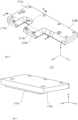
- FIG. 6 is a perspective view showing the first pusher 211.
- the first pusher 211 may include a lower block 210A and an upper block 210B that is stacked on and coupled to the lower block 210A.
- the lower surface of the lower block 210A is flat and in contact with the first area A1 (see FIG. 2 ) of the electrode material S0.
- the upper block 210B may be coupled to the holder 225.
- the size of the lower block 210A may be smaller than that of the upper block 210B.
- the first pusher 211 has the following characteristics:
- the first pusher 211 may include a body 211a in contact with the coated portion Sa and an extension portion 211b in contact with both the non-coated portion Sb and the coated portion Sa.
- the extension portion 211b may be disposed to extend from the front of the body 211 and protrude forward.
- the size of the extension portion 211b may be appropriately set, considering the size of the electrode tab Sc.
- the extension portion 211b may be formed on both the lower block 210A and the upper block 210B or only on the lower block 210A.
- FIG. 7 is a perspective view showing the second pusher 212.
- the second pusher 212 may include a lower block 210A and an upper block 210B that is stacked on and coupled to the lower block 210A.
- the lower surface of the lower block 210A is flat and in contact with the second area A2 (see FIG. 2 ) of the electrode material S0.
- the upper block 210B may be coupled to the holder 225.
- the front edge of the second pusher 212 has no extension portion 211b and has a straight shape.
- FIG. 8 is an exploded view of the first pusher 211
- FIG. 9 is a view showing the lower block 210A of the first pusher 211
- FIG. 10 is a view showing the upper block 210B of the first pusher 211.
- the lower block 210A includes a first groove G1.
- the first groove G1 is concavely formed on the upper surface of the lower block 210A.
- the first groove G1 may be formed over the body 211a and the extension portion 211b.
- the upper block 210B includes a second groove G2.
- the second groove G2 is concavely formed on the lower surface of the upper block 210B.
- the second groove G2 may be formed over the body 211a and the extension portion 211b.
- the first groove G1 and the second groove G2 form an air passage U that communicates with an air nozzle portion 250.
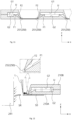
- FIG. 11 is a side cross-sectional view of the first pusher 211 taken along line A-A of FIG.6
- FIG. 12 is a side cross-sectional view of the second pusher 212 taken along line B-B of FIG. 6
- FIG. 13 is a plan view of the fist pusher 211
- FIG. 14 is a view showing a state in which scrap is separated from the electrode material S0 through the air nozzle portion 250.
- the pusher 210 forms the air nozzle portion 250 in the gap between the lower block 210A and the upper block 210B.
- the air nozzle portion 250 is connected to the air blower 230 and, during notching, sprays air supplied by the air blower 230 through the outlet of the air nozzle portion 250.
- the first pusher 211 forms an angular C-shaped air nozzle portion 250
- the second pusher 212 forms a straight air nozzle portion 250.
- the lower block 210A of the first pusher 211 may include a first surface F1 that forms the air nozzle portion 250.
- the upper block 210B may include a second surface F2 that forms the air nozzle portion 250.
- the first surface F1 and the second surface F2 are arranged facing each other with a gap therebetween.
- the outlet of the air nozzle portion 250 may be positioned toward the notching line NL.
- the first surface F1 and the second surface F2 may each be inclined toward the outlet of the air nozzle portion 250 such that the area of the air nozzle portion 250 decreases toward the outlet of the air nozzle portion 250.
- the inclination of the slope formed by the first surface F1 with respect to the lower surface of the lower block 210A may be smaller than the inclination of the slope formed by the second surface F2 with respect to the lower surface of the lower block 210A.
- the air nozzle portion 250 may include a first air nozzle 251 and a second air nozzle 252.
- the first pusher 211 may include both the first air nozzle 251 and the second air nozzle 252, while the second pusher 211 may include only the first air nozzle 251.
- the first air nozzle 251 is arranged along the front-and-rear direction y on the body 211a and sprays air from behind the scrap SR.
- the second air nozzle 252 is positioned on the extension portion 211b and arranged along the left-and-right direction x, spraying air from the side of the scrap SR.
- FIG. 15 is a diagram for describing a lower plate 600 detachably attached to a base at the bottom of a notched area of an electrode
- FIGS. 16 to 18 are diagrams for describing the structure of the lower plate 600.
- scrap SR is generated during the notching process of the electrode material S0 by the laser.
- the scraps SR separated from the front notching line NL1 and the rear notching line NL2 is removed by the suction hoods 241 of the suction portion 240.
- the scrap SR generated during notching may also be in close contact with a base B, making it challenging for the suction hood 241 to adsorb the scrap SR.
- the lower plate 600 may be detachably attached to both ends of the base B that correspond to the area irradiated with the laser beam L.
- Through slots 610 are formed, allowing the air flowing at the bottom of the through slots 610 to push the scrap SR while passing through the through slots 610 when the suction portion 240 adsorbs the scrap SR. This allows the scrap SR to be quickly discharged through the suction hood 241.
- the lower plate 600 may be in the shape of an empty box with one lateral side open, allowing one end of the base B to be inserted, while the remaining lateral sides are closed, and it has a structure that accommodates the end of the base B.
- the lower plate 600 may be formed into a structure that has one lateral side and the bottom side open and a hollow interior, enabling it to cover the end of the base B from the top.
- FIG. 19 is a diagram for describing the removal of gas (fume) or dust generated during laser notching.
- dust generated during the process may adhere to the notching line. Additionally, dispersed dust may contaminate the surface and vicinity of the electrode. To prevent these issues, it is possible to minimize the space where dust can adhere to the electrode by covering areas beyond the minimum distance (0.5 mm to 2 mm) for air spraying during laser notching.
- An air generating portion 730 which is disposed above the pusher portion 210 and configured to blow out gas or dust generated when the laser beam L notches the electrode S0 and a fume hood 741 configured to inhale and discharge the gas or dust blown outwards by the air generating portion 730 may be further provided.
- the volatile material of the electrode is burnt by the laser beam L, generating gas (fume) in the form of smoke. If this gas settles on the coated portion of the electrode S0, it may change the characteristics of the electrode, leading to defects. Alternatively, dust may scatter during the notching process.
- the pusher 210 covers the electrode S0 and air is expelled through the air nozzle 250 of the pusher 210 to push simultaneously scrap SR and gas (fume) or dust outward
- the air generating portion 730 is provided on the upper side of the pusher 210 to address situations where gas (fume) or dust cannot be entirely removed, ensuring that the gas (fume) does not affect the coated portion of the electrode and preventing the scattering of dust.
- the suction hood 741 for removing gas may be provided.
- the fume hood 741 is configured to suction air similarly to the suction hood 241.
- the present invention describes the transfer of the electrode material S0 in the horizontal direction and notching and cutting in the vertical (top to bottom) direction, it is not limited to this configuration.
- the electrode material S0 may also be transferred in the vertical direction (top to bottom or bottom to top), and notching and cutting may be performed in the horizontal direction.
- the present invention can be efficiently applied in the field of manufacturing a notching portion of a secondary battery electrode production system.
Landscapes
- Engineering & Computer Science (AREA)
- Optics & Photonics (AREA)
- Physics & Mathematics (AREA)
- Mechanical Engineering (AREA)
- Plasma & Fusion (AREA)
- Chemical & Material Sciences (AREA)
- General Chemical & Material Sciences (AREA)
- Electrochemistry (AREA)
- Chemical Kinetics & Catalysis (AREA)
- Manufacturing & Machinery (AREA)
- Materials Engineering (AREA)
- Battery Electrode And Active Subsutance (AREA)
- Laser Beam Processing (AREA)
Abstract
Description
- The present invention relates to a secondary battery electrode production system.
- In general, a chemical battery refers to a battery composed of a positive electrode, a negative electrode, and an electrolyte to thus generate electrical energy using a chemical reaction, and is classified into a primary battery, which is disposable, and a secondary battery, which is chargeable and dischargeable, thus enabling repeated use.
- The use of a secondary battery is gradually increasing due to the advantage of its chargeable and dischargeable characteristic. Among such secondary batteries, a lithium secondary battery has high energy density per unit weight, and thus is widely used as a power source in electronic communication devices and in high-power hybrid vehicles.
- Electrodes used in such a secondary battery are used as positive and negative electrodes of the battery, and are used to electrically connect the battery to the outside of the battery.
- The electrodes are formed through a notching process and a cutting process. The notching process involves forming electrode tabs on an electrode material. The cutting process involves cutting the electrode material on which the electrode tabs are formed into a predetermined length, producing a single sheet of electrodes.
- A notching portion configured to perform the etching process includes a mold upper plate and a mold lower plate which include a punching member. As the mold upper plate and mold lower plate move, they punch the electrode material to form electrode tabs. However, the notching portion has a problem of high maintenance costs for the mold. Additionally, after some repetitions of notching process, there is a need to replace components such as the mold or punching member.
- To address these issues, an approach is proposed to utilize a laser for the notching process. However, when using a laser for notching, there is a problem with dust adhering to a notching line. Moreover, scattered dust poses a risk of contaminating the surface of the electrode or its surroundings.
- An object of the present invention is to provide a secondary battery electrode production system including a notching portion without using a mold.
- According to an embodiment, a secondary battery electrode production system for producing a secondary battery electrode includes a notching portion configured to form an electrode tip of an electrode by notching an electrode material, wherein the notching portion includes a laser portion configured to irradiate the electrode material with a laser beam along a notching line, and a pusher portion disposed above the electrode material, and the pusher portion comprises a pusher in contact with the electrode material and an air blower connected to the pusher, wherein the pusher, during notching, makes contact with an area of the electrode material excluding the notching line, fixing the electrode material while fixing both a coated portion and a non-coated portion of the electrode material, wherein the pusher includes a lower block in contact with the electrode material, an upper block coupled to the lower block, and an air nozzle portion that corresponds to a gap between the lower block and the upper block, and the pusher includes a first pusher and a second pusher, wherein the first pusher and the second pusher are spaced apart from each other in a front-and-rear direction, and the first pusher presses both the coated portion and the non-coated portion, while the second pusher presses only the coated portion, wherein the first pusher includes a body in contact with the coated portion, and an extension portion in contact with both the non-coated portion and the coated portion and the air nozzle portion includes a first air nozzle disposed along the front-and-rear direction on the body and configured to spray air from behind scrap and a second air nozzle disposed along a left-and-right direction on the extension portion and configured to spray air from the side of the scrap.
- The lower block may include a first groove formed concavely on an upper surface, the upper block may include a second groove concavely formed on a lower surface, and in a coupled state of the upper block and the lower block, the first groove and the second groove may form an air passage that communicates with the air nozzle portion.
- The lower block may include a first surface that forms the air nozzle portion and the upper block may include a second surface that forms the air nozzle portion.
- The first surface and the second surface may each be inclined toward an outlet of the air nozzle portion such that the area of the air nozzle portion decreases toward the outlet.
- The inclination of the slope formed by the first surface with respect to the lower surface of the lower block may be smaller than the inclination of the slope formed by the second surface with respect to the lower surface of the lower block.
- The pusher may fix the electrode material to a base, a lower plate may be further provided which is detachably attached to both ends of the base that correspond to an area irradiated with the laser beam, and a through slot may be formed on an upper surface of the lower plate to facilitate a discharge of scrap generated during notching.
- The base may have through slots formed on an area at both ends of the base that corresponds to an area irradiated with the laser beam, facilitating a discharge of scrap generated during notching.
- The secondary battery electrode production system may further include an air generating portion disposed above the pusher portion and configured to blow out gas (fume) or dust generated when the laser beam notches the electrode, and a fume hood configured to inhale and discharge gas or dust blown outwards by the air generating portion.
- According to an embodiment, notching is performed using a laser instead of a mold, thereby providing the advantageous effect of using a notching portion almost permanently, except for replacing consumable parts.
- According to an embodiment, after notching, the cutting process utilizes a knife to cut an electrode material, thereby providing the advantageous effect of increasing the production speed of an electrode.
- According to an embodiment, an electrode is brought into close contact with a base at a notching line through a pusher that fixes a coated portion and a non-coated portion of an electrode together, thereby providing the advantageous effect of increasing the quality of notching.
- According to an embodiment, an air nozzle is disposed on the pusher, thereby providing the advantageous effect of easily separating scrap from the electrode material after notching. In particular, spraying air to the rear and lateral sides of the scrap facilitates separation of the scrap from the electrode material.
- According to an embodiment, a suction portion is arranged adjacent to the base, thereby providing the advantageous effect of easily removing scrap.
- According to the embodiment, the space where dust can adhere to the electrode can be minimized.
- According to the embodiment, scrap and dust can be removed, preventing the scattering of dust.
-
-
FIG. 1 is a front view showing a secondary battery electrode production system according to an embodiment. -
FIG. 2 is a plan view of an electrode material. -
FIG. 3 is a view showing a notching portion. -
FIG. 4 is a view showing the notching portion when viewed from a transfer direction. -
FIG. 5 is a view showing the notching portion when viewed from the front-and-rear direction. -
FIG. 6 is a perspective view showing a first pusher. -
FIG. 7 is a perspective view showing a second pusher. -
FIG. 8 is an exploded view of the first pusher. -
FIG. 9 is a view showing a lower block of the first pusher. -
FIG. 10 is a view showing an upper block of the first pusher. -
FIG. 11 is a side cross-sectional view of the first pusher taken along line A-A ofFIG.6 . -
FIG. 12 a side cross-sectional view of the second pusher taken along line B-B ofFIG.6 . -
FIG. 13 is a plan view of the first pusher. -
FIG. 14 is a view showing a state in which scrap is separated from an electrode material through an air nozzle portion. -
FIG. 15 is a diagram for describing a lower plate detachably attached to a base at the bottom of a notched area of an electrode. -
FIGS. 16 to 18 are views for describing the structure of the lower plate. -
FIG. 19 is a diagram for describing the removal of gas (fume) generated during laser notching. - Hereinafter, preferred embodiments of the present invention will be described in detail with reference to the accompanying drawings.
- The invention may, however, be embodied in many different forms and should not be construed as being limited to the embodiments set forth herein; rather these embodiments are provided so that this disclosure will be thorough and complete, and will fully convey the concept of the invention to one of ordinary skill in the art.
- The terminology used herein is for the purpose of describing particular embodiments only and is not intended to be limiting of the present invention. As used herein, the singular forms "a," "an" and "the" are intended to include the plural forms as well, unless the context clearly indicates otherwise. It will be further understood that the terms "comprises" and/or "comprising" used herein specify the presence of stated features, integers, steps, operations, members, components, and/or groups thereof, but do not preclude the presence or addition of one or more other features, integers, steps, operations, members, components, and/or groups thereof. As used herein, the term "and/or" includes any and all combinations of one or more of the associated listed items.
- It will be understood that, although the terms first, second, third, etc., may be used herein to describe various elements, components, regions, layers and/or sections, these elements, components, regions, layers and/or sections should not be limited by these terms. These terms are only used to distinguish one element, component, region, layer or section from another region, layer or section. Thus, a first element, component, region, layer or section discussed below could be termed a second element, component, region, layer or section without departing from the teachings of the present invention.
- Embodiments of the present invention are described herein with reference to drawings that are schematic illustrations of idealized embodiments of the invention. As such, variations from the shapes of the drawings as a result, for example, of manufacturing techniques and/or tolerances, are to be expected. Thus, embodiments of the invention should not be construed as limited to the particular shapes of regions illustrated herein but are to include deviations in shapes that result, for example, from manufacturing.
- A secondary battery electrode production system is a device for automatically and continuously producing electrodes used in secondary batteries.
-
FIG. 1 is a front view of a secondary battery electrode production system according to an embodiment. In the drawings, the direction represented by the x-axis corresponds to a length direction of the secondary battery electrode production system, indicating a direction in which an electrode material is transferred. In the drawings, the direction represented by the y-axis corresponds to a direction between the front and rear of the secondary battery electrode production system, indicating the same direction as the width direction of the electrode material, and the direction represented by the z-axis corresponds to a height direction of the secondary battery electrode production system. - As shown in
FIG. 1 , the secondary battery electrode production system according to an embodiment includes an unwindingportion 10, adancer unit 20, a notchingportion 30, afeeding device 40, a cuttingportion 50, and an alignment device andmagazine 60. An electrode material S0 formed as a horizontally elongated strip-shaped metal plate is supplied from the unwindingportion 10. The electrode material S0 is an elongated strip-shaped metal plate that may be formed of copper when producing a cathode battery, or aluminum when producing an anode battery. - The
dancer unit 20 guides the electrode material S0 supplied from the unwindingportion 10 to the notchingportion 30 and adjusts the tension of the electrode material S0 in response to changes in the supply speed of the electrode material S0. - The notching
portion 30 forms electrode tabs Sc (seeFIG. 2 ) on the supplied electrode material S0. - The
feeding device 40 supplies the notched electrode material S0 from the notchingportion 30 to the cuttingportion 50. Thefeeding device 40 may pull the electrode material S0 at periodically repeating different speeds or tensions. - The cutting
portion 50 cuts the supplied electrode material S0 to produce a single sheet of electrodes. - The alignment device and
magazine 60 aligns and loads the sheets of electrodes. -
FIG. 2 is a plan view of the electrode material S0. - Referring to
FIG. 2 , the electrode material S0 may be divided into a coated portion Sa and a non-coated portion Sb. The non-coated portion Sb may each be placed in front of and behind the coated portion Sa. The non-coated portion Sb placed in front of the coated portion Sa is cut by the notchingportion 30, forming its remaining area into the electrode tab Sc. Notching is performed along a notching line NL on the electrode material S0. The notching line NL may be divided into a front notching line NL1 and a rear notching line NL2. The front notching line NL1 starts at the front edge of the electrode material S0 and forms the electrode tab Sc. The rear notching line NL2 starts at the rear edge of the electrode material S0. The front notching line NL1 includes two bent lines corresponding to the shape of the electrode tab Sc, while the rear notching line NL2 may be a straight line. Laser beam irradiation is performed along the notching line NL. -
FIG. 3 is a view showing the notchingportion 30. - Referring to
FIG. 3 , the notchingportion 30 irradiates the electrode material S0 with laser for notching. The laser beam, with its high energy density, provides the advantage of precise processing of the electrode tabs Sc. The notchingportion 30 includes alaser portion 100 and apusher portion 200. Thelaser portion 100 irradiates the electrode material S0 with a laser beam along the notching line NL. Thepusher portion 200 serves to pressurize and adjust the electrode material S0 during notching. - The
laser portion 100 may be disposed above thepusher portion 200 and emit a laser beam from the top to the bottom. Thelaser portion 100, in addition to an oscillation device, may include driving devices that move the oscillation device in two or three axes. Therefore, thelaser portion 100 may move in the front-and-rear direction y, the transfer direction x, and the height direction z. Thislaser portion 100 may include afirst laser portion 110 and asecond laser portion 120. Thefirst laser portion 110 may emit a laser beam along the front notching line NL. Thesecond laser portion 120 may emit a laser beam along the rear notching line NL2. Thefirst laser portion 110 and thesecond laser portion 120 may be spaced apart from each other in the front-and-rear direction y. - The
pusher portion 200 may include apusher 210 and a drivingportion 220. Thepusher 210 makes contact with and fixes the electrode material S0. The drivingportion 220 is a device that vertically moves thepusher 210 in the height direction z. Thepusher 210 may include afirst pusher 211 and asecond pusher 212. Thefirst pusher 211 and thesecond pusher 212 may be spaced apart from each other in the front-and-rear direction y. Thefirst pusher 211 may be in contact with the electrode material S0 near the front notching line NL1. Thesecond pusher 212 may be in contact with the electrode material S0 near the rear notching line NL2. Thefirst pusher 211 and thesecond pusher 212 may descend together, simultaneously making contact with the electrode material S0. - Among these
pushers 210, thefirst pusher 211 fixes both the coated portion Sa and the non-coated portion Sb of the electrode material S0 together, thereby increasing the adhesion of the electrode material S0 to a base B. When notching using a laser, if the electrode material S0 is not adhered to the base B and is floating, there may be defects in the electrode tabs Sc as the laser beam can deviate from the notching line NL. When thefirst pusher 211 fixes not only the coated portion Sa but also the remaining area of the non-coated portion Sb that forms the electrode tip Sc together with the coated portion Sa, the adhesion of the electrode material S0 to the base B near the front notching line NL1 can be significantly increased, ensuring the quality of notching. - From the perspective of the electrode material S0, it may include a first area A1 and a second area A2 in contact with the
pusher 210. The first area A1 and the second area A2 may be spaced apart from each other in the width direction y of the electrode material S0. The first area A1 is positioned near the front notching line NL1 and may be spaced at a predetermined distance from the front notching line NL1. The second area A2 is positioned near the rear notching line NL2 and may be spaced at a predetermined distance from the rear notching line NL2. Here, the first area A1 is formed over the coated portion Sa and the non-coated portion Sb, while the second area A2 may be formed only on the coated portion Sa. - The length L of the first area A1 or the second area A2, i.e., the length of the
pusher 210, may be at least greater than the length L2 of a single sheet S1 of electrodes. This is to establish a minimum length of the notching line NL performed at once when the transfer of the electrode material S0 is in a halted state by taking into account the fact that after notching the electrode material S0 is immediately cut in the cuttingportion 50 to produce a single sheet S1 of electrodes. Here, the length is defined with respect to the transfer direction x. - Unlike the notching
portion 30, the cuttingportion 50 physically cuts the electrode material S0 using a knife. The cuttingportion 50 cuts the electrode material S0 at once along a cutting line CL to produce a single sheet S1 of electrodes. Therefore, the cutting process progresses rapidly, allowing an increase in the overall speed of the electrode production process. -
FIG. 4 is a view showing the notchingportion 30 when viewed from the transfer direction x, andFIG. 5 is a view showing the notchingportion 30 when viewed from the front-and-rear direction y. - Referring to
FIGS. 4 and5 , the drivingportion 220 of thepusher portion 200 may include amotor 221, ashaft 222, apusher rod 223, aguide 224, and aholder 225. - The
motor 221 provides a driving force to allow thepusher rod 223 to move in the height direction z. Theshaft 222 is connected to themotor 221 to transmit the power of themotor 221 to thepusher rod 223. Thepusher rod 223 moves in the height direction z along theguide 224. Various power transmission devices may be placed between theshaft 222 and thepusher rod 223 to convert the rotational motion of theshaft 222 into linear reciprocating motion. Theholder 225 is coupled to thepusher rod 223, and as thepusher rod 223 moves up and down, it moves together. Thepusher 210 is positioned in theholder 225, so when thepusher rod 223 descends, it descends together and makes contact with the electrode material S0. Anelastic member 226 may be placed between theholder 225 and thepusher 210. Theelastic member 226 may be a component that exhibits a restoring force when stretched or contracted in the height direction z. Thiselastic member 226 guides thepusher 210 to ensure that the electrode material S0 comes into close contact with the base B when pressed by thepusher 210. - When the transfer of the electrode material S0 stops, the
first pusher 211 and thesecond pusher 212 descend together and make contact with the first area A1 and the second area A2 of the electrode material S0 simultaneously, allowing the electrode material S0 to be fixed to the base B. - A
suction portion 240 serves to suction and remove scrap SR generated during the notching process. Thesuction portion 240 includessuction hoods 241. During the notching process, when thesuction portion 240 operates, thesuction hoods 241 are each positioned in front of and behind the base B in the front-and-rear direction y, allowing it to directly suction the scrap SR of the electrode material S0 separated at the front notching line NL1 and the scrap SR of the electrode material S0 separated at the rear notching line NL2. -
FIG. 6 is a perspective view showing thefirst pusher 211. - Referring to
FIG. 6 , thefirst pusher 211 may include alower block 210A and anupper block 210B that is stacked on and coupled to thelower block 210A. The lower surface of thelower block 210A is flat and in contact with the first area A1 (seeFIG. 2 ) of the electrode material S0. Theupper block 210B may be coupled to theholder 225. The size of thelower block 210A may be smaller than that of theupper block 210B. In order to make contact with both the coated portion Sa and the non-coated portion Sb, thefirst pusher 211 has the following characteristics: - The
first pusher 211 may include abody 211a in contact with the coated portion Sa and anextension portion 211b in contact with both the non-coated portion Sb and the coated portion Sa. Theextension portion 211b may be disposed to extend from the front of thebody 211 and protrude forward. The size of theextension portion 211b may be appropriately set, considering the size of the electrode tab Sc. Theextension portion 211b may be formed on both thelower block 210A and theupper block 210B or only on thelower block 210A. -
FIG. 7 is a perspective view showing thesecond pusher 212. - Referring to
FIG. 7 , thesecond pusher 212 may include alower block 210A and anupper block 210B that is stacked on and coupled to thelower block 210A. The lower surface of thelower block 210A is flat and in contact with the second area A2 (seeFIG. 2 ) of the electrode material S0. Theupper block 210B may be coupled to theholder 225. Unlike thefirst pusher 211, the front edge of thesecond pusher 212 has noextension portion 211b and has a straight shape. -
FIG. 8 is an exploded view of thefirst pusher 211,FIG. 9 is a view showing thelower block 210A of thefirst pusher 211, andFIG. 10 is a view showing theupper block 210B of thefirst pusher 211. - Referring to
FIGS. 8 and9 , thelower block 210A includes a first groove G1. The first groove G1 is concavely formed on the upper surface of thelower block 210A. The first groove G1 may be formed over thebody 211a and theextension portion 211b. - Referring to
FIGS. 8 and10 , theupper block 210B includes a second groove G2. The second groove G2 is concavely formed on the lower surface of theupper block 210B. The second groove G2 may be formed over thebody 211a and theextension portion 211b. - In the coupled state of the
lower block 210A and theupper block 210B, the first groove G1 and the second groove G2 form an air passage U that communicates with anair nozzle portion 250. -
FIG. 11 is a side cross-sectional view of thefirst pusher 211 taken along line A-A ofFIG.6 ,FIG. 12 is a side cross-sectional view of thesecond pusher 212 taken along line B-B ofFIG. 6 ,FIG. 13 is a plan view of thefist pusher 211, andFIG. 14 is a view showing a state in which scrap is separated from the electrode material S0 through theair nozzle portion 250. - Referring to
FIGS. 11 and 12 , thepusher 210 forms theair nozzle portion 250 in the gap between thelower block 210A and theupper block 210B. Theair nozzle portion 250 is connected to theair blower 230 and, during notching, sprays air supplied by theair blower 230 through the outlet of theair nozzle portion 250. - The
first pusher 211 forms an angular C-shapedair nozzle portion 250, and thesecond pusher 212 forms a straightair nozzle portion 250. - Referring to
FIG. 11 , thelower block 210A of thefirst pusher 211 may include a first surface F1 that forms theair nozzle portion 250. Theupper block 210B may include a second surface F2 that forms theair nozzle portion 250. The first surface F1 and the second surface F2 are arranged facing each other with a gap therebetween. The outlet of theair nozzle portion 250 may be positioned toward the notching line NL. - The first surface F1 and the second surface F2 may each be inclined toward the outlet of the
air nozzle portion 250 such that the area of theair nozzle portion 250 decreases toward the outlet of theair nozzle portion 250. - The inclination of the slope formed by the first surface F1 with respect to the lower surface of the
lower block 210A may be smaller than the inclination of the slope formed by the second surface F2 with respect to the lower surface of thelower block 210A. - As shown in
FIGS. 11 to 14 , theair nozzle portion 250 may include afirst air nozzle 251 and asecond air nozzle 252. Thefirst pusher 211 may include both thefirst air nozzle 251 and thesecond air nozzle 252, while thesecond pusher 211 may include only thefirst air nozzle 251. - The
first air nozzle 251 is arranged along the front-and-rear direction y on thebody 211a and sprays air from behind the scrap SR. Thesecond air nozzle 252 is positioned on theextension portion 211b and arranged along the left-and-right direction x, spraying air from the side of the scrap SR. - During the irradiation of the electrode material S0 with laser, air is sprayed through the
air nozzle portion 250 toward the notching line NL. The scrap SR notched by the laser is easily separated from the electrode material S0 by the air sprayed. During notching by thefirst pusher 211 and thesecond pusher 212, air is sprayed, facilitating the easy separation of scrap SR from the electrode material S0. The separated scrap SR may be immediately suctioned and removed by thesuction hood 241. - In the case of the
first pusher 211, air is sprayed from the rear and lateral surfaces of the scrap SR, allowing for easy separation of the scrap SR from the electrode material S0. -
FIG. 15 is a diagram for describing alower plate 600 detachably attached to a base at the bottom of a notched area of an electrode, andFIGS. 16 to 18 are diagrams for describing the structure of thelower plate 600. - According to the description in
FIG. 12 , during the notching process of the electrode material S0 by the laser, scrap SR is generated. The scraps SR separated from the front notching line NL1 and the rear notching line NL2 is removed by thesuction hoods 241 of thesuction portion 240. - Since the electrode material S0 is brought into close contact with the base B by the
pusher 210, the scrap SR generated during notching may also be in close contact with a base B, making it challenging for thesuction hood 241 to adsorb the scrap SR. - To address these issues, the
lower plate 600 may be detachably attached to both ends of the base B that correspond to the area irradiated with the laser beam L. On the upper surface of thelower plate 600, throughslots 610 are formed, allowing the air flowing at the bottom of the throughslots 610 to push the scrap SR while passing through the throughslots 610 when thesuction portion 240 adsorbs the scrap SR. This allows the scrap SR to be quickly discharged through thesuction hood 241. - The
lower plate 600 may be in the shape of an empty box with one lateral side open, allowing one end of the base B to be inserted, while the remaining lateral sides are closed, and it has a structure that accommodates the end of the base B. Alternatively, thelower plate 600 may be formed into a structure that has one lateral side and the bottom side open and a hollow interior, enabling it to cover the end of the base B from the top. - Additionally, instead of the
lower plate 600, directly forming through slots on an area at both ends of the base B that corresponds to the area irradiated with the laser beam L may achieve the same effect. -
FIG. 19 is a diagram for describing the removal of gas (fume) or dust generated during laser notching. - During laser notching, dust generated during the process may adhere to the notching line. Additionally, dispersed dust may contaminate the surface and vicinity of the electrode. To prevent these issues, it is possible to minimize the space where dust can adhere to the electrode by covering areas beyond the minimum distance (0.5 mm to 2 mm) for air spraying during laser notching.
- An
air generating portion 730 which is disposed above thepusher portion 210 and configured to blow out gas or dust generated when the laser beam L notches the electrode S0 and afume hood 741 configured to inhale and discharge the gas or dust blown outwards by theair generating portion 730 may be further provided. - When the coated portion of the electrode S0 is cut with a laser beam L, the volatile material of the electrode is burnt by the laser beam L, generating gas (fume) in the form of smoke. If this gas settles on the coated portion of the electrode S0, it may change the characteristics of the electrode, leading to defects. Alternatively, dust may scatter during the notching process.
- Although the
pusher 210 covers the electrode S0 and air is expelled through theair nozzle 250 of thepusher 210 to push simultaneously scrap SR and gas (fume) or dust outward, theair generating portion 730 is provided on the upper side of thepusher 210 to address situations where gas (fume) or dust cannot be entirely removed, ensuring that the gas (fume) does not affect the coated portion of the electrode and preventing the scattering of dust. - In addition, in cases where a large amount of air is suctioned by the
suction hood 241 for removing scrap SR, the suction pressure weakens, hindering efficient discharge of scrap SR. Thus, thefume hood 741 for removing gas (fume) may be provided. Thefume hood 741 is configured to suction air similarly to thesuction hood 241. - In addition, while the present invention describes the transfer of the electrode material S0 in the horizontal direction and notching and cutting in the vertical (top to bottom) direction, it is not limited to this configuration. The electrode material S0 may also be transferred in the vertical direction (top to bottom or bottom to top), and notching and cutting may be performed in the horizontal direction.
- In the above, specific examples of the secondary battery electrode production system of the present invention have been described, but it is obvious that various implementation modifications are possible within the limit not departing from the scope of the present invention.
- Therefore, the scope of the present invention should not be limited to the aforementioned embodiments, but should be defined by the equivalents to the appended claims as well as the claims.
- Accordingly, it should be understood that the above-described embodiments are merely exemplary and is not limited, and it should be interpreted that the scope of the present invention is represented by the claims rather than the description, and the changes or modifications derived from the claims and the equivalents thereof pertain to the scope of the present invention.
- The present invention can be efficiently applied in the field of manufacturing a notching portion of a secondary battery electrode production system.
Claims (8)
- A secondary battery electrode production system for producing a secondary battery electrode, comprising a notching portion configured to form an electrode tab of an electrode by notching an electrode material,wherein the notching portion (1) comprises a laser portion (100) configured to irradiate the electrode material with a laser beam along a notching line, and a pusher portion (200) disposed above the electrode material, andthe pusher portion (200) comprises a pusher (210) in contact with the electrode material and an air blower (230) connected to the pusher (210),wherein the pusher (210), during notching, makes contact with an area of the electrode material excluding the notching line, fixing the electrode material while fixing both a coated portion (Sa) and a non-coated portion (Sb) of the electrode material,wherein the pusher (210) comprises a lower block (210A) in contact with the electrode material, an upper block (210B) coupled to the lower block (210A), and an air nozzle portion (250) that corresponds to a gap between the lower block (210A) and the upper block (210B), and the pusher (210) comprises a first pusher (211) and a second pusher (212),wherein the first pusher (211) and the second pusher (212) are spaced apart from each other in a front-and-rear direction, and the first pusher (211) presses both the coated portion (Sa) and the non-coated portion (Sb), while the second pusher (212) presses only the coated portion,wherein the first pusher (211) comprises a body (211a) in contact with the coated portion (Sa), and an extension portion (211b) in contact with both the non-coated portion (Sb) and the coated portion (Sa) andthe air nozzle portion (250) comprises a first air nozzle (251) disposed along the front-and-rear direction on the body (211a) and configured to spray air from behind scrap and a second air nozzle (252) disposed along a left-and-right direction on the extension portion (211b) and configured to spray air from the side of the scrap.
- The secondary battery electrode production system of claim 1, wherein:the lower block (210A) comprises a first groove (G1) formed concavely on an upper surface,the upper block (210B) comprises a second groove (G2) concavely formed on a lower surface, andin a coupled state of the upper block 210B and the lower block (210A), the first groove (G1) and the second groove (G2) form an air passage (U) that communicates with the air nozzle portion (250).
- The secondary battery electrode production system of claim 2, wherein the lower block (210A) includes a first surface (F1) that forms the air nozzle portion (250) and the upper block (210B) includes a second surface (F2) that forms the air nozzle portion (250).
- The secondary battery electrode production system of claim 3, wherein the first surface (F1) and the second surface (F2) are each inclined toward an outlet of the air nozzle portion (250) such that the area of the air nozzle portion (250) decreases toward the outlet of the air nozzle portion (250).
- The secondary battery electrode production system of claim 4, wherein an inclination of a slope formed by the first surface (F1) with respect to a lower surface of the lower block (210A) is smaller than an inclination of a slope formed by the second surface (F2) with respect to a lower surface of the lower block (210A).
- The secondary battery electrode production system of claim 1, wherein:the pusher (210) fixes the electrode material to a base (B),a lower plate (600) is further provided which is detachably attached to both ends of the base (B) that correspond to an area irradiated with the laser beam, anda through slot (610) is formed on an upper surface of the lower plate to facilitate a discharge of scrap generated during notching.
- The secondary battery electrode production system of claim 6, wherein the base (B) has through slots (610) formed on an area at both ends of the base (B) that corresponds to an area irradiated with the laser beam, facilitating a discharge of scrap generated during notching.
- The secondary battery electrode production system of claim 1, further comprising:an air generating portion (730) disposed above the pusher portion (200) and configured to blow out gas (fume) or dust generated when the laser beam notches the electrode; anda fume hood (741) configured to inhale and discharge gas or dust blown outwards by the air generating portion (730).
Applications Claiming Priority (2)
| Application Number | Priority Date | Filing Date | Title |
|---|---|---|---|
| KR1020230005885A KR102903317B1 (en) | 2023-01-16 | 2023-01-16 | System for producing electrodes of battery |
| PCT/KR2024/000704 WO2024155049A1 (en) | 2023-01-16 | 2024-01-15 | Electrode production system for secondary battery |
Publications (2)
| Publication Number | Publication Date |
|---|---|
| EP4425592A1 true EP4425592A1 (en) | 2024-09-04 |
| EP4425592A4 EP4425592A4 (en) | 2025-08-27 |
Family
ID=91956234
Family Applications (1)
| Application Number | Title | Priority Date | Filing Date |
|---|---|---|---|
| EP24705346.5A Pending EP4425592A4 (en) | 2023-01-16 | 2024-01-15 | ELECTRODE MANUFACTURING SYSTEM FOR SECONDARY BATTERY |
Country Status (5)
| Country | Link |
|---|---|
| US (1) | US20250128355A1 (en) |
| EP (1) | EP4425592A4 (en) |
| JP (1) | JP7742188B2 (en) |
| KR (1) | KR102903317B1 (en) |
| WO (1) | WO2024155049A1 (en) |
Family Cites Families (8)
| Publication number | Priority date | Publication date | Assignee | Title |
|---|---|---|---|---|
| KR101569798B1 (en) | 2014-01-28 | 2015-11-17 | 주식회사 디에이테크놀로지 | Electrode Notching Apparatus for Secondary Battery |
| KR20180010803A (en) * | 2016-07-22 | 2018-01-31 | 에스케이이노베이션 주식회사 | Notching machine for secondary battery |
| CN106410113A (en) * | 2016-11-08 | 2017-02-15 | 珠海光宇电池有限公司 | Method for removing pole piece coating and pole piece coating cleaning device |
| KR102589533B1 (en) * | 2021-01-12 | 2023-10-16 | 유일에너테크(주) | System for producing electrodes of battery |
| EP4060778A1 (en) * | 2021-03-18 | 2022-09-21 | EO Technics Co., Ltd. | Device for manufacturing electrode |
| KR102902937B1 (en) * | 2021-04-14 | 2025-12-22 | 주식회사 엘지에너지솔루션 | Apparatus for removing foreign substances during the notching process of secondary battery |
| KR102497811B1 (en) * | 2021-05-27 | 2023-02-10 | 주식회사 디에이테크놀로지 | Laser Notching System for Manufacturing Secondary Battery |
| KR102788410B1 (en) * | 2021-10-14 | 2025-03-31 | 유일에너테크(주) | System for producing electrodes of battery |
-
2023
- 2023-01-16 KR KR1020230005885A patent/KR102903317B1/en active Active
-
2024
- 2024-01-15 EP EP24705346.5A patent/EP4425592A4/en active Pending
- 2024-01-15 WO PCT/KR2024/000704 patent/WO2024155049A1/en not_active Ceased
- 2024-01-15 JP JP2024513536A patent/JP7742188B2/en active Active
- 2024-01-15 US US18/685,596 patent/US20250128355A1/en active Pending
Also Published As
| Publication number | Publication date |
|---|---|
| JP7742188B2 (en) | 2025-09-19 |
| KR20240114026A (en) | 2024-07-23 |
| US20250128355A1 (en) | 2025-04-24 |
| KR102903317B1 (en) | 2025-12-23 |
| JP2025507475A (en) | 2025-03-21 |
| EP4425592A4 (en) | 2025-08-27 |
| WO2024155049A1 (en) | 2024-07-25 |
Similar Documents
| Publication | Publication Date | Title |
|---|---|---|
| KR101774262B1 (en) | Electrode Tab Fabricating Apparatus with Improved Dimensional Stability and Method for Fabricating Electrode Tab Utilizing the Same | |
| KR102589533B1 (en) | System for producing electrodes of battery | |
| JP5685347B2 (en) | Laser cutting device for electronic component electrode band | |
| KR102788410B1 (en) | System for producing electrodes of battery | |
| KR20230152616A (en) | Notching machine for secondary battery | |
| EP4205926B1 (en) | Electrode cutting apparatus including detached foreign substance removing unit | |
| KR102559154B1 (en) | Electrode notching apparatus and method thereof | |
| KR102647047B1 (en) | Apparatus for processing lead tab of secondary battery | |
| JP2023535844A (en) | Electrode plate forming method and equipment | |
| CN114556613B (en) | Electrode manufacturing method using laser etching and electrode manufacturing equipment for performing the method | |
| EP4425592A1 (en) | Electrode production system for secondary battery | |
| US20240424707A1 (en) | Marking device and electrode sheet production system | |
| KR20230168121A (en) | Laser cutting apparatus | |
| US20240149313A1 (en) | Cleaning equipment and cleaning method of sealing tool | |
| JP2025538853A (en) | Electrode notching device and electrode notching method using the same | |
| CN119497658A (en) | Device for collecting foreign matter generated during laser grooving and method for collecting foreign matter using the same | |
| KR102461510B1 (en) | System for producing electrodes of battery | |
| KR102955949B1 (en) | Apparatus for collecting foreign material from laser notching process and method using the same | |
| KR20240174407A (en) | Electrode Manufacturing Device | |
| KR20250136520A (en) | Laser notching device | |
| KR20240174632A (en) | Pattern jig and apparatus for producing electrodes of battery | |
| CN113967782A (en) | Ultrasonic dust removing device | |
| KR20250039714A (en) | Notching system and method | |
| CN121666287A (en) | Laser grooving equipment | |
| CN119384334A (en) | Laser cutting device |
Legal Events
| Date | Code | Title | Description |
|---|---|---|---|
| STAA | Information on the status of an ep patent application or granted ep patent |
Free format text: STATUS: UNKNOWN |
|
| STAA | Information on the status of an ep patent application or granted ep patent |
Free format text: STATUS: THE INTERNATIONAL PUBLICATION HAS BEEN MADE |
|
| PUAI | Public reference made under article 153(3) epc to a published international application that has entered the european phase |
Free format text: ORIGINAL CODE: 0009012 |
|
| STAA | Information on the status of an ep patent application or granted ep patent |
Free format text: STATUS: REQUEST FOR EXAMINATION WAS MADE |
|
| 17P | Request for examination filed |
Effective date: 20240223 |
|
| AK | Designated contracting states |
Kind code of ref document: A1 Designated state(s): AL AT BE BG CH CY CZ DE DK EE ES FI FR GB GR HR HU IE IS IT LI LT LU LV MC ME MK MT NL NO PL PT RO RS SE SI SK SM TR |
|
| A4 | Supplementary search report drawn up and despatched |
Effective date: 20250725 |
|
| RIC1 | Information provided on ipc code assigned before grant |
Ipc: H01M 4/04 20060101AFI20250721BHEP Ipc: H01M 10/04 20060101ALI20250721BHEP Ipc: B23K 26/362 20140101ALI20250721BHEP Ipc: B23K 26/16 20060101ALI20250721BHEP Ipc: B08B 15/04 20060101ALI20250721BHEP Ipc: B23K 101/36 20060101ALI20250721BHEP Ipc: B23K 26/08 20140101ALI20250721BHEP Ipc: B23K 26/142 20140101ALI20250721BHEP Ipc: B23K 26/38 20140101ALI20250721BHEP |
|
| DAV | Request for validation of the european patent (deleted) | ||
| DAX | Request for extension of the european patent (deleted) |