EP4424691A1 - Cyclic phosphine compound preparation method - Google Patents
Cyclic phosphine compound preparation method Download PDFInfo
- Publication number
- EP4424691A1 EP4424691A1 EP22887453.3A EP22887453A EP4424691A1 EP 4424691 A1 EP4424691 A1 EP 4424691A1 EP 22887453 A EP22887453 A EP 22887453A EP 4424691 A1 EP4424691 A1 EP 4424691A1
- Authority
- EP
- European Patent Office
- Prior art keywords
- group
- chemical formula
- compound
- reaction
- integer
- Prior art date
- Legal status (The legal status is an assumption and is not a legal conclusion. Google has not performed a legal analysis and makes no representation as to the accuracy of the status listed.)
- Pending
Links
- -1 Cyclic phosphine compound Chemical class 0.000 title claims abstract description 58
- XYFCBTPGUUZFHI-UHFFFAOYSA-N Phosphine Natural products P XYFCBTPGUUZFHI-UHFFFAOYSA-N 0.000 title claims abstract description 51
- 229910000073 phosphorus hydride Inorganic materials 0.000 title claims abstract description 51
- 238000002360 preparation method Methods 0.000 title description 2
- 238000006243 chemical reaction Methods 0.000 claims abstract description 106
- 150000001875 compounds Chemical class 0.000 claims abstract description 103
- 238000000034 method Methods 0.000 claims abstract description 49
- 239000007822 coupling agent Substances 0.000 claims abstract description 33
- 150000002896 organic halogen compounds Chemical class 0.000 claims abstract description 27
- 239000000126 substance Substances 0.000 claims description 115
- 125000004432 carbon atom Chemical group C* 0.000 claims description 34
- 239000003960 organic solvent Substances 0.000 claims description 29
- 239000002904 solvent Substances 0.000 claims description 28
- 125000005843 halogen group Chemical group 0.000 claims description 18
- 229910052751 metal Inorganic materials 0.000 claims description 18
- 239000002184 metal Substances 0.000 claims description 18
- 150000001412 amines Chemical class 0.000 claims description 16
- 239000002585 base Substances 0.000 claims description 16
- 239000000460 chlorine Substances 0.000 claims description 14
- ZAMOUSCENKQFHK-UHFFFAOYSA-N Chlorine atom Chemical compound [Cl] ZAMOUSCENKQFHK-UHFFFAOYSA-N 0.000 claims description 11
- 125000002947 alkylene group Chemical group 0.000 claims description 11
- 125000003277 amino group Chemical group 0.000 claims description 11
- 229910052801 chlorine Inorganic materials 0.000 claims description 11
- 230000003647 oxidation Effects 0.000 claims description 11
- 238000007254 oxidation reaction Methods 0.000 claims description 11
- 150000002430 hydrocarbons Chemical group 0.000 claims description 10
- 150000003839 salts Chemical class 0.000 claims description 10
- 125000000101 thioether group Chemical group 0.000 claims description 10
- 125000003396 thiol group Chemical group [H]S* 0.000 claims description 10
- 239000011737 fluorine Substances 0.000 claims description 9
- 229910052731 fluorine Inorganic materials 0.000 claims description 9
- 125000002887 hydroxy group Chemical group [H]O* 0.000 claims description 9
- 229930195735 unsaturated hydrocarbon Natural products 0.000 claims description 9
- 125000000732 arylene group Chemical group 0.000 claims description 8
- 229910052736 halogen Inorganic materials 0.000 claims description 8
- 229910052698 phosphorus Inorganic materials 0.000 claims description 8
- 229910052710 silicon Inorganic materials 0.000 claims description 8
- 150000001350 alkyl halides Chemical class 0.000 claims description 7
- 239000004210 ether based solvent Substances 0.000 claims description 7
- XLYOFNOQVPJJNP-UHFFFAOYSA-M hydroxide Chemical compound [OH-] XLYOFNOQVPJJNP-UHFFFAOYSA-M 0.000 claims description 7
- 229910052757 nitrogen Inorganic materials 0.000 claims description 7
- 229910052760 oxygen Inorganic materials 0.000 claims description 7
- 238000006467 substitution reaction Methods 0.000 claims description 7
- 229910052717 sulfur Inorganic materials 0.000 claims description 7
- WKBOTKDWSSQWDR-UHFFFAOYSA-N Bromine atom Chemical compound [Br] WKBOTKDWSSQWDR-UHFFFAOYSA-N 0.000 claims description 6
- GDTBXPJZTBHREO-UHFFFAOYSA-N bromine Substances BrBr GDTBXPJZTBHREO-UHFFFAOYSA-N 0.000 claims description 6
- 229910052794 bromium Inorganic materials 0.000 claims description 6
- 150000002367 halogens Chemical group 0.000 claims description 6
- 239000005453 ketone based solvent Substances 0.000 claims description 6
- QTBSBXVTEAMEQO-UHFFFAOYSA-M Acetate Chemical compound CC([O-])=O QTBSBXVTEAMEQO-UHFFFAOYSA-M 0.000 claims description 5
- 150000004945 aromatic hydrocarbons Chemical class 0.000 claims description 5
- ZCYVEMRRCGMTRW-UHFFFAOYSA-N 7553-56-2 Chemical compound [I] ZCYVEMRRCGMTRW-UHFFFAOYSA-N 0.000 claims description 3
- 229910052783 alkali metal Inorganic materials 0.000 claims description 3
- 150000001340 alkali metals Chemical class 0.000 claims description 3
- 229910052740 iodine Inorganic materials 0.000 claims description 3
- 239000011630 iodine Substances 0.000 claims description 3
- 125000001153 fluoro group Chemical group F* 0.000 claims 1
- 239000006227 byproduct Substances 0.000 abstract description 13
- 239000002994 raw material Substances 0.000 abstract description 9
- 238000007796 conventional method Methods 0.000 abstract description 7
- 229910052744 lithium Inorganic materials 0.000 description 20
- YMWUJEATGCHHMB-UHFFFAOYSA-N Dichloromethane Chemical compound ClCCl YMWUJEATGCHHMB-UHFFFAOYSA-N 0.000 description 18
- RTZKZFJDLAIYFH-UHFFFAOYSA-N Diethyl ether Chemical compound CCOCC RTZKZFJDLAIYFH-UHFFFAOYSA-N 0.000 description 18
- WHXSMMKQMYFTQS-UHFFFAOYSA-N Lithium Chemical compound [Li] WHXSMMKQMYFTQS-UHFFFAOYSA-N 0.000 description 18
- ZMANZCXQSJIPKH-UHFFFAOYSA-N Triethylamine Chemical compound CCN(CC)CC ZMANZCXQSJIPKH-UHFFFAOYSA-N 0.000 description 15
- 229940021013 electrolyte solution Drugs 0.000 description 15
- 239000008151 electrolyte solution Substances 0.000 description 14
- 239000000376 reactant Substances 0.000 description 13
- OKTJSMMVPCPJKN-UHFFFAOYSA-N Carbon Chemical compound [C] OKTJSMMVPCPJKN-UHFFFAOYSA-N 0.000 description 11
- 229910052799 carbon Inorganic materials 0.000 description 11
- LCGLNKUTAGEVQW-UHFFFAOYSA-N Dimethyl ether Chemical compound COC LCGLNKUTAGEVQW-UHFFFAOYSA-N 0.000 description 10
- 229910003002 lithium salt Inorganic materials 0.000 description 10
- 159000000002 lithium salts Chemical class 0.000 description 10
- 239000000203 mixture Substances 0.000 description 10
- 238000005859 coupling reaction Methods 0.000 description 9
- XLYOFNOQVPJJNP-UHFFFAOYSA-N water Substances O XLYOFNOQVPJJNP-UHFFFAOYSA-N 0.000 description 9
- PXGOKWXKJXAPGV-UHFFFAOYSA-N Fluorine Chemical compound FF PXGOKWXKJXAPGV-UHFFFAOYSA-N 0.000 description 8
- 238000005160 1H NMR spectroscopy Methods 0.000 description 7
- LFQSCWFLJHTTHZ-UHFFFAOYSA-N Ethanol Chemical compound CCO LFQSCWFLJHTTHZ-UHFFFAOYSA-N 0.000 description 7
- HBBGRARXTFLTSG-UHFFFAOYSA-N Lithium ion Chemical compound [Li+] HBBGRARXTFLTSG-UHFFFAOYSA-N 0.000 description 7
- 239000006183 anode active material Substances 0.000 description 7
- 230000015572 biosynthetic process Effects 0.000 description 7
- 238000001914 filtration Methods 0.000 description 7
- 229910001416 lithium ion Inorganic materials 0.000 description 7
- 150000005677 organic carbonates Chemical class 0.000 description 7
- 125000001424 substituent group Chemical group 0.000 description 7
- 229910001868 water Inorganic materials 0.000 description 7
- SQCIFBZKLLGBFA-UHFFFAOYSA-N 2-(1,3,2-dioxaphospholan-2-yloxy)-1,3,2-dioxaphospholane Chemical compound O1CCOP1OP1OCCO1 SQCIFBZKLLGBFA-UHFFFAOYSA-N 0.000 description 6
- XEKOWRVHYACXOJ-UHFFFAOYSA-N Ethyl acetate Chemical compound CCOC(C)=O XEKOWRVHYACXOJ-UHFFFAOYSA-N 0.000 description 6
- VEXZGXHMUGYJMC-UHFFFAOYSA-N Hydrochloric acid Chemical compound Cl VEXZGXHMUGYJMC-UHFFFAOYSA-N 0.000 description 6
- JUJWROOIHBZHMG-UHFFFAOYSA-N Pyridine Chemical compound C1=CC=NC=C1 JUJWROOIHBZHMG-UHFFFAOYSA-N 0.000 description 6
- UIIMBOGNXHQVGW-UHFFFAOYSA-M Sodium bicarbonate Chemical compound [Na+].OC([O-])=O UIIMBOGNXHQVGW-UHFFFAOYSA-M 0.000 description 6
- WYURNTSHIVDZCO-UHFFFAOYSA-N Tetrahydrofuran Chemical compound C1CCOC1 WYURNTSHIVDZCO-UHFFFAOYSA-N 0.000 description 6
- YXFVVABEGXRONW-UHFFFAOYSA-N Toluene Chemical compound CC1=CC=CC=C1 YXFVVABEGXRONW-UHFFFAOYSA-N 0.000 description 6
- HEDRZPFGACZZDS-MICDWDOJSA-N Trichloro(2H)methane Chemical compound [2H]C(Cl)(Cl)Cl HEDRZPFGACZZDS-MICDWDOJSA-N 0.000 description 6
- 239000006182 cathode active material Substances 0.000 description 6
- 229960004132 diethyl ether Drugs 0.000 description 6
- 239000003792 electrolyte Substances 0.000 description 6
- 238000001704 evaporation Methods 0.000 description 6
- 230000008020 evaporation Effects 0.000 description 6
- 230000008569 process Effects 0.000 description 6
- 239000000047 product Substances 0.000 description 6
- 238000003756 stirring Methods 0.000 description 6
- OLSFRDLMFAOSIA-UHFFFAOYSA-N 2-chloro-1,3,2-dioxaphospholane Chemical compound ClP1OCCO1 OLSFRDLMFAOSIA-UHFFFAOYSA-N 0.000 description 5
- BVKZGUZCCUSVTD-UHFFFAOYSA-L Carbonate Chemical compound [O-]C([O-])=O BVKZGUZCCUSVTD-UHFFFAOYSA-L 0.000 description 5
- OIFBSDVPJOWBCH-UHFFFAOYSA-N Diethyl carbonate Chemical compound CCOC(=O)OCC OIFBSDVPJOWBCH-UHFFFAOYSA-N 0.000 description 5
- 239000002000 Electrolyte additive Substances 0.000 description 5
- KMTRUDSVKNLOMY-UHFFFAOYSA-N Ethylene carbonate Chemical compound O=C1OCCO1 KMTRUDSVKNLOMY-UHFFFAOYSA-N 0.000 description 5
- JBTWLSYIZRCDFO-UHFFFAOYSA-N ethyl methyl carbonate Chemical compound CCOC(=O)OC JBTWLSYIZRCDFO-UHFFFAOYSA-N 0.000 description 5
- RAXXELZNTBOGNW-UHFFFAOYSA-N imidazole Natural products C1=CNC=N1 RAXXELZNTBOGNW-UHFFFAOYSA-N 0.000 description 5
- RUOJZAUFBMNUDX-UHFFFAOYSA-N propylene carbonate Chemical compound CC1COC(=O)O1 RUOJZAUFBMNUDX-UHFFFAOYSA-N 0.000 description 5
- 238000000746 purification Methods 0.000 description 5
- 239000011734 sodium Substances 0.000 description 5
- DGAQECJNVWCQMB-PUAWFVPOSA-M Ilexoside XXIX Chemical compound C[C@@H]1CC[C@@]2(CC[C@@]3(C(=CC[C@H]4[C@]3(CC[C@@H]5[C@@]4(CC[C@@H](C5(C)C)OS(=O)(=O)[O-])C)C)[C@@H]2[C@]1(C)O)C)C(=O)O[C@H]6[C@@H]([C@H]([C@@H]([C@H](O6)CO)O)O)O.[Na+] DGAQECJNVWCQMB-PUAWFVPOSA-M 0.000 description 4
- JGFZNNIVVJXRND-UHFFFAOYSA-N N,N-Diisopropylethylamine (DIPEA) Chemical compound CCN(C(C)C)C(C)C JGFZNNIVVJXRND-UHFFFAOYSA-N 0.000 description 4
- 239000012298 atmosphere Substances 0.000 description 4
- IJOOHPMOJXWVHK-UHFFFAOYSA-N chlorotrimethylsilane Chemical compound C[Si](C)(C)Cl IJOOHPMOJXWVHK-UHFFFAOYSA-N 0.000 description 4
- 125000004122 cyclic group Chemical group 0.000 description 4
- JQVDAXLFBXTEQA-UHFFFAOYSA-N dibutylamine Chemical compound CCCCNCCCC JQVDAXLFBXTEQA-UHFFFAOYSA-N 0.000 description 4
- 239000000706 filtrate Substances 0.000 description 4
- 230000001965 increasing effect Effects 0.000 description 4
- 229910001463 metal phosphate Inorganic materials 0.000 description 4
- 150000003254 radicals Chemical group 0.000 description 4
- 238000001953 recrystallisation Methods 0.000 description 4
- 238000007086 side reaction Methods 0.000 description 4
- 125000005372 silanol group Chemical group 0.000 description 4
- 229910052708 sodium Inorganic materials 0.000 description 4
- 239000000243 solution Substances 0.000 description 4
- ZWEHNKRNPOVVGH-UHFFFAOYSA-N 2-Butanone Chemical compound CCC(C)=O ZWEHNKRNPOVVGH-UHFFFAOYSA-N 0.000 description 3
- UHOVQNZJYSORNB-UHFFFAOYSA-N Benzene Chemical compound C1=CC=CC=C1 UHOVQNZJYSORNB-UHFFFAOYSA-N 0.000 description 3
- HEDRZPFGACZZDS-UHFFFAOYSA-N Chloroform Chemical compound ClC(Cl)Cl HEDRZPFGACZZDS-UHFFFAOYSA-N 0.000 description 3
- KFZMGEQAYNKOFK-UHFFFAOYSA-N Isopropanol Chemical compound CC(C)O KFZMGEQAYNKOFK-UHFFFAOYSA-N 0.000 description 3
- ZLMJMSJWJFRBEC-UHFFFAOYSA-N Potassium Chemical compound [K] ZLMJMSJWJFRBEC-UHFFFAOYSA-N 0.000 description 3
- 239000000654 additive Substances 0.000 description 3
- 229910052782 aluminium Inorganic materials 0.000 description 3
- 125000004429 atom Chemical group 0.000 description 3
- 239000003575 carbonaceous material Substances 0.000 description 3
- 238000004821 distillation Methods 0.000 description 3
- 239000007789 gas Substances 0.000 description 3
- 239000000411 inducer Substances 0.000 description 3
- 238000009830 intercalation Methods 0.000 description 3
- 230000002687 intercalation Effects 0.000 description 3
- 239000011777 magnesium Substances 0.000 description 3
- 239000011572 manganese Substances 0.000 description 3
- 125000002496 methyl group Chemical group [H]C([H])([H])* 0.000 description 3
- VLKZOEOYAKHREP-UHFFFAOYSA-N n-Hexane Chemical compound CCCCCC VLKZOEOYAKHREP-UHFFFAOYSA-N 0.000 description 3
- 239000012299 nitrogen atmosphere Substances 0.000 description 3
- 238000010534 nucleophilic substitution reaction Methods 0.000 description 3
- 229910052700 potassium Inorganic materials 0.000 description 3
- 239000011591 potassium Substances 0.000 description 3
- UMJSCPRVCHMLSP-UHFFFAOYSA-N pyridine Natural products COC1=CC=CN=C1 UMJSCPRVCHMLSP-UHFFFAOYSA-N 0.000 description 3
- 229910000030 sodium bicarbonate Inorganic materials 0.000 description 3
- 239000007787 solid Substances 0.000 description 3
- AAPLIUHOKVUFCC-UHFFFAOYSA-N trimethylsilanol Chemical compound C[Si](C)(C)O AAPLIUHOKVUFCC-UHFFFAOYSA-N 0.000 description 3
- WNOHNXYRZHBGFX-UHFFFAOYSA-N 1,3,2-dioxaphospholan-2-yloxy(trimethyl)silane Chemical compound C[Si](C)(C)OP1OCCO1 WNOHNXYRZHBGFX-UHFFFAOYSA-N 0.000 description 2
- DURPTKYDGMDSBL-UHFFFAOYSA-N 1-butoxybutane Chemical compound CCCCOCCCC DURPTKYDGMDSBL-UHFFFAOYSA-N 0.000 description 2
- MTLQTLACJSJEDA-UHFFFAOYSA-N 2-(1,3,2-dioxaphosphinan-2-yloxy)-1,3,2-dioxaphosphinane Chemical compound O1CCCOP1OP1OCCCO1 MTLQTLACJSJEDA-UHFFFAOYSA-N 0.000 description 2
- CSCPPACGZOOCGX-UHFFFAOYSA-N Acetone Chemical compound CC(C)=O CSCPPACGZOOCGX-UHFFFAOYSA-N 0.000 description 2
- XKRFYHLGVUSROY-UHFFFAOYSA-N Argon Chemical compound [Ar] XKRFYHLGVUSROY-UHFFFAOYSA-N 0.000 description 2
- IJGRMHOSHXDMSA-UHFFFAOYSA-N Atomic nitrogen Chemical compound N#N IJGRMHOSHXDMSA-UHFFFAOYSA-N 0.000 description 2
- XTHFKEDIFFGKHM-UHFFFAOYSA-N Dimethoxyethane Chemical compound COCCOC XTHFKEDIFFGKHM-UHFFFAOYSA-N 0.000 description 2
- XOBKSJJDNFUZPF-UHFFFAOYSA-N Methoxyethane Chemical compound CCOC XOBKSJJDNFUZPF-UHFFFAOYSA-N 0.000 description 2
- FXHOOIRPVKKKFG-UHFFFAOYSA-N N,N-Dimethylacetamide Chemical compound CN(C)C(C)=O FXHOOIRPVKKKFG-UHFFFAOYSA-N 0.000 description 2
- 125000000217 alkyl group Chemical group 0.000 description 2
- 229910003481 amorphous carbon Inorganic materials 0.000 description 2
- 239000011230 binding agent Substances 0.000 description 2
- 239000011575 calcium Substances 0.000 description 2
- 229960001701 chloroform Drugs 0.000 description 2
- 239000002131 composite material Substances 0.000 description 2
- 239000006258 conductive agent Substances 0.000 description 2
- 238000009831 deintercalation Methods 0.000 description 2
- ZBCBWPMODOFKDW-UHFFFAOYSA-N diethanolamine Chemical compound OCCNCCO ZBCBWPMODOFKDW-UHFFFAOYSA-N 0.000 description 2
- HPNMFZURTQLUMO-UHFFFAOYSA-N diethylamine Chemical compound CCNCC HPNMFZURTQLUMO-UHFFFAOYSA-N 0.000 description 2
- IEJIGPNLZYLLBP-UHFFFAOYSA-N dimethyl carbonate Chemical compound COC(=O)OC IEJIGPNLZYLLBP-UHFFFAOYSA-N 0.000 description 2
- 229910001873 dinitrogen Inorganic materials 0.000 description 2
- VUPKGFBOKBGHFZ-UHFFFAOYSA-N dipropyl carbonate Chemical compound CCCOC(=O)OCCC VUPKGFBOKBGHFZ-UHFFFAOYSA-N 0.000 description 2
- 230000001939 inductive effect Effects 0.000 description 2
- 239000011261 inert gas Substances 0.000 description 2
- 229910000765 intermetallic Inorganic materials 0.000 description 2
- AMXOYNBUYSYVKV-UHFFFAOYSA-M lithium bromide Chemical compound [Li+].[Br-] AMXOYNBUYSYVKV-UHFFFAOYSA-M 0.000 description 2
- KWGKDLIKAYFUFQ-UHFFFAOYSA-M lithium chloride Chemical compound [Li+].[Cl-] KWGKDLIKAYFUFQ-UHFFFAOYSA-M 0.000 description 2
- 229910052749 magnesium Inorganic materials 0.000 description 2
- 229910044991 metal oxide Inorganic materials 0.000 description 2
- 150000004706 metal oxides Chemical class 0.000 description 2
- 239000012046 mixed solvent Substances 0.000 description 2
- 238000002156 mixing Methods 0.000 description 2
- 238000012986 modification Methods 0.000 description 2
- 230000004048 modification Effects 0.000 description 2
- GNVRJGIVDSQCOP-UHFFFAOYSA-N n-ethyl-n-methylethanamine Chemical compound CCN(C)CC GNVRJGIVDSQCOP-UHFFFAOYSA-N 0.000 description 2
- 238000006116 polymerization reaction Methods 0.000 description 2
- 239000002244 precipitate Substances 0.000 description 2
- 238000000425 proton nuclear magnetic resonance spectrum Methods 0.000 description 2
- 230000002441 reversible effect Effects 0.000 description 2
- 239000012265 solid product Substances 0.000 description 2
- 238000003860 storage Methods 0.000 description 2
- 229910052712 strontium Inorganic materials 0.000 description 2
- 230000002194 synthesizing effect Effects 0.000 description 2
- IMFACGCPASFAPR-UHFFFAOYSA-N tributylamine Chemical compound CCCCN(CCCC)CCCC IMFACGCPASFAPR-UHFFFAOYSA-N 0.000 description 2
- 238000005292 vacuum distillation Methods 0.000 description 2
- 238000005406 washing Methods 0.000 description 2
- 229910052727 yttrium Inorganic materials 0.000 description 2
- ZZXUZKXVROWEIF-UHFFFAOYSA-N 1,2-butylene carbonate Chemical compound CCC1COC(=O)O1 ZZXUZKXVROWEIF-UHFFFAOYSA-N 0.000 description 1
- LZDKZFUFMNSQCJ-UHFFFAOYSA-N 1,2-diethoxyethane Chemical compound CCOCCOCC LZDKZFUFMNSQCJ-UHFFFAOYSA-N 0.000 description 1
- RYHBNJHYFVUHQT-UHFFFAOYSA-N 1,4-Dioxane Chemical compound C1COCCO1 RYHBNJHYFVUHQT-UHFFFAOYSA-N 0.000 description 1
- CJOGVHAUJHBLPB-UHFFFAOYSA-N 2-chloro-4-methyl-1,3,2-dioxaphospholane Chemical compound CC1COP(Cl)O1 CJOGVHAUJHBLPB-UHFFFAOYSA-N 0.000 description 1
- 229910000838 Al alloy Inorganic materials 0.000 description 1
- 229910001558 CF3SO3Li Inorganic materials 0.000 description 1
- OYPRJOBELJOOCE-UHFFFAOYSA-N Calcium Chemical compound [Ca] OYPRJOBELJOOCE-UHFFFAOYSA-N 0.000 description 1
- 239000004215 Carbon black (E152) Substances 0.000 description 1
- RYGMFSIKBFXOCR-UHFFFAOYSA-N Copper Chemical compound [Cu] RYGMFSIKBFXOCR-UHFFFAOYSA-N 0.000 description 1
- 229910000733 Li alloy Inorganic materials 0.000 description 1
- 229910003253 LiB10Cl10 Inorganic materials 0.000 description 1
- 229910000552 LiCF3SO3 Inorganic materials 0.000 description 1
- 229910032387 LiCoO2 Inorganic materials 0.000 description 1
- 229910002993 LiMnO2 Inorganic materials 0.000 description 1
- 229910003005 LiNiO2 Inorganic materials 0.000 description 1
- 229910013100 LiNix Inorganic materials 0.000 description 1
- 229910001290 LiPF6 Inorganic materials 0.000 description 1
- 229910002097 Lithium manganese(III,IV) oxide Inorganic materials 0.000 description 1
- FYYHWMGAXLPEAU-UHFFFAOYSA-N Magnesium Chemical compound [Mg] FYYHWMGAXLPEAU-UHFFFAOYSA-N 0.000 description 1
- BZLVMXJERCGZMT-UHFFFAOYSA-N Methyl tert-butyl ether Chemical compound COC(C)(C)C BZLVMXJERCGZMT-UHFFFAOYSA-N 0.000 description 1
- CTQNGGLPUBDAKN-UHFFFAOYSA-N O-Xylene Chemical compound CC1=CC=CC=C1C CTQNGGLPUBDAKN-UHFFFAOYSA-N 0.000 description 1
- 229910019142 PO4 Inorganic materials 0.000 description 1
- 229910006145 SO3Li Inorganic materials 0.000 description 1
- 229910000676 Si alloy Inorganic materials 0.000 description 1
- 229910001128 Sn alloy Inorganic materials 0.000 description 1
- XSTXAVWGXDQKEL-UHFFFAOYSA-N Trichloroethylene Chemical group ClC=C(Cl)Cl XSTXAVWGXDQKEL-UHFFFAOYSA-N 0.000 description 1
- 239000002253 acid Substances 0.000 description 1
- 150000007513 acids Chemical class 0.000 description 1
- 230000000996 additive effect Effects 0.000 description 1
- 229910052784 alkaline earth metal Inorganic materials 0.000 description 1
- 150000001342 alkaline earth metals Chemical class 0.000 description 1
- 125000003342 alkenyl group Chemical group 0.000 description 1
- 125000003282 alkyl amino group Chemical group 0.000 description 1
- 150000001343 alkyl silanes Chemical group 0.000 description 1
- 239000000956 alloy Substances 0.000 description 1
- XAGFODPZIPBFFR-UHFFFAOYSA-N aluminium Chemical compound [Al] XAGFODPZIPBFFR-UHFFFAOYSA-N 0.000 description 1
- 229910052786 argon Inorganic materials 0.000 description 1
- 150000004982 aromatic amines Chemical class 0.000 description 1
- 229910021383 artificial graphite Inorganic materials 0.000 description 1
- 229910052788 barium Inorganic materials 0.000 description 1
- DSAJWYNOEDNPEQ-UHFFFAOYSA-N barium atom Chemical compound [Ba] DSAJWYNOEDNPEQ-UHFFFAOYSA-N 0.000 description 1
- 229910052790 beryllium Inorganic materials 0.000 description 1
- ATBAMAFKBVZNFJ-UHFFFAOYSA-N beryllium atom Chemical compound [Be] ATBAMAFKBVZNFJ-UHFFFAOYSA-N 0.000 description 1
- 230000033228 biological regulation Effects 0.000 description 1
- 229910052797 bismuth Inorganic materials 0.000 description 1
- 229910052793 cadmium Inorganic materials 0.000 description 1
- 229910052792 caesium Inorganic materials 0.000 description 1
- TVFDJXOCXUVLDH-UHFFFAOYSA-N caesium atom Chemical compound [Cs] TVFDJXOCXUVLDH-UHFFFAOYSA-N 0.000 description 1
- 229910052791 calcium Inorganic materials 0.000 description 1
- 239000003990 capacitor Substances 0.000 description 1
- 229950005499 carbon tetrachloride Drugs 0.000 description 1
- 239000003610 charcoal Substances 0.000 description 1
- NEHMKBQYUWJMIP-UHFFFAOYSA-N chloromethane Chemical group ClC NEHMKBQYUWJMIP-UHFFFAOYSA-N 0.000 description 1
- 230000000052 comparative effect Effects 0.000 description 1
- 238000001816 cooling Methods 0.000 description 1
- 239000011889 copper foil Substances 0.000 description 1
- 230000008878 coupling Effects 0.000 description 1
- 238000010168 coupling process Methods 0.000 description 1
- 238000000354 decomposition reaction Methods 0.000 description 1
- 239000008367 deionised water Substances 0.000 description 1
- 229910021641 deionized water Inorganic materials 0.000 description 1
- 238000007599 discharging Methods 0.000 description 1
- 230000000694 effects Effects 0.000 description 1
- 230000007613 environmental effect Effects 0.000 description 1
- 125000001495 ethyl group Chemical group [H]C([H])([H])C([H])([H])* 0.000 description 1
- QKBJDEGZZJWPJA-UHFFFAOYSA-N ethyl propyl carbonate Chemical compound [CH2]COC(=O)OCCC QKBJDEGZZJWPJA-UHFFFAOYSA-N 0.000 description 1
- 238000011049 filling Methods 0.000 description 1
- 239000010408 film Substances 0.000 description 1
- 239000012467 final product Substances 0.000 description 1
- NBVXSUQYWXRMNV-UHFFFAOYSA-N fluoromethane Chemical group FC NBVXSUQYWXRMNV-UHFFFAOYSA-N 0.000 description 1
- 239000011888 foil Substances 0.000 description 1
- 239000002803 fossil fuel Substances 0.000 description 1
- 229910002804 graphite Inorganic materials 0.000 description 1
- 239000010439 graphite Substances 0.000 description 1
- 239000011357 graphitized carbon fiber Substances 0.000 description 1
- 239000001307 helium Substances 0.000 description 1
- 229910052734 helium Inorganic materials 0.000 description 1
- SWQJXJOGLNCZEY-UHFFFAOYSA-N helium atom Chemical compound [He] SWQJXJOGLNCZEY-UHFFFAOYSA-N 0.000 description 1
- 229930195733 hydrocarbon Natural products 0.000 description 1
- 239000001257 hydrogen Substances 0.000 description 1
- 229910052739 hydrogen Inorganic materials 0.000 description 1
- 125000004435 hydrogen atom Chemical class [H]* 0.000 description 1
- 229910052738 indium Inorganic materials 0.000 description 1
- 239000004615 ingredient Substances 0.000 description 1
- 230000000977 initiatory effect Effects 0.000 description 1
- 229910052746 lanthanum Inorganic materials 0.000 description 1
- 229910052745 lead Inorganic materials 0.000 description 1
- 229910001547 lithium hexafluoroantimonate(V) Inorganic materials 0.000 description 1
- 229910001540 lithium hexafluoroarsenate(V) Inorganic materials 0.000 description 1
- HSZCZNFXUDYRKD-UHFFFAOYSA-M lithium iodide Inorganic materials [Li+].[I-] HSZCZNFXUDYRKD-UHFFFAOYSA-M 0.000 description 1
- MHCFAGZWMAWTNR-UHFFFAOYSA-M lithium perchlorate Chemical compound [Li+].[O-]Cl(=O)(=O)=O MHCFAGZWMAWTNR-UHFFFAOYSA-M 0.000 description 1
- 229910001486 lithium perchlorate Inorganic materials 0.000 description 1
- 229910001537 lithium tetrachloroaluminate Inorganic materials 0.000 description 1
- 229910001496 lithium tetrafluoroborate Inorganic materials 0.000 description 1
- HSFDLPWPRRSVSM-UHFFFAOYSA-M lithium;2,2,2-trifluoroacetate Chemical compound [Li+].[O-]C(=O)C(F)(F)F HSFDLPWPRRSVSM-UHFFFAOYSA-M 0.000 description 1
- IGILRSKEFZLPKG-UHFFFAOYSA-M lithium;difluorophosphinate Chemical compound [Li+].[O-]P(F)(F)=O IGILRSKEFZLPKG-UHFFFAOYSA-M 0.000 description 1
- VGYDTVNNDKLMHX-UHFFFAOYSA-N lithium;manganese;nickel;oxocobalt Chemical compound [Li].[Mn].[Ni].[Co]=O VGYDTVNNDKLMHX-UHFFFAOYSA-N 0.000 description 1
- 238000004519 manufacturing process Methods 0.000 description 1
- 230000007246 mechanism Effects 0.000 description 1
- SKTCDJAMAYNROS-UHFFFAOYSA-N methoxycyclopentane Chemical compound COC1CCCC1 SKTCDJAMAYNROS-UHFFFAOYSA-N 0.000 description 1
- KKQAVHGECIBFRQ-UHFFFAOYSA-N methyl propyl carbonate Chemical compound CCCOC(=O)OC KKQAVHGECIBFRQ-UHFFFAOYSA-N 0.000 description 1
- 229910021382 natural graphite Inorganic materials 0.000 description 1
- 229910001317 nickel manganese cobalt oxide (NMC) Inorganic materials 0.000 description 1
- 239000011255 nonaqueous electrolyte Substances 0.000 description 1
- NBIIXXVUZAFLBC-UHFFFAOYSA-K phosphate Chemical compound [O-]P([O-])([O-])=O NBIIXXVUZAFLBC-UHFFFAOYSA-K 0.000 description 1
- 239000010452 phosphate Substances 0.000 description 1
- 239000012264 purified product Substances 0.000 description 1
- 238000011084 recovery Methods 0.000 description 1
- 230000009467 reduction Effects 0.000 description 1
- 238000011160 research Methods 0.000 description 1
- 229910052701 rubidium Inorganic materials 0.000 description 1
- IGLNJRXAVVLDKE-UHFFFAOYSA-N rubidium atom Chemical compound [Rb] IGLNJRXAVVLDKE-UHFFFAOYSA-N 0.000 description 1
- 235000017557 sodium bicarbonate Nutrition 0.000 description 1
- 239000007784 solid electrolyte Substances 0.000 description 1
- CIOAGBVUUVVLOB-UHFFFAOYSA-N strontium atom Chemical compound [Sr] CIOAGBVUUVVLOB-UHFFFAOYSA-N 0.000 description 1
- 238000003786 synthesis reaction Methods 0.000 description 1
- VZGDMQKNWNREIO-UHFFFAOYSA-N tetrachloromethane Chemical compound ClC(Cl)(Cl)Cl VZGDMQKNWNREIO-UHFFFAOYSA-N 0.000 description 1
- YLQBMQCUIZJEEH-UHFFFAOYSA-N tetrahydrofuran Natural products C=1C=COC=1 YLQBMQCUIZJEEH-UHFFFAOYSA-N 0.000 description 1
- 239000010409 thin film Substances 0.000 description 1
- 229910052718 tin Inorganic materials 0.000 description 1
- 239000008096 xylene Substances 0.000 description 1
- 229910052725 zinc Inorganic materials 0.000 description 1
Images
Classifications
-
- C—CHEMISTRY; METALLURGY
- C07—ORGANIC CHEMISTRY
- C07F—ACYCLIC, CARBOCYCLIC OR HETEROCYCLIC COMPOUNDS CONTAINING ELEMENTS OTHER THAN CARBON, HYDROGEN, HALOGEN, OXYGEN, NITROGEN, SULFUR, SELENIUM OR TELLURIUM
- C07F9/00—Compounds containing elements of Groups 5 or 15 of the Periodic Table
- C07F9/02—Phosphorus compounds
- C07F9/547—Heterocyclic compounds, e.g. containing phosphorus as a ring hetero atom
- C07F9/6564—Heterocyclic compounds, e.g. containing phosphorus as a ring hetero atom having phosphorus atoms, with or without nitrogen, oxygen, sulfur, selenium or tellurium atoms, as ring hetero atoms
- C07F9/6571—Heterocyclic compounds, e.g. containing phosphorus as a ring hetero atom having phosphorus atoms, with or without nitrogen, oxygen, sulfur, selenium or tellurium atoms, as ring hetero atoms having phosphorus and oxygen atoms as the only ring hetero atoms
-
- C—CHEMISTRY; METALLURGY
- C07—ORGANIC CHEMISTRY
- C07F—ACYCLIC, CARBOCYCLIC OR HETEROCYCLIC COMPOUNDS CONTAINING ELEMENTS OTHER THAN CARBON, HYDROGEN, HALOGEN, OXYGEN, NITROGEN, SULFUR, SELENIUM OR TELLURIUM
- C07F9/00—Compounds containing elements of Groups 5 or 15 of the Periodic Table
- C07F9/02—Phosphorus compounds
- C07F9/547—Heterocyclic compounds, e.g. containing phosphorus as a ring hetero atom
- C07F9/6564—Heterocyclic compounds, e.g. containing phosphorus as a ring hetero atom having phosphorus atoms, with or without nitrogen, oxygen, sulfur, selenium or tellurium atoms, as ring hetero atoms
- C07F9/6571—Heterocyclic compounds, e.g. containing phosphorus as a ring hetero atom having phosphorus atoms, with or without nitrogen, oxygen, sulfur, selenium or tellurium atoms, as ring hetero atoms having phosphorus and oxygen atoms as the only ring hetero atoms
- C07F9/6574—Esters of oxyacids of phosphorus
- C07F9/65746—Esters of oxyacids of phosphorus the molecule containing more than one cyclic phosphorus atom
-
- C—CHEMISTRY; METALLURGY
- C07—ORGANIC CHEMISTRY
- C07F—ACYCLIC, CARBOCYCLIC OR HETEROCYCLIC COMPOUNDS CONTAINING ELEMENTS OTHER THAN CARBON, HYDROGEN, HALOGEN, OXYGEN, NITROGEN, SULFUR, SELENIUM OR TELLURIUM
- C07F19/00—Metal compounds according to more than one of main groups C07F1/00 - C07F17/00
-
- C—CHEMISTRY; METALLURGY
- C07—ORGANIC CHEMISTRY
- C07F—ACYCLIC, CARBOCYCLIC OR HETEROCYCLIC COMPOUNDS CONTAINING ELEMENTS OTHER THAN CARBON, HYDROGEN, HALOGEN, OXYGEN, NITROGEN, SULFUR, SELENIUM OR TELLURIUM
- C07F9/00—Compounds containing elements of Groups 5 or 15 of the Periodic Table
- C07F9/02—Phosphorus compounds
- C07F9/547—Heterocyclic compounds, e.g. containing phosphorus as a ring hetero atom
- C07F9/6564—Heterocyclic compounds, e.g. containing phosphorus as a ring hetero atom having phosphorus atoms, with or without nitrogen, oxygen, sulfur, selenium or tellurium atoms, as ring hetero atoms
- C07F9/6571—Heterocyclic compounds, e.g. containing phosphorus as a ring hetero atom having phosphorus atoms, with or without nitrogen, oxygen, sulfur, selenium or tellurium atoms, as ring hetero atoms having phosphorus and oxygen atoms as the only ring hetero atoms
- C07F9/6574—Esters of oxyacids of phosphorus
- C07F9/65742—Esters of oxyacids of phosphorus non-condensed with carbocyclic rings or heterocyclic rings or ring systems
-
- H—ELECTRICITY
- H01—ELECTRIC ELEMENTS
- H01M—PROCESSES OR MEANS, e.g. BATTERIES, FOR THE DIRECT CONVERSION OF CHEMICAL ENERGY INTO ELECTRICAL ENERGY
- H01M10/00—Secondary cells; Manufacture thereof
- H01M10/05—Accumulators with non-aqueous electrolyte
- H01M10/056—Accumulators with non-aqueous electrolyte characterised by the materials used as electrolytes, e.g. mixed inorganic/organic electrolytes
- H01M10/0564—Accumulators with non-aqueous electrolyte characterised by the materials used as electrolytes, e.g. mixed inorganic/organic electrolytes the electrolyte being constituted of organic materials only
- H01M10/0566—Liquid materials
- H01M10/0567—Liquid materials characterised by the additives
-
- H—ELECTRICITY
- H01—ELECTRIC ELEMENTS
- H01M—PROCESSES OR MEANS, e.g. BATTERIES, FOR THE DIRECT CONVERSION OF CHEMICAL ENERGY INTO ELECTRICAL ENERGY
- H01M10/00—Secondary cells; Manufacture thereof
- H01M10/42—Methods or arrangements for servicing or maintenance of secondary cells or secondary half-cells
- H01M10/4235—Safety or regulating additives or arrangements in electrodes, separators or electrolyte
-
- Y—GENERAL TAGGING OF NEW TECHNOLOGICAL DEVELOPMENTS; GENERAL TAGGING OF CROSS-SECTIONAL TECHNOLOGIES SPANNING OVER SEVERAL SECTIONS OF THE IPC; TECHNICAL SUBJECTS COVERED BY FORMER USPC CROSS-REFERENCE ART COLLECTIONS [XRACs] AND DIGESTS
- Y02—TECHNOLOGIES OR APPLICATIONS FOR MITIGATION OR ADAPTATION AGAINST CLIMATE CHANGE
- Y02E—REDUCTION OF GREENHOUSE GAS [GHG] EMISSIONS, RELATED TO ENERGY GENERATION, TRANSMISSION OR DISTRIBUTION
- Y02E60/00—Enabling technologies; Technologies with a potential or indirect contribution to GHG emissions mitigation
- Y02E60/10—Energy storage using batteries
Definitions
- the present invention relates to a method of preparing a symmetric or asymmetric cyclic phosphine compound, and more particularly, to a method of preparing a symmetric or asymmetric cyclic phosphine compound that uses cheaper compounds compared to a conventional method when preparing a symmetric or asymmetric cyclic phosphine compound, has excellent economics by stably storing reaction raw materials, is capable of improving productivity and yield due to easy reaction control and low generation of by-products, is capable of being easily applied on an industrial scale, and has excellent expandability of a synthetic route.
- symmetric or asymmetric cyclic phosphine compounds such as 2,2'-oxybis(1,3,2-dioxaphospholane), 2,2'-oxybis(1,3,2-dioxaphosphinane), 2-[(trimethylsilyl)oxy]-1,3,2-dioxaphospholane, and derivatives thereof are used.
- Known methods of preparing a symmetric or asymmetric cyclic phosphine compound include a method of preparing a symmetric or asymmetric cyclic phosphine compound by coupling reaction of a cyclic halophosphite compound and an alcohol-based compound in the presence of water (H 2 O) and an aromatic amine (e.g., imidazole compound or pyridine) and a method of preparing a symmetric or asymmetric cyclic phosphine compound by reacting with a silanol group-containing compound such as trimethylsilanol and inducing an exchange reaction between a halogen group and an alkylsilane group.
- a silanol group-containing compound such as trimethylsilanol
- the present invention has been made in view of the above problems, and it is one object of the present invention to provide a method of preparing a symmetric or asymmetric cyclic phosphine compound that is capable of easily controlling reaction and has high purity and yield.
- a method of preparing a cyclic phosphine compound including reacting a compound represented by Chemical Formula 1 below with an organic halogen compound under an oxo coupling agent, wherein the oxo coupling agent is a compound represented by Chemical Formula 2 below.
- R 1 is a substituted or unsubstituted alkylene group having 1 to 10 carbon atoms or an arylene group having 6 to 20 carbon atoms, the substitution is performed using one or more selected from the group consisting of an unsaturated hydrocarbon group having a monovalent or divalent double bond or a triple bond, a halogen group, a hydroxyl group, an amine group, an oxide group, a sulfide group, and a thiol group, n is an integer from 1 to 5, and X 1 is a halogen group.
- M is a monovalent or divalent metal, preferably a monovalent metal
- a is 1 or 2
- b is 0 or 1, preferably 1.
- organic halogen compound an organic halogen compound capable of coupling used in the art to which the present invention pertains may be used without particular limitation.
- a compound represented by Chemical Formula 3 below may be used. [Chemical Formula 3] X 2 -R 2
- X 2 is a halogen group
- R 2 is a radical represented by C d H e X' f Y g Z h
- d is an integer from 1 to 15
- f is an integer from 0 to 31
- g is an integer from 0 to 5
- h is an integer from 0 to 5
- e is a value that satisfies an oxidation number of R 2
- X' is a halogen radical
- Y and Z each independently include one or more selected from the group consisting of P, O, Si, N, and S.
- An oxidation number of R 2 may be +1, which may be a sum of oxidation numbers of all atoms included in R 2 .
- e when R 2 is C 2 H e Si, e must be 5 to satisfy +1, which is the oxidation number of R 2 .
- a radical refer to a compound or atomic group containing one electron used in covalent bonding, which may also be referred to as a group.
- the compound represented by Chemical Formula 3 may preferably include one or more selected from the group consisting of compounds represented by Chemical Formulas 3-1 to 3-12 below (In each Chemical Formula, X 2 is independent).
- R 3 is a substituted or unsubstituted alkylene group having 1 to 10 carbon atoms or a substituted or unsubstituted arylene group having 6 to 20 carbon atoms, the substitution is performed using one or more selected from the group consisting of an unsaturated hydrocarbon group having a monovalent or divalent double bond or a triple bond, a halogen group, a hydroxyl group, an amine group, an oxide group, a sulfide group, and a thiol group, and n' is an integer from 1 to 5.
- X 2 -C C
- the compound represented by Chemical Formula 3-1 may preferably include one or more selected from the group consisting of compounds represented by Chemical Formulas 3-1a to 3-1e below (In each Chemical Formula, X 2 is independent).
- the symmetric or asymmetric cyclic phosphine compound prepared by the reaction may be a compound represented by Chemical Formula 4 below.
- R 1 , R 2 , and n are each as defined in Chemical Formulas 1 and 3.
- X 1 may be fluorine (F), chlorine (Cl), bromine (Br), or iodine (I), preferably chlorine or bromine.
- An equivalence ratio of the compound represented by Chemical Formula 1 to the oxo coupling agent may be 0.2 to 2.5 : 1.
- An equivalence ratio of a sum of the compound represented by Chemical Formula 1 and the organic halogen compound to the oxo coupling agent may be 0.5 to 2.2 : 1.
- An equivalence ratio of the compound represented by Chemical Formula 1 to the organic halogen compound may be 0.8 to 1.2 : 1.
- the reaction may proceed under an amine base.
- the amine base may be an aliphatic amine compound, and as a specific example, may include one or more selected from the group consisting of triethylamine, tributylamine, diethylamine, dibutylamine, diethylmethylamine, diisopropylethylamine, and dimethylacetamide.
- An equivalence ratio of the amine base to the oxo coupling agent may be 0.2 to 1.5 : 1.
- the reaction may be performed at a temperature of - 10 to 30 °C.
- the reaction may be performed under one or more organic solvents selected from the group consisting of an ether-based solvent having 1 to 10 carbon atoms, a haloalkane-based solvent, a haloalkene-based solvent, a ketone-based solvent, an acetate-based solvent having 2 to 10 carbon atoms, and an aromatic hydrocarbon solvent having 6 to10 carbon atoms.
- organic solvents selected from the group consisting of an ether-based solvent having 1 to 10 carbon atoms, a haloalkane-based solvent, a haloalkene-based solvent, a ketone-based solvent, an acetate-based solvent having 2 to 10 carbon atoms, and an aromatic hydrocarbon solvent having 6 to10 carbon atoms.
- the method of preparing a cyclic phosphine compound may include i) forming a metal salt or a hydroxide by reacting the compound represented by Chemical Formula 1 and an oxo coupling agent; and ii) generating the compound represented by Chemical Formula 2 by reacting the metal salt or hydroxide and the organic halogen compound.
- the compound represented by Chemical Formula 1 and the organic halogen compound and/or oxo coupling agent may each be dissolved in the organic solvent and mixed.
- the reaction may be a protic compound-free reaction, as a specific example, an alcohol-free reaction and/or water-free reaction.
- the protic compound-free reaction means a reaction that does not use a protic compound as a reactant, but may include the production of a protic compound as a by-product.
- a method of preparing a symmetric or asymmetric cyclic phosphine compound according to the present invention can perform synthesis using cheaper compounds compared to a conventional method, has excellent economics by stably storing reaction raw materials, allows easy reaction control, can improve productivity and yield due to low generation of by-products, can be easily applied on an industrial scale, and has excellent expandability or substitutivity of a synthetic route.
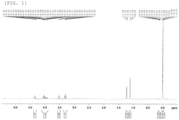
- FIG. 1 is the 1 H NMR spectrum of the product prepared in Example 2 of the present invention.
- a method of preparing a symmetric or asymmetric cyclic phosphine compound according to the present invention includes a step of reacting a compound represented by Chemical Formula 1 below with an organic halogen compound under an oxo coupling agent.
- the oxo coupling agent is a compound represented by Chemical Formula 2 below.
- cheaper compounds may be used compared to a conventional method, excellent economics may be achieved by stably storing reaction raw materials, productivity and yield may be improved due to easy reaction control and low generation of by-products, application on an industrial scale may be easy, and expandability or substitutivity of a synthetic route may be excellent.
- R 1 is a substituted or unsubstituted alkylene group having 1 to 10 carbon atoms or an arylene group having 6 to 20 carbon atoms, the substitution is performed using one or more selected from the group consisting of an unsaturated hydrocarbon group having a monovalent or divalent double bond or a triple bond, a halogen group, a hydroxyl group, an amine group, an oxide group, a sulfide group, and a thiol group, n is an integer from 1 to 5, and X 1 is a halogen element.
- an unsaturated hydrocarbon group having a monovalent or divalent double bond or a triple bond may refer to a hydrocarbon atomic group that has a bond line with one (monovalent) or two (divalent) other atoms or atomic groups and contains a double bond or triple bond.
- M is a monovalent or divalent metal, a is 1 or 2, and b is 0 or 1.
- R 1 is a substituted or unsubstituted alkylene group having 1 to 10 carbon atoms or an arylene group having 6 to 20 carbon atoms
- the carbon number of the substituted or unsubstituted alkylene group may be preferably 1 to 10, more preferably 1 to 7, still more preferably 2 to 6.
- the carbon number of the substituted or unsubstituted arylene group may be preferably 6 to 20, more preferably 6 to 10.
- the substitution may be performed using one or more selected from the group consisting of an unsaturated hydrocarbon group having a monovalent or divalent double bond or a triple bond, a halogen group, a hydroxyl group, an amine group, an oxide group, a sulfide group, and a thiol group, preferably one or more selected from the group consisting of a halogen group, an amine group, an oxide group, a sulfide group, and a thiol group, more preferably one or more selected from the group consisting of a halogen group, a hydroxyl group, and an amine group.
- the halogen group of the substituent may include preferably one or more selected from the group consisting of fluorine and chlorine, more preferably fluorine.
- the carbon number of the substituent may preferably 1 to 5, more preferably 1 to 3.
- n may be preferably an integer from 1 to 5, more preferably 1 to 3, still more preferably 2 or 3.
- X 1 is a halogen element (may be written as radical or group).
- X 1 may be fluorine (F), chlorine (Cl), bromine (Br), or iodine (I), preferably chlorine or bromine, more preferably chlorine.
- R 1 may be a unsubstituted alkylene group having 2 to 6 carbon atoms or an alkylene group including one or more selected from the group consisting of a methyl group, an ethyl group, a methyl fluoride group, a methyl chloride group, an alkylamine group, an oxide group, a sulfide group, and a thiol group as a substituent, and n may be a 2 or 3.
- the compound represented by Chemical Formula 1 may be 2-chloro-1,3,2-dioxaphospholane (CP).
- M is a monovalent or divalent metal
- the monovalent metal refers to an alkali metal.
- the monovalent metal may be lithium (Li), sodium (Na), potassium (K), rubidium (Rb), or cesium (Cs).
- the divalent metal refers to an alkaline earth metal.
- the divalent metal may be beryllium (Be), magnesium (Mg), calcium (Ca), strontium (Sr), or barium (Ba).
- M may be preferably an alkali metal, more preferably lithium, sodium, or potassium, still more preferably sodium.
- a may be 1 or 2, preferably 1.
- b may be 0 or 1, preferably 1.
- M may be lithium, sodium, or potassium, and a and b may each be 1. More preferably, the compound represented by Chemical Formula 2 may be sodium bicarbonate (NaHCO 3 ).
- NaHCO 3 sodium bicarbonate
- quantitative control may be easy, and thus reaction efficiency, purity, and yield may be improved.
- economic efficiency may be improved by using inexpensive reaction raw materials. Nevertheless, the stability of a product after reaction may be improved.
- the organic halogen compound may be preferably a compound represented by Chemical Formula 3 below. [Chemical Formula 3] X 2 -R 2
- X 2 is a halogen group.
- X 2 may be selected within the same range as X 1 .
- X 2 may be chlorine or bromine, more preferably chlorine.
- X 2 may be the same element as X 1 .
- R 2 is a radical represented by C d H e X' f Y g Z h , d is an integer from 1 to 15, preferably an integer from 1 to 10, more preferably an integer from 1 to 8, f is an integer from 0 to 31, preferably 0 to 30, more preferably 0 to 10, still more preferably 0 to 3, still more preferably 0 to 1, g is an integer from 0 to 5, preferably 0 to 2, more preferably 0 or 1, and h is an integer from 0 to 5, preferably 0 to 4, more preferably 0 to 3.
- b is a value that satisfies the oxidation number of R 2 .
- the oxidation number of R 2 may be +1, which may be the sum of the oxidation numbers of all atoms included in R 2 .
- d is 1, f and h are each 0, and Y is Si.
- g is 1, e must be 5 to satisfy +1, which is the oxidation number of R 2 .
- X' may be a halogen element, preferably fluorine or chlorine, more preferably fluorine.
- Y and Z may each independently include one or more selected from the group consisting of P, O, Si, N, and S, Y may be preferably P or Si, and Z may include one or more selected from the group consisting of O, N, and S.
- the element directly bonded to X 2 may be C or Y.
- the element directly bonded to X 2 may be one selected from the group consisting of C, P, O, Si, N, and S, preferably C, P, or Si.
- R 2 may have a linear, branched, or cyclic structure.
- R 2 may include an unsaturated hydrocarbon group with double or triple bonds.
- the sum of g and h may be 1 to 8, preferably 1 to 6, more preferably 1 to 4.
- R 2 may be the same as R 1 .
- R 3 may be a substituted or unsubstituted alkylene group having 1 to 10 carbon atoms or a substituted or unsubstituted arylene group having 6 to 20 carbon atoms.
- R 3 may be a substituted or unsubstituted alkylene group having 1 to 7 carbon atoms, more preferably 2 to 6 carbon atoms, still more preferably 2 to 4 carbon atoms.
- the substitution may be performed using one or more selected from the group consisting of an unsaturated hydrocarbon group having a monovalent or divalent double bond or a triple bond, a halogen group, a hydroxyl group, an amine group, an oxide group, a sulfide group, and a thiol group, preferably one or more selected from the group consisting of a halogen group, an amine group, an oxide group, a sulfide group, and a thiol group, more preferably one or more selected from the group consisting of a halogen group, a hydroxyl group, and an amine group.
- the halogen group of the substituent may include preferably one or more selected from the group consisting of fluorine and chlorine, more preferably fluorine.
- the carbon number of the substituent may be preferably 1 to 5, preferably 1 to 3.
- n' may be preferably an integer from 1 to 5, more preferably 1 to 3, still more preferably 2 or 3.
- the compound represented by Chemical Formula 3-1 may include preferably one or more selected from the group consisting of compounds represented by Chemical Formulas 3-1a to 3-1e below (In each Chemical Formula, X 2 is independent).
- the symmetric or asymmetric cyclic phosphine compound prepared by the reaction may be preferably a compound represented by Chemical Formula 4 below.
- R 1 and n are each as defined in Chemical Formula 1, and R 2 is as defined in Chemical Formula 3.
- R 2 may be the same as R 1 .
- the organic halogen compound is a compound identical to the compound represented by Chemical Formula 1.
- a cyclic phosphine compound with a symmetrical structure may be obtained.
- the cyclic phosphine compound represented by Chemical Formula 4 may include one or more selected from the group consisting of 2,2'-oxybis(1,3,2-dioxaphospholane), 2,2'-oxybis(1,3,2-dioxaphosphinane), and 2-[(trimethylsilyl)oxy]-1,3,2-dioxaphospholane.
- the cyclic phosphine compound may be referred to differently as a cyclic phosphite compound, a cyclic pyrophosphite compound, etc., as long as the cyclic phosphine compound follows the definition of the present invention.
- the reaction may preferably proceed under an amine base, and the amine base may preferably be an aliphatic amine.
- the aliphatic amine may include preferably one or more selected from the group consisting of triethylamine, tributylamine, diethylamine, dibutylamine, diethylmethylamine, diisopropylethylamine, and dimethylacetamide, still more preferably triethylamine.
- a decrease in yield due to by-products such as X 1 H and X 2 H generated during the reaction process may be prevented. Additionally, reaction control may be easier and economic advantages may be obtained.
- the method of preparing a symmetric or asymmetric cyclic phosphine compound of the present invention may include a step of reacting the compound represented by Chemical Formula 1 and the organic halogen compound under the oxo coupling agent represented by Chemical Formula 2 to synthesize the cyclic phosphine compound represented by Chemical Formula 4.
- reaction may proceed through the reaction route represented by Reaction Formula 1 below.
- the compounds represented by Chemical Formulas 1 and 2 may be coupled to form the cyclic phosphine compound represented by Chemical Formula 4 by reacting under the oxo coupling agent.
- reaction may include Reaction Formula 1a step and Reaction Formula 1b step below.
- Reaction Formula 1a step and Reaction Formula 1b step may be performed simultaneously or sequentially.
- X 1 of the compound represented by Chemical Formula 1 reacts with the oxo coupling agent, producing organic carbonate.
- the organic carbonate is converted into a metal salt or hydroxide form as CO 2 is separated from -O ⁇ C(O)O- and escapes due to the unstable bonding force, and the metal salt or hydroxide undergoes a coupling reaction with the organic halogen compound represented by Chemical Formula 3 to form a (R 1 ) n -(OPO)-O-R 2 structure, i.e., the symmetric or asymmetric cyclic phosphine compound represented by Chemical Formula 4 (the product of Reaction Formula 1b).
- by-products such as hydrochloric acid may be formed, but since the by-products react with the oxo coupling agent and precipitate, the by-products may be easily removed through an evaporation or filtering process.
- the reaction may be performed under an organic solvent.
- the organic solvent may include one or more selected from the group consisting of an ether-based solvent having 1 to 10 carbon atoms, a haloalkane-based solvent, a haloalkene-based solvent, a ketone-based solvent, an acetate-based solvent having 2 to 10 carbon atoms, and an aromatic hydrocarbon solvent having 6 to10 carbon atoms, preferably one or more selected from the group consisting of an ether-based solvent having 1 to 6 carbon atoms, a haloalkane-based solvent, a haloalkene-based solvent, and a ketone-based solvent, more preferably one or more selected from the group consisting of an ether-based solvent having 1 to 6 carbon atoms and a haloalkane-based solvent.
- the ether-based solvent may be preferably one selected from the group consisting of dimethyl ether, diethyl ether, dibutyl ether, dimethyl ether, ethylmethyl ether, methyl t-butyl ether, 1,2-dimethoxyethane, ethylene glycol diethyl ether, tetrahydrofuran, 1,4-dioxane, and cyclopentyl methyl ether, more preferably one selected from the group consisting of dimethyl ether, diethyl ether, dibutyl ether, dimethyl ether, and ethylmethyl ether, still more preferably dimethyl ether or diethyl ether.
- the reaction may proceed stably due to excellent solubility for the reactant.
- the coupling reaction may proceed stably.
- the haloalkane-based solvent may be a haloalkane-based solvent having 1 to 5 carbon atoms, preferably dichloromethane, trichloromethane, or tetrachloromethane, more preferably dichloromethane.
- the coupling reaction may proceed stably due to excellent solubility for the reactant.
- the coupling reaction may proceed stably when synthesizing a cyclic phosphine compound with a symmetrical structure.
- the haloalkene-based solvent may be a haloalkene-based solvent including an alkenyl group having 1 to 5 carbon atoms, as a specific example, trichlorethylene.
- the ketone-based solvent may be a ketone-based solvent including an alkyl group having 1 to 5 carbon atoms, as a specific example, may include one or more selected from the group consisting of acetone and methyl ethyl ketone.
- the acetate-based solvent may be an acetate-based solvent including an alkyl group having 2 to 5 carbon atoms, as a specific example, ethyl acetate.
- the aromatic hydrocarbon solvent may be an aromatic hydrocarbon having 6 to 10 carbon atoms, as a specific example, may include one or more selected from the group consisting of benzene and toluene.
- Conditions for the reaction such as reaction temperature; and the equivalence ratio of a reactant, an amine base, and an organic solvent, may be explained by dividing into a case where the organic halogen compound is the same as the compound represented by Chemical Formula 1 and a case where the organic halogen compound is not the same as the compound represented by Chemical Formula 1.
- the organic halogen compound is the same as the compound represented by Chemical Formula 1, after the reaction starts, approximately 50 % of a predetermined organic carbonate is formed (see Reaction Formula 1a), and the formed organic carbonate is converted into metal salt or hydroxide. Then, coupling reaction between the metal salt or hydroxide and the unreacted compound represented by Chemical Formula 1 occurs to form the compound represented by Chemical Formula 4 (see Chemical Formula 1b). Accordingly, in this case, the compound represented by Chemical Formula 1 and the organic halogen compound are not added individually, but only the compound represented by Chemical Formula 1 is added under the oxo coupling agent and only the reaction conditions are adjusted to produce a cyclic phosphine compound with a symmetrical structure.
- the reaction temperature may be adjusted differently at the step of forming the organic carbonate and at the step of forming the compound represented by Chemical Formula 4.
- the oxo coupling agent and the amine base may be introduced into a reaction zone, respectively, and the temperature of the reaction zone may be adjusted to -10 to 5 °C, preferably -5 to 5 °C.
- a step of introducing the compound represented by Chemical Formula 1 into the reaction zone and maintaining the temperature at -10 to 5 °C, preferably -5 to 5 °C, for 10 minutes to 7 hours, preferably 30 minutes to 5 hours may be performed, and then a step of increasing the temperature of the reaction zone to 20 to 35 °C, preferably 20 to 26 °C and proceeding a reaction while maintaining the temperature for 30 minutes to 24 hours, preferably 1 to 10 hours (step of forming the compound represented by Chemical Formula 4) may be performed.
- the equivalence ratio of the compound represented by Chemical Formula 1 to the oxo coupling agent may be 1.5 to 2.5 : 1, preferably 1.8 to 2.3 : 1, more preferably 1.9 to 2.2 : 1. Within this range, the formation of side reactants may be suppressed, and yield and purity may be improved.
- the equivalence ratio of the amine base to the oxo coupling agent may be 0.8 to 1.5 : 1, preferably 0.8 to 1.3 : 1, more preferably 1.9 to 1.2 : 1. Within this range, the formation of side reactants may be suppressed, and yield and purity may be improved.
- the molar ratio of the organic solvent to the oxo coupling agent may be 25 to 35, preferably 28 to 34, more preferably 28 to 32. Within this range, the reaction proceeds smoothly, greatly improving yield and purity.
- the organic solvent may be preferably an ether-based solvent. In this case, yield and purity may be further increased.
- the reaction may be initiated by introducing the compound represented by Chemical Formula 1 and the oxo coupling agent into the reaction zone, respectively, and the organic halogen compound is introduced into the reaction zone.
- a cyclic phosphine compound with an asymmetrical structure may be prepared.
- the reaction temperature may be -10 to 30 °C, preferably -10 to 5 °C, more preferably -5 to 5 °C. Within this range, side reactions may be suppressed, and the reaction may be easily controlled.
- the reaction of forming the cyclic phosphine compound with an asymmetrical structure may include a step of introducing the oxo coupling agent and the amine base into the reaction zone, respectively, a step of adjusting the temperature of the reaction zone to - 10 to 5 °C, preferably -5 to 5 °C, a step of introducing the compound represented by Chemical Formula 1 into the reaction zone and initiating a reaction while maintaining the temperature at -10 to 5 °C for 10 minutes to 5 hours, preferably 30 minutes to 3 hours, and a step of introducing the organic halogen compound into the reaction zone and proceeding the reaction while maintaining the temperature at -10 to 5 °C, preferably -5 to 5 °C for 10 minutes to 3 hours, preferably 10 minutes to 2 hours.
- the reaction may be easily controlled, and by suppressing side reactions, a cyclic phosphine compound with an asymmetrical structure may be obtained with high yield and purity.
- the equivalence ratio of the compound represented by Chemical Formula 1 to the oxo coupling agent may be 0.2 to 1.5 : 1, preferably 0.2 to 1 : 1, more preferably 0.3 to 0.8 : 1. Within this range, the formation of side reactants may be suppressed, and yield and purity may be greatly improved.
- the equivalence ratio of the compound represented by Chemical Formula 1 to the organic halogen compound may be 0.8 to 1.2 : 1, preferably 0.9 to 1.2 : 1, more preferably 0.9 to 1.1 : 1, as a preferred example, 1 : 1.
- the formation of side reactants may be suppressed, and yield and purity may be improved.
- the equivalence ratio of the amine base to the oxo coupling agent may be 0.8 to 1.2 : 1, preferably 0.9 to 1.2 : 1, more preferably 0.9 to 1.1 : 1, as a preferred example, 1 : 1.
- the formation of side reactants may be suppressed, and yield and purity may be improved.
- the molar ratio of the organic solvent to the oxo coupling agent may be 2 to 25, preferably 3 to 20, more preferably 3 to 15. Within this range, the formation of side reactants may be suppressed, and yield and purity may be improved.
- the carbonate-based compound represented by Chemical Formula 2 is used as the nucleophilic substitution reaction inducer, that is, the coupling agent, of the compound represented by Chemical Formula 1.
- a symmetric or asymmetric cyclic phosphine compound is synthesized by inducing a coupling reaction using a carbonate-based compound of a specific structure under an amine base.
- quantitative control of the injected reactants is easy to prevent side reactions,
- polymerization reaction caused by water may be prevented, so yield and purity may be greatly improved.
- the stability of the final product obtained after the reaction may be improved by removing acids that decompose the symmetric or asymmetric cyclic phosphine compound, which is the target product.
- a non-alcohol-based haloalkylsilane compound such as chlorotrimethylsilane may be used. Accordingly, compared to the conventional method using an alcohol-based compound including a silanol group-containing compound, reaction control may be easier. In addition, compared to the case of using a compound containing a silanol group, inexpensive reaction raw materials may be used, and economic efficiency may be improved due to the excellent storage stability of reaction raw materials. In addition, compared to the conventional method, the reaction route may be easily expanded, allowing various synthetic route designs.
- the reaction may be a protic compound-free reaction, preferably an alcohol-free reaction, that is, a reaction that does not use alcohol-based compounds including silanol group-containing compounds.
- the reaction may be performed under an inert atmosphere to allow the reaction to proceed stably.
- the inert atmosphere may be formed preferably using one or more inert gases selected from the group consisting of nitrogen gas, argon gas, and helium gas, more preferably nitrogen gas, considering economic feasibility.
- the inert atmosphere may mean filling 60 % by volume or more, preferably 70 % by volume or more, more preferably 80 % by volume or more of the total air inside the reactor with an inert gas.
- the compound represented by Chemical Formula 1, the organic halogen compound, and the oxo coupling agent may each be dissolved in the organic solvent and introduced into the reaction zone. In this case, reaction efficiency may be further improved.
- CO 2 may be generated by using the carbonate-based compound represented by Chemical Formula 2 as a nucleophilic substitution reaction inducer of the compound represented by Chemical Formula 1, that is, a coupling agent. Since CO 2 diffuses into the atmosphere in the form of a gas and disappears naturally during the reaction process or after the reaction is completed, a separate CO 2 removal process is not required.
- the yield of the cyclic phosphine compound may be 70 % or more, 75 to 99 %, or 80 to 98 %.
- the symmetric or asymmetric cyclic phosphine compound prepared according to the method of preparing a cyclic phosphine compound of the present invention may have a purity of 90 % or more, 90 to 99.5 %, or 95 to 99 %.
- the method of preparing a cyclic phosphine compound may include a purification step after the reaction is completed.
- the purification may include one or more selected from the group consisting of a filtration process, an evaporation process, a recrystallization process, and a washing process.
- the filtration, evaporation, recrystallization, and washing may be performed according to methods commonly performed in the technical field to which the present invention pertains.
- the filtration refers to filtering the reaction results after the reaction is completed, and may remove solid by-products, etc.
- the evaporation is performing vacuum distillation of the filtrate from which solid by-products have been removed after the filtration, and solvents and volatile substances may be removed.
- the vacuum distillation may be performed at a temperature of 25 to 250 °C, preferably 30 to 200 °C, more preferably 50 to 95 °C, still more preferably 70 to 90 °C under a pressure of 0.001 to 760 Torr, preferably 0.01 to 700 Torr, more preferably 0.01 to 500 Torr, still more preferably 0.1 to 100 Torr.
- the recrystallization is a process that may be selected as needed.
- the recrystallization involves dissolving the solid purified product obtained after the evaporation in one or more solvents selected from the group consisting of water, ethanol, isopropyl alcohol, ethyl acetate, hexane, dichloromethane, chloroform, diethylether, THF, toluene, and xylene and then recrystallizing the product.
- a high-purity cyclic phosphine compound may be obtained.
- the present invention provides an electrolyte solution for batteries including the symmetric or asymmetric cyclic phosphine compound prepared according to the method of preparing a cyclic phosphine compound and a secondary battery including the electrolyte solution.
- the electrolyte solution is a non-aqueous electrolyte solution for lithium secondary batteries, includes the symmetric or asymmetric cyclic phosphine compound as an electrolyte additive, and includes a predetermined organic solvent and lithium salt. Since the cyclic phosphine compound prepared according to the method of preparing a cyclic phosphine compound of the present invention has high purity as described above, when the cyclic phosphine compound is added as an electrolyte additive of a secondary battery, battery cycle characteristics may be significantly improved.
- the symmetric or asymmetric cyclic phosphine compound may be included in an amount of preferably 0.1 to 5 % by weight, more preferably 0.2 to 3 % by weight. Within this range, battery cycle characteristics may be further improved.
- the organic solvent is not particularly limited as long as the organic solvent is an organic solvent commonly used in a battery electrolyte solution in the technical field to which the present invention pertains.
- the organic solvent may be a carbonate-based organic solvent.
- the organic solvent may include one or more selected from the group consisting of ethylene carbonate (EC), diethyl carbonate (DEC), ethylmethyl carbonate (EMC), dimethyl carbonate (DMC), propylene carbonate (PC), dipropyl carbonate (DPC), butylene carbonate, methylpropyl carbonate, and ethylpropyl carbonate.
- the organic solvent may be a one-type solvent or a mixed solvent of two or more types.
- the organic solvent may be a mixture of a high-dielectric constant organic solvent with high ionic conductivity and a low-viscosity organic solvent with a viscosity appropriate for application to a battery.
- EC and/or PC may be used as the high-dielectric constant organic solvent, and one or more selected from the group consisting of EMC, DMC, and DEC may be used as the low-viscosity organic solvent.
- the high-dielectric constant organic solvent and the low-viscosity organic solvent may be mixed in a volume ratio of 2:8 to 8:2.
- the organic solvent may be a three-element mixed solvent of EC or PC, EMC, and DEC. At this time, the ratio of EC or PC : EMC : DEC may be 3 : 3 to 5 : 2 to 4.
- lithium ions in the electrolyte solution may be hydrolyzed, so it is desirable to control the moisture in the organic solvent to 150 ppm or less, preferably 100 ppm or less.
- the lithium salt may be used without particular limitation as long as the lithium salt is a compound that may provide lithium ions used in lithium secondary batteries.
- the lithium salt may include one or more selected from the group consisting of LiPF 6 , LiBF 4 , LiCl, LiBr, LiI, LiClO 4 , LiB 10 Cl 10 , LiCF 3 SO 3 , LiCF 3 CO 2 , LiAsF 6 , LiSbF 6 , LiAlCl 4 , CH 3 SO 3 Li, CF 3 SO 3 Li, and (CF 3 SO 2 ) 2 NLi.
- the lithium salt When the lithium salt is dissolved in an electrolyte solution, the lithium salt may function as a source of lithium ions within a lithium secondary battery and promote the movement of lithium ions between an anode and cathode. Accordingly, the lithium salt is preferably included in the electrolyte solution at a concentration of approximately 0.6 mol % to 2 mol %. When the concentration of the lithium salt is less than 0.6 mol %, the conductivity of an electrolyte may decrease and electrolyte performance may deteriorate. When the concentration of the lithium salt exceeds 2 mol %, as the viscosity of the electrolyte increases, the mobility of lithium ions may decrease.
- the lithium salt may be included in the electrolyte solution in an amount of preferably 0.7 mol % to 1.6 mol %, more preferably 0.8 mol % to 1.5 mol %.
- the electrolyte solution for batteries of the present invention may further include additives (hereinafter referred to as other additives) that may be generally used in electrolyte solutions for the purpose of improving battery lifespan characteristics, suppressing battery capacity reduction, and improving battery discharge capacity.
- additives hereinafter referred to as other additives
- the other additive components may include metal phosphate-based compounds.
- the metal phosphate-based compounds may include one or more selected from the group consisting of lithium difluoro(bisoxalato)phosphate (LiDFOP), lithium tetrafluorooxalatophosphate (LiTFOP), lithium difluorophosphate, and lithium trioxalatophosphate.
- the metal phosphate-based compound is an ingredient added to improve the performance of lithium secondary batteries, lithium ion capacitors, etc., and may be included in an electrolyte solution in an amount of 0.3 to 1.5 % by weight, preferably 0.7 to 1.2 % by weight.
- an electrolyte solution in an amount of 0.3 to 1.5 % by weight, preferably 0.7 to 1.2 % by weight.
- the present invention may provide a secondary battery including the electrolyte solution, and the secondary battery includes an anode, a cathode, a separator disposed between the anode and the cathode, and the electrolyte solution for batteries.
- the cathode may be manufactured by mixing a cathode active material, a binder, and optionally a conductive agent to prepare a composition for forming a cathode active material layer, and then applying the composition to a cathode current collector such as aluminum foil.
- the cathode active material may be a typical NCM (lithium nickel manganese cobalt oxide, LiNiMnCoO 2 ) cathode active material used in lithium secondary batteries.
- the cathode active material may be a lithium complex metal oxide in the form of a chemical formula of Li[NixCo 1-x-y Mn y ]O 2 (here 0 ⁇ x ⁇ 0.5, 0 ⁇ y ⁇ 0.5), without being limited thereto.
- variables x and y may independently be 0.0001 ⁇ x ⁇ 0.5 and 0.0001 ⁇ y ⁇ 0.5, or 0.001 ⁇ x ⁇ 0.3 and 0.001 ⁇ y ⁇ 0.3.
- cathode active material may include a compound (lithiated intercalation compound) capable of reversible intercalation and deintercalation of lithium.
- the anode may be manufactured by mixing an anode active material, a binder, and optionally a conductive agent to prepare a composition for forming an anode active material layer, and then applying the composition to an anode current collector such as copper foil.
- a compound capable of reversible intercalation and deintercalation of lithium may be used as the anode active material.
- anode active material may include carbonaceous materials such as artificial graphite, natural graphite, graphitized carbon fiber, and amorphous carbon.
- carbonaceous materials such as artificial graphite, natural graphite, graphitized carbon fiber, and amorphous carbon.
- a metallic compound that may be alloyed with lithium or a composite containing a metallic compound and a carbonaceous material may also be used as the anode active material.
- graphite may be used.
- the metal that may be alloyed with lithium at least one of Si, Al, Sn, Pb, Zn, Bi, In, Mg, Ga, Cd, Si alloy, Sn alloy, and Al alloy may be used.
- a metallic lithium thin film may be used as the anode active material.
- one or more selected from the group consisting of crystalline carbon, amorphous carbon, carbon composite, lithium metal, and alloy containing lithium may be used as the anode active material.
- battery characteristics such as battery cycle characteristics, battery charging resistance, output characteristics, capacity recovery characteristics at low and high temperatures, and lifespan characteristics may be further improved.
- the compound was 2-(1,3,2-dioxaphospholan-2-yloxy)-1,3,2-dioxaphospholane.
- the yield was 82 %.
- the characteristic 1 H NMR peak values were as follows.
- the compound was 4-methyl-2-((trimethylsilyl)oxy)-1,3,2-dioxaphospholane.
- the yield was 81 %.
- the characteristic 1 H NMR peak values were as follows.
Landscapes
- Chemical & Material Sciences (AREA)
- Organic Chemistry (AREA)
- Health & Medical Sciences (AREA)
- Life Sciences & Earth Sciences (AREA)
- Biochemistry (AREA)
- General Health & Medical Sciences (AREA)
- Molecular Biology (AREA)
Abstract
Description
- The present invention relates to a method of preparing a symmetric or asymmetric cyclic phosphine compound, and more particularly, to a method of preparing a symmetric or asymmetric cyclic phosphine compound that uses cheaper compounds compared to a conventional method when preparing a symmetric or asymmetric cyclic phosphine compound, has excellent economics by stably storing reaction raw materials, is capable of improving productivity and yield due to easy reaction control and low generation of by-products, is capable of being easily applied on an industrial scale, and has excellent expandability of a synthetic route.
- Recently, in line with environmental regulations that are being strengthened around the world, methods of maximizing the performance of secondary batteries to replace fossil fuels are being intensively researched. Among the above methods, research is being actively conducted on electrolyte additives that can improve battery performance by forming a film (Cathode-Electrolyte Interface; CEI, or Solid Electrolyte Interface; SEI) that lowers the resistance of an electrode surface or preventing decomposition of an electrolyte. As the electrolyte additives, symmetric or asymmetric cyclic phosphine compounds such as 2,2'-oxybis(1,3,2-dioxaphospholane), 2,2'-oxybis(1,3,2-dioxaphosphinane), 2-[(trimethylsilyl)oxy]-1,3,2-dioxaphospholane, and derivatives thereof are used.
- Known methods of preparing a symmetric or asymmetric cyclic phosphine compound include a method of preparing a symmetric or asymmetric cyclic phosphine compound by coupling reaction of a cyclic halophosphite compound and an alcohol-based compound in the presence of water (H2O) and an aromatic amine (e.g., imidazole compound or pyridine) and a method of preparing a symmetric or asymmetric cyclic phosphine compound by reacting with a silanol group-containing compound such as trimethylsilanol and inducing an exchange reaction between a halogen group and an alkylsilane group.
- When using water, accessibility to raw materials is excellent, but the precision of controlling the input amount of a reactant, that is, quantitative control, is relatively poor due to the relatively low molecular weight of about 18 g/mol. As a result, a large amount of side reactants are generated. In particular, when an excess of water is added, an unwanted polymerization reaction occurs successively in the desired reaction, resulting in a decrease in purity and yield.
- In addition, when using trimethylsilanol or the like, economics are reduced due to the use of expensive reaction raw materials. In addition, there is a problem that industrialization is difficult due to poor storage stability as chemical reactions easily occur due to heat.
-
- Therefore, the present invention has been made in view of the above problems, and it is one object of the present invention to provide a method of preparing a symmetric or asymmetric cyclic phosphine compound that is capable of easily controlling reaction and has high purity and yield.
- It is another object of the present invention to provide a method of preparing a symmetric or asymmetric cyclic phosphine compound that has excellent economics, is easy to industrialize, and has excellent expandability or substitutivity of a synthetic route.
- The above and other objects can be accomplished by the present invention described below.
- In accordance with one aspect of the present invention, provided is a method of preparing a cyclic phosphine compound, the method including reacting a compound represented by Chemical Formula 1 below with an organic halogen compound under an oxo coupling agent, wherein the oxo coupling agent is a compound represented by Chemical Formula 2 below.

[Chemical Formula 2] MaHbCO3,
wherein M is a monovalent or divalent metal, preferably a monovalent metal, a is 1 or 2, preferably 1, and b is 0 or 1, preferably 1. - As the organic halogen compound, an organic halogen compound capable of coupling used in the art to which the present invention pertains may be used without particular limitation. Preferably, a compound represented by Chemical Formula 3 below may be used.
[Chemical Formula 3] X2-R2
- In Chemical Formula 3, X2 is a halogen group, R2 is a radical represented by CdHeX'fYgZh, d is an integer from 1 to 15, f is an integer from 0 to 31, g is an integer from 0 to 5, h is an integer from 0 to 5, e is a value that satisfies an oxidation number of R2, X' is a halogen radical, and Y and Z each independently include one or more selected from the group consisting of P, O, Si, N, and S.
- An oxidation number of R2 may be +1, which may be a sum of oxidation numbers of all atoms included in R2. For example, when R2 is C2HeSi, e must be 5 to satisfy +1, which is the oxidation number of R2.
- In the present disclosure, a radical refer to a compound or atomic group containing one electron used in covalent bonding, which may also be referred to as a group.
- The compound represented by Chemical Formula 3 may preferably include one or more selected from the group consisting of compounds represented by Chemical Formulas 3-1 to 3-12 below (In each Chemical Formula, X2 is independent).

- In Chemical Formula 3-1, R3 is a substituted or unsubstituted alkylene group having 1 to 10 carbon atoms or a substituted or unsubstituted arylene group having 6 to 20 carbon atoms, the substitution is performed using one or more selected from the group consisting of an unsaturated hydrocarbon group having a monovalent or divalent double bond or a triple bond, a halogen group, a hydroxyl group, an amine group, an oxide group, a sulfide group, and a thiol group, and n' is an integer from 1 to 5.


[Chemical Formula 3-6] X2-CH3
[Chemical Formula 3-7] X2-C=C
[Chemical Formula 3-8] X2-C≡N


- The compound represented by Chemical Formula 3-1 may preferably include one or more selected from the group consisting of compounds represented by Chemical Formulas 3-1a to 3-1e below (In each Chemical Formula, X2 is independent).





- In Chemical Formulas of the present invention, the indications of carbon (C) and/or hydrogen (H) are omitted so that a person skilled in the art may more easily understand the present invention.
- The symmetric or asymmetric cyclic phosphine compound prepared by the reaction may be a compound represented by Chemical Formula 4 below.
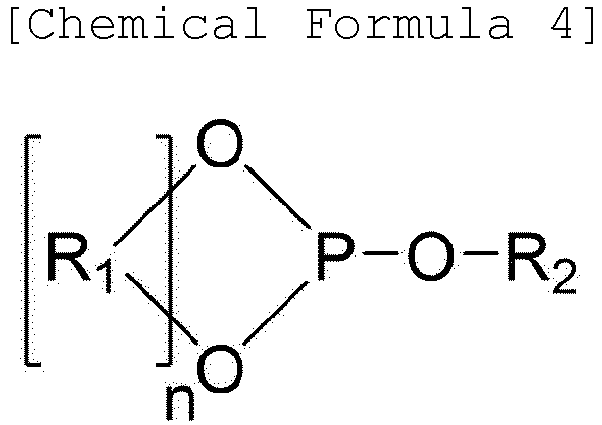
- In Chemical Formula 4, R1, R2, and n are each as defined in Chemical Formulas 1 and 3.
- For example, X1 may be fluorine (F), chlorine (Cl), bromine (Br), or iodine (I), preferably chlorine or bromine.
- An equivalence ratio of the compound represented by Chemical Formula 1 to the oxo coupling agent may be 0.2 to 2.5 : 1.
- An equivalence ratio of a sum of the compound represented by Chemical Formula 1 and the organic halogen compound to the oxo coupling agent may be 0.5 to 2.2 : 1.
- An equivalence ratio of the compound represented by Chemical Formula 1 to the organic halogen compound may be 0.8 to 1.2 : 1.
- The reaction may proceed under an amine base. The amine base may be an aliphatic amine compound, and as a specific example, may include one or more selected from the group consisting of triethylamine, tributylamine, diethylamine, dibutylamine, diethylmethylamine, diisopropylethylamine, and dimethylacetamide.
- An equivalence ratio of the amine base to the oxo coupling agent may be 0.2 to 1.5 : 1.
- The reaction may be performed at a temperature of - 10 to 30 °C.
- The reaction may be performed under one or more organic solvents selected from the group consisting of an ether-based solvent having 1 to 10 carbon atoms, a haloalkane-based solvent, a haloalkene-based solvent, a ketone-based solvent, an acetate-based solvent having 2 to 10 carbon atoms, and an aromatic hydrocarbon solvent having 6 to10 carbon atoms.
- The method of preparing a cyclic phosphine compound may include i) forming a metal salt or a hydroxide by reacting the compound represented by Chemical Formula 1 and an oxo coupling agent; and ii) generating the compound represented by Chemical Formula 2 by reacting the metal salt or hydroxide and the organic halogen compound.
- The compound represented by Chemical Formula 1 and the organic halogen compound and/or oxo coupling agent may each be dissolved in the organic solvent and mixed.
- The reaction may be a protic compound-free reaction, as a specific example, an alcohol-free reaction and/or water-free reaction.
- In the present disclosure, the protic compound-free reaction means a reaction that does not use a protic compound as a reactant, but may include the production of a protic compound as a by-product.
- A method of preparing a symmetric or asymmetric cyclic phosphine compound according to the present invention can perform synthesis using cheaper compounds compared to a conventional method, has excellent economics by stably storing reaction raw materials, allows easy reaction control, can improve productivity and yield due to low generation of by-products, can be easily applied on an industrial scale, and has excellent expandability or substitutivity of a synthetic route.
-
FIG. 1 is the 1H NMR spectrum of the product prepared in Example 2 of the present invention. - Hereinafter, the present invention is described in detail.
- While the present inventors were researching a method of preparing a high-purity symmetric or asymmetric cyclic phosphine compound more stably and economically, the present inventors discovered that when reacting using a predetermined reaction condition and reaction route, all of the objectives can be achieved. Based on these results, the present inventors conducted further studies to complete the present invention.
- A method of preparing a symmetric or asymmetric cyclic phosphine compound according to the present invention includes a step of reacting a compound represented by Chemical Formula 1 below with an organic halogen compound under an oxo coupling agent. The oxo coupling agent is a compound represented by Chemical Formula 2 below. In this case, cheaper compounds may be used compared to a conventional method, excellent economics may be achieved by stably storing reaction raw materials, productivity and yield may be improved due to easy reaction control and low generation of by-products, application on an industrial scale may be easy, and expandability or substitutivity of a synthetic route may be excellent.
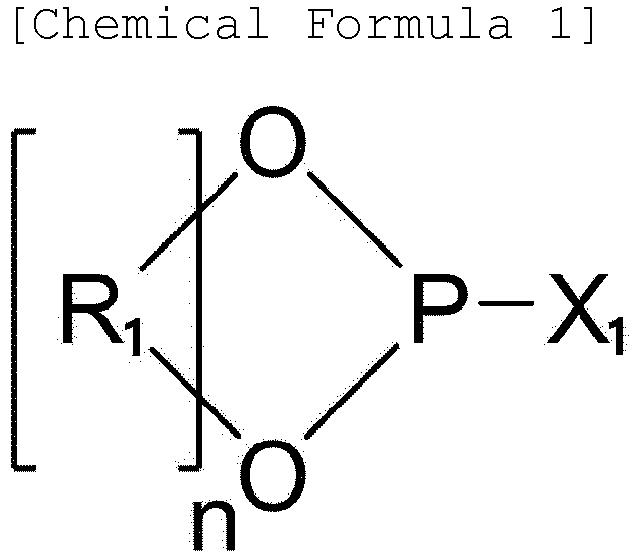
- In Chemical Formula 1, R1 is a substituted or unsubstituted alkylene group having 1 to 10 carbon atoms or an arylene group having 6 to 20 carbon atoms, the substitution is performed using one or more selected from the group consisting of an unsaturated hydrocarbon group having a monovalent or divalent double bond or a triple bond, a halogen group, a hydroxyl group, an amine group, an oxide group, a sulfide group, and a thiol group, n is an integer from 1 to 5, and X1 is a halogen element.
- In the present disclosure, an unsaturated hydrocarbon group having a monovalent or divalent double bond or a triple bond may refer to a hydrocarbon atomic group that has a bond line with one (monovalent) or two (divalent) other atoms or atomic groups and contains a double bond or triple bond.
[Chemical Formula 2] MaHbCO3
- In Chemical Formula 2, M is a monovalent or divalent metal, a is 1 or 2, and b is 0 or 1.
- In Chemical Formula 1, R1 is a substituted or unsubstituted alkylene group having 1 to 10 carbon atoms or an arylene group having 6 to 20 carbon atoms, The carbon number of the substituted or unsubstituted alkylene group may be preferably 1 to 10, more preferably 1 to 7, still more preferably 2 to 6. The carbon number of the substituted or unsubstituted arylene group may be preferably 6 to 20, more preferably 6 to 10.
- The substitution may be performed using one or more selected from the group consisting of an unsaturated hydrocarbon group having a monovalent or divalent double bond or a triple bond, a halogen group, a hydroxyl group, an amine group, an oxide group, a sulfide group, and a thiol group, preferably one or more selected from the group consisting of a halogen group, an amine group, an oxide group, a sulfide group, and a thiol group, more preferably one or more selected from the group consisting of a halogen group, a hydroxyl group, and an amine group. The halogen group of the substituent may include preferably one or more selected from the group consisting of fluorine and chlorine, more preferably fluorine. For example, when the substituent includes carbon, the carbon number of the substituent may preferably 1 to 5, more preferably 1 to 3.
- n may be preferably an integer from 1 to 5, more preferably 1 to 3, still more preferably 2 or 3.
- X1 is a halogen element (may be written as radical or group). For example, X1 may be fluorine (F), chlorine (Cl), bromine (Br), or iodine (I), preferably chlorine or bromine, more preferably chlorine.
- As a specific example, in the compound represented by Chemical Formula 1, R1 may be a unsubstituted alkylene group having 2 to 6 carbon atoms or an alkylene group including one or more selected from the group consisting of a methyl group, an ethyl group, a methyl fluoride group, a methyl chloride group, an alkylamine group, an oxide group, a sulfide group, and a thiol group as a substituent, and n may be a 2 or 3.
- As a more specific example, the compound represented by Chemical Formula 1 may be 2-chloro-1,3,2-dioxaphospholane (CP).
- In Chemical Formula 2, M is a monovalent or divalent metal, and the monovalent metal refers to an alkali metal. Specifically, the monovalent metal may be lithium (Li), sodium (Na), potassium (K), rubidium (Rb), or cesium (Cs). The divalent metal refers to an alkaline earth metal. Specifically, the divalent metal may be beryllium (Be), magnesium (Mg), calcium (Ca), strontium (Sr), or barium (Ba).
- M may be preferably an alkali metal, more preferably lithium, sodium, or potassium, still more preferably sodium.
- For example, a may be 1 or 2, preferably 1.
- For example, b may be 0 or 1, preferably 1.
- As a preferred example, in the compound represented by Chemical Formula 2, M may be lithium, sodium, or potassium, and a and b may each be 1. More preferably, the compound represented by Chemical Formula 2 may be sodium bicarbonate (NaHCO3). In this case, quantitative control may be easy, and thus reaction efficiency, purity, and yield may be improved. In addition, economic efficiency may be improved by using inexpensive reaction raw materials. Nevertheless, the stability of a product after reaction may be improved.
- The organic halogen compound may be preferably a compound represented by Chemical Formula 3 below.
[Chemical Formula 3] X2-R2
- In Chemical Formula 3, X2 is a halogen group. For example, X2 may be selected within the same range as X1. Preferably, X2 may be chlorine or bromine, more preferably chlorine.
- As a preferred example, X2 may be the same element as X1.
- R2 is a radical represented by CdHeX'fYgZh, d is an integer from 1 to 15, preferably an integer from 1 to 10, more preferably an integer from 1 to 8, f is an integer from 0 to 31, preferably 0 to 30, more preferably 0 to 10, still more preferably 0 to 3, still more preferably 0 to 1, g is an integer from 0 to 5, preferably 0 to 2, more preferably 0 or 1, and h is an integer from 0 to 5, preferably 0 to 4, more preferably 0 to 3. b is a value that satisfies the oxidation number of R2. The oxidation number of R2 may be +1, which may be the sum of the oxidation numbers of all atoms included in R2. For example, when R2 is C2HeSi, d is 1, f and h are each 0, and Y is Si. When g is 1, e must be 5 to satisfy +1, which is the oxidation number of R2.
- X' may be a halogen element, preferably fluorine or chlorine, more preferably fluorine.
- Y and Z may each independently include one or more selected from the group consisting of P, O, Si, N, and S, Y may be preferably P or Si, and Z may include one or more selected from the group consisting of O, N, and S.
- In Chemical Formula 3, for example, the element directly bonded to X2 may be C or Y. As a specific example, the element directly bonded to X2 may be one selected from the group consisting of C, P, O, Si, N, and S, preferably C, P, or Si.
- For example, R2 may have a linear, branched, or cyclic structure. For example, R2 may include an unsaturated hydrocarbon group with double or triple bonds.
- For example, the sum of g and h may be 1 to 8, preferably 1 to 6, more preferably 1 to 4.
- For example, R2 may be the same as R1.
- The compound represented by Chemical Formula 3 may preferably include one or more selected from the group consisting of compounds represented by Chemical Formulas 3-1 to 3-12 (In each Chemical Formula, X2 is independent).


[Chemical Formula 3-6] X2-CH3
[Chemical Formula 3-7] X2-C=C
[Chemical Formula 3-8] X2-C≡N


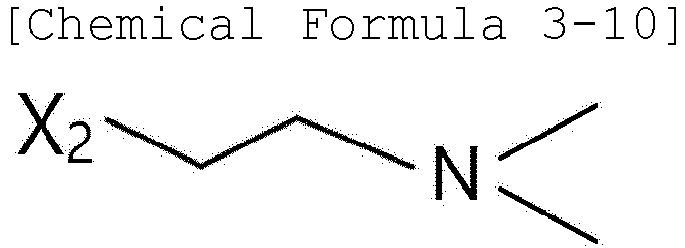


- In Chemical Formula 3-1, R3 may be a substituted or unsubstituted alkylene group having 1 to 10 carbon atoms or a substituted or unsubstituted arylene group having 6 to 20 carbon atoms. As a preferred example, R3 may be a substituted or unsubstituted alkylene group having 1 to 7 carbon atoms, more preferably 2 to 6 carbon atoms, still more preferably 2 to 4 carbon atoms. The substitution may be performed using one or more selected from the group consisting of an unsaturated hydrocarbon group having a monovalent or divalent double bond or a triple bond, a halogen group, a hydroxyl group, an amine group, an oxide group, a sulfide group, and a thiol group, preferably one or more selected from the group consisting of a halogen group, an amine group, an oxide group, a sulfide group, and a thiol group, more preferably one or more selected from the group consisting of a halogen group, a hydroxyl group, and an amine group. The halogen group of the substituent may include preferably one or more selected from the group consisting of fluorine and chlorine, more preferably fluorine. For example, when the substituent includes carbon, the carbon number of the substituent may be preferably 1 to 5, preferably 1 to 3. n' may be preferably an integer from 1 to 5, more preferably 1 to 3, still more preferably 2 or 3.
- The compound represented by Chemical Formula 3-1 may include preferably one or more selected from the group consisting of compounds represented by Chemical Formulas 3-1a to 3-1e below (In each Chemical Formula, X2 is independent).


- The symmetric or asymmetric cyclic phosphine compound prepared by the reaction may be preferably a compound represented by Chemical Formula 4 below.

- In Chemical Formula 4, R1 and n are each as defined in Chemical Formula 1, and R2 is as defined in Chemical Formula 3.
- For example, R2 may be the same as R1. In this case, the organic halogen compound is a compound identical to the compound represented by Chemical Formula 1. In this case, a cyclic phosphine compound with a symmetrical structure may be obtained.
- As a specific example, the cyclic phosphine compound represented by Chemical Formula 4 may include one or more selected from the group consisting of 2,2'-oxybis(1,3,2-dioxaphospholane), 2,2'-oxybis(1,3,2-dioxaphosphinane), and 2-[(trimethylsilyl)oxy]-1,3,2-dioxaphospholane.
- In the present disclosure, the cyclic phosphine compound may be referred to differently as a cyclic phosphite compound, a cyclic pyrophosphite compound, etc., as long as the cyclic phosphine compound follows the definition of the present invention.
- The reaction may preferably proceed under an amine base, and the amine base may preferably be an aliphatic amine. The aliphatic amine may include preferably one or more selected from the group consisting of triethylamine, tributylamine, diethylamine, dibutylamine, diethylmethylamine, diisopropylethylamine, and dimethylacetamide, still more preferably triethylamine. In this case, a decrease in yield due to by-products such as X1H and X2H generated during the reaction process may be prevented. Additionally, reaction control may be easier and economic advantages may be obtained.
- As a specific example, the method of preparing a symmetric or asymmetric cyclic phosphine compound of the present invention may include a step of reacting the compound represented by Chemical Formula 1 and the organic halogen compound under the oxo coupling agent represented by Chemical Formula 2 to synthesize the cyclic phosphine compound represented by Chemical Formula 4.
- Hereinafter, the method of the present invention is described in more detail based on the reaction mechanism.
- For example, the reaction may proceed through the reaction route represented by Reaction Formula 1 below.

- The compounds represented by Chemical Formulas 1 and 2 may be coupled to form the cyclic phosphine compound represented by Chemical Formula 4 by reacting under the oxo coupling agent.
- More specifically, the reaction may include Reaction Formula 1a step and Reaction Formula 1b step below. At this time, Reaction Formula 1a step and Reaction Formula 1b step may be performed simultaneously or sequentially.



- Specifically, in the reaction, after the reaction starts, X1 of the compound represented by Chemical Formula 1 reacts with the oxo coupling agent, producing organic carbonate.
- The organic carbonate is converted into a metal salt or hydroxide form as CO2 is separated from -O·C(O)O- and escapes due to the unstable bonding force, and the metal salt or hydroxide undergoes a coupling reaction with the organic halogen compound represented by Chemical Formula 3 to form a (R1)n-(OPO)-O-R2 structure, i.e., the symmetric or asymmetric cyclic phosphine compound represented by Chemical Formula 4 (the product of Reaction Formula 1b).
- For example, in the step of Reaction Formula 1a, by-products such as hydrochloric acid may be formed, but since the by-products react with the oxo coupling agent and precipitate, the by-products may be easily removed through an evaporation or filtering process.
- In addition, when reacting under the amine base, by-products such as hydrochloric acid react with the amine base compound and precipitate, so the by-products may be easily removed through an evaporation or filtering process. In particular, the yield and purity may be greatly improved by solving the problems of the prior art, i.e.,, the difficulty in controlling pH and the occurrence of side reactions due to hydrochloric acid.
- For example, the reaction may be performed under an organic solvent. The organic solvent may include one or more selected from the group consisting of an ether-based solvent having 1 to 10 carbon atoms, a haloalkane-based solvent, a haloalkene-based solvent, a ketone-based solvent, an acetate-based solvent having 2 to 10 carbon atoms, and an aromatic hydrocarbon solvent having 6 to10 carbon atoms, preferably one or more selected from the group consisting of an ether-based solvent having 1 to 6 carbon atoms, a haloalkane-based solvent, a haloalkene-based solvent, and a ketone-based solvent, more preferably one or more selected from the group consisting of an ether-based solvent having 1 to 6 carbon atoms and a haloalkane-based solvent.
- The ether-based solvent may be preferably one selected from the group consisting of dimethyl ether, diethyl ether, dibutyl ether, dimethyl ether, ethylmethyl ether, methyl t-butyl ether, 1,2-dimethoxyethane, ethylene glycol diethyl ether, tetrahydrofuran, 1,4-dioxane, and cyclopentyl methyl ether, more preferably one selected from the group consisting of dimethyl ether, diethyl ether, dibutyl ether, dimethyl ether, and ethylmethyl ether, still more preferably dimethyl ether or diethyl ether. In this case, the reaction may proceed stably due to excellent solubility for the reactant. In particular, when synthesizing a cyclic phosphine compound with a symmetrical structure, the coupling reaction may proceed stably.
- For example, the haloalkane-based solvent may be a haloalkane-based solvent having 1 to 5 carbon atoms, preferably dichloromethane, trichloromethane, or tetrachloromethane, more preferably dichloromethane. In this case, the coupling reaction may proceed stably due to excellent solubility for the reactant. In particular, when synthesizing a cyclic phosphine compound with a symmetrical structure, the coupling reaction may proceed stably.
- For example, the haloalkene-based solvent may be a haloalkene-based solvent including an alkenyl group having 1 to 5 carbon atoms, as a specific example, trichlorethylene.
- For example, the ketone-based solvent may be a ketone-based solvent including an alkyl group having 1 to 5 carbon atoms, as a specific example, may include one or more selected from the group consisting of acetone and methyl ethyl ketone.
- For example, the acetate-based solvent may be an acetate-based solvent including an alkyl group having 2 to 5 carbon atoms, as a specific example, ethyl acetate.
- For example, the aromatic hydrocarbon solvent may be an aromatic hydrocarbon having 6 to 10 carbon atoms, as a specific example, may include one or more selected from the group consisting of benzene and toluene.
- Conditions for the reaction, such as reaction temperature; and the equivalence ratio of a reactant, an amine base, and an organic solvent, may be explained by dividing into a case where the organic halogen compound is the same as the compound represented by Chemical Formula 1 and a case where the organic halogen compound is not the same as the compound represented by Chemical Formula 1.
- First, in the case where the organic halogen compound is the same as the compound represented by Chemical Formula 1, after the reaction starts, approximately 50 % of a predetermined organic carbonate is formed (see Reaction Formula 1a), and the formed organic carbonate is converted into metal salt or hydroxide. Then, coupling reaction between the metal salt or hydroxide and the unreacted compound represented by Chemical Formula 1 occurs to form the compound represented by Chemical Formula 4 (see Chemical Formula 1b). Accordingly, in this case, the compound represented by Chemical Formula 1 and the organic halogen compound are not added individually, but only the compound represented by Chemical Formula 1 is added under the oxo coupling agent and only the reaction conditions are adjusted to produce a cyclic phosphine compound with a symmetrical structure.
- For example, the reaction temperature may be adjusted differently at the step of forming the organic carbonate and at the step of forming the compound represented by Chemical Formula 4. As a specific example, in the step of forming the organic carbonate, the oxo coupling agent and the amine base may be introduced into a reaction zone, respectively, and the temperature of the reaction zone may be adjusted to -10 to 5 °C, preferably -5 to 5 °C. In the step of forming the compound represented by Chemical Formula 4, a step of introducing the compound represented by Chemical Formula 1 into the reaction zone and maintaining the temperature at -10 to 5 °C, preferably -5 to 5 °C, for 10 minutes to 7 hours, preferably 30 minutes to 5 hours (step of forming the organic carbonate) may be performed, and then a step of increasing the temperature of the reaction zone to 20 to 35 °C, preferably 20 to 26 °C and proceeding a reaction while maintaining the temperature for 30 minutes to 24 hours, preferably 1 to 10 hours (step of forming the compound represented by Chemical Formula 4) may be performed.
- For example, the equivalence ratio of the compound represented by Chemical Formula 1 to the oxo coupling agent may be 1.5 to 2.5 : 1, preferably 1.8 to 2.3 : 1, more preferably 1.9 to 2.2 : 1. Within this range, the formation of side reactants may be suppressed, and yield and purity may be improved.
- For example, the equivalence ratio of the amine base to the oxo coupling agent may be 0.8 to 1.5 : 1, preferably 0.8 to 1.3 : 1, more preferably 1.9 to 1.2 : 1. Within this range, the formation of side reactants may be suppressed, and yield and purity may be improved.
- For example, the molar ratio of the organic solvent to the oxo coupling agent may be 25 to 35, preferably 28 to 34, more preferably 28 to 32. Within this range, the reaction proceeds smoothly, greatly improving yield and purity.
- In this case, the organic solvent may be preferably an ether-based solvent. In this case, yield and purity may be further increased.
- When the organic halogen compound and the compound represented by Chemical Formula 1 are different, as a specific example, the reaction may be initiated by introducing the compound represented by Chemical Formula 1 and the oxo coupling agent into the reaction zone, respectively, and the organic halogen compound is introduced into the reaction zone. In this case, a cyclic phosphine compound with an asymmetrical structure may be prepared.
- For example, the reaction temperature may be -10 to 30 °C, preferably -10 to 5 °C, more preferably -5 to 5 °C. Within this range, side reactions may be suppressed, and the reaction may be easily controlled.
- As a specific example, the reaction of forming the cyclic phosphine compound with an asymmetrical structure may include a step of introducing the oxo coupling agent and the amine base into the reaction zone, respectively, a step of adjusting the temperature of the reaction zone to - 10 to 5 °C, preferably -5 to 5 °C, a step of introducing the compound represented by Chemical Formula 1 into the reaction zone and initiating a reaction while maintaining the temperature at -10 to 5 °C for 10 minutes to 5 hours, preferably 30 minutes to 3 hours, and a step of introducing the organic halogen compound into the reaction zone and proceeding the reaction while maintaining the temperature at -10 to 5 °C, preferably -5 to 5 °C for 10 minutes to 3 hours, preferably 10 minutes to 2 hours. In this case, the reaction may be easily controlled, and by suppressing side reactions, a cyclic phosphine compound with an asymmetrical structure may be obtained with high yield and purity.
- For example, the equivalence ratio of the compound represented by Chemical Formula 1 to the oxo coupling agent may be 0.2 to 1.5 : 1, preferably 0.2 to 1 : 1, more preferably 0.3 to 0.8 : 1. Within this range, the formation of side reactants may be suppressed, and yield and purity may be greatly improved.
- For example, the equivalence ratio of the compound represented by Chemical Formula 1 to the organic halogen compound may be 0.8 to 1.2 : 1, preferably 0.9 to 1.2 : 1, more preferably 0.9 to 1.1 : 1, as a preferred example, 1 : 1. Within this range, the formation of side reactants may be suppressed, and yield and purity may be improved.
- For example, the equivalence ratio of the amine base to the oxo coupling agent may be 0.8 to 1.2 : 1, preferably 0.9 to 1.2 : 1, more preferably 0.9 to 1.1 : 1, as a preferred example, 1 : 1. Within this range, the formation of side reactants may be suppressed, and yield and purity may be improved.
- In this case, the molar ratio of the organic solvent to the oxo coupling agent may be 2 to 25, preferably 3 to 20, more preferably 3 to 15. Within this range, the formation of side reactants may be suppressed, and yield and purity may be improved.
- Unlike a conventional method in which coupling reaction of a halophosphite compound such as 2-chloro-1,3,2-dioxaphospholane is performed under H2O and pyridine or imidazole, or reaction with a compound containing an -OH group such as trimethylsilanol is performed to synthesize a cyclic pyrophosphite compound such as diethylene pyrophosphite[2-(1,3,2-dioxaphospholan-2-yloxy)-1,3,2-dioxaphospholane], in the present invention, the carbonate-based compound represented by Chemical Formula 2 is used as the nucleophilic substitution reaction inducer, that is, the coupling agent, of the compound represented by Chemical Formula 1. Preferably, a symmetric or asymmetric cyclic phosphine compound is synthesized by inducing a coupling reaction using a carbonate-based compound of a specific structure under an amine base. In this case, quantitative control of the injected reactants is easy to prevent side reactions, In addition, polymerization reaction caused by water may be prevented, so yield and purity may be greatly improved. In addition, the stability of the final product obtained after the reaction may be improved by removing acids that decompose the symmetric or asymmetric cyclic phosphine compound, which is the target product. In addition, by using a carbonate-based compound represented by Chemical Formula 3 as a nucleophilic substitution reaction inducer, a non-alcohol-based haloalkylsilane compound such as chlorotrimethylsilane may be used. Accordingly, compared to the conventional method using an alcohol-based compound including a silanol group-containing compound, reaction control may be easier. In addition, compared to the case of using a compound containing a silanol group, inexpensive reaction raw materials may be used, and economic efficiency may be improved due to the excellent storage stability of reaction raw materials. In addition, compared to the conventional method, the reaction route may be easily expanded, allowing various synthetic route designs.
- From this perspective, the reaction may be a protic compound-free reaction, preferably an alcohol-free reaction, that is, a reaction that does not use alcohol-based compounds including silanol group-containing compounds.
- For example, the reaction may be performed under an inert atmosphere to allow the reaction to proceed stably. The inert atmosphere may be formed preferably using one or more inert gases selected from the group consisting of nitrogen gas, argon gas, and helium gas, more preferably nitrogen gas, considering economic feasibility.
- For example, the inert atmosphere may mean filling 60 % by volume or more, preferably 70 % by volume or more, more preferably 80 % by volume or more of the total air inside the reactor with an inert gas.
- As a preferred example, the compound represented by Chemical Formula 1, the organic halogen compound, and the oxo coupling agent may each be dissolved in the organic solvent and introduced into the reaction zone. In this case, reaction efficiency may be further improved.
- In the reaction process, CO2 may be generated by using the carbonate-based compound represented by Chemical Formula 2 as a nucleophilic substitution reaction inducer of the compound represented by Chemical Formula 1, that is, a coupling agent. Since CO2 diffuses into the atmosphere in the form of a gas and disappears naturally during the reaction process or after the reaction is completed, a separate CO2 removal process is not required.
- For example, in the method of preparing a cyclic phosphine compound of the present invention, the yield of the cyclic phosphine compound may be 70 % or more, 75 to 99 %, or 80 to 98 %.
- For example, the symmetric or asymmetric cyclic phosphine compound prepared according to the method of preparing a cyclic phosphine compound of the present invention may have a purity of 90 % or more, 90 to 99.5 %, or 95 to 99 %.
- For example, the method of preparing a cyclic phosphine compound may include a purification step after the reaction is completed. For example, the purification may include one or more selected from the group consisting of a filtration process, an evaporation process, a recrystallization process, and a washing process.
- The filtration, evaporation, recrystallization, and washing may be performed according to methods commonly performed in the technical field to which the present invention pertains.
- For example, the filtration refers to filtering the reaction results after the reaction is completed, and may remove solid by-products, etc.
- For example, the evaporation is performing vacuum distillation of the filtrate from which solid by-products have been removed after the filtration, and solvents and volatile substances may be removed. For example, the vacuum distillation may be performed at a temperature of 25 to 250 °C, preferably 30 to 200 °C, more preferably 50 to 95 °C, still more preferably 70 to 90 °C under a pressure of 0.001 to 760 Torr, preferably 0.01 to 700 Torr, more preferably 0.01 to 500 Torr, still more preferably 0.1 to 100 Torr.
- The recrystallization is a process that may be selected as needed. The recrystallization involves dissolving the solid purified product obtained after the evaporation in one or more solvents selected from the group consisting of water, ethanol, isopropyl alcohol, ethyl acetate, hexane, dichloromethane, chloroform, diethylether, THF, toluene, and xylene and then recrystallizing the product. In this case, a high-purity cyclic phosphine compound may be obtained.
- In addition, the present invention provides an electrolyte solution for batteries including the symmetric or asymmetric cyclic phosphine compound prepared according to the method of preparing a cyclic phosphine compound and a secondary battery including the electrolyte solution.
- The electrolyte solution is a non-aqueous electrolyte solution for lithium secondary batteries, includes the symmetric or asymmetric cyclic phosphine compound as an electrolyte additive, and includes a predetermined organic solvent and lithium salt. Since the cyclic phosphine compound prepared according to the method of preparing a cyclic phosphine compound of the present invention has high purity as described above, when the cyclic phosphine compound is added as an electrolyte additive of a secondary battery, battery cycle characteristics may be significantly improved.
- Based on a total weight of the electrolyte solution, the symmetric or asymmetric cyclic phosphine compound may be included in an amount of preferably 0.1 to 5 % by weight, more preferably 0.2 to 3 % by weight. Within this range, battery cycle characteristics may be further improved.
- The organic solvent is not particularly limited as long as the organic solvent is an organic solvent commonly used in a battery electrolyte solution in the technical field to which the present invention pertains. For example, the organic solvent may be a carbonate-based organic solvent. Specifically, the organic solvent may include one or more selected from the group consisting of ethylene carbonate (EC), diethyl carbonate (DEC), ethylmethyl carbonate (EMC), dimethyl carbonate (DMC), propylene carbonate (PC), dipropyl carbonate (DPC), butylene carbonate, methylpropyl carbonate, and ethylpropyl carbonate.
- For example, the organic solvent may be a one-type solvent or a mixed solvent of two or more types. Preferably, to improve the charging and discharging performance of a battery, the organic solvent may be a mixture of a high-dielectric constant organic solvent with high ionic conductivity and a low-viscosity organic solvent with a viscosity appropriate for application to a battery.
- For example, EC and/or PC may be used as the high-dielectric constant organic solvent, and one or more selected from the group consisting of EMC, DMC, and DEC may be used as the low-viscosity organic solvent. Preferably, the high-dielectric constant organic solvent and the low-viscosity organic solvent may be mixed in a volume ratio of 2:8 to 8:2. More specifically, the organic solvent may be a three-element mixed solvent of EC or PC, EMC, and DEC. At this time, the ratio of EC or PC : EMC : DEC may be 3 : 3 to 5 : 2 to 4.
- When the organic solvent contains moisture, lithium ions in the electrolyte solution may be hydrolyzed, so it is desirable to control the moisture in the organic solvent to 150 ppm or less, preferably 100 ppm or less.
- The lithium salt may be used without particular limitation as long as the lithium salt is a compound that may provide lithium ions used in lithium secondary batteries. Specifically, the lithium salt may include one or more selected from the group consisting of LiPF6, LiBF4, LiCl, LiBr, LiI, LiClO4, LiB10Cl10, LiCF3SO3, LiCF3CO2, LiAsF6, LiSbF6, LiAlCl4, CH3SO3Li, CF3SO3Li, and (CF3SO2)2NLi.
- When the lithium salt is dissolved in an electrolyte solution, the lithium salt may function as a source of lithium ions within a lithium secondary battery and promote the movement of lithium ions between an anode and cathode. Accordingly, the lithium salt is preferably included in the electrolyte solution at a concentration of approximately 0.6 mol % to 2 mol %. When the concentration of the lithium salt is less than 0.6 mol %, the conductivity of an electrolyte may decrease and electrolyte performance may deteriorate. When the concentration of the lithium salt exceeds 2 mol %, as the viscosity of the electrolyte increases, the mobility of lithium ions may decrease. Considering the conductivity of the electrolyte and the mobility of lithium ions, the lithium salt may be included in the electrolyte solution in an amount of preferably 0.7 mol % to 1.6 mol %, more preferably 0.8 mol % to 1.5 mol %.
- For example, in addition to electrolytic salt prepared through an electrolytic salt preparation method, the electrolyte solution for batteries of the present invention may further include additives (hereinafter referred to as other additives) that may be generally used in electrolyte solutions for the purpose of improving battery lifespan characteristics, suppressing battery capacity reduction, and improving battery discharge capacity.
- For example, the other additive components may include metal phosphate-based compounds.
- For example, the metal phosphate-based compounds may include one or more selected from the group consisting of lithium difluoro(bisoxalato)phosphate (LiDFOP), lithium tetrafluorooxalatophosphate (LiTFOP), lithium difluorophosphate, and lithium trioxalatophosphate.
- The metal phosphate-based compound is an ingredient added to improve the performance of lithium secondary batteries, lithium ion capacitors, etc., and may be included in an electrolyte solution in an amount of 0.3 to 1.5 % by weight, preferably 0.7 to 1.2 % by weight. When the content of the metal phosphate-based compound satisfies the range, it is desirable in terms of improving the low-temperature characteristics and cycle characteristics of a battery.
- As another example, the present invention may provide a secondary battery including the electrolyte solution, and the secondary battery includes an anode, a cathode, a separator disposed between the anode and the cathode, and the electrolyte solution for batteries.
- For example, the cathode may be manufactured by mixing a cathode active material, a binder, and optionally a conductive agent to prepare a composition for forming a cathode active material layer, and then applying the composition to a cathode current collector such as aluminum foil.
- For example, the cathode active material may be a typical NCM (lithium nickel manganese cobalt oxide, LiNiMnCoO2) cathode active material used in lithium secondary batteries. Specifically, the cathode active material may be a lithium complex metal oxide in the form of a chemical formula of Li[NixCo1-x-yMny]O2 (here 0<x<0.5, 0<y<0.5), without being limited thereto.
- For example, in the chemical formula of Li[NixCo1-x-yMny]O2 of the lithium complex metal oxide, variables x and y may independently be 0.0001<x<0.5 and 0.0001<y<0.5, or 0.001<x<0.3 and 0.001<y<0.3.
- Another examples of the cathode active material may include a compound (lithiated intercalation compound) capable of reversible intercalation and deintercalation of lithium.
- Among the compounds, in terms of battery capacity characteristics and stability, one or more selected from the group consisting of LiCoO2, LiMnO2, LiMn2O4, LiNiO2, LiNixMn(1-x)O2 (0<x<1), and LiM1xM2yO2 (0≤x≤1, 0≤y≤1, 0≤x+y≤1, and M1 and M2 each independently include one or more selected from the group consisting of Al, Sr, Mg, and La) may be preferably used.
- For example, the anode may be manufactured by mixing an anode active material, a binder, and optionally a conductive agent to prepare a composition for forming an anode active material layer, and then applying the composition to an anode current collector such as copper foil.
- For example, a compound capable of reversible intercalation and deintercalation of lithium may be used as the anode active material.
- Specific examples of the anode active material may include carbonaceous materials such as artificial graphite, natural graphite, graphitized carbon fiber, and amorphous carbon. In addition to the carbonaceous materials, a metallic compound that may be alloyed with lithium or a composite containing a metallic compound and a carbonaceous material may also be used as the anode active material. For example, graphite may be used.
- For example, as the metal that may be alloyed with lithium, at least one of Si, Al, Sn, Pb, Zn, Bi, In, Mg, Ga, Cd, Si alloy, Sn alloy, and Al alloy may be used.
- In addition, a metallic lithium thin film may be used as the anode active material. Considering stability, one or more selected from the group consisting of crystalline carbon, amorphous carbon, carbon composite, lithium metal, and alloy containing lithium may be used as the anode active material.
- By applying the electrolyte additives including the symmetric or asymmetric cyclic phosphine compound of the present invention to the secondary battery of the present invention, battery characteristics such as battery cycle characteristics, battery charging resistance, output characteristics, capacity recovery characteristics at low and high temperatures, and lifespan characteristics may be further improved.
- Hereinafter, the present invention will be described in more detail with reference to the following preferred examples. However, these examples are provided for illustrative purposes only and should not be construed as limiting the scope and spirit of the present invention. In addition, it will be apparent to those skilled in the art that various changes and modifications may be made without departing from the spirit and scope of the present invention, and such changes and modifications are also within the scope of the appended claims.
- After installing a thermometer in a 250 mL three-neck reaction vessel, 90 ml of dried diethyl ether, 11 ml (78.92 mmol, 1.05 eq) of triethylamine, and 6.32 g (75.23 mmol, 1 eq) of NaHCOs were added under a nitrogen atmosphere, and the mixture was cooled to 0 °C. A solution obtained by dissolving 20 g (158.13 mmol, 2 eq) of 2-chloro-1,3,2-dioxaphospholane in 30 ml of diethyl ether was slowly added dropwise to the above mixture over 30 minutes, and then stirring was performed for 1 hour while maintaining the temperature at 0 °C. Afterwards, the temperature was increased to room temperature, stirring was performed for 3 hours, the residue was filtered, and the filtrate was subjected to reduced pressure distillation to remove the solvent. Then, reduced pressure purification was performed at 84 °C under 1.5 Torr to obtain 25.6 g of a solid product.
- As a result of confirming the structure of the obtained compound by 1H NMR, the compound was 2-(1,3,2-dioxaphospholan-2-yloxy)-1,3,2-dioxaphospholane. The yield was 82 %. Here, the characteristic 1H NMR peak values were as follows.
- 1H NMR (CDCl3, 400MHz) δ = 4.18 (m, 2H), 4.02 (m, 2H)
The reaction proceeds through the reaction path shown in Reaction Formula 2 below.

- After installing a thermometer in a 250 mL three-neck reaction vessel, 40 ml of dried dichloromethane, 5.8 ml (41.5 mmol, 1.05 eq) of triethylamine, and 8.3 g (98.8 mmol, 2.5 eq) NaHCO3 were added under a nitrogen atmosphere, and the mixture was cooled to 0 °C. A solution obtained by dissolving 5.55 g (39.53 mmol, 1.0 eq) of 2-chloro-4-methyl-1,3,2-dioxaphospholane in 10 ml of dichloromethane was added to the mixture, and stirring was performed for 1 hour while maintaining the temperature at 0 °C. Then, a solution obtained by dissolving 5 ml (39.53 mmol) of chlorotrimethylsilane in 10 ml of dichloromethane was slowly added dropwise to the mixture over 30 minutes, and stirring was performed for 6 hours while maintaining the temperature at 0 °C. The residue was filtered, and the filtrate was subjected to reduced pressure distillation to remove the solvent. Then, reduced pressure purification was performed at 84 °C under 1.5 Torr to obtain 6.2 g of a solid product.
- As a result of confirming the structure of the obtained compound by 1H NMR spectrum shown in
FIG. 1 below, the compound was 4-methyl-2-((trimethylsilyl)oxy)-1,3,2-dioxaphospholane. The yield was 81 %. Here, the characteristic 1H NMR peak values were as follows. - 1H NMR (CDCl3, 400MHz) δ = 3.26-4.34 (m, 2H), 3.92 (m, 3H), 1.11-1.23 (m, 3H), 0.052 (s. 9H)
The reaction proceeds through the reaction path shown in Reaction Formula 3 below.
- Under a nitrogen atmosphere, 120 ml of dried THF was added to a dried 200 ml three-necked flask, 20.2 g of 2-chloro-1,3,2-dioxaphospholane was added thereto, and then the compounds were dissolved while cooling to 0 °C. Then, 14.4 ml of pyridine was added thereto, 1.46 g of deionized water was slowly added dropwise for 1 hour, and then stirring was performed for 2 hours while maintaining the temperature at 0 °C. The temperature was gradually increased to room temperature, and additional stirring was performed for 2 hours. The residue was filtered, and the filtrate was subjected to reduced pressure distillation to remove the solvent. Then, reduced pressure purification was performed at 84 °C under 1.5 Torr to obtain 2-(1,3,2-dioxaphospholan-2-yloxy)-1,3,2-dioxaphospholane in a yield of 45 %. The structure of the obtained product was confirmed by the characteristic 1H NMR peak values as follows.
1H NMR (CDCl3, 400MHz) δ = 4.18 (m, 2H), 4.02 (m, 2H)
Claims (17)
- A method of preparing a cyclic phosphine compound, comprising reacting a compound represented by Chemical Formula 1 below with an organic halogen compound under an oxo coupling agent,wherein the oxo coupling agent is a compound represented by Chemical Formula 2 below.
 wherein R1 is a substituted or unsubstituted alkylene group having 1 to 10 carbon atoms or an arylene group having 6 to 20 carbon atoms, the substitution is performed using one or more selected from the group consisting of an unsaturated hydrocarbon group having a monovalent or divalent double bond or a triple bond, a halogen group, a hydroxyl group, an amine group, an oxide group, a sulfide group, and a thiol group, n is an integer from 1 to 5, and X1 is a halogen element.
[Chemical Formula 2] MaHbCO3,
wherein M is a monovalent or divalent metal, a is 1 or 2, and b is 0 or 1. - The method according to claim 1, wherein, in Chemical Formula 2, M is a monovalent alkali metal, a is 1, and b is 1.
- The method according to claim 1, wherein the organic halogen compound is a compound represented by Chemical Formula 3 below.
[Chemical Formula 3] X2-R2,
wherein X2 is a halogen group, R2 is a radical represented by CdHeX'fYgZh, d is an integer from 1 to 15, f is an integer from 0 to 31, g is an integer from 0 to 5, h is an integer from 0 to 5, e is a value that satisfies an oxidation number of R2, X' is a halogen radical, and Y and Z each independently comprise one or more selected from the group consisting of P, O, Si, N, and S. - The method according to claim 3, wherein the compound represented by Chemical Formula 3 comprises one or more selected from the group consisting of compounds represented by Chemical Formulas 3-1 to 3-12 below (In each Chemical Formula, X2 is independent).


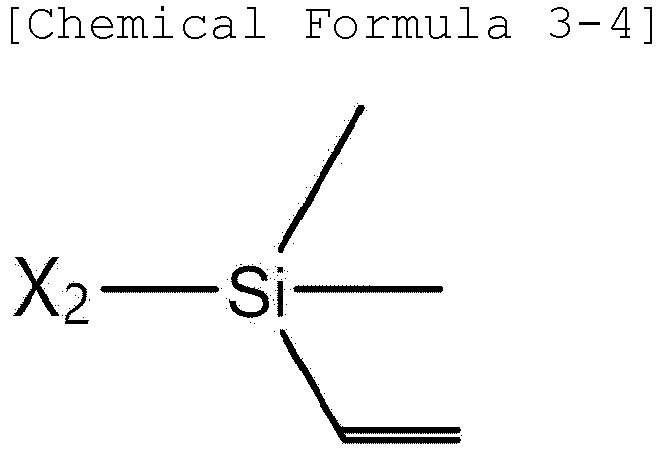

[Chemical Formula 3-6] X2 - CH3
[Chemical Formula 3-7] X2 - C = C
[Chemical Formula 3-8] X2 - C ≡ N





- The method according to claim 4, wherein the compound represented by Chemical Formula 3-1 comprises one or more selected from the group consisting of compounds represented by Chemical Formulas 3-1a to 3-1e below (In each Chemical Formula, X2 is independent).


- The method according to claim 1, wherein the cyclic phosphine compound prepared by the reaction is a compound represented by Chemical Formula 4 below.

- The method according to claim 1, wherein X1 is fluorine (F), chlorine (Cl), bromine (Br), or iodine (I).
- The method according to claim 1, wherein an equivalence ratio of the compound represented by Chemical Formula 1 to the oxo coupling agent is 0.2 to 2.5 : 1.
- The method according to claim 1, wherein an equivalence ratio of a sum of the compound represented by Chemical Formula 1 and the organic halogen compound to the oxo coupling agent is 0.8 to 1.2 : 1.
- The method according to claim 1, wherein the reaction proceeds under an amine base.
- The method according to claim 10, wherein the amine base is an aliphatic amine compound.
- The method according to claim 1, comprising:i) forming a metal salt or a hydroxide by reacting the compound represented by Chemical Formula 1 and an oxo coupling agent; and ii) generating a compound represented by Chemical Formula 4 below by reacting the metal salt or hydroxide and the organic halogen compound.

- The method according to claim 10, wherein an equivalence ratio of the amine base to the oxo coupling agent is 0.2 to 1.5 : 1.
- The method according to claim 1, wherein the reaction is performed at a temperature of -10 to 30 °C.
- The method according to claim 1, wherein the reaction is performed under one or more organic solvents selected from the group consisting of an ether-based solvent having 1 to 10 carbon atoms, a haloalkane-based solvent, a haloalkene-based solvent, a ketone-based solvent, an acetate-based solvent having 2 to 10 carbon atoms, and an aromatic hydrocarbon solvent having 6 to10 carbon atoms.
- The method according to claim 15, wherein the compound represented by Chemical Formula 1 and the organic halogen compound are each dissolved in the organic solvent and mixed.
- The method according to claim 1, wherein the reaction is a protic compound-free reaction.
Applications Claiming Priority (2)
| Application Number | Priority Date | Filing Date | Title |
|---|---|---|---|
| KR1020210145021A KR20230060368A (en) | 2021-10-27 | 2021-10-27 | Preparing method for cyclic phosphine compound |
| PCT/KR2022/015785 WO2023075257A1 (en) | 2021-10-27 | 2022-10-18 | Cyclic phosphine compound preparation method |
Publications (2)
| Publication Number | Publication Date |
|---|---|
| EP4424691A1 true EP4424691A1 (en) | 2024-09-04 |
| EP4424691A4 EP4424691A4 (en) | 2025-03-12 |
Family
ID=86158126
Family Applications (1)
| Application Number | Title | Priority Date | Filing Date |
|---|---|---|---|
| EP22887453.3A Pending EP4424691A4 (en) | 2021-10-27 | 2022-10-18 | PROCESS FOR THE PREPARATION OF A CYCLIC PHOSPHINE COMPOUND |
Country Status (4)
| Country | Link |
|---|---|
| US (1) | US20240409567A1 (en) |
| EP (1) | EP4424691A4 (en) |
| KR (1) | KR20230060368A (en) |
| WO (1) | WO2023075257A1 (en) |
Family Cites Families (5)
| Publication number | Priority date | Publication date | Assignee | Title |
|---|---|---|---|---|
| US2722539A (en) | 1954-03-26 | 1955-11-01 | American Cyanamid Co | Derivatives of ethylene pyrophosphite |
| GB0211136D0 (en) * | 2002-05-15 | 2002-06-26 | Univ London | Treatment and prevention of tissue damage |
| KR101297172B1 (en) * | 2011-06-30 | 2013-08-21 | 삼성에스디아이 주식회사 | Non-aqueous liquid electrolyte additive for lithium secondary cell, non-aqueous liquid electrolyte and lithium secondary cell comprising the same |
| DE102018116475B4 (en) * | 2018-07-06 | 2020-11-05 | Forschungszentrum Jülich GmbH | Electrolyte comprising at least one lithium salt and lithium secondary battery |
| CN110563764A (en) * | 2019-09-10 | 2019-12-13 | 恒大新能源科技集团有限公司 | electrolyte flame-retardant additive and preparation method and application thereof |
-
2021
- 2021-10-27 KR KR1020210145021A patent/KR20230060368A/en active Pending
-
2022
- 2022-10-18 WO PCT/KR2022/015785 patent/WO2023075257A1/en not_active Ceased
- 2022-10-18 EP EP22887453.3A patent/EP4424691A4/en active Pending
- 2022-10-18 US US18/704,097 patent/US20240409567A1/en active Pending
Also Published As
| Publication number | Publication date |
|---|---|
| US20240409567A1 (en) | 2024-12-12 |
| EP4424691A4 (en) | 2025-03-12 |
| WO2023075257A1 (en) | 2023-05-04 |
| KR20230060368A (en) | 2023-05-04 |
Similar Documents
| Publication | Publication Date | Title |
|---|---|---|
| EP3501057B1 (en) | Nonaqueous electrolyte compositions comprising silyl oxalates | |
| EP3516728B1 (en) | Silyl ester phosphinates as electrolyte additives | |
| KR102260496B1 (en) | Method for producing lithium difluorophosphate | |
| EP3513448B1 (en) | Electrolytes containing six membered ring cyclic sulfates | |
| US11289738B2 (en) | Nonaqueous electrolyte compositions comprising lithium oxalato phosphates | |
| US20240332623A1 (en) | Liquid Electrolyte Composition, and Electrochemical Cell Comprising Said Electrolyte Composition | |
| US11005127B2 (en) | Stable fluorinated alkylated lithium malonatoborate salts for lithium-ion battery applications | |
| EP3540842A1 (en) | Electrolyte for rechargeable lithium battery and rechargeable lithium battery | |
| JP2017531285A (en) | Non-aqueous electrolyte composition comprising sultone and a fluorinated solvent | |
| US11362368B2 (en) | Nonaqueous electrolyte compositions | |
| CN117438649A (en) | Nonaqueous electrolyte composition | |
| KR102294409B1 (en) | Method for producing lithium difluorophosphate | |
| EP2765135B1 (en) | Phosphorus Containing Compound, and Electrolyte for Rechargeable Lithium Battery and Rechargeable Lithium Battery Including the Same | |
| CN113206294B (en) | Phosphate and preparation method and application thereof | |
| KR102068759B1 (en) | Additives composition for lithium secondarybattery and process for producing the same | |
| JP6182113B2 (en) | Method for producing amino-substituted phosphazene compound, method for producing electrolyte for non-aqueous secondary battery, and method for producing non-aqueous secondary battery | |
| EP4424691A1 (en) | Cyclic phosphine compound preparation method | |
| KR102521086B1 (en) | Manufacturing method of lithium difluorophosphate | |
| KR102864004B1 (en) | Manufacturing method of lithium difluorophosphate | |
| KR102768151B1 (en) | Electrolyte additive for secondary battery, manufacturing method thereof, electrolyte containing the same, and secondary battery including the Electrolyte | |
| KR102771022B1 (en) | Electrolyte additive for secondary battery, manufacturing method thereof, electrolyte containing the same, and secondary battery including the Electrolyte | |
| KR102952707B1 (en) | Electrolyte additive for lithium secondary battery, electrolyte for lithium secondary battery including the electrolyte additive, and lithium secondary battery including the electrolyte | |
| KR102638391B1 (en) | Method for producing dialkanesulfonyl isosorbide compound, electrolyte additive for lithium secondary battery, electrolyte for lithium secondary battery, and lithium secondary battery | |
| KR102294130B1 (en) | Electrolyte additive for secondary battery, electrolyte for secondary battery, and secondary battery comprising the same | |
| US20240347772A1 (en) | Liquid Electrolyte Composition, and Electrochemical Cell Comprising Said Electrolyte Composition |
Legal Events
| Date | Code | Title | Description |
|---|---|---|---|
| STAA | Information on the status of an ep patent application or granted ep patent |
Free format text: STATUS: THE INTERNATIONAL PUBLICATION HAS BEEN MADE |
|
| PUAI | Public reference made under article 153(3) epc to a published international application that has entered the european phase |
Free format text: ORIGINAL CODE: 0009012 |
|
| STAA | Information on the status of an ep patent application or granted ep patent |
Free format text: STATUS: REQUEST FOR EXAMINATION WAS MADE |
|
| 17P | Request for examination filed |
Effective date: 20240503 |
|
| AK | Designated contracting states |
Kind code of ref document: A1 Designated state(s): AL AT BE BG CH CY CZ DE DK EE ES FI FR GB GR HR HU IE IS IT LI LT LU LV MC ME MK MT NL NO PL PT RO RS SE SI SK SM TR |
|
| DAV | Request for validation of the european patent (deleted) | ||
| DAX | Request for extension of the european patent (deleted) | ||
| REG | Reference to a national code |
Ref country code: DE Ref legal event code: R079 Free format text: PREVIOUS MAIN CLASS: C07F0009657100 Ipc: C07F0009657400 |
|
| A4 | Supplementary search report drawn up and despatched |
Effective date: 20250212 |
|
| RIC1 | Information provided on ipc code assigned before grant |
Ipc: C07F 9/6574 20060101AFI20250206BHEP |