EP4424530A2 - Sleeve for covering vehicle wheels and a method of manufacturing a sleeve for covering vehicle wheels - Google Patents
Sleeve for covering vehicle wheels and a method of manufacturing a sleeve for covering vehicle wheels Download PDFInfo
- Publication number
- EP4424530A2 EP4424530A2 EP24382229.3A EP24382229A EP4424530A2 EP 4424530 A2 EP4424530 A2 EP 4424530A2 EP 24382229 A EP24382229 A EP 24382229A EP 4424530 A2 EP4424530 A2 EP 4424530A2
- Authority
- EP
- European Patent Office
- Prior art keywords
- band
- sleeve
- vehicle wheels
- covering vehicle
- central area
- Prior art date
- Legal status (The legal status is an assumption and is not a legal conclusion. Google has not performed a legal analysis and makes no representation as to the accuracy of the status listed.)
- Pending
Links
Images

Classifications
-
- B—PERFORMING OPERATIONS; TRANSPORTING
- B60—VEHICLES IN GENERAL
- B60B—VEHICLE WHEELS; CASTORS; AXLES FOR WHEELS OR CASTORS; INCREASING WHEEL ADHESION
- B60B15/00—Wheels or wheel attachments designed for increasing traction
-
- B—PERFORMING OPERATIONS; TRANSPORTING
- B60—VEHICLES IN GENERAL
- B60C—VEHICLE TYRES; TYRE INFLATION; TYRE CHANGING; CONNECTING VALVES TO INFLATABLE ELASTIC BODIES IN GENERAL; DEVICES OR ARRANGEMENTS RELATED TO TYRES
- B60C27/00—Non-skid devices temporarily attachable to resilient tyres or resiliently-tyred wheels
- B60C27/06—Non-skid devices temporarily attachable to resilient tyres or resiliently-tyred wheels extending over the complete circumference of the tread, e.g. made of chains or cables
- B60C27/16—Non-skid devices temporarily attachable to resilient tyres or resiliently-tyred wheels extending over the complete circumference of the tread, e.g. made of chains or cables formed of close material, e.g. leather or synthetic mats
- B60C27/18—Non-skid devices temporarily attachable to resilient tyres or resiliently-tyred wheels extending over the complete circumference of the tread, e.g. made of chains or cables formed of close material, e.g. leather or synthetic mats the material being fabric, e.g. woven wire or textile
-
- B—PERFORMING OPERATIONS; TRANSPORTING
- B60—VEHICLES IN GENERAL
- B60C—VEHICLE TYRES; TYRE INFLATION; TYRE CHANGING; CONNECTING VALVES TO INFLATABLE ELASTIC BODIES IN GENERAL; DEVICES OR ARRANGEMENTS RELATED TO TYRES
- B60C27/00—Non-skid devices temporarily attachable to resilient tyres or resiliently-tyred wheels
- B60C27/06—Non-skid devices temporarily attachable to resilient tyres or resiliently-tyred wheels extending over the complete circumference of the tread, e.g. made of chains or cables
-
- B—PERFORMING OPERATIONS; TRANSPORTING
- B60—VEHICLES IN GENERAL
- B60C—VEHICLE TYRES; TYRE INFLATION; TYRE CHANGING; CONNECTING VALVES TO INFLATABLE ELASTIC BODIES IN GENERAL; DEVICES OR ARRANGEMENTS RELATED TO TYRES
- B60C27/00—Non-skid devices temporarily attachable to resilient tyres or resiliently-tyred wheels
- B60C27/06—Non-skid devices temporarily attachable to resilient tyres or resiliently-tyred wheels extending over the complete circumference of the tread, e.g. made of chains or cables
- B60C27/08—Non-skid devices temporarily attachable to resilient tyres or resiliently-tyred wheels extending over the complete circumference of the tread, e.g. made of chains or cables involving lugs or rings taking up wear, e.g. chain links, chain connectors
-
- B—PERFORMING OPERATIONS; TRANSPORTING
- B60—VEHICLES IN GENERAL
- B60C—VEHICLE TYRES; TYRE INFLATION; TYRE CHANGING; CONNECTING VALVES TO INFLATABLE ELASTIC BODIES IN GENERAL; DEVICES OR ARRANGEMENTS RELATED TO TYRES
- B60C27/00—Non-skid devices temporarily attachable to resilient tyres or resiliently-tyred wheels
- B60C27/06—Non-skid devices temporarily attachable to resilient tyres or resiliently-tyred wheels extending over the complete circumference of the tread, e.g. made of chains or cables
- B60C27/10—Non-skid devices temporarily attachable to resilient tyres or resiliently-tyred wheels extending over the complete circumference of the tread, e.g. made of chains or cables having tensioning means
- B60C27/12—Non-skid devices temporarily attachable to resilient tyres or resiliently-tyred wheels extending over the complete circumference of the tread, e.g. made of chains or cables having tensioning means resilient pretension
-
- D—TEXTILES; PAPER
- D03—WEAVING
- D03D—WOVEN FABRICS; METHODS OF WEAVING; LOOMS
- D03D1/00—Woven fabrics designed to make specified articles
-
- D—TEXTILES; PAPER
- D03—WEAVING
- D03D—WOVEN FABRICS; METHODS OF WEAVING; LOOMS
- D03D13/00—Woven fabrics characterised by the special disposition of the warp or weft threads, e.g. with curved weft threads, with discontinuous warp threads, with diagonal warp or weft
- D03D13/008—Woven fabrics characterised by the special disposition of the warp or weft threads, e.g. with curved weft threads, with discontinuous warp threads, with diagonal warp or weft characterised by weave density or surface weight
-
- D—TEXTILES; PAPER
- D03—WEAVING
- D03D—WOVEN FABRICS; METHODS OF WEAVING; LOOMS
- D03D15/00—Woven fabrics characterised by the material, structure or properties of the fibres, filaments, yarns, threads or other warp or weft elements used
- D03D15/20—Woven fabrics characterised by the material, structure or properties of the fibres, filaments, yarns, threads or other warp or weft elements used characterised by the material of the fibres or filaments constituting the yarns or threads
- D03D15/242—Woven fabrics characterised by the material, structure or properties of the fibres, filaments, yarns, threads or other warp or weft elements used characterised by the material of the fibres or filaments constituting the yarns or threads inorganic, e.g. basalt
- D03D15/25—Metal
-
- D—TEXTILES; PAPER
- D03—WEAVING
- D03D—WOVEN FABRICS; METHODS OF WEAVING; LOOMS
- D03D15/00—Woven fabrics characterised by the material, structure or properties of the fibres, filaments, yarns, threads or other warp or weft elements used
- D03D15/20—Woven fabrics characterised by the material, structure or properties of the fibres, filaments, yarns, threads or other warp or weft elements used characterised by the material of the fibres or filaments constituting the yarns or threads
- D03D15/283—Woven fabrics characterised by the material, structure or properties of the fibres, filaments, yarns, threads or other warp or weft elements used characterised by the material of the fibres or filaments constituting the yarns or threads synthetic polymer-based, e.g. polyamide or polyester fibres
-
- D—TEXTILES; PAPER
- D03—WEAVING
- D03D—WOVEN FABRICS; METHODS OF WEAVING; LOOMS
- D03D15/00—Woven fabrics characterised by the material, structure or properties of the fibres, filaments, yarns, threads or other warp or weft elements used
- D03D15/40—Woven fabrics characterised by the material, structure or properties of the fibres, filaments, yarns, threads or other warp or weft elements used characterised by the structure of the yarns or threads
- D03D15/43—Woven fabrics characterised by the material, structure or properties of the fibres, filaments, yarns, threads or other warp or weft elements used characterised by the structure of the yarns or threads with differing diameters
-
- D—TEXTILES; PAPER
- D03—WEAVING
- D03D—WOVEN FABRICS; METHODS OF WEAVING; LOOMS
- D03D15/00—Woven fabrics characterised by the material, structure or properties of the fibres, filaments, yarns, threads or other warp or weft elements used
- D03D15/50—Woven fabrics characterised by the material, structure or properties of the fibres, filaments, yarns, threads or other warp or weft elements used characterised by the properties of the yarns or threads
- D03D15/54—Woven fabrics characterised by the material, structure or properties of the fibres, filaments, yarns, threads or other warp or weft elements used characterised by the properties of the yarns or threads coloured
-
- D—TEXTILES; PAPER
- D03—WEAVING
- D03D—WOVEN FABRICS; METHODS OF WEAVING; LOOMS
- D03D3/00—Woven fabrics characterised by their shape
- D03D3/02—Tubular fabrics
-
- D—TEXTILES; PAPER
- D10—INDEXING SCHEME ASSOCIATED WITH SUBLASSES OF SECTION D, RELATING TO TEXTILES
- D10B—INDEXING SCHEME ASSOCIATED WITH SUBLASSES OF SECTION D, RELATING TO TEXTILES
- D10B2101/00—Inorganic fibres
- D10B2101/20—Metallic fibres
-
- D—TEXTILES; PAPER
- D10—INDEXING SCHEME ASSOCIATED WITH SUBLASSES OF SECTION D, RELATING TO TEXTILES
- D10B—INDEXING SCHEME ASSOCIATED WITH SUBLASSES OF SECTION D, RELATING TO TEXTILES
- D10B2401/00—Physical properties
- D10B2401/06—Load-responsive characteristics
- D10B2401/061—Load-responsive characteristics elastic
-
- D—TEXTILES; PAPER
- D10—INDEXING SCHEME ASSOCIATED WITH SUBLASSES OF SECTION D, RELATING TO TEXTILES
- D10B—INDEXING SCHEME ASSOCIATED WITH SUBLASSES OF SECTION D, RELATING TO TEXTILES
- D10B2505/00—Industrial
- D10B2505/02—Reinforcing materials; Prepregs
- D10B2505/022—Reinforcing materials; Prepregs for tyres
-
- D—TEXTILES; PAPER
- D10—INDEXING SCHEME ASSOCIATED WITH SUBLASSES OF SECTION D, RELATING TO TEXTILES
- D10B—INDEXING SCHEME ASSOCIATED WITH SUBLASSES OF SECTION D, RELATING TO TEXTILES
- D10B2505/00—Industrial
- D10B2505/08—Upholstery, mattresses
-
- D—TEXTILES; PAPER
- D10—INDEXING SCHEME ASSOCIATED WITH SUBLASSES OF SECTION D, RELATING TO TEXTILES
- D10B—INDEXING SCHEME ASSOCIATED WITH SUBLASSES OF SECTION D, RELATING TO TEXTILES
- D10B2505/00—Industrial
- D10B2505/12—Vehicles
Definitions
- the purpose of the present application for invention is to register a sleeve for covering vehicle wheels and a method of manufacturing a sleeve for covering vehicle wheels, which incorporates notable innovations and advantages over the techniques used to date.
- the invention proposes the development of a sleeve for covering vehicle wheels and a method of manufacturing a sleeve for covering vehicle wheels, which, due to its particular arrangement, allows greatly improved performance in its use during covering of the wheel of a vehicle.
- the same tyres known in the state of the art can be greatly improved in their adhesion properties on different rolling surfaces or also in their tribological properties and in their general mechanical properties, which is very necessary on difficult rolling surfaces, such as wet, snowy or icy roads.
- the present invention contributes to solving the present problem, as it allows greatly improved performance in its use during the covering of the wheel of a vehicle, both in terms of maintaining a correct position on a wheel during its use, as well as for improving its adhesion performance and/or tribological and mechanical properties in general, as well as its durability.
- the present invention has been developed in order to provide a sleeve for covering vehicle wheels, which consists of a fabric band having an annular arrangement and therefore with a circumferential path as a result of said annular geometry, said band having such proportions and being enabled to cover and surround an external region of a wheel of a vehicle, wherein the fabric band has a central area along its circumferential path and at least one lateral area adjacent to the central area following the same circumferential path, wherein the at least one adjacent lateral area of the band has a surface density value lower than the surface density value of the central area of the same band; wherein said band also presents a textile or fabric continuity in the mutual contact between its central area and at least one adjacent lateral area, the band being formed in one piece or textile body.
- the band is enabled to totally or partially cover at least the tread and at least one side of the wheel of a vehicle.
- the central area of the band corresponds to at least the tread of the wheel and the at least one lateral area corresponds to at least one flank of the same wheel.
- the central area of the band corresponds to the tread and also partially over at least one flank of the wheel.
- the sleeve for covering vehicle wheels there are at least two adjacent lateral areas, resulting in at least one adjacent lateral area on both sides of the central area of the band, following the circumferential path of the annular geometry of the band.
- the central area of the band corresponds at least to the tread of the wheel and at least one adjacent lateral area corresponds to each of the flanks of the wheel.
- the band has an adjacent lateral area arranged on each side of the central area following the circumferential path of the annular geometry of the band.
- the lateral areas of the band have a symmetry in relation to the central area of the same band.
- the band incorporates an elastic means on at least one of its lateral edges following the circumferential path of the annular geometry of the band.
- the sleeve for vehicle wheels is made of polymeric material or the like.
- the wheel incorporates a tyre.
- the central area of the band has projections on its surface.
- the projections have a linear arrangement.
- the projections have a linear and rectilinear arrangement.
- the projections have a linear and rectilinear arrangement and with an orientation that is parallel to the axial axis of the annular arrangement of the band.
- the textile band incorporates metallic yarns in the total or partial formation of its constituent fabric.
- the metal yarns are totally or partially made of titanium.
- the metal yarns are totally or partially made of stainless steel.
- the projections of the band are metallic in nature.
- the band simultaneously incorporates in its conformation at least yarns of a polymeric nature or the like and yarns of a metallic nature or the like.
- Method of manufacturing a sleeve for covering vehicle wheels comprising an arrangement and supply of warp yarns from and along a warp and another arrangement and supply of weft yarns from and along a creel, the warp and the creel being mutually positioned and enabled to result in a fabric band, wherein the amount and/or properties of the warp yarns supplied is heterogeneous along the same warp, resulting in the fabric band having a different surface density along its surface depending on the heterogeneity in the number and/or properties of the warp yarns supplied along the same warp.
- the number and/or properties of the weft yarns supplied is heterogeneous along the creel, resulting in the fabric band having projections on its surface that are in turn resulting from said differentiated weft yarns supplied from the creel, the projections being in turn oriented in the direction of the arrangement of the weft yarns supplied from the creel.
- the differentiated weft yarns have a differentiated thickness.
- the differentiated weft yarns are the result of a joining of several weft yarns supplied in the same creel.
- the warp yarns and/or the weft yarns are entirely or partially metallic in nature.
- the warp yarns and/or the weft yarns are entirely or partially made of titanium.
- the warp yarns and/or the weft yarns are entirely or partially made of stainless steel.
- the method of manufacturing a sleeve for covering vehicle wheels simultaneously inserts warp and/or weft yarns of at least polymeric or similar nature and at least of metallic or similar nature.
- a sleeve for covering vehicle wheels which is the result of the manufacturing method of a sleeve for covering vehicle wheels.
- the sleeve for covering vehicle wheels of the proposed invention consists of a textile fabric band 1 having an annular arrangement, which means that it has an axial axis and that a circumferential path can be followed along the same, indicated by the curved arrow in figure 1 and resulting from said annular geometry.
- the band 1 is made of polymeric material or the like.
- the band 1 has such proportions and is enabled to cover and surround an external region of a vehicle wheel 2, the wheel 2 appearing in figure 1 already covered by the band 1.
- the wheel 2 incorporates a tyre.
- the band 1 of the sleeve for covering vehicle wheels of the invention is enabled due to its proportions to cover the tread 21 and the flanks 22 of a vehicle wheel 2.
- the fabric band 1 has a central area 11 along its circumferential path and at least one lateral area 12 adjacent to the central area 11, taking as reference the aforementioned circumferential path that is indicated with the curved arrow in figure 1 .
- the central area 11 of the band 1 corresponds to or covers at least the tread 21 of the wheel 2
- the lateral areas 12 correspond to or cover the flanks 22 of the same wheel 2.
- the central area 11 can even partially extend its covering over the flanks 22 of the wheel 2.
- the band 1 incorporates elastic means 13 on its lateral edges, in order to help and ensure the correct adjustment and positioning of the band 1 covering the tread 21 and the flanks 22 of the wheel 2.
- the sleeve for covering vehicle wheels of the proposed invention is characterised in that in the fabric band 1, the lateral areas 12 adjacent to the central area 11 have a surface density value that is lower than the surface density value of the central area 11 of the same band 1.
- the lateral areas 12 of the band 1 will much better maintain their correct position on the flanks 22 of the wheel 2 without coming off or moving due to the centrifugal stress caused by the turning movement of the wheel 2.
- the sleeve for covering vehicle wheels of the invention due to its explained arrangement, will allow a vehicle to circulate at higher speeds without the consequent higher turning speed in its wheels 2 resulting in the lateral areas 12 and the same band 1 coming off from its correct position.
- the difference in surface densities referred to in the sleeve for covering vehicle wheels of the present invention means that during use, fewer wrinkles are generated in the central area 11 of the band 1 than in the adjacent lateral areas 12, precisely because of this difference in their surface densities.
- the sleeve for covering vehicle wheels of the present invention may have multiple preferred embodiments, such as including a plurality of adjacent lateral areas 12 on the sides of the central area 11, with different surface density values lower than the surface density value of the central area 11 of the band 1.
- the lateral areas 12 in the band 1 present a symmetry in relation to the central area 11 of the same band 1.
- the band 1 presents a textile or fabric continuity in the mutual contact between its central area 11 and the adjacent lateral areas 12, which thus entails that the band 1 is formed and made up of one piece or textile body.
- the band 1 of the sleeve of the invention is more resistant to possible breakages and detachments in that area during its use, because it is not sewn but manufactured directly and entirely from a textile machine as a single fabric or piece or textile body.
- the band 1 can have in its central area 11 projections 14 on its surface, as can be seen in Figure 1 .
- the projections 14 have a linear and rectilinear arrangement, and with an orientation that is parallel to the axial axis of the annular arrangement of the band 1.
- projections 14 in the central area 11 of the band 1 can have tribological properties, very useful to ensure correct adhesion of the sleeve for covering vehicle wheels of the invention to the ground during the rolling of the wheel 2, for example on surfaces more prone to potential slipping such as wet or snowy surfaces.
- the projections 14 also provide better mechanical traction properties in their use to the band 1 and therefore to the sleeve for covering vehicle wheels of the invention.
- the textile band 1 can also incorporate metallic yarns in the total or partial formation of its constituent fabric, such as by means of yarns made of titanium, stainless steel, etc., or other suitable metal material or metal alloy.
- the properties and mechanical traction performance of the sleeve for covering vehicle wheels of the proposed invention can be significantly improved, being more resistant and/or durable under more demanding biasing during use.
- the projections 14 can also be metallic in nature, with the better mechanical properties and performance that this entails.
- the sleeve for covering vehicle wheels of the invention can therefore present its textile band 1 formed by a simultaneous variability of yarns of different nature, such as polymeric or metallic, according to the precise and specific different requirements and biasing expected while it is used, and can therefore adapt to multiple expected use and/or marketing requirements.
- the invention also includes a method of manufacturing a particular sleeve for vehicle wheels.
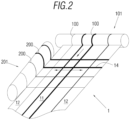
- said manufacturing method comprises an arrangement and supply of warp yarns 100 and weft yarns 200 using a textile machine or weaving machine or loom.
- the warp yarns 100 are supplied from and along a warp 101 or warping beam or warping creels, which is part of a textile machine or weaving machine or loom.
- the weft yarns 200 are supplied from and along a weft creel 201 of the same textile machine or weaving machine or loom, with a mutual positioning between the warp 101 and the creel 201 as is already known in the state of the art.
- the warp yarns 100 are supplied from the warp 101 in the direction indicated by the unidirectional arrow in Figure 2
- the weft yarns 200 are supplied from the cone or cones of the creel 201 and continuously distributed back and forth by a clamp (not shown in the drawings) of the same weaving machine and in the direction indicated by the double arrow in Figure 2 and transversely to the warp yarns 100.
- the manufacturing method included in the present invention also incorporates the detail that the distribution and allocation of the number and/or properties of the warp yarns 100 supplied from the warp 101 is heterogeneous or variable along the same warp 101.
- the warp yarns 100 have different thickness properties that vary along the warp 101. This therefore means that the fabric band 1 resulting from said manufacturing method has a different surface density along its surface, in accordance with the heterogeneity or variability in the distribution and allocation of the number and/or properties of the warp yarns 100 supplied along the same warp 101.
- the same manufacturing method included in the present invention may also present the added detail that the distribution and allocation of the number and/or properties of the weft yarns 200 is heterogeneous and variable along the same creel 201.
- the fabric band 1 resulting from said manufacturing method has linear projections 14 on its surface, as, for example, have been described above in a possible scenario, and which are in turn resulting from the aforementioned differentiated weft yarns 200 supplied from the creel 201, said projections 14 being oriented in the direction of the arrangement of the weft yarns 200 from the creel 201.
- the weft yarns 200 can have a different thickness along the creel 201, as for example figure 2 schematically shows, or several weft yarns 200 can be joined together at the same time and increasing their resulting thickness. This therefore means that the aforementioned projections 14 are generated in this manner, and that they correspond to the weft yarns 200 of greater resulting thickness that are supplied from the creel 201.
- the warp yarns 100 and/or the weft yarns 200 can be totally or partially metallic in nature, such as titanium, stainless steel, etc., or other suitable metal material or metal alloy.
- the manufacturing method described in the present invention also allows the insertion of different warp 100 and weft 200 yarns of different nature, for example polymeric or metallic, according to the precise and specific different requirements and biasing expected in the resulting sleeve for covering vehicle wheels, and can therefore be adapted to multiple expected use and/or marketing requirements.
- the manufacturing method included in the present invention also has the technical advantage of improving manufacturing speed.
- the present invention also includes a sleeve for covering vehicle wheels as described above, characterised in that it may have been made with a manufacturing method as described above and which is also included in the present invention.
- the detail explained above for the sleeve for covering vehicle wheels of the proposed invention in which the fabric band 1 has a central area 11 and lateral areas 12 adjacent to the central area 11, with a surface density value in the lateral areas 12 that is lower than the surface density value of the central area 11 of the same band 1, can be achieved by means of a manufacturing method described and included in the same invention.
- the heterogeneity and variability in the distribution and allocation of the number and/or properties of the warp yarns 100 supplied from and along the warp 101 means that the band 1 resulting from manufacturing may have a central longitudinal area 11 with a surface density greater than the surface density of the adjacent, also longitudinal, lateral areas 12 as also indicated schematically in figure 2 .
- a central area 11 is generated in the band 1 with a surface density greater than the surface density of the adjacent lateral areas 12, as figure 2 schematically shows.
- the band 1 has textile continuity between its central area 11 and its lateral areas 12 as the band 1 is formed in one piece or textile body can also be the result of the manufacturing method described and included in the present invention.
- the central area 11 and the adjacent lateral areas 12 can be generated in the same textile band 1 with textile continuity between them and without requiring intermediate sewing between them, resulting in the band 1 being formed in one piece or textile body and manufactured directly from a textile machine suitable for this purpose as a single fabric, and with the consequent explained advantages of not requiring any sewing between the central area 11 and the adjacent lateral areas 12 in the same textile band 1, as figure 2 also shows.
- the projections 14 on the surface of the central area 11 of the band 1 can be generated. This is due to the fact that the heterogeneity and variability in the number and/or properties of the weft yarns 200 supplied from and along the creel 201, means that in the band 1 resulting from manufacturing, the aforementioned projections 14 are generated oriented in the direction of the arrangement of the weft yarns 200 from the creel 201 and generated by the use of thicker weft yarns 200 or by bringing together several weft yarns 200 at the same time and increasing their resulting thickness.
- Figure 2 shows how a projection 14 in the band 1 is generated by a thicker weft yarn 200.
Landscapes
- Engineering & Computer Science (AREA)
- Textile Engineering (AREA)
- Mechanical Engineering (AREA)
- Chemical & Material Sciences (AREA)
- Inorganic Chemistry (AREA)
- Tires In General (AREA)
- Vehicle Interior And Exterior Ornaments, Soundproofing, And Insulation (AREA)
- Body Structure For Vehicles (AREA)
- Ropes Or Cables (AREA)
- Handcart (AREA)
- Casting Or Compression Moulding Of Plastics Or The Like (AREA)
Abstract
Description
- The purpose of the present application for invention is to register a sleeve for covering vehicle wheels and a method of manufacturing a sleeve for covering vehicle wheels, which incorporates notable innovations and advantages over the techniques used to date.
- More specifically, the invention proposes the development of a sleeve for covering vehicle wheels and a method of manufacturing a sleeve for covering vehicle wheels, which, due to its particular arrangement, allows greatly improved performance in its use during covering of the wheel of a vehicle.
- In the current state of the art, the usual sleeves used to cover vehicle wheels are known, used above all with the purpose of ensuring correct adhesion of such wheels during rolling, especially in the case of rolling on surfaces prone to cause unwanted slipping and skidding, such as on wet or snow- or ice-covered road surfaces.
- Despite the usual good properties known in said sleeves, it may also be common that during use and as a consequence of the rolling and subsequent turning of the wheel, the aforementioned sleeves may move from their correct covering position in the wheel, and even completely come off its covering position in the wheel.
- This circumstance can occur above all as a consequence of the fact that when the aforementioned sleeves are arranged covering the vehicle wheels, they are subjected to the same turning movement of the wheel, which means that the same sleeve is in turn subjected to inertia and centrifugal stress towards the outside of the wheel, and which could result in the sleeve coming off its covering position in the wheel, or at least a resulting incorrect positioning of the sleeve on the wheel itself.
- Also, the same tyres known in the state of the art can be greatly improved in their adhesion properties on different rolling surfaces or also in their tribological properties and in their general mechanical properties, which is very necessary on difficult rolling surfaces, such as wet, snowy or icy roads.
- The present invention contributes to solving the present problem, as it allows greatly improved performance in its use during the covering of the wheel of a vehicle, both in terms of maintaining a correct position on a wheel during its use, as well as for improving its adhesion performance and/or tribological and mechanical properties in general, as well as its durability.
- The present invention has been developed in order to provide a sleeve for covering vehicle wheels, which consists of a fabric band having an annular arrangement and therefore with a circumferential path as a result of said annular geometry, said band having such proportions and being enabled to cover and surround an external region of a wheel of a vehicle, wherein the fabric band has a central area along its circumferential path and at least one lateral area adjacent to the central area following the same circumferential path, wherein the at least one adjacent lateral area of the band has a surface density value lower than the surface density value of the central area of the same band; wherein said band also presents a textile or fabric continuity in the mutual contact between its central area and at least one adjacent lateral area, the band being formed in one piece or textile body.
- Preferably, in the sleeve for covering vehicle wheels, the band is enabled to totally or partially cover at least the tread and at least one side of the wheel of a vehicle.
- Alternatively, in the sleeve for covering vehicle wheels, the central area of the band corresponds to at least the tread of the wheel and the at least one lateral area corresponds to at least one flank of the same wheel.
- Alternatively, in the sleeve for covering vehicle wheels, the central area of the band corresponds to the tread and also partially over at least one flank of the wheel.
- Alternatively, in the sleeve for covering vehicle wheels, there are at least two adjacent lateral areas, resulting in at least one adjacent lateral area on both sides of the central area of the band, following the circumferential path of the annular geometry of the band.
- Preferably, in the sleeve for covering vehicle wheels, the central area of the band corresponds at least to the tread of the wheel and at least one adjacent lateral area corresponds to each of the flanks of the wheel.
- Preferably, in the sleeve for covering vehicle wheels, the band has an adjacent lateral area arranged on each side of the central area following the circumferential path of the annular geometry of the band.
- Additionally, in the sleeve for covering vehicle wheels, the lateral areas of the band have a symmetry in relation to the central area of the same band.
- Additionally, in the sleeve for covering vehicle wheels, the band incorporates an elastic means on at least one of its lateral edges following the circumferential path of the annular geometry of the band.
- Alternatively, the sleeve for vehicle wheels is made of polymeric material or the like.
- Preferably, in relation to the sleeve for covering vehicle wheels, the wheel incorporates a tyre.
- Additionally, in the sleeve for covering vehicle wheels, the central area of the band has projections on its surface.
- Preferably, in the sleeve for covering vehicle wheels, the projections have a linear arrangement.
- Preferably, in the sleeve for covering vehicle wheels, the projections have a linear and rectilinear arrangement.
- Preferably, in the sleeve for covering vehicle wheels, in which the projections have a linear and rectilinear arrangement and with an orientation that is parallel to the axial axis of the annular arrangement of the band.
- Alternatively, in the sleeve for covering vehicle wheels, the textile band incorporates metallic yarns in the total or partial formation of its constituent fabric.
- Alternatively, in the sleeve for covering vehicle wheels, the metal yarns are totally or partially made of titanium.
- Alternatively, in the sleeve for covering vehicle wheels, the metal yarns are totally or partially made of stainless steel.
- Alternatively, in the sleeve for covering vehicle wheels, the projections of the band are metallic in nature.
- Alternatively, in the sleeve for covering vehicle wheels, the band simultaneously incorporates in its conformation at least yarns of a polymeric nature or the like and yarns of a metallic nature or the like.
- Method of manufacturing a sleeve for covering vehicle wheels, comprising an arrangement and supply of warp yarns from and along a warp and another arrangement and supply of weft yarns from and along a creel, the warp and the creel being mutually positioned and enabled to result in a fabric band, wherein the amount and/or properties of the warp yarns supplied is heterogeneous along the same warp, resulting in the fabric band having a different surface density along its surface depending on the heterogeneity in the number and/or properties of the warp yarns supplied along the same warp.
- Additionally, in the method of manufacturing a sleeve for covering vehicle wheels, the number and/or properties of the weft yarns supplied is heterogeneous along the creel, resulting in the fabric band having projections on its surface that are in turn resulting from said differentiated weft yarns supplied from the creel, the projections being in turn oriented in the direction of the arrangement of the weft yarns supplied from the creel.
- Alternatively, in the method of manufacturing a sleeve for covering vehicle wheels, the differentiated weft yarns have a differentiated thickness.
- Alternatively, in the method of manufacturing a sleeve for covering vehicle wheels, the differentiated weft yarns are the result of a joining of several weft yarns supplied in the same creel.
- Alternatively, in the method of manufacturing a sleeve for covering vehicle wheels, the warp yarns and/or the weft yarns are entirely or partially metallic in nature.
- Alternatively, in the method of manufacturing a sleeve for covering vehicle wheels, the warp yarns and/or the weft yarns are entirely or partially made of titanium.
- Alternatively, in the method of manufacturing a sleeve for covering vehicle wheels, the warp yarns and/or the weft yarns are entirely or partially made of stainless steel.
- Alternatively, the method of manufacturing a sleeve for covering vehicle wheels simultaneously inserts warp and/or weft yarns of at least polymeric or similar nature and at least of metallic or similar nature.
- A sleeve for covering vehicle wheels, which is the result of the manufacturing method of a sleeve for covering vehicle wheels.
- Due to the present invention, greatly improved performance is achieved when using a sleeve while covering a vehicle wheel, both in terms of maintaining a correct positioning on a wheel during use, and to improve its adhesion performance and/or tribological and mechanical properties in general.
- Other features and advantages of the sleeve for covering vehicle wheels object of the present invention will become apparent from the description of a preferred but not exclusive embodiment illustrated by way of non-limiting example in the attached drawings, in which:
-
-
Figure 1 is a perspective and schematic view of a preferred embodiment of the sleeve for covering vehicle wheels of the present invention, and also indicative of its use on a wheel. -
Figure 2 is a schematic view indicative of a preferred embodiment of a manufacturing method of a sleeve for covering vehicle wheels of the invention. - As shown schematically in
Figure 1 , the sleeve for covering vehicle wheels of the proposed invention consists of a textile fabric band 1 having an annular arrangement, which means that it has an axial axis and that a circumferential path can be followed along the same, indicated by the curved arrow infigure 1 and resulting from said annular geometry. - In this preferred embodiment, the band 1 is made of polymeric material or the like.
- The band 1 has such proportions and is enabled to cover and surround an external region of a
vehicle wheel 2, thewheel 2 appearing infigure 1 already covered by the band 1. - Also in this preferred embodiment, the
wheel 2 incorporates a tyre. - As can be seen in this preferred embodiment represented in
Figure 1 , the band 1 of the sleeve for covering vehicle wheels of the invention is enabled due to its proportions to cover thetread 21 and theflanks 22 of avehicle wheel 2. - According to the invention itself, the fabric band 1 has a
central area 11 along its circumferential path and at least onelateral area 12 adjacent to thecentral area 11, taking as reference the aforementioned circumferential path that is indicated with the curved arrow infigure 1 . In this preferred embodiment represented inFigure 1 , there are twolateral areas 12 that are arranged, one on each side of thecentral area 11 of the band 1, only onelateral area 12 arranged on one of the sides of thecentral area 11 being visible inFigure 1 . - As can also be seen in
Figure 1 , in the sleeve for covering vehicle wheels of the invention, thecentral area 11 of the band 1 corresponds to or covers at least thetread 21 of thewheel 2, and thelateral areas 12 correspond to or cover theflanks 22 of thesame wheel 2. - In some preferred embodiments of the invention, the
central area 11 can even partially extend its covering over theflanks 22 of thewheel 2. - Moreover, in the sleeve for covering vehicle wheels of the invention, the band 1 incorporates
elastic means 13 on its lateral edges, in order to help and ensure the correct adjustment and positioning of the band 1 covering thetread 21 and theflanks 22 of thewheel 2. - The sleeve for covering vehicle wheels of the proposed invention is characterised in that in the fabric band 1, the
lateral areas 12 adjacent to thecentral area 11 have a surface density value that is lower than the surface density value of thecentral area 11 of the same band 1. - This technical detail represents a very important technical advantage in the use of the sleeve for covering vehicle wheels of the proposed invention.
- This is because when the sleeve of the invention is arranged covering a
vehicle wheel 2, as can also be seen inFigure 1 , the operation of thesame wheel 2 means that it must roll and turn on itself, as is known in the state of the art. - This in turn therefore means that the band 1 of the sleeve for covering vehicle wheels of the invention, which is arranged and covering the
wheel 2, is subjected to the same turning movement of thewheel 2, which entails an inertia and centrifugal stress on the same band 1 outwards of thewheel 2, with the consequent danger that thelateral areas 12 of the band 1 end up coming out of their correct position on theflanks 22 of thewheel 2, even overcoming the resistance of the elastics means 13 on the lateral edges of the band 1. - This technical detail explained and referred to the fact that the
lateral areas 12 adjacent to thecentral area 11 have a surface density value lower than the surface density value of thecentral area 11 of the same band 1, therefore means that the centrifugal stress to which the adjacentlateral areas 12 are subjected is noticeably lower than the stress to which thecentral area 11 of the same band 1 is subjected due to the same turning movement of thewheel 2 and the band 1. - Because of this, the
lateral areas 12 of the band 1 will much better maintain their correct position on theflanks 22 of thewheel 2 without coming off or moving due to the centrifugal stress caused by the turning movement of thewheel 2. - By keeping the
lateral areas 12 and the band 1 itself in their correct position, possible entanglement, friction or other incidence of thelateral areas 12 and the same band 1 on different internal elements of the vehicle itself is also avoided when the turning movement of thewheel 2 occurs. - In addition, the sleeve for covering vehicle wheels of the invention, due to its explained arrangement, will allow a vehicle to circulate at higher speeds without the consequent higher turning speed in its
wheels 2 resulting in thelateral areas 12 and the same band 1 coming off from its correct position. - In addition, the difference in surface densities referred to in the sleeve for covering vehicle wheels of the present invention means that during use, fewer wrinkles are generated in the
central area 11 of the band 1 than in the adjacentlateral areas 12, precisely because of this difference in their surface densities. - This therefore means, according to the explained positioning of the band 1 on the
wheel 2, which results in a lower presence of wrinkles in thetread 21 and a greater presence of wrinkles in theflanks 22 of thesame wheel 2, which in turn will entail greater durability of the sleeve for covering vehicle wheels of the present invention, since the wrinkles are more prone to breakage in use, and as the wear and biasing is greater on thetread 21 of thewheel 2 that on theflanks 22, as there are fewer wrinkles specifically on thetread 21, the final durability will be greater. - The sleeve for covering vehicle wheels of the present invention may have multiple preferred embodiments, such as including a plurality of adjacent
lateral areas 12 on the sides of thecentral area 11, with different surface density values lower than the surface density value of thecentral area 11 of the band 1. - Also in this preferred embodiment represented in
Figure 1 , thelateral areas 12 in the band 1 present a symmetry in relation to thecentral area 11 of the same band 1. - Another very important technical detail in the sleeve for covering vehicle wheels of the present invention is that the band 1 presents a textile or fabric continuity in the mutual contact between its
central area 11 and the adjacentlateral areas 12, which thus entails that the band 1 is formed and made up of one piece or textile body. - This therefore means that in the sleeve for covering vehicle wheels of the present invention, the
central area 11 and thelateral areas 12 of the band 1 do not need to be joined by sewing or the like, which would represent a notable risk of breakage and detachment due to the stress and wear suffered in use during the rolling of thewheel 2. - Thanks to the textile continuity of the band 1 between its
central area 11 and itslateral areas 12, as the band 1 is formed in one piece or textile body, the band 1 of the sleeve of the invention is more resistant to possible breakages and detachments in that area during its use, because it is not sewn but manufactured directly and entirely from a textile machine as a single fabric or piece or textile body. - Another detail added to the sleeve for covering vehicle wheels of the invention is that the band 1 can have in its
central area 11projections 14 on its surface, as can be seen inFigure 1 . - In the embodiment represented in
Figure 1 , theprojections 14 have a linear and rectilinear arrangement, and with an orientation that is parallel to the axial axis of the annular arrangement of the band 1. - These
projections 14 in thecentral area 11 of the band 1 can have tribological properties, very useful to ensure correct adhesion of the sleeve for covering vehicle wheels of the invention to the ground during the rolling of thewheel 2, for example on surfaces more prone to potential slipping such as wet or snowy surfaces. - The
projections 14 also provide better mechanical traction properties in their use to the band 1 and therefore to the sleeve for covering vehicle wheels of the invention. - In other preferred embodiments of the sleeve for covering vehicle wheels of the invention, the textile band 1 can also incorporate metallic yarns in the total or partial formation of its constituent fabric, such as by means of yarns made of titanium, stainless steel, etc., or other suitable metal material or metal alloy.
- With this, the properties and mechanical traction performance of the sleeve for covering vehicle wheels of the proposed invention can be significantly improved, being more resistant and/or durable under more demanding biasing during use.
- Accordingly, the
projections 14 can also be metallic in nature, with the better mechanical properties and performance that this entails. - The sleeve for covering vehicle wheels of the invention can therefore present its textile band 1 formed by a simultaneous variability of yarns of different nature, such as polymeric or metallic, according to the precise and specific different requirements and biasing expected while it is used, and can therefore adapt to multiple expected use and/or marketing requirements.
- The invention also includes a method of manufacturing a particular sleeve for vehicle wheels.
- As
figure 2 schematically shows, said manufacturing method comprises an arrangement and supply ofwarp yarns 100 andweft yarns 200 using a textile machine or weaving machine or loom. - The
warp yarns 100 are supplied from and along awarp 101 or warping beam or warping creels, which is part of a textile machine or weaving machine or loom. - The
weft yarns 200 are supplied from and along aweft creel 201 of the same textile machine or weaving machine or loom, with a mutual positioning between thewarp 101 and thecreel 201 as is already known in the state of the art. - As
figure 2 schematically shows, thewarp yarns 100 are supplied from thewarp 101 in the direction indicated by the unidirectional arrow inFigure 2 , and theweft yarns 200 are supplied from the cone or cones of thecreel 201 and continuously distributed back and forth by a clamp (not shown in the drawings) of the same weaving machine and in the direction indicated by the double arrow inFigure 2 and transversely to thewarp yarns 100. - The aforementioned arrangement and supply of
warp yarns 100 in thewarp 101 and ofweft yarns 200 in thecreel 201, and their mutual crossing, results in a fabric band 1 for a particular sleeve for vehicle wheels, such as, in a possible scenario, the one described above. - The manufacturing method included in the present invention also incorporates the detail that the distribution and allocation of the number and/or properties of the
warp yarns 100 supplied from thewarp 101 is heterogeneous or variable along thesame warp 101. - As
figure 2 schematically shows, in this preferred embodiment thewarp yarns 100 have different thickness properties that vary along thewarp 101. This therefore means that the fabric band 1 resulting from said manufacturing method has a different surface density along its surface, in accordance with the heterogeneity or variability in the distribution and allocation of the number and/or properties of thewarp yarns 100 supplied along thesame warp 101. - The same manufacturing method included in the present invention may also present the added detail that the distribution and allocation of the number and/or properties of the
weft yarns 200 is heterogeneous and variable along thesame creel 201. This means, therefore, that the fabric band 1 resulting from said manufacturing method haslinear projections 14 on its surface, as, for example, have been described above in a possible scenario, and which are in turn resulting from the aforementioneddifferentiated weft yarns 200 supplied from thecreel 201, saidprojections 14 being oriented in the direction of the arrangement of theweft yarns 200 from thecreel 201. - In a preferred embodiment of the manufacturing method included in the present invention, the
weft yarns 200 can have a different thickness along thecreel 201, as for examplefigure 2 schematically shows, orseveral weft yarns 200 can be joined together at the same time and increasing their resulting thickness. This therefore means that theaforementioned projections 14 are generated in this manner, and that they correspond to theweft yarns 200 of greater resulting thickness that are supplied from thecreel 201. - In another preferred embodiment of the manufacturing method included in the present invention, the
warp yarns 100 and/or theweft yarns 200 can be totally or partially metallic in nature, such as titanium, stainless steel, etc., or other suitable metal material or metal alloy. - Therefore, the manufacturing method described in the present invention also allows the insertion of
different warp 100 andweft 200 yarns of different nature, for example polymeric or metallic, according to the precise and specific different requirements and biasing expected in the resulting sleeve for covering vehicle wheels, and can therefore be adapted to multiple expected use and/or marketing requirements. - The manufacturing method included in the present invention also has the technical advantage of improving manufacturing speed.
- It also has the advantage of being able to incorporate
warp 100 andweft 200 yarns of different colours, in order to provide a desired colour distribution in the resulting fabric band 1. - The present invention also includes a sleeve for covering vehicle wheels as described above, characterised in that it may have been made with a manufacturing method as described above and which is also included in the present invention.
- In particular, the detail explained above for the sleeve for covering vehicle wheels of the proposed invention, in which the fabric band 1 has a
central area 11 andlateral areas 12 adjacent to thecentral area 11, with a surface density value in thelateral areas 12 that is lower than the surface density value of thecentral area 11 of the same band 1, can be achieved by means of a manufacturing method described and included in the same invention. - Specifically, the heterogeneity and variability in the distribution and allocation of the number and/or properties of the
warp yarns 100 supplied from and along thewarp 101, means that the band 1 resulting from manufacturing may have a centrallongitudinal area 11 with a surface density greater than the surface density of the adjacent, also longitudinal,lateral areas 12 as also indicated schematically infigure 2 . - Depending on the greater or lesser number of
warp yarns 100 distributed and supplied from and along thewarp 101 or the different properties that thesewarp yarns 100 have along thewarp 101, such as their thickness, acentral area 11 is generated in the band 1 with a surface density greater than the surface density of the adjacentlateral areas 12, asfigure 2 schematically shows. - The other very important detail referred to in the sleeve for covering vehicle wheels of the invention as described above, the fact that the band 1 has textile continuity between its
central area 11 and itslateral areas 12 as the band 1 is formed in one piece or textile body can also be the result of the manufacturing method described and included in the present invention. - Indeed, by means of the manufacturing method described and included in the present invention, the
central area 11 and the adjacentlateral areas 12 can be generated in the same textile band 1 with textile continuity between them and without requiring intermediate sewing between them, resulting in the band 1 being formed in one piece or textile body and manufactured directly from a textile machine suitable for this purpose as a single fabric, and with the consequent explained advantages of not requiring any sewing between thecentral area 11 and the adjacentlateral areas 12 in the same textile band 1, asfigure 2 also shows. - The other possible detail also present in the sleeve for covering vehicle wheels of the present invention in which the
central area 11 of the band 1 hasprojections 14 on its surface with better tribological and mechanical traction properties, can also be achieved. by means of a manufacturing method described and included in the same invention. - Indeed, by means of the manufacturing method described and included in the present invention, the
projections 14 on the surface of thecentral area 11 of the band 1 can be generated. This is due to the fact that the heterogeneity and variability in the number and/or properties of theweft yarns 200 supplied from and along thecreel 201, means that in the band 1 resulting from manufacturing, theaforementioned projections 14 are generated oriented in the direction of the arrangement of theweft yarns 200 from thecreel 201 and generated by the use ofthicker weft yarns 200 or by bringing together severalweft yarns 200 at the same time and increasing their resulting thickness.Figure 2 shows how aprojection 14 in the band 1 is generated by athicker weft yarn 200. - The details, shapes, dimensions and other accessory elements, as well as the materials used in the manufacture of the sleeve for covering vehicle wheels and the method of manufacturing a sleeve for covering vehicle wheels of the invention, may be conveniently replaced by others that are technically equivalent and do not deviate from the essential features of the invention or the scope defined by the claims included below.
Claims (15)
- A sleeve for covering vehicle wheels, which consists of a fabric band (1) having an annular arrangement and therefore with a circumferential path as a result of said annular geometry, said band (1) having such proportions and being enabled to cover and surround an external region of a wheel (2) of a vehicle, characterised in that the fabric band (1) has a central area (11) along its circumferential path and at least one lateral area (12) adjacent to the central area (11) following the same circumferential path, wherein the at least one adjacent lateral area (12) of the band (1) has a surface density value lower than the surface density value of the central area (11) in the same band (1); wherein said band (1) further has a textile or fabric continuity in the mutual contact between its central area (11) and the at least one adjacent lateral area (12), the band (1) being formed in one piece or textile body.
- The sleeve for covering vehicle wheels according to claim 1, wherein the band (1) is enabled to totally or partially cover at least the tread (21) and at least one flank (22) of the wheel (2) of a vehicle.
- The sleeve for covering vehicle wheels according to claim 2, wherein the central area (11) of the band (1) corresponds to at least the tread (21) of the wheel (2) and the at least one lateral area (12) corresponds to at least one flank (22) of the same wheel (2).
- The sleeve for covering vehicle wheels according to claim 3, wherein the central area (11) of the band (1) corresponds to the tread (21) and also partially over at least one flank (22) of the wheel (2).
- The sleeve for covering vehicle wheels according to any of the preceding claims, wherein there are at least two adjacent lateral areas (12), resulting in at least one adjacent lateral area (12) on both sides of the central area (11) of the band (1), following the circumferential path of the annular geometry of the band (1).
- The sleeve for covering vehicle wheels according to claim 5 when it depends on claim 3 or 4, wherein the central area (11) of the band (1) corresponds at least to the tread (21) of the wheel (2) and at least one adjacent lateral area (12) corresponds to each of the flanks (22) of the wheel (2).
- The sleeve for covering vehicle wheels according to claim 6, wherein the band (1) has an adjacent lateral area (12) arranged on each side of the central area (11) following the circumferential path of the annular geometry of the band (1).
- The sleeve for covering vehicle wheels according to any of claims 6 to 7 when they depend on claim 5, wherein the lateral areas (12) of the band (1) have a symmetry in relation to the central area (11) of the same band (1).
- The sleeve for covering vehicle wheels according to any of the preceding claims, wherein the band (1) incorporates an elastic means (13) on at least one of its lateral edges following the circumferential path of the annular geometry of the band (1).
- The sleeve for covering vehicle wheels according to any of the preceding claims, which is made totally or partially of polymeric material or the like.
- The sleeve for covering vehicle wheels according to any of the preceding claims, wherein the central area (11) of the band (1) has projections (14) on its surface with a linear and/or rectilinear arrangement.
- The sleeve for covering vehicle wheels according to claim 11, wherein the projections (14) have a linear and rectilinear arrangement, and with an orientation that is parallel to the axial axis of the annular arrangement of the band (1).
- The sleeve for covering vehicle wheels according to any of the preceding claims, wherein the textile band (1) incorporates metallic yarns in the total or partial conformation of its constituent fabric.
- A method of manufacturing a sleeve for covering vehicle wheels, comprising an arrangement and supply of warp yarns (100) from and along a warp (101) and another arrangement and supply of weft yarns (200) from and along a creel (201), the warp (101) and the creel (201) being mutually positioned and enabled to result in a fabric band (1), characterised in that the amount and/or properties of the warp yarns (100) supplied is heterogeneous along the same warp (101), resulting in the fabric band (1) having a different surface density along its surface depending on the heterogeneity in the amount and/or properties of the warp yarns (100) supplied along the same warp (101).
- The method of manufacturing a sleeve for covering vehicle wheels, according to claim 14, wherein the number and/or properties of the weft yarns (200) supplied is heterogeneous along the creel (201), resulting in the fabric band (1) having projections (14) on its surface that are in turn resulting from said differentiated weft yarns (200) supplied from the creel (201), the projections (14) being in turn oriented in the direction of the arrangement of the weft yarns (200) supplied from the creel (201).
Applications Claiming Priority (1)
| Application Number | Priority Date | Filing Date | Title |
|---|---|---|---|
| ES202330182A ES2953436A1 (en) | 2023-03-02 | 2023-03-02 | COVER FOR COVERING VEHICLE WHEELS AND A METHOD OF MANUFACTURING A COVER FOR COVERING VEHICLE WHEELS |
Publications (2)
| Publication Number | Publication Date |
|---|---|
| EP4424530A2 true EP4424530A2 (en) | 2024-09-04 |
| EP4424530A3 EP4424530A3 (en) | 2025-01-29 |
Family
ID=88695290
Family Applications (1)
| Application Number | Title | Priority Date | Filing Date |
|---|---|---|---|
| EP24382229.3A Pending EP4424530A3 (en) | 2023-03-02 | 2024-03-01 | Sleeve for covering vehicle wheels and a method of manufacturing a sleeve for covering vehicle wheels |
Country Status (7)
| Country | Link |
|---|---|
| US (1) | US20240294036A1 (en) |
| EP (1) | EP4424530A3 (en) |
| JP (1) | JP2024124399A (en) |
| KR (1) | KR20240134776A (en) |
| CA (1) | CA3230830A1 (en) |
| ES (1) | ES2953436A1 (en) |
| TR (1) | TR2024002493A2 (en) |
Families Citing this family (1)
| Publication number | Priority date | Publication date | Assignee | Title |
|---|---|---|---|---|
| ES3033920A1 (en) * | 2024-11-13 | 2025-08-11 | Isse Safety S L | COVER ADAPTED TO VEHICLE WHEELS |
Citations (5)
| Publication number | Priority date | Publication date | Assignee | Title |
|---|---|---|---|---|
| GB190927255A (en) | 1909-11-23 | 1910-05-19 | Thomas James Clark | Improvements in Tire Protectors. |
| US1523552A (en) | 1923-09-15 | 1925-01-20 | William Boyd Wiggington | Outer casing or shoe for pneumatic tires |
| US7013548B1 (en) | 1999-04-06 | 2006-03-21 | Autosock As | Method for increasing friction between wheel and road using gliding preventer |
| WO2011021662A1 (en) | 2009-08-19 | 2011-02-24 | 東洋ゴム織布株式会社 | Fabric tire chain |
| WO2014202852A2 (en) | 2013-06-21 | 2014-12-24 | Joubert Productions Sas | Grip-enhancing device for motor vehicle wheels |
Family Cites Families (17)
| Publication number | Priority date | Publication date | Assignee | Title |
|---|---|---|---|---|
| FR340616A (en) * | 1904-02-26 | 1904-07-11 | Rene Peclet | Use of a metallic cloth as an anti-slip for automobile wheels |
| US880274A (en) * | 1906-10-20 | 1908-02-25 | Charles A Brophy | Cover for pneumatic tires. |
| US2392577A (en) * | 1942-10-23 | 1946-01-08 | Us Rubber Co | Tire tread cover |
| DE2108386A1 (en) * | 1971-01-29 | 1972-08-24 | Doller, Arthur, 7800 Freiburg | Removable cover, in particular for vehicle tires |
| AT338122B (en) * | 1973-11-06 | 1977-07-25 | Muller Peter | NET STRIP-LIKE ANTI-SLIP PROTECTION FOR MOTOR VEHICLE TIRES |
| ES1043578Y (en) * | 1999-06-24 | 2000-06-01 | Albarran Ignacio Ambel | NEW ANTI-SLIP CHAIN FOR VEHICLE WHEELS. |
| WO2002099173A1 (en) * | 2001-06-01 | 2002-12-12 | N.V. Bekaert S.A. | Burner membrane comprising machined metal fiber bundles |
| EP1745948B1 (en) * | 2005-07-22 | 2009-01-07 | Gima S.r.l. | Textile and elastic anti-skid device for vehicle tyres |
| ITBS20050114A1 (en) * | 2005-10-06 | 2007-04-07 | Agripol S R L | ANTI-SCRATCH DEVICE FOR VEHICLES |
| NO326539B1 (en) * | 2007-01-31 | 2008-12-29 | Autosock As | textile Material |
| KR100767841B1 (en) * | 2007-03-30 | 2007-10-18 | 주식회사 욱성 | Tire chain composed of triple layered warp knitted fabric |
| DE102007036855A1 (en) * | 2007-08-06 | 2009-02-12 | Rud Ketten Rieger & Dietz Gmbh U. Co. Kg | Reversible anti-slip device |
| US20090145530A1 (en) * | 2007-10-01 | 2009-06-11 | Kurt Lammon | Wheel Traction Cover with Traction Pads |
| JP4685920B2 (en) * | 2007-12-26 | 2011-05-18 | 株式会社コイズミ | Anti-slip device for vehicle tire |
| DE102008047071A1 (en) * | 2008-09-12 | 2010-03-18 | Rud Ketten Rieger & Dietz Gmbh &. Co. Kg | Anti-slip device with increased service life |
| DE102009016041A1 (en) * | 2009-04-02 | 2010-10-07 | Itg Automotive Safety Textiles Gmbh | Textile fabric and method for producing the same |
| FR3140637B1 (en) * | 2022-10-06 | 2024-11-01 | Sebeltech | Textile and device for increasing the grip of a tire on slippery ground |
-
2023
- 2023-03-02 ES ES202330182A patent/ES2953436A1/en active Pending
-
2024
- 2024-03-01 TR TR2024/002493A patent/TR2024002493A2/en unknown
- 2024-03-01 CA CA3230830A patent/CA3230830A1/en active Pending
- 2024-03-01 EP EP24382229.3A patent/EP4424530A3/en active Pending
- 2024-03-02 US US18/593,907 patent/US20240294036A1/en active Pending
- 2024-03-04 JP JP2024031985A patent/JP2024124399A/en active Pending
- 2024-03-04 KR KR1020240030820A patent/KR20240134776A/en active Pending
Patent Citations (5)
| Publication number | Priority date | Publication date | Assignee | Title |
|---|---|---|---|---|
| GB190927255A (en) | 1909-11-23 | 1910-05-19 | Thomas James Clark | Improvements in Tire Protectors. |
| US1523552A (en) | 1923-09-15 | 1925-01-20 | William Boyd Wiggington | Outer casing or shoe for pneumatic tires |
| US7013548B1 (en) | 1999-04-06 | 2006-03-21 | Autosock As | Method for increasing friction between wheel and road using gliding preventer |
| WO2011021662A1 (en) | 2009-08-19 | 2011-02-24 | 東洋ゴム織布株式会社 | Fabric tire chain |
| WO2014202852A2 (en) | 2013-06-21 | 2014-12-24 | Joubert Productions Sas | Grip-enhancing device for motor vehicle wheels |
Non-Patent Citations (5)
| Title |
|---|
| ANONYMOUS: "AutoSock research and development", AUTOSTOCK, 22 April 2021 (2021-04-22), pages 1 - 2, XP093376384, Retrieved from the Internet <URL:https://web.archive.org/web/20210422203549/https://www.autosock.co.uk/about-us/autosock-research-and-development.php> |
| ANONYMOUS: "Ripstop", WIKIPWDIA, 4 October 2022 (2022-10-04), pages 1 - 2, XP093376389, Retrieved from the Internet <URL: https://en.wikipedia.org/w/index.php?title=Ripstop&oldid=1114004634 > |
| ANONYMOUS: "Snow socks", WIKIPEDIA, 10 July 2022 (2022-07-10), pages 1 - 2, XP093376394, Retrieved from the Internet <URL: https://en.wikipedia.org/w/index.php?title=Snow_socks&oldid=1097479858 > |
| ANONYMOUS: "Woven fabric", WIKIPEDIA, 9 April 2022 (2022-04-09), pages 1 - 2, XP093376371, Retrieved from the Internet <URL:https://en.wikipedia.org/w/index.php?title=Woven_fabric&oldid=1081767982> |
| ANONYMOUS: "Woven fabric: Revision history", WIKIPEDIA, 7 February 2016 (2016-02-07), pages 1 - 3, XP093376377 |
Also Published As
| Publication number | Publication date |
|---|---|
| US20240294036A1 (en) | 2024-09-05 |
| JP2024124399A (en) | 2024-09-12 |
| ES2953436A1 (en) | 2023-11-13 |
| EP4424530A3 (en) | 2025-01-29 |
| TR2024002493A2 (en) | 2024-09-23 |
| CA3230830A1 (en) | 2025-06-27 |
| KR20240134776A (en) | 2024-09-10 |
Similar Documents
| Publication | Publication Date | Title |
|---|---|---|
| EP4424530A2 (en) | Sleeve for covering vehicle wheels and a method of manufacturing a sleeve for covering vehicle wheels | |
| CN102442161B (en) | Pneumatic tire with a woven or knitted bead reinforcement | |
| US4407347A (en) | Pneumatic tire | |
| US11541574B2 (en) | Bicycle wheel rim | |
| EP2431196A2 (en) | A pneumatic tire and method for making a pneumatic tire | |
| CN113459729A (en) | Shear band | |
| CN106029353B (en) | Crown reinforcement for aero tyre | |
| EP1731333B1 (en) | Reinforced pneumatic tire | |
| US11052710B2 (en) | Pneumatic tire | |
| KR20140041898A (en) | Tire having knit fabric reinforcement in sidewall area | |
| US9931801B2 (en) | Partitioned rubber-coated fabric | |
| RU2749204C1 (en) | Breaker construction for tire | |
| US4196764A (en) | Pneumatic tire with reinforced belt configuration | |
| US6105647A (en) | Radial tire with an obliquely lap-welded carcass ply | |
| US4600045A (en) | Pneumatic vehicle tire | |
| JP2018099776A (en) | Bamboo fabric, tire ply material, tire and manufacturing method thereof | |
| US20090294010A1 (en) | Leno Cap Ply for Pneumatic Tire | |
| US6129129A (en) | Radial tire comprising a carcass ply with a notched lap weld | |
| JP2024124399A5 (en) | ||
| ES1311565U (en) | COVER FOR COVERING VEHICLE WHEELS (Machine-translation by Google Translate, not legally binding) | |
| CN106004254A (en) | Crown reinforcement for a pneumatic tire | |
| JP6024081B2 (en) | Pneumatic radial tire and manufacturing method thereof | |
| JPS60189606A (en) | Radial tire | |
| JP2011026710A (en) | Cord fabric and pneumatic tire using the same | |
| US943557A (en) | Woven wrapper for tires. |
Legal Events
| Date | Code | Title | Description |
|---|---|---|---|
| PUAI | Public reference made under article 153(3) epc to a published international application that has entered the european phase |
Free format text: ORIGINAL CODE: 0009012 |
|
| STAA | Information on the status of an ep patent application or granted ep patent |
Free format text: STATUS: THE APPLICATION HAS BEEN PUBLISHED |
|
| AK | Designated contracting states |
Kind code of ref document: A2 Designated state(s): AL AT BE BG CH CY CZ DE DK EE ES FI FR GB GR HR HU IE IS IT LI LT LU LV MC ME MK MT NL NO PL PT RO RS SE SI SK SM TR |
|
| PUAL | Search report despatched |
Free format text: ORIGINAL CODE: 0009013 |
|
| AK | Designated contracting states |
Kind code of ref document: A3 Designated state(s): AL AT BE BG CH CY CZ DE DK EE ES FI FR GB GR HR HU IE IS IT LI LT LU LV MC ME MK MT NL NO PL PT RO RS SE SI SK SM TR |
|
| RIC1 | Information provided on ipc code assigned before grant |
Ipc: D03D 15/25 20210101ALI20241223BHEP Ipc: D03D 15/54 20210101ALI20241223BHEP Ipc: D03D 15/43 20210101ALI20241223BHEP Ipc: D03D 15/283 20210101ALI20241223BHEP Ipc: D03D 13/00 20060101ALI20241223BHEP Ipc: D03D 1/00 20060101ALI20241223BHEP Ipc: B60C 27/12 20060101ALI20241223BHEP Ipc: B60C 27/06 20060101ALI20241223BHEP Ipc: D04B 21/00 20060101ALI20241223BHEP Ipc: B60C 27/18 20060101AFI20241223BHEP |
|
| STAA | Information on the status of an ep patent application or granted ep patent |
Free format text: STATUS: REQUEST FOR EXAMINATION WAS MADE |
|
| 17P | Request for examination filed |
Effective date: 20250729 |
|
| RIC1 | Information provided on ipc code assigned before grant |
Ipc: B60C 27/18 20060101AFI20251103BHEP Ipc: D04B 21/00 20060101ALI20251103BHEP Ipc: B60C 27/06 20060101ALI20251103BHEP Ipc: B60C 27/12 20060101ALI20251103BHEP Ipc: D03D 1/00 20060101ALI20251103BHEP Ipc: D03D 13/00 20060101ALI20251103BHEP Ipc: D03D 15/283 20210101ALI20251103BHEP Ipc: D03D 15/43 20210101ALI20251103BHEP Ipc: D03D 15/54 20210101ALI20251103BHEP Ipc: D03D 15/25 20210101ALI20251103BHEP |
|
| GRAP | Despatch of communication of intention to grant a patent |
Free format text: ORIGINAL CODE: EPIDOSNIGR1 |
|
| STAA | Information on the status of an ep patent application or granted ep patent |
Free format text: STATUS: GRANT OF PATENT IS INTENDED |
|
| INTG | Intention to grant announced |
Effective date: 20260102 |
|
| TPAC | Observations filed by third parties |
Free format text: ORIGINAL CODE: EPIDOSNTIPA |
|
| GRAJ | Information related to disapproval of communication of intention to grant by the applicant or resumption of examination proceedings by the epo deleted |
Free format text: ORIGINAL CODE: EPIDOSDIGR1 |
|
| STAA | Information on the status of an ep patent application or granted ep patent |
Free format text: STATUS: REQUEST FOR EXAMINATION WAS MADE |
|
| STAA | Information on the status of an ep patent application or granted ep patent |
Free format text: STATUS: EXAMINATION IS IN PROGRESS |
|
| INTC | Intention to grant announced (deleted) | ||
| 17Q | First examination report despatched |
Effective date: 20260306 |