EP4424417A1 - Hydrocarbon oxidation catalyst, method for producing same and hydrocarbon processing method - Google Patents
Hydrocarbon oxidation catalyst, method for producing same and hydrocarbon processing method Download PDFInfo
- Publication number
- EP4424417A1 EP4424417A1 EP22886435.1A EP22886435A EP4424417A1 EP 4424417 A1 EP4424417 A1 EP 4424417A1 EP 22886435 A EP22886435 A EP 22886435A EP 4424417 A1 EP4424417 A1 EP 4424417A1
- Authority
- EP
- European Patent Office
- Prior art keywords
- zirconia
- hydrocarbon
- phase
- oxidation catalyst
- less
- Prior art date
- Legal status (The legal status is an assumption and is not a legal conclusion. Google has not performed a legal analysis and makes no representation as to the accuracy of the status listed.)
- Pending
Links
Images


Classifications
-
- B—PERFORMING OPERATIONS; TRANSPORTING
- B01—PHYSICAL OR CHEMICAL PROCESSES OR APPARATUS IN GENERAL
- B01D—SEPARATION
- B01D53/00—Separation of gases or vapours; Recovering vapours of volatile solvents from gases; Chemical or biological purification of waste gases, e.g. engine exhaust gases, smoke, fumes, flue gases, aerosols
- B01D53/34—Chemical or biological purification of waste gases
- B01D53/92—Chemical or biological purification of waste gases of engine exhaust gases
- B01D53/94—Chemical or biological purification of waste gases of engine exhaust gases by catalytic processes
-
- B—PERFORMING OPERATIONS; TRANSPORTING
- B01—PHYSICAL OR CHEMICAL PROCESSES OR APPARATUS IN GENERAL
- B01J—CHEMICAL OR PHYSICAL PROCESSES, e.g. CATALYSIS OR COLLOID CHEMISTRY; THEIR RELEVANT APPARATUS
- B01J21/00—Catalysts comprising the elements, oxides, or hydroxides of magnesium, boron, aluminium, carbon, silicon, titanium, zirconium, or hafnium
- B01J21/06—Silicon, titanium, zirconium or hafnium; Oxides or hydroxides thereof
- B01J21/066—Zirconium or hafnium; Oxides or hydroxides thereof
-
- B—PERFORMING OPERATIONS; TRANSPORTING
- B01—PHYSICAL OR CHEMICAL PROCESSES OR APPARATUS IN GENERAL
- B01J—CHEMICAL OR PHYSICAL PROCESSES, e.g. CATALYSIS OR COLLOID CHEMISTRY; THEIR RELEVANT APPARATUS
- B01J23/00—Catalysts comprising metals or metal oxides or hydroxides, not provided for in group B01J21/00
- B01J23/38—Catalysts comprising metals or metal oxides or hydroxides, not provided for in group B01J21/00 of noble metals
- B01J23/40—Catalysts comprising metals or metal oxides or hydroxides, not provided for in group B01J21/00 of noble metals of the platinum group metals
-
- B—PERFORMING OPERATIONS; TRANSPORTING
- B01—PHYSICAL OR CHEMICAL PROCESSES OR APPARATUS IN GENERAL
- B01J—CHEMICAL OR PHYSICAL PROCESSES, e.g. CATALYSIS OR COLLOID CHEMISTRY; THEIR RELEVANT APPARATUS
- B01J23/00—Catalysts comprising metals or metal oxides or hydroxides, not provided for in group B01J21/00
- B01J23/38—Catalysts comprising metals or metal oxides or hydroxides, not provided for in group B01J21/00 of noble metals
- B01J23/40—Catalysts comprising metals or metal oxides or hydroxides, not provided for in group B01J21/00 of noble metals of the platinum group metals
- B01J23/44—Palladium
-
- B—PERFORMING OPERATIONS; TRANSPORTING
- B01—PHYSICAL OR CHEMICAL PROCESSES OR APPARATUS IN GENERAL
- B01J—CHEMICAL OR PHYSICAL PROCESSES, e.g. CATALYSIS OR COLLOID CHEMISTRY; THEIR RELEVANT APPARATUS
- B01J23/00—Catalysts comprising metals or metal oxides or hydroxides, not provided for in group B01J21/00
- B01J23/38—Catalysts comprising metals or metal oxides or hydroxides, not provided for in group B01J21/00 of noble metals
- B01J23/40—Catalysts comprising metals or metal oxides or hydroxides, not provided for in group B01J21/00 of noble metals of the platinum group metals
- B01J23/46—Ruthenium, rhodium, osmium or iridium
- B01J23/462—Ruthenium
-
- B—PERFORMING OPERATIONS; TRANSPORTING
- B01—PHYSICAL OR CHEMICAL PROCESSES OR APPARATUS IN GENERAL
- B01J—CHEMICAL OR PHYSICAL PROCESSES, e.g. CATALYSIS OR COLLOID CHEMISTRY; THEIR RELEVANT APPARATUS
- B01J27/00—Catalysts comprising the elements or compounds of halogens, sulfur, selenium, tellurium, phosphorus or nitrogen; Catalysts comprising carbon compounds
- B01J27/02—Sulfur, selenium or tellurium; Compounds thereof
- B01J27/04—Sulfides
- B01J27/043—Sulfides with iron group metals or platinum group metals
- B01J27/045—Platinum group metals
-
- B—PERFORMING OPERATIONS; TRANSPORTING
- B01—PHYSICAL OR CHEMICAL PROCESSES OR APPARATUS IN GENERAL
- B01J—CHEMICAL OR PHYSICAL PROCESSES, e.g. CATALYSIS OR COLLOID CHEMISTRY; THEIR RELEVANT APPARATUS
- B01J27/00—Catalysts comprising the elements or compounds of halogens, sulfur, selenium, tellurium, phosphorus or nitrogen; Catalysts comprising carbon compounds
- B01J27/02—Sulfur, selenium or tellurium; Compounds thereof
- B01J27/053—Sulfates
-
- B—PERFORMING OPERATIONS; TRANSPORTING
- B01—PHYSICAL OR CHEMICAL PROCESSES OR APPARATUS IN GENERAL
- B01J—CHEMICAL OR PHYSICAL PROCESSES, e.g. CATALYSIS OR COLLOID CHEMISTRY; THEIR RELEVANT APPARATUS
- B01J35/00—Catalysts, in general, characterised by their form or physical properties
- B01J35/40—Catalysts, in general, characterised by their form or physical properties characterised by dimensions, e.g. grain size
-
- B—PERFORMING OPERATIONS; TRANSPORTING
- B01—PHYSICAL OR CHEMICAL PROCESSES OR APPARATUS IN GENERAL
- B01J—CHEMICAL OR PHYSICAL PROCESSES, e.g. CATALYSIS OR COLLOID CHEMISTRY; THEIR RELEVANT APPARATUS
- B01J35/00—Catalysts, in general, characterised by their form or physical properties
- B01J35/70—Catalysts, in general, characterised by their form or physical properties characterised by their crystalline properties, e.g. semi-crystalline
- B01J35/77—Compounds characterised by their crystallite size
-
- B—PERFORMING OPERATIONS; TRANSPORTING
- B01—PHYSICAL OR CHEMICAL PROCESSES OR APPARATUS IN GENERAL
- B01J—CHEMICAL OR PHYSICAL PROCESSES, e.g. CATALYSIS OR COLLOID CHEMISTRY; THEIR RELEVANT APPARATUS
- B01J37/00—Processes, in general, for preparing catalysts; Processes, in general, for activation of catalysts
- B01J37/08—Heat treatment
-
- B—PERFORMING OPERATIONS; TRANSPORTING
- B01—PHYSICAL OR CHEMICAL PROCESSES OR APPARATUS IN GENERAL
- B01J—CHEMICAL OR PHYSICAL PROCESSES, e.g. CATALYSIS OR COLLOID CHEMISTRY; THEIR RELEVANT APPARATUS
- B01J2235/00—Indexing scheme associated with group B01J35/00, related to the analysis techniques used to determine the catalysts form or properties
- B01J2235/15—X-ray diffraction
Definitions
- the present invention relates to a hydrocarbon oxidation catalyst, a method for producing the same, and a hydrocarbon processing method.
- An internal combustion engine is known to operate with natural gas (mainly containing hydrocarbons such as methane) supplied as fuel gas.
- natural gas mainly containing hydrocarbons such as methane
- such internal combustion engine is operated under conditions where some of the hydrocarbons in the fuel gas (e.g., approximately 3 to 7% of fuel methane in a two-stroke low-pressure gas engine and approximately 6 to 13% of fuel methane in a four-stroke low-pressure gas engine) are not burned. That is, exhaust gas from the internal combustion engine contains unburned hydrocarbons.
- the unburned hydrocarbons contain gases that have a higher greenhouse effect than carbon dioxide. Methane, for example, has 25 times more greenhouse effect than carbon dioxide.
- the unburned hydrocarbons such as methane are desired to be removed from the exhaust gas.
- Patent Document 1 Japanese Unexamined Patent Application Publication (Translation of PCT Application) No. 2018-510767
- Patent Document 1 discloses a methane oxidation catalyst comprising a catalyst carrier and palladium as an active metal supported on the catalyst carrier, with an amount of palladium supported of 4% by mass. This catalyst has a relatively large amount of expensive palladium (active metal) supported. In view of cost reduction, however, it is required that hydrocarbons in the exhaust gas are oxidized and decomposed by a catalyst having a smaller amount of the active metal supported.
- the present invention provides a hydrocarbon oxidation catalyst suitable for achieving good catalyst performance while suppressing the amount of active metal supported, a hydrocarbon processing method, and a method for producing the hydrocarbon oxidation catalyst.
- the present invention [1] includes a hydrocarbon oxidation catalyst, being a catalyst for oxidizing hydrocarbon, the hydrocarbon oxidation catalyst including a catalyst carrier comprising zirconia; and an active metal supported on the catalyst carrier, in which the zirconia contains a monoclinic zirconia phase and a tetragonal zirconia phase, a ratio of a peak intensity of the tetragonal zirconia phase to a peak intensity of the monoclinic zirconia phase in an X-ray diffraction measurement is 0.005 or more and less than 0.8, and the monoclinic zirconia phase has a crystallite diameter of 35 ⁇ or more and 115 ⁇ or less.
- the present invention [2] includes the hydrocarbon oxidation catalyst described in [1], in which the catalyst carrier is oxoacid zirconia.
- the present invention [3] includes the hydrocarbon oxidation catalyst described in [1] or [2], in which the oxoacid zirconia includes at least one selected from the group consisting of sulfated zirconia and tungstated zirconia.
- the present invention [4] includes the hydrocarbon oxidation catalyst described in any one of the above-described [1] to [3], in which the active metal includes at least one selected from the group consisting of palladium, platinum, and ruthenium.
- the present invention [5] includes the hydrocarbon oxidation catalyst described in any one of the above-described [1] to [4], in which the active metal includes palladium and an amount of the palladium supported is 0.1% by mass or more and less than 4% by mass.
- the present invention [6] includes a hydrocarbon processing method including the step of bringing hydrocarbon into contact with the hydrocarbon oxidation catalyst according to any one of the above-described [1] to [5].
- the present invention [7] includes a method for producing a hydrocarbon oxidation catalyst, including a first step of preparing a slurry containing a catalyst carrier raw material including zirconia, and an active metal; a second step of drying the slurry to obtain a powder; and a third step of calcining the powder at a temperature of 400°C or more and 600°C or less to produce the hydrocarbon oxidation catalyst according to any one of the above-described [1] to [5], in which the zirconia in the first step contains a monoclinic zirconia phase and a tetragonal zirconia phase, a ratio of a peak intensity of the tetragonal zirconia phase to a peak intensity of the monoclinic zirconia phase in an X-ray diffraction measurement is 0.005 or more and 0.85 or less, and the monoclinic zirconia phase has a crystallite diameter of 35 ⁇ or more and 115 ⁇ or less.
- the ratio of the peak intensity of the tetragonal zirconia phase to the peak intensity of the monoclinic zirconia phase by the X-ray diffraction measurement in the zirconia supporting the active metal is 0.005 or more and less than 0.8, and the monoclinic zirconia phase has a crystallite diameter of 35 ⁇ or more and 115 ⁇ or less. Therefore, the hydrocarbon oxidation catalyst is suitable for achieving good catalyst performance while suppressing the amount of the active metal supported.
- the hydrocarbon processing method including the step of bringing hydrocarbon into contact with such hydrocarbon oxidation catalyst is suitable for efficiently decomposing the hydrocarbon.
- the above-described ratio of the zirconia used in the first step is 0.005 or more and 0.85 or less as measured by X-ray diffraction
- the crystallite diameter of the monoclinic zirconia phase is 35 ⁇ or more and 115 ⁇ or less
- the calcination temperature in the third step is 400°C or more and 600°C or less. Therefore, the above-described hydrocarbon oxidation catalyst can be efficiently produced.
- a hydrocarbon oxidation catalyst as an embodiment of the present invention is a catalyst for oxidatively decomposing hydrocarbons and includes a catalyst carrier and an active metal supported on the catalyst carrier.
- the hydrocarbon oxidation catalyst can be used to remove unburned hydrocarbons such as methane from the exhaust gas.
- the hydrocarbon in the exhaust gas include aliphatic hydrocarbons and alicyclic hydrocarbons.
- the aliphatic hydrocarbon include aliphatic saturated hydrocarbons and aliphatic unsaturated hydrocarbons.
- Examples of the aliphatic saturated hydrocarbon include methane, ethane, propane, butane, and pentane.
- the catalyst carrier contains zirconia.
- the zirconia contains a monoclinic zirconia (m-ZrO 2 ) phase and a tetragonal zirconia (t-ZrO 2 ) phase.
- the zirconia contains a relatively large amount of monoclinic zirconia phase.
- a ratio (P2/P1) of a peak intensity P2 of the tetragonal zirconia phase to a peak intensity P1 of the monoclinic zirconia phase in an X-ray diffraction (XRD) measurement is 0.005 or more and less than 0.8.
- the ratio (P2/P1) is an index of acidity of a surface of the hydrocarbon oxidation catalyst, and the ratio (P2/P1) of 0.005 or more is suitable for ensuring the surface acidity required for oxidation reaction such as methane oxidation reaction in the hydrocarbon oxidation catalyst, and thus for achieving good catalyst performance (The ratio (P2/P1) of less than 0.005 is not suitable for ensuring the surface acidity).
- the ratio (P2/P1) is preferably 0.01 or more, more preferably 0.1 or more, even more preferably 0.2 or more, particularly preferably 0.3 or more.
- the ratio (P2/P1) is also an index of the amounts of the monoclinic zirconia phase and the tetragonal zirconia phase which is more stable than the monoclinic zirconia phase, and the ratio (P2/P1) of less than 0.8 is suitable for ensuring the monoclinic zirconia phase of which the active metal supported site is more likely to be activated than that of the tetragonal zirconia phase, and thus for achieving good catalyst performance (The ratio (P2/P1) of 0.8 or more is not suitable for ensuring the monoclinic zirconia phase). From such a viewpoint, the ratio (P2/P1) is preferably 0.7 or less, more preferably 0.6 or less, even more preferably 0.5 or less.
- the XRD measurement can be performed by a method to be described later regarding Examples.
- the catalyst carrier is preferably oxoacid zirconia. Such a configuration is preferred to stabilize the tetragonal zirconia phase, which is unstable at room temperature (Bulk pure zirconia crystals are monoclinic at room temperature).
- the oxoacid zirconia include sulfated zirconia, tungstated zirconia, titanated zirconia, and phosphated zirconia.
- the oxoacid zirconia preferably includes at least one selected from the group consisting of sulfated zirconia and tungstated zirconia.
- the percentage of the oxo acid in the catalyst carrier is preferably 0.1% by mass or more, more preferably 0.3% by mass or more, even more preferably 0.5% by mass or more, and preferably 4% by mass or less, more preferably 3.5% by mass or less, even more preferably 3% by mass or less.
- These configurations are preferred to stabilize the tetragonal zirconia phase in the oxoacid zirconia so that it exists at the ratio (P2/P1) described above.
- the configuration in which the catalyst carrier is oxoacid zirconia is also preferred to acidify a surface of the hydrocarbon oxidation catalyst. Acidification of the hydrocarbon oxidation catalyst surface helps ensure catalytic activity.
- the monoclinic zirconia phase has a crystallite diameter R1 of 35 ⁇ or more and 115 ⁇ or less.
- the crystallite diameter R1 is 35 ⁇ or more, preferably 40 ⁇ or more, more preferably 50 ⁇ or more, even more preferably 60 ⁇ or more.
- the crystallite diameter R1 is 115 ⁇ or less, preferably 110 ⁇ or less, more preferably 105 ⁇ or less.
- the tetragonal zirconia phase has a crystallite diameter R2 of preferably 40 ⁇ or more, more preferably 45 ⁇ or more.
- the crystallite diameter R2 is preferably 115 ⁇ or less, more preferably 110 ⁇ or less, even more preferably 105 ⁇ or less.
- Such nanoparticle-level miniaturization of the tetragonal zirconia phase also helps stabilize tetragonal zirconia.
- D is the crystallite size (nm)
- ⁇ is the wavelength (nm) of X-rays (Cu-K ⁇ ray) in the XRD measurement
- B is the diffraction line width broadening (rad)
- ⁇ is the Bragg angle (rad).
- K is the Scherrer constant, which is 0.89.
- the XRD measurement can be performed by a method to be described later regarding Examples.
- the active metal examples include platinum group metals.
- the platinum group metal include palladium (Pd), platinum (Pt), iridium (Ir), and ruthenium (Ru).
- the active metal preferably includes at least one selected from the group consisting of Pd, Pt, and Ru, more preferably includes two selected from the group consisting of Pd, Pt, and Ru, even more preferably includes Pd, and Ru or Pt (Pd-Pt composite support, Pd-Ru composite support).
- the amount of Pd supported in the hydrocarbon oxidation catalyst is preferably 0.1% by mass or more, more preferably 0.5% by mass or more, even more preferably 0.7% by mass or more in view of catalytic activity for a hydrocarbon having a high ignition point such as methane.
- the amount of Pd supported is preferably less than 4% by mass, more preferably 3.5% by mass or less, even more preferably 3% by mass or less, particularly preferably 2.5% by mass or less in view of cost reduction.
- the amount of Pd supported may be 4% by mass as necessary, and is, for example, 8% by mass or less.
- the amount of Pd supported in the hydrocarbon oxidation catalyst is expressed as the mass percentage of the amount of Pd to the total amount of the catalyst carrier and the whole active metal supported thereon (the same applies to the active metal elements to be described later).
- the amount of Pt supported in the hydrocarbon oxidation catalyst is preferably 0.1% by mass or more, more preferably 0.5% by mass or more, even more preferably 0.7% by mass or more, even more preferably 0.9 % by mass or more, particularly preferably 1% by mass or more in view of ensuring catalytic activity.
- the amount of Pt supported is preferably 3% by mass or less, more preferably 2.5% by mass or less, even more preferably 2% by mass or less in view of cost reduction.
- the amount of Ru supported in the hydrocarbon oxidation catalyst is preferably 1% by mass or more, more preferably 2% by mass or more, even more preferably 3% by mass or more in view of ensuring catalytic activity.
- the amount of Ru supported is preferably 7% by mass or less, more preferably 6% by mass or less, even more preferably 5.5% by mass or less in view of cost reduction.
- the total amount of Pd and Pt supported in the hydrocarbon oxidation catalyst is preferably 0.2% by mass or more, more preferably 0.8% by mass or more, even more preferably 1% by mass or more in view of ensuring catalytic activity.
- the total amount of Pd and Pt supported is preferably less than 7% by mass, more preferably 6% by mass or less, even more preferably 5% by mass or less in view of cost reduction.
- the total amount of Pd and Ru supported in the hydrocarbon oxidation catalyst is preferably 1.1% by mass or more, more preferably 2% by mass or more, even more preferably 3% by mass or more in view of ensuring catalytic activity.
- the total amount of Pd and Ru supported is preferably less than 11% by mass, more preferably 9% by mass or less, even more preferably 7.5% by mass or less in view of cost reduction.
- a method for producing the hydrocarbon oxidation catalyst as an embodiment of the present invention includes the following steps.
- a slurry containing a catalyst carrier raw material including zirconia, and an active metal is prepared (first step).
- a powdery catalyst carrier raw material including zirconia is suspended in a solution containing the active metal (active metal-containing solution), and the suspension is continuously stirred.
- the stirring temperature is, for example, from 5°C to 35°C.
- the stirring time is, for example, from 15 to 21 hours depending on the amount of preparation.
- the active metal examples include platinum group metals.
- the platinum group metal examples include Pd, Pt, Ru, Os, Rh, and Ir.
- the active metal preferably includes at least one selected from the group consisting of Pd, Pt, and Ru, more preferably includes Pd or Ru, and Pt in view of ensuring catalytic activity.
- the active metal-containing solution is, for example, an aqueous solution of nitrates, chlorides, or acetates of these active metals.
- the zirconia in the catalyst carrier raw material contains a monoclinic zirconia phase and a tetragonal zirconia phase.
- the ratio (P2/P1) of the peak intensity P2 of the tetragonal zirconia phase to the peak intensity P1 of the monoclinic zirconia phase in the XRD measurement is 0.005 or more and 0.85 or less, and the monoclinic zirconia phase has a crystallite diameter of 35 ⁇ or more and 115 ⁇ or less.
- the ratio (P2/P1) in this step is preferably 0.01 or more, more preferably 0.02 or more, and preferably 0.82 or less, more preferably less than 0.8.
- the crystallite diameter R1 in this step is preferably 40 ⁇ or more, more preferably 45 ⁇ or more, and preferably 100 ⁇ or less, more preferably 90 ⁇ or less.
- the crystallite diameter R2 in this step is preferably 35 ⁇ or more, more preferably 40 ⁇ or more, and preferably 115 ⁇ or less, more preferably 80 ⁇ or less.
- oxoacid zirconia oxide is preferably used, more preferably at least one selected from the group consisting of sulfated zirconia and tungstated zirconia is used.
- the catalyst carrier raw material a commercially available product may be used, or a calcined product of a precursor of the catalyst carrier raw material may be used. Examples of the precursor of the catalyst carrier raw material include amorphous zirconia, zirconium hydroxide sol, zirconium hydroxide gel, zirconium lactate, and zirconium alkoxide.
- examples of the precursor of the catalyst carrier raw material include amorphous zirconia, zirconium hydroxide sol, zirconium hydroxide gel, zirconium lactate, or a mixture of zirconium alkoxide and oxo acid.
- examples of the oxo acid include sulfuric acid, tungstic acid, titanic acid, and phosphoric acid.
- the drying temperature is, for example, 80°C or more, preferably 100°C or more, and for example, 150°C or less, preferably 130°C or less.
- the drying time is, for example, 1 hour or more, preferably 3 hours or more, and for example, 9 hours or less, preferably 7 hours or less.
- the powder obtained in the second step is calcined at a temperature of 400°C or more and 600°C or less (third step).
- the calcination temperature in this step is preferably 450°C or more, more preferably 480°C or more, and preferably 550°C or less, more preferably 520°C or less.
- the calcination time is preferably 3 hours or more, more preferably 5 hours or more, and preferably 20 hours or less, more preferably 15 hours or less.
- the resulting hydrocarbon oxidation catalyst may be milled.
- the milling method include compression milling.
- the milled hydrocarbon oxidation catalyst may be sieved to separate out the hydrocarbon oxidation catalyst of a desired size.
- the hydrocarbon oxidation catalyst before or after milling may be compression-molded into a predetermined shape.
- the shape of the hydrocarbon oxidation catalyst include a spherical shape, a tablet-like (pill-like) shape, and a honeycomb-like shape (monolithic body).
- the hydrocarbon oxidation catalyst can be produced.
- a hydrocarbon processing method as an embodiment of the present invention includes a step (contact processing step) of bringing the hydrocarbon into contact with the above-described hydrocarbon oxidation catalyst.
- gas such as exhaust gas containing hydrocarbon (hydrocarbon-containing gas) is brought into contact with the hydrocarbon oxidation catalyst.
- the hydrocarbon-containing gas may be brought into contact with the hydrocarbon oxidation catalyst as a fixed bed placed in a given vessel or may be brought into contact with the hydrocarbon oxidation catalyst as a fluidized bed placed in a given vessel.
- the processing temperature in the contact processing step is, for example, from 190°C to 550°C.
- the flow rate of the hydrocarbon-containing gas in the contact processing step is, for example, 100 Nm 3 /h or more and, for example, 480000 Nm 3 /h or less.
- the ratio (P2/P1) of the peak intensity P2 of the tetragonal zirconia phase to the peak intensity P1 of the monoclinic zirconia phase by the XRD measurement in the zirconia supporting the active metal is 0.005 or more and less than 0.8, and the crystallite diameter R1 of the monoclinic zirconia phase is 35 ⁇ or more and 115 ⁇ or less.
- Such hydrocarbon oxidation catalyst is suitable for achieving good catalyst performance while suppressing the amount of the active metal supported.
- the hydrocarbon oxidation catalyst is as described in Examples and Comparative Examples below.
- the above-described hydrocarbon processing method including the step of bringing hydrocarbon into contact with such hydrocarbon oxidation catalyst is suitable for efficiently decomposing the hydrocarbon.
- a palladium(II) nitrate solution (trade name: “Low chlorine Pd nitrate solution”, manufactured by Tanaka Kikinzoku Kogyo, K. K.), a tetraammineplatinum(II) nitrate solution (trade name: “TetraamminePt nitrate solution”, manufactured by Tanaka Kikinzoku Kogyo, K. K.), and ion-exchange water were mixed to give an aqueous solution (metal solution preparation step).
- the mass ratio of palladium (Pd) to platinum (Pt) in this aqueous solution is 1 to 1.
- powdery first sulfated zirconia (trade name "Z-3300", sulfated zirconia (1 wt% SO 4 /ZrO 2 ) with 1% by mass of sulfuric acid, manufactured by Daiichi Kigenso Kagaku Kogyo Co., Ltd.) was added to the aqueous solution and then mixed to prepare a slurry (slurry preparation step).
- the amount of the sulfated zirconia in this slurry is 98 parts by mass per 2 parts by mass of a total of Pd and Pt.
- This slurry was then stirred at room temperature for about 16 hours.
- the slurry was then dried at 110°C to obtain a powder.
- hydrocarbon oxidation catalyst (catalyst carrier: 1 wt% SO 4 /ZrO 2 , active metal: 1.0 wt% Pd + 1.0 wt% Pt) of Example 1 in powder form was prepared.
- a hydrocarbon oxidation catalyst (catalyst carrier: 2 wt% SO 4 /ZrO 2 , active metal: 1.0 wt% Pd + 1.0 wt% Pt) of Example 2 in powder form and a hydrocarbon oxidation catalyst (catalyst carrier: 3 wt% SO 4 /ZrO 2 , active metal: 1.0 wt% Pd + 1.0 wt% Pt) of Example 3 in powder form were prepared in the same manner as for the catalyst of Example 1, except the following.
- powdery second sulfated zirconia (trade name "Z-3301", sulfated zirconia with 2% by mass of sulfuric acid (2 wt% SO 4 /ZrO 2 ), manufactured by Daiichi Kigenso Kagaku Kogyo Co., Ltd.) was used instead of the first sulfated zirconia.
- powdery third sulfated zirconia (trade name "Z-2964", sulfated zirconia with 3% by mass of sulfuric acid (3 wt% SO 4 /ZrO 2 ), manufactured by Daiichi Kigenso Kagaku Kogyo Co., Ltd.) was used instead of the first sulfated zirconia.
- a hydrocarbon oxidation catalyst (catalyst carrier: 3 wt% SO 4 /ZrO 2 , active metal: 2.0 wt% Pd + 1.0 wt% Pt) of Example 4 in powder form was prepared in the same manner as for the catalyst of Example 1, except the following.
- the mass ratio of Pd to Pt in the aqueous solution was set at 2 to 1.
- powdery third sulfated zirconia (trade name "Z-2964") was used instead of the first sulfated zirconia, and the amount of the sulfated zirconia was set to 97 parts by mass per 3 parts by mass of a total of Pd and Pt.
- a hydrocarbon oxidation catalyst (catalyst carrier: 3 wt% SO 4 /ZrO 2 , active metal: 2.0 wt% Pd + 2.0 wt% Pt) of Example 5 in powder form was prepared in the same manner as for the catalyst of Example 1, except the following.
- powdery third sulfated zirconia (trade name "Z-2964") was used instead of the first sulfated zirconia, and the amount of the sulfated zirconia was set to 96 parts by mass per 4 parts by mass of a total of Pd and Pt.
- a hydrocarbon oxidation catalyst (catalyst carrier: 10 wt% WO 3 /ZrO 2 , active metal: 1.0 wt% Pd + 1.0 wt% Pt) of Example 6 in powder form was prepared in the same manner as for the catalyst of Example 1, except the following.
- powdery tungstated zirconia (trade name "Z-2233", tungstated zirconia with 10% by mass of tungstic acid (10 wt% WO 3 /ZrO 2 ), manufactured by Daiichi Kigenso Kagaku Kogyo Co., Ltd.) was used instead of the first sulfated zirconia, and the amount of the tungstated zirconia was set to 98 parts by mass per 2 parts by mass of a total of Pd and Pt.
- a hydrocarbon oxidation catalyst (catalyst carrier: 10 wt% WO 3 /ZrO 2 , active metal: 2.0 wt% Pd + 1.0 wt% Pt) of Example 7 in powder form was prepared in the same manner as for the catalyst of Example 1, except the following.
- the mass ratio of Pd to Pt in the aqueous solution was set at 2 to 1.
- powdery tungstated zirconia (trade name "Z-2233", manufactured by Daiichi Kigenso Kagaku Kogyo Co., Ltd.) was used instead of the first sulfated zirconia, and the amount of the tungstated zirconia was set to 97 parts by mass per 3 parts by mass of a total of Pd and Pt.
- a hydrocarbon oxidation catalyst (catalyst carrier: 1 wt% SO 4 /ZrO 2 , active metal: 1.0 wt% Pd + 2.0 wt% Pt) of Example 8 in powder form was prepared in the same manner as for the catalyst of Example 1, except the following.
- the mass ratio of Pd to Pt in the aqueous solution was set at 1 to 2.
- the amount of the first sulfated zirconia was set to 97 parts by mass per 3 parts by mass of a total of Pd and Pt.
- a hydrocarbon oxidation catalyst (catalyst carrier: 1 wt% SO 4 /ZrO 2 , active metal: 2.0 wt% Pd + 1.0 wt% Pt) of Example 9 in powder form was prepared in the same manner as for the catalyst of Example 1, except the following.
- the mass ratio of Pd to Pt in the aqueous solution was set at 2 to 1.
- the amount of the first sulfated zirconia was set to 97 parts by mass per 3 parts by mass of a total of Pd and Pt.
- a hydrocarbon oxidation catalyst (catalyst carrier: 1 wt% SO 4 /ZrO 2 , active metal: 2.0 wt% Pd + 5.0 wt% Ru) of Example 10 in powder form was prepared in the same manner as for the catalyst of Example 1, except the following.
- a ruthenium nitrate solution manufactured by Tanaka Kikinzoku Kogyo K. K.
- the mass ratio of Pd to Ru in the aqueous solution obtained in the metal solution preparation step is 2 to 5.
- the amount of the first sulfated zirconia was set to 93 parts by mass per 7 parts by mass of a total of Pd and Ru.
- a hydrocarbon oxidation catalyst (catalyst carrier: m-ZrO 2 , active metal: 1.0 wt% Pd + 1.0 wt% Pt) of Comparative Example 1 in powder form was prepared in the same manner as for the catalyst of Example 1, except the following.
- powdery zirconia (trade name "RC-100", monoclinic zirconia (m-ZrO 2 ), manufactured by Daiichi Kigenso Kagaku Kogyo Co., Ltd.) was used instead of the first sulfated zirconia, and the amount of the zirconia was set to 98 parts by mass per 2 parts by mass of a total of Pd and Pt.
- powdery fourth sulfated zirconia (trade name "Z-3314", sulfated zirconia with 5% by mass of sulfuric acid (5 wt% SO 4 /ZrO 2 ), manufactured by Daiichi Kigenso Kagaku Kogyo Co., Ltd.) was used instead of the first sulfated zirconia.
- powdery fifth sulfated zirconia (trade name "Z-3294", sulfated zirconia with 6% by mass of sulfuric acid (6 wt% SO 4 /ZrO 2 ), manufactured by Daiichi Kigenso Kagaku Kogyo Co., Ltd.) was used instead of the first sulfated zirconia.
- powdery sixth sulfated zirconia (trade name "Z-3295", sulfated zirconia with 10% by mass of sulfuric acid (10 wt% SO 4 /ZrO 2 ), manufactured by Daiichi Kigenso Kagaku Kogyo Co., Ltd.) was used instead of the first sulfated zirconia.
- a hydrocarbon oxidation catalyst (catalyst carrier: 30 wt% TiO 2 /ZrO 2 , active metal: 1.0 wt% Pd + 1.0 wt% Pt) of Comparative Example 5 in powder form was prepared in the same manner as for the catalyst of Example 1, except the following.
- powdery titanated zirconia (trade name "30 wt% TiO 2 /ZrO 2 ", titanated zirconia with 30% by mass of titanic acid (30 wt% TiO 2 /ZrO 2 ), manufactured by Daiichi Kigenso Kagaku Kogyo Co., Ltd.) was used instead of the first sulfated zirconia, and the amount of the titanated zirconia was set to 98 parts by mass per 2 parts by mass of a total of Pd and Pt.
- Powder samples of the hydrocarbon oxidation catalysts of Examples 1 to 10 and Comparative Examples 1 to 5 were analyzed by X-ray diffraction (XRD) to determine the peak intensity P1 of the monoclinic zirconia (m-ZrO 2 ) phase, the peak intensity P2 of the tetragonal zirconia (t-ZrO 2 ) phase, the crystallite diameter R1 of the m-ZrO 2 phase, and the crystallite diameter R2 of the t-ZrO 2 phase.
- the crystal structure was analyzed by the Bragg-Brentano method using an X-ray diffraction analyzer "Ultima IV" and an X-ray detector "D/teX Ultra” (both manufactured by Rigaku Corporation).
- the analysis was performed using a Rigaku's analysis software "PDXI, 2 (Version 2.7.2.0)".
- D is the crystallite size (nm)
- ⁇ is the wavelength (nm) of X-rays (Cu-K ⁇ ray)
- B is the diffraction line width broadening (rad)
- ⁇ is the Bragg angle (rad).
- K is the Scherrer constant, which was 0.89.
- D K ⁇ / Bcos ⁇
- FIG. 1 shows XRD patterns obtained for hydrocarbon oxidation catalysts of Examples 1 to 10 and Comparative Examples 1 to 5.
- the abscissa represents 2 ⁇ (deg) in the XRD measurement and the ordinate represents the XRD signal intensity.
- the powder samples of the first to sixth sulfated zirconia, monoclinic zirconia, tungstated zirconia, and titanated zirconia described above, which were used as the catalyst carrier raw materials, were measured by XRD in the same manner as above, and the peak intensity P1 of the monoclinic zirconia (m-ZrO 2 ) phase, the peak intensity P2 of the tetragonal zirconia (t-ZrO 2 ) phase, the crystallite diameter R1 of the m-ZrO 2 phase, and the crystallite diameter R2 of the t-ZrO 2 phase were determined.
- Table 3 shows XRD patterns obtained for various zirconia used as the catalyst carrier raw materials.
- the abscissa represents 2 ⁇ (deg) in the XRD measurement and the ordinate represents the XRD signal intensity.
- a methane oxidation test was performed on each of the hydrocarbon oxidation catalysts of Examples 1 to 10 and Comparative Examples 1 to 5 to determine a methane oxidation rate at 400°C as the catalytic performance.
- the methane oxidation test was first performed at each of six temperature points (in increments of 30°C to 40°C) selected from a range of 290°C to 460°C to determine the methane oxidation rates.
- a fixed-bed reactor was first filled with the catalyst, and then the reactor was placed in the middle of a test gas flow path. Then, the test gas was heated to a predetermined temperature followed by being allowed to flow into the reactor.
- the CH 4 concentration is 1000 ppmv (dry) (inlet concentration D1)
- the O 2 concentration is 12 vol% (wet)
- the NO concentration is 200 ppmv (dry)
- the SO 2 concentration is 0.2 ppmv (dry)
- the H 2 O concentration is 10 vol%
- the rest is N 2 .
- the temperature in the reactor is 400°C
- the pressure in the reactor is 0.2 MPa
- the flow rate of the test gas is 1.0 NL/min
- the gas hourly space velocity (GHSV) of the test gas is 55000 h -1 .
- the gas hourly space velocity is calculated by dividing the flow rate (Nm 3 /h) of the test gas by the catalyst volume (m 3 ).
- the methane concentration (outlet methane concentration D2) of the test gas that passed through the fixed-bed reactor under these conditions was measured.
- a gas chromatography system "GC-8A” manufactured by Shimadzu Corporation with a thermal conductivity detector (TCD) was used to quantify the methane concentration.
- a 2.0 m ⁇ 3 dual packed column "Shincarbon-ST 50/80 mesh” manufactured by Shinwa Chemical Industries Ltd.
- He gas flow rate 50 NmL/min
- the detector temperature was set to 140°C.
- Methane oxidation rate (%) [(inlet concentration D1 - outlet concentration D2)/inlet concentration D1] ⁇ 100
- the rate constant k (h -1 ) in the methane oxidation reaction at a predetermined temperature was obtained by substituting the methane oxidation rate into the following equation (1).
- the GHSV in the equation (1) is the gas hourly space velocity as described above.
- the methane oxidation activity ratio expressed by the following equation (2) was obtained.
- k 0 is a value of the rate constant k (400°C) of the hydrocarbon oxidation catalyst in Comparative Example 1. That is, the methane oxidation activity ratio is a ratio of the rate constant k (400°C) of each of the hydrocarbon oxidation catalysts to the rate constant k (400°C) of the hydrocarbon oxidation catalyst of Comparative Example 1.
- the values are shown in Tables 1 and 2.
- Methane oxidation activity ratio k / k 0
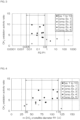
- FIG. 3 is a graph showing a correlation between the methane oxidation activity ratio and the ratio (P2/P1) of the peak intensity P2 of the tetragonal zirconia phase to the peak intensity P1 of the monoclinic zirconia phase in the XRD measurement for the hydrocarbon oxidation catalysts of Examples 1 to 10 and Comparative Examples 1 to 5.
- the abscissa represents the ratio (P2/P1) and the ordinate represents the methane oxidation activity ratio.
- FIG. 4 is a graph showing a correlation between the methane oxidation activity ratio and the crystallite diameter R1 of the monoclinic zirconia phase for the hydrocarbon oxidation catalysts of Examples 1 to 10 and Comparative Examples 1 to 5.
- the abscissa represents the crystallite diameter R1 ( ⁇ ) of the monoclinic zirconia phase and the ordinate represents the methane oxidation activity ratio.
- the hydrocarbon oxidation catalysts of Examples 1 to 10 in which the ratio (P2/P1) was 0.005 or more and less than 0.8 and the crystallite diameter R1 of the monoclinic zirconia phase was 35 ⁇ or more and 115 ⁇ or less, exhibit higher methane oxidation activity than those of Comparative Examples 1 to 5, in which the ratio and the crystallite diameter R1 were not as above.
- FIG. 5 is a graph showing a correlation between the methane oxidation activity ratio and the temperature T 50 (CH 4 ) relative to the percentage of sulfuric acid in the catalyst carrier for the hydrocarbon oxidation catalysts of Examples 1 to 3 and Comparative Examples 1 to 4.
- the percentage of sulfuric acid is 0% by mass (Comparative Example 1), 1% by mass (Example 1), 2% by mass (Example 2), 3% by mass (Example 3), 5% by mass (Comparative Example 2), 6% by mass (Comparative Example 3), or 10% by mass (Comparative Example 4).
- the percentage of sulfuric acid is 0% by mass (Comparative Example 1), 1% by mass (Example 1), 2% by mass (Example 2), 3% by mass (Example 3), 5% by mass (Comparative Example 2), 6% by mass (Comparative Example 3), or 10% by mass (Comparative Example 4).
- the hydrocarbon oxidation catalysts of Examples 1 to 3 containing sulfated zirconia containing 3% by mass or less of sulfuric acid as the catalyst carrier exhibit higher methane oxidation activity than those of Comparative Examples 1 to 4 not containing such sulfated zirconia.
- the hydrocarbon oxidation catalyst of the present invention can be used, for example, to remove unburned hydrocarbons from the exhaust gas of internal combustion engines operating with natural gas as fuel gas.
Landscapes
- Chemical & Material Sciences (AREA)
- Engineering & Computer Science (AREA)
- Chemical Kinetics & Catalysis (AREA)
- Organic Chemistry (AREA)
- Materials Engineering (AREA)
- Health & Medical Sciences (AREA)
- Analytical Chemistry (AREA)
- General Chemical & Material Sciences (AREA)
- Oil, Petroleum & Natural Gas (AREA)
- Environmental & Geological Engineering (AREA)
- Biomedical Technology (AREA)
- Combustion & Propulsion (AREA)
- Physics & Mathematics (AREA)
- Thermal Sciences (AREA)
- Catalysts (AREA)
Abstract
Description
- The present invention relates to a hydrocarbon oxidation catalyst, a method for producing the same, and a hydrocarbon processing method.
- An internal combustion engine is known to operate with natural gas (mainly containing hydrocarbons such as methane) supplied as fuel gas. For example, in view of energy efficiency, such internal combustion engine is operated under conditions where some of the hydrocarbons in the fuel gas (e.g., approximately 3 to 7% of fuel methane in a two-stroke low-pressure gas engine and approximately 6 to 13% of fuel methane in a four-stroke low-pressure gas engine) are not burned. That is, exhaust gas from the internal combustion engine contains unburned hydrocarbons. The unburned hydrocarbons contain gases that have a higher greenhouse effect than carbon dioxide. Methane, for example, has 25 times more greenhouse effect than carbon dioxide. When such exhaust gas is released into the atmosphere, the unburned hydrocarbons such as methane are desired to be removed from the exhaust gas.
- As a method for removing the unburned hydrocarbons from the exhaust gas, there has been known a method for oxidizing the unburned hydrocarbons using a catalyst to decompose them into carbon dioxide and water. A technique relating to a methane oxidation catalyst is disclosed in, for example,
Patent Document 1 below. - Patent Document 1:
Japanese Unexamined Patent Application Publication (Translation of PCT Application) No. 2018-510767 -
Patent Document 1 discloses a methane oxidation catalyst comprising a catalyst carrier and palladium as an active metal supported on the catalyst carrier, with an amount of palladium supported of 4% by mass. This catalyst has a relatively large amount of expensive palladium (active metal) supported. In view of cost reduction, however, it is required that hydrocarbons in the exhaust gas are oxidized and decomposed by a catalyst having a smaller amount of the active metal supported. - The present invention provides a hydrocarbon oxidation catalyst suitable for achieving good catalyst performance while suppressing the amount of active metal supported, a hydrocarbon processing method, and a method for producing the hydrocarbon oxidation catalyst.
- The present invention [1] includes a hydrocarbon oxidation catalyst, being a catalyst for oxidizing hydrocarbon, the hydrocarbon oxidation catalyst including a catalyst carrier comprising zirconia; and an active metal supported on the catalyst carrier, in which the zirconia contains a monoclinic zirconia phase and a tetragonal zirconia phase, a ratio of a peak intensity of the tetragonal zirconia phase to a peak intensity of the monoclinic zirconia phase in an X-ray diffraction measurement is 0.005 or more and less than 0.8, and the monoclinic zirconia phase has a crystallite diameter of 35Å or more and 115Å or less.
- The present invention [2] includes the hydrocarbon oxidation catalyst described in [1], in which the catalyst carrier is oxoacid zirconia.
- The present invention [3] includes the hydrocarbon oxidation catalyst described in [1] or [2], in which the oxoacid zirconia includes at least one selected from the group consisting of sulfated zirconia and tungstated zirconia.
- The present invention [4] includes the hydrocarbon oxidation catalyst described in any one of the above-described [1] to [3], in which the active metal includes at least one selected from the group consisting of palladium, platinum, and ruthenium.
- The present invention [5] includes the hydrocarbon oxidation catalyst described in any one of the above-described [1] to [4], in which the active metal includes palladium and an amount of the palladium supported is 0.1% by mass or more and less than 4% by mass.
- The present invention [6] includes a hydrocarbon processing method including the step of bringing hydrocarbon into contact with the hydrocarbon oxidation catalyst according to any one of the above-described [1] to [5].
- The present invention [7] includes a method for producing a hydrocarbon oxidation catalyst, including a first step of preparing a slurry containing a catalyst carrier raw material including zirconia, and an active metal; a second step of drying the slurry to obtain a powder; and a third step of calcining the powder at a temperature of 400°C or more and 600°C or less to produce the hydrocarbon oxidation catalyst according to any one of the above-described [1] to [5], in which the zirconia in the first step contains a monoclinic zirconia phase and a tetragonal zirconia phase, a ratio of a peak intensity of the tetragonal zirconia phase to a peak intensity of the monoclinic zirconia phase in an X-ray diffraction measurement is 0.005 or more and 0.85 or less, and the monoclinic zirconia phase has a crystallite diameter of 35Å or more and 115Å or less.
- In the hydrocarbon oxidation catalyst of the present invention, as described above, the ratio of the peak intensity of the tetragonal zirconia phase to the peak intensity of the monoclinic zirconia phase by the X-ray diffraction measurement in the zirconia supporting the active metal is 0.005 or more and less than 0.8, and the monoclinic zirconia phase has a crystallite diameter of 35Å or more and 115Å or less. Therefore, the hydrocarbon oxidation catalyst is suitable for achieving good catalyst performance while suppressing the amount of the active metal supported. The hydrocarbon processing method including the step of bringing hydrocarbon into contact with such hydrocarbon oxidation catalyst is suitable for efficiently decomposing the hydrocarbon. In the method for producing the hydrocarbon oxidation catalyst according to the present invention, the above-described ratio of the zirconia used in the first step is 0.005 or more and 0.85 or less as measured by X-ray diffraction, the crystallite diameter of the monoclinic zirconia phase is 35Å or more and 115Å or less, and the calcination temperature in the third step is 400°C or more and 600°C or less. Therefore, the above-described hydrocarbon oxidation catalyst can be efficiently produced.
-
-
FIG. 1 shows XRD patterns obtained for hydrocarbon oxidation catalysts of Examples 1 to 10 and Comparative Examples 1 to 5. -
FIG. 2 shows XRD patterns obtained for various zirconia used as catalyst carrier raw materials in Examples 1 to 10 and Comparative Examples 1 to 5. -
FIG. 3 is a graph showing a correlation between a methane oxidation activity ratio and a ratio (P2/P1) of a peak intensity P2 of a tetragonal zirconia phase to a peak intensity P1 of a monoclinic zirconia phase in XRD measurement for the hydrocarbon oxidation catalysts of Examples 1 to 10 and Comparative Examples 1 to 5. -
FIG. 4 is a graph showing a correlation between the methane oxidation activity ratio and a crystallite diameter R1 of the monoclinic zirconia phase for the hydrocarbon oxidation catalysts of Examples 1 to 10 and Comparative Examples 1 to 5. -
FIG. 5 is a graph showing a correlation of the methane oxidation activity ratio and a temperature T50 (CH4) relative to the percentage of sulfuric acid in a catalyst carrier for the hydrocarbon oxidation catalysts of Examples 1 to 3 and Comparative Examples 1 to 4. - A hydrocarbon oxidation catalyst as an embodiment of the present invention is a catalyst for oxidatively decomposing hydrocarbons and includes a catalyst carrier and an active metal supported on the catalyst carrier. When exhaust gas is released into the atmosphere, the hydrocarbon oxidation catalyst can be used to remove unburned hydrocarbons such as methane from the exhaust gas. Examples of the hydrocarbon in the exhaust gas include aliphatic hydrocarbons and alicyclic hydrocarbons. Examples of the aliphatic hydrocarbon include aliphatic saturated hydrocarbons and aliphatic unsaturated hydrocarbons. Examples of the aliphatic saturated hydrocarbon include methane, ethane, propane, butane, and pentane.
- The catalyst carrier contains zirconia. The zirconia contains a monoclinic zirconia (m-ZrO2) phase and a tetragonal zirconia (t-ZrO2) phase. The zirconia contains a relatively large amount of monoclinic zirconia phase. Specifically, in the hydrocarbon oxidation catalyst, a ratio (P2/P1) of a peak intensity P2 of the tetragonal zirconia phase to a peak intensity P1 of the monoclinic zirconia phase in an X-ray diffraction (XRD) measurement is 0.005 or more and less than 0.8. The ratio (P2/P1) is an index of acidity of a surface of the hydrocarbon oxidation catalyst, and the ratio (P2/P1) of 0.005 or more is suitable for ensuring the surface acidity required for oxidation reaction such as methane oxidation reaction in the hydrocarbon oxidation catalyst, and thus for achieving good catalyst performance (The ratio (P2/P1) of less than 0.005 is not suitable for ensuring the surface acidity). From such a viewpoint, the ratio (P2/P1) is preferably 0.01 or more, more preferably 0.1 or more, even more preferably 0.2 or more, particularly preferably 0.3 or more. The ratio (P2/P1) is also an index of the amounts of the monoclinic zirconia phase and the tetragonal zirconia phase which is more stable than the monoclinic zirconia phase, and the ratio (P2/P1) of less than 0.8 is suitable for ensuring the monoclinic zirconia phase of which the active metal supported site is more likely to be activated than that of the tetragonal zirconia phase, and thus for achieving good catalyst performance (The ratio (P2/P1) of 0.8 or more is not suitable for ensuring the monoclinic zirconia phase). From such a viewpoint, the ratio (P2/P1) is preferably 0.7 or less, more preferably 0.6 or less, even more preferably 0.5 or less. In the XRD measurement, the peak intensity P1 of the monoclinic zirconia phase is an integral value of the intensity (cps) of the X-ray diffraction signal having a diffraction peak at 2θ = 28.1° (θ denotes the Bragg angle). The peak intensity P2 of the tetragonal zirconia phase is an integral value of the intensity (cps) of the X-ray diffraction signal having a diffraction peak at 2θ = 30.2°. Specifically, the XRD measurement can be performed by a method to be described later regarding Examples.
- The catalyst carrier is preferably oxoacid zirconia. Such a configuration is preferred to stabilize the tetragonal zirconia phase, which is unstable at room temperature (Bulk pure zirconia crystals are monoclinic at room temperature). Examples of the oxoacid zirconia include sulfated zirconia, tungstated zirconia, titanated zirconia, and phosphated zirconia. The oxoacid zirconia preferably includes at least one selected from the group consisting of sulfated zirconia and tungstated zirconia. The percentage of the oxo acid in the catalyst carrier is preferably 0.1% by mass or more, more preferably 0.3% by mass or more, even more preferably 0.5% by mass or more, and preferably 4% by mass or less, more preferably 3.5% by mass or less, even more preferably 3% by mass or less. These configurations are preferred to stabilize the tetragonal zirconia phase in the oxoacid zirconia so that it exists at the ratio (P2/P1) described above. The configuration in which the catalyst carrier is oxoacid zirconia is also preferred to acidify a surface of the hydrocarbon oxidation catalyst. Acidification of the hydrocarbon oxidation catalyst surface helps ensure catalytic activity.
- The monoclinic zirconia phase has a crystallite diameter R1 of 35 Å or more and 115 Å or less. In view of ensuring an area where one crystallite of the monoclinic zirconia phase can support the active metal with a high degree of dispersion, the crystallite diameter R1 is 35Å or more, preferably 40Å or more, more preferably 50Å or more, even more preferably 60Å or more. In view of ensuring a crystallite surface area (in which the active metal is supported) per crystallite volume in the monoclinic zirconia phase, the crystallite diameter R1 is 115 Å or less, preferably 110 Å or less, more preferably 105 Å or less.
- In view of ensuring an area where one crystallite of the tetragonal zirconia phase can support the active metal with a high degree of dispersion, the tetragonal zirconia phase has a crystallite diameter R2 of preferably 40Å or more, more preferably 45Å or more. In view of ensuring a crystallite surface area (in which the active metal is supported) per crystallite volume in the tetragonal zirconia phase, the crystallite diameter R2 is preferably 115 Å or less, more preferably 110 Å or less, even more preferably 105 Å or less. Such nanoparticle-level miniaturization of the tetragonal zirconia phase also helps stabilize tetragonal zirconia.
- The crystallite diameters R1 and R2 can be determined based on the XRD measurement. Specifically, the crystallite diameter R1 of the monoclinic zirconia phase can be determined based on the full width at half maximum (FWHM) of a peak as the diffraction line width at 2θ = 28.1° (θ denotes the Bragg angle) in the XRD measurement and the Scherrer equation (D = Kλ/Bcosθ). The crystallite diameter R2 of the tetragonal zirconia phase can be determined based on the full width at half maximum of a peak as the diffraction line width at 2θ = 30.2° in the XRD measurement and the Scherrer equation. In the Scherrer equation, D is the crystallite size (nm), λ is the wavelength (nm) of X-rays (Cu-Kα ray) in the XRD measurement, B is the diffraction line width broadening (rad), and θ is the Bragg angle (rad). In addition, K is the Scherrer constant, which is 0.89. Specifically, the XRD measurement can be performed by a method to be described later regarding Examples.
- Examples of the active metal include platinum group metals. Examples of the platinum group metal include palladium (Pd), platinum (Pt), iridium (Ir), and ruthenium (Ru). In view of ensuring catalytic activity, the active metal preferably includes at least one selected from the group consisting of Pd, Pt, and Ru, more preferably includes two selected from the group consisting of Pd, Pt, and Ru, even more preferably includes Pd, and Ru or Pt (Pd-Pt composite support, Pd-Ru composite support).
- When the active metal includes Pd, the amount of Pd supported in the hydrocarbon oxidation catalyst is preferably 0.1% by mass or more, more preferably 0.5% by mass or more, even more preferably 0.7% by mass or more in view of catalytic activity for a hydrocarbon having a high ignition point such as methane. The amount of Pd supported is preferably less than 4% by mass, more preferably 3.5% by mass or less, even more preferably 3% by mass or less, particularly preferably 2.5% by mass or less in view of cost reduction. The amount of Pd supported may be 4% by mass as necessary, and is, for example, 8% by mass or less. The amount of Pd supported in the hydrocarbon oxidation catalyst is expressed as the mass percentage of the amount of Pd to the total amount of the catalyst carrier and the whole active metal supported thereon (the same applies to the active metal elements to be described later).
- When the active metal includes Pt, the amount of Pt supported in the hydrocarbon oxidation catalyst is preferably 0.1% by mass or more, more preferably 0.5% by mass or more, even more preferably 0.7% by mass or more, even more preferably 0.9 % by mass or more, particularly preferably 1% by mass or more in view of ensuring catalytic activity. The amount of Pt supported is preferably 3% by mass or less, more preferably 2.5% by mass or less, even more preferably 2% by mass or less in view of cost reduction.
- When the active metal includes Ru, the amount of Ru supported in the hydrocarbon oxidation catalyst is preferably 1% by mass or more, more preferably 2% by mass or more, even more preferably 3% by mass or more in view of ensuring catalytic activity. The amount of Ru supported is preferably 7% by mass or less, more preferably 6% by mass or less, even more preferably 5.5% by mass or less in view of cost reduction.
- When the active metal is a Pd-Pt composite support, the total amount of Pd and Pt supported in the hydrocarbon oxidation catalyst is preferably 0.2% by mass or more, more preferably 0.8% by mass or more, even more preferably 1% by mass or more in view of ensuring catalytic activity. The total amount of Pd and Pt supported is preferably less than 7% by mass, more preferably 6% by mass or less, even more preferably 5% by mass or less in view of cost reduction.
- When the active metal is a Pd-Ru composite support, the total amount of Pd and Ru supported in the hydrocarbon oxidation catalyst is preferably 1.1% by mass or more, more preferably 2% by mass or more, even more preferably 3% by mass or more in view of ensuring catalytic activity. The total amount of Pd and Ru supported is preferably less than 11% by mass, more preferably 9% by mass or less, even more preferably 7.5% by mass or less in view of cost reduction.
- A method for producing the hydrocarbon oxidation catalyst as an embodiment of the present invention includes the following steps.
- First, a slurry containing a catalyst carrier raw material including zirconia, and an active metal is prepared (first step). For example, a powdery catalyst carrier raw material including zirconia is suspended in a solution containing the active metal (active metal-containing solution), and the suspension is continuously stirred. The stirring temperature is, for example, from 5°C to 35°C. The stirring time is, for example, from 15 to 21 hours depending on the amount of preparation.
- Examples of the active metal include platinum group metals. Examples of the platinum group metal include Pd, Pt, Ru, Os, Rh, and Ir. The active metal preferably includes at least one selected from the group consisting of Pd, Pt, and Ru, more preferably includes Pd or Ru, and Pt in view of ensuring catalytic activity. The active metal-containing solution is, for example, an aqueous solution of nitrates, chlorides, or acetates of these active metals.
- The zirconia in the catalyst carrier raw material contains a monoclinic zirconia phase and a tetragonal zirconia phase. The ratio (P2/P1) of the peak intensity P2 of the tetragonal zirconia phase to the peak intensity P1 of the monoclinic zirconia phase in the XRD measurement is 0.005 or more and 0.85 or less, and the monoclinic zirconia phase has a crystallite diameter of 35 Å or more and 115 Å or less. The ratio (P2/P1) in this step is preferably 0.01 or more, more preferably 0.02 or more, and preferably 0.82 or less, more preferably less than 0.8. The crystallite diameter R1 in this step is preferably 40 Å or more, more preferably 45 Å or more, and preferably 100 Å or less, more preferably 90 Å or less. The crystallite diameter R2 in this step is preferably 35 Å or more, more preferably 40 Å or more, and preferably 115 Å or less, more preferably 80 Å or less.
- In the first step, as the catalyst carrier raw material, oxoacid zirconia oxide is preferably used, more preferably at least one selected from the group consisting of sulfated zirconia and tungstated zirconia is used. As the catalyst carrier raw material, a commercially available product may be used, or a calcined product of a precursor of the catalyst carrier raw material may be used. Examples of the precursor of the catalyst carrier raw material include amorphous zirconia, zirconium hydroxide sol, zirconium hydroxide gel, zirconium lactate, and zirconium alkoxide. When oxoacid zirconia is used as the catalyst carrier raw material, examples of the precursor of the catalyst carrier raw material include amorphous zirconia, zirconium hydroxide sol, zirconium hydroxide gel, zirconium lactate, or a mixture of zirconium alkoxide and oxo acid. Examples of the oxo acid include sulfuric acid, tungstic acid, titanic acid, and phosphoric acid.
- Next, the slurry obtained in the first step is dried to obtain a powder (second step). The drying temperature is, for example, 80°C or more, preferably 100°C or more, and for example, 150°C or less, preferably 130°C or less. The drying time is, for example, 1 hour or more, preferably 3 hours or more, and for example, 9 hours or less, preferably 7 hours or less.
- Next, the powder obtained in the second step is calcined at a temperature of 400°C or more and 600°C or less (third step). The calcination temperature in this step is preferably 450°C or more, more preferably 480°C or more, and preferably 550°C or less, more preferably 520°C or less. The calcination time is preferably 3 hours or more, more preferably 5 hours or more, and preferably 20 hours or less, more preferably 15 hours or less. These calcination conditions are suitable for suppressing changes in the above-described ratio (P2/P1) and the crystallite diameters R1 and R2 for the zirconia in the catalyst carrier raw material, and thus suitable for obtaining the hydrocarbon oxidation catalyst described above.
- The resulting hydrocarbon oxidation catalyst may be milled. Examples of the milling method include compression milling. The milled hydrocarbon oxidation catalyst may be sieved to separate out the hydrocarbon oxidation catalyst of a desired size. The hydrocarbon oxidation catalyst before or after milling may be compression-molded into a predetermined shape. Examples of the shape of the hydrocarbon oxidation catalyst include a spherical shape, a tablet-like (pill-like) shape, and a honeycomb-like shape (monolithic body).
- For example, in the manner described above, the hydrocarbon oxidation catalyst can be produced.
- A hydrocarbon processing method as an embodiment of the present invention includes a step (contact processing step) of bringing the hydrocarbon into contact with the above-described hydrocarbon oxidation catalyst. In the contact processing step, for example, gas such as exhaust gas containing hydrocarbon (hydrocarbon-containing gas) is brought into contact with the hydrocarbon oxidation catalyst. The hydrocarbon-containing gas may be brought into contact with the hydrocarbon oxidation catalyst as a fixed bed placed in a given vessel or may be brought into contact with the hydrocarbon oxidation catalyst as a fluidized bed placed in a given vessel. The processing temperature in the contact processing step is, for example, from 190°C to 550°C. The flow rate of the hydrocarbon-containing gas in the contact processing step is, for example, 100 Nm3/h or more and, for example, 480000 Nm3/h or less.
- In the hydrocarbon oxidation catalyst of the present invention, as described above, the ratio (P2/P1) of the peak intensity P2 of the tetragonal zirconia phase to the peak intensity P1 of the monoclinic zirconia phase by the XRD measurement in the zirconia supporting the active metal is 0.005 or more and less than 0.8, and the crystallite diameter R1 of the monoclinic zirconia phase is 35Å or more and 115Å or less. Such hydrocarbon oxidation catalyst is suitable for achieving good catalyst performance while suppressing the amount of the active metal supported. Specifically, the hydrocarbon oxidation catalyst is as described in Examples and Comparative Examples below. The above-described hydrocarbon processing method including the step of bringing hydrocarbon into contact with such hydrocarbon oxidation catalyst is suitable for efficiently decomposing the hydrocarbon.
- Hereinafter, the present invention will be described more in detail with reference to Examples, but not limited to the Examples. The specific numerical values in mixing ratio (content ratio), property value, and parameter used in the following description can be replaced with upper limit values (numerical values defined as "or less" or "below") or lower limit values (numerical values defined as "or more" or "above") of corresponding numerical values in mixing ratio (content ratio), property value, and parameter described in the above-described
- First, a palladium(II) nitrate solution (trade name: "Low chlorine Pd nitrate solution", manufactured by Tanaka Kikinzoku Kogyo, K. K.), a tetraammineplatinum(II) nitrate solution (trade name: "TetraamminePt nitrate solution", manufactured by Tanaka Kikinzoku Kogyo, K. K.), and ion-exchange water were mixed to give an aqueous solution (metal solution preparation step). The mass ratio of palladium (Pd) to platinum (Pt) in this aqueous solution is 1 to 1. Next, powdery first sulfated zirconia (trade name "Z-3300", sulfated zirconia (1 wt% SO4/ZrO2) with 1% by mass of sulfuric acid, manufactured by Daiichi Kigenso Kagaku Kogyo Co., Ltd.) was added to the aqueous solution and then mixed to prepare a slurry (slurry preparation step). The amount of the sulfated zirconia in this slurry is 98 parts by mass per 2 parts by mass of a total of Pd and Pt. This slurry was then stirred at room temperature for about 16 hours. The slurry was then dried at 110°C to obtain a powder. The powder was then calcined at 500°C for 9 hours. In this manner, a hydrocarbon oxidation catalyst was produced. The catalyst was then compressed and milled, and thereafter, sieved to fractionate powders (hydrocarbon oxidation catalyst) having a particle size of 16 to 31 mesh (0.5 to 1.00 mm). In the manner described above, a hydrocarbon oxidation catalyst (catalyst carrier: 1 wt% SO4/ZrO2, active metal: 1.0 wt% Pd + 1.0 wt% Pt) of Example 1 in powder form was prepared.
- A hydrocarbon oxidation catalyst (catalyst carrier: 2 wt% SO4/ZrO2, active metal: 1.0 wt% Pd + 1.0 wt% Pt) of Example 2 in powder form and a hydrocarbon oxidation catalyst (catalyst carrier: 3 wt% SO4/ZrO2, active metal: 1.0 wt% Pd + 1.0 wt% Pt) of Example 3 in powder form were prepared in the same manner as for the catalyst of Example 1, except the following. In the slurry preparation step in Example 2, powdery second sulfated zirconia (trade name "Z-3301", sulfated zirconia with 2% by mass of sulfuric acid (2 wt% SO4/ZrO2), manufactured by Daiichi Kigenso Kagaku Kogyo Co., Ltd.) was used instead of the first sulfated zirconia. In the slurry preparation step in Example 3, powdery third sulfated zirconia (trade name "Z-2964", sulfated zirconia with 3% by mass of sulfuric acid (3 wt% SO4/ZrO2), manufactured by Daiichi Kigenso Kagaku Kogyo Co., Ltd.) was used instead of the first sulfated zirconia.
- A hydrocarbon oxidation catalyst (catalyst carrier: 3 wt% SO4/ZrO2, active metal: 2.0 wt% Pd + 1.0 wt% Pt) of Example 4 in powder form was prepared in the same manner as for the catalyst of Example 1, except the following. In the metal solution preparation step, the mass ratio of Pd to Pt in the aqueous solution was set at 2 to 1. In the slurry preparation step, powdery third sulfated zirconia (trade name "Z-2964") was used instead of the first sulfated zirconia, and the amount of the sulfated zirconia was set to 97 parts by mass per 3 parts by mass of a total of Pd and Pt.
- A hydrocarbon oxidation catalyst (catalyst carrier: 3 wt% SO4/ZrO2, active metal: 2.0 wt% Pd + 2.0 wt% Pt) of Example 5 in powder form was prepared in the same manner as for the catalyst of Example 1, except the following. In the slurry preparation step, powdery third sulfated zirconia (trade name "Z-2964") was used instead of the first sulfated zirconia, and the amount of the sulfated zirconia was set to 96 parts by mass per 4 parts by mass of a total of Pd and Pt.
- A hydrocarbon oxidation catalyst (catalyst carrier: 10 wt% WO3/ZrO2, active metal: 1.0 wt% Pd + 1.0 wt% Pt) of Example 6 in powder form was prepared in the same manner as for the catalyst of Example 1, except the following. In the slurry preparation step, powdery tungstated zirconia (trade name "Z-2233", tungstated zirconia with 10% by mass of tungstic acid (10 wt% WO3/ZrO2), manufactured by Daiichi Kigenso Kagaku Kogyo Co., Ltd.) was used instead of the first sulfated zirconia, and the amount of the tungstated zirconia was set to 98 parts by mass per 2 parts by mass of a total of Pd and Pt.
- A hydrocarbon oxidation catalyst (catalyst carrier: 10 wt% WO3/ZrO2, active metal: 2.0 wt% Pd + 1.0 wt% Pt) of Example 7 in powder form was prepared in the same manner as for the catalyst of Example 1, except the following. In the metal solution preparation step, the mass ratio of Pd to Pt in the aqueous solution was set at 2 to 1. In the slurry preparation step, powdery tungstated zirconia (trade name "Z-2233", manufactured by Daiichi Kigenso Kagaku Kogyo Co., Ltd.) was used instead of the first sulfated zirconia, and the amount of the tungstated zirconia was set to 97 parts by mass per 3 parts by mass of a total of Pd and Pt.
- A hydrocarbon oxidation catalyst (catalyst carrier: 1 wt% SO4/ZrO2, active metal: 1.0 wt% Pd + 2.0 wt% Pt) of Example 8 in powder form was prepared in the same manner as for the catalyst of Example 1, except the following. In the metal solution preparation step, the mass ratio of Pd to Pt in the aqueous solution was set at 1 to 2. In the slurry preparation step, the amount of the first sulfated zirconia was set to 97 parts by mass per 3 parts by mass of a total of Pd and Pt.
- A hydrocarbon oxidation catalyst (catalyst carrier: 1 wt% SO4/ZrO2, active metal: 2.0 wt% Pd + 1.0 wt% Pt) of Example 9 in powder form was prepared in the same manner as for the catalyst of Example 1, except the following. In the metal solution preparation step, the mass ratio of Pd to Pt in the aqueous solution was set at 2 to 1. In the slurry preparation step, the amount of the first sulfated zirconia was set to 97 parts by mass per 3 parts by mass of a total of Pd and Pt.
- A hydrocarbon oxidation catalyst (catalyst carrier: 1 wt% SO4/ZrO2, active metal: 2.0 wt% Pd + 5.0 wt% Ru) of Example 10 in powder form was prepared in the same manner as for the catalyst of Example 1, except the following. In the metal solution preparation step, a ruthenium nitrate solution (manufactured by Tanaka Kikinzoku Kogyo K. K.) was used instead of the tetraammineplatinum nitrate solution. The mass ratio of Pd to Ru in the aqueous solution obtained in the metal solution preparation step is 2 to 5. In the slurry preparation step, the amount of the first sulfated zirconia was set to 93 parts by mass per 7 parts by mass of a total of Pd and Ru.
- A hydrocarbon oxidation catalyst (catalyst carrier: m-ZrO2, active metal: 1.0 wt% Pd + 1.0 wt% Pt) of Comparative Example 1 in powder form was prepared in the same manner as for the catalyst of Example 1, except the following. In the slurry preparation step, powdery zirconia (trade name "RC-100", monoclinic zirconia (m-ZrO2), manufactured by Daiichi Kigenso Kagaku Kogyo Co., Ltd.) was used instead of the first sulfated zirconia, and the amount of the zirconia was set to 98 parts by mass per 2 parts by mass of a total of Pd and Pt.
- A hydrocarbon oxidation catalyst (catalyst carrier: 5 wt% SO4/ZrO2, active metal: 1.0 wt% Pd + 1.0 wt% Pt) of Comparative Example 2 in powder form, a hydrocarbon oxidation catalyst (catalyst carrier: 6 wt% SO4/ZrO2, active metal: 1.0 wt% Pd + 1.0 wt% Pt) of Comparative Example 3 in powder form, and a hydrocarbon oxidation catalyst (catalyst carrier: 10 wt% SO4/ZrO2, active metal: 1.0 wt% Pd + 1.0 wt% Pt) of Comparative Example 4 in powder form were prepared in the same manner as for the catalyst of Example 1, except the following. In the slurry preparation step in Comparative Example 2, powdery fourth sulfated zirconia (trade name "Z-3314", sulfated zirconia with 5% by mass of sulfuric acid (5 wt% SO4/ZrO2), manufactured by Daiichi Kigenso Kagaku Kogyo Co., Ltd.) was used instead of the first sulfated zirconia. In the slurry preparation step in Comparative Example 3, powdery fifth sulfated zirconia (trade name "Z-3294", sulfated zirconia with 6% by mass of sulfuric acid (6 wt% SO4/ZrO2), manufactured by Daiichi Kigenso Kagaku Kogyo Co., Ltd.) was used instead of the first sulfated zirconia. In the slurry preparation step in Comparative Example 4, powdery sixth sulfated zirconia (trade name "Z-3295", sulfated zirconia with 10% by mass of sulfuric acid (10 wt% SO4/ZrO2), manufactured by Daiichi Kigenso Kagaku Kogyo Co., Ltd.) was used instead of the first sulfated zirconia.
- A hydrocarbon oxidation catalyst (catalyst carrier: 30 wt% TiO2/ZrO2, active metal: 1.0 wt% Pd + 1.0 wt% Pt) of Comparative Example 5 in powder form was prepared in the same manner as for the catalyst of Example 1, except the following. In the slurry preparation step, powdery titanated zirconia (trade name "30 wt% TiO2/ZrO2", titanated zirconia with 30% by mass of titanic acid (30 wt% TiO2/ZrO2), manufactured by Daiichi Kigenso Kagaku Kogyo Co., Ltd.) was used instead of the first sulfated zirconia, and the amount of the titanated zirconia was set to 98 parts by mass per 2 parts by mass of a total of Pd and Pt.
- Powder samples of the hydrocarbon oxidation catalysts of Examples 1 to 10 and Comparative Examples 1 to 5 were analyzed by X-ray diffraction (XRD) to determine the peak intensity P1 of the monoclinic zirconia (m-ZrO2) phase, the peak intensity P2 of the tetragonal zirconia (t-ZrO2) phase, the crystallite diameter R1 of the m-ZrO2 phase, and the crystallite diameter R2 of the t-ZrO2 phase. In this analysis, the crystal structure was analyzed by the Bragg-Brentano method using an X-ray diffraction analyzer "Ultima IV" and an X-ray detector "D/teX Ultra" (both manufactured by Rigaku Corporation). A CuKα ray (λ = 1.54815 Å, Ni filter, applied power: 40 kV, 40 mA) was used as the X-ray source, with a scanning range of 5° to 90° in 2θ, a scanning speed of 5.0°/min, a sampling width of 0.01°, a divergence slit of 0.20 mm, a divergence vertical limit slit of 2 mm, a scattering slit of 2°, a receiving slit of 0.15 mm, and an offset angle of 0°.
- The analysis was performed using a Rigaku's analysis software "PDXI, 2 (Version 2.7.2.0)". The peak intensity P1 of the m-ZrO2 phase is an integrated intensity (cps·deg) of the X-ray diffraction signal having a diffraction peak at 2θ = 28.1° (θ is the Bragg angle) and is a value obtained by integrating the intensity (cps) over a range of integration widths (deg) calculated by the analysis software for the diffraction peak. The peak intensity P2 of the t-ZrO2 phase is an integrated intensity (cps·deg) of the X-ray diffraction signal having a diffraction peak at 2θ = 30.2° and is a value obtained by integrating the intensity (cps) over a range of integration widths (deg) calculated by the analysis software for the diffraction peak. The crystallite diameter R1 of the m-ZrO2 phase was determined based on the full width at half maximum of the peak as the diffraction line width at 2θ = 28.1° and the following Scherrer equation. The crystallite diameter R2 of the t-ZrO2 phase was determined based on the full width at half maximum of the peak as the diffraction line width at 2θ = 30.2° and the following Scherrer equation. In the Scherrer equation, D is the crystallite size (nm), λ is the wavelength (nm) of X-rays (Cu-Kα ray), B is the diffraction line width broadening (rad), and θ is the Bragg angle (rad). In addition, K is the Scherrer constant, which was 0.89.

- The measurement results are shown in Tables 1 and 2. The ratio (P2/P1) of the peak intensity P2 of the t-ZrO2 phase to the peak intensity P1 of the m-ZrO2 phase are also shown in Tables 1 and 2.
FIG. 1 shows XRD patterns obtained for hydrocarbon oxidation catalysts of Examples 1 to 10 and Comparative Examples 1 to 5. In the graph ofFIG. 1 , the abscissa represents 2θ (deg) in the XRD measurement and the ordinate represents the XRD signal intensity. - On the other hand, the powder samples of the first to sixth sulfated zirconia, monoclinic zirconia, tungstated zirconia, and titanated zirconia described above, which were used as the catalyst carrier raw materials, were measured by XRD in the same manner as above, and the peak intensity P1 of the monoclinic zirconia (m-ZrO2) phase, the peak intensity P2 of the tetragonal zirconia (t-ZrO2) phase, the crystallite diameter R1 of the m-ZrO2 phase, and the crystallite diameter R2 of the t-ZrO2 phase were determined. The results are shown in Table 3.
FIG. 2 shows XRD patterns obtained for various zirconia used as the catalyst carrier raw materials. In the graph ofFIG. 2 , the abscissa represents 2θ (deg) in the XRD measurement and the ordinate represents the XRD signal intensity. - A methane oxidation test was performed on each of the hydrocarbon oxidation catalysts of Examples 1 to 10 and Comparative Examples 1 to 5 to determine a methane oxidation rate at 400°C as the catalytic performance.
- Specifically, the methane oxidation test was first performed at each of six temperature points (in increments of 30°C to 40°C) selected from a range of 290°C to 460°C to determine the methane oxidation rates. In the methane oxidation test, a fixed-bed reactor was first filled with the catalyst, and then the reactor was placed in the middle of a test gas flow path. Then, the test gas was heated to a predetermined temperature followed by being allowed to flow into the reactor. In the test gas used, the CH4 concentration is 1000 ppmv (dry) (inlet concentration D1), the O2 concentration is 12 vol% (wet), the NO concentration is 200 ppmv (dry), the SO2 concentration is 0.2 ppmv (dry), the H2O concentration is 10 vol%, and the rest is N2. In this test, the temperature in the reactor is 400°C, the pressure in the reactor is 0.2 MPa, the flow rate of the test gas is 1.0 NL/min, and the gas hourly space velocity (GHSV) of the test gas is 55000 h-1. The gas hourly space velocity is calculated by dividing the flow rate (Nm3/h) of the test gas by the catalyst volume (m3). The methane concentration (outlet methane concentration D2) of the test gas that passed through the fixed-bed reactor under these conditions was measured. A gas chromatography system "GC-8A" (manufactured by Shimadzu Corporation) with a thermal conductivity detector (TCD) was used to quantify the methane concentration. In the measurement using the gas chromatography system, a 2.0 m × 3 dual packed column "Shincarbon-
ST 50/80 mesh" (manufactured by Shinwa Chemical Industries Ltd.) was used as the column, He gas (flowrate 50 NmL/min) was used as the carrier gas, the column temperature was set to 180°C, and the detector temperature was set to 140°C. The methane oxidation rate expressed by the following equation was then obtained from the inlet concentration D1 and outlet concentration D2 of methane.Methane oxidation rate (%) = [(inlet concentration D1 - outlet concentration D2)/inlet concentration D1] × 100 - Next, the rate constant k (h-1) in the methane oxidation reaction at a predetermined temperature was obtained by substituting the methane oxidation rate into the following equation (1). The GHSV in the equation (1) is the gas hourly space velocity as described above. In the manner described above, the rate constants k at the above-described six temperature points were obtained.

- Then, based on the rate constants k at the above-described six temperature points, the Arrhenius equation for the methane oxidation reaction using a predetermined catalyst was identified by the Arrhenius plot method, and the rate constant k (h-1) was obtained at 400°C in the Arrhenius equation. The methane (CH4) oxidation rate at 400°C was then obtained from the value and the above equation (1). The values are shown in Tables 1 and 2.
- The methane oxidation activity ratio expressed by the following equation (2) was obtained. In the equation (2), k0 is a value of the rate constant k (400°C) of the hydrocarbon oxidation catalyst in Comparative Example 1. That is, the methane oxidation activity ratio is a ratio of the rate constant k (400°C) of each of the hydrocarbon oxidation catalysts to the rate constant k (400°C) of the hydrocarbon oxidation catalyst of Comparative Example 1. The values are shown in Tables 1 and 2.

-
FIG. 3 is a graph showing a correlation between the methane oxidation activity ratio and the ratio (P2/P1) of the peak intensity P2 of the tetragonal zirconia phase to the peak intensity P1 of the monoclinic zirconia phase in the XRD measurement for the hydrocarbon oxidation catalysts of Examples 1 to 10 and Comparative Examples 1 to 5. In the graph inFIG. 3 , the abscissa represents the ratio (P2/P1) and the ordinate represents the methane oxidation activity ratio.FIG. 4 is a graph showing a correlation between the methane oxidation activity ratio and the crystallite diameter R1 of the monoclinic zirconia phase for the hydrocarbon oxidation catalysts of Examples 1 to 10 and Comparative Examples 1 to 5. In the graph inFIG. 4 , the abscissa represents the crystallite diameter R1 (Å) of the monoclinic zirconia phase and the ordinate represents the methane oxidation activity ratio. As shown inFIGS. 3 and 4 , the hydrocarbon oxidation catalysts of Examples 1 to 10, in which the ratio (P2/P1) was 0.005 or more and less than 0.8 and the crystallite diameter R1 of the monoclinic zirconia phase was 35Å or more and 115Å or less, exhibit higher methane oxidation activity than those of Comparative Examples 1 to 5, in which the ratio and the crystallite diameter R1 were not as above. - On the other hand, for each of the hydrocarbon oxidation catalysts of Examples 1 to 10 and Comparative Examples 1 to 5, a reaction temperature T50 (CH4) when the methane oxidation rate reached 50% was determined. Specifically, the rate constant k when the methane oxidation rate reached 50% was determined from the above equation (1), and the reaction temperature T50 (CH4) when the methane oxidation rate reached 50% was determined by substituting the k into the above Arrhenius equation identified as described above. The values are shown in Tables 1 and 2.
-
FIG. 5 is a graph showing a correlation between the methane oxidation activity ratio and the temperature T50 (CH4) relative to the percentage of sulfuric acid in the catalyst carrier for the hydrocarbon oxidation catalysts of Examples 1 to 3 and Comparative Examples 1 to 4. In the plot in the graph ofFIG. 5 , the percentage of sulfuric acid is 0% by mass (Comparative Example 1), 1% by mass (Example 1), 2% by mass (Example 2), 3% by mass (Example 3), 5% by mass (Comparative Example 2), 6% by mass (Comparative Example 3), or 10% by mass (Comparative Example 4). As shown inFIG. 5 , the hydrocarbon oxidation catalysts of Examples 1 to 3 containing sulfated zirconia containing 3% by mass or less of sulfuric acid as the catalyst carrier exhibit higher methane oxidation activity than those of Comparative Examples 1 to 4 not containing such sulfated zirconia. -
[TABLE 1] \ Composition Catalyst carrier Active metal m-ZrO2 phase t-ZrO2 phase P2/P1 CH4 oxidation rate [%] cH4 oxidation activity ratio T50(CH4) [°C] Peak intensity P1 leps × deg.] Crystallite diameter R1 [Å] Peak intensity P2 [cps × deg.] Crystallite diameter R2 [Å] Ex. 1 1 wt% SO4/ZrO2 3664 113 279 81 0.076 69 5.9 379 1 wt% Pd, 1 wt% Pt Ex. 2 2 wt% SO4/ZrO2 3465 70 246 56 0.071 68 4.9 387 1 wt% Pd, 1 wt% Pt Ex. 3 3 wt% SO4/ZrO2 302-1 85 867 48 0.287 54 3.9 396 1 wt% Pd, 1 wt% Pt Ex. 4 3 wt% SO4/ZrO2 29.50 81 1090 52 0.369 71 6.1 378 2 wt% Pd, 1 wt% Pt Ex. 5 3 wt% SO4/ZrO2 2543 67 1016 45 0.400 85 9.6 365 2 wt% Pd, 2 wt% Pt Ex. 6 10 wt% WO4/ZrO2 2552 60 704 45 0.276 55 4.0 395 1 wt% Pd, 1 wt% Pt Ex. 7 10 wt% WO4/ZrO2 2607 53 668 43 0.256 70 6.0 375 2 wt% Pd, 1 wt% Pt Ex. 8 1 wt% SO4/ZrO2 3555 103 66 48 0.019 86 9.8 365 1 wt% Pd, 2 wt% Pt -
[TABLE 2] Composition Catalyst carrier Active metal m-ZrO2 phase t-ZrO2 phase P2/P1 CH4 oxidation rate [%] CH4 oxidation activity ratio T50(CH4) [°C] Peak intensity P1 [cps × deg.] Crystallite diameter R1 [Å] Peak intensity P2 [cps × deg.] Crystallite diameter R2 [Å] Ex. 9 1 wt% SO4/ZrO2 3368 113 517 83 0.154 79 8.8 365 2 wt% Pd, 1 wt% Pt Ex. 10 1 wt% SO4/ZrO2 3499 101 66 43 0.019 68 5.7 385 2 wt% Pd, 5 wt% Ru Comp. Ex. 1 m-ZrO2 3536 123 668 47 0.019 18 1.0 450 1 wt% Pd, 1 wt% Pt Comp. Ex. 2 5 wt% SO4/ZrO2 469 60 6818 72 14.537 45 3.3 402 2 wt% Pd, 2 wt% Pt Comp. Ex. 3 6 wt% SO4/ZrO2 24 67 7425 82 309.38 36 2.7 416 2 wt% Pd, 1 wt% Pt Comp. Ex. 4 10 wt% SO4/ZrO2 1185 32 2945 43 2.485 22 22 440 1 wt% Pd, 1 wt% Pt Comp. Ex. 5 30 wt% TIO2/ZrO2 933 38 863 16 0.925 49 2.9 407 1 wt% Pd, 1 wt% Pt -
[TABLE 3] Composition m-ZrO2 phase t-ZrO2 phase P2/P1 Peak intensity P1 [cps × deg.] Crystallite diameter R1 [A] Peak intensity P2 [cps × deg.] Crystallite diameter R2 [Å] First sulfated zirconia (Z-3300) (Examples 1, 8, 9, and 10) 1 wt% SO4/ZrO2 3369 80 67 50 0.020 Second sulfated zirconia (Z-3301) (Example 2) 2 wt% SO4/ZrO2 3333 84 1047 44 0.314 Third sulfated zirconia (Z-2964) (Examples 3, 4, and 5) 3 wt% SO4/ZrO2 2486 49 1074 45 0.432 Fourth sulfated zirconia (Z-3314) (Comparative Example 2) 5 wt% SO4/ZrO2 283 64 6733 81 23.79 Fifth sulfated zirconia (Z-3294) (Comparative Example 3) 6 wt% SO4/ZrO2 155 59 6145 71 39.65 Sixth sulfated zirconia (Z-3295) (Comparative Example 4) 10 wt% SO4/ZrO2 1556 38 1357 38 0.872 Monoclinic zirconia (RC-100) (Comparative Example 1) m-ZrO2 3679 105 19 46 0.005 Tungstated zirconia (Z-2233) (Examples 6 and 7) 10 wt% WO4/ZrO2 2201 55 1800 47 0.818 Titanated zirconia (Comparative Example 5) 30 wt% TiO2/ZrO2 1831 24 579 24 0.316 - The hydrocarbon oxidation catalyst of the present invention can be used, for example, to remove unburned hydrocarbons from the exhaust gas of internal combustion engines operating with natural gas as fuel gas.
Claims (7)
- A hydrocarbon oxidation catalyst, being a catalyst for oxidizing hydrocarbon, the hydrocarbon oxidation catalyst comprising:a catalyst carrier comprising zirconia; andan active metal supported on the catalyst carrier,wherein the zirconia comprises a monoclinic zirconia phase and a tetragonal zirconia phase,a ratio of a peak intensity of the tetragonal zirconia phase to a peak intensity of the monoclinic zirconia phase in an X-ray diffraction measurement is 0.005 or more and less than 0.8, and the monoclinic zirconia phase has a crystallite diameter of 35Å or more and 115Å or less.
- The hydrocarbon oxidation catalyst according to claim 1, wherein the catalyst carrier is oxoacid zirconia.
- The hydrocarbon oxidation catalyst according to claim 1, wherein the oxoacid zirconia comprises at least one selected from the group consisting of sulfated zirconia and tungstated zirconia.
- The hydrocarbon oxidation catalyst according to claim 1, wherein the active metal comprises at least one selected from the group consisting of palladium, platinum, and ruthenium.
- The hydrocarbon oxidation catalyst according to any one of claims 1 to 4, wherein the active metal comprises palladium and an amount of the palladium supported is 0.1% by mass or more and less than 4% by mass.
- A hydrocarbon processing method, comprising the step of bringing hydrocarbon into contact with the hydrocarbon oxidation catalyst according to any one of claims 1 to 4.
- A method for producing a hydrocarbon oxidation catalyst, comprising:a first step of preparing a slurry comprising a catalyst carrier raw material including zirconia, and an active metal;a second step of drying the slurry to obtain a powder; anda third step of calcining the powder at a temperature of 400°C or more and 600°C or less to produce the hydrocarbon oxidation catalyst according to any one of claims 1 to 4,wherein the zirconia in the first step comprises a monoclinic zirconia phase and a tetragonal zirconia phase, a ratio of a peak intensity of the tetragonal zirconia phase to a peak intensity of the monoclinic zirconia phase in an X-ray diffraction measurement is 0.005 or more and 0.85 or less, and the monoclinic zirconia phase has a crystallite diameter of 35Å or more and 115Å or less.
Applications Claiming Priority (2)
| Application Number | Priority Date | Filing Date | Title |
|---|---|---|---|
| JP2021176694 | 2021-10-28 | ||
| PCT/JP2022/032044 WO2023074101A1 (en) | 2021-10-28 | 2022-08-25 | Hydrocarbon oxidation catalyst, method for producing same and hydrocarbon processing method |
Publications (2)
| Publication Number | Publication Date |
|---|---|
| EP4424417A1 true EP4424417A1 (en) | 2024-09-04 |
| EP4424417A4 EP4424417A4 (en) | 2025-10-22 |
Family
ID=86159361
Family Applications (1)
| Application Number | Title | Priority Date | Filing Date |
|---|---|---|---|
| EP22886435.1A Pending EP4424417A4 (en) | 2021-10-28 | 2022-08-25 | Hydrocarbon oxidation catalyst, process for producing the same, and hydrocarbon processing method |
Country Status (4)
| Country | Link |
|---|---|
| EP (1) | EP4424417A4 (en) |
| KR (1) | KR20240088987A (en) |
| CN (1) | CN118176062A (en) |
| WO (1) | WO2023074101A1 (en) |
Families Citing this family (1)
| Publication number | Priority date | Publication date | Assignee | Title |
|---|---|---|---|---|
| KR20260000758A (en) * | 2024-06-26 | 2026-01-05 | 주식회사 엘지화학 | Catalyst |
Family Cites Families (5)
| Publication number | Priority date | Publication date | Assignee | Title |
|---|---|---|---|---|
| JP4356324B2 (en) * | 2003-01-22 | 2009-11-04 | 日立造船株式会社 | Method for producing carrier for methane selective denitration catalyst |
| KR102661054B1 (en) * | 2015-03-05 | 2024-04-25 | 쉘 인터내셔날 리써취 마트샤피지 비.브이. | Methane oxidation catalyst, method of making the same and method of using the same |
| CN107297206A (en) * | 2016-04-14 | 2017-10-27 | 巴斯夫公司 | Oxidation catalysts for lean-burn compressed natural gas engines |
| DK3507008T3 (en) * | 2016-08-31 | 2021-11-22 | Shell Int Research | PROCEDURE FOR PREPARING A METHANE OXIDIZATION CATALYST |
| JP7188822B2 (en) * | 2019-03-27 | 2022-12-13 | 国立大学法人東海国立大学機構 | Zirconia fine particle material, gas processing catalyst and method for producing the same |
-
2022
- 2022-08-25 WO PCT/JP2022/032044 patent/WO2023074101A1/en not_active Ceased
- 2022-08-25 CN CN202280072157.8A patent/CN118176062A/en active Pending
- 2022-08-25 KR KR1020247013286A patent/KR20240088987A/en active Pending
- 2022-08-25 EP EP22886435.1A patent/EP4424417A4/en active Pending
Also Published As
| Publication number | Publication date |
|---|---|
| EP4424417A4 (en) | 2025-10-22 |
| KR20240088987A (en) | 2024-06-20 |
| WO2023074101A1 (en) | 2023-05-04 |
| CN118176062A (en) | 2024-06-11 |
| JPWO2023074101A1 (en) | 2023-05-04 |
Similar Documents
| Publication | Publication Date | Title |
|---|---|---|
| Sun et al. | Construction of CuO/CeO2 catalysts via the ceria shape effect for selective catalytic oxidation of ammonia | |
| Chen et al. | Elucidation of active sites for CH4 catalytic oxidation over Pd/CeO2 via tailoring metal–support interactions | |
| Wang et al. | Ru/CeO2 catalyst with optimized CeO2 support morphology and surface facets for propane combustion | |
| Fernandez-Garcia et al. | Enhanced hydroxyl radical scavenging activity by doping lanthanum in ceria nanocubes | |
| Rogers et al. | Differences in the nature of active sites for methane dry reforming and methane steam reforming over nickel aluminate catalysts | |
| Lin et al. | Improved coking resistance of “intelligent” Ni catalysts prepared by atomic layer deposition | |
| Profeti et al. | Production of hydrogen via steam reforming of biofuels on Ni/CeO2–Al2O3 catalysts promoted by noble metals | |
| Hou et al. | Structure sensitivity of La2O2CO3 catalysts in the oxidative coupling of methane | |
| Jimenez-Gonzalez et al. | Behavior of coprecipitated NiAl2O4/Al2O3 catalysts for low-temperature methane steam reforming | |
| Boaro et al. | A comparative study of water gas shift reaction over gold and platinum supported on ZrO2 and CeO2–ZrO2 | |
| EP3400099B1 (en) | Process for methanol synthesis using an indium oxide based catalyst | |
| Hill et al. | Thermally induced restructuring of Pd@ CeO2 and Pd@ SiO2 nanoparticles as a strategy for enhancing low-temperature catalytic activity | |
| Yuan et al. | Deep insight into the mechanism of catalytic combustion of CO and CH4 over SrTi1–x B x O3 (B= Co, Fe, Mn, Ni, and Cu) perovskite via flame spray pyrolysis | |
| EP3495041A1 (en) | Methanation reaction catalyst, method for producing methanation reaction catalyst, and method for producing methane | |
| Rezlescu et al. | Partial substitution of manganese with cerium in SrMnO3 nano-perovskite catalyst. Effect of the modification on the catalytic combustion of dilute acetone | |
| Feng et al. | Sub-nanometer Ru clusters on ceria nanorods as efficient catalysts for ammonia synthesis under mild conditions | |
| Ran et al. | Unraveling the mechanistic origin of high N2 selectivity in ammonia selective catalytic oxidation on CuO-based catalyst | |
| Li et al. | Enhancing catalytic removal of autoexhaust soot particles via the modulation of interfacial oxygen vacancies in Cu/CeO2 catalysts | |
| Alcalde-Santiago et al. | Macroporous carrier-free Sr-Ti catalyst for NOx storage and reduction | |
| Zhang et al. | Ultrafine PdO x nanoparticles on spinel oxides by galvanic displacement for catalytic combustion of methane | |
| Luo et al. | Importance of Low Dimensional CeO x Nanostructures in Pt/CeO x–TiO2 Catalysts for the Water–Gas Shift Reaction | |
| Li et al. | Elucidating the characteristics of palladium-anchored CeO2-modified hexagonal nanosheet Co3O4 catalysts for the complete oxidation of volatile organic compounds | |
| Wu et al. | Weakening Mn–O bond strength in Mn-based perovskite catalysts to enhance propane catalytic combustion | |
| Hu et al. | Methane combustion with a Pd–Pt catalyst stabilized by Magnesia–Alumina spinel in a High-Humidity feed | |
| EP3507008B1 (en) | Process to prepare a methane oxidation catalyst |
Legal Events
| Date | Code | Title | Description |
|---|---|---|---|
| STAA | Information on the status of an ep patent application or granted ep patent |
Free format text: STATUS: THE INTERNATIONAL PUBLICATION HAS BEEN MADE |
|
| PUAI | Public reference made under article 153(3) epc to a published international application that has entered the european phase |
Free format text: ORIGINAL CODE: 0009012 |
|
| STAA | Information on the status of an ep patent application or granted ep patent |
Free format text: STATUS: REQUEST FOR EXAMINATION WAS MADE |
|
| 17P | Request for examination filed |
Effective date: 20240327 |
|
| AK | Designated contracting states |
Kind code of ref document: A1 Designated state(s): AL AT BE BG CH CY CZ DE DK EE ES FI FR GB GR HR HU IE IS IT LI LT LU LV MC MK MT NL NO PL PT RO RS SE SI SK SM TR |
|
| DAV | Request for validation of the european patent (deleted) | ||
| DAX | Request for extension of the european patent (deleted) | ||
| A4 | Supplementary search report drawn up and despatched |
Effective date: 20250923 |
|
| RIC1 | Information provided on ipc code assigned before grant |
Ipc: B01J 27/053 20060101AFI20250917BHEP Ipc: B01D 53/94 20060101ALI20250917BHEP Ipc: B01J 23/652 20060101ALI20250917BHEP Ipc: B01J 37/08 20060101ALI20250917BHEP Ipc: B01J 21/06 20060101ALI20250917BHEP Ipc: B01J 23/44 20060101ALI20250917BHEP Ipc: B01J 23/46 20060101ALI20250917BHEP Ipc: B01J 35/40 20240101ALI20250917BHEP Ipc: B01J 35/77 20240101ALI20250917BHEP |