EP4422332A1 - Endogenous service transmission method and apparatus, and storage medium - Google Patents
Endogenous service transmission method and apparatus, and storage medium Download PDFInfo
- Publication number
- EP4422332A1 EP4422332A1 EP22882620.2A EP22882620A EP4422332A1 EP 4422332 A1 EP4422332 A1 EP 4422332A1 EP 22882620 A EP22882620 A EP 22882620A EP 4422332 A1 EP4422332 A1 EP 4422332A1
- Authority
- EP
- European Patent Office
- Prior art keywords
- native service
- terminal
- base station
- rrc
- signaling
- Prior art date
- Legal status (The legal status is an assumption and is not a legal conclusion. Google has not performed a legal analysis and makes no representation as to the accuracy of the status listed.)
- Granted
Links
Images


Classifications
-
- H—ELECTRICITY
- H04—ELECTRIC COMMUNICATION TECHNIQUE
- H04W—WIRELESS COMMUNICATION NETWORKS
- H04W4/00—Services specially adapted for wireless communication networks; Facilities therefor
- H04W4/50—Service provisioning or reconfiguring
-
- H—ELECTRICITY
- H04—ELECTRIC COMMUNICATION TECHNIQUE
- H04W—WIRELESS COMMUNICATION NETWORKS
- H04W76/00—Connection management
- H04W76/10—Connection setup
- H04W76/19—Connection re-establishment
-
- G—PHYSICS
- G06—COMPUTING OR CALCULATING; COUNTING
- G06N—COMPUTING ARRANGEMENTS BASED ON SPECIFIC COMPUTATIONAL MODELS
- G06N20/00—Machine learning
-
- H—ELECTRICITY
- H04—ELECTRIC COMMUNICATION TECHNIQUE
- H04L—TRANSMISSION OF DIGITAL INFORMATION, e.g. TELEGRAPHIC COMMUNICATION
- H04L41/00—Arrangements for maintenance, administration or management of data switching networks, e.g. of packet switching networks
- H04L41/16—Arrangements for maintenance, administration or management of data switching networks, e.g. of packet switching networks using machine learning or artificial intelligence
-
- H—ELECTRICITY
- H04—ELECTRIC COMMUNICATION TECHNIQUE
- H04W—WIRELESS COMMUNICATION NETWORKS
- H04W24/00—Supervisory, monitoring or testing arrangements
- H04W24/02—Arrangements for optimising operational condition
-
- H—ELECTRICITY
- H04—ELECTRIC COMMUNICATION TECHNIQUE
- H04W—WIRELESS COMMUNICATION NETWORKS
- H04W74/00—Wireless channel access
- H04W74/002—Transmission of channel access control information
- H04W74/004—Transmission of channel access control information in the uplink, i.e. towards network
-
- H—ELECTRICITY
- H04—ELECTRIC COMMUNICATION TECHNIQUE
- H04W—WIRELESS COMMUNICATION NETWORKS
- H04W74/00—Wireless channel access
- H04W74/08—Non-scheduled access, e.g. ALOHA
- H04W74/0833—Random access procedures, e.g. with 4-step access
-
- H—ELECTRICITY
- H04—ELECTRIC COMMUNICATION TECHNIQUE
- H04W—WIRELESS COMMUNICATION NETWORKS
- H04W76/00—Connection management
-
- H—ELECTRICITY
- H04—ELECTRIC COMMUNICATION TECHNIQUE
- H04W—WIRELESS COMMUNICATION NETWORKS
- H04W76/00—Connection management
- H04W76/10—Connection setup
-
- H—ELECTRICITY
- H04—ELECTRIC COMMUNICATION TECHNIQUE
- H04W—WIRELESS COMMUNICATION NETWORKS
- H04W76/00—Connection management
- H04W76/20—Manipulation of established connections
- H04W76/27—Transitions between radio resource control [RRC] states
Definitions
- the present disclosure relates to the field of communication technology and, in particular, to a transmission method and apparatus for an AI-native service, and a storage medium.
- Services in the existing 3GPP (3rd Generation Partnership Project, 3rd Generation Partnership Project) wireless communication network are end-to-end services, in which a service establishment process is initiated and completed through NAS signaling between a terminal and a core network.
- machine learning modules are embedded in various nodes (including base stations and terminals) of wireless mobile communication networks.
- the base stations and the terminals have functions such as model signaling, data processing, and edge computing.
- a service generated by application of artificial intelligence in wireless communication networks is one of typical examples of an AI-native service. Characteristics of the AI-native service are: a starting point and an end point of the service are both within the system, and the AI-native service does not directly serve end users, but is built to solve complex problems of the mobile communication system or improve performance.
- the AI-native service During performing data processing and machine learning model transmission, the AI-native service has a characteristic that data stream is large and cannot be transmitted as physical layer signaling, but can only be transmitted as a type of independent service flows through a data bearer.
- Transmission approaches in the prior art cannot meet transmission requirements of the AI-native service and cannot guarantee reliable transmission of AI-native service data or signaling.
- the present disclosure provides a transmission method and apparatus for an AI-native service, and a storage medium, to establish an AI-native service transmission channel between a base station and a terminal to ensure reliable transmission of AI-native service data or signaling.
- the present disclosure provides a transmission method for an AI-native service, where the method is applied to a terminal and includes:
- the sending the AI-native service establishment request to the base station through the air interface signaling includes at least one of:
- the AI-native service includes at least one of: learning model sharing, computing power sharing, computing power interaction, cloud processing data sharing, and intelligent task segmentation.
- the method before sending the random access request to the base station by using the preset preamble and/or the preset physical random access channel (PRACH) resource corresponding to the AI-native service, the method further includes:
- the sending the radio resource control (RRC) establishment request message to the base station includes: sending the radio resource control (RRC) establishment request message to the base station if the terminal is in an RRC idle state.
- the sending the RRC recovery request message to the base station includes: sending the radio resource control (RRC) recovery request message to the base station if the terminal is in an RRC inactive state.
- RRC radio resource control
- the receiving the AI-native service establishment indication information sent by the base station includes: receiving any of following messages sent by the base station, where any of the following messages includes the AI-native service establishment indication information: an RRC connection establishment message, an RRC connection reconfiguration message, an RRC connection recovery message, and third RRC signaling.
- the RB includes signaling radio bearers: SRBO, SRB 1, SRB2 or a data radio bearer (DRB).
- SRBO signaling radio bearers
- SRB 1 SRB 1
- SRB2 SRB2
- DRB data radio bearer
- the AI-native service establishment indication information includes a DRB configuration parameter; the transmitting the data and/or the signaling of the AI-native service between the terminal and the base station over the radio bearer (RB) carrying the AI-native service includes:
- the present disclosure provides a transmission method for an AI-native service, where the method is applied to a base station and includes:
- the RB includes signaling radio bearers: SRBO, SRB 1, SRB2 or a data radio bearer (DRB).
- SRBO signaling radio bearers
- SRB 1 SRB 1
- SRB2 SRB2
- DRB data radio bearer
- the transmitting the data and/or the signaling of the AI-native service between the base station and the terminal over the radio bearer (RB) carrying the AI-native service includes:
- the sending the AI-native service establishment indication information to the terminal includes: after air interface security is activated, establishing, according to an AI-native service requirement, a DRB dedicated to carrying the AI-native service, and sending the AI-native service establishment indication information to the terminal, where the AI-native service establishment indication information includes a DRB configuration parameter, so that the terminal establishes a corresponding DRB according to the DRB configuration parameter for transmission of the data and/or the signaling of the AI-native service over the DRB.
- the transmitting the data and/or the signaling of the AI-native service between the base station and the terminal over the radio bearer (RB) carrying the AI-native service includes:
- the sending the AI-native service establishment indication information to the terminal includes: sending any of following messages to the terminal, where any of the following messages includes the AI-native service establishment indication information: an RRC connection establishment message, an RRC connection reconfiguration message, an RRC connection recovery message, and third RRC signaling.
- the present disclosure provides a terminal, including a memory, a transceiver, and a processor; the memory is configured to store a computer program; the transceiver is configured to send and receive data under a control of the processor; the processor is configured to read the computer program in the memory and perform following operations:
- the processor when sending the AI-native service establishment request to the base station through the air interface signaling, the processor is configured to perform at least one of:
- the AI-native service includes at least one of: learning model sharing, computing power sharing, computing power interaction, cloud processing data sharing, and intelligent task segmentation.
- the processor before the sending the random access request to the base station by using the preset preamble and/or the preset physical random access channel (PRACH) resource corresponding to the AI-native service, the processor is further configured to:
- the processor when sending the radio resource control (RRC) establishment request message to the base station, the processor is configured to: send the radio resource control (RRC) establishment request message to the base station if the terminal is in an RRC idle state.
- the processor when sending the RRC recovery request message to the base station, is configured to: send the radio resource control (RRC) recovery request message to the base station if the terminal is in an RRC inactive state.
- RRC radio resource control
- the processor when receiving the AI-native service establishment indication information sent by the base station, is configured to: receive any of following messages sent by the base station, in which any of the following messages includes the AI-native service establishment indication information: an RRC connection establishment message, an RRC connection reconfiguration message, an RRC connection recovery message, and third RRC signaling.
- the RB includes signaling radio bearers: SRBO, SRB 1, SRB2 or a data radio bearer (DRB).
- SRBO signaling radio bearers
- SRB 1 SRB 1
- SRB2 SRB2
- DRB data radio bearer
- the AI-native service establishment indication information includes a DRB configuration parameter; when transmitting the data and/or the signaling of the AI-native service between the terminal and the base station over the radio bearer (RB) carrying the AI-native service, the processor is configured to:
- the present disclosure provides a base station, including a memory, a transceiver, and a processor; the memory is configured to store a computer program; the transceiver is configured to send and receive data under a control of the processor; the processor is configured to read the computer program in the memory and perform following operations:
- the RB includes signaling radio bearers: SRBO, SRB 1, SRB2 or a data radio bearer (DRB).
- SRBO signaling radio bearers
- SRB 1 SRB 1
- SRB2 SRB2
- DRB data radio bearer
- the processor when transmitting the data and/or the signaling of the AI-native service between the base station and the terminal over the radio bearer (RB) carrying the AI-native service, the processor is configured to:
- the processor when sending the AI-native service establishment indication information to the terminal, is configured to: after air interface security is activated establish, according to an AI-native service requirement, a DRB dedicated to carrying the AI-native service, and send the AI-native service establishment indication information to the terminal, where the AI-native service establishment indication information includes a DRB configuration parameter, so that the terminal establishes a corresponding DRB according to the DRB configuration parameter for transmission of the data and/or the signaling of the AI-native service over the DRB.
- the processor when transmitting the data and/or the signaling of the AI-native service between the base station and the terminal over the radio bearer (RB) carrying the AI-native service, the processor is configured to:
- the processor when sending the AI-native service establishment indication information to the terminal, is configured to: send any of following messages to the terminal, where any of the following messages includes the AI-native service establishment indication information: an RRC connection establishment message, an RRC connection reconfiguration message, an RRC connection recovery message, and third RRC signaling.
- the present disclosure provides a transmission apparatus for an AI-native service, including:
- the present disclosure provides a transmission apparatus for an AI-native service, including:
- the present disclosure provides a processor-readable storage medium, where the processor-readable storage medium stores a computer program, and the computer program is used to cause a processor to execute the method described in the first aspect or the second aspect.
- the present disclosure provides a transmission method and apparatus for an AI-native service and a storage medium.
- a terminal sends an AI-native service establishment request to a base station through air interface signaling; the base station determines to establish the AI-native service according to the AI-native service establishment request and sends AI-native service establishment indication information to the terminal.
- data and/or signaling of the AI-native service can be transmitted between the base station and the terminal over a radio bearer (RB) carrying the AI-native service.
- RB radio bearer
- the data and/or the signaling of the AI-native service serves as an independent service flow and is transmitted over a specific radio bearer between the base station and the terminal, to ensure reliable transmission of the data and/or the signaling of the AI-native service.
- a plurality of refers to two or more than two, and other quantifiers are similar to it.
- a service establishment process initiated by the terminal is as follows. If the terminal is in an RRC (Radio Resource Control, radio resource control) connected state, it directly performs signaling interaction with the core network and initiates a service request through air interface NAS (Non-access stratum, non-access stratum) direct transfer; if the terminal is in an RRC Idle (idle) state, an RRC connection needs to be established; and if the terminal is in an RRC Inactive (inactive) state, the RRC connection needs to be recovered and a service establishment process needs to be initiated.
- RRC Radio Resource Control
- a terminal in the RRC Idle state when the terminal needs to initiate a service request, it initiates the process of establishing a RRC connection with a base station.
- the terminal directly sends a NAS connection request message (service request) to the core network through the NAS direct transfer carried in the RRC signaling, the core network establishes a service connection with the terminal, and then the core network sends the service connection and service-related information to the base station, according to which the base station establishes a service bearer RB (radio bearer, radio bearer) carrying the service between the base station and the terminal, and notifies the terminal via an RRC reconfiguration message.
- a service bearer RB radio bearer, radio bearer
- the terminal For the service request initiated by the terminal in the RRC Idle state, the terminal has EstablishmentCause carried in the RRC connection request message RRCSetupRequest to indicate the reason for establishing the RRC connection, and then sends a service request NAS message to the core network.
- the terminal For a terminal in the RRC Inactive state, the terminal has ResumeCause carried in the RRCResumeRequest or RRCResumeRequestl to indicate the reason for recovering the RRC connection, and then sends a service request NAS message to the core network.
- a service generated by the application of artificial intelligence in wireless communication networks is one of the typical examples of an AI-native service.
- the characteristics of the AI-native service are: a starting point and an end point of the service are both within the system, and the AI-native service does not directly serve end users, but is built to solve complex problems of the mobile communication system or improve performance.
- the AI-native service can be learning model sharing, computing power sharing, computing power interaction, cloud processing data sharing, intelligent task segmentation, etc.
- terminal A performs data preprocessing and transmits the preprocessed data to another network device through the base station to infer an intermediate result and transmit the inferred intermediate result to terminal B.
- Terminal B can infer a final result and report the inferred final result to the network device through the base station.
- the AI-native service During performing data processing and machine learning model transmission, the AI-native service has a characteristic that data stream is large and cannot be transmitted as physical layer signaling but can only be transmitted as an independent service flow through a data bearer.
- latency and reliability there are different requirements in terms of latency and reliability. For example, an inference process has high-level latency requirements; a delivery of an inference result and a model has high-level reliability requirements.
- Transmission approaches in the prior art cannot meet the transmission requirements of the AI-native service and cannot guarantee the reliable transmission of AI-native service data or signaling.
- the present disclosure provides a transmission method for an AI-native service.
- a specific transmission channel for carrying the AI-native service is established between a base station and a terminal to ensure reliable transmission of AI-native service data or signaling.
- the terminal can send an AI-native service establishment request to the base station through air interface signaling; the base station determines to establish the AI-native service according to the AI-native service establishment request, and sends AI-native service establishment indication information to the terminal; in response to the AI-native service establishment indication information, a radio bearer (RB) that carries the AI-native service is designated or established between the terminal and the base station, and then data and/or signaling of the AI-native service can be transmitted between the terminal and the base station over the RB.
- the RB includes signaling radio bearers: SRBO, SRB1, SRB2 or a data radio bearer (DRB).
- An embodiment of the present disclosure provides a transmission method for an AI-native service, which is applicable to a system as shown in FIG. 1 .
- the system includes a terminal 11 and a base station 12.
- the terminal 11 can send an AI-native service establishment request to the base station 12 through air interface signaling;
- the base station 12 determines to establish the AI-native service according to the AI-native service establishment request, and sends AI-native service establishment indication information to the terminal 11; in response to the AI-native service establishment indication information, a radio bearer (RB) carrying the AI-native service is designated or established between the terminal 11 and the base station 12, and then data and/or signaling of the AI-native service can be transmitted between the terminal 11 and the base station 12 over the RB.
- RB radio bearer
- an applicable system may be a global system of mobile communication (global system of mobile communication, GSM) system, a code division multiple access (code division multiple access, CDMA) system, a wideband code division multiple access (Wideband Code Division Multiple Access, WCDMA) general packet radio service (general packet radio service, GPRS) system, a long term evolution (long term evolution, LTE) system, an LTE frequency division duplex (frequency division duplex, FDD) system, an LTE time division duplex (time division duplex, TDD) system, a long term evolution advanced (long term evolution advanced, LTE-A) system, a universal mobile telecommunication system (universal mobile telecommunication system, UMTS), a worldwide interoperability for microwave access (worldwide interoperability for microwave access, WiMAX) system, a 5G new radio (New Radio, NR) system, etc.
- GSM global system of mobile communication
- CDMA code division multiple access
- WCDMA Wideband Code Division Multiple Access
- general packet radio service general packet radio service
- the terminal device involved in the embodiments of the present disclosure may refer to a device that provides voice and/or data connectivity to users, a handheld device with a wireless connection function, or other processing devices connected to a wireless modem, etc.
- the terminal device may also have different names.
- the terminal device may be called a user equipment (User Equipment, UE).
- a wireless terminal device can communicate with one or more core networks (Core Network, CN) via a radio access network (Radio Access Network, RAN).
- Core Network Core Network
- RAN Radio Access Network
- the wireless terminal device can be a mobile terminal device, such as a mobile phone (or known as a "cellular" phone), and a computer with a mobile terminal device, which may be, for example, portable, pocket-sized, handheld, computer-built-in or vehicle-mounted mobile apparatuses, such as a personal communication service (Personal Communication Service, PCS) phone, a cordless phone, a session initiated protocol (Session Initiated Protocol, SIP) phone, a wireless local loop (Wireless Local Loop, WLL) station, a personal digital assistant (Personal Digital Assistant, PDA) and other devices, which exchanges language and/or data with the radio access network.
- PCS Personal Communication Service
- SIP Session Initiated Protocol
- WLL Wireless Local Loop
- PDA Personal Digital Assistant
- Wireless terminal device may also be called a system, a subscriber unit (subscriber unit), a subscriber station (subscriber station), a mobile station (mobile station), a mobile (mobile), a remote station (remote station), an access point (access point), a remote terminal (remote terminal), an access terminal (access terminal), a user terminal (user terminal), a user agent (user agent), a user device (user device), which is not limited in the embodiments of the present disclosure.
- the base stations involved in the embodiments of the present disclosure may also be other network devices, and a based station may include multiple cells that provide services for terminals.
- the base station may also called an access point, or may refer to devices in communication with the wireless terminal devices through one or more sectors in an air interface in an access network, or devices with other names.
- the network device may be configured to interconvert a received air frame and an internet protocol (internet protocol, IP) packet and serves as a router between the wireless terminal devices and remaining parts of the access network, where the remaining parts of the access network may include an internet protocol (IP) communication network.
- IP internet protocol
- the network device may further coordinate attribute management to the air interface.
- the network devices involved in the embodiments of the present application may be network devices (Base Transceiver Station, BTS) in the global system for mobile communications (Global System for Mobile Communications, GSM) or code division multiple access (Code Division Multiple Access, CDMA), or network devices (NodeB) in wide-band code division multiple access (Wide-band Code Division Multiple Access, WCDMA), or evolutional network devices (evolutional Node B, eNB or e-NodeB) in a long term evolution (long term evolution, LTE) system, or a 5G base station (gNB) in a 5G network architecture (next generation system), or a home evolved node B (Home evolved Node B, HeNB), a relay node (relay node), a femto (femto), a pico (pico), etc., which is not limited in the embodiments of the present disclosure.
- the network device may include a centralized unit (centralized unit, CU) node and a distributed unit (distributtribut Transfer Protocol
- the method and the apparatus are based on the same application concept. Since principles of the method and the apparatus to solve the problem are similar, reference can be made to each other for the implementation of the apparatus and the method, and repeated details will not be described.
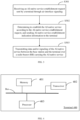
- FIG. 2 is a flow chart of a transmission method for an AI-native service provided by an embodiment. As shown in FIG. 2 , this embodiment provides a transmission method for an AI-native service, and the execution body is a terminal UE. Specific steps of the method are as follows.
- the AI-native service includes but is not limited to at least one of: learning model sharing, computing power sharing, computing power interaction, cloud processing data sharing, and intelligent task segmentation.
- learning model sharing since the AI-native service has a characteristic that data stream is large and cannot be transmitted as physical layer signaling, it can only be transmitted as an independent service flow through a data bearer.
- the terminal can send an AI-native service establishment request to the base station through air interface signaling, so that the base station determines whether to accept the base station to establish an AI-native service based on the AI-native service request.
- the sending the AI-native service establishment request to the base station through the air interface signaling includes at least one of:
- a set of dedicated preambles (preamble) and/or PRACH (Physical Random Access Channel, physical random access channel) resources can be pre-specified to be associated with one or a type of AI-native services, and the terminal can use such dedicated preambles and/or PRACH resources to initiate a random access, and the base station can determine, based on the dedicated preambles and/or PRACH resources, that the terminal initiates a request to establish a specific AI-native service.
- PRACH Physical Random Access Channel, physical random access channel
- the preset preamble and/or the preset PRACH resource can be obtained through the following process:
- the terminal In mode 2, if the terminal is in the RRC Idle (idle) state, the terminal needs to send an RRC establishment request message to the base station to establish an RRC connection, so that the terminal enters the RRC Connected (connected) state.
- An establishment reason included in the RRC establishment request message can be set to be AI-native service establishment, that is, "AI-native service establishment" is added into the EstablishmentCause of the RRC establishment request message RRCSetupRequest.
- the base station After the base station receives the RRC establishment request message, if it is determined that the establishment reason included in the RRC establishment request message is AI-native service establishment, it can be determined that the terminal has initiated an AI-native service establishment request.
- a recovery reason included in the RRC recovery request message can be set to be AI-native service establishment, that is, "AI-native service establishment" is added into the ResumeCause of the RRC recovery request message RRCResumeRequest or RRCResumeRequest1.
- AI-native service establishment is added into the ResumeCause of the RRC recovery request message RRCResumeRequest or RRCResumeRequest1.
- the terminal can send first RRC signaling to the base station.
- the first RRC signaling is an AI-native service establishment request message and may include but is not limited to one or more of: an AI-native service establishment request, an AI-native service type, an AI-native service cycle, an AI-native service life cycle, an AI-native service QoS (Quality of Service, Quality of Service) requirement (such as data volume, latency, reliability).
- the information such as the AI-native service type, the AI-native service cycle, the AI-native service life cycle, the AI-native service QoS (Quality of Service, Quality of Service) requirement can be used by the base station to determine which AI-native service(s) to be established by the request from the terminal, as well as which radio bearer (Radio Bearers, RB) to be adopted for transmission, etc., which are not limited here.
- one piece of first RRC signaling may include the above information of one or more AI-native services, that is, establishment of one or more AI-native services can be requested via one piece of the first RRC signaling.
- the base station after receiving the AI-native service establishment request sent by the terminal, the base station can determine, according to the AI-native service request, whether to accept the terminal to establish the AI-native service. After determining to accept the terminal to establish the AI-native service, the base station can send the AI-native service establishment indication information to the terminal, to indicate that the terminal can establish the AI-native service.
- the base station may send any of the following messages to the terminal, where any of the following messages includes the AI-native service establishment indication information: an RRC connection establishment message, an RRC connection reconfiguration message, an RRC connection recovery message, and third RRC signaling.
- the third RRC signaling is a separate RRC signaling, that is, a separate RRC signaling can be used to transmit the AI-native service establishment indication information.
- the base station may also send the AI-native service establishment indication information to the terminal through SRB0.
- the base station when it is necessary to adopt a DRB (Data Radio Bearers, data radio bearer) as the RB carrying the AI-native service, for transmitting the data and/or the signaling of the AI-native service over the DRB, the base station needs to establish a dedicated RB for carrying the AI-native service and then have the AI-native service establishment indication information to carry a DRB configuration parameter.
- the terminal can establish the corresponding DRB according to the DRB configuration parameter, so that the data and/or the signaling of the AI-native service can be transmitted over the DRB between the base station and the terminal.
- the terminal after receiving the AI-native service establishment indication information sent by the base station, the terminal can determine, according to the AI-native service establishment indication information, that the base station accepts the terminal to establish the AI-native service, and then can transmit the data and/or the signaling of the AI-native service between the terminal and the base station over the designated RB carrying the AI-native service.
- the RB carrying the AI-native service includes but is not limited to SRBO, SRB1, SRB2 or DRB.
- the RB carrying the AI-native service is specifically as follows:
- the terminal sends the AI-native service establishment request to the base station through the air interface signaling; the base station determines to establish the AI-native service according to the AI-native service establishment request and sends the AI-native service establishment indication information to the terminal; then the data and/or the signaling of the AI-native service can be transmitted between the base station and the terminal over the radio bearer (RB) carrying the AI-native service.
- RB radio bearer
- the data and/or the signaling of the AI-native service serves as an independent service flow, and is transmitted over a specific radio bearer between the base station and the terminal, to ensure reliable transmission of the data and/or the signaling of the AI-native service.
- FIG. 3 is a flow chart of a transmission method for an AI-native service provided by an embodiment. As shown in FIG. 3 , this embodiment provides a transmission method for an AI-native service, and the execution body is the base station. Specific steps of the method are as follows:
- the RB may include signaling radio bearers: SRBO, SRB1, SRB2 or a data radio bearer (DRB).
- SRBO signaling radio bearers
- SRB1 SRB1
- SRB2 SRB2
- DRB data radio bearer
- the transmitting the data and/or the signaling of the AI-native service between the base station and the terminal over the radio bearer (RB) carrying the AI-native service includes:
- the sending the AI-native service establishment indication information to the terminal includes: after air interface security is activated, establishing, according to an AI-native service requirement, a DRB dedicated to carrying the AI-native service, and sending the AI-native service establishment indication information to the terminal, where the AI-native service establishment indication information includes a DRB configuration parameter, so that the terminal establishes a corresponding DRB according to the DRB configuration parameter for transmission of the data and/or the signaling of the AI-native service over the DRB.
- the transmitting the data and/or the signaling of the AI-native service between the base station and the terminal over the radio bearer (RB) carrying the AI-native service includes:
- the sending the AI-native service establishment indication information to the terminal includes: sending any of following messages to the terminal, where any of the following messages includes the AI-native service establishment indication information: an RRC connection establishment message, an RRC connection reconfiguration message, an RRC connection recovery message, and third RRC signaling.
- the transmission method for an AI-native service provided in this embodiment is the method by the base station side in the above embodiment, and is based on the same application concept. Since the method and the apparatus solve the problem in a similar principle, repeated details will not be described again.
- Example 1 a terminal in an RRC Idle state establishes an AI-native service (1)
- a set of dedicated preambles and/or PRACH resources are pre-specified to be associated with one or a type of AI-native services.
- the terminal can use such dedicated preambles and/or PRACH resources to initiate a random access.
- the base station can determine, based on the dedicated preambles and/or PRACH resources, that the terminal initiates a request to establish a specific AI-native service.
- the dedicated preambles/or PRACH resources are broadcast in a system message of a wireless access network, and the base station can send the dedicated preamble/PRACH resource configuration for the AI-native service establishment request in the system message.
- the transmission method for an AI-native service may specifically include:
- Example 2 a terminal in an RRC Idle state establishes an AI-native service
- the transmission method for an AI-native service may specifically include:
- Example 3 a terminal in an idle state establishes an AI-native service (3)
- the transmission method for an AI-native service may specifically include:
- Example 4 a terminal in an RRC Inactive state establishes an AI-native service (1)
- a set of dedicated preambles and/or PRACH resources are pre-specified to be associated with one or a type of AI-native services.
- the terminal can use such dedicated preambles and/or PRACH resources to initiate a random access.
- the base station can determine, based on the dedicated preambles and/or PRACH resources, that the terminal initiates a request to establish a specific AI-native service.
- the dedicated preambles/or PRACH resources are broadcast in a system message of a wireless access network, that is, the base station can send the dedicated preamble/PRACH resource configuration for the AI-native service establishment request in the system message, or before the terminal enters the RRC Inactive state, the base station sends the dedicated preamble/PRACH resource configuration for the AI-native service establishment request to the terminal through RRC dedicated signaling.
- the transmission method for an AI-native service may specifically include:
- Example 5 a terminal in an RRC Inactive state establishes an AI-native service (2)
- the transmission method for an AI-native service may specifically include:
- Example 6 a terminal in an RRC Inactive state establishes an AI-native service (3)
- the transmission method for an AI-native service may specifically include:
- Example 7 a terminal in an RRC Connected state establishes an AI-native service (1)
- a set of dedicated preambles and/or PRACH resources are pre-specified to be associated with one or a type of AI-native services.
- the terminal can use such dedicated preambles and/or PRACH resources to initiate a random access.
- the base station can determine, based on the dedicated preambles and/or PRACH resources, that the terminal initiates a request to establish a specific AI-native service.
- the dedicated preambles/or PRACH resources are broadcast in a system message of a wireless access network, that is, the base station can send the dedicated preamble/PRACH resource configuration for the AI-native service establishment request in the system message, or the base station sends the dedicated preamble/PRACH resource configuration for the AI-native service establishment request to the terminal through RRC dedicated signaling.
- the transmission method for an AI-native service may specifically include:
- Example 8 a terminal in an RRC Connected state establishes an AI-native service (2)
- the transmission method for an AI-native service may specifically include:
- FIG. 4 is a structural diagram of a terminal according to an embodiment of the present disclosure.
- the terminal provided by this embodiment can execute the processing flow provided by the method embodiments on the terminal side.
- the terminal 400 includes a memory 401, a transceiver 402, and a processor 403.
- a bus architecture may include any number of interconnected buses and bridges, and specifically various circuits of one or more processors represented by the processor 403 and the memory represented by the memory 401 are linked together.
- the bus architecture can also link together various other circuits such as peripherals, voltage regulators, and power management circuits, which are all well known in the art and therefore no further description will be given herein.
- the bus interface provides an interface.
- the transceiver 402 may be a plurality of elements, i.e., including a transmitter and a receiver, providing a unit for communicating with various other apparatuses over transmission media, where the transmission media include wireless channels, wired channels, optical cables, and other transmission media.
- the processor 403 is responsible for managing the bus architecture and general processing, and the memory 401 can store data used by the processor 403 when performing operations.
- the processor 403 may be a central processing unit (CPU), an application specific integrated circuit (Application Specific Integrated Circuit, ASIC), a field programmable gate array (Field-Programmable Gate Array, FPGA) or a complex programmable logic device (Complex Programmable Logic Device, CPLD).
- the processor can also adopt a multi-core architecture.
- the memory 401 is configured to store a computer program; the transceiver 402 is configured to send and receive data under a control of the processor 403; and the processor 403 is configured to read the computer program in the memory 401 and perform following operations:
- the processor 403 when sending the AI-native service establishment request to the base station through the air interface signaling, the processor 403 is configured to perform at least one of:
- the AI-native service includes at least one of: learning model sharing, computing power sharing, computing power interaction, cloud processing data sharing, and intelligent task segmentation.
- the processor 403 before the sending the random access request to the base station by using the preset preamble and/or the preset physical random access channel (PRACH) resource corresponding to the AI-native service, the processor 403 is further configured to:
- the processor 403 when sending the radio resource control (RRC) establishment request message to the base station, the processor 403 is configured to: send the radio resource control (RRC) establishment request message to the base station if the terminal is in an RRC idle state.
- the processor 403 when sending the RRC recovery request message to the base station, is configured to: send the radio resource control (RRC) recovery request message to the base station if the terminal is in an RRC inactive state.
- RRC radio resource control
- the processor 403 when receiving the AI-native service establishment indication information sent by the base station, the processor 403 is configured to: receive any of following messages sent by the base station, where any of the following messages includes the AI-native service establishment indication information: an RRC connection establishment message, an RRC connection reconfiguration message, an RRC connection recovery message, and third RRC signaling.
- the RB includes signaling radio bearers: SRBO, SRB1, SRB2 or a data radio bearer (DRB).
- SRBO signaling radio bearers: SRBO, SRB1, SRB2 or a data radio bearer (DRB).
- DRB data radio bearer
- the AI-native service establishment indication information includes a DRB configuration parameter; when transmitting the data and/or the signaling of the AI-native service between the terminal and the base station over the radio bearer (RB) carrying the AI-native service, the processor 403 is configured to:
- the terminal provided by the embodiments of the present disclosure can be specifically used to execute the above method embodiments on the terminal side, and the specific functions will not be described here again.
- FIG. 5 is a structural diagram of a base station according to an embodiment of the present disclosure.
- the base station provided in this embodiment can execute the processing flow provided by the method embodiments on the base station side.
- the base station 500 includes a memory 501, a transceiver 502, and a processor 503.
- a bus architecture may include any number of interconnected buses and bridges, and specifically various circuits of one or more processors represented by the processor 503 and the memory represented by the memory 501 are linked together.
- the bus architecture can also link together various other circuits such as peripherals, voltage regulators, and power management circuits, which are all well known in the art and therefore no further description will be given herein.
- the bus interface provides an interface.
- the transceiver 502 may be a plurality of elements, i.e., including a transmitter and a receiver, providing a unit for communicating with various other apparatuses over transmission media, where the transmission media include wireless channels, wired channels, optical cables, and other transmission media.
- the processor 503 is responsible for managing the bus architecture and general processing, and the memory 501 can store data used by the processor 503 when performing operations.
- the processor 503 may be a central processing unit (CPU), an application specific integrated circuit (Application Specific Integrated Circuit, ASIC), a field programmable gate array (Field-Programmable Gate Array, FPGA) or a complex programmable logic device (Complex Programmable Logic Device, CPLD).
- the processor can also adopt a multi-core architecture.
- the memory 501 is configured to store a computer program; the transceiver 502 is configured to send and receive data under a control of the processor 503; and the processor 503 is configured to read the computer program in the memory 501 and perform following operations:
- the RB includes signaling radio bearers: SRBO, SRB 1, SRB2 or a data radio bearer (DRB).
- SRBO signaling radio bearers: SRBO, SRB 1, SRB2 or a data radio bearer (DRB).
- DRB data radio bearer
- the processor 503 when transmitting the data and/or the signaling of the AI-native service between the base station and the terminal over the radio bearer (RB) carrying the AI-native service, the processor 503 is configured to:
- the processor 503 when sending the AI-native service establishment indication information to the terminal, is configured to: after air interface security is activated, establish, according to an AI-native service requirement, a DRB dedicated to carrying the AI-native service, and send the AI-native service establishment indication information to the terminal, where the AI-native service establishment indication information includes a DRB configuration parameter, so that the terminal establishes a corresponding DRB according to the DRB configuration parameter for transmission of the data and/or the signaling of the AI-native service over the DRB.
- the processor 503 when transmitting the data and/or the signaling of the AI-native service between the base station and the terminal over the radio bearer (RB) carrying the AI-native service, the processor 503 is configured to:
- the processor 503 when sending the AI-native service establishment indication information to the terminal, is configured to: send any of following messages to the terminal, where any of the following messages includes the AI-native service establishment indication information: an RRC connection establishment message, an RRC connection reconfiguration message, an RRC connection recovery message, and third RRC signaling.
- the base station provided by the embodiments of the present disclosure can be specifically used to perform the above method embodiments on the base station side, and the specific functions will not be described here again.
- FIG. 6 is a structural diagram of a transmission apparatus for an AI-native service provided by an embodiment of the present disclosure.
- the transmission apparatus for an AI-native service provided by this embodiment can execute the processing flow provided by the method embodiments on the terminal side.
- the transmission apparatus for an AI-native service 600 includes a request unit 601, a receiving unit 602 and a transmission unit 603.
- the request unit 601 is configured to send an AI-native service establishment request to a base station through air interface signaling.
- the receiving unit 602 is configured to receive AI-native service establishment indication information sent by the base station.
- the transmission unit 603 is configured to transmit, according to the AI-native service establishment indication information, data and/or signaling of the AI-native service between the transmission apparatus and the base station over a radio bearer (RB) carrying the AI-native service.
- RB radio bearer
- the request unit 601 when sending the AI-native service establishment request to the base station through the air interface signaling, the request unit 601 is configured to perform at least one of:
- the AI-native service includes at least one of: learning model sharing, computing power sharing, computing power interaction, cloud processing data sharing, and intelligent task segmentation.
- the receiving unit 602 before sending the random access request to the base station by using the preset preamble and/or the preset physical random access channel (PRACH) resource corresponding to the AI-native service, the receiving unit 602 is further configured to:
- the request unit 601 when sending the radio resource control (RRC) establishment request message to the base station, is configured to: send the radio resource control (RRC) establishment request message to the base station if the terminal is in an RRC idle state.
- the request unit 601 sending the RRC recovery request message to the base station includes: sending the radio resource control (RRC) recovery request message to the base station if the terminal is in an RRC inactive state.
- RRC radio resource control
- the receiving unit 602 when receiving the AI-native service establishment indication information sent by the base station, the receiving unit 602 is configured to: receive any of following messages sent by the base station, where any of the following messages includes the AI-native service establishment indication information: an RRC connection establishment message, an RRC connection reconfiguration message, an RRC connection recovery message, and third RRC signaling.
- the RB includes signaling radio bearers: SRBO, SRB1, SRB2 or a data radio bearer (DRB).
- SRBO signaling radio bearers: SRBO, SRB1, SRB2 or a data radio bearer (DRB).
- DRB data radio bearer
- the AI-native service establishment indication information includes a DRB configuration parameter; when transmitting the data and/or the signaling of the AI-native service between the transmission apparatus and the base station over the radio bearer (RB) carrying the AI-native service, the transmission unit 603 is configured to:
- the transmission apparatus for an AI-native service provided by the embodiments of the present disclosure can be specifically used to execute the above method embodiments on the terminal side, and the specific functions will not be described here again.
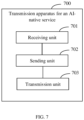
- FIG. 7 is a structural diagram of a transmission apparatus for an AI-native service provided by an embodiment of the present disclosure.
- the transmission apparatus for an AI-native service provided by the embodiment can execute the processing flow provided by the method embodiments on the base station side.
- the transmission apparatus for an AI-native service 700 includes a receiving unit 701, a sending unit 702, and a transmission unit 703.
- the receiving unit 701 is configured to receive an AI-native service establishment request sent by a terminal through air interface signaling.
- the sending unit 702 is configured to determine to establish the AI-native service according to the AI-native service establishment request, and send AI-native service establishment indication information to the terminal.
- the transmission unit 703 is configured to transmit data and/or signaling of the AI-native service between the transmission apparatus and the terminal over a radio bearer (RB) carrying the AI-native service.
- RB radio bearer
- the RB includes signaling radio bearers: SRBO, SRB1, SRB2 or a data radio bearer (DRB).
- SRBO signaling radio bearers: SRBO, SRB1, SRB2 or a data radio bearer (DRB).
- DRB data radio bearer
- the transmission unit 703 when transmitting the data and/or the signaling of the AI-native service between the transmission apparatus and the terminal over the radio bearer (RB) carrying the AI-native service, the transmission unit 703 is configured to:
- the sending unit 702 when sending the AI-native service establishment indication information to the terminal, is configured to: after air interface security is activated, establish, according to an AI-native service requirement, a DRB dedicated to carrying the AI-native service, and send the AI-native service establishment indication information to the terminal, where the AI-native service establishment indication information includes a DRB configuration parameter, so that the terminal establishes a corresponding DRB according to the DRB configuration parameter for the transmission unit 703 to transmit the data and/or the signaling of the AI-native service over the DRB.
- the transmission unit 703 when transmitting the data and/or the signaling of the AI-native service between the transmission apparatus and the terminal over the radio bearer (RB) carrying the AI-native service, the transmission unit 703 is configured to:
- the sending unit 702 when sending the AI-native service establishment indication information to the terminal, is configured to: send any of following messages to the terminal, where any of the following messages includes the AI-native service establishment indication information: an RRC connection establishment message, an RRC connection reconfiguration message, an RRC connection recovery message, and third RRC signaling.
- the transmission apparatus for an AI-native service provided by the embodiments of the present disclosure can be specifically used to perform the above method embodiments on the base station side, and the specific functions will not be described here again.
- each functional unit in various embodiments of the present disclosure may be integrated into one processing unit, or each unit may exist physically alone, or two or more units may be integrated into one unit.
- the above integrated units can be implemented in the form of hardware or software functional units.
- the integrated unit When the integrated unit is implemented in the form of a software functional unit and sold or used as an independent product, the integrated unit may be stored in a processor readable storage medium. Based on such an understanding, the technical solutions of the present disclosure essentially or the part that contributes to the prior art or all or a part of the technical solutions may be implemented in the form of a software product.
- the computer software product is stored in a storage medium and includes several instructions for instructing a computer device (which may be a personal computer, a server, a network device, or the like) or a processor (processor) to perform all or some steps of the methods described in the embodiments of the present disclosure.
- the foregoing storage medium includes any medium that can store a program code, such as a USB flash drive, a removable hard disk, a read-only memory (Read-Only Memory, ROM), a random access memory (Random Access Memory, RAM), a magnetic disk, or an optical disk, etc.
- a program code such as a USB flash drive, a removable hard disk, a read-only memory (Read-Only Memory, ROM), a random access memory (Random Access Memory, RAM), a magnetic disk, or an optical disk, etc.
- Another embodiment of the present disclosure also provides a computer-readable storage medium.
- the computer-readable storage medium stores a computer program.
- the computer program is used to cause a processor to execute a transmission method for an AI-native service on the terminal or base station side.
- the computer-readable storage medium may be any available medium or data storage device that the processor can access, including but not limited to a magnetic memory (such as a floppy disk, a hard disk, a tape, a magneto-optical disk (MO), etc.), an optical memory (such as a CD, a DVD, a BD, a HVD, etc.), and a semiconductor memory (such as a ROM, an EPROM, an EEPROM, a non-volatile memory (NAND FLASH), a solid state drive (SSD)), etc.
- a magnetic memory such as a floppy disk, a hard disk, a tape, a magneto-optical disk (MO), etc.
- an optical memory such as a CD, a DVD, a BD, a HVD, etc.
- semiconductor memory such as a ROM, an EPROM, an EEPROM, a non-volatile memory (NAND FLASH), a solid state drive (SSD)
- Another embodiment of the present disclosure also provides a computer program product, which includes a computer program.
- the computer program is configured to cause a processor to execute the transmission method for an AI-native service on the terminal side or the base station side.
- embodiments of the present disclosure may be provided as methods, systems, or computer program products. Accordingly, the present disclosure may take the form of an entirely hardware embodiment, an entirely software embodiment, or an embodiment that combines software and hardware aspects. Furthermore, the present disclosure may take the form of a computer program product embodied in one or more computer-usable storage media (including, but not limited to, a magnetic disk memory, an optical memory, and the like) having a computer-usable program code embodied therein.
- computer-usable storage media including, but not limited to, a magnetic disk memory, an optical memory, and the like
- These computer-executable instructions may be provided to a processor of a general-purpose computer, a special-purpose computer, an embedded processor, or other programmable data processing device to produce a machine, such that the instructions executed by the processor of the computer or other programmable data processing device produce means for implementing the functions specified in a process or processes in the flow chart and/or in a block or blocks in the a block diagram.
- processor-executable instructions may also be stored in a processor-readable memory that causes a computer or other programmable data processing device to operate in a particular manner, such that instructions stored in the processor-readable memory generates a manufactured product including an instruction means.
- the instruction means implements the function specified in one process or multiple processes in the flow chart and/or one block or multiple blocks in the block diagram.
- processor-executable instructions may also be loaded into a computer or other programmable data processing devices, causing a series of operational steps to be performed in the computer or other programmable devices to produce computer-implemented processing, thereby causing the instructions that are executed in the computer or other programmable device to provide steps for implementing the functions specified in a process or processes of the flow charts and/or a block or blocks of the block diagrams.
Landscapes
- Engineering & Computer Science (AREA)
- Signal Processing (AREA)
- Computer Networks & Wireless Communication (AREA)
- Software Systems (AREA)
- Artificial Intelligence (AREA)
- Computer Vision & Pattern Recognition (AREA)
- Evolutionary Computation (AREA)
- Medical Informatics (AREA)
- Databases & Information Systems (AREA)
- Theoretical Computer Science (AREA)
- General Physics & Mathematics (AREA)
- Mathematical Physics (AREA)
- General Engineering & Computer Science (AREA)
- Computing Systems (AREA)
- Physics & Mathematics (AREA)
- Data Mining & Analysis (AREA)
- Mobile Radio Communication Systems (AREA)
Abstract
Description
- This application claims priority to
Chinese Patent Application No. 202111231461.6, entitled "TRANSMISSION METHOD AND APPARATUS FOR AI-NATIVE SERVICE, AND STORAGE MEDIUM" and filed with the China National Intellectual Property Administration on October 22, 2021 - The present disclosure relates to the field of communication technology and, in particular, to a transmission method and apparatus for an AI-native service, and a storage medium.
- Services in the existing 3GPP (3rd Generation Partnership Project, 3rd Generation Partnership Project) wireless communication network are end-to-end services, in which a service establishment process is initiated and completed through NAS signaling between a terminal and a core network. With the introduction of artificial intelligence, machine learning modules are embedded in various nodes (including base stations and terminals) of wireless mobile communication networks. Correspondingly, the base stations and the terminals have functions such as model signaling, data processing, and edge computing. A service generated by application of artificial intelligence in wireless communication networks is one of typical examples of an AI-native service. Characteristics of the AI-native service are: a starting point and an end point of the service are both within the system, and the AI-native service does not directly serve end users, but is built to solve complex problems of the mobile communication system or improve performance.
- During performing data processing and machine learning model transmission, the AI-native service has a characteristic that data stream is large and cannot be transmitted as physical layer signaling, but can only be transmitted as a type of independent service flows through a data bearer. In addition, depending on different types of machine learning, there are different requirements in terms of latency and reliability. For example, an inference process has a high-level latency requirement; and a delivery of an inference result and a model has a high-level reliability requirement. Transmission approaches in the prior art cannot meet transmission requirements of the AI-native service and cannot guarantee reliable transmission of AI-native service data or signaling.
- The present disclosure provides a transmission method and apparatus for an AI-native service, and a storage medium, to establish an AI-native service transmission channel between a base station and a terminal to ensure reliable transmission of AI-native service data or signaling.
- In a first aspect, the present disclosure provides a transmission method for an AI-native service, where the method is applied to a terminal and includes:
- sending an AI-native service establishment request to a base station through air interface signaling;
- receiving AI-native service establishment indication information sent by the base station;
- transmitting, according to the AI-native service establishment indication information, data and/or signaling of the AI-native service between the terminal and the base station over a radio bearer (RB) carrying the AI-native service.
- In a possible design, the sending the AI-native service establishment request to the base station through the air interface signaling includes at least one of:
- sending a random access request to the base station by using a preset preamble and/or a preset physical random access channel (PRACH) resource corresponding to the AI-native service; or
- sending a radio resource control (RRC) establishment request message to the base station, where an establishment reason included in the RRC establishment request message is set to be AI-native service establishment; or
- sending an RRC recovery request message to the base station, where a recovery reason included in the RRC recovery request message is set to be AI-native service establishment; or
- sending first RRC signaling to the base station when the terminal is in an RRC connected state, where the first RRC signaling is an AI-native service establishment request message which includes one or more of: an AI-native service establishment request, an AI-native service type, an AI-native service cycle, an AI-native service life cycle, an AI-native service QoS requirement.
- In a possible design, the AI-native service includes at least one of:
learning model sharing, computing power sharing, computing power interaction, cloud processing data sharing, and intelligent task segmentation. - In a possible design, before sending the random access request to the base station by using the preset preamble and/or the preset physical random access channel (PRACH) resource corresponding to the AI-native service, the method further includes:
- receiving a system message of a radio access network system sent by the base station, where the system message includes the preset preamble and/or the preset PRACH resource corresponding to the AI-native service; or
- receiving, when the terminal is in the RRC connected state, second RRC signaling sent by the base station, where the second RRC signaling includes the preset preamble and/or the preset PRACH resource corresponding to the AI-native service.
- In a possible design, the sending the radio resource control (RRC) establishment request message to the base station includes:
sending the radio resource control (RRC) establishment request message to the base station if the terminal is in an RRC idle state. - In a possible design, the sending the RRC recovery request message to the base station includes:
sending the radio resource control (RRC) recovery request message to the base station if the terminal is in an RRC inactive state. - In a possible design, the receiving the AI-native service establishment indication information sent by the base station includes:
receiving any of following messages sent by the base station, where any of the following messages includes the AI-native service establishment indication information:
an RRC connection establishment message, an RRC connection reconfiguration message, an RRC connection recovery message, and third RRC signaling. - In a possible design, the RB includes signaling radio bearers: SRBO, SRB 1, SRB2 or a data radio bearer (DRB).
- In a possible design, the AI-native service establishment indication information includes a DRB configuration parameter;
the transmitting the data and/or the signaling of the AI-native service between the terminal and the base station over the radio bearer (RB) carrying the AI-native service includes: - establishing a DRB according to the DRB configuration parameter;
- transmitting the data and/or the signaling of the AI-native service over the DRB.
- In a second aspect, the present disclosure provides a transmission method for an AI-native service, where the method is applied to a base station and includes:
- receiving an AI-native service establishment request sent by a terminal through air interface signaling;
- determining to establish the AI-native service according to the AI-native service establishment request, and sending AI-native service establishment indication information to the terminal;
- transmitting data and/or signaling of the AI-native service between the base station and the terminal over a radio bearer (RB) carrying the AI-native service.
- In a possible design, the RB includes signaling radio bearers: SRBO, SRB 1, SRB2 or a data radio bearer (DRB).
- In a possible design, the transmitting the data and/or the signaling of the AI-native service between the base station and the terminal over the radio bearer (RB) carrying the AI-native service includes:
- adopting SRB1 or SRB2 as the RB carrying the AI-native service, after air interface security is activated;
- transmitting the data and/or the signaling of the AI-native service between the base station and the terminal over SRB 1 or SRB2; or
- adopting SRB0 as the RB carrying the AI-native service, if the air interface security is not activated;
- transmitting the data and/or the signaling of the AI-native service between the base station and the terminal over SRB0.
- In a possible design, the sending the AI-native service establishment indication information to the terminal includes:
after air interface security is activated, establishing, according to an AI-native service requirement, a DRB dedicated to carrying the AI-native service, and sending the AI-native service establishment indication information to the terminal, where the AI-native service establishment indication information includes a DRB configuration parameter, so that the terminal establishes a corresponding DRB according to the DRB configuration parameter for transmission of the data and/or the signaling of the AI-native service over the DRB. - In a possible design, the transmitting the data and/or the signaling of the AI-native service between the base station and the terminal over the radio bearer (RB) carrying the AI-native service includes:
- if the terminal is in an RRC inactive state, recovering, in a case that the terminal does not enter an RRC connected state, a DRB carrying the AI-native service pre-stored in terminal context;
- transmitting the data and/or the signaling of the AI-native service between the base station and the terminal over the recovered DRB carrying the AI-native service.
- In a possible design, the sending the AI-native service establishment indication information to the terminal includes:
sending any of following messages to the terminal, where any of the following messages includes the AI-native service establishment indication information:
an RRC connection establishment message, an RRC connection reconfiguration message, an RRC connection recovery message, and third RRC signaling. - In a third aspect, the present disclosure provides a terminal, including a memory, a transceiver, and a processor;
the memory is configured to store a computer program; the transceiver is configured to send and receive data under a control of the processor; the processor is configured to read the computer program in the memory and perform following operations: - sending an AI-native service establishment request to a base station through air interface signaling;
- receiving AI-native service establishment indication information sent by the base station;
- transmitting, according to the AI-native service establishment indication information, data and/or signaling of the AI-native service between the terminal and the base station over a radio bearer (RB) carrying the AI-native service.
- In a possible design, when sending the AI-native service establishment request to the base station through the air interface signaling, the processor is configured to perform at least one of:
- sending a random access request to the base station by using a preset preamble and/or a preset physical random access channel (PRACH) resource corresponding to the AI-native service; or
- sending a radio resource control (RRC) establishment request message to the base station, where an establishment reason included in the RRC establishment request message is set to be AI-native service establishment; or
- sending an RRC recovery request message to the base station, where a recovery reason included in the RRC recovery request message is set to be AI-native service establishment; or
- sending first RRC signaling to the base station when the terminal is in an RRC connected state, where the first RRC signaling is an AI-native service establishment request message which includes one or more of: an AI-native service establishment request, an AI-native service type, an AI-native service cycle, an AI-native service life cycle, an AI-native service QoS requirement.
- In a possible design, the AI-native service includes at least one of:
learning model sharing, computing power sharing, computing power interaction, cloud processing data sharing, and intelligent task segmentation. - In a possible design, before the sending the random access request to the base station by using the preset preamble and/or the preset physical random access channel (PRACH) resource corresponding to the AI-native service, the processor is further configured to:
- receive a system message of a radio access network system sent by the base station, in which the system message includes the preset preamble and/or the preset PRACH resource corresponding to the AI-native service; or
- receive, when the terminal is in the RRC connected state, second RRC signaling sent by the base station, where the second RRC signaling includes the preset preamble and/or the preset PRACH resource corresponding to the AI-native service.
- In a possible design, when sending the radio resource control (RRC) establishment request message to the base station, the processor is configured to:
send the radio resource control (RRC) establishment request message to the base station if the terminal is in an RRC idle state. - In a possible design, when sending the RRC recovery request message to the base station, the processor is configured to:
send the radio resource control (RRC) recovery request message to the base station if the terminal is in an RRC inactive state. - In a possible design, when receiving the AI-native service establishment indication information sent by the base station, the processor is configured to:
receive any of following messages sent by the base station, in which any of the following messages includes the AI-native service establishment indication information:
an RRC connection establishment message, an RRC connection reconfiguration message, an RRC connection recovery message, and third RRC signaling. - In a possible design, the RB includes signaling radio bearers: SRBO, SRB 1, SRB2 or a data radio bearer (DRB).
- In a possible design, the AI-native service establishment indication information includes a DRB configuration parameter;
when transmitting the data and/or the signaling of the AI-native service between the terminal and the base station over the radio bearer (RB) carrying the AI-native service, the processor is configured to: - establish a DRB according to the DRB configuration parameter;
- transmit the data and/or the signaling of the AI-native service over the DRB.
- In a fourth aspect, the present disclosure provides a base station, including a memory, a transceiver, and a processor;
the memory is configured to store a computer program; the transceiver is configured to send and receive data under a control of the processor; the processor is configured to read the computer program in the memory and perform following operations: - receiving an AI-native service establishment request sent by a terminal through air interface signaling;
- determining to establish an AI-native service according to the AI-native service establishment request, and sending AI-native service establishment indication information to the terminal;
- transmitting data and/or signaling of the AI-native service between the base station and the terminal over a radio bearer (RB) carrying the AI-native service.
- In a possible design, the RB includes signaling radio bearers: SRBO, SRB 1, SRB2 or a data radio bearer (DRB).
- In a possible design, when transmitting the data and/or the signaling of the AI-native service between the base station and the terminal over the radio bearer (RB) carrying the AI-native service, the processor is configured to:
- adopt SRB1 or SRB2 as the RB carrying the AI-native service, after air interface security is activated;
- transmit the data and/or the signaling of the AI-native service between the base station and the terminal over SRB 1 or SRB2; or
- adopt SRB0 as the RB carrying the AI-native service, if the air interface security is not activated;
- transmit the data and/or the signaling of the AI-native service between the base station and the terminal over SRB0.
- In a possible design, when sending the AI-native service establishment indication information to the terminal, the processor is configured to:
after air interface security is activated establish, according to an AI-native service requirement, a DRB dedicated to carrying the AI-native service, and send the AI-native service establishment indication information to the terminal, where the AI-native service establishment indication information includes a DRB configuration parameter, so that the terminal establishes a corresponding DRB according to the DRB configuration parameter for transmission of the data and/or the signaling of the AI-native service over the DRB. - In a possible design, when transmitting the data and/or the signaling of the AI-native service between the base station and the terminal over the radio bearer (RB) carrying the AI-native service, the processor is configured to:
- if the terminal is in an RRC inactive state, recover, in a case that the terminal does not enter an RRC connected state, a DRB carrying the AI-native service pre-stored in terminal context;
- transmit the data and/or the signaling of the AI-native service between the base station and the terminal over the recovered DRB carrying the AI-native service.
- In a possible design, when sending the AI-native service establishment indication information to the terminal, the processor is configured to:
send any of following messages to the terminal, where any of the following messages includes the AI-native service establishment indication information:
an RRC connection establishment message, an RRC connection reconfiguration message, an RRC connection recovery message, and third RRC signaling. - In a fifth aspect, the present disclosure provides a transmission apparatus for an AI-native service, including:
- a request unit, configured to send an AI-native service establishment request to a base station through air interface signaling;
- a receiving unit, configured to receive AI-native service establishment indication information sent by the base station;
- a transmission unit, configured to transmit, according to the AI-native service establishment indication information, data and/or signaling of the AI-native service between the transmission apparatus and the base station over a radio bearer (RB) carrying the AI-native service.
- In a sixth aspect, the present disclosure provides a transmission apparatus for an AI-native service, including:
- a receiving unit, configured to receive an AI-native service establishment request sent by a terminal through air interface signaling;
- a sending unit, configured to determine to establish the AI-native service according to the AI-native service establishment request, and send AI-native service establishment indication information to the terminal;
- a transmission unit, configured to transmit data and/or signaling of the AI-native service between the transmission apparatus and the terminal over a radio bearer (RB) carrying the AI-native service.
- In a seventh aspect, the present disclosure provides a processor-readable storage medium, where the processor-readable storage medium stores a computer program, and the computer program is used to cause a processor to execute the method described in the first aspect or the second aspect.
- The present disclosure provides a transmission method and apparatus for an AI-native service and a storage medium. A terminal sends an AI-native service establishment request to a base station through air interface signaling; the base station determines to establish the AI-native service according to the AI-native service establishment request and sends AI-native service establishment indication information to the terminal. Then data and/or signaling of the AI-native service can be transmitted between the base station and the terminal over a radio bearer (RB) carrying the AI-native service. In the embodiment, the data and/or the signaling of the AI-native service serves as an independent service flow and is transmitted over a specific radio bearer between the base station and the terminal, to ensure reliable transmission of the data and/or the signaling of the AI-native service.
- It should be understood that the content described in the above summary section is not intended to define key or important features of the embodiments of the present disclosure, nor is it used to limit the scope of the present disclosure. Other features of the present disclosure will become apparent from the description below.
- In order to illustrate the technical solutions of the present disclosure or the prior art more clearly, the drawings required for the description of embodiments or the prior art will be briefly introduced below. Obviously, the drawings in the following description are some embodiments of the present disclosure. Those of ordinary skill in the art can also obtain other drawings based on these drawings without creative effort.
-
FIG. 1 is a schematic diagram of a system for a transmission method for an AI-native service provided by an embodiment of the present disclosure. -
FIG. 2 is a flow chart of a transmission method for an AI-native service provided by an embodiment of the present disclosure. -
FIG. 3 is a flow chart of a transmission method for an AI-native service provided by another embodiment of the present disclosure. -
FIG. 4 is a structural diagram of a terminal provided by an embodiment of the present disclosure. -
FIG. 5 is a structural diagram of a base station provided by an embodiment of the present disclosure. -
FIG. 6 is a structural diagram of a transmission apparatus for an AI-native service provided by an embodiment of the present disclosure. -
FIG. 7 is a structural diagram of a transmission apparatus for an AI-native service provided by another embodiment of the present disclosure. - The term "and/or" in the present disclosure describes the association relationship between associated objects, indicating that there can be three relationships, for example, A and/or B, which can mean three cases: A alone exists; A and B exist simultaneously; and B alone exists. The character "/" generally indicates that related objects before and after are in an "or" relationship.
- In the embodiment of this disclosure, the term "a plurality of" refers to two or more than two, and other quantifiers are similar to it.
- Services in the existing 3GPP wireless communication network are end-to-end services, where a service establishment process is initiated and completed through NAS signaling between a terminal and a core network. A service establishment process initiated by the terminal is as follows. If the terminal is in an RRC (Radio Resource Control, radio resource control) connected state, it directly performs signaling interaction with the core network and initiates a service request through air interface NAS (Non-access stratum, non-access stratum) direct transfer; if the terminal is in an RRC Idle (idle) state, an RRC connection needs to be established; and if the terminal is in an RRC Inactive (inactive) state, the RRC connection needs to be recovered and a service establishment process needs to be initiated. Taking a terminal in the RRC Idle state as an example, when the terminal needs to initiate a service request, it initiates the process of establishing a RRC connection with a base station. The terminal directly sends a NAS connection request message (service request) to the core network through the NAS direct transfer carried in the RRC signaling, the core network establishes a service connection with the terminal, and then the core network sends the service connection and service-related information to the base station, according to which the base station establishes a service bearer RB (radio bearer, radio bearer) carrying the service between the base station and the terminal, and notifies the terminal via an RRC reconfiguration message. For the service request initiated by the terminal in the RRC Idle state, the terminal has EstablishmentCause carried in the RRC connection request message RRCSetupRequest to indicate the reason for establishing the RRC connection, and then sends a service request NAS message to the core network. For a terminal in the RRC Inactive state, the terminal has ResumeCause carried in the RRCResumeRequest or RRCResumeRequestl to indicate the reason for recovering the RRC connection, and then sends a service request NAS message to the core network.
- With the introduction of artificial intelligence, machine learning modules are embedded in various nodes (including base stations and terminals) of wireless mobile communication networks. Correspondingly, the base stations and the terminals have functions such as model signaling, data processing, and edge computing. A service generated by the application of artificial intelligence in wireless communication networks is one of the typical examples of an AI-native service. The characteristics of the AI-native service are: a starting point and an end point of the service are both within the system, and the AI-native service does not directly serve end users, but is built to solve complex problems of the mobile communication system or improve performance.
- The AI-native service can be learning model sharing, computing power sharing, computing power interaction, cloud processing data sharing, intelligent task segmentation, etc. For example, in a federated learning system, terminal A performs data preprocessing and transmits the preprocessed data to another network device through the base station to infer an intermediate result and transmit the inferred intermediate result to terminal B. Terminal B can infer a final result and report the inferred final result to the network device through the base station.
- During performing data processing and machine learning model transmission, the AI-native service has a characteristic that data stream is large and cannot be transmitted as physical layer signaling but can only be transmitted as an independent service flow through a data bearer. In addition, depending on different types of machine learning, there are different requirements in terms of latency and reliability. For example, an inference process has high-level latency requirements; a delivery of an inference result and a model has high-level reliability requirements. Transmission approaches in the prior art cannot meet the transmission requirements of the AI-native service and cannot guarantee the reliable transmission of AI-native service data or signaling.
- In order to solve the above technical problems, the present disclosure provides a transmission method for an AI-native service. For the AI-native service, a specific transmission channel for carrying the AI-native service is established between a base station and a terminal to ensure reliable transmission of AI-native service data or signaling. Specifically, the terminal can send an AI-native service establishment request to the base station through air interface signaling; the base station determines to establish the AI-native service according to the AI-native service establishment request, and sends AI-native service establishment indication information to the terminal; in response to the AI-native service establishment indication information, a radio bearer (RB) that carries the AI-native service is designated or established between the terminal and the base station, and then data and/or signaling of the AI-native service can be transmitted between the terminal and the base station over the RB. Optionally, the RB includes signaling radio bearers: SRBO, SRB1, SRB2 or a data radio bearer (DRB).
- An embodiment of the present disclosure provides a transmission method for an AI-native service, which is applicable to a system as shown in
FIG. 1 . The system includes a terminal 11 and abase station 12. The terminal 11 can send an AI-native service establishment request to thebase station 12 through air interface signaling; thebase station 12 determines to establish the AI-native service according to the AI-native service establishment request, and sends AI-native service establishment indication information to the terminal 11; in response to the AI-native service establishment indication information, a radio bearer (RB) carrying the AI-native service is designated or established between the terminal 11 and thebase station 12, and then data and/or signaling of the AI-native service can be transmitted between the terminal 11 and thebase station 12 over the RB. - Technical solutions provided by embodiments of the present disclosure can be applied to a variety of systems, especially a 5G system. For example, an applicable system may be a global system of mobile communication (global system of mobile communication, GSM) system, a code division multiple access (code division multiple access, CDMA) system, a wideband code division multiple access (Wideband Code Division Multiple Access, WCDMA) general packet radio service (general packet radio service, GPRS) system, a long term evolution (long term evolution, LTE) system, an LTE frequency division duplex (frequency division duplex, FDD) system, an LTE time division duplex (time division duplex, TDD) system, a long term evolution advanced (long term evolution advanced, LTE-A) system, a universal mobile telecommunication system (universal mobile telecommunication system, UMTS), a worldwide interoperability for microwave access (worldwide interoperability for microwave access, WiMAX) system, a 5G new radio (New Radio, NR) system, etc. Each of these various systems includes a terminal device and a network device. The system can also include a core network part, such as an evolved packet system (Evolved Packet System, EPS), a 5G system (5GS), etc.
- The terminal device involved in the embodiments of the present disclosure may refer to a device that provides voice and/or data connectivity to users, a handheld device with a wireless connection function, or other processing devices connected to a wireless modem, etc. In different systems, the terminal device may also have different names. For example, in a 5G system, the terminal device may be called a user equipment (User Equipment, UE). A wireless terminal device can communicate with one or more core networks (Core Network, CN) via a radio access network (Radio Access Network, RAN). The wireless terminal device can be a mobile terminal device, such as a mobile phone (or known as a "cellular" phone), and a computer with a mobile terminal device, which may be, for example, portable, pocket-sized, handheld, computer-built-in or vehicle-mounted mobile apparatuses, such as a personal communication service (Personal Communication Service, PCS) phone, a cordless phone, a session initiated protocol (Session Initiated Protocol, SIP) phone, a wireless local loop (Wireless Local Loop, WLL) station, a personal digital assistant (Personal Digital Assistant, PDA) and other devices, which exchanges language and/or data with the radio access network. Wireless terminal device may also be called a system, a subscriber unit (subscriber unit), a subscriber station (subscriber station), a mobile station (mobile station), a mobile (mobile), a remote station (remote station), an access point (access point), a remote terminal (remote terminal), an access terminal (access terminal), a user terminal (user terminal), a user agent (user agent), a user device (user device), which is not limited in the embodiments of the present disclosure.
- The base stations involved in the embodiments of the present disclosure may also be other network devices, and a based station may include multiple cells that provide services for terminals. According to different specific application occasions, the base station may also called an access point, or may refer to devices in communication with the wireless terminal devices through one or more sectors in an air interface in an access network, or devices with other names. The network device may be configured to interconvert a received air frame and an internet protocol (internet protocol, IP) packet and serves as a router between the wireless terminal devices and remaining parts of the access network, where the remaining parts of the access network may include an internet protocol (IP) communication network. The network device may further coordinate attribute management to the air interface. For example, the network devices involved in the embodiments of the present application may be network devices (Base Transceiver Station, BTS) in the global system for mobile communications (Global System for Mobile Communications, GSM) or code division multiple access (Code Division Multiple Access, CDMA), or network devices (NodeB) in wide-band code division multiple access (Wide-band Code Division Multiple Access, WCDMA), or evolutional network devices (evolutional Node B, eNB or e-NodeB) in a long term evolution (long term evolution, LTE) system, or a 5G base station (gNB) in a 5G network architecture (next generation system), or a home evolved node B (Home evolved Node B, HeNB), a relay node (relay node), a femto (femto), a pico (pico), etc., which is not limited in the embodiments of the present disclosure. In some network structures, the network device may include a centralized unit (centralized unit, CU) node and a distributed unit (distributed unit, DU) node, and the centralized unit and the distributed unit may also be arranged geographically separately.
- The technical solutions in the embodiments of the present disclosure will be clearly and comprehensively described below with reference to the drawings in the embodiments of the present disclosure. Obviously, the described embodiments are only some of the embodiments of the present disclosure, not all of them. All other embodiments obtained by those of ordinary skill in the art based on the embodiments in the present disclosure without creative efforts fall within the protection scope of the present disclosure.
- The method and the apparatus are based on the same application concept. Since principles of the method and the apparatus to solve the problem are similar, reference can be made to each other for the implementation of the apparatus and the method, and repeated details will not be described.
-
FIG. 2 is a flow chart of a transmission method for an AI-native service provided by an embodiment. As shown inFIG. 2 , this embodiment provides a transmission method for an AI-native service, and the execution body is a terminal UE. Specific steps of the method are as follows. - S201, sending an AI-native service establishment request to a base station through air interface signaling.
- In this embodiment, the AI-native service includes but is not limited to at least one of: learning model sharing, computing power sharing, computing power interaction, cloud processing data sharing, and intelligent task segmentation. During performing data processing and machine learning model transmission, since the AI-native service has a characteristic that data stream is large and cannot be transmitted as physical layer signaling, it can only be transmitted as an independent service flow through a data bearer. In addition, depending on different types of machine learning, there are different requirements in terms of latency and reliability. For example, an inference process has high-level latency requirements; a delivery of an inference result and a model has high-level reliability requirements. Therefore, in this embodiment, consideration is given to establishing a specific transmission channel for carrying the AI-native service between the terminal and the base station.
- When it is necessary to establish an AI-native service, the terminal can send an AI-native service establishment request to the base station through air interface signaling, so that the base station determines whether to accept the base station to establish an AI-native service based on the AI-native service request.
- Optionally, the sending the AI-native service establishment request to the base station through the air interface signaling includes at least one of:
- method 1: sending a random access request to the base station by using a preset preamble and/or a preset physical random access channel (PRACH) resource corresponding to the AI-native service;
- method 2: sending a radio resource control (RRC) establishment request message to the base station, where an establishment reason included in the RRC establishment request message is set to be AI-native service establishment;
- method 3: sending an RRC recovery request message to the base station, where a recovery reason included in the RRC recovery request message is set to be AI-native service establishment;
- method 4: sending first RRC signaling to the base station when the terminal is in an RRC connected state, where the first RRC signaling is an AI-native service establishment request message which includes one or more of: an AI-native service establishment request, an AI-native service type, an AI-native service cycle, an AI-native service life cycle, an AI-native service QoS requirement.
- In method 1, a set of dedicated preambles (preamble) and/or PRACH (Physical Random Access Channel, physical random access channel) resources can be pre-specified to be associated with one or a type of AI-native services, and the terminal can use such dedicated preambles and/or PRACH resources to initiate a random access, and the base station can determine, based on the dedicated preambles and/or PRACH resources, that the terminal initiates a request to establish a specific AI-native service.
- Optionally, the preset preamble and/or the preset PRACH resource can be obtained through the following process:
- receiving a system message of a radio access network system sent by the base station, where the system message includes the preset preamble and/or the preset PRACH resource corresponding to the AI-native service; or
- receiving, when the terminal is in the RRC connected state, second RRC signaling sent by the base station, where the second RRC signaling includes the preset preamble and/or the preset PRACH resource corresponding to the AI-native service.
- In mode 2, if the terminal is in the RRC Idle (idle) state, the terminal needs to send an RRC establishment request message to the base station to establish an RRC connection, so that the terminal enters the RRC Connected (connected) state. An establishment reason included in the RRC establishment request message can be set to be AI-native service establishment, that is, "AI-native service establishment" is added into the EstablishmentCause of the RRC establishment request message RRCSetupRequest. After the base station receives the RRC establishment request message, if it is determined that the establishment reason included in the RRC establishment request message is AI-native service establishment, it can be determined that the terminal has initiated an AI-native service establishment request.
- In mode 3, if the terminal is in the RRC Inactive (inactive) state, the terminal needs to send an RRC recovery request message to the base station to recover the RRC connection, so that the terminal enters the RRC Connected (connected) state. A recovery reason included in the RRC recovery request message can be set to be AI-native service establishment, that is, "AI-native service establishment" is added into the ResumeCause of the RRC recovery request message RRCResumeRequest or RRCResumeRequest1. After the base station receives the RRC recovery request message, if it is determined that the recovery reason included in the RRC recovery request message is AI-native service establishment, it can be determined that the terminal has initiated an AI-native service establishment request.
- In mode 4, if the terminal is in the RRC Connected state, the terminal can send first RRC signaling to the base station. The first RRC signaling is an AI-native service establishment request message and may include but is not limited to one or more of: an AI-native service establishment request, an AI-native service type, an AI-native service cycle, an AI-native service life cycle, an AI-native service QoS (Quality of Service, Quality of Service) requirement (such as data volume, latency, reliability). The information such as the AI-native service type, the AI-native service cycle, the AI-native service life cycle, the AI-native service QoS (Quality of Service, Quality of Service) requirement (such as data volume, latency, reliability) can be used by the base station to determine which AI-native service(s) to be established by the request from the terminal, as well as which radio bearer (Radio Bearers, RB) to be adopted for transmission, etc., which are not limited here. It should be noted that one piece of first RRC signaling may include the above information of one or more AI-native services, that is, establishment of one or more AI-native services can be requested via one piece of the first RRC signaling.
- It should be noted that the above four methods can be combined in a case that no conflict occurs, which is not limited in the present disclosure.
- S202, receiving AI-native service establishment indication information sent by the base station.
- In this embodiment, after receiving the AI-native service establishment request sent by the terminal, the base station can determine, according to the AI-native service request, whether to accept the terminal to establish the AI-native service. After determining to accept the terminal to establish the AI-native service, the base station can send the AI-native service establishment indication information to the terminal, to indicate that the terminal can establish the AI-native service.
- Optionally, the base station may send any of the following messages to the terminal, where any of the following messages includes the AI-native service establishment indication information: an RRC connection establishment message, an RRC connection reconfiguration message, an RRC connection recovery message, and third RRC signaling. Where the third RRC signaling is a separate RRC signaling, that is, a separate RRC signaling can be used to transmit the AI-native service establishment indication information. In another optional embodiment, the base station may also send the AI-native service establishment indication information to the terminal through SRB0.
- Optionally, when it is necessary to adopt a DRB (Data Radio Bearers, data radio bearer) as the RB carrying the AI-native service, for transmitting the data and/or the signaling of the AI-native service over the DRB, the base station needs to establish a dedicated RB for carrying the AI-native service and then have the AI-native service establishment indication information to carry a DRB configuration parameter. The terminal can establish the corresponding DRB according to the DRB configuration parameter, so that the data and/or the signaling of the AI-native service can be transmitted over the DRB between the base station and the terminal.
- S203, transmitting, according to the AI-native service establishment indication information, data and/or signaling of the AI-native service between the terminal and the base station over a radio bearer (RB) carrying the AI-native service.
- In this embodiment, after receiving the AI-native service establishment indication information sent by the base station, the terminal can determine, according to the AI-native service establishment indication information, that the base station accepts the terminal to establish the AI-native service, and then can transmit the data and/or the signaling of the AI-native service between the terminal and the base station over the designated RB carrying the AI-native service.
- The RB carrying the AI-native service includes but is not limited to SRBO, SRB1, SRB2 or DRB.
- Optionally, the RB carrying the AI-native service is specifically as follows:
- 1) in a case that air interface security is not activated, SRB0 is adopted as the RB carrying the AI-native service; the data and/or the signaling of the AI-native service can be transmitted between the base station and the terminal over SRB0; where this approach is suitable for an AI-native service that does not require high-level security and transmission reliability;
- 2) after air interface security is activated, SRB 1 or SRB2 is adopted as the RB carrying the AI-native service; the data and/or the signaling of the AI-native service can be transmitted between the base station and the terminal over SRB 1 or SRB2; in addition, optionally, new SRBx can also be adopted as the RB carrying the AI-native service;
- 3) after air interface security is activated, a DRB dedicated to carrying the AI-native service is established according to an AI-native service requirement, and the AI-native service establishment indication information is sent to the terminal, where the AI-native service establishment indication information includes a DRB configuration parameter, so that the terminal establishes a corresponding DRB according to the DRB configuration parameter for transmission of the data and/or the signaling of the AI-native service over the DRB between the base station and the terminal; optionally, one or more DRBs can be established for an AI-native service;
- 4) if the terminal is in the RRC inactive state, a DRB carrying the AI-native service pre-stored in terminal context is recovered in a case that the terminal does not enter an RRC connected state; and the data and/or the signaling of the AI-native service can be transmitted between the base station and the terminal over the recovered DRB carrying the AI-native service.
- In the transmission method for an AI-native service provided by this embodiment, the terminal sends the AI-native service establishment request to the base station through the air interface signaling; the base station determines to establish the AI-native service according to the AI-native service establishment request and sends the AI-native service establishment indication information to the terminal; then the data and/or the signaling of the AI-native service can be transmitted between the base station and the terminal over the radio bearer (RB) carrying the AI-native service. In this embodiment, the data and/or the signaling of the AI-native service serves as an independent service flow, and is transmitted over a specific radio bearer between the base station and the terminal, to ensure reliable transmission of the data and/or the signaling of the AI-native service.
-
FIG. 3 is a flow chart of a transmission method for an AI-native service provided by an embodiment. As shown inFIG. 3 , this embodiment provides a transmission method for an AI-native service, and the execution body is the base station. Specific steps of the method are as follows: - S301, receiving an AI-native service establishment request sent by a terminal through air interface signaling;
- 5302, determining to establish the AI-native service according to the AI-native service establishment request, and sending AI-native service establishment indication information to the terminal;
- 5303, transmitting data and/or signaling of the AI-native service between the base station and the terminal over a radio bearer (RB) carrying the AI-native service.
- Based on the above embodiments, the RB may include signaling radio bearers: SRBO, SRB1, SRB2 or a data radio bearer (DRB).
- Based on any of the above embodiments, the transmitting the data and/or the signaling of the AI-native service between the base station and the terminal over the radio bearer (RB) carrying the AI-native service includes:
- adopting SRB1 or SRB2 as the RB carrying the AI-native service, after air interface security is activated;
- transmitting the data and/or the signaling of the AI-native service between the base station and the terminal over SRB1 or SRB2; or
- adopting SRB0 as the RB carrying the AI-native service, if the air interface security is not activated;
- transmitting the data and/or the signaling of the AI-native service between the base station and the terminal over SRB0.
- Based on any of the above embodiments, the sending the AI-native service establishment indication information to the terminal includes:
after air interface security is activated, establishing, according to an AI-native service requirement, a DRB dedicated to carrying the AI-native service, and sending the AI-native service establishment indication information to the terminal, where the AI-native service establishment indication information includes a DRB configuration parameter, so that the terminal establishes a corresponding DRB according to the DRB configuration parameter for transmission of the data and/or the signaling of the AI-native service over the DRB. - Based on any of the above embodiments, the transmitting the data and/or the signaling of the AI-native service between the base station and the terminal over the radio bearer (RB) carrying the AI-native service includes:
- if the terminal is in an RRC inactive state, recovering, in a case that the terminal does not enter an RRC connected state, a DRB carrying the AI-native service pre-stored in terminal context;
- transmitting the data and/or the signaling of the AI-native service between the base station and the terminal over the recovered DRB carrying the AI-native service.
- Based on any of the above embodiments, the sending the AI-native service establishment indication information to the terminal includes:
sending any of following messages to the terminal, where any of the following messages includes the AI-native service establishment indication information:
an RRC connection establishment message, an RRC connection reconfiguration message, an RRC connection recovery message, and third RRC signaling. - The transmission method for an AI-native service provided in this embodiment is the method by the base station side in the above embodiment, and is based on the same application concept. Since the method and the apparatus solve the problem in a similar principle, repeated details will not be described again.
- In order to further introduce the above transmission method for the AI-native service, embodiments of the present disclosure further provide the following examples for detailed illustration.
- A set of dedicated preambles and/or PRACH resources are pre-specified to be associated with one or a type of AI-native services. The terminal can use such dedicated preambles and/or PRACH resources to initiate a random access. The base station can determine, based on the dedicated preambles and/or PRACH resources, that the terminal initiates a request to establish a specific AI-native service. The dedicated preambles/or PRACH resources are broadcast in a system message of a wireless access network, and the base station can send the dedicated preamble/PRACH resource configuration for the AI-native service establishment request in the system message.
- In this example, for the terminal in the RRC Idle state, the transmission method for an AI-native service may specifically include:
- step 1, the terminal reads the system message and determines the dedicated preamble and/or the PRACH resource for the AI-native service establishment request;
- step 2, when the terminal needs to initiate the AI-native service, it triggers a random access process and sends a random access request to the base station by using the dedicated preamble and/or the PRACH resource;
- step 3, the base station receives the random access request sent by the terminal, and determines, according to the dedicated preamble and/or the PRACH resource, that the terminal initiates an AI-native service establishment process;
- step 4, the terminal sends an RRC connection establishment request message to the base station, where the reason for the connection establishment request can be "AI-native service establishment" (optional) or others;
- step 5, the base station receives the RRC connection establishment request message sent by the terminal, and establishes the radio bearer (RB) of the AI-native service by one of the following approaches, where the RB can be an SRB or a DRB;
- without establishing a connection with the core network, using SRB0 for transmission of the data and/or the signaling of the AI-native service between the base station and the terminal; where this approach is suitable for an AI-native service with low-level security and transmission reliability requirements; or
- establishing a connection with the core network for the terminal, after air interface security is activated, using a dedicated SRB (SRB 1 or SRB2 or a new SRBx) for transmission of the data and/or the signaling of the AI-native service; or
- establishing a connection with the core network for the terminal, after air interface security is activated, according to the AI-native service requirement, establishing a DRB dedicated to carrying the AI-native service (there can be one or more DRBs that carry the AI-native service) for this DRB to carry the data stream transmission of the data and/or the signaling of the AI-native service;
- step 6, the base station sends the AI-native service establishment indication information to the terminal, where the indication information can be sent through an RRC connection establishment message or an RRC connection reconfiguration message, or the AI-native service establishment indication information is sent to the terminal through SRB0; optionally, the indication information can include an AI-native service parameter, such as a DRB ID, layer 2 configuration (such as PDCP, RLC, MAC configuration, etc.) and layer 1 configuration, etc.; and
- step 7, the terminal establishes the RB carrying the AI-native service according to the indication from the base station through the RRC connection establishment message or the RRC connection reconfiguration message, and performs transmission of the data and/or the signaling of the AI-native service between the terminal and the base station over the RB, where the RB may be an SRB or a DRB.
- In this example, for the terminal in the RRC Idle state, the transmission method for an AI-native service may specifically include:
- step 1, when the terminal needs to initiate the AI-native service, it triggers a random access process and sends a random access request to the base station;
- step 2, the base station receives the random access request sent by the terminal; and the base station can respond to the random access request sent by the terminal;
- step 3, the terminal sends an RRC connection establishment request message to the base station (for example, the RRC connection establishment request is carried by Msg3 or MSGB), where the connection establishment request reason is "AI-native service establishment"; optionally, the RRC connection establishment request message can also carry AI-native service requirement information, such as an AI-native service type, an AI-native service life cycle, an AI-native service QoS requirement, etc.;
- step 4, the base station receives the RRC connection establishment request message sent by the terminal, and determines that the terminal would initiate an AI-native service establishment process;
- step 5, based on the content of the AI-native service establishment request from the terminal, the base station establishes the radio bearer (RB) of the AI-native service by one of the following approaches, where the RB can be an SRB or a DRB;
- without establishing a connection with the core network, using SRB0 for AI-native service transmission between the base station and the terminal; where this approach is suitable for an AI-native service with low-level security and transmission reliability requirements; or
- with establishing a connection with the core network for the terminal, after air interface security is activated, using a dedicated SRB (SRB 1 or SRB2 or a new SRBx) for the AI-native service transmission; or
- with establishing a connection with the core network for the terminal, after air interface security is activated, according to the AI-native service requirement, establishing a DRB dedicated to carrying the AI-native service (there can be one or more DRBs that carry the AI-native service) and using this DRB to carry the AI-native service data stream transmission;
- step 6, the base station sends the AI-native service establishment indication information to the terminal through the RRC connection establishment message or the RRC connection reconfiguration message; optionally, the AI-native service establishment indication information includes an AI-native service parameter, such as a DRB ID, layer 2 configuration (such as PDCP, RLC, MAC configuration, etc.) and layer 1 configuration, etc.;
- step 7, the terminal receives the RRC connection establishment message or the RRC connection reconfiguration message sent by the base station, where such message carries information indicating the AI-native service bearer RB and its configuration; and
- step 8, the terminal establishes the RB carrying the AI-native service according to the AI-native service bearer information indicated by the base station, and performs transmission of the data and/or the signaling of the AI-native service between the terminal and the base station over the RB, where the RB may be an SRB or a DRB.
- In this example, for the terminal in the RRC Idle state, the transmission method for an AI-native service may specifically include:
- step 1, the terminal initiates a random access process and sends an RRC connection establishment request message to the base station (for example, the RRC connection establishment request is specifically carried in Msg3 or MSGB), where the reason for the connection establishment request can be "AI-native service establishment" (optional) or others;
- step 2, the base station responds to the random access process initiated by the terminal, and receives the RRC connection establishment request;
- step 3, the terminal establishes an RRC connection according to the RRC connection establishment message from the base station, and then sends RRC signaling for "AI-native service establishment request" to the base station; where the signaling content includes one or more of: an AI-native service establishment request, an AI-native service type, AI-native service periodicity, an AI-native service life cycle, an AI-native service QoS requirement (such as data volume, latency, reliability), etc.; and one piece of the RRC signaling for the "AI-native service establishment request" can include a request for one or more AI-native services;
- step 4, after establishing an RRC connection for the terminal, the base station receives the RRC message for the "AI-native service establishment request" sent by the terminal, and establishes one or more DRBs to carry the AI-native service according to the AI-native service requirement from the terminal; as for the DRB establishment process, please see the above embodiments;
- step 5, the base station sends an RRC connection reconfiguration message including AI-native service bearer configuration information to the terminal, where the configuration information includes an AI-native service parameter, such as an AI-native service type, a DRB ID, layer 2 configuration (such as PDCP, RLC, MAC configuration, etc.) and layer 1 configuration;
- step 6, the terminal receives the RRC connection reestablishment message, establishes a corresponding DRB according to the configuration information in the message, and performs transmission of the data and/or the signaling of the AI-native service between the terminal and the base station over the DRB.
- A set of dedicated preambles and/or PRACH resources are pre-specified to be associated with one or a type of AI-native services. The terminal can use such dedicated preambles and/or PRACH resources to initiate a random access. The base station can determine, based on the dedicated preambles and/or PRACH resources, that the terminal initiates a request to establish a specific AI-native service. The dedicated preambles/or PRACH resources are broadcast in a system message of a wireless access network, that is, the base station can send the dedicated preamble/PRACH resource configuration for the AI-native service establishment request in the system message, or before the terminal enters the RRC Inactive state, the base station sends the dedicated preamble/PRACH resource configuration for the AI-native service establishment request to the terminal through RRC dedicated signaling.
- In this example, for the terminal in the RRC Inactive state, the transmission method for an AI-native service may specifically include:
- step 1, the terminal reads the system message or determines the dedicated preamble/PRACH resource for the AI-native service establishment request through the RRC dedicated signaling before the terminal enters the RRC Inactive state;
- step 2, when the terminal needs to initiate the AI-native service, it triggers a random access process and sends a random access request to the base station by using the dedicated preamble/PRACH resource;
- step 3, the base station receives the random access request sent by the terminal and determines that the terminal would initiate an AI-native service establishment process;
- step 4, the terminal sends an RRC recovery request message (RRCResumeRequest or RRCResumeRequest1) to the base station, where the recovery reason ResumeCause can be "AI-native service establishment" (optional) or others;
- step 5, the base station receives the RRC recovery request message sent by the terminal, and establishes the radio bearer (RB) of the AI-native service by one of the following approaches, where the RB can be an SRB or a DRB;
- disallowing the terminal to enter the connected state, recovering the RB carrying the AI-native service saved in the RRC-Inactive-state terminal context (UE context), and using the RB for transmission of the AI-native service data stream between the base station and the terminal; or
- notifying the terminal to enter the connected state and using a dedicated SRB (SRB1 or SRB2 or a new SRBx) for AI-native service transmission; or
- notifying the terminal to enter the connected state, and according to the AI-native service requirement, establishing a DRB dedicated to carrying the AI-native service (there can be one or more DRBs that carry the AI-native service) for this DRB to carry the data stream transmission of the data and/or the signaling of the AI-native service;
- step 6, the base station sends the AI-native service establishment indication information to the terminal, where the indication information can be sent through an RRC recovery message or an RRC connection establishment message or an RRC connection reconfiguration message; optionally, the indication information can include an AI-native service parameter, such as a DRB ID, layer 2 configuration (such as PDCP, RLC, MAC configuration, etc.) and layer 1 configuration, etc.; and the base station establishes a protocol stack for the radio bearer (RB) of the AI-native service;
- step 7, the terminal receives the RRC recovery message, RRC connection establishment message or RRC connection reconfiguration message sent by the base station, where such message carries information indicating the AI-native service bearer RB and its configuration; and the terminal establishes the RB carrying the AI-native service based on the AI-native service parameter carried in the message, and performs transmission of the data and/or the signaling of the AI-native service between the terminal and the base station over the RB; where the RB may be an SRB or a DRB.
- In this example, for the terminal in the RRC Inactive state, the transmission method for an AI-native service may specifically include:
- step 1, when the terminal needs to initiate the AI-native service, it triggers a random access process and sends a random access request to the base station;
- step 2, the base station receives the random access request sent by the terminal and responds to the random access request;
- step 3, the terminal sends an RRC recovery request message (RRCResumeRequest or RRCResumeRequest1) (which, for example, may be carried by Msg3 or MSGB) to the base station, where the recovery reason is "AI-native service establishment"; optionally, the RRC recovery request message can also carry AI-native service requirement information, such as an AI-native service type, an AI-native service life cycle, an AI-native service QoS requirement, etc.;
- step 4, the base station receives the RRC connection recovery request message sent by the terminal, determines that the terminal would initiate an AI-native service establishment process, and establishes the radio bearer (RB) of the AI-native service by one of the following approaches, where the RB can be an SRB or a DRB;
- disallowing the terminal to enter the connected state, recovering the RB carrying the AI-native service saved in the inactive-state terminal context (UE context), and using the RB for transmission of the AI-native service data stream between the base station and the terminal; or
- notifying the terminal to enter the connected state and using a dedicated SRB (SRB1 or SRB2 or a new SRBx) for AI-native service transmission; or
- notifying the terminal to enter the connected state, and according to the AI-native service requirement, establishing a DRB dedicated to carrying the AI-native service (there can be one or more DRBs that carry the AI-native service) for this DRB to carry the AI-native service data stream transmission;
- step 5, the base station sends the AI-native service establishment indication information to the terminal, where the indication information can be sent through an RRC recovery message, an RRC connection establishment message, or an RRC connection reconfiguration message; optionally, the indication information can include an AI-native service parameter, such as a DRB ID, layer 2 configuration (such as PDCP, RLC, MAC configuration, etc.) and layer 1 configuration, etc.; and the base station establishes a protocol stack for radio bearer (RB) of the AI-native service; and
- step 6, the terminal receives the RRC recovery message or the RRC connection establishment message or the RRC connection reconfiguration message sent by the base station, and according to the configuration information in the message, the terminal establishes the RB carrying the AI-native service, and performs transmission of the data and/or the signaling of the AI-native service over the RB; where the RB may be an SRB or a DRB.
- In this example, for the terminal in the RRC Inactive state, the transmission method for an AI-native service may specifically include:
- step 1, the terminal initiates a random access process and sends an RRC recovery request to the base station, where the recovery reason can be "AI-native service establishment" (optional) or others;
- step 2, the base station responds to the random access process initiated by the terminal, receives the RRC recovery request, and establishes an RRC connection for the terminal;
- step 3, the terminal establishes the RRC connection according to the RRC connection recovery message or the RRC connection establishment message from the base station, and then sends RRC signaling for "AI-native service establishment request" to the base station, where the signaling content includes one or more of: an AI-native service establishment request, an AI-native service type, AI-native service periodicity, an AI-native service life cycle, an AI-native service QoS requirement (such as data volume, latency, reliability), etc., one piece of the RRC signaling for the "AI-native service establishment request" can include a request for one or more AI-native services;
- step 4, the base station receives the RRC signaling for the "AI-native service establishment request" sent by the terminal, and according to the AI-native service requirement from the terminal, establishes one or more DRBs to carry the AI-native service; where the process of establishing a DRB can be found in the above embodiments;
- step 5, the base station sends an RRC connection reconfiguration message including AI-native service bearer configuration information to the terminal, where the configuration information includes an AI-native service parameter, such as an AI-native service type, a DRB ID, layer 2 configuration (such as PDCP, RLC, MAC configuration, etc.) and layer 1 configuration.
- step 6, the terminal receives the RRC connection reestablishment message including the AI-native service bearer configuration, establishes the corresponding DRB according to the configuration parameter, and performs transmission of the data and/or the signaling of the AI-native service between the terminal and the base station over the DRB.
- A set of dedicated preambles and/or PRACH resources are pre-specified to be associated with one or a type of AI-native services. The terminal can use such dedicated preambles and/or PRACH resources to initiate a random access. The base station can determine, based on the dedicated preambles and/or PRACH resources, that the terminal initiates a request to establish a specific AI-native service. The dedicated preambles/or PRACH resources are broadcast in a system message of a wireless access network, that is, the base station can send the dedicated preamble/PRACH resource configuration for the AI-native service establishment request in the system message, or the base station sends the dedicated preamble/PRACH resource configuration for the AI-native service establishment request to the terminal through RRC dedicated signaling.
- In this example, for the terminal in the RRC Connected state, the transmission method for an AI-native service may specifically include:
- step 1, the terminal reads the system message or determines the dedicated preamble/PRACH resource for the AI-native service establishment request through the RRC dedicated signaling;
- step 2, when the terminal needs to initiate the AI-native service, it triggers a random access process and sends a random access request to the base station by using the dedicated preamble /PRACH resource;
- step 3, the base station receives a non-contention-based random access request sent by the terminal and determines that the terminal initiates an AI-native service establishment process;
- step 4, the terminal sends RRC signaling for "AI-native service establishment request" to the base station, where the signaling content includes one or more of: an AI-native service establishment request, an AI-native service type, AI-native service periodicity, an AI-native service life cycle, an AI-native service QoS requirement (such as data volume, latency, reliability), etc., one piece of the RRC signaling for the "AI-native service establishment request" can include a request for one or more AI-native services;
- step 5, the base station receives the RRC message for the "AI-native service establishment request" sent by the terminal, and according to the AI-native service requirement from the terminal, establishes the radio bearer (RB) of the AI-native service by one of the following approaches, where the RB can be an SRB or a DRB;
- using a dedicated SRB (SRB 1 or SRB2 or a new SRBx) for AI-native traffic transmission; or
- establishing a DRB dedicated to carrying the AI-native service (there can be one or more DRBs carrying the AI-native service) for the DRB to carry the AI-native service data stream transmission.
- step 6, the base station sends the AI-native service establishment indication information to the terminal via the RRC connection reconfiguration message, where the indication information may include AI-native service configuration information; and
- step 7, the terminal receives the RRC connection reconfiguration message sent by the base station, where the message carries information indicating the AI-native service bearer RB and its configuration; and the terminal establishes an RB carrying the AI-native service based on the configuration information, and performs transmission of the data and/or the signaling of the AI-native service between the terminal and the base station over the RB; where the RB may be an SRB or a DRB.
- In this example, for the terminal in the RRC Connected state, the transmission method for an AI-native service may specifically include:
- step 1, when the terminal needs to initiate the AI-native service, it sends RRC signaling for "AI-native service establishment request" to the base station, where the signaling content includes one or more of: an AI-native service establishment request, an AI-native service type, AI-native service periodicity, an AI-native service life cycle, an AI-native service QoS requirement (such as data volume, latency, reliability), etc.
- step 2, the base station receives the RRC message for the "AI-native service establishment request" sent by the terminal, and based on the AI-native service requirement from the terminal, establishes the radio bearer (RB) of the AI-native service by one of the following approaches, where the RB can be an SRB or a DRB;
- using a dedicated SRB (SRB 1 or SRB2 or a new SRBx) for AI-native traffic transmission; or
- according to the AI-native service requirement, establishing a DRB dedicated to carrying the AI-native service (there can be one or more DRBs carrying the AI-native service) for the DRB to carry the AI-native service data stream transmission.
- step 3, the base station sends the AI-native service establishment indication information to the terminal via the RRC connection reconfiguration message, where the indication information may include AI-native service configuration information; and
- step 4, the terminal receives the RRC connection reconfiguration message sent by the base station, where the message carries information indicating the AI-native service bearer RB and its configuration; the terminal establishes an RB carrying the AI-native service based on the configuration information, and performs transmission of the data and/or the signaling of the AI-native service between the terminal and the base station over the RB, where the RB may be an SRB or a DRB.
-
FIG. 4 is a structural diagram of a terminal according to an embodiment of the present disclosure. The terminal provided by this embodiment can execute the processing flow provided by the method embodiments on the terminal side. As shown inFIG. 4 , the terminal 400 includes amemory 401, atransceiver 402, and aprocessor 403. - In
FIG. 4 , a bus architecture may include any number of interconnected buses and bridges, and specifically various circuits of one or more processors represented by theprocessor 403 and the memory represented by thememory 401 are linked together. The bus architecture can also link together various other circuits such as peripherals, voltage regulators, and power management circuits, which are all well known in the art and therefore no further description will be given herein. The bus interface provides an interface. Thetransceiver 402 may be a plurality of elements, i.e., including a transmitter and a receiver, providing a unit for communicating with various other apparatuses over transmission media, where the transmission media include wireless channels, wired channels, optical cables, and other transmission media. Theprocessor 403 is responsible for managing the bus architecture and general processing, and thememory 401 can store data used by theprocessor 403 when performing operations. - The
processor 403 may be a central processing unit (CPU), an application specific integrated circuit (Application Specific Integrated Circuit, ASIC), a field programmable gate array (Field-Programmable Gate Array, FPGA) or a complex programmable logic device (Complex Programmable Logic Device, CPLD). The processor can also adopt a multi-core architecture. - The
memory 401 is configured to store a computer program; thetransceiver 402 is configured to send and receive data under a control of theprocessor 403; and theprocessor 403 is configured to read the computer program in thememory 401 and perform following operations: - sending an AI-native service establishment request to a base station through air interface signaling;
- receiving AI-native service establishment indication information sent by the base station;
- transmitting, according to the AI-native service establishment indication information, data and/or signaling of an AI-native service between the terminal and the base station over a radio bearer (RB) carrying the AI-native service.
- Based on any of the above embodiments, when sending the AI-native service establishment request to the base station through the air interface signaling, the
processor 403 is configured to perform at least one of: - sending a random access request to the base station by using a preset preamble and/or a preset physical random access channel (PRACH) resource corresponding to the AI-native service; or
- sending a radio resource control (RRC) establishment request message to the base station, where an establishment reason included in the RRC establishment request message is set to be AI-native service establishment; or
- sending an RRC recovery request message to the base station, where a recovery reason included in the RRC recovery request message is set to be AI-native service establishment; or
- sending first RRC signaling to the base station when the terminal is in an RRC connected state, where the first RRC signaling is an AI-native service establishment request message which includes one or more of: an AI-native service establishment request, an AI-native service type, an AI-native service cycle, an AI-native service life cycle, an AI-native service QoS requirement.
- Based on any of the above embodiments, the AI-native service includes at least one of:
learning model sharing, computing power sharing, computing power interaction, cloud processing data sharing, and intelligent task segmentation. - Based on any of the above embodiments, before the sending the random access request to the base station by using the preset preamble and/or the preset physical random access channel (PRACH) resource corresponding to the AI-native service, the
processor 403 is further configured to: - receive a system message of a radio access network system sent by the base station, where the system message includes the preset preamble and/or the preset PRACH resource corresponding to the AI-native service; or
- receive, when the terminal is in the RRC connected state, second RRC signaling sent by the base station, where the second RRC signaling includes the preset preamble and/or the preset PRACH resource corresponding to the AI-native service.
- Based on any of the above embodiments, when sending the radio resource control (RRC) establishment request message to the base station, the
processor 403 is configured to:
send the radio resource control (RRC) establishment request message to the base station if the terminal is in an RRC idle state. - Based on any of the above embodiments, when sending the RRC recovery request message to the base station, the
processor 403 is configured to:
send the radio resource control (RRC) recovery request message to the base station if the terminal is in an RRC inactive state. - Based on any of the above embodiments, when receiving the AI-native service establishment indication information sent by the base station, the
processor 403 is configured to:
receive any of following messages sent by the base station, where any of the following messages includes the AI-native service establishment indication information:
an RRC connection establishment message, an RRC connection reconfiguration message, an RRC connection recovery message, and third RRC signaling. - Based on any of the above embodiments, the RB includes signaling radio bearers: SRBO, SRB1, SRB2 or a data radio bearer (DRB).
- Based on any of the above embodiments, the AI-native service establishment indication information includes a DRB configuration parameter;
when transmitting the data and/or the signaling of the AI-native service between the terminal and the base station over the radio bearer (RB) carrying the AI-native service, theprocessor 403 is configured to: - establish a DRB according to the DRB configuration parameter;
- transmit the data and/or the signaling of the AI-native service over the DRB.
- The terminal provided by the embodiments of the present disclosure can be specifically used to execute the above method embodiments on the terminal side, and the specific functions will not be described here again.
-
FIG. 5 is a structural diagram of a base station according to an embodiment of the present disclosure. The base station provided in this embodiment can execute the processing flow provided by the method embodiments on the base station side. As shown inFIG. 5 , thebase station 500 includes amemory 501, atransceiver 502, and aprocessor 503. - In
FIG. 5 , a bus architecture may include any number of interconnected buses and bridges, and specifically various circuits of one or more processors represented by theprocessor 503 and the memory represented by thememory 501 are linked together. The bus architecture can also link together various other circuits such as peripherals, voltage regulators, and power management circuits, which are all well known in the art and therefore no further description will be given herein. The bus interface provides an interface. Thetransceiver 502 may be a plurality of elements, i.e., including a transmitter and a receiver, providing a unit for communicating with various other apparatuses over transmission media, where the transmission media include wireless channels, wired channels, optical cables, and other transmission media. Theprocessor 503 is responsible for managing the bus architecture and general processing, and thememory 501 can store data used by theprocessor 503 when performing operations. - The
processor 503 may be a central processing unit (CPU), an application specific integrated circuit (Application Specific Integrated Circuit, ASIC), a field programmable gate array (Field-Programmable Gate Array, FPGA) or a complex programmable logic device (Complex Programmable Logic Device, CPLD). The processor can also adopt a multi-core architecture. - The
memory 501 is configured to store a computer program; thetransceiver 502 is configured to send and receive data under a control of theprocessor 503; and theprocessor 503 is configured to read the computer program in thememory 501 and perform following operations: - receiving an AI-native service establishment request sent by a terminal through air interface signaling;
- determining to establish an AI-native service according to the AI-native service establishment request, and sending AI-native service establishment indication information to the terminal;
- transmitting data and/or signaling of the AI-native service between the base station and the terminal over a radio bearer (RB) carrying the AI-native service.
- Based on any of the above embodiments, the RB includes signaling radio bearers: SRBO, SRB 1, SRB2 or a data radio bearer (DRB).
- Based on any of the above embodiments, when transmitting the data and/or the signaling of the AI-native service between the base station and the terminal over the radio bearer (RB) carrying the AI-native service, the
processor 503 is configured to: - adopt SRB1 or SRB2 as the RB carrying the AI-native service, after air interface security is activated;
- transmit the data and/or the signaling of the AI-native service between the base station and the terminal over SRB 1 or SRB2; or
- adopt SRBO as the RB carrying the AI-native service, if the air interface security is not activated;
- transmit the data and/or the signaling of the AI-native service between the base station and the terminal over SRB0.
- Based on any of the above embodiments, when sending the AI-native service establishment indication information to the terminal, the
processor 503 is configured to:
after air interface security is activated, establish, according to an AI-native service requirement, a DRB dedicated to carrying the AI-native service, and send the AI-native service establishment indication information to the terminal, where the AI-native service establishment indication information includes a DRB configuration parameter, so that the terminal establishes a corresponding DRB according to the DRB configuration parameter for transmission of the data and/or the signaling of the AI-native service over the DRB. - Based on any of the above embodiments, when transmitting the data and/or the signaling of the AI-native service between the base station and the terminal over the radio bearer (RB) carrying the AI-native service, the
processor 503 is configured to: - if the terminal is in an RRC inactive state, recover, in a case that the terminal does not enter an RRC connected state, a DRB carrying the AI-native service pre-stored in terminal context;
- transmit the data and/or the signaling of the AI-native service between the base station and the terminal over the recovered DRB carrying the AI-native service.
- Based on any of the above embodiments, when sending the AI-native service establishment indication information to the terminal, the
processor 503 is configured to:
send any of following messages to the terminal, where any of the following messages includes the AI-native service establishment indication information:
an RRC connection establishment message, an RRC connection reconfiguration message, an RRC connection recovery message, and third RRC signaling. - The base station provided by the embodiments of the present disclosure can be specifically used to perform the above method embodiments on the base station side, and the specific functions will not be described here again.
-
FIG. 6 is a structural diagram of a transmission apparatus for an AI-native service provided by an embodiment of the present disclosure. The transmission apparatus for an AI-native service provided by this embodiment can execute the processing flow provided by the method embodiments on the terminal side. As shown inFIG. 6 , the transmission apparatus for an AI-native service 600 includes arequest unit 601, a receivingunit 602 and atransmission unit 603. - The
request unit 601 is configured to send an AI-native service establishment request to a base station through air interface signaling. - The receiving
unit 602 is configured to receive AI-native service establishment indication information sent by the base station. - The
transmission unit 603 is configured to transmit, according to the AI-native service establishment indication information, data and/or signaling of the AI-native service between the transmission apparatus and the base station over a radio bearer (RB) carrying the AI-native service. - Based on any of the above embodiments, when sending the AI-native service establishment request to the base station through the air interface signaling, the
request unit 601 is configured to perform at least one of: - sending a random access request to the base station by using a preset preamble and/or a preset physical random access channel (PRACH) resource corresponding to the AI-native service; or
- sending a radio resource control (RRC) establishment request message to the base station, where an establishment reason included in the RRC establishment request message is set to be AI-native service establishment; or
- sending an RRC recovery request message to the base station, where a recovery reason included in the RRC recovery request message is set to be AI-native service establishment; or
- sending first RRC signaling to the base station when the terminal is in an RRC connected state, where the first RRC signaling is an AI-native service establishment request message which includes one or more of: an AI-native service establishment request, an AI-native service type, an AI-native service cycle, an AI-native service life cycle, an AI-native service QoS requirement.
- Based on any of the above embodiments, the AI-native service includes at least one of:
learning model sharing, computing power sharing, computing power interaction, cloud processing data sharing, and intelligent task segmentation. - Based on any of the above embodiments, before sending the random access request to the base station by using the preset preamble and/or the preset physical random access channel (PRACH) resource corresponding to the AI-native service, the receiving
unit 602 is further configured to: - receive a system message of a radio access network system sent by the base station, where the system message includes the preset preamble and/or the preset PRACH resource corresponding to the AI-native service; or
- receive, when the terminal is in the RRC connected state, second RRC signaling sent by the base station, where the second RRC signaling includes the preset preamble and/or the preset PRACH resource corresponding to the AI-native service.
- Based on any of the above embodiments, when sending the radio resource control (RRC) establishment request message to the base station, the
request unit 601 is configured to:
send the radio resource control (RRC) establishment request message to the base station if the terminal is in an RRC idle state. - Based on any of the above embodiments, the
request unit 601 sending the RRC recovery request message to the base station includes:
sending the radio resource control (RRC) recovery request message to the base station if the terminal is in an RRC inactive state. - Based on any of the above embodiments, when receiving the AI-native service establishment indication information sent by the base station, the receiving
unit 602 is configured to:
receive any of following messages sent by the base station, where any of the following messages includes the AI-native service establishment indication information:
an RRC connection establishment message, an RRC connection reconfiguration message, an RRC connection recovery message, and third RRC signaling. - Based on any of the above embodiments, the RB includes signaling radio bearers: SRBO, SRB1, SRB2 or a data radio bearer (DRB).
- Based on any of the above embodiments, the AI-native service establishment indication information includes a DRB configuration parameter;
when transmitting the data and/or the signaling of the AI-native service between the transmission apparatus and the base station over the radio bearer (RB) carrying the AI-native service, thetransmission unit 603 is configured to: - establish a DRB according to the DRB configuration parameter;
- transmit the data and/or the signaling of the AI-native service over the DRB.
- The transmission apparatus for an AI-native service provided by the embodiments of the present disclosure can be specifically used to execute the above method embodiments on the terminal side, and the specific functions will not be described here again.
-
FIG. 7 is a structural diagram of a transmission apparatus for an AI-native service provided by an embodiment of the present disclosure. The transmission apparatus for an AI-native service provided by the embodiment can execute the processing flow provided by the method embodiments on the base station side. As shown inFIG. 7 , the transmission apparatus for an AI-native service 700 includes a receivingunit 701, a sendingunit 702, and atransmission unit 703. - The receiving
unit 701 is configured to receive an AI-native service establishment request sent by a terminal through air interface signaling. - The sending
unit 702 is configured to determine to establish the AI-native service according to the AI-native service establishment request, and send AI-native service establishment indication information to the terminal. - The
transmission unit 703 is configured to transmit data and/or signaling of the AI-native service between the transmission apparatus and the terminal over a radio bearer (RB) carrying the AI-native service. - Based on any of the above embodiments, the RB includes signaling radio bearers: SRBO, SRB1, SRB2 or a data radio bearer (DRB).
- Based on any of the above embodiments, when transmitting the data and/or the signaling of the AI-native service between the transmission apparatus and the terminal over the radio bearer (RB) carrying the AI-native service, the
transmission unit 703 is configured to: - adopt SRB1 or SRB2 as the RB carrying the AI-native service, after air interface security is activated;
- transmit the data and/or the signaling of the AI-native service between the transmission apparatus and the terminal over SRB 1 or SRB2; or
- adopt SRB0 as the RB carrying the AI-native service, if the air interface security is not activated;
- transmit the data and/or the signaling of the AI-native service between the transmission apparatus and the terminal over SRB0.
- Based on any of the above embodiments, when sending the AI-native service establishment indication information to the terminal, the sending
unit 702 is configured to:
after air interface security is activated, establish, according to an AI-native service requirement, a DRB dedicated to carrying the AI-native service, and send the AI-native service establishment indication information to the terminal, where the AI-native service establishment indication information includes a DRB configuration parameter, so that the terminal establishes a corresponding DRB according to the DRB configuration parameter for thetransmission unit 703 to transmit the data and/or the signaling of the AI-native service over the DRB. - Based on any of the above embodiments, when transmitting the data and/or the signaling of the AI-native service between the transmission apparatus and the terminal over the radio bearer (RB) carrying the AI-native service, the
transmission unit 703 is configured to: - if the terminal is in an RRC inactive state, recover, in a case that the terminal does not enter an RRC connected state, a DRB carrying the AI-native service pre-stored in terminal context;
- transmit the data and/or the signaling of the AI-native service between the base station and the terminal over the recovered DRB carrying the AI-native service.
- Based on any of the above embodiments, when sending the AI-native service establishment indication information to the terminal, the sending
unit 702 is configured to:
send any of following messages to the terminal, where any of the following messages includes the AI-native service establishment indication information:
an RRC connection establishment message, an RRC connection reconfiguration message, an RRC connection recovery message, and third RRC signaling. - The transmission apparatus for an AI-native service provided by the embodiments of the present disclosure can be specifically used to perform the above method embodiments on the base station side, and the specific functions will not be described here again.
- It should be noted that the division of units in the above embodiments of the present disclosure is as an example and is merely a logical function division. In actual implementation, there may be other division methods. In addition, each functional unit in various embodiments of the present disclosure may be integrated into one processing unit, or each unit may exist physically alone, or two or more units may be integrated into one unit. The above integrated units can be implemented in the form of hardware or software functional units.
- When the integrated unit is implemented in the form of a software functional unit and sold or used as an independent product, the integrated unit may be stored in a processor readable storage medium. Based on such an understanding, the technical solutions of the present disclosure essentially or the part that contributes to the prior art or all or a part of the technical solutions may be implemented in the form of a software product. The computer software product is stored in a storage medium and includes several instructions for instructing a computer device (which may be a personal computer, a server, a network device, or the like) or a processor (processor) to perform all or some steps of the methods described in the embodiments of the present disclosure. The foregoing storage medium includes any medium that can store a program code, such as a USB flash drive, a removable hard disk, a read-only memory (Read-Only Memory, ROM), a random access memory (Random Access Memory, RAM), a magnetic disk, or an optical disk, etc.
- Another embodiment of the present disclosure also provides a computer-readable storage medium. The computer-readable storage medium stores a computer program. The computer program is used to cause a processor to execute a transmission method for an AI-native service on the terminal or base station side.
- The computer-readable storage medium may be any available medium or data storage device that the processor can access, including but not limited to a magnetic memory (such as a floppy disk, a hard disk, a tape, a magneto-optical disk (MO), etc.), an optical memory (such as a CD, a DVD, a BD, a HVD, etc.), and a semiconductor memory (such as a ROM, an EPROM, an EEPROM, a non-volatile memory (NAND FLASH), a solid state drive (SSD)), etc.
- Another embodiment of the present disclosure also provides a computer program product, which includes a computer program. The computer program is configured to cause a processor to execute the transmission method for an AI-native service on the terminal side or the base station side.
- Those skilled in the art will appreciate that embodiments of the present disclosure may be provided as methods, systems, or computer program products. Accordingly, the present disclosure may take the form of an entirely hardware embodiment, an entirely software embodiment, or an embodiment that combines software and hardware aspects. Furthermore, the present disclosure may take the form of a computer program product embodied in one or more computer-usable storage media (including, but not limited to, a magnetic disk memory, an optical memory, and the like) having a computer-usable program code embodied therein.
- The present disclosure is described with reference to flow charts and/or block diagrams of the methods, the device (systems), and the computer program products according to the embodiments of the present disclosure. It will be understood that each process and/or block in the flow charts and/or block diagrams, and combinations of processes and/or blocks in the flow charts and/or block diagrams, can be implemented by computer-executable instructions. These computer-executable instructions may be provided to a processor of a general-purpose computer, a special-purpose computer, an embedded processor, or other programmable data processing device to produce a machine, such that the instructions executed by the processor of the computer or other programmable data processing device produce means for implementing the functions specified in a process or processes in the flow chart and/or in a block or blocks in the a block diagram.
- These processor-executable instructions may also be stored in a processor-readable memory that causes a computer or other programmable data processing device to operate in a particular manner, such that instructions stored in the processor-readable memory generates a manufactured product including an instruction means. The instruction means implements the function specified in one process or multiple processes in the flow chart and/or one block or multiple blocks in the block diagram.
- These processor-executable instructions may also be loaded into a computer or other programmable data processing devices, causing a series of operational steps to be performed in the computer or other programmable devices to produce computer-implemented processing, thereby causing the instructions that are executed in the computer or other programmable device to provide steps for implementing the functions specified in a process or processes of the flow charts and/or a block or blocks of the block diagrams.
- Obviously, those skilled in the art can make various changes and modifications to the present disclosure without departing from the spirit and scope of the present disclosure. In this way, if these changes and modifications of the present disclosure fall within the scope of the claims and equivalent technologies of the present disclosure, the present disclosure is also intended to include these changes and modifications.
Claims (45)
- A transmission method for an AI-native service, wherein the method is applied to a terminal and comprises:sending an AI-native service establishment request to a base station through air interface signaling;receiving AI-native service establishment indication information sent by the base station;transmitting, according to the AI-native service establishment indication information, data and/or signaling of the AI-native service between the terminal and the base station over a radio bearer (RB) carrying the AI-native service.
- The method according to claim 1, wherein the sending the AI-native service establishment request to the base station through the air interface signaling comprises at least one of:sending a random access request to the base station by using a preset preamble and/or a preset physical random access channel (PRACH) resource corresponding to the AI-native service; orsending a radio resource control (RRC) establishment request message to the base station, wherein an establishment reason comprised in the RRC establishment request message is set to be AI-native service establishment; orsending an RRC recovery request message to the base station, wherein a recovery reason comprised in the RRC recovery request message is set to be AI-native service establishment; orsending first RRC signaling to the base station when the terminal is in an RRC connected state, wherein the first RRC signaling is an AI-native service establishment request message which comprises one or more of: an AI-native service establishment request, an AI-native service type, an AI-native service cycle, an AI-native service life cycle, an AI-native service QoS requirement.
- The method according to claim 1 or 2, wherein the AI-native service comprises at least one of:
learning model sharing, computing power sharing, computing power interaction, cloud processing data sharing, and intelligent task segmentation. - The method according to claim 2, wherein before sending the random access request to the base station by using the preset preamble and/or the preset physical random access channel (PRACH) resource corresponding to the AI-native service, the method further comprises:receiving a system message of a radio access network system sent by the base station, wherein the system message comprises the preset preamble and/or the preset PRACH resource corresponding to the AI-native service; orreceiving, when the terminal is in the RRC connected state, second RRC signaling sent by the base station, wherein the second RRC signaling comprises the preset preamble and/or the preset PRACH resource corresponding to the AI-native service.
- The method according to claim 2, wherein the sending the radio resource control (RRC) establishment request message to the base station comprises:
sending the radio resource control (RRC) establishment request message to the base station if the terminal is in an RRC idle state. - The method according to claim 2, wherein the sending the RRC recovery request message to the base station comprises:
sending the radio resource control (RRC) recovery request message to the base station if the terminal is in an RRC inactive state. - The method according to claim 1, wherein the receiving the AI-native service establishment indication information sent by the base station comprises:
receiving any of following messages sent by the base station, wherein any of the following messages comprises the AI-native service establishment indication information:
an RRC connection establishment message, an RRC connection reconfiguration message, an RRC connection recovery message, and third RRC signaling. - The method according to claim 1, wherein the RB comprises signaling radio bearers: SRBO, SRB1, SRB2 or a data radio bearer (DRB).
- The method according to claim 8, wherein the AI-native service establishment indication information comprises a DRB configuration parameter;
the transmitting the data and/or the signaling of the AI-native service between the terminal and the base station over the radio bearer (RB) carrying the AI-native service comprises:establishing a DRB according to the DRB configuration parameter;transmitting the data and/or the signaling of the AI-native service over the DRB. - A transmission method for an AI-native service, wherein the method is applied to a base station and comprises:receiving an AI-native service establishment request sent by a terminal through air interface signaling;determining to establish the AI-native service according to the AI-native service establishment request, and sending AI-native service establishment indication information to the terminal;transmitting data and/or signaling of the AI-native service between the base station and the terminal over a radio bearer (RB) carrying the AI-native service.
- The method according to claim 10, wherein the RB comprises signaling radio bearers: SRBO, SRB1, SRB2 or a data radio bearer (DRB).
- The method according to claim 11, wherein the transmitting the data and/or the signaling of the AI-native service between the base station and the terminal over the radio bearer (RB) carrying the AI-native service comprises:adopting SRB 1 or SRB2 as the RB carrying the AI-native service, after air interface security is activated;transmitting the data and/or the signaling of the AI-native service between the base station and the terminal over SRB 1 or SRB2; oradopting SRB0 as the RB carrying the AI-native service, if the air interface security is not activated;transmitting the data and/or the signaling of the AI-native service between the base station and the terminal over SRB0.
- The method according to claim 11, wherein the sending the AI-native service establishment indication information to the terminal comprises:
after air interface security is activated, establishing, according to an AI-native service requirement, a DRB dedicated to carrying the AI-native service, and sending the AI-native service establishment indication information to the terminal, wherein the AI-native service establishment indication information comprises a DRB configuration parameter, so that the terminal establishes a corresponding DRB according to the DRB configuration parameter for transmission of the data and/or the signaling of the AI-native service over the DRB. - The method according to claim 11, wherein the transmitting the data and/or the signaling of the AI-native service between the base station and the terminal over the radio bearer (RB) carrying the AI-native service comprises:if the terminal is in an RRC inactive state, recovering, in a case that the terminal does not enter an RRC connected state, a DRB carrying the AI-native service pre-stored in terminal context;transmitting the data and/or the signaling of the AI-native service between the base station and the terminal over the recovered DRB carrying the AI-native service.
- The method according to any one of claims 10 to 14, wherein the sending the AI-native service establishment indication information to the terminal comprises:
sending any of following messages to the terminal, wherein any of the following messages comprises the AI-native service establishment indication information:
an RRC connection establishment message, an RRC connection reconfiguration message, an RRC connection recovery message, and third RRC signaling. - A terminal, comprising a memory, a transceiver, and a processor;
wherein the memory is configured to store a computer program; the transceiver is configured to send and receive data under a control of the processor; the processor is configured to read the computer program in the memory and perform following operations:sending an AI-native service establishment request to a base station through air interface signaling;receiving AI-native service establishment indication information sent by the base station;transmitting, according to the AI-native service establishment indication information, data and/or signaling of an AI-native service between the terminal and the base station over a radio bearer (RB) carrying the AI-native service. - The terminal according to claim 16, wherein when sending the AI-native service establishment request to the base station through the air interface signaling, the processor is configured to perform at least one of:sending a random access request to the base station by using a preset preamble and/or a preset physical random access channel (PRACH) resource corresponding to the AI-native service; orsending a radio resource control (RRC) establishment request message to the base station, wherein an establishment reason comprised in the RRC establishment request message is set to be AI-native service establishment; orsending an RRC recovery request message to the base station, wherein a recovery reason comprised in the RRC recovery request message is set to be AI-native service establishment; orsending first RRC signaling to the base station when the terminal is in an RRC connected state, wherein the first RRC signaling is an AI-native service establishment request message which comprises one or more of: an AI-native service establishment request, an AI-native service type, an AI-native service cycle, an AI-native service life cycle, an AI-native service QoS requirement.
- The terminal according to claim 16 or 17, wherein the AI-native service comprises at least one of:
learning model sharing, computing power sharing, computing power interaction, cloud processing data sharing, and intelligent task segmentation. - The terminal according to claim 17, wherein before sending the random access request to the base station by using the preset preamble and/or the preset physical random access channel (PRACH) resource corresponding to the AI-native service, the processor is further configured to:receive a system message of a radio access network system sent by the base station, wherein the system message comprises the preset preamble and/or the preset PRACH resource corresponding to the AI-native service; orreceive, when the terminal is in the RRC connected state, second RRC signaling sent by the base station, wherein the second RRC signaling comprises the preset preamble and/or the preset PRACH resource corresponding to the AI-native service.
- The terminal according to claim 17, wherein when sending the radio resource control (RRC) establishment request message to the base station, the processor is configured to:
send the radio resource control (RRC) establishment request message to the base station if the terminal is in an RRC idle state. - The terminal according to claim 17, wherein when sending the RRC recovery request message to the base station, the processor is configured to:
send the radio resource control (RRC) recovery request message to the base station if the terminal is in an RRC inactive state. - The terminal according to claim 16, wherein when receiving the AI-native service establishment indication information sent by the base station, the processor is configured to:
receive any of following messages sent by the base station, wherein any of the following messages comprises the AI-native service establishment indication information:
an RRC connection establishment message, an RRC connection reconfiguration message, an RRC connection recovery message, and third RRC signaling. - The terminal according to claim 16, wherein the RB comprises signaling radio bearers: SRBO, SRB1, SRB2 or a data radio bearer (DRB).
- The terminal according to claim 23, wherein the AI-native service establishment indication information comprises a DRB configuration parameter;
when transmitting the data and/or the signaling of the AI-native service between the terminal and the base station over the radio bearer (RB) carrying the AI-native service, the processor is configured to:establish a DRB according to the DRB configuration parameter;transmit the data and/or the signaling of the AI-native service over the DRB. - A base station, comprising a memory, a transceiver, and a processor;
wherein the memory is configured to store a computer program; the transceiver is configured to send and receive data under a control of the processor; the processor is configured to read the computer program in the memory and perform following operations:receiving an AI-native service establishment request sent by a terminal through air interface signaling;determining to establish the AI-native service according to the AI-native service establishment request, and sending AI-native service establishment indication information to the terminal;transmitting data and/or signaling of the AI-native service between the base station and the terminal over a radio bearer (RB) carrying the AI-native service. - The base station according to claim 25, wherein the RB comprises signaling radio bearers: SRBO, SRB1, SRB2 or a data radio bearer (DRB).
- The base station according to claim 26, wherein when transmitting the data and/or the signaling of the AI-native service between the base station and the terminal over the radio bearer (RB) carrying the AI-native service, the processor is configured to:adopt SRB1 or SRB2 as the RB carrying the AI-native service, after air interface security is activated;transmit the data and/or the signaling of the AI-native service between the base station and the terminal over SRB 1 or SRB2; oradopt SRB0 as the RB carrying the AI-native service, if the air interface security is not activated;transmit the data and/or the signaling of the AI-native service between the base station and the terminal over SRB0.
- The base station according to claim 26, wherein when sending the AI-native service establishment indication information to the terminal, the processor is configured to:
after air interface security is activated, establish, according to an AI-native service requirement, a DRB dedicated to carrying the AI-native service, and send the AI-native service establishment indication information to the terminal, wherein the AI-native service establishment indication information comprises a DRB configuration parameter, so that the terminal establishes a corresponding DRB according to the DRB configuration parameter for transmission of the data and/or the signaling of the AI-native service over the DRB. - The base station according to claim 26, wherein when transmitting the data and/or the signaling of the AI-native service between the base station and the terminal over the radio bearer (RB) carrying the AI-native service, the processor is configured to:if the terminal is in an RRC inactive state, recover, in a case that the terminal does not enter an RRC connected state, a DRB carrying the AI-native service pre-stored in terminal context;transmit the data and/or the signaling of the AI-native service between the base station and the terminal over the recovered DRB carrying the AI-native service.
- The base station according to any one of claims 25 to 29, wherein when sending the AI-native service establishment indication information to the terminal, the processor is configured to:
send any of following messages to the terminal, wherein any of the following messages comprises the AI-native service establishment indication information:
an RRC connection establishment message, an RRC connection reconfiguration message, an RRC connection recovery message, and third RRC signaling. - A transmission apparatus for an AI-native service, comprising:a request unit, configured to send an AI-native service establishment request to a base station through air interface signaling;a receiving unit, configured to receive AI-native service establishment indication information sent by the base station;a transmission unit, configured to transmit, according to the AI-native service establishment indication information, data and/or signaling of the AI-native service between the transmission apparatus and the base station over a radio bearer (RB) carrying the AI-native service.
- The transmission apparatus for an AI-native service according to claim 31, wherein when sending the AI-native service establishment request to the base station through the air interface signaling, the request unit is configured to perform at least one of following operations:sending a random access request to the base station by using a preset preamble and/or a preset physical random access channel (PRACH) resource corresponding to the AI-native service; orsending a radio resource control (RRC) establishment request message to the base station, wherein an establishment reason comprised in the RRC establishment request message is set to be AI-native service establishment; orsending an RRC recovery request message to the base station, wherein a recovery reason comprised in the RRC recovery request message is set to be AI-native service establishment; orsending first RRC signaling to the base station when the terminal is in an RRC connected state, wherein the first RRC signaling is an AI-native service establishment request message which comprises one or more of: an AI-native service establishment request, an AI-native service type, an AI-native service cycle, an AI-native service life cycle, an AI-native service QoS requirement.
- The transmission apparatus for an AI-native service according to claim 32, wherein before sending the random access request to the base station by using the preset preamble and/or the preset physical random access channel (PRACH) resource corresponding to the AI-native service, the receiving unit is further configured to:receive a system message of a radio access network system sent by the base station, wherein the system message comprises the preset preamble and/or the preset PRACH resource corresponding to the AI-native service; orreceive, when the terminal is in the RRC connected state, second RRC signaling sent by the base station, wherein the second RRC signaling comprises the preset preamble and/or the preset PRACH resource corresponding to the AI-native service.
- The transmission apparatus for an AI-native service according to claim 32, wherein when sending the radio resource control (RRC) establishment request message to the base station, the request unit is configured to:
send the radio resource control (RRC) establishment request message to the base station if the terminal is in an RRC idle state. - The transmission apparatus for an AI-native service according to claim 32, wherein when sending the RRC recovery request message to the base station, the request unit is configured to:
send the radio resource control (RRC) recovery request message to the base station if the terminal is in an RRC inactive state. - The transmission apparatus for an AI-native service according to claim 31, wherein when receiving the AI-native service establishment indication information sent by the base station, the receiving unit is configured to:
receive any of following messages sent by the base station, wherein any of the following messages comprises the AI-native service establishment indication information:
an RRC connection establishment message, an RRC connection reconfiguration message, an RRC connection recovery message, and third RRC signaling. - The transmission apparatus for an AI-native service according to claim 31, wherein the RB comprises signaling radio bearers: SRBO, SRB1, SRB2 or a data radio bearer (DRB).
- The transmission apparatus for an AI-native service according to claim 37, wherein the AI-native service establishment indication information comprises a DRB configuration parameter;
when transmitting the data and/or the signaling of the AI-native service between the transmission apparatus and the base station over the radio bearer (RB) carrying the AI-native service, the transmission unit is configured to:establish a DRB according to the DRB configuration parameter;transmit the data and/or the signaling of the AI-native service over the DRB. - A transmission apparatus for an AI-native service, comprising:a receiving unit, configured to receive an AI-native service establishment request sent by a terminal through air interface signaling;a sending unit, configured to determine to establish the AI-native service according to the AI-native service establishment request, and send AI-native service establishment indication information to the terminal;a transmission unit, configured to transmit data and/or signaling of the AI-native service between the transmission apparatus and the terminal over a radio bearer (RB) carrying the AI-native service.
- The transmission apparatus for an AI-native service according to claim 39, wherein the RB comprises signaling radio bearers: SRBO, SRB1, SRB2 or a data radio bearer (DRB).
- The transmission apparatus for an AI-native service according to claim 40, wherein when transmitting the data and/or the signaling of the AI-native service between the transmission apparatus and the terminal over the radio bearer (RB) carrying the AI-native service, the transmission unit 703 is configured to:adopt SRB1 or SRB2 as the RB carrying the AI-native service, after air interface security is activated;transmit the data and/or the signaling of the AI-native service between the transmission apparatus and the terminal over SRB 1 or SRB2; oradopt SRB0 as the RB carrying the AI-native service, if the air interface security is not activated;transmit the data and/or the signaling of the AI-native service between the transmission apparatus and the terminal over SRB0.
- The transmission apparatus for an AI-native service according to claim 40, wherein when sending the AI-native service establishment indication information to the terminal, the sending unit is configured to:
after air interface security is activated, establish, according to an AI-native service requirement, a DRB dedicated to carrying the AI-native service, and send the AI-native service establishment indication information to the terminal, wherein the AI-native service establishment indication information comprises a DRB configuration parameter, so that the terminal establishes a corresponding DRB according to the DRB configuration parameter for the transmission unit to transmit the data and/or the signaling of the AI-native service over the DRB. - The transmission apparatus for an AI-native service according to claim 40, wherein when transmitting the data and/or the signaling of the AI-native service between the transmission apparatus and the terminal over the radio bearer (RB) carrying the AI-native service, the transmission unit is configured to:if the terminal is in an RRC inactive state, recover, in a case that the terminal does not enter an RRC connected state, a DRB carrying the AI-native service pre-stored in terminal context;transmit the data and/or the signaling of the AI-native service between the transmission apparatus and the terminal over the recovered DRB carrying the AI-native service.
- The transmission apparatus for an AI-native service according to any one of claims 39 to 43, wherein when sending the AI-native service establishment indication information to the terminal, the sending unit is configured to:
send any of following messages to the terminal, wherein any of the following messages comprises the AI-native service establishment indication information:
an RRC connection establishment message, an RRC connection reconfiguration message, an RRC connection recovery message, and third RRC signaling. - A processor-readable storage medium, wherein the processor-readable storage medium stores a computer program, and the computer program is used to cause the processor to execute the method according to any one of claims 1 to 9 or any one of claims 10 to 15.
Applications Claiming Priority (2)
| Application Number | Priority Date | Filing Date | Title |
|---|---|---|---|
| CN202111231461.6A CN116017763A (en) | 2021-10-22 | 2021-10-22 | Endogenous service transmission method, device and storage medium |
| PCT/CN2022/122862 WO2023066009A1 (en) | 2021-10-22 | 2022-09-29 | Endogenous service transmission method and apparatus, and storage medium |
Publications (4)
| Publication Number | Publication Date |
|---|---|
| EP4422332A1 true EP4422332A1 (en) | 2024-08-28 |
| EP4422332A4 EP4422332A4 (en) | 2025-02-19 |
| EP4422332B1 EP4422332B1 (en) | 2026-02-18 |
| EP4422332C0 EP4422332C0 (en) | 2026-02-18 |
Family
ID=86027481
Family Applications (1)
| Application Number | Title | Priority Date | Filing Date |
|---|---|---|---|
| EP22882620.2A Active EP4422332B1 (en) | 2021-10-22 | 2022-09-29 | Endogenous service transmission method and apparatus, and storage medium |
Country Status (5)
| Country | Link |
|---|---|
| US (1) | US12317358B2 (en) |
| EP (1) | EP4422332B1 (en) |
| JP (1) | JP2024538790A (en) |
| CN (1) | CN116017763A (en) |
| WO (1) | WO2023066009A1 (en) |
Cited By (2)
| Publication number | Priority date | Publication date | Assignee | Title |
|---|---|---|---|---|
| US20230354434A1 (en) * | 2022-04-27 | 2023-11-02 | Ulak Haberlesme A.S. | User equipment and method for prach performance reporting to base station |
| WO2026068153A1 (en) * | 2024-09-27 | 2026-04-02 | Nokia Technologies Oy | Enhanced rrc connection procedure |
Families Citing this family (3)
| Publication number | Priority date | Publication date | Assignee | Title |
|---|---|---|---|---|
| US20250081046A1 (en) * | 2023-08-31 | 2025-03-06 | Qualcomm Incorporated | Cellular connection over non-cellular access via gateway |
| CN120881525A (en) * | 2024-04-29 | 2025-10-31 | 大唐移动通信设备有限公司 | Artificial intelligent service establishment method, base station, terminal, device and medium |
| CN119402594B (en) * | 2024-12-31 | 2025-05-06 | 长沙金维集成电路股份有限公司 | A signaling and voice transmission method and system in DTMF process of satellite mobile communication system |
Family Cites Families (20)
| Publication number | Priority date | Publication date | Assignee | Title |
|---|---|---|---|---|
| CN102388669B (en) * | 2011-09-30 | 2014-07-30 | 华为技术有限公司 | Service Establishment Method, System, Wireless Network Controller and User Terminal |
| CN103108404B (en) * | 2011-11-14 | 2018-07-24 | 南京中兴新软件有限责任公司 | service establishing method and device |
| CN105323867B (en) * | 2014-06-24 | 2019-09-13 | 中国移动通信集团公司 | A business data transmission control method, device and system |
| CN107949016A (en) * | 2017-12-26 | 2018-04-20 | 广东欧珀移动通信有限公司 | The method for building up and relevant device of dedicated bearer |
| KR102525428B1 (en) * | 2018-08-07 | 2023-04-26 | 삼성전자 주식회사 | Method and apparatus for downlink data transmission in a wireless communication system |
| US11824732B2 (en) | 2018-12-28 | 2023-11-21 | Intel Corporation | Techniques for artificial intelligence capabilities at a network switch |
| US11743957B2 (en) * | 2019-01-21 | 2023-08-29 | Lg Electronics Inc. | Method and apparatus for initial access in wireless communication system |
| WO2020167100A1 (en) * | 2019-02-15 | 2020-08-20 | 엘지전자 주식회사 | Method for transmitting uplink data through preconfigured uplink resource in wireless communication system, and apparatus therefor |
| US11388054B2 (en) * | 2019-04-30 | 2022-07-12 | Intel Corporation | Modular I/O configurations for edge computing using disaggregated chiplets |
| CN110545539B (en) * | 2019-08-31 | 2020-11-20 | 深圳市长卿网络科技有限公司 | Self-adaptive link establishment method and system based on big data |
| EP4038848A1 (en) | 2019-10-03 | 2022-08-10 | Telefonaktiebolaget LM Ericsson (publ) | Management of traffic over a communication channel |
| WO2021091224A1 (en) | 2019-11-06 | 2021-05-14 | Samsung Electronics Co., Ltd. | Method and apparatus for performing handover in wireless communication system |
| US11431583B2 (en) * | 2019-11-22 | 2022-08-30 | Huawei Technologies Co., Ltd. | Personalized tailored air interface |
| CN113570063B (en) * | 2020-04-28 | 2024-04-30 | 大唐移动通信设备有限公司 | Machine learning model parameter transfer method and device |
| CN111819872B (en) * | 2020-06-03 | 2023-08-22 | 北京小米移动软件有限公司 | Information transmission method, device, communication device and storage medium |
| CN114095969B (en) * | 2020-08-24 | 2026-04-07 | 华为技术有限公司 | A smart wireless access network |
| WO2022086984A1 (en) * | 2020-10-21 | 2022-04-28 | Idac Holdings, Inc. | Methods, apparatus, and systems for artificial intelligence (ai)-enabled filters in wireless systems |
| US12225390B2 (en) * | 2020-11-11 | 2025-02-11 | Qualcomm Incorporated | Machine learning model sharing between wireless nodes |
| US12530778B2 (en) * | 2020-12-21 | 2026-01-20 | Beijing Xiaomi Mobile Software Co., Ltd. | Model transmission method, model transmission apparatus, and storage medium |
| US12244468B2 (en) * | 2021-09-28 | 2025-03-04 | Qualcomm Incorporated | Artificial intelligence based enhancements for idle and inactive state operations |
-
2021
- 2021-10-22 CN CN202111231461.6A patent/CN116017763A/en active Pending
-
2022
- 2022-09-29 WO PCT/CN2022/122862 patent/WO2023066009A1/en not_active Ceased
- 2022-09-29 JP JP2024522374A patent/JP2024538790A/en active Pending
- 2022-09-29 EP EP22882620.2A patent/EP4422332B1/en active Active
- 2022-09-29 US US18/698,787 patent/US12317358B2/en active Active
Cited By (3)
| Publication number | Priority date | Publication date | Assignee | Title |
|---|---|---|---|---|
| US20230354434A1 (en) * | 2022-04-27 | 2023-11-02 | Ulak Haberlesme A.S. | User equipment and method for prach performance reporting to base station |
| US12593351B2 (en) * | 2022-04-27 | 2026-03-31 | Ulak Haberlesme A.S. | User equipment and method for PRACH performance reporting to base station |
| WO2026068153A1 (en) * | 2024-09-27 | 2026-04-02 | Nokia Technologies Oy | Enhanced rrc connection procedure |
Also Published As
| Publication number | Publication date |
|---|---|
| WO2023066009A1 (en) | 2023-04-27 |
| EP4422332A4 (en) | 2025-02-19 |
| EP4422332B1 (en) | 2026-02-18 |
| US20240334524A1 (en) | 2024-10-03 |
| US12317358B2 (en) | 2025-05-27 |
| JP2024538790A (en) | 2024-10-23 |
| KR20240090709A (en) | 2024-06-21 |
| CN116017763A (en) | 2023-04-25 |
| EP4422332C0 (en) | 2026-02-18 |
Similar Documents
| Publication | Publication Date | Title |
|---|---|---|
| EP4422332B1 (en) | Endogenous service transmission method and apparatus, and storage medium | |
| EP4236424B1 (en) | Data transmission control method and apparatus | |
| KR102484223B1 (en) | PDU session activation method, paging method and device thereof | |
| EP4422302A1 (en) | Data transmission method and apparatus, and storage medium | |
| WO2022073491A1 (en) | Handover method, apparatus, terminal device, network device, and storage medium | |
| CN110677921A (en) | Method and device for configuring side link radio bearer | |
| CN114205883A (en) | Network slice remapping method, device and storage medium | |
| CN114071805B (en) | Business processing method, information indication method, terminal and network equipment | |
| WO2022073431A1 (en) | Data processing method, device, apparatus, and storage medium | |
| EP4277430A1 (en) | Data sending and processing method, apparatus, and processor-readable storage medium | |
| CN115707151A (en) | State transition method, device, equipment and storage medium | |
| CN115190527A (en) | Method, device, node and storage medium for realizing deactivation of auxiliary cell group | |
| WO2021056386A1 (en) | Wireless communication method and terminal device | |
| KR102968932B1 (en) | Transmission method, device, and storage medium of AI native services | |
| CN114727231B (en) | Transmission control method and device for broadcast multicast service session | |
| EP4258809A1 (en) | Message notification method and apparatus, terminal device, relay device, and storage medium | |
| CN116017776A (en) | RLC entity establishment method, terminal, device and storage medium | |
| CN115134949A (en) | Information transmission method, apparatus, device, and storage medium | |
| CN115515087A (en) | Session establishment method, device, apparatus and storage medium | |
| US20260032559A1 (en) | Multi-path communication method and apparatus | |
| US20250220740A1 (en) | Information processing method, apparatus, user terminal and storage medium | |
| WO2022206294A1 (en) | Transmission processing method and apparatus, and terminal | |
| EP4529341A1 (en) | Interaction method and related device | |
| EP4561030A1 (en) | Data processing method and device, and storage medium | |
| CN116209080A (en) | Information transmission method and device |
Legal Events
| Date | Code | Title | Description |
|---|---|---|---|
| STAA | Information on the status of an ep patent application or granted ep patent |
Free format text: STATUS: THE INTERNATIONAL PUBLICATION HAS BEEN MADE |
|
| PUAI | Public reference made under article 153(3) epc to a published international application that has entered the european phase |
Free format text: ORIGINAL CODE: 0009012 |
|
| STAA | Information on the status of an ep patent application or granted ep patent |
Free format text: STATUS: REQUEST FOR EXAMINATION WAS MADE |
|
| 17P | Request for examination filed |
Effective date: 20240328 |
|
| AK | Designated contracting states |
Kind code of ref document: A1 Designated state(s): AL AT BE BG CH CY CZ DE DK EE ES FI FR GB GR HR HU IE IS IT LI LT LU LV MC MK MT NL NO PL PT RO RS SE SI SK SM TR |
|
| DAV | Request for validation of the european patent (deleted) | ||
| DAX | Request for extension of the european patent (deleted) | ||
| A4 | Supplementary search report drawn up and despatched |
Effective date: 20250121 |
|
| RIC1 | Information provided on ipc code assigned before grant |
Ipc: H04W 76/00 20180101AFI20250115BHEP |
|
| REG | Reference to a national code |
Ref legal event code: R079 Free format text: PREVIOUS MAIN CLASS: H04W0076000000 Ref country code: DE Ref legal event code: R079 Ref document number: 602022030859 Country of ref document: DE Free format text: PREVIOUS MAIN CLASS: H04W0076000000 Ipc: H04W0024020000 |
|
| GRAP | Despatch of communication of intention to grant a patent |
Free format text: ORIGINAL CODE: EPIDOSNIGR1 |
|
| STAA | Information on the status of an ep patent application or granted ep patent |
Free format text: STATUS: GRANT OF PATENT IS INTENDED |
|
| RIC1 | Information provided on ipc code assigned before grant |
Ipc: H04W 24/02 20090101AFI20251110BHEP Ipc: H04W 74/0833 20240101ALI20251110BHEP Ipc: H04W 76/00 20180101ALI20251110BHEP Ipc: H04W 4/50 20180101ALI20251110BHEP Ipc: H04L 41/16 20220101ALI20251110BHEP Ipc: H04W 76/10 20180101ALI20251110BHEP Ipc: H04W 76/27 20180101ALI20251110BHEP Ipc: G06N 20/00 20190101ALN20251110BHEP |
|
| RIC1 | Information provided on ipc code assigned before grant |
Ipc: H04W 24/02 20090101AFI20251120BHEP Ipc: H04W 74/0833 20240101ALI20251120BHEP Ipc: H04W 76/00 20180101ALI20251120BHEP Ipc: H04W 4/50 20180101ALI20251120BHEP Ipc: H04L 41/16 20220101ALI20251120BHEP Ipc: H04W 76/10 20180101ALI20251120BHEP Ipc: H04W 76/27 20180101ALI20251120BHEP Ipc: G06N 20/00 20190101ALN20251120BHEP |
|
| INTG | Intention to grant announced |
Effective date: 20251127 |
|
| GRAS | Grant fee paid |
Free format text: ORIGINAL CODE: EPIDOSNIGR3 |
|
| GRAA | (expected) grant |
Free format text: ORIGINAL CODE: 0009210 |
|
| STAA | Information on the status of an ep patent application or granted ep patent |
Free format text: STATUS: THE PATENT HAS BEEN GRANTED |
|
| AK | Designated contracting states |
Kind code of ref document: B1 Designated state(s): AL AT BE BG CH CY CZ DE DK EE ES FI FR GB GR HR HU IE IS IT LI LT LU LV MC MK MT NL NO PL PT RO RS SE SI SK SM TR |
|
| REG | Reference to a national code |
Ref country code: CH Ref legal event code: F10 Free format text: ST27 STATUS EVENT CODE: U-0-0-F10-F00 (AS PROVIDED BY THE NATIONAL OFFICE) Effective date: 20260218 Ref country code: GB Ref legal event code: FG4D |
|
| REG | Reference to a national code |
Ref country code: IE Ref legal event code: FG4D |
|
| REG | Reference to a national code |
Ref country code: DE Ref legal event code: R096 Ref document number: 602022030859 Country of ref document: DE |
|
| U01 | Request for unitary effect filed |
Effective date: 20260313 |
|
| U07 | Unitary effect registered |
Designated state(s): AT BE BG DE DK EE FI FR IT LT LU LV MT NL PT RO SE SI Effective date: 20260319 |