EP4421118A1 - Organic peroxide composition - Google Patents
Organic peroxide composition Download PDFInfo
- Publication number
- EP4421118A1 EP4421118A1 EP24158525.6A EP24158525A EP4421118A1 EP 4421118 A1 EP4421118 A1 EP 4421118A1 EP 24158525 A EP24158525 A EP 24158525A EP 4421118 A1 EP4421118 A1 EP 4421118A1
- Authority
- EP
- European Patent Office
- Prior art keywords
- organic peroxide
- peroxide composition
- polypropylene
- water
- composition
- Prior art date
- Legal status (The legal status is an assumption and is not a legal conclusion. Google has not performed a legal analysis and makes no representation as to the accuracy of the status listed.)
- Pending
Links
Classifications
-
- C—CHEMISTRY; METALLURGY
- C08—ORGANIC MACROMOLECULAR COMPOUNDS; THEIR PREPARATION OR CHEMICAL WORKING-UP; COMPOSITIONS BASED THEREON
- C08K—Use of inorganic or non-macromolecular organic substances as compounding ingredients
- C08K13/00—Use of mixtures of ingredients not covered by one single of the preceding main groups, each of these compounds being essential
- C08K13/02—Organic and inorganic ingredients
-
- B—PERFORMING OPERATIONS; TRANSPORTING
- B01—PHYSICAL OR CHEMICAL PROCESSES OR APPARATUS IN GENERAL
- B01F—MIXING, e.g. DISSOLVING, EMULSIFYING OR DISPERSING
- B01F23/00—Mixing according to the phases to be mixed, e.g. dispersing or emulsifying
- B01F23/60—Mixing solids with solids
-
- B—PERFORMING OPERATIONS; TRANSPORTING
- B29—WORKING OF PLASTICS; WORKING OF SUBSTANCES IN A PLASTIC STATE IN GENERAL
- B29B—PREPARATION OR PRETREATMENT OF THE MATERIAL TO BE SHAPED; MAKING GRANULES OR PREFORMS; RECOVERY OF PLASTICS OR OTHER CONSTITUENTS OF WASTE MATERIAL CONTAINING PLASTICS
- B29B11/00—Making preforms
- B29B11/14—Making preforms characterised by structure or composition
-
- B—PERFORMING OPERATIONS; TRANSPORTING
- B29—WORKING OF PLASTICS; WORKING OF SUBSTANCES IN A PLASTIC STATE IN GENERAL
- B29B—PREPARATION OR PRETREATMENT OF THE MATERIAL TO BE SHAPED; MAKING GRANULES OR PREFORMS; RECOVERY OF PLASTICS OR OTHER CONSTITUENTS OF WASTE MATERIAL CONTAINING PLASTICS
- B29B7/00—Mixing; Kneading
- B29B7/80—Component parts, details or accessories; Auxiliary operations
- B29B7/88—Adding charges, i.e. additives
-
- B—PERFORMING OPERATIONS; TRANSPORTING
- B29—WORKING OF PLASTICS; WORKING OF SUBSTANCES IN A PLASTIC STATE IN GENERAL
- B29C—SHAPING OR JOINING OF PLASTICS; SHAPING OF MATERIAL IN A PLASTIC STATE, NOT OTHERWISE PROVIDED FOR; AFTER-TREATMENT OF THE SHAPED PRODUCTS, e.g. REPAIRING
- B29C48/00—Extrusion moulding, i.e. expressing the moulding material through a die or nozzle which imparts the desired form; Apparatus therefor
- B29C48/25—Component parts, details or accessories; Auxiliary operations
- B29C48/78—Thermal treatment of the extrusion moulding material or of preformed parts or layers, e.g. by heating or cooling
-
- C—CHEMISTRY; METALLURGY
- C08—ORGANIC MACROMOLECULAR COMPOUNDS; THEIR PREPARATION OR CHEMICAL WORKING-UP; COMPOSITIONS BASED THEREON
- C08J—WORKING-UP; GENERAL PROCESSES OF COMPOUNDING; AFTER-TREATMENT NOT COVERED BY SUBCLASSES C08B, C08C, C08F, C08G or C08H
- C08J3/00—Processes of treating or compounding macromolecular substances
- C08J3/20—Compounding polymers with additives, e.g. colouring
- C08J3/203—Solid polymers with solid and/or liquid additives
-
- C—CHEMISTRY; METALLURGY
- C08—ORGANIC MACROMOLECULAR COMPOUNDS; THEIR PREPARATION OR CHEMICAL WORKING-UP; COMPOSITIONS BASED THEREON
- C08J—WORKING-UP; GENERAL PROCESSES OF COMPOUNDING; AFTER-TREATMENT NOT COVERED BY SUBCLASSES C08B, C08C, C08F, C08G or C08H
- C08J3/00—Processes of treating or compounding macromolecular substances
- C08J3/20—Compounding polymers with additives, e.g. colouring
- C08J3/205—Compounding polymers with additives, e.g. colouring in the presence of a continuous liquid phase
- C08J3/2053—Compounding polymers with additives, e.g. colouring in the presence of a continuous liquid phase the additives only being premixed with a liquid phase
-
- C—CHEMISTRY; METALLURGY
- C08—ORGANIC MACROMOLECULAR COMPOUNDS; THEIR PREPARATION OR CHEMICAL WORKING-UP; COMPOSITIONS BASED THEREON
- C08K—Use of inorganic or non-macromolecular organic substances as compounding ingredients
- C08K3/00—Use of inorganic substances as compounding ingredients
- C08K3/18—Oxygen-containing compounds, e.g. metal carbonyls
- C08K3/24—Acids; Salts thereof
- C08K3/26—Carbonates; Bicarbonates
-
- C—CHEMISTRY; METALLURGY
- C08—ORGANIC MACROMOLECULAR COMPOUNDS; THEIR PREPARATION OR CHEMICAL WORKING-UP; COMPOSITIONS BASED THEREON
- C08K—Use of inorganic or non-macromolecular organic substances as compounding ingredients
- C08K3/00—Use of inorganic substances as compounding ingredients
- C08K3/32—Phosphorus-containing compounds
-
- C—CHEMISTRY; METALLURGY
- C08—ORGANIC MACROMOLECULAR COMPOUNDS; THEIR PREPARATION OR CHEMICAL WORKING-UP; COMPOSITIONS BASED THEREON
- C08K—Use of inorganic or non-macromolecular organic substances as compounding ingredients
- C08K3/00—Use of inorganic substances as compounding ingredients
- C08K3/34—Silicon-containing compounds
- C08K3/346—Clay
-
- C—CHEMISTRY; METALLURGY
- C08—ORGANIC MACROMOLECULAR COMPOUNDS; THEIR PREPARATION OR CHEMICAL WORKING-UP; COMPOSITIONS BASED THEREON
- C08K—Use of inorganic or non-macromolecular organic substances as compounding ingredients
- C08K5/00—Use of organic ingredients
- C08K5/0008—Organic ingredients according to more than one of the "one dot" groups of C08K5/01 - C08K5/59
- C08K5/005—Stabilisers against oxidation, heat, light, ozone
-
- C—CHEMISTRY; METALLURGY
- C08—ORGANIC MACROMOLECULAR COMPOUNDS; THEIR PREPARATION OR CHEMICAL WORKING-UP; COMPOSITIONS BASED THEREON
- C08K—Use of inorganic or non-macromolecular organic substances as compounding ingredients
- C08K5/00—Use of organic ingredients
- C08K5/04—Oxygen-containing compounds
- C08K5/09—Carboxylic acids; Metal salts thereof; Anhydrides thereof
- C08K5/098—Metal salts of carboxylic acids
-
- C—CHEMISTRY; METALLURGY
- C08—ORGANIC MACROMOLECULAR COMPOUNDS; THEIR PREPARATION OR CHEMICAL WORKING-UP; COMPOSITIONS BASED THEREON
- C08K—Use of inorganic or non-macromolecular organic substances as compounding ingredients
- C08K5/00—Use of organic ingredients
- C08K5/04—Oxygen-containing compounds
- C08K5/13—Phenols; Phenolates
- C08K5/134—Phenols containing ester groups
- C08K5/1345—Carboxylic esters of phenolcarboxylic acids
-
- C—CHEMISTRY; METALLURGY
- C08—ORGANIC MACROMOLECULAR COMPOUNDS; THEIR PREPARATION OR CHEMICAL WORKING-UP; COMPOSITIONS BASED THEREON
- C08K—Use of inorganic or non-macromolecular organic substances as compounding ingredients
- C08K5/00—Use of organic ingredients
- C08K5/04—Oxygen-containing compounds
- C08K5/14—Peroxides
-
- C—CHEMISTRY; METALLURGY
- C08—ORGANIC MACROMOLECULAR COMPOUNDS; THEIR PREPARATION OR CHEMICAL WORKING-UP; COMPOSITIONS BASED THEREON
- C08K—Use of inorganic or non-macromolecular organic substances as compounding ingredients
- C08K5/00—Use of organic ingredients
- C08K5/49—Phosphorus-containing compounds
- C08K5/51—Phosphorus bound to oxygen
- C08K5/52—Phosphorus bound to oxygen only
- C08K5/524—Esters of phosphorous acids, e.g. of H3PO3
- C08K5/526—Esters of phosphorous acids, e.g. of H3PO3 with hydroxyaryl compounds
-
- C—CHEMISTRY; METALLURGY
- C08—ORGANIC MACROMOLECULAR COMPOUNDS; THEIR PREPARATION OR CHEMICAL WORKING-UP; COMPOSITIONS BASED THEREON
- C08L—COMPOSITIONS OF MACROMOLECULAR COMPOUNDS
- C08L23/00—Compositions of homopolymers or copolymers of unsaturated aliphatic hydrocarbons having only one carbon-to-carbon double bond; Compositions of derivatives of such polymers
- C08L23/02—Compositions of homopolymers or copolymers of unsaturated aliphatic hydrocarbons having only one carbon-to-carbon double bond; Compositions of derivatives of such polymers not modified by chemical after-treatment
- C08L23/10—Homopolymers or copolymers of propene
-
- C—CHEMISTRY; METALLURGY
- C08—ORGANIC MACROMOLECULAR COMPOUNDS; THEIR PREPARATION OR CHEMICAL WORKING-UP; COMPOSITIONS BASED THEREON
- C08L—COMPOSITIONS OF MACROMOLECULAR COMPOUNDS
- C08L91/00—Compositions of oils, fats or waxes; Compositions of derivatives thereof
-
- B—PERFORMING OPERATIONS; TRANSPORTING
- B01—PHYSICAL OR CHEMICAL PROCESSES OR APPARATUS IN GENERAL
- B01F—MIXING, e.g. DISSOLVING, EMULSIFYING OR DISPERSING
- B01F2101/00—Mixing characterised by the nature of the mixed materials or by the application field
- B01F2101/2204—Mixing chemical components in generals in order to improve chemical treatment or reactions, independently from the specific application
-
- B—PERFORMING OPERATIONS; TRANSPORTING
- B29—WORKING OF PLASTICS; WORKING OF SUBSTANCES IN A PLASTIC STATE IN GENERAL
- B29C—SHAPING OR JOINING OF PLASTICS; SHAPING OF MATERIAL IN A PLASTIC STATE, NOT OTHERWISE PROVIDED FOR; AFTER-TREATMENT OF THE SHAPED PRODUCTS, e.g. REPAIRING
- B29C2948/00—Indexing scheme relating to extrusion moulding
- B29C2948/92—Measuring, controlling or regulating
- B29C2948/92504—Controlled parameter
- B29C2948/92704—Temperature
-
- C—CHEMISTRY; METALLURGY
- C08—ORGANIC MACROMOLECULAR COMPOUNDS; THEIR PREPARATION OR CHEMICAL WORKING-UP; COMPOSITIONS BASED THEREON
- C08J—WORKING-UP; GENERAL PROCESSES OF COMPOUNDING; AFTER-TREATMENT NOT COVERED BY SUBCLASSES C08B, C08C, C08F, C08G or C08H
- C08J2323/00—Characterised by the use of homopolymers or copolymers of unsaturated aliphatic hydrocarbons having only one carbon-to-carbon double bond; Derivatives of such polymers
- C08J2323/02—Characterised by the use of homopolymers or copolymers of unsaturated aliphatic hydrocarbons having only one carbon-to-carbon double bond; Derivatives of such polymers not modified by chemical after treatment
- C08J2323/10—Homopolymers or copolymers of propene
- C08J2323/12—Polypropene
-
- C—CHEMISTRY; METALLURGY
- C08—ORGANIC MACROMOLECULAR COMPOUNDS; THEIR PREPARATION OR CHEMICAL WORKING-UP; COMPOSITIONS BASED THEREON
- C08K—Use of inorganic or non-macromolecular organic substances as compounding ingredients
- C08K3/00—Use of inorganic substances as compounding ingredients
- C08K3/18—Oxygen-containing compounds, e.g. metal carbonyls
- C08K3/24—Acids; Salts thereof
- C08K3/26—Carbonates; Bicarbonates
- C08K2003/267—Magnesium carbonate
-
- C—CHEMISTRY; METALLURGY
- C08—ORGANIC MACROMOLECULAR COMPOUNDS; THEIR PREPARATION OR CHEMICAL WORKING-UP; COMPOSITIONS BASED THEREON
- C08K—Use of inorganic or non-macromolecular organic substances as compounding ingredients
- C08K3/00—Use of inorganic substances as compounding ingredients
- C08K3/32—Phosphorus-containing compounds
- C08K2003/321—Phosphates
- C08K2003/325—Calcium, strontium or barium phosphate
-
- C—CHEMISTRY; METALLURGY
- C08—ORGANIC MACROMOLECULAR COMPOUNDS; THEIR PREPARATION OR CHEMICAL WORKING-UP; COMPOSITIONS BASED THEREON
- C08L—COMPOSITIONS OF MACROMOLECULAR COMPOUNDS
- C08L2207/00—Properties characterising the ingredient of the composition
- C08L2207/20—Recycled plastic
-
- Y—GENERAL TAGGING OF NEW TECHNOLOGICAL DEVELOPMENTS; GENERAL TAGGING OF CROSS-SECTIONAL TECHNOLOGIES SPANNING OVER SEVERAL SECTIONS OF THE IPC; TECHNICAL SUBJECTS COVERED BY FORMER USPC CROSS-REFERENCE ART COLLECTIONS [XRACs] AND DIGESTS
- Y02—TECHNOLOGIES OR APPLICATIONS FOR MITIGATION OR ADAPTATION AGAINST CLIMATE CHANGE
- Y02P—CLIMATE CHANGE MITIGATION TECHNOLOGIES IN THE PRODUCTION OR PROCESSING OF GOODS
- Y02P20/00—Technologies relating to chemical industry
- Y02P20/141—Feedstock
- Y02P20/143—Feedstock the feedstock being recycled material, e.g. plastics
-
- Y—GENERAL TAGGING OF NEW TECHNOLOGICAL DEVELOPMENTS; GENERAL TAGGING OF CROSS-SECTIONAL TECHNOLOGIES SPANNING OVER SEVERAL SECTIONS OF THE IPC; TECHNICAL SUBJECTS COVERED BY FORMER USPC CROSS-REFERENCE ART COLLECTIONS [XRACs] AND DIGESTS
- Y02—TECHNOLOGIES OR APPLICATIONS FOR MITIGATION OR ADAPTATION AGAINST CLIMATE CHANGE
- Y02W—CLIMATE CHANGE MITIGATION TECHNOLOGIES RELATED TO WASTEWATER TREATMENT OR WASTE MANAGEMENT
- Y02W30/00—Technologies for solid waste management
- Y02W30/50—Reuse, recycling or recovery technologies
- Y02W30/62—Plastics recycling; Rubber recycling
Definitions
- the invention relates to an organic peroxide composition in solid form and its use in a process for producing high melt strength polypropylene (HMS-PP).
- WO 99/027007 discloses a process which involves thermal treatment of polypropylene with a peroxydicarbonate.
- peroxydicarbonates including dicetyl peroxydicarbonate, dimyristyl peroxydicarbonate, and di(4-tert-butylcyclohexyl) peroxydicarbonate.
- dialkyl peroxydicarbonates are, apart from their good performance in the process, their safety aspects and ease of handling. All of them are in solid form and - in contrast to many other peroxydicarbonates - can be safely stored and handled at room temperature. In addition, they can be used in an extrusion process.
- High melt strength polypropylene finds use in food packaging and automotive applications.
- the decomposition product of the dialkyl peroxydicarbonate - i.e. alcohols such as cetyl alcohol, myristyl alcohol, and 4-tert-butylcyclohexanol - tend to evaporate from the HMS-PP and condense on other surfaces, thereby forming a fogged surface with reduced visual transparency. This phenomenon is called fogging.
- the alcoholic decomposition product may evaporate and condense on the package's lid or the microwave window, thereby negatively affecting their transparency.
- HMS-PP used in automotive interiors may heat up at warm weather conditions and the alcoholic decomposition product may condense on the car windows, with the evidently undesired result of reduced visibility.
- the decomposition products of dicetyl and dimyristyl peroxydicarbonates also tend to migrate to the surface of the modified polypropylene. This phenomenon is called “blooming" and leads to the formation of white or glittering particles on the surface, resulting in a non-uniform appearance of the polymer surface.
- WO 99/36466 and WO 2019/038244 disclose processes for increasing the melt strength of polypropylene.
- using the specific peroxides disclosed therein resulted in higher melt strengths than the use of, e.g., dicetyl peroxydicarbonate, dibenzoylperoxide, and ortho-substituted dibenzoyl peroxide (as used in WO 99/36466 ).
- This improvement can be directly attributed to the use of those specific peroxides in combination with an inert atmosphere in the extruder.
- the preferred organic peroxide formulations used in WO 2019/038244 contained substantial amounts of water. Whilst such organic peroxide formulations are generally safe to use (with appropriate training), they are not without safety complications. Specifically, when dosed to an extruder, there is always the potential for unintended spillage of the formulation onto the extruder apparatus. Should that happen, then the water (phlegmatizer) will quickly evaporate, thereby increasing the concentration of the peroxide to the point where the peroxide can become friction and impact sensitive. In the event of that happening, the chance of explosion is significantly increased, which is clearly something to be avoided (especially on an industrial scale). This issue makes handling such organic peroxide formulations somewhat hazardous and challenging.
- the present disclosure relates to an organic peroxide composition that is in solid form (preferably in the form of compacted solid articles, such as flakes or granules) and which comprises:
- the organic peroxide composition disclosed herein is in solid form.
- suitable solid forms for the organic peroxide composition such as, but not necessarily limited to, powders (e.g., blend of powdered ingredients, typically mixed in a conical screw mixer, or a ploughshare mixer), granules, flakes, etc.
- the organic peroxide composition is compacted (and optionally shaped) into solid articles, such as flakes or granules, as the compacted solid articles (such as flakes and granules) have been found to be chemically stable and easier to dose than uncompacted powders, hence much safer and easier to add to the extruder.
- the organic peroxide composition comprises as a first essential component a) at least one organic peroxide selected from those of the formula wherein each R is located at the para-position of the aromatic ring and is individually selected from C 1-5 alkyl groups.
- each R is individually selected from C 1-5 alkyl groups.
- groups are methyl, ethyl, n- propyl, i-propyl, n-butyl, sec-butyl, tert-butyl, and tert-amyl.
- At least one R is methyl.
- the organic peroxide is di(para-methylbenzoyl) peroxide (i.e., each R is methyl).
- the organic peroxide composition comprises from 40-75 wt.%, preferably from 45-70 wt.%, more preferably from 50-65 wt.% of the at least one organic peroxide as described above (wt.% based on the total weight of the organic peroxide composition).
- the organic peroxide composition comprises as a second essential component b) at least one water retaining agent that is a solid at room temperature.
- water retaining agent has its ordinary meaning, which (in this technical context) means an agent that causes water to be retained in the organic peroxide composition (e.g., via absorption or adsorption of free water in the composition by the "water retaining agent"), particularly when subjected to compressive forces (i.e., minimize water loss when the composition is compressed).
- the test for determining whether an agent is a particularly suitable "water retaining agent” for use in the presently disclosed organic peroxide compositions is set out in the worked examples below ("Protocol A").
- Solid at room temperature has its ordinary meaning, i.e., a solid at 25°C and 1 atmosphere. It was found that retaining water in the solid organic peroxide composition was critical to successfully producing a polypropylene product by extrusion under a non-inert atmosphere with the same desirable technical properties of the polypropylene products produced by the process of WO 2019/038244 .
- Water retaining agents suitable for use in chemical compositions are known and readily available to the skilled person. Examples of suitable water retaining agents according to the present disclosure include, but are not necessarily limited to:
- Preferred water retaining agents comprise or consist of at least one anionic clay.
- Anionic clays have a crystal structure comprising positively charged layers built up of combinations of divalent and trivalent metal hydroxides between which there are anions and water molecules.
- Hydrotalcite is an example of a naturally occurring anionic clay, in which carbonate is the predominant anion and the layers contain Mg and Al.
- Various natural, synthetic, and modified forms with other di- and/or trivalent metals and/or anions including nitrate anions, organic anions and pillaring anions) are known and suitable for use in the compositions disclosed herein.
- Preferred anionic clays are anionic clays with carbonate or hydroxide anions in the interlayers. It has been found that the anionic clays are particularly effective in the presently disclosed compositions, such as the naturally occurring and synthetic hydrotalcites, for example aluminum magnesium hydroxide carbonate.
- the organic peroxide composition comprises from 1-30 wt.%, preferably from 3-20 wt.%, more preferably from 5-15 wt.% of the at least one water retaining agent (wt.% based on the total weight of the organic peroxide composition).
- the organic peroxide composition comprises as a third essential component c) water.
- the organic peroxide composition comprises from 5-30 wt.%, preferably from 10-25 wt.%, more preferably from 15-20 wt.% water (wt.% based on the total weight of the organic peroxide composition).
- additives conventionally used in organic peroxide compositions may also be included in the organic peroxide composition disclosed herein. These conventional additives typically account for about 5-25 wt.%, preferably 5-20 wt.%, of the organic peroxide composition.
- Preferred additives include stabilizers, such as (but not limited to) one or more antioxidants, for example primary antioxidants, e.g. phenolic types, and/or secondary antioxidants, e.g.
- phosphite sulphite types (such as Irganox ® 1010 [phenolic; pentaerythritol tetrakis(3-(3,5-ditert-butyl-4-hydroxyphenyl)propionate)] and/or Irgafos 168 [phosphite; tris(2,4-di-tert-butylphenyl)-phosphite], or a 1:1 blend of both antioxidants which is named Irganox B225 (all of which are available from BASF ® ).
- Irganox B225 all of which are available from BASF ®
- the organic peroxide composition in solid form (preferably in the form of compacted solid articles, such as flakes or granules) comprises
- the organic peroxide composition in solid form (preferably in the form of compacted solid articles, such as flakes or granules) comprises
- the organic peroxide composition in solid form (preferably in the form of compacted solid articles, such as flakes or granules) comprises
- the organic peroxide composition in solid form (preferably in the form of compacted solid articles, such as flakes or granules) comprises
- the present disclosure relates to a process for enhancing the melt strength of polypropylene by extruding said polypropylene in an extruder, at a temperature between 150°C and 300°C, and in the presence of an organic peroxide composition in solid form as described above.
- the organic peroxide composition is added to the polypropylene prior to or during extrusion.
- the quantity of organic peroxide composition to be used will depend on the desired degree of modification and on the type of polypropylene employed.
- the amount of organic peroxide composition used is such that the concentration of the at least one organic peroxide a) is in the range of 0.1 to 5.0 g of peroxide per 100 g polypropylene, more preferably in the range of 0.5 to 3.0 g per 100 g polypropylene.
- the extrusion is performed at a temperature in the range 155-250°C, more preferably 160-240°C.
- the polypropylene can be a homopolymer of propylene or a random, alternating, heterophasic, or block co- or terpolymer of propylene and other olefins.
- a propylene copolymer or terpolymer will contain one or more other olefins, such as ethylene, butene, pentene, hexene, heptene, or octene, but it may also comprise styrene or styrene derivatives.
- the content of olefins other than propylene is preferably not more than 30 wt% of all monomers.
- Polypropylene homopolymers and copolymers of propylene and ethylene are most preferred. It is also possible to use mixtures of polypropylene and polyethylene, such as polyolefins recycle streams.
- the melting point of commercially available propylene homopolymer is about 160-170°C.
- the melting point of propylene copolymers and terpolymers is generally lower.
- the molecular weight of the polypropylene used can be selected from a wide range. Indicative of the molecular weight is the melt flow index (MFI).
- MFI melt flow index
- Use may be made of a polypropylene having a MFI from 0.1 to 1000 g/10 min (230°C, 21.6 N).
- MFI melt flow index
- the polypropylene may be a branched polypropylene, such as described in WO 2016/126429 and WO 2016/126430 .
- Extrusion allows modification of the polypropylene to be combined with pelletization.
- Use is made of a single screw extruder or a twin screw extruder. Twin screw extruders are preferred because they more thoroughly homogenize the peroxide within the polypropylene.
- the residence time in the extruder is generally about 10 seconds to about 5 minutes.
- the screw speed of the extruder is preferably in the range 25-1000 rpm.
- the temperature of the extruder should be above the melting temperature of the polypropylene.
- the process can be carried out as a batch process, a continuous process, or a combination thereof.
- a continuous process is preferred.
- vacuum or atmospheric degassing may be applied in order to remove volatile decomposition products and any water introduced as part of the peroxide formulation.
- Extrusion may be conducted in the presence of a co-agent in order to influence the melt flow index of the polypropylene and/or to enhance the degree of modification.
- coagents are TMAIC (trimethallyl isocyanurate), TAIC (triallyl isocyanurate), TAC (triallycyanurate), TRIM (trimethylol propane trimethacrylate), divinylbenzene, HVA-2 (N,N'-phenylene bismaleimide), AMSD (alpha methyl styrene dimer), and Perkalink 900 (1,3-bis(citraconimidomethyl)benzene).
- a co-agent is generally understood to be a polyfunctional reactive additive such as a polyunsaturated compound which will react rapidly with polymer radicals, will overcome steric hindrance and minimize undesirable side reactions.
- the incorporation of an effective amount of one or more of these co-agents into the polypropylene, prior to or during the process of the present invention tends to influence the melt flow index and molecular weight of the resulting polypropylene.
- conventional adjuvants in an amount known to one skilled in the art, such as antioxidants, UV-stabilizers, lubricants, antidegradants, foaming agents, nucleating agents, fillers, pigments, acid catchers (e.g. calcium stearate), and/or antistatic agents may be added to the polypropylene.
- These adjuvants can be added to the polypropylene before as well as during or after extrusion.
- a chemical blowing agent e.g. azodicarbonamide
- a physical blowing agent e.g. a gas like nitrogen, carbon dioxide, butane, or isobutane
- a chemical blowing agent is preferably added before or after extrusion; a physical blowing agent is preferably injected during or after the extrusion.
- the HMS-PP may be further processed as known to one of ordinary skill in the art. It may be formed directly into a desired end product, it may be processed using an underwater pelletizer, or it may be purified, modified, moulded, or blended with miscible amounts of other (polymer) materials, such as EPM, EPDM, and/or LDPE. Thus, there may be modifications using another polymer or monomer in order to enhance the end product's compatibility with other materials.
- the HMS-PP may be degraded to increase its processability and/or applicability or may be further processed by, for example, foaming, foam moulding, injection moulding, blow moulding, extrusion coating, profile extrusion, cast film extrusion, blown film extrusion, and/or thermoforming.
- the melt flow index (MFI) was measured with a Goettfert Melt Indexer MI-3 according to ISO 1133 (230°C/2.16 kg load). The MFI is expressed in g/10 min.
- the melt strength (MS) was measured (in cN) with a Goettfert Rheograph 20 (capillary rheometer) in combination with a Goettfert Rheotens 71.97, according to the manufacturer's instructions using the following configuration and settings:
- the extruded material was led through a water bath for cooling and the cooled strands were granulated by an automatic granulator.
- MFI Melt Flow Index
- MS Melt Strength
- An organic peroxide composition in solid form (flakes) in accordance with the present disclosure was prepared as follows.
- Step 1 The following components were added successively to a 50L ploughshare mixer (Lödige mixer) and mixed for 10 minutes at 60rpm: 4.5 kg of Di(para-methylbenzoyl) peroxide (75% with water, Perkadox ® PM-W75), 0.9 kg of Irganox ® 1010 (phenolic antioxidant), 0.9 kg Irgafos 168 (phosphite antioxidant), 1.2 kg of DHT-4V (an aluminum magnesium hydroxide carbonate hydrotalcite available from Kisuma Chemicals), then 4.5 kg of Di(para-methylbenzoyl) peroxide (75% with water, Perkadox ® PM-W75).
- Step 2 500g batches of the obtained mixture (from step 1) were compacted using an Alexanderwerk WP50 N/75 compactor with the following compactor settings: Pressure 40 bar, feeder on 7.0, rollers on 1.0.
- Step 3 The compacted product (from step 2) was granulated using a Frewitt GLA ORV granulator with a 6mm sieve installed.
- Step 4 The granulated product (from step 3) was sieved using a Retsch AS 450 sieving apparatus installed with a 3.15 mm sieve and a 1.0 mm sieve. The granulated product was first sieved using the 3.15mm sieve followed by the 1.0 mm sieve. Fines ( ⁇ 1mm) were returned to the compactor. The final product recovered from the sieves was in the form of solid flakes.
- the solid flakes had the following approximate composition: Component Wt. % (relative to total weight of flake) Di(para-methylbenzoyl) peroxide 56 Water 19 Irganox ® 1010 7.5 Irgafos 168 7.5 Hydrotalcite 10
- polypropylene homopolymer (PP) powder and the solid flakes of Example 2 were separately dosed to a twin-screw extruder. Two ways of feeding were applied:
- the extruded material was led through a water bath for cooling and the cooled strands were granulated by an automatic granulator.
- Example 3 was repeated using a polypropylene random copolymer instead of a polypropylene homopolymer.
- a sample of the fines (from step 4 of Example 2) was also tested, by preparing a premixture with the PP powder in a tumble mixer (concrete mill) upfront and dosing this premix via the Ktron feeder at 10 kg/h. The results are set out in Table 3 and corroborate the above conclusions.
- the following solid compositions were prepared by mixing the following ingredients: 80 parts by weight (pbw) di(para-methylbenzoyl) peroxide (75% with water, Perkadox ® PM-W75), 7.5 pbw Irganox ® 1010 (phenolic antioxidant), 7.5 pbw Irgafos 168 (phosphite antioxidant), and 5 pbw water retaining agent.
- the resulting solid compositions contained the following components in the stated amounts: Component Wt. % (relative to total weight) Di(para-methylbenzoyl) peroxide 60 Water 20 Irganox ® 1010* 7.5 Irgafos 168 + 7.5 Water Retaining Agent 5
- Each solid composition was compacted on a pelletizing press (Herzog HTP 40; Diameter press chamber: 25 mm; Intake product: 10.0 g; Pressure: 20 ⁇ 5 kN (0.4 ⁇ 0.1 ton/cm 2 )) and the water lost (i.e., the water pressed out of the tablets by the press under these test conditions) was determined (i.e., % water loss was calculated based on the weight difference of the powder mixture prior to pressing and the tablet after pressing). The water loss is reported as a % of the original water content.
- water retaining agents that are particularly suitable for use in the compositions disclosed herein are those agents which cause the composition to retain 60% or more of the original water content when the composition comprising said agent is subjected to the above specific testing conditions (i.e., the water loss is 40% or less relative to the original water content).
- an agent is a particularly suitable "water retaining agent b)" if said agent is a solid at room temperature and meets the requirements of the following experimental protocol (herein named "Protocol A”):
- Preferred water retaining agents b) are those wherein the organic peroxide composition comprising the agent b) retains 80% or more of the original water content when subjected to Protocol A.
- the organic peroxide composition disclosed herein is an excellent candidate for use in polyolefin plastic recycling.
- An organic peroxide composition in solid form (solid granules) in accordance with the present disclosure was prepared as follows.
- Step 1 The following components were added successively to a 10L Eirich R02 planetary mixer and mixed for 15 minutes: 1.5 kg of Di(para-methylbenzoyl) peroxide (75% with water, Perkadox ® PM-W75), 0.3 kg of Irganox ® 1010 (phenolic antioxidant), 0.3 kg Irgafos 168 (phosphite antioxidant), 0.4 kg of DHT-4V (an aluminum magnesium hydroxide carbonate hydrotalcite available from Kisuma Chemicals), then 1.5 kg of Di(para-methylbenzoyl) peroxide (75% with water, Perkadox ® PM-W75).
- Di(para-methylbenzoyl) peroxide 75% with water, Perkadox ® PM-W75
- Irganox ® 1010 phenolic antioxidant
- Irgafos 168 phosphite antioxidant
- DHT-4V an aluminum magnesium hydroxide carbonate hydrotalcite available from Kisuma Chemicals
- Step 2 a 4 kg batch of the obtained mixture (from step 1) was compacted using an Amandus Kahl 14-175 compactor equipped with 4-mm die plate and with the following compactor settings: 50 rpm; torque maintained between 2.5-2.8 kW using manual feeding.
- Step 3 The compacted product (from step 2) was manually sieved on a 2-mm sieve to remove fines.
- the final product recovered from the sieves was in the form of solid granules (primarily composed of substantially cylindrical-shaped granules with a cross section diameter of 4 mm).
- the solid granules had the following approximate composition: Component Wt. % (relative to total weight of granule) Di(para-methylbenzoyl) peroxide 56 Water 19 Irganox ® 1010 7.5 Irgafos 168 7.5 Hydrotalcite 10
- An organic peroxide composition in solid form (powder) in accordance with the present disclosure was prepared by blending the following components: 4.5 kg of Di(paramethylbenzoyl) peroxide (75% with water, Perkadox ® PM-W75), 0.9 kg of Irganox ® 1010 (phenolic antioxidant), 0.9 kg Irgafos 168 (phosphite antioxidant), 1.2 kg of DHT-4V (an aluminum magnesium hydroxide carbonate hydrotalcite available from Kisuma Chemicals), then 4.5 kg of Di(para-methylbenzoyl) peroxide (75% with water, Perkadox ® PM-W75).
- the solid powder had the following approximate composition: Component Wt. % (relative to total weight of powder) Di(para-methylbenzoyl) peroxide 56 Water 19 Irganox ® 1010 7.5 Irgafos 168 7.5 Hydrotalcite 10
- polypropylene homopolymer (PP) powder and a peroxide composition according to the present disclosure were separately dosed to a twin-screw extruder under an air atmosphere.
- the organic peroxide compositions of the present disclosure substantially reduced the melt flow index and substantially increased the melt strength.
- An organic peroxide composition in solid form (solid granules) in accordance with the present disclosure was prepared as follows.
- Dicalcium phosphate (CaHPO 4 .2H 2 O) was the water retaining agent in this example.
- Step 1 The following components were added successively to a 10L Eirich R02 planetary mixer and mixed for 15 minutes: 1.6 kg of Di(para-methylbenzoyl) peroxide (75% with water, Perkadox ® PM-W75), 0.8 kg of dicalcium phosphate (CaHPO 4 .2H 2 O), then 1.6 kg of Di(para-methylbenzoyl) peroxide (75% with water, Perkadox ® PM-W75).
- Step 2 a 4 kg batch of the obtained mixture (from step 1) was compacted using an Amandus Kahl 14-175 compactor equipped with 4-mm die plate and with the following compactor settings: 50 rpm; torque maintained between 2.5-2.8 kW using manual feeding.
- Step 3 The compacted product (from step 2) was manually sieved on a 2-mm sieve to remove fines.
- the final product recovered from the sieves was in the form of solid granules (primarily composed of substantially cylindrical-shaped granules with a cross section diameter of 4 mm).
- the solid granules had the following approximate composition: Component Wt. % (relative to total weight of granule) Di(para-methylbenzoyl) peroxide 60 Water 20 Dicalcium phosphate (2 aq) 20
- Example 9 Under equivalent PP processing conditions as Example 9, the granules performed as expected (reduced MFI, increased melt strength; results are shown in Table 7) Table 7 Air atmosphere Peroxide (wt%) Melt Flow Index (g/10 min) Melt Strength (cN) PP unmodified 0 4.8 2 PP modified with Example 10 1.43 3.4 13
Landscapes
- Chemical & Material Sciences (AREA)
- Chemical Kinetics & Catalysis (AREA)
- Medicinal Chemistry (AREA)
- Polymers & Plastics (AREA)
- Organic Chemistry (AREA)
- Health & Medical Sciences (AREA)
- Mechanical Engineering (AREA)
- Engineering & Computer Science (AREA)
- Dispersion Chemistry (AREA)
- Physics & Mathematics (AREA)
- Thermal Sciences (AREA)
- Oil, Petroleum & Natural Gas (AREA)
- Compositions Of Macromolecular Compounds (AREA)
- Organic Low-Molecular-Weight Compounds And Preparation Thereof (AREA)
- Addition Polymer Or Copolymer, Post-Treatments, Or Chemical Modifications (AREA)
Abstract
Description
- The invention relates to an organic peroxide composition in solid form and its use in a process for producing high melt strength polypropylene (HMS-PP).
- Processes for improving the melt strength of polypropylene using a peroxide are known in the art. The treatment with peroxide creates long chain branches. The more long chain branches, the higher the melt strength.
- For instance,
WO 99/027007 - The advantages of these particular dialkyl peroxydicarbonates are, apart from their good performance in the process, their safety aspects and ease of handling. All of them are in solid form and - in contrast to many other peroxydicarbonates - can be safely stored and handled at room temperature. In addition, they can be used in an extrusion process.
- High melt strength polypropylene (HMS-PP) finds use in food packaging and automotive applications. At higher temperatures, the decomposition product of the dialkyl peroxydicarbonate - i.e. alcohols such as cetyl alcohol, myristyl alcohol, and 4-tert-butylcyclohexanol - tend to evaporate from the HMS-PP and condense on other surfaces, thereby forming a fogged surface with reduced visual transparency. This phenomenon is called fogging.
- For example, as a result of heating an HMS-PP based food package in a microwave, the alcoholic decomposition product may evaporate and condense on the package's lid or the microwave window, thereby negatively affecting their transparency.
- HMS-PP used in automotive interiors may heat up at warm weather conditions and the alcoholic decomposition product may condense on the car windows, with the evidently undesired result of reduced visibility.
- The decomposition products of dicetyl and dimyristyl peroxydicarbonates also tend to migrate to the surface of the modified polypropylene. This phenomenon is called "blooming" and leads to the formation of white or glittering particles on the surface, resulting in a non-uniform appearance of the polymer surface.
-
WO 99/36466 WO 2019/038244 disclose processes for increasing the melt strength of polypropylene. As noted inWO 2019/038244 , using the specific peroxides disclosed therein resulted in higher melt strengths than the use of, e.g., dicetyl peroxydicarbonate, dibenzoylperoxide, and ortho-substituted dibenzoyl peroxide (as used inWO 99/36466 - Whilst the process of
WO 2019/038244 does indeed produce polypropylene products with excellent melt strength properties, it is not always practical or desirable to use an inert environment in the extruder. For example, in polypropylene plastic recycling it is preferable if an inert environment can be avoided (to minimize the overall complexity and cost of the process). - Through empirical studies by the inventors, it has been found that switching from an inert to a non-inert atmosphere in the extruder (i.e., air instead of an inert atmosphere) whilst using the organic peroxides of
WO 2019/038244 still produced a polypropylene product with melt strength properties that outperform the organic peroxides used inWO 99/36466 - Additionally, the preferred organic peroxide formulations used in
WO 2019/038244 contained substantial amounts of water. Whilst such organic peroxide formulations are generally safe to use (with appropriate training), they are not without safety complications. Specifically, when dosed to an extruder, there is always the potential for unintended spillage of the formulation onto the extruder apparatus. Should that happen, then the water (phlegmatizer) will quickly evaporate, thereby increasing the concentration of the peroxide to the point where the peroxide can become friction and impact sensitive. In the event of that happening, the chance of explosion is significantly increased, which is clearly something to be avoided (especially on an industrial scale). This issue makes handling such organic peroxide formulations somewhat hazardous and challenging. - In view of this, there remains a need for an organic peroxide composition that generates polypropylene products under non-inert extrusion conditions whilst maintaining the excellent polypropylene properties of
WO 2019/038244 and whilst avoiding the safety hazards and handling issues noted above. - It has now been found that these objectives are met by an organic peroxide composition comprising water and a water retaining agent. Accordingly, the present disclosure may be summarized by the following Aspects:
- Aspect 1. An organic peroxide composition in solid form comprising:
- a) at least one organic peroxide of the formula

- b) at least one water retaining agent that is a solid at room temperature; and
- c) water.
- a) at least one organic peroxide of the formula
- Aspect 2. The organic peroxide composition of Aspect 1, wherein each R is individually selected from methyl, ethyl, n- propyl, i-propyl, n-butyl, sec-butyl, tert-butyl, and tert-amyl.
- Aspect 3. The organic peroxide composition of Aspects 1 or 2, wherein the at least one organic peroxide is di(para-methylbenzoyl) peroxide.
- Aspect 4. The organic peroxide composition of any one of Aspects 1 to 3, wherein organic peroxide composition comprises from 40-75 wt.%, preferably from 45-70 wt.%, more preferably from 50-65 wt.% of the at least one organic peroxide a) (wt.% based on the total weight of the organic peroxide composition).
- Aspect 5. The organic peroxide composition of any one of Aspects 1 to 4, wherein the organic peroxide composition retains 60% or more of the original water content of the organic peroxide composition when the organic peroxide composition is subjected to "Protocol A".
- Aspect 6. The organic peroxide composition of any one of Aspects 1 to 5, wherein the at least one water retaining agent comprises one or more anionic clays.
- Aspect 7. The organic peroxide composition of Aspect 6, wherein the one or more anionic clays is a hydrotalcite.
- Aspect 8. The organic peroxide composition of any one of Aspects 1 to 5, wherein the at least one water retaining agent comprises one or more metal phosphates.
- Aspect 9. The organic peroxide composition of Aspect 8, wherein the one or more metal phosphates is dicalcium phosphate.
- Aspect 10. The organic peroxide composition of any one of Aspects 1 to 9, wherein the organic peroxide composition comprises from 1-30 wt.%, preferably from 3-20 wt.%, more preferably from 5-15 wt.% of the at least one water retaining agent b) (wt.% based on the total weight of the organic peroxide composition).
- Aspect 11. The organic peroxide composition of any one of Aspects 1 to 10, wherein the organic peroxide composition comprises from 5-30 wt.%, preferably from 10-25 wt.%, more preferably from 15-20 wt.% water (wt.% based on the total weight of the organic peroxide composition).
- Aspect 12. The organic peroxide composition of any one of Aspects 1 to 11, further comprising one or more stabilizers, preferably in an amount of from 5-25 wt.% (wt.% based on the total weight of the organic peroxide composition).
- Aspect 13. The organic peroxide composition of Aspect 12, wherein the one or more stabilizers comprises or consists of one or more antioxidants.
- Aspect 14. The organic peroxide composition of any one of Aspects 1 to 13, wherein the composition is in the form of compacted solid articles, optionally compacted and shaped solid articles.
- Aspect 15. The organic peroxide composition of Aspect 14, wherein the compacted solid articles are flakes or granules.
- Aspect 16. A process for enhancing the melt strength of polypropylene by extruding said polypropylene in an extruder, at a temperature between 150 °C and 300 °C, and in the presence of an organic peroxide composition according to any one of Aspects 1 to 13.
- Aspect 17. The process of Aspect 16, wherein the organic peroxide composition is added to the polypropylene prior to or during extrusion.
- Aspect 18. The process of Aspects 16 or 17, wherein the amount of organic peroxide composition used is such that the concentration of the at least one organic peroxide a) is in the range of 0.1 to 5.0 g of peroxide per 100 g polypropylene, more preferably in the range of 0.5 to 3.0 g per 100 g polypropylene.
- Aspect 19. The process of any one of Aspects 16 to 18, wherein the polypropylene is a homopolymer of propylene or a random, alternating, heterophasic, or block co- or terpolymer of propylene and other olefins.
- Aspect 20. Use of an organic peroxide composition according to any one of Aspects 1 to 15 for increasing the melt strength of polypropylene and/or as an additive for polyolefin plastic recycling.
- In a first aspect, the present disclosure relates to an organic peroxide composition that is in solid form (preferably in the form of compacted solid articles, such as flakes or granules) and which comprises:
- a) at least one organic peroxide of the formula

- b) at least one water retaining agent that is a solid at room temperature; and
- c) water.
- An unexpected finding was that by including water and a water retaining agent in the organic peroxide composition, it was no longer essential to use an inert environment in the extruder (i.e., the performance of the peroxide was unaffected by the type of atmosphere used). The polypropylene products also showed no obvious signs of polypropylene degradation, and no discoloration of the product was observed (i.e., a white product was obtained). Furthermore, the organic peroxide composition disclosed herein was found to be much safer and easier to handle than the preferred organic peroxide formulations of
WO 2019/038244 . Thus, all of the above technical issues have been solved by the organic peroxide composition disclosed herein. Accordingly, the organic peroxide composition disclosed herein is an excellent candidate for use in polypropylene plastic recycling. - The organic peroxide composition disclosed herein is in solid form. There are many suitable solid forms for the organic peroxide composition, such as, but not necessarily limited to, powders (e.g., blend of powdered ingredients, typically mixed in a conical screw mixer, or a ploughshare mixer), granules, flakes, etc. Preferably, the organic peroxide composition is compacted (and optionally shaped) into solid articles, such as flakes or granules, as the compacted solid articles (such as flakes and granules) have been found to be chemically stable and easier to dose than uncompacted powders, hence much safer and easier to add to the extruder. An additional unexpected finding was that using compacted (and optionally shaped) solid articles (e.g., flakes or granules) instead of an uncompacted powdered blend of components resulted in a lower MFI. Persons skilled in the art know how to prepare compacted (and optionally shaped) solid articles and are aware of suitable and readily available apparatus for preparing compacted (and optionally shaped) solid articles (e.g., Amandus Kahl pellet mill, Bepex gear pelletizer, etc.).
- The organic peroxide composition comprises as a first essential component a) at least one organic peroxide selected from those of the formula
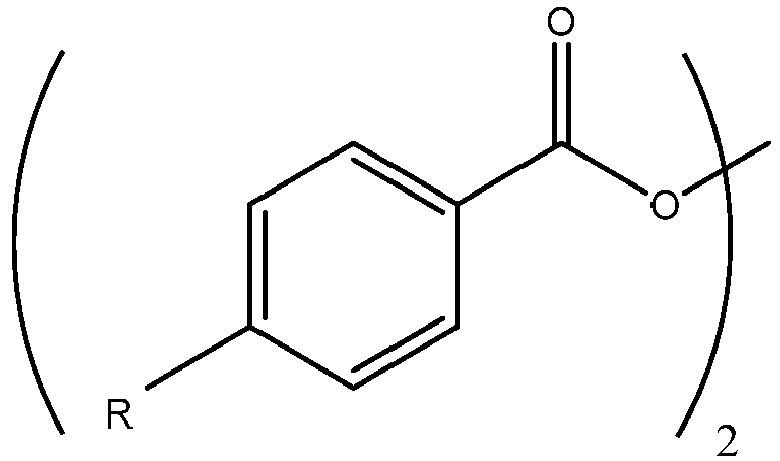
- In a preferred embodiment, each R is individually selected from C1-5 alkyl groups. Examples of such groups are methyl, ethyl, n- propyl, i-propyl, n-butyl, sec-butyl, tert-butyl, and tert-amyl.
- More preferably, at least one R is methyl.
- Most preferably, the organic peroxide is di(para-methylbenzoyl) peroxide (i.e., each R is methyl).
- Preferably, the organic peroxide composition comprises from 40-75 wt.%, preferably from 45-70 wt.%, more preferably from 50-65 wt.% of the at least one organic peroxide as described above (wt.% based on the total weight of the organic peroxide composition).
- The organic peroxide composition comprises as a second essential component b) at least one water retaining agent that is a solid at room temperature. The term "water retaining agent" has its ordinary meaning, which (in this technical context) means an agent that causes water to be retained in the organic peroxide composition (e.g., via absorption or adsorption of free water in the composition by the "water retaining agent"), particularly when subjected to compressive forces (i.e., minimize water loss when the composition is compressed). The test for determining whether an agent is a particularly suitable "water retaining agent" for use in the presently disclosed organic peroxide compositions is set out in the worked examples below ("Protocol A"). "Solid at room temperature" has its ordinary meaning, i.e., a solid at 25°C and 1 atmosphere. It was found that retaining water in the solid organic peroxide composition was critical to successfully producing a polypropylene product by extrusion under a non-inert atmosphere with the same desirable technical properties of the polypropylene products produced by the process of
WO 2019/038244 . Water retaining agents suitable for use in chemical compositions are known and readily available to the skilled person. Examples of suitable water retaining agents according to the present disclosure include, but are not necessarily limited to: - anionic clays, such as, but not limited to, synthetic and natural layered double hydroxides including, but not limited to, natural and synthetic hydrotalcites;
- water absorbing polymers, such as, but not limited to, acrylic-based water absorbing polymers (e.g. poly(meth)acrylic acids, polyacrylamides, etc.), polyvinylalcohol-based water absorbing polymers, polyethylene glycol-based water absorbing polymers, polysaccharide-based water absorbing polymers (e.g., water absorbing polymers based native or modified starch, native or modified cellulose [notably carboxymethyl celluloses], native or modified cyclodextrins, native or modified guar gums, etc.), polyamide-based water absorbing polymers (e.g., polyaspartic acid);
- metal carbonates and metal bicarbonates, such as, but not limited to, Ca, Mg, Zn, Na, K, or Li carbonate, or Na, K, or Li bicarbonate;
- metal oxides, such as, but not limited to, CaO, MgO, and ZnO;
- metal silicates, such as, but not limited to, calcium silicate or magnesium silicate;
- metal phosphates, such as, but not limited to, dicalcium phosphate;
- hydrophilic silicas; and
- metal sulfate drying agents, such as, but not limited to, sodium sulfate, barium sulfate, and magnesium sulfate.
- Preferred water retaining agents comprise or consist of at least one anionic clay. Anionic clays have a crystal structure comprising positively charged layers built up of combinations of divalent and trivalent metal hydroxides between which there are anions and water molecules. Hydrotalcite is an example of a naturally occurring anionic clay, in which carbonate is the predominant anion and the layers contain Mg and Al. Various natural, synthetic, and modified forms with other di- and/or trivalent metals and/or anions (including nitrate anions, organic anions and pillaring anions) are known and suitable for use in the compositions disclosed herein. Preferred anionic clays are anionic clays with carbonate or hydroxide anions in the interlayers. It has been found that the anionic clays are particularly effective in the presently disclosed compositions, such as the naturally occurring and synthetic hydrotalcites, for example aluminum magnesium hydroxide carbonate.
- Preferably, the organic peroxide composition comprises from 1-30 wt.%, preferably from 3-20 wt.%, more preferably from 5-15 wt.% of the at least one water retaining agent (wt.% based on the total weight of the organic peroxide composition).
- The organic peroxide composition comprises as a third essential component c) water. Preferably, the organic peroxide composition comprises from 5-30 wt.%, preferably from 10-25 wt.%, more preferably from 15-20 wt.% water (wt.% based on the total weight of the organic peroxide composition).
- Other additives conventionally used in organic peroxide compositions may also be included in the organic peroxide composition disclosed herein. These conventional additives typically account for about 5-25 wt.%, preferably 5-20 wt.%, of the organic peroxide composition. Preferred additives include stabilizers, such as (but not limited to) one or more antioxidants, for example primary antioxidants, e.g. phenolic types, and/or secondary antioxidants, e.g. phosphite, sulphite types (such as Irganox® 1010 [phenolic; pentaerythritol tetrakis(3-(3,5-ditert-butyl-4-hydroxyphenyl)propionate)] and/or Irgafos 168 [phosphite; tris(2,4-di-tert-butylphenyl)-phosphite], or a 1:1 blend of both antioxidants which is named Irganox B225 (all of which are available from BASF®).
- In a preferred embodiment, the organic peroxide composition in solid form (preferably in the form of compacted solid articles, such as flakes or granules) comprises
- a) 40-75 wt.% of at least one organic peroxide of the formula

- b) 1-30 wt.% of at least one water retaining agent that is a solid at room temperature and meets the requirements of "Protocol A";
- c) 5-30 wt.% water; and
- d) optionally 5-25 wt.% of at least one antioxidant.
- In a more preferred embodiment, the organic peroxide composition in solid form (preferably in the form of compacted solid articles, such as flakes or granules) comprises
- a) 40-75 wt.% of at least one organic peroxide of the formula

- b) 1-30 wt.% of at least one water retaining agent that is a solid at room temperature, selected from anionic clays;
- c) 5-30 wt.% water; and
- d) optionally 5-25 wt.% of at least one antioxidant, preferably at least one primary antioxidant and/or at least one secondary antioxidant.
- In a more preferred embodiment, the organic peroxide composition in solid form (preferably in the form of compacted solid articles, such as flakes or granules) comprises
- a) 40-75 wt.% of di(para-methylbenzoyl) peroxide;
- b) 1-30 wt.% of at least one water retaining agent that is a solid at room temperature, selected from hydrotalcites;
- c) 5-30 wt.% water; and
- d) optionally 5-25 wt.% of at least one antioxidant, preferably at least one phenolic-type antioxidant and/or at least one phosphite-type antioxidant or sulphite-type antioxidant.
- In a further preferred embodiment, the organic peroxide composition in solid form (preferably in the form of compacted solid articles, such as flakes or granules) comprises
- a) 40-75 wt.% of di(para-methylbenzoyl) peroxide;
- b) 1-30 wt.% of at least one water retaining agent that is a solid at room temperature, selected from Mg/AI hydrotalcites;
- c) 5-30 wt.% water; and
- d) 5-25 wt.% of at least one antioxidant, preferably at least one phenolic-type antioxidant and/or at least one phosphite or sulphite type antioxidant.
- In a second aspect, the present disclosure relates to a process for enhancing the melt strength of polypropylene by extruding said polypropylene in an extruder, at a temperature between 150°C and 300°C, and in the presence of an organic peroxide composition in solid form as described above.
- The organic peroxide composition is added to the polypropylene prior to or during extrusion. The quantity of organic peroxide composition to be used will depend on the desired degree of modification and on the type of polypropylene employed. Preferably, the amount of organic peroxide composition used is such that the concentration of the at least one organic peroxide a) is in the range of 0.1 to 5.0 g of peroxide per 100 g polypropylene, more preferably in the range of 0.5 to 3.0 g per 100 g polypropylene.
- Preferably, the extrusion is performed at a temperature in the range 155-250°C, more preferably 160-240°C.
- The polypropylene can be a homopolymer of propylene or a random, alternating, heterophasic, or block co- or terpolymer of propylene and other olefins. Generally, a propylene copolymer or terpolymer will contain one or more other olefins, such as ethylene, butene, pentene, hexene, heptene, or octene, but it may also comprise styrene or styrene derivatives. The content of olefins other than propylene is preferably not more than 30 wt% of all monomers.
- Polypropylene homopolymers and copolymers of propylene and ethylene are most preferred. It is also possible to use mixtures of polypropylene and polyethylene, such as polyolefins recycle streams.
- The melting point of commercially available propylene homopolymer is about 160-170°C. The melting point of propylene copolymers and terpolymers is generally lower.
- The molecular weight of the polypropylene used can be selected from a wide range. Indicative of the molecular weight is the melt flow index (MFI). Use may be made of a polypropylene having a MFI from 0.1 to 1000 g/10 min (230°C, 21.6 N). Preferably, use is made of a polypropylene having a MFI from 0.5 to 250 g/10 min.
- The polypropylene may be a branched polypropylene, such as described in
WO 2016/126429 andWO 2016/126430 . - Extrusion allows modification of the polypropylene to be combined with pelletization. Use is made of a single screw extruder or a twin screw extruder. Twin screw extruders are preferred because they more thoroughly homogenize the peroxide within the polypropylene. The residence time in the extruder is generally about 10 seconds to about 5 minutes.
- The screw speed of the extruder is preferably in the range 25-1000 rpm. The temperature of the extruder should be above the melting temperature of the polypropylene.
- The process can be carried out as a batch process, a continuous process, or a combination thereof. A continuous process is preferred.
- During extrusion, vacuum or atmospheric degassing may be applied in order to remove volatile decomposition products and any water introduced as part of the peroxide formulation.
- Extrusion may be conducted in the presence of a co-agent in order to influence the melt flow index of the polypropylene and/or to enhance the degree of modification. Examples of coagents are TMAIC (trimethallyl isocyanurate), TAIC (triallyl isocyanurate), TAC (triallycyanurate), TRIM (trimethylol propane trimethacrylate), divinylbenzene, HVA-2 (N,N'-phenylene bismaleimide), AMSD (alpha methyl styrene dimer), and Perkalink 900 (1,3-bis(citraconimidomethyl)benzene).
- A co-agent is generally understood to be a polyfunctional reactive additive such as a polyunsaturated compound which will react rapidly with polymer radicals, will overcome steric hindrance and minimize undesirable side reactions. The incorporation of an effective amount of one or more of these co-agents into the polypropylene, prior to or during the process of the present invention tends to influence the melt flow index and molecular weight of the resulting polypropylene.
- If so desired, conventional adjuvants, in an amount known to one skilled in the art, such as antioxidants, UV-stabilizers, lubricants, antidegradants, foaming agents, nucleating agents, fillers, pigments, acid catchers (e.g. calcium stearate), and/or antistatic agents may be added to the polypropylene. These adjuvants can be added to the polypropylene before as well as during or after extrusion. For example, a chemical blowing agent (e.g. azodicarbonamide) can be added or a physical blowing agent (e.g. a gas like nitrogen, carbon dioxide, butane, or isobutane) can be injected into an extruder in order to produce foamed polypropylene. A chemical blowing agent is preferably added before or after extrusion; a physical blowing agent is preferably injected during or after the extrusion.
- The HMS-PP may be further processed as known to one of ordinary skill in the art. It may be formed directly into a desired end product, it may be processed using an underwater pelletizer, or it may be purified, modified, moulded, or blended with miscible amounts of other (polymer) materials, such as EPM, EPDM, and/or LDPE. Thus, there may be modifications using another polymer or monomer in order to enhance the end product's compatibility with other materials.
- Alternatively, the HMS-PP may be degraded to increase its processability and/or applicability or may be further processed by, for example, foaming, foam moulding, injection moulding, blow moulding, extrusion coating, profile extrusion, cast film extrusion, blown film extrusion, and/or thermoforming.
- It is noted that various elements of the present invention, including but not limited to preferred ranges for the various parameters, can be combined unless they are mutually exclusive.
- The invention will be elucidated by the following examples without being limited thereto or thereby.
- The melt flow index (MFI) was measured with a Goettfert Melt Indexer MI-3 according to ISO 1133 (230°C/2.16 kg load). The MFI is expressed in g/10 min.
- The melt strength (MS) was measured (in cN) with a Goettfert Rheograph 20 (capillary rheometer) in combination with a Goettfert Rheotens 71.97, according to the manufacturer's instructions using the following configuration and settings:
- Rheograph:
- Temperature: 220°C
- Melting time: 10 minutes
- Die: capillary, length 30 mm, diameter 2 mm
- Barrel chamber and piston: diameter 15 mm
- Piston speed: 0.32 mm/s, corresponding to a shear rate of 72 s-1
- Melt strand speed (at start): 20 mm/s
- Rheotens:
- Acceleration of wheels (strand): 10 mm/s2
- Barrel to mid-wheel distance: 100 mm
- Strand length: 70 mm
- 500 g of polypropylene homopolymer (PP) powder, organic peroxide formulation, and 0.5 g (0.1 phr) Irganox® 1010 antioxidant, were mixed in a bucket with a spatula, and subsequently in a bucket mixer for 10 min. The organic peroxide formulation was added in amounts corresponding to the wt.% pure peroxide set out in Table 1.
- The following organic peroxide formulations were used:
- Dibenzoyl peroxide, 75% with water (Perkadox® L-W75, Nouryon®)
- Di(para-methylbenzoyl) peroxide, 75% with water (Perkadox® PM-W75, Nouryon®)
- The compounds were extruded on a Haake PolyLab OS RheoDrive 7 system fitted with a Haake Rheomex OS PTW16 extruder (co-rotating twin-screw, L/D=40), from Thermo Scientific, using following settings:
- Temperature profile settings: hopper at 30°C, zone 1 at 160°C, zones 2-4 at 190°C, zones 5-6 at 200°C, zones 7-10 at 210°C.
- Screw speed: 280 rpm.
- Throughput: 1.2 kg/h, dosed by a Brabender gravimetric screw feeder type DDW-MD2-DSR28-10.
- Nitrogen was purged at the hopper (3.5 L/min) and the die (9 L/min).
- The extruded material was led through a water bath for cooling and the cooled strands were granulated by an automatic granulator.
- Melt Flow Index (MFI) and Melt Strength (MS) are directly linked to the molecular weight and long-chain branching of the resulting polypropylene structure. A higher MFI signifies polypropylene degradation by chain scission, while a lower MFI is representative of advantageous long-chain branches, which in turn, lead to an increase in MS. The melt-flow index (MFI) and melt strength (MS) of the extruded HMS-PP compounds were analysed as described below. The results are listed in Table 1.
Table 1 Air atmosphere Inert atmosphere Peroxide (wt%) Melt Flow Index (g/10 min) Melt Strength (cN) Melt Flow Index (g/10 min Melt Strength (cN) PP unmodified 0 7.3 <1 5.6 <1 PP modified with Perkadox L* 1 10 <1 5.6 4.3 PP modified with Perkadox PM* 1 6.1 5.8 4.1 6.8 PP modified with Perkadox L* 2 6.2 4.8 2.9 8 PP modified with Perkadox PM* 2 2.8 7.5 1.1 14 L*: Perkadox® L-W75
PM*: Perkadox® PM-W75 - From the above results it can be seen that the use of an air atmosphere increases polypropylene degradation (higher MFI) and reduces melt strength compared to the use of an inert atmosphere.
- It can also be seen that the best results are achieved when using 1 or 2 wt% Perkadox PM-W75, i.e., di(para-methylbenzoyl)peroxide [di(4-methylbenzoyl)peroxide] (PTP), in an inert atmosphere, rather than using Perkadox L-W75, i.e., dibenzoyl peroxide (BPO).
- An organic peroxide composition in solid form (flakes) in accordance with the present disclosure was prepared as follows.
- Step 1: The following components were added successively to a 50L ploughshare mixer (Lödige mixer) and mixed for 10 minutes at 60rpm: 4.5 kg of Di(para-methylbenzoyl) peroxide (75% with water, Perkadox® PM-W75), 0.9 kg of Irganox® 1010 (phenolic antioxidant), 0.9 kg Irgafos 168 (phosphite antioxidant), 1.2 kg of DHT-4V (an aluminum magnesium hydroxide carbonate hydrotalcite available from Kisuma Chemicals), then 4.5 kg of Di(para-methylbenzoyl) peroxide (75% with water, Perkadox® PM-W75).
- Step 2: 500g batches of the obtained mixture (from step 1) were compacted using an Alexanderwerk WP50 N/75 compactor with the following compactor settings: Pressure 40 bar, feeder on 7.0, rollers on 1.0.
- Step 3: The compacted product (from step 2) was granulated using a Frewitt GLA ORV granulator with a 6mm sieve installed.
- Step 4: The granulated product (from step 3) was sieved using a Retsch AS 450 sieving apparatus installed with a 3.15 mm sieve and a 1.0 mm sieve. The granulated product was first sieved using the 3.15mm sieve followed by the 1.0 mm sieve. Fines (<1mm) were returned to the compactor. The final product recovered from the sieves was in the form of solid flakes.
- Based on the solid powders mixed in step 1, the solid flakes had the following approximate composition:
Component Wt. % (relative to total weight of flake) Di(para-methylbenzoyl) peroxide 56 Water 19 Irganox® 1010 7.5 Irgafos 168 7.5 Hydrotalcite 10 - In this example, polypropylene homopolymer (PP) powder and the solid flakes of Example 2 were separately dosed to a twin-screw extruder. Two ways of feeding were applied:
- in a closed setup of the hopper under nitrogen purge (at 5 liter/minute) with 1-cm opening for gas release ("inert atmosphere")
- in an open setup into a funnel under air ("air atmosphere")
- The compounds were extruded on a Coperion W&P ZSK30 twin-screw extruder (co-rotating twin-screw, UD=36) using following settings:
- Throughput PP: 9.75 kg/h, dosed by a Ktron loss-in-weight feeder
- Throughput organic peroxide formulation: 0.25 kg/h, dosed by a Plasticolor 1500 single screw feeder (volumetric), placed on a balance to record the dosing rate in kg/h
- Temperature profile settings: hopper at 20°C, zone 1 at 160°C, zones 2-3 at 190°C, zone 4 at 200°C, zones 5-6 at 210°C (zone 6=die)
- Screw speed: 300 rpm
- Vacuum degassing was applied at approx. -0.8 bar
- The extruded material was led through a water bath for cooling and the cooled strands were granulated by an automatic granulator.
- As a comparison to show the beneficial effect of water in the flakes, a batch of flakes of Example 2 without water was also tested (i.e., water was deliberately removed from the flakes of Example 2 by intentionally drying the flakes prior to testing). The results are shown in Table 2.
Table 2 Air atmosphere Inert atmosphere Peroxide (wt%) Melt Flow Index (g/10 min) Melt Strength (cN) Melt Flow Index (g/10 min Melt Strength (cN) PP unmodified* 0 5.6 2 5.0 2 PP modified with Example 2 1.3 -- -- 2.8 13.5 PP modified with Example 2 1.4 2.6 16 -- -- PP modified with Example 2 [no water - Comparative] 1.4 -- -- 3.0 15 PP modified with Example 2 [no water - Comparative]* 1.3 4.7 11 -- -- * PP product produced under air atmosphere had a visibly yellow colour - The above results clearly demonstrate the efficacy of the organic peroxide composition of the present disclosure. The polypropylene product that was produced under an air atmosphere had essentially the same technical properties as the product that was produced under an inert atmosphere (i.e., the air atmosphere did not affect the performance of the peroxide composition). The flakes without water, however, showed a notable loss of performance under an air atmosphere (polypropylene degradation, product yellowing, and lower melt strength).
- Thus, to summarize the above:
- Comparative Example 1 - organic peroxides with water, but with no water retaining agent, demonstrate a notable loss of performance under an air atmosphere.
- Comparative Example 3 - organic peroxides with water retaining agent, but with no water, demonstrate a notable loss of performance under an air atmosphere.
- Inventive Example 3 - organic peroxides with water retaining agent and water demonstrate no notable loss of performance under an air atmosphere.
- It can be concluded from these results that the water and water retaining agent are acting in synergy to produce the substantially improved technical outcome.
- Example 3 was repeated using a polypropylene random copolymer instead of a polypropylene homopolymer. A sample of the fines (from step 4 of Example 2) was also tested, by preparing a premixture with the PP powder in a tumble mixer (concrete mill) upfront and dosing this premix via the Ktron feeder at 10 kg/h. The results are set out in Table 3 and corroborate the above conclusions.
Table 3 Air atmosphere Inert atmosphere Peroxide (wt%) Melt Flow Index (g/10 min) Melt Strength (cN) Melt Flow Index (g/10 min) Melt Strength (cN) PP unmodified 0 4.0 <1 3.4 1 PP modified with Example 2 1.5 0.8 20 0.8 20 PP modified with fines (Example 2) 1.5 0.5 22 1.1 21 - The following solid compositions were prepared by mixing the following ingredients: 80 parts by weight (pbw) di(para-methylbenzoyl) peroxide (75% with water, Perkadox® PM-W75), 7.5 pbw Irganox® 1010 (phenolic antioxidant), 7.5 pbw Irgafos 168 (phosphite antioxidant), and 5 pbw water retaining agent. The resulting solid compositions contained the following components in the stated amounts:
Component Wt. % (relative to total weight) Di(para-methylbenzoyl) peroxide 60 Water 20 Irganox® 1010* 7.5 Irgafos 168+ 7.5 Water Retaining Agent 5 - Each solid composition was compacted on a pelletizing press (Herzog HTP 40; Diameter press chamber: 25 mm; Intake product: 10.0 g; Pressure: 20 ± 5 kN (0.4 ± 0.1 ton/cm2)) and the water lost (i.e., the water pressed out of the tablets by the press under these test conditions) was determined (i.e., % water loss was calculated based on the weight difference of the powder mixture prior to pressing and the tablet after pressing). The water loss is reported as a % of the original water content. For example, a weight loss of 1 g (i.e., final weight of 9g) equates to a loss of 50% of the original water content (20 wt.% of 10g = 2g water, hence 1g water pressed out of the tablet = 50% water loss).
- The following agents were tested for their water retaining ability:
- Calcium Stearate
- Lankroflex E2307 (an epoxidized soybean oil)
- DHT-4V (an aluminum magnesium hydroxide carbonate hydrotalcite available from Kisuma Chemicals)
- The results are shown in the Table 4 below.
Table 4 Agent Water loss (%) Calcium Stearate >50 Lankroflex E2307 50 DHT-4V 15 - In the context of the present disclosure, water retaining agents that are particularly suitable for use in the compositions disclosed herein are those agents which cause the composition to retain 60% or more of the original water content when the composition comprising said agent is subjected to the above specific testing conditions (i.e., the water loss is 40% or less relative to the original water content).
- In other words, within the context of the present disclosure, an agent is a particularly suitable "water retaining agent b)" if said agent is a solid at room temperature and meets the requirements of the following experimental protocol (herein named "Protocol A"):
- I. Mix 60 parts by weight (pbw) di(para-methylbenzoyl) peroxide with 20 pbw water, 7.5 pbw pentaerythritol tetrakis(3-(3,5-di-tert-butyl-4-hydroxyphenyl)propionate, 7.5 pbw tris(2,4-di-tert-butylphenyl)-phosphite, and 5 pbw water retaining agent;
- II. Compact 10g of the composition obtained from step I) on a pelletizing press (Herzog HTP 40; Diameter press chamber: 25 mm; Intake product: 10.0 g; Pressure: 20 ± 5 kN (0.4 ± 0.1 ton/cm2));
- III. Weigh (in grams) the compacted composition (pellet) obtained from step II);
- IV. Determine weight loss due to compacting in step II;
- i.e., 10 g - [weight determined in step III];
- under these specific test conditions, the weight loss corresponds to the weight of water lost as a result of the compressive forces applied to the solid composition in step II;
- V. Calculate % loss of water;
- i.e., ([weight loss of step IV] / 2)*100);
- VI. Determine % of original water content retained in the compacted composition;
- i.e., % of original water content = 100%-[% determined in step V];
- VII. If the % calculated in step VI) is ≥60%, then the agent is a particularly suitable water retaining agent b) according to the present disclosure.
- Preferred water retaining agents b) are those wherein the organic peroxide composition comprising the agent b) retains 80% or more of the original water content when subjected to Protocol A.
- As noted above, when the preferred organic peroxide formulations used in
WO 2019/038244 are dosed to an extruder, there is always the potential for unintended spillage of the formulation onto the extruder apparatus. Should that happen, then the water (phlegmatizer) will quickly evaporate, thereby increasing the concentration of the peroxide to the point where the peroxide can become friction and impact sensitive. In the event of that happening, the chance of explosion is significantly increased, which is clearly something to be avoided (especially on an industrial scale). This issue makes handling such organic peroxide formulations somewhat hazardous and challenging. The organic peroxide composition disclosed herein was found to be much safer and easier to handle than the preferred organic peroxide formulations ofWO 2019/038244 . This finding was based on the following thermal explosion and impact sensitivity safety testing that compared the peroxide compositions of Example 2 against the preferred organic peroxide formulations ofWO 2019/038244 . -
- Peroxide composition of Example 2
- Peroxide composition of Example 2 dried (to simulate spillage and evaporation of the water contained in the composition)
- Perkadox PM-W75 (preferred organic peroxide formulation of
WO 2019/038244 ) - Perkadox PM-W75 dried (to simulate spillage and evaporation of the water contained in the formulation)
-
- Criteria: Violent - limiting diameter ≥ 9 mm
- Medium - limiting diameter ≥ 3.5 mm and < 9 mm
- Low - limiting diameter ≥ 1 mm and < 3.5 mm
- No - limiting diameter < 1 mm
-
- Criteria: Very high - impact sensitivity ≤ 2 J
- High - impact sensitivity > 2 J and ≤ 7.5 J
- Medium - impact sensitivity > 7.5 J and ≤ 40 J
- Low - impact sensitivity > 40 J
- The safety test results are shown in Table 5 below:
Table 5 Example 2 Example 2 [dry] Perkadox PM-W75 Perkadox PM-W75 [dry] Thermal explosion No Low Low Violent Impact sensitivity Low Low Low High - These results show that the organic peroxide composition of the present disclosure is safer than Perkadox PM-W75 (no thermal explosion), and much safer than Perkadox PM-W75 in a situation of drying out (e.g., accidental spill near or on the extruder).
- In view of the much-improved air-atmosphere performance and much-improved safety profile, the organic peroxide composition disclosed herein is an excellent candidate for use in polyolefin plastic recycling.
- An organic peroxide composition in solid form (solid granules) in accordance with the present disclosure was prepared as follows.
- Step 1: The following components were added successively to a 10L Eirich R02 planetary mixer and mixed for 15 minutes: 1.5 kg of Di(para-methylbenzoyl) peroxide (75% with water, Perkadox® PM-W75), 0.3 kg of Irganox® 1010 (phenolic antioxidant), 0.3 kg Irgafos 168 (phosphite antioxidant), 0.4 kg of DHT-4V (an aluminum magnesium hydroxide carbonate hydrotalcite available from Kisuma Chemicals), then 1.5 kg of Di(para-methylbenzoyl) peroxide (75% with water, Perkadox® PM-W75).
- Step 2: a 4 kg batch of the obtained mixture (from step 1) was compacted using an Amandus Kahl 14-175 compactor equipped with 4-mm die plate and with the following compactor settings: 50 rpm; torque maintained between 2.5-2.8 kW using manual feeding.
- Step 3: The compacted product (from step 2) was manually sieved on a 2-mm sieve to remove fines. The final product recovered from the sieves was in the form of solid granules (primarily composed of substantially cylindrical-shaped granules with a cross section diameter of 4 mm).
- Based on the solid powders mixed in step 1, the solid granules had the following approximate composition:
Component Wt. % (relative to total weight of granule) Di(para-methylbenzoyl) peroxide 56 Water 19 Irganox® 1010 7.5 Irgafos 168 7.5 Hydrotalcite 10 - An organic peroxide composition in solid form (powder) in accordance with the present disclosure was prepared by blending the following components: 4.5 kg of Di(paramethylbenzoyl) peroxide (75% with water, Perkadox® PM-W75), 0.9 kg of Irganox® 1010 (phenolic antioxidant), 0.9 kg Irgafos 168 (phosphite antioxidant), 1.2 kg of DHT-4V (an aluminum magnesium hydroxide carbonate hydrotalcite available from Kisuma Chemicals), then 4.5 kg of Di(para-methylbenzoyl) peroxide (75% with water, Perkadox® PM-W75).
- The solid powder had the following approximate composition:
Component Wt. % (relative to total weight of powder) Di(para-methylbenzoyl) peroxide 56 Water 19 Irganox® 1010 7.5 Irgafos 168 7.5 Hydrotalcite 10 - In this example, polypropylene homopolymer (PP) powder and a peroxide composition according to the present disclosure were separately dosed to a twin-screw extruder under an air atmosphere. The compounds were extruded on a Coperion W&P ZSK30 twin-screw extruder (co-rotating twin-screw, UD=36) using the following settings:
- Throughput PP: 9.75 kg/h (resp. 8.78 kg/h for CaHPO4-based granules of Example 10), dosed by a Ktron loss-in-weight feeder
- Throughput organic peroxide formulation: 0.25 kg/h (resp. 0.22 kg/h for CaHPO4-based granules of Example 10), dosed by a Plasticolor 1500 single screw feeder (volumetric), placed on a balance to record the dosing rate in kg/h
- Temperature profile settings: hopper at 20°C, zone 1 at 160°C, zones 2-3 at 190°C, zone 4 at 200°C, zones 5-6 at 210°C (zone 6=die)
- Screw speed: 300 rpm
- Vacuum degassing was applied at approx. -0.65 bar
- The extruded material was led through a water bath for cooling, and the cooled strands were granulated by an automatic granulator. The results are shown in Table 6.
Table 6 Air atmosphere Peroxide (wt%) Melt Flow Index (g/10 min) Melt Strength (cN) PP unmodified 0 4.8 2 PP modified with Example 8 (powder) 1.5 3.1 15 PP modified with Example 7 (granules) 1.57 2.4 14 PP modified with Example 2 (flakes) 1.53 2.2 15 - As expected, the organic peroxide compositions of the present disclosure (Examples 2, 7 and 8) substantially reduced the melt flow index and substantially increased the melt strength. An unexpected observation, however, was that the physical form of the organic peroxide composition appeared to have a material impact upon the MFI: the compacted compositions (flakes and granules) outperformed the equivalent blend that had not been subjected to a compacting step (blended powder). Accordingly, even though the powder form yielded excellent results, it was found that those results could be further enhanced by converting the blend into compacted articles (e.g., flakes and granules).
- An organic peroxide composition in solid form (solid granules) in accordance with the present disclosure was prepared as follows. Dicalcium phosphate (CaHPO4.2H2O) was the water retaining agent in this example.
- Step 1: The following components were added successively to a 10L Eirich R02 planetary mixer and mixed for 15 minutes: 1.6 kg of Di(para-methylbenzoyl) peroxide (75% with water, Perkadox® PM-W75), 0.8 kg of dicalcium phosphate (CaHPO4.2H2O), then 1.6 kg of Di(para-methylbenzoyl) peroxide (75% with water, Perkadox® PM-W75).
- Step 2: a 4 kg batch of the obtained mixture (from step 1) was compacted using an Amandus Kahl 14-175 compactor equipped with 4-mm die plate and with the following compactor settings: 50 rpm; torque maintained between 2.5-2.8 kW using manual feeding.
- Step 3: The compacted product (from step 2) was manually sieved on a 2-mm sieve to remove fines. The final product recovered from the sieves was in the form of solid granules (primarily composed of substantially cylindrical-shaped granules with a cross section diameter of 4 mm).
- Based on the solid powders mixed in step 1, the solid granules had the following approximate composition:
Component Wt. % (relative to total weight of granule) Di(para-methylbenzoyl) peroxide 60 Water 20 Dicalcium phosphate (2 aq) 20 - Under equivalent PP processing conditions as Example 9, the granules performed as expected (reduced MFI, increased melt strength; results are shown in Table 7)
Table 7 Air atmosphere Peroxide (wt%) Melt Flow Index (g/10 min) Melt Strength (cN) PP unmodified 0 4.8 2 PP modified with Example 10 1.43 3.4 13 - In this specification, unless expressly otherwise indicated, the word 'or' is used in the sense of an operator that returns a true value when either or both of the stated conditions is met, as opposed to the operator 'exclusive or' which requires that only one of the conditions is met. The word 'comprising' is used in the sense of 'including' rather than to mean 'consisting of'. All prior teachings acknowledged above are hereby incorporated by reference. No acknowledgement of any prior published document herein should be taken to be an admission or representation that the teaching thereof was common general knowledge in Europe or elsewhere at the date hereof.
Claims (15)
- An organic peroxide composition in solid form comprisinga) at least one organic peroxide of the formula
 b) at least one water retaining agent that is a solid at room temperature; andc) water.
- The organic peroxide composition of claim 1, wherein each R is individually selected from methyl, ethyl, n-propyl, i-propyl, n-butyl, sec-butyl, tert-butyl, and tert-amyl.
- The organic peroxide composition of claims 1 or 2, wherein the at least one organic peroxide is di(para-methylbenzoyl) peroxide.
- The organic peroxide composition of any one of claims 1 to 3, wherein organic peroxide composition comprises from 40-75 wt.%, preferably from 45-70 wt.%, more preferably from 50-65 wt.% of the at least one organic peroxide a) (wt.% based on the total weight of the organic peroxide composition).
- The organic peroxide composition of any one of claims 1 to 4, wherein the at least one water retaining agent b) is selected from one or more of the following:• anionic clays;• water absorbing polymers;• metal carbonates and metal bicarbonates;• metal oxides;• metal silicates;• metal phosphates;• hydrophilic silicas; or• metal sulfate drying agents.
- The organic peroxide composition of claim 5, wherein the at least one water retaining agent comprises one or more anionic clays.
- The organic peroxide composition of any one of claims 1 to 6, wherein the organic peroxide composition comprises from 1-30 wt.%, preferably from 3-20 wt.%, more preferably from 5-15 wt.% of the at least one water retaining agent b) (wt.% based on the total weight of the organic peroxide composition).
- The organic peroxide composition of any one of claims 1 to 7, wherein the organic peroxide composition comprises from 5-30 wt.%, preferably from 10-25 wt.%, more preferably from 15-20 wt.% water (wt.% based on the total weight of the organic peroxide composition).
- The organic peroxide composition of any one of claims 1 to 8, further comprising one or more stabilizers, preferably in an amount of from 5-20 wt.% (wt.% based on the total weight of the organic peroxide composition).
- The organic peroxide composition of claim 9, wherein the one or more stabilizers comprises or consists of one or more antioxidants.
- A process for enhancing the melt strength of polypropylene by extruding said polypropylene in an extruder, at a temperature between 150°C and 300°C, and in the presence of an organic peroxide composition according to any one of claims 1 to 10.
- The process of claim 11, wherein the organic peroxide composition is added to the polypropylene prior to or during extrusion.
- The process of claims 11 or 12, wherein the amount of organic peroxide composition used is such that the concentration of the at least one organic peroxide a) is in the range of 0.1 to 5.0 g of peroxide per 100 g polypropylene, more preferably in the range of 0.5 to 3.0 g per 100 g polypropylene.
- The process of any one of claims 11 to 13, wherein the polypropylene is a homopolymer of propylene or a random, alternating, heterophasic, or block co- or terpolymer of propylene and other olefins.
- Use of an organic peroxide composition according to any one of claims 1 to 10 for increasing the melt strength of polypropylene and/or as an additive for polyolefin plastic recycling.
Applications Claiming Priority (1)
| Application Number | Priority Date | Filing Date | Title |
|---|---|---|---|
| EP23157698.4A EP4421117A1 (en) | 2023-02-21 | 2023-02-21 | Organic peroxide composition |
Publications (1)
| Publication Number | Publication Date |
|---|---|
| EP4421118A1 true EP4421118A1 (en) | 2024-08-28 |
Family
ID=85321060
Family Applications (2)
| Application Number | Title | Priority Date | Filing Date |
|---|---|---|---|
| EP23157698.4A Withdrawn EP4421117A1 (en) | 2023-02-21 | 2023-02-21 | Organic peroxide composition |
| EP24158525.6A Pending EP4421118A1 (en) | 2023-02-21 | 2024-02-20 | Organic peroxide composition |
Family Applications Before (1)
| Application Number | Title | Priority Date | Filing Date |
|---|---|---|---|
| EP23157698.4A Withdrawn EP4421117A1 (en) | 2023-02-21 | 2023-02-21 | Organic peroxide composition |
Country Status (5)
| Country | Link |
|---|---|
| US (1) | US20240287284A1 (en) |
| EP (2) | EP4421117A1 (en) |
| JP (1) | JP7685091B2 (en) |
| KR (1) | KR20240130033A (en) |
| CN (1) | CN118530512A (en) |
Citations (9)
| Publication number | Priority date | Publication date | Assignee | Title |
|---|---|---|---|---|
| WO1999027007A1 (en) | 1997-11-21 | 1999-06-03 | Akzo Nobel N.V. | Extrusion process for enhancing the melt strength of polypropylene |
| WO1999036466A1 (en) | 1998-01-19 | 1999-07-22 | Polymers Australia Pty Limited | Process for increasing the melt strength of polypropylene |
| CN103642356A (en) * | 2013-12-07 | 2014-03-19 | 天津市华鑫达投资有限公司 | Crosslinked polypropylene viscoelastic composite coating and preparation method thereof |
| CN103739946A (en) * | 2013-12-07 | 2014-04-23 | 天津市华鑫达投资有限公司 | High-impact high-stiffness polypropylene rotational molding material and preparation method thereof |
| WO2016126430A1 (en) | 2015-02-04 | 2016-08-11 | Exxonmobil Chemical Patents Inc. | Stabilized balanced melt strength and strain hardened polypropylene |
| WO2016126429A1 (en) | 2015-02-04 | 2016-08-11 | Exxonmobil Chemical Patents Inc. | Polypropylenes having balanced strain hardening, melt strength, and shear thinning |
| CN107325462A (en) * | 2017-05-16 | 2017-11-07 | 安徽瑞鑫自动化仪表有限公司 | A kind of subsurface environment rubber sheath |
| WO2019038244A1 (en) | 2017-08-24 | 2019-02-28 | Akzo Nobel Chemicals International B.V. | Process for producing high melt strength polypropylene |
| EP3864005A1 (en) * | 2018-10-12 | 2021-08-18 | Nouryon Chemicals International B.V. | Solid organic peroxide composition |
Family Cites Families (2)
| Publication number | Priority date | Publication date | Assignee | Title |
|---|---|---|---|---|
| TW341579B (en) | 1996-06-24 | 1998-10-01 | Akzo Nobel Nv | Process for enhancing the melt strength of polypropylene (co)polymers |
| CN111770913B (en) | 2017-12-19 | 2023-05-16 | 诺力昂化学品国际有限公司 | Process for the preparation of pulverulent organic peroxide formulations |
-
2023
- 2023-02-21 EP EP23157698.4A patent/EP4421117A1/en not_active Withdrawn
-
2024
- 2024-02-16 JP JP2024021683A patent/JP7685091B2/en active Active
- 2024-02-19 KR KR1020240023167A patent/KR20240130033A/en active Pending
- 2024-02-20 EP EP24158525.6A patent/EP4421118A1/en active Pending
- 2024-02-21 US US18/583,099 patent/US20240287284A1/en active Pending
- 2024-02-21 CN CN202410191150.9A patent/CN118530512A/en active Pending
Patent Citations (9)
| Publication number | Priority date | Publication date | Assignee | Title |
|---|---|---|---|---|
| WO1999027007A1 (en) | 1997-11-21 | 1999-06-03 | Akzo Nobel N.V. | Extrusion process for enhancing the melt strength of polypropylene |
| WO1999036466A1 (en) | 1998-01-19 | 1999-07-22 | Polymers Australia Pty Limited | Process for increasing the melt strength of polypropylene |
| CN103642356A (en) * | 2013-12-07 | 2014-03-19 | 天津市华鑫达投资有限公司 | Crosslinked polypropylene viscoelastic composite coating and preparation method thereof |
| CN103739946A (en) * | 2013-12-07 | 2014-04-23 | 天津市华鑫达投资有限公司 | High-impact high-stiffness polypropylene rotational molding material and preparation method thereof |
| WO2016126430A1 (en) | 2015-02-04 | 2016-08-11 | Exxonmobil Chemical Patents Inc. | Stabilized balanced melt strength and strain hardened polypropylene |
| WO2016126429A1 (en) | 2015-02-04 | 2016-08-11 | Exxonmobil Chemical Patents Inc. | Polypropylenes having balanced strain hardening, melt strength, and shear thinning |
| CN107325462A (en) * | 2017-05-16 | 2017-11-07 | 安徽瑞鑫自动化仪表有限公司 | A kind of subsurface environment rubber sheath |
| WO2019038244A1 (en) | 2017-08-24 | 2019-02-28 | Akzo Nobel Chemicals International B.V. | Process for producing high melt strength polypropylene |
| EP3864005A1 (en) * | 2018-10-12 | 2021-08-18 | Nouryon Chemicals International B.V. | Solid organic peroxide composition |
Non-Patent Citations (4)
| Title |
|---|
| "UN Manual of Tests and Criteria", 2019 |
| DATABASE CA [online] CHEMICAL ABSTRACTS SERVICE, COLUMBUS, OHIO, US; 20 March 2014 (2014-03-20), LI, YUNYAN ET AL: "Cross-linked polypropylene viscoelastic composite coating and preparation method thereof", XP002809824, retrieved from STN Database accession no. 2014:443975 * |
| DATABASE CA [online] CHEMICAL ABSTRACTS SERVICE, COLUMBUS, OHIO, US; 25 April 2014 (2014-04-25), LI, YUNYAN ET AL: "Polypropylene rotational molding material with high impact resistance and high rigidity and preparation method of the same", XP002809825, retrieved from STN Database accession no. 2014:667024 * |
| DATABASE CA [online] CHEMICAL ABSTRACTS SERVICE, COLUMBUS, OHIO, US; 7 November 2017 (2017-11-07), GAO, FENGYI: "Rubber sheath applied to underground environment", XP002809827, retrieved from STN Database accession no. 2017:1760946 * |
Also Published As
| Publication number | Publication date |
|---|---|
| CN118530512A (en) | 2024-08-23 |
| EP4421117A1 (en) | 2024-08-28 |
| US20240287284A1 (en) | 2024-08-29 |
| JP7685091B2 (en) | 2025-05-28 |
| JP2024119049A (en) | 2024-09-02 |
| KR20240130033A (en) | 2024-08-28 |
Similar Documents
| Publication | Publication Date | Title |
|---|---|---|
| KR100591817B1 (en) | Crosslinking composition | |
| KR102438935B1 (en) | Peroxide Masterbatch | |
| EP3673010B1 (en) | Process for producing high melt strength polypropylene | |
| JP2002332359A (en) | Additive composition for granular polyolefin, method for producing the same, polyolefin resin composition containing the composition, and molded article thereof | |
| JP7685091B2 (en) | organic peroxide composition | |
| KR20190078628A (en) | Peroxide master batch | |
| BR102024003265B1 (en) | Organic peroxide composition in solid form, process for increasing the melt strength of polypropylene, and use of an organic peroxide composition. | |
| BR102024003265A2 (en) | COMPOSITION OF ORGANIC PEROXIDE IN SOLID FORM, PROCESS FOR INCREASING THE MELT STRENGTH OF POLYPROPYLENE AND USE OF AN ORGANIC PEROXIDE COMPOSITION | |
| EP3155040B1 (en) | Process for enhancing the melt strength of polypropylene | |
| CN106554580A (en) | A kind of PVC packagings for foodstuff composition and preparation method thereof | |
| JPS624419B2 (en) | ||
| JP2023545044A (en) | How to change the optical appearance of polymers | |
| RU2286997C2 (en) | Polymeric composition | |
| US5246975A (en) | Blowing agents | |
| KR102125637B1 (en) | Polyolefin composition | |
| JPH0588859B2 (en) | ||
| JP2019172745A (en) | Hollow molded body made of propylene-based resin composition | |
| JPH07216155A (en) | Method of modifying polypropylene resin | |
| JP2002212436A (en) | Flame retardant resin, molded product thereof and method of producing flame retardant resin | |
| CS249408B1 (en) | Composite material based on copolymers of propylene with ethylene | |
| HU195525B (en) | Process for preparing curdled polyolefines of invariant melt viscosity |
Legal Events
| Date | Code | Title | Description |
|---|---|---|---|
| PUAI | Public reference made under article 153(3) epc to a published international application that has entered the european phase |
Free format text: ORIGINAL CODE: 0009012 |
|
| STAA | Information on the status of an ep patent application or granted ep patent |
Free format text: STATUS: REQUEST FOR EXAMINATION WAS MADE |
|
| 17P | Request for examination filed |
Effective date: 20240220 |
|
| AK | Designated contracting states |
Kind code of ref document: A1 Designated state(s): AL AT BE BG CH CY CZ DE DK EE ES FI FR GB GR HR HU IE IS IT LI LT LU LV MC ME MK MT NL NO PL PT RO RS SE SI SK SM TR |
|
| P01 | Opt-out of the competence of the unified patent court (upc) registered |
Free format text: CASE NUMBER: APP_61769/2024 Effective date: 20241119 |
|
| STAA | Information on the status of an ep patent application or granted ep patent |
Free format text: STATUS: EXAMINATION IS IN PROGRESS |
|
| 17Q | First examination report despatched |
Effective date: 20260409 |