EP4420719B1 - Dynamischer stegfilter und bereichsschieber und bestrahlungssystem mit selbigen - Google Patents
Dynamischer stegfilter und bereichsschieber und bestrahlungssystem mit selbigen Download PDFInfo
- Publication number
- EP4420719B1 EP4420719B1 EP23158167.9A EP23158167A EP4420719B1 EP 4420719 B1 EP4420719 B1 EP 4420719B1 EP 23158167 A EP23158167 A EP 23158167A EP 4420719 B1 EP4420719 B1 EP 4420719B1
- Authority
- EP
- European Patent Office
- Prior art keywords
- axis
- string
- filter
- along
- shifter
- Prior art date
- Legal status (The legal status is an assumption and is not a legal conclusion. Google has not performed a legal analysis and makes no representation as to the accuracy of the status listed.)
- Active
Links
Images



Classifications
-
- A—HUMAN NECESSITIES
- A61—MEDICAL OR VETERINARY SCIENCE; HYGIENE
- A61N—ELECTROTHERAPY; MAGNETOTHERAPY; RADIATION THERAPY; ULTRASOUND THERAPY
- A61N5/00—Radiation therapy
- A61N5/10—X-ray therapy; Gamma-ray therapy; Particle-irradiation therapy
- A61N5/1077—Beam delivery systems
-
- A—HUMAN NECESSITIES
- A61—MEDICAL OR VETERINARY SCIENCE; HYGIENE
- A61N—ELECTROTHERAPY; MAGNETOTHERAPY; RADIATION THERAPY; ULTRASOUND THERAPY
- A61N5/00—Radiation therapy
- A61N5/10—X-ray therapy; Gamma-ray therapy; Particle-irradiation therapy
-
- A—HUMAN NECESSITIES
- A61—MEDICAL OR VETERINARY SCIENCE; HYGIENE
- A61N—ELECTROTHERAPY; MAGNETOTHERAPY; RADIATION THERAPY; ULTRASOUND THERAPY
- A61N5/00—Radiation therapy
- A61N5/10—X-ray therapy; Gamma-ray therapy; Particle-irradiation therapy
- A61N5/1048—Monitoring, verifying, controlling systems and methods
- A61N5/1064—Monitoring, verifying, controlling systems and methods for adjusting radiation treatment in response to monitoring
- A61N5/1065—Beam adjustment
-
- A—HUMAN NECESSITIES
- A61—MEDICAL OR VETERINARY SCIENCE; HYGIENE
- A61N—ELECTROTHERAPY; MAGNETOTHERAPY; RADIATION THERAPY; ULTRASOUND THERAPY
- A61N5/00—Radiation therapy
- A61N5/10—X-ray therapy; Gamma-ray therapy; Particle-irradiation therapy
- A61N5/1042—X-ray therapy; Gamma-ray therapy; Particle-irradiation therapy with spatial modulation of the radiation beam within the treatment head
- A61N5/1043—Scanning the radiation beam, e.g. spot scanning or raster scanning
-
- G—PHYSICS
- G21—NUCLEAR PHYSICS; NUCLEAR ENGINEERING
- G21K—HANDLING OF PARTICLES OR IONISING RADIATION NOT OTHERWISE PROVIDED FOR; IRRADIATION DEVICES; GAMMA RAY OR X-RAY MICROSCOPES
- G21K1/00—Arrangements for handling particles or ionising radiation, e.g. focusing or moderating
- G21K1/10—Scattering devices; Absorbing devices; Ionising radiation filters
-
- A—HUMAN NECESSITIES
- A61—MEDICAL OR VETERINARY SCIENCE; HYGIENE
- A61N—ELECTROTHERAPY; MAGNETOTHERAPY; RADIATION THERAPY; ULTRASOUND THERAPY
- A61N5/00—Radiation therapy
- A61N5/10—X-ray therapy; Gamma-ray therapy; Particle-irradiation therapy
- A61N2005/1085—X-ray therapy; Gamma-ray therapy; Particle-irradiation therapy characterised by the type of particles applied to the patient
- A61N2005/1087—Ions; Protons
-
- A—HUMAN NECESSITIES
- A61—MEDICAL OR VETERINARY SCIENCE; HYGIENE
- A61N—ELECTROTHERAPY; MAGNETOTHERAPY; RADIATION THERAPY; ULTRASOUND THERAPY
- A61N5/00—Radiation therapy
- A61N5/10—X-ray therapy; Gamma-ray therapy; Particle-irradiation therapy
- A61N2005/1092—Details
- A61N2005/1095—Elements inserted into the radiation path within the system, e.g. filters or wedges
Definitions
- the shaping device comprises a dynamic ridge filter and / or a dynamic range shifter.
- the dynamic shaping device of the present invention comprises a number of identical rows formed by a number of modules of different predefined geometries. Each row is configured to translate independently along a Y-axis to define a string formed by a selection of one module of each row aligned along an X-axis (X ⁇ Y) and configured to shape the dose deposited onto the specific volume facing the string.
- the dynamic shaping device of the present invention has the advantage that a single dynamic shaping device can be used to shape the pencil beams for treating different tumours of different geometries. It allows substantial time and cost saving as it is not necessary to produce a new shaping device for every patient and, also, for different irradiation sessions to a same patient, as the geometry of a tumour and patient can evolve with time. Having a dynamic shaping device allows for immediate treatment plan adaptation.
- Radiotherapy with particles or waves such as electron beams, protons beams, heavy ions beams, x-rays, ⁇ -rays, and the like, has become an essential tool for treating patients with tumours.
- tumoural cells and healthy cells comprised in a volume are irradiated, a first challenge in cancer treatment is to define a treatment plan ensuring that defined doses are deposited into the tumoural cells to effectively destroy or kill them, while limiting the doses deposition into healthy cells to spare them as much as possible.
- a second challenge is to actually deposit the defined doses onto the tumoural cells whilst limited doses are actually deposited onto the healthy cells as planned.
- X-rays deposit most of their energy near the level of the skin, and the deposited energy decreases with penetration depth into the tissues. Healthy tissues located upstream of a treatment volume of tumoural cells therefore receive a higher dose than the cells located in the treatment volume.
- charged particle beams such as protons and carbon ions, deposit most of their energy close to the end of their beam path, forming a so-called Bragg peak.
- the charged particles emerging from a nozzle of a particle accelerator form a narrow pencil beam.
- the pencil beam must be spread laterally either by introducing scattering material in the beam path or by scanning the beam over the desired area.
- Pencil beam scanning (PBS) and double scattering (DS) proton therapy are two techniques allowing physicians to deliver a precise, powerful dose of radiation that covers the tumour with minimal radiation exposure to healthy tissues.
- PBS is very advantageous because it optimizes the geometrical distribution of the dose deposition to match it with the geometry of the treatment volume enclosing the tumour.
- PBS treatment time can, however, be long as the PBS-beams must scan over each spot and over multiple mono-energetic layers. Moving a PBS-beam from onemono-energectic layer to the next one with different energies is time consuming, of the order of 500 ms. It is therefore advantageous, when irradiation time is a factor, such as in FLASH-RT, to reduce the number of layers, optimally to a single layer.
- the treatment plan comprises FLASH irradiation, wherein doses are deposited into the cells at high dose rates (HDR), of at least 1 Gy / s or even up to at least 40 Gy / s.
- HDR high dose rates
- a given high dose (e.g., 5 to 10 Gy) deposited at HDR has shown to better spare healthy cells relative to the same dose deposited at lower conventional dose rates (CDR).
- CDR conventional dose rates
- "Painting" a target volume in depth with a single layer can be achieved by shaping the pencil beams delivered towards the volume to be treated by means of a shaping device intersecting the pencil beam path.
- a shaping device is a device positioned between a source of accelerated particles and a treatment volume, changing the energy profile and / or the geometry of the beam traversing it. It is designed for absorbing a portion of the required energy of a portion of the protons from the pencil beams to control the specific volumes where doses are deposited onto by each pencil beam.
- the present invention concerns more particularly ridge filters and range shifters and shaping devices composed of at least one ridge filter and at least one range shifter.
- a CT-scan image of a patient is produced, which values are converted to proton stopping power.
- a treatment plan is established by a practitioner defining the doses to be deposited onto specific volumes.
- One or more shaping devices are designed by a treatment planning system (TPS) which shapes the beam to match a geometry of the treatment volume comprising tumoral cells, for depositing specific doses onto specific locations within the treatment volume according to the treatment plan while minimizing the dose deposited onto healthy tissues
- a ridge filter allows shaping the Spread-Out Bragg Peak (SOBP) along the corresponding pencil beam axis (Zj).
- Ridge filters are known in the art and comprise energy spreading units distributed on a base. They are in the form of smooth-pins or step pyramids, or crests extending along the beam axes (Zj) of the individual pencil beams.
- EP21208699 describes a ridge filter comprising a plurality of energy spreading units in the form of orifices or pins arranged side by- side according to the- array of spots in a support base.
- Each energy spreading unit is formed by one or more spreading subunits in the form of orifices or pins having a generalized cylindrical geometry of cross-sectional areas and extending along the corresponding beam axis (Zj) from the- support block.
- the spreading subunits can for example be stacked on top of one another along the corresponding irradiation axis (Zj).
- the superposition of spreading subunits forming each energy spreading unit allows shaping and varying the width of the Spread-Out Bragg Peak (SOBP) along the corresponding beam axis (Zj).
- SOBP Spread-Out Bragg Peak
- a range shifter consists of slabs of stopping material inserted between the nozzle and the treatment volume and is used to reduce the residual range of the incident beam so that the treatment ranges can be extended to shallow depths.
- a range shifter allows limiting the region where doses are deposited at a downstream (or distal) end of the treatment volume, relative to the particles' propagation direction. For a material of given particle stopping capacity, varying the thickness of the slabs facing each pencil beams allows match the boundary where doses are deposited to the geometry of the downstream surface of the target volume.
- ridge filters and range shifters are unique devices usable once only for one patient and are tailor-made according to the corresponding planned device design to match the type and geometry of tumour to be treated. They can be produced by machining, but they are generally produced by 3D-printing, which is still time-consuming and relatively expensive (although less than by machining).
- the shaping devices could also need replacement by new ones for treatment of a same tumour of a same patient in different irradiation sessions because, as shown in CT-scan images, the geometry of the tumour or patient varies with time and with the preceding irradiation sessions leading to a dose distribution unacceptable by clinicians if the shaping devices are unchanged.
- a particle beam irradiation apparatus and therapy system with a dynamic range shifter are known from US 2011240874 A1 .
- the present invention proposes a dynamic shaping device, including a dynamic ridge filter and / or a dynamic range shifter, that can be re-used several times and adapted for the treatment of tumours of different geometries.
- the present invention concerns a dynamic ridge filter, a dynamic range shifter, and a dynamic shaping device comprising the dynamic ridge filter and the dynamic range shifter, each of them being configured for shaping a dose deposition zone by radiation with charged particles beams, preferably with proton or other light ion beams, and for depositing doses (Dj) applied by pencil beams (Bj) propagating along corresponding irradiation axes (Zj) fanning out of a central irradiation axis (Z) by a pencil beam scanning (PBS) system and delivered in sequence to specific volumes (Vj) along a X-axis to form specific volume stripes distributed next to one another along a Y-axis transverse, preferably normal, to the X-axis, the specific volumes (Vj) defining in combination a target volume (Vt) comprising the tumoral cells,
- the dynamic ridge filter comprises a number of energy spreading units, each energy spreading unit being characterized by a corresponding energy spreading capacity for spreading the dose deposited along the irradiation axis (Zj) by the corresponding pencil beams (Bj) traversing one or more energy spreading units.
- the gist of the dynamic ridge filter is that the energy spreading units are distributed in filter modules, each filter module supporting one or more energy spreading units and having an area normal to the central irradiation axis (Z) compatible with a cross-section of the corresponding pencil beam (Bj).
- the filter modules are arranged in different filter rows, each extending along the row-direction (Y).
- Each filter row comprises a number of dissimilar filter modules.
- Each filter module of a filter row has a different energy spreading capacity from the other filter modules of the same filter row.
- Each filter row can be displaced independently to form a filter string along the X-axis and the filter string is configured to shape the dose deposition in the specific volumes (vj) forming the specific volume stripe facing the filter string along the irradiation axes (Zj). All filter rows are preferably identical and comprise a same selection of filter modules, to be combined to form a corresponding filter string.
- the energy spreading units are in the form of spikes of generalized cylindrical, preferably prismatic geometry, or of conical geometry, truncated or not, preferably a pyramidal geometry.
- the spikes are supported on a base of the filter modules and are configured in use for having a major axis of the spikes extending parallel to the corresponding pencil beam axes (Zj).
- Each filter module can comprise one or more energy spreading units ,each formed by a plurality of spreading subunits having differing cross-sectional areas (Ai) normal to the irradiation axis (Zj). They can be stacked on top of one another along a major axis of the energy spreading unit configured in use for extending parallel to the irradiation axis (Zj), wherein all spreading subunits of the stack have different energy spreading capacities.
- the gist of the range shifter of the present invention is that the range shifter comprises shifter modules arranged side-by-side to form shifter rows, wherein each shifter row comprises a selection of shifter modules having a constant or almost constant thickness different from the other shifter modules of the same shifter row, and configured for absorbing different amounts of reference absorbed energy ( ⁇ E) from the pencil beam (Bj).
- the shifter row has a step-geometry.
- the shifter row can have a continuous geometry, forming a continuous slope from a high thickness to a low thickness, wherein each shifter module has a varying thickness, whose high and low values are equal to the low and high values of the thicknesses of the shifter modules adjacent thereto on either side.
- This geometry can be defined as an infinite number of infinitely thin slices of decreasing height measured along the central irradiation axis (Z) aligned side by side along the Y-axis.
- All shifter rows are preferably identical comprising a same selection of shifter modules.
- the dynamic shaping device comprises at least a dynamic ridge filter as defined supra and at least a dynamic range shifter as defined supra disposed in a sequence along a beam path of a pencil beam (Bj), such that the filter string and the shifter string face each other along a direction, which in use is parallel the irradiation axis (Zj), to form in combination a radiation string.
- the present invention also concerns a treatment station comprising,
- the one or more processors are preferably configured for:
- the one or more processors are configured for,
- the couch is static and, to ensure that the beam paths followed by the pencil beams (Bj) always cross a corresponding filter module of the filter string and a corresponding shifter module of the shifter string, the one or more processors are configured for synchronizing the electromagnetic elements and
- the present invention concerns a dynamic shaping device (30) that can be re-used and re-configured to shape the SOBP's of pencil beams matching the dose deposition patterns defined by treatment plans for the treatment of target volumes (Vt) of different geometries.
- a target area (At) is defined by projecting the target volume (Vt) onto a plane P0 defined by an X-axis and a Y-axis perpendicular to a central irradiation axis (Z).
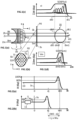
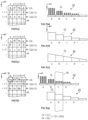
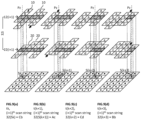
- An array of spots (Sj) is defined, distributed on the plane (P0) covering at least the whole of the target area (At) as illustrated in Figures 1(b) , 3(a) , and 12(a) to 12(c).
- the dynamic shaping device (30) of the present invention comprises a dynamic ridge filter (1) and / or a dynamic range shifter (2).
- the dynamic ridge filter (1) of the present invention is configured for shaping a dose deposition zone by radiation with charged particles pencil beams, preferably with proton pencil beams, and for depositing doses (Dj) applied by pencil beams (Bj) propagating along corresponding irradiation axes (Zj) fanning out of a central irradiation axis (Z) with a pencil beam scanning (PBS) system.
- the pencil beams are delivered into a sequence of specific volumes (Vj) along an X-axis to form specific volume stripes, which are distributed next to one another along a Y-axis transverse, preferably normal, to the X-axis.
- the specific volumes (Vj) define in combination the target volume (Vt) comprising the tumoral cells.
- the dynamic ridge filter (1) comprises a number of energy spreading units (11), each energy spreading unit (11) being characterized by a corresponding energy spreading capacity for spreading the dose deposited along the irradiation axis (Zj) by the corresponding pencil beams (Bj) traversing one or more energy spreading units (11).
- the gist of the present invention is that the ridge filter is dynamic, in that a topography of the ridge filter can be varied according to the requirements of the treatment plan.
- the energy spreading units (11) are distributed in filter modules (12).
- Each filter module (12) supports one or more energy spreading units (11) and has an area normal to the central irradiation axis (Z) compatible with a cross-sectional diameter (D100) of the corresponding pencil beam (Bj).
- the filter modules (12) are arranged in different filter rows (10), each extending along the row-direction (Y).
- Each filter row (10) comprises a number of dissimilar filter modules (12), each filter module of a filter row (10) having a different energy spreading capacity than the other filter modules (12) of the same filter row (10).
- the ridge filter of the present invention is dynamic because each filter row can be displaced independently to form a filter string (12i) along the X-axis as shown in Figure 6(a) .
- the filter string is configured to shape the dose deposition in the specific volumes (Vj) forming the specific volume stripe facing the filter string along the irradiation axes (Zj).
- All filter rows (10) are preferably identical to one another and comprise a same selection of filter modules (12).
- Each module is to the filter string (12i) what letters are to a word. They can be combined in different arrangements to define different "words".
- each module (12) preferably has dimensions of the same order of magnitude as the diameter (D100) of the pencil beams.
- Each filter module (12) comprises one or more energy spreading units (11) supported on a base of the filter modules (12).
- an energy spreading unit (11) on the path of a hadron beam, the energy thereof can be controlled for shortening the propagation distance thereof through a body (e.g., water or tissues of a patient). It is thus possible to displace the position of the Bragg Peak of hadron particles where the full dose (Dj) of each particle is deposited, without varying the energy of the hadron beam emitted out of the nozzle (3).
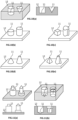
- Figures 2(c) to 2(e) show how the positions of the Bragg peaks of one or more pencil beam can be controlled by passing them through different embodiments of energy spreading units (11).
- the energy spreading units (11) can be in the form of spikes of generalized cylindrical, preferably prismatic geometry.
- a prismatic geometry is herein defined as a cylindrical geometry whose planar base is polygonal.
- the energy spreading units (11) can have a conical geometry, truncated or not, preferably a pyramidal geometry.
- a conical geometry is defined by straight lines passing by an apex and by the perimeter of a planar base of any geometry, preferably albeit not necessarily circular.
- a pyramidal geometry is a conical geometry whose planar base is polygonal.
- the pencil beams (Bj) exit out of a nozzle (3) which can be considered as forming the apex of a scanning triangle in a (X, Z) plane and of a scanning cone whose base encloses at least the target area (At) on the patient 6, depending on whether the electromagnetic elements (4) are configured for deviating the pencil beams (Bj) along the X-axis only or along both X- and Y-axes.
- the central irradiation axis (Z) is defined by the axial axis of the nozzle. In the case of scanning along both X-and Y-axes, the pencil beams can scan within the scanning cone and thus cover the whole target area (At).
- the energy spreading units (11) can be in the form of orifices of generalized cylindrical or conical geometry penetrating in a support base of the filter modules (12). Each orifice extends from an aperture opening at a surface of the support base and penetrating to a given depth leaving a resulting thickness of material of the support base. As for the spikes discussed supra, it is preferred that the orifices be configured in use for having a major axis of the cavities extending parallel to the corresponding irradiation axes (Zj).
- each filter module (12) can comprise one or more energy spreading units (11), each formed by a plurality of spreading subunits (11a-11c) having differing cross-sectional areas (Ai) normal to the irradiation axis (Zj).
- the spreading subunits (11a-11c) are stacked on top of one another along a major axis of the energy spreading unit (11) configured in use for extending parallel to the irradiation axis (Zj).
- a corresponding SOBP can be defined as described in EP2021/208699 .
- the dynamic shaping device (30) of the present invention also includes a range shifter (2) configured for shaping a dose deposition zone by radiation with charged particles beams, preferably with proton beams, and for depositing doses (Dj) applied by pencil beams (Bj) propagating along corresponding irradiation axes (Zj) fanning out of a central irradiation axis (Z) with a pencil beam scanning (PBS) system and delivered into a sequence of specific volumes (Vj) along a X-axis to form specific volume stripes distributed next to one another along a Y-axis transverse, preferably normal, to the X-axis.
- the specific volumes (Vj) define in combination the target volume (Vt) comprising the tumoral cells.
- the range shifter (2) has a thickness of material measured along the central irradiation axis (Z) which varies over an area of the range shifter (2).
- the area is preferably planar and preferably configured for being substantially normal to the corresponding irradiation axes (Zj).
- the thickness of range shifting material determines the corresponding amount of absorbed energy ( ⁇ E) of the pencil beam (Bj) of the charged particles traversing the thickness
- the gist of the present invention is that the range shifter (2) is dynamic, in that a topographic thickness of the range shifter can be varied according to the requirements of the treatment plan.
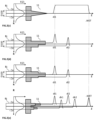
- the range shifter comprises shifter modules (22) arranged side by side to form shifter rows (20), as illustrated in Figure 4(b) .
- Each shifter row (20) comprises a selection of shifter modules (22) having a constant thickness different from the other shifter modules (22) of the same shifter row (20) and configured for absorbing different amounts of energy ( ⁇ E) from the pencil beam (Bj).
- all shifter rows (20) can be displaced independently to form a shifter string (22i) along the X-axis.
- the shifter string is configured to shape along the irradiation axes (Zj) the dose deposition in the specific volumes (Vj) forming the specific volume stripe facing the shifter string along the irradiation axes (Zj).
- the range shifter defines the geometry of the furthest downstream end of the dose deposition profile.
- All shifter rows (20) are preferably identical and comprise a same selection of shifter modules (22).
- Each shifter module is formed by a plate of preferably constant thickness and of dimensions on the plane (X, Y) of the same order of magnitude as the pencil beam diameter (D100) and as the filter modules (12).
- the dynamic ridge filter (1) and range filter (2) are superimposed such that the filter string (12i) and the shifter string (22i) face each other along a direction, which in use is parallel the irradiation axis (Zj), to form in combination a radiation string (32i).
- the ridge filter (1) can indifferently be positioned upstream or downstream of the range shifter (2) relative to the particles flow direction.
- the filter rows (10) and shifter rows (20) must be translated along the Y-axis such as to bring the right sequence of filter modules (12) and shifter modules (22) aligned along the X-axis to define the required radiation string (32i) matching the dose deposition pattern onto the corresponding specific volume stripe as defined in the treatment plan.
- the filter rows (10) and shifter rows (20) must be translated again to define the required radiation string (32i) matching the dose deposition pattern onto a next corresponding specific volume stripe adjacent to the first one along the Y-axis, as defined in the treatment plan.
- the present invention also concerns a treatment station for shaping a dose deposition zone by radiation with charged particles beams, preferably with proton beams, and for depositing doses (Dj) applied by pencil beams (Bj) propagating along corresponding irradiation axes (Zj) fanning out of a central irradiation axis (Z) with a pencil beam scanning (PBS) system and delivered into a sequence of specific volumes (Vj) along a X-axis to form specific volume stripes distributed next to one another along a Y-axis transverse, preferably normal, to the X-axis, the specific volumes (Vj) defining in combination a target volume (Vt) comprising the tumoral cells.
- the treatment station comprises,
- the treatment station comprises both dynamic ridge filter (1) and dynamic range shifter (2) according to the present invention and are aligned such that the filter string (12i) and the shifter string (22i) face each other along a direction, which in use is parallel the irradiation axis (Zj), to form in combination a radiation string (32i).
- the PBS system is configured for pointing a pencil beam (Bj) over each spot (Sj) in a given sequence.
- the nozzle (3) is provided with electromagnetic elements (4) configured for deviating the pencil beams (Bj) at least along the X-axis, preferably along both X-axis and Y-axis.
- the one or more processors can be configured for controlling the actions illustrated in Figures 7(a), 7(c), 7(f) , 8(a) to 8(d) and 9(a) to 9(d) discussed in continuation.
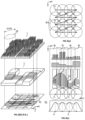
- the letters A, B, C, D refer to a specific filter module (12) as defined in Figure 7(b).
- the shifter row (20) is preferably formed of discrete shifter modules (22) each of substantially constant thickness.
- the shifter row (20) can have a continuous slope as illustrated in Figure 7(e) .
- the size of a shifter module is defined by the diameter of the pencil beam (Bj) as can be deduced from Figure 7(g) .
- a radiation string (32i) is formed by the combination of a filter string (12i) and a shifter string (22i) as shown in Figure 7(f) .
- a radiation module (32) is obtained by sliding along the Y-axis each filter row (10) and shifter row (20) of the dynamic shaping device (30) to align the required filter modules (12) and shifter modules (22) with the corresponding pencil beams (Bj).
- the modules of a filter row (10) are identified by letters A, B, C, D and the ones of a shifter row are identified by letters, a, b, c, d.
- the radiation modules (32) can be formed by any combinations of the filter modules (12) and shifter modules (22), with a total of 16 combinations Aa, Ab, Ac, Ad, Ba, Bb, Bc...
- the filter rows (10) and the shifter rows (20) are moved independently along the Y-axis to yield a sequence of filter modules (12) and shifter modules (22) forming in combination an i th radiation string (32i) composed of an i th filter string (12i) and of an i th shifter string (22i) along the X-axis according to a predefined treatment plan illustrated in Figures 7(a), 7(c), and 7(f) .
- the beam paths of the pencil beams (Bj) of an i th scanning string sequentially traverse the corresponding radiation modules (32) of the i th radiation string (32i) before attaining the target volume (Vt). This corresponds to any one sequence defined in line i, i+1, i+2... in Figure 7(f) .
- the electromagnetic elements (4) are controlled for orienting the pencil beam (Bj) through a first filter module (12) of the i th filter string (12i) and through a first shifter module (22) of the i th shifter string (22i), and towards a first spot (Sj) of the i th scanning string formed by a sequence of spots (Sj) distributed along the X-axis.
- the electromagnetic elements (4) are controlled for sequentially orienting the pencil beams (Bj) of the i th scanning string through each one of the sequence of filter modules (12) forming the i th filter string and through each one of the sequence of shifter modules (22) forming the i th shifter string, and towards the sequence of spots (Sj) of the i th scanning string.
- the radiation sequence starts by pointing a j th pencil beam (Bj) to a j th spot (Sj) on the i th scanning string (i) of spots distributed along the X-axis.
- the electromagnetic elements (4) are activated to deviate the pencil beam towards a (j+1) th spot (S(j+1)) adjacent to the j th spot (Sj) along the X-axis.
- next pencil beam is oriented towards a first spot of a next scanning string (i+1) of spots.
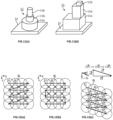
- This can be achieved in different manners described below with reference to Figures 13(a) &13(b) to 15(a)&15(b).
- the previous steps are repeated for all the spots aligned along the (i+1) th string as shown in Figures 9(a) to 9(d) . And so on, until all spots aligned along all scanning strings (i, i+1%) extending along the X-axis and distributed along the Y-axis have been irradiated.
- Moving the filter rows (10) (and shifter rows (20)) to their respective positions required by the corresponding spot of the next scanning string as soon as the corresponding spot has been irradiated is advantageous in that the shaping device (30) is sequentially modifying the radiation string (32i) for the radiation string required for shaping the pencil beams pointed at the spots of the next scanning string. This way, the flow of accelerated particles needs not be interrupted until the new radiation string has been formed before starting scanning along an (i+1) th scanning string.
- the same process is applied after a dose has been deposited in the specific volumes associated with each successive spot (Sj, S(j+1),...) of the i th scanning string.
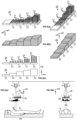
- Figures 12(a) to 12(c) show three possible embodiments of spots irradiation sequences, all including a scan comprising at least a component along the X-axis.
- Figure 12(a) illustrates a reading sequence wherein as a scan along the X-axis is completed, the pencil beam is returned to the initial position one string below, as when reading a document.
- Figure 12(b) illustrates a scarf-sequence wherein as a scan along the X-axis is completed, the pencil beam jumps to the closest spot located on the next string.
- the choice between the reading sequence or the scarf sequence depends on many parameters which extend beyond the scope of the present invention, including the geometry of the target volume, the position of the spots to be irradiated at ultra-high dose deposition rates, the performance of the source of accelerated particles, the performance of the scanning system, and the like.
- Figure 12(c) shows a reading sequence obtained when the couch (5) supporting the patient (6) translates along the Y-axis.
- the angle formed by the scanning direction (xs) with the X-axis illustrated in Figure 12(c) is therefore largely exaggerated. Note that the return rate (vr) from the last spot of a given scanning string to the first spot of a next scanning string is much higher than the X-rate (vx).
- the electromagnetic elements (4) are configured for deviating the pencil beam (Bj) to scan also along the Y-axis as the nozzle remains static.
- State of the art ridge filters and range shifters i.e., non-dynamic are designed to intercept the pencil beams (Bj) as they scan along both X- and Y-axes.
- the whole shaping device (30) can move along the Y-axis together with the pencil beams (Bj).
- the filter rows (10) and shifter rows (20) can be moved independently to ensure that the right arrangement of modules (12, 22) is present as a pencil beam (Bj) traverses the radiation string (32i) which is always aligned with the pencil beams (32i).
- This solution is quite straightforward and requires little processing power to coordinate the translations along the Y-axis of the shaping device (30) and of the pencil beams (Bj).
- the radiation string (32i) (illustrated with a rectangular window in Figures 13 to 15 ) moves relative to the shaping device along the Y-axis together with the deviation of the pencil beams (Bj) along a new scanning string.
- This is quite simple to achieve and requires little processing power to coordinate the movements of the filter / shifter rows (10, 20) to align the right arrangements of modules along radiations strings that move together with the pencil beams along the Y-axis.
- the electromagnetic elements (4) do not deviate the pencil beams (Bj) along the Y-axis.
- the shaping device (30) does not move.
- the couch (5) supporting the patient (6) is provided with a translation system configured for translating the couch along the Y-axis to align the specific volumes (Vj) with the corresponding pencil beams (Bj).
- the movement of the couch (5) can be continuous at a couch rate (v5) or it can be sequential, moving only when the pencil beams are deviated along the Y-axis. It is preferred that the couch moves continuously at a couch rate (v5) yielding a scanning sequence as for example, illustrated in Figure 13(c).
- the dynamic shaping device (30) of the present invention comprises a dynamic ridge filter and a dynamic range shifter comprising a number of filter rows (10) and a number of shifter rows, respectively.
- Each filter row is composed of a same selection of filter modules (12) of different energy spreading properties distributed along a length of the filter row parallel to the Y-axis.
- each shifter row (20) is composed of a same selection of shifter modules (22) of different range shifting properties distributed along a length of the shifter row parallel to the Y-axis.
- the filter rows and shifter rows can be translated along the Y-axis independently of one another to yield radiation modules (32) formed by a filter module and a shifter module aligned along a corresponding irradiation axis (Z).
- the dynamic shaping device (30) adapts dynamically to a predefined treatment plan.
- the present invention is very advantageous over the prior art shaping devices because a single dynamic shaping device (30) according to the present invention can be used several times to treat different patients, or a same patient at different moments in time corresponding to different radiation sessions.
- the dynamic shaping device of the present invention can be adapted to match the treatment plans associated with the treatment of target volumes of different geometries. It can also be adapted for us with particles accelerators of different performance. Not having to manufacture a new ridge filter and a new range shifter before every radiation session is a substantial time saving factor.
Landscapes
- Health & Medical Sciences (AREA)
- Engineering & Computer Science (AREA)
- Biomedical Technology (AREA)
- Pathology (AREA)
- Nuclear Medicine, Radiotherapy & Molecular Imaging (AREA)
- Radiology & Medical Imaging (AREA)
- Life Sciences & Earth Sciences (AREA)
- Animal Behavior & Ethology (AREA)
- General Health & Medical Sciences (AREA)
- Public Health (AREA)
- Veterinary Medicine (AREA)
- Physics & Mathematics (AREA)
- Spectroscopy & Molecular Physics (AREA)
- General Engineering & Computer Science (AREA)
- High Energy & Nuclear Physics (AREA)
- Radiation-Therapy Devices (AREA)
Claims (13)
- Dynamisches Ridge-Filter (1) zum Formen einer Dosisabscheidungszone durch Strahlung mit Strahlen geladener Teilchen, vorzugsweise mit Protonen- oder anderen Leichtionenstrahlen, und zum Abscheiden von Dosen (Dj), die durch Bleistiftstrahlen (Bj) aufgebracht werden, die sich entlang entsprechender Bestrahlungsachsen (Zj) ausbreiten, die sich durch ein Bleistiftstrahlabtast(PBS)-Systems aus einer zentralen Bestrahlungsachse (Z) auffächern und in einer Sequenz an spezifische Volumina (Vj) entlang einer X-Achse abgegeben werden, um spezifische Volumenstreifen zu bilden, die nebeneinander entlang einer Y-Achse quer, vorzugsweise normal, zur X-Achse verteilt sind, wobei die spezifischen Volumina (Vj) in Kombination ein Zielvolumen (Vt) definieren, das die Tumorzellen umfasst,wobei das dynamische Ridge-Filter eine Anzahl von Energiestreuungseinheiten (11) umfasst, wobei jede Energiestreuungseinheit (11) durch eine entsprechende Energiestreuungskapazität zum Streuen der Dosis gekennzeichnet ist, die entlang der Bestrahlungsachse (Zj) abgeschieden wird, indem die entsprechenden Bleistiftstrahlen (Bj) eine oder mehrere Energiestreuungseinheiten (11) durchqueren,dadurch gekennzeichnet, dass• die Energiestreuungseinheiten (11) in Filtermodulen (12) verteilt sind, wobei jedes Filtermodul (12) eine oder mehrere Energiestreuungseinheiten (11) stützt und eine Fläche normal zur zentralen Bestrahlungsachse (Z) aufweist, die mit einem Querschnitt des entsprechenden Bleistiftstrahls (Bj) kompatibel ist, wobei die Filtermodule (12) in unterschiedlichen Filterreihen (10) angeordnet sind, die sich jeweils entlang der Reihenrichtung (Y) erstrecken,• jede Filterreihe (10) eine Anzahl von ungleichen Filtermodulen (12) umfasst, wobei jedes Filtermodul einer Filterreihe (10) eine von den anderen Filtermodulen (12) derselben Filterreihe (10) unterschiedliche Energiestreuungskapazität aufweist, wobei∘ jede Filterreihe unabhängig verschoben werden kann, um einen Filterstrang (12i) entlang der X-Achse zu bilden, und∘ der Filterstrang dazu ausgelegt ist, die Dosisabscheidung in den spezifischen Volumina (Vj) zu formen, die den spezifischen Volumenstreifen bilden, der dem Filterstrang entlang der Bestrahlungsachsen (Zj) zugewandt ist.
- Dynamisches Ridge-Filter (1) nach Anspruch 1, wobei die Energiestreuungseinheiten (11) in Form von Spitzen mit generalisierter zylindrischer, vorzugsweise prismatischer Geometrie oder mit kegelförmiger Geometrie, abgestumpft oder nicht, vorzugsweise pyramidenförmiger Geometrie vorliegen, die auf einer Basis der Filtermodule (12) abgestützt und im Gebrauch so ausgelegt sind, dass sich eine Hauptachse der Spitzen parallel zu den entsprechenden Bleistiftstrahlachsen (Zj) erstreckt.
- Dynamisches Ridge-Filter (1) nach Anspruch 1, wobei die Energiestreuungseinheiten (11) in Form von Mündungen mit generalisierter zylindrischer oder kegelförmiger Geometrie vorliegen, die in eine Stützbasis der Filtermodule (12) eindringen, wobei sich jede Mündung von einer Blendenöffnung an einer Oberfläche der Stützbasis erstreckt und bis zu einer gegebenen Tiefe eindringt, wodurch eine resultierende Materialdicke der Stützbasis verbleibt, und im Gebrauch so ausgelegt sind, dass sich eine Hauptachse der Hohlräume parallel zu den entsprechenden Bleistiftstrahlachsen (Zj) erstreckt.
- Dynamisches Ridge-Filter (1) nach einem der vorhergehenden Ansprüche, wobei jedes Filtermodul (12) eine oder mehrere Energiestreuungseinheiten (11) umfasst, die jeweils durch mehrere Streuungsuntereinheiten (11a-11c) mit unterschiedlichen Querschnittsflächen (Ai) normal zur Bestrahlungsachse (Zj) gebildet sind und entlang einer Hauptachse der Energiestreuungseinheit (11) übereinander gestapelt sind, die im Gebrauch so ausgelegt ist, dass sie sich parallel zur Bestrahlungsachse (Zj) erstreckt, wobei alle Streuungsuntereinheiten (11a-11c) des Stapels unterschiedliche Energiestreuungskapazitäten aufweisen.
- Dynamisches Ridge-Filter (1) nach einem der vorhergehenden Ansprüche, wobei alle Filterreihen (10) identisch sind und eine gleiche Auswahl von Filtermodulen (12) umfassen.
- Dynamische Reichweitenverstellvorrichtung (2) zum Formen einer Dosisabscheidungszone durch Strahlung mit Strahlen geladener Teilchen, vorzugsweise mit Protonen- oder anderen Leichtionenstrahlen, und zum Abscheiden von Dosen (Dj), die durch Bleistiftstrahlen (Bj) aufgebracht werden, die sich entlang entsprechender Bestrahlungsachsen (Zj) ausbreiten, die sich durch ein Bleistiftstrahlabtast(PBS)-Systems aus einer zentralen Bestrahlungsachse (Z) auffächern und in einer Sequenz an spezifische Volumina (Vj) entlang einer X-Achse abgegeben werden, um spezifische Volumenstreifen zu bilden, die nebeneinander entlang einer Y-Achse quer, vorzugsweise normal, zur X-Achse verteilt sind, wobei die spezifischen Volumina (Vj) in Kombination ein Zielvolumen (Vt) definieren, das die Tumorzellen umfasst,
wobei die Reichweitenverstellvorrichtung (2) eine Materialdicke aufweist, die über eine Fläche der Reichweitenverstellvorrichtung (2) variiert, wobei die Fläche so ausgelegt ist, dass sie im Gebrauch im Wesentlichen normal zur Bestrahlungsachse (Zj) ist, wobei ein Wert der Dicke eine entsprechende Menge an absorbierter Energie (ΔE) des Bleistiftstrahls (Bj) der geladenen Teilchen bestimmt, die die Dicke durchqueren, dadurch gekennzeichnet, dass• die Reichweitenverstellvorrichtung Verstellvorrichtungsmodule (22) umfasst, die nebeneinander angeordnet sind, um Verstellvorrichtungsreihen (20) zu bilden, wobei jede Verstellvorrichtungsreihe (20) eine Auswahl von Verstellvorrichtungsmodulen (22) umfasst, die eine konstante oder nahezu konstante Dicke aufweisen, die sich von den anderen Verstellvorrichtungsmodulen (22) derselben Verstellvorrichtungsreihe (20) unterscheidet, und dazu ausgelegt sind, unterschiedliche Mengen an absorbierter Referenzenergie (ΔE) von dem Bleistiftstrahl (Bj) zu absorbieren, wobei• jede Verstellvorrichtungsreihe (20) unabhängig verschoben werden kann, um einem Verstellvorrichtungsstrang (22i) entlang der X-Achse zu bilden,• der Verstellvorrichtungsstrang dazu ausgelegt ist, entlang der Bestrahlungsachsen (Zj) die Dosisabscheidung in den spezifischen Volumina (Vj) zu formen, die den spezifischen Volumenstreifen bilden, der dem Verstellvorrichtungsstrang entlang der Bestrahlungsachsen (Zj) zugewandt ist. - Dynamische Reichweitenverstellvorrichtung (2) nach Anspruch 6, wobei alle Verstellvorrichtungsreihen (20) identisch sind und eine gleiche Auswahl von Verstellvorrichtungsmodulen (22) umfassen.
- Dynamische Formungsvorrichtung (30) zum Formen einer Dosisabscheidungszone durch Strahlung mit Strahlen geladener Teilchen, vorzugsweise mit Protonenstrahlen, und zum Abscheiden von Dosen (Dj), die durch Bleistiftstrahlen (Bj) aufgebracht werden, die sich entlang entsprechender Bestrahlungsachsen (Zj) ausbreiten, die sich mit einem Bleistiftstrahlabtast(PBS)-Systems aus einer zentralen Bestrahlungsachse (Z) auffächern und in eine Sequenz von spezifischen Volumina (Vj) entlang einer X-Achse abgegeben werden, um spezifische Volumenstreifen zu bilden, die nebeneinander entlang einer Y-Achse quer, vorzugsweise normal, zur X-Achse verteilt sind, wobei die spezifischen Volumina (Vj) in Kombination ein Zielvolumen (Vt) definieren, das die Tumorzellen umfasst,
dadurch gekennzeichnet, dass sie mindestens ein dynamisches Ridge-Filter (1) nach einem der Ansprüche 1 bis 5 und mindestens eine dynamische Reichweitenverstellvorrichtung (2) nach Anspruch 6 oder 7 umfasst. die in einer Sequenz entlang eines Strahlengangs eines Bleistiftstrahls (Bj) angeordnet sind, so dass der Filterstrang (12i) und der Verstellvorrichtungsstrang (22i) entlang einer Richtung, die im Gebrauch parallel zur Bestrahlungsachse (Zj) ist, einander zugewandt sind, um in Kombination einen Strahlungsstrang (32i) zu bilden. - Behandlungsstation zum Formen einer Dosisabscheidungszone durch Strahlung mit Strahlen geladener Teilchen, vorzugsweise mit Protonenstrahlen, und zum Abscheiden von Dosen (Dj), die durch Bleistiftstrahlen (Bj) aufgebracht werden, die sich entlang entsprechender Bestrahlungsachsen (Zj) ausbreiten, die sich mit einem Bleistiftstrahlabtast(PBS)-Systems aus einer zentralen Bestrahlungsachse (Z) auffächern und in eine Sequenz von spezifischen Volumina (Vj) entlang einer X-Achse abgegeben werden, um spezifische Volumenstreifen zu bilden, die nebeneinander entlang einer Y-Achse quer, vorzugsweise normal, zur X-Achse verteilt sind, wobei die spezifischen Volumina (Vj) in Kombination ein Zielvolumen (Vt) definieren, das die Tumorzellen umfasst, wobei die Behandlungsstation umfasst,• eine Quelle von Bleistiftstrahlen (Bj) beschleunigter geladener Teilchen, vorzugsweise von Protonen,• eine Düse (3) zum Richten der Bleistiftstrahlen (Bj) beschleunigter geladener Teilchen auf das Zielvolumen (Vt), wobei die Düse elektromagnetische Elemente (4) umfasst, die dazu ausgelegt sind, den Bleistiftstrahl (Bj) abzulenken, um entlang mindestens der X-Achse abzutasten, während die Düse statisch bleibt,• ein Ridge-Filter,• eine Reichweitenverstellvorrichtung,• eine Liege oder einen Stuhl (5) zum Aufnehmen des Patienten in Rückenlage, Bauchlage, sitzender oder stehender Position,• einen oder mehrere Prozessoren, die zum Steuern verschiedener Komponenten der Behandlungsstation ausgelegt sind,
dadurch gekennzeichnet, dass• das Ridge-Filter ein dynamisches Ridge-Filter (1) nach einem der Ansprüche 1 bis 5 ist,• die Reichweitenverstellvorrichtung eine dynamische Reichweitenverstellvorrichtung (2) nach Anspruch 6 oder 7 ist,wobei das dynamische Ridge-Filter (1) und die dynamische Reichweitenverstellvorrichtung (2) so angeordnet sind, dass sie eine Formungsvorrichtung nach Anspruch 8 bilden. - Behandlungsstation nach Anspruch 9, wobei entweder,• die elektromagnetischen Elemente (4) dazu ausgelegt sind, den Bleistiftstrahl (Bj) abzulenken, um auch entlang der Y-Achse abzutasten, während die Düse statisch bleibt, und∘ die Formungsvorrichtung (30) mit einem Translationssystem versehen ist, das dazu ausgelegt ist, einer Translation des Bleistiftstrahls entlang der Y-Achse zu folgen, so dass sich der Filterstrang (12i) und der Verstellvorrichtungsstrang (22i) zusammen mit der Formungsvorrichtung (30) bewegen, wobei sie in Ausrichtung mit dem Bleistiftstrahl entlang der Y-Achse gehalten werden, odero sich der Filterstrang (12i) und der Verstellvorrichtungsstrang (22i) entlang der Y-Achse relativ zur Formungsvorrichtung (30) bewegen, die vorzugsweise relativ zum Zielvolumen (Vt) statisch bleibt, um in Ausrichtung mit dem Bleistiftstrahl entlang der Y-Achse gehalten zu werden, oder• die Liege (5) mit einem Translationssystem versehen ist, das zum translatorischen Bewegen der Liege entlang der Y-Achse ausgelegt ist, um die spezifischen Volumina (Vj) mit den entsprechenden Bleistiftstrahlen (Bj) auszurichten, während die Formungsvorrichtung (30) und der Filterstrang und der Verstellvorrichtungsstrang vorzugsweise relativ zum Zielvolumen statisch bleiben,
oder• eine Kombination der vorstehenden Optionen. - Behandlungsstation nach Anspruch 9 oder 10, wobei der eine oder die mehreren Prozessoren zu Folgendem ausgelegt sind:• Bewegen der Filterreihen (10) und der Verstellvorrichtungsreihen (20) entlang der Y-Achse, um eine Sequenz von Filtermodulen (12), die einen i-ten Filterstrang (12i) bilden, und eines i-ten Verstellvorrichtungsstrangs (22i), der sich entlang der X-Achse erstreckt, zu erhalten, um einen i-ten Strahlungsstrang (32i) gemäß einem vordefinierten Behandlungsplan zu erhalten, so dass die Strahlengänge der Bleistiftstrahlen (Bj) eines i-ten Abtaststrangs entsprechende Strahlungsmodule (32) der Sequenz von Strahlungsmodulen (32), die den i-ten Strahlungsstrang (32i) bilden, durchlaufen, bevor das Zielvolumen (Vt) erreicht wird, wobei ein Strahlungsmodul (32) durch ein Filtermodul (12) und ein Verstellvorrichtungsmodul (22) gebildet wird, die entlang der Bestrahlungsachse (Z) ausgerichtet sind,• Steuern der elektromagnetischen Elemente (4) zum Ausrichten des Bleistiftstrahls (Bj) durch ein erstes Strahlungsmodul (32), das durch ein erstes Filtermodul (12) des i-ten Filterstrangs (12i) und ein erstes Verstellvorrichtungsmodul (22) des i-ten Verstellvorrichtungsstrangs (22i) gebildet wird, und auf einen ersten Punkt (Sj) eines i-ten Abtaststrangs, der durch eine Sequenz von Punkten (Sj) gebildet wird, die entlang der X-Achse verteilt sind, wobei die Punkte in mehreren Abtaststrängen (I, i+1...) angeordnet sind, die entlang der X-Achse verteilt sind, um eine Anordnung von Punkten zu definieren, die auf einer Ebene (X, Y) angeordnet sind, die eine Projektion auf die Ebene (X, Y) des Behandlungsvolumens (Vt) darstellt,• nachdem der Bleistiftstrahl (Bj), der den ersten Punkt (Sj) des i-ten Abtaststrangs durchquert, eine vordefinierte Dosis (Dj) abgegeben hat, werden die elektromagnetischen Elemente (4) zur sequentiellen Ausrichtung der Bleistiftstrahlen (Bj) des i-ten Abtaststrangs durch die Sequenz von Strahlungsmodulen (32), die den i-ten Strahlungsstrang (32i) bilden, und auf die Sequenz von Punkten (Sj) des i-ten Abtaststrangs gesteuert.,• für alle Filtermodule (12), die den i-ten Filterstrang (12i) bilden, und für alle Verstellvorrichtungsmodule (22), die den i-ten Verstellvorrichtungsstrang (22i) bilden, nachdem der Bleistiftstrahl (Bj) ein x-tes Strahlungsmodul (32) durchlaufen hat und sich zu einem nächsten (x+1)-ten Strahlungsmodul (32) entlang der X-Achse bewegt, Bewegen der j-ten Filterreihe (10) und der x-ten Verstellvorrichtungsreihe (20) entlang der Y-Achse, um das Strahlungsmodul (32) zu erhalten, das zur Bestrahlung des x-ten Strahlungsmoduls des nächsten (i+1)-ten Strahlungsstrangs (32(i+1)) erforderlich ist, das zur Bestrahlung eines nächsten (i+1)-ten Abtaststrangs von Punkten (Sj) gemäß der vordefinierten Behandlung erforderlich ist.
- Behandlungsstation nach den Ansprüchen 10 und 11, wobei, nachdem der Bleistiftstrahl (Bj), der einen letzten Punkt (Sj) des i-ten Abtaststrangs durchquert, eine vordefinierte Dosis (Dj) in ein entsprechendes letztes spezifisches Volumen (Vj) abgegeben hat, der eine oder die mehreren Prozessoren zu Folgendem ausgelegt sind,• Steuern der elektromagnetischen Elemente (4) oder des Translationssystems der Liege (5) wie in Anspruch 10 definiert zum Ausrichten des Bleistiftstrahls (Bj) durch einen ersten Punkt eines (i+1)-ten Abtaststrangs, der entlang der Y-Achse an den i-ten Abtaststrang angrenzt, und• Wiederholen der Schritte nach Anspruch 11 für die Punkte auf dem (i+1)-ten Abtaststrang,• Wiederholen der vorstehenden Schritte für alle der mehreren Abtaststränge, die die Anordnung von Punkten (Sj) bilden, die die Dosis gemäß dem vordefinierten Behandlungsplan noch nicht empfangen haben.
- Behandlungsstation nach Anspruch 10, wobei die Liege (5) statisch ist und wobei, um sicherzustellen, dass die Strahlengänge, denen die Bleistiftstrahlen (Bj) folgen, immer ein entsprechendes Filtermodul (12) des Filterstrangs (12i) und ein entsprechendes Verstellvorrichtungsmodul (22) des Verstellvorrichtungsstrangs (22i) kreuzen, der eine oder die mehreren Prozessoren zum Synchronisieren der elektromagnetischen Elemente (4) ausgelegt sind und• das Translationssystem der Formungsvorrichtung zum Sicherstellen, dass, während der Bleistiftstrahl entlang der Y-Achse abgelenkt wird, die Formungsvorrichtung oder der Strahlungsstrang (32i) auch entlang der Y-Achse translatorisch bewegt wird, oder• ein Bewegen des Filterstrangs (12i) und des Verstellvorrichtungsstrangs (22i) entlang der Y-Achse relativ zur Formungsvorrichtung (30), die relativ zum Zielvolumen (Vt) statisch bleibt, um entlang der Y-Achse in Ausrichtung mit dem Bleistiftstrahl gehalten zu werden.
Priority Applications (4)
| Application Number | Priority Date | Filing Date | Title |
|---|---|---|---|
| EP23158167.9A EP4420719B1 (de) | 2023-02-23 | 2023-02-23 | Dynamischer stegfilter und bereichsschieber und bestrahlungssystem mit selbigen |
| US18/433,571 US20240285974A1 (en) | 2023-02-23 | 2024-02-06 | Dynamic ridge filter and range shifter and radiation system comprising same |
| JP2024022607A JP2024120165A (ja) | 2023-02-23 | 2024-02-19 | 動的リッジフィルタ及びレンジシフタ並びにこれらを有する放射システム |
| CN202410188851.7A CN118526726A (zh) | 2023-02-23 | 2024-02-20 | 动态脊形滤波器和范围移位器以及包括其的辐射系统 |
Applications Claiming Priority (1)
| Application Number | Priority Date | Filing Date | Title |
|---|---|---|---|
| EP23158167.9A EP4420719B1 (de) | 2023-02-23 | 2023-02-23 | Dynamischer stegfilter und bereichsschieber und bestrahlungssystem mit selbigen |
Publications (3)
| Publication Number | Publication Date |
|---|---|
| EP4420719A1 EP4420719A1 (de) | 2024-08-28 |
| EP4420719B1 true EP4420719B1 (de) | 2025-05-28 |
| EP4420719C0 EP4420719C0 (de) | 2025-05-28 |
Family
ID=85381116
Family Applications (1)
| Application Number | Title | Priority Date | Filing Date |
|---|---|---|---|
| EP23158167.9A Active EP4420719B1 (de) | 2023-02-23 | 2023-02-23 | Dynamischer stegfilter und bereichsschieber und bestrahlungssystem mit selbigen |
Country Status (4)
| Country | Link |
|---|---|
| US (1) | US20240285974A1 (de) |
| EP (1) | EP4420719B1 (de) |
| JP (1) | JP2024120165A (de) |
| CN (1) | CN118526726A (de) |
Family Cites Families (6)
| Publication number | Priority date | Publication date | Assignee | Title |
|---|---|---|---|---|
| JP2006280457A (ja) * | 2005-03-31 | 2006-10-19 | Hitachi Ltd | 荷電粒子ビーム出射装置及び荷電粒子ビーム出射方法 |
| CN101763909B (zh) * | 2010-01-20 | 2011-12-28 | 中国科学院近代物理研究所 | 一种利用高能离子束辐照时减小离子束展宽Bragg峰后沿剂量半影的方法 |
| JP5646312B2 (ja) * | 2010-04-02 | 2014-12-24 | 三菱電機株式会社 | 粒子線照射装置及び粒子線治療装置 |
| JP2014161706A (ja) * | 2013-02-28 | 2014-09-08 | Hitachi Ltd | 粒子線治療システムおよび飛程調整装置 |
| EP3593858B1 (de) * | 2018-07-12 | 2024-06-05 | RaySearch Laboratories AB | Ripplefiltereinheit zur verwendung in der strahlentherapiebehandlung, verfahren zur strahlentherapiebehandlungsplanung sowie computerprogrammprodukte |
| CN114452550B (zh) * | 2022-01-27 | 2022-11-15 | 兰州科近泰基新技术有限责任公司 | 一种用于离子Flash治疗的束流配送系统 |
-
2023
- 2023-02-23 EP EP23158167.9A patent/EP4420719B1/de active Active
-
2024
- 2024-02-06 US US18/433,571 patent/US20240285974A1/en active Pending
- 2024-02-19 JP JP2024022607A patent/JP2024120165A/ja active Pending
- 2024-02-20 CN CN202410188851.7A patent/CN118526726A/zh active Pending
Also Published As
| Publication number | Publication date |
|---|---|
| US20240285974A1 (en) | 2024-08-29 |
| JP2024120165A (ja) | 2024-09-04 |
| EP4420719C0 (de) | 2025-05-28 |
| CN118526726A (zh) | 2024-08-23 |
| EP4420719A1 (de) | 2024-08-28 |
Similar Documents
| Publication | Publication Date | Title |
|---|---|---|
| US10814146B2 (en) | Radiation therapy with orthovoltage x-ray minibeams | |
| US6757355B1 (en) | High definition radiation treatment with an intensity modulating multi-leaf collimator | |
| US6526123B2 (en) | Multiple layer multileaf collimator | |
| US6266393B1 (en) | Multiple layer multileaf collimator | |
| US7839974B2 (en) | ARC-sequencing technique for intensity modulated ARC therapy | |
| US20030160189A1 (en) | Charged particle beam irradiation apparatus | |
| US20090212231A1 (en) | Heavy ion radiation therapy system with stair-step modulation | |
| CN114452550A (zh) | 一种用于离子Flash治疗的束流配送系统及方法 | |
| EP2043743A1 (de) | Verfahren zur behandlung eines zielvolumens mit einem teilchenstrahl und vorrichtung zur umsetzung des verfahrens | |
| JP7555399B2 (ja) | 超高線量率放射線治療用装置 | |
| US7643610B2 (en) | Method and devices for performing stereotactic microbeam radiation therapy | |
| US10974076B2 (en) | Dynamic three-dimensional beam modification for radiation therapy | |
| CN107485801A (zh) | 一种准直体和治疗头 | |
| EP4420719A1 (de) | Dynamisches stegfilter und bereichsschieber und strahlungssystem damit | |
| US20130034211A1 (en) | Radiotherapy | |
| US11395929B2 (en) | Method and apparatus to deliver therapeutic radiation to a patient | |
| Svensson et al. | Beam characteristics and clinical possibilities of a new compact treatment unit design combining narrow pencil beam scanning and segmental multileaf collimation | |
| RU2826821C1 (ru) | Устройство для лучевой терапии с использованием сверхвысокой мощности дозы излучения | |
| US12233284B2 (en) | SRS contoured multi-layer multileaf collimator | |
| Forster et al. | Radiosurgery using segmental conformal therapy with a doubly focused multileaf collimator |
Legal Events
| Date | Code | Title | Description |
|---|---|---|---|
| PUAI | Public reference made under article 153(3) epc to a published international application that has entered the european phase |
Free format text: ORIGINAL CODE: 0009012 |
|
| STAA | Information on the status of an ep patent application or granted ep patent |
Free format text: STATUS: THE APPLICATION HAS BEEN PUBLISHED |
|
| AK | Designated contracting states |
Kind code of ref document: A1 Designated state(s): AL AT BE BG CH CY CZ DE DK EE ES FI FR GB GR HR HU IE IS IT LI LT LU LV MC ME MK MT NL NO PL PT RO RS SE SI SK SM TR |
|
| STAA | Information on the status of an ep patent application or granted ep patent |
Free format text: STATUS: REQUEST FOR EXAMINATION WAS MADE |
|
| 17P | Request for examination filed |
Effective date: 20240909 |
|
| RBV | Designated contracting states (corrected) |
Designated state(s): AL AT BE BG CH CY CZ DE DK EE ES FI FR GB GR HR HU IE IS IT LI LT LU LV MC ME MK MT NL NO PL PT RO RS SE SI SK SM TR |
|
| GRAP | Despatch of communication of intention to grant a patent |
Free format text: ORIGINAL CODE: EPIDOSNIGR1 |
|
| STAA | Information on the status of an ep patent application or granted ep patent |
Free format text: STATUS: GRANT OF PATENT IS INTENDED |
|
| RIC1 | Information provided on ipc code assigned before grant |
Ipc: G21K 1/10 20060101ALN20241129BHEP Ipc: G21K 1/04 20060101ALN20241129BHEP Ipc: A61N 5/10 20060101AFI20241129BHEP |
|
| RIC1 | Information provided on ipc code assigned before grant |
Ipc: G21K 1/10 20060101ALN20241212BHEP Ipc: G21K 1/04 20060101ALN20241212BHEP Ipc: A61N 5/10 20060101AFI20241212BHEP |
|
| INTG | Intention to grant announced |
Effective date: 20241223 |
|
| GRAS | Grant fee paid |
Free format text: ORIGINAL CODE: EPIDOSNIGR3 |
|
| GRAA | (expected) grant |
Free format text: ORIGINAL CODE: 0009210 |
|
| STAA | Information on the status of an ep patent application or granted ep patent |
Free format text: STATUS: THE PATENT HAS BEEN GRANTED |
|
| AK | Designated contracting states |
Kind code of ref document: B1 Designated state(s): AL AT BE BG CH CY CZ DE DK EE ES FI FR GB GR HR HU IE IS IT LI LT LU LV MC ME MK MT NL NO PL PT RO RS SE SI SK SM TR |
|
| REG | Reference to a national code |
Ref country code: GB Ref legal event code: FG4D |
|
| REG | Reference to a national code |
Ref country code: CH Ref legal event code: EP |
|
| REG | Reference to a national code |
Ref country code: DE Ref legal event code: R096 Ref document number: 602023003653 Country of ref document: DE |
|
| REG | Reference to a national code |
Ref country code: IE Ref legal event code: FG4D |
|
| U01 | Request for unitary effect filed |
Effective date: 20250620 |
|
| U07 | Unitary effect registered |
Designated state(s): AT BE BG DE DK EE FI FR IT LT LU LV MT NL PT RO SE SI Effective date: 20250701 |
|
| PG25 | Lapsed in a contracting state [announced via postgrant information from national office to epo] |
Ref country code: ES Free format text: LAPSE BECAUSE OF FAILURE TO SUBMIT A TRANSLATION OF THE DESCRIPTION OR TO PAY THE FEE WITHIN THE PRESCRIBED TIME-LIMIT Effective date: 20250528 |
|
| PG25 | Lapsed in a contracting state [announced via postgrant information from national office to epo] |
Ref country code: GR Free format text: LAPSE BECAUSE OF FAILURE TO SUBMIT A TRANSLATION OF THE DESCRIPTION OR TO PAY THE FEE WITHIN THE PRESCRIBED TIME-LIMIT Effective date: 20250829 Ref country code: NO Free format text: LAPSE BECAUSE OF FAILURE TO SUBMIT A TRANSLATION OF THE DESCRIPTION OR TO PAY THE FEE WITHIN THE PRESCRIBED TIME-LIMIT Effective date: 20250828 |
|
| PG25 | Lapsed in a contracting state [announced via postgrant information from national office to epo] |
Ref country code: PL Free format text: LAPSE BECAUSE OF FAILURE TO SUBMIT A TRANSLATION OF THE DESCRIPTION OR TO PAY THE FEE WITHIN THE PRESCRIBED TIME-LIMIT Effective date: 20250528 |
|
| PG25 | Lapsed in a contracting state [announced via postgrant information from national office to epo] |
Ref country code: HR Free format text: LAPSE BECAUSE OF FAILURE TO SUBMIT A TRANSLATION OF THE DESCRIPTION OR TO PAY THE FEE WITHIN THE PRESCRIBED TIME-LIMIT Effective date: 20250528 |
|
| PG25 | Lapsed in a contracting state [announced via postgrant information from national office to epo] |
Ref country code: RS Free format text: LAPSE BECAUSE OF FAILURE TO SUBMIT A TRANSLATION OF THE DESCRIPTION OR TO PAY THE FEE WITHIN THE PRESCRIBED TIME-LIMIT Effective date: 20250828 |
|
| PG25 | Lapsed in a contracting state [announced via postgrant information from national office to epo] |
Ref country code: IS Free format text: LAPSE BECAUSE OF FAILURE TO SUBMIT A TRANSLATION OF THE DESCRIPTION OR TO PAY THE FEE WITHIN THE PRESCRIBED TIME-LIMIT Effective date: 20250928 |
|
| PG25 | Lapsed in a contracting state [announced via postgrant information from national office to epo] |
Ref country code: SM Free format text: LAPSE BECAUSE OF FAILURE TO SUBMIT A TRANSLATION OF THE DESCRIPTION OR TO PAY THE FEE WITHIN THE PRESCRIBED TIME-LIMIT Effective date: 20250528 |
|
| PG25 | Lapsed in a contracting state [announced via postgrant information from national office to epo] |
Ref country code: CZ Free format text: LAPSE BECAUSE OF FAILURE TO SUBMIT A TRANSLATION OF THE DESCRIPTION OR TO PAY THE FEE WITHIN THE PRESCRIBED TIME-LIMIT Effective date: 20250528 |
|
| PG25 | Lapsed in a contracting state [announced via postgrant information from national office to epo] |
Ref country code: SK Free format text: LAPSE BECAUSE OF FAILURE TO SUBMIT A TRANSLATION OF THE DESCRIPTION OR TO PAY THE FEE WITHIN THE PRESCRIBED TIME-LIMIT Effective date: 20250528 |
|
| PLBE | No opposition filed within time limit |
Free format text: ORIGINAL CODE: 0009261 |
|
| STAA | Information on the status of an ep patent application or granted ep patent |
Free format text: STATUS: NO OPPOSITION FILED WITHIN TIME LIMIT |
|
| U20 | Renewal fee for the european patent with unitary effect paid |
Year of fee payment: 4 Effective date: 20260227 |
|
| REG | Reference to a national code |
Ref country code: CH Ref legal event code: L10 Free format text: ST27 STATUS EVENT CODE: U-0-0-L10-L00 (AS PROVIDED BY THE NATIONAL OFFICE) Effective date: 20260409 |
|
| 26N | No opposition filed |
Effective date: 20260303 |