EP4420132B1 - Depolymerisationsoptimierungsplattform - Google Patents
Depolymerisationsoptimierungsplattform Download PDFInfo
- Publication number
- EP4420132B1 EP4420132B1 EP22802392.5A EP22802392A EP4420132B1 EP 4420132 B1 EP4420132 B1 EP 4420132B1 EP 22802392 A EP22802392 A EP 22802392A EP 4420132 B1 EP4420132 B1 EP 4420132B1
- Authority
- EP
- European Patent Office
- Prior art keywords
- ionic liquid
- representation
- molecules
- bsp
- reaction
- Prior art date
- Legal status (The legal status is an assumption and is not a legal conclusion. Google has not performed a legal analysis and makes no representation as to the accuracy of the status listed.)
- Active
Links
Images










Classifications
-
- C—CHEMISTRY; METALLURGY
- C08—ORGANIC MACROMOLECULAR COMPOUNDS; THEIR PREPARATION OR CHEMICAL WORKING-UP; COMPOSITIONS BASED THEREON
- C08J—WORKING-UP; GENERAL PROCESSES OF COMPOUNDING; AFTER-TREATMENT NOT COVERED BY SUBCLASSES C08B, C08C, C08F, C08G or C08H
- C08J11/00—Recovery or working-up of waste materials
- C08J11/04—Recovery or working-up of waste materials of polymers
- C08J11/10—Recovery or working-up of waste materials of polymers by chemically breaking down the molecular chains of polymers or breaking of crosslinks, e.g. devulcanisation
- C08J11/16—Recovery or working-up of waste materials of polymers by chemically breaking down the molecular chains of polymers or breaking of crosslinks, e.g. devulcanisation by treatment with inorganic material
-
- C—CHEMISTRY; METALLURGY
- C08—ORGANIC MACROMOLECULAR COMPOUNDS; THEIR PREPARATION OR CHEMICAL WORKING-UP; COMPOSITIONS BASED THEREON
- C08J—WORKING-UP; GENERAL PROCESSES OF COMPOUNDING; AFTER-TREATMENT NOT COVERED BY SUBCLASSES C08B, C08C, C08F, C08G or C08H
- C08J11/00—Recovery or working-up of waste materials
- C08J11/04—Recovery or working-up of waste materials of polymers
- C08J11/10—Recovery or working-up of waste materials of polymers by chemically breaking down the molecular chains of polymers or breaking of crosslinks, e.g. devulcanisation
-
- G—PHYSICS
- G16—INFORMATION AND COMMUNICATION TECHNOLOGY [ICT] SPECIALLY ADAPTED FOR SPECIFIC APPLICATION FIELDS
- G16C—COMPUTATIONAL CHEMISTRY; CHEMOINFORMATICS; COMPUTATIONAL MATERIALS SCIENCE
- G16C10/00—Computational theoretical chemistry, i.e. ICT specially adapted for theoretical aspects of quantum chemistry, molecular mechanics, molecular dynamics or the like
-
- G—PHYSICS
- G16—INFORMATION AND COMMUNICATION TECHNOLOGY [ICT] SPECIALLY ADAPTED FOR SPECIFIC APPLICATION FIELDS
- G16C—COMPUTATIONAL CHEMISTRY; CHEMOINFORMATICS; COMPUTATIONAL MATERIALS SCIENCE
- G16C20/00—Chemoinformatics, i.e. ICT specially adapted for the handling of physicochemical or structural data of chemical particles, elements, compounds or mixtures
- G16C20/10—Analysis or design of chemical reactions, syntheses or processes
-
- G—PHYSICS
- G16—INFORMATION AND COMMUNICATION TECHNOLOGY [ICT] SPECIALLY ADAPTED FOR SPECIFIC APPLICATION FIELDS
- G16C—COMPUTATIONAL CHEMISTRY; CHEMOINFORMATICS; COMPUTATIONAL MATERIALS SCIENCE
- G16C20/00—Chemoinformatics, i.e. ICT specially adapted for the handling of physicochemical or structural data of chemical particles, elements, compounds or mixtures
- G16C20/20—Identification of molecular entities, parts thereof or of chemical compositions
-
- G—PHYSICS
- G16—INFORMATION AND COMMUNICATION TECHNOLOGY [ICT] SPECIALLY ADAPTED FOR SPECIFIC APPLICATION FIELDS
- G16C—COMPUTATIONAL CHEMISTRY; CHEMOINFORMATICS; COMPUTATIONAL MATERIALS SCIENCE
- G16C20/00—Chemoinformatics, i.e. ICT specially adapted for the handling of physicochemical or structural data of chemical particles, elements, compounds or mixtures
- G16C20/40—Searching chemical structures or physicochemical data
-
- G—PHYSICS
- G16—INFORMATION AND COMMUNICATION TECHNOLOGY [ICT] SPECIALLY ADAPTED FOR SPECIFIC APPLICATION FIELDS
- G16C—COMPUTATIONAL CHEMISTRY; CHEMOINFORMATICS; COMPUTATIONAL MATERIALS SCIENCE
- G16C20/00—Chemoinformatics, i.e. ICT specially adapted for the handling of physicochemical or structural data of chemical particles, elements, compounds or mixtures
- G16C20/70—Machine learning, data mining or chemometrics
-
- G—PHYSICS
- G16—INFORMATION AND COMMUNICATION TECHNOLOGY [ICT] SPECIALLY ADAPTED FOR SPECIFIC APPLICATION FIELDS
- G16C—COMPUTATIONAL CHEMISTRY; CHEMOINFORMATICS; COMPUTATIONAL MATERIALS SCIENCE
- G16C20/00—Chemoinformatics, i.e. ICT specially adapted for the handling of physicochemical or structural data of chemical particles, elements, compounds or mixtures
- G16C20/80—Data visualisation
-
- G—PHYSICS
- G16—INFORMATION AND COMMUNICATION TECHNOLOGY [ICT] SPECIALLY ADAPTED FOR SPECIFIC APPLICATION FIELDS
- G16C—COMPUTATIONAL CHEMISTRY; CHEMOINFORMATICS; COMPUTATIONAL MATERIALS SCIENCE
- G16C60/00—Computational materials science, i.e. ICT specially adapted for investigating the physical or chemical properties of materials or phenomena associated with their design, synthesis, processing, characterisation or utilisation
-
- C—CHEMISTRY; METALLURGY
- C08—ORGANIC MACROMOLECULAR COMPOUNDS; THEIR PREPARATION OR CHEMICAL WORKING-UP; COMPOSITIONS BASED THEREON
- C08J—WORKING-UP; GENERAL PROCESSES OF COMPOUNDING; AFTER-TREATMENT NOT COVERED BY SUBCLASSES C08B, C08C, C08F, C08G or C08H
- C08J2367/00—Characterised by the use of polyesters obtained by reactions forming a carboxylic ester link in the main chain; Derivatives of such polymers
- C08J2367/02—Polyesters derived from dicarboxylic acids and dihydroxy compounds
-
- C—CHEMISTRY; METALLURGY
- C08—ORGANIC MACROMOLECULAR COMPOUNDS; THEIR PREPARATION OR CHEMICAL WORKING-UP; COMPOSITIONS BASED THEREON
- C08J—WORKING-UP; GENERAL PROCESSES OF COMPOUNDING; AFTER-TREATMENT NOT COVERED BY SUBCLASSES C08B, C08C, C08F, C08G or C08H
- C08J2367/00—Characterised by the use of polyesters obtained by reactions forming a carboxylic ester link in the main chain; Derivatives of such polymers
- C08J2367/04—Polyesters derived from hydroxy carboxylic acids, e.g. lactones
-
- C—CHEMISTRY; METALLURGY
- C08—ORGANIC MACROMOLECULAR COMPOUNDS; THEIR PREPARATION OR CHEMICAL WORKING-UP; COMPOSITIONS BASED THEREON
- C08J—WORKING-UP; GENERAL PROCESSES OF COMPOUNDING; AFTER-TREATMENT NOT COVERED BY SUBCLASSES C08B, C08C, C08F, C08G or C08H
- C08J2467/00—Characterised by the use of polyesters obtained by reactions forming a carboxylic ester link in the main chain; Derivatives of such polymers
- C08J2467/02—Polyesters derived from dicarboxylic acids and dihydroxy compounds
-
- C—CHEMISTRY; METALLURGY
- C08—ORGANIC MACROMOLECULAR COMPOUNDS; THEIR PREPARATION OR CHEMICAL WORKING-UP; COMPOSITIONS BASED THEREON
- C08J—WORKING-UP; GENERAL PROCESSES OF COMPOUNDING; AFTER-TREATMENT NOT COVERED BY SUBCLASSES C08B, C08C, C08F, C08G or C08H
- C08J2467/00—Characterised by the use of polyesters obtained by reactions forming a carboxylic ester link in the main chain; Derivatives of such polymers
- C08J2467/04—Polyesters derived from hydroxy carboxylic acids, e.g. lactones
-
- G—PHYSICS
- G06—COMPUTING OR CALCULATING; COUNTING
- G06N—COMPUTING ARRANGEMENTS BASED ON SPECIFIC COMPUTATIONAL MODELS
- G06N20/00—Machine learning
- G06N20/10—Machine learning using kernel methods, e.g. support vector machines [SVM]
-
- G—PHYSICS
- G06—COMPUTING OR CALCULATING; COUNTING
- G06N—COMPUTING ARRANGEMENTS BASED ON SPECIFIC COMPUTATIONAL MODELS
- G06N3/00—Computing arrangements based on biological models
- G06N3/02—Neural networks
- G06N3/04—Architecture, e.g. interconnection topology
- G06N3/042—Knowledge-based neural networks; Logical representations of neural networks
-
- G—PHYSICS
- G06—COMPUTING OR CALCULATING; COUNTING
- G06N—COMPUTING ARRANGEMENTS BASED ON SPECIFIC COMPUTATIONAL MODELS
- G06N3/00—Computing arrangements based on biological models
- G06N3/02—Neural networks
- G06N3/04—Architecture, e.g. interconnection topology
- G06N3/045—Combinations of networks
- G06N3/0455—Auto-encoder networks; Encoder-decoder networks
-
- G—PHYSICS
- G06—COMPUTING OR CALCULATING; COUNTING
- G06N—COMPUTING ARRANGEMENTS BASED ON SPECIFIC COMPUTATIONAL MODELS
- G06N3/00—Computing arrangements based on biological models
- G06N3/02—Neural networks
- G06N3/04—Architecture, e.g. interconnection topology
- G06N3/047—Probabilistic or stochastic networks
-
- G—PHYSICS
- G06—COMPUTING OR CALCULATING; COUNTING
- G06N—COMPUTING ARRANGEMENTS BASED ON SPECIFIC COMPUTATIONAL MODELS
- G06N3/00—Computing arrangements based on biological models
- G06N3/02—Neural networks
- G06N3/08—Learning methods
-
- G—PHYSICS
- G16—INFORMATION AND COMMUNICATION TECHNOLOGY [ICT] SPECIALLY ADAPTED FOR SPECIFIC APPLICATION FIELDS
- G16C—COMPUTATIONAL CHEMISTRY; CHEMOINFORMATICS; COMPUTATIONAL MATERIALS SCIENCE
- G16C20/00—Chemoinformatics, i.e. ICT specially adapted for the handling of physicochemical or structural data of chemical particles, elements, compounds or mixtures
- G16C20/30—Prediction of properties of chemical compounds, compositions or mixtures
Definitions
- Plastic recycling may include the conversion of waste plastics (polyethylene terephthalate (PET), polylactic acid (PLA)) into their monomer components (bis(2-hydroxyethyl) terephthalate (BHET), lactate) to replace virgin plastics derived from oil.
- waste plastics polyethylene terephthalate (PET), polylactic acid (PLA)
- PLA polylactic acid
- BHET bis(2-hydroxyethyl) terephthalate
- lactate lactate
- ionic liquids consist of tunable choices of cation and anion molecules, leading to a high-dimensional space from which to choose the experimental parameters.
- NIST National Institute of Standards & Technology
- the invention is defined in the appended claims.
- the invention according to claim 1 is a computer-implemented method comprising: accessing a predictive function configured to: receive a partial or complete bond string and position, BSP, representation of a molecule of a reactant ionic liquid, wherein the partial or complete BSP representation identifies relative positions of atoms connected by a bond in the molecule; predict a reaction-characteristic value that characterizes a reaction between the reactant ionic liquid and a particular polymer based on the received partial or complete BSP representation; wherein the predictive function was generated at least in part using training data corresponding to a set of molecules that were selected using Bayesian optimization, one or more previous versions of the predictive function, and experimentally derived reaction-characteristic values characterizing reactions between the molecules selected using Bayesian optimization and the particular polymer; identifying at least one particular ionic liquid as a prospect for depolymerizing the particular polymer based on the predictive function; and outputting an identification of the at least one particular ionic liquid.
- the identification of the at least one particular ionic liquid may include a type of representation that is different from partial or complete BSP representation.
- the method may include include identifying a BSP representation for each of the molecules that were selected using Bayesian optimization, where the predictive function was generated at least in part based on the BSP representations of the molecules selected using Bayesian optimization.
- Some embodiments may further include generating the training data by a performing quantum-mechanical or thermodynamical method.
- the selection of the set of molecules corresponding to the training data may be further based on evaluating a utility function using at least one of the one or more previous versions of the predictive function.
- the reaction-characteristic value may include a mixing enthalpy associated with the reactant ionic liquid and the particular polymer.
- the reaction-characteristic value may include an activity coefficient associated with the reactant ionic liquid and the particular polymer.
- a system according to claim 8 may be provided that includes one or more data processors and a non-transitory computer readable storage medium containing instructions which, when executed on the one or more data processors, cause the one or more data processors to perform part or all of one or more methods disclosed herein.
- a computer-program product according to claim 15 is provided that is tangibly embodied in a non-transitory machine-readable storage medium and that includes instructions configured to cause one or more data processors to perform part or all of one or more methods disclosed herein.
- An embedding framework can map individual molecules into embeddings in a high dimensional space in which structurally similar molecules are mapped closer together. These representations can be processed using molecular property prediction models, and novel molecules can be identified within a space corresponding to the representations from some seed set of interest. These embeddings can be fed as input to a model that estimates certain thermodynamic properties that can be used to predict a molecule's ability to break down a certain polymer. Molecules with unfavorable properties can be filtered out, a search can be expanded around the promising candidates, eventually returning a small set of molecules (e.g., ionic liquids) that are predicted to efficiently depolymerize plastics.
- a small set of molecules e.g., ionic liquids
- Candidate molecules can be processed by a Bayesian optimization system that recommends new experiments, learns from their results, and recommends further experiments until converging to optimal reaction performance.
- the Bayesian optimization may also be performed over a learned embedding space using the embedding framework.
- Accurately representing a molecule is key for predicting properties of the molecule using a model, designing novel molecules with desired properties or predicting chemical reaction outputs.
- Existing approaches for representing a molecule include two categories: property-based and model-based.
- a property-based fingerprint is a collection of features describing different aspects of the molecule.
- a molecule can be represented by a vector describing the number of atoms of each type it contains as shown for methanol below.
- An example property-based fingerprint of methanol may include the count of each atom in the molecule.
- the Morgan fingerprint (sometimes known as the extended connectivity fingerprint, ECFP) uses limited structural information to build up a vector representation for a molecule.
- the Morgan fingerprint is limited by only partially capturing a molecule's structure while not accounting for the three-dimensional orientation of the atoms.
- fingerprints capture some detail of a molecule's structure, they are fundamentally limited by the availability of chemical data since each property included in the fingerprint must be included for every molecule in the dataset. In general, there is a paucity of experimental chemistry data suitable for machine learning. Note that the Morgan fingerprint does not include any explicit property information beyond an approximate encoding of the molecular graph, allowing it to be easily applied to any molecule, which contributes to its widespread use.
- Model-based fingerprints rely on machine learning to generate these vector representations and include two classes: deep neural networks (DNNs) and graph neural networks (GNNs).
- DNNs deep neural networks
- GNNs capture molecular structure by operating directly on the molecular graph but are computationally limited in their ability to capture long-range interactions within a molecule.
- the molecular graph i.e., chemical graph
- the graph may include vertices corresponding to atoms and edges corresponding to bonds.
- DNNs may be more flexible, but they generally treat molecules as text by using string representations as input.
- the most popular of these string representations is SMILES, to a lesser extent, SELF-referencing Embedded Strings (SELFIES).
- SELFIES SELF-referencing Embedded Strings
- FIGS. 1A-1E illustrate a process of generating a SMILES string for a particular molecule.
- FIG. 1A shows an example of a molecular graph.
- FIG. 1B shows where cyclic structures are broken so that the molecule can be written as a string.
- FIG. 1C shows highlighting of various components of the molecule.
- FIG. 1D shows a SMILES string corresponding to the highlighting in FIG. 1C.
- FIG. 1E shows another SMILES string corresponding the molecular graph in FIG. 1A .
- Embodiments described herein include encoding molecules into an embedding space.
- the embedding space may convey spatial information of the atoms or bonds in the molecule.
- an encoder network may transform partial or complete bond string and position (BSP) representations, which may include coordinates of atoms, into positions within the embedding space.
- BSP bond string and position
- an encoder network may transform a molecular graph representation of a molecule into positions within the embedding space.
- the molecular graph representation may include angles and distances of atoms or bonds in the molecule, possibly relative to other atoms.
- three-dimensional information of molecules may be represented through a bond string and position (BSP) molecular representation that simultaneously captures both the chemical makeup (bond string) and the three-dimensional structure (bond position) of an arbitrary molecule.
- the BSP molecular representation can be generated using (for example) RDKit's structure optimization methods, which can identify three-dimensional coordinates of each atom in the molecule.
- Other models that can identify three-dimensional coordinates may also be used.
- a connection table can be transformed into a distance bounds matrix, which can be smoothed using a triangle-bounds smoothing algorithm.
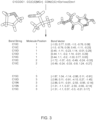
- FIG. 3 shows an example of constructing BSP representations of reactants/reagents from SMILES strings.
- the bond strings shown in the left column enumerate the bonds in each molecule.
- the molecule position in the center column indicates which molecule a bond belongs to, allowing the model to distinguish one molecule from another.
- the third column, bond vector contains the coordinates of the bond in three-dimensional space.
- the bond string and position (BSP) molecular representation can directly identify information about a molecule's complete three-dimensional structure.
- the BSP molecular representations can be used to train a machine learning model (e.g., a Transformer based model).
- the model may be trained to predict "missing" (or “masked") bonds that were artificially removed from each representation based on the rest of the representation. That is, the model is trained to, given the position of an unknown bond, predict the correct bond token by examining the neighboring bonds in three-dimensional space.
- a training data set can include three-dimensional representations of molecules.
- a training data set may include unique molecules from the MIT_USPTO dataset, which contains hundreds of thousands of chemical reactions scraped from U.S. patents, for a total of around 600k unique molecules. Since the three-dimensional representation of each molecule is not unique as a single molecule may have multiple conformers, multiple molecule representations can be generated with different coordinates. This acts as a data augmentation routine and helps reduce overfitting on downstream tasks.
- FIG. 5 depicts an overall process of training the masked bond model.
- Some of the tokens from the bond string representation of a molecule can be selected (e.g., randomly selected) and replaced with a [MASK] token.
- the corresponding bond positions of all mask tokens can be kept as is.
- the masked bond string and the bond position can be fed to the Encoder network of the Transformer model (e.g., a BERT encoder).
- the model loss is then computed using only the prediction at each masked position.
- the masked input BSP representations and the predicted unmasked BSP representations for the example of FIG. 5 are:
- the Transformer model can include the Encoder network and a Decoder network.
- pre-training the Transformer model can include training the Encoder network to learn how to transform the BSP molecular representation into an embedding space and training the Decoder network to learn how to transform a data point in the embedding space into the corresponding BSP molecular representation or into another representation that identifies the structure of a molecule, such as a Simplified Molecular-Input Line-Entry System (SMILES) representation.
- SILES Simplified Molecular-Input Line-Entry System
- a Graph Neural Network can be used to generate the fingerprint.
- a molecule can be interpreted as a molecular graph where atoms are nodes and bonds are edges. Under such representation, a GNN can be used to obtain the embedding of the molecule.
- a typical GNN may include multiple graph convolution layers. To update the node features, the graph convolution layer may aggregate features of the adjacent nodes. There are many variants of graph convolution. For example, a Message Passing layer may be particularly expressive and may allow incorporation of edge features that are important for molecular graphs.
- FIG. 7 illustrates a representation of a Message Passing layer.
- Each node may collect messages from the neighboring nodes. Nodes are shown as X i and X j .
- a message may be sent from X j to X i , including edge information E ij .
- the message value is represented as M ij .
- the messages, M ij may then be aggregated using a permutation invariant function such as mean or sum.
- the aggregated message is shown as X ⁇ ⁇ .
- Each node may update its feature vector using aggregated messages, X ⁇ ⁇ , and its own feature vector, X i .
- the updated node is shown as X i '.
- GNNs can be pre-trained on unlabeled molecules.
- Two methods of GNN pre-training include atom masking and context prediction.
- FIG. 8 shows an approach for atom-masking pre-training.
- the "X” shows a masked node in a molecular graph.
- a GNN is used to obtain the identity of the masked node.
- neighborhood and context graphs of v may be defined as follows.
- K-hop neighborhood of v contains all nodes and edges that are at most K-hops away from v in the graph. This is motivated by the fact that a K-layer GNN aggregates information across the K-th order neighborhood of v, and thus node embedding h (K) v depends on nodes that are at most K-hops away from v.
- a context graph of node v represents the graph structure that surrounds v 's neighborhood.
- the context graph may be described by two hyperparameters, r1 and r2, and the context graph may represent a subgraph that is between r1 -hops and r2 -hops away from v (i.e., it is a ring of width r2 - r1 ).
- a constraint of r1 ⁇ K can be implemented so that some nodes are shared between the neighborhood and the context graph, and those nodes can be referred to as context anchor nodes. Constraints may include K being 2, 3, 4, 5, 6, 7, 8, 9, or 10. These anchor nodes provide information about how the neighborhood, and context graphs may be connected with each other.
- FIG. 9 shows molecular graphs and subgraphs for a K-hop neighborhood around a center node.
- K is the number of hops allowed between a given node and its neighbors, such that two nodes are considered neighbors if they are connected by a path with K or fewer edges. It is set to 2 in the figure.
- FIG. 9 shows a subgraph for a K-hop neighborhood, including nodes within 2 hops of the center node.
- FIG. 9 also shows the context subgraphs created by extracting the portions of the molecule that fall between r1 and r2.
- Box 904 represents the embedding vector of the K-hop neighborhood subgraph
- box 908 represents the embedding vector of the context graph.
- the dot represents the vector dot product similarity.
- Table 1 shows performance metrics of a GNN generated using different data sets, evaluation metrics and types of pre-training. Generally, performance metrics associated with the atom-mask pre-training slightly exceeded those associated with the context-prediction pre-training.
- Table 1 Validation scores on DeepChem tasks Dataset Name Number of Tasks Number of Samples Evaluation Metric Context Prediction Pre-training Atom Mask Pre-training HIV 1 41913 ROC-AUC 0.7633 0.7801 BACE 1 1522 ROC-AUC 0.8466 0.8630 BBBP 1 2053 ROC-AUC 0.7075 0.7312 Tox21 12 8014 ROC-AUC 0.7473 0.7507 ToxCast 617 8615 ROC-AUC 0.6000 0.6300 SIDER 27 1427 ROC-AUC 0.6457 0.6629 ClinTox 2 1491 ROC-AUC 0.5000 0.5000
- the molecular graph may be represented as a fixed size latent vector such that the molecule can be reconstructed from the latent vector as a SMILES string.
- the size of the latent vector is a hyperparameter and may be determined empirically. This latent vector can then be used to predict the properties of the molecule.
- FIG. 10 illustrates molecular graph 1004 as an example.
- the molecular graph may be represented using BSP.
- Molecular graph 1004 can have latent representation 1008.
- Latent representation 1008 can be used for property prediction 1012.
- a SMILES string 1016 can also be reconstructed from latent representation 1008.
- DVT D irectional V ariational T ransformer
- the Encoder network may be a graph-based module.
- Graph-based modules may include graph neural networks (GNNs).
- the graph-based modules may consider distance between atoms and the spatial direction from one atom to another.
- DimeNet github.com/gasteigerjo/dimenet
- the DVT may embed messages passed between atoms rather than the atoms themselves.
- a message passing layer is described with FIG. 7 .
- the Decoder network may take the latent representation from the Encoder network as an input and then generate the SMILES representation.
- DVT DVT and the variational transformers (VT) (e.g., model trained as variational autoencoder in section II.D.)
- VT variational transformers
- the DVT model can be used in place of another transformer model.
- the DVT model may be pre-trained and trained similar to the variational autoencoder model described in section II.D. Additionally, aspects of transformer models described with the DVT model may also apply to other transformer models.
- an input data set may represent a molecule in a manner that identifies a sequence of bonds with the position of its atoms in 3-D space. Using the positions of the atoms, the relative distances and angles between two bonds may be computed.
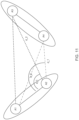
- FIG. 11 illustrates the relative position in terms of angles and distances.
- FIG. 11 shows four atoms: A1, A2, A3, and A4. A1 and A2 are connected by a bond, and A3 and A4 are connected by a bond.
- B1(A1, A2) represents the bond between atom A1 and A2, and B2(A3, A4) represents the bond between atom A3 and A4.
- the order of the atoms in a bond may be defined by their order of appearance during a depth-first search over the molecular graph of the molecule. Because the molecular graph created from canonical SMILES is unique, the model can learn to generalize the order. Generalizing the order may refer to the model learning how to generate canonical ordering of SMILES during training, and when BSP of a molecule not seen during training is an input, the model can output the canonical SMILES of that molecule.
- the second atom can be chosen to compute distances and angles. For example, FIG. 11 shows the distances and angles from atom A2 rather than atom A1, even though A1 and A2 are both in the same bond.
- the distances and angles can be computed from the first atom (e.g., A1) in the bond.
- the performance of the model may remain high regardless of whether the calculations of angles and distances are performed using the first atom of a bond or the second atom of a bond.
- a graph representation of a molecule may be input into the Encoder network.
- the graph representation may identify spatial relationships between atoms and/or spatial properties pertaining to bonds between atoms.
- the graph representation may include a representation of the molecule in two dimensions.
- the graph representation may include a representation of the molecule in three dimensions.
- the encoder network may produce a fixed size latent vector as an output.
- the Encoder network may include a plurality of heads.
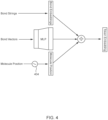
- the Encoder network may include two heads: a graph attention head and a readout attention head. Other heads that may be used include a standard attention head or an OutputBlock head, similar to what is used in DimeNet.
- a graph attention head performs attention-based message passing between nodes to provide relative angle and distance information.
- message passing may include two steps.
- nodes may send messages to their neighboring nodes, a message from node i to node j is a combination of embedding of node i and a relative position of node i with respect to node j, as shown in FIG. 12A .
- the message includes an angle from E_t to another node (e.g., A_ti) and a distance from E_t to another node (e.g., D_ti).
- all nodes may send messages to neighboring nodes.
- the number of message passing steps may be the same as the number of graph attention layers in the Encoder network.
- the number of graph attention layers may be 2, 3, 4, 5, 6, 7, 8, 9, 10, or more.
- each node may aggregate its incoming messages using an attention mechanism, as shown in FIG. 12B .
- Each node may generate a key-value pair (i.e., k and v) for all incoming messages.
- Each node also may generate a query vector (i.e., q) from its own embedding. Using the query and key, each node may compute the attention score by doing the vector dot product between query and key vector for all incoming messages.
- the updated embedding of the target node may be generated based on a weighted average of the value vector of all incoming edges.
- An example of the weight is W([A_ti, D_ti]), which is a vector that contains directional information between bond t and i in FIG. 12A . If attention is between bonds that share a common atom, then A_ti and D_tj are scalar values representing single angle and distance values. If attention is between bonds that are within a certain threshold distance, then A_ti and D_tj are vectors of size 2 and can be computed as shown in FIG. 11 .
- the attention scores are used as weights.
- a set of embeddings may be generated, where each embedding represents an angle or distance of a bond in one or more molecules (e.g., such that the set of embeddings corresponds to a single ionic liquid molecule or a combination of a single ionic liquid molecule and a target molecule).
- a set of key-value-query pairs are generated that correspond to pairs between the particular embedding and each embedding in the set of embeddings.
- a readout attention head may be another head used in the Encoder network.
- the readout head may aggregate all node embeddings to generate fixed size latent vectors using the attention mechanism.
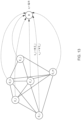
- a readout node may be used to aggregate all nodes.
- the readout node may be a single node connected to all other nodes but excluded from the message passing mechanism.
- the readout node is R in FIG. 13 .
- the readout node may act as a query vector and may have an embedding that is learned during training. Key-value pairs (i.e., k and v) from all nodes in the graph may be generated. Using query and key, the attention score may be computed for all nodes of the graph. Weighted aggregation of all value vectors where attention scores are weights may be performed.
- the "promising molecule” can correspond to a position in the embedding space where a condition associated with each predicted property is satisfied.
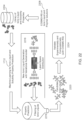
- FIG. 22 illustrates an exemplary workflow for identifying candidate molecules for a reaction (e.g., depolymerization) using computational simulations and variational autoencoder.
- a data store is created and/or accessed that includes one or more properties and structures of molecules.
- the one or more properties can include viscosities, solubilities, enthalpies, and/or activity coefficients.
- COSMO-RS computations at stage 2208 may be accessed corresponding to compounds that have already pre-computed quantum mechanical (DFT) calculations.
- DFT quantum mechanical
- one or more regions within the embedding space that correspond to desirable properties can be identified.
- What constitutes the "desirable" properties may be defined based on input from a user and/or default settings. For example, a user may be able to adjust thresholds for each of one or more properties in an interface. The interface may update to indicate for how many molecules the threshold criteria are fulfilled.
- a Decoder network (trained within a corresponding variational autoencoder 2218) can then be used to transform data points within the one or more regions of the embedding space into structural representations of the molecules (e.g., SMILES or BSP representations of the molecules).
- a Decoder network of the variational autoencoder may be trained to reliably translate data points from the embedding space into a space that clearly conveys molecular structure.
- the outputs from the generative and regression model(s) may identify positions within the embedding space(s) having properties of interest, one or more candidate molecules of interest can be identified using the variational autoencoder.
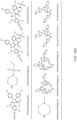
- a transformer-based variational autoencoder model was trained on a large data set of chemical molecules containing both charged (i.e., ionic liquid cations and anions) and uncharged species. The autoencoder model was then used to generate new ionic liquid cations by exploring the space near known ionic liquid cations.
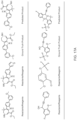
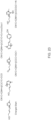
- FIG. 23 illustrates exploring the space around a molecule to generate new ionic liquid cations.
- the starting ionic liquid cation is on the left and labeled "CHARGED START.” Random Gaussian noise was added to its embedding.
- the four ionic liquid cations were then decoded from the embedding.
- the SMILES string of each cation is listed underneath the four resulting ionic liquid cations.
- the four decoded outputs are all charged molecules, although this is not always the case because of the stochastic nature of the model.
- FIG. 23 demonstrates that additional ionic liquid cations can be generated from a single ionic liquid cation using a transformer-based variational autoencoder model.
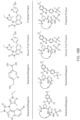
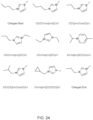
- FIG. 24 shows exploring the space in between two molecules by means of linear interpolation.
- the two molecules are the ionic liquid cation on the top left labeled "CHARGED START” and the ionic liquid cation on the bottom right labeled "CHARGED END.”
- FIG. 24 shows seven ionic liquid cations generated in the space between CHARGED START and CHARGED END.
- the SMILES strings are displayed underneath the generated cations.
- Other interpolation techniques like SLERP (spherical linear interpolation), can also be utilized.
- FIG. 24 demonstrates that additional ionic liquid cations can be generated by exploring the space between two ionic liquid cations using a transformer-based variational autoencoder model.
- Chemical recycling involves reaction processes where waste (e.g., plastic waste) is converted back into molecular constituents to then be used as fuel or feedstock by the chemical industry.
- Optimized chemical reactions are selected by attempting to maximize conversion (amount of plastic dissolved relative to amount of starting plastic), yield (amount of monomer relative to amount of starting plastic), and selectivity (amount of monomer relative to total amount of reaction products).
- These deconstruction reactions are complex, as they depend on intricate coupling between chemical and physical processes spanning multiple time and length scales, meaning that design of experiments (DOE) is expensive and not easily generalizable across chemical space.
- Chemical reaction optimization involves maximizing a function (e.g., a utility function) that is dependent on a set of reaction parameters.
- a function e.g., a utility function
- optimization algorithms e.g., convex approaches for local minima such as gradient descent, conjugate gradient, BFGS, and non-convex, black box function optimization approaches for global optima such as systematic grid-searches
- they can require many evaluations of the function and are not suitable for expensive processes such as laboratory chemical reactions where each evaluation requires a new benchtop experiment to be run.
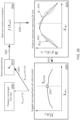
- FIG. 26 illustrates a Bayesian optimization process via GP iterative loop using discrete sampling, x obs .
- Thicker lines 2604, 2606, 2608, and 2610 show the loop which starts with a seed set of experimental results 2612 which are used to construct the posterior distribution 2616.
- Green points e.g., point 2620
- red points e.g., point 2624
- the utility shown in graph 2628
- the next experiment in the star 2632, x probe is picked from x obs , because x probe has the highest utility.
- the Gaussian Process prior is constructed.
- the surrogate function for black box function f ( x ) (box 2640) assumes GP over R N , but the prior is constructed using only a specific and finite set of points called x obs .
- x n x obs
- x obs is discrete.
- the set of points x obs includes points that have been experimentally evaluated, providing experimental data.
- R N describes the design space and may include parameters like solvent type, solvent concentration, solvent ratio, and reaction temperature.
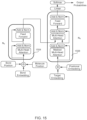
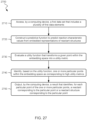
- FIG. 27 is a flowchart of an example process 2700 associated with ionic liquid based depolymerization optimization.
- the feature matrix may be decorrelated by removing columns that have a pairwise correlation coefficient greater than a predefined threshold (e.g., 0.4, 0.5, 0.6, 0.7, 0.8, or 0.9) and/or less than a negative of the predefined threshold.
- a predefined threshold e.g., 0.4, 0.5, 0.6, 0.7, 0.8, or 0.9
- PCA may be used on the resulting feature matrix.
- PCA may result in 3, 4, 5, 5 to 10, 10 to 15, 15 to 20, 20 to 30, or more than 30 principal components (PCs).
- the embedded representation may include a property of a reactant of a set of reactants in the depolymerization reaction.
- a property of the reactant may include viscosity, activity coefficient, bond type, enthalpy of formation, heat of combustion, or properties derived therefrom.
- the reactants in the plurality of first data elements may include ionic liquids, including any described herein. In some embodiments, the reactants may also include a solvent, including any described herein, and/or the polymer to be depolymerized.
- a suitable database such as the National Institute of Standards and Technology (NIST) database for binary ionic liquids with known viscosities may be queried to provide property information.
- NIST National Institute of Standards and Technology
- the plurality of first data elements may include reaction input values that characterize an operating condition of the depolymerization reaction.
- the reaction input variables may include time, temperature, ratio (e.g., ionic liquid to solvent), amount, cost, and/or pressure.
- the plurality of first data elements may also include a representation, which may or may not be embedded, of the solvent.
- Constructing the predictive function may include estimating reaction-characteristic values and/or reaction inputs not present in the first data set. These reaction-characteristic values and/or the reaction input values not present in the first data set may be discrete values even if the parameters are continuous (e.g., time, temperature, ratio, amount, embedding space). The estimated reaction-characteristic values and/or the reaction input values may be determined by a Gaussian Process.
- process 2700 may identify, based on the utility function, one or more particular points within the embedding space as corresponding to high utility metrics. For example, in FIG. 26 , graph 2628 shows a utility function with star 2632 indicating the maximum. The values associated with that maximum may be one point of the one or more particular points.
- process 2700 may include outputting, by the computing device, a result that identifies, for each particular point of the one or more particular points, a reactant corresponding to the particular point or a reactant structure corresponding to the particular point.
- the result may be displayed to a user.
- process 2700 may include determining that the one or more particular points are equivalent to one or more coordinate values of the set of coordinate values within the embedding space in the plurality of first data elements.
- Process 2700 may further include outputting a message conveying that the one or more particular points represent a converged solution.
- the computing device may end the Bayesian optimization. For example, the utility function may not be evaluated again.
- the first data set may include a point previously identified using the utility function.
- An experiment may have been performed using the point previously identified using the utility function to determine at least one reaction-characteristic value in the plurality of first data elements.
- Process 2700 may include additional implementations, such as any single implementation or any combination of implementations described below and/or in connection with one or more other processes described elsewhere herein.
- process 2700 may include additional blocks, fewer blocks, different blocks, or differently arranged blocks than those depicted in FIG. 27 . Additionally, or alternatively, two or more of the blocks of process 2700 may be performed in parallel.
- Embodiments may also include a depolymerization product resulting from performing an experiment with reactants and reaction-characteristic values and/or reaction input values corresponding to the one or more particular points identified by process 2700.
- Embodiments may also include a method of acquiring a reactant, including an ionic liquid, and/or a solvent.
- the identity of the reactant or solvent and/or the amount of the reactant or solvent may be determined by the reactants and/or reaction input values corresponding to the one or more particular points identified by process 2700.
- Embodiments may also include a reactant and/or a solvent that is acquired after being identified by process 2700.
- the feature matrix may be reduced in size. For each of the 3,652 columns, their corresponding mean was subtracted and divided by n-1 (e.g., 116). This normalization may avoid columns appearing to be significant simply because the magnitudes of their values are higher than other columns.
- the feature matrix was decorrelated by computing pairwise correlation of columns and removing any columns that have correlation coefficient > 0.5 or correlation coefficient ⁇ -0.5.
- the feature matrix included column indices that are duplicates based on high correlation, and one of each of the duplicate columns was retained. Each column was taken in order, and the column's correlation with every other column was computed. Any of these other columns that have a high correlation are removed. The process of analyzing correlation and removing columns is repeated for remaining columns. In this example, after decorrelation, the feature matrix has shape 117 x 26.
- the open-source BayesianOptimization (github.com/fmfn/BayesianOptimization) (accessed September 15, 2021) package available via the MIT License may be used. The package was adapted for custom input of the arrays.
- UOB GP Upper Confidence Bound
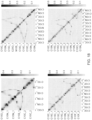
- FIGS. 28A and 28 B show the result of applying Bayesian optimization to the minimization of H mix over solvent mole fraction x obs .
- FIGS. 28A and 28B show two sampling approaches, both with the same utility function.
- the x-axis shows the mole fraction.
- the y-axis of the top graphs shows the black box function.
- Dashed lines 2804 and 2808 show the mean for the black box function.
- Shaded teal regions e.g., regions 2812 and 2816
- the observations x s e.g., points 2820 and 2824
- the observables x obs e.g., points 2828 and 2832
- the yellow stars e.g., stars 2836 and 2850
- the size of the seed experiments given to seed the Bayesian optimization was considered a "bundle.”
- Each "bundle” contained all the mole fraction and temperature data for a given ionic liquid and solvent pair versus H mix .
- the bundle may contain similar information as the plurality of first data elements (in this example, ionic liquid, solvent, mole fraction) and the associated one or more output values (in this example, H mix ) of process 2700.
- Separating bundles by ionic liquid and solvent pairs and not by mole fractions is a realistic setting for seed experiments because the cost to purchase an ionic liquid to be used with a solvent is much greater than the cost to produce different mole fractions of solvent to IL. In other words, when an IL is purchased or created, the thermodynamic data is readily available or obtainable for a range of mole fractions.
- Bayesian optimization was applied to the depolymerization of polylactic acid (PLA).
- the PCs for ionic liquids determined above were used for Bayesian optimization.
- Conversion (C) and yield (Y) is the subject of optimization. Conversion is the amount of total product relative to amount of starting plastic, and yield is the amount of the target monomer relative to amount of starting plastic.
- Table 7 shows the results of doing 100 trials to predict conversion and yield.
- the results for conversion are on the left and the results for yield are on the right.
- the percent success (%) is the average likelihood that the maximized reaction is greater than 95% for conversion and greater than 85% for yield.
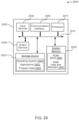
- computing system 2900 includes a computing device 2905.
- the computing device 2905 can be resident on a network infrastructure such as within a cloud environment, or may be a separate independent computing device (e.g., a computing device of a service provider).
- the computing device 2905 may include a bus 2910, processor 2915, a storage device 2920, a system memory (hardware device) 2925, one or more input devices 2930, one or more output devices 2935, and a communication interface 2940.
- bus 2910 permits communication among the components of computing device 2905.
- bus 2910 may be any of several types of bus structures including a memory bus or memory controller, a peripheral bus, and a local bus using any of a variety of bus architectures to provide one or more wired or wireless communication links or paths for transferring data and/or power to, from, or between various other components of computing device 2905.
- the processor 2915 may be one or more processors, microprocessors, or specialized dedicated processors that include processing circuitry operative to interpret and execute computer readable program instructions, such as program instructions for controlling the operation and performance of one or more of the various other components of computing device 2905 for implementing the functionality, steps, and/or performance of the present disclosure.
- processor 2915 interprets and executes the processes, steps, functions, and/or operations of the present disclosure, which may be operatively implemented by the computer readable program instructions.
- processor 2915 can retrieve, e.g., import and/or otherwise obtain or generate ionic liquid properties, encode molecule information into an embedding space, decode a point in an embedding space into a molecule, construct predictive functions, and evaluate utility functions.
- the information obtained or generated by the processor 2915 can be stored in the storage device 2920.
- the storage device 2920 may include removable/non-removable, volatile/nonvolatile computer readable media, such as, but not limited to, non-transitory machine readable storage medium such as magnetic and/or optical recording media and their corresponding drives.
- the drives and their associated computer readable media provide for storage of computer readable program instructions, data structures, program modules and other data for operation of computing device 2905 in accordance with the different aspects of the present disclosure.
- storage device 2920 may store operating system 2945, application programs 2950, and program data 2955 in accordance with aspects of the present disclosure.
- the system memory 2925 may include one or more storage mediums, including for example, non-transitory machine readable storage medium such as flash memory, permanent memory such as read-only memory (“ROM”), semi-permanent memory such as random access memory (“RAM”), any other suitable type of non-transitory storage component, or any combination thereof.
- non-transitory machine readable storage medium such as flash memory
- permanent memory such as read-only memory (“ROM”)
- semi-permanent memory such as random access memory (“RAM”)
- RAM random access memory
- BIOS input/output system 2960
- the one or more input devices 2930 may include one or more mechanisms that permit an operator to input information to computing device 2905, including, but not limited to, a touch pad, dial, click wheel, scroll wheel, touch screen, one or more buttons (e.g., a keyboard), mouse, game controller, track ball, microphone, camera, proximity sensor, light detector, motion sensors, biometric sensor, and combinations thereof.
- the one or more output devices 2935 may include one or more mechanisms that output information to an operator, such as, but not limited to, audio speakers, headphones, audio line-outs, visual displays, antennas, infrared ports, tactile feedback, printers, or combinations thereof.
- Some embodiments of the present disclosure include a system including one or more data processors.
- the system includes a non-transitory computer readable storage medium containing instructions which, when executed on the one or more data processors, cause the one or more data processors to perform part or all of one or more methods and/or part or all of one or more processes disclosed herein.
- Some embodiments of the present disclosure include a computer-program product tangibly embodied in a non-transitory machine-readable storage medium, including instructions configured to cause one or more data processors to perform part or all of one or more methods and/or part or all of one or more processes disclosed herein.
- circuits, systems, networks, processes, and other components may be shown as components in block diagram form in order not to obscure the embodiments in unnecessary detail.
- well-known circuits, processes, algorithms, structures, and techniques may be shown without unnecessary detail in order to avoid obscuring the embodiments.
Landscapes
- Chemical & Material Sciences (AREA)
- Engineering & Computer Science (AREA)
- Theoretical Computer Science (AREA)
- Life Sciences & Earth Sciences (AREA)
- Computing Systems (AREA)
- Bioinformatics & Cheminformatics (AREA)
- Bioinformatics & Computational Biology (AREA)
- Crystallography & Structural Chemistry (AREA)
- Health & Medical Sciences (AREA)
- Chemical Kinetics & Catalysis (AREA)
- General Health & Medical Sciences (AREA)
- Data Mining & Analysis (AREA)
- Physics & Mathematics (AREA)
- Spectroscopy & Molecular Physics (AREA)
- Medicinal Chemistry (AREA)
- Polymers & Plastics (AREA)
- Organic Chemistry (AREA)
- Sustainable Development (AREA)
- Analytical Chemistry (AREA)
- Databases & Information Systems (AREA)
- Computer Vision & Pattern Recognition (AREA)
- Evolutionary Computation (AREA)
- Medical Informatics (AREA)
- Software Systems (AREA)
- Artificial Intelligence (AREA)
- Information Retrieval, Db Structures And Fs Structures Therefor (AREA)
- Management, Administration, Business Operations System, And Electronic Commerce (AREA)
Claims (15)
- Computerimplementiertes Verfahren, umfassend:
Zugreifen auf eine prädiktive Funktion, die zu Folgendem konfiguriert ist:Empfangen einer unvollständigen oder vollständigen Darstellung einer Bindungszeichenfolge und Position, BSP-Darstellung, eines Moleküls einer ionischen Reaktantenflüssigkeit, wobei die unvollständige oder vollständige BSP-Darstellung relative Positionen von Atomen identifiziert, die durch eine Bindung in dem Molekül verbunden sind;Vorhersagen eines reaktionscharakteristischen Werts, der eine Reaktion zwischen der ionischen Reaktantenflüssigkeit und einem konkreten Polymer charakterisiert, basierend auf der empfangenen unvollständigen oder vollständigen BSP-Darstellung;wobei die prädiktive Funktion mindestens zum Teil unter Verwendung von Trainingsdaten generiert wurde, die einem Satz von Molekülen, die unter Verwendung einer Bayes-Optimierung ausgewählt wurden, einer oder mehreren vorheriger Versionen der prädiktiven Funktion und experimentell abgeleiteten reaktionscharakteristischen Werten, die Reaktionen zwischen den unter Verwendung der Bayes-Optimierung ausgewählten Molekülen und dem konkreten Polymer charakterisieren, entsprechen;Identifizieren mindestens einer konkreten ionischen Flüssigkeit als Perspektive zum Depolymerisieren des konkreten Polymers basierend auf der prädiktiven Funktion; undAusgeben einer Identifizierung der mindestens einen konkreten ionischen Flüssigkeit. - Computerimplementiertes Verfahren nach Anspruch 1, wobei die Identifizierung der mindestens einen konkreten ionischen Flüssigkeit eine Art von Darstellung einschließt, die sich von einer unvollständigen oder vollständigen BSP-Darstellung unterscheidet.
- Computerimplementiertes Verfahren nach Anspruch 1 oder 2, ferner umfassend:
Identifizieren einer BSP-Darstellung für jedes der Moleküle, die unter Verwendung der Bayes-Optimierung ausgewählt wurden, wobei die prädiktive Funktion mindestens zum Teil basierend auf den BSP-Darstellungen der unter Verwendung der Bayes-Optimierung ausgewählten Moleküle generiert wurde. - Computerimplementiertes Verfahren nach einem der Ansprüche 1-3, ferner umfassend:
Generieren der Trainingsdaten durch ein durchführendes quantenmechanisches oder thermodynamisches Verfahren. - Computerimplementiertes Verfahren nach einem der Ansprüche 1-4, wobei die Auswahl des Satzes von Molekülen, die den Trainingsdaten entsprechen, ferner auf einem Auswerten einer Nutzenfunktion unter Verwendung mindestens einer der einen oder der mehreren vorherigen Versionen der Vorhersagefunktion basierte.
- Computerimplementiertes Verfahren nach einem der Ansprüche 1-5, wobei der reaktionscharakteristische Wert eine Mischungsenthalpie einschließt, die der ionischen Reaktantenflüssigkeit und dem konkreten Polymer zugeordnet ist.
- Computerimplementiertes Verfahren nach einem der Ansprüche 1-5, wobei der reaktionscharakteristische Wert einen Aktivitätskoeffizienten einschließt, der der ionischen Reaktantenflüssigkeit und dem konkreten Polymer zugeordnet ist.
- System, umfassend:einen oder mehrere Datenprozessoren; undein nichttransitorisches computerlesbares Speichermedium, das Anweisungen enthält, die, wenn sie auf dem einen oder den mehreren Datenprozessoren ausgeführt werden, den einen oder die mehreren Datenprozessoren dazu veranlassen, Folgendes durchzuführen:
Zugreifen auf eine prädiktive Funktion, die zu Folgendem konfiguriert ist:Empfangen einer unvollständigen oder vollständigen Darstellung einer Bindungszeichenfolge und Position, BSP-Darstellung, eines Moleküls einer ionischen Reaktantenflüssigkeit, wobei die unvollständige oder vollständige BSP-Darstellung relative Positionen von Atomen identifiziert, die durch eine Bindung in dem Molekül verbunden sind;Vorhersagen eines reaktionscharakteristischen Werts, der eine Reaktion zwischen der ionischen Reaktantenflüssigkeit und einem konkreten Polymer charakterisiert, basierend auf der empfangenen unvollständigen oder vollständigen BSP-Darstellung;wobei die prädiktive Funktion mindestens zum Teil unter Verwendung von Trainingsdaten generiert wurde, die einem Satz von Molekülen, die unter Verwendung einer Bayes-Optimierung ausgewählt wurden, einer oder mehreren vorheriger Versionen der prädiktiven Funktion und experimentell abgeleiteten reaktionscharakteristischen Werten, die Reaktionen zwischen den unter Verwendung der Bayes-Optimierung ausgewählten Molekülen und dem konkreten Polymer charakterisieren, entsprechen;Identifizieren mindestens einer konkreten ionischen Flüssigkeit als Perspektive zum Depolymerisieren des konkreten Polymers basierend auf der prädiktiven Funktion; undAusgeben einer Identifizierung der mindestens einen konkreten ionischen Flüssigkeit. - System nach Anspruch 8, wobei die Identifizierung der mindestens einen konkreten ionischen Flüssigkeit eine Art von Darstellung einschließt, die sich von einer unvollständigen oder vollständigen BSP-Darstellung unterscheidet.
- System nach Anspruch 8 oder Anspruch 9, wobei die Anweisungen, wenn sie auf dem einen oder den mehreren Datenprozessoren ausgeführt werden, den einen oder die mehreren Datenprozessoren dazu veranlassen, Folgendes durchzuführen:
Identifizieren einer BSP-Darstellung für jedes der Moleküle, die unter Verwendung der Bayes-Optimierung ausgewählt wurden, wobei die prädiktive Funktion mindestens zum Teil basierend auf den BSP-Darstellungen der unter Verwendung der Bayes-Optimierung ausgewählten Moleküle generiert wurde. - System nach einem der Ansprüche 8-10, wobei die Anweisungen, wenn sie auf dem einen oder den mehreren Datenprozessoren ausgeführt werden, den einen oder die mehreren Datenprozessoren dazu veranlassen, Folgendes durchzuführen:
Generieren der Trainingsdaten durch ein durchführendes quantenmechanisches oder thermodynamisches Verfahren. - System nach einem der Ansprüche 8-11, wobei die Auswahl des Satzes von Molekülen, die den Trainingsdaten entsprechen, ferner auf einem Auswerten einer Nutzenfunktion unter Verwendung mindestens einer der einen oder der mehreren vorherigen Versionen der Vorhersagefunktion basierte.
- System nach einem der Ansprüche 8-12, wobei der reaktionscharakteristische Wert eine Mischungsenthalpie einschließt, die der ionischen Reaktantenflüssigkeit und dem konkreten Polymer zugeordnet ist.
- System nach einem der Ansprüche 8-12, wobei der reaktionscharakteristische Wert einen Aktivitätskoeffizienten einschließt, der der ionischen Reaktantenflüssigkeit und dem konkreten Polymer zugeordnet ist.
- Computerprogramm, das greifbar in einem nichttransitorischen maschinenlesbaren Speichermedium verkörpert ist, das Anweisungen einschließt, die dazu konfiguriert sind, einen oder mehrere Datenprozessoren dazu zu veranlassen, das Verfahren nach einem der Ansprüche 1 bis 7 durchzuführen.
Applications Claiming Priority (5)
| Application Number | Priority Date | Filing Date | Title |
|---|---|---|---|
| US202163264640P | 2021-11-29 | 2021-11-29 | |
| US202163264642P | 2021-11-29 | 2021-11-29 | |
| US202163264641P | 2021-11-29 | 2021-11-29 | |
| US202163264643P | 2021-11-29 | 2021-11-29 | |
| PCT/US2022/046898 WO2023096712A1 (en) | 2021-11-29 | 2022-10-17 | Depolymerization optimization platform |
Publications (3)
| Publication Number | Publication Date |
|---|---|
| EP4420132A1 EP4420132A1 (de) | 2024-08-28 |
| EP4420132B1 true EP4420132B1 (de) | 2025-06-25 |
| EP4420132C0 EP4420132C0 (de) | 2025-06-25 |
Family
ID=84331933
Family Applications (4)
| Application Number | Title | Priority Date | Filing Date |
|---|---|---|---|
| EP22802812.2A Pending EP4413584A1 (de) | 2021-11-29 | 2022-10-17 | Molekularstrukturtransformatoren zur eigenschaftsvorhersage |
| EP22802813.0A Pending EP4420130A1 (de) | 2021-11-29 | 2022-10-17 | Optimierung der depolymerisation auf basis von ionischen flüssigkeiten |
| EP22802392.5A Active EP4420132B1 (de) | 2021-11-29 | 2022-10-17 | Depolymerisationsoptimierungsplattform |
| EP22803416.1A Pending EP4420038A1 (de) | 2021-11-29 | 2022-10-17 | Suche nach kandidatenmolekülen unter verwendung von quanten- oder thermodynamischen simulationen und autocodierer |
Family Applications Before (2)
| Application Number | Title | Priority Date | Filing Date |
|---|---|---|---|
| EP22802812.2A Pending EP4413584A1 (de) | 2021-11-29 | 2022-10-17 | Molekularstrukturtransformatoren zur eigenschaftsvorhersage |
| EP22802813.0A Pending EP4420130A1 (de) | 2021-11-29 | 2022-10-17 | Optimierung der depolymerisation auf basis von ionischen flüssigkeiten |
Family Applications After (1)
| Application Number | Title | Priority Date | Filing Date |
|---|---|---|---|
| EP22803416.1A Pending EP4420038A1 (de) | 2021-11-29 | 2022-10-17 | Suche nach kandidatenmolekülen unter verwendung von quanten- oder thermodynamischen simulationen und autocodierer |
Country Status (5)
| Country | Link |
|---|---|
| US (6) | US12378383B2 (de) |
| EP (4) | EP4413584A1 (de) |
| JP (4) | JP7764604B2 (de) |
| ES (1) | ES3039160T3 (de) |
| WO (4) | WO2023096711A1 (de) |
Families Citing this family (11)
| Publication number | Priority date | Publication date | Assignee | Title |
|---|---|---|---|---|
| WO2024250185A1 (zh) * | 2023-06-07 | 2024-12-12 | 之江实验室 | 基于矢量量化的图神经网络的药物性质预测方法和装置 |
| WO2025081097A1 (en) * | 2023-10-13 | 2025-04-17 | Albert Invent Corp. | Generating predictions relating to chemical processes using machine learning models |
| WO2025114842A1 (ja) * | 2023-11-30 | 2025-06-05 | 株式会社半導体エネルギー研究所 | 有機化合物の設計方法および有機化合物の設計システム |
| JP2025097645A (ja) * | 2023-12-19 | 2025-07-01 | 株式会社デンソー | 探索方法、情報処理装置、プログラム |
| US12368503B2 (en) | 2023-12-27 | 2025-07-22 | Quantum Generative Materials Llc | Intent-based satellite transmit management based on preexisting historical location and machine learning |
| CN118380162B (zh) * | 2024-04-22 | 2025-09-23 | 常熟理工学院 | 基于消息传递模型的药物不良反应预测方法 |
| CN118197509B (zh) * | 2024-05-17 | 2024-08-06 | 烟台国工智能科技有限公司 | 一种聚合物建模分析方法及装置 |
| CN119560054B (zh) * | 2024-10-29 | 2025-11-21 | 微宏慧联医疗科技(无锡)有限公司 | 一种基于药物预训练模型的分子性质预测微调方法 |
| CN120183541A (zh) * | 2025-05-21 | 2025-06-20 | 上海张江数学研究院 | 多模态分子性质预测方法、装置、设备、存储介质和计算机程序产品 |
| CN120354085B (zh) * | 2025-05-29 | 2025-08-12 | 云南师范大学 | 一种基于图神经网络的分子表示学习分布外泛化方法 |
| CN121075491A (zh) * | 2025-11-10 | 2025-12-05 | 厦门大学 | 基于双通道的聚合物性能预测系统及合成方案推荐系统 |
Family Cites Families (11)
| Publication number | Priority date | Publication date | Assignee | Title |
|---|---|---|---|---|
| US4777209A (en) | 1984-12-21 | 1988-10-11 | The Dow Chemical Company | Compositions of polycycloalkenyl-terminated, unsaturated polyesters or polyesteramides and vinyl-reactive plasticizers therefor |
| US5437979A (en) | 1989-07-24 | 1995-08-01 | Beckman Instruments, Inc. | Solid phase system for sequential reactions |
| US5772855A (en) | 1997-04-17 | 1998-06-30 | Bend Research, Inc. | Preparation of bioactive compounds by plasma synthesis |
| US20020077757A1 (en) | 2000-04-03 | 2002-06-20 | Libraria, Inc. | Chemistry resource database |
| US20030087334A1 (en) | 2001-04-02 | 2003-05-08 | Libraria, Inc. | Method of flexibly generating diverse reaction chemistries |
| WO2003044219A1 (en) | 2001-11-20 | 2003-05-30 | Libraria, Inc. | Method of flexibly generating diverse reaction chemistries |
| US20060216267A1 (en) | 2002-08-20 | 2006-09-28 | Kovacs Stephen G | Hydrophobic elastomeric polymer chemistry device for inhibiting the growth of onychomycosis and urushiol-induced allergic contact dermatitis |
| KR101373109B1 (ko) * | 2012-07-25 | 2014-03-11 | 인하대학교 산학협력단 | 셀룰로오스를 용해시킬 수 있는 이온성 액체를 탐색하는 방법 |
| CA2989059C (en) | 2015-06-19 | 2020-04-07 | Stratasys, Inc. | Water dispersible polymer for use in additive manufacturing |
| US12283351B2 (en) | 2018-11-27 | 2025-04-22 | California Institute Of Technology | Screening methods and related catalysts, materials, compositions, methods and systems |
| US20220108765A1 (en) * | 2020-10-01 | 2022-04-07 | International Business Machines Corporation | Sampling unique molecular structures from autoencoders |
-
2022
- 2022-10-17 JP JP2024529334A patent/JP7764604B2/ja active Active
- 2022-10-17 US US17/967,685 patent/US12378383B2/en active Active
- 2022-10-17 US US17/967,711 patent/US20230170056A1/en active Pending
- 2022-10-17 WO PCT/US2022/046897 patent/WO2023096711A1/en not_active Ceased
- 2022-10-17 EP EP22802812.2A patent/EP4413584A1/de active Pending
- 2022-10-17 ES ES22802392T patent/ES3039160T3/es active Active
- 2022-10-17 WO PCT/US2022/046898 patent/WO2023096712A1/en not_active Ceased
- 2022-10-17 JP JP2024529335A patent/JP7763951B2/ja active Active
- 2022-10-17 EP EP22802813.0A patent/EP4420130A1/de active Pending
- 2022-10-17 WO PCT/US2022/046895 patent/WO2023096710A1/en not_active Ceased
- 2022-10-17 JP JP2024529333A patent/JP7767614B2/ja active Active
- 2022-10-17 US US17/967,704 patent/US12291608B2/en active Active
- 2022-10-17 JP JP2024531709A patent/JP7766800B2/ja active Active
- 2022-10-17 US US17/967,723 patent/US20230167264A1/en active Pending
- 2022-10-17 WO PCT/US2022/046893 patent/WO2023096709A1/en not_active Ceased
- 2022-10-17 EP EP22802392.5A patent/EP4420132B1/de active Active
- 2022-10-17 EP EP22803416.1A patent/EP4420038A1/de active Pending
-
2025
- 2025-04-10 US US19/175,250 patent/US20250236717A1/en active Pending
- 2025-07-01 US US19/257,315 patent/US20250326912A1/en active Pending
Also Published As
| Publication number | Publication date |
|---|---|
| EP4420130A1 (de) | 2024-08-28 |
| US20250326912A1 (en) | 2025-10-23 |
| JP7767614B2 (ja) | 2025-11-11 |
| US12378383B2 (en) | 2025-08-05 |
| EP4420038A1 (de) | 2024-08-28 |
| EP4413584A1 (de) | 2024-08-14 |
| US20230167264A1 (en) | 2023-06-01 |
| JP2024541108A (ja) | 2024-11-06 |
| US12291608B2 (en) | 2025-05-06 |
| JP7766800B2 (ja) | 2025-11-10 |
| ES3039160T3 (en) | 2025-10-17 |
| EP4420132C0 (de) | 2025-06-25 |
| US20250236717A1 (en) | 2025-07-24 |
| JP7764604B2 (ja) | 2025-11-05 |
| US20230170059A1 (en) | 2023-06-01 |
| JP2024542186A (ja) | 2024-11-13 |
| WO2023096709A1 (en) | 2023-06-01 |
| JP2024541085A (ja) | 2024-11-06 |
| US20230170053A1 (en) | 2023-06-01 |
| US20230170056A1 (en) | 2023-06-01 |
| JP2024541084A (ja) | 2024-11-06 |
| JP7763951B2 (ja) | 2025-11-04 |
| WO2023096712A1 (en) | 2023-06-01 |
| EP4420132A1 (de) | 2024-08-28 |
| WO2023096710A1 (en) | 2023-06-01 |
| WO2023096711A1 (en) | 2023-06-01 |
Similar Documents
| Publication | Publication Date | Title |
|---|---|---|
| EP4420132B1 (de) | Depolymerisationsoptimierungsplattform | |
| Luo et al. | A 3D generative model for structure-based drug design | |
| Karthikeyan et al. | Artificial intelligence: machine learning for chemical sciences | |
| Jablonka et al. | Big-data science in porous materials: materials genomics and machine learning | |
| EP4181145B1 (de) | Verfahren und system für strukturbasierten arzneimittelentwurf unter verwendung eines multimodalen tiefenlernmodells | |
| US20230297853A1 (en) | System and method for the latent space optimization of generative machine learning models | |
| US12248885B2 (en) | System and method for feedback-driven automated drug discovery | |
| US11354582B1 (en) | System and method for automated retrosynthesis | |
| Doan et al. | Fcg-former: identification of functional groups in FTIR spectra using enhanced transformer-based model | |
| US11367006B1 (en) | Toxic substructure extraction using clustering and scaffold extraction | |
| Han et al. | Computer‐aided synthesis planning (CASP) and machine learning: optimizing chemical reaction conditions | |
| WO2024161359A2 (en) | Compound representation and property analysis at scale | |
| JP2026021368A (ja) | 特性予測のための分子構造トランスフォーマ | |
| Zhang et al. | Molecular Representations for Drug Discovery | |
| US20240355411A1 (en) | Decoding surface fingerprints for protein-ligand interactions | |
| Wei | Exploring Machine Learning Applications to Enable Next-Generation Chemistry | |
| Che | Data-driven approach of discovering organic photocatalysts and developing molecular force field by machine learning | |
| Han et al. | EGMOF: Efficient Generation of Metal-Organic Frameworks Using a Hybrid Diffusion-Transformer Architecture | |
| Wang et al. | qcGEM: a graph-based molecular representation with quantum chemistry awareness | |
| Coley | Data-driven Prediction of Organic Reaction Outcomes | |
| Hu | Studying the Spatial Organizations of Chromosomes With Machine Learning | |
| WO2026017861A1 (en) | Generating torsion profiles using circular mixture distributions | |
| Mechelke | On the application of Bayesian statistics to protein structure calculation from nuclear magnetic resonance data |
Legal Events
| Date | Code | Title | Description |
|---|---|---|---|
| STAA | Information on the status of an ep patent application or granted ep patent |
Free format text: STATUS: UNKNOWN |
|
| STAA | Information on the status of an ep patent application or granted ep patent |
Free format text: STATUS: THE INTERNATIONAL PUBLICATION HAS BEEN MADE |
|
| PUAI | Public reference made under article 153(3) epc to a published international application that has entered the european phase |
Free format text: ORIGINAL CODE: 0009012 |
|
| STAA | Information on the status of an ep patent application or granted ep patent |
Free format text: STATUS: REQUEST FOR EXAMINATION WAS MADE |
|
| 17P | Request for examination filed |
Effective date: 20240521 |
|
| AK | Designated contracting states |
Kind code of ref document: A1 Designated state(s): AL AT BE BG CH CY CZ DE DK EE ES FI FR GB GR HR HU IE IS IT LI LT LU LV MC ME MK MT NL NO PL PT RO RS SE SI SK SM TR |
|
| GRAP | Despatch of communication of intention to grant a patent |
Free format text: ORIGINAL CODE: EPIDOSNIGR1 |
|
| STAA | Information on the status of an ep patent application or granted ep patent |
Free format text: STATUS: GRANT OF PATENT IS INTENDED |
|
| DAV | Request for validation of the european patent (deleted) | ||
| DAX | Request for extension of the european patent (deleted) | ||
| INTG | Intention to grant announced |
Effective date: 20250127 |
|
| GRAS | Grant fee paid |
Free format text: ORIGINAL CODE: EPIDOSNIGR3 |
|
| GRAA | (expected) grant |
Free format text: ORIGINAL CODE: 0009210 |
|
| STAA | Information on the status of an ep patent application or granted ep patent |
Free format text: STATUS: THE PATENT HAS BEEN GRANTED |
|
| P01 | Opt-out of the competence of the unified patent court (upc) registered |
Free format text: CASE NUMBER: APP_20883/2025 Effective date: 20250502 |
|
| AK | Designated contracting states |
Kind code of ref document: B1 Designated state(s): AL AT BE BG CH CY CZ DE DK EE ES FI FR GB GR HR HU IE IS IT LI LT LU LV MC ME MK MT NL NO PL PT RO RS SE SI SK SM TR |
|
| REG | Reference to a national code |
Ref country code: GB Ref legal event code: FG4D |
|
| REG | Reference to a national code |
Ref country code: CH Ref legal event code: EP |
|
| REG | Reference to a national code |
Ref country code: CH Ref legal event code: EP |
|
| REG | Reference to a national code |
Ref country code: IE Ref legal event code: FG4D |
|
| REG | Reference to a national code |
Ref country code: DE Ref legal event code: R096 Ref document number: 602022016593 Country of ref document: DE |
|
| U01 | Request for unitary effect filed |
Effective date: 20250724 |
|
| U07 | Unitary effect registered |
Designated state(s): AT BE BG DE DK EE FI FR IT LT LU LV MT NL PT RO SE SI Effective date: 20250902 |
|
| P04 | Withdrawal of opt-out of the competence of the unified patent court (upc) registered |
Free format text: CASE NUMBER: APP_20883_1/2025 Effective date: 20250902 |
|
| PG25 | Lapsed in a contracting state [announced via postgrant information from national office to epo] |
Ref country code: GR Free format text: LAPSE BECAUSE OF FAILURE TO SUBMIT A TRANSLATION OF THE DESCRIPTION OR TO PAY THE FEE WITHIN THE PRESCRIBED TIME-LIMIT Effective date: 20250926 |
|
| PGFP | Annual fee paid to national office [announced via postgrant information from national office to epo] |
Ref country code: NO Payment date: 20250917 Year of fee payment: 4 |
|
| PGFP | Annual fee paid to national office [announced via postgrant information from national office to epo] |
Ref country code: TR Payment date: 20250912 Year of fee payment: 4 |
|
| PG25 | Lapsed in a contracting state [announced via postgrant information from national office to epo] |
Ref country code: HR Free format text: LAPSE BECAUSE OF FAILURE TO SUBMIT A TRANSLATION OF THE DESCRIPTION OR TO PAY THE FEE WITHIN THE PRESCRIBED TIME-LIMIT Effective date: 20250625 |
|
| REG | Reference to a national code |
Ref country code: ES Ref legal event code: FG2A Ref document number: 3039160 Country of ref document: ES Kind code of ref document: T3 Effective date: 20251017 |
|
| PG25 | Lapsed in a contracting state [announced via postgrant information from national office to epo] |
Ref country code: RS Free format text: LAPSE BECAUSE OF FAILURE TO SUBMIT A TRANSLATION OF THE DESCRIPTION OR TO PAY THE FEE WITHIN THE PRESCRIBED TIME-LIMIT Effective date: 20250925 |
|
| PGFP | Annual fee paid to national office [announced via postgrant information from national office to epo] |
Ref country code: IE Payment date: 20250915 Year of fee payment: 4 Ref country code: CZ Payment date: 20250912 Year of fee payment: 4 |
|
| REG | Reference to a national code |
Ref country code: CH Ref legal event code: U11 Free format text: ST27 STATUS EVENT CODE: U-0-0-U10-U11 (AS PROVIDED BY THE NATIONAL OFFICE) Effective date: 20251111 |
|
| PGFP | Annual fee paid to national office [announced via postgrant information from national office to epo] |
Ref country code: HU Payment date: 20250919 Year of fee payment: 4 |
|
| PG25 | Lapsed in a contracting state [announced via postgrant information from national office to epo] |
Ref country code: IS Free format text: LAPSE BECAUSE OF FAILURE TO SUBMIT A TRANSLATION OF THE DESCRIPTION OR TO PAY THE FEE WITHIN THE PRESCRIBED TIME-LIMIT Effective date: 20251025 |
|
| PG25 | Lapsed in a contracting state [announced via postgrant information from national office to epo] |
Ref country code: SM Free format text: LAPSE BECAUSE OF FAILURE TO SUBMIT A TRANSLATION OF THE DESCRIPTION OR TO PAY THE FEE WITHIN THE PRESCRIBED TIME-LIMIT Effective date: 20250625 |
|
| PGFP | Annual fee paid to national office [announced via postgrant information from national office to epo] |
Ref country code: CH Payment date: 20251111 Year of fee payment: 4 |
|
| PG25 | Lapsed in a contracting state [announced via postgrant information from national office to epo] |
Ref country code: PL Free format text: LAPSE BECAUSE OF FAILURE TO SUBMIT A TRANSLATION OF THE DESCRIPTION OR TO PAY THE FEE WITHIN THE PRESCRIBED TIME-LIMIT Effective date: 20250625 |
|
| PG25 | Lapsed in a contracting state [announced via postgrant information from national office to epo] |
Ref country code: SK Free format text: LAPSE BECAUSE OF FAILURE TO SUBMIT A TRANSLATION OF THE DESCRIPTION OR TO PAY THE FEE WITHIN THE PRESCRIBED TIME-LIMIT Effective date: 20250625 |
|
| PGFP | Annual fee paid to national office [announced via postgrant information from national office to epo] |
Ref country code: ES Payment date: 20251105 Year of fee payment: 4 |