EP4418718A1 - Richtlinienbasierte leistungsverwaltung für hochskalierbare o-ran-netzwerke - Google Patents
Richtlinienbasierte leistungsverwaltung für hochskalierbare o-ran-netzwerke Download PDFInfo
- Publication number
- EP4418718A1 EP4418718A1 EP24157602.4A EP24157602A EP4418718A1 EP 4418718 A1 EP4418718 A1 EP 4418718A1 EP 24157602 A EP24157602 A EP 24157602A EP 4418718 A1 EP4418718 A1 EP 4418718A1
- Authority
- EP
- European Patent Office
- Prior art keywords
- gbr
- pdb
- ran
- ric
- delay
- Prior art date
- Legal status (The legal status is an assumption and is not a legal conclusion. Google has not performed a legal analysis and makes no representation as to the accuracy of the status listed.)
- Granted
Links
Images






Classifications
-
- H—ELECTRICITY
- H04—ELECTRIC COMMUNICATION TECHNIQUE
- H04W—WIRELESS COMMUNICATION NETWORKS
- H04W24/00—Supervisory, monitoring or testing arrangements
- H04W24/02—Arrangements for optimising operational condition
-
- G—PHYSICS
- G06—COMPUTING OR CALCULATING; COUNTING
- G06N—COMPUTING ARRANGEMENTS BASED ON SPECIFIC COMPUTATIONAL MODELS
- G06N20/00—Machine learning
-
- H—ELECTRICITY
- H04—ELECTRIC COMMUNICATION TECHNIQUE
- H04W—WIRELESS COMMUNICATION NETWORKS
- H04W88/00—Devices specially adapted for wireless communication networks, e.g. terminals, base stations or access point devices
- H04W88/08—Access point devices
- H04W88/085—Access point devices with remote components
Definitions
- the present disclosure is related to Open Radio Access Network (O-RAN) wireless systems, and relates more particularly to policy-based network performance management in O-RAN systems.
- O-RAN Open Radio Access Network
- 5G NR New Radio
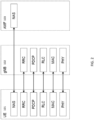
- user and control plane functions with monolithic gNB are shown in FIGS. 1-2 .
- PHY physical
- MAC Medium Access Control
- RLC Radio Link Control
- PDCP Packet Data Convergence Protocol
- SDAP Service Data Adaptation Protocol
- RRC Radio Resource Control
- PDCP Packet Control
- RLC Packet Control
- MAC Packet Control
- PHY Packet Control sublayer
- NAS Non-Access Stratum
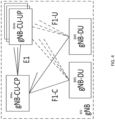
- NG-Radio Access Network (NG-RAN) architecture from 3GPP TS 38.401 is shown in FIGS. 3-4 .
- the NG-RAN 301 consists of a set of gNBs 302 connected to the 5GC 303 through the NG interface.
- Each gNB comprises gNB-CU 304 and one or more gNB-DU 305 (see FIG. 3 ).
- Each gNB comprises gNB-CU 304 and one or more gNB-DU 305 (see FIG. 3 ).
- FIG. 3 NG-Radio Access Network
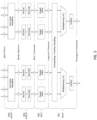
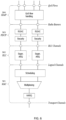
- L2 of 5G NR is split into the following sublayers (in accordance with 3GPP TS 38.300):
- FIG. 5 is a block diagram illustrating DL L2 structure, in accordance with 3GPP TS 38.300.
- FIG. 6 is a block diagram illustrating UL L2 structure, in accordance with 3GPP TS 38.300.
- FIG. 7 is a block diagram illustrating L2 data flow example, in accordance with 3GPP TS 38.300 (in FIG. 7 , H denotes headers or sub-headers).
- Open Radio Access Network is based on disaggregated components which are connected through open and standardized interfaces based on 3GPP NG-RAN.
- An overview of O-RAN with disaggregated RAN CU (Centralized Unit), DU (Distributed Unit), and RU (Radio Unit), near-real-time Radio Intelligent Controller (RIC) and non-real-time RIC is illustrated in FIG. 8 .
- the CU (shown split as O-CU-CP 801a and O-CU-UP 801b) and the DU (shown as O-DU 802) are connected using the F1 interface (with F1-C for control plane and F1-U for user plane traffic) over a mid-haul (MH) path.
- One DU can host multiple cells (e.g., one DU could host 24 cells) and each cell may support many users. For example, one cell may support 600 Radio Resource Control (RRC)-connected users and out of these 600, there may be 200 Active users (i.e., users that have data to send at a given point of time).
- RRC Radio Resource Control
- a cell site can comprise multiple sectors, and each sector can support multiple cells.
- one site could comprise three sectors and each sector could support eight cells (with eight cells in each sector on different frequency bands).
- One CU-CP (CU-Control Plane) could support multiple DUs and thus multiple cells.
- a CU-CP could support 1,000 cells and around 100,000 User Equipments (UEs).
- Each UE could support multiple Data Radio Bearers (DRB) and there could be multiple instances of CU-UP (CU-User Plane) to serve these DRBs.
- DRB Data Radio Bearers
- CU-UP CU-User Plane
- each UE could support 4 DRBs, and 400,000 DRBs (corresponding to 100,000 UEs) may be served by five CU-UP instances (and one CU-CP instance).
- the DU could be located in a private data center, or it could be located at a cell-site.
- the CU could also be in a private data center or even hosted on a public cloud system.
- the DU and CU which are typically located at different physical locations, could be tens of kilometers apart.
- the CU communicates with a 5G core system, which could also be hosted in the same public cloud system (or could be hosted by a different cloud provider).
- a RU (Radio Unit) (shown as O-RU 803 in FIG. 8 ) is located at a cell-site and communicates with the DU via a front-haul (FH) interface.
- FH front-haul
- the E2 nodes (CU and DU) are connected to the near-real-time RIC 132 using the E2 interface.
- the E2 interface is used to send data (e.g., user, cell, slice KPMs) from the RAN, and deploy control actions and policies to the RAN at near-real-time RIC 132.
- the application or service at the near-real-time RIC 132 that deploys the control actions and policies to the RAN are called xApps.
- the near-real-time RIC 132 is connected to the non-real-time RIC 133 (which is shown as part of Service Management and Orchestration (SMO) Framework 805 in FIG. 8 ) using the A1 interface.
- SMO Service Management and Orchestration
- O-eNB 806 which is shown as being connected to the near-real-time RIC 132 and the SMO Framework 805
- O-Cloud 804 (which is shown as being connected to the SMO Framework 805).
- PDU connectivity service is a service that provides exchange of PDUs between a UE and a data network identified by a Data Network Name (DNN).
- DNN Data Network Name
- the PDU Connecitivity service is supported via PDU sessions that are established upon request from the UE.
- the DNN defines the interface to a specific external data network.
- One or more QoS flows can be supported in a PDU session. All the packets belonging to a specific QoS flow have the same 5QI (5G QoS Identifier).
- a PDU session consists of the following: Data Radio Bearer which is between UE and CU in RAN; and an NG-U GTP tunnel which is between CU and UPF (User Plane Function) in the core network.
- FIG. 9 illustrates an example PDU session (in accordance with 3GPP TS 23.501) consisting of multiple DRBs, where each DRB can consist of multiple QoS flows.
- three components are shown for the PDU session 901: UE 101; access network (AN) 902; and UPF 903, which includes Packet Detection Rules (PDRs) 9031.
- PDRs Packet Detection Rules
- Radio Resource Management for connecting UE 101 to the network via RU 306 with a MAC Scheduler 1001:
- the first column represents the 5QI value.
- the second column lists the different resource types, i.e., as one of Non-GBR, GBR, Delay-critical GBR.
- the third column (“Default Priority Level") represents the priority level Priority5QI, for which lower the value the higher the priority of the corresponding QoS flow.
- the fourth column represents the Packet Delay Budget (PDB), which defines an upper bound for the time that a packet may be delayed between the UE and the N6 termination point at the UPF.
- the fifth column represents the Packet Error Rate (PER).
- the sixth column represents the maximimum data burst volume for delay-critical GBR types.
- the seventh column represents averaging window for GBR, delay critical GBR types.
- 5QI value 1 is of resource type GBR with the default priority value of 20, PDB of 100ms, PER of 0.01, and averaging window of 2000 ms. Conversational voice falls under this catogery.
- 5QI value 7 is of resource type Non-GBR with the default priority value of 70, PDB of 100ms and PER of 0.001. Voice, video (live streaming), and interactive gaming fall under this catogery.
- Table 1 5QI Value Resource Type Default Priority Level Packet Delay Budget (NOTE 3) Packet Error Rate Default Maximum Data Burst Volume (NOTE 2) Default Averaging Window Example Services 1 GBR (NOTE 1) 20 100 ms (NOTE 11, NOTE 13) 10 -2 N/A 2000 ms Conversational Voice 2 40 150 ms (NOTE 11, NOTE 13) 10 -3 N/A 2000 ms Conversational Video (Live Streaming) 3 30 50 ms (NOTE 11, NOTE 13) 10 -3 N/A 2000 ms Real Time Gaming, V2X messages (see TS 23.287 [121]).
- Electricity distribution - medium voltage, Process automation monitoring 4 50 300 ms (NOTE 11, NOTE 13) 10 -6 N/A 2000 ms Non-Conversational Video (Buffered Streaming) 65 (NOTE 9, NOTE 12) 7 75ms (NOTE 7, NOTE 8) 10 -2 N/A 2000 ms Mission Critical user plane Push To Talk voice (e.g., MCPTT) 66 (NOTE 12) 20 100 ms (NOTE 10, NOTE 13) 10 -2 N/A 2000 ms Non-Mission-Critical user plane Push To Talk voice 67 ' (NOTE 12) 15 100 ms (NOTE 10, NOTE 131 10 -3 N/A 2000 ms Mission Critical Video user plane 75 (NOTE 14) 71 56 150 ms (NOTE 11, NOTE 13, NOTE 15) 10 -6 N/A 2000 ms "Live" Uplink Streaming (e.g.
- Non-GBR 10 100 ms NOTE 10, NOTE 13) 10 -6 N/A N/A IMS Signalling 6 N/A N/A Video (Buffered Streaming) TCP-based (e.g., www, e-mail, chat, ftp, p2p file sharing, progressive video, etc.) 60 300 ms (NOTE 10, NOTE 13) 10 -6 7 N/A N/A Voice, Video (Live Streaming) Interactive Gaming 70 100 ms (NOTE 10, NOTE 13) 10 -3
- Radio Resource Management (RRM) will be discussed (a block diagram for an example RRM with a MAC Scheduler is shown in FIG. 10 ).
- L2 methods (such as MAC scheduler) play a critical role in allocating radio resources to different UEs in a cellular network.
- the scheduling priority of a UE is based on the maximum logical channel priority value across the logical channels (LCs) of the UE, and the resources allocated to a UE are based on this maximum logical channel priority.
- LCs logical channels
- the above-described weights determine the importance of the priority values (P 5QI , P GBR , P PDB , P PF ). Determining the optimal weights (or substantially optimal weights) that balance the different target parameters (e.g., 5QI priority, target bit rate, packet delay budget, proportional fairness) is difficult, especially in the presence of different traffic types, varying channel conditions, high cell load, etc.
- the traffic could be different at different times in the day and night, and the traffic density varies with the region and/or location (rural, urban), e.g., there will be heavy traffic in crowded stadiums or malls. Static weights may not consider these variations for UE priority calculation in an optimal manner.
- RRM radio resource management
- enhanced RRM utilizing machine-learning-based method is implemented, e.g., to determine suitable values of the weights for determining scheduling priority of UEs for policy-based performance management in cellular networks.
- enhanced RRM utilizing machine-learning-based method is implemented at distributed unit (DU) / Centralized unit (CU) or at a RAN Intelligent Controller (RIC) to determine suitable values of the weights for determining scheduling priority of UEs.
- DU distributed unit
- CU Centralized unit
- RIC RAN Intelligent Controller
- enhanced RRM utilizing machine-learning-based method is implemented to determine, e.g., dynamically or in a semi-static manner, suitable values of the weights for determining scheduling priority of UEs.
- selection of suitable values of the weights for determining scheduling priority of UEs is linked with the flow-control procedure between Control Unit User Plane (CU-UP) and DU to help improve performance, e.g., for high-load networks).
- CU-UP Control Unit User Plane
- machine learning techniques are incorporated to improve the determination of the priority of a UE at the Level 2 (L2) scheduler of the base station, e.g., by training, deploying, and updating the relevant parameters to provide policy-based determination of the priority of a UE.
- L2 Level 2
- machine-learning-assisted technique for determining suitable values of the weights for determining scheduling priority of UEs is implemented in conjunction with a near-real-time RIC (near-RT RIC).
- near-RT RIC near-real-time RIC
- machine-learning-assisted technique for determining suitable values of the weights for determining scheduling priority of UEs is implemented using DU and CU.
- the least squares method is utilized to update the weights.
- the method of least squares is used in regression analysis, which minimizes the sum of the squared errors.
- the objective function is a sum of squared errors, which is a convex function, so there exists a minimum, and the weight updating method moves in a direction to get to the error minimum.
- the weights are updated based on the difference in error between two consecutive samples, which is a tweaked version (or variant) of the gradient descent.
- the step size utilized in the weight updating determines how fast or slow the method converges to the minimum.
- network includes both networks and internetworks of all kinds, including the Internet, and is not limited to any particular type of network or inter-network.
- first and second are used to distinguish one element, set, data, object or thing from another, and are not used to designate relative position or arrangement in time.
- Coupled means a relationship between or among two or more devices, apparatus, files, programs, applications, media, components, networks, systems, subsystems, and/or means, constituting any one or more of (a) a connection, whether direct or through one or more other devices, apparatus, files, programs, applications, media, components, networks, systems, subsystems, or means, (b) a communications relationship, whether direct or through one or more other devices, apparatus, files, programs, applications, media, components, networks, systems, subsystems, or means, and/or (c) a functional relationship in which the operation of any one or more devices, apparatus, files, programs, applications, media, components, networks, systems, subsystems, or means depends, in whole or in part, on the operation of any one or more others thereof.
- multiple parameters are utilized to train the machine-learning (ML) model which can be deployed i) at the DU and/or CU, or ii) at a near-RT RIC.
- the multiple parameters are computed (and/or acquired) every T fdbk interval, and the value of each parameter of a single UE calculated and/or acquired in a T fdbk interval define an "instance".
- T fdbk interval is measured in number of time slots. Every T fdbk , multiple instances (of parameters) are used by the ML model.
- a static T fdbk is assumed in the present example embodiment, the example method is equally applicable in the case of dynamic intervals.
- the following RAN-related parameters can be utilized to train the ML model:
- the relevant weights e.g., W GBR , W PDB and W PF
- the relevant weights are initialized, i.e., the weights are configured based on some selected guidelines. For example, one can consider the case for which these weights can be common across all UEs or common across UEs within the same QoS class (i.e., 5QI for 5G systems), but different for various QoS classes.
- the relevant weights will be used for an interval of T fdbk at the scheduler, e.g., MAC scheduler, as previously described above.
- the parameters related to the instances in the T fdbk interval are used to compute the objective function, which is a least square error function.
- the main objective is to minimize this least square error function, which is sum of the error functions corresponding to PDB, GBR and PF.
- the updating of the weights can vary on a case-by-case basis. For example, the weights can be changed (increased or decreased) gradually, aggressively or a mix of both based on the application. The updated weights will be used for an interval of T fdbk and the process repeats.
- initialization of the weights involves configuring the weights based on some selected guidelines, e.g., weight for delay sensitive applications or GBR applications can be configured to be higher than other weights.
- the weights (W GBR , W PDB , W PF ) are to be determined to implement policy-based performance management (e.g., optimize the determination of the priority of UEs (P UE ) for a specific scenario).
- the relevant weights are optimized by minimizing the proposed error function over K 1 training data instances (also referred to as sampling points), K 1 ⁇ 2, at T fdbk intervals (which can be static or dynamic), as explained below.
- K 1 training data instances also referred to as sampling points
- K 1 ⁇ 2 at T fdbk intervals (which can be static or dynamic)
- T fdbk intervals which can be static or dynamic
- E PDB (t) the PDB error
- PDB error the sum of squared difference between the PDB to the delay at the UE over the K 1 training data instances.
- the UE-experienced delay ( Delay UE i ) is within its PDB budget
- the corresponding error term is given as square of the deviation from the PDB budget, as represented above.
- the worst-case delay in the sample set is used for error computation.
- the achieved bit rate is less than the target guaranteed bit rate (GBR)
- GBR target guaranteed bit rate
- the UE overachieves i.e., the achieved GBR rate is more than the target GBR rate
- the corresponding error term is taken as the square of deviation from the target GBR rate.
- the Physical Resource Blocks (PRBs) allocation should be based on their packet delay budgets (PDBs).
- PDBs packet delay budgets
- the PRB allocation for the GBR UEs should be according to their guaranteed bit rates (GBRs). Either of these cases may lead to large deviation in the PRBs allocation across UEs.
- GBRs guaranteed bit rates
- E PDB (t + T fdbk ), E GBR (t + T fdbk ), and E PF (t + T fdbk ) are computed in a similar manner.
- PF error function a variant of the above-described PF error function can be utilized.
- the total number of PRBs is utilized, instead of average number of PRBs that should be given to each UE in a proportional fair (PF) resource allocation method.
- PF proportional fair
- E PF,5QI,j (t) another error function (E PF,5QI,j (t)) can be optionally further considered, which additional error function considers deviation in proportional fair (PF) behavior for UEs with DRBs of the same 5QI:
- E PF , UE , j i 0 if NPrb UE , j i > AvgPrb UE , j , for UEs supporting only DRBs of type 5QI j.
- the weights (W GBR , W PDB , W PF ) are updated, e.g., as shown in FIG. 12 (which will be explained in a subsequent section), based on the difference between the current error function and the previous error function, and the UE priorities are determined using the updated weights.
- the step size Delta is a value between (y1, y2), which is a configurable parameter (with y2 > y1). For example, Delta in (0,1) implies a smaller step size, so the weights increase/decrease gradually.
- the relevant weights can be common for all UEs in a cell, or the relevant weights can be common for UEs with traffic from the same QoS class (e.g., same 5QI for 5G systems).
- the error function can be redefined as multiple sums over these QoS classes to calculate the error across each class.
- the weight updating method is redefined by considering same weights for the UEs having similar 5QI.
- W GBR the weights associated with GBR throughput
- W GBR the weights associated with GBR throughput
- 0 ⁇ Delta GBR_stepup ⁇ Thresh GBR i.e., Delta GBR_stepup is the GBR step size, which is upper-bounded by Thresh GBR .
- the weights are common across all UEs, if difference in the error function (for the PF part) increases over consecutive samples, we increase the weights associated with the PF factor, i.e., W PF .
- Increase of difference in error implies, across UEs, the variance between average PRBs and allocated PRBs of the current sample is more than that of the previous sample.
- the W PF is increased as given below: In the above expressions, 0 ⁇ Delta PF_stepup ⁇ Thresh PF , i.e., Delta PF_stepup is the step size, which is upper-bounded by Thresh PF .
- a weight threshold, W Th is specified, which is a large value. If any one of the weights (i.e., W 5QI , W GBR , W PDB , and W PF ) reaches W Th , we adjust the threshold-exceeding weight by subtracting a value corresponding to the minimum value among the weights, and proceed with these new weights. For the 5QI priority, no explicit weight updating is applied. If the 5QI priority is not in the range of other weights, the 5QI priority can be periodically (e.g., function of T fdbk ) reset to a value corresponding to the minimum value among the other three weights.
- the relevant weight can be increased in an aggressive manner till they are in a comparable range. If the relative error is bare minimum over consecutive intervals, then the corresponding weight can be decreased gradually.
- an alternative example embodiment can use a dynamically varying step size.
- the above example method has been described in the context of using one logical channel (or DRB) per-UE, the above example method is equally applicable for the case in which a UE supports multiple DRBs. In the case of more than one logical channel (LC) per UE, an example method can consider the LC with the highest priority.
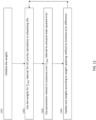
- FIG. 12 is a flowchart summarizing the overall weight updating method discussed above.
- the error functions E PDB , E GBR , and E PF are computed for two consecutive sampling instants.
- the difference in error (Delta, or "D") between the two sampling instants is determined. If D is greater than 0 (as shown in the decision box 1203) for a particular error function, then the corresponding weight is adjusted (e.g., increased) and updated (as shown in box 1204). If D is not greater than 0, then no change in weight is implemented (as shown in box 1205).
- the following parameters are sent to the near-real-time RAN Intelligent Controller (near-RT RIC) from the RAN over the E2 interface to train the machine learning (ML) model that is deployed at the near-real-time RIC.
- These parameters are forwarded from the RAN to the near-RT RIC at T fdbk interval, and the value of each parameter of a single UE acquired in a T fdbk interval define an "instance".
- T fdbk interval is measured in number of time slots. Every T fdbk , multiple instances (of parameters) are sent to the near-RT RIC.
- T fdbk is assumed in the present example embodiment, the example method is equally applicable in the case of dynamic intervals.
- the following RAN-related parameters can be communicated to the near-RT RIC via E2 interface (by adding suitable objects in the E2 protocol):
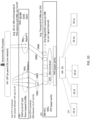
- FIG. 13 which is a signal flow diagram of E2AP SUBSCRIPTION procedure utilized for policy-based performance management in an O-RAN system using a RIC module
- the example method starts with an E2 setup procedure 1301 between the E2 Node 131 (which encompasses DU and CU) and the near-RT RIC 132, which E2 setup procedure is as specified in the O-RAN and 3GPP specifications.
- the next step 2 involves the RIC subscription procedure including a sequence of actions: i) Near-RT RIC requests a SUBSCRIPTION from the E2 Node 131 for REPORT, with the corresponding Event Trigger (e.g., periodic trigger), and the E2 Node 131 acknowledges the SUBSCRIPTION (generally referenced by the process arrow 1302); and ii) Near-RT RIC requests a SUBSCRIPTION from the E2 Node 131 for POLICY, with the corresponding Event Trigger (e.g., periodic trigger), and the E2 Node 131 acknowledges the SUBSCRIPTION (generally referenced by the process arrow 1303).
- Event Trigger e.g., periodic trigger
- the Near-RT RIC subscribes to the above-listed parameters from the E2 Node (DU and/or CU) and provides the triggers for the E2 Node to communicate the subscribed information. Subsequently, the E2 Node (DU and/or CU) detects the RIC event trigger (as shown in box 1304). In the case of the REPORT trigger event occurring, the REPORT service sends the above-listed RAN-related DU and/or CU parameters from the E2 Node 131 (DU and/or CU) to the Near-RT RIC 132 in an RIC INDICATION report (as shown by the process arrow 1307). The Near-RT RIC uses the received information to implement weight updating to obtain (compute) new weights as discussed above.
- DU continues to run radio resource management methods (including scheduling methods) with the latest set of weights it had received before the current time, as shown in box 1306.
- the near-RT RIC 132 communicates the updated weights to the E2 Node (i.e., DU in this case), and the E2 Node (i.e., DU) modifies the scheduler process according to information contained in the POLICY description (i.e., new weights are provided to the scheduler), as summarized in box 1305.
- FIG. 14 illustrates a signal flow diagram of an example embodiment of a method for enhanced RRM utilizing machine-learning-based technique at a RAN Intelligent Controller (RIC) to determine suitable values of the weights for determining scheduling priority of UEs.
- various RAN-related parameters previously listed above and have been collected e.g., weights of various priority values for GBR, PDB and PF, etc.
- ML machine learning
- the trained ML model is deployed at near-RT RIC 132, where the training of the ML model continues.
- the trained ML model has trained weights for the various scheduling parameters, e.g., the priority weights W GBR , W PDB , and W PF .
- equal weights for the priority weights can be used initially.
- the trained weights (or equal weights, if so chosen) from the near-RT RIC 132 are deployed at CU 131a and/or DU 131b.
- the above-listed RAN-related parameters are reported from DU 131b and/or CU 131a to the near-RT RIC 132.
- the near-RT RIC implements the weight updating method discussed above, i.e., the relevant weights are optimized by minimizing the proposed error function over K 1 training data instances at T fdbk intervals.
- the parameters related to the instances in this T fdbk interval are used to compute the objective function, which is a least squared error function.
- the main objective is to minimize this least square error function which is sum of the error functions corresponding to Packet Delay Budget (PDB), Guaranteed Bit Rate (GBR), and PF factors.
- PDB Packet Delay Budget
- GBR Guaranteed Bit Rate
- PF factors a positive term which is squared errors summed over K 1 training instances.
- a network operator can specify at least one desired policy, which is used along with the previous example method to optimize the values for the scheduler weights.
- the operator can specify a higher preference for increased cell throughput and accept performance degradation for some UEs and their associated applications.
- Delta PF_stepup described above can be chosen to be higher than the usual Delta PF_stepup , or W PF can be increased in a more aggressive way.
- the operator can give a higher preference to delay sensitive applications.
- Delta PDB_stepup can be chosen to be higher than the usual value, or W PDB can be increased more aggressively.
Landscapes
- Engineering & Computer Science (AREA)
- Theoretical Computer Science (AREA)
- Software Systems (AREA)
- Evolutionary Computation (AREA)
- Data Mining & Analysis (AREA)
- Medical Informatics (AREA)
- Computer Vision & Pattern Recognition (AREA)
- Physics & Mathematics (AREA)
- Computing Systems (AREA)
- General Engineering & Computer Science (AREA)
- General Physics & Mathematics (AREA)
- Mathematical Physics (AREA)
- Artificial Intelligence (AREA)
- Computer Networks & Wireless Communication (AREA)
- Signal Processing (AREA)
- Mobile Radio Communication Systems (AREA)
Applications Claiming Priority (3)
| Application Number | Priority Date | Filing Date | Title |
|---|---|---|---|
| IN202321011015 | 2023-02-17 | ||
| IN202321020065 | 2023-03-22 | ||
| US18/438,597 US20240284441A1 (en) | 2023-02-17 | 2024-02-12 | Policy based performance management for highly scalable o-ran networks |
Publications (2)
| Publication Number | Publication Date |
|---|---|
| EP4418718A1 true EP4418718A1 (de) | 2024-08-21 |
| EP4418718B1 EP4418718B1 (de) | 2025-08-27 |
Family
ID=89941178
Family Applications (1)
| Application Number | Title | Priority Date | Filing Date |
|---|---|---|---|
| EP24157602.4A Active EP4418718B1 (de) | 2023-02-17 | 2024-02-14 | Richtlinienbasierte leistungsverwaltung für hochskalierbare o-ran-netzwerke |
Country Status (1)
| Country | Link |
|---|---|
| EP (1) | EP4418718B1 (de) |
Citations (3)
| Publication number | Priority date | Publication date | Assignee | Title |
|---|---|---|---|---|
| US20220272794A1 (en) * | 2021-02-23 | 2022-08-25 | At&T Intellectual Property I, L.P. | Synchronization of artificial intelligence based microservices |
| WO2022187139A1 (en) * | 2021-03-01 | 2022-09-09 | Intel Corporation | Ric-based machine learning methods for beam compression |
| WO2022252162A1 (zh) * | 2021-06-02 | 2022-12-08 | 北京小米移动软件有限公司 | 一种模型训练方法、模型训练装置及存储介质 |
-
2024
- 2024-02-14 EP EP24157602.4A patent/EP4418718B1/de active Active
Patent Citations (3)
| Publication number | Priority date | Publication date | Assignee | Title |
|---|---|---|---|---|
| US20220272794A1 (en) * | 2021-02-23 | 2022-08-25 | At&T Intellectual Property I, L.P. | Synchronization of artificial intelligence based microservices |
| WO2022187139A1 (en) * | 2021-03-01 | 2022-09-09 | Intel Corporation | Ric-based machine learning methods for beam compression |
| WO2022252162A1 (zh) * | 2021-06-02 | 2022-12-08 | 北京小米移动软件有限公司 | 一种模型训练方法、模型训练装置及存储介质 |
Non-Patent Citations (3)
| Title |
|---|
| ANONYMOUS: "AI/ML workflow description and requirements", TECHNICAL REPORT, O-RAN.WG2.AIML-V01.03,, 1 October 2021 (2021-10-01), pages 1 - 58, XP009546854 * |
| BALASUBRAMANIAN BHARATH ET AL: "RIC: A RAN Intelligent Controller Platform for AI-Enabled Cellular Networks", IEEE INTERNET COMPUTING., vol. 25, no. 2, 1 March 2021 (2021-03-01), US, pages 7 - 17, XP055916679, ISSN: 1089-7801, Retrieved from the Internet <URL:https://ieeexplore.ieee.org/stampPDF/getPDF.jsp?tp=&arnumber=9376232&ref=> DOI: 10.1109/MIC.2021.3062487 * |
| SINGH AMARDIP KUMAR ET AL: "MCORANFed: Communication Efficient Federated Learning in Open RAN", 2022 14TH IFIP WIRELESS AND MOBILE NETWORKING CONFERENCE (WMNC), IFIP, 17 October 2022 (2022-10-17), pages 15 - 22, XP034233973, DOI: 10.23919/WMNC56391.2022.9954307 * |
Also Published As
| Publication number | Publication date |
|---|---|
| EP4418718B1 (de) | 2025-08-27 |
Similar Documents
| Publication | Publication Date | Title |
|---|---|---|
| US11240724B2 (en) | Method and device for handover | |
| EP3198836B1 (de) | System und verfahren zur übertragungsverwaltung in software-definierten netzwerken | |
| WO2011057292A1 (en) | Burst packet scheduler for improved ran efficiency in umts/hspa networks | |
| JP2005539445A (ja) | 無線リソースを管理する方法及び無線システム | |
| US20250063388A1 (en) | Policy-based performance management for 5g network slices in o-ran networks | |
| US20250088464A1 (en) | System and methods for network slicing for coexistence of low latency, low loss and scalable throughput (l4s) and non-l4s traffic in wireless networks | |
| US20240314628A1 (en) | Optimizations for overload control in o-ran networks | |
| EP4510520A1 (de) | Richtlinienbasierte leistungsverwaltung für 5g-netzwerk-slices in o-ran-netzwerken | |
| EP4432725A1 (de) | Optimierungen zur überlastregelung in o-ran-netzwerken | |
| EP4598102A1 (de) | Maschinenlernunterstützte funkressourcenverwaltungsrichtlinien für niedrige datenratenlatenz und andere anwendungen in o-ran-netzwerken | |
| EP4554324A1 (de) | Optimierte funkressourcenverwaltung unter verwendung von maschinenlernansätzen in o-ran-netzwerken | |
| US20250063387A1 (en) | Optimized radio resource management for 5g network slicing | |
| US20250063451A1 (en) | Load balancing optimizations for o-ran networks | |
| EP4418718A1 (de) | Richtlinienbasierte leistungsverwaltung für hochskalierbare o-ran-netzwerke | |
| US20240284441A1 (en) | Policy based performance management for highly scalable o-ran networks | |
| EP4521815A1 (de) | System und verfahren zum netzwerk-slicing zur koexistenz von niedriglatentem, verlustarmem und skalierbarem durchsatz (l4s) und nicht-l4s-verkehr in drahtlosen netzwerken | |
| EP4510751B1 (de) | Optimierte funkressourcenverwaltung für 5g-netzwerk-slicing | |
| EP4507372B1 (de) | Cu-du-flusssteuerungsoptimierungen für verlustbehaftetes midhaul in o-ran-netzwerken | |
| EP4648463A1 (de) | Optimierung der funkressourcenverwaltung in o-ran-netzwerken unter verwendung von maschinenlerntechniken | |
| EP4475592A1 (de) | Verfahren zur koexistenz von l4s- und nicht-l4s-verkehr mit niedriger latenz, geringem verlust und skalierbarem durchsatz in 5g-netzwerken | |
| US20240414582A1 (en) | Method for coexistence of low latency, low loss and scalable throughput (l4s) and non-l4s traffic in 5g-type networks | |
| US20250055795A1 (en) | Cu-du flow control optimizations for lossy midhaul in o-ran networks | |
| US20250365749A1 (en) | Optimizing radio resource management in o-ran networks using machine learning techniques | |
| EP4513956A1 (de) | Lastausgleichsoptimierungen für o-ran-netzwerke | |
| US20250150897A1 (en) | Optimized radio resource management using machine learning approaches in o-ran networks |
Legal Events
| Date | Code | Title | Description |
|---|---|---|---|
| PUAI | Public reference made under article 153(3) epc to a published international application that has entered the european phase |
Free format text: ORIGINAL CODE: 0009012 |
|
| STAA | Information on the status of an ep patent application or granted ep patent |
Free format text: STATUS: REQUEST FOR EXAMINATION WAS MADE |
|
| 17P | Request for examination filed |
Effective date: 20240214 |
|
| AK | Designated contracting states |
Kind code of ref document: A1 Designated state(s): AL AT BE BG CH CY CZ DE DK EE ES FI FR GB GR HR HU IE IS IT LI LT LU LV MC ME MK MT NL NO PL PT RO RS SE SI SK SM TR |
|
| GRAP | Despatch of communication of intention to grant a patent |
Free format text: ORIGINAL CODE: EPIDOSNIGR1 |
|
| STAA | Information on the status of an ep patent application or granted ep patent |
Free format text: STATUS: GRANT OF PATENT IS INTENDED |
|
| INTG | Intention to grant announced |
Effective date: 20250321 |
|
| GRAS | Grant fee paid |
Free format text: ORIGINAL CODE: EPIDOSNIGR3 |
|
| GRAA | (expected) grant |
Free format text: ORIGINAL CODE: 0009210 |
|
| STAA | Information on the status of an ep patent application or granted ep patent |
Free format text: STATUS: THE PATENT HAS BEEN GRANTED |
|
| P01 | Opt-out of the competence of the unified patent court (upc) registered |
Free format text: CASE NUMBER: UPC_APP_0429_4418718/2025 Effective date: 20250716 |
|
| AK | Designated contracting states |
Kind code of ref document: B1 Designated state(s): AL AT BE BG CH CY CZ DE DK EE ES FI FR GB GR HR HU IE IS IT LI LT LU LV MC ME MK MT NL NO PL PT RO RS SE SI SK SM TR |
|
| REG | Reference to a national code |
Ref country code: CH Ref legal event code: EP |
|
| REG | Reference to a national code |
Ref country code: DE Ref legal event code: R096 Ref document number: 602024000521 Country of ref document: DE |
|
| REG | Reference to a national code |
Ref country code: IE Ref legal event code: FG4D |
|
| REG | Reference to a national code |
Ref country code: CH Ref legal event code: W10 Free format text: ST27 STATUS EVENT CODE: U-0-0-W10-W00 (AS PROVIDED BY THE NATIONAL OFFICE) Effective date: 20251210 |
|
| REG | Reference to a national code |
Ref country code: NL Ref legal event code: MP Effective date: 20250827 |
|
| RAP2 | Party data changed (patent owner data changed or rights of a patent transferred) |
Owner name: MAVENIR US INC. |
|
| PG25 | Lapsed in a contracting state [announced via postgrant information from national office to epo] |
Ref country code: IS Free format text: LAPSE BECAUSE OF FAILURE TO SUBMIT A TRANSLATION OF THE DESCRIPTION OR TO PAY THE FEE WITHIN THE PRESCRIBED TIME-LIMIT Effective date: 20251227 |
|
| PG25 | Lapsed in a contracting state [announced via postgrant information from national office to epo] |
Ref country code: NO Free format text: LAPSE BECAUSE OF FAILURE TO SUBMIT A TRANSLATION OF THE DESCRIPTION OR TO PAY THE FEE WITHIN THE PRESCRIBED TIME-LIMIT Effective date: 20251127 |
|
| REG | Reference to a national code |
Ref country code: LT Ref legal event code: MG9D |
|
| PG25 | Lapsed in a contracting state [announced via postgrant information from national office to epo] |
Ref country code: PT Free format text: LAPSE BECAUSE OF FAILURE TO SUBMIT A TRANSLATION OF THE DESCRIPTION OR TO PAY THE FEE WITHIN THE PRESCRIBED TIME-LIMIT Effective date: 20251229 |
|
| PG25 | Lapsed in a contracting state [announced via postgrant information from national office to epo] |
Ref country code: FI Free format text: LAPSE BECAUSE OF FAILURE TO SUBMIT A TRANSLATION OF THE DESCRIPTION OR TO PAY THE FEE WITHIN THE PRESCRIBED TIME-LIMIT Effective date: 20250827 |
|
| PG25 | Lapsed in a contracting state [announced via postgrant information from national office to epo] |
Ref country code: HR Free format text: LAPSE BECAUSE OF FAILURE TO SUBMIT A TRANSLATION OF THE DESCRIPTION OR TO PAY THE FEE WITHIN THE PRESCRIBED TIME-LIMIT Effective date: 20250827 Ref country code: NL Free format text: LAPSE BECAUSE OF FAILURE TO SUBMIT A TRANSLATION OF THE DESCRIPTION OR TO PAY THE FEE WITHIN THE PRESCRIBED TIME-LIMIT Effective date: 20250827 |
|
| PG25 | Lapsed in a contracting state [announced via postgrant information from national office to epo] |
Ref country code: GR Free format text: LAPSE BECAUSE OF FAILURE TO SUBMIT A TRANSLATION OF THE DESCRIPTION OR TO PAY THE FEE WITHIN THE PRESCRIBED TIME-LIMIT Effective date: 20251128 |
|
| PG25 | Lapsed in a contracting state [announced via postgrant information from national office to epo] |
Ref country code: SE Free format text: LAPSE BECAUSE OF FAILURE TO SUBMIT A TRANSLATION OF THE DESCRIPTION OR TO PAY THE FEE WITHIN THE PRESCRIBED TIME-LIMIT Effective date: 20250827 |
|
| PG25 | Lapsed in a contracting state [announced via postgrant information from national office to epo] |
Ref country code: LV Free format text: LAPSE BECAUSE OF FAILURE TO SUBMIT A TRANSLATION OF THE DESCRIPTION OR TO PAY THE FEE WITHIN THE PRESCRIBED TIME-LIMIT Effective date: 20250827 |
|
| PG25 | Lapsed in a contracting state [announced via postgrant information from national office to epo] |
Ref country code: BG Free format text: LAPSE BECAUSE OF FAILURE TO SUBMIT A TRANSLATION OF THE DESCRIPTION OR TO PAY THE FEE WITHIN THE PRESCRIBED TIME-LIMIT Effective date: 20250827 Ref country code: PL Free format text: LAPSE BECAUSE OF FAILURE TO SUBMIT A TRANSLATION OF THE DESCRIPTION OR TO PAY THE FEE WITHIN THE PRESCRIBED TIME-LIMIT Effective date: 20250827 |
|
| PG25 | Lapsed in a contracting state [announced via postgrant information from national office to epo] |
Ref country code: RS Free format text: LAPSE BECAUSE OF FAILURE TO SUBMIT A TRANSLATION OF THE DESCRIPTION OR TO PAY THE FEE WITHIN THE PRESCRIBED TIME-LIMIT Effective date: 20251127 |
|
| PG25 | Lapsed in a contracting state [announced via postgrant information from national office to epo] |
Ref country code: ES Free format text: LAPSE BECAUSE OF FAILURE TO SUBMIT A TRANSLATION OF THE DESCRIPTION OR TO PAY THE FEE WITHIN THE PRESCRIBED TIME-LIMIT Effective date: 20250827 |
|
| REG | Reference to a national code |
Ref country code: AT Ref legal event code: MK05 Ref document number: 1831573 Country of ref document: AT Kind code of ref document: T Effective date: 20250827 |
|
| PG25 | Lapsed in a contracting state [announced via postgrant information from national office to epo] |
Ref country code: SM Free format text: LAPSE BECAUSE OF FAILURE TO SUBMIT A TRANSLATION OF THE DESCRIPTION OR TO PAY THE FEE WITHIN THE PRESCRIBED TIME-LIMIT Effective date: 20250827 |
|
| PG25 | Lapsed in a contracting state [announced via postgrant information from national office to epo] |
Ref country code: DK Free format text: LAPSE BECAUSE OF FAILURE TO SUBMIT A TRANSLATION OF THE DESCRIPTION OR TO PAY THE FEE WITHIN THE PRESCRIBED TIME-LIMIT Effective date: 20250827 |
|
| PGFP | Annual fee paid to national office [announced via postgrant information from national office to epo] |
Ref country code: DE Payment date: 20260227 Year of fee payment: 3 |
|
| PG25 | Lapsed in a contracting state [announced via postgrant information from national office to epo] |
Ref country code: AT Free format text: LAPSE BECAUSE OF FAILURE TO SUBMIT A TRANSLATION OF THE DESCRIPTION OR TO PAY THE FEE WITHIN THE PRESCRIBED TIME-LIMIT Effective date: 20250827 |
|
| PG25 | Lapsed in a contracting state [announced via postgrant information from national office to epo] |
Ref country code: IT Free format text: LAPSE BECAUSE OF FAILURE TO SUBMIT A TRANSLATION OF THE DESCRIPTION OR TO PAY THE FEE WITHIN THE PRESCRIBED TIME-LIMIT Effective date: 20250827 |