EP4418359A1 - Electrolyte solution for secondary battery and secondary battery including the same - Google Patents
Electrolyte solution for secondary battery and secondary battery including the same Download PDFInfo
- Publication number
- EP4418359A1 EP4418359A1 EP24158230.3A EP24158230A EP4418359A1 EP 4418359 A1 EP4418359 A1 EP 4418359A1 EP 24158230 A EP24158230 A EP 24158230A EP 4418359 A1 EP4418359 A1 EP 4418359A1
- Authority
- EP
- European Patent Office
- Prior art keywords
- group
- secondary battery
- active material
- electrolyte solution
- battery according
- Prior art date
- Legal status (The legal status is an assumption and is not a legal conclusion. Google has not performed a legal analysis and makes no representation as to the accuracy of the status listed.)
- Pending
Links
Images

Classifications
-
- H—ELECTRICITY
- H01—ELECTRIC ELEMENTS
- H01M—PROCESSES OR MEANS, e.g. BATTERIES, FOR THE DIRECT CONVERSION OF CHEMICAL ENERGY INTO ELECTRICAL ENERGY
- H01M10/00—Secondary cells; Manufacture thereof
- H01M10/42—Methods or arrangements for servicing or maintenance of secondary cells or secondary half-cells
- H01M10/4235—Safety or regulating additives or arrangements in electrodes, separators or electrolyte
-
- H—ELECTRICITY
- H01—ELECTRIC ELEMENTS
- H01M—PROCESSES OR MEANS, e.g. BATTERIES, FOR THE DIRECT CONVERSION OF CHEMICAL ENERGY INTO ELECTRICAL ENERGY
- H01M10/00—Secondary cells; Manufacture thereof
- H01M10/05—Accumulators with non-aqueous electrolyte
- H01M10/052—Li-accumulators
-
- H—ELECTRICITY
- H01—ELECTRIC ELEMENTS
- H01M—PROCESSES OR MEANS, e.g. BATTERIES, FOR THE DIRECT CONVERSION OF CHEMICAL ENERGY INTO ELECTRICAL ENERGY
- H01M10/00—Secondary cells; Manufacture thereof
- H01M10/05—Accumulators with non-aqueous electrolyte
- H01M10/052—Li-accumulators
- H01M10/0525—Rocking-chair batteries, i.e. batteries with lithium insertion or intercalation in both electrodes; Lithium-ion batteries
-
- H—ELECTRICITY
- H01—ELECTRIC ELEMENTS
- H01M—PROCESSES OR MEANS, e.g. BATTERIES, FOR THE DIRECT CONVERSION OF CHEMICAL ENERGY INTO ELECTRICAL ENERGY
- H01M10/00—Secondary cells; Manufacture thereof
- H01M10/05—Accumulators with non-aqueous electrolyte
- H01M10/056—Accumulators with non-aqueous electrolyte characterised by the materials used as electrolytes, e.g. mixed inorganic/organic electrolytes
- H01M10/0564—Accumulators with non-aqueous electrolyte characterised by the materials used as electrolytes, e.g. mixed inorganic/organic electrolytes the electrolyte being constituted of organic materials only
- H01M10/0566—Liquid materials
- H01M10/0567—Liquid materials characterised by the additives
-
- H—ELECTRICITY
- H01—ELECTRIC ELEMENTS
- H01M—PROCESSES OR MEANS, e.g. BATTERIES, FOR THE DIRECT CONVERSION OF CHEMICAL ENERGY INTO ELECTRICAL ENERGY
- H01M10/00—Secondary cells; Manufacture thereof
- H01M10/05—Accumulators with non-aqueous electrolyte
- H01M10/056—Accumulators with non-aqueous electrolyte characterised by the materials used as electrolytes, e.g. mixed inorganic/organic electrolytes
- H01M10/0564—Accumulators with non-aqueous electrolyte characterised by the materials used as electrolytes, e.g. mixed inorganic/organic electrolytes the electrolyte being constituted of organic materials only
- H01M10/0566—Liquid materials
- H01M10/0569—Liquid materials characterised by the solvents
-
- H—ELECTRICITY
- H01—ELECTRIC ELEMENTS
- H01M—PROCESSES OR MEANS, e.g. BATTERIES, FOR THE DIRECT CONVERSION OF CHEMICAL ENERGY INTO ELECTRICAL ENERGY
- H01M4/00—Electrodes
- H01M4/02—Electrodes composed of, or comprising, active material
- H01M4/36—Selection of substances as active materials, active masses, active liquids
- H01M4/362—Composites
- H01M4/364—Composites as mixtures
-
- H—ELECTRICITY
- H01—ELECTRIC ELEMENTS
- H01M—PROCESSES OR MEANS, e.g. BATTERIES, FOR THE DIRECT CONVERSION OF CHEMICAL ENERGY INTO ELECTRICAL ENERGY
- H01M4/00—Electrodes
- H01M4/02—Electrodes composed of, or comprising, active material
- H01M4/36—Selection of substances as active materials, active masses, active liquids
- H01M4/38—Selection of substances as active materials, active masses, active liquids of elements or alloys
- H01M4/386—Silicon or alloys based on silicon
-
- H—ELECTRICITY
- H01—ELECTRIC ELEMENTS
- H01M—PROCESSES OR MEANS, e.g. BATTERIES, FOR THE DIRECT CONVERSION OF CHEMICAL ENERGY INTO ELECTRICAL ENERGY
- H01M4/00—Electrodes
- H01M4/02—Electrodes composed of, or comprising, active material
- H01M4/36—Selection of substances as active materials, active masses, active liquids
- H01M4/48—Selection of substances as active materials, active masses, active liquids of inorganic oxides or hydroxides
- H01M4/483—Selection of substances as active materials, active masses, active liquids of inorganic oxides or hydroxides for non-aqueous cells
-
- H—ELECTRICITY
- H01—ELECTRIC ELEMENTS
- H01M—PROCESSES OR MEANS, e.g. BATTERIES, FOR THE DIRECT CONVERSION OF CHEMICAL ENERGY INTO ELECTRICAL ENERGY
- H01M4/00—Electrodes
- H01M4/02—Electrodes composed of, or comprising, active material
- H01M4/36—Selection of substances as active materials, active masses, active liquids
- H01M4/58—Selection of substances as active materials, active masses, active liquids of inorganic compounds other than oxides or hydroxides, e.g. sulfides, selenides, tellurides, halogenides or LiCoFy; of polyanionic structures, e.g. phosphates, silicates or borates
- H01M4/583—Carbonaceous material, e.g. graphite-intercalation compounds or CFx
- H01M4/587—Carbonaceous material, e.g. graphite-intercalation compounds or CFx for inserting or intercalating light metals
-
- H—ELECTRICITY
- H01—ELECTRIC ELEMENTS
- H01M—PROCESSES OR MEANS, e.g. BATTERIES, FOR THE DIRECT CONVERSION OF CHEMICAL ENERGY INTO ELECTRICAL ENERGY
- H01M4/00—Electrodes
- H01M4/02—Electrodes composed of, or comprising, active material
- H01M2004/026—Electrodes composed of, or comprising, active material characterised by the polarity
- H01M2004/027—Negative electrodes
-
- H—ELECTRICITY
- H01—ELECTRIC ELEMENTS
- H01M—PROCESSES OR MEANS, e.g. BATTERIES, FOR THE DIRECT CONVERSION OF CHEMICAL ENERGY INTO ELECTRICAL ENERGY
- H01M2300/00—Electrolytes
- H01M2300/0017—Non-aqueous electrolytes
- H01M2300/0025—Organic electrolyte
-
- H—ELECTRICITY
- H01—ELECTRIC ELEMENTS
- H01M—PROCESSES OR MEANS, e.g. BATTERIES, FOR THE DIRECT CONVERSION OF CHEMICAL ENERGY INTO ELECTRICAL ENERGY
- H01M50/00—Constructional details or processes of manufacture of the non-active parts of electrochemical cells other than fuel cells, e.g. hybrid cells
- H01M50/10—Primary casings; Jackets or wrappings
- H01M50/102—Primary casings; Jackets or wrappings characterised by their shape or physical structure
- H01M50/105—Pouches or flexible bags
-
- Y—GENERAL TAGGING OF NEW TECHNOLOGICAL DEVELOPMENTS; GENERAL TAGGING OF CROSS-SECTIONAL TECHNOLOGIES SPANNING OVER SEVERAL SECTIONS OF THE IPC; TECHNICAL SUBJECTS COVERED BY FORMER USPC CROSS-REFERENCE ART COLLECTIONS [XRACs] AND DIGESTS
- Y02—TECHNOLOGIES OR APPLICATIONS FOR MITIGATION OR ADAPTATION AGAINST CLIMATE CHANGE
- Y02E—REDUCTION OF GREENHOUSE GAS [GHG] EMISSIONS, RELATED TO ENERGY GENERATION, TRANSMISSION OR DISTRIBUTION
- Y02E60/00—Enabling technologies; Technologies with a potential or indirect contribution to GHG emissions mitigation
- Y02E60/10—Energy storage using batteries
Definitions
- the present disclosure invention relates to an electrolyte solution for a secondary battery and a lithium secondary battery including the same. More particularly, the present disclosure relates to an electrolyte solution for a secondary battery including an additive, and a secondary battery including the same.
- a secondary battery which can be charged and discharged repeatedly has been widely employed as a power source of a mobile electronic device such as a camcorder, a mobile phone, a laptop computer.
- the secondary battery include a lithium secondary battery, a nickel-cadmium battery, a nickel-hydrogen battery, etc.
- the lithium secondary battery is widely developed and applied due to high operational voltage and energy density per unit weight, a high charging rate, a compact dimension, etc.
- the secondary battery may include an electrode assembly including a cathode, an anode and a separation layer (separator), and an electrolyte solution immersing the electrode assembly.
- the lithium secondary battery may further include an outer case having, e.g., a pouch shape for accommodating the electrode assembly and the electrolyte solution.
- a side reaction may occur due to a contact with an electrolyte, and mechanical and chemical damage such as cracks of the particles may be generated. If a composition or a structure of the active material is modified in order to improve stability of the active material particles, a conductivity may be lowered to cause degradation of a power of the secondary battery.
- an electrolyte solution providing improved stability and activity.
- a secondary battery having improved stability and activity.
- An electrolyte solution for a secondar battery includes a lithium salt, a non-aqueous organic solvent, and a silatane-based compound represented by Chemical Formula 1.
- X is each independently oxygen, sulfur, nitrogen or phosphorus.
- R 1 is an electron donating group, a C2 to C10 tertiary aminoalkyl group, a C1 to C10 haloalkyl group, a C6 to C15 aryl group, a C6 to C15 haloaryl group, or a hydrocarbon group including at least one selected the group consisting of a C1 to C10 alkyl group, a C1 to C10 haloalkyl group, a sulfonyloxy group, a C1 to C10 alkylene group and a C3 to C15 trialkylsilyloxy group.
- R 2 , R 3 , R 4 , R 5 , R 6 and R 7 are each independently hydrogen, a C1 to C6 linear alkyl group, a C3 to C6 branched alkyl group or a C3 to C6 cyclic alkyl group.
- the electron donating group may include at least one selected from the group consisting of a C1 to C10 alkoxy group, a cyano group, a halogen group, a vinyl group, a hydroxy group, a primary to tertiary amine group, an imine group, a thiol group and a sulfide group.
- X may be oxygen
- R 1 may be a methoxy group, an ethoxy group, a propoxy group, a dimethylamine group, a diethylamine group, a methylethylamine group, a dimethylaminomethyl group, a dimethylaminoethyl group, a dimethylaminopropyl group, a methylethylaminomethyl group, a methylethylaminoethyl group, a methylethylaminopropyl group, a diethylaminomethyl group, a diethylaminoethyl group, a diethylaminopropyl group, a trifluoromethyl group, a trifluoroethyl group, a trifluoropropyl group, a phenyl group, a naphthyl group, a fluorophenyl group, a difluorophenyl group, a trifluorophenyl group, a fluoroph
- R 2 , R 3 , R 4 , R 5 , R 6 and R 7 may each be hydrogen.
- a content of the silatrane-based compound may be in a range from 0.1 wt% to 5.0 wt% based on a total weight of the electrolyte solution.
- an auxiliary additive that includes at least one selected from the group consisting of a fluorine-containing carbonate-based compound, a vinylidene carbonate-based compound and a sulfinyl group-containing compound may be further included.
- the fluorine-containing carbonate-based compound may include fluoroethylene carbonate
- the vinylidene carbonate-based compound may include vinylethylene carbonate
- the sulfinyl group-containing compound may include at least one of 1,3-propane sultone and ethylene sulfate.
- a content of the auxiliary additive may be in a range from 0.1 wt% to 10 wt% based on a total weight of the electrolyte solution.
- a secondary battery includes a cathode including a lithium metal oxide, an anode facing the cathode and including a carbon-based active material or a silicon-based active material, and the electrolyte solution for a secondary battery according to the above-described embodiments.
- the anode may include the carbon-based active material and the silicon-based active material, and the silicon-based active material may be included in an amount from 0.1 parts by weight to 50 parts by weight based on 100 parts by weight of the carbon-based active material.
- a coating layer derived from the silatrane-based compound may be formed on a surface of an active material of the anode.
- a C-X bond may be formed between the carbon-based active material and the coating layer derived from the silatrane-based compound.
- a Si-X bond may be formed between the silicon-based active material and the coating layer derived from the silatrane-based compound.
- the electrolyte solution for a secondary battery according to the present disclosure may improve storage properties and capacity properties of a cathode.
- a silatrane-based compound contained in the electrolyte solution for a secondary battery may form a coating layer on a surface of an anode for a secondary battery.
- a coating layer may also be formed on a surface of an anode active material included in the anode by the silatrane-based compound. Accordingly, exposure of the anode active material to the electrolyte solution may be reduced. A contact between the cathode active material dissolved in the electrolyte solution and the anode active material may be suppressed by the coating layer. Thus, even though charging and discharging of the battery may be repeated, reduction of the capacity from the anode may be prevented.
- a chemical bond may be formed between the silatane-based compound contained in the electrolyte solution for a secondary battery and the anode active material.
- a coating layer may be formed on the surface of the anode active material. High-temperature storage of the anode active material may be improved by the coating layer.
- the secondary battery includes the electrolyte solution for a secondary battery, and may have improved capacity, storage and life-span properties.
- Ca to Cb refers that the number of carbon atoms in a functional group is in a range from a to b.
- substituted used herein may refer that any hydrogen of a moiety is substituted with at least one of a cyano group, a halogen group (e.g., a fluorine atom), a vinyl group, a hydroxyl group, a primary to tertiary amine group, an imine group, a thiol group, a sulfide group, a C1 to C6 alkyl group, a C2 to C6 alkenyl group, a C1 to C6 alkoxy group and a C6 to C12 phenoxy group.
- a cyano group e.g., a fluorine atom
- vinyl group e.g., a vinyl group, a hydroxyl group, a primary to tertiary amine group, an imine group, a thiol group, a sulfide group, a C1 to C6 alkyl group, a C2 to C6 alkenyl group, a C1 to
- the electrolyte solution for a secondary battery may include a lithium salt, a non-aqueous organic solvent, and a silatane-based compound represented by Chemical Formula 1.
- X may each independently be oxygen, sulfur, nitrogen, or phosphorus.
- R 1 may be an electron donating group, a C2 to C10 tertiary aminoalkyl group, a C1 to C10 haloalkyl group, a C6 to C15 aryl group, a C6 to C15 haloaryl group, or a hydrocarbon group including at least one selected the group consisting of a C1 to C10 alkyl group, a C1 to C10 haloalkyl group, a sulfonyloxy group, a C1 to C10 alkylene group and a C3 to C15 trialkylsilyloxy group.
- R 2 , R 3 , R 4 , R 5 , R 6 and R 7 may each independently be hydrogen, a C1 to C6 linear alkyl group, a C3 to C6 branched alkyl group or a C3 to C6 cyclic alkyl group.
- electron donating group used herein may refer to an atom or functional group capable of increasing an electron density by pushing electrons toward a bonded atom.
- alkyl group used herein refers to an aliphatic saturated hydrocarbon group that may be linear or branched.
- alkylene group used herein may be a divalent saturated hydrocarbon group from which one hydrogen of the alkyl group is removed.
- alkoxy group used herein may refer to an alkyl group bonded through oxygen.
- tertiary aminoalkyl group used herein may refer to an alkyl group to which an amine group having two substituents is bonded.
- the tertiary aminoalkyl group may be a dialkyl aminoalkyl group.
- haloalkyl group used herein may refer to a group obtained by substituting at least one hydrogen in the alkyl group with halogen.
- hydrogen bonded to an end of the alkyl group may be substituted with halogen, or hydrogen bonded to an alkylene group in the middle of the alkyl groups may be substituted with a halogen.
- Halogen may include fluorine, chloride, bromine, iodine, etc.
- aryl group used herein may refer to a single ring or a multiple ring structured substituent containing an aromatic ring.
- haloaryl group used herein may refer to a group in which at least one hydrogen of the aryl group is substituted with halogen.
- Halogen may include fluorine, chloride, bromine, iodine, etc.
- cyclic alkyl group used herein may refer to an alicyclic saturated hydrocarbon group, and may refer to an alkyl group with a cyclic structure.
- the sulfonyloxy group includes two oxygen atoms linked by a double bond to a sulfur atom, and an oxygen atom linked by a single bond to the sulfur atom, and each of the sulfur atom and the oxygen atom may be a divalent organic group having a binding site.
- Each of the alkyl group, the alkoxy group, the tertiary aminoalkyl group, the haloalkyl group, the aryl group, and the cyclicalkyl group may be substituted or unsubstituted.
- the silatane-based compound represented by Chemical Formula 1 may form a coating layer on a surface of the anode active material included in an anode of the secondary battery above. A direct contact between the electrolyte solution and the anode active material may be blocked by the coating layer. Additionally, volume change and loss of the anode active material may be suppressed while charging and discharging the secondary battery.
- a nitrogen atom of Chemical Formula 1 may donate an electron to a silicon atom of Chemical Formula 1, and a coordination bond may be formed between the nitrogen atom and the silicon atom. Additionally, the silicon atom may partially have a negative charge by the coordination bond formed between the nitrogen atom and the silicon atom,
- R 1 bonded to the silicon atom of Chemical Formula 1 may be an electron donating group; a C2 to C10 tertiary aminoalkyl group; a C1 to C10 haloalkyl group; a C6 to C15 aryl group; a C6 to C15 haloaryl group; or a hydrocarbon group including at least one selected from the group consisting of a C1 to C10 alkyl group, a C1 to C10 haloalkyl group, a sulfonyloxy group, a C1 to C10 alkylene group and a C3 to C15 trialkylsilyloxy group.
- R 1 may function as an electron donor.
- R 1 may be bonded to the silicon atom to donate an electron to the silicon atom through a resonance effect, an induction effect, etc., and may increase a partial negative charge of the nitrogen atom of Chemical Formula 1.
- the electron donating group may include a C1 to C10 alkoxy group, a cyano group, a halogen group (e.g., a fluorine atom), a vinyl group, a hydroxy group, a primary to tertiary amine group, an imine group, a thiol group, a sulfide group, etc.
- a halogen group e.g., a fluorine atom
- R 1 may include an alkoxy group such as a methoxy group, an ethoxy group, a propoxy group, etc.; a tertiary aminoalkyl group such as a dimethylamine group, a diethylamine group, a methylethylamine group, a dimethylaminomethyl group, a dimethylaminoethyl group, a dimethylaminopropyl group, a methylethylaminomethyl group, a methylethylaminoethyl group, a methylethylaminopropyl group, a diethylaminomethyl group, a diethylaminoethyl group, a diethylaminopropyl group, etc.; a haloalkyl group such as a trifluoromethyl group, a trifluoroethyl group, a trifluoropropyl group, etc.; an aryl group such as a phenyl
- R 1 may be a hydrocarbon group including at least one selected from the group consisting of a C1 to C10 alkyl group, a C1 to C10 haloalkyl group, a sulfonyloxy group, a C1 to C10 alkylene group and a C3 to C15 trialkylsilyloxy group.
- R 1 may be a hydrocarbon group including at least one selected from the group consisting of a C1 to C3 alkyl group, a C1 to C3 haloalkyl group, a sulfonyloxy group, a C1 to C3 alkylene group and a C3 to C6 trialkylsilyloxy group.
- R 1 may be a C6 to C15 haloaryl group.
- a more robust coating layer may be formed on the surface of the anode active material, and side reactions between the electrolyte solution and the anode active material may be suppressed. Accordingly, capacity reduction or volume expansion may be prevented in a storage at high temperature.
- R 1 may include the sulfonyloxy group.
- the capacity of the battery may be maintained without a large reduction from the initial capacity, and the life-span properties of the battery may be improved.
- R 1 may include the trialkylsilyloxy group.
- R 1 may include the trialkylsilyloxy group.
- the above-listed R 1 may be employed, so that dissociation of a Si-X bond may be promoted. Additionally, the formation of the coating layer derived from the silatrane-based compound may be further promoted, and high-temperature storage properties of the secondary battery may be further improved.
- the partial negative charge of the silicon atom may be formed to increase nucleophilicity of a single bond formed at the silicon atom, and a reactivity between the electrophilic anode active material and the single bond may be increased.
- an electron pair forming the single bond may be donated so that a chemical bond may be formed between the anode active material and X of Chemical Formula 1.
- the coating layer derived from the silatrane-based compound may be formed on the surface of the anode active material.
- R 1 may be a phenyl group, a methoxy group, a dimethylaminopropyl group, a trifluoropropyl group, a methylsulfonyloxymethyl group, a trifluoromethylsulfonyloxymethyl group, a trimethylsilyloxymethyl group, or a pentafluoro phenyl group.
- R 1 may act as a nucleophilic functional group, and an intramolecular substitution reaction may occur.
- R 1 may react with the anode active material to additionally form a covalent bond.
- the covalent bond may be formed with the anode active material, so that the silatrane-based compound may be induced to the surface of the anode active material by R 1 .
- R 1 may primarily fix the silatrane-based compound on the surface of the anode active material to promote the formation of the coating layer on the surface of the anode active material. Accordingly, cohesion of the coating layer may be further improved.
- X in Formula 1 may have a negative charge due to dissociation of the single bond with the silicon atom, and X having the negative charge may act as a nucleophile.
- a chemical bond may be formed between X having the negative charge, and the anode active material.
- the chemical bond may be a single bond such as SiX or C-X.
- X may be oxygen.
- the single bond between the silicon atom and the oxygen atom may be dissociated to forming an oxide.
- the oxide may react with the anode active material to form a covalent bond.
- the covalent bond formed between the anode active material and the oxide may be one or more of a Si-O bond and a C-O bond.
- Si-O bond When the Si-O bond is formed, cohesion of the coating layer formed on the surface of the anode active material may be further enhanced due to high affinity between silicon and oxygen.
- R 2 , R 3 , R 4 , R 5 , R 6 and R 7 may each be hydrogen. In this case, the action of R 1 as the nucleophilic functional group may be further promoted.
- a content of the silatrane-based compound may be in a range from 0.1 weight percent (wt%) to 5.0 wt% based on a total weight of the electrolyte solution.
- the content of the silatrane-based compound may be in a range from 0.5 wt% to 3 wt%, from 0.5 wt% to 2 wt%, or from 0.5 wt% to 1 wt% based on the total weight of the electrolyte solution.
- the coating layer derived from the silatrane-based compound may be prevented, the coating layer can be formed uniformly. Further, the life-span properties of the secondary battery containing the above-described electrolyte solution for a secondary battery may be improved.
- the fluorine-containing carbonate-based compound may include fluoroethylene carbonate
- the vinylidene carbonate-based compound may include vinylethylene carbonate
- the sulfinyl group-containing compound may include 1,3-propane sultone and/or ethylene sulfate.
- auxiliary additive may be further included, so that high-temperature storage property and high-temperature stability of the secondary battery containing the electrolyte solution may be further improved.
- the fluorine-containing carbonate-based compound may include fluoroethylene carbonate (FEC), difluoroethylene carbonate (DFEC), fluorodimethylcarbonate (FDMC), and fluoroethylmethyl carbonate (FEMC) or a mixture thereof.
- FEC fluoroethylene carbonate
- DFEC difluoroethylene carbonate
- FDMC fluorodimethylcarbonate
- FEMC fluoroethylmethyl carbonate
- the vinylidene carbonate-based compound may include vinylene carbonate (VC), vinyl ethylene carbonate (VEC), or a mixture thereof.
- the sulfinyl group-containing compound may include at least one selected from the group consisting of a sulfone compound, a sulfite compound, a sulfonate compound, a sultone compound and a sulfate compound.
- Non-limiting examples of the sulfone compound may include dimethyl sulfone, diethyl sulfone, ethyl methyl sulfone, methyl vinyl sulfone, divinyl sulfone, or a mixture thereof.
- Non-limiting examples of the sulfite compounds may include ethylene sulfite, methyl ethylene sulfite, ethyl ethylene sulfite, 4,5-dimethyl ethylene sulfite, 4,5-diethyl ethylene sulfite, propylene sulfite, 4,5-dimethyl propylene sulfite, 4,5-diethyl propylene sulfite, 4,6-dimethyl propylene sulfite, 4,6-diethyl propylene sulfite, 1,3-butylene glycol sulfite, or a mixture thereof.
- Non-limiting examples of the sulfonate compound may include methyl methanesulfonate, ethyl methanesulfonate, methyl ethanesulfonate, propyl methanesulfonate, methyl propanesulfonate, ethyl propanesulfonate, vinyl methanesulfonate, allyl methanesulfonate, vinyl benzenesulfonate, allyl prop-2-enesulfonate, or a mixture thereof.
- Non-limiting examples of the sultone compound may include ethanesultone, 1,3-propane sultone (PS), 1,4-butane sultone, ethenesultone, 1,3-propene sultone, 3-fluoro-1,3-propane sultone, 1,4-butene sultone, or a mixture thereof.
- PS 1,3-propane sultone
- 1,4-butane sultone ethenesultone
- 1,3-propene sultone 1,3-propene sultone
- 3-fluoro-1,3-propane sultone 1,4-butene sultone
- Non-limiting examples of the sulfate compound may include ethylene sulfate (ESA), propylene sulfate, 2,3-butylene sulfate, 1,3-propylene sulfate, 1,3-butylene sulfate, or a mixture thereof.
- ESA ethylene sulfate
- propylene sulfate propylene sulfate
- 2,3-butylene sulfate 1,3-propylene sulfate
- 1,3-butylene sulfate 1,3-propylene sulfate
- 1,3-butylene sulfate 1,3-butylene sulfate
- the fluorine-containing carbonate-based compound may include fluoroethylene carbonate
- the vinylidene carbonate-based compound may include vinylethylene carbonate
- the sulfinyl group-containing compound may include 1,3-propane sultone and/or ethylene sulfate.
- auxiliary additive may be included, so that the high-temperature storage property and high-temperature stability of the secondary battery including the electrolyte solution may be further improved.
- the auxiliary additive may be included in an amount from 0.1 wt% to 10 wt% based on the total weight of the electrolyte solution.
- the high-temperature stability and the capacity retention of the secondary battery may be enhanced and a rapid life-span degradation may be prevented.
- the electrolyte solution may include a lithium salt as an electrolyte and a non-aqueous organic solvent, and the lithium salt is expressed, e.g., as Li + X - .
- anion X - of the lithium salt examples include F - , Cl - , Br - , I - , NO 3 - , N(CN) 2 - , BF 4 - , ClO 4 - , PF 6 - , (CF 3 ) 2 PF 4 - , (CF 3 ) 3 PF 3 - , (CF 3 ) 4 PF 2 - , (CF 3 ) 5 PF - , (CF 3 ) 6 P - , CF 3 SO 3 - , CF 3 CF 2 SO 3 - , (CF 3 SO 2 ) 2 N - , (FSO 2 ) 2 N - , CF 3 CF 2 (CF 3 ) 2 CO - , (CF 3 SO 2 ) 2 CH - , (SF 5 ) 3 C - , (CF 3 SO 2 ) 3 C - , CF 3 (CF 2 ) 7 SO 3 - , CF 3 CO 2 - -
- the lithium salt may be included in a concentration of 0.1 M to 2.0 M. In the concentration range, a conductivity of the electrolyte solution and a mobility of lithium ions may both be improved.
- non-aqueous organic solvent examples include propylene carbonate (PC), ethylene carbonate (EC), diethyl carbonate (DEC), dimethyl carbonate (DMC), ethylmethyl carbonate (EMC), methylpropyl carbonate, dipropyl carbonate, dimethyl sulfoxide, acetonitrile, dimethoxyethane, diethoxyethane, sulfolane, gamma-butyrolactone, tetrahydrofuran, etc. These may be used alone or in a combination of two or more therefrom.
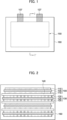
- FIGS. 1 and 2 are a schematic plan view and a schematic cross-sectional view, respectively, illustrating a lithium secondary battery in accordance with exemplary embodiments.
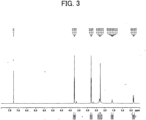
- FIG. 2 is a cross-sectional view taken along a line I-I' shown in FIG. 1 in a thickness direction of a secondary battery.
- the secondary battery shown in FIGS. 1 and 2 are provided for convenience of descriptions, and the secondary battery of the present disclosure is not limited to the structure/shape illustrated in FIGS. 1 and 2 .
- the secondary battery may be provided as a lithium secondary battery.
- the secondary battery may include an electrode assembly 150 and a case 160 accommodating the electrode assembly 150.
- the electrode assembly 150 may include a cathode 100, an anode 130 and a separator 140.
- the cathode 100 may include a cathode current collector 105 and a cathode active material layer 110 formed on at least one surface of the cathode current collector 105.
- the cathode active material layer 110 may be formed on both surfaces (e.g., upper and lower surfaces) of the cathode current collector 105.
- the cathode active material layer 110 may be coated on each of the upper surface and the lower surface of the cathode current collector 105, and may be directly coated on the surface of the cathode current collector 105.
- the anode current collector 105 may include, e.g., stainless steel, nickel, aluminum, titanium, copper, or an alloy thereof, preferably aluminum or an aluminum alloy.
- the cathode active material layer 110 may include a lithium metal oxide as a cathode active material, and may include a lithium (Li)-nickel (Ni)-based oxide according to example embodiments.
- the lithium metal oxide included in the cathode active material layer 110 may be represented by Chemical Formula 2 below. [Chemical Formula 2] Li x Ni 1-y M y O 2-z X z
- M may include at least one element selected from the group consisting of Mg, Sr, Ba, B, Al, Si, Mn, Ti, Zr, Co and W, and X may represent an element selected from O, F, S and P.
- M may include manganese (Mn).
- NCM nickel-cobalt-manganese
- nickel may serve as a metal related to a capacity of the lithium secondary battery. As a content of nickel becomes greater, the capacity of the lithium secondary battery may be increased. However, an excessively high nickel content may degrade a life-span of the battery, and may be disadvantageous from an aspect of mechanical and electrical stability.
- a molar ratio (1-y) of nickel in Chemical Formula 2 may be in a range from 0.8 to 0.95.
- the power and the capacity may be increased through a high-Ni cathode composition.
- cobalt may serve as a metal related to a conductivity or a resistance, and the power of a lithium secondary battery.
- M includes manganese (Mn), and Mn may serve as a metal related to mechanical and electrical stability of the lithium secondary battery.
- the capacity, the power, the conductivity and life-span stability may be improved together in the cathode active material layer 110.
- the lithium metal oxide may be represented by Chemical Formula 3 below.
- the lithium metal oxide represented by Chemical Formula 3 may have an olivine structure. [Chemical Formula 3] LiMPO 4
- M may include at least one element of Fe, Mn, Ni, Co and V.
- a slurry may be prepared by mixing and stirring a cathode active material with a binder, a conductive material and/or a dispersive agent in a solvent.
- the slurry may be coated on the cathode current collector 105, and then dried and pressed to form the cathode active material layer 110.
- the binder may include, e.g., an organic binder such as vinylidene fluoride-hexafluoropropylene copolymer (PVDF-co-HFP), polyvinylidene fluoride (PVDF), polyacrylonitrile, polymethylmethacrylate, or an aqueous binder such as styrene-butadiene rubber (SBR), and may be used together with a thickener such as carboxymethyl cellulose (CMC).
- an organic binder such as vinylidene fluoride-hexafluoropropylene copolymer (PVDF-co-HFP), polyvinylidene fluoride (PVDF), polyacrylonitrile, polymethylmethacrylate, or an aqueous binder such as styrene-butadiene rubber (SBR), and may be used together with a thickener such as carboxymethyl cellulose (CMC).
- PVDF-co-HFP vinylidene fluoride
- a PVDF-based binder may be used as the cathode binder.
- an amount of the binder for forming the cathode active material layer may be reduced, and an amount of the cathode active material may be relatively increased.
- capacity and power of the lithium secondary battery may be further improved.
- the conductive material may be added to facilitate electron mobility between active material particles.
- the conductive material may include a carbon-based material such as graphite, carbon black, graphene, carbon nanotube, etc., and/or a metal-based material such as tin, tin oxide, titanium oxide, a perovskite material such as LaSrCoO 3 or LaSrMnO 3 , etc.
- an electrode density of the cathode 100 may be in a range from 3.0 g/cc to 3.9 g/cc, preferably from 3.2 g/cc to 3.8 g/cc.
- the anode 130 may include an anode current collector 125 and an anode active material layer 120 formed on at least one surface of the anode current collector 125.
- the anode active material layer 120 may be formed on both surfaces (e.g., upper and lower surfaces) of the anode current collector 125.
- the anode active material layer 120 may be coated on each of the upper surface and the lower surface of the anode current collector 125.
- the anode active material layer 120 may directly contact the surface of the anode current collector 125.
- the anode current collector 125 may include gold, stainless steel, nickel, aluminum, titanium, copper, or an alloy thereof, preferably copper or a copper alloy.
- the anode active material layer 120 may include an anode active material capable of intercalating and de-intercalating lithium ions.
- the anode active material may include a lithium alloy, a carbon-based active material, and/or a silicon (Si)-based active material.
- the carbon-based active material may include a crystalline carbon, an amorphous carbon, a carbon composite and/or a carbon fiber.
- amorphous carbon examples include hard carbon, coke, mesocarbon microbeads (MCMB), mesophase pitch-based carbon fiber (MPCF), etc.
- Examples of the crystalline carbon may include a graphite-based carbon such as natural graphite, artificial graphite, graphitized coke, graphitized MCMB, graphitized MPCF, etc.
- Elements included in the lithium alloy may include aluminum, zinc, bismuth, cadmium, antimony, silicon, lead, tin, gallium, indium, etc.
- the anode active material above may include the silicon-based active material to implement a high-capacity lithium secondary battery.
- the silicon-based active material may include a siloxane-based compound, and the siloxane-based compound may be represented as SiOx (0 ⁇ x ⁇ 2).
- the siloxane-based compound may be a polymer compound, and may be crystalline or amorphous.
- the siloxane-based polymer compound may include one or more of an M-unit, a D-unit, and a T-unit.
- the silicon-based active material may include, e.g., a silicon-carbon composite compound such as silicon carbide (SiC).
- the anode may include the carbon-based active material and the silicon-based active material.
- the silicon-based active material may be included in an amount from about 0.1 parts by weight to about 50 parts by weight based on 100 parts by weight of the carbon-based active material.
- a chemical bond between the silatane-based compound and the silicon-based active material may be sufficiently formed to improve a cohesion of the coating layer formed on the surface of the anode active material. Further, volume expansion of the anode due to the silicon-based active material may be suppressed, so that high-temperature storage and capacity properties of the secondary battery may both be enhanced.
- the anode active material may be mixed and stirred together with a binder, a conductive material and/or a dispersive agent in a solvent to form a slurry.
- the slurry may be coated on at least one surface of the anode current collector 125, dried and pressed to form the anode active material layer 120.
- the binder and the conductive material substantially the same as or similar to those used for the cathode may also be used.
- the binder for forming the anode 130 may include, e.g., a styrene-butadiene rubber (SBR) or an acrylic binder for consistency with a graphite-based active material, and may be used with a thickener such as carboxymethyl cellulose (CMC).
- SBR styrene-butadiene rubber
- CMC carboxymethyl cellulose
- the anode active material layer 120 may have a density in a range from 1.4 g/cc to 1.9 g/cc.
- an area and/or a volume of the anode 130 may be greater than that of the cathode 100.
- lithium ions generated from the cathode 100 may be easily transferred to the anode 130 without a loss by, e.g., precipitation or sedimentation.
- the separator 140 may be interposed between the cathode 100 and the anode 130.
- the separator 140 may include a porous polymer film prepared from, e.g., a polyolefin-based polymer such as an ethylene homopolymer, a propylene homopolymer, an ethylene/butene copolymer, an ethylene/hexene copolymer, an ethylene/methacrylate copolymer, or the like.
- the separator 140 may also include a non-woven fabric formed from a glass fiber with a high melting point, a polyethylene terephthalate fiber, etc.
- the separator 140 may extend in a width direction in FIG. 1 between the cathode 100 and the anode 130, and may be folded and wound in a thickness direction of the secondary battery. Accordingly, a plurality of the cathodes 100 and anodes 130 may be stacked in the thickness direction by the separator 140.
- an electrode cell may be defined by the cathode 100, the anode 130 and the separator 140, and a plurality of the electrode cells may be stacked to form the electrode assembly 150 that may have e.g., a jelly roll shape.
- the electrode assembly 150 may be formed by winding, stacking or folding the separator 140.
- the electrode assembly 150 may be accommodated together with the electrolyte solution according to the above-described embodiments of the present disclosure in the case 160.
- electrode tabs may protrude from the cathode current collector 105 and the anode current collector 125 included in each electrode cell to one side of the case 160.
- the electrode tabs may be welded together with the one side of the case 160 to be connected to an electrode lead (a cathode lead 107 and an anode lead 127) that may be extended or exposed to an outside of the case 160.
- FIG. 1 illustrates that the cathode lead 107 and the anode lead 127 are formed at the same side of the case 160, but the cathode lead 107 and the anode lead 127 may be formed at opposite sides.
- the cathode lead 107 may be formed at one side of the case 160, and the anode lead 127 may be formed at the other side of the case 160.
- the lithium secondary battery may be fabricated into a cylindrical shape using a can, a prismatic shape, a pouch shape, a coin shape, etc.
- Triethanolamine (14.9 g, 100 mmol) and toluene (150 mL) as a solvent were added to a 250 mL round bottom flask to prepare a solution.
- (N,N-dimethylaminopropyl) trimethoxysilane (21.8 g, 105 mmol) was added to the solution, and then heated to about 110°C while being stirred.
- Triethanolamine (14.9 g, 100 mmol) and toluene (150 mL) as a solvent were added to a 250 mL round bottom flask to prepare solution.
- Tetramethoxysilane (15.2 g, 100 mmol) was added to the solution, and heated to about 100°C while being stirred.
- the 1 H NMR spectrum of the compound is shown in FIG. 4 .
- Triethanolamine (14.9 g, 100 mmol) and toluene (150 mL) as a solvent were added to a 250 mL round bottom flask to prepare a solution.
- Trimethoxy(3,3,3-trifluoropropyl)silane (3,2, 21.8 g, 100 mmol) was added to the solution, and heated to about 110°C while being stirred.
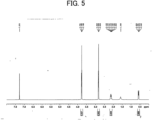
- the 1 H NMR spectrum of the compound is shown in FIG. 5 .
- Triethanolamine (14.9 g, 100 mmol) and toluene (150 mL) as a solvent were added to a 250 mL round bottom flask to prepare a solution.
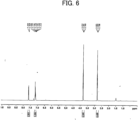
- Trimethoxyphenylsilane (19.8 g, 100 mmol) was added to the solution, and heated to about 110°C while being stirred.
- the 1 H NMR spectrum of the compound is shown in FIG. 6 .
- Triethanolamine (14.9 g, 100 mmol) and toluene (150 mL) as a solvent were added to a 250 mL round bottom flask.
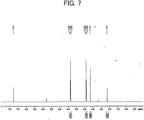
- Chloromethyl triethoxy silane (17.1 g, 100 mmol) was added to the solution, and heated to about 110°C while being stirred.
- the 1 H NMR spectrum of the compound is shown in in FIG. 7 .
- the 1H NMR spectrum of the compound is shown in FIG. 8 .
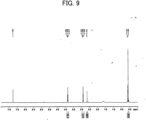
- the 1 H NMR spectrum of the compound is shown in FIG. 9 .
- Triethanolamine (14.9 g, 100 mmol) and benzene (150 mL) as a solvent were added to a 250 mL round bottom flask to prepare a solution.
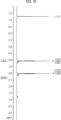
- Triethoxy (pentafluorophenyl)silane (33.1 g, 100 mmol) was added to the solution, and heated to about 80°C while being stirred.
- the 1 H NMR spectrum of the compound is shown in FIG. 10 .
- the silatane-based compound of Preparation Example 1, a non-aqueous mixed solvent, a lithium salt and an additive were mixed to obtain an electrolyte solution for a secondary battery.
- the non-aqueous mixed solvent included 25 vol% of EC, 45 vol% of EMC and 30 vol% of DEC based on a total volume of the solvent.
- the lithium salt was LiPF 6 , and a concentration of the lithium salt was within 1.0 M to 1.1 M.
- the additive included 3 wt% of fluoroethylene carbonate (FEC), 0.5 wt% of propanesultone (PS), and 0.5 wt% of ethylene sulfate (ESA) based on a total weight of the electrolyte solution.
- FEC fluoroethylene carbonate
- PS propanesultone
- ESA ethylene sulfate
- the silatane-based compound was included in an amount of 0.5 wt% based on the total weight of the electrolyte solution.
- LiNi 0.8 Co 0.1 Mn 0.1 O 2 as a cathode active material, polyvinylidene fluoride (PVdF) as a binder, and a carbon-based conductive agent were mixed in a weight ratio of 98:1:1, and then dispersed in N-methyl-2-pyrrolidone to prepare a cathode slurry.
- the slurry was coated on an aluminum foil having a thickness of 20 ⁇ m, dried and pressed to form a cathode.
- a film separator formed of polyethylene (PE) having a thickness of 25 ⁇ m was stacked between the above-manufactured electrodes to form a pouch cell having a thickness of 6 mm x a width of 60 mm x a length of 90 mm, and the electrolyte solution for a secondary battery was injected to obtain a 2.0 Ah-level secondary battery.
- PE polyethylene
- a secondary battery was manufactured by the same manner as that in Example 1, except that types and contents of the silatane-based compound, types and contents of the solvent, and the types and contents of the additive were changed as shown in Table 1 below.
- a secondary battery was manufactured by the same method as that in Example 1, except that types and contents of the solvent, and types and contents of the additive were changed as shown in Table 1 below while the silatane-based compound was not used.
- silatrane-based compound solvent additive type Preparation Example
- Example 1 1 0.5 EC/EMC/DEC (25/45/30) FEC(3), PS(0.5), ESA(0.5)
- Example 2 2 0.5 EC/EMC/DEC (25/45/30) FEC(3), PS(0.5), ESA(0.5)
- Example 3 3 0.5 EC/EMC/DEC (25/45/30) FEC(3), PS(0.5), ESA(0.5)
- Example 4 4 0.5 EC/EMC/DEC (25/45/30) FEC(3), PS(0.5), ESA(0.5) Example 5 5 0.5 EC/EMC (25/75) FEC(4), PS(0.2)
- Example 6 6 0.5
- EC ethylene carbonate
- EMC ethylmethyl carbonate
- DEC diethyl carbonate
- FEC fluoroethylene carbonate
- PS propane sultone
- W3 lithium difluorophosphate (LiPO 2 F 2 )
- ESA ethylene sulfate.
- Each of the secondary batteries of Examples and Comparative Examples was charged with 0.5C rate CC-CV (4.2V, 0.05C cut-off) at room temperature, and then discharged (2.7V cut-off) at 0.5C rate CC to measure an initial capacity of the battery.
- Each of the secondary batteries of Examples and Comparative Examples was charged with 0.5C rate CC-CV (4.2V, 0.05C cut-off) at room temperature, and then discharged (2.7V cut-off) at 0.5C rate CC tree times, and then an initial resistance of the battery was measured.
- the secondary batteries of Examples and Comparative Examples were charged with 0.5C rate CC-CV (4.2V, 0.05C cut-off) at room temperature, and then stored in an oven at 60°C for 6, 12 or 16 weeks. Thereafter, each secondary battery was taken out of the oven and left for 30 minutes, and a capacity measured after discharging (2.7V cut-off) at 0.5C rate CC was divided by the initial capacity measured in the above (1)-1 to calculate a capacity retention (%).
- 0.5C rate CC-CV 4.2V, 0.05C cut-off
- the secondary batteries of Examples and Comparative Examples were charged with 0.5C rate CC-CV (4.2V, 0.05C cut-off) at room temperature, and then stored in an oven at 60°C for 6, 12 or 16 weeks. After the battery was taken out of the oven, a central thickness was measured with a thickness meter in a hot state. The measured thickness was divided by an initial thickness before the storage at 60°C to calculate a thickness change ratio (thickness after the storage/initial thickness)* 100(%)). The initial thickness of the secondary battery of each Example was ⁇ 2.5% based on a value of Comparative Example 1, and a decimal point was deleted.
- CC-CV 4.2V, 0.05C cut-off
- the secondary batteries of Examples and Comparative Examples were charged with 0.5C rate CC-CV (4.2V, 0.05C cut-off) at room temperature, and then stored in an oven at 60°C for 6, 12 or 16 weeks. Thereafter, each secondary battery was taken out of the oven and left for 30 minutes, and a resistance was measured by discharging (2.7V cut-off) at 0.5C rate CC. The measured resistance was divided by the initial resistance measured in the above (1)-2 to calculate a resistance increase ratio (%). A decimal point was deleted.
- 0.5C rate CC-CV 4.2V, 0.05C cut-off
- the secondary batteries of Examples and Comparative Examples were charged at 0.5C rate CC-CV (4.2V, 0.05C cut-off) at room temperature, and then discharged (2.7V cut-off) at 0.5C rate CC as a single cycle. 500 cycles or 1000 cycles were performed, and then a capacity of each battery was measured. The measured capacity was divided by the initial capacity measured in the above (1) to calculate a capacity retention (%).
- the batteries of Examples 1 to 4, and 9 to 11 provided lower thickness increase ratios when stored at high temperature and higher capacity retentions during the repeated charging and discharging than those from Comparative Example 1 having the electrolyte solution that included the same additive and no silatane-based compound.
- the batteries of Examples 5, 6 and 8 provided higher capacity retentions when stored at high temperature than those from Comparative Example 2 having the electrolyte solution that included the same additive and no silatane-based compound. Further, higher capacity retentions were provided during the repeated charging and discharging.
- the battery of Example 7 provided the capacity retention during high-temperature storage similar to that from Comparative Example 3 including the electrolyte solution that included the same additive the same composition, and provided low thickness increase ratio and improved dimensional stability during high-temperature storage.
Landscapes
- Chemical & Material Sciences (AREA)
- General Chemical & Material Sciences (AREA)
- Chemical Kinetics & Catalysis (AREA)
- Electrochemistry (AREA)
- Engineering & Computer Science (AREA)
- Manufacturing & Machinery (AREA)
- Inorganic Chemistry (AREA)
- General Physics & Mathematics (AREA)
- Condensed Matter Physics & Semiconductors (AREA)
- Physics & Mathematics (AREA)
- Composite Materials (AREA)
- Materials Engineering (AREA)
- Secondary Cells (AREA)
Abstract
An electrolyte solution for a lithium secondary battery according to embodiments of the present disclosure includes a lithium salt, a non-aqueous organic solvent, and a silatane-based having a specific chemical structure. A secondary battery includes the electrolyte solution for a lithium secondary battery. The secondary battery has improved high temperature storage properties and life-span properties.
Description
- The present disclosure invention relates to an electrolyte solution for a secondary battery and a lithium secondary battery including the same. More particularly, the present disclosure relates to an electrolyte solution for a secondary battery including an additive, and a secondary battery including the same.
- A secondary battery which can be charged and discharged repeatedly has been widely employed as a power source of a mobile electronic device such as a camcorder, a mobile phone, a laptop computer. Examples of the secondary battery include a lithium secondary battery, a nickel-cadmium battery, a nickel-hydrogen battery, etc. For example, the lithium secondary battery is widely developed and applied due to high operational voltage and energy density per unit weight, a high charging rate, a compact dimension, etc.
- For example, the secondary battery may include an electrode assembly including a cathode, an anode and a separation layer (separator), and an electrolyte solution immersing the electrode assembly. The lithium secondary battery may further include an outer case having, e.g., a pouch shape for accommodating the electrode assembly and the electrolyte solution.
- For example, when charging and discharging of active material particles included in the cathode or the anode is repeated, a side reaction may occur due to a contact with an electrolyte, and mechanical and chemical damage such as cracks of the particles may be generated. If a composition or a structure of the active material is modified in order to improve stability of the active material particles, a conductivity may be lowered to cause degradation of a power of the secondary battery.
- According to an aspect of the present invention, there is provided an electrolyte solution providing improved stability and activity.
- According to an aspect of the present invention, there is provided a secondary battery having improved stability and activity.
- An electrolyte solution for a secondar battery includes a lithium salt, a non-aqueous organic solvent, and a silatane-based compound represented by Chemical Formula 1.

- In Chemical Formula 1, X is each independently oxygen, sulfur, nitrogen or phosphorus. R1 is an electron donating group, a C2 to C10 tertiary aminoalkyl group, a C1 to C10 haloalkyl group, a C6 to C15 aryl group, a C6 to C15 haloaryl group, or a hydrocarbon group including at least one selected the group consisting of a C1 to C10 alkyl group, a C1 to C10 haloalkyl group, a sulfonyloxy group, a C1 to C10 alkylene group and a C3 to C15 trialkylsilyloxy group. R2, R3, R4, R5, R6 and R7 are each independently hydrogen, a C1 to C6 linear alkyl group, a C3 to C6 branched alkyl group or a C3 to C6 cyclic alkyl group.
- In some embodiments, the electron donating group may include at least one selected from the group consisting of a C1 to C10 alkoxy group, a cyano group, a halogen group, a vinyl group, a hydroxy group, a primary to tertiary amine group, an imine group, a thiol group and a sulfide group.
- In some embodiments, in Chemical Formula 1, X may be oxygen.
- In some embodiments, in Chemical Formula 1, R1 may be a methoxy group, an ethoxy group, a propoxy group, a dimethylamine group, a diethylamine group, a methylethylamine group, a dimethylaminomethyl group, a dimethylaminoethyl group, a dimethylaminopropyl group, a methylethylaminomethyl group, a methylethylaminoethyl group, a methylethylaminopropyl group, a diethylaminomethyl group, a diethylaminoethyl group, a diethylaminopropyl group, a trifluoromethyl group, a trifluoroethyl group, a trifluoropropyl group, a phenyl group, a naphthyl group, a fluorophenyl group, a difluorophenyl group, a trifluorophenyl group, a tetrafluorophenyl group, a pentafluorophenyl group, a methylsulfonyloxymethylene group, a ethylsulfonyloxymethylene group, a trifluoromethylsulfonyloxymethylene group, a pentafluoroethylsulfonyloxymethylene group or a trimethylsilyloxymethylene group.
- In some embodiments, in Chemical Formula 1, R2, R3, R4, R5, R6 and R7 may each be hydrogen.
- In some embodiments, a content of the silatrane-based compound may be in a range from 0.1 wt% to 5.0 wt% based on a total weight of the electrolyte solution.
- In some embodiments, an auxiliary additive that includes at least one selected from the group consisting of a fluorine-containing carbonate-based compound, a vinylidene carbonate-based compound and a sulfinyl group-containing compound may be further included.
- In some embodiments, the fluorine-containing carbonate-based compound may include fluoroethylene carbonate, the vinylidene carbonate-based compound may include vinylethylene carbonate, and the sulfinyl group-containing compound may include at least one of 1,3-propane sultone and ethylene sulfate.
- In some embodiments, a content of the auxiliary additive may be in a range from 0.1 wt% to 10 wt% based on a total weight of the electrolyte solution.
- A secondary battery includes a cathode including a lithium metal oxide, an anode facing the cathode and including a carbon-based active material or a silicon-based active material, and the electrolyte solution for a secondary battery according to the above-described embodiments.
- In some embodiments, the anode may include the carbon-based active material and the silicon-based active material, and the silicon-based active material may be included in an amount from 0.1 parts by weight to 50 parts by weight based on 100 parts by weight of the carbon-based active material.
- In some embodiments, a coating layer derived from the silatrane-based compound may be formed on a surface of an active material of the anode.
- In some embodiments, a C-X bond may be formed between the carbon-based active material and the coating layer derived from the silatrane-based compound.
- In some embodiments, a Si-X bond may be formed between the silicon-based active material and the coating layer derived from the silatrane-based compound.
- The electrolyte solution for a secondary battery according to the present disclosure may improve storage properties and capacity properties of a cathode.
- In example embodiments, a silatrane-based compound contained in the electrolyte solution for a secondary battery may form a coating layer on a surface of an anode for a secondary battery. A coating layer may also be formed on a surface of an anode active material included in the anode by the silatrane-based compound. Accordingly, exposure of the anode active material to the electrolyte solution may be reduced. A contact between the cathode active material dissolved in the electrolyte solution and the anode active material may be suppressed by the coating layer. Thus, even though charging and discharging of the battery may be repeated, reduction of the capacity from the anode may be prevented.
- In example embodiments, a chemical bond may be formed between the silatane-based compound contained in the electrolyte solution for a secondary battery and the anode active material. Through the formation of the chemical bond, a coating layer may be formed on the surface of the anode active material. High-temperature storage of the anode active material may be improved by the coating layer.
- In example embodiments, the secondary battery includes the electrolyte solution for a secondary battery, and may have improved capacity, storage and life-span properties.
-
-
FIG. 1 is a schematic plan view illustrating a secondary battery in accordance with example embodiments. -
FIG. 2 is a schematic cross-sectional view illustrating a secondary battery in accordance with example embodiments. -
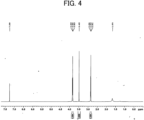
FIGS. 3 to 10 are 1H NMR spectra of compounds of Preparation Examples 1 to 8, respectively. - The term "Ca to Cb" used herein refers that the number of carbon atoms in a functional group is in a range from a to b.
- The term "substituted" used herein may refer that any hydrogen of a moiety is substituted with at least one of a cyano group, a halogen group (e.g., a fluorine atom), a vinyl group, a hydroxyl group, a primary to tertiary amine group, an imine group, a thiol group, a sulfide group, a C1 to C6 alkyl group, a C2 to C6 alkenyl group, a C1 to C6 alkoxy group and a C6 to C12 phenoxy group.
- The electrolyte solution for a secondary battery according to embodiments of the present disclosure may include a lithium salt, a non-aqueous organic solvent, and a silatane-based compound represented by Chemical Formula 1.

- In Chemical Formula 1, X may each independently be oxygen, sulfur, nitrogen, or phosphorus. R1 may be an electron donating group, a C2 to C10 tertiary aminoalkyl group, a C1 to C10 haloalkyl group, a C6 to C15 aryl group, a C6 to C15 haloaryl group, or a hydrocarbon group including at least one selected the group consisting of a C1 to C10 alkyl group, a C1 to C10 haloalkyl group, a sulfonyloxy group, a C1 to C10 alkylene group and a C3 to C15 trialkylsilyloxy group. R2, R3, R4, R5, R6 and R7 may each independently be hydrogen, a C1 to C6 linear alkyl group, a C3 to C6 branched alkyl group or a C3 to C6 cyclic alkyl group.
- The term "electron donating group" used herein may refer to an atom or functional group capable of increasing an electron density by pushing electrons toward a bonded atom.
- The "alkyl group" used herein refers to an aliphatic saturated hydrocarbon group that may be linear or branched. The "alkylene group" used herein may be a divalent saturated hydrocarbon group from which one hydrogen of the alkyl group is removed.
- The "alkoxy group" used herein may refer to an alkyl group bonded through oxygen.
- The "tertiary aminoalkyl group" used herein may refer to an alkyl group to which an amine group having two substituents is bonded. For example, the tertiary aminoalkyl group may be a dialkyl aminoalkyl group.
- The "haloalkyl group" used herein may refer to a group obtained by substituting at least one hydrogen in the alkyl group with halogen. For example, hydrogen bonded to an end of the alkyl group may be substituted with halogen, or hydrogen bonded to an alkylene group in the middle of the alkyl groups may be substituted with a halogen. Halogen may include fluorine, chloride, bromine, iodine, etc.
- The term "aryl group" used herein may refer to a single ring or a multiple ring structured substituent containing an aromatic ring.
- The "haloaryl group" used herein may refer to a group in which at least one hydrogen of the aryl group is substituted with halogen. Halogen may include fluorine, chloride, bromine, iodine, etc.
- The term "cyclic alkyl group" used herein may refer to an alicyclic saturated hydrocarbon group, and may refer to an alkyl group with a cyclic structure.
- The "sulfonyloxy group" may be represented by -S(=O)2-O-. The sulfonyloxy group includes two oxygen atoms linked by a double bond to a sulfur atom, and an oxygen atom linked by a single bond to the sulfur atom, and each of the sulfur atom and the oxygen atom may be a divalent organic group having a binding site.
- Each of the alkyl group, the alkoxy group, the tertiary aminoalkyl group, the haloalkyl group, the aryl group, and the cyclicalkyl group may be substituted or unsubstituted.
- In example embodiments, the silatane-based compound represented by Chemical Formula 1 may form a coating layer on a surface of the anode active material included in an anode of the secondary battery above. A direct contact between the electrolyte solution and the anode active material may be blocked by the coating layer. Additionally, volume change and loss of the anode active material may be suppressed while charging and discharging the secondary battery.
- In example embodiments, a nitrogen atom of Chemical Formula 1 may donate an electron to a silicon atom of Chemical Formula 1, and a coordination bond may be formed between the nitrogen atom and the silicon atom. Additionally, the silicon atom may partially have a negative charge by the coordination bond formed between the nitrogen atom and the silicon atom,
- In example embodiments, R1 bonded to the silicon atom of Chemical Formula 1 may be an electron donating group; a C2 to C10 tertiary aminoalkyl group; a C1 to C10 haloalkyl group; a C6 to C15 aryl group; a C6 to C15 haloaryl group; or a hydrocarbon group including at least one selected from the group consisting of a C1 to C10 alkyl group, a C1 to C10 haloalkyl group, a sulfonyloxy group, a C1 to C10 alkylene group and a C3 to C15 trialkylsilyloxy group. R1 may function as an electron donor. R1 may be bonded to the silicon atom to donate an electron to the silicon atom through a resonance effect, an induction effect, etc., and may increase a partial negative charge of the nitrogen atom of Chemical Formula 1.
- For example, the electron donating group may include a C1 to C10 alkoxy group, a cyano group, a halogen group (e.g., a fluorine atom), a vinyl group, a hydroxy group, a primary to tertiary amine group, an imine group, a thiol group, a sulfide group, etc.
- For example, R1 may include an alkoxy group such as a methoxy group, an ethoxy group, a propoxy group, etc.; a tertiary aminoalkyl group such as a dimethylamine group, a diethylamine group, a methylethylamine group, a dimethylaminomethyl group, a dimethylaminoethyl group, a dimethylaminopropyl group, a methylethylaminomethyl group, a methylethylaminoethyl group, a methylethylaminopropyl group, a diethylaminomethyl group, a diethylaminoethyl group, a diethylaminopropyl group, etc.; a haloalkyl group such as a trifluoromethyl group, a trifluoroethyl group, a trifluoropropyl group, etc.; an aryl group such as a phenyl group, a naphthyl group, etc.; a haloaryl group such as a fluorophenyl group, a difluorophenyl group, a trifluorophenyl group, a tetrafluorophenyl group, a pentafluorophenyl group, etc.
- In some embodiments, R1 may be a hydrocarbon group including at least one selected from the group consisting of a C1 to C10 alkyl group, a C1 to C10 haloalkyl group, a sulfonyloxy group, a C1 to C10 alkylene group and a C3 to C15 trialkylsilyloxy group. For example, R1 may be a hydrocarbon group including at least one selected from the group consisting of a C1 to C3 alkyl group, a C1 to C3 haloalkyl group, a sulfonyloxy group, a C1 to C3 alkylene group and a C3 to C6 trialkylsilyloxy group.
- For example, R1 may be a C6 to C15 haloaryl group. In this case, a more robust coating layer may be formed on the surface of the anode active material, and side reactions between the electrolyte solution and the anode active material may be suppressed. Accordingly, capacity reduction or volume expansion may be prevented in a storage at high temperature.
- For example, R1 may include the sulfonyloxy group. In this case, even during the repeated charging and discharging of the battery, the capacity of the battery may be maintained without a large reduction from the initial capacity, and the life-span properties of the battery may be improved.
- For example, R1 may include the trialkylsilyloxy group. In this case, even when the battery is stored at high temperature for a long period, an amount of gas generated at an inside of the battery may be reduced, and a dimensional stability of the battery may be improved.
- The above-listed R1 may be employed, so that dissociation of a Si-X bond may be promoted. Additionally, the formation of the coating layer derived from the silatrane-based compound may be further promoted, and high-temperature storage properties of the secondary battery may be further improved.
- In example embodiments, the partial negative charge of the silicon atom may be formed to increase nucleophilicity of a single bond formed at the silicon atom, and a reactivity between the electrophilic anode active material and the single bond may be increased.
- Thus, an electron pair forming the single bond may be donated so that a chemical bond may be formed between the anode active material and X of Chemical Formula 1. Further, the coating layer derived from the silatrane-based compound may be formed on the surface of the anode active material.
- In some embodiments, R1 may be a phenyl group, a methoxy group, a dimethylaminopropyl group, a trifluoropropyl group, a methylsulfonyloxymethyl group, a trifluoromethylsulfonyloxymethyl group, a trimethylsilyloxymethyl group, or a pentafluoro phenyl group. In this case, R1 may act as a nucleophilic functional group, and an intramolecular substitution reaction may occur. In some embodiments, R1 may react with the anode active material to additionally form a covalent bond.
- The covalent bond may be formed with the anode active material, so that the silatrane-based compound may be induced to the surface of the anode active material by R1. R1 may primarily fix the silatrane-based compound on the surface of the anode active material to promote the formation of the coating layer on the surface of the anode active material. Accordingly, cohesion of the coating layer may be further improved.
- X in Formula 1 may have a negative charge due to dissociation of the single bond with the silicon atom, and X having the negative charge may act as a nucleophile. In example embodiments, a chemical bond may be formed between X having the negative charge, and the anode active material. The chemical bond may be a single bond such as SiX or C-X.
- In example embodiments, X may be oxygen. In this case, the single bond between the silicon atom and the oxygen atom may be dissociated to forming an oxide.
- The oxide may react with the anode active material to form a covalent bond. The covalent bond formed between the anode active material and the oxide may be one or more of a Si-O bond and a C-O bond. When the Si-O bond is formed, cohesion of the coating layer formed on the surface of the anode active material may be further enhanced due to high affinity between silicon and oxygen.
- In example embodiments, R2, R3, R4, R5, R6 and R7 may each be hydrogen. In this case, the action of R1 as the nucleophilic functional group may be further promoted.
- In the electrolyte solution for a secondary battery according to some embodiments, a content of the silatrane-based compound may be in a range from 0.1 weight percent (wt%) to 5.0 wt% based on a total weight of the electrolyte solution. In an embodiment, the content of the silatrane-based compound may be in a range from 0.5 wt% to 3 wt%, from 0.5 wt% to 2 wt%, or from 0.5 wt% to 1 wt% based on the total weight of the electrolyte solution.
- In the above content range, agglomeration of the coating layer derived from the silatrane-based compound may be prevented, the coating layer can be formed uniformly. Further, the life-span properties of the secondary battery containing the above-described electrolyte solution for a secondary battery may be improved.
- The electrolyte solution for a secondary battery according to some embodiments may further include an auxiliary additive including at least one compound selected from the group consisting of a fluorine-containing carbonate-based compound, a vinylidene carbonate-based compound, and a sulfinyl group (S=O)-containing compound.
- In example embodiments, the fluorine-containing carbonate-based compound may include fluoroethylene carbonate, the vinylidene carbonate-based compound may include vinylethylene carbonate, and the sulfinyl group-containing compound may include 1,3-propane sultone and/or ethylene sulfate.
- The above-described auxiliary additive may be further included, so that high-temperature storage property and high-temperature stability of the secondary battery containing the electrolyte solution may be further improved.
- In some embodiments, the fluorine-containing carbonate-based compound may include fluoroethylene carbonate (FEC), difluoroethylene carbonate (DFEC), fluorodimethylcarbonate (FDMC), and fluoroethylmethyl carbonate (FEMC) or a mixture thereof.
- In some embodiments, the vinylidene carbonate-based compound may include vinylene carbonate (VC), vinyl ethylene carbonate (VEC), or a mixture thereof.
- In some embodiments, the sulfinyl group-containing compound may include at least one selected from the group consisting of a sulfone compound, a sulfite compound, a sulfonate compound, a sultone compound and a sulfate compound.
- Non-limiting examples of the sulfone compound may include dimethyl sulfone, diethyl sulfone, ethyl methyl sulfone, methyl vinyl sulfone, divinyl sulfone, or a mixture thereof.
- Non-limiting examples of the sulfite compounds may include ethylene sulfite, methyl ethylene sulfite, ethyl ethylene sulfite, 4,5-dimethyl ethylene sulfite, 4,5-diethyl ethylene sulfite, propylene sulfite, 4,5-dimethyl propylene sulfite, 4,5-diethyl propylene sulfite, 4,6-dimethyl propylene sulfite, 4,6-diethyl propylene sulfite, 1,3-butylene glycol sulfite, or a mixture thereof.
- Non-limiting examples of the sulfonate compound may include methyl methanesulfonate, ethyl methanesulfonate, methyl ethanesulfonate, propyl methanesulfonate, methyl propanesulfonate, ethyl propanesulfonate, vinyl methanesulfonate, allyl methanesulfonate, vinyl benzenesulfonate, allyl prop-2-enesulfonate, or a mixture thereof.
- Non-limiting examples of the sultone compound may include ethanesultone, 1,3-propane sultone (PS), 1,4-butane sultone, ethenesultone, 1,3-propene sultone, 3-fluoro-1,3-propane sultone, 1,4-butene sultone, or a mixture thereof.
- Non-limiting examples of the sulfate compound may include ethylene sulfate (ESA), propylene sulfate, 2,3-butylene sulfate, 1,3-propylene sulfate, 1,3-butylene sulfate, or a mixture thereof.
- In some embodiments, the fluorine-containing carbonate-based compound may include fluoroethylene carbonate, the vinylidene carbonate-based compound may include vinylethylene carbonate, and the sulfinyl group-containing compound may include 1,3-propane sultone and/or ethylene sulfate.
- The above-described auxiliary additive may be included, so that the high-temperature storage property and high-temperature stability of the secondary battery including the electrolyte solution may be further improved.
- In some embodiments, the auxiliary additive may be included in an amount from 0.1 wt% to 10 wt% based on the total weight of the electrolyte solution.
- In the content range of the auxiliary additive, the high-temperature stability and the capacity retention of the secondary battery may be enhanced and a rapid life-span degradation may be prevented.
- In the electrolyte solution for a secondary battery according to example embodiments, the electrolyte solution may include a lithium salt as an electrolyte and a non-aqueous organic solvent, and the lithium salt is expressed, e.g., as Li+X-. Examples of the anion X- of the lithium salt include F-, Cl-, Br-, I-, NO3 -, N(CN)2 -, BF4 -, ClO4 -, PF6 -, (CF3)2PF4 -, (CF3)3PF3 -, (CF3)4PF2 -, (CF3)5PF-, (CF3)6P-, CF3SO3 -, CF3CF2SO3 -, (CF3SO2)2N-, (FSO2)2N-, CF3CF2(CF3)2CO-, (CF3SO2)2CH-, (SF5)3C-, (CF3SO2)3C-, CF3(CF2)7SO3 -, CF3CO2 -, CH3CO2 -, SCN-, (CF3CF2SO2)2N-.
- The lithium salt may be included in a concentration of 0.1 M to 2.0 M. In the concentration range, a conductivity of the electrolyte solution and a mobility of lithium ions may both be improved.
- Examples of the non-aqueous organic solvent include propylene carbonate (PC), ethylene carbonate (EC), diethyl carbonate (DEC), dimethyl carbonate (DMC), ethylmethyl carbonate (EMC), methylpropyl carbonate, dipropyl carbonate, dimethyl sulfoxide, acetonitrile, dimethoxyethane, diethoxyethane, sulfolane, gamma-butyrolactone, tetrahydrofuran, etc. These may be used alone or in a combination of two or more therefrom.
-
FIGS. 1 and 2 are a schematic plan view and a schematic cross-sectional view, respectively, illustrating a lithium secondary battery in accordance with exemplary embodiments. For example,FIG. 2 is a cross-sectional view taken along a line I-I' shown inFIG. 1 in a thickness direction of a secondary battery. The secondary battery shown inFIGS. 1 and 2 are provided for convenience of descriptions, and the secondary battery of the present disclosure is not limited to the structure/shape illustrated inFIGS. 1 and 2 . - Referring to
FIGS. 1 and 2 , the secondary battery may be provided as a lithium secondary battery. In example embodiments, the secondary battery may include anelectrode assembly 150 and acase 160 accommodating theelectrode assembly 150. Theelectrode assembly 150 may include acathode 100, ananode 130 and aseparator 140. - The
cathode 100 may include a cathodecurrent collector 105 and a cathodeactive material layer 110 formed on at least one surface of the cathodecurrent collector 105. In example embodiments, the cathodeactive material layer 110 may be formed on both surfaces (e.g., upper and lower surfaces) of the cathodecurrent collector 105. For example, the cathodeactive material layer 110 may be coated on each of the upper surface and the lower surface of the cathodecurrent collector 105, and may be directly coated on the surface of the cathodecurrent collector 105. - The anode
current collector 105 may include, e.g., stainless steel, nickel, aluminum, titanium, copper, or an alloy thereof, preferably aluminum or an aluminum alloy. - The cathode
active material layer 110 may include a lithium metal oxide as a cathode active material, and may include a lithium (Li)-nickel (Ni)-based oxide according to example embodiments. - In some embodiments, the lithium metal oxide included in the cathode
active material layer 110 may be represented byChemical Formula 2 below.
[Chemical Formula 2] LixNi1-yMyO2-zXz
- In
Chemical Formula 2, 0.9≤x≤1.1, 0≤y≤0.7, and -0.1≤z≤0.1. M may include at least one element selected from the group consisting of Mg, Sr, Ba, B, Al, Si, Mn, Ti, Zr, Co and W, and X may represent an element selected from O, F, S and P. - In some embodiments, in
Chemical Formula 2, M may include manganese (Mn). In one embodiment, a nickel-cobalt-manganese (NCM)-based lithium oxide may be used as the cathode active material. - For example, nickel (Ni) may serve as a metal related to a capacity of the lithium secondary battery. As a content of nickel becomes greater, the capacity of the lithium secondary battery may be increased. However, an excessively high nickel content may degrade a life-span of the battery, and may be disadvantageous from an aspect of mechanical and electrical stability.
- In one embodiment, a molar ratio (1-y) of nickel in
Chemical Formula 2 may be in a range from 0.8 to 0.95. In this case, the power and the capacity may be increased through a high-Ni cathode composition. - For example, cobalt (Co) may serve as a metal related to a conductivity or a resistance, and the power of a lithium secondary battery. In one embodiment, M includes manganese (Mn), and Mn may serve as a metal related to mechanical and electrical stability of the lithium secondary battery.
- From the above-described interaction of nickel, cobalt and manganese, the capacity, the power, the conductivity and life-span stability may be improved together in the cathode
active material layer 110. - In some embodiments, the lithium metal oxide may be represented by Chemical Formula 3 below. The lithium metal oxide represented by Chemical Formula 3 may have an olivine structure.
[Chemical Formula 3] LiMPO4
- In Chemical Formula 3, M may include at least one element of Fe, Mn, Ni, Co and V.
- For example, a slurry may be prepared by mixing and stirring a cathode active material with a binder, a conductive material and/or a dispersive agent in a solvent. The slurry may be coated on the cathode
current collector 105, and then dried and pressed to form the cathodeactive material layer 110. - The binder may include, e.g., an organic binder such as vinylidene fluoride-hexafluoropropylene copolymer (PVDF-co-HFP), polyvinylidene fluoride (PVDF), polyacrylonitrile, polymethylmethacrylate, or an aqueous binder such as styrene-butadiene rubber (SBR), and may be used together with a thickener such as carboxymethyl cellulose (CMC).
- For example, a PVDF-based binder may be used as the cathode binder. In this case, an amount of the binder for forming the cathode active material layer may be reduced, and an amount of the cathode active material may be relatively increased. Thus, capacity and power of the lithium secondary battery may be further improved.
- The conductive material may be added to facilitate electron mobility between active material particles. For example, the conductive material may include a carbon-based material such as graphite, carbon black, graphene, carbon nanotube, etc., and/or a metal-based material such as tin, tin oxide, titanium oxide, a perovskite material such as LaSrCoO3 or LaSrMnO3, etc.
- In some embodiments, an electrode density of the
cathode 100 may be in a range from 3.0 g/cc to 3.9 g/cc, preferably from 3.2 g/cc to 3.8 g/cc. - The
anode 130 may include an anodecurrent collector 125 and an anodeactive material layer 120 formed on at least one surface of the anodecurrent collector 125. In example embodiments, the anodeactive material layer 120 may be formed on both surfaces (e.g., upper and lower surfaces) of the anodecurrent collector 125. The anodeactive material layer 120 may be coated on each of the upper surface and the lower surface of the anodecurrent collector 125. For example, the anodeactive material layer 120 may directly contact the surface of the anodecurrent collector 125. - The anode
current collector 125 may include gold, stainless steel, nickel, aluminum, titanium, copper, or an alloy thereof, preferably copper or a copper alloy. - In example embodiments, the anode
active material layer 120 may include an anode active material capable of intercalating and de-intercalating lithium ions. The anode active material may include a lithium alloy, a carbon-based active material, and/or a silicon (Si)-based active material. - The carbon-based active material may include a crystalline carbon, an amorphous carbon, a carbon composite and/or a carbon fiber.
- Examples of the amorphous carbon may include hard carbon, coke, mesocarbon microbeads (MCMB), mesophase pitch-based carbon fiber (MPCF), etc.
- Examples of the crystalline carbon may include a graphite-based carbon such as natural graphite, artificial graphite, graphitized coke, graphitized MCMB, graphitized MPCF, etc. Elements included in the lithium alloy may include aluminum, zinc, bismuth, cadmium, antimony, silicon, lead, tin, gallium, indium, etc.
- In some examples, the anode active material above may include the silicon-based active material to implement a high-capacity lithium secondary battery. The silicon-based active material may include a siloxane-based compound, and the siloxane-based compound may be represented as SiOx (0<x<2).
- The siloxane-based compound may be a polymer compound, and may be crystalline or amorphous. For example, the siloxane-based polymer compound may include one or more of an M-unit, a D-unit, and a T-unit.
- The silicon-based active material may include, e.g., a silicon-carbon composite compound such as silicon carbide (SiC).
- In some embodiments, the anode may include the carbon-based active material and the silicon-based active material. The silicon-based active material may be included in an amount from about 0.1 parts by weight to about 50 parts by weight based on 100 parts by weight of the carbon-based active material.
- Within the above-described content range, a chemical bond between the silatane-based compound and the silicon-based active material may be sufficiently formed to improve a cohesion of the coating layer formed on the surface of the anode active material. Further, volume expansion of the anode due to the silicon-based active material may be suppressed, so that high-temperature storage and capacity properties of the secondary battery may both be enhanced.
- For example, the anode active material may be mixed and stirred together with a binder, a conductive material and/or a dispersive agent in a solvent to form a slurry. The slurry may be coated on at least one surface of the anode
current collector 125, dried and pressed to form the anodeactive material layer 120. - The binder and the conductive material substantially the same as or similar to those used for the cathode may also be used. In some embodiments, the binder for forming the
anode 130 may include, e.g., a styrene-butadiene rubber (SBR) or an acrylic binder for consistency with a graphite-based active material, and may be used with a thickener such as carboxymethyl cellulose (CMC). - In example embodiments, the anode
active material layer 120 may have a density in a range from 1.4 g/cc to 1.9 g/cc. - In some embodiments, an area and/or a volume of the anode 130 (e.g., a contact area with the separation layer 140) may be greater than that of the
cathode 100. Thus, lithium ions generated from thecathode 100 may be easily transferred to theanode 130 without a loss by, e.g., precipitation or sedimentation. - The
separator 140 may be interposed between thecathode 100 and theanode 130. Theseparator 140 may include a porous polymer film prepared from, e.g., a polyolefin-based polymer such as an ethylene homopolymer, a propylene homopolymer, an ethylene/butene copolymer, an ethylene/hexene copolymer, an ethylene/methacrylate copolymer, or the like. Theseparator 140 may also include a non-woven fabric formed from a glass fiber with a high melting point, a polyethylene terephthalate fiber, etc. - The
separator 140 may extend in a width direction inFIG. 1 between thecathode 100 and theanode 130, and may be folded and wound in a thickness direction of the secondary battery. Accordingly, a plurality of thecathodes 100 andanodes 130 may be stacked in the thickness direction by theseparator 140. - In example embodiments, an electrode cell may be defined by the
cathode 100, theanode 130 and theseparator 140, and a plurality of the electrode cells may be stacked to form theelectrode assembly 150 that may have e.g., a jelly roll shape. For example, theelectrode assembly 150 may be formed by winding, stacking or folding theseparator 140. - The
electrode assembly 150 may be accommodated together with the electrolyte solution according to the above-described embodiments of the present disclosure in thecase 160. - As illustrated in
FIG. 1 , electrode tabs (a cathode tab and an anode tab) may protrude from the cathodecurrent collector 105 and the anodecurrent collector 125 included in each electrode cell to one side of thecase 160. The electrode tabs may be welded together with the one side of thecase 160 to be connected to an electrode lead (acathode lead 107 and an anode lead 127) that may be extended or exposed to an outside of thecase 160. -
FIG. 1 illustrates that thecathode lead 107 and theanode lead 127 are formed at the same side of thecase 160, but thecathode lead 107 and theanode lead 127 may be formed at opposite sides. - For example, the
cathode lead 107 may be formed at one side of thecase 160, and theanode lead 127 may be formed at the other side of thecase 160. - The lithium secondary battery may be fabricated into a cylindrical shape using a can, a prismatic shape, a pouch shape, a coin shape, etc.
- Hereinafter, exemplary experimental examples are proposed to more concretely describe the present disclosure. However, the following examples are only given for illustrating the present invention and those skilled in the related art will obviously understand that various alterations and modifications are possible within the scope and spirit of the present invention. Such alterations and modifications are duly included in the appended claims.
-

- Triethanolamine (14.9 g, 100 mmol) and toluene (150 mL) as a solvent were added to a 250 mL round bottom flask to prepare a solution. (N,N-dimethylaminopropyl) trimethoxysilane (21.8 g, 105 mmol) was added to the solution, and then heated to about 110°C while being stirred.
- After the heating, a white solid produced by stirring for 12 hours or more and cooling to room temperature was filtered, washed, and dried to obtain 24.7 g of (N,N-dimethylaminopropyl) silatrane in the form of a solid (yield: 95%).
- 1H NMR (500 MHz, CDCl3) δ = 3.76 (6H, t), 2.80 (6H, t), 2.33 (2H, m), 2.27 (6H, s), 1 . 5 9 (2H, m) 0.36 (2H, m)
- The 1H NMR spectrum of the prepared compound is shown in
FIG. 3 -

- Triethanolamine (14.9 g, 100 mmol) and toluene (150 mL) as a solvent were added to a 250 mL round bottom flask to prepare solution. Tetramethoxysilane (15.2 g, 100 mmol) was added to the solution, and heated to about 100°C while being stirred.
- After the heating, a white solid produced by stirring for 12 hours or more and cooling to room temperature was filtered, washed, and dried to obtain 16.4 g of methoxysilatrane in the form of a solid (yield: 80%).
- 1H NMR (500 MHz, CDCl3) δ = 3.83 (6H, t), 3.48 (3H, s), and 2.85 (6H, t)
- The 1H NMR spectrum of the compound is shown in
FIG. 4 . -

- Triethanolamine (14.9 g, 100 mmol) and toluene (150 mL) as a solvent were added to a 250 mL round bottom flask to prepare a solution. Trimethoxy(3,3,3-trifluoropropyl)silane (3,2, 21.8 g, 100 mmol) was added to the solution, and heated to about 110°C while being stirred.
- After the heating, a white solid produced by stirring for 12 hours or more and cooling to room temperature was filtered, washed, and dried to obtain 25.7 g of (3,3,3-trifluoropropyl)-silatrane in the form of a solid (yield 95%).
- 1H NMR (500 MHz, CDCl3) δ = 3.78 (6H, t), 2.84 (6H, t), 2.13 (2H, m), 0.58 (2H, m)
- The 1H NMR spectrum of the compound is shown in
FIG. 5 . -
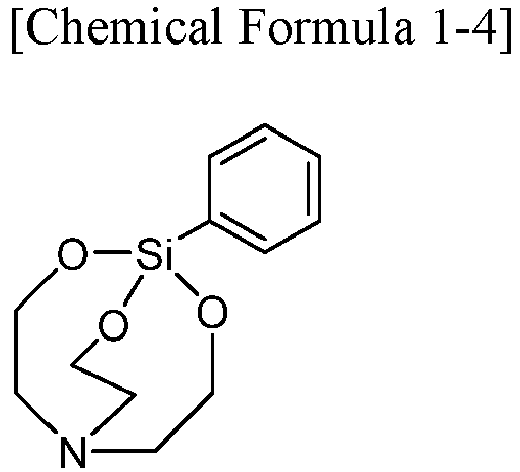
- Triethanolamine (14.9 g, 100 mmol) and toluene (150 mL) as a solvent were added to a 250 mL round bottom flask to prepare a solution. Trimethoxyphenylsilane (19.8 g, 100 mmol) was added to the solution, and heated to about 110°C while being stirred.
- After the heating, a white solid produced by stirring for 12 hours or more and cooling to room temperature was filtered, washed, and dried to obtain 24.6 g of phenylsilatrane in the form of a solid (yield 98 %).
- 1H NMR (500 MHz, CDCl3) δ = 7.62 (2H, d), 7.15 (3H,m), 3.80 (6H, t), 2.81 (6H, t)
- The 1H NMR spectrum of the compound is shown in
FIG. 6 . -

- Triethanolamine (14.9 g, 100 mmol) and toluene (150 mL) as a solvent were added to a 250 mL round bottom flask. Chloromethyl triethoxy silane (17.1 g, 100 mmol) was added to the solution, and heated to about 110°C while being stirred.
- After the heating, a white solid produced by stirring for 12 hours or more and cooling to room temperature was filtered, washed, and dried to obtain 17.8 g of chloromethyl silatrane in the form of a solid (yield 83%).
- To a solution in which methylene chloride (30 mL) was added to chloromethyl silatrane (2.3 g, 10 mmol), sodium methanesulfonate (1.3 g, 11 mmol) was added and stirred, and heated to about 40°C while being stirred. After the heating, the mixture was stirred for at least 6 hours, cooled to room temperature, washed with water, and dried, thereby obtaining 1.2 g of methylsulfonyloxymethyl silatrane in the form of a solid (yield 43%).
- 1H NMR (500 MHz, CDCl3) = 3.85 (6H, t), 2.90 (6H, t), 2.64 (2H, s), 1.64(3H, s)
- The 1H NMR spectrum of the compound is shown in in
FIG. 7 . -

- Chloromethyl silatrane (2.3 g, 10 mmol) and methylene chloride (30 mL) as a solvent were added to a 100 mL round bottom flask to prepare a solution. Sodium trifluoromethanesulfonate (12 g, 11 mmol) was added to the solution, and heated to about 40°C while being stirred.
- After the heating, the mixture was stirred for 6 hours or more, cooled to room temperature, washed with water, and dried to obtain 1.1 g of trifluoromethylsulfonyloxy silatrane in the form of a solid (yield: 45%).
- 1H NMR (500 MHz, CDCl3) δ = 3.84 (6H, t), 2.89 (6H, t), 2.62(2H, s)
- The 1H NMR spectrum of the compound is shown in
FIG. 8 . -

- Chloromethyl silatrane (2.3 g, 10 mmol) and methylene chloride (30 mL) as a solvent were added to a 100 mL round bottom flask to prepare a solution. Sodium trimethylsilanolate (1.4 g, 11 mmol) was added to the solution, and heated to about 40°C while being stirred.
- After the heating, the mixture was stirred for 6 hours or more, washed with water, and dried to obtain 1.5 g of trimethylsilyloxymethyl silatrane in the form of a solid (yield 54%)
- 1H NMR (500 MHz, CDCl3) δ = 3.86 (6H, t), 2.90 (6H, t), 2.65 (2H, s), 0.09 (9H, s)
- The 1H NMR spectrum of the compound is shown in
FIG. 9 . -

- Triethanolamine (14.9 g, 100 mmol) and benzene (150 mL) as a solvent were added to a 250 mL round bottom flask to prepare a solution. Triethoxy (pentafluorophenyl)silane (33.1 g, 100 mmol) was added to the solution, and heated to about 80°C while being stirred.
- After the heating, a white solid produced by stirring for 12 hours or more and cooling to room temperature was filtered, washed, and dried to obtain 16 g of pentafluorophenyl silatrane in the form of a solid (yield 47%).
- 1H NMR (500 MHz, CDCl3) δ = 3.90 (6H, t), 2.96 (6H, t)
- The 1H NMR spectrum of the compound is shown in
FIG. 10 . - The silatane-based compound of Preparation Example 1, a non-aqueous mixed solvent, a lithium salt and an additive were mixed to obtain an electrolyte solution for a secondary battery. The non-aqueous mixed solvent included 25 vol% of EC, 45 vol% of EMC and 30 vol% of DEC based on a total volume of the solvent. The lithium salt was LiPF6, and a concentration of the lithium salt was within 1.0 M to 1.1 M. The additive included 3 wt% of fluoroethylene carbonate (FEC), 0.5 wt% of propanesultone (PS), and 0.5 wt% of ethylene sulfate (ESA) based on a total weight of the electrolyte solution.
- The silatane-based compound was included in an amount of 0.5 wt% based on the total weight of the electrolyte solution.
- LiNi0.8Co0.1Mn0.1O2 as a cathode active material, polyvinylidene fluoride (PVdF) as a binder, and a carbon-based conductive agent were mixed in a weight ratio of 98:1:1, and then dispersed in N-methyl-2-pyrrolidone to prepare a cathode slurry. The slurry was coated on an aluminum foil having a thickness of 20 µm, dried and pressed to form a cathode.
- Artificial graphite as an anode active material and a silicon-based active material, styrene-butadiene rubber (SBR) as a binder, and carboxymethyl cellulose (CMC) as a thickener were mixed in a weight ratio of 97:1:2 and then dispersed in water to prepare an anode slurry. The slurry was coated on a copper foil having a thickness of 15 µm, dried and pressed to form an anode.
- A film separator formed of polyethylene (PE) having a thickness of 25 µm was stacked between the above-manufactured electrodes to form a pouch cell having a thickness of 6 mm x a width of 60 mm x a length of 90 mm, and the electrolyte solution for a secondary battery was injected to obtain a 2.0 Ah-level secondary battery.
- A secondary battery was manufactured by the same manner as that in Example 1, except that types and contents of the silatane-based compound, types and contents of the solvent, and the types and contents of the additive were changed as shown in Table 1 below.
- A secondary battery was manufactured by the same method as that in Example 1, except that types and contents of the solvent, and types and contents of the additive were changed as shown in Table 1 below while the silatane-based compound was not used.
- The types and the contents of the silatane-based compound contained in the electrolyte solutions of Examples and Comparative Examples, the types and volume ratios of the solvents, and the types and the contents of the additives are shown in Table 1.
[Table 1] silatrane-based compound solvent additive type (Preparation Example) content (wt%) type (volume ratio) type (content, wt%) Example 1 1 0.5 EC/EMC/DEC (25/45/30) FEC(3), PS(0.5), ESA(0.5) Example 2 2 0.5 EC/EMC/DEC (25/45/30) FEC(3), PS(0.5), ESA(0.5) Example 3 3 0.5 EC/EMC/DEC (25/45/30) FEC(3), PS(0.5), ESA(0.5) Example 4 4 0.5 EC/EMC/DEC (25/45/30) FEC(3), PS(0.5), ESA(0.5) Example 5 5 0.5 EC/EMC (25/75) FEC(4), PS(0.2) Example 6 6 0.5 EC/EMC (25/75) FEC(4), PS(0.2) Example 7 7 0.5 EC/EMC/DEC (25/45/30) FEC(3), PS(0.5), ESA(0.5), W3(1.0) Example 8 8 0.5 EC/EMC (25/75) FEC(4), PS(0.2) Example 9 1 1 EC/EMC/DEC (25/45/30) FEC(3), PS(0.5), ESA(0.5) Example 10 1 2 EC/EMC/DEC (25/45/30) FEC(3), PS(0.5), ESA(0.5) Example 11 1 3 EC/EMC/DEC (25/45/30) FEC(3), PS(0.5), ESA(0.5) Comparative Example 1 - - EC/EMC/DEC (25/45/30) FEC(3), PS(0.5), ESA(0.5) Comparative Example 2 - - EC/EMC (25/75) FEC(4), PS(0.2) Comparative Example 3 - - EC/EMC/DEC (25/45/30) FEC(3), PS(0.5), ESA(0.5), W3(1.0) - In Table 1, EC represents ethylene carbonate, EMC represents ethylmethyl carbonate, DEC represents diethyl carbonate, FEC represents fluoroethylene carbonate, PS represents propane sultone, W3 represents lithium difluorophosphate (LiPO2F2), and ESA represents ethylene sulfate.
- Properties of the secondary batteries of Examples and Comparative Examples were evaluated according to the following Experimental Examples, and the results are shown in Table 2. Items that were not evaluated in Examples and Comparative Examples are designated as X.
- Each of the secondary batteries of Examples and Comparative Examples was charged with 0.5C rate CC-CV (4.2V, 0.05C cut-off) at room temperature, and then discharged (2.7V cut-off) at 0.5C rate CC to measure an initial capacity of the battery.
- Each of the secondary batteries of Examples and Comparative Examples was charged with 0.5C rate CC-CV (4.2V, 0.05C cut-off) at room temperature, and then discharged (2.7V cut-off) at 0.5C rate CC tree times, and then an initial resistance of the battery was measured.
- The secondary batteries of Examples and Comparative Examples were charged with 0.5C rate CC-CV (4.2V, 0.05C cut-off) at room temperature, and then stored in an oven at 60°C for 6, 12 or 16 weeks. Thereafter, each secondary battery was taken out of the oven and left for 30 minutes, and a capacity measured after discharging (2.7V cut-off) at 0.5C rate CC was divided by the initial capacity measured in the above (1)-1 to calculate a capacity retention (%).
- The secondary batteries of Examples and Comparative Examples were charged with 0.5C rate CC-CV (4.2V, 0.05C cut-off) at room temperature, and then stored in an oven at 60°C for 6, 12 or 16 weeks. After the battery was taken out of the oven, a central thickness was measured with a thickness meter in a hot state. The measured thickness was divided by an initial thickness before the storage at 60°C to calculate a thickness change ratio (thickness after the storage/initial thickness)* 100(%)). The initial thickness of the secondary battery of each Example was ±2.5% based on a value of Comparative Example 1, and a decimal point was deleted.
- The secondary batteries of Examples and Comparative Examples were charged with 0.5C rate CC-CV (4.2V, 0.05C cut-off) at room temperature, and then stored in an oven at 60°C for 6, 12 or 16 weeks. Thereafter, each secondary battery was taken out of the oven and left for 30 minutes, and a resistance was measured by discharging (2.7V cut-off) at 0.5C rate CC. The measured resistance was divided by the initial resistance measured in the above (1)-2 to calculate a resistance increase ratio (%). A decimal point was deleted.
- The secondary batteries of Examples and Comparative Examples were charged at 0.5C rate CC-CV (4.2V, 0.05C cut-off) at room temperature, and then discharged (2.7V cut-off) at 0.5C rate CC as a single cycle. 500 cycles or 1000 cycles were performed, and then a capacity of each battery was measured. The measured capacity was divided by the initial capacity measured in the above (1) to calculate a capacity retention (%).
[Table 2] initial property high temperature storage property1) life-span property (capacity retention, %) capacity (mAh) resistance (mΩ) capacity retention (%) thickness increase ratio (%) resistance increase ratio (%) 25°C, 1000 cycles 25°C, 500 cycles Comparative Example 1 2082 X 68.7 220 164 68.4 X 2 2123 20.4 56.9* X 233* X 81.8 3 1867 X 86.8** 190** X X X Example 1 2037 X 73.3 170 140 72.6 X 2 2078 X 65.7 174 148 71.8 X 3 2081 X 701 191 155 70.8 X 4 2079 X 69.3 180 161 72.0 X 5 2115 20.5 60.9* X 211* X 85.1 6 2117 20.8 59.3* X 232* X 84.4 7 1867 X 85.8** 181** X X X 8 2127 21.1 60.0* X 209* X 86.2 9 1988 X 70.3 176 160 74.7 X 10 1907 X 68.1 180 171 70.0 X 11 1797 X 60.9 191 205 61.2 X 1) The denotation * represents evaluation result values after the 6 week-storage in the oven when evaluating the high temperature storage properties. The denotation ** represents evaluation result values after the 12 week-storage in the oven when evaluating the high temperature storage properties. The values with no denotation represent the evaluation result values after the 16 week-storage in the oven when evaluating the high temperature storage properties. - Referring to Table 2, in the batteries of Examples, more improved high-temperature storage properties (low resistance and thickness increase ratios) were provided than those from Comparative Examples, while maintaining a similar level of initial capacity and capacity retention to that from Comparative Examples. Additionally, the batteries of Examples provided high capacity retentions during the repeated charging and discharging.
- The batteries of Examples 1 to 4, and 9 to 11 provided lower thickness increase ratios when stored at high temperature and higher capacity retentions during the repeated charging and discharging than those from Comparative Example 1 having the electrolyte solution that included the same additive and no silatane-based compound.
- The batteries of Examples 5, 6 and 8 provided higher capacity retentions when stored at high temperature than those from Comparative Example 2 having the electrolyte solution that included the same additive and no silatane-based compound. Further, higher capacity retentions were provided during the repeated charging and discharging.
- The battery of Example 7 provided the capacity retention during high-temperature storage similar to that from Comparative Example 3 including the electrolyte solution that included the same additive the same composition, and provided low thickness increase ratio and improved dimensional stability during high-temperature storage.
Claims (14)
- An electrolyte solution for a secondar battery, comprising:a lithium salt, a non-aqueous organic solvent, and a silatane-based compound represented by Chemical Formula 1:
 wherein, in Chemical Formula 1, X is each independently oxygen, sulfur, nitrogen or phosphorus,R1 is an electron donating group, a C2 to C10 tertiary aminoalkyl group, a C1 to C10 haloalkyl group, a C6 to C15 aryl group, a C6 to C15 haloaryl group, or a hydrocarbon group including at least one selected the group consisting of a C1 to C10 alkyl group, a C1 to C10 haloalkyl group, a sulfonyloxy group, a C1 to C10 alkylene group and a C3 to C15 trialkylsilyloxy group, andR2, R3, R4, R5, R6 and R7 are each independently hydrogen, a C1 to C6 linear alkyl group, a C3 to C6 branched alkyl group or a C3 to C6 cyclic alkyl group.
 - The electrolyte solution for a lithium secondary battery according to claim 1, wherein the electron donating group includes at least one selected from the group consisting of a C1 to C10 alkoxy group, a cyano group, a halogen group, a vinyl group, a hydroxy group, a primary to tertiary amine group, an imine group, a thiol group and a sulfide group.
- The electrolyte solution for a secondary battery according to claims 1 or 2, wherein, in Chemical Formula 1, X is oxygen.
- The electrolyte solution for a secondary battery according to one of claims 1 to 3, wherein, in Chemical Formula 1, R1 is a methoxy group, an ethoxy group, a propoxy group, a dimethylamine group, a diethylamine group, a methylethylamine group, a dimethylaminomethyl group, a dimethylaminoethyl group, a dimethylaminopropyl group, a methylethylaminomethyl group, a methylethylaminoethyl group, a methylethylaminopropyl group, a diethylaminomethyl group, a diethylaminoethyl group, a diethylaminopropyl group, a trifluoromethyl group, a trifluoroethyl group, a trifluoropropyl group, a phenyl group, a naphthyl group, a fluorophenyl group, a difluorophenyl group, a trifluorophenyl group, a tetrafluorophenyl group, a pentafluorophenyl group, a methylsulfonyloxymethylene group, a ethylsulfonyloxymethylene group, a trifluoromethylsulfonyloxymethylene group, a pentafluoroethylsulfonyloxymethylene group or a trimethylsilyloxymethylene group.
- The electrolyte for a secondary battery according to one of claims 1 to 4, wherein, in Chemical Formula 1, R2, R3, R4, R5, R6 and R7 are each hydrogen.
- The electrolyte solution for a secondary battery according to one of claims 1 to 5, wherein a content of the silatrane-based compound is in a range from 0.1 wt% to 5.0 wt% based on a total weight of the electrolyte solution.
- The electrolyte solution for a secondary battery according to one of claims 1 to 6, further comprising an auxiliary additive that includes at least one selected from the group consisting of a fluorine-containing carbonate-based compound, a vinylidene carbonate-based compound and a sulfinyl group-containing compound.
- The electrolyte solution for a secondary battery according to claim 7, wherein the fluorine-containing carbonate-based compound includes fluoroethylene carbonate, the vinylidene carbonate-based compound includes vinylethylene carbonate, and the sulfinyl group-containing compound includes at least one of 1,3-propane sultone and ethylene sulfate.
- The electrolyte solution for a secondary battery according to claims 7 or 8, wherein a content of the auxiliary additive is in a range from 0.1 wt% to 10 wt% based on a total weight of the electrolyte solution.
- A secondary battery, comprising:a cathode(100) comprising a lithium metal oxide;an anode(130) facing the cathode and comprising a carbon-based active material or a silicon-based active material; andthe electrolyte solution for a secondary battery according to one of claims 1 to 9.
- The secondary battery according to claim 10, wherein the anode(130) comprises the carbon-based active material and the silicon-based active material, and the silicon-based active material is included in an amount from 0.1 parts by weight to 50 parts by weight based on 100 parts by weight of the carbon-based active material.
- The secondary battery according to claim 10, wherein a coating layer derived from the silatrane-based compound is formed on a surface of an active material of the anode.
- The secondary battery according to claim 12, wherein a C-X bond is formed between the carbon-based active material and the coating layer derived from the silatrane-based compound.
- The secondary battery according to claim 12, wherein a Si-X bond is formed between the silicon-based active material and the coating layer derived from the silatrane-based compound.
Applications Claiming Priority (2)
| Application Number | Priority Date | Filing Date | Title |
|---|---|---|---|
| KR20230022269 | 2023-02-20 | ||
| KR1020230142973A KR20240129556A (en) | 2023-02-20 | 2023-10-24 | Electrolyte for secondary battery, secondary battery comprising the same |
Publications (1)
| Publication Number | Publication Date |
|---|---|
| EP4418359A1 true EP4418359A1 (en) | 2024-08-21 |
Family
ID=89983062
Family Applications (1)
| Application Number | Title | Priority Date | Filing Date |
|---|---|---|---|
| EP24158230.3A Pending EP4418359A1 (en) | 2023-02-20 | 2024-02-16 | Electrolyte solution for secondary battery and secondary battery including the same |
Country Status (2)
| Country | Link |
|---|---|
| US (1) | US20240291047A1 (en) |
| EP (1) | EP4418359A1 (en) |
Citations (4)
| Publication number | Priority date | Publication date | Assignee | Title |
|---|---|---|---|---|
| JP2011086548A (en) * | 2009-10-16 | 2011-04-28 | Hiroshima Univ | Solid electrolyte |
| US20130029217A1 (en) * | 2011-06-09 | 2013-01-31 | Wildcat Discovery Technologies, Inc. | Materials for Battery Electrolytes and Methods for Use |
| US20190363354A1 (en) * | 2017-01-11 | 2019-11-28 | Jnc Corporation | Polysilsesquioxane covering silicon nanoparticle or calcined product thereof and production method thereof, negative electrode active material for lithium ion battery, negative electrode for lithium ion battery and lithium ion battery |
| EP4141991A1 (en) * | 2021-08-24 | 2023-03-01 | SK On Co., Ltd. | Electrolyte solution for secondary battery and secondary battery including the same |
-
2024
- 2024-02-06 US US18/433,465 patent/US20240291047A1/en active Pending
- 2024-02-16 EP EP24158230.3A patent/EP4418359A1/en active Pending
Patent Citations (4)
| Publication number | Priority date | Publication date | Assignee | Title |
|---|---|---|---|---|
| JP2011086548A (en) * | 2009-10-16 | 2011-04-28 | Hiroshima Univ | Solid electrolyte |
| US20130029217A1 (en) * | 2011-06-09 | 2013-01-31 | Wildcat Discovery Technologies, Inc. | Materials for Battery Electrolytes and Methods for Use |
| US20190363354A1 (en) * | 2017-01-11 | 2019-11-28 | Jnc Corporation | Polysilsesquioxane covering silicon nanoparticle or calcined product thereof and production method thereof, negative electrode active material for lithium ion battery, negative electrode for lithium ion battery and lithium ion battery |
| EP4141991A1 (en) * | 2021-08-24 | 2023-03-01 | SK On Co., Ltd. | Electrolyte solution for secondary battery and secondary battery including the same |
Non-Patent Citations (4)
| Title |
|---|
| BRADLEY J BRENNAN ET AL: "1-(3'-amino)propylsilatrane derivatives as covalent surface linkers to nanoparticulate metal oxide films for use in photoelectrochemical cells; 1-(3'-amino)propylsilatrane derivatives as covalent surface linkers to nanoparticulate metal oxide films for use in photoelectrochemical cells", NANOTECHNOLOGY, INSTITUTE OF PHYSICS PUBLISHING, BRISTOL, GB, vol. 20, no. 50, 16 December 2009 (2009-12-16), pages 505203, XP020168674, ISSN: 0957-4484 * |
| BROKA K ET AL: "Electrochemical oxidation of silatranes", JOURNAL OF ELECTROANALYTICAL CHEMISTRY AND INTERFACIAL ELECTROCHEMISTRY, ELSEVIER, AMSTERDAM, NL, vol. 351, no. 1-2, 1 June 1993 (1993-06-01), pages 199 - 206, XP026534142, ISSN: 0022-0728, [retrieved on 19930601], DOI: 10.1016/0022-0728(93)80234-9 * |
| LERMONTOV S A ET AL: "1-Fluorosilatrane synthesis from SiF"4 complexes and its properties", JOURNAL OF ORGANOMETALLIC CHEMISTRY, ELSEVIER, AMSTERDAM, NL, vol. 694, no. 16, 15 July 2009 (2009-07-15), pages 2476 - 2479, XP026172271, ISSN: 0022-328X, [retrieved on 20090423], DOI: 10.1016/J.JORGANCHEM.2009.04.016 * |
| MIZUMO TOMONOBU ET AL: "Oligosiloxanes with Silatrane Moieties for Use in Lithium-ion Conductive Matrices", SILICON, SPRINGER, DORDRECHT, vol. 9, no. 1, 21 November 2014 (2014-11-21), pages 85 - 96, XP036057760, ISSN: 1876-990X, [retrieved on 20141121], DOI: 10.1007/S12633-014-9187-1 * |
Also Published As
| Publication number | Publication date |
|---|---|
| US20240291047A1 (en) | 2024-08-29 |
Similar Documents
| Publication | Publication Date | Title |
|---|---|---|
| JP7296893B2 (en) | Phosphorus-containing electrolyte | |
| KR102510110B1 (en) | Electrolyte additive for secondary battery, and electrolyte and secondary battery comprising same | |
| CN102113164B (en) | Non-aqueous electrolytic solution, lithium secondary battery and method for producing same, and mixed non-aqueous electrolytic solution | |
| KR101608844B1 (en) | Non-aqueous electrolyte secondary battery and method for producing a non-aqueous electrolyte secondary battery | |
| CN102119463B (en) | Nonaqueous electrolyte and lithium cell using the same | |
| JP2019536239A (en) | Electrolyte additive and non-aqueous electrolyte for lithium secondary battery containing the same | |
| JP7258012B2 (en) | Additive for non-aqueous electrolyte, non-aqueous electrolyte, and storage device | |
| US20250096323A1 (en) | Electrolyte Solution for Secondary Battery and Secondary Battery Including the Same | |
| JP2020087690A (en) | Electrolyte for non-aqueous electrolyte battery and non-aqueous electrolyte battery using the same | |
| CN117638223A (en) | Secondary battery electrolyte, secondary battery and vehicle | |
| KR102517654B1 (en) | Electrolyte for lithium secondary battery and lithium secondary battery including the same | |
| KR20150079078A (en) | Non-aqueous electrolyte for lithium ion battery containing silyl ether and lithium ion battery including the same | |
| KR102894237B1 (en) | Compounds, non-aqueous electrolyte comprising thereof and lithium secondary battery comprising the same | |
| KR20240129556A (en) | Electrolyte for secondary battery, secondary battery comprising the same | |
| WO2022158399A1 (en) | Non-aqueous electrolyte, non-aqueous electrolyte battery, and compound | |
| EP4418359A1 (en) | Electrolyte solution for secondary battery and secondary battery including the same | |
| CN118522953A (en) | Electrolyte for secondary battery and secondary battery including the same | |
| KR102940856B1 (en) | Electrolyte solution for lithium secondary battery and lithium secondary battery including the same | |
| CN117352836A (en) | Non-aqueous electrolyte additive, non-aqueous electrolyte and secondary battery | |
| CN114583269A (en) | Electrolyte for lithium secondary battery and lithium secondary battery comprising same | |
| US20260074281A1 (en) | Electrolyte for rechargeable lithium battery and rechargeable lithium battery including same | |
| US12609355B2 (en) | Electrolyte for lithium secondary battery and lithium secondary battery including the same | |
| EP4303978B1 (en) | Electrolyte solution for lithium secondary battery and lithium secondary battery including the same | |
| EP4503226B1 (en) | Electrolyte for lithium secondary battery and lithium secondary battery including the same | |
| EP4651256A1 (en) | Electrolyte for lithium secondary battery and lithium secondary battery including the same |
Legal Events
| Date | Code | Title | Description |
|---|---|---|---|
| PUAI | Public reference made under article 153(3) epc to a published international application that has entered the european phase |
Free format text: ORIGINAL CODE: 0009012 |
|
| STAA | Information on the status of an ep patent application or granted ep patent |
Free format text: STATUS: REQUEST FOR EXAMINATION WAS MADE |
|
| 17P | Request for examination filed |
Effective date: 20240216 |
|
| AK | Designated contracting states |
Kind code of ref document: A1 Designated state(s): AL AT BE BG CH CY CZ DE DK EE ES FI FR GB GR HR HU IE IS IT LI LT LU LV MC ME MK MT NL NO PL PT RO RS SE SI SK SM TR |