EP4417632A1 - Copolymer for separator and secondary battery comprising same - Google Patents
Copolymer for separator and secondary battery comprising same Download PDFInfo
- Publication number
- EP4417632A1 EP4417632A1 EP21960728.0A EP21960728A EP4417632A1 EP 4417632 A1 EP4417632 A1 EP 4417632A1 EP 21960728 A EP21960728 A EP 21960728A EP 4417632 A1 EP4417632 A1 EP 4417632A1
- Authority
- EP
- European Patent Office
- Prior art keywords
- copolymer
- separator
- monomer unit
- based monomer
- core
- Prior art date
- Legal status (The legal status is an assumption and is not a legal conclusion. Google has not performed a legal analysis and makes no representation as to the accuracy of the status listed.)
- Pending
Links
Classifications
-
- C—CHEMISTRY; METALLURGY
- C08—ORGANIC MACROMOLECULAR COMPOUNDS; THEIR PREPARATION OR CHEMICAL WORKING-UP; COMPOSITIONS BASED THEREON
- C08F—MACROMOLECULAR COMPOUNDS OBTAINED BY REACTIONS ONLY INVOLVING CARBON-TO-CARBON UNSATURATED BONDS
- C08F220/00—Copolymers of compounds having one or more unsaturated aliphatic radicals, each having only one carbon-to-carbon double bond, and only one being terminated by only one carboxyl radical or a salt, anhydride ester, amide, imide or nitrile thereof
- C08F220/02—Monocarboxylic acids having less than ten carbon atoms; Derivatives thereof
- C08F220/10—Esters
- C08F220/12—Esters of monohydric alcohols or phenols
- C08F220/14—Methyl esters, e.g. methyl (meth)acrylate
-
- C—CHEMISTRY; METALLURGY
- C08—ORGANIC MACROMOLECULAR COMPOUNDS; THEIR PREPARATION OR CHEMICAL WORKING-UP; COMPOSITIONS BASED THEREON
- C08F—MACROMOLECULAR COMPOUNDS OBTAINED BY REACTIONS ONLY INVOLVING CARBON-TO-CARBON UNSATURATED BONDS
- C08F220/00—Copolymers of compounds having one or more unsaturated aliphatic radicals, each having only one carbon-to-carbon double bond, and only one being terminated by only one carboxyl radical or a salt, anhydride ester, amide, imide or nitrile thereof
- C08F220/02—Monocarboxylic acids having less than ten carbon atoms; Derivatives thereof
- C08F220/10—Esters
- C08F220/12—Esters of monohydric alcohols or phenols
- C08F220/16—Esters of monohydric alcohols or phenols of phenols or of alcohols containing two or more carbon atoms
- C08F220/18—Esters of monohydric alcohols or phenols of phenols or of alcohols containing two or more carbon atoms with acrylic or methacrylic acids
- C08F220/1804—C4-(meth)acrylate, e.g. butyl (meth)acrylate, isobutyl (meth)acrylate or tert-butyl (meth)acrylate
-
- C—CHEMISTRY; METALLURGY
- C08—ORGANIC MACROMOLECULAR COMPOUNDS; THEIR PREPARATION OR CHEMICAL WORKING-UP; COMPOSITIONS BASED THEREON
- C08F—MACROMOLECULAR COMPOUNDS OBTAINED BY REACTIONS ONLY INVOLVING CARBON-TO-CARBON UNSATURATED BONDS
- C08F220/00—Copolymers of compounds having one or more unsaturated aliphatic radicals, each having only one carbon-to-carbon double bond, and only one being terminated by only one carboxyl radical or a salt, anhydride ester, amide, imide or nitrile thereof
- C08F220/02—Monocarboxylic acids having less than ten carbon atoms; Derivatives thereof
- C08F220/42—Nitriles
- C08F220/44—Acrylonitrile
-
- C—CHEMISTRY; METALLURGY
- C08—ORGANIC MACROMOLECULAR COMPOUNDS; THEIR PREPARATION OR CHEMICAL WORKING-UP; COMPOSITIONS BASED THEREON
- C08F—MACROMOLECULAR COMPOUNDS OBTAINED BY REACTIONS ONLY INVOLVING CARBON-TO-CARBON UNSATURATED BONDS
- C08F265/00—Macromolecular compounds obtained by polymerising monomers on to polymers of unsaturated monocarboxylic acids or derivatives thereof as defined in group C08F20/00
- C08F265/04—Macromolecular compounds obtained by polymerising monomers on to polymers of unsaturated monocarboxylic acids or derivatives thereof as defined in group C08F20/00 on to polymers of esters
-
- C—CHEMISTRY; METALLURGY
- C08—ORGANIC MACROMOLECULAR COMPOUNDS; THEIR PREPARATION OR CHEMICAL WORKING-UP; COMPOSITIONS BASED THEREON
- C08K—Use of inorganic or non-macromolecular organic substances as compounding ingredients
- C08K3/00—Use of inorganic substances as compounding ingredients
- C08K3/01—Use of inorganic substances as compounding ingredients characterized by their specific function
- C08K3/013—Fillers, pigments or reinforcing additives
-
- H—ELECTRICITY
- H01—ELECTRIC ELEMENTS
- H01M—PROCESSES OR MEANS, e.g. BATTERIES, FOR THE DIRECT CONVERSION OF CHEMICAL ENERGY INTO ELECTRICAL ENERGY
- H01M10/00—Secondary cells; Manufacture thereof
- H01M10/05—Accumulators with non-aqueous electrolyte
- H01M10/052—Li-accumulators
- H01M10/0525—Rocking-chair batteries, i.e. batteries with lithium insertion or intercalation in both electrodes; Lithium-ion batteries
-
- H—ELECTRICITY
- H01—ELECTRIC ELEMENTS
- H01M—PROCESSES OR MEANS, e.g. BATTERIES, FOR THE DIRECT CONVERSION OF CHEMICAL ENERGY INTO ELECTRICAL ENERGY
- H01M50/00—Constructional details or processes of manufacture of the non-active parts of electrochemical cells other than fuel cells, e.g. hybrid cells
- H01M50/40—Separators; Membranes; Diaphragms; Spacing elements inside cells
- H01M50/409—Separators, membranes or diaphragms characterised by the material
- H01M50/411—Organic material
- H01M50/414—Synthetic resins, e.g. thermoplastics or thermosetting resins
- H01M50/417—Polyolefins
-
- H—ELECTRICITY
- H01—ELECTRIC ELEMENTS
- H01M—PROCESSES OR MEANS, e.g. BATTERIES, FOR THE DIRECT CONVERSION OF CHEMICAL ENERGY INTO ELECTRICAL ENERGY
- H01M50/00—Constructional details or processes of manufacture of the non-active parts of electrochemical cells other than fuel cells, e.g. hybrid cells
- H01M50/40—Separators; Membranes; Diaphragms; Spacing elements inside cells
- H01M50/409—Separators, membranes or diaphragms characterised by the material
- H01M50/411—Organic material
- H01M50/414—Synthetic resins, e.g. thermoplastics or thermosetting resins
- H01M50/42—Acrylic resins
-
- H—ELECTRICITY
- H01—ELECTRIC ELEMENTS
- H01M—PROCESSES OR MEANS, e.g. BATTERIES, FOR THE DIRECT CONVERSION OF CHEMICAL ENERGY INTO ELECTRICAL ENERGY
- H01M50/00—Constructional details or processes of manufacture of the non-active parts of electrochemical cells other than fuel cells, e.g. hybrid cells
- H01M50/40—Separators; Membranes; Diaphragms; Spacing elements inside cells
- H01M50/409—Separators, membranes or diaphragms characterised by the material
- H01M50/446—Composite material consisting of a mixture of organic and inorganic materials
-
- H—ELECTRICITY
- H01—ELECTRIC ELEMENTS
- H01M—PROCESSES OR MEANS, e.g. BATTERIES, FOR THE DIRECT CONVERSION OF CHEMICAL ENERGY INTO ELECTRICAL ENERGY
- H01M50/00—Constructional details or processes of manufacture of the non-active parts of electrochemical cells other than fuel cells, e.g. hybrid cells
- H01M50/40—Separators; Membranes; Diaphragms; Spacing elements inside cells
- H01M50/409—Separators, membranes or diaphragms characterised by the material
- H01M50/449—Separators, membranes or diaphragms characterised by the material having a layered structure
-
- C—CHEMISTRY; METALLURGY
- C08—ORGANIC MACROMOLECULAR COMPOUNDS; THEIR PREPARATION OR CHEMICAL WORKING-UP; COMPOSITIONS BASED THEREON
- C08K—Use of inorganic or non-macromolecular organic substances as compounding ingredients
- C08K3/00—Use of inorganic substances as compounding ingredients
- C08K3/18—Oxygen-containing compounds, e.g. metal carbonyls
- C08K3/20—Oxides; Hydroxides
- C08K3/22—Oxides; Hydroxides of metals
- C08K2003/2227—Oxides; Hydroxides of metals of aluminium
-
- Y—GENERAL TAGGING OF NEW TECHNOLOGICAL DEVELOPMENTS; GENERAL TAGGING OF CROSS-SECTIONAL TECHNOLOGIES SPANNING OVER SEVERAL SECTIONS OF THE IPC; TECHNICAL SUBJECTS COVERED BY FORMER USPC CROSS-REFERENCE ART COLLECTIONS [XRACs] AND DIGESTS
- Y02—TECHNOLOGIES OR APPLICATIONS FOR MITIGATION OR ADAPTATION AGAINST CLIMATE CHANGE
- Y02E—REDUCTION OF GREENHOUSE GAS [GHG] EMISSIONS, RELATED TO ENERGY GENERATION, TRANSMISSION OR DISTRIBUTION
- Y02E60/00—Enabling technologies; Technologies with a potential or indirect contribution to GHG emissions mitigation
- Y02E60/10—Energy storage using batteries
Definitions
- the present disclosure relates to a copolymer, a core-shell particle containing the same, a slurry composition, a separator, and a secondary battery.
- lithium secondary batteries are being used extensively in electrical, electronic, telecommunication, and computer industries. Additionally, application fields of lithium secondary batteries are being expanded to high-capacity secondary batteries for hybrid vehicles, electric vehicles, and the like, in addition to small lithium secondary batteries for portable electronic devices.
- polyolefin-based films are being used widely as separators, but polyolefins have the disadvantages of severe heat shrinkage at high temperatures and poor mechanical properties.
- one or both sides of the porous separator substrate are coated with the inorganic particles also in combination with the binder. Accordingly, the inorganic particles can provide the function of suppressing the shrinkage rate of the substrate.
- a further safe separator can be manufactured by the coating layer.
- the coating layer is required not only to be evenly coated but also to have strong adhesive strength to the substrate.
- the present disclosure aims to provide a slurry composition having excellent adhesive strength with the use of a copolymer.
- the present disclosure aims to provide a separator having excellent heat resistance by applying the slurry composition and a battery having excellent performance with the use of the separator.
- a copolymer including an acrylonitrile-based monomer unit in an amount of greater than 5 wt% and 70 wt% or less, an acrylate-based monomer unit in an amount of 15 wt% or greater and less than 90 wt%, an acrylamide-based monomer unit in an amount of 1 wt% or greater and 20 wt% or less, and an acrylic acid-based monomer unit in an amount of 1 wt% or greater and 10 wt% or less, based on 100 wt% of the total weight of the copolymer, is provided.
- a core-shell particle including a core and
- a slurry composition including the copolymer and
- a separator containing the slurry composition is provided.
- a secondary battery including the separator is provided.
- a copolymer of the present disclosure can improve the dispersion stability of a slurry composition, increase adhesive strength to a polyolefin film, which is a separator substrate, and/or to electrodes, and improve the heat resistance of a separator.
- the defect rate during battery manufacturing can be reduced, and a battery having excellent battery resistance and cycle characteristics can be implemented.
- a copolymer may include: an acrylonitrile-based monomer unit in an amount of greater than 5 wt% and 70 wt% or less; an acrylate-based monomer unit in an amount of 15 wt% or greater and less than 90 wt%; an acrylamide-based monomer unit in an amount of 1 wt% or greater and 20 wt% or less; and an acrylic acid-based monomer unit in an amount of 1 wt% or greater and 10 wt% or less, based on 100 wt% of the total weight of the copolymer.
- acrylonitrile is highly crystalline and heat-resistant.
- the pores of the separator may be blocked due to excessive expansion rate of the electrolyte solution, and the electrical resistance properties may be poor. Additionally, the adhesive strength may decrease, causing major problems in the heat resistance properties of the separator.
- the acrylate-based monomer unit is characterized by being softened and sticky upon the immersion of the electrolyte solution and thus may improve the adhesive strength after the immersion in the electrolyte solution.
- the pores of the separator may be blocked, so the air permeability and electrical resistance properties may be poor.
- the acrylamide-based monomer unit serves to suppress the expansion of the electrolyte solution and thus may help maintain the heat resistance properties of the separator.
- the acrylic acid-based monomer unit may improve the stability of the copolymer and the dispersibility of inorganic particles, thus enabling a balanced coating to be formed and the heat resistance of the separator to be improved.
- the content of the monomer unit does not fall within the above numerical range, one or more among the dispersion stability of a slurry composition to which the copolymer is applied, the adhesive strength of a coating film, and the heat resistance of the separator may be poor.
- the copolymer may be represented by Formula 1 below.
- R 1 in Formula 1 may include one or more selected from the group consisting of hydrogen, methyl, and ethyl.
- R 2 in Formula 1 may include one or more selected from the group consisting of methyl, ethyl, n-propyl, isopropyl, n-butyl, tert-butyl, n-pentyl, n-hexyl, n-heptyl, n-octyl, 2-ethylhexyl, n-nonyl, n-decyl, n-undecyl, lauryl, n-dodecyl, n-tridecyl, n-tetradecyl, n-pentadecyl, cetyl, n-hexadecyl, n-heptadecyl, stearyl, n-octadecyl, n-nonadecyl, n-icosyl, n-henicosyl, n-docosyl, isopentyl, isohept
- M in Formula 1 may be Li, Na, or K, but is not limited thereto.
- the copolymer may further include a cross-linking monomer unit in an amount of 0.005 to 3 parts by weight based on the total weight of the copolymer in an amount of 100 parts by weight.
- the cross-linking monomer unit may be one or more selected from the group consisting of an aliphatic difunctional methacrylate and an aromatic difunctional methacrylate.
- the cross-linking monomer unit is one or more among divinylbenzene and ethylene glycol dimethacrylate.
- the adhesive strength of the copolymer is improved.
- the air permeability and electrical resistance of the separator to which the copolymer is applied may be poor.
- the copolymer may be a random or block copolymer depending on a synthesis process.
- the copolymer may have a number average molecular weight in a range of 5,000 or greater and 1,000,000 or less.
- the number average molecular weight of the copolymer When the number average molecular weight of the copolymer is less than 5,000, the fluidity of the copolymer may be increased. Thus, the dispersibility and the heat resistance properties of the separator may be poor. When the number average molecular weight is 1,000,000 or greater, the viscosity may be excessively high to be used, and the pores of the separator may be blocked, so the air permeability and resistance may be poor.
- the weight ratio of the acrylate-based monomer unit to the acrylonitrile-based monomer unit may be in a range of 0.2 or higher and less than 18.
- the lower the ratio the higher the electrolyte affinity to the electrolyte solution.
- the ionic conductivity and swelling degree of the electrolyte may be improved.
- the higher the ratio the higher the adhesive strength, not to mention that the effect in the electrolyte solution may appear more clearly.
- a core-shell particle includes a core and a shell surrounding the core, the shell containing the copolymer.
- th core has a median particle diameter in a range of 50 to 250 nm
- the final core-shell particle has a median particle diameter in a range of 300 to 1000 nm.
- the absence of the durable structure being firm may cause the particle form to be destroyed, so the pores of the separator may be blocked while forming a film. Thus, the air permeability and resistance may be poor.
- the core may include acrylic-based and acrylic acid-based monomer units, but is not limited thereto. Additionally, the core particles may be cross-linked.
- a slurry composition may include the copolymer and inorganic particles.
- the slurry composition may contain a core-shell particle having a form in which the copolymer is contained in the shell.
- the inorganic particles may be used without limitation as long as the particles are insulator particles, and are preferably high dielectric constant insulator particles.
- the inorganic particles may include Al 2 O 3 , AlO(OH) (boehmite), SiO 2 , TiO 2 , ZrO 2 , ZnO, NiO, CaO, SnO 2 , Y 2 O 3 , MgO, BaTiO 3 , CaTiO 3 , SrTiO 3 , SiC, Li 3 PO 4 , Pb(Zr,Ti)O 3 (PZT), (Pb,La)(Zr,Ti)O 3 (PLZT), and mixtures thereof.
- the inorganic particles are not particularly limited in size, but the median particle diameter thereof may be, for example, in a range of 0.01 to 30 ⁇ m and is, more preferably, in the range of 0.1 to 10 ⁇ m.
- the median particle diameter of the inorganic particles is smaller than the above preferable range, dispersibility may be poor.
- the thickness of the coating layer may be increased after coating, thus deteriorating mechanical properties.
- the inorganic particles are not particularly limited in form but may have, for example, a spherical, elliptical, or irregular form.
- a separator may include the slurry composition.
- the separator coating layer containing the above copolymer is suitable for use when forming a single-layer or multilayer coating.
- the binding strength of the inorganic particles and the adhesive strength of electrodes may be improved depending on the content.
- electrode adhesive strength may be improved.
- the separator may have a heat shrinkage rate of 5% or lower in both a machine direction (MD, longitudinal direction) and a transverse direction (TD, width direction).
- the separator may be manufactured by coating at least one side of a porous substrate film with the slurry composition described above, or by forming the slurry composition into a film form and laminating such a formed film to the porous substrate film.
- the separator may be used as a separator for a secondary battery, for example, a separator for a lithium secondary battery.
- One example of manufacturing the separator may include: (a) preparing a polymer solution by dissolving or dispersing the copolymer in a solvent, (b) obtaining a mixture by adding and mixing the inorganic particles to the polymer solution in the a) preparing, and (c) coating and drying one or more regions selected from the group consisting of the surface of a polyolefin-based separator substrate and some of pores in the substrate with the mixture of the b) obtaining.
- the copolymer is prepared in a polymer solution form in which the copolymer is dissolved or dispersed in an appropriate solvent.
- the solvent has a solubility index not inferior to that of the copolymer, used as a binder, and has a low boiling point, which is to facilitate the mixing to be uniform and the solvent to be easily removed later.
- the available solvents may include acetone, tetrahydrofuran, methylene chloride, chloroform, dimethylformamide, N-methyl-2-pyrrolidone (NMP), cyclohexane, water, or mixtures thereof. More preferably, the solvent may be used in a water-dispersed state.
- the mixture of the inorganic particles and the polymer is prepared by adding and dispersing the inorganic particles to the prepared polymer solution.
- a process of dispersing the polymer solution and the inorganic particles is performed.
- the dispersion may be appropriately performed for 1 to 50 hours.
- An existing method may be used as a dispersion method, and particularly, a ball milling method is preferable.
- the mixture composed of the inorganic particles and the polymer is not particularly limited in composition. However, depending on the composition of the mixture, the thickness, pore size, and porosity of the finally manufactured organic/inorganic composite porous separator of the present disclosure may be controlled.
- the higher the ratio (ratio I/P) of the inorganic particles (I) to the polymer (P), the higher the porosity of the separator, resulting in an increase in thickness of the separator under the same amount of non-volatile phase (inorganic particle weight plus polymer weight).
- pores are more likely to be formed between the inorganic particles, so the pore size is larger.
- the larger the size (particle diameter) of the inorganic particles the greater the interstitial distance between the inorganic particles, thus increasing the pore size.
- the manufactured polyolefin-based separator substrate is coated with the prepared mixture of the inorganic particles and the polymer and then dried, thereby obtaining the separator of the present disclosure.
- an existing coating method known in the art may be used as a method of coating the polyolefin-based separator substrate with the mixture of the inorganic particles and the polymer.
- various methods such as dip coating, die coating, roll coating, comma coating, or combinations of these methods, may be used.
- the coating may be performed on both sides of the separator substrate or selectively performed on only one side.
- lithium ions may be transferred not only through the separator substrate but also through a porous active layer, not to mention that the safety improvement effect described above may be exhibited when an external impact causes internal short circuits.
- the secondary battery may include a positive electrode, a negative electrode, the separator interposed between the positive and negative electrodes, and an electrolyte solution.
- the secondary battery may be manufactured by existing methods known in the art.
- the secondary battery is manufactured by interposing the separator between the electrodes to obtain an assembly and then injecting the electrolyte solution into the assembly.
- the electrodes to be used in combination with the separator are not particularly limited.
- typical positive electrode active materials available for positive electrodes of secondary batteries may be used as a positive electrode active material.
- Non-limiting examples thereof may include lithium intercalation material, such as lithium manganese oxide (lithiated magnesium oxide), lithium cobalt oxide (lithiated cobalt oxide), a lithium nickel oxide (lithiated nickel oxide), or a composite oxide formed by combinations thereof.
- typical negative electrode active materials available for negative electrodes of existing electrochemical devices may be used as a negative electrode active material.
- Non-limiting examples thereof may include lithium intercalation material, such as lithium metal, lithium alloys, carbon, petroleum coke, activated carbon, graphite, or other carbon-based materials.
- Both the electrodes are configured in such forms that the respective electrode active materials, described above, are bound to a positive electrode current collector, that is, a foil made of aluminum, nickel, or combinations thereof, and a negative electrode current collector, that is, a foil made of copper, gold, nickel, copper alloys, or combinations thereof, respectively.
- the electrolyte solution preferably has a form in which a salt having a structure such as A+B-, where A+ includes an alkali metal cation such as Li + , Na + , and K + , or an ion composed of combinations thereof, and B- includes an anion such as PF6 - , BF4 - , Cl - , Br - , I - , ClO 4 - , AsF 6 - , CH 3 CO 2 - , CF 3 SO 3 - , N(CF 3 SO 2 ) 2 - , and C(CF 2 SO 2 ) 3 - , or an ion composed of combinations thereof, is dissolved and dissociated in an organic solvent composed of propylene carbonate (PC), ethylene carbonate (EC), diethyl carbonate (DEC), dimethyl carbonate (DMC), dipropyl carbonate (DPC), dimethyl sulfoxide, acetonitrile, dimethoxyethane, diethoxye
- a process of laminating and folding the separator and the electrodes is usable as a process of applying the separator to a battery.
- Distilled water in an amount of 380 parts by weight and an emulsifier in an amount of 0.1 to 3 parts by weight with respect to a monomer mixture (A) in an amount of 100 parts by weight were added to a reaction vessel and heated to a temperature of 80°C while injecting high-purity nitrogen gas thereinto.
- Ammonium persulfate, a degradable initiator, in an amount of 0.1 to 3 parts by weight with respect to the monomer mixture (A) in an amount of 100 parts by weight was added to the reaction vessel prepared at a temperature of 80°C to perform continuous emulsion polymerization, thereby preparing core particles.
- Distilled water in an amount of 140 parts by weight, an emulsifier in an amount of 0.1 to 3 parts by weight with respect to a monomer mixture (B), used in shell preparation, in an amount of 100 parts by weight, and the prepared core particles in an amount of 0.1 to 15 parts by weight were added to a reaction vessel and heated to a temperature of 70°C while injecting high-purity nitrogen gas thereinto.
- Ammonium persulfate, a degradable initiator, in an amount of 0.05 to 3 parts by weight with respect to the monomer mixture (B) in an amount of 100 parts by weight was added to the reaction vessel prepared at a temperature of 70°C to perform continuous emulsion polymerization, thereby preparing core-shell particles.
- the carboxylic acid moiety present in the shell was ionized by adding an aqueous solution of metal hydroxide (NaOH, LiOH, or KOH).
- the monomer mixture (B) was prepared by adjusting the appropriate amounts of acrylamide monomers (AAm), acrylonitrile monomers (AN), acrylic acid monomers (AA), and butyl acrylate (BA) and further mixing divinylbenzene in an amount of 0.05 to 3 parts by weight with respect to the monomer mixture (B) in an amount of 100 parts by weight.
- AAm acrylamide monomers
- AN acrylonitrile monomers
- AA acrylic acid monomers
- BA butyl acrylate
- the prepared core-shell particles were used as a binder.
- Inorganic particles alumina having a median particle diameter of 0.5 ⁇ m
- the core-shell particles (binder) prepared by Preparation Example 1 were mixed to a non-volatile phase weight ratio of 96:4. Then, distilled water was added and mixed to a non-volatile phase concentration of 35%. The resulting mixture was sufficiently dispersed using a ball milling method or a mechanical stirrer to prepare a slurry.
- a polyolefin porous substrate (polyethylene (PE), polypropylene (PP), and the like) was coated with the porous film-coating slurry prepared by Preparation Example 2 to form an inorganic coating layer.
- Various methods such as dip coating, die coating, gravure coating, comma coating, and the like, were available as a coating method.
- the inorganic coating layer formed on one or both sides had a thickness in a range of 1 to 6 ⁇ m.
- the thickness was smaller than 1 ⁇ m, there was a problem in that the heat resistance of the separator was significantly poor.
- the thickness exceeded 6 ⁇ m the thickness of the separator was excessively large, resulting in a decrease in battery energy density and an increase in battery resistance.
- Examples 1 to 4 and Comparative Examples 1 to 6 were prepared according to Preparation Example 1 by adjusting the composition ratio of the monomers in the monomer mixture (B), used for shell preparation, the use of a cross-linking monomer, and the use of the core particles, as shown in Table 1 below.
- porous film-coating slurries and separators were prepared and manufactured according to Preparation Examples 2 and 3, respectively.
- the cross-linking monomer was not used in the shell preparation step of Comparative Example 5, and the core particles were not used in Comparative Example 6.
- the core-shell particles (binder) of Examples 1 to 4 and Comparative Examples 1 to 6 were dried at a temperature of 60°C for 6 hours to prepare a binder film.
- the dried binder film was weighed to 0.2 g, placed in 30 g of an electrolyte solution, and then immersed therein at a temperature of 60°C for 72 hours. The swollen binder film was taken out. Then, the electrolyte solution on the surface was removed, and the weight was measured to calculate the degree of expansion rate relative to the electrolyte solution.
- the separator manufactured according to Preparation Example 3 using the core-shell particles (binder) of Examples 1 to 4 and Comparative Examples 1 to 6, and electrodes were cut to a size with a width of 25 mm and a length of 100 mm.
- a double-sided tape having an area with a width of 20 mm and a length of 40 mm was attached to an acrylic plate having an area with a width of 40 mm and a length of 100 mm.
- Such a prepared separator was attached to the double-sided tape and lightly pressed 5 times with a hand roller.
- the prepared specimen was mounted on UTM (20 kgf load cell) so that one part of the separator was fixed to the upper clip of the tensile strength machine while fixing the bottom part of the tape, attached to one side of the separator, onto the lower clip to measure 180° peel strength at a speed of 100 mm/min.
- the average value thereof was calculated through measurement performed on five or more specimens prepared per sample.
- the separator manufactured according to Preparation Example 3 using the core-shell particles (binder) of Examples 1 to 4 and Comparative Examples 1 to 6, and electrodes were cut to a size with a width of 25 mm and a length of 100 mm.
- Such cut separator and electrodes were compressed in an interposed condition at a temperature of 70°C and a pressure of 500 kg for 30 seconds using hot-press equipment.
- the prepared specimen was mounted on UTM (20 kgf load cell) so that one part of the separator was fixed to the upper clip of the tensile strength machine while fixing the bottom part of the tape, attached to one side of the separator, onto the lower clip to measure 180° peel strength at a speed of 100 mm/min.
- the average value thereof was calculated through measurement performed on five or more specimens prepared per sample.
- the separator manufactured according to Preparation Example 3 using the core-shell particles (binder) of Examples 1 to 4 and Comparative Examples 1 to 6, and electrodes were cut to a size with a width of 25 mm and a length of 100 mm.
- Such cut separator and electrodes were compressed in an interposed condition at a temperature of 70°C and a pressure of 500 kg for 30 seconds using hot-press equipment.
- the prepared specimen was mounted on UTM (20 kgf load cell) so that one part of the separator was fixed to the upper clip of the tensile strength machine while fixing the bottom part of the tape, attached to one side of the separator, onto the lower clip to measure 180° peel strength at a speed of 100 mm/min.
- the average value thereof was calculated through measurement performed on five or more specimens prepared per sample.
- the separator manufactured according to Preparation Example 3 using the core-shell particles (binder) of Examples 1 to 4 and Comparative Examples 1 to 6, was used to measure the time (second) required for 100 cc of air to permeate using an air permeability measuring device.
- the separator manufactured according to Preparation Example 3 using the core-shell particles (binder) of Examples 1 to 4 and Comparative Examples 1 to 6, lithium (Li) metal, and a SUS plate were each independently interposed to prepare an electrode assembly in a coin-cell type.
- An electrolyte solution containing a lithium salt was injected into the prepared electrode assembly, and the electrode assembly was sealed to manufacture a lithium secondary battery.
- the impedance of such a manufactured battery was measured using an impedance analyzer. The results thereof are shown in Table 2 below.
- the electrical resistance measured by the method of Evaluation Example 1 was used to calculate the ionic conductivity of the separator, manufactured according to Preparation Example 3 using the core-shell particles (binder) of Examples 1 to 4 and Comparative Examples 1 to 6, by Equation 1 below.
- Ionic conductivity thickness of specimen / electrical resistance ⁇ area of specimen
- the " ⁇ " of the air permeability in Table 2 indicates the difference in air permeability before and after coating the polyolefin porous substrate (polyethylene (PE), polypropylene (PP), and the like) with the porous film-coating slurry prepared by Preparation Example 2.
- PE polyethylene
- PP polypropylene
- the air permeability was increased by 12 sec/100 cc after being coated with the porous film-coating slurry compared to that before being coated with the porous film-coating slurry.
- the firm nature of the acrylonitrile in the shell and excessive electrolyte expansion reduce the adhesive strength.
- the reduced adhesive strength may ultimately cause major problems in the heat resistance performance of the separator.
- the separator manufactured using the core-shell particles (binder) of Examples 1 to 4, had excellent adhesive strength to the substrate and excellent heat resistance properties at a degree of less than 5% at a temperature of 150°C.
- a copolymer of the present disclosure is capable of improving the dispersion stability of a slurry composition, increasing the adhesive strength to a polyolefin film, which is a separator substrate, and/or to electrodes, and improving the heat resistance of a separator.
- the defect rate during battery manufacturing is reducible, and a battery having excellent battery resistance and cycle characteristics is implementable.
Landscapes
- Chemical & Material Sciences (AREA)
- Chemical Kinetics & Catalysis (AREA)
- Electrochemistry (AREA)
- General Chemical & Material Sciences (AREA)
- Medicinal Chemistry (AREA)
- Organic Chemistry (AREA)
- Polymers & Plastics (AREA)
- Health & Medical Sciences (AREA)
- Engineering & Computer Science (AREA)
- Materials Engineering (AREA)
- Inorganic Chemistry (AREA)
- Composite Materials (AREA)
- Manufacturing & Machinery (AREA)
- Cell Separators (AREA)
- Compositions Of Macromolecular Compounds (AREA)
- Polymerisation Methods In General (AREA)
- Addition Polymer Or Copolymer, Post-Treatments, Or Chemical Modifications (AREA)
Abstract
Description
- The present disclosure relates to a copolymer, a core-shell particle containing the same, a slurry composition, a separator, and a secondary battery.
- With high energy density, lithium secondary batteries are being used extensively in electrical, electronic, telecommunication, and computer industries. Additionally, application fields of lithium secondary batteries are being expanded to high-capacity secondary batteries for hybrid vehicles, electric vehicles, and the like, in addition to small lithium secondary batteries for portable electronic devices.
- Although the insulation of lithium-ion secondary batteries is enabled by separators, internal or external battery abnormalities, or shocks cause a short circuit between positive and negative electrodes, which may lead to heat generation and explosion. Thus, ensuring the thermal and chemical safety of the separator is extremely important.
- Currently, polyolefin-based films are being used widely as separators, but polyolefins have the disadvantages of severe heat shrinkage at high temperatures and poor mechanical properties.
- To improve the stability of such polyolefin-based separators, a porous separator in which a polyolefin porous substrate film is coated with a mixture of inorganic particles and a binder has been developed.
- That is, to suppress battery instability due to dendrite and heat shrinkage of polyolefin-based separators caused by high temperatures, one or both sides of the porous separator substrate are coated with the inorganic particles also in combination with the binder. Accordingly, the inorganic particles can provide the function of suppressing the shrinkage rate of the substrate. At the same time, a further safe separator can be manufactured by the coating layer.
- To obtain excellent battery characteristics, the coating layer is required not only to be evenly coated but also to have strong adhesive strength to the substrate.
- In addition, to cope with the recent high capacity and high output of batteries, the heat resistance of existing separators needs to be further improved.
-
- (Patent Document 2)
Korean Patent No. 10-1430975 - (Patent Document 1)
Korean Patent Application Publication No. 10-2006-0072065 - Accordingly, the present disclosure aims to provide a slurry composition having excellent adhesive strength with the use of a copolymer.
- Additionally, the present disclosure aims to provide a separator having excellent heat resistance by applying the slurry composition and a battery having excellent performance with the use of the separator.
- This may reduce the defect rate during battery manufacturing and enable a battery having excellent battery resistance and cycle characteristics to be implemented.
- However, the problems to be solved by the present disclosure are not limited to the above description, and other problems can be clearly understood by those skilled in the art from the following description.
- In a first aspect of the present application, a copolymer including an acrylonitrile-based monomer unit in an amount of greater than 5 wt% and 70 wt% or less, an acrylate-based monomer unit in an amount of 15 wt% or greater and less than 90 wt%, an acrylamide-based monomer unit in an amount of 1 wt% or greater and 20 wt% or less, and an acrylic acid-based monomer unit in an amount of 1 wt% or greater and 10 wt% or less, based on 100 wt% of the total weight of the copolymer,
is provided. - In a second aspect of the present application, a core-shell particle including a core and
- a shell surrounding the core,
- in which the shell contains the copolymer,
- is provided.
- In a third aspect of the present application, a slurry composition including the copolymer and
- inorganic particles
- is provided.
- In a fourth aspect of the present application, a separator containing the slurry composition
is provided. - In a fifth aspect of the present application, a secondary battery including the separator
is provided. - A copolymer of the present disclosure can improve the dispersion stability of a slurry composition, increase adhesive strength to a polyolefin film, which is a separator substrate, and/or to electrodes, and improve the heat resistance of a separator.
- Additionally, the defect rate during battery manufacturing can be reduced, and a battery having excellent battery resistance and cycle characteristics can be implemented.
- Hereinafter, the action and effect of the present disclosure will be described in detail through specific embodiments of the disclosure. However, these embodiments are provided only for illustrative purposes, and the scope of the present disclosure is not limited to the following embodiments.
- All terms including technical and scientific terms used herein have the same meaning as commonly understood by those skilled in the art to which the present disclosure belongs. It will be further understood that terms, such as those defined in commonly used dictionaries, should be interpreted as having a meaning that is consistent with their meaning in the context of the relevant art and the present disclosure, and will not be interpreted in an idealized or overly formal sense unless expressly so defined herein.
- Therefore, the configuration of embodiments described herein are merely examples and do not exhaustively present the technical spirit of the present disclosure. Accordingly, it should be appreciated that there may be various equivalents and modifications that can replace the embodiments and the configurations at the time at which the present disclosure is filed.
- As used herein, the singular forms are intended to include the plural forms as well, unless the context clearly indicates otherwise. It will be further understood that the terms "comprise", "include", "have", etc. when used herein, specify the presence of stated features, integers, steps, components, or combinations thereof but do not preclude the presence or addition of one or more other features, integers, steps, components, or combinations thereof.
- As used herein to represent a specific numerical range, the expression "a to b" means "≥ a and ≤ b".
- A copolymer, according to a first aspect of the present application, may include: an acrylonitrile-based monomer unit in an amount of greater than 5 wt% and 70 wt% or less; an acrylate-based monomer unit in an amount of 15 wt% or greater and less than 90 wt%; an acrylamide-based monomer unit in an amount of 1 wt% or greater and 20 wt% or less; and an acrylic acid-based monomer unit in an amount of 1 wt% or greater and 10 wt% or less, based on 100 wt% of the total weight of the copolymer.
- The higher the content of the acrylonitrile-based monomer unit, the higher the expansion rate of an electrolyte solution in a separator using the copolymer, and the better the ionic conductivity and electrical resistance properties. This is because acrylonitrile has a high affinity to the electrolyte solution.
- Additionally, acrylonitrile is highly crystalline and heat-resistant. Thus, the higher the content of the acrylonitrile-based monomer unit, the better the heat resistance of the separator using the copolymer.
- However, when the content of the acrylonitrile-based monomer unit exceeds 70 wt%, the pores of the separator may be blocked due to excessive expansion rate of the electrolyte solution, and the electrical resistance properties may be poor. Additionally, the adhesive strength may decrease, causing major problems in the heat resistance properties of the separator.
- The acrylate-based monomer unit is characterized by being softened and sticky upon the immersion of the electrolyte solution and thus may improve the adhesive strength after the immersion in the electrolyte solution.
- However, when the content of the acrylate-based monomer unit is 90 wt% or higher, the pores of the separator may be blocked, so the air permeability and electrical resistance properties may be poor.
- On the other hand, the acrylamide-based monomer unit serves to suppress the expansion of the electrolyte solution and thus may help maintain the heat resistance properties of the separator.
- Additionally, the acrylic acid-based monomer unit may improve the stability of the copolymer and the dispersibility of inorganic particles, thus enabling a balanced coating to be formed and the heat resistance of the separator to be improved.
- In other words, when the content of the monomer unit does not fall within the above numerical range, one or more among the dispersion stability of a slurry composition to which the copolymer is applied, the adhesive strength of a coating film, and the heat resistance of the separator may be poor.
- In one example, the copolymer may be represented by Formula 1 below.


- In Formula 1,
- R1 may be hydrogen or a straight-chain or branched-chain hydrocarbon having 1 to 4 carbon atoms,
- R2 may be each independently hydrogen or a straight-chain or branched-chain hydrocarbon having 1 to 20 carbon atoms,
- M may be an alkali metal, and
- m, n, x, and y may satisfy m + n + x + y = 1,
- where m, n, x, and y in Formula 1 correspond to the weight fractions of the respective monomer units, and the sum of the weight fractions of the respective monomer units is 1.
- In one example, R1 in Formula 1 may include one or more selected from the group consisting of hydrogen, methyl, and ethyl.
- Additionally, R2 in Formula 1 may include one or more selected from the group consisting of methyl, ethyl, n-propyl, isopropyl, n-butyl, tert-butyl, n-pentyl, n-hexyl, n-heptyl, n-octyl, 2-ethylhexyl, n-nonyl, n-decyl, n-undecyl, lauryl, n-dodecyl, n-tridecyl, n-tetradecyl, n-pentadecyl, cetyl, n-hexadecyl, n-heptadecyl, stearyl, n-octadecyl, n-nonadecyl, n-icosyl, n-henicosyl, n-docosyl, isopentyl, isoheptyl, isooctyl, isononyl, isodecyl, isoundecyl, isododecyl, isotridecyl, isotetradecyl, isopentadecyl, isocetyl, isohexadecyl, isoheptadecyl, isostearyl, isooctadecyl, isononadecyl, isoicosyl, isohenicosyl, and isodocosyl.
- On the other hand, M in Formula 1 may be Li, Na, or K, but is not limited thereto.
- In one example, the copolymer may further include a cross-linking monomer unit in an amount of 0.005 to 3 parts by weight based on the total weight of the copolymer in an amount of 100 parts by weight.
- The cross-linking monomer unit may be one or more selected from the group consisting of an aliphatic difunctional methacrylate and an aromatic difunctional methacrylate.
- Preferably, the cross-linking monomer unit is one or more among divinylbenzene and ethylene glycol dimethacrylate.
- Unless cross-linked through the cross-linking monomer unit, the adhesive strength of the copolymer is improved. However, the air permeability and electrical resistance of the separator to which the copolymer is applied may be poor.
- This may also cause problems when coating an electrode adhesive layer because durability fails to be obtained through cross-linking based on the cross-linking monomer, so the pores of the separator may be blocked while forming a film.
- In one example, the copolymer may be a random or block copolymer depending on a synthesis process.
- In one example, the copolymer may have a number average molecular weight in a range of 5,000 or greater and 1,000,000 or less.
- When the number average molecular weight of the copolymer is less than 5,000, the fluidity of the copolymer may be increased. Thus, the dispersibility and the heat resistance properties of the separator may be poor. When the number average molecular weight is 1,000,000 or greater, the viscosity may be excessively high to be used, and the pores of the separator may be blocked, so the air permeability and resistance may be poor.
- In one example, the weight ratio of the acrylate-based monomer unit to the acrylonitrile-based monomer unit (wt% of the acrylate-based monomer unit/wt% of the acrylonitrile-based monomer unit) may be in a range of 0.2 or higher and less than 18.
- Within the above weight ratio range, the lower the ratio, the higher the electrolyte affinity to the electrolyte solution. Thus, the ionic conductivity and swelling degree of the electrolyte may be improved. Additionally, within the above weight ratio range, the higher the ratio, the higher the adhesive strength, not to mention that the effect in the electrolyte solution may appear more clearly.
- A core-shell particle, according to a second aspect of the present disclosure, includes a core and a shell surrounding the core, the shell containing the copolymer.
- Preferably, th core has a median particle diameter in a range of 50 to 250 nm, and the final core-shell particle has a median particle diameter in a range of 300 to 1000 nm.
- In the case of not using the core, the absence of the durable structure being firm may cause the particle form to be destroyed, so the pores of the separator may be blocked while forming a film. Thus, the air permeability and resistance may be poor.
- This may also cause problems when coating an electrode adhesive layer because when durability fails to be obtained through the core, the pores of the separator may be blocked while forming a film.
- On the other hand, the core may include acrylic-based and acrylic acid-based monomer units, but is not limited thereto. Additionally, the core particles may be cross-linked.
- A slurry composition, according to a third aspect of the present application, may include the copolymer and inorganic particles.
- In other words, the slurry composition may contain a core-shell particle having a form in which the copolymer is contained in the shell.
- The inorganic particles may be used without limitation as long as the particles are insulator particles, and are preferably high dielectric constant insulator particles.
- Specific examples of the inorganic particles may include Al2O3, AlO(OH) (boehmite), SiO2, TiO2, ZrO2, ZnO, NiO, CaO, SnO2, Y2O3, MgO, BaTiO3, CaTiO3, SrTiO3, SiC, Li3PO4, Pb(Zr,Ti)O3(PZT), (Pb,La)(Zr,Ti)O3(PLZT), and mixtures thereof.
- The inorganic particles are not particularly limited in size, but the median particle diameter thereof may be, for example, in a range of 0.01 to 30 µm and is, more preferably, in the range of 0.1 to 10 µm. When the median particle diameter of the inorganic particles is smaller than the above preferable range, dispersibility may be poor. When the median particle diameter exceeds the above preferable range, the thickness of the coating layer may be increased after coating, thus deteriorating mechanical properties.
- Additionally, the inorganic particles are not particularly limited in form but may have, for example, a spherical, elliptical, or irregular form.
- A separator, according to a fourth aspect of the present application, may include the slurry composition.
- The separator coating layer containing the above copolymer is suitable for use when forming a single-layer or multilayer coating. As an example, when forming the single-layer coating with inorganic particles, the binding strength of the inorganic particles and the adhesive strength of electrodes may be improved depending on the content.
- When forming the multilayer coating on the inorganic particle coating layer through a binder alone, electrode adhesive strength may be improved.
- The separator may have a heat shrinkage rate of 5% or lower in both a machine direction (MD, longitudinal direction) and a transverse direction (TD, width direction).
- The separator may be manufactured by coating at least one side of a porous substrate film with the slurry composition described above, or by forming the slurry composition into a film form and laminating such a formed film to the porous substrate film.
- On the other hand, the separator may be used as a separator for a secondary battery, for example, a separator for a lithium secondary battery.
- One example of manufacturing the separator may include: (a) preparing a polymer solution by dissolving or dispersing the copolymer in a solvent, (b) obtaining a mixture by adding and mixing the inorganic particles to the polymer solution in the a) preparing, and (c) coating and drying one or more regions selected from the group consisting of the surface of a polyolefin-based separator substrate and some of pores in the substrate with the mixture of the b) obtaining.
- First, 1) the copolymer is prepared in a polymer solution form in which the copolymer is dissolved or dispersed in an appropriate solvent.
- Preferably, the solvent has a solubility index not inferior to that of the copolymer, used as a binder, and has a low boiling point, which is to facilitate the mixing to be uniform and the solvent to be easily removed later. Non-limiting examples of the available solvents may include acetone, tetrahydrofuran, methylene chloride, chloroform, dimethylformamide, N-methyl-2-pyrrolidone (NMP), cyclohexane, water, or mixtures thereof. More preferably, the solvent may be used in a water-dispersed state.
- 2) The mixture of the inorganic particles and the polymer is prepared by adding and dispersing the inorganic particles to the prepared polymer solution.
- Preferably, a process of dispersing the polymer solution and the inorganic particles is performed. In this case, the dispersion may be appropriately performed for 1 to 50 hours. An existing method may be used as a dispersion method, and particularly, a ball milling method is preferable.
- The mixture composed of the inorganic particles and the polymer is not particularly limited in composition. However, depending on the composition of the mixture, the thickness, pore size, and porosity of the finally manufactured organic/inorganic composite porous separator of the present disclosure may be controlled.
- In other words, the higher the ratio (ratio = I/P) of the inorganic particles (I) to the polymer (P), the higher the porosity of the separator, resulting in an increase in thickness of the separator under the same amount of non-volatile phase (inorganic particle weight plus polymer weight). Additionally, pores are more likely to be formed between the inorganic particles, so the pore size is larger. In this case, the larger the size (particle diameter) of the inorganic particles, the greater the interstitial distance between the inorganic particles, thus increasing the pore size.
- 3) The manufactured polyolefin-based separator substrate is coated with the prepared mixture of the inorganic particles and the polymer and then dried, thereby obtaining the separator of the present disclosure.
- In this case, an existing coating method known in the art may be used as a method of coating the polyolefin-based separator substrate with the mixture of the inorganic particles and the polymer. For example, various methods, such as dip coating, die coating, roll coating, comma coating, or combinations of these methods, may be used. Additionally, when coating the polyolefin-based separator substrate with the mixture of the inorganic particles and the polymer, the coating may be performed on both sides of the separator substrate or selectively performed on only one side.
- When using the separator in a secondary battery, lithium ions may be transferred not only through the separator substrate but also through a porous active layer, not to mention that the safety improvement effect described above may be exhibited when an external impact causes internal short circuits.
- Additionally, the secondary battery may include a positive electrode, a negative electrode, the separator interposed between the positive and negative electrodes, and an electrolyte solution.
- The secondary battery may be manufactured by existing methods known in the art. For example, the secondary battery is manufactured by interposing the separator between the electrodes to obtain an assembly and then injecting the electrolyte solution into the assembly.
- The electrodes to be used in combination with the separator are not particularly limited. However, typical positive electrode active materials available for positive electrodes of secondary batteries may be used as a positive electrode active material. Non-limiting examples thereof may include lithium intercalation material, such as lithium manganese oxide (lithiated magnesium oxide), lithium cobalt oxide (lithiated cobalt oxide), a lithium nickel oxide (lithiated nickel oxide), or a composite oxide formed by combinations thereof. Additionally, typical negative electrode active materials available for negative electrodes of existing electrochemical devices may be used as a negative electrode active material. Non-limiting examples thereof may include lithium intercalation material, such as lithium metal, lithium alloys, carbon, petroleum coke, activated carbon, graphite, or other carbon-based materials. Both the electrodes are configured in such forms that the respective electrode active materials, described above, are bound to a positive electrode current collector, that is, a foil made of aluminum, nickel, or combinations thereof, and a negative electrode current collector, that is, a foil made of copper, gold, nickel, copper alloys, or combinations thereof, respectively.
- The electrolyte solution preferably has a form in which a salt having a structure such as A+B-, where A+ includes an alkali metal cation such as Li+, Na+, and K+, or an ion composed of combinations thereof, and B- includes an anion such as PF6-, BF4-, Cl-, Br-, I-, ClO4 -, AsF6 -, CH3CO2 -, CF3SO3 -, N(CF3SO2)2 -, and C(CF2SO2)3 -, or an ion composed of combinations thereof, is dissolved and dissociated in an organic solvent composed of propylene carbonate (PC), ethylene carbonate (EC), diethyl carbonate (DEC), dimethyl carbonate (DMC), dipropyl carbonate (DPC), dimethyl sulfoxide, acetonitrile, dimethoxyethane, diethoxyethane, tetrahydrofuran, N-methyl-2-pyrrolidone (NMP), ethyl methyl carbonate (EMC), gamma-butyrolactone (GBL), or a mixture thereof.
- In addition to typical winding processes, a process of laminating and folding the separator and the electrodes is usable as a process of applying the separator to a battery.
- Hereinafter, the present application will be described in more detail using examples, but the present application is not limited thereto.
- Distilled water in an amount of 380 parts by weight and an emulsifier in an amount of 0.1 to 3 parts by weight with respect to a monomer mixture (A) in an amount of 100 parts by weight were added to a reaction vessel and heated to a temperature of 80°C while injecting high-purity nitrogen gas thereinto.
- Ammonium persulfate, a degradable initiator, in an amount of 0.1 to 3 parts by weight with respect to the monomer mixture (A) in an amount of 100 parts by weight was added to the reaction vessel prepared at a temperature of 80°C to perform continuous emulsion polymerization, thereby preparing core particles.
- The monomer mixture (A), including a (meth)acrylate-based monomer in an amount of 90 parts by weight and a (meth)acrylic acid-based monomer in an amount of 10 parts by weight, was prepared by further mixing divinylbenzene in an amount of 0.1 to 1 part by weight with respect to the monomer mixture (A) in an amount of 100 parts by weight.
- Distilled water in an amount of 140 parts by weight, an emulsifier in an amount of 0.1 to 3 parts by weight with respect to a monomer mixture (B), used in shell preparation, in an amount of 100 parts by weight, and the prepared core particles in an amount of 0.1 to 15 parts by weight were added to a reaction vessel and heated to a temperature of 70°C while injecting high-purity nitrogen gas thereinto.
- Ammonium persulfate, a degradable initiator, in an amount of 0.05 to 3 parts by weight with respect to the monomer mixture (B) in an amount of 100 parts by weight was added to the reaction vessel prepared at a temperature of 70°C to perform continuous emulsion polymerization, thereby preparing core-shell particles.
- In the prepared core-shell particles, the carboxylic acid moiety present in the shell was ionized by adding an aqueous solution of metal hydroxide (NaOH, LiOH, or KOH).
- The monomer mixture (B) was prepared by adjusting the appropriate amounts of acrylamide monomers (AAm), acrylonitrile monomers (AN), acrylic acid monomers (AA), and butyl acrylate (BA) and further mixing divinylbenzene in an amount of 0.05 to 3 parts by weight with respect to the monomer mixture (B) in an amount of 100 parts by weight.
- The prepared core-shell particles were used as a binder.
- Inorganic particles (alumina having a median particle diameter of 0.5 µm) and the core-shell particles (binder) prepared by Preparation Example 1 were mixed to a non-volatile phase weight ratio of 96:4. Then, distilled water was added and mixed to a non-volatile phase concentration of 35%. The resulting mixture was sufficiently dispersed using a ball milling method or a mechanical stirrer to prepare a slurry.
- A polyolefin porous substrate (polyethylene (PE), polypropylene (PP), and the like) was coated with the porous film-coating slurry prepared by Preparation Example 2 to form an inorganic coating layer. Various methods, such as dip coating, die coating, gravure coating, comma coating, and the like, were available as a coating method.
- Additionally, methods, including warm air drying, hot air drying, vacuum drying, infrared drying, and the like, were used for drying after the coating, where the drying temperature was in a range of 60°C to 85°C.
- The inorganic coating layer formed on one or both sides had a thickness in a range of 1 to 6 µm. When the thickness was smaller than 1 µm, there was a problem in that the heat resistance of the separator was significantly poor. When the thickness exceeded 6 µm, the thickness of the separator was excessively large, resulting in a decrease in battery energy density and an increase in battery resistance.
- In preparing the core-shell particles of Preparation 1, Examples 1 to 4 and Comparative Examples 1 to 6 were prepared according to Preparation Example 1 by adjusting the composition ratio of the monomers in the monomer mixture (B), used for shell preparation, the use of a cross-linking monomer, and the use of the core particles, as shown in Table 1 below.
- Using the binder copolymers prepared by Examples 1 to 4 and Comparative Examples 1 to 6, porous film-coating slurries and separators were prepared and manufactured according to Preparation Examples 2 and 3, respectively.
-
[Table 1] Classification Monomer composition (wt%) Cross-linked not Core particle AN BA AAm AA Example 1 45 45 5 5 O O Example 2 35 55 5 5 O O Example 3 65 25 5 5 O O Example 4 15 75 5 5 O O Comparative Example 1 80 10 5 5 O O Comparative Example 2 5 90 2.5 2.5 O O Comparative Example 3 65 30 0 5 O O Comparative Example 4 65 30 5 0 O O Comparative Example 5 45 45 5 5 X O Comparative Example 6 45 45 5 5 O X - In Table 1 above, "O" indicates that cross-linking was involved, or the core particles were applied, and "X" indicates that cross-linking was not involved, or the core particles were not applied.
- As shown in Table 1 above, the cross-linking monomer was not used in the shell preparation step of Comparative Example 5, and the core particles were not used in Comparative Example 6.
- The core-shell particles (binder) of Examples 1 to 4 and Comparative Examples 1 to 6 were dried at a temperature of 60°C for 6 hours to prepare a binder film. The dried binder film was weighed to 0.2 g, placed in 30 g of an electrolyte solution, and then immersed therein at a temperature of 60°C for 72 hours. The swollen binder film was taken out. Then, the electrolyte solution on the surface was removed, and the weight was measured to calculate the degree of expansion rate relative to the electrolyte solution.
- The separator, manufactured according to Preparation Example 3 using the core-shell particles (binder) of Examples 1 to 4 and Comparative Examples 1 to 6, and electrodes were cut to a size with a width of 25 mm and a length of 100 mm.
- A double-sided tape having an area with a width of 20 mm and a length of 40 mm was attached to an acrylic plate having an area with a width of 40 mm and a length of 100 mm. Such a prepared separator was attached to the double-sided tape and lightly pressed 5 times with a hand roller.
- The prepared specimen was mounted on UTM (20 kgf load cell) so that one part of the separator was fixed to the upper clip of the tensile strength machine while fixing the bottom part of the tape, attached to one side of the separator, onto the lower clip to measure 180° peel strength at a speed of 100 mm/min. The average value thereof was calculated through measurement performed on five or more specimens prepared per sample.
- Each separator, manufactured according to Preparation Example 3 using the core-shell particles (binder) of Examples 1 to 4 and Comparative Examples 1 to 6, was cut to prepare specimens having a width of 5 cm and a length of 100 mm. These specimens were left in an oven at a temperature of 150°C for 1 hour, and then the shrinkage rate was measured.
- The separator, manufactured according to Preparation Example 3 using the core-shell particles (binder) of Examples 1 to 4 and Comparative Examples 1 to 6, and electrodes were cut to a size with a width of 25 mm and a length of 100 mm.
- Such cut separator and electrodes were compressed in an interposed condition at a temperature of 70°C and a pressure of 500 kg for 30 seconds using hot-press equipment.
- The prepared specimen was mounted on UTM (20 kgf load cell) so that one part of the separator was fixed to the upper clip of the tensile strength machine while fixing the bottom part of the tape, attached to one side of the separator, onto the lower clip to measure 180° peel strength at a speed of 100 mm/min. The average value thereof was calculated through measurement performed on five or more specimens prepared per sample.
- The separator, manufactured according to Preparation Example 3 using the core-shell particles (binder) of Examples 1 to 4 and Comparative Examples 1 to 6, and electrodes were cut to a size with a width of 25 mm and a length of 100 mm.
- Such cut separator and electrodes were compressed in an interposed condition at a temperature of 70°C and a pressure of 500 kg for 30 seconds using hot-press equipment.
- The specimen, manufactured through compression, was placed in an aluminum pouch, immersed in an electrolyte solution for 1 hour, and then re-compressed using hot press equipment at a temperature of 70°C and a pressure of 500 kg for 10 seconds.
- The prepared specimen was mounted on UTM (20 kgf load cell) so that one part of the separator was fixed to the upper clip of the tensile strength machine while fixing the bottom part of the tape, attached to one side of the separator, onto the lower clip to measure 180° peel strength at a speed of 100 mm/min.
- The average value thereof was calculated through measurement performed on five or more specimens prepared per sample.
- The separator, manufactured according to Preparation Example 3 using the core-shell particles (binder) of Examples 1 to 4 and Comparative Examples 1 to 6, was used to measure the time (second) required for 100 cc of air to permeate using an air permeability measuring device.
- The separator, manufactured according to Preparation Example 3 using the core-shell particles (binder) of Examples 1 to 4 and Comparative Examples 1 to 6, lithium (Li) metal, and a SUS plate were each independently interposed to prepare an electrode assembly in a coin-cell type.
- An electrolyte solution containing a lithium salt was injected into the prepared electrode assembly, and the electrode assembly was sealed to manufacture a lithium secondary battery.
- The impedance of such a manufactured battery was measured using an impedance analyzer. The results thereof are shown in Table 2 below.
- The electrical resistance measured by the method of Evaluation Example 1 was used to calculate the ionic conductivity of the separator, manufactured according to Preparation Example 3 using the core-shell particles (binder) of Examples 1 to 4 and Comparative Examples 1 to 6, by Equation 1 below.

- The evaluation results for Evaluation Examples 1 to 8 are shown in Table 2 below.
-
[Table 2] Classifica n Electroly solutio Expansion [%] Basic properties of separator Inorganic adhesiv strength [gf/mm Dry adhes strength [gf/mm Wet adhes strength [gf/mm Heat shrinkag rate (MD/TD [%] Ionic conductivity [mS/cm Resistan [mΩ] Air permeability [sec/100 Example 1610 6.0 13.3 133.3 2/2 0.591 82.7 Δ12 Example 1100 8.5 14 189.3 2/3 0.56 85.4 Δ65 Example 1820 5.1 11.8 113 1.5/2 0.62 80.7 Δ10 Example 940 9.3 16.5 234 4/4.5 0.562 86.8 Δ89 Compar e Exampl 3125 3.0 6 4 4.5/5 0.632 76.7 Δ164 Compar e Exampl 890 10.1 17.2 251 5/6 0.567 89.0 Δ166 Compar e Exampl 1860 4.8 11.2 93 8/9 0.619 81.2 Δ10.5 Compar e Exampl 2010 4.1 11 66 6.5/10 0.617 81.9 Δ11 Compar e Exampl 1700 6.0 14.2 190 2.5/2.5 0.586 91.4 Δ151 Compar e Exampl 1630 5.5 13.5 161 2.5/3 0.59 91 Δ149 - The "△" of the air permeability in Table 2 indicates the difference in air permeability before and after coating the polyolefin porous substrate (polyethylene (PE), polypropylene (PP), and the like) with the porous film-coating slurry prepared by Preparation Example 2.
- For example, in the case of Example 1, the air permeability was increased by 12 sec/100 cc after being coated with the porous film-coating slurry compared to that before being coated with the porous film-coating slurry.
- In the case of using the core-shell particles (binder) of Examples 1 to 4, it was confirmed that the higher the acrylonitrile content in the shell, the higher the expansion rate of the electrolyte solution, the higher the ionic conductivity, and the lower the electrical resistance.
- On the other hand, it is confirmed that the higher the acrylonitrile content in the shell, the better the adhesive strength (inorganic, dry, and wet).
- In the case of using the core-shell particles (binder) of Comparative Example 1, where the acrylonitrile content in the shell exceeded 70 wt%, and the butyl acrylate content in the shell was lower than 15 wt%, it was confirmed that the expansion rate of the electrolyte solution was significantly increased.
- In other words, although the ionic conductivity was extremely good due to the increased acrylonitrile content in the shell, the pores of the separator were blocked, and the electrical resistance was increased due to excessive expansion of the electrolyte solution caused by high affinity to the electrolyte solution.
- Additionally, the firm nature of the acrylonitrile in the shell and excessive electrolyte expansion reduce the adhesive strength. The reduced adhesive strength may ultimately cause major problems in the heat resistance performance of the separator.
- In the case of using the core-shell particles (binder) of Comparative Example 2, where the acrylonitrile content in the shell was 5 wt% or lower, and the butyl acrylate content in the shell was 90 wt% or higher, it was confirmed that the adhesive strength and the ionic conductivity were significantly improved.
- However, due to the softened and sticky nature thereof in the electrolyte solution phase, the pores of the separator were blocked, thus significantly reducing the air permeability and resistance.
- In the case of using the core-shell particles (binder) of Comparative Example 3, not containing acrylamide in the shell, the expansion rate of the electrolyte solution was higher, and the heat shrinkage rate was higher than those in the case of using the core-shell particles (binder) of Example 1, where the acrylonitrile and acrylate contents in the shell were the same as those in the case of Comparative Example 3 while containing acrylamide, confirming that the heat resistant properties were poor.
- In the case of using the core-shell particles (binder) of Comparative Example 4, not containing acrylic acid in the shell, the heat shrinkage rate was higher than that in the case of using the core-shell particles (binder) of Example 3, where the acrylonitrile content in the shell was the same as that in the case of Example 3 while containing acrylic acid, confirming that the heat resistance properties were poor.
- In the case of using the core-shell particles (binder) of Comparative Example 5, where the shell was not cross-linked, it was confirmed that the air permeability and electrical resistance properties were poor compared to the case of using the core-shell particles (binder) of Example 1, where the monomer contents in the shell were the same as those in the case of Comparative Example 5 while the shell was cross-linked.
- In the case of using the particles (binder) of Comparative Example 6, not containing the core particles, it was confirmed that the air permeability and electrical resistance properties were poor compared to the case of using the core-shell particles (binder) of Example 1, where the monomer contents in the shell were the same as those in the case of Comparative Example 6 while containing the core particles,
- As a result, the separator, manufactured using the core-shell particles (binder) of Examples 1 to 4, had excellent adhesive strength to the substrate and excellent heat resistance properties at a degree of less than 5% at a temperature of 150°C.
- Additionally, it is confirmed that excellent adhesive strength to the electrodes enables the characteristics of the separator, which are advantageous in reducing the defect rate and maintaining the electrical resistance and cycle during the battery manufacturing, to be realized.
- The scope of the present disclosure is defined by the appended claims rather than the detailed description presented above. All changes or modifications derived from the meaning and scope of the claims and the concept of equivalents should be construed to fall within the scope of the present disclosure.
- A copolymer of the present disclosure is capable of improving the dispersion stability of a slurry composition, increasing the adhesive strength to a polyolefin film, which is a separator substrate, and/or to electrodes, and improving the heat resistance of a separator.
- Additionally, the defect rate during battery manufacturing is reducible, and a battery having excellent battery resistance and cycle characteristics is implementable.
Claims (12)
- A copolymer comprising:an acrylonitrile-based monomer unit in an amount of greater than 5 wt% and 70 wt% or less;an acrylate-based monomer unit in an amount of 15 wt% or greater and less than 90 wt%;an acrylamide-based monomer unit in an amount of 1 wt% or greater and 20 wt% or less, andan acrylic acid-based monomer unit in an amount of 1 wt% or greater and 10 wt% or less, based on 100 wt% of the total weight of the copolymer.
- The copolymer of claim 1, wherein the copolymer is represented by Formula 1,
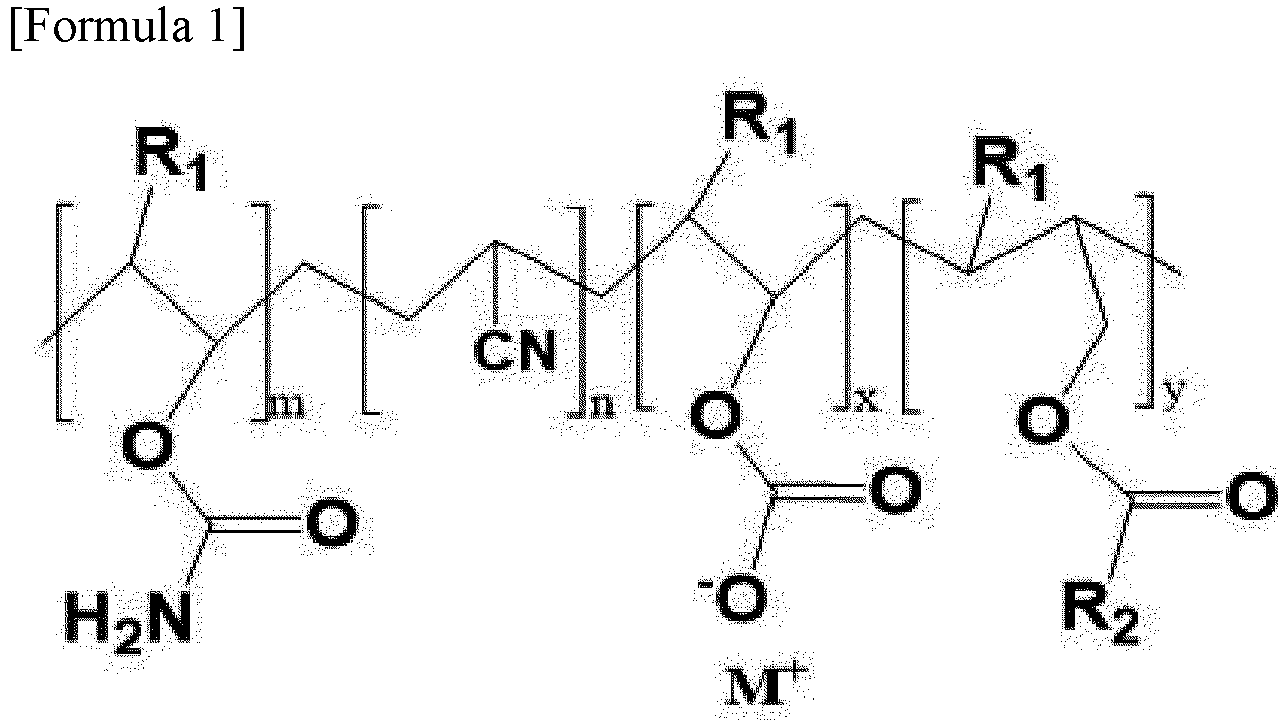 where in Formula 1, R1 is hydrogen or a straight-chain or branched-chain hydrocarbon having 1 to 4 carbon atoms,R2 is each independently hydrogen or a linear or branched hydrocarbon having 1 to 20 carbon atoms,M is an alkali metal, andm, n, x, and y satisfy m + n + x + y = 1.
 - The copolymer of claim 2, wherein R1 in Formula 1 comprises one or more selected from the group consisting of hydrogen, methyl, and ethyl, and
R2 in Formula 1 comprises one or more selected from the group consisting of methyl, ethyl, n-propyl, isopropyl, n-butyl, tert-butyl, n-pentyl, n-hexyl, n-heptyl, n-octyl, 2-ethylhexyl, n-nonyl, n-decyl, n-undecyl, lauryl, n-dodecyl, n-tridecyl, n-tetradecyl, n-pentadecyl, cetyl, n-hexadecyl, n-heptadecyl, stearyl, n-octadecyl, n-nonadecyl, n-icosyl, n-henicosyl, n-docosyl, isopentyl, isoheptyl, isooctyl, isononyl, isodecyl, isoundecyl, isododecyl, isotridecyl, isotetradecyl, isopentadecyl, isocetyl, isohexadecyl, isoheptadecyl, isostearyl, isooctadecyl, isononadecyl, isoicosyl, isohenicosyl, and isodocosyl. - The copolymer of claim 1, further comprising a cross-linking monomer unit in an amount of 0.005 to 3 parts by weight based on the total weight of the copolymer in an amount of 100 parts by weight.
- The copolymer of claim 4, wherein the cross-linking monomer unit comprises one or more selected from the group consisting of an aliphatic difunctional methacrylate and an aromatic difunctional methacrylate.
- The copolymer of claim 1, wherein the copolymer is a random or block copolymer.
- The copolymer of claim 1, wherein the copolymer has a number average molecular weight of 5,000 or greater and 1,000,000 or less.
- The copolymer of claim 1, wherein a weight ratio (wt% of the acrylate-based monomer unit/wt% of the acrylonitrile-based monomer unit) of the acrylate-based monomer unit to the acrylonitrile-based monomer unit is in a range of 0.2 or higher and lower than 18.
- A core-shell particle comprising:a core; anda shell surrounding the core, the shell comprising the copolymer of claim 1.
- A slurry composition comprising:the copolymer of any one of claims 1 to 8; andinorganic particles.
- A separator comprising the slurry composition of claim 10.
- A secondary battery comprising the separator of claim 11.
Applications Claiming Priority (2)
| Application Number | Priority Date | Filing Date | Title |
|---|---|---|---|
| KR1020210137117A KR102468277B1 (en) | 2021-10-15 | 2021-10-15 | Copolymer for separator and secondary battery using thereof |
| PCT/KR2021/014605 WO2023063461A1 (en) | 2021-10-15 | 2021-10-19 | Copolymer for separator and secondary battery comprising same |
Publications (2)
| Publication Number | Publication Date |
|---|---|
| EP4417632A1 true EP4417632A1 (en) | 2024-08-21 |
| EP4417632A4 EP4417632A4 (en) | 2024-12-25 |
Family
ID=84233878
Family Applications (1)
| Application Number | Title | Priority Date | Filing Date |
|---|---|---|---|
| EP21960728.0A Pending EP4417632A4 (en) | 2021-10-15 | 2021-10-19 | COPOLYMER FOR SEPARATOR AND SECONDARY BATTERY |
Country Status (5)
| Country | Link |
|---|---|
| US (1) | US20240352168A1 (en) |
| EP (1) | EP4417632A4 (en) |
| JP (1) | JP7794948B2 (en) |
| KR (1) | KR102468277B1 (en) |
| WO (1) | WO2023063461A1 (en) |
Families Citing this family (4)
| Publication number | Priority date | Publication date | Assignee | Title |
|---|---|---|---|---|
| KR102612926B1 (en) * | 2022-12-05 | 2023-12-13 | 주식회사 한솔케미칼 | Copolymer composition for separator and secondary battery using thereof |
| CN116190658B (en) * | 2023-03-07 | 2025-02-14 | 深圳市研一新材料有限责任公司 | A water-based binder and its preparation method and use |
| CN118834628B (en) * | 2023-04-24 | 2026-04-14 | 宁德时代新能源科技股份有限公司 | Binder for secondary battery, preparation method thereof, secondary battery and electric device |
| WO2026038922A1 (en) * | 2024-08-16 | 2026-02-19 | 주식회사 엘지에너지솔루션 | Separator for lithium secondary battery, method of manufacturing same, and lithium secondary battery containing same |
Family Cites Families (19)
| Publication number | Priority date | Publication date | Assignee | Title |
|---|---|---|---|---|
| JPS5933145B2 (en) * | 1978-06-02 | 1984-08-14 | 三菱電機株式会社 | Heat-resistant water-dispersed electrodeposition varnish |
| JPS62197485A (en) * | 1986-02-25 | 1987-09-01 | Mitsui Toatsu Chem Inc | Discoloration time monitoring layer |
| US6316107B1 (en) * | 1999-04-07 | 2001-11-13 | Pmd Group Inc. | Multiple phase polymeric vinyl chloride systems and related core-shell particles |
| KR100775310B1 (en) | 2004-12-22 | 2007-11-08 | 주식회사 엘지화학 | Organic/inorganic composite microporous membrane and electrochemical device prepared thereby |
| CN101457131B (en) * | 2009-01-12 | 2010-07-28 | 成都茵地乐电源科技有限公司 | Water binding agent for lithium ionic cell electric pole material and preparation method thereof |
| CN102060954B (en) * | 2010-11-23 | 2013-04-03 | 广州慧谷化学有限公司 | Acrylic emulsion as well as preparation method and application thereof |
| CN102140149B (en) * | 2010-12-30 | 2013-03-06 | 长兴化学工业(中国)有限公司 | Aqueous emulsion composition, and emulsion resin prepared by using same and use thereof |
| KR20140029691A (en) * | 2012-08-29 | 2014-03-11 | 주식회사 엘지화학 | Separator for electrochemical device comprising core-shell particles, electrochemical device comprising the same, and method for preparing the separator |
| KR101430975B1 (en) | 2013-08-21 | 2014-08-18 | 에스케이씨 주식회사 | Separator for secondary battery with high heat resistance |
| KR102546315B1 (en) * | 2015-09-25 | 2023-06-21 | 삼성전자주식회사 | Electrode composite separator assembly for lithium battery and lithium battery including the same |
| JP6911837B2 (en) * | 2016-03-28 | 2021-07-28 | 日本ゼオン株式会社 | Binder composition for electrochemical element electrodes, slurry composition for electrochemical element electrodes, electrodes for electrochemical elements, and electrochemical elements |
| KR101950703B1 (en) * | 2017-04-03 | 2019-02-22 | 한양대학교 산학협력단 | Separators for Batteries Having Single-layered Coating of Polymeric Particles and Preparation Method Thereof |
| KR102328256B1 (en) * | 2017-11-30 | 2021-11-18 | 주식회사 엘지에너지솔루션 | Binder comprising random copolymer, anode for lithium-ion secondary battery comprising the same, lithium-ion secondary battery comprising the anode, and method for polymerizing the copolymer |
| US12212002B2 (en) * | 2018-06-29 | 2025-01-28 | Zeon Corporation | Binder composition for electrochemical device electrode, slurry composition for electrochemical device electrode, electrode for electrochemical device, and electrochemical device |
| JP7185504B2 (en) * | 2018-11-20 | 2022-12-07 | 三井化学株式会社 | Raw material for coating material for secondary battery separator, method for producing raw material for coating material for secondary battery separator, coating material for secondary battery separator, secondary battery separator, method for producing secondary battery separator, and secondary battery |
| KR102342671B1 (en) * | 2019-01-04 | 2021-12-22 | 삼성에스디아이 주식회사 | Separator for rechargeable lithium battery and rechargeable lithium battery including the same |
| JP7221097B2 (en) * | 2019-03-18 | 2023-02-13 | 三井化学株式会社 | Water-dispersible resin composition, thermosensitive recording layer resin composition, and protective layer resin composition |
| JP6656647B1 (en) * | 2019-10-07 | 2020-03-04 | サイデン化学株式会社 | Composite resin composition |
| CN112724336B (en) * | 2020-12-30 | 2022-07-19 | 王海涛 | Preparation method of core-shell type polymer microsphere encapsulated with functional core material |
-
2021
- 2021-10-15 KR KR1020210137117A patent/KR102468277B1/en active Active
- 2021-10-19 JP JP2024508748A patent/JP7794948B2/en active Active
- 2021-10-19 US US18/684,818 patent/US20240352168A1/en active Pending
- 2021-10-19 EP EP21960728.0A patent/EP4417632A4/en active Pending
- 2021-10-19 WO PCT/KR2021/014605 patent/WO2023063461A1/en not_active Ceased
Also Published As
| Publication number | Publication date |
|---|---|
| JP2024531249A (en) | 2024-08-29 |
| JP7794948B2 (en) | 2026-01-06 |
| KR102468277B1 (en) | 2022-11-21 |
| KR102468277B9 (en) | 2024-03-06 |
| WO2023063461A1 (en) | 2023-04-20 |
| EP4417632A4 (en) | 2024-12-25 |
| US20240352168A1 (en) | 2024-10-24 |
Similar Documents
| Publication | Publication Date | Title |
|---|---|---|
| EP4417632A1 (en) | Copolymer for separator and secondary battery comprising same | |
| EP3376562B1 (en) | Separator for non-aqueous secondary cell, and non-aqueous secondary cell | |
| JP7665027B2 (en) | Copolymer for separator and secondary battery including same | |
| KR102558448B1 (en) | Copolymer for separator and secondary battery using thereof | |
| EP4632003A1 (en) | Copolymer composition for separator and secondary battery comprising same | |
| JP2026508730A (en) | Polymer composition for separation membranes and secondary battery containing the same | |
| EP4613788A1 (en) | Copolymer for separator and secondary battery comprising same | |
| EP4603519A1 (en) | Copolymer for separator and secondary battery comprising same | |
| KR102660594B1 (en) | Copolymer for separator and secondary battery using thereof | |
| KR102504187B1 (en) | Copolymer for separator and secondary battery using thereof | |
| KR102866718B1 (en) | Copolymer for separator and secondary battery using thereof | |
| KR102839945B1 (en) | Binder composition for secondary battery separator coating and secondary battery comprising the same | |
| KR20250064008A (en) | Copolymer for separator and secondary battery using thereof | |
| EP3958364A1 (en) | Composite separator and electrochemical device including the same | |
| KR20250075968A (en) | Copolymer for separator and secondary battery using thereof | |
| EP4557421A2 (en) | Separator and electrochemical device comprising the same | |
| EP4220843A1 (en) | Composition for separator for non-aqueous electrolyte battery, separator for non-aqueous electrolyte battery, and non-aqueous electrolyte battery |
Legal Events
| Date | Code | Title | Description |
|---|---|---|---|
| STAA | Information on the status of an ep patent application or granted ep patent |
Free format text: STATUS: THE INTERNATIONAL PUBLICATION HAS BEEN MADE |
|
| PUAI | Public reference made under article 153(3) epc to a published international application that has entered the european phase |
Free format text: ORIGINAL CODE: 0009012 |
|
| STAA | Information on the status of an ep patent application or granted ep patent |
Free format text: STATUS: REQUEST FOR EXAMINATION WAS MADE |
|
| 17P | Request for examination filed |
Effective date: 20240219 |
|
| AK | Designated contracting states |
Kind code of ref document: A1 Designated state(s): AL AT BE BG CH CY CZ DE DK EE ES FI FR GB GR HR HU IE IS IT LI LT LU LV MC MK MT NL NO PL PT RO RS SE SI SK SM TR |
|
| A4 | Supplementary search report drawn up and despatched |
Effective date: 20241121 |
|
| RIC1 | Information provided on ipc code assigned before grant |
Ipc: H01M 50/446 20210101ALI20241115BHEP Ipc: H01M 50/42 20210101ALI20241115BHEP Ipc: C08K 3/013 20180101ALI20241115BHEP Ipc: C08L 55/00 20060101ALI20241115BHEP Ipc: C08F 220/06 20060101ALI20241115BHEP Ipc: C08F 220/56 20060101ALI20241115BHEP Ipc: C08F 220/44 20060101ALI20241115BHEP Ipc: C08F 297/02 20060101ALI20241115BHEP Ipc: C08F 220/14 20060101AFI20241115BHEP |
|
| DAV | Request for validation of the european patent (deleted) | ||
| DAX | Request for extension of the european patent (deleted) |