EP4415429B1 - Method for operating a mobile station being in a radio environment comprising a plurality of radio cells of a plurality of mobile communication networks, mobile station, system or mobile communication network, program and computer program product - Google Patents
Method for operating a mobile station being in a radio environment comprising a plurality of radio cells of a plurality of mobile communication networks, mobile station, system or mobile communication network, program and computer program product Download PDFInfo
- Publication number
- EP4415429B1 EP4415429B1 EP23156287.7A EP23156287A EP4415429B1 EP 4415429 B1 EP4415429 B1 EP 4415429B1 EP 23156287 A EP23156287 A EP 23156287A EP 4415429 B1 EP4415429 B1 EP 4415429B1
- Authority
- EP
- European Patent Office
- Prior art keywords
- mobile communication
- network
- mobile station
- communication network
- mobile
- Prior art date
- Legal status (The legal status is an assumption and is not a legal conclusion. Google has not performed a legal analysis and makes no representation as to the accuracy of the status listed.)
- Active
Links
Images
Classifications
-
- H—ELECTRICITY
- H04—ELECTRIC COMMUNICATION TECHNIQUE
- H04W—WIRELESS COMMUNICATION NETWORKS
- H04W48/00—Access restriction; Network selection; Access point selection
- H04W48/18—Selecting a network or a communication service
-
- H—ELECTRICITY
- H04—ELECTRIC COMMUNICATION TECHNIQUE
- H04W—WIRELESS COMMUNICATION NETWORKS
- H04W12/00—Security arrangements; Authentication; Protecting privacy or anonymity
- H04W12/06—Authentication
- H04W12/069—Authentication using certificates or pre-shared keys
-
- H—ELECTRICITY
- H04—ELECTRIC COMMUNICATION TECHNIQUE
- H04W—WIRELESS COMMUNICATION NETWORKS
- H04W60/00—Affiliation to network, e.g. registration; Terminating affiliation with the network, e.g. de-registration
- H04W60/005—Multiple registrations, e.g. multihoming
-
- H—ELECTRICITY
- H04—ELECTRIC COMMUNICATION TECHNIQUE
- H04W—WIRELESS COMMUNICATION NETWORKS
- H04W76/00—Connection management
- H04W76/10—Connection setup
- H04W76/15—Setup of multiple wireless link connections
- H04W76/16—Involving different core network technologies, e.g. a packet-switched [PS] bearer in combination with a circuit-switched [CS] bearer
-
- H—ELECTRICITY
- H04—ELECTRIC COMMUNICATION TECHNIQUE
- H04W—WIRELESS COMMUNICATION NETWORKS
- H04W12/00—Security arrangements; Authentication; Protecting privacy or anonymity
- H04W12/40—Security arrangements using identity modules
-
- H—ELECTRICITY
- H04—ELECTRIC COMMUNICATION TECHNIQUE
- H04W—WIRELESS COMMUNICATION NETWORKS
- H04W12/00—Security arrangements; Authentication; Protecting privacy or anonymity
- H04W12/60—Context-dependent security
- H04W12/61—Time-dependent
-
- H—ELECTRICITY
- H04—ELECTRIC COMMUNICATION TECHNIQUE
- H04W—WIRELESS COMMUNICATION NETWORKS
- H04W12/00—Security arrangements; Authentication; Protecting privacy or anonymity
- H04W12/60—Context-dependent security
- H04W12/63—Location-dependent; Proximity-dependent
-
- H—ELECTRICITY
- H04—ELECTRIC COMMUNICATION TECHNIQUE
- H04W—WIRELESS COMMUNICATION NETWORKS
- H04W48/00—Access restriction; Network selection; Access point selection
- H04W48/08—Access restriction or access information delivery, e.g. discovery data delivery
-
- H—ELECTRICITY
- H04—ELECTRIC COMMUNICATION TECHNIQUE
- H04W—WIRELESS COMMUNICATION NETWORKS
- H04W60/00—Affiliation to network, e.g. registration; Terminating affiliation with the network, e.g. de-registration
- H04W60/04—Affiliation to network, e.g. registration; Terminating affiliation with the network, e.g. de-registration using triggered events
-
- H—ELECTRICITY
- H04—ELECTRIC COMMUNICATION TECHNIQUE
- H04W—WIRELESS COMMUNICATION NETWORKS
- H04W76/00—Connection management
- H04W76/10—Connection setup
- H04W76/15—Setup of multiple wireless link connections
-
- H—ELECTRICITY
- H04—ELECTRIC COMMUNICATION TECHNIQUE
- H04W—WIRELESS COMMUNICATION NETWORKS
- H04W76/00—Connection management
- H04W76/20—Manipulation of established connections
-
- H—ELECTRICITY
- H04—ELECTRIC COMMUNICATION TECHNIQUE
- H04W—WIRELESS COMMUNICATION NETWORKS
- H04W88/00—Devices specially adapted for wireless communication networks, e.g. terminals, base stations or access point devices
- H04W88/02—Terminal devices
- H04W88/06—Terminal devices adapted for operation in multiple networks or having at least two operational modes, e.g. multi-mode terminals
Definitions
- the present invention relates to a method for operating a mobile station being in a radio environment comprising a plurality of radio cells of a plurality of mobile communication networks, each one of these radio cells being associated, respectively, to at least one mobile communication network of the plurality of mobile communication networks, wherein, as a primary connection of the mobile station, the mobile station is connected to, or registered on, a first mobile communication network of the plurality of mobile communication networks and is, additionally and as a secondary connection of the mobile station, able to be connected to, or registered on, a second mobile communication network of the plurality of mobile communication networks.
- the present invention relates to a mobile station for being operated in a radio environment comprising a plurality of radio cells of a plurality of mobile communication networks, each one of these radio cells being associated, respectively, to at least one mobile communication network of the plurality of mobile communication networks, wherein, as a primary connection of the mobile station, the mobile station is connected to, or registered on, a first mobile communication network of the plurality of mobile communication networks and is, additionally and as a secondary connection of the mobile station, able to be connected to, or registered on, a second mobile communication network of the plurality of mobile communication networks.
- the present invention relates to a system or a mobile communication network for operating a mobile station being in a radio environment comprising a plurality of radio cells of a plurality of mobile communication networks, each one of these radio cells being associated, respectively, to at least one mobile communication network of the plurality of mobile communication networks, wherein, as a primary connection of the mobile station, the mobile station is connected to, or registered on, a first mobile communication network of the plurality of mobile communication networks and is, additionally and as a secondary connection of the mobile station, able to be connected to, or registered on, a second mobile communication network of the plurality of mobile communication networks.
- the present invention relates to a program and to a computer-readable medium for operating a mobile station being in a radio environment according to the inventive method.
- a mobile communication network Before a mobile communication network is considered as a network selection candidate at all, the mobile station needs to find a suitable radio cell of a mobile communication network or public land mobile network to camp on.
- the criteria for a radio cell to be considered as suitable radio cell (to camp on) is dependent on the considered network technology (or radio access technology) being defined in or by means of the relevant standardization documents, mostly referred to 3GPP (third generation partnership project) documents.
- the (initial) selection of a mobile network by a mobile station or user equipment is specified (among others) in TS 23.122; a number of lists of networks are defined that determine the priority of network selection for a certain network, wherein the highest priority regarding network selection is given to the home network (or a plurality of equivalent home networks).
- TS 22.261 defines " Multi-network connectivity and service delivery across operators" (clause 6.18 of TS 22.261 V16.16.0 ) or " Providing Access to Local Services” (clause 6.41 of TS 22.261 V18.7.0 ).
- US 2022/0104313 A1 describes a session steering procedure for a user equipment that initially accesses a first radio access technology (RAT) communication system and subsequently discovers an available second RAT communication system, in which the traffic path is switched from the first to the second system using dual registration.
- RAT radio access technology
- An object of the present invention is to provide a technically simple, effective and cost effective solution for operating a mobile station being in a radio environment comprising a plurality of radio cells of a plurality of mobile communication networks, the mobile station being connected to a first mobile communication network as a primary connection, and the mobile station additionally being able to be connected to a second mobile communication network.
- a further object of the present invention is to provide a corresponding mobile station, system or mobile communication network, and a corresponding program and computer-readable medium.
- the object of the present invention is achieved by a method according to claim 1.
- This connection is, in the context of the present invention, also called primary connection of the mobile station, and the respective mobile communication network is, in the context of the present invention, also called first mobile communication network (of the plurality of mobile communication networks available to the mobile station).
- first mobile communication network of the plurality of mobile communication networks available to the mobile station.
- second mobile communication network of the plurality of mobile communication networks.
- This possible connection, to the second mobile communication network is, in the context of the present invention, also called secondary connection of the mobile station.
- the selection of the first mobile communication network is the result of a network selection process, hereinafter also called primary network selection process (i.e.
- the mobile station When conducting the primary network selection process, the mobile station takes into account, of course and necessarily, the radio environment at its current location, but it takes also into account network selection data being stored (typically in lists of networks being used for network selection) in a memory module of the mobile station (typically the USIM in case of the mobile station being a user equipment, or in another memory portion of the mobile equipment or mobile station in case that the mobile station does not comprise a USIM).
- a mobile communication network i.e. the primary connection to the first mobile communication network
- the network selection data relate to or indicate the first mobile communication network.
- the method according to the present invention comprises the following steps:
- the secondary network selection process is influenced by the result of the primary network selection process. Stated otherwise, a mechanism is proposed to select a prioritized network for an additional connection (secondary connection to the second mobile communication network) in parallel to an existing (primary) connection in a network (first mobile communication network).
- a mobile station typically a user equipment
- a radio environment i.e. the different radio frequency signals that the mobile station - at its current position or location - is potentially able to receive on different frequencies and/or frequency bands and/or at different points in time or time intervals or time slots and/or according to different radio access technologies
- a radio environment i.e. the different radio frequency signals that the mobile station - at its current position or location - is potentially able to receive on different frequencies and/or frequency bands and/or at different points in time or time intervals or time slots and/or according to different radio access technologies
- One such radio cell is typically provided by a base station entity, i.e. an antenna arrangement of a specific base station entity emits radio frequency signals such that the mobile station, at its current position or location, is able to receive such radio frequency signals with a sufficient quality, typically with a sufficient signal to noise ratio. If this is the case, the radio environment of the mobile station comprises the considered radio cell.
- a plurality of radio cells i.e. of base station entities
- the mobile station by means of selecting a radio cell (out of the plurality of radio cells present or receivable of the radio environment at the considered position or location of the mobile station), the mobile station also selects a mobile communication network (that is associated to that radio cell).
- a mobile communication network is considered as a network selection candidate (i.e. a candidate mobile communication network) at all, the mobile station needs to find a suitable radio cell of a mobile communication network or public land mobile network to camp on.
- the criteria for a radio cell to be considered as suitable radio cell (to camp on) is dependent on the considered network technology (or radio access technology) being defined in or by means of the relevant standardization documents, mostly referred to 3GPP (third generation partnership project) documents.
- a mobile equipment, ME, or mobile station comprising a USIM in case of public land mobile networks and/or those lists or corresponding network selection information could also be stored, especially for standalone non-public networks, in the mobile equipment, ME (which is a terminal user equipment without the USIM, because devices do not necessarily require a USIM for use in SNPNs).
- the mobile station uses network selection data, typically lists of (mobile communication) networks prescribing an order of priority for network selection (or assigning a priority level to such networks in these lists); TS 23.122 (e.g. V18.0.0), for example, specifies - for public land mobile networks in clause 4.4, for standalone non-public networks in clause 4.9 - a number of lists stored in the mobile station (e.g.
- the highest priority is given (after power-on of the device or loss of coverage), as already mentioned, to the home network (or home networks, if any, stored in a list of so-called equivalent home public land mobile networks - EHPLMNs); the next level of priority is given to the networks in a user list of preferred networks with access technology (UPLMNwAcT) in the order of the entries in these lists; and finally to the networks in an operator list with access technology (OPLMNwAcT); the specification of the access technology (or radio access technology) in these lists typically being optional.
- ULMNwAcT preferred networks with access technology
- OLMNwAcT operator list with access technology
- the mobile station or user equipment searches for (mobile communication) networks with high signal level (high quality) and then among the remaining networks for the one with the highest signal level.
- a similar mechanism i.e. based on using network selection data
- the lists can also be stored in the ME (mobile equipment, which is a terminal UE without the USIM), because devices do not necessarily require a USIM for use in standalone non-public networks.
- Group IDs for Network selection GINs can also be used, which combine several SNPNs into one group.
- this network selection data i.e. these lists for the home networks and the networks prioritized by the operator, are susceptible to be updated by the operator-typically the home operator of the mobile station or the operator operating the home mobile communication network - at any time via the mobile connection.
- mobile stations or user equipments might also be registered in two different networks (or might even be required to be registered in two different networks), i.e. in addition to the primary connection to the first mobile communication network, the mobile station is able to be connected to a second mobile communication network.
- TS 22.261 defines "Multi-network connectivity and service delivery across operators" (clause 6.18 of TS 22.261 V16.16.0), e.g. especially industrial communication networks might only support a limited number of services (e.g., only data transmission, but no voice service). In order to offer the full service portfolio to users, cooperation is required with another network that provides the remaining services; a mobile station or a user equipment is then connected to the home network for basic services and simultaneously roams to another network to receive additional services.
- Other use cases might include (according to clause 6.41 of TS 22.261 V18.7.0) mobile stations or user equipments that connect to a local network (e.g. in a stadium in order to receive services from there, e.g.
- local networks can also be standalone non-public networks, SNPNs. Connection to the local network may only be allowed temporarily and when the mobile station or user equipment is in a specific location. Authentication in the local network might be based on the access data from the home network (roaming) or using the local network's own access data. Furthermore, having a secondary connection in addition to the primary connection could provide the possibility, regarding a mobile station, to split and/or switch back and forth the data stream of such a mobile station (if connected via two networks) between the two networks to provide optimal coverage. As a typical application, parallel connection over a terrestrial cellular network and over a satellite cellular network is considered, cf. FS_DualSteer study (TR 22.841 in draft status).
- Such a secondary connection to the second telecommunications network of the mobile station also needs to be selected among the mobile communication networks available to the mobile station (at its current location and the considered point in time).
- the network selection of the secondary connection (to the second mobile communication network), i.e. the secondary network selection process is influenced by the result of the primary network selection process (based on the network selection data), i.e. the secondary network selection data are related, at least in part, to the first mobile communication network and indicating at least the second mobile communication network (that is the result of the secondary network selection process); especially the 'choice' within secondary network selection process might be reduced and/or the priority levels modified with regard to the primary network selection process.
- the network selection data comprise lists or list entries as primary network selection data regarding the primary connection of the mobile station, the primary network selection data being used, by the mobile station, during the primary network selection process that is performed taking into account the radio environment, especially by means of the mobile station conducting measurements of radiofrequency parameters, the primary network selection process resulting in the mobile station being connected to, or registered on, the first mobile communication network, wherein the secondary network selection data are also part of the network selection data, wherein specific parts of the secondary network selection data are assigned to the primary network selection data, each specific part corresponding to one of the mobile communication networks selectable as the first mobile communication network.
- the lists or list entries that are used - as part of the network selection data - as primary network selection data are able to be complemented (or extended) by means of the secondary network selection data, wherein the secondary network selection data (also being part of the network selection data and assigned to the primary network selection data) provide an extension to the (primary) network selection data related to one of the mobile communication networks selectable as the first mobile communication network.
- the secondary network selection data an extension of the lists for network selection such that for each entry of the EHPLMN, UPLMNwAcT and/or OPLMNwAcT network lists (or their equivalents for SNPN network selection) one entry or multiple entries for prioritization of secondary networks (or groups of secondary networks) with access technology are possible.
- public land mobile network identities i.e. PLMN IDs
- SNPN identities and group identities for network selection are able to be part of the secondary network selection data.
- the primary network selection process either corresponds to a PLMN selection process, or to an SNPN selection process
- the secondary network selection process either corresponds to a further PLMN selection process, or to a further SNPN selection process, wherein especially the mobile station either corresponds to a user equipment having or comprising a subscriber identity module or a USIM or a universal integrated circuit card, or to a mobile equipment (especially without a USIM).
- the secondary connection (of the mobile station) is to a standalone non-public network (i.e. the second mobile communication network being a standalone non-public network) while the primary connection (of the mobile station) is to a public land mobile network (i.e. the first mobile communication network is a public land mobile network), or vice versa.
- the mobile station is able to be connected to a standalone non-public network (as the second mobile communication network) while not being in SNPN access mode (as it is, as its primary connection, connected to a public land mobile network).
- this also applies the other way around, i.e. the mobile station is able to be connected to a public land mobile network (as the second mobile communication network) while being in SNPN access mode (as it is, as its primary connection, connected to a standalone non-public network).
- the network selection data are stored on a subscriber identity module or a USIM or a universal integrated circuit card associated with the mobile station, the subscriber identity module or the USIM or the universal integrated circuit card especially corresponding to the memory module of the mobile station, or wherein the network selection data are stored on the mobile equipment, wherein especially the network selection data - especially the primary network selection data regarding the primary connection of the mobile station and the secondary network selection data regarding the secondary connection of the mobile station - comprise lists or list entries, respectively, regarding different categories of mobile communication networks, especially
- the specific part of the secondary network selection data that corresponds to the first mobile communication network - or, a specific part of the secondary network selection data that corresponds to a mobile communication network selectable as the first mobile communication network - comprises or corresponds to a set of information items, each information item corresponding to or referring to a mobile communication network selectable as the second mobile communication network, wherein regarding the set of information items of each specific part of the secondary network selection data one or a plurality of the following is able to be verified:
- the mobile station connecting to, or registering on, the second mobile communication network is performed using authentication and/or using a credential information according to one or a plurality out of the following:
- a further secondary network selection process is performed regarding the secondary connection of the mobile station, taking into account the radio environment as well as the respective part of the secondary network selection data corresponding to the further first mobile communication network, wherein especially the connection to the second mobile communication network, or the secondary connection of the mobile station, is terminated after terminating the primary connection with the first mobile communication network and prior to the mobile station being connected to, or registered on, the further first mobile communication network.
- the present invention relates to a mobile station according to claim 8 and to a system or mobile communication network according to claim 9.
- the present invention relates to a program comprising a computer readable program code which, when executed on a computer and/or on a mobile station and/or on a network node of a mobile communication network, or in part on a mobile station and/or in part on network node of a mobile communication network, causes the computer and/or the mobile station and/or the network node of the mobile communication network to perform the inventive method.
- the present invention relates to a computer-readable medium comprising instructions which when executed on a computer and/or on a mobile station and/or on a network node of a mobile communication network, or in part on a mobile station and/or in part on network node of a mobile communication network, causes the computer and/or the mobile station and/or the network node of the mobile communication network to perform the inventive method.
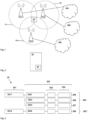
- a mobile station 20 is schematically shown in a radio environment comprising a plurality of radio cells of a plurality of mobile communication networks.
- a first radio cell 11 is associated with or related to a first mobile communication network 100
- a second radio cell 12 is associated with or related to a second mobile communication network 200
- a third radio cell 13 is associated with or related to a third mobile communication network 300.
- a base station entity is represented regarding each one of the three radio cells 11, 12, 13 that the mobile station 20 detects or "sees":
- a first base station entity 111 (typically but not necessarily of the first mobile communication network 100) generates or provides radio coverage of or regarding the first radio cell 11
- a second base station entity 112 (typically but not necessarily of the second mobile communication network 200) generates or provides radio coverage of or regarding the second radio cell 12
- a third base station entity 113 typically but not necessarily of the third mobile communication network 200 generates or provides radio coverage of or regarding the third radio cell 13.
- the mobile station 20 is shown being located within the radio coverage area (illustrated by means of dashed circles) of the first radio cell 11, the second radio cell 12, as well as the third radio cell 13.
- the mobile station 20 typically measures or detects reception conditions regarding the plurality of radio cells 11, 12, 13, and subsequently selects and/or registers to a mobile communication network out of the plurality of mobile communication networks 100, 200, 300.
- the mobile station 20 (especially a user equipment, i.e. comprising the mobile equipment with a USIM or subscriber identity module, or a mobile equipment) is already connected to a mobile communication network.
- This connection is called primary connection of the mobile station 20, and the respective mobile communication network is the first mobile communication network 100 (of the plurality of mobile communication networks 100, 200, 300 available to the mobile station).
- the mobile station 20 is able to be connected to, or registered on, a second mobile communication network 200 (of the plurality of mobile communication networks 100, 200, 300).
- This possible connection, to the second mobile communication network 200 is also called secondary connection of the mobile station 20.
- the selection of the first mobile communication network 100 is the result of the primary network selection process (i.e. the initial network selection process that is performed - according to the respective standardization documents - in case that the mobile station 20 does not have any connection at all to a mobile communication network, i.e., typically, after power-on and/or after loss of connection) that is conducted based on network selection data 25 stored in the mobile station 20 (especially in the USIM in case the mobile station 20 is a user equipment, and, hence, comprises a USIM), i.e. at least part of the network selection data 25 relate to or indicate the first mobile communication network 100.
- the primary network selection process i.e. the initial network selection process that is performed - according to the respective standardization documents - in case that the mobile station 20 does not have any connection at all to a mobile communication network, i.e., typically, after power-on and/or after loss of connection
- network selection data 25 stored in the mobile station 20 (especially in the USIM in case the mobile station 20 is a user equipment, and
- the mobile station 20 in order for the mobile station 20 to be additionally connected to, or registered on, the second mobile communication network 200, the mobile station 20 comprises or receives secondary network selection data regarding the secondary connection of the mobile station 20 and regarding the second mobile communication network 200 (that the mobile station 20 is able to be connected to - in addition to being connected to, or registered on, the first mobile communication network 100 - as a result of a secondary network selection process) such that the secondary network selection data are related, at least in part, to the first mobile communication network 100 (and indicate at least the second mobile communication network 200).
- the structure of the network selection data 25 - especially comprising the secondary network selection data 252 - is schematically shown in Figure 3 .
- the network selection data 25 comprise the primary network selection data 251.
- the primary network selection data 251 are especially provided - according to respective standardization documents - in the form of lists of networks, e.g. the list of equivalent home public land mobile networks (EHPLMN), the user list of preferred networks with access technology (UPLMNwAcT) and/or the operator list with access technology (OPLMNwAcT), wherein by means of these lists, the different networks are ranked in an order of priority.
- EHPLMN equivalent home public land mobile networks
- ULMNwAcT user list of preferred networks with access technology
- OLMNwAcT operator list with access technology
- the primary network selection data 251 being represented to comprise (at least as a part thereof) a list of networks (especially an arbitrary list of network, i.e. not specified whether this corresponds to a EHPLMN or a UPLMNwAct or a OPLMNwAcT list, or their equivalents for standalone non-public network selection), comprising a first primary network entry 2511 (e.g. relating to "PLMN A in France, E-UTRAN") and a second primary network entry 2512 (e.g. relating to "PLMN X in UK").
- a first primary network entry 2511 e.g. relating to "PLMN A in France, E-UTRAN
- a second primary network entry 2512 e.g. relating to "PLMN X in UK
- the secondary network selection data 252 preferably (but not necessarily) also comprise network entries; this is schematically and exemplarily shown, in Figure 3 , by means of the secondary network selection data 252 comprising a first secondary network entry 2521 (e.g. relating to "PLMN B in France, NG-RAN"), a second secondary network entry 2522 (e.g. relating to "SNPN C"), a third secondary network entry 2523 (e.g. relating to "PLMN D in Spain”), and a fourth secondary network entry 2524 (e.g. relating to "SNPN Y, UTRAN”).
- a first secondary network entry 2521 e.g. relating to "PLMN B in France, NG-RAN
- a second secondary network entry 2522 e.g. relating to "SNPN C”
- a third secondary network entry 2523 e.g. relating to "PLMN D in Spain
- a fourth secondary network entry 2524 e.g. relating to "SNPN Y,
- the network selection data 25 especially comprises the primary network selection data 251 and the secondary network selection data 252, and especially as lists or list entries.
- the primary network selection data 251 are used, as part of the network selection data 25, in the primary network selection process (i.e. regarding, or in order to set up, the primary connection of the mobile station 20) that is performed taking into account the radio environment, especially by means of the mobile station 20 conducting measurements of radiofrequency parameters.
- the primary network selection process results in the mobile station 20 being connected to, or registered on, the first mobile communication network 100.
- the secondary network selection data 252 are also part of the network selection data 25, and, furthermore, the secondary network selection data 252 are shown to comprise specific parts 252', 252" (namely a first specific part 252' - comprising the first, second and third secondary network entry 2521, 2522, 2523 of the secondary network selection data 252 -, and a second specific part 252" - comprising the fourth secondary network entry 2524 of the secondary network selection data 252).
- the specific parts 252', 252" of the secondary network selection data 252 are assigned to the primary network selection data 251 such that each specific part 252', 252" is assigned to, or belongs to, a specific primary network entry 2511, 2512 as part of the primary network selection data 251, i.e. to mobile communication networks being selectable (in the primary network selection process) as the first mobile communication network 100.
- the first specific part 252' is assigned to or belongs to the first primary network entry 2511 of the primary network selection data 251
- the second specific part 252" is assigned to or belongs to the second primary network entry 2512 of the primary network selection data 251.
- the specific parts 252', 252" of the secondary network selection data 252 (that correspond to a mobile communication network selectable as the first mobile communication network 100) comprise or correspond to a set of information items 255, 256, 257, 258, each information item 255, 256, 257, 258 corresponding to or referring to a mobile communication network selectable as the second mobile communication network 200.
- the order of the information items 255, 256, 257 within a set of information items implies a priority rank among the information items, and, especially, the respective network entries; or the other way around, i.e. the order of the network entries implies a priority rank of the corresponding (secondary) networks, i.e. to be respected in the secondary network selection process.
- the second specific part 252" (of the secondary network selection data 252, the second specific part 252" corresponding to the second primary network entry 2512 of the primary network selection data 251) comprises a fourth information item 258 (likewise as a set of (in this case only one) information item) comprising or referring to the fourth secondary network entry 2524 of the secondary network selection data 252, i.e. designating a mobile communication network selectable (in the secondary network selection process) as the second mobile communication network 200.
- each one of the information items 255, 256, 257, 258 refers to at least one mobile communication network (or secondary network entry 2521, 2522, 2523, 2524) selectable as the second mobile communication network 200, especially each information item 255, 256, 257, 258 referring to one mobile communication network selectable as the second mobile communication network 200.
- Figure 3 furthermore shows the possibility that each set of information items (i.e. the set of information items 255, 256, 257 regarding the first specific part 252', and the set consisting of information item 258 regarding the second specific part 252") - and potentially also each information item 255, 256, 257, 258 individually - comprises an indication for authentication purposes 253 in order to access the respective mobile communication network referred to (in the corresponding secondary network entry, i.e. 2521 for information item 255, 2522 for information item 256, 2523 for information item 257, and 2524 for information item 258).
- each set of information items i.e. the set of information items 255, 256, 257 regarding the first specific part 252', and the set consisting of information item 258 regarding the second specific part 252
- each information item 255, 256, 257, 258 individually - comprises an indication for authentication purposes 253 in order to access the respective mobile communication network referred to (in the corresponding secondary network entry, i.e. 2521 for
- the indication for authentication purposes 253 indicates whether to use (in order to access the network indicated by the respective secondary network entry 2521, 2522, 2523, 2524) local credential information or credential information of a home network of the mobile station 20, and especially the indication for authentication purposes comprises the credential information to be used to access the respective mobile communication network referred to.
- the indication for authentication purposes 253 might correspond to "use home network authentication” and/or "the home network authentication parameters / credentials are the following lengthy” regarding the first, third, and fourth information item 255, 257, 258, and to "use local network authentication” and/or "the local network authentication parameters / credentials are the following white” regarding the second information item 256.
- Figure 3 furthermore also shows the possibility that each set of information items (i.e. the set of information items 255, 256, 257 regarding the first specific part 252', and the set consisting of information item 258 regarding the second specific part 252") - and potentially also each information item 255, 256, 257, 258 individually - comprises a validity indication 254 regarding the access to (or regarding the permission to access) the respective mobile communication network referred to (in the corresponding secondary network entry, i.e. 2521 for information item 255, 2522 for information item 256, 2523 for information item 257, and 2524 for information item 258).
- the validity indication 254 indicates conditions (e.g.
- the validity indication 254 might be empty (i.e. refraining from stipulating a positive condition regarding either the permission to access the respective network, or, alternatively, regarding a denial to access the respective network) regarding the first, third, and fourth information item 255, 257, 258, and might correspond to "on Sundays and if located at a specific location or geographical area, e.g. a city such as Paris" regarding the second information item 256.
- the validity (or applicability) of the information items 255, 256, 257, 258 is able to be restricted or allowed, especially with respect to time and/or with respect to the location of the mobile station 20, wherein especially
- a set of information items 255, 256, 257, 258 (corresponding to a specific part 252', 252" of the secondary network selection data 252) is susceptible to be an empty set, in which case this results in an avoidance of a secondary network selection, especially no secondary network selection takes place.
- the secondary network selection process is performed directly after the mobile station 20 is connected to, or registered on, the first mobile communication network 100, and/or periodically according to a timer implementing a periodic secondary time interval, wherein especially values regarding the secondary time interval and/or the start of the timer being stored in the memory module of the mobile station 20.
- a timer and/or a secondary time interval of the secondary network selection process is especially independent from when a primary network selection process is repeated.
- connecting to, or registering on, the second mobile communication network 200 is performed, by the mobile station 20, using authentication and/or using a credential information according to one or a plurality out of the following:
- the present invention provides solution in case that the connection with the first mobile communication network 100 (as the primary connection of the mobile station 20) is terminated: In such a case (i.e. assuming that the mobile station 20 has previously been connected to the first mobile communication network 100 as its primary connection and to the second mobile communication network 200 as its secondary connection, and that - for some reason - the primary connection to the first mobile communication network 100 is terminated (i.e. the secondary connection to the second mobile communication network 200 is still active or available): If, in such a situation, the mobile station 20 (by means of performing the primary network selection process again) is connected to, or registered on, a further first mobile communication network (i.e.
- a further secondary network selection process is performed regarding the secondary connection of the mobile station 20, taking into account the radio environment as well as the respective part of the secondary network selection data 252 corresponding to the further first mobile communication network (i.e.
- the connection to the second mobile communication network 200, or the secondary connection of the mobile station 20 is terminated after terminating the primary connection with the first mobile communication network 100 and prior to the mobile station 20 being connected to, or registered on, the further first mobile communication network.
- a mobile station 20 - in order to implement the present invention and the method according to the present invention - basically only needs to receive the network selection data 25 (typically from its home network) and/or needs to store the network selection data 25 that are structured according to the present invention, i.e. the secondary network selection data 252 having a relation, at least in part, to the first mobile communication network 100 (to which the mobile station 20 is connected - as its primary connection - due to having performed the primary network selection process) and indicating at least the second mobile communication network 200.
- the network selection data 25 typically from its home network
- the secondary network selection data 252 having a relation, at least in part, to the first mobile communication network 100 (to which the mobile station 20 is connected - as its primary connection - due to having performed the primary network selection process) and indicating at least the second mobile communication network 200.
- the mobile station 20 only needs to be configured to use the network selection data 25, at least in part related to or indicating a first mobile communication network 100, to conduct a primary network selection process in order to be, as a primary connection of the mobile station 20, connected to, or to be registered on, the first mobile communication network 100, wherein the network selection data 25 additionally comprises the secondary network selection data 252, the secondary network selection data 252 being related, at least in part, to the first mobile communication network 100 and indicating at least a second mobile communication network 200, and wherein the mobile station 20 is configured such as to use the secondary network selection data 252 to conduct a secondary network selection process in order to be, as a secondary connection of the mobile station 20, connected to, or to be registered on, the second mobile communication network 200 - in addition to being connected to, or registered on, the first mobile communication network 100.
- the secondary network selection data 252 especially correspond to an extension of the lists for network selection such that for each entry of the EHPLMN, UPLMNwAcT and/or OPLMNwAcT (or their equivalents for SNPN network selection) multiple entries for prioritization of secondary networks (or groups of secondary networks) - potentially with access technology - are possible.
- PLMN Identities as well as SNPN Identities and Group Identities for Network selection can be entered there, i.e. as part of the secondary network selection data 252.
- the user equipment (or mobile station) 20 searches for these (secondary) networks and also logs on to the highest priority network thereof.
- the search for these (secondary) networks is performed, e.g., immediately after logging into a new primary network or periodically according to a timer value on the USIM (or also in the ME for SNPN devices). This timer is especially independent of the timer for the periodic search in the primary network.
- the user equipment or mobile station 20 uses, depending on the indication, either the access data (credentials) from the home network or access data from the secondary network, which may already be stored on the USIM or in the terminal device or may only be played on the device in the course of the access attempt.
- the indication could be explicit - an information element in the list indicating which credentials to use -, or implicit if secondary network credentials are stored or the secondary network rejects access with home network credentials.
- the secondary network is also selected again.
- the secondary network if the secondary network is lost, a new search for it is performed based on the entries in the lists. The connection to the primary network remains unaffected.
- the extended lists i.e. the lists of network selection data 25 extended by means of the secondary network selection data 252 should also be able to contain entries for the validity of the selection of secondary networks, e.g. a time restriction (start date+time, end date+time; periodic validity - valid on a certain day of the week / day of the month / day of the year at a certain time within a certain period), or a restriction of the location (only valid if the user equipment or the mobile station 20 is in, e.g., a certain tracking area of the primary network, or in a certain area specified by coordinates).
- the validity specifications are logically linked (AND, OR, NOT) with each other (e.g. valid if temporal AND local condition is met). The validity specifications trigger a search for the secondary network.
- an application example e.g. the connection to a local network in a stadium
- Figure 3 the first secondary network entry 2521 rather relates to "SNPN B, e.g., in France, NG-RAN":
- SNPN B e.g., in France, NG-RAN
- a soccer stadium is served by a SNPN B designed to be available only in the stands of the stadium.
- the stadium network streams video from different camera perspectives (goalie view, coach view, etc.) during matches, as well as replays of key events. This content is only available via SNPN B.
- the operator of PLMN A has an agreement with SNPN B that user equipment or mobile stations 20 from PLMN A can roam to SNPN B during prime time daily between 1800 and 2200 hours to watch the local content.
- Operator A updates the EHPLMN list (with respect to the secondary network selection data 252) of its customers: Primary network is PLMN A, secondary network SNPN B, access data (i.e. the indication for authentication purposes 253) is that of PLMN A, validity (i.e. the validity indication 254) is restricted to daily between 1800 and 2200 hours in the tracking area where the stadium is located.
- the timer for secondary networks is set to 10 min.
- a user equipment or mobile station 20 that is not in the area of the stadium is logged into the home network PLMN A (as its primary connection or first mobile communication network 100), but does not periodically search for another network because the validity (being located in the stadium) is not given for the only entry of a secondary network.
- a search for the secondary network is started. If the user equipment or mobile station 20 detects the secondary network SNPN B, it additionally tries to register there.
Landscapes
- Engineering & Computer Science (AREA)
- Computer Networks & Wireless Communication (AREA)
- Signal Processing (AREA)
- Computer Security & Cryptography (AREA)
- Mobile Radio Communication Systems (AREA)
Priority Applications (5)
| Application Number | Priority Date | Filing Date | Title |
|---|---|---|---|
| ES23156287T ES3003861T3 (en) | 2023-02-13 | 2023-02-13 | Method for operating a mobile station being in a radio environment comprising a plurality of radio cells of a plurality of mobile communication networks, mobile station, system or mobile communication network, program and computer program product |
| PL23156287.7T PL4415429T3 (pl) | 2023-02-13 | 2023-02-13 | Sposób działania stacji ruchomej znajdującej się w środowisku radiowym zawierającym liczne komórki radiowe wielu sieci łączności komórkowej, stacja ruchoma, system albo sieć łączności komórkowej, program i produkt w postaci programu komputerowego |
| EP23156287.7A EP4415429B1 (en) | 2023-02-13 | 2023-02-13 | Method for operating a mobile station being in a radio environment comprising a plurality of radio cells of a plurality of mobile communication networks, mobile station, system or mobile communication network, program and computer program product |
| CN202480011503.0A CN120712844A (zh) | 2023-02-13 | 2024-02-09 | 用于操作处于包括多个移动通信网络的多个无线电蜂窝小区的无线电环境中的移动站的方法、移动站、系统或移动通信网络、程序和计算机程序产品 |
| PCT/EP2024/053379 WO2024170449A1 (en) | 2023-02-13 | 2024-02-09 | Method for operating a mobile station being in a radio environment comprising a plurality of radio cells of a plurality of mobile communication networks, mobile station, system or mobile communication network, program and computer program product |
Applications Claiming Priority (1)
| Application Number | Priority Date | Filing Date | Title |
|---|---|---|---|
| EP23156287.7A EP4415429B1 (en) | 2023-02-13 | 2023-02-13 | Method for operating a mobile station being in a radio environment comprising a plurality of radio cells of a plurality of mobile communication networks, mobile station, system or mobile communication network, program and computer program product |
Publications (2)
| Publication Number | Publication Date |
|---|---|
| EP4415429A1 EP4415429A1 (en) | 2024-08-14 |
| EP4415429B1 true EP4415429B1 (en) | 2024-12-11 |
Family
ID=85227167
Family Applications (1)
| Application Number | Title | Priority Date | Filing Date |
|---|---|---|---|
| EP23156287.7A Active EP4415429B1 (en) | 2023-02-13 | 2023-02-13 | Method for operating a mobile station being in a radio environment comprising a plurality of radio cells of a plurality of mobile communication networks, mobile station, system or mobile communication network, program and computer program product |
Country Status (5)
| Country | Link |
|---|---|
| EP (1) | EP4415429B1 (pl) |
| CN (1) | CN120712844A (pl) |
| ES (1) | ES3003861T3 (pl) |
| PL (1) | PL4415429T3 (pl) |
| WO (1) | WO2024170449A1 (pl) |
Family Cites Families (2)
| Publication number | Priority date | Publication date | Assignee | Title |
|---|---|---|---|---|
| KR102371810B1 (ko) * | 2017-10-20 | 2022-03-10 | 삼성전자주식회사 | 다중 무선 접속 기술(Multi-Radio Access Technology)을 지원하는 무선 접속 시스템에서 단말이 데이터를 송수신하기 위한 방법 및 장치. |
| GB201906276D0 (en) * | 2019-05-03 | 2019-06-19 | Trustonic Ltd | Remote secure unlock |
-
2023
- 2023-02-13 EP EP23156287.7A patent/EP4415429B1/en active Active
- 2023-02-13 PL PL23156287.7T patent/PL4415429T3/pl unknown
- 2023-02-13 ES ES23156287T patent/ES3003861T3/es active Active
-
2024
- 2024-02-09 CN CN202480011503.0A patent/CN120712844A/zh active Pending
- 2024-02-09 WO PCT/EP2024/053379 patent/WO2024170449A1/en not_active Ceased
Also Published As
| Publication number | Publication date |
|---|---|
| PL4415429T3 (pl) | 2025-03-03 |
| CN120712844A (zh) | 2025-09-26 |
| WO2024170449A1 (en) | 2024-08-22 |
| EP4415429A1 (en) | 2024-08-14 |
| ES3003861T3 (en) | 2025-03-11 |
Similar Documents
| Publication | Publication Date | Title |
|---|---|---|
| EP1671499B1 (en) | Wireless access network sharing among core networks and methods | |
| KR100999913B1 (ko) | 네트워크 연결 개선을 위한 셀 재선택 | |
| US8010105B2 (en) | System and method for facilitating accelerated network selection using a weighted network list | |
| US8116766B2 (en) | Method for optimizing search communication network by mobile communications terminal | |
| US9178718B2 (en) | Method and mobile terminal for dealing with PS domain service and realizing PS domain service request | |
| US8995989B2 (en) | UE enhancement for service recovery in mobile communications network | |
| US10374960B2 (en) | Apparatus, systems and methods for network selection with priority class | |
| US20020173275A1 (en) | Radio telecommunication network | |
| EP1863313B1 (en) | Method and apparatus for facilitating accelerated network selection using a weighted network list | |
| CN110602765B (zh) | 一种网络选择方法和装置 | |
| US20110256867A1 (en) | Method, User Equipment, and System for Network Selection | |
| KR20090126284A (ko) | 멀티 모드 디바이스에 의한 무선 네트워크 선택을 위한 시스템 및 방법 | |
| EP4415429B1 (en) | Method for operating a mobile station being in a radio environment comprising a plurality of radio cells of a plurality of mobile communication networks, mobile station, system or mobile communication network, program and computer program product | |
| KR101508680B1 (ko) | 호 발신 제한시 대체 망을 통한 호 발신방법 및 휴대 단말기 및 컴퓨터 판독가능 기록매체 | |
| EP4415430B1 (en) | Method for operating a mobile station being in a radio environment comprising a plurality of radio cells of a plurality of mobile communication networks, mobile station, system or mobile communication network, program and computer program product | |
| CN115486131B (zh) | 独立模式plmn选择 | |
| MX2007009148A (es) | Aparato y metodo asociado para facilitar la seleccion por un nodo movil de una porcion de red para comunicarse para efectuar un servicio de comunicacion seleccionado. | |
| US20250056379A1 (en) | Method and electronic device to recover from a forbidden tracking area identity (ftai) after no slices available in network | |
| CN119233365A (zh) | 用于无线通信的方法及电子设备 | |
| KR100732164B1 (ko) | 이동통신 단말기의 전 채널 네트워크 서칭 방법 |
Legal Events
| Date | Code | Title | Description |
|---|---|---|---|
| STAA | Information on the status of an ep patent application or granted ep patent |
Free format text: STATUS: EXAMINATION IS IN PROGRESS |
|
| PUAI | Public reference made under article 153(3) epc to a published international application that has entered the european phase |
Free format text: ORIGINAL CODE: 0009012 |
|
| 17P | Request for examination filed |
Effective date: 20240123 |
|
| AK | Designated contracting states |
Kind code of ref document: A1 Designated state(s): AL AT BE BG CH CY CZ DE DK EE ES FI FR GB GR HR HU IE IS IT LI LT LU LV MC ME MK MT NL NO PL PT RO RS SE SI SK SM TR |
|
| GRAP | Despatch of communication of intention to grant a patent |
Free format text: ORIGINAL CODE: EPIDOSNIGR1 |
|
| STAA | Information on the status of an ep patent application or granted ep patent |
Free format text: STATUS: GRANT OF PATENT IS INTENDED |
|
| RIC1 | Information provided on ipc code assigned before grant |
Ipc: H04W 12/40 20210101ALN20240822BHEP Ipc: H04W 76/15 20180101ALN20240822BHEP Ipc: H04W 48/08 20090101ALN20240822BHEP Ipc: H04W 12/069 20210101ALI20240822BHEP Ipc: H04W 60/00 20090101ALI20240822BHEP Ipc: H04W 48/18 20090101AFI20240822BHEP |
|
| INTG | Intention to grant announced |
Effective date: 20240913 |
|
| GRAS | Grant fee paid |
Free format text: ORIGINAL CODE: EPIDOSNIGR3 |
|
| GRAA | (expected) grant |
Free format text: ORIGINAL CODE: 0009210 |
|
| STAA | Information on the status of an ep patent application or granted ep patent |
Free format text: STATUS: THE PATENT HAS BEEN GRANTED |
|
| AK | Designated contracting states |
Kind code of ref document: B1 Designated state(s): AL AT BE BG CH CY CZ DE DK EE ES FI FR GB GR HR HU IE IS IT LI LT LU LV MC ME MK MT NL NO PL PT RO RS SE SI SK SM TR |
|
| REG | Reference to a national code |
Ref country code: GB Ref legal event code: FG4D |
|
| REG | Reference to a national code |
Ref country code: CH Ref legal event code: EP |
|
| REG | Reference to a national code |
Ref country code: IE Ref legal event code: FG4D |
|
| REG | Reference to a national code |
Ref country code: DE Ref legal event code: R096 Ref document number: 602023001285 Country of ref document: DE |
|
| REG | Reference to a national code |
Ref country code: NL Ref legal event code: FP |
|
| REG | Reference to a national code |
Ref country code: ES Ref legal event code: FG2A Ref document number: 3003861 Country of ref document: ES Kind code of ref document: T3 Effective date: 20250311 |
|
| REG | Reference to a national code |
Ref country code: LT Ref legal event code: MG9D |
|
| PG25 | Lapsed in a contracting state [announced via postgrant information from national office to epo] |
Ref country code: HR Free format text: LAPSE BECAUSE OF FAILURE TO SUBMIT A TRANSLATION OF THE DESCRIPTION OR TO PAY THE FEE WITHIN THE PRESCRIBED TIME-LIMIT Effective date: 20241211 |
|
| PGFP | Annual fee paid to national office [announced via postgrant information from national office to epo] |
Ref country code: DE Payment date: 20250218 Year of fee payment: 3 |
|
| PG25 | Lapsed in a contracting state [announced via postgrant information from national office to epo] |
Ref country code: FI Free format text: LAPSE BECAUSE OF FAILURE TO SUBMIT A TRANSLATION OF THE DESCRIPTION OR TO PAY THE FEE WITHIN THE PRESCRIBED TIME-LIMIT Effective date: 20241211 |
|
| PG25 | Lapsed in a contracting state [announced via postgrant information from national office to epo] |
Ref country code: BG Free format text: LAPSE BECAUSE OF FAILURE TO SUBMIT A TRANSLATION OF THE DESCRIPTION OR TO PAY THE FEE WITHIN THE PRESCRIBED TIME-LIMIT Effective date: 20241211 |
|
| PGFP | Annual fee paid to national office [announced via postgrant information from national office to epo] |
Ref country code: ES Payment date: 20250318 Year of fee payment: 3 |
|
| PG25 | Lapsed in a contracting state [announced via postgrant information from national office to epo] |
Ref country code: NO Free format text: LAPSE BECAUSE OF FAILURE TO SUBMIT A TRANSLATION OF THE DESCRIPTION OR TO PAY THE FEE WITHIN THE PRESCRIBED TIME-LIMIT Effective date: 20250311 |
|
| PG25 | Lapsed in a contracting state [announced via postgrant information from national office to epo] |
Ref country code: GR Free format text: LAPSE BECAUSE OF FAILURE TO SUBMIT A TRANSLATION OF THE DESCRIPTION OR TO PAY THE FEE WITHIN THE PRESCRIBED TIME-LIMIT Effective date: 20250312 Ref country code: LV Free format text: LAPSE BECAUSE OF FAILURE TO SUBMIT A TRANSLATION OF THE DESCRIPTION OR TO PAY THE FEE WITHIN THE PRESCRIBED TIME-LIMIT Effective date: 20241211 |
|
| PGFP | Annual fee paid to national office [announced via postgrant information from national office to epo] |
Ref country code: FR Payment date: 20250220 Year of fee payment: 3 Ref country code: PL Payment date: 20250204 Year of fee payment: 3 |
|
| PGFP | Annual fee paid to national office [announced via postgrant information from national office to epo] |
Ref country code: IT Payment date: 20250228 Year of fee payment: 3 |
|
| PG25 | Lapsed in a contracting state [announced via postgrant information from national office to epo] |
Ref country code: RS Free format text: LAPSE BECAUSE OF FAILURE TO SUBMIT A TRANSLATION OF THE DESCRIPTION OR TO PAY THE FEE WITHIN THE PRESCRIBED TIME-LIMIT Effective date: 20250311 |
|
| PGFP | Annual fee paid to national office [announced via postgrant information from national office to epo] |
Ref country code: TR Payment date: 20250227 Year of fee payment: 3 |
|
| REG | Reference to a national code |
Ref country code: AT Ref legal event code: MK05 Ref document number: 1751357 Country of ref document: AT Kind code of ref document: T Effective date: 20241211 |
|
| PG25 | Lapsed in a contracting state [announced via postgrant information from national office to epo] |
Ref country code: SM Free format text: LAPSE BECAUSE OF FAILURE TO SUBMIT A TRANSLATION OF THE DESCRIPTION OR TO PAY THE FEE WITHIN THE PRESCRIBED TIME-LIMIT Effective date: 20241211 |
|
| PG25 | Lapsed in a contracting state [announced via postgrant information from national office to epo] |
Ref country code: IS Free format text: LAPSE BECAUSE OF FAILURE TO SUBMIT A TRANSLATION OF THE DESCRIPTION OR TO PAY THE FEE WITHIN THE PRESCRIBED TIME-LIMIT Effective date: 20250411 |
|
| PG25 | Lapsed in a contracting state [announced via postgrant information from national office to epo] |
Ref country code: PT Free format text: LAPSE BECAUSE OF FAILURE TO SUBMIT A TRANSLATION OF THE DESCRIPTION OR TO PAY THE FEE WITHIN THE PRESCRIBED TIME-LIMIT Effective date: 20250411 |
|
| PG25 | Lapsed in a contracting state [announced via postgrant information from national office to epo] |
Ref country code: EE Free format text: LAPSE BECAUSE OF FAILURE TO SUBMIT A TRANSLATION OF THE DESCRIPTION OR TO PAY THE FEE WITHIN THE PRESCRIBED TIME-LIMIT Effective date: 20241211 |
|
| PG25 | Lapsed in a contracting state [announced via postgrant information from national office to epo] |
Ref country code: AT Free format text: LAPSE BECAUSE OF FAILURE TO SUBMIT A TRANSLATION OF THE DESCRIPTION OR TO PAY THE FEE WITHIN THE PRESCRIBED TIME-LIMIT Effective date: 20241211 Ref country code: RO Free format text: LAPSE BECAUSE OF FAILURE TO SUBMIT A TRANSLATION OF THE DESCRIPTION OR TO PAY THE FEE WITHIN THE PRESCRIBED TIME-LIMIT Effective date: 20241211 |
|
| PG25 | Lapsed in a contracting state [announced via postgrant information from national office to epo] |
Ref country code: SK Free format text: LAPSE BECAUSE OF FAILURE TO SUBMIT A TRANSLATION OF THE DESCRIPTION OR TO PAY THE FEE WITHIN THE PRESCRIBED TIME-LIMIT Effective date: 20241211 |
|
| PG25 | Lapsed in a contracting state [announced via postgrant information from national office to epo] |
Ref country code: CZ Free format text: LAPSE BECAUSE OF FAILURE TO SUBMIT A TRANSLATION OF THE DESCRIPTION OR TO PAY THE FEE WITHIN THE PRESCRIBED TIME-LIMIT Effective date: 20241211 |
|
| PG25 | Lapsed in a contracting state [announced via postgrant information from national office to epo] |
Ref country code: SE Free format text: LAPSE BECAUSE OF FAILURE TO SUBMIT A TRANSLATION OF THE DESCRIPTION OR TO PAY THE FEE WITHIN THE PRESCRIBED TIME-LIMIT Effective date: 20241211 |
|
| REG | Reference to a national code |
Ref country code: DE Ref legal event code: R097 Ref document number: 602023001285 Country of ref document: DE |
|
| PG25 | Lapsed in a contracting state [announced via postgrant information from national office to epo] |
Ref country code: MC Free format text: LAPSE BECAUSE OF FAILURE TO SUBMIT A TRANSLATION OF THE DESCRIPTION OR TO PAY THE FEE WITHIN THE PRESCRIBED TIME-LIMIT Effective date: 20241211 |
|
| PG25 | Lapsed in a contracting state [announced via postgrant information from national office to epo] |
Ref country code: DK Free format text: LAPSE BECAUSE OF FAILURE TO SUBMIT A TRANSLATION OF THE DESCRIPTION OR TO PAY THE FEE WITHIN THE PRESCRIBED TIME-LIMIT Effective date: 20241211 |
|
| PG25 | Lapsed in a contracting state [announced via postgrant information from national office to epo] |
Ref country code: LU Free format text: LAPSE BECAUSE OF NON-PAYMENT OF DUE FEES Effective date: 20250213 |
|
| PLBE | No opposition filed within time limit |
Free format text: ORIGINAL CODE: 0009261 |
|
| STAA | Information on the status of an ep patent application or granted ep patent |
Free format text: STATUS: NO OPPOSITION FILED WITHIN TIME LIMIT |
|
| 26N | No opposition filed |
Effective date: 20250912 |