EP4414884A1 - Vehicle resource access method and apparatus, and vehicle control unit - Google Patents
Vehicle resource access method and apparatus, and vehicle control unit Download PDFInfo
- Publication number
- EP4414884A1 EP4414884A1 EP21961630.7A EP21961630A EP4414884A1 EP 4414884 A1 EP4414884 A1 EP 4414884A1 EP 21961630 A EP21961630 A EP 21961630A EP 4414884 A1 EP4414884 A1 EP 4414884A1
- Authority
- EP
- European Patent Office
- Prior art keywords
- data
- vehicle
- format
- vehicle controller
- gateway module
- Prior art date
- Legal status (The legal status is an assumption and is not a legal conclusion. Google has not performed a legal analysis and makes no representation as to the accuracy of the status listed.)
- Pending
Links
Images






Classifications
-
- H—ELECTRICITY
- H04—ELECTRIC COMMUNICATION TECHNIQUE
- H04L—TRANSMISSION OF DIGITAL INFORMATION, e.g. TELEGRAPHIC COMMUNICATION
- H04L67/00—Network arrangements or protocols for supporting network services or applications
- H04L67/01—Protocols
- H04L67/12—Protocols specially adapted for proprietary or special-purpose networking environments, e.g. medical networks, sensor networks, networks in vehicles or remote metering networks
-
- G—PHYSICS
- G06—COMPUTING OR CALCULATING; COUNTING
- G06F—ELECTRIC DIGITAL DATA PROCESSING
- G06F13/00—Interconnection of, or transfer of information or other signals between, memories, input/output devices or central processing units
- G06F13/14—Handling requests for interconnection or transfer
- G06F13/20—Handling requests for interconnection or transfer for access to input/output bus
-
- H—ELECTRICITY
- H04—ELECTRIC COMMUNICATION TECHNIQUE
- H04L—TRANSMISSION OF DIGITAL INFORMATION, e.g. TELEGRAPHIC COMMUNICATION
- H04L67/00—Network arrangements or protocols for supporting network services or applications
- H04L67/50—Network services
- H04L67/56—Provisioning of proxy services
- H04L67/565—Conversion or adaptation of application format or content
-
- G—PHYSICS
- G06—COMPUTING OR CALCULATING; COUNTING
- G06F—ELECTRIC DIGITAL DATA PROCESSING
- G06F13/00—Interconnection of, or transfer of information or other signals between, memories, input/output devices or central processing units
- G06F13/38—Information transfer, e.g. on bus
- G06F13/40—Bus structure
- G06F13/4004—Coupling between buses
- G06F13/4027—Coupling between buses using bus bridges
-
- G—PHYSICS
- G06—COMPUTING OR CALCULATING; COUNTING
- G06F—ELECTRIC DIGITAL DATA PROCESSING
- G06F2213/00—Indexing scheme relating to interconnection of, or transfer of information or other signals between, memories, input/output devices or central processing units
- G06F2213/40—Bus coupling
Definitions
- This application relates to the field of vehicle controller technologies, and in particular to a method and an apparatus for accessing a vehicle resource and a vehicle controller.
- autonomous driving of L2 means partial automation of vehicle driving
- a higher level a higher level.
- Evolution and transformation of vehicle technologies have never stopped.
- the vehicle industry is continuously integrated with other industries (for example, an Internet technology (Internet Technology, IT) industry), and a core technology of the vehicle industry will be greatly changed.
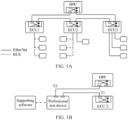
- an electronic and electrical architecture of a vehicle shown in FIG. 1A changes from a distributed electronic control unit (Electronic Control Unit, ECU) to center centralized processing (for example, high performance computing (High Performance Computing, HPC)).
- ECU Electronic Control Unit
- HPC High Performance Computing
- a communication backbone network develops from a low-speed network such as a conventional controller area network (Controller Area Network, CAN) to a high-speed network such as automotive Ethernet (1000BASE-T1).
- a solid line represents an automotive Ethernet connection
- a dashed line represents a bus connection.
- a topological link of the automotive Ethernet is point-to-point communication, which is different from a conventional bus manner in that a switch chip needs to be added during cross-node data transmission.
- an original direct connection manner between the ECU 1 and the HPC needs to be disconnected, a connector required for a professional device shown in FIG. 1B is installed, and then a device is connected.
- Introduction of a professional test device and circuit reconstruction bring high hardware costs.
- supporting software of the professional test device is required for deserialization and serialization of automotive Ethernet protocol data provided by the device.
- an installation platform for the supporting software is simple (for example, an operating system). The supporting software of the professional test device and a closed environment created by the simple installation platform bring additional software costs.
- embodiments of this application provide a method and an apparatus for accessing a vehicle resource, and a vehicle controller.
- a first aspect of this application provides a method for accessing a vehicle resource.
- the method includes: a vehicle controller receives first data of a vehicle sensor, where the first data is data in a physical format of the vehicle sensor; the vehicle controller converts the first data into second data, where the second data is data in an external message format; and the vehicle controller sends the second data to the outside.
- the first data in the physical format of the vehicle sensor is converted into the second data that is based on the open external message format, to send the second data to the outside, so that when the vehicle resource is accessed externally, there is no need to introduce an expensive professional test device and reconstruct an original harness.
- an existing disclosed IT technology ecosystem is used to access an automotive resource simply.
- a process in which the vehicle controller converts the first data into the second data includes: converting the first data into fifth data, where the fifth data is data in an internal message format; and converting the fifth data into the second data.
- the first data in the physical format of the vehicle sensor is converted into the fifth data that is based on the internal message format, to facilitate internal use of the vehicle sensor.
- the physical format includes a binary sequence format.
- the first data is collected by using a binary sequence format that matches a physical layer of the vehicle sensor, so that the vehicle controller obtains a capability of an interface of the vehicle sensor.
- the external message format includes an HTTP format.
- the HTTP format is used as the external message format, so that the outside can use an open IT ecosystem technology to access internal data of the vehicle controller.
- a second aspect of this application provides a method for accessing a vehicle resource.
- the method includes: a vehicle controller receives third data that is from outside a vehicle, where the third data is data in an external message format; the vehicle controller converts the third data into fourth data, where the fourth data is data in a physical format of a vehicle actuator; and the vehicle controller sends the fourth data to the vehicle actuator.
- the third data based on the open external message format is obtained from the outside, and is converted into the fourth data that is based on the physical format of the vehicle actuator, to control the vehicle actuator, so that when a control vehicle is debugged or calibrated externally, there is no need to introduce an expensive professional test device and reconstruct an original harness.
- an existing disclosed IT technology ecosystem is used to perform debugging and calibration simply.
- a process in which the vehicle controller converts the third data into the fourth data includes: converting the third data into sixth data, where the sixth data is data in an internal message format; and converting fifth data into the fourth data.
- the third data in the external message format is converted into the sixth data that is based on the internal message format, to facilitate internal use of the vehicle sensor.
- the physical format includes a binary sequence format.
- the fourth data is sent by using a binary sequence format that matches a physical layer of the vehicle actuator, so that the vehicle controller obtains a capability of an interface of the vehicle actuator.
- the external message format includes an HTTP format.
- the HTTP is used as the external message format, so that the vehicle controller can use an open IT ecosystem technology to receive external control.
- a third aspect of this application provides an apparatus for accessing a vehicle resource.
- the apparatus includes: an interface module and a gateway module.
- the interface module is configured to enable a vehicle controller to receive first data of a vehicle sensor, and the first data is data in a physical format of the vehicle sensor.
- the gateway module is configured to enable the vehicle controller to convert the first data into second data, and the second data is data in an external message format.
- the gateway module is further configured to enable the vehicle controller to send the second data to the outside.
- the first data in the physical format of the vehicle sensor is converted into the second data that is based on the open external message format, to send the second data to the outside, so that when the vehicle resource is accessed externally, there is no need to introduce an expensive professional test device and reconstruct an original harness.
- an existing disclosed IT technology ecosystem is used to access an automotive resource simply.
- the gateway module includes a south gateway module and a north gateway module.
- the south gateway module is configured to convert the first data into fifth data, and the fifth data is data in an internal message format.
- the north gateway module is configured to convert the fifth data into the second data.
- the first data in the physical format of the vehicle sensor is converted into the fifth data that is based on the internal message format, to facilitate internal use of the vehicle sensor.
- the physical format includes a binary sequence format.
- the first data is collected by using a binary sequence format that matches a physical layer of the vehicle sensor, so that the vehicle controller obtains a capability of an interface of the vehicle sensor.
- the external message format includes an HTTP format.
- the HTTP format is used as the external message format, so that the outside can use an open IT ecosystem technology to access internal data of the vehicle controller.
- a fourth aspect of this application provides an apparatus for accessing a vehicle resource.
- the apparatus includes: an interface module and a gateway module.
- the gateway module is configured to enable a vehicle controller to receive third data that is from outside a vehicle, and the third data is data in an external message format.
- the gateway module is further configured to enable the vehicle controller to convert the third data into fourth data, and the fourth data is data in a physical format of a vehicle actuator.
- the interface module is configured to enable the vehicle controller to send the fourth data to the vehicle actuator.
- the third data based on the open external message format is obtained from the outside, and is converted into the fourth data that is based on the physical format of the vehicle actuator, to control the vehicle actuator, so that when a control vehicle is debugged or calibrated externally, there is no need to introduce an expensive professional test device and reconstruct an original harness.
- an existing disclosed IT technology ecosystem is used to perform debugging and calibration simply.
- the gateway module includes a south gateway module and a north gateway module.
- the north gateway module is configured to convert the third data into sixth data
- the sixth data is data in an internal message format.
- the south gateway module is configured to convert the sixth data into fourth data.
- the third data in the external message format is converted into the sixth data that is based on the internal message format, to facilitate internal use of the vehicle sensor.
- the physical format includes a binary sequence format.
- the fourth data is sent by using a binary sequence format that matches a physical layer of the vehicle actuator, so that the vehicle controller obtains a capability of an interface of the vehicle actuator.
- the external message format includes an HTTP format.
- the HTTP is used as the external message format, so that the vehicle controller can use an open IT ecosystem technology to receive external control.
- a fifth aspect of this application provides a vehicle controller.
- the vehicle controller includes: the apparatus according to any possible implementation of the third aspect, the apparatus according to any possible implementation of the fourth aspect, a versatile interface unit, and a centralized controller, where the interface module is deployed in the versatile interface unit, and the gateway module is deployed in the centralized controller.
- a sixth aspect of this application provides a computing device.
- the computing device includes at least one processor and at least one memory, where the memory stores program instructions, and when the program instructions are executed by the at least one processor, the at least one processor is enabled to perform the method according to any possible implementation of the first aspect or the method according to any possible implementation of the second aspect.
- a seventh aspect of this application provides a computer-readable storage medium.
- the computer-readable storage medium stores program instructions, and when the program instructions are executed by a computer, the computer is enabled to perform the method according to any possible implementation of the first aspect or the method according to any possible implementation of the second aspect.
- an eighth aspect of this application provides a computer program product.
- the computer program product includes program instructions, and when the program instructions are executed by a computer, the computer is enabled to perform the method according to any possible implementation of the first aspect or the method according to any possible implementation of the second aspect.
- the solution for exchanging data between a vehicle controller and the outside includes an apparatus and a method for exchanging data between a vehicle controller and the outside, a computing device, a computer-readable storage medium, and a computer program product. Due to same or similar principles of solving problems by these technical solutions, in the following descriptions of specific embodiments, some repeated parts may not be described herein, but it should be considered that the specific embodiments are mutually referenced and may be combined with each other.
- Vehicle controller is a controller configured to complete control functions of a whole vehicle or a plurality of functional domains.
- the functional domains may include fields such as an intelligent cockpit, a vehicle body, and autonomous driving, or include sub-functional domains including the foregoing functional domains.
- Versatile interface unit (Versatile Interface Unit, VIU) is configured to implement device connections of a vehicle sensor and a vehicle actuator in one functional domain.
- Centralized controller (X domain Controller, XDC) is configured to implement control functions in one or more functional domains of a vehicle.
- Hypertext transfer protocol (Hypertext Transfer Protocol, HTTP) is a network transfer protocol widely applied on the Internet, is a transmission protocol used to transmit hypertext from a World Wide Web (World Wide Web, WWW) server to a local browser, and transmits data based on a TCP/IP communication protocol.
- HTTP Hypertext Transfer Protocol
- JS object notation (JavaScript Object Notation, JSon) is a lightweight data exchange format. Data is stored and represented in a text format that is completely independent of programming languages. A simple and clear hierarchical structure makes the text format an ideal data exchange language, which is easy to read and write, is easy to be parsed and generated by a machine, and effectively improves network transmission efficiency.
- Obj ectification is to encapsulate a target status and an operation performed on the target status together.
- objectification is performed on a vehicle sensor and a vehicle actuator in a service-oriented manner.
- FIG. 1C shows a calibration measurement solution based on an Ethernet backbone network.
- the solution includes a versatile interface unit 101 and a versatile interface unit 102.
- the versatile interface unit 101 and the versatile interface unit 102 are responsible for device connections of a vehicle sensor and a vehicle actuator in a functional domain.
- the solution further shows a centralized controller 104, a professional test device 103, and supporting software 105 corresponding to the professional test device 103.
- Original topology is that the versatile interface unit 101 and the versatile interface unit 102 are directly connected to the centralized controller 104, to provide an automotive Ethernet protocol data service.
- the professional test device 103 and the supporting software 105 corresponding to the professional test device 103 need to be first introduced. Then, original harnesses that are of the versatile interface unit 101 and the versatile interface unit 102 and that are directly connected to the centralized controller 104 need to be reconstructed. The original harnesses need to be disconnected, a connector required for the professional test device is installed on the harnesses, and then the harnesses are connected to a device. Then, the professional test device 103 performs bypass measurement or calibration on the data.
- an engineer needs to configure a physical link for the professional test device 103 by using the professional supporting software 105.
- the physical link is successfully connected to perform data calibration and measurement.
- Serialization and deserialization for the automotive Ethernet protocol data also need to be implemented by using the professional test device.
- a hardware device cost is high, and an expensive professional test device needs to be introduced.
- the original harnesses need to be reconstructed.
- a software interface is not open. The serialization and deserialization need to be performed on calibration status data by using professional supporting software, and an existing IT technology ecosystem cannot be used to access an automotive resource simply.
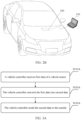
- the vehicle includes a vehicle controller 100, a sensor 130, a sensor 132, and an actuator 140.
- the vehicle controller 100 may be a whole vehicle controller or a controller in a functional domain, for example, an intelligent cockpit controller.
- the vehicle controller 100 includes a versatile interface unit 110, a versatile interface unit 112, and a centralized controller 120.
- the versatile interface unit 110 and the versatile interface unit 112 are responsible for device connections of the vehicle sensor 130, the sensor 132, and the vehicle actuator 140 in the functional domain.
- FIG. 2A shows two versatile interface units, and may actually include a plurality of versatile interface units, and each versatile interface unit may be an ECU.
- the centralized controller 120 implements a control function of a whole vehicle, control functions in one or more fields, or a control function in a specific functional domain.
- the centralized controller 120 may be an HPC, a multi-domain controller (Multi Domain Controller, MDC), or an ECU.
- the vehicle sensor 130 and the vehicle sensor 132 are configured to collect data.
- FIG. 2A shows two vehicle sensors, and may actually include a plurality of vehicle sensors that are separately connected to the versatile interface units.
- the vehicle sensor may include a vehicle speed sensor, a roll angle sensor, a distance sensor, a temperature sensor, a brightness sensor, a humidity sensor, a power sensor, or the like.
- the vehicle actuator 140 is configured to execute a control command of the centralized controller 120.
- FIG. 2A shows one vehicle actuator, and may actually include a plurality of vehicle actuators that are separately connected to the versatile interface units.
- the vehicle actuator includes a motor, a clutch, a solenoid valve, a switch, an ABS brake caliper, or
- an external computer 150 communicates with the vehicle controller 100, and is configured to obtain, by using the centralized controller 120 of the vehicle controller 100, data collected by the vehicle sensor, and to issue a control command to the vehicle actuator by using the centralized controller 120.
- the external computer may communicate with the vehicle controller 100 in a wired or wireless manner.
- the external computer may also be replaced with a device such as a tablet computer (PAD) or a smartphone.
- a first method embodiment and a second method embodiment for accessing a vehicle resource provided in this application are described. Methods in the first embodiment and the second embodiment may be run in the vehicle controller 100 shown in FIG. 2A .
- a vehicle controller accesses a vehicle sensor or controls a vehicle actuator based on data in a physical format, and interacts with a device outside a vehicle based on data in an open external message format. Therefore, when the device outside the vehicle accesses a vehicle resource, a new device may not be added, and an existing vehicle controller may not be reconstructed.
- FIG. 3A shows a procedure of a first method embodiment for accessing a vehicle resource.
- a vehicle controller 100 obtains, from a vehicle sensor, first data that is based on a physical format of the vehicle sensor, and converts the first data into data that is based on an open external message format, to send converted data to the outside.
- This embodiment includes step S310A to step S330A.
- the vehicle controller 100 receives the first data of the vehicle sensor.
- the first data is the data in the physical format of the vehicle sensor.
- the data in the physical format includes binary sequence data. In some other embodiments, the data in the physical format includes hexadecimal or octal sequence data.
- the vehicle controller 100 receives the first data of the vehicle sensor by using a versatile interface unit.
- the versatile interface unit may be implemented by an ECU included in the vehicle controller 100.
- the interface unit of the vehicle controller 100 communicates with the vehicle sensor by using a universal bus protocol, to obtain the first data of the vehicle sensor.
- the universal bus protocol may include a CAN bus protocol, a high-speed CAN bus protocol, a FlexRay protocol, a time triggered protocol (Time Triggered Protocol, TTP), a vehicle area network (Vehicle Area Network, VAN) protocol, a local interconnect network (Local Interconnect Network, LIN) bus protocol, or the like.
- the vehicle controller 100 transmits the first data from the versatile interface unit to a centralized controller 120 by using an internal communication protocol.
- the internal communication protocol may be an automotive Ethernet protocol (Ethernet), a vehicle area network (Vehicle Area Network, VAN) protocol, a local interconnect network (Local Interconnect Network, LIN) protocol, or the like.
- Ethernet automotive Ethernet protocol
- VAN vehicle Area Network
- LIN local interconnect network
- S320A The vehicle controller 100 converts the first data into second data.
- the second data is data in an external message format.
- the data in the external message format includes data based on an HTTP format.
- An HTTP is a network transfer protocol widely applied to the Internet. Therefore, the data based on the HTTP format is more universal, which facilitates receiving and processing the data based on the HTTP format by various external devices.
- the data in the external message format may alternatively be data in an FTP protocol format or the like.
- the second data is JSon-based structured data.
- the JSon-based structured data is easy to be read and written by people, is easy to be parsed and generated by a machine, and effectively improves network transmission efficiency.
- the structured data may alternatively be based on an XML (the XML is an extensible markup language), Protobuf (the Protobuf is a data exchange format), Flatbuffer (the Flatbuffer is a data exchange format), or the like.
- the first data and the second data are in a same service-oriented template structure.
- the vehicle controller 100 converts the first data into the second data by using the centralized controller 120. In some embodiments, the vehicle controller 100 may alternatively convert the data by using another controller, such as any ECU on the vehicle.
- the vehicle controller sends the data that is based on the open external message format to the outside.
- Data of the vehicle sensor may be transmitted to an external apparatus without a dedicated third-party test device and reconstruction of an internal circuit of the vehicle controller.
- this step specifically includes: converting the first data into fifth data, where the fifth data is data in an internal message format; and converting the fifth data into the second data.
- the first data and the fifth data are in a same service-oriented template structure.
- the first data is converted into the fifth data in the internal message format, to facilitate internal use of the vehicle controller 100.
- S330A The vehicle controller 100 sends the second data to the outside.
- the vehicle controller 100 sends the second data to the outside by using the centralized controller 120.
- the vehicle controller 100 may send, in a wired transmission manner or a wireless transmission manner, the second data to an external apparatus by using the centralized controller 120.
- the external apparatus may be a general-purpose computer system, a tablet computer (PAD), a smartphone, or the like.
- the second data uses chunked transfer encoding (Chunked Transfer Encoding, Chunked), to facilitate multiplexing of a link of the second data.
- chunked transfer encoding Chunked Transfer Encoding, Chunked
- FIG. 3B shows a procedure of a second method embodiment for accessing a vehicle resource.
- a vehicle controller obtains third data that is based on an open external message format from the outside, and converts the third data into fourth data that is based on a physical format of a vehicle actuator, to control the vehicle actuator.
- This embodiment includes step S310B to step S330B.
- the vehicle controller 100 receives the third data that is from outside a vehicle.
- the third data is data in the open external message format.
- the data in the external message format includes data based on an HTTP format, may be data based on an FTP protocol format, or the like.
- the external message format in step S320A refers to related descriptions of the external message format in step S320A.
- the third data is JSon-based structured data or data based on an XML, Protobuf, Flatbuffer, or the like.
- XML XML
- Protobuf Protobuf
- Flatbuffer Flatbuffer
- the vehicle controller 100 receives the third data that is from an external apparatus outside the vehicle by using a centralized controller 120.
- the vehicle controller 100 may receive the third data in a wired transmission manner or a wireless transmission manner.
- the vehicle controller 100 converts the third data into the fourth data.
- the fourth data is data in the physical format of the vehicle actuator.
- the data in the physical format includes binary sequence data or may be hexadecimal or octal sequence data, or the like, and a format of the fourth data may be subject to a physical format supported by an actuator.
- the third data and the fourth data are in a same service-oriented template structure.
- the vehicle controller 100 converts the third data into the fourth data by using the centralized controller 120. In some embodiments, the vehicle controller 100 may alternatively convert the data by using another controller, such as any ECU on the vehicle.
- the vehicle controller receives the external data that is based on the open external message format, and converts the data into the data in the physical format of the vehicle actuator.
- Data sent by the external general-purpose computer system can be received without a need for a dedicated third-party test device and a need to reconstruct an internal circuit of the vehicle controller.
- this step specifically includes: converting the third data into sixth data, where the sixth data is data in an internal message format; and converting the sixth data into the fourth data.
- the sixth data and the fourth data are in a same service-oriented template structure.
- the third data is converted into the sixth data in the internal message format, to facilitate internal use in the vehicle controller 100.
- S330B The vehicle controller sends the fourth data to the vehicle actuator 140.
- the vehicle controller 100 sends the fourth data from the centralized controller 120 to a versatile interface unit by using an internal communication protocol.
- the internal communication protocol may be an automotive Ethernet protocol (Ethernet), a vehicle area network (Vehicle Area Network, VAN) protocol, a local interconnect network (Local Interconnect Network, LIN) protocol, or the like.
- the vehicle controller 100 sends the fourth data to the actuator 140 by using the versatile interface unit.
- the versatile interface unit may be implemented by an ECU included in the vehicle controller 100.
- the interface unit of the vehicle controller 100 communicates with the actuator by using a universal bus protocol, to send the fourth data to the actuator.
- the universal bus protocol may include a CAN bus protocol, a high-speed CAN bus protocol, a FlexRay protocol, a time triggered protocol (Time Triggered Protocol, TTP), a vehicle area network (Vehicle Area Network, VAN) protocol, a local interconnect network (Local Interconnect Network, LIN) bus protocol, or the like.
- the procedure of the first method embodiment for accessing the vehicle resource and the procedure of the second method embodiment for accessing the vehicle resource are separately executed in a single manner, to collect data of the vehicle sensor or control the vehicle actuator.
- the procedure of the first method embodiment for accessing the vehicle resource is first performed, and then the procedure of the second method embodiment for accessing the vehicle resource is performed, for example, in a data calibration process.
- the procedure of the first method embodiment for accessing the vehicle resource and the procedure of the second method embodiment for accessing the vehicle resource are performed repeatedly and alternately, for example, in a troubleshooting process or a debugging process.
- the first data based on the physical format of the vehicle sensor is collected from the vehicle sensor, and is converted into the data that is based on the open external message format to be sent to the outside.
- the third data based on the open external message format is obtained from the outside, and is converted into the fourth data that is based on the physical format of the vehicle actuator to control the vehicle actuator.
- Embodiments of this application further provide a third method embodiment and a fourth method embodiment for accessing a vehicle resource.
- the third method embodiment and the fourth method embodiment are executed by the vehicle controller 100 shown in FIG. 2A .
- the vehicle controller 100 accesses a vehicle sensor or controls a vehicle actuator based on data in a physical format of a binary sequence, and externally interacts with the outside based on data in an open HTTP format, so that when a vehicle resource is accessed, a new device is not added and a harness of an existing vehicle controller is not reconstructed, and an existing IT ecosystem technology is used to interconnect with a system outside a vehicle.
- FIG. 4A shows a procedure of the third method embodiment.
- a versatile interface unit collects first data (for ease of description, referred to as status data subsequently in this embodiment) in a physical format of a vehicle sensor from the vehicle sensor to send the status data to a centralized controller 120.
- the centralized controller 120 first generates fifth data in an internal message format (for ease of description, referred to as a second status message subsequently in this embodiment) based on the status data, and then generates second data in an HTTP format (for ease of description, referred to as a first status message subsequently in this embodiment) based on the second status message, to send the first status message to an external computer 150.
- Step S410Ato step S440A are included.
- FIG. 4B shows a procedure of the fourth method embodiment.
- a centralized controller 120 receives third data in an open HTTP format (for ease of description, referred to as a first command message subsequently in this embodiment) from an external computer.
- the centralized controller 120 generates sixth data (for ease of description, referred to as a second command message subsequently in this embodiment) based on the first command message, then generates fourth data that is based on a physical format of an actuator (for ease of description, referred to as a control command subsequently in this embodiment) based on the second command message, and sends the control command to a versatile interface unit.
- the versatile interface unit sends the received control command to the vehicle actuator to control a vehicle.
- Step S410B to step S440B are included.
- S410A The versatile interface unit of a vehicle controller 100 obtains the status data, and sends the status data to the centralized controller 120 of the vehicle controller 100.
- the status data is binary sequence data that is in a physical format of a related status and that is collected by the vehicle sensor.
- the vehicle controller 100 collects data from the vehicle sensor by using a service-oriented architecture application programming interface (Service-Oriented Architecture Application Programming Interface, SOA API), generates content of the status data based on a service-oriented template, and adds a related service type identifier and a related data type identifier to generate the status data, where the data type identifier of the status data is a data identifier.
- SOA API Service-Oriented Architecture Application Programming Interface
- the status data is transmitted by using an internal communication protocol that is between the versatile interface unit and the centralized controller 120.
- S420A The centralized controller 120 of the vehicle controller 100 receives the status data, and generates an objectified second status message based on the status data.
- the second status message is objectified data in the internal message format, to facilitate use of a subscribed application (Application, APP) in the centralized controller 120.
- APP Application, APP
- a template structure of content of the second status message is the same as a template structure of content of the status data, and is a service-oriented template structure.
- S430A The centralized controller 120 of the vehicle controller 100 converts the second status message into the first status message.
- the first status message is JSon structured data based on an HTTP format, and is in a representational state transfer (Representational State Transfer, REST) style, to facilitate the external computer 150 using the first status message by using an open IT technology ecosystem.
- REST representational State Transfer
- a template structure of content of the first status message is the same as a template structure of content of the status data.
- S440A The centralized controller 120 of the vehicle controller 100 converts the second status message to send to the outside.
- the first status message uses chunked transfer encoding, to facilitate multiplexing of a link of the first status message.
- S410B The centralized controller 120 of the vehicle controller 100 receives the first command message from outside a vehicle.
- the first command message is JSon structured data based on an HTTP format, to facilitate receiving a command that passes through the external computer 150 by using an open IT ecosystem technology.
- S420B The centralized controller 120 of the vehicle controller 100 converts the first command message into the second command message.
- the second command message is objectified structured data in the internal message format, to facilitate internal use of the centralized controller 120.
- a template structure of content of the second command message is the same as a template structure of content of the first command message, and is a service-oriented template structure.
- S430B The centralized controller 120 of the vehicle controller 100 performs serialization on the second command message, to generate a control command in a binary sequence.
- a format of the control command is the physical format of the vehicle actuator.
- the template structure of content of the second command message is the same as a template structure of content of the control command.
- S440B The versatile interface unit of the vehicle controller 100 obtains the control command, and sends the control command to the vehicle actuator that generates a command of the vehicle actuator.
- the status data is transmitted by using an internal communication protocol that is between the versatile interface unit and the centralized controller 120.
- the versatile interface unit sends the command to the vehicle actuator by using the SOAAPI.
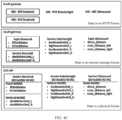
- FIG. 4C shows data of three service types which respectively are: status data and control data that are in a physical format, a second status message and a second command message that are in an internal message format, and a first status message and a first command message that are in an HTTP format from bottom to top.
- a service type of the data is a doorlock service (Service DoorLock).
- Data in a lower square frame of the figure is data in the physical format, a service type identifier is SID 0x1001, and the data includes status data of a vehicle door status and a control command of a vehicle door.
- a data type identifier of the status data is Event 0x0001, where Event represents the status data, and content of the status data includes a left door status (flClockStatus) and a right door status (frClockStatus).
- a data type identifier of the control command is Method 0x0002, where Method represents the control command, and content of the control command includes a left door control command (clockMotorCmd_L) and a right door control command (clockMotorCmd_R).
- Data in a middle square frame of the figure is data in the internal message format.
- Topic DoorLock is the second status message.
- Content of Topic DoorLock is the same as content of Event of Service DoorLock, and includes a left door status (flClockStatus) and a right door status (frClockStatus).
- Service DoorLock is the second command message.
- Content of Service DoorLock is the same as content of the control command, that is, content of Method of Service DoorLock, and includes a left door control command (clockMotorCmd_L) and a right door control command (clockMotorCmd_R).
- Data in an upper square frame of the figure is JSon structured data in the HTTP format.
- RI: GET DoorLock is obtaining the first status message of the vehicle door status. GET represents obtaining.
- Obtained content of DoorLock includes the left door status (flClockStatus) and the right door status (frClockStatus) in Topic DoorLock.
- URI: PUT DoorLock is sending the first command message of vehicle door control. PUT represents sending.
- Sent content of DoorLock includes the left door control command (clockMotorCmd_L) and the right door control command (clockMotorCmd_R) in Service DoorLock.
- a middle text in FIG. 4C is a light service (Service ExteriorLight), and a service type identifier of the light service is SID 0x1002.
- a control command, a second command message, and a first command message that are of light are included from bottom to top. Content of the control command, the second command message, and the first command message are the same, and details are not described again.
- a right text in FIG. 4C is an ultrasound radar service (Service Ultrasound), and a service type identifier of the ultrasound radar service is SID 0x1003.
- Status data, a second status message, and a first status message that are of an ultrasound radar are included from bottom to top. Content of the status data, the second status message, and the first status message are the same, and details are not described again.
- a text form displayed in FIG. 4C is for ease of description, and an actual form of the text form may be binary sequence data.
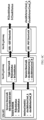
- FIG. 4D shows a data conversion relationship of the third method embodiment and the fourth method embodiment, and the data conversion relationship includes: binary sequence status data in a physical format of a sensor is deserialized, then converted into an objectified second status message in an internal message format of a vehicle controller, and then converted into a JSon structured first status message in an HTTP format; and the JSon structured first status message in the HTTP format is converted into an objectified second command message in the internal message format, and then serialized into a binary sequence control command in the physical format.
- the status data in the physical format of the vehicle sensor is collected from the vehicle sensor, and converted into the second status message in the internal message format, and then the second status message is converted into the first status message in the open HTTP format, to send the first status message to the external computer 150.
- the first command message in the HTTP format is received from the external computer.
- the centralized controller 120 converts the first command message into the second command message in the internal message format based on the first command message, generates the control command in the physical format of the actuator based on the second command message, and sends the control command to the versatile interface unit to control the vehicle.
- an existing disclosed IT technology ecosystem is used to access an automotive resource simply.
- the second status message or/and the second command message that is/are in the internal message format and that are generated in the middle facilitates/facilitate internal use of the vehicle controller.
- An embodiment of this application provides a first apparatus embodiment for accessing a vehicle resource.
- the apparatus may be configured to perform the solutions in embodiments of the foregoing method for accessing a vehicle resource.
- FIG. 5 shows a structure of the first apparatus embodiment, and the apparatus includes an interface module 510 and a gateway module 520.
- the interface module 510 performs the foregoing step S310A and the optional embodiments of the step, and is configured to enable a vehicle controller 100 to receive first data of a vehicle sensor.
- the interface module 510 further performs the foregoing step S330B and the optional embodiments of the step, and is configured to enable the vehicle controller 100 to send fourth data.
- the first data is data in a physical format of the vehicle sensor
- the fourth data is data in a physical format of a vehicle actuator.
- the data in the physical format includes binary sequence data.
- the interface module 510 is deployed on a versatile interface unit of the vehicle controller 100 shown in FIG. 2A .
- the gateway module 520 performs the foregoing steps S320A and S330A and the optional embodiments of the two steps, and is configured to enable the vehicle controller 100 to convert the first data into second data and send the second data to the outside.
- the gateway module 520 further performs the foregoing step S310B and step S320B and the optional embodiments of the two steps, and is configured to enable the vehicle controller 100 to receive third data that is from outside a vehicle and convert the third data into fourth data.
- the second data and the third data are data in an external message format.
- the data in the external message format includes data based on an HTTP format.
- the second data and the third data are JSon-based structured data.
- the first data and the second data are in a same service-oriented template.
- the third data and the fourth data are in a same service-oriented template.
- the gateway module 520 communicates with the interface module 510 by using an existing internal protocol of the vehicle controller 100.
- the gateway module 520 is deployed on a centralized controller 120 of the vehicle controller 100 shown in FIG. 2A .
- the gateway module 520 includes a south gateway module 521 and a north gateway module 522.
- the south gateway module 521 is configured to enable the vehicle controller 100 to convert the first data into fifth data
- the north gateway module 522 is further configured to enable the vehicle controller 100 to convert the fifth data into the second data.
- the fifth data is data in an internal message format.
- the north gateway module 522 is further configured to enable the vehicle controller 100 to convert the third data into sixth data
- the south gateway module 521 is further configured to enable the vehicle controller 100 to convert the sixth data into the fourth data.
- the sixth data is the data in the internal message format.
- An embodiment of this application further provides a vehicle controller, and the vehicle controller may be configured to perform the solutions in embodiments of the foregoing method for accessing a vehicle resource.
- FIG. 6A shows a structure of an embodiment of a vehicle controller.
- the embodiment of the vehicle controller includes versatile interface units (for example, includes a versatile interface unit 110 and a versatile interface unit 112) and a centralized controller 120.
- Each versatile interface unit further includes an interface module 510.
- the centralized controller 120 includes a south gateway (South Gateway) module 521 and a north gateway (North Gateway) module 522.
- the interface module 510 is configured to provide an SOAAPIto the vehicle controller 100 to open capabilities of vehicle sensors (including a vehicle sensor 130 and a vehicle sensor 132) and a vehicle actuator (including a vehicle actuator 140).
- the interface module 510 performs the foregoing step S410A and the optional embodiments of the step, obtains status data from the vehicle sensor, and further performs the foregoing step S440B and the optional embodiments of the step, to send a control command to the vehicle actuator.
- Each versatile interface unit communicates with the centralized controller 120 based on an IP. Therefore, an interface provided by the interface module 510 is a middleware of SOMEIP. When each versatile interface unit communicates with the centralized controller 120 in another communication manner, an interface provided by the interface module 510 is a service-oriented middleware in another communication manner.
- the status data is binary sequence data in a physical format of the vehicle sensor
- the control command is binary sequence data in a physical format of the vehicle actuator.
- the status data and the control command are based on a service-oriented template structure.
- the template includes a service type identifier, a data type identifier, and content.
- the data type identifier of the status data is a data identifier
- the data type identifier of the control command is a command identifier.
- the south gateway module 521 performs the foregoing step S420A and optional embodiments of the step, and is configured to deserialize the status data received from the interface module 510, and convert the status data into an objectified second status message, so that the objectified second status message is used by an internal APP of the centralized controller 120 or sent by using the north gateway module 522.
- the south gateway module 521 further performs the foregoing step S430B and the optional embodiments of the step, and is configured to serialize the objectified second command message received from the north gateway module 522 or the APP that is in the centralized controller 120, and convert the objectified second command message into a binary control command, to send the binary control command to the interface module 510.
- the south gateway module 521 communicates with the interface module 510 by using an internal protocol of the vehicle controller. For example, the south gateway module 521 communicates with the interface module 510 based on an IP.
- the second status message and the second command message are in an internal message format of the vehicle controller, to facilitate use of a subscribed APP in the centralized controller.
- a template structure of content of the second status message is the same as a template structure of content of the status data, and a template structure of content of the second command message is the same as a template structure of content of the control command.
- FIG. 6B shows data conversion between the south gateway module 521 and the interface module 510.
- the second status message that is in the internal message format of the centralized controller 120 and that is defined by the south gateway module 521 is Topic DoorLock.
- Content of the second status message is the same as content of the status data of the interface module 510, that is, content of Event of Service DoorLock, and includes a left door status (flClockStatus) and a right door status (frClockStatus).
- the south gateway module 521 deserializes, based on a same template structure, corresponding data of Event of Service DoorLock received from the interface module 510, and converts the corresponding data of Event of Service DoorLock into objectified Topic DoorLock that is in the internal message format, to facilitate subscription of an internal APP of the centralized controller 120 or sending to the north gateway module 522.
- the second command message that is of the centralized controller 120 and that is defined by the south gateway module 521 is Service DoorLock.
- Content of the second command message is the same as content of the control command of the interface module 510, that is, content of Method of Service DoorLock, and includes a left door control command (clockMotorCmd_L) and a right door control command (clockMotorCmd_R).
- the south gateway module 521 serializes, based on a same template structure, Service DoorLock received from the internal APP or received by the north gateway module 522, and generates a control command in a physical format of the vehicle actuator, to control a vehicle by using the interface module 510.
- the north gateway module 522 performs the foregoing step S430A and step S440A and the optional embodiments of the two steps, and is configured to convert the second status message received from the south gateway module 521 into a first status message in an HTTP format, and send the first status message to an external computer 150.
- the north gateway module 522 further performs the foregoing step S410B and step S420B and the optional embodiments of the two steps, and is configured to receive a first command message in an HTTP format from the external computer 150 and convert the first command message into the second command message.
- the first status message and the first command message are in an HTTP format widely used in the IT industry, and are in a REST style, to facilitate the external computer 150 using the first status message and the first command message by using an open IT ecosystem technology.
- the first status message and the first command message are structured data represented by a JS object, to further facilitate use of the external computer 150.
- a template structure of content of the first status message is the same as a template structure of content of the status data.
- the first status message uses chunked transfer encoding, to facilitate multiplexing of a link of the first status message.
- FIG. 6C shows a data conversion relationship among the north gateway module 522, the south gateway module 521, and the interface module 510.
- a data conversion relationship between the south gateway module 521 and the interface module 510 has been described in FIG. 6B .
- the following describes data conversion between the north gateway module 522 and the south gateway module 521.
- the first status message defined by the north gateway module 522 is URI: GET DoorLock.
- Content of the first status message is JSon structured data based on an HTTP format.
- GET represents obtaining, and obtained content of DoorLock includes a left door status (flClockStatus) and a right door status (frClockStatus) that are in Topic DoorLock defined by the south gateway module 521.
- a logical chain of data mapping from the vehicle sensor to the interface module 510, to the south gateway module 521, to the north gateway module 522, and finally to the external computer 150 is completed.
- the first command message received by using the north gateway module 522 is URI: PUT DoorLock.
- Content of the first command message is JSon structured data based on the HTTP format.
- PUT represents sending, and sent content of DoorLock includes a left door control command (clockMotorCmd_L) and a right door control command (clockMotorCmd_R) that are in Service DoorLock defined by the south gateway module 521.
- clockMotorCmd_L left door control command
- clockMotorCmd_R right door control command
- FIG. 7 is a schematic diagram of a structure of a computing device 700 according to an embodiment of this application.
- the computing device 700 includes a processor 710, a memory 720, and a communication interface 730.
- the communication interface 730 in the computing device 700 shown in FIG. 7 may be used for communication with another device.
- the processor 710 may be connected to the memory 720.
- the memory 720 may be configured to store program code and data. Therefore, the memory 720 may be an internal storage module of the processor 710, may be an external storage module independent of the processor 710, or may be a component that includes an internal storage module of the processor 710 and an external storage module independent of the processor 710.
- the processor 710 may be a central processing unit (central processing unit, CPU).
- the processor may alternatively be another general-purpose processor, a digital signal processor (digital signal processor, DSP), an application-specific integrated circuit (application-specific integrated circuit, ASIC), a field programmable gate array (field programmable gate array, FPGA) or another programmable logic component, a discrete gate or a transistor logic component, or a discrete hardware assembly.
- the general-purpose processor may be a microprocessor, or the processor may be any conventional processor, or the like.
- the processor 710 uses one or more integrated circuits, and is configured to execute a related program, to implement a technical solution provided in this embodiment of this application.
- the memory 720 may include a read-only memory and a random access memory, and provides instructions and data to the processor 710.
- a part of the processor 710 may further include a non-volatile random access memory.
- the processor 710 may further store device type information.
- the processor 710 executes computer-executable instructions in the memory 720 to perform the steps of the foregoing method.
- computing device 700 may correspond to a corresponding execution body of the method based on embodiments of this application, and the foregoing and other operations and/or functions of modules in the computing device 700 are separately intended to implement corresponding procedures of the methods in embodiments of this application. For brevity, details are not described herein again.
- the disclosed system, apparatus, and method may be implemented in other manners.
- the described apparatus embodiments are merely examples.
- the division of units is merely logical function division and may be other division in actual implementation.
- a plurality of units or components may be combined or integrated into another system, or some features may be ignored or may not be performed.
- the displayed or discussed mutual couplings or direct couplings or communication connections may be implemented by using some interfaces.
- the indirect couplings or communication connections between apparatuses or units may be implemented in electronic, mechanical, or other forms.
- the units described as separate parts may or may not be physically separate, and parts displayed as units may or may not be physical units, may be located in one position, or may be distributed on a plurality of network units. Some or all of the units may be selected based on actual requirements to achieve the objectives of the solutions of embodiments.
- the functions When the functions are implemented in a form of a software functional unit and sold or used as an independent product, the functions may be stored in a computer-readable storage medium. Based on such an understanding, the technical solutions of this application essentially or parts contributing to the conventional technology or some of the technical solutions may be embodied in a form of a software product.
- the computer software product is stored in a storage medium, and includes several instructions for instructing a computer device (which may be a personal computer, a server, a network device, or the like) to perform all or some of the steps of the methods described in embodiments of this application.
- the storage medium includes any medium that can store program code, such as a USB flash drive, a removable hard disk, a read-only memory (Read-Only Memory, ROM), a random access memory (Random Access Memory, RAM), a magnetic disk, or a compact disc.
- program code such as a USB flash drive, a removable hard disk, a read-only memory (Read-Only Memory, ROM), a random access memory (Random Access Memory, RAM), a magnetic disk, or a compact disc.
- An embodiment of this application further provides a computer-readable storage medium.
- the computer-readable storage medium stores a computer program.
- the program is executed by a processor, the program is used to perform at least one of the solutions described in embodiments of this application.
- the computer storage medium may be any combination of one or more computer-readable media.
- the computer-readable medium may be a computer-readable signal medium or a computer-readable storage medium.
- the computer-readable storage medium may be but is not limited to an electric, magnetic, optical, electromagnetic, infrared, or semiconductor system, apparatus, or device, or any combination thereof.
- the computer-readable storage medium includes an electrical connection having one or more wires, a portable computer disk, a hard disk, a random access memory (RAM), a read-only memory (ROM), an erasable programmable read-only memory (EPROM or flash memory), an optical fiber, a portable compact disk read-only memory (CD-ROM), an optical storage device, a magnetic storage device, or any suitable combination thereof.
- the computer-readable storage medium may be any tangible medium including or storing a program that may be used by an instruction execution system, apparatus, or device, or be used in combination with an instruction execution system, apparatus, or device.
- the read-only signal medium may include a data signal propagated in a baseband or propagated as part of a carrier, where the data signal carries read-only program code. Such a propagated data signal may take a variety of forms, including but not limited to an electromagnetic signal, an optical signal, or any suitable combination thereof.
- the computer-readable signal medium may alternatively be any computer-readable medium other than the computer-readable storage medium. The computer-readable medium may send, propagate, or transmit the program used by the instruction execution system, apparatus, or device, or used in combination with the instruction execution system, apparatus, or device.
- the program code included in the computer-readable medium may be transmitted by using any suitable medium, including but not limited to a wireless medium, a wire, an optical cable, RF, and the like, or any suitable combination thereof.
- Computer program code for performing the operations in this application may be written in one or more programming languages, or a combination thereof.
- the programming languages include an object-oriented programming language, such as Java, Smalltalk, and C++, and also include a conventional procedural programming language, such as a "C" language or a similar programming language.
- the program code may be executed entirely on a user computer, or some may be executed on a user computer as a separate software package, or some may be executed on a user computer while some is executed on a remote computer, or the code may be entirely executed on a remote computer or a server.
- the remote computer may be connected to a user computer by using any type of network, including a local area network (LAN) or a wide area network (WAN), or may be connected to an external computer (for example, connected by using an Internet service provider through the Internet).
- LAN local area network
- WAN wide area network
- an external computer for example, connected by using an Internet service provider through the Internet.
- first, second, third, and the like or similar terms such as a module A, a module B, and a module C are merely used to distinguish between similar objects, and do not represent a specific order of the objects. It may be understood that specific orders or sequences may be exchanged if permitted, so that embodiments of this application described herein can be implemented in an order other than an order illustrated or described herein.
- involved reference numerals such as S 110 and S 120 that indicate steps do not necessarily indicate that the steps are to be performed based on the order, and consecutive steps may be transposed if allowed, or may be performed simultaneously.
- One embodiment or “an embodiment” mentioned in this specification indicates that a particular feature, structure or property that is described with reference to the embodiment is included in at least one embodiment of this application. Therefore, the terms “in one embodiment” or “in an embodiment” that appear in this specification do not necessarily indicate a same embodiment, but may indicate a same embodiment. Further, in one or more embodiments, the particular features, structures, or properties can be combined in any proper manner, as will be clear from this disclosure to a person of ordinary skill in the art.
Landscapes
- Engineering & Computer Science (AREA)
- Theoretical Computer Science (AREA)
- Computer Networks & Wireless Communication (AREA)
- Signal Processing (AREA)
- Physics & Mathematics (AREA)
- General Engineering & Computer Science (AREA)
- General Physics & Mathematics (AREA)
- Health & Medical Sciences (AREA)
- Computing Systems (AREA)
- General Health & Medical Sciences (AREA)
- Medical Informatics (AREA)
- Small-Scale Networks (AREA)
Abstract
Description
- This application relates to the field of vehicle controller technologies, and in particular to a method and an apparatus for accessing a vehicle resource and a vehicle controller.
- Nowadays, vehicles are equipped with a plurality of advanced autonomous driving assistance functions. An autonomous driving level reaches L2 (autonomous driving of L2 means partial automation of vehicle driving) or a higher level. Evolution and transformation of vehicle technologies have never stopped. In transformation of intelligent interconnection, autonomous driving, shared mobility, and electric drive, the vehicle industry is continuously integrated with other industries (for example, an Internet technology (Internet Technology, IT) industry), and a core technology of the vehicle industry will be greatly changed.
- To cope with these changes, an electronic and electrical architecture of a vehicle shown in
FIG. 1A changes from a distributed electronic control unit (Electronic Control Unit, ECU) to center centralized processing (for example, high performance computing (High Performance Computing, HPC)). A communication backbone network develops from a low-speed network such as a conventional controller area network (Controller Area Network, CAN) to a high-speed network such as automotive Ethernet (1000BASE-T1). InFIG. 1A , a solid line represents an automotive Ethernet connection, and a dashed line represents a bus connection. - After devices of a whole vehicle are equipped, it is difficult for engineers to access, outside a system, data resources provided by the devices of the vehicle to perform tests (such as calibration measurement). For example, a topological link of the automotive Ethernet is point-to-point communication, which is different from a conventional bus manner in that a switch chip needs to be added during cross-node data transmission. To access Ethernet data between an ECU 1 and the HPC, an original direct connection manner between the ECU 1 and the HPC needs to be disconnected, a connector required for a professional device shown in
FIG. 1B is installed, and then a device is connected. Introduction of a professional test device and circuit reconstruction bring high hardware costs. - In another aspect, supporting software of the professional test device is required for deserialization and serialization of automotive Ethernet protocol data provided by the device. In addition, an installation platform for the supporting software is simple (for example, an operating system). The supporting software of the professional test device and a closed environment created by the simple installation platform bring additional software costs.
- In view of this, embodiments of this application provide a method and an apparatus for accessing a vehicle resource, and a vehicle controller.
- To achieve the foregoing objective, a first aspect of this application provides a method for accessing a vehicle resource. The method includes: a vehicle controller receives first data of a vehicle sensor, where the first data is data in a physical format of the vehicle sensor; the vehicle controller converts the first data into second data, where the second data is data in an external message format; and the vehicle controller sends the second data to the outside.
- According to the foregoing, the first data in the physical format of the vehicle sensor is converted into the second data that is based on the open external message format, to send the second data to the outside, so that when the vehicle resource is accessed externally, there is no need to introduce an expensive professional test device and reconstruct an original harness. In addition, an existing disclosed IT technology ecosystem is used to access an automotive resource simply.
- In a possible implementation of the first aspect, a process in which the vehicle controller converts the first data into the second data includes: converting the first data into fifth data, where the fifth data is data in an internal message format; and converting the fifth data into the second data.
- According to the foregoing, the first data in the physical format of the vehicle sensor is converted into the fifth data that is based on the internal message format, to facilitate internal use of the vehicle sensor.
- In a possible implementation of the first aspect, the physical format includes a binary sequence format.
- According to the foregoing, the first data is collected by using a binary sequence format that matches a physical layer of the vehicle sensor, so that the vehicle controller obtains a capability of an interface of the vehicle sensor.
- In a possible implementation of the first aspect, the external message format includes an HTTP format.
- According to the foregoing, the HTTP format is used as the external message format, so that the outside can use an open IT ecosystem technology to access internal data of the vehicle controller.
- To achieve the foregoing objective, a second aspect of this application provides a method for accessing a vehicle resource. The method includes: a vehicle controller receives third data that is from outside a vehicle, where the third data is data in an external message format; the vehicle controller converts the third data into fourth data, where the fourth data is data in a physical format of a vehicle actuator; and the vehicle controller sends the fourth data to the vehicle actuator.
- According to the foregoing, the third data based on the open external message format is obtained from the outside, and is converted into the fourth data that is based on the physical format of the vehicle actuator, to control the vehicle actuator, so that when a control vehicle is debugged or calibrated externally, there is no need to introduce an expensive professional test device and reconstruct an original harness. In addition, an existing disclosed IT technology ecosystem is used to perform debugging and calibration simply.
- In a possible implementation of the second aspect, a process in which the vehicle controller converts the third data into the fourth data includes: converting the third data into sixth data, where the sixth data is data in an internal message format; and converting fifth data into the fourth data.
- According to the foregoing, the third data in the external message format is converted into the sixth data that is based on the internal message format, to facilitate internal use of the vehicle sensor.
- In a possible implementation of the second aspect, the physical format includes a binary sequence format.
- According to the foregoing, the fourth data is sent by using a binary sequence format that matches a physical layer of the vehicle actuator, so that the vehicle controller obtains a capability of an interface of the vehicle actuator.
- In a possible implementation of the second aspect, the external message format includes an HTTP format.
- According to the foregoing, the HTTP is used as the external message format, so that the vehicle controller can use an open IT ecosystem technology to receive external control.
- To achieve the foregoing objective, a third aspect of this application provides an apparatus for accessing a vehicle resource. The apparatus includes: an interface module and a gateway module. The interface module is configured to enable a vehicle controller to receive first data of a vehicle sensor, and the first data is data in a physical format of the vehicle sensor. The gateway module is configured to enable the vehicle controller to convert the first data into second data, and the second data is data in an external message format. The gateway module is further configured to enable the vehicle controller to send the second data to the outside.
- According to the foregoing, the first data in the physical format of the vehicle sensor is converted into the second data that is based on the open external message format, to send the second data to the outside, so that when the vehicle resource is accessed externally, there is no need to introduce an expensive professional test device and reconstruct an original harness. In addition, an existing disclosed IT technology ecosystem is used to access an automotive resource simply.
- In a possible implementation of the third aspect, the gateway module includes a south gateway module and a north gateway module. The south gateway module is configured to convert the first data into fifth data, and the fifth data is data in an internal message format. The north gateway module is configured to convert the fifth data into the second data.
- According to the foregoing, the first data in the physical format of the vehicle sensor is converted into the fifth data that is based on the internal message format, to facilitate internal use of the vehicle sensor.
- In a possible implementation of the third aspect, the physical format includes a binary sequence format.
- According to the foregoing, the first data is collected by using a binary sequence format that matches a physical layer of the vehicle sensor, so that the vehicle controller obtains a capability of an interface of the vehicle sensor.
- In a possible implementation of the third aspect, the external message format includes an HTTP format.
- According to the foregoing, the HTTP format is used as the external message format, so that the outside can use an open IT ecosystem technology to access internal data of the vehicle controller.
- To achieve the foregoing objective, a fourth aspect of this application provides an apparatus for accessing a vehicle resource. The apparatus includes: an interface module and a gateway module. The gateway module is configured to enable a vehicle controller to receive third data that is from outside a vehicle, and the third data is data in an external message format. The gateway module is further configured to enable the vehicle controller to convert the third data into fourth data, and the fourth data is data in a physical format of a vehicle actuator. The interface module is configured to enable the vehicle controller to send the fourth data to the vehicle actuator.
- According to the foregoing, the third data based on the open external message format is obtained from the outside, and is converted into the fourth data that is based on the physical format of the vehicle actuator, to control the vehicle actuator, so that when a control vehicle is debugged or calibrated externally, there is no need to introduce an expensive professional test device and reconstruct an original harness. In addition, an existing disclosed IT technology ecosystem is used to perform debugging and calibration simply.
- In a possible implementation of the fourth aspect, the gateway module includes a south gateway module and a north gateway module. The north gateway module is configured to convert the third data into sixth data, and the sixth data is data in an internal message format. The south gateway module is configured to convert the sixth data into fourth data.
- According to the foregoing, the third data in the external message format is converted into the sixth data that is based on the internal message format, to facilitate internal use of the vehicle sensor.
- In a possible implementation of the fourth aspect, the physical format includes a binary sequence format.
- According to the foregoing, the fourth data is sent by using a binary sequence format that matches a physical layer of the vehicle actuator, so that the vehicle controller obtains a capability of an interface of the vehicle actuator.
- In a possible implementation of the fourth aspect, the external message format includes an HTTP format.
- According to the foregoing, the HTTP is used as the external message format, so that the vehicle controller can use an open IT ecosystem technology to receive external control.
- To achieve the foregoing objective, a fifth aspect of this application provides a vehicle controller. The vehicle controller includes: the apparatus according to any possible implementation of the third aspect, the apparatus according to any possible implementation of the fourth aspect, a versatile interface unit, and a centralized controller, where the interface module is deployed in the versatile interface unit, and the gateway module is deployed in the centralized controller.
- To achieve the foregoing objective, a sixth aspect of this application provides a computing device. The computing device includes at least one processor and at least one memory, where the memory stores program instructions, and when the program instructions are executed by the at least one processor, the at least one processor is enabled to perform the method according to any possible implementation of the first aspect or the method according to any possible implementation of the second aspect.
- To achieve the foregoing objective, a seventh aspect of this application provides a computer-readable storage medium. The computer-readable storage medium stores program instructions, and when the program instructions are executed by a computer, the computer is enabled to perform the method according to any possible implementation of the first aspect or the method according to any possible implementation of the second aspect.
- To achieve the foregoing objective, an eighth aspect of this application provides a computer program product. The computer program product includes program instructions, and when the program instructions are executed by a computer, the computer is enabled to perform the method according to any possible implementation of the first aspect or the method according to any possible implementation of the second aspect.
- In conclusion, in embodiments of this application, when the vehicle resource is accessed, there is no need to introduce an expensive professional test device and reconstruct an original harness. In addition, an existing disclosed IT technology ecosystem is used to access an automotive resource simply.
- These aspects and another aspect of this application will be clearer and easier to understand in descriptions of the following (a plurality of) embodiments.
- The following further describes features of this application and a relationship between the features with reference to the accompanying drawings. The accompanying drawings are all examples, and some features are not shown in actual proportions. In addition, in some accompanying drawings, common features that are not mandatory for this application in the field of this application may be omitted. Alternatively, additional features that are not mandatory for this application are shown. A combination of the features shown in the accompanying drawings is not intended to limit this application. In addition, in this specification, same reference numerals represent same content. The specific accompanying drawings are described as follows:
-
FIG. 1A is a schematic diagram of an electronic and electrical architecture of a vehicle; -
FIG. 1B is a schematic diagram of a structure of accessing a vehicle resource by using a professional device; -
FIG. 1C is a schematic diagram of a structure of accessing a vehicle resource through Ethernet by using a professional device; -
FIG. 2A is a schematic diagram of a structure of an application scenario according to an embodiment of this application; -
FIG. 2B is a schematic diagram of an application scenario according to an embodiment of this application; -
FIG. 3A is a schematic flowchart of a first method embodiment for accessing a vehicle resource according to this application; -
FIG. 3B is a schematic flowchart of a second method embodiment for accessing a vehicle resource according to this application; -
FIG. 4A is a schematic flowchart of a third method embodiment for accessing a vehicle resource according to this application; -
FIG. 4B is a schematic flowchart of a fourth method embodiment for accessing a vehicle resource according to this application; -
FIG. 4C is a schematic diagram of data of the third method embodiment and the fourth method embodiment according to this application; -
FIG. 4D is a schematic diagram of a data conversion process of the third method embodiment and the fourth method embodiment according to this application; -
FIG. 5 is a schematic diagram of a structure of a first apparatus embodiment for accessing a vehicle resource according to this application; -
FIG. 6A is a schematic diagram of a structure of an embodiment of a vehicle controller according to this application; -
FIG. 6B is a schematic diagram of data conversion between an interface module and a south gateway module in an embodiment of a vehicle controller according to this application; -
FIG. 6C is a schematic diagram of data conversion among an interface module, a south gateway module, and a north gateway module in an embodiment of a vehicle controller according to this application; and -
FIG. 7 is a schematic diagram of a structure of a computing device according to an embodiment of this application. - The following further describes the technical solutions provided in this application with reference to the accompanying drawings and embodiments. It should be understood that system architectures and service scenarios in embodiments of this application are mainly intended to describe possible implementations of the technical solutions of this application, and should not be construed as a unique limitation on the technical solutions of this application. A person of ordinary skill in the art may learn that, with evolution of a system structure and emergence of a new service scenario, the technical solutions provided in this application are also applicable to a similar technical problem.
- It should be understood that the solution for exchanging data between a vehicle controller and the outside provided in embodiments of this application includes an apparatus and a method for exchanging data between a vehicle controller and the outside, a computing device, a computer-readable storage medium, and a computer program product. Due to same or similar principles of solving problems by these technical solutions, in the following descriptions of specific embodiments, some repeated parts may not be described herein, but it should be considered that the specific embodiments are mutually referenced and may be combined with each other.
- Before the specific implementations of this application are further described in detail, technical terms in embodiments of this application are described. Unless otherwise defined, all technical and scientific terms used in this specification have same meanings as those usually understood by a person skilled in the art of this application. In case of any inconsistency, the meaning described in this specification or the meaning obtained according to the content recorded in this specification shall be used. In addition, the terms used in this specification are merely for the purpose of describing embodiments of this application, but are not intended to limit this application.
- To accurately describe technical content in this application and accurately understand this application, the following explanations, descriptions, or definitions are first provided for terms used in this specification before specific implementations are described.
- Vehicle controller is a controller configured to complete control functions of a whole vehicle or a plurality of functional domains. For example, the functional domains may include fields such as an intelligent cockpit, a vehicle body, and autonomous driving, or include sub-functional domains including the foregoing functional domains.
- Versatile interface unit (Versatile Interface Unit, VIU) is configured to implement device connections of a vehicle sensor and a vehicle actuator in one functional domain.
- Centralized controller (X domain Controller, XDC) is configured to implement control functions in one or more functional domains of a vehicle.
- Hypertext transfer protocol (Hypertext Transfer Protocol, HTTP) is a network transfer protocol widely applied on the Internet, is a transmission protocol used to transmit hypertext from a World Wide Web (World Wide Web, WWW) server to a local browser, and transmits data based on a TCP/IP communication protocol.
- JS object notation (JavaScript Object Notation, JSon) is a lightweight data exchange format. Data is stored and represented in a text format that is completely independent of programming languages. A simple and clear hierarchical structure makes the text format an ideal data exchange language, which is easy to read and write, is easy to be parsed and generated by a machine, and effectively improves network transmission efficiency.
- Obj ectification is to encapsulate a target status and an operation performed on the target status together. In embodiments of this application, objectification is performed on a vehicle sensor and a vehicle actuator in a service-oriented manner.
-
FIG. 1C shows a calibration measurement solution based on an Ethernet backbone network. The solution includes aversatile interface unit 101 and aversatile interface unit 102. Theversatile interface unit 101 and theversatile interface unit 102 are responsible for device connections of a vehicle sensor and a vehicle actuator in a functional domain. The solution further shows acentralized controller 104, aprofessional test device 103, and supportingsoftware 105 corresponding to theprofessional test device 103. - Original topology is that the
versatile interface unit 101 and theversatile interface unit 102 are directly connected to thecentralized controller 104, to provide an automotive Ethernet protocol data service. When data of the versatile interface unit needs to be calibrated and measured, theprofessional test device 103 and the supportingsoftware 105 corresponding to theprofessional test device 103 need to be first introduced. Then, original harnesses that are of theversatile interface unit 101 and theversatile interface unit 102 and that are directly connected to thecentralized controller 104 need to be reconstructed. The original harnesses need to be disconnected, a connector required for the professional test device is installed on the harnesses, and then the harnesses are connected to a device. Then, theprofessional test device 103 performs bypass measurement or calibration on the data. - In a whole process, an engineer needs to configure a physical link for the
professional test device 103 by using the professional supportingsoftware 105. The physical link is successfully connected to perform data calibration and measurement. Serialization and deserialization for the automotive Ethernet protocol data also need to be implemented by using the professional test device. - In the calibration and measurement solution, a hardware device cost is high, and an expensive professional test device needs to be introduced. In addition, the original harnesses need to be reconstructed. In another aspect, a software interface is not open. The serialization and deserialization need to be performed on calibration status data by using professional supporting software, and an existing IT technology ecosystem cannot be used to access an automotive resource simply.
- With reference to
FIG. 2A andFIG. 2B , the following briefly describes a scenario in which a solution for accessing a vehicle resource provided in an embodiment of this application is applied to a vehicle. - In this application scenario, as shown in
FIG. 2A , the vehicle includes avehicle controller 100, asensor 130, asensor 132, and anactuator 140. Thevehicle controller 100 may be a whole vehicle controller or a controller in a functional domain, for example, an intelligent cockpit controller. Thevehicle controller 100 includes aversatile interface unit 110, aversatile interface unit 112, and acentralized controller 120. Theversatile interface unit 110 and theversatile interface unit 112 are responsible for device connections of thevehicle sensor 130, thesensor 132, and thevehicle actuator 140 in the functional domain. For example,FIG. 2A shows two versatile interface units, and may actually include a plurality of versatile interface units, and each versatile interface unit may be an ECU. Thecentralized controller 120 implements a control function of a whole vehicle, control functions in one or more fields, or a control function in a specific functional domain. Thecentralized controller 120 may be an HPC, a multi-domain controller (Multi Domain Controller, MDC), or an ECU. Thevehicle sensor 130 and thevehicle sensor 132 are configured to collect data. For example,FIG. 2A shows two vehicle sensors, and may actually include a plurality of vehicle sensors that are separately connected to the versatile interface units. The vehicle sensor may include a vehicle speed sensor, a roll angle sensor, a distance sensor, a temperature sensor, a brightness sensor, a humidity sensor, a power sensor, or the like. Thevehicle actuator 140 is configured to execute a control command of thecentralized controller 120. For example,FIG. 2A shows one vehicle actuator, and may actually include a plurality of vehicle actuators that are separately connected to the versatile interface units. The vehicle actuator includes a motor, a clutch, a solenoid valve, a switch, an ABS brake caliper, or the like. - In this application scenario, as shown in
FIG. 2B , anexternal computer 150 communicates with thevehicle controller 100, and is configured to obtain, by using thecentralized controller 120 of thevehicle controller 100, data collected by the vehicle sensor, and to issue a control command to the vehicle actuator by using thecentralized controller 120. In some embodiments, the external computer may communicate with thevehicle controller 100 in a wired or wireless manner. The external computer may also be replaced with a device such as a tablet computer (PAD) or a smartphone. - The following describes embodiments of this application based on the accompanying drawings.
- First, a first method embodiment and a second method embodiment for accessing a vehicle resource provided in this application are described. Methods in the first embodiment and the second embodiment may be run in the
vehicle controller 100 shown inFIG. 2A . In the first method embodiment and the second method embodiment, a vehicle controller accesses a vehicle sensor or controls a vehicle actuator based on data in a physical format, and interacts with a device outside a vehicle based on data in an open external message format. Therefore, when the device outside the vehicle accesses a vehicle resource, a new device may not be added, and an existing vehicle controller may not be reconstructed. -
FIG. 3A shows a procedure of a first method embodiment for accessing a vehicle resource. In this embodiment, avehicle controller 100 obtains, from a vehicle sensor, first data that is based on a physical format of the vehicle sensor, and converts the first data into data that is based on an open external message format, to send converted data to the outside. The following describes this embodiment in detail with reference toFIG. 3A . This embodiment includes step S310A to step S330A. - S310A: The
vehicle controller 100 receives the first data of the vehicle sensor. The first data is the data in the physical format of the vehicle sensor. - In this embodiment, the data in the physical format includes binary sequence data. In some other embodiments, the data in the physical format includes hexadecimal or octal sequence data.
- In some embodiments, the
vehicle controller 100 receives the first data of the vehicle sensor by using a versatile interface unit. In this embodiment, the versatile interface unit may be implemented by an ECU included in thevehicle controller 100. - In some embodiments, the interface unit of the
vehicle controller 100 communicates with the vehicle sensor by using a universal bus protocol, to obtain the first data of the vehicle sensor. In some embodiments, the universal bus protocol may include a CAN bus protocol, a high-speed CAN bus protocol, a FlexRay protocol, a time triggered protocol (Time Triggered Protocol, TTP), a vehicle area network (Vehicle Area Network, VAN) protocol, a local interconnect network (Local Interconnect Network, LIN) bus protocol, or the like. - In some embodiments, the
vehicle controller 100 transmits the first data from the versatile interface unit to acentralized controller 120 by using an internal communication protocol. - In some embodiments, the internal communication protocol may be an automotive Ethernet protocol (Ethernet), a vehicle area network (Vehicle Area Network, VAN) protocol, a local interconnect network (Local Interconnect Network, LIN) protocol, or the like.
- S320A: The
vehicle controller 100 converts the first data into second data. The second data is data in an external message format. - In this embodiment, the data in the external message format includes data based on an HTTP format. An HTTP is a network transfer protocol widely applied to the Internet. Therefore, the data based on the HTTP format is more universal, which facilitates receiving and processing the data based on the HTTP format by various external devices. In some other embodiments, the data in the external message format may alternatively be data in an FTP protocol format or the like.
- In this embodiment, the second data is JSon-based structured data. The JSon-based structured data is easy to be read and written by people, is easy to be parsed and generated by a machine, and effectively improves network transmission efficiency. In some other embodiments, the structured data may alternatively be based on an XML (the XML is an extensible markup language), Protobuf (the Protobuf is a data exchange format), Flatbuffer (the Flatbuffer is a data exchange format), or the like.
- In some embodiments, the first data and the second data are in a same service-oriented template structure.
- In some embodiments, the
vehicle controller 100 converts the first data into the second data by using thecentralized controller 120. In some embodiments, thevehicle controller 100 may alternatively convert the data by using another controller, such as any ECU on the vehicle. - According to the foregoing, the vehicle controller sends the data that is based on the open external message format to the outside. Data of the vehicle sensor may be transmitted to an external apparatus without a dedicated third-party test device and reconstruction of an internal circuit of the vehicle controller.
- In some embodiments, this step specifically includes: converting the first data into fifth data, where the fifth data is data in an internal message format; and converting the fifth data into the second data.
- In some embodiments, the first data and the fifth data are in a same service-oriented template structure.
- According to the foregoing, the first data is converted into the fifth data in the internal message format, to facilitate internal use of the
vehicle controller 100. - S330A: The
vehicle controller 100 sends the second data to the outside. - In some embodiments, the
vehicle controller 100 sends the second data to the outside by using thecentralized controller 120. In some embodiments, thevehicle controller 100 may send, in a wired transmission manner or a wireless transmission manner, the second data to an external apparatus by using thecentralized controller 120. The external apparatus may be a general-purpose computer system, a tablet computer (PAD), a smartphone, or the like. - In some embodiments, the second data uses chunked transfer encoding (Chunked Transfer Encoding, Chunked), to facilitate multiplexing of a link of the second data.
-
FIG. 3B shows a procedure of a second method embodiment for accessing a vehicle resource. In this embodiment, a vehicle controller obtains third data that is based on an open external message format from the outside, and converts the third data into fourth data that is based on a physical format of a vehicle actuator, to control the vehicle actuator. The following describes this embodiment in detail with reference toFIG. 3B . This embodiment includes step S310B to step S330B. - S310B: The
vehicle controller 100 receives the third data that is from outside a vehicle. The third data is data in the open external message format. - In some embodiments, the data in the external message format includes data based on an HTTP format, may be data based on an FTP protocol format, or the like. For details, refer to related descriptions of the external message format in step S320A.
- In some embodiments, the third data is JSon-based structured data or data based on an XML, Protobuf, Flatbuffer, or the like. For details, refer to related descriptions of the structured data in step S320A.
- In some embodiments, the
vehicle controller 100 receives the third data that is from an external apparatus outside the vehicle by using acentralized controller 120. Thevehicle controller 100 may receive the third data in a wired transmission manner or a wireless transmission manner. - S320B: The
vehicle controller 100 converts the third data into the fourth data. The fourth data is data in the physical format of the vehicle actuator. - In some embodiments, the data in the physical format includes binary sequence data or may be hexadecimal or octal sequence data, or the like, and a format of the fourth data may be subject to a physical format supported by an actuator.
- In some embodiments, the third data and the fourth data are in a same service-oriented template structure.
- In some embodiments, the
vehicle controller 100 converts the third data into the fourth data by using thecentralized controller 120. In some embodiments, thevehicle controller 100 may alternatively convert the data by using another controller, such as any ECU on the vehicle. - According to the foregoing, the vehicle controller receives the external data that is based on the open external message format, and converts the data into the data in the physical format of the vehicle actuator. Data sent by the external general-purpose computer system can be received without a need for a dedicated third-party test device and a need to reconstruct an internal circuit of the vehicle controller.
- In some embodiments, this step specifically includes: converting the third data into sixth data, where the sixth data is data in an internal message format; and converting the sixth data into the fourth data.
- In some embodiments, the sixth data and the fourth data are in a same service-oriented template structure.
- According to the foregoing, the third data is converted into the sixth data in the internal message format, to facilitate internal use in the
vehicle controller 100. - S330B: The vehicle controller sends the fourth data to the
vehicle actuator 140. - In some embodiments, the
vehicle controller 100 sends the fourth data from thecentralized controller 120 to a versatile interface unit by using an internal communication protocol. In some embodiments, the internal communication protocol may be an automotive Ethernet protocol (Ethernet), a vehicle area network (Vehicle Area Network, VAN) protocol, a local interconnect network (Local Interconnect Network, LIN) protocol, or the like. - In some embodiments, the
vehicle controller 100 sends the fourth data to theactuator 140 by using the versatile interface unit. In this embodiment, the versatile interface unit may be implemented by an ECU included in thevehicle controller 100. - In some embodiments, the interface unit of the
vehicle controller 100 communicates with the actuator by using a universal bus protocol, to send the fourth data to the actuator. In some embodiments, the universal bus protocol may include a CAN bus protocol, a high-speed CAN bus protocol, a FlexRay protocol, a time triggered protocol (Time Triggered Protocol, TTP), a vehicle area network (Vehicle Area Network, VAN) protocol, a local interconnect network (Local Interconnect Network, LIN) bus protocol, or the like. - In some embodiments, the procedure of the first method embodiment for accessing the vehicle resource and the procedure of the second method embodiment for accessing the vehicle resource are separately executed in a single manner, to collect data of the vehicle sensor or control the vehicle actuator.
- In some embodiments, the procedure of the first method embodiment for accessing the vehicle resource is first performed, and then the procedure of the second method embodiment for accessing the vehicle resource is performed, for example, in a data calibration process.
- In some embodiments, the procedure of the first method embodiment for accessing the vehicle resource and the procedure of the second method embodiment for accessing the vehicle resource are performed repeatedly and alternately, for example, in a troubleshooting process or a debugging process.
- In conclusion, in the foregoing method embodiments for accessing the vehicle resource, the first data based on the physical format of the vehicle sensor is collected from the vehicle sensor, and is converted into the data that is based on the open external message format to be sent to the outside. The third data based on the open external message format is obtained from the outside, and is converted into the fourth data that is based on the physical format of the vehicle actuator to control the vehicle actuator. In the foregoing method embodiments for accessing the vehicle resource, there is no need to introduce an expensive professional test device, and to reconstruct an original harness. In addition, an existing disclosed IT technology ecosystem is used to access an automotive resource simply.
- Embodiments of this application further provide a third method embodiment and a fourth method embodiment for accessing a vehicle resource. The following describes the third method embodiment and the fourth method embodiment with reference to the accompanying drawings.
- The third method embodiment and the fourth method embodiment are executed by the
vehicle controller 100 shown inFIG. 2A . Thevehicle controller 100 accesses a vehicle sensor or controls a vehicle actuator based on data in a physical format of a binary sequence, and externally interacts with the outside based on data in an open HTTP format, so that when a vehicle resource is accessed, a new device is not added and a harness of an existing vehicle controller is not reconstructed, and an existing IT ecosystem technology is used to interconnect with a system outside a vehicle. -
FIG. 4A shows a procedure of the third method embodiment. In the procedure of the third embodiment, a versatile interface unit collects first data (for ease of description, referred to as status data subsequently in this embodiment) in a physical format of a vehicle sensor from the vehicle sensor to send the status data to acentralized controller 120. Thecentralized controller 120 first generates fifth data in an internal message format (for ease of description, referred to as a second status message subsequently in this embodiment) based on the status data, and then generates second data in an HTTP format (for ease of description, referred to as a first status message subsequently in this embodiment) based on the second status message, to send the first status message to anexternal computer 150. Step S410Ato step S440A are included. -
FIG. 4B shows a procedure of the fourth method embodiment. In the procedure of the fourth embodiment, acentralized controller 120 receives third data in an open HTTP format (for ease of description, referred to as a first command message subsequently in this embodiment) from an external computer. Thecentralized controller 120 generates sixth data (for ease of description, referred to as a second command message subsequently in this embodiment) based on the first command message, then generates fourth data that is based on a physical format of an actuator (for ease of description, referred to as a control command subsequently in this embodiment) based on the second command message, and sends the control command to a versatile interface unit. The versatile interface unit sends the received control command to the vehicle actuator to control a vehicle. Step S410B to step S440B are included. - Refer to
FIG. 4A . The following describes in detail specific steps included in the third method embodiment. - S410A: The versatile interface unit of a
vehicle controller 100 obtains the status data, and sends the status data to thecentralized controller 120 of thevehicle controller 100. - The status data is binary sequence data that is in a physical format of a related status and that is collected by the vehicle sensor.
- The
vehicle controller 100 collects data from the vehicle sensor by using a service-oriented architecture application programming interface (Service-Oriented Architecture Application Programming Interface, SOA API), generates content of the status data based on a service-oriented template, and adds a related service type identifier and a related data type identifier to generate the status data, where the data type identifier of the status data is a data identifier. - The status data is transmitted by using an internal communication protocol that is between the versatile interface unit and the
centralized controller 120. - S420A: The
centralized controller 120 of thevehicle controller 100 receives the status data, and generates an objectified second status message based on the status data. - The second status message is objectified data in the internal message format, to facilitate use of a subscribed application (Application, APP) in the
centralized controller 120. - A template structure of content of the second status message is the same as a template structure of content of the status data, and is a service-oriented template structure.
- S430A: The
centralized controller 120 of thevehicle controller 100 converts the second status message into the first status message. - The first status message is JSon structured data based on an HTTP format, and is in a representational state transfer (Representational State Transfer, REST) style, to facilitate the
external computer 150 using the first status message by using an open IT technology ecosystem. - A template structure of content of the first status message is the same as a template structure of content of the status data.
- S440A: The
centralized controller 120 of thevehicle controller 100 converts the second status message to send to the outside. - When the first status message is periodic data, the first status message uses chunked transfer encoding, to facilitate multiplexing of a link of the first status message.
- Refer to
FIG. 4B . The following describes in detail specific steps included in the fourth method embodiment. - S410B: The
centralized controller 120 of thevehicle controller 100 receives the first command message from outside a vehicle. - The first command message is JSon structured data based on an HTTP format, to facilitate receiving a command that passes through the
external computer 150 by using an open IT ecosystem technology. - S420B: The
centralized controller 120 of thevehicle controller 100 converts the first command message into the second command message. - The second command message is objectified structured data in the internal message format, to facilitate internal use of the
centralized controller 120. - A template structure of content of the second command message is the same as a template structure of content of the first command message, and is a service-oriented template structure.
- S430B: The
centralized controller 120 of thevehicle controller 100 performs serialization on the second command message, to generate a control command in a binary sequence. - A format of the control command is the physical format of the vehicle actuator.
- The template structure of content of the second command message is the same as a template structure of content of the control command.
- S440B: The versatile interface unit of the
vehicle controller 100 obtains the control command, and sends the control command to the vehicle actuator that generates a command of the vehicle actuator. - The status data is transmitted by using an internal communication protocol that is between the versatile interface unit and the
centralized controller 120. - The versatile interface unit sends the command to the vehicle actuator by using the SOAAPI.
- The following describes an example of the data in the third method embodiment and the fourth method embodiment with reference to the accompanying drawings.
- For example,
FIG. 4C shows data of three service types which respectively are: status data and control data that are in a physical format, a second status message and a second command message that are in an internal message format, and a first status message and a first command message that are in an HTTP format from bottom to top. - First, data on the left side of
FIG. 4C is described, and a service type of the data is a doorlock service (Service DoorLock). Data in a lower square frame of the figure is data in the physical format, a service type identifier is SID 0x1001, and the data includes status data of a vehicle door status and a control command of a vehicle door. A data type identifier of the status data is Event 0x0001, where Event represents the status data, and content of the status data includes a left door status (flClockStatus) and a right door status (frClockStatus). A data type identifier of the control command is Method 0x0002, where Method represents the control command, and content of the control command includes a left door control command (clockMotorCmd_L) and a right door control command (clockMotorCmd_R). Data in a middle square frame of the figure is data in the internal message format. Topic DoorLock is the second status message. Content of Topic DoorLock is the same as content of Event of Service DoorLock, and includes a left door status (flClockStatus) and a right door status (frClockStatus). Service DoorLock is the second command message. Content of Service DoorLock is the same as content of the control command, that is, content of Method of Service DoorLock, and includes a left door control command (clockMotorCmd_L) and a right door control command (clockMotorCmd_R). Data in an upper square frame of the figure is JSon structured data in the HTTP format. RI: GET DoorLock is obtaining the first status message of the vehicle door status. GET represents obtaining. Obtained content of DoorLock includes the left door status (flClockStatus) and the right door status (frClockStatus) in Topic DoorLock. URI: PUT DoorLock is sending the first command message of vehicle door control. PUT represents sending. Sent content of DoorLock includes the left door control command (clockMotorCmd_L) and the right door control command (clockMotorCmd_R) in Service DoorLock. - A middle text in
FIG. 4C is a light service (Service ExteriorLight), and a service type identifier of the light service is SID 0x1002. A control command, a second command message, and a first command message that are of light are included from bottom to top. Content of the control command, the second command message, and the first command message are the same, and details are not described again. A right text inFIG. 4C is an ultrasound radar service (Service Ultrasound), and a service type identifier of the ultrasound radar service is SID 0x1003. Status data, a second status message, and a first status message that are of an ultrasound radar are included from bottom to top. Content of the status data, the second status message, and the first status message are the same, and details are not described again. - It should be noted that a text form displayed in
FIG. 4C is for ease of description, and an actual form of the text form may be binary sequence data. - For example,
FIG. 4D shows a data conversion relationship of the third method embodiment and the fourth method embodiment, and the data conversion relationship includes: binary sequence status data in a physical format of a sensor is deserialized, then converted into an objectified second status message in an internal message format of a vehicle controller, and then converted into a JSon structured first status message in an HTTP format; and the JSon structured first status message in the HTTP format is converted into an objectified second command message in the internal message format, and then serialized into a binary sequence control command in the physical format. - In conclusion, in the third method embodiment and the fourth method embodiment, the status data in the physical format of the vehicle sensor is collected from the vehicle sensor, and converted into the second status message in the internal message format, and then the second status message is converted into the first status message in the open HTTP format, to send the first status message to the
external computer 150. The first command message in the HTTP format is received from the external computer. Thecentralized controller 120 converts the first command message into the second command message in the internal message format based on the first command message, generates the control command in the physical format of the actuator based on the second command message, and sends the control command to the versatile interface unit to control the vehicle. In the third method embodiment and the fourth method embodiment, there is no need to introduce an expensive professional test device and reconstruct an original harness. In addition, an existing disclosed IT technology ecosystem is used to access an automotive resource simply. In addition, the second status message or/and the second command message that is/are in the internal message format and that are generated in the middle facilitates/facilitate internal use of the vehicle controller. - An embodiment of this application provides a first apparatus embodiment for accessing a vehicle resource. The apparatus may be configured to perform the solutions in embodiments of the foregoing method for accessing a vehicle resource.
-
FIG. 5 shows a structure of the first apparatus embodiment, and the apparatus includes aninterface module 510 and agateway module 520. - The
interface module 510 performs the foregoing step S310A and the optional embodiments of the step, and is configured to enable avehicle controller 100 to receive first data of a vehicle sensor. Theinterface module 510 further performs the foregoing step S330B and the optional embodiments of the step, and is configured to enable thevehicle controller 100 to send fourth data. - The first data is data in a physical format of the vehicle sensor, and the fourth data is data in a physical format of a vehicle actuator.
- In some embodiments, the data in the physical format includes binary sequence data.
- In some embodiments, the
interface module 510 is deployed on a versatile interface unit of thevehicle controller 100 shown inFIG. 2A . - The
gateway module 520 performs the foregoing steps S320A and S330A and the optional embodiments of the two steps, and is configured to enable thevehicle controller 100 to convert the first data into second data and send the second data to the outside. Thegateway module 520 further performs the foregoing step S310B and step S320B and the optional embodiments of the two steps, and is configured to enable thevehicle controller 100 to receive third data that is from outside a vehicle and convert the third data into fourth data. - The second data and the third data are data in an external message format.
- In some embodiments, the data in the external message format includes data based on an HTTP format.
- In some embodiments, the second data and the third data are JSon-based structured data.
- In some embodiments, the first data and the second data are in a same service-oriented template.
- In some embodiments, the third data and the fourth data are in a same service-oriented template.
- In some embodiments, the
gateway module 520 communicates with theinterface module 510 by using an existing internal protocol of thevehicle controller 100. - In some embodiments, the
gateway module 520 is deployed on acentralized controller 120 of thevehicle controller 100 shown inFIG. 2A . - In some embodiments, the
gateway module 520 includes asouth gateway module 521 and a north gateway module 522. - The
south gateway module 521 is configured to enable thevehicle controller 100 to convert the first data into fifth data, and the north gateway module 522 is further configured to enable thevehicle controller 100 to convert the fifth data into the second data. The fifth data is data in an internal message format. - The north gateway module 522 is further configured to enable the
vehicle controller 100 to convert the third data into sixth data, and thesouth gateway module 521 is further configured to enable thevehicle controller 100 to convert the sixth data into the fourth data. The sixth data is the data in the internal message format. - An embodiment of this application further provides a vehicle controller, and the vehicle controller may be configured to perform the solutions in embodiments of the foregoing method for accessing a vehicle resource.
-
FIG. 6A shows a structure of an embodiment of a vehicle controller. The embodiment of the vehicle controller includes versatile interface units (for example, includes aversatile interface unit 110 and a versatile interface unit 112) and acentralized controller 120. Each versatile interface unit further includes aninterface module 510. Thecentralized controller 120 includes a south gateway (South Gateway)module 521 and a north gateway (North Gateway) module 522. - The
interface module 510 is configured to provide an SOAAPIto thevehicle controller 100 to open capabilities of vehicle sensors (including avehicle sensor 130 and a vehicle sensor 132) and a vehicle actuator (including a vehicle actuator 140). Theinterface module 510 performs the foregoing step S410A and the optional embodiments of the step, obtains status data from the vehicle sensor, and further performs the foregoing step S440B and the optional embodiments of the step, to send a control command to the vehicle actuator. - Each versatile interface unit communicates with the
centralized controller 120 based on an IP. Therefore, an interface provided by theinterface module 510 is a middleware of SOMEIP. When each versatile interface unit communicates with thecentralized controller 120 in another communication manner, an interface provided by theinterface module 510 is a service-oriented middleware in another communication manner. - The status data is binary sequence data in a physical format of the vehicle sensor, and the control command is binary sequence data in a physical format of the vehicle actuator.
- The status data and the control command are based on a service-oriented template structure. The template includes a service type identifier, a data type identifier, and content. The data type identifier of the status data is a data identifier, and the data type identifier of the control command is a command identifier.
- The
south gateway module 521 performs the foregoing step S420A and optional embodiments of the step, and is configured to deserialize the status data received from theinterface module 510, and convert the status data into an objectified second status message, so that the objectified second status message is used by an internal APP of thecentralized controller 120 or sent by using the north gateway module 522. Thesouth gateway module 521 further performs the foregoing step S430B and the optional embodiments of the step, and is configured to serialize the objectified second command message received from the north gateway module 522 or the APP that is in thecentralized controller 120, and convert the objectified second command message into a binary control command, to send the binary control command to theinterface module 510. - The
south gateway module 521 communicates with theinterface module 510 by using an internal protocol of the vehicle controller. For example, thesouth gateway module 521 communicates with theinterface module 510 based on an IP. - The second status message and the second command message are in an internal message format of the vehicle controller, to facilitate use of a subscribed APP in the centralized controller.
- A template structure of content of the second status message is the same as a template structure of content of the status data, and a template structure of content of the second command message is the same as a template structure of content of the control command.
- For example, Service DoorLock is used as an example,
FIG. 6B shows data conversion between thesouth gateway module 521 and theinterface module 510. InFIG. 6B , the second status message that is in the internal message format of thecentralized controller 120 and that is defined by thesouth gateway module 521 is Topic DoorLock. Content of the second status message is the same as content of the status data of theinterface module 510, that is, content of Event of Service DoorLock, and includes a left door status (flClockStatus) and a right door status (frClockStatus). In this way, thesouth gateway module 521 deserializes, based on a same template structure, corresponding data of Event of Service DoorLock received from theinterface module 510, and converts the corresponding data of Event of Service DoorLock into objectified Topic DoorLock that is in the internal message format, to facilitate subscription of an internal APP of thecentralized controller 120 or sending to the north gateway module 522. For another example, inFIG. 6B , the second command message that is of thecentralized controller 120 and that is defined by thesouth gateway module 521 is Service DoorLock. Content of the second command message is the same as content of the control command of theinterface module 510, that is, content of Method of Service DoorLock, and includes a left door control command (clockMotorCmd_L) and a right door control command (clockMotorCmd_R). In this way, thesouth gateway module 521 serializes, based on a same template structure, Service DoorLock received from the internal APP or received by the north gateway module 522, and generates a control command in a physical format of the vehicle actuator, to control a vehicle by using theinterface module 510. - The north gateway module 522 performs the foregoing step S430A and step S440A and the optional embodiments of the two steps, and is configured to convert the second status message received from the
south gateway module 521 into a first status message in an HTTP format, and send the first status message to anexternal computer 150. The north gateway module 522 further performs the foregoing step S410B and step S420B and the optional embodiments of the two steps, and is configured to receive a first command message in an HTTP format from theexternal computer 150 and convert the first command message into the second command message. - The first status message and the first command message are in an HTTP format widely used in the IT industry, and are in a REST style, to facilitate the
external computer 150 using the first status message and the first command message by using an open IT ecosystem technology. - The first status message and the first command message are structured data represented by a JS object, to further facilitate use of the
external computer 150. - A template structure of content of the first status message is the same as a template structure of content of the status data.
- When the first status message is periodic data, the first status message uses chunked transfer encoding, to facilitate multiplexing of a link of the first status message.
- For example, Service DoorLock is used as an example,
FIG. 6C shows a data conversion relationship among the north gateway module 522, thesouth gateway module 521, and theinterface module 510. A data conversion relationship between thesouth gateway module 521 and theinterface module 510 has been described inFIG. 6B . The following describes data conversion between the north gateway module 522 and thesouth gateway module 521. InFIG. 6C , the first status message defined by the north gateway module 522 is URI: GET DoorLock. Content of the first status message is JSon structured data based on an HTTP format. GET represents obtaining, and obtained content of DoorLock includes a left door status (flClockStatus) and a right door status (frClockStatus) that are in Topic DoorLock defined by thesouth gateway module 521. In this way, a logical chain of data mapping from the vehicle sensor to theinterface module 510, to thesouth gateway module 521, to the north gateway module 522, and finally to theexternal computer 150 is completed. In addition, inFIG. 6C , the first command message received by using the north gateway module 522 is URI: PUT DoorLock. Content of the first command message is JSon structured data based on the HTTP format. PUT represents sending, and sent content of DoorLock includes a left door control command (clockMotorCmd_L) and a right door control command (clockMotorCmd_R) that are in Service DoorLock defined by thesouth gateway module 521. In this way, a logical chain of data mapping from theexternal computer 150 to the north gateway module 522, to thesouth gateway module 521, to theinterface module 510, and finally to the vehicle actuator is completed. -
FIG. 7 is a schematic diagram of a structure of acomputing device 700 according to an embodiment of this application. Thecomputing device 700 includes aprocessor 710, amemory 720, and acommunication interface 730. - It should be understood that the
communication interface 730 in thecomputing device 700 shown inFIG. 7 may be used for communication with another device. - The
processor 710 may be connected to thememory 720. Thememory 720 may be configured to store program code and data. Therefore, thememory 720 may be an internal storage module of theprocessor 710, may be an external storage module independent of theprocessor 710, or may be a component that includes an internal storage module of theprocessor 710 and an external storage module independent of theprocessor 710. - It should be understood that, in this embodiment of this application, the
processor 710 may be a central processing unit (central processing unit, CPU). The processor may alternatively be another general-purpose processor, a digital signal processor (digital signal processor, DSP), an application-specific integrated circuit (application-specific integrated circuit, ASIC), a field programmable gate array (field programmable gate array, FPGA) or another programmable logic component, a discrete gate or a transistor logic component, or a discrete hardware assembly. The general-purpose processor may be a microprocessor, or the processor may be any conventional processor, or the like. Alternatively, theprocessor 710 uses one or more integrated circuits, and is configured to execute a related program, to implement a technical solution provided in this embodiment of this application. - The
memory 720 may include a read-only memory and a random access memory, and provides instructions and data to theprocessor 710. A part of theprocessor 710 may further include a non-volatile random access memory. For example, theprocessor 710 may further store device type information. - When the
computing device 700 runs, theprocessor 710 executes computer-executable instructions in thememory 720 to perform the steps of the foregoing method. - It should be understood that the
computing device 700 according to this embodiment of this application may correspond to a corresponding execution body of the method based on embodiments of this application, and the foregoing and other operations and/or functions of modules in thecomputing device 700 are separately intended to implement corresponding procedures of the methods in embodiments of this application. For brevity, details are not described herein again. - A person of ordinary skill in the art may be aware that, in combination with the examples described in embodiments disclosed in this specification, units and algorithm steps may be implemented by electronic hardware or a combination of computer software and electronic hardware. Whether the functions are performed by hardware or software depends on particular applications and design constraints of the technical solutions. A person skilled in the art may use different methods to implement the described functions for each particular application, but it should not be considered that the implementation goes beyond the scope of this application.
- A person skilled in the art may clearly understand that, for the purpose of convenient and brief description, for a detailed working process of the foregoing system, apparatus, and unit, refer to a corresponding process in the foregoing method embodiments, and details are not described herein again.
- In several embodiments provided in this application, it should be understood that the disclosed system, apparatus, and method may be implemented in other manners. For example, the described apparatus embodiments are merely examples. For example, the division of units is merely logical function division and may be other division in actual implementation. For example, a plurality of units or components may be combined or integrated into another system, or some features may be ignored or may not be performed. In addition, the displayed or discussed mutual couplings or direct couplings or communication connections may be implemented by using some interfaces. The indirect couplings or communication connections between apparatuses or units may be implemented in electronic, mechanical, or other forms.
- The units described as separate parts may or may not be physically separate, and parts displayed as units may or may not be physical units, may be located in one position, or may be distributed on a plurality of network units. Some or all of the units may be selected based on actual requirements to achieve the objectives of the solutions of embodiments.
- In addition, functional units in embodiments of this application may be integrated into one processing unit, each of the units may exist alone physically, or two or more units are integrated into one unit.
- When the functions are implemented in a form of a software functional unit and sold or used as an independent product, the functions may be stored in a computer-readable storage medium. Based on such an understanding, the technical solutions of this application essentially or parts contributing to the conventional technology or some of the technical solutions may be embodied in a form of a software product. The computer software product is stored in a storage medium, and includes several instructions for instructing a computer device (which may be a personal computer, a server, a network device, or the like) to perform all or some of the steps of the methods described in embodiments of this application. The storage medium includes any medium that can store program code, such as a USB flash drive, a removable hard disk, a read-only memory (Read-Only Memory, ROM), a random access memory (Random Access Memory, RAM), a magnetic disk, or a compact disc.
- An embodiment of this application further provides a computer-readable storage medium. The computer-readable storage medium stores a computer program. When the program is executed by a processor, the program is used to perform at least one of the solutions described in embodiments of this application.
- The computer storage medium according to this embodiment of this application may be any combination of one or more computer-readable media. The computer-readable medium may be a computer-readable signal medium or a computer-readable storage medium. The computer-readable storage medium may be but is not limited to an electric, magnetic, optical, electromagnetic, infrared, or semiconductor system, apparatus, or device, or any combination thereof. More specific examples (a non-exhaustive list) of the computer-readable storage medium include an electrical connection having one or more wires, a portable computer disk, a hard disk, a random access memory (RAM), a read-only memory (ROM), an erasable programmable read-only memory (EPROM or flash memory), an optical fiber, a portable compact disk read-only memory (CD-ROM), an optical storage device, a magnetic storage device, or any suitable combination thereof. In this document, the computer-readable storage medium may be any tangible medium including or storing a program that may be used by an instruction execution system, apparatus, or device, or be used in combination with an instruction execution system, apparatus, or device.
- The read-only signal medium may include a data signal propagated in a baseband or propagated as part of a carrier, where the data signal carries read-only program code. Such a propagated data signal may take a variety of forms, including but not limited to an electromagnetic signal, an optical signal, or any suitable combination thereof. The computer-readable signal medium may alternatively be any computer-readable medium other than the computer-readable storage medium. The computer-readable medium may send, propagate, or transmit the program used by the instruction execution system, apparatus, or device, or used in combination with the instruction execution system, apparatus, or device.
- The program code included in the computer-readable medium may be transmitted by using any suitable medium, including but not limited to a wireless medium, a wire, an optical cable, RF, and the like, or any suitable combination thereof.
- Computer program code for performing the operations in this application may be written in one or more programming languages, or a combination thereof. The programming languages include an object-oriented programming language, such as Java, Smalltalk, and C++, and also include a conventional procedural programming language, such as a "C" language or a similar programming language. The program code may be executed entirely on a user computer, or some may be executed on a user computer as a separate software package, or some may be executed on a user computer while some is executed on a remote computer, or the code may be entirely executed on a remote computer or a server. When a remote computer is involved, the remote computer may be connected to a user computer by using any type of network, including a local area network (LAN) or a wide area network (WAN), or may be connected to an external computer (for example, connected by using an Internet service provider through the Internet).
- In this specification and claims, the terms "first, second, third, and the like" or similar terms such as a module A, a module B, and a module C are merely used to distinguish between similar objects, and do not represent a specific order of the objects. It may be understood that specific orders or sequences may be exchanged if permitted, so that embodiments of this application described herein can be implemented in an order other than an order illustrated or described herein.
- In the foregoing descriptions, involved reference numerals such as
S 110 andS 120 that indicate steps do not necessarily indicate that the steps are to be performed based on the order, and consecutive steps may be transposed if allowed, or may be performed simultaneously. - The terms "include" and "comprise" used in this specification and claims should not be construed as being limited to the content listed below, and do not exclude other elements or steps. Therefore, it should be construed as specifying existence of a mentioned feature, whole, step, or part, but does not preclude existence or addition of one or more other features, wholes, steps, or parts and their groups. Therefore, the expression "a device including an apparatus A and an apparatus B" should not be limited to a device including only the components A and B.
- "One embodiment" or "an embodiment" mentioned in this specification indicates that a particular feature, structure or property that is described with reference to the embodiment is included in at least one embodiment of this application. Therefore, the terms "in one embodiment" or "in an embodiment" that appear in this specification do not necessarily indicate a same embodiment, but may indicate a same embodiment. Further, in one or more embodiments, the particular features, structures, or properties can be combined in any proper manner, as will be clear from this disclosure to a person of ordinary skill in the art.
- It should be noted that the foregoing are merely example embodiments of this application and used technical principles. A person skilled in the art may understand that this application is not limited to specific embodiments described herein, and a person skilled in the art may make various obvious changes, readjustments, and replacements without departing from the protection scope of this application. Therefore, although this application is described in detail with reference to the foregoing embodiments, this application is not limited to the foregoing embodiments. More other equivalent embodiments may be included without departing from the concept of this application, and all fall within the protection scope of this application.
Claims (16)
- A method for accessing a vehicle resource, comprising:receiving, by a vehicle controller, first data of a vehicle sensor, wherein the first data is data in a physical format of the vehicle sensor;converting, by the vehicle controller, the first data into second data, wherein the second data is data in an external message format; andoutputting, by the vehicle controller, the second data.
- The method according to claim 1, wherein the converting, by the vehicle controller, the first data into second data comprises:converting the first data into fifth data, wherein the fifth data is data in an internal message format; andconverting the fifth data into the second data.
- A method for accessing a vehicle resource, comprising:receiving, by a vehicle controller, third data that is from outside a vehicle, wherein the third data is data in an external message format;converting, by the vehicle controller, the third data into fourth data, wherein the fourth data is data in a physical format of a vehicle actuator; andsending, by the vehicle controller, the fourth data to the vehicle actuator.
- The method according to claim 3, wherein the converting, by the vehicle controller, the third data into fourth data comprises:converting the third data into sixth data, wherein the sixth data is data in an internal message format; andconverting the sixth data into the fourth data.
- The method according to claim 1 or 3, wherein the physical format comprises a binary sequence format.
- The method according to claim 1 or 3, wherein the external message format comprises an HTTP format.
- An apparatus for accessing a vehicle resource, comprising: an interface module and a gateway module, whereinthe interface module is configured to enable a vehicle controller to receive first data of a vehicle sensor, and the first data is data in a physical format of the vehicle sensor; andthe gateway module is configured to enable the vehicle controller to convert the first data into second data, and the second data is data in an external message format; andthe gateway module is further configured to enable the vehicle controller to output the second data.
- The apparatus according to claim 7, wherein the gateway module comprises a south gateway module and a north gateway module, whereinthe south gateway module is configured to convert the first data into fifth data, and the fifth data is data in an internal message format; andthe north gateway module is configured to convert the fifth data into the second data.
- An apparatus for accessing a vehicle resource, comprising: an interface module and a gateway module, whereinthe gateway module is configured to enable a vehicle controller to receive third data that is from outside a vehicle, and the third data is data in an external message format; andthe gateway module is further configured to enable the vehicle controller to convert the third data into fourth data, and the fourth data is data in a physical format of a vehicle actuator; andthe interface module is configured to enable the vehicle controller to send the fourth data to the vehicle actuator.
- The apparatus according to claim 9, wherein the gateway module comprises a south gateway module and a north gateway module, whereinthe north gateway module is configured to convert the third data into sixth data, and the sixth data is data in an internal message format; andthe south gateway module is configured to convert the sixth data into the fourth data.
- The apparatus according to claim 7 or 9, wherein the physical format comprises a binary sequence format.
- The apparatus according to claim 7 or 9, wherein the external message format comprises an HTTP format.
- A vehicle controller, comprising:the apparatus according to any one of claims 7 to 12;a versatile interface unit; anda centralized controller, whereinthe interface module is deployed in the versatile interface unit, and the gateway module is deployed in the centralized controller.
- A computing device, comprising at least one processor and at least one memory, wherein the memory stores program instructions, and when the program instructions are executed by the at least one processor, the at least one processor is enabled to perform the method according to any one of claims 1 to 6.
- A computer-readable storage medium, wherein the computer-readable storage medium stores program instructions, and when the program instructions are executed by a computer, the computer is enabled to perform the method according to any one of claims 1 to 6.
- A computer program product, wherein the computer program product comprises program instructions, and when the program instructions are executed by a computer, the computer is enabled to perform the method according to any one of claims 1 to 6.
Applications Claiming Priority (1)
| Application Number | Priority Date | Filing Date | Title |
|---|---|---|---|
| PCT/CN2021/125965 WO2023070238A1 (en) | 2021-10-25 | 2021-10-25 | Vehicle resource access method and apparatus, and vehicle control unit |
Publications (2)
| Publication Number | Publication Date |
|---|---|
| EP4414884A1 true EP4414884A1 (en) | 2024-08-14 |
| EP4414884A4 EP4414884A4 (en) | 2024-12-04 |
Family
ID=86159859
Family Applications (1)
| Application Number | Title | Priority Date | Filing Date |
|---|---|---|---|
| EP21961630.7A Pending EP4414884A4 (en) | 2021-10-25 | 2021-10-25 | Vehicle resource access method and apparatus, and vehicle control unit |
Country Status (4)
| Country | Link |
|---|---|
| US (1) | US20240273042A1 (en) |
| EP (1) | EP4414884A4 (en) |
| CN (1) | CN117203637A (en) |
| WO (1) | WO2023070238A1 (en) |
Family Cites Families (15)
| Publication number | Priority date | Publication date | Assignee | Title |
|---|---|---|---|---|
| US8744668B2 (en) * | 2012-05-09 | 2014-06-03 | Bosch Automotive Service Solutions Llc | Automotive diagnostic server |
| CN102831673B (en) * | 2012-09-06 | 2016-03-30 | 中兴通讯股份有限公司 | Driving recording disposal route, device and equipment |
| DE102016104290A1 (en) * | 2016-03-09 | 2017-09-14 | Dr. Ing. H.C. F. Porsche Aktiengesellschaft | Management control device for a vehicle |
| US11442926B2 (en) * | 2018-09-05 | 2022-09-13 | Nhn Corporation | Method and system for storing driving record data based on block chain |
| JP7277102B2 (en) * | 2018-10-12 | 2023-05-18 | 株式会社Subaru | vehicle diagnostic system |
| CN109544964A (en) * | 2018-12-29 | 2019-03-29 | 同济大学 | A kind of course line Transmission system of automatic driving car |
| JP7215307B2 (en) * | 2019-04-10 | 2023-01-31 | トヨタ自動車株式会社 | Vehicle control interface and vehicle system |
| JP7226048B2 (en) * | 2019-04-10 | 2023-02-21 | トヨタ自動車株式会社 | Vehicle control interface and vehicle system |
| CN110321392A (en) * | 2019-06-25 | 2019-10-11 | 北京海量数据技术股份有限公司 | Data base management system based on sensor monitor data file |
| US20210152639A1 (en) * | 2019-11-15 | 2021-05-20 | Ford Global Technologies, Llc | Vehicle network using publish-subscribe protocol |
| CN111009054B (en) * | 2019-11-25 | 2021-01-15 | 腾讯科技(深圳)有限公司 | A vehicle control device, data processing method and storage medium |
| CN111191422B (en) * | 2019-12-31 | 2023-09-05 | 湖南中联重科智能技术有限公司 | File format conversion method, device and computer readable storage medium |
| US11537944B2 (en) * | 2020-01-09 | 2022-12-27 | Here Global B.V. | Method and system to generate machine learning model for evaluating quality of data |
| WO2021144858A1 (en) * | 2020-01-14 | 2021-07-22 | パナソニック インテレクチュアル プロパティ コーポレーション オブ アメリカ | Abnormality detection system, abnormality detection device, and abnormality detection method |
| KR20220022263A (en) * | 2020-08-18 | 2022-02-25 | 현대자동차주식회사 | Vehicle and method of controlling speed limit for the same |
-
2021
- 2021-10-25 CN CN202180097384.1A patent/CN117203637A/en active Pending
- 2021-10-25 WO PCT/CN2021/125965 patent/WO2023070238A1/en not_active Ceased
- 2021-10-25 EP EP21961630.7A patent/EP4414884A4/en active Pending
-
2024
- 2024-04-25 US US18/645,945 patent/US20240273042A1/en active Pending
Also Published As
| Publication number | Publication date |
|---|---|
| EP4414884A4 (en) | 2024-12-04 |
| WO2023070238A1 (en) | 2023-05-04 |
| US20240273042A1 (en) | 2024-08-15 |
| CN117203637A (en) | 2023-12-08 |
Similar Documents
| Publication | Publication Date | Title |
|---|---|---|
| Kyusakov et al. | Integration of wireless sensor and actuator nodes with IT infrastructure using service-oriented architecture | |
| Fürst et al. | AUTOSAR for connected and autonomous vehicles: The AUTOSAR adaptive platform | |
| US10681184B2 (en) | Method and device for transmitting a message in a vehicle | |
| WO2022041720A1 (en) | Uds-based communication method, ecu and upper computer | |
| CN101963798B (en) | Embedded-type rail transit station equipment information collection method | |
| CN110412970A (en) | The method of vehicle diagnostics is executed in more ECU systems | |
| Neumann et al. | Approaches for in-vehicle communication–an analysis and outlook | |
| Kenjić et al. | Connectivity challenges in automotive solutions | |
| CN115743001A (en) | Vehicle control method, device, electronic apparatus, storage medium, and program product | |
| US12190656B2 (en) | Method for vehicle diagnostics, diagnostic connector, and diagnostic device | |
| CN101197812A (en) | A system and method for realizing page calling | |
| US20240273042A1 (en) | Method and Apparatus for Accessing Vehicle Resource and Vehicle Controller | |
| CN117336113A (en) | Communication method and related device for vehicle control system | |
| CN116760872A (en) | Equipment control systems, methods, devices, computer equipment and storage media | |
| KR20250033830A (en) | The System Using New TCP/IP Stack Capable Of Simulating Vehicle Ethernet Communication Networks | |
| Yordanova et al. | Comparative evaluation of communication protocols in the automotive industry | |
| CN117857294A (en) | Fault detection method, system, device and electronic equipment based on distributed communication | |
| Trifunović et al. | Data exchange interfaces in automotive soa | |
| Seo et al. | A reliable gateway for in-vehicle networks | |
| CN114584590B (en) | Data transmission method, system, device and storage medium | |
| CN116743808B (en) | Industrial data access and forwarding system, method, device and electronic equipment | |
| Tao et al. | Design and implementation of an embedded IP sensor for distributed networking sensing | |
| Gutjahr et al. | ROS and XCP in Traditional ECU Development | |
| KR102663894B1 (en) | Vehicle Self-diagnosis System and Vehicle Self-diagnosis Method of the System | |
| CN121151429A (en) | Vehicle communication methods and electronic equipment |
Legal Events
| Date | Code | Title | Description |
|---|---|---|---|
| STAA | Information on the status of an ep patent application or granted ep patent |
Free format text: STATUS: THE INTERNATIONAL PUBLICATION HAS BEEN MADE |
|
| PUAI | Public reference made under article 153(3) epc to a published international application that has entered the european phase |
Free format text: ORIGINAL CODE: 0009012 |
|
| STAA | Information on the status of an ep patent application or granted ep patent |
Free format text: STATUS: REQUEST FOR EXAMINATION WAS MADE |
|
| 17P | Request for examination filed |
Effective date: 20240506 |
|
| AK | Designated contracting states |
Kind code of ref document: A1 Designated state(s): AL AT BE BG CH CY CZ DE DK EE ES FI FR GB GR HR HU IE IS IT LI LT LU LV MC MK MT NL NO PL PT RO RS SE SI SK SM TR |
|
| A4 | Supplementary search report drawn up and despatched |
Effective date: 20241106 |
|
| RIC1 | Information provided on ipc code assigned before grant |
Ipc: H04L 67/565 20220101ALI20241030BHEP Ipc: H04L 67/12 20220101ALI20241030BHEP Ipc: G06F 40/151 20200101AFI20241030BHEP |
|
| RAP1 | Party data changed (applicant data changed or rights of an application transferred) |
Owner name: SHENZHEN YINWANG INTELLIGENTTECHNOLOGIES CO., LTD. |
|
| DAV | Request for validation of the european patent (deleted) | ||
| DAX | Request for extension of the european patent (deleted) |