EP4414495A1 - Method for operating a washing machine and washing machine - Google Patents
Method for operating a washing machine and washing machine Download PDFInfo
- Publication number
- EP4414495A1 EP4414495A1 EP23382122.2A EP23382122A EP4414495A1 EP 4414495 A1 EP4414495 A1 EP 4414495A1 EP 23382122 A EP23382122 A EP 23382122A EP 4414495 A1 EP4414495 A1 EP 4414495A1
- Authority
- EP
- European Patent Office
- Prior art keywords
- drum
- laundry items
- variation
- coefficient
- determined
- Prior art date
- Legal status (The legal status is an assumption and is not a legal conclusion. Google has not performed a legal analysis and makes no representation as to the accuracy of the status listed.)
- Granted
Links
Images




Classifications
-
- D—TEXTILES; PAPER
- D06—TREATMENT OF TEXTILES OR THE LIKE; LAUNDERING; FLEXIBLE MATERIALS NOT OTHERWISE PROVIDED FOR
- D06F—LAUNDERING, DRYING, IRONING, PRESSING OR FOLDING TEXTILE ARTICLES
- D06F33/00—Control of operations performed in washing machines or washer-dryers
- D06F33/50—Control of washer-dryers characterised by the purpose or target of the control
- D06F33/52—Control of the operational steps, e.g. optimisation or improvement of operational steps depending on the condition of the laundry
-
- D—TEXTILES; PAPER
- D06—TREATMENT OF TEXTILES OR THE LIKE; LAUNDERING; FLEXIBLE MATERIALS NOT OTHERWISE PROVIDED FOR
- D06F—LAUNDERING, DRYING, IRONING, PRESSING OR FOLDING TEXTILE ARTICLES
- D06F33/00—Control of operations performed in washing machines or washer-dryers
- D06F33/30—Control of washing machines characterised by the purpose or target of the control
- D06F33/32—Control of operational steps, e.g. optimisation or improvement of operational steps depending on the condition of the laundry
-
- D—TEXTILES; PAPER
- D06—TREATMENT OF TEXTILES OR THE LIKE; LAUNDERING; FLEXIBLE MATERIALS NOT OTHERWISE PROVIDED FOR
- D06F—LAUNDERING, DRYING, IRONING, PRESSING OR FOLDING TEXTILE ARTICLES
- D06F33/00—Control of operations performed in washing machines or washer-dryers
- D06F33/30—Control of washing machines characterised by the purpose or target of the control
- D06F33/32—Control of operational steps, e.g. optimisation or improvement of operational steps depending on the condition of the laundry
- D06F33/36—Control of operational steps, e.g. optimisation or improvement of operational steps depending on the condition of the laundry of washing
-
- D—TEXTILES; PAPER
- D06—TREATMENT OF TEXTILES OR THE LIKE; LAUNDERING; FLEXIBLE MATERIALS NOT OTHERWISE PROVIDED FOR
- D06F—LAUNDERING, DRYING, IRONING, PRESSING OR FOLDING TEXTILE ARTICLES
- D06F33/00—Control of operations performed in washing machines or washer-dryers
- D06F33/30—Control of washing machines characterised by the purpose or target of the control
- D06F33/32—Control of operational steps, e.g. optimisation or improvement of operational steps depending on the condition of the laundry
- D06F33/40—Control of operational steps, e.g. optimisation or improvement of operational steps depending on the condition of the laundry of centrifugal separation of water from the laundry
-
- D—TEXTILES; PAPER
- D06—TREATMENT OF TEXTILES OR THE LIKE; LAUNDERING; FLEXIBLE MATERIALS NOT OTHERWISE PROVIDED FOR
- D06F—LAUNDERING, DRYING, IRONING, PRESSING OR FOLDING TEXTILE ARTICLES
- D06F33/00—Control of operations performed in washing machines or washer-dryers
- D06F33/30—Control of washing machines characterised by the purpose or target of the control
- D06F33/48—Preventing or reducing imbalance or noise
-
- D—TEXTILES; PAPER
- D06—TREATMENT OF TEXTILES OR THE LIKE; LAUNDERING; FLEXIBLE MATERIALS NOT OTHERWISE PROVIDED FOR
- D06F—LAUNDERING, DRYING, IRONING, PRESSING OR FOLDING TEXTILE ARTICLES
- D06F34/00—Details of control systems for washing machines, washer-dryers or laundry dryers
- D06F34/04—Signal transfer or data transmission arrangements
- D06F34/05—Signal transfer or data transmission arrangements for wireless communication between components, e.g. for remote monitoring or control
-
- D—TEXTILES; PAPER
- D06—TREATMENT OF TEXTILES OR THE LIKE; LAUNDERING; FLEXIBLE MATERIALS NOT OTHERWISE PROVIDED FOR
- D06F—LAUNDERING, DRYING, IRONING, PRESSING OR FOLDING TEXTILE ARTICLES
- D06F34/00—Details of control systems for washing machines, washer-dryers or laundry dryers
- D06F34/08—Control circuits or arrangements thereof
-
- D—TEXTILES; PAPER
- D06—TREATMENT OF TEXTILES OR THE LIKE; LAUNDERING; FLEXIBLE MATERIALS NOT OTHERWISE PROVIDED FOR
- D06F—LAUNDERING, DRYING, IRONING, PRESSING OR FOLDING TEXTILE ARTICLES
- D06F34/00—Details of control systems for washing machines, washer-dryers or laundry dryers
- D06F34/14—Arrangements for detecting or measuring specific parameters
-
- D—TEXTILES; PAPER
- D06—TREATMENT OF TEXTILES OR THE LIKE; LAUNDERING; FLEXIBLE MATERIALS NOT OTHERWISE PROVIDED FOR
- D06F—LAUNDERING, DRYING, IRONING, PRESSING OR FOLDING TEXTILE ARTICLES
- D06F34/00—Details of control systems for washing machines, washer-dryers or laundry dryers
- D06F34/14—Arrangements for detecting or measuring specific parameters
- D06F34/16—Imbalance
-
- D—TEXTILES; PAPER
- D06—TREATMENT OF TEXTILES OR THE LIKE; LAUNDERING; FLEXIBLE MATERIALS NOT OTHERWISE PROVIDED FOR
- D06F—LAUNDERING, DRYING, IRONING, PRESSING OR FOLDING TEXTILE ARTICLES
- D06F34/00—Details of control systems for washing machines, washer-dryers or laundry dryers
- D06F34/14—Arrangements for detecting or measuring specific parameters
- D06F34/18—Condition of the laundry, e.g. nature or weight
-
- D—TEXTILES; PAPER
- D06—TREATMENT OF TEXTILES OR THE LIKE; LAUNDERING; FLEXIBLE MATERIALS NOT OTHERWISE PROVIDED FOR
- D06F—LAUNDERING, DRYING, IRONING, PRESSING OR FOLDING TEXTILE ARTICLES
- D06F34/00—Details of control systems for washing machines, washer-dryers or laundry dryers
- D06F34/14—Arrangements for detecting or measuring specific parameters
- D06F34/20—Parameters relating to constructional components, e.g. door sensors
-
- D—TEXTILES; PAPER
- D06—TREATMENT OF TEXTILES OR THE LIKE; LAUNDERING; FLEXIBLE MATERIALS NOT OTHERWISE PROVIDED FOR
- D06F—LAUNDERING, DRYING, IRONING, PRESSING OR FOLDING TEXTILE ARTICLES
- D06F37/00—Details specific to washing machines covered by groups D06F21/00 - D06F25/00
- D06F37/30—Driving arrangements
- D06F37/304—Arrangements or adaptations of electric motors
-
- D—TEXTILES; PAPER
- D06—TREATMENT OF TEXTILES OR THE LIKE; LAUNDERING; FLEXIBLE MATERIALS NOT OTHERWISE PROVIDED FOR
- D06F—LAUNDERING, DRYING, IRONING, PRESSING OR FOLDING TEXTILE ARTICLES
- D06F2101/00—User input for the control of domestic laundry washing machines, washer-dryers or laundry dryers
- D06F2101/10—Spin speed
-
- D—TEXTILES; PAPER
- D06—TREATMENT OF TEXTILES OR THE LIKE; LAUNDERING; FLEXIBLE MATERIALS NOT OTHERWISE PROVIDED FOR
- D06F—LAUNDERING, DRYING, IRONING, PRESSING OR FOLDING TEXTILE ARTICLES
- D06F2103/00—Parameters monitored or detected for the control of domestic laundry washing machines, washer-dryers or laundry dryers
- D06F2103/02—Characteristics of laundry or load
- D06F2103/04—Quantity, e.g. weight or variation of weight
-
- D—TEXTILES; PAPER
- D06—TREATMENT OF TEXTILES OR THE LIKE; LAUNDERING; FLEXIBLE MATERIALS NOT OTHERWISE PROVIDED FOR
- D06F—LAUNDERING, DRYING, IRONING, PRESSING OR FOLDING TEXTILE ARTICLES
- D06F2103/00—Parameters monitored or detected for the control of domestic laundry washing machines, washer-dryers or laundry dryers
- D06F2103/02—Characteristics of laundry or load
- D06F2103/08—Humidity
-
- D—TEXTILES; PAPER
- D06—TREATMENT OF TEXTILES OR THE LIKE; LAUNDERING; FLEXIBLE MATERIALS NOT OTHERWISE PROVIDED FOR
- D06F—LAUNDERING, DRYING, IRONING, PRESSING OR FOLDING TEXTILE ARTICLES
- D06F2103/00—Parameters monitored or detected for the control of domestic laundry washing machines, washer-dryers or laundry dryers
- D06F2103/24—Spin speed; Drum movements
-
- D—TEXTILES; PAPER
- D06—TREATMENT OF TEXTILES OR THE LIKE; LAUNDERING; FLEXIBLE MATERIALS NOT OTHERWISE PROVIDED FOR
- D06F—LAUNDERING, DRYING, IRONING, PRESSING OR FOLDING TEXTILE ARTICLES
- D06F2103/00—Parameters monitored or detected for the control of domestic laundry washing machines, washer-dryers or laundry dryers
- D06F2103/26—Imbalance; Noise level
-
- D—TEXTILES; PAPER
- D06—TREATMENT OF TEXTILES OR THE LIKE; LAUNDERING; FLEXIBLE MATERIALS NOT OTHERWISE PROVIDED FOR
- D06F—LAUNDERING, DRYING, IRONING, PRESSING OR FOLDING TEXTILE ARTICLES
- D06F2103/00—Parameters monitored or detected for the control of domestic laundry washing machines, washer-dryers or laundry dryers
- D06F2103/44—Current or voltage
- D06F2103/46—Current or voltage of the motor driving the drum
-
- D—TEXTILES; PAPER
- D06—TREATMENT OF TEXTILES OR THE LIKE; LAUNDERING; FLEXIBLE MATERIALS NOT OTHERWISE PROVIDED FOR
- D06F—LAUNDERING, DRYING, IRONING, PRESSING OR FOLDING TEXTILE ARTICLES
- D06F2105/00—Systems or parameters controlled or affected by the control systems of washing machines, washer-dryers or laundry dryers
-
- D—TEXTILES; PAPER
- D06—TREATMENT OF TEXTILES OR THE LIKE; LAUNDERING; FLEXIBLE MATERIALS NOT OTHERWISE PROVIDED FOR
- D06F—LAUNDERING, DRYING, IRONING, PRESSING OR FOLDING TEXTILE ARTICLES
- D06F2105/00—Systems or parameters controlled or affected by the control systems of washing machines, washer-dryers or laundry dryers
- D06F2105/10—Temperature of washing liquids; Heating means therefor
-
- D—TEXTILES; PAPER
- D06—TREATMENT OF TEXTILES OR THE LIKE; LAUNDERING; FLEXIBLE MATERIALS NOT OTHERWISE PROVIDED FOR
- D06F—LAUNDERING, DRYING, IRONING, PRESSING OR FOLDING TEXTILE ARTICLES
- D06F2105/00—Systems or parameters controlled or affected by the control systems of washing machines, washer-dryers or laundry dryers
- D06F2105/46—Drum speed; Actuation of motors, e.g. starting or interrupting
-
- D—TEXTILES; PAPER
- D06—TREATMENT OF TEXTILES OR THE LIKE; LAUNDERING; FLEXIBLE MATERIALS NOT OTHERWISE PROVIDED FOR
- D06F—LAUNDERING, DRYING, IRONING, PRESSING OR FOLDING TEXTILE ARTICLES
- D06F2105/00—Systems or parameters controlled or affected by the control systems of washing machines, washer-dryers or laundry dryers
- D06F2105/46—Drum speed; Actuation of motors, e.g. starting or interrupting
- D06F2105/48—Drum speed
-
- D—TEXTILES; PAPER
- D06—TREATMENT OF TEXTILES OR THE LIKE; LAUNDERING; FLEXIBLE MATERIALS NOT OTHERWISE PROVIDED FOR
- D06F—LAUNDERING, DRYING, IRONING, PRESSING OR FOLDING TEXTILE ARTICLES
- D06F2105/00—Systems or parameters controlled or affected by the control systems of washing machines, washer-dryers or laundry dryers
- D06F2105/52—Changing sequence of operational steps; Carrying out additional operational steps; Modifying operational steps, e.g. by extending duration of steps
-
- D—TEXTILES; PAPER
- D06—TREATMENT OF TEXTILES OR THE LIKE; LAUNDERING; FLEXIBLE MATERIALS NOT OTHERWISE PROVIDED FOR
- D06F—LAUNDERING, DRYING, IRONING, PRESSING OR FOLDING TEXTILE ARTICLES
- D06F2105/00—Systems or parameters controlled or affected by the control systems of washing machines, washer-dryers or laundry dryers
- D06F2105/58—Indications or alarms to the control system or to the user
Definitions
- the invention is directed to a method for operating a washing machine as well as to a washing machine designed to perform this method, wherein the washing machine has a washing machine control, which is programmed to perform this method.
- EP 2524989 B1 Another similar method is known from EP 2524989 B1 and also from EP 4008825 A1 , where a torque of a drive motor of the drum of a washing machine is monitored to find out how laundry items behave inside the drum.
- the method according to the invention is directed to operating a washing machine, wherein the washing machine comprises a drum and preferably also a receptacle for the drum to rotate in.
- a drive motor is provided to rotate the drum in this receptacle, wherein a power supply is provided to provide the drive motor with power.
- this motor current is an indication of the momentary power that is consumed by the motor and is transformed into mechanical energy.
- this motor current is also an indicator of the torque that is provided by the drive motor.
- the power supply is also designed to monitor a motor current that is supplied to the drive motor.
- the washing machine also has a washing machine control, which monitors and detects the motor current from the power supply or by means of the power supply.
- This washing machine control preferably is the main control for the whole washing machine, which also has washing programs running and is preferably connected to a user interface or input/output unit, respectively.
- the drum with laundry items in it is rotated by means of the drive motor.
- the laundry items may have been placed into the drum before by a user through a conventional door or the like.
- the motor current is constantly monitored and also recorded for further use.
- the rotational position of the drum is also monitored and recorded. This serves to know not only the rotational speed of the drum, but also the exact position of the drum, which may be important when taking into account that laundry items may be concentrated rather in one region inside the drum.
- step B one or each of the full revolutions of the drum during its rotational movement is divided into at least three rotation sections, wherein the motor current is monitored and recorded for each of these rotation sections.
- those rotation sections are preferably of equal size, so they may for example be 120°, 90°, 72° and so on.
- step C the drum is rotated for at least three full revolutions at a constant rotational speed. This is preferably done in continuous manner, such that there is no stop or slowing down of the rotational speed, but one continuous movement is effected.
- Each of these full revolutions is divided into the rotation sections as explained before. This serves for the washing machine control to have a correlation of rotation position to the motor current and in consequence of the torque of the motor for each of the rotation sections.
- a motor current curve is monitored by the washing machine control, and an envelope curve of this motor current is calculated, such that the envelope curve of the motor current for each rotation section and also for the full revolution is known.
- a standard deviation is calculated from the envelope curve to know the standard deviation ⁇ for each rotation section.
- step E the respective standard deviation ⁇ is divided by the mean value ⁇ of the motor current or of the value of the envelope curve to determine the coefficient of variation CV for each rotation section.
- this coefficient of variation CV for each rotation section that has been determined as described before is compared with stored values for this coefficient of variation CV to determine the behavior of the laundry items in the drum.
- stored values for the CV can be stored in relation to specific parameters of the laundry items that are known, the most prominent of which are total weight of the laundry items in the drum, kind of laundry items or specific kind of main fibers of the laundry items or the like.
- This behavior of the laundry items may be sliding of the laundry items down the drum inner wall during rotating, a fall from the drum inner wall or, in particular at higher rotational speeds, a rotating of the laundry items together with the drum while remaining in substantially the same position of the drum inner wall due to centrifugal forces.
- a following step G after having determined the behavior of the laundry items as described before, specific parameters are determined or derived therefrom for the further operation of the washing machine with regard to the treatment of the laundry items.
- parameters may be temperature, duration of the washing process or of certain sections of the washing process, rotational speed of the drum, type and quantity of additives or detergents that are used, or the like. Further parameters are of course available as is known in the art.
- the invention serves to find out more information about the laundry items in the drum without the need of specific additional and costly sensors in the washing machine that also need additional effort when manufacturing the washing machine or its components, respectively. Furthermore, by calculating the envelope curve of the motor current, its standard deviation ⁇ and the coefficient of variation CV of the movement of the drum with the laundry items in it, at least divided into the rotation sections as explained before, it is possible to retrieve information about the laundry items and their behavior which is in some way standardized. This again allows for a standardized comparison with stored values which are characteristic for specific situations, which again allows for finding out more about the laundry items solely based on information from the motor current and the rotational position of the drum. No further hardware is needed for this that is not already present in a standard washing machine. If the drive motor for the drum is a so-called direct drive, for example with a BLDCM motor, the information about the rotation position is already included anyway.
- the drum is rotated for the at least three full revolutions at a rotational speed lying between 30 rpm and 90 rpm, in particular between 55 rpm and 65 rpm, for example at about 60 rpm.
- This specific rotational speed is advantageous because the laundry items may well perform any of the three behaviors described before, such that they do not necessarily slide down in the drum due to a very low rotational speed or rotate with the drum due to a relatively high rotational speed.
- the rotational speed mentioned before should be constant for the three or any number of revolutions such that the external conditions do not change.
- the steps A to F as described before can be carried out twice or several times for different rotational speeds in each case of carrying out all these steps.
- the rotational speeds can be increased after each complete cycle of steps. This can serve for better retrieving information about the laundry items if the characteristics apply for different rotational speeds. It is regarded as advantageous to increase the rotational speed after each cycle of carrying out all the steps or the steps B to F, wherein such an increase may be by 10% up to 50% or even up to 100%.
- the method can help to detect whether the laundry items in the drum are sufficiently evenly distributed.
- a predefined limit value for the coefficient of variation CV can be used to be compared with the measured value for the coefficient of variation. If this comparison falls below said predefined limit value, then the rotational speed for the drum may be changed as a consequence to redistribute laundry items in the drum to achieve a more even distribution. This may help to compensate for any imbalance of the laundry items in the drum. This helps to reach higher rotational speeds, reduce vibration and in consequence annoying noise in addition to preventing mechanical damage to the washing machine, for example by excessive wear of any bearings.
- several parameters can be used to detect a sufficiently even distribution of the laundry items in the drum, which are a weight of the laundry items which has been initially determined, preferably in a dry state. Furthermore, a stored value for the coefficient of variation CV for this determined weight of laundry items and for their behavior with falling from the drum inner wall is used. After this, the steps B to E are carried out at least once in order to determine whether the value determined in this way for the coefficient of variation actually corresponds to the stored value. If this is not the case, the rotational speed and/or a direction of rotation of the drum is changed, in particular the rotational speed may be reduced or the drum may even be stopped to effect a redistribution of the laundry items in the drum.
- the same is done one more time to again compare the determined value with the stored value. If again they do not correspond to each other or do not correspond with a deviation of maximum 10% to 20%, the procedure is repeated. If at any time the values corresponds sufficiently to each other, then the drum may be accelerated to high speeds, for example for a dry spinning of the laundry items.
- the following parameters or information may be used to detect whether the laundry items in the drum are sufficiently evenly distributed. These include the weight of the laundry items determined at the beginning of the process, preferably in their dry state. Furthermore, a stored value for the coefficient of variation CV corresponding to this determined weight of the laundry items may be used, preferably also another stored value for the behavior of the laundry items with falling from the drum inner wall. Together with using these values, the steps B to E as described before are carried out to determine whether the value for the coefficient of variation as determined in this way corresponds to the stored value. If this is the case, the drum can be rotated faster to a higher rotational speed, which preferably may be used for dry spinning the laundry items or another purpose.
- the weight of the laundry items determined at the beginning of the process is used again as well as a stored value for the coefficient of variation for this determined weight and for the behavior of the laundry items rotating together with the drum, which means that the laundry items do not fall down and do not slide along the inner wall.
- the steps B to E are carried out again for determining whether the value of the coefficient of variation that has been determined by this corresponds to the stored value for a behavior of the laundry items corresponding to a rotation together with the drum. If this is the case, the rotational speed for the drum is lowered to check again whether the laundry items still fall from the drum inner wall. This may serve to approach a rotational speed lying slightly or significantly above the point where the laundry items fall down.
- the steps B to E are carried out at a constant rotational speed. This serves to determine whether the value determined for the coefficient of variation CV corresponds to the stored value for the behavior of the laundry items with them sliding down the drum inner wall. Then another differentiation can be made such that if the laundry items indeed slide down, the rotational speed for the drum is raised again. Then it is checked again whether the laundry items still fall from the drum inner wall at the higher rotational speed. On the other hand, if this is not the case, it is checked as described before in connection with the sufficiently even distribution of laundry items in the drum whether these items still fall from the drum inner wall while the rotational speed remains unchanged.
- a treatment process of the laundry items is further carried out if a distribution of the laundry items is considered to be sufficiently uniform.
- a dry spinning process may preferably be carried out because high rotational speeds are used for dry spinning, and for these high rotational speeds a uniform distribution is advantageous or even necessary to avoid vibrations as discussed before.
- the weight of the laundry items may be determined at the beginning of the process. Then a stored value for the coefficient of variation CV for this determined weight of laundry items is used, which also characterizes the behavior of the laundry items in case they rotate together with the drum such that they do not fall or slide down. After that, the laundry items are moistened by introducing water into the drum or onto the laundry items, preferably by spraying.
- the steps B to E as described before are carried out, which serves to determine whether the value for the coefficient of variation determined in this way corresponds to the stored value for the behavior of the laundry items with rotation together with the drum. If this is the case, the rotational speed of the drum is raised to a higher speed, which may for example be used for a dry spinning process of the laundry items. If this not the case, the rotational speed and/or a direction of rotation of the drum are changed, which serves to redistribute the laundry items again to allow for a higher rotational speed without vibrations.
- the determined value for the coefficient of variation does not correspond to the stored value for the behavior of the laundry items with a rotation together with the drum, it is checked at a constant rotational speed whether the laundry items fall from the drum inner wall. Such a check can be made as described initially. Then the weight of the laundry items determined at the beginning is used for this purpose and a stored value for the coefficient of variation for this determined weight of laundry items and for the behavior of the laundry items with falling from the drum inner wall is used. After this, the steps B to E are carried out again in order to determine whether the value for the coefficient of variation determined in this way corresponds to the stored value for the behavior of the laundry items with falling from the drum inner wall.
- the drum is rotated faster, and then it is checked again to see whether the laundry items are still rotating together with the drum at the higher rotational speed. If this is not the case, the steps B to E are carried out again at a constant rotational speed. This serves to determine whether the value determined for the coefficient of variation corresponds to the stored value for the behavior of the laundry items with sliding down the drum inner wall. Again, if this is the case, the drum is rotated at a higher rotational speed, and then a check is made to see whether the laundry items are still sliding down the drum inner wall at this higher rotational speed. If this is not the case, a check is made in accordance to what has been described before for the detection of sufficiently evenly distributed laundry items to see whether the laundry items are still rotating with the drum at the same rotational speed.
- a washing process for the laundry items in the drum with water is monitored. This may be used for determining of the appropriate washing process for the specific laundry items detected in the drum.
- the weight of the laundry items determined at the beginning is used as well as a stored value for the coefficient of variation CV for this determined weight of the laundry items as well as for the behavior of the laundry items desired for this specific washing process.
- the steps B to E are carried out again to determine whether the value for the coefficient of variation determined in this way corresponds to the stored value for the desired behavior of the laundry items. If this is the case, the drum is further rotated at the same rotational speed and in the same direction for the next wash cycle. If, however, this is not the case, the rotational speed and/or direction of rotation of the drum is changed. This may serve to better redistribute the laundry items in the drum.
- the quantity or weight of the laundry items in the drum is always determined at the beginning of operating the washing machine or before starting a washing process. This may be either done by weighing the laundry items with physical weighing sensors. This is known in the art to the skilled person in detail. Alternatively, the motor current can be monitored as the drum rotates with the laundry items in it. This is also known in the art, and such a method does not need any specific additional weighing sensors or the like.
- the method may be used to find an optimum rotational speed for either moistening or wetting the laundry items or for dry spinning, especially at the end of a washing process.
- washing machine 11 has a housing 12 with a rotating drum 14 in it being placed in a fix drum receptacle 13 surrounding it.
- Drum 14 is rotated or driven, respectively, by a drive motor 16 with drive belt 17 as is common in the art.
- a drive motor 16 with drive belt 17 as is common in the art.
- three paddles 19 forming well-known protrusions are provided in rib-like form or in the form of a triangle with a rounded tip pointing inside the drum 14.
- the paddles 19 are shown in profile and can preferably have this form in a direction parallel to the rotation axis of drum 14.
- the paddles 19 are advantageous for the regular washing process, but are not absolutely necessary for the invention at hand.
- Washing machine control 34 is connected to a current sensor 35, which is able to exactly supervise the drive current supplied to drive motor 16 by the power control unit 32.
- a current sensor 35 is known in the art and can be provided by the person skilled in the art without any problem. It may also be integrated into the power control unit 32 or into the drive motor 16 itself.
- Integrated into drive motor 16 may be a rotation position sensor means for supervising or detecting a rotation position of the drum, which is not shown here due to the integration.
- a rotation position sensor means can be integrated into the drive motor 16 as is also common in the art, preferably as an incremental encoder.
- the rotation position sensor means is also connected to the central washing machine control 34. Washing machine control 34 is also provided with a storage 37 as mentioned before and will be explained in detail hereinafter, preferably being integrated into one semi-conductor component.
- drum 14 is shown with a laundry item 30 in it.
- a center of gravity or mass of the laundry item 30 is at an angle ⁇ to the vertical axis as indicated by the dashed line.
- Laundry item 30 is abutted against the inside of drum 14 due to rotation of the drum 14.
- the force of gravity F GR is pointing vertically downwards.
- the centrifugal force F CE generated by the rotation of the drum 14 and depending on its rotation speed is pointing outwards in radial direction away from a center of drum 14 and through the center of gravity of the laundry item 30.
- a frictional force F FR is pointing upwards from the region of contact of laundry item 30 with the inside of drum 14 in a circumferential direction or in tangential direction, respectively, which is also at right angle to the centrifugal force F CE .
- a sliding force F SL is pointing in the opposite direction of the frictional force F FR .
- the laundry item 30 is moved counterclockwise with rotating drum 14 by the frictional force F FR , if it does not abut against a paddle 19.
- the sliding force F SL is pulling the laundry item 30 downward again initiated by the gravity force F GR .
- laundry item 30 is simply sliding down on the inside of drum 14, most probably also over a paddle 19. If a certain rotational speed is exceeded, the laundry item 30 will be pressed by the centrifugal force F CE against the inside of the drum 14 and will not move relative to the drum 14 but rotate with it and with exactly the same rotational speed.
- any change in the rotational speed of the drum means a change in the kinetic energy of the system of drum 14 and laundry item 30 combined.
- the required energy or momentary power of the drive motor 16 to speed up the drum from the first low rotational speed to the second high rotational speed is significantly less than when a relatively large quantity of laundry item 30 is inside drum 14. This difference in the required energy or power, respectively, from the drive motor 16 can be detected and can particularly be stored in the storage 37 connected to the washing machine control 34.
- the washing machine 11 is loaded with an unknown quantity of laundry, this serves according to the invention to detect the power or energy requirement needed for this higher rotational speed and can be compared with memory values for the power or energy stored in the storage 37.
- these values are not stored directly in relation to power or energy, but to current minimum, current maximum and average current.
- a schematic method for redistributing laundry items in the drum is shown.
- This algorithm may specifically be selected by a user or by a washing program in case it is needed.
- the amount of laundry items or the load, respectively is chosen. This value is preferably detected in any way at the beginning of each washing or laundry treatment process, with the advantage that the laundry items are dry at this point.
- the corresponding coefficient of variation is chosen correlated with this load amount and with the behavior of the laundry items falling from the drum inner wall.
- the steps B to F as described before are performed to find out whether such a falling movement has been detected or not. If it has been detected, then the laundry items need to be rotated faster to find an unbalance speed. If such a falling movement has not been detected, there are two possibilities of what the laundry items behavior might be.
- it is detected whether the laundry items rotate together with the drum so the values determined in steps B to F are compared with the suitable coefficient of variation for such a rotation movement. If this is the case, the drum is slowed down to allow the laundry items to fall down and not to rotate together with the drum.
- a load wetting algorithm is described, which has the aim that the wet laundry should rotate together with the drum.
- a value for the load amount in dry state is needed again. This can be done as described before.
- the coefficient of variation CV for a rotation movement of the laundry items is selected corresponding to this load amount.
- the wetting phase has already started, which means that water is brought into the drum or directly onto the laundry items, respectively. If this has been the case, the steps B to F are performed again. At first, it is checked whether a rotation movement of the laundry items has been detected. If this is the case, then the rotational speed is kept constant. Preferably, more water can be brought onto the laundry items, such that in this wetting phase it is checked once more whether there still is a rotation movement. If, however, a rotation movement has not been detected, it is checked whether a falling movement can be detected. This can be done as described before.
- this rotational speed is increased somewhat, for example for 10% to 30% or even 100%. After the increase, it is checked once more with the process according to steps B to F what kind of movement of the laundry items is to be found.
- the rotational speed for a sliding movement is lower than for a falling movement. If this is the case, then the rotational speed is also increased, preferably even stronger than in the case of a falling movement described before. This also serves to reach a rotation movement of the laundry items. If also no sliding movement can be detected, the steps B to F are performed once more to try to detect which kind of movement is present.
- Fig. 5 another algorithm is shown which serves for an improved washing.
- the load amount needs to be known as has been described before.
- a coefficient of variation corresponding to this load amount and any movement required for the washing algorithm is chosen. This may be any of the three movements described before.
- the steps B to F are performed to find out whether the required movement has been detected or their coefficients of variation correspond to each other sufficiently. If this is the case, the rotational speed can be kept constant to continue with the same way or process in the washing process. If this is not the case, then the rotational speed or even the sense of rotation may be changed as described before.
- a typical curve for the motor current I is shown over the time in thin line.
- the envelope curve of the motor current I is shown. This envelope curve is used for the algorithms and formulae described herein, because it can be used much better and easier.
- a movement of a laundry item with five positions is shown corresponding to a falling movement. Furthermore, this is valid for the case that the washing machine 11 has paddles 19 as described initially.
- the laundry item starts to fall down between points 3 and 4, which is at the end of the first quarter of a turn, where the quarters are counted anti-clockwise, which corresponds to the sense of rotation of the drum.
- the laundry item is still in contact with the inner wall of the drum, starts from there continuing to point 4 and then falling down to point 5.
- Fig. 8 the envelope curve of the motor current I is shown over an increasing number of samples with three full turns for a falling movement with a paddle in the drum, and afterwards for two full turns for a real sliding movement. This shows according to the table of Fig. 7 that the coefficient of variation CV for the sliding movement is significantly less than for the falling movement.
- Fig. 9 the falling movement is shown for a washing machine without paddles.
- the difference compared to Fig. 7 is that the laundry item starts to disconnect from the drum at point 3, which is but rather late in the second quarter of the turn.
- the corresponding current envelope of the motor current is shown in Fig. 10 , which shows that the variation is even higher than in Fig. 8 .
- the numerical values are somewhat higher than in Fig. 7 .
- Fig. 11 a movement of the laundry items together with the drum is shown. This is rather simple and means that the laundry item rotates exactly together with the drum without any relative movement, neither sliding nor falling.
- Fig. 12 shows the corresponding current envelope of the motor current I, which does not vary very much. The corresponding coefficient of variation CV which has again been calculated according to the formula described initially is again significantly higher than for the falling and for the sliding movement.
- Fig. 13 the coefficient of variation is shown for three situations corresponding to a movement of a laundry item with falling in a drum with paddles.
- the CV varies for each of the thirds of each turn. It also varies for each turn again. This shows that no exact numerical values can be derived, but they nevertheless serve to detect movements of laundry items in the drum with sufficient accuracy.
Landscapes
- Engineering & Computer Science (AREA)
- Textile Engineering (AREA)
- Computer Networks & Wireless Communication (AREA)
- Control Of Washing Machine And Dryer (AREA)
Abstract
Description
- The invention is directed to a method for operating a washing machine as well as to a washing machine designed to perform this method, wherein the washing machine has a washing machine control, which is programmed to perform this method.
- It is known from the prior art, for example from
EP 3608466 A1 , to monitor the motor current of a drive motor for a washing machine in order to find out what type of laundry is in the drum. Specifically, the type of fiber of the laundry shall be detected. - Another similar method is known from
EP 2524989 B1 and also fromEP 4008825 A1 , where a torque of a drive motor of the drum of a washing machine is monitored to find out how laundry items behave inside the drum. - It is an object of the invention to provide a method for operating a washing machine as well as to provide a washing machine adapted to perform this method, with which method and washing machine problems of the prior art can be solved, and in particular to provide a method which allows for a secure and reliable detection of the behavior of laundry items in a drum.
- This problem is solved by a method having the features of claim 1 as well as by a washing machine designed to perform this method having the features of claim 15. Advantageous and preferred embodiments of the invention are the subject-matter of the further claims and will be explained in more detail below. In so doing, some of the features will be explained only for the method or only for the washing machine. However, irrespective of this, they can both be applied both to the method and also to the washing machine on their own and independently of one another. The wording of the claims is incorporated into the description by express reference.
- The method according to the invention is directed to operating a washing machine, wherein the washing machine comprises a drum and preferably also a receptacle for the drum to rotate in. A drive motor is provided to rotate the drum in this receptacle, wherein a power supply is provided to provide the drive motor with power. As is known in the art, this motor current is an indication of the momentary power that is consumed by the motor and is transformed into mechanical energy.
- In consequence, this motor current is also an indicator of the torque that is provided by the drive motor. The power supply is also designed to monitor a motor current that is supplied to the drive motor. The washing machine also has a washing machine control, which monitors and detects the motor current from the power supply or by means of the power supply. This washing machine control preferably is the main control for the whole washing machine, which also has washing programs running and is preferably connected to a user interface or input/output unit, respectively.
- In a step A or at as a general rule, the drum with laundry items in it is rotated by means of the drive motor. The laundry items may have been placed into the drum before by a user through a conventional door or the like. The motor current is constantly monitored and also recorded for further use. Additionally, the rotational position of the drum is also monitored and recorded. This serves to know not only the rotational speed of the drum, but also the exact position of the drum, which may be important when taking into account that laundry items may be concentrated rather in one region inside the drum.
- In a following step B, one or each of the full revolutions of the drum during its rotational movement is divided into at least three rotation sections, wherein the motor current is monitored and recorded for each of these rotation sections. In a preferred embodiment of the invention, those rotation sections are preferably of equal size, so they may for example be 120°, 90°, 72° and so on.
- In a following step C, the drum is rotated for at least three full revolutions at a constant rotational speed. This is preferably done in continuous manner, such that there is no stop or slowing down of the rotational speed, but one continuous movement is effected. Each of these full revolutions is divided into the rotation sections as explained before. This serves for the washing machine control to have a correlation of rotation position to the motor current and in consequence of the torque of the motor for each of the rotation sections.
- In a following step D, a motor current curve is monitored by the washing machine control, and an envelope curve of this motor current is calculated, such that the envelope curve of the motor current for each rotation section and also for the full revolution is known. With the help of a specific formula known in mathematics, a standard deviation is calculated from the envelope curve to know the standard deviation σ for each rotation section.
- In a following step E, the respective standard deviation σ is divided by the mean value µ of the motor current or of the value of the envelope curve to determine the coefficient of variation CV for each rotation section.
- In a following step F, this coefficient of variation CV for each rotation section that has been determined as described before is compared with stored values for this coefficient of variation CV to determine the behavior of the laundry items in the drum. Such stored values for the CV can be stored in relation to specific parameters of the laundry items that are known, the most prominent of which are total weight of the laundry items in the drum, kind of laundry items or specific kind of main fibers of the laundry items or the like. This behavior of the laundry items may be sliding of the laundry items down the drum inner wall during rotating, a fall from the drum inner wall or, in particular at higher rotational speeds, a rotating of the laundry items together with the drum while remaining in substantially the same position of the drum inner wall due to centrifugal forces.
- In a following step G, after having determined the behavior of the laundry items as described before, specific parameters are determined or derived therefrom for the further operation of the washing machine with regard to the treatment of the laundry items. Such parameters may be temperature, duration of the washing process or of certain sections of the washing process, rotational speed of the drum, type and quantity of additives or detergents that are used, or the like. Further parameters are of course available as is known in the art.
- The invention serves to find out more information about the laundry items in the drum without the need of specific additional and costly sensors in the washing machine that also need additional effort when manufacturing the washing machine or its components, respectively. Furthermore, by calculating the envelope curve of the motor current, its standard deviation σ and the coefficient of variation CV of the movement of the drum with the laundry items in it, at least divided into the rotation sections as explained before, it is possible to retrieve information about the laundry items and their behavior which is in some way standardized. This again allows for a standardized comparison with stored values which are characteristic for specific situations, which again allows for finding out more about the laundry items solely based on information from the motor current and the rotational position of the drum. No further hardware is needed for this that is not already present in a standard washing machine. If the drive motor for the drum is a so-called direct drive, for example with a BLDCM motor, the information about the rotation position is already included anyway.
- In a further embodiment of the invention, a specific formula for calculating the coefficient of variation CV is used:


- In a preferred embodiment of the invention, the drum is rotated for the at least three full revolutions at a rotational speed lying between 30 rpm and 90 rpm, in particular between 55 rpm and 65 rpm, for example at about 60 rpm. This specific rotational speed is advantageous because the laundry items may well perform any of the three behaviors described before, such that they do not necessarily slide down in the drum due to a very low rotational speed or rotate with the drum due to a relatively high rotational speed. The rotational speed mentioned before should be constant for the three or any number of revolutions such that the external conditions do not change.
- In a further embodiment of the invention, the steps A to F as described before can be carried out twice or several times for different rotational speeds in each case of carrying out all these steps. Preferably, the rotational speeds can be increased after each complete cycle of steps. This can serve for better retrieving information about the laundry items if the characteristics apply for different rotational speeds. It is regarded as advantageous to increase the rotational speed after each cycle of carrying out all the steps or the steps B to F, wherein such an increase may be by 10% up to 50% or even up to 100%.
- In a further embodiment of the invention, the method can help to detect whether the laundry items in the drum are sufficiently evenly distributed. For this, a predefined limit value for the coefficient of variation CV can be used to be compared with the measured value for the coefficient of variation. If this comparison falls below said predefined limit value, then the rotational speed for the drum may be changed as a consequence to redistribute laundry items in the drum to achieve a more even distribution. This may help to compensate for any imbalance of the laundry items in the drum. This helps to reach higher rotational speeds, reduce vibration and in consequence annoying noise in addition to preventing mechanical damage to the washing machine, for example by excessive wear of any bearings.
- In a further preferred embodiment of the invention several parameters can be used to detect a sufficiently even distribution of the laundry items in the drum, which are a weight of the laundry items which has been initially determined, preferably in a dry state. Furthermore, a stored value for the coefficient of variation CV for this determined weight of laundry items and for their behavior with falling from the drum inner wall is used. After this, the steps B to E are carried out at least once in order to determine whether the value determined in this way for the coefficient of variation actually corresponds to the stored value. If this is not the case, the rotational speed and/or a direction of rotation of the drum is changed, in particular the rotational speed may be reduced or the drum may even be stopped to effect a redistribution of the laundry items in the drum. After such a redistribution, which may also include a change of direction of rotation, the same is done one more time to again compare the determined value with the stored value. If again they do not correspond to each other or do not correspond with a deviation of maximum 10% to 20%, the procedure is repeated. If at any time the values corresponds sufficiently to each other, then the drum may be accelerated to high speeds, for example for a dry spinning of the laundry items.
- In a further embodiment of the invention, the following parameters or information may be used to detect whether the laundry items in the drum are sufficiently evenly distributed. These include the weight of the laundry items determined at the beginning of the process, preferably in their dry state. Furthermore, a stored value for the coefficient of variation CV corresponding to this determined weight of the laundry items may be used, preferably also another stored value for the behavior of the laundry items with falling from the drum inner wall. Together with using these values, the steps B to E as described before are carried out to determine whether the value for the coefficient of variation as determined in this way corresponds to the stored value. If this is the case, the drum can be rotated faster to a higher rotational speed, which preferably may be used for dry spinning the laundry items or another purpose. If the values do not sufficiently correspond to each other, a check can be made as to whether the items of laundry rotate together with the drum. For this, the weight of the laundry items determined at the beginning of the process is used again as well as a stored value for the coefficient of variation for this determined weight and for the behavior of the laundry items rotating together with the drum, which means that the laundry items do not fall down and do not slide along the inner wall. After this, the steps B to E are carried out again for determining whether the value of the coefficient of variation that has been determined by this corresponds to the stored value for a behavior of the laundry items corresponding to a rotation together with the drum. If this is the case, the rotational speed for the drum is lowered to check again whether the laundry items still fall from the drum inner wall. This may serve to approach a rotational speed lying slightly or significantly above the point where the laundry items fall down.
- If this is not the case, the steps B to E are carried out at a constant rotational speed. This serves to determine whether the value determined for the coefficient of variation CV corresponds to the stored value for the behavior of the laundry items with them sliding down the drum inner wall. Then another differentiation can be made such that if the laundry items indeed slide down, the rotational speed for the drum is raised again. Then it is checked again whether the laundry items still fall from the drum inner wall at the higher rotational speed. On the other hand, if this is not the case, it is checked as described before in connection with the sufficiently even distribution of laundry items in the drum whether these items still fall from the drum inner wall while the rotational speed remains unchanged.
- This all serves to better differentiate various behaviors of the laundry items, in particular whether they fall from the drum inner wall or whether they slide down.
- It may also be provided that a treatment process of the laundry items is further carried out if a distribution of the laundry items is considered to be sufficiently uniform. In this case, a dry spinning process may preferably be carried out because high rotational speeds are used for dry spinning, and for these high rotational speeds a uniform distribution is advantageous or even necessary to avoid vibrations as discussed before.
- In a further embodiment of the invention, it is possible to monitor a moistening or wetting of the laundry items in the drum with water. This may serve to detect whether the laundry items are sufficiently uniformly moistened in the drum. At first, the weight of the laundry items may be determined at the beginning of the process. Then a stored value for the coefficient of variation CV for this determined weight of laundry items is used, which also characterizes the behavior of the laundry items in case they rotate together with the drum such that they do not fall or slide down. After that, the laundry items are moistened by introducing water into the drum or onto the laundry items, preferably by spraying. Then the steps B to E as described before are carried out, which serves to determine whether the value for the coefficient of variation determined in this way corresponds to the stored value for the behavior of the laundry items with rotation together with the drum. If this is the case, the rotational speed of the drum is raised to a higher speed, which may for example be used for a dry spinning process of the laundry items. If this not the case, the rotational speed and/or a direction of rotation of the drum are changed, which serves to redistribute the laundry items again to allow for a higher rotational speed without vibrations.
- In a further refinement of the invention, based on the case described before where the determined value for the coefficient of variation does not correspond to the stored value for the behavior of the laundry items with a rotation together with the drum, it is checked at a constant rotational speed whether the laundry items fall from the drum inner wall. Such a check can be made as described initially. Then the weight of the laundry items determined at the beginning is used for this purpose and a stored value for the coefficient of variation for this determined weight of laundry items and for the behavior of the laundry items with falling from the drum inner wall is used. After this, the steps B to E are carried out again in order to determine whether the value for the coefficient of variation determined in this way corresponds to the stored value for the behavior of the laundry items with falling from the drum inner wall. If this is the case, the drum is rotated faster, and then it is checked again to see whether the laundry items are still rotating together with the drum at the higher rotational speed. If this is not the case, the steps B to E are carried out again at a constant rotational speed. This serves to determine whether the value determined for the coefficient of variation corresponds to the stored value for the behavior of the laundry items with sliding down the drum inner wall. Again, if this is the case, the drum is rotated at a higher rotational speed, and then a check is made to see whether the laundry items are still sliding down the drum inner wall at this higher rotational speed. If this is not the case, a check is made in accordance to what has been described before for the detection of sufficiently evenly distributed laundry items to see whether the laundry items are still rotating with the drum at the same rotational speed.
- In a further embodiment of the invention, a washing process for the laundry items in the drum with water is monitored. This may be used for determining of the appropriate washing process for the specific laundry items detected in the drum. In this case, the weight of the laundry items determined at the beginning is used as well as a stored value for the coefficient of variation CV for this determined weight of the laundry items as well as for the behavior of the laundry items desired for this specific washing process. After that, the steps B to E are carried out again to determine whether the value for the coefficient of variation determined in this way corresponds to the stored value for the desired behavior of the laundry items. If this is the case, the drum is further rotated at the same rotational speed and in the same direction for the next wash cycle. If, however, this is not the case, the rotational speed and/or direction of rotation of the drum is changed. This may serve to better redistribute the laundry items in the drum.
- In a further possible embodiment of the invention, the quantity or weight of the laundry items in the drum, which in particular is in a dry state of the laundry items, is always determined at the beginning of operating the washing machine or before starting a washing process. This may be either done by weighing the laundry items with physical weighing sensors. This is known in the art to the skilled person in detail. Alternatively, the motor current can be monitored as the drum rotates with the laundry items in it. This is also known in the art, and such a method does not need any specific additional weighing sensors or the like.
- Generally, the method may be used to find an optimum rotational speed for either moistening or wetting the laundry items or for dry spinning, especially at the end of a washing process.
- It is further possible to use the coefficient of variation as described before in addition to the standard deviation and also the mean deviation. This allows for more options and for a more precise process.
- These and further features are evident not only from the claims but also from the description and the drawings, the individual features each being implemented by themselves or in multiples in the form of subcombinations for an embodiment of the invention and in different fields and being able to be advantageous and independent protectable embodiments for which protection is claimed here. The division of the application into individual sections and subheadings does not limit the general validity of the statements made thereunder.
- Exemplary embodiments of the invention are schematically illustrated in the drawings and will be explained in more detail below. In the drawings show:
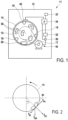
- Fig. 1
- a schematic front view onto a washing machine according to the invention with laundry items in it,
- Fig. 2
- a schematic drawing of the forces acting on one laundry item in the drum of the washing machine of
Fig. 1 , - Fig. 3
- a block diagram of a load redistribution algorithm,
- Fig. 4
- a block diagram of a load wetting algorithm,
- Fig. 5
- a block diagram of an improved washing algorithm,
- Fig. 6
- the motor current of the drive motor of the washing machine and the envelope of this motor current,
- Fig. 7
- schematical drawings of laundry items with a falling with paddle movement, a real sliding movement as well as a table for the coefficient of variation for both movements,
- Fig. 8
- both movements of
Fig. 7 with a motor current envelope for three and two turns, respectively, - Fig. 9
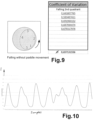
- a schematic drawing of a falling without paddle movement and the corresponding table of the coefficient of variation,
- Fig. 10
- the motor current envelope for the movement of
Fig. 9 , - Fig. 11
- a schematic drawing of a rotating of laundry items together with the drum and a corres-ponding table of the coefficient of variation for this movement,
- Fig. 12
- the motor current envelope for the movement of
Fig. 11 , - Fig. 13
- a comparison of various coefficients of variation for a falling with paddle movement for three turns, wherein each turn is divided into three thirds.
- From
Fig. 1 a schematic drawing of awashing machine 11 according to the invention can be taken.Washing machine 11 has ahousing 12 with arotating drum 14 in it being placed in afix drum receptacle 13 surrounding it.Drum 14 is rotated or driven, respectively, by adrive motor 16 withdrive belt 17 as is common in the art. On the inside ofdrum 14, threepaddles 19 forming well-known protrusions are provided in rib-like form or in the form of a triangle with a rounded tip pointing inside thedrum 14. Thepaddles 19 are shown in profile and can preferably have this form in a direction parallel to the rotation axis ofdrum 14. Thepaddles 19 are advantageous for the regular washing process, but are not absolutely necessary for the invention at hand. - Inside
drum 14,several laundry items 30 are shown being rotated and thrown about. This will be described in detail later. It corresponds to a normal process of rotating the drum with relatively low speed. - Drive
motor 16 is driven or energized bypower control unit 32, which again is controlled bywashing machine control 34, preferably being the main control of thewhole washing machine 11.Washing machine control 34 is connected to acurrent sensor 35, which is able to exactly supervise the drive current supplied to drivemotor 16 by thepower control unit 32. Such acurrent sensor 35 is known in the art and can be provided by the person skilled in the art without any problem. It may also be integrated into thepower control unit 32 or into thedrive motor 16 itself. - Integrated into
drive motor 16 may be a rotation position sensor means for supervising or detecting a rotation position of the drum, which is not shown here due to the integration. Such a rotation position sensor means can be integrated into thedrive motor 16 as is also common in the art, preferably as an incremental encoder. The rotation position sensor means is also connected to the centralwashing machine control 34.Washing machine control 34 is also provided with astorage 37 as mentioned before and will be explained in detail hereinafter, preferably being integrated into one semi-conductor component. - In
Fig. 2 , for better basic understanding of the invention, drum 14 is shown with alaundry item 30 in it. In reality, of course a plurality of laundry items will be in thedrum 14. A center of gravity or mass of thelaundry item 30 is at an angle α to the vertical axis as indicated by the dashed line.Laundry item 30 is abutted against the inside ofdrum 14 due to rotation of thedrum 14. The force of gravity FGR is pointing vertically downwards. The centrifugal force FCE generated by the rotation of thedrum 14 and depending on its rotation speed is pointing outwards in radial direction away from a center ofdrum 14 and through the center of gravity of thelaundry item 30. A frictional force FFR is pointing upwards from the region of contact oflaundry item 30 with the inside ofdrum 14 in a circumferential direction or in tangential direction, respectively, which is also at right angle to the centrifugal force FCE. A sliding force FSL is pointing in the opposite direction of the frictional force FFR. Thelaundry item 30 is moved counterclockwise withrotating drum 14 by the frictional force FFR, if it does not abut against apaddle 19. The sliding force FSL is pulling thelaundry item 30 downward again initiated by the gravity force FGR. When the fabric or the fibers oflaundry item 30 have a small friction coefficient and/orlaundry item 30 is lightweight, possibly because it does not take up much water, then there is not enough frictional force FFR. Inconsequence laundry item 30 is simply sliding down on the inside ofdrum 14, most probably also over apaddle 19. If a certain rotational speed is exceeded, thelaundry item 30 will be pressed by the centrifugal force FCE against the inside of thedrum 14 and will not move relative to thedrum 14 but rotate with it and with exactly the same rotational speed. - In a state when the
laundry item 30 is pressed against the inner wall of thedrum 14 and thus rotates exactly together with thedrum 14, any change in the rotational speed of the drum means a change in the kinetic energy of the system ofdrum 14 andlaundry item 30 combined. The more weight this combined system has, the more kinetic energy must be provided by thedrive motor 16. If only a relatively small quantity oflaundry item 30 is insidedrum 14, the required energy or momentary power of thedrive motor 16 to speed up the drum from the first low rotational speed to the second high rotational speed is significantly less than when a relatively large quantity oflaundry item 30 is insidedrum 14. This difference in the required energy or power, respectively, from thedrive motor 16 can be detected and can particularly be stored in thestorage 37 connected to thewashing machine control 34. If now in practice, thewashing machine 11 is loaded with an unknown quantity of laundry, this serves according to the invention to detect the power or energy requirement needed for this higher rotational speed and can be compared with memory values for the power or energy stored in thestorage 37. In the invention, it is provided that these values are not stored directly in relation to power or energy, but to current minimum, current maximum and average current. - In
Fig. 3 , a schematic method for redistributing laundry items in the drum is shown. This algorithm may specifically be selected by a user or by a washing program in case it is needed. At first, the amount of laundry items or the load, respectively, is chosen. This value is preferably detected in any way at the beginning of each washing or laundry treatment process, with the advantage that the laundry items are dry at this point. - In the next step, the corresponding coefficient of variation is chosen correlated with this load amount and with the behavior of the laundry items falling from the drum inner wall. In the next step, the steps B to F as described before are performed to find out whether such a falling movement has been detected or not. If it has been detected, then the laundry items need to be rotated faster to find an unbalance speed. If such a falling movement has not been detected, there are two possibilities of what the laundry items behavior might be. Next, it is detected whether the laundry items rotate together with the drum, so the values determined in steps B to F are compared with the suitable coefficient of variation for such a rotation movement. If this is the case, the drum is slowed down to allow the laundry items to fall down and not to rotate together with the drum. If no rotation movement has been detected, a corresponding coefficient of variation is taken for the detected load amount directed to a sliding movement of the laundry items. If the correlation between them is suitable, the sliding movement of the laundry items has been detected, which is but not what should be. In consequence, the rotational speed of the drum is increased again. If also no sliding movement has been detected, the rotational speed is kept constant and it is started for another time to try to detect such a falling movement. Alternatively, an error can be output or, as a further alternative, it is tried to use this as a case of falling movement. As a further alternative, the drum can be stopped and the whole procedure can be started once more to generate new values from performing the steps B to F.
- In
Fig. 4 , a load wetting algorithm is described, which has the aim that the wet laundry should rotate together with the drum. In the beginning, a value for the load amount in dry state is needed again. This can be done as described before. - In the next step, the coefficient of variation CV for a rotation movement of the laundry items is selected corresponding to this load amount. In the next step, it is checked whether the wetting phase has already started, which means that water is brought into the drum or directly onto the laundry items, respectively. If this has been the case, the steps B to F are performed again. At first, it is checked whether a rotation movement of the laundry items has been detected. If this is the case, then the rotational speed is kept constant. Preferably, more water can be brought onto the laundry items, such that in this wetting phase it is checked once more whether there still is a rotation movement. If, however, a rotation movement has not been detected, it is checked whether a falling movement can be detected. This can be done as described before. If such a falling movement of the laundry items has been detected, which means that the rotational speed is too low, this rotational speed is increased somewhat, for example for 10% to 30% or even 100%. After the increase, it is checked once more with the process according to steps B to F what kind of movement of the laundry items is to be found.
- If neither a rotation movement nor a falling movement has been detected, it is checked whether a sliding movement can be detected. Usually, the rotational speed for a sliding movement is lower than for a falling movement. If this is the case, then the rotational speed is also increased, preferably even stronger than in the case of a falling movement described before. This also serves to reach a rotation movement of the laundry items. If also no sliding movement can be detected, the steps B to F are performed once more to try to detect which kind of movement is present.
- In
Fig. 5 , another algorithm is shown which serves for an improved washing. At the beginning the load amount needs to be known as has been described before. After this, a coefficient of variation corresponding to this load amount and any movement required for the washing algorithm is chosen. This may be any of the three movements described before. - Next, the steps B to F are performed to find out whether the required movement has been detected or their coefficients of variation correspond to each other sufficiently. If this is the case, the rotational speed can be kept constant to continue with the same way or process in the washing process. If this is not the case, then the rotational speed or even the sense of rotation may be changed as described before.
- In
Fig. 6 , a typical curve for the motor current I is shown over the time in thin line. In thick line, the envelope curve of the motor current I is shown. This envelope curve is used for the algorithms and formulae described herein, because it can be used much better and easier. - In
Fig. 7 , a movement of a laundry item with five positions is shown corresponding to a falling movement. Furthermore, this is valid for the case that thewashing machine 11 haspaddles 19 as described initially. The laundry item starts to fall down betweenpoints point 3, the laundry item is still in contact with the inner wall of the drum, starts from there continuing to point 4 and then falling down topoint 5. - In the lower picture, a sliding movement of a laundry item is shown, which again is divided into five points. When compared to the falling movement, it is clear that no falling down takes place, but the laundry item is always in contact with the inner wall of the drum. It is simply turned over at least partly in this sliding process.
- In the right table of
Fig. 7 , the coefficient of variation is shown for ten points in the falling movement and for four points in the sliding movement, which is N in each case. A mean value µ is calculated from these, which is 0,524013276 and 0,284096412. The values for N and mean value µ can be used hereinafter for the formulae. It is indicated below for both movements, N is ten and four, respectively. - In
Fig. 8 , the envelope curve of the motor current I is shown over an increasing number of samples with three full turns for a falling movement with a paddle in the drum, and afterwards for two full turns for a real sliding movement. This shows according to the table ofFig. 7 that the coefficient of variation CV for the sliding movement is significantly less than for the falling movement. - In
Fig. 9 , the falling movement is shown for a washing machine without paddles. The difference compared toFig. 7 is that the laundry item starts to disconnect from the drum atpoint 3, which is but rather late in the second quarter of the turn. The corresponding current envelope of the motor current is shown inFig. 10 , which shows that the variation is even higher than inFig. 8 . Correspondingly, according to the table of the coefficient of variation according toFig. 9 , the numerical values are somewhat higher than inFig. 7 . - Then again in
Fig. 11 a movement of the laundry items together with the drum is shown. This is rather simple and means that the laundry item rotates exactly together with the drum without any relative movement, neither sliding nor falling.Fig. 12 shows the corresponding current envelope of the motor current I, which does not vary very much. The corresponding coefficient of variation CV which has again been calculated according to the formula described initially is again significantly higher than for the falling and for the sliding movement. - In
Fig. 13 , the coefficient of variation is shown for three situations corresponding to a movement of a laundry item with falling in a drum with paddles. As various laundry items are distributed in the drum not only in one single place, but particularly in more than one place, for example after each of the threepaddles 19, the CV varies for each of the thirds of each turn. It also varies for each turn again. This shows that no exact numerical values can be derived, but they nevertheless serve to detect movements of laundry items in the drum with sufficient accuracy.
Claims (15)
- A method for operating a washing machine, the washing machine comprising:- a drum,- a drive motor for the drum,- a power supply for the drive motor with monitoring of a motor current,- a washing machine control, wherein the washing machine control monitors and detects the motor current by means of the power supply,with the steps of:A the drum with laundry items in it is rotated by means of the drive motor and, in doing so, the motor current is constantly monitored and recorded, whereby the rotational position of the drum is also monitored and recorded,B a full revolution of the drum is divided into at least three rotation sections and the motor current is monitored and recorded for each of the rotation sections, whereby the rotation sections are preferably of equal size,C the drum is rotated for at least three full revolutions at a constant rotational speed, preferably continuously,D for the motor current determined for each rotation section, the envelope curve of this motor current is calculated, and from the envelope curve the standard deviation (σ) is calculated with a formula,E then the respective standard deviation (σ) is divided by the mean value (µ) of the motor current or of the envelope curve to determine the coefficient of variation (CV) for each rotation section,F by comparing the coefficient of variation (CV) for each rotation section that has been determined with stored values for the coefficient of variation, the behaviour of the laundry items is determined as to whether laundry items slide down the drum inner wall during rotation in the drum, fall from the drum inner wall or rotate together with the drum while remaining in substantially the same position on the drum inner wall,G from the determination of the behaviour of the laundry items, parameters are determined for the further operation of the washing machine with regard to the treatment of the laundry items, such as temperature, duration, rotational speed, type and quantity of additives used or the like.
- Method according to claim 1, wherein the formula for calculating the coefficient of variation (CV) is:

- Method according to claim 1 or 2, wherein the formula for calculating the Standard Deviation (σ) is:

- Method according to one of the preceding claims, characterised in that the drum is rotated for the three full revolutions at a rotational speed between 30 rpm and 90 rpm, preferably between 55 rpm and 65 rpm.
- Method according to one of the preceding claims, characterised in that the method with steps A to F is carried out several times for different rotational speeds in each case, in particular for increasing rotational speeds in each case, the rotational speeds preferably increasing by 10% to 100%.
- Method according to any one of the preceding claims, characterized in that the method detects whether the laundry items in the drum are sufficiently evenly distributed by using a predefined limit value for the coefficient of variation for comparison with the measured value for the coefficient of variation, and if the comparison falls below this predefined limit value, then the rotational speed for the drum is changed to redistribute laundry items in the drum for a more even distribution to compensate for imbalance of the laundry items in the drum.
- Method according to claim 6, characterized in that for the detection of the sufficiently even distribution of the laundry items in the drum the following is used: the initially determined weight of the laundry items, a stored value for the coefficient of variation (CV) for this determined weight of the laundry items and for the behaviour of the laundry items with falling from the drum inner wall, then the steps B to E are carried out in order to determine whether the value for the coefficient of variation (CV) determined in this way corresponds to the stored value, and- if this is not the case, the rotational speed and/or direction of rotation of the drum is changed, and- if this is the case, the drum is rotated faster for a high speed, especially for dry spinning.
- Method according to claim 6 or 7, characterised in that for the detection of the sufficiently even distribution of the laundry items in the drum the following is used: the weight of the laundry items determined at the beginning, a stored value for the coefficient of variation (CV) for this determined weight of the laundry items and for the behaviour of the laundry items with falling from the drum inner wall, then steps B to E are carried out in order to determine whether the value determined in this way for the coefficient of variation (CV) corresponds to the stored value, and- if this is the case, the drum is rotated faster for a high speed, especially for a dry spin, and- if this is not the case, a check is made as to whether the items of laundry rotate together with the drum, the weight of the laundry items being determined at the beginning, a stored value for the coefficient of variation (CV) for this determined weight of the laundry items and for the behaviour of the laundry items rotating with the drum being used, and then steps B to E are carried out to determine whether the value of the coefficient of variation (CV) thereby determined corresponds to the stored value for the behaviour of the laundry items with rotation together with the drum, and∘ if this is the case, the drum is rotated more slowly and then it is checked again to see if the laundry items still fall from the drum inner wall at the lower rotational speed, and∘ if this is not the case, steps B to E are carried out at constant rotational speed to determine whether the determined value for the coefficient of variation (CV) corresponds to the stored value for the behaviour of the laundry items with sliding down the drum inner wall, and▪ if this is the case, the drum is rotated faster and then checked again to see if the laundry still falls from the drum inner wall at the higher rotational speed, and▪ if this is not the case, a check is made in accordance with claim 7 to see whether the items of laundry still fall from the drum inner wall while the rotational speed remains the same.
- Method according to claim 7 or 8, characterised in that, in the event that a distribution of the laundry items is considered to be sufficiently uniform, a treatment process of the laundry items is further carried out, in particular a dry spinning process.
- Method according to one of the preceding claims, characterised in that a moistening of laundry items in the drum with water is monitored, preferably for the detection of the sufficiently uniform moistening of the laundry items in the drum: the weight of the laundry items determined at the beginning, a stored value for the coefficient of variation (CV) for this determined weight of the laundry items and for the behaviour of the laundry items with rotation together with the drum, then the laundry items are moistened by introducing water into the drum and/or onto the laundry items, then steps B to E are carried out to determine whether the value for the coefficient of variation (CV) determined in this way corresponds to the stored value for the behaviour of the laundry items with rotation together with the drum, and- if this is the case, the drum is rotated faster for a high speed, especially for a dry spinning process, and- if this is not the case, preferably the rotational speed and/or direction of rotation of the drum are changed.
- Method according to claim 10, characterised in that, in the event that the determined value for the coefficient of variation (CV) does not correspond to the stored value for the behaviour of the laundry items with rotation together with the drum, a check is made at constant rotational speed as to whether the laundry items fall from the drum inner wall, the weight of the laundry items determined at the beginning being used for this purpose, a stored value for the coefficient of variation (CV) for this determined weight of the laundry items and for the behaviour of the laundry items with falling from the drum inner wall is used, and then steps B to E are carried out in order to determine whether the value for the coefficient of variation (CV) determined in this way corresponds to the stored value for the behaviour of the laundry items with falling from the drum inner wall, and∘ if this is the case, the drum is rotated faster and then it is checked again to see whether the laundry items are still rotating together with the drum at the higher rotational speed, and∘ if this is not the case, steps B to E are carried out at constant rotational speed to determine whether the determined value for the coefficient of variation (CV) corresponds to the stored value for the behaviour of the laundry items with sliding down the drum inner wall, and▪ if this is the case, the drum is rotated faster and then it is checked again to see if the laundry items are still sliding down the drum inner wall at the higher rotational speed, and▪ if this is not the case, a check is made in accordance with claim 7 to see whether the laundry items are still rotating with the drum at the same rotational speed.
- Method according to one of the preceding claims, characterized in that a washing process for the laundry items in the drum with water is monitored, preferably using for the detection of the appropriate washing process for the laundry items in the drum: the weight of the laundry items determined at the beginning, a stored value for the coefficient of variation (CV) for this determined weight of the laundry items and for the behaviour of the laundry items desired for the washing process, then steps B to E are carried out to determine whether the value for the coefficient of variation (CV) determined in this way corresponds to the stored value for the desired behaviour of the laundry items, and- if this is the case, the drum is rotated at the same rotational speed and in the same direction for the next wash cycle, and- if this is not the case, the rotational speed and/or direction of rotation of the drum is changed.
- Method according to any one of the preceding claims, characterised in that the quantity or weight of the laundry items in the drum is determined in the beginning, preferably either by weighing or by monitoring the motor current as the drum with the laundry items in it rotates.
- Method according to any one of the preceding claims, characterized in that the coefficient of variation is used in addition to the standard deviation and the mean deviation.
- Washing machine comprising:- a drum,- a drive motor for the drum,- a power supply for the drive motor with monitoring of a motor current,- a washing machine control, wherein the washing machine control monitors and detects the motor current by means of the power supply,wherein the washing machine control is designed to perform the method according to any one of the preceding claims.
Priority Applications (5)
| Application Number | Priority Date | Filing Date | Title |
|---|---|---|---|
| PL23382122.2T PL4414495T3 (en) | 2023-02-10 | 2023-02-10 | Method for operating a washing machine and washing machine |
| EP23382122.2A EP4414495B1 (en) | 2023-02-10 | 2023-02-10 | Method for operating a washing machine and washing machine |
| US18/403,837 US20240271347A1 (en) | 2023-02-10 | 2024-01-04 | Method for operating a washing machine and washing machine |
| KR1020240016784A KR20240125447A (en) | 2023-02-10 | 2024-02-02 | Method for operating a washing machine and washing machine |
| CN202410163361.1A CN118480936A (en) | 2023-02-10 | 2024-02-05 | Method for operating a washing machine and washing machine |
Applications Claiming Priority (1)
| Application Number | Priority Date | Filing Date | Title |
|---|---|---|---|
| EP23382122.2A EP4414495B1 (en) | 2023-02-10 | 2023-02-10 | Method for operating a washing machine and washing machine |
Publications (2)
| Publication Number | Publication Date |
|---|---|
| EP4414495A1 true EP4414495A1 (en) | 2024-08-14 |
| EP4414495B1 EP4414495B1 (en) | 2025-11-19 |
Family
ID=85227332
Family Applications (1)
| Application Number | Title | Priority Date | Filing Date |
|---|---|---|---|
| EP23382122.2A Active EP4414495B1 (en) | 2023-02-10 | 2023-02-10 | Method for operating a washing machine and washing machine |
Country Status (5)
| Country | Link |
|---|---|
| US (1) | US20240271347A1 (en) |
| EP (1) | EP4414495B1 (en) |
| KR (1) | KR20240125447A (en) |
| CN (1) | CN118480936A (en) |
| PL (1) | PL4414495T3 (en) |
Citations (5)
| Publication number | Priority date | Publication date | Assignee | Title |
|---|---|---|---|---|
| EP1636410A1 (en) * | 2003-06-11 | 2006-03-22 | Askoll Holding S.r.l. | Method for detecting unbalanced conditions of a rotating load driven by a synchronous motor and for controlling said motor |
| US20130160216A1 (en) * | 2011-12-21 | 2013-06-27 | Whirlpool Corporation | Laundry treating appliance and method of control |
| EP2524989B1 (en) | 2011-05-17 | 2016-07-13 | Whirlpool Corporation | Method and apparatus for determining load fall in a laundry trating appliance |
| EP3608466A1 (en) | 2018-08-09 | 2020-02-12 | E.G.O. ELEKTRO-GERÄTEBAU GmbH | Laundry treating device and method for its operation |
| EP4008825A1 (en) | 2020-12-02 | 2022-06-08 | Miele & Cie. KG | Washing machine and method for operating a washing machine |
Family Cites Families (5)
| Publication number | Priority date | Publication date | Assignee | Title |
|---|---|---|---|---|
| US20090249560A1 (en) * | 2008-04-04 | 2009-10-08 | Ken Gaulter | Laundry water extractor speed limit control and method |
| KR101555588B1 (en) * | 2012-10-31 | 2015-10-06 | 엘지전자 주식회사 | Laundry treatment machine and the method for operating the same |
| JP2019154481A (en) * | 2018-03-07 | 2019-09-19 | パナソニックIpマネジメント株式会社 | Control method for controlling washing machine, control device and program |
| KR102824479B1 (en) * | 2019-12-20 | 2025-06-24 | 엘지전자 주식회사 | Controlling Method of Laundry Treatment Apparatus |
| CN113089256B (en) * | 2021-03-22 | 2022-03-01 | 珠海格力电器股份有限公司 | Washing machine dehydration control method and washing machine |
-
2023
- 2023-02-10 PL PL23382122.2T patent/PL4414495T3/en unknown
- 2023-02-10 EP EP23382122.2A patent/EP4414495B1/en active Active
-
2024
- 2024-01-04 US US18/403,837 patent/US20240271347A1/en not_active Abandoned
- 2024-02-02 KR KR1020240016784A patent/KR20240125447A/en active Pending
- 2024-02-05 CN CN202410163361.1A patent/CN118480936A/en active Pending
Patent Citations (5)
| Publication number | Priority date | Publication date | Assignee | Title |
|---|---|---|---|---|
| EP1636410A1 (en) * | 2003-06-11 | 2006-03-22 | Askoll Holding S.r.l. | Method for detecting unbalanced conditions of a rotating load driven by a synchronous motor and for controlling said motor |
| EP2524989B1 (en) | 2011-05-17 | 2016-07-13 | Whirlpool Corporation | Method and apparatus for determining load fall in a laundry trating appliance |
| US20130160216A1 (en) * | 2011-12-21 | 2013-06-27 | Whirlpool Corporation | Laundry treating appliance and method of control |
| EP3608466A1 (en) | 2018-08-09 | 2020-02-12 | E.G.O. ELEKTRO-GERÄTEBAU GmbH | Laundry treating device and method for its operation |
| EP4008825A1 (en) | 2020-12-02 | 2022-06-08 | Miele & Cie. KG | Washing machine and method for operating a washing machine |
Also Published As
| Publication number | Publication date |
|---|---|
| EP4414495B1 (en) | 2025-11-19 |
| US20240271347A1 (en) | 2024-08-15 |
| KR20240125447A (en) | 2024-08-19 |
| PL4414495T3 (en) | 2026-04-20 |
| CN118480936A (en) | 2024-08-13 |
Similar Documents
| Publication | Publication Date | Title |
|---|---|---|
| EP2083109B1 (en) | Drum type washing machine having ball balancers and controlling method of the same | |
| US5507054A (en) | Method for determining the mass of wet laundry in a laundry drum | |
| US6842929B2 (en) | Method for controlling washing in washing machine | |
| US8156592B2 (en) | Washing machine and method of controlling the same | |
| US7451510B2 (en) | Washing machine and method of performing spinning operation | |
| US6029299A (en) | Method for detecting cloth amount in drum washing machine | |
| US10837134B2 (en) | Washing machine and method of controlling the same | |
| US20040211009A1 (en) | Method and system for determinging a washing machine load unbalance | |
| EP0969133A1 (en) | A method of detecting imbalance in a drum of a washing machine | |
| EP0704568B1 (en) | Improvement in a washing machine with automatic determination of the weight of the wash load | |
| SE515954C2 (en) | Centrifuge to remove liquid from wet laundry | |
| US20090107185A1 (en) | Method and apparatus for determining an imbalance condition in an appliance | |
| CN112626796B (en) | Control method, device, washing machine and computer-readable storage medium for washing machine | |
| US20090249560A1 (en) | Laundry water extractor speed limit control and method | |
| US7251848B2 (en) | Method for controlling dehydrating operation of drum type washing machine | |
| US20040194226A1 (en) | Method for detecting dewatering load in washing machine and washing machine control method using the same | |
| US7263735B2 (en) | Washing machine control method and washing machine using the same | |
| EP4414495B1 (en) | Method for operating a washing machine and washing machine | |
| EP1461487B1 (en) | Method for determining unbalanced load | |
| EP4063552B1 (en) | Washing machine with linen mass determination | |
| EP4382657A1 (en) | Method of operating a washing machine and washing machine | |
| CN115516157B (en) | Method for operating a washing machine and washing machine | |
| CN113605045A (en) | Control method of clothes treatment equipment | |
| WO2022200928A1 (en) | Washing machine with linen mass determination | |
| CN121760165A (en) | Belt fault detection method and device of clothes treatment equipment and clothes treatment equipment |
Legal Events
| Date | Code | Title | Description |
|---|---|---|---|
| PUAI | Public reference made under article 153(3) epc to a published international application that has entered the european phase |
Free format text: ORIGINAL CODE: 0009012 |
|
| STAA | Information on the status of an ep patent application or granted ep patent |
Free format text: STATUS: REQUEST FOR EXAMINATION WAS MADE |
|
| 17P | Request for examination filed |
Effective date: 20231205 |
|
| AK | Designated contracting states |
Kind code of ref document: A1 Designated state(s): AL AT BE BG CH CY CZ DE DK EE ES FI FR GB GR HR HU IE IS IT LI LT LU LV MC ME MK MT NL NO PL PT RO RS SE SI SK SM TR |
|
| GRAP | Despatch of communication of intention to grant a patent |
Free format text: ORIGINAL CODE: EPIDOSNIGR1 |
|
| STAA | Information on the status of an ep patent application or granted ep patent |
Free format text: STATUS: GRANT OF PATENT IS INTENDED |
|
| RIC1 | Information provided on ipc code assigned before grant |
Ipc: D06F 33/32 20200101AFI20250711BHEP Ipc: D06F 34/18 20200101ALI20250711BHEP Ipc: D06F 103/46 20200101ALN20250711BHEP Ipc: D06F 105/46 20200101ALN20250711BHEP |
|
| INTG | Intention to grant announced |
Effective date: 20250801 |
|
| GRAS | Grant fee paid |
Free format text: ORIGINAL CODE: EPIDOSNIGR3 |
|
| GRAA | (expected) grant |
Free format text: ORIGINAL CODE: 0009210 |
|
| STAA | Information on the status of an ep patent application or granted ep patent |
Free format text: STATUS: THE PATENT HAS BEEN GRANTED |
|
| AK | Designated contracting states |
Kind code of ref document: B1 Designated state(s): AL AT BE BG CH CY CZ DE DK EE ES FI FR GB GR HR HU IE IS IT LI LT LU LV MC ME MK MT NL NO PL PT RO RS SE SI SK SM TR |
|
| REG | Reference to a national code |
Ref country code: CH Ref legal event code: F10 Free format text: ST27 STATUS EVENT CODE: U-0-0-F10-F00 (AS PROVIDED BY THE NATIONAL OFFICE) Effective date: 20251119 Ref country code: GB Ref legal event code: FG4D |
|
| REG | Reference to a national code |
Ref country code: DE Ref legal event code: R096 Ref document number: 602023008761 Country of ref document: DE |
|
| REG | Reference to a national code |
Ref country code: IE Ref legal event code: FG4D |
|
| REG | Reference to a national code |
Ref country code: NL Ref legal event code: MP Effective date: 20251119 |
|
| PG25 | Lapsed in a contracting state [announced via postgrant information from national office to epo] |
Ref country code: ES Free format text: LAPSE BECAUSE OF FAILURE TO SUBMIT A TRANSLATION OF THE DESCRIPTION OR TO PAY THE FEE WITHIN THE PRESCRIBED TIME-LIMIT Effective date: 20251119 |
|
| REG | Reference to a national code |
Ref country code: LT Ref legal event code: MG9D |
|
| PG25 | Lapsed in a contracting state [announced via postgrant information from national office to epo] |
Ref country code: NO Free format text: LAPSE BECAUSE OF FAILURE TO SUBMIT A TRANSLATION OF THE DESCRIPTION OR TO PAY THE FEE WITHIN THE PRESCRIBED TIME-LIMIT Effective date: 20260219 |
|
| PGFP | Annual fee paid to national office [announced via postgrant information from national office to epo] |
Ref country code: DE Payment date: 20260218 Year of fee payment: 4 |
|
| PG25 | Lapsed in a contracting state [announced via postgrant information from national office to epo] |
Ref country code: FI Free format text: LAPSE BECAUSE OF FAILURE TO SUBMIT A TRANSLATION OF THE DESCRIPTION OR TO PAY THE FEE WITHIN THE PRESCRIBED TIME-LIMIT Effective date: 20251119 Ref country code: AT Free format text: LAPSE BECAUSE OF FAILURE TO SUBMIT A TRANSLATION OF THE DESCRIPTION OR TO PAY THE FEE WITHIN THE PRESCRIBED TIME-LIMIT Effective date: 20251119 Ref country code: HR Free format text: LAPSE BECAUSE OF FAILURE TO SUBMIT A TRANSLATION OF THE DESCRIPTION OR TO PAY THE FEE WITHIN THE PRESCRIBED TIME-LIMIT Effective date: 20251119 |
|
| PGFP | Annual fee paid to national office [announced via postgrant information from national office to epo] |
Ref country code: AT Payment date: 20260301 Year of fee payment: 4 |
|
| REG | Reference to a national code |
Ref country code: AT Ref legal event code: MK05 Ref document number: 1858889 Country of ref document: AT Kind code of ref document: T Effective date: 20251119 |
|
| PG25 | Lapsed in a contracting state [announced via postgrant information from national office to epo] |
Ref country code: NL Free format text: LAPSE BECAUSE OF FAILURE TO SUBMIT A TRANSLATION OF THE DESCRIPTION OR TO PAY THE FEE WITHIN THE PRESCRIBED TIME-LIMIT Effective date: 20251119 |
|
| PG25 | Lapsed in a contracting state [announced via postgrant information from national office to epo] |
Ref country code: RS Free format text: LAPSE BECAUSE OF FAILURE TO SUBMIT A TRANSLATION OF THE DESCRIPTION OR TO PAY THE FEE WITHIN THE PRESCRIBED TIME-LIMIT Effective date: 20260219 |
|
| PG25 | Lapsed in a contracting state [announced via postgrant information from national office to epo] |
Ref country code: IS Free format text: LAPSE BECAUSE OF FAILURE TO SUBMIT A TRANSLATION OF THE DESCRIPTION OR TO PAY THE FEE WITHIN THE PRESCRIBED TIME-LIMIT Effective date: 20260319 |
|
| PGFP | Annual fee paid to national office [announced via postgrant information from national office to epo] |
Ref country code: TR Payment date: 20260206 Year of fee payment: 4 |
|
| PG25 | Lapsed in a contracting state [announced via postgrant information from national office to epo] |
Ref country code: PT Free format text: LAPSE BECAUSE OF FAILURE TO SUBMIT A TRANSLATION OF THE DESCRIPTION OR TO PAY THE FEE WITHIN THE PRESCRIBED TIME-LIMIT Effective date: 20260319 |
|
| PGFP | Annual fee paid to national office [announced via postgrant information from national office to epo] |
Ref country code: PL Payment date: 20260128 Year of fee payment: 4 |
|
| PG25 | Lapsed in a contracting state [announced via postgrant information from national office to epo] |
Ref country code: LV Free format text: LAPSE BECAUSE OF FAILURE TO SUBMIT A TRANSLATION OF THE DESCRIPTION OR TO PAY THE FEE WITHIN THE PRESCRIBED TIME-LIMIT Effective date: 20251119 |
|
| PG25 | Lapsed in a contracting state [announced via postgrant information from national office to epo] |
Ref country code: BG Free format text: LAPSE BECAUSE OF FAILURE TO SUBMIT A TRANSLATION OF THE DESCRIPTION OR TO PAY THE FEE WITHIN THE PRESCRIBED TIME-LIMIT Effective date: 20251119 |
|
| PG25 | Lapsed in a contracting state [announced via postgrant information from national office to epo] |
Ref country code: LT Free format text: LAPSE BECAUSE OF FAILURE TO SUBMIT A TRANSLATION OF THE DESCRIPTION OR TO PAY THE FEE WITHIN THE PRESCRIBED TIME-LIMIT Effective date: 20251119 |
|
| PG25 | Lapsed in a contracting state [announced via postgrant information from national office to epo] |
Ref country code: SM Free format text: LAPSE BECAUSE OF FAILURE TO SUBMIT A TRANSLATION OF THE DESCRIPTION OR TO PAY THE FEE WITHIN THE PRESCRIBED TIME-LIMIT Effective date: 20251119 |
|
| PG25 | Lapsed in a contracting state [announced via postgrant information from national office to epo] |
Ref country code: DK Free format text: LAPSE BECAUSE OF FAILURE TO SUBMIT A TRANSLATION OF THE DESCRIPTION OR TO PAY THE FEE WITHIN THE PRESCRIBED TIME-LIMIT Effective date: 20251119 |
|
| PG25 | Lapsed in a contracting state [announced via postgrant information from national office to epo] |
Ref country code: IT Free format text: LAPSE BECAUSE OF FAILURE TO SUBMIT A TRANSLATION OF THE DESCRIPTION OR TO PAY THE FEE WITHIN THE PRESCRIBED TIME-LIMIT Effective date: 20251119 |
|
| PG25 | Lapsed in a contracting state [announced via postgrant information from national office to epo] |
Ref country code: EE Free format text: LAPSE BECAUSE OF FAILURE TO SUBMIT A TRANSLATION OF THE DESCRIPTION OR TO PAY THE FEE WITHIN THE PRESCRIBED TIME-LIMIT Effective date: 20251119 |
|
| PG25 | Lapsed in a contracting state [announced via postgrant information from national office to epo] |
Ref country code: CZ Free format text: LAPSE BECAUSE OF FAILURE TO SUBMIT A TRANSLATION OF THE DESCRIPTION OR TO PAY THE FEE WITHIN THE PRESCRIBED TIME-LIMIT Effective date: 20251119 |
|
| PG25 | Lapsed in a contracting state [announced via postgrant information from national office to epo] |
Ref country code: SK Free format text: LAPSE BECAUSE OF FAILURE TO SUBMIT A TRANSLATION OF THE DESCRIPTION OR TO PAY THE FEE WITHIN THE PRESCRIBED TIME-LIMIT Effective date: 20251119 |
|
| PG25 | Lapsed in a contracting state [announced via postgrant information from national office to epo] |
Ref country code: SE Free format text: LAPSE BECAUSE OF FAILURE TO SUBMIT A TRANSLATION OF THE DESCRIPTION OR TO PAY THE FEE WITHIN THE PRESCRIBED TIME-LIMIT Effective date: 20251119 |