EP4414424A2 - Hydrogen sulfide scavengers for asphalt - Google Patents
Hydrogen sulfide scavengers for asphalt Download PDFInfo
- Publication number
- EP4414424A2 EP4414424A2 EP24185420.7A EP24185420A EP4414424A2 EP 4414424 A2 EP4414424 A2 EP 4414424A2 EP 24185420 A EP24185420 A EP 24185420A EP 4414424 A2 EP4414424 A2 EP 4414424A2
- Authority
- EP
- European Patent Office
- Prior art keywords
- asphalt
- branched
- metal
- sulfide
- straight
- Prior art date
- Legal status (The legal status is an assumption and is not a legal conclusion. Google has not performed a legal analysis and makes no representation as to the accuracy of the status listed.)
- Pending
Links
Classifications
-
- C—CHEMISTRY; METALLURGY
- C08—ORGANIC MACROMOLECULAR COMPOUNDS; THEIR PREPARATION OR CHEMICAL WORKING-UP; COMPOSITIONS BASED THEREON
- C08L—COMPOSITIONS OF MACROMOLECULAR COMPOUNDS
- C08L95/00—Compositions of bituminous materials, e.g. asphalt, tar, pitch
-
- C—CHEMISTRY; METALLURGY
- C08—ORGANIC MACROMOLECULAR COMPOUNDS; THEIR PREPARATION OR CHEMICAL WORKING-UP; COMPOSITIONS BASED THEREON
- C08J—WORKING-UP; GENERAL PROCESSES OF COMPOUNDING; AFTER-TREATMENT NOT COVERED BY SUBCLASSES C08B, C08C, C08F, C08G or C08H
- C08J3/00—Processes of treating or compounding macromolecular substances
- C08J3/20—Compounding polymers with additives, e.g. colouring
- C08J3/203—Solid polymers with solid and/or liquid additives
-
- C—CHEMISTRY; METALLURGY
- C08—ORGANIC MACROMOLECULAR COMPOUNDS; THEIR PREPARATION OR CHEMICAL WORKING-UP; COMPOSITIONS BASED THEREON
- C08K—Use of inorganic or non-macromolecular organic substances as compounding ingredients
- C08K3/00—Use of inorganic substances as compounding ingredients
- C08K3/18—Oxygen-containing compounds, e.g. metal carbonyls
- C08K3/20—Oxides; Hydroxides
- C08K3/22—Oxides; Hydroxides of metals
-
- C—CHEMISTRY; METALLURGY
- C08—ORGANIC MACROMOLECULAR COMPOUNDS; THEIR PREPARATION OR CHEMICAL WORKING-UP; COMPOSITIONS BASED THEREON
- C08K—Use of inorganic or non-macromolecular organic substances as compounding ingredients
- C08K3/00—Use of inorganic substances as compounding ingredients
- C08K3/18—Oxygen-containing compounds, e.g. metal carbonyls
- C08K3/24—Acids; Salts thereof
- C08K3/26—Carbonates; Bicarbonates
-
- C—CHEMISTRY; METALLURGY
- C08—ORGANIC MACROMOLECULAR COMPOUNDS; THEIR PREPARATION OR CHEMICAL WORKING-UP; COMPOSITIONS BASED THEREON
- C08K—Use of inorganic or non-macromolecular organic substances as compounding ingredients
- C08K5/00—Use of organic ingredients
- C08K5/04—Oxygen-containing compounds
- C08K5/09—Carboxylic acids; Metal salts thereof; Anhydrides thereof
- C08K5/098—Metal salts of carboxylic acids
-
- C—CHEMISTRY; METALLURGY
- C08—ORGANIC MACROMOLECULAR COMPOUNDS; THEIR PREPARATION OR CHEMICAL WORKING-UP; COMPOSITIONS BASED THEREON
- C08K—Use of inorganic or non-macromolecular organic substances as compounding ingredients
- C08K5/00—Use of organic ingredients
- C08K5/16—Nitrogen-containing compounds
- C08K5/34—Heterocyclic compounds having nitrogen in the ring
- C08K5/3467—Heterocyclic compounds having nitrogen in the ring having more than two nitrogen atoms in the ring
- C08K5/3477—Six-membered rings
-
- C—CHEMISTRY; METALLURGY
- C08—ORGANIC MACROMOLECULAR COMPOUNDS; THEIR PREPARATION OR CHEMICAL WORKING-UP; COMPOSITIONS BASED THEREON
- C08K—Use of inorganic or non-macromolecular organic substances as compounding ingredients
- C08K5/00—Use of organic ingredients
- C08K5/16—Nitrogen-containing compounds
- C08K5/34—Heterocyclic compounds having nitrogen in the ring
- C08K5/3467—Heterocyclic compounds having nitrogen in the ring having more than two nitrogen atoms in the ring
- C08K5/3477—Six-membered rings
- C08K5/3492—Triazines
-
- C—CHEMISTRY; METALLURGY
- C08—ORGANIC MACROMOLECULAR COMPOUNDS; THEIR PREPARATION OR CHEMICAL WORKING-UP; COMPOSITIONS BASED THEREON
- C08L—COMPOSITIONS OF MACROMOLECULAR COMPOUNDS
- C08L23/00—Compositions of homopolymers or copolymers of unsaturated aliphatic hydrocarbons having only one carbon-to-carbon double bond; Compositions of derivatives of such polymers
- C08L23/02—Compositions of homopolymers or copolymers of unsaturated aliphatic hydrocarbons having only one carbon-to-carbon double bond; Compositions of derivatives of such polymers not modified by chemical after-treatment
- C08L23/10—Homopolymers or copolymers of propene
- C08L23/12—Polypropene
-
- C—CHEMISTRY; METALLURGY
- C08—ORGANIC MACROMOLECULAR COMPOUNDS; THEIR PREPARATION OR CHEMICAL WORKING-UP; COMPOSITIONS BASED THEREON
- C08J—WORKING-UP; GENERAL PROCESSES OF COMPOUNDING; AFTER-TREATMENT NOT COVERED BY SUBCLASSES C08B, C08C, C08F, C08G or C08H
- C08J2395/00—Bituminous materials, e.g. asphalt, tar or pitch
-
- C—CHEMISTRY; METALLURGY
- C08—ORGANIC MACROMOLECULAR COMPOUNDS; THEIR PREPARATION OR CHEMICAL WORKING-UP; COMPOSITIONS BASED THEREON
- C08L—COMPOSITIONS OF MACROMOLECULAR COMPOUNDS
- C08L2555/00—Characteristics of bituminous mixtures
- C08L2555/20—Mixtures of bitumen and aggregate defined by their production temperatures, e.g. production of asphalt for road or pavement applications
- C08L2555/22—Asphalt produced above 140°C, e.g. hot melt asphalt
-
- C—CHEMISTRY; METALLURGY
- C08—ORGANIC MACROMOLECULAR COMPOUNDS; THEIR PREPARATION OR CHEMICAL WORKING-UP; COMPOSITIONS BASED THEREON
- C08L—COMPOSITIONS OF MACROMOLECULAR COMPOUNDS
- C08L2555/00—Characteristics of bituminous mixtures
- C08L2555/30—Environmental or health characteristics, e.g. energy consumption, recycling or safety issues
- C08L2555/32—Environmental burden or human safety, e.g. CO2 footprint, fuming or leaching
-
- C—CHEMISTRY; METALLURGY
- C08—ORGANIC MACROMOLECULAR COMPOUNDS; THEIR PREPARATION OR CHEMICAL WORKING-UP; COMPOSITIONS BASED THEREON
- C08L—COMPOSITIONS OF MACROMOLECULAR COMPOUNDS
- C08L2555/00—Characteristics of bituminous mixtures
- C08L2555/40—Mixtures based upon bitumen or asphalt containing functional additives
- C08L2555/50—Inorganic non-macromolecular ingredients
-
- C—CHEMISTRY; METALLURGY
- C08—ORGANIC MACROMOLECULAR COMPOUNDS; THEIR PREPARATION OR CHEMICAL WORKING-UP; COMPOSITIONS BASED THEREON
- C08L—COMPOSITIONS OF MACROMOLECULAR COMPOUNDS
- C08L2555/00—Characteristics of bituminous mixtures
- C08L2555/40—Mixtures based upon bitumen or asphalt containing functional additives
- C08L2555/60—Organic non-macromolecular ingredients, e.g. oil, fat, wax or natural dye
Definitions
- the present disclosure relates generally to scavengers of sulfur-based species, and more particularly to compounds that scavenge hydrogen sulfide and/or mercaptan vapors released from asphalt.
- Asphalt is commonly used in the construction and paving of roads.
- Asphalt is a mixture of aggregate material, such as sand, gravel, and crushed stone, with hot bitumen.
- the bitumen coats the aggregate material to give the asphalt, which may be spread as a uniform layer upon a road bed and compacted and smoothed with heavy rolling equipment.
- the amount of sulfur will depend on the origin of the crude oil, as well as the processes used to refine the crude oil, into asphalt.
- the sulfur may exist in different forms.
- sulfur may be in the form of hydrogen sulfide.
- Hydrogen sulfide, or dihydrogen sulfide is a chemical compound with the formula H 2 S. It is a colorless, poisonous, flammable gas with the characteristically regarded foul odor.
- Hydrogen sulfide may be released from asphalt, in particular when the asphalt is heated to a certain temperature.
- hydrogen sulfide results from the dehydrogenation reactions that occur between bitumen and sulfur at the hot mixing temperatures, for example temperatures greater than 140 °C.
- Hydrogen sulfide emissions are regulated. Therefore, there exists a need to reduce the amount of hydrogen sulfide in asphalt.
- a variety of polymers are used to treat / modify asphalt.
- the degree to which a polymer improves an asphalt's properties depends on the compatibility of the polymer and the asphalt; e.g., a polymer that does not separate in a mixture of asphalt and polymer during storage. Highly compatible or compatibilized polymers are more effective in providing property improvements.
- An extensive range of additives has been used for the purpose of "crosslinking" polymers and asphalts, thereby rendering the mixture compatible.
- sulfur is a well-known crosslinking agent.
- Polyphosphoric acid (H n+2 P n O 3n+1 ) is a polymer of orthophosphoric acid (H 3 PO 4 ).
- PPA polymer of orthophosphoric acid
- PPA offered commercially is a mixture of orthophosphoric acid with pyrophosphoric acid, triphosphoric and higher acids.
- Superphosphoric acid is a similar mixture sold at 105% H 3 PO 4 .
- Other grades of phosphoric acid may contain water, but are not typically used in asphalt modification. This eliminates issues of foaming and corrosion at the refinery or terminal.
- PPA's major applications are surfactant production, water treatment, pharmaceutical synthesis, pigment production, flame proofing, metals finishing and asphalt modification.
- PPA has been widely used in refineries to modify the performance properties of asphalt. Due to its strong acidity, however, the PPA would revert most H 2 S scavengers and allow undesirable release the hydrogen sulfide from scavenger treated asphalt.
- the present disclosure relates generally to scavengers of sulfur-based species and methods of using the scavengers.
- the disclosure provides a composition for reducing hydrogen sulfide emission from asphalt.
- the composition comprises a metal-containing compound; and a sulfide-scavenging agent selected from the group consisting of hexamethylenetetramine and a 1 ,3,5-triazine derivative of Formula I: wherein each of R 1 , R 2 , and R 3 is independently selected at each occurrence from hydrogen, straight or branched C 1 -C 30 alkyl, hydroxyl substituted straight or branched C 1 -C 30 alkyl, and straight or branched C 1 -C 30 alkyl substituted with straight or branched C 1 -C 30 alkoxy.
- the composition may further comprise asphalt.
- the asphalt may be polymer-treated asphalt.
- the asphalt may comprise PPA.
- the sulfide-scavenging agent comprises Formula I, and each of R 1 , R 2 , and R 3 is independently selected from straight or branched C 6 -C 30 alkyl, hydroxyl substituted straight or branched C 6 -C 30 alkyl, and straight or branched C 6 -C 30 alkoxy substituted with straight or branched C 1 -C 30 alkoxy.
- the sulfide-scavenging agent comprises Formula I, and each of R 1 , R 2 , and R 3 is selected from C 1 -C 9 straight or branched alkyl.
- the sulfide-scavenging agent comprises Formula I, and each of R 1 , R 2 , and R 3 is the same substituent, such as -CH 2 CH 2 OH. In certain embodiments, the sulfide-scavenging agent is hexamethylenetetramine.
- the composition further comprises a polar solvent.
- the polar solvent may be selected from the group consisting of diethylene glycol, 2-butoxyethanol, propylene glycol, monoethanol amine, and any combination thereof.
- the composition may comprise about 10 weight % to about 90 weight % of the sulfide-scavenging agent, about 1 weight % to about 50 weight % of the metal-containing compound, and optionally about 10 weight % to about 90 weight % of a solvent. Additionally, the composition may comprise about 30 weight % to about 60 weight % of the sulfide-scavenging agent, about 1 weight % to about 30 weight % of the metal-containing compound, and optionally about 30 weight % to about 60 weight % of a solvent. Further, the composition may comprise about 45 weight % of the sulfide-scavenging agent, about 10 weight % of the metal-containing compound, and optionally about 45 weight % of a solvent.
- the asphalt comprises about 0.1 weight % to about 10 weight % of the polymer, or about 0.1 weight % to about 5 weight % of the polymer, or about 1 weight % of the polymer.
- the present disclosure also provides a method of reducing hydrogen sulfide emission from asphalt.
- the method comprises combining asphalt with a composition, the composition comprising a metal-containing compound and a sulfide-scavenging agent selected from the group consisting of hexamethylenetetramine and a 1,3,5-triazine derivative of Formula I: wherein each of R 1 , R 2 , and R 3 is independently selected at each occurrence from hydrogen, straight or branched C 1 -C 30 alkyl, hydroxyl substituted straight or branched C 1 -C 30 alkyl, and straight or branched C 1 -C 30 alkyl substituted with straight or branched C 1 -C 30 alkoxy.
- the sulfide-scavenging agent is hexamethylenetetramine.
- the composition comprises a polar solvent.
- the asphalt is polymer-treated asphalt.
- the asphalt comprises PPA.
- the metal may be selected from the group consisting of Cu (II), Zn (II), Fe (II), Ni (II), Co (II), Mn (II), Ca (II), Mg (II), and any combination thereof.
- the metal-containing compound may be selected from the group consisting of copper acetate, copper bis-glycinate, zinc acetate, zinc bis-glycinate, zinc octoate, zinc 2-ethylhexanoate, copper 2-ethylhexanoate, iron 2-ethylhexanoate and any combination thereof.
- the metal-containing compound comprises copper acetate.
- composition, the metal-containing compound, and/or the sulfide-scavenging agent may be anhydrous.
- the present disclosure also provides a composition, comprising asphalt; a metal-containing compound; and a sulfide-scavenging agent selected from the group consisting of hexamethylenetetramine and a 1,3,5-triazine derivative of Formula I: wherein each of R 1 , R 2 , and R 3 is independently selected at each occurrence from hydrogen, straight or branched C 1 -C 30 alkyl, hydroxyl substituted straight or branched C 1 -C 30 alkyl, and straight or branched C 1 -C 30 alkyl substituted with straight or branched C 1 -C 30 alkoxy.
- the metal-containing compound may be copper acetate.
- the composition, the metal-containing compound, and/or the sulfide-scavenging agent may be anhydrous.
- the present disclosure also provides for the use of any composition disclosed herein in a method of reducing hydrogen sulfide emission from asphalt.
- the present disclosure relates to sulfide-scavenging compositions for use with asphalt.
- the compositions are particularly efficient at reducing hydrogen sulfide emissions of asphalt, including polymer-treated asphalt, such as PPA-treated asphalt.
- the present disclosure relates to compositions comprising a metal-containing compound, a sulfide-scavenging agent, and optionally asphalt, including polymer-treated asphalt, such as PPA-treated asphalt.
- the present disclosure also relates to methods of using the compositions to reduce hydrogen sulfide emission from asphalt, including polymer-treated asphalt, such as PPA-treated asphalt.
- alkyl refers to a hydrocarbon radical with a defined number of carbon atoms (i.e., 1, 2, 3, 4, 5, 6, 7, 8, 9, 10, 11, 12, 13, 14, 15, 16, 17, 18, 19, 20, 21, 22, 23, 24, 25, 26, 27, 28, 29, and 30 carbons).
- Branched alkyl groups include, but are not limited to, sec-butyl, tert-butyl, isobutyl, isopentyl, neopentyl, 1-methylbutyl, 2-methylbutyl, 1,1-dimethylpropyl, 1,2-dimethylpropyl, 1-ethylpropyl, 1-methylpentyl, 2-methylpentyl, 3-methylpentyl, 4-methylpentyl, 1,1-dimethylbutyl, 1,2-dimethylbutyl, 1,3-dimethylbutyl, 2,2-dimethylbutyl, 2,3-dimethylbutyl, 3,3-dimethylbutyl, 1,1,2-trimethylpropyl, 1,2,2-trimethylpropyl, 1-ethylbutyl, 2-ethylbutyl, 1-methylhexyl, 2-methylhexyl, 3-methylhexyl, 4-methylhexyl, 5-methylhexyl, 1,1-dimethylpent
- the number of carbon atoms for the alkyl group is between 6 and 30. In some embodiments, the number of carbon atoms for the alkyl group is between 6 and 20. In some embodiments, the number of carbon atoms for the alkyl group is between 6 and 15. In some embodiments, the number of carbon atoms for the alkyl group is between 6 and 10. In some embodiments, the number of carbon atoms for the alkyl group is between 6 and 8.
- alkoxyl refers to a ether radical with a defined number of carbon atoms (i.e., 1, 2, 3, 4, 5, 6, 7, 8, 9, 10, 11, 12, 13, 14, 15, 16, 17, 18, 19, 20, 21, 22, 23, 24, 25, 26, 27, 28, 29, and 30 carbons).
- Branched alkyl groups include, but are not limited to, sec-butoxy, tert-butoxy, isobutoxy, isopentoxy, neopentoxy, 1-methylbutoxy, 2-methoxybutoxy, 1,1-dimethylpropoxy, 1,2-dimethylpropoxy, 1-ethylpropoxy, 1-methylpentoxy, 2-methylpentoxy, 3-methylpentoxy, 4-methylpentoxy, 1,1-dimethylbutoxy, 1,2-dimethylbutoxy, 1,3-dimethylbutoxy, 2,2-dimethylbutoxy, 2,3-dimethylbutoxy, 3,3-dimethylbutoxy, 1,1,2-trimethylpropoxy, 1,2,2-trimethylpropoxy, 1-ethylbutoxy, 2-ethylbutoxy, 1-methylhexoxy, 2-methylhexoxy, 3-methylhexoxy, 4-methylhexoxy, 5-methylhexoxy, 1,1-dimethylpentoxy, 1,2-dimethylpentoxy, 1,3-dimethylpentoxy, 1,4-dimethyl
- the number of carbon atoms for the alkyl portion of the alkoxy group is between 6 and 30. In some embodiments, the number of carbon atoms for the alkyl group is between 6 and 20. In some embodiments, the number of carbon atoms for the alkyl group is between 6 and 15. In some embodiments, the number of carbon atoms for the alkyl group is between 6 and 10. In some embodiments, the number of carbon atoms for the alkyl group is between 6 and 8.
- Bitumen is a generic term defined by the ASTM as a class of black or dark-colored cementitious substances, natural or manufactured, composed principally of high molecular weight hydrocarbons, of which asphalts, tars, pitches and asphaltenes are typical.
- the ASTM further classifies asphalts or bituminous materials as solids, semi-solids, or liquids using a penetration test for consistency or viscosity.
- solid materials are those having a penetration of not more than 1 millimeter when a load of 100 grams is applied for 5 seconds while at 25 °C
- semi-solids are those having a penetration of more than 1 millimeter when a load of 50 grams is applied for 5 seconds while at 25 °C.
- asphalts predominate in commercial practice today.
- any asphalt bottoms fraction, as well as naturally occurring asphalts, tars and pitches and may be used interchangeably herein with the term “bitumen.”
- asphalt concrete means asphalt used as a binder with appropriate aggregate added, typically for use as a paving material.
- bottoms fraction refers to a crude fraction having a flash point of about 70 °F or greater.
- anhydrous refers to compositions where the amount of water present is less than about 10 weight %, such as less than about 7 weight %, less than about 5 weight %, less than about 4 weight %, less than about 3 weight %, less than about 2 weight %, less than about 1 weight %, or about 0 weight %.
- compositions disclosed herein comprise a metal-containing compound and a sulfide-scavenging agent.
- the compositions comprise asphalt, which could be polymer-treated asphalt, such as PPA-treated asphalt.
- the compositions may further comprise a solvent.
- the composition is anhydrous.
- the metal-containing compound is anhydrous.
- sulfide-scavenging agent is anhydrous.
- the sulfide-scavenging agent is selected from the group consisting of hexamethylenetetramine and 1,3,5-triazine derivatives of Formula I where each of R 1 , R 2 , and R 3 is independently selected at each occurrence from hydrogen, straight or branched C 1 -C 30 alkyl, hydroxyl substituted straight or branched C 1 -C 30 alkyl, straight or branched C 1 -C 30 alkyl substituted with straight or branched C 1 -C 30 alkoxy.
- the 1,3,5-triazine derivative is anhydrous.
- the sulfide-scavenging agent is hexamethylenetetramine (HMTA), which has the structure: Hexamethylenetetramine
- the sulfide-scavenging agent is a 1,3,5-triazine derivative of Formula I having the substituents for R 1 , R 2 , and R 3 defined above.
- the 1,3,5-triazine is anhydrous.
- each of R 1 , R 2 , and R 3 is independently selected from hydrogen or straight or branched C 1 -C 30 alkyl.
- each of each of R 1 , R 2 , and R 3 is independently selected from straight or branched C 6 -C 30 alkyl.
- each of R 1 , R 2 , and R 3 is CH 2 CH 2 OH.
- each of R 1 , R 2 , and R 3 is H.
- each of R 1 , R 2 , and R 3 is independently hydroxyl substituted straight or branched C 1 -C 30 alkyl. In some embodiments, each of R 1 , R 2 , and R 3 is independently hydroxyl substituted straight or branched C 6 -C 30 alkyl.
- each of R 1 , R 2 , and R 3 is independently straight or branched C 1 -C 30 alkyl substituted with straight or branched C 1 -C 30 alkoxy. In some embodiments, each of R 1 , R 2 , and R 3 is independently straight or branched C 6 -C 30 alkyl substituted with straight or branched C 1 -C 30 alkoxy. In some embodiments, each of R 1 , R 2 , and R 3 is independently straight or branched C 6 -C 30 alkyl substituted with straight or branched C 6 -C 30 alkoxy.
- each of R 1 , R 2 , and R 3 is the same. In some embodiments, R 1 is different from R 2 and R 3 . In some embodiments, R 1 and R 2 are the same. In some embodiments, R 1 and R 2 are the same and are also different from R 3 . In some embodiments, R 1 is different from R 2 and R 3 , and R 2 is different from R 3 .
- the metal-containing compound of the presently disclosed compositions is not particularly limited.
- the metal-containing compound comprises a metal carboxylate, a metal oxide, a metal carbonate, and any combination thereof.
- the metal-containing compound may comprise one or more metal carboxylates, such as a copper carboxylate, a zinc carboxylate, an iron carboxylate, and any combination thereof.
- the metal-containing compound may comprise one or more metal carboxylates and one or more metal oxides.
- the metal-containing compound may comprise one or more metal carboxylates, one or more metal oxides, and one or more metal carbonates.
- the metal-containing compound may comprise one or more metal carboxylates and one or more metal carbonates.
- the metal-containing compound may comprise one or more metal oxides, such as zinc oxide, copper oxide, iron oxide, and any combination thereof. In some embodiments, the metal-containing compound may comprise one or more metal oxides and one or more metal carbonates. In other embodiments, the metal-containing compound may comprise one or more metal carbonates, such as zinc carbonate, iron carbonate, copper carbonate, and any combination thereof.
- the metal of the metal-containing compound is not particularly limited.
- the metal comprises a divalent ion selected from, but not limited to, Cu (II), Zn (II), Fe (II), Ni (II), Co (II), Mn (II), Ca (II), Mg (II), and any combination thereof.
- the metal-containing compound comprises a member selected from the group consisting of copper, zinc, iron, and any combination thereof.
- the metal-containing compound comprises copper acetate, copper bis-glycinate, zinc acetate, zinc bis-glycinate, zinc 2-ethylhexanoate, copper 2-ethylhexanoate, iron 2-ethylhexanoate and any combination thereof.
- the metal-containing compound comprises zinc octoate.
- the molar ratio of zinc complexed with octanoic acid is not 1:2. In some embodiments, the ratio is from about 2.1:3 to about 1.97:3 (see, for example, U.S. Patent No. 8,246,813 , the entire contents of which are incorporated into the present disclosure in their entirety).
- carboxylates may be derived from various carboxylic acids.
- the carboxylic acids may comprise from 1 to about 20 carbon atoms.
- the carboxylic acids include various hydroxyl acids and amino acids, such as glycine, aspartic acid, citric acid, etc.
- the carboxylic acid is selected from the group consisting of carbonic acid, methanoic acid, ethanoic acid, propanoic acid, butanoic acid, pentanoic acid, hexanoic acid, heptanoic acid, octanoic acid, 2-ethyhexanoic acid, nonanoic acid, decanoic acid, undecanoic acid, dodecanoic acid, tridecanoic acid, tetradecanoic acid, pentadecanoic acid, hexadecanoic acid, heptadecanoic acid, octadecanoic acid, nonadecanoic acid, icosanoic acid, and any combination thereof.
- the carboxylic acid is selected from branched neo-acids, such as neodecanoic acid.
- the carboxylic acid is selected from an aromatic acid, such as benzoic acid and/or naphthoic acid, wherein the aromatic rings may include alkyl and alkoxy groups attached to them.
- the asphalt disclosed herein may be, but does not need to be, polymer-treated asphalt.
- one or more polymers may be added thereto to modify certain performance characteristics.
- the polymers include, but are not limited to, various rubbers, thermoplastic elastomers, elastomeric polymers, and any combination thereof.
- Elastomeric polymers include synthetic and/or natural rubbers, such as, but not limited to, polybutadiene, ethylene/vinyl acetate copolymers, polyacrylates, styrene-butadiene copolymers, polyolefins, and styrene-isoprene copolymers.
- the polymers comprise conjugated diene units and/or aromatic monovinyl hydrocarbon units.
- the polymer is PPA.
- the polymers may be crosslinked or may be free of crosslinks.
- agents that can be used to crosslink polymers such as, but not limited to, organic sulfur-containing crosslinkers, elemental sulfur crosslinkers, etc.
- the asphalt may comprise from about 0.1 weight % to about 10 weight % of the polymer. In some embodiments, the asphalt comprises from about 0.1 weight % to about 5 weight % of the polymer. In certain embodiments, the asphalt comprises about 1 weight % of the polymer.
- PPA is added to the asphalt.
- Acid modification of the asphalt generally results in asphalt compositions that exhibit improved low temperature performance.
- the asphalt composition may include less than or equal to about 10 wt. % acid. In some embodiments, the asphalt composition includes less than or equal to about 5 wt. % acid. In some embodiments, the asphalt composition includes less than or equal to about 3 wt. % acid. In some embodiments, the asphalt composition includes less than or about 1 wt. % acid and may include from about 0.01 wt. % to about 1 wt. % acid, from about 0.05 wt. % to about 1 wt. % acid, or from about 0.1 wt. % to about 1 wt. % acid, for example.
- compositions disclosed herein can optionally include one or more solvents.
- the solvent may be a polar solvent, for example.
- the solvent is selected from the group consisting of diethylene glycol, 2-butoxyethanol, propylene glycol, monoethanol amine, and any combination thereof.
- compositions disclosed herein can optionally include one or more additives.
- Suitable additives include, but are not limited to, asphaltene inhibitors, paraffin inhibitors, corrosion inhibitors, scale inhibitors, emulsifiers, water clarifiers, dispersants, emulsion breakers, gas hydrate inhibitors, biocides, pH modifiers, surfactants, and combinations thereof. Additional additives include sulfonating agents, crosslinking agents or combinations thereof.
- the asphalt composition may include from about 0.001 wt. % to about 5 wt. % of total additives or from about 0.01 wt. % to about 3 wt. % of total additives, for example.
- the crosslinking agents may be activators (e.g., zinc oxide), accelerators, such as sulfur compounds (e.g., mercaptobenzothizole (MBT)) or both accelerators and activators, such as a zinc salt of MBT, for example.
- activators e.g., zinc oxide
- accelerators such as sulfur compounds (e.g., mercaptobenzothizole (MBT))
- MBT mercaptobenzothizole
- the additives may further include unsaturated functional monomers, unsaturated carboxylic acids, unsaturated dicarboxylic acids, unsaturated anhydrides, unsaturated esters, unsaturated amides or combinations thereof, for example.
- compositions display synergy when used to scavenge hydrogen sulfide from asphalt, including polymer-treated asphalt, such as PPA-treated asphalt.
- the inventors discovered synergy between certain sulfide-scavenging agents and certain metal-containing compounds. For example, synergy was discovered when the metal-containing compound comprised a metal-carboxylate and when the sulfide-scavenging agent comprised the 1,3,5-triazine derivative of Formula I, where each of R 1 , R 2 and R 3 were a functionalized alkyl group.
- the compositions are made with anhydrous sulfide-scavenging agents to facilitate handling of PPA-treated asphalt and asphalt mixtures at temperatures around 250 °C.
- the temperature of the asphalt or asphalt mixture is less than about 200 °C.
- the temperature of the asphalt or asphalt mixture is less than about 150 °C.
- the temperature of the asphalt or asphalt mixture is less than about 100 °C.
- the temperature of the asphalt or asphalt mixture is less than about 90 °C.
- asphalt is heated in a first mixing vessel to a temperature of from about 140 °C to 205 °C.
- the asphalt concentrate may then be transferred to a second mixing vessel or remain in the first mixing vessel.
- PPA polymer
- the polymer may be added to the mixing vessel.
- the polymer is added in a timed release sufficient to avoid foaming, such as from about 20 minutes to about 1 hour, for example.
- the polymer can be added at any point in the process and to any vessel or conduit in the process.
- the polymer can be added to a first or second mixing vessel or to a conduit operably connecting the first and second mixing vessels.
- the sulfide-scavenging agent may then be added.
- the metal-containing compound may be added before, after, and/or with the sulfide-scavenging agent.
- the sulfide-scavenging agent and/or metal-containing compound can be added before, after, and/or when the polymer is added.
- the addition of the sulfide-scavenging agent and/or the metal-containing compound may occur with mixing for about 15 minutes to about 10 hours.
- the asphalt compositions described herein can be used for many applications, such as road paving, sealing, water proofing, asphalt cement and/or roofing, for example.
- Rxn Ratio was presented as the volume of additive vs Initial H 2 S.
- Rxn Ratio 1 means 1 vppm additive was added for 1 ppm initial H 2 S. 2
- the dosage of 100% copper acetate was determined by matching the same amount of copper acetate in the blended product.
- Rxn Ratio was presented as the volume of additive vs Initial H 2 S.
- Rxn Ratio 1 means 1 vppm additive was added for 1 ppm initial H 2 S. 2
- the dosage of 100% copper acetate was determined by matching the same amount of copper acetate in the blended product.
- a is intended to include “at least one” or “one or more.”
- a metal-containing compound is intended to include “at least one metal-containing compound” or “one or more metal-containing compounds.”
- the term "about” refers to the cited value being within the errors arising from the standard deviation found in their respective testing measurements, and if those errors cannot be determined, then “about” refers to within 10% of the cited value.
- a composition as disclosed herein consists essentially of (or consists of) a metal-containing compound and a sulfide-scavenging agent.
- a composition as disclosed herein consists essentially of (or consists of) a metal-containing compound, a sulfide-scavenging agent and a solvent.
- a composition as disclosed herein consists essentially of (or consists of) a metal-containing compound, a sulfide-scavenging agent, and asphalt.
- a composition as disclosed herein consists essentially of (or consists of) a metal-containing compound, a sulfide-scavenging agent, and polymer-treated asphalt. In some embodiments, a composition as disclosed herein consists essentially of (or consists of) a metal-containing compound, a sulfide-scavenging agent, polymer-treated asphalt, and a solvent.
- phrases "consist essentially of,” “consists essentially of,” “consisting essentially of,” and the like limit the scope of a claim to the specified materials or steps and those materials or steps that do not materially affect the basic and novel characteristic(s) of the claimed invention.
Landscapes
- Chemical & Material Sciences (AREA)
- Health & Medical Sciences (AREA)
- Chemical Kinetics & Catalysis (AREA)
- Medicinal Chemistry (AREA)
- Polymers & Plastics (AREA)
- Organic Chemistry (AREA)
- Engineering & Computer Science (AREA)
- Civil Engineering (AREA)
- Materials Engineering (AREA)
- Structural Engineering (AREA)
- Compositions Of Macromolecular Compounds (AREA)
- Solid-Sorbent Or Filter-Aiding Compositions (AREA)
Abstract
Description
- The present disclosure relates generally to scavengers of sulfur-based species, and more particularly to compounds that scavenge hydrogen sulfide and/or mercaptan vapors released from asphalt.
- Asphalt is commonly used in the construction and paving of roads. Asphalt is a mixture of aggregate material, such as sand, gravel, and crushed stone, with hot bitumen. The bitumen coats the aggregate material to give the asphalt, which may be spread as a uniform layer upon a road bed and compacted and smoothed with heavy rolling equipment.
- Asphalt invariably contains sulfur. The amount of sulfur will depend on the origin of the crude oil, as well as the processes used to refine the crude oil, into asphalt. The sulfur may exist in different forms. For example, sulfur may be in the form of hydrogen sulfide. Hydrogen sulfide, or dihydrogen sulfide, is a chemical compound with the formula H2S. It is a colorless, poisonous, flammable gas with the characteristically regarded foul odor.
- Hydrogen sulfide may be released from asphalt, in particular when the asphalt is heated to a certain temperature. For example, hydrogen sulfide results from the dehydrogenation reactions that occur between bitumen and sulfur at the hot mixing temperatures, for example temperatures greater than 140 °C. Hydrogen sulfide emissions are regulated. Therefore, there exists a need to reduce the amount of hydrogen sulfide in asphalt.
- A variety of polymers are used to treat / modify asphalt. The degree to which a polymer improves an asphalt's properties depends on the compatibility of the polymer and the asphalt; e.g., a polymer that does not separate in a mixture of asphalt and polymer during storage. Highly compatible or compatibilized polymers are more effective in providing property improvements. An extensive range of additives has been used for the purpose of "crosslinking" polymers and asphalts, thereby rendering the mixture compatible. For example, sulfur is a well-known crosslinking agent.
- Polyphosphoric acid (PPA) (Hn+2 PnO3n+1) is a polymer of orthophosphoric acid (H3PO4). PPA offered commercially is a mixture of orthophosphoric acid with pyrophosphoric acid, triphosphoric and higher acids. Superphosphoric acid is a similar mixture sold at 105% H3PO4. Other grades of phosphoric acid may contain water, but are not typically used in asphalt modification. This eliminates issues of foaming and corrosion at the refinery or terminal. PPA's major applications are surfactant production, water treatment, pharmaceutical synthesis, pigment production, flame proofing, metals finishing and asphalt modification.
- PPA has been widely used in refineries to modify the performance properties of asphalt. Due to its strong acidity, however, the PPA would revert most H2S scavengers and allow undesirable release the hydrogen sulfide from scavenger treated asphalt.
- The present disclosure relates generally to scavengers of sulfur-based species and methods of using the scavengers. In some embodiments, the disclosure provides a composition for reducing hydrogen sulfide emission from asphalt. The composition comprises a metal-containing compound; and a sulfide-scavenging agent selected from the group consisting of hexamethylenetetramine and a 1 ,3,5-triazine derivative of Formula I:

- The composition may further comprise asphalt. The asphalt may be polymer-treated asphalt. The asphalt may comprise PPA.
- In some embodiments, the sulfide-scavenging agent comprises Formula I, and each of R1, R2, and R3 is independently selected from straight or branched C6-C30 alkyl, hydroxyl substituted straight or branched C6-C30 alkyl, and straight or branched C6-C30 alkoxy substituted with straight or branched C1-C30 alkoxy. In certain embodiments, the sulfide-scavenging agent comprises Formula I, and each of R1, R2, and R3 is selected from C1-C9 straight or branched alkyl. In some embodiments, the sulfide-scavenging agent comprises Formula I, and each of R1, R2, and R3 is the same substituent, such as -CH2CH2OH. In certain embodiments, the sulfide-scavenging agent is hexamethylenetetramine.
- In some embodiments, the composition further comprises a polar solvent. The polar solvent may be selected from the group consisting of diethylene glycol, 2-butoxyethanol, propylene glycol, monoethanol amine, and any combination thereof.
- The composition may comprise about 10 weight % to about 90 weight % of the sulfide-scavenging agent, about 1 weight % to about 50 weight % of the metal-containing compound, and optionally about 10 weight % to about 90 weight % of a solvent. Additionally, the composition may comprise about 30 weight % to about 60 weight % of the sulfide-scavenging agent, about 1 weight % to about 30 weight % of the metal-containing compound, and optionally about 30 weight % to about 60 weight % of a solvent. Further, the composition may comprise about 45 weight % of the sulfide-scavenging agent, about 10 weight % of the metal-containing compound, and optionally about 45 weight % of a solvent.
- In some embodiments, the asphalt comprises about 0.1 weight % to about 10 weight % of the polymer, or about 0.1 weight % to about 5 weight % of the polymer, or about 1 weight % of the polymer.
- The metal of the metal-containing compound may be selected from the group consisting of Cu (II), Zn (II), Fe (II), Ni (II), Co (II), Mn (II), Ca (II), Mg (II), and any combination thereof. The metal-containing compound may comprise a member selected from the group consisting of a metal carboxylate, a metal oxide, a metal carbonate, and any combination thereof. The metal-containing compound may be selected from the group consisting of copper acetate, copper bis-glycinate, zinc acetate, zinc bis-glycinate, zinc octoate, zinc 2-ethylhexanoate, copper 2-ethylhexanoate, iron 2-ethylhexanoate and any combination thereof.
- The composition, the metal-containing compound and/or the sulfide-scavenging agent may be anhydrous.
- The present disclosure also provides a method of reducing hydrogen sulfide emission from asphalt. The method comprises combining asphalt with a composition, the composition comprising a metal-containing compound and a sulfide-scavenging agent selected from the group consisting of hexamethylenetetramine and a 1,3,5-triazine derivative of Formula I:

- In some embodiments, the sulfide-scavenging agent comprises Formula I, and each of R1, R2, and R3 is independently selected from straight or branched C6-C30 alkyl, hydroxyl substituted straight or branched C6-C30 alkyl, and straight or branched C6-C30 alkoxy substituted with straight or branched C1-C30 alkoxy. In some embodiments, the sulfide-scavenging agent comprises Formula I, and each of R1, R2, and R3 is the same substituent, such as -CH2CH2OH, R2 is -CH2CH2OH, and R3 is-CH2CH2OH.
- In some embodiments, the sulfide-scavenging agent is hexamethylenetetramine. In some embodiments, the composition comprises a polar solvent. In some embodiments, the asphalt is polymer-treated asphalt. In some embodiments, the asphalt comprises PPA.
- In accordance with the methods disclosed herein, the metal may be selected from the group consisting of Cu (II), Zn (II), Fe (II), Ni (II), Co (II), Mn (II), Ca (II), Mg (II), and any combination thereof. The metal-containing compound may be selected from the group consisting of copper acetate, copper bis-glycinate, zinc acetate, zinc bis-glycinate, zinc octoate, zinc 2-ethylhexanoate, copper 2-ethylhexanoate, iron 2-ethylhexanoate and any combination thereof. In some embodiments, the metal-containing compound comprises copper acetate.
- The composition, the metal-containing compound, and/or the sulfide-scavenging agent may be anhydrous.
- The present disclosure also provides a composition, comprising asphalt; a metal-containing compound; and a sulfide-scavenging agent selected from the group consisting of hexamethylenetetramine and a 1,3,5-triazine derivative of Formula I:

- The present disclosure also provides for the use of any composition disclosed herein in a method of reducing hydrogen sulfide emission from asphalt.
- The foregoing has outlined rather broadly the features and technical advantages of the present disclosure in order that the detailed description that follows may be better understood. Additional features and advantages of the disclosure will be described hereinafter that form the subject of the claims of this application. It should be appreciated by those skilled in the art that the conception and the specific embodiments disclosed may be readily utilized as a basis for modifying or designing other embodiments for carrying out the same purposes of the present disclosure. It should also be realized by those skilled in the art that such equivalent embodiments do not depart from the spirit and scope of the disclosure as set forth in the appended claims
- The present disclosure relates to sulfide-scavenging compositions for use with asphalt. The compositions are particularly efficient at reducing hydrogen sulfide emissions of asphalt, including polymer-treated asphalt, such as PPA-treated asphalt. The present disclosure relates to compositions comprising a metal-containing compound, a sulfide-scavenging agent, and optionally asphalt, including polymer-treated asphalt, such as PPA-treated asphalt. The present disclosure also relates to methods of using the compositions to reduce hydrogen sulfide emission from asphalt, including polymer-treated asphalt, such as PPA-treated asphalt.
- In accordance with the present disclosure, the term "alkyl" as used herein, refers to a hydrocarbon radical with a defined number of carbon atoms (i.e., 1, 2, 3, 4, 5, 6, 7, 8, 9, 10, 11, 12, 13, 14, 15, 16, 17, 18, 19, 20, 21, 22, 23, 24, 25, 26, 27, 28, 29, and 30 carbons). Branched alkyl groups include, but are not limited to, sec-butyl, tert-butyl, isobutyl, isopentyl, neopentyl, 1-methylbutyl, 2-methylbutyl, 1,1-dimethylpropyl, 1,2-dimethylpropyl, 1-ethylpropyl, 1-methylpentyl, 2-methylpentyl, 3-methylpentyl, 4-methylpentyl, 1,1-dimethylbutyl, 1,2-dimethylbutyl, 1,3-dimethylbutyl, 2,2-dimethylbutyl, 2,3-dimethylbutyl, 3,3-dimethylbutyl, 1,1,2-trimethylpropyl, 1,2,2-trimethylpropyl, 1-ethylbutyl, 2-ethylbutyl, 1-methylhexyl, 2-methylhexyl, 3-methylhexyl, 4-methylhexyl, 5-methylhexyl, 1,1-dimethylpentyl, 1,2-dimethylpentyl, 1,3-dimethylpentyl, 1,4-dimethylpentyl, 2,2-dimethylpentyl, 2,3-dimethylpentyl, 2,4-dimethylpentyl, 3,3-dimethylpentyl, 3,4-dimethylpentyl, 4,4-dimethylpentyl, 1,1,2-trimethylbutyl, 1,1,3-trimethylbutyl, 1,2,2-trimethylbutyl, 1,2,3-trimethylbutyl, 1,3,3-trimethylbutyl, 2,2,3-trimethylbutyl, 2,3,3-trimethylbutyl, 1,1,2,2-tetramethylpropyl, 1-ethylpentyl, 2-ethylpentyl, 3-ethylpentyl, 1-ethyl-1-methylbutyl, 1-ethyl-2-methylbutyl, 1-ethyl-3-methylbutyl, 2-ethyl-1-methylbutyl, 2-ethyl-2-methylbutyl, 2-ethyl-3-methylbutyl, 1-propylbutyl, 1,1-diethylpropyl, etc.
- In some embodiments, the number of carbon atoms for the alkyl group is between 6 and 30. In some embodiments, the number of carbon atoms for the alkyl group is between 6 and 20. In some embodiments, the number of carbon atoms for the alkyl group is between 6 and 15. In some embodiments, the number of carbon atoms for the alkyl group is between 6 and 10. In some embodiments, the number of carbon atoms for the alkyl group is between 6 and 8.
- The term "alkoxyl" as used herein, refers to a ether radical with a defined number of carbon atoms (i.e., 1, 2, 3, 4, 5, 6, 7, 8, 9, 10, 11, 12, 13, 14, 15, 16, 17, 18, 19, 20, 21, 22, 23, 24, 25, 26, 27, 28, 29, and 30 carbons). Branched alkyl groups include, but are not limited to, sec-butoxy, tert-butoxy, isobutoxy, isopentoxy, neopentoxy, 1-methylbutoxy, 2-methoxybutoxy, 1,1-dimethylpropoxy, 1,2-dimethylpropoxy, 1-ethylpropoxy, 1-methylpentoxy, 2-methylpentoxy, 3-methylpentoxy, 4-methylpentoxy, 1,1-dimethylbutoxy, 1,2-dimethylbutoxy, 1,3-dimethylbutoxy, 2,2-dimethylbutoxy, 2,3-dimethylbutoxy, 3,3-dimethylbutoxy, 1,1,2-trimethylpropoxy, 1,2,2-trimethylpropoxy, 1-ethylbutoxy, 2-ethylbutoxy, 1-methylhexoxy, 2-methylhexoxy, 3-methylhexoxy, 4-methylhexoxy, 5-methylhexoxy, 1,1-dimethylpentoxy, 1,2-dimethylpentoxy, 1,3-dimethylpentoxy, 1,4-dimethylpentoxy, 2,2-dimethylpentoxy, 2,3-dimethylpentoxy, 2,4-dimethylpentoxy, 3,3-dimethylpentoxy, 3,4-dimethylpentoxy, 4,4-dimethylpentoxy, 1,1,2-trimethylbutoxy, 1,1,3-trimethylbutoxy, 1,2,2-trimethylbutoxy, 1,2,3-trimethylbutoxy, 1,3,3-trimethylbutoxy, 2,2,3-trimethylbutoxy, 2,3,3-trimethylbutoxy, 1,1,2,2-tetramethylpropoxy, 1-ethylpentoxy, 2-ethylpentoxy, 3-ethylpentoxy, 1-ethyl-1-methylbutoxy, 1-ethyl-2-methylbutoxy, 1-ethyl-3-methylbutoxy, 2-ethyl-1-methylbutoxy, 2-ethyl-2-methylbutoxy, 2-ethyl-3-methylbutoxy, 1-propylbutoxy, 1,1-diethylpropoxy, etc.
- In some embodiments, the number of carbon atoms for the alkyl portion of the alkoxy group is between 6 and 30. In some embodiments, the number of carbon atoms for the alkyl group is between 6 and 20. In some embodiments, the number of carbon atoms for the alkyl group is between 6 and 15. In some embodiments, the number of carbon atoms for the alkyl group is between 6 and 10. In some embodiments, the number of carbon atoms for the alkyl group is between 6 and 8.
- As used herein, the term "asphalt" refers to any of a variety of materials that are solid or semisolid at room temperature and which gradually liquefy when heated, and in which the predominant constituents are naturally occurring bitumens (or kerogens) or which are bitumen like materials obtained as residue in petroleum refining. It is expressly contemplated that asphalt as used herein includes what ASTM defines as asphalt: a dark brown to black cementitious material in which the predominant constituents are bitumens that occur in nature or are obtained in petroleum processing. Asphalts characteristically contain very high molecular weight hydrocarbons called asphaltenes. These are essentially soluble in carbon disulfide, and aromatic and chlorinated hydrocarbons. Bitumen is a generic term defined by the ASTM as a class of black or dark-colored cementitious substances, natural or manufactured, composed principally of high molecular weight hydrocarbons, of which asphalts, tars, pitches and asphaltenes are typical. The ASTM further classifies asphalts or bituminous materials as solids, semi-solids, or liquids using a penetration test for consistency or viscosity. In this classification, solid materials are those having a penetration of not more than 1 millimeter when a load of 100 grams is applied for 5 seconds while at 25 °C, and semi-solids are those having a penetration of more than 1 millimeter when a load of 50 grams is applied for 5 seconds while at 25 °C. Semi-solid and liquid asphalts predominate in commercial practice today. For example, any asphalt bottoms fraction, as well as naturally occurring asphalts, tars and pitches and may be used interchangeably herein with the term "bitumen." The term "asphaltic concrete" means asphalt used as a binder with appropriate aggregate added, typically for use as a paving material.
- The term "bottoms fraction" refers to a crude fraction having a flash point of about 70 °F or greater.
- The term "anhydrous" as used herein, refers to compositions where the amount of water present is less than about 10 weight %, such as less than about 7 weight %, less than about 5 weight %, less than about 4 weight %, less than about 3 weight %, less than about 2 weight %, less than about 1 weight %, or about 0 weight %.
- The compositions disclosed herein comprise a metal-containing compound and a sulfide-scavenging agent. In some embodiments, the compositions comprise asphalt, which could be polymer-treated asphalt, such as PPA-treated asphalt. The compositions may further comprise a solvent. In some embodiments, the composition is anhydrous. In some embodiments, the metal-containing compound is anhydrous. In some embodiments, sulfide-scavenging agent is anhydrous.
- The sulfide-scavenging agent is selected from the group consisting of hexamethylenetetramine and 1,3,5-triazine derivatives of Formula I

- In some embodiments, the sulfide-scavenging agent is hexamethylenetetramine (HMTA), which has the structure:

- In some embodiments, the sulfide-scavenging agent is a 1,3,5-triazine derivative of Formula I

- In some embodiments, each of R1, R2, and R3 is independently hydroxyl substituted straight or branched C1-C30 alkyl. In some embodiments, each of R1, R2, and R3 is independently hydroxyl substituted straight or branched C6-C30 alkyl.
- In some embodiments, each of R1, R2, and R3 is independently straight or branched C1-C30 alkyl substituted with straight or branched C1-C30 alkoxy. In some embodiments, each of R1, R2, and R3 is independently straight or branched C6-C30 alkyl substituted with straight or branched C1-C30 alkoxy. In some embodiments, each of R1, R2, and R3 is independently straight or branched C6-C30 alkyl substituted with straight or branched C6-C30 alkoxy.
- In some embodiments, each of R1, R2, and R3 is the same. In some embodiments, R1 is different from R2 and R3. In some embodiments, R1 and R2 are the same. In some embodiments, R1 and R2 are the same and are also different from R3. In some embodiments, R1 is different from R2 and R3, and R2 is different from R3.
- The metal-containing compound of the presently disclosed compositions is not particularly limited. In some embodiments, the metal-containing compound comprises a metal carboxylate, a metal oxide, a metal carbonate, and any combination thereof.
- For example, in some embodiments, the metal-containing compound may comprise one or more metal carboxylates, such as a copper carboxylate, a zinc carboxylate, an iron carboxylate, and any combination thereof. In some embodiments, the metal-containing compound may comprise one or more metal carboxylates and one or more metal oxides. In some embodiments, the metal-containing compound may comprise one or more metal carboxylates, one or more metal oxides, and one or more metal carbonates. In some embodiments, the metal-containing compound may comprise one or more metal carboxylates and one or more metal carbonates.
- In additional embodiments, the metal-containing compound may comprise one or more metal oxides, such as zinc oxide, copper oxide, iron oxide, and any combination thereof. In some embodiments, the metal-containing compound may comprise one or more metal oxides and one or more metal carbonates. In other embodiments, the metal-containing compound may comprise one or more metal carbonates, such as zinc carbonate, iron carbonate, copper carbonate, and any combination thereof.
- The metal of the metal-containing compound is not particularly limited. In some embodiments, the metal comprises a divalent ion selected from, but not limited to, Cu (II), Zn (II), Fe (II), Ni (II), Co (II), Mn (II), Ca (II), Mg (II), and any combination thereof. In some embodiments, the metal-containing compound comprises a member selected from the group consisting of copper, zinc, iron, and any combination thereof.
- In some embodiments, the metal-containing compound comprises copper acetate, copper bis-glycinate, zinc acetate, zinc bis-glycinate, zinc 2-ethylhexanoate, copper 2-ethylhexanoate, iron 2-ethylhexanoate and any combination thereof. In some embodiments, the metal-containing compound comprises zinc octoate. In particular embodiments, the molar ratio of zinc complexed with octanoic acid is not 1:2. In some embodiments, the ratio is from about 2.1:3 to about 1.97:3 (see, for example,
U.S. Patent No. 8,246,813 , the entire contents of which are incorporated into the present disclosure in their entirety). - In accordance with the present disclosure, carboxylates may be derived from various carboxylic acids. In some embodiments, the carboxylic acids may comprise from 1 to about 20 carbon atoms. The carboxylic acids include various hydroxyl acids and amino acids, such as glycine, aspartic acid, citric acid, etc. In some embodiments, the carboxylic acid is selected from the group consisting of carbonic acid, methanoic acid, ethanoic acid, propanoic acid, butanoic acid, pentanoic acid, hexanoic acid, heptanoic acid, octanoic acid, 2-ethyhexanoic acid, nonanoic acid, decanoic acid, undecanoic acid, dodecanoic acid, tridecanoic acid, tetradecanoic acid, pentadecanoic acid, hexadecanoic acid, heptadecanoic acid, octadecanoic acid, nonadecanoic acid, icosanoic acid, and any combination thereof.
- In additional embodiments, the carboxylic acid is selected from branched neo-acids, such as neodecanoic acid. In some embodiments, the carboxylic acid is selected from an aromatic acid, such as benzoic acid and/or naphthoic acid, wherein the aromatic rings may include alkyl and alkoxy groups attached to them.
- The asphalt disclosed herein may be, but does not need to be, polymer-treated asphalt. Depending upon the desired application of the asphalt, one or more polymers may be added thereto to modify certain performance characteristics. The polymers include, but are not limited to, various rubbers, thermoplastic elastomers, elastomeric polymers, and any combination thereof. Elastomeric polymers include synthetic and/or natural rubbers, such as, but not limited to, polybutadiene, ethylene/vinyl acetate copolymers, polyacrylates, styrene-butadiene copolymers, polyolefins, and styrene-isoprene copolymers. In some embodiments, the polymers comprise conjugated diene units and/or aromatic monovinyl hydrocarbon units. In certain embodiments, the polymer is PPA.
- The polymers may be crosslinked or may be free of crosslinks. One of ordinary skill in the art understands the types of agents that can be used to crosslink polymers such as, but not limited to, organic sulfur-containing crosslinkers, elemental sulfur crosslinkers, etc.
- The asphalt may comprise from about 0.1 weight % to about 10 weight % of the polymer. In some embodiments, the asphalt comprises from about 0.1 weight % to about 5 weight % of the polymer. In certain embodiments, the asphalt comprises about 1 weight % of the polymer.
- In accordance with certain embodiments of the present disclosure, PPA is added to the asphalt. Acid modification of the asphalt generally results in asphalt compositions that exhibit improved low temperature performance. The asphalt composition may include less than or equal to about 10 wt. % acid. In some embodiments, the asphalt composition includes less than or equal to about 5 wt. % acid. In some embodiments, the asphalt composition includes less than or equal to about 3 wt. % acid. In some embodiments, the asphalt composition includes less than or about 1 wt. % acid and may include from about 0.01 wt. % to about 1 wt. % acid, from about 0.05 wt. % to about 1 wt. % acid, or from about 0.1 wt. % to about 1 wt. % acid, for example.
- The compositions disclosed herein can optionally include one or more solvents. The solvent may be a polar solvent, for example. In some embodiments, the solvent is selected from the group consisting of diethylene glycol, 2-butoxyethanol, propylene glycol, monoethanol amine, and any combination thereof.
- The compositions disclosed herein can optionally include one or more additives. Suitable additives include, but are not limited to, asphaltene inhibitors, paraffin inhibitors, corrosion inhibitors, scale inhibitors, emulsifiers, water clarifiers, dispersants, emulsion breakers, gas hydrate inhibitors, biocides, pH modifiers, surfactants, and combinations thereof. Additional additives include sulfonating agents, crosslinking agents or combinations thereof. The asphalt composition may include from about 0.001 wt. % to about 5 wt. % of total additives or from about 0.01 wt. % to about 3 wt. % of total additives, for example.
- The crosslinking agents may be activators (e.g., zinc oxide), accelerators, such as sulfur compounds (e.g., mercaptobenzothizole (MBT)) or both accelerators and activators, such as a zinc salt of MBT, for example.
- The additives may further include unsaturated functional monomers, unsaturated carboxylic acids, unsaturated dicarboxylic acids, unsaturated anhydrides, unsaturated esters, unsaturated amides or combinations thereof, for example.
- The inventors discovered that certain components of the compositions display synergy when used to scavenge hydrogen sulfide from asphalt, including polymer-treated asphalt, such as PPA-treated asphalt. Specifically, the inventors discovered synergy between certain sulfide-scavenging agents and certain metal-containing compounds. For example, synergy was discovered when the metal-containing compound comprised a metal-carboxylate and when the sulfide-scavenging agent comprised the 1,3,5-triazine derivative of Formula I, where each of R1, R2 and R3 were a functionalized alkyl group.
- In accordance with certain embodiments of the present disclosure, the compositions are made with anhydrous sulfide-scavenging agents to facilitate handling of PPA-treated asphalt and asphalt mixtures at temperatures around 250 °C. In some embodiments, the temperature of the asphalt or asphalt mixture is less than about 200 °C. In some embodiments, the temperature of the asphalt or asphalt mixture is less than about 150 °C. In some embodiments, the temperature of the asphalt or asphalt mixture is less than about 100 °C. In some embodiments, the temperature of the asphalt or asphalt mixture is less than about 90 °C.
- Illustrative, non-limiting methods of forming such asphalt compositions are described below. For example, in one embodiment, asphalt is heated in a first mixing vessel to a temperature of from about 140 °C to 205 °C. The asphalt concentrate may then be transferred to a second mixing vessel or remain in the first mixing vessel.
- PPA (or any other polymer disclosed herein) may be added to the mixing vessel. The polymer is added in a timed release sufficient to avoid foaming, such as from about 20 minutes to about 1 hour, for example. The polymer, however, can be added at any point in the process and to any vessel or conduit in the process. For example, the polymer can be added to a first or second mixing vessel or to a conduit operably connecting the first and second mixing vessels.
- The sulfide-scavenging agent may then be added. The metal-containing compound may be added before, after, and/or with the sulfide-scavenging agent. The sulfide-scavenging agent and/or metal-containing compound can be added before, after, and/or when the polymer is added. The addition of the sulfide-scavenging agent and/or the metal-containing compound may occur with mixing for about 15 minutes to about 10 hours.
- The asphalt compositions described herein can be used for many applications, such as road paving, sealing, water proofing, asphalt cement and/or roofing, for example.
- The compounds, compositions, methods, and processes will be better understood by reference to the following examples, which are intended to be illustrative, and not limiting upon the scope of the present disclosure.
- Sulfide emissions from PPA-treated asphalt were measured to examine the effectiveness of various sulfide scavengers. All H2S levels reported below and observed were measured by modified ASTM D5705 at annotated temperature and residual time.
- The H2S testing was conducted by adding 1 wt. % PPA to asphalt and keeping the mixture at 150 °C for 24 hours to allow any H2S release. At the end of this 24 hour period, the vapor phase H2S concentration of sample was determined and recorded as initial H2S. The composition comprising the sulfide-scavenging agent and metal-containing compound was then added to this PPA-treated asphalt sample, and the sample was kept at 150 °C for another 24 or 48 hours. The vapor phase H2S after this 24 or 48 hour period was measured and reported as final H2S.
- In a first set of experiments, the composition comprised copper acetate and a 1,3,5-triazine derivative of Formula I, where each of R1, R2 and R3 were CH2CH2OH. Results are shown in Tables 1 - 3.
Table 1: 95 weight % solvent diluted triazine with 5 weight % copper acetate Sample After PPA H2S Level / ppm RXN Ratio Dosage ppm Final H2S ppm Reduction 1 5000 0 0 5000 0% 2 5000 0.4 2000 1900 62% 3 5000 0.8 4000 800 84% 4 5000 1.2 6000 300 94% 5 5000 1.6 8000 0 100% Table 2: 92.5 weight % solvent diluted triazine with 7.5 weight % copper acetate Sample After PPA H2S Level / ppm RXN Ratio Dosage ppm Final H2S ppm Reduction 1 5500 0 0 5500 0% 2 5500 0.4 2200 1800 67% 3 5500 0.8 4400 480 91% 4 5500 1 5500 0 100% 5 5500 1.2 6600 0 100% 6 5500 1.4 7700 0 100% Table 3: 90 weight % solvent diluted triazine with 10 weight % copper acetate Sample After PPA H2S Level / ppm RXN Ratio Dosage ppm Final H2S ppm Reduction 1 5500 0 0 5500 0% 2 5500 0.4 2200 2100 62% 3 5500 0.6 3300 730 87% 4 5500 0.8 4400 150 97% 5 5500 1 5500 0 100% 6 5500 1.2 6600 0 100% - Similar experiments to those above were carried out using the triazine without the copper acetate. Results are shown in Table 4. As can be seen, the mixture of the triazine and copper acetate outperformed triazine alone.
Table 4: 95 weight % solvent diluted triazine Sampl e Additives Initial H2S/ppm Rxn Ratio Dosage / ppm Final H2S/pp m Reductio n 1 Blank 7500 0 0 9500 -27% 2 7500 0 0 7500 0% 9 Solvent diluted triazine 7500 1 7500 400 95% 10 7500 1 7500 620 92% 11 7500 2 15000 315 96% 12 7500 2 15000 390 95% 13 7500 3 22500 85 99% 14 7500 3 22500 100 99% 15 7500 3.5 26250 65 99% - In an additional set of experiments, one-gallon containers containing asphalt samples were placed in an oven at around 300 °F for at least about 10 hours to allow the samples to flow. Once the samples were sufficiently heated, a mechanical shaker agitated each sample for about 3 minutes to ensure thorough mixing.
- Each testing sample was then prepared by transferring about 500 ml asphalt into a quart metal can, which was already pre-dosed with about 0.5 ml of PPA. After the transfer, each can was immediately capped and shaken rigorously to mix the asphalt with the PPA.
- The sample cans were then placed back into an oven for at least about 30 minutes to improve the flowability of the asphalt. After reheating, one can was taken out and hand-shaken for about 50 counts followed by measuring of the H2S amount with a Draeger tube. This amount was recorded as initial H2S. The rest of the cans were then treated with different amounts of additives according to the initial H2S. The dosage of copper acetate was determined by matching the same amount of copper acetate in the blended product.
- The treated sample cans were then stored at about 300 °F for about 24 hours. At the end of this period, each can was removed from the oven and hand-shaken for about 50 counts followed by measuring of the H2S content. This H2S level was recorded as Final H2S. Results are depicted in Tables 1 and 2.

- 1The Rxn Ratio was presented as the volume of additive vs Initial H2S. E.g., Rxn Ratio = 1 means 1 vppm additive was added for 1 ppm initial H2S. 2The dosage of 100% copper acetate was determined by matching the same amount of copper acetate in the blended product. The detailed calculation was as follows:
Density (10% copper acetate + 90% water free triazine) = 1.204 g/ml


- 1The Rxn Ratio was presented as the volume of additive vs Initial H2S. E.g., Rxn Ratio = 1 means 1 vppm additive was added for 1 ppm initial H2S. 2The dosage of 100% copper acetate was determined by matching the same amount of copper acetate in the blended product. The detailed calculation was as follows: Density (10% copper acetate + 90% water free triazine) = 1.204 g/ml Copper acetate for Sample


- All of the compositions and methods disclosed and claimed herein can be made and executed without undue experimentation in light of the present disclosure. While this invention may be embodied in many different forms, there are described in detail herein specific preferred embodiments of the invention. The present disclosure is an exemplification of the principles of the invention and is not intended to limit the invention to the particular embodiments illustrated.
- Unless expressly stated to the contrary, use of the term "a" is intended to include "at least one" or "one or more." For example, "a metal-containing compound" is intended to include "at least one metal-containing compound" or "one or more metal-containing compounds."
- Any ranges given either in absolute terms or in approximate terms are intended to encompass both, and any definitions used herein are intended to be clarifying and not limiting. Notwithstanding that the numerical ranges and parameters setting forth the broad scope of the invention are approximations, the numerical values set forth in the specific examples are reported as precisely as possible. Any numerical value, however, inherently contains certain errors necessarily resulting from the standard deviation found in their respective testing measurements. Moreover, all ranges disclosed herein are to be understood to encompass any and all subranges (including all fractional and whole values) subsumed therein.
- As used herein, the term "about" refers to the cited value being within the errors arising from the standard deviation found in their respective testing measurements, and if those errors cannot be determined, then "about" refers to within 10% of the cited value.
- The terms "comprise(s)," "include(s)," "having," "has," "can," "contain(s)," and variants thereof, as used herein, are intended to be open-ended transitional phrases, terms, or words that do not preclude the possibility of additional acts or structures. The singular forms "a," "and" and "the" include plural references unless the context clearly dictates otherwise. The present disclosure also contemplates other embodiments "comprising," "consisting of" and "consisting essentially of," the embodiments or elements presented herein, whether explicitly set forth or not.
- For example, in some embodiments, a composition as disclosed herein consists essentially of (or consists of) a metal-containing compound and a sulfide-scavenging agent. In some embodiments, a composition as disclosed herein consists essentially of (or consists of) a metal-containing compound, a sulfide-scavenging agent and a solvent. In some embodiments, a composition as disclosed herein consists essentially of (or consists of) a metal-containing compound, a sulfide-scavenging agent, and asphalt. In some embodiments, a composition as disclosed herein consists essentially of (or consists of) a metal-containing compound, a sulfide-scavenging agent, and polymer-treated asphalt. In some embodiments, a composition as disclosed herein consists essentially of (or consists of) a metal-containing compound, a sulfide-scavenging agent, polymer-treated asphalt, and a solvent.
- In accordance with the present disclosure, the phrases "consist essentially of," "consists essentially of," "consisting essentially of," and the like limit the scope of a claim to the specified materials or steps and those materials or steps that do not materially affect the basic and novel characteristic(s) of the claimed invention.
- Furthermore, the invention encompasses any and all possible combinations of some or all of the various embodiments described herein. It should also be understood that various changes and modifications to the presently preferred embodiments described herein will be apparent to those skilled in the art. Such changes and modifications can be made without departing from the spirit and scope of the invention and without diminishing its intended advantages. It is therefore intended that such changes and modifications be covered by the appended claims.
-
- 1. A composition for reducing hydrogen sulfide emission from asphalt, comprising:
- (a) a metal-containing compound; and
- (b) a sulfide-scavenging agent selected from the group consisting of hexamethylenetetramine and a 1,3,5-triazine derivative of Formula I:

- 2. The composition of aspect 1, further comprising asphalt.
- 3. The composition of aspect 2, wherein the asphalt is polymer-treated asphalt.
- 4. The composition of aspect 2 or 3, wherein the asphalt comprises polyphosphoric acid.
- 5. The composition of any one of aspects 1 to 4, wherein the sulfide-scavenging agent comprises Formula I, and each of R1, R2, and R3 is independently selected from straight or branched C6-C30 alkyl, hydroxyl substituted straight or branched C6-C30 alkyl, and straight or branched C6-C30 alkoxy substituted with straight or branched C1-C30 alkoxy.
- 6. The composition of any one of aspects 1 to 4, wherein the sulfide-scavenging agent comprises Formula I, and each of R1, R2, and R3 is selected from C1-C9 straight or branched alkyl.
- 7. The composition of any one of aspects 1 to 6, wherein the sulfide-scavenging agent comprises Formula I, and each of R1, R2, and R3 is the same substituent.
- 8. The composition of any one of aspects 1, 2, 3, 4, 5 or 7, wherein R1 is - CH2CH2OH, R2 is -CH2CH2OH, and R3 is-CH2CH2OH.
- 9. The composition of any one of aspects 1 to 4, wherein the sulfide-scavenging agent is hexamethylenetetramine.
- 10. The composition of any one of aspects 1 to 9, further comprising a polar solvent selected from the group consisting of diethylene glycol, 2-butoxyethanol, propylene glycol, monoethanol amine, and any combination thereof.
- 11. The composition of aspect 1, wherein the composition comprises about 10 weight % to about 90 weight % of the sulfide-scavenging agent, about 1 weight % to about 50 weight % of the metal-containing compound, and optionally about 10 weight % to about 90 weight % of a solvent.
- 12. The composition of aspect 3, wherein the asphalt comprises about 0.1 weight % to about 10 weight % of the polymer.
- 13. The composition of any one of aspects 1 to 12, wherein the metal of the metal-containing compound is selected from the group consisting of Cu (II), Zn (II), Fe (II), Ni (II), Co (II), Mn (II), Ca (II), Mg (II), and any combination thereof.
- 14. The composition of any one of aspects 1 to 13, wherein the metal-containing compound comprises a member selected from the group consisting of a metal carboxylate, a metal oxide, a metal carbonate, and any combination thereof.
- 15. The composition of any one of aspects 1 to 14, wherein the metal-containing compound is selected from the group consisting of copper acetate, copper bis-glycinate, zinc acetate, zinc bis-glycinate, zinc octoate, zinc 2-ethylhexanoate, copper 2-ethylhexanoate, iron 2-ethylhexanoate and any combination thereof.
- 16. The composition of any one of aspects 1 to 15, wherein the composition, the metal-containing compound and/or the sulfide-scavenging agent is anhydrous.
- 17. A method of reducing hydrogen sulfide emission from asphalt, comprising: combining asphalt with a composition, the composition comprising a metal-containing compound and a sulfide-scavenging agent selected from the group consisting of hexamethylenetetramine and a 1,3,5-triazine derivative of Formula I:

- 18. The method of aspect 17, wherein the sulfide-scavenging agent comprises Formula I, and each of R1, R2, and R3 is independently selected from straight or branched C6-C30 alkyl, hydroxyl substituted straight or branched C6-C30 alkyl, and straight or branched C6-C30 alkoxy substituted with straight or branched C1-C30 alkoxy.
- 19. A composition, comprising:
- (a) asphalt;
- (b) a metal-containing compound; and
- (c) a sulfide-scavenging agent selected from the group consisting of hexamethylenetetramine and a 1,3,5-triazine derivative of Formula I:

- 20. Use of a composition according to any one of aspects 1 to 16 or claim 19 in a method of reducing hydrogen sulfide emission from asphalt.
Claims (12)
- A method of reducing hydrogen sulfide emission from asphalt, comprising the steps of:
combining asphalt with a composition, the composition comprising a metal-containing compound selected from the group consisting of copper carboxylate, iron carboxylate and mixtures thereof; and a sulfide-scavenging agent selected from the group consisting of hexamethylenetetramine and a 1,3,5-triazine derivative of Formula I: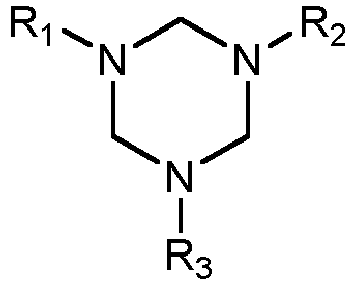
- The method of claim 1, wherein the sulfide-scavenging agent comprises a 1,3,5-triazine derivative of Formula I, wherein each of R1, R2, and R3 is independently selected from straight or branched C6-C30 alkyl, hydroxyl substituted straight or branched C6-C30 alkyl, and straight or branched C6-C30 alkoxy substituted with straight or branched C1-C30 alkoxy.
- The method of claim 1 or claim 2, wherein the asphalt is polymer-treated asphalt.
- The method of any one of the preceding claims, wherein the asphalt comprises polyphosphoric acid.
- The method of any one of the preceding claims, wherein each of R1, R2, and R3 is the same substituent.
- The method of any one of the preceding claims, wherein R1 is -CH2CH2OH, R2 is -CH2CH2OH, and R3 is -CH2CH2OH.
- The method of any one of the preceding claims, wherein the composition comprises a solvent selected from the group consisting of diethylene glycol, 2-butoxyethanol, propylene glycol, monoethanol amine, and any combination thereof.
- The method of any one of the preceding claims, wherein the composition comprises 10 weight % to 90 weight % of the sulfide-scavenging agent, 1 weight % to 50 weight % of the metal-containing compound.
- The method of claim 7 or claim 8, wherein the composition comprises 10 weight % to 90 weight % of the solvent.
- The method of any one of the preceding claims, wherein the metal-containing compound is selected from the group consisting of copper acetate, copper bis-glycinate, copper 2-ethylhexanoate, iron 2-ethylhexanoate and any combination thereof.
- The method of any one of the preceding claims, wherein the composition, the metal-containing compound and/or the sulfide-scavenging agent is anhydrous.
- The method of any one of the preceding claims, wherein the sulfide-scavenging agent comprises hexamethylenetetramine.
Applications Claiming Priority (3)
| Application Number | Priority Date | Filing Date | Title |
|---|---|---|---|
| US201962812108P | 2019-02-28 | 2019-02-28 | |
| PCT/US2020/019866 WO2020176604A1 (en) | 2019-02-28 | 2020-02-26 | Hydrogen sulfide scavengers for asphalt |
| EP20713477.6A EP3931257A1 (en) | 2019-02-28 | 2020-02-26 | Hydrogen sulfide scavengers for asphalt |
Related Parent Applications (1)
| Application Number | Title | Priority Date | Filing Date |
|---|---|---|---|
| EP20713477.6A Division EP3931257A1 (en) | 2019-02-28 | 2020-02-26 | Hydrogen sulfide scavengers for asphalt |
Publications (2)
| Publication Number | Publication Date |
|---|---|
| EP4414424A2 true EP4414424A2 (en) | 2024-08-14 |
| EP4414424A3 EP4414424A3 (en) | 2024-10-30 |
Family
ID=69941506
Family Applications (2)
| Application Number | Title | Priority Date | Filing Date |
|---|---|---|---|
| EP20713477.6A Pending EP3931257A1 (en) | 2019-02-28 | 2020-02-26 | Hydrogen sulfide scavengers for asphalt |
| EP24185420.7A Pending EP4414424A3 (en) | 2019-02-28 | 2020-02-26 | Hydrogen sulfide scavengers for asphalt |
Family Applications Before (1)
| Application Number | Title | Priority Date | Filing Date |
|---|---|---|---|
| EP20713477.6A Pending EP3931257A1 (en) | 2019-02-28 | 2020-02-26 | Hydrogen sulfide scavengers for asphalt |
Country Status (4)
| Country | Link |
|---|---|
| US (1) | US11981817B2 (en) |
| EP (2) | EP3931257A1 (en) |
| CA (1) | CA3130142A1 (en) |
| WO (1) | WO2020176604A1 (en) |
Families Citing this family (2)
| Publication number | Priority date | Publication date | Assignee | Title |
|---|---|---|---|---|
| EP4133014A1 (en) * | 2020-04-06 | 2023-02-15 | Hindustan Petroleum Corporation Limited | Sulphur additive and sulphur modified bitumen |
| KR20230079175A (en) * | 2020-10-02 | 2023-06-05 | 비엘 테크놀러지스 인크. | Polyphosphoric Acid (PPA) Resistant Sulfide Remover for Asphalt |
Citations (1)
| Publication number | Priority date | Publication date | Assignee | Title |
|---|---|---|---|---|
| US8246813B2 (en) | 2009-12-15 | 2012-08-21 | Nalco Company | Method of removing hydrogen sulfide |
Family Cites Families (58)
| Publication number | Priority date | Publication date | Assignee | Title |
|---|---|---|---|---|
| SU520365A1 (en) * | 1972-04-03 | 1976-07-05 | Институт органической химии Академии наук Киргизской ССР | The method of obtaining hexamethylenetetramine cooper |
| GB2137633B (en) | 1983-03-31 | 1986-10-29 | Exxon Research Engineering Co | Decreasing h2s emission in bitumen/sulphur mixtures |
| IT1197853B (en) | 1986-08-07 | 1988-12-21 | Ciba Geigy Spa | POLYTHRIAZIN COMPOUNDS CONTAINING PIPERIDYLYAMIDIN GROUPS AND THEIR USE AS POLYMER STABILIZERS |
| JPH0757863B2 (en) | 1987-12-29 | 1995-06-21 | 日本合成化学工業株式会社 | Pressure sensitive adhesive composition |
| US5000835A (en) | 1989-10-02 | 1991-03-19 | Exxon Chemical Patents, Inc. | Method of reducing H2 S in asphalt |
| RO113217B1 (en) | 1990-07-24 | 1998-05-29 | Quaker Chem Corp | Method for lowering sulphide content in residual gases |
| RU2014339C1 (en) * | 1991-11-15 | 1994-06-15 | Шаховец Сергей Евгеньевич | Method for regeneration of vulcanized elastomer wastes |
| US5213680A (en) | 1991-12-20 | 1993-05-25 | Baker Hughes Incorporated | Sweetening of oils using hexamethylenetetramine |
| US5314672A (en) | 1992-05-22 | 1994-05-24 | Sweetchem Corp. | Composition and method for sweetening hydrocarbons |
| CA2125513A1 (en) | 1993-07-30 | 1995-01-31 | Kishan Bhatia | Method of treating sour gas and liquid hydrocarbon streams |
| US5744024A (en) | 1995-10-12 | 1998-04-28 | Nalco/Exxon Energy Chemicals, L.P. | Method of treating sour gas and liquid hydrocarbon |
| US6414056B1 (en) * | 1998-05-08 | 2002-07-02 | Exxonmobil Research And Engineering Company | Asphalt compositions and method for making (LAW617) |
| EP1475415A1 (en) | 2003-05-07 | 2004-11-10 | SigmaKalon Services B.V. | Silyl esters, their use in binder systems and paint compositions and a process of production thereof |
| US20050143497A1 (en) | 2003-12-31 | 2005-06-30 | Butler James R. | Using excess levels of metal salts to improve properties when incorporating polymers in asphalt |
| US7517447B2 (en) | 2004-01-09 | 2009-04-14 | Clearwater International, Llc | Sterically hindered N-methylsecondary and tertiary amine sulfur scavengers and methods for making and using same |
| US7264786B2 (en) | 2004-04-21 | 2007-09-04 | Bj Services Company | Method of scavenging hydrogen sulfide and/or mercaptans from fluid and gas streams |
| US20060089429A1 (en) | 2004-10-22 | 2006-04-27 | Fina Technology, Inc. | Use of inorganic acids with crosslinking agents in polymer modified asphalts |
| US7544239B2 (en) * | 2004-12-01 | 2009-06-09 | Fina Technology, Inc. | Reduction of sulfur emissions from crude fractions |
| US7365111B2 (en) | 2004-12-23 | 2008-04-29 | Fina Technology, Inc. | Use of zinc oxide to improve compatibility of polymer modified asphalt crosslinked with phenol aldehyde resin |
| FR2881043B1 (en) | 2005-01-21 | 2007-04-27 | Corneal Ind Sa | FLEXIBLE INTRAOCULAR IMPLANT INJECTOR |
| US7438877B2 (en) | 2006-09-01 | 2008-10-21 | Baker Hughes Incorporated | Fast, high capacity hydrogen sulfide scavengers |
| WO2008039671A2 (en) | 2006-09-19 | 2008-04-03 | Invista Technologies S.A.R.L. | Polyamide composition with improved heat stability and whiteness |
| AR059003A1 (en) | 2007-01-12 | 2008-03-05 | Jose Jorge Gyarmathy | MICROBICIDE ACTIVATED BY BACTERIA PRODUCERS OF ACIDS FOR THE TREATMENT OF MASTITIS AND METRITIS IN BOVINE, OVINE AND CAPRINE LIVESTOCK |
| JP4388975B2 (en) | 2007-10-16 | 2009-12-24 | シャープ株式会社 | Electrophotographic photoreceptor containing triamine compound, image forming apparatus provided with the same, triamine compound and method for producing the same |
| US8523994B2 (en) * | 2007-12-11 | 2013-09-03 | Baker Hughes Incorporated | Method for reducing hydrogen sulfide evolution from asphalt |
| WO2009100356A1 (en) | 2008-02-06 | 2009-08-13 | Icl Performance Products Lp | Polyphosphate modifier for warm asphalt applications |
| US8034231B2 (en) * | 2008-02-20 | 2011-10-11 | Baker Hughes Incorporated | Method for reducing hydrogen sulfide evolution from asphalt |
| US20090242461A1 (en) * | 2008-03-28 | 2009-10-01 | Sherif Eldin | Hydrogen sulfide scavengers and methods for removing hydrogen sulfide from asphalt |
| FR2929616B1 (en) | 2008-04-08 | 2011-09-09 | Total France | PROCESS FOR CROSSLINKING BITUMEN / POLYMER COMPOSITIONS HAVING REDUCED EMISSIONS OF HYDROGEN SULFIDE |
| FR2942802B1 (en) | 2009-03-03 | 2012-06-01 | Total Raffinage Marketing | GRANULATED CROSSLINKING COMPOSITION FOR PREPARING RETICULATED BITUMEN / ELASTOMERIC COMPOSITIONS |
| AU2010233985B2 (en) | 2009-04-02 | 2015-11-19 | Basf Se | Method for reducing sunburn damage in plants |
| US20110160355A1 (en) | 2009-11-06 | 2011-06-30 | Jean-Valery Martin | Asphalt additive with improved performance |
| US8734637B2 (en) | 2010-03-12 | 2014-05-27 | Baker Hughes Incorporated | Method of scavenging hydrogen sulfide and/or mercaptans using triazines |
| US8211294B1 (en) | 2011-10-01 | 2012-07-03 | Jacam Chemicals, Llc | Method of removing arsenic from hydrocarbons |
| US8241491B1 (en) | 2011-10-01 | 2012-08-14 | Jacam Chemicals, Llc | Method of removing arsenic from hydrocarbons |
| FR2984342B1 (en) | 2011-12-20 | 2014-01-03 | Total Raffinage Marketing | PROCESS FOR PRODUCING A BITUMEN COMPOSITION / RETICULATED POLYMER WITH REDUCTION OF H2S EMISSIONS |
| CN102618202B (en) | 2012-04-01 | 2013-12-25 | 江阴市诺科科技有限公司 | Water-based polyurethane composite adhesive for tanning and preparation method and application of composite adhesive |
| CA2837992C (en) | 2012-12-19 | 2021-01-05 | Coastal Chemical Co., L.L.C. | Processes and compositions for scavenging hydrogen sulfide |
| CN109181671B (en) | 2013-01-31 | 2020-08-25 | 艺康美国股份有限公司 | Mobility control polymers for enhanced oil recovery |
| US9719027B2 (en) * | 2013-02-19 | 2017-08-01 | Baker Hughes Incorporated | Low viscosity metal-based hydrogen sulfide scavengers |
| KR101462545B1 (en) | 2013-06-26 | 2014-11-17 | 대성씨앤에스 주식회사 | Light-blocking agent composition for industrial use |
| CN104063362B (en) | 2013-07-18 | 2016-03-16 | 腾讯科技(深圳)有限公司 | A kind of truncation of a string method and device |
| US9243107B2 (en) | 2013-10-10 | 2016-01-26 | International Business Machines Corporation | Methods of preparing polyhemiaminals and polyhexahydrotriazines |
| FR3013051B1 (en) | 2013-11-12 | 2016-08-19 | Total Marketing Services | BITUMINOUS COMPOSITIONS BASED ON PHOSPHORIC DERIVATIVES |
| US9441092B2 (en) * | 2014-01-31 | 2016-09-13 | Innophos, Inc. | Hydrogen sulfide scavenger |
| US9783458B2 (en) | 2014-01-31 | 2017-10-10 | Innophos, Inc. | Hydrogen sulfide scavenger |
| US20170015811A1 (en) | 2014-01-31 | 2017-01-19 | Innophos Inc. | Hydrogen sulfide scavenger |
| US20170044444A1 (en) | 2014-02-13 | 2017-02-16 | Ecolab Usa Inc. | Process for scavenging hydrogen sulfide present in a fluid stream |
| US9592470B2 (en) | 2014-05-27 | 2017-03-14 | International Business Machines Corporation | Sulfur scavenging materials for filters and coatings |
| CN104031355A (en) | 2014-06-24 | 2014-09-10 | 大连理工大学 | Epoxy resin composition cured and modified by carboxyl-containing polyether nitrile sulphone ketone copolymer as well as preparation method and application of epoxy resin composition |
| CA2985693C (en) | 2015-05-14 | 2022-08-30 | Clariant International Ltd | Composition and method for scavenging sulfides and mercaptans |
| WO2016191672A1 (en) | 2015-05-28 | 2016-12-01 | Ecolab Usa Inc. | 2-substituted imidazole and benzimidazole corrosion inhibitors |
| US20170022109A1 (en) * | 2015-07-23 | 2017-01-26 | Baker Hughes Incorporated | Polyphosphoric acid resistant hydrogen sulfide scavenger for use in asphalt applications |
| EP3400260B2 (en) | 2016-01-08 | 2025-03-19 | Innophos, Inc. | Scavenger compositions for sulfur species |
| CN108779290B (en) | 2016-03-14 | 2021-03-12 | 通用电气(Ge)贝克休斯有限责任公司 | Metal-based hydrogen sulfide scavenger and method of making the same |
| ES2949241T3 (en) * | 2016-12-08 | 2023-09-26 | Ecolab Usa Inc | Hydrogen Sulfide Removers for Polymer Treated Asphalt |
| EP3562915B1 (en) * | 2016-12-31 | 2020-04-15 | Dorf Ketal Chemicals (India) Private Limited | Amine based hydrogen sulfide scavenging additive compositions of copper salts, and medium comprising the same |
| AU2018366253B2 (en) | 2017-11-13 | 2024-05-02 | Ecolab Usa Inc. | A novel one-pot homogeneous process for the large scale manufacture of 2-substituted benzimidazoles |
-
2020
- 2020-02-26 US US16/801,726 patent/US11981817B2/en active Active
- 2020-02-26 CA CA3130142A patent/CA3130142A1/en active Pending
- 2020-02-26 WO PCT/US2020/019866 patent/WO2020176604A1/en not_active Ceased
- 2020-02-26 EP EP20713477.6A patent/EP3931257A1/en active Pending
- 2020-02-26 EP EP24185420.7A patent/EP4414424A3/en active Pending
Patent Citations (1)
| Publication number | Priority date | Publication date | Assignee | Title |
|---|---|---|---|---|
| US8246813B2 (en) | 2009-12-15 | 2012-08-21 | Nalco Company | Method of removing hydrogen sulfide |
Also Published As
| Publication number | Publication date |
|---|---|
| WO2020176604A1 (en) | 2020-09-03 |
| US11981817B2 (en) | 2024-05-14 |
| EP4414424A3 (en) | 2024-10-30 |
| CA3130142A1 (en) | 2020-09-03 |
| EP3931257A1 (en) | 2022-01-05 |
| US20200277498A1 (en) | 2020-09-03 |
Similar Documents
| Publication | Publication Date | Title |
|---|---|---|
| CA2936894C (en) | Polyphosphoric acid resistant hydrogen sulfide scavenger for use in asphalt applications | |
| CA2708608C (en) | Method for reducing hydrogen sulfide evolution from asphalt | |
| US9334448B2 (en) | Method for reducing hydrogen sulfide evolution from asphalt and heavy fuel oils | |
| US8034231B2 (en) | Method for reducing hydrogen sulfide evolution from asphalt | |
| US11981817B2 (en) | Hydrogen sulfide scavengers for asphalt | |
| US10544282B2 (en) | Hydrogen sulfide scavengers for polymer treated asphalt | |
| EP4277967B1 (en) | Hydrogen sulfide scavengers | |
| BR112019011534B1 (en) | COMPOSITION, METHOD FOR REDUCING EMISSION OF HYDROGEN SULPHIDE FROM ASPHALT, AND, USE OF A COMPOSITION |
Legal Events
| Date | Code | Title | Description |
|---|---|---|---|
| PUAI | Public reference made under article 153(3) epc to a published international application that has entered the european phase |
Free format text: ORIGINAL CODE: 0009012 |
|
| STAA | Information on the status of an ep patent application or granted ep patent |
Free format text: STATUS: THE APPLICATION HAS BEEN PUBLISHED |
|
| AC | Divisional application: reference to earlier application |
Ref document number: 3931257 Country of ref document: EP Kind code of ref document: P |
|
| AK | Designated contracting states |
Kind code of ref document: A2 Designated state(s): AL AT BE BG CH CY CZ DE DK EE ES FI FR GB GR HR HU IE IS IT LI LT LU LV MC MK MT NL NO PL PT RO RS SE SI SK SM TR |
|
| REG | Reference to a national code |
Ref country code: DE Ref legal event code: R079 Free format text: PREVIOUS MAIN CLASS: C08L0095000000 Ipc: C08L0023080000 |
|
| PUAL | Search report despatched |
Free format text: ORIGINAL CODE: 0009013 |
|
| AK | Designated contracting states |
Kind code of ref document: A3 Designated state(s): AL AT BE BG CH CY CZ DE DK EE ES FI FR GB GR HR HU IE IS IT LI LT LU LV MC MK MT NL NO PL PT RO RS SE SI SK SM TR |
|
| RIC1 | Information provided on ipc code assigned before grant |
Ipc: C08L 95/00 20060101ALI20240920BHEP Ipc: C08K 5/3492 20060101ALI20240920BHEP Ipc: C08K 5/3477 20060101ALI20240920BHEP Ipc: C08K 5/098 20060101ALI20240920BHEP Ipc: C08K 3/26 20060101ALI20240920BHEP Ipc: C08K 3/20 20060101ALI20240920BHEP Ipc: C09D 195/00 20060101ALI20240920BHEP Ipc: C08L 23/08 20060101AFI20240920BHEP |
|
| STAA | Information on the status of an ep patent application or granted ep patent |
Free format text: STATUS: REQUEST FOR EXAMINATION WAS MADE |
|
| 17P | Request for examination filed |
Effective date: 20250404 |