EP4414420A1 - Vinylidene fluoride polymer solution - Google Patents
Vinylidene fluoride polymer solution Download PDFInfo
- Publication number
- EP4414420A1 EP4414420A1 EP22878413.8A EP22878413A EP4414420A1 EP 4414420 A1 EP4414420 A1 EP 4414420A1 EP 22878413 A EP22878413 A EP 22878413A EP 4414420 A1 EP4414420 A1 EP 4414420A1
- Authority
- EP
- European Patent Office
- Prior art keywords
- vinylidene fluoride
- fluoride polymer
- solvent
- less
- mass
- Prior art date
- Legal status (The legal status is an assumption and is not a legal conclusion. Google has not performed a legal analysis and makes no representation as to the accuracy of the status listed.)
- Granted
Links
Images
Classifications
-
- C—CHEMISTRY; METALLURGY
- C08—ORGANIC MACROMOLECULAR COMPOUNDS; THEIR PREPARATION OR CHEMICAL WORKING-UP; COMPOSITIONS BASED THEREON
- C08L—COMPOSITIONS OF MACROMOLECULAR COMPOUNDS
- C08L27/00—Compositions of homopolymers or copolymers of compounds having one or more unsaturated aliphatic radicals, each having only one carbon-to-carbon double bond, and at least one being terminated by a halogen; Compositions of derivatives of such polymers
- C08L27/02—Compositions of homopolymers or copolymers of compounds having one or more unsaturated aliphatic radicals, each having only one carbon-to-carbon double bond, and at least one being terminated by a halogen; Compositions of derivatives of such polymers not modified by chemical after-treatment
- C08L27/12—Compositions of homopolymers or copolymers of compounds having one or more unsaturated aliphatic radicals, each having only one carbon-to-carbon double bond, and at least one being terminated by a halogen; Compositions of derivatives of such polymers not modified by chemical after-treatment containing fluorine atoms
- C08L27/16—Homopolymers or copolymers or vinylidene fluoride
-
- C—CHEMISTRY; METALLURGY
- C08—ORGANIC MACROMOLECULAR COMPOUNDS; THEIR PREPARATION OR CHEMICAL WORKING-UP; COMPOSITIONS BASED THEREON
- C08F—MACROMOLECULAR COMPOUNDS OBTAINED BY REACTIONS ONLY INVOLVING CARBON-TO-CARBON UNSATURATED BONDS
- C08F214/00—Copolymers of compounds having one or more unsaturated aliphatic radicals, each having only one carbon-to-carbon double bond, and at least one being terminated by a halogen
- C08F214/18—Monomers containing fluorine
- C08F214/22—Vinylidene fluoride
-
- C—CHEMISTRY; METALLURGY
- C08—ORGANIC MACROMOLECULAR COMPOUNDS; THEIR PREPARATION OR CHEMICAL WORKING-UP; COMPOSITIONS BASED THEREON
- C08J—WORKING-UP; GENERAL PROCESSES OF COMPOUNDING; AFTER-TREATMENT NOT COVERED BY SUBCLASSES C08B, C08C, C08F, C08G or C08H
- C08J3/00—Processes of treating or compounding macromolecular substances
- C08J3/02—Making solutions, dispersions, lattices or gels by other methods than by solution, emulsion or suspension polymerisation techniques
- C08J3/09—Making solutions, dispersions, lattices or gels by other methods than by solution, emulsion or suspension polymerisation techniques in organic liquids
-
- C—CHEMISTRY; METALLURGY
- C08—ORGANIC MACROMOLECULAR COMPOUNDS; THEIR PREPARATION OR CHEMICAL WORKING-UP; COMPOSITIONS BASED THEREON
- C08J—WORKING-UP; GENERAL PROCESSES OF COMPOUNDING; AFTER-TREATMENT NOT COVERED BY SUBCLASSES C08B, C08C, C08F, C08G or C08H
- C08J5/00—Manufacture of articles or shaped materials containing macromolecular substances
- C08J5/18—Manufacture of films or sheets
-
- C—CHEMISTRY; METALLURGY
- C08—ORGANIC MACROMOLECULAR COMPOUNDS; THEIR PREPARATION OR CHEMICAL WORKING-UP; COMPOSITIONS BASED THEREON
- C08K—Use of inorganic or non-macromolecular organic substances as compounding ingredients
- C08K5/00—Use of organic ingredients
- C08K5/04—Oxygen-containing compounds
- C08K5/07—Aldehydes; Ketones
-
- C—CHEMISTRY; METALLURGY
- C08—ORGANIC MACROMOLECULAR COMPOUNDS; THEIR PREPARATION OR CHEMICAL WORKING-UP; COMPOSITIONS BASED THEREON
- C08K—Use of inorganic or non-macromolecular organic substances as compounding ingredients
- C08K5/00—Use of organic ingredients
- C08K5/04—Oxygen-containing compounds
- C08K5/10—Esters; Ether-esters
-
- C—CHEMISTRY; METALLURGY
- C09—DYES; PAINTS; POLISHES; NATURAL RESINS; ADHESIVES; COMPOSITIONS NOT OTHERWISE PROVIDED FOR; APPLICATIONS OF MATERIALS NOT OTHERWISE PROVIDED FOR
- C09D—COATING COMPOSITIONS, e.g. PAINTS, VARNISHES OR LACQUERS; FILLING PASTES; CHEMICAL PAINT OR INK REMOVERS; INKS; CORRECTING FLUIDS; WOODSTAINS; PASTES OR SOLIDS FOR COLOURING OR PRINTING; USE OF MATERIALS THEREFOR
- C09D127/00—Coating compositions based on homopolymers or copolymers of compounds having one or more unsaturated aliphatic radicals, each having only one carbon-to-carbon double bond, and at least one being terminated by a halogen; Coating compositions based on derivatives of such polymers
- C09D127/02—Coating compositions based on homopolymers or copolymers of compounds having one or more unsaturated aliphatic radicals, each having only one carbon-to-carbon double bond, and at least one being terminated by a halogen; Coating compositions based on derivatives of such polymers not modified by chemical after-treatment
- C09D127/12—Coating compositions based on homopolymers or copolymers of compounds having one or more unsaturated aliphatic radicals, each having only one carbon-to-carbon double bond, and at least one being terminated by a halogen; Coating compositions based on derivatives of such polymers not modified by chemical after-treatment containing fluorine atoms
- C09D127/16—Homopolymers or copolymers of vinylidene fluoride
Definitions
- the present invention relates to a vinylidene fluoride polymer solution.
- Vinylidene fluoride polymers are used in a wide range of applications for their excellent weather resistance and chemical resistance. However, vinylidene fluoride polymers are hardly dissolved in common solvents. Therefore, in a paint, a coating agent or the like, where dissolving vinylidene fluoride polymers are necessary, N-methylpyrrolidone (NMP) or acetone is used as a solvent.
- NMP N-methylpyrrolidone
- acetone is used as a solvent.
- acetone has a low flash point and boiling point, making it difficult to handle.
- NMP can easily dissolve vinylidene fluoride polymers and has a high boiling point.
- Hexamethylphosphoramide and dimethylsulfoxide are also known as solvents capable of dissolving a vinylidene fluoride polymer.
- these solvents also have relatively high freezing points, and thus cannot be said to be easily handled.
- Patent Document 1 describes a coating composition in which an acrylic resin and a vinylidene fluoride polymer are dissolved in cyclohexanone or the like.
- Patent Document 1 JP 03-220272 A
- An object is to provide a vinylidene fluoride polymer solution in which a vinylidene fluoride polymer is dissolved in a solvent that has a lower environmental impact and is easy to handle.
- the present invention provides a vinylidene fluoride polymer solution containing a vinylidene fluoride polymer and a solvent, the solvent including an affinity solvent having a molecular weight of 100 or more and containing at least one structure selected from ethers, ketones, and esters, and the vinylidene fluoride polymer satisfying the following (A) to (C):
- the present invention can provide a vinylidene fluoride polymer solution in which a vinylidene fluoride polymer is dissolved in a solvent that has a lower environmental impact and is easy to handle.
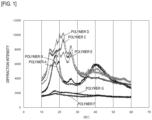
- FIG. 1 is an X-ray diffraction pattern obtained when X-ray diffraction measurement is performed on vinylidene fluoride polymers A to G prepared in Examples of the present application.
- the vinylidene fluoride polymer solution of the present invention a vinylidene fluoride polymer satisfying the below-described Requirements (A) to (C) is combined with a solvent containing an affinity solvent having a molecular weight of 100 or more and containing at least one structure selected from ethers, ketones, and esters.
- a solvent containing an affinity solvent having a molecular weight of 100 or more and containing at least one structure selected from ethers, ketones, and esters This makes it possible to easily dissolve the vinylidene fluoride polymer in the above solvent, improving the stability of the polymer.
- the vinylidene fluoride polymer solution will be described.
- the vinylidene fluoride polymer contained in the vinylidene fluoride polymer solution according to the present invention contains a structural unit derived from vinylidene fluoride and a structural unit derived from a fluorine-containing alkyl vinyl compound (Requirement (A)).
- the vinylidene fluoride polymer may contain at least a structure derived from vinylidene fluoride and a structure derived from one or more fluorine-containing alkyl vinyl compounds, and may be a binary copolymer of vinylidene fluoride and a fluorine-containing alkyl vinyl compound or a ternary copolymer of vinylidene fluoride, a fluorine-containing alkyl vinyl compound and another compound. Further, the ones obtained by adding an additive such as a polymer modifier to these copolymers may also be employed.
- a total amount of the structural units derived from vinylidene fluoride and the structural units derived from a fluorine-containing alkyl vinyl compound is preferably 90 mass% or more, more preferably 95 mass% or more, and still more preferably 97 mass% or more, with respect to all structural units of the vinylidene fluoride polymer.
- solubility of the vinylidene fluoride polymer in the solvent which will be described below, is likely to improve.
- an amount of the structural units derived from vinylidene fluoride in the vinylidene fluoride polymer is preferably from 40 to 75 mass%, and more preferably from 51 to 70 mass%. It is still more preferably from 55 to 68 mass%.
- the amount of the structural unit derived from vinylidene fluoride in the vinylidene fluoride polymer is 40 mass% or more, physical properties derived from vinylidene fluoride are likely to be exhibited.
- the amount of the structural unit derived from vinylidene fluoride in the vinylidene fluoride polymer is 75 mass% or less, an amount of the structure derived from a fluorine-containing alkyl vinyl compound becomes sufficiently large, and the solubility in the solvent described later is likely to be enhanced.
- the amount of the structural units derived from vinylidene fluoride in the vinylidene fluoride polymer can be specified by, for example, 19 F-NMR analysis or the like.
- the amount of the structural units derived from a fluorine-containing alkyl vinyl compound in the vinylidene fluoride polymer is preferably from 25 to 60 mass%, more preferably from 30 to 49 mass%, and still more preferably from 32 to 45 mass%.
- the amount of the structural units derived from a fluorine-containing alkyl compound in the vinylidene fluoride polymer is 25 mass% or more, the solubility in the solvent which will be described later is improved.
- the amount of the structural units derived from a fluorine-containing alkyl vinyl compound in the vinylidene fluoride polymer is 60 mass% or less, the amount of the structure derived from vinylidene fluoride becomes sufficiently large, and the physical properties derived from vinylidene fluoride are likely to be exhibited.
- the amount of the structural units derived from a fluorine-containing alkyl vinyl compound in the vinylidene fluoride polymer can be specified by, for example, 19 F-NMR analysis or the like.
- the fluorine-containing alkyl vinyl compound may be a compound having a vinyl group and a fluorine-containing alkyl group, and the vinylidene fluoride polymer may contain only one structural unit derived from a fluorine-containing alkyl vinyl compound, or may contain two or more structural units derived from a fluorine-containing alkyl vinyl compound.
- the fluorine-containing alkyl vinyl compound include vinyl fluoride, trifluoroethylene, tetrafluoroethylene, chlorotrifluoroethylene, hexafluoropropylene, fluoroalkyl vinyl ether, and perfluoroalkyl vinyl ether represented by perfluoromethyl vinyl ether.
- the vinylidene fluoride polymer may have a structural unit derived from a monomer other than the vinylidene fluoride and the fluorine-containing alkyl vinyl compound (hereinafter also referred to as "another monomer").
- another monomer examples of such another monomer also include an unsaturated basic acid and an unsaturated basic acid ester.
- the unsaturated basic acid may be an unsaturated carboxylic acid or a derivative thereof, and examples thereof include compounds with one or more carboxyl groups bonded by a linear or branched unsaturated alkylene group having from 1 to 6 carbon atoms. More specific examples of the unsaturated basic acid include acrylic acid, methacrylic acid, crotonic acid, maleic acid, fumaric acid, itaconic acid, and citraconic acid.
- the unsaturated basic acid ester is an ester compound derived from the unsaturated basic acid, and specific examples thereof include acrylic acid methyl ester, methacrylic acid methyl ester, maleic acid monomethyl ester, maleic acid monoethyl ester, maleic acid dimethyl ester, citraconic acid monomethyl ester, and citraconic acid monoethyl ester.
- the vinylidene fluoride polymer has a peak top in a range of 60°C or higher and lower than 100°C in a DSC curve obtained by differential scanning calorimetry in accordance with ASTM D3418 (Requirement (B)).
- a DSC curve is a curve obtained by performing differential scanning calorimetry while changing the temperature in accordance with ASTM D3418.
- the temperature range at the time of measurement can be usually from 20°C to 230°C.
- a group of measured values that is convex to an endothermic side with respect to a baseline is regarded as a peak.
- the definition of the baseline in differential scanning calorimetry will be indicated below.
- An average value of heat fluxes and an average value of temperatures at a plurality of measurement points in a range of 40°C or higher and 41°C or lower are each calculated.
- an average value of heat fluxes and an average value of temperatures at a plurality of measurement points in a range of 120°C or higher and 121°C or lower are each calculated.
- a straight line connecting two points of the average value of the values at the plurality of measurement points in the range of 40°C or higher and 41°C or lower and the average value of the values at the plurality of measurement points in the range of 120°C or higher and 121°C or lower calculated as described above is used as the baseline.
- measurement is desirably performed so that three or more measurement points are present in each temperature range (40°C or higher and 41°C or lower and 120°C or higher and 121°C or lower).
- the vinylidene fluoride polymer when the vinylidene fluoride polymer has a peak top in the range of 60°C or higher and lower than 100°C in the DSC curve, the vinylidene fluoride polymer is likely to soften or melt at 60°C or higher and lower than 100°C. That is, since a diffusion motion of a molecular chain of the vinylidene fluoride polymer is accelerated in the temperature range, swelling in the solvent and disentanglement are promoted, and the polymer is easily dissolved in the solvent which will be described later.
- the vinylidene fluoride polymer more preferably has a peak top in a range of 60°C or higher and 90°C or lower in the DSC curve.
- the amount of the structural unit derived from vinylidene fluoride and the amount of the structural unit derived from a fluorine-containing alkyl vinyl compound in the vinylidene fluoride polymer is preferable to adjust the amount of the structural unit derived from vinylidene fluoride and the amount of the structural unit derived from a fluorine-containing alkyl vinyl compound in the vinylidene fluoride polymer to the above-mentioned ranges.
- the vinylidene fluoride polymer has at least one local maximum value in a diffraction angle range of 10° or more and 19.9° or less in an X-ray diffraction pattern obtained by X-ray diffraction measurement, and a maximum diffraction intensity in a diffraction angle range of 22.5° or more and 30° or less is equal to or less than a maximum diffraction intensity in a diffraction angle range of 10° or more and 19.9° or less (Requirement (C)).
- the X-ray diffraction measurement is performed in accordance with JIS K0131: 1996.
- the expression "has at least one local maximum value in a diffraction angle range of 10° or more and 19.9° or less” means that the X-ray diffraction pattern has a peak and the local maximum value of the peak is present in the diffraction angle range of 10° or more and 19.9° or less.
- Whether the X-ray diffraction pattern has a peak is determined as follows. First, the baseline is specified as follows. Then, the diffraction intensity at a point on the baseline is compared with the diffraction intensity on the X-ray diffraction pattern at the same diffraction angle.
- the diffraction intensities at continuous five or more points on the X-ray diffraction pattern indicate a value of 1.5 times or more the corresponding diffraction intensities on the baseline
- a local maximum value is specified in a group of measured values in which the diffraction intensities at continuous five or more points on the X-ray diffraction pattern indicate a value of 1.5 times or more the diffraction intensities on the baseline, and it is determined whether or not the local maximum value falls within the diffraction angle range of 10° or more and 19.9° or less.
- the baseline in the X-ray diffraction measurement is defined as follows. An average value of diffraction angles and an average value of diffraction intensities at a plurality of measurement points in a diffraction angle range of 10.0° or more and less than 10.1° are each calculated. Similarly, an average value of diffraction angles and an average value of diffraction intensities at a plurality of measurement points in a diffraction angle range of 30.0° or more and less than 30.1° are each calculated. Then, a straight line connecting two points of the values of the diffraction angle and the diffraction intensity calculated as described above is used as the baseline.
- the average value of the values at the plurality of measurement points for calculating the baseline i.e., the average value of the values at the measurement points in the range of 10.0° or more and less than 10.1° and the average value of the values at the measurement points in the range of 30.0° or more and less than 30.1 ° are, desirably, each an average value of the values at five or more points.
- the weight of a sample used for measurement is 0.1 g or more, an accurate measurement value is easily obtained.
- the X-ray diffraction pattern of the vinylidene fluoride polymer represents a crystallization state of the vinylidene fluoride polymer.
- the position of the local maximum value of the diffraction intensity in the X-ray diffraction pattern varies depending on the type of crystal structure.
- the vinylidene fluoride polymer has a large number of local maximum values in a diffraction angle range of 10° or more and 30° or less as in the case of a vinylidene fluoride polymer D (homopolymer of vinylidene fluoride) in Examples which will be described later, it can be said that the vinylidene fluoride polymer includes a large number of crystal structures (see FIG. 1 ). A large amount of energy is required to dissolve such a vinylidene fluoride homopolymer in a solvent.
- the present inventors' studies have revealed that the solubility in the solvent which will be described below is low particularly when the vinylidene fluoride polymer includes a large number of crystal structures that appear in a diffraction angle range of 22.5° or more and 30° or less.
- the vinylidene fluoride polymer does not have a local maximum value in the X-ray diffraction pattern as in the case of a vinylidene fluoride polymer G in Examples which will be described later, the vinylidene fluoride polymer does not have a crystal structure and is rubbery (see FIG. 1 ). In such a vinylidene fluoride polymer, it is difficult for the solvent to enter the inside thereof, and the solubility of the vinylidene fluoride polymer in the solvent becomes low.
- the solubility in the solvent which will be described later becomes remarkably high. It is considered that such a vinylidene fluoride polymer has high solubility in the above-described solvent because it has a small number of crystal structures having low solubility in the solvent and the solvent can appropriately easily enter the inside of the vinylidene fluoride polymer.
- the vinylidene fluoride polymer satisfying Requirement (C) is easily obtained by adjusting the amount of the structural unit derived from vinylidene fluoride and the amount of the structural unit derived from a fluorine-containing alkyl vinyl compound in the vinylidene fluoride polymer to the above-described ranges.
- the treatment for destroying the crystal structure include a treatment for dissolving the prepared vinylidene fluoride polymer in a solvent such as acetone.
- a weight average molecular weight of the vinylidene fluoride polymer satisfying Requirements (A) to (C) is preferably 10000 or more and 2500000 or less, more preferably 50000 or more and 2000000 or less, and still more preferably 100000 or more and 1500000 or less.
- the weight average molecular weight is a value measured by gel permeation chromatography (GPC) calibrated with polystyrene.
- the vinylidene fluoride polymer satisfying the above Requirements (A) to (C) can be prepared by copolymerizing vinylidene fluoride, a fluorine-containing alkyl vinyl compound, and another compound as necessary by a known method.
- Examples of the method for copolymerizing them include suspension polymerization, emulsion polymerization, and solution polymerization.
- emulsion polymerization is preferable from the perspective that a vinylidene fluoride polymer satisfying the above-described Requirements (B) and (C) is easily obtained. Since the vinylidene fluoride polymer copolymerized by emulsion polymerization has a small primary particle size, the polymer is easily dispersed and has improved stability after dispersion.
- a solvent contained in the vinylidene fluoride polymer solution may contain at least an affinity solvent having a molecular weight of 100 or more and containing at least one structure selected from ethers, ketones, and esters, and may partially include another solvent as long as the objects and effects of the present invention are not impaired.
- an amount of the affinity solvent with respect to a total amount of the solvent is preferably 80 mass% or more, and more preferably 90 mass% or more.
- the molecular weight of the affinity solvent is 100 or more, even a solvent having an ether, a ketone, or an ester as a polar group has an appropriately reduced polarity, and thus the affinity with the vinylidene fluoride polymer is enhanced.
- the molecular weight of the affinity solvent is preferably 100 or more and 251 or less, more preferably 100 or more and 201 or less, and still more preferably 100 or more and 161 or less.
- the affinity solvent may include only one of ethers, ketones, and esters, or may include two or more thereof.
- the solvent may include only one affinity solvent or two or more affinity solvents.
- an octanol/water partition coefficient LogP of the affinity solvent is preferably 0 or more, more preferably 0 or more and 4 or less, still more preferably 0 or more and 3 or less, and even still further preferably 0.5 or more and 2.9 or less.
- the octanol/water partition coefficient of the affinity solvent is 0 or more, the water content of the vinylidene fluoride polymer solution is low, and the stability of the vinylidene fluoride polymer solution is likely to be enhanced.
- the octanol/water partition coefficient LogP is a common logarithm value (Log(CoZCw)) of a ratio between a concentration Co of the affinity solvent in an octanol phase and a concentration Cw of the affinity solvent in a water phase when the affinity solvent is dissolved in a two phase system of octanol and water and brought into equilibrium at 25°C.
- affinity solvent examples include solvents including ketones such as diisobutyl ketone (molecular weight: 142, LogP: 2.56), methyl isobutyl ketone (molecular weight: 100, LogP: 1.31) and isophorone (molecular weight: 138, LogP: 1.67); esters such as ethylmethyl carbonate (molecular weight: 104, LogP: 1.21), amyl acetate (molecular weight: 130, LogP: 2.18), ethyl butyrate (molecular weight: 116, LogP: 1.85), butyl butyrate (molecular weight: 144, LogP: 2.8), isopropyl acetate (molecular weight: 102, LogP: 1.3) and ethyl propionate (molecular weight: 102, LogP: 1.21); and esters and ethers such as 2-butoxyethyl acetate (molecular weight: 160, LogP: 1.51).
- ketones such
- the vinylidene fluoride polymer solution may contain a component other than the vinylidene fluoride polymer and the solvent in accordance with its use as long as the objects and effects of the present invention are not impaired.
- the vinylidene fluoride polymer solution may further contain another type of resin such as an acrylic resin, a filler such as an inorganic filler, various additives, and the like.
- a concentration of the vinylidene fluoride polymer in the vinylidene fluoride polymer solution is not particularly limited, but is preferably 30 mass% or less. When the concentration of the vinylidene fluoride polymer is in this range, an undissolved residue or the like of the vinylidene fluoride polymer is unlikely to be generated, and the stability of the vinylidene fluoride polymer is likely to be enhanced. Furthermore, the vinylidene fluoride polymer solution can be easily used in various applications.
- a haze value of the vinylidene fluoride polymer solution is preferably 18% or less, more preferably 15% or less, and still more preferably 10% or less.
- the haze value of the vinylidene fluoride polymer solution is 18% or less, it can be said that the vinylidene fluoride polymer is sufficiently dissolved in the solvent.
- the haze value is 18% or less, precipitation, separation, or the like of the vinylidene fluoride polymer is unlikely to occur even with the lapse of time.
- the haze value of the vinylidene fluoride polymer solution was measured using NDH2000 available from Nippon Denshoku Industries Co., Ltd. in accordance with ISO 14782.
- a method for preparing the vinylidene fluoride polymer solution is not particularly limited, and the vinylidene fluoride polymer solution can be prepared by mixing a vinylidene fluoride polymer and a solvent by a known method to dissolve the vinylidene fluoride polymer in the solvent.
- the vinylidene fluoride polymer and the solvent are preferably mixed at a temperature of 40°C or higher and 150°C or lower, and the temperature is more preferably 60°C or higher and 100°C or lower. When the temperature is 60°C or higher, the vinylidene fluoride polymer is easily softened or dissolved. On the other hand, when the temperature is 100°C or lower, the solvent is unlikely to evaporate excessively, and a vinylidene fluoride polymer solution having a desired composition is likely to be obtained.
- the mixing time is preferably 3 minutes or more and 3 hours or less, more preferably 5 minutes or more and 2 hours or less, from the perspective of production efficiency.
- the vinylidene fluoride polymer satisfying the above-described Requirements (A) to (C) and the solvent including the above-described affinity solvent are combined, it does not take much time when the vinylidene fluoride polymer is dissolved in the solvent, and the stability of the obtained vinylidene fluoride polymer solution can also be improved.
- the application of the vinylidene fluoride polymer solution is not particularly limited, and the vinylidene fluoride polymer solution can be used in various applications such as paints and coating agents, and various binders for non-aqueous electrolyte secondary batteries and all-solid-state batteries.
- Vinylidene fluoride polymers A to G were prepared by the following method.
- An autoclave was charged with 0.2 parts by mass of disodium hydrogen phosphate (Na2HPO4) and 330 parts by mass of water. After the degassing, 0.003 parts by mass of polyoxyethylene alkylene alkyl ether, 0.1 parts by mass of ethyl acetate, 8.7 parts by mass of vinylidene fluoride (VDF), and 38.0 parts by mass of hexafluoropropylene (HFP) were charged into the autoclave. Then, the temperature in the autoclave was raised to 80°C under stirring, and 0.06 parts by mass of ammonium persulfate (APS) was charged to initiate polymerization.
- Na2HPO4 disodium hydrogen phosphate
- HFP hexafluoropropylene
- VDF-HFP copolymer vinylidene fluoride-hexafluoropropylene copolymer
- a resin concentration of the latex was 20.6 mass%, and an average particle size of the VDF-HFP copolymer in the latex was 221 nm.
- the average particle size of the VDF-HFP copolymer is a value derived by 50 times of integration using a DelsaMaxCORE (detector angle: 90°) available from Beckman Coulter, Inc.
- the latex was frozen with liquid nitrogen, and further vacuum-dried for 8 hours under a reduced pressure of 30.0 Pa or less using a freeze-dryer to obtain vinylidene fluoride-hexafluoropropylene copolymer particles (vinylidene fluoride polymer A).
- a mass ratio of vinylidene fluoride to hexafluoropropylene derived by 19 F-NMR was 63:37.
- An autoclave was charged with 0.2 parts by mass of disodium hydrogen phosphate (Na2HPO4) and 330 parts by mass of water. After the degassing, 0.003 parts by mass of polyoxyethylene alkylene alkyl ether, 0.1 parts by mass of ethyl acetate, 5 parts by mass of vinylidene fluoride (VDF), and 47.0 parts by mass of hexafluoropropylene (HFP) were charged into the autoclave. Then, the temperature in the autoclave was raised to 80°C under stirring, and 0.3 parts by mass of ammonium persulfate (APS) was charged to initiate polymerization.
- Na2HPO4 disodium hydrogen phosphate
- HFP hexafluoropropylene
- VDF-HFP copolymer vinylidene fluoride-hexafluoropropylene copolymer
- a resin concentration of the latex was 20.6 mass%, and an average particle size of the VDF-HFP copolymer in the latex was 100 nm.
- the average particle size of the VDF-HFP copolymer is a value derived by 50 times of integration using a DelsaMaxCORE (detector angle: 90°) available from Beckman Coulter, Inc. Thereafter, the latex was frozen with liquid nitrogen, and further vacuum-dried for 8 hours under a reduced pressure of 30.0 Pa or less using a freeze-dryer to obtain vinylidene fluoride-hexafluoropropylene copolymer particles (vinylidene fluoride polymer B).
- a mass ratio of vinylidene fluoride to hexafluoropropylene derived by 19 F-NMR was 55:45.
- An autoclave was charged with 0.2 parts by mass of disodium hydrogen phosphate (Na2HPO4) and 330 parts by mass of water. After the degassing, 0.003 parts by mass of polyoxyethylene alkylene alkyl ether, 0.1 parts by mass of ethyl acetate, 13 parts by mass of vinylidene fluoride (VDF), and 24 parts by mass of hexafluoropropylene (HFP) were charged into the autoclave. Then, the temperature in the autoclave was raised to 80°C under stirring, and 0.06 parts by mass of ammonium persulfate (APS) was charged to initiate polymerization.
- Na2HPO4 disodium hydrogen phosphate
- HFP hexafluoropropylene
- VDF-HFP copolymer vinylidene fluoride-hexafluoropropylene copolymer
- a resin concentration of the latex was 20.9 mass%, and an average particle size of the VDF-HFP copolymer in the latex was 180 nm.
- the average particle size of the VDF-HFP copolymer is a value derived by 50 times of integration using a DelsaMaxCORE (detector angle: 90°) available from Beckman Coulter, Inc. Thereafter, the latex was frozen with liquid nitrogen, and further vacuum-dried for 8 hours under a reduced pressure of 30.0 Pa or less using a freeze-dryer to obtain vinylidene fluoride-hexafluoropropylene copolymer particles (vinylidene fluoride polymer C).
- a mass ratio of vinylidene fluoride to hexafluoropropylene derived by 19 F-NMR was 80:20.
- An autoclave was charged with 0.2 parts by mass of disodium hydrogen phosphate (Na2HPO4) and 330 parts by mass of water. After the degassing, 0.003 parts by mass of polyoxyethylene alkylene alkyl ether, 0.1 parts by mass of ethyl acetate, and 30 parts by mass of vinylidene fluoride (VDF) were charged into the autoclave. Then, the temperature in the autoclave was raised to 80°C under stirring, and 0.06 parts by mass of ammonium persulfate (APS) was charged to initiate polymerization. At this time, the initial pressure was 2.5 MPa, and 70 parts by mass of VDF was continuously added so that the pressure was maintained at 2.5 MPa. When the pressure dropped to 1.5 MPa, the polymerization reaction ended, and a vinylidene fluoride homopolymer (VDF homopolymer) latex was obtained.
- VDF disodium hydrogen phosphate
- a resin concentration of the latex was 20.9 mass%, and an average particle size of the VDF homopolymer in the latex was 150 nm.
- the average particle size of the VDF homopolymer is a value derived by 50 times of integration using a DelsaMaxCORE (detector angle: 90°) available from Beckman Coulter, Inc. Thereafter, the latex was frozen with liquid nitrogen, and further vacuum-dried for 8 hours under a reduced pressure of 30.0 Pa or less using a freeze-dryer to obtain vinylidene fluoride homopolymer particles (vinylidene fluoride homopolymer D).
- An autoclave was charged with 0.3 parts by mass of disodium hydrogen phosphate (Na2HPO4) and 380 parts by mass of water. After the degassing, 0.003 parts by mass of polyoxyethylene alkylene alkyl ether, 0.1 parts by mass of ethyl acetate, 25 parts by mass of vinylidene fluoride (VDF), and 10 parts by mass of hexafluoropropylene (HFP) were charged into the autoclave. Then, the temperature in the autoclave was raised to 80°C under stirring, and 0.2 parts by mass of ammonium persulfate (APS) was charged to initiate polymerization.
- Na2HPO4 disodium hydrogen phosphate
- HFP hexafluoropropylene
- the initial pressure was 4.01 MPa, and 65 parts by mass of VDF was continuously added so that the pressure was maintained at 2.5 MPa.
- the pressure dropped to 1.5 MPa the polymerization reaction ended, and a vinylidene fluoride-hexafluoropropylene copolymer (VDF-HFP copolymer) latex was obtained.
- a resin concentration of the latex was 20.9 mass%, and an average particle size of the VDF-HFP copolymer in the latex was 129 nm.
- the average particle size of the VDF-HFP copolymer is a value derived by 50 times of integration using a DelsaMaxCORE (detector angle: 90°) available from Beckman Coulter, Inc. Thereafter, the latex was frozen with liquid nitrogen, and further vacuum-dried for 8 hours under a reduced pressure of 30.0 Pa or less using a freeze-dryer to obtain vinylidene fluoride-hexafluoropropylene copolymer particles (vinylidene fluoride polymer E).
- a mass ratio of vinylidene fluoride to hexafluoropropylene derived by 19 F-NMR was 91:9.
- An autoclave was charged with 0.2 parts by mass of disodium hydrogen phosphate (Na2HPO4) and 330 parts by mass of water. After the degassing, 0.003 parts by mass of polyoxyethylene alkylene alkyl ether, 0.2 parts by mass of ethyl acetate, 8 parts by mass of vinylidene fluoride (VDF), and 32 parts by mass of hexafluoropropylene (HFP) were charged into the autoclave. Then, the temperature in the autoclave was raised to 80°C under stirring, and 0.3 parts by mass of ammonium persulfate (APS) was charged to initiate polymerization.
- Na2HPO4 disodium hydrogen phosphate
- HFP hexafluoropropylene
- VDF-HFP copolymer vinylidene fluoride-hexafluoropropylene copolymer
- a resin concentration of the latex was 20.9 mass%, and an average particle size of the VDF-HFP copolymer in the latex was 210 nm.
- the average particle size of the VDF-HFP copolymer is a value derived by 50 times of integration using a DelsaMaxCORE (detector angle: 90°) available from Beckman Coulter, Inc. Thereafter, the latex was frozen with liquid nitrogen, and further vacuum-dried for 8 hours under a reduced pressure of 30.0 Pa or less using a freeze-dryer to obtain vinylidene fluoride-hexafluoropropylene copolymer particles.
- the granulated copolymer particles were dissolved by adding 5 parts by mass of acetone per part by mass of the granulated copolymer particles. To this acetone solution, 10 parts by mass of hexane was added and stirred, followed by filtration to obtain a rubber-like precipitation. The rubber-like precipitation was dried with a vacuum dryer to obtain vinylidene fluoride-hexafluoropropylene copolymer particles (vinylidene fluoride polymer F). A mass ratio of vinylidene fluoride to hexafluoropropylene derived by 19 F-NMR was 70:30.
- the polymer was coagulated, separated by filtration, washed with water, washed with n-hexane, and, further, dried with a vacuum dryer to obtain 160 g of a white powdery vinylidene fluoride polymer G.
- a composition of the vinylidene fluoride polymer G was VDF:TFE:HFP (mass ratio) of 61:24:15.
- Each of the vinylidene fluoride polymers was subjected to differential scanning calorimetry in a range of from 20°C to 230° in accordance with ASTM D3418 using a STARe DSC1 (apparatus) available from METTLER TOLEDO to prepare a DSC curve.
- the measurement was performed under a nitrogen flow at a temperature rising rate of 10°C/min and 50 mL/min.
- a group of measured values that was convex to the endothermic side with respect to the baseline was regarded as a peak, and a measured value corresponding to a local maximum value of a curve formed by the group of measured values was regarded as a peak top.
- the baseline was specified as follows.
- X' Pert-PRO available from Philips Co. was used as an apparatus.
- a Bragg-Brentano type concentrated optical system was used as an optical system, a Cu bulb tube was used to generate X-rays, a voltage value was 45 kV, and a current value was 40 mA.
- the X-rays were monochromatized using a Ni filter, and a movable slit (irradiation area: 1 cm ⁇ 1 cm) was used.
- a polyimide kapton tape was used if it was necessary to secure a sample.
- the X-ray diffraction measurement of each vinylidene fluoride polymer was performed based on JIS K0131: 1996 under the apparatus conditions as described above.
- the measurement range in each measurement was from 10.00° to 60.00°, the number of scan steps was 0.026 per degree (°), and the time per step was 86.19/second.
- the X-ray diffraction pattern of each vinylidene fluoride polymer is presented in FIG. 1 .
- an average value of diffraction angles and an average value of diffraction intensities at a plurality of measurement points in a diffraction angle range of 10.0° or more and less than 10.1° in the X-ray diffraction measurement were each calculated.
- an average value of diffraction angles and an average value of diffraction intensities at a plurality of measurement points in a diffraction angle range of 30.0° or more and less than 30.1° were each calculated.
- a straight line connecting two points of the values of the diffraction angle and the diffraction intensity calculated as described above was used as the baseline.
- the diffraction intensities at the points on the baseline were compared with the diffraction intensities on the X-ray diffraction pattern at the same diffraction angles, and when the diffraction intensities at continuous five or more points on the X-ray diffraction pattern indicated a value of 1.5 times or more the diffraction intensities on the baseline, the X-ray diffraction pattern was determined to have a peak.
- a local maximum value was specified in a group of measured values in which the diffraction intensities at continuous five or more points on the X-ray diffraction pattern indicated a value of 1.5 times or more the diffraction intensities on the baseline, and it was specified whether or not the local maximum value fell within the diffraction angle range of 10° or more and 19.9° or less.
- Solvents having physical properties presented in Table 2 below were provided. Each physical property value presented in Table 2 is a literature value.
- the vinylidene fluoride polymers and the solvents were mixed in the combinations presented in Tables 3 and 4 to obtain vinylidene fluoride polymer solutions.
- the vinylidene fluoride polymers and the solvents were stirred and mixed at 70°C and 700 rpm for 3 hours. Concentrations of the vinylidene fluoride polymers in the solutions at this time are expressed as solution concentrations. Then, for the vinylidene fluoride polymer solutions, the solution state, haze value, and fluidity were measured as follows. The results are presented in Tables 3 and 4.
- Each vinylidene fluoride polymer solution was visually checked to confirm whether separation, clouding, precipitation, or gelation occurred.
- the haze of the solvent used in each Example and each Comparative Example was assumed to be 0, and the haze of the sample was derived. When separation was observed in the sample or when the sample was in an undissolved state, an accurate haze could not be derived, and thus the haze in such a case was defined as "unmeasurable” (indicated as "-" in Table 4).
- Each vinylidene fluoride polymer solution was added to a screw bottle and the screw bottle was inclined to an angle of 45 degrees. Whether or not a horizontal plane was observed in the vinylidene fluoride polymer solution inside the inclined screw bottle was visually confirmed based on the following criteria for determination.
- Comparative Examples 2, 7, 13, 20, and 23 in which the vinylidene fluoride polymer D not satisfying Requirement (A) was used, precipitation and separation were likely to occur. One of the reasons is considered to be insufficient compatibility with the solvents. In Comparative Examples 1, 3, 6, 8, 12, 14, 19, and 25 in which the vinylidene fluoride polymer C or E satisfying Requirement (A) but not satisfying Requirement (B) was used, gelation or separation occurred. Also in this case, it is considered that the polymers were not sufficiently compatible with the solvents.
- the present invention can provide a vinylidene fluoride polymer solution in which a vinylidene fluoride polymer is completely dissolved in a solvent that has a lower environmental impact and is easy to handle.
- the vinylidene fluoride polymer solution can be used in various fields.
Landscapes
- Chemical & Material Sciences (AREA)
- Organic Chemistry (AREA)
- Health & Medical Sciences (AREA)
- Chemical Kinetics & Catalysis (AREA)
- Medicinal Chemistry (AREA)
- Polymers & Plastics (AREA)
- Engineering & Computer Science (AREA)
- Manufacturing & Machinery (AREA)
- Materials Engineering (AREA)
- Dispersion Chemistry (AREA)
- Life Sciences & Earth Sciences (AREA)
- Wood Science & Technology (AREA)
- Addition Polymer Or Copolymer, Post-Treatments, Or Chemical Modifications (AREA)
- Compositions Of Macromolecular Compounds (AREA)
Abstract
Description
- The present invention relates to a vinylidene fluoride polymer solution.
- Vinylidene fluoride polymers are used in a wide range of applications for their excellent weather resistance and chemical resistance. However, vinylidene fluoride polymers are hardly dissolved in common solvents. Therefore, in a paint, a coating agent or the like, where dissolving vinylidene fluoride polymers are necessary, N-methylpyrrolidone (NMP) or acetone is used as a solvent.
- However, acetone has a low flash point and boiling point, making it difficult to handle. Also, NMP can easily dissolve vinylidene fluoride polymers and has a high boiling point. However, in recent years, concerns about its toxicity have led to strict regulatory restrictions. Hexamethylphosphoramide and dimethylsulfoxide are also known as solvents capable of dissolving a vinylidene fluoride polymer. However, these solvents also have relatively high freezing points, and thus cannot be said to be easily handled.
- Patent Document 1 describes a coating composition in which an acrylic resin and a vinylidene fluoride polymer are dissolved in cyclohexanone or the like.
- Patent Document 1:
JP 03-220272 A - However, as a result of intensive studies by the present inventors, it has been found that, when the vinylidene fluoride polymer described in Patent Document 1 is dissolved alone in a solvent, its solubility in the solvent is not sufficient, and that dissolving the vinylidene fluoride polymer takes a very long time. In other words, with known technologies, it has been very difficult to dissolve a vinylidene fluoride polymer in a solvent having a lower environmental impact and good handling properties.
- The present invention has been made in view of the above issues. An object is to provide a vinylidene fluoride polymer solution in which a vinylidene fluoride polymer is dissolved in a solvent that has a lower environmental impact and is easy to handle.
- The present invention provides a vinylidene fluoride polymer solution containing a vinylidene fluoride polymer and a solvent, the solvent including an affinity solvent having a molecular weight of 100 or more and containing at least one structure selected from ethers, ketones, and esters, and the vinylidene fluoride polymer satisfying the following (A) to (C):
- (A) containing a structural unit derived from vinylidene fluoride and a structural unit derived from a fluorine-containing alkyl vinyl compound;
- (B) having a peak top in a range of 60°C or higher and lower than 100°C in a DSC curve obtained by differential scanning calorimetry in accordance with ASTM D3418; and
- (C) in an X-ray diffraction pattern obtained by X-ray diffraction measurement, having at least one local maximum value in a diffraction angle range of 10° or more and 19.9° or less, and a maximum diffraction intensity in a diffraction angle range of 22.5° or more and 30° or less is equal to or less than a maximum diffraction intensity in a diffraction angle range of 10° or more and 19.9° or less.
- The present invention can provide a vinylidene fluoride polymer solution in which a vinylidene fluoride polymer is dissolved in a solvent that has a lower environmental impact and is easy to handle.
-
FIG. 1 is an X-ray diffraction pattern obtained when X-ray diffraction measurement is performed on vinylidene fluoride polymers A to G prepared in Examples of the present application. - As described above, it has been difficult to dissolve common vinylidene fluoride polymers in solvents such as ethers, ketones, and esters, for example, which have a low environmental impact and are relatively easy to handle. In contrast, the vinylidene fluoride polymer solution of the present invention, a vinylidene fluoride polymer satisfying the below-described Requirements (A) to (C) is combined with a solvent containing an affinity solvent having a molecular weight of 100 or more and containing at least one structure selected from ethers, ketones, and esters. This makes it possible to easily dissolve the vinylidene fluoride polymer in the above solvent, improving the stability of the polymer. Hereinafter, the vinylidene fluoride polymer solution will be described.
- The vinylidene fluoride polymer contained in the vinylidene fluoride polymer solution according to the present invention contains a structural unit derived from vinylidene fluoride and a structural unit derived from a fluorine-containing alkyl vinyl compound (Requirement (A)).
- The vinylidene fluoride polymer may contain at least a structure derived from vinylidene fluoride and a structure derived from one or more fluorine-containing alkyl vinyl compounds, and may be a binary copolymer of vinylidene fluoride and a fluorine-containing alkyl vinyl compound or a ternary copolymer of vinylidene fluoride, a fluorine-containing alkyl vinyl compound and another compound. Further, the ones obtained by adding an additive such as a polymer modifier to these copolymers may also be employed. However, a total amount of the structural units derived from vinylidene fluoride and the structural units derived from a fluorine-containing alkyl vinyl compound is preferably 90 mass% or more, more preferably 95 mass% or more, and still more preferably 97 mass% or more, with respect to all structural units of the vinylidene fluoride polymer. When the total amount of the structural units derived from vinylidene fluoride and the structural units derived from a fluorine-containing alkyl vinyl compound is within the above range, solubility of the vinylidene fluoride polymer in the solvent, which will be described below, is likely to improve.
- Here, when the total amount of the structural units derived from vinylidene fluoride and the structural units derived from a fluorine-containing alkyl vinyl compound is 100 mass%, an amount of the structural units derived from vinylidene fluoride in the vinylidene fluoride polymer is preferably from 40 to 75 mass%, and more preferably from 51 to 70 mass%. It is still more preferably from 55 to 68 mass%. When the amount of the structural unit derived from vinylidene fluoride in the vinylidene fluoride polymer is 40 mass% or more, physical properties derived from vinylidene fluoride are likely to be exhibited. On the other hand, when the amount of the structural unit derived from vinylidene fluoride in the vinylidene fluoride polymer is 75 mass% or less, an amount of the structure derived from a fluorine-containing alkyl vinyl compound becomes sufficiently large, and the solubility in the solvent described later is likely to be enhanced. The amount of the structural units derived from vinylidene fluoride in the vinylidene fluoride polymer can be specified by, for example, 19F-NMR analysis or the like.
- On the other hand, when the total of the structural units derived from vinylidene fluoride and the structural units derived from a fluorine-containing alkyl vinyl compound is 100 mass%, the amount of the structural units derived from a fluorine-containing alkyl vinyl compound in the vinylidene fluoride polymer is preferably from 25 to 60 mass%, more preferably from 30 to 49 mass%, and still more preferably from 32 to 45 mass%. When the amount of the structural units derived from a fluorine-containing alkyl compound in the vinylidene fluoride polymer is 25 mass% or more, the solubility in the solvent which will be described later is improved. On the other hand, when the amount of the structural units derived from a fluorine-containing alkyl vinyl compound in the vinylidene fluoride polymer is 60 mass% or less, the amount of the structure derived from vinylidene fluoride becomes sufficiently large, and the physical properties derived from vinylidene fluoride are likely to be exhibited. The amount of the structural units derived from a fluorine-containing alkyl vinyl compound in the vinylidene fluoride polymer can be specified by, for example, 19F-NMR analysis or the like.
- The fluorine-containing alkyl vinyl compound may be a compound having a vinyl group and a fluorine-containing alkyl group, and the vinylidene fluoride polymer may contain only one structural unit derived from a fluorine-containing alkyl vinyl compound, or may contain two or more structural units derived from a fluorine-containing alkyl vinyl compound. Examples of the fluorine-containing alkyl vinyl compound include vinyl fluoride, trifluoroethylene, tetrafluoroethylene, chlorotrifluoroethylene, hexafluoropropylene, fluoroalkyl vinyl ether, and perfluoroalkyl vinyl ether represented by perfluoromethyl vinyl ether. Among them, from the perspective that Requirements (B) and (C) are easily satisfied, tetrafluoroethylene, chlorotrifluoroethylene, and hexafluoropropylene are preferable, and hexafluoropropylene is more preferable.
- The vinylidene fluoride polymer may have a structural unit derived from a monomer other than the vinylidene fluoride and the fluorine-containing alkyl vinyl compound (hereinafter also referred to as "another monomer"). Examples of such another monomer also include an unsaturated basic acid and an unsaturated basic acid ester.
- The unsaturated basic acid may be an unsaturated carboxylic acid or a derivative thereof, and examples thereof include compounds with one or more carboxyl groups bonded by a linear or branched unsaturated alkylene group having from 1 to 6 carbon atoms. More specific examples of the unsaturated basic acid include acrylic acid, methacrylic acid, crotonic acid, maleic acid, fumaric acid, itaconic acid, and citraconic acid.
- The unsaturated basic acid ester is an ester compound derived from the unsaturated basic acid, and specific examples thereof include acrylic acid methyl ester, methacrylic acid methyl ester, maleic acid monomethyl ester, maleic acid monoethyl ester, maleic acid dimethyl ester, citraconic acid monomethyl ester, and citraconic acid monoethyl ester.
- The vinylidene fluoride polymer has a peak top in a range of 60°C or higher and lower than 100°C in a DSC curve obtained by differential scanning calorimetry in accordance with ASTM D3418 (Requirement (B)).
- A DSC curve is a curve obtained by performing differential scanning calorimetry while changing the temperature in accordance with ASTM D3418. The temperature range at the time of measurement can be usually from 20°C to 230°C. In the present specification, a group of measured values that is convex to an endothermic side with respect to a baseline is regarded as a peak. The definition of the baseline in differential scanning calorimetry will be indicated below. An average value of heat fluxes and an average value of temperatures at a plurality of measurement points in a range of 40°C or higher and 41°C or lower are each calculated. Similarly, an average value of heat fluxes and an average value of temperatures at a plurality of measurement points in a range of 120°C or higher and 121°C or lower are each calculated. A straight line connecting two points of the average value of the values at the plurality of measurement points in the range of 40°C or higher and 41°C or lower and the average value of the values at the plurality of measurement points in the range of 120°C or higher and 121°C or lower calculated as described above is used as the baseline. In the differential scanning calorimetry, measurement is desirably performed so that three or more measurement points are present in each temperature range (40°C or higher and 41°C or lower and 120°C or higher and 121°C or lower).
- Here, when the vinylidene fluoride polymer has a peak top in the range of 60°C or higher and lower than 100°C in the DSC curve, the vinylidene fluoride polymer is likely to soften or melt at 60°C or higher and lower than 100°C. That is, since a diffusion motion of a molecular chain of the vinylidene fluoride polymer is accelerated in the temperature range, swelling in the solvent and disentanglement are promoted, and the polymer is easily dissolved in the solvent which will be described later. The vinylidene fluoride polymer more preferably has a peak top in a range of 60°C or higher and 90°C or lower in the DSC curve.
- In order to adjust the vinylidene fluoride polymer so that the DSC curve has a peak top in the range of 60°C or higher and lower than 100°C, it is preferable to adjust the amount of the structural unit derived from vinylidene fluoride and the amount of the structural unit derived from a fluorine-containing alkyl vinyl compound in the vinylidene fluoride polymer to the above-mentioned ranges.
- The vinylidene fluoride polymer has at least one local maximum value in a diffraction angle range of 10° or more and 19.9° or less in an X-ray diffraction pattern obtained by X-ray diffraction measurement, and a maximum diffraction intensity in a diffraction angle range of 22.5° or more and 30° or less is equal to or less than a maximum diffraction intensity in a diffraction angle range of 10° or more and 19.9° or less (Requirement (C)).
- Here, the X-ray diffraction measurement is performed in accordance with JIS K0131: 1996. In the present specification, the expression "has at least one local maximum value in a diffraction angle range of 10° or more and 19.9° or less" means that the X-ray diffraction pattern has a peak and the local maximum value of the peak is present in the diffraction angle range of 10° or more and 19.9° or less. Whether the X-ray diffraction pattern has a peak is determined as follows. First, the baseline is specified as follows. Then, the diffraction intensity at a point on the baseline is compared with the diffraction intensity on the X-ray diffraction pattern at the same diffraction angle. When the diffraction intensities at continuous five or more points on the X-ray diffraction pattern indicate a value of 1.5 times or more the corresponding diffraction intensities on the baseline, it is determined that the X-ray diffraction pattern has a peak. In addition, a local maximum value is specified in a group of measured values in which the diffraction intensities at continuous five or more points on the X-ray diffraction pattern indicate a value of 1.5 times or more the diffraction intensities on the baseline, and it is determined whether or not the local maximum value falls within the diffraction angle range of 10° or more and 19.9° or less.
- In the present specification, the baseline in the X-ray diffraction measurement is defined as follows. An average value of diffraction angles and an average value of diffraction intensities at a plurality of measurement points in a diffraction angle range of 10.0° or more and less than 10.1° are each calculated. Similarly, an average value of diffraction angles and an average value of diffraction intensities at a plurality of measurement points in a diffraction angle range of 30.0° or more and less than 30.1° are each calculated. Then, a straight line connecting two points of the values of the diffraction angle and the diffraction intensity calculated as described above is used as the baseline. From the perspective of measurement accuracy, the average value of the values at the plurality of measurement points for calculating the baseline, i.e., the average value of the values at the measurement points in the range of 10.0° or more and less than 10.1° and the average value of the values at the measurement points in the range of 30.0° or more and less than 30.1 ° are, desirably, each an average value of the values at five or more points. In addition, when the weight of a sample used for measurement is 0.1 g or more, an accurate measurement value is easily obtained.
- The X-ray diffraction pattern of the vinylidene fluoride polymer represents a crystallization state of the vinylidene fluoride polymer. The position of the local maximum value of the diffraction intensity in the X-ray diffraction pattern varies depending on the type of crystal structure.
- For example, when the vinylidene fluoride polymer has a large number of local maximum values in a diffraction angle range of 10° or more and 30° or less as in the case of a vinylidene fluoride polymer D (homopolymer of vinylidene fluoride) in Examples which will be described later, it can be said that the vinylidene fluoride polymer includes a large number of crystal structures (see
FIG. 1 ). A large amount of energy is required to dissolve such a vinylidene fluoride homopolymer in a solvent. In addition, the present inventors' studies have revealed that the solubility in the solvent which will be described below is low particularly when the vinylidene fluoride polymer includes a large number of crystal structures that appear in a diffraction angle range of 22.5° or more and 30° or less. - On the other hand, when the vinylidene fluoride polymer does not have a local maximum value in the X-ray diffraction pattern as in the case of a vinylidene fluoride polymer G in Examples which will be described later, the vinylidene fluoride polymer does not have a crystal structure and is rubbery (see
FIG. 1 ). In such a vinylidene fluoride polymer, it is difficult for the solvent to enter the inside thereof, and the solubility of the vinylidene fluoride polymer in the solvent becomes low. - On the other hand, in the vinylidene fluoride polymer having at least one local maximum value in the diffraction angle range of 10° or more and 19.9° or less in which the maximum diffraction intensity in the diffraction angle range of 22.5° or more and 30° or less is equal to or less than the maximum diffraction intensity in the diffraction angle range of 10° or more and 19.9° or less, the solubility in the solvent which will be described later becomes remarkably high. It is considered that such a vinylidene fluoride polymer has high solubility in the above-described solvent because it has a small number of crystal structures having low solubility in the solvent and the solvent can appropriately easily enter the inside of the vinylidene fluoride polymer.
- The vinylidene fluoride polymer satisfying Requirement (C) is easily obtained by adjusting the amount of the structural unit derived from vinylidene fluoride and the amount of the structural unit derived from a fluorine-containing alkyl vinyl compound in the vinylidene fluoride polymer to the above-described ranges. In addition, it is preferable to prepare the vinylidene fluoride polymer or to perform a treatment after the preparation, under such conditions that the crystal structure in which the local maximum value appears in the diffraction angle range of 10° or more and 19.9° or less is not destroyed. Examples of the treatment for destroying the crystal structure include a treatment for dissolving the prepared vinylidene fluoride polymer in a solvent such as acetone.
- A weight average molecular weight of the vinylidene fluoride polymer satisfying Requirements (A) to (C) is preferably 10000 or more and 2500000 or less, more preferably 50000 or more and 2000000 or less, and still more preferably 100000 or more and 1500000 or less. The weight average molecular weight is a value measured by gel permeation chromatography (GPC) calibrated with polystyrene. When the weight average molecular weight of the vinylidene fluoride polymer is in the above range, the vinylidene fluoride polymer is more easily dissolved in the solvent which will be described later.
- The vinylidene fluoride polymer satisfying the above Requirements (A) to (C) can be prepared by copolymerizing vinylidene fluoride, a fluorine-containing alkyl vinyl compound, and another compound as necessary by a known method. Examples of the method for copolymerizing them include suspension polymerization, emulsion polymerization, and solution polymerization. Here, emulsion polymerization is preferable from the perspective that a vinylidene fluoride polymer satisfying the above-described Requirements (B) and (C) is easily obtained. Since the vinylidene fluoride polymer copolymerized by emulsion polymerization has a small primary particle size, the polymer is easily dispersed and has improved stability after dispersion.
- A solvent contained in the vinylidene fluoride polymer solution may contain at least an affinity solvent having a molecular weight of 100 or more and containing at least one structure selected from ethers, ketones, and esters, and may partially include another solvent as long as the objects and effects of the present invention are not impaired. However, an amount of the affinity solvent with respect to a total amount of the solvent is preferably 80 mass% or more, and more preferably 90 mass% or more.
- When the molecular weight of the affinity solvent is 100 or more, even a solvent having an ether, a ketone, or an ester as a polar group has an appropriately reduced polarity, and thus the affinity with the vinylidene fluoride polymer is enhanced. The molecular weight of the affinity solvent is preferably 100 or more and 251 or less, more preferably 100 or more and 201 or less, and still more preferably 100 or more and 161 or less.
- In addition, the affinity solvent may include only one of ethers, ketones, and esters, or may include two or more thereof. The solvent may include only one affinity solvent or two or more affinity solvents.
- Here, an octanol/water partition coefficient LogP of the affinity solvent is preferably 0 or more, more preferably 0 or more and 4 or less, still more preferably 0 or more and 3 or less, and even still further preferably 0.5 or more and 2.9 or less. When the octanol/water partition coefficient of the affinity solvent is 0 or more, the water content of the vinylidene fluoride polymer solution is low, and the stability of the vinylidene fluoride polymer solution is likely to be enhanced. The octanol/water partition coefficient LogP is a common logarithm value (Log(CoZCw)) of a ratio between a concentration Co of the affinity solvent in an octanol phase and a concentration Cw of the affinity solvent in a water phase when the affinity solvent is dissolved in a two phase system of octanol and water and brought into equilibrium at 25°C.
- Specific examples of the affinity solvent include solvents including ketones such as diisobutyl ketone (molecular weight: 142, LogP: 2.56), methyl isobutyl ketone (molecular weight: 100, LogP: 1.31) and isophorone (molecular weight: 138, LogP: 1.67); esters such as ethylmethyl carbonate (molecular weight: 104, LogP: 1.21), amyl acetate (molecular weight: 130, LogP: 2.18), ethyl butyrate (molecular weight: 116, LogP: 1.85), butyl butyrate (molecular weight: 144, LogP: 2.8), isopropyl acetate (molecular weight: 102, LogP: 1.3) and ethyl propionate (molecular weight: 102, LogP: 1.21); and esters and ethers such as 2-butoxyethyl acetate (molecular weight: 160, LogP: 1.51).
- Among the above, isophorone, diisobutyl ketone, methyl isobutyl ketone, amyl acetate, isopropyl acetate, ethyl butyrate, butyl butyrate, and ethyl propionate and are preferable as the affinity solvent from the perspective of handling and the like.
- The vinylidene fluoride polymer solution may contain a component other than the vinylidene fluoride polymer and the solvent in accordance with its use as long as the objects and effects of the present invention are not impaired. For example, the vinylidene fluoride polymer solution may further contain another type of resin such as an acrylic resin, a filler such as an inorganic filler, various additives, and the like.
- A concentration of the vinylidene fluoride polymer in the vinylidene fluoride polymer solution is not particularly limited, but is preferably 30 mass% or less. When the concentration of the vinylidene fluoride polymer is in this range, an undissolved residue or the like of the vinylidene fluoride polymer is unlikely to be generated, and the stability of the vinylidene fluoride polymer is likely to be enhanced. Furthermore, the vinylidene fluoride polymer solution can be easily used in various applications.
- A haze value of the vinylidene fluoride polymer solution is preferably 18% or less, more preferably 15% or less, and still more preferably 10% or less. When the haze value of the vinylidene fluoride polymer solution is 18% or less, it can be said that the vinylidene fluoride polymer is sufficiently dissolved in the solvent. In addition, when the haze value is 18% or less, precipitation, separation, or the like of the vinylidene fluoride polymer is unlikely to occur even with the lapse of time.
- The haze value of the vinylidene fluoride polymer solution was measured using NDH2000 available from Nippon Denshoku Industries Co., Ltd. in accordance with ISO 14782. The haze value in the present specification is a value obtained as follows: each vinylidene fluoride polymer solution is placed in a quartz cell, a diffuse light transmittance Td (%) and a total light transmittance Tt (%) are measured, and then the haze value is calculated based on the following equation:

- A method for preparing the vinylidene fluoride polymer solution is not particularly limited, and the vinylidene fluoride polymer solution can be prepared by mixing a vinylidene fluoride polymer and a solvent by a known method to dissolve the vinylidene fluoride polymer in the solvent. The vinylidene fluoride polymer and the solvent are preferably mixed at a temperature of 40°C or higher and 150°C or lower, and the temperature is more preferably 60°C or higher and 100°C or lower. When the temperature is 60°C or higher, the vinylidene fluoride polymer is easily softened or dissolved. On the other hand, when the temperature is 100°C or lower, the solvent is unlikely to evaporate excessively, and a vinylidene fluoride polymer solution having a desired composition is likely to be obtained.
- When the vinylidene fluoride polymer and the solvent are mixed, stirring is preferably performed by a known apparatus. The mixing time (stirring time) is preferably 3 minutes or more and 3 hours or less, more preferably 5 minutes or more and 2 hours or less, from the perspective of production efficiency. In the present invention, since the vinylidene fluoride polymer satisfying the above-described Requirements (A) to (C) and the solvent including the above-described affinity solvent are combined, it does not take much time when the vinylidene fluoride polymer is dissolved in the solvent, and the stability of the obtained vinylidene fluoride polymer solution can also be improved.
- The application of the vinylidene fluoride polymer solution is not particularly limited, and the vinylidene fluoride polymer solution can be used in various applications such as paints and coating agents, and various binders for non-aqueous electrolyte secondary batteries and all-solid-state batteries.
- Hereinafter, specific examples of the present invention will be described together with comparative examples, but the present invention is not limited to these.
- Vinylidene fluoride polymers A to G were prepared by the following method.
- An autoclave was charged with 0.2 parts by mass of disodium hydrogen phosphate (Na2HPO4) and 330 parts by mass of water. After the degassing, 0.003 parts by mass of polyoxyethylene alkylene alkyl ether, 0.1 parts by mass of ethyl acetate, 8.7 parts by mass of vinylidene fluoride (VDF), and 38.0 parts by mass of hexafluoropropylene (HFP) were charged into the autoclave. Then, the temperature in the autoclave was raised to 80°C under stirring, and 0.06 parts by mass of ammonium persulfate (APS) was charged to initiate polymerization. At this time, the initial pressure was 2.5 MPa, and 53.3 parts by mass of VDF was continuously added so that the pressure was maintained at 2.5 MPa. When the pressure dropped to 1.5 MPa, the polymerization reaction ended, and a vinylidene fluoride-hexafluoropropylene copolymer (VDF-HFP copolymer) latex was obtained.
- A resin concentration of the latex was 20.6 mass%, and an average particle size of the VDF-HFP copolymer in the latex was 221 nm. The average particle size of the VDF-HFP copolymer is a value derived by 50 times of integration using a DelsaMaxCORE (detector angle: 90°) available from Beckman Coulter, Inc.
- Thereafter, the latex was frozen with liquid nitrogen, and further vacuum-dried for 8 hours under a reduced pressure of 30.0 Pa or less using a freeze-dryer to obtain vinylidene fluoride-hexafluoropropylene copolymer particles (vinylidene fluoride polymer A). A mass ratio of vinylidene fluoride to hexafluoropropylene derived by 19F-NMR was 63:37.
- An autoclave was charged with 0.2 parts by mass of disodium hydrogen phosphate (Na2HPO4) and 330 parts by mass of water. After the degassing, 0.003 parts by mass of polyoxyethylene alkylene alkyl ether, 0.1 parts by mass of ethyl acetate, 5 parts by mass of vinylidene fluoride (VDF), and 47.0 parts by mass of hexafluoropropylene (HFP) were charged into the autoclave. Then, the temperature in the autoclave was raised to 80°C under stirring, and 0.3 parts by mass of ammonium persulfate (APS) was charged to initiate polymerization. At this time, the initial pressure was 2.5 MPa, and 48 parts by mass of VDF was continuously added so that the pressure was maintained at 2.5 MPa. When the pressure dropped to 1.5 MPa, the polymerization reaction ended, and a vinylidene fluoride-hexafluoropropylene copolymer (VDF-HFP copolymer) latex was obtained.
- A resin concentration of the latex was 20.6 mass%, and an average particle size of the VDF-HFP copolymer in the latex was 100 nm. The average particle size of the VDF-HFP copolymer is a value derived by 50 times of integration using a DelsaMaxCORE (detector angle: 90°) available from Beckman Coulter, Inc.
Thereafter, the latex was frozen with liquid nitrogen, and further vacuum-dried for 8 hours under a reduced pressure of 30.0 Pa or less using a freeze-dryer to obtain vinylidene fluoride-hexafluoropropylene copolymer particles (vinylidene fluoride polymer B). A mass ratio of vinylidene fluoride to hexafluoropropylene derived by 19F-NMR was 55:45. - An autoclave was charged with 0.2 parts by mass of disodium hydrogen phosphate (Na2HPO4) and 330 parts by mass of water. After the degassing, 0.003 parts by mass of polyoxyethylene alkylene alkyl ether, 0.1 parts by mass of ethyl acetate, 13 parts by mass of vinylidene fluoride (VDF), and 24 parts by mass of hexafluoropropylene (HFP) were charged into the autoclave. Then, the temperature in the autoclave was raised to 80°C under stirring, and 0.06 parts by mass of ammonium persulfate (APS) was charged to initiate polymerization. At this time, the initial pressure was 2.5 MPa, and 63 parts by mass of VDF was continuously added so that the pressure was maintained at 2.5 MPa. When the pressure dropped to 1.5 MPa, the polymerization reaction ended, and a vinylidene fluoride-hexafluoropropylene copolymer (VDF-HFP copolymer) latex was obtained.
- A resin concentration of the latex was 20.9 mass%, and an average particle size of the VDF-HFP copolymer in the latex was 180 nm. The average particle size of the VDF-HFP copolymer is a value derived by 50 times of integration using a DelsaMaxCORE (detector angle: 90°) available from Beckman Coulter, Inc.
Thereafter, the latex was frozen with liquid nitrogen, and further vacuum-dried for 8 hours under a reduced pressure of 30.0 Pa or less using a freeze-dryer to obtain vinylidene fluoride-hexafluoropropylene copolymer particles (vinylidene fluoride polymer C). A mass ratio of vinylidene fluoride to hexafluoropropylene derived by 19F-NMR was 80:20. - An autoclave was charged with 0.2 parts by mass of disodium hydrogen phosphate (Na2HPO4) and 330 parts by mass of water. After the degassing, 0.003 parts by mass of polyoxyethylene alkylene alkyl ether, 0.1 parts by mass of ethyl acetate, and 30 parts by mass of vinylidene fluoride (VDF) were charged into the autoclave. Then, the temperature in the autoclave was raised to 80°C under stirring, and 0.06 parts by mass of ammonium persulfate (APS) was charged to initiate polymerization. At this time, the initial pressure was 2.5 MPa, and 70 parts by mass of VDF was continuously added so that the pressure was maintained at 2.5 MPa. When the pressure dropped to 1.5 MPa, the polymerization reaction ended, and a vinylidene fluoride homopolymer (VDF homopolymer) latex was obtained.
- A resin concentration of the latex was 20.9 mass%, and an average particle size of the VDF homopolymer in the latex was 150 nm. The average particle size of the VDF homopolymer is a value derived by 50 times of integration using a DelsaMaxCORE (detector angle: 90°) available from Beckman Coulter, Inc.
Thereafter, the latex was frozen with liquid nitrogen, and further vacuum-dried for 8 hours under a reduced pressure of 30.0 Pa or less using a freeze-dryer to obtain vinylidene fluoride homopolymer particles (vinylidene fluoride homopolymer D). - An autoclave was charged with 0.3 parts by mass of disodium hydrogen phosphate (Na2HPO4) and 380 parts by mass of water. After the degassing, 0.003 parts by mass of polyoxyethylene alkylene alkyl ether, 0.1 parts by mass of ethyl acetate, 25 parts by mass of vinylidene fluoride (VDF), and 10 parts by mass of hexafluoropropylene (HFP) were charged into the autoclave. Then, the temperature in the autoclave was raised to 80°C under stirring, and 0.2 parts by mass of ammonium persulfate (APS) was charged to initiate polymerization. At this time, the initial pressure was 4.01 MPa, and 65 parts by mass of VDF was continuously added so that the pressure was maintained at 2.5 MPa. When the pressure dropped to 1.5 MPa, the polymerization reaction ended, and a vinylidene fluoride-hexafluoropropylene copolymer (VDF-HFP copolymer) latex was obtained.
- A resin concentration of the latex was 20.9 mass%, and an average particle size of the VDF-HFP copolymer in the latex was 129 nm. The average particle size of the VDF-HFP copolymer is a value derived by 50 times of integration using a DelsaMaxCORE (detector angle: 90°) available from Beckman Coulter, Inc.
Thereafter, the latex was frozen with liquid nitrogen, and further vacuum-dried for 8 hours under a reduced pressure of 30.0 Pa or less using a freeze-dryer to obtain vinylidene fluoride-hexafluoropropylene copolymer particles (vinylidene fluoride polymer E). A mass ratio of vinylidene fluoride to hexafluoropropylene derived by 19F-NMR was 91:9. - An autoclave was charged with 0.2 parts by mass of disodium hydrogen phosphate (Na2HPO4) and 330 parts by mass of water. After the degassing, 0.003 parts by mass of polyoxyethylene alkylene alkyl ether, 0.2 parts by mass of ethyl acetate, 8 parts by mass of vinylidene fluoride (VDF), and 32 parts by mass of hexafluoropropylene (HFP) were charged into the autoclave. Then, the temperature in the autoclave was raised to 80°C under stirring, and 0.3 parts by mass of ammonium persulfate (APS) was charged to initiate polymerization. At this time, the initial pressure was 2.5 MPa, and 60 parts by mass of VDF was continuously added so that the pressure was maintained at 2.5 MPa. When the pressure dropped to 1.5 MPa, the polymerization reaction ended, and a vinylidene fluoride-hexafluoropropylene copolymer (VDF-HFP copolymer) latex was obtained.
- A resin concentration of the latex was 20.9 mass%, and an average particle size of the VDF-HFP copolymer in the latex was 210 nm. The average particle size of the VDF-HFP copolymer is a value derived by 50 times of integration using a DelsaMaxCORE (detector angle: 90°) available from Beckman Coulter, Inc.
Thereafter, the latex was frozen with liquid nitrogen, and further vacuum-dried for 8 hours under a reduced pressure of 30.0 Pa or less using a freeze-dryer to obtain vinylidene fluoride-hexafluoropropylene copolymer particles. The granulated copolymer particles were dissolved by adding 5 parts by mass of acetone per part by mass of the granulated copolymer particles. To this acetone solution, 10 parts by mass of hexane was added and stirred, followed by filtration to obtain a rubber-like precipitation. The rubber-like precipitation was dried with a vacuum dryer to obtain vinylidene fluoride-hexafluoropropylene copolymer particles (vinylidene fluoride polymer F). A mass ratio of vinylidene fluoride to hexafluoropropylene derived by 19F-NMR was 70:30. - One(1) kg of deionized and deoxygenated water, 2.4 g of ammonium persulfate, 4.0 g of ammonium perfluorooctanoate, and 0.8 g of acidic sodium sulfite were charged into an autoclave having a volume of 5 L with a stirrer and a temperature regulating jacket outside, and 0.2 g of sodium hydroxide was further added. After the inside of the autoclave was replaced with nitrogen gas three times, 170 g of vinylidene fluoride (VDF), 80 g of tetrafluoroethylene (TFE), and 90 g of hexafluoropropylene (HFP) were charged, and the mixture was polymerized at 60°C for 7 hours with stirring. The polymer was coagulated, separated by filtration, washed with water, washed with n-hexane, and, further, dried with a vacuum dryer to obtain 160 g of a white powdery vinylidene fluoride polymer G. A composition of the vinylidene fluoride polymer G was VDF:TFE:HFP (mass ratio) of 61:24:15.
- DSC curves and X-ray diffraction patterns of the vinylidene fluoride polymers A to G obtained by the above method were obtained based on the following method.
- Each of the vinylidene fluoride polymers was subjected to differential scanning calorimetry in a range of from 20°C to 230° in accordance with ASTM D3418 using a STARe DSC1 (apparatus) available from METTLER TOLEDO to prepare a DSC curve. The measurement was performed under a nitrogen flow at a temperature rising rate of 10°C/min and 50 mL/min.
In addition, a group of measured values that was convex to the endothermic side with respect to the baseline was regarded as a peak, and a measured value corresponding to a local maximum value of a curve formed by the group of measured values was regarded as a peak top. Note that the baseline was specified as follows.
At three measurement points in a range of 40°C or higher and 41°C or lower and three measurement points in a range of 120°C or higher and 121°C or lower, an average value of heat fluxes and an average value of temperatures in each temperature section were calculated. A straight line connecting two points of the average value of the values at the respective measurement points in the range of 40°C or higher and 41°C or lower and the average value of the values at the respective measurement points in the range of 120°C or higher and 121°C or lower calculated as described above was used as the baseline. - As an apparatus, X' Pert-PRO available from Philips Co. was used. A Bragg-Brentano type concentrated optical system was used as an optical system, a Cu bulb tube was used to generate X-rays, a voltage value was 45 kV, and a current value was 40 mA. The X-rays were monochromatized using a Ni filter, and a movable slit (irradiation area: 1 cm × 1 cm) was used. A polyimide kapton tape was used if it was necessary to secure a sample.
The X-ray diffraction measurement of each vinylidene fluoride polymer was performed based on JIS K0131: 1996 under the apparatus conditions as described above. The measurement range in each measurement was from 10.00° to 60.00°, the number of scan steps was 0.026 per degree (°), and the time per step was 86.19/second. The X-ray diffraction pattern of each vinylidene fluoride polymer is presented inFIG. 1 . In the obtained X-ray diffraction pattern, it was confirmed whether a local maximum value was present in a diffraction angle range of 10° or more and 19.9° or less, and whether the maximum diffraction intensity in a diffraction angle range of 22.5° or more and 30° or less was equal to or less than the maximum diffraction intensity in a diffraction angle range of 10° or more and 19.9° or less. - Specifically, an average value of diffraction angles and an average value of diffraction intensities at a plurality of measurement points in a diffraction angle range of 10.0° or more and less than 10.1° in the X-ray diffraction measurement were each calculated. Similarly, an average value of diffraction angles and an average value of diffraction intensities at a plurality of measurement points in a diffraction angle range of 30.0° or more and less than 30.1° were each calculated. Then, a straight line connecting two points of the values of the diffraction angle and the diffraction intensity calculated as described above was used as the baseline. Then, the diffraction intensities at the points on the baseline were compared with the diffraction intensities on the X-ray diffraction pattern at the same diffraction angles, and when the diffraction intensities at continuous five or more points on the X-ray diffraction pattern indicated a value of 1.5 times or more the diffraction intensities on the baseline, the X-ray diffraction pattern was determined to have a peak. Further, a local maximum value was specified in a group of measured values in which the diffraction intensities at continuous five or more points on the X-ray diffraction pattern indicated a value of 1.5 times or more the diffraction intensities on the baseline, and it was specified whether or not the local maximum value fell within the diffraction angle range of 10° or more and 19.9° or less.
- According to the specifying method, for example, in the X-ray diffraction patterns of the vinylidene fluoride polymers F and G, there was no point at which the diffraction intensity of the measured value was 1.5 times or more the corresponding diffraction intensity on the baseline in the diffraction angle range of 10° or more and 19.9° or less, and thus it was determined that there was no local maximum value. The results are indicated in Table 1.
[Table 1] Vinylidene fluoride polymer Composition (Mass ratio) DSC curve 60°C ≤ peak top < 100°C (Local maximum value)X-ray diffraction measurement Local maximum value at a diffraction angle of 10° or more and 19.9° or less Maximum diffraction intensity at a diffraction angle of from 22.5° to 30° ≤ maximum diffraction intensity at a diffraction angle of from 10° to 19.9° A VDF/HFP (63:37) ○ (73°C) ○ ○ B VDF/HFP (55:45) ○ (90°C) ○ ○ C VDF/HFP (80:20) × (127°C) ○ × D VDF (-) × (164°C) ○ × E VDF/HFP (91:9) × (138°C) ○ ○ F VDF/HFP (70:30) ○ (90°C) × × G VDF/HFP/TFE (61:24:15) × (no peak) × × - Solvents having physical properties presented in Table 2 below were provided. Each physical property value presented in Table 2 is a literature value.
[Table 2] Solvent Molecular weight Functional group Boiling point (°C) Freezing point (°C) Viscosity (cP) Octanol/ water partition coefficient LogP Butyl butyrate 144 Ester 166 -92 0.98 2.83 Diisobutyl ketone 142 Ketone 169 -42 0.89 2.56 n-Octane 114 No 125 -60 0.52 5.18 o-Xylene 106 No 144 -48 0.76 3.1 Toluene 92 No 110 -95 0.59 2.73 Amyl acetate 130 Ester 149 -71 0.73 2.18 Ethyl butyrate 116 Ester 120 -93 0.64 1.85 Ethyl propionate 102 Ester 99 -73 0.005 1.21 Isophorone 138 Cyclic ketone 215 -8 2.6 1.67 Cyclohexanone 98 Ketone 156 -16 2.01 0.08 Methyl isobutyl ketone 100 Ketone 118 -85 0.58 1.31 Isopropyl acetate 102 Ester 89 -73 0.49 1.3 - The vinylidene fluoride polymers and the solvents were mixed in the combinations presented in Tables 3 and 4 to obtain vinylidene fluoride polymer solutions. The vinylidene fluoride polymers and the solvents were stirred and mixed at 70°C and 700 rpm for 3 hours. Concentrations of the vinylidene fluoride polymers in the solutions at this time are expressed as solution concentrations. Then, for the vinylidene fluoride polymer solutions, the solution state, haze value, and fluidity were measured as follows. The results are presented in Tables 3 and 4.
- Each vinylidene fluoride polymer solution was visually checked to confirm whether separation, clouding, precipitation, or gelation occurred.
- The haze was measured with NDH2000 available from Nippon Denshoku Industries Co., Ltd. Each vinylidene fluoride polymer solution was placed in a quartz cell, the diffuse light transmittance Td (%) and the total light transmittance Tt (%) were measured, and the haze value was calculated as follows:

When separation was observed in the sample or when the sample was in an undissolved state, an accurate haze could not be derived, and thus the haze in such a case was defined as "unmeasurable" (indicated as "-" in Table 4). - Each vinylidene fluoride polymer solution was added to a screw bottle and the screw bottle was inclined to an angle of 45 degrees. Whether or not a horizontal plane was observed in the vinylidene fluoride polymer solution inside the inclined screw bottle was visually confirmed based on the following criteria for determination.
- O: A horizontal plane could be confirmed, and neither phase separation nor precipitation was observed.
- ×: A horizontal plane could not be confirmed, or even when a horizontal plane was confirmed, phase separation occurred in the vinylidene fluoride polymer solution and partial precipitation occurred.
- As presented in Table 3 above, when the vinylidene fluoride polymers satisfying the above Requirements (A) to (C) were combined with the solvents including the above affinity solvent, the obtained vinylidene fluoride polymer solutions were transparent and had good fluidity. Furthermore, the haze values were also low (Examples 1 to 21). As presented in Table 4, even when the vinylidene fluoride polymer satisfied Requirements (A) to (C), when the solvent included no affinity solvent, specifically, when the solvent had a molecular weight of less than 100, the solvent, even though contained an ether, a ketone, or an ester, had excessively high polarity and low affinity with the polymer described above, and thus the primary particles aggregated and the solution became cloudy (Comparative Example 11). The solvents having a molecular weight of 100 or more but not containing any of an ether, a ketone, and an ester had excessively low polarity and did not dissolve the polymers (Comparative Examples 17 and 18).
- In Comparative Examples 2, 7, 13, 20, and 23 in which the vinylidene fluoride polymer D not satisfying Requirement (A) was used, precipitation and separation were likely to occur. One of the reasons is considered to be insufficient compatibility with the solvents. In Comparative Examples 1, 3, 6, 8, 12, 14, 19, and 25 in which the vinylidene fluoride polymer C or E satisfying Requirement (A) but not satisfying Requirement (B) was used, gelation or separation occurred. Also in this case, it is considered that the polymers were not sufficiently compatible with the solvents. Furthermore, in Comparative Examples 4, 5, 9, 10, 15, 16, 21, 22, 24, and 26 in which the vinylidene fluoride polymer F satisfying Requirements (A) and (B) but not satisfying Requirement (C) or the vinylidene fluoride polymer G not satisfying Requirement (B) or (C) was used, an undissolved material was generated depending on the solvent used. One of the reasons is considered to be that, since the vinylidene fluoride polymers F and G were in a rubbery state, the solvents were less likely to enter the inside thereof.
- The present application claims priority from the
Japanese patent application No. 2021-164151 filed on October 5, 2021 - The present invention can provide a vinylidene fluoride polymer solution in which a vinylidene fluoride polymer is completely dissolved in a solvent that has a lower environmental impact and is easy to handle. The vinylidene fluoride polymer solution can be used in various fields.
| Vinylidene fluoride polymer | Solvent | Solution concentration (mass%) | Solution state | Haze value | Fluidity | |
| Example 1 | A | Butyl butyrate | 5 | Transparent | 1.2 | ○ |
| Example 2 | A | Butyl butyrate | 7 | Transparent | 2.8 | ○ |
| Example 3 | B | Butyl butyrate | 7 | Transparent | 0.4 | ○ |
| Example 4 | B | Butyl butyrate | 25 | Transparent | 2.4 | ○ |
| Example 5 | A | Diisobutyl ketone | 5 | Transparent | 3.6 | ○ |
| Example 6 | A | Diisobutyl ketone | 7 | Transparent | 4.0 | ○ |
| Example 7 | B | Diisobutyl ketone | 7 | Transparent | 0 | ○ |
| Example 8 | B | Diisobutyl ketone | 25 | Transparent | 2.1 | ○ |
| Example 9 | A | Ethyl propionate | 14 | Transparent | 11.2 | ○ |
| Example 10 | B | Ethyl propionate | 30 | Transparent | 10.5 | ○ |
| Example 11 | A | Mixed solvent (butyl butyrate 90 wt% + toluene 10 wt%) | 7 | Transparent | 12.5 | ○ |
| Example 12 | B | Mixed solvent (butyl butyrate 90 wt% + toluene 10 wt%) | 7 | Transparent | 1.5 | ○ |
| Example 13 | B | Amyl acetate | 10 | Transparent | 10.1 | ○ |
| Example 14 | A | Isophorone | 5 | Transparent | 4.9 | ○ |
| Example 15 | B | Isophorone | 5 | Transparent | 1.0 | ○ |
| Example 16 | A | Ethyl butyrate | 7 | Transparent | 3.2 | ○ |
| Example 17 | B | Ethyl butyrate | 7 | Transparent | 0 | ○ |
| Example 18 | A | Isopropyl acetate | 10 | Transparent | 1.1 | ○ |
| Example 19 | B | Isopropyl acetate | 10 | Transparent | 0.1 | ○ |
| Example 20 | A | Methyl isobutyl ketone | 10 | Transparent | 1.2 | ○ |
| Example 21 | B | Methyl isobutyl ketone | 10 | Transparent | 0.2 | ○ |
| Vinylidene fluoride polymer | Solvent | Solution concentration (mass%) | Solution state | Haze value | Fluidity | |
| Comparative Example 1 | C | Butyl butyrate | 7 | Cloudy | 28.8 | ○ |
| Comparative Example 2 | D | Butyl butyrate | 7 | Separated | - | × |
| Comparative Example 3 | E | Butyl butyrate | 7 | Separated | - | × |
| Comparative Example 4 | F | Butyl butyrate | 7 | Separated | - | × |
| Comparative Example 5 | G | Butyl butyrate | 7 | Undissolved material present | - | × |
| Comparative Example 6 | C | Diisobutyl ketone | 7 | Separated | - | × |
| Comparative Example 7 | D | Diisobutyl ketone | 7 | Separated | - | × |
| Comparative Example 8 | E | Diisobutyl ketone | 7 | Separated | - | × |
| Comparative Example 9 | F | Diisobutyl ketone | 7 | Cloudy | 18.7 | ○ |
| Comparative Example 10 | G | Diisobutyl ketone | 7 | Undissolved material present | - | × |
| Comparative Example 11 | A | Cyclohexanone | 7 | Cloudy | 28.1 | ○ |
| Comparative Example 12 | C | Ethyl propionate | 14 | Gelling | - | × |
| Comparative Example 13 | D | Ethyl propionate | 14 | Separated | - | × |
| Comparative Example 14 | E | Ethyl propionate | 14 | Gelling | - | × |
| Comparative Example 15 | F | Ethyl propionate | 14 | Gelling | - | × |
| Comparative Example 16 | G | Ethyl propionate | 14 | Undissolved | - | × |
| Comparative Example 17 | A | n-Octane | 7 | Undissolved | - | × |
| Comparative Example 18 | B | p-Xylene | 7 | Undissolved | - | × |
| Comparative Example 19 | C | Amyl acetate | 7 | Separated | - | × |
| Comparative Example 20 | D | Amyl acetate | 7 | Separated | - | × |
| Comparative Example 21 | F | Amyl acetate | 7 | Gelling | - | × |
| Comparative Example 22 | G | Amyl acetate | 7 | Undissolved | - | × |
| Comparative Example 23 | D | Isophorone | 7 | Separated | - | × |
| Comparative Example 24 | G | Isophorone | 7 | Undissolved | - | × |
| Comparative Example 25 | E | Isopropyl acetate | 10 | Gelling | - | × |
| Comparative Example 26 | G | Methyl isobutyl ketone | 10 | Undissolved | - | × |
Claims (6)
- A vinylidene fluoride polymer solution comprising a vinylidene fluoride polymer and a solvent,the solvent comprising an affinity solvent having a molecular weight of 100 or more and containing at least one structure selected from ethers, ketones, and esters, andthe vinylidene fluoride polymer satisfying the following (A) to (C):(A) comprising a structural unit derived from vinylidene fluoride and a structural unit derived from a fluorine-containing alkyl vinyl compound;(B) having a peak top in a range of 60°C or higher and lower than 100°C in a DSC curve obtained by differential thermal analysis in accordance with ASTM D3418; and(C) in an X-ray diffraction pattern obtained by X-ray diffraction measurement, having at least one local maximum value in a diffraction angle range of 10° or more and 19.9° or less, and a maximum diffraction intensity in a diffraction angle range of 22.5° or more and 30° or less is equal to or less than a maximum diffraction intensity in a diffraction angle range of 10° or more and 19.9° or less.
- The vinylidene fluoride polymer solution according to claim 1,
wherein an octanol/water partition coefficient LogP of the affinity solvent is 0 or more. - The vinylidene fluoride polymer solution according to claim 1 or 2,
wherein the solvent comprises at least one selected from the group consisting of isophorone, diisobutyl ketone, amyl acetate, ethyl butyrate, butyl butyrate, and ethyl propionate. - The vinylidene fluoride polymer solution according to any one of claims 1 to 3,
wherein the fluorine-containing alkyl vinyl compound is hexafluoropropylene. - The vinylidene fluoride polymer solution according to any one of claims 1 to 4, wherein a concentration of the vinylidene fluoride polymer is 30 mass% or less.
- The vinylidene fluoride polymer solution according to any one of claims 1 to 5, wherein a haze value is 18% or less.
Applications Claiming Priority (2)
| Application Number | Priority Date | Filing Date | Title |
|---|---|---|---|
| JP2021164151 | 2021-10-05 | ||
| PCT/JP2022/036378 WO2023058543A1 (en) | 2021-10-05 | 2022-09-29 | Vinylidene fluoride polymer solution |
Publications (3)
| Publication Number | Publication Date |
|---|---|
| EP4414420A1 true EP4414420A1 (en) | 2024-08-14 |
| EP4414420A4 EP4414420A4 (en) | 2024-12-18 |
| EP4414420B1 EP4414420B1 (en) | 2026-04-08 |
Family
ID=85803436
Family Applications (1)
| Application Number | Title | Priority Date | Filing Date |
|---|---|---|---|
| EP22878413.8A Active EP4414420B1 (en) | 2021-10-05 | 2022-09-29 | Vinylidene fluoride polymer solution |
Country Status (6)
| Country | Link |
|---|---|
| US (1) | US20250002622A1 (en) |
| EP (1) | EP4414420B1 (en) |
| JP (1) | JP7716488B2 (en) |
| KR (1) | KR102959943B1 (en) |
| CN (1) | CN117980401A (en) |
| WO (1) | WO2023058543A1 (en) |
Family Cites Families (10)
| Publication number | Priority date | Publication date | Assignee | Title |
|---|---|---|---|---|
| JP2960487B2 (en) | 1989-11-14 | 1999-10-06 | ジェイエスアール株式会社 | Organic solvent-based composition for fluorine-containing paint |
| JP2009051876A (en) * | 2007-08-23 | 2009-03-12 | Three M Innovative Properties Co | Coating composition and article using the same |
| JP2016025027A (en) * | 2014-07-23 | 2016-02-08 | トヨタ自動車株式会社 | Method for manufacturing positive electrode for solid battery, method for manufacturing solid battery, and slurry for positive electrode |
| JP6829941B2 (en) * | 2016-03-10 | 2021-02-17 | 株式会社クレハ | Gel electrolyte and its preparation method |
| WO2019230140A1 (en) * | 2018-05-31 | 2019-12-05 | 株式会社クレハ | Polymer solution, method of manufacturing film using same, and resin composition for nonaqueous electrolyte secondary battery |
| KR102367508B1 (en) * | 2018-09-14 | 2022-02-24 | 가부시끼가이샤 구레하 | Resin dispersed electrolyte, polymer gel electrolyte and method for manufacturing same, and secondary battery and manufacturing method thereof |
| WO2021039468A1 (en) * | 2019-08-30 | 2021-03-04 | 富士フイルム株式会社 | Composition containing inorganic solid electrolyte, sheet for all-solid secondary batteries, all-solid secondary battery, method for manufacturing sheet for all-solid secondary batteries, and method for manufacturing all-solid secondary battery |
| EP4024501A4 (en) * | 2019-08-30 | 2023-02-22 | FUJIFILM Corporation | INORGANIC SOLID COMPOSITION CONTAINING ELECTROLYTES, SOLID STATE SECONDARY BATTERY FOIL, SOLID STATE SECONDARY BATTERY AND METHOD OF MAKING A SOLID STATE SECONDARY BATTERY AND SOLID STATE SECONDARY BATTERY FOIL |
| WO2021166968A1 (en) * | 2020-02-20 | 2021-08-26 | 富士フイルム株式会社 | Inorganic solid electrolyte-containing composition, sheet for all-solid-state secondary batteries, all-solid-state secondary battery, method for producing sheet for all-solid-state secondary batteries, and method for producing all-solid-state secondary battery |
| JP2021164151A (en) | 2020-03-30 | 2021-10-11 | プレシードジャパン株式会社 | Sound collector |
-
2022
- 2022-09-29 WO PCT/JP2022/036378 patent/WO2023058543A1/en not_active Ceased
- 2022-09-29 US US18/697,184 patent/US20250002622A1/en active Pending
- 2022-09-29 KR KR1020247010512A patent/KR102959943B1/en active Active
- 2022-09-29 JP JP2023552835A patent/JP7716488B2/en active Active
- 2022-09-29 CN CN202280062124.5A patent/CN117980401A/en active Pending
- 2022-09-29 EP EP22878413.8A patent/EP4414420B1/en active Active
Also Published As
| Publication number | Publication date |
|---|---|
| US20250002622A1 (en) | 2025-01-02 |
| JPWO2023058543A1 (en) | 2023-04-13 |
| KR102959943B1 (en) | 2026-04-30 |
| CN117980401A (en) | 2024-05-03 |
| JP7716488B2 (en) | 2025-07-31 |
| EP4414420B1 (en) | 2026-04-08 |
| WO2023058543A1 (en) | 2023-04-13 |
| EP4414420A4 (en) | 2024-12-18 |
| KR20240048563A (en) | 2024-04-15 |
Similar Documents
| Publication | Publication Date | Title |
|---|---|---|
| US11591430B2 (en) | Method for making fluoropolymers | |
| JP3999927B2 (en) | Coating composition containing polar vinylidene fluoride copolymer | |
| US7851573B2 (en) | Aqueous polytetrafluoroethylene emulsion, polytetrafluoroethylene fine powder and porous material obtained therefrom | |
| EP3061145B1 (en) | Positive electrodes for lithium-sulphur batteries | |
| EP4026855A1 (en) | Composition and method for producing same | |
| EP3885372A1 (en) | Production method of modified polytetrafluoroethylene and composition | |
| US20120202906A1 (en) | Polytetrafluoroethylene aqueous emulsion and process for its production, polytetrafluoroethylene aqueous dispersion obtainable by using such an aqueous emulsion, polytetrafluoroethylene fine powder, and stretched porous material | |
| EP2447322A1 (en) | Organosol composition of fluorine-containing polymer | |
| CN103443196B (en) | Aqueous fluorine-containing polymer dispersion | |
| CN113717401A (en) | Aqueous polytetrafluoroethylene dispersion and polytetrafluoroethylene fine powder | |
| EP3885406A1 (en) | Composition and stretched body | |
| US20210380741A1 (en) | Dispersible ionomer powder and method of making the same | |
| EP3898717A1 (en) | Vinylidene fluoride polymer dispersion | |
| EP3429017A1 (en) | Gel electrolyte and preparation method thereof | |
| EP4414420B1 (en) | Vinylidene fluoride polymer solution | |
| JP3824331B2 (en) | Polyvinylidene fluoride blends and applications for high gloss paint composition | |
| EP2810980B1 (en) | Optical member, method for producing same, and article provided with optical member | |
| WO2023055778A1 (en) | Fluoropolymer composition and method to make | |
| EP3767730B1 (en) | Polymer gel electrolyte for nonaqueous electrolyte secondary battery, and nonaqueous electrolyte secondary battery | |
| WO2023198717A1 (en) | Positive electrode binder for lithium ion batteries | |
| WO2025233234A1 (en) | Monomer composition and use thereof for the preparation of a fluorinated polymer | |
| WO2022071232A1 (en) | Method for producing fluorine-containing polymer, aqueous dispersion liquid of fluorine-containing polymer, and polymer composition | |
| CN101613431A (en) | Preparation method of perfluorosulfonyl resin |
Legal Events
| Date | Code | Title | Description |
|---|---|---|---|
| STAA | Information on the status of an ep patent application or granted ep patent |
Free format text: STATUS: THE INTERNATIONAL PUBLICATION HAS BEEN MADE |
|
| PUAI | Public reference made under article 153(3) epc to a published international application that has entered the european phase |
Free format text: ORIGINAL CODE: 0009012 |
|
| STAA | Information on the status of an ep patent application or granted ep patent |
Free format text: STATUS: REQUEST FOR EXAMINATION WAS MADE |
|
| 17P | Request for examination filed |
Effective date: 20240319 |
|
| AK | Designated contracting states |
Kind code of ref document: A1 Designated state(s): AL AT BE BG CH CY CZ DE DK EE ES FI FR GB GR HR HU IE IS IT LI LT LU LV MC MK MT NL NO PL PT RO RS SE SI SK SM TR |
|
| A4 | Supplementary search report drawn up and despatched |
Effective date: 20241119 |
|
| RIC1 | Information provided on ipc code assigned before grant |
Ipc: C08K 5/10 20060101ALI20241113BHEP Ipc: C08K 5/07 20060101ALI20241113BHEP Ipc: C08F 214/22 20060101ALI20241113BHEP Ipc: C08L 27/16 20060101AFI20241113BHEP |
|
| DAV | Request for validation of the european patent (deleted) | ||
| DAX | Request for extension of the european patent (deleted) | ||
| GRAP | Despatch of communication of intention to grant a patent |
Free format text: ORIGINAL CODE: EPIDOSNIGR1 |
|
| STAA | Information on the status of an ep patent application or granted ep patent |
Free format text: STATUS: GRANT OF PATENT IS INTENDED |
|
| INTG | Intention to grant announced |
Effective date: 20250903 |
|
| GRAJ | Information related to disapproval of communication of intention to grant by the applicant or resumption of examination proceedings by the epo deleted |
Free format text: ORIGINAL CODE: EPIDOSDIGR1 |
|
| STAA | Information on the status of an ep patent application or granted ep patent |
Free format text: STATUS: REQUEST FOR EXAMINATION WAS MADE |
|
| GRAP | Despatch of communication of intention to grant a patent |
Free format text: ORIGINAL CODE: EPIDOSNIGR1 |
|
| STAA | Information on the status of an ep patent application or granted ep patent |
Free format text: STATUS: GRANT OF PATENT IS INTENDED |
|
| INTC | Intention to grant announced (deleted) | ||
| INTG | Intention to grant announced |
Effective date: 20251203 |
|
| GRAS | Grant fee paid |
Free format text: ORIGINAL CODE: EPIDOSNIGR3 |
|
| GRAA | (expected) grant |
Free format text: ORIGINAL CODE: 0009210 |
|
| STAA | Information on the status of an ep patent application or granted ep patent |
Free format text: STATUS: THE PATENT HAS BEEN GRANTED |
|
| AK | Designated contracting states |
Kind code of ref document: B1 Designated state(s): AL AT BE BG CH CY CZ DE DK EE ES FI FR GB GR HR HU IE IS IT LI LT LU LV MC MK MT NL NO PL PT RO RS SE SI SK SM TR |
|
| P01 | Opt-out of the competence of the unified patent court (upc) registered |
Free format text: CASE NUMBER: UPC_APP_0008143_4414420/2026 Effective date: 20260226 |
|
| REG | Reference to a national code |
Ref country code: CH Ref legal event code: F10 Free format text: ST27 STATUS EVENT CODE: U-0-0-F10-F00 (AS PROVIDED BY THE NATIONAL OFFICE) Effective date: 20260408 Ref country code: GB Ref legal event code: FG4D |
|
| REG | Reference to a national code |
Ref country code: DE Ref legal event code: R096 Ref document number: 602022034318 Country of ref document: DE |
|
| REG | Reference to a national code |
Ref country code: IE Ref legal event code: FG4D |