EP4412232A1 - Verfahren und system zum erhalten mehrerer kamerabilder einer zielpose im laufe der zeit - Google Patents
Verfahren und system zum erhalten mehrerer kamerabilder einer zielpose im laufe der zeit Download PDFInfo
- Publication number
- EP4412232A1 EP4412232A1 EP23154491.7A EP23154491A EP4412232A1 EP 4412232 A1 EP4412232 A1 EP 4412232A1 EP 23154491 A EP23154491 A EP 23154491A EP 4412232 A1 EP4412232 A1 EP 4412232A1
- Authority
- EP
- European Patent Office
- Prior art keywords
- camera
- images
- pose
- target body
- target
- Prior art date
- Legal status (The legal status is an assumption and is not a legal conclusion. Google has not performed a legal analysis and makes no representation as to the accuracy of the status listed.)
- Withdrawn
Links
Images



Classifications
-
- H—ELECTRICITY
- H04—ELECTRIC COMMUNICATION TECHNIQUE
- H04N—PICTORIAL COMMUNICATION, e.g. TELEVISION
- H04N23/00—Cameras or camera modules comprising electronic image sensors; Control thereof
- H04N23/60—Control of cameras or camera modules
- H04N23/61—Control of cameras or camera modules based on recognised objects
- H04N23/611—Control of cameras or camera modules based on recognised objects where the recognised objects include parts of the human body
-
- H—ELECTRICITY
- H04—ELECTRIC COMMUNICATION TECHNIQUE
- H04N—PICTORIAL COMMUNICATION, e.g. TELEVISION
- H04N23/00—Cameras or camera modules comprising electronic image sensors; Control thereof
- H04N23/60—Control of cameras or camera modules
- H04N23/66—Remote control of cameras or camera parts, e.g. by remote control devices
- H04N23/661—Transmitting camera control signals through networks, e.g. control via the Internet
- H04N23/662—Transmitting camera control signals through networks, e.g. control via the Internet by using camera arrangements where one camera controls another camera to affect the control of camera image capture, e.g. placing the camera in a desirable condition to capture a desired image
-
- H—ELECTRICITY
- H04—ELECTRIC COMMUNICATION TECHNIQUE
- H04N—PICTORIAL COMMUNICATION, e.g. TELEVISION
- H04N23/00—Cameras or camera modules comprising electronic image sensors; Control thereof
- H04N23/70—Circuitry for compensating brightness variation in the scene
- H04N23/73—Circuitry for compensating brightness variation in the scene by influencing the exposure time
Definitions
- the present invention generally relates to a method and a system for obtaining a plurality of camera images of a target pose over time.
- thermal imaging of a body is configured to record thermal radiation of the body. It is known in the art that thermal imaging or thermography of a body can contribute to the detection and/or follow-up of lesions or of various abnormal body conditions.
- cancerous tissue may be recognized in thermal imaging due to increased metabolic activity and blood flow in and around the affected tissue.
- tissue affected by an inflammation or infection is tissue affected by an inflammation or infection, which may also be detected due to increased thermal radiation.
- a relatively high temperature of a part of the human body can point to a potentially undetected physical overloading.
- Thermal imaging, as well as imaging in other wavelengths such as UV or visual light, of a body may thus be advantageous for monitoring a condition of a target area of the body over time in various medical disciplines.
- a known problem when obtaining images of a moving subject is that the obtained data volume may quickly become relatively large, which may complicate data storage and analysis. This may already be the case when using standard cameras but is all the more problematic when using cameras configured to obtain thermal image data, or cameras configured to obtain three-dimensional or four-dimensional image data. Data analysis may then rapidly become extremely time-consuming and may need relatively high computing power. At the same time, a large part of said obtained data may be superfluous, in particular in repetitive movements, when only part of the movement or one or more poses may be of interest for further analysis. As an example, in running it may be of interest to study the way a foot of a runner touches the ground. In cycling, a cyclist may experience pain under a specific angle of his knee. Data analysis may in such cases be limited to only part of the collected image data.
- the invention aims at providing a computer-implemented method and system for obtaining a plurality of camera images of a target pose over time which can reduce the obtained data volume and allow relatively efficient data analysis.
- a computer-implemented method for obtaining a plurality of camera images of a target pose of at least part of a target body over time, said target body being a living body performing a repetitive movement the method having the features of claim 1.
- the method comprises the steps of obtaining a plurality of images captured by a first camera of at least part of said target body.
- the first camera may for example capture images of an entire human performing a repetitive movement, such as for example running or cycling or any other repetitive movement.
- the first camera may also capture images of for example only an arm movement or leg movement of said target body.
- the first camera preferably captures images substantially continuously, at a relatively high frequency rate.
- the method comprises the step of verifying a presence of a predetermined pose of at least part of said target body.
- Said predetermined pose corresponds to a pose intervening in said repetitive movement at a time span ⁇ T before the target pose.
- a target pose i.e. a pose of interest for further analysis
- the predetermined pose can be chosen as being a pose intervening systematically before said target pose.
- the predetermined position to detect may for example be said foot when said pedals are more or less 45° before their highest point.
- the step of verifying or identifying a presence of a predetermined pose may also include verifying a presence of one of a plurality of predetermined poses.
- the method comprises the step of triggering a second camera to capture at least one image of at least part of said target body at said time span ⁇ T after detection of said predetermined pose.
- the method searches for a predetermined pose in images captured by and obtained from a first camera to timely trigger a second camera at a time span after said detected predetermined pose, allowing the second camera to only capture images of the desired target pose.
- the previous steps i.e. the step of obtaining a plurality of images, of verifying a presence of, and of detecting, a predetermined pose and of triggering a second camera, are repeated, thereby obtaining a plurality of camera images of the target pose over time.
- data storage and data analysis can be limited to images of the desired target pose captured by the second camera only, thus saving precious computation time, storage capacity and calculation means.
- the step of triggering the second camera includes sending an electric impulse to the second camera.
- An electric impulse is an example of a hardware trigger in contrast to a software trigger.
- Said hardware trigger may for example be sent by a computer system, for example the computer system configured to process image data obtained from the first camera, via a GPIO line, or via a data acquisition (DAQ) card.
- DAQ data acquisition
- Such an electric impulse can be sent directly to an input port of the second camera. In this way, it is possible to control the exact moment when the second camera captures one or more images.
- using a hardware trigger to trigger the second camera can allow an improved synchronisation when multiple second cameras are used and/or when additional material, such as flashlights, need to be triggered substantially simultaneously.
- software triggers can be used to trigger said second camera, for example via a communication line, which may require considerable bandwidth of a USB-bus or an ethernet port.
- software triggers seem to be less accurate in timing than a hardware trigger.
- multiple cameras and/or devices cannot be synchronized accurately when receiving software triggers.
- the time span ⁇ T can preferably include at least a computer calculation time for the step of verifying a presence and detecting said predetermined pose of at least part of said target body and a recording time of the second camera to capture at least one image of at least part of the target body.
- the computer calculation time may include obtaining an image captured by the first camera, determining a pose of the target body captured by the first camera and deciding whether or not said pose corresponds to the predetermined pose.
- the recording time may be defined as the time between the sending of a trigger to the second camera and the acquisition of an image by the second camera. Said computer calculation time, as well as said recording time of the second camera, are more or less known, so it can be taken into account in the time span needed to timely trigger the second camera such that the second camera can indeed capture an image of the desired target pose.
- the time span ⁇ T may be adjustable and may further be at least partly based on a frequency of the repetitive movement in a time window preceding said predetermined pose.
- a living body is performing a repetitive movement, such as for example running, cycling, rowing or any other repetitive movement, he or she may not perform said repetitive movement continuously at a same speed over time.
- the time span between an occurrence of the predetermined pose and the target pose is shortened.
- the time span between an occurrence of the predetermined pose and the target pose is extended.
- the method may therefore include a further step of determining the time span ⁇ T at least partly based on a frequency of the repetitive movement in a time window preceding said predetermined pose.
- a frequency or periodicity of said movement may be determined, for example in a time window as close as possible to the predetermined pose. Determining said frequency or periodicity may for example be done using known methods based on Fast Fourier transforms, such as a periodogram. The frequency within said time window may then be extrapolated such that a time span between an occurrence of the predetermined pose and the target pose may be estimated. In this way, the time span ⁇ T may be adjustable and take into account an acceleration or deceleration of the repetitive movement. In this way, a time series of images captured by the second camera of the desired target pose may be obtained in spite of an acceleration or deceleration of the repetitive movement.
- the step of verifying or identifying a presence of a predetermined pose of at least part of said target body may preferably comprise skeletonizing each of said plurality of obtained images of said target body captured by the first camera.
- Skeletonizing is a process for reducing foreground regions in a binary image, which can be extracted from visual images using segmentation, to a skeletal remnant that largely preserves the extent and connectivity of the original region while throwing away most of the original foreground pixels.
- images of the human body can be reduced to a plurality of connected and/or hinged lines which can correspond more or less to a simplified human skeleton.
- each of the images obtained from the first camera can be converted into a keypoint representation of the target body representing joints of said target body, which is an approximation of the biomechanics of the target body.
- Different methods to do skeletonization exist and preferably use convolutional neural networks. In this way, movement of the target body, of which images captured by the first camera are being obtained, can be simulated relatively well while keeping processing capacity requirements relatively low.
- sensors, tags or markers, for example infrared reflective markers, placed on the target body, or external sensors may be used to determine a relative position of a body member of the target body to detect a predetermined pose. Even if treatment of sensor data may be relatively fast, the placement of the sensors on a target body may be cumbersome. Moreover, the sensors may hinder the repetitive movement.
- the target pose and/or the predetermined pose may advantageously correspond to an angle between body members of the target body. Angles between body members of the target body can be determined relatively easily on the plurality of obtained images, in particular after skeletonizing each of said plurality of images. As an example, when the repetitive movement is cycling, then the target pose, or pose of interest to be studied, may be a largest angle between a shin and a thigh of the living being, and the predetermined pose may for example be an angle of more or less 30° between said tibia and said thigh. Other angles between other body members can also be used. Alternatively, an angle between a body member and an external surface may be determined, for example an angle between a foot and the ground, for example a treadmill, on which the target body is running.
- the method can further comprise the steps of, for each of said plurality of images obtained from the first camera, verifying a presence, and possibly detecting a further predetermined pose of at least part of said target body.
- the method may include the step of triggering the second camera to stop capturing images.
- These steps may in particular be useful when the second camera has been triggered to capture a plurality of images.
- a plurality of images may be a fixed number of images, or a number of images during a fixed time span, or a plurality of images until the second camera is triggered to stop capturing images.
- images may be obtained from a first desired target pose until a desired second target pose and provide a range of poses which may be of interest for further analysis.
- the second camera may be triggered to capture only one image, a fixed number of images or a number of images during a predetermined time span.
- the second camera can preferably be one of an infrared camera, a UV camera or a visual camera.
- the second camera may be configured to capture infrared images, UV images or images in the visual spectrum, i.e. light visible to a human eye having a wavelength varying between approximately 400 nm to 760 nm.
- the choice of wavelength of the second camera may be determined by the type of analysis which may be performed on the plurality of camera images of the target pose over time obtained by the present method.
- thermal imaging or thermography of a human body can contribute to the detection and/or follow-up of lesions or of various abnormal body conditions.
- the second camera may for example be configured to capture images in a range of wavelengths from near-infrared to long-wave infrared, for example between more or less 760 nm to 14 ⁇ m. Other applications may benefit from UV images, ranging from approximately 100 nm to approximately 400 nm in wavelength, for example in the monitoring of burns.
- the second camera may include a CCD or CMOS sensor or any other sensor (InGaAs, InSb, MCT, SLS, microbolometer, or others) suitable to the desired wavelength and a corresponding lens system.
- the second camera can be configured to capture 2D images of at least part of said target body.
- Two-dimensional imaging (2D) has the advantage of requiring less processing power and processing time than three-dimensional imaging (3D) while still allowing to provide relevant information on a condition of the target body.
- a regular RGB camera may be used.
- the second camera may be configured to capture 3D images.
- the second camera may include a stereo vision system allowing extraction of 3D information from a set of two cameras of the stereo vision system.
- the second camera may include a structured light imaging system using a combination of a projected light pattern with one or more cameras to calculate 3D information.
- the second camera may include a time-of-flight camera system in which 3D information is derived from measuring travelling time of reflected light.
- the first camera can advantageously be an RGB camera or a greyscale camera, in particular an RGB camera or a greyscale camera configured to capture 2D images.
- a greyscale camera may for example be configured to capture images in the visual spectrum and/or in the near-infrared spectrum.
- Such cameras can provide relatively precise images, in particular of a target body performing a repetitive movement.
- 2D RGB images may require less processing capacity and time than for example 3D images or stereoscopic images, which is important when the plurality of images of obtained from the first camera need to be analysed to detect a predetermined pose of at least part of said target body.
- the repetitive movement may for example include running, in particular on a treadmill.
- Running includes a plurality of repetitive movements, such as arm movement, leg movement, and/or a foot movement. Each of these movements may need detailed analysis to improve performance, to check loads and/or to detect anomalies.
- a speed of the treadmill may be adjustable such that the target body can remain on more or less the same spot in spite of acceleration and/or deceleration of the movement, which is advantageous to capture a plurality of images of said target body with a fixed camera without the need for following a displacement of the target.
- a system for obtaining a plurality of camera images of a target pose of at least part of a target body, said target body being a living body performing a repetitive movement the system having the features of claim 11.
- the system comprises a first camera configured to capture a plurality of images of at least part of said target body, a second camera configured to, at reception of a trigger, capture at least one image of at least part of said target body, and a controller and a memory with computer program code configured to perform the method as described above.
- the system is a relatively low-cost system which can allow obtaining a plurality of camera images of the target pose over time requiring less image storage capacity than known systems.
- a controller comprising at least one processor and at least one memory including computer program code, the at least one memory and computer program code configured to, with the at least one processor, cause the controller to perform the method as described above.
- a computer program product comprising computer-executable instructions for performing the method as described above when the program is run on a computer.
- a computer readable storage medium comprising computer-executable instructions for performing the method as described above the program is run on a computer.
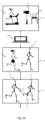
- Figure 1 shows a preferred embodiment of a system 100 for obtaining a plurality of camera images of a target pose 4 of at least part of a target body 3 according to an aspect of the invention.
- Said target body 3 is a living body performing a repetitive movement, for example running on a treadmill 5, but many other set-ups are possible as well, such as for example cycling on a stationary bike or exercising on a training device or lifting weights or just jumping or doing other exercises without using any additional training device.
- the system 100 includes a first camera 1 configured to capture a plurality of images of at least part of said target body 3. More preferably, the first camera 1 may be configured to capture a plurality of images of said target body 3 substantially entirely.
- the first camera 1 is preferably configured to capture images at a relatively high frequency rate, for example at a rate between more or less 30 Hz and more or less 100 Hz, more preferably substantially continuously.
- the first camera 1 is preferably a 2D camera configured to capture 2D images of at least part of said target body 3, which require relatively low computing capacity to process.
- the first camera 1 is preferably an RGB camera or a greyscale camera.
- the system further includes a second camera 2 configured to, at reception of a trigger, capture at least one image of at least part of said target body 3.
- the second camera 2 may for example be one of an infrared camera, a UV camera, or a visual camera.
- the second camera 2 may preferably be configured to capture 2D images.
- the system 100 further comprises a computer system 500, as shown for example in Figure 3 , including a controller and a memory with computer program code configured to perform the computer-implemented method as will be described hereafter.
- the computer system 500 is operatively connected to the first camera 1 and to the second camera 2.
- the second camera 2 is advantageously configured to be triggered by an electric impulse to capture at least one image of at least part of said target body 3.
- the computer system 500 may for example include a GPIO line 6 operatively connected with the second camera 2.
- the system 100 may for example be used in sports medicine where a target pose 4 of a target body 3 performing a repetitive movement may be of interest for further analysis.
- the target pose 3 may for example be a given position of a foot, or an angle between body members.
- Figures 2a and 2b show a schematic flow chart of a preferred embodiment of the computer-implemented method for obtaining a plurality of camera images of a target pose 4 of at least part of a target body 3 over time according to an aspect of the invention.
- 'Over time' may mean at regular or irregular intervals, in particular obtaining an image per cycle within the repetitive movement.
- a plurality of images captured by the first camera 1 is obtained by a computing system 500.
- the plurality of images may be taken substantially continuously by said first camera 1.
- the plurality of images are images of at least part of the target body 3, preferably of substantially an entire target body 3, the target body performing a repetitive movement, such as running on a treadmill.
- each of said plurality of images of said target body 3 captured by the first camera 1 can preferably be skeletonized.
- Skeletonization is a process for reducing foreground regions in a binary image, obtained by segmenting said image captured by the first camera 1, to a skeletal remnant that largely preserves the extent and connectivity of the original region while throwing away most of the original foreground pixels.
- each of the images obtained from the first camera 1 can be converted into a keypoint representation of the target body representing joints of said target body 3, which is an approximation of the biomechanics of the target body.
- Different methods to do skeletonization exist and preferably use convolutional neural networks. As a result, a skeletonized model 5 of a momentary posture of the target body 3 at a given time is obtained.
- step 30 of said preferred embodiment of the method it is verified for each of said plurality of obtained images, whether or not a predetermined pose 6 of at least part of said target body 3 is present.
- Said predetermined pose 6 corresponds to a pose intervening in said repetitive movement at a time span ⁇ T before the target pose 4.
- the predetermined pose 6 may for example correspond to an angle 7 between body members of the target body 3, for example to an angle 7 between an upper leg and a lower leg of the target body 3.
- Said verification may preferably be done on the skeletonized representations 5 of the target body 3.
- the predetermined pose 6 may for example be an angle of around 110° between said upper leg and said lower leg of the target body, since said angle of 110° intervenes before the angle of more or less 90° when the angle decreases.
- Said time span ⁇ T may be fixed or variable and can include at least a computer calculation time for the steps 20 and 30 of verifying a presence of and detecting said predetermined pose 6 of at least part of said target body 3 and a recording time of the second camera 2 to capture at least one image of at least part of the target body 3, which is discussed under step 50.
- the time span ⁇ T may be determined, in particular when the time span is adjustable.
- the time span ⁇ T may for example at least partly be based on a frequency of the repetitive movement in a time window preceding said predetermined pose 6.
- the frequency within said time window may then be extrapolated such that a time span between an occurrence of the predetermined pose and the target pose may be estimated.
- the graph 8 can represent an angle 7 between a thigh and a shin in function of time, as measured during the repetitive movement of the target body 3. Even if the movement is repetitive, the movement may include accelerations and/or decelerations.
- the graph 8 may be analysed with known methods to determine a frequency or periodicity within a time window preceding said predetermined pose 6. In this way, the time span ⁇ T may be determined in spite of accelerations and/or decelerations within the repetitive movement.
- the second camera 2 is triggered to capture at least one image of at least part of said target body 3 at said time span ⁇ T after detection of said predetermined pose 6, when said predetermined pose is detected.
- the second camera 2 may be one of an infrared camera, a UV camera, or a visual camera. Triggering the second camera 2 is preferably performed by sending an electric impulse 9 to the second camera 2. Instead of capturing a whole-body image, the second camera 2 may be configured to capture an image of only part of said target body 3, depending on the required target pose 4. Instead of capturing only one image of at least part of the target body 3, the second camera 2 may be triggered to capture a series of images of at least part of said target body 3.
- Said capturing of images by the second camera 2 may be performed for a fixed number of images, or during a predetermined period of time.
- the method may further comprise the steps of verifying a presence of a further predetermined pose of at least part of said target body for each of said plurality of images obtained from the first camera 1, in analogy with step 30 but with a further predetermined pose different from the predetermined pose 6, and when said further predetermined pose is detected, triggering the second camera 2 to stop capturing images.
- the second camera 2 may be configured to be triggered to start capturing a plurality of images as well as to be triggered to stop said capturing, both triggers being based on a respective predetermined pose detected by the computer system 500 in the images captured by and received from the first camera 1. In this way, a series of target poses can be obtained in spite of variations in speed and/or frequency in the repetitive movement of the target body 3.
- step 60 of said preferred embodiment of the method the previous steps, for example steps 20, 30, 40 and 50, can be repeated, thereby obtaining a plurality of camera images of the target pose 4 over time, in particular one or more images of the target pose 4 per cycle within the repetitive movement. Since the capturing of the images can be limited to those images useful for further analysis, the quantity of data to be analysed can be limited, which can save computation time and storage space.
- FIG. 3 shows a suitable computing system 500 comprising circuitry enabling the performance of steps of embodiments of the method for processing a plurality of camera images of a human body target area over time according to an aspect of the invention.
- Computing system 500 may in general be formed as a suitable generalpurpose computer and comprise a bus 510, a processor 502, a local memory 504, one or more optional input interfaces 514, one or more optional output interfaces 516, a communication interface 512, a storage element interface 506, and one or more storage elements 508.
- Bus 510 may comprise one or more conductors that permit communication among the components of the computing system 500.
- Processor 502 may include any type of conventional processor or microprocessor that interprets and executes programming instructions.
- Local memory 504 may include a random-access memory (RAM) or another type of dynamic storage device that stores information and instructions for execution by processor 502 and/or a read only memory (ROM) or another type of static storage device that stores static information and instructions for use by processor 502.
- Input interface 514 may comprise one or more conventional mechanisms that permit an operator or user to input information to the computing device 500, such as a keyboard 520, a mouse 530, a pen, voice recognition and/or biometric mechanisms, a camera, etc.
- Output interface 516 may comprise one or more conventional mechanisms that output information to the operator or user, such as a display 540, etc.
- Communication interface 512 may comprise any transceiver-like mechanism such as for example one or more Ethernet interfaces that enables computing system 500 to communicate with other devices and/or systems, for example with other computing devices 581, 582, 583.
- the communication interface 512 of computing system 500 may be connected to such another computing system by means of a local area network (LAN) or a wide area network (WAN) such as for example the internet.
- Storage element interface 506 may comprise a storage interface such as for example a Serial Advanced Technology Attachment (SATA) interface or a Small Computer System Interface (SCSI) for connecting bus 510 to one or more storage elements 508, such as one or more local disks, for example SATA disk drives, and control the reading and writing of data to and/or from these storage elements 508.
- SATA Serial Advanced Technology Attachment
- SCSI Small Computer System Interface
- the storage element(s) 508 above is/are described as a local disk, in general any other suitable computer-readable media such as a removable magnetic disk, optical storage media such as a CD or DVD, -ROM disk, solid state drives, flash memory cards, ... could be used.
- circuitry may refer to one or more or all of the following:
- circuitry also covers an implementation of merely a hardware circuit or processor (or multiple processors) or portion of a hardware circuit or processor and its (or their) accompanying software and/or firmware.
- circuitry also covers, for example and if applicable to the particular claim element, a baseband integrated circuit or processor integrated circuit for a mobile device or a similar integrated circuit in a server, a cellular network device, or other computing or network device.
- top, bottom, over, under, and the like are introduced for descriptive purposes and not necessarily to denote relative positions. It is to be understood that the terms so used are interchangeable under appropriate circumstances and embodiments of the invention are capable of operating according to the present invention in other sequences, or in orientations different from the one(s) described or illustrated above.
Landscapes
- Engineering & Computer Science (AREA)
- Multimedia (AREA)
- Signal Processing (AREA)
- Image Analysis (AREA)
Priority Applications (3)
| Application Number | Priority Date | Filing Date | Title |
|---|---|---|---|
| EP23154491.7A EP4412232A1 (de) | 2023-02-01 | 2023-02-01 | Verfahren und system zum erhalten mehrerer kamerabilder einer zielpose im laufe der zeit |
| PCT/EP2024/052041 WO2024160713A1 (en) | 2023-02-01 | 2024-01-29 | Method and system for obtaining a plurality of camera images of a target pose over time |
| EP24701974.8A EP4659456A1 (de) | 2023-02-01 | 2024-01-29 | Verfahren und system zum erhalten mehrerer kamerabilder einer zielpose im laufe der zeit |
Applications Claiming Priority (1)
| Application Number | Priority Date | Filing Date | Title |
|---|---|---|---|
| EP23154491.7A EP4412232A1 (de) | 2023-02-01 | 2023-02-01 | Verfahren und system zum erhalten mehrerer kamerabilder einer zielpose im laufe der zeit |
Publications (1)
| Publication Number | Publication Date |
|---|---|
| EP4412232A1 true EP4412232A1 (de) | 2024-08-07 |
Family
ID=85158485
Family Applications (2)
| Application Number | Title | Priority Date | Filing Date |
|---|---|---|---|
| EP23154491.7A Withdrawn EP4412232A1 (de) | 2023-02-01 | 2023-02-01 | Verfahren und system zum erhalten mehrerer kamerabilder einer zielpose im laufe der zeit |
| EP24701974.8A Pending EP4659456A1 (de) | 2023-02-01 | 2024-01-29 | Verfahren und system zum erhalten mehrerer kamerabilder einer zielpose im laufe der zeit |
Family Applications After (1)
| Application Number | Title | Priority Date | Filing Date |
|---|---|---|---|
| EP24701974.8A Pending EP4659456A1 (de) | 2023-02-01 | 2024-01-29 | Verfahren und system zum erhalten mehrerer kamerabilder einer zielpose im laufe der zeit |
Country Status (2)
| Country | Link |
|---|---|
| EP (2) | EP4412232A1 (de) |
| WO (1) | WO2024160713A1 (de) |
Citations (3)
| Publication number | Priority date | Publication date | Assignee | Title |
|---|---|---|---|---|
| US20160322078A1 (en) * | 2010-08-26 | 2016-11-03 | Blast Motion Inc. | Multi-sensor event detection and tagging system |
| US20180241922A1 (en) * | 2017-02-23 | 2018-08-23 | Qualcomm Incorporated | Adjustment for cameras for low power mode operation |
| US20210134001A1 (en) * | 2016-10-14 | 2021-05-06 | SZ DJI Technology Co., Ltd. | System and method for moment capturing |
-
2023
- 2023-02-01 EP EP23154491.7A patent/EP4412232A1/de not_active Withdrawn
-
2024
- 2024-01-29 EP EP24701974.8A patent/EP4659456A1/de active Pending
- 2024-01-29 WO PCT/EP2024/052041 patent/WO2024160713A1/en not_active Ceased
Patent Citations (3)
| Publication number | Priority date | Publication date | Assignee | Title |
|---|---|---|---|---|
| US20160322078A1 (en) * | 2010-08-26 | 2016-11-03 | Blast Motion Inc. | Multi-sensor event detection and tagging system |
| US20210134001A1 (en) * | 2016-10-14 | 2021-05-06 | SZ DJI Technology Co., Ltd. | System and method for moment capturing |
| US20180241922A1 (en) * | 2017-02-23 | 2018-08-23 | Qualcomm Incorporated | Adjustment for cameras for low power mode operation |
Also Published As
| Publication number | Publication date |
|---|---|
| EP4659456A1 (de) | 2025-12-10 |
| WO2024160713A1 (en) | 2024-08-08 |
Similar Documents
| Publication | Publication Date | Title |
|---|---|---|
| Chaudhari et al. | Yog-guru: Real-time yoga pose correction system using deep learning methods | |
| JP4860749B2 (ja) | 画像中の人物における位置決め指示との適合性を判定する機器、システム、及び方法 | |
| Dikovski et al. | Evaluation of different feature sets for gait recognition using skeletal data from Kinect | |
| CN113658211B (zh) | 一种用户姿态的评估方法、装置以及处理设备 | |
| KR101118654B1 (ko) | 모션캡쳐 기반의 자세분석을 통한 재활 장치 및 이에 따른 재활 방법 | |
| US20220129669A1 (en) | System and Method for Providing Multi-Camera 3D Body Part Labeling and Performance Metrics | |
| CN107590473B (zh) | 一种人脸活体检测方法、介质和相关装置 | |
| US11790652B2 (en) | Detection of contacts among event participants | |
| CN115105062B (zh) | 髋膝关节协调性评估方法、装置、系统和存储介质 | |
| CN116645697A (zh) | 一种多视角步态识别方法、装置、电子设备及存储介质 | |
| CN117252801B (zh) | 非接触手掌静脉图像质量评价方法、认证方法、程序产品 | |
| Nguyen et al. | Extracting silhouette-based characteristics for human gait analysis using one camera | |
| EP4412232A1 (de) | Verfahren und system zum erhalten mehrerer kamerabilder einer zielpose im laufe der zeit | |
| Rady et al. | Smart gesture-based control in human computer interaction applications for special-need people | |
| Ó Conaire et al. | Combining inertial and visual sensing for human action recognition in tennis | |
| Zhang et al. | An approach of region of interest detection based on visual attention and gaze tracking | |
| Zhang et al. | Intelligent pose recognition and evaluation system for rowing sports | |
| Qin et al. | Gesture recognition from depth images using motion and shape features | |
| Chaudhari et al. | Yoga Pose Detection using MoveNet Architecture | |
| CN117474949A (zh) | 运动计数方法、装置、系统、电子设备及存储介质 | |
| Wang | Monocular 2D and 3D human pose estimation review | |
| Fihl et al. | Invariant gait continuum based on the duty-factor | |
| Kathing | Vision-Based Gait Analysis for human identification with covariate conditions | |
| EP4309567A1 (de) | Verfahren und system zum verarbeiten einer vielzahl von kamerabildern eines menschlichen körperzielbereichs über die zeit | |
| Ma | Mobile Action Modeling: Efficient and Effective Scenery Classification with Applications |
Legal Events
| Date | Code | Title | Description |
|---|---|---|---|
| PUAI | Public reference made under article 153(3) epc to a published international application that has entered the european phase |
Free format text: ORIGINAL CODE: 0009012 |
|
| STAA | Information on the status of an ep patent application or granted ep patent |
Free format text: STATUS: THE APPLICATION HAS BEEN PUBLISHED |
|
| AK | Designated contracting states |
Kind code of ref document: A1 Designated state(s): AL AT BE BG CH CY CZ DE DK EE ES FI FR GB GR HR HU IE IS IT LI LT LU LV MC ME MK MT NL NO PL PT RO RS SE SI SK SM TR |
|
| STAA | Information on the status of an ep patent application or granted ep patent |
Free format text: STATUS: THE APPLICATION IS DEEMED TO BE WITHDRAWN |
|
| 18D | Application deemed to be withdrawn |
Effective date: 20250208 |