EP4411363A1 - Control method for liquid chromatograph mass spectrometry device - Google Patents
Control method for liquid chromatograph mass spectrometry device Download PDFInfo
- Publication number
- EP4411363A1 EP4411363A1 EP22875992.4A EP22875992A EP4411363A1 EP 4411363 A1 EP4411363 A1 EP 4411363A1 EP 22875992 A EP22875992 A EP 22875992A EP 4411363 A1 EP4411363 A1 EP 4411363A1
- Authority
- EP
- European Patent Office
- Prior art keywords
- mobile phase
- phase solvent
- ratio
- time point
- control method
- Prior art date
- Legal status (The legal status is an assumption and is not a legal conclusion. Google has not performed a legal analysis and makes no representation as to the accuracy of the status listed.)
- Pending
Links
Images


Classifications
-
- G—PHYSICS
- G01—MEASURING; TESTING
- G01N—INVESTIGATING OR ANALYSING MATERIALS BY DETERMINING THEIR CHEMICAL OR PHYSICAL PROPERTIES
- G01N27/00—Investigating or analysing materials by the use of electric, electrochemical, or magnetic means
- G01N27/62—Investigating or analysing materials by the use of electric, electrochemical, or magnetic means by investigating the ionisation of gases, e.g. aerosols; by investigating electric discharges, e.g. emission of cathode
-
- G—PHYSICS
- G01—MEASURING; TESTING
- G01N—INVESTIGATING OR ANALYSING MATERIALS BY DETERMINING THEIR CHEMICAL OR PHYSICAL PROPERTIES
- G01N30/00—Investigating or analysing materials by separation into components using adsorption, absorption or similar phenomena or using ion-exchange, e.g. chromatography or field flow fractionation
- G01N30/02—Column chromatography
- G01N30/62—Detectors specially adapted therefor
- G01N30/72—Mass spectrometers
- G01N30/7233—Mass spectrometers interfaced to liquid or supercritical fluid chromatograph
-
- B—PERFORMING OPERATIONS; TRANSPORTING
- B01—PHYSICAL OR CHEMICAL PROCESSES OR APPARATUS IN GENERAL
- B01D—SEPARATION
- B01D15/00—Separating processes involving the treatment of liquids with solid sorbents; Apparatus therefor
- B01D15/08—Selective adsorption, e.g. chromatography
- B01D15/10—Selective adsorption, e.g. chromatography characterised by constructional or operational features
- B01D15/16—Selective adsorption, e.g. chromatography characterised by constructional or operational features relating to the conditioning of the fluid carrier
- B01D15/166—Fluid composition conditioning, e.g. gradient
-
- B—PERFORMING OPERATIONS; TRANSPORTING
- B01—PHYSICAL OR CHEMICAL PROCESSES OR APPARATUS IN GENERAL
- B01D—SEPARATION
- B01D15/00—Separating processes involving the treatment of liquids with solid sorbents; Apparatus therefor
- B01D15/08—Selective adsorption, e.g. chromatography
- B01D15/42—Selective adsorption, e.g. chromatography characterised by the development mode, e.g. by displacement or by elution
- B01D15/424—Elution mode
-
- G—PHYSICS
- G01—MEASURING; TESTING
- G01N—INVESTIGATING OR ANALYSING MATERIALS BY DETERMINING THEIR CHEMICAL OR PHYSICAL PROPERTIES
- G01N30/00—Investigating or analysing materials by separation into components using adsorption, absorption or similar phenomena or using ion-exchange, e.g. chromatography or field flow fractionation
- G01N30/02—Column chromatography
- G01N30/26—Conditioning of the fluid carrier; Flow patterns
- G01N30/28—Control of physical parameters of the fluid carrier
- G01N30/34—Control of physical parameters of the fluid carrier of fluid composition, e.g. gradient
-
- G—PHYSICS
- G01—MEASURING; TESTING
- G01N—INVESTIGATING OR ANALYSING MATERIALS BY DETERMINING THEIR CHEMICAL OR PHYSICAL PROPERTIES
- G01N30/00—Investigating or analysing materials by separation into components using adsorption, absorption or similar phenomena or using ion-exchange, e.g. chromatography or field flow fractionation
- G01N30/02—Column chromatography
- G01N30/86—Signal analysis
- G01N30/8624—Detection of slopes or peaks; baseline correction
-
- G—PHYSICS
- G01—MEASURING; TESTING
- G01N—INVESTIGATING OR ANALYSING MATERIALS BY DETERMINING THEIR CHEMICAL OR PHYSICAL PROPERTIES
- G01N30/00—Investigating or analysing materials by separation into components using adsorption, absorption or similar phenomena or using ion-exchange, e.g. chromatography or field flow fractionation
- G01N30/02—Column chromatography
- G01N2030/022—Column chromatography characterised by the kind of separation mechanism
- G01N2030/027—Liquid chromatography
-
- G—PHYSICS
- G01—MEASURING; TESTING
- G01N—INVESTIGATING OR ANALYSING MATERIALS BY DETERMINING THEIR CHEMICAL OR PHYSICAL PROPERTIES
- G01N30/00—Investigating or analysing materials by separation into components using adsorption, absorption or similar phenomena or using ion-exchange, e.g. chromatography or field flow fractionation
- G01N30/02—Column chromatography
- G01N30/62—Detectors specially adapted therefor
- G01N30/72—Mass spectrometers
Definitions
- the present disclosure relates to a method for controlling a mass spectrometer.
- a mobile phase solvent used in measurement by a liquid chromatograph mass spectrometer contacts a solvent bottle, a tube group and a filter group of a synthetic resin system, and so on.
- a substance attached to a constituent of the solvent bottle, the tube group, and the filter group and the surface of them is gradually solved in the mobile phase solvent as the time elapses, and possibly becomes a foreign substance contaminating the mobile phase solvent.
- a phenomenon that ionization of a measurement object substance intrinsically desired to be ionized is suppressed (ion suppression) occurs, and the measurement sensitivity of the measurement object substance deteriorates.
- Patent Literature 1 described below, measurement is performed adding an internal standard substance to a mobile phase solvent, and when the intensity of the internal standard substance becomes less than a reference, it is determined that the ion suppression has occurred (refer to the abstract).
- Patent Literature 1 WO09/123297
- the present disclosure has been made in view of such technical problems as described above, and its object is to provide a method for controlling a liquid chromatograph mass spectrometer by which contamination of a mobile phase solvent caused by a foreign substance can be detected without using an internal standard substance.
- the method for controlling a liquid chromatograph mass spectrometer related to the present disclosure includes: calculating a first ratio of signal intensities at a first time point and a second time point when measurement is performed using a first mobile phase solvent; calculating a second ratio of signal intensities at the first time point and the second time point when measurement is further performed using a second mobile phase solvent; and determining whether or not the second mobile phase solvent is contaminated according to an absolute difference between the first ratio and the second ratio.
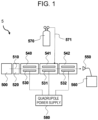
- FIG. 1 shows a device configuration of the mass spectrometer 5 according to the first embodiment of the present disclosure.
- a measurement sample fed by a pump of a liquid chromatograph and the like is ionized by an ion source 500. Since the ion source 500 is under the atmospheric pressure and the mass spectrometer 5 operates under vacuum, an ion 510 is introduced into the mass spectrometer through an interface 520 of the atmospheric air and the vacuum.
- ions generated by the ion source have various masses
- AC voltage (HF voltage) and DC voltage allowing a target ion to pass through are applied to a first quadrupole electrode portion 540 (there is a quadrupole electrode 530 in the inside) by a quadrupole power supply 580, and only the target ion derived from the measurement sample is made to selectively pass through.
- a collision gas 570 nitrogen gas, argon gas, and the like
- a collision gas 570 nitrogen gas, argon gas, and the like
- a second quadrupole electrode 531 normally applies only AC voltage from a quadrupole power supply 580 to eliminate mass selectivity, allows the target ion having passed through the first quadrupole electrode portion 540 and the gas to collide on each other, and thereby generates a fragment ion.
- the fragment ion having been generated passes through the second quadrupole electrode portion 541, and enters a third quadrupole electrode portion 542.
- HF voltage and DC voltage allowing the target fragment ion to pass through are applied to a third quadrupole electrode 532 by the quadrupole power supply 580, only the target fragment ion passes through the third quadrupole electrode portion 542.
- the target fragment ion having passed through is detected by a detector 550.
- a detection signal is sent to a data processing unit 560 (controller), and mass spectrometry is performed by the data processing unit 560.
- a device aspect of a triple quadrupole type mass spectrometer called a Triple QMS was shown here as an example, the technology of the present disclosure can be applied also to a Single QMS quadrupole mass spectrometer where one unit of the QMF is arranged in the inside. Further, according to the embodiment, although explanation will be made with an example of the quadrupole as the mass filter, the technology of the present disclosure can be applied to a mass filter of not only the quadrupole but also of the multiple pole.
- FIG. 2 is a graph illustrating a measurement result of a chromatogram signal.
- each of the first mobile phase solvent and the second mobile phase solvent is a mixed liquid of the liquid A (deionized water) and the liquid B (methanol).
- the blank sample was measured by a gradient elution method using the mass spectrometer 5.
- the horizontal axis of FIG. 2 shows the elapsed time from the start of elution.
- the vertical axis of the lower stage of FIG. 2 shows the ion signal intensity acquired by that the mass spectrometer 5 measures the blank sample.
- the mass spectrometer 5 measures the ion signal intensity using the first mobile phase solvent.
- the first mobile phase solvent is a mobile phase solvent not contaminated. Followings for example can be used as the first mobile phase solvent: (a) a mobile phase solvent not long after preparation; (b) a mobile phase solvent having been stored under a condition where the temperature and the humidity were managed after preparation until the time of use (refrigerator and the like). With the time point of starting elution using the first mobile phase solvent being made the time point 0, the mass spectrometer 5 measures the ion signal intensity I 1, t1 at the time point t1 and the ion signal intensity I 1, t2 at the time point t2 respectively.
- the time point t1 and the time point t2 are made the temporal points where the composition ratio (the liquid B ratio in FIG. 2 ) of the solvent is different from each other.
- the mass spectrometer 5 measures the ion signal intensity using the second mobile phase solvent.
- the second mobile phase solvent is a determination object for determining whether or not there is contamination.
- the temporal change of the liquid B ratio namely the degree of the gradient in the gradient method
- the characteristic of the mobile phase solvent namely R 2 ⁇ R 1
- similar determination can be performed by whether or not R 1 /R 2 or R 1 -R 2 is a threshold or more.
- R 1 and R 2 at the time of contamination can be grasped beforehand according to the kind of the mobile phase solvent, and so on, it is also possible to grasp beforehand which calculation expression of (a) R 2 /R 1 or R 2 -R 1 and (b) R 1 /R 2 or R 1 -R 2 should be used.
- R 1 and R 2 is bigger due to some circumstances, similar determination may be performed by whether or not the absolute difference
- the time point t1 and the time point t2 are to be set so as to avoid a time assumed as the elution time of an object substance measured by the mass spectrometer 5.
- the reason is that, although measurement of FIG. 2 is performed using a blank sample, an object substance of former measurement carries over, and an ion signal of the carried over object substance may be superimposed when the elution time of the object substance elapses.
- the object substance mentioned here means a substance scheduled to be measured by the mass spectrometer 5 using such temporal change of the liquid B ratio as shown in the upper stage of FIG. 2 .
- a method for performing the measurement shown in FIG. 2 will be supplemented. After operating the mass spectrometer 5 with a selective ion monitoring (SIM) mode, a multiple reaction monitoring (MRM) mode, and the like for example, only an ion having an optional m/z value is measured. From a mass chromatogram signal value (ion signal) obtained by this measurement, the measurement result as shown in FIG. 2 can be obtained.
- SIM selective ion monitoring
- MRM multiple reaction monitoring
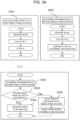
- FIG. 3A is a flowchart illustrating a procedure for determining whether or not the second mobile phase solvent is contaminated.
- the mass spectrometer 5 calculates R 1 using the first mobile phase solvent by the procedure explained in FIG. 2 , and stores the result in a storage device and the like.
- step S302 is started.
- the mass spectrometer 5 calculates R 2 using the second mobile phase solvent by a procedure explained in FIG. 2 , and compares the result with R 1 .
- S301 can be performed for example when a user interface (for example a button on the device, an operation component on a screen interface, and so on) provided in the mass spectrometer 5 is operated.
- S302 can be performed when the user wants to determine contamination of the second mobile phase solvent.
- S302 and onward may be performed while an object substance is measured, or S302 only (S303 and onward according to the necessity) may be performed independently in a vacant time when an object substance is not measured.
- step S303 the mass spectrometer 5 determines whether or not the second mobile phase solvent is contaminated based on the comparison result of R 1 and R 2 .
- an analysis object sample is measured (S304).
- the user is notified of the effect, and measurement of the analysis object sample is canceled (S305).
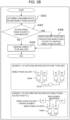
- FIG. 3B is a flowchart illustrating another procedure for determining whether or not the second mobile phase solvent is contaminated.
- S301 to S304 are same to those of FIG. 3A .
- S306 is performed instead of S305.
- the mass spectrometer 5 switches the solvent to be used from the second mobile phase solvent to another mobile phase solvent. With respect to the switching method, such example as described below for example is possible.
- step S306 first example of switching method
- step S306 second example of switching method
- the second mobile phase solvent within the container may be replaced by another mobile phase solvent using the mechanism.
- the liquid A1 of the second mobile phase solvent is replaced by the liquid A1'
- the liquid B 1 of the second mobile phase solvent is replaced by the liquid B 1' .
- the mass spectrometer 5 calculates the ratio R 1 of the ion signal intensities at the time points t1 and t2 respectively when the blank sample is measured using the first mobile phase solvent and the ratio R 2 of the ion signal intensities at the time points t1 and t2 respectively when the blank sample is measured using the second mobile phase solvent, compares their difference or ratio with a threshold, and thereby determines whether or not the second mobile phase solvent is contaminated.
- the ratio R 1 of the ion signal intensities at the time points t1 and t2 respectively when the blank sample is measured using the first mobile phase solvent compares their difference or ratio with a threshold, and thereby determines whether or not the second mobile phase solvent is contaminated.
- the mass spectrometer 5 determines contamination of the second mobile phase solvent using the ratio of the ion signal intensities (both of R 1 and R 2 are calculated as the ratio of the ion signal intensities at the time points t1 and t2 respectively).
- the ratio of the ion signals of different time points respectively is used, contamination can be thereby determined after suppressing an effect of the machine difference of the device.
- the mass spectrometer 5 When it is determined that the second mobile phase solvent is contaminated, the mass spectrometer 5 according to the present first embodiment notifies the user of the effect and cancels the measurement, or performs measurement after replacing the second mobile phase solvent by another mobile phase solvent. Thus, such event can be avoided that the second mobile phase solvent having been contaminated is used as it is to acquire an erroneous measurement result.
- FIG. 4A is an example of a total ion chromatogram obtained by operating the mass spectrometer 5 in a scan mode.
- the scan mode is a measurement operation for acquiring an ion detection signal in a certain range of m/z. By adding the ion detection signal of all of m/z, a total ion chromatogram is obtained.
- the SIM mode explained in the first embodiment is different from the scan mode in a point of the measuring operation for obtaining an ion detection signal with respect to a specific m/z only.
- the mass spectrometer 5 measures the ion detection signal with respect to each of the first mobile phase solvent (one expressed as "new” in FIG. 4A ) and the second mobile phase solvent (one expressed as "PP” in FIG. 4A ) using a blank sample similarly to the first embodiment.
- the solvent ratio is assumed to change as shown in the lower stage of FIG. 4A .
- the mass spectrometer 5 measures the ion signal intensities in each of the time points t1 and t2 similarly to the first embodiment, and calculates the ratio R 1 and R 2 of the ion signal intensities.
- FIG. 4B shows an example of a measurement result of the ion signal intensities in FIG. 4A .
- R 2 /R 1 or R 2 -R 1 is a threshold or more, it is determined that the second mobile phase solvent is contaminated.
- FIG. 4B shows a numerical value example in a case that the second mobile phase solvent is contaminated.
- the mass spectrometer 5 performs the scan mode, and the total ion chromatogram is thereby obtained with respect to a certain range of m/z.
- the ion signal obtained then is plotted on the vertical axis, m/z is plotted on the horizontal axis, and a mass spectrum is thereby obtained simultaneously.
- the mass spectrometer 5 may produce an analysis result of it.
- the measurement accuracy in the scan mode is lower than that in the SIM mode and the MRM mode, it is considered to be preferable that the composition and the amount of the foreign substance analyzed by the scan mode are to be deemed as a surmised result.
- the SIM mode or the MRM mode is performed first to acquire a chromatogram signal intensity, and the flowchart of FIG. 3A to FIG. 3B is performed using the chromatogram signal intensity.
- a mass spectrum is obtained by performing the scan mode, and the composition and the amount of a foreign substance contained within the second mobile phase solvent are analyzed using the mass spectrum.
- the present disclosure is not to be limited to the embodiments described above, and various modifications are to be included.
- the embodiments described above were explained in detail for easy understanding of the present disclosure, and are not to be necessarily limited to those including all configurations explained.
- a part of a configuration of an embodiment can be replaced by a configuration of another embodiment, and a configuration of an embodiment can be added with a configuration of another embodiment.
- a part of a configuration of each embodiment it is possible to add, delete, and substitute other configurations.
- the control line and the information line are shown for those considered to be necessary for explanation, and all control lines and information lines of the product have not necessarily been shown. In fact, it can be considered that almost all configurations are connected to each other.
- the first mobile phase solvent (or a separate fresh mobile phase solvent in replacing the second mobile phase solvent) was not contaminated.
- the first mobile phase solvent is not contaminated since the first mobile phase solvent becomes a reference of presence and absence of contamination, when it can be secured that the degree of contamination is less than a predetermined reference value according to a required determination accuracy and the like for example, such mobile phase solvent may be used as the first mobile phase solvent.
- each flowchart can be performed by a calculation device such as the data processing unit 560 for example, and may be performed also by that an operator operates manually the mass spectrometer 5.
Landscapes
- Chemical & Material Sciences (AREA)
- Analytical Chemistry (AREA)
- General Health & Medical Sciences (AREA)
- Life Sciences & Earth Sciences (AREA)
- Health & Medical Sciences (AREA)
- Biochemistry (AREA)
- Physics & Mathematics (AREA)
- General Physics & Mathematics (AREA)
- Immunology (AREA)
- Pathology (AREA)
- Chemical Kinetics & Catalysis (AREA)
- Electrochemistry (AREA)
- Other Investigation Or Analysis Of Materials By Electrical Means (AREA)
Abstract
Description
- The present disclosure relates to a method for controlling a mass spectrometer.
- A mobile phase solvent used in measurement by a liquid chromatograph mass spectrometer (LC/MS) contacts a solvent bottle, a tube group and a filter group of a synthetic resin system, and so on. A substance attached to a constituent of the solvent bottle, the tube group, and the filter group and the surface of them is gradually solved in the mobile phase solvent as the time elapses, and possibly becomes a foreign substance contaminating the mobile phase solvent. When the mobile phase solvent is contaminated by a foreign substance, a phenomenon that ionization of a measurement object substance intrinsically desired to be ionized is suppressed (ion suppression) occurs, and the measurement sensitivity of the measurement object substance deteriorates.
- In Patent Literature 1 described below, measurement is performed adding an internal standard substance to a mobile phase solvent, and when the intensity of the internal standard substance becomes less than a reference, it is determined that the ion suppression has occurred (refer to the abstract).
- Patent Literature 1:
WO09/123297 - In a prior art of adding an internal standard substance as described in Patent Literature 1, the internal standard substance itself possibly becomes a foreign substance contaminating the mobile phase solvent. Therefore, such technology is required that can detect contamination of a mobile phase solvent without adding a substance that possibly becomes a foreign substance.
- The present disclosure has been made in view of such technical problems as described above, and its object is to provide a method for controlling a liquid chromatograph mass spectrometer by which contamination of a mobile phase solvent caused by a foreign substance can be detected without using an internal standard substance.
- The method for controlling a liquid chromatograph mass spectrometer related to the present disclosure includes: calculating a first ratio of signal intensities at a first time point and a second time point when measurement is performed using a first mobile phase solvent; calculating a second ratio of signal intensities at the first time point and the second time point when measurement is further performed using a second mobile phase solvent; and determining whether or not the second mobile phase solvent is contaminated according to an absolute difference between the first ratio and the second ratio.
- According to the method for controlling a liquid chromatograph mass spectrometer related to the present disclosure, contamination of a mobile phase solvent caused by a foreign substance can be detected without using an internal standard substance. Problems, configurations, and effects other than those described above will be clarified by explanation of embodiments described below.
-
- [
FIG. 1] FIG. 1 shows a device configuration of amass spectrometer 5 according to a first embodiment. - [
FIG. 2] FIG. 2 is a graph illustrating a measurement result of a chromatogram signal. - [
FIG. 3A] FIG. 3A is a flowchart illustrating a procedure for determining whether or not a second mobile phase solvent is contaminated. - [
FIG. 3B] FIG. 3B is a flowchart illustrating another procedure for determining whether or not the second mobile phase solvent is contaminated. - [
FIG. 4A] FIG. 4A is an example of a total ion chromatogram obtained by operating themass spectrometer 5 in a scan mode. - [
FIG. 4B] FIG. 4B shows an example of a measurement result of ion signal intensities inFIG. 4A . -
FIG. 1 shows a device configuration of themass spectrometer 5 according to the first embodiment of the present disclosure. A measurement sample fed by a pump of a liquid chromatograph and the like is ionized by anion source 500. Since theion source 500 is under the atmospheric pressure and themass spectrometer 5 operates under vacuum, anion 510 is introduced into the mass spectrometer through aninterface 520 of the atmospheric air and the vacuum. - Although ions generated by the ion source have various masses, AC voltage (HF voltage) and DC voltage allowing a target ion to pass through are applied to a first quadrupole electrode portion 540 (there is a
quadrupole electrode 530 in the inside) by aquadrupole power supply 580, and only the target ion derived from the measurement sample is made to selectively pass through. To a secondquadrupole electrode portion 541, a collision gas 570 (nitrogen gas, argon gas, and the like) for dissociating the target ion is introduced from a supply source through agas line 571. - A
second quadrupole electrode 531 normally applies only AC voltage from aquadrupole power supply 580 to eliminate mass selectivity, allows the target ion having passed through the firstquadrupole electrode portion 540 and the gas to collide on each other, and thereby generates a fragment ion. The fragment ion having been generated passes through the secondquadrupole electrode portion 541, and enters a thirdquadrupole electrode portion 542. - When HF voltage and DC voltage allowing the target fragment ion to pass through are applied to a
third quadrupole electrode 532 by thequadrupole power supply 580, only the target fragment ion passes through the thirdquadrupole electrode portion 542. The target fragment ion having passed through is detected by adetector 550. A detection signal is sent to a data processing unit 560 (controller), and mass spectrometry is performed by thedata processing unit 560. - Although a device aspect of a triple quadrupole type mass spectrometer called a Triple QMS was shown here as an example, the technology of the present disclosure can be applied also to a Single QMS quadrupole mass spectrometer where one unit of the QMF is arranged in the inside. Further, according to the embodiment, although explanation will be made with an example of the quadrupole as the mass filter, the technology of the present disclosure can be applied to a mass filter of not only the quadrupole but also of the multiple pole.
-
FIG. 2 is a graph illustrating a measurement result of a chromatogram signal. Here, it is assumed that each of the first mobile phase solvent and the second mobile phase solvent is a mixed liquid of the liquid A (deionized water) and the liquid B (methanol). When the liquid B ratio within the mobile phase solvent changed over time as the upper stage ofFIG. 2 , the blank sample was measured by a gradient elution method using themass spectrometer 5. The horizontal axis ofFIG. 2 shows the elapsed time from the start of elution. The vertical axis of the lower stage ofFIG. 2 shows the ion signal intensity acquired by that themass spectrometer 5 measures the blank sample. - First, the
mass spectrometer 5 measures the ion signal intensity using the first mobile phase solvent. The first mobile phase solvent is a mobile phase solvent not contaminated. Followings for example can be used as the first mobile phase solvent: (a) a mobile phase solvent not long after preparation; (b) a mobile phase solvent having been stored under a condition where the temperature and the humidity were managed after preparation until the time of use (refrigerator and the like). With the time point of starting elution using the first mobile phase solvent being made thetime point 0, themass spectrometer 5 measures the ion signal intensity I1, t1 at the time point t1 and the ion signal intensity I1, t2 at the time point t2 respectively. The time point t1 and the time point t2 are made the temporal points where the composition ratio (the liquid B ratio inFIG. 2 ) of the solvent is different from each other. Themass spectrometer 5 calculates the ratio R1 of each ion signal intensity as follows: I1, t2/I1, t1=R1. - Next, the
mass spectrometer 5 measures the ion signal intensity using the second mobile phase solvent. The second mobile phase solvent is a determination object for determining whether or not there is contamination. The second mobile phase solvent is a mobile phase solvent that is not the first mobile phase solvent at least, and includes for example such first mobile phase solvent that the time elapses after being arranged in themass spectrometer 5. With the time point of starting elution using the second mobile phase solvent being made thetime point 0, themass spectrometer 5 measures respectively the ion signal intensity I2, t1 and I2, t2 at the time t1 and t2 which are same to those for the first mobile phase solvent. Themass spectrometer 5 calculates the ratio R2 of each ion signal intensity as follows: I2, t2/I2, t1=R2. - When the second mobile phase solvent is contaminated and contains the foreign substance much, it is considered that the ion signal intensity rises more than the time of non-contamination accompanying rise of the liquid B ratio by the effect. Utilizing the effect, by comparison of R1 and R2, it is possible to determine whether or not the second mobile phase solvent is contaminated. In concrete terms, when R2/R1 or R2-R1 is a threshold or more (namely when the both deviate from each other largely and the absolute difference of the both is a threshold or more), it is determined that the mobile phase solvent used in measurement of R2 is contaminated.
- According to the temporal change of the liquid B ratio (namely the degree of the gradient in the gradient method) and the characteristic of the mobile phase solvent, and so on, it is possible that the rise rate of the ion signal intensity is smaller when the second mobile phase solvent is contaminated (namely R2<R1). Even in this case, similar determination can be performed by whether or not R1/R2 or R1-R2 is a threshold or more.
- Since the magnitude relationship of R1 and R2 at the time of contamination can be grasped beforehand according to the kind of the mobile phase solvent, and so on, it is also possible to grasp beforehand which calculation expression of (a) R2/R1 or R2-R1 and (b) R1/R2 or R1-R2 should be used. When it is not clear which of R1 and R2 is bigger due to some circumstances, similar determination may be performed by whether or not the absolute difference |R2-R1| is a threshold or more.
- It is preferable that the time point t1 and the time point t2 are to be set so as to avoid a time assumed as the elution time of an object substance measured by the
mass spectrometer 5. The reason is that, although measurement ofFIG. 2 is performed using a blank sample, an object substance of former measurement carries over, and an ion signal of the carried over object substance may be superimposed when the elution time of the object substance elapses. Also, the object substance mentioned here means a substance scheduled to be measured by themass spectrometer 5 using such temporal change of the liquid B ratio as shown in the upper stage ofFIG. 2 . - A method for performing the measurement shown in
FIG. 2 will be supplemented. After operating themass spectrometer 5 with a selective ion monitoring (SIM) mode, a multiple reaction monitoring (MRM) mode, and the like for example, only an ion having an optional m/z value is measured. From a mass chromatogram signal value (ion signal) obtained by this measurement, the measurement result as shown inFIG. 2 can be obtained. -
FIG. 3A is a flowchart illustrating a procedure for determining whether or not the second mobile phase solvent is contaminated. In step S301, themass spectrometer 5 calculates R1 using the first mobile phase solvent by the procedure explained inFIG. 2 , and stores the result in a storage device and the like. After S301, at a temporal point for determining contamination of the second mobile phase solvent, step S302 is started. In step S302, themass spectrometer 5 calculates R2 using the second mobile phase solvent by a procedure explained inFIG. 2 , and compares the result with R1. - S301 can be performed for example when a user interface (for example a button on the device, an operation component on a screen interface, and so on) provided in the
mass spectrometer 5 is operated. S302 can be performed when the user wants to determine contamination of the second mobile phase solvent. For example, S302 and onward may be performed while an object substance is measured, or S302 only (S303 and onward according to the necessity) may be performed independently in a vacant time when an object substance is not measured. - In step S303, the
mass spectrometer 5 determines whether or not the second mobile phase solvent is contaminated based on the comparison result of R1 and R2. When the second mobile phase solvent is not contaminated, an analysis object sample is measured (S304). When the second mobile phase solvent is contaminated, the user is notified of the effect, and measurement of the analysis object sample is canceled (S305). -
FIG. 3B is a flowchart illustrating another procedure for determining whether or not the second mobile phase solvent is contaminated. S301 to S304 are same to those ofFIG. 3A . InFIG. 3B , S306 is performed instead of S305. In S306, themass spectrometer 5 switches the solvent to be used from the second mobile phase solvent to another mobile phase solvent. With respect to the switching method, such example as described below for example is possible. - There is a case that plural sets of combinations of a container storing the liquid A and a container storing the liquid B are connected to the
mass spectrometer 5 through a valve. For example, there is such case as illustrated in the first example ofFIG. 3B that two sets of the liquid A and the liquid B are connected through a valve. In this case, the connection destination of the valve (namely the liquid route for acquiring the mobile phase solvent) can be switched from the set of A1 and B 1 to the set of A2 and B2. - When the
mass spectrometer 5 is provided with a mechanism for replacing the mobile phase solvent within the container, the second mobile phase solvent within the container may be replaced by another mobile phase solvent using the mechanism. In the example illustrated inFIG. 3B , the liquid A1 of the second mobile phase solvent is replaced by the liquid A1', and the liquid B 1 of the second mobile phase solvent is replaced by the liquid B 1' . - It is also possible to switch the second mobile phase solvent to another mobile phase solvent, to measure thereafter the ion signal intensity and to calculate R2 at the time points t1 and t2 again with respect to the mobile phase solvent, and to determine contamination of the second mobile phase solvent again. Further, when the mobile phase solvent after switching is fresh and equivalent to the first mobile phase solvent, it is also possible to deem that the first mobile phase solvent has been re-introduced, to measure the ion signal intensity and to recalculate R1 at the time points t1 and t2 again.
- The
mass spectrometer 5 according to the present first embodiment calculates the ratio R1 of the ion signal intensities at the time points t1 and t2 respectively when the blank sample is measured using the first mobile phase solvent and the ratio R2 of the ion signal intensities at the time points t1 and t2 respectively when the blank sample is measured using the second mobile phase solvent, compares their difference or ratio with a threshold, and thereby determines whether or not the second mobile phase solvent is contaminated. Thus, since presence and absence of the contamination can be determined without adding an internal standard substance, it can be avoided that the internal standard substance itself acts as a foreign substance. - The
mass spectrometer 5 according to the present first embodiment determines contamination of the second mobile phase solvent using the ratio of the ion signal intensities (both of R1 and R2 are calculated as the ratio of the ion signal intensities at the time points t1 and t2 respectively). Instead of the value itself of the ion signal intensity, the ratio of the ion signals of different time points respectively is used, contamination can be thereby determined after suppressing an effect of the machine difference of the device. - When it is determined that the second mobile phase solvent is contaminated, the
mass spectrometer 5 according to the present first embodiment notifies the user of the effect and cancels the measurement, or performs measurement after replacing the second mobile phase solvent by another mobile phase solvent. Thus, such event can be avoided that the second mobile phase solvent having been contaminated is used as it is to acquire an erroneous measurement result. - In the first embodiment, explanation was made with an example of measuring the ion signal intensities with respect to specific m/z only. Alternatively, it is also possible to scan a certain range of m/z and to use an ion signal value obtained in the scanning. In the second embodiment of the present disclosure, an example of it will be explained. The configuration of the
mass spectrometer 5 is same to that of the first embodiment. -
FIG. 4A is an example of a total ion chromatogram obtained by operating themass spectrometer 5 in a scan mode. The scan mode is a measurement operation for acquiring an ion detection signal in a certain range of m/z. By adding the ion detection signal of all of m/z, a total ion chromatogram is obtained. On the other hand, the SIM mode explained in the first embodiment is different from the scan mode in a point of the measuring operation for obtaining an ion detection signal with respect to a specific m/z only. - The
mass spectrometer 5 measures the ion detection signal with respect to each of the first mobile phase solvent (one expressed as "new" inFIG. 4A ) and the second mobile phase solvent (one expressed as "PP" inFIG. 4A ) using a blank sample similarly to the first embodiment. The solvent ratio is assumed to change as shown in the lower stage ofFIG. 4A . Themass spectrometer 5 measures the ion signal intensities in each of the time points t1 and t2 similarly to the first embodiment, and calculates the ratio R1 and R2 of the ion signal intensities. -
FIG. 4B shows an example of a measurement result of the ion signal intensities inFIG. 4A . In the example, it was revealed that Ri=6.37 and R2=94.5. When R2/R1 or R2-R1 is a threshold or more, it is determined that the second mobile phase solvent is contaminated.FIG. 4B shows a numerical value example in a case that the second mobile phase solvent is contaminated. - In the second embodiment, the
mass spectrometer 5 performs the scan mode, and the total ion chromatogram is thereby obtained with respect to a certain range of m/z. The ion signal obtained then is plotted on the vertical axis, m/z is plotted on the horizontal axis, and a mass spectrum is thereby obtained simultaneously. Using this mass spectrum, the composition and the amount of a foreign substance contained within the second mobile phase solvent can be analyzed. Along with the contamination determination result, themass spectrometer 5 may produce an analysis result of it. However, since the measurement accuracy in the scan mode is lower than that in the SIM mode and the MRM mode, it is considered to be preferable that the composition and the amount of the foreign substance analyzed by the scan mode are to be deemed as a surmised result. - In the SIM mode and the MRM mode of the
mass spectrometer 5, an ion signal is obtained with respect to a single m/z only, and therefore there are advantages that the measurement time is short and many data points are obtained (namely the resolution of the measurement result is high). However, the mass spectrum cannot be obtained. On the other hand, in the scan mode, since an ion signal is obtained over a m/z range of a certain degree, there is an advantage that a mass spectrum can be obtained although the measurement time is long. It is also possible to combine these modes and to use the advantages of the both. - For example, in order to determine whether or not the second mobile phase solvent is contaminated, the SIM mode or the MRM mode is performed first to acquire a chromatogram signal intensity, and the flowchart of
FIG. 3A to FIG. 3B is performed using the chromatogram signal intensity. When it is determined that the second mobile phase solvent is contaminated, a mass spectrum is obtained by performing the scan mode, and the composition and the amount of a foreign substance contained within the second mobile phase solvent are analyzed using the mass spectrum. By combination of such modes, since the foreign substance comes to be analyzed by the scan mode only at the time of contamination while performing measurement quickly at normal times, both of the measurement efficiency and analysis of the foreign substance can be achieved. - Also, the present disclosure is not to be limited to the embodiments described above, and various modifications are to be included. For example, the embodiments described above were explained in detail for easy understanding of the present disclosure, and are not to be necessarily limited to those including all configurations explained. Also, a part of a configuration of an embodiment can be replaced by a configuration of another embodiment, and a configuration of an embodiment can be added with a configuration of another embodiment. Also, with respect to a part of a configuration of each embodiment, it is possible to add, delete, and substitute other configurations. Further, the control line and the information line are shown for those considered to be necessary for explanation, and all control lines and information lines of the product have not necessarily been shown. In fact, it can be considered that almost all configurations are connected to each other.
- In the embodiments described above, explanation was made on a premise that the first mobile phase solvent (or a separate fresh mobile phase solvent in replacing the second mobile phase solvent) was not contaminated. Although it is preferable that the first mobile phase solvent is not contaminated since the first mobile phase solvent becomes a reference of presence and absence of contamination, when it can be secured that the degree of contamination is less than a predetermined reference value according to a required determination accuracy and the like for example, such mobile phase solvent may be used as the first mobile phase solvent.
- In the embodiments described above, each flowchart can be performed by a calculation device such as the
data processing unit 560 for example, and may be performed also by that an operator operates manually themass spectrometer 5. -
- 5: mass spectrometer
- 500: ion source
- 510: ion
- 520: interface
- 530: quadrupole electrode
- 531: second quadrupole electrode
- 532: third quadrupole electrode
- 540: first quadrupole electrode portion
- 541: second quadrupole electrode portion
- 542: third quadrupole electrode portion
- 550: detector
- 560: data processing unit
- 580: quadrupole power supply
- 570: collision gas
- 571: gas line
Claims (14)
- A method for controlling a liquid chromatograph mass spectrometer, the control method comprising:a step of calculating a first ratio of chromatogram signal intensities at two different time points, the chromatogram signal intensities being obtained by measuring a blank sample with a gradient elution method by using a first mobile phase solvent having a degree of contamination less than a reference value;a step of calculating a second ratio of chromatogram signal intensities at the two different time points, the chromatogram signal intensities being obtained by measuring a blank sample with the gradient elution method by using a second mobile phase solvent having the same composition as the first mobile phase solvent; anda step of determining whether or not the second mobile phase solvent is contaminated by using the first ratio and the second ratio, whereinin the step of calculating the first ratio, a ratio between a chromatogram signal intensity at a first time point at which a first time elapses from start of elution using the first mobile phase solvent and a chromatogram signal intensity at a second time point at which a solvent ratio is different from that of the first time point and at which a second time elapses is calculated as the first ratio,in the step of calculating the second ratio, a ratio between a chromatogram signal intensity at a time point at which the first time elapses from start of elution using the second mobile phase solvent and a chromatogram signal intensity at a time point at which the second time elapses is calculated as the second ratio, andin the determining step, it is determined that the second mobile phase solvent is contaminated when an absolute difference between the first ratio and the second ratio is equal to or greater than a threshold value.
- The control method according to claim 1, wherein
each of the first time point and the second time point is set to be different from a time point at which an elution time of a target substance to be measured by the liquid chromatograph mass spectrometer using the solvent ratio at each of the first time point and the second time point is scheduled to elapse. - The control method according to claim 1, further comprising:a step of notifying, when it is determined in the determining step that the second mobile phase solvent is contaminated, a user of the result; anda step of starting, when it is determined in the determining step that the second mobile phase solvent is not contaminated, measurement of a target substance to be measured by the liquid chromatograph mass spectrometer.
- The control method according to claim 1, further comprising:a step of switching the second mobile phase solvent to another mobile phase solvent when it is determined in the determining step that the second mobile phase solvent is contaminated; anda step of starting, when it is determined in the determining step that the second mobile phase solvent is not contaminated, measurement of a target substance to be measured by the liquid chromatograph mass spectrometer.
- The control method according to claim 4, whereinthe liquid chromatograph mass spectrometer includes a container containing a third mobile phase solvent having the same composition as the second mobile phase solvent, andin the step of switching to the another mobile phase solvent, the second mobile phase solvent is switched to the another mobile phase solvent by switching a path, through which a mobile phase solvent is acquired, from a container containing the second mobile phase solvent to the container containing the third mobile phase solvent.
- The control method according to claim 4, whereinthe liquid chromatograph mass spectrometer includes a mechanism configured to replace the second mobile phase solvent in a container containing the second mobile phase solvent with the second mobile phase solvent that is not contaminated, andin the step of switching to the another mobile phase solvent, the second mobile phase solvent is switched to the another mobile phase solvent by replacing, using the mechanism, the second mobile phase solvent in the container containing the second mobile phase solvent with the second mobile phase solvent that is not contaminated.
- The control method according to claim 4, wherein
after the step of switching to the another mobile phase solvent, the step of calculating the second ratio and the determining step are performed again. - The control method according to claim 4, further comprising:
a step of recalculating the first ratio using the another mobile phase solvent after the step of switching to the another mobile phase solvent. - The control method according to claim 1, further comprising:a step of measuring only an ion signal of specific m/z, whereinin the step of calculating the first ratio and the step of calculating the second ratio, each of the first ratio and the second ratio is calculated by using a chromatogram signal obtained in the step of measuring only the ion signal of the specific m/z.
- The control method according to claim 1, further comprising:a step of measuring an ion signal of m/z included in a specific range by scanning within the range, whereinin the step of calculating the first ratio and the step of calculating the second ratio, each of the first ratio and the second ratio is calculated by using a total ion chromatogram signal obtained in the step of measuring the ion signal by the scanning.
- The control method according to claim 10, further comprising:
a step of estimating a foreign substance in the second mobile phase solvent and an amount of the foreign substance by using a mass spectrum obtained in the step of measuring the ion signal by the scanning. - The control method according to claim 1, further comprising:a step of measuring only an ion signal of specific m/z, whereinin the step of calculating the first ratio and the step of calculating the second ratio, each of the first ratio and the second ratio is calculated by using a chromatogram signal obtained in the step of measuring only the ion signal of the specific m/z, andthe method further comprises:a step of measuring, when it is determined in the determining step that the second mobile phase solvent is contaminated, an ion signal of m/z included in a specific range by scanning within the range; anda step of estimating a foreign substance in the second mobile phase solvent and an amount of the foreign substance by using a mass spectrum obtained in the step of measuring the ion signal by the scanning.
- The control method according to claim 1, wherein
the step of calculating the second ratio and the determining step are performed in a vacant time during which a target substance to be measured by the liquid chromatograph mass spectrometer using the solvent ratio at each of the first time point and the second time point is not measured. - A liquid chromatograph apparatus, comprising: a controller configured to perform the method according to claim 1.
Applications Claiming Priority (2)
| Application Number | Priority Date | Filing Date | Title |
|---|---|---|---|
| JP2021162591 | 2021-10-01 | ||
| PCT/JP2022/035211 WO2023054125A1 (en) | 2021-10-01 | 2022-09-21 | Control method for liquid chromatograph mass spectrometry device |
Publications (2)
| Publication Number | Publication Date |
|---|---|
| EP4411363A1 true EP4411363A1 (en) | 2024-08-07 |
| EP4411363A4 EP4411363A4 (en) | 2025-10-15 |
Family
ID=85780655
Family Applications (1)
| Application Number | Title | Priority Date | Filing Date |
|---|---|---|---|
| EP22875992.4A Pending EP4411363A4 (en) | 2021-10-01 | 2022-09-21 | Control method for a liquid chromatograph-mass spectrometry device |
Country Status (5)
| Country | Link |
|---|---|
| US (1) | US20250146985A1 (en) |
| EP (1) | EP4411363A4 (en) |
| JP (1) | JP7627776B2 (en) |
| CN (1) | CN117980739A (en) |
| WO (1) | WO2023054125A1 (en) |
Families Citing this family (1)
| Publication number | Priority date | Publication date | Assignee | Title |
|---|---|---|---|---|
| WO2021038417A1 (en) * | 2019-08-30 | 2021-03-04 | Dh Technologies Development Pte. Ltd. | Method for mass spectrometry |
Family Cites Families (9)
| Publication number | Priority date | Publication date | Assignee | Title |
|---|---|---|---|---|
| WO2009123297A1 (en) * | 2008-04-03 | 2009-10-08 | 株式会社日立ハイテクノロジーズ | Quantitative analysis method using mass spectrometer |
| JP6075087B2 (en) * | 2013-01-28 | 2017-02-08 | ウシオ電機株式会社 | Fluorometer inspection method, inspection reagent container, and fluorimeter |
| WO2014132387A1 (en) * | 2013-02-28 | 2014-09-04 | 株式会社島津製作所 | Tandem quadrupole mass spectrometer |
| JP2017216983A (en) * | 2016-06-10 | 2017-12-14 | 株式会社イヌイメデイックス | Cleaning evaluation method |
| WO2018003011A1 (en) * | 2016-06-28 | 2018-01-04 | 株式会社島津製作所 | Analysis device |
| WO2018029847A1 (en) * | 2016-08-12 | 2018-02-15 | 株式会社島津製作所 | Chromatograph device, chromatograph analysis method, chromatograph analysis program, and chromatograph analysis database |
| JP6828621B2 (en) * | 2017-07-03 | 2021-02-10 | 株式会社島津製作所 | Detection device |
| CN111971553A (en) * | 2018-04-18 | 2020-11-20 | 安捷伦科技有限公司 | Blank run analysis of chromatographic Performance |
| JP7568648B2 (en) * | 2019-05-31 | 2024-10-16 | ジェンザイム・コーポレーション | Two-dimensional LC-MS/MS system |
-
2022
- 2022-09-21 EP EP22875992.4A patent/EP4411363A4/en active Pending
- 2022-09-21 JP JP2023551386A patent/JP7627776B2/en active Active
- 2022-09-21 CN CN202280062295.8A patent/CN117980739A/en active Pending
- 2022-09-21 US US18/691,091 patent/US20250146985A1/en active Pending
- 2022-09-21 WO PCT/JP2022/035211 patent/WO2023054125A1/en not_active Ceased
Also Published As
| Publication number | Publication date |
|---|---|
| EP4411363A4 (en) | 2025-10-15 |
| WO2023054125A1 (en) | 2023-04-06 |
| JP7627776B2 (en) | 2025-02-06 |
| JPWO2023054125A1 (en) | 2023-04-06 |
| CN117980739A (en) | 2024-05-03 |
| US20250146985A1 (en) | 2025-05-08 |
Similar Documents
| Publication | Publication Date | Title |
|---|---|---|
| US11860142B2 (en) | Liquid chromatograph mass spectrometer | |
| US9384957B2 (en) | Mass analysis device and mass calibration method | |
| JPWO2015079529A1 (en) | Mass spectrometry method, mass spectrometer, and mass spectrometry data processing program | |
| JP2018120804A (en) | Mass spectrometer and mass spectrometry method | |
| US20250146985A1 (en) | Control method for liquid chromatograph mass spectrometry device | |
| US20240006174A1 (en) | Method for Controlling Mass Spectrometer | |
| US11990326B2 (en) | Mass spectrometer with charge up determiner using ion intensity signal | |
| US12135314B2 (en) | Chromatograph mass spectrometer | |
| WO2018029847A1 (en) | Chromatograph device, chromatograph analysis method, chromatograph analysis program, and chromatograph analysis database | |
| US11251030B2 (en) | Mass spectrometry apparatus and mass spectrometry method | |
| CN108780073B (en) | Chromatograph device | |
| JP7523527B2 (en) | Methods for Mass Spectrometry | |
| JP2018044826A5 (en) | ||
| JP5405668B2 (en) | Ion trap mass spectrometer and mass spectrometry method | |
| JP5527438B2 (en) | Mass spectrometer | |
| US10192724B2 (en) | MS/MS mass spectrometric method and MS/MS mass spectrometer | |
| US9715999B2 (en) | Chromatograph mass spectrometer | |
| JP3826092B2 (en) | 3D quadrupole mass spectrometer | |
| US20240355603A1 (en) | Determination of Ion Control for Detector Life Time and Provision for Notice To End User | |
| JP2005106537A (en) | Preparative liquid chromatograph | |
| JP3569250B2 (en) | Plasma ion source 3D quadrupole mass spectrometer | |
| US10453663B2 (en) | Mass spectrometry device and ion detection method therefor | |
| WO2025258009A1 (en) | Abnormal site identification method and information processing device | |
| JP2006292508A (en) | Mass spectrometer | |
| JPH08279348A (en) | Mass spectrometer and mass spectrometry method |
Legal Events
| Date | Code | Title | Description |
|---|---|---|---|
| STAA | Information on the status of an ep patent application or granted ep patent |
Free format text: STATUS: THE INTERNATIONAL PUBLICATION HAS BEEN MADE |
|
| PUAI | Public reference made under article 153(3) epc to a published international application that has entered the european phase |
Free format text: ORIGINAL CODE: 0009012 |
|
| STAA | Information on the status of an ep patent application or granted ep patent |
Free format text: STATUS: REQUEST FOR EXAMINATION WAS MADE |
|
| 17P | Request for examination filed |
Effective date: 20240319 |
|
| AK | Designated contracting states |
Kind code of ref document: A1 Designated state(s): AL AT BE BG CH CY CZ DE DK EE ES FI FR GB GR HR HU IE IS IT LI LT LU LV MC MK MT NL NO PL PT RO RS SE SI SK SM TR |
|
| DAV | Request for validation of the european patent (deleted) | ||
| DAX | Request for extension of the european patent (deleted) | ||
| A4 | Supplementary search report drawn up and despatched |
Effective date: 20250915 |
|
| RIC1 | Information provided on ipc code assigned before grant |
Ipc: G01N 27/62 20210101AFI20250909BHEP Ipc: G01N 30/34 20060101ALI20250909BHEP Ipc: G01N 30/72 20060101ALI20250909BHEP Ipc: G01N 30/86 20060101ALI20250909BHEP |
|
| GRAP | Despatch of communication of intention to grant a patent |
Free format text: ORIGINAL CODE: EPIDOSNIGR1 |
|
| STAA | Information on the status of an ep patent application or granted ep patent |
Free format text: STATUS: GRANT OF PATENT IS INTENDED |