EP4411122A2 - Ein antriebssystem für ein flugzeug - Google Patents
Ein antriebssystem für ein flugzeug Download PDFInfo
- Publication number
- EP4411122A2 EP4411122A2 EP24156137.2A EP24156137A EP4411122A2 EP 4411122 A2 EP4411122 A2 EP 4411122A2 EP 24156137 A EP24156137 A EP 24156137A EP 4411122 A2 EP4411122 A2 EP 4411122A2
- Authority
- EP
- European Patent Office
- Prior art keywords
- core
- nacelle
- flow
- assembly
- core engine
- Prior art date
- Legal status (The legal status is an assumption and is not a legal conclusion. Google has not performed a legal analysis and makes no representation as to the accuracy of the status listed.)
- Pending
Links
Images

Classifications
-
- F—MECHANICAL ENGINEERING; LIGHTING; HEATING; WEAPONS; BLASTING
- F02—COMBUSTION ENGINES; HOT-GAS OR COMBUSTION-PRODUCT ENGINE PLANTS
- F02C—GAS-TURBINE PLANTS; AIR INTAKES FOR JET-PROPULSION PLANTS; CONTROLLING FUEL SUPPLY IN AIR-BREATHING JET-PROPULSION PLANTS
- F02C3/00—Gas-turbine plants characterised by the use of combustion products as the working fluid
- F02C3/20—Gas-turbine plants characterised by the use of combustion products as the working fluid using a special fuel, oxidant, or dilution fluid to generate the combustion products
- F02C3/30—Adding water, steam or other fluids for influencing combustion, e.g. to obtain cleaner exhaust gases
-
- F—MECHANICAL ENGINEERING; LIGHTING; HEATING; WEAPONS; BLASTING
- F02—COMBUSTION ENGINES; HOT-GAS OR COMBUSTION-PRODUCT ENGINE PLANTS
- F02C—GAS-TURBINE PLANTS; AIR INTAKES FOR JET-PROPULSION PLANTS; CONTROLLING FUEL SUPPLY IN AIR-BREATHING JET-PROPULSION PLANTS
- F02C3/00—Gas-turbine plants characterised by the use of combustion products as the working fluid
- F02C3/20—Gas-turbine plants characterised by the use of combustion products as the working fluid using a special fuel, oxidant, or dilution fluid to generate the combustion products
- F02C3/22—Gas-turbine plants characterised by the use of combustion products as the working fluid using a special fuel, oxidant, or dilution fluid to generate the combustion products the fuel or oxidant being gaseous at standard temperature and pressure
-
- F—MECHANICAL ENGINEERING; LIGHTING; HEATING; WEAPONS; BLASTING
- F02—COMBUSTION ENGINES; HOT-GAS OR COMBUSTION-PRODUCT ENGINE PLANTS
- F02C—GAS-TURBINE PLANTS; AIR INTAKES FOR JET-PROPULSION PLANTS; CONTROLLING FUEL SUPPLY IN AIR-BREATHING JET-PROPULSION PLANTS
- F02C3/00—Gas-turbine plants characterised by the use of combustion products as the working fluid
- F02C3/20—Gas-turbine plants characterised by the use of combustion products as the working fluid using a special fuel, oxidant, or dilution fluid to generate the combustion products
- F02C3/30—Adding water, steam or other fluids for influencing combustion, e.g. to obtain cleaner exhaust gases
- F02C3/305—Increasing the power, speed, torque or efficiency of a gas turbine or the thrust of a turbojet engine by injecting or adding water, steam or other fluids
-
- F—MECHANICAL ENGINEERING; LIGHTING; HEATING; WEAPONS; BLASTING
- F02—COMBUSTION ENGINES; HOT-GAS OR COMBUSTION-PRODUCT ENGINE PLANTS
- F02K—JET-PROPULSION PLANTS
- F02K3/00—Plants including a gas turbine driving a compressor or a ducted fan
- F02K3/02—Plants including a gas turbine driving a compressor or a ducted fan in which part of the working fluid by-passes the turbine and combustion chamber
- F02K3/04—Plants including a gas turbine driving a compressor or a ducted fan in which part of the working fluid by-passes the turbine and combustion chamber the plant including ducted fans, i.e. fans with high volume, low pressure outputs, for augmenting the jet thrust, e.g. of double-flow type
- F02K3/062—Plants including a gas turbine driving a compressor or a ducted fan in which part of the working fluid by-passes the turbine and combustion chamber the plant including ducted fans, i.e. fans with high volume, low pressure outputs, for augmenting the jet thrust, e.g. of double-flow type with aft fan
-
- F—MECHANICAL ENGINEERING; LIGHTING; HEATING; WEAPONS; BLASTING
- F05—INDEXING SCHEMES RELATING TO ENGINES OR PUMPS IN VARIOUS SUBCLASSES OF CLASSES F01-F04
- F05D—INDEXING SCHEME FOR ASPECTS RELATING TO NON-POSITIVE-DISPLACEMENT MACHINES OR ENGINES, GAS-TURBINES OR JET-PROPULSION PLANTS
- F05D2260/00—Function
- F05D2260/20—Heat transfer, e.g. cooling
- F05D2260/211—Heat transfer, e.g. cooling by intercooling, e.g. during a compression cycle
-
- F—MECHANICAL ENGINEERING; LIGHTING; HEATING; WEAPONS; BLASTING
- F05—INDEXING SCHEMES RELATING TO ENGINES OR PUMPS IN VARIOUS SUBCLASSES OF CLASSES F01-F04
- F05D—INDEXING SCHEME FOR ASPECTS RELATING TO NON-POSITIVE-DISPLACEMENT MACHINES OR ENGINES, GAS-TURBINES OR JET-PROPULSION PLANTS
- F05D2260/00—Function
- F05D2260/20—Heat transfer, e.g. cooling
- F05D2260/213—Heat transfer, e.g. cooling by the provision of a heat exchanger within the cooling circuit
-
- F—MECHANICAL ENGINEERING; LIGHTING; HEATING; WEAPONS; BLASTING
- F05—INDEXING SCHEMES RELATING TO ENGINES OR PUMPS IN VARIOUS SUBCLASSES OF CLASSES F01-F04
- F05D—INDEXING SCHEME FOR ASPECTS RELATING TO NON-POSITIVE-DISPLACEMENT MACHINES OR ENGINES, GAS-TURBINES OR JET-PROPULSION PLANTS
- F05D2260/00—Function
- F05D2260/40—Transmission of power
- F05D2260/403—Transmission of power through the shape of the drive components
- F05D2260/4031—Transmission of power through the shape of the drive components as in toothed gearing
- F05D2260/40311—Transmission of power through the shape of the drive components as in toothed gearing of the epicyclical, planetary or differential type
Definitions
- the present invention relates generally to a hydrogen powered aircraft propulsion system and, more particularly to a hydrogen steam injected and intercooled turbine engine including a forward mounted gas generator and ducting for routing flows through heat exchangers disposed within a nacelle.
- Gas turbine engines compress incoming core airflow, mix the compressed airflow with fuel that is ignited in a combustor to generate a high energy exhaust gas flow. Some energy in the high energy exhaust flow is recovered as it is expanded through a turbine section. Much of the heat energy within the exhaust gas flow is lost. Some of the heat energy may be recaptured and used to generate a steam flow that is injected into the core flow.
- the steam flow increases engine efficiencies by increasing mass flow without additional work required by the turbine section.
- the size required for efficient heat exchangers to capture heat and generate a steam flow may be large compared to the overall engine size and may be a limiting factor.
- Turbine engine manufacturers continue to seek further improvements to engine performance including improvements to reduce environmental impact while improving propulsive efficiencies.
- a propulsion system for an aircraft includes a core engine that generates a core gas flow, a propulsor section that is driven by the core engine and disposed aft of the core engine, a nacelle that surrounds the core engine and the propulsor section, a water recovery system that is disposed at least in part in the nacelle, an exhaust duct where the core gas flow is directed radially outward from the core engine to the nacelle, an evaporator assembly that is in thermal communication (or thermal contact) with the exhaust duct where water is recovered by the water recovery system and is heated to generate a steam flow that is subsequently communicated to the core engine.
- the propulsion system includes a refrigeration system that is disposed aft of the propulsor section where a cooling medium is circulated through a cooling circuit to cool a portion of the water recovery system.
- the refrigeration system includes a refrigerant condenser for cooling the cooling medium.
- the refrigerant condenser is in thermal communication (or thermal contact) with a bypass flow through the propulsor section for condensing the cooling medium.
- the water recovery system includes a condenser assembly and a water separator.
- the cooling circuit is in thermal communication (or thermal contact) with the condenser assembly for condensing liquid water from the core gas flow.
- the condenser assembly includes a plurality of condensers that are disposed about a circumference of the nacelle.
- the exhaust duct includes a plurality of passages that extend radially outward from the core engine to a corresponding one of the plurality of condensers such that core gas flow is communicated through the plurality of passages to each of the plurality of condensers.
- the evaporator assembly includes a plurality of evaporators that are disposed within the nacelle and are in thermal communication (or thermal contact) with a portion of each of the plurality of passages of the exhaust duct.
- each of the plurality of passages of the exhaust duct include a radial portion that routes core gas flow radially outward and a circumferential portion is in thermal communication (or thermal contact) with at least one of the plurality of evaporators.
- each of the plurality of passages include an outlet that communicates the core gas flow to a corresponding one of the plurality of condensers.
- the propulsion system includes a gearbox that is driven by the core engine and coupled to drive the propulsor.
- the propulsion system includes an intercooling system that is configured to inject water into a compressor section of the core engine to reduce a temperature of a core airflow within the core flow path.
- the intercooling system receives water from the water recovery system.
- a propulsion system for an aircraft includes a core engine that includes a core flow path where air is compressed in a compressor section, communicated to a combustor section, mixed with a hydrogen based fuel and ignited to generate a core gas flow that is expanded through a turbine section.
- the propulsion system includes a hydrogen fuel system that is configured to supply hydrogen fuel to the combustor through a fuel flow path, a propulsor section that is driven by the core engine and disposed aft of the core engine, a nacelle that surrounds the core engine and the propulsor section, a condenser assembly that is disposed at least partially within the nacelle, an exhaust duct where the core gas flow is directed radially outward from the core engine to the condenser assembly in the nacelle, an evaporator assembly that is in thermal communication (or thermal contact) with the exhaust duct where water recovered by the condenser assembly is heated to generate a steam flow that is injected into the core flow path, and a refrigeration system that is disposed aft of the propulsor section where a cooling medium is circulated through a cooling circuit to cool a portion of the water recovery system.
- a hydrogen fuel system that is configured to supply hydrogen fuel to the combustor through a fuel flow path
- the refrigeration system includes a refrigerant condenser for cooling the cooling medium.
- the refrigerant condenser is in thermal communication (or thermal contact) with a bypass flow through the propulsor section for condensing the cooling medium.
- the condenser assembly includes a plurality of condensers that are disposed about a circumference of the nacelle.
- the exhaust duct includes a plurality of passages that extend radially outward from the core engine to a corresponding one of the plurality of condensers such that core gas flow is communicated through the plurality of passages to each of the plurality of condensers.
- each of the plurality of passages of the exhaust duct include a radial portion that routes core gas flow radially outward and a circumferential portion is in thermal communication (or thermal contact) with the evaporator assembly and an outlet communicates the core gas flow to a corresponding one of the plurality of condensers.
- a nacelle assembly for a turbine engine includes a nacelle housing that surrounds a core engine and a propulsor section, a condenser assembly that is supported at least partially within the nacelle housing, the condenser assembly is configured to recover water from a core gas flow that is generated by the core engine, an exhaust duct that extends between the nacelle housing and the core engine, the core gas flow is directed radially outward through the exhaust duct to the condenser assembly, and an evaporator assembly that is supported within the nacelle housing and is in thermal communication (or thermal contact) with at least a portion of the exhaust duct where heat from the core gas flow is utilized to heat a water flow to generate a steam flow injected into the core flow path.
- the exhaust duct includes a plurality of passages with each including a radial portion where the core gas flow is directed radially outward to the condenser assembly.
- a circumferential portion is in thermal communication (or thermal contact) with the evaporator assembly and an outlet communicates the core gas flow to the condenser assembly.
- the exhaust duct extends forward of the propulsor section to an aft end of the core engine.
- the nacelle housing includes a bypass passage for a fan airflow that extends between a forward inlet and an aft exhaust opening.
- the exhaust duct is supported within the forward inlet and the core engine is supported engine forward of the exhaust duct.
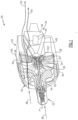
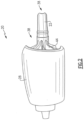
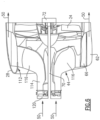
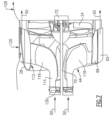
- FIGS 1 and 2 schematically illustrate an example hydrogen steam injected inter-cooled aircraft propulsion system that is generally indicated at 20.
- Heat exchangers utilized to recover and generate steam for injection into a core flow operate most effectively with low pressure drops that require large forward facing areas.
- the example propulsion system 20 incorporates heat exchangers for evaporator and condenser systems at least partially within a nacelle assembly such that larger forward surface areas can be utilized.
- a gas generating core engine is mounted forward of a propulsive fan to free additional space within the nacelle assembly for a refrigeration system.
- the propulsion system 20 includes a gas generating core engine 22 supported engine forward of a propulsive fan 24.
- the fan 24 is disposed within a nacelle assembly 26 including a nacelle housing 28.
- the core engine 22 drives the propulsive fan 24 through a speed reduction gear box 72.
- a condenser assembly 62 and evaporator assembly 42 are disposed in a forward portion of the nacelle housing 28.
- a core gas flow 50 is communicated radially outward through an exhaust duct 44 to the evaporator assembly 42 and the condenser assembly 62. Locating the evaporator assembly 42 and the condenser assembly 62 within the nacelle housing 28 provides larger surfaces for the required heat exchangers to enhance thermal transfer.
- Fan flow 52 is exhausted through the exhaust opening 34 to provide a propulsive thrust.
- a portion of the fan flow 52 is communicated as a cooling flow 54 to a refrigerant assembly 46.
- the refrigerant assembly 46 includes a condenser 48 that is supported aft of the propulsive fan 24 and vanes 30. In one disclosed example, portions of the refrigerant system 46 are supported in a tail cone 58.
- the refrigerant assembly 46 circulates a cooling medium to the condenser assembly 62 to aid in condensing water from the core gas flow 50.
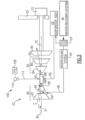
- the core engine 22 is schematically shown and defines a portion of the core airflow path C for the core flow 50.
- An inlet airflow 38 is routed through serially through a compressor section 90, a combustor 88 and a turbine section 82 disposed along the axis A.
- the compressor section 90 the inlet airflow 38 is compressed and mixed with a hydrogen (H 2 ) fuel flow 112 and ignited to generate the core gas flow 50 that expands through the turbine section 82 where energy is extracted and utilized to drive the compressor section 90.
- H 2 hydrogen
- the disclosed example core engine embodiment 22 includes the compressor section with a low pressure compressor (LPC) 92 coupled to a low pressure turbine (LPT) 86 through an outer shaft 98.
- a high pressure compressor (HPC) 94 is coupled to a high pressure turbine 84 through an inner shaft 96.
- a power turbine 80 is coupled to a shaft 70 that drives the fan 24 through the gear box 72.
- the gear box 72 may be of any configuration utilized to provide a desired speed change between the power turbine 80 and fan 24.
- the example core engine 22 is shown and disclosed by way of example as being disposed along the axis A along with the fan 24, the core engine may be disposed offset from the axis A. As the power turbine 80 is not mechanically coupled to the core engine 22 and is driven by the core flow 50, the core engine 22 and the power turbine 80 and fan 24 could be on different axes. Moreover, the core engine 22 may be angled relative to an axis of rotation of the fan 24. Accordingly, mechanically decoupling of the fan 24 from the core engine 22 provides for offset and angled relative orientations of the core engine 22. Such offset and angular orientations of the core engine 22 are within the contemplation and scope of this disclosure.
- the core engine 22 is configured to burn hydrogen provided by a fuel system 106.
- the fuel system 106 includes a liquid hydrogen (LH 2 ) tank 108 in communication with at least one pump 110.
- the pump 110 drives the fuel flow 112 to the combustor 88.
- hydrogen is shown and described by way of example, other non-carbon based fuels could also be utilized and are within the scope and contemplation of this disclosure. Additionally, traditional carbon-based fuels could also be utilized and are within the contemplation and scope of this disclosure.
- a water recovery system 40 recovers water that is communicated to a water tank 124. From the water tank, water is communicated to the intercooling system 65 and to the evaporator 42.
- a steam flow 56 is injected into the core flow path C.
- the core engine 22 has an increased power output from the injected steam flow 56 due to an increasing mass flow through the turbine section 82 without a corresponding increase in work from the compressor section 90.
- An example engine operation cycle may include up to (or more than) 35% steam-air-ratios (SAR) and may be assisted by a multiple fold (e.g., 2x, 3x, etc.) increase in moisture from burning H 2 as the fuel.
- SAR steam-air-ratios
- An intercooling system 65 provides an intercooling water flow 68 that is communicated to the compressor section 90 to reduce a temperature of the core flow 50 and increase mass flow.
- water flow 68 is injected at a location 100 between the LPC 92 and HPC 94.
- the water flow 68 provides reduced temperatures and increased mass flow that decreases the work required by the compressor section 90.
- Water may also be used as a cooling flow to cool other sections of the core engine 22 such as for example, the turbine section 82.
- an example intercooling system 65 is schematically shown by way of example, other intercooling systems that utilized a flow of water for cooling could be utilized and are within the contemplation of this disclosure.
- the core engine 22 is disposed within a housing 76 that defines a core inlet 74.
- the core housing 76 is supported forward of the nacelle assembly 26.
- a turbine exhaust case 78 defines the outlet for the core flow 50 from the core engine 22.
- the condenser/water recovery system 40 includes a plurality of condensers 62 disposed about a circumference of the nacelle assembly 26.
- the plurality of condensers 62 are positioned at a forward location proximate to the inlet 32.
- the core flow 50 is cooled in each of the plurality of condensers 62 to condense water into a liquid form.
- the liquid water is separated in a water separator 64 and communicated to an evaporator assembly 42.
- Each of the plurality of condensers 62 are in communication with a cold sink to enhance condensation of water from the core flow 50.
- the refrigeration system 46 includes a closed loop cooling circuit 60 that is in thermal communication with each of the condensers 62.
- a refrigerant flow 65 accepts heat from the core gas flow 50 in each of the plurality of condensers 62.
- the location of the core engine 22 forward of the nacelle assembly 26 frees up space aft of the fan 24.
- the free space provides for a refrigerant condenser, shown schematically at 48, of an increased size.
- the cooling air flow 54 is routed into the tail cone 58 and through the refrigerant condenser 48 to cool the refrigerant flow 65 after accepting heat in the condenser 62.
- Water from the water separator 64 may be stored in a tank, shown schematically at 124 to accommodate variations in water recovery.
- a pump 126 may be utilized to drive water flow to the evaporator assembly 42.
- the evaporator assembly 42 includes a plurality of evaporators 66 disposed about a circumference of the nacelle assembly 26. Heat from the core as flow 50 is utilized to transform the water flow 68 into a steam flow 56.
- the plurality of evaporators 66 are disposed about a circumference of the nacelle assembly 26 proximate to the inlet 32.
- the example evaporator assembly 42 and evaporators 66 are shown by way of example within the nacelle assembly 26, portions of the evaporator assembly 42 and evaporators 66 may be disposed at least partially outside of the nacelle assembly 26 and remain within the contemplation and scope of this disclosure.
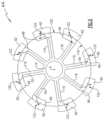
- the exhaust duct 44 is schematically shown and defines a path for communicating the core flow 50 radially outward to the evaporators 66 and condensers 62.
- the evaporators 66 are disposed, at least partially along an inner surface 118 of the nacelle assembly 26 and the condensers 62 are at radially outward of the evaporators 66.
- the exhaust duct 44 includes a central portion 114 that is coupled to a turbine exhaust case 78 at an aft portion of the core engine 22.
- Radial passage portions 116 extend from the central portion 114 to each of the plurality of evaporators 66.
- the shaft 70 for driving the fan 24 extends through the central portion 114.
- the radial passage portions 116 are spaced circumferentially apart to provide passages for the inlet flow to the fan 24.
- one radial passage portion 116 is provided for each of the evaporators 66 disposed within the nacelle assembly 26. However, the number of passage portions 116 could be changed to accommodate different evaporator configurations and remain within the contemplation of this disclosure.
- the example exhaust duct 44 is disclosed as a single unitary part with the radial passage portions 116 being provided as curved transitions to turn the axially directed core flow 50 radially outward to each of the evaporators 66.
- the passage portions 116 may further curve circumferentially to direct flow into the corresponding one of the evaporators 66.
- Each of the evaporators 66 include a passage 122 for communicating the core flow 50 to one of the condensers 62.
- the number of evaporators 66 and condensers 62 are the same such that the core flow 50 is divided evenly through the passage portions 116.
- a ram air passage 120 is disposed in the nacelle 28 and provides for a ram air flow 128 to be placed in thermal communication with the condenser 62.
- the ram air flow 128 reduces and/or eliminates the need for the refrigerant flow for cooling of the condensers 62.
- an example operational embodiment includes generating the core flow 50 in the core engine 22.
- the core flow 50 is generated from a hydrogen based fuel and the steam flow 56 that is injected into the core flow 50.
- a shaft 70 is driven by a power turbine 80 ( Figure 3 ) through which the core flow 50 expands.
- the core flow 50 is then exhausted through the turbine exhaust case 78 into the exhaust duct 44.
- the core flow 50 is directed radially outward through one of the pluralities of radial passages 116 to one of the evaporators 66.
- the core flow 50 is then communicated to one of the condensers 62 and cooled to liquify water.
- the refrigerant system 46 cools the core flow 50 by providing the refrigerant flow 65 through the closed loop refrigerant circuit 60.
- a cooling flow 54 is routed across the refrigerant condenser 48 to cool the warmed refrigerant flow 65.
- the ram air flow 128 could be utilized for cooling the core flow 50 within the condensers 62.
- the cooled core flow 50 with liquified water content is routed to the water separators 64.
- a plurality of water separators 64 are provided that correspond with each of the condensers 62.
- one water separator 64 that receives the cooled core flow 50 could be utilized and is within the contemplation of this disclosure.
- Separated water is communicated either to a water tank 124 and/or directly to each of the evaporators 66.
- the remaining gaseous portion of the core flow 50 is exhausted to the ambient environment.
- the water flow to the evaporators 66 is transformed into the steam flow 56 with heat from the core flow 50.
- the steam flow 56 is communicated to the core engine 22 and injected in to the core flow path C.
- the example propulsion system embodiments include evaporator and condenser systems with increased efficiencies by providing corresponding heat exchangers within the nacelle assembly such that larger forward surface areas can be utilized.
- the forward mounted gas generating core engine provides additional space within the nacelle assembly for a refrigeration system.
Landscapes
- Engineering & Computer Science (AREA)
- Chemical & Material Sciences (AREA)
- Combustion & Propulsion (AREA)
- Mechanical Engineering (AREA)
- General Engineering & Computer Science (AREA)
- Heat-Exchange Devices With Radiators And Conduit Assemblies (AREA)
- Laminated Bodies (AREA)
- Engine Equipment That Uses Special Cycles (AREA)
Applications Claiming Priority (1)
| Application Number | Priority Date | Filing Date | Title |
|---|---|---|---|
| US18/106,161 US12092022B2 (en) | 2023-02-06 | 2023-02-06 | Forward mounted hydrogen steam injected and inter-cooled turbine engine with octopus ducting |
Publications (2)
| Publication Number | Publication Date |
|---|---|
| EP4411122A2 true EP4411122A2 (de) | 2024-08-07 |
| EP4411122A3 EP4411122A3 (de) | 2024-10-09 |
Family
ID=89853687
Family Applications (1)
| Application Number | Title | Priority Date | Filing Date |
|---|---|---|---|
| EP24156137.2A Pending EP4411122A3 (de) | 2023-02-06 | 2024-02-06 | Ein antriebssystem für ein flugzeug |
Country Status (2)
| Country | Link |
|---|---|
| US (1) | US12092022B2 (de) |
| EP (1) | EP4411122A3 (de) |
Cited By (2)
| Publication number | Priority date | Publication date | Assignee | Title |
|---|---|---|---|---|
| EP4431715A3 (de) * | 2023-03-08 | 2024-10-16 | RTX Corporation | Wärmetauscher zur wasser- und/oder wärmeenergierückgewinnung aus verbrennungsprodukten von turbinenmotoren |
| EP4726197A1 (de) * | 2024-10-09 | 2026-04-15 | RTX Corporation | Schubumkehrvorrichtung in einem kondensatorausgangskanal |
Families Citing this family (3)
| Publication number | Priority date | Publication date | Assignee | Title |
|---|---|---|---|---|
| US12331684B2 (en) * | 2023-11-07 | 2025-06-17 | Rtx Corporation | Strut microtube counterflow evaporator |
| US20250369393A1 (en) * | 2024-05-30 | 2025-12-04 | Rtx Corporation | Axial flow angled condenser arrangement for an aircraft propulsion system |
| US12510023B1 (en) * | 2024-07-01 | 2025-12-30 | Rtx Corporation | Fan case mounted evaporator for aircraft turbine engine |
Family Cites Families (15)
| Publication number | Priority date | Publication date | Assignee | Title |
|---|---|---|---|---|
| US2447696A (en) * | 1944-12-13 | 1948-08-24 | Fairey Aviat Co Ltd | Combustion gas and steam turbine arrangement |
| US3266564A (en) | 1964-02-11 | 1966-08-16 | Curtiss Wright Corp | Liquid metal rotary heat exchanger |
| US3604207A (en) | 1970-06-01 | 1971-09-14 | Rohr Corp | Vapor cycle propulsion system |
| GB2192234B (en) | 1986-07-02 | 1991-04-17 | Rolls Royce Plc | A turbofan gas turbine engine |
| US20150000298A1 (en) * | 2013-03-15 | 2015-01-01 | Advanced Green Technologies, Llc | Fuel conditioner, combustor and gas turbine improvements |
| US10421553B2 (en) * | 2015-01-20 | 2019-09-24 | United Technologies Corporation | Pusher fan engine with in wing configuration |
| US10184372B2 (en) | 2016-05-23 | 2019-01-22 | Honeywell International Inc. | Exhaust systems and methods for gas turbine engine |
| DE102019203595A1 (de) * | 2019-03-15 | 2020-09-17 | MTU Aero Engines AG | Luftfahrzeug |
| WO2022232828A1 (en) * | 2021-04-30 | 2022-11-03 | University Of Florida Research Foundation, Inc. | Semi-closed cycle aero engine with contrail suppression |
| US11635022B1 (en) * | 2022-02-11 | 2023-04-25 | Raytheon Technologies Corporation | Reducing contrails from an aircraft powerplant |
| US11603798B1 (en) * | 2022-02-11 | 2023-03-14 | Raytheon Technologies Corporation | Cryogenically assisted exhaust condensation |
| US11828200B2 (en) * | 2022-02-11 | 2023-11-28 | Raytheon Technologies Corporation | Hydrogen-oxygen fueled powerplant with water and heat recovery |
| US12163467B2 (en) * | 2022-05-13 | 2024-12-10 | Rtx Corporation | Condenser for hydrogen steam injected turbine engine |
| US12129774B2 (en) * | 2022-05-19 | 2024-10-29 | Rtx Corporation | Hydrogen fueled turbine engine pinch point water separator |
| US11808209B1 (en) * | 2023-04-25 | 2023-11-07 | Rtx Corporation | Aftercooler exhaust duct protection |
-
2023
- 2023-02-06 US US18/106,161 patent/US12092022B2/en active Active
-
2024
- 2024-02-06 EP EP24156137.2A patent/EP4411122A3/de active Pending
Cited By (2)
| Publication number | Priority date | Publication date | Assignee | Title |
|---|---|---|---|---|
| EP4431715A3 (de) * | 2023-03-08 | 2024-10-16 | RTX Corporation | Wärmetauscher zur wasser- und/oder wärmeenergierückgewinnung aus verbrennungsprodukten von turbinenmotoren |
| EP4726197A1 (de) * | 2024-10-09 | 2026-04-15 | RTX Corporation | Schubumkehrvorrichtung in einem kondensatorausgangskanal |
Also Published As
| Publication number | Publication date |
|---|---|
| US20240263578A1 (en) | 2024-08-08 |
| US12092022B2 (en) | 2024-09-17 |
| EP4411122A3 (de) | 2024-10-09 |
Similar Documents
| Publication | Publication Date | Title |
|---|---|---|
| EP4411122A2 (de) | Ein antriebssystem für ein flugzeug | |
| US12129774B2 (en) | Hydrogen fueled turbine engine pinch point water separator | |
| CN110529256B (zh) | 用于燃气涡轮发动机组件的空气循环组件 | |
| US20230323814A1 (en) | Hydrogen turbine power assisted condensation | |
| US12442330B2 (en) | Condenser for hydrogen steam injected turbine engine | |
| EP4279718B1 (de) | Kondensatorkanal eines wasserstoffbetriebenen turbinenmotors | |
| US11920515B2 (en) | Condenser for hydrogen steam injected turbine engine | |
| EP4455465B1 (de) | Versetzter kern mit seitlichen ejektordüsen der verkleidung | |
| EP4656858A2 (de) | Umlaufflusskondensatoranordnung für ein flugzeugantriebssystem | |
| EP4279721B1 (de) | Wasserstoffdampfeinspritzturbinenmotor mit rückströmung | |
| US12421895B2 (en) | Turbine engine including a condenser system | |
| EP4414542A1 (de) | Wasserabscheider für wasserstoffdampfeinspritzturbinenmotor | |
| EP4279719A1 (de) | Wasserstoffdampfeinspritzturbinenmotor mit gekühlter kühlluft | |
| US12473858B2 (en) | Partial exhaust bottoming cycle | |
| EP4656860A1 (de) | Konische kondensatoranordnung mit axialer strömung für ein flugzeugantriebssystem | |
| US12510023B1 (en) | Fan case mounted evaporator for aircraft turbine engine | |
| US20260063068A1 (en) | Evaporator system within an inner fixed structure of an aircraft propulsion system | |
| EP4656857A2 (de) | Geneigte axialflusskondensatoranordnung für ein flugzeugantriebssystem |
Legal Events
| Date | Code | Title | Description |
|---|---|---|---|
| PUAI | Public reference made under article 153(3) epc to a published international application that has entered the european phase |
Free format text: ORIGINAL CODE: 0009012 |
|
| STAA | Information on the status of an ep patent application or granted ep patent |
Free format text: STATUS: THE APPLICATION HAS BEEN PUBLISHED |
|
| AK | Designated contracting states |
Kind code of ref document: A2 Designated state(s): AL AT BE BG CH CY CZ DE DK EE ES FI FR GB GR HR HU IE IS IT LI LT LU LV MC ME MK MT NL NO PL PT RO RS SE SI SK SM TR |
|
| PUAL | Search report despatched |
Free format text: ORIGINAL CODE: 0009013 |
|
| AK | Designated contracting states |
Kind code of ref document: A3 Designated state(s): AL AT BE BG CH CY CZ DE DK EE ES FI FR GB GR HR HU IE IS IT LI LT LU LV MC ME MK MT NL NO PL PT RO RS SE SI SK SM TR |
|
| RIC1 | Information provided on ipc code assigned before grant |
Ipc: F02K 3/062 20060101ALI20240902BHEP Ipc: F02C 3/30 20060101ALI20240902BHEP Ipc: F02C 3/22 20060101AFI20240902BHEP |
|
| STAA | Information on the status of an ep patent application or granted ep patent |
Free format text: STATUS: REQUEST FOR EXAMINATION WAS MADE |
|
| 17P | Request for examination filed |
Effective date: 20250407 |