EP4410673A1 - Neuromorphic sensor implementation in aircraft cabin environments - Google Patents
Neuromorphic sensor implementation in aircraft cabin environments Download PDFInfo
- Publication number
- EP4410673A1 EP4410673A1 EP24155328.8A EP24155328A EP4410673A1 EP 4410673 A1 EP4410673 A1 EP 4410673A1 EP 24155328 A EP24155328 A EP 24155328A EP 4410673 A1 EP4410673 A1 EP 4410673A1
- Authority
- EP
- European Patent Office
- Prior art keywords
- smart device
- sensor
- neuromorphic
- neuromorphic sensor
- passenger cabin
- Prior art date
- Legal status (The legal status is an assumption and is not a legal conclusion. Google has not performed a legal analysis and makes no representation as to the accuracy of the status listed.)
- Granted
Links
Images


Classifications
-
- B—PERFORMING OPERATIONS; TRANSPORTING
- B64—AIRCRAFT; AVIATION; COSMONAUTICS
- B64D—EQUIPMENT FOR FITTING IN OR TO AIRCRAFT; FLIGHT SUITS; PARACHUTES; ARRANGEMENT OR MOUNTING OF POWER PLANTS OR PROPULSION TRANSMISSIONS IN AIRCRAFT
- B64D11/00—Passenger or crew accommodation; Flight-deck installations not otherwise provided for
-
- B—PERFORMING OPERATIONS; TRANSPORTING
- B64—AIRCRAFT; AVIATION; COSMONAUTICS
- B64D—EQUIPMENT FOR FITTING IN OR TO AIRCRAFT; FLIGHT SUITS; PARACHUTES; ARRANGEMENT OR MOUNTING OF POWER PLANTS OR PROPULSION TRANSMISSIONS IN AIRCRAFT
- B64D11/00—Passenger or crew accommodation; Flight-deck installations not otherwise provided for
- B64D11/0015—Arrangements for entertainment or communications, e.g. radio, television
-
- B—PERFORMING OPERATIONS; TRANSPORTING
- B64—AIRCRAFT; AVIATION; COSMONAUTICS
- B64D—EQUIPMENT FOR FITTING IN OR TO AIRCRAFT; FLIGHT SUITS; PARACHUTES; ARRANGEMENT OR MOUNTING OF POWER PLANTS OR PROPULSION TRANSMISSIONS IN AIRCRAFT
- B64D11/00—Passenger or crew accommodation; Flight-deck installations not otherwise provided for
- B64D11/02—Toilet fittings
-
- B—PERFORMING OPERATIONS; TRANSPORTING
- B64—AIRCRAFT; AVIATION; COSMONAUTICS
- B64D—EQUIPMENT FOR FITTING IN OR TO AIRCRAFT; FLIGHT SUITS; PARACHUTES; ARRANGEMENT OR MOUNTING OF POWER PLANTS OR PROPULSION TRANSMISSIONS IN AIRCRAFT
- B64D11/00—Passenger or crew accommodation; Flight-deck installations not otherwise provided for
- B64D11/04—Galleys
-
- G—PHYSICS
- G06—COMPUTING OR CALCULATING; COUNTING
- G06N—COMPUTING ARRANGEMENTS BASED ON SPECIFIC COMPUTATIONAL MODELS
- G06N3/00—Computing arrangements based on biological models
- G06N3/02—Neural networks
- G06N3/06—Physical realisation, i.e. hardware implementation of neural networks, neurons or parts of neurons
- G06N3/063—Physical realisation, i.e. hardware implementation of neural networks, neurons or parts of neurons using electronic means
-
- H—ELECTRICITY
- H04—ELECTRIC COMMUNICATION TECHNIQUE
- H04N—PICTORIAL COMMUNICATION, e.g. TELEVISION
- H04N7/00—Television systems
- H04N7/18—Closed-circuit television [CCTV] systems, i.e. systems in which the video signal is not broadcast
- H04N7/188—Capturing isolated or intermittent images triggered by the occurrence of a predetermined event, e.g. an object reaching a predetermined position
-
- A—HUMAN NECESSITIES
- A47—FURNITURE; DOMESTIC ARTICLES OR APPLIANCES; COFFEE MILLS; SPICE MILLS; SUCTION CLEANERS IN GENERAL
- A47K—SANITARY EQUIPMENT; ACCESSORIES THEREFOR, e.g. TOILET ACCESSORIES
- A47K5/00—Holders or dispensers for soap, toothpaste or the like
- A47K5/06—Dispensers for soap
- A47K5/12—Dispensers for soap for liquid or pasty soap
- A47K5/1217—Electrical control means for the dispensing mechanism
-
- B—PERFORMING OPERATIONS; TRANSPORTING
- B64—AIRCRAFT; AVIATION; COSMONAUTICS
- B64D—EQUIPMENT FOR FITTING IN OR TO AIRCRAFT; FLIGHT SUITS; PARACHUTES; ARRANGEMENT OR MOUNTING OF POWER PLANTS OR PROPULSION TRANSMISSIONS IN AIRCRAFT
- B64D11/00—Passenger or crew accommodation; Flight-deck installations not otherwise provided for
- B64D2011/0038—Illumination systems for cabins as a whole
-
- B—PERFORMING OPERATIONS; TRANSPORTING
- B64—AIRCRAFT; AVIATION; COSMONAUTICS
- B64D—EQUIPMENT FOR FITTING IN OR TO AIRCRAFT; FLIGHT SUITS; PARACHUTES; ARRANGEMENT OR MOUNTING OF POWER PLANTS OR PROPULSION TRANSMISSIONS IN AIRCRAFT
- B64D11/00—Passenger or crew accommodation; Flight-deck installations not otherwise provided for
- B64D2011/0053—Cabin passenger reading lights
-
- E—FIXED CONSTRUCTIONS
- E03—WATER SUPPLY; SEWERAGE
- E03C—DOMESTIC PLUMBING INSTALLATIONS FOR FRESH WATER OR WASTE WATER; SINKS
- E03C1/00—Domestic plumbing installations for fresh water or waste water; Sinks
- E03C1/02—Plumbing installations for fresh water
- E03C1/05—Arrangements of devices on wash-basins, baths, sinks, or the like for remote control of taps
- E03C1/055—Electrical control devices, e.g. with push buttons, control panels or the like
- E03C1/057—Electrical control devices, e.g. with push buttons, control panels or the like touchless, i.e. using sensors
-
- E—FIXED CONSTRUCTIONS
- E03—WATER SUPPLY; SEWERAGE
- E03D—WATER-CLOSETS OR URINALS WITH FLUSHING DEVICES; FLUSHING VALVES THEREFOR
- E03D5/00—Special constructions of flushing devices, e.g. closed flushing system
- E03D5/10—Special constructions of flushing devices, e.g. closed flushing system operated electrically, e.g. by a photo-cell; also combined with devices for opening or closing shutters in the bowl outlet and/or with devices for raising/or lowering seat and cover and/or for swiveling the bowl
- E03D5/105—Special constructions of flushing devices, e.g. closed flushing system operated electrically, e.g. by a photo-cell; also combined with devices for opening or closing shutters in the bowl outlet and/or with devices for raising/or lowering seat and cover and/or for swiveling the bowl touchless, e.g. using sensors
Definitions
- the present disclosure relates generally to improvements to smart devices utilized in environments such as aircraft cabins, and more particularly, to the fusion of neuromorphic sensor technology and smart device modalities to expand and maximize the usage and functionality of smart devices.
- Aircraft cabins are one environment type that benefits from the use of smart devices.
- Smart devices in such environments are generally equipped with sensor technologies configured to automate usage of the device according to a set of preprogrammed instructions.
- the preprogrammed instructions may be as basic as turning on or off a device when a predetermined condition is met. In other instances, the preprogrammed instructions may be more complicated such as customized usage according to the user.
- smart devices may be utilized in the passenger cabin to control lighting systems, seat controls, climatization, media equipment, etc.
- smart devices may be utilized to control lighting systems, ventilation, toilets, faucets, soap dispensers, etc. Galleys and crew quarters may also benefit from the use of smart devices, among other applications.
- Infrared and proximity sensors are two modalities commonly incorporated in smart devices.
- Infrared sensors are devices configured to emit and detect infrared radiation in order to detect obstacles within range of the sensor.
- an infrared sensor can be used to detect heat and motion of a passenger, without physical contact, to activate or deactivate a device according to a preprogrammed instruction.
- Proximity sensors operate in a similar manner by emitting an electromagnetic field or beam and determining a change in the field or return signal.
- Short range proximity sensors are commonly used in lavatory appliances as touchless switches for hygiene reasons.
- the present disclosure provides a system for implementation in an aircraft passenger cabin.
- the system includes a smart device, or in some instances a plurality of smart devices, including communication circuitry and a sensor configured to detect a condition change proximate the smart device.
- the system further includes a neuromorphic sensor positionable apart from the smart device, or in some instances a plurality of neuromorphic sensors, the neuromorphic sensor including communication circuitry, and the neuromorphic sensor configured to detect a condition change apart from the smart device.
- the system further includes a controller communicatively coupled to each of the smart device and the neuromorphic sensor, the controller including a processor configured to receive condition change information from each of the smart device and the neuromorphic sensor, coordinate the received condition change information, and instruct the smart device to operate, according to preprogrammed instructions, based on the received and coordinated condition change information.
- the senor of the smart device is a proximity sensor configured to detect object movement proximate the smart device
- the neuromorphic sensor is configured to detect object movement in the aircraft passenger cabin, the detected object movement of the neuromorphic sensor out of range of detection of the sensor of the smart device.
- the aircraft passenger cabin is a passenger seating area including a passenger seat
- the condition change associated with each of the sensor of the smart device and the neuromorphic sensor comprises passenger movement within the passenger seating area
- the smart device is one of a lighting device, a seat control device, a climatization device, and a media device
- the neuromorphic sensor is positionable in the passenger seating area such that an imaging area of the neuromorphic sensor includes the passenger seat.
- the aircraft passenger cabin is a lavatory
- the condition change associated with each of the smart device and the neuromorphic sensor comprises passenger movement
- the smart device is one of a lighting device, a toilet, a climatization device, a ventilation device, a disinfection device, a faucet, and a soap dispenser
- the neuromorphic sensor is positionable to image substantially an entirety of the lavatory.
- condition change associated with each of the smart device and the neuromorphic sensor comprises inanimate object movement
- the smart device is an inanimate object configured to traverse at least one aisle of the aircraft passenger cabin
- the neuromorphic sensor is positionable in the aircraft passenger cabin such that an imaging area of the at least one neuromorphic sensor includes the at least one aisle.
- the smart device is a galley cart.
- the smart device is communicatively coupled to at least one other smart device, and the at least one other smart device is communicatively coupled to the controller.
- the neuromorphic sensor is communicatively coupled to at least one other neuromorphic sensor, the at least one other neuromorphic sensor is communicatively coupled to the controller, and each neuromorphic sensor is configured to image a predetermined area of the aircraft passenger cabin, wherein each predetermined area may or may not overlap at least one other predetermined area.
- condition change comprises passenger movement and the neuromorphic sensor is incapable of capturing a visually recognizable identity of any person.
- the present disclosure provides a method of operating a smart device in an aircraft passenger cabin.
- the method includes providing a smart device in the aircraft passenger cabin including a sensor configured to detect object movement proximate the smart device, and providing a neuromorphic sensor in the aircraft passenger cabin, the neuromorphic sensor configured to detect object movement in the aircraft passenger cabin out of range of detection of the sensor of the smart device.
- the method further includes providing a controller communicatively coupled to each of the smart device and the neuromorphic sensor.
- the method continues with detecting, by the neuromorphic sensor, object movement in the aircraft passenger cabin, analyzing, by the controller, the detected object movement, and determining, by the controller, if the analyzed object movement is associated with use of the smart device. If the object movement is determined to be associated with the use of the smart device then, by the controller, the method continues with instructing the smart device to operate according to preprogrammed instructions of the smart device.
- the step of analyzing includes confirming object movement into or out of an imaging area of the neuromorphic sensor and/or confirming object movement toward or away from the smart device.
- the aircraft passenger cabin is a passenger seating area including a passenger seat
- the smart device is one of a lighting device, a seat control device, a climatization device, and a media device
- the neuromorphic sensor is positionable in the passenger seating area such that an imaging area of the neuromorphic sensor includes the passenger seat.
- the aircraft passenger cabin is a lavatory
- the smart device is one of a lighting device, a toilet, a climatization device, a ventilation device, a disinfection device, a faucet, and a soap dispenser
- the neuromorphic sensor is positionable overhead in the lavatory.
- the smart device is networked with at least one other smart device communicatively coupled to the controller, and use of the smart device and the at least one other smart device is coordinated according to preprogrammed instructions.
- the neuromorphic sensor is networked with at least one other neuromorphic sensor, each of the neuromorphic sensor and the at least one other neuromorphic sensor is configured to image a predetermined area of the aircraft passenger cabin, and each predetermined area may or may not overlap at least one other predetermined area.
- a letter following a reference numeral is intended to reference an embodiment of the feature or element that may be similar, but not necessarily identical, to a previously described element or feature bearing the same reference numeral (e.g., 1, 1a, 1b).
- reference numeral e.g. 1, 1a, 1b
- Such shorthand notations are used for purposes of convenience only and should not be construed to limit the disclosure in any way unless expressly stated to the contrary.
- any reference to “one embodiment” or “some embodiments” means that a particular element, feature, structure, or characteristic described in connection with the embodiment is included in at least one embodiment disclosed herein.
- the appearances of the phrase “in some embodiments” in various places in the specification are not necessarily all referring to the same embodiment, and embodiments may include one or more of the features expressly described or inherently present herein, or any combination of sub-combination of two or more such features, along with any other features which may not necessarily be expressly described or inherently present in the instant disclosure.
- the present disclosure provides systems and methods configured to be implemented in an active environment such as an aircraft passenger cabin.
- the systems described herein include at least one sensor of a particular type deployed in conjunction with at least one smart device provided in the environment.
- the at least one sensor such as a neuromorphic sensor, captures and outputs information regarding movements that occur in the environment such as inanimate object and passenger movements.
- the movements are then analyzed by the system, such as by a processor configured in a controller, and as they relate to use of a smart device, may be used to operate, improve, coordinate, and expand the functionalities and capabilities of the smart devices.
- the at least one neuromorphic sensor is positioned apart from the at least one smart device such that object movement detection of the at least one neuromorphic sensor is out of range of detection of the at least one smart device.
- the at least one neuromorphic sensor is configured to monitor the overall environment in which the at least one smart device operates whereas the smart device is configured to detect object movements proximate the at least smart device and in range of an integrated sensor of the at least one smart device.
- use of the at least one smart device may be according to detected movements proximate the at least one smart device, object movements apart from the at least one smart device, or a coordination of various detected object movements.
- Environments that benefit from the systems and methods of the present disclosure include, but are not limited to, aircraft and other vehicle passenger cabins, seating areas and passenger suites within passenger cabins, lavatories, crew quarters, galleys, cockpits, etc.
- the systems may be utilized in other environments that include smart devices, wherein an additional sensor apart from the smart device itself may serve to expand the capabilities of the smart device.
- neuromorphic sensors also referred to herein as neuromorphic vision systems.
- neuromorphic event-based camera sensors are imaging sensors configured to detect and track object movements in real time, with low latency, and with high sensitivity regardless of lighting conditions.
- neuromorphic sensors respond to local changes in brightness as they occur and report those changes as changes in pixel intensities.
- Neuromorphic sensors do not capture and report color information nor do they report visually recognizable information. As such, the information obtained and reported by neuromorphic sensors makes them particularly well suited for use in areas wherein there is an expectation of privacy, such as lavatories, seating compartments, sleeping quarters, suites, etc.
- neuromorphic sensors in conjunction with the use of smart devices according to the present disclosure expands the capabilities of conventional smart devices.
- improved smart devices according to the present disclosure may be enhanced in terms of use, application, range, coordination, etc.
- FIG. 1 illustrates a non-limiting example of an aircraft passenger cabin within which systems and methods according to the present disclosure may be implemented.
- the passenger cabin 100 may be typical of a commercial airliner configured to carry a predetermined number of passengers.
- the illustrated passenger cabin 100 includes a plurality seat rows 102 separated by a center aisle 104 arranged parallel to the aircraft longitudinal axis.
- a galley 106 positioned proximate a forward end of the cabin is used by the cabin crew for food and beverage service.
- the galley 106 may include stowage for galley carts such as smart carts 108.
- a lavatory 110 may be positioned in the cabin.
- Portions of the cabin environment may include at least one smart device.
- the term “smart device” refers to an intelligent device including communication circuitry and sensing equipment included in the device or communicatively coupled thereto.
- the smart device may be networked with a controller and at least one other smart device operating in the environment to coordinate functions.
- the smart device operates according to preprogrammed instructions. For example, sensing functionality may detect movement in close proximity to the smart device, and responsive to the sensed movement, the device operates according to the preprogrammed instructions.
- sensing equipment provided in the device may detect object movement relative to the sensing equipment which in turn causes the device to power on, whereas movement of the object away from the sensing equipment or expiration of a predetermined time period may cause the device to power off.
- Examples of such devices that operate according to the foregoing description include, but are not limited to, smart switches, entry detectors, and appliances. Smart switches, for example, may be electrically coupled to other devices such as components of lighting systems, seat actuation systems, climatization systems, media devices, etc. In use, a touchless smart switch operates to activate or inactivate a device responsive to movement sensed by the switch, obviating the need to operate the switch manually.
- smart device sensors may include proximity sensors incorporated into the device.
- a galley cart 108 may be configured as smart device.
- a smart galley cart 108 may be configured to traverse an aisle to serve food and beverages to traveling passengers.
- Automated functionality of a smart galley cart 108 may include, but is not limited to, deployment, dispensing, payment and stowage.
- a smart galley cart 108 may be networked and communicatively coupled to a controller 112 configured to receive requests for service. When a request for service is received, a smart galley cart 108 may be deployed to satisfy the service request.
- the controller 112 is part of a crew display including an interface.
- At least one neuromorphic sensor 114 may be positioned in the cabin to image a predetermined area of the cabin.
- a plurality of neuromorphic sensors 114 may be installed in a cabin environment that is large, complex in shape, includes obstacles such as walls, etc.
- Each neuromorphic sensor 114 is configured to image a predetermined area, and a predetermined area may overlap with at least one other area such that complete coverage is achieved.
- the controller 112, communicatively coupled to each neuromorphic sensor 114 may be configured to reconcile the received outputs from the sensors.
- the sensors detect and report local changes in brightness in the environment corresponding to object movements.
- Object movements such as animate (e.g., passenger) and inanimate (e.g., galley cart) movements are analyzed by the controller to determine an association with a use of at least one smart device.
- FIG. 2 illustrates a non-limiting example, of a passenger suite in an aircraft in which systems and methods according to the present disclosure may be implemented.
- the illustrated passenger suite 200 includes a passenger seat 202 and at least one amenity such as a seat actuation system 204, climatization system internal to the seat or seating area, media device 206 for instance positioned in a partition wall 208, etc.
- the seating area 200 may include furniture such as consoles 210 housing controls, other partitions 212, compartments 214, tables 216, deployable partitions 218, doors 220, etc., each of which may include smart capability to automate a function responsive to a sensed condition change such as object movement.
- the at least one amenity may be an intelligent device such that the device operates according to a programmed instruction based on a passenger position and or movement relative to the device.
- the passenger seat 202 may include an actuation system for adjusting seat surfaces. Whereas a standard seat may be controlled via a control panel configured to receive user inputs, an intelligent seat system may adjust automatically according to passenger position and motion.
- Other intelligent devices may include seat climatization devices and cabin climatization devices. In some embodiments, the devices operate according to preprogrammed instructions based on passenger movements into, out of, and within the passenger suite.
- the passenger suite 200 further includes at least one neuromorphic sensor 114 as described above.
- one neuromorphic sensor 114 is positioned in the suite generally overhead location such that the field of view of the sensor includes the passenger seat 202 and suite entrance 222.
- the at least one neuromorphic sensor 114 is positioned to detect movements associated with the passenger, seat, door, window shades, meal table, etc.
- the neuromorphic sensor 114 detects changes associated with the passenger, seat recline, door position, window shade deployment, meal table deployment, etc.
- Such condition changes, determined by object movements are analyzed by a system controller and utilized to carry out the preprogrammed instructions of the at least one smart device.
- the controller for example, may be incorporated into the display monitor or other seat control panel.
- Operation of the smart devices within the passenger suite 200 may be coordinated. For example, a waking motion of the passenger determined by a change in position from horizontal to upright, as reported by the at least one neuromorphic sensor 114, may be considered by the controller to coordinate the seat actuation system in returning the seat to the upright sitting position, changing the lighting conditions in terms of intensity and/or color, opening the window shades, etc.
- the controller may instruct networked smart devices to operate in reverse when the passenger movement indicates a change from awake to sleeping.
- conventional passenger suites may be equipped with a door entry sensor for activating certain devices when a passenger enters or exits a suite
- the at least one neuromorphic sensor captures object movements within the suite for better situational awareness without capturing visually recognizable information considered an invasion of privacy to the passenger.
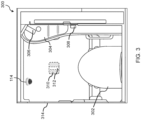
- FIG. 3 illustrates an example of a lavatory in which systems and methods according to the present disclosure may be implemented.
- a lavatory is a place where privacy is expected and thus is an ideal application for neuromorphic sensors.
- the illustrated lavatory 300 includes a toilet 302, sink 304 with faucet 306, soap dispenser 308, fan 310 with fan light 312, door 314, etc., each of which may be configured as a smart device wherein at least one function is automated.
- the lavatory 300 may further include additional smart devices such as lighting systems, climatization systems, fragrance systems, etc.
- the at least one smart device operates according to a programmed instruction based on passenger or object movements relative to the device. For example, the toilet 302 may flush automatically when the toilet senses object movement away from the toilet, the faucet 304 my turn on when object motion proximate the sensor is sensed, and the same for the soap dispenser.
- the lavatory 300 further includes at least one neuromorphic sensor 114 as discussed above.
- a sensor 114 may be positioned overhead in the lavatory such that passenger movement into, out of, and within the lavatory can be detected.
- the at least one sensor 114 is capable of detecting movements associated with the use of the entry door, toilet, faucet, and soap dispenser.
- the output of the neuromorphic sensor 114 can be considered by the device controller to activate or deactivate any of the foregoing smart devices based on the anticipated actions of the passenger, and the device operations can be coordinated in any predetermined manner.
- the systems and methods according to the present disclosure are configured to utilize object movements to anticipate the needs of a passenger such that devices can be operated to meet those needs, without decision making and action on the part of the passengers.
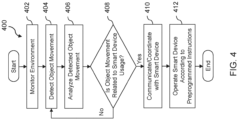
- FIG. 4 is a flowchart illustrating a method 400 for operating at least one smart device in an environment such as an aircraft passenger cabin.
- the general environment is continuously monitored by at least one neuromorphic sensor as described above.
- movements such as passenger movements and inanimate object movements are detected by the at least one neuromorphic sensor.
- outputs from the at least one neuromorphic sensor are analyzed by the controller including the processor, wherein the controller is communicatively coupled to the at least one neuromorphic sensor.
- the controller determines if the analyzed object movements are associated with use at least one smart device further communicatively coupled to the controller.
- Step 410 if the movements are confirmed to be associated with the use of the at least one smart device, the controller communicates with the at least one smart device.
- Step 412 the smart device then operates according to preprogrammed instructions. Movements determined not to be associated with the at least one smart device may be disregarded or used by another system such as an environment monitoring system.
- the controller may be a digital computer that, in terms of hardware architecture, generally includes a processor, input/output (I/O) interfaces, a network interface, a data store, and memory. It should be appreciated by those of ordinary skill in the art that a practical embodiment of a controller may include additional components and suitably configured processing logic to support known or conventional operating features that are not described in detail herein.
- the components are communicatively coupled via a local interface.
- the local interface may be, for example but not limited to, one or more buses or other wired or wireless connections, as is known in the art.
- the local interface may have additional elements, which are omitted for simplicity, such as controllers, buffers (caches), drivers, repeaters, and receivers, among many others, to enable communications. Further, the local interface may include address, control, and/or data connections to enable appropriate communications among the aforementioned components.
- the processor may be a hardware device for executing software instructions.
- the processor may be any custom made or commercially available processor, a central processing unit (CPU), an auxiliary processor among several processors associated with the server, a semiconductor-based microprocessor (in the form of a microchip or chip set), or generally any device for executing software instructions.
- the processor is configured to execute software stored within the memory, to communicate data to and from the memory, and to generally control operations of the server pursuant to the software instructions.
- the I/O interfaces may be used to receive input from and/or for providing system output to one or more devices.
- I/O interfaces may include, for example, a serial port, a parallel port, a small computer system interface (SCSI), a serial ATA (SATA), a fibre channel, Infiniband, iSCSI, a PCI Express interface (PCI-x), an infrared (IR) interface, a radio frequency (RF) interface, and/or a universal serial bus (USB) interface.
- SCSI small computer system interface
- SATA serial ATA
- fibre channel Infiniband
- iSCSI a PCI Express interface
- PCI-x PCI Express interface
- IR infrared
- RF radio frequency
- USB universal serial bus
- a network interface may be used to enable the controller to communicate on a network, such as a wide area network (WAN), a local area network (LAN), and the like, etc.
- the network interface may include, for example, an Ethernet card or adapter (e.g., 10BaseT, Fast Ethernet, Gigabit Ethernet, 10 GbE) or a wireless local area network
- the network interface may include address, control, and/or data connections to enable appropriate communications on the network.
- a data store may be used to store data.
- the data store may include any of volatile memory elements (e.g., random access memory (RAM, such as DRAM, SRAM, SDRAM, and the like)), nonvolatile memory elements (e.g., ROM, hard drive, tape, CDROM, and the like), and combinations thereof.
- the data store may incorporate electronic, magnetic, optical, and/or other types of storage media.
- the data store may be located internal to the server such as, for example, an internal hard drive connected to the local interface in the server.
- the data store may be located external to the server such as, for example, an external hard drive connected to the I/O interfaces (e.g., SCSI or USB connection).
- the data store may be connected to the server through a network, such as, for example, a network attached file server.
- the memory may include any of volatile memory elements (e.g., random access memory (RAM, such as DRAM, SRAM, SDRAM, etc.)), nonvolatile memory elements (e.g., ROM, hard drive, tape, CDROM, etc.), and combinations thereof. Moreover, the memory may incorporate electronic, magnetic, optical, and/or other types of storage media. Note that the memory may have a distributed architecture, where various components are situated remotely from one another, but can be accessed by the processor.
- the software in memory may include one or more software programs, each of which includes an ordered listing of executable instructions for implementing logical functions.
- the software in the memory includes a suitable operating system (O/S) and one or more programs.
- O/S operating system
- the operating system essentially controls the execution of other computer programs, such as the one or more programs, and provides scheduling, input-output control, file and data management, memory management, and communication control and related services.
- the one or more programs may be configured to implement the various processes, algorithms, methods, techniques, etc. described herein.
- the radio enables wireless communication to an external device or network.
- Any number of suitable wireless data communication protocols, techniques, or methodologies can be supported by the radio, including, without limitation: RF; IrDA (infrared); Bluetooth; ZigBee (and other variants of the IEEE 802.15 protocol); IEEE 802.11 (any variation); IEEE 802.16 (WMAX or any other variation); Direct Sequence Spread Spectrum; Frequency Hopping Spread Spectrum; Long Term Evolution (LTE); cellular/wireless/cordless telecommunication protocols (e.g.
- LMR Land Mobile Radio
- DMR Digital Mobile Radio
- TETRA Terrestrial Trunked Radio
- P25 wireless home network communication protocols; paging network protocols; magnetic induction; satellite data communication protocols; wireless hospital or health care facility network protocols such as those operating in the WMTS bands; GPRS; proprietary wireless data communication protocols such as variants of Wireless USB; and any other protocols for wireless communication.
Landscapes
- Engineering & Computer Science (AREA)
- Aviation & Aerospace Engineering (AREA)
- Physics & Mathematics (AREA)
- Health & Medical Sciences (AREA)
- Life Sciences & Earth Sciences (AREA)
- Biomedical Technology (AREA)
- Biophysics (AREA)
- Theoretical Computer Science (AREA)
- Multimedia (AREA)
- Signal Processing (AREA)
- Computational Linguistics (AREA)
- Data Mining & Analysis (AREA)
- Evolutionary Computation (AREA)
- General Health & Medical Sciences (AREA)
- Molecular Biology (AREA)
- Computing Systems (AREA)
- General Engineering & Computer Science (AREA)
- General Physics & Mathematics (AREA)
- Mathematical Physics (AREA)
- Software Systems (AREA)
- Artificial Intelligence (AREA)
- Neurology (AREA)
- Circuit Arrangement For Electric Light Sources In General (AREA)
Abstract
Description
- The present disclosure relates generally to improvements to smart devices utilized in environments such as aircraft cabins, and more particularly, to the fusion of neuromorphic sensor technology and smart device modalities to expand and maximize the usage and functionality of smart devices.
- Aircraft cabins are one environment type that benefits from the use of smart devices. Smart devices in such environments are generally equipped with sensor technologies configured to automate usage of the device according to a set of preprogrammed instructions. In some instances, the preprogrammed instructions may be as basic as turning on or off a device when a predetermined condition is met. In other instances, the preprogrammed instructions may be more complicated such as customized usage according to the user.
- In an aircraft cabin environment, for example, smart devices may be utilized in the passenger cabin to control lighting systems, seat controls, climatization, media equipment, etc. In an aircraft lavatory, smart devices may be utilized to control lighting systems, ventilation, toilets, faucets, soap dispensers, etc. Galleys and crew quarters may also benefit from the use of smart devices, among other applications.
- Infrared and proximity sensors are two modalities commonly incorporated in smart devices. Infrared sensors are devices configured to emit and detect infrared radiation in order to detect obstacles within range of the sensor. When implemented in a smart device in an aircraft cabin, an infrared sensor can be used to detect heat and motion of a passenger, without physical contact, to activate or deactivate a device according to a preprogrammed instruction. Proximity sensors operate in a similar manner by emitting an electromagnetic field or beam and determining a change in the field or return signal. Short range proximity sensors are commonly used in lavatory appliances as touchless switches for hygiene reasons.
- Conventional smart devices that rely solely on proximity detection have limited use due to their inability to track the global context of passenger activities. Accordingly, it would be desirable to implement a further technology in conjunction with smart device modalities to provide better situational awareness of the environment in which smart devices operate to improve performance and use of the smart devices.
- According to a first aspect, the present disclosure provides a system for implementation in an aircraft passenger cabin. The system includes a smart device, or in some instances a plurality of smart devices, including communication circuitry and a sensor configured to detect a condition change proximate the smart device. The system further includes a neuromorphic sensor positionable apart from the smart device, or in some instances a plurality of neuromorphic sensors, the neuromorphic sensor including communication circuitry, and the neuromorphic sensor configured to detect a condition change apart from the smart device. The system further includes a controller communicatively coupled to each of the smart device and the neuromorphic sensor, the controller including a processor configured to receive condition change information from each of the smart device and the neuromorphic sensor, coordinate the received condition change information, and instruct the smart device to operate, according to preprogrammed instructions, based on the received and coordinated condition change information.
- In some embodiments, the sensor of the smart device is a proximity sensor configured to detect object movement proximate the smart device, and the neuromorphic sensor is configured to detect object movement in the aircraft passenger cabin, the detected object movement of the neuromorphic sensor out of range of detection of the sensor of the smart device.
- In some embodiments, the aircraft passenger cabin is a passenger seating area including a passenger seat, the condition change associated with each of the sensor of the smart device and the neuromorphic sensor comprises passenger movement within the passenger seating area, the smart device is one of a lighting device, a seat control device, a climatization device, and a media device, and the neuromorphic sensor is positionable in the passenger seating area such that an imaging area of the neuromorphic sensor includes the passenger seat.
- In some embodiments, the aircraft passenger cabin is a lavatory, the condition change associated with each of the smart device and the neuromorphic sensor comprises passenger movement, the smart device is one of a lighting device, a toilet, a climatization device, a ventilation device, a disinfection device, a faucet, and a soap dispenser, andthe neuromorphic sensor is positionable to image substantially an entirety of the lavatory.
- In some embodiments, the condition change associated with each of the smart device and the neuromorphic sensor comprises inanimate object movement, the smart device is an inanimate object configured to traverse at least one aisle of the aircraft passenger cabin, and the neuromorphic sensor is positionable in the aircraft passenger cabin such that an imaging area of the at least one neuromorphic sensor includes the at least one aisle.
- In some embodiments, the smart device is a galley cart.
- In some embodiments, the smart device is communicatively coupled to at least one other smart device, and the at least one other smart device is communicatively coupled to the controller.
- In some embodiments, the neuromorphic sensor is communicatively coupled to at least one other neuromorphic sensor, the at least one other neuromorphic sensor is communicatively coupled to the controller, and each neuromorphic sensor is configured to image a predetermined area of the aircraft passenger cabin, wherein each predetermined area may or may not overlap at least one other predetermined area.
- In some embodiments, the condition change comprises passenger movement and the neuromorphic sensor is incapable of capturing a visually recognizable identity of any person.
- According to another aspect, the present disclosure provides a method of operating a smart device in an aircraft passenger cabin. The method includes providing a smart device in the aircraft passenger cabin including a sensor configured to detect object movement proximate the smart device, and providing a neuromorphic sensor in the aircraft passenger cabin, the neuromorphic sensor configured to detect object movement in the aircraft passenger cabin out of range of detection of the sensor of the smart device. The method further includes providing a controller communicatively coupled to each of the smart device and the neuromorphic sensor. The method continues with detecting, by the neuromorphic sensor, object movement in the aircraft passenger cabin, analyzing, by the controller, the detected object movement, and determining, by the controller, if the analyzed object movement is associated with use of the smart device. If the object movement is determined to be associated with the use of the smart device then, by the controller, the method continues with instructing the smart device to operate according to preprogrammed instructions of the smart device.
- In some embodiments, the step of analyzing includes confirming object movement into or out of an imaging area of the neuromorphic sensor and/or confirming object movement toward or away from the smart device.
- In some embodiments, the aircraft passenger cabin is a passenger seating area including a passenger seat, the smart device is one of a lighting device, a seat control device, a climatization device, and a media device, and the neuromorphic sensor is positionable in the passenger seating area such that an imaging area of the neuromorphic sensor includes the passenger seat.
- In some embodiments, the aircraft passenger cabin is a lavatory, the smart device is one of a lighting device, a toilet, a climatization device, a ventilation device, a disinfection device, a faucet, and a soap dispenser, and the neuromorphic sensor is positionable overhead in the lavatory.
- In some embodiments, the smart device is networked with at least one other smart device communicatively coupled to the controller, and use of the smart device and the at least one other smart device is coordinated according to preprogrammed instructions.
- In some embodiments, the neuromorphic sensor is networked with at least one other neuromorphic sensor, each of the neuromorphic sensor and the at least one other neuromorphic sensor is configured to image a predetermined area of the aircraft passenger cabin, and each predetermined area may or may not overlap at least one other predetermined area.
- The detailed description is described with reference to the accompanying figures. The use of the same reference numbers in different instances in the description and the figures may indicate similar or identical items. Various embodiments or examples ("examples") of the disclosure are disclosed in the following detailed description and the accompanying drawings. The drawings are not necessarily to scale. In general, operations of disclosed processes may be performed in an arbitrary order, unless otherwise provided in the claims. In the drawings:
-
FIG. 1 is a schematic diagram illustrating a system according to the present disclosure implemented in a non-limiting example of an aircraft passenger cabin; -
FIG. 2 is a schematic diagram illustrating a system according to the present disclosure implemented in a non-limiting example of a seating area in an aircraft passenger cabin; -
FIG. 3 is a schematic diagram illustrating a system according to the present disclosure implemented in a non-limiting example of a lavatory in an aircraft passenger cabin; and -
FIG. 4 is a flow chart illustrating a method according to the present disclosure. - Reference will now be made in detail to the subject matter disclosed, which is illustrated in the accompanying drawings. Before explaining one or more embodiments of the disclosure in detail, it is to be understood that the embodiments are not limited in their application to the details of construction and the arrangement of the components or steps or methodologies set forth in the following description or illustrated in the drawings. In the following detailed description of embodiments, numerous specific details may be set forth in order to provide a more thorough understanding of the disclosure. However, it will be apparent to one of ordinary skill in the art having the benefit of the instant disclosure that the embodiments disclosed herein may be practiced without some of these specific details. In other instances, well-known features may not be described in detail to avoid unnecessarily complicating the instant disclosure.
- As used herein a letter following a reference numeral is intended to reference an embodiment of the feature or element that may be similar, but not necessarily identical, to a previously described element or feature bearing the same reference numeral (e.g., 1, 1a, 1b). Such shorthand notations are used for purposes of convenience only and should not be construed to limit the disclosure in any way unless expressly stated to the contrary.
- Further, unless expressly stated to the contrary, "or" refers to an inclusive or and not to an exclusive or. For example, a condition A or B is satisfied by anyone of the following: A is true (or present) and B is false (or not present), A is false (or not present) and B is true (or present), and both A and B are true (or present).
- In addition, use of "a" or "an" may be employed to describe elements and components of embodiments disclosed herein. This is done merely for convenience and "a" and "an" are intended to include "one" or "at least one," and the singular also includes the plural unless it is obvious that it is meant otherwise.
- Finally, as used herein any reference to "one embodiment" or "some embodiments" means that a particular element, feature, structure, or characteristic described in connection with the embodiment is included in at least one embodiment disclosed herein. The appearances of the phrase "in some embodiments" in various places in the specification are not necessarily all referring to the same embodiment, and embodiments may include one or more of the features expressly described or inherently present herein, or any combination of sub-combination of two or more such features, along with any other features which may not necessarily be expressly described or inherently present in the instant disclosure.
- Broadly, the present disclosure provides systems and methods configured to be implemented in an active environment such as an aircraft passenger cabin. The systems described herein include at least one sensor of a particular type deployed in conjunction with at least one smart device provided in the environment. In use, the at least one sensor, such as a neuromorphic sensor, captures and outputs information regarding movements that occur in the environment such as inanimate object and passenger movements. The movements are then analyzed by the system, such as by a processor configured in a controller, and as they relate to use of a smart device, may be used to operate, improve, coordinate, and expand the functionalities and capabilities of the smart devices.
- In embodiments, the at least one neuromorphic sensor is positioned apart from the at least one smart device such that object movement detection of the at least one neuromorphic sensor is out of range of detection of the at least one smart device. As such, the at least one neuromorphic sensor is configured to monitor the overall environment in which the at least one smart device operates whereas the smart device is configured to detect object movements proximate the at least smart device and in range of an integrated sensor of the at least one smart device. In this regard, use of the at least one smart device may be according to detected movements proximate the at least one smart device, object movements apart from the at least one smart device, or a coordination of various detected object movements.
- Environments that benefit from the systems and methods of the present disclosure include, but are not limited to, aircraft and other vehicle passenger cabins, seating areas and passenger suites within passenger cabins, lavatories, crew quarters, galleys, cockpits, etc. The systems may be utilized in other environments that include smart devices, wherein an additional sensor apart from the smart device itself may serve to expand the capabilities of the smart device.
- Preferred sensor types suitable for use in the systems and methods of the present disclosure include neuromorphic sensors, also referred to herein as neuromorphic vision systems. Known to those skilled in the art, neuromorphic event-based camera sensors are imaging sensors configured to detect and track object movements in real time, with low latency, and with high sensitivity regardless of lighting conditions. In use, neuromorphic sensors respond to local changes in brightness as they occur and report those changes as changes in pixel intensities. Neuromorphic sensors do not capture and report color information nor do they report visually recognizable information. As such, the information obtained and reported by neuromorphic sensors makes them particularly well suited for use in areas wherein there is an expectation of privacy, such as lavatories, seating compartments, sleeping quarters, suites, etc.
- The use of neuromorphic sensors in conjunction with the use of smart devices according to the present disclosure expands the capabilities of conventional smart devices. For example, improved smart devices according to the present disclosure may be enhanced in terms of use, application, range, coordination, etc.
-
FIG. 1 illustrates a non-limiting example of an aircraft passenger cabin within which systems and methods according to the present disclosure may be implemented. Thepassenger cabin 100 may be typical of a commercial airliner configured to carry a predetermined number of passengers. The illustratedpassenger cabin 100 includes aplurality seat rows 102 separated by acenter aisle 104 arranged parallel to the aircraft longitudinal axis. Agalley 106 positioned proximate a forward end of the cabin is used by the cabin crew for food and beverage service. Thegalley 106 may include stowage for galley carts such assmart carts 108. Alavatory 110 may be positioned in the cabin. - Portions of the cabin environment may include at least one smart device. As used herein, the term "smart device" refers to an intelligent device including communication circuitry and sensing equipment included in the device or communicatively coupled thereto. In some embodiments, the smart device may be networked with a controller and at least one other smart device operating in the environment to coordinate functions. The smart device operates according to preprogrammed instructions. For example, sensing functionality may detect movement in close proximity to the smart device, and responsive to the sensed movement, the device operates according to the preprogrammed instructions. In a particular example, sensing equipment provided in the device may detect object movement relative to the sensing equipment which in turn causes the device to power on, whereas movement of the object away from the sensing equipment or expiration of a predetermined time period may cause the device to power off. Examples of such devices that operate according to the foregoing description include, but are not limited to, smart switches, entry detectors, and appliances. Smart switches, for example, may be electrically coupled to other devices such as components of lighting systems, seat actuation systems, climatization systems, media devices, etc. In use, a touchless smart switch operates to activate or inactivate a device responsive to movement sensed by the switch, obviating the need to operate the switch manually. In embodiments, smart device sensors may include proximity sensors incorporated into the device.
- In an exemplary embodiment, a
galley cart 108 may be configured as smart device. In use, asmart galley cart 108 may be configured to traverse an aisle to serve food and beverages to traveling passengers. Automated functionality of asmart galley cart 108 may include, but is not limited to, deployment, dispensing, payment and stowage. Asmart galley cart 108 may be networked and communicatively coupled to acontroller 112 configured to receive requests for service. When a request for service is received, asmart galley cart 108 may be deployed to satisfy the service request. In embodiments, thecontroller 112 is part of a crew display including an interface. - According to the present system, at least one
neuromorphic sensor 114 may be positioned in the cabin to image a predetermined area of the cabin. A plurality ofneuromorphic sensors 114 may be installed in a cabin environment that is large, complex in shape, includes obstacles such as walls, etc. Eachneuromorphic sensor 114 is configured to image a predetermined area, and a predetermined area may overlap with at least one other area such that complete coverage is achieved. Thecontroller 112, communicatively coupled to eachneuromorphic sensor 114, may be configured to reconcile the received outputs from the sensors. In use, the sensors detect and report local changes in brightness in the environment corresponding to object movements. Object movements, such as animate (e.g., passenger) and inanimate (e.g., galley cart) movements are analyzed by the controller to determine an association with a use of at least one smart device. -
FIG. 2 illustrates a non-limiting example, of a passenger suite in an aircraft in which systems and methods according to the present disclosure may be implemented. The illustratedpassenger suite 200 includes apassenger seat 202 and at least one amenity such as aseat actuation system 204, climatization system internal to the seat or seating area,media device 206 for instance positioned in apartition wall 208, etc. Theseating area 200 may include furniture such asconsoles 210 housing controls,other partitions 212,compartments 214, tables 216,deployable partitions 218,doors 220, etc., each of which may include smart capability to automate a function responsive to a sensed condition change such as object movement. - The at least one amenity may be an intelligent device such that the device operates according to a programmed instruction based on a passenger position and or movement relative to the device. For example, the
passenger seat 202 may include an actuation system for adjusting seat surfaces. Whereas a standard seat may be controlled via a control panel configured to receive user inputs, an intelligent seat system may adjust automatically according to passenger position and motion. Other intelligent devices may include seat climatization devices and cabin climatization devices. In some embodiments, the devices operate according to preprogrammed instructions based on passenger movements into, out of, and within the passenger suite. - The
passenger suite 200 further includes at least oneneuromorphic sensor 114 as described above. As shown, oneneuromorphic sensor 114 is positioned in the suite generally overhead location such that the field of view of the sensor includes thepassenger seat 202 andsuite entrance 222. As such, the at least oneneuromorphic sensor 114 is positioned to detect movements associated with the passenger, seat, door, window shades, meal table, etc. In this regard, theneuromorphic sensor 114 detects changes associated with the passenger, seat recline, door position, window shade deployment, meal table deployment, etc. Such condition changes, determined by object movements, are analyzed by a system controller and utilized to carry out the preprogrammed instructions of the at least one smart device. The controller, for example, may be incorporated into the display monitor or other seat control panel. - Operation of the smart devices within the
passenger suite 200 may be coordinated. For example, a waking motion of the passenger determined by a change in position from horizontal to upright, as reported by the at least oneneuromorphic sensor 114, may be considered by the controller to coordinate the seat actuation system in returning the seat to the upright sitting position, changing the lighting conditions in terms of intensity and/or color, opening the window shades, etc. The controller may instruct networked smart devices to operate in reverse when the passenger movement indicates a change from awake to sleeping. Whereas conventional passenger suites may be equipped with a door entry sensor for activating certain devices when a passenger enters or exits a suite, the at least one neuromorphic sensor captures object movements within the suite for better situational awareness without capturing visually recognizable information considered an invasion of privacy to the passenger. -
FIG. 3 illustrates an example of a lavatory in which systems and methods according to the present disclosure may be implemented. A lavatory is a place where privacy is expected and thus is an ideal application for neuromorphic sensors. The illustratedlavatory 300 includes atoilet 302, sink 304 withfaucet 306,soap dispenser 308,fan 310 withfan light 312,door 314, etc., each of which may be configured as a smart device wherein at least one function is automated. Thelavatory 300 may further include additional smart devices such as lighting systems, climatization systems, fragrance systems, etc. The at least one smart device operates according to a programmed instruction based on passenger or object movements relative to the device. For example, thetoilet 302 may flush automatically when the toilet senses object movement away from the toilet, thefaucet 304 my turn on when object motion proximate the sensor is sensed, and the same for the soap dispenser. - The
lavatory 300 further includes at least oneneuromorphic sensor 114 as discussed above. As shown, asensor 114 may be positioned overhead in the lavatory such that passenger movement into, out of, and within the lavatory can be detected. As such, the at least onesensor 114 is capable of detecting movements associated with the use of the entry door, toilet, faucet, and soap dispenser. In this regard, the output of theneuromorphic sensor 114 can be considered by the device controller to activate or deactivate any of the foregoing smart devices based on the anticipated actions of the passenger, and the device operations can be coordinated in any predetermined manner. Thus, in contrast to conventional smart devices that operate alone and only when close proximity is sensed, the systems and methods according to the present disclosure are configured to utilize object movements to anticipate the needs of a passenger such that devices can be operated to meet those needs, without decision making and action on the part of the passengers. - The above-described examples are not intended to be limited or exhaustive of the possible applications for the systems and methods of the present disclosure, and it is envisioned and intended that other environments and applications may benefit from the above-described aspects such as security applications and monitoring the general state of an environment.
-
FIG. 4 is a flowchart illustrating amethod 400 for operating at least one smart device in an environment such as an aircraft passenger cabin. In aStep 402, the general environment is continuously monitored by at least one neuromorphic sensor as described above. In aStep 404, movements such as passenger movements and inanimate object movements are detected by the at least one neuromorphic sensor. In aStep 406, outputs from the at least one neuromorphic sensor are analyzed by the controller including the processor, wherein the controller is communicatively coupled to the at least one neuromorphic sensor. In aStep 408, the controller determines if the analyzed object movements are associated with use at least one smart device further communicatively coupled to the controller. In aStep 410, if the movements are confirmed to be associated with the use of the at least one smart device, the controller communicates with the at least one smart device. In aStep 412, the smart device then operates according to preprogrammed instructions. Movements determined not to be associated with the at least one smart device may be disregarded or used by another system such as an environment monitoring system. - The controller may be a digital computer that, in terms of hardware architecture, generally includes a processor, input/output (I/O) interfaces, a network interface, a data store, and memory. It should be appreciated by those of ordinary skill in the art that a practical embodiment of a controller may include additional components and suitably configured processing logic to support known or conventional operating features that are not described in detail herein. The components are communicatively coupled via a local interface. The local interface may be, for example but not limited to, one or more buses or other wired or wireless connections, as is known in the art. The local interface may have additional elements, which are omitted for simplicity, such as controllers, buffers (caches), drivers, repeaters, and receivers, among many others, to enable communications. Further, the local interface may include address, control, and/or data connections to enable appropriate communications among the aforementioned components.
- The processor may be a hardware device for executing software instructions. The processor may be any custom made or commercially available processor, a central processing unit (CPU), an auxiliary processor among several processors associated with the server, a semiconductor-based microprocessor (in the form of a microchip or chip set), or generally any device for executing software instructions. When the controller is in operation, the processor is configured to execute software stored within the memory, to communicate data to and from the memory, and to generally control operations of the server pursuant to the software instructions. The I/O interfaces may be used to receive input from and/or for providing system output to one or more devices. I/O interfaces may include, for example, a serial port, a parallel port, a small computer system interface (SCSI), a serial ATA (SATA), a fibre channel, Infiniband, iSCSI, a PCI Express interface (PCI-x), an infrared (IR) interface, a radio frequency (RF) interface, and/or a universal serial bus (USB) interface.
- A network interface may be used to enable the controller to communicate on a network, such as a wide area network (WAN), a local area network (LAN), and the like, etc. The network interface may include, for example, an Ethernet card or adapter (e.g., 10BaseT, Fast Ethernet, Gigabit Ethernet, 10 GbE) or a wireless local area network
- (WLAN) card or adapter (e.g., 802.11a/b/g/n). The network interface may include address, control, and/or data connections to enable appropriate communications on the network.
- A data store may be used to store data. The data store may include any of volatile memory elements (e.g., random access memory (RAM, such as DRAM, SRAM, SDRAM, and the like)), nonvolatile memory elements (e.g., ROM, hard drive, tape, CDROM, and the like), and combinations thereof. Moreover, the data store may incorporate electronic, magnetic, optical, and/or other types of storage media. In one example, the data store may be located internal to the server such as, for example, an internal hard drive connected to the local interface in the server. Additionally, in another embodiment, the data store may be located external to the server such as, for example, an external hard drive connected to the I/O interfaces (e.g., SCSI or USB connection). In a further embodiment, the data store may be connected to the server through a network, such as, for example, a network attached file server.
- The memory may include any of volatile memory elements (e.g., random access memory (RAM, such as DRAM, SRAM, SDRAM, etc.)), nonvolatile memory elements (e.g., ROM, hard drive, tape, CDROM, etc.), and combinations thereof. Moreover, the memory may incorporate electronic, magnetic, optical, and/or other types of storage media. Note that the memory may have a distributed architecture, where various components are situated remotely from one another, but can be accessed by the processor. The software in memory may include one or more software programs, each of which includes an ordered listing of executable instructions for implementing logical functions. The software in the memory includes a suitable operating system (O/S) and one or more programs. The operating system essentially controls the execution of other computer programs, such as the one or more programs, and provides scheduling, input-output control, file and data management, memory management, and communication control and related services. The one or more programs may be configured to implement the various processes, algorithms, methods, techniques, etc. described herein.
- The radio enables wireless communication to an external device or network. Any number of suitable wireless data communication protocols, techniques, or methodologies can be supported by the radio, including, without limitation: RF; IrDA (infrared); Bluetooth; ZigBee (and other variants of the IEEE 802.15 protocol); IEEE 802.11 (any variation); IEEE 802.16 (WMAX or any other variation); Direct Sequence Spread Spectrum; Frequency Hopping Spread Spectrum; Long Term Evolution (LTE); cellular/wireless/cordless telecommunication protocols (e.g. 3G/4G, etc.); Land Mobile Radio (LMR); Digital Mobile Radio (DMR); Terrestrial Trunked Radio (TETRA); Project 25 (P25); wireless home network communication protocols; paging network protocols; magnetic induction; satellite data communication protocols; wireless hospital or health care facility network protocols such as those operating in the WMTS bands; GPRS; proprietary wireless data communication protocols such as variants of Wireless USB; and any other protocols for wireless communication.
- Although the disclosure has been described with reference to the embodiments illustrated in the attached drawing figures, variations are possible within the scope of the invention defined by the claims.
Claims (15)
- A system for implementation in an aircraft passenger cabin (100), comprising:a smart device including communication circuitry and a sensor configured to detect a condition change proximate the smart device;a neuromorphic sensor (114) positionable apart from the smart device, the neuromorphic sensor (114) including communication circuitry, and the neuromorphic sensor (114) configured to detect a condition change apart from the smart device; anda controller (112) communicatively coupled to each of the smart device and the neuromorphic sensor (114), the controller (112) including a processor configured to receive condition change information from each of the smart device and the neuromorphic sensor, coordinate the received condition change information, and instruct the smart device to operate, according to preprogrammed instructions, based on the received and coordinated condition change information.
- The system according to claim 1, wherein:the sensor of the smart device is a proximity sensor configured to detect object movement proximate the smart device; andthe neuromorphic sensor (114) is configured to detect object movement in the aircraft passenger cabin (100), the detected object movement of the neuromorphic sensor out of range of detection of the sensor of the smart device.
- The system according to claim 1 or 2, wherein:the aircraft passenger cabin (100) is a passenger seating area including a passenger seat;the condition change associated with each of the sensor of the smart device and the neuromorphic sensor (114) comprises passenger movement within the passenger seating area;the smart device is one of a lighting device, a seat control device, a climatization device, and a media device; andthe neuromorphic sensor (114) is positionable in the passenger seating area such that an imaging area of the neuromorphic sensor includes the passenger seat.
- The system according to claim 1 or 2, wherein:the aircraft passenger cabin is a lavatory (110);the condition change associated with each of the smart device and the neuromorphic sensor (114) comprises passenger movement;the smart device is one of a lighting device, a toilet, a climatization device, a ventilation device, a disinfection device, a faucet, and a soap dispenser; andthe neuromorphic sensor (114) is positionable to image substantially an entirety of the lavatory (110).
- The system according to any preceding claim, wherein:the condition change associated with each of the smart device and the neuromorphic sensor (114) comprises inanimate object movement;the smart device is an inanimate object configured to traverse at least one aisle (104) of the aircraft passenger cabin (100); andthe neuromorphic sensor (114) is positionable in the aircraft passenger cabin (100) such that an imaging area of the at least one neuromorphic sensor (114) includes the at least one aisle (104).
- The system according to claim 5, wherein the smart device is a galley cart (108).
- The system according to any preceding claim, wherein:the smart device is communicatively coupled to at least one other smart device; andthe at least one other smart device is communicatively coupled to the controller (112).
- The system according to any preceding claim, wherein:the neuromorphic sensor (114) is communicatively coupled to at least one other neuromorphic sensor (114);the at least one other neuromorphic sensor (114) is communicatively coupled to the controller (112); andeach neuromorphic sensor (114) is configured to image a predetermined area of the aircraft passenger cabin (100), wherein each predetermined area may or may not overlap at least one other predetermined area.
- The system according to any preceding claim, wherein the condition change comprises passenger movement and the neuromorphic sensor (114) is incapable of capturing a visually recognizable identity of any person.
- A method of operating a smart device in an aircraft passenger cabin (100), comprising:providing a smart device in the aircraft passenger cabin, the smart device including a sensor configured to detect object movement proximate the smart device;providing a neuromorphic sensor (114) in the aircraft passenger cabin, the neuromorphic sensor (114) configured to detect object movement in the aircraft passenger cabin (100) out of range of detection of the sensor of the smart device;providing a controller (112) communicatively coupled to each of the smart device and the neuromorphic sensor (114);detecting, by the neuromorphic sensor (114), object movement in the aircraft passenger cabin (100);analyzing, by the controller (112), the detected object movement;determining, by the controller (112), if the analyzed object movement is associated with use of the smart device; andif the object movement is determined to be associated with the use of the smart device then, by the controller (112), instructing the smart device to operate according to preprogrammed instructions of the smart device.
- The method according to claim 10, wherein the step of analyzing comprises confirming object movement into or out of an imaging area of the neuromorphic sensor (114) and/or confirming object movement toward or away from the smart device.
- The method according to claim 10 or 11, wherein:the aircraft passenger cabin (100) is a passenger seating area including a passenger seat;the smart device is one of a lighting device, a seat control device, a climatization device, and a media device; andthe neuromorphic sensor (114) is positionable in the passenger seating area such that an imaging area of the neuromorphic sensor (114) includes the passenger seat.
- The method according to claim 10 or 11, wherein:the aircraft passenger cabin (100) is a lavatory (110);the smart device is one of a lighting device, a toilet, a climatization device, a ventilation device, a disinfection device, a faucet, and a soap dispenser; andthe neuromorphic sensor (114) is positionable overhead in the lavatory (110).
- The method according to any of claims 10 to 13, wherein:the smart device is networked with at least one other smart device communicatively coupled to the controller (112); anduse of the smart device and the at least one other smart device is coordinated according to preprogrammed instructions.
- The method according to any of claims 10 to 14, wherein:the neuromorphic sensor (114) is networked with at least one other neuromorphic sensor (114);each of the neuromorphic sensor (1140 and the at least one other neuromorphic sensor (114) is configured to image a predetermined area of the aircraft passenger cabin (100); andeach predetermined area may or may not overlap at least one other predetermined area.
Applications Claiming Priority (1)
| Application Number | Priority Date | Filing Date | Title |
|---|---|---|---|
| US18/105,664 US12428153B2 (en) | 2023-02-03 | 2023-02-03 | Neuromorphic sensor implementation in aircraft cabin environments |
Publications (2)
| Publication Number | Publication Date |
|---|---|
| EP4410673A1 true EP4410673A1 (en) | 2024-08-07 |
| EP4410673B1 EP4410673B1 (en) | 2026-04-15 |
Family
ID=89833834
Family Applications (1)
| Application Number | Title | Priority Date | Filing Date |
|---|---|---|---|
| EP24155328.8A Active EP4410673B1 (en) | 2023-02-03 | 2024-02-01 | Neuromorphic sensor implementation in aircraft cabin environments |
Country Status (2)
| Country | Link |
|---|---|
| US (1) | US12428153B2 (en) |
| EP (1) | EP4410673B1 (en) |
Citations (6)
| Publication number | Priority date | Publication date | Assignee | Title |
|---|---|---|---|---|
| US20200028703A1 (en) * | 2018-07-19 | 2020-01-23 | Rivieh Inc. | Intelligent Environment Control Systems And Methods |
| EP3771648A1 (en) * | 2019-07-30 | 2021-02-03 | Be Aerospace, Inc. | Predictive aircraft passenger cabin service system and method |
| US20210223779A1 (en) * | 2018-09-19 | 2021-07-22 | Brain Corporation | Systems and methods for rerouting robots to avoid no-go zones |
| WO2021214574A1 (en) * | 2020-04-23 | 2021-10-28 | Zodiac Cabin Controls Gmbh | Far-uvc, narrow-band of disinfecting light, used in aircraft cabin |
| DE102020213560A1 (en) * | 2020-10-28 | 2022-04-28 | Kid-Systeme Gmbh | Method and system for monitoring a transport container for goods in an aircraft and aircraft |
| US20220388661A1 (en) * | 2021-06-03 | 2022-12-08 | Honeywell International Inc. | Methods and systems for identifying and addressing passenger issues in an aircraft |
Family Cites Families (21)
| Publication number | Priority date | Publication date | Assignee | Title |
|---|---|---|---|---|
| JP4388234B2 (en) * | 2001-01-19 | 2009-12-24 | 株式会社三栄水栓製作所 | Automatic water supply method and automatic water supply mechanism in water washer |
| US20030067379A1 (en) * | 2001-10-09 | 2003-04-10 | Riley Jonathan C. | Biometric in-flight aircraft flight crew authentication system |
| US20170113801A1 (en) * | 2014-04-07 | 2017-04-27 | Zodiac Aerotechnics | Cabin monitoring system and cabin of aircraft or spacecraft |
| US9725033B1 (en) * | 2016-03-11 | 2017-08-08 | B/E Aerospace, Inc. | Method and system for displaying a moveable lighting scene in a passenger cabin |
| US20170323281A1 (en) * | 2016-05-06 | 2017-11-09 | Wal-Mart Stores, Inc. | Methods and Systems for Tracking Carts and Retail Products in a Shopping Space |
| US10133944B2 (en) | 2016-12-21 | 2018-11-20 | Volkswagen Ag | Digital neuromorphic (NM) sensor array, detector, engine and methodologies |
| US10235565B2 (en) * | 2016-12-21 | 2019-03-19 | Volkswagen Ag | System and methodologies for occupant monitoring utilizing digital neuromorphic (NM) data and fovea tracking |
| US20190337549A1 (en) * | 2018-05-02 | 2019-11-07 | Walmart Apollo, Llc | Systems and methods for transactions at a shopping cart |
| CN112673405A (en) * | 2018-09-13 | 2021-04-16 | 三菱电机株式会社 | In-vehicle monitoring information generation control device and in-vehicle monitoring information generation control method |
| US11689886B2 (en) * | 2018-11-27 | 2023-06-27 | Gogo Business Aviation Llc | Passenger location platform |
| US20200367332A1 (en) * | 2019-05-17 | 2020-11-19 | Goodrich Corporation | Smart night-lighting of aircraft cabin |
| US11434023B2 (en) * | 2019-07-18 | 2022-09-06 | The Boeing Company | Presence detection systems and methods with increased occupancy status determination |
| US11588987B2 (en) | 2019-10-02 | 2023-02-21 | Sensors Unlimited, Inc. | Neuromorphic vision with frame-rate imaging for target detection and tracking |
| US12002371B2 (en) | 2021-05-14 | 2024-06-04 | Rockwell Collins, Inc. | Neuromorphic cameras for aircraft |
| US20230002054A1 (en) * | 2021-06-30 | 2023-01-05 | The Boeing Company | Automated cart systems and methods for an internal cabin of a vehicle |
| US12177572B2 (en) * | 2021-07-21 | 2024-12-24 | The Open University | Object tracking by event camera |
| US12425551B2 (en) * | 2021-09-23 | 2025-09-23 | Intel Corporation | Enhanced occupant collision safety system |
| US12258025B2 (en) * | 2022-02-01 | 2025-03-25 | Magna Electronics Inc. | Vehicular driver monitoring system with event camera |
| US11836983B2 (en) * | 2022-03-14 | 2023-12-05 | Neuronbasic Technology Inc. | Independent toilet seat assembly with image recognizers for automatic lifts |
| EP4279394B1 (en) * | 2022-05-16 | 2026-03-18 | KID-Systeme GmbH | Dynamically adjustable surveillance system and method of dynamically adjusting operation modes of a surveillance system |
| US12611968B2 (en) * | 2022-09-30 | 2026-04-28 | Ford Global Technologies, Llc | Vehicle having ergonomically adjustable seat assembly |
-
2023
- 2023-02-03 US US18/105,664 patent/US12428153B2/en active Active
-
2024
- 2024-02-01 EP EP24155328.8A patent/EP4410673B1/en active Active
Patent Citations (6)
| Publication number | Priority date | Publication date | Assignee | Title |
|---|---|---|---|---|
| US20200028703A1 (en) * | 2018-07-19 | 2020-01-23 | Rivieh Inc. | Intelligent Environment Control Systems And Methods |
| US20210223779A1 (en) * | 2018-09-19 | 2021-07-22 | Brain Corporation | Systems and methods for rerouting robots to avoid no-go zones |
| EP3771648A1 (en) * | 2019-07-30 | 2021-02-03 | Be Aerospace, Inc. | Predictive aircraft passenger cabin service system and method |
| WO2021214574A1 (en) * | 2020-04-23 | 2021-10-28 | Zodiac Cabin Controls Gmbh | Far-uvc, narrow-band of disinfecting light, used in aircraft cabin |
| DE102020213560A1 (en) * | 2020-10-28 | 2022-04-28 | Kid-Systeme Gmbh | Method and system for monitoring a transport container for goods in an aircraft and aircraft |
| US20220388661A1 (en) * | 2021-06-03 | 2022-12-08 | Honeywell International Inc. | Methods and systems for identifying and addressing passenger issues in an aircraft |
Also Published As
| Publication number | Publication date |
|---|---|
| US12428153B2 (en) | 2025-09-30 |
| EP4410673B1 (en) | 2026-04-15 |
| US20240262502A1 (en) | 2024-08-08 |
Similar Documents
| Publication | Publication Date | Title |
|---|---|---|
| US11203433B2 (en) | Predictive aircraft passenger cabin service system and method | |
| US8108055B2 (en) | Method, system and apparatus for controlling an electrical device | |
| CN106144862B (en) | Depth sensor based passenger sensing for passenger transport door control | |
| CA2996602C (en) | Touch-free operable stowage bin assemblies | |
| US10793277B2 (en) | Electronic stowage bin control systems and methods | |
| CA2996598C (en) | Vehicles including electronic stowage bin control systems | |
| US10401825B2 (en) | Area occupancy information extraction | |
| CA2996558C (en) | Vehicle stowage bin assemblies having weight sensors | |
| KR20220027727A (en) | Correlated motion detection and measurement using MIMO radar | |
| CA2996557C (en) | Illuminated stowage bin assemblies within vehicles | |
| CN110316383B (en) | Seat sensor array and controller and seat assembly having the same | |
| US12311066B2 (en) | Ultraviolet light sanitizing system and method with occupancy detection | |
| US20220001985A1 (en) | Aircraft smart cabin control | |
| US9811065B2 (en) | Human detection system and human detection method | |
| KR101297112B1 (en) | Management apparatus for a room of accommodation, and management system and method using the same | |
| US20190111806A1 (en) | Systems and methods for arranging seats in a seating area | |
| EP4410673B1 (en) | Neuromorphic sensor implementation in aircraft cabin environments | |
| US20240318856A1 (en) | Sensor fusion for low power occupancy sensing | |
| KR101984522B1 (en) | A sequentially automatic controlled light system using a count sensor | |
| US20250236414A1 (en) | Systems and methods for monitoring storage provisions in a conveyance | |
| EP4592177A1 (en) | Systems and methods for monitoring storage provisions in a conveyance | |
| US20220047762A1 (en) | Information processing system, non-transitory computer readable medium, and booth | |
| CN115303178A (en) | Lighting system for a stationary closed cargo space of a transport vehicle | |
| CN115333229A (en) | System and method for managing and predicting power usage of ultraviolet lamps within an environment |
Legal Events
| Date | Code | Title | Description |
|---|---|---|---|
| PUAI | Public reference made under article 153(3) epc to a published international application that has entered the european phase |
Free format text: ORIGINAL CODE: 0009012 |
|
| STAA | Information on the status of an ep patent application or granted ep patent |
Free format text: STATUS: THE APPLICATION HAS BEEN PUBLISHED |
|
| AK | Designated contracting states |
Kind code of ref document: A1 Designated state(s): AL AT BE BG CH CY CZ DE DK EE ES FI FR GB GR HR HU IE IS IT LI LT LU LV MC ME MK MT NL NO PL PT RO RS SE SI SK SM TR |
|
| STAA | Information on the status of an ep patent application or granted ep patent |
Free format text: STATUS: REQUEST FOR EXAMINATION WAS MADE |
|
| 17P | Request for examination filed |
Effective date: 20250207 |
|
| GRAP | Despatch of communication of intention to grant a patent |
Free format text: ORIGINAL CODE: EPIDOSNIGR1 |
|
| STAA | Information on the status of an ep patent application or granted ep patent |
Free format text: STATUS: GRANT OF PATENT IS INTENDED |
|
| GRAS | Grant fee paid |
Free format text: ORIGINAL CODE: EPIDOSNIGR3 |
|
| GRAA | (expected) grant |
Free format text: ORIGINAL CODE: 0009210 |
|
| STAA | Information on the status of an ep patent application or granted ep patent |
Free format text: STATUS: THE PATENT HAS BEEN GRANTED |
|
| INTG | Intention to grant announced |
Effective date: 20260212 |
|
| AK | Designated contracting states |
Kind code of ref document: B1 Designated state(s): AL AT BE BG CH CY CZ DE DK EE ES FI FR GB GR HR HU IE IS IT LI LT LU LV MC ME MK MT NL NO PL PT RO RS SE SI SK SM TR |
|
| REG | Reference to a national code |
Ref country code: CH Ref legal event code: F10 Free format text: ST27 STATUS EVENT CODE: U-0-0-F10-F00 (AS PROVIDED BY THE NATIONAL OFFICE) Effective date: 20260415 |
|
| REG | Reference to a national code |
Ref country code: DE Ref legal event code: R096 Ref document number: 602024003888 Country of ref document: DE |