EP4409569B1 - Modelle für die erkennung von nicht flüssiger sprache für natürlichsprachliche erkennungssysteme - Google Patents
Modelle für die erkennung von nicht flüssiger sprache für natürlichsprachliche erkennungssysteme Download PDFInfo
- Publication number
- EP4409569B1 EP4409569B1 EP22777153.2A EP22777153A EP4409569B1 EP 4409569 B1 EP4409569 B1 EP 4409569B1 EP 22777153 A EP22777153 A EP 22777153A EP 4409569 B1 EP4409569 B1 EP 4409569B1
- Authority
- EP
- European Patent Office
- Prior art keywords
- network
- speech
- pause
- speech recognition
- time step
- Prior art date
- Legal status (The legal status is an assumption and is not a legal conclusion. Google has not performed a legal analysis and makes no representation as to the accuracy of the status listed.)
- Active
Links
Images


Classifications
-
- G—PHYSICS
- G10—MUSICAL INSTRUMENTS; ACOUSTICS
- G10L—SPEECH ANALYSIS TECHNIQUES OR SPEECH SYNTHESIS; SPEECH RECOGNITION; SPEECH OR VOICE PROCESSING TECHNIQUES; SPEECH OR AUDIO CODING OR DECODING
- G10L15/00—Speech recognition
- G10L15/08—Speech classification or search
- G10L15/16—Speech classification or search using artificial neural networks
-
- G—PHYSICS
- G10—MUSICAL INSTRUMENTS; ACOUSTICS
- G10L—SPEECH ANALYSIS TECHNIQUES OR SPEECH SYNTHESIS; SPEECH RECOGNITION; SPEECH OR VOICE PROCESSING TECHNIQUES; SPEECH OR AUDIO CODING OR DECODING
- G10L15/00—Speech recognition
- G10L15/06—Creation of reference templates; Training of speech recognition systems, e.g. adaptation to the characteristics of the speaker's voice
- G10L15/063—Training
-
- G—PHYSICS
- G10—MUSICAL INSTRUMENTS; ACOUSTICS
- G10L—SPEECH ANALYSIS TECHNIQUES OR SPEECH SYNTHESIS; SPEECH RECOGNITION; SPEECH OR VOICE PROCESSING TECHNIQUES; SPEECH OR AUDIO CODING OR DECODING
- G10L15/00—Speech recognition
- G10L15/08—Speech classification or search
- G10L15/083—Recognition networks
-
- G—PHYSICS
- G10—MUSICAL INSTRUMENTS; ACOUSTICS
- G10L—SPEECH ANALYSIS TECHNIQUES OR SPEECH SYNTHESIS; SPEECH RECOGNITION; SPEECH OR VOICE PROCESSING TECHNIQUES; SPEECH OR AUDIO CODING OR DECODING
- G10L15/00—Speech recognition
- G10L15/08—Speech classification or search
- G10L15/18—Speech classification or search using natural language modelling
-
- G—PHYSICS
- G10—MUSICAL INSTRUMENTS; ACOUSTICS
- G10L—SPEECH ANALYSIS TECHNIQUES OR SPEECH SYNTHESIS; SPEECH RECOGNITION; SPEECH OR VOICE PROCESSING TECHNIQUES; SPEECH OR AUDIO CODING OR DECODING
- G10L15/00—Speech recognition
- G10L15/22—Procedures used during a speech recognition process, e.g. man-machine dialogue
-
- G—PHYSICS
- G10—MUSICAL INSTRUMENTS; ACOUSTICS
- G10L—SPEECH ANALYSIS TECHNIQUES OR SPEECH SYNTHESIS; SPEECH RECOGNITION; SPEECH OR VOICE PROCESSING TECHNIQUES; SPEECH OR AUDIO CODING OR DECODING
- G10L25/00—Speech or voice analysis techniques not restricted to a single one of groups G10L15/00 - G10L21/00
- G10L25/78—Detection of presence or absence of voice signals
Definitions
- This disclosure relates to disfluency detection models for natural conversational voice systems.
- Modern automatic speech recognition (ASR) systems focus on providing not only high quality (e.g., a low word error rate), but also low latency (e.g., a short delay between the user speaking and a transcription appearing). For example, when using a device that implements an ASR system today, there is often an expectation that the ASR system decodes utterances in a streaming fashion that corresponds to real-time or even faster than real-time.
- US 2020/335091 patent document discloses a method for providing joint end pointing and automatic speech recognition for natural language understanding.
- One aspect of the disclosure provides a computer-implemented method as defined by independent claim 1.
- the method comprising that, when executed on data processing hardware, causes the data processing hardware to perform operations including receiving a sequence of acoustic frames characterizing one or more utterances.
- the operations further include: generating, by an encoder network of a speech recognition model, a higher order feature representation for a corresponding acoustic frame in the sequence of acoustic frames; generating, by a prediction network of the speech recognition model, a hidden representation for a corresponding sequence of non-blank symbols output by a final softmax layer of the speech recognition model; and generating, by a first joint network of the speech recognition model that receives the higher order feature representation generated by the encoder network and the hidden representation generated by the prediction network, a probability distribution that the corresponding time step corresponds to a pause and an end of speech.
- Implementations of the disclosure may include one or more of the following optional features.
- the operations further include determining that a probability that the corresponding time step corresponds to the end of speech satisfies an end of speech threshold; and in response to determining that the probability that the corresponding time step corresponds to the end of speech satisfies the threshold, triggering a microphone closing event.
- the operations include determining that a probability that the corresponding time step corresponds to the pause satisfies a pause threshold; and emitting a pause token at the corresponding time step based on the determining that the probability of the corresponding time step corresponds to the pause satisfies the pause threshold.
- the operations include, at each of the plurality of output steps, generating, by a second joint network of the speech recognition model, a probability distribution over possible speech recognition hypotheses.
- the speech recognition model is trained by a two-stage training process.
- the two-stage training process may include: a first stage that trains the encoder network, the prediction network, and the second joint network on a speech recognition task; and a second stage that initializes and fine-tunes the first joint network to learn how to predict pause and end of speech locations in utterances.
- parameters of the encoder network, the prediction network, and the second joint network are frozen during the second stage of the two-stage training process.
- the two-stage training process trains the speech recognition model on a plurality of transcribed training utterances having labels indicating pause and end of speech locations.
- the encoder network includes a stack of self-attention blocks.
- the stack of self-attention blocks may include a stack of conformer blocks or a stack of transformer blocks.
- generating the hidden representation for the corresponding sequence of non-blank symbols includes for each non-blank symbol in the sequence of non-blank symbols received as input at the corresponding time step: generating, by the prediction network, using a shared embedding matrix, an embedding of the corresponding non-blank symbol; assigning, by the prediction network, a respective position vector to the corresponding non-blank symbol; and weighting, by the prediction network, the embedding proportional to a similarity between the embedding and the respective position vector.
- Generating the hidden representation further includes generating, as output from the prediction network, a single embedding vector at the corresponding time step, the single embedding vector based on a weighted average of the weighted embeddings, the single embedding vector including the hidden representation.
- the prediction network includes a multi-headed attention mechanism, the multi-headed attention mechanism sharing the shared embedding matrix across each head of the multi-headed attention mechanism.
- Another aspect of the disclosure provides a system including data processing hardware and memory hardware in communication with the data processing hardware as defined by independent system claim 8.
- the memory hardware storing instructions that when executed on the data processing hardware causes the data processing hardware to perform operations.
- the operations include receiving a sequence of acoustic frames characterizing one or more utterances.
- the operations further include, at each of a plurality of output steps: generating, by an encoder network of a speech recognition model, a higher order feature representation for a corresponding acoustic frame in the sequence of acoustic frames; generating, by a prediction network of the speech recognition model, a hidden representation for a corresponding sequence of non-blank symbols output by a final softmax layer of the speech recognition model; and generating, by a first joint network of the speech recognition model that receives the higher order feature representation generated by the encoder network and the hidden representation generated by the prediction network, a probability distribution that the corresponding time step corresponds to a pause and an end of speech.
- Implementations of the disclosure may include one or more of the following optional features.
- the operations further include determining that a probability that the corresponding time step corresponds to the end of speech satisfies an end of speech threshold; and in response to determining that the probability that the corresponding time step corresponds to the end of speech satisfies the threshold, triggering a microphone closing event.
- the operations include determining that a probability that the corresponding time step corresponds to the pause satisfies a pause threshold; and emitting a pause token at the corresponding time step based on the determining that the probability of the corresponding time step corresponds to the pause satisfies the pause threshold.
- the operations include, at each of the plurality of output steps, generating, by a second joint network of the speech recognition model, a probability distribution over possible speech recognition hypotheses.
- the speech recognition model is trained by a two-stage training process.
- the two-stage training process may include: a first stage that trains the encoder network, the prediction network, and the second joint network on a speech recognition task; and a second stage that initializes and fine-tunes the first joint network to learn how to predict pause and end of speech locations in utterances.
- parameters of the encoder network, the prediction network, and the second joint network are frozen during the second stage of the two-stage training process.
- the two-stage training process trains the speech recognition model on a plurality of transcribed training utterances having labels indicating pause and end of speech locations.
- the encoder network includes a stack of self-attention blocks.
- the stack of self-attention blocks may include a stack of conformer blocks or a stack of transformer blocks.
- generating the hidden representation for the corresponding sequence of non-blank symbols includes for each non-blank symbol in the sequence of non-blank symbols received as input at the corresponding time step: generating, by the prediction network, using a shared embedding matrix, an embedding of the corresponding non-blank symbol; assigning, by the prediction network, a respective position vector to the corresponding non-blank symbol; and weighting, by the prediction network, the embedding proportional to a similarity between the embedding and the respective position vector.
- Generating the hidden representation further includes generating, as output from the prediction network, a single embedding vector at the corresponding time step, the single embedding vector based on a weighted average of the weighted embeddings, the single embedding vector including the hidden representation.
- the prediction network includes a multi-headed attention mechanism, the multi-headed attention mechanism sharing the shared embedding matrix across each head of the multi-headed attention mechanism.
- ASR natural conversation automated speech recognition
- the encoder configured to receive, as input, a sequence of acoustic frames characterizing one or more utterances; and generate, at each of a plurality of time steps, a higher order feature representation for a corresponding acoustic frame in the sequence of acoustic frames.
- the prediction network configured to receive, as input, a sequence of non-blank symbols output by a final softmax layer; and generate, at each of the plurality of time steps, a hidden representation.
- the first joint network configured to receive, as input, the hidden representation generated by the prediction network at each of the plurality of time steps and the higher order feature representation generated by the encoder at each of the plurality of time steps; and generate, at each of the plurality of time steps, a probability distribution of whether the corresponding time step corresponds to a pause and an end of speech.
- Implementations of the disclosure may include one or more of the following optional features.
- the ASR model triggers a microphone closing event based on a probability of the corresponding time step corresponding to end of speech satisfying a threshold.
- the ASR model also includes a second joint network configured to: receive, as input, the hidden representation generated by the prediction network at each of the plurality of time steps and the higher order feature representation generated by the encoder at each of the plurality of time steps; and generate, at each of the plurality of time steps, a probability distribution over possible speech recognition hypotheses.
- the encoder network, the prediction network, and the second joint network are trained on a speech recognition task during a first training stage; and after the first training stage, the first joint network is initialized and fine-tuned to learn how to predict pause and end of speech locations in utterances while parameters of the encoder network, the prediction network, and the second joint network are frozen.
- Still another aspect of the disclosure provides a natural conversational automated speech recognition (ASR) system including an ASR model having an encoder, a prediction network, and a first joint network; and a turn taking detector model.
- the encoder configured to receive, as input, a sequence of acoustic frames characterizing one or more utterances; and generate, at each of a plurality of time steps, a higher order feature representation for a corresponding acoustic frame in the sequence of acoustic frames.
- the prediction network configured to receive, as input, a sequence of non-blank symbols output by a final softmax layer; and generate, at each of the plurality of time steps, a hidden representation.
- the joint network configured to: receive, as input, the hidden representation generated by the prediction network at each of the plurality of time steps and the higher order feature representation generated by the encoder at each of the plurality of time steps; and generate, at each of the plurality of time steps, a probability distribution of whether the corresponding time step corresponds to a pause and an end of speech.
- the turn taking detector model configured to receive, as input, the higher order feature representation generated by the encoder at each of the plurality of time steps; and, for each higher order feature representation, generate a corresponding probability distribution of whether the higher order feature representation corresponds to talking, pause, and end of speech.
- a still further aspect of the disclosure provides a natural conversational automated speech recognition (ASR) system including an ASR model having an encoder, a prediction network, and a joint network; and a turn taking detector model.
- the ASR model including an encoder configured to receive, as input, a sequence of acoustic frames characterizing one or more utterances; and generate, at each of a plurality of time steps, a higher order feature representation for a corresponding acoustic frame in the sequence of acoustic frames.
- the prediction network configured to receive, as input, a sequence of non-blank symbols output by a final softmax layer; and generate, at each of the plurality of time steps, a hidden representation.
- the joint network configured to receive, as input, the hidden representation generated by the prediction network at each of the plurality of time steps and the higher order feature representation generated by the encoder at each of the plurality of time steps; and generate, at each of the plurality of time steps, a probability distribution over possible speech recognition hypotheses.
- the turn-taking detector model configured to receive, as input, the hidden representation generated by the prediction network at each of the plurality of time steps; and generate a corresponding probability distribution of whether a next sub-word unit corresponds to a pause and an end of speech.
- ASR streaming automatic speech recognition
- Example disfluencies include, but are not limited to, pauses, pauses to think, random pauses, hesitations, word lengthening (e.g., "onnn"), filler pauses or words (e.g., "uh”, “um”), repeated phrases, and changing of actions.
- Disfluencies may introduce short or long pauses in an utterance, which may cause ambiguity during ASR, such that an ASR system may prematurely endpoint an utterance and interrupt a person before they have finished speaking. For example, a person may start an utterance by speaking "where can I" followed by a pause. During natural conversational speech, the pause may indicate that the person has not finished speaking.
- Implementations herein are directed toward integrating an ASR system with a disfluency detection model that is configured and trained to detect disfluencies and end-of-speaking events that occur naturally in spoken utterances of natural conversational interactions.
- Example disfluency detection models are built on top of, or integrated with, an end-to-end (E2E) ASR model, such as a recurrent neural network - transducer (RNN-T) model.
- E2E end-to-end
- RNN-T recurrent neural network - transducer
- an ASR system receives a sequence of acoustic frames characterizing one or more utterances.
- an encoder network of the ASR model For each of a plurality of output steps: an encoder network of the ASR model generates a higher order feature representation for a corresponding acoustic frame in the sequence of acoustic frames; a prediction network of the ASR model generates a hidden representation for a corresponding sequence of non-blank symbols output by a final softmax layer of the ASR model; and a first joint network of the ASR model (i.e., a disfluency detection joint network) receives the higher order feature representation and the hidden representation, and generates a probability distribution that the corresponding time step corresponds to a disfluency (e.g., a pause) and an end of speech event.
- a second joint network e.g., a word piece joint network
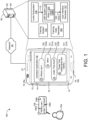
- FIG. 1 is a schematic diagram of an example speech environment 100.
- a user's 104 manner of interacting with a computing device, such as a user device 10 may be through voice input.
- the user device 10 (also referred to generally as a device 10) is configured to capture sounds (e.g., streaming audio data) from one or more users 104 within the speech environment 100.
- the streaming audio data may refer to a spoken utterance 106 by the user 104 that functions as an audible query, a command for the device 10, or an audible communication captured by the device 10.
- Speech-enabled systems of the device 10 may field the query or the command by answering the query and/or causing the command to be performed/fulfilled by one or more downstream applications.
- the user device 10 may correspond to any computing device associated with a user 104 and capable of receiving audio data.
- Some examples of user devices 10 include, but are not limited to, mobile devices (e.g., mobile phones, tablets, laptops, etc.), computers, wearable devices (e.g., smart watches), smart appliances, vehicle infotainment systems, internet of things (IoT) devices, vehicle infotainment systems, smart displays, smart speakers, etc.
- the user device 10 includes data processing hardware 12 and memory hardware 14 in communication with the data processing hardware 12.
- the memory hardware 14 stores instructions that, when executed by the data processing hardware 12, cause the data processing hardware 12 to perform one or more operations.
- the user device 10 further includes an audio system 16 with an audio capture device (e.g., microphone) 16, 16a for capturing and converting spoken utterances 106 within the speech environment 100 into electrical signals, and a speech output device (e.g., a speaker) 16, 16b for communicating an audible audio signal (e.g., as output audio data from the device 10). While the user device 10 implements a single audio capture device 16a in the example shown, the user device 10 may implement an array of audio capture devices 16a without departing from the scope of the present disclosure, whereby one or more capture devices 16a in the array may not physically reside on the user device 10, but be in communication with the audio system 16.
- an audio capture device e.g., microphone
- a speech output device e.g., a speaker
- an automated speech recognition (ASR) system 118 implementing a recurrent neural network-transducer (RNN-T) model 200 and a disfluency detection model 205 resides on the user device 10 of the user 104 and/or on a remote computing device 60 (e.g., one or more remote servers of a distributed system executing in a cloud-computing environment) in communication with the user device 10 via a network 40.
- ASR automated speech recognition
- RNN-T recurrent neural network-transducer
- the user device 10 and/or the remote computing device 60 also includes an audio subsystem 108 configured to receive the utterance 106 spoken by the user 104 and captured by the audio capture device 16a, and convert the utterance 106 into a corresponding digital format associated with input acoustic frames 110 capable of being processed by the ASR system 118.
- the user speaks a respective utterance 106 and the audio subsystem 108 converts the utterance 106 into corresponding audio data (e.g., acoustic frames) 110 for input to the ASR system 118.
- the RNN-T model 200 receives, as input, the acoustic frames 110 corresponding to the utterance 106, and generates/predicts, as output, a corresponding transcription 120 of the utterance 106.
- the RNN-T model 200 may perform streaming speech recognition to produce partial transcriptions (e.g., streaming speech recognition results) 120a, 120b as the user speaks.
- the user device 10 and/or the remote computing device 60 also executes a user interface generator 107 configured to present representations of the transcriptions 120, 120a-n of the utterance 106 to the user 104 of the user device 10, and to present one or more responses 121, 121a-n to queries and/or commands of the utterance 106.
- the user interface generator 107 may display the speech recognition results 120, 120a-n and the responses 121, 121a-n during or at different times.
- the user interface generator 107 may present the speech recognition results 120, 120a-n (e.g., transcriptions) and the responses 121, 121a-n to represent an interaction/conversation between the user 104 and an interactive program or application (e.g., a digital assistant application 50).
- speech recognition results 120, 120a-n e.g., transcriptions
- responses 121, 121a-n e.g., responses to represent an interaction/conversation between the user 104 and an interactive program or application (e.g., a digital assistant application 50).
- the transcription 120 output from the ASR system 118 are processed, e.g., by a natural language processing/understanding (NLP/NLU) module executing on the user device 10 or the remote computing device 60, to execute a user command/query specified by the utterance 106.
- the digital assistant application 50 may provide an appropriate response 121 subsequent to executing the user command/query specified by the utterance 106.
- a text-to-speech system (not shown) (e.g., executing on any combination of the user device 10 or the remote computing device 60) may convert the transcription 120 and/or the response 121 into synthesized speech for audible output by the user device 10 and/or another device.
- the user 104 interacts with a program or application (e.g., the digital assistant application 50) of the user device 10 that uses the ASR system 118.
- a program or application e.g., the digital assistant application 50
- FIG. 1 depicts the user 104 communicating with the digital assistant application 50, and the digital assistant application 50 displaying an interactive digital assistant interface 18 on a screen 19 of the user device 10 to depict a natural conversational interaction between the user 104 and the digital assistant application 50.
- the user 104 during time 1, speaks a first portion 106a ("Where can I") of the utterance 106, and then pauses (as represented by ellipsis "!) during a second portion 106b of the utterance.
- the RNN-T model 200 while receiving the acoustic frames 110 corresponding to the utterance 106 as the user 104 speaks, performs speech recognition on the acoustic frames 110 to produce first speech recognition results 120a (i.e., "where can I") corresponding to the first portion 106a of the utterance 106.
- the disfluency detection model 205 detects that the acoustic frames 110 corresponding to the second portion 106b of the utterance 106 are indicative of a pause in the user's speech rather than an end of speech event which would prematurely endpoint the utterance.
- the user interface generator 107 presents, via the digital assistant interface 18, a representation of the first speech recognition results 120a of the utterance 106 to the user 104 of the user device 10 in a streaming fashion such that words, word pieces, and/or individual characters appear on the screen 19 of the user device 10 as soon as they are spoken.
- the digital assistant 50 responds with an acknowledgement response 121a ("Mhm") to indicate to the user 104 that the ASR system 118 and the digital assistant 50 are waiting for the user 104 to continue speaking.
- the user 104 commences speaking a third remaining portion 106c ("order Thai food") of the utterance 106 after pausing and the RNN-T model 200 performs speech recognition on the audio frames 110 corresponding to the remaining portion 106c of the utterance 106 to produce second speech recognition results 120b (i.e., "order Thai food”).
- the disfluency detection model 205 detects an end of speech event to indicate that the utterance 106 is complete.
- the user interface generator 107 presents, via the digital assistant interface 18, a representation of the second speech recognition results 120b of the utterance 106 to the user 104 of the user device 10 in a streaming fashion such that words, word pieces, and/or individual characters appear on the screen 19 of the user device 10 as soon as they are spoken.
- the ASR system 118 may trigger a microphone closing event and process the transcription 120 (e.g., by the NLP/NLU module) to execute a user command/query (e.g., perform a search for Thai restaurants) specified by the utterance 106 responsive to the disfluency detection model 205 detecting the end of speech event.
- the user interface generator 107 presents, via the digital assistant interface 18, a response 121b (i.e., "These Thai restaurants are nearby ") to the query.
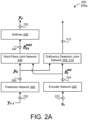
- FIG. 2A is a schematic view of an example RNN-T model 200, 200a integrating the disfluency detection model 205 as a first joint network (i.e., disfluency detection joint network) 210 for detecting disfluencies in spoken utterances that are indicative of speech and interaction patterns that resemble human conversational speech, interactions, and/or turn taking with a digital assistant.
- a first joint network i.e., disfluency detection joint network
- Problems involved in recognizing natural conversational speech include, but are not limited to, recognizing pauses and determining when a person has finished speaking.
- Example disfluencies include, but are not limited to, pauses, pauses to think, random pauses, hesitations, word lengthening (e.g., "onnn"), filler pauses or words (e.g., "uh”, “um”), repeated phrases, and changing of actions.
- These disfluencies characterized by no voice activity detected for a threshold duration, can trigger conventional ASR systems to prematurely endpoint the utterance before the user has completed speaking the utterance. Such premature endpointing may result in misinterpreted queries that the digital assistant may not be able to process where the digital assistant may interrupt to prompt the user to repeat the query, thereby leading to user frustration.
- the RNN-T model 200a includes an encoder network 220, a prediction/decoder network 300, a second joint network 240 (i.e., a word piece joint network 240), and a final softmax output layer 250.
- the encoder network 220 e.g., an audio encoder
- AM acoustic model
- receives a sequence of feature vectors x ( x 1 , x 2 , ⁇ , x t ) 222, where x i ⁇ R d (e.g., the acoustic frames 110 of FIG.
- h t enc h 1 enc , ... , h t enc .
- the prediction/decoder network 300 includes an LSTM-based prediction network that, like a language model (LM), processes a sequence of non-blank symbols y 0 , ... , y u- 1 252 output so far by the softmax layer 250 into a hidden representation h u pred 350 (also generally referred to as a dense or linguistic representation) representing a probability distribution of whether a current time step corresponds to a pause and an end of speech, where y 0 represents a special start of sequence symbol.
- LM language model
- FIG. 3 shows the prediction network 300 for the RNN-T model 200 that receives, as input, a sequence of non-blank symbols y u-n , . . . , y u - 1 that is limited to the N previous non-blank symbols 252a-n output by the final softmax layer 250.
- N is equal to two. In other examples, N is equal to five, however, the disclosure is non-limiting and N may equal any integer.
- the sequence of non-blank symbols 252a-n may indicate a partial speech recognition result 120a, 120b ( FIG. 1 ).
- the prediction network 300 includes a multi-headed attention mechanism 302 that shares a shared embedding matrix 304 across each head 302A-302H of the multi-headed attention mechanism.
- the multi-headed attention mechanism 302 includes four heads. However, any number of heads may be employed by the multi-headed attention mechanism 302.
- the multi-headed attention mechanism 302 improves performance significantly with minimal increase to model size.
- each head 302A-H includes its own row of position vectors 308, and rather than incurring an increase in model size by concatenating outputs 318A-H from all the heads, the outputs 318A-H are instead averaged by a head average module 322.
- the head 302A generates, using the shared embedding matrix 304, a corresponding embedding 306, 306a-n (e.g., X ⁇ R N ⁇ d e ) for each non-blank symbol 301 among the sequence of non-blank symbols y ui-n , . . . , y ui - 1 received as input at the corresponding time step from the plurality of time steps.
- the shared embedding matrix 304 is shared across all heads of the multi-headed attention mechanism 302, the other heads 302B-H all generate the same corresponding embeddings 306 for each non-blank symbol.
- the head 302A also assigns a respective position vector PV Aa-An 308, 308Aa-An (e.g., P ⁇ R H ⁇ N ⁇ d e ) to each corresponding non-blank symbol in the sequence of non-blank symbols y u - n , . . . , y u - 1 .
- the respective position vector PV 308 assigned to each non-blank symbol indicates a position in the history of the sequence of non-blank symbols (e.g., the N previous non-blank symbols output by the final softmax layer 250).
- each of the embeddings 306 may include a same dimensionality (i.e., dimension size) as each of the position vectors PV 308.
- each head 302A-H defines a different set/row of position vectors 308.
- the first head 302A defines the row of position vectors PV Aa-An 308Aa-An
- the second head 302B defines a different row of position vectors PV Ba-Bn 308 Ba-Bn
- the H th head 302 H defines another different row of position vectors PV Ha-Hn 308 Ha-Hn .
- the first head 302A For each non-blank symbol in the sequence of non-blank symbols 252a-n received, the first head 302A also weights, via a weight layer 310, the corresponding embedding 306 proportional to a similarity between the corresponding embedding and the respective position vector PV 308 assigned thereto.
- the similarity may include a cosine similarity (e.g., cosine distance).
- the weight layer 310 outputs a sequence of weighted embeddings 312, 312Aa-An each associated the corresponding embedding 306 weighted proportional to the respective position vector PV 308 assigned thereto.
- the weighted embeddings 312 output by the weight layer 310 for each embedding 306 may correspond to a dot product between the embedding 306 and the respective position vector PV 308.
- the weighted embeddings 312 may be interpreted as attending over the embeddings in proportion to how similar they are to the positioned associated with their respective position vectors PV 308.
- Equation (1) h represents the index of the heads 302
- n represents position in context
- e represents the embedding dimension.
- H, N, and d e include the sizes of the corresponding dimensions.
- the position vector PV 308 does not have to be trainable and may include random values. Notably, even though the weighted embeddings 312 are averaged, the position vectors PV 308 can potentially save position history information, alleviating the need to provide recurrent connections at each layer of the prediction network 300.
- the weight layer 310 outputs a sequence of weighted embeddings 312Ba-Bn, 312Ha-Hn at each other head 302B-H that is different than the sequence of weighted embeddings 312Aa-Aa at the first head 302A.
- the weighted average module 316 generates, as output from each other corresponding head 302B-H, a respective weighted average 318B-H of the corresponding weighted embeddings 312 of the sequence of non-blank symbols.
- the prediction network 300 includes a head average module 322 that averages the weighted averages 318A-H output from the corresponding heads 302A-H.
- a projection layer 326 with SWISH may receive, as input, an output 324 from the head average module 322 that corresponds to the average of the weighted averages 318A-H, and generate, as output, a projected output 328.
- a final layer normalization 330 may normalize the projected output 328 to provide the single embedding vector P u 350 (i.e., hidden representation) at the corresponding time step from the plurality of time steps.
- the prediction network 300 generates only a single embedding vector P u 350 at each of the plurality of time steps subsequent to an initial time step.
- the prediction network 300 does not implement the multi-headed attention mechanism 302 and only performs the operations described above with respect to the first head 302A.
- the weighted average 318A of the weighted embeddings 312Aa-An is simply passed through the projection layer 326 and layer normalization 330 to provide the single embedding vector P u 350.
- the word piece joint network 240 receives the single embedding vector P u 350 from the prediction network 300, and the higher-order feature representation h t i enc from the encoder 220.
- the set of output labels may include twenty-seven (27) symbols, e.g., one label for each of the 26-letters in the English alphabet and one label designating a space.
- the word piece joint network 240 may output a set of values indicative of the likelihood of occurrence of each of a predetermined set of output labels.
- This set of values can be a vector and can indicate a probability distribution over the set of output labels.
- the output labels are graphemes (e.g., individual characters, and potentially punctuation and other symbols), but the set of output labels is not so limited.
- the set of output labels can include wordpieces and/or entire words, in addition to or instead of graphemes.
- the output distribution of the word piece joint network 240 can include a posterior probability value for each of the different output labels.
- the output h t , u joint 242 of the word piece joint network 240 can include 100 different probability values, one for each output label.
- the word piece joint network 240 generates, at each output step (e.g., time step), a probability distribution 242 over possible speech recognition hypotheses.
- the probability distribution h t , u joint 242 can then be used to select and assign scores to candidate orthographic elements (e.g., graphemes, wordpieces, and/or words) in a beam search process (e.g., by the softmax layer 240) for determining the transcriptions 120.
- the softmax layer 250 may employ any technique to select the output label/symbol with the highest probability in the distribution h t , u joint 242 as the next output symbol y u 252 predicted by the RNN-T model 200 at the corresponding output step. In this manner, the RNN-T model 200 does not make a conditional independence assumption. Instead, the RNN-T model 200 predicts each symbol conditioned not only on the acoustics but also on the sequence of labels output so far. The RNN-T model 200 does assume an output symbol is independent of future acoustic frames 110, which allows the RNN-T model 200 to be employed in a streaming fashion.
- the softmax layer 250 is composed of a unified word piece or grapheme set that is generated using all unique word pieces or graphemes in a plurality of training data sets.
- the first joint network (i.e., the disfluency detection joint network) 210 generates, based on the higher order feature representation h t enc 224 output by the encoder network 220 and the single embedding vector P u 350 output by the prediction network 300, a probability distribution that the corresponding time step corresponds to a disfluency (e.g., a pause) or an end of speech event.
- the first joint network can output a set of values indicative of the likelihood of occurrence of each of a predetermined set of output labels including ⁇ pause> for a pause, and ⁇ eos> for an end of speech event.
- This set of values can be a vector and can indicate a probability distribution over the set of output labels.
- P pause joint P disfluency pause x t , y 0 , ... , y u ⁇ 1 , y u
- P eos joint P disfluency eos x t , y 0 , ... , y u ⁇ 1 , y u
- y u is the output word piece hypothesis with the highest probability h t , u joint 242.
- the disfluency detection joint network 210 emits tokens 212 (e.g., ⁇ pause> and ⁇ eos> tokens) when the corresponding probability satisfies (e.g., exceeds) a predefined threshold. For example, when P pause joint satisfies (e.g., exceeds) an end of speech threshold an ⁇ eos> token 212 is emitted and when P eos joint satisfies (e.g., exceeds) a pause threshold a ⁇ pause> token 212 is emitted.
- the end of speech threshold and the pause threshold need not have the same value.
- detection of an end of speech event e.g., a probability that a corresponding time step corresponds to an end of speech satisfies an end of speech threshold
- a microphone closing event by the user device 10 by, for example, emitting an end of speech token 212 that causes the triggering of the microphone closing event.
- a training system 130 trains the RNN-T 200 using a two-stage training processing.
- the training system 130 trainsthe encoder network 220, the prediction network 300, and the word piece joint network 240 on a speech recognition task to perform speech recognition.
- the training system 130 holds the parameters of the encoder network 220, the prediction network 300, and the word piece joint network 240 fixed, while initializing and fine-tuning (e.g., training) the disfluency detection joint network 210 to learn how to detect the presence of pauses and end of speech events.
- the training system 130 trains the disfluency detection joint network 210 to learn how to predict pause and end of speech locations in utterances.
- the training system 130 trains the disfluency detection joint network 210 using a plurality of transcribed training utterances that has be annotated by, for example, a training data generator 140 ( FIG. 1 ) to include labels (e.g., ⁇ pause> and ⁇ eos>) indicating pause and end of speech locations.
- the training data generator 140 can insert ⁇ pause> tokens for pauses, and insert ⁇ eos> tokens at the end of utterances.
- the training data generator 140 appends ⁇ eos> tokens to the end of each utterance, and inserts ⁇ pause> tokens for silence segments determined, for example, using forced alignment. While short-form utterances can be used to model end of speech events and regular short pauses, they may not cover a broader range of possible disfluencies.
- the disfluency detection joint network 210 may learn to stop emitting any additional ⁇ eos> tokens after determining a first end of speech event in an utterance, which may cause disfluency detection problems for longer utterances or utterances with multiple disfluencies.
- the feature vectors x 222 input to the encoder network 220 may include 80-dimensional log-Mel filter bank features formed by stacking three 25 millisecond (ms) acoustic frames with a 10 ms shift, and downsampling to a 30ms frame rate.
- the encoder network 220 includes twelve 512-dimensional conformer layers.
- the conformer layers include causal convolution with a kernel size of 15, and a stack of left-context attention layers with 8-head self-attention. While the encoder network 220 described has a stack of multi-head attention layers/blocks with self-attention that include conformer layers/blocks (e.g., twelve conformer blocks), the present disclosure is not so limited.
- the encoder network 220 may include a stack of transformer layers/ or a stack of any other type of multi-head attention layers/bocks.
- the encoder network 220 may include a series of multi-headed self-attention, depth-wise convolutional and feed-forward layers.
- the encoder network 220 may include a plurality of long-short term memory (LSTM) layers in lieu of multi-head attention layers/blocks.
- LSTM long-short term memory
- the prediction network 300 may include an LTSM-based network having an embedding dimension of 320.
- the dimension D joint of the fused representation h t , u joint 232 may be set to 640.
- the word piece joint network 240 includes hidden units. Additionally or alternatively, the word piece joint network 240 does not include a fully connected (FC) layer.
- the prediction network 300 may include a stack of transformer or conformer blocks (or other type of multi-head attention blocks).
- the prediction network 300 may also be an embedding look-up table (e.g., a V2 embedding look-up table) to improve latency by outputting looked-up sparse embeddings in lieu of generating hidden representations.
- the prediction network 300 is a stateless prediction network.
- the word piece joint network 240 and the prediction network 300 may collective form an RNN-T decoder of the RNN-T model 200.
- parameter tying between the prediction network 300 and the word piece joint network 240 is applied.
- the shared embedding matrix 304 at the prediction network is E ⁇ R V x d e .
- a last hidden layer includes a dimension size d h at the joint network 240
- feed-forward projection weights from the hidden layer to the output logits will be W ⁇ R d h ⁇ V + 1 , with an extra blank token in the vocabulary.
- the feed-forward layer corresponding to the last layer of the word piece joint network 240 includes a weight matrix [ d h ,
- the feed-forward projection weights of the word piece joint network 240 and the shared embedding matrix 304 of the prediction network 300 can share their weights for all non-blank symbols via a simple transpose transformation. Since the two matrices share all their values, the RNN-T decoder only needs to store the values once in memory, instead of storing two individual matrices.
- the RNN-T decoder By setting the size of the embedding dimension d e equal to the size of the hidden layer dimension d h , the RNN-T decoder reduces a number of parameters equal to the product of the embedding dimension d e and the vocabulary size
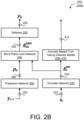
- FIG. 2B is a schematic view of an example RNN-T model 200, 200b integrating the disfluency detection model 205 as an acoustic-based turn taking detector 410 to compute, at each corresponding time step (i.e., for each acoustic frame 222 x(t), a probability distribution that the corresponding time step corresponds to the disfluency (e.g., pause) and the end of speech event.
- the RNN-T model 200b includes the encoder network 220, the prediction/decoder network 300, the word piece joint network 240, and the final softmax output layer 250 of the RNN-T model 200a of FIG.
- the acoustic-based turn taking detection network 410 generates, for each input feature vector x t at time step t and based on the higher order feature representation h t enc 224 produced by the encoder network 220 for input feature vectors x t , x t- 1 , ... , x t-k 222, the probability distribution that the corresponding time step corresponds to the pause and the end of speech event.
- the acoustic-based turn taking detection network 410 can output a set of values indicative of the likelihood of occurrence of each of a predetermined set of output labels including ⁇ pause> for a pause, and ⁇ eos> for an end of speech event.
- This set of values can be a vector and can indicate a probability distribution over the set of output labels.
- the turn taking detection network 410 emits tokens 412 (e.g., ⁇ pause> and ⁇ eos> tokens) when the corresponding probability satisfies (e.g., exceeds) a predefined threshold. For example, when P pause acoustic satisfies (e.g., exceeds) an end of speech threshold an ⁇ eos> token 412 is emitted and when P eos acoustic satisfies (e.g., exceeds) a pause threshold a ⁇ pause> token 412 is emitted.
- the end of speech threshold and the pause threshold need not have the same value.
- detection of an end of speech event e.g., a probability that a corresponding time step corresponds to an end of speech satisfies an end of speech threshold
- a microphone closing event by the user device 10 by, for example, emitting an end of speech token 412 that causes the triggering of the microphone closing event.
- the RNN-T 200a synchronizes speech recognition by the RNN-T decoder, i.e., the prediction network 300 and the word piece joint network 240, with turn taking detection by the acoustic-based turn taking detection network 410, which helps ensure correct interactions for natural conversational inputs.
- the turn taking detection network 410 reuses the encoder network 220, it is not necessary to configure or include another separate encoder, which reduces computational complexity. Because delayed or late disfluency detection may introduce slow responses to queries and commands, some examples apply an emission regularization method (e.g., FastEmit) to the turn taking detection network 410 to reduce disfluency detection delays.
- an emission regularization method e.g., FastEmit
- the training system 130 trains the RNN-T 200b in two stages in a similar manner as described above with reference to the RNN-T 200a of FIG. 2A .
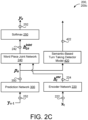
- FIG. 2C is a schematic view of an example RNN-T model 200, 200c integrating the disfluency detection model 205 as a semantic-based turn taking detection network 420 to compute, at each corresponding time step, a probability distribution that the corresponding time step corresponds to the disfluency (e.g., pause) and the end of speech event.
- the RNN-T model 200b includes the encoder network 220, the prediction/decoder network 300, the word piece joint network 240, and the final softmax output layer 250 of the RNN-T model 200a of FIG. 2A , but replaces the disfluency detection joint network 210 with the acoustic-based turn taking detection network 205. Details of the encoder network 220, the prediction/decoder network 300, the word piece joint network 240, and the final softmax output layer 250 are described above with reference to FIGS. 2A and 3 .
- the semantic-based turn taking detection network 420 generates, for each time step and based on a past sequence of output symbols y 0 , y 1 , ... , y u 252 output by the softmax layer 250, the probability distribution that the corresponding time step corresponds to the disfluency (e.g., a pause) and the end of speech event.
- the semantic-based turn taking detection network 420 can output a set of values indicative of the likelihood of occurrence of each of a predetermined set of output labels including ⁇ pause> for a pause, and ⁇ eos> for an end of speech event.
- This set of values can be a vector and can indicate a probability distribution over the set of output labels.
- P pause semantic P disfluency pause y 0 , y 1 , ... , y u
- P eos semantic P disfluency eos y 0 , y 1 , ... , y u
- the semantic-based turn taking detection network 420 includes a language model (LM) that determines probabilities that a next output symbol (e.g., sub-word unit) corresponds to a ⁇ pause> and an ⁇ eos>.
- LM language model
- the semantic-based turn taking detection network 420 emits tokens 422 (e.g., ⁇ pause> and ⁇ eos> tokens) when the corresponding probability satisfies (e.g., exceeds) a predefined threshold.
- P pause semantic satisfies (e.g., exceeds) an end of speech threshold an ⁇ eos> token 422 is emitted and when P eos semantic satisfies (e.g., exceeds) a pause threshold a ⁇ pause> token 422 is emitted.
- the end of speech threshold and the pause threshold need not have the same value.
- detection of an end of speech event e.g., a probability that a corresponding time step corresponds to an end of speech satisfies an end of speech threshold
- the training system 130 trains the RNN-T 200c in two stages in a similar manner as described above with reference to the RNN-T 200a of FIG. 2A .
- FIG. 4A depicts an example transcribed long-form training utterance 400.
- FIG. 4B depicts an example annotated transcribed training utterance 450 generated by the training data generator 140 for the transcribed long-form training utterance 500 of FIG. 4A .
- the training data generator 140 determines silence segments 402, 402a-n using, for example, forced alignment, and determines sentence boundaries based on silence durations.
- the training data generator 140 labels short silent pauses (e.g., silent pauses 402a and 402b) with respective ⁇ pause> tokens (e.g., tokens 452a and 452b), at least initially labels long silent pauses (e.g., silent pauses 402c and 402d) with respective ⁇ eos> tokens, and labels a final silent pause (e.g., silent pause 402e) with an ⁇ eos> token (e.g., token 452e).
- a silent pause is determined to be short or long by comparing the duration of the silent pause to a pre-determined threshold.
- the training data generator 140 classifies silent pause durations less than the pre-determined threshold as short, and classifies silent pause durations greater than the pre-determined threshold as long.
- labeling long silent pauses in this way may cause the training data generator 140 to incorrectly label some long silent pauses (e.g., the silent pauses 402c and 402d) with ⁇ eos> tokens.
- the training data generator 140 re-labels silent pauses (e.g., the silent pause 402c) of any length that follow a hesitation word 412 (a filler, repeated phrase, etc.) with ⁇ pause> tokens (e.g., token 452c).
- the training data generator 140 re-labels silent pauses (e.g., the silent pause 402d) of any length that follow word lengthening 414 with ⁇ pause> tokens (e.g., token 452d).
- the training data generator 140 determines word lengthening when a last phoneme of a word or word piece has a duration that satisfies a criteria (e.g., exceeds 10 standard deviations as pre-computed for the phoneme).
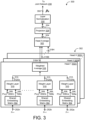
- FIG. 5 is a flowchart of an exemplary arrangement of operations for a computer-implemented method 500 for detecting disfluencies and performing speech recognition.
- the method 500 performs operations 504, 506, 508 and 510.
- the method 500 includes generating, by an encoder network 220 of a speech recognition model (e.g., the RNN-T 200), a higher order feature representation h t enc 224 for a corresponding acoustic frame in the sequence of acoustic frames.
- a speech recognition model e.g., the RNN-T 200
- the method 500 includes generating, by a prediction network 300 of the speech recognition model, a hidden representation (e.g., the single embedding vector P u 350) for a corresponding sequence of non-blank symbols y 0 , y 1 , ... , y u 252 output by a final softmax layer 250 of the speech recognition model.
- a hidden representation e.g., the single embedding vector P u 350
- the method 500 includes generating, by a first joint network (e.g., the disfluency detection joint network) 210 of the speech recognition model that receives the higher order feature representation generated by the encoder network and the dense representation generated by the prediction network, a probability distribution that the corresponding time step corresponds to a pause and an end of speech.
- a first joint network e.g., the disfluency detection joint network
- the method 500 includes generating, by a second joint network (e.g., the word piece joint network) 240 of the speech recognition model, a probability distribution h t , u joint 242 over possible speech recognition hypotheses.
- a second joint network e.g., the word piece joint network
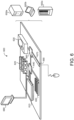
- FIG. 6 is schematic view of an example computing device 600 that can be used to implement the systems and methods described in this document.
- the computing device 600 is intended to represent various forms of digital computers, such as laptops, desktops, workstations, personal digital assistants, servers, blade servers, mainframes, and other appropriate computer devices.
- the components shown here, their connections and relationships, and their functions, are meant to be exemplary only, and are not meant to limit implementations of the inventions described and/or claimed in this document.
- the computing device 600 includes a processor 610 (i.e., data processing hardware) that can be used to implement the data processing hardware 12 and/or 62, memory 620 (i.e., memory hardware) that can be used to implement the memory hardware 14 and/or 64, a storage device 630 (i.e., memory hardware) that can be used to implement the memory hardware 14 and/or 64, a high-speed interface/controller 640 connecting to the memory 620 and high-speed expansion ports 650, and a low speed interface/controller 670 connecting to a low speed bus 660 and a storage device 630.
- processor 610 i.e., data processing hardware
- memory 620 i.e., memory hardware
- storage device 630 i.e., memory hardware
- Each of the components 610, 620, 630, 640, 650, and 660 are interconnected using various busses, and may be mounted on a common motherboard or in other manners as appropriate.
- the processor 610 can process instructions for execution within the computing device 600, including instructions stored in the memory 620 or on the storage device 630 to display graphical information for a graphical user interface (GUI) on an external input/output device, such as display 680 coupled to high speed interface 640.
- GUI graphical user interface
- multiple processors and/or multiple buses may be used, as appropriate, along with multiple memories and types of memory.
- multiple computing devices 600 may be connected, with each device providing portions of the necessary operations (e.g., as a server bank, a group of blade servers, or a multi-processor system).
- the memory 620 stores information non-transitorily within the computing device 600.
- the memory 620 may be a computer-readable medium, a volatile memory unit(s), or non-volatile memory unit(s).
- the non-transitory memory 620 may be physical devices used to store programs (e.g., sequences of instructions) or data (e.g., program state information) on a temporary or permanent basis for use by the computing device 600.
- non-volatile memory examples include, but are not limited to, flash memory and read-only memory (ROM) / programmable read-only memory (PROM) / erasable programmable read-only memory (EPROM) / electronically erasable programmable read-only memory (EEPROM) (e.g., typically used for firmware, such as boot programs).
- volatile memory examples include, but are not limited to, random access memory (RAM), dynamic random access memory (DRAM), static random access memory (SRAM), phase change memory (PCM) as well as disks or tapes.
- the storage device 630 is capable of providing mass storage for the computing device 600.
- the storage device 630 is a computer-readable medium.
- the storage device 630 may be a floppy disk device, a hard disk device, an optical disk device, or a tape device, a flash memory or other similar solid state memory device, or an array of devices, including devices in a storage area network or other configurations.
- a computer program product is tangibly embodied in an information carrier.
- the computer program product contains instructions that, when executed, perform one or more methods, such as those described above.
- the information carrier is a computer- or machine-readable medium, such as the memory 620, the storage device 630, or memory on processor 610.
- the high speed controller 640 manages bandwidth-intensive operations for the computing device 600, while the low speed controller 670 manages lower bandwidth-intensive operations. Such allocation of duties is exemplary only.
- the high-speed controller 640 is coupled to the memory 620, the display 680 (e.g., through a graphics processor or accelerator), and to the high-speed expansion ports 650, which may accept various expansion cards (not shown).
- the low-speed controller 670 is coupled to the storage device 630 and a low-speed expansion port 690.
- the low-speed expansion port 690 which may include various communication ports (e.g., USB, Bluetooth, Ethernet, wireless Ethernet), may be coupled to one or more input/output devices, such as a keyboard, a pointing device, a scanner, or a networking device such as a switch or router, e.g., through a network adapter.
- input/output devices such as a keyboard, a pointing device, a scanner, or a networking device such as a switch or router, e.g., through a network adapter.
- the computing device 600 may be implemented in a number of different forms, as shown in the figure. For example, it may be implemented as a standard server 600a or multiple times in a group of such servers 600a, as a laptop computer 600b, or as part of a rack server system 600c.
- implementations of the systems and techniques described herein can be realized in digital electronic and/or optical circuitry, integrated circuitry, specially designed ASICs (application specific integrated circuits), computer hardware, firmware, software, and/or combinations thereof.
- ASICs application specific integrated circuits
- These various implementations can include implementation in one or more computer programs that are executable and/or interpretable on a programmable system including at least one programmable processor, which may be special or general purpose, coupled to receive data and instructions from, and to transmit data and instructions to, a storage system, at least one input device, and at least one output device.
- a software application may refer to computer software that causes a computing device to perform a task.
- a software application may be referred to as an "application,” an "app,” or a "program.”
- Example applications include, but are not limited to, system diagnostic applications, system management applications, system maintenance applications, word processing applications, spreadsheet applications, messaging applications, media streaming applications, social networking applications, and gaming applications.
- the processes and logic flows described in this specification can be performed by one or more programmable processors, also referred to as data processing hardware, executing one or more computer programs to perform functions by operating on input data and generating output.
- the processes and logic flows can also be performed by special purpose logic circuitry, e.g., an FPGA (field programmable gate array) or an ASIC (application specific integrated circuit).
- processors suitable for the execution of a computer program include, by way of example, both general and special purpose microprocessors, and any one or more processors of any kind of digital computer.
- a processor will receive instructions and data from a read only memory or a random access memory or both.
- the essential elements of a computer are a processor for performing instructions and one or more memory devices for storing instructions and data.
- a computer will also include, or be operatively coupled to receive data from or transfer data to, or both, one or more mass storage devices for storing data, e.g., magnetic, magneto optical disks, or optical disks.
- mass storage devices for storing data
- a computer need not have such devices.
- Computer readable media suitable for storing computer program instructions and data include all forms of non-volatile memory, media and memory devices, including by way of example semiconductor memory devices, e.g., EPROM, EEPROM, and flash memory devices; magnetic disks, e.g., internal hard disks or removable disks; magneto optical disks; and CD ROM and DVD-ROM disks.
- the processor and the memory can be supplemented by, or incorporated in, special purpose logic circuitry.
- one or more aspects of the disclosure can be implemented on a computer having a display device, e.g., a CRT (cathode ray tube), LCD (liquid crystal display) monitor, or touch screen for displaying information to the user and optionally a keyboard and a pointing device, e.g., a mouse or a trackball, by which the user can provide input to the computer.
- a display device e.g., a CRT (cathode ray tube), LCD (liquid crystal display) monitor, or touch screen for displaying information to the user and optionally a keyboard and a pointing device, e.g., a mouse or a trackball, by which the user can provide input to the computer.
- Other kinds of devices can be used to provide interaction with a user as well; for example, feedback provided to the user can be any form of sensory feedback, e.g., visual feedback, auditory feedback, or tactile feedback; and input from the user can be received in any form, including acoustic, speech, or tactile input
Landscapes
- Engineering & Computer Science (AREA)
- Acoustics & Sound (AREA)
- Health & Medical Sciences (AREA)
- Audiology, Speech & Language Pathology (AREA)
- Human Computer Interaction (AREA)
- Physics & Mathematics (AREA)
- Computational Linguistics (AREA)
- Multimedia (AREA)
- Artificial Intelligence (AREA)
- Signal Processing (AREA)
- Evolutionary Computation (AREA)
- Machine Translation (AREA)
- Telephonic Communication Services (AREA)
- Two-Way Televisions, Distribution Of Moving Picture Or The Like (AREA)
Claims (15)
- Computerimplementiertes Verfahren (500), das, wenn es auf Datenverarbeitungshardware (610) ausgeführt wird, die Datenverarbeitungshardware (610) veranlasst, Vorgänge durchzuführen, die Folgendes umfassen:Empfangen einer Sequenz von akustischen Rahmen (110), die eine oder mehrere Äußerungen (106) kennzeichnen; undbei jedem einer Vielzahl von Zeitschritten:Erzeugen einer Merkmalsdarstellung höherer Ordnung (224) für einen entsprechenden akustischen Rahmen in der Sequenz von akustischen Rahmen (110) durch ein Codierernetzwerk (220) eines Spracherkennungsmodells (200);Erzeugen einer versteckten Darstellung (350) für eine entsprechende Sequenz von nichtleeren Symbolen (252), die durch eine abschließende Softmax-Schicht (250) des Spracherkennungsmodells (200) ausgegeben wird, durch ein Vorhersagenetzwerk (300) des Spracherkennungsmodells (200); undErzeugen einer Wahrscheinlichkeitsverteilung, dass der entsprechende Zeitschritt einer Pause und einem Ende von Sprache entspricht, durch ein erstes gemeinsames Netzwerk (210) des Spracherkennungsmodells (200), das die durch das Codierernetzwerk (220) erzeugte Merkmalsdarstellung höherer Ordnung (224) und die durch das Vorhersagenetzwerk (300) erzeugte versteckte Darstellung (350) empfängt.
- Computerimplementiertes Verfahren (500) nach Anspruch 1, wobei die Vorgänge ferner Folgendes umfassen:Bestimmen, dass die Wahrscheinlichkeit, dass der entsprechende Zeitschritt dem Ende von Sprache entspricht, einen Ende von Sprache-Schwellenwert erfüllt; undals Reaktion auf das Bestimmen, dass die Wahrscheinlichkeit, dass der entsprechende Zeitschritt dem Ende von Sprache entspricht, den Schwellenwert erfüllt, Auslösen eines Mikrofonschließereignisses.
- Computerimplementiertes Verfahren (500) nach Anspruch 1 oder 2, wobei die Vorgänge ferner Folgendes umfassen:Bestimmen, dass die Wahrscheinlichkeit, dass der entsprechende Zeitschritt der Pause entspricht, einen Pausen-Schwellenwert erfüllt; undEmittieren eines Pausentokens (212) an dem entsprechenden Zeitschritt, basierend auf dem Bestimmen, dass die Wahrscheinlichkeit, dass der entsprechende Zeitschritt der Pause entspricht, den Pausenschwellenwert erfüllt.
- Computerimplementiertes Verfahren (500) nach einem der Ansprüche 1-3, wobei die Vorgänge ferner an jedem der Vielzahl von Ausgabeschritten das Erzeugen einer Wahrscheinlichkeitsverteilung (242) über mögliche Spracherkennungshypothesen umfassen, durch ein zweites gemeinsames Netzwerk (240) des Spracherkennungsmodells (200).
- Computerimplementiertes Verfahren (500) nach Anspruch 4, wobei das Spracherkennungsmodell (200) durch einen zweistufigen Trainingsprozess trainiert wird, wobei der zweistufige Trainingsprozess Folgendes umfasst:eine erste Stufe, die das Codierernetzwerk (220), das Vorhersagenetzwerk (300) und das zweite gemeinsame Netzwerk (240) auf eine Spracherkennungsaufgabe trainiert; undeine zweite Phase, die das erste gemeinsame Netzwerk (210) initialisiert und fein abstimmt, um zu lernen, wie Pausen- und Ende von Sprache-Standorte in Äußerungen (106) vorhergesagt werden,optional:wobei Parameter des Codierernetzwerks (220), des Vorhersagenetzwerks (300) und des zweiten gemeinsamen Netzwerks (240) während der zweiten Stufe des zweistufigen Trainingsprozesses eingefroren werden; und/oderwobei der zweistufige Trainingsprozess das Spracherkennungsmodell (200) auf einer Vielzahl von transkribierten Trainingsäußerungen trainiert, die Etiketten aufweisen, die Pausen- und Ende von Sprache-Positionen angeben.
- Computerimplementiertes Verfahren (500) nach einem der Ansprüche 1-5, wobei das Codierernetzwerk (220) einen Stapel von Selbstaufmerksamkeitsblöcken umfasst, wobei der Stapel von Selbstaufmerksamkeitsblöcken optional einen Stapel von Konformerblöcken oder einen Stapel von Transformatorblöcken umfasst.
- Computerimplementiertes Verfahren (500) nach einem der Ansprüche 1-6, wobei das Erzeugen der versteckten Darstellung (350) für die entsprechende Sequenz von nichtleeren Symbolen (252) Folgendes umfasst:
für jedes nichtleere Symbol in der Sequenz von nichtleeren Symbolen (252), das als Eingabe in dem entsprechenden Zeitschritt empfangen wurde:Erzeugen einer Einbettung (306) des entsprechenden nichtleeren Symbols durch das Vorhersagenetzwerk (300) unter Verwendung einer gemeinsam genutzten Einbettungsmatrix (304);Zuweisen eines jeweiligen Positionsvektors (308) zu dem entsprechenden nichtleeren Symbol durch das Vorhersagenetzwerk (300); undGewichten der Einbettung (306) proportional zu einer Ähnlichkeit zwischen der Einbettung (306) und dem jeweiligen Positionsvektor (308) durch das Vorhersagenetzwerk (300); undErzeugen eines einzelnen Einbettungsvektors (305) an dem entsprechenden Zeitschritt als Ausgabe des Vorhersagenetzwerks (300), wobei der einzelne Einbettungsvektor (305) auf einem gewichteten Durchschnitt der gewichteten Einbettungen basiert, wobei der einzelne Einbettungsvektor (305) die versteckte Darstellung (350) umfasst, optional wobei das Vorhersagenetzwerk (300) einen mehrköpfigen Aufmerksamkeitsmechanismus (302) umfasst, wobei der mehrköpfige Aufmerksamkeitsmechanismus (302) die gemeinsam genutzte Einbettungsmatrix (304) über jeden Kopf (302A-H) des mehrköpfigen Aufmerksamkeitsmechanismus (302) teilt. - System (100), umfassend:Datenverarbeitungshardware (610); undSpeicherhardware (620), die mit der Datenverarbeitungshardware (610) in Kommunikation kommuniziert und Anweisungen speichert, die, wenn sie auf der Datenverarbeitungshardware (610) ausgeführt werden, die Datenverarbeitungshardware (610) veranlassen, Vorgänge durchzuführen, die Folgendes umfassen:Empfangen einer Sequenz von akustischen Rahmen (110), die eine oder mehrere Äußerungen (106) kennzeichnen; undbei jedem einer Vielzahl von Ausgabeschritten:Erzeugen einer Merkmalsdarstellung höherer Ordnung (224) für einen entsprechenden akustischen Rahmen in der Sequenz von akustischen Rahmen (110) durch ein Codierernetzwerk (220) eines Spracherkennungsmodells (200);Erzeugen einer versteckten Darstellung (350) für eine entsprechende Sequenz von nichtleeren Symbolen (252), die durch eine abschließende Softmax-Schicht (250) des Spracherkennungsmodells (200) ausgegeben wird, durch ein Vorhersagenetzwerk (300) des Spracherkennungsmodells (200); undErzeugen einer Wahrscheinlichkeitsverteilung, dass der entsprechende Zeitschritt einer Pause und einem Ende von Sprache entspricht, durch ein erstes gemeinsames Netzwerk (210) des Spracherkennungsmodells (200), das die durch das Codierernetzwerk (220) erzeugte Merkmalsdarstellung höherer Ordnung (224) und die durch das Vorhersagenetzwerk (300) erzeugte versteckte Darstellung (350) empfängt.
- System (100) nach Anspruch 8, wobei die Vorgänge ferner Folgendes umfassen:Bestimmen, dass die Wahrscheinlichkeit, dass der entsprechende Zeitschritt dem Ende von Sprache entspricht, einen Ende von Sprache-Schwellenwert erfüllt; undals Reaktion auf das Bestimmen, dass die Wahrscheinlichkeit, dass der entsprechende Zeitschritt dem Ende von Sprache entspricht, den Schwellenwert erfüllt, Auslösen eines Mikrofonschließereignisses.
- System (100) nach Anspruch 8 oder 9, wobei die Vorgänge ferner Folgendes umfassen:Bestimmen, dass eine Wahrscheinlichkeit, dass der entsprechende Zeitschritt der Pause entspricht, einen Pausen-Schwellenwert erfüllt; undEmittieren eines Pausentokens (212) an dem entsprechenden Zeitschritt, basierend auf dem Bestimmen, dass die Wahrscheinlichkeit, dass der entsprechende Zeitschritt der Pause entspricht, den Pausenschwellenwert erfüllt.
- System (100) nach einem der Ansprüche 8-10, wobei die Vorgänge ferner an jedem der Vielzahl von Ausgabeschritten das Erzeugen einer Wahrscheinlichkeitsverteilung (242) über mögliche Spracherkennungshypothesen umfassen, durch ein zweites gemeinsames Netzwerk (240) des Spracherkennungsmodells (200), optional wobei das Spracherkennungsmodell (200) durch einen zweistufigen Trainingsprozess trainiert wird, wobei der zweistufige Trainingsprozess Folgendes umfasst:eine erste Stufe, die das Codierernetzwerk (220), das Vorhersagenetzwerk (300) und das zweite gemeinsame Netzwerk (240) auf eine Spracherkennungsaufgabe trainiert; undeine zweite Phase, die das erste gemeinsame Netzwerk (210) initialisiert und fein abstimmt, um zu lernen, wie Pausen- und Ende von Sprache-Standorte in Äußerungen (106) vorhergesagt werden,ferner optional:wobei Parameter des Codierernetzwerks (220), des Vorhersagenetzwerks (300) und des zweiten gemeinsamen Netzwerks (240) während der zweiten Stufe des zweistufigen Trainingsprozesses eingefroren werden; und/oderwobei der zweistufige Trainingsprozess das Spracherkennungsmodell (200) auf einer Vielzahl von transkribierten Trainingsäußerungen trainiert, die Etiketten aufweisen, die Pausen- und Ende von Sprache-Positionen angeben.
- System (100) nach einem der Ansprüche 8-11, wobei das Codierernetzwerk (220) einen Stapel von Selbstaufmerksamkeitsblöcken umfasst, wobei der Stapel von Selbstaufmerksamkeitsblöcken optional einen Stapel von Konformerblöcken oder einen Stapel von Transformatorblöcken umfasst.
- System (100) nach einem der Ansprüche 8-12, wobei das Erzeugen der versteckten Darstellung (350) für die entsprechende Sequenz von nichtleeren Symbolen (252) Folgendes umfasst:
für jedes nichtleere Symbol in der Sequenz von nichtleeren Symbolen (252), das als Eingabe in dem entsprechenden Zeitschritt empfangen wurde:Erzeugen einer Einbettung (306) des entsprechenden nichtleeren Symbols durch das Vorhersagenetzwerk (300) unter Verwendung einer gemeinsam genutzten Einbettungsmatrix (304);Zuweisen eines jeweiligen Positionsvektors (308) zu dem entsprechenden nichtleeren Symbol durch das Vorhersagenetzwerk (300); undGewichten der Einbettung (306) proportional zu einer Ähnlichkeit zwischen der Einbettung (306) und dem jeweiligen Positionsvektor (308) durch das Vorhersagenetzwerk (300); undErzeugen eines einzelnen Einbettungsvektors (305) an dem entsprechenden Zeitschritt als Ausgabe des Vorhersagenetzwerks (300), wobei der einzelne Einbettungsvektor (305) auf einem gewichteten Durchschnitt der gewichteten Einbettungen basiert, wobei der einzelne Einbettungsvektor (305) die versteckte Darstellung (350) umfasst, optional wobei das Vorhersagenetzwerk (300) einen mehrköpfigen Aufmerksamkeitsmechanismus (302) umfasst, wobei der mehrköpfige Aufmerksamkeitsmechanismus (302) die gemeinsam genutzte Einbettungsmatrix (304) über jeden Kopf (302A-H) des mehrköpfigen Aufmerksamkeitsmechanismus (302) teilt. - Natürlichsprachiges automatisiertes Spracherkennungsmodell (ASR) (200), umfassend:ein Codierernetzwerk (220), das zu Folgendem konfiguriert ist: Empfangen einer Sequenz von akustischen Rahmen (110), die eine oder mehrere Äußerungen (106) kennzeichnen, als Eingabe; undErzeugen einer Merkmalsdarstellung höherer Ordnung (224) für einen entsprechenden akustischen Rahmen in der Sequenz nach akustischen Rahmen (110) an jedem einer Vielzahl von Zeitschritten;ein Vorhersagenetzwerk (300), das zu Folgendem konfiguriert ist: Empfangen einer Sequenz von nichtleeren Symbolen (252), die von einer abschließenden Softmax-Schicht (250) ausgegeben wird, als Eingabe; undErzeugen einer versteckten Darstellung (350) an jedem der Vielzahl von Zeitschritten; undein erstes gemeinsames Netzwerk (210), das zu Folgendem konfiguriert ist:Empfangen der versteckten Darstellung (350), die von dem Vorhersagenetzwerk (300) an jedem der Vielzahl von Zeitschritten erzeugt wird, und der Merkmalsdarstellung höherer Ordnung (224), die von dem Codierernetzwerk (220) an jedem der Vielzahl von Zeitschritten erzeugt wird, als Eingabe; undErzeugen einer Wahrscheinlichkeitsverteilung, dass der entsprechende Zeitschritt einer Pause und einem Ende von Sprache entspricht, an jedem der Vielzahl von Zeitschritten.
- ASR-Modell (200) nach Anspruch 14, ferner umfassend ein zweites gemeinsames Netzwerk (240), das zu Folgendem konfiguriert ist:Empfangen der versteckten Darstellung (350), die von dem Vorhersagenetzwerk (300) an jedem der Vielzahl von Zeitschritten erzeugt wird, und der Merkmalsdarstellung höherer Ordnung (224), die von dem Codierernetzwerk (220) an jedem der Vielzahl von Zeitschritten erzeugt wird, als Eingabe; undErzeugen einer Wahrscheinlichkeitsverteilung über mögliche Spracherkennungshypothesen an jedem der Vielzahl von Zeitschritten, optional wobei:das Codierernetzwerk (220), das Vorhersagenetzwerk (300) und das zweite gemeinsame Netzwerk (240) während einer ersten Trainingsstufe auf eine Spracherkennungsaufgabe trainiert werden; undnach der ersten Trainingsstufe das erste gemeinsame Netzwerk (210) initialisiert und fein abgestimmt wird, um zu lernen, wie Pausen- und Ende von Sprache-Standorte in Äußerungen (106) vorherzusagen sind, während Parameter des Codierernetzwerks (220), des Vorhersagenetzwerks (300) und des zweiten gemeinsamen Netzwerks (240) eingefroren werden.
Priority Applications (1)
| Application Number | Priority Date | Filing Date | Title |
|---|---|---|---|
| EP25153902.9A EP4521397A3 (de) | 2021-10-06 | 2022-08-26 | Modelle zur detektion von störungen für natürliche konversationssprachsysteme |
Applications Claiming Priority (2)
| Application Number | Priority Date | Filing Date | Title |
|---|---|---|---|
| US202163262185P | 2021-10-06 | 2021-10-06 | |
| PCT/US2022/075550 WO2023059963A1 (en) | 2021-10-06 | 2022-08-26 | Disfluency detection models for natural conversational voice systems |
Related Child Applications (1)
| Application Number | Title | Priority Date | Filing Date |
|---|---|---|---|
| EP25153902.9A Division EP4521397A3 (de) | 2021-10-06 | 2022-08-26 | Modelle zur detektion von störungen für natürliche konversationssprachsysteme |
Publications (2)
| Publication Number | Publication Date |
|---|---|
| EP4409569A1 EP4409569A1 (de) | 2024-08-07 |
| EP4409569B1 true EP4409569B1 (de) | 2025-01-29 |
Family
ID=83438975
Family Applications (2)
| Application Number | Title | Priority Date | Filing Date |
|---|---|---|---|
| EP22777153.2A Active EP4409569B1 (de) | 2021-10-06 | 2022-08-26 | Modelle für die erkennung von nicht flüssiger sprache für natürlichsprachliche erkennungssysteme |
| EP25153902.9A Pending EP4521397A3 (de) | 2021-10-06 | 2022-08-26 | Modelle zur detektion von störungen für natürliche konversationssprachsysteme |
Family Applications After (1)
| Application Number | Title | Priority Date | Filing Date |
|---|---|---|---|
| EP25153902.9A Pending EP4521397A3 (de) | 2021-10-06 | 2022-08-26 | Modelle zur detektion von störungen für natürliche konversationssprachsysteme |
Country Status (6)
| Country | Link |
|---|---|
| US (2) | US12354597B2 (de) |
| EP (2) | EP4409569B1 (de) |
| JP (1) | JP2024538020A (de) |
| KR (1) | KR20240070678A (de) |
| CN (1) | CN118202404A (de) |
| WO (1) | WO2023059963A1 (de) |
Families Citing this family (7)
| Publication number | Priority date | Publication date | Assignee | Title |
|---|---|---|---|---|
| CN114154459A (zh) * | 2021-10-28 | 2022-03-08 | 北京搜狗科技发展有限公司 | 语音识别文本处理方法、装置、电子设备及存储介质 |
| US12488778B2 (en) | 2022-07-26 | 2025-12-02 | Nvidia Corporation | Normalizing flows with neural splines for high-quality speech synthesis |
| KR102516391B1 (ko) * | 2022-09-02 | 2023-04-03 | 주식회사 액션파워 | 음성 구간 길이를 고려하여 오디오에서 음성 구간을 검출하는 방법 |
| US20240161728A1 (en) * | 2022-11-10 | 2024-05-16 | Nvidia Corporation | Synthetic speech generation for conversational ai systems and applications |
| US12367866B2 (en) * | 2023-01-12 | 2025-07-22 | International Business Machines Corporation | Reducing insertion errors in neural transducer-based automatic speech recognition |
| CN120496511B (zh) * | 2025-07-17 | 2025-09-19 | 杭州一知智能科技有限公司 | 基于多模态大模型的语音交互优化方法及系统 |
| CN120636409B (zh) * | 2025-07-22 | 2025-12-12 | 广东超腾信息科技有限公司 | 一种具有打断处理功能的低延迟流式语音交互系统 |
Family Cites Families (9)
| Publication number | Priority date | Publication date | Assignee | Title |
|---|---|---|---|---|
| US10373612B2 (en) * | 2016-03-21 | 2019-08-06 | Amazon Technologies, Inc. | Anchored speech detection and speech recognition |
| US10929754B2 (en) * | 2017-06-06 | 2021-02-23 | Google Llc | Unified endpointer using multitask and multidomain learning |
| CN110520925B (zh) * | 2017-06-06 | 2020-12-15 | 谷歌有限责任公司 | 询问结束检测 |
| US20190325898A1 (en) * | 2018-04-23 | 2019-10-24 | Soundhound, Inc. | Adaptive end-of-utterance timeout for real-time speech recognition |
| US10923111B1 (en) * | 2019-03-28 | 2021-02-16 | Amazon Technologies, Inc. | Speech detection and speech recognition |
| US11475880B2 (en) * | 2019-04-16 | 2022-10-18 | Google Llc | Joint endpointing and automatic speech recognition |
| US11615799B2 (en) * | 2020-05-29 | 2023-03-28 | Microsoft Technology Licensing, Llc | Automated meeting minutes generator |
| US11715462B2 (en) * | 2021-04-29 | 2023-08-01 | Microsoft Technology Licensing, Llc | Efficiency adjustable speech recognition system |
| US12002451B1 (en) * | 2021-07-01 | 2024-06-04 | Amazon Technologies, Inc. | Automatic speech recognition |
-
2022
- 2022-08-26 CN CN202280073377.2A patent/CN118202404A/zh active Pending
- 2022-08-26 KR KR1020247014759A patent/KR20240070678A/ko active Pending
- 2022-08-26 US US17/822,673 patent/US12354597B2/en active Active
- 2022-08-26 EP EP22777153.2A patent/EP4409569B1/de active Active
- 2022-08-26 EP EP25153902.9A patent/EP4521397A3/de active Pending
- 2022-08-26 JP JP2024520857A patent/JP2024538020A/ja active Pending
- 2022-08-26 WO PCT/US2022/075550 patent/WO2023059963A1/en not_active Ceased
-
2025
- 2025-01-06 US US19/010,299 patent/US20250140239A1/en active Pending
Non-Patent Citations (1)
| Title |
|---|
| SHUO-YIIN CHANG ET AL: "Turn-Taking Prediction for Natural Conversational Speech", ARXIV.ORG, CORNELL UNIVERSITY LIBRARY, 201 OLIN LIBRARY CORNELL UNIVERSITY ITHACA, NY 14853, 29 August 2022 (2022-08-29), XP091304933 * |
Also Published As
| Publication number | Publication date |
|---|---|
| CN118202404A (zh) | 2024-06-14 |
| EP4521397A3 (de) | 2025-05-14 |
| US20230107450A1 (en) | 2023-04-06 |
| KR20240070678A (ko) | 2024-05-21 |
| US20250140239A1 (en) | 2025-05-01 |
| EP4409569A1 (de) | 2024-08-07 |
| EP4521397A2 (de) | 2025-03-12 |
| JP2024538020A (ja) | 2024-10-18 |
| WO2023059963A1 (en) | 2023-04-13 |
| US12354597B2 (en) | 2025-07-08 |
Similar Documents
| Publication | Publication Date | Title |
|---|---|---|
| EP4409569B1 (de) | Modelle für die erkennung von nicht flüssiger sprache für natürlichsprachliche erkennungssysteme | |
| JP7679468B2 (ja) | トランスフォーマトランスデューサ:ストリーミング音声認識と非ストリーミング音声認識を統合する1つのモデル | |
| US11676625B2 (en) | Unified endpointer using multitask and multidomain learning | |
| US20240371363A1 (en) | Efficient streaming non-recurrent on-device end-to-end model | |
| US12322383B2 (en) | Predicting word boundaries for on-device batching of end-to-end speech recognition models | |
| EP4292080B1 (de) | Rekurrentes neuronales netzwerk-wandler-modell zur durchführung von spracherkennung | |
| US12354598B2 (en) | Rare word recognition with LM-aware MWER training | |
| US20230343332A1 (en) | Joint Segmenting and Automatic Speech Recognition | |
| US20250273205A1 (en) | Intended query detection using e2e modeling for continued conversation | |
| EP4405941B1 (de) | Sprachagnostisches mehrsprachiges ende-zu-ende-streaming-on-device-asr-system | |
| US20240290320A1 (en) | Semantic Segmentation With Language Models For Long-Form Automatic Speech Recognition | |
| JP7778965B2 (ja) | 結合セグメント化及び自動音声認識 | |
| WO2024182646A1 (en) | Text injection for training auxiliary tasks in speech recognition models |
Legal Events
| Date | Code | Title | Description |
|---|---|---|---|
| STAA | Information on the status of an ep patent application or granted ep patent |
Free format text: STATUS: UNKNOWN |
|
| STAA | Information on the status of an ep patent application or granted ep patent |
Free format text: STATUS: THE INTERNATIONAL PUBLICATION HAS BEEN MADE |
|
| PUAI | Public reference made under article 153(3) epc to a published international application that has entered the european phase |
Free format text: ORIGINAL CODE: 0009012 |
|
| STAA | Information on the status of an ep patent application or granted ep patent |
Free format text: STATUS: REQUEST FOR EXAMINATION WAS MADE |
|
| 17P | Request for examination filed |
Effective date: 20240503 |
|
| AK | Designated contracting states |
Kind code of ref document: A1 Designated state(s): AL AT BE BG CH CY CZ DE DK EE ES FI FR GB GR HR HU IE IS IT LI LT LU LV MC MK MT NL NO PL PT RO RS SE SI SK SM TR |
|
| GRAP | Despatch of communication of intention to grant a patent |
Free format text: ORIGINAL CODE: EPIDOSNIGR1 |
|
| STAA | Information on the status of an ep patent application or granted ep patent |
Free format text: STATUS: GRANT OF PATENT IS INTENDED |
|
| INTG | Intention to grant announced |
Effective date: 20240828 |
|
| RAP3 | Party data changed (applicant data changed or rights of an application transferred) |
Owner name: GOOGLE LLC |
|
| GRAS | Grant fee paid |
Free format text: ORIGINAL CODE: EPIDOSNIGR3 |
|
| GRAA | (expected) grant |
Free format text: ORIGINAL CODE: 0009210 |
|
| STAA | Information on the status of an ep patent application or granted ep patent |
Free format text: STATUS: THE PATENT HAS BEEN GRANTED |
|
| DAV | Request for validation of the european patent (deleted) | ||
| DAX | Request for extension of the european patent (deleted) | ||
| AK | Designated contracting states |
Kind code of ref document: B1 Designated state(s): AL AT BE BG CH CY CZ DE DK EE ES FI FR GB GR HR HU IE IS IT LI LT LU LV MC MK MT NL NO PL PT RO RS SE SI SK SM TR |
|
| REG | Reference to a national code |
Ref country code: GB Ref legal event code: FG4D |
|
| REG | Reference to a national code |
Ref country code: CH Ref legal event code: EP |
|
| P01 | Opt-out of the competence of the unified patent court (upc) registered |
Free format text: CASE NUMBER: APP_68109/2024 Effective date: 20241226 |
|
| REG | Reference to a national code |
Ref country code: DE Ref legal event code: R096 Ref document number: 602022010275 Country of ref document: DE |
|
| REG | Reference to a national code |
Ref country code: IE Ref legal event code: FG4D |
|
| REG | Reference to a national code |
Ref country code: NL Ref legal event code: MP Effective date: 20250129 |
|
| PG25 | Lapsed in a contracting state [announced via postgrant information from national office to epo] |
Ref country code: NL Free format text: LAPSE BECAUSE OF FAILURE TO SUBMIT A TRANSLATION OF THE DESCRIPTION OR TO PAY THE FEE WITHIN THE PRESCRIBED TIME-LIMIT Effective date: 20250129 |
|
| PG25 | Lapsed in a contracting state [announced via postgrant information from national office to epo] |
Ref country code: RS Free format text: LAPSE BECAUSE OF FAILURE TO SUBMIT A TRANSLATION OF THE DESCRIPTION OR TO PAY THE FEE WITHIN THE PRESCRIBED TIME-LIMIT Effective date: 20250429 |
|
| PG25 | Lapsed in a contracting state [announced via postgrant information from national office to epo] |
Ref country code: FI Free format text: LAPSE BECAUSE OF FAILURE TO SUBMIT A TRANSLATION OF THE DESCRIPTION OR TO PAY THE FEE WITHIN THE PRESCRIBED TIME-LIMIT Effective date: 20250129 |
|
| PG25 | Lapsed in a contracting state [announced via postgrant information from national office to epo] |
Ref country code: PL Free format text: LAPSE BECAUSE OF FAILURE TO SUBMIT A TRANSLATION OF THE DESCRIPTION OR TO PAY THE FEE WITHIN THE PRESCRIBED TIME-LIMIT Effective date: 20250129 |
|
| PG25 | Lapsed in a contracting state [announced via postgrant information from national office to epo] |
Ref country code: ES Free format text: LAPSE BECAUSE OF FAILURE TO SUBMIT A TRANSLATION OF THE DESCRIPTION OR TO PAY THE FEE WITHIN THE PRESCRIBED TIME-LIMIT Effective date: 20250129 |
|
| REG | Reference to a national code |
Ref country code: LT Ref legal event code: MG9D |
|
| PG25 | Lapsed in a contracting state [announced via postgrant information from national office to epo] |
Ref country code: IS Free format text: LAPSE BECAUSE OF FAILURE TO SUBMIT A TRANSLATION OF THE DESCRIPTION OR TO PAY THE FEE WITHIN THE PRESCRIBED TIME-LIMIT Effective date: 20250529 Ref country code: NO Free format text: LAPSE BECAUSE OF FAILURE TO SUBMIT A TRANSLATION OF THE DESCRIPTION OR TO PAY THE FEE WITHIN THE PRESCRIBED TIME-LIMIT Effective date: 20250429 |
|
| REG | Reference to a national code |
Ref country code: AT Ref legal event code: MK05 Ref document number: 1764277 Country of ref document: AT Kind code of ref document: T Effective date: 20250129 |
|
| PG25 | Lapsed in a contracting state [announced via postgrant information from national office to epo] |
Ref country code: HR Free format text: LAPSE BECAUSE OF FAILURE TO SUBMIT A TRANSLATION OF THE DESCRIPTION OR TO PAY THE FEE WITHIN THE PRESCRIBED TIME-LIMIT Effective date: 20250129 |
|
| PG25 | Lapsed in a contracting state [announced via postgrant information from national office to epo] |
Ref country code: LV Free format text: LAPSE BECAUSE OF FAILURE TO SUBMIT A TRANSLATION OF THE DESCRIPTION OR TO PAY THE FEE WITHIN THE PRESCRIBED TIME-LIMIT Effective date: 20250129 Ref country code: PT Free format text: LAPSE BECAUSE OF FAILURE TO SUBMIT A TRANSLATION OF THE DESCRIPTION OR TO PAY THE FEE WITHIN THE PRESCRIBED TIME-LIMIT Effective date: 20250529 |
|
| PG25 | Lapsed in a contracting state [announced via postgrant information from national office to epo] |
Ref country code: BG Free format text: LAPSE BECAUSE OF FAILURE TO SUBMIT A TRANSLATION OF THE DESCRIPTION OR TO PAY THE FEE WITHIN THE PRESCRIBED TIME-LIMIT Effective date: 20250129 Ref country code: GR Free format text: LAPSE BECAUSE OF FAILURE TO SUBMIT A TRANSLATION OF THE DESCRIPTION OR TO PAY THE FEE WITHIN THE PRESCRIBED TIME-LIMIT Effective date: 20250430 |
|
| PG25 | Lapsed in a contracting state [announced via postgrant information from national office to epo] |
Ref country code: AT Free format text: LAPSE BECAUSE OF FAILURE TO SUBMIT A TRANSLATION OF THE DESCRIPTION OR TO PAY THE FEE WITHIN THE PRESCRIBED TIME-LIMIT Effective date: 20250129 |
|
| PG25 | Lapsed in a contracting state [announced via postgrant information from national office to epo] |
Ref country code: SE Free format text: LAPSE BECAUSE OF FAILURE TO SUBMIT A TRANSLATION OF THE DESCRIPTION OR TO PAY THE FEE WITHIN THE PRESCRIBED TIME-LIMIT Effective date: 20250129 |
|
| PG25 | Lapsed in a contracting state [announced via postgrant information from national office to epo] |
Ref country code: SM Free format text: LAPSE BECAUSE OF FAILURE TO SUBMIT A TRANSLATION OF THE DESCRIPTION OR TO PAY THE FEE WITHIN THE PRESCRIBED TIME-LIMIT Effective date: 20250129 |
|
| PG25 | Lapsed in a contracting state [announced via postgrant information from national office to epo] |
Ref country code: DK Free format text: LAPSE BECAUSE OF FAILURE TO SUBMIT A TRANSLATION OF THE DESCRIPTION OR TO PAY THE FEE WITHIN THE PRESCRIBED TIME-LIMIT Effective date: 20250129 |
|
| PGFP | Annual fee paid to national office [announced via postgrant information from national office to epo] |
Ref country code: DE Payment date: 20250827 Year of fee payment: 4 |
|
| PG25 | Lapsed in a contracting state [announced via postgrant information from national office to epo] |
Ref country code: IT Free format text: LAPSE BECAUSE OF FAILURE TO SUBMIT A TRANSLATION OF THE DESCRIPTION OR TO PAY THE FEE WITHIN THE PRESCRIBED TIME-LIMIT Effective date: 20250129 |
|
| PGFP | Annual fee paid to national office [announced via postgrant information from national office to epo] |
Ref country code: FR Payment date: 20250825 Year of fee payment: 4 |
|
| PG25 | Lapsed in a contracting state [announced via postgrant information from national office to epo] |
Ref country code: EE Free format text: LAPSE BECAUSE OF FAILURE TO SUBMIT A TRANSLATION OF THE DESCRIPTION OR TO PAY THE FEE WITHIN THE PRESCRIBED TIME-LIMIT Effective date: 20250129 Ref country code: CZ Free format text: LAPSE BECAUSE OF FAILURE TO SUBMIT A TRANSLATION OF THE DESCRIPTION OR TO PAY THE FEE WITHIN THE PRESCRIBED TIME-LIMIT Effective date: 20250129 |
|
| PG25 | Lapsed in a contracting state [announced via postgrant information from national office to epo] |
Ref country code: RO Free format text: LAPSE BECAUSE OF FAILURE TO SUBMIT A TRANSLATION OF THE DESCRIPTION OR TO PAY THE FEE WITHIN THE PRESCRIBED TIME-LIMIT Effective date: 20250129 |
|
| PG25 | Lapsed in a contracting state [announced via postgrant information from national office to epo] |
Ref country code: SK Free format text: LAPSE BECAUSE OF FAILURE TO SUBMIT A TRANSLATION OF THE DESCRIPTION OR TO PAY THE FEE WITHIN THE PRESCRIBED TIME-LIMIT Effective date: 20250129 |
|
| REG | Reference to a national code |
Ref country code: DE Ref legal event code: R097 Ref document number: 602022010275 Country of ref document: DE |
|
| PLBE | No opposition filed within time limit |
Free format text: ORIGINAL CODE: 0009261 |
|
| STAA | Information on the status of an ep patent application or granted ep patent |
Free format text: STATUS: NO OPPOSITION FILED WITHIN TIME LIMIT |