EP4409548B1 - Verfahren zur abbildung eines körperteils eines benutzers, anti-wiedergabeverfahren für eine bewegung eines körperteils und zugehöriges computerprogramm - Google Patents
Verfahren zur abbildung eines körperteils eines benutzers, anti-wiedergabeverfahren für eine bewegung eines körperteils und zugehöriges computerprogramm Download PDFInfo
- Publication number
- EP4409548B1 EP4409548B1 EP22761956.6A EP22761956A EP4409548B1 EP 4409548 B1 EP4409548 B1 EP 4409548B1 EP 22761956 A EP22761956 A EP 22761956A EP 4409548 B1 EP4409548 B1 EP 4409548B1
- Authority
- EP
- European Patent Office
- Prior art keywords
- body part
- image
- user
- imaging
- images
- Prior art date
- Legal status (The legal status is an assumption and is not a legal conclusion. Google has not performed a legal analysis and makes no representation as to the accuracy of the status listed.)
- Active
Links
Images





Classifications
-
- G—PHYSICS
- G06—COMPUTING OR CALCULATING; COUNTING
- G06F—ELECTRIC DIGITAL DATA PROCESSING
- G06F3/00—Input arrangements for transferring data to be processed into a form capable of being handled by the computer; Output arrangements for transferring data from processing unit to output unit, e.g. interface arrangements
- G06F3/01—Input arrangements or combined input and output arrangements for interaction between user and computer
- G06F3/011—Arrangements for interaction with the human body, e.g. for user immersion in virtual reality
- G06F3/012—Head tracking input arrangements
-
- G—PHYSICS
- G06—COMPUTING OR CALCULATING; COUNTING
- G06F—ELECTRIC DIGITAL DATA PROCESSING
- G06F21/00—Security arrangements for protecting computers, components thereof, programs or data against unauthorised activity
- G06F21/30—Authentication, i.e. establishing the identity or authorisation of security principals
- G06F21/31—User authentication
- G06F21/32—User authentication using biometric data, e.g. fingerprints, iris scans or voiceprints
-
- G—PHYSICS
- G06—COMPUTING OR CALCULATING; COUNTING
- G06F—ELECTRIC DIGITAL DATA PROCESSING
- G06F3/00—Input arrangements for transferring data to be processed into a form capable of being handled by the computer; Output arrangements for transferring data from processing unit to output unit, e.g. interface arrangements
- G06F3/01—Input arrangements or combined input and output arrangements for interaction between user and computer
- G06F3/017—Gesture based interaction, e.g. based on a set of recognized hand gestures
-
- G—PHYSICS
- G06—COMPUTING OR CALCULATING; COUNTING
- G06T—IMAGE DATA PROCESSING OR GENERATION, IN GENERAL
- G06T3/00—Geometric image transformations in the plane of the image
- G06T3/02—Affine transformations
-
- G—PHYSICS
- G06—COMPUTING OR CALCULATING; COUNTING
- G06T—IMAGE DATA PROCESSING OR GENERATION, IN GENERAL
- G06T7/00—Image analysis
- G06T7/70—Determining position or orientation of objects or cameras
-
- G—PHYSICS
- G06—COMPUTING OR CALCULATING; COUNTING
- G06V—IMAGE OR VIDEO RECOGNITION OR UNDERSTANDING
- G06V20/00—Scenes; Scene-specific elements
- G06V20/40—Scenes; Scene-specific elements in video content
-
- G—PHYSICS
- G06—COMPUTING OR CALCULATING; COUNTING
- G06V—IMAGE OR VIDEO RECOGNITION OR UNDERSTANDING
- G06V40/00—Recognition of biometric, human-related or animal-related patterns in image or video data
- G06V40/10—Human or animal bodies, e.g. vehicle occupants or pedestrians; Body parts, e.g. hands
- G06V40/16—Human faces, e.g. facial parts, sketches or expressions
- G06V40/161—Detection; Localisation; Normalisation
-
- G—PHYSICS
- G06—COMPUTING OR CALCULATING; COUNTING
- G06V—IMAGE OR VIDEO RECOGNITION OR UNDERSTANDING
- G06V40/00—Recognition of biometric, human-related or animal-related patterns in image or video data
- G06V40/10—Human or animal bodies, e.g. vehicle occupants or pedestrians; Body parts, e.g. hands
- G06V40/16—Human faces, e.g. facial parts, sketches or expressions
- G06V40/161—Detection; Localisation; Normalisation
- G06V40/165—Detection; Localisation; Normalisation using facial parts and geometric relationships
-
- G—PHYSICS
- G06—COMPUTING OR CALCULATING; COUNTING
- G06V—IMAGE OR VIDEO RECOGNITION OR UNDERSTANDING
- G06V40/00—Recognition of biometric, human-related or animal-related patterns in image or video data
- G06V40/60—Static or dynamic means for assisting the user to position a body part for biometric acquisition
- G06V40/67—Static or dynamic means for assisting the user to position a body part for biometric acquisition by interactive indications to the user
-
- G—PHYSICS
- G06—COMPUTING OR CALCULATING; COUNTING
- G06V—IMAGE OR VIDEO RECOGNITION OR UNDERSTANDING
- G06V40/00—Recognition of biometric, human-related or animal-related patterns in image or video data
- G06V40/40—Spoof detection, e.g. liveness detection
- G06V40/45—Detection of the body part being alive
Definitions
- the invention relates to the field of electronic methods and devices for imaging a part of a user's body, in particular a face, one or more irises, a hand or a finger for three-dimensional model construction applications or for the purpose of authenticating said user, for example for a right of access to a good or service or a geographical area and/or for the purpose of verifying that the user is real, alive and legitimate.
- Three-dimensional model building or authentication imaging devices are known from the state of the art that require the user to present a body part in several positions. These devices display, for example, on a display screen a model to be followed by the user. According to a known embodiment, the face of a robot is displayed on a screen, making head tilting movements from top to bottom, then from left to right. The user must reproduce the same head movements as those made by the robot in front of the electronic imaging device.
- imaging devices encourage the user to move and make it possible, for example, to verify that the user is a living person and that it is not a photograph that is presented in front of the electronic imaging device. Indeed, such imaging devices can be used for the purpose of authenticating a legitimate user, for a right of access to a good or service or a geographical area.
- Some devices include multiple cameras to be able to image a body part in three dimensions, for example a fingertip from different viewing angles to image a complete fingerprint, or a hand, to image both the palm and the writer's palm.
- US 2020/296132 A1 describes a method for detecting biometric identity theft and/or validating an identity recognition match using a mobile device camera, processing the user's facial image or set of images at a first and second distance to generate first and second data representations, processing the first data representation in a predictive model, and comparing the data representation with the predictive model.
- US 2019/080189 A1 describes a device with a user interface with guidance for performing biometric enrollment.
- the invention aims to solve the aforementioned problems of the state of the art by proposing an imaging method that is both intuitive and reliable for the user, and pleasant to use, which does not disturb the user.
- the invention further allows for reliable and discreet verification of legitimacy of a user by implementing a reliable anti-replay method that is barely perceptible to the user.
- the invention relates to a method of imaging a body part of a user according to claim 1.
- the first image is saved in a memory of the electronic device.
- the second image is saved in a memory of the electronic device.
- the position of said body part in the second image is different from the second position.
- the processing step ends following the acquisition of the second image in the second acquisition step.
- the second acquisition step comprises acquiring a plurality of second images by the video capture device, the position of the body part in each second image being different.
- the plurality of second images is saved in a memory of the electronic device.
- the processing step ends when the position of said body part on the second image corresponds to a third predetermined position different from the second position.
- the processing step ends when the number of second images exceeds a predetermined threshold.
- the second position corresponds to an enlargement or a reduction in the size of the body part in the first image, a change in positioning of said body part from the first position and according to said predetermined positioning instruction corresponding to a moving closer or further away of the body part with respect to the video capture device.
- the second position corresponds to a decentering of said body part in the first image, a change in positioning of said body part from the first position and according to said predetermined positioning instruction corresponding to a movement of the body part relative to the video capture device in a plane orthogonal to a line of sight of said video capture device.
- the line of sight corresponds to an optical axis of the video capture device.
- the second position corresponds to a rotation of said body part in the first image, a change in positioning of said body part from the first position and according to said predetermined positioning instruction corresponding to a rotational movement of the body part relative to the video capture device.
- a transformation can be a combination of enlarging and decentering.
- the predetermined positioning instruction for said part of the user's body comprises the display on the display screen, superimposed, of a positioning target whose location and dimension are fixed relative to said display screen.
- the second position is determined based on an instruction from an anti-fraud device and/or a three-dimensional modeling device and/or a biometric data construction device.
- An anti-fraud device makes it possible to verify that a user is not committing fraud, in particular in that the part of the user's body to be imaged is alive and real, by verifying in images, for example, details of the skin, a coherent environment of said body part, the three-dimensional visibility of said body part to detect planar fraud.
- the body part's environment includes the interface between the body part and the environment as well as the more distant environment that appears on the display screen.
- the second position is determined according to random or pseudo-random data.
- said body part is of a defined category
- the second position is determined according to the category of said body part.
- the steps of first acquisition, characterization, determination, processing and second acquisition are iterated several times.
- the second position of an iteration of the imaging method is determined based on the second position in the previous iteration of the imaging method, or a history of second positions in previous iterations of the imaging method.
- the second position of an iteration of the imaging method is determined based on the position of said body part on the second image or on a second predetermined image of a plurality of second images of the second acquisition step in the previous iteration of the imaging method, or on a history of the positions of said body part on the second image or on a second predetermined image of a plurality of second images of the second acquisition step of the previous iterations of the imaging method.
- the position of said body part on the second predetermined image corresponds to the third position.
- the number of iterations is a function of an instruction of an anti-fraud device and/or a three-dimensional modeling device and/or a biometric data construction device.
- the number of iterations is a function of the elapse of a predetermined duration.
- the video capture device is capable of acquiring biometric fingerprint images of said part of the user's body, the first image and at least one second image being biometric fingerprint images.
- a biometric fingerprint image is, for example, an image of a network of ridges and/or furrows of the skin, of a hand, a finger, a face, patterns of an iris, for the purpose of authenticating a user by comparing their shape, characteristics and/or color to a reference model stored in a database.
- said body part is a face.
- said body part is a hand, in particular a palm of a hand.
- said body part is a portion of a hand, in particular a finger or a fingertip.
- said body part is one or both irises of a face.
- the invention also relates to an anti-replay method of a movement of a body part according to claim 14.
- the consistency of the change in the position of the body part makes it possible to verify that the user is a real person who self-corrects the positioning of said body part according to what is displayed on the display screen and a positioning instruction, and that the user is not broadcasting in front of the electronic device a recorded video of a previous execution of the imaging method or a recorded video with changes in the positioning of said body part according to random positions.
- Consistency checking methods are known in the state of the art and are not described here.
- the invention also relates to a computer program product according to claim 15.
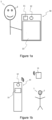
- FIGS. 1a and 1b represent a system comprising a computer 11, and an electronic device 10 comprising a video capture device 12 and a display screen 13.
- An electronic device 10 may be mobile relative to the environment of the user 1 such as a mobile phone as shown in the Figure 1a .
- An electronic device 10 may be fixed relative to the environment of the user 1, for example placed on the floor, a table or fixed to a wall, such as an acquisition terminal as shown in the Figure 1b .
- the calculator 11 can be embedded on the electronic device 10, as shown in the Figure 1a or transferred to an external server, as shown in the Figure 1b .
- the computer 11 can be on-board or remote, the Figures 1a and 1b are only examples of system implementation.
- the exchanges of information between the computer 11 and the electronic device are made either by contactless transmission means, for example by radio waves or optical networks, or by wired transmission means if the electronic device 10 is not too far from the computer 11.
- the video capture device 12 is capable of acquiring images and videos of a body part 2 of a user 1.
- a user's body part 2 is, for example, a face, one or more fingers of a hand, the palm of a hand, an entire hand, one or more irises.
- the display screen 13 is capable of displaying images taken by the video capture device 12, modified or not by the computer 11.
- the display screen 13 is capable of displaying a real video return of a video stream of images acquired by the video capture device 12, but it is also capable of displaying a biased video return of images acquired by the video capture device 12 then modified by the computer 11.
- the invention relates to a method for imaging a body part 2 of a user 1 according to a predetermined positioning instruction.
- the user 1 is able to position said part of his body according to a predetermined positioning instruction based on video feedback displayed on the display screen 13.
- the video feedback on the display screen 13 is biased, said part of the body 2 of the user 1 is not positioned relative to the video capture device 12 as displayed on the display screen 13.
- the user 1 is not informed that the video feedback displayed on the display screen is biased.
- the predetermined positioning instruction can be a voice or visual instruction.
- the predetermined positioning instruction can be implicit or explicit.
- a predetermined implicit positioning instruction is typically a centering on the display screen 13 of the user's body part.
- a predetermined explicit positioning instruction includes, for example, a superimposed display of a real or biased video return on the display screen 13.
- the predetermined positioning instruction comprises the display on the display screen 13 of a positioning target 30 whose location and dimension are fixed relative to said display screen 13.
- body part 2 is a face and target 30 is a face contour template.
- target 30 is a face contour template.
- user 1 must position your face so as to best match your face contour with the face contour template displayed as an overlay on the display screen 13.
- body part 2 is a face and target 30 is a marker.
- user 1 must position his right eye on the marker displayed superimposed on the display screen 13.
- the marker and the face outline template are non-limiting examples of making a target 30.
- the location and size of the target 30 are fixed relative to the display screen 13. Thus, whether the video feedback displayed on the display screen 13 is real or biased, the position and size of the target 30 remains unchanged on the display screen 13.
- the predetermined positioning instruction is identical throughout the execution of the imaging process.
- the method of imaging a body part 2 of a user 1 comprises several steps as shown in the Figure 3 .
- the body part is a face. This is not limiting, the method is applicable to any other part of a user's body.
- the video capture device 12 acquires a first image comprising said body part 2 of the user.
- the video capture device 12 acquires images of the body part 2 of the user 1 which are displayed in real video feedback, on the display screen 13.
- the user 1 is instructed to position his face according to a predetermined positioning instruction, for example so as to match the contour of his face as displayed on said video feedback with a fixed face template displayed superimposed on the display screen 13.
- the video capture device 12 acquires a first image comprising said body part 2 of the user 1.
- the video capture device 12 acquires a first image when said body part 2 is positioned according to said predetermined positioning instruction.
- the video capture device 12 may acquire a first image comprising said body part 2 of the user 1 while said body part 2 is not positioned according to said predetermined positioning instruction, for example because the position of the user's body part is relevant for the electronic device 10 or a predetermined period of time has elapsed.
- a relevant position is a position whose associated image is useful for the construction of a three-dimensional model, for authentication of said user and/or for verification of legitimacy of a user.
- the calculator 11 characterizes a first position of the body part 2 of the user, in the first image.
- the calculator 11 characterizes the orientation of the user's body part in the first image.
- a user's face may be oriented frontally, three-quarters, sideways, at a particular angle, in a straight, up, down head posture, or at a particular angle relative to the straight head posture.
- the first position is a front orientation.
- the calculator 11 characterizes the location of the user's body part in the first image.
- the body part may be centered, off-centered to the right, left, top, bottom in the first image.
- the location of said body part may be characterized relative to a predetermined reference point in the first image, for example the center or relative to a location of a positioning instruction displayed on the display screen 13, in particular a target 30.
- the first position is a location centered in the image.
- the calculator 11 characterizes the dimension of the user's body part in the first image.
- the body part may occupy more or less surface area in the first image or may be smaller or larger compared to a template displayed superimposed on the display screen 13.
- the first position is a dimension substantially equal to the dimension of a template, for example the target 30.
- the dimension may also be associated with a magnification factor. of video capture device 12.
- the first position is a 100% magnification factor dimension of the video capture device 12.
- the calculator 11 determines a second position of said part of the user's body different from the first position.
- the first position of a face is a full-face orientation.
- the second position is a three-quarter orientation.
- the first position of a face is a centered location in an image.
- the second position is an off-center location to the right in an image.
- the first position of a face is a face dimension in an image substantially equal to that of a template displayed superimposed on said image on the display screen 13.
- the second position is a face dimension multiplied by a magnification factor of 150% relative to the first position and said template.
- the computer 11 recovers a video stream of images comprising the body part, the images having been acquired by the video capture device 12. As images are acquired by the video capture device 12, the computer 11 generates modified images, by modifying the positioning in the acquisition images of the body part 2. The modified images are displayed on the display screen 13 for displaying to the user 1 a biased video feedback of said body part 2.
- the positioning of the body part 2 is modified according to a transformation of the type an enlargement or a reduction in the dimension of the body part, a decentering of said body part, a rotation of said body part.
- the determined settings are applied to all images in the image stream.
- an enlargement or reduction factor parameter is determined and applied to all images in the image stream.
- a decentering factor parameter is determined and applied to all images in the image stream.
- a decentering factor includes, for example, a translation according to a change of reference in the image.
- a rotation angle parameter relative to a rotation axis is determined and applied to all images in the image stream.
- the computer 11 generates modified images corresponding to a biased feedback in that the positioning of the body part 2 does not correspond to the actual positioning of the body part, the biased feedback being consistent in that an actual relative movement of the body part relative to the electronic device 10 is reproduced in the biased feedback.
- the body part is a head and the user rotates his head around his neck to the right from a first position facing forward relative to the electronic device to a second position facing left relative to the electronic device.
- the biased feedback the user rotates his head around his neck to the right from a right profile position relative to the electronic device to a position facing forward relative to the electronic device.
- the pivot movement to the right by a predetermined rotation angle is reproduced in the biased feedback, according to the same rotation angle.
- Displaying biased video feedback prompts user 1 to intuitively change the position of body part 2 to follow the predetermined positioning instruction.
- the positioning is all the more intuitive and natural because user 1 does not know that the video feedback is biased or at least in what way it is biased. Believing body part 2 to be poorly positioned, the user naturally modifies the position of said body part.
- a visual or audio aid can additionally guide the user to reach the predetermined positioning instruction, for example by displaying arrows, colors, pictograms, messages on the display screen 13 or by transmitting audio guidance messages indicating a direction or direction of movement to follow.
- the user self-corrects the positioning of the body part 2 relative to the electronic device 10 by moving said body part 2, possibly by moving himself, but this is not mandatory.
- a user can change the position of his face by rotating his head around his neck, without moving his torso and without moving.
- a user can turn on himself or turn around the electronic device 10 to change the position of his face relative to the electronic device as before.
- the user can self-correct the positioning of the body part by moving the body part 2, possibly by moving himself and/or by moving the electronic device 10.
- the electronic device 10 is a mobile phone that the user holds in his hand
- the user can change the position of his face by rotating his head around his neck, without moving the arm or the hand, by moving or by remaining still.
- the user can also move his arm from right to left around his bust to change the position of his face relative to the electronic device 10 as before.
- the computer 11 modifies the images acquired by the video capture device 12 in such a way that a position of said body part 2 according to said predetermined positioning instruction on the display screen 13, therefore in the modified images of the biased video return, corresponds to a position of the body part 2 according to the second position in an acquisition image by the video capture device 12 not modified by the computer 11.
- the images are modified so that the displacement of the body part 2 on the biased video feedback displayed on the display screen 13 is consistent with the change in positioning of the body part 2 in the acquisition images by the video capture device 12, i.e. consistent with the change in actual positioning of the body part 2 relative to the electronic device 10.
- a displacement of the body part relative to the electronic device 10 in one direction, for example the right causes a displacement of the body part in the same direction in the biased video feedback, here to the right.
- the images are modified so that the movement of the body part on the biased video feedback displayed on the display screen 13 is continuous.
- the images are modified so as to make the user 1 believe that he has incorrectly positioned the body part relative to the electronic device 10, relative to the predetermined positioning instruction and that a modification of the position of the body part relative to the electronic device 10 is necessary to achieve said predetermined positioning instruction.
- the environment of the body part is partially or totally replaced by a predetermined image background such as a solid color background.
- a predetermined image background such as a solid color background.
- processing step 103 is not interrupted and the user 1 modifies the positioning of the body part 2 according to said predetermined positioning instruction, then, when the body part 2 is positioned according to said predetermined positioning instruction on the display screen 13, and therefore in the images modified by the computer 11, the body part 2 is positioned according to the second position in the unmodified images as acquired by the video capture device 12.
- the video capture device 12 acquires a second image comprising said body part 2 of the user, during the processing step 103.
- the imaging method makes it possible to acquire a second image of the body part of the user 1 whose position corresponds to an intermediate or final position of the body part 2 on a predetermined movement from the first position to the second position.
- the video capture device 12 acquires during the processing step 103 a plurality of second images according to the second acquisition step 104, the position of the body part in each second image being different.
- the computer 11 modifies images acquired by the video capture device 12 as the acquisitions progress, some of these acquired images being second images according to the second acquisition step 104.
- the position of body part 2 in each second image is significantly different, so as to enrich a database of second images.
- body part 2 is positioned in several orientations: front, one-quarter, three-quarter, side.
- body part 2 is offset to a greater or lesser extent: at a quarter of the distance between the center and an edge of the image, at a third, at half distance, at two-thirds, at three-quarters.
- body part 2 is magnified by a different factor relative to the first position: 110%, 120%, 130%, 140%, 150%.
- the position of said body part in each second image is different from the second position.
- the target position is advantageous to choose said target position as an intermediate position in a movement between the first position and a second position.
- the target position will still be reached during the self-correction movement because it is an intermediate position.
- the processing step 103 ends when the position of said body part on the second image corresponds to a third predetermined position different from the second position.
- a second acquisition step 104 comprising the acquisition of a single second image
- the body part is positioned according to the third position in said single second image.
- the body part is positioned according to the third position in the last second image of the plurality of second images.
- the third position is advantageously the target position, as described previously.
- the processing step 103 ends when it is detected on a second image that other second images on the movement of the body part 2 between the first position and the second position are no longer useful or interesting for the electronic device 10 and/or for an ancillary device such as an anti-fraud, three-dimensional modeling or biometric data construction device.
- a second image gives unexpected information, it may be appropriate to stop the current movement of body part 2 and generate a different movement of body part 2 by repeating the imaging process with a new second position.
- the processing step 103 ends when the number of second images exceeds a predetermined threshold. In this case, it is not a particular target position that is targeted, but the acquisition of images of the body part in different positions, in a predetermined movement, for example to check the consistency of the movement with the predetermined instruction.
- a predetermined threshold is for example between 2 and 6, preferably 5.
- the second position is chosen based on the nature of the movement of the body part relative to the desired video capture device, but also on a sense, direction and intensity.
- a second position close to the first position induces a low intensity movement while a second position far in distance or very different in nature from the first position induces a high intensity movement.
- the direction is for example diagonal, horizontal, vertical or defined by an angle relative to a reference direction.
- a direction is for example, up, down, right, left or defined in relation to the cardinal points.
- Nature corresponds for example to a translation, a rotation, or a combination of the two.
- a rotation is defined relative to an axis of rotation.
- a planar rotation of a face from the front on an image corresponds to an axial rotation of the face around an axis passing through the nose, which corresponds to a tilting movement to the right or to the left of the head of a user who is standing vertically, for example standing or sitting.
- An axial rotation of a face around an axis passing through the ears corresponds to a tilting movement of the head of a user who is standing vertically, for example standing or sitting, upwards or downwards.
- An axial rotation of a face around an axis passing through the neck corresponds to a rotational movement of the head of a user who is standing vertically, for example standing or sitting, towards the left or towards the right.
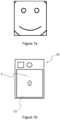
- FIG. 5a illustrates the actual video feedback of the face of a user 1 positioned according to a predetermined positioning instruction and in the manner of a standardized identity photo, full face, centered and frontally.
- the first image is acquired according to this positioning which corresponds to a first position, as shown in the Figure 5b .
- FIG. 5b is an image acquired by the video capture device 12, the body part being positioned according to the first position.
- User 1 is located in an outdoor space. We can see on the Figure 5b a body part 2 environment such as a park or garden.
- the images are modified by the computer 11 so that, after self-correction by the user 1 of the positioning of said body part 2 according to the predetermined positioning instruction, here as shown in the Figure 5a , body part 2 is positioned according to the second position.
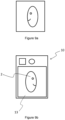
- the Figures 6b , 7b , 8b , 9b illustrate the biased video feedback of modified images of the image of the Figure 5b , with a view to positioning the body part 2 according to a second position represented respectively on the Figures 6a , 7a , 8a , 9a .
- Said positioning according to the second position will be achieved when on the display screen 13, the user 1 has positioned the body part 2 according to the predetermined positioning instruction, here as shown on the Figure 5a .
- the environment around the body part 2, here the user's face is advantageously replaced by a white background, so as to avoid aberrations in the environment of the body part, as already described previously.
- the environment around the body part 2, here the user's face is also replaced by a white background, so as to prevent the user 1 from easily distinguishing a biased return from a real video return or in any case so as not to give him an indication that a video return is biased.
- a black background (not shown) is particularly advantageous because it allows the attention of the user 1 to be drawn to the body part 2 displayed on the display screen 13.
- the second position corresponds to a left-offset of the body part in the first image as shown Figure 5b , a change in positioning of said body part 2 from the first position and according to said predetermined positioning instruction corresponding to a movement of the part of body 2 with respect to the video capture device 12 in a plane orthogonal to a line of sight of said video capture device 12.
- the second position corresponds to an enlargement of the size of the body part in the first image, a change in positioning of said body part 2, from the first position and according to said predetermined positioning instruction, corresponding to a bringing closer of the body part 2 to the video capture device 12.
- the second position corresponds to a plane rotation towards the left of said body part in the first image, a change in positioning of said body part 2, from the first position and according to said predetermined positioning instruction, corresponding to a tilt towards the left of the body part with respect to the video capture device 12.
- the second position corresponds to an axial rotation of the head towards the left of said body part 2 in the first image, a change in positioning of said body part 2, from the first position and according to said predetermined positioning instruction, corresponding to an axial rotation towards the left of the body part with respect to the video capture device 12.
- the computer 11 needs a three-dimensional model of a face, preferably that of user 1, but this is not mandatory.
- a neural network can be advantageously used to modify the image.
- transformations of enlargement or reduction of dimension, of decentering and of plane rotation do not require additional data. They correspond to a zoom, decropping or rotation of an image.
- the change in positioning of the body part 2 is described above with respect to the video capture device 12, which is the same as describing it with respect to the electronic device 10, the video capture device 12 being fixed and integral with the electronic device 10.
- the second position can be determined based on an instruction from an anti-fraud device.
- an anti-fraud device may need to check skin details of user 1 to determine whether body part 2 is real or whether it is an image or an artificial prosthesis.
- a second position corresponding to an enlargement of the dimension of body part 2 in the first image is interesting.
- the anti-fraud device needs a three-dimensional visibility of said body part 2.
- a second position corresponding to an axial rotation of the body part 2 in the first image is interesting.
- the anti-fraud device needs to move said body part 2 relative to the environment of said body part.
- a second position corresponding to an off-centering of the body part 2 in the first image is interesting.
- the computer has the images acquired by the video capture device. If the body part 2 moves relative to the electronic device 10 in a manner inconsistent with the environment, fraud may be suspected.
- the second position can be determined based on a three-dimensional modeling device.
- a three-dimensional modeling device needs images of body part 2 from several different viewpoints to construct a three-dimensional model of said body part 2.
- a second position corresponding to a non-planar rotation of body part 2 in the first image is of interest.
- the second position may be determined based on a biometric data construction device, in particular a biometric fingerprint image construction device.
- a device for constructing iris biometric data needs a detailed image of the iris of user 1 to characterize its patterns.
- a second position corresponding to a size enlargement of body part 2 in the first image is of interest.
- the video capture device 12 is advantageously capable of acquiring biometric fingerprint images of said body part 2 of the user 1, the first image and at least one second image being biometric fingerprint images.
- a second position corresponding to a non-planar rotation of the body part 2 in the first image is of interest.
- the second position is determined according to an instruction from an anti-fraud device and/or a three-dimensional modeling device and/or a biometric data construction device, the second image(s) being sent after acquisition to the anti-fraud device and/or the three-dimensional modeling device and/or the biometric data construction device.
- an anti-fraud device for example, a three-dimensional modeling device and a biometric data construction device.
- the electronic device 10 and the anti-fraud device, the three-dimensional modeling device or the biometric data construction device may be distinct.
- the electronic device 10 may comprise an anti-fraud device, a three-dimensional modeling device or a biometric data construction device.
- the controller 11 may be common to the devices, for example by comprising an anti-fraud algorithm, a three-dimensional modeling algorithm or a biometric data construction algorithm.
- the same image can be used to construct a three-dimensional model of a body part, construct biometric data such as a biometric fingerprint image for user authentication, and verify that the user is legitimate.
- the second position may be determined based on the category of said body part 2.
- a second position corresponding to a non-planar rotation of an iris in the first image is not very relevant for constructing biometric data of an iris.
- the calculator determines the second position based on random or pseudo-random data.
- the second position being associated with a movement of the body part 2 with respect to the video capture device 12, the movement being characterized by a nature, a sense, a direction and an intensity, the random or pseudo-random data can be applied to the nature, the sense, the direction or the intensity or to a combination of these.
- first acquisition 100, characterization 101, determination 102, processing 103 and second acquisition 104 can be iterated several times.
- the second position of an iteration of the imaging method is determined based on the position of said body part 2 on a second image in the previous iteration or in the previous iterations.
- the second position of an iteration of the imaging method is determined as a function of the position of said body part on a predetermined image of the plurality of second images, in particular as a function of a target position as previously described in the previous iteration or in the previous iterations.
- the number of iterations of the imaging method is a function of an instruction from an anti-fraud device, a three-dimensional modeling device, or a biometric data construction device.
- the second acquisition step 104 of the imaging method comprises acquiring five second images, and the imaging method is iterated four times.
- This example is applicable to the case of the three-dimensional modeling device, and the biometric data construction device, the values being chosen to illustrate the example and not being limiting.
- the number of iterations of the imaging method is a function of the elapsed time of a predetermined duration.
- the predetermined positioning instruction is identical for all iterations of the imaging process.
- the iterations follow one another without the user being aware of it, the user self-correcting or attempting to self-correct without discontinuity the position of the body part according to the predetermined positioning instruction.
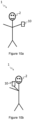
- FIGS. 10a and 10b illustrate a self-correction of a user 1 of the face positioning according to said predetermined positioning instruction, in the case of a mobile electronic device 10 such as a cell phone.
- FIG. 10a represents the position of the electronic device 10 and of the user 1 before an execution of the imaging method.
- FIG. 10b represents the position of the electronic device 10 and the user 1 after or during the execution of the processing step 103 of the imaging method, the user moving his arm to move the electronic device 10 arranged in his hand to carry out the placement self-correction.
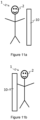
- FIGS. 11a and 11b illustrate a self-correction of a user 1 of the face positioning according to said predetermined positioning instruction, in the case of a fixed electronic device 10 such as a terminal.
- FIG. 11a represents the position of the electronic device 10 and of the user 1 before an execution of the imaging method.
- FIG. 11b represents the position of the electronic device 10 and the user 1 after or during the execution of the processing step 103 of the imaging method, the user moving around the electronic device 10 to perform the placement self-correction.
- the invention also provides an anti-replay method.
- the anti-replay method comprises the imaging method described above, the second acquisition step 104 comprising the acquisition of a plurality of second images by the video capture device 12, and further comprises a verification step 105 in which the computer 11 verifies that the self-correction of the positioning of said body part of the user according to said predetermined positioning instruction, by the user 1, is consistent.
- the calculator 11 verifies in the plurality of second images that the change in position of the body part 2 is consistent with the first position and the second position.
- the calculator 11 calculates a consistency score.
- the calculator 11 determines whether the user 1 is cheating, for example by replaying a previous execution of the method or by broadcasting a video recorded with changes in the positioning of said body part according to random positions, or whether he is not cheating.
- the imaging method can be iterated several times.
- the calculator 11 can check the position consistency of said user's body part over several movements between a first position to a second position.
- the calculator 11 can calculate a probability of fraud and compare it to a predetermined fraud threshold.
Landscapes
- Engineering & Computer Science (AREA)
- Theoretical Computer Science (AREA)
- Physics & Mathematics (AREA)
- General Physics & Mathematics (AREA)
- General Engineering & Computer Science (AREA)
- Human Computer Interaction (AREA)
- Multimedia (AREA)
- Computer Security & Cryptography (AREA)
- Oral & Maxillofacial Surgery (AREA)
- Health & Medical Sciences (AREA)
- General Health & Medical Sciences (AREA)
- Software Systems (AREA)
- Computer Hardware Design (AREA)
- Geometry (AREA)
- Computer Vision & Pattern Recognition (AREA)
- Image Analysis (AREA)
- Studio Devices (AREA)
- Image Processing (AREA)
- User Interface Of Digital Computer (AREA)
- Manipulator (AREA)
Claims (15)
- Verfahren zur Abbildung eines Körperteils (2) eines Benutzers (1) gemäß einer vorbestimmten Positionierungsvorgabe durch ein System, umfassend einen Rechner (11) und eine elektronische Vorrichtung (10), die eine Videoaufnahmevorrichtung (12), die geeignet ist, Bilder des Körperteils (2) des Benutzers zu erfassen, und einen Anzeigebildschirm (13) beinhaltet, wobei das Verfahren die folgenden Schritte umfasst:- einen Schritt des ersten Erfassens (100) eines ersten Bilds, das den Körperteil (2) des Benutzers umfasst, durch die Videoaufnahmevorrichtung (12),- einen Schritt des Charakterisierens (101) einer ersten Position des Körperteils (2) des Benutzers in dem ersten Bild durch den Rechner (11),- einen Schritt des Bestimmens (102) einer zweiten Position des Körperteils des Benutzers, die von der ersten Position verschieden ist, durch den Rechner,- einen Schritt des Verarbeitens (103), bei dem der Rechner (11) einen Videostrom aus Bildern abruft, die von der Videoaufnahmevorrichtung (12) erfasst wurden und den Körperteil (2) umfassen, geänderte Bilder im Zuge der Erfassungen von Bildern des Videostroms erzeugt, indem in den Erfassungsbildern die Positionierung des Körperteils (2) geändert wird, zwecks Anzeige auf dem Anzeigebildschirm eines verzerrten Video-Feedbacks, das den geänderten Bildern entspricht, so dass eine Autokorrektur des Benutzers (1) der Positionierung des Körperteils gemäß der vorbestimmten Positionierungsvorgabe bewirkt wird, wobei die Änderung der Bilder dergestalt ist, dass eine Position des Körperteils (2) gemäß der vorbestimmten Positionierungsvorgabe auf dem Anzeigebildschirm (13) einer Position des Körperteils (2) gemäß der zweiten Position in einem Erfassungsbild durch die Videoaufnahmevorrichtung (12) entspricht, und so, dass die Verlagerung des Körperteils (2) auf dem verzerrten Video-Feedback mit dem Positionierungswechsel des Körperteils (2) in den Erfassungsbildern kohärent ist, wobei eine Verlagerung des Körperteils in Bezug auf die elektronische Vorrichtung (10) in eine Richtung eine Verlagerung des Körperteils in dieselbe Richtung in dem verzerrten Video-Feedback bewirkt,- einen Schritt des zweiten Erfassens (104) eines zweiten Bilds, das den Körperteil (2) des Benutzers umfasst, durch die Videoaufnahmevorrichtung (12) während des Schritts des Verarbeitens (103).
- Verfahren zur Abbildung eines Körperteils (2) nach dem vorhergehenden Anspruch, wobei die Position des Körperteils in dem zweiten Bild von der zweiten Position verschieden ist.
- Verfahren zur Abbildung eines Körperteils (2) nach einem der vorhergehenden Ansprüche, wobei der Schritt des zweiten Erfassens (104) das Erfassen einer Mehrzahl von zweiten Bildern durch die Videoaufnahmevorrichtung (12) umfasst, wobei die Position des Körperteils in jedem zweiten Bild verschieden ist.
- Verfahren zur Abbildung eines Körperteils (2) nach Anspruch 3, wobei der Schritt des Verarbeitens endet, wenn die Position des Körperteils auf dem zweiten Bild einer dritten vorbestimmten Position entspricht, die von der zweiten Position verschieden ist.
- Verfahren zur Abbildung eines Körperteils (2) nach Anspruch 3, wobei der Schritt des Verarbeitens endet, wenn die Anzahl von zweiten Bildern einen vorbestimmten Schwellenwert überschreitet.
- Verfahren zur Abbildung eines Körperteils (2) nach einem der vorhergehenden Ansprüche, wobei die zweite Position aus mindestens einer Transformation resultiert unter:- einer Vergrößerung oder einer Verkleinerung des Körperteils (2) in dem ersten Bild,- einer Dezentrierung des Körperteils in dem ersten Bild,- einer Rotation des Körperteils in dem ersten Bild, wobei ein Positionierungswechsel des Körperteils von der ersten Position aus und gemäß der vorbestimmten Positionierungsvorgabe einer vorbestimmten Bewegung des Körperteils (2) gegenüber der Videoaufnahmevorrichtung (12) entspricht, wobei die vorbestimmte Bewegung mindestens eine Bewegung ist unter:- einer Annäherung oder einer Entfernung,- einer Verlagerung in einer senkrecht zu einer Sichtlinie der Videoaufnahmevorrichtung (12) verlaufenden Ebene,- einer rotatorischen Verlagerung.
- Verfahren zur Abbildung eines Körperteils (2) nach einem der vorhergehenden Ansprüche, wobei die vorbestimmte Positionierungsvorgabe für den Körperteil des Benutzers die Anzeige auf dem Anzeigebildschirm (13), in Überlagerung, einer Zielscheibe (30) zur Positionierung umfasst, deren Lage und Größe in Bezug auf den Anzeigebildschirm (13) festgelegt sind.
- Verfahren zur Abbildung eines Körperteils (2) nach einem der vorhergehenden Ansprüche, wobei die zweite Position in Abhängigkeit von einer Anweisung einer Betrugsverhinderungsvorrichtung und/oder einer Vorrichtung zur dreidimensionalen Modellierung und/oder einer Vorrichtung zur Erstellung von biometrischen Daten bestimmt wird.
- Verfahren zur Abbildung eines Körperteils (2) nach dem vorhergehenden Anspruch, wobei die zweite Position in Abhängigkeit von einem zufälligen oder pseudozufälligen Datenelement bestimmt wird.
- Verfahren zur Abbildung eines Körperteils (2) nach einem der vorhergehenden Ansprüche, wobei die Schritte des ersten Erfassens (100), des Charakterisierens (101), des Bestimmens (102), des Verarbeitens (103) und des zweiten Erfassens (104) mehrmals wiederholt werden.
- Verfahren zur Abbildung eines Körperteils (2) nach dem vorhergehenden Anspruch, wobei die zweite Position einer Wiederholung des Verfahrens zur Abbildung in Abhängigkeit von der Position des Körperteils auf dem zweiten Bild oder auf einem vorbestimmten zweiten Bild einer Mehrzahl von zweiten Bildern des Schritts des zweiten Erfassens (104) bei der vorhergehenden Wiederholung des Verfahrens zur Abbildung oder von einer Historie der Positionen des Körperteils auf dem zweiten Bild oder auf einem vorbestimmten zweiten Bild einer Mehrzahl von zweiten Bildern des Schritts des zweiten Erfassens (104) der vorhergehenden Wiederholungen des Verfahrens zur Abbildung bestimmt wird.
- Verfahren zur Abbildung eines Körperteils (2) nach einem der Ansprüche 10 oder 11, wobei die Anzahl von Wiederholungen von einer Anweisung einer Betrugsverhinderungsvorrichtung und/oder einer Vorrichtung zur dreidimensionalen Modellierung und/oder einer Vorrichtung zur Erstellung von biometrischen Daten oder aber vom Ablauf einer vorbestimmten Dauer abhängig ist.
- Verfahren zur Abbildung eines Körperteils (2) nach einem der vorhergehenden Ansprüche, wobei der Körperteil (2) ein Gesicht ist.
- Verfahren zum Verhindern des Wiedereinspielens einer Verlagerung eines Körperteils (2), umfassend ein Verfahren zur Abbildung des Körperteils (2) nach Anspruch 3 oder nach einem der vorherigen Ansprüche, wenn dieser von Anspruch 3 abhängt, wobei das Verfahren zum Verhindern des Wiedereinspielens einen Schritt des Überprüfens (105), durch den Rechner (11), einer kohärenten Autokorrektur des Benutzers (1) der Positionierung des Körperteils des Benutzers gemäß der vorbestimmten Positionierungsvorgabe während des Schritts Schritts des Verarbeitens (103) umfasst, durch die Überprüfung eines kohärenten Wechsels der Position des Körperteils (2) in der Mehrzahl von zweiten Bildern in Abhängigkeit von der ersten Position und von der zweiten Position.
- Computerprogrammprodukt, das Programmanweisungen umfasst, die bei der Ausführung der Programmanweisungen durch einen Computer die Schritte des Verfahrens zur Abbildung nach einem der Ansprüche 1 bis 13 ausführen.
Priority Applications (1)
| Application Number | Priority Date | Filing Date | Title |
|---|---|---|---|
| MA69825A MA69825B1 (fr) | 2021-09-27 | 2022-08-01 | Procédé d'imagerie d'une partie de corps d'un utilisateur, procédé anti-rejeu d'un déplacement d'une partie de corps et produit programme d'ordinateur associé |
Applications Claiming Priority (2)
| Application Number | Priority Date | Filing Date | Title |
|---|---|---|---|
| FR2110177A FR3127610B1 (fr) | 2021-09-27 | 2021-09-27 | Procédé d’imagerie d’une partie de corps d’un utilisateur, procédé anti-rejeu d’un déplacement d’une partie de corps et produit programme d’ordinateur associé |
| PCT/EP2022/071571 WO2023046344A1 (fr) | 2021-09-27 | 2022-08-01 | Procédé d'imagerie d'une partie de corps d'un utilisateur, procédé anti-rejeu d'un déplacement d'une partie de corps et produit programme d'ordinateur associé |
Publications (3)
| Publication Number | Publication Date |
|---|---|
| EP4409548A1 EP4409548A1 (de) | 2024-08-07 |
| EP4409548C0 EP4409548C0 (de) | 2025-06-04 |
| EP4409548B1 true EP4409548B1 (de) | 2025-06-04 |
Family
ID=79018722
Family Applications (1)
| Application Number | Title | Priority Date | Filing Date |
|---|---|---|---|
| EP22761956.6A Active EP4409548B1 (de) | 2021-09-27 | 2022-08-01 | Verfahren zur abbildung eines körperteils eines benutzers, anti-wiedergabeverfahren für eine bewegung eines körperteils und zugehöriges computerprogramm |
Country Status (6)
| Country | Link |
|---|---|
| US (1) | US12541248B2 (de) |
| EP (1) | EP4409548B1 (de) |
| CO (1) | CO2024003955A2 (de) |
| FR (1) | FR3127610B1 (de) |
| MA (1) | MA69825B1 (de) |
| WO (1) | WO2023046344A1 (de) |
Families Citing this family (4)
| Publication number | Priority date | Publication date | Assignee | Title |
|---|---|---|---|---|
| KR102803808B1 (ko) | 2017-05-16 | 2025-05-08 | 애플 인크. | 이모지 레코딩 및 전송 |
| US11921998B2 (en) | 2020-05-11 | 2024-03-05 | Apple Inc. | Editing features of an avatar |
| WO2023230290A1 (en) | 2022-05-26 | 2023-11-30 | Apple Inc. | Devices, methods, and graphical user interfaces for user authentication and device management |
| US12530113B2 (en) | 2023-02-28 | 2026-01-20 | Apple Inc. | Devices, methods, and graphical user interfaces for adjusting device settings |
Family Cites Families (6)
| Publication number | Priority date | Publication date | Assignee | Title |
|---|---|---|---|---|
| US6970580B2 (en) * | 2001-10-17 | 2005-11-29 | Qualcomm Incorporated | System and method for maintaining a video image in a wireless communication device |
| US9082235B2 (en) * | 2011-07-12 | 2015-07-14 | Microsoft Technology Licensing, Llc | Using facial data for device authentication or subject identification |
| CA2902093C (en) * | 2014-08-28 | 2023-03-07 | Kevin Alan Tussy | Facial recognition authentication system including path parameters |
| KR102301599B1 (ko) * | 2017-09-09 | 2021-09-10 | 애플 인크. | 생체측정 인증의 구현 |
| US11507646B1 (en) * | 2017-09-29 | 2022-11-22 | Amazon Technologies, Inc. | User authentication using video analysis |
| AU2020237108B2 (en) * | 2019-03-12 | 2022-12-15 | Element Inc. | Detecting spoofing of facial recognition with mobile devices |
-
2021
- 2021-09-27 FR FR2110177A patent/FR3127610B1/fr active Active
-
2022
- 2022-08-01 WO PCT/EP2022/071571 patent/WO2023046344A1/fr not_active Ceased
- 2022-08-01 MA MA69825A patent/MA69825B1/fr unknown
- 2022-08-01 US US18/693,975 patent/US12541248B2/en active Active
- 2022-08-01 EP EP22761956.6A patent/EP4409548B1/de active Active
-
2024
- 2024-03-27 CO CONC2024/0003955A patent/CO2024003955A2/es unknown
Also Published As
| Publication number | Publication date |
|---|---|
| EP4409548C0 (de) | 2025-06-04 |
| CO2024003955A2 (es) | 2024-06-27 |
| FR3127610B1 (fr) | 2024-07-19 |
| WO2023046344A1 (fr) | 2023-03-30 |
| US12541248B2 (en) | 2026-02-03 |
| US20240393871A1 (en) | 2024-11-28 |
| MA69825B1 (fr) | 2025-09-30 |
| EP4409548A1 (de) | 2024-08-07 |
| FR3127610A1 (fr) | 2023-03-31 |
Similar Documents
| Publication | Publication Date | Title |
|---|---|---|
| EP4409548B1 (de) | Verfahren zur abbildung eines körperteils eines benutzers, anti-wiedergabeverfahren für eine bewegung eines körperteils und zugehöriges computerprogramm | |
| KR101356358B1 (ko) | 눈의 이미지에 기초한 바이오메트릭 인증을 위한 기기 및 컴퓨터 구현 방법 | |
| JP6599421B2 (ja) | バイオメトリック認証のための特徴抽出およびマッチングおよびテンプレート更新 | |
| CN105787454B (zh) | 用于生物特征验证的方法和系统 | |
| KR101495430B1 (ko) | 바이오메트릭 인증을 위한 품질 메트릭 | |
| EP3522053B1 (de) | Authentifizierungsverfahren eines gesichts | |
| JP2008203995A (ja) | 物体形状生成方法、物体形状生成装置及びプログラム | |
| WO2025016037A1 (zh) | 虹膜特征采集方法、对象识别方法、装置、设备、介质及产品 | |
| WO2020049257A1 (fr) | Procédé amelioré de création d'une représentation tridimensionnelle virtuelle du buste d'une personne | |
| HK1211716B (en) | Methods and systems for spoof detection for biometric authentication | |
| HK1211721B (zh) | 用於生物特徵验证的电子欺骗检测的方法和系统 | |
| HK1238756B (zh) | 用於生物特徵验证的质量度量的方法和系统 | |
| WO2006082291A1 (fr) | Procede de determination d'un axe de reference d'un œil | |
| HK1189685B (en) | Methods and systems for texture features for biometric authentication | |
| HK1238756A1 (en) | Methods and systems for quality metrics for biometric authentication | |
| HK1227139A1 (en) | Methods and systems for biometric authentication | |
| HK1189977B (en) | Methods and systems for quality metrics for biometric authentication | |
| HK1189977A (en) | Methods and systems for quality metrics for biometric authentication |
Legal Events
| Date | Code | Title | Description |
|---|---|---|---|
| STAA | Information on the status of an ep patent application or granted ep patent |
Free format text: STATUS: UNKNOWN |
|
| STAA | Information on the status of an ep patent application or granted ep patent |
Free format text: STATUS: THE INTERNATIONAL PUBLICATION HAS BEEN MADE |
|
| PUAI | Public reference made under article 153(3) epc to a published international application that has entered the european phase |
Free format text: ORIGINAL CODE: 0009012 |
|
| STAA | Information on the status of an ep patent application or granted ep patent |
Free format text: STATUS: REQUEST FOR EXAMINATION WAS MADE |
|
| 17P | Request for examination filed |
Effective date: 20240229 |
|
| AK | Designated contracting states |
Kind code of ref document: A1 Designated state(s): AL AT BE BG CH CY CZ DE DK EE ES FI FR GB GR HR HU IE IS IT LI LT LU LV MC MK MT NL NO PL PT RO RS SE SI SK SM TR |
|
| DAX | Request for extension of the european patent (deleted) | ||
| RAV | Requested validation state of the european patent: fee paid |
Extension state: MA Effective date: 20240229 |
|
| RAP1 | Party data changed (applicant data changed or rights of an application transferred) |
Owner name: IDEMIA PUBLIC SECURITY FRANCE |
|
| REG | Reference to a national code |
Ref country code: DE Ref legal event code: R079 Free format text: PREVIOUS MAIN CLASS: G06V0040400000 Ipc: G06F0021320000 Ref country code: DE Ref legal event code: R079 Ref document number: 602022015599 Country of ref document: DE Free format text: PREVIOUS MAIN CLASS: G06V0040400000 Ipc: G06F0021320000 |
|
| GRAP | Despatch of communication of intention to grant a patent |
Free format text: ORIGINAL CODE: EPIDOSNIGR1 |
|
| STAA | Information on the status of an ep patent application or granted ep patent |
Free format text: STATUS: GRANT OF PATENT IS INTENDED |
|
| RIC1 | Information provided on ipc code assigned before grant |
Ipc: G06V 40/60 20220101ALI20250225BHEP Ipc: G06T 3/02 20240101ALI20250225BHEP Ipc: G06F 3/01 20060101ALI20250225BHEP Ipc: G06V 40/40 20220101ALI20250225BHEP Ipc: G06V 40/16 20220101ALI20250225BHEP Ipc: G06T 7/70 20170101ALI20250225BHEP Ipc: G06F 21/32 20130101AFI20250225BHEP |
|
| INTG | Intention to grant announced |
Effective date: 20250310 |
|
| P01 | Opt-out of the competence of the unified patent court (upc) registered |
Free format text: CASE NUMBER: APP_14771/2025 Effective date: 20250326 |
|
| GRAS | Grant fee paid |
Free format text: ORIGINAL CODE: EPIDOSNIGR3 |
|
| GRAA | (expected) grant |
Free format text: ORIGINAL CODE: 0009210 |
|
| STAA | Information on the status of an ep patent application or granted ep patent |
Free format text: STATUS: THE PATENT HAS BEEN GRANTED |
|
| AK | Designated contracting states |
Kind code of ref document: B1 Designated state(s): AL AT BE BG CH CY CZ DE DK EE ES FI FR GB GR HR HU IE IS IT LI LT LU LV MC MK MT NL NO PL PT RO RS SE SI SK SM TR |
|
| REG | Reference to a national code |
Ref country code: GB Ref legal event code: FG4D Free format text: NOT ENGLISH |
|
| REG | Reference to a national code |
Ref country code: CH Ref legal event code: EP |
|
| REG | Reference to a national code |
Ref country code: IE Ref legal event code: FG4D Free format text: LANGUAGE OF EP DOCUMENT: FRENCH |
|
| U01 | Request for unitary effect filed |
Effective date: 20250604 |
|
| U07 | Unitary effect registered |
Designated state(s): AT BE BG DE DK EE FI FR IT LT LU LV MT NL PT RO SE SI Effective date: 20250611 |
|
| P04 | Withdrawal of opt-out of the competence of the unified patent court (upc) registered |
Free format text: CASE NUMBER: APP_26969/2025 Effective date: 20250606 |
|
| U20 | Renewal fee for the european patent with unitary effect paid |
Year of fee payment: 4 Effective date: 20250723 |
|
| REG | Reference to a national code |
Ref country code: MA Ref legal event code: VAGR Ref document number: 69825 Country of ref document: MA Kind code of ref document: B1 |
|
| PG25 | Lapsed in a contracting state [announced via postgrant information from national office to epo] |
Ref country code: ES Free format text: LAPSE BECAUSE OF FAILURE TO SUBMIT A TRANSLATION OF THE DESCRIPTION OR TO PAY THE FEE WITHIN THE PRESCRIBED TIME-LIMIT Effective date: 20250604 |
|
| PG25 | Lapsed in a contracting state [announced via postgrant information from national office to epo] |
Ref country code: NO Free format text: LAPSE BECAUSE OF FAILURE TO SUBMIT A TRANSLATION OF THE DESCRIPTION OR TO PAY THE FEE WITHIN THE PRESCRIBED TIME-LIMIT Effective date: 20250904 Ref country code: GR Free format text: LAPSE BECAUSE OF FAILURE TO SUBMIT A TRANSLATION OF THE DESCRIPTION OR TO PAY THE FEE WITHIN THE PRESCRIBED TIME-LIMIT Effective date: 20250905 |
|
| PG25 | Lapsed in a contracting state [announced via postgrant information from national office to epo] |
Ref country code: PL Free format text: LAPSE BECAUSE OF FAILURE TO SUBMIT A TRANSLATION OF THE DESCRIPTION OR TO PAY THE FEE WITHIN THE PRESCRIBED TIME-LIMIT Effective date: 20250604 |
|
| PG25 | Lapsed in a contracting state [announced via postgrant information from national office to epo] |
Ref country code: HR Free format text: LAPSE BECAUSE OF FAILURE TO SUBMIT A TRANSLATION OF THE DESCRIPTION OR TO PAY THE FEE WITHIN THE PRESCRIBED TIME-LIMIT Effective date: 20250604 |
|
| PG25 | Lapsed in a contracting state [announced via postgrant information from national office to epo] |
Ref country code: RS Free format text: LAPSE BECAUSE OF FAILURE TO SUBMIT A TRANSLATION OF THE DESCRIPTION OR TO PAY THE FEE WITHIN THE PRESCRIBED TIME-LIMIT Effective date: 20250904 |
|
| VSFP | Annual fee paid to validation state [announced via postgrant information from national office to epo] |
Ref country code: MA Payment date: 20250813 Year of fee payment: 4 |
|
| PG25 | Lapsed in a contracting state [announced via postgrant information from national office to epo] |
Ref country code: IS Free format text: LAPSE BECAUSE OF FAILURE TO SUBMIT A TRANSLATION OF THE DESCRIPTION OR TO PAY THE FEE WITHIN THE PRESCRIBED TIME-LIMIT Effective date: 20251004 |
|
| PG25 | Lapsed in a contracting state [announced via postgrant information from national office to epo] |
Ref country code: SM Free format text: LAPSE BECAUSE OF FAILURE TO SUBMIT A TRANSLATION OF THE DESCRIPTION OR TO PAY THE FEE WITHIN THE PRESCRIBED TIME-LIMIT Effective date: 20250604 |
|
| PG25 | Lapsed in a contracting state [announced via postgrant information from national office to epo] |
Ref country code: CZ Free format text: LAPSE BECAUSE OF FAILURE TO SUBMIT A TRANSLATION OF THE DESCRIPTION OR TO PAY THE FEE WITHIN THE PRESCRIBED TIME-LIMIT Effective date: 20250604 |
|
| PG25 | Lapsed in a contracting state [announced via postgrant information from national office to epo] |
Ref country code: SK Free format text: LAPSE BECAUSE OF FAILURE TO SUBMIT A TRANSLATION OF THE DESCRIPTION OR TO PAY THE FEE WITHIN THE PRESCRIBED TIME-LIMIT Effective date: 20250604 |