EP4408160B1 - Vorrichtung mit löslichen hakenförmigen mikroelementen zur eintragung von stoffen in die blätter von pflanzen - Google Patents
Vorrichtung mit löslichen hakenförmigen mikroelementen zur eintragung von stoffen in die blätter von pflanzen Download PDFInfo
- Publication number
- EP4408160B1 EP4408160B1 EP22800754.8A EP22800754A EP4408160B1 EP 4408160 B1 EP4408160 B1 EP 4408160B1 EP 22800754 A EP22800754 A EP 22800754A EP 4408160 B1 EP4408160 B1 EP 4408160B1
- Authority
- EP
- European Patent Office
- Prior art keywords
- micro
- elements
- integrated device
- hook
- anchoring
- Prior art date
- Legal status (The legal status is an assumption and is not a legal conclusion. Google has not performed a legal analysis and makes no representation as to the accuracy of the status listed.)
- Active
Links
Images


Classifications
-
- A—HUMAN NECESSITIES
- A01—AGRICULTURE; FORESTRY; ANIMAL HUSBANDRY; HUNTING; TRAPPING; FISHING
- A01G—HORTICULTURE; CULTIVATION OF VEGETABLES, FLOWERS, RICE, FRUIT, VINES, HOPS OR SEAWEED; FORESTRY; WATERING
- A01G7/00—Botany in general
- A01G7/06—Treatment of growing trees or plants, e.g. for preventing decay of wood, for tingeing flowers or wood, for prolonging the life of plants
Definitions
- the present invention fits into the field of agricultural sciences.
- the invention is within the scope of devices suitable for deploying into the plants, and in particular into leaves, nutritive or curative substances, pesticides or other substances containing active ingredients mainly in the form of nanoparticles, molecules, salts, ions, nucleic acids, proteins, viruses, or bacteria.
- Injection into the trunk and feeding from the petiole overcome the problems caused by the plant's barrier tissues mechanically damaging these barriers and directly accessing the vascular system. They have a greater delivery efficiency and can be used to provide large amounts of active ingredients. However, they are suitable for large and woody plants due to their invasive application method. In addition, valuable and labile active ingredients are not suitable for distribution by these methods.
- the leaves represent the most common organs of plants and the most extensive biointerface in the world.
- application technologies both for substance detection and for the detection of conditions directly on the leaves are limited due to the fragile and heterogeneous structure thereof (e.g., presence of different microstructures on the foliar surface, hardness, and roughness).
- CA2199612A1 discloses a miniaturised integrated device for deploying substances into the inner tissue of leaves of plants.
- Silk fibroin is a very rare and expensive material derived from silkworm as it requires long and complex extraction methods.
- Silk fibroin is a poorly soluble material in contact with the sap of the plant and in order to be able to be dissolved in the sap of the plant it needs to be engineered, which is a long and expensive method.
- the realisation of soluble components in such material is performed by vacuum infiltration which is also a long and expensive method.
- the mechanical characteristics of the micro-needles due both to the material of which they are made and to their geometry, as well as the times of dissolution of the material, do not allow the creation of devices that are able to deploy the active ingredients within optimal times, or in any case adaptable according to the needs without a great expense of costs.
- An object of the present invention is to propose a device with soluble micro-needles for applications to plant leaves, both for the purpose of deploying active ingredients and for detection, which has very low realisation costs compared to the prior art.
- Another object of the present invention is to propose a device with soluble micro-needles for deploying active ingredients into the leaves of the plants that allows to deploy the active ingredients in a particularly efficient way, in particular in relation to the possibility of remaining on the leaf and deploying active ingredients directly into the vascular tissue of the latter with optimised deployment times and easily adjustable according to the needs.
- a further object of the present invention is to propose a method for the production of a device with soluble micro-needles for applications on leaves of plants which allows to produce said device in a simple and cost-effective way.
- a miniaturised device suitable for deploying substances into the inner tissue of leaves of the plants comprises one or more anchoring micro-elements made of a soluble material, so that the anchoring micro-element penetrates the inner tissue of the leaf and by dissolving it deploys the active ingredients contained therein.
- the above mentioned objects/ problems are solved with the miniaturised integrated device for deploying substances into the inner tissue of leaves of plants according to independent claim 1.
- the anchoring micro-elements are made of a material based on sugar alcohols, advantageously selected from isomalt, erythritol, lactitol, maltitol, mannitol, xylitol and sorbitol or a mixture thereof.
- isomalt in particular has optimal characteristics as it has enormously lower costs than silk fibroin (about 15,000 times lower), is able to dissolve quite quickly within the foliar tissue, has no environmental impact as it is completely biodegradable.
- said one or more anchoring micro-elements are a matrix of abaxial hook-shaped micro-elements each having dimensions of the order of tens or hundreds of ⁇ m, arranged in arrays.
- Abaxial hook-shaped micro-elements have much higher tensile strength characteristics than micro-needles, therefore, together with the chosen material which has the ability to dissolve in a relatively short time, they allow the device to deploy all their active ingredient load into the tissue of the plant without the device risking a premature detachment from the foliar surface.
- the abaxial hook-shaped micro-element geometry produces contact separation forces dependent on the application direction so it is possible to envisage applications in which it is appropriate that the device can also be easily detached from the foliar surface.
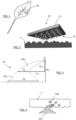
- a miniaturised soluble device suitable for deploying substances into the inner tissue of leaves, F, of plants is generally indicated with numeral 10.
- the device 10 consists of a sheet support, 11, on one side of which arrays of anchoring micro-elements, 12 protrude.
- each anchoring micro-element 12 consists of an abaxial hook-shaped micro-element.
- abaxial is used in botany to indicate a side or surface of an organ facing and positioned on the opposite side with respect to that facing its supporting axis. In a leaf the abaxial side is typically the lower side.
- the geometry of the hook-shaped micro-elements is inspired by the climbing mechanism of the plant G.
- Aparine L. whose leaves on the adaxial side are provided with hook-shaped micro-elements similar to those Velcro is inspired by, while on the abaxial side they are provided with hook-shaped micro-elements having the peculiar shape shown in Fig. 3 .
- An anchoring micro-element 12 consisting of an abaxial hook-shaped micro-element is formed by a conical base, 12a and by a hooked upper portion, 12b, which becomes thinner as it approaches the apical part.
- the hooked portion 12b of an abaxial hook-shaped micro-element never assumes a downward orientation, is squatter and has a prevalent extension in the direction parallel to the orthogonal surface with respect to the extension in the direction orthogonal thereto. As seen in Fig.
- the main geometric parameters of the abaxial hook-shaped micro-element 12 are the total height H tot , the height of the hooked portion arc , the horizontal length of the hooked portion measured from the inner side L arc , the base diameter of the base D b and the base diameter of the hooked portion D m .
- H tot is about twice as H arc
- D b is between two and three times D m
- L arc is between 1.5 and 2 times H arc and between 1 and 2 times D m .
- a hooking micro-element according to the present invention has H tot comprised in orders of magnitude comprised between tens and hundreds of ⁇ m, preferably between 100 ⁇ m and 600 ⁇ m.
- the aforementioned geometric characteristics which as already mentioned are largely inspired by those of the abaxial hook-shaped micro-elements of the leaves of G. Aparine L.
- the device 10 has a hook-shaped micro-element density between 10 hook-shaped micro-elements per 2 and 1,000 hook-shaped micro-elements per cm 2 . Together with the choice of a material having suitable mechanical characteristics in particular with regard to the Young's module, the aforementioned geometric characteristics allow the device 10 to show very high contact separation forces and dependent on the application direction.
- the anchoring micro-elements 12 are made of a material based on sugar alcohols. More specifically, the anchoring micro-elements 12 are made of a material selected from isomalt, erythritol, lactitol, maltitol, mannitol, xylitol and sorbitol or a mixture thereof.
- the anchoring micro-elements 12 and the relative sheet support 11 are made of isomalt.
- Isomalt is a material that has a very low cost, is not toxic, is soluble and recyclable.
- Particularly advantageous characteristics for the present application are the fact that the isomalt has a great mechanical resistance, which allows the manufacture of resistant hook-shaped micro-elements capable of anchoring and penetrating the leaves in the cutting direction and is also very soluble from the sap of the plants.
- the isomalt is advantageously mixed with substances containing active ingredients which are deployed into the inner tissues of the leaf when the isomalt solubilises.
- the aforementioned active ingredients can be molecules, nanoparticles, nucleic acids, salts, ions, viruses, bacteria or other, for example with nutritional, fertilising, pesticidal or other function.
- the realisation of the device 10 in isomalt, or more generally in a material based on sugar alcohols, allows to greatly reduce the costs compared to the prior art while also improving the mechanical characteristics of the device.
- the use of isomalt in combination with the peculiar abaxial hook-shaped micro-element geometry of the anchoring micro-elements 12, allow to make particularly efficient the deployment of the active substances into the inner tissue of the leaf F avoiding their dispersion.
- the geometry of the hook-shaped micro-elements whose size can be defined according to the surface structure of the leaves on which the device must be anchored, allows to obtain a maximum detachment force and a maximum shear anchoring force that are higher than those experienced with other geometries, for example micro-needles, so that the device can remain anchored to the leaf longer and even in the presence of greater stresses.
- the high solubility of the isomalt from the sap of the plants makes the deployment of the active ingredients mixed with the isomalt quick. In this way, the risk that part of the active ingredient is not transferred to the inner tissue of the leaf due to premature detachment of the device from the leaf is greatly reduced.
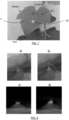
- FIG. 7 shows the photo of a device 1 according to the present invention on the adaxial surface of a leaf F.
- the device 1 is made of isomalt to which fluorescein has been mixed.
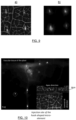
- FIG. 8 shows images made under a microscope of the device 1 applied to the leaf 7 of FIG. 7 .
- Photos a) and b) are digital images, photos c) and d) are photos obtained with fluorescence techniques.
- FIG. 9 shows images of areas of the leaf that have been injected through the hook-shaped micro-element arrays, obtained with light field microscopy technique, with red filter (photo a)) and in fluorescence (photo b)).
- FIG. 10 shows fluorescent images of the leaf veins after the device 1 has been removed. The device had been applied close to the central rib and the hook-shaped micro-elements penetrated a vein. The numbered circles and ellipses in the figure indicate the areas of the vascular tissues of the leaf that have been monitored. The box at the bottom right is a photo with light field microscopy showing the orientation of the deployment point with respect to the leaf F.
- FIG. 11 shows the temporal variation of the fluorescence intensity in the vascular tissue at the monitored points indicated in FIG. 10 .
- FIG. 12 shows the temporal variation of the area of the hook-shaped micro-elements when they are placed in dissolution in water, a), or exposed to ambient humidity, b).
- Quantum dots Quantum dots
- an advantageous embodiment variant provides that the anchoring micro-element 12 is made of a material based on sugar alcohols, coated with a material with reduced solubility.
- material with reduced solubility herein refers to a material that is not soluble in the sap of the plants or that in any case has a lower solubility in the sap of the plants than that of sugar alcohols, said material with reduced solubility being also advantageously able to be chosen (for example by means of an appropriate choice of the relative pH) so as to appropriately schedule the time of dissolution of the coating of the hook-shaped micro-elements into the foliar tissue.
- the device thus retains the advantages of being made mainly with a material that has very low cost and optimal mechanical characteristics but the protective outer coating allows a much longer life of the hook-shaped micro-elements.
- a particularly advantageous embodiment provides that the anchoring micro-elements 12 have abaxial hook-shaped micro-element geometry.
- one of the most peculiar characteristics of this geometry is the fact that the shear anchoring force is dependent on the application direction so that while a very high shear anchoring force is exerted in one direction, the shear anchoring force is practically nil in the opposite direction, thus allowing an easy removability of the device.
- the aforementioned combination of characteristics therefore allows a device according to the invention to be particularly suitable for very different applications in which a long life of the anchoring micro-elements 12 and a reversibility of the anchoring, such as for example sensing applications, are necessary.
- a protective surface layer made of a material with reduced solubility is provided only at the conical base 12a.
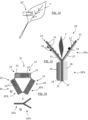
- a miniaturised device for deploying active substances into the leaves as described above is part of an integrated device, 10', according to the present invention which provides integrated functionality for both the deployment of substances by dissolution and for monitoring the leaf.
- the integrated device 10' can deploy substances on both the abaxial and the adaxial part of the leaf and at the same time monitor the effect of these substances on the plant thanks to the presence of electronic components comprising sensors, 23.
- the integrated device 10' comprises a distal portion, 10'a, and a proximal portion, 10'b, consisting of a pair of jaws, 21, 22, through which the proximal portion 10'b can be clamped to a leaf, F.
- the inner sides of both jaws 21 and 22 are provided with anchoring micro-elements 12 according to the present invention which, as previously described, allow the integrated device 10' to anchor stably to the leaf F and deploy substances both from the abaxial side and from the adaxial side thereof.
- the proximal portion 10'b comprises sensors, 23, (such as humidity sensors, temperature sensors, light sensors, or others) which may be provided on both the outer and inner side of the jaws 21, 22.
- the distal portion 10'a comprises electrical and electronic components that allow the acquisition, processing and remote sending of the data acquired by the sensors 23.
- an electronic board, 24, containing management, processing and storage means, a communication module, 25, a battery, 26 and electronic circuitry, 27 for connecting the various components are advantageously present.
- the arrangement of the components mentioned above is purely indicative and the number, type, and arrangement of the electronic components of the integrated device 10' can certainly be different still with a view of providing monitoring functionality.
- the integrated device 10' is advantageously realised with an origami design in which three supporting elements, 31, 32, 33 are obtained in a single sheet of rigid or flexible material, which are intended to be suitably superimposed so that a first supporting element, 31, forms the inner sides of the jaws 21 and 22, a second supporting element, 32, forms the outer side of the first jaw 21 and a first side of the distal portion 10'a, and a third supporting element, 33, forms the outer side of the second jaw 22 and the other side of the distal portion 10'a.
- the arrays of anchoring micro-elements 12 and the electronic components for the monitoring functions can advantageously be integrated into the respective supporting elements 31, 32, 33 before the final assembly of the integrated device 1'.
- the integrated device 1' allows at the same time the deployment of substances and the simultaneous monitoring of the abaxial and adaxial part of the leaf.
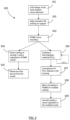
- a miniaturised device 10 according to the present invention is advantageously produced by a peculiar and innovative production method, 100.
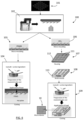
- the production method according to the invention provides for the combination of micro-manufacturing techniques comprising the direct printing of anchoring micro-elements by high-resolution 3D printing, subsequent micro-moulding to obtain a micro-mould with negative imprint of the anchoring micro-elements and finally casting of the soluble material into the obtained micro-mould.
- the arrays of anchoring micro-elements 12 are designed with CAD technologies, step 101, and the relative parametric geometry sent to a high-resolution 3D printer which realises the arrays of anchoring micro-elements 12 on a rigid support, step 102.
- the aforementioned 3D printing step is performed with two-photon polymerisation (2PP) technology on a silicon support.
- the 3D printed matrix is used to obtain a PDMS micro-mould, step 103.
- the moulded anchoring micro-elements 12 are silanised, coated with poly(dimethylsiloxane) (PDMS), and allowed under vacuum.
- the PDMS micro-mould can be directly used to perform a casting of soluble material, step 104, in order to directly obtain a device 10 according to the invention, which once solidified is removed from the micro-mould, step 105.
- the soluble material is advantageously isomalt which is heated to about 100°C and to which the substances containing the active ingredients to be transferred to the plant are mixed.
- the liquid phase mixture is cast into the PDMS micro-mould and pressure and heat are applied to ensure proper filling of the cavities of the micro-mould.
- a step of casting a thermoplastic material in the PDMS micro-mould, step 106 is repeated for a number of times so that a plurality of auxiliary devices is realised, 111 which instead of being made of soluble material are made of thermoplastic material, which is advantageously PCL.
- the auxiliary devices 111 are arranged in a suitable housing, 112, step 107.
- the housing 112 containing the auxiliary devices 111 is used as a matrix to obtain a PDMS multi-mould, 113, step 108, in which the casting of soluble material, step 109 is then performed, so that in a single casting operation a plurality of miniaturised soluble devices 10 according to the invention is made.
- the method described above allows a very simple and economical large-scale production of the devices 10.
- the disclosed production method makes it possible to easily mix the active ingredients to the soluble material of which the anchoring micro-elements 12 are made.
Landscapes
- Life Sciences & Earth Sciences (AREA)
- Biodiversity & Conservation Biology (AREA)
- Ecology (AREA)
- Forests & Forestry (AREA)
- Engineering & Computer Science (AREA)
- Wood Science & Technology (AREA)
- Botany (AREA)
- Environmental Sciences (AREA)
- Apparatus Associated With Microorganisms And Enzymes (AREA)
- Breeding Of Plants And Reproduction By Means Of Culturing (AREA)
Claims (10)
- Miniaturisierte integrierte Vorrichtung (10'), die geeignet ist, Substanzen in das innere Gewebe von Pflanzenblättern (F) einzubringen, wobei die Vorrichtung ein oder mehrere Verankerungsmikroelemente (12) aus einem löslichen Material umfasst, dadurch gekennzeichnet, dass sie elektronische Komponenten enthält, die Sensoren (23) zur Überwachung der Wirkung der in die Pflanze eingebrachten Substanzen umfassen.
- Miniaturisierte integrierte Vorrichtung (10) nach Anspruch 1, dadurch gekennzeichnet, dass die Verankerungsmikroelemente (12) aus einem Material auf der Basis von Zuckeralkoholen gefertigt sind.
- Miniaturisierte integrierte Vorrichtung (10') nach dem vorhergehenden Anspruch, dadurch gekennzeichnet, dass das Material auf der Basis von Zuckeralkoholen ausgewählt ist aus Isomalt, Erythrit, Lactit, Maltit, Mannit, Xylit und Sorbit oder einer Mischung davon.
- Miniaturisierte integrierte Vorrichtung (10) nach Anspruch 2, dadurch gekennzeichnet, dass das lösliche Material ein Material auf Isomaltbasis ist.
- Miniaturisierte integrierte Vorrichtung (10') nach einem der vorhergehenden Ansprüche, dadurch gekennzeichnet, dass das lösliche Material mit Substanzen gemischt ist, die aktive Bestandteile enthalten, die aus Molekülen, Nanopartikeln, Nukleinsäuren, Viren, Bakterien, Ionen, Salzen oder dergleichen ausgewählt sind.
- Miniaturisierte integrierte Vorrichtung (10') nach einem der vorangehenden Ansprüche, dadurch gekennzeichnet, dass die verankernden Mikroelemente (12) zumindest teilweise mit einer Schicht aus einem Material mit reduzierter Löslichkeit überzogen sind.
- Miniaturisierte integrierte Vorrichtung (10') nach einem der vorhergehenden Ansprüche, dadurch gekennzeichnet, dass das eine oder die mehreren Verankerungsmikroelemente (12) eine Matrix aus abaxialen hakenförmigen Mikroelementen sind, die jeweils Abmessungen in der Größenordnung von Dutzenden oder Hunderten µm aufweisen, wobei die abaxialen hakenförmigen Mikroelemente in Arrays auf einem Folienträger (11) angeordnet sind.
- Miniaturisierte integrierte Vorrichtung (10') nach dem vorhergehenden Anspruch, dadurch gekennzeichnet, dass jedes abaxiale hakenförmige Mikroelement durch eine konische Basis (12a) und durch einen hakenförmigen oberen Abschnitt (12b) gebildet wird, der dünner wird, wenn er sich dem apikalen Teil nähert, wobei der hakenförmige Abschnitt (12b) niemals eine nach unten gerichtete Orientierung annimmt und eine größere Ausdehnung in der Richtung parallel zur Basisoberfläche als die Ausdehnung in der Richtung orthogonal dazu aufweist.
- Miniaturisierte integrierte Vorrichtung (10') nach Anspruch 1, dadurch gekennzeichnet, dass sie einen distalen Abschnitt (10'a) und einen proximalen Abschnitt (10'b) umfasst, wobei der proximale Abschnitt (10'b) aus einem Paar von Klemmbacken (21, 22) besteht, durch die ein Blatt (F) eingeklemmt werden kann, wobei die Innenseiten der beiden Klemmbacken (21, 22) mit den Verankerungs-Mikroelementen (12) versehen sind.
- Miniaturisierte integrierte Vorrichtung (10') nach dem vorhergehenden Anspruch, dadurch gekennzeichnet, dass der proximale Abschnitt (10'b) Sensoren (23) wie Feuchtigkeitssensoren, Temperatursensoren oder Lichtsensoren umfasst und der distale Abschnitt (10'a) elektrische und elektronische Komponenten umfasst, die die Erfassung, Verarbeitung und Fernübertragung der von den Sensoren (23) erfassten Daten ermöglichen.
Applications Claiming Priority (2)
| Application Number | Priority Date | Filing Date | Title |
|---|---|---|---|
| IT202100025100 | 2021-09-30 | ||
| PCT/IB2022/059331 WO2023053078A1 (en) | 2021-09-30 | 2022-09-30 | Device with soluble hook-shaped micro-elements for the deployment of substances into the leaves of plants |
Publications (3)
| Publication Number | Publication Date |
|---|---|
| EP4408160A1 EP4408160A1 (de) | 2024-08-07 |
| EP4408160B1 true EP4408160B1 (de) | 2025-05-28 |
| EP4408160C0 EP4408160C0 (de) | 2025-05-28 |
Family
ID=79018580
Family Applications (1)
| Application Number | Title | Priority Date | Filing Date |
|---|---|---|---|
| EP22800754.8A Active EP4408160B1 (de) | 2021-09-30 | 2022-09-30 | Vorrichtung mit löslichen hakenförmigen mikroelementen zur eintragung von stoffen in die blätter von pflanzen |
Country Status (3)
| Country | Link |
|---|---|
| US (1) | US12628744B2 (de) |
| EP (1) | EP4408160B1 (de) |
| WO (1) | WO2023053078A1 (de) |
Family Cites Families (22)
| Publication number | Priority date | Publication date | Assignee | Title |
|---|---|---|---|---|
| US2261368A (en) * | 1937-04-30 | 1941-11-04 | Hecht Walter | Method of treating plants to produce artificial or abnormal growths |
| US2309391A (en) * | 1938-04-29 | 1943-01-26 | Hecht Walter | Device for injectively treating plants |
| US3943932A (en) * | 1975-01-17 | 1976-03-16 | Yen Kong Woo | Acupuncture needles and holder |
| US4126962A (en) * | 1977-06-13 | 1978-11-28 | Polcaro Arthur B | Plant care device |
| CA2199612C (en) * | 1994-09-09 | 2007-05-29 | Hans-Rainer Hoffmann | Implantable moulded body for administering active substances to plants |
| TW308769B (en) | 1996-01-03 | 1997-06-21 | Motorola Inc | Radio telecommunication system and method for layered wide area roaming management |
| US6503231B1 (en) * | 1998-06-10 | 2003-01-07 | Georgia Tech Research Corporation | Microneedle device for transport of molecules across tissue |
| US6611707B1 (en) * | 1999-06-04 | 2003-08-26 | Georgia Tech Research Corporation | Microneedle drug delivery device |
| EP1959731A1 (de) * | 2005-12-14 | 2008-08-27 | Ariana Holdings Pty Ltd | Chemikalienapplikator |
| US20120017500A1 (en) * | 2010-07-20 | 2012-01-26 | Russell Shane Davis | Indoor Plant Duster and Solution Applicator |
| DK3052181T3 (da) * | 2013-09-30 | 2022-10-24 | Georgia Tech Res Inst | Mikronåleplastre og systemer |
| DK179202B1 (en) * | 2015-04-15 | 2018-01-29 | Dagato Aps | Hand held device |
| WO2017004067A1 (en) * | 2015-06-29 | 2017-01-05 | Corium International, Inc. | Microarray for delivery of therapeutic agent, methods of use, and methods of making |
| US20170209553A1 (en) * | 2016-01-22 | 2017-07-27 | Transderm, Inc. | Delivery of botulinum with microneedle arrays |
| JP6736337B2 (ja) * | 2016-04-15 | 2020-08-05 | 富士フイルム株式会社 | マイクロニードルアレイ |
| US11606948B2 (en) * | 2017-01-27 | 2023-03-21 | Ariana Holdings Pty Ltd | Chemical applicator for plant material |
| EP3773477A1 (de) * | 2018-04-03 | 2021-02-17 | Vaxess Technologies, Inc. | Mikronadel mit seidenfibroin auf einer löslichen basis |
| WO2020005973A1 (en) * | 2018-06-25 | 2020-01-02 | Corium, Inc. | Hybrid method of forming microstructure array molds, methods of making microstructure arrays, and methods of use |
| CN110917176B (zh) * | 2018-08-31 | 2021-03-30 | 中科微针(北京)科技有限公司 | 一种可植入型缓释微针贴片及其制备方法 |
| JP2022532215A (ja) * | 2019-05-16 | 2022-07-13 | ユニバーシティ オブ ピッツバーグ - オブ ザ コモンウェルス システム オブ ハイヤー エデュケイション | 皮膚および非皮膚薬物送達のためのアンダーカット特徴を有するマイクロニードルアレイ |
| WO2021146554A1 (en) * | 2020-01-16 | 2021-07-22 | Kansas State University Research Foundation | Microneedle, microcone, and photolithography fabrication methods |
| US12246359B2 (en) * | 2022-11-12 | 2025-03-11 | Goha, Inc. | Device, system, and/or method of a plant treatment |
-
2022
- 2022-09-30 EP EP22800754.8A patent/EP4408160B1/de active Active
- 2022-09-30 WO PCT/IB2022/059331 patent/WO2023053078A1/en not_active Ceased
- 2022-09-30 US US18/697,697 patent/US12628744B2/en active Active
Also Published As
| Publication number | Publication date |
|---|---|
| WO2023053078A1 (en) | 2023-04-06 |
| US20250228166A1 (en) | 2025-07-17 |
| EP4408160C0 (de) | 2025-05-28 |
| US12628744B2 (en) | 2026-05-19 |
| EP4408160A1 (de) | 2024-08-07 |
Similar Documents
| Publication | Publication Date | Title |
|---|---|---|
| Yu et al. | Fabrication of biodegradable composite microneedles based on calcium sulfate and gelatin for transdermal delivery of insulin | |
| Park et al. | Polymer Microneedles for Controlled-Release Drug Delivery: Park, Allen, and Prausnitz | |
| Chu et al. | Fabrication of dissolving polymer microneedles for controlled drug encapsulation and delivery: bubble and pedestal microneedle designs | |
| Gil et al. | Nanoparticle-modified polyelectrolyte capsules | |
| US9987236B2 (en) | Transdermal absorption sheet, and manufacturing method for the same | |
| Zhang et al. | Microneedles fabricated from alginate and maltose for transdermal delivery of insulin on diabetic rats | |
| Riahi et al. | Microfluidics for advanced drug delivery systems | |
| US20150030642A1 (en) | Polymer micro-needle array chip, preparation process and use thereof | |
| Tao et al. | Microfabricated drug delivery systems: from particles to pores | |
| US10029081B2 (en) | Molding compact, and manufacturing method for transdermal absorption sheet | |
| AU2007202052B2 (en) | Microneedle devices and production thereof | |
| US20210386985A1 (en) | Biodegradable microneedles for transdermal therapeutic agent delivery | |
| US20190015650A1 (en) | Microneedle tattoo patches and use thereof | |
| WO2018160140A1 (en) | A microneedle device | |
| Sadeqi et al. | Cost-effective fabrication of chitosan microneedles for transdermal drug delivery | |
| US12628744B2 (en) | Device with soluble hook-shaped micro-elements for the deployment of substances into the leaves of plants | |
| US20120004614A1 (en) | Production Process for a Microneedle Arrangement and Corresponding Microneedle Arrangement and Use | |
| Tomono | A new way to control the internal structure of microneedles: a case of chitosan lactate | |
| KR102263673B1 (ko) | 마이크로 니들 패치 및 이의 제조 방법 | |
| EP3326683B1 (de) | Vorrichtung für perkutane verabreichung | |
| EP3292883A1 (de) | Verfahren zur herstellung von nadelartiger arrayfolie | |
| JP2016171888A (ja) | マイクロニードルシートとその製造方法 | |
| JP6186806B2 (ja) | 針状体の製造方法および針状体 | |
| TWI700107B (zh) | 收納片、微型針片的包裝體 | |
| Li et al. | Review on engineered polymer microneedles for drug delivery and disease diagnosis |
Legal Events
| Date | Code | Title | Description |
|---|---|---|---|
| STAA | Information on the status of an ep patent application or granted ep patent |
Free format text: STATUS: UNKNOWN |
|
| STAA | Information on the status of an ep patent application or granted ep patent |
Free format text: STATUS: THE INTERNATIONAL PUBLICATION HAS BEEN MADE |
|
| PUAI | Public reference made under article 153(3) epc to a published international application that has entered the european phase |
Free format text: ORIGINAL CODE: 0009012 |
|
| STAA | Information on the status of an ep patent application or granted ep patent |
Free format text: STATUS: REQUEST FOR EXAMINATION WAS MADE |
|
| 17P | Request for examination filed |
Effective date: 20240430 |
|
| AK | Designated contracting states |
Kind code of ref document: A1 Designated state(s): AL AT BE BG CH CY CZ DE DK EE ES FI FR GB GR HR HU IE IS IT LI LT LU LV MC MK MT NL NO PL PT RO RS SE SI SK SM TR |
|
| DAV | Request for validation of the european patent (deleted) | ||
| DAX | Request for extension of the european patent (deleted) | ||
| GRAP | Despatch of communication of intention to grant a patent |
Free format text: ORIGINAL CODE: EPIDOSNIGR1 |
|
| STAA | Information on the status of an ep patent application or granted ep patent |
Free format text: STATUS: GRANT OF PATENT IS INTENDED |
|
| INTG | Intention to grant announced |
Effective date: 20250122 |
|
| GRAS | Grant fee paid |
Free format text: ORIGINAL CODE: EPIDOSNIGR3 |
|
| GRAA | (expected) grant |
Free format text: ORIGINAL CODE: 0009210 |
|
| STAA | Information on the status of an ep patent application or granted ep patent |
Free format text: STATUS: THE PATENT HAS BEEN GRANTED |
|
| AK | Designated contracting states |
Kind code of ref document: B1 Designated state(s): AL AT BE BG CH CY CZ DE DK EE ES FI FR GB GR HR HU IE IS IT LI LT LU LV MC MK MT NL NO PL PT RO RS SE SI SK SM TR |
|
| REG | Reference to a national code |
Ref country code: GB Ref legal event code: FG4D |
|
| REG | Reference to a national code |
Ref country code: CH Ref legal event code: EP |
|
| REG | Reference to a national code |
Ref country code: IE Ref legal event code: FG4D Ref country code: DE Ref legal event code: R096 Ref document number: 602022015280 Country of ref document: DE |
|
| U01 | Request for unitary effect filed |
Effective date: 20250626 |
|
| U07 | Unitary effect registered |
Designated state(s): AT BE BG DE DK EE FI FR IT LT LU LV MT NL PT RO SE SI Effective date: 20250702 |
|
| PG25 | Lapsed in a contracting state [announced via postgrant information from national office to epo] |
Ref country code: ES Free format text: LAPSE BECAUSE OF FAILURE TO SUBMIT A TRANSLATION OF THE DESCRIPTION OR TO PAY THE FEE WITHIN THE PRESCRIBED TIME-LIMIT Effective date: 20250528 |
|
| PG25 | Lapsed in a contracting state [announced via postgrant information from national office to epo] |
Ref country code: GR Free format text: LAPSE BECAUSE OF FAILURE TO SUBMIT A TRANSLATION OF THE DESCRIPTION OR TO PAY THE FEE WITHIN THE PRESCRIBED TIME-LIMIT Effective date: 20250829 Ref country code: NO Free format text: LAPSE BECAUSE OF FAILURE TO SUBMIT A TRANSLATION OF THE DESCRIPTION OR TO PAY THE FEE WITHIN THE PRESCRIBED TIME-LIMIT Effective date: 20250828 |
|
| PG25 | Lapsed in a contracting state [announced via postgrant information from national office to epo] |
Ref country code: PL Free format text: LAPSE BECAUSE OF FAILURE TO SUBMIT A TRANSLATION OF THE DESCRIPTION OR TO PAY THE FEE WITHIN THE PRESCRIBED TIME-LIMIT Effective date: 20250528 |
|
| PG25 | Lapsed in a contracting state [announced via postgrant information from national office to epo] |
Ref country code: HR Free format text: LAPSE BECAUSE OF FAILURE TO SUBMIT A TRANSLATION OF THE DESCRIPTION OR TO PAY THE FEE WITHIN THE PRESCRIBED TIME-LIMIT Effective date: 20250528 |
|
| PG25 | Lapsed in a contracting state [announced via postgrant information from national office to epo] |
Ref country code: RS Free format text: LAPSE BECAUSE OF FAILURE TO SUBMIT A TRANSLATION OF THE DESCRIPTION OR TO PAY THE FEE WITHIN THE PRESCRIBED TIME-LIMIT Effective date: 20250828 |
|
| PG25 | Lapsed in a contracting state [announced via postgrant information from national office to epo] |
Ref country code: IS Free format text: LAPSE BECAUSE OF FAILURE TO SUBMIT A TRANSLATION OF THE DESCRIPTION OR TO PAY THE FEE WITHIN THE PRESCRIBED TIME-LIMIT Effective date: 20250928 |
|
| U20 | Renewal fee for the european patent with unitary effect paid |
Year of fee payment: 4 Effective date: 20250925 |
|
| PG25 | Lapsed in a contracting state [announced via postgrant information from national office to epo] |
Ref country code: SM Free format text: LAPSE BECAUSE OF FAILURE TO SUBMIT A TRANSLATION OF THE DESCRIPTION OR TO PAY THE FEE WITHIN THE PRESCRIBED TIME-LIMIT Effective date: 20250528 |
|
| PG25 | Lapsed in a contracting state [announced via postgrant information from national office to epo] |
Ref country code: CZ Free format text: LAPSE BECAUSE OF FAILURE TO SUBMIT A TRANSLATION OF THE DESCRIPTION OR TO PAY THE FEE WITHIN THE PRESCRIBED TIME-LIMIT Effective date: 20250528 |
|
| PG25 | Lapsed in a contracting state [announced via postgrant information from national office to epo] |
Ref country code: SK Free format text: LAPSE BECAUSE OF FAILURE TO SUBMIT A TRANSLATION OF THE DESCRIPTION OR TO PAY THE FEE WITHIN THE PRESCRIBED TIME-LIMIT Effective date: 20250528 |
|
| PLBE | No opposition filed within time limit |
Free format text: ORIGINAL CODE: 0009261 |
|
| STAA | Information on the status of an ep patent application or granted ep patent |
Free format text: STATUS: NO OPPOSITION FILED WITHIN TIME LIMIT |
|
| REG | Reference to a national code |
Ref country code: CH Ref legal event code: L10 Free format text: ST27 STATUS EVENT CODE: U-0-0-L10-L00 (AS PROVIDED BY THE NATIONAL OFFICE) Effective date: 20260409 |
|
| REG | Reference to a national code |
Ref country code: CH Ref legal event code: H13 Free format text: ST27 STATUS EVENT CODE: U-0-0-H10-H13 (AS PROVIDED BY THE NATIONAL OFFICE) Effective date: 20260504 |
|
| 26N | No opposition filed |
Effective date: 20260303 |
|
| PG25 | Lapsed in a contracting state [announced via postgrant information from national office to epo] |
Ref country code: MC Free format text: LAPSE BECAUSE OF FAILURE TO SUBMIT A TRANSLATION OF THE DESCRIPTION OR TO PAY THE FEE WITHIN THE PRESCRIBED TIME-LIMIT Effective date: 20250528 |
|
| PG25 | Lapsed in a contracting state [announced via postgrant information from national office to epo] |
Ref country code: CH Free format text: LAPSE BECAUSE OF NON-PAYMENT OF DUE FEES Effective date: 20250930 Ref country code: IE Free format text: LAPSE BECAUSE OF NON-PAYMENT OF DUE FEES Effective date: 20250930 |