EP4408107A2 - Verfahren und vorrichtung in einem knoten zur verwendung in der drahtlosen kommunikation - Google Patents
Verfahren und vorrichtung in einem knoten zur verwendung in der drahtlosen kommunikation Download PDFInfo
- Publication number
- EP4408107A2 EP4408107A2 EP24179447.8A EP24179447A EP4408107A2 EP 4408107 A2 EP4408107 A2 EP 4408107A2 EP 24179447 A EP24179447 A EP 24179447A EP 4408107 A2 EP4408107 A2 EP 4408107A2
- Authority
- EP
- European Patent Office
- Prior art keywords
- time
- information block
- radio signal
- field
- sequence
- Prior art date
- Legal status (The legal status is an assumption and is not a legal conclusion. Google has not performed a legal analysis and makes no representation as to the accuracy of the status listed.)
- Pending
Links
Images



Classifications
-
- H—ELECTRICITY
- H04—ELECTRIC COMMUNICATION TECHNIQUE
- H04W—WIRELESS COMMUNICATION NETWORKS
- H04W72/00—Local resource management
- H04W72/04—Wireless resource allocation
- H04W72/044—Wireless resource allocation based on the type of the allocated resource
- H04W72/0446—Resources in time domain, e.g. slots or frames
-
- H—ELECTRICITY
- H04—ELECTRIC COMMUNICATION TECHNIQUE
- H04W—WIRELESS COMMUNICATION NETWORKS
- H04W72/00—Local resource management
- H04W72/04—Wireless resource allocation
- H04W72/044—Wireless resource allocation based on the type of the allocated resource
- H04W72/0453—Resources in frequency domain, e.g. a carrier in FDMA
-
- H—ELECTRICITY
- H04—ELECTRIC COMMUNICATION TECHNIQUE
- H04W—WIRELESS COMMUNICATION NETWORKS
- H04W74/00—Wireless channel access
- H04W74/002—Transmission of channel access control information
-
- H—ELECTRICITY
- H04—ELECTRIC COMMUNICATION TECHNIQUE
- H04W—WIRELESS COMMUNICATION NETWORKS
- H04W74/00—Wireless channel access
- H04W74/002—Transmission of channel access control information
- H04W74/006—Transmission of channel access control information in the downlink, i.e. towards the terminal
-
- H—ELECTRICITY
- H04—ELECTRIC COMMUNICATION TECHNIQUE
- H04W—WIRELESS COMMUNICATION NETWORKS
- H04W74/00—Wireless channel access
- H04W74/08—Non-scheduled access, e.g. ALOHA
- H04W74/0833—Random access procedures, e.g. with 4-step access
-
- H—ELECTRICITY
- H04—ELECTRIC COMMUNICATION TECHNIQUE
- H04W—WIRELESS COMMUNICATION NETWORKS
- H04W74/00—Wireless channel access
- H04W74/08—Non-scheduled access, e.g. ALOHA
- H04W74/0833—Random access procedures, e.g. with 4-step access
- H04W74/0841—Random access procedures, e.g. with 4-step access with collision treatment
-
- H—ELECTRICITY
- H04—ELECTRIC COMMUNICATION TECHNIQUE
- H04W—WIRELESS COMMUNICATION NETWORKS
- H04W80/00—Wireless network protocols or protocol adaptations to wireless operation
- H04W80/02—Data link layer protocols
-
- H—ELECTRICITY
- H04—ELECTRIC COMMUNICATION TECHNIQUE
- H04W—WIRELESS COMMUNICATION NETWORKS
- H04W74/00—Wireless channel access
- H04W74/08—Non-scheduled access, e.g. ALOHA
- H04W74/0833—Random access procedures, e.g. with 4-step access
- H04W74/0836—Random access procedures, e.g. with 4-step access with 2-step access
-
- Y—GENERAL TAGGING OF NEW TECHNOLOGICAL DEVELOPMENTS; GENERAL TAGGING OF CROSS-SECTIONAL TECHNOLOGIES SPANNING OVER SEVERAL SECTIONS OF THE IPC; TECHNICAL SUBJECTS COVERED BY FORMER USPC CROSS-REFERENCE ART COLLECTIONS [XRACs] AND DIGESTS
- Y02—TECHNOLOGIES OR APPLICATIONS FOR MITIGATION OR ADAPTATION AGAINST CLIMATE CHANGE
- Y02D—CLIMATE CHANGE MITIGATION TECHNOLOGIES IN INFORMATION AND COMMUNICATION TECHNOLOGIES [ICT], I.E. INFORMATION AND COMMUNICATION TECHNOLOGIES AIMING AT THE REDUCTION OF THEIR OWN ENERGY USE
- Y02D30/00—Reducing energy consumption in communication networks
- Y02D30/70—Reducing energy consumption in communication networks in wireless communication networks
Definitions
- the present disclosure relates to transmission methods and devices in wireless communication systems, and in particular to a transmission scheme and device related to random access in wireless communications.
- 3rd Generation Partner Project (3GPP) Radio Access Network (RAN) #72 plenary decided to conduct the study of New Radio (NR), or what is called fifth Generation (5G).
- the work Item (WI) of NR was approved at 3GPP RAN #75 plenary to standardize the NR.
- SI Non-orthogonal Multiple Access
- NoMA Non-orthogonal Multiple Access
- both 2-step Random Access (RACH) procedure and 4-step RACH procedure can be adopted.
- the conventional 4-step RACH comprises interactions of four messages, including Msg1, Msg2, Msg3 and Msg4, while the 2-step RACH only comprises interactions of two messages, including MsgA and MsgB, therefore, the 2-step RACH can greatly shorten time delay of random access, thus reducing signaling overhead.
- a User Equipment (UE) can switch between the 2-step RACH and the 4-step RACH or fall back from the 2-step RACH to the 4-step RACH.
- new MsgB needs to take partial functions of the conventional Msg2 and Msg4 into account.
- the present disclosure provides a solution for the design of MsgB, which can not only solve conflicts in random access in MsgB, but also support instant fallback of the 2-step RACH and the 4-step RACH. It should be noted that the embodiments of a base station and the characteristics of the embodiments in the present disclosure may be applied to a UE if no conflict is incurred, and vice versa. Further, the embodiments and the characteristics of the embodiments in the present disclosure may be mutually combined if no conflict is incurred.
- the present disclosure provides a method in a first node for wireless communications, comprising:
- the first node through jointly analyzing a value interval in which a first value in the present disclosure is not used and a first field, determines that a second radio signal in the present disclosure is MsgB of 2-step RACH, or determines that a second radio signal in the present disclosure is Msg2 of 4-step RACH.
- the first node according to a position of a first information block in the present disclosure in X first-type information block(s), judges whether a first field in the first information block is used to determine an information format of a second information block in the present disclosure.
- the above method is advantageous in that by re-analyzing the existing signaling, extra signaling overhead is avoided, which achieves contention resolution of 2-sep RACH and supports flexible switching between the 2-step RACH and 4-step RACH.
- the above method in characterized in that the first field and a value interval to which the first value belongs are used to determine an information format of the second information block.
- the above method in characterized in that the second radio signal comprises Y second-type information block(s), and the second information block is one of the Y second-type information block(s), Y being a positive integer; the Y second-type information block(s) comprises(respectively comprise) Y first-type identifier(s); when the target identifier is one of the Y first-type identifier(s), the Y second-type information block(s) comprises(comprise) a second target information block, and the second target information block is one of the Y second-type information block(s) corresponding to the target identifier.
- the above method in characterized in that the second radio signal comprises X first-type information block(s), and the first information block is one of the X first-type information block(s), X being a positive integer; the X first-type information block(s) comprises(respectively comprise) X first-type field(s), the first field is one of the X first-type field(s), a position of the first information block in the X first-type information block(s) is used to determine whether the first field is used to determine whether the second radio signal comprises the Y second-type information block(s).
- the above method in characterized in that a value interval to which the first value belongs is a first value interval, and the first value interval is different from the second value interval; an illegal communication node assumes that the first value only belongs to the first value interval out of the first value interval and the second value interval.
- the above method in characterized in that a value interval to which the first value belongs is a second value interval, and the first value interval is different from the second value interval; an illegal communication node assumes that the first value only belongs to the first value interval out of the first value interval and the second value interval.
- the above method is characterized in comprising:
- the above method is characterized in comprising:
- the above method is characterized in that the first node is a UE.
- the above method is characterized in that the first node is a relay node.
- the present disclosure provides a method in a second node for wireless communications, comprising:
- the above method in characterized in that the first field and a value interval to which the first value belongs are used to determine an information format of the second information block.
- the above method in characterized in that the second radio signal comprises Y second-type information block(s), and the second information block is one of the Y second-type information block(s), Y being a positive integer; the Y second-type information block(s) comprises(respectively comprise) Y first-type identifier(s); when the target identifier is one of the Y first-type identifier(s), the Y second-type information block(s) comprises(comprise) a second target information block, and the second target information block is one of the Y second-type information block(s) corresponding to the target identifier.
- the above method in characterized in that the second radio signal comprises X first-type information block(s), and the first information block is one of the X first-type information block(s), X being a positive integer; the X first-type information block(s) comprises(respectively comprise) X first-type field(s), the first field is one of the X first-type field(s), a position of the first information block in the X first-type information block(s) is used to determine whether the first field is used to determine whether the second radio signal comprises the Y second-type information block(s).
- the above method in characterized in that a value interval to which the first value belongs is a first value interval, and the first value interval is different from the second value interval; an illegal communication node assumes that the first value only belongs to the first value interval out of the first value interval and the second value interval.
- the above method in characterized in that a value interval to which the first value belongs is a second value interval, and the first value interval is different from the second value interval; an illegal communication node assumes that the first value only belongs to the first value interval out of the first value interval and the second value interval.
- the above method is characterized in comprising:
- the above method is characterized in comprising:
- the above method is characterized in that the second node is a base station.
- the above method is characterized in that the second node is a relay node.
- the present disclosure provides a first node for wireless communications, comprising:
- the present disclosure provides a second node for wireless communications, comprising:
- the present disclosure is advantageous in the following aspects:
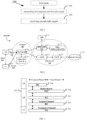
- Embodiment 1 illustrates a flowchart of the processing of a first node according to one embodiment of the present disclosure, as shown in FIG. 1 .
- each box represents a step.
- the first node in the present disclosure first performs step 101 to transmit a first sequence and a first radio signal; then in step 102, receives a second radio signal; the first sequence is associated with the first radio signal; the first radio signal comprises a target identifier; the second radio signal comprises a first information block, the first information block comprises a first field and a second field, the second field is used to determine a first value, and the first value is a non-negative integer; the first field and a value interval to which the first value belongs are used to determine whether the second radio signal comprises a second information block, the second information block comprises a first-type identifier, and the target identifier belongs to the first-type identifier.
- the first sequence is transmitted on a Random Access Channel (RACH).
- RACH Random Access Channel
- the first sequence is transmitted on a Physical Random Access Channel (PRACH).
- PRACH Physical Random Access Channel
- the first sequence is transmitted on a Narrowband Physical Random Access Channel (NPRACH).
- NPRACH Narrowband Physical Random Access Channel
- the first sequence is transmitted on sidelink.
- the first sequence is cell-specific.
- the first sequence is UE-specific.
- the first sequence is broadcast.
- the first sequence is groupcast.
- the first sequence is unicast.
- the first sequence is a pseudo-random sequence.
- the first sequence is a Gold sequence.
- the first sequence is an M sequence.
- the first sequence is a Zadeoff-Chu sequence.
- the first sequence is a preamble sequence.
- the generation method of the first sequence refers to 3GPP TS38. 211, section 6.3.3.1.
- a Subcarrier Spacing (SCS) of subcarriers occupied by the first sequence in frequency domain is one of 1.25kHz, 5kHz, 15kHz, 30kHz, 60kHz or 120kHz.
- the first sequence is a long preamble.
- the first sequence is a short preamble.
- a length of the first sequence is 839
- an SCS of subcarriers occupied by the first sequence is one of 1.25kHz or 5kHz.
- a length of the first sequence is 139
- an SCS of subcarriers occupied by the first sequence is one of 15kHz, 30kHz, 60kHz or 120kHz.
- the first sequence is processed through Discrete Fourier Transform (DFT), and then through Orthogonal Frequency Division Multiplexing (OFDM) modulation.
- DFT Discrete Fourier Transform
- OFDM Orthogonal Frequency Division Multiplexing
- a first characteristic sequence is obtained after the first sequence sequentially through Sequence Generation, DFT, Modulation and Resource Element Mapping, and Wideband Symbol Generation.
- the first characteristic radio signal is transmitted on an RACH.
- the first characteristic radio signal is transmitted on a PRACH.
- the first characteristic radio signal is transmitted on an NPRACH.
- the first characteristic radio signal comprises at least one first-type sequence
- the first sequence is one of the at least one first-type sequence
- a length of any of the at least one first-type sequence is 139
- the at least one first-type sequence is Time-Division Multiplexing (TDM).
- the at least one first-type sequence is(are) the same.
- At least two of the at least one first-type sequence are different.
- any two adjacent first-type sequences in the at least one first-type sequence are spaced by a Cyclic Prefix (CP).
- CP Cyclic Prefix
- the first radio signal is transmitted on an Uplink Shared Channel (UL-SCH).
- UL-SCH Uplink Shared Channel
- the first radio signal is transmitted on a Physical Uplink Shared Channel (PUSCH).
- PUSCH Physical Uplink Shared Channel
- the first radio signal is transmitted on a Physical Sidelink Shared Channel (PSSCH).
- PSSCH Physical Sidelink Shared Channel
- the first radio signal is transmitted on a Physical Uplink Control Channel (PUCCH).
- PUCCH Physical Uplink Control Channel
- the first radio signal is transmitted on a Physical Sidelink Control Channel (PSCCH).
- PSCCH Physical Sidelink Control Channel
- the first radio signal is transmitted on a PUCCH and a PUSCH.
- the first radio signal is transmitted on a PSCCH and a PSSCH.
- the first sequence and the first radio signal are respectively transmitted on a PRACH and a PUSCH.
- the first radio signal is Cell-specific.
- the first radio signal is UE-specific.
- the first sequence is cell-specific, and the first radio signal is UE-specific.
- the first sequence and the first radio signal are both UE-specific.
- the first radio signal is broadcast.
- the first radio signal is groupcast.
- the first radio signal is unicast.
- the first radio signal comprises all or part of a higher layer signaling.
- the first radio signal comprises all or part of a Radio Resource Control (RRC) layer signaling.
- RRC Radio Resource Control
- the first radio signal comprises one or more fields in an RRC Information Element (IE).
- IE RRC Information Element
- the first radio signal comprises all or part of a Multimedia Access Control (MAC) layer signaling.
- MAC Multimedia Access Control
- the first radio signal comprises one or more fields in a MAC Control Element (CE).
- CE MAC Control Element
- the first radio signal comprises one or more fields in a PHY layer.
- the first radio signal comprises one or more fields in a piece of Uplink Control Information (UCI).
- UCI Uplink Control Information
- the first radio signal comprises one or more fields in a Master Information Block-V2X-Sidelink (MIB-V2X-SL).
- MIB-V2X-SL Master Information Block-V2X-Sidelink
- the first radio signal comprises one or more fields in a piece of Sidelink Control Information (SCI).
- SCI Sidelink Control Information
- the first radio signal comprises a Demodulation Reference Signal (DMRS).
- DMRS Demodulation Reference Signal
- the first radio signal does not comprise a DMRS.
- the first radio signal comprises a first bit block, and the first bit block comprises at least one bit arranged in order.
- the first bit block comprises at least one Code Block (CB).
- CB Code Block
- the first bit block comprises at least one Code Block Group (CBG).
- CBG Code Block Group
- the first bit block comprises one Transport Block (TB).
- TB Transport Block
- the first bit block is obtained by a TB subjected to transport block-level Cyclic Redundancy Check (CRC) attachment.
- CRC Cyclic Redundancy Check
- the first bit block is one of CB(s) obtained by a TB sequentially subjected to TB-level CRC attachment, CB Segmentation, and CB-level CRC attachment.
- the first radio signal is obtained after all or partial bits of the first bit block are sequentially subjected to TB-level CRC attachment, CB segmentation, CB-level CRC attachment, Channel Coding, Rate Matching, CB Concatenation, scrambling, Modulation, Layer Mapping, Antenna Port Mapping, Mapping to Physical Resource Blocks, Baseband Signal Generation, Modulation and Upconversion.
- the Channel Coding is based on a polar code.
- the Channel Coding is based on a Low-density Parity-Check (LDPC) code.
- LDPC Low-density Parity-Check
- only the first bit block is used to generate the first radio signal.
- bit block other than the first bit block also being used to generate the first radio signal.
- the first radio signal does not comprise UCI.
- the first radio signal does not comprise SCI.
- an SCS of subcarriers occupied by the first radio signal in frequency domain is equal to one of 15kHz, 30kHz, 60kHz, 120kHz, 240kHz, 480kHz or 960kHz.
- a number of multicarrier symbols comprised in the first radio signal in time domain is one of 1 multicarrier symbol, 2 multicarrier symbols, 3 multicarrier symbols, 4 multicarrier symbols, 5 multicarrier symbols, 6 multicarrier symbols, 7 multicarrier symbols, 11 multicarrier symbols, 12 multicarrier symbols, 13 multicarrier symbols or 14 multicarrier symbols.
- the first sequence and the first radio signal are TDM.
- the first characteristic radio signal and the first radio signal are TDM.
- the first radio signal is used to determine the first sequence out of at least one characteristic sequence, and the first sequence is one of the at least one characteristic sequence.
- a payload size of the first radio signal is used to determine the first sequence out of the at least one characteristic sequence, and the first sequence is one of the at least one characteristic sequence.
- a number of bits comprised in the first bit block is used to determine the first sequence out of the at least one characteristic sequence, and the first sequence is one of the at least one characteristic sequence.
- time-frequency resources occupied by the first radio signal are used to determine the first sequence.
- time-frequency resources occupied by the first radio signal are used to determine time-frequency resources occupied by the first sequence.
- the first sequence is used to determine time-frequency resources occupied by the first radio signal.
- the first sequence is used to determine a first time-frequency resource pool
- the first time-frequency resource pool comprises at least one time-frequency resource block
- time-frequency resources occupied by the first radio signal comprise a first time-frequency resource block
- the first time-frequency resource block is one of the at least one time-frequency resource block.
- a root sequence of the first sequence is used to determine the first time-frequency resource pool.
- a cyclic shift of the first sequence based on a root sequence is used to determine the first time-frequency resource pool.
- time-frequency resources occupied by the first sequence are used to determine the first time-frequency resource pool.
- time-frequency resources occupied by the first sequence are used to determine the first time-frequency resource pool, and a root sequence of the first sequence is used to determine the first time-frequency resource block in the first time-frequency resource pool.
- time-frequency resources occupied by the first characteristic radio signal are used to determine the first time-frequency resource pool.
- the first sequence is used to determine time-domain resources occupied by the first radio signal.
- the first sequence is used to determine frequency-domain resources occupied by the first radio signal.
- the first sequence is used to determine time-domain resources occupied by the first radio signal and frequency-domain resources occupied by the first radio signal.
- the first sequence is associated with time-domain resources occupied by the first radio signal.
- time-domain resources occupied by the first sequence are associated with time-domain resources occupied by the first radio signal.
- time-domain resources occupied by the first characteristic radio signal are used to determine time-domain resources occupied by the first radio signal.
- a root sequence of the first sequence is used to determine the time-domain resources occupied by the first radio signal.
- time-domain resources occupied by the first radio signal and time-domain resources occupied by the first sequence are spaced by a time offset.
- time-domain resources occupied by the first radio signal and time-domain resources occupied by the first characteristic radio signal are spaced by a first time offset.
- the first time offset is pre-defined.
- the first time offset is configured.
- the first time offset comprises at least one subframe.
- the first time offset comprises at least one slot.
- the first time offset comprises at least one multicarrier symbol.
- the first sequence is associated with frequency-domain resources occupied by the first radio signal.
- a root sequence of the first sequence is used to determine frequency-domain resources occupied by the first radio signal.
- a cyclic shift of the first sequence based on a root sequence is used to determine frequency-domain resources occupied by the first radio signal.
- frequency-domain resources occupied by the first sequence is used to determine frequency-domain resources occupied by the first radio signal.
- frequency-domain resources occupied by the first sequence belong to frequency-domain resources occupied by the first radio signal.
- frequency-domain resources occupied by the first sequence are associated with frequency-domain resources occupied by the first radio signal.
- a lowest subcarrier in frequency-domain resources occupied by the first sequence is the same as a lowest subcarrier in frequency-domain resources occupied by the first radio signal.
- frequency-domain resources occupied by the first sequence and frequency-domain resources occupied by the first radio signal are spaced by a first frequency offset.
- a lowest subcarrier in frequency-domain resources occupied by the first sequence and a lowest subcarrier in frequency-domain resources occupied by the first radio signal are spaced by a first frequency offset.
- a start resource block in frequency-domain resources occupied by the first sequence and a start resource block in frequency-domain resources occupied by the first radio signal are spaced by a first frequency offset.
- the first frequency offset is pre-defined.
- the first frequency offset is configured.
- the first frequency offset comprises at least one Physical Resource Block (PRB).
- PRB Physical Resource Block
- the first frequency offset comprises at least one Precoding Resource block Group (PRG).
- PRG Precoding Resource block Group
- the first frequency offset comprises at least one subcarrier.
- frequency-domain resources occupied by the first characteristic radio signal are used to determine frequency-domain resources occupied by the first radio signal.
- frequency-domain resources occupied by the first characteristic radio signal belong to frequency-domain resources occupied by the first radio signal.
- frequency-domain resources occupied by the first characteristic radio signal are the same as frequency-domain resources occupied by the first radio signal.
- a lowest subcarrier in frequency-domain resources occupied by the first characteristic radio signal is the same as a lowest subcarrier in frequency-domain resources occupied by the first radio signal.
- a start resource block in frequency-domain resources occupied by the first characteristic radio signal is the same as a start resource block in frequency-domain resources occupied by the first radio signal.
- frequency-domain resources occupied by the first characteristic radio signal and frequency-domain resources occupied by the first radio signal are spaced by a first frequency offset.
- a lowest subcarrier in frequency-domain resources occupied by the first characteristic radio signal and a lowest subcarrier in frequency-domain resources occupied by the first radio signal are spaced by a first frequency offset.
- a start resource block in frequency-domain resources occupied by the first characteristic radio signal and a start resource block in frequency-domain resources occupied by the first radio signal are spaced by a first frequency offset.
- the first sequence is used to determine a scrambling sequence of the first radio signal.
- the first sequence is used to determine a timing for receiving the first radio signal.
- the target identifier is used to identify the first node.
- the target identifier is an integer not less than 0 and not greater than 2 30 .
- the target identifier is a hexadecimal non-negative integer.
- the target identifier comprises at least one bit.
- the target identifier comprises at least one hexadecimal bit.
- the target identifier comprises 4 hexadecimal bits.
- the target identifier comprises a value from hexadecimal 0000 to hexadecimal FFFF.
- the target identifier is a Cell Radio Network Temporary Identifier (C-RNTI).
- C-RNTI Cell Radio Network Temporary Identifier
- the target identifier is a Temporary Cell Radio Network Temporary Identifier (TC-RNTI).
- TC-RNTI Temporary Cell Radio Network Temporary Identifier
- the target identifier is a Radio Network Temporary Identifier (RNTI).
- RNTI Radio Network Temporary Identifier
- the target identifier is a Random Access Radio Network Temporary Identifier (RA-RNTI).
- RA-RNTI Random Access Radio Network Temporary Identifier
- the target identifier is a Paging RNTI (P-RNTI).
- P-RNTI Paging RNTI
- the target identifier is a Serving Temporary Mobile Subscriber Identity (S-TMSI).
- S-TMSI Serving Temporary Mobile Subscriber Identity
- the target identifier is an International Mobile Subscriber Identification Number (IMSI).
- IMSI International Mobile Subscriber Identification Number
- the target identifier is a Globally Unique Temporary UE Identity (GUTI).
- GUI Globally Unique Temporary UE Identity
- At least one of the first sequence or the first radio signal carries the target identifier.
- the first sequence or the first radio signal are used together to carry the target identifier.
- the first sequence comprises the target identifier.
- the first radio signal comprises the target identifier.
- the first characteristic radio signal comprises the target identifier.
- the first sequence and the first radio signal comprise the target identifier together.
- the first sequence comprises a first sub-target identifier
- the first radio signal comprises a second sub-target identifier
- the first sub-target identifier and the second sub-target identifier are used together to determine the target identifier
- the target identifier is used to determine the first sequence.
- the target identifier is used to determine the first sequence out of at least one characteristic sequence, and the first sequence is one of the at least one characteristic sequence.
- the target identifier is used to generate the first characteristic radio signal.
- the target identifier is used to generate a root sequence of the first sequence.
- the target identifier is used to determine a cyclic shift of the first sequence based on a root sequence.
- the target identifier is used to determine time-domain resources occupied by the first sequence.
- the target identifier is used to determine frequency-domain resources occupied by the first sequence.
- the target identifier is used to determine time-frequency resources occupied by the first sequence.
- the first bit block comprises the target identifier.
- the target identifier is used to generate the first bit block.
- the target identifier is used to generate a scrambling sequence of the first radio signal.
- the target identifier is used to determine time-domain resources occupied by the first radio signal.
- the target identifier is used to determine frequency-domain resources occupied by the first radio signal.
- the target identifier is used to determine time-frequency resources occupied by the first radio signal.
- the target identifier is used to determine time-frequency resource(s) occupied by the first radio signal out of at least one of time-frequency resource.
- the target identifier is used to generate at least one of the first sequence or the first radio signal.
- the target identifier is used to generate the first sequence and the first radio signal.
- the target identifier is used to determine at least one of time-frequency resources occupied by the first sequence or time-frequency resources occupied by the first radio signal.
- the target identifier is used to determine time-frequency resources occupied by the first sequence and time-frequency resources occupied by the first radio signal.
- the target identifier is used to determine at least one of the first sequence, the first radio signal, time-frequency resources occupied by the first sequence or time-frequency resources occupied by the first radio signal.
- the second radio signal is transmitted on a Downlink Shared Channel (DL-SCH).
- DL-SCH Downlink Shared Channel
- the second radio signal is transmitted on a Physical Downlink Shared Channel (PDSCH).
- PDSCH Physical Downlink Shared Channel
- the second radio signal is transmitted on a Physical Sidelink Shared Channel (PSSCH).
- PSSCH Physical Sidelink Shared Channel
- the second radio signal is transmitted on a Physical Downlink Control Channel (PDCCH).
- PDCH Physical Downlink Control Channel
- the second radio signal is transmitted on a Physical Sidelink Control Channel (PSCCH).
- PSCCH Physical Sidelink Control Channel
- the second radio signal is cell-specific.
- the second radio signal is UE-specific.
- the second radio signal is broadcast.
- the second radio signal is groupcast.
- the second radio signal is unicast.
- the second radio signal comprises all or part of a higher-layer signaling.
- the second radio signal comprises all or part of an RRC layer signaling.
- the second radio signal comprises one or more fields in an RRC IE.
- the second radio signal comprises all or part of a MAC layer signaling.
- the second radio signal comprises one or more fields of a MAC CE.
- the second radio signal comprises a Multimedia Access Control Protocol Data Unit (MAC PDU).
- MAC PDU Multimedia Access Control Protocol Data Unit
- the second radio signal is a MAC PDU.
- the second radio signal comprises one or more fields of a PHY layer.
- the second radio signal does not comprise Downlink Control Information (DCI).
- DCI Downlink Control Information
- the second radio signal does not comprise SCI.
- the second radio signal comprises a DMRS.
- the second radio signal does not comprise a DMRS.
- an SCS of subcarriers occupied by the second radio signal in frequency domain is equal to one of 15kHz, 30kHz, 60kHz, 120kHz, 240kHz, 480kHz or 960kHz.
- the second radio signal comprises all or part of information of a Random Access Response (RAR).
- RAR Random Access Response
- the second radio signal is an RAR.
- the second radio signal comprises a second bit block, and the second bit block comprises at least one bit arranged in order.
- the second bit block comprises at least one CB.
- the second bit block comprises at least one CBG.
- the second bit block comprises a TB.
- the second bit block is obtained by a TB subjected to TB-level CRC attachment.
- the second bit block is one of CB(s) obtained by a TB sequentially subjected to TB-level CRC attachment, CB Segmentation, and CB-level CRC attachment.
- the second radio signal is obtained after all or partial bits of the second bit block are sequentially subjected to TB-level CRC attachment, CB Segmentation, CB-level CRC attachment, Channel Coding, Rate Matching, CB Concatenation, scrambling, modulation, Layer Mapping, Antenna Port Mapping, Mapping to Physical Resource Blocks, Baseband Signal Generation as well as Modulation and Upconversion.
- only the second bit block is used to generate the second radio signal.
- bit block other than the second bit block being used to generate the second radio signal.
- the second radio signal comprises the first information block.
- the first information block comprises at least one bit arranged in order
- the second bit block comprises all bits in the first information block
- the first information block comprises at least one bit arranged in order
- the second bit block comprises partial bits in the first information block
- the first information block comprises all or part of a higher layer signaling.
- the first information block comprises all or part of an RRC layer signaling.
- the first information block comprises all or part of a MAC layer signaling.
- the first information block comprises one or more fields of a MAC CE.
- the first information block comprises one or more fields of a PHY layer.
- the first information block comprises a Multimedia Access Control subheader (MAC subheader).
- MAC subheader Multimedia Access Control subheader
- the first information block is a MAC subheader.
- the first information block belongs to a Multimedia Access Control sub Protocol Data Unit (MAC subPDU).
- MAC subPDU Multimedia Access Control sub Protocol Data Unit
- the first information block comprises at least one bit arranged in order.
- the first information block comprises at least one fourth-type field.
- the at least one fourth-type field are arranged in order in the first information block, and numbers of bits comprised in at least two of the at least one fourth-type fields are different.
- the first information block comprises 3 fourth-type fields arranged in order.
- the second radio signal comprises the first information block and the second information block.
- the second radio signal comprises the first information block and does not comprise the second information block.
- the second radio signal also comprises an information block other than the first information block and the second information block.
- the second radio signal comprises a fourth information block, and the fourth information is different from the first information block and the second information block.
- the second information block comprises all or part of a higher layer signaling.
- the second information block comprises all or part of an RRC layer signaling.
- the second information block comprises all or part of a MAC layer signaling.
- the second information block comprises one or more fields of a MAC CE.
- the second information block comprises one or more fields of a PHY layer.
- the second information block comprises a Multimedia Access Control Payload (MAC payload).
- MAC payload Multimedia Access Control Payload
- the second information block is a MAC payload.
- the second information block belongs to a MAC subPDU.
- the second information block comprises at least one bit arranged in order.
- the second information block comprises at least one fifth-type field.
- the at least one fifth-type fields are arranged in order in the second information block, and numbers of bits comprised in at least two of the at least one fifth-type fields are different.
- the first field is one of at least one fourth-type field comprised in the first information block.
- the first field comprises at least one bit.
- the first field only comprises one bit.
- the first field is used to determine whether the second radio signal comprises the second information block.
- the first field is used to indicate any one of at least one first-type state, a first state is one of at least one first-type state, a second state is one of at least one first-type state, and the second state is different from the first state; when the first field indicates the first state, the second radio signal does not comprise the second information block; and when the first field indicates the second state, the second radio signal does not comprise the second information block.
- the first field is used to indicate any one of at least one first-type state, a first state is one of at least one first-type state, a second state is one of at least one first-type state, and the second state is different from the first state; when the first field indicates a first state, the second radio signal does not comprise the second information block; and when the first field indicates a second state, the second radio signal comprises the second information block.
- the first field is used to indicate any one of at least one first-type state; when the first field indicates a first state, the first state is one of at least one first-type state, and the second radio signal does not comprise the second information block; when the first field indicates a second state, the second state is one of at least one first-type state, the second state is different from the first state, and the second radio signal comprises the second information block.
- the first field is used to indicate any one of at least one first-type state, a first state is one of at least one first-type state, a second state is one of at least one first-type state, and the second state is different from the first state; when the first field indicates a first state, the second radio signal does not comprise the second information block; and when the first field indicates a second state, the second field is used to determine whether the second radio signal comprises the second information block.
- the first field only comprises one bit, the first field is set to "1", and the first field indicates the first state.
- the first field only comprises one bit, the first field is set to "0", and the first field indicates the second state.
- the first field comprises two bits, the first field is set to "11", and the first field indicates the first state.
- the first field comprises two bits, the first field is set to "00", and the first field indicates the second state.
- the second field is one of at least one fourth-type field comprised in the first information block, and the second field is different from the first field.
- the second field comprises at least one bit.
- the second field is used to determine a first value
- the first value is a non-negative integer
- the first value is one of the at least one first-type value
- the second field is used to determine the first value out of at least one first-type value
- the at least one first-type value belongs(belong) to at least one value interval, and a first value interval and a second value interval are two orthogonal value intervals in the at least one value interval.
- the first field indicates the second state, and a value interval to which the first value belongs is used to determine whether the second radio signal comprises the second information block.
- the first field indicates the second state
- a value interval to which the first value belongs is the first value interval
- the second radio signal does not comprise the second information block.
- the first field indicates the second state
- a value interval to which the first value belongs is the second value interval
- the second radio signal comprises the second information block.
- the first field is set to "0"
- the first value is set to 14
- the second radio signal comprises the second information block.
- the first field is set to "0"
- the first value is set to 15
- the second radio signal comprises the second information block.
- the first field is set to "0"
- the first value is set to any non-negative integer from 0 to 13
- the second radio signal does not comprise the second information block.
- the second information block comprises the first-type identifier, and the target identifier belongs to the first-type identifier.
- the first-type identifier is one of at least one fifth-type field comprised in the second information block.
- a communication system comprises at least one first-type identifier, and the target identifier is one of the at least one first-type identifier.
- a communication network comprises at least one first-type identifier, and the target identifier is one of the at least one first-type identifier.
- a cell comprises at least one first-type identifier, and the target identifier is one of the at least one first-type identifier.
- the second information block comprises at least one of the at least one first-type identifier.
- the second information block only comprises the first-type identifier.
- the target identifier belongs to the first-type identifier.
- the first-type identifier is used to identify a UE.
- the first-type identifier is used to identify a relay node.
- the first-type identifier is an integer not less than 0 and not greater than 2 30 .
- the first-type identifier is a hexadecimal non-negative integer.
- the first-type identifier comprises at least one bit.
- the first-type identifier comprises at least one hexadecimal bit.
- the first-type identifier comprises 4 hexadecimal bits.
- the first-type identifier comprises a value from hexadecimal 0000 to hexadecimal FFFF.
- the first-type identifier is a C-RNTI.
- the first-type identifier is a TC-RNTI.
- the first-type identifier is an RNTI.
- the first-type identifier is an RA-RNTI.
- the first-type identifier is a P-RNTI.
- the first-type identifier is an S-TMSI.
- the first-type identifier is an IMSI.
- the first-type identifier is a GUTI.
- the second radio signal comprises the first-type identifier.
- the first-type identifier is used to generate a scrambling sequence of the second radio signal.
- the first-type identifier is used to generate a CRC of the second radio signal.
- the first-type identifier is used to determine a DMRS of the second radio signal.
- Embodiment 2 illustrates a schematic diagram of a network architecture according to the present disclosure, as shown in FIG. 2 .
- FIG. 2 illustrates a network architecture 200 of 5G NR, Long-Term Evolution (LTE) and Long-Term Evolution Advanced (LTE-A) systems.
- the NR 5G or LTE network architecture 200 may be called an Evolved Packet System (EPS) 200 or other appropriate terms.
- the EPS 200 may comprise one or more UEs 201, an NG-RAN 202, an Evolved Packet Core/ 5G-Core Network (EPC/5G-CN) 210, a Home Subscriber Server (HSS) 220 and an Internet Service 230.
- the EPS 200 may be interconnected with other access networks. For simple description, the entities/interfaces are not shown. As shown in FIG. 2 , the EPS 200 provides packet switching services.
- the NG-RAN 202 comprises an NR node B (gNB) 203 and other gNBs 204.
- the gNB 203 provides UE 201-oriented user plane and control plane protocol terminations.
- the gNB 203 may be connected to other gNBs 204 via an Xn interface (for example, backhaul).
- the gNB 203 may be called a base station, a base transceiver station, a radio base station, a radio transceiver, a transceiver function, a Base Service Set (BSS), an Extended Service Set (ESS), a Transmitter Receiver Point (TRP) or some other applicable terms.
- the gNB 203 provides an access point of the EPC/SG-CN 210 for the UE 201.
- Examples of the UE 201 include cellular phones, smart phones, Session Initiation Protocol (SIP) phones, laptop computers, Personal Digital Assistant (PDA), satellite Radios, non-terrestrial base station communications, Satellite Mobile Communications, Global Positioning Systems (GPSs), multimedia devices, video devices, digital audio players (for example, MP3 players), cameras, game consoles, unmanned aerial vehicles (UAV), aircrafts, narrow-band Internet of Things (loT) devices, machine-type communication devices, land vehicles, automobiles, wearable devices, or any other similar functional devices.
- SIP Session Initiation Protocol
- PDA Personal Digital Assistant
- satellite Radios Non-terrestrial base station communications
- Satellite Mobile Communications Global Positioning Systems
- GPSs Global Positioning Systems
- multimedia devices video devices
- digital audio players for example, MP3 players
- UAV unmanned aerial vehicles
- UAV unmanned aerial vehicles
- LoT narrow-band Internet of Things
- Those skilled in the art also can call the UE 201 a mobile station, a subscriber station, a mobile unit, a subscriber unit, a wireless unit, a remote unit, a mobile device, a wireless device, a radio communication device, a remote device, a mobile subscriber station, an access terminal, a mobile terminal, a wireless terminal, a remote terminal, a handset, a user proxy, a mobile client, a client or some other appropriate terms.
- the gNB 203 is connected to the EPC/5G-CN 210 via an S1/NG interface.
- the EPC/5G-CN 210 comprises a Mobility Management Entity (MME)/ Authentication Management Field (AMF)/ User Plane Function (UPF) 211, other MMEs/ AMFs/UPFs 214, a Service Gateway (S-GW) 212 and a Packet Date Network Gateway (P-GW) 213.
- MME Mobility Management Entity
- AMF Authentication Management Field
- UPF User Plane Function
- S-GW Service Gateway
- P-GW Packet Date Network Gateway
- the MME/AMF/UPF 211 is a control node for processing a signaling between the UE 201 and the EPC/5G-CN 210.
- the MME/AMF/UPF 211 provides bearer and connection management. All user Internet Protocol (IP) packets are transmitted through the S-GW 212, the S-GW 212 is connected to the P-GW 213.
- IP Internet Protocol
- the P-GW 213 provides UE IP address allocation and other functions.
- the P-GW 213 is connected to the Internet Service 230.
- the Internet Service 230 comprises IP services corresponding to operators, specifically including Internet, Intranet, IP Multimedia Subsystem (IMS) and Packet Switching Streaming Services (PSS).
- IMS IP Multimedia Subsystem
- PSS Packet Switching Streaming Services
- the first node in the present disclosure comprises the UE 201.
- the second node in the present disclosure comprises the gNB 203.
- the UE in the present disclosure comprises the UE 201.
- the base station in the present disclosure comprises the gNB 203.
- a transmitter of the first sequence in the present disclosure comprises the UE 201.
- a receiver of the first sequence comprises the gNB 203.
- a transmitter of the first radio signal in the present disclosure comprises the UE 201.
- a receiver of the first radio signal in the present disclosure comprises the gNB 203.
- a receiver of the first signaling in the present disclosure comprises the UE 201.
- a transmitter of the first signaling in the present disclosure comprises the gNB 203.
- a receiver of the second radio signal in the present disclosure comprises the UE 201.
- a transmitter of the second radio signal in the present disclosure comprises the gNB 203.
- a receiver of third information block in the present disclosure comprises the UE 201.
- a transmitter of the third information block in the present disclosure comprises the gNB 203.
- Embodiment 3 illustrates a schematic diagram of an example of a radio protocol architecture of a user plane and a control plane according to one embodiment of the present disclosure, as shown in FIG. 3 .
- FIG. 3 is a schematic diagram illustrating a radio protocol architecture of a user plane and a control plane.
- the radio protocol architecture for a UE and a base station is represented by three layers, which are a layer 1, a layer 2 and a layer 3, respectively.
- the layer 1 (L1) is the lowest layer and performs signal processing functions of various PHY layers.
- a layer above the layer 1 belongs to a higher layer.
- the L1 is called PHY 301 in the present disclosure.
- the layer 2 (L2) 305 is above the PHY 301, and is in charge of the link between the UE and the base station via the PHY 301.
- L2 305 comprises a Medium Access Control (MAC) sublayer 302, a Radio Link Control (RLC) sublayer 303 and a Packet Data Convergence Protocol (PDCP) sublayer 304. All the three sublayers terminate at the base stations of the network side.
- the UE may comprise several higher layers above the L2 305, such as a network layer (i.e., IP layer) terminated at a P-GW 213 of the network side and an application layer terminated at the other side of the connection (i.e., a peer UE, a server, etc.).
- the PDCP sublayer 304 provides multiplexing among variable radio bearers and logical channels.
- the PDCP sublayer 304 also provides a header compression for a higher-layer packet so as to reduce a radio transmission overhead, provides security by encrypting a packet, and provides support for UE handover between base stations.
- the RLC sublayer 303 provides segmentation and reassembling of a higher-layer packet, retransmission of a lost packet, and reordering of a packet so as to compensate the disordered receiving caused by Hybrid Automatic Repeat reQuest (HARQ).
- HARQ Hybrid Automatic Repeat reQuest
- the MAC sublayer 302 provides multiplexing between a logical channel and a transport channel.
- the MAC sublayer 302 is also responsible for allocating between UEs various radio resources (i.e., resources block) in a cell.
- the MAC sublayer 302 is also in charge of HARQ operation.
- the radio protocol architecture of the UE and the base station is almost the same as the radio protocol architecture in the user plane on the PHY 301 and the L2 305, but there is no header compression for the control plane.
- the control plane also comprises a Radio Resource Control (RRC) sublayer 306 in the layer 3 (L3).
- RRC sublayer 306 is responsible for obtaining radio resources (i.e., radio bearer) and configuring the lower layer using an RRC signaling between the base station and the UE.
- the radio protocol architecture in FIG. 3 is applicable to the first node in the present disclosure.
- the radio protocol architecture in FIG. 3 is applicable to the second node in the present disclosure.
- the first sequence in the present disclosure is generated by the PHY 301.
- the first radio signal in the present disclosure is generated by the RRC sublayer 306.
- the first radio signal in the present disclosure is generated by the MAC sublayer 302.
- the first radio signal in the present disclosure is generated by the PHY 301.
- the first signaling in the present disclosure is generated by the PHY 301.
- the second radio signal in the present disclosure is generated by the RRC sublayer 306.
- the second radio signal in the present disclosure is generated by the MAC sublayer 302.
- the second radio signal in the present disclosure is generated by the PHY 301.
- the first information block in the present disclosure is generated by the MAC sublayer 302.
- the second information block in the present disclosure is generated by the MAC sublayer 302.
- the third information block in the present disclosure is generated by the RRC sublayer 306.
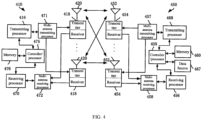
- Embodiment 4 illustrates a schematic diagram of a first communication device and a second communication device in the present disclosure, as shown in FIG. 4.
- FIG. 4 is a block diagram of a first communication device 410 in communication with a second communication device 450 in an access network.
- the first communication device 410 comprises a controller/ processor 475, a memory 476, a receiving processor 470, a transmitting processor 416, a multi-antenna receiving processor 472, a multi-antenna transmitting processor 471, a transmitter/ receiver 418 and an antenna 420.
- the second communication device 450 comprises a controller/ processor 459, a memory 460, a data source 467, a transmitting processor 468, a receiving processor 456, a multi-antenna transmitting processor 457, a multi-antenna receiving processor 458, a transmitter/receiver 454 and an antenna 452.
- a higher layer packet from the core network is provided to a controller/ processor 475.
- the controller/processor 475 provides a function of the L2 layer.
- the controller/ processor 475 provides header compression, encryption, packet segmentation and reordering, and multiplexing between a logical channel and a transport channel, and radio resources allocation to the second communication device 450 based on various priorities.
- the controller/ processor 475 is also responsible for retransmission of a lost packet and a signaling to the second communication device 450.
- the transmitting processor 416 and the multi-antenna transmitting processor 471 perform various signal processing functions used for the L1 layer (that is, PHY).
- the transmitting processor 416 performs coding and interleaving so as to ensure an FEC (Forward Error Correction) at the second communication device 450, and the mapping to signal clusters corresponding to each modulation scheme (i.e., BPSK, QPSK, M-PSK, M-QAM, etc.).
- the multi-antenna transmitting processor 471 performs digital spatial precoding, including codebook-based precoding and non-codebook-based precoding, and beamforming on encoded and modulated symbols to generate one or more spatial streams.
- the transmitting processor 416 then maps each spatial stream into a subcarrier.
- the mapped symbols are multiplexed with a reference signal (i.e., pilot frequency) in time domain and/or frequency domain, and then they are assembled through Inverse Fast Fourier Transform (IFFT) to generate a physical channel carrying time-domain multi-carrier symbol streams.
- IFFT Inverse Fast Fourier Transform
- the multi-antenna transmitting processor 471 performs transmission analog precoding/beamforming on the time-domain multi-carrier symbol streams.
- Each transmitter 418 converts a baseband multicarrier symbol stream provided by the multi-antenna transmitting processor 471 into a radio frequency (RF) stream.
- RF radio frequency
- each receiver 454 receives a signal via a corresponding antenna 452.
- Each receiver 454 recovers information modulated to the RF carrier, converts the radio frequency stream into a baseband multicarrier symbol stream to be provided to the receiving processor 456.
- the receiving processor 456 and the multi-antenna receiving processor 458 perform signal processing functions of the L1 layer.
- the multi-antenna receiving processor 458 performs receiving analog precoding/beamforming on a baseband multicarrier symbol stream from the receiver 454.
- the receiving processor 456 converts the baseband multicarrier symbol stream after receiving the analog precoding/beamforming from time domain into frequency domain using FFT.
- a physical layer data signal and a reference signal are de-multiplexed by the receiving processor 456, wherein the reference signal is used for channel estimation, while the data signal is subjected to multi-antenna detection in the multi-antenna receiving processor 458 to recover any the second communication device-targeted spatial stream.
- Symbols on each spatial stream are demodulated and recovered in the receiving processor 456 to generate a soft decision.
- the receiving processor 456 decodes and de-interleaves the soft decision to recover the higher-layer data and control signal transmitted on the physical channel by the first communication node 410.
- the higher-layer data and control signal are provided to the controller/processor 459.
- the controller/processor 459 performs functions of the L2 layer.
- the controller/processor 459 can be connected to a memory 460 that stores program code and data.
- the memory 460 can be called a computer readable medium.
- the controller/ processor 459 provides demultiplexing between a transport channel and a logical channel, packet reassembling, decryption, header decompression and control signal processing so as to recover a higher-layer packet from the core network.
- the higher-layer packet is later provided to all protocol layers above the L2 layer, or various control signals can be provided to the L3 layer for processing.
- the data source 467 is configured to provide a higher-layer packet to the controller/processor 459.
- the data source 467 represents all protocol layers above the L2 layer.
- the controller/processor 459 Similar to a transmitting function of the first communication device 410 described in the transmission from the first communication device 410 to the second communication device 450, the controller/processor 459 performs header compression, encryption, packet segmentation and reordering, and multiplexing between a logical channel and a transport channel based on radio resources allocation so as to provide the L2 layer functions used for the user plane and the control plane.
- the controller/processor 459 is also responsible for retransmission of a lost packet, and a signaling to the first communication device 410.
- the transmitting processor 468 performs modulation mapping and channel coding.
- the multi-antenna transmitting processor 457 implements digital multi-antenna spatial precoding, including codebook-based precoding and non-codebook-based precoding, as well as beamforming. Following that, the generated spatial streams are modulated into multicarrier/single-carrier symbol streams by the transmitting processor 468, and then modulated symbol streams are subjected to analog precoding/beamforming in the multi-antenna transmitting processor 457 and provided from the transmitters 454 to each antenna 452. Each transmitter 454 first converts a baseband symbol stream provided by the multi-antenna transmitting processor 457 into a radio frequency symbol stream, and then provides the radio frequency symbol stream to the antenna 452.
- the function of the first communication device 410 is similar to the receiving function of the second communication device 450 described in the transmission from the first communication device 410 to the second communication device 450.
- Each receiver 418 receives a radio frequency signal via a corresponding antenna 420, converts the received radio frequency signal into a baseband signal, and provides the baseband signal to the multi-antenna receiving processor 472 and the receiving processor 470.
- the receiving processor 470 and multi-antenna receiving processor 472 collectively provide functions of the L 1 layer.
- the controller/processor 475 provides functions of the L2 layer.
- the controller/processor 475 can be connected with the memory 476 that stores program code and data.
- the memory 476 can be called a computer readable medium.
- the controller/processor 475 In the transmission from the second communication device 450 to the first communication device 410, the controller/processor 475 provides de-multiplexing between a transport channel and a logical channel, packet reassembling, decryption, header decompression, control signal processing so as to recover a higher-layer packet from the UE 450.
- the higher-layer packet coming from the controller/processor 475 may be provided to the core network.
- the first node in the present disclosure comprises the second communication device 450, and the second node in the present disclosure comprises the first communication device 410.
- the first node is a UE
- the second node is a base station
- the first node is a UE
- the second node is a relay node
- the first node is a relay node
- the second node is a base station
- the second communication device 450 comprises: at least one controller/ processor; the at least one controller/ processor is responsible for HARQ operation.
- the first communication device 410 comprises: at least one controller/ processor; the at least one controller/ processor is responsible for error detection using ACK and/ or NACK protocols as a way to support HARQ operation.
- the first communication device 410 comprises: at least one controller/ processor; the at least one controller/ processor is responsible for HARQ operation.
- the second communication device 450 comprises: at least one controller/ processor; the at least one controller/ processor is responsible for error detection using ACK and/ or NACK protocols as a way to support HARQ operation.
- the second communication device 450 comprises at least one processor and at least one memory.
- the at least one memory comprises computer program codes; the at least one memory and the computer program codes are configured to be used in collaboration with the at least one processor.
- the second communication device 450 at least: transmits a first sequence and a first radio signal, the first sequence is associated with the first radio signal; and receives a second radio signal; the first radio signal is used to carry a target identifier; the second radio signal comprises a first information block, the first information block comprises a first field and a second field, the second field is used to determine a first value, and the first value is a non-negative integer; the first field and a value interval to which the first value belongs are used to determine whether the second radio signal comprises a second information block, the second information block comprises a first-type identifier, and the target identifier belongs to the first-type identifier.
- the second communication device 450 comprises a memory that stores a computer readable instruction program.
- the computer readable instruction program generates an action when executed by at least one processor.
- the action includes: transmitting a first sequence and a first radio signal, the first sequence being associated with the first radio signal; and receiving a second radio signal; the first radio signal is used to carry a target identifier; the second radio signal comprises a first information block, the first information block comprises a first field and a second field, the second field is used to determine a first value, and the first value is a non-negative integer; the first field and a value interval to which the first value belongs are used to determine whether the second radio signal comprises a second information block, the second information block comprises a first-type identifier, and the target identifier belongs to the first-type identifier.
- the first communication device 410 comprises at least one processor and at least one memory.
- the at least one memory comprises computer program codes; the at least one memory and the computer program codes are configured to be used in collaboration with the at least one processor.
- the first communication device 410 at least: receives a first sequence and a first radio signal, the first sequence is associated with the first radio signal; and transmits a second radio signal; the first radio signal is used to carry a target identifier; the second radio signal comprises a first information block, the first information block comprises a first field and a second field, the second field is used to determine a first value, and the first value is a non-negative integer; the first field and a value interval to which the first value belongs are used to determine whether the second radio signal comprises a second information block, the second information block comprises a first-type identifier, and the target identifier belongs to the first-type identifier.
- the first communication device 410 comprises a memory that stores a computer readable instruction program.
- the computer readable instruction program generates an action when executed by at least one processor.
- the action includes: receiving a first sequence and a first radio signal, the first sequence being associated with the first radio signal; and transmitting a second radio signal; the first radio signal is used to carry a target identifier; the second radio signal comprises a first information block, the first information block comprises a first field and a second field, the second field is used to determine a first value, and the first value is a non-negative integer; the first field and a value interval to which the first value belongs are used to determine whether the second radio signal comprises a second information block, the second information block comprises a first-type identifier, and the target identifier belongs to the first-type identifier.
- At least one of the antenna 452, the transmitter 454, the multi-antenna transmitting processor 458, the transmitting processor 468, the controller/ processor 459, the memory 460, or the data sources 467 is used to transmit the first sequence in the present disclosure.
- At least one of the antenna 452, the transmitter 454, the multi-antenna transmitting processor 458 or the transmitting processor 468 is used to transmit the first sequence in the present disclosure.
- At least one of the antenna 452, the transmitter 454, the multi-antenna transmitting processor 458, the transmitting processor 468, the controller/ processor 459, the memory 460, or the data sources 467 is used to transmit the first radio signal in the present disclosure.
- At least one of the antenna 452, the transmitter 454, the multi-antenna transmitting processor 458 or the transmitting processor 468 is used to transmit the first radio signal in the present disclosure.
- At least one of the antenna 452, the receiver 454, the multi-antenna receiving processor 458, the receiving processor 456, the controller / processor 459, the memory 460, or the data source 467 is used to receive the first signaling in the present disclosure.
- the antenna 452, the receiver 454, the multi-antenna receiving processor 458, the receiving processor 456, the controller / processor 459, the memory 460, and the data source 467 are used to receive the first signaling in the present disclosure.
- At least one of the antenna 452, the receiver 454, the multi-antenna receiving processor 458, the receiving processor 456, the controller/ processor 459, the memory 460, or the data source 467 is used to receive the second radio signal in the present disclosure.
- the antenna 452, the receiver 454, the multi-antenna receiving processor 458, the receiving processor 456, the controller / processor 459, the memory 460, and the data source 467 are used to receive the second radio signal in the present disclosure.
- At least one of the antenna 452, the receiver 454, the multi-antenna receiving processor 458, the receiving processor 456, the controller / processor 459, the memory 460, or the data source 467 is used to receive the third information block in the present disclosure.
- the antenna 452, the receiver 454, the multi-antenna receiving processor 458, the receiving processor 456, the controller / processor 459, the memory 460, and the data source 467 are used to receive the third information block in the present disclosure.
- Embodiment 5 illustrates a flowchart of radio signal transmission according to one embodiment in the present disclosure, as shown in FIG. 5 .
- a first node U1 and a second node N2 are communication nodes that are transmitted via an air interface.
- steps in dotted box F0 are optional.
- the first node U1 receives a third information block in step S11; transmits a first sequence in step S12; transmits a first radio signal in step S13; receives a first signaling in a first time window in step S14; and receives a second radio signal in step S15.
- the second node N2 transmits a third information block in step S21; receives a first sequence in step S22; receives a first radio signal in step S23; transmits a first signaling in a first time window in step S24; and transmits a second radio signal in step S25.
- the first radio signal is used to carry a target identifier;
- the second radio signal comprises a first information block, the first information block comprises a first field and a second field, the second field is used to determine a first value, and the first value is a non-negative integer;
- the first field and a value interval to which the first value belongs are used to determine whether the second radio signal comprises a second information block, the second information block comprises a first-type identifier, and the target identifier belongs to the first-type identifier;
- the first field and a value interval to which the first value belongs are used to determine an information format of the second information block;
- the second radio signal comprises Y second-type information block(s), and the second information block is one of the Y second-type information block(s), Y being a positive integer;
- the Y second-type information block(s) comprises(respectively comprise) Y first-type identifier(s); when the target identifier is one of the Y first-type identifier(s),
- a value interval to which the first value belongs is a first value interval.
- a value interval to which the first value belongs is a second value interval.
- the first value interval is different from the second value interval.
- an illegal communication node assumes that the first value only belongs to the first value interval out of the first value interval and the second value interval.
- the first signaling is used to determine time-frequency resources occupied by the second radio signal.
- the first signaling is used to determine an MCS adopted by the second radio signal.
- the first signaling is used to determine time-frequency resources occupied by the second radio signal and an MCS adopted by the second radio signal.
- the second node N2 is a maintenance base station of a serving cell of a first node U1.
- the second node N2 is an access base station of a serving cell of a first node U1.
- the first signaling is transmitted through a PDCCH.
- the first signaling and the second radio signal are respectively transmitted on a PDCCH and a PDSCH.
- the first signaling and the second radio signal are respectively transmitted on a PSCCH and a PSSCH.
- the first signaling is broadcast.
- the first signaling is groupcast.
- the first signaling is unicast.
- the first signaling is cell-specific.
- the first signaling is UE-specific.
- the first signaling is semi-statically configured.
- the first signaling is dynamically configured.
- the first signaling comprises all or part of a higher-layer signaling.
- the first signaling comprises one or more fields of a PHY layer signaling.
- the first signaling comprises one or more fields in a piece of DCI.
- the first signaling comprises one or more fields in a DCI format.
- the first signaling comprises one or more fields in a piece of SCI.
- the first signaling is a piece of DCI.
- the first signaling is a DCI format.
- the first signaling is DCI format 1_0 in NR system.
- the first signaling comprises a first characteristic identifier.
- the first signaling carries a first characteristic identifier.
- the first characteristic identifier is used to scramble the first signaling.
- the first characteristic identifier is used to generate a scrambling sequence of the first signaling.
- the first characteristic identifier is used to generate a DMRS of the first signaling.
- the first characteristic identifier is used to generate a CRC of the first signaling.
- the first characteristic identifier is a hexadecimal non-negative integer.
- the first characteristic identifier comprises 4 hexadecimal bits.
- the first characteristic identifier comprises a value from hexadecimal 0000 to hexadecimal FFFF.
- the first characteristic identifier is an RNTI.
- the first characteristic identifier is an RA-RNTI.
- the first characteristic identifier is a C-RNTI.
- the first characteristic identifier is a TC-RNTI.
- the first characteristic identifier is an S-TMSI.
- the first characteristic identifier is an IMSI.
- the first characteristic identifier is a GUTI.
- the first characteristic identifier is not the target identifier.
- the first characteristic identifier and the target identifier are respectively two different RNTIs.
- the target identifier is a TC-RNTI
- the first characteristic identifier is an RA-RNTI
- the target identifier is a C-RNTI
- the first characteristic identifier is an RA-RNTI
- the target identifier is an S-TMSI
- the first characteristic identifier is an RNTI
- the target identifier is an S-TMSI
- the first characteristic identifier is an RA-RNTI
- time-domain resources occupied by the first sequence is used to determine the first characteristic identifier.
- frequency-domain resources occupied by the first sequence is used to determine the first characteristic identifier.
- time-frequency resources occupied by the first sequence is used to determine the first characteristic identifier.
- time-domain resources occupied by the first sequence and frequency-domain resources occupied by the first sequence are used together to determine the first characteristic identifier.
- time-domain resources occupied by the first radio signal are used to determine the first characteristic identifier.
- frequency-domain resources occupied by the first radio signal are used to determine the first characteristic identifier.
- time-frequency resources occupied by the first radio signal are used to determine the first characteristic identifier.
- time-frequency resources occupied by the first sequence and time-frequency resources occupied by the first radio signal are used together to determine the first characteristic identifier.
- the first RACH occasion is used to determine the first characteristic identifier.
- the first RACH occasion is used to determine the first characteristic identifier out of at least one first-type characteristic identifier, and the first characteristic identifier is one of the at least one first-type characteristic identifier.
- the first characteristic identifier is equal to a sum of a positive integer, a symbol index of a first multicarrier symbol of time-domain resources occupied by a PRACH, a multiple of a slot index of time-domain resources occupied by a PRACH, a multiple of a frequency index of frequency resources occupied by a PRACH and a multiple of an uplink carrier index.
- the first characteristic identifier is equal to (1+ a symbol index of a first multicarrier symbol of time-domain resources occupied by a PRACH +14 ⁇ a slot index of time-domain resources occupied by a PRACH+14 ⁇ 80 ⁇ a frequency index of frequency-domain resources occupied by a PRACH+14 ⁇ 80 ⁇ 8 ⁇ an uplink carrier index).
- the characteristic identifier is used to generate the first signaling.
- the first characteristic identifier is used to scramble the first signaling.
- the first characteristic identifier is used to generate a CRC of the first signaling.
- the first characteristic identifier is used to generate the second radio signal.
- the first characteristic identifier is used to scramble the second radio signal.
- the first characteristic identifier is used to generate a CRC of the second radio signal.
- the first characteristic identifier is used to generate a DMRS of the second radio signal.
- the first signaling is used to determine frequency-domain resources occupied by the second radio signal.
- the first signaling is used to determine time-domain resources occupied by the second radio signal.
- the first signaling is used to determine time-domain resources occupied by the second radio signal and frequency-domain resources occupied by the second radio signal.
- the first signaling comprises time-frequency resources occupied by the second radio signal.
- the first signaling comprises an MCS adopted by the second radio signal.
- the first signaling comprises time-frequency resources occupied by the second radio signal and an MCS adopted by the second radio signal.
- the first signaling comprises a DMRS adopted by the second radio signal.
- the first signaling comprises an Antenna Port (AP) corresponding to a DMRS adopted by the second radio signal.
- AP Antenna Port
- the first signaling is used to determine transmit power adopted by the second radio signal.
- the first signaling is used to determine a number of all bits comprised in the second bit block.
- the first signaling comprises scheduling information of the second radio signal.
- the first signaling indicates time-frequency resources occupied by the second radio signal.
- the first signaling indicates an MCS adopted by the second radio signal.
- the first signaling indicates a Redundancy Version (RV) adopted by the second radio signal.
- RV Redundancy Version
- the first signaling indicates time-frequency resources occupied by the second radio signal and an RV adopted by the second radio signal.
- the first signaling indicates an MCS adopted by the second radio signal and an RV adopted by the second radio signal.
- the first signaling indicates time-frequency resources occupied by the second radio signal, an MCS adopted by the second radio signal and an RV adopted by the second radio signal.
- the first signaling comprises at least one third-type field, two of the at least one third-type fields are respectively used to indicate time-frequency resources occupied by the second radio signal and an MCS adopted by the second radio signal.
- the first signaling comprises at least one third-type field, three of the at least one third-type field are respectively used to indicate time-frequency resources occupied by the second radio signal, an MCS adopted by the second radio signal and an RV adopted by the second radio signal.
- a Cyclic Redundancy Check (CRC) code of the first signaling is used to indicate scheduling information of the second radio signal.
- CRC Cyclic Redundancy Check
- a DMRS of the first signaling is used to indicate scheduling information of the second radio signal.
- the first signaling is used to determine a time interval between a time for receiving the first signaling and a time for receiving the second radio signal.
- the time interval is pre-defined.
- the time interval is configured.
- the time interval comprises at least one subframe.
- the time interval comprises at least one slot.
- the time interval comprises at least one multicarrier symbol.
- the scheduling information comprises time-frequency resources occupied by the second radio signal.
- the scheduling information comprises an MCS adopted by the second radio signal.
- the scheduling information comprises an RV adopted by the second radio signal.
- the scheduling information comprises time-frequency resources occupied by the second radio signal and an MCS adopted by the second radio signal.
- the scheduling information comprises time-frequency resources occupied by the second radio signal and an RV adopted by the second radio signal.
- the scheduling information comprises an MCS adopted by the second radio signal and an RV adopted by the second radio signal.
- the scheduling information comprises time-frequency resources occupied by the second radio signal, an MCS adopted by the second radio signal and an RV adopted by the second radio signal.
- the scheduling information comprises time-frequency resources occupied by the second radio signal, an MCS adopted by the second radio signal, an RV adopted by the second radio signal and an AP of a DMRS adopted by the second radio signal.
- the third information block is transmitted on a PDCCH.
- the third information block is transmitted on a PDSCH.
- the third information block is transmitted on a PDCCH and a PDSCH.
- the third information block is broadcast.
- the third information block is groupcast.
- the third information block is unicast.
- the third information block is cell-specific.
- the third information block is UE-specific.
- the third information block comprises all or part of a higher-layer signaling.
- the third information block comprises all or part of an RRC layer signaling.
- the third information block comprises one or more fields in an RRC IE.
- the third information block comprises one or more fields in a Master Information Block (MIB).
- MIB Master Information Block
- the third information block comprises one or more fields in a System Information Block (SIB).
- SIB System Information Block
- the third information block comprises all or part of a MAC layer signaling.
- the third information block comprises one or more fields of a PHY layer signaling.
- the third information block comprises an ra-ResponseWindow field in a RACH-ConfigGeneric IE in NR system.
- the first time window comprises at least one slot.
- the first time window comprises at least one multicarrier symbol.
- the first time window comprises at least one subframe.
- the first time window comprises at least one radio frame.
- the first time window comprises at least one ms.
- parameters of the first time window comprise one or more of a start time of a first time window, an end time of a first time window and a time length of a first time window.
- a start time of the first time window is a time when the first node starts monitoring the first signaling.
- an end time of the first time window is a latest time when the first node stops monitoring the first signaling.
- a time length of the first time window is a duration from a start time of the first time window to an end time of the first time window.
- a time length of the first time window is an integral multiple of a slot.
- a time length of the first time window is an integral multiple of a multicarrier symbol.
- a time length of the first time window is an integral multiple of a subframe.
- a time length of the first time window is not greater than 10ms.
- a time length of the first time window is 1 slot.
- a time length of the first time window is 2 slots.
- a time length of the first time window is 4 slots.
- a time length of the first time window is 8 slots.
- a time length of the first time window is 10 slots.
- a time length of the first time window is 20 slots.
- a time length of the first time window is 40 slots.
- a time length of the first time window is 80 slots.
- a time length of the first time window is configured by the third information block.
- the third information block is used to configure a time length of the first time window.
- the third information block comprises a time length of the first time window.
- the third information block comprises at least one field, and a time length of the first time window is one field of the at least one field comprised in the third information block.
- the third information block indicates a time length of the first time window.
- the third information block indicates that a time length of the first time window is one of 1 slot, 2 slots, 4 slots, 8 slots, 10 slots, 20 slots, 40 slots or 80 slots.
- Embodiment 6 illustrates a schematic diagram of relations among a given period, a first RACH Occasion, a first sequence and Z characteristic sequence(s) according to one embodiment of the present disclosure, as shown in FIG. 6 .
- the horizontal axis represents time
- the vertical axis represents frequency
- the dotted rectangle represents at least one RACH occasion in a given period
- the slash-filled solid rectangle represents a first RACH occasion
- the Z parallelogram(s) represents(respectively represent) Z characteristic sequence(s)
- the square-filled parallelogram represents a first sequence.
- a given period in the present disclosure comprises at least one RACH occasion, a first RACH occasion is one of the at least one RACH occasion, the first RACH occasion corresponds to Z characteristic sequence(s) in the present disclosure, and the first sequence in the present disclosure is one of the Z characteristic sequence(s), Z being a positive integer.
- the first node transmits the first sequence out of the Z characteristic sequence(s) on the first RACH occasion.
- any of the at least one RACH corresponds to Z characteristic sequence(s), Z being a positive integer.
- At least one RACH occasion there exists(exist) at least one RACH occasion, and at least one of the at least one RACH corresponds to Z characteristic sequence(s), Z being a positive integer.
- a given period comprises at least one RACH occasion, and any of the at least one RACH occasion corresponds to Z characteristic sequence(s), Z being a positive integer.
- the given period is a Broadcast Channel (BCH) update period.
- BCH Broadcast Channel
- the given period comprises at least one radio frame.
- the given period comprises at least one subframe.
- the given period comprises at least one slot.
- the given period is 80 ms.
- the given period is 40 ms.
- the given period is 10 ms.
- any of the at least one RACH occasion is time-frequency resources occupied by the Z characteristic sequence(s).
- any of the at least one RACH occasion is time-frequency resources occupied by a PRACH.
- any of the at least one RACH occasion is time-frequency resources occupied by the first sequence.
- any of the Z characteristic sequence(s) is transmitted on any of the at least one RACH occasion.
- At least one of the Z characteristic sequence(s) is transmitted on any of the at least one RACH occasion.
- any of the Z characteristic sequence(s) is a pseudo-random sequence.
- any of the Z characteristic sequence is a Zadeoff-Chu sequence.
- the Z is a positive integer not greater than 64.
- the Z is equal to 64.
- the first sequence is one of the Z characteristic sequence(s).
- the first sequence is transmitted on any of the at least one RACH occasion.
- the first characteristic radio signal is transmitted on any of the at least one RACH occasion.
- the first radio signal is used to determine the first sequence out of the Z characteristic sequence(s), and the first sequence is one of the Z characteristic sequence(s).
- a payload size of the first radio signal is used to determine the first sequence out of the Z characteristic sequence(s), and the first sequence is one of the Z characteristic sequence(s).
- a number of bits comprised in the first bit block is used to determine the first sequence out of the Z characteristic sequence(s), and the first sequence is one of the Z characteristic sequence(s).
- the second field is used to determine one of the Z characteristic sequence(s).
- the Z characteristic sequence(s) corresponds(correspond) to the first characteristic sequence.
- any of the Z characteristic sequence transmitted in the first RACH time corresponds to the first characteristic identifier.
- Embodiment 7 illustrates a schematic diagram of relations among a target identifier, a second target information block and a first-type identifier, Y second-type information block(s) according to one embodiment of the present disclosure, as shown in FIG. 7 .
- the solid rectangle represents a second-type information block in the present disclosure
- the slash-filled rectangle represent a first-type identifier in the present disclosure
- a dotted rectangle represents a second target information block.
- the second radio signal comprises Y second-type information block(s), and the second information block is one of the Y second-type information block(s), Y being a positive integer;
- the Y second-type information block(s) comprises(respectively comprise) Y first-type identifier(s); when the target identifier is one of the Y first-type identifier(s), the Y second-type information block(s) comprises(comprise) a second target information block, and the second target information block is one of the Y second-type information block(s) corresponding to the target identifier.
- the second radio signal comprises Y second-type information block(s), and the second information block is one of the Y second-type information block(s), Y being a positive integer.
- the Y second-type information block(s) comprises(respectively comprise) Y MAC payload(s).
- the Y second-type information block(s) is(are respectively) Y MAC payload(s).
- any of the Y second-type information block(s) comprises at least one of a Timing Advance Command (TAC), an Uplink Grant (UL Grant), a first-type identifier or a UE Contention Resolution Identity.
- TAC Timing Advance Command
- UL Grant Uplink Grant
- first-type identifier a first-type identifier or a UE Contention Resolution Identity.
- any of the Y second-type information block(s) comprises a TAC.
- a TAC field is a field in any of the Y second-type information block(s).
- the TAC field is used to indicate a timing adjustment index
- the timing adjustment index is used to control a timing adjustment amount needed to be applied by a MAC entity of the first node.
- the TAC field comprises 12 bits.
- At least one of the Y second-type information block(s) comprises an Uplink Grant.
- an Uplink Grant field is a field in at least one of the Y second-type information block(s).
- the Uplink Grant field comprises 25 bits.
- the Uplink Grant field is used to indicate resources transmitted via uplink.
- the Uplink Grant field is used to schedule transmission of an uplink radio signal.
- the Uplink Grant field is used to schedule a PUSCH.
- the Uplink Grant field is used to schedule Msg3 in random access procedure.
- the Uplink Grant field is used to indicate an RAR Uplink Grant.
- the Uplink Grant field comprises a Frequency Hopping Flag.
- the Uplink Grant field comprises frequency-domain resource allocation of a radio signal.
- the Uplink Grant field comprises time-domain resource allocation of a radio signal.
- the Uplink Grant field comprises an MCS of a radio signal.
- the Uplink Grant field comprises a Transmitter Power Control (TPC) command of a radio signal.
- TPC Transmitter Power Control
- the Uplink Grant field comprises a Channel State Information (CSI) Request.
- CSI Channel State Information
- the Uplink Grant field comprises at least one of a Frequency Hopping Flag, a PUSCH frequency-domain resource allocation, a PUSCH time-domain resource allocation, an MCS, a TPC command or a CSI request.
- the Y second-type information block(s) comprises(respectively comprise) Y first-type identifier(s).
- the Y second-type information block(s) corresponds(respectively correspond) to the Y first-type identifier(s).
- any of the Y second-type information block(s) comprises the first-type identifier.
- a first-type identifier field is a field in any of the Y second-type information block(s).
- the first-type identifier field comprises 16 bits.
- the first-type identifier field is used to indicate a temporary identifier used by a MAC entity in a random access procedure.
- At least one of the Y second-type information block(s) comprises a UE Contention Resolution Identity.
- any of the Y second-type information block(s) comprises a UE Contention Resolution Identity.
- At least one of the Y second-type information block(s) does not comprise a UE Contention Resolution Identity.
- the UE Contention Resolution Identity is a MAC CE.
- the UE Contention Resolution Identity is a field in at least one of the Y second-type information block(s).
- the UE Contention Resolution Identity is a field in any of the Y second-type information block(s).
- the UE Contention Resolution Identity comprises an Uplink Common Control Channel Service Data Unit (UL CCCH SDU).
- UL CCCH SDU Uplink Common Control Channel Service Data Unit
- the UE Contention Resolution Identity field comprises 48 bits.
- the UE Contention Resolution field comprises first 48 bits in the UL CCCH SDU.
- any of the Y second-type information block(s) does not comprise the Uplink Grant, and any of the Y second-type information block(s) comprises the UE Contention Resolution Identity.
- any of the Y second-type information block(s) comprises the Uplink Grant, and any of the Y second-type information block(s) comprises the UE Contention Resolution Identity.
- the Uplink Grant field and the UE Contention Resolution Identity field do not exist at the same time in any of the Y second-type information block(s).
- any of the Y second-type information block(s) comprises the UE Contention Resolution Identity, and any of the Y second-type information block(s) does not comprise the first-type identifier.
- any of the Y second-type information block(s) does not comprise the Uplink Grant, and any of the Y second-type information block(s) does not comprise the first-type identifier.
- any of the Y second-type information block(s) comprises the UE Contention Resolution Identity, any of the Y second-type information block(s) does not comprise the Uplink Grant, and any of the Y second-type information block(s) does not comprise the first-type identifier.
- At least one of the Y second-type information block(s) comprises the target identifier.
- any of the Y second-type information block(s) does not comprise the target identifier.
- the target identifier belongs to the first-type identifier.
- the target identifier is one of the Y first-type identifier(s).
- the target identifier is not any of the Y first-type identifier(s).
- the Y second-type information block(s) comprises(comprise) the second target information block.
- a second target information block is one of the Y second-type information block(s).
- the Y second-type information block(s) does(do) not comprise the second target information block.
- the target identifier is one of the Y first-type identifier(s)
- the second target information block is one of the Y second-type information block(s) corresponding to the target identifier.
- the Y first-type identifier(s) does(do) not comprise the target identifier
- the Y second-type information block(s) does(do) not comprise the second target information block
- the second target information block corresponds to the target identifier
- the second target information block is one of the Y second-type information block(s) corresponding to the target identifier, and the second target information block comprises the target identifier.
- Embodiment 8 illustrates a schematic diagram of relations among a first information block, X first-type information block(s) and X first-type field(s) according to one embodiment of the present disclosure, as shown in FIG.8 .
- the solid rectangle represents first-type information block in the present disclosure
- the slash-filled rectangle represent a first-type field in the present disclosure.
- the second radio signal comprises X first-type information block(s), and the first information block is one of the X first-type information block(s), X being a positive integer;
- the X first-type information block(s) comprises(respectively comprise) X first-type field(s), the first field is one of the X first-type field(s), a position of the first information block in the X first-type information block(s) is used to determine whether the first field is used to determine whether the second radio signal comprises the Y second-type information block(s).
- the second radio signal comprises X first-type information block(s), and the first information block is one of the X first-type information block(s), X being a positive integer.
- the X first-type information block(s) comprises(respectively comprise) X MAC subheafer(s).
- the X first-type information block(s) is(are respectively) X MAC subheader(s).
- the X first-type information block(s) comprises(respectively comprise) X first-type field(s), the first field is one of the X first-type field(s), and the first information block comprises the first field.
- a position of the first information block in the X first-type information block(s) is used to determine whether the first field is used to determine whether the second radio signal comprises the Y second-type information block(s).
- the X first-type information block(s) is(are) arranged in order, when the first information block is a first one of the X first-type information block(s), the first field is used to determine whether the second radio signal comprises the Y second-type information block(s).
- the first field indicates the first state
- the second radio signal does not comprise Y second-type information(s).
- the first field indicates the second state
- the second radio signal comprises Y second-type information block(s).
- the first field indicates the second state
- a value interval to which the first value belongs determined by the second field is used to determine whether the second radio signal comprises the Y second-type information block(s).
- the first field indicates the second state
- a value interval to which the first value belongs determined by the second field is the second value interval out of a first value interval and a second value interval
- the second radio signal comprises the Y second-type information block(s).
- the first field indicates the second state
- a value interval to which the first value belongs determined by the second field is the first value interval out of a first value interval and a first value interval
- the second radio signal does not comprise the Y second-type information block(s).
- the X first-type information block(s) is(are) arranged in order, when the first information block is a first-type information block other than a first one of the X first-type information block(s), the first field is not used to determine whether the second radio signal comprises the Y second-type information block(s).
- the X first-type information block(s) is(are) arranged in order, when the first information block is a first-type information block other than a first one of the X first-type information block(s), whether the second radio signal comprises the Y second-type information block(s) is unrelated to the first field.
- the X first-type information block(s) is(are) arranged in order, when the first information block is a last one of the X first-type information block(s), the first field is not used to determine whether the second radio signal comprises the Y second-type information block(s).
- a position of the first information block in the X first-type information block(s) is used to determine whether the first field is used to determine an information format of the second information block.
- the X first-type information block(s) is(are) arranged in order, when the first information block is a first one of the X first-type information block(s), the first field is used to determine an information format of the second information block.
- the X first-type information block(s) is(are) arranged in order, when the first information block is a first-type information block other than a first one of the X first-type information block(s), the first field is not used to determine an information format of the second information block.
- Embodiment 9 illustrates a schematic diagram of relations among X first-type information block(s), Y second-type information block(s) and Q first-type information group(s) according to one embodiment of the present disclosure, as shown in FIG. 9 .
- the slash-filled rectangle represent a first-type information block in the present disclosure
- a solid rectangle represent a first-type information block in the present disclosure
- a thick solid rectangle represents a first-type information group in the present disclosure.
- the second radio signal comprises Q first-type information group(s), and one of the Q first-type information group(s) comprises the first information block, Q being a positive integer.
- the Q first-type information group(s) is(are) arranged in order in the second radio signal.
- the Q first-type information group(s) comprises(respectively comprise) Q MAC subPDU(s).
- the Q first-type information group(s) is(are respectively) Q MAC subPDU(s).
- the first information block belongs to one of the Q first-type information group(s).
- the Q is equal to 1, the second radio signal only comprises one first-type information group, and the first-type information group comprises the first information block.
- the Q first-type information group(s) comprises(respectively comprise) Q first-type information block(s), and the first information block is one of the Q first-type information block(s).
- the Q first-type information group(s) comprises(respectively comprise) X first-type information block(s), the first information block is one of the X first-type information block(s), X being a positive integer not greater than the Q.
- any of the Q first-type information group(s) at least comprises one of the X first-type information block(s).
- the Q is equal to the X.
- one of the Q first-type information group(s) comprises an information block other than any of the X first-type information block(s).
- a first information group is one of the Q first-type information group(s), and the first information group comprises the first information block.
- the first information group is a MAC subPDU.
- the first information group only comprises the first information block.
- the first information group does not comprise an information block other than the first information block.
- the first information group does not comprise the second information block.
- the Q first-type information group(s) comprises(respectively comprise) Y second-type information block(s), and the second information block is one of the Y second-type information block(s).
- At least one of the Q first-type information group(s) comprises one of the Y second-type information block(s).
- any of the Q first-type information group(s) does not comprise any of the Y second-type information block(s).
- any of the Q first-type information group(s) does not comprise any of Y second-type information block(s), and the second information block is one of the Y second-type information block(s).
- any of the Q first-type information group(s) does not comprise the second information block.
- the first information block and the second information block do not belong to a same one of the Q first-type information group(s).
- a second information group is one of the Q first-type information group(s), the second information group comprises the second information block, and the second information group is different from the first information group.
- the second information group is a MAC subPDU.
- the first information block belongs to a first information group
- the second information block belongs to a second information group
- the first information group is one of the Q first-type information group(s)
- the second information group is one of the Q first-type information group(s)
- the first information group is different from the second information block.
- one of the Q first-type information group(s) comprises one of the X first-type information block(s) and one of the Y second-type information block(s).
- one of the Q first-type information group(s) comprises one of the X first-type information block(s) and does not comprise any of the Y second-type information block(s).
- the second radio signal comprises the Q first-type information group(s), when the second radio signal comprises the second information group, at least one of the Q first-type information group(s) comprises the second information block.
- the second radio signal comprises the Q first-type information group(s), when the second radio signal does not comprise the second information group, any of the Q first-type information group(s) does not comprise the second information block.
- the second radio signal comprises the second information block
- the second information block belongs to one of the Q first-type information group(s).
- one of the Q first-type information group(s) comprises the first-type identifier.
- a first-type information block and a second-type information block in one of the Q first-type information group(s) jointly comprise the first-type identifier.
- a first-type information block in one of the Q first-type information group(s) comprises a first-type sub-identifier
- a second-type information block in the one of the Q first-type information group(s) comprises a second-type sub-identifier
- the first-type sub-identifier and the second-type sub-identifier are used together to determine the first-type identifier.
- Embodiment 10 illustrates a schematic diagram of relations among a first field, a second field and a first information block according to one embodiment of the present disclosure, as shown in FIG. 10 .
- the second radio signal in the present disclosure comprises the first information block, and the first information block comprises the first field and the second field.
- the first field is an Extension Field.
- the first field comprises one bit.
- the first field is used to indicate whether the first information group is a last one of the Q first-type information group(s).
- the first field being set to "1" is used to indicate that the first information group is not a last one of the Q first-type information group(s); the first field being set to "0" is used to indicate that the first information group is a last one of the Q first-type information group(s).
- the first field is not used to indicate whether the first information group is a last one of the Q first-type information group(s).
- whether the first field is used to indicate whether the first information group is a last one of the Q first-type information group(s) is related to the second field.
- whether the first field is used to indicate whether the first information group is a last one of the Q first-type information group(s) is related to the first value.
- whether the first field is used to indicate whether the first information group is a last one of the Q first-type information group(s) is related to a value space to which the first value belongs.
- the first information block comprises a Backoff Indicator (BI).
- BI Backoff Indicator
- the second field comprises a BI.
- the second field is a BI field.
- the second field is used to determine an overload condition in a cell.
- the second field comprises 4 bits.
- the first information block comprises one of Z characteristic identifier(s), Z being a positive integer.
- the second field comprises one of the Z characteristic sequence identifier(s).
- the second field is used to determine a characteristic sequence out of the Z characteristic sequence(s).
- the second field comprises a Random Access Preamble Identifier (RAPID).
- RAPID Random Access Preamble Identifier
- the second field is an RAPID field.
- the second field comprises 6 bits.
- the first field is an Extension Field
- the second field is a BI field
- the first field is an Extension field
- the second field is an RAPID field
- the first information block also comprises a field other than the first field and the second field.
- the first information block comprises a reserved bit.
- the first information block does not comprise a reserved bit.
- the first information block comprises the first field, a reserved bit and the second field.
- the first information comprises the first field and the second field, and the first information block does not comprise a reserved bit.
- the Z characteristic sequence identifier(s) is(are respectively) used to determine Z characteristic sequence(s), and the first sequence is one of the Z characteristic sequence(s).
- any of the Z characteristic sequence identifier(s) is an RAPID.
- each of the Z characteristic sequence(s) corresponds to each of Z characteristic sequence identifier(s).
- any of the Z characteristic sequence identifier(s) is a non-negative integer.
- any of the Z characteristic sequence identifier(s) is an RAPID.
- the Z characteristic sequence identifier(s) is(are respectively) 0 , 1 , 2 , ..., Z-1.
- the Z characteristic sequence identifier(s) is(are respectively) 1, 2, 3, ..., Z.
- the Z characteristic sequence identifier(s) is(are respectively) an integer from 0 to Z-1.
- the Z characteristic sequence identifier(s) is(are respectively) an integer from 1 to Z.
- any of the Z characteristic sequence identifier(s) is a non-negative integer from 0 to 63.
- any of the Z characteristic sequence identifier(s) is a positive integer from 1 to 64.
- the first sequence identifier is one of the Z characteristic sequence identifier(s) corresponding to the first sequence.
- the first sequence identifier is used to determine the first sequence.
- the first sequence identifier is used to identify the first sequence.
- the first sequence identifier is an RAPID.
- the first sequence identifier is an integer from 0 to 63.
- the first sequence identifier is a positive integer from 1 to 64.
- the first sequence identifier is used to determine the first sequence out of the Z characteristic sequence(s).
- the target identifier is used to determine the first sequence out of Z characteristic sequence(s), and the first sequence is one of the Z characteristic sequence(s).
- Embodiment 11 illustrates a schematic diagram of an information format of a second information block according to one embodiment of the present disclosure, as shown in FIG. 11 .
- the box marked with the letter "R" represents a reserved bit
- an information format of a second information in case A represents a first information format
- an information format of a second information block in case B represents a second information format.
- the first field and a value interval to which the first value belongs in the present disclosure are used to determine an information format of the second information block; and the information format of the second information block is one of at least one information format.
- a first information format is one of the at least one information format
- a second information format is one of the at least one information format
- the first information format is different from the second information format
- an information format of the second information block is used to determine a number of all fifth-type fields comprised in the second information block.
- an information format of the second information block is used to determine a number of bits comprised in any of at least one fifth-type field comprised in the second information block.
- the second information block is used to indicate at least one fifth-type sub-information, and each of the at least one fifth-type field comprised in the second information block corresponds to each of the at least one fifth-type sub-information.
- an information format of the second information block is used to indicate a corresponding relation between the at least one fifth-type field comprised in the second information block and the at least one fifth-type sub-information.
- the first-type identifier is one of the at least one fifth-type sub-information.
- the second information block is one of the Y second-type information block(s).
- the second information block comprises at least one of a TAC, a UL Grant, a first-type identifier or a UE Contention Resolution Identity.
- the second information block comprises at least two of a TAC, a UL Grant, a first-type identifier and a UE Contention Resolution Identity.
- the first information format indicates that the second information block comprises a TAC, a UL Grant and a first-type identifier.
- the first information format indicates that the second information block comprises a reserved bit.
- the second information format indicates that the second information block comprises a TAC and a UE Contention Resolution Identity.
- a TAC is one of the at least one fifth-type sub-information.
- a UL Grant is one of the at least one fifth-type sub-information.
- a UE Contention Resolution Identity is one of the at least one fifth-type sub-information.
- the second information block comprises the TAC field.
- the TAC field is one of the at least one fifth-type field.
- the second information block comprises a UL Grant.
- the second information block does not comprise a UL Grant.
- the UL Grant field is one of the at least one fifth-type field.
- the second information block comprises the first-type identifier.
- the first-type identifier field is one of the at least one fifth-type field.
- the second information block comprises the target identifier.
- the second information block does not comprise the target identifier.
- the second information block comprises a UE Contention Resolution Identity.
- the second information block does not comprise a UE Contention Resolution Identity.
- the second information block does not comprise the UL Grant, and the second information block comprises the UE Contention Resolution Identity.
- the second information block comprises the UL Grant, and the second information block does not comprise the UE Contention Resolution Identity.
- the Uplink Grant field and the UE Contention Resolution Identity field do not exist at the same time in the second information block.
- the second information block comprises the UE Contention Resolution Identity, and the second information block does not comprise the first-type identifier.
- the second information block does not comprise the UL Grant, and the second information block does not comprise the first-type identifier.
- the second information block comprises the UE Contention Resolution Identity, the second information block does not comprise the UL Grant, and the second information does not comprise the first-type identifier.
- an information format of the second information block is the first information format out of the first information format and the second information format.
- an information format of the second information block is the second information format out of the first information format and the second information format.
- an information format of the second information block is only the second information format.
- Embodiment 12 illustrates a schematic diagram of relations among a first value, N0 first-type value(s), a first value interval and a second value interval according to one embodiment of the present disclosure, as shown in FIG. 12 .
- the blank rectangle represents a first value interval in the present disclosure
- the slash-filled rectangle represents a second value in the present disclosure.
- a value interval to which a first value belongs in the present disclosure is one of at least one value interval, the at least one value interval comprises N0 first-type value(s), and the first value is one of the N0 first-type value(s), N0 being a positive integer.
- a value interval to which the first value belongs is a first value interval, and the first value interval is one of the at least one value interval.
- a value interval to which the first value belongs is a second value interval, and the second value interval is one of the at least one value interval.
- the first value interval is different from the second value interval.
- a value interval of a value determined by the second field is divided into at least one value interval, the first value interval is one of the at least one value interval, the second value interval is one of the at least one value interval, and the first value interval is different from the second value interval.
- the first value interval comprises N1 first-type value(s)
- the second value interval comprises N2 first-type interval(s)
- the N1 first-type interval(s) and the N2 first-type value(s) belong to the N0 first-type values
- N1 and N2 are positive integers
- a sum of the N1 and the N2 is not greater than the N0.
- the N0 is equal to 16.
- the N1 is equal to 14.
- the N2 is equal to 2.
- the N2 is equal to 1.
- the first value interval is orthogonal to the second value interval, that is, the N1 first-type value(s) comprised in the first value interval does(do) not belong to the second value interval.
- the first value interval is orthogonal to the second value interval, that is, the N2 first-type value(s) comprised in the second value interval does(do) not belong to the first value interval.
- a first target value is a first-type value in the first value interval, and the second value interval does not comprise the first target value.
- a second target value is a first-type value in the second value interval, and the first value interval does not comprise the second target value.
- the first value interval overlaps with the second value interval.
- a third target value is a first-type value in the first value interval, and the second value interval comprises the third target value.
- a fourth target value is a first-type value in the second value interval, and the first value interval comprises the fourth target value.
- the first field indicates the second state
- a value interval to which the first value belongs is used to determine an information format of the second information block.
- the first field indicates the second state
- a value interval to which the first value belongs is the first value interval
- an information format of the second information is the first information format
- the first field indicates the second state
- a value interval to which the first value belongs is the second value interval
- an information format of the second information is the second information format.
- the first value interval comprises non-negative integers from 0 to 13.
- the second value interval comprises positive integers from 14 to 15.
- the second value interval only comprises 14.
- the second value interval only comprises 15.
- the first field is set to "0"
- a value interval to which the first value belongs is the first value interval
- an information format of the second information is the first information format.
- the first field is set to "0"
- a value interval to which the first value belongs is the second value interval
- an information format of the second information is the second information format.
- the first field is set to "0"
- the first value is any non-negative integer from 0 to 13
- an information format of the second information block is the first information format.
- the first field is set to "0"
- the first value is a positive integer of one of 14 or 15
- an information format of the second information block is the second information format.
- the first field is set to "0"
- the first value is set to 14
- an information format of the second information block is the second information format.
- the first field is set to "0"
- the first value is set to 15
- an information format of the second information block is the second information format.
- an illegal communication node assumes that the first value only belongs to the first value interval.
- the illegal communication node assumes that the first value only belongs to the first value interval out of the first value interval and the second value interval.
- the illegal communication node does not assume that the first value belongs to the second value interval.
- the first value belongs to the first value interval, and the illegal communication node assumes the first value to be valid.
- the first value belongs to the second value interval, and the illegal communication node assumes the first value to be invalid.
- the first value belongs to the second value interval, and the illegal communication node assumes that the second radio signal is not correctly received.
- the first value belongs to the second value interval, and the illegal communication node assumes that the second radio signal is wrongly detected.
- the first value belongs to the second value interval, and the illegal communication node assumes that the first information block is not correctly received.
- the first field is used to indicate whether the first information block is a last one of the X first-type information block(s).
- the first field indicates the first state, and the illegal communication node assumes that the first information block is not a last one of the X first-type information block(s).
- the first field indicates the second state, and the illegal communication node assumes that the first information block is a last one of the X first-type information block(s).
- the first field is set to "1"
- the illegal communication node assumes that the first information block is not a last one of the X first-type information block(s).
- the first field is set to "0", and the illegal communication node assumes that the first information block is a last one of the X first-type information block(s).
- the first field is used to determine whether the second radio signal comprises a second information block.
- the first field is used to determine an information format of the second information block.
- the illegal communication node comprises UEs not supporting 3GPP Release-16 and subsequent versions.
- the illegal communication node comprises UEs only supporting 3GPP Release-15 version.
- the illegal communication node comprises a UE not supporting 2-step RACH.
- the illegal communication node comprises a UE only supporting 4-step RACH.
- the legal communication node comprises UEs supporting 3GPP Release-16 and subsequent versions.
- the legal communication node comprises a UE supporting 2-step RACH.
- the legal communication node comprises a UE supporting 2-step RACH and 4-step RACH.
- the first node belongs to the legal communication node.
- the first node belongs to the illegal communication node.
- Embodiment 13 illustrates a schematic diagram of relations among a first sequence, a first radio signal, a first signaling and a first time window according to one embodiment of the present disclosure, as shown in FIG. 13 .
- the horizontal axis represents time
- the slash-filled rectangle represents a first sequence
- the cross-line-filled rectangle represents a first radio signal
- each unfilled dotted rectangle represents a time monitoring a first signaling
- a time interval between an end time of time-domain resources occupied by a first radio signal and a start time of a first time window is a first time window.
- At least one of air-interface resources occupied by the first sequence in the present disclosure or air-interface resources occupied by the first radio signal are used to determine a start time of the first time window.
- time-domain resources occupied by the first signaling belong to the first time window.
- the first time window comprises time-domain resources occupied by the first signaling.
- the first signaling is transmitted in the first time window.
- the first node monitors the first signaling in the first time window.
- the monitoring refers to a blind detection based reception, that is, the first node receives a signal in the first time window and performs decoding operation; when the decoding according to a CRC bit is determined correct, judges that the first signaling is successfully received in the first time window; otherwise judges that the first signaling is not successfully received in the first time window.
- the monitoring refers to a coherent detection based reception, that is, the first node performs a coherent reception on a radio signal with an RS sequence corresponding to a DMRS of the first signaling in the first time window, and measures energy of a signal obtained after the coherent reception; if the energy of the signal obtained after the coherent reception is greater than a first given threshold, judges that the first signaling is successfully received in the first time window; otherwise judges that the first signaling is not successfully received in the first time window.
- a coherent detection based reception that is, the first node performs a coherent reception on a radio signal with an RS sequence corresponding to a DMRS of the first signaling in the first time window, and measures energy of a signal obtained after the coherent reception; if the energy of the signal obtained after the coherent reception is greater than a first given threshold, judges that the first signaling is successfully received in the first time window; otherwise judges that the first signaling is not successfully received in the first time window.
- the monitoring refers to an energy detection based reception, that is, the first node senses energy of a radio signal in the first time window and averages it on time to obtain received energy; if the received energy is greater than a second given threshold, judges that the first signaling is successfully received in the first time window; otherwise judges that the first signaling is not successfully received in the first time window.
- the first signaling being detected refers to the first signaling is received based on a blind detection, and the decoding is determined correct according to a CRC bit.
- air-interface resources occupied by the first radio signal are used to determine a start time of the first time window.
- air-interface resources occupied by the first radio signal comprise time-domain resources occupied by the first radio signal, frequency-domain resources occupied by the first radio signal and code-domain resources occupied by the first radio signal.
- air-interface resources occupied by the first radio signal comprise time-domain resources occupied by the first radio signal.
- air-interface resources occupied by the first radio signal comprise frequency-domain resources occupied by the first radio signal.
- air-interface resources occupied by the first radio signal comprise code-domain resources occupied by the first radio signal.
- air-interface resources occupied by the first radio signal comprise time-domain resources occupied by the first radio signal.
- air-interface resources occupied by the first radio signal comprise frequency-domain resources occupied by the first radio signal.
- air-interface resources occupied by the first radio signal comprise code-domain resources occupied by the first radio signal.
- air-interface resources occupied by the first radio signal comprise time-domain resources occupied by the first radio signal and frequency-domain resources occupied by the first radio signal.
- air-interface resources occupied by the first sequence are used to determine a start time of the first time window.
- air-interface resources occupied by the first sequence comprise time-domain resources occupied by the first sequence, frequency-domain resources occupied by the first sequence or code-domain resources occupied by the first sequence.
- air-interface resources occupied by the first sequence comprise time-domain resources occupied by the first sequence.
- air-interface resources occupied by the first sequence comprise frequency-domain resources occupied by the first sequence.
- air-interface resources occupied by the first sequence comprise code-domain resources occupied by the first sequence.
- a time interval between an end time of time-domain resources occupied by the first sequence and a start time of the first time window is a first time interval
- a time length of the first time interval is not less than a first threshold
- the first threshold is pre-defined.
- a time interval between an end time of time-domain resources occupied by the first sequence and a start time of the first time window is a first time interval
- a time length of the first time interval is not less than a first threshold
- the first threshold is configurable.
- a time interval between an end time of time-domain resources occupied by the first sequence and a start time of the first time window is a first time interval, and a time length of the first time interval is not less than 1 ms.
- a time interval between an end time of time-domain resources occupied by the first sequence and a start time of the first time window is a first time interval
- the first threshold is related to an SCS of subcarriers occupied by the first signaling
- a time interval between an end time of time-domain resources occupied by the first sequence and a start time of the first time window is a first time interval
- the first threshold is equal to a time length of one of multicarrier symbols occupied by the first signaling
- the above phrase of "an end time of time-domain resources occupied by the first sequence is used to determine a start time of the first time window" includes: an end time of time-domain resources occupied by the first sequence is a start time of the first time window.
- the above phrase of "an end time of time-domain resources occupied by the first sequence is used to determine a start time of the first time window" includes: an end time of time-domain resources occupied by the first sequence is not late than a start time of the first time window.
- the above phrase of "an end time of time-domain resources occupied by the first sequence is used to determine a start time of the first time window" includes: a start time of the first time window is a first time, an end time of time-domain resources occupied by the sequence is a second time, the first time is later than the second time, a length of a time interval between the first time and the second time is not less than a time length of one multicarrier symbol, and an SCS corresponding to the one multicarrier symbol is equal to an SCS adopted by the first signaling.
- the above phrase of "an end time of time-domain resources occupied by the first sequence is used to determine a start time of the first time window" includes: a start time of the first time window is a first time, an end time of time-domain resources occupied by the first sequence is a second time, the first time is later than the second time, a length of a time interval between the first time and the second time is equal to a time length of one multicarrier symbol, and an SCS corresponding to the one multicarrier symbol is equal to an SCS adopted by the first signaling.
- the above phrase of "an end time of time-domain resources occupied by the first sequence is used to determine a start time of the first time window" includes: a start time of the first time window is a first time, an end time of time-domain resources occupied by the first sequence is a second time, the first time is later than the second time, a length of a time interval between the first time and the second time is not less than a time length of one multicarrier symbol, the first time is a start time of an earliest Control Resource Set (CORESET) comprising a PDCCH Common Search Space, and an SCS corresponding to the one multicarrier symbol is equal to an SCS of the earliest CORESET.
- CORESET Control Resource Set
- the above phrase of "an end time of time-domain resources occupied by the first sequence is used to determine a start time of the first time window" includes: a start time of the first time window is a first time, an end time of time-domain resources occupied by the first sequence is a second time, the first time is later than the second time, a length of a time interval between the first time and the second time is not less than a time length of one multicarrier symbol, the first time is a start time of an earliest CORESET comprising a Type1 PDCCH Common Search Space, and an SCS corresponding to the one multicarrier symbol is equal to an SCS of the earliest CORESET.
- the above phrase of "an end time of time-domain resources occupied by the first sequence is used to determine a start time of the first time window" includes: an end time of time-domain resources occupied by the first sequence is used by the first node to determine a start time of the first time window.
- the above phrase of "an end time of time-domain resources occupied by the first sequence is used to determine a start time of the first time window" includes: an end time of time-domain resources occupied by the first sequence is used to directly determine a start time of the first time window.
- the above phrase of "an end time of time-domain resources occupied by the first sequence is used to determine a start time of the first time window" includes: an end time of time-domain resources occupied by the first sequence is used to indirectly determine a start time of the first time window.
- the above phrase of "an end time of time-domain resources occupied by the first sequence is used to determine a start time of the first time window" includes: an end time of time-domain resources occupied by the first sequence is used to explicitly determine a start time of the first time window.
- the above phrase of "an end time of time-domain resources occupied by the first sequence is used to determine a start time of the first time window" includes: an end time of time-domain resources occupied by the first sequence is used to implicitly determine a start time of the first time window.
- time-domain resources occupied by the first radio signal are used to determine a start time of the first time window.
- a time interval between an end time of time-domain resources occupied by the first radio signal and a start time of the first time window is a first time window
- a time length of the first time interval is not less than a first threshold
- the first threshold is pre-defined.
- a time interval between an end time of time-domain resources occupied by the first radio signal and a start time of the first time window is a first time window, a time length of the first time interval is not less than a first threshold, and the first threshold is configured.
- a time interval between an end time of time-domain resources occupied by the first radio signal and a start time of the first time window is a first time window, and a time length of the first time interval is not less than 1 ms.
- a time interval between an end time of time-domain resources occupied by the first radio signal and a start time of the first time window is a first time window
- the first threshold is related to an SCS of subcarriers occupied by the first signaling
- a time interval between an end time of time-domain resources occupied by the first radio signal and a start time of the first time window is a first time window
- the first threshold is equal to a time length of one of multicarrier symbols occupied by the first signaling
- the above phrase of "an end time of time-domain resources occupied by the first radio signal is used to determine a start time of the first time window" includes: an end time of time-domain resources occupied by the first radio signal is a start time of the first time window.
- the above phrase of "an end time of time-domain resources occupied by the first radio signal is used to determine a start time of the first time window" includes: an end time of time-domain resources occupied by the first radio signal is not later than a start time of the first time window.
- the above phrase of "an end time of time-domain resources occupied by the first radio signal is used to determine a start time of the first time window" includes: a start time of the first time window is a first time, an end time of time-domain resources occupied by the first radio signal is a second time, the first time is later than the second time, a length of a time interval between the first time and the second time is not less than a time length of one multicarrier symbol, and an SCS corresponding to the one multicarrier symbol is equal to an SCS adopted by the first signaling.
- the above phrase of "an end time of time-domain resources occupied by the first radio signal is used to determine a start time of the first time window" includes: a start time of the first time window is a first time, an end time of time-domain resources occupied by the first radio signal is a second time, the first time is late than the second time, a length of a time interval between the first time and the second time is equal to a time length of one multicarrier symbol, and an SCS corresponding to the one multicarrier symbol is equal to an SCS adopted by the first signaling.
- the above phrase of "an end time of time-domain resources occupied by the first radio signal is used to determine a start time of the first time window" includes: a start time of the first time window is a first time, an end time of time-domain resources occupied by the first radio signal is a second time, the first time is later than the second time, a length of a time interval between the first time and the second time is not less than a time length of one multicarrier symbol, the first time is a start time of an earliest CORESET comprising a PDCCH Common Search Space, and an SCS corresponding to the one multicarrier symbol is equal to an SCS of the earliest CORESET.
- the above phrase of "an end time of time-domain resources occupied by the first radio signal is used to determine a start time of the first time window" includes: a start time of the first time window is a first time, an end time of time-domain resources occupied by the first radio signal is a second time, the first time is later than the second time, a length of a time interval between the first time and the second time is not less than a time length of one multicarrier symbol, the first time is a start time of an earliest CORESET comprising a Type1 PDCCH Common Search Space, and an SCS corresponding to the one multicarrier symbol is equal to an SCS of the earliest CORESET.
- the above phrase of "an end time of time-domain resources occupied by the first radio signal is used to determine a start time of the first time window" includes: an end time of time-domain resources occupied by the first radio signal is used by the first node to determine a start time of the first time window.
- the above phrase of "an end time of time-domain resources occupied by the first radio signal is used to determine a start time of the first time window" includes: an end time of time-domain resources occupied by the first radio signal is used to directly determine a start time of the first time window.
- the above phrase of "an end time of time-domain resources occupied by the first radio signal is used to determine a start time of the first time window" includes: an end time of time-domain resources occupied by the first radio signal is used to indirectly determine a start time of the first time window.
- the above phrase of "an end time of time-domain resources occupied by the first radio signal is used to determine a start time of the first time window" includes: an end time of time-domain resources occupied by the first radio signal is used to explicitly determine a start time of the first time window.
- the above phrase of "an end time of time-domain resources occupied by the first radio signal is used to determine a start time of the first time window" includes: an end time of time-domain resources occupied by the first radio signal is used to implicitly determine a start time of the first time window.
- air-interface resources occupied by the first sequence and air-interface resources occupied by the first radio signal are used together to determine a start time of the first time window.
- Embodiment 14 illustrates a schematic diagram of a time-frequency resource according to one embodiment of the present disclosure, as shown in FIG. 14 .
- a dotted box represents a Resource Element (RE)
- a solid rectangle represents a time-frequency resource.
- a time-frequency resource occupies K subcarrier(s) in frequency domain and L multicarrier symbol(s) in time domain, the K and the L being positive integers.
- t 1 , t 2 , ..., t L represents(represent) the L symbol(s)
- f 1 , f 2 , ..., f K represent(s) the K subcarrier(s).
- a time-frequency resource occupies K subcarrier(s) in frequency domain and L multicarrier symbol(s) in time domain, the K and the L being positive integers.
- the K is equal to 12.
- the K is equal to 72.
- the K is equal to 127.
- the K is equal to 240.
- the L is equal to 1.
- the L is equal to 2.
- the L is not greater than 14.
- any of the L multicarrier symbol(s) is at least one of a Frequency Division Multiple Access (FDMA), an Orthogonal Frequency Division Multiplexing (OFDM), a Single-Carrier Frequency Division Multiple Access (SC-FDMA), a Discrete Fourier Transform Spread Orthogonal Frequency Division Multiplexing (DFTS-OFDM), a Filter Bank Multi-Carrier (FBMC), or an Interleaved Frequency Division Multiple Access (IFDMA).
- FDMA Frequency Division Multiple Access
- OFDM Orthogonal Frequency Division Multiplexing
- SC-FDMA Single-Carrier Frequency Division Multiple Access
- DFTS-OFDM Discrete Fourier Transform Spread Orthogonal Frequency Division Multiplexing
- FBMC Filter Bank Multi-Carrier
- IFDMA Interleaved Frequency Division Multiple Access
- the time-domain resource comprises at least one radio frame.
- the time-domain resource is a radio frame.
- the time-domain resource comprises at least one subframe.
- the time-domain resource is a subframe.
- the time-domain resource comprises at least one slot.
- the time-domain resource is a slot.
- the time-domain resource comprises at least one multi-carrier symbol.
- the time-domain resource is a multi-carrier symbol.
- the frequency-domain resource comprises at least one carrier.
- the frequency-domain resource is a carrier.
- the frequency-domain resource comprises at least one Bandwidth Part (BWP).
- BWP Bandwidth Part
- the frequency-domain resource is a BWP.
- the frequency-domain resource comprises at least one subchannel.
- the frequency-domain resource is a subchannel.
- the subchannel comprises at least one Resource Block (RB).
- RB Resource Block
- a number of RBs comprised in the subchannel is variable.
- the RB comprises at least one subcarrier in frequency domain.
- the RB comprises 12 subcarriers in frequency domain.
- the sub-channel comprises at least one PRB.
- a number of PRBs comprised in the subchannel is variable.
- the PRB comprises at least one subcarrier in frequency domain.
- the PRB comprises 12 subcarriers in frequency domain.
- the frequency-domain resource comprises at least one RB.
- the frequency-domain resource is an RB.
- the frequency-domain resource comprises at least one PRB.
- the frequency-domain resource is an PRB.
- the frequency-domain resource comprises at least one subcarrier.
- the frequency-domain resource is a subcarrier.
- the time-frequency resource comprises R RE(s), R being a positive integer.
- the time-frequency resource consists of R RE(s), R being a positive integer.
- any of the R RE(s) occupies a multicarrier symbol in time domain and a subcarrier in frequency domain.
- an SCS of the RE is measured by Hertz (Hz).
- an SCS of the RE is measured by Kilohertz (kHz).
- an SCS of the RE is measured by Megahertz (MHz).
- a symbol length of a multicarrier symbol of the RE is measured by sampling point.
- a symbol length of a multicarrier symbol of the RE is measured by ⁇ s.
- a symbol length of a multicarrier symbol of the RE is measured by ms.
- an SCS of the RE is at least one of 1.25kHz, 2.5kHz, 5kHz, 15kHz, 30kHz, 60kHz, 120kHz or 240kHz.
- the time-frequency resource comprises the K subcarrier(s) and the L multicarrier symbol(s), and a product of the K and the L being not less than the R.
- the time-frequency resource does not comprise an RE allocated to a Guard Period (GP).
- GP Guard Period
- the time-frequency resource does not comprise a RE allocated to a Reference Signal (RS).
- RS Reference Signal
- the time-frequency resource does not comprise an RE allocated to the first-type signal in the present disclosure.
- the time-frequency resource does not comprise an RE allocated to the first-type channel in the present disclosure.
- the time-frequency resource does not comprise an RE allocated to the second-type signal in the present disclosure.
- the time-frequency resource does not comprise an RE allocated to the second-type channel in the present disclosure.
- the time-frequency resource comprises at least one RB.
- the time-frequency resource belongs to an RB.
- the time-frequency resource is equal to an RB in frequency domain.
- the time-frequency resource comprises 6 RBs in frequency domain.
- the time-frequency resource comprises 20 RBs in frequency domain.
- the time-frequency resources comprise at least one PRB.
- the time-frequency resource belongs to a PRB.
- the time-frequency resource is equal to a PRB in frequency domain.
- the time-frequency resource comprises at least one Virtual Resource Block (VRB).
- VRB Virtual Resource Block
- the time-frequency resource belongs to an VRB.
- the time-frequency resource is equal to an VRB in frequency domain.
- the time-frequency resource comprises at least one Physical Resource Block pair (PRB).
- PRB Physical Resource Block pair
- the time-frequency resource belongs to a PRB pair.
- the time-frequency resource is equal to a PRB pair in frequency domain.
- the time-frequency resource comprises at least one radio frame.
- the time-frequency resource belongs to a radio frame.
- the time-frequency resource is equal to a radio frame in time domain.
- the time-frequency resource comprises at least one subframe.
- the time-frequency resource belongs to a subframe.
- the time-frequency resource is equal to a subframe in time domain.
- the time-frequency resources comprise at least one slot.
- the time-frequency resource belongs to a slot.
- the time-frequency resource is equal to a slot in time domain.
- the time-frequency resources comprise at least one symbol.
- the time-frequency resource belongs to a symbol.
- the time-frequency resource is equal to a symbol in time domain.
- the time-frequency resource belongs to the third-type signal in the present disclosure.
- the time-frequency resource belongs to the third-type channel in the present disclosure.
- a duration of the time-domain resource in the present disclosure is equal to a duration of the time-frequency resource in time domain in the present disclosure.
- Embodiment 15 illustrates a structure block diagram of a processing device used in a first node, as shown in FIG. 15 .
- a first node's processing device 1500 mainly consists of a first receiver 1501, a first transmitter 1502 and a second receiver 1503.
- the first receiver 1501 comprises at least one of the antenna 452, the transmitter/receiver 454, the multi-antenna receiving processor 458, the receiving processor 456, the controller/ processor 459, the memory 460 or the data source 467 in FIG. 4 of the present disclosure.
- the first transmitter 1502 comprises at least one of the antenna 452, the transmitter/receiver 454, the multi-antenna transmitting processor 457, the transmitting processor 468, the controller/ processor 459, the memory 460, or the data source 467 in FIG 4 of the present disclosure.
- the second receiver 1503 comprises at least one of the antenna 452, the transmitter/receiver 454, the multi-antenna receiving processor 458, the receiving processor 456, the controller/ processor 459, the memory 460 or the data source 467 in FIG. 4 of the present disclosure.
- the first transmitter 1502 transmits a first sequence and a first radio signal, the first sequence is associated with the first radio signal; the first receiver 1501 receives a second radio signal; the first radio signal is used to carry a target identifier; the second radio signal comprises a first information block, the first information block comprises a first field and a second field, the second field is used to determine a first value, and the first value is a non-negative integer; the first field and a value interval to which the first value belongs are used to determine whether the second radio signal comprises a second information block, the second information block comprises a first-type identifier, and the target identifier belongs to the first-type identifier.
- the first field and a value interval to which the first value belongs are used to determine an information format of the second information block.
- the second radio signal comprises Y second-type information block(s), and the second information block is one of the Y second-type information block(s), Y being a positive integer;
- the Y second-type information block(s) comprises(respectively comprise) Y first-type identifier(s); when the target identifier is one of the Y first-type identifier(s), the Y second-type information block(s) comprises(comprise) a second target information block, and the second target information block is one of the Y second-type information block(s) corresponding to the target identifier.
- the second radio signal comprises X first-type information block(s), and the first information block is one of the X first-type information block(s), X being a positive integer;
- the X first-type information block(s) comprises(respectively comprise) X first-type field(s), the first field is one of the X first-type field(s), a position of the first information block in the X first-type information block(s) is used to determine whether the first field is used to determine whether the second radio signal comprises the Y second-type information block(s).
- a value to which the first value belongs is a first value interval, and the first value interval is different from the second value interval; an illegal communication node assumes that the first value only belongs to the first value interval out of the first value interval and the second value interval.
- a value to which the first value belongs is a second value interval, and the first value interval is different from the second value interval; an illegal communication node assumes that the first value only belongs to the first value interval out of the first value interval and the second value interval.
- the first receiver 1501 receives a first signaling in a first time window; at least one of air-interface resources occupied by the first sequence or air-interface resources occupied by the first radio signal are used to determine a start time of the first time window; the first signaling is used to determine time-frequency resources occupied by the second radio signal.
- the first receiver 1501 receives a first signaling in a first time window; at least one of air-interface resources occupied by the first sequence or air-interface resources occupied by the first radio signal are used to determine a start time of the first time window; the first signaling is used to determine an MCS adopted by the second radio signal.
- the first receiver 1501 receives a first signaling in a first time window; at least one of air-interface resources occupied by the first sequence or air-interface resources occupied by the first radio signal are used to determine a start time of the first time window; the first signaling is used to determine time-frequency resources occupied by the second radio signal and an MCS adopted by the second radio signal.
- the second receiver 1503 receives a third information block; the third information block is used to determine a time length of a first time window.
- the first node 1500 is a UE.
- the first node 1500 is a relay node.
- Embodiment 16 illustrates a structure block diagram of a processing device used in a second node, as shown in FIG. 16 .
- the second node's processing device 1600 mainly consists of a second transmitter 1601, a third receiver 1602 and a third transmitter 1603.
- the second transmitter 1601 comprises at least one of the antenna 420, the transmitter/receiver 418, the multi-antenna transmitting processor 471, the transmitting processor 416, the controller/ processor 475 or the memory 476 in FIG. 4 of the present disclosure.
- the third receiver 1602 comprises at least one of the antenna 420, the transmitter/receiver 418, the multi-antenna receiving processor 472, the receiving processor 470, the controller/ processor 475 or the memory 476 in FIG. 4 of the present disclosure.
- the third transmitter 1603 comprises at least one of the antenna 420, the transmitter/receiver 418, the multi-antenna transmitting processor 471, the transmitting processor 416, the controller/ processor 475 or the memory 476 in FIG. 4 of the present disclosure.
- the third receiver 1602 receives a first sequence and a first radio signal, and the first sequence is associated with the first radio signal; the second transmitter 1601 transmits a second radio signal; the first radio signal is used to carry a target identifier; the second radio signal comprises a first information block, the first information block comprises a first field and a second field, the second field is used to determine a first value, and the first value is a non-negative integer; the first field and a value interval to which the first value belongs are used to determine whether the second radio signal comprises a second information block, the second information block comprises a first-type identifier, and the target identifier belongs to the first-type identifier.
- the first field and a value interval to which the first value belongs is used to determine an information format of the second information block.
- the second radio signal comprises Y second-type information block(s), and the second information block is one of the Y second-type information block(s), Y being a positive integer;
- the Y second-type information block(s) comprises(respectively comprise) Y first-type identifier(s); when the target identifier is one of the Y first-type identifier(s), the Y second-type information block(s) comprises(comprise) a second target information block, and the second target information block is one of the Y second-type information block(s) corresponding to the target identifier.
- the second radio signal comprises X first-type information block(s), and the first information block is one of the X first-type information block(s), X being a positive integer;
- the X first-type information block(s) comprises(respectively comprise) X first-type field(s), the first field is one of the X first-type field(s), a position of the first information block in the X first-type information block(s) is used to determine whether the first field is used to determine whether the second radio signal comprises the Y second-type information block(s).
- a value to which the first value belongs is a first value interval, and the first value interval is different from the second value interval; an illegal communication node assumes that the first value only belongs to the first value interval out of the first value interval and the second value interval.
- a value to which the first value belongs is a second value interval, and the first value interval is different from the second value interval; an illegal communication node assumes that the first value only belongs to the first value interval out of the first value interval and the second value interval.
- the second transmitter 1601 transmits a first signaling in a first time window; at least one of air-interface resources occupied by the first sequence or air-interface resources occupied by the first radio signal are used to determine a start time of the first time window; and the first signaling is used to determine an MCS adopted by the second radio signal.
- the second transmitter 1601 transmits a first signaling in a first time window; at least one of air-interface resources occupied by the first sequence or air-interface resources occupied by the first radio signal are used to determine a start time of the first time window; and the first signaling is used to determine time-frequency resources occupied by the second radio signal;
- the second transmitter 1601 transmits a first signaling in a first time window; at least one of air-interface resources occupied by the first sequence or air-interface resources occupied by the first radio signal are used to determine a start time of the first time window; the first signaling is used to determine time-frequency resources occupied by the second radio signal and an MCS adopted by the second radio signal.
- the third transmitter 1603 transmits third information; the third information block is used to determine a time length of a first time window.
- the second node 1600 is a base station.
- the second node 1600 is a relay node.
- each module unit in the above embodiment may be realized in the form of hardware, or in the form of software function modules.
- the first node in the present disclosure includes but is not limited to mobile phones, tablet computers, notebooks, network cards, low-consumption equipment, enhanced MTC (eMTC) terminals, NB-IOT terminals, vehicle-mounted communication equipment, aircrafts, diminutive airplanes, unmanned aerial vehicles, telecontrolled aircrafts and other wireless communication devices.
- the second node in the present disclosure includes but is not limited to mobile phones, tablet computers, notebooks, network cards, low-consumption equipment, enhanced MTC (eMTC) terminals, NB-IOT terminals, vehicle-mounted communication equipment, aircrafts, diminutive airplanes, unmanned aerial vehicles, telecontrolled aircrafts and other wireless communication devices.
- the UE or terminal in the present disclosure includes but is not limited to mobile phones, tablet computers, notebooks, network cards, low-consumption equipment, enhanced MTC (eMTC) terminals, NB-IOT terminals, vehicle-mounted communication equipment, aircrafts, diminutive airplanes, unmanned aerial vehicles, telecontrolled aircrafts, etc.
- the base station or network side equipment in the present disclosure includes but is not limited to macro-cellular base stations, micro-cellular base stations, home base stations, relay base station, eNB, gNB, Transmitter Receiver Point (TRP), GNSS, relay satellites, satellite base stations, space base stations and other radio communication equipment.
Landscapes
- Engineering & Computer Science (AREA)
- Computer Networks & Wireless Communication (AREA)
- Signal Processing (AREA)
- Mobile Radio Communication Systems (AREA)
Applications Claiming Priority (3)
| Application Number | Priority Date | Filing Date | Title |
|---|---|---|---|
| CN201910059317.5A CN111465113B (zh) | 2019-01-22 | 2019-01-22 | 一种被用于无线通信的节点中的方法和节点 |
| EP19911035.4A EP3917261B1 (de) | 2019-01-22 | 2019-12-27 | Verfahren und vorrichtung in einem knoten zur drahtlosen kommunikation |
| PCT/CN2019/129271 WO2020151457A1 (zh) | 2019-01-22 | 2019-12-27 | 一种被用于无线通信的节点中的方法和装置 |
Related Parent Applications (1)
| Application Number | Title | Priority Date | Filing Date |
|---|---|---|---|
| EP19911035.4A Division EP3917261B1 (de) | 2019-01-22 | 2019-12-27 | Verfahren und vorrichtung in einem knoten zur drahtlosen kommunikation |
Publications (2)
| Publication Number | Publication Date |
|---|---|
| EP4408107A2 true EP4408107A2 (de) | 2024-07-31 |
| EP4408107A3 EP4408107A3 (de) | 2024-08-07 |
Family
ID=71678958
Family Applications (2)
| Application Number | Title | Priority Date | Filing Date |
|---|---|---|---|
| EP24179447.8A Pending EP4408107A3 (de) | 2019-01-22 | 2019-12-27 | Verfahren und vorrichtung in einem knoten zur verwendung in der drahtlosen kommunikation |
| EP19911035.4A Active EP3917261B1 (de) | 2019-01-22 | 2019-12-27 | Verfahren und vorrichtung in einem knoten zur drahtlosen kommunikation |
Family Applications After (1)
| Application Number | Title | Priority Date | Filing Date |
|---|---|---|---|
| EP19911035.4A Active EP3917261B1 (de) | 2019-01-22 | 2019-12-27 | Verfahren und vorrichtung in einem knoten zur drahtlosen kommunikation |
Country Status (4)
| Country | Link |
|---|---|
| US (1) | US12171029B2 (de) |
| EP (2) | EP4408107A3 (de) |
| CN (3) | CN111465113B (de) |
| WO (1) | WO2020151457A1 (de) |
Families Citing this family (7)
| Publication number | Priority date | Publication date | Assignee | Title |
|---|---|---|---|---|
| CN116193497A (zh) * | 2017-08-09 | 2023-05-30 | 上海朗帛通信技术有限公司 | 一种用于无线通信的用户设备、基站中的方法和装置 |
| CN111867125B (zh) * | 2019-04-29 | 2022-12-06 | 华为技术有限公司 | 一种随机接入方法和装置 |
| CN114257274B (zh) * | 2020-09-21 | 2023-02-17 | 上海朗帛通信技术有限公司 | 一种被用于无线通信的节点中的方法和装置 |
| CN114599114A (zh) * | 2020-12-07 | 2022-06-07 | 上海朗帛通信技术有限公司 | 一种被用于中继无线通信中的方法和装置 |
| EP4292359A4 (de) * | 2021-04-01 | 2024-03-13 | Apple Inc. | Koordination zwischen benutzergeräten zur erfassung auf anfrage |
| US12075490B2 (en) * | 2021-08-05 | 2024-08-27 | Ofinno, Llc | Switching between two-step and four-step random access procedures in non-terrestrial networks |
| WO2025175479A1 (zh) * | 2024-02-20 | 2025-08-28 | 上海移远通信技术股份有限公司 | 非地面网络中的卫星通信的方法和装置 |
Family Cites Families (9)
| Publication number | Priority date | Publication date | Assignee | Title |
|---|---|---|---|---|
| US10405342B2 (en) * | 2016-11-01 | 2019-09-03 | Qualcomm Incorporated | Two step random access procedure |
| CN108271275B (zh) * | 2017-01-04 | 2021-02-05 | 电信科学技术研究院 | 一种竞争随机接入的方法和装置 |
| CN108282901B (zh) * | 2017-01-06 | 2019-08-09 | 电信科学技术研究院 | 一种随机接入响应方法和装置 |
| WO2018175809A1 (en) * | 2017-03-22 | 2018-09-27 | Comcast Cable Communications, Llc | Random access process in new radio |
| US20180368188A1 (en) * | 2017-06-15 | 2018-12-20 | Sharp Laboratories Of America, Inc. | User equipments, base stations and methods |
| WO2018232003A1 (en) * | 2017-06-15 | 2018-12-20 | Sharp Laboratories Of America, Inc. | User equipments, base stations and methods |
| CN112056002B (zh) * | 2018-04-04 | 2022-12-06 | 艾普拉控股有限公司 | 利用新无线电非许可小区进行随机接入 |
| US11388755B2 (en) * | 2018-08-03 | 2022-07-12 | Comcast Cable Communications, Llc | Uplink and downlink synchronization procedures |
| US11653387B2 (en) * | 2018-09-28 | 2023-05-16 | Samsung Electronics Co., Ltd. | Random access method and apparatus in wireless communication system |
-
2019
- 2019-01-22 CN CN201910059317.5A patent/CN111465113B/zh active Active
- 2019-01-22 CN CN202310432868.8A patent/CN116390240A/zh active Pending
- 2019-01-22 CN CN202310363902.0A patent/CN116390239A/zh active Pending
- 2019-12-27 EP EP24179447.8A patent/EP4408107A3/de active Pending
- 2019-12-27 EP EP19911035.4A patent/EP3917261B1/de active Active
- 2019-12-27 WO PCT/CN2019/129271 patent/WO2020151457A1/zh not_active Ceased
-
2021
- 2021-07-21 US US17/382,327 patent/US12171029B2/en active Active
Also Published As
| Publication number | Publication date |
|---|---|
| EP4408107A3 (de) | 2024-08-07 |
| US12171029B2 (en) | 2024-12-17 |
| EP3917261C0 (de) | 2024-07-10 |
| WO2020151457A1 (zh) | 2020-07-30 |
| CN116390239A (zh) | 2023-07-04 |
| US20210352740A1 (en) | 2021-11-11 |
| EP3917261A1 (de) | 2021-12-01 |
| CN111465113A (zh) | 2020-07-28 |
| CN116390240A (zh) | 2023-07-04 |
| EP3917261A4 (de) | 2022-04-13 |
| EP3917261B1 (de) | 2024-07-10 |
| CN111465113B (zh) | 2023-04-25 |
Similar Documents
| Publication | Publication Date | Title |
|---|---|---|
| US11871445B2 (en) | Method and device in nodes used for wireless communication | |
| US11722997B2 (en) | Method and device in UE and base station used for wireless communication | |
| US12171029B2 (en) | Method and device in node used for wireless communication | |
| US12127168B2 (en) | Method and device used in node for wireless communication | |
| US12317335B2 (en) | Method and device in a node used for wireless communication | |
| US12035298B2 (en) | Method and device for use in wireless communication nodes related to sidelink | |
| US20240397559A1 (en) | Method and device in nodes used for wireless communication | |
| US12218862B2 (en) | Method and device in nodes used for wireless communication | |
| US20220394696A1 (en) | Method and device in a node used for wireless communication | |
| US11064478B2 (en) | Method and device in nodes with reduced signaling overhead used for wireless communication | |
| US11019524B2 (en) | Method and device for utilization of radio resources in wireless communication in UE and base station | |
| US20250379685A1 (en) | Method and device in a node used for wireless communication | |
| CN115038191A (zh) | 一种被用于无线通信中的方法和装置 | |
| CN111769922B (zh) | 一种被用于无线通信的节点中的方法和装置 | |
| CN119183208A (zh) | 一种被用于无线通信的方法和装置 |
Legal Events
| Date | Code | Title | Description |
|---|---|---|---|
| PUAI | Public reference made under article 153(3) epc to a published international application that has entered the european phase |
Free format text: ORIGINAL CODE: 0009012 |
|
| STAA | Information on the status of an ep patent application or granted ep patent |
Free format text: STATUS: THE APPLICATION HAS BEEN PUBLISHED |
|
| REG | Reference to a national code |
Ref country code: DE Ref legal event code: R079 Free format text: PREVIOUS MAIN CLASS: H04W0074000000 Ipc: H04W0074083300 |
|
| PUAL | Search report despatched |
Free format text: ORIGINAL CODE: 0009013 |
|
| AC | Divisional application: reference to earlier application |
Ref document number: 3917261 Country of ref document: EP Kind code of ref document: P |
|
| AK | Designated contracting states |
Kind code of ref document: A2 Designated state(s): AL AT BE BG CH CY CZ DE DK EE ES FI FR GB GR HR HU IE IS IT LI LT LU LV MC MK MT NL NO PL PT RO RS SE SI SK SM TR |
|
| AK | Designated contracting states |
Kind code of ref document: A3 Designated state(s): AL AT BE BG CH CY CZ DE DK EE ES FI FR GB GR HR HU IE IS IT LI LT LU LV MC MK MT NL NO PL PT RO RS SE SI SK SM TR |
|
| RIC1 | Information provided on ipc code assigned before grant |
Ipc: H04W 74/00 20090101ALN20240704BHEP Ipc: H04W 74/0833 20240101AFI20240704BHEP |
|
| STAA | Information on the status of an ep patent application or granted ep patent |
Free format text: STATUS: REQUEST FOR EXAMINATION WAS MADE |
|
| 17P | Request for examination filed |
Effective date: 20250103 |
|
| RAP1 | Party data changed (applicant data changed or rights of an application transferred) |
Owner name: APOGEE NETWORKS, LLC |