EP4408101A1 - Verfahren und vorrichtung zum senden und empfangen eines signals in einem drahtloskommunikationssystem - Google Patents
Verfahren und vorrichtung zum senden und empfangen eines signals in einem drahtloskommunikationssystem Download PDFInfo
- Publication number
- EP4408101A1 EP4408101A1 EP22876833.9A EP22876833A EP4408101A1 EP 4408101 A1 EP4408101 A1 EP 4408101A1 EP 22876833 A EP22876833 A EP 22876833A EP 4408101 A1 EP4408101 A1 EP 4408101A1
- Authority
- EP
- European Patent Office
- Prior art keywords
- pucch
- pusch
- band
- cell
- mhz
- Prior art date
- Legal status (The legal status is an assumption and is not a legal conclusion. Google has not performed a legal analysis and makes no representation as to the accuracy of the status listed.)
- Granted
Links
Images


Classifications
-
- H—ELECTRICITY
- H04—ELECTRIC COMMUNICATION TECHNIQUE
- H04W—WIRELESS COMMUNICATION NETWORKS
- H04W72/00—Local resource management
- H04W72/04—Wireless resource allocation
-
- H—ELECTRICITY
- H04—ELECTRIC COMMUNICATION TECHNIQUE
- H04W—WIRELESS COMMUNICATION NETWORKS
- H04W72/00—Local resource management
- H04W72/12—Wireless traffic scheduling
- H04W72/1263—Mapping of traffic onto schedule, e.g. scheduled allocation or multiplexing of flows
- H04W72/1268—Mapping of traffic onto schedule, e.g. scheduled allocation or multiplexing of flows of uplink data flows
-
- H—ELECTRICITY
- H04—ELECTRIC COMMUNICATION TECHNIQUE
- H04L—TRANSMISSION OF DIGITAL INFORMATION, e.g. TELEGRAPHIC COMMUNICATION
- H04L27/00—Modulated-carrier systems
- H04L27/26—Systems using multi-frequency codes
- H04L27/2601—Multicarrier modulation systems
-
- H—ELECTRICITY
- H04—ELECTRIC COMMUNICATION TECHNIQUE
- H04L—TRANSMISSION OF DIGITAL INFORMATION, e.g. TELEGRAPHIC COMMUNICATION
- H04L5/00—Arrangements affording multiple use of the transmission path
- H04L5/003—Arrangements for allocating sub-channels of the transmission path
- H04L5/0044—Allocation of payload; Allocation of data channels, e.g. PDSCH or PUSCH
-
- H—ELECTRICITY
- H04—ELECTRIC COMMUNICATION TECHNIQUE
- H04L—TRANSMISSION OF DIGITAL INFORMATION, e.g. TELEGRAPHIC COMMUNICATION
- H04L5/00—Arrangements affording multiple use of the transmission path
- H04L5/003—Arrangements for allocating sub-channels of the transmission path
- H04L5/0053—Allocation of signalling, i.e. of overhead other than pilot signals
-
- H—ELECTRICITY
- H04—ELECTRIC COMMUNICATION TECHNIQUE
- H04L—TRANSMISSION OF DIGITAL INFORMATION, e.g. TELEGRAPHIC COMMUNICATION
- H04L5/00—Arrangements affording multiple use of the transmission path
- H04L5/0091—Signalling for the administration of the divided path, e.g. signalling of configuration information
- H04L5/0094—Indication of how sub-channels of the path are allocated
-
- H—ELECTRICITY
- H04—ELECTRIC COMMUNICATION TECHNIQUE
- H04W—WIRELESS COMMUNICATION NETWORKS
- H04W72/00—Local resource management
- H04W72/12—Wireless traffic scheduling
-
- H—ELECTRICITY
- H04—ELECTRIC COMMUNICATION TECHNIQUE
- H04W—WIRELESS COMMUNICATION NETWORKS
- H04W72/00—Local resource management
- H04W72/20—Control channels or signalling for resource management
- H04W72/21—Control channels or signalling for resource management in the uplink direction of a wireless link, i.e. towards the network
-
- H—ELECTRICITY
- H04—ELECTRIC COMMUNICATION TECHNIQUE
- H04W—WIRELESS COMMUNICATION NETWORKS
- H04W72/00—Local resource management
- H04W72/20—Control channels or signalling for resource management
- H04W72/23—Control channels or signalling for resource management in the downlink direction of a wireless link, i.e. towards a terminal
- H04W72/231—Control channels or signalling for resource management in the downlink direction of a wireless link, i.e. towards a terminal the control data signalling from the layers above the physical layer, e.g. RRC or MAC-CE signalling
-
- H—ELECTRICITY
- H04—ELECTRIC COMMUNICATION TECHNIQUE
- H04W—WIRELESS COMMUNICATION NETWORKS
- H04W72/00—Local resource management
- H04W72/50—Allocation or scheduling criteria for wireless resources
- H04W72/56—Allocation or scheduling criteria for wireless resources based on priority criteria
- H04W72/566—Allocation or scheduling criteria for wireless resources based on priority criteria of the information or information source or recipient
-
- H—ELECTRICITY
- H04—ELECTRIC COMMUNICATION TECHNIQUE
- H04W—WIRELESS COMMUNICATION NETWORKS
- H04W72/00—Local resource management
- H04W72/50—Allocation or scheduling criteria for wireless resources
- H04W72/56—Allocation or scheduling criteria for wireless resources based on priority criteria
- H04W72/566—Allocation or scheduling criteria for wireless resources based on priority criteria of the information or information source or recipient
- H04W72/569—Allocation or scheduling criteria for wireless resources based on priority criteria of the information or information source or recipient of the traffic information
-
- H—ELECTRICITY
- H04—ELECTRIC COMMUNICATION TECHNIQUE
- H04L—TRANSMISSION OF DIGITAL INFORMATION, e.g. TELEGRAPHIC COMMUNICATION
- H04L1/00—Arrangements for detecting or preventing errors in the information received
- H04L1/12—Arrangements for detecting or preventing errors in the information received by using return channel
- H04L1/16—Arrangements for detecting or preventing errors in the information received by using return channel in which the return channel carries supervisory signals, e.g. repetition request signals
- H04L1/1607—Details of the supervisory signal
- H04L1/1671—Details of the supervisory signal the supervisory signal being transmitted together with control information
-
- H—ELECTRICITY
- H04—ELECTRIC COMMUNICATION TECHNIQUE
- H04L—TRANSMISSION OF DIGITAL INFORMATION, e.g. TELEGRAPHIC COMMUNICATION
- H04L5/00—Arrangements affording multiple use of the transmission path
- H04L5/003—Arrangements for allocating sub-channels of the transmission path
- H04L5/0053—Allocation of signalling, i.e. of overhead other than pilot signals
- H04L5/0055—Physical resource allocation for ACK/NACK
-
- H—ELECTRICITY
- H04—ELECTRIC COMMUNICATION TECHNIQUE
- H04L—TRANSMISSION OF DIGITAL INFORMATION, e.g. TELEGRAPHIC COMMUNICATION
- H04L5/00—Arrangements affording multiple use of the transmission path
- H04L5/003—Arrangements for allocating sub-channels of the transmission path
- H04L5/0053—Allocation of signalling, i.e. of overhead other than pilot signals
- H04L5/0057—Physical resource allocation for CQI
Definitions
- the present disclosure relates to a wireless communication system, and more particularly, to a method and apparatus for transmitting or receiving a downlink/uplink radio signal in a wireless communication system.
- a wireless communication system is developing to diversely cover a wide range to provide such a communication service as an audio communication service, a data communication service and the like.
- the wireless communication is a sort of a multiple access system capable of supporting communications with multiple users by sharing available system resources (e.g., bandwidth, transmit power, etc.).
- the multiple access system may be any of a code division multiple access (CDMA) system, a frequency division multiple access (FDMA) system, a time division multiple access (TDMA) system, an orthogonal frequency division multiple access (OFDMA) system, and a single carrier frequency division multiple access (SC-FDMA) system.
- CDMA code division multiple access
- FDMA frequency division multiple access
- TDMA time division multiple access
- OFDMA orthogonal frequency division multiple access
- SC-FDMA single carrier frequency division multiple access
- An object of the present disclosure is to provide a method of efficiently performing wireless signal transmission/reception procedures and an apparatus therefor.
- a method of transmitting a signal by a user equipment (UE) in a wireless communication system may include: receiving a parameter related to simultaneous physical uplink control channel - physical uplink shared channel (PUCCH-PUSCH) transmission; and performing an uplink (UL) transmission related to at least one of a PUCCH and one or more PUSCHs overlapping with the PUCCH.
- the parameter related to the PUCCH-PUSCH simultaneous transmission may be a parameter for enabling a simultaneous transmission of overlapping PUCCH-PUSCH with different priorities within a same PUCCH cell group.
- the one or more PUSCHs overlapping with the PUCCH may include at least one of a first PUSCH on a first band to which a cell of the PUCCH belongs and a second PUSCH on a second band having at least one cell.
- the UE performs the UL transmission without multiplexing uplink control information (UCI) of the PUCCH into the second PUSCH, based on that the first band to which the cell of the PUCCH belongs is different from the second band to which the cell of the second PUSCH belongs.
- UCI uplink control information
- a priority of the PUCCH may be different from a priority of the second PUSCH.
- the cell of the PUCCH and the cell of the second PUSCH may belong to the same PUCCH cell group.
- the PUCCH and the second PUSCH may be transmitted simultaneously.
- the simultaneous transmission of the PUCCH and the second PUSCH may be based on inter-band carrier aggregation.
- the PUSCH may be determined as one of PUSCHs on the first band.
- the simultaneous transmission of the PUCCH on the first band and the second PUSCH on the second band may be allowed based on the parameter, but multiplexing of the PUCCH on the first band and the second PUSCH on the second band may not be allowed.
- the UCI in the PUCCH may be transmitted through the first PUSCH other than the second PUSCH.
- the UE may receive at least one of scheduling of the first PUSCH and DCI scheduling the second PUSCH over a physical downlink control channel (PDCCH).
- the DCI may trigger aperiodic channel state information reporting and include a priority index of the corresponding PUSCH.
- the UE may resolve an overlap between a PUCCH and a PUSCH with a same priority first, resolve an overlap between PUCCHs with different priorities, and then resolve an overlap between a PUCCH and a PUSCH with different priorities.
- a processor-readable recording medium having recorded thereon a program for executing the signal transmission method described above.
- a UE configured to perform the signal transmission method described above.
- a device for controlling the UE performing the signal transmission method described above is provided herein.
- a method of receiving a signal by a base station (BS) in a wireless communication system may include: transmitting a parameter related to PUCCH-PUSCH simultaneous transmission to a UE; and receiving a UL signal related to at least one of a PUCCH and one or more PUSCHs overlapping with the PUCCH from the UE.
- the one or more PUSCHs overlapping with the PUCCH may include at least one of a first PUSCH on a first band to which a cell of the PUCCH belongs and a second PUSCH on a second band having at least one cell.
- the BS may receive the UL signal without de-multiplexing UCI in the PUCCH from the second PUSCH, based on that the first band to which the cell of the PUCCH belongs is different from the second band to which the cell of the second PUSCH belongs.
- a BS configured to perform the signal reception method described above.
- wireless signal transmission and reception may be efficiently performed in a wireless communication system.
- Embodiments of the present disclosure are applicable to a variety of wireless access technologies such as code division multiple access (CDMA), frequency division multiple access (FDMA), time division multiple access (TDMA), orthogonal frequency division multiple access (OFDMA), and single carrier frequency division multiple access (SC-FDMA).
- CDMA can be implemented as a radio technology such as Universal Terrestrial Radio Access (UTRA) or CDMA2000.
- TDMA can be implemented as a radio technology such as Global System for Mobile communications (GSM)/General Packet Radio Service (GPRS)/Enhanced Data Rates for GSM Evolution (EDGE).
- GSM Global System for Mobile communications
- GPRS General Packet Radio Service
- EDGE Enhanced Data Rates for GSM Evolution
- OFDMA can be implemented as a radio technology such as Institute of Electrical and Electronics Engineers (IEEE) 802.11 (Wireless Fidelity (Wi-Fi)), IEEE 802.16 (Worldwide interoperability for Microwave Access (WiMAX)), IEEE 802.20, and Evolved UTRA (E-UTRA).
- UTRA is a part of Universal Mobile Telecommunications System (UMTS).
- 3rd Generation Partnership Project (3GPP) Long Term Evolution (LTE) is part of Evolved UMTS (E-UMTS) using E-UTRA
- LTE-Advanced (A) is an evolved version of 3GPP LTE.
- 3GPP NR New Radio or New Radio Access Technology
- 3GPP LTE/LTE-A is an evolved version of 3GPP LTE/LTE-A.
- NR New Radio or New RAT
- 3GPP NR is mainly described, but the technical idea of the present disclosure is not limited thereto.
- set/setting may be replaced with “configure/configuration”, and both may be used interchangeably.
- a conditional expression e.g., "if", “in a case”, or “when”
- SW/HW software/hardware
- UE user equipment
- BS base station
- a process on a receiving (or transmitting) side may be derived/understood from a process on the transmitting (or receiving) side in signal transmission/reception between wireless communication devices (e.g., a BS and a UE), its description may be omitted.
- Signal determination/generation/encoding/transmission of the transmitting side may be understood as signal monitoring reception/decoding/determination of the receiving side.
- a UE performs (or does not perform) a specific operation this may also be interpreted as that a BS expects/assumes (or does not expect/assume) that the UE performs the specific operation.
- a BS performs (or does not perform) a specific operation
- this may also be interpreted as that a UE expects/assumes (or does not expect/assume) that the BS performs the specific operation.
- sections, embodiments, examples, options, methods, schemes, and so on are distinguished from each other and indexed, for convenience of description, which does not mean that each of them necessarily constitutes an independent invention or that each of them should be implemented only individually. Unless explicitly contradicting each other, it may be derived/understood that at least some of the sections, embodiments, examples, options, methods, schemes, and so on may be implemented in combination or may be omitted.
- a user equipment receives information through downlink (DL) from a base station (BS) and transmit information to the BS through uplink (UL).
- the information transmitted and received by the BS and the UE includes data and various control information and includes various physical channels according to type/usage of the information transmitted and received by the UE and the BS.
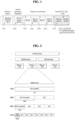
- FIG. 1 illustrates physical channels used in a 3GPP NR system and a general signal transmission method using the same.
- the UE When a UE is powered on again from a power-off state or enters a new cell, the UE performs an initial cell search procedure, such as establishment of synchronization with a BS, in step S101. To this end, the UE receives a synchronization signal block (SSB) from the BS.
- the SSB includes a primary synchronization signal (PSS), a secondary synchronization signal (SSS), and a physical broadcast channel (PBCH).
- PSS primary synchronization signal
- SSS secondary synchronization signal
- PBCH physical broadcast channel
- the UE establishes synchronization with the BS based on the PSS/SSS and acquires information such as a cell identity (ID).
- ID cell identity
- the UE may acquire broadcast information in a cell based on the PBCH.
- the UE may receive a DL reference signal (RS) in an initial cell search procedure to monitor a DL channel status.
- RS DL reference signal
- the UE may acquire more specific system information by receiving a physical downlink control channel (PDCCH) and receiving a physical downlink shared channel (PDSCH) based on information of the PDCCH in step S102.
- a physical downlink control channel (PDCCH)
- PDSCH physical downlink shared channel
- the UE may perform a random access procedure to access the BS in steps S103 to S106.
- the UE may transmit a preamble to the BS on a physical random access channel (PRACH) (S103) and receive a response message for preamble on a PDCCH and a PDSCH corresponding to the PDCCH (S104).
- PRACH physical random access channel
- the UE may perform a contention resolution procedure by further transmitting the PRACH (S105) and receiving a PDCCH and a PDSCH corresponding to the PDCCH (S106).
- the UE may receive a PDCCH/PDSCH (S107) and transmit a physical uplink shared channel (PUSCH)/physical uplink control channel (PUCCH) (S108), as a general downlink/uplink signal transmission procedure.
- Control information transmitted from the UE to the BS is referred to as uplink control information (UCI).
- the UCI includes hybrid automatic repeat and request acknowledgement/negative-acknowledgement (HARQ-ACK/NACK), scheduling request (SR), channel state information (CSI), etc.
- the CSI includes a channel quality indicator (CQI), a precoding matrix indicator (PMI), a rank indicator (RI), etc.
- the UCI While the UCI is transmitted on a PUCCH in general, the UCI may be transmitted on a PUSCH when control information and traffic data need to be simultaneously transmitted. In addition, the UCI may be aperiodically transmitted through a PUSCH according to request/command of a network.
- FIG. 2 illustrates a radio frame structure.
- uplink and downlink transmissions are configured with frames.
- Each radio frame has a length of 10 ms and is divided into two 5-ms half-frames (HF).
- Each half-frame is divided into five 1-ms subframes (SFs).
- a subframe is divided into one or more slots, and the number of slots in a subframe depends on subcarrier spacing (SCS).
- SCS subcarrier spacing
- Each slot includes 12 or 14 Orthogonal Frequency Division Multiplexing (OFDM) symbols according to a cyclic prefix (CP).
- OFDM Orthogonal Frequency Division Multiplexing
- CP cyclic prefix
- Table 1 exemplarily shows that the number of symbols per slot, the number of slots per frame, and the number of slots per subframe vary according to the SCS when the normal CP is used.
- the structure of the frame is merely an example.
- the number of subframes, the number of slots, and the number of symbols in a frame may vary.
- OFDM numerology e.g., SCS
- SCS single-frame duration
- a time resource e.g., an SF, a slot or a TTI
- TU time unit
- the symbols may include an OFDM symbol (or a CP-OFDM symbol) and an SC-FDMA symbol (or a discrete Fourier transform-spread-OFDM (DFT-s-OFDM) symbol).
- OFDM symbol or a CP-OFDM symbol
- SC-FDMA symbol or a discrete Fourier transform-spread-OFDM (DFT-s-OFDM) symbol.
- DFT-s-OFDM discrete Fourier transform-spread-OFDM
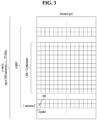
- FIG. 3 illustrates a resource grid of a slot.
- a slot includes a plurality of symbols in the time domain. For example, when the normal CP is used, the slot includes 14 symbols. However, when the extended CP is used, the slot includes 12 symbols.
- a carrier includes a plurality of subcarriers in the frequency domain.
- a resource block (RB) is defined as a plurality of consecutive subcarriers (e.g., 12 consecutive subcarriers) in the frequency domain.
- a bandwidth part (BWP) may be defined to be a plurality of consecutive physical RBs (PRBs) in the frequency domain and correspond to a single numerology (e.g., SCS, CP length, etc.).
- the carrier may include up to N (e.g., 5) BWPs. Data communication may be performed through an activated BWP, and only one BWP may be activated for one UE.
- each element is referred to as a resource element (RE), and one complex symbol may be mapped to
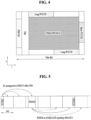
- FIG. 4 illustrates exemplary mapping of physical channels in a slot.
- a PDCCH may be transmitted in a DL control region, and a PDSCH may be transmitted in a DL data region.
- a PUCCH may be transmitted in a UL control region, and a PUSCH may be transmitted in a UL data region.
- a guard period (GP) provides a time gap for transmission mode-to-reception mode switching or reception mode-to-transmission mode switching at a BS and a UE. Some symbol at the time of DL-to-UL switching in a subframe may be configured as a GP.
- the PDCCH delivers DCI.
- the PDCCH i.e., DCI
- the PDCCH may carry information about a transport format and resource allocation of a DL shared channel (DL-SCH), resource allocation information of an uplink shared channel (UL-SCH), paging information on a paging channel (PCH), system information on the DL-SCH, information on resource allocation of a higher-layer control message such as an RAR transmitted on a PDSCH, a transmit power control command, information about activation/release of configured scheduling, and so on.
- the DCI includes a cyclic redundancy check (CRC).
- the CRC is masked with various identifiers (IDs) (e.g., a radio network temporary identifier (RNTI)) according to an owner or usage of the PDCCH. For example, if the PDCCH is for a specific UE, the CRC is masked by a UE ID (e.g., cell-RNTI (C-RNTI)). If the PDCCH is for a paging message, the CRC is masked by a paging-RNTI (P-RNTI). If the PDCCH is for system information (e.g., a system information block (SIB)), the CRC is masked by a system information RNTI (SI-RNTI). When the PDCCH is for an RAR, the CRC is masked by a random access-RNTI (RA-RNTI).
- IDs e.g., a radio network temporary identifier (RNTI)
- RNTI radio network temporary identifier
- the PDCCH includes 1, 2, 4, 8, or 16 control channel elements (CCEs) according to its aggregation level (AL).
- a CCE is a logical allocation unit used to provide a PDCCH with a specific code rate according to a radio channel state.
- a CCE includes 6 resource element groups (REGs), each REG being defined by one OFDM symbol by one (P)RB.
- the PDCCH is transmitted in a control resource set (CORESET).
- a CORESET is defined as a set of REGs with a given numerology (e.g., an SCS, a CP length, and so on).
- a plurality of CORESETs for one UE may overlap with each other in the time/frequency domain.
- a CORESET may be configured by system information (e.g., a master information block (MIB)) or UE-specific higher-layer signaling (e.g., radio resource control (RRC) signaling). Specifically, the number of RBs and the number of symbols (3 at maximum) in the CORESET may be configured through higher-layer signaling.
- system information e.g., a master information block (MIB)
- UE-specific higher-layer signaling e.g., radio resource control (RRC) signaling
- RRC radio resource control
- a PDCCH candidate is CCE(s) that the UE should monitor to detect a PDCCH.
- Each PDCCH candidate is defined as 1, 2, 4, 8, or 16 CCEs according to an AL.
- the monitoring includes (blind) decoding PDCCH candidates.
- a set of PDCCH candidates decoded by the UE are defined as a PDCCH search space (SS).
- An SS may be a common search space (CSS) or a UE-specific search space (USS).
- the UE may obtain DCI by monitoring PDCCH candidates in one or more SSs configured by an MIB or higher-layer signaling.
- Each CORESET is associated with one or more SSs, and each SS is associated with one CORESET.
- An SS may be defined based on the following parameters.
- An occasion (e.g., time/frequency resources) in which the UE is to monitor PDCCH candidates is defined as a PDCCH (monitoring) occasion.
- PDCCH (monitoring) occasion One or more PDCCH (monitoring) occasions may be configured in a slot.
- Table 3 shows the characteristics of each SS.
- Type Search Space RNTI Use Case Type0-PDCCH Common SI-RNTI on a primary cell SIB Decoding Type0A-PDCCH Common SI-RNTI on a primary cell SIB Decoding Type 1-PDCCH Common RA-RNTI or TC-RNTI on a primary cell Msg2, Msg4 decoding in RACH Type2-PDCCH Common P-RNTI on a primary cell Paging Decoding Type3-PDCCH Common INT-RNTI, SFI-RNTI, TPC-PUSCH-RNTI, TPC-PUCCH-RNTI, TPC-SRS-RNTI, C-RNTI, MCS-C-RNTI, or CS-RNTI(s) UE Specific UE Specific C-RNTI, or MCS-C-RNTI, or CS-RNTI(s) User specific PDSCH decoding
- Table 4 shows DCI formats transmitted on the PDCCH.
- DCI format 0_0 may be used to schedule a TB-based (or TB-level) PUSCH
- DCI format 0_1 may be used to schedule a TB-based (or TB-level) PUSCH or a code block group (CBG)-based (or CBG-level) PUSCH
- DCI format 1_0 may be used to schedule a TB-based (or TB-level) PDSCH
- DCI format 1_1 may be used to schedule a TB-based (or TB-level) PDSCH or a CBG-based (or CBG-level) PDSCH (DL grant DCI).
- DCI format 0_0/0_1 may be referred to as UL grant DCI or UL scheduling information
- DCI format 1_0/1_1 may be referred to as DL grant DCI or DL scheduling information
- DCI format 2_0 is used to deliver dynamic slot format information (e.g., a dynamic slot format indicator (SFI)) to a UE
- DCI format 2_1 is used to deliver DL pre-emption information to a UE.
- DCI format 2_0 and/or DCI format 2_1 may be delivered to a corresponding group of UEs on a group common PDCCH which is a PDCCH directed to a group of UEs.
- DCI format 0_0 and DCI format 1_0 may be referred to as fallback DCI formats, whereas DCI format 0_1 and DCI format 1_1 may be referred to as non-fallback DCI formats.
- a DCI size/field configuration is maintained to be the same irrespective of a UE configuration.
- the DCI size/field configuration varies depending on a UE configuration in the non-fallback DCI formats.
- the PDSCH conveys DL data (e.g., DL-shared channel transport block (DL-SCH TB)) and uses a modulation scheme such as quadrature phase shift keying (QPSK), 16-ary quadrature amplitude modulation (16QAM), 64QAM, or 256QAM.
- a TB is encoded into a codeword.
- the PDSCH may deliver up to two codewords. Scrambling and modulation mapping may be performed on a codeword basis, and modulation symbols generated from each codeword may be mapped to one or more layers. Each layer together with a demodulation reference signal (DMRS) is mapped to resources, and an OFDM symbol signal is generated from the mapped layer with the DMRS and transmitted through a corresponding antenna port.
- DMRS demodulation reference signal
- the PUCCH delivers uplink control information (UCI).
- UCI uplink control information
- the UCI includes the following information.
- Table 5 illustrates exemplary PUCCH formats.
- PUCCH formats may be divided into short PUCCHs (Formats 0 and 2) and long PUCCHs (Formats 1, 3, and 4) based on PUCCH transmission durations.
- [Table 5] PUCCH format Length in OFDM symbols N symb PUCCH Number of bits Usage Etc 0 1 - 2 ⁇ 2 HARQ, SR Sequence selection 1 4 - 14 ⁇ 2 HARQ, [SR] Sequence modulation 2 1 - 2 >2 HARQ, CSI, [SR] CP-OFDM 3 4 - 14 >2 HARQ, CSI, [SR] DFT-s-OFDM (no UE multiplexing) 4 4 - 14 >2 HARQ, CSI, [SR] DFT-s-OFDM (Pre DFT OCC)
- PUCCH format 0 conveys UCI of up to 2 bits and is mapped in a sequence-based manner, for transmission. Specifically, the UE transmits specific UCI to the BS by transmitting one of a plurality of sequences on a PUCCH of PUCCH format 0. Only when the UE transmits a positive SR, the UE transmits the PUCCH of PUCCH format 0 in PUCCH resources for a corresponding SR configuration.
- PUCCH format 1 conveys UCI of up to 2 bits and modulation symbols of the UCI are spread with an orthogonal cover code (OCC) (which is configured differently whether frequency hopping is performed) in the time domain.
- OCC orthogonal cover code
- the DMRS is transmitted in a symbol in which a modulation symbol is not transmitted (i.e., transmitted in time division multiplexing (TDM)).
- PUCCH format 2 conveys UCI of more than 2 bits and modulation symbols of the DCI are transmitted in frequency division multiplexing (FDM) with the DMRS.
- the DMRS is located in symbols #1, #4, #7, and #10 of a given RB with a density of 1/3.
- a pseudo noise (PN) sequence is used for a DMRS sequence.
- frequency hopping may be activated.
- PUCCH format 3 does not support UE multiplexing in the same PRBS, and conveys UCI of more than 2 bits. In other words, PUCCH resources of PUCCH format 3 do not include an OCC. Modulation symbols are transmitted in TDM with the DMRS.
- PUCCH format 4 supports multiplexing of up to 4 UEs in the same PRBS, and conveys UCI of more than 2 bits.
- PUCCH resources of PUCCH format 3 include an OCC. Modulation symbols are transmitted in TDM with the DMRS.
- At least one of one or two or more cells configured to the UE may be configured for PUCCH transmission.
- At least a primary cell may be set as a cell for the PUCCH transmission.
- At least one PUCCH cell group may be configured to the UE based on at least one cell where the PUCCH transmission is configured, and each PUCCH cell group includes one or two or more cells.
- a PUCCH cell group may be simply referred to as a PUCCH group.
- the PUCCH transmission may be configured not only in the primary cell but also in a secondary cell (Scell).
- the primary cell belongs to a primary PUCCH group, and the PUCCH-SCell where the PUCCH transmission is configured belongs to a secondary PUCCH group.
- a PUCCH on the primary cell may be used.
- a PUCCH on the PUCCH-SCell may be used.
- the PUSCH delivers UL data (e.g., UL-shared channel transport block (UL-SCH TB)) and/or UCI based on a CP-OFDM waveform or a DFT-s-OFDM waveform.
- UL-SCH TB UL-shared channel transport block
- the UE transmits the PUSCH by transform precoding. For example, when transform precoding is impossible (e.g., disabled), the UE may transmit the PUSCH in the CP-OFDM waveform, while when transform precoding is possible (e.g., enabled), the UE may transmit the PUSCH in the CP-OFDM or DFT-s-OFDM waveform.
- a PUSCH transmission may be dynamically scheduled by a UL grant in DCI, or semi-statically scheduled by higher-layer (e.g., RRC) signaling (and/or Layer 1 (L1) signaling such as a PDCCH) (configured scheduling or configured grant).
- the PUSCH transmission may be performed in a codebook-based or non-codebook-based manner.
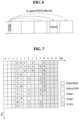
- FIG. 5 illustrates an exemplary ACK/NACK transmission process.
- the UE may detect a PDCCH in slot #n.
- the PDCCH includes DL scheduling information (e.g., DCI format 1_0 or DCI format 1_1).
- the PDCCH indicates a DL assignment-to-PDSCH offset, K0 and a PDSCH-to-HARQ-ACK reporting offset, K1.
- DCI format 1_0 and DCI format 1_1 may include the following information.
- the UE may transmit UCI on a PUCCH in slot #(n+K1).
- the UCI may include an HARQ-ACK response to the PDSCH.
- K1 may be indicated/interpreted based on the SCS of the PUCCH.
- the HARQ-ACK response may be configured in one bit. In the case where the PDSCH is configured to carry up to two TBs, the HARQ-ACK response may be configured in two bits if spatial bundling is not configured and in one bit if spatial bundling is configured.
- slot #(n+K1) is designated as an HARQ-ACK transmission timing for a plurality of PDSCHs, UCI transmitted in slot #(n+K1) includes HARQ-ACK responses to the plurality of PDSCHs.
- Whether the UE should perform spatial bundling for an HARQ-ACK response may be configured for each cell group (e.g., by RRC/higher layer signaling). For example, spatial bundling may be configured for each individual HARQ-ACK response transmitted on the PUCCH and/or HARQ-ACK response transmitted on the PUSCH.
- spatial bundling may be supported. More than four layers may be used for a 2-TB transmission, and up to four layers may be used for a 1-TB transmission. As a result, when spatial bundling is configured for a corresponding cell group, spatial bundling may be performed for a serving cell in which more than four layers may be scheduled among serving cells of the cell group.
- a UE which wants to transmit an HARQ-ACK response through spatial bundling may generate an HARQ-ACK response by performing a (bit-wise) logical AND operation on A/N bits for a plurality of TBs.
- a UE that performs spatial bundling may generate a single A/N bit by a logical AND operation between a first A/N bit for a first TB and a second A/N bit for a second TB.
- the UE reports an ACK bit value to a BS, and when at least one of the TBs is a NACK, the UE reports a NACK bit value to the BS.
- the UE may generate a single A/N bit by performing a logical AND operation on an A/N bit for the one TB and a bit value of 1. As a result, the UE reports the A/N bit for the one TB to the BS.
- Each HARQ process is associated with an HARQ buffer in the medium access control (MAC) layer.
- Each DL HARQ process manages state variables such as the number of MAC physical data unit (PDU) transmissions, an HARQ feedback for a MAC PDU in a buffer, and a current redundancy version.
- PDU physical data unit
- Each HARQ process is identified by an HARQ process ID.
- FIG. 6 illustrates an exemplary PUSCH transmission procedure.
- the UE may detect a PDCCH in slot #n.
- the PDCCH includes DL scheduling information (e.g., DCI format 1_0 or 1_1).
- DCI format 1_0 or 1_1 may include the following information.
- the UE may then transmit a PUSCH in slot #(n+K2) according to the scheduling information in slot #n.
- the PUSCH includes a UL-SCH TB.
- FIG. 7 illustrates exemplary multiplexing of UCI in a PUSCH.
- UCI may be transmitted on a PUSCH (UCI piggyback or PUSCH piggyback), as illustrated.
- PUSCH UCI piggyback or PUSCH piggyback
- an HARQ-ACK and CSI are carried in a PUSCH resource.
- the frequency range (FR) of Rel-16 NR is broadly categorized into FR1 and FR2.
- Table 6 shows FR1 and FR2 defined in the NR specification TS 38.104. [Table 6] Frequency range designation Corresponding frequency range FR1 410 MHz - 7125 MHz FR2 24250 MHz - 52600 MHz
- FR1 and FR2 multiple NR operating bands are defined.
- Rel-17 there are discussions underway to further expand the FR2 range by defining Rel-16 FR2, which spans from 24250 MHz to 52600 MHz, as FR2-1 and defining the range from 52600 MHz to 71000 MHz as FR2-2.
- Table 7 shows the bands belonging to Rel-16 FR1, and Table 8 shows bands belonging to Rel-16 FR2.
- NR operating band Uplink (UL) operating band Downlink (DL) operating band Duplex mode BS receive / UE transmit F UL,low - F UL,high BS transmit / UE receive F DL,low - F DL,high n1 1920 MHz - 1980 MHz 2110 MHz - 2170 MHz FDD n2 1850 MHz - 1910 MHz 1930 MHz - 1990 MHz FDD n3 1710 MHz 1785 MHz 1805 MHz - 1880 MHz FDD n5 824 MHz - 849 MHz 869 MHz - 894 MHz FDD n7 2500 MHz - 2570 MHz 2620 MHz - 2690 MHz FDD n8 880 MHz - 915 MHz 925 MHz - 960 MHz FDD n12 699 MHz - 716 MHz 729 MHz - 746
- the BS/UE needs to support at least one of the bands shown in Table 7/8.
- the actual operation band may vary depending on the regulations and the implementation of the BS/UE.
- one or more carriers/cells may be configured in one band.
- the UE may be configured with a plurality of cells. In this case, the plurality of cells configured to the UE may belong to the same band or different bands. For example, among the plurality of cells, cells in a first cell group may belong to a first band, and cells in a second cell group may belong to a second band.
- Carrier aggregation between cells belonging to different bands may be referred to as inter-band carrier aggregation (CA).
- CA inter-band carrier aggregation
- Carrier aggregation between cells belonging to the same band may be referred to as intra-band CA.
- the UL channels may be located in different cells.
- the placement of the plurality of UL channels on different cells may be either inter-band CA or intra-band CA depending on situations.
- a communication node e.g., a BS or a UE operating in an unlicensed band should determine whether other communication node(s) is using a channel, before transmitting a signal.
- a sub-band (SB) in which LBT is performed individually is defined as an LBT-SB
- a plurality of LBT-SBs may be included in one wideband cell/BWP.
- An RB set forming an LBT-SB may be configured through higher-layer signaling (e.g., RRC signaling).
- one cell/BWP may include one or more LBT-SBs based on (i) the BW of a cell/BWP and (ii) RB set allocation information.
- a plurality of LBT-SBs may be included in a BWP of a cell (or carrier).
- An LBT-SB may have, for example, a band of 20MHz.
- An LBT-SB may include a plurality of consecutive (P)RBs in the frequency domain and may be referred to as a (P)RB set. While not shown, a guard band (GB) may be included between LBT-SBs. Accordingly, a BWP may be configured in the form of ⁇ LBT-SB #0 (RB set #0) + GB #0 + LBT-SB #1 (RB set #1 + GB #1) + ... + LBT-SB #(K-1) (RB set (#K-1)) ⁇ . For convenience, LBT-SBs/RBs may be configured/defined to be indexed increasingly from a lower frequency band to a higher frequency band.
- a BS in a type 1 DL CAP and a UE in a type 1 UL CAP may detect whether a channel is idle during sensing slot durations of a defer duration Td, and after a counter N is zero, perform a transmission.
- the counter N is adjusted by sensing the channel for additional sensing slot duration(s) according to the following procedure:
- a type 1 UL CAP may be applied to the following transmissions.
- a type 2 CAP is a CAP performed without random backoff.
- Type 2A, 2B, and 2C are defined for DL, and type 2A, 2B, and 2C are defined for UL.
- Tf includes a sensing slot at the beginning of the duration.
- Tf includes a sensing slot within the last 9us of the duration.
- Tf includes a sensing slot within the last 9us of the duration.
- the UE does not sense a channel before performing a transmission.
- a semi-static configured grant may be configured for the UE by RRC signaling. Up to 12 active CGs may be configured for the UE in a corresponding BWP of a serving cell.
- Each CG may be type 1 or type 2.
- a type 1 CG may be activated/deactivated independently between serving cells.
- each type 2 CG may be individually activated by DCI.
- One DCI may deactivate one type 2 CG or a plurality of type 2 CGs.
- CG-UCI uplink control information
- a CG PUSCH i.e., a PUSCH scheduled by a CG.
- Multiplexing between a PUCCH carrying CG-UCI and a PUCCH carrying an HARQ-ACK in NR-U may be configured/allowed by the BS.
- the CG PUSCH transmission is dropped.
- a service/protection priority (e.g., low priority (LP) or high priority (HP)) may be configured for the UE semi-statically (by RRC signaling) or dynamically (by DCI/MAC signaling), for each physical channel/signal (transmission resource) and control information (e.g., UCI).
- LP low priority
- HP high priority
- a priority indicator has been introduced to some DCI formats (e.g., DCI format 1_1/1_2 for DL, and DCI format 0_1/0_2 for UL) in NR Rel. 16.
- the UE blind-decodes the DCI format, assuming that the priority indicator exists. Without explicit signaling indicating that the priority indicator will be used for the DCI format, the UE blind-decodes the DCI format, assuming that the priority indicator is not included in the DCI format.
- a lower priority index may be configured/indicated for LP, and a higher priority index may be configured/indicated for HP.
- a lower bit value e.g., bit '0'
- a higher bit value e.g., bit '1'
- a priority (e.g., LP or HP) may be configured/indicated for each UCI type (e.g., HARQ-ACK, SR, and/or CSI) or for each PUCCH/PUSCH resource configured/indicated for each related UCI transmission.
- LP/HP may be indicated for an HARQ-ACK for a PDSCH by DL grant DCI that schedules the PDSCH.
- DCI e.g., UL grant DCI scheduling a PUSCH.
- a PUCCH resource set may be configured independently for each priority, and/or (ii) a maximum UCI coding rate for a PUCCH transmission may be configured independently for each priority.
- a beta offset ⁇ offset for encoding UCI on a PUSCH may be configured independently for each priority and/or (iv) an HARQ-ACK codebook type may be configured independently for each priority. At least one of (i) to (iv) or any combination thereof may be used.
- a UE processing timeline related to PUCCH/PUSCH transmission is satisfied for each priority (for example, a minimum processing time N1 between the reception time of a PDSCH (e.g., PDSCH ending symbol) and the transmission time of a HARQ-ACK therefor (e.g., HARQ-ACK starting symbol) and/or a minimum processing time N2 between the reception time of a PDCCH (e.g., PDCCH ending symbol) and the transmission time of a PUSCH/PUCCH related thereto (e.g., PUSCH/PUCCH starting symbol)); and ii) a UCI/UL multiplexing process (where multiple PUCCHs/PUSCHs overlapping in time are merged (multiplexed) into one UL channel) is performed (that is, the UE processing timeline check and UCI/UL multiplexing processes are performed for the same priority).
- a minimum processing time N1 between the reception time of a PDSCH e.g., PDSCH ending symbol
- the UE processing timeline check and UCI/UL multiplexing processes may be performed between DL channels (e.g., PDSCH/PDCCH) and UL channels (e.g., PUCCH/PUSCH) with different priorities as well as the same priority (i.e. for inter-priority channels). Then, the outcomes for LP and HP PUCCHs/PUSCHs, which are the multiplexing results, may be transmitted.
- the eNB may enable or disable the simultaneous PUCCH+PUSCH transmission for a UE with the corresponding capability (if the UE reports the capability to the eNB).
- the UE may be configured to perform UL transmission according to the corresponding configuration (for example, if the configuration is "ON,” the UE may perform simultaneous PUCCH+PUSCH transmission, whereas if the configuration is "OFF,” the UE may perform the traditional PUCCH-only or PUSCH-only operation (defined in Rel-8 LTE or Rel-15 NR)).
- Table 9 shows UCI and UL channel transmission operations performed by the UE based on the ON/OFF configuration of simultaneous PUCCH+PUSCH transmission defined in Rel-10 LTE-A. [Table 9] 1) When simultaneous PUCCH+PUSCH transmission is set to OFF A.
- the UE piggybacks the HARQ-ACK on the PUSCH for transmission (i.e., HARQ-ACK on PUSCH).
- the UE piggybacks the periodic CSI (P-CSI) on the PUSCH for transmission (i.e., P-CSI on PUSCH).
- P-CSI periodic CSI
- the UE piggybacks both the HARQ-ACK and P-CSI on the PUSCH for transmission (i.e., ⁇ HARQ-ACK + P-CSI ⁇ on PUSCH).
- the UE simultaneously transmits the HARQ-ACK on the PUCCH and a PUSCH where the CSI is piggybacked (i.e., HARQ-ACK on PUCCH + P-CSI on PUSCH).
- UL multiplexing transmission between LP and HP channels may also be enabled simultaneously (for example, between a PUCCH and PUSCH on different frequency bands (or different serving cells) with different priorities).
- UE operations it may be necessary to define UE operations to be performed/applied according to a combination of UL channels (e.g., PUCCH and/or PUSCH) overlapping in time (between different priorities).
- each UCI type e.g., HARQ-ACK (A/N), SR, CSI, etc.
- each UL channel e.g., PUCCH, PUSCH, etc.
- it may be necessary to define specific UE/BS operations for simultaneous PUCCH+PUSCH transmission for example, which type of UCI and/or which priority of UCI will be transmitted on which UL channel).
- the present disclosure proposes a method of simultaneously transmitting a PUCCH and PUSCH in scenarios where different priorities are configured/indicated for UCI types and/or UL channels (for example, for a PUCCH and PUSCH configured/indicated at the same time (e.g., in the same slot, same sub-slot, or same symbol)).
- the proposals described later may be equally applied when the same priority is configured/indicated for each UCI type and/or UL channel (or where there is no separate priority configuration/indication).
- a specific priority is defined as XP
- a priority different from XP is defined as YP.
- XP LP
- YP HP
- YP LP
- a first signal and a second signal when configured/indicated at the same time, it may mean that resources for the first signal and resources for the second signal fully overlap in the time domain.
- the present disclosure is not limited thereto.
- transmitting, by the UE, a specific channel/signal may be interpreted as receiving, by the BS, the specific channel/signal.
- multiplexing between two UL channels may mean not only an operation of multiplexing and transmitting control information/data carried on the two UL channels on a single UL channel but also a prioritization operation of dropping transmission of a specific UL channel among the two UL channels and transmitting only the remaining UL channel.
- (at least one of) the following three operating parameters may (individually) be set as either enabled or disabled (e.g., at least one is configured through higher layer signaling).
- Alt 1 may be applied as an exception (while Alt 2 may be applied for the remaining combinations).
- step 1 of Alt 2 which is multiplexing for the same priority, is applied and then LP UCI is multiplexed on a LP PUSCH, it is more likely to be dropped due to an overlap in time with a HP PUCCH or HP PUSCH in step 2.
- Alt 1 is applied, even if a LP PUCCH overlaps with a HP PUCCH in step 1, the LP PUCCH is more likely to be multiplexed without being dropped.
- Inter-P _ PUCCH_mux Enable
- Inter-P _ PUSCH_mux Enable
- PUCCH +PUSCH _ TX Enable (e.g., when the UE is configured with parameters for simultaneous transmission of an XP PUCCH and YP PUSCH on different bands), the following UCI/UL (channel) multiplexing transmission operation methods may be considered for PUSCH transmission.
- PUSCH transmission may be a scheduled PUSCH (e.g., PUSCH transmission scheduled by UL grant DCI), but the present disclosure is not limited thereto. That is, the PUSCH transmission may be a PUSCH transmitted based on a configured grant (CG).
- CG configured grant
- the scheduled PUSCH it may be considered that transmission of an aperiodic CSI report (e.g., aperiodic channel state information (A-CSI)) on a specific PUSCH is triggered.
- an aperiodic CSI report e.g., aperiodic channel state information (A-CSI)
- A-CSI aperiodic channel state information
- the UL grant DCI that triggers A-CSI on the PUSCH may include a field indicating the priority index of the corresponding PUSCH.
- the priority of the corresponding PUSCH may be considered as LP.
- the UE may be configured to multiplex (piggyback) UCI in a PUCCH only on a PUSCH (which overlaps with the PUCCH) on the same band (or cell) as the PUCCH.
- the XP PUCCH and YP PUSCH may be required to be located on the same band.
- the UE may not be allowed to piggyback UCI in a first PUCCH on a first band on a second PUSCH (overlapping in time with the first PUCCH) on a second band (or cell), which is different from the first band, where the second PUSCH may be, for example, an A-CSI triggered PUSCH or another PUSCH.
- the UE may piggyback the UCI in the first PUCCH on the first PUSCH on the same first band (or cell).
- the UE may simultaneously transmit the first PUCCH on the first band and the second PUSCH on the second band.
- the priority index of the first PUCCH is different from the priority index of the second PUSCH.
- cells belonging to the same PUCCH (cell) group may be sub-grouped into one or two or more sub-groups, which will be described later. The cells belonging to the same sub-group may be on the same band, and cells belonging to different sub-groups may be on different bands.
- inter-band CA is required for simultaneous PUCCH/PUSCH transmission, which offers advantages in terms of reducing the complexity of radio frequency (RF) modules of the UE and the low peak-to-average-power ratio (PAPR).
- RF radio frequency
- PAPR peak-to-average-power ratio
- the UE uses a relatively compact and cost-effective RF modules compared to the BS, which results in constraints on the frequency range be covered by one RF module of the UE.
- different RF modules may be required for bands that are widely separated in the frequency domain.
- Simultaneous transmission based on different RF modules may not cause PAPR issues due to OFDM modulation, but PUCCH/PUSCH transmission based on the same RF module may cause a relatively high PAPR. Therefore, when a PUCCH and PUSCH are on the same band, the PUCCH may be piggybacked on the PUSCH, thereby reducing the UE complexity and PAPR.
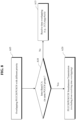
- FIG. 8 illustrates a UL signal transmission method according to an embodiment of the present disclosure (e.g., method related to 1) Alt A of Proposal 2).
- the PUCCH and PUSCH with different priorities may overlap with each other (A05).
- the UE may check whether the overlapping PUCCH and PUSCH are for inter-band CA (in the same PUCCH group) (A10) and perform UL transmission.
- the UE transmits the PUCCH and PUSCH simultaneously (A20). Otherwise (No in A10), the UE needs to perform an operation to resolve the overlap between the PUCCH and PUSCH (A15).
- UCI in the PUCCH may be piggybacked on the PUSCH. In this case, the PUSCH carrying the UCI may be transmitted without transmitting the PUCCH.
- the corresponding PUCCH and PUSCH may be excluded from the overlap resolution operation performed by the UE.
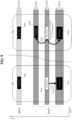
- FIG. 9 illustrates various examples of overlapping PUCCHs/PUSCHs (e.g., various application examples of FIG. 8 ).
- an XP PUCCH 802a, an YP PUSCH 801a, and an YP PUSCH 803a overlap in the time domain.
- the UE multiplexes (e.g., piggybacks) UCI in the XP PUCCH 802a onto the YP PUSCH 801a, which overlaps with the XP PUCCH 802a, on the same band, Band 1.
- the YP PUSCH 803a in Band 2 is transmitted without UCI multiplexing.
- an XP PUCCH 802b, an YP PUSCH 801b, an YP PUSCH 803b, and an YP PUSCH 804 overlap in the time domain. Based on that multiplexing between channels of different priorities is configured, the UE determines that one of the YP PUSCH 801b and YP PUSCH 804b in Band 1 is an YP PUSCH to be multiplex with UCI in the XP PUCCH 802a. The YP PUSCH 803b in Band 2 is transmitted without UCI multiplexing.
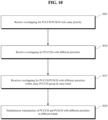
- FIG. 10 is a diagram for explaining an operation of resolving overlaps between PUCCHs/PUSCHs according to an embodiment of the present disclosure.
- the UE first resolves overlaps between PUCCHs/PUSCHs with the same priority (B05). Thereafter, the UE resolves overlaps between PUCCHs with different priorities (B10). Then, the UE resolves overlaps between PUCCHs/PUSCHs of different priorities (in the same PUCCH group and the same band) (B15). As a result of performing the overlap resolution operation, the UE performs simultaneous transmission of PUCCHs/PUSCHs with different priorities on different bands, which are finally determined to be transmitted (B20).
- UCI in the corresponding PUCCH may be piggybacked on the corresponding A-CSI triggered PUSCH exceptionally, regardless of whether the two UL channels are on the same band (or cell) or different bands (or cells). If there is no A-CSI triggered PUSCH overlapping in time with the PUCCH, the operations in Alt A may be performed.
- one PUSCH When a PUSCH overlaps in time with a PUCCH on the same band (or cell), one PUSCH is selected from among all PUSCHs (on all bands (or cells) in the same PUCCH cell group), and then UCI in the PUCCH may be piggybacked on the corresponding PUSCH.
- UCI in the PUCCH may be piggybacked on the corresponding PUSCH.
- simultaneous transmission of the PUCCH and PUSCH transmission may be performed (without UCI piggyback on the PUSCH).
- a LP channel e.g., PUCCH or PUSCH
- HP channel e.g., PUCCH or PUSCH
- a (frequency) band may mean that a plurality of cells belonging to a single PUCCH cell group are divided into one or more sub-groups and cells belonging to the same sub-group are in the same band (that is, cells belonging to different sub-groups are on different bands). Therefore, information on the sub-groups configured in one PUCCH cell group may be provided to the UE, and accordingly, the band in this document may be replaced with the sub-group.
- FIG. 11 illustrates an implementation example of a method by which a UE transmits a signal in a wireless communication system according to an embodiment of the present disclosure.
- FIG. 11 is for a better understanding of the above-described examples, and the scope of the present disclosure is not limited to the following description. The redundant description may be omitted, and the above-described content may be referred to if necessary.
- the UE may receive a parameter related to PUCCH-PUSCH simultaneous transmission (C05).
- the parameter related to the PUCCH-PUSCH simultaneous transmission may be a parameter for enabling a simultaneous transmission of overlapping PUCCH-PUSCH with different priorities within a same PUCCH cell group,
- the UE may perform UL transmission related to at least one of a PUCCH and one or more PUSCHs overlapping with the PUCCH (C10).
- the one or more PUSCHs overlapping with the PUCCH may include at least one of a first PUSCH on a first band to which a cell of the PUCCH belongs and a second PUSCH on a second band having at least one cell.
- the UE may perform the UL transmission without multiplexing UCI in the PUCCH on the second PUSCH, based on that the first band to which the cell of the PUCCH belongs is different from the second band to which the cell of the second PUSCH belongs.
- a priority of the PUCCH may be different from a priority of the second PUSCH.
- the cell of the PUCCH and the cell of the second PUSCH may belong to the same PUCCH cell group.
- the PUCCH and the second PUSCH may be transmitted simultaneously.
- the simultaneous transmission of the PUCCH and the second PUSCH may be based on inter-band CA.
- the PUSCH may be determined as one of PUSCHs on the first band.
- the simultaneous transmission of the PUCCH on the first band and the second PUSCH on the second band may be allowed based on the parameter, but multiplexing of the PUCCH on the first band and the second PUSCH on the second band may not be allowed.
- the UCI in the PUCCH may be transmitted through the first PUSCH other than the second PUSCH.
- the UE may receive at least one of scheduling of the first PUSCH and DCI scheduling the second PUSCH over a PDCCH.
- the DCI may trigger A-CSI reporting and include a priority index of the corresponding PUSCH.
- the UE may resolve an overlap between a PUCCH and a PUSCH with a same priority first, resolve an overlap between PUCCHs with different priorities, and then resolve an overlap between a PUCCH and a PUSCH with different priorities.
- FIG. 12 illustrates an implementation example of a method by which a BS receives a signal in a wireless communication system according to an embodiment of the present disclosure.
- FIG. 12 is for a better understanding of the above-described examples, and the scope of the present disclosure is not limited to the following description. The redundant description may be omitted, and the above-described content may be referred to if necessary.
- the BS may transmit a parameter related to PUCCH-PUSCH simultaneous transmission to a UE (D05).
- the parameter related to the PUCCH-PUSCH simultaneous transmission may be a parameter for enabling the UE to perform simultaneous transmission of overlapping PUCCH-PUSCH with different priorities within a same PUCCH cell group.
- the BS may receive a UL signal related to at least one of a PUCCH and one or more PUSCHs overlapping with the PUCCH from the UE (D10).
- the one or more PUSCHs overlapping with the PUCCH may include at least one of a first PUSCH on a first band to which a cell of the PUCCH belongs and a second PUSCH on a second band having at least one cell.
- the BS may receive the UL signal without de-multiplexing UCI in the PUCCH from the second PUSCH, based on that the first band to which the cell of the PUCCH belongs is different from the second band to which the cell of the second PUSCH belongs.
- a priority of the PUCCH may be different from a priority of the second PUSCH.
- the cell of the PUCCH and the cell of the second PUSCH may belong to the same PUCCH cell group.
- the PUCCH and the second PUSCH may be received simultaneously.
- the simultaneous reception of the PUCCH and the second PUSCH may be based on inter-band CA.
- the PUSCH may be determined as one of PUSCHs on the first band.
- the simultaneous reception of the PUCCH on the first band and the second PUSCH on the second band may be performed based on the parameter, but multiplexing of the PUCCH on the first band and the second PUSCH on the second band may not be performed.
- the UCI in the PUCCH may be received over the first PUSCH other than the second PUSCH.
- the BS may transmit at least one of scheduling of the first PUSCH and DCI scheduling the second PUSCH over a PDCCH.
- the DCI may trigger A-CSI reporting and include a priority index of the corresponding PUSCH.
- FIG. 13 illustrates a communication system 1 applied to the present disclosure.
- a communication system 1 includes wireless devices, Base Stations (BSs), and a network.
- the wireless devices represent devices performing communication using Radio Access Technology (RAT) (e.g., 5G New RAT (NR)) or Long-Term Evolution (LTE)) and may be referred to as communication/radio/SG devices.
- RAT Radio Access Technology
- the wireless devices may include, without being limited to, a robot 100a, vehicles 100b-1 and 100b-2, an extended Reality (XR) device 100c, a hand-held device 100d, a home appliance 100e, an Internet of Things (IoT) device 100f, and an Artificial Intelligence (AI) device/server 400.
- RAT Radio Access Technology
- NR 5G New RAT
- LTE Long-Term Evolution
- the wireless devices may include, without being limited to, a robot 100a, vehicles 100b-1 and 100b-2, an extended Reality (XR) device 100c, a hand-held device 100d, a home appliance 100e, an Internet of Things (IoT)
- the vehicles may include a vehicle having a wireless communication function, an autonomous driving vehicle, and a vehicle capable of performing communication between vehicles.
- the vehicles may include an Unmanned Aerial Vehicle (UAV) (e.g., a drone).
- UAV Unmanned Aerial Vehicle
- the XR device may include an Augmented Reality (AR)/Virtual Reality (VR)/Mixed Reality (MR) device and may be implemented in the form of a Head-Mounted Device (HMD), a Head-Up Display (HUD) mounted in a vehicle, a television, a smartphone, a computer, a wearable device, a home appliance device, a digital signage, a vehicle, a robot, etc.
- the hand-held device may include a smartphone, a smartpad, a wearable device (e.g., a smartwatch or a smartglasses), and a computer (e.g., a notebook).
- the home appliance may include a TV, a refrigerator, and a washing machine.
- the IoT device may include a sensor and a smartmeter.
- the BSs and the network may be implemented as wireless devices and a specific wireless device 200a may operate as a BS/network node with respect to other wireless devices.
- the wireless devices 100a to 100f may be connected to the network 300 via the BSs 200.
- An AI technology may be applied to the wireless devices 100a to 100f and the wireless devices 100a to 100f may be connected to the AI server 400 via the network 300.
- the network 300 may be configured using a 3G network, a 4G (e.g., LTE) network, or a 5G (e.g., NR) network.
- the wireless devices 100a to 100f may communicate with each other through the BSs 200/network 300, the wireless devices 100a to 100f may perform direct communication (e.g., sidelink communication) with each other without passing through the BSs/network.
- the vehicles 100b-1 and 100b-2 may perform direct communication (e.g., Vehicle-to-Vehicle (V2V)/Vehicle-to-everything (V2X) communication).
- the IoT device e.g., a sensor
- the IoT device may perform direct communication with other IoT devices (e.g., sensors) or other wireless devices 100a to 100f.
- Wireless communication/connections 150a, 150b, or 150c may be established between the wireless devices 100a to 100fBS 200, or BS 200BS 200.
- the wireless communication/connections may be established through various RATs (e.g., 5G NR) such as uplink/downlink communication 150a, sidelink communication 150b (or, D2D communication), or inter BS communication (e.g., relay, Integrated Access Backhaul (IAB)).
- the wireless devices and the BSs/the wireless devices may transmit/receive radio signals to/from each other through the wireless communication/connections 150a and 150b.
- the wireless communication/connections 150a and 150b may transmit/receive signals through various physical channels.
- various configuration information configuring processes various signal processing processes (e.g., channel encoding/decoding, modulation/demodulation, and resource mapping/demapping), and resource allocating processes, for transmitting/receiving radio signals, may be performed based on the various proposals of the present disclosure.
- various signal processing processes e.g., channel encoding/decoding, modulation/demodulation, and resource mapping/demapping
- resource allocating processes for transmitting/receiving radio signals
- FIG. 14 illustrates wireless devices applicable to the present disclosure.
- a first wireless device 100 and a second wireless device 200 may transmit radio signals through a variety of RATs (e.g., LTE and NR).
- ⁇ the first wireless device 100 and the second wireless device 200 ⁇ may correspond to ⁇ the wireless device 100x and the BS 200 ⁇ and/or ⁇ the wireless device 100x and the wireless device 100x ⁇ of FIG. 13 .
- the first wireless device 100 may include one or more processors 102 and one or more memories 104 and additionally further include one or more transceivers 106 and/or one or more antennas 108.
- the processor(s) 102 may control the memory(s) 104 and/or the transceiver(s) 106 and may be configured to implement the descriptions, functions, procedures, proposals, methods, and/or operational flowcharts disclosed in this document.
- the processor(s) 102 may process information within the memory(s) 104 to generate first information/signals and then transmit radio signals including the first information/signals through the transceiver(s) 106.
- the processor(s) 102 may receive radio signals including second information/signals through the transceiver 106 and then store information obtained by processing the second information/signals in the memory(s) 104.
- the memory(s) 104 may be connected to the processor(s) 102 and may store a variety of information related to operations of the processor(s) 102.
- the memory(s) 104 may store software code including commands for performing a part or the entirety of processes controlled by the processor(s) 102 or for performing the descriptions, functions, procedures, proposals, methods, and/or operational flowcharts disclosed in this document.
- the processor(s) 102 and the memory(s) 104 may be a part of a communication modem/circuit/chip designed to implement RAT (e.g., LTE or NR).
- the transceiver(s) 106 may be connected to the processor(s) 102 and transmit and/or receive radio signals through one or more antennas 108.
- Each of the transceiver(s) 106 may include a transmitter and/or a receiver.
- the transceiver(s) 106 may be interchangeably used with Radio Frequency (RF) unit(s).
- the wireless device may represent a communication modem/circuit/chip.
- the second wireless device 200 may include one or more processors 202 and one or more memories 204 and additionally further include one or more transceivers 206 and/or one or more antennas 208.
- the processor(s) 202 may control the memory(s) 204 and/or the transceiver(s) 206 and may be configured to implement the descriptions, functions, procedures, proposals, methods, and/or operational flowcharts disclosed in this document.
- the processor(s) 202 may process information within the memory(s) 204 to generate third information/signals and then transmit radio signals including the third information/signals through the transceiver(s) 206.
- the processor(s) 202 may receive radio signals including fourth information/signals through the transceiver(s) 106 and then store information obtained by processing the fourth information/signals in the memory(s) 204.
- the memory(s) 204 may be connected to the processor(s) 202 and may store a variety of information related to operations of the processor(s) 202.
- the memory(s) 204 may store software code including commands for performing a part or the entirety of processes controlled by the processor(s) 202 or for performing the descriptions, functions, procedures, proposals, methods, and/or operational flowcharts disclosed in this document.
- the processor(s) 202 and the memory(s) 204 may be a part of a communication modem/circuit/chip designed to implement RAT (e.g., LTE or NR).
- the transceiver(s) 206 may be connected to the processor(s) 202 and transmit and/or receive radio signals through one or more antennas 208.
- Each of the transceiver(s) 206 may include a transmitter and/or a receiver.
- the transceiver(s) 206 may be interchangeably used with RF unit(s).
- the wireless device may represent a communication modem/circuit/chip.
- One or more protocol layers may be implemented by, without being limited to, one or more processors 102 and 202.
- the one or more processors 102 and 202 may implement one or more layers (e.g., functional layers such as PHY, MAC, RLC, PDCP, RRC, and SDAP).
- the one or more processors 102 and 202 may generate one or more Protocol Data Units (PDUs) and/or one or more Service Data Unit (SDUs) according to the descriptions, functions, procedures, proposals, methods, and/or operational flowcharts disclosed in this document.
- PDUs Protocol Data Units
- SDUs Service Data Unit
- the one or more processors 102 and 202 may generate messages, control information, data, or information according to the descriptions, functions, procedures, proposals, methods, and/or operational flowcharts disclosed in this document.
- the one or more processors 102 and 202 may generate signals (e.g., baseband signals) including PDUs, SDUs, messages, control information, data, or information according to the descriptions, functions, procedures, proposals, methods, and/or operational flowcharts disclosed in this document and provide the generated signals to the one or more transceivers 106 and 206.
- the one or more processors 102 and 202 may receive the signals (e.g., baseband signals) from the one or more transceivers 106 and 206 and acquire the PDUs, SDUs, messages, control information, data, or information according to the descriptions, functions, procedures, proposals, methods, and/or operational flowcharts disclosed in this document.
- signals e.g., baseband signals
- the one or more processors 102 and 202 may be referred to as controllers, microcontrollers, microprocessors, or microcomputers.
- the one or more processors 102 and 202 may be implemented by hardware, firmware, software, or a combination thereof.
- ASICs Application Specific Integrated Circuits
- DSPs Digital Signal Processors
- DSPDs Digital Signal Processing Devices
- PLDs Programmable Logic Devices
- FPGAs Field Programmable Gate Arrays
- the descriptions, functions, procedures, proposals, methods, and/or operational flowcharts disclosed in this document may be implemented using firmware or software and the firmware or software may be configured to include the modules, procedures, or functions.
- Firmware or software configured to perform the descriptions, functions, procedures, proposals, methods, and/or operational flowcharts disclosed in this document may be included in the one or more processors 102 and 202 or stored in the one or more memories 104 and 204 so as to be driven by the one or more processors 102 and 202.
- the descriptions, functions, procedures, proposals, methods, and/or operational flowcharts disclosed in this document may be implemented using firmware or software in the form of code, commands, and/or a set of commands.
- the one or more memories 104 and 204 may be connected to the one or more processors 102 and 202 and store various types of data, signals, messages, information, programs, code, instructions, and/or commands.
- the one or more memories 104 and 204 may be configured by Read-Only Memories (ROMs), Random Access Memories (RAMs), Electrically Erasable Programmable Read-Only Memories (EPROMs), flash memories, hard drives, registers, cash memories, computer-readable storage media, and/or combinations thereof.
- the one or more memories 104 and 204 may be located at the interior and/or exterior of the one or more processors 102 and 202.
- the one or more memories 104 and 204 may be connected to the one or more processors 102 and 202 through various technologies such as wired or wireless connection.
- the one or more transceivers 106 and 206 may transmit user data, control information, and/or radio signals/channels, mentioned in the methods and/or operational flowcharts of this document, to one or more other devices.
- the one or more transceivers 106 and 206 may receive user data, control information, and/or radio signals/channels, mentioned in the descriptions, functions, procedures, proposals, methods, and/or operational flowcharts disclosed in this document, from one or more other devices.
- the one or more transceivers 106 and 206 may be connected to the one or more processors 102 and 202 and transmit and receive radio signals.
- the one or more processors 102 and 202 may perform control so that the one or more transceivers 106 and 206 may transmit user data, control information, or radio signals to one or more other devices.
- the one or more processors 102 and 202 may perform control so that the one or more transceivers 106 and 206 may receive user data, control information, or radio signals from one or more other devices.
- the one or more transceivers 106 and 206 may be connected to the one or more antennas 108 and 208 and the one or more transceivers 106 and 206 may be configured to transmit and receive user data, control information, and/or radio signals/channels, mentioned in the descriptions, functions, procedures, proposals, methods, and/or operational flowcharts disclosed in this document, through the one or more antennas 108 and 208.
- the one or more antennas may be a plurality of physical antennas or a plurality of logical antennas (e.g., antenna ports).
- the one or more transceivers 106 and 206 may convert received radio signals/channels etc.
- the one or more transceivers 106 and 206 may convert the user data, control information, radio signals/channels, etc. processed using the one or more processors 102 and 202 from the base band signals into the RF band signals.
- the one or more transceivers 106 and 206 may include (analog) oscillators and/or filters.
- FIG. 15 illustrates another example of a wireless device applied to the present disclosure.
- the wireless device may be implemented in various forms according to a use-case/service (refer to FIG. 13 ).
- wireless devices 100 and 200 may correspond to the wireless devices 100 and 200 of FIG. 14 and may be configured by various elements, components, units/portions, and/or modules.
- each of the wireless devices 100 and 200 may include a communication unit 110, a control unit 120, a memory unit 130, and additional components 140.
- the communication unit may include a communication circuit 112 and transceiver(s) 114.
- the communication circuit 112 may include the one or more processors 102 and 202 and/or the one or more memories 104 and 204 of FIG. 14 .
- the transceiver(s) 114 may include the one or more transceivers 106 and 206 and/or the one or more antennas 108 and 208 of FIG. 14 .
- the control unit 120 is electrically connected to the communication unit 110, the memory 130, and the additional components 140 and controls overall operation of the wireless devices. For example, the control unit 120 may control an electric/mechanical operation of the wireless device based on programs/code/commands/information stored in the memory unit 130.
- the control unit 120 may transmit the information stored in the memory unit 130 to the exterior (e.g., other communication devices) via the communication unit 110 through a wireless/wired interface or store, in the memory unit 130, information received through the wireless/wired interface from the exterior (e.g., other communication devices) via the communication unit 110.
- the additional components 140 may be variously configured according to types of wireless devices.
- the additional components 140 may include at least one of a power unit/battery, input/output (I/O) unit, a driving unit, and a computing unit.
- the wireless device may be implemented in the form of, without being limited to, the robot (100a of FIG. 13 ), the vehicles (100b-1 and 100b-2 of FIG. 13 ), the XR device (100c of FIG. 13 ), the hand-held device (100d of FIG. 13 ), the home appliance (100e of FIG. 13 ), the IoT device (100f of FIG.
- the wireless device may be used in a mobile or fixed place according to a use-example/service.
- the entirety of the various elements, components, units/portions, and/or modules in the wireless devices 100 and 200 may be connected to each other through a wired interface or at least a part thereof may be wirelessly connected through the communication unit 110.
- the control unit 120 and the communication unit 110 may be connected by wire and the control unit 120 and first units (e.g., 130 and 140) may be wirelessly connected through the communication unit 110.
- Each element, component, unit/portion, and/or module within the wireless devices 100 and 200 may further include one or more elements.
- the control unit 120 may be configured by a set of one or more processors.
- control unit 120 may be configured by a set of a communication control processor, an application processor, an Electronic Control Unit (ECU), a graphical processing unit, and a memory control processor.
- memory 130 may be configured by a Random Access Memory (RAM), a Dynamic RAM (DRAM), a Read Only Memory (ROM)), a flash memory, a volatile memory, a non-volatile memory, and/or a combination thereof.
- RAM Random Access Memory
- DRAM Dynamic RAM
- ROM Read Only Memory
- flash memory a volatile memory
- non-volatile memory and/or a combination thereof.
- FIG. 16 illustrates a vehicle or an autonomous driving vehicle applied to the present disclosure.
- the vehicle or autonomous driving vehicle may be implemented by a mobile robot, a car, a train, a manned/unmanned Aerial Vehicle (AV), a ship, etc.
- AV manned/unmanned Aerial Vehicle
- a vehicle or autonomous driving vehicle 100 may include an antenna unit 108, a communication unit 110, a control unit 120, a driving unit 140a, a power supply unit 140b, a sensor unit 140c, and an autonomous driving unit 140d.
- the antenna unit 108 may be configured as a part of the communication unit 110.
- the blocks 110/130/140a to 140d correspond to the blocks 110/130/140 of FIG. 15 , respectively.
- the communication unit 110 may transmit and receive signals (e.g., data and control signals) to and from external devices such as other vehicles, BSs (e.g., gNBs and road side units), and servers.
- the control unit 120 may perform various operations by controlling elements of the vehicle or the autonomous driving vehicle 100.
- the control unit 120 may include an Electronic Control Unit (ECU).
- the driving unit 140a may cause the vehicle or the autonomous driving vehicle 100 to drive on a road.
- the driving unit 140a may include an engine, a motor, a powertrain, a wheel, a brake, a steering device, etc.
- the power supply unit 140b may supply power to the vehicle or the autonomous driving vehicle 100 and include a wired/wireless charging circuit, a battery, etc.
- the sensor unit 140c may acquire a vehicle state, ambient environment information, user information, etc.
- the sensor unit 140c may include an Inertial Measurement Unit (IMU) sensor, a collision sensor, a wheel sensor, a speed sensor, a slope sensor, a weight sensor, a heading sensor, a position module, a vehicle forward/backward sensor, a battery sensor, a fuel sensor, a tire sensor, a steering sensor, a temperature sensor, a humidity sensor, an ultrasonic sensor, an illumination sensor, a pedal position sensor, etc.
- IMU Inertial Measurement Unit
- the autonomous driving unit 140d may implement technology for maintaining a lane on which a vehicle is driving, technology for automatically adjusting speed, such as adaptive cruise control, technology for autonomously driving along a determined path, technology for driving by automatically setting a path if a destination is set, and the like.
- the communication unit 110 may receive map data, traffic information data, etc. from an external server.
- the autonomous driving unit 140d may generate an autonomous driving path and a driving plan from the obtained data.
- the control unit 120 may control the driving unit 140a such that the vehicle or the autonomous driving vehicle 100 may move along the autonomous driving path according to the driving plan (e.g., speed/direction control).
- the communication unit 110 may aperiodically/periodically acquire recent traffic information data from the external server and acquire surrounding traffic information data from neighboring vehicles.
- the sensor unit 140c may obtain a vehicle state and/or surrounding environment information.
- the autonomous driving unit 140d may update the autonomous driving path and the driving plan based on the newly obtained data/information.
- the communication unit 110 may transfer information about a vehicle position, the autonomous driving path, and/or the driving plan to the external server.
- the external server may predict traffic information data using AI technology, etc., based on the information collected from vehicles or autonomous driving vehicles and provide the predicted traffic information data to the vehicles or the autonomous driving vehicles.
- FIG. 17 is a diagram illustrating a DRX operation of a UE according to an embodiment of the present disclosure.
- the UE may perform a DRX operation in the afore-described/proposed procedures and/or methods.
- a UE configured with DRX may reduce power consumption by receiving a DL signal discontinuously.
- DRX may be performed in an RRC_IDLE state, an RRC_INACTIVE state, and an RRC_CONNECTED state.
- the UE performs DRX to receive a paging signal discontinuously in the RRC_IDLE state and the RRC_INACTIVE state.
- DRX in the RRC_CONNECTED state (RRC_CONNECTED DRX) will be described below.
- a DRX cycle includes an On Duration and an Opportunity for DRX.
- the DRX cycle defines a time interval between periodic repetitions of the On Duration.
- the On Duration is a time period during which the UE monitors a PDCCH.
- the UE performs PDCCH monitoring during the On Duration.
- the UE successfully detects a PDCCH during the PDCCH monitoring the UE starts an inactivity timer and is kept awake.
- the UE fails in detecting any PDCCH during the PDCCH monitoring, the UE transitions to a sleep state after the On Duration.
- PDCCH monitoring/reception may be performed discontinuously in the time domain in the afore-described/proposed procedures and/or methods.
- PDCCH reception occasions e.g., slots with PDCCH SSs
- PDCCH monitoring/reception may be performed continuously in the time domain.
- PDCCH reception occasions e.g., slots with PDCCH SSs
- PDCCH monitoring may be restricted during a time period configured as a measurement gap.
- Table 10 describes a DRX operation of a UE (in the RRC_CONNECTED state).
- DRX configuration information is received by higher-layer signaling (e.g., RRC signaling), and DRX ON/OFF is controlled by a DRX command from the MAC layer.
- RRC signaling e.g., RRC signaling
- DRX ON/OFF is controlled by a DRX command from the MAC layer.
- the UE may perform PDCCH monitoring discontinuously in performing the afore-described/proposed procedures and/or methods.
- MAC-CellGroupConfig includes configuration information required to configure MAC parameters for a cell group.
- MAC-CellGroupConfig may also include DRX configuration information.
- MAC-CellGroupConfig may include the following information in defining DRX.
- the UE When any of drx-OnDurationTimer, drx-InactivityTimer, drx-HARQ-RTT-TimerDL, and drx-HARQ-RTT-TimerDL is running, the UE performs PDCCH monitoring in each PDCCH occasion, staying in the awake state.
- the present disclosure is applicable to UEs, BSs, or other apparatuses in a wireless mobile communication system.
Landscapes
- Engineering & Computer Science (AREA)
- Signal Processing (AREA)
- Computer Networks & Wireless Communication (AREA)
- Mobile Radio Communication Systems (AREA)
Applications Claiming Priority (3)
| Application Number | Priority Date | Filing Date | Title |
|---|---|---|---|
| KR20210130228 | 2021-09-30 | ||
| US202163286079P | 2021-12-05 | 2021-12-05 | |
| PCT/KR2022/014531 WO2023055061A1 (ko) | 2021-09-30 | 2022-09-28 | 무선 통신 시스템에서 신호 송수신 방법 및 장치 |
Publications (3)
| Publication Number | Publication Date |
|---|---|
| EP4408101A1 true EP4408101A1 (de) | 2024-07-31 |
| EP4408101A4 EP4408101A4 (de) | 2025-01-22 |
| EP4408101B1 EP4408101B1 (de) | 2026-01-28 |
Family
ID=85783187
Family Applications (1)
| Application Number | Title | Priority Date | Filing Date |
|---|---|---|---|
| EP22876833.9A Active EP4408101B1 (de) | 2021-09-30 | 2022-09-28 | Verfahren und vorrichtung zum senden und empfangen eines signals in einem drahtloskommunikationssystem |
Country Status (3)
| Country | Link |
|---|---|
| US (1) | US20240389097A1 (de) |
| EP (1) | EP4408101B1 (de) |
| WO (1) | WO2023055061A1 (de) |
Families Citing this family (3)
| Publication number | Priority date | Publication date | Assignee | Title |
|---|---|---|---|---|
| EP4410028A1 (de) | 2021-10-01 | 2024-08-07 | QUALCOMM Incorporated | Rahmen für gleichzeitige pucch/pusch-übertragungen und intra-ue-multiplexing |
| US12477546B2 (en) * | 2022-02-25 | 2025-11-18 | Qualcomm Incorporated | HARQ-ack feedback and intra-UE multiplexing |
| US12483360B2 (en) * | 2022-04-29 | 2025-11-25 | Qualcomm Incorporated | Hybrid automatic repeat request codebook retransmission |
Family Cites Families (3)
| Publication number | Priority date | Publication date | Assignee | Title |
|---|---|---|---|---|
| WO2020006678A1 (en) * | 2018-07-03 | 2020-01-09 | Zte Corporation | Communication multiplexing with pucch and pusch |
| US11743890B2 (en) * | 2020-02-04 | 2023-08-29 | Qualcomm Incorporated | Simultaneous PUCCH-PUSCH with different priorities |
| US11930489B2 (en) * | 2020-02-14 | 2024-03-12 | Qualcomm Incorporated | Overlapping PUCCH and PUSCH transmission |
-
2022
- 2022-09-28 EP EP22876833.9A patent/EP4408101B1/de active Active
- 2022-09-28 US US18/696,180 patent/US20240389097A1/en active Pending
- 2022-09-28 WO PCT/KR2022/014531 patent/WO2023055061A1/ko not_active Ceased
Also Published As
| Publication number | Publication date |
|---|---|
| WO2023055061A1 (ko) | 2023-04-06 |
| US20240389097A1 (en) | 2024-11-21 |
| EP4408101B1 (de) | 2026-01-28 |
| EP4408101A4 (de) | 2025-01-22 |
Similar Documents
| Publication | Publication Date | Title |
|---|---|---|
| US11864230B2 (en) | Method and apparatus for transmitting and receiving signal in wireless communication system | |
| EP4099792B1 (de) | Verfahren und vorrichtung zum senden und empfangen eines signals in einem drahtloskommunikationssystem | |
| EP4050958B1 (de) | Verfahren und vorrichtung zum senden und empfangen eines signals in einem drahtloskommunikationssystem | |
| EP4408101B1 (de) | Verfahren und vorrichtung zum senden und empfangen eines signals in einem drahtloskommunikationssystem | |
| EP4518205A1 (de) | Verfahren und vorrichtung zum senden und empfangen eines signals in einem drahtloskommunikationssystem | |
| US11909679B2 (en) | Method and device for transmitting/receiving signals in wireless communication system | |
| EP4236558A1 (de) | Verfahren und vorrichtung zum senden und empfangen eines signals in einem drahtloskommunikationssystem | |
| EP4518179A1 (de) | Verfahren und vorrichtung zum senden und empfangen eines signals in einem drahtloskommunikationssystem | |
| EP4412374A1 (de) | Verfahren und vorrichtung zum senden und empfangen eines signals in einem drahtloskommunikationssystem | |
| EP4072233A1 (de) | Verfahren und vorrichtung für signalübertragung oder -empfang in einem drahtlosen kommunikationssystem | |
| EP4572188A1 (de) | Verfahren und vorrichtung zum senden und empfangen eines signals in einem drahtloskommunikationssystem | |
| EP4518229A1 (de) | Verfahren und vorrichtung zum senden und empfangen eines signals in einem drahtloskommunikationssystem | |
| EP4518225A1 (de) | Verfahren und vorrichtung zum senden und empfangen eines signals in einem drahtloskommunikationssystem | |
| EP4444015A1 (de) | Verfahren und vorrichtung zum senden und empfangen von signalen in einem drahtloskommunikationssystem | |
| EP4287739A1 (de) | Verfahren und vorrichtung zum senden/empfangen eines signals in einem drahtloskommunikationssystem | |
| EP4236155A1 (de) | Verfahren und vorrichtung zum senden und empfangen eines signals in einem drahtloskommunikationssystem | |
| EP4518226A1 (de) | Verfahren und vorrichtung zum senden oder empfangen eines signals in einem drahtloskommunikationssystem | |
| EP4572497A1 (de) | Verfahren und vorrichtung zum senden oder empfangen eines signals in einem drahtloskommunikationssystem | |
| EP4518228A1 (de) | Verfahren und vorrichtung zum senden und empfangen eines signals in einem drahtloskommunikationssystem | |
| EP4618463A1 (de) | Verfahren und vorrichtung zum senden und empfangen eines signals in einem drahtloskommunikationssystem | |
| EP4572196A1 (de) | Verfahren und vorrichtung zum senden oder empfangen eines signals in einem drahtloskommunikationssystem | |
| EP4661515A1 (de) | Signalübertragungs-/empfangsverfahren und -vorrichtung in einem drahtloskommunikationssystem | |
| EP4668981A1 (de) | Verfahren und vorrichtung für signalübertragung und -empfang in einem drahtloskommunikationssystem | |
| EP4280499A1 (de) | Verfahren und vorrichtung zum senden und empfangen eines signals in einem drahtloskommunikationssystem | |
| CN118020363A (zh) | 在无线通信系统中发送和接收信号的方法和设备 |
Legal Events
| Date | Code | Title | Description |
|---|---|---|---|
| STAA | Information on the status of an ep patent application or granted ep patent |
Free format text: STATUS: THE INTERNATIONAL PUBLICATION HAS BEEN MADE |
|
| PUAI | Public reference made under article 153(3) epc to a published international application that has entered the european phase |
Free format text: ORIGINAL CODE: 0009012 |
|
| STAA | Information on the status of an ep patent application or granted ep patent |
Free format text: STATUS: REQUEST FOR EXAMINATION WAS MADE |
|
| 17P | Request for examination filed |
Effective date: 20240424 |
|
| AK | Designated contracting states |
Kind code of ref document: A1 Designated state(s): AL AT BE BG CH CY CZ DE DK EE ES FI FR GB GR HR HU IE IS IT LI LT LU LV MC MK MT NL NO PL PT RO RS SE SI SK SM TR |
|
| DAV | Request for validation of the european patent (deleted) | ||
| DAX | Request for extension of the european patent (deleted) | ||
| A4 | Supplementary search report drawn up and despatched |
Effective date: 20250102 |
|
| RIC1 | Information provided on ipc code assigned before grant |
Ipc: H04L 1/1607 20230101ALN20241219BHEP Ipc: H04W 72/566 20230101ALI20241219BHEP Ipc: H04W 72/21 20230101ALI20241219BHEP Ipc: H04L 27/26 20060101ALI20241219BHEP Ipc: H04L 5/00 20060101ALI20241219BHEP Ipc: H04W 72/1268 20230101ALI20241219BHEP Ipc: H04W 72/04 20230101AFI20241219BHEP |
|
| GRAP | Despatch of communication of intention to grant a patent |
Free format text: ORIGINAL CODE: EPIDOSNIGR1 |
|
| STAA | Information on the status of an ep patent application or granted ep patent |
Free format text: STATUS: GRANT OF PATENT IS INTENDED |
|
| RIC1 | Information provided on ipc code assigned before grant |
Ipc: H04W 72/04 20230101AFI20250909BHEP Ipc: H04W 72/1268 20230101ALI20250909BHEP Ipc: H04L 5/00 20060101ALI20250909BHEP Ipc: H04L 27/26 20060101ALI20250909BHEP Ipc: H04W 72/21 20230101ALI20250909BHEP Ipc: H04W 72/566 20230101ALI20250909BHEP Ipc: H04L 1/1607 20230101ALN20250909BHEP |
|
| INTG | Intention to grant announced |
Effective date: 20250922 |
|
| RIC1 | Information provided on ipc code assigned before grant |
Ipc: H04W 72/04 20230101AFI20250915BHEP Ipc: H04W 72/1268 20230101ALI20250915BHEP Ipc: H04L 5/00 20060101ALI20250915BHEP Ipc: H04L 27/26 20060101ALI20250915BHEP Ipc: H04W 72/21 20230101ALI20250915BHEP Ipc: H04W 72/566 20230101ALI20250915BHEP Ipc: H04L 1/1607 20230101ALN20250915BHEP |
|
| GRAS | Grant fee paid |
Free format text: ORIGINAL CODE: EPIDOSNIGR3 |
|
| GRAA | (expected) grant |
Free format text: ORIGINAL CODE: 0009210 |
|
| STAA | Information on the status of an ep patent application or granted ep patent |
Free format text: STATUS: THE PATENT HAS BEEN GRANTED |
|
| AK | Designated contracting states |
Kind code of ref document: B1 Designated state(s): AL AT BE BG CH CY CZ DE DK EE ES FI FR GB GR HR HU IE IS IT LI LT LU LV MC MK MT NL NO PL PT RO RS SE SI SK SM TR |
|
| REG | Reference to a national code |
Ref country code: CH Ref legal event code: F10 Free format text: ST27 STATUS EVENT CODE: U-0-0-F10-F00 (AS PROVIDED BY THE NATIONAL OFFICE) Effective date: 20260128 Ref country code: GB Ref legal event code: FG4D |