EP4407935A2 - Appareil et procédé de validation de jeton prédictive - Google Patents
Appareil et procédé de validation de jeton prédictive Download PDFInfo
- Publication number
- EP4407935A2 EP4407935A2 EP24169572.5A EP24169572A EP4407935A2 EP 4407935 A2 EP4407935 A2 EP 4407935A2 EP 24169572 A EP24169572 A EP 24169572A EP 4407935 A2 EP4407935 A2 EP 4407935A2
- Authority
- EP
- European Patent Office
- Prior art keywords
- service
- token
- user
- usage information
- computer
- Prior art date
- Legal status (The legal status is an assumption and is not a legal conclusion. Google has not performed a legal analysis and makes no representation as to the accuracy of the status listed.)
- Pending
Links
Images




Classifications
-
- H—ELECTRICITY
- H04—ELECTRIC COMMUNICATION TECHNIQUE
- H04L—TRANSMISSION OF DIGITAL INFORMATION, e.g. TELEGRAPHIC COMMUNICATION
- H04L63/00—Network architectures or network communication protocols for network security
- H04L63/08—Network architectures or network communication protocols for network security for authentication of entities
- H04L63/083—Network architectures or network communication protocols for network security for authentication of entities using passwords
-
- G—PHYSICS
- G06—COMPUTING OR CALCULATING; COUNTING
- G06F—ELECTRIC DIGITAL DATA PROCESSING
- G06F21/00—Security arrangements for protecting computers, components thereof, programs or data against unauthorised activity
- G06F21/30—Authentication, i.e. establishing the identity or authorisation of security principals
- G06F21/31—User authentication
- G06F21/41—User authentication where a single sign-on provides access to a plurality of computers
-
- G—PHYSICS
- G06—COMPUTING OR CALCULATING; COUNTING
- G06F—ELECTRIC DIGITAL DATA PROCESSING
- G06F21/00—Security arrangements for protecting computers, components thereof, programs or data against unauthorised activity
- G06F21/60—Protecting data
- G06F21/604—Tools and structures for managing or administering access control systems
-
- H—ELECTRICITY
- H04—ELECTRIC COMMUNICATION TECHNIQUE
- H04L—TRANSMISSION OF DIGITAL INFORMATION, e.g. TELEGRAPHIC COMMUNICATION
- H04L63/00—Network architectures or network communication protocols for network security
- H04L63/08—Network architectures or network communication protocols for network security for authentication of entities
- H04L63/0815—Network architectures or network communication protocols for network security for authentication of entities providing single-sign-on or federations
-
- H—ELECTRICITY
- H04—ELECTRIC COMMUNICATION TECHNIQUE
- H04L—TRANSMISSION OF DIGITAL INFORMATION, e.g. TELEGRAPHIC COMMUNICATION
- H04L63/00—Network architectures or network communication protocols for network security
- H04L63/10—Network architectures or network communication protocols for network security for controlling access to devices or network resources
- H04L63/102—Entity profiles
-
- H—ELECTRICITY
- H04—ELECTRIC COMMUNICATION TECHNIQUE
- H04W—WIRELESS COMMUNICATION NETWORKS
- H04W12/00—Security arrangements; Authentication; Protecting privacy or anonymity
- H04W12/06—Authentication
-
- H—ELECTRICITY
- H04—ELECTRIC COMMUNICATION TECHNIQUE
- H04W—WIRELESS COMMUNICATION NETWORKS
- H04W12/00—Security arrangements; Authentication; Protecting privacy or anonymity
- H04W12/08—Access security
Definitions
- the present disclosure relates to user authentication systems, and more particularly to token validation techniques.
- a validation of a user's secret token is a first step for successful invocation of a cloud service.
- a cloud service there may be countless requests in a given time from multiple users.
- the user passes a token for being validated at the cloud service.
- there may be a considerable performance impact on the cloud service This may, in turn, result in network and processor overhead for servicing such repeated tasks.
- An apparatus for predictive token validation. Included are a non-transitory memory comprising instructions and one or more processors in communication with the memory. The one or more processors execute the instructions to store, in a database, service usage information relating to usage of at least one service hosted by at least one server. Before at least one request for service is received from a user at the at least one server, the service usage information in the database is accessed. Based on such service usage information, a token associated with the user is sent to the at least one server for being validated by the at least one server, such that the at least one server allows access to the at least one service by the user, in response to the at least one request for service being received from the user with an identifier that is different from the token.
- a database stores service usage information relating to usage of at least one service hosted by at least one server. Before at least one request for service is received from a user at the at least one server, the service usage information in the database is accessed. Further, based on the service usage information, a token associated with the user is sent to the at least one server for being validated by the at least one server, such that the at least one server allows access to the at least one service by the user, in response to the at least one request for service being received from the user with an identifier that is different from the token.
- the identifier may include a universally unique identifier (UUID).
- UUID universally unique identifier
- the service usage information may identify the user and the at least one service.
- the service usage information may identify a time and/or a location associated with the user.
- the token may be sent based on the service usage information, by: determining whether the user has previously used the at least one service; and sending the token, if it is determined that the user has previously used the at least one service.
- the token may be sent based on the service usage information, by: abstaining from sending the token, if it is determined that the user has not previously used the at least one service.
- the token may be sent based on the service usage information, by: altering a content of the token, based on the service usage information.
- the identifier may be received in connection with at least one failed request for service that failed due to a lack of token validation.
- the at least one failed request for service may be logged as service usage information in the database.
- the token associated with the user may be sent to the at least one server for being validated by the at least one server.
- the database may be populated with the service usage information by automatically collecting data on the usage of the at least one service hosted by the at least one server.
- the database may be populated with the service usage information by receiving manually created data on the usage of the at least one service hosted by the at least one server in connection with one or more user roles.
- access may be allowed to the at least one service, in response to the at least one request for service being received from the user, without waiting for the token to be validated.
- Another apparatus for predictive token validation. Included are a non-transitory memory comprising instructions and one or more processors in communication with the memory. The one or more processors execute the instructions to, before receiving at least one request for service from a user with an identifier, receive a token that is different from the identifier, based on service usage information relating to usage by the user of at least one service hosted by at least one server. Further, the token is validated. Still yet, after validating the token, the at least one request for service is received from the user. Access to the at least one service by the user is then permitted, in response to the at least one request for service from the user.
- a token is received that is different from the identifier, based on service usage information relating to usage by the user of at least one service hosted by at least one server. Further, the token is validated. Still yet, after validating the token, the at least one request for service is received from the user. Access to the at least one service by the user is then permitted, in response to the at least one request for service from the user.
- the access may be permitted without receiving the token from the user.
- another request for service may be received from the user in connection with another service hosted by the at least one server.
- it may be determined whether the token is validated in connection with the another service. If it is determined that the token is not validated in connection with the another service, the identifier may be sent for requesting the token so that the token can be validated.
- One or more of the foregoing features of the aforementioned apparatus and/or method may afford a mechanism for performing token validation before users request access to services of a services platform, based on a prediction of such access. This may, in turn, result in accelerated access to the services of the services platform that would otherwise be foregone in systems that lack such capability. It should be noted that the aforementioned potential advantages are set forth for illustrative purposes only and should not be construed as limiting in any manner.
- FIG. 1 illustrates a system 100 for predictive security token validation, in accordance with an embodiment.
- the system 100 includes an identity and access management (IAM) module 102 in communication with a database 104 and a services platform 106.
- IAM identity and access management
- the communication between the foregoing components of the system 100 may be afforded by way of any type of networking (e.g. bus networks, local networks, remote networks, etc.).
- each of the illustrated components of the system 100 may include any combination of software and/or hardware capable of performing their intended tasks that will be elaborated upon below, and may or may not share underlying hardware with one or more of the other components of the system 100.
- the illustrated components can communicate with each other using one or more data communication networks such as, for example, the Internet. More information will now be set forth regarding each of the foregoing components and the interoperability thereof.
- the services platform 106 may include at least one server that hosts one or more services 108.
- Non-limiting examples of such services 108 may include, but are not limited to a controller service 109, along with other services such as a compute service for computing data, a network service for communicating data, an image service for processing images, a storage service for storing data, a cluster service for providing enhanced availability to one or more of the foregoing services, etc.
- the system 100 may be equipped with a cache 111.
- controller service 109 serves for controlling access to the various services 108 using the results of token validation that is stored in the cache 111.
- the IAM module 102 is configured to register users 110 by assigning one or more tokens and one or more identifiers to each user that are later shared, possibly after being authenticated using a user name/password combination that is assigned to each user 110 during registration.
- the aforementioned identifier may be any identifier that is different (in at least one respect) from the token.
- the aforementioned identifier may include any unique or pseudo-unique identifier that is of a smaller size (e.g. less bits/bytes) as compared to the token.
- the token may include any security data structure that is of a larger size (e.g. more bits/bytes) as compared to the foregoing identifier.
- the identifier may possibly include a universally unique identifier (UUID) (e.g., sixteen octets), and the token may possibly include any one or more of the following: any unique identifier or data unique to a particular user (e.g. UUID, etc.), a password, a cryptographic key, biometric data (e.g., data representing a user's fingerprint, retina, facial features, or combinations of these), a digital signature, user role information, time and/or location information for restricting user access based on a time and/or a location, and/or code for facilitating processing of the token for the purpose of validating a particular user.
- each token may vary (e.g.
- each token may include only those token components (see examples above) that are required for validating the corresponding service 108.
- such validation may involve one or more of decrypting the token using a public-private key combination, populating and caching information extracted from the token, and/or conducting integrity checks on the token and/or information stored therein.
- the smaller size of the identifier facilitates transmission thereof by requiring less time and bandwidth to communicate the same.
- such smaller size (and less contents) further enable faster processing of the identifier (as compared to the token).
- the system 100 utilizes contents of the database 104 to initiate token validation (which is more cumbersome than use of the identifier), for the purpose of validating a user before such user actually accesses one or more services of the services platform 106, so that the smaller, more easily processed identifier may be used to accelerate access to such services by the users 110.
- the users 110 are permitted faster access to the services platform 106, while still preserving a sufficient level of security in connection with such access.
- the database 104 is configured to store service usage information relating to usage of at least one of the services 108 by the various users 110.
- service usage information may include any information that identifies, includes, and/or is derived from such usage which, in turn, may refer to any historical and/or predicted future access to such service(s), information stored by the service(s), and/or functionality thereby provided.
- the service usage information may identify each of the users 110 (using a user name, the aforementioned identifier and/or token) and the at least one service (using a naming protocol or any other mechanism that allows the tracking of past and/or prospective service usage by the users 110 ).
- the database 104 may be populated in any desired manner.
- the database 104 is populated with the service usage information by automatically collecting data on the usage of the service(s) hosted by the services platform 106.
- the database 104 may be populated with the service usage information by receiving manually created data on the usage of the service(s) in connection with one or more user roles.
- an administrator may populate a template (e.g. using mark-up language) that provides a mapping between the different services 108 of the services platform 106, and different roles that the users 110 may take on.
- the users 110 may be validated for access to different services 108 based on a role currently taken or predicted to be taken by such users 110.
- Table 1 illustrates simplified, exemplary contents of the database 104, in accordance with one possible embodiment.
- Table 1 Role_1 --> Service_1, Service_2 Role_2 --> Service_1, Service_3 Role_3 --> Service_4, Service_5
- the IAM module 102 registers one or more of the users 110 by assigning such users 110 with at least one token and an identifier, and shares the identifier with the corresponding one of the users 110, as indicated by operation 1. Such token and identifier are then stored in internal memory of the IAM module 102.
- the database 104 is configured to store service usage information regarding past and/or prospective service usage of the different services 108 of the services platform 106 by the user(s) 110.
- the IAM module 102 predicts which user(s) 110 will use which of the different services 108 and sends the token and identifier for such user(s) 110 to the services platform 106. See operation 3.
- the services platform 106 uses the controller service 109 to: validate the token, and store the identifier in a manner that is linked to any token validation results in the cache 111, as well as a mapping to the relevant services 108.
- the foregoing functionality of the controller service 109 may be distributed across any one or more of the services 108 such that the services 108 independently validate the token.
- Table 2 illustrates exemplary contents of the cache 111.
- Table 2 UUID_1 --> Token Information Service_1, Token_Information_Service_2 UUID_2 --> Token Information Service_1, Token_Information_Service_3 UUID_3 --> Token_Information_Service_4, Token_Information_Service_5
- Operation 3 occurs, at least in part, before a relevant one of the users 110 attempts to access one or more of the different services 108 in operation 4 by using the identifier that was originally allocated by the IAM module 102 in operation 1.
- the controller service 109 of the services platform 106 uses the identifier to check (via the cache 111 ) whether such particular user is authorized to access the requested services 108. If so, the particular user is granted access to the requested service(s) 108 without necessarily requiring, as a runtime precondition, the communication and/or processing of the token for validation purposes (since that has already occurred based on the prediction that it would be necessary - see operation 3 ).
- One or more of the foregoing features of the aforementioned system 100 thereby afford a mechanism for performing token validation before the users 110 request access to the services 108 of the services platform 106 by performing the token validation beforehand based on the prediction of such access. This may, in turn, result in accelerated access to the services 108 of the services platform 106 that would otherwise be foregone in systems that lack such capability. More illustrative information will now be set forth regarding various optional architectures and uses in which the foregoing system 100 may or may not be implemented, per the desires of the user.
- Figure 2 illustrates a system 200 for predictive security token validation in connection with an initial access by a user, in accordance with another embodiment.
- the system 200 may be implemented in the context of any one or more of the embodiments set forth in any previous and/or subsequent figure(s) and/or the description thereof.
- the system 200 may be implemented with one or more of the features of the system 100 of Figure 1 .
- the system 200 may be implemented in other suitable environments.
- the system 200 includes an IAM module 202 in communication with a database 204 and a services platform 206 which, in turn, includes services 108 and a cache 211 -equipped controller service 209, for permitting access to users 210. Further, after the database 204 has been populated, the system 200 permits early prediction-based token validation, so that, upon a request for access to one or more of the services 108 (using the aforementioned identifier) access may proceed without necessarily requiring another token validation. See operations 1-5 (which are similar to operations 1-5 of Figure 1 and are incorporated here).
- the system 200 is further configured for additional operations that accommodate a situation where the database 204 is not necessarily pre-populated and a user, for an initial time, requests access to one or more of the services 108 (using the aforementioned identifier) without token validation occurring.
- operations 5-6 proceed as follows. Specifically, after it is determined that token validation has not yet occurred in connection with the requesting user 210 (and the requested service(s) 208 ), the identifier is sent to the IAM module 202 for the purpose of requesting and receiving the token associated with the requesting user 210. See operation 5. To this end, token validation may occur at the services platform 206 and the requesting user 210 may (if validation is successful) thereafter be permitted access to the requested service(s) 208.
- the requested access (from operation 4 ) is logged in the database 204 so that there is a correspondence between the particular user 210 and the requested service(s) 208.
- the token may be communicated again (based on predictive analytics) to the cache 211 -equipped controller service 209 of the services platform 206, for pre-validating such token in advance of any future predicted access to the same requested service(s) 208. More information will now be set forth regarding the functionality of the IAM module 202 and the services platform 206, in accordance with various embodiments.
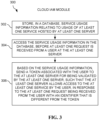
- Figure 3 illustrates a method 300 for predictive security token validation in connection with an IAM module, in accordance with another embodiment.
- the method 300 may be implemented in the context of any one or more of the embodiments set forth in any previous and/or subsequent figure(s) and/or the description thereof.
- the method 300 may be implemented in the context of the IAM modules 102 and 202 of Figures 1 and 2 , respectively.
- the method 300 may be implemented in other suitable environments.
- service usage information is stored in at least one database (e.g. the databases 104 and 204 of Figures 1 and 2 , respectively).
- service usage information relates to usage of at least one service hosted by at least one server associated with a services platform (e.g. the services platform 106 and 206 of Figures 1 and 2 , respectively).
- additional operations 304-306 are performed before at least one request is received from a user at the at least one server.
- the service usage information is accessed in the database.
- a token associated with the user is sent to the server(s) of the services platform for being validated by the at least one server. See operation 306.
- the token is sent in advance to any user request, such validation permits the server(s) of the services platform to allow access to the service(s) by the user, in response to the at least one request being received from the user with an identifier (that is different from the token).
- the combination of the pre-validation of the token and the use of the lightweight identifier-equipped request permits for a more real-time response to the request, instead of waiting for the communication and/or processing of the heavier token.
- Figure 4 illustrates a method 400 for predictive security token validation in connection with a services platform, in accordance with another embodiment.
- the method 400 may be implemented in the context of any one or more of the embodiments set forth in any previous and/or subsequent figure(s) and/or the description thereof.
- the method 400 may be implemented in the context of the services platform 106 and 206 of Figures 1 and 2 , respectively.
- the method 400 may be implemented in other suitable environments.
- a token is received in operation 402.
- the token may be received at a services platform (e.g. the services platform 106 and 206 of Figures 1 and 2 , respectively) from an IAM module (e.g. the IAM module 102 and 202 of Figures 1 and 2 , respectively).
- this token may be based on service usage information relating to usage by a user of at least one service hosted by at least one server of the services platform.
- service usage information may be accessible via a database (e.g. the databases 104 and 204 of Figures 1 and 2 , respectively).
- the IAM module predicts that the user will access one or more of the service of the services platform, the token will be communicated for token validation in connection with such specific user/service combination.
- such token is validated in operation 404. Further, after validating the token, the services platform is ready to receive at least one request from the user with an identifier that is different from the token. See operation 406. In response to the at least one request from the user, access is permitted to the at least one service by the user, per operation 408.
- the access operation 408 may be permitted by the services platform without the services platform necessarily receiving the token from the user, since such token was already received earlier from the IAM module and pre-validated. As mentioned earlier, it is possible that the token may not be received in operation 402 and the pre-validation of operation 404 may not necessarily occur as a result of a lack of a prediction that it would be needed. More information regarding such use case scenario will be set forth during the description of different services platform embodiments illustrated in one or more subsequent figures (e.g. Figure 6 ).
- Figure 5 illustrates a method 500 for predictive security token validation in connection with an IAM module, in accordance with yet another embodiment.
- the method 500 may be implemented in the context of any one or more of the embodiments set forth in any previous and/or subsequent figure(s) and/or the description thereof.
- method 500 may be implemented in the context of the IAM modules 102 and 202 of Figures 1 and 2 , respectively, as well as be incorporate one or more features of the method 300 of Figure 3 .
- the method 500 may be implemented in other suitable environments.
- the method 500 begins in operation 502 by registering a user with a user name and password, and generating a UUID for such user.
- this may be accomplished via an IAM module (e.g. the IAM modules 102 and 202 of Figures 1 and 2 , respectively) which may or may not be integrated with a services platform (e.g. the services platform 106 and 206 of Figures 1 and 2 , respectively).
- the IAM module generates the UUID via any random or pseudorandom process.
- the UUID may be randomly generated on-the-fly, in response to a registration request from the user.
- the UUID may be selected from a previously generated list of random UUIDs.
- the user is authenticated using the user name/password combination, per operation 504. In various embodiments, such authentication may be carried out in- or out-of-band.
- the UUID is sent to the user. In different embodiments, the UUID may be encrypted or protected by other mechanisms. With the user now equipped with the UUID, the user is now able to request access to various services of the services platform at a later time. Beforehand, however, the method 500 continues with operations 510-520 for permitting the services platform to pre-validate the token, in order to allow expedited access to requested services.
- a database (e.g. the databases 104 and 204 of Figures 1 and 2 , respectively) is queried for service usage information.
- service usage information may include historical data for the user at hand, and/or predictive data that identifies roles (e.g. administrator, manager, general user, etc.) of certain users that typically access certain services of the services platform. For the latter, a current, prevalent, and/or predicted role of the user may therefore be used to infer which services should be pre-validated.
- other information may also be stored in connection with each user including, but not limited to an indication of times and/or locations when the certain services are accessed by the user, a type of services accessed by the user, and/or roles historically held by the user.
- a threshold likelihood may be predetermined (or even dynamically determined) by an administrator of the IAM module, and any service usage information may be compiled, aggregated, etc. in order to calculate a specific likelihood which may then be compared against the threshold likelihood. If such threshold is met, decision 512 may identify a "hit" and relevant services may be pre-validated.
- the token is sent to the services platform for validation by the services platform, so that subsequently-received (post-validation) service access requests may be administered via the UUID and not necessarily require the validation occur in whole or in part between the receipt of the request and the permitted access to the service.
- a single token may be sent to the services platform with an indication as to which of the services are to be pre-validated based on the service usage information, so that such indication can be tracked by the services platform.
- a plurality of service-specific tokens may be communicated to the services platform so that each service may be separately validated via a corresponding token.
- the operations 510-514 may involve determining whether the user has previously used the requested service(s) and, then, sending the token if it is determined that the user has previously used the at least one service; or abstaining from sending the token, if it is determined that the user has not previously used the at least one service. In the case of the latter, any subsequent request for access to a service may result in a failed request, since token validation has not occurred.
- a content of the token may be altered, based on the service usage information. For example, if the token is being sent in connection with a first service (to validate the user for using such first service), the token may include first information specific to the first service. Further, if the token is being sent in connection with a second service (to validate the user for using such second service), the token may include second information specific to the second service.
- no service usage information may exist, or any such service usage information may not necessarily be relevant to a particular requested service.
- no early token communication may occur between the IAM module and the services platform in order to enable pre-validation, and further operations may be initiated to accommodate such a situation where there is a failed request(s) due to a lack of token validation.
- the UUID received (from the user/at the services platform) in connection with the aforementioned failed request(s) may be used to initiate further processing at the IAM module.
- the IAM module logs the failed request as service usage information in the database per operation 518 and the token associated with the user is sent to the server(s) of the services platform in operation 520, for being thereby validated.
- access (albeit delayed) may nevertheless be permitted to a service that was requested by the user by providing the token to the services platform, for validation purposes. More information will be set forth regarding related operation from the perspective of the services platform, during the description of Figure 6 .
- tokens sent in operations 514 and/or 520 may be limited in terms of a time period (after validation), during which access is allowed (i.e. the validation is still effective) during a particular session.
- time period may be predetermined and/or static, or be dynamically determined based on the service usage information. For example, it may be known, through the service usage information, that a particular user will likely only access the services platform during a short time period at a first location, but will likely access the services platform during a longer time period at a second location.
- time period limitations may be sent with the token in some embodiments, but may also be established and enforced at the services platform (e.g. by only temporarily caching the token validation results, etc.).
- the method 500 repeats operations 510-514 as a function of different queries including different parameters (e.g. time, location, role, any those mentioned earlier, etc.) for sending and re-sending tokens to accommodate such time period limitations.
- the aforementioned time and location parameters may be used to both determine when the tokens are sent to the services platform for validation, as well as when to revoke tokens based on apparent non-usage of a particular service, or when a time and/or location is no longer applicable since it does not reflect when and/or where the user typically uses the particular service.
- Figure 6 illustrates a method 600 for predictive security token validation in connection with a services platform, in accordance with yet another embodiment.
- the method 600 may be implemented in the context of any one or more of the embodiments set forth in any previous and/or subsequent figure(s) and/or the description thereof.
- the method 600 may be implemented in the context of the services platform 106 and 206 of Figures 1 and 2 , respectively, as well as incorporate one or more features of the method 400 of Figure 4 .
- the method 600 may be implemented in other suitable environments.
- a token is received at a services platform (e.g. the services platform 106 and 206 of Figures 1 and 2 , respectively) from an IAM module (e.g. the IAM modules 102 and 202 of Figures 1 and 2 , respectively).
- a services platform e.g. the services platform 106 and 206 of Figures 1 and 2 , respectively
- an IAM module e.g. the IAM modules 102 and 202 of Figures 1 and 2 , respectively.
- Such token may be actively requested or passively received, in different embodiments. Further, in one possible embodiment, such token may be accompanied by an indication of one or more specific services provided by the services platform.
- the token may be validated in operation 602. Further, such validation may, in some embodiments, be designated for use on only a subset of the complete set of services provided by the services platform. As will become further apparent, such validation may occur prior to any user request for service being received at the services platform, thus permitting operation 602 to occur before the remaining operations.
- a user request for service is received by the services platform.
- Such request for service is accompanied by at least a UUID and/or user name (that was registered with the requesting user), as well as at least one indication of at least one service provided by the services platform.
- a token has already been communicated from the IAM module for validation (e.g. see operations 601-602 ) it may be determined so in decision 604, thus allowing accelerated access to the requested service per operation 605.
- the user thereby obtains access to the requested service without waiting for token validation, thereby providing such access in real-time, near real-time, immediately, and/or possibly with fewer or even without intermediate operations between the receipt of the request and the permitted access (other than validation of the UUID and/or user name).
- transport layer security may be used for channel-level security and remediation from man-in-the-middle (MiTM)-based attacks.
- the UUID that was received with the service request may be forwarded from the services platform to the IAM module in operation 606, in order to initiate further processing at the IAM module so that a token may be issued from the IAM module to the services platform, for validation in connection with the service request. Accordingly, a response to operation 606 is awaited per decision 608. If no token is received, an error is reported to the user via operation 610. On the other hand, upon receipt of the token, token validation may ensue per operation 609 in connection with the appropriate service, thus permitting access to such service by the requesting user. See, again, operation 605. Thus, access (albeit delayed) may nevertheless be permitted to a service that was requested by the user by providing the token to the services platform, for validation purposes.
- the method 600 accommodates situations where different services may or may not have validated tokens associated therewith. Further, each of such situations may be accommodated for providing, in some scenarios, faster access to requested services and, in other scenarios, token validation (and slower service access) with a mechanism for enabling faster access for subsequent requests for such service.
- Figure 7 illustrates an example 700 of an amount of time 701 that is saved between a client request 702 and access to a requested service 704 by way of prediction-based token validation 706 that is carried out in advance of client request processing 708.
- Figure 8 illustrates a system 800 for predictive security token validation, in accordance with an embodiment.
- the system 800 may be implemented with one or more features of any one or more of the embodiments set forth in any previous and/or subsequent figure(s) and/or the description thereof.
- the system 800 may be implemented in other suitable environments.
- a storage means in the form of a storage module 802 is provided for storing service usage information relating to usage of at least one service hosted by at least one server.
- the storage module 802 may include, but is not limited to the databases 104 and 204 of Figures 1 and 2 , respectively, memory (to be described later) and any software controlling the same, and/or any other circuitry capable of the aforementioned functionality.
- an IAM means in the form of an IAM module 804 in communication with the storage module 802 for: causing storage of the service usage information; and, before at least one request is received from a user: accessing the service usage information in the storage module 802, and based on the service usage information, sending a token associated with the user to at least one server for being validated, such that the at least one server allows access to the at least one service by the user, in response to the at least one request being received from the user with an identifier that is different from the token (e.g. see the method 300 of Figure 3 ).
- the IAM module 804 may include, but is not limited to the IAM module 102 and 202 of Figures 1 and 2 , respectively, at least one processor (to be described later) and any software controlling the same, and/or any other circuitry capable of the aforementioned functionality.
- service means in the form of a service module 806 is in communication with the IAM module 804 for receiving a token based on service usage information relating to usage by a user of at least one service hosted by at least one server; validating the token; after validating the token, receiving at least one request from the user with an identifier that is different from the token; and permitting access to the at least one service by the user, in response to the at least one request from the user (e.g. see the method 400 of Figure 4 ).
- the service module 806 may include, but is not limited to the services platform 106 and 206 of Figures 1 and 2 , respectively, at least one processor (to be described later) and any software controlling the same, and/or any other circuitry capable of the aforementioned functionality.
- Figure 9 is a diagram of a network architecture 900, in accordance with an embodiment. As shown, at least one network 902 is provided. In various embodiments, any one or more components/features set forth during the description of any previous figure(s) may be implemented in connection with any one or more of the components of the at least one network 902.
- the network 902 may take any form including, but not limited to a telecommunications network, a local area network (LAN), a wireless network, a wide area network (WAN) such as the Internet, peer-to-peer network, cable network, etc. While only one network is shown, it should be understood that two or more similar or different networks 902 may be provided.
- LAN local area network
- WAN wide area network
- Coupled to the network 902 is a plurality of devices.
- a server 912 and a computer 908 may be coupled to the network 902 for communication purposes.
- Such computer 908 may include a desktop computer, lap-top computer, and/or any other type of logic.
- various other devices may be coupled to the network 902 including a personal digital assistant (PDA) device 910, a mobile phone device 906, a television 904, etc.
- PDA personal digital assistant
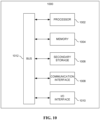
- FIG 10 is a diagram of an exemplary processing device 1000, in accordance with an embodiment.
- the processing device 1000 may be implemented in the context of any of the devices of the network architecture 900 of Figure 9 .
- the processing device 1000 may be implemented in any desired environment.
- the processing device 1000 includes at least one processor 1002 which is connected to a bus 1012.
- the processing device 1000 also includes memory 1004 [e.g., hard disk drive, solid state drive, random access memory (RAM), etc.] coupled to the bus 1012.
- the memory 1004 may include one or more memory components, and may even include different types of memory.
- a communication interface 1008 e.g. local/remote network interface, memory access interface, etc.
- an input/output (I/O) interface 1010 e.g. display, speaker, microphone, touchscreen, touchpad, mouse interface, etc.
- the processing device 1000 may also include a secondary storage 1006.
- the secondary storage 1006 coupled to the bus 1012 and/or to other components of the processing device 1000.
- the secondary storage 1006 can include, for example, a hard disk drive and/or a removable storage drive, representing a floppy disk drive, a magnetic tape drive, a compact disk drive, etc.
- the removable storage drive reads from and/or writes to a removable storage unit in a well-known manner.
- Computer programs, or computer control logic algorithms may be stored in the memory 1004, the secondary storage 1006, and/or any other memory, for that matter. Such computer programs, when executed, enable the processing device 1000 to perform various functions (as set forth above, for example).
- Memory 1004, secondary storage 1006 and/or any other storage comprise non-transitory computer-readable media.
- the at least one processor 1002 executes instructions in the memory 1004 or in the secondary storage 1006 to store, in a database, service usage information relating to usage of at least one service hosted by at least one server. Before at least one request for service is received from a user at the at least one server, the service usage information in the database is accessed. Based on such service usage information, a token associated with the user is sent to the at least one server for being validated by the at least one server, such that the at least one server allows access to the at least one service by the user, in response to the at least one request for service being received from the user with an identifier that is different from the token.
- the identifier may include a universally unique identifier (UUID).
- UUID universally unique identifier
- the service usage information may identify the user and the at least one service.
- the service usage information may identify a time and/or a location associated with the user.
- the token may be sent based on the service usage information, by: determining whether the user has previously used the at least one service; and sending the token, if it is determined that the user has previously used the at least one service.
- the token may be sent based on the service usage information, by: abstaining from sending the token, if it is determined that the user has not previously used the at least one service.
- the token may be sent based on the service usage information, by: altering a content of the token, based on the service usage information.
- the identifier may be received in connection with at least one failed request for service that failed due to a lack of token validation.
- the at least one failed request for service may be logged as service usage information in the database.
- the token associated with the user may be sent to the at least one server for being validated by the at least one server.
- the database may be populated with the service usage information by automatically collecting data on the usage of the at least one service hosted by the at least one server.
- the database may be populated with the service usage information by receiving manually created data on the usage of the at least one service hosted by the at least one server in connection with one or more user roles.
- access may be allowed to the at least one service, in response to the at least one request for service being received from the user, without waiting for the token to be validated.
- the at least one processor 1002 executes instructions in the memory 1004 or in the secondary storage 1006 to, before receiving at least one request for service from a user with an identifier, receive a token that is different from the identifier, based on service usage information relating to usage by the user of at least one service hosted by at least one server. Further, the token is validated. Still yet, after validating the token, the at least one request for service is received from the user. Access to the at least one service by the user is then permitted, in response to the at least one request for service from the user.
- the access may be permitted without receiving the token from the user.
- another request for service may be received from the user in connection with another service hosted by the at least one server.
- it may be determined whether the token is validated in connection with the another service. If it is determined that the token is not validated in connection with the another service, the identifier may be sent for requesting the token so that the token can be validated.
- a "computer-readable medium” includes one or more of any suitable media for storing the executable instructions of a computer program such that the instruction execution machine, system, apparatus, or device may read (or fetch) the instructions from the computer readable medium and execute the instructions for carrying out the described methods.
- Suitable storage formats include one or more of an electronic, magnetic, optical, and electromagnetic format.
- a non-exhaustive list of conventional exemplary computer readable medium includes: a portable computer diskette; a RAM; a ROM; an erasable programmable read only memory (EPROM or flash memory); optical storage devices, including a portable compact disc (CD), a portable digital video disc (DVD), a high definition DVD (HD-DVD TM ), a BLU-RAY disc; or the like.
- Computer-readable non-transitory media includes all types of computer readable media, including magnetic storage media, optical storage media, and solid state storage media and specifically excludes signals.
- the software can be installed in and sold with the devices described herein. Alternatively the software can be obtained and loaded into the devices, including obtaining the software via a disc medium or from any manner of network or distribution system, including, for example, from a server owned by the software creator or from a server not owned but used by the software creator.
- the software can be stored on a server for distribution over the Internet, for example.
- one or more of these system components may be realized, in whole or in part, by at least some of the components illustrated in the arrangements illustrated in the described Figures.
- the other components may be implemented in software that when included in an execution environment constitutes a machine, hardware, or a combination of software and hardware.
- At least one component defined by the claims is implemented at least partially as an electronic hardware component, such as an instruction execution machine (e.g., a processor-based or processor-containing machine) and/or as specialized circuits or circuitry (e.g., discrete logic gates interconnected to perform a specialized function).
- an instruction execution machine e.g., a processor-based or processor-containing machine
- specialized circuits or circuitry e.g., discrete logic gates interconnected to perform a specialized function.
- Other components may be implemented in software, hardware, or a combination of software and hardware. Moreover, some or all of these other components may be combined, some may be omitted altogether, and additional components may be added while still achieving the functionality described herein.
- the subject matter described herein may be embodied in many different variations, and all such variations are contemplated to be within the scope of what is claimed.
Landscapes
- Engineering & Computer Science (AREA)
- Computer Security & Cryptography (AREA)
- Signal Processing (AREA)
- Computer Networks & Wireless Communication (AREA)
- Computer Hardware Design (AREA)
- General Engineering & Computer Science (AREA)
- Computing Systems (AREA)
- Theoretical Computer Science (AREA)
- Physics & Mathematics (AREA)
- Software Systems (AREA)
- General Physics & Mathematics (AREA)
- General Health & Medical Sciences (AREA)
- Bioethics (AREA)
- Health & Medical Sciences (AREA)
- Automation & Control Theory (AREA)
- Telephonic Communication Services (AREA)
- Management, Administration, Business Operations System, And Electronic Commerce (AREA)
Applications Claiming Priority (4)
| Application Number | Priority Date | Filing Date | Title |
|---|---|---|---|
| US15/446,943 US10693867B2 (en) | 2017-03-01 | 2017-03-01 | Apparatus and method for predictive token validation |
| EP18761766.7A EP3577884B1 (fr) | 2017-03-01 | 2018-02-27 | Appareil et procédé de validation de jeton prédictive |
| EP21202567.0A EP3958150B1 (fr) | 2017-03-01 | 2018-02-27 | Appareil et procédé de validation de jeton prédictive |
| PCT/CN2018/077371 WO2018157784A1 (fr) | 2017-03-01 | 2018-02-27 | Appareil et procédé de validation de jeton prédictive |
Related Parent Applications (3)
| Application Number | Title | Priority Date | Filing Date |
|---|---|---|---|
| EP21202567.0A Division EP3958150B1 (fr) | 2017-03-01 | 2018-02-27 | Appareil et procédé de validation de jeton prédictive |
| EP21202567.0A Division-Into EP3958150B1 (fr) | 2017-03-01 | 2018-02-27 | Appareil et procédé de validation de jeton prédictive |
| EP18761766.7A Division EP3577884B1 (fr) | 2017-03-01 | 2018-02-27 | Appareil et procédé de validation de jeton prédictive |
Publications (2)
| Publication Number | Publication Date |
|---|---|
| EP4407935A2 true EP4407935A2 (fr) | 2024-07-31 |
| EP4407935A3 EP4407935A3 (fr) | 2024-10-23 |
Family
ID=63355985
Family Applications (3)
| Application Number | Title | Priority Date | Filing Date |
|---|---|---|---|
| EP18761766.7A Active EP3577884B1 (fr) | 2017-03-01 | 2018-02-27 | Appareil et procédé de validation de jeton prédictive |
| EP21202567.0A Active EP3958150B1 (fr) | 2017-03-01 | 2018-02-27 | Appareil et procédé de validation de jeton prédictive |
| EP24169572.5A Pending EP4407935A3 (fr) | 2017-03-01 | 2018-02-27 | Appareil et procédé de validation de jeton prédictive |
Family Applications Before (2)
| Application Number | Title | Priority Date | Filing Date |
|---|---|---|---|
| EP18761766.7A Active EP3577884B1 (fr) | 2017-03-01 | 2018-02-27 | Appareil et procédé de validation de jeton prédictive |
| EP21202567.0A Active EP3958150B1 (fr) | 2017-03-01 | 2018-02-27 | Appareil et procédé de validation de jeton prédictive |
Country Status (4)
| Country | Link |
|---|---|
| US (2) | US10693867B2 (fr) |
| EP (3) | EP3577884B1 (fr) |
| CN (1) | CN110301127B (fr) |
| WO (1) | WO2018157784A1 (fr) |
Families Citing this family (6)
| Publication number | Priority date | Publication date | Assignee | Title |
|---|---|---|---|---|
| US10693867B2 (en) | 2017-03-01 | 2020-06-23 | Futurewei Technologies, Inc. | Apparatus and method for predictive token validation |
| US11580058B1 (en) | 2021-08-30 | 2023-02-14 | International Business Machines Corporation | Hierarchical ring-based interconnection network for symmetric multiprocessors |
| US12265850B2 (en) | 2021-08-30 | 2025-04-01 | International Business Machines Corporation | Reservation mechanism for node with token constraints for preventing node starvation in a circular topology network |
| US12405826B2 (en) | 2021-08-30 | 2025-09-02 | International Business Machines Corporation | Reservation mechanism for nodes with phase constraints |
| CN114201780B (zh) * | 2021-12-14 | 2024-11-29 | 平安壹钱包电子商务有限公司 | 操作请求的验证方法、服务器、终端设备和存储介质 |
| US11843546B1 (en) * | 2023-01-17 | 2023-12-12 | Capital One Services, Llc | Determining resource usage metrics for cloud computing systems |
Family Cites Families (13)
| Publication number | Priority date | Publication date | Assignee | Title |
|---|---|---|---|---|
| US20080275993A1 (en) * | 2007-03-21 | 2008-11-06 | Microsoft Corporation | Web service for user and subscription data storage |
| US9699170B2 (en) * | 2011-09-29 | 2017-07-04 | Oracle International Corporation | Bundled authorization requests |
| US9038134B1 (en) | 2012-12-31 | 2015-05-19 | Emc Corporation | Managing predictions in data security systems |
| US9349132B2 (en) | 2013-03-13 | 2016-05-24 | Salesforce.Com, Inc. | Systems, methods, and apparatuses for implementing a group command with a predictive query interface |
| WO2014152817A1 (fr) * | 2013-03-14 | 2014-09-25 | Brivo Systems, Inc. | Système et procédé de contrôle physique d'accès |
| WO2015035396A1 (fr) * | 2013-09-09 | 2015-03-12 | Layer, Inc. | Authentification fédérée d'ordinateurs clients dans des services de communication de données en réseau appelables par des applications |
| CN103595809A (zh) | 2013-11-22 | 2014-02-19 | 乐视致新电子科技(天津)有限公司 | 智能电视中的账户信息管理方法及装置 |
| US9461980B1 (en) | 2014-03-28 | 2016-10-04 | Juniper Networks, Inc. | Predictive prefetching of attribute information |
| US20160191512A1 (en) * | 2014-12-27 | 2016-06-30 | Mcafee, Inc. | Predictive user authentication |
| US9717003B2 (en) * | 2015-03-06 | 2017-07-25 | Qualcomm Incorporated | Sponsored connectivity to cellular networks using existing credentials |
| US20170111345A1 (en) * | 2015-10-16 | 2017-04-20 | Bank Of America Corporation | Tokenization of sensitive personal data for use in transactions |
| CN105871854B (zh) | 2016-04-11 | 2018-11-20 | 浙江工业大学 | 基于动态授权机制的自适应云访问控制方法 |
| US10693867B2 (en) | 2017-03-01 | 2020-06-23 | Futurewei Technologies, Inc. | Apparatus and method for predictive token validation |
-
2017
- 2017-03-01 US US15/446,943 patent/US10693867B2/en active Active
-
2018
- 2018-02-27 EP EP18761766.7A patent/EP3577884B1/fr active Active
- 2018-02-27 CN CN201880012496.0A patent/CN110301127B/zh active Active
- 2018-02-27 EP EP21202567.0A patent/EP3958150B1/fr active Active
- 2018-02-27 WO PCT/CN2018/077371 patent/WO2018157784A1/fr not_active Ceased
- 2018-02-27 EP EP24169572.5A patent/EP4407935A3/fr active Pending
-
2020
- 2020-05-31 US US15/929,965 patent/US11310216B2/en active Active
Also Published As
| Publication number | Publication date |
|---|---|
| CN110301127B (zh) | 2021-02-12 |
| EP3958150B1 (fr) | 2024-05-15 |
| CN110301127A (zh) | 2019-10-01 |
| US20200296083A1 (en) | 2020-09-17 |
| EP4407935A3 (fr) | 2024-10-23 |
| US20180255040A1 (en) | 2018-09-06 |
| EP3577884B1 (fr) | 2021-11-03 |
| US10693867B2 (en) | 2020-06-23 |
| EP3958150A1 (fr) | 2022-02-23 |
| EP3577884A1 (fr) | 2019-12-11 |
| EP3577884A4 (fr) | 2020-01-22 |
| WO2018157784A1 (fr) | 2018-09-07 |
| US11310216B2 (en) | 2022-04-19 |
Similar Documents
| Publication | Publication Date | Title |
|---|---|---|
| US11310216B2 (en) | Apparatus and method for predictive token validation | |
| US12088623B2 (en) | Edge network-based account protection service | |
| US11456965B2 (en) | Network service request throttling system | |
| AU2015289493B2 (en) | Tiered connection pooling methods, systems and computer readable storage media | |
| US8903884B2 (en) | Multi-tenant services gateway | |
| US10659453B2 (en) | Dual channel identity authentication | |
| US20190052643A1 (en) | Cloud access rule translation for hybrid cloud computing environments | |
| US20140143533A1 (en) | Securing speech recognition data | |
| US20210243024A1 (en) | User Security Token Invalidation | |
| US10382398B2 (en) | Application signature authorization | |
| US11165804B2 (en) | Distinguishing bot traffic from human traffic | |
| EP3788524A1 (fr) | Commande d'accès à des documents dans des scénarios collaboratifs à l'aide d'une reconnaissance faciale à partir de webcams | |
| WO2020091864A1 (fr) | Authentification et autorisation centralisées | |
| US9680871B2 (en) | Adopting policy objects for host-based access control | |
| US10594657B1 (en) | Methods for parameterized sub-policy evaluation for fine grain access control during a session and devices thereof | |
| CN115190159A (zh) | 会话控制方法、装置、电子设备及介质 | |
| US20170214689A1 (en) | Network device authentication based on hashing content of sequential messages | |
| US20240104181A1 (en) | Method and system for authentication | |
| US20140298017A1 (en) | Methods and systems for broadcasting pictures | |
| CN120263428A (zh) | 基于零信任的数据处理方法及装置、设备、介质 |
Legal Events
| Date | Code | Title | Description |
|---|---|---|---|
| PUAI | Public reference made under article 153(3) epc to a published international application that has entered the european phase |
Free format text: ORIGINAL CODE: 0009012 |
|
| STAA | Information on the status of an ep patent application or granted ep patent |
Free format text: STATUS: THE APPLICATION HAS BEEN PUBLISHED |
|
| AC | Divisional application: reference to earlier application |
Ref document number: 3577884 Country of ref document: EP Kind code of ref document: P Ref document number: 3958150 Country of ref document: EP Kind code of ref document: P |
|
| AK | Designated contracting states |
Kind code of ref document: A2 Designated state(s): AL AT BE BG CH CY CZ DE DK EE ES FI FR GB GR HR HU IE IS IT LI LT LU LV MC MK MT NL NO PL PT RO RS SE SI SK SM TR |
|
| REG | Reference to a national code |
Ref country code: DE Ref legal event code: R079 Free format text: PREVIOUS MAIN CLASS: H04L0009400000 Ipc: G06F0021410000 |
|
| PUAL | Search report despatched |
Free format text: ORIGINAL CODE: 0009013 |
|
| AK | Designated contracting states |
Kind code of ref document: A3 Designated state(s): AL AT BE BG CH CY CZ DE DK EE ES FI FR GB GR HR HU IE IS IT LI LT LU LV MC MK MT NL NO PL PT RO RS SE SI SK SM TR |
|
| RIC1 | Information provided on ipc code assigned before grant |
Ipc: H04L 9/40 20220101ALI20240919BHEP Ipc: H04W 12/08 20210101ALI20240919BHEP Ipc: H04W 12/06 20210101ALI20240919BHEP Ipc: G06F 21/60 20130101ALI20240919BHEP Ipc: G06F 21/41 20130101AFI20240919BHEP |
|
| STAA | Information on the status of an ep patent application or granted ep patent |
Free format text: STATUS: REQUEST FOR EXAMINATION WAS MADE |
|
| 17P | Request for examination filed |
Effective date: 20250423 |