EP4407908A1 - Verfahren zur nachrichtenkommunikation zwischen einer vielzahl von benutzergeräten - Google Patents
Verfahren zur nachrichtenkommunikation zwischen einer vielzahl von benutzergeräten Download PDFInfo
- Publication number
- EP4407908A1 EP4407908A1 EP23305111.9A EP23305111A EP4407908A1 EP 4407908 A1 EP4407908 A1 EP 4407908A1 EP 23305111 A EP23305111 A EP 23305111A EP 4407908 A1 EP4407908 A1 EP 4407908A1
- Authority
- EP
- European Patent Office
- Prior art keywords
- useful data
- message
- user equipment
- series
- recipient
- Prior art date
- Legal status (The legal status is an assumption and is not a legal conclusion. Google has not performed a legal analysis and makes no representation as to the accuracy of the status listed.)
- Pending
Links
Images
Classifications
-
- H—ELECTRICITY
- H04—ELECTRIC COMMUNICATION TECHNIQUE
- H04L—TRANSMISSION OF DIGITAL INFORMATION, e.g. TELEGRAPHIC COMMUNICATION
- H04L1/00—Arrangements for detecting or preventing errors in the information received
- H04L1/12—Arrangements for detecting or preventing errors in the information received by using return channel
- H04L1/16—Arrangements for detecting or preventing errors in the information received by using return channel in which the return channel carries supervisory signals, e.g. repetition request signals
- H04L1/18—Automatic repetition systems, e.g. Van Duuren systems
- H04L1/1867—Arrangements specially adapted for the transmitter end
-
- H—ELECTRICITY
- H04—ELECTRIC COMMUNICATION TECHNIQUE
- H04W—WIRELESS COMMUNICATION NETWORKS
- H04W4/00—Services specially adapted for wireless communication networks; Facilities therefor
- H04W4/06—Selective distribution of broadcast services, e.g. multimedia broadcast multicast service [MBMS]; Services to user groups; One-way selective calling services
-
- H—ELECTRICITY
- H04—ELECTRIC COMMUNICATION TECHNIQUE
- H04L—TRANSMISSION OF DIGITAL INFORMATION, e.g. TELEGRAPHIC COMMUNICATION
- H04L1/00—Arrangements for detecting or preventing errors in the information received
- H04L1/12—Arrangements for detecting or preventing errors in the information received by using return channel
- H04L1/16—Arrangements for detecting or preventing errors in the information received by using return channel in which the return channel carries supervisory signals, e.g. repetition request signals
- H04L1/18—Automatic repetition systems, e.g. Van Duuren systems
- H04L1/1829—Arrangements specially adapted for the receiver end
- H04L1/1858—Transmission or retransmission of more than one copy of acknowledgement message
-
- H—ELECTRICITY
- H04—ELECTRIC COMMUNICATION TECHNIQUE
- H04L—TRANSMISSION OF DIGITAL INFORMATION, e.g. TELEGRAPHIC COMMUNICATION
- H04L1/00—Arrangements for detecting or preventing errors in the information received
- H04L2001/0092—Error control systems characterised by the topology of the transmission link
- H04L2001/0093—Point-to-multipoint
Definitions
- the present invention relates to the field of tactical telecommunications and more particularly concerns a method for communicating messages between a plurality of user equipment.
- Wireless telecommunications networks such as tactical radio networks are networks that present several constraints. First, during service discovery, it is necessary that each UE in the network be able to identify and address other UEs in the network. Then, this type of networks, mobile and decentralized, involve packet losses, which can pose reliability problems. Finally, operation in point-to-point mode, known as “unicast”, may not be supported by tactical radio telecommunications user equipment, which presents a disadvantage.
- the transmission control protocol or UDP (User Datagram Protocol in English) does not have any retransmission mechanism consisting of ensuring the reception of each packet and retransmitting any packet not received, and can therefore prove to be therefore relatively unreliable.
- UDP also limits the packet size to 64 KB, which may prove to be too little in high-speed radio communication networks.
- the reliable transmission control protocol or RUDP (Reliable User Datagram Protocol) implements retransmission mechanisms but can generate a lot of packet traffic because it uses a systematic acknowledgment mechanism for the receipt of data packets, which can significantly degrade useful network bandwidth. Additionally, this protocol only works in point-to-point mode.
- the transport layer protocol or QUIC Quick UDP Internet Protocol in English
- QUIC Quick UDP Internet Protocol in English
- point-to-point mode unicast or unicast
- QUIC can generate a significant number of acknowledgments and therefore packet exchanges on the network, which can considerably degrade the network bandwidth.
- TCP Transmission Control Protocol in English
- TCP Transmission Control Protocol in English
- point-to-point mode unicast or unicast
- data which again presents disadvantages.
- One of the aims of the invention is to enable simple, reliable and efficient data exchange within highly constrained networks such as tactical radio networks.
- the invention firstly relates to a method of communicating messages between a plurality of user equipment of a set of user equipment via a communication network, in particular wireless, of strongly constrained ad hoc preference, said method comprising the steps of:
- each payload message of said series of payload message comprising an identifier of said payload message and at least one identifier of a user equipment, called "recipient”, recipient of said series of useful data messages,
- receiveriver for each user equipment, called “receiver”, having received at least one useful data message from the series of useful data messages broadcast by the transmitter, determination based on the at least one useful data message received , its status as recipient or not of the series of useful data messages broadcast,
- the acknowledgment of useful data messages from the same series is carried out via a single acknowledgment message in order to reduce the number of messages exchanged and thus preserve the communication network, and rebroadcast is not carried out only if the user equipment for which the acknowledgment is not complete is still present on the network and only for useful data messages not received.
- the method according to the invention thus allows both data exchanges, in particular within highly constrained networks, such as radio networks, while ensuring high reliability (little packet loss) and avoiding significantly degrading bandwidth, thus limiting data loss.
- Presence of user equipment on the communication network it is meant that the user equipment is connected to the network so as to be able to receive messages sent by other user equipment of the set of user equipment.
- a transmitter broadcasts messages to all of the other user equipment (“broadcast” mode) but in certain cases, only one or some of the other user equipment can be recipients of these messages, i.e. that is, the useful data they contain is intended for them. In other words, all user equipment can receive the messages but in certain cases, only some of them can be recipients.
- the reception information for a payload message is the identifier of said payload message.
- the acknowledgment message includes the identifier of each useful data message in the series received by the receiver.
- the method comprises a step of segmenting the set of useful data.
- useful data in order to distribute said useful data into a series of useful data messages whose identifiers are ordered in an increasing order in order to allow a receiver to completely reconstruct said series of useful data messages.
- large messages are segmented in order to respect the constraints of the link layer.
- the invention also relates to a computer program product characterized in that it includes a set of program code instructions which, when executed by one or more processors, configure the one or more processors to implement a process as presented previously.
- the invention also relates to transmitting user equipment for communicating messages between a plurality of user equipments of a set of user equipments via a communication network, said user equipment being configured to:
- each useful data message of said series of useful data messages comprising an identifier of said message of useful data and an identifier of at least one user equipment recipient of said series of useful data messages
- the transmitting user equipment is configured to insert the identifier of one or more recipients into each payload message of the payload message series.
- the transmitting user equipment is configured so that the size of a set of payload data intended to be inserted in a payload message is greater than the maximum size of the payload data field of said payload message. , segment the set of useful data in order to distribute said useful data into a series of useful data messages whose identifiers are ordered in an increasing order in order to allow a receiver to completely reconstruct said series of useful data messages.
- the transmitting user equipment is configured to broadcast a status message indicating the presence on the communication network of said user equipment.
- the invention also relates to receiving user equipment for communicating messages between a plurality of user equipments of a set of user equipments via a communication network, said user equipment being configured to:
- the invention also relates to user equipment configured to be both a transmitter, as presented previously, and a receiver, as described above.
- the invention also relates to a communication system comprising a plurality of user equipment as presented above and a communication network, preferably a highly constrained ad hoc network, configured to allow communication between said user equipment.
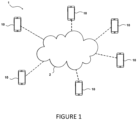
- FIG. 1 illustrates an example of system 1 according to the invention.
- the system 1 comprises a set of user equipment 10 and a communication network 20.
- each user equipment 10 is configured to operate both in transmission and reception.
- Each user equipment 10 is characterized by a unique identifier in the system 1.
- each user equipment 10 is configured to transmit three types of messages: so-called “status” messages MS, so-called “useful data” messages M1, ..., Mn and acknowledgment messages MA.
- Each message MS, M1, ..., Mn, MA comprises data which is encoded in a signal transmitted by the transmitting user equipment 10, in a manner known per se.
- each user equipment 10 is configured to encode the data to be sent in a signal and to send said signal to the receiving user equipment 10 via the communication network 20.
- each receiving user equipment 10 is configured to receive the signals transmitted by the other user equipment 10 and to decode said signals in order to determine the messages encoded in said signals.
- the useful data messages M1, ..., Mn are sent in the form of a series S of messages.
- Each series S of messages includes at least one useful data message M1, ..., Mn.
- Each useful data message M1, ..., Mn of the S series comprises an identifier of said message M1, ..., Mn, useful data intended for one or more of the other user equipment 10 of the set of user equipment 10, for example the data of an application (or application data), and the identifier(s) of the user equipment 10 recipients of the series S of useful data messages M1, ..., Mn.
- Each user equipment 10 is configured to transmit a series S of useful data messages M1, ..., Mn each time this useful data must be sent to one, several, or even all the user equipment 10 of the set of user equipment 10. To this end, each user equipment 10 is configured to insert in each useful data message M1, ..., Mn of the series S, an identifier of said message, and the or the identifiers of the user equipment 10 recipients.
- An MS status message includes the identifier of the user equipment 10 which transmits said MS status message in order to allow other user equipment 10 to know that said user equipment 10 transmitting the MS status message is present on the communication network 20 in order to receive messages.
- Each user equipment 10 is configured to broadcast, that is to say periodically transmit, a status message MS when said user equipment 10 is present on the communication network 20.
- Each user equipment 10 is configured to determine, from at least one useful data message M1, ..., Mn received, whether said user equipment 10 is the recipient or not of the series of useful data messages M1, ..., Mn emitted.
- Each user equipment 10 recipient of a series S of useful data messages M1, ..., Mn is configured to send an acknowledgment message MA to the transmitter.
- This acknowledgment message MA includes reception information for each message of the series S received by said recipient user equipment 10.
- Each transmitter user equipment 10 is configured to, in the absence of receipt of an acknowledgment message MA sent by a recipient DEST and after receipt of a status message MS from said recipient DEST indicating its presence on the communication network 20, rebroadcast the series S of useful data messages M1, ..., Mn.
- Each transmitter user equipment 10 is configured to, upon receipt of an acknowledgment message MA from said recipient DEST not including reception information for each useful data message M1, ..., Mn of the series S and after reception of a status message MS from said recipient DEST indicating its presence on the communication network 20, rebroadcast the useful data messages M1, ..., Mn of the series S for which no reception information is included in the MA acknowledgment message received.
- the reception information for a payload message M1, ..., Mn is for example the identifier of said payload message M1, ..., Mn.
- the transmitter rebroadcasts all three useful data messages M1, M2, M3 of the S series.
- the equipment d user 10 transmitter of the series S receives from the recipient, a status message MS and an acknowledgment message MA comprising the identifier of the first message M1 and the identifier of the third message M3, the transmitter rebroadcasts the second M2 message only.
- Each user equipment 10 comprises a processor capable of implementing a set of instructions allowing these functions to be carried out.
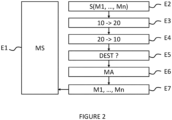
- each user equipment 10 of the set of user equipment 10 broadcasts a status message MS indicating its presence on the communication network 20.
- a broadcast results in by a periodic transmission of the status message MS, the content of the latter comprising at least the identifier of the user equipment 10 which transmits it.
- step E2 includes, if necessary, the segmentation of all the useful data to be sent into several subsets, each subset being sent in a useful data message M1, ..., Mn of the series S in the order of segmentation of all useful data.
- Step E2 then includes the insertion of each subset into a payload message M1, ..., Mn different from the series S, the assignment of an identifier to each payload message M1, .. ., Mn and the insertion of the identifier of the DEST recipient(s) of the S series.
- the transmitting user equipment 10 broadcasts each useful data message M1, ..., Mn of the series S, in turn in the order of said series S, via the communication network 20 in a step E3.
- the useful data messages M1, ..., Mn of the S series can be broadcast as they are generated, one by one or the S series can first be generated then broadcast in one burst, preferably in the order of the useful data messages M1, ..., Mn of the S series.
- the useful data messages M1, ..., Mn sent by the transmitting user equipment 10 are received by some or all of the other user equipment 10, called “receivers" in a step E4. All or part of the useful data messages M1, ..., Mn sent by the transmitting user equipment 10 may not be received by some or all of the receiving user equipment 10.
- the receiving user equipment 10 On receipt of a useful data message M1, ..., Mn by a receiving user equipment 10, the receiving user equipment 10 analyzes the useful data message M1, ..., Mn in order to determine the or the recipient identifiers DEST corresponding to its own identifier (i.e. its unique identifier with which it indicates that it is connected to the communication network 20 in its MS status messages) in a step E5. In the absence of a DEST recipient identifier in the received message, the receiver deduces that the received message is intended for all user equipment 10 of the set of user equipment 10.
- said receiver sends in a step E6 an acknowledgment message MA, comprising information of reception for each useful data message in the series received by said receiver, intended for the transmitter via the communication network 20.
- a step E7 in the absence of receipt of an acknowledgment message MA sent by a recipient DEST and after receipt of a status message MS from said recipient DEST indicating its presence on the communication network 20, the transmitter rebroadcasts the series of useful data messages M1, ..., Mn, or, upon receipt of an acknowledgment message MA from said recipient DEST not including reception information for each useful data message M1, . .., Mn of the series S and after receipt of a status message MS from said recipient DEST indicating its presence on the communication network 20, the transmitter rebroadcasts the useful data messages M1, ..., Mn of the series S for which no reception information is included in the acknowledgment message MA received by said recipient DEST.
- transmitters can send useful data messages M1, ..., Mn simultaneously and that a transmitter can thus also be a receiver of useful data messages M1, ..., Mn sent by another transmitter of the user equipment set 10.
- the invention makes it possible to ensure that all of the useful data messages M1, ..., Mn of a series S of useful data messages M1, ..., Mn sent by a transmitter are well received by the or the recipients of said series S of useful data messages M1, ..., Mn.
Landscapes
- Engineering & Computer Science (AREA)
- Computer Networks & Wireless Communication (AREA)
- Signal Processing (AREA)
- Multimedia (AREA)
- Mobile Radio Communication Systems (AREA)
Priority Applications (2)
| Application Number | Priority Date | Filing Date | Title |
|---|---|---|---|
| EP23305111.9A EP4407908A1 (de) | 2023-01-27 | 2023-01-27 | Verfahren zur nachrichtenkommunikation zwischen einer vielzahl von benutzergeräten |
| US18/420,702 US20240259767A1 (en) | 2023-01-27 | 2024-01-23 | Method for communicating messages between a plurality of pieces of user equipment |
Applications Claiming Priority (1)
| Application Number | Priority Date | Filing Date | Title |
|---|---|---|---|
| EP23305111.9A EP4407908A1 (de) | 2023-01-27 | 2023-01-27 | Verfahren zur nachrichtenkommunikation zwischen einer vielzahl von benutzergeräten |
Publications (1)
| Publication Number | Publication Date |
|---|---|
| EP4407908A1 true EP4407908A1 (de) | 2024-07-31 |
Family
ID=85384608
Family Applications (1)
| Application Number | Title | Priority Date | Filing Date |
|---|---|---|---|
| EP23305111.9A Pending EP4407908A1 (de) | 2023-01-27 | 2023-01-27 | Verfahren zur nachrichtenkommunikation zwischen einer vielzahl von benutzergeräten |
Country Status (2)
| Country | Link |
|---|---|
| US (1) | US20240259767A1 (de) |
| EP (1) | EP4407908A1 (de) |
Citations (2)
| Publication number | Priority date | Publication date | Assignee | Title |
|---|---|---|---|---|
| US20040023651A1 (en) * | 1991-05-13 | 2004-02-05 | Gollnick Charles D. | Network supporting roaming, sleeping terminals |
| WO2015139026A2 (en) * | 2014-03-14 | 2015-09-17 | Go Tenna Inc. | System and method for digital communication between computing devices |
Family Cites Families (6)
| Publication number | Priority date | Publication date | Assignee | Title |
|---|---|---|---|---|
| US9723581B2 (en) * | 2013-10-18 | 2017-08-01 | Qualcomm Incorporated | Systems and methods for establishing synchronization across multiple networks and participating STAs via operations on a known common channel |
| US10496976B2 (en) * | 2016-03-01 | 2019-12-03 | Wipro Limited | Method and device for validating transactions pertaining to sharing of services in ad hoc network |
| US9794965B1 (en) * | 2017-06-05 | 2017-10-17 | Chengfu Yu | Autonomous and remote pairing of internet of things devices utilizing a cloud service |
| WO2020092911A1 (en) * | 2018-11-01 | 2020-05-07 | Kyocera Corporation | Vehicle-to-vehicle unicast/groupcast communications based on a periodic discovery channel broadcast |
| EP3664310A1 (de) * | 2018-12-05 | 2020-06-10 | INTEL Corporation | Verfahren und vorrichtung für drahtlose kommunikationen in vorrichtung-zu-vorrichtung-netzwerken |
| US12401413B2 (en) * | 2022-03-30 | 2025-08-26 | Eagle Technology, Llc | Communications system having mobile wireless devices that communicate via satellite or WiFi and associated methods |
-
2023
- 2023-01-27 EP EP23305111.9A patent/EP4407908A1/de active Pending
-
2024
- 2024-01-23 US US18/420,702 patent/US20240259767A1/en active Pending
Patent Citations (2)
| Publication number | Priority date | Publication date | Assignee | Title |
|---|---|---|---|---|
| US20040023651A1 (en) * | 1991-05-13 | 2004-02-05 | Gollnick Charles D. | Network supporting roaming, sleeping terminals |
| WO2015139026A2 (en) * | 2014-03-14 | 2015-09-17 | Go Tenna Inc. | System and method for digital communication between computing devices |
Also Published As
| Publication number | Publication date |
|---|---|
| US20240259767A1 (en) | 2024-08-01 |
Similar Documents
| Publication | Publication Date | Title |
|---|---|---|
| EP3360384B1 (de) | Verfahren und vorrichtung zur drahtlosen kommunikation zwischen verbundenen objekten und gateways | |
| EP2487984B1 (de) | Asynchrone Kommunikationsmethode für drahtloses Sensornetz | |
| EP3637845B1 (de) | Kommunikationsverfahren mit hilfe eines rahmenbasierten übertragungsprotokolls | |
| EP2156597B1 (de) | Verfahren zum empfang von datenpaketen und entsprechendes übertragungsverfahren | |
| EP4649656A1 (de) | Verfahren zur rechtzeitigen übertragung von daten über verlustbehaftete kommunikationskanäle | |
| EP2282432A1 (de) | Verfahren zur Übertragung von Multimedia-Daten in ad-hoc Netzwerken | |
| EP2856707B1 (de) | Kurze steuerungsrahmen für physische schichten | |
| EP4407908A1 (de) | Verfahren zur nachrichtenkommunikation zwischen einer vielzahl von benutzergeräten | |
| EP4408036A1 (de) | Verfahren zur nachrichtenkommunikation zwischen einer vielzahl von benutzergeräten | |
| EP3675562A1 (de) | Datenverarbeitungsverfahren in einem ad-hoc-funknetz, entsprechende mobile funkstationen und computerprogramme | |
| FR3017017A1 (fr) | Procede de communication entre un terminal alimente par batterie et une station de base et reseau de communication associes | |
| EP3247076A1 (de) | Datenübertragungssystem und -verfahren | |
| EP4142171B1 (de) | Übertragungsverfahren und knotenvorrichtung für die implementierung dieses verfahrens | |
| WO2008050061A2 (fr) | Procede et systeme de communication relatifs au protocole dhcp | |
| EP2890026B1 (de) | Kommunikationsverfahren, das über einen Relaisknoten umgesetzt wird | |
| WO2021116572A1 (fr) | Procédé et dispositif mettant en œuvre ce procédé pour accéder à un canal partagé pour répondre à une requête de demande de relais | |
| FR2888703A1 (fr) | Systeme et methode pour convertir des donnees de diffusion video numerique | |
| EP3739785B1 (de) | Verfahren zur bestätigung von datenrahmen | |
| EP4142169A1 (de) | Übertragungsverfahren und knotenvorrichtung für die implementierung dieses verfahrens | |
| FR2815796A1 (fr) | Procede de transmission securise evitant les retransmissions inutiles | |
| WO2023152447A1 (fr) | Fragmentation de paquets | |
| FR3096850A1 (fr) | Procede de transmission de donnees entre un emetteur et un recepteur dans un reseau de radiocommunications a capacite de bouclage local | |
| FR3100681A1 (fr) | Procédé et dispositif de communication V2X pour véhicule | |
| WO2008152338A2 (fr) | Procede de retransmission vers un recepteur de paquets perdus et recepteurs associes | |
| FR2904905A1 (fr) | Procedes et systemes d'emission et de reception d'un flux de donnees en fonction de contraintes de qualite de service |
Legal Events
| Date | Code | Title | Description |
|---|---|---|---|
| PUAI | Public reference made under article 153(3) epc to a published international application that has entered the european phase |
Free format text: ORIGINAL CODE: 0009012 |
|
| STAA | Information on the status of an ep patent application or granted ep patent |
Free format text: STATUS: THE APPLICATION HAS BEEN PUBLISHED |
|
| AK | Designated contracting states |
Kind code of ref document: A1 Designated state(s): AL AT BE BG CH CY CZ DE DK EE ES FI FR GB GR HR HU IE IS IT LI LT LU LV MC ME MK MT NL NO PL PT RO RS SE SI SK SM TR |
|
| STAA | Information on the status of an ep patent application or granted ep patent |
Free format text: STATUS: REQUEST FOR EXAMINATION WAS MADE |
|
| 17P | Request for examination filed |
Effective date: 20250123 |
|
| P01 | Opt-out of the competence of the unified patent court (upc) registered |
Free format text: CASE NUMBER: APP_22889/2025 Effective date: 20250514 |
|
| GRAP | Despatch of communication of intention to grant a patent |
Free format text: ORIGINAL CODE: EPIDOSNIGR1 |
|
| STAA | Information on the status of an ep patent application or granted ep patent |
Free format text: STATUS: GRANT OF PATENT IS INTENDED |
|
| GRAS | Grant fee paid |
Free format text: ORIGINAL CODE: EPIDOSNIGR3 |
|
| INTG | Intention to grant announced |
Effective date: 20260304 |