EP4407634A1 - Verbesserte quelle für kalte atom - Google Patents
Verbesserte quelle für kalte atom Download PDFInfo
- Publication number
- EP4407634A1 EP4407634A1 EP23305107.7A EP23305107A EP4407634A1 EP 4407634 A1 EP4407634 A1 EP 4407634A1 EP 23305107 A EP23305107 A EP 23305107A EP 4407634 A1 EP4407634 A1 EP 4407634A1
- Authority
- EP
- European Patent Office
- Prior art keywords
- atom
- atoms
- source
- axis
- along
- Prior art date
- Legal status (The legal status is an assumption and is not a legal conclusion. Google has not performed a legal analysis and makes no representation as to the accuracy of the status listed.)
- Pending
Links
Images







Classifications
-
- G—PHYSICS
- G21—NUCLEAR PHYSICS; NUCLEAR ENGINEERING
- G21K—HANDLING OF PARTICLES OR IONISING RADIATION NOT OTHERWISE PROVIDED FOR; IRRADIATION DEVICES; GAMMA RAY OR X-RAY MICROSCOPES
- G21K1/00—Arrangements for handling particles or ionising radiation, e.g. focusing or moderating
- G21K1/30—Arrangements for handling particles or ionising radiation, e.g. focusing or moderating for confining neutral particles or handling confined neutral particles, e.g. atom traps
Definitions
- the invention relates to the field of cold atom source, and more particularly on cold atoms source based on the combination of a two-dimensional magneto-optical-trap, called 2D-MOT, and a Zeeman slower.
- Cold atom sources have been developed for different applications such as atomic clocks, gravimeters, accelerometers, gyroscopes, among others... For the industrialization of those quantum sensors there is presently a need for developing miniaturized cold atoms sources.
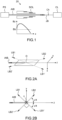
- a first cold atom source 20, called Zeeman slower has been described by Phillips et al in the publication "Laser Deceleration of an Atomic Beam” (Phys.Rev. Lett. Vol 48, n°9, 1982 ) and is illustrated in figure 1 .
- the Zeeman slower is based on the deceleration of atoms by a counter-propagating laser beam called Zeeman beam ZB.
- the atoms have a two level atomic structure with a fundamental state FS and an excited state ExS, the transition between the two states being called the cooling transition defined by the transition wavelength ⁇ c or the transition frequency f c .
- the Zeeman laser has a wavelength related to ⁇ c. In order to efficiently decelerate the atoms, the photons of the Zeeman beam need to be in resonance with the atoms.
- the effective atomic deceleration is limited by two processes: the changing atomic velocity Doppler shifts out of resonance of laser light, and optical pumping limits the number of available photon scattering cycles.
- the atom source of Phillips solves those two problems.
- the cold atoms source 20 comprises a primary atom source PS which is an oven: atoms with a low vapour pressure at 300 K typically require an oven to generate a thermal atomic beam with sufficient flux. This is the case of strontium (Sr), sodium (Na), cadmium (Cd), and ytterbium (Yt) among others.
- the typical operating temperature of an oven is a few hundred degree Celsius, which determines a Maxwell-Boltzmann distribution for the velocity of the thermal atomic beam AtB generated by the oven, with a root mean square value at a few hundred meters/seconds out of the oven.
- the cold atom source also comprises a slowing laser beam ZB with a fixed frequency and having a circular polarization, generated by a cooling laser CL.
- the Zeeman slower uses a spatially varying magnetic field Bz along the axis z of the thermal atomic beam AtB, and which coincides with the slowing laser beam ZB.
- the magnetic field Zeeman tunes the decelerating atoms into constant resonance with the fixed-frequency cooling laser CL and produces selection rules and Zeeman shifts that strongly discriminate against optical pumping.
- the magnetic field keeps the decelerating atoms in resonance with the fixed frequency of the cooling laser thanks to the Zeeman shift, and produces selection rules and Zeeman shifts that strongly inhibit optical pumping.
- the cold atom source 20 comprises a 60 cm long solenoid SOL configured to generate the spatially varying magnetic field along z Bz
- B b is the constant bias magnetic field which solves the Doppler-shift and pumping problems
- B 0 is the magnetic field for which the Zeeman shift matches the Doppler shift for atoms leaving the oven at an initial velocity v 0 and down to zero velocity.
- Atoms with v ⁇ v 0 begin decelerating only when they reach the magnetic field which determines a Zeeman shift exactly compensating their Doppler shift. The result is that all atoms with initial velocity up to v 0 are bunched into one slow velocity group, adapt to be trapped.
- the cooling light can be polarized to address only the targeted transition, namely circular positive (negative) if the magnetic sublevel mF increases (decreases) going from FS to ExS.
- This setup allows an efficient deceleration of atoms but has several drawbacks.
- the atomic trap at the end of the Zeeman slower has the oven in sight, which determines black-body radiation issues and a high collisional rate with background gas which limits the atomic lifetime.
- a mechanical shutter Ch must be installed in vacuum to mechanically hide the path of the thermal atomic beam, or the output atomic beam must be deflected.
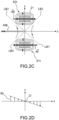
- FIG. 2A The geometrical configuration of the laser beams of the 2D-MOT of Tiecke is shown on figure 2A (perspective), figure 2B (yz plane - 2D-MOT plane), and figures 2C and 2D shows the magnet configuration in the yz plane (magnets plane).
- the axis z propagation of atom beam
- axis x toward the second chamber
- the 2D-MOT cools and traps atoms along the y-z plane, whereas leaves the x free for the transfer of atoms to another chamber (operated by a push beam), where another MOT called 3D-MOT (recapture) is located.
- the 2D-MOT is the first phase of the cooling process, and the second phase occurs in the second chamber with the 3D-MOT.
- the 2D-MOT comprises 4 counter-propagating laser beams in pairs, a first pair of contra-propagating beams (LB1, LB1') and a second pair of contra-propagating beams (LB2, LB2'), the two pairs (LB1, LB1') and (LB2, LB2') being perpendicular to each other.
- the beams are located in the y-z plane (2D-MOT plane) at an angle ⁇ /4 with respect to the z axis and red detuned with respect to the cooling transition.
- the two pairs have opposite circular polarization, and the polarization of the two beams in each pair is also opposite.
- the zone ZTr at the intersection of the beams defines the trap dimension, having a centre O. In Tiecke atoms are Lithium and the cooling transition is around 671 nm.
- the four beams for the 2D-MOT (and the 6 beams for the 3D-MOT) are provided by a unique laser system.
- the 2D-MOT also comprises two sets S1t and S2t of stacked permanents magnet configured to generate a two-dimensional magnetic field with:
- the two sets are arranged symmetrically with respect to the z axis along y and have equal but opposite magnetization +M/-M along z as shown on figure 2C .
- the second Maxwell equation i.e. the Gauss's law of magnetism
- This magnetic field B field being null along one axis (the x one) and varying linearly and with opposite gradient along the two other axes is commonly called linear quadrupole magnetic field.
- the B field is null in only one point, has a gradient G 3D along one axis and a gradient -G 3D /2 along the other two axes.
- This configuration has the advantage of being very compact and strongly reduces the distance between the oven and the atom trapping region, thus increasing the capture solid angle compared to the Phillips configuration.
- the magnetic field is generated by permanent magnets, which is also more compact than the solenoid of Phillips, has a lower consumption and does not need water cooling.
- the 2D MOT produces a jet of cold atoms transferred to another vacuum chamber, where the atoms are recollected (typically in a 3D MOT) and used for the experiment.
- the place where the atoms are recollected is along the x axis, where the B field generated by the permanent magnet of the 2D MOT is zero.
- the magnet configuration of the 2D MOT does not disturb the final experiment.
- the drawback is that the flux of cold atoms captured by the 2D-MOT in the configuration reported by Tiecke is low when compared to a standard Zeeman slower.
- Lamporesi et al Review of scientific Instruments 84, 063102, 2013
- Nosske et al Physical. Review A, 96, 053415, 2017
- Lamporesi realised a sodium source and Nosske a strontium source.
- the tail of the 2D MOT magnetic field is exploited to implement a compact non optimized Zeeman slower, which uses a cooling laser beam CB entering the setup along the z axis in the opposite direction with respect to the thermal beam AtB.
- the Zeeman slower is non optimized because:
- the geometrical configuration of the 2D MOT of the atom source is the one shown in figures 2A to 2D with a different arrangement of the magnets (four stacks of magnet instead of two).
- the complete setup of the cold atom source 30 performed by Nosske is shown on figure 3 .
- the thermal atom beam AtB is generated by the strontium oven OV operated at a temperature range between 450° to 580°C in the case of strontium.
- the different beams are included in high vacuum tubes, the trapped atoms are located in the centre of the multiway cross vacuum chamber.
- the intersection between the 4 2D-MOT beams defines the trap size defined by the zone ZTr.
- the passage of the trapped atoms from the trap chamber toward the ultra-high vacuum chamber of the 3D-MOT is performed by a differential pumping tube DPT along x, and by a pushing beam PB.
- the beam AtBC is the cooled atom beam pushed in the 3D-MOT chamber.
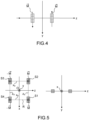
- each of the two sets of Tiecke have been "split" in two, and each half has been translated to respectively +/- x0 as shown on figure 5 (left xz plane, right yz plane).
- the magnetization axis of S1 and S2 is opposite to the magnetisation axis of S3 and S4.
- the permanent magnets generate a linear quadrupole magnetic field for the 2D-MOT with a gradient of ⁇ 50 G/cm near the origin O where the field is equal to 0.
- the magnetic field is used for an auxiliary Zeeman slower; however, given that the magnetic field is orthogonal to the direction of AtB and ZC, both Lamporesi et al. (end of ⁇ II.C in the publication) and Nosske et al. (end of ⁇ II.A in the publication) observed that at maximum half the optical power of the Zeeman slower beam can be set on each of the two polarizations in the atom reference system, and hence used for the atom deceleration.
- This configuration is set by choosing for the Zeeman slower beam a linear polarization along the axis orthogonal to the magnetic field, i.e. x for Nosske and y for Lamporesi.
- the cooling beam of the Zeeman slower and the 2D-MOT beams have frequency offset equal to several natural linewidth ⁇ (linewidth of the two hyperfine levels of the atomic structure, specific to each atom species).
- the centre of the trap is located at 125 mm from the exit of the oven (strontium source).
- the size of the ZTr zone along the y axis Try is +/- 15 mm.
- Nosske defines two regions of the magnetic field topology allowing for the Zeeman slower, labelled 1 and 2 on figure 4 .
- region 1 the magnetic field increases until a maximum value Bmax of 160 G and the gradient is positive
- region 2 the magnetic field decreases from Bmax, passes at zero value at the centre O of the trap and continues to decrease until a minimum value -Bmax, and the gradient is negative.
- the Lamporesi publication assumes that the cooling of the thermal beam is operated on « the vanishing tail » of the magnetic field generated by the permanent magnets , i.e. the region from the oven to the position where the magnetic field is maximum, corresponding to region 1 of Nosske.
- the gradient around the centre is 0.36 T/m (corresponding to 36 G/cm).
- the cooling beam is linearly polarized along the zero magnetic field axis of the 2D-MOT and can be decomposed in two circular components ⁇ + and ⁇ - . Exploiting half of the available optical power means that only one circular component decelerates the atoms, and the other one is wasted.
- the target of the invention is to realize an atomic source which combines compactness and low energy consumption with a high flux of cold atoms.
- the design of the cold atom source according to the invention has a geometry close to the one described in Lamporesi/Nosske, but the frequency detuning of the cooling beam, and optionally magnetic field parameters, are modified in order to achieve a larger cold atomic flux.
- a cold atom source comprising:
- the magnetic device comprises two sets of stacked permanent magnets, respectively arranged along the y axis symmetrically on either side of the z axis and having respective magnetic dipoles oppositely oriented along the z axis.
- the magnetic device comprises four sets of stacked permanent magnets, arranged at the corners of a rectangle in the xz plane centred in O, the two sets arranged on the primary source side and the two sets arranged on the other side having respective magnetic dipoles oppositely oriented along the y axis.
- a cold atom source comprising:
- the absolute value of the extremum located on the side opposite to the primary atom source is strictly greater than the absolute value of the other extremum, of a factor (K) being comprised between 1.3 and 3.
- the magnetic device comprises four sets of stacked permanent magnets arranged at the corners of a rectangle in the xz plane centred in a point O' located on the z axis but offset from O, the two sets arranged on the primary source side and the two sets arranged on the other side having respective magnetic dipoles oppositely oriented along the y axis, and an absolute value of the magnetic dipoles of the two sets arranged on the primary source side being smaller than an absolute value (M1) of the two sets arranged on the other side.
- the atom species is chosen among : Strontium; Ytterbium; Calcium; Magnesium; Cadmium; Sodium.
- the frequency detuning ⁇ z m is such that: ⁇ 1500 MHz ⁇ ⁇ z m ⁇ ⁇ 325 MHz
- the primary atom source is an oven.
- the primary atom source is a solid atomic source whose desorption is controlled by a laser source.
- the inventor approach consists in understanding in detail the physical effects involved in this trap combining 2D-MOT and non-optimized Zeeman slower, in order to improve its performance by modifying parameters of interest.
- the numerical simulation used in Lamporesi considers separately the atomic dynamics from the oven until the the 2D MOT region and inside the 2D MOT, and did not identify the peculiar features of the atomic trajectories (e.g. that atoms can be captured by the 2D-MOT in their second passage in the trapping region), trap operation and efficiency (e.g that both polarization components of the Zeeman cooling beam can be used simultaneously for the atom deceleration).
- the cold atom source 10, 11 according to the invention is shown on figure 7 .
- the cold atom source comprises a primary atom source PAS configured to generate an atomic beam AtB propagating along a z axis of a coordinate system xyz.
- the primary source is an oven.
- the output of the oven can be a single aperture or it can be filled with an array of micro-tubes to increase the source collimation.
- the primary source is a solid atomic source, whose desorption is controlled by a laser source, as reported in Kock et al in "Laser controlled atom source for optical clocks" Scientific Reports 6, 37321 (2016 ) where a thermal jet of atoms is obtained by laser ablation with a laser source preferentially in the ultraviolet range.
- the cold atom source also comprises a two-dimensional magneto-optical trap, called 2D-MOT, comprising a first pair (LB1, LB1') and a second pair (LB2, LB2') of two counter-propagating beams.
- the two pairs are perpendicular to each other and located in a plane yz, and the intersection of which defines a trap zone ZTr having a centre O.
- the dimension of the trap along the z axis is Trz.
- the four beams LB1, LB1', LB2, LB2' trap and cool the atoms and the configuration of the four beams is identical to that of Lamporesi/Nosske.
- the 2D-MOT also comprises a magnetic device MD configured to generate a magnetic field having a null value at centre O and on the x axis at least inside the trap zone.
- a magnetic device MD configured to generate a magnetic field having a null value at centre O and on the x axis at least inside the trap zone.
- the value of the magnetic field gradient is negative.
- the gradient is positive, which requires the inversion of the polarization of the 2D MOT beams, and the exchange of the role of each polarization component in the Zeeman slower.
- the cold atomic source 10, 11 also comprises a cooling beam CBm propagating in a direction opposite to that of the atoms.
- the cooling beam CBm has a linear polarization along the x axis, which is decomposed into a balanced sum of right circular polarisation ⁇ + component and a left circular polarization ⁇ - component. Note that a circular polarization along the y axis would determine only ⁇ transitions on the atoms, which are useless in a Zeeman slower.
- the cooling beam is generated by a laser not shown on figure 7 .
- All the beams are located in interconnected vacuum chambers.
- FIG 8 An example of the cold atom source 10 according to the first variant of the invention is shown on figure 8 , based on the Nosske configuration.
- the trap configuration is shown on A
- the applied magnetic field By is plotted on B
- the configuration of the four magnet sets in the xz plane is shown on C.
- the magnetic device MD is configured so that the component along y By varying along z between two extrema, a positive maximum and a negative minimum as shown on figure 8 B .
- the positive maximum value Bmax and the negative minimum value Bmin have identical absolute values:
- Bmax.
- magnetic device MD comprises two sets (S1t, S2t) of stacked permanent magnets, respectively arranged symmetrically on either side the z axis and having respective magnetic dipoles oppositely oriented along the y axis, as illustrated on figure 2C .
- the magnetic device MD comprises four sets of stacked permanent magnets, arranged at the corners of a rectangle R in the xz plane centred in O.
- the two sets (S3, S4) arranged on the primary source side and the two sets (S1, S2) arranged on the other side have respective magnetic dipoles M oppositely oriented along the y axis, as shown on figure 8 C (similarly to Nosske magnets configuration shown on figure 5 ).
- the viewport is heated to avoid its rapid metallization caused by the strontium thermal beam, for example for strontium to ⁇ 300 °C.
- the distance d ps-O between the primary source and the trap centre O sizes the atom source taking into account the many design and physical constraints. We want this distance as short as possible but it cannot currently be less than 10 cm. A distance of 15 cm is currently a standard for cold atom sources design.
- the maximum B max (minimun B min ) of the magnetic field on the z axis at the position of the magnet stacks is set by the magnet configuration (i.e. position of the magnets and required gradient VB).
- the simulation uses the 4 th order Runge-Kutta algorithm to calculate the atomic dynamics in the presence of i) magnetic field generated by the four stacks of permanent magnets, and ii) of the laser beams of the 2D-MOT and iii) the Zeeman cooler beam.
- the simulation is based on the configuration of figure 8 (A) .
- a first simulation takes into account the 2D-MOT alone without Zeeman cooling beam, with an applied magnetic field as in figure 8 (B) with magnets as in figure 8 (C) .
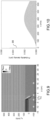
- Figure 9 shows the phase-space plot of the different atomic velocities effused by the oven. It shows trajectories of the atoms along z as a function of the initial speed along z vz at the exit of the oven at 585°C.
- the white lines/curves correspond to trajectories which are not trapped in the 2D-MOT and the black lines the trajectories which are trapped by the 2D-MOT in the origin.
- the background colour corresponds to the value of the acceleration a MAX of the atoms: grey : no acceleration; white : negative acceleration; black : positive acceleration.
- the atoms are decelerated because they diffracts photons and the amount of photons they can diffract depends on the atom species and more particularly on the natural linewidth ⁇ and on the intensity and frequency of the laser light.
- the acceleration is a vector quantity, whose direction is defined by k; for the Zeeman cooling beam it is directed towards the oven, i.e. against the propagation direction of the atoms effused by the oven.
- the maximum value of the acceleration is achieved when the laser beam is set to be resonant with the cooling transition and with an intensity much higher than the saturation intensity Isat, which is defined as the intensity required to reduce the absorption coefficient of the atomic medium to half its value.
- the Zeeman cooling beam is not present, so the trajectories are modified only in the 2D-MOT region, because of the acceleration due to the 2D-MOT beams, which determine a friction force slowing the atomic motion together with a central force bringing them towards the x axis.
- the simulation only takes into account the one dimensional propagation along z of the atoms, and does not consider at first the radial expansion of the thermal beam. It can be seen that only the atoms having initial speed positive and below 70 m/s are trapped.
- Figure 10 shows the Maxwell-Boltzmann distribution of the velocities of atoms emitted by the oven (dark grey), almost completely covered by the modified distribution except at low velocity), and after the action of the trap is taken into account (light grey). Only small speeds in the range [0, 70] m/s are captured (left side of the distribution) which corresponds to a very low number of atoms.
- the peak at 0 velocity 90 represents the atomic fraction captured by the 2D MOT, equal to 0.45%.
- the capture efficiency is corrected to take into account the radial expansion of the atoms during their motion, computed following Greenland et al, Journal of Physics D: Applied Physics 18, 1223 (1985), "Atomic beam velocity distributions ". When the losses due to the radial expansion of the thermal beam are taken into account, such capture efficiency decreases to 0.25%.
- the background colour indicates the acceleration experienced by the atoms at each position and velocity: in addition to the acceleration due to the 2D MOT, there is now also that determined by the Zeeman cooling beam, always directed towards the oven (hence white coloured).
- this one captures atoms in an initial velocity window of similar size, but at higher speed, where the Maxwell-Boltzmann distribution is higher; as a consequence, its capture efficiency results higher, as shown in figure 12 .
- Figure 12 shows how the velocity distribution is modified by this experimental configuration.
- Atoms with lower speed (see speed interval 103) cannot be trapped as they are decelerated to the inversion point before entering in the 2D-MOT.
- Atoms with initial speeds ⁇ 230-240 m/s pass through the 2D-MOT almost unaffected, and are decelerated along the magnetic field slope in region 4 by the ⁇ - polarization component of the Zeeman beam, and are finally captured by the 2D MOT after their motion is inverted thanks to off-resonance scattering caused by the Zeeman beam (trajectory 102 on figure 11 ).
- the exploitation of region 4 has never been reported before, and it is one of the results of the numerical simulation.
- ⁇ eff ⁇ Z ⁇ k v z + ⁇ B g F m F B y z / ⁇
- the two terms added to the nominal laser detuning are thus the Doppler shift and the Zeeman shift of each sublevel m F .
- the atoms In order to be captured by the 2D-MOT, the atoms have to enter in the overlap region defined by the MOT beams (-2.0 cm ⁇ z ⁇ 2.0 cm in the case we consider) with an absolute velocity below the value vc that the 2D MOT can capture.
- the grey zone CR shows the 2D-MOT capture region, defined by the size of the MOT beams and by the MOT velocity capture v c .
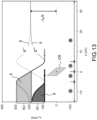
- the magnetic field generated by the permanent magnets for the 2D-MOT has two slopes that can be exploited for the cooling of the thermal beam produced by the oven, when using an opposite circular polarization for the light shined on the opposite direction with respect to the atomic beam, as indicated in figure 13 ; the first magnetic field slope is in region 1 of figure 13 , the second slope in regions 2 and 3 of the same figure.
- Curve 5 shows in the phase space the atoms being in resonance with the ⁇ + polarization component of the cooling beam (detuning ⁇ z ), and curve 6 shows in the phase space the atoms being in resonance with the ⁇ - polarization component of the cooling beam.
- the cooling beam is resonant with a velocity that depends on the local magnetic field, which shifts the atomic levels. More precisely, it is resonant with:
- the effect of the off-resonant photon scattering is an additional acceleration of the atoms in the -z direction, which lowers the velocity obtained with the Zeeman cooling process and eventually inverts the atomic motion. This effect is taken into account in the simulation of the atomic trajectories to determine if they end up trapped by the 2D-MOT when operative.
- the atoms In order for the 2D-MOT to capture atoms decelerated along both magnetic field slopes, the atoms must enter in the 2D-MOT region with a velocity lower in modulus to the capture velocity v c of the MOT ( ⁇ 70 m/s for Sr and with the MOT beam parameters adopted in the example).
- the frequency detuning ⁇ z m is thus determined so that a first set of atoms presenting speeds comprised in the first speed interval IS1 at the exit of the primary atom source and a second set of atoms presenting speeds comprised in the second speed interval IS2, with speeds of IS2 greater than the speeds of IS1, are decelerated because resonant with respectively a first and a second circular polarization component of the cooling beam.
- the second speed interval IS2 is contiguous to the first speed interval IS1.
- IS1 is resonant with ⁇ - and IS2 is resonant with ⁇ + .
- IS2 is resonant with ⁇ - and IS1 is resonant with ⁇ + .
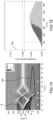
- the atom trajectories in the phase space corresponding to the optimal result for the set of parameters considered above (plus a saturation intensity for the Zeeman beam equal to 1.4) is determined by simulation and presented in figure 14 .
- trajectory 140 is quite long and goes almost at the limit of zone 4.
- the long interval required to travel such a long distance determines a high radial extension of the atomic beam, which decreases substantially the flux of atoms effectively captured by the 2D-MOT.
- the values of the limits of the frequency internal for the detuning ⁇ z m of the cooling beam depend at a first approximation mainly of the atom species (nominal magnetic field gradient required, value of a max , properties of the cooling transition and most notably the wavevector k).
- the interval depends on parameter s.
- the interval is shifted toward high frequencies in absolute value when s increases.
- the interval depends also on the value of the gradient. Still acceptable (but non optimized) results can be obtained by taking a gradient at +100 % /- 50% of the nominal value. For example for strontium it is 40 G/cm + 40 G/cm / 20 G/cm.
- the 2D-MOT parameters (capture velocity, size, beam intensity and extension only slightly influence the values of the limits of the interval.
- the frequency detuning ⁇ z m has to be comprised in an interval I depending on atom species.
- the detuning according to the first variant of the invention is comprised in a global interval of [-1271 MHz ; -325 MHz]. Taking into account variations of the gradient around the nominal values (mainly above the nominal value which more interesting in terms of captured atom flux) the global interval becomes: I G ⁇ ⁇ 1500 MHz ; ⁇ 325 MHz .
- the value of the interval is also I G .
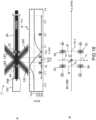
- FIG. 16 A shows the setup configuration.
- the magnetic device MD of cold atom source is configured to generate a magnetic field By varying along z between two extrema, a positive maximum and a negative minimum, the absolute value of the extremum located on a side opposite to the atom primary source being strictly greater than an absolute value of the other extremum. With such asymmetric values of the magnetic field the position on the z axis of the extremum located on the side opposite to the primary atom source has to be determined in order to keep a null value on the centre O.
- the magnetic device MD comprises four sets of stacked permanent magnets.
- the four sets are arranged at the corners of a rectangle R' in the xz plane centred in a point O' located on the z axis but offset from O.
- the two sets (S3, S4) are arranged on the primary source side, and the two sets (S1, S2) are arranged on the other side.
- the two sets (S3, S4) and the two sets (S1, S2) have respective magnetic dipoles oppositely oriented along the y axis.
- the absolute value M2 of the magnetic dipoles of (S3, S4) is smaller than the absolute value M1 of the two sets (S1, S2) (see figure 16 C).
- the cold atom source according to the second variant of the invention also comprises a cooling beam CBm propagating in a direction opposite to that of the atoms.
- the cooling beam presents a frequency detuning with respect to a frequency of a cooling transition having a negative value ⁇ z m depending on the atom species (see further).
- the parameters are identical to those of figure 13 except the magnetic field configuration.
- Curve 15 shows in the phase space the atoms being in resonance with the ⁇ + polarization component of the cooling beam (detuning ⁇ z ), and curve 14 shows in the phase space the atoms being in resonance with the ⁇ - polarization component of the cooling beam.
- the frequency detuning ⁇ z m is thus determined so that a first set of atoms presenting speeds comprised in the first speed interval IS1' at the exit of the primary atom source and a second set of atoms presenting speeds comprised in the second speed interval IS2', with speeds of IS2' greater than speeds of IS1', are decelerated because resonant with respectively a first and a second circular polarization component of the cooling beam.
- IS1' is resonant with ⁇ - and IS2' is resonant with ⁇ + .
- the two intervals IS1' are IS2' are also contiguous.
- the cooling beam is resonant with a velocity that depends on the local magnetic field, which shifts the atomic levels.
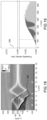
- the main difference with the symmetric configuration is related to the lower output velocity of the atoms decelerated in regions 2 and 3, which permits them to reach the 2D MOT capture region without a long trajectory in region 4.
- the efficiency of the configuration is higher, given the lower impact of the radial beam expansion in terms of atom losses.
- Figure 19 shows the velocity distribution of atoms emitted by the oven (dark grey) at 585 °C and after the action of the trap is taken into account (light grey).
- the fraction of the Maxwell-Boltzman initial velocity distribution being captured by the 2D-MOT amounts to 26.9 % (see peak 190).
- the absolute value of the magnetic field on the side opposite to the primary atom source has to be equal to K times the absolute value of the magnetic field on the side of the primary atom source.
- the lower limit is set to get an effect on the atomic flux.
- the upper limit is set by the encumbrance of the permanent magnet stack and by the disturbance determined by a large magnetic field on the rest of the apparatus, and is set to a ratio of 3. Note that a ratio of 5 gives an atomic source according to the invention, but having such a large and not necessary magnetic field is not very suitable in a cold atom experiment.
- the values of the limits of the interval I* is slightly different in frequency with respect to the interval I determined for the first variant of the invention.
- Each interval has to be determined by simulation.
- the detuning according to the second variant of the invention is comprised in a global interval of [-1330 MHz ; -325 MHz]. Taking into account variations of the gradient around the nominal values (mainly above the nominal value which more interesting in terms of captured atom flux) the global interval becomes: I G * ⁇ ⁇ 1500 MHz ; ⁇ 325 MHz .
- the value of the interval is also I G* .
- the cooling beam CBm presents an additional frequency detuning ⁇ z m' determined from the frequency detuning ⁇ z m. This embodiment is compatible with the first and the second variant of the invention.
- Figure 20 shows a phase-space plot with the atomic trajectories for the atoms according to this embodiment, in combination with the second variant of the invention.
- Curve 16 shows in the phase space the atoms being in resonance with the ⁇ + polarization component of the cooling beam of detuning ⁇ z '
- curve 17 shows in the phase space the atoms being in resonance with the ⁇ - polarization component of the cooling beam of detuning ⁇ z '.
- a third set of atoms with speed comprised in a third speed interval IS3' are captured by the 2D-MOT.
- Atoms with a velocity between 330 m/s and 550 m/s are decelerated in region 1 (i.e.
- Figure 22 shows the corresponding velocity distribution of atoms emitted by the oven (dark grey) at 585 °C and after the combined action of the Zeeman slower and 2D-MOT is taken into account (light grey).
- the atom flux captured by the 2D-MOT is increased compared to the one without the additional detuning.
- ⁇ z m 0 ′ ⁇ z m ⁇ 2 ⁇ B B PSS / ⁇ ⁇ 2 ⁇ / 2 ⁇ with ⁇ B the Bohr magneton, ⁇ the Planck constant and ⁇ /(2 ⁇ ) the natural linewidth of the atom species, and B PSS is the absolute value of the magnetic field extremum located on the primary atom source side.
Landscapes
- Physics & Mathematics (AREA)
- Spectroscopy & Molecular Physics (AREA)
- Engineering & Computer Science (AREA)
- General Engineering & Computer Science (AREA)
- High Energy & Nuclear Physics (AREA)
- Stabilization Of Oscillater, Synchronisation, Frequency Synthesizers (AREA)
Priority Applications (4)
| Application Number | Priority Date | Filing Date | Title |
|---|---|---|---|
| EP23305107.7A EP4407634A1 (de) | 2023-01-27 | 2023-01-27 | Verbesserte quelle für kalte atom |
| JP2025543293A JP2026505282A (ja) | 2023-01-27 | 2024-01-25 | 改善された冷却原子源 |
| EP24701248.7A EP4655803A1 (de) | 2023-01-27 | 2024-01-25 | Verbesserte quelle für kalte atom |
| PCT/EP2024/051794 WO2024156812A1 (en) | 2023-01-27 | 2024-01-25 | Improved cold atom source |
Applications Claiming Priority (1)
| Application Number | Priority Date | Filing Date | Title |
|---|---|---|---|
| EP23305107.7A EP4407634A1 (de) | 2023-01-27 | 2023-01-27 | Verbesserte quelle für kalte atom |
Publications (1)
| Publication Number | Publication Date |
|---|---|
| EP4407634A1 true EP4407634A1 (de) | 2024-07-31 |
Family
ID=85979820
Family Applications (2)
| Application Number | Title | Priority Date | Filing Date |
|---|---|---|---|
| EP23305107.7A Pending EP4407634A1 (de) | 2023-01-27 | 2023-01-27 | Verbesserte quelle für kalte atom |
| EP24701248.7A Pending EP4655803A1 (de) | 2023-01-27 | 2024-01-25 | Verbesserte quelle für kalte atom |
Family Applications After (1)
| Application Number | Title | Priority Date | Filing Date |
|---|---|---|---|
| EP24701248.7A Pending EP4655803A1 (de) | 2023-01-27 | 2024-01-25 | Verbesserte quelle für kalte atom |
Country Status (3)
| Country | Link |
|---|---|
| EP (2) | EP4407634A1 (de) |
| JP (1) | JP2026505282A (de) |
| WO (1) | WO2024156812A1 (de) |
Citations (1)
| Publication number | Priority date | Publication date | Assignee | Title |
|---|---|---|---|---|
| WO2015145136A2 (en) * | 2014-03-24 | 2015-10-01 | The University Of Birmingham | Controlled atom source |
-
2023
- 2023-01-27 EP EP23305107.7A patent/EP4407634A1/de active Pending
-
2024
- 2024-01-25 EP EP24701248.7A patent/EP4655803A1/de active Pending
- 2024-01-25 WO PCT/EP2024/051794 patent/WO2024156812A1/en not_active Ceased
- 2024-01-25 JP JP2025543293A patent/JP2026505282A/ja active Pending
Patent Citations (1)
| Publication number | Priority date | Publication date | Assignee | Title |
|---|---|---|---|---|
| WO2015145136A2 (en) * | 2014-03-24 | 2015-10-01 | The University Of Birmingham | Controlled atom source |
Non-Patent Citations (13)
| Title |
|---|
| GARWOOD DAVIS ET AL: "A hybrid Zeeman slower for lithium", REVIEW OF SCIENTIFIC INSTRUMENTS, AMERICAN INSTITUTE OF PHYSICS, 2 HUNTINGTON QUADRANGLE, MELVILLE, NY 11747, vol. 93, no. 3, 10 March 2022 (2022-03-10), XP012264115, ISSN: 0034-6748, [retrieved on 20220310], DOI: 10.1063/5.0081080 * |
| GREENLAND ET AL., JOURNAL OF PHYSICS D: APPLIED PHYSICS, vol. 18, 1985, pages 1223 |
| INGO NOSSKE ET AL: "Two-dimensional magneto-optical trap as a source for cold strontium atoms", ARXIV.ORG, CORNELL UNIVERSITY LIBRARY, 201 OLIN LIBRARY CORNELL UNIVERSITY ITHACA, NY 14853, 4 September 2017 (2017-09-04), XP081282861, DOI: 10.1103/PHYSREVA.97.039901 * |
| JAROM S JACKSON ET AL: "Magneto-Optical Trap Field Characterization with the Directional Hanle Effect", ARXIV.ORG, CORNELL UNIVERSITY LIBRARY, 201 OLIN LIBRARY CORNELL UNIVERSITY ITHACA, NY 14853, 10 March 2017 (2017-03-10), XP081322591 * |
| JIANING LI ET AL: "Bi-color atomic beam slower and magnetic field compensation for ultracold gases", ARXIV.ORG, CORNELL UNIVERSITY LIBRARY, 201 OLIN LIBRARY CORNELL UNIVERSITY ITHACA, NY 14853, 6 January 2023 (2023-01-06), XP091408767, DOI: 10.1116/5.0126745 * |
| KOCK ET AL.: "Laser controlled atom source for optical clocks", SCIENTIFIC REPORTS, vol. 6, 2016, pages 37321 |
| KOELEMEIJ J C J ET AL: "Magneto-optical trap for metastable helium at 389 nm", ARXIV.ORG, CORNELL UNIVERSITY LIBRARY, 201 OLIN LIBRARY CORNELL UNIVERSITY ITHACA, NY 14853, 15 October 2002 (2002-10-15), XP080096307, DOI: 10.1103/PHYSREVA.67.053406 * |
| LAMPORESI ET AL., REVIEW OF SCIENTIFIC INSTRUMENTS, vol. 84, 2013 |
| NOSSKE ET AL., PHYSICAL. REVIEW A, vol. 96, 2017, pages 053415 |
| PHILLIPS ET AL.: "Laser Deceleration of an Atomic Beam", PHYS.REV. LETT., vol. 48, no. 9, 1982 |
| RAAB ET AL., PHYS.REV. LETT., vol. 59, no. 23, 1987, pages 2631 |
| TIECKE ET AL.: "High flux two-dimensional magneto-optical-trap source for cold lithium atoms", PHYS. REV. A, vol. 80, 2009 |
| XIAOBIN MA ET AL: "A dual-species magneto-optical trap for lithium and strontium atoms", ARXIV.ORG, CORNELL UNIVERSITY LIBRARY, 201 OLIN LIBRARY CORNELL UNIVERSITY ITHACA, NY 14853, 10 April 2019 (2019-04-10), XP081167611 * |
Also Published As
| Publication number | Publication date |
|---|---|
| EP4655803A1 (de) | 2025-12-03 |
| WO2024156812A1 (en) | 2024-08-02 |
| JP2026505282A (ja) | 2026-02-13 |
Similar Documents
| Publication | Publication Date | Title |
|---|---|---|
| Boiron et al. | Three-dimensional cooling of cesium atoms in four-beam gray optical molasses | |
| Youn et al. | Dysprosium magneto-optical traps | |
| Baldwin | Metastable helium: Atom optics with nano-grenades | |
| Sharma et al. | All-optical atom trap as a target for MOTRIMS-like collision experiments | |
| CN112236833A (zh) | 冷原子束生成方法、冷原子束生成装置、原子干涉仪 | |
| Hopkins et al. | A versatile dual-species Zeeman slower for caesium and ytterbium | |
| CN116420080B (zh) | 惯性传感器、原子干涉仪、调整原子的速度的方法、调整原子的速度的装置 | |
| Steffens | Polarized heavy ion beams at tandem accelerators | |
| Wang et al. | Strong-field atomic physics meets 229Th nuclear physics | |
| EP4407634A1 (de) | Verbesserte quelle für kalte atom | |
| Park et al. | Optical Stern-Gerlach effect from the Zeeman-like ac Stark shift | |
| Feng et al. | Compact and high flux strontium atom source | |
| Miyake et al. | Ultra slow muons generated by laser resonant ionization of thermal muonium produced by 500‐MeV protons with hot tungsten | |
| Nasyrov et al. | Magneto-optical trap operating on a magnetically induced level-mixing effect | |
| Nakano et al. | Selective production of the doubly excited 2 p 2 (1 D) state in He-like Ar 16+ ions by resonant coherent excitation | |
| Levy et al. | Polarized ion sources for high-energy accelerators | |
| Baumann et al. | Time lens for high-resolution neutron time-of-flight spectrometers | |
| Ramirez-Serrano | Photoassociation spectroscopy of cold atoms in a bright atomic beam | |
| Spies et al. | Recombination experiments at CRYRING | |
| Strecker | Sympathetic cooling of a Bose/Fermi mixture of lithium to quantum degeneracy | |
| Musumeci et al. | Inverse Free Electron Laser Experiment at the Neptune Laboratory | |
| Jin | State-dependent alignment effect at dispersion of carbon disulfide molecules by a pulsed optical standing wave | |
| EP3096867A1 (de) | Resonante verbesserung der photoionisation von gasförmigen atomen | |
| Leduc et al. | Ultracold metastable helium: from atoms to exotic molecules | |
| Peixoto | Enhanced loading of a lithium 7 magneto optical trap using transverse cooling and frequency spread light |
Legal Events
| Date | Code | Title | Description |
|---|---|---|---|
| PUAI | Public reference made under article 153(3) epc to a published international application that has entered the european phase |
Free format text: ORIGINAL CODE: 0009012 |
|
| STAA | Information on the status of an ep patent application or granted ep patent |
Free format text: STATUS: THE APPLICATION HAS BEEN PUBLISHED |
|
| AK | Designated contracting states |
Kind code of ref document: A1 Designated state(s): AL AT BE BG CH CY CZ DE DK EE ES FI FR GB GR HR HU IE IS IT LI LT LU LV MC ME MK MT NL NO PL PT RO RS SE SI SK SM TR |
|
| STAA | Information on the status of an ep patent application or granted ep patent |
Free format text: STATUS: REQUEST FOR EXAMINATION WAS MADE |
|
| 17P | Request for examination filed |
Effective date: 20241206 |