EP4407633A1 - Verfahren, programm und vorrichtung zum trainieren und ableiten eines tiefenlernmodells auf basis von medizinischen daten - Google Patents
Verfahren, programm und vorrichtung zum trainieren und ableiten eines tiefenlernmodells auf basis von medizinischen daten Download PDFInfo
- Publication number
- EP4407633A1 EP4407633A1 EP22873142.8A EP22873142A EP4407633A1 EP 4407633 A1 EP4407633 A1 EP 4407633A1 EP 22873142 A EP22873142 A EP 22873142A EP 4407633 A1 EP4407633 A1 EP 4407633A1
- Authority
- EP
- European Patent Office
- Prior art keywords
- neural network
- network model
- function
- training
- medical data
- Prior art date
- Legal status (The legal status is an assumption and is not a legal conclusion. Google has not performed a legal analysis and makes no representation as to the accuracy of the status listed.)
- Pending
Links
Images



Classifications
-
- G—PHYSICS
- G06—COMPUTING OR CALCULATING; COUNTING
- G06N—COMPUTING ARRANGEMENTS BASED ON SPECIFIC COMPUTATIONAL MODELS
- G06N3/00—Computing arrangements based on biological models
- G06N3/02—Neural networks
- G06N3/08—Learning methods
-
- A—HUMAN NECESSITIES
- A61—MEDICAL OR VETERINARY SCIENCE; HYGIENE
- A61B—DIAGNOSIS; SURGERY; IDENTIFICATION
- A61B5/00—Measuring for diagnostic purposes; Identification of persons
- A61B5/24—Detecting, measuring or recording bioelectric or biomagnetic signals of the body or parts thereof
- A61B5/316—Modalities, i.e. specific diagnostic methods
- A61B5/318—Heart-related electrical modalities, e.g. electrocardiography [ECG]
- A61B5/346—Analysis of electrocardiograms
-
- G—PHYSICS
- G06—COMPUTING OR CALCULATING; COUNTING
- G06F—ELECTRIC DIGITAL DATA PROCESSING
- G06F16/00—Information retrieval; Database structures therefor; File system structures therefor
- G06F16/90—Details of database functions independent of the retrieved data types
- G06F16/906—Clustering; Classification
-
- G—PHYSICS
- G06—COMPUTING OR CALCULATING; COUNTING
- G06N—COMPUTING ARRANGEMENTS BASED ON SPECIFIC COMPUTATIONAL MODELS
- G06N3/00—Computing arrangements based on biological models
- G06N3/02—Neural networks
- G06N3/04—Architecture, e.g. interconnection topology
-
- G—PHYSICS
- G06—COMPUTING OR CALCULATING; COUNTING
- G06N—COMPUTING ARRANGEMENTS BASED ON SPECIFIC COMPUTATIONAL MODELS
- G06N3/00—Computing arrangements based on biological models
- G06N3/02—Neural networks
- G06N3/04—Architecture, e.g. interconnection topology
- G06N3/044—Recurrent networks, e.g. Hopfield networks
-
- G—PHYSICS
- G06—COMPUTING OR CALCULATING; COUNTING
- G06N—COMPUTING ARRANGEMENTS BASED ON SPECIFIC COMPUTATIONAL MODELS
- G06N3/00—Computing arrangements based on biological models
- G06N3/02—Neural networks
- G06N3/04—Architecture, e.g. interconnection topology
- G06N3/045—Combinations of networks
-
- G—PHYSICS
- G06—COMPUTING OR CALCULATING; COUNTING
- G06N—COMPUTING ARRANGEMENTS BASED ON SPECIFIC COMPUTATIONAL MODELS
- G06N3/00—Computing arrangements based on biological models
- G06N3/02—Neural networks
- G06N3/08—Learning methods
- G06N3/084—Backpropagation, e.g. using gradient descent
-
- G—PHYSICS
- G16—INFORMATION AND COMMUNICATION TECHNOLOGY [ICT] SPECIALLY ADAPTED FOR SPECIFIC APPLICATION FIELDS
- G16H—HEALTHCARE INFORMATICS, i.e. INFORMATION AND COMMUNICATION TECHNOLOGY [ICT] SPECIALLY ADAPTED FOR THE HANDLING OR PROCESSING OF MEDICAL OR HEALTHCARE DATA
- G16H10/00—ICT specially adapted for the handling or processing of patient-related medical or healthcare data
- G16H10/60—ICT specially adapted for the handling or processing of patient-related medical or healthcare data for patient-specific data, e.g. for electronic patient records
-
- G—PHYSICS
- G16—INFORMATION AND COMMUNICATION TECHNOLOGY [ICT] SPECIALLY ADAPTED FOR SPECIFIC APPLICATION FIELDS
- G16H—HEALTHCARE INFORMATICS, i.e. INFORMATION AND COMMUNICATION TECHNOLOGY [ICT] SPECIALLY ADAPTED FOR THE HANDLING OR PROCESSING OF MEDICAL OR HEALTHCARE DATA
- G16H50/00—ICT specially adapted for medical diagnosis, medical simulation or medical data mining; ICT specially adapted for detecting, monitoring or modelling epidemics or pandemics
- G16H50/20—ICT specially adapted for medical diagnosis, medical simulation or medical data mining; ICT specially adapted for detecting, monitoring or modelling epidemics or pandemics for computer-aided diagnosis, e.g. based on medical expert systems
-
- G—PHYSICS
- G16—INFORMATION AND COMMUNICATION TECHNOLOGY [ICT] SPECIALLY ADAPTED FOR SPECIFIC APPLICATION FIELDS
- G16H—HEALTHCARE INFORMATICS, i.e. INFORMATION AND COMMUNICATION TECHNOLOGY [ICT] SPECIALLY ADAPTED FOR THE HANDLING OR PROCESSING OF MEDICAL OR HEALTHCARE DATA
- G16H50/00—ICT specially adapted for medical diagnosis, medical simulation or medical data mining; ICT specially adapted for detecting, monitoring or modelling epidemics or pandemics
- G16H50/70—ICT specially adapted for medical diagnosis, medical simulation or medical data mining; ICT specially adapted for detecting, monitoring or modelling epidemics or pandemics for mining of medical data, e.g. analysing previous cases of other patients
-
- A—HUMAN NECESSITIES
- A61—MEDICAL OR VETERINARY SCIENCE; HYGIENE
- A61B—DIAGNOSIS; SURGERY; IDENTIFICATION
- A61B5/00—Measuring for diagnostic purposes; Identification of persons
- A61B5/24—Detecting, measuring or recording bioelectric or biomagnetic signals of the body or parts thereof
- A61B5/25—Bioelectric electrodes therefor
- A61B5/279—Bioelectric electrodes therefor specially adapted for particular uses
- A61B5/28—Bioelectric electrodes therefor specially adapted for particular uses for electrocardiography [ECG]
Definitions
- the present disclosure relates to deep learning technology in the medical field, and more particularly to a method of training a deep learning model by using inductive bias transfer and utilizing the trained deep learning model in the medical field.
- DeiT Data efficient image Transformer
- DeiT adopts a method of distilling the knowledge of a convolutional neural network, which plays an important role in generalization performance, into a transformer through additional tokens by using the convolutional neural network as a teacher for the transformer.
- DeiT assumes that performance can be improved by encoding the inductive bias of the convolutional neural network into the transformer through the distillation method.
- DeiT in order to perform knowledge distillation, DeiT also requires a predetermined amount of data to be secured. Accordingly, DeiT has the problem of being difficult to utilize in the medical field in which a sufficient number of data classes for knowledge distillation have not been accumulated.
- ImageNet which has been previously used to evaluate the performance of DieT, consists of thousands of classes, whereas medical data such as electrocardiogram data, electronic health records (EHR) data, and/or the like contain only tens to tens of classes.
- the present disclosure has been conceived in response to the above-described background technology, and an object of the present disclosure is to provide a method of training a deep learning model by efficiently transferring inductive bias even using a small data set in the medical field and also provide a method of estimating various health conditions by using a deep learning model trained based on the above training method.
- the training method may include: training a first neural network model based on medical data; and training a second neural network model based on the trained first neural network model by matching a first operation function representative of a neural network block included in the trained first neural network model and a second operation function representative of a neural network block included in the second neural network model.
- training the second neural network model based on the trained first neural network model by matching the first operation function representative of the neural network block included in the trained first neural network model and the second operation function representative of the neural network block included in the second neural network model may include training the second neural network model based on the trained first neural network model by using a loss function for matching at least one of inputs or dimensions between the first and second operation functions.
- the loss function may include: a first sub-loss function adapted to use th output of a first operation function corresponding to an (n-1)-th (n is a natural number) neural network block included in the first neural network model as an input variable; and a second sub-loss function adapted to use the output of a second operation function corresponding to an (n-1)-th neural network block included in the second neural network model as an input variable.
- each of the first and second sub-loss functions may be a function for calculating the difference between the output of a first operation function corresponding to an n-th neural network block included in the first neural network model and the output of a second operation function corresponding to an n-th neural network block included in the second neural network model.
- each of the first and second sub-loss functions may include a transformation function for matching the dimensions of the first operation function corresponding to the n-th neural network block and the second operation function corresponding to the n-th neural network block.
- the transformation function may include: a first sub-transformation function for linearly transforming the input variables of the transformation function in a temporal direction; and a second sub-transformation function for linearly transforming the input variables of the transformation function in a feature dimension.
- the transformation function included in the first sub-loss function may be a function for: matching the dimension of the output of the first operation function corresponding to the (n-1)-th neural network block to the dimension of the input of the second operation function corresponding to the n-th neural network block; and matching the dimension of the output of the second calculation function corresponding to the n-th neural network block to the dimension of the output of the first calculation function corresponding to the n-th neural network block.
- the transformation function included in the second sub-loss function may be a function for: matching the dimension of the output of the second operation function corresponding to the (n-1)-th neural network block to the dimension of the input of the first operation function corresponding to the n-th neural network block; and matching the dimension of the output of the first operation function corresponding to the n-th neural network block to the dimension of the output of the second operation function corresponding to the n-th neural network block.
- the loss function may further include a third sub-loss function for calculating the difference between the output of the first neural network model having received the medical data and the output of the second neural network model having received the medical data.
- the third sub-loss function may include a transformation function for matching the dimension of the output of the first neural network model having received the medical data to the dimension of the output of the second neural network model having received the medical data.
- the method may further include fine-tuning the second neural network model based on the medical data.
- the fine-tuning may be training the second neural network model while maintaining the weight of the second neural network model close to a weight in the state in which training based on the trained first neural network model has been completed.
- the first neural network model may include at least one of a convolutional neural network or a recurrent neural network
- the second neural network model may include a self-attention-based neural network
- the medical data may include at least one of electrocardiogram data or electronic health records (EHR) data.
- EHR electronic health records
- an inference method of a deep learning model based on medical data which is performed by a computing device.
- the inference method may include: acquiring medical data including at least one of electrocardiogram data or electronic health records (EHR) data; and estimating a person's health condition based on the medical data by using a second neural network model.
- the second neural network model has been trained through operations for matching a first operation function corresponding to a neural network block included in a pre-trained first neural network model and a second operation function corresponding to a neural network block included in the second neural network model based on the pre-trained first neural network model.
- a computer program stored in a computer-readable storage medium.
- the computer program performs operations for training a deep learning model based on medical date when executed on one or more processors.
- the operations may include operations of: training a first neural network model based on medical data; and training a second neural network model based on the trained first neural network model by matching a first operation function representative of a neural network block included in the trained first neural network model and a second operation function representative of a neural network block included in the second neural network model.
- a computing device for training a deep learning model based on medical data.
- the computing device may include: a processor including at least one core; memory including program codes that are executable on the processor; and a network unit configured to acquire medical data.
- the processor may train a first neural network model based on medical data, and may train a second neural network model based on the trained first neural network model by matching a first operation function representative of a neural network block included in the trained first neural network model and a second operation function representative of a neural network block included in the second neural network model.
- the present disclosure provides the method of training a deep learning model, which can generalize a student model even based on a small amount of data by appropriately utilizing the strong inductive bias of a teacher model, and also provides the method of effectively utilizing a deep learning model, trained through the above training method, in the medical field.
- N-th (N is a natural number)
- N is a natural number
- components performing different functional roles may be distinguished as a first component or a second component.
- components that are substantially the same within the technical spirit of the present disclosure but should be distinguished for the convenience of description may also be distinguished as a first component or a second component.
- acquisition used herein can be understood to mean not only receiving data over a wired/wireless communication network connecting with an external device or a system, but also generating data in an on-device form.
- module or “unit” used herein may be understood as a term referring to an independent functional unit processing computing resources, such as a computer-related entity, firmware, software or part thereof, hardware or part thereof, or a combination of software and hardware.
- the "module” or “unit” may be a unit composed of a single component, or may be a unit expressed as a combination or set of multiple components.
- the term “module” or “unit” may refer to a hardware component or set of components of a computing device, an application program performing a specific function of software, a procedure implemented through the execution of software, a set of instructions for the execution of a program, or the like.
- module or “unit” may refer to a computing device itself constituting part of a system, an application running on the computing device, or the like.
- the above-described concepts are only examples, and the concept of “module” or “unit” may be defined in various manners within a range understandable to those skilled in the art based on the content of the present disclosure.
- model used herein may be understood as a system implemented using mathematical concepts and language to solve a specific problem, a set of software units intended to solve a specific problem, or an abstract model for a process intended to solve a specific problem.
- a neural network "model” may refer to an overall system implemented as a neural network that is provided with problem-solving capabilities through training.
- the neural network may be provided with problem-solving capabilities by optimizing parameters connecting nodes or neurons through training.
- the neural network "model” may include a single neural network, or a neural network set in which multiple neural networks are combined together.
- Data used herein may include “images,” signals, etc.
- image used herein may refer to multidimensional data composed of discrete image elements.
- image may be understood as a term referring to a digital representation of an object that can be seen by the human eye.
- image may refer to multidimensional data composed of elements corresponding to pixels in a two-dimensional image.
- Image may refer to multidimensional data composed of elements corresponding to voxels in a three-dimensional image.
- inductive bias used herein can be understood as a set of assumptions that enable the inductive inference of a deep learning model. In order to resolve the generalization error in which a deep learning model exhibits appropriate performance only for given training data, it is necessary for the deep learning model to infer an output close to an accurate output for data other than the given training data. Accordingly, “inductive bias” can be understood as a set of preconditions that a deep learning model has in the process of being trained to predict the output of an ungiven input.
- a neural network "block” may be understood as a set of neural networks including one or more neural networks. In this case, it can be assumed that the neural networks included in the neural network "block” perform predetermined operations to achieve a common purpose that serves as a classification criterion.
- operation function used herein can be understood as a mathematical presentation for a configurational unit that performs a specific function or processes an operation.
- operation function of a neural network block
- the "operation function" of a neural network block can be understood as a mathematical representation representative of a neural network block that processes a specific operation. Accordingly, the relationship between the input and output of the neural network block can be represented by a formula through the "operation function" of the neural network block.
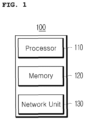
- FIG. 1 is a block diagram of a computing device according to an embodiment of the present disclosure.
- a computing device 100 may be a hardware device or part of a hardware device that performs the comprehensive processing and calculation of data, or may be a software-based computing environment that is connected to a communication network.
- the computing device 100 may be a server that performs an intensive data processing function and shares resources, or may be a client that shares resources through interaction with a server.
- the computing device 100 may be a cloud system in which a plurality of servers and clients interact with each other and comprehensively process data. Since the above descriptions are only examples related to the type of computing device 100, the type of computing device 100 may be configured in various manners within a range understandable to those skilled in the art based on the content of the present disclosure.
- the computing device 100 may include a processor 110, memory 120, and a network unit 130.
- FIG. 1 shows only an example, and the computing device 100 may include other components for implementing a computing environment. Furthermore, only some of the components disclosed above may be included in the computing device 100.
- the processor 110 may be understood as a configuration unit including hardware and/or software for performing computing operation.
- the processor 110 may read a computer program and perform data processing for machine learning.
- the processor 110 may process computational processes such as the processing of input data for machine learning, the extraction of features for machine learning, and the calculation of errors based on backpropagation.
- the processor 110 for performing such data processing may include a central processing unit (CPU), a general purpose graphics processing unit (GPGPU), a tensor processing unit (TPU), an application specific integrated circuit (ASIC), or a field programmable gate array (FPGA). Since the types of processor 110 described above are only examples, the type of processor 110 may be configured in various manners within a range understandable to those skilled in the art based on the content of the present disclosure.
- the processor 110 may train a neural network model for estimating a person's health condition based on knowledge distillation, which transfers the knowledge of a teacher model to a student model. For example, the processor 110 may train the teacher model to estimate a person's health condition based on medical data. The processor 110 may train the student model based on the inductive bias generated during the process of training the teacher model. In order to transfer the inductive bias of the teacher model to the student model during the process of training the student model, the processor 110 may match individual operation functions representative of a plurality of neural network blocks included in the teacher model and individual operation functions representative of a plurality of neural network blocks included in the student model.
- the matching of the operation functions may be understood as an operation that allows the student model to be trained on the inductive bias of the teacher model by minimizing the difference between the features interpreted by the individual neural network blocks of the teacher model and the features interpreted by the individual neural network blocks of the student model.
- the processor 110 may effectively transfer the inductive bias of the teacher model to the student model even by using a small amount of medical data.
- the processor 110 may efficiently train the student model based on the knowledge of the teacher model even when a sufficient amount of data is not secured. Additionally, through the training for the performance of the matching of operation functions, the processor 110 may guarantee the performance of generalization of the student model.
- the processor 110 may estimate a person's health condition based on medical data by using the neural network model generated through the above-described training process.
- the processor 110 may generate inference data representative of the results of estimation of a person's health condition by inputting medical data to the neural network model trained through the above-described process. For example, the processor 110 may predict whether a chronic disease such as arrhythmia has occurred and the progress of the chronic disease by inputting electrocardiogram data to the trained student model.
- the processor 110 may generate data related to information necessary for the management of a patient, such as changes in the patient's heart rate by inputting electronic health records (EHR) data to the trained student model.
- EHR electronic health records
- the type of medical data and the output of the neural network model may be configured in various manners within a range understandable to those skilled in the art based on the content of the present disclosure.
- the memory 120 may be understood as a configuration unit including hardware and/or software for storing and managing data that is processed in the computing device 100. That is, the memory 120 may store any type of data generated or determined by the processor 110 and any type of data received by the network unit 130.
- the memory 120 may include at least one type of storage medium of a flash memory type, hard disk type, multimedia card micro type, and card type memory, random access memory (RAM), static random access memory (SRAM), read-only memory (ROM), electrically erasable programmable read-only memory (EEPROM), programmable read-only memory (PROM), magnetic memory, a magnetic disk, and an optical disk.
- the memory 120 may include a database system that controls and manages data in a predetermined system. Since the types of memory 120 described above are only examples, the type of memory 120 may be configured in various manners within a range understandable to those skilled in the art based on the content of the present disclosure.
- the memory 120 may structure, organize, and manage data necessary for the processor 110 to perform computation, the combination of data, and program codes executable on the processor 110.
- the memory 120 may store medical data received through the network unit 130, which will be described later.
- the memory 120 may store program codes configured to operate the neural network model to receive medical data and perform learning, program codes configured to operate the neural network model to receive medical data and perform inference in accordance with the purpose of use of the computing device 100, processed data generated as program codes are executed, etc.
- the network unit 130 may be understood as a configuration unit that transmits and receives data through any type of known wired/wireless communication system.
- the network unit 130 may perform data transmission and reception using a wired/wireless communication system such as a local area network (LAN), a wideband code division multiple access (WCDMA) network, a long term evolution (LTE) network, the wireless broadband Internet (WiBro), a 5th generation mobile communication (5G) network, a ultra wide-band wireless communication network, a ZigBee network, a radio frequency (RF) communication network, a wireless LAN, a wireless fidelity network, a near field communication (NFC) network, or a Bluetooth network.
- LAN local area network
- WCDMA wideband code division multiple access
- LTE long term evolution
- WiBro wireless broadband Internet
- 5G 5th generation mobile communication
- RF radio frequency
- the network unit 130 may receive data necessary for the processor 110 to perform computation through wired/wireless communication with any system or client or the like. Furthermore, the network unit 130 may transmit data generated through the computation of the processor 110 through wired/wireless communication with any system or client or the like. For example, the network unit 130 may receive medical data through communication with a database within a hospital environment, a cloud server configured to perform tasks such as the standardization of medical data, a computing device, or the like. The network unit 130 may transmit the output data of the neural network model, intermediate data and processed data acquired from the computation process of the processor 110, etc. through communication with the above-described database, server, or computing device.
- FIG. 2 is a block diagram showing a process of training a deep learning model according to an embodiment of the present disclosure.
- the processor 110 may perform a three-step training process to train a neural network model for estimating a person's health condition based on medical data.
- the processor 110 may perform step A of training a first neural network model 200 to have an inductive bias for estimating a person's health condition based on medical data.
- the processor 110 may perform step B of transferring the inductive bias of the first neural network model 200, enhanced through step A, to the second neural network model 300.
- the processor 110 may perform step C of fine-tuning the second neural network model 300, trained through step B, to suit the purpose of use.
- step C does not necessarily need to be performed, and may or may not be performed depending on the purpose of using the second neural network model 300.
- the processor 110 may train the first neural network model 200 to generate an inductive bias to be transferred to the second neural network model 300.
- the processor 110 may generate an output for estimating a person's health condition by inputting medical data 11 to the first neural network model 200.
- the processor 110 may reconstruct the parameters, such as the weight, of the neural network by comparing the output of the first neural network model 200 with the ground truth (GT) through a loss function.
- the processor 110 may train the first neural network model 200 based on the medical data 11 by repeatedly performing the above operation until the loss function converges.
- the first neural network model 200 includes a convolutional neural network
- the first neural network model 200 may enhance the inductive bias of locality and translation invariance for the medical data 11 through step A.
- the first neural network model 200 includes a recurrent neural network
- the first neural network model 200 may enhance the inductive bias of temporal invariance for the medical data 11 through step A.
- the processor 110 may match a plurality of neural network blocks 210 included in the first neural network model 200 with a plurality of neural network blocks 220 included in the second neural network model 300 so that the second neural network model 300 can be trained on the inductive bias of the first neural network model 200 enhanced through step A.
- the processor 110 may input medical data 15 to each of the first neural network model 200 and the second neural network model 300.
- the medical data 15 of step B may be the same as or different from the medical data 11 of step A.
- the processor 100 may calculate the difference between the output of each of the plurality of neural network blocks 210 included in the first neural network model 200 and the output of each of the plurality of neural network blocks 220 included in the second neural network model 300 by using the loss function. That is, the processor 110 may pair the plurality of neural network blocks 210 included in the first neural network model 200 and the plurality of neural network blocks 220 included in the second neural network model 300 and then calculate loss.
- the differences in the input and/or dimension may occur between the neural network blocks 210 and 220 to be matched.
- the first neural network model 200 includes at least one of a convolutional neural network or a recurrent neural network and the second neural network model 300 includes a self-attention-based neural network
- the processor 110 may perform an operation of matching the inputs and/or dimensions between the neural network blocks 210 and 220 in the process of calculating the differences using the loss function.
- the processor 110 may alternately input the intermediate output of the first neural network model 200 and the intermediate output of the second neural network model 300 to the blocks 210 and 220, and may perform an operation of matching the input and output dimensions of the blocks 210 and 220. Through such input and dimension matching, the processor 110 may effectively match the neural network blocks 210 and 220 even when the types of neural networks included in the first neural network model 200 and the second neural network model 300 are different.
- the processor 110 may calculate the difference between the final output of the first neural network model 200 and the final output of the second neural network model 300 by using a loss function.
- the processor 110 may transfer the inductive bias of the first neural network model 200 to the second neural network model 300 by repeatedly performing the above-described matching between the neural network blocks and the above-described matching between the final outputs until the loss function converges.
- the processor 110 may train the second neural network model 300 based on the first neural network model 200, trained through step A, through the neural network block matching in step B.
- the processor 110 may fine-tune the second neural network model 300 that has been trained on the inductive bias of the first neural network model 200.
- the fine tuning may be understood as a training process of optimizing the second neural network model 300 for a specific task in accordance with the purpose of use of the second neural network model 300.
- the processor 110 may generate an output for estimating the person's health condition by inputting the medical data 19 to the second neural network model 300 trained through step B.
- the medical data 19 may be electrocardiogram data or electronic health records data depending on the purpose of using the second neural network model 300.
- the second neural network model 300 may receive electrocardiogram data to estimate chronic disease such as arrhythmia, and may receive electronic health records data to estimate changes in the condition of a critically ill patient.
- the processor 110 may reconstruct the parameters, such as the weight, of the neural network by comparing the output of the second neural network model 300 with the ground truth GT through the loss function.
- the processor 110 may re-train the second neural network model 300 based on the medical data 19 by repeatedly performing the above operation until the loss function converges.
- FIG. 3 is a conceptual diagram showing the operation process of a loss function according to an embodiment of the present disclosure.
- the first neural network model 200 is assumed to be a convolutional neural network model or a recurrent neural network model
- the second neural network model 300 is assumed to be a self-attention-based transformer model.
- the first neural network model 200 and the second neural network model 300 may be interpreted as a combination of operation functions representative of neural network blocks as shown in Equation 1 below.
- f l f ⁇ f n ⁇ ⁇ ⁇ f 1
- g l g ⁇ g n ⁇ ⁇ ⁇ g 1
- f denotes the first neural network model 200
- f n denotes the n-th (n is a natural number) neural network block of the first neural network model 200
- g denotes the second neural network model 300
- g n denotes the n-th neural network block of the second neural network model 300.
- l f denotes the classifier of the first neural network model 200
- l g denotes the classifier of the second neural network model 300.
- the processor 110 may perform an operation of matching f n and g n . Matching operations may be basically divided into input matching and dimension matching.
- the input of the second function g 2 of the second neural network model 300 is g 1 ( x )
- the input of the second function f 2 of the first neural network model 200 is f 1 ( x ).
- matching between the two functions is performed as an operation of minimizing ⁇ g 2 ( g 1 ( x )) - f 2 ( f 1 ( x )) ⁇ .
- this matching operation may not guarantee that g 2 is close to f 2 .
- the processor 110 alleviates the above-described problem by transferring signals to both operation flows of the first neural network model 200 and the second neural network model 300. That is, in the present disclosure, matching between the two functions is performed as an operation of minimizing ⁇ g 2 ( f 1 ( x )) - f 2 ( f 1 ( x )) ⁇ - ⁇ g 2 ( g 1 ( x )) - f 2 ( g 1 ( x )) ⁇ .
- a problem with a dimensional difference may occur due to the functions through which input passes.
- f n ( ⁇ ) representative of the n-th neural network block of the first neural network model 200 a pooling operation and a convolution-with-stride operation change a dimension according to a temporal direction, and a convolution operation change also expands the dimension of features.
- the processor 110 may use a transformation function h ( ⁇ ) that transforms individual dimensions into the same one.
- h z I z W
- Equation 2 I ( ⁇ ) denotes the linear transformation of the temporal direction, and W denotes the linear transformation of the feature dimension.
- the transformation function h ( ⁇ ) may be represented by the product of a function for the linear transformation of the temporal direction of an input variable and a function for the linear transformation of the feature dimension of the input variable.
- L n 1 ⁇ t , d f n z n ⁇ 1 f ⁇ h n g ⁇ f ⁇ g n ⁇ h n ⁇ 1 f ⁇ g z n ⁇ 1 f 2
- L n 2 ⁇ t , d g n z n ⁇ 1 g ⁇ h n f ⁇ g ⁇ f n ⁇ h n ⁇ 1 g ⁇ f z n ⁇ 1 g 2
- L n 1 may correspond to (a) of FIG. 3
- L n 2 may correspond to (b) of FIG. 3 .
- the total loss function L for training the second neural network model 300, which is a transformer model, on the inductive bias of the first neural network model 200, which is a convolutional neural network model or a recurrent neural network model, may be represented by the following Equation 5 obtained by integrating the above-described Equations 3 and 4.
- the weight ⁇ in the state in which training has been completed may be used as the initial weight of training using a randomly initialized classifier.
- the processor 110 may fine-tune the trained second neural network model 300 by minimizing loss through the same task as the first neural network model 200 having an inductive bias.
- the processor 110 may normalize the second neural network model 300 so that the second neural network model 300 can be prevented from forgetting the inductive bias, transferred from the first neural network model 200, by keeping the weight ⁇ g close to the initial weights ⁇ f ⁇ g .
- training is performed by efficiently transferring the inductive bias of the first neural network model 200 to the second neural network model 300, and the second neural network model 300 may be effectively optimized to suit the purpose of use in the medical field. Furthermore, in the medical field in which sufficient data is not accumulated, the second neural network model 300 may be trained to ensure generalization performance even by using a small amount of data, so that it can be easily used for various tasks in the medical field.
- FIG. 4 is a graph showing the results of the comparison and evaluation of the performance of a deep learning model trained according to an embodiment of the present disclosure and the performance of a conventional solution.
- FIG. 4(a) shows the results of the comparison among the performance of the convolutional neural network 41, the performance of a DieT 45, and the performance of the neural network 49 of the present disclosure, trained through the reception of the inductive bias from the convolutional neural network 41, based on electrocardiogram data.
- F1 represents an f-1 score
- P-21 represents a physionet 21 score.
- the performance of the neural network 49 of the present disclosure is superior to that of the convolutional neural network 41 that has transferred the inductive bias.
- the performance of the neural network 49 of the present disclosure is significantly superior to that of the DieT 45, which is based on knowledge distillation.
- the performance of the DieT 45 is inferior to that of the convolutional neural network 41.
- FIG. 4(b) shows the results of the comparison among the performance of the convolutional neural network 51, the performance of a DieT 55, and the performance of the neural network 59 of the present disclosure, trained through the reception of the inductive bias from the convolutional neural network 51, based on electronic medical record data.
- P-19 represents a physionet 19 score.
- the performance of the neural network 59 of the present disclosure is superior to that of the convolutional neural network 51 that has transferred the inductive bias.
- the performance of the neural network 49 of the present disclosure is significantly superior to that of the DieT 45, which is based on knowledge distillation, based on P-15.
- the neural network trained through the training method of the present disclosure is more suitable for the medical field in which sufficient data for training is not accumulated than the DieT. Furthermore, it can be seen that the neural network trained through the training method of the present disclosure successfully encodes the inductive bias of a preceding model and exhibits better performance than the preceding model.
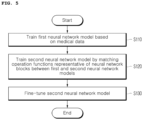
- FIG. 5 is a flowchart showing a method of training a deep learning model according to an embodiment of the present disclosure.
- the computing device 100 may train a first neural network model based on medical data in step S110.
- the computing device 100 may train the first neural network model so that the first neural network model can estimate the health condition of a person based on the medical data.
- the computing device 100 may receive at least one of electrocardiogram data or electronic health records data as training data through communication with a database in a hospital environment.
- the computing device 100 may generate at least one of electrocardiogram data or electronic health records data as training data through communication with an electrocardiogram measurement device within a hospital environment.
- the computing device 100 may train the first neural network model to estimate the occurrence, change trend, degree of risk, and/or the like of a human disease based on at least one of the electrocardiogram data or electronic health records data obtained by the first neural network model.
- the computing device 100 may train the second neural network model by matching operation functions representative of neural network blocks between the first and second neural network models in step S120.
- the computing device 100 may match a first operation function representative of a neural network block included in the first neural network model trained through step S110 and a second operation function representative of a neural network block included in the second neural network model. More specifically, the computing device 100 may train the second neural network model based on the first neural network model trained through step S110 by using a loss function for matching at least one of the inputs or dimensions between the first operation function and the second operation function.
- the loss function for matching the first and second operation functions in step S120 may include a first sub-loss function whose input variable is the output of the first operation function corresponding to an (n-1)-th neural network block included in the first neural network model, and a second sub-loss function whose input variable is the output of the second operation function corresponding to an (n-1)-th neural network block included in the second neural network model.
- Each of the first and second sub-loss functions may be a function for calculating the difference between the output of the first operation function corresponding to the n-th neural network block included in the first neural network model and the output of the first operation function corresponding to the n-th neural network block included in the second neural network model.
- the first sub-loss function may be understood as a function for calculating the difference between the outputs generated by inputting the output of the previous first operation function to the current first and second operation functions.
- the second sub-loss function may be understood as a function for calculating the difference between the outputs generated by inputting the output of the previous second operation function to the current first and second operation functions.
- each of the first and second sub-loss functions may include a transformation function for matching the dimension of the first operation function corresponding to the n-th neural network block and the dimension of the second operation function corresponding to the n-th neural network block.
- the transformation function may include a first sub-transformation function for linearly transforming the input variable of the transformation function in the temporal direction and a second sub-transformation function for linearly transforming the input variable of the transformation function in the feature dimension. It may be understood that the transformation function corresponds to h ( ⁇ ) in Equation 2, the first sub-transformation function corresponds to I ( ⁇ ) in Equation 2 and the second sub-transformation function corresponds to W in Equation 2.
- the transformation function included in the first sub-loss function may be a function for matching the dimension of the output of the first operation function corresponding to the (n-1)-th neural network block to the dimension of the input of the second operation function corresponding to the n-th neural network block and also matching the dimension of the output of the second calculation function corresponding to the n-th neural network block to the dimension of the output of the first operation function corresponding to the n-th neural network block. For example, referring to (a) of FIG.
- the transformation function included in the first sub-loss function may be used for an operation for transforming the dimension of the output of the first operation function corresponding to the (n-1)-th neural network block in accordance with the dimension of the input of the second operation function corresponding to the n-th neural network block, as in h n ⁇ 1 f ⁇ g . Furthermore, the transformation function included in the first sub-loss function may be used for an operation of transforming the dimension of the output of the second operation function corresponding to the n-th neural network block in accordance with the dimension of the output of the first operation function corresponding to the n-th neural network block, as in h n g ⁇ f .
- the transformation function included in the second sub-loss function may be a function for matching the dimension of the output of the second operation function corresponding to the (n-1)-th neural network block to the dimension of the input of the first operation function corresponding to the n-th neural network block and also matching the dimension of the output of the first operation function corresponding to the n-th neural network block to the dimension of the output of the second operation function corresponding to the n-th neural network block. For example, referring to (b) of FIG.
- the transformation function included in the second sub-loss function may be used for an operation of transforming the dimension of the output of the second operation function corresponding to the (n-1)-th neural network block in accordance with the dimension of the input of the first operation function corresponding to the n-th neural network block, as in h n ⁇ 1 g ⁇ f .
- the transformation function included in the second sub-loss function may be used for an operation of transforming the dimension of the output of the first operation function corresponding to the n-th neural network block in accordance with the dimension of the output of the second operation function corresponding to the n-th neural network block, as in h n f ⁇ g .
- the first sub-loss function corresponds to L n 1 in Equation 3 and the second sub-loss function corresponds to L n 2 in Equation 3. That is, it may be understood that the operation process of the first sub-loss function corresponds to (a) of FIG. 3 and the operation process of the second sub-loss function corresponds to (b) of FIG. 3 .
- the loss function for matching the first and second operation functions in step S120 may further include a third sub-loss function for calculating the difference between the output of the first neural network model that has received medical data and the output of the second neural network model that has received medical data.
- the third sub-loss function may be understood as a function for matching the neural network models from an overall model perspective.
- the third sub-loss function may include a transformation function for matching the dimension of the output of the first neural network model that has received medical data to the dimension of the output of the second neural network model that has received medical data.
- the third sub-loss function may include a transformation function to solve the dimensional difference problem. For example, referring to (c) of FIG.
- the transformation function included in the third sub-loss function may be used for an operation of transforming the dimension of the output of the first operation function corresponding to the final neural network block into the dimension of the output of the second operation function corresponding to the final neural network block, as in h n f ⁇ g .
- the third sub-loss function corresponds to L n 3 in Equation 4 and the operation process of the third sub-loss function corresponds to (c) in FIG. 3 .
- the loss function for matching the first and second operation functions in step S120 may be represented by a combination of the first sub-loss function, the second sub-loss function, and the third loss function.
- the simple sum of the three sub-loss functions is shown in Equation 5, the sub-loss functions may be combined based on various operations such as a weighted sum and a multiplication as well as a simple sum.
- the computing device 100 may fine-tune the second neural network model, trained on the inductive bias of the first neural network model through step S120, based on the medical data in step S130.
- fine tuning may be understood as a process of training the second neural network model while keeping the weight of the second neural network model close to the weight in the state in which training based on the first neural network model in step S120 has been completed.
- the computing device 100 may fine-tune the second neural network model by inputting electrocardiogram data related to the prediction of arrhythmia to the second neural network model for which step S120 has been completed.
- the computing device 100 may fine-tune the second neural network model by inputting the electronic health records data of a critically ill patient to the second neural network model for which step S120 has been completed.
- the fine tuning of the present disclosure is not limited to the above-described example, but may be performed in various manners within the range understandable by those skilled in the art based on the content of the present disclosure.
- FIG. 6 is a flowchart showing the inference method of a deep learning model according to an embodiment of the present disclosure.
- the computing device 100 may acquire medical data including at least one of electrocardiogram data or electronic health records data in step S210.
- the computing device 100 may receive at least one of the electrocardiogram data or electronic health records data of an inference target through communication with a database in a hospital environment.
- the computing device 100 may generate at least one of the electrocardiogram data or electronic health records data of an inference target through communication with an electrocardiogram measurement device within the hospital environment.
- the computing device 100 may estimate a person's health condition based on the medical data using the pre-trained second neural network model in step S220.
- the computing device 100 may predict the occurrence, change trend, degree of risk, and/or the like of the person's disease by inputting the at least one of the electrocardiogram data or the electronic health records data, acquired through step S210, to the pre-trained second neural network model.
- the second neural network model may have been trained through operations of matching first operation functions corresponding to the neural network blocks included in the first neural network model and second neural network functions corresponding to the neural network blocks included in the second neural network model based on the pre-trained first neural network model. Since the pre-training of the second neural network model corresponds to the description of FIG. 6 given above, a detailed description thereof will be omitted below.
Landscapes
- Engineering & Computer Science (AREA)
- Health & Medical Sciences (AREA)
- Physics & Mathematics (AREA)
- Theoretical Computer Science (AREA)
- General Health & Medical Sciences (AREA)
- Biomedical Technology (AREA)
- Data Mining & Analysis (AREA)
- Life Sciences & Earth Sciences (AREA)
- General Engineering & Computer Science (AREA)
- General Physics & Mathematics (AREA)
- Biophysics (AREA)
- Molecular Biology (AREA)
- Artificial Intelligence (AREA)
- Computational Linguistics (AREA)
- Software Systems (AREA)
- Mathematical Physics (AREA)
- Computing Systems (AREA)
- Evolutionary Computation (AREA)
- Medical Informatics (AREA)
- Public Health (AREA)
- Databases & Information Systems (AREA)
- Epidemiology (AREA)
- Primary Health Care (AREA)
- Pathology (AREA)
- Cardiology (AREA)
- Heart & Thoracic Surgery (AREA)
- Veterinary Medicine (AREA)
- Animal Behavior & Ethology (AREA)
- Surgery (AREA)
- Measuring And Recording Apparatus For Diagnosis (AREA)
- Medical Treatment And Welfare Office Work (AREA)
Applications Claiming Priority (3)
| Application Number | Priority Date | Filing Date | Title |
|---|---|---|---|
| KR20210126784 | 2021-09-25 | ||
| KR1020220113975A KR20230044123A (ko) | 2021-09-25 | 2022-09-08 | 의료 데이터를 기반으로 하는 딥러닝 모델의 학습 및 추론 방법, 프로그램 및 장치 |
| PCT/KR2022/013833 WO2023048437A1 (ko) | 2021-09-25 | 2022-09-15 | 의료 데이터를 기반으로 하는 딥러닝 모델의 학습 및 추론 방법, 프로그램 및 장치 |
Publications (2)
| Publication Number | Publication Date |
|---|---|
| EP4407633A1 true EP4407633A1 (de) | 2024-07-31 |
| EP4407633A4 EP4407633A4 (de) | 2025-07-30 |
Family
ID=85720885
Family Applications (1)
| Application Number | Title | Priority Date | Filing Date |
|---|---|---|---|
| EP22873142.8A Pending EP4407633A4 (de) | 2021-09-25 | 2022-09-15 | Verfahren, programm und vorrichtung zum trainieren und ableiten eines tiefenlernmodells auf basis von medizinischen daten |
Country Status (4)
| Country | Link |
|---|---|
| US (1) | US20240386268A1 (de) |
| EP (1) | EP4407633A4 (de) |
| JP (1) | JP2024537971A (de) |
| WO (1) | WO2023048437A1 (de) |
Families Citing this family (2)
| Publication number | Priority date | Publication date | Assignee | Title |
|---|---|---|---|---|
| CN117253611B (zh) * | 2023-09-25 | 2024-04-30 | 四川大学 | 基于多模态知识蒸馏的癌症智能早期筛查方法及系统 |
| CN120473162B (zh) * | 2025-07-15 | 2025-10-28 | 自贡市第一人民医院 | 基于人工智能的呼吸疾病治疗反馈数据处理方法及系统 |
Family Cites Families (11)
| Publication number | Priority date | Publication date | Assignee | Title |
|---|---|---|---|---|
| JP7262452B2 (ja) * | 2017-10-06 | 2023-04-21 | メイヨ・ファウンデーション・フォー・メディカル・エデュケーション・アンド・リサーチ | Ecgベースの心駆出率のスクリーニング |
| JP7022195B2 (ja) * | 2018-02-28 | 2022-02-17 | 富士フイルム株式会社 | 機械学習装置、方法およびプログラム並びに記録媒体 |
| KR102850048B1 (ko) * | 2018-10-22 | 2025-08-26 | 삼성전자주식회사 | 모델 학습 방법 및 장치, 및 데이터 인식 방법 |
| CN111105008A (zh) * | 2018-10-29 | 2020-05-05 | 富士通株式会社 | 模型训练方法、数据识别方法和数据识别装置 |
| KR20200052453A (ko) * | 2018-10-31 | 2020-05-15 | 삼성에스디에스 주식회사 | 딥러닝 모델 학습 장치 및 방법 |
| JP7068242B2 (ja) * | 2019-07-31 | 2022-05-16 | 株式会社東芝 | 学習装置、学習方法およびプログラム |
| JP2021043631A (ja) * | 2019-09-10 | 2021-03-18 | 富士ゼロックス株式会社 | 状態推定装置及び状態推定プログラム |
| KR102806741B1 (ko) * | 2019-09-23 | 2025-05-14 | 삼성에스디에스 주식회사 | 의료 진단 방법 및 장치 |
| US20220343163A1 (en) * | 2019-09-30 | 2022-10-27 | Nec Corporation | Learning system, learning device, and learning method |
| KR20210068713A (ko) * | 2019-12-02 | 2021-06-10 | 주식회사 피디젠 | 딥러닝 기반 다중의료데이터를 통한 질병의 진행 예측 분석 시스템 |
| KR102232138B1 (ko) * | 2020-11-17 | 2021-03-25 | (주)에이아이매틱스 | 지식 증류 기반 신경망 아키텍처 탐색 방법 |
-
2022
- 2022-09-15 WO PCT/KR2022/013833 patent/WO2023048437A1/ko not_active Ceased
- 2022-09-15 JP JP2024516570A patent/JP2024537971A/ja active Pending
- 2022-09-15 US US18/693,589 patent/US20240386268A1/en active Pending
- 2022-09-15 EP EP22873142.8A patent/EP4407633A4/de active Pending
Also Published As
| Publication number | Publication date |
|---|---|
| EP4407633A4 (de) | 2025-07-30 |
| WO2023048437A1 (ko) | 2023-03-30 |
| JP2024537971A (ja) | 2024-10-18 |
| US20240386268A1 (en) | 2024-11-21 |
Similar Documents
| Publication | Publication Date | Title |
|---|---|---|
| US12008478B2 (en) | Systems and methods for training generative models using summary statistics and other constraints | |
| US11620487B2 (en) | Neural architecture search based on synaptic connectivity graphs | |
| US20210358624A1 (en) | A computer implemented determination method and system | |
| CN117999562A (zh) | 用于量化联邦学习中的客户端贡献的方法和系统 | |
| Rivail et al. | Modeling disease progression in retinal OCTs with longitudinal self-supervised learning | |
| EP4160488A1 (de) | Adaptive aggregation für föderiertes lernen | |
| EP4407633A1 (de) | Verfahren, programm und vorrichtung zum trainieren und ableiten eines tiefenlernmodells auf basis von medizinischen daten | |
| Manduchi et al. | DPSOM: Deep probabilistic clustering with self-organizing maps | |
| US20240346389A1 (en) | Ensemble learning model for time-series forecasting | |
| CN116261733A (zh) | 用于预测新模型参数的辅助模型 | |
| Usmanova et al. | Federated continual learning through distillation in pervasive computing | |
| Rahad et al. | KL-FedDis: A federated learning approach with distribution information sharing using Kullback-Leibler divergence for non-IID data | |
| Tschiatschek et al. | Parameter learning of bayesian network classifiers under computational constraints | |
| US20250086522A1 (en) | Learnable degrees of equivariance for machine learning models | |
| KR20240009883A (ko) | 심전도 기반 신경망 모델의 학습 방법, 프로그램 및장치 | |
| KR102442591B1 (ko) | 라벨 생성 방법, 프로그램 및 장치 | |
| Prabha et al. | Deep learning for medical image segmentation using convolutional neural networks | |
| EP4406481A2 (de) | Verfahren zur analyse medizinischer daten auf basis erklärbarer künstlicher intelligenz, programm und vorrichtung | |
| KR20230044123A (ko) | 의료 데이터를 기반으로 하는 딥러닝 모델의 학습 및 추론 방법, 프로그램 및 장치 | |
| WO2024014821A1 (ko) | 심전도 기반 신경망 모델의 학습 방법, 프로그램 및 장치 | |
| KR20230175117A (ko) | 딥러닝 모델의 학습을 위한 의료 데이터의 처리 방법, 프로그램 및 장치 | |
| US20220108173A1 (en) | Probabilistic numeric convolutional neural networks | |
| Fakhfakh et al. | Bayesian optimization using hamiltonian dynamics for sparse artificial neural networks | |
| KR20230138686A (ko) | 척추 정렬 상태를 예측하는 방법 | |
| CN118020112A (zh) | 以医疗数据为基础的深度学习模型的学习及推论方法、程序及装置 |
Legal Events
| Date | Code | Title | Description |
|---|---|---|---|
| STAA | Information on the status of an ep patent application or granted ep patent |
Free format text: STATUS: THE INTERNATIONAL PUBLICATION HAS BEEN MADE |
|
| PUAI | Public reference made under article 153(3) epc to a published international application that has entered the european phase |
Free format text: ORIGINAL CODE: 0009012 |
|
| STAA | Information on the status of an ep patent application or granted ep patent |
Free format text: STATUS: REQUEST FOR EXAMINATION WAS MADE |
|
| 17P | Request for examination filed |
Effective date: 20240321 |
|
| AK | Designated contracting states |
Kind code of ref document: A1 Designated state(s): AL AT BE BG CH CY CZ DE DK EE ES FI FR GB GR HR HU IE IS IT LI LT LU LV MC MK MT NL NO PL PT RO RS SE SI SK SM TR |
|
| DAV | Request for validation of the european patent (deleted) | ||
| DAX | Request for extension of the european patent (deleted) | ||
| A4 | Supplementary search report drawn up and despatched |
Effective date: 20250630 |
|
| RIC1 | Information provided on ipc code assigned before grant |
Ipc: G16H 50/70 20180101AFI20250624BHEP Ipc: G16H 50/50 20180101ALI20250624BHEP Ipc: G16H 50/20 20180101ALI20250624BHEP Ipc: G16H 10/60 20180101ALI20250624BHEP Ipc: A61B 5/28 20210101ALI20250624BHEP Ipc: G06N 3/08 20230101ALI20250624BHEP Ipc: G06F 16/906 20190101ALI20250624BHEP Ipc: A61B 5/346 20210101ALI20250624BHEP Ipc: G06N 3/04 20230101ALI20250624BHEP Ipc: G06N 3/044 20230101ALI20250624BHEP Ipc: G06N 3/045 20230101ALI20250624BHEP Ipc: G06N 3/084 20230101ALI20250624BHEP |