EP4407472A1 - System und verfahren zur verwaltung einer speicherhierarchie - Google Patents
System und verfahren zur verwaltung einer speicherhierarchie Download PDFInfo
- Publication number
- EP4407472A1 EP4407472A1 EP24153952.7A EP24153952A EP4407472A1 EP 4407472 A1 EP4407472 A1 EP 4407472A1 EP 24153952 A EP24153952 A EP 24153952A EP 4407472 A1 EP4407472 A1 EP 4407472A1
- Authority
- EP
- European Patent Office
- Prior art keywords
- memory
- page
- pages
- period
- group
- Prior art date
- Legal status (The legal status is an assumption and is not a legal conclusion. Google has not performed a legal analysis and makes no representation as to the accuracy of the status listed.)
- Granted
Links
Images




Classifications
-
- G—PHYSICS
- G06—COMPUTING OR CALCULATING; COUNTING
- G06F—ELECTRIC DIGITAL DATA PROCESSING
- G06F12/00—Accessing, addressing or allocating within memory systems or architectures
- G06F12/02—Addressing or allocation; Relocation
- G06F12/08—Addressing or allocation; Relocation in hierarchically structured memory systems, e.g. virtual memory systems
- G06F12/12—Replacement control
- G06F12/121—Replacement control using replacement algorithms
- G06F12/128—Replacement control using replacement algorithms adapted to multidimensional cache systems, e.g. set-associative, multicache, multiset or multilevel
-
- G—PHYSICS
- G06—COMPUTING OR CALCULATING; COUNTING
- G06F—ELECTRIC DIGITAL DATA PROCESSING
- G06F12/00—Accessing, addressing or allocating within memory systems or architectures
- G06F12/02—Addressing or allocation; Relocation
- G06F12/08—Addressing or allocation; Relocation in hierarchically structured memory systems, e.g. virtual memory systems
- G06F12/0802—Addressing of a memory level in which the access to the desired data or data block requires associative addressing means, e.g. caches
- G06F12/0877—Cache access modes
- G06F12/0882—Page mode
-
- G—PHYSICS
- G06—COMPUTING OR CALCULATING; COUNTING
- G06F—ELECTRIC DIGITAL DATA PROCESSING
- G06F12/00—Accessing, addressing or allocating within memory systems or architectures
- G06F12/02—Addressing or allocation; Relocation
- G06F12/08—Addressing or allocation; Relocation in hierarchically structured memory systems, e.g. virtual memory systems
- G06F12/0802—Addressing of a memory level in which the access to the desired data or data block requires associative addressing means, e.g. caches
- G06F12/0806—Multiuser, multiprocessor or multiprocessing cache systems
- G06F12/0811—Multiuser, multiprocessor or multiprocessing cache systems with multilevel cache hierarchies
-
- G—PHYSICS
- G06—COMPUTING OR CALCULATING; COUNTING
- G06F—ELECTRIC DIGITAL DATA PROCESSING
- G06F12/00—Accessing, addressing or allocating within memory systems or architectures
- G06F12/02—Addressing or allocation; Relocation
- G06F12/08—Addressing or allocation; Relocation in hierarchically structured memory systems, e.g. virtual memory systems
- G06F12/0802—Addressing of a memory level in which the access to the desired data or data block requires associative addressing means, e.g. caches
- G06F12/0891—Addressing of a memory level in which the access to the desired data or data block requires associative addressing means, e.g. caches using clearing, invalidating or resetting means
-
- G—PHYSICS
- G06—COMPUTING OR CALCULATING; COUNTING
- G06F—ELECTRIC DIGITAL DATA PROCESSING
- G06F12/00—Accessing, addressing or allocating within memory systems or architectures
- G06F12/02—Addressing or allocation; Relocation
- G06F12/08—Addressing or allocation; Relocation in hierarchically structured memory systems, e.g. virtual memory systems
- G06F12/10—Address translation
- G06F12/1009—Address translation using page tables, e.g. page table structures
-
- G—PHYSICS
- G06—COMPUTING OR CALCULATING; COUNTING
- G06F—ELECTRIC DIGITAL DATA PROCESSING
- G06F12/00—Accessing, addressing or allocating within memory systems or architectures
- G06F12/02—Addressing or allocation; Relocation
- G06F12/08—Addressing or allocation; Relocation in hierarchically structured memory systems, e.g. virtual memory systems
- G06F12/12—Replacement control
- G06F12/121—Replacement control using replacement algorithms
- G06F12/122—Replacement control using replacement algorithms of the least frequently used [LFU] type, e.g. with individual count value
-
- G—PHYSICS
- G06—COMPUTING OR CALCULATING; COUNTING
- G06F—ELECTRIC DIGITAL DATA PROCESSING
- G06F12/00—Accessing, addressing or allocating within memory systems or architectures
- G06F12/02—Addressing or allocation; Relocation
- G06F12/08—Addressing or allocation; Relocation in hierarchically structured memory systems, e.g. virtual memory systems
- G06F12/12—Replacement control
- G06F12/121—Replacement control using replacement algorithms
- G06F12/123—Replacement control using replacement algorithms with age lists, e.g. queue, most recently used [MRU] list or least recently used [LRU] list
-
- G—PHYSICS
- G06—COMPUTING OR CALCULATING; COUNTING
- G06F—ELECTRIC DIGITAL DATA PROCESSING
- G06F12/00—Accessing, addressing or allocating within memory systems or architectures
- G06F12/02—Addressing or allocation; Relocation
- G06F12/08—Addressing or allocation; Relocation in hierarchically structured memory systems, e.g. virtual memory systems
- G06F12/10—Address translation
- G06F12/1027—Address translation using associative or pseudo-associative address translation means, e.g. translation look-aside buffer [TLB]
-
- G—PHYSICS
- G06—COMPUTING OR CALCULATING; COUNTING
- G06F—ELECTRIC DIGITAL DATA PROCESSING
- G06F2212/00—Indexing scheme relating to accessing, addressing or allocation within memory systems or architectures
- G06F2212/10—Providing a specific technical effect
- G06F2212/1016—Performance improvement
- G06F2212/1024—Latency reduction
-
- G—PHYSICS
- G06—COMPUTING OR CALCULATING; COUNTING
- G06F—ELECTRIC DIGITAL DATA PROCESSING
- G06F2212/00—Indexing scheme relating to accessing, addressing or allocation within memory systems or architectures
- G06F2212/20—Employing a main memory using a specific memory technology
- G06F2212/205—Hybrid memory, e.g. using both volatile and non-volatile memory
Definitions
- Memory in a computer system is implemented as several levels or tiers because no single memory technology can meet all of the memory requirements of the computer system.
- Memory close to a processor is usually small but provides relatively quick access, while memory that is more distant from the processor is large but provides relatively slow access.
- the main memory in a computer system has access times of hundreds of nanoseconds, but a more distant memory, such as non-volatile flash memory, has access times that are much longer. Because the memory closer to the processor is smaller, it is important to optimize its use, placing the most useful (often used) items in that memory.
- Computer systems manage main memory with a paging system.
- memory is broken into fixed-sized blocks (referred to as pages or page frames), and multiple page tables, arranged in a hierarchy, keep track of the locations of the pages in the main memory and their accesses.
- page tables contain page table entries, each of which has several flags describing the status of a corresponding page.
- the flags include a dirty bit, a present bit, an access bit, and a write-protected bit. If a page that is pointed to by the page tables is not present or write-protected, then a page fault is incurred if and when the processor attempts to access the page.
- page faults are quite expensive, having both hardware and software overhead. Also, page faults have after-effects, such as negating speculative pre-fetching of pages and disrupting the processor pipeline. Disrupting the processor pipeline entails lost execution time, during which the pipeline is restored to a state before the page fault.
- page migration requires remapping the page by updating the page table entry of the page to point to a new page number.
- a flush of the translation lookaside buffer is often required to make any changes to the PTE effective and visible to the processor, thereby disturbing the processor caches and the TLB in the process.
- One or more embodiments employ a device that is coupled to a processor to manage a memory hierarchy including a first memory and a second memory that is at a lower position in the memory hierarchy than the first memory.
- a method of managing the memory hierarchy includes: observing, over a first period of time, accesses to pages of the first memory; determining that no page in a first group of pages of the first memory was accessed during the first period of time; in response to determining that no page in the first group of pages was accessed during the first period of time, moving each page in the first group of pages from the first memory to the second memory; generating a count of pages accessed during the first period of time in other groups of pages of the first memory; and in response to determining that the page count is less than a threshold number of pages, moving each page in a second group of pages that was not accessed during the first period of time from the first memory to the second memory, wherein the second group of pages is one of the other groups of pages and includes at least one page which was not accessed during the
- Described herein are embodiments for managing a memory hierarchy which includes a first memory and a second memory that is at a lower position in the memory hierarchy than the first memory.
- the first memory is system memory for a central processing unit (CPU).
- the second memory provides slower memory access than the first memory but is larger than the first memory.
- An example of the second memory is non-volatile memory such as flash memory.
- the second memory is managed by a device that is configured to observe accesses to pages of the first memory during a predefined period of time and move a group of the pages of the first memory to the second memory if there is no access to any page in the group during the time period.
- the CPU moves non-accessed pages within the group to the second memory if a large page containing both groups of pages is determined to be a "cold" large page.
- all pages of the large page are reassembled in a contiguous memory region of the first memory and a page table entry for the large page is updated to point to this contiguous memory region.
- FIG. 1 depicts a host computer system 100 in which embodiments may operate.
- host computer system 100 supports multiple virtual machines (VMs) 118 1 -118 N , which are an example of virtual computing instances that run on and share a common hardware platform 102.
- Hardware platform 102 includes conventional computer hardware components, such as random access memory (RAM) 106, one or more network interfaces 108, host bus adapter (HBA) 110, and one or more central processing units (CPUs) 104.
- CPUs 104 may include processing units having multiple cores, and each of CPUs 104 includes a memory management unit (MMU) 104a that is configured to perform logical-to-physical address translations using page tables and to cache recent translations in a translation lookaside buffer (TLB) 104b.
- MMU memory management unit
- hardware platform 102 also includes a CXL device 112 coupled to CPUs 104 via a cache-coherent interconnect 114 that conforms to the CXL (Computer Express Link) standard, a local volatile memory (local RAM 107) for CXL device 112, and a local non-volatile memory (NVM 116), such as flash memory, for CXL device 112.
- CXL Computer Express Link
- local RAM 107 local volatile memory
- NVM 116 local non-volatile memory
- a virtualization software layer hereinafter referred to as a hypervisor 111 is installed on top of hardware platform 102.
- Hypervisor 111 makes possible the concurrent instantiation and execution of one or more VMs 118 1 -118 N .
- the interaction of a VM 118 with hypervisor 111 is facilitated by the virtual machine monitors (VMMs) 134 1 -134 N .
- VMMs virtual machine monitors
- Each VMM 134 1 -134 N is assigned to and monitors a corresponding VM 118 1 -118 N .
- hypervisor 111 is a bare metal hypervisor such as VMware ESXi ® , which is available from VMware, Inc. of Palo Alto, CA.
- hypervisor 111 runs on top of a host operating system, which itself runs on hardware platform 102. In such an embodiment, hypervisor 111 operates above an abstraction level provided by the host operating system.
- each of VMs 118 1 -118 N encapsulates a virtual hardware platform 120 that is executed under the control of hypervisor 111.
- Virtual hardware platform 120 of VM 118 1 includes but is not limited to such virtual devices as one or more virtual CPUs (vCPUs) 122 1 -122 N , a virtual random access memory (vRAM) 124, a virtual network interface adapter (vNIC) 126, and a virtual HBA 128.
- Virtual hardware platform 120 supports the installation of a guest operating system (guest OS) 130, which is capable of executing applications 132. Examples of guest OS 130 include any of the well-known operating systems, such as the Microsoft Windows ® operating system, the Linux ® operating system, and the like.
- FIG. 2 is a block diagram of CXL device 112 implemented in host computer system 100.
- CXL device 112 includes CXL logic 152, a cache controller 154, a processor 158, an observer 156, a promoter 160, and a non-volatile memory interface (NVM IF) 174, each of which is coupled to a bus 170.
- CXL device 112 is implemented as a field programmable gate array (FPGA).
- FPGA field programmable gate array
- CXL logic 152 is a logic circuit that implements the CXL standard, which defines three different protocols: CXL.io, CXL.cache, and CXL.mem.
- CXL.io is based on PCIe 5.0 with a few enhancements and provides configuration, link initialization and management, device discovery and enumeration, interrupts, direct memory access (DMA), and register I/O access using non-coherent loads/stores.
- CXL.cache allows CXL device 112 to coherently access and cache RAM 106 in CXL cache 164 (which includes memory configured in CXL device 112 and may also include part of local RAM 107) with a low latency request/response interface.
- CXL.mem allows CPUs 104 to coherently access CXL memory, which may be local RAM 107, NVM 116, or remote RAM/NVM accessed over network interface 108.
- CXL device 112 caches some of this CXL memory in CXL memory cache 166, which includes memory configured in CXL device 112 and may also include part of local RAM 107.
- Cache controller 154 is a control circuit that controls caching of the CXL memory in CXL memory cache 166.
- Observer 156 is a logic circuit that is configured to track accesses to page table entries (PTEs) and demoting pages. The operations of observer 156 are described below in conjunction with FIG. 6 .
- Promoter 160 is a logic circuit that is configured to determine which of the demoted pages to promote back into RAM 106.
- NVM IF 174 is an interface circuit to NVM 116 that manages read and write accesses to NVM 116.
- FIG. 3 is a conceptual diagram depicting how pages are demoted according to embodiments.
- scanner thread 302 which is a process running in hypervisor 111, scans a batch of level-2 (L2) page table entries (depicted as L2 PTEs 306 in FIG. 3 ).
- L2 PTE may include pointers to (memory addresses of) level-1 (L1) page tables or a single pointer to a large page (e.g., 2 MB page).
- L1 page table that point to the set of pages (e.g., 4 KB pages) that make up the large page.
- New L1 page tables that are created in this manner are depicted in FIG.
- scanner thread 302 populates a queue (depicted as L1_PTE queue 308 in FIG. 3 ) for processing by observer 156. Then, at each polling interval, scanner thread 302 examines the queue to determine whether all PTEs of a new L1 page table have been processed by observer 156. If so, scanner thread 302 updates the L2 page table entry corresponding to the new L1 page table so that it points to the new L1 page table.
- Observer 310 processes the L1 PTEs that are identified in L1_PTE queue 308 by exclusive reading contents of the L1 PTEs into CXL cache 164, and sets a timer interval for each L1 page table when all PTEs of that L1 page table have been processed. Alternatively, a timer interval can be set for each cache line containing a set of L1 PTEs (e.g., 16 L1 PTEs). For each L1 page table, observer 310 demotes those pages corresponding to PTEs that remain in CXL cache 164 at the expiration of the timer interval by moving them from RAM 106 to NVM 116. In addition, observer 310 populates a queue (depicted as L1_PTE filter queue 312) for processing by hot filter thread 314, which is another process running in hypervisor 111.
- L1_PTE filter queue 312 for processing by hot filter thread 314, which is another process running in hypervisor 111.
- L1_PTE filter queue 312 contains a bitmap for each L1 page table indicating which cache lines, each containing a set of L1 PTEs, have been evicted from CXL cache 164.
- Hot filter thread 314 examines this queue to identify the PTEs that have been evicted and counts the number of access bits set in these PTEs. Alternatively, hot filter thread 314 counts the number of access bits in these PTEs and resets the access bits for further observation.
- hot filter thread 314 Based on this counted number or re-observed counted number, hot filter thread 314 either performs a reassembly of all the small pages of the L1 page table to become a large page, or demotes all non-accessed pages of the L1 page table by moving them from RAM 106 to NVM 116.
- FIG. 4 is a conceptual diagram depicting how pages are promoted according to embodiments.
- Promoter 402 carries out its operations on each page cached in CXL memory cache 166. When promoter 402 determines that a page cached in CXL memory cache 166 is accessed more than a threshold number of times during a timer interval, promoter 402 adds a page number of the page to a promotion queue 404.
- Promoter thread 406 is a process running in hypervisor 111 that promotes each page identified in the promotion queue by moving the page from NVM 116 to RAM 106.
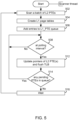
- FIG. 5 depicts a flow of operations of scanner thread 302.
- scanner thread 302 scans a batch of L2 page table entries (L2 PTEs 306) for pointers to (e.g., machine addresses of) either existing L1 page tables, each of which includes PTEs that point to a set of small pages, or a large page (e.g., 2 MB page)
- L2 page table entries L2 PTEs 306
- pointers e.g., machine addresses of
- L1 page tables e.g., machine addresses of
- a large page e.g., 2 MB page
- scanner thread 302 creates an L1 page table for the L2 page table entry.
- Each such L1 page table contains PTEs that point to a set of small pages (e.g., 4 KB pages) that make up the one large page.
- the L1 page tables are used for page translation to enable observer 310 to track accesses to small pages that are made through the scanned L2 page table entries.
- scanner thread 302 adds entries to an L1_PTE queue 308. Each added entry corresponds to a set of PTEs of one of the existing or new L1 page tables, and contains a machine address (MA) of the starting PTE of the set, a bitmap indicating which of the PTEs in the set are valid, and space for observer 310 to indicate that observer 310 has read the entry and pulled the set of PTEs corresponding to the entry into CXL cache 164.
- MA machine address
- scanner thread 302 sets up a polling interval for examining L1_PTE queue 308 to determine whether or not observer 310 has finished pulling in all PTEs of an L1 page table into CXL cache 164.
- scanner thread 302 determines from L1_PTE queue 308 that observer 310 has finished pulling in all PTEs of an L1 page table into CXL cache 164, scanner thread 302 in step 512 updates the corresponding L2 page table entry as needed (to point to a new L1 page table if it was created in step 504) and flushes the TLB so that any new accesses to the pages of the L1 page table (existing or new) can be observed.
- step 514 if scanner thread 302 determines from L1_PTE queue 308 that not all PTEs in L1_PTE queue 308 have been pulled into CXL cache 164 (step 514, Yes), scanner thread 302 returns to step 508 for the next polling interval. If all PTEs in L1_PTE queue 308 have been pulled into CXL cache 164 (step 514, No), scanner thread 302 waits a short time in step 516 and then resumes the operations at step 502.
- FIG. 6 depicts a flow of operations of observer 310.
- Observer 310 tracks accesses to small pages that are made through the L2 page table entries scanned by scanner thread 302 and moves the small pages that are not accessed during a predefined timer period (referred to herein as a "cooking" period) to the address space of NVM 116 (initially to CXL memory cache 166 and later written back to NVM 116).
- observer 310 accesses L1_PTE queue 308 to retrieve memory locations of L1 PTEs and pulls (reads) the L1 PTEs into cache lines of CXL cache 164.
- the size of cache lines of CXL cache 164 may be any typical cache line size, e.g., 32, 64 and 128 bytes. Therefore, a single cache line of CXL cache 164 is large enough to store multiple L1 PTEs, e.g., 16 L1 PTEs if the cache line size is 64 bytes and each PTE is 4 bytes.
- Observer 310 also sets the bits in L1_PTE queue 308 corresponding to the L1 PTEs as they are pulled into CXL cache 164, and starts a timer, which is set to the cooking period, for each L1 page table when all PTEs thereof have been pulled into CXL cache 164.
- step 608 observer 310 prepares a separate cache line (CL) bitmap for each of the L1 page tables.
- CL bitmap represents a set of L1 PTEs that have been pulled into the cache line and is set by observer 310 when one of the L1 PTEs is accessed, and the cache line containing the accessed L1 PTE is evicted from CXL cache 164.
- observer 310 adds entries to an L1_PTE filter queue 312, which is used by hot filter thread 314. Each added entry contains a machine address of one of the L1 page tables and the CL bitmap for the L1 page table, the CL bitmap indicating the cache lines evicted from CXL cache 164.
- Observer 310 carries out the remaining steps of FIG. 6 each time a timer for an L1 page table (or alternatively, a timer for a set of L1 PTEs) expires. If the timer for an L1 page table has expired (step 612, Yes), observer 310 in step 616 moves all pages of PTEs of such L1 page table that remains in CXL cache 164 (because they were not evicted from), from RAM 106 to NVM 116 (with CXL memory cache 166 functioning as a cache of NVM 116).
- the process of moving each such page includes the steps of: (i) allocating a page in NVM 116; (ii) performing a DMA copy of the page residing in RAM 106 to the page residing in NVM 116; and (iii) updating the PTE of the page to point to the page residing in NVM 116. If, during the process of moving the pages, a cache line containing the PTEs gets evicted from CXL cache 164, observer 310 discards the cache line and any pages of PTEs stored in the evicted cache line that have not yet been moved, remain in RAM 106. When the timers of all L1 page tables have expired (step 618, Yes), observer 310 waits a short time in step 620 and then resumes the operations at step 604.
- step 616 the updating of the PTE of the page to point to the page residing in NVM 116 is performed atomically.
- the atomic update can be carried out in one of several ways.
- observer 310 may be configured to support the atomic update, in particular an atomic compare-and-swap.
- a compare-and-swap operation is performed with the compare value having the access bit set to 0. If the page is being accessed before the swap, then the A bit would be set, and the compare will fail, which means the address will not be updated.
- Checking for access bit being 0 covers the race case, where the page is accessed and the cache line evicted, just before the write to update the PTE.
- the CXL logic 152 may be configured to support a conditional write which is dependent on the cache line still being in CXL cache 164. This mechanism does not need to have the access bit set by observer 310. In instead, observer 310 will issue this conditional write to update the PTE.
- the hardware and software can also cooperate and perform this function without the need for special logic, or locks.
- the hardware can clear the present bit (or bits), with a byte write, without affecting the other bits. After clearing, the access bit is checked to see if it is still 0, before updating the PTE with the present bit(s) enabled. If the host accesses the page before the present bit clearing was done, then the access bit will be 1, and the address update will not happen. If the host accesses the page after the present bit(s) were cleared, a page fault will be raised, prompting a page fault handler to handle the page fault.
- hypervisor 111 performs the remaps.
- CXL device 112 provides a list of cache line states, with 1 indicating which cache line is still present in CXL cache 164, and a 0 indicating which cache line was evicted. This list is used in conjunction with the access bit to remap the demoted pages to NVM 116.
- CXL device 112 handles the re-mappings for the PTEs at the granularity of cache lines that were not evicted
- hypervisor 111 handles the re-mappings for individual PTEs that are cold (not accessed) within the cache lines that were evicted.
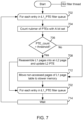
- FIG. 7 depicts a flow of operations of hot filter thread 314, which accesses L1_PTE filter queue 312 to determine if the pages of any L1 page table should be reassembled as a large page and if not to find additional pages to move to slower memory, e.g., from RAM 106 to NVM 116.
- the operations of FIG. 7 are carried out for each entry in L1_PTE filter queue 312, which corresponds to an L1 page table (step 702).
- hot filter thread 314 accesses the PTEs of the L1 page table and counts the number of PTEs having the A bit set among the accessed PTEs.
- hot filter thread 314 in step 708 reassembles the pages of the L1 page table into a large page and updates the L2 page table entry to point to the large page.
- hot filter thread 314 in step 712 moves all non-accessed pages of PTEs of the L1 page table that were stored in evicted cache lines from RAM 106 to NVM 116. The process of moving is the same as described above for step 616.
- hot filter thread 314 waits a short time in step 714 (e.g., for a new entry to be added to L1_PTE filter queue 312) and then resumes the operations at step 702.
- FIG. 8 depicts a flow of operations of promoter 402.
- the task of promoter 402 is to identify those pages in NVM 116 which can be promoted back to RAM 106. Each such page is identified by a page number in CXL memory space, hereinafter referred to as a CXL page number.
- the operations of FIG. 8 are carried out for each page that are brought into CXL memory cache 166 (step 802).
- a page that is brought into CXL memory cache 166 may be of two types. Pages that are brought into CXL memory cache 166 when they are cached in CXL memory cache 166 in the process of moving them to NVM 116 in step 616 and step 712 described above, are of a first type.
- Pages that are brought into CXL memory cache 166 from NVM 116 as a result of access because they are not cached in CXL memory cache 166 are of a second type.
- promoter 402 sets a timer for the page.
- the timer period may be differently for the first type of page and the second type of page to allow for flexibility.
- the timer period is set to be shorter for pages of the first type than for pages of the second type, because pages recently moved from RAM 106 are likely to have a higher degree of activity while those already residing in NVM 116 are likely to have been idle for a while.
- promoter 402 increments an access count for the page each time the page is accessed during its timer period.
- promoter 402 instead of storing an access count for each page, uses a Count-Min Sketch (CMS) structure, which employs a table accessed by a hash of the page number to store a count for the page. The structure is queried using the hash function to retrieve the count for the page. When CMS is used, fewer locations are needed to store a count for each page accessed, but the count stored is an approximate count. If, before its timer has expired, as determined in step 810, the access count for the page exceeds an access threshold (step 812, Yes), the CXL page number of the page is added to promotion queue 404 in step 814. Similarly to the timer period, the access threshold may be set differently for the first type of page and the second type of page.
- CMS Count-Min Sketch
- step 810 If the timer expires (step 810, Yes) prior to the access count for the page exceeding the access threshold, the page is copied to NVM 116 in step 816 and removed from CXL memory cache 166 in step 818.
- promoter 402 waits a short time in step 820 (e.g., for a page to be inserted into CXL memory cache 166) and then resumes the operations at step 802.
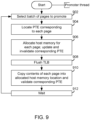
- FIG. 9 depicts a flow of operations of promoter thread 406.
- the task of promoter thread 406 is to move a page residing in NVM 116 back to RAM 106.
- promoter thread 406 selects a batch of pages residing in NVM 116 from promotion queue 404, for promotion.
- promoter thread 406 accesses a back map to locate the PTEs that point to the selected pages.
- the back map provides mappings from CXL page numbers of pages residing in NVM 116 to memory addresses of PTEs that point to them, and is updated each time a page is moved from RAM 106 to NVM 116.
- step 906 promoter thread 406 allocates memory space in RAM 106 for the selected pages, updates the PTEs located in step 904 with pointers to the allocated memory space in RAM 106, and invalidates the PTEs because the contents of the selected pages have not been copied yet.
- step 908 the TLB is flushed so that any mappings to the selected pages residing in NVM 116 that are cached in the TLB are deleted.
- step 910 promoter thread 406 performs a DMA copy of the contents of the selected pages from NVM 116 to the allocated memory space in RAM 106, and validates the PTEs.
- promoter thread 406 waits a short time in step 912 and then resumes the operations at step 902 for a new batch of pages to promote.
- Certain embodiments as described above involve a hardware abstraction layer on top of a host computer.
- the hardware abstraction layer allows multiple contexts to share the hardware resource. These contexts are isolated from each other in one embodiment, each having at least a user application program running therein.
- the hardware abstraction layer thus provides benefits of resource isolation and allocation among the contexts.
- virtual machines are used as an example for the contexts and hypervisors as an example for the hardware abstraction layer.
- each virtual machine includes a guest operating system in which at least one application program runs.
- OS-less containers see, e.g., www.docker.com).
- OS-less containers implement operating system-level virtualization, wherein an abstraction layer is provided on top of the kernel of an operating system on a host computer.
- the abstraction layer supports multiple OS-less containers, each including an application program and its dependencies.
- Each OS-less container runs as an isolated process in users pace on the host operating system and shares the kernel with other containers.
- the OS-less container relies on the kernel's functionality to make use of resource isolation (CPU, memory, block I/O, network, etc.) and separate namespaces and to completely isolate the application program's view of the operating environments.
- resource isolation CPU, memory, block I/O, network, etc.
- By using OS-less containers resources can be isolated, services restricted, and processes provisioned to have a private view of the operating system with their own process ID space, file system structure, and network interfaces.
- Multiple containers can share the same kernel, but each container can be constrained only to use a defined amount of resources such as CPU, memory, and I/O.
- Certain embodiments may be implemented in a host computer without a hardware abstraction layer or an OS-less container.
- certain embodiments may be implemented in a host computer running a Linux ® or Windows ® operating system.
- One or more embodiments of the present invention may be implemented as one or more computer programs or as one or more computer program modules embodied in one or more computer-readable media.
- the term computer-readable medium refers to any data storage device that can store data which can thereafter be input to a computer system.
- Computer-readable media may be based on any existing or subsequently developed technology for embodying computer programs in a manner that enables them to be read by a computer.
- Examples of a computer-readable medium include a hard drive, network-attached storage (NAS), read-only memory, random-access memory (e.g., a flash memory device), a CD (Compact Discs) --CD-ROM, a CDR, or a CD-RW, a DVD (Digital Versatile Disc), a magnetic tape, and other optical and non-optical data storage devices.
- NAS network-attached storage
- read-only memory e.g., a flash memory device
- CD Compact Discs
- CD-ROM Compact Discs --CD-ROM
- CDR Compact Disc
- CD-RW Digital Versatile Disc
- DVD Digital Versatile Disc
Landscapes
- Engineering & Computer Science (AREA)
- Theoretical Computer Science (AREA)
- Physics & Mathematics (AREA)
- General Engineering & Computer Science (AREA)
- General Physics & Mathematics (AREA)
- Memory System Of A Hierarchy Structure (AREA)
Applications Claiming Priority (1)
| Application Number | Priority Date | Filing Date | Title |
|---|---|---|---|
| US18/160,221 US20240256459A1 (en) | 2023-01-26 | 2023-01-26 | System and method for managing a memory hierarchy |
Publications (2)
| Publication Number | Publication Date |
|---|---|
| EP4407472A1 true EP4407472A1 (de) | 2024-07-31 |
| EP4407472B1 EP4407472B1 (de) | 2025-09-17 |
Family
ID=89723046
Family Applications (1)
| Application Number | Title | Priority Date | Filing Date |
|---|---|---|---|
| EP24153952.7A Active EP4407472B1 (de) | 2023-01-26 | 2024-01-25 | System und verfahren zur verwaltung einer speicherhierarchie |
Country Status (2)
| Country | Link |
|---|---|
| US (1) | US20240256459A1 (de) |
| EP (1) | EP4407472B1 (de) |
Families Citing this family (1)
| Publication number | Priority date | Publication date | Assignee | Title |
|---|---|---|---|---|
| US12505048B2 (en) * | 2023-09-22 | 2025-12-23 | Rambus Inc. | Memory module with memory-ownership exchange |
Citations (4)
| Publication number | Priority date | Publication date | Assignee | Title |
|---|---|---|---|---|
| US9330015B2 (en) * | 2014-06-11 | 2016-05-03 | Vmware, Inc. | Identification of low-activity large memory pages |
| US10474580B2 (en) * | 2016-09-22 | 2019-11-12 | Google Llc | Memory management supporting huge pages |
| US20210019069A1 (en) * | 2019-10-21 | 2021-01-21 | Intel Corporation | Memory and storage pool interfaces |
| US20210049101A1 (en) * | 2019-08-13 | 2021-02-18 | Micron Technology, Inc. | MEMORY TIERING USING PCIe CONNECTED FAR MEMORY |
Family Cites Families (3)
| Publication number | Priority date | Publication date | Assignee | Title |
|---|---|---|---|---|
| WO2014143053A1 (en) * | 2013-03-15 | 2014-09-18 | Intel Corporation | Dead block predictors for cooperative execution in the last level cache |
| TWI525635B (zh) * | 2013-12-17 | 2016-03-11 | 慧榮科技股份有限公司 | 資料儲存裝置及其資料維護方法 |
| US12417121B2 (en) * | 2021-10-29 | 2025-09-16 | Intel Corporation | Memory pool management |
-
2023
- 2023-01-26 US US18/160,221 patent/US20240256459A1/en not_active Abandoned
-
2024
- 2024-01-25 EP EP24153952.7A patent/EP4407472B1/de active Active
Patent Citations (4)
| Publication number | Priority date | Publication date | Assignee | Title |
|---|---|---|---|---|
| US9330015B2 (en) * | 2014-06-11 | 2016-05-03 | Vmware, Inc. | Identification of low-activity large memory pages |
| US10474580B2 (en) * | 2016-09-22 | 2019-11-12 | Google Llc | Memory management supporting huge pages |
| US20210049101A1 (en) * | 2019-08-13 | 2021-02-18 | Micron Technology, Inc. | MEMORY TIERING USING PCIe CONNECTED FAR MEMORY |
| US20210019069A1 (en) * | 2019-10-21 | 2021-01-21 | Intel Corporation | Memory and storage pool interfaces |
Non-Patent Citations (2)
| Title |
|---|
| NEHA AGARWAL ET AL: "Thermostat : Application-transparent Page Management for Two-tiered Main Memory", ARCHITECTURAL SUPPORT FOR PROGRAMMING LANGUAGES AND OPERATING SYSTEMS, 1 January 2017 (2017-01-01), 2 Penn Plaza, Suite 701 New York NY 10121-0701 USA, pages 631 - 644, XP055674816, ISBN: 978-1-4503-4465-4, DOI: 10.1145/3037697.3037706 * |
| WANG XIAOYUAN XIAOYUANW@HUST EDU CN ET AL: "Supporting Superpages and Lightweight Page Migration in Hybrid Memory Systems", ACM TRANSACTIONS ON ARCHITECTURE AND CODE OPTIMIZATION, ASSOCIATION FOR COMPUTING MACHINERY, US, vol. 16, no. 2, 9 April 2019 (2019-04-09), pages 1 - 26, XP058673067, ISSN: 1544-3566, DOI: 10.1145/3310133 * |
Also Published As
| Publication number | Publication date |
|---|---|
| US20240256459A1 (en) | 2024-08-01 |
| EP4407472B1 (de) | 2025-09-17 |
Similar Documents
| Publication | Publication Date | Title |
|---|---|---|
| US8719545B2 (en) | System and method for improving memory locality of virtual machines | |
| US10496547B1 (en) | External disk cache for guest operating system in a virtualized environment | |
| US8359451B2 (en) | Management of host physical memory allocation to virtual machines with a balloon application | |
| EP1131721B1 (de) | Speicherverwaltungseinheit für java-umgebungs-rechner und verfahren hierfür | |
| US9547600B2 (en) | Method and system for restoring consumed memory after memory consolidation | |
| US7376949B2 (en) | Resource allocation and protection in a multi-virtual environment | |
| US7788464B2 (en) | Scalability of virtual TLBs for multi-processor virtual machines | |
| US9760493B1 (en) | System and methods of a CPU-efficient cache replacement algorithm | |
| US7631147B2 (en) | Efficient flushing of translation lookaside buffers in a multiprocessor environment | |
| US8140834B2 (en) | System, method and computer program product for providing a programmable quiesce filtering register | |
| US20130031293A1 (en) | System and method for free page hinting | |
| US11237985B2 (en) | Controlling allocation of entries in a partitioned cache | |
| KR102026877B1 (ko) | 메모리 관리 유닛 및 그 동작 방법 | |
| Peleg et al. | Utilizing the {IOMMU} scalably | |
| US8458438B2 (en) | System, method and computer program product for providing quiesce filtering for shared memory | |
| WO2013023090A2 (en) | Systems and methods for a file-level cache | |
| EP4377805A1 (de) | Dynamisch zuweisbare metadatenspeicherung mit physischer adressierung | |
| EP4407472B1 (de) | System und verfahren zur verwaltung einer speicherhierarchie | |
| Franke | Operating Systems |
Legal Events
| Date | Code | Title | Description |
|---|---|---|---|
| PUAI | Public reference made under article 153(3) epc to a published international application that has entered the european phase |
Free format text: ORIGINAL CODE: 0009012 |
|
| STAA | Information on the status of an ep patent application or granted ep patent |
Free format text: STATUS: THE APPLICATION HAS BEEN PUBLISHED |
|
| AK | Designated contracting states |
Kind code of ref document: A1 Designated state(s): AL AT BE BG CH CY CZ DE DK EE ES FI FR GB GR HR HU IE IS IT LI LT LU LV MC ME MK MT NL NO PL PT RO RS SE SI SK SM TR |
|
| STAA | Information on the status of an ep patent application or granted ep patent |
Free format text: STATUS: REQUEST FOR EXAMINATION WAS MADE |
|
| 17P | Request for examination filed |
Effective date: 20250109 |
|
| GRAP | Despatch of communication of intention to grant a patent |
Free format text: ORIGINAL CODE: EPIDOSNIGR1 |
|
| STAA | Information on the status of an ep patent application or granted ep patent |
Free format text: STATUS: GRANT OF PATENT IS INTENDED |
|
| RIC1 | Information provided on ipc code assigned before grant |
Ipc: G06F 12/128 20160101ALI20250325BHEP Ipc: G06F 12/123 20160101ALI20250325BHEP Ipc: G06F 12/122 20160101ALI20250325BHEP Ipc: G06F 12/1009 20160101ALI20250325BHEP Ipc: G06F 12/0811 20160101AFI20250325BHEP |
|
| RAP3 | Party data changed (applicant data changed or rights of an application transferred) |
Owner name: VMWARE LLC |
|
| INTG | Intention to grant announced |
Effective date: 20250410 |
|
| GRAS | Grant fee paid |
Free format text: ORIGINAL CODE: EPIDOSNIGR3 |
|
| GRAA | (expected) grant |
Free format text: ORIGINAL CODE: 0009210 |
|
| STAA | Information on the status of an ep patent application or granted ep patent |
Free format text: STATUS: THE PATENT HAS BEEN GRANTED |
|
| AK | Designated contracting states |
Kind code of ref document: B1 Designated state(s): AL AT BE BG CH CY CZ DE DK EE ES FI FR GB GR HR HU IE IS IT LI LT LU LV MC ME MK MT NL NO PL PT RO RS SE SI SK SM TR |
|
| REG | Reference to a national code |
Ref country code: GB Ref legal event code: FG4D |
|
| REG | Reference to a national code |
Ref country code: CH Ref legal event code: EP |
|
| REG | Reference to a national code |
Ref country code: IE Ref legal event code: FG4D |
|
| REG | Reference to a national code |
Ref country code: DE Ref legal event code: R096 Ref document number: 602024000657 Country of ref document: DE |
|
| REG | Reference to a national code |
Ref country code: NL Ref legal event code: FP |
|
| PG25 | Lapsed in a contracting state [announced via postgrant information from national office to epo] |
Ref country code: NO Free format text: LAPSE BECAUSE OF FAILURE TO SUBMIT A TRANSLATION OF THE DESCRIPTION OR TO PAY THE FEE WITHIN THE PRESCRIBED TIME-LIMIT Effective date: 20251217 |
|
| REG | Reference to a national code |
Ref country code: LT Ref legal event code: MG9D |
|
| PG25 | Lapsed in a contracting state [announced via postgrant information from national office to epo] |
Ref country code: FI Free format text: LAPSE BECAUSE OF FAILURE TO SUBMIT A TRANSLATION OF THE DESCRIPTION OR TO PAY THE FEE WITHIN THE PRESCRIBED TIME-LIMIT Effective date: 20250917 |
|
| PG25 | Lapsed in a contracting state [announced via postgrant information from national office to epo] |
Ref country code: HR Free format text: LAPSE BECAUSE OF FAILURE TO SUBMIT A TRANSLATION OF THE DESCRIPTION OR TO PAY THE FEE WITHIN THE PRESCRIBED TIME-LIMIT Effective date: 20250917 |
|
| PGFP | Annual fee paid to national office [announced via postgrant information from national office to epo] |
Ref country code: FR Payment date: 20251217 Year of fee payment: 3 |
|
| PG25 | Lapsed in a contracting state [announced via postgrant information from national office to epo] |
Ref country code: GR Free format text: LAPSE BECAUSE OF FAILURE TO SUBMIT A TRANSLATION OF THE DESCRIPTION OR TO PAY THE FEE WITHIN THE PRESCRIBED TIME-LIMIT Effective date: 20251218 |
|
| PG25 | Lapsed in a contracting state [announced via postgrant information from national office to epo] |
Ref country code: SE Free format text: LAPSE BECAUSE OF FAILURE TO SUBMIT A TRANSLATION OF THE DESCRIPTION OR TO PAY THE FEE WITHIN THE PRESCRIBED TIME-LIMIT Effective date: 20250917 |
|
| PG25 | Lapsed in a contracting state [announced via postgrant information from national office to epo] |
Ref country code: LV Free format text: LAPSE BECAUSE OF FAILURE TO SUBMIT A TRANSLATION OF THE DESCRIPTION OR TO PAY THE FEE WITHIN THE PRESCRIBED TIME-LIMIT Effective date: 20250917 |
|
| PG25 | Lapsed in a contracting state [announced via postgrant information from national office to epo] |
Ref country code: BG Free format text: LAPSE BECAUSE OF FAILURE TO SUBMIT A TRANSLATION OF THE DESCRIPTION OR TO PAY THE FEE WITHIN THE PRESCRIBED TIME-LIMIT Effective date: 20250917 |
|
| PG25 | Lapsed in a contracting state [announced via postgrant information from national office to epo] |
Ref country code: RS Free format text: LAPSE BECAUSE OF FAILURE TO SUBMIT A TRANSLATION OF THE DESCRIPTION OR TO PAY THE FEE WITHIN THE PRESCRIBED TIME-LIMIT Effective date: 20251217 |